Chapter
1. The First Stone of Notre-Dame de Paris: Who Really Began Construction in 1163?
Chapter
1.1 Bishop Maurice de Sully: The Genius Behind the Vision of Notre-Dame de Paris
The story of Notre-Dame de Paris begins with a man whose name should be as famous as the monument he envisioned: Maurice de Sully. Born into a humble family on the banks of the Loire River, the peasant boy who once begged for bread on the streets of Paris rose with meteoric speed to the position of Bishop of Paris in 1160 — a social leap made possible only by the medieval ecclesiastical ecosystem, where intellectual talent could, on occasion, triumph over birth. A man of fiery oratory and unprecedented architectural vision, Maurice de Sully understood that Paris needed a symbol: not merely a church, but a manifesto in stone and light that would declare to the Christian world that the Capetian capital had arrived to stay.
The genius of Maurice de Sully lay not only in the pulpit — it was in his ability to articulate political power, theology, and architecture within a single monumental project. He knew that the Romanesque style, with its massive walls and tiny windows, no longer matched the ambition of a city fast becoming the intellectual heart of Europe. The bishop studied the innovations then emerging at Saint-Denis, where Abbot Suger was experimenting with the first pointed arches and narrative stained glass, and decided that Paris deserved something even greater: a cathedral that would transform light into divine language. In 1163, with the direct support of King Louis VII and the blessing of Pope Alexander III, Maurice de Sully laid the foundations of what would become the masterpiece of the Gothic style.
What makes Maurice de Sully a tragic and fascinating figure is that he never saw his cathedral completed. He died on 11 September 1196, when only the nave and the choir had been raised — roughly one third of the total project. Yet his vision was so precise, so meticulously documented in plans and instructions passed down to the trade guilds, that the builders who succeeded him followed his original design for nearly two centuries. The Notre-Dame we behold today is, in essence, the dream of a peasant who dared to think on a divine scale, financed by the royal treasury and executed by anonymous hands that turned blocks of limestone into petrified prayer. The bishop's tomb, once located in the cathedral choir, was desecrated during the French Revolution — but his true headstone is the twin towers 69 metres high that still cut into the Parisian sky.
Chapter
1.2 Why Was the Île de la Cité Chosen to Build Notre-Dame de Paris?
The Île de la Cité was not chosen to house Notre-Dame de Paris — it demanded the cathedral as the logical consequence of two millennia of history accumulated on its 22 hectares of sacred ground. This river island, which the Celtic Parisii chose as a ritual centre long before Julius Caesar set foot in Gaul, is the geographic womb of France: every Roman road converged upon its wooden bridges, every Merovingian and Carolingian coronation took place at its altars, every market and tribunal established itself on its banks. When Maurice de Sully assumed the bishopric, the Île de la Cité already throbbed as the nerve centre of a Paris growing at a dizzying pace — and the old Romanesque church of Saint-Étienne, which occupied the site, simply could not compete with the city that had become the fixed capital of the kingdom.
The position of the Île de la Cité at the heart of the River Seine represented a monumental logistical advantage for a project that would consume nearly two centuries. The subterranean limestone quarries that supplied the "pierre de Paris" — the fine-grained, cream-coloured Lutetian limestone that gave the cathedral its characteristic hue — lay within navigable distance, and barges carried the blocks directly down the Seine to the worksite on the island. Timber for scaffolding and roofing floated down from the forests of Champagne along the same river. Iron for joints and cramps came from the forges of Faubourg Saint-Antoine. The island functioned as a natural unloading port, where materials sourced from tens of kilometres around converged on a single point — a logistical gearwork that explains how a project of such magnitude could advance even in the depths of the Middle Ages, without motorised cranes or transport lorries.
There is, however, a deeper and more symbolic layer to this choice. The Île de la Cité was not merely strategic — it was a temporal crossroads connecting the pagan past to the Christian future. On the ground where Notre-Dame rises, archaeological layers reveal an extraordinary succession: first a Roman temple dedicated to Jupiter, where the legionaries of Tiberius offered sacrifices; then a Merovingian basilica of the 6th century, raised when Clovis anointed Paris the capital of the Frankish kingdom; next a Carolingian cathedral of the 9th century, enlarged by the grandsons of Charlemagne; and finally the Romanesque church of Saint-Étienne, with its walls two metres thick. Every new faith, every new dynasty, every new power had to plant its flag on that exact spot — on the very soil the Parisii considered a point of communication between worlds. The political genius of Maurice de Sully was to grasp that the Gothic — with its vertical aspiration, its transfiguring light, its theology of the transcendent — would be the definitive layer of this sacred stratigraphy.
Medieval records also indicate that the Île de la Cité was the demographic epicentre of 12th-century Paris, housing around 3,000 permanent inhabitants among clerics, artisans, and merchants who served the diocese. The cathedral was not built in some remote spot but in the throbbing heart of the city — labourers worked to the sound of goldsmiths' hammers, the shouts of fishmongers in the nearby market, and the processions that crossed the Parvis daily. This proximity to urban life was no accident: Notre-Dame was conceived as a cathedral of the people, open to weary pilgrims arriving on foot, to merchants closing deals in its forecourt, and to beggars sleeping beneath its portals. The western facade, with its three monumental doors, was effectively the living room of Paris — the place where the city met itself.
Finally, the choice of the Île de la Cité carried a subtle but crucial geological dimension: the island's subsoil, formed by a compact layer of sealed plastic clay atop the rocky bed of the Seine, offered an exceptionally stable foundation for a structure that would reach 35 metres in height in the nave and 69 metres in the towers. The medieval builders intuitively understood what modern engineering would confirm centuries later: without the "clay cushion" of the island, which evenly distributes the colossal pressure exerted by hundreds of tonnes of limestone, the foundations of Notre-Dame would have given way under their own weight within decades of completion. Geology, in this sense, also conspired in the cathedral's favour — and Maurice de Sully, when he drove the first site stake in 1163, sealed a pact between the stone of the subsoil and the stone of the edifice, a pact that has remained intact for more than 850 years.
Chapter
1.3 The 4 Previous Temples: The Secret History Beneath Notre-Dame de Paris
Before the first block of Gothic Notre-Dame was laid in 1163, the ground of the Île de la Cité had already witnessed four successive incarnations of the sacred — an archaeological stratigraphy that recounts, in layers of stone and ash, the religious history of France itself. The oldest temple identified on the site was a pagan Roman sanctuary dedicated to Jupiter, likely raised during the reign of Emperor Tiberius in the 1st century AD, when Lutetia was a prosperous provincial city of the Empire. Excavations carried out in the 19th century during the restoration works led by Viollet-le-Duc uncovered fragments of the altar of Jupiter — a votive column with partially legible Latin inscriptions mentioning the nautae (the boatmen of the Seine) as sponsors. It was the official cult of Rome, the religion of the imperial State, rooted on the very spot where, a thousand years later, Christianity would raise its definitive architectural victory.
The second layer belonged to the Merovingian dynasty, that lineage of long-haired Frankish kings with names such as Childebert I and Chlothar II who ruled between the 5th and 8th centuries. Around the 6th century, atop the ruins of the pagan temple, a Merovingian basilica was built and dedicated to Saint Stephen — the first Christian martyr, stoned in Jerusalem for claiming to have seen the heavens open. It was a modest basilica compared with what would follow: a single nave, a wooden roof, and columns repurposed directly from the Roman ruins — a common practice known as spolia, whereby victors physically incorporated the spoils of the vanquished into their monuments. The Merovingians, converted to orthodox Christianity since the baptism of Clovis in 496, planted their alliance with the Church of Rome right there: where once sacrifices were made to Jupiter, now the Gloria was sung to the Christian God.
The third incarnation came with the rise of the Carolingian dynasty in the 9th century, when the descendants of Charlemagne — emperors of a realm stretching from the Pyrenees to the Elbe — decided the old Merovingian basilica no longer reflected imperial power. The Carolingian cathedral raised on the site was significantly larger: it incorporated a rudimentary transept, a crypt for relics, and an elevated choir where the canons chanted the divine office. Documents from the reign of Charles the Bald, grandson of Charlemagne, mention substantial donations to this cathedral, including a fragment of the True Cross that drew pilgrims from across the kingdom. This cathedral survived Viking raids that swept up the Seine in the 9th and 10th centuries — the Norsemen sacked Paris at least three times, yet strangely spared the religious building, perhaps out of superstition, perhaps out of political calculation by chieftains who negotiated conversion to Christianity as currency for peace.
The fourth and final direct predecessor of Notre-Dame was the Romanesque church of Saint-Étienne, which occupied the site from the 11th century until its partial demolition in 1163 to make way for the new Gothic project. We know details of this church — which combined the name of the protomartyr Stephen with the Marian title, officially called Saint-Étienne-Notre-Dame — through 12th-century chronicles and archaeological fragments: walls two metres thick, windows as narrow as castle loopholes, a western block flanked by two squat towers. It was the ultimate expression of Parisian Romanesque, a style that favoured solidity and dimness over lightness and light. The church housed, in addition to the relics of the True Cross, a fragment of the Crown of Thorns that King Louis IX (Saint Louis) would acquire in 1239 for a sum equivalent to half the annual budget of the kingdom — a relic later transferred to the Sainte-Chapelle and, on solemn feast days, displayed at the high altar of the very Notre-Dame then under construction.
The decision by Maurice de Sully to demolish Saint-Étienne in order to build Notre-Dame was not an act of iconoclastic vandalism but of theological continuity. The bishop ordered the old Romanesque church to be dismantled meticulously — stone by stone — while the new Gothic choir was already beginning to rise just a few metres away. The stones of Saint-Étienne were repurposed: some went into the foundations of the new building, others were sold to finance the works, and the most symbolic ones were crushed and mixed into the mortar that would bind the blocks of Gothic Notre-Dame. The gesture carried precise liturgical symbolism: the old and the new did not oppose each other but fused into a single ecclesial body. The Roman, Merovingian, Carolingian, and Romanesque past was not denied — it was absorbed, like a river receiving tributaries without losing its course. Notre-Dame de Paris rests, to this day, upon this stratigraphy of beliefs: four previous temples that became, quite literally, the foundations of the fifth and definitive one.
Chapter
1.4 The First Stone Ceremony in 1163: What Really Happened?
The year 1163 marks the official baptism of Notre-Dame de Paris, but what exactly took place on that spring day — most likely between March and June, when the Seine rains gave the worksite a reprieve — remains shrouded in layers of legend and scant documentation. There is no notarial deed, no contemporary painting, no eyewitness account that describes the founding gesture with precision. What we know comes from later monastic chronicles, such as that of Robert de Torigni, abbot of Mont-Saint-Michel, who recorded laconically: *"This year, the bishop of Paris began the new church of Our Lady"* — a phrase that, in its monastic dryness, conceals what must have been one of the most theatrical events of 12th-century Paris. The first stone ceremony was, in the Middle Ages, a political-theological spectacle that mobilised the entire hierarchy of the city and the kingdom.
The medieval foundation liturgy followed a strict protocol dating back to the Old Testament, where the Book of Ezra described the rebuilding of the Temple of Jerusalem with hymns, sacrifices, and the ritual laying of the foundations. For Notre-Dame, Pope Alexander III — who at that very moment was in exile in Sens, 100 kilometres from Paris, fleeing the antipope Victor IV backed by Emperor Frederick Barbarossa — sent his apostolic blessing to Bishop Maurice de Sully. The papal gesture was also political: by blessing the Parisian cathedral, Alexander III reaffirmed his authority over the diocese of Paris and, by extension, over King Louis VII, who attended the ceremony with his retinue of barons and knights. The royal presence at the moment of the first stone sealed the alliance between Crown and Mitre — Notre-Dame was born, quite literally, as a project of State.
The ritual itself included the demarcation of the future cathedral's perimeter with blessed wooden stakes, the sprinkling of holy water over the ground by Maurice de Sully, and the deposition of the cornerstone into a previously excavated cavity. The stone — almost certainly a rectangular block of Lutetian limestone bearing a carved cross and possibly a cavity to hold relics — was sealed with mortar and covered with a sheet of lead engraved with the Chrismon (the monogram of Christ formed by the Greek letters X and P) and the year of foundation. Symbolic objects — coins from the reign of Louis VII, fragments of liturgical pottery, perhaps an episcopal ring — were deposited beside the stone, sealing what archaeologists would call a "foundation deposit," a time capsule that materialised the hopes and ambitions of the age. None of these objects has yet been found in excavations — and perhaps never will be, preserved beneath layers of foundations that support the 69-metre towers.
What makes the 1163 ceremony especially significant is that it marks Paris's definitive transition from a Romanesque city to a Gothic metropolis. While Bishop Maurice de Sully lowered the first stone into the choir of the future cathedral, labourers had already been at work for months on the foundations — a contradiction only in appearance, for in the medieval mind the project "began" liturgically, not structurally. The canons of the Saint-Étienne chapter — who would soon see their Romanesque church demolished — took part in the ceremony wearing their finest vestments, intoning the Te Deum, the Church's great hymn of thanksgiving. The crowd of Parisians, jostling on the esplanade that would become the Parvis, witnessed a foundational act whose full significance none of them could anticipate: they were watching the birth of the building that, 850 years later, would still be the heart of Paris.
Chapter
2. The Construction of Notre-Dame de Paris: 180 Years of Gothic Building and Its Secrets
Chapter
2.1 Phase 1 (1163-1200): How the Body of the Nave of Notre-Dame de Paris Came to Be
The first phase of the construction of Notre-Dame de Paris — the 37 years stretching from 1163 to 1200 — was devoted to raising the primordial skeleton of the cathedral: the choir, the central nave, and the double side aisles. It was not the most visible part, nor the most photogenic, but it was the backbone without which nothing else could exist. Bishop Maurice de Sully, who would die in 1196 without seeing even half of this first phase completed, had planned a nave of unprecedented proportions for the period: 35 metres in height from floor to vault, supported by cruciform pillars rising like the trunks of a petrified forest. By comparison, the vault of the Romanesque cathedral of Saint-Étienne that stood on the same site barely reached 15 metres — the Gothic ambition more than doubled the vertical scale, defying every known law of engineering at the time.
The Phase 1 worksite was a human anthill that mobilised hundreds of artisans organised into strictly hierarchical guilds: the stonemasons dressed the limestone blocks on the banks of the Seine, guided by wooden templates that reproduced the rib profiles at full scale; the stone carvers finished the mouldings and capitals; the carpenters assembled the centring — semicircular timber structures that held the vaults in place while the mortar cured; the blacksmiths forged the iron cramps that bound adjacent blocks together. A team of carters and hauliers transported the blocks from the barges to the worksite, using pulleys, treadwheel cranes (where men walked inside a large wooden wheel to generate traction), and rammed-earth inclined planes that snaked around the building. The logistics were as complex as the architecture itself — and it all worked without a single engine, without a single plan drawn on paper, relying only on the oral tradition of the guilds and proportional rules based on the human body.
The nave pillars of Notre-Dame, with their cylindrical shafts 1.3 metres in diameter, are not mere supports — they are the teeth of a structural gearwork that distributes loads with millimetric precision. Each pillar receives the weight of the six-part vault (sexpartite vault) that spans the main bay 12 metres wide, transmitting it through bundles of colonettes that rise from the floor to the springing of the arches. These colonettes, fine as pencils compared to the mass of the pillars, are not decorative — they are active structural elements that channel the force lines to the ground, creating what engineers call a "discharge rib." The brilliance of the design lies in the fact that the human eye reads these colonettes as graceful ornaments, when in truth they are stress conduits capable of bearing tonnes of lateral thrust. The Gothic, from its earliest phase at Notre-Dame, deliberately confuses structure and decoration — and it is precisely this ambiguity that gives the cathedral interior its atmosphere of seemingly miraculous lightness.
The choir of the cathedral — the eastern portion of the building, behind the high altar — was the first part to be completed and consecrated, allowing liturgical celebrations to begin as early as 1182, a mere 19 years after the laying of the first stone. This strategy of phased inauguration was deliberate: a functioning choir guaranteed continuous funding for the works, since the faithful's donations flowed more generously when the cathedral was already partially in use. Moreover, the daily liturgy of the chapter of canons — the seven canonical hours of the divine office, from Matins to Compline — took place literally inside a construction site, with the clergy chanting psalms as stonemasons struck chisels a few metres away and limestone dust mingled with altar incense. This coexistence of worship and construction, of the sacred and the labouring, marked the whole first phase and forged a peculiar community of faith and toil that lasted 37 years.
By the end of Phase 1, around the year 1200, the main body of Notre-Dame was essentially defined: a nave 128 metres long and 48 metres wide at the transept, with a capacity of 9,000 people, supported by a stone skeleton that no one had yet seen in its totality. The timber roof — the so-called "forest", so nicknamed for the staggering quantity of oak beams that composed it — already sheltered the vaults from Parisian rains. But the western facade, that face the world would forever associate with Notre-Dame, was still a rough, provisional wall, awaiting the second phase that would transform a functional body into an eternal icon.
Chapter
2.2 Phase 2 (1200-1250): The Western Facade and the Twin Towers of Notre-Dame de Paris
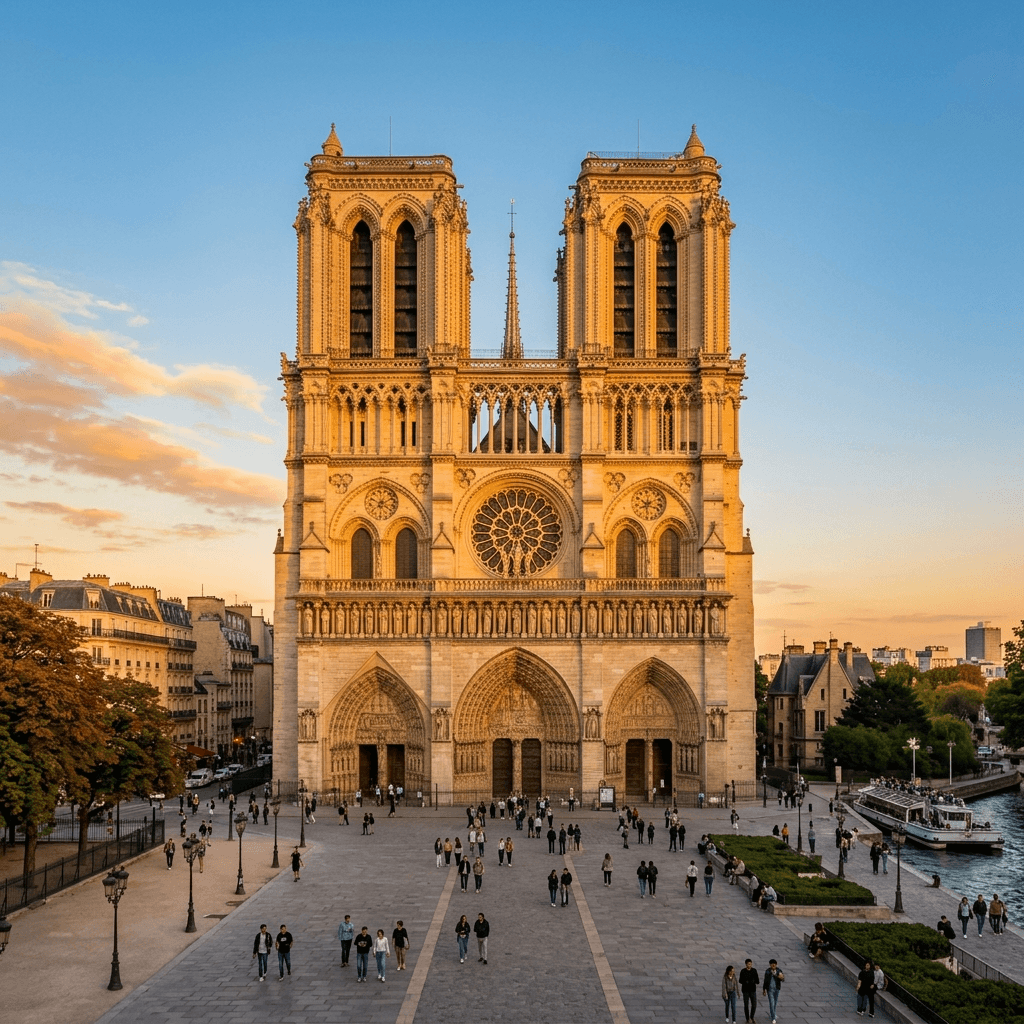
If Phase 1 gave Notre-Dame a body, Phase 2 — the 50 years between 1200 and 1250 — gave it a face. And what a face: the cathedral's western facade, with its two twin towers 69 metres high, its three monumental portals, and its Gallery of Kings, is quite possibly the most recognisable architectural composition in the medieval world. The design of this facade, conceived in the time of Maurice de Sully yet executed by a new generation of anonymous master builders, represents a remarkable evolution from Early Gothic to what historians call High Gothic — more vertical, more ornate, more structurally audacious. The western facade is not mere scenery; it is a theological machine that turns the visitor into a pilgrim before he even crosses the threshold of the church.
The organising principle of the facade is its division into three superimposed horizontal registers, each with a specific liturgical function. The lower register houses the three portals — the Portal of the Virgin (left), the Portal of the Last Judgement (centre), and the Portal of Saint Anne (right) — whose sculpted tympanums narrate, from left to right, the history of salvation: from the Virgin Mary to the Last Judgement, by way of the infancy of Christ. The middle register is dominated by the Gallery of Kings, a row of 28 colossal statues representing the kings of Judah and Israel, ancestors of Jesus according to the Gospel of Matthew — mistaken during the French Revolution for kings of France and beheaded by the revolutionaries. The upper register is pierced by the western rose window 10 metres in diameter, flanked by two twin arched openings that echo the towers above. This tripartite structure, with its proportions based on the number 3 (the three persons of the Trinity) and on the square (symbol of Earth and stability), composes a page of stone that the medieval faithful — largely illiterate — could "read" as though reading the Bible itself.
The twin towers of the western facade, each 69 metres high, were the last great undertaking of Phase 2 — and, in a sense, an unfinished conquest. The original design called for stone spires to crown each tower, raising them to roughly 90 metres, but the structural limitations of the foundations and, probably, a shortage of resources in the latter half of the 13th century left the towers with their flat top — a feature we today consider intrinsic to the silhouette of Notre-Dame, but which to the medieval builders represented a work suspended, not concluded. The ascent to the tower tops is made via a spiral staircase of 387 steps winding inside the south tower — the very same stairway that, 850 years later, still guides exhausted tourists to one of the most coveted viewpoints in Paris, where the gargoyles and chimeras added by Viollet-le-Duc in the 19th century gaze out over the city.
The construction of the western facade also represented a qualitative leap in medieval sculptural technique. The portals of Notre-Dame — especially the Portal of the Last Judgement — bring together hundreds of figures sculpted in very high relief, each with facial expressions, folds of drapery, and gestures that reveal a minute study of human anatomy and a mastery of the chisel rivalling classical Roman statuary. The sculptors, whose names are likewise lost, worked under the direction of a magister operis (master of the works) who coordinated specialised teams: some carved hands, others faces, others draperies — a medieval assembly line that ensured stylistic uniformity despite the massive number of pieces. The column statues of the Portal of Saint Anne, with their elongated bodies bound to the columns like vines to a wall, inaugurated a new relationship between sculpture and architecture: the human figure was no longer merely applied to the building; it became part of it, blurring the boundaries between flesh and stone, between the temporal and the eternal.
Phase 2 also witnessed the completion of the two figure-eight stained-glass windows (the twin oculi) flanking the western rose window and the installation of the primitive organ that would occupy the tribune above the central portal. When the last stone of the facade was laid, around 1250, Notre-Dame de Paris finally had a face worthy of its nave: a frontispiece that not only welcomed the faithful but confronted them with the drama of salvation carved into every available inch of stone. The cathedral was, by that time, the tallest building in Paris — and would remain so for more than 400 years, until the construction of the Eiffel Tower in 1889.
Chapter
2.3 Phase 3 (1250-1300): The Transept and the Famous Rose Windows of Notre-Dame de Paris
Phase 3 of construction — between 1250 and 1300 — corresponds to what art historians call Rayonnant Gothic (*Rayonnant*): a style in which the wall practically disappears, replaced by membranes of coloured glass that turn sunlight into a theological spectacle. It was during this period that the anonymous architects of Notre-Dame dared to rip open the walls of the transept — the transverse nave that crosses the main nave to form a Latin cross — and insert into them the two rose windows that would become landmarks of stained-glass art: the North Rose and the South Rose, both an impressive 13 metres in diameter. The intervention in the transept, however, went far beyond the rose windows: it involved lengthening the arms of the cross by nearly 10 metres on each side, opening full-arched side windows, and completely rebuilding the gables (the triangular walls that cap each arm of the transept) to accommodate the new stained glass. The final effect was an explosion of light and colour that radically redefined the experience of the cathedral interior.
The North Rose, installed around 1250 and financed in part by King Louis IX (Saint Louis) — who would make Paris the capital of European stained glass by commissioning the 1,113 panels of the Sainte-Chapelle — is a mandala of glass and lead with the Virgin Mary as its central figure. Around Mary, in concentric circles that evoke the celestial spheres of medieval cosmology, are arrayed prophets, kings, judges, and saints of the Old Testament — a spiritual genealogy culminating in the Mother of God, seated with the Child Jesus on her lap, in the central eye of the stone flower. The intense blue that dominates the glass fragments is no ordinary blue: it is the legendary "Chartres blue", obtained from cobalt imported from the Saxony region, whose exact formula — a fusion at very high temperatures with potassium carbonate — produced a shade that seemed to capture the very medieval sky imprisoned in glass. The north rose, whose restoration required hundreds of thousands of fragments painstakingly cleaned and reassembled, has survived Revolutions, wars, and the 2019 fire with less damage than feared, a testament to the almost supernatural resilience of medieval glass.
The South Rose, completed around 1260 as a gift from King Louis IX to the cathedral, is the thematic twin of the north rose: if the former celebrates Mary as the throne of divine Wisdom, the latter represents Christ as Judge of the World — the Byzantine Pantocrator transplanted into the visual grammar of French Gothic. At the centre of the 13-metre flower, Christ sits enthroned in majesty, his right hand raised in blessing and his left holding the Book of Life. Around him, in the immediate ring, the apostles and evangelists — Matthew, Mark, Luke, and John — display their iconographic attributes: the angel, the lion, the ox, and the eagle. In the outer rings, trumpet-blowing angels herald the end of time, while the wise virgins and foolish virgins (the parable of the ten virgins from the Gospel of Matthew) illustrate the fate of souls at the Last Judgement. The south rose, like all great medieval art, is at once decorative and didactic: the faithful who lifted their eyes to that whirlwind of glass and lead received, in immediate visual language, the summa of Christian eschatology.
The installation of the rose windows in the transept represented an engineering feat bordering on the miraculous. A rose window 13 metres in diameter weighs, with its stone tracery and thousands of glass fragments, something in the region of 15 to 20 tonnes — and all that weight is borne exclusively by the radial stone tracery that acts as the flower's skeleton. To prevent collapse, the builders developed a wrought-iron armature embedded within the stone tracery, creating a sort of "metallic prosthesis" that distributed the stresses and kept the rose window from deforming under its own weight. This combination of stone and iron in stained-glass support was a Rayonnant Gothic innovation that anticipates, on a monumental scale, the principles of reinforced concrete that civil engineering would only rediscover in the 20th century. The north rose still preserves much of the original 13th-century iron armature, a tribute to the quality of metal forged in the medieval workshops of Paris.
The elongated, light-filled transept of Phase 3 transformed Notre-Dame into a truly radiant cathedral: the light streaming through the north and south rose windows, combined with the tall side-aisle windows, created a chromatic spectacle inside the building that shifted with the hours of the day and the seasons of the year. In the morning, the sun rising in the east first lit the choir rose window, tinting the high altar in reds and golds. At noon, the zenithal light blazed through the south rose, bathing the nave in deep blues. At dusk, the setting sun filtered through the western rose, casting elongated shadows that danced across the stone floor. Gothic architecture, in its radiant phase, had turned the cathedral into a clock of light — and Phase 3 was the precise moment when Notre-Dame de Paris completed that metamorphosis.
Chapter
2.4 Phase 4 (1300-1345): The Apse and the Flying Buttresses of Notre-Dame de Paris
Phase 4 — the 45 years spanning 1300 to 1345 — was the final act of a stone symphony that had already lasted 137 years when the last medieval builders climbed the scaffolding of Notre-Dame. The focus of this conclusive phase was the chevet of the cathedral: the semicircular apse enveloping the choir on the east side, the crown of radiating chapels encircling it, and above all the definitive system of flying buttresses that would stabilise the entire edifice. If Phase 1 gave body, Phase 2 gave face, and Phase 3 gave light, Phase 4 gave support — it was the stage in which medieval engineers propped the stone giant so it would not collapse under its own weight. The apse of Notre-Dame, with its 14 flying buttresses converging like the spokes of a wheel, is the purest expression of Gothic structural logic: every thrust meets a counter-thrust, every force a reaction, in an equation of equilibrium that Newtonian physics would only formalise 400 years later.
The flying buttresses of the chevet of Notre-Dame — those immense stone arches that leap over the side aisles like the arms of titans — are the result of a long process of trial and error. The first buttresses, installed as early as Phase 1, were relatively modest: simple arches transmitting the vault thrust to massive external piers. But as the cathedral grew in height and the transept rose windows were opened (further weakening the already slender walls), it became clear that the original buttresses were inadequate. During Phase 4, engineers added a second tier of flying buttresses atop the first, creating a two-storey system — a lower tier receiving the thrust from the nave vaults, an upper tier countering the force of the roof and timberwork. The result is a web of stone arches that, seen from the exterior of the chevet, resembles a Gothic machine whose function is not disguised but displayed with an almost industrial pride.
The radiating chapels encircling the apse — five semicircular chapels arranged in a fan — were the final addition to Phase 4 and represent a concession to the liturgical needs of the chapter of canons. Each important canon wanted his own chapel for private masses and, above all, for his tomb — choir space was finite, and the competition for prestigious burial spots generated constant conflict. The radiating chapels solved this institutional problem while at the same time creating one of the most photographed silhouettes of Notre-Dame: the chevet notched by a semicircle of small apses, each with its own conical slate roof, like a retinue of stone dwarfs around the great central apse. The light entering these chapels, filtered through stained glass commissioned by noble Parisian families (whose coats of arms appear discreetly in the lower corners of the panels), created pockets of intimacy within the vast space of the cathedral — small cathedrals within the great cathedral.
The year 1345 is traditionally accepted as the completion date of Notre-Dame de Paris — the last stone was laid, the last mortar joint was smoothed, the last piece of stained glass was fitted into its lead frame. The project had lasted 182 years, spanned the reigns of seven kings of France (from Louis VII to Philip VI), survived outbreaks of plague, cyclical famines that decimated the workforce, and wars that drained the royal coffers. Yet the "completed" cathedral of 1345 was not exactly the Notre-Dame we see today. Still missing were the tower spires, the gargoyles and chimeras that Viollet-le-Duc would add in the 19th century, the monumental Cavaillé-Coll organ, and countless touch-ups and restorations that would accumulate over subsequent centuries. The Notre-Dame of 1345 was an essentially finished medieval cathedral — but Gothic cathedrals, unlike modern buildings, are never truly finished. They continue to be written, like a palimpsest in stone upon which each generation inscribes its own vision of the sacred.
Chapter
2.5 Why Did the Construction of Notre-Dame de Paris Take Nearly 200 Years?
The question "why 182 years?" contains within itself an anachronism: it proceeds from the modern assumption that monumental works must be completed within a predictable timeline, ideally within the lifetime of those who began them. For the medieval mindset, this premise simply did not exist. The construction of a Gothic cathedral was a communal act of faith that transcended generations — the great-grandson of the stonemason who had laid the first stone would continue the work begun by his great-grandfather, without feeling that there was any "delay" at all. The cathedral was a living organism, and its gestation period was measured in centuries, not years. Nevertheless, if we wish to break down the 182 years of Notre-Dame de Paris's construction into concrete factors, we can identify at least six principal reasons for this duration.
The first reason is the colossal scale of the project relative to the technological resources available. The nave 35 metres high, the towers 69 metres tall, the rose windows 13 metres in diameter, the flying buttresses demanding exhaustive empirical calculations — all of this was built without the aid of a single engine, a single hydraulic crane, a single calculator. Each block of Lutetian limestone, weighing between 50 and 500 kilograms, was extracted from the subterranean quarries with picks and wooden wedges, transported in barges along the Seine, hoisted by human-powered winches, and set in place with lime mortar prepared in wood-fired kilns. The speed of construction was the speed of human muscle, of the wind filling barge sails, and of the patience with which mortar cured over weeks. In retrospect, it is astonishing that it took only 182 years.
The second reason is intermittent funding. Although the Crown and the Papacy supported the initial project, most of the resources came from irregular and unpredictable sources: donations from wealthy faithful in exchange for indulgences, testamentary bequests from nobles who wished to be buried in the choir, ecclesiastical taxes on fairs and markets, and contributions from the trade guilds that had their own side chapels in the cathedral. During periods of crisis — the famine of 1195-1197, the Albigensian Crusade (1209-1229) that drained the kingdom's coffers, the Black Death that would reach France in 1348 — the flow of resources dried up and the works ground to a halt, sometimes for years on end. The construction of Notre-Dame was a graph of peaks and troughs, of frenetic bursts followed by long intervals of inactivity — precisely the opposite of the linear financing a modern project would require.
The third reason is technical: Gothic was, during the 12th century, an experimental technology. The builders of Notre-Dame were literally pushing the limits of structural physics, and they did not always get it right on the first try. The initial flying buttresses, as mentioned, proved insufficient and had to be reinforced and doubled decades later. Some vaults developed cracks, requiring repairs that consumed resources and time that would otherwise have been allocated to building new sections. The medieval builders did not have engineering manuals — they had intuition, orally transmitted experience, and an astonishing courage to correct mistakes after multi-tonne blocks were already in place. The cathedral was, in many respects, a full-scale prototype — and prototypes, as any engineer knows, are rarely finished on schedule.
The fourth reason is demographic. The population of Paris in the 12th century was roughly 50,000 inhabitants — a tiny fraction of today's 2.1 million — and the workforce available for construction was limited by competition with other major projects underway simultaneously: the Sainte-Chapelle itself, Chartres Cathedral, the Abbey of Saint-Denis, all consuming the finest stonemasons, carpenters, and master glaziers of the kingdom. Periodic epidemics — smallpox, typhus, dysentery — wiped out entire teams, and replacing skilled artisans took years, since guild training was a decades-long process.
The fifth reason is political. During the 182 years of construction, France was involved in near-constant conflict: the Third Crusade (1189-1192) led by Philip Augustus, the Albigensian Crusade against the Cathars of southern France, the Hundred Years' War that would begin in 1337 and place Paris under English threat. Each war diverted financial and human resources that, in peacetime, would have been channelled into the cathedral. It is no coincidence that Phases 3 and 4 (1250-1345) were slower than Phases 1 and 2 (1163-1250): 14th-century France was a kingdom at war, and cathedrals are not a priority when enemy armies camp within a few days' march of the capital.
The sixth and final reason, perhaps the most overlooked, is climatic. The Little Ice Age — a period of global cooling that stretched roughly from the 14th to the 19th centuries — began to manifest itself in Europe precisely during the final years of Notre-Dame's construction. Harsher winters meant that lime mortar did not cure properly for months, forcing a total halt to work between November and March. Early autumn frosts cracked freshly laid blocks. Floods of the Seine, more frequent with increased precipitation, invaded the worksite. The medieval builders were hostages to the climate to a degree that modern engineering, with its chemical additives and artificial climate control, cannot even begin to imagine.
Chapter
3. The Engineering Secrets of Notre-Dame de Paris: How Does the Stone Giant Withstand the Test of Time?
Chapter
3.1 Pointed Arches: The Revolutionary Engineering of Notre-Dame de Paris
The pointed arch — also called the broken arch or ogival arch — is the genetic signature of the Gothic, the stem cell from which the entire anatomy of Notre-Dame de Paris developed. Unlike the semicircular arch that had dominated Romanesque architecture for three centuries, the pointed arch is composed of two segments of a circle meeting at an acute vertex at the top, like two hands joined in prayer. This seemingly simple geometry conceals a revolution in structural physics: whereas the semicircular Romanesque arch discharges its weight at an angle that "pushes" the walls outward (the so-called lateral thrust), the pointed arch channels compressive forces far more vertically, directing them towards specific piers rather than distributing them along the entire wall. The difference is not merely aesthetic — it is what allowed the walls of Notre-Dame to be pierced by thousands of square metres of stained glass without the building collapsing.
To understand the brilliance of the pointed arch, one must visualise the force diagram acting upon it. In the semicircular Romanesque arch, the continuous curve generates a thrust vector forming an angle of roughly 30 to 45 degrees relative to the horizontal — an angle low enough that the horizontal component of the force (the one that "pushes" the walls sideways) is highly significant. That is why Romanesque churches required walls 2 to 3 metres thick: to resist that horizontal thrust threatening to open the nave like a book. In the pointed arch, the steeper upper section — near the vertex — approaches the vertical, generating a force vector forming an angle of 60 to 75 degrees relative to the horizontal. A much larger proportion of the load is transmitted downward (vertical compression), and a much smaller proportion sideways (horizontal thrust). The builders of Notre-Dame did not need trigonometric tables or Newton's laws to reach this conclusion — they reached it through trial, error, and a geometric intuition that centuries of guild practice had refined to an extraordinary degree.
The pointed arch brought with it another innovation that transformed the interior space of the cathedral: the ribbed vault (also called the ogival cross-vault). In the Romanesque groin vault, the weight of the ceiling was borne by the entire curved surface, which in turn discharged uniformly onto the continuous walls — it was a monolithic, "shell" solution. In the Gothic ribbed vault, the weight is concentrated in a skeleton of stone arches (the ribs) that form a three-dimensional grid, and the panels between the ribs (the vault webs) are merely infill weighing far less. This distinction between structural skeleton and weatherproofing skin — which 20th-century modern architecture would believe it had invented with the glass curtain walls suspended from steel frames — was already fully operative in Notre-Dame of the 12th century. The ribs concentrate loads at specific points along the perimeter (the piers), and those points are the only ones that need massive reinforcement — all the rest of the wall can be replaced by windows.
The application of pointed arches at Notre-Dame was not confined to the vaults: they shaped every opening in the cathedral, from the three monumental portals of the western facade to the tall nave windows, from the triforium arches (the narrow gallery running above the side aisles) to the arcades separating the central nave from the aisles. The pointed arch, unlike the Romanesque semicircle, can be elongated or compressed without losing its geometric identity — a semicircular arch always has a height equal to half its width (the fixed proportion of 1:2), whereas the pointed arch can be "stretched" to different proportions (from 1:2 to 2:1 or more). This flexibility allowed the builders of Notre-Dame to create openings of varied proportions — some slender as lances, others broad as gateways — without breaking the visual unity of the whole. The Gothic cathedral is, in this sense, a modular system: the pointed arch is the fundamental module that, repeated at different scales and proportions, generates the harmonic coherence of the whole.
The introduction of the pointed arch at Notre-Dame was not a unique invention of the Parisian cathedral — the credit for the first systematic application belongs to the Abbey of Saint-Denis, where Abbot Suger had experimented with the new form around 1140. But it was at Notre-Dame, from 1163 onward, that the pointed arch found its most monumental and ambitious application: a nave 35 metres high, 12 metres of clear span, supported exclusively by isolated piers thanks to the vertical canalisation of loads. When a visitor enters the nave of Notre-Dame today and feels the ceiling appear to float, they are experiencing the materialisation of a geometric principle that 12th-century builders discovered without ever having read a treatise on statics: the pointed form is more efficient than the curved form at channelling the weight of stone into the earth.
Chapter
3.2 Flying Buttresses: The "Invisible Arms" That Support Notre-Dame de Paris
The flying buttresses of Notre-Dame de Paris are the Gothic answer to a problem Romanesque architects never managed to solve completely: how to push a wall upward without it collapsing sideways. The most accurate metaphor is perhaps that of the flying buttresses — the technical term for these stone arches that "fly" over the side aisles — as the steel cables of a medieval cable-stayed bridge: external elements of tension and compression that counterbalance the forces threatening to destabilise the main structure. Each flying buttress of Notre-Dame is an inclined arch resting on two points: at its upper end, it "receives" the horizontal thrust of the central nave vault, precisely at the point where the diagonal rib of the vault transfers its load to the wall; at its lower end, it "discharges" that force into a massive buttress pier, a vertical block of stone that acts as a gravitational anchor. The arch, therefore, is not there to decorate — it is there to divert a force that would otherwise open the central nave like a flower blooming in reverse.
The history of the flying buttresses of Notre-Dame is a history of empirical learning through controlled failures. The first flying buttresses, installed in Phase 1 (1163-1200) to support the newly built nave vaults, were relatively low and set at a gentle angle — probably because the builders still did not fully trust the new technology and preferred to err on the side of caution. These early flying buttresses worked but proved under-dimensioned as the cathedral grew: the vaults at 35 metres high generated greater thrust than calculated, and the walls began to show shear fissures — diagonal cracks typical of structures subjected to excessive lateral forces. It was during Phase 4 (1300-1345) that the medieval engineers made the definitive correction: they added a second tier of flying buttresses above the first, with higher arches set at more aggressive angles (around 60 degrees relative to the horizontal), along with pinnacles — those small pointed turrets crowning the buttress piers — whose function is not decorative but physical: the pinnacles add vertical mass atop the buttress pier, increasing its own weight and, consequently, its capacity to resist horizontal thrust without sliding on the foundation.
The flying buttress system of the chevet of Notre-Dame (the apse and choir) is particularly complex and elegant. At the chevet, where the curvature of the building prevents the flying buttresses from being parallel to one another, the engineers created a fan of 14 buttresses converging radially on the external piers, like the spokes of a wheel whose hub is the apse itself. Each flying buttress at the chevet is actually a composite structure of two superimposed arches connected by small radial colonettes — a solution that increases the rigidity of the whole without significantly increasing weight. The visual effect, when one contemplates the chevet of Notre-Dame from the Square Jean-XXIII (the public garden stretching behind the cathedral), is one of paradoxical lightness: arches that multiply, intersect, and mutually support one another, creating a stone lacework that seems far too fragile to bear the weight of a building — and yet has borne it for more than 700 years.
The flying buttresses of Notre-Dame also played a crucial role in the monument's conservation history. During the restoration led by Viollet-le-Duc between 1844 and 1864, the original 14th-century flying buttresses — weakened by centuries of rainwater infiltration, freeze-thaw cycles, and atmospheric pollution — were meticulously replaced, one by one, with replicas in limestone identical to the original. Viollet-le-Duc, who perhaps understood the structural function of flying buttresses better than any architect of his generation, personally supervised the replacement, ensuring the new arches reproduced not only the form but the exact angle and load distribution of the originals. It was also Viollet-le-Duc who added the famous gargoyles and chimeras to the facade buttress piers — grotesque figures that, in addition to serving as spouts to channel rainwater away from the walls, imparted to the cathedral the phantasmagoric silhouette that the Romanticism of the 19th century would so admire.
What makes the flying buttresses of Notre-Dame an innovation of world-historical importance is that they are the first large-scale manifestation of the structural principle modern engineering calls "triangulation of forces" — the very same principle that underpins suspension bridges, concrete-core skyscrapers, and transmission towers. By separating the functions of vertical support (piers) and lateral bracing (flying buttresses), the builders of Notre-Dame anticipated by seven centuries the logic of reticulated structures that the Industrial Revolution would believe it had invented. The "invisible arms" holding the cathedral upright are, in truth, the direct ancestors of the steel beams and cables that support the secular cathedrals of our own time — stadiums, airports, bridges. The difference is that, at Notre-Dame, engineering does not disguise itself as pure function: it is transfigured into beauty.
Chapter
3.3 The North Rose Window of Notre-Dame de Paris: 13 Metres of Stained-Glass Masterpiece
The North Rose of Notre-Dame de Paris, with its impressive 13 metres in diameter, is not merely a stained-glass window — it is a theological universe encapsulated in glass, lead, and light. Installed around 1250, at the height of Rayonnant Gothic, the north rose is devoted entirely to the figure of the Virgin Mary and the Old Testament figures that medieval theology interpreted as prefigurations of her role in the history of salvation. The centre of the stone flower is occupied by Mary enthroned with the Child Jesus on her lap — the Byzantine Theotokos, the Mother of God, translated into the visual idiom of French Gothic with a serene majesty that dominates the entire circular field. Around this focal point, in concentric rings evoking the celestial spheres of Ptolemaic cosmology, parade prophets (Isaiah, Jeremiah, Ezekiel, Daniel), kings of Judah and Israel (David, Solomon, Josiah), judges (Samson, Gideon), and patriarchs (Abraham, Isaac, Jacob) — in all, more than 80 narrative figures that turn the stained-glass window into a theological summa legible to the illiterate faithful of the 13th century.
The technique that enabled the creation of the North Rose is, in itself, an achievement that defies the limits of medieval technology. Gothic stained glass is not simply coloured glass mounted in lead: each fragment is a plaque of blown glass cut with sand and hot iron, coloured by the addition of metallic oxides still in the melting phase — cobalt for blue, copper for red and green, manganese for purple, iron for yellow — and painted with grisaille, an opaque ink based on ground iron oxide, applied with the finest brushes to the glass surface and fixed by a second firing in a low-temperature kiln. The grisaille allowed artists to draw onto the glass the anatomical details — faces, hands, folds of drapery — and the Latin inscriptions identifying each character. The roughly 80 panels of the rose window are composed of thousands of individual glass fragments, each hand-cut, hand-painted, kiln-fired, and fitted into a web of H-section lead cames that hold the whole together. The total weight of the rose window, including the radial stone tracery and the 13th-century wrought-iron armature supporting it, is estimated at 15 to 20 tonnes — a figure made all the more striking when one considers that all this mass is suspended roughly 20 metres in the air, supported solely by a wall barely more than 1 metre thick.
The iconography of the North Rose is organised according to a concentric logic that starts at the centre (Mary, the "New Eve") and expands outward to the borders, traversing salvation history in reverse: from the New Testament (central ring) to the Old Testament (outer rings). In the first ring, immediately around Mary, stand the four major prophets (Isaiah, Jeremiah, Ezekiel, Daniel), whom medieval exegesis considered the principal heralds of the coming of the Messiah — each bears a phylactery with a Latin verse alluding to the virginal birth of Christ. In the second ring, the kings of Judah form the Davidic lineage from which, according to prophecy, the Saviour would be born — David with his harp, Solomon with the model of the Temple of Jerusalem, Hezekiah and Josiah with sceptres and crowns. In the third ring, the judges and patriarchs of the people of Israel complete the spiritual genealogy of Mary, each prefiguring an aspect of her mission: the strength of Samson prefiguring her moral fortitude, the wisdom of Solomon prefiguring her role as "Seat of Wisdom." On the outermost borders, small circular medallions narrate episodes from the life of Mary — the Annunciation, the Visitation, the Nativity — on a reduced scale but with astonishing detail.
The survival of the North Rose across more than 770 years is a chapter unto itself in the history of heritage conservation. The rose window faced the iconoclastic vandalism of the Huguenots in the 16th century, who destroyed statues but miraculously spared the stained glass — perhaps because, installed 20 metres high, it was beyond the reach of hurled stones. It survived the French Revolution, when the cathedral was turned into a Temple of Reason and many sculptures were destroyed, yet again the high stained glass escaped. It passed through the great restoration of Viollet-le-Duc in the 19th century, who replaced a few broken fragments and reinforced the iron armature. And it survived the fire of 15 April 2019, which consumed the roof and central spire but spared the transept rose windows — the extreme heat could have melted the lead cames that hold the glass fragments, but the thermal barrier formed by the stone vaults (which withstood the collapse of the burning spire) protected the stained glass from catastrophic structural damage. The North Rose of Notre-Dame seems to carry, in its very resilience, the most eloquent proof of the technical genius of its anonymous creators.
Chapter
3.4 The South Rose Window of Notre-Dame de Paris: Christ as Judge of the World
The South Rose of Notre-Dame de Paris — sharing the same 13 metres in diameter as its northern twin, yet with a radically different iconography — was installed around 1260 as a personal gift from King Louis IX (Saint Louis) to the cathedral he so loved. While the north rose celebrates the Virgin Mary and her Old Testament genealogy, the south rose plunges into Christian eschatology: its theme is the Last Judgement, with Christ Pantocrator (the Universal Judge) enthroned at the centre, surrounded by the apostles, angels, wise and foolish virgins, and a multitude of saints and martyrs. The south rose is the theological counterpoint of the north rose: if the former offers the faithful the promise of the Incarnation and Salvation, the latter confronts them with the inevitability of Judgement and the urgency of penitence. Together, the two transept rose windows form a theological diptych that summarises, in light and colour, the full arc of medieval Christian doctrine.
At the centre of the South Rose, Christ is depicted as the Byzantine Pantocrator — seated on a throne of glory, his right hand raised in blessing and his left holding the Book of Life, open so that all may "read" their own destiny. His face, painted in grisaille on glass, bears an expression that eludes the simplistic dichotomy between severity and mercy: it is the face of a judge who knows every soul intimately, who weighs not only actions but intentions, and whose verdict is at once just and loving. Around Christ, in the first ring, are the twelve apostles — Peter with the keys of the Kingdom, Paul with the sword of his martyrdom, John with the chalice of the poison that miraculously did not kill him — each seated on an individual throne, as assessors to the supreme Judge, echoing the Gospel promise that "the twelve will judge the twelve tribes of Israel." In the second ring, trumpet-blowing angels sound the trumpets of the Apocalypse, heralding the resurrection of the dead and the end of time. In the third ring, the parable of the ten virgins (five wise and five foolish) illustrates the preparation required for the meeting with the divine Bridegroom and serves as a moral exhortation for the faithful who gazed upon the window.
The technical execution of the South Rose is exceptional even by the standards of Rayonnant Gothic. The master glaziers who executed it — anonymous like all the artisans of Notre-Dame — commanded a chromatic palette that included exceptionally rare hues: the ruby red obtained by adding gold chloride to molten glass, the emerald green of the leaves of the tree of life, the imperial purple reserved for the robes of Christ and the highest angels in the celestial hierarchy. The south rose, unlike its northern counterpart (which receives predominantly indirect light), is bathed by the noonday sun entering directly through the southern facade of the transept — the glaziers knew this and calibrated the density of the grisaille and the thickness of the glass so that the legibility of the figures peaked precisely during the hours of strongest sunlight. The result is a chromatic spectacle that reaches its zenith between 11 a.m. and 2 p.m., when the sun's rays pass through the rose as though it were a divine lens and project, onto the stone slabs of the transept floor, a shifting carpet of colours that seems to float and dance with the movement of the clouds.
The South Rose also bears the mark of Louis IX's personal devotion. The sainted king — canonised in 1297, just 27 years after his death — was an obsessive collector of relics of the Passion of Christ, having acquired the Crown of Thorns and a fragment of the True Cross for sums equivalent to the kingdom's annual budget. The rose window he commissioned and financed for Notre-Dame can be read as an attempt to inscribe his own piety into the stone and glass of the cathedral: the central Pantocrator, the angels of the Apocalypse, the wise virgins — all evoke the universe of eschatological expectation that shaped Louis IX's spirituality and led him to embark on two crusades (the Seventh, in 1248, and the Eighth, in 1270, during which he would die of dysentery before the walls of Tunis). The south rose is, in this sense, the luminous testament of a king who believed he was living through the final days before Christ's return — and who made Notre-Dame the stage for his waiting.
Chapter
3.5 The Western Rose Window of Notre-Dame de Paris: The Battle Between Vices and Virtues
The Western Rose — 10 metres in diameter, installed around 1225 on the main facade — is the smallest and oldest of the three rose windows of Notre-Dame de Paris, but no less important for it. Pierced at the centre of the facade's third register, precisely above the Gallery of Kings and aligned with the central oculus of the gable, the western rose functions as the "eye" of the cathedral turned toward the west — a pupil of stone and glass that captures the light of the Parisian dusk and transforms it into a chromatic spectacle visible from the Parvis. Its iconographic theme is the Psychomachia — the allegorical combat between Vices and Virtues, a literary and visual genre dating back to the Christian poet Prudentius (4th century) and enjoying immense popularity in medieval art. In the western rose, virtues such as Humility, Charity, and Patience engage in single combat with the corresponding vices — Pride, Avarice, Wrath — in a cosmic battle whose outcome is suggested by the very geometry of the rose: at the centre, Christ in majesty (largely restored in the 19th century) ensures the final victory of the forces of good.
Reading the Western Rose required of the medieval faithful an effort of visual decoding that today almost entirely escapes us. Each Virtue is represented as a crowned female figure, bearing a shield with her emblem (Faith holds a chalice and host, Hope raises an anchor, Charity nurses two children) and wielding a lance that pierces the corresponding Vice at her feet. The vices, for their part, are grotesque, at times monstrous figures, writhing in poses of defeat. The sequence is read clockwise, from top to right, following the movement of the sun — a "visual rosary" the pilgrim could trace with his eyes while waiting for the doors to open for Mass. Unlike the transept rose windows, which can only be fully appreciated from inside the cathedral, the Western Rose was conceived to be seen from the exterior as well — its stone armature, with the rays converging toward the centre, functions as an architectural mandala that captures the passer-by's gaze and guides it, through the symbolism of vices and virtues, into the interior of the building.
The survival of the Western Rose across 800 years was even more precarious than that of its transept sisters. Because it is on the main facade, exposed directly to the westerly winds and the rains that sweep the Parvis, the rose window suffered continuous damage from water infiltration that degraded the stone tracery and the lead cames much faster than the sheltered transept rose windows. During the restoration by Viollet-le-Duc in the 19th century, the western rose was in such a state of decay that the architect seriously considered replacing it with a full replica — a decision he ultimately did not take, opting instead for a conservative restoration that preserved as many original 13th-century fragments as possible. In the 2019 fire, the worst was feared: the flames that consumed the spire and the nave roof reached temperatures in excess of 800 degrees Celsius, sufficient to melt the lead in the windows. Yet again, though, the western rose survived — with minor damage to the lead cames that were promptly repaired during the reconstruction works completed in 2024.
Chapter
3.6 Why Does the Interior of Notre-Dame de Paris Feel So High and Majestic?
The sensation of spiritual vertigo that overtakes the visitor upon crossing the threshold of Notre-Dame de Paris — the impression that the ceiling floats, that the walls dissolve into light, that the space breathes — is neither accidental nor purely subjective. It is the result of a symphony of architectural artifice meticulously orchestrated by the Gothic builders to produce precisely that psychophysical reaction in the 13th-century faithful — and which continues to work, with undiminished effectiveness, on the 21st-century tourist. The key to understanding this sensation lies in the combination of three structural and perceptual factors: the extreme verticality of the nave (the height-to-width ratio), the dematerialisation of the walls by the light of the stained glass, and the rhythmic modulation of the pillars and arches that guides the eye upward and toward the altar.
The first factor, verticality, is quantifiable: the central nave of Notre-Dame is 35 metres high from floor to vault and 12 metres wide between the piers — a height-to-width ratio of roughly 3:1. By comparison, the Roman basilicas that inspired the first Christian churches had a typical ratio of 1.5:1; Romanesque cathedrals, 2:1; Notre-Dame pushed the ratio to 3:1, the boldest yet attempted. The human eye, upon entering a space whose height is triple its width, experiences a perceptual distortion that makes it feel smaller and lighter — what architectural psychology calls the "cathedral effect." The cylindrical piers of the nave, 1.3 metres in diameter, are proportionally slender — were they Romanesque they would be double the diameter for the same height — and this slenderness reinforces the sensation that the columns are taut threads stretched between floor and ceiling, not massive obstructions.
The second factor, the luminous dematerialisation of the walls, is the masterstroke of Rayonnant Gothic. The walls of the nave of Notre-Dame, at clerestory level (the tall windows), are practically non-existent as a continuous surface: they are a succession of pointed-arch openings filled with stained glass that filters sunlight and transforms it into a chromatic atmosphere. The eye, accustomed to reading walls as solid barriers, is deceived: it finds nowhere to rest horizontally, and is therefore compelled to move vertically, following the bundles of colonettes that rise from the piers and merge with the vault ribs. The coloured light passing through the stained glass has an additional effect: because the colours shift with the hours of the day and the atmospheric conditions, the cathedral interior never looks the same twice — it is a space that breathes, that pulses, that is alive. The Gothic architects, in creating this dematerialisation of the wall, were translating in architectural terms the theology of light of Pseudo-Dionysius the Areopagite, the 5th-century Neoplatonic mystic whose writings — translated into Latin and widely read in the cathedral schools of the Île-de-France — affirmed that material light is the most perfect metaphor for divine light.
The third factor, rhythmic modulation, is the most subtle yet perhaps the most effective. The nave of Notre-Dame is divided into five bays (segments between piers) that repeat like the bars of a visual melody. Within each bay, the eye traverses a fixed vertical sequence: pier → capital → nave arcade → triforium (the narrow gallery) → clerestory (tall windows) → vault. This sequence repeats, identical, bay after bay, the entire length of the nave, creating a hypnotic rhythm that guides the faithful inexorably toward the high altar — which, in turn, is illuminated by a more intense light (the choir rose window and the radiating chapels). Rhythmic repetition does not weary: it mesmerises. It is the same principle as Gregorian chant, whose modal, repetitive melodies induced altered states of consciousness in the monks who sang them for hours on end — and it is no coincidence that Gothic architecture and Gregorian chant flowered in the same century and the same region of France.
The interior of Notre-Dame holds one final effect in reserve: accelerated perspective. The choir of the cathedral is slightly narrower than the nave — a difference of roughly 1 metre in the width between piers — and the choir bays are somewhat shorter than those of the nave. This progressive narrowing and shortening, almost imperceptible to the naked eye, creates an optical illusion that makes the high altar appear more distant than it actually is — and therefore more majestic, more unattainable, more divine. The medieval builders, who had never read a treatise on geometric optics, intuitively understood that subtly distorting real proportions could magnify perceived proportions. On entering Notre-Dame de Paris, the visitor is not merely seeing a cathedral — they are being processed by a sensory machine 850 years old, calibrated with precision to produce a single response: awe.
Chapter
4. The Gargoyles and Chimeras of Notre-Dame de Paris: Fantastic Guardians or Mere Decoration?
Chapter
4.1 The Medieval Gargoyles of Notre-Dame de Paris: Hydraulic Function and Spiritual Protection
The gargoyles of Notre-Dame de Paris are perhaps the most misunderstood stone creatures in Gothic architecture. Contrary to what many visitors suppose when they spot them from the cathedral courtyard, these monstrous figures were not carved out of artistic caprice or the mere grotesque delight of the medieval stonecutters. The authentic gargoyles — and the word matters, for not every stone creature at Notre-Dame is a gargoyle — were conceived in the 13th century with an absolutely practical and ingenious function: to channel rainwater away from the cathedral walls. Each gargoyle functions as a spout projecting horizontally outward from the cornice, launching the stream of rainwater several metres away from the masonry. Without this system, water would trickle down the walls, seeping into the mortar joints, accelerating the erosion of the limestone, and compromising the building's structural stability over the centuries.
The hydraulic mechanism of the medieval gargoyles is one of genius simplicity. Rainwater is collected by the gutters running along the tops of the walls and the flying buttresses, channelled through internal conduits to the mouth of the sculpted creature, and expelled in an arc outward. The length of the gargoyle's neck determines the trajectory of the jet: the farther from the wall the water falls, the less moisture reaches the cathedral's base. The 13th-century builders grasped that aesthetics and function need not be rivals: rather than installing metal pipes or discreet water outlets, they gave each conduit a monstrous personality, turning hydraulic engineering into sacred art. The result was dozens of figures — demons, hybrid beasts, snarling dogs, winged dragons, lions devouring men — that jut out from the heights of Notre-Dame like grotesque sentinels against the Parisian sky.
The choice of demonic and bestial figures for so prosaic a function as draining water was not random. In the medieval worldview, the material world and the spiritual world were not separate: every architectural element carried theological meaning. The gargoyles, by expelling water — an element associated with purification — fulfilled a second function, every bit as important as the first: the spiritual protection of the temple. It was believed that the monstrous forms warded off the demons that prowled outside the church, preventing evil forces from penetrating the sacred space. This belief echoed a common principle in medieval art: the grotesque and the terrifying placed on the outside acted as guardians, while the interior blazed with divine beauty and order. The gargoyle, therefore, was at once hydraulic engineer and spiritual guardian — a dual function no other architectural element performed with such symbolic effectiveness.
The original 13th-century gargoyles were positioned mainly along the upper cornices of the nave, the choir, and the towers. Many of them, however, were lost or severely damaged over the centuries — victims of pollution, the elements, and, above all, neglect during the revolutionary period, when Notre-Dame was turned into a Temple of Reason and its religious symbols were mutilated. The gargoyles we see on the cathedral today are part restored medieval originals and part 19th-century recreations executed during the great restoration campaign led by Eugène Viollet-le-Duc. In some cases, the pieces were so deteriorated — reduced to shapeless lumps of eroded limestone — that they had to be completely remade from old drawings and surviving examples in other French Gothic cathedrals.
It is essential to understand that the word "gargoyle" — from the Latin *gargula*, meaning "throat" or "gullet" — applies exclusively to creatures that function as water spouts. The etymology survives in modern French *gargouille*, in English *gargle*, and in the Portuguese *gargarejo*. Any figure sculpted on the facade, the towers, or the gallery that does not serve as a water outlet is not, technically, a gargoyle — and this distinction is fundamental to understanding the difference between the medieval creatures and those that would populate Notre-Dame six centuries later, at the hands of the very same Viollet-le-Duc who restored the original gargoyles.
Chapter
4.2 The Chimeras of Viollet-le-Duc at Notre-Dame de Paris: 19th-Century Art
If the gargoyles are legitimate children of the Middle Ages, the chimeras of Notre-Dame de Paris are creatures of the 19th century — and this is one of the revelations that most astonish visitors who believe they are gazing upon medieval monsters. The chimeras were conceived and added to the cathedral between 1844 and 1864, during the restoration campaign led by Eugène Emmanuel Viollet-le-Duc, the architect who practically refounded the image the world has of Notre-Dame. Unlike the medieval gargoyles, the chimeras serve no hydraulic function whatsoever: they channel no water, they protect no walls from rain, they play no role in the building's engineering. They are purely decorative creatures, sculpted to populate the balustrades, the parapets, and the angles of the towers with a fantastical gallery that expresses the Neo-Gothic imagination of the 19th century.
Viollet-le-Duc did not limit himself to restoring what existed: he completed what he deemed unfinished. For the architect, the Middle Ages had been interrupted before fully realising its aesthetic and symbolic vision, and it fell to the modern restorer not only to consolidate the ruins but to fulfil the potential that the medieval masters had left latent. This restoration philosophy — controversial then and still debated among art historians today — resulted in the creation of 54 chimeras that appear in no medieval drawing or document. Viollet-le-Duc personally sketched the designs for these creatures and entrusted them to the sculptor Victor Pyanet, who executed them in limestone between the 1840s and 1860s.
The chimeras dwell above all on the Gallery of Chimeras, located between the two towers of the western facade, 46 metres above ground. There, lined up along the balustrade, hybrid figures gaze out over Paris with expressions that oscillate between sarcasm, melancholy, voracity, and supernatural boredom. They are creatures that blend parts of real and imaginary animals: a feline body, bird-of-prey wings, a goat's head with twisted horns, a human torso with eagle's talons. The style is unmistakably Neo-Gothic, a Romantic reimagining of the medieval grotesque filtered through 19th-century sensibility — more theatrical, more dramatic, more literary than the sober functional gargoyles of the 13th century. The chimeras were not made to drain water; they were made to provoke shivers, to tell silent stories, to give Notre-Dame the aura of fantastical mystery that Victor Hugo had immortalised in "Notre-Dame de Paris" (1831).
The historical irony is that the majority of tourists who now photograph the chimeras and describe them on social networks as "medieval monsters" are, in reality, recording creations that are less than 200 years old — chronologically closer to the Industrial Revolution than to the Crusades. This does not diminish their artistic value or their importance to the visual identity of the cathedral; on the contrary, it demonstrates how Notre-Dame is a living organism, a cathedral-palimpsest to which each century has added its own layer of meaning. The chimeras of Viollet-le-Duc are as authentically "Notre-Dame" as the 13th-century rose windows or the 8,000-pipe organ — because Notre-Dame has never been a monument frozen in time, but an uninterrupted dialogue between eras, styles, and sensibilities.
Chapter
4.3 The Stryge: The Most Photographed "Insatiable Vampire" of Notre-Dame de Paris
Among the 54 chimeras that inhabit the heights of Notre-Dame de Paris, one has achieved worldwide fame and become the most photographed creature of the entire cathedral: the Stryge, whose name — derived from the Latin *strix* and the Greek *strigx* — evokes a nocturnal bird of ill omen that, according to Roman mythology, drank the blood of children. In medieval Christian iconography, the *stryge* was assimilated to the figure of the vampire, the nocturnal demon that feeds on the life of others, and Viollet-le-Duc, a profound connoisseur of the medieval bestiary, chose this name to christen the most celebrated of his creations. The chimera also acquired the popular epithet "Le Penseur de Notre-Dame" (The Thinker of Notre-Dame) and was immortalised as the cathedral's "insatiable vampire" — a being with curved horns, half-spread wings, a protruding tongue, and a fixed, hungry gaze over the landscape of Paris.
The Stryge perches on the balustrade of the Gallery of Chimeras, 46 metres above ground, resting its chin on one hand while the other rests on a bent knee, in a pose that fuses demonic boredom with melancholy contemplation. Its expression is ambiguous: some see age-old weariness, others see contempt for the mortals teeming in the streets below, and still others detect an insatiable hunger that no century has managed to slake. It is precisely this ambiguity — this face that never fully reveals its emotion — that has turned the Stryge into an icon of dark Romanticism and one of the most enduring symbols of mysterious Paris. The creature looks eastward, toward the ancient heart of the city, as though it has been watching over the Île de la Cité since the dawn of time — though it was installed there only in the 19th century.
The Stryge's worldwide fame owes much to a historic photograph. In 1853, the French photographer Charles Nègre — one of the pioneers of the calotype and artistic photography in France — climbed to the Gallery of Chimeras with his heavy, primitive equipment and captured the image that would define the iconography of Notre-Dame for the centuries that followed. Nègre's photograph shows the Stryge in the foreground, silhouetted against the sky of Paris, with the misty city in the background, and conveys a sensation of vertigo and mystery so intense that it became one of the most reproduced images in the history of French photography. That glass plate sensitised with collodion inaugurated an entire genre: the photo of the "gargoyle with Paris in the background," which millions of tourists try to replicate with their phones without knowing that the protagonist of the image is not a medieval creature but a Neo-Gothic invention photographed by a 19th-century genius.
The fascination with the Stryge has crossed the centuries and permeated popular culture. The creature appears on book covers, cinema posters, Romantic engravings, contemporary tattoos, and countless digital illustrations. For decades, postcards sold in the vicinity of Notre-Dame featured the Stryge as the main image, frequently with the erroneous caption "medieval gargoyle." When the fire of 15 April 2019 consumed the spire and the cathedral roof, one of the first questions to circulate on social media was: "Did the Stryge survive?" — and the answer was yes. The Gallery of Chimeras lay outside the collapse zone and the stone creatures that Viollet-le-Duc had planted over Paris continued their unbroken vigil, impassive before the flames that licked the nave just metres away.
Chapter
4.4 Why Not All the Creatures of Notre-Dame de Paris Date from the Middle Ages?
The confusion between gargoyles and chimeras — and, more broadly, between medieval creatures and nineteenth-century ones — is one of the most persistent misconceptions among visitors to Notre-Dame de Paris, and understanding its causes helps decipher the very history of the cathedral. The fundamental reason why not everything that looks medieval at Notre-Dame actually is lies in the fact that the cathedral underwent three profoundly transformative phases: the original construction (12th–14th centuries), the revolutionary devastation (late 18th century), and the restoration by Viollet-le-Duc (1844–1864). No Gothic cathedral reaches the present day untouched by time, but Notre-Dame suffered interventions so radical that, in many respects, the building we contemplate is a co-authorship between the anonymous masters of the 13th century and the visionary architect of the 19th century.
During the French Revolution (1789–1799), Notre-Dame was systematically vandalized. The statues of the Gallery of Kings on the western facade — 28 figures representing the kings of Judah and Israel — were decapitated by the revolutionary crowd, who mistook them for the kings of France. The medieval gargoyles, many already weakened by centuries of exposure to the elements, were torn down, mutilated, or simply left to crumble. The liturgical furnishings were looted, the bells (except for Emmanuel, the largest of them) were melted down to make cannons, and the cathedral was consecrated to the Cult of Reason. When Napoleon Bonaparte signed the Concordat with the Holy See in 1801 and restored Notre-Dame to Catholic worship, the cathedral was in such an advanced state of decay that many Parisians considered it a doomed ruin.
It was in this context of abandonment that Victor Hugo published, in 1831, "Notre-Dame de Paris" — a novel that was not merely fiction, but a manifesto for the preservation of French Gothic heritage. The book generated a national outpouring that culminated in the decision by the government of Louis-Philippe I to restore the cathedral, entrusting the task to Eugène Viollet-le-Duc and Jean-Baptiste Lassus. Viollet-le-Duc, who was only 30 years old when he won the competition for the restoration, approached the work with a philosophy that he himself summarized in his famous — and controversial — phrase: "To restore a building is not to maintain it, repair it, or remake it; it is to reestablish it in a complete state that may never have existed at any given moment." This doctrine justified the recreation of lost elements and the addition of new components that, in the architect's view, completed the internal logic of the Gothic style.
It is for this reason that the most famous creatures of Notre-Dame — the pensive Stryge, the open-winged harpy, the soul-devouring demon — are creations of the 19th century, not the Middle Ages. The original medieval gargoyles, discreet and functional, were supplemented (and partly replaced) by a gallery of neo-Gothic monsters that responded more to the Romantic imagination of Viollet-le-Duc and Victor Hugo than to the historical records of the 13th century. Far from being a fraud or a forgery, this layering of timelines is what gives Notre-Dame its unique character: a cathedral where the 13th century and the 19th century converse in stone, where the functional grotesque and the decorative fantastical deliberately blur together, and where it falls to the attentive visitor to distinguish — or simply admire — each of these strata of living history.
Chapter
5. The Sacred Treasure of Notre-Dame de Paris: Relics and Altar That Tell Stories
Chapter
5.1 The Crown of Thorns of Jesus at Notre-Dame de Paris: The Most Precious Relic
Few objects in the world carry a symbolic charge as dense as the Crown of Thorns preserved at Notre-Dame de Paris — a braided circle of sea rush (*Juncus balticus*) approximately 21 centimeters in diameter, which Christian tradition identifies as the crown placed upon Jesus Christ by Roman soldiers during the Passion. The relic no longer contains thorns: they were progressively extracted over the centuries and distributed as diplomatic gifts to churches and monarchs throughout the Christian world. What remains — and what millions of pilgrims venerate — is the circular plant-fiber support, preserved in a crystal and gold tube inside a neo-Gothic reliquary of gilded bronze, designed in the 19th century by the goldsmith Placide Poussielgue-Rusand.
The arrival of the Crown of Thorns in Paris is a story that blends faith, diplomacy, and medieval finance in a plot worthy of a novel. In the year 1239, King Louis IX — later canonized as Saint Louis — acquired the relic from Baldwin II, Latin Emperor of Constantinople, who was facing a financial crisis so severe that he had pawned the Crown of Thorns as collateral for a loan from Venetian merchants. The transaction value was 135,000 livres tournois — an astronomical sum for the time, equivalent to roughly half the annual budget of the Kingdom of France. For comparison, the construction of the entire Sainte-Chapelle, the palace chapel that Louis IX had built specifically to house the relic, cost approximately 40,000 livres — less than one-third of the price paid for the crown itself. The amount eloquently demonstrates the political and spiritual prestige that ownership of a Passion relic conferred upon the Capetian monarchy.
On August 10, 1239, the Crown of Thorns entered Paris solemnly. Louis IX, barefoot and wearing only a simple tunic, personally carried the reliquary from the Saint-Antoine gate to the Sainte-Chapelle, in a procession that left a deep mark on the collective memory of medieval France. The Sainte-Chapelle, completed in 1248 on the Île de la Cité — the same island where Notre-Dame stood —, was conceived as a shrine of light to house the Crown of Thorns and a fragment of the True Cross. Its 15 stained glass windows, 15 meters high, narrating the biblical story from Creation to the Apocalypse, transformed the interior of the chapel into a jewel of colored light that seemed to materialize the Heavenly Jerusalem itself. The relic remained in the Sainte-Chapelle until the French Revolution, when the building was looted and turned into a flour warehouse, surviving miraculously thanks to the intervention of clergy who hid the most precious objects.
With the restoration of Catholic worship in post-revolutionary France, the Crown of Thorns was entrusted to the Cathedral of Notre-Dame de Paris in 1806, where it remained until the fire of 2019 — an occasion on which it was heroically rescued from the flames by the chaplain of the Paris Fire Brigade, Father Jean-Marc Fournier, who entered the burning cathedral with the help of a human chain of firefighters. Since the 19th century, the relic has been displayed for the veneration of the faithful on the first Friday of each month, throughout the year, and on Good Friday, when a solemn ceremony gathers thousands of devotees. With the reopening of the restored cathedral in December 2024, the Crown of Thorns returned to its place in the treasury of Notre-Dame, in a new reliquary designed by Sylvain Dubuisson — ensuring that the circle of rush that survived empires, revolutions, and fires continues to be the most precious relic in France.
Chapter
5.2 The Golden Rooster Atop Notre-Dame de Paris: Spiritual Lightning Rod
At the highest point of Notre-Dame de Paris — the top of the spire that rises 96 meters above the ground since the reconstruction completed in 2023 — a metal rooster gazes upon the city. It is not a mere ornament or decorative weathervane: the golden rooster of Notre-Dame's spire is, simultaneously, a reliquary, a national symbol, and what the cathedral clergy themselves describe as a "spiritual lightning rod" — a symbolic safeguard against the forces of evil and adversity. The original rooster, installed by Viollet-le-Duc during the restoration of the spire between 1858 and 1860, was a piece of gilded copper approximately 30 centimeters tall, which housed inside it three relics of inestimable value: a thorn from the Crown of Thorns, a fragment of Saint Denis (the first bishop of Paris, martyred in the 3rd century), and a relic of Saint Genevieve (patron saint of Paris, who saved the city from Attila's invasion in the 5th century).
The choice of the rooster as the culminating figure of the Christian cathedral is not accidental. The rooster is a symbol deeply rooted in French tradition and Christian iconography. In the Bible, the rooster is associated with the episode of Peter's denial — "before the rooster crows, you will deny me three times" (Matthew 26:34) — and, by extension, with vigilance and repentance. In French heraldry, the Gallic rooster — *Gallus* in Latin, a pun on *Gallia* (Gaul) — became the national emblem, a symbol of the pride, combativeness, and resilience of the French people. By placing a golden rooster at the summit of the spire, Viollet-le-Duc sealed a triple symbolic pact: the rooster crowned the cathedral as a spiritual sentinel, affirmed French national identity, and protected the relics of the patron saints of Paris, entrusting them to the highest and most visible point of the building.
The function of "spiritual lightning rod" deserves attention. In physics, a metal lightning rod conducts the electrical discharge to the ground, protecting the building's structure. In the popular theology surrounding the construction of cathedrals, it was believed that sacred objects placed at elevated points deflected divine wrath, warded off storms, and protected the community from calamities. The golden rooster, containing three relics of enormous intercessory power — the thorn of the Passion, the martyr bishop, and the virgin patron saint — functioned as an architectural amulet on a monumental scale. During the fire of April 15, 2019, the original rooster fell with the collapse of the spire, at 7:50 p.m. Its crushed copper body was recovered from the charred rubble the following day, and the three relics inside it were found intact — a detail that many faithful interpreted as a providential sign.
The rooster that now crowns Notre-Dame is a work of contemporary sacred art that engages with tragedy and resilience. Designed by chief architect of historical monuments Philippe Villeneuve, the new rooster was blessed by the Archbishop of Paris, Monsignor Laurent Ulrich, and installed atop the rebuilt spire on December 16, 2023. Its most striking feature is the wings of fire — an explicit representation of the cathedral's resurrection from the ashes of the fire, in a direct allusion to the symbolism of the Phoenix, the mythical bird that rises again from its own flames. Inside the new rooster were placed the same three relics from the original rooster, rescued from the rubble, plus a fourth: a list with the names of all 2,000 artisans who worked on the cathedral's restoration — carpenters, stonemasons, stained glass artists, goldsmiths, engineers — transforming the reliquary into a collective memorial of the reconstruction. The rooster with flaming wings does not replace Viollet-le-Duc's: it reinterprets it, inscribing the 21st century into the narrative of faith, art, and resilience that Notre-Dame embodies.
Chapter
5.3 The Relics of Saint Denis and Saint Genevieve Preserved at Notre-Dame de Paris
The relics of Saint Denis and Saint Genevieve housed at Notre-Dame de Paris connect the cathedral to the two most venerated patron saints of the French capital — figures who, in life and in legend, shaped the spiritual identity of Paris long before the first stone of the cathedral was laid. Saint Denis (in Latin *Dionysius*, in French *Saint Denis*) was, according to tradition, the first bishop of Lutetia (Roman Paris), sent to evangelize Gaul around the year 250 A.D. by Pope Fabian. After decades of preaching, he was martyred by decapitation on the hill of Montmartre (whose name derives from *Mons Martyrum*, the "Mount of Martyrs") around 272 A.D., during the persecutions of Emperor Valerian. The most famous legend about Saint Denis — immortalized in medieval iconography — tells that, after the decapitation, the saint rose, picked up his own head from the ground, and walked for six kilometers to the site where the Basilica of Saint-Denis now stands, preaching a sermon of repentance along the way.
Saint Genevieve (in French *Sainte Geneviève*) was born in Nanterre around the year 422 and became the patron saint of Paris for having, according to tradition, saved the city on two crucial occasions. The first was in 451, when Attila the Hun was advancing with his army upon Gaul and the terrified Parisians planned to abandon the city. Genevieve, then a consecrated young woman of 29 years, convinced the population — especially the women — to stay and pray, prophesying that the Huns would not attack Paris. Indeed, Attila diverted his route toward Orléans, sparing the city. The second occasion was the siege of Paris by the Franks of Childeric I, around 470, when Genevieve organized a flotilla of boats that crossed enemy lines on the Seine River to fetch wheat from Troyes and feed the besieged population. Genevieve died around the year 502 and was buried on the hill that today bears her name — Montagne Sainte-Geneviève, in the Latin Quarter.
The relics of both patron saints found refuge at Notre-Dame after the revolutionary upheavals of the late 18th century. During the French Revolution, the tombs and reliquaries of Parisian churches were systematically desecrated: the mortal remains of Saint Denis, preserved in the basilica that bears his name, were exhumed and thrown into a mass grave, while the relics of Saint Genevieve — previously venerated at the Abbey of Sainte-Geneviève, located where the Lycée Henri-IV now stands — were largely burned publicly in 1793 at the Place de Grève (now Place de l'Hôtel de Ville). The few fragments that survived were secretly collected by the faithful and, decades later, entrusted to the Treasury of Notre-Dame, where they remain to this day. The presence of these relics in the cathedral is not merely a museological fact: it makes Notre-Dame the spiritual center of gravity of Paris, the physical place where the mortal remains of the city's patron saints — the martyr bishop of the 3rd century and the virgin savior of the 5th century — are preserved and venerated.
Chapter
5.4 The High Altar and the Virgin of Notre-Dame de Paris: Where It Is Located and What It Represents
The high altar of Notre-Dame de Paris is the architectural and liturgical focal point of the entire cathedral — and understanding it first requires remembering that Notre-Dame literally means "Our Lady", meaning the entire cathedral has been, since its foundation in 1163, a temple dedicated to the Virgin Mary. The high altar is situated at the far eastern end of the building, at the center of the choir, aligned with the longitudinal axis that runs through the nave from the western portal to the ambulatory of the apse. This location follows the canonical liturgical orientation of medieval cathedrals, with the altar facing east — the cardinal point from which, according to Christian tradition, Christ will return at the Last Judgment. During the liturgical reform led by Cardinal Jean-Marie Lustiger in the late 20th century, a new bronze high altar — the work of French sculptor Jean Touret — was installed closer to the transept crossing, to allow the celebrant to officiate Mass facing the congregation, in accordance with the provisions of the Second Vatican Council. This altar survived the 2019 fire nearly intact, struck only by a few fragments of charred wood and stones fallen from the vault, and was retained in the restored cathedral.
The most venerated piece of the high altar is not, however, the altar itself, but the statue that dominates it: the Virgin and Child — Notre-Dame de Paris in person, so to speak — carved in limestone in the 14th century. The statue, which measures approximately 1.80 meters in height, depicts the Virgin Mary standing, crowned as Queen of Heaven, holding the Infant Jesus on her left arm while her right hand rests upon her chest. The original piece was moved several times over the centuries: originally positioned at the trumeau (central pillar) of the portal on the western facade, it was transferred to the interior of the cathedral during the French Revolution to protect it from vandalism, and since 1818 has occupied the central niche of the high altar, where the light filtered through the stained glass windows of the ambulatory creates an atmosphere of contemplation that envelops visitors.
The 14th-century statue of the Virgin is not the only Marian representation at Notre-Dame. On the southeastern pillar of the transept crossing, a second statue of Notre-Dame de Paris — also from the 14th century, but of distinct authorship and style from the piece at the high altar — attracts popular devotion. Known as "Notre-Dame des Miracles" (Our Lady of Miracles), this polychrome wooden image has received, over the centuries, hundreds of ex-votos — small marble or metal plaques with inscriptions of thanksgiving for graces received — that cover the walls near the pillar. During the 2019 fire, this statue was one of the first pieces to be evacuated, hastily removed by firefighters who formed a human chain to save the most precious works of art, and it returned to its place with the reopening of the cathedral in 2024. The presence of these two medieval Virgins — one in the stone of the altar, the other in the wood of the pillar — reminds us that Notre-Dame is not merely a historical monument or a feat of Gothic engineering, but an active space of Marian worship that has endured for nearly nine centuries.
Chapter
6. The Fire of April 15, 2019: How Notre-Dame de Paris Nearly Was Destroyed Forever
Chapter
6.1 The First Flames in the Attic of the "Forest" of Notre-Dame de Paris
April 15, 2019 dawned as an ordinary spring Monday in Paris, with the thermometer reading 18 degrees and the sky partially overcast. At 6:20 p.m., the first fire alarm went off in the security system of Notre-Dame de Paris, but a communication failure caused the alert to be initially interpreted as false — a human error that would cost precious minutes. Only at 6:43 p.m., when a second surveillance team visually confirmed the presence of smoke, was the alert transmitted to the firefighters. The first flames had broken out in the attic of the cathedral, a hidden space between the stone vault and the lead roof known as "la forêt" — the forest. The name was never mere metaphor: the charpente (roof framework) of Notre-Dame was one of the greatest achievements of medieval European carpentry, composed of approximately 1,300 oaks felled in the 13th century, each beam cut and fitted by hand by carpenters who worked at a time when France still possessed vast primary forests. Every tree used in the framework — some over 300 years old at the time of felling — became a beam up to 12 meters long and 30 centimeters thick, forming a three-dimensional lattice that the carpenters themselves nicknamed "forest" for its resemblance to a dense grove of vertical trunks.
The fire found in the "forest" the ideal fuel: wood dried for eight centuries, impregnated with natural resin and reduced to an almost fossilized density that made it highly flammable. When the first firefighters arrived on the scene, at 6:51 p.m., the flames had already spread across more than 200 square meters of the attic and were licking the base of the central spire. The roof structure, which covered an area of approximately 13,000 square meters, was a deadly trap for firefighters: access was extremely difficult — narrow stairways, claustrophobic passages between beams, lack of lighting — and the risk of structural collapse prevented teams from penetrating directly into the heart of the blaze. The strategy adopted was defensive from the very first moment: contain the flames so they would not reach the two towers of the western facade, where eight bronze bells — among them the gigantic Emmanuel, weighing 13 tons — were suspended. If the towers collapsed, the fall of the bells would trigger a domino effect that would bring down the entire western facade and, likely, the entire structure of the nave.
The "forest" that was burning was itself an irreparable archaeological loss. Those 1,300 oaks had survived the Hundred Years' War, the Wars of Religion, the French Revolution, the Paris Commune of 1871, and two World Wars — they survived everything, except a spark on a spring afternoon in 2019. The exact cause of the fire remains officially undetermined, although the investigation conducted by the Paris Prosecutor's Office ruled out criminal intent and pointed to a likely origin in an electrical short circuit in the temporary elevators of the spire restoration worksite, which had been underway since April 2018, or a poorly extinguished cigarette by a worker. What is known with certainty is that the fire began in the attic, spread through the oak framework as through a labyrinth of ancestral firewood, and in less than an hour turned eight centuries of Gothic carpentry into an inferno visible from every corner of Paris.
Chapter
6.2 13,000 m² of Medieval Roof of Notre-Dame de Paris in Flames
As the fire devoured the framework of the "forest," the roof of Notre-Dame de Paris — a continuous surface of 13,000 square meters covered by lead sheets — began to give way. Lead, with its relatively low melting point of 327.5 degrees Celsius, could not withstand the heat generated by the combustion of dry wood, which can reach temperatures exceeding 800 degrees Celsius. The sheets melted, flowed down the gutters, and released clouds of yellow-orange smoke, laden with toxic particles of lead oxide, which were carried by the wind to neighboring districts. In the days following the fire, environmental analyses detected significantly elevated lead concentrations in soil and surface dust within a radius of up to 500 meters around the cathedral, forcing health authorities to decree the temporary closure of squares, schools, and daycare centers on the Île de la Cité and surrounding areas.
The roof of Notre-Dame was a double-pitched structure with an inclination of approximately 55 degrees, divided into three main sections: the nave roof, the choir roof, and the transept roof. Each section had its own construction history. The nave and choir roof dated from the 13th century and had undergone repairs and partial replacements over the centuries, but its general configuration remained faithful to the original medieval design. The transept roof, in turn, was a product of the great restoration by Viollet-le-Duc in the 19th century, who had also remodeled the spire and added the chimeras. This entire complex of wood and lead — one of the largest preserved medieval roofs in Europe — burned before the television cameras of the entire world, in a live broadcast that transfixed about 2 billion viewers across all continents. The image of the cathedral in flames, with orange flames erupting from the gables of the transept, became one of the most viral photographs of the decade.
The collapse of the roof had immediate structural consequences for the interior of the cathedral. Without the roof, the stone vaults that form the inner ceiling of the nave were exposed to a brutal temperature differential — extreme heat on the upper face (the one in contact with the fire) and relative coolness on the lower face (facing the interior of the nave) — generating thermo-mechanical stresses that caused cracks and, at three specific points, the partial collapse of the vaults. Medieval stones weighing up to 500 kilograms plunged from a height of 32 meters, crushing part of the liturgical furnishings and opening craters in the floor of the choir. Miraculously, no firefighter was struck by these collapses, and the bronze high altar by Jean Touret escaped with superficial damage, covered by a layer of soot and charred debris that would be meticulously removed in the following months.
Chapter
6.3 The Fall of Viollet-le-Duc's Spire: 93 Meters of History of Notre-Dame de Paris
The most dramatic moment of the fire of April 15, 2019 — the one that drew screams and tears from Parisians gathered on the bridges of the Seine and from millions of spectators around the world — occurred at 7:50 p.m., exactly one and a half hours after the first alarm. The central spire of Notre-Dame de Paris — the masterpiece of Eugène Viollet-le-Duc that had risen 93 meters above the ground since its completion in 1859 — was consumed by flames from base to summit and collapsed onto the nave, piercing through the stone vault and crushing the transept crossing. The collapse was not a simple cave-in: it was a sequence. First, the wooden base of the spire — 500 tons of hewn oak — gave way under the fire that had been devouring it for over an hour. Then, the lead cladding that protected the wooden structure melted, turning into a silvery liquid that streamed down the sides of the spire before it fell. Finally, the golden rooster at the top — the reliquary containing the thorn of the Crown, the relics of Saint Denis and Saint Genevieve — toppled along with the debris and disappeared amid the flames and smoke that engulfed the transept.
Viollet-le-Duc's spire was far more than an architectural ornament. When the architect designed it, between 1857 and 1859, he was not merely restoring a lost medieval structure, but reinterpreting the very idea of a Gothic spire. The original spire of Notre-Dame, built around 1250 and approximately 78 meters tall, had been dismantled in 1792, during the French Revolution, by order of the Paris Commune — not for ideological reasons, but because its wooden structure, weakened by centuries of wind and rain, threatened to collapse. Viollet-le-Duc recreated the spire with 15 additional meters of height, raising it to 93 meters, and surrounded it with copper statues representing the 12 apostles and the four evangelists — a sculptural ensemble that the architect personally designed and that was executed by the sculptor Adolphe-Victor Geoffroy-Dechaume. Curiously, one of these statues — that of Saint Thomas, the apostle patron of architects — was given the face of Viollet-le-Duc himself, who thus immortalized himself as one of the apostles facing the spire he himself had created.
In the week before the fire, by a coincidence that many considered providential, the 16 copper statues of the apostles and evangelists had been removed from the base of the spire for restoration — the first time they had left their post in over 160 years. They were safe in a workshop in Périgueux, in southwestern France, when the spire that supported them collapsed. Had they not been removed, they would have been destroyed along with the structure. The fact that the statues — including the Saint Thomas with Viollet-le-Duc's face — survived intact, while the spire that housed them disappeared, was read by many as a sign that history itself took care to preserve its most precious testimonies, even when the fire seemed to consume everything.
The reconstruction of the spire was one of the first decisions made by President Emmanuel Macron in the hours following the fire. The question that divided France — and the world of architecture — was not whether the spire would be rebuilt, but how: faithful to Viollet-le-Duc's original or reinterpreted by a contemporary architect? After an intense public debate that pitted traditionalists against modernists, the French government opted, in July 2020, for an identical reconstruction — "à l'identique" — respecting the plans, materials, and techniques of the 19th century. The new spire, completed in 2023, rises again to 96 meters (three meters higher than the original, due to the new rooster by Philippe Villeneuve) and is, in every detail, the direct heir of the neo-Gothic dream that Viollet-le-Duc planted in the Paris sky.
Chapter
6.4 Why the Fire Did Not Reach the Rose Windows of Notre-Dame de Paris?
Among the many images that circulated in the hours following the fire of April 15, 2019, one of the most striking was the nighttime view of the three rose windows of Notre-Dame de Paris — the north rose (13th century, 13 meters in diameter), the south rose (13th century, also 13 meters in diameter), and the west rose (13th century, 9.5 meters in diameter) — still standing, their stained glass apparently intact, silhouetted against a backdrop of smoke and rubble. The survival of the rose windows was described by experts as "miraculous," but the miracle has a precise physical explanation, combining the properties of the materials involved with the dynamics of the fire that night.
The stained glass of the rose windows is composed of hundreds of pieces of colored glass — the north rose, for example, contains approximately 1,100 individual panels — held together by a network of lead cames. Lead is the element that solders each glass fragment to its neighbor, forming the lattice that supports the design. The melting point of lead is 327.5 degrees Celsius, relatively low by the standards of a fire — the flames that consumed the "forest" and the roof reached estimated temperatures between 800 and 1,000 degrees Celsius. However, the rose windows were located in the tympanums of the north, south, and west facades, several meters away from the main combustion zone and, above all, protected by the massive limestone walls of the facades, which acted as thermal barriers. The limestone of Notre-Dame, with an average thickness of 1 meter, is an excellent thermal insulator: it absorbs heat slowly and dissipates it gradually, preventing the temperature inside the openings of the rose windows from reaching the critical melting point of lead. The fire was above the vaults, and the rose windows were below them — this difference in height, combined with the thermal inertia of the stone, was the decisive factor.
In addition to the thermal insulation provided by the walls, a second factor contributed to the survival of the rose windows: the firefighting strategy adopted by the Paris firefighters. The priority of the operation — defined by General Jean-Claude Gallet, commander of the Paris Fire Brigade, in conjunction with the architects of historical monuments — was to prevent the fire from reaching the two towers of the western facade and the rose windows. To this end, the firefighters concentrated water jets incessantly on the western facade, continuously cooling the stone and creating an artificial thermal barrier that prevented the propagation of heat toward the stained glass. Simultaneously, teams positioned inside the cathedral monitored the temperature of the rose windows with thermal imaging cameras, ready to order evacuation should the lead begin to soften. The safety limit was never exceeded, and the 13th-century rose windows — which had already survived the French Revolution, two world wars, and centuries of Parisian pollution — added yet another chapter of resilience to their legend.
This does not mean the rose windows emerged unscathed from the fire. The soot deposited on the stained glass by the dense smoke that enveloped the cathedral for over 15 hours covered the surfaces with a dark, greasy film that drastically reduced the brightness of the colors. Furthermore, the water used to fight the fire — approximately 30 million liters in total, according to firefighter estimates — penetrated the joints between the glass and the lead cames, causing micro-infiltration that, in the long term, could accelerate corrosion. The thermal shock wave — extreme heat followed by abrupt cooling from the water — also generated micro-fissures in some panels. The complete restoration of the three rose windows, completed between 2021 and 2024 under the direction of stained glass artist Flavie Vincent-Petit, consisted of disassembling, piece by piece, all 3,800 panels of the three rose windows, individual cleaning in ultrasonic baths, replacement of damaged lead cames, and reassembly using techniques identical to those employed by the artisans of the 13th century.
Chapter
6.5 The 500 Firefighters Who Saved the Structure of Notre-Dame de Paris
The operation to combat the Notre-Dame de Paris fire mobilized, at its peak, 500 firefighters — men and women of the Paris Fire Brigade (BSPP), an elite unit of the French Army responsible for fire safety in the capital since 1811, when it was created by Napoleon Bonaparte after a devastating fire at the Austrian embassy. The operation lasted 15 uninterrupted hours — from 6:43 p.m. on April 15 to 9:30 a.m. on April 16, 2019 — and demanded from the firefighters not only physical courage in the face of one of the largest structural fires in recent French history, but also extraordinary tactical precision, as every wrong decision could mean the definitive loss of an 850-year-old monument.
The strategy adopted by the fire command was defined in the first 20 minutes of the operation, in direct consultation with the chief architects of historical monuments who were accompanying the fire on site. There were two options: an offensive attack, sending teams into the burning attic to try to extinguish the fire directly at its source, or a defensive attack, concentrating all efforts on protecting the structures that had not yet been hit and waiting for the available fuel — the framework of 1,300 oaks — to burn itself out. The offensive option was ruled out almost immediately: the risk of the stone vault collapsing onto the firefighters was too high, and experience from previous catastrophic fires in cathedrals — such as that of Chartres Cathedral in 1836, which completely destroyed its framework — indicated that the priority should be containment, not direct attack. The decision not to sacrifice human lives for stones, however precious they might be, was communicated to President Emmanuel Macron even during the fire and received his immediate approval.
The execution of the defensive strategy relied on three simultaneous fronts of action. The first front, positioned outside the cathedral, concentrated 18 high-pressure hoses — including two firefighting robots (the Colossus models, by the French company Shark Robotics, remotely controlled and capable of withstanding temperatures of up to 900 degrees Celsius) — on the western facade and the towers, cooling the stone and preventing the fire from reaching the wooden structure that supports the bells. The second front, inside the cathedral, was tasked with evacuating the works of art, relics, and liturgical objects: a human chain of firefighters, police officers, and cathedral staff transported, piece by piece, the Treasure of Notre-Dame, including the Crown of Thorns, the Tunic of Saint Louis, historical chalices and monstrances, and dozens of paintings from the 17th and 18th centuries. The third front, aerial, employed drones with thermal cameras to map hot spots in real time and direct water jets to the most critical points — a technological innovation that proved decisive in preventing the fire from spreading to areas not yet affected.
Among the 500 firefighters who battled the blaze, one name deserves special mention: Father Jean-Marc Fournier, chaplain of the Paris Fire Brigade, who entered the burning cathedral, accompanied by a team of firefighters, to rescue the Crown of Thorns and the Blessed Sacrament (the consecrated hosts kept in the tabernacle). Fournier, a 52-year-old priest who had served as a military chaplain in Afghanistan, later reported that, upon opening the safe where the crown was kept, he had to break the security code with the help of a firefighter who knew the combination, since the person responsible for the Treasury was not on site. The image of the priest walking calmly amid the smoldering debris, with the Crown of Thorns protected in a glass case against his chest, became one of the symbols of that night. None of the 500 firefighters lost their lives in the operation, and only three suffered minor injuries — an extraordinary result given the magnitude of the disaster.
Chapter
6.6 The Drama of the 8,000 Pipes of the Organ of Notre-Dame de Paris in the Fire
The Great Organ of Notre-Dame de Paris is, in itself, a cathedral within the cathedral. With approximately 8,000 pipes — the exact number varies depending on the count, as some pipes are coupled and others divided — distributed across 115 stops (sound registers), 5 manual keyboards, and a 32-note pedalboard, it is the largest historic organ in France and one of the most important musical instruments in the world. Its construction history spans nearly six centuries: the oldest pipes date from the 15th century and were part of the original Gothic organ, while successive renovations and expansions — in the 17th, 18th, 19th, and 20th centuries — added layers of sonority that transformed the instrument into an unparalleled acoustic palimpsest. The last major restoration, completed in 1992 under the direction of organ builder Jean-Loup Boisseau, digitized the transmission between the keyboards and the stops, combining historic mechanics with contemporary electronics, and restored to the organ the sonic fullness it had lost over the 20th century.
On the night of the fire of April 15, 2019, the Great Organ faced three simultaneous threats, each potentially fatal to a pipe instrument. The first was the fire itself, which fortunately did not reach the tribune where the organ is installed, on the west side of the nave, above the central portal. The second was water — millions of liters poured by firefighters onto the cathedral, which flowed down through the vaults and gutters, soaking the woodwork of the tribune and threatening to infiltrate the instrument's mechanism. The third, and most insidious, was structural collapse: if the spire, upon falling, had triggered a chain collapse of the vaults, the stones would have crushed the tribune and destroyed the organ completely. None of these three threats fully materialized — and the Great Organ survived the fire "by a hair's breadth," as summarized by titular organist Olivier Latry, who was in Vienna that night and watched on television, helpless, as flames licked the roof just meters from his instrument.
The diagnosis carried out in the weeks following the fire revealed that the organ had escaped total destruction, but had suffered significant damage. A thick layer of soot and ash — microscopic particles of charred wood, vaporized lead, and stone dust pulverized by the collapse of the vaults — covered each of the 8,000 pipes, penetrating the narrowest openings and settling on the reeds, bellows, and valves of the mechanism. The soot, composed partly of toxic lead, was corrosive to the tin and copper of the pipes and, if not removed quickly, could cause irreversible oxidation on the metal surfaces. In addition, the water used to fight the fire altered the relative humidity inside the cathedral, subjecting the wooden components of the organ — the console structure, the leather bellows, the transmission rods — to abrupt variations in expansion and contraction that threatened to compromise the tuning and mechanics of the instrument.
The salvage operation of the Great Organ was one of the most delicate of the entire Notre-Dame restoration. In August 2020, a team of 30 organ builders from the Pascal Quoirin and Bertrand Cattiaux workshops began the complete dismantling of the instrument — a task that had never been carried out in the organ's history. Each of the 8,000 pipes was identified, catalogued, photographed, and individually removed from the tribune, transported with extreme care to specialized workshops, and subjected to a cleaning process that combined precision vacuums, chemical baths, and controlled drying. The entire mechanism — bellows, springs, valves, air conduits — was reviewed piece by piece. The wood of the tribune and console, contaminated by lead, was treated with stabilizing resins. The complete reassembly of the organ was finished at the end of 2023, and the instrument sounded again in the restored cathedral during the reopening ceremony on December 7, 2024 — when Olivier Latry, seated once more at the console he feared he would never see again, played the first notes of the Te Deum that hailed the resurrection of Notre-Dame.
Chapter
7. The Restoration of Notre-Dame de Paris: 5 Years of Rebirth at Record Speed
Chapter
7.1 The Great Worksite: 700 Million Euros and 2,000 Artisans to Restore Notre-Dame de Paris
When the flames were extinguished in the early hours of April 16, 2019, the entire world was already mobilized to answer a single agonizing question: could Notre-Dame rise again? The answer came in the form of a planetary movement unprecedented in the history of heritage conservation. In a matter of hours, days, and weeks, 340,000 donors from 150 different countries channeled 700 million euros in donations for what would become the largest restoration worksite of the 21st-century French world. Never before had a fire-ruined cathedral concentrated such a volume of international generosity on such a compressed time scale, and this fact alone reveals something profound about the place Notre-Dame occupies in the collective imagination of humanity: it does not belong only to France, it belongs to all who have ever raised their eyes to its twin towers and felt the silent weight of eight centuries of history condensed in limestone. The financial magnitude of the operation is impressive, but what truly distinguishes this restoration from any other undertaking of its kind is the human density it mobilized. More than 2,000 artisans — a French word that designates craftsmen of the highest specialization, far beyond what the English term can translate in its full semantic scope — worked simultaneously on the worksite during the five years that separated the tragedy from the reopening. These were not generic laborers, but an unprecedented concentration of ancestral knowledge: carpenters specialized in medieval joinery techniques without nails, master stained glass artists capable of reading the chemical composition of a 13th-century stained glass window as one deciphers a parchment, stonemasons who knew the exact porosity of each type of Parisian limestone, sculptors trained to reproduce the precise gesture of the Gothic chisel, mural painting restorers who worked square centimeter by square centimeter with scalpels and custom solvents.
The silent complexity that escapes the gaze of the tourist who today admires the restored cathedral lies precisely in the invisible layer of technical, ethical, and philosophical decisions that each replaced stone required. What does it mean to restore a monument that is simultaneously an active religious temple, a UNESCO World Heritage site, a French national symbol, a masterpiece of Gothic architecture, and a tourist destination that received 12 million annual visitors before the fire? Each decision had to balance historical authenticity with contemporary structural safety, liturgical reverence with universal accessibility requirements, fidelity to Viollet-le-Duc's original with the discreet incorporation of fire prevention technologies that the 19th century could never have conceived. The scaffolding consumed 40,000 tons of steel in the emergency shoring phase alone. The lead volatilized by the fire — tons of it, from the roof and the spire — required a decontamination protocol that paralyzed the worksite for months and became the subject of intense public debate over risks to the health of workers and neighboring schools. The toxic dust impregnated every crevice, every gargoyle, every fold of carved stone, and its removal was an operation of microsurgical precision executed on a monumental scale. The restoration of Notre-Dame was not merely a work of architectural reconstruction; it was the largest heritage restoration operation ever undertaken in the West, executed in half the time that any technical forecast considered reasonable, financed by a planetary wave of generosity, and carried out by a generation of artisans who carried on their shoulders the symbolic weight of proving that ancestral manual knowledge not only survived the digital age but is irreplaceable when it comes to engaging in dialogue with the eternity of stone.
Chapter
7.2 Rebuilding the "Forest": 1,200 Centuries-Old Oaks for Notre-Dame de Paris
The medieval roof of Notre-Dame was known as la forêt — the forest —, a poetic designation that described with almost literal precision the tangle of wooden beams that supported the lead roof since the 13th century. There were approximately 1,300 original oaks, felled between 1220 and 1240, each one transformed into a square-section beam by carpenters who did not use saws — only axes, wedges, and adzes, following a work logic that respected the natural direction of the wood fibers to maximize structural strength. The 2019 fire reduced this forest of eight centuries to ashes in less than two hours, and the decision on how to rebuild it became one of the most heated debates of the entire restoration. There were ambitious contemporary proposals: a glass roof, a minimalist metal structure, a forest of oaks with 21st-century architectural design. What prevailed, after intense public deliberation and consultations with the National Commission for Heritage and Architecture, was the decision to rebuild the forest exactly as it was at the moment of the fire — that is, as Viollet-le-Duc had rebuilt it in the 19th century, which in turn faithfully reproduced the medieval techniques of the 13th century. This decision, seemingly conservative, was in fact the most radical of all, because it obliged contemporary France to prove that it still possessed the oaks, the carpenters, and the tacit knowledge needed to erect a medieval roof in the 21st century.
The search for 1,200 centuries-old oaks turned into a forest and logistical operation of national scale that mobilized rural landowners, foresters, agents of the Office National des Forêts, and dendrochronology specialists. The trees came mainly from three French departments: Sarthe, Orne, and Eure, regions of temperate forests where sessile oak reaches ideal maturity — straight trunks, height exceeding 20 meters, minimum diameter of 50 centimeters, and above all, long, dense fibers that guarantee the structural strength that a roof at 93 meters of height demands. Each tree was individually selected by teams of specialized carpenters who roamed the French forests touching, measuring, and examining the trunks like someone selecting candidates for a historic mission. Some of these oaks were over 200 years old — trees that germinated during the reign of Louis XVIII, survived two world wars, the accelerated industrialization of the 20th century, and urban expansion, and found their final destiny not in an ordinary sawmill, but as part of the living structure of a cathedral that had already survived revolutions, religious wars, and a devastating fire. The poetic dimension of this vegetal continuity — oaks that grew for two centuries to replace oaks that served for eight centuries — adds a layer of meaning that transcends the mere engineering of reconstruction. The felling occurred between 2020 and 2022, respecting lunar cycles and specific seasons, according to a medieval carpentry tradition that holds that wood cut in the waning moon of winter, when the sap is low, shows less tendency to crack and greater resistance to parasites over the centuries. The logs were transported to specialized workshops where they spent months in controlled drying before being worked on.
The work of the carpenters in rebuilding the forest constitutes, in itself, a chapter of cultural resistance. The medieval techniques of structural carpentry — the complex mortise-and-tenon joints, the half-lap assemblies, the oak dowels that dispensed with any metal piece — nearly disappeared during the industrialization of the 19th century and the modern standardization of construction. The Compagnons du Devoir, a secular brotherhood of artisans dating back to the Middle Ages that preserves an initiatory system of transmitting manual knowledge, were mobilized as guardians of these techniques. Veteran carpenters, some already retired, returned to the worksites to teach young apprentices the exact gesture of the hewing axe, the precise inclination of the adze, the intuitive calculation of joint angles that no CAD software fully replaces. Each beam was hewn by hand with tools that reproduced the originals of the 13th century, and each piece was marked with the personal symbol of its carpenter — a medieval practice that allowed identification of the author of each structural element and was resurrected specifically for this reconstruction. The assembly of the forest, completed in 2023, was the moment when the cathedral began to regain its lost silhouette: 1,200 oaks interwoven in a triangular structure 35 meters high, ready to receive the lead sheets that would once again seal the roof against the elements of Paris. The forest is not visible to the visitor — it is hidden above the stone vaults, invisible and essential like the bones of a living body — but its silent presence supports every square meter of the ceiling and carries with it the memory of two previous forests: the original one of the 13th century and Viollet-le-Duc's of the 19th century. A cathedral that holds three forests superimposed in time.
Chapter
7.3 The New Spire of Notre-Dame de Paris: Faithful to the Original by Viollet-le-Duc
No image of the 2019 fire was etched more violently into the collective memory than the moment when the spire of Notre-Dame — 93 meters high, 750 tons of oak and lead, 160 years of history — collapsed engulfed in flames and swallowed the roof of the cathedral before the cameras of the entire world. The collapse of the spire was the instant when the tragedy materialized as irreversible loss, and its reconstruction became, inevitably, the most visible emblem of the cathedral's rebirth. The original spire was not medieval. It had been designed and built by Eugène Emmanuel Viollet-le-Duc between 1859 and 1860, as part of the great restoration that the architect conducted from 1844 to 1864 and that restored to Notre-Dame the silhouette the world knew until the night of the fire. Viollet-le-Duc, a central figure of 19th-century French architecture and an inescapable theorist of heritage restoration, had found a mutilated cathedral: the original spire, built around 1250, had been dismantled in 1792 during the French Revolution, a victim not of fire but of systematic abandonment and revolutionary hostility toward the symbols of the Ancien Régime. Its reconstruction in the 19th century was a deliberate act of historical reinvention — Viollet-le-Duc did not merely copy the medieval spire, but reinterpreted it with additions of his own authorship, including the famous copper statues of the twelve apostles and the four evangelists that accompanied the spire in its vertical ascent. These statues, by a coincidence that many interpreted as providential, had been removed from the spire just four days before the fire for restoration, escaping unharmed from the destruction.
The reconstruction of the spire between 2022 and 2024 was guided by a non-negotiable principle established by the project management: the new spire would be rigorously identical to Viollet-le-Duc's, in the same materials, the same dimensions, and with the same construction techniques of the 19th century. This decision, far from being consensual, reignited centuries-old debates about the philosophy of heritage restoration: should one rebuild a monument exactly as it was at the moment of destruction, or should one use the tragedy as an opportunity to create something new that engages with the present? The French answer was unequivocal — the spire belongs to the visual identity of Notre-Dame as much as the twin towers belong to its western facade, and any attempt at modernization would be perceived as a second violence inflicted upon the cathedral. The new spire, at 93 meters in height, was entirely built in solid oak clad in lead sheets, exactly replicating the internal structure of wooden joints and dowels designed by Viollet-le-Duc. The assembly process demanded extraordinary technical skill: the oak structure, once completed on the ground, was hoisted in sections by millimeter-precision cranes and assembled directly over the transept crossing, exactly at the position where the original spire had fallen. The lifting operation, watched by thousands of Parisians who gathered on the bridges of the Seine to witness the moment, was the most visible sign that the cathedral was indeed rising again.
The new spire is not, however, a servile copy devoid of contemporary meaning. The gesture of replicating Viollet-le-Duc in the heart of the 21st century carries a symbolic density that goes beyond mere physical reconstruction: it means recognizing that the history of Western architecture is made of superimposed layers of human interventions, that the Gothic of the 13th century and the neo-Gothic of the 19th century are both authentic, that a faithful copy can be, under certain circumstances, the most radical and most respectful gesture one can offer a wounded monument. The spire once again punctuates the horizon of Paris exactly as Parisians knew it, with its copper apostles climbing the sky and its golden rooster at the apex, but it also carries with it the invisible marks of trauma and overcoming. Each of its oak pieces was marked with the signature of the carpenter who hewed it — the very carpenters who, five years earlier, watched on television the collapse of the original spire with tears in their eyes and who now placed upon the wooden shoulders the symbolic weight of an entire nation that refused to accept the loss. The spire is faithful to the original, but it will never be the same, because the wood that composes it grew in French forests during the 20th century, breathed the air of a world that Viollet-le-Duc could never have imagined, and was hewn by hands that carried the traumatic memory of the flames of 2019. Fidelity to the past is also a dialogue with the present, and every centimeter of this 93-meter spire bears witness to this dual temporal belonging.
Chapter
7.4 Restoration of the Rose Windows of Notre-Dame de Paris: Cleaning and Consolidation
The three great rose windows of Notre-Dame — the west rose above the organ, the north rose, and the south rose that open onto the transept — rank among the most important ensembles of stained glass in the medieval world and have survived eight centuries of French history with a resilience that borders on the miraculous. Dating from approximately 1220 to 1270, each rose window is a universe of color and light composed of dozens of circular panels depicting biblical scenes, figures of saints, prophets, angels, and the cycles of the seasons, in an iconographic complexity that functioned as a visual Bible for the illiterate faithful of the 13th century. The north rose, with its impressive 12.9 meters in diameter, and the south rose, at 12 meters, are particularly notable for the predominance of blue tones — the famous Chartres blue — that characterized the stained glass of the Rayonnant Gothic period and owes its coloring to cobalt oxide added to the molten glass by artisans whose names have been definitively lost. The west rose, smaller but equally precious, dominates the main facade and serves as a counterpoint of light to the darkness outside, visible from kilometers away when illuminated from within during evening masses. When the 2019 fire broke out, the fate of the rose windows was one of the foremost anxieties of specialists: the extreme heat could have melted the lead frames holding each glass fragment together, and the firefighters' water could have caused thermal shocks capable of shattering entire panels. By one of those accidents that defy material logic, the three rose windows survived the fire structurally intact, protected by the thermal resistance of the limestone surrounding them and by the relative distance that separated them from the blaze's focal point concentrated on the roof.
Survival did not mean, however, that the rose windows were in good condition. What the fire did not destroy, time corroded. Eight centuries of exposure to the Parisian elements, to the atmospheric pollution of the Industrial Revolution, to the corrosive gases of 20th-century automobile traffic, and to the permanent vibrations of the urban subsoil had left deep marks: warped panels, weakened lead frames, accumulation of grime that obscured the original colors, micro-fissures in the glass that threatened to propagate. The restoration of the rose windows was an operation of surgical precision that extended over years and required each rose window to be fully dismantled for treatment. Each glass fragment — and each rose window contains thousands of them — was individually removed, catalogued, photographed, subjected to chemical and physical analyses to determine the original composition of the pigments and glass, and then cleaned with specific solvents chosen case by case to remove centuries of grime without damaging the delicate surface of the medieval glass. The cleaning revealed colors that no living person had ever seen: the blues recovered a cosmic depth that seemed lost forever, the reds regained the sanguine intensity planned by the 13th-century glassmakers, the golds once again captured and refracted light like tiny suns encapsulated in stone. The lead frames, which hold the fragments together using a technique that remains essentially the same since the Middle Ages, were replaced when too weakened to guarantee the structural stability of the panels, exactly replicating the profile and malleability of the originals.
The work of the master glassmakers responsible for restoring the rose windows belongs to a category of know-how transmitted through direct contact between generations. Restoring a medieval stained glass window is not a standardizable technical operation; each panel is a unique problem, with its own history of previous repairs, its own specific fragilities, its own manufacturing secrets that must be deduced from meticulous observation of the color, thickness, and texture of each fragment. The glassmakers worked with magnifying glasses and controlled lighting, identifying areas where previous interventions — some dating from the 18th century, others from the 19th century — had replaced original fragments with inferior-quality modern industrial glass, and decided in each case whether it was appropriate to remove these replacements to restore the chromatic integrity of the ensemble. The restored rose windows were repositioned in their original locations in 2023 and 2024, and the moment when the first light of the Paris sun once again passed through the deep blues of the north rose was described by those present as a form of resurrection as powerful as the reconstruction of the spire. The light inside Notre-Dame once again became the filtered light that the Gothic architects had designed eight centuries earlier — a light that does not merely illuminate, but transforms the interior of the cathedral into an architectural metaphor of the divine, where colors dance slowly across the stone columns to the rhythm of the Earth's rotation and reveal, at each hour of the day, a different face of the eternity encapsulated in the stained glass.
Chapter
7.5 The New Rooster with Wings of Fire Atop Notre-Dame de Paris: Symbol of Resurrection
At the vertex of the 93-meter spire that dominates the Paris skyline, 96 meters above the ground, a golden point shines against the gray sky of the Île-de-France. It is the rooster, the age-old symbol of France and spiritual guardian of the cathedral since the Middle Ages, returned to its post of honor on December 16, 2023, in a ceremony that blended Catholic liturgy, republican protocol, and the collective emotion of a nation that had just witnessed the impossible become reality before its eyes. The original rooster by Viollet-le-Duc, damaged during the fire when the spire collapsed, was recovered from the rubble — twisted, blackened, unrecognizable in its original form, but intact enough to be preserved as a historical relic and exhibited in the future in a museum of the worksite. The new rooster, conceived by chief architect Philippe Villeneuve and executed by specialized artisans, is not a servile copy of the previous one, but a deliberately contemporary reinterpretation that engages with tradition without submitting to it. Its design incorporates wings that evoke flames — a direct allusion to the fire that nearly destroyed the cathedral and that, paradoxically, became the catalyst for its most magnificent rebirth. The flames are not of destruction, but of resurrection; they do not refer to the fire that consumed the forest, but to the fire that forged the determination to rebuild.
The symbolism of the rooster atop Notre-Dame stretches back centuries of French history. The rooster — le coq gaulois — has been the national emblem of France since Roman antiquity, when a Latin pun between gallus (rooster) and Gallus (Gaul) established the bird as the representation of the people who inhabited Gaul. In the specific context of a Catholic cathedral, the rooster acquires a second layer of meaning: it is the symbol of Christian vigilance, the bird that sings at dawn to announce the return of light after the darkness of night, a theological metaphor for the resurrection of Christ and the victory of life over death. The rooster of Notre-Dame de Paris thus condenses three simultaneous symbolic dimensions: French national identity, the Catholic faith, and, since 2019, the resilience of a monument that refused to disappear. When the new rooster was blessed by the Archbishop of Paris and hoisted to the top of the rebuilt spire, the tolling of the great bell Emmanuel — the only bell that survived the French Revolution and the fire — resounded over the Île de la Cité for the first time since the tragedy. The sound of the bronze, deep and grave, crossed the banks of the Seine, ricocheted off the Haussmannian facades of the Left Bank, and announced to all of Paris that the cathedral was standing, crowned anew, ready to meet the 21st century with its golden guardian pointing toward the future.
But the rooster is not merely a static symbolic object; it also fulfills a practical function that few visitors know about. The rooster of Notre-Dame is a reliquary — a sacred container that holds objects endowed with spiritual and historical meaning. In the tradition of medieval cathedrals, the rooster atop the spire safeguards relics that symbolically protect the building. The rooster damaged by the fire contained three small relics that survived the flames: a fragment of the Crown of Thorns, a relic of Saint Denis, patron saint of Paris, and a relic of Saint Genevieve, patron saint of the city. The new rooster, in addition to these three recovered relics, received additions that update its meaning for the 21st century: a list with the names of all 2,000 artisans who worked on the restoration, transforming the rooster into a time capsule that honors the human dimension of the cathedral's rebirth; and a seal bearing the date of the reopening — December 8, 2024 — that fixes at the top of the spire the precise moment when Notre-Dame re-encountered the world. The gesture has a restrained beauty that escapes media grandiloquence: at the highest point of Paris, invisible to the naked eye, rest the names of carpenters, stonemasons, glassmakers, and sculptors whose work will be known only when, in some future century, another fire or another restoration opens the rooster and reveals to posterity the names of those who raised the spire once again. The duality between the visible and the invisible, between the public symbol and the private secret, between the flame that destroys and the flame that renews — all this is contained in that small golden object that shines against the Parisian sky and that, like the cathedral itself, holds within more than the surface allows one to see.
Chapter
8. Victor Hugo and the Novel That Saved Notre-Dame de Paris from Demolition in 1831
Chapter
8.1 The Hunchback of Notre-Dame (1831): More Than a Novel, a Plea to Save Notre-Dame de Paris
In 1831, France was living a wrenching contradiction. The country that had invented the Gothic — because the first ribbed vaults in the world rose in the 12th-century Île-de-France, in the basilica of Saint-Denis and in the cathedrals of Sens, Noyon, and Laon — was the same country that allowed its Gothic cathedrals to crumble under general indifference, victims of revolutionary looting, decades of neglect, partial demolitions, and an aesthetic hostility that considered medieval architecture barbarous, primitive, unworthy of Enlightenment modernity. Notre-Dame de Paris, the most majestic of all, had been particularly violated by the French Revolution of 1789: its gallery of kings lost 28 statues that were decapitated by revolutionaries who mistook the biblical monarchs of Judah for the kings of France, its interior was stripped of all furnishings and decoration, its doors were vandalized, and the cathedral itself was formally demoted from the status of Catholic temple to that of a food warehouse and, later, to that of the Temple of Reason, a secular cult created by the Revolution to replace Christianity. The following decades, now under the restored monarchy and later under the constitutional monarchy of Louis-Philippe, brought no relief. On the contrary: the public budget for the maintenance of religious buildings was derisory, and cultured public opinion, shaped in the rationalist classicism of the 18th century, harbored genuine contempt for Gothic architecture, which it considered confused, excessive, irrational. Notre-Dame was in ruins, with cracks in the vaults, infiltrations rotting the beams, broken stained glass, gargoyles crashing down onto passersby, and — a detail especially symbolic and painful — its medieval spire, the one that had risen above the crossing since 1250, had been summarily dismantled in 1792 and never rebuilt. The complete demolition of the cathedral was not a remote hypothesis of radical pamphleteers; it was a real possibility, discussed in official circles, and the only thing stopping it was the sheer cost of bringing down a building of such scale.
It was in this context that Victor Hugo, at just 29 years old and already consecrated as the leader of French Romanticism, published Notre-Dame de Paris — a title that deserves to be written in French, because the English translation that became famous as The Hunchback of Notre-Dame dangerously shifts the focus from the cathedral to the character, when the novel's true protagonist is, unequivocally, the building. Hugo was explicit about his intention. In pamphlets, newspaper articles, and in the novel's own introduction, he denounced the systematic destruction of France's medieval heritage and called on his readers to rise up in indignation against the abandonment of Notre-Dame. The book was not merely a work of fiction with a cathedral as a picturesque setting; it was a deliberate political act, a manifesto for heritage preservation disguised as a historical novel. Hugo structured the book around the cathedral as if it were a living character, endowed with agency, memory, and its own voice — and dedicated entire chapters to meticulous descriptions of its architecture, its sculpted portals, its protective gargoyles, its shimmering stained glass, its towers that dominated Paris before Haussmann surrounded them with tall buildings. The chapter describing the view of Paris from the towers of Notre-Dame — a panoramic flight over the medieval city, with its winding streets, its church towers, and its slate roofs — is considered one of the most beautiful pages in French literature and functions as an anticipated elegy for the world that modernity was destroying. Hugo's novel did something that no technical report, no petition of scholars, and no parliamentary motion could ever have achieved: it made all of France fall in love with a cathedral that was on the brink of collapse, restored Notre-Dame to the hearts of the French people, and turned its preservation into a popular cause that cut across social classes, aesthetic tastes, and political convictions.
The initial print run of the novel sold out within weeks. Reprints followed one another at a dizzying pace. Parisian newspapers began publishing articles about the deplorable state of the cathedral. Citizens' associations organized to pressure the government to fund its restoration. Public opinion, which until then had ignored or been hostile to the Gothic, rediscovered Notre-Dame as a national symbol and architectural pride. In 1844, only thirteen years after the novel's publication, the French government approved the funds for the great restoration of the cathedral and appointed a young architect named Eugène Viollet-le-Duc and his colleague Jean-Baptiste Lassus to lead the work. The rest, as they say, is history — literally: the spire that the world saw collapse in 2019 was the spire that Viollet-le-Duc erected because Victor Hugo had written a novel. The gargoyles that became an iconic tourist attraction of Paris are 19th-century creations inspired by the Hugolian imagination. The Notre-Dame that the 21st century inherited is, to a large extent, the fruit of the written word of a 29-year-old novelist who decided to save a cathedral with the only weapons at his disposal: paper, ink, and a monumental imagination capable of turning stones into characters and characters into myths.
Chapter
8.2 Quasimodo, Esmeralda and Frollo: Characters Who Made Notre-Dame de Paris Famous Around the World
If the cathedral is the collective protagonist of Victor Hugo's novel, the human characters who move through its naves, towers, and squares constitute the narrative engine that turned a heritage manifesto into a masterpiece of universal literature. Quasimodo, the hunchbacked, deaf, and one-eyed bell ringer who inhabits the heights of the cathedral, is perhaps Hugo's most brilliant creation in the novel — a character who functions simultaneously as a metaphor for Notre-Dame itself. Just as the Gothic cathedral was seen by the rationalists of the 18th century as monstrous, deformed, excessive, incomprehensible, Quasimodo is physically monstrous, socially rejected, and emotionally misunderstood. But Hugo shows us, with almost didactic insistence, that beneath the bell ringer's deformed surface beats a soul capable of love, loyalty, sacrifice, and a connection so profound with his stone dwelling that he and the cathedral become a single indivisible entity — Quasimodo knows every corner, every bell, every secret passage, and every gargoyle of Notre-Dame, and his deafness is compensated by a vibrational perception of the building that turns the entire cathedral into an extension of his sensitive body. The deaf bell ringer who hears through stone: the metaphor is transparent and powerful, and sums up the Hugolian project of making us listen to what architecture has to say even when the society that built it no longer knows how to hear it.
Esmeralda, the young gypsy who dances in the square before the cathedral, functions as the tragic counterpoint to Quasimodo. She is beauty, vitality, innocence, and exoticism — attributes that 15th-century Parisian society simultaneously desires, exploits, and condemns. Her presence in the novel crystallizes the prejudices, repressed desires, and institutional violence of an era in which women, gypsies, and the marginalized could be persecuted, tortured, and executed with the joint blessing of Church and State. Esmeralda is also the object of Quasimodo's impossible love — a love that the bell ringer knows is condemned in advance, but that he cultivates with a purity and selflessness that contrast violently with the predatory obsession of Claude Frollo, the archdeacon of the cathedral. Frollo is the third vertex of the Hugolian tragic triangle and perhaps the novel's most complex character: a scholar, theologian, alchemist, a man of science and faith who finds himself consumed by an uncontrollable desire for Esmeralda, a desire he himself recognizes as demonic, that humiliates him, corrodes him, pushes him into a spiral of possessiveness, violence, and self-destruction. Frollo is the personification of reason gone mad when confronted with the irrationality of desire, and his fall from the towers of the cathedral at the novel's climax is both a moral punishment and a perfect visual metaphor: the archdeacon who believed himself above human passions plunges from the high church that was meant to protect him, thrown from there by Quasimodo in an act of poetic justice that seals the fate of all the characters.
The planetary impact of these three characters on the fame of Notre-Dame de Paris is impossible to overstate. Before Hugo's novel, the cathedral was known to the French, to a few wealthy English travelers, and to specialists in medieval architecture — a restricted, scholarly, European audience. After the novel, and especially after its countless theatrical, musical, and cinematic adaptations throughout the 19th, 20th, and 21st centuries, Quasimodo, Esmeralda, and Frollo became characters of the global imagination, recognizable to people who have never set foot in Paris and perhaps never will. The 1996 Disney animated film and the 1998 Franco-Canadian musical, with songs that reached audiences of radically distinct languages and cultures, consolidated this planetary appropriation of the cathedral through its fictional characters. The profound irony of this phenomenon is that Victor Hugo wrote his novel precisely to save the real cathedral from destruction — and succeeded, but did so by creating fictional creatures so powerful that they overshadowed the very cathedral they were meant to protect. Today, millions of tourists enter Notre-Dame looking for Quasimodo's hiding place, the stairs he climbed to ring the bells, the spot from which Frollo plunged — and they find none of it, because everything they seek was born of a novelist's imagination and never existed in stone. The real cathedral receives them with its genuine architecture, its medieval sculptures, and its untouched stained glass, but the visitor can no longer tell where the limestone Notre-Dame ends and the paper Notre-Dame begins — and this productive confusion between reality and fiction, between stone and literature, between history and myth, is the greatest posthumous triumph Victor Hugo could have wished for.
Chapter
8.3 How Victor Hugo's Book Sparked the Campaign for the Preservation of Notre-Dame de Paris
The political effectiveness of Notre-Dame de Paris as an instrument of heritage preservation was no happy accident, but the result of a deliberately calculated strategy by a writer who deeply understood the mechanisms of public opinion formation in France during the July Monarchy. Victor Hugo did not limit himself to writing a novel; he surrounded it with a parallel campaign of articles, pamphlets, and public interventions that hammered the same message with rhetorical variations tailored to each audience. In a pamphlet titled Guerre aux Démolisseurs — War on the Demolishers —, published in 1832, just months after the novel, Hugo denounced by name mayors, contractors, and real estate speculators who profited from the demolition of medieval monuments, and demanded a national heritage protection law that would criminalize the destruction of historic buildings. The tone was not that of a melancholic man of letters mourning the passage of time, but that of an indignant polemicist pointing his finger at criminals and accomplices. Hugo named names, accused, ridiculed, mobilized — he used his immense popularity as a novelist to embarrass the government into action. And, above all, he did something that no archaeologist, historian, or architect had managed to do before him: he turned the preservation of medieval heritage into a popular, emotional, and national cause, not merely a quarrel among specialists. By giving the cathedral human characters with whom the ordinary reader could identify, Hugo broke through the barrier of erudition that isolated the heritage debate and injected Notre-Dame directly into the bloodstream of French popular culture.
The practical result of this campaign was the formation of an informal coalition of artists, writers, intellectuals, and ordinary citizens who began to systematically pressure the government of Louis-Philippe for concrete measures. In 1834, Prosper Mérimée, a writer and newly appointed Inspector-General of Historical Monuments, began a systematic inventory of French medieval heritage that proved, with data and reports, what Hugo denounced with literature and passion: France was losing its heritage at a terrifying speed. Romanesque churches were demolished to open avenues, feudal castles were dismantled stone by stone to become construction material, Gothic abbeys were turned into factories or stables. Mérimée's inventory provided the technical foundation for what the popular outcry generated by Hugo had made politically viable. In 1837, the government created the Commission of Historical Monuments, tasked with identifying and protecting the most threatened buildings. In 1840, the first official list of historical monuments protected by the French state was published. And in 1844, the budget for the restoration of Notre-Dame was finally approved, and the architects Viollet-le-Duc and Lassus were given the task of saving the cathedral. The arc connecting the publication of a novel in 1831 to the approval of public funds to restore the monument the novel celebrated in 1844 is only thirteen years — an extraordinarily short interval by the standards of state bureaucracy, one that can only be explained by the unprecedented mobilization of public opinion that Hugo's book unleashed.
The legacy of this campaign extends far beyond the specific case of Notre-Dame. Victor Hugo is rightly considered one of the founding fathers of modern heritage consciousness — not because he was the first to care about ancient monuments, but because he was the first to understand that heritage preservation is, essentially, a cultural battle won by telling stories, awakening emotions, and creating emotional bonds between people and stone. His strategy — using fiction to save reality, using literature to protect architecture — was so successful that it became a model replicated in other countries and other eras, whenever an architectural masterpiece was threatened and needed allies who went beyond technical reports and bureaucratic petitions. When, in 2019, the entire world donated 700 million euros in a matter of hours to rebuild the cathedral burning in Paris, the collective gesture was the amplified, globalized repetition of the same mechanism Hugo had engineered 188 years earlier: Notre-Dame was not just a building, it was a character — the character of a novel that the whole world had read, watched, heard, and internalized as part of its own personal mythology. And beloved characters, when wounded, mobilize armies of rescuers.
Chapter
8.4 Viollet-le-Duc: The Architect Who Recreated Notre-Dame de Paris in the 19th Century
The figure of Eugène Emmanuel Viollet-le-Duc occupies a uniquely controversial and unavoidable position in the history of Western architecture. Born in Paris in 1814 and deceased in Lausanne in 1879, Viollet-le-Duc was simultaneously the greatest restorer of medieval monuments France ever produced and the architect most attacked by later generations of heritage conservators who accused him of reinventing the Middle Ages instead of preserving it. The contradiction is real, profound, and productive — and understanding it is essential to grasp why the Notre-Dame the world knows is, to a large extent, a 19th-century creation of Viollet-le-Duc, and not the cathedral exactly as it was in the 13th century. The architect was appointed to restore Notre-Dame in 1844, at the age of 30, in partnership with Jean-Baptiste Lassus, and the work extended over twenty years, until 1864. What he found when he first climbed the cathedral's scaffolding was a spectacular ruin, infinitely more degraded than Victor Hugo's romantic description suggested. The medieval gargoyles were virtually all destroyed or missing — most had been torn down during the Revolution. The medieval spire built around 1250 had been dismantled in 1792 and simply no longer existed. The gallery of kings was decapitated, the stained-glass windows broken or sold off, the interior stripped bare, the western facade eroded by five centuries of Parisian weather. Restoring the cathedral necessarily meant making decisions that no restoration manual could guide, since the very modern concept of heritage restoration was being invented precisely at that moment, in large part by Viollet-le-Duc himself.
Viollet-le-Duc's restoration philosophy, which he laid out in detail in his monumental Dictionnaire Raisonné de l'Architecture Française du XIe au XVIe Siècle — a reference work in ten volumes published between 1854 and 1868 — starts from a principle that sounds shocking to contemporary ears shaped by the dogmas of the 1964 Venice Charter: restoring a building is not maintaining it, repairing it, or remaking it; it is reestablishing it in a complete state that may never have existed at any given moment. In other words, Viollet-le-Duc arrogated to himself the right — and the duty — to complete work left unfinished or mutilated by the centuries, restoring to the building the stylistic unity and architectural integrity it never had, or had lost. It was this philosophy that led him to recreate the spire of Notre-Dame not as it was in the 13th century, but as he imagined it should have been. The spire the world watched collapse in 2019 was, therefore, a creation of 1859, a neo-Gothic work that dialogued with medieval tradition without submitting to it. The same applies to the famous chimeras of the upper gallery — those monstrous creatures, half-demon half-beast, that lean over Paris with enigmatic gazes and have become one of the cathedral's most photographed icons. None of those sculptures are medieval; they are all 19th-century creations, inspired by Victor Hugo's literary descriptions but designed and sculpted under the direct supervision of Viollet-le-Duc. The architect also fully restored the western facade, remaking destroyed sculptures, reintegrating lost elements, and above all, rebuilding the gallery of the 28 kings of Judah that the revolutionaries of 1793 had decapitated, mistaking them for the kings of France — a historical irony worth noting: the sans-culottes believed they were destroying symbols of the French monarchy, but were in fact attacking representations of biblical kings from the Old Testament.
Viollet-le-Duc's legacy continues to be the subject of intense debate among historians and restorers. His critics accuse him of having falsified the Middle Ages by creating an "ideal" Notre-Dame that never existed, erasing the marks of time in the name of an artificial stylistic unity, and privileging the imagination of the architect-restorer over the historical authenticity of the monument. His defenders respond that, without this 19th-century intervention — however questionable it may be in light of contemporary criteria —, Notre-Dame simply would no longer exist, or would exist as a half-destroyed ruin that no one would visit. There is one objective and inescapable fact in this debate: the spire Viollet-le-Duc raised became so inseparable from Notre-Dame's visual identity that, when it collapsed in flames in 2019, no one in the world — no one — argued that the occasion should be seized to restore the original medieval spire that had been dismantled in 1792. The unanimous, almost instinctive decision was to rebuild Viollet-le-Duc's spire. This planetary and instantaneous consensus is history's final verdict on the architect: he may have violated the orthodox principles of restoration, but he created Notre-Dame — the Notre-Dame the world loves, the Notre-Dame the world donated 700 million euros to rebuild, and the Notre-Dame the world returned to visit starting in December 2024. The history of architecture is sometimes wiser than the theorists of architecture, and history has absolved Viollet-le-Duc.
Chapter
8.5 Victor Hugo at Place des Vosges: Where He Lived and Wrote About Notre-Dame de Paris
Few addresses in Paris condense as much literary history as number 6 Place des Vosges, in the elegant Marais district, where Victor Hugo lived for sixteen years, from 1832 to 1848, and where he produced much of his most mature work, including central scenes of Notre-Dame de Paris, though the novel was published in 1831, a year before he moved to the location. The apartment, situated on the second floor of one of the most beautiful architectural ensembles in Paris — Place des Vosges is the oldest planned square in the city, built by Henry IV between 1605 and 1612 — was the setting for an intense family life, memorable literary gatherings, and a period of feverish creation that cemented Hugo as the leading figure of French Romanticism. It was from there that he maintained a voluminous correspondence with editors, politicians, writers, and admirers from around the world, and it was from there that the inflamed pages of Guerre aux Démolisseurs and other combative texts for the preservation of French medieval heritage were sent out. The apartment was a microcosm of Hugo's taste for decorative eclecticism: Gothic furniture coexisted with Chinese porcelain, medieval tapestries with Oriental bric-a-brac, crucifixes with cult objects from exotic religions that Hugo collected like an amateur ethnographer fascinated by the diversity of human beliefs. Visitors of the time describe the space as a cabinet of curiosities where each object told a story and where Hugo himself, surrounded by his heterogeneous collection, seemed like a character out of one of his own novels.
In 1902, to mark the centenary of Victor Hugo's birth, the apartment was turned into a museum — the Maison de Victor Hugo —, managed by the city of Paris and open to the public free of charge. The museum preserves the atmosphere of the original apartment, with period furniture, handwritten manuscripts, first editions of his works, portraits painted by contemporary artists, drawings by Hugo himself — who was a draftsman of considerable talent — and a faithful reconstruction of the room where the writer received his illustrious guests. For the literary pilgrim crossing Paris following Hugo's traces, Place des Vosges is a mandatory stop that offers a different dimension from a visit to Notre-Dame: while the cathedral is the monument Hugo saved with his fiction, the apartment is the intimate space from which the words that saved the cathedral were launched. The distance between the two sites is short — about two kilometers as the crow flies —, and the route on foot crosses the heart of the medieval Marais and ends at the Île de la Cité, allowing the visitor to physically travel the same geographic arc that linked the writer's private life to the public crusade he undertook. Place des Vosges, with its symmetrical gardens, its pink stone arcades, and its atmosphere of aristocratic calm, is the silent counterpoint to the dizzying grandeur of Notre-Dame — but it is there, in that apartment with high ceilings and windows overlooking the perfect square of the Renaissance square, that an essential part of the indissoluble bond between French literature and the monument it saved was forged.
The temporal irony framing this residence is that Victor Hugo moved to Place des Vosges in 1832, a year after the publication of Notre-Dame de Paris — the novel that consecrated him, saved the cathedral, and unleashed the campaign that would culminate in Viollet-le-Duc's restoration. That is, Hugo wrote the book that made him immortal before settling into the apartment that now houses his museum. But it was from Place des Vosges that he conducted the political and media battle for Notre-Dame's preservation in the crucial years between the novel's publication and the effective start of restoration works. It was from there that he wrote the inflamed articles, received the young architects who applied to restore the cathedral, debated with Mérimée and other heritage advocates the strategies to convince the government to release funds. And it was from there that he left for exile in 1851, after the coup d'état of Louis-Napoleon Bonaparte — which Hugo virulently denounced —, beginning the nearly twenty years he spent in Jersey and Guernsey, from which he would only return in 1870 when France was a different country, Notre-Dame was already restored, and Viollet-le-Duc had already completed his spire. The Place des Vosges museum thus preserves not only the memory of the celebrated writer Hugo already was when he moved there, but also the vestiges of the polemicist, the exile, and the visionary who used his pen as a weapon in a war against the demolishers that he won, against all odds, with the only weapons that never betrayed him: words.
Chapter
9. Notre-Dame de Paris in French History: Coronations, Revolutions, and Survival
Chapter
9.1 The Coronation of Napoleon Bonaparte at Notre-Dame de Paris (1804): How Did It Happen?
The ceremony that took place on December 2, 1804 within the naves of Notre-Dame de Paris was not just an imperial coronation — it was a political manifesto staged before the whole of Europe with a choreographic sophistication that subsequent centuries have never ceased to study. Napoleon Bonaparte, then 35 years old and already the undisputed master of post-revolutionary France, conceived every detail of the ceremony as an encrypted message aimed at multiple simultaneous audiences: to republican France, he signaled that the Revolution was complete and that its supreme leader was rising to the condition of emperor by his own merit, not by divine right; to monarchical Europe, he communicated that France was returning to the concert of nations under a stable, strong, and hereditary regime; to the Catholic Church, he signaled that revolutionary resentment was overcome and that the new emperor had reconciled with Rome — but on his own terms, never on the pope's. The contradiction that made this political equation seemingly unsolvable found its scenic solution in the ceremony's most famous gesture: the self-coronation. Napoleon, unlike all the European monarchs who preceded and succeeded him, did not kneel before Pope Pius VII to receive the imperial crown from the hands of God's representative on Earth. He took the crown, raised it over his own head, and placed it himself — a gesture of symbolic audacity that condensed into a single image the central message of his regime: power does not emanate from Rome, does not emanate from dynastic tradition, does not emanate from divine will; power emanates from Napoleon Bonaparte.
The choice of Notre-Dame de Paris as the setting for this ceremony was itself a decision loaded with meaning. Napoleon did not crown himself at Reims, where the kings of France had been consecrated since Clovis — it was necessary to break with the Capetian monarchical tradition that Reims symbolized. Nor did he choose a palace or any republican building — it was necessary to affirm that the new emperor dialogued with French history without submitting to it. Notre-Dame offered the perfect balance: it was a Catholic temple of the very highest grandeur, satisfying the need for a religious ceremony that would confer solemnity upon the act; but it was also the symbolic heart of Paris, the city of the Revolution, signaling that the new empire was not a restoration of the Ancien Régime, but rather the transformed continuation of the French Revolution itself. The cathedral, however, was far from offering the splendor the occasion demanded. It had not yet been restored — Viollet-le-Duc's campaign would only begin forty years later — and the damage caused by the French Revolution was visible everywhere: the 28 statues of the gallery of kings had been decapitated in 1793, the stained-glass windows were broken or sold off, the walls bore scars of vandalism and neglect, the medieval spire no longer existed. Napoleon ordered the wounds to be covered with tapestries, provisional colonnades to be erected inside to hide the degradation of the walls, and the cathedral to be lit with thousands of candles and chandeliers so the dim light would conceal what the tapestries could not cover. The Notre-Dame of the coronation was, therefore, a cathedral made up for one night of glory, a scenographic illusion that hid a centuries-old ruin under layers of velvet, gold, and the flickering light of candles.
The painter Jacques-Louis David, appointed First Painter to the Emperor, was tasked with immortalizing the ceremony in a monumental canvas that would become one of the masterpieces of French historical painting. The Coronation of Napoleon, completed in 1807 after two years of obsessive work, measures an impressive 9.79 meters wide by 6.21 meters high and depicts not the moment of the self-coronation — which David had initially sketched —, but the subsequent instant, in which Napoleon crowns Joséphine de Beauharnais as empress. The choice of the depicted moment was not naive: showing Napoleon crowning himself would be a gesture of arrogance too explicit, one that could offend the European monarchies with which France still maintained unstable diplomatic relations. Showing him crowning Joséphine, on the other hand, conveyed the image of a generous emperor and a dynasty consolidating itself through family and hereditary succession. The painting, currently exhibited at the Louvre Museum in Paris, contains fascinating details that reveal the meticulousness of Napoleonic staging: Napoleon's mother, Letizia Bonaparte, occupies a prominent place in the canvas's central gallery, although in reality she was in Rome, refusing to attend the ceremony due to family disputes. Pope Pius VII appears seated behind Napoleon, in a position of visual subordination that reflected exactly the place the emperor reserved for spiritual power in the new French political order: present, respected, but unequivocally subordinate to the temporal power emanating from Napoleon. The coronation of 1804 was, in sum, the first great historical event to return Notre-Dame to the center of French politics after the revolutionary trauma, and the choice of the cathedral as the stage for this staging of power helped reposition the building in the national imagination — no longer as a symbol of medieval obscurantism or the Ancien Régime, but as the theater of France's new glory, the place where the nation's most extraordinary destiny was ritualized before the eyes of Europe and the world.
Chapter
9.2 The Beatification of Joan of Arc at Notre-Dame de Paris (1909)
Four hundred and seventy-eight years separate the death of Joan of Arc at the stake on the Place du Vieux-Marché in Rouen, on May 30, 1431, from her solemn beatification at Notre-Dame de Paris on April 18, 1909. The extraordinarily long time span between her death and her official recognition by the Catholic Church is explained, to a large extent, by the politically explosive character of Joan of Arc's figure in France. The young peasant girl from Domrémy who, at just 17 years old, convinced a demoralized dauphin to entrust her with an army, broke the English siege of Orléans in 1429, and opened the way for the coronation of Charles VII at Reims — reversing the course of the Hundred Years' War at a moment when France seemed irremediably defeated —, was burned as a heretic by an ecclesiastical tribunal serving English political interests. Her rehabilitation occurred in 1456, when a new ecclesiastical tribunal annulled the heresy conviction, but the Church hesitated for more than four centuries to elevate her to the honor of the altars. The reason for this hesitation was an uncomfortable combination of theology and politics: beatifying a young woman who had been condemned to death by a tribunal of the Church itself — even if for political reasons — implied implicitly recognizing that the Catholic hierarchy had committed a very grave error. Moreover, Joan of Arc had become, during the 19th century, a figure of intense and contradictory political appropriation: republicans claimed her as a daughter of the people betrayed by the monarchy and the clergy, monarchists saw her as the savior of the French crown, Catholics viewed her as a martyr of the faith, nationalists held her up as a symbol of eternal France against foreign invaders. Beatifying her meant navigating politically through these turbulent waters without alienating any of the camps that claimed her.
The 1909 ceremony at Notre-Dame de Paris was, therefore, an event that largely transcended the religious sphere to become a national celebration of great proportions. The cathedral, richly decorated for the occasion, received civil, military, and ecclesiastical authorities in a demonstration of national unity that the French Third Republic, marked by deep tensions between secularism and Catholicism, rarely managed to produce. The beatification was conducted by Cardinal François-Marie-Benjamin Richard, Archbishop of Paris, under the authority of Pope Pius X, and the event was accompanied by a crowd that filled the square before the cathedral and the banks of the Seine, in a popular outpouring that evoked the medieval processions Joan of Arc had led five centuries earlier. The symbolism of the choice of Notre-Dame as the ceremony's venue was multiple and deliberate: the cathedral represented the spiritual heart of France, the geographic and historical center of Paris, the monument that synthesized eight centuries of French history in its stones. Beatifying Joan of Arc there meant inscribing her definitively in the symbolic pantheon of the nation, alongside the kings who had been crowned in the cathedral, the emperors who had chosen it as the stage for their glory, and the millions of anonymous souls who had prayed beneath its ogival vaults since the 13th century. Full canonization — the next and definitive step — would come only in 1920, eleven years later, under the pontificate of Benedict XV, consolidating Joan of Arc as the patron saint of France and one of the most venerated and politically polysemic figures in French history.
There is a profound historical symmetry between the beatification of Joan of Arc at Notre-Dame and the cathedral's own destiny. Both — the saint and the monument — were victims of revolutionary violence, the indifference of the powerful, and institutional neglect. Both were rescued from abandonment in the 19th century by movements of cultural rediscovery and symbolic rehabilitation. Joan of Arc was an obscure, almost folkloric figure until Romantic historians like Jules Michelet and poets like Charles Péguy transformed her into a national heroine and Christian martyr — exactly as Victor Hugo and Viollet-le-Duc transformed Notre-Dame from a ruined and despised building into France's most beloved monument. And both achieved, at the beginning of the 20th century, the ultimate consecration: the cathedral, restored and resplendent, attracted pilgrims and tourists from around the world; Joan of Arc, beatified and on the verge of canonization, was celebrated beneath the same vaults that had witnessed centuries of French history. The 1909 ceremony was, in this sense, the meeting of two parallel destinies that were finally converging — the saint who saved France and the cathedral that witnessed her salvation.
Chapter
9.3 The Coronation of Henry VI of England at Notre-Dame de Paris (1431)
Few events in the long history of Notre-Dame de Paris are as unknown to the general public and as revealing of the political complexities of the Hundred Years' War as the coronation of Henry VI of England as King of France, which took place inside the cathedral on December 16, 1431. The scene seems drawn from a historical fiction novel, but it is rigorously factual: an English king, just 10 years old, son of Henry V of England and Catherine of Valois, daughter of the French king Charles VI, is led through the naves of Notre-Dame in a consecration ceremony that sought to definitively seal the union of the two crowns under English rule, in accordance with the terms of the Treaty of Troyes of 1420. The treaty, signed by a mentally debilitated Charles VI manipulated by the Burgundian faction that collaborated with the English, disinherited the dauphin of France — the future Charles VII — and recognized Henry V of England as the legitimate heir to the French throne. The premature death of Henry V in 1422, followed by the death of Charles VI a few months later, made the infant Henry VI, less than a year old, the first and only monarch in history to be simultaneously King of England and King of France — at least on paper and according to the English interpretation of the treaty.
The 1431 coronation at Notre-Dame was, however, an act of political propaganda conducted under conditions of extreme military and symbolic fragility, which its promoters attempted to conceal beneath ceremonial pomp. The boy king traveled from London to Paris escorted by a massive military apparatus, crossing hostile territories where forces loyal to the dauphin Charles VII controlled extensive regions. Paris itself, although under the control of the Burgundian faction allied with the English, was not a pacified city: the Parisian population oscillated between pragmatic resignation in the face of foreign occupation and outbursts of hostility against the English soldiers patrolling its streets. The ceremony was organized hastily, with reduced pomp compared to the traditional consecrations of French kings at Reims, and the banquet that followed the coronation was described by contemporary chroniclers as disorganized and tumultuous — a seemingly minor detail, but one that the cooks of the time interpreted as an omen of ill fortune. The most revealing fact, however, is that Charles VII, the dauphin whom the Treaty of Troyes had disinherited, had already been crowned King of France on July 17, 1429 at the cathedral of Reims — the traditional coronation site of French kings, made possible by Joan of Arc's military victory at Orléans and the lightning campaign she led to Reims so that the dauphin could be consecrated in the canonical place of all French coronations since Clovis. That is, when Henry VI was crowned at Notre-Dame in December 1431, a crowned king of France already existed, consecrated with the oil of the Holy Ampulla and legitimized by a visionary peasant girl whom the English would burn at the stake less than six months later. The English coronation at Notre-Dame was, therefore, a desperate attempt to create a symbolic fact that could rival the material fact of Charles VII's coronation, but the asymmetry between the two ceremonies — one at Reims, the traditional locus of legitimacy, and the other at Notre-Dame, an improvised location in an occupied and hostile city — made the English ceremony, from its very inception, an act of propaganda fated to ring hollow.
The outcome of this dispute of coronations is known: the tide of war turned progressively in Charles VII's favor, English forces were gradually driven out of France over the following decades, and Henry VI ended his days — after a turbulent reign in England, marked by bouts of insanity and the beginning of the Wars of the Roses — as a prisoner in the Tower of London, murdered in 1471 while praying in a chapel, according to the official version of the time. The coronation of an English king at Notre-Dame remained a footnote in France's triumphalist history, rarely mentioned in guidebooks and official accounts, but deeply significant for those who understand that history is not made only of triumphs, but also of moments when defeat seemed inevitable and was reversed by an improbable combination of charismatic military leadership, popular fervor, and collective obstinacy. The cathedral that hosted the coronation of a 10-year-old English king in 1431 is the same one that, 473 years later, would beatify the young peasant girl who made possible the coronation of the legitimate French king — a temporal and symbolic arc that condenses into two ceremonies held in the same building the entire complexity of French history during the Hundred Years' War.
Chapter
9.4 The French Revolution: When Notre-Dame de Paris Became the Temple of Reason
The French Revolution of 1789 represented for Notre-Dame de Paris a more radical and violent transformation than any fire, war, or military siege could have inflicted, because it did not merely attack the building's physical integrity — it attacked the very meaning of its existence. The cathedral that for more than five centuries had been the spiritual heart of France, the stage for the monarchy's great ceremonies, and the symbolic reference point of Parisian Christendom was systematically stripped of its religious identity, its artistic treasures, and its most sacred symbols over a process of desacralization that culminated, in 1793, in the cathedral's transformation into a Temple of Reason — an entirely secular revolutionary cult that sought to replace Christianity with the worship of human reason, Enlightenment values, and republican ideals. The decision was not an isolated act of vandalism committed by uncontrolled mobs, but a deliberate policy of the revolutionary government, executed by the Paris Commune and sanctioned by the National Convention, which viewed the Catholic Church as a pillar of the Ancien Régime that needed to be eradicated for the new social order to flourish. Church property had been nationalized as early as 1789. Religious orders had been suppressed. The clergy had been forced to swear allegiance to the Civil Constitution of the Clergy, splitting the French Church between juring and refractory priests. The transformation of the country's main cathedral into a secular temple was the next and logically coherent step in this program of de-Christianization that would intensify throughout 1793 and 1794, during the period known as the Terror.
The material consequences of this process were devastating for Notre-Dame's artistic heritage. In October 1793, a revolutionary mob invaded the cathedral and, armed with ropes, pickaxes, and hammers, attacked the Gallery of Kings on the western facade. The 28 colossal statues representing the kings of Judah — the biblical ancestors of Christ and the Virgin Mary — were mistaken for representations of the kings of France and, in that capacity, were brutally decapitated. The stone heads rolled across the square before the cathedral, were collected by revolutionaries as trophies, and disappeared into the depths of Paris's urban rubble. The fate of these heads would only be known 184 years later, in 1977, when workers excavating the basement of a building in the 9th arrondissement of Paris found 364 fragments of medieval sculptures, among them 21 of the 28 lost heads of the kings of Judah — and some of them were intact enough to be identified and studied. The discovery, one of the most important accidental archaeological finds in Parisian history, revealed that an anonymous citizen, probably an art lover horrified by the destruction, had collected the decapitated heads and buried them in his garden, preserving them for posterity in flagrant disobedience of revolutionary orders. The cathedral's interior furnishings were looted or destroyed. The statues of saints were mutilated. The bells, with the exception of the great bell Emmanuel, were melted down to make cannons — the sacred bronze that for centuries had called the faithful to prayer was transformed into an instrument of war in the service of the Revolution. The stained-glass windows were broken or sold to private individuals. The medieval spire was dismantled in 1792, and its lead was repurposed for military uses. The cathedral itself was renamed, ceasing to be Notre-Dame de Paris to become the Temple of Reason, and an official sign was affixed to the facade announcing the new name to the Parisian population — an act of symbolic erasure as violent, in its way, as the physical destruction of the sculptures.
On the high altar, where for half a millennium Catholic priests had celebrated the Eucharist, the revolutionaries installed a statue of the Goddess of Reason — a female figure represented by actresses from the Comédie-Française who embodied, in public ceremonies, the new secular cult that was meant to replace Christianity. The ceremonies of the Temple of Reason were a bizarre combination of liturgical parody and revolutionary propaganda: hymns to liberty replaced psalms, philosophical speeches replaced sermons, dances and profane music replaced the Catholic liturgy, and the exaltation of the Revolution's martyrs — especially Jean-Paul Marat, assassinated in 1793 — replaced the cult of saints. The cult of Reason, however, had a relatively short life. Already in 1794, Maximilien Robespierre, alarmed by the unpopularity of radical atheism among the peasant masses who remained mostly Catholic despite the Revolution, instituted the Cult of the Supreme Being — a deistic civil religion that recognized the existence of God and the immortality of the soul, but rejected any specific dogma, any organized church, and any professional clergy. Notre-Dame transitioned from Catholic temple to Temple of Reason and, subsequently, to temple of the Supreme Being, all within the span of a few months, in a vertigo of resignifications that reflected the revolutionary acceleration itself. The cathedral would only be returned to Catholic worship in 1802, after the signing of the Concordat between Napoleon Bonaparte and Pope Pius VII — but the re-consecration ceremony could not completely erase the scars left by a decade of revolutionary profanation, and the marks of the statues' mutilation would remain visible until Viollet-le-Duc's restoration. The French Revolution nearly destroyed Notre-Dame de Paris — not in a spectacular fire like that of 2019, but in a slow, systematic, and ideological erosion that attacked the building in what it had of most sacred: its identity, its meaning, and its place in the symbolic life of the French people.
Chapter
9.5 The Near-Destruction of Notre-Dame de Paris During the Paris Commune (1871)
Seventy-eight years after the French Revolution had transformed Notre-Dame into a secular temple and mutilated its statues, the cathedral faced what was probably the most acute threat of total destruction in its history — more imminent even than the 2019 fire, because in 1871 what was at stake was not an accident, but a deliberate human decision to set the building ablaze. The Paris Commune, the popular uprising that governed the city between March 18 and May 28, 1871, was born from the power vacuum left by the French defeat in the Franco-Prussian War, the fall of Napoleon III, the Prussian siege of Paris that lasted more than four months, and the national humiliation that capitulation to a newly unified Germany represented. The communards — socialists, anarchists, Blanquists, radical republicans, and a myriad of other revolutionary currents coexisting tensely within the movement — took control of Paris and proclaimed an autonomous government that opposed simultaneously the provisional French government sheltering in Versailles and the Prussian army occupying the capital's suburbs. During the two weeks known as the Bloody Week — from May 21 to 28, 1871 —, the regular French army, commanded by Patrice de MacMahon, reconquered Paris neighborhood by neighborhood, street by street, in a bloody advance that left between 10,000 and 20,000 communards dead in combat or summarily executed. It was in this context of imminent military collapse and revolutionary desperation that the communards, in a scorched-earth policy aimed at denying the victors the symbols of power and wealth they themselves could not keep, began systematically setting fire to the emblematic buildings of Paris.
The Tuileries Palace, the historic residence of French kings and emperors adjacent to the Louvre, was completely destroyed by fire — and never rebuilt. The Hôtel de Ville, seat of the Paris city hall, burned almost entirely, consuming municipal archives of inestimable historical value from the medieval period and the Ancien Régime that comprised centuries of administrative memory. The Palais de Justice, the Police Prefecture, the Ministry of Finance, and dozens of other public buildings were set ablaze in cascade, in a spiral of destruction that threatened to turn the center of Paris into a field of smoking ruins. Notre-Dame was on the target list. The communards had piled up bundles of firewood, barrels of gunpowder, furniture, and flammable materials at various points inside the cathedral and in the wooden structures of the roof and the base of the towers — the same forest of medieval and 19th-century oaks that the 2019 fire would consume 148 years later. A single spark would have sufficed for the entire cathedral to turn into a funeral pyre of stone, wood, and lead, repeating on a monumental scale the fate of the Tuileries. The order to set Notre-Dame on fire was effectively given in the final days of May 1871, when the regular army's generals already controlled most of the Right Bank and the Commune's defeat was a matter of hours.
What saved the cathedral in that tragic May was not the intervention of the army, still busy suppressing the last pockets of resistance in the working-class neighborhoods of eastern Paris. What saved Notre-Dame were the residents of the neighboring districts — ordinary citizens of the Île de la Cité and the banks of the Seine, artisans, shopkeepers, housewives, students — who, noticing the movement of the communard incendiaries, spontaneously organized to prevent the catastrophe. They formed human chains to remove the flammable materials piled up inside the cathedral. They confronted the communards who tried to light the fuses, arguing, pleading, and, in some cases, using physical force to prevent the fire. They alerted the Parisian firefighters who, in a collapsing city, could still keep some equipment operational. And, above all, they refused to passively watch the destruction of the monument that for centuries had defined the visual, spiritual, and emotional identity of Paris. The popular resistance was strong and organized enough to hold back the incendiaries until the first regular army troops arrived at the square before the cathedral and arrested or dispersed the communards still trying to carry out the destruction orders. When the dust of the Bloody Week settled and Paris began to tally its dead and its ruins, the facade of Notre-Dame was standing, blackened by the smoke of the burning Tuileries and neighboring fires, but intact. The cathedral had survived the French Revolution and its transformation into a Temple of Reason. It had survived the neglect of the following decades, which eroded its stones and rotted its beams. It had survived the aesthetic hostility of the Classicists who considered it barbaric and primitive. And now it survived, by a hair's breadth and thanks to the courage of anonymous citizens, deliberate destruction during a civil war that tore Paris apart. Notre-Dame's resilience was beginning to merge with the resilience of France itself — a country capable of burning its own capital in a suicidal act and, the next day, beginning to rebuild what it had destroyed, stubbornly believing that stones, like nations, can be reborn.
Chapter
10. The Archaeological Crypt of Notre-Dame de Paris: 2,000 Years of History Underfoot
Chapter
10.1 What Lies Hidden Beneath the Square of Notre-Dame de Paris?
Few of the millions of tourists who crowd annually into the square before the western facade of Notre-Dame — the Place du Parvis Notre-Dame — suspect that beneath the paving stones they tread lies one of the most extraordinary urban archaeological sites in Europe, a time capsule condensing 2,000 years of uninterrupted history of the Île de la Cité and, by extension, of Paris itself. The Archaeological Crypt of the Île de la Cité — the official name of the museological space — was discovered entirely by accident during construction work on an underground parking lot in 1965, when excavators removing layers of earth and urban rubble began to reveal structures that no engineer expected to find there. What emerged from the Parisian subsoil was a superposition of archaeological layers reaching far beyond the Gothic cathedral dominating the surface: vestiges of buildings from the 1st century, when Paris was still Lutetia, the Gallo-Roman city founded by the Celtic tribe of the Parisii and later incorporated into the Roman Empire; defensive walls from the 3rd century built to protect the island from the barbarian invasions beginning to destabilize Roman frontiers; foundations of medieval dwellings and streets that accumulated over the Roman ruins throughout the following centuries; and the footings of religious and civil buildings that preceded Notre-Dame itself. The discovery was so significant that the parking lot construction was immediately halted, and the original project was radically altered to preserve and musealize the vestiges in situ — a decision that, in the 1960s, was far from obvious, in an era when archaeological heritage competed unfavorably with the demands of functionalist urbanism and the triumphant automobile.
The archaeological crypt was opened to the public in 1980, after fifteen years of meticulous excavations, structural consolidation, and assembly of the museographic itinerary, and is under the management of the Musée Carnavalet, the museum dedicated to the history of Paris. The space extends for approximately 120 meters in length beneath the square, with a total area of about 1,800 square meters, and offers the visitor an inverted chronological path: one descends a few meters below the level of the contemporary square and, as one advances, the layers of time peel away before one's eyes, revealing Roman Paris, Merovingian Paris, medieval Paris, and finally, the Haussmann-era Paris of the 19th century, in a visual stratigraphy that condenses two millennia of continuous human occupation into a single climate-controlled, illuminated space. The experience is radically different from visiting the cathedral proper, although the two spaces are physically superimposed and dialogue in a complementary fashion. The cathedral is the triumphant verticality of the Gothic, the stone launching itself skyward in ogival arches, rose windows of light, and spires of lead; the crypt is the silent horizontality of archaeology, the stone burying itself in the soil in foundations, walls, and footings that tell the story of the ordinary people who lived, worked, traded, and prayed on the Île de la Cité before the first stone of Notre-Dame was laid in 1163. Together, the cathedral and the crypt form an architectural and temporal diptych that encompasses the entire span of human presence on the island — from the 1st century to the 21st, from the Roman temple to the smartphone of the tourist photographing the facade without knowing what rests beneath their feet.
The impact of the archaeological crypt on visitors' imagination is potentially transformative, because it forces a radical inversion of perspective: Notre-Dame, which on the surface seems the primordial monument, the origin of everything, the architectural matrix of the Île de la Cité, reveals itself in truth as the latest chapter — or, more precisely, the most recent chapter — of an urban history that had already accumulated a thousand years of continuous human occupation when Bishop Maurice de Sully laid the first stone of the Gothic cathedral. Before Notre-Dame, there were older churches on the same site — the Cathedral of Saint-Étienne, from the 4th or 5th century, one of the first Christian churches of Paris, whose vestiges also rest beneath the current square. Before Christianity, there were pagan temples that the Romans erected over the altars of the Celtic druids. Before the Romans, there was the tribe of the Parisii, who chose the island of the Seine as a settlement site for reasons that remain perfectly legible in current geography: the strategic position at the crossroads of fluvial and terrestrial routes, the natural defensibility offered by the arms of the river, the abundance of fish, and the fertility of the marshy banks that would be drained over the centuries. The archaeological crypt is, therefore, a time machine that reminds us that Notre-Dame — with all its Gothic majesty, its eight centuries of history, and its 700 million euros in planetary donations — is merely the most visible layer of an infinitely deeper and older history, whose roots sink into the island's soil to touch the 1st century of the Christian era and whose protagonists are not kings, bishops, or architects, but the dozens of generations of anonymous people who lived, loved, traded, and died precisely there, on the same rectangle of land we now call Place du Parvis Notre-Dame and that the entire world photographs without ever suspecting what it conceals.
Chapter
10.2 Gallo-Roman Vestiges and 3rd-Century Walls Beneath Notre-Dame de Paris
The deepest and most ancient strata of the archaeological crypt reveal imperial Roman Paris in its most concrete and everyday materiality, far removed from the idealized image French school textbooks convey with marble columns and senatorial togas. What the 1965 excavations and subsequent archaeological work brought to light were, above all, vestiges of urban infrastructure that speak of the practical life of a medium-sized provincial Roman city — Lutetia, which was never an imperial metropolis like Rome, Alexandria, or Antioch, but fulfilled essential administrative, commercial, and defensive functions in the province of Gallia Lugdunensis. Among the most impressive finds are the remains of Roman thermal baths — public baths that functioned simultaneously as spaces for hygiene, socialization, physical exercise, and business, and which constituted the heart of urban sociability in any self-respecting city of the Roman Empire. The baths of the Île de la Cité included hot, tepid, and cold water rooms, heated by a hypocaust system — an ingenious underground heating device in which hot air from furnaces circulated beneath raised floors supported by brick pilae — that reveals the technical mastery of Roman engineers and their capacity to adapt Mediterranean technologies to the damp temperate climate of northern Gaul. The foundations of residential and commercial buildings, street pavements, drinking water conduits, and sewer systems complete the picture of a perfectly functional Roman city, equipped with all the urban amenities that characterized Roman civilization at any point in its vast empire.
But the find that most impresses visitors to the crypt and best synthesizes the vulnerability of late Roman Paris is the preserved stretch of 3rd-century defensive walls that encircled the Île de la Cité. These walls, built with stone blocks repurposed from earlier Roman monuments — a practice known as spoliation, which reveals both the urgency of the military situation and the lack of resources to quarry new stone from distant quarries — were erected in a context of generalized crisis of the Roman Empire in the West. The barbarian invasions of the 270s and 280s had devastated the Gallic provinces, and entire cities that until then had lived in relative safety were forced to improvise urgent defenses against waves of Germanic raiders crossing the Rhine frontier with ever-increasing frequency. The wall of the Île de la Cité measured about two meters thick and probably reached six to eight meters high, with interspersed towers and fortified gates at the accesses to the wooden bridges linking the island to the two banks of the Seine. What these walls testify to, more than Roman engineering, is the transformation of the ancient world into the medieval world — the precise moment when an open city, confident in the protection of the imperial legions, contracted behind emergency walls and began the long transition to the fortified cities of the Middle Ages. The 3rd-century walls are, therefore, the most eloquent archaeological document of the end of Antiquity on the Île de la Cité and the material prologue to the long medieval period that would culminate, nine centuries later, in the construction of the Gothic cathedral that today dominates the surface.
The next archaeological layer reveals the transformations of the Early Middle Ages and the Romanesque period that immediately preceded Gothic Notre-Dame. The vestiges of the Cathedral of Saint-Étienne, probably built in the 4th or 5th century and expanded over the following centuries, are particularly moving for the visitor who understands the sacred continuity of the site: the same patch of land on the Île de la Cité successively housed a Celtic sanctuary, a Roman temple, an early Christian church, a Merovingian and Carolingian cathedral expanded in Romanesque style, and finally, the Gothic Notre-Dame whose construction began in 1163 under Bishop Maurice de Sully. The foundations of Saint-Étienne, visible in the archaeological crypt, attest that the dimensions of this earlier cathedral were considerable — though smaller than those of the Notre-Dame that would replace it — and that the building possessed a central nave, side aisles, and probably a transept, configuring a basilica plan typical of the religious architecture of the Early Middle Ages. The old cathedral was not demolished immediately; during the first decades of construction of the new Gothic Notre-Dame, the old Saint-Étienne continued to function alongside the construction site, in an architectural coexistence that perfectly illustrates the logic of progressive substitution that characterized the great medieval cathedrals: the faithful prayed in the old church while the stonemasons raised the new one beside it, and only when the new one was sufficiently advanced to house worship was the old one progressively dismantled and its materials reused. The archaeological crypt thus preserves the foundations of a cathedral that was already old when Notre-Dame began to be built and whose walls witnessed centuries of prayers before the first stone of the Gothic cathedral was laid — an architectural palimpsest where the sacred accumulates in successive layers of stone, each one replacing the previous without ever completely erasing its memory.
Chapter
10.3 The Evolution of the Île de la Cité Over 2,000 Years: From Roman Temple to Notre-Dame de Paris
Contemplated through the stratigraphy revealed by the archaeological crypt and the complementary excavations carried out over the following decades, the Île de la Cité reveals itself as one of the most extraordinary urban palimpsests in the world — a place where each century deposited its layer of architecture, its cultural mark, and its social transformations upon the previous layers, without ever completely erasing them. The human occupation of the island goes back to the pre-Roman period, when the Celtic tribe of the Parisii established their main fortified settlement there, named Lutetia. The Parisii were one of the many Gallic tribes occupying the territory of modern-day France before the Roman conquest initiated by Julius Caesar in 58 BC, and their choice of the Île de la Cité as a settlement site obeyed a geographic logic that remains perfectly legible today and explains why Paris emerged exactly there, at that specific point of the Seine, and not somewhere else along the river's course. The island was the natural crossing point of the Seine on the north-south axis linking the northern regions of Gaul to the southern regions, a strategic commercial and military route that the Romans later consolidated with the construction of permanent bridges. The insular position offered natural protection against land attacks, while control of the river guaranteed dominance of fluvial transport, which was the main logistical artery of the ancient world. And the marshy banks of the Seine, which we now imagine drained and urbanized, provided abundant resources of game, fish, and timber for the populations that settled there.
With the Roman conquest of Gaul, completed by Caesar in 51 BC, Celtic Lutetia gradually transformed into a Gallo-Roman city that followed the standardized urbanistic model Rome exported to all its provinces. The island remained the administrative and religious center, but Roman urban expansion extended mainly along the Left Bank of the Seine — the Montagne Sainte-Geneviève —, where archaeological excavations have revealed the vestiges of a forum, monumental baths, an amphitheater with a capacity of about 15,000 spectators, and an orthogonal urban grid that exemplified Roman urbanistic rationalism. The Île de la Cité, in turn, housed the palace of the Roman governor, temples dedicated to deities of the Roman pantheon, and probably the fluvial port that centralized the trade of grain, wine, ceramics, and metals along the Seine. The conversion of the Roman Empire to Christianity, consolidated over the course of the 4th century, brought profound transformations to the Île de la Cité. Pagan temples were progressively abandoned or converted into churches. The first Christian cathedral of Paris — Saint-Étienne — was probably built in the 4th or 5th century at the eastern end of the island, exactly on the site where Notre-Dame would rise eight centuries later. The choice of this specific site, which was repeated in each reconstruction and expansion over more than a millennium and a half, was not arbitrary: it was the most sacred point of the island, where successive religious traditions — Celtic, Roman pagan, early Christian, medieval Christian — had deposited their layers of sacredness, and where the new Gothic cathedral would root itself in a cultic continuity that was already a thousand years old when the first stone was placed in 1163.
The Middle Ages radically transformed the physiognomy of the Île de la Cité. The island, which in Antiquity was an administrative and religious center with relatively low population density, became so densely packed that it turned into a labyrinth of narrow streets, churches, chapels, episcopal palaces, canons' residences, hospitals for pilgrims, artisans' shops, and dwellings of all kinds, in an urban tangle compressed between the arms of the Seine and the defensive walls. The construction of Notre-Dame starting in 1163 was the defining architectural event of this period, but the cathedral did not exist in isolation: around it pulsed an intense and chaotic urban life, with markets, fairs, religious processions, public executions, theatrical performances of medieval mystery plays, and the constant circulation of clerics, students, merchants, pilgrims, and beggars that made the square before the cathedral one of the most vibrant public spaces in medieval Europe. The great urban transformations of the 19th century, led by Baron Haussmann under the reign of Napoleon III, permanently disfigured this medieval Île de la Cité. Entire neighborhoods of medieval streets were demolished to make way for large administrative buildings — the Palais de Justice, the Police Prefecture, the rebuilt Hôtel-Dieu — and the island lost much of its historical residential density, transforming into the administrative and tourist district we know today. The archaeological crypt is, in this sense, the only place where the medieval Île de la Cité survived intact — not on the surface, where Haussmann erased it, but underground, where the foundations of the demolished houses, the medieval conduits, and the vestiges of streets that no longer exist constitute an archive of stone preserving the memory of what was destroyed.
Chapter
10.4 How to Access the Archaeological Crypt of Notre-Dame de Paris (and Why So Few Tourists Know About It)
The experience of visiting the archaeological crypt of Notre-Dame de Paris begins at a discreet access point situated on the Place du Parvis Notre-Dame itself, a few meters from the cathedral's western facade — an entrance so modest and so poorly signposted that thousands of tourists walk past it daily without ever noticing it, absorbed in contemplating the twin towers rising 69 meters above their heads. The entrance, a low glass-walled structure that blends in with the urban furniture of the square, leads the visitor down a stairway that slowly descends below the level of the paving stones, and it is in this gradual descent that the experience begins to operate its most fundamental perceptual transformation: the noises of contemporary Paris — engines, sirens, conversations in dozens of languages, the occasional tolling of the great bell Emmanuel — gradually attenuate, replaced by climate-controlled silence and indirect lighting that immediately transports the visitor to a radically different temporality. The temperature drops a few degrees. The humidity of the subsoil makes itself felt. The smell of ancient stone, characteristic of all underground archaeological sites, fills the nostrils. And suddenly, at the end of the stairway, the visitor finds themselves before an archaeological panorama that no photograph, no documentary, and no textual description can faithfully reproduce: 2,000 years of history materialized in stone walls, foundations of vanished buildings, Roman heating systems, medieval street pavements, and defensive walls of the Late Empire, all preserved in situ exactly as they were discovered in 1965 and presented with a discreet museography that lets the power of the vestiges speak for themselves.
The reason the archaeological crypt remains so unknown to the majority of tourists visiting Notre-Dame is multifactorial and says a great deal about the psychology of mass tourism and the hierarchy of visibility that governs Parisian tourist flows. First, the very underground nature of the space makes it invisible to the visitor who does not know of its existence: the crypt has no imposing facade to attract the eye, it rises not above street level, it competes not visually with the cathedral that dominates and obscures it. The cathedral is the monument every tourist already knows before arriving in Paris — it is in films, in school textbooks, on postcards, on travel guide covers, and in the planetary collective imagination. The crypt, by contrast, has no media equivalent: there are no films set inside it, no famous books mention it, no postcard depicts it. It is, literally, a place that does not appear — and in a world saturated with images, places that do not appear tend to disappear from touristic consciousness. Second, the crypt competes with an extremely congested Parisian tourist agenda: the average visitor has a few days in Paris, perhaps just one, and in that interval must manage a list of unmissable monuments that includes the Eiffel Tower, the Louvre, the Arc de Triomphe, Montmartre, the Musée d'Orsay, Versailles, and Notre-Dame itself. The archaeological crypt, however extraordinary it may be, simply cannot insert itself into this hierarchy of priorities that is already saturated with world-famous monuments.
Despite all this, the crypt is broadly accessible: it is open Tuesday to Sunday, from 10h to 18h, with moderately priced tickets and free admission for those under 18, European students, and disabled persons. The full visit lasts between 45 minutes and one hour, depending on the level of detail with which the visitor peruses the explanatory panels, interactive models, and digital projections that virtually reconstruct the different historical layers of the archaeological site. For the visitor with limited time, the crypt offers an unbeatable time-to-value ratio: in less than an hour, it is possible to traverse two millennia of Parisian history, from the Gallo-Roman Lutetia of the 1st century to the Haussmann-era Paris of the 19th century, in an experience of archaeological immersion that no other Parisian museum provides. For the visitor who loves Notre-Dame and wishes to understand it in all its temporal depth — and not just as the Gothic monument that Victor Hugo saved and that the 2019 fire nearly destroyed —, the crypt is a mandatory and complementary visit: the cathedral tells the story of faith, art, and politics that unfolded in its naves and towers; the crypt tells the story of daily life, commerce, defense, and urbanization that unfolded on the ground the cathedral occupies, long before the first stone was placed. The two stories complete, respond to, and illuminate each other, and the visitor who knows only the cathedral without descending into the crypt knows, in truth, only the visible half of a story whose invisible half rests literally beneath their feet, waiting in silence for the few who bother to descend.
Chapter
11. Notre-Dame de Paris in Pop Culture: From Victor Hugo to Disney and Beyond
Chapter
11.1 From Victor Hugo to Disney: The Hunchback on Every Screen and the Fame of Notre-Dame de Paris
The metamorphosis of Notre-Dame de Paris from a religious monument to a global pop culture icon is a narrative that spans three centuries of artistic and technological creation without parallel in the history of Western culture. The ignition point of this extraordinary journey was the novel Notre-Dame de Paris, published by Victor Hugo in 1831, a work that radically transcended the literary sphere to become a political and heritage manifesto that literally saved the cathedral from ruin and from the demolition scheduled by the urbanists of post-revolutionary Paris. Hugo was not merely telling a story about a hunchbacked bell-ringer in love with a gypsy — he was building a protagonist character made of stone, the cathedral itself, to whom he dedicated the title of the book and about half the pages of the novel in meticulous architectural descriptions that functioned as a desperate and poetic plea for the preservation of the French medieval Gothic in the face of the iconoclastic tide that had devastated churches and abbeys at the end of the 18th century and beginning of the 19th. The impact was immediate and seismic: French public opinion rediscovered the cathedral, and the government of Louis-Philippe was pressured to create, in 1837, the Commission des Monuments Historiques, which would lead the largest medieval restoration program in French history, culminating in the twenty-five years of work by the architect Eugène Viollet-le-Duc, who restored to the cathedral its spire, its chimeras, and its Gothic soul between 1844 and 1869.
The 20th century would catapult the literary myth into mass culture through a vehicle that Victor Hugo could never have imagined: animated cinema and the great studio of Walt Disney. In 1996, Disney Pictures released worldwide The Hunchback of Notre-Dame, the studio's 38th animated classic, directed by Gary Trousdale and Kirk Wise with music by Alan Menken and lyrics by Stephen Schwartz. The film represented one of the boldest and riskiest creative decisions in Disney's history: adapting a dark novel, filled with violence, repressed sexuality, religious fanaticism, and a tragic ending to the family animation format. The result was a film that oscillated between fidelity to the literary work and the inevitable concessions to a children's audience, creating a hybrid work that divided critics and enchanted audiences. The soundtrack — with songs such as *The Bells of Notre Dame*, *Out There*, and *Hellfire* — was acclaimed as one of the most complex and dark ever produced by the studio, addressing themes like lust, eternal damnation, and the hypocrisy of clerical power with a depth atypical for an animation of the genre. The visual recreation of the cathedral by the Disney animation team was meticulous and faithful to the real architecture, with artists visiting Paris during production to sketch the rose windows, the flying buttresses, the gargoyles, and the vaulted nave with a precision that would make Viollet-le-Duc smile. The film grossed over 325 million dollars worldwide at the time of its release, proving that the story of Quasimodo and his cathedral had global commercial appeal six decades after the first silent film adaptations of the novel.
Before Disney, Notre-Dame de Paris had already accumulated a rich filmography that included versions from 1911 (a French silent film directed by Albert Capellani with Stacia Napierkowska as Esmeralda and Henry Krauss as Quasimodo), the iconic 1923 adaptation with the immortal Lon Chaney in the role of the deformed bell-ringer — a performance so physically intense and a makeup so grotesque that it horrified audiences and cemented Chaney as the "man of a thousand faces" — and the grand Franco-Italian production of 1956, directed by Jean Delannoy, starring Anthony Quinn as Quasimodo and a stunning Gina Lollobrigida as Esmeralda, shot in vibrant color with real locations in the cathedral and Parisian surroundings. Each generation reinterpreted Hugo through the aesthetic and moral lenses of its time, and each new version of the Hunchback functioned as a vector of cultural diffusion that kept the name and the silhouette of Notre-Dame de Paris in the global popular imagination far beyond the readership of classic literature.
Chapter
11.2 The Paris Musical (1998) and the Global Impact of the Notre-Dame de Paris Fire
The year 1998 marked a watershed in the presence of Notre-Dame de Paris in pop culture with the premiere of the musical Notre-Dame de Paris, a monumental Franco-Canadian production conceived by composer Richard Cocciante and lyricist Luc Plamondon, two giants of Francophone music who created one of the best-selling and most exported musical works in the history of European entertainment. Plamondon, a brilliant lyricist obsessed with the precision of words, spent years studying Hugo's novel, selecting passages, condensing the complex web of characters and motivations, and transforming the dense 19th-century prose into lyrics for symphonic pop-rock songs that captured the tragic essence of the story. Cocciante's score blended devastating emotional ballads with grandiose choral numbers, creating melodies that would become instant anthems of the Francophone repertoire: *Belle*, *Le temps des cathédrales*, *Vivre*, *Danse mon Esmeralda* were sung by millions in karaoke bars, on radio stations, in concert halls, and on school stages around the world.
The premiere took place at the Palais des Congrès de Paris on September 16, 1998, with a stellar cast that included Garou as Quasimodo — an until-then-unknown singer discovered by Plamondon in a Quebec bar, whose hoarse and visceral voice would become inseparable from the character —, Hélène Ségara as Esmeralda, Daniel Lavoie as Frollo, Bruno Pelletier as Gringoire, and Patrick Fiori as Phoebus. The success was immediate, thunderous, and unprecedented in the history of French musical theater. The song *Belle* remained 60 consecutive weeks at the top of the French charts, an absolute record of commercial longevity. The album sold more than 13 million copies worldwide, and the theatrical production launched a global tour that covered 23 countries, with productions in cities such as London, Las Vegas, Moscow, Beijing, Seoul, Montreal, Rome, and Tokyo, being translated into English, Italian, Russian, Korean, Spanish, and Flemish, among other languages, with a reception that ranged from absolute delirium to cultural veneration. The musical by Cocciante and Plamondon did something not even Disney had achieved with the same intensity: it turned Notre-Dame de Paris into a young, relevant, singable, danceable pop icon, present in cell phones and playlists of teenagers around the world decades after the publication of the original novel.
The fire of April 15, 2019 operated as a second seismic event in the cathedral's media presence, of an entirely different nature. The live broadcast of the flames consuming Viollet-le-Duc's spire and the medieval timber roof of the Forest was watched by hundreds of millions of people around the planet in real time, generating a global outcry of proportions rarely seen for a historical monument. In the weeks and months following the fire, the musical returned triumphantly to the stages of Paris with a special commemorative production at the Palais des Congrès, and ticket sales exploded worldwide, with new productions being announced in Europe, Asia, and the Americas, as if the public sought in the show a form of collective mourning and a celebration of the symbol's resilience. The musical's songs, especially *Le temps des cathédrales* and *Belle*, became unofficial anthems of heritage mourning in France, spontaneously sung by crowds on the banks of the Seine during the silent vigil of that spring night. The fire brutally reaffirmed the central thesis of Hugo's novel and of Plamondon and Cocciante's adaptation: Notre-Dame de Paris is not merely a building of stone and stained glass, but a living symbolic organism that transcends its physical existence to inhabit the emotional heart of Western civilization. The global impact of the disaster exponentially amplified touristic, cultural, and media interest in the cathedral, generating a new wave of documentaries, special programs, podcasts, traveling immersive exhibitions, and film productions focused both on the tragedy and on the epic of the restoration.
Chapter
11.3 Notre-Dame de Paris in Video Games, Anime, and Comics: Infinite Inspiration
The presence of Notre-Dame de Paris in the universe of video games represents a fascinating and frequently underestimated chapter in the cathedral's cultural diffusion, reaching young and technological audiences who would never read Victor Hugo or watch a French musical. The most extraordinary and best-documented example is the game Assassin's Creed Unity, released by Ubisoft in 2014, whose setting in the Paris of the French Revolution required the creation of a digital replica of the cathedral with a level of precision and detailing that surprised even architectural historians. The graphic artist Caroline Miousse, a senior level designer at Ubisoft Montreal, spent over two years of her professional life modeling every capital, every flying buttress, every stained-glass window, and every gargoyle of the cathedral in three dimensions, using reference photographs, historical architectural plans, on-site visits, and meticulous research into the alterations made by Viollet-le-Duc in the 19th century. The result was one of the most meticulous recreations of a historic building ever accomplished in an interactive virtual environment, to the point that, after the 2019 fire, Ubisoft was contacted by teams involved in the real restoration of the cathedral to consult the game's 3D models as a complementary research reference for the reconstruction of lost elements — an unprecedented feat at the intersection of digital entertainment and world historical heritage.
Notre-Dame de Paris also features in dozens of other games, from strategy titles like the Civilization series by Firaxis Games, where the cathedral appears as a constructible Wonder that grants cultural and religious bonuses to the player, to open-world simulators like Microsoft Flight Simulator 2024, where the 3D model of the city of Paris includes the cathedral with its newly restored spire, flyable in any condition of light and weather. In The Saboteur (2009), a game by Pandemic Studios set in Nazi-occupied Paris, Notre-Dame appears as a monumental visual reference point on the city's skyline, and in Kingdom Hearts 3D: Dream Drop Distance by Square Enix, the world inspired by Disney's The Hunchback of Notre-Dame transports the characters Sora and Riku into the interior and the towers of the cathedral in battles against creatures of darkness. The ubiquity of Notre-Dame in the gaming medium is a testament to the symbolic malleability of the building as an epic setting — whether in the Middle Ages, the French Revolution, occupied Paris, or a fantasy universe, the cathedral functions as an instant marker of monumentality, spirituality, and drama.
In the universe of Japanese anime and manga, Notre-Dame appears sporadically but impactfully. The series Le Chevalier d'Eon (2006) by Production I.G., set in pre-revolutionary 18th-century Paris, uses the cathedral as one of the key settings in a plot of mystery and supernatural espionage. In the universe of Fate/Grand Order by Type-Moon, one of the summonable Servants is a fantastic version of Quasimodo, with a design directly inspired by Hugo's bell-ringer and thematic abilities linked to the bells and the sacred architecture of the cathedral. In comics, adaptations of Hugo's novel are countless: from the classic Classics Illustrated (1944), which introduced generations of American children to the Hunchback, to contemporary graphic novels like the edition by Timothy Basil Ering and the dark, expressionist adaptation by the French cartoonist George Bess (2009), which reimagines Quasimodo with a disturbing Gothic line that echoes the art of Gustave Doré. Franco-Belgian comic art, with its tradition of large-format albums and detailed art, has dedicated countless editions to the cathedral and its bell-ringer, including titles from publishers Casterman, Delcourt, Glénat, and Dargaud, proving that the dialogue between Hugo's word and sequential image finds fertile ground in every generation and every artistic tradition.
Chapter
11.4 Why Does Notre-Dame de Paris Fascinate Children and Adults Around the World?
The question that echoes across generations, nationalities, and social classes has no single answer, but rather a bundle of explanations that converge toward a simple and powerful truth: Notre-Dame de Paris encapsulates, in its silhouette of stone and in its stories, universal narrative archetypes that transcend cultural, linguistic, and age barriers. For children, the initial fascination often operates through the filter of Disney and the musical — the goodness of the misunderstood monster, the injustice against the vulnerable, the adventure of exploring a labyrinthine building filled with stone creatures that come to life in the imagination, bells that toll with gigantic voices, and a redemptive ending where the purity of love defeats the ugliness of prejudice. The animated gargoyles Victor, Hugo, and Laverne from the 1996 film — characters invented by Disney that do not exist in the original novel — became for millions of children around the world the first affective guides to the world of the cathedral, transforming what could be a solemn and intimidating space into a playground of the imagination where stone creatures are talking friends and the top of the towers is a lookout point for dreaming.
For adults, the fascination operates in denser and more multifaceted layers. The cathedral is simultaneously a testimony to 850 years of human engineering at its maximum limit — the audacity of raising stone upon stone, spire upon vault, to heights that defied the known laws of gravity of the time — and a receptacle of collective historical memory where every capital, every stained-glass window, and every gargoyle tells a layer of the French saga. For the religious, it is a space of transcendence where the light filtered through the rose windows produces a mystical experience that requires no catechism. For atheists and agnostics, it is a total work of art that proves the human capacity to create sublime beauty for purposes that transcend the immediately utilitarian. For the French, it is the beating heart of national identity — the country's official zero point is embedded in a bronze plaque in the square before the western facade, the Point Zéro des Routes de France, from which all French road distances are measured, and the very notion of France as a cultural and spiritual entity has in the cathedral one of its most solid symbolic pillars. For foreigners, Notre-Dame is the quintessence of Paris — older than the Eiffel Tower, more rooted than the Louvre, more symbolic than the Arc de Triomphe — and represents the promise that beauty, faith, art, and history can coexist in a single place, open to all, free of charge, without distinction of creed, origin, or purchasing power. This universality of appeal, rare in any monument on the planet, explains why the 13 million annual visitors before the fire made Notre-Dame the most visited historical monument in all of Europe, surpassing the Colosseum in Rome, the Eiffel Tower, and the Sagrada Família in Barcelona, and why the free entry line snaked across the square every morning regardless of the season, the weather, or the global geopolitical landscape.
Chapter
12. Curiosities About Notre-Dame de Paris You Never Knew and Never Imagined
Chapter
12.1 The 8,000-Pipe Organ of Notre-Dame de Paris That Can Play by Itself
The Great Organ of Notre-Dame de Paris is not merely a musical instrument — it is a sound cathedral within the stone cathedral, an acoustic machine of almost mythological complexity whose history intertwines with the very history of Western sacred music. The origin of the organ dates back to 1401, when the first pipes and bellows were installed in the north arm of the transept to accompany the Gregorian chant of the monks and the liturgical choirs, at a time when European organs were still modest instruments of one or two keyboards, with limited range and operation dependent on assistants who worked manual bellows like medieval blacksmiths. The first great expansion occurred between 1730 and 1733, under the care of the brilliant builder François Thierry, a member of a dynasty of French organ builders who served the court of Louis XV. Thierry transformed the medieval instrument into a Baroque giant of real proportions: he expanded the number of stops, added new reed and flute ranks, reinforced the structure of the organ case with Burgundy oak, and created a sonority that made the Gothic choir tremble during the *Te Deum* of the monarchy's great celebrations, such as the wedding of Marie Antoinette and Louis XVI and the Dauphin's baptism. The carved and gilded wooden case housing the instrument, with its Corinthian columns, winged cherubs, and Baroque pediment crowned by trumpet angels, is in itself a masterpiece of artistic woodworking from the Louis XV period, executed by anonymous artists of the guild of Parisian *menuisiers*.
The definitive transformation of the organ into the symphonic monster the world knows today came with the intervention of the most legendary organ builder of all time: Aristide Cavaillé-Coll, the Norman genius who revolutionized organ building worldwide in the 19th century with his mechanical innovations and his symphonic conception of the instrument, which would influence composers like César Franck, Camille Saint-Saëns, Charles-Marie Widor, and Louis Vierne. Between 1863 and 1868, Cavaillé-Coll completely rebuilt the organ of Notre-Dame using all his patented inventions: the Barker lever system (a pneumatic machine that relieved the physical effort of the organist in pressing the keys), free reed stops with symphonic timbres never before heard in a church, and a sound concept that allowed both the most diaphanous pianissimos and the most thunderous fortissimos capable of competing with the eight-second reverberation of the Gothic nave. The result is an instrument of cyclopean proportions: 8,000 pipes of metal and wood, organized into 115 stops (sound registers) and distributed across 5 manual keyboards plus a 32-note pedalboard. The pipes range from the size of a pencil — the smallest trebles, thin as needles — to the size of a telephone pole, with the 32-foot bass pipes that produce infra-sonic frequencies nearly inaudible to the human ear, felt more as a physical vibration in the chest of the faithful than as a sound per se. The titular organist of Notre-Dame occupies one of the most prestigious musical positions in the world; among the historical title-holders are legends like Louis Vierne, who held the post from 1900 to 1937 and died literally at the organ console during his 1,750th recital at the cathedral, the victim of a heart attack while pressing the pedal note at the end of a piece.
The organ's modern functionality includes an astonishing digital electronic memory system that allows the instrument to literally play pre-programmed sequences of stop combinations by itself. The current console, installed in 1992 during a major restoration supervised by the organ builder Jean-Loup Boisseau, incorporates a digital combiner with thousands of memories that store specific stop configurations, allowing the organist to switch instantly between the softness of a celestial flute stop and the thunder of a full symphonic *tutti* with a single piston touch. During the months following the 2019 fire, the organ miraculously escaped the direct flames, but suffered severe damage from toxic soot, lead dust from the melted roof, and the abrupt variation in temperature and humidity inside the nave, which affected the tuning and the stability of the pipes and the mechanism. The instrument underwent a meticulous partial dismantling, cleaning pipe by pipe with swabs and compressed air, restoration of the pneumatic mechanism, and complete re-tuning, being reassembled and re-voiced in time for the reopening in December 2024, ready to resound for another eight centuries beneath the Gothic vaults.
Chapter
12.2 The 387 Steps to the Top of the Towers of Notre-Dame de Paris: Is It Worth the Climb?
The climb to the top of the south tower of Notre-Dame de Paris is an intense physical experience, a rite of passage for the determined traveler, and one of the most rewarding vertical journeys that Parisian tourism offers. There are 387 steps of time-worn stone, in a tight, dark spiral staircase winding through the interior of the south tower, with no elevator, no air conditioning, and no possibility of giving up halfway — an authentic medieval staircase designed for monastic legs accustomed to climbing and descending bell towers several times a day, not for sedentary 21st-century calves. The ascent culminates on the panoramic platform at 69 meters high, between the two twin towers, at the level where Viollet-le-Duc's chimeras contemplate Paris with their empty stone eyes and their expressions of eternal disdain. The visual reward upon emerging from the darkness of the staircase into the light of the Parisian sky is overwhelming and justifies every accelerated heartbeat and every sore thigh muscle: all of Paris unfolds in 360 degrees at your feet like a living map, with the Seine winding in silver curves, the Eiffel Tower piercing the horizon to the west, the white dome of the Basilica of Sacré-Coeur floating over the hill of Montmartre to the north, the Tour Montparnasse standing solitary to the south, and the endless gray-blue zinc ridges of the Haussmann-era rooftops forming a geometric carpet stretching as far as the Parisian haze allows.
The experience is not merely visual. Climbing the stairs of Notre-Dame is to physically traverse the entrails of an 850-year-old monument, feeling the texture of the cold limestone under the palm of your hand, hearing the distant echo of the bells vibrating in the bowels of the tower even when they are not ringing, noticing the historical graffiti scratched into the stone of the landings by medieval workers, 19th-century visitors, and soldiers of the two world wars who sought in the cathedral a symbolic refuge amid the chaos of the occupied city. At each narrow ogival window landing, a new angle of the city reveals itself, and the attentive visitor realizes that the stairs themselves are a vertical archaeological document — more worn steps indicate heavier traffic in certain eras, while steeper or more irregular steps reveal the technical limitations of medieval builders and the adaptations made by subsequent generations. The climb is not recommended for visitors with serious heart conditions, breathing difficulties, severe vertigo, or significant reduced mobility, and it is strongly discouraged for very young children (under 6 years old) who lack the physical stamina for a climb of approximately 15 to 20 minutes at a moderate pace. For everyone else, it is absolutely worth every drop of sweat and every breathless step. The separate paid ticket for tower access costs approximately €10, and capacity is strictly controlled to avoid congestion on the one-way staircase, with advance online booking strongly recommended, especially in high season and in the post-reopening period.
Chapter
12.3 The Secret Garden at the Notre-Dame de Paris Viewpoint: A Hidden Paradise
Few of the 13 million tourists who visited Notre-Dame annually before the fire ever discovered the pocket of serenity that hides literally behind the cathedral's chevet, like a secret whispered among initiates. The Square Jean XXIII — named in honor of the pope who convened the Second Vatican Council — is a small horseshoe-shaped public garden that embraces the apse and the flying buttresses of the cathedral's east facade, occupying the space that, in the Middle Ages, housed the cloister and the episcopal palace of the bishop of Paris. Accessed from the right side of the main square (Place Jean-Paul II), through a discreet iron gate that most visitors ignore while photographing the Portal of the Last Judgment, the garden reveals itself as a paradoxical oasis: the sound of the crowds from the west facade magically disappears within a few steps, replaced by the rustle of linden and ornamental cherry tree leaves, the song of blackbirds and finches nesting in the towers, and the constant murmur of a central stone fountain carved in the neo-Gothic style dating from the 19th-century landscaping renovation.
The architectural perspective the garden offers is simply irreplaceable. While the west facade is majestic and solemn, the east apse reveals the cathedral's living engineering in all its three-dimensional complexity: the flying buttresses that launch themselves like stone fingers between the central nave and the outer buttresses, the intricate tracery of the ambulatory's Gothic windows, the radiating chapels projecting like petals of a limestone flower, and the new spire by Viollet-le-Duc rising slenderly over the transept crossing. The garden was designed in 1844 by landscape architect Jean-Charles Alphand, the same genius who designed the Parc des Buttes-Chaumont and the Bois de Boulogne, as part of Baron Haussmann's grand urban renewal program that transformed the Île de la Cité from an unhealthy medieval tangle into an airy monumental space worthy of the capital of Europe. The plant species planted by Alphand — silver lindens, horse chestnuts, Japanese cherry trees, old rose beds, and clipped boxwood hedges — were selected to bloom in a cascade throughout the seasons, ensuring the garden is always colorful, from the intense white and pink blossoms of spring to the gold and russet leaves of autumn. During springtime, the flowering Japanese cherry trees create an oneiric suspension effect, with pink petals floating slowly over the lawns framing the gray stone of the Gothic apse in a breathtaking chromatic contrast that attracts professional photographers from all over the world.
The garden features wooden benches strategically arranged in a semicircle to contemplate the apse, and it is the perfect place to sit with a croissant and a coffee purchased from some boulangerie in the alleyways of the Île de la Cité or the Latin Quarter, rest your feet after hours of tourist exploration, and simply exist in silence before one of the most sublime views Paris can offer. At night, the illuminated apse reflects its pointed arches and flying buttresses in the tranquil waters of the central fountain, creating a mirror effect reminiscent of 19th-century Romantic engravings. The Square Jean XXIII is public, free, open every day of the year from dawn to dusk (seasonal hours) and remained open even during the five years of restoration, serving as the main point of contemplation and vigil for Parisians and tourists who wished to follow the progress of the works and pay their silent tribute to the cathedral slumbering beneath the scaffolding.
Chapter
12.4 The Hidden Inscriptions on the Pillars of Notre-Dame de Paris: What Do They Say?
One of the least known and most exciting secrets for the visitor with trained eyes and archaeological curiosity is the presence of historical inscriptions and graffiti engraved on the pillars and limestone walls of Notre-Dame de Paris, especially on the lower levels of the nave and in the access areas to the side chapels and the archaeological crypt. These marks are not acts of contemporary vandalism — although unfortunately some modern graffiti also exist and are periodically removed by the conservation team — but rather silent testimonies of eight centuries of human presence in the building, a written stratigraphy ranging from the anonymous scrawl of a medieval pilgrim to the enigmatic symbol of a stonemasons' guild that worked on the vaults in the 13th century.
The oldest and most enigmatic of these inscriptions are the stonemasons' marks (*marques de tâcherons*), small geometric symbols engraved in bas-relief on the limestone blocks of the original construction: simple crosses, triangles, circles with dots, stylized letters, signs resembling runes or abstract hieroglyphs, and patterns of broken lines. These symbols were neither decorative nor religious — they were functional. In the Middle Ages, each stonemason or quarry team (*tâcheron*) possessed a personal or guild mark, which functioned simultaneously as an authorship signature, as an accounting code (each mark was counted at the end of the week to calculate the team's payment), and as a quality guarantee seal for the work executed. The stonemasons' marks of Notre-Dame are concentrated on the nave pillars, the vault arches, and the upper levels of the triforium galleries — places where the ordinary visitor rarely has access or direct visibility, but which are meticulously studied by medieval architecture historians and construction archaeologists. Decoding these marks reveals precious information about the construction logistics: how many different teams worked simultaneously on the worksite, from which regions of France or Europe these specialized craftsmen came, and how the work was divided into sectors of responsibility coordinated by the master builder.
In the areas more accessible to the public, some nave pillars feature graffiti from medieval pilgrims and visitors from subsequent centuries: names and dates scratched with a metal point or fine chisel, pilgrimage crosses drawn by devotees who had completed long journeys to the sanctuary, and even coats of arms of noble families who sponsored side chapels and left their mark on the stone as an assertion of power and devotion. Some graffiti date from the 18th century and show the elegant cursive handwriting of visitors from the Age of Enlightenment; others, more rough and hasty, record the passage of soldiers during the turbulent years of the French Revolution and the Napoleonic Wars, when the cathedral served as a military depot, warehouse, and stage for secular civic celebrations. There are 19th-century inscriptions left by English and American Romantic tourists during the Grand Tour era, and even graffiti scratched in pencil by Allied soldiers who visited the cathedral during the Liberation of Paris in August 1944, when the towers once again housed bells ringing the *Te Deum* of victory after four years of silence forced by the Nazi occupation. The cathedral's conservation team maintains a detailed photographic catalog of these historical inscriptions, and during specialized guided tours with historians or archaeologists accredited by the Centre des Monuments Nationaux, some of these marks are pointed out and interpreted for an audience that is invariably surprised by the tangible humanity they reveal, reminding us that Notre-Dame was not built only by brilliant architects and visionary bishops, but by thousands of anonymous hands, each one leaving its silent signature on the stone that would outlive them for centuries.
Chapter
13. How to Visit Notre-Dame de Paris in 2026: The Definitive Guide to Tickets and Practical Tips
Chapter
13.1 Opening Hours and Free Admission at Notre-Dame de Paris
The access policy that Notre-Dame de Paris has maintained since its consecration as a cathedral church in the 14th century remains one of the most admirable and democratic aspects of the monument: entry to the main nave of the cathedral is free for all visitors, regardless of nationality, religion, or any other criterion, remaining faithful to the theological and civilizational principle that the house of God and art must have its doors open to every human being. There is no distinction between the faithful who wish to pray before the Crown of Thorns and secular tourists who wish to photograph the rose windows and contemplate the sublime height of the pointed vaults — Notre-Dame's open-door policy is one of the rare examples in the world of a monument of maximum historical importance that charges absolutely nothing for access to its main space. Before the 2019 fire, the cathedral opened its doors every day of the year, from 7:45 AM to 6:45 PM (with extended hours until 7:15 PM on Saturdays and Sundays), without closing for holidays or special dates, and this generous schedule should be maintained under the new post-reopening operating regime, with eventual seasonal adjustments that will be communicated on the cathedral's official website and on tourist visitation apps.
Under the new post-reopening regime of December 2024, the cathedral has implemented a hybrid system that preserves free entry to the nave but introduces modern visitor flow management mechanisms to avoid the kilometer-long lines that formed daily in the square before the fire and to protect the fragile ecosystem of newly restored stone, wood, and stained glass from the excessive pressure of mass tourism. The opening hours remain essentially the same, with opening in the morning (around 8 AM) and closing in the late afternoon or early evening (around 7 PM), but visitors are now distributed into time slots managed by a digital reservation system. Catholic masses take place at specific times throughout the week, and during liturgical celebrations tourist access to the nave is restricted or momentarily suspended to preserve the sacred character of the space; visitors may remain in the cathedral during masses as long as they maintain absolute silence, do not photograph with flash, and respect the faithful in prayer. On Sundays and on dates of the Catholic liturgical calendar such as Christmas, Easter, and the Assumption, the cathedral receives an intense flow of faithful, and space for tourist visitors is proportionally reduced; it is recommended to opt for weekdays and morning hours for a more peaceful and contemplative experience.
Chapter
13.2 Online Reservation for Notre-Dame de Paris: Mandatory or Optional in 2026?
The online reservation system implemented by the Diocese of Paris and the Centre des Monuments Nationaux after the December 2024 reopening represents a significant change in the visitation experience that every tourist needs to be aware of before planning their trip to the cathedral. Reservation is strongly recommended and, during high season and peak hours, becomes virtually mandatory to guarantee access within a reasonable time frame, but the cathedral maintains a daily quota of slots for immediate access without reservation, intended for spontaneous pilgrims, local residents, and tourists who were unable or did not know how to book in advance. In practice, this means that visitors without a reservation can still enter — but will face a parallel waiting line that, on busy days, can exceed two or three hours under the sun or rain of the square, while those with a reservation simply present themselves at the scheduled time and are admitted within minutes through a fast priority line.
The reservation system is accessible through the cathedral's official website and partner cultural tourism platforms, with booking available up to two months in advance for high season months (April to October) and up to one week in advance for low season months. The visitor selects a 30-minute time slot (for example, 9:00-9:30 AM, 2:30-3:00 PM) and receives a confirmation QR code at the registered email address, which must be presented at the entrance — printed or on the smartphone screen — for access to the priority line. The reservation is nominal and non-transferable, and the system asks for the number of visitors in the group (up to a maximum of 6 people per reservation) and nationalities for statistical purposes. For those without familiarity with digital systems, elderly people with technological difficulties, or travelers from regions with limited internet access, the cathedral maintains self-service kiosks in the square and at the Hôtel-Dieu tourist welcome center (the former medieval hospital next to the cathedral, transformed into a hospitality and information center) where staff and volunteers assist with the in-person reservation process free of charge. The online reservation for the nave is completely free — the platform does not charge convenience fees, unlike many other European monuments that have turned booking into a source of additional revenue. Payment is only required for separate premium accesses: tower climb (around €10), archaeological crypt (around €8), digital audio guide on smartphone (variable price), and specialized guided tours with historians (variable prices depending on itinerary and duration).
Chapter
13.3 What to Visit at Notre-Dame de Paris: Towers, Crypt, and Interior
A complete visit to Notre-Dame de Paris requires advance planning so as not to miss any of the essential experiences the monument offers, distributed between the nave interior, the archaeological underground, and the heights of the bell tower. The nave interior is the central and free experience, and deserves at least 45 minutes to 1 hour of unhurried contemplation. The visitor should travel the longitudinal axis from the west entrance (Portal of the Last Judgment) to the east apse, feeling the transformation of light along the route — the Romanesque penumbra of the narthex, the chromatic explosion of the rose windows, the filtered luminosity of the side chapels — and paying special attention to three points: the North Rose Window (in the left arm of the transept, seen from inside the nave), with its 13 meters in diameter and the predominance of deep cobalt blues representing scenes from the Old Testament and figures of kings and prophets surrounding the Virgin Mary enthroned at the center; the South Rose Window (in the right arm of the transept), equally colossal and dominated by tones of red and gold, with Christ as the central Judge surrounded by apostles, martyrs, and angels; and the Cathedral Treasury, a museum room within the church itself that houses some of the most venerated relics and most precious liturgical objects of Christendom, including the Crown of Thorns (displayed for public veneration on specific dates), fragments of the True Cross, nails of the crucifixion, and an impressive collection of sacred goldsmith work from the 17th to 19th centuries.
Access to the towers is an entirely independent experience from the nave visit, with its own line and separately charged ticket (approximately €10). The entrance for the climb is on the left side of the western facade, on Rue du Cloître-Notre-Dame, and must be purchased in advance online; in high season, the line for in-person purchase can consume more than an hour before even beginning to climb the 387 steps. The climb is prohibited for children under a certain age (normally below 6-8 years old), has no elevator, and is physically demanding, but rewards with the close-up view of Viollet-le-Duc's chimeras, the giant bells (including the bourdon Emmanuel, from 1686, which weighs 13 tons and only rings on solemn occasions), the panoramic platform between the two towers, and the 360-degree view of Paris from 69 meters high. The Archaeological Crypt of the Parvis de Notre-Dame is the third experience, located underground beneath the square in front of the west facade. With a separate ticket of approximately €8, the crypt is an underground museum that displays archaeological remains from 2,000 years of occupation of the Île de la Cité, from Gallo-Roman dwellings of the 1st century BC to medieval foundations and the cellars of houses demolished by Haussmann in the 19th century, all with multilingual signage, scale models, interactive screens, and temporary exhibitions on the urban history of Paris. The crypt is fully accessible for wheelchairs and strollers (unlike the towers), and offers a climate-controlled and peaceful experience, perfect for rainy days or intense heat.
Chapter
13.4 Best Time to Visit Notre-Dame de Paris and Avoid Lines
The science of tourist timing at Notre-Dame de Paris is an art that separates the stressed visitor who lost three hours in lines under the sun from the enlightened visitor who entered in five minutes and had the nave almost to themselves. The golden rule, confirmed by visitor flow data, cathedral staff, and experienced guides, is crystal clear: the best time is between 8 AM and 10 AM, especially on weekdays (Tuesday to Friday), when the bus tour crowds are still on their way, leisure tourists are still having breakfast at the hotel or rented apartment, and Parisians are immersed in their work and study routines. In this morning interval, the morning sunlight penetrates through the rose windows of the east facade at a particularly beautiful angle, creating luminous beams that cross the nave and illuminate suspended particles of dust and incense like floating gold, and the interior temperature is still cool, before the body heat of thousands of visitors warms the stone throughout the day. The experience of being in the empty nave of Notre-Dame at 8:30 AM, with only a few faithful praying in the side chapels and the sound of footsteps echoing in the vaults at 35 meters high, is a secular mystical experience that no photograph, documentary, or literary description can fully reproduce, and one that justifies the effort of waking up early even during vacation.
The second-best time window is the late afternoon, between 4 PM and 6 PM, when most tours have already departed for other tourist attractions or for dinner, and the golden light of dusk — the photographers' famous *heure dorée* — falls upon the west facade with an amber and pinkish tone that makes the Parisian limestone shine as if the stone were alive. For photographers, this is the magic moment, with the west facade frontally illuminated and the sculptures of the Portal of the Last Judgment gaining relief and depth through the play of light and shadow of the setting sun, and the reflection of the cathedral in the puddles of the square or on the banks of the Seine just behind offering postcard-perfect symmetrical compositions. The times to be avoided at all costs are the interval between 11 AM and 3 PM, the absolute peak of school trips, mass tourism groups, river cruise buses, and independent tourists, when the square turns into a human anthill, lines reach their maximum length, and the interior experience becomes noisy, rushed, and photographically limited by heads and raised arms blocking every angle. Mondays also tend to be fuller than average, due to the closure of many other Parisian museums on that day, which concentrates the flow of tourists on monuments that remain open, including the cathedral.
Chapter
13.5 Photography Tips for Notre-Dame de Paris: The Best Angles
Photographing Notre-Dame de Paris satisfactorily requires strategy, patience, and knowledge of a few privileged angles that not all tourists discover, and that can transform a banal photo into an image of editorial impact. The classic and unavoidable angle is the frontal one, from the center of Place Jean-Paul II, the paved square before the west facade, positioning oneself exactly on the Point Zéro (the bronze plate on the ground) and looking up. The perfect symmetry of the two twin towers, the gallery of kings, the three monumental doors, and the central rose window reveals itself at this point like nowhere else, and the use of a wide-angle lens (equivalent to 16-24mm on full frame) allows capturing the entire facade without having to step too far back and lose detail. On modern smartphones, ultra-wide mode (0.5x or 0.6x) is enough for the same framing. To avoid crowds at the base of the photo, position yourself close to the ground and angle the camera slightly upward, using the visitors themselves in the foreground as scale elements that emphasize the monumentality of the building.
The most underrated and most rewarding angle for photographers seeking to escape clichés is that of the left bank of the Seine, from the Quai de Montebello or the Pont de l'Archevêché, from which one obtains a side view of the cathedral that reveals the three-dimensional complexity of the flying buttresses, the silhouette of the spire projecting over the rooftops, and the reflection of the light stone in the dark green waters of the river, with barges and the *bouquinistes* (the secondhand booksellers of the Seine banks) providing foreground elements that contextualize the cathedral in the living fabric of the city. Another spectacular and little-explored angle is from the top of the Tour Saint-Jacques, the solitary Gothic tower in the heart of the 4th arrondissement which offers, upon reservation and payment of a small fee, a panoramic platform from which one can see the cathedral in its complete urban context, with the Île de la Cité projecting like a stone ship in the middle of the Seine. For nighttime photographs with the illuminated cathedral, the best point is the Pont de la Tournelle, which offers a frontal view of the east facade (apse) illuminated by warm LED projectors, with the reflection doubled in the calm waters of the Seine and the moon often framed between the towers if the photographer is lucky with the satellite's position. The use of tripods is restricted in the square and prohibited inside without special authorization, but tabletop mini-tripods or clamp mounts on bridge railings can circumvent this limitation without violating the monument's rules.
Inside the cathedral, photography is allowed without flash and, ideally, without shutter sound (silent mode on modern smartphones and mirrorless cameras), and the best results are obtained at high ISO (1600-6400) to compensate for the low natural light of the Gothic nave, with the lens aperture wide open and stabilization activated. The most impactful interior angle is obtained by positioning oneself under the transept crossing and aiming directly at the North Rose Window or the South Rose Window, preferably on a sunny day, when the external light explodes through the stained glass and projects a kaleidoscope of colors onto the gray stone of the nave, creating a visual effect that is simultaneously architecture, painting, optical physics, and theology materialized in light. To capture the vertical scale of the nave, position yourself in one of the side aisles and aim upward, framing the pillars that rise to the pointed rib vaults at 35 meters from the floor; including a human figure at the base of the pillar — a visitor, a kneeling worshipper, an altar server passing by — provides the scale reference that pure architectural photography often loses. The Square Jean XXIII behind the apse is the ideal place for photographs of the exterior architecture calmly and without crowds, especially in spring, when the flowering cherry trees add a pink frame to the gray stone, and in autumn, when the golden leaves reflect the light of the setting sun spectacularly.
Chapter
14. Notre-Dame de Paris in Numbers: All the Data and Measurements
Chapter
14.1 The Dimensions of Notre-Dame de Paris: Height, Width, and Length
The physical scale of Notre-Dame de Paris is the first piece of data the visitor must internalize in order to fully understand the magnitude of the architectural feat that medieval builders accomplished without motorized machinery, without structural steel, without reinforced concrete, and without material strength calculations in the modern sense of civil engineering — only with stone, lime mortar, oak wood, and an empirical knowledge of statics and geometry that was transmitted orally from master to apprentice in the Franco-Masonic stonemasons' guilds. The cathedral measures 128 meters in total length from the west portal to the end of the east apse — a distance equivalent to a professional soccer field plus the technical area and a safety strip, or slightly more than a standard Parisian Haussmann block — with a maximum width of 48 meters from one end of the transept to the other, roughly half a soccer field across. The height of the central nave, measured from the black and white marble pavement to the keystone of the pointed rib vaults, reaches 35 meters, the equivalent of a modern twelve-story building, a height that, in the 12th century, seemed to defy the very laws of gravity and was only possible thanks to the structural invention of the flying buttresses — those stone arms that embrace the nave from the outside and transfer the lateral thrust of the vaults to massive external buttresses, freeing the nave walls to be pierced by enormous stained glass windows. For comparison with everyday experience, the 35 meters of Notre-Dame's nave is roughly equivalent to the height of the Christ the Redeemer statue in Rio de Janeiro (the monument with its pedestal measures 38 meters) or a typical Parisian residential building of eight to ten stories.
The twin towers of the west facade each reach 69 meters in height — the south tower houses the tourist access staircase of 387 steps and the bourdon Emmanuel, while the north tower is structurally identical but generally closed to the public. The height of the towers may seem modest compared to modern skyscrapers, but in the context of medieval Paris, where most buildings were no more than three or four stories high and the towers of rival churches rarely exceeded 40 meters, those two rectangular blocks of limestone rising over the Île de la Cité must have seemed like artificial mountains touching the sky, visible for dozens of kilometers across the plain of the Paris Basin. The original spire built by Viollet-le-Duc between 1859 and 1860 rose to 93 meters from the ground — the height of a thirty-story building — and was crowned by a gilded copper rooster containing three sacred relics. The new spire, completed in 2024 as part of the post-fire restoration, was faithfully reconstructed to Viollet-le-Duc's design, but its final height was adjusted to approximately 96 meters, incorporating a small additional elevation derived from the new structural anchoring system and the new golden rooster designed by the restoration's chief architect, Philippe Villeneuve. These 128 meters of length by 48 meters of width by 35 meters of nave height (plus 69 meters of the towers and 96 meters of the spire) make up an estimated built volume of about three million cubic meters of architectural space, a figure that, in the 12th century, made Notre-Dame one of the largest buildings on the planet and still today places it among the five largest French Gothic cathedrals.
Chapter
14.2 The Rose Windows: 13 Meters in Diameter and 129 Historic Panels
The three rose windows of Notre-Dame de Paris constitute the largest and best-preserved set of medieval stained glass of this type in any European cathedral, a treasure of art, engineering, and theology in glass and lead that has survived revolutions, wars, atmospheric pollution, thermal variations, and, miraculously, the 2019 fire. The North Rose Window, installed in the north arm of the transept around 1250 during the third construction phase of the cathedral, measures 13 meters in diameter — the size of a small Parisian apartment — and is composed of 129 individual stained glass panels arranged in a radial pattern radiating from a central medallion where the Virgin Mary enthroned holds the Child Jesus, surrounded by concentric rings of prophets, kings of Judah, bishops, and saints, in a celestial hierarchy encoded in colors: the deep cobalt blues (the most expensive pigment of the Middle Ages, imported from mines in present-day Georgia) represent the divine and the celestial, the ruby reds represent the sacrifice of Christ and the martyrdom of saints, and the greens represent hope and spiritual renewal. The South Rose Window, in the opposite arm of the transept, also 13 meters in diameter, was installed around 1260 and is dominated by warmer tones — reds, golds, and oranges — with Christ as Pantocrator Judge at the center, surrounded by apostles, angels blowing the trumpets of the Apocalypse, martyrs with instruments of torture, and the wise and foolish virgins of the gospel parable, in a visual catechesis that allowed illiterate medieval faithful to understand biblical narratives through colors and shapes.
The West Rose Window, installed above the Portal of the Last Judgment on the west facade around 1225 — the oldest of the three — is slightly smaller, at 10 meters in diameter, and partially hidden by the monumental Cavaillé-Coll organ when viewed from inside the nave, but visible in its fullness from the outside. The west rose window is dedicated to the theme of the Combat between Vices and Virtues, with the medieval zodiac representing the cycle of life and the labors of the months of the year, an unusual iconography that blends Christian theology with pagan cosmology inherited from Roman agricultural calendars. The structural system that holds these gigantic glass mandalas in place for nearly 800 years is a marvel of medieval engineering: each rose window is supported by a complex network of wrought iron bars and radiating stone ribs that divide the circumference into triangular segments, each filled with dozens of small individual stained glass pieces joined by malleable lead channels that allow the structure as a whole to expand and contract with thermal variations without shattering the glass. During the 2019 fire, the rose windows were exposed to extreme temperatures that could have melted the lead of the joints and cracked the ancient glass, but they survived intact because firefighters prioritized cooling the west facade and the transept gables with continuous water jets, creating a thermal curtain that saved the ensemble. The post-fire restoration included the individual cleaning of each of the 129 panels of each large rose window, the replacement of oxidized or damaged lead channels, the application of a thin layer of transparent UV protection to filter the most aggressive solar rays without altering the color temperature of the filtered light, and the installation of micro-sensors that monitor in real time the vibration, temperature, and humidity in the vicinity of each stained glass window, sending automatic alerts to the conservation team via an integrated digital network.
Chapter
14.3 The Tower and the Spire: 69 Meters to the Top
The verticality of Notre-Dame de Paris is a numerical and sensory experience that unfolds across two complementary altitudes: the twin towers of the west facade, accessible to the public, and the spire over the transept crossing, admired from the outside and from inside the Square Jean XXIII but physically inaccessible. The twin towers measure 69 meters from the ground of the square to the top of the crenellated parapet, but it is important to understand that they are not hollow like a chimney: they are massive masonry structures with walls reaching several meters in thickness at the base, progressively thinning as they rise, and which house within them the spiral staircases, the bell chambers, the clock mechanisms, and the impressive framework of oak beams known as the beffroi (wooden bell tower), a veritable cathedral of carpentry hidden within the cathedral of stone, which supports the bells without transmitting their vibrations to the masonry structure — a feat of acoustic isolation and civil engineering that medieval builders perfected over generations.
The largest bell of Notre-Dame, the bourdon Emmanuel, installed in the south tower in 1686 by order of Louis XIV to celebrate the baptism of his son, the Grand Dauphin, weighs 13 tons and produces a note in F-sharp 2 that can be heard over 10 kilometers away on windless days, cutting through the hum of Paris like a voice of bronze that announces hours, masses, great national celebrations, and the mourning of the nation — as occurred during the Liberation of Paris in 1944, after the attack on Charlie Hebdo in 2015, and at the funerals of Charles de Gaulle, François Mitterrand, and Jacques Chirac. Emmanuel's clapper, a piece of wrought iron the size of an adult human being, has been driven by an electric motor system since the 20th century, but until the 19th century the bell was rung manually by teams of bell-ringers who swung the giant suspended by ropes and chains in a physical effort that required coordination, strength, and absolute synchronization of an entire team.
The original spire (flèche) by Viollet-le-Duc, completed in 1860, was a needle of oak wood clad in lead that projected 93 meters above the ground, the height of a thirty-story building, and was considered the architect's personal masterpiece, the vertical signature of his interpretation of idealized Gothic. The spire was crowned by a gilded copper rooster containing three sacred relics — a fragment of the Crown of Thorns, a fragment of bone from Saint Denis (patron saint of Paris), and a fragment of bone from Saint Genevieve (patron saint of Paris) — transforming the highest point of the cathedral not only into an architectural landmark, but into a vertical reliquary that functioned as a spiritual lightning rod over the city. In the fire of April 15, 2019, the spire collapsed in spectacular flames in one of the most dramatic and televised moments of the event, falling through the roof of the nave and transept in a rain of molten lead and carbonized wood that pierced the stone vaults at some points. The new spire, faithful to Viollet-le-Duc's design, was rebuilt with 1,200 century-old oaks selected one by one from public and private forests across all of France, using the same medieval carpentry techniques (marking, cutting with axe and plane, assembly by dowel and tenon joints without nails or metal screws) that the charpentiers of the 19th and 13th centuries employed before them. The new spire rises to approximately 96 meters — three meters higher than the original, a structural adjustment derived from the need for deeper anchoring and a new rainwater drainage system — and is crowned by a new golden rooster that, unlike the original, has wings that evoke tongues of fire, designed by architect Philippe Villeneuve as a symbol of the cathedral's resurrection through the very fire that nearly destroyed it.
Chapter
14.4 The Organ: 8,000 Pipes and 800 Years of Music
The Great Organ of Notre-Dame de Paris is a sonic monument whose history intertwines with the history of Western music as deeply as that of the cathedral itself with the history of Gothic architecture. The current instrument houses 8,000 pipes of metal (an alloy of tin and lead in varying proportions depending on the desired timbre) and wood (oak and fir for the lowest pipes), distributed across 115 stops — each stop being a complete set of pipes with the same timbre across the entire extent of the keyboard — and controlled by 5 manual keyboards of 61 notes each and a pedalboard (foot keyboard) of 32 notes, totaling more than 300 keys that the organist must simultaneously master with hands and feet, in addition to dozens of levers and combination pistons. The sonic power of the organ in full *tutti* (all stops open) is roughly equivalent to a symphony orchestra of 120 musicians playing simultaneously, and the air pressure that feeds the pipes, generated by a system of modern electric blowers (which replaced the manual bellows operated by assistants in the medieval and Baroque periods), is enough to make the stained glass of the rose windows vibrate and the marble floor of the nave tremble under the feet of the faithful at the climactic moments of great liturgical celebrations or sacred music concerts.
The trajectory of Notre-Dame's organ is a musical timeline of more than 600 years since its initial installation in 1401. The medieval and Renaissance period (1401-1600) saw a modest instrument, of reduced dimensions, used mainly to alternate psalm verses with the monastic choir in the tradition of *organum* and *cantus firmus*. The Baroque era brought the first great transformation with the builder François Thierry, who between 1730 and 1733 expanded the number of stops and introduced the characteristic sonorities of the classical French organ: the vibrating reeds (*trompette*, *clairon*), the warm and velvety flutes (*bourdon*, *flûte*), and the brilliant mixtures (*plein jeu*, *cymbale*) that gave the instrument the ability to sound simultaneously grandiose and celestial, depending on the organist's choice. François-Henri Clicquot, another genius of French organ building, made additional modifications in 1783, shortly before the French Revolution, which nearly destroyed the instrument — the revolutionaries considered the organ a symbol of clerical power and even proposed selling it as scrap, but the titular organist of the time managed to save it by playing revolutionary melodies and hymns to Reason during the period when the cathedral was converted into a Temple of Reason.
The definitive transformation came with Aristide Cavaillé-Coll, the builder who practically reinvented worldwide organ building in the 19th century, equating the church organ with the symphony orchestra. Between 1863 and 1868, Cavaillé-Coll completely dismantled the instrument, replaced the archaic mechanics with his patented pneumatic systems (the Barker machine, which used compressed air to relieve the organist's effort), introduced new reed stops with unprecedented orchestral timbres (such as the *basson-hautbois*, the *cor anglais*, the *voix humaine*, and the *tuba magna*) that allowed the organist to imitate all the sections of an orchestra, and created an instrument that could sound from the whisper of an ethereal flute to the thunder of a chorus of a hundred brass instruments. Iconic compositions of the worldwide organ repertoire, including the symphonies of Charles-Marie Widor, Louis Vierne, Marcel Dupré, and Olivier Messiaen, were written specifically for the sonorities of the Cavaillé-Coll at Notre-Dame, and the titular organists of the cathedral throughout the 20th century — a lineage of brilliant musicians that includes Louis Vierne, Léonce de Saint-Martin, Pierre Cochereau, Yves Devernay, and, since 1985, Olivier Latry — transformed the position into one of the most prestigious and coveted musical posts in the world. After the 2019 fire, the organ underwent a complete cleaning and restoration that involved the disassembly of each of the 8,000 pipes, the removal of toxic soot and lead dust deposited on every surface, the repair or replacement of damaged mechanical parts, the full retuning of the instrument, and its reassembly and revoicing to sound as gloriously as the day Cavaillé-Coll handed over the keys of the console to the first organist in 1868.
Chapter
14.5 The Fire and the Restoration in Numbers
The fire of April 15, 2019 and the five and a half years of restoration that followed until the reopening in December 2024 are events that, analyzed in numbers, reveal the truly epic scale of the tragedy and the human response it mobilized. The flames began around 6:18 PM in the wooden attic of the roof, known as the Forest (*la Forêt*), so called because each of the thousands of oak beams that supported the lead roof had been an individual tree felled in the 13th century, literally forming a forest of horizontal trunks suspended above the stone vaults of the nave. The total roof area consumed by the fire was approximately 13,000 square meters, the equivalent of two soccer fields, and the oak beams that burned represented 1,300 medieval trees with estimated ages between 300 and 400 years at the time of cutting in the 13th century. The lead that covered the roof — about 460 tons of metal plates — melted at temperatures exceeding 800 degrees Celsius reached at the epicenter of the fire, transforming into a liquid rain of incandescent metal that flowed through the medieval gutters and partially vaporized, creating a toxic cloud of airborne lead particles that contaminated the square, the adjacent streets, and, to a lesser degree, nearby neighborhoods of the Île de la Cité, generating a second environmental and health disaster parallel to the heritage disaster.
The firefighters' response was Herculean and precise. About 500 firefighters of the Brigade des Sapeurs-Pompiers de Paris fought the flames for more than 15 hours, until 4 AM on April 16, using 65 hoses, 18 firefighting vehicles, drones with thermal cameras to identify hidden hot spots, and a firefighting robot called Colossus that was sent into the burning nave, where temperatures and the risk of collapse prevented human entry, to direct water jets directly onto the most intense fire points. The strategic decision of the firefighters to concentrate cooling efforts on the two towers of the west facade prevented the fire from reaching the wooden structure of the beffroi (the bell tower) inside the north tower, which would have brought down the bells, including Emmanuel, and possibly caused the cascading collapse of the entire facade — a scenario that would have meant the total loss of the cathedral.
The fundraising campaign for the restoration was a social and economic phenomenon unprecedented in the history of world heritage preservation. Within 48 hours after the fire, donation pledges exceeded €1 billion, originating from extraordinarily diverse sources: €200 million from the Bernard Arnault family (owners of the LVMH group), €100 million from the François Pinault family (owners of the Kering group), €100 million from the Bettencourt Meyers family (heir of L'Oréal), €200 million from more than 340,000 individual donors from about 150 countries through the official website of the Fondation du Patrimoine. In total, €846 million was effectively raised and directed to the restoration budget, with a final estimated cost of around €700 million, the remaining €146 million being allocated to a perpetual fund for the future maintenance of the cathedral.
The reconstruction mobilized 2,000 professionals from dozens of trades: stonemasons, carpenters, charpentiers (carpenters specialized in monumental wooden structures), glaziers, stained glass artists, sculptors, organ builders, structural engineers, archaeologists, art historians, chemists specialized in stone materials, geologists of historic quarries, quarrymen, artisanal tinsmiths, gilders, decorative painters, plumbers, electricians, acousticians, structural fire specialists, and even drone and 3D scanning engineers. For the reconstruction of the Forest (the wooden roof), 1,200 century-old oaks were selected with ages between 150 and 200 years, sourced from public and private forests across all regions of France, especially Burgundy, Normandy, Brittany, and the Massif Central, cut and prepared using the same medieval techniques of radial splitting (cross-cutting in a wedge following the radius of the trunk to maximize fiber strength) that had been used by the 13th-century builders. Each beam received a specific charpentier's mark — a medieval identification tradition — and was carved with curved-blade axes, hand planes, and chisels, without the use of any electric tool in the final finish, in a gesture of experimental archaeology that the craftsmen described as a form of dialogue across time with the anonymous colleagues who built the first Forest eight centuries earlier. The 5-year deadline for the completion of the works, promised by President Emmanuel Macron while still standing before the smoldering cathedral on the night of the fire, was fulfilled with almost chronometric precision, and the reopening to the public and to worship took place on December 8, 2024 in a solemn ceremony that blended Catholic liturgy, republican protocol, collective emotion, and global television broadcast, sealing the most recent — and certainly not the last — chapter of the millennia-old saga of the cathedral of Paris.
Chapter
14.6 Comparison with Other French Gothic Cathedrals
Notre-Dame de Paris occupies a singular position in the pantheon of French Gothic cathedrals that no isolated metric can fully explain, but which becomes understandable when the numbers are contextualized in a triad of comparisons with the largest and most famous cathedrals of the country. Amiens Cathedral (Notre-Dame d'Amiens), in Picardy, is larger than Notre-Dame de Paris in terms of internal volume — Amiens has the highest nave among all complete French Gothic cathedrals, at 42.3 meters compared to the 35 meters of Paris, and a total length of 145 meters compared to 128 meters — but Amiens never attained the same global fame, the same instant silhouette recognition, or the same density of cultural references that Notre-Dame possesses. Amiens is the cathedral of engineers and architects, the technical apex of Rayonnant Gothic, while Notre-Dame is the cathedral of the popular imagination, the emotional emblem that Victor Hugo, Disney, and the musical by Cocciante and Plamondon etched into the retina of the planet.
Beauvais Cathedral (Saint-Pierre de Beauvais), also in Picardy, holds the absolute record for Gothic vault height in the world, with an impressive 48.5 meters — more than 13 meters beyond Notre-Dame — but the price of this excessive vertical ambition was the chronic structural instability that resulted in the partial collapse of the cathedral in 1284, only twelve years after the choir's completion, and which explains why Beauvais remains to this day an unfinished cathedral, without a nave — only the choir and transept were built, and the nave that would connect the structure to the facade never left the drawing board. Beauvais is the tragic example of medieval architectural hubris, a fragile giant that the laws of physics punished, while Notre-Dame represents the successful balance between vertical ambition and structural stability, an engineering lesson that the builders of Paris learned by observing the mistakes of their colleagues in Beauvais and incorporating flying buttresses as a solution.
Chartres Cathedral (Notre-Dame de Chartres), about 80 kilometers from Paris, is often considered the most beautiful and best-preserved Gothic cathedral in France, and rivals Notre-Dame in fame among connoisseurs of medieval architecture, especially for its 13th-century stained glass — the largest ensemble of original medieval stained glass in the world, with 2,600 square meters of glazed surface, of which more than 90% is original, whereas Notre-Dame lost much of its medieval stained glass to restorations and replacements over the centuries. Chartres' nave has a height similar to that of Paris (36 meters) and the cathedral is slightly longer (130 meters), but Chartres does not have the Seine River, the geographic zero point of France, the Île de la Cité as an insular urban setting, the three rose windows simultaneously intact, and the density of national historical events — coronations, revolutions, liberations — that Notre-Dame accumulated by being at the heart of the capital.
Reims Cathedral (Notre-Dame de Reims), although majestic with its 38 meters of nave height, its 138 meters of length, and its facade with the famous gallery of kings and the smiling angel, rivals Notre-Dame in historical importance for having been the coronation site of 25 kings of France between 1027 and 1825, but loses in terms of continuous international visibility and in the diversity of cultural manifestations that Notre-Dame inspired. What makes Notre-Dame de Paris unbeatable in the symbolic ranking of cathedrals is not the height of its nave, the size of its rose windows, or the vastness of its length — it is the unique convergence of geographic, historical, artistic, literary, musical, and media factors that transformed a limestone building into a universal icon. No other French Gothic cathedral possesses three intact, large-scale medieval rose windows simultaneously (most cathedrals lost one or more rose windows to storms, earlier fires, revolutionary vandalism, or stylistic replacements). No other is located at kilometer zero of the national road network. No other received 13 million visitors per year before the fire, making it the most visited monument in Europe, surpassing the Colosseum, the Sagrada Familia, and the Eiffel Tower itself. And no other managed the feat of surviving a planned demolition attempt, a catastrophic fire, two world wars, and an anticlerical revolution, reemerging from each crisis not only as a restored building, but as a renewed symbol of collective resilience.
Chapter
15. Notre-Dame de Paris: The Symbol of Paris' Resilience That Inspires the Whole World
Chapter
15.1 What We Can Learn from 850 Years of Transformation at Notre-Dame de Paris
The history of Notre-Dame de Paris is, in its deepest sense, an architectural parable about resilience as the fundamental law of existence — not resilience as an abstract virtue or desirable moral quality, but as a concrete survival mechanism that repeats itself in cycles of birth, decay, near-death, and rebirth throughout eight and a half centuries of French and European history. The first lesson that the stones of Notre-Dame teach is that nothing truly valuable remains intact without suffering damage, transformations, and reconstructions. The cathedral that the visitor admires today, with its twin towers, its slender spire, and its radiant rose windows, is not exactly the cathedral that Bishop Maurice de Sully envisioned in 1163, nor the one that Viollet-le-Duc restored in 1869, nor the one that firefighters saved from the flames in 2019, but the living sum of all these overlapping versions, a stone palimpsest where each generation of the last 85 decades left its mark, its correction, its reinterpretation, and its signature. The stones of the base are Romanesque and heavy; the vaults are Gothic and tall; the chimeras are neo-Gothic and dreamlike; the rooster atop the new spire has wings of fire — each architectural element tells a different temporal layer, and the beauty of the cathedral resides precisely in this collage of eras, in this organic heterogeneity that denies the modern illusion of original purity of monuments.
The second lesson is that the survival of a collective symbol depends on community mobilization. Victor Hugo wrote his novel in 1831 not only out of literary ambition, but as a political and pamphletary act: he witnessed daily the deterioration of the cathedral he loved, saw stones being stolen, stained glass being sold to antique dealers, capitals being mutilated by vandals, and municipal authorities seriously discussing the demolition of the building to open space for a modern square, and he reacted with the only weapon he possessed — words. The novel's success generated a public opinion campaign that forced the French state to act, resulting in the restoration program led by Viollet-le-Duc, which consumed 25 years and returned the cathedral to its dignity. A century and a half later, in 2019, the mobilization came not from literature, but from global televised commotion and social media: within 48 hours after the fire, the world donated a billion euros to rebuild the roof that was burning live before their eyes, and 2,000 professionals from all trades interrupted their careers and personal projects to dedicate themselves to the most publicized and symbolic restoration work of the century. The lesson is crystal clear: monuments are not saved by governments — they are saved by communities of people who refuse to let them die.
The third lesson, and perhaps the most applicable to the life of anyone who will ever set foot in Paris, is that fragility and grandeur coexist in everything that is beautiful and enduring. The cathedral that seems eternal and indestructible to the tourist photographing it from the square is, in truth, an organism of incredible fragility: its limestone slowly dissolves with the acid rain of urban pollution, its stained glass vibrates dangerously with the sound waves of airplanes flying over the city, the lead of its roof expands and contracts with thermal variations, the mortar joints between the millennia-old blocks dry out and need to be repointed by craftsmen who master medieval masonry techniques that nearly disappeared in time. The 2019-2024 restoration revealed cracks and weaknesses in the structure that the fire did not cause, but that existed silently for decades or centuries, aggravated by the vibration of the metro passing under the Île de la Cité, by the chemical pollution of car and boat exhaust, and by the millions of pairs of feet that daily trod the slabs of the nave over generations. And yet, there it stands, upright, ready for another cycle of centuries, because each generation of Parisians, French citizens, and citizens of the world accepted the cost and the effort of preserving it. The great lesson of 850 years of transformation is this: permanence is not a state, it is continuous work. And continuous work, when applied to something that transcends the individual and the generation, is the most precise and most beautiful definition of civilization.
Chapter
15.2 An Invitation to Visit Notre-Dame de Paris and Relive 850 Years of Living History
Visiting Notre-Dame de Paris in 2026 — or in any coming year of this monument's long life — is not a simple tourist activity to be checked off a list of Parisian attractions. It is a personal, silent, and non-transferable encounter with eight and a half centuries of living history that breathes in the stone, in the light filtered through the stained glass, and in the muffled sound of footsteps echoing in the Gothic vaults at 35 meters high. This guide, which has covered everything from the medieval origins of the cathedral to the epic of the post-fire restoration, passing through its presence in worldwide pop culture, its architectural and musical curiosities, its practical visitation guide, and its comparative numerical data, was written with the conviction that the only way to truly understand Notre-Dame de Paris is to be there — not through photographs, documentaries, or others' descriptions, no matter how detailed and passionate they may be.
When you position yourself at the Point Zéro of the square in front of the west facade and look up, seeing the two twin towers project against the Paris sky at 69 meters high, you will not merely be looking at an old building. You will be treading on soil that was sacred to Celtic tribes and Romans, that was the backyard of the episcopal palace of Bishop Maurice de Sully, that was the stage where Napoleon Bonaparte snatched the crown from the hands of Pope Pius VII and crowned himself emperor in 1804, that was the center of the action of the novel Victor Hugo wrote to save the cathedral from demolition, that was the site of the beatification of Joan of Arc in 1909, that was the vigil point of Parisians during the Liberation in 1944, and that was the arena of global commotion on the night of April 15, 2019. Every stone has a story to tell, every gargoyle has a secret whispered to the Seine wind, every stained glass window has a theological color code waiting to be deciphered by attentive eyes. And all of this — absolutely all of it — is available to you, free of charge, without distinction of nationality, creed, or social condition, because Notre-Dame de Paris belongs to humanity as a whole, and not only to France, the Catholic Church, or the city of Paris.
Book your visit in advance through the online system, choose the 8 AM to 10 AM time slot to have the nave almost to yourself, climb the 387 steps to the top of the south tower to touch the chimeras of Viollet-le-Duc and see Paris from 69 meters high, rest on the wooden bench of the Square Jean XXIII under the flowering cherry trees with a view of the apse and the flying buttresses, cross the Pont de l'Archevêché at dusk to photograph the cathedral's silhouette reflected in the golden waters of the Seine, visit the Archaeological Crypt to walk over Gallo-Roman foundations from 2,000 years ago, and, before leaving, sit for a few minutes on one of the nave benches, in silence, simply breathing the air that smells of incense, candle wax, and ancient stone, and feel the simultaneous weight and lightness of being inside a stone dream that has survived everything — kings, revolutions, wars, fires, vandalism, and time itself — and that, against all odds, continues standing, waiting for you. Notre-Dame de Paris is not a monument of the past. It is a living organism of the present, a promise of the future, and, above all, a permanent invitation to the human capacity to create, preserve, and be reborn.
Chapter
16. FAQ — Frequently Asked Questions About the Cathedral of Notre-Dame de Paris
Is Notre-Dame de Paris accessible for people in wheelchairs?
The accessibility of Notre-Dame de Paris for visitors in wheelchairs is a topic that requires absolute transparency to avoid frustration at the moment of the visit. The interior of the cathedral, at the main nave level, is accessible via access ramps installed at the portal on the right side of the west facade and at the south transept portal, and the interior pavement is flat and regular, allowing autonomous circulation of wheelchair users along the entire length of the nave, the side chapels, the ambulatory around the high altar, and access to the Cathedral Treasury. The polished marble and limestone floor offers good wheel traction, and the spaces between the benches are sufficiently wide to maneuver a standard wheelchair without difficulty. Adapted restrooms for visitors with reduced mobility are available in the vicinity of the cathedral, at the adjacent Hôtel-Dieu welcome center. However, it is essential to know that the upper floors — including access to the towers, the panoramic platform between the twin towers, and the gallery of chimeras — are completely inaccessible for wheelchairs, with no public elevator installed due to the historic nature of the structure and the physical limitations imposed by the medieval spiral staircase. The Archaeological Crypt, located underground beneath the square, is fully accessible via a dedicated elevator, with ramps, braille signage, and audio guides with sound amplification for visually and hearing impaired visitors.
Can I take photos inside Notre-Dame de Paris? And use flash or tripod?
Amateur photography for personal use is permitted and encouraged inside the cathedral, and visitors may freely photograph the nave, the side chapels, the rose windows, the Treasury, and the architectural details with any portable device — smartphones, compact cameras, mirrorless cameras, and DSLRs. There are only three important restrictions that every visitor should know and respect. First, the use of flash is strictly prohibited in all areas of the cathedral, both for conservation reasons (intense ultraviolet light pulses accelerate the chemical degradation of medieval stained glass and the pigments of paintings and sculptures) and for liturgical reasons (flash disturbs the atmosphere of recollection of the faithful in prayer and the solemnity of religious celebrations). Second, the use of tripods and monopods is prohibited inside without special prior authorization issued by the cathedral administration, authorization which is granted only for professional, academic, or journalistic projects properly documented and scheduled weeks in advance. Third, during masses and liturgical celebrations, photography is discouraged under any circumstances, as a gesture of respect to the community of worshippers. For nighttime long-exposure photographs of the cathedral's exterior, the public square imposes no restrictions on the use of tripods, but the photographer must be careful not to obstruct pedestrian circulation and not to position equipment in the path of emergency vehicles.
Are pets and dogs allowed inside Notre-Dame de Paris?
The rule for pets at Notre-Dame de Paris follows the standard policy of historic monuments and religious spaces in France: common pets, including dogs, cats, birds, and other domestic pets, are not allowed inside the cathedral, regardless of size or whether they are on a leash and harness. This restriction strictly applies to the nave, chapels, Treasury, and all interior areas. The only universally recognized and respected exception is for guide dogs accompanying visually impaired visitors, who have guaranteed access to all spaces of the cathedral without any restriction, provided they are identified with the regulatory vest and harness and that the visitor carries the supporting documentation for the assistance animal. For other visitors traveling with their animals, the practical solution is for one member of the group to wait outside with the pet while the others visit the cathedral, alternating in shifts so that everyone can enjoy the experience. The square in front of the cathedral and the Square Jean XXIII behind the apse are outdoor public spaces where pets are welcome, as long as they are kept on a leash and waste is collected by the owner, in accordance with Parisian municipal urban cleanliness legislation. On days of extremely high temperatures in the Parisian summer, one should not leave the animal alone in the square under the sun without shade and fresh water.
Are there restaurants, cafés, or snack bars near Notre-Dame de Paris?
The Île de la Cité, being a small island largely classified as a historic site, is not the most obvious place for a wide gastronomic offering, but the immediately surrounding area in the Latin Quarter (just one bridge away, crossing the Pont au Double or the Petit Pont) is one of the neighborhoods with the highest density of restaurants, cafés, bistros, crêperies, and bakeries in all of Paris. For a complete and authentic meal in the Parisian spirit, the traveler can explore the narrow streets such as Rue de la Huchette, Rue Saint-Séverin, Rue Xavier Privas, and Rue Saint-Jacques, all less than five minutes' walk from the cathedral square, which offer everything from traditional French menus at honest prices (*formule* of starter, main course, and dessert for around €18 to €30) to options of Greek, Lebanese, Italian, Japanese, Moroccan, and Vietnamese cuisine that reflect the cosmopolitan diversity of contemporary Paris. For an espresso, a *café crème*, or a Parisian hot chocolate with *croissant* or *pain au chocolat*, any of the countless boulangeries-patisseries in the area offers fresh products at standard prices (a quality butter croissant sits between €1.20 and €1.80 in the Latin Quarter). The area is also generously dotted with street *crêpe* stalls selling the classic *crêpe au Nutella* or *crêpe au sucre* (with butter and sugar) for between €3 and €5, perfect for a quick snack between one visit and another. The important practical tip is to avoid the few restaurants directly on the cathedral square (such as those on Rue d'Arcole immediately facing it) which, due to their ultra-privileged location, charge inflated prices and offer mediocre quality aimed exclusively at unsuspecting tourists.
What is the best time of year to visit Notre-Dame de Paris?
The question of the best time to visit Notre-Dame de Paris admits two equally valid and radically different answers, depending on what the traveler prioritizes in their experience. If the priority is avoiding crowds, enjoying the nave peacefully, and obtaining photographs without dozens of human heads in the frame, the ideal months are those outside the Parisian high tourist season: November, January, February, and early March. In these months, the flow of visitors at the cathedral is significantly lower, the access lines (even the non-reservation line) are short, fast, and tolerable, the interior of the nave remains in a cold and solemn penumbra that accentuates the mystical atmosphere of the Gothic, and the prices of hotels and airfare in Paris drop to more accessible levels. The counterpoint is that the trees of the Square Jean XXIII will be leafless, outdoor temperatures can be low (between 1°C and 8°C in the Parisian winter), and fine, persistent rain is a frequent companion. If the priority is experiencing Paris at its most vibrant, flowery, and illuminated, the months of April, May, June, September, and October offer the best balance between pleasant weather (temperatures between 15°C and 25°C), abundant and beautiful natural light for photography, and crowds that, although numerous, have not yet reached the suffocating peak of July and August. July and August, the height of European and American school holidays, are the most crowded, hottest, and most expensive months, and visiting Notre-Dame during this period requires online reservation weeks in advance, arrival at the site before 8 AM, and zen-like patience in the face of crowds.
Is it possible to visit Notre-Dame de Paris with small children? Is the experience suitable for them?
Visiting Notre-Dame de Paris with small children is not only possible — it is a potentially magical experience that, well planned, can become one of the most lasting memories of a family trip to Paris. The interior of the cathedral, with its colossal dimensions, the colored light filtered through the rose windows that projects like a rainbow of stone on the floor and walls of the nave, the sound of the organ reverberating in the vaults, and the mysterious presence of statues, stained glass, and lighted candles, functions as a three-dimensional fairy-tale setting that captures children's imagination naturally and powerfully, dispensing with complex historical explanations that the child is not yet prepared to process. For children familiar with the 1996 Disney film, the visual recognition of the cathedral is immediate and exciting ("it's Quasimodo's church!"), and parents can use this emotional hook to introduce simple notions of medieval history, architecture, and the idea that real places can be as impressive as cartoons. The tower climb (the 387 steps) is the most delicate part of the visit with small children: children under 6 years of age generally do not have the physical stamina for the strenuous climb, and the spiral staircase with no possibility of return midway can generate episodes of fatigue and frustration. The common-sense recommendation is to limit the tower climb to children from 7 or 8 years old with good physical condition, bring water, and take breaks at the few available landings to admire the view through the narrow pointed windows. Strollers should be left at the base of the tower or, preferably, not even brought to the Île de la Cité — the cobblestone pavement of the square and the medieval alleyways around it make using strollers with wheels an exercise in frustration, and a baby carrier, sling, or backpack carrier for babies is infinitely more practical for navigating the cathedral, the bridges, and the surrounding streets of the Latin Quarter. The cathedral does not have a specific play area or entertainment for children, but in practice the monument itself, with its gargantuan dimensions, its play of lights and colors, and its atmosphere between the solemn and the fantastic, functions as the greatest attraction that a curious child could wish for.
Is the Notre-Dame de Paris audio guide available in Portuguese? How much does it cost?
The audio guide service of Notre-Dame de Paris is a valuable resource for the visitor who wishes a deep and contextualized experience without depending on a private human guide, and fortunately for the Lusophone public, Portuguese is among the languages available in the device's selection menu. The audio guide covers the main points of interest of the cathedral — the west facade and its three sculpted portals, the Gothic nave, the rose windows, the Treasury, the high altar, the side chapels, the Cavaillé-Coll organ, and the general history of the monument — in a route of approximately 45 minutes to 1 hour in duration, depending on walking pace and pause time at each station. The content is narrated by a clear and neutral professional voice, with a script written by historians and specialists in medieval sacred art, and includes curiosities, numerical data, quotes from Victor Hugo's novel, and explanations about the symbolism of the sculptures and stained glass that the visitor would not be able to decipher alone. The rental cost of the audio guide is around €5 to €8, which may vary slightly depending on pricing updates and whether disposable headphones are included (it is recommended to bring your own headphones with a standard 3.5mm P2 plug for more comfortable and hygienic use). The device is picked up and returned at a specific counter at the main entrance, and the service team speaks English and French, but the device's menu is self-explanatory and multi-touch, allowing the visitor to select their language and their route with full autonomy. In addition to the physical audio guide, independent smartphone apps such as Rick Steves Audio Europe, VoiceMap, and GPSmyCity offer self-guided tours in Portuguese of Notre-Dame and surroundings that can be downloaded in advance at the hotel with WiFi and used offline during the visit without mobile data consumption.
Are the masses at Notre-Dame de Paris celebrated in French or in other languages?
The Catholic masses celebrated at Notre-Dame de Paris are officiated predominantly in French, the official liturgical language of the cathedral as the episcopal see of the Archdiocese of Paris. The biblical readings, the homily (sermon) of the celebrating priest, the Eucharistic prayers, and the choir's chants are all delivered in the French language, following the Roman missal of the Apostolic Roman Catholic Church. However, the cathedral, being a pole of international pilgrimage and visitation of colossal scale, recognizes the linguistic diversity of its public and incorporates some multilingual elements in its celebrations: the intentions of the universal prayer (the community prayers for the needy, for peace in the world, and for the Church) are frequently read in several languages, including English, Italian, Spanish, German, and, occasionally, Portuguese, especially if there is a large group of foreign pilgrims present and previously communicated to the administration. In some special celebrations, such as the 11:30 AM Sunday mass, parts of the ordinary of the mass (Kyrie, Gloria, Sanctus, Agnus Dei) are sung in Latin, the universal language of Catholic liturgy, and leaflets with the readings translated into English, Spanish, and Italian are usually available at the entrance for foreign visitors who wish to follow the liturgy with understanding. For tourists who wish to attend a Catholic mass in their native language, the best alternative in Paris is the church Saint-Eugène-Sainte-Cécile, in the 9th arrondissement, which celebrates masses in Portuguese for the Lusophone community of Paris, or Église Saint-Sulpice, in the 6th arrondissement, which occasionally offers multilingual celebrations.
Is Notre-Dame de Paris a safe place? Are there concerns about theft or tourist scams in the area?
The area of Notre-Dame de Paris, comprising the cathedral square, the Square Jean XXIII, the Île de la Cité, the access bridges, and the immediately surrounding streets, is one of the most policed and monitored zones in the entire city of Paris, with a constant presence of agents from the Police Nationale, the Gendarmerie, municipal police, and closed-circuit surveillance cameras. During the day, the density of visitors, faithful, merchants, tour guides, and passersby creates an environment of collective security through saturation of witnesses, and incidents of violence are extremely rare. However, as in any tourist spot of extremely high pedestrian density in major European capitals, the risk of opportunistic theft (pickpockets) is real and requires basic common-sense precautions. The most common modality is the operation of duos or trios of pickpockets who work in the entrance lines, at moments of distraction while photographing the facade, and in the crowds around street performers or preachers who present themselves in the square. Prevention boils down to simple and effective measures: keep your bag or backpack closed with a zipper and positioned at the front of the body in the abdominal region (never on your back), wallet and phone should never be in the back pocket of your pants or in external side pockets of a backpack, and a visitor who suddenly stops to photograph the facade and drops their bag on the ground next to their feet while adjusting the camera is offering an irresistible invitation to the opportunistic thief. Another known scam in the Paris area is the "petition of the fake deaf-mutes," in which young people approach tourists with a clipboard and pen asking for signatures for a fake humanitarian cause, while an accomplice steals from the victim distracted by the conversation — the rule is simple: politely ignore any unsolicited approach in the square and keep walking. During the night, the Île de la Cité area is well lit and peaceful, with a constant flow of people crossing the bridges and the presence of police patrols of the Brigade Fluviale (river brigade) on the Seine. Solo women traveling alone should exercise the same precautions they would in any other tourist area of a major European city, but the area of the cathedral, in particular, does not present specific risks beyond those of pickpocketing already described.
Is there a dress code to enter Notre-Dame de Paris?
The answer to this question reflects the hybrid nature of Notre-Dame de Paris as a religious temple in active operation and a tourist monument of universal visitation: there is no formal and rigid dress code applied by inspectors at the entrance door, as occurs, for example, at St. Peter's Basilica in the Vatican, where shoulders and knees must be covered under penalty of access refusal. Entry to the cathedral is free and open to any person, regardless of what they are wearing. That said, Notre-Dame is, first and foremost and above any tourist function, a consecrated Catholic church in full liturgical activity, where the faithful pray, masses are celebrated daily before the high altar, and the Blessed Sacrament is present in the tabernacle. Common sense and respect for the sacredness of the space naturally suggest minimally modest attire: avoid excessively short shorts, tops that leave the abdomen completely exposed, beachwear (bikinis, swim trunks, beach cover-ups), flip-flops, and T-shirts with messages offensive or disrespectful to any religious or social group. In practice, the tourist wearing knee-length shorts, a short-sleeved T-shirt, and sneakers or closed sandals will encounter no problem or reprimand. In the summer months, when temperatures in Paris can exceed 35°C and tourists naturally seek maximum coolness, a thin-strapped tank top is tolerated, but it is a gesture of basic elegance to carry a scarf or light wrap in your backpack to cover your shoulders when entering any European church. For Sunday masses and special liturgical celebrations (Christmas, Easter), Parisian faithful tend to dress with sobriety and some formality, and the tourist who wishes to fully integrate into the liturgical experience would do well to follow their example.
Can I climb the towers of Notre-Dame de Paris with my small child or are there age restrictions?
The climb to the towers of Notre-Dame de Paris is a physically challenging activity that the Centre des Monuments Nationaux regulates with care to ensure the safety of all visitors and avoid risk or panic situations inside the medieval staircase. The most important official rule about children is that children are not allowed to climb alone: all minors under 16 years must be accompanied by a responsible adult during the entire ascent route, stay on the panoramic platform, and descent. There is no formal prohibition by an absolute minimum age — technically, an infant carried in a suitable baby carrier or backpack could climb with their parents — but common sense and the very description of the experience strongly advise against climbing with children under 6 to 7 years of age. The spiral staircase is narrow, steep, dark in many stretches, and composed of 387 stone steps with no elevator or mechanical access alternative. There is no way to give up halfway and turn back, as the staircase is unidirectional — the ascent and descent flow occurs via different staircases to avoid congestion and accidents — and a tired, frightened, or bored child in the middle of the route cannot be removed except by continuing to the top. Children from 8 years old with good energy and a spirit of adventure generally love the experience: the reward of seeing Paris from above, the gargoyles up close (some of them within visual reach, looking like creatures from a fantasy film), and the feeling of having conquered a mountain of stone becomes one of the most vivid memories of the trip. For families with multiple children of varying ages, a common logistical solution is to split the group: one adult climbs with the older children while the other adult stays in the Square Jean XXIII or in the cafés of the Latin Quarter with the younger children, and then they switch.
Is there an elevator to climb the towers of Notre-Dame de Paris?
No, categorically, there is no elevator for access to the towers of Notre-Dame de Paris, and there are no plans for future installation. The medieval structure of the cathedral, the thickness of the tower walls, the nature of the spiral staircase that winds through the interior of the masonry, and the fact that the building is classified as a Historic Monument (listed at the highest degree of heritage protection of the French state) make the installation of a modern elevator architecturally impossible without irreversibly altering the integrity of the monument. The Galerie des Chimères (the panoramic platform between the two towers, at 69 meters high) and the entire ascent and descent route are accessible exclusively via the 387 stone steps of the spiral staircase of the south tower, and this accessibility limitation is clearly communicated on the official website, at the ticket office, and in tourist information materials. For visitors with reduced mobility, elderly people with locomotion difficulties, people with heart or respiratory problems, and families with very small children and strollers, the official recommendation is to enjoy the cathedral from the nave (ground floor, free and accessible), the Archaeological Crypt (underground, accessible by elevator), and an alternative height-viewing experience: the Tour Saint-Jacques, a few minutes' walk from the cathedral, offers a panoramic platform that, although it also does not have an elevator and requires climbing stairs, provides a spectacular view of the cathedral in its complete urban context for those with moderate physical condition.
Where can I buy official souvenirs of Notre-Dame de Paris?
Souvenirs related to Notre-Dame de Paris are sold at various physical and online points, varying in quality, authenticity, and price range, and the attentive traveler will know how to distinguish between a genuine memento of the monument and a generic mass-tourism product. The official souvenir shop of the cathedral is located inside the nave itself, at the exit of the side chapels to the right upon entering, and is managed by the cathedral administration and the Diocese of Paris, offering products whose revenue is entirely directed to the maintenance of the monument and the funding of liturgical and cultural activities. In this shop, the visitor finds a curated selection that includes miniature replicas of the gargoyles and chimeras in resin and metal, books on the history and architecture of the cathedral in various languages (including Portuguese, in a smaller variety of titles), high-quality reproductions of the stained glass of the rose windows in postcard or poster format, rosaries and crucifixes blessed at the cathedral, devotional candles with images of Our Lady of Paris, illustrated liturgical calendars, CDs and vinyls with recordings of the Great Organ by the titular organists, and a line of delicate jewelry (pendants, earrings, and bracelets) with motifs of rose windows, flying buttresses, and spires. Outside the cathedral interior, the souvenir shops on the surrounding streets of the Île de la Cité — especially on Rue d'Arcole, Rue du Cloître-Notre-Dame, and the vicinity of the Cité metro station — sell a variety of mementos at lower prices but more generic and impersonal quality (refrigerator magnets, plastic miniatures, mass-printed T-shirts), suitable for those seeking affordable souvenirs without concern for artisanal curation and the provenance of the revenue. For those who prefer to buy in advance, the official online shop of the Fondation du Patrimoine and the virtual boutique of the Cathedral of Notre-Dame de Paris offer international delivery (with variable shipping costs), and the products purchased through these channels have the guarantee that the profit goes entirely to heritage preservation and not to private commercial intermediaries.
What happens if it rains on the day of my visit to Notre-Dame de Paris? Is the experience compromised?
Rain in Paris is not an exceptional unforeseen event — it is a recurrent, poetic, and absolutely integrated part of the Parisian experience, and the wise visitor incorporates this possibility into their planning rather than treating it as a catastrophe. The good news is that Notre-Dame de Paris, unlike open-air monuments such as the Eiffel Tower, Sacré-Coeur, or the gardens of the Palais-Royal, is a predominantly interior and protected experience. The nave of the cathedral, the side chapels, the Treasury, the audio guide route, and the contemplation of the rose windows are entirely conducted under the Gothic stone vaults, with a stable pleasant temperature and complete protection from the elements. Rain only negatively affects two aspects of the visit: the wait in the external line on the square (for those without an online reservation with a scheduled time) and the tower climb, whose line also occurs in a partially uncovered area on Rue du Cloître-Notre-Dame. For the first problem, the solution has already been emphasized throughout this guide: make the online reservation with a scheduled time slot and present yourself at the marked time, skipping the external line and entering within minutes. For the second, the tower climb can be rescheduled for another day or another time on the same day, as the scheduling platform allows changes with reasonable advance notice. The Archaeological Crypt, being underground and covered, is an excellent alternative program on rainy days, offering a comfortable and sheltered museological experience. And for the romantic-spirited tourist, the Parisian rain that beats against the stained glass of the rose windows and trickles down the medieval gargoyles adds a layer of dramatic atmosphere to the visit that radiant sunshine could never provide.
Is it allowed to light candles inside Notre-Dame de Paris?
Yes, lighting candles is permitted and constitutes one of the oldest and most symbolic devotional practices of the Catholic tradition preserved inside Notre-Dame de Paris. The side chapels of the nave and the ambulatory house altars dedicated to various saints and the Virgin Mary, and at each one there is a metal stand with votive candles that the faithful and visitors can light in intention of a personal prayer or in memory of a deceased loved one. The practice is open to all visitors, regardless of whether they are practicing Catholics, members of another religious denomination, agnostics, or atheists: the gesture of lighting a candle in silence inside a Gothic cathedral of eight centuries of history is a universal human experience that transcends doctrinal barriers and speaks directly to the ancestral need to kindle a small light amid the dark vastness of the world. The candles are available in two sizes: small candles (intention candles, which burn for approximately 2 to 4 hours) cost around €2 to €3, and large candles (devotional tapers, which burn for 24 hours or more) cost around €5 to €10. Payment is made in cash (coins or bills) deposited in an offering box next to each altar, in a self-managed honesty system — you take the candle, deposit the corresponding amount, and light it from the flame of a candle already lit, never with your own lighter or match, for fire safety reasons. Under no circumstances should candles be lit with a personal lighter or matches, or should the flame touch wooden surfaces, tapestries, stained glass, or any other flammable material of the monument.