Chapter
1. The True Story of the Musée du Louvre: From Philip Augustus’s Medieval Fortress to the Largest and Most Visited Museum in the World
Chapter
1.1 As Origens do Louvre no Século XII: O Castelo Construído Por Filipe Augusto Para Proteger Paris dos Ataques Vikings
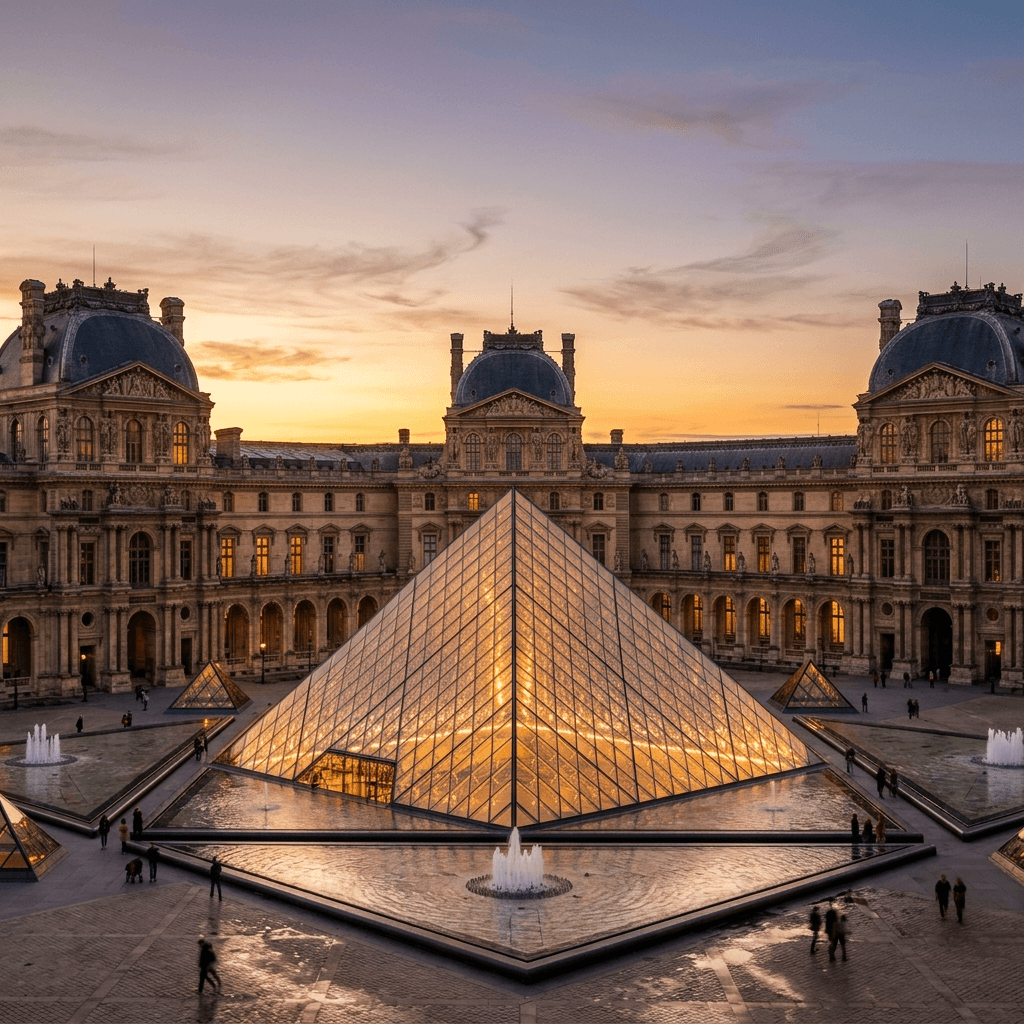
Few visitors who today pose in front of the Glass Pyramid imagine that Paris's most iconic building began as a military fortress. The year was 1190 and King Philip II of France, known as Philip Augustus, was preparing to depart for the Third Crusade. Before leaving the kingdom, the monarch made a decision that would forever alter the Parisian landscape: he ordered the construction of a fortified castle on the right bank of the Seine River, at the western edge of the city, to protect it from attacks from Normandy — territory then under English control.
The location was not chosen by chance. The wall that Philip Augustus had built around Paris, spanning roughly 3 mi in length, left the capital's western flank vulnerable. The England of Richard the Lionheart and, later, of John Lackland, still held Normandy, and an invasion up the Seine valley was a real and constant threat. The Louvre was conceived precisely to block that advance.
The original castle was a massive and austere structure, typical of 12th-century military architecture. Its central element was the Grosse Tour, a circular keep approximately 98 ft tall with walls 13 ft thick at the base, surrounded by a moat 33 ft wide fed by the waters of the Seine. Around the main tower, a quadrangular enclosure with walls punctuated by defensive towers completed the complex. The dry moat encircling the outer perimeter served as a second line of defense against invaders.
Construction took about 12 years and was completed around 1202. The result was an imposing fortress that fulfilled both defensive and symbolic functions: it housed the royal treasury, the kingdom's archives, and, at certain moments, high-value political prisoners. The Grosse Tour functioned as a state prison, a kind of Bastille avant la lettre, where figures such as Ferdinand of Portugal, Count of Flanders, captured at the Battle of Bouvines in 1214, were imprisoned.
Despite its strategic importance, the Louvre remained a secondary royal residence throughout most of the Middle Ages. Kings preferred the Palais de la Cité, on the Île de la Cité, or the Hôtel Saint-Pol. It was only under Charles V, in the 14th century, that the castle received its first residential adaptations: wider windows were opened in the walls, towers were crowned with conical roofs, and a royal library with about 900 manuscripts was installed — the embryo of what is now the Bibliothèque nationale de France.
Chapter
1.2 How Francis I Transformed the Louvre in 1546? The Renaissance King Who Turned a Fortress Into a Royal Palace
The metamorphosis of the Louvre from medieval fortress to Renaissance palace began with a radical gesture. In 1528, Francis I ordered the demolition of the Grosse Tour, the keep that had been the heart of the castle for more than three centuries. The king, recently returned from captivity in Spain after his defeat at the Battle of Pavia in 1525, wanted a palace worthy of the Italian Renaissance he so admired. The old fortress, dark and medieval, was the opposite of everything the visionary monarch represented.
In 1546, Francis I took the definitive step: he hired architect Pierre Lescot to design a completely new palace atop the foundations of the old castle. Lescot conceived a wing in classical Renaissance style, with façades ornamented by pilasters, triangular pediments, and arcades, directly inspired by the Italian palaces Francis I had encountered during his military campaigns on the peninsula. Sculptor Jean Goujon was responsible for the sculptural decoration of the façades, adding reliefs of allegorical and mythological figures that still mark the Lescot Wing today — the oldest part of the palace still visible in the square courtyard, the Cour Carrée.
Francis I did not live to see the project completed — he died in 1547, a year after work began — but his architectural legacy was continued by Henry II, his son and successor. Henry II kept Lescot in command of the works and, though he lacked his father's enthusiasm for the arts, ensured the project moved forward. Construction continued throughout the reign of Catherine de' Medici, who later commissioned the Tuileries Palace west of the Louvre, linking it to the main palace via a long gallery parallel to the Seine — the Grande Galerie.
Francis I's choice of the Renaissance was not merely a matter of aesthetic taste. It represented a political statement: France was claiming for itself the role of heir to the classical grandeur that Renaissance Italy symbolized. The Louvre, transformed from a defensive castle into a palace of arts and power, became the stage for this ambition. Francis I was also the first French monarch to form a royal painting collection, acquiring works by masters such as Leonardo da Vinci — including, it is believed, the Mona Lisa itself — Raphael, and Titian, laying the foundations for what would become the future museum's collection.
Chapter
1.3 Why the Name "Louvre"? Discover the 4 Historical Theories Behind the Most Famous Name in World Art
The origin of the name "Louvre" remains one of the most fascinating enigmas of Parisian toponymy. Despite centuries of research by historians and linguists, none of the proposed theories has been accepted as definitive. Four main hypotheses compete for primacy, each with plausible arguments and documentary weaknesses that continue to fuel academic debate.
The first theory, and perhaps the most evocative, traces back to the Latin "lupara", a term designating a wolf's den. The word would have evolved in Old French into "louvre" or "louvière", meaning a place where these animals were hunted or abounded. Indeed, the right bank of the Seine in the 12th century was a wooded and marshy area on the outskirts of Paris, the natural habitat of wolves. The image of a fortress built atop an ancient wolf's den carries undeniable symbolic appeal, but lacks solid documentary evidence.
The second hypothesis points to a Frankish origin, derived from the Germanic word "leovar" or "lower", which would mean "watchtower" or "fortified lookout." This theory gains strength when one considers that the Franks, the Germanic people who dominated the region after the fall of the Roman Empire, left numerous place names in northern France. The Louvre, as an observation fortress on the banks of the Seine, fits perfectly into this functional etymology. Documents from the 9th century mention a structure called "Turris Lupara" at exactly that location.
The third theory is linked to medieval commerce. The term would derive from the French verb "louer" (to rent), suggesting that the site originally functioned as a trading post where merchants rented spaces to display and sell their goods. Considering the Louvre's strategic position along the Seine — the main transportation route for goods in medieval Paris — the idea of a fortified market on the riverbank is not implausible.
The fourth hypothesis, less widespread but equally considered by specialists, suggests a Saxon origin. The term "lower", in Old English and Saxon, may have been brought by merchants or Norse invaders who frequented the lower Seine region. The phonetic evolution from "lower" to "louvre" is linguistically defensible, though the direct historical connection between Saxon presence and the original construction of the castle is tenuous. None of the four theories is conclusive, and it is precisely this ambiguity that gives the name additional charm.
Chapter
1.4 The French Revolution and the Birth of the Louvre Museum: August 10, 1793 — The Day That Changed the History of Universal Art
The idea of turning the Louvre into a public museum did not emerge from nowhere in 1793. During the reign of Louis XVI, the Count d'Angiviller, director of royal buildings, had already commissioned studies to open the palace's Grande Galerie to the public, displaying part of the royal painting collection. The French Revolution, however, accelerated the process in a dizzying and irreversible manner. The fall of the monarchy on August 10, 1792 — exactly one year before the museum's opening — sealed the fate of the old palace.
The National Convention, the revolutionary government established after the king's fall, decreed the museum's creation with a clear and profoundly political purpose: art, until then the exclusive privilege of royalty, nobility, and high clergy, should belong to the people. The decree of July 27, 1793 formalized the creation of the "Muséum central des Arts de la République", and the date chosen for the inauguration — August 10, 1793 — was carefully calculated: it marked the first anniversary of the fall of the French monarchy. The gesture was as symbolic as it was practical: the museum was born upon the ashes of the Ancien Régime.
The opening was modest by contemporary standards, but revolutionary for its time. The museum operated three days a week — with one day reserved exclusively for artists to copy the works, a common practice in 18th-century museums — and admission was entirely free. For the first time in history, an ordinary citizen could circulate freely through halls that had once been the exclusive domain of royalty, contemplating the same masterpieces that monarchs had contemplated. The principle of the democratization of access to culture had been inaugurated.
Chapter
1.4.1 The 537 Inaugural Paintings and 184 Art Objects: The Collection Confiscated from the Church and Nobility That Gave Rise to the Museum
The inaugural collection of the Muséum central des Arts was composed of 537 paintings and 184 art objects — numbers that impress by their quantity but even more so by their origin. Most of the works came from three main sources: the royal collection of the French Crown, accumulated over centuries by monarchs such as Francis I and Louis XIV; the assets confiscated from the Catholic Church during the nationalization of clerical property in 1789; and the properties of the emigrant nobility, who had fled revolutionary France abandoning palaces filled with artistic treasures.
The royal collection constituted the most valuable core. Francis I had begun the collecting tradition with the acquisition of Italian masterpieces in the 16th century, a tradition that Louis XIV brought to its apex in the 17th century by acquiring entire collections, such as that of the banker Everhard Jabach, which brought to France works by Raphael, Carracci, and Correggio. Cardinal Mazarin had bequeathed his fabulous private collection to the Crown shortly before his death in 1661. These acquisitions, combined with direct commissions to artists such as Poussin and Le Brun, formed a collection of exceptional quality.
The revolutionary confiscations added an entirely new layer. Abbeys, convents, and cathedrals housed altarpieces, sculptures, and reliquaries that, removed from their liturgical context, became part of the museum's collection. The same occurred with the palaces of the exiled nobility: works by Rubens, Van Dyck, and Rembrandt that had decorated private residences were transferred to the halls of the Louvre. The museum was thus born from a historical paradox: the revolutionary violence that destroyed the Ancien Régime was the very same force that preserved and democratized its artistic heritage.
The arrangement of the works did not follow chronological or national criteria as it does today. Paintings were grouped by school — Italian, French, Flemish — in arrangements that prioritized visual impact over historical accuracy. The main hall of the Grande Galerie displayed the most important pieces arranged from floor to ceiling, a profusion of gilded frames that impressed visitors with their abundance and splendor. The lighting, provided by side windows and an improvised skylight, was precarious, and conservation conditions were far from current museological standards, but the effect on the public was electrifying.
Chapter
1.4.2 The Revolutionary Decision to Open the Louvre to the People: How Art Ceased to Be a Privilege of Royalty and Became a Citizen's Right
The opening of the Louvre to the public was not merely an administrative decision — it was a political act of profound philosophical significance. The French revolutionaries, imbued with the Enlightenment ideals of Rousseau, Voltaire, and Diderot, understood art not as ornament of power, but as national heritage and an instrument of civic education. The public museum was the materialization of the principle that knowledge, including aesthetic knowledge, should be accessible to all citizens, regardless of birth or fortune.
The decision reverberated across Europe. No nation had dared to open the doors of a royal palace converted into a universal and free museum to the people. The British Museum, founded in 1753, had restricted access and required letters of recommendation. The Vatican Museum opened occasionally for authorized scholars. The Louvre inaugurated a radically new model: the museum as a quintessentially public space, where any citizen could enter without the mediation of privilege or credentials.
The social impact was immediate and lasting. Accounts of the time describe crowds of ordinary Parisians — artisans, merchants, washerwomen — wandering wide-eyed through halls their ancestors could never have set foot in. The museum functioned as a space of visual pedagogy: citizens learned history, mythology, and geography through the works on display, absorbing a cultural repertoire that had previously been denied them. The Louvre did not merely exhibit art — it shaped citizens.
The principle established in 1793 resonates to this day. The idea that access to culture and artistic heritage is a fundamental right of the citizen, not a favor of the state, was born in that room of the National Convention that voted to create the museum. The Louvre, as an institution, anticipated by two centuries contemporary discussions about cultural democratization, museum accessibility, and the social function of museums. The date of August 10, 1793 thus marks not just the opening of a museum, but the refounding of the relationship between art and society in the Western world.
---
Chapter
2. Napoleon Bonaparte and the Musée du Louvre: The Emperor Who Plundered Europe to Build the World’s Greatest Art Collection
Chapter
2.1 The Treaty of Tolentino and the Horses of Saint Mark: How Napoleon's Campaigns Brought All of Italy Into the Louvre
When Napoleon Bonaparte took command of the Army of Italy in 1796, a general of just 26 years of age, his instructions from the Directory included an unusual clause: in addition to defeating the Austrians, his troops were to "send to France all the monuments of art and science that may enrich the Museum of Paris." The young general embraced the mission with enthusiasm almost as intense as that which he devoted to battle. The Italian military campaign simultaneously transformed into the largest systematic art plundering operation ever undertaken in Europe.
The Treaty of Tolentino, signed with Pope Pius VI on February 19, 1797, was the legal instrument that legitimized the pillage. Among its ceasefire and territorial cession clauses, the eighth article established that the Papacy would hand over to France one hundred works of art and five hundred manuscripts to be chosen by French commissioners. The Vatican, defeated militarily and without bargaining power, watched a convoy bearing some of the most precious works of classical antiquity depart from Rome. Among them were the Laocoön — the Hellenistic sculptural group that Michelangelo considered the most perfect work ever created — and the Apollo Belvedere, the sculpture that Winckelmann had elevated to the status of the absolute paradigm of classical beauty.
The triumphal entry of these works into Paris on July 27, 1798, was choreographed like a military parade. The objects crossed the city on carts decorated with ribbons and flags, accompanied by a procession of soldiers, musicians, and officials, under the applause of a Parisian crowd that saw in those trophies confirmation of revolutionary France's cultural supremacy. The Festival of the Liberty of the Arts, as the event was christened, marked the arrival of the Napoleonic loot at the heart of Paris.
The Horses of Saint Mark constitute a separate chapter in this history. The four gilded bronze horses, sculpted in antiquity — probably in the 2nd century B.C. by a Greek artist — and displayed on the Basilica of Saint Mark in Venice since 1204, when the Crusaders brought them from the Hippodrome of Constantinople, were confiscated after the fall of the Republic of Venice in 1797. Napoleon ordered them installed atop the Arc de Triomphe du Carrousel, the monumental entrance to the Tuileries Palace, where they remained for 18 years as the supreme symbol of French imperial power.
Napoleonic plundering, though morally reprehensible under any contemporary perspective, operated under a logic that the French revolutionaries believed legitimate: France, as the cradle of liberty and the rights of man, was the only country worthy of safeguarding the masterpieces of humanity. The cultural arrogance of this premise did not diminish its rhetorical force. For Napoleon and his art commissioners, transferring the Laocoön from Rome to Paris was not theft — it was liberation.
Chapter
2.2 Who Was Vivant Denon? The Louvre's First Director Who Accompanied Napoleon on the Egyptian Campaign
Dominique Vivant Denon is one of the most extraordinary and multifaceted figures in the history of French art. Born on January 4, 1747 in Chalon-sur-Saône, Denon was, over the course of his 78-year life: diplomat, courtier of Louis XV, talented engraver, libertine writer, spy, amateur archaeologist, and, ultimately, the man who shaped the Louvre as a museological institution. His ability to survive politically through three radically distinct regimes — the absolutist monarchy, the French Revolution, and the Napoleonic Empire — attests to a chameleon-like skill for adaptation that bordered on the prodigious.
Denon's decisive encounter with Napoleon occurred during the Egyptian Campaign of 1798–1799. At 51 years of age, Denon embarked as a member of the Commission of Sciences and Arts, the contingent of 167 scholars whom Napoleon brought to Egypt with the mission of systematically documenting pharaonic civilization. While soldiers fought the Mamluks, Denon compulsively drew temples, tombs, and hieroglyphs, often under enemy fire. His work "Voyage dans la Basse et la Haute Égypte", published in 1802, became an instant bestseller in Europe and launched the vogue of Egyptomania that would dominate Western culture for decades.
Napoleon, impressed by Denon's energy and talent, appointed him director-general of the imperial museums on November 19, 1802, a position that gave him absolute authority over the Louvre and all French museums. The appointment was an act of administrative genius: Denon possessed not only an infallible eye for artistic quality, but also a practical sense of organization that traditional academics lacked. Under his direction, the Louvre ceased to be a chaotic heap of confiscated works and transformed into a museum with defined curatorial criteria.
Denon completely reorganized the arrangement of the works, introducing chronological and geographical criteria that remain, in essence, to this day. It was he who conceived the idea of traversing the Grande Galerie as a journey through art history, from the early Italian schools to contemporary French painting. He also instituted the system of informative labels beside the works, with the artist's name, title, and provenance — an elementary museographic innovation that today seems obvious, but was revolutionary in 1803. Denon was, in short, the world's first modern curator.
Denon's devotion to Napoleon was genuine and intense. He accompanied the emperor on several military campaigns as a kind of artistic advisor, personally selecting the works to be sent to Paris. After the Battle of Jena in 1806, Denon traveled through Prussia requisitioning paintings from museums and private collections. After the Spanish campaign in 1808, he did the same with Spanish artistic treasures. His correspondence with Napoleon shows a man obsessed with the mission of making the Louvre the greatest museum in the universe, a mission he fulfilled with almost terrifying efficiency.
Chapter
2.3 The Musée Napoléon: When the Louvre Was Renamed to Celebrate the Emperor of the French
In 1803, the Muséum central des Arts received a new name that revealed without disguise its new condition: Musée Napoléon. The change in nomenclature was decreed by Consular Order and reflected the absolute personalization that Napoleon had imprinted upon the institution. The museum ceased to be "of the Republic" to become "of Napoleon," and the gesture was not merely symbolic — it was the affirmation that the Louvre, from that moment on, functioned as a showcase of imperial power and a monument to the emperor's personal glory.
The Musée Napoléon was, in magnitude and ambition, something the world had never seen. Under Denon's direction, the museum brought together masterpieces from virtually all European artistic schools, thanks to the successive waves of confiscations that accompanied Napoleonic military victories. With each new campaign — Italy, Austria, Prussia, Spain — convoys of carts laden with paintings, sculptures, and precious objects converged on Paris. The imperial museum came to house more than 5,000 paintings, constituting the greatest concentration of artworks ever assembled in a single location in human history.
The architectural decoration of the museum was adapted to reflect the new political reality. Napoleon's bust was installed at the main entrance, and large canvases commemorating military victories — such as the paintings of Jacques-Louis David and Antoine-Jean Gros — were strategically positioned in the main halls. The museum did not merely exhibit art: it narrated a story in which Napoleon figured as the legitimate heir of the great empires of antiquity, from Rome to pharaonic Egypt. Imperial propaganda and museology merged in an operation of soft power avant la lettre.
The annual painting salon, which had been held at the Louvre since 1667, gained unprecedented scale and pomp under Napoleon. Artists competed for imperial commissions that meant prestige, money, and immortality. David, the regime's official painter, produced monumental works such as "The Coronation of Napoleon" and "The Distribution of the Eagles", immense canvases that occupied entire walls of the museum and functioned as central pieces of the Empire's visual narrative. The Musée Napoléon was, simultaneously, a fine arts museum, a gallery of political propaganda, and a temple of the imperial personality cult.
The splendor of the Musée Napoléon was ephemeral, lasting little more than one decade. Napoleon's defeat at the Battle of Waterloo on June 18, 1815 marked the end of the imperial dream and the beginning of the largest operation of art restitution in European history. The name Musée Napoléon was abolished, Denon was dismissed, and the allied powers demanded the return of the looted treasures. The museum, however, would never be the same: the brief Napoleonic reign had left permanent marks on the institution, the collection, and the collective imagination about what a museum could — and should — be.
Chapter
2.4 The 1815 Restitution After Waterloo: Why Not All Looted Works Were Returned and Which Remain at the Louvre to This Day
Napoleon's definitive defeat at Waterloo triggered an unprecedented art restitution operation. The victorious powers — primarily Austria, Prussia, and the Papal States — sent commissioners to Paris with detailed lists of the confiscated works, demanding their immediate return. Louis XVIII, restored to the French throne, found himself in a politically untenable position: he could not oppose the allied demands, but also feared the reaction of French public opinion to what many perceived as pillage in reverse.
The operation was conducted with military efficiency. The Horses of Saint Mark were dismantled from the Arc de Triomphe du Carrousel in October 1815 and sent back to Venice under armed Austrian escort — to the dismay of Parisians, who had grown accustomed to the imposing presence of the bronze horses in the heart of the city. The Laocoön and the Apollo Belvedere returned to the Vatican. Cranach's Brides, the Rubens from the Antwerp cathedral, the Correggios from the Italian duchies — work after work was removed from the galleries and packed for travel.
However, the restitution was not complete. The process ran into diplomatic, logistical, and, in some cases, purely pragmatic obstacles. Many small and medium-sized works were simply not located or claimed in time. Others had been dispersed to French provincial museums, beyond the reach of foreign commissioners. An additional and crucial factor was the stance of Vivant Denon, who, even dismissed from his post, worked behind the scenes to hinder the return, arguing that certain pieces were too fragile for transport or that the provenance records were ambiguous.
The most emblematic case of incomplete restitution is that of The Wedding at Cana, by Paolo Veronese. The monumental canvas, measuring about 753 sq ft, had been confiscated from the refectory of the monastery of San Giorgio Maggiore in Venice in 1797. The Austrians demanded its return, but the French argued that the painting was too fragile to withstand the journey back — and proposed exchanging it for a canvas by Charles Le Brun, court painter to Louis XIV. The Austrians accepted the exchange. Veronese's work remained in Paris, and today occupies an entire wall of the room where the Mona Lisa is also displayed. Supreme irony of museological fate: millions of visitors who crowd before the Gioconda turn their backs on one of the greatest paintings of the Venetian Renaissance, which is there because of a diplomatic stratagem from 1815.
It is estimated that about 5,000 works were restituted, but another 500 to 600 remained in France permanently, incorporated into the collection of the Louvre and other French museums. The episode generated an institutional trauma that, paradoxically, strengthened the museum's identity. The Louvre learned that its collection was not a war trophy, but a heritage whose legitimacy depended on transparent acquisition processes. The lesson, painful and necessary, shaped the institution's museological ethics for the centuries to follow.
---
Chapter
3. The Secret of the Medieval Foundations of the Musée du Louvre: What Lies Beneath the Glass Pyramid That Few Visitors Know About?
Chapter
3.1 The 1984 Archaeological Excavations at the Louvre: The Discovery of the Original 12th-Century Castle No One Expected to Find
When François Mitterrand launched the ambitious Grand Louvre project in 1981, no one anticipated that the greatest archaeological discovery would be made beneath the museum's central courtyard. The preparatory excavations for the construction of the Glass Pyramid and the underground reception hall, begun in 1984, struck the foundations of what quickly revealed itself to be the original castle of Philip Augustus, from the 12th century. The find was as spectacular as it was unexpected, and completely transformed the historical understanding of the site.
Archaeologists, led by Michel Fleury, discovered that the medieval foundations were surprisingly well preserved. The castle's original moat, the bases of the defensive towers, the foundations of the ancient wall and, above all, the remains of the Grosse Tour — the keep demolished by order of Francis I in 1528 — emerged from the Parisian soil like an architectural ghost 800 years old. The dark, massive limestone stones contrasted dramatically with the white of the Renaissance palace that enveloped them.
The discovery of the medieval foundations provoked intense debate among architects, archaeologists, and government authorities. The Grand Louvre project called for the complete excavation of the courtyard to install the Carrousel du Louvre and the visitor accommodation infrastructure. Preserving the ruins meant substantially altering the original plans, with implications for cost and schedule. The final decision, personally endorsed by Mitterrand, was integrative: rather than removing the foundations, they would be incorporated into the new underground complex, becoming part of the museological experience.
Fieldwork revealed fascinating details about the medieval construction. The excavations identified three main construction phases: the original fortress of 1190–1202, the expansions of Charles V in the 14th century, and the Renaissance modifications of Francis I. Archaeologists also recovered thousands of objects — pottery fragments, coins, tools, and armor remnants — that allowed the reconstruction of daily life in the castle over more than three centuries of occupation. The discovery was classified as one of the most important finds in French medieval archaeology of the 20th century.
Chapter
3.2 How to Visit the Louvre's Archaeological Crypt: The 800-Year-Old Walls That Are Literally Beneath Your Feet
The Archaeological Crypt of the Louvre, also known as the Saint-Louis Room or the Medieval Foundations Room, constitutes one of the most surprising and least-known experiences of the museum. Located on level -1 of the Sully Wing, the crypt displays in situ the foundations of Philip Augustus's castle, allowing visitors to literally walk inside the original 12th-century fortress — a layering of temporalities that no other museum in the world offers with such intensity.
Access to the crypt is through the Napoleon Hall, beneath the Glass Pyramid, descending the escalators toward the Sully Wing. The entrance is included in the museum's regular ticket and requires no special reservation, although many visitors pass directly through the painting galleries without ever discovering that beneath their feet lie 800 years of military and architectural history. The space, with low lighting and a silent atmosphere, contrasts with the bustle of the upper galleries.
The crypt displays three main architectural elements. The first is the castle moat, with its limestone walls cut at precise angles, whose original depth and width impress with their monumental scale. The second is the base of the Grosse Tour, the circular keep whose diameter of roughly 49 ft can be clearly identified on the floor. The third is the walls of the quadrangular enclosure with the bases of its towers, which defined the castle's defensive perimeter. Explanatory panels and 3D models help visitors understand the original arrangement of the structures.
The experience of visiting the crypt is, for many, one of the most impactful revelations of the Louvre. Few museums allow visitors to physically experience the stratigraphy of architectural time: the Renaissance palace of Lescot rises above, the 18th-century museum unfolds around, and the 12th-century fortress rests below, all coexisting in the same space. The crypt functions as a time machine that connects the contemporary Louvre — with its 9 million annual visitors — to King Philip Augustus, who could never have imagined that his walls would become objects of tourist contemplation eight centuries later.
Chapter
3.3 The Secret Passages and Underground Tunnels of the Musée du Louvre: The Hidden Side Tourists Never See
Beneath the Louvre that the public visits extends a second city — a labyrinthine network of tunnels, technical passages, service galleries, and underground corridors that constitutes the nervous system of the world's largest museum. This hidden infrastructure, with roughly 9 mi of total length, is off-limits to visitors and accessible only to authorized personnel, but its existence fuels one of the most fascinating imaginaries associated with the museum.
The modern underground system was built in three major phases. The first, during the Grand Louvre works between 1984 and 1993, created Napoleon Hall, the connections with the Carrousel du Louvre, and the technical galleries for climate control and security. The second, begun in 2003, expanded the technical reserve spaces and conservation laboratories. The third, completed between 2015 and 2019, modernized the internal art transport systems and the flood prevention infrastructure for the Seine.
The service tunnels connect virtually every point of the museum, allowing the transport of works of art — from the tiniest Persian miniature to the most colossal painting by Delacroix — without them needing to transit through public galleries. Silent electric vehicles travel the underground corridors transporting pieces between the technical reserves, restoration laboratories, and exhibition halls. The system of special freight elevators with capacity for up to 5.5 short tons allows large sculptures and monumental paintings to circulate vertically between the museum's levels.
Part of the fascination with the Louvre's underground tunnels is due to their presence in popular culture. The novel "The Da Vinci Code" by Dan Brown mentions underground passages, and the film "Belphégor — The Phantom of the Louvre" from 2001 explores the idea that a cursed mummy roams through the museum's hidden corridors at night. Although the reality is more prosaic — the tunnels primarily house pipes, fiber-optic cables, and air conditioning ducts — the mere existence of this underground city beneath one of the most heavily monitored buildings on the planet is, in itself, sufficiently extraordinary.
The tunnel system also plays a crucial role in security and preventive conservation. Sensors constantly monitor humidity and temperature levels, essential for the preservation of works dating back millennia. In case of emergency — fire, terrorist threat, or, more prosaically, a severe storm — the tunnels serve as evacuation routes for the most valuable works in the collection. The Louvre learned, from the World War II evacuations, that the survival of its heritage depends on safe and discreet underground routes.
Chapter
3.4 Ghosts and Supernatural Legends of the Musée du Louvre: From Belphegor to the Cursed Mummies That Haunt the Museum
A museum that accumulates more than 800 years of history within its walls inevitably attracts a dense layer of legends, myths, and ghost stories. The Louvre, with its past as a fortress, royal residence, prison, and stage of revolutions and wars, offers exceptionally fertile raw material for the supernatural imaginary. Night staff, security guards, and even curators, over the decades, have reported experiences that defy rational explanations and fuel the parallel mythology of the museum.
The most famous legend is that of Belphegor, a demonic entity that, according to tradition, inhabits the depths of the Louvre since its foundation. The story gained worldwide prominence with the novel "Belphégor" by Arthur Bernède, published in 1927 and adapted for film in 1927 and 1965, as well as the 2001 version starring Sophie Marceau. In fiction, Belphegor awakens from an Egyptian sarcophagus and begins to terrorize the museum's night watchmen, unleashing a series of mysterious deaths. The legend fuses medieval demonological folklore with the museum's Egyptian collections in a typically French synthesis of terror and erudition.
The Egyptian mummies of the Egyptian Antiquities department — one of the museum's eight curatorial departments, with more than 50,000 objects — are recurring protagonists of the Louvre's supernatural legends. There are reports, never confirmed, of security guards who heard footsteps, whispers, and inexplicable sounds coming from the Egyptian galleries during the early morning hours, when the rooms are completely empty. The stories, which date back to the 19th century, echo the popular belief in the "curse of the pharaoh", popularized after the discovery of Tutankhamun's tomb in 1922 and the mysterious death of Lord Carnarvon.
The ghost of Charles IX is another protagonist of the museum's supernatural folklore. The king, who reigned during the St. Bartholomew's Day massacre of 1572, is said to have occasionally been seen in the corridors of the Renaissance wing where he resided. The legend is told with delight by tour guides who lead brave visitors on themed nighttime tours of the Louvre. The story blends the historical horror of the religious massacre with the Gothic atmosphere of the old palace.
There are also reports of the Lady in White, a female figure dressed in 16th-century attire that some claim to have seen near the Grande Galerie on full-moon nights. The lady's identity varies according to the version of the legend: for some, she would be Catherine de' Medici, the intriguing and superstitious queen; for others, Gabrielle d'Estrées, the mistress of Henry IV who died tragically young. Obviously, none of these apparitions withstands scientific scrutiny, but their persistence in the oral culture of the museum's employees and in the accounts of impressionable visitors attests to the power the Louvre exerts over the collective imagination. The museum does not merely guard works of art — it also guards the untold stories of eight centuries of uninterrupted human presence in that space.
---
Chapter
4. World War II and the Largest Art Evacuation Operation in History: How the Musée du Louvre Saved 400,000 Masterpieces from the Nazis
Chapter
4.1 The Louvre's Secret Evacuation Plan of 1938: Why the Museum Began Removing Works Even Before France Declared War?
A few months after the Sudeten Crisis, which in September 1938 brought Europe to the brink of total war, the Musée du Louvre launched one of the most extraordinary logistical operations in the history of museums. The director of the Louvre, Jacques Jaujard — a name that deserves to stand among the heroes of world culture — understood with astonishing lucidity that war was not a question of "if," but of "when." In October 1938, without any formal declaration of hostilities and with the French government still committed to the policy of appeasement, Jaujard activated the secret evacuation plan for the national museums.
The plan, drawn up in secret since 1935 by the national collection protection services, called for the staggered removal of the Louvre's most valuable works to a network of 11 secret depots spread across châteaux and abbeys in the French interior. The priority list included masterpieces of inestimable value, with the Mona Lisa naturally heading the roster. Each work received a classification code — yellow for the most valuable, green for valuable, red for the least valuable — and a withdrawal itinerary was meticulously charted.
The choice of the Château de Chambord, the majestic Renaissance castle in the Loire Valley, as the main destination of the evacuation was not casual. Chambord, with its 440 rooms and far from the probable corridors of military invasion, offered ideal space and security. Its distance from Paris — roughly 112 mi — was sufficient to protect it from aerial bombardment, yet close enough to allow transport of the works in land convoys. The castle became the epicenter of the operation, sheltering the most precious pieces of France's artistic heritage.
On August 28, 1939, four days before Germany's invasion of Poland and five days before France's declaration of war on Germany, the Louvre closed its doors to the public under the official justification of "restoration work." In reality, the intensive phase of the evacuation had begun. Museum employees, with the help of volunteers and the French armed forces, worked in uninterrupted 24-hour shifts to pack, catalog, and dispatch thousands of works. By December 28, 1939, when German troops were still stationed on the other side of the Maginot Line, the Louvre was virtually empty.
Jacques Jaujard deserves special mention. Born in 1895, Jaujard was a cultured and discreet bureaucrat who held the position of director of French National Museums. His moral courage would be tested repeatedly during the occupation: he not only coordinated the largest art evacuation in history, but also, later, worked behind the scenes to protect French heritage from Nazi looting, defying orders from the Vichy government and risking his own life. Jaujard is today recognized as one of the great anonymous heroes of world cultural heritage preservation.
Chapter
4.2 The Escape of the Mona Lisa During World War II: The 6 Times the World's Most Famous Painting Was Hidden Over 5 Years of Conflict
The Mona Lisa was not merely saved from the Nazis — she was saved six times, in a five-year odyssey that transformed the world's most famous painting into a luxury refugee, transported from château to abbey to château like a Renaissance princess fleeing invading armies. No other work of art in history received such an elaborate and obsessive protection operation.
The first stop was the Château de Chambord, where the Mona Lisa was taken on August 28, 1939, in the first evacuation convoy. The painting traveled in a specially built wooden crate, custom-made, lined with red velvet and equipped with a humidity and temperature control system. A specially adapted ambulance transported the crate, escorted by French military vehicles. At Chambord, the Mona Lisa was stored in a climate-controlled room, away from windows and duly protected against possible bombardments.
The tranquility was short-lived. With the German advance into France in May 1940, the painting had to be moved again. The second stop was the Château de Louvigny, in the Sarthe department. From there it went to the Abbey of Loc-Dieu in Aveyron, an isolated Cistercian abbey from the 12th century whose remote location and solid architecture offered ideal protection. The fourth stop was the Musée Ingres in Montauban, where the Mona Lisa remained for a longer period, surrounded by other masterpieces evacuated from the Louvre.
With the liberation of France and the German retreat, the Mona Lisa made its way back, passing once again through Chambord before definitively returning to Paris in June 1945. Throughout the entire period of 1,940 days between evacuation and return, the painting was handled by specialized curators who constantly monitored its conservation status, checking the stability of the pictorial layer and the humidity levels of the poplar wood on which Leonardo da Vinci had painted the masterpiece four centuries earlier.
The Mona Lisa's wartime journey became legend and served as the basis for documentaries, books, and even the 2014 film "The Monuments Men", though the latter mainly focuses on the Allies. The operation demonstrated that the protection of cultural heritage during armed conflicts is a matter of meticulous planning, institutional commitment, and, above all, of people willing to risk everything for what they believe. The Mona Lisa survived the war without a single scratch — and has never left France again, except for temporary exhibitions in other countries, always under maximum security.
Chapter
4.3 The Trucks and Color-Coded Crates: The System That Coordinated the Largest Movement of Artworks in History
The evacuation of the Louvre required the mobilization of a transport fleet and an organizational system that rivaled, in logistical complexity, the military operations of the war itself. More than 400,000 works of art were packed, cataloged, transported, and reinstalled in safe locations — an operation made possible only by a meticulous classification system that history today recognizes as a feat of organizational engineering.
The heart of the system was the color code applied to the transport crates. The crates were painted or marked with three chromatic categories: yellow for works of supreme and irreplaceable artistic value, the "crown jewels" of the collection — Mona Lisa, Winged Victory of Samothrace, Venus de Milo, The Wedding at Cana, and other pieces of the first magnitude; green for works of great value and importance, but that were not part of the select group of absolute priorities; and red for the less valuable works from a monetary and historical standpoint, which would be evacuated as a last resort and only if time and resources allowed.
The transport fleet was composed of about 200 trucks, many of them military vehicles provided by the French army. Each convoy was planned days in advance, with routes minutely studied to avoid dangerous intersections with troop movements, roads congested by fleeing civilians, and areas that could become targets of aerial attacks. The drivers — museum employees, soldiers, and volunteers — received detailed maps and strict instructions on what to do in case of breakdown, bombardment, or enemy interception.
The packaging of the works was another monumental operation. The Winged Victory of Samothrace, a marble sculpture 9 ft tall and weighing more than 1.1 short tons, required a special wooden structure, hoisted by cranes and transported on a flatbed truck with reinforced suspension. The Wedding at Cana by Veronese, at roughly 753 sq ft, had to be dismounted from its chassis and rolled onto a gigantic cylinder for transport. Each work presented unique technical challenges that the Louvre's curators solved with ingenuity, courage, and improvised wartime materials.
The documentation of the operation was also exceptional. Each crate received an inventory number that was recorded on carbon paper cards, with copies stored in different locations to prevent data loss in the event of bombardment. The system ensured that, at the end of the operation, none of the 400,000 works were lost or damaged. The museum had not only saved its collection — it had created a model of museological emergency response that would serve as a reference for institutions worldwide in the decades to follow.
Chapter
4.4 The Louvre Under Nazi Occupation in Paris: What Happened to the Completely Empty Museum During the Years of German Rule?
On June 14, 1940, German troops entered Paris and, a few days later, raised the swastika atop the Eiffel Tower. At the Louvre, they found a ghost museum: deserted corridors, empty rooms, bare walls where masterpieces by Rembrandt, Delacroix, and David once hung. Only sculptures too large to be transported, plaster casts, replicas, and a few pieces of lesser value remained. The world's largest museum had become an empty shell — and would remain so for the next four years.
The Nazi occupation of the Louvre represented a disturbing historical paradox. While German soldiers patrolled the museum's deserted corridors, the upper echelons of the Third Reich — notably Hermann Göring and Alfred Rosenberg — were coordinating the systematic looting of Jewish art collections throughout occupied France. The Einsatzstab Reichsleiter Rosenberg (ERR), the Nazi organization dedicated to the plunder of cultural property, used some of the Louvre's empty galleries as sorting centers and temporary storage for works stolen from Jewish families. The museum that had been born as a symbol of revolutionary liberty in 1793 was now the involuntary accomplice of the largest art theft in history.
Not all galleries remained inactive. The Nazis, interested in projecting an image of cultural normality in Paris, partially reopened some rooms of the Louvre in September 1940, displaying mainly sculptures that could not be evacuated — including the Winged Victory of Samothrace, which, though evacuated, was replaced by a plaster cast. The program included exhibitions of German art and propaganda shows. German soldiers on leave in Paris visited the museum as tourists, photographing themselves in front of the few remaining works.
The French resistance operated silently within the Louvre itself during the occupation. Jacques Jaujard, who formally remained in his post, used his position to sabotage Nazi attempts to locate the evacuated works. When German officers demanded information about the whereabouts of the collections, Jaujard provided evasive answers, forged documents, or deliberately confusing instructions. On at least three documented occasions, Jaujard intercepted orders for the transfer of works to Germany and "misplaced" them bureaucratically. His quiet courage saved not only the Louvre's collection, but also works from other French museums and collections.
In August 1944, during the Liberation of Paris, the Louvre narrowly escaped destruction. The German military commander of Paris, General Dietrich von Choltitz, received direct orders from Hitler to destroy the city before it fell into Allied hands — orders that von Choltitz famously disobeyed. The Louvre, empty and vulnerable, could have been reduced to rubble. At the end of the war, Jacques Jaujard and his team began the reverse process: the repatriation of the 400,000 evacuated works, which returned to Paris throughout 1945 and 1946. The museum fully reopened in 1946, and the Mona Lisa returned to its place on the wall, as if it had never left.
Chapter
5. The Theft of the Mona Lisa from the Musée du Louvre in 1911: How an Italian Thief Turned an Obscure Painting Into the Most Famous Artwork on the Planet
Chapter
5.1 Vincenzo Peruggia and the Theft of the Mona Lisa: The Italian Glazier Who Simply Unscrewed the Frame and Walked Out of the Louvre
On the morning of August 21, 1911, a Sunday, a short man with a thick mustache entered the Musée du Louvre as if he belonged there — and, in a sense, he did. Vincenzo Peruggia, an Italian glazier and carpenter, 29 years old, from Dumenza in Lombardy, had worked months earlier installing the glass cases that protected the museum's masterpieces. He knew the corridors, the staircases, the guards' schedules.
That Sunday, wearing the white apron that identified employees, Peruggia walked calmly through the staff entrance. He made his way to the Salon Carré, where the Mona Lisa was displayed among other works of the Italian school — no alarms, no pressure sensors, no armored case. Simply hanging on the wall. He lifted the 30 x 21 in painting, unscrewed the frame with his bare hands, removed the poplar-wood panel, and took it to a service staircase where he tore off the protective glass. With the tablet wrapped under his apron, Peruggia left the Louvre through the same door he had entered. No one stopped him. No one asked a thing.
The theft was only discovered on the morning of Tuesday, August 22, when painter Louis Béroud went to the museum to sketch a parody of the Mona Lisa and found only four empty hooks on the wall. Béroud asked a guard where the painting was. The guard replied that it was probably in the photographic studio. When the information finally climbed the chain of command, the museum went into panic. The director of the Louvre, Théophile Homolle, who was on vacation, naively declared: "This is as if someone had stolen the towers of Notre-Dame." The museum closed for an entire week — the first time since its founding.
The investigation that followed was a spectacle of incompetence. The French police, led by inspector Louis Lépine, had no concrete leads for weeks. Peruggia remained in Paris the entire time. He was even interviewed by the police, but the investigators did not suspect the former employee who spoke with a heavy accent and claimed to have been sick on the day of the crime. The Italian simply kept the Mona Lisa in his apartment and waited for the dust to settle. The simplicity of the crime — no break-in, no violence, no accomplices — was such that the French police never considered that an ordinary employee could be the culprit.
Chapter
5.2 Where Was the Mona Lisa Hidden for 28 Months? The Story of the Paris Apartment That Sheltered the Missing Masterpiece
For 28 months — from August 1911 to December 1913 — the Mona Lisa vanished from the world. And for almost that entire period, it was just a few miles from the Louvre, hidden in Vincenzo Peruggia's modest apartment on Rue de l'Hôpital Saint-Louis, in the 10th arrondissement of Paris.
The exact address was number 5 Rue de l'Hôpital Saint-Louis, a simple building where Peruggia rented a furnished room. Inside a wooden trunk, beneath old clothes, worn-out shoes, and carpentry tools, lay the poplar tablet painted by Leonardo da Vinci — valued at the time at about 5 million francs, today insured for nearly $1 billion. The room had no temperature control, humidity control, or security. The painting survived for two and a half years protected only by the world's ignorance of its whereabouts.
Peruggia lived a double life. During the day, he worked as a glazier in Paris. At night, he came home and lived with the most famous woman of the Italian Renaissance hidden in his room. There are accounts that he even hung the painting on his apartment wall to admire it in private, perhaps convinced that he was fulfilling a patriotic mission. In December 1913, judging that the dust had settled enough, Peruggia took the Mona Lisa by train to Italy.
In Florence, he contacted Alfredo Geri, owner of an art gallery. The letter he sent, signed with the pseudonym "Leonardo", claimed to have the Mona Lisa and wished to return it to Italy in exchange for 500,000 lire. Geri, skeptical, arranged a meeting at the hotel where Peruggia was staying — the Tripoli-Italia on Via de' Panzani. The Italian opened the trunk and showed the painting. Geri and the director of the Galleria degli Uffizi, Giovanni Poggi, who accompanied him, confirmed the authenticity of the work. They asked permission to take the painting to the Uffizi for examination and, once confirmed, called the police. Peruggia was arrested on December 12, 1913.
The Mona Lisa was briefly displayed at the Uffizi and the Galleria Borghese in Rome before being returned to France in a solemn ceremony. Peruggia, tried by an Italian court, received a surprisingly lenient sentence: 7 months in prison. The Italian judges partially accepted the patriotism argument — although the Mona Lisa had been legally acquired by Francis I in 1518 and had never been looted by Napoleon. The "patriot" who wanted to return the work to Italy was ignoring a basic detail of art history: Leonardo sold the painting to the French king.
Chapter
5.3 Was Picasso a Suspect in the Mona Lisa Theft? The Connection to Poet Guillaume Apollinaire and the Scandal That Nearly Implicated the Cubist Genius
Three weeks after the theft, an unexpected twist shook the Parisian art world. In September 1911, the French police arrested the poet and art critic Guillaume Apollinaire on suspicion of involvement in the theft of the Mona Lisa. And through Apollinaire, the scandal splashed onto none other than Pablo Picasso.
The connection began with an earlier, apparently unrelated crime. Géry Pieret, a Belgian of flexible morals who worked as Apollinaire's private secretary, had stolen two Iberian statuettes from the Louvre in 1907 — stone heads dating from the 3rd century B.C. Pieret had sold the pieces to Picasso for 50 francs each, and the painter used them as direct inspiration for the angular figures of Les Demoiselles d'Avignon, his Cubist masterpiece. The statues remained in Picasso's possession when the Mona Lisa scandal exploded.
In the panic that followed, Apollinaire and Picasso considered disposing of the evidence — they even thought about throwing the statuettes into the Seine. They did not. Instead, Apollinaire accompanied Pieret to the newspaper Paris-Journal, where the Belgian sold his story and returned a third stolen piece — this time a Phoenician head. The gesture was interpreted by the police as an attempt at blackmail. Apollinaire was arrested on September 7, 1911, charged with complicity in the theft of the statues and considered a suspect in the disappearance of the Mona Lisa.
Apollinaire spent six days in La Santé prison before being released for lack of evidence. When the police interrogated him, the poet, desperate and frightened, replied: "I am not the thief." Picasso, summoned to testify, appeared at the police station crying and denied any involvement — although he was confronted with his signature on the receipt for the statuettes. Neither was ever formally charged in the Mona Lisa case, but the scandal revealed the existence of a black market for antiquities operating in the shadows of the world's largest museum.
Chapter
5.4 How the 1911 Theft Transformed the Mona Lisa: From a Work Admired Only by Critics to a Global Pop Icon and the World's Most Famous Painting
Before August 21, 1911, the Mona Lisa was a painting admired among specialists, but unknown to the international public at large. Peruggia's theft changed that forever. During the 28 months the work was missing, the world press turned the painting into a celebrity.
The newspaper Le Petit Parisien published the photograph of the Mona Lisa on its front page on August 23, 1911. It was the first time most French people saw the face of Lisa Gherardini. The image was reproduced in newspapers around the world — from New York to Tokyo — and Leonardo's enigmatic smile became instantly recognizable on a global scale. Postcards, cartoons, and advertisements appropriated the image. The Mona Lisa became a commodity before it was even found.
Meanwhile, at the Louvre, an unusual phenomenon was taking place. The empty wall of the Salon Carré where the painting had hung became a tourist attraction. Visitors lined up to see the blank space — the place where the Mona Lisa was no longer there. The poet Franz Kafka, visiting Paris, recorded in his diary the experience of looking at the void and feeling "the excitement and shame of a betrayed lover." The extraordinary fact that the theft generated more interest in the painting than the painting had ever generated in itself did not escape the most astute observers of the time.
When the Mona Lisa returned to the Louvre in January 1914, it was no longer the same painting — literally, it was, but culturally, it had been transformed. In the first two days of its re-exhibition, more than 100,000 people faced lines that wrapped around city blocks. The Louvre had to hire extra guards and limit viewing time. The Mona Lisa had left Paris as a scholar's collector's piece and returned as a planetary pop icon. The theft of 1911 did not destroy the painting's fame — it created it. Every subsequent decade, from Hollywood films to internet memes, only solidified the status conquered in those 28 months of disappearance.
---
Chapter
6. The Controversy of the Louvre’s Glass Pyramid: The Architectural Scandal That Divided France and Redefined a National Symbol
Chapter
6.1 François Mitterrand and the Grand Louvre Project: The Presidential Vision That Sought to Revolutionize France's Most Important Museum
On September 24, 1981, during his first press conference as president of the French Republic, François Mitterrand made an announcement that left the country agape: the Ministry of Finance would be expelled from the Richelieu Wing of the Louvre, and the museum would occupy the entirety of the palace for the first time in its history. Thus was born the Grand Louvre, the most ambitious and controversial presidential project of the Fifth Republic in terms of cultural policy. Mitterrand's vision was grandiose: to transform France's most important museum into the largest and most modern museological complex on the planet.
The problem was practical and monumental. The Louvre, in 1981, received roughly 2.5 million visitors per year — a number that was growing exponentially. The main entrance, at the Perrault Colonnade, was insufficient. Technical services were scattered chaotically throughout the palace. The museum operated with a fraction of the space because the Ministry of Finance occupied nearly half the structure. Mitterrand saw the project not merely as the renovation of a museum, but as the grand chantier of his term, equivalent in scale and symbolism to what the Centre Pompidou had represented for Georges Pompidou in the 1970s.
The project called for the creation of a central underground entrance — Napoleon Hall — that would unify access to the museum's three wings. To illuminate this underground lobby, a structure would emerge in the Cour Napoléon: a construction of glass and metal. Mitterrand, who considered himself a "builder president" in the tradition of the pharaohs and French kings, made a decision none of his predecessors had dared to make: he selected the architect personally, without a public competition. This autocratic decision was the fuse for the greatest architectural controversy Paris had witnessed since the Eiffel Tower in 1889.
Mitterrand's choice fell on a Chinese-American architect little known to the French public: Ieoh Ming Pei. The French president had visited the National Gallery of Art in Washington, whose East Building had been designed by Pei, and was impressed by the architect's ability to insert modern architecture into historical contexts. Pei asked for four months to study the proposal before accepting. During those months, he visited Paris incognito, walked through the Louvre, studied the light, the angles, the relationship of the palace to the city. He accepted the invitation in 1983 and began a project that would consume six years of his life and redefine his career.
Chapter
6.2 I. M. Pei and the Louvre Pyramid: The Chinese-American Architect Who Faced the Wrath of French Public Opinion — and Won
When I. M. Pei unveiled the design for the glass pyramid in January 1984, the French reaction was brutal, immediate, and almost unanimous. The newspaper Le Figaro called the project "a scar on the face of Paris." The Society for the Defense of Architecture compared the pyramid to a "Disneyland attraction" shoved into the heart of French classicism. François Mitterrand, who had staked his personal prestige on the project, saw his approval ratings plummet. Even Le Monde, traditionally favorable to the socialist president, published editorials questioning the intervention.
The opposition was not merely aesthetic, but cultural and political. For the French, the Cour Napoléon was the main courtyard of the most emblematic palace of the French monarchy — the interference of a foreign architect, chosen without competition, seemed an affront to French cultural sovereignty. The press nicknamed the project "Pharaoh Mitterrand's pyramid." The Louvre Defense Committee was founded specifically to combat the construction and gathered 300,000 signatures against the project. It was one of the largest mobilizations of French public opinion around an architectural issue in the 20th century.
Pei faced the hostility with the patience of a monk. In interviews, he repeated that the pyramid would not compete with the palace's architecture, but complement it — that the glass would be transparent enough for the palace to remain the protagonist of the Cour Napoléon. He built a full-scale mock-up with steel cables stretched across the courtyard to demonstrate the visual impact. He invited journalists and critics to examine the simulation. The mock-up convinced some. Others remained irreducibly opposed.
The foundation stone of the pyramid was laid in 1985, and construction advanced amid heated debates. Former president Valéry Giscard d'Estaing, who had created the Musée d'Orsay, publicly criticized Mitterrand's project. The debate pitted conservatives against progressives, nationalists against cosmopolitans. When the Pyramid was finally inaugurated on March 30, 1989, the controversy was not over — but the first reactions of the public who visited it began to change the tone of the conversation.
The natural light that the pyramid poured into the underground lobby transformed the experience of entering the museum. The space, which could have been an oppressive cave beneath the main courtyard, became luminous and inviting. Gradually, Parisians and architecture critics began to admit that Pei might have been right. Thirty years later, the Louvre Pyramid is photographed by 10 million visitors annually and has integrated itself into the museum's visual identity so organically that it seems impossible to imagine the Louvre without it. The structure that was once called a "scar" has become the most photographed symbol in Paris after the Eiffel Tower.
Chapter
6.3 Does the Louvre Pyramid Have 666 Glass Panels? The Truth Behind Paris's Most Persistent Urban Legend
The most tenacious urban legend about the Louvre Pyramid has circulated since its inauguration: that the structure supposedly has 666 glass panels — the number of the Beast in the biblical Book of Revelation — at the express request of François Mitterrand. The story spread through esoteric books, sensationalist documentaries, and internet chain letters. It is entirely false, but its persistence is as impressive as the pyramid's architecture itself.
The main pyramid verifiably has 673 diamond-shaped glass panels and 118 triangular panels, totaling 791 glass pieces. The legend of the number 666 arose from an error published in the 1980s by a French magazine that, without consulting the architects, calculated the number of panels from photographs and arrived at the wrong number. The writer Dan Brown himself contributed to perpetuating the myth in The Da Vinci Code, although in the 2006 film adaptation a scene was cut to avoid propagating the error.
The real numbers of the pyramid are impressive without the need for legends. The structure stands 71 ft tall, with a base 115 ft wide on each side, and weighs roughly 198 short tons, supported by 105 short tons of steel and 116 short tons of aluminum. Each glass panel is laminated and tempered, manufactured with cutting-edge technology by the company Saint-Gobain, which developed a special glass to eliminate the slight green tint resulting from the iron oxide present in ordinary glass. It took two years of research to create a glass that was structurally resistant and optically perfect.
The geometric design of the pyramid is based on the proportions of the Great Pyramid of Giza, which Pei studied meticulously. The relationship between the height and base of the Louvre Pyramid — 71 ft by 115 ft — approximately reproduces the golden ratio that Egyptian architects employed 4,500 years ago. Pei, who grew up in China fascinated by the monumental architecture of the imperial dynasties, considered geometry a universal language that transcended cultures and eras.
Around the main pyramid, three smaller pyramids — each one 16 ft tall — function as skylights for the underground spaces. There is also the fifth inverted pyramid, at the Carrousel level, which completes the ensemble. The system of fountains and triangular reflecting pools that surrounds the main pyramid was designed by landscape architect Michel Desvigne and serves both aesthetic and functional purposes.
Chapter
6.4 The Inverted Pyramid and the Carrousel du Louvre: The Underground Mall That The Da Vinci Code Turned Into a Scene of Mystery
Beneath the Place du Carrousel, at the western end of the Louvre complex, lies the Inverted Pyramid — a 17.6 short ton structure that functions as a skylight for the Carrousel du Louvre, the underground shopping center inaugurated on October 31, 1993. The opening date, Halloween, was a happy coincidence that fueled the aura of mystery the pyramid would acquire a decade later.
The Inverted Pyramid is exactly what the name suggests: a glass pyramid suspended upside down, with its apex pointing toward the ground. It weighs 17.6 short tons — significantly lighter than its larger sister in the Cour Napoléon — and filters sunlight through 84 triangular glass panels. Beneath the apex, a small stone pyramid rises from the floor to meet it — the "tip" of the invisible pyramid born underground. The image is of an almost surreal symmetry: two pyramids that do not touch, separated by inches of air and miles of esoteric meaning.
In the novel The Da Vinci Code from 2003, Dan Brown turns the Inverted Pyramid into the geographical climax of his plot. The protagonist Robert Langdon discovers that the pyramid marks the location of the Holy Grail, which supposedly rests "beneath the Rose Line" — a reference to the Paris Meridian. In the book's final scene, Langdon kneels before the small stone pyramid and understands that it points toward the Grail in the depths of the earth. The passage transformed the Inverted Pyramid into a mandatory pilgrimage point.
Reality is less mystical but equally fascinating. The Carrousel du Louvre houses shops, restaurants, a bookstore, an Apple Store, and the Louvre Auditorium, with a capacity of 420 seats. It is also the main access to the Palais-Royal — Musée du Louvre metro station and the museum's underground ticket office — the preferred route for experienced visitors who want to avoid the lines at the main Pyramid. The commercial gallery was part of the Grand Louvre's self-financing plan, generating revenue for the maintenance of the museological complex.
---
Chapter
7. The Three Great Ladies of the Musée du Louvre: Secrets, Mysteries, and Curiosities of the Mona Lisa, Venus de Milo, and Winged Victory of Samothrace
Chapter
7.1 Who Was the Real Mona Lisa? Lisa Gherardini and the Secrets of the Most Enigmatic Smile in Art History
The woman in the world's most famous painting was called Lisa Gherardini, was born on June 15, 1479 in Florence, married at 15 the silk merchant Francesco di Bartolomeo di Zanobi del Giocondo — hence the names La Gioconda (in Italian) and La Joconde (in French) — and lived a comfortable bourgeois life that, except for the portrait Leonardo da Vinci painted of her, would be completely anonymous in history. The portrait, commissioned by Francesco del Giocondo probably to celebrate the birth of his second son, Andrea, in 1502, or the purchase of a new house in 1503, occupied Leonardo intermittently for 16 years — from approximately 1503 until his death in 1519.
The smile that has hypnotized the world for 500 years is not a simple painting trick. It is the result of one of the most refined technical innovations of the Italian Renaissance: sfumato — a term derived from the Italian fumo, smoke — a technique Leonardo developed and perfected over decades. In 2004, the National Research Council of Canada subjected the Mona Lisa to a three-dimensional infrared laser scan and discovered something extraordinary. The painting had no visible brushstrokes. None. Leonardo applied layers of glaze so thin — researchers estimate between 30 and 40 translucent layers of pigment diluted in oil — that the transition between light and shadow occurs on a microscopic scale. Each layer measures 1 to 2 microns thick — less than the thickness of a human red blood cell.
This technique creates a visual effect that challenges the human perceptual system. Lisa's smile seems to change depending on the viewing angle and the observer's focal point. When you look directly at her mouth, the smile seems to disappear. When you shift your gaze to her eyes or hands, the smile resurfaces in your peripheral vision. Researchers at Harvard University, in a 2005 study, demonstrated that this optical illusion is deliberate: Leonardo painted Lisa's mouth with spatial frequencies that human peripheral vision captures as a smile, but direct vision interprets as a neutral expression. The Florentine artist understood visual neuroscience four centuries before neuroscience existed as a discipline.
The identity of the model was definitively confirmed in 2005, when researcher Armin Schlechter of the Heidelberg University Library discovered a marginal note in an edition of Cicero dated October 1503, where the Florentine chancellor Agostino Vespucci — a friend of Leonardo — confirmed that the artist was painting the portrait of Lisa del Giocondo. The note was the last missing documentary link needed to establish the model's identity beyond any reasonable doubt.
Chapter
7.1.1 Leonardo da Vinci's 30 Layers of Glaze and the Science Behind the Sfumato Technique
The genius of Leonardo's sfumato lies not only in the number of layers, but in the chemistry Leonardo developed to make them possible. X-ray fluorescence analyses conducted by the Centre de Recherche et de Restauration des Musées de France in 2010 revealed the unusual composition of the Mona Lisa's glazes. Leonardo mixed pigments with walnut and linseed oils — but in radically different proportions from the conventional recipes of his time. He added manganese dioxide to accelerate the drying of the oil and allow the application of successive layers without dissolving the underlying ones — a technique that modern chemists classify as a precursor to controlled polymerization.
The result is a pictorial surface with an optical depth unparalleled in the history of Western art. The light striking the painting penetrates multiple layers of translucent pigment, reflects at different depths, and returns to the observer's eye with complex chromatic information. An ultramarine blue — made of ground lapis lazuli, more expensive than gold in the Renaissance — was detected in the lower layers of the background, contributing to the sensation of atmospheric depth. Leonardo did not paint what he saw; he painted what the light did with what he saw.
Chapter
7.1.2 The New 32,300 sq ft Mona Lisa Room Announced for 2026: How the $1.2 Billion Renovation Will Transform the Experience
The Mona Lisa is a victim of its own success. The Salle des États — to which the painting was moved in 1966 after years in the Salon Carré and stints in other rooms — receives roughly 20,000 visitors per day who wait in lines of up to two hours to spend 30 to 50 seconds in front of the painting. It is a frustrating experience for the visitor and dangerous for the conservation of the work, which suffers from fluctuations in humidity and temperature caused by the breathing of millions of people.
In January 2025, Louvre president Laurence des Cars announced the "New Renaissance" project — a renovation plan budgeted at $1.2 billion that includes the construction of a new room dedicated to the Mona Lisa spanning an impressive 32,300 sq ft. The space will be accessed through an independent entrance — likely via the Porte des Lions — allowing visitors to see the Mona Lisa without competing with the crowds at the main entrance. Completion is scheduled for 2031, but the initial phase is expected to open by 2026.
The new room will not only give the painting the space its fame demands, but will also introduce a visitation model separate from the general ticketing system. Visitors will have a specific ticket for the Mona Lisa wing, with a timed entry and strict flow control. The room's architecture was commissioned from a firm specializing in immersive media and cinematic lighting technology, suggesting that the experience will be closer to an art installation than a traditional museum gallery. The Mona Lisa, which has been stolen, hidden in a trunk, evacuated during wars, and attacked with acid and stones by deranged visitors, will finally have a home worthy of its status as the world's most famous painting.
Chapter
7.2 Venus de Milo at the Musée du Louvre: The Armless Greek Goddess Discovered by Chance by a Peasant in 1820
The Venus de Milo was not discovered by archaeologists, explorers, or enlightened nobles. It was discovered by a Greek farmer named Yorgos Kentrotas, who on April 8, 1820 was digging on his land on the island of Milos, in the Cyclades archipelago, when his shovel struck something hard. What emerged from the soil was no ordinary rock — it was the upper half of a marble statue of extraordinary beauty, representing a semi-nude woman with severed arms.
The story of the statue's acquisition by France is a diplomatic romance worthy of a film. Kentrotas, unaware of the value of what he had found, hid the statue in his barn. A French naval officer, Olivier Voutier, who was anchored at Milos, visited the site by chance, recognized the importance of the discovery, and alerted the Marquis de Rivière, French ambassador to the Ottoman Empire — which then ruled Greece. Rivière acquired the Venus for France in hurried and tense negotiations, fearing that Ottoman authorities or agents from England, which avidly collected Greek sculptures for the British Museum, might intercept the piece.
The statue arrived in France in 1821 as a gift from the Marquis de Rivière to King Louis XVIII, who in turn donated it to the Louvre. Current dating places the sculpture between 130 and 100 B.C., the late Hellenistic period, making it contemporary with the fall of Corinth to the Romans. Carved in Parian marble — the finest and most translucent marble of the Greek islands — the statue stands 6 ft 8 in tall and is composed of six blocks of marble joined with a precision that only became visible with modern X-rays.
The identity of the sculptor remained a mystery for more than a century, until an inscription on the original pedestal indicated that the author was probably Alexandros of Antioch, a little-documented sculptor of the Hellenistic school. The inscription, however, remains the subject of academic controversy to this day. As for the missing arms, dozens of hypothetical reconstructions have been proposed over the years: the goddess holding an apple, leaning on a column, entwined with Ares, the god of war. The mystery of the lost arms has become an inseparable part of the fascination that Venus exerts — and perhaps, as some historians suggest, the absence is precisely what makes her so powerful. With arms, the Venus de Milo would be just another Greek statue. Without them, she is the very embodiment of beauty that survives time and mutilation.
Chapter
7.3 The Winged Victory of Samothrace at the Musée du Louvre: The 2,200-Year-Old Winged Sculpture That Commands the Daru Staircase and Was Rescued from the Bottom of the Aegean Sea
The Winged Victory of Samothrace — known in the museum's catalogs as the Nike of Samothrace — is the third great lady of the Louvre and occupies the most spectacular scenographic position in the museum: the top of the Daru Staircase, a monumental staircase of 30 marble steps that creates a theatrical perspective worthy of a divine apparition. The winged goddess, standing 9 ft tall — and 18 ft if we include the ship's prow on which she alights — seems to have just landed on the staircase, her wings still extended, the fabric of her dress plastered to her body by the wind of the Aegean Sea.
The sculpture was discovered in 1863 by French diplomat and amateur archaeologist Charles Champoiseau, who, as French consul in Adrianople, organized an expedition to the island of Samothrace. On April 15, 1863, his team found the upper part of the statue — torso and wings — fragmented into 23 pieces in the ruins of the Sanctuary of the Great Gods. The head and arms were never found. The sculpture had been carved to celebrate a naval victory — probably the battle of Rhodes against the fleet of Antiochus III of Syria, which took place around 190 B.C.
The restoration of Victory at the Louvre was a slow and meticulous process. The first assembly, in 1866, reconstructed the torso and wings. The ship's prow — a block of blue-gray Rhodian marble weighing 25 short tons — was discovered in 1875 and mounted with the statue in 1884. But it was only in the 1934 restoration, led by curator Jean Charbonneaux, that the work was installed on the Daru Staircase in the configuration we know today. In the 2014 restoration, which took 10 months and cost $4.4 million, the statue was completely cleaned with lasers and revealed blue pigments preserved on the wings — Victory, like almost all ancient Greek sculpture, was originally polychrome.
The presence of the Winged Victory of Samothrace on the Daru Staircase is not merely exhibition: it is architectural performance. The visitor who climbs the steps of the Denon wing toward the Galerie d'Apollon is obliged to raise their head and meet the gaze of a faceless goddess who seems to challenge them to ascend. The natural light that enters through the skylight above the staircase bathes the marble in different intensities throughout the day, creating a mutable experience. The statue, which celebrated a military victory 2,200 years ago, now celebrates the simple act of walking through a museum. It is, simultaneously, sculpture, architecture, and experience.
---
Chapter
8. The Da Vinci Code at the Musée du Louvre: How Dan Brown’s Novel Changed Tourism at the World’s Most Visited Museum Forever
Chapter
8.1 The Da Vinci Code Movie Scenes at the Louvre: What Was Actually Filmed Inside the Museum and What Is Pure Hollywood Fiction?
The opening scene of The Da Vinci Code, Dan Brown's novel published in 2003, is probably the most-read paragraph about the Musée du Louvre since its founding in 1793: "Renowned curator Jacques Saunière staggered through the vaulted archway of the museum's Grand Gallery..." With those words, Brown transformed the world's largest museum into the setting of a conspiratorial thriller that sold more than 80 million copies and became one of the greatest publishing phenomena in history.
In 2006, when Columbia Pictures adapted the book for the big screen, with Tom Hanks as Robert Langdon and Audrey Tautou as Sophie Neveu, the production made history of its own: it was the first time Hollywood was granted permission to film inside the Louvre. The museum charged a location fee — the amount was never officially disclosed — and established extremely strict rules: filming took place at night, crews could not use hot lighting that might damage the paintings, and replicas of works had to be used for scenes involving the manipulation of artifacts. The body of Jacques Saunière stretched on the floor of the Grande Galerie — were filmed in the actual location.
The Mona Lisa, however, was represented by a replica in the closest scenes. Not even Hollywood obtained authorization to film actors inches from Leonardo's original. The Glass Pyramid appears in multiple scenes. The Salle des États, where the Mona Lisa is displayed, and the Inverted Pyramid are also real locations in the film. But not everything corresponds to the actual museum floor plan. Dan Brown takes generous liberties with the Louvre's geography. The distance between the Grande Galerie and the Salle des États is far greater than the novel suggests. And the secret catacombs that appear in the book do not exist in reality — the Louvre has medieval foundations, but no labyrinthine tunnels with hidden passages leading to Templar crypts. It is fiction. Good fiction, but fiction.
Chapter
8.2 Da Vinci Code Themed Tours at the Musée du Louvre: How Thousands of Tourists Retrace Robert Langdon's Steps Every Day
Few novels in history have provoked such a direct and measurable impact on the tourism of a cultural institution as The Da Vinci Code on the Louvre. Starting in 2004, barely had the book surpassed the mark of 10 million copies sold, the museum began to notice a new type of visitor: tourists who arrived with the book tucked under their arm, wandering through the rooms with a marked page and comparing Dan Brown's description with reality.
The Louvre, with the institutional sagacity that characterizes it, embraced the phenomenon. In 2005, the museum officially launched the "Da Vinci Code Tour" — a themed itinerary that guided visitors through the locations mentioned in the novel, from the Pyramid to the Salle des États, passing through the Grande Galerie and culminating at the Inverted Pyramid. The tour included an audio guide narrated in a suspenseful tone and explanatory cards separating historical facts from fictional liberties. It was an immediate success. The initiative was later replaced by an even broader offering of themed tours in the museum's official app.
Private operators also rode the wave: dozens of tourism companies in Paris offer guided "Da Vinci Code" tours that include not only the Louvre, but other locations mentioned in the book: the Church of Saint-Sulpice, the Arc de Triomphe, Place Vendôme, and the Ritz Hotel. A determined tourist can spend an entire day retracing the steps of Robert Langdon and Sophie Neveu through Paris. The phenomenon, far from being a passing fad, remains active two decades after the novel's publication. The Louvre understood that a fiction book can be a powerful ally in the mission of making art accessible — as long as the museum maintains control of the narrative and factual information.
Chapter
8.3 The Rose Line and the Holy Grail at the Louvre: The Real Symbols Inside the Museum and Those Invented by Dan Brown
At the climax of The Da Vinci Code, Dan Brown reveals that the Holy Grail is not a chalice, but the body of Mary Magdalene — and that her mortal remains lie beneath the Inverted Pyramid, precisely under the point where the small stone pyramid touches the "apex" of the suspended structure. The location, according to the novel, is aligned with the "Rose Line" — the Paris Meridian that cuts through the French capital and which, in the symbology of the Priory of Sion, represents the sacred lineage of Christ and Magdalene.
Reality, like almost everything in Brown's novel, is an ingenious mixture of historical facts and narrative invention. The Paris Meridian actually exists. It was the reference meridian for French cartography for two centuries, from 1667 until 1884, when the International Washington Conference transferred the world reference to the Greenwich meridian. And the Arago Medallions — 135 bronze discs embedded in the streets of Paris from the south to the north of the city — actually mark the meridian's path. They were installed in 1994 by Dutch artist Jan Dibbets in homage to François Arago, the French astronomer who precisely measured the meridian in the 19th century.
However, the relationship of these elements to the Priory of Sion — the secret society that, in the novel, guards the secret of the Grail — is entirely fictional. The Priory of Sion as described by Dan Brown is based on the Secret Dossiers, documents that circulated in the Bibliothèque Nationale de France in the 1960s and that were exposed as an elaborate hoax perpetrated by the Frenchman Pierre Plantard. The story of the millenary Priory is fiction — but the Arago medallions are real and can be found by any tourist with enough patience to walk looking at the ground in Paris. The Church of Saint-Sulpice — another important setting in the novel — actually possesses the gnomon and the obelisk that Brown describes, but the church issued official communiqués in 2005 vehemently denying the existence of any pagan or Templar symbolism in its construction.
Chapter
8.4 The Dan Brown Effect on Tourism: Why the Louvre Saw a 40% Increase in Visitors After the Book's Release
The impact of The Da Vinci Code on the Louvre's numbers was immediate and overwhelming. In 2003, the year the novel was published in the United States and France, the museum received 5.7 million visitors. In 2004, with the book already translated into 44 languages and topping bestseller lists in more than 30 countries, the number jumped to 6.7 million. In 2005, the year the official "Da Vinci Code Tour" audio guide was launched, the mark reached 7.3 million — a 28% increase in two years.
The phenomenon was not fleeting. In 2006, propelled by the premiere of Ron Howard's film with Tom Hanks, the Louvre reached 7.8 million visitors. The threshold of 7 to 8 million annually consolidated as the museum's new normal — a permanent leap compared to the average of 5 to 6 million in the 1990s. Although the 2020 pandemic temporarily brought numbers down, the post-pandemic recovery returned the Louvre to the levels established in the post-Da Vinci Code era.
What explains this effect? Dan Brown's novel did not merely "promote" the Louvre — it reorganized the tourist's gaze upon the museum. Before The Da Vinci Code, visitors went to the Louvre to see the works. After the novel, millions of visitors began going to the Louvre to see the places: the settings where the fiction happened. The Mona Lisa was not just a Leonardo painting; it was the silent witness to a ritual murder. Dan Brown gave the Louvre a second layer — a narrative of mystery — that superimposed itself on the artistic and historical layer.
The museum not only accepted this phenomenon but strategically embraced it. The Louvre's official app includes themed routes. The museum shop sells the book in multiple languages. The Louvre understood something few museums in the world have grasped: art does not need to compete with entertainment — it can use entertainment as a gateway. A tourist who enters the Louvre because of Dan Brown and spends 30 seconds in front of the Mona Lisa may, along the way, be seduced by the Winged Victory of Samothrace, by the Venus de Milo, by the Apollo Gallery, and by Rembrandt. Dan Brown's Louvre is the same Louvre — only with a better story to tell.
Chapter
9. The Gigantic Collection of the Musée du Louvre in Numbers: 615,000 Works, 8 Departments, and Mind-Blowing Facts
Chapter
9.1 How Many Hours Would It Take to See Every Work at the Musée du Louvre? The Surprising Calculation No One Tells You
Visiting the Musée du Louvre and wanting to see everything is an ambition that verges on the impossible. With roughly 615,797 objects cataloged in its collection, the museum exhibits approximately 35,000 works at any given moment in its galleries. If a visitor decided to stop in front of each displayed piece for only 10 seconds — a frantic pace, with no pauses to breathe, eat, or use the restroom — it would take approximately 97 hours nonstop, the equivalent of four entire days without sleep. This calculation does not include the other 580,000 works in technical reserves, inaccessible to the public.
The difference between the total collection and what is effectively on display is one of the least-understood aspects for visitors. The Louvre has one of the largest and most active conservation and restoration centers in Europe, with teams continuously rotating pieces. Many works remain decades away from the public eye for reasons of fragility, academic research, or simply space constraints. A significant portion of this material is stored at the Louvre Conservation Centre, inaugurated in 2019 in Liévin, in northern France, a 199,000 sq ft facility designed to protect the heritage from Seine floods.
To make matters worse, visitors must traverse 9 mi of corridors and galleries spread across 403 rooms in a building that occupies 782,910 sq ft of exhibition space. Just walking from one end of the museum to the other, without looking at a single work, already consumes more than an hour. The Louvre is not a museum: it is a city within a palace, with its own distances, its own pace, and its own internal geography that defies any attempt at total conquest.
The practical recommendation from curators is clear: choose one or two wings per visit. The museum is designed to be experienced in layers over multiple visits, not to be consumed in a single go. Parisians themselves often visit the Louvre dozens of times over the course of their lives, always discovering something new.
Chapter
9.2 The 8 Curatorial Departments of the Musée du Louvre: From Egyptian Antiquities to Islamic Art — What to Expect from Each Wing
The Musée du Louvre's collection is organized into eight curatorial departments, each functioning almost like an independent museum within the complex, with its own curators, budgets, and acquisition programs. The Department of Egyptian Antiquities is a crown jewel: with more than 50,000 objects, it is the largest collection of Egyptian art outside Cairo. Among its highlights are The Great Sphinx of Tanis, one of the largest sphinxes outside Egypt, and The Seated Scribe, a painted limestone sculpture from the Old Kingdom that retains its striking realism after 4,500 years.
The Department of Near Eastern Antiquities houses artifacts dating back to the earliest civilizations. Its most celebrated treasure is the Code of Hammurabi, a black basalt stele 7 ft 5 in tall engraved in Akkadian cuneiform script around 1,750 B.C., the oldest and most complete legal monument known. The department also guards the impressive Winged Bulls of Assyria, colossal lamassu with human heads, bull bodies, and eagle wings that once protected the portals of the palace of Sargon II at Khorsabad.
The third department, Greek, Etruscan, and Roman Antiquities, is dominated by the two celebrities of the Denon Wing: the Venus de Milo and the Winged Victory of Samothrace. The Department of Islamic Art, the newest of the eight departments, occupies the Visconti Courtyard under a stunning undulating glass canopy designed by Rudy Ricciotti and Mario Bellini. The Department of Sculptures houses masterpieces spanning from the French Middle Ages to the 19th century, including the Tomb of Philippe Pot. The Department of Decorative Arts covers from the Middle Ages to the first half of the 19th century, with a highlight on the apartments of Napoleon III, an exercise in opulence that rivals Versailles.
The Department of Paintings is the realm of the crowds — beyond the Mona Lisa, it shelters Liberty Leading the People by Delacroix, The Raft of the Medusa by Géricault, The Coronation of Napoleon by David, and The Wedding at Cana by Veronese. Finally, the Department of Graphic Arts holds thousands of drawings, engravings, and pastels — a collection of extreme fragility, rarely exhibited due to the need for protection from light.
Chapter
9.3 The 10 Most Underrated Works at the Musée du Louvre You Need to Know Beyond the Mona Lisa
The obsession with the Mona Lisa creates a peculiar phenomenon at the Louvre: while hundreds of people jostle for a glimpse of Leonardo da Vinci's painting, equally extraordinary masterpieces remain in relative solitude in neighboring rooms. The Wedding at Cana by Paolo Veronese occupies an entire wall of 721 sq ft in the same room as the Mona Lisa. Painted in 1563, the colossal canvas depicts the biblical miracle with 130 figures in a Venetian Renaissance banquet of dazzling colors. Most tourists literally turn their backs on it while queuing for its neighboring work.
In the Department of Egyptian Antiquities, the Chapel of Thutmose III is a room carved out of pink granite that was transported stone by stone from Egypt to Paris — a 19th-century logistical feat that few notice. Meanwhile, The Winged Bull — a lamassu standing 13 ft 9 in tall — guards the entrance to the Department of Near Eastern Antiquities with a presence that freezes visitors in place.
Psyche Revived by Cupid's Kiss by Antonio Canova is perhaps the most romantic sculpture in the museum. The white marble seems to dissolve into living flesh as Cupid embraces Psyche. The piece is in the Michelangelo Gallery, where one also finds The Dying Slave by Michelangelo. In the French painting section, The Death of Sardanapalus by Eugène Delacroix is an explosion of violence and color: the Assyrian king orders the destruction of everything he possesses, and Delacroix transforms the scene into a whirlwind of reds, golds, and agonized bodies.
In the medieval sculpture galleries, The Tomb of Philippe Pot is a hypnotic vision: eight stone monks draped in heavy mourning carry the knight's body on their shoulders. The Portrait of Louis XIV by Hyacinthe Rigaud is the image that defined absolute monarchy: the Sun King enveloped in ermine and fleur-de-lis, with legs the painter elongated to satisfy royal vanity. In the next room, The Lacemaker by Vermeer proves that a whole wall is not needed to create a masterpiece: in just 9 x 8 in, the Dutchman captured a feminine concentration so absolute that the spectator feels like an intruder.
Finally, Gabrielle d'Estrées and One of Her Sisters, from the Fontainebleau School, is one of the most enigmatic paintings in the museum. The two women in the bathtub, with one pinching the other's nipple, are in fact a pregnancy announcement encoded in the symbolic language of the 16th century. It is erotic, political, dynastic art — all in a single image that most visitors never encounter.
Chapter
9.4 The Musée du Louvre in Staggering Numbers: 782,910 sq ft of Exhibition Space, 403 Rooms, 9 Million Visitors a Year, and Much More
The Musée du Louvre is the most visited art museum in the world. In 2025, it received 9.0 million visitors, a number that fluctuates annually but keeps the Louvre at the top of the global rankings. The historical record was set in 2018, when 10.2 million people crossed its entrances — driven in part by the phenomenon of the music video "Apeshit" by Beyoncé and Jay-Z, which was filmed entirely inside the museum and generated a spike in interest among younger audiences.
To sustain this pharaonic operation, the Louvre employs roughly 2,000 employees, including curators, restorers, security guards, educators, guides, administrators, and maintenance staff. The building's dimensions are equally monumental: 782,910 sq ft of exhibition space distributed across 403 rooms, connected by 9 mi of corridors and galleries. The collection of 615,797 objects spans from prehistory to the 19th century and represents virtually every civilization that shaped human history.
One number that surprises even regular visitors: the Louvre is the absolute owner of the Mona Lisa. The painting is not on loan from any Italian institution, nor is it under repatriation litigation — Leonardo da Vinci sold the painting to King Francis I of France in the 16th century, and the transaction was perfectly legal. Only about 5.7% of the total collection is exhibited to the public. The remainder is held in technical reserves, conservation centers, and loans to other institutions.
The future promises to be even more impressive. The "New Renaissance" (Nouvelle Renaissance) project, announced by President Emmanuel Macron in 2024, calls for an investment of $1.2 billion to renovate the museum. The transformation includes a new eastern entrance at the Grande Colonnade, a suite of 32,300 sq ft dedicated exclusively to the Mona Lisa, and the complete reorganization of entire wings. Construction begins in September 2026 and should redefine both the visitor experience and the superlative numbers that make the Louvre a unique case in museum history.
Chapter
10. The Definitive Guide to Visiting the Musée du Louvre in 2026: Tickets, Secret Entrances, Best Times, and How to Avoid the Crowds
Chapter
10.1 Where to Buy the Cheapest Official Musée du Louvre Ticket? Avoid Scams, Resellers, and 3-Hour Lines
The first commandment for visiting the Louvre is: buy your ticket in advance, exclusively on the official website (ticketlouvre.fr). Tickets purchased online cost $24 and guarantee a reserved entry time, eliminating the risk of facing lines that can reach up to three hours during peak season. Those who insist on buying at the physical ticket office pay $16, but run the serious risk of finding tickets sold out for the day — the Louvre operates with a capacity limit and closes in-person sales once it hits the daily visitor ceiling.
Be extra cautious with third-party websites that appear in the top search results. Many platforms charge between $33 and $66 for the same ticket, adding "convenience" or "priority" fees that confer no real advantage whatsoever. The only official advance sales channel is the museum's own website.
Free admission is generous and covers a significant portion of potential visitors. Entry is free for all European Union citizens under 26 and for all children and adolescents under 18, regardless of nationality. On the first Sunday of each month, between October and March, the museum opens its doors free of charge to all audiences — but you must reserve a time slot in advance even on free days. Teachers, journalists, visual artists, and visitors with disabilities (plus one companion) are also entitled to free admission.
A valuable tip for those planning to visit more than one museum in Paris: the Paris Museum Pass offers unlimited access to the Louvre and more than 50 museums and monuments in the city for a period of 2, 4, or 6 consecutive days. For those planning at least three cultural visits, the pass usually works out cheaper than the sum of individual tickets and also offers priority queue access at several attractions.
Chapter
10.2 The 4 Entrances of the Musée du Louvre: Pyramid, Carrousel, Porte des Lions, and Passage Richelieu — Which Is the Best and Fastest?
The Louvre does not have just one door. There are four official entrances, and choosing the right one can mean the difference between a 5-minute wait or a 2-hour line. The Glass Pyramid entrance is the main one, the most photographed, and also the most congested. Absolutely all first-time tourists instinctively head there, which is why the square in front of the pyramid concentrates the complex's longest lines. The Pyramid should only be your option if you have a very early timed ticket (arriving before opening, at 9:00 AM).
The Porte des Lions, near the Seine on the museum's southern façade, is the Louvre's best-kept secret. This side entrance, marked by two stone lions, rarely has a line and often lets you walk right in without waiting a single minute. The access leads directly to the Denon Wing, placing visitors just a few steps from the Mona Lisa and the Winged Victory of Samothrace. The only drawback is that the Porte des Lions closes on some days during the low season.
The Carrousel du Louvre is the entrance through the namesake underground mall, with direct access from the Palais Royal–Musée du Louvre metro station (lines 1 and 7). It is the smartest choice for most visitors: covered, heated, with lines generally shorter than those at the Pyramid, and all the commercial center infrastructure at your disposal — restrooms, cafés, and even an Apple Store. The fourth entrance, the Passage Richelieu, is reserved for school groups, museum members, and holders of special passes, and is not available to the ordinary visitor without prior accreditation.
Chapter
10.3 What's the Best Day and Time to Visit the Musée du Louvre Without Facing the Mona Lisa Crowds?
The golden rule for avoiding crowds at the Louvre is simple and can be summed up in three words: never on Tuesdays. The museum is closed on Tuesdays, unappealably, year-round — and many tourists only discover this upon arriving at the locked gates. Mondays are also problematic because they accumulate the backed-up flow from Tuesday's closure, and Saturdays and Sundays concentrate domestic and international tourism at peak times. The museum is also closed on three annual holidays: January 1, May 1, and December 25.
The winning combination, tried and tested by experienced visitors, is to visit the Louvre on Wednesday or Friday evenings, when the museum extends its hours until 9:00 PM. From 6:00 PM onward, the flow of school excursions and tour groups ceases, and the galleries acquire a calmer, more solemn atmosphere — the twilight filtering through the palace windows creates some of the most beautiful lighting conditions for viewing the paintings. If an evening visit is not feasible, the next best option is to arrive at 9:00 AM sharp when the museum opens on a Wednesday, Thursday, or Friday.
Avoid the period between 11:00 AM and 3:00 PM at all costs. It is the window when all the tour buses unload their passengers, school excursions crowd the corridors, and the Mona Lisa room becomes a sea of raised cell phones. If you find yourself in the museum during that time, take advantage to explore the less crowded wings — Near Eastern Antiquities, Islamic Art, and the Napoleon III apartments tend to remain surprisingly empty even during the worst times of the day.
Chapter
10.4 What to See at the Musée du Louvre in 2 Hours, 4 Hours, or a Full Day? Perfect Itineraries by Available Visit Time
Chapter
10.4.1 The 2-Hour Louvre Lightning Circuit: The 10 Essential Works You Cannot Miss on Your First Visit
If you have only two hours at the Louvre, do not try to improvise. Enter through the Porte des Lions, head straight up to the Denon Wing, and follow a precise route that connects the museum's ten most emblematic works. Start with the Winged Victory of Samothrace at the top of the Daru Staircase — the 2,200-year-old winged goddess who seems to alight upon a marble ship's prow. Next, enter the painting galleries to see the Mona Lisa (brace yourself for the crowd), Veronese's Wedding at Cana, Delacroix's Liberty Leading the People, and David's Coronation of Napoleon.
Then descend to the Venus de Milo, cross to the Sully Wing where The Seated Scribe awaits in the Department of Egyptian Antiquities, and don't miss the Great Sphinx of Tanis. Quickly cross to the Richelieu Wing to admire Canova's Psyche Revived by Cupid's Kiss and finish with the Code of Hammurabi in the Near Eastern Antiquities department. Ten works, two hours. It is not a visit — it is a surgical strike. But you will leave having seen the best of the Louvre at a pace that respects the clock without sacrificing impact.
Chapter
10.4.2 The Half-Day Louvre Itinerary: From Egyptian Antiquities to the 19th-Century French Painting Galleries
With four hours, the experience shifts gears. You can add to the lightning route a deeper dive into two of the museum's most fascinating areas. Begin with the Department of Egyptian Antiquities — beyond The Seated Scribe, explore the rooms dedicated to the New Kingdom and the Ptolemaic period, where sarcophagi of incredible chromatic richness reveal scenes from the Book of the Dead and everyday objects that humanize a five-thousand-year-old civilization.
The second half of the route should be dedicated to the 19th-century French painting galleries. Beyond Delacroix and Géricault, explore The Painter's Studio by Courbet, The Valpinçon Bather by Ingres, and the Barbizon school landscapes that prepared the ground for Impressionism. The apartments of Napoleon III in the Richelieu Wing are the perfect ending: crystal chandeliers, crimson velvet, gilded carvings — a spectacle of imperial luxury that leaves anyone speechless and almost never appears in hurried itineraries.
Those who have a full day can finally afford to wander. The suggestion is to divide the day into three blocks: morning for the Louvre's stars (Mona Lisa, Venus, Victory), early afternoon for the quiet wings (Islamic Art, Near Eastern Antiquities, Medieval Sculpture), and late afternoon for the less obvious pleasures — the courtyard of Marly with its marble horses, the ceiling by Cy Twombly in the Salle des Bronzes. A full day at the Louvre is exhausting, but it is the only way to leave the museum with the feeling of having truly visited the Louvre, and not merely scratched its surface.
Chapter
10.5 Musée du Louvre with Children: Activities, Themed Routes, and Special Tips for Little Explorers
Visiting the Louvre with children does not have to be an ordeal — neither for the parents nor for the little ones. The museum has developed a series of family-specific programs that transform the experience into an adventure. The Parcours Enfant are themed printed itineraries available free of charge at the reception desk, with illustrated maps that guide children through missions such as "Find all the animals of Ancient Egypt" or "Discover the monsters hidden in the medieval sculptures."
The Louvre Studio, in the Pyramid's basement, is a space dedicated to hands-on workshops for children ages 4 and up, with activities ranging from clay sculpture to tempera painting, always inspired by works in the collection. Sessions last between 1 and 2 hours and require advance reservation on the official website. For families with very young children, the museum offers baby strollers on loan free of charge at the reception desk.
Some practical recommendations for parents: focus on the wings that naturally interest children most — Egyptian Antiquities (mummies, sarcophagi, sphinxes) and the Napoleon III apartments (the spectacle of gold and luxury works like a fantasy film). Avoid the overcrowded Renaissance painting galleries, where the height of the canvases and the press of crowds prevent any child from seeing anything. And above all, do not attempt a long visit: 90 minutes is the maximum attention span of a child in a museum. Stop for an ice cream in the Jardin des Tuileries afterwards — the pause is an essential part of the program.
Chapter
10.6 Accessibility at the Musée du Louvre: Wheelchair Users, Seniors, and Visitors with Reduced Mobility — Everything You Need to Know
The Louvre has invested heavily in accessibility and is among the best-prepared museums in Europe for visitors with reduced mobility. All wings of the museum are accessible via elevators and ramps, and the entrances through the Carrousel du Louvre and the Passage Richelieu offer priority access for wheelchair users and companions — both enter free of charge upon presentation of disability documentation.
The museum lends wheelchairs and motorized carts free of charge at the cloakroom. Folding canes are also available for seniors and visitors with difficulty walking. For the visually impaired, the Tactile Gallery offers tactile replicas of famous sculptures that can be touched and explored with the hands — a rare and valuable experience that the Louvre was one of the first museums in the world to implement.
For the hearing impaired, the museum's audioguide offers content in French Sign Language (LSF) and there are regular guided tours with LSF interpreters. Accessible restrooms are spread throughout all wings and are adequately sized for wheelchairs. Guide dogs are welcome throughout the museum's perimeter. One special consideration: the marble floors of the galleries can be slippery on rainy days — shoes with non-slip soles are recommended for everyone, but especially for seniors.
Chapter
11. The Tuileries Palace, the Jardin des Tuileries, and the Historical Axis: The Musée du Louvre as the Heart of Parisian Urbanism
Chapter
11.1 The Tuileries Palace: The Lost Neighbor of the Musée du Louvre Destroyed by the Fire of the Paris Commune in 1871
Few visitors to the Louvre imagine that the museum was once just the western half of a much larger palatial complex. The Tuileries Palace, which closed the west side of the current Carrousel courtyard, was for 300 years the twin brother of the Louvre — and its absence leaves an architectural scar that defines the landscape of Paris to this day. Built from 1564 by order of Catherine de' Medici, widow of Henry II, the palace was erected on old tile kilns — tuileries in the French of the time, origin of its name.
Henry IV connected the two palaces with the Grande Galerie, a monumental wing 1,476 ft long built on the banks of the Seine between 1595 and 1610. The gallery served both as a covered walkway between the two royal residences and as an exhibition space for the king's art collection — a museological function that anticipates by two centuries the creation of the museum itself. Louis XIV also resided at the Tuileries before moving definitively to Versailles.
The tragedy occurred on May 23, 1871, during the bloody repression of the Paris Commune. The communards, in retreat, set fire to several public buildings in Paris, including the Tuileries Palace. The fire lasted 48 hours and completely destroyed the interior, consuming furniture, tapestries, and frescoes of incalculable value. The stone exterior walls remained standing, charred but structurally intact, and for 12 years France debated whether to restore the palace or demolish it. In 1883, the Third Republic opted for total demolition — a decision that architectural historians still lament today as one of the greatest heritage losses of modern France.
What remained of the Tuileries are fragments scattered across France: columns and pediments were repurposed in public buildings and private collections. In Paris, the void left by the palace was filled by what we now know as the Jardin des Tuileries — but the architectural wound remains open, and there are periodic movements that advocate for the reconstruction of the palace to restore the original symmetry of the Louvre-Tuileries complex.
Chapter
11.2 The Historical Axis of Paris or Voie Triomphale: From the Louvre to the Grande Arche de La Défense — The 5-Mile Straight Line That Cuts Through the French Capital
The Musée du Louvre is ground zero of one of the most spectacular urbanistic creations in the world: the Historical Axis of Paris (Axe Historique), also called the Voie Triomphale — Triumphal Way. It is a straight line of approximately 5 mi that cuts through Paris from east to west, beginning at the eastern façade of the Louvre and ending at the Grande Arche de La Défense, in the business district. Along this perfectly aligned axis parade some of the most iconic monuments of the French capital, as if the entire history of France had been organized along a ruler.
The route begins at the Cour Napoléon of the Louvre, where the Glass Pyramid functions as a contemporary marker of the starting point. Crossing the Arc de Triomphe du Carrousel, the visitor enters the Jardin des Tuileries, whose geometric flower beds and lime tree avenues rigidly follow the axis's layout. At the western end of the garden, the Place de la Concorde interrupts the greenery with its Luxor Obelisk, an Egyptian monolith 3,300 years old gifted to France in 1831. The obelisk is positioned exactly on the axis, aligned with millimeter precision.
From the Concorde, the axis rises gently along the Avenue des Champs-Élysées, the most famous avenue in the world, until it reaches the Place Charles de Gaulle (formerly Place de l'Étoile), where stands the monumental Arc de Triomphe, commissioned by Napoleon Bonaparte in 1806 to celebrate the victory at Austerlitz. The arch, at 164 ft tall, remained incomplete for decades and was only finished in 1836. From the terrace of the Arc de Triomphe, one can see the entire axis: to the east, the Louvre; to the west, the Grande Arche de La Défense, a modern hollow cube 361 ft per side inaugurated in 1989.
The alignment is not accidental. Each monarch and each regime that governed France added a new element to this symbolic spine of Paris, reinforcing the idea of historical continuity and centralized power. The Louvre, as the seat of royal power for centuries and later as the republican temple of art, is the foundation upon which this entire urban narrative rests. The Axe Historique is, ultimately, an architectural declaration that France understands itself as a continuous line — from monarchy to republic, from past to future — and that the Louvre is the opening chapter of that story.
Chapter
11.3 The Jardin des Tuileries: The Story of the Royal Garden That Is Now Paris's Most Elegant Backyard — with Free Access to the Louvre Complex
The Jardin des Tuileries is not merely the Louvre's garden — it is an autonomous character in the history of Paris. Created from 1564 by Catherine de' Medici as the private garden of the Tuileries Palace, the space was inspired by the Renaissance gardens of Florence, the queen's birthplace. Catherine imported Italian gardeners who introduced botanical species previously unknown north of the Alps.
The garden we see today, however, owes its form more to the 17th century than to the Renaissance. André Le Nôtre, the landscape genius responsible for the gardens of Versailles, completely redesigned the Tuileries between 1664 and 1672 at the request of Louis XIV. Le Nôtre widened the perspective, created the large central lake (Grand Bassin), opened an elevated terrace along the Seine, and planted the avenues of lime and chestnut trees that still frame the space today.
After the French Revolution, the garden became a public space — and remains so today. Access is totally free, open from 7:00 AM to 11:00 PM in summer and 7:30 AM to 7:30 PM in winter. Within the Tuileries, Parisians and tourists find the iconic green metal chairs scattered around the central lake — nobody knows exactly how many there are, but the customary right to drag them into the sun, swivel them into the shade, or gather them in conversation circles is one of the most genuine pleasures of Parisian life.
The garden also houses two prestigious cultural institutions: the Musée de l'Orangerie, at the western end, where Monet painted his monumental Water Lilies as a gift to the French nation after World War I, and the Jeu de Paume, at the northern end, dedicated to photography and contemporary image. During the Paris 2024 Olympics, the Olympic cauldron was installed in the Tuileries, designed to fly at night in an illuminated balloon — a spectacle that reinforced the garden's role as the stage for the capital's great moments.
Chapter
11.4 The Arc de Triomphe du Carrousel at the Louvre: The Small Arch Napoleon Bonaparte Built to Celebrate His Military Victories
Between the Cour Napoléon and the beginning of the Jardin des Tuileries rises a triumphal arch that many tourists confuse with its larger brother at the Étoile. The Arc de Triomphe du Carrousel is an architectural jewel of modest proportions — 62 ft tall versus the 164 ft of the Arc de l'Étoile — but of historical and artistic significance disproportionate to its size. Built between 1806 and 1808 by order of Napoleon Bonaparte, the monument celebrated the military victories of the 1805 Campaign, which culminated in the crushing Battle of Austerlitz.
Napoleon wanted the arch to be a faithful copy of the Arch of Septimius Severus in Rome, which explains its deliberately archaizing style for the standards of the time. Architects Charles Percier and Pierre Fontaine, the same who decorated the imperial apartments of the Louvre and designed the Rue de Rivoli, executed the work in pink marble. The bas-reliefs narrate scenes from the Napoleonic campaigns: the surrender of Ulm, the entry into Vienna, the Battle of Austerlitz, and the Peace of Pressburg.
The arch was originally crowned by the Four Horses of Saint Mark, the famous bronze horses that Napoleon had looted from Venice. After the defeat at Waterloo in 1815, the Austrians demanded the return of the horses to Venice, and they were removed from the top of the Arc du Carrousel under military escort. In their place, sculptor François Joseph Bosio created a bronze quadriga — a chariot pulled by four horses — with an allegorical figure of Peace that, ironically, celebrates the same military victories that the Venetian horses symbolized.
The Arc du Carrousel occupies a strategic position on the Historical Axis of Paris. If the visitor positions themselves under the central arch and looks west, they will see the perfect alignment with the Obelisk of the Concorde and the Arc de Triomphe de l'Étoile, 1.9 mi ahead. The Arc du Carrousel is also one of the best places to photograph the entire Louvre: with one's back to the garden, the framing captures the Glass Pyramid, the Sully Pavilion, and the Cour Napoléon in a single composition. And, since it stands in open space, visiting the Arc du Carrousel is free — no museum ticket required.
Chapter
12. Contemporary Art Invades the Musée du Louvre: From Beyoncé to Cy Twombly — How the Museum Engages with 21st-Century Culture
Chapter
12.1 Cy Twombly's Ceiling in the Salle des Bronzes at the Louvre: The Controversy of a Contemporary Intervention in One of the World's Most Classical Museums
In 2010, the Musée du Louvre made a decision that divided art critics and the French public: it invited American painter Cy Twombly to create a permanent intervention on the ceiling of the Salle des Bronzes (formerly Salle La Caze), one of the museum's most classical galleries. Twombly, one of the giants of American abstract expressionism, was then 82 years old and accepted the challenge as the crowning achievement of his career. The result was a surface of 4,305 sq ft painted in a deep blue background — the blue of the Mediterranean, said Twombly — populated by floating circles, celestial discs, and inscriptions in ancient Greek that evoke the sky of classical antiquity.
The intervention was controversial from the first sketch. Defenders of tradition accused the Louvre of profaning a historic space with incomprehensible scribbles. Enthusiasts of contemporary art celebrated the museum's courage in establishing a dialogue between centuries — after all, the Salle des Bronzes houses pieces from Greek and Roman antiquity, and Twombly's ceiling is not a rupture with that heritage, but an abstract meditation on the sky that classical sculptors looked at while shaping marble.
Twombly was not the only contemporary artist to leave his mark on the Louvre. In 2007, German painter Anselm Kiefer had inaugurated a permanent sculpture-installation on the north staircase of the Perrault Colonnade. In 2013, French artist François Morellet created an abstract stained-glass window. And the tradition continues: in 2025, American Jenny Holzer was invited to create an installation of text and light to dialogue with the collection of medieval sculpture. The Louvre understood, since Mitterrand, that its mission is not only to preserve the past, but to keep it alive in the present. The controversy is part of the project.
Chapter
12.2 Beyoncé and Jay-Z at the Musée du Louvre: How the 2018 "Apeshit" Music Video Gave the Museum Over 150 Million YouTube Views
In the early hours of June 16, 2018, without prior announcement, Beyoncé and Jay-Z released the music video for "Apeshit", a track from the joint album Everything Is Love. The images shocked the worlds of art and entertainment: the two artists, along with a cast of Black dancers, had taken over the Musée du Louvre. In six minutes of video, the couple appears singing and dancing in front of some of the most iconic works of Western art history — the Mona Lisa, the Winged Victory of Samothrace, The Coronation of Napoleon, the Great Sphinx of Tanis, and The Oath of the Horatii, among others.
The impact was seismic. The video accumulated more than 150 million views on YouTube and generated press coverage that no Louvre advertising campaign could buy. The most immediate reading was the affirmation of Black power in a historically white space — Beyoncé and her dancers forming a human pyramid in front of the Egyptian sphinx, Jay-Z staring down Napoleon with the same posture of a conqueror. The clip functioned simultaneously as a critique of the historical exclusion of Black people from the Western artistic canon and as a celebration of the conquest of a space that was unthinkable for Black artists until a few decades ago.
The Louvre, far from resisting, embraced the phenomenon. The museum was paid by The Carters (as Beyoncé and Jay-Z present themselves jointly) for the rental of the space. After the release, the Louvre quickly launched an official themed itinerary based on the clip, guiding visitors through the 17 works that appear in the video. In 2018, the Louvre broke its historical record of 10.2 million visitors — and while the clip is not solely responsible, its role in that peak is undeniable. The museum discovered that, to remain relevant in the 21st century, it must speak the language of the present — even if it includes rap lyrics, hip-hop choreography, and a multimillionaire couple posing as emperors in a 17th-century gallery.
Chapter
12.3 The Musée du Louvre and Video Games: From the Nintendo 3DS Audio Guide to the Digital Recreation in Assassin's Creed Unity
In 2012, the Louvre surprised the world by announcing a partnership with Nintendo: from that year on, the museum replaced its traditional audioguides with Nintendo 3DS consoles, equipped with a navigation system combining internal GPS, interactive maps, and more than 30 hours of audio content with 1,000 high-resolution photographs. The device allowed visitors to locate themselves in real time within the labyrinth of galleries, trace personalized routes, and listen to curators' commentary. It was a pioneering experience in digital museography that lasted until 2025, when the Louvre finally retired the 3DS in favor of smartphone apps.
The Louvre's dialogue with the world of video games is even deeper thanks to Ubisoft, one of the largest game developers in the world, headquartered in Paris. For the development of Assassin's Creed Unity, released in 2014 and set during the French Revolution of 1789, the Ubisoft team spent two years studying the architecture of the Louvre as it was at the end of the 18th century. Digital artists visited the museum dozens of times, photographed every detail of façades and interiors, and consulted historical documents to digitally recreate rooms that no longer exist. The result is one of the most precise historical digital reconstructions ever made of a real building.
The relationship is two-way. In 2024, the Louvre produced an entire temporary exhibition dedicated to the creative process of Assassin's Creed Unity, displaying side by side the game's digital recreations and the original works from the collection that inspired the Ubisoft artists. The exhibition attracted a radically different audience from the museum's traditional profile — young gamers who had never set foot in the Louvre and who left fascinated by the real collection after years of exploring its digital version. It is a demonstration that video games do not compete with museums, but can be the most effective gateway for a new generation of visitors.
Chapter
12.4 Louvre-Lens and Louvre Abu Dhabi: The International Expansion Strategy That Turned the Musée du Louvre Into a Global Brand
The Musée du Louvre is no longer confined to Paris. Since the 2000s, the museum has pursued an international expansion strategy that transformed it from a national institution into a global brand. The first decentralization experience was Louvre-Lens, inaugurated in December 2012 in the city of Lens, in northern France. The choice of location was not accidental: Lens lies in the heart of the former mining region of Nord-Pas-de-Calais, an area economically devastated by the closure of the coal mines. The French government bet that a world-class museum could function as an anchor for urban regeneration.
The Louvre-Lens building, designed by the Japanese firm SANAA, is an architectural antithesis of the Parisian Louvre: low, horizontal, transparent, made of glass and polished aluminum, nestled into the flat landscape of northern France as if floating on the grass. The heart of the museum is the Galerie du Temps, a unique space of 32,300 sq ft where 200 masterpieces from the Louvre are exhibited in chronological order, without divisions by school, geography, or style.
The Louvre Abu Dhabi is a project of radically larger scale and ambition. Inaugurated in November 2017 on Saadiyat Island in the United Arab Emirates, the museum was designed by Jean Nouvel, Pritzker Prize laureate, and is crowned by a dome 591 ft in diameter pierced by 7,850 geometric stars that filter the desert sunlight like a metallic palm grove. The agreement between France and the UAE includes the use of the "Louvre" name for a period of 30 years, rotating loans of works from the Parisian collection, and French curatorial consultancy — a package that cost the Emirates roughly $1.1 billion between construction and licensing.
The expansion to Abu Dhabi was the subject of intense debate in France. Critics accused the Louvre of "selling its soul," renting out its name and works to an authoritarian regime. Defenders argued that the project finances the preservation of French heritage and projects Enlightenment values in a region where access to universal art is limited. The Louvre Abu Dhabi received more than 2 million visitors in its first two years of operation. Regardless of one's ideological position, the Louvre franchise model is a consolidated reality — and the Parisian museum, with its 615,000 objects, remains the irreplaceable matrix on which all branches depend.
Chapter
13. The Great Heist at the Musée du Louvre of October 2025: How the French Crown Jewels Were Stolen in Broad Daylight
In the early hours of October 19, 2025, the Musée du Louvre was the stage for the most audacious heist at the institution since the theft of the Mona Lisa in 1911. A group of criminals managed to break into the Galerie d'Apollon — the space that houses the French Crown Jewels and boasts the stunning ceiling painted by Charles Le Brun — and made off with nine pieces of jewelry of incalculable historical value. The crime mobilized the French police in an operation that culminated in multiple arrests in less than two weeks, but also revealed worrying fragilities in the security systems of one of the most heavily guarded museums on the planet.
Chapter
13.1 How Did the 2025 Louvre Heist Happen? The Construction Platform and Angle Grinder That Allowed the Invasion of the Galerie d'Apollon
The thieves' plan exploited a vulnerability that was literally parked next to the museum. The Louvre was undergoing, in October 2025, a series of renovation works within the framework of the ambitious reform project budgeted at $1.2 billion. Among the equipment present at the construction site was a construction platform mounted on a truck with an elevating basket — exactly the type of equipment that would allow someone to reach windows located several yards up the palace façade.
That Sunday morning, the criminals used that very platform to elevate themselves to one of the windows of the Galerie d'Apollon. Armed with angle grinders, they cut through the protective grilles and then broke the window glass. The choice of target was not random: the Galerie d'Apollon is precisely the room that displays the crowns, diadems, and jewels that belonged to the French monarchs, as well as housing the famous ceiling painted by Charles Le Brun.
The heist was executed with surgical speed. The criminals knew exactly where the cases containing the most valuable pieces of the French Crown Jewels collection were located — a set created by Francis I in 1530 and enriched over four centuries by kings, emperors, and empresses. In a matter of minutes, nine pieces were ripped from their display cases while the museum's security system was still processing what was happening.
The audacity of the method shocked French authorities and the world of museology. Using the museum's own construction equipment as an instrument of invasion demonstrated a level of planning and prior knowledge of the site that suggested, from the start, the involvement of someone familiar with the museum's construction routine.
Chapter
13.2 Which French Crown Jewels Were Stolen in the Musée du Louvre Heist? Empress Marie Louise's Necklace and Eugénie's Crown
The nine pieces taken that morning represent centuries of the history of French monarchy and empire. The most valuable item in the lot was an emerald necklace that belonged to Empress Marie Louise of Austria, Napoleon Bonaparte's second wife. The jewel, crafted in the early 19th century, exemplifies the pomp of the Napoleonic court and Napoleon's taste for gifting his wives spectacular jewels as a demonstration of power.
Among the stolen pieces were also three jewels that belonged to two French queens: Marie Amélie of Bourbon-Two Sicilies, wife of Louis Philippe I — the last king of France — and Hortense de Beauharnais, Queen Consort of Holland, daughter of Empress Joséphine and stepdaughter of Napoleon Bonaparte. These three pieces carry with them the history of the transition between the Napoleonic period and the July Monarchy.
The most symbolic piece of the set, however, was the Crown of Empress Eugénie, wife of Napoleon III. Crafted in 1855 by jeweler Gabriel Lemonnier, the crown was commissioned for the Universal Exposition of Paris that year and became one of the icons of the Second French Empire. Eugénie, born Spanish, was the last empress consort of France, and her crown represents the swan song of the French monarchy before its definitive fall in 1870.
The other pieces taken completed a lot of nine items that, together, tell the story of a France that no longer exists: the France of the Bourbons, of the Bonapartes, of the royalty that governed the country between the end of the Ancien Régime and the proclamation of the Third Republic.
Chapter
13.3 The Recovery of Eugénie's Damaged Crown and the Arrest of Suspects at Charles de Gaulle Airport: The Outcome of the Crime
On the very day of the heist, October 19, the Crown of Empress Eugénie was found abandoned on a street near the museum. The relief at its recovery, however, was immediately tempered by the discovery of the piece's condition: the crown was damaged, with loose gems and the gold structure partially deformed. Evidently, the criminals had tried to dismantle it or pry out the precious stones in a hurry, causing significant damage to a piece of jewelry with 170 years of history.
The investigation advanced quickly. On October 25, six days after the crime, two suspects were arrested. One of them was detained at Charles de Gaulle Airport while trying to board a flight bound for Algeria, which suggested an attempt to flee abroad with the remaining jewels. The arrest at Paris's main airport, just a few miles from the crime scene, indicated that the French police had managed to track the suspects before they could leave French territory.
On October 29, the French prosecutor's office released a statement reporting that the two detainees had "partially admitted" involvement in the heist. The partial admission suggested that the suspects recognized their participation in the crime but possibly contested the degree of responsibility or were trying to protect other individuals involved. The eight remaining jewels, including the valuable emerald necklace of Empress Marie Louise, were still missing. The following day, October 30, the police operation intensified with the arrest of five more suspects, bringing the total number of detainees to seven.
At the beginning of 2026, the Musée du Louvre announced the restoration plan for Eugénie's Crown, budgeted at $44,000. The work would be supervised by a scientific committee that included specialists from the prestigious jewelry maisons Cartier and Van Cleef & Arpels, two of the most renowned jewelers in the world and deeply linked to the history of French goldsmithing. The restoration work was expected to be completed by the end of 2026, returning the crown — though not the other missing jewels — to its place in the Galerie d'Apollon.
Chapter
13.4 What Does the 2025 Heist Teach Us About Security in the World's Great Museums in the 21st Century?
The heist at the Louvre in October 2025, the most significant since Vincenzo Peruggia's theft of the Mona Lisa in 1911, raised uncomfortable questions about the security of major museological institutions in the contemporary era. How was it possible for criminals to use the museum's own construction equipment to invade one of the most valuable galleries in the world? The answer suggests that, however sophisticated alarm systems, cameras, and internal surveillance may be, perimeter security — that which protects external accesses — remains the Achilles' heel of museums.
The episode also highlighted a paradox: museums under renovation are vulnerable museums. The Louvre's own modernization project, conceived to improve the visitor experience and the conservation of the works, created temporary security breaches that were meticulously exploited by the criminals. The most immediate lesson was the need for security protocols during renovations to be as rigorous as those applied under normal operating conditions — if not more so.
Finally, the rapid arrest of the suspects and the criminals' inability to get the jewels out of France demonstrated the effectiveness of coordination between French police forces and border control systems. However, the fact that, months after the crime, most of the jewels remained missing is a somber reminder that, once works of art and historical objects leave the legal circuit, their recovery becomes extraordinarily difficult — even when those responsible are identified and arrested.
Chapter
14. FAQ — Frequently Asked Questions About the Musée du Louvre
Chapter
How much does a Louvre Museum ticket cost in 2026?
The price of a Musée du Louvre ticket in 2026 is $24 when purchased in advance through the museum's official website. For those who choose to buy at the physical ticket office, there is a reduced price of $16 — but this option is subject to daily availability, as the museum adopts a scheduled entry system with limited capacity.
The good news is that the Louvre maintains a generous free admission policy for various audiences. Citizens of the European Union under 26 have free entry upon presentation of ID, as do all visitors under 18, regardless of nationality. Teachers, journalists, people with disabilities, and their companions are also exempt from payment.
Additionally, the museum offers free entry to all visitors on the first Sunday of each month between October and March — a tradition dating back to 1996 that democratizes access to the collection. It is worth remembering that even on free days, advance reservation through the website is mandatory, as visitor numbers remain limited for security and conservation reasons.
Chapter
What is the best day to visit the Louvre Museum?
The best days to visit the Musée du Louvre are Wednesdays and Fridays, especially in the evening. The museum operates with extended hours until 9:00 PM on these days, and the flow of visitors tends to be significantly smaller than during the mornings and afternoons of Monday, Thursday, and Saturday. The nighttime experience at the Louvre has the added charm of the illumination of the Glass Pyramid and the palace's internal courtyards.
It is essential to avoid Tuesdays, when the museum is closed — a common mistake among tourists who do not check the opening hours in advance. Weekends, especially Saturdays, are the periods of greatest crowding, with long lines and the most famous galleries — particularly the Salle des États, where the Mona Lisa is — packed with visitors.
If your trip to Paris only allows a weekend visit, the recommendation is to arrive before opening or opt for the lunchtime slot, between noon and 2:00 PM, when some visitors leave to eat. Another effective strategy is to begin the visit in the less crowded wings — such as Near Eastern Antiquities or Islamic Art — and leave the more popular galleries for the end of the day, when the crowds begin to disperse.
Chapter
Is the Louvre Museum open every day?
No. The Musée du Louvre is closed on Tuesdays, a tradition that has been maintained since the museum's reopening after World War II in 1946. In addition to Tuesdays, the Louvre is also closed to the public on three specific holidays: January 1 (New Year's Day), May 1 (Labor Day), and December 25 (Christmas).
On other days, the museum operates from 9:00 AM to 6:00 PM, with extended hours until 9:00 PM on Wednesdays and Fridays — except on certain French holidays that fall on those days. Last entry is always one hour before closing, and visitors are asked to begin heading toward the exits 30 minutes before closure.
It is worth noting that the closing dates may undergo exceptional changes due to official events, strikes, or emergency situations. For this reason, the recommendation is always to consult the updated calendar on the museum's official website before planning your visit.
Chapter
How many works does the Louvre Museum have?
The total collection of the Musée du Louvre consists of 615,797 works, of which approximately 35,000 are on permanent display in the museum's 403 rooms. This means that, at any given moment, about 94% of the collection is stored in technical reserves, whether for conservation reasons, lack of exhibition space, or curatorial rotation.
The collection is organized into eight curatorial departments: Egyptian Antiquities; Greek, Etruscan, and Roman Antiquities; Near Eastern Antiquities; Islamic Art; Sculptures; Decorative Arts; Paintings; and Graphic Arts. Each of these departments has specialized curators, conservation laboratories, and its own research and acquisition programs.
The number of 615,797 works is dynamic: new acquisitions, donations, and bequests are regularly incorporated into the collection, while some pieces are occasionally transferred to other French museological institutions, such as the Musée d'Orsay, which received works by artists born after 1848, or the Musée du Quai Branly, to which the non-Western art collections were sent.
Chapter
How long does it take to visit the entire Louvre Museum?
If you intended to see each of the 35,000 works on display at the Musée du Louvre, dedicating only 10 seconds to each piece, it would take approximately 97 hours — the equivalent of 12 full days of visiting, with no pauses to eat, rest, or sleep. In practice, visiting the entire Louvre is a physically impossible task in a single trip.
For the vast majority of visitors, a realistic visit to the Louvre lasts between 2 and 4 hours. In that period, it is possible to follow a highlights itinerary that includes the three great ladies of the museum — Mona Lisa, Venus de Milo, and Winged Victory of Samothrace — as well as some additional themed galleries.
If you have a full day, you can distribute the visit into two blocks of 3 to 4 hours, with a pause for lunch at the Carrousel du Louvre or at one of the museum's internal cafés. The tip is to choose in advance which wings really interest you and not try to "see everything" — no one, not even the museum's curators, can visit the entire Louvre in one go.
Chapter
Where is the Mona Lisa located in the Louvre Museum?
The Mona Lisa is located in the Salle des États, the largest room in the Musée du Louvre, situated on the first floor of the Denon Wing. To get there, simply follow the signs reading "La Joconde" — the name by which the work is known in French — distributed throughout virtually all the corridors and staircases of the Denon Wing.
The Salle des États has undergone several reformulations over the years to accommodate the ever-increasing flow of visitors wishing to see Leonardo da Vinci's painting. The work is protected by bulletproof glass and displayed in a special niche with strict control of temperature, humidity, and lighting. In front of it, a queue system organizes visitors, who have about 30 to 60 seconds to contemplate the painting before giving way to the next group.
In 2026, the inauguration of a new room dedicated to the Mona Lisa, spanning 32,300 sq ft, is scheduled as part of the museum's "Grand Louvre" modernization project. The new room, with independent entrance through the Cour Carrée, promises a more comfortable and dignified visitation experience for the world's most famous painting.
Chapter
Can you take photos of the Mona Lisa at the Louvre?
Yes, it is permitted to photograph the Mona Lisa — and practically all the other works in the Musée du Louvre's permanent collection — but with one fundamental restriction: the use of flash is strictly prohibited. The prohibition also applies to tripods, selfie sticks, and any artificial lighting equipment. The rule exists to protect the artworks, as the intense and repeated light of the flash accelerates the degradation of pigments and varnishes.
The scene in front of the Mona Lisa is one of the most curious images of contemporary tourism: dozens of people with cell phones and cameras raised above their heads trying to capture a photo of the small 30 x 21 in painting, which remains at a considerable distance from the public behind bulletproof glass and the security barrier. The result is often a photograph in which the canvas appears tiny, obscured by the reflection of the glass or by ambient light.
For those who want a quality image, the tip is to use a lens with good optical zoom, position themselves slightly to the side to minimize the reflection of the glass, and, if possible, take the photo during the quieter hours — evening on Wednesday or Friday — when the competition for space in front of the painting is less fierce.
Chapter
Is the Louvre the largest museum in the world?
Yes, by exhibition area, and also by number of visitors. With 782,910 sq ft dedicated to exhibition spaces, the Musée du Louvre is the largest art museum in the world in terms of gallery surface area open to the public. To give an idea of the scale, this area is equivalent to approximately ten soccer fields.
By the visitation criterion, the Louvre also leads: with about 9 million visitors per year, it is the most visited art museum on the planet. The Vatican Museum, the British Museum in London, and the Metropolitan Museum of Art in New York are the closest competitors in this ranking, but none of them have reached the public thresholds of the Louvre.
If we consider the total size of the collection, however, the Louvre does not occupy first place. Institutions such as the British Museum, with about 8 million objects, or the Natural History Museum in London, with 80 million specimens, have numerically larger collections. What makes the Louvre's collection unique is the extraordinary density of masterpieces of Western civilization concentrated in a single building.
Chapter
What is the most famous painting at the Louvre Museum?
The most famous painting at the Musée du Louvre is, incontestably, the Mona Lisa (La Gioconda), painted by Leonardo da Vinci between 1503 and 1519. The work's fame transcends the world of art: it is probably the most reproduced, parodied, and referenced image in human history, recognized instantly anywhere on the planet, from Tokyo to New York.
Ironically, the Mona Lisa was not always the star of the Louvre. Before the sensational theft of 1911, perpetrated by the Italian glazier Vincenzo Peruggia, the painting was admired mainly by critics and art connoisseurs, but did not possess the pop icon status it has today. The 28 months during which it remained missing, combined with intense international press coverage, transformed it from a Renaissance masterpiece into a mass cultural phenomenon.
But the Louvre is far from being summarized by the Mona Lisa. The museum houses other paintings of planetary fame, such as "Liberty Leading the People" by Eugène Delacroix, "The Wedding at Cana" by Veronese — the largest painting in the collection, at 721 sq ft —, "The Coronation of Napoleon" by Jacques-Louis David, and "The Raft of the Medusa" by Théodore Géricault. All deserve at least a few minutes of contemplation on any visit to the museum.
Chapter
How long does it take from the Eiffel Tower to the Louvre Museum?
The distance between the Eiffel Tower and the Musée du Louvre is approximately 2.8 mi in a straight line. The most pleasant way to cover this route is walking along the banks of the Seine River, a journey of about 45 minutes that crosses some of the most iconic urban landscapes of Paris, including the Place de la Concorde, the National Assembly, and the Jardin des Tuileries.
For those who prefer public transportation, the metro is the fastest and most economical option. The journey takes about 15 minutes: simply take Line 6 at Bir-Hakeim station (near the Eiffel Tower), go to Charles de Gaulle-Étoile station, and transfer to Line 1 in the direction of Château de Vincennes, getting off at Palais Royal-Musée du Louvre station, which has a direct exit to the Carrousel du Louvre.
There is also the option of hop-on hop-off tourist buses, which cover the route between the main tourist attractions of Paris, and the Vélib' shared bicycles. By bicycle, the route between the Eiffel Tower and the Louvre takes about 20 minutes via the bike lanes along the Seine, offering a healthy and scenic alternative.
Chapter
Was the Louvre a palace or a castle?
Both. The architectural history of the Louvre is the history of France itself in stone and mortar. It all began at the end of the 12th century, when King Philip Augustus ordered the construction of a medieval fortress — a castle with a moat, circular towers, and a central keep — to protect Paris from attacks coming from the west, especially considering that the king was departing for the Third Crusade and wanted to leave the city defended.
In the 16th century, the Renaissance king Francis I demolished the old fortress and began the transformation of the Louvre into a luxurious royal palace, worthy of the power and sophistication of the French monarchy. Renovation continued under the reigns of Henry II, Catherine de' Medici, Henry IV, Louis XIII, and Louis XIV — the last monarch being the one who most expanded and beautified the complex before deciding to transfer the court to Versailles in 1682, leaving the Louvre partially abandoned for more than a century.
Only in 1793, during the French Revolution, did the Louvre find its final destiny: to become the public museum we know today, opening its doors to the people with 537 paintings and 184 art objects. The foundations of Philip Augustus's original fortress, rediscovered during the archaeological excavations of 1984, can be visited in the archaeological crypt beneath the Cour Carrée — a silent testimony that the world's largest museum was once a medieval castle built for war.
Chapter
Why is the Louvre Museum closed on Tuesdays?
The closure of the Musée du Louvre on Tuesdays is a tradition dating back to 1946, when the museum reopened its doors to the public after the dark years of World War II. In that context of national reconstruction, the museum needed a weekly day dedicated exclusively to maintenance, cleaning, gallery organization, and conservation work that could not be carried out with the public circulating.
Over the decades, Tuesday consolidated as the day of internal operations at the Louvre. It is on this day that conservation teams carry out interventions on the works, the cleaning staff deep-cleans the 403 rooms and 782,910 sq ft of exhibition space, and the administration coordinates the logistics of mounting and dismantling temporary exhibitions. It is also the day reserved for security training, maintenance of climate control and lighting systems, and curatorial planning meetings.
Although the Tuesday closure may frustrate tourists who did not check the opening hours before traveling, the measure is essential for the preservation of a collection spanning 9,000 years of human history. Without this weekly pause day, it would be impossible to maintain the standard of conservation that makes the Louvre a world reference in museology.
Chapter
Is it worth visiting the Louvre Museum with children?
Yes, and the Musée du Louvre is far from being an adults-only program. The museum has developed over the years a programming specifically for families that transforms the visit into a playful and educational experience for children of all ages. Art workshops, mythological storytelling, theatricalized visits, and themed itineraries specially designed for the little ones are part of the museum's permanent offering.
For children between 3 and 12 years old, the Louvre offers the "Parcours Famille" — family itineraries with special signage, interactive stations, and support materials that transform the exploration of the museum into a treasure hunt. Among the most popular themes are "The Animals of the Louvre," which takes children to discover lions, horses, crocodiles, and mythological creatures in the sculptures and paintings, and "Pharaohs, Pyramids, and Mummies," a dive into Ancient Egypt.
For families with babies and very young children, the museum provides free baby strollers, changing tables in several restrooms, and rest areas. The most important tip is not to try to cover too much ground: a visit of 90 minutes to two hours, focused on one or two departments and including snack breaks, is much more useful and pleasant for everyone than an exhausting marathon through the museum's 403 rooms.
Chapter
How to avoid the lines at the Louvre Museum?
The most effective strategy to avoid the long lines at the Musée du Louvre is to buy tickets in advance through the museum's official website, with date and time scheduled. The $24 online ticket guarantees a 30-minute entry slot, and those who arrive within the scheduled time rarely face waits longer than 15 minutes — even in high season.
The choice of entrance also makes a dramatic difference. The Glass Pyramid, although the most famous and photogenic entrance, is also the most congested, with lines that can exceed two hours in the summer months. The tip is to use the access through the Carrousel du Louvre (the underground mall connected to the Palais Royal-Musée du Louvre metro station, Line 1) or through the Porte des Lions in the Denon Wing, which tends to have significantly shorter lines.
Combining advance purchase with the right time is the infallible formula: visits on Wednesday or Friday evenings, when the museum operates until 9:00 PM, are the least crowded. If your budget allows, private guided tours offered by authorized companies include priority access and can be an excellent alternative for those who want to maximize their visiting time without facing crowds.
Chapter
What does Louvre mean in English?
The origin of the name "Louvre" is one of the most debated linguistic mysteries in France, and there is no definitive meaning for the word in English — or in any other language. The etymology of the name remains uncertain, with at least four main theories disputing the preference of historians.
The first theory, and perhaps the most widely accepted among specialists, associates "Louvre" with the Late Latin term "lupara" or the Old French "louveterie," both related to wolves. In this interpretation, the location where the castle was built would originally have been a wolf-hunting area or a "wolf's den" — "louvre" would come from "loup," wolf in French.
The second hypothesis links the name to the Saxon word "lower" or "leovar," which would mean "fortress" or "watchtower" — an association that would make sense considering that the original Louvre was, indeed, a defensive fortress. The third theory suggests an origin in the Frankish term "lewar" or "laubar," which designated a fortified observation tower. A fourth line of research proposes that "Louvre" derives from "l'ouvre," a contraction of "l'oeuvre" (the work), or from "louer" (to rent). Whatever the truth may be, what no one disputes is that the name Louvre has become synonymous with art, history, and museological excellence throughout the world.
Chapter
Does the Louvre Museum offer guided tours in Portuguese?
Yes, the Musée du Louvre offers guided tours in Portuguese, although not on a permanent basis as happens with French, English, and Spanish. The availability of tours led by Lusophone guides varies according to the season and demand, and the recommendation is to consult the updated schedule on the museum's official website at least two weeks in advance.
An increasingly popular alternative among Brazilian and Portuguese visitors is to hire private guides authorized by the museum who offer tours in Portuguese. These professionals know the collection deeply and can adapt the itinerary to the specific interests of each group, whether a deep dive into Italian Renaissance art, an exploration of Egyptian antiquities, or the classic circuit of the unmissable masterpieces.
For those who prefer to explore the museum independently but do not want to miss out on information in Portuguese, the Louvre provides audioguides in several languages — however, Portuguese is unfortunately not yet among the options offered. The tip is to download third-party Louvre visit apps in advance, many of which include Portuguese narration and work offline, eliminating the concern about internet coverage inside the galleries.
Chapter
Are backpacks and food allowed inside the Louvre Museum?
Backpacks and small bags are permitted at the Musée du Louvre, but are subject to security inspection at the entrance — standard procedure at all museums and tourist attractions in Paris. Large suitcases, camping backpacks, and bulky luggage are not permitted in the galleries, and the museum does not have a cloakroom for items of this size. The recommendation is to travel light: a small backpack with the essentials is the ideal companion for the visit.
As for food, it is not permitted to eat inside the museum's galleries, and food and beverages may not be consumed in the exhibition rooms. The Louvre, however, has various dining options on its premises: cafés, restaurants, and rest areas where visitors can take a break to snack. The Carrousel du Louvre, the underground mall connected to the museum, houses a complete food court, as well as shops and services.
For visitors who prefer to bring their own snack, the Jardin des Tuileries, right in front of the museum, is an extraordinarily pleasant spot for a picnic — especially in spring and summer. Just remember that, upon returning to the museum, you will need to pass through the security control again, and the same bag inspection procedures will apply.