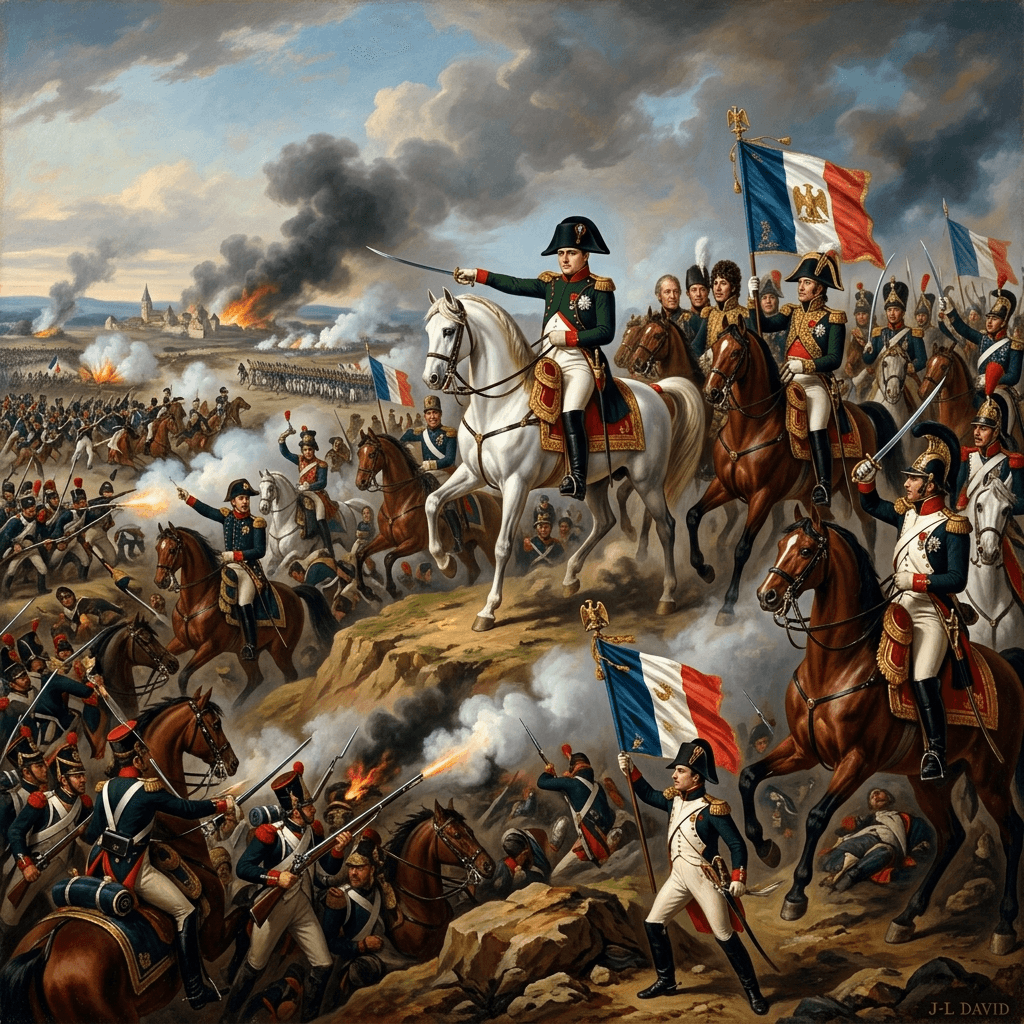
Chapter
1. Napoleonic Wars — The Definitive Guide to the Conflict That Redrew Europe (1803-1815)
Chapter
1.1 What Were the Napoleonic Wars? The True Story of the Greatest European Conflict Before World War I
The Napoleonic Wars were a series of warlike conflicts fought between the French Empire, led by Napoleon Bonaparte, and a succession of coalitions of European powers, spanning from 18 May 1803 to 20 November 1815 — totalling twelve years, six months and two days of nearly uninterrupted warfare. The struggle pitted Napoleonic France and its satellite states against alliances led chiefly by the United Kingdom, the Austrian Empire, the Russian Empire and the Kingdom of Prussia, in seven distinct coalitions that mobilised millions of combatants. This was the largest European conflict before the outbreak of World War I, both in geographic scale and in the number of belligerents involved, and its shockwaves spread to the Americas, the Middle East, North Africa and the Indian subcontinent.
The immediate trigger of hostilities in 1803 was the rupture of the fragile Peace of Amiens, signed between France and the United Kingdom just a year earlier. Napoleon, then First Consul of the French Republic, had consolidated his domestic political control and expanded French influence over Italy, Switzerland and the Low Countries. The British refusal to evacuate the island of Malta and Bonaparte's expansionist ambitions in central Europe and the Caribbean made the return to the battlefield inevitable. The British declaration of war in May of that year inaugurated a cycle of violence that would only end twelve years later, on the rain-soaked fields of Waterloo.
The scale of the conflict has no parallel in the modern era before the world wars of the twentieth century. It is estimated that between 2.5 million and 3.5 million military personnel perished on battlefields, fell victim to disease or went missing in action throughout the period. Added to this are between 750,000 and 3 million civilians killed as a direct or indirect result of the fighting, the famines and the epidemics that accompanied the campaigns. The historian Charles Esdaile calculates a total of 5 to 7 million deaths, combining military and civilian populations, which makes the Napoleonic Wars one of the deadliest conflicts in human history before the mechanisation of death in the twentieth century.
The theatre of operations encompassed virtually all of continental Europe, with decisive battles fought in what is now the Czech Republic (Austerlitz), Poland (Eylau, Friedland), Germany (Jena, Leipzig), Austria (Wagram), Russia (Borodino), Belgium (Waterloo), Portugal and Spain (the long and bloody Peninsular War). Naval engagements were also decisive, the most celebrated being the Battle of Trafalgar, on 21 October 1805, in which the British squadron commanded by Admiral Horatio Nelson annihilated the combined Franco-Spanish fleet, securing the United Kingdom's maritime supremacy and definitively thwarting Napoleon's plans to invade the British Isles.
The final outcome of the conflict was victory for the coalition forces. Napoleon was defeated, forced to abdicate on 6 April 1814, exiled to the island of Elba, returned to power for a hundred days in 1815, only to be conclusively defeated at the Battle of Waterloo on 18 June 1815 and deported to the remote island of Saint Helena, in the South Atlantic, where he died on 5 May 1821. The Congress of Vienna, which met between September 1814 and June 1815, completely redrew the continent's borders, inaugurating a period of relative stability that would endure, with setbacks, until the outbreak of World War I in 1914.
1.1.1 How This Conflict Changed Europe's Political Geography Forever
The redrawing of the European map after the Napoleonic Wars was arguably the deepest geopolitical transformation the continent had experienced since the Peace of Westphalia in 1648. The first and most symbolic victim was the Holy Roman Empire, a millennial institution founded by Charlemagne in the year 800, which Napoleon formally dissolved on 6 August 1806, following the humiliating Austrian defeat at Austerlitz. In its place, the French emperor created the Confederation of the Rhine, an alliance of German states under French protectorate that eliminated centuries of feudal fragmentation and paved the way for future German unification.
The number of independent political entities in the territory that today corresponds to Germany plummeted from more than 300 principalities, duchies, bishoprics and free cities to a few dozen larger and more cohesive territorial units. This rationalisation of the German political map, though imposed by a foreign conqueror, eliminated the medieval patchwork that had for centuries hampered any project of administrative modernisation in central Europe. The historical paradox is noteworthy: Napoleon, who intended to submit the Germans to Paris, ended up providing the territorial and institutional conditions for Germany to one day emerge as a unified power capable of challenging France itself.
Napoleonic expansion also sowed the seeds of modern nationalism. In the occupied territories, the French military presence and the imposition of administrative, fiscal and legal reforms sparked reactions that transcended mere resentment against a foreign invader. In Spain, popular resistance against the troops of Joseph Bonaparte, Napoleon's brother enthroned in Madrid, spawned the Spanish War of Independence (1808-1814) and coined the very term “guerrilla” to designate the asymmetric warfare waged by armed civilians. In Prussia, the national humiliation following the defeats of Jena and Auerstedt in 1806 spurred a profound movement of military, educational and social reforms that forged a Prussian — and later, German — national identity.
The Congress of Vienna, under the baton of Austrian chancellor Klemens von Metternich, attempted to restore the absolutist order that had existed before 1789, but the restoration was only partial. France was reduced to its 1790 borders, lost all territories conquered since the revolutionary wars and was surrounded by buffer states designed to contain it: the United Kingdom of the Netherlands to the north (uniting Holland and Belgium), the German Confederation to the east, neutralised Switzerland and a strengthened Kingdom of Sardinia to the south. Russia annexed most of the Duchy of Warsaw created by Napoleon, transforming it into the Kingdom of Poland under tsarist rule, while Austria consolidated its hegemony over the Italian peninsula. This arrangement, known as the Concert of Europe, established a balance-of-power system that prevented widespread continental wars for nearly a century.
Chapter
1.2 How Many Battles Did Napoleon Bonaparte Fight in His Lifetime? The Exact Number and the Most Decisive Ones
Napoleon Bonaparte personally commanded 60 major battles over the course of his military career, which stretched from the Battle of Montenotte on 12 April 1796 to Waterloo on 18 June 1815. Of this staggering total, he lost only seven: Acre (1799), Aspern-Essling (1809), Leipzig (1813), La Rothière (1814), Laon (1814), Arcis-sur-Aube (1814) and Waterloo (1815). His victory percentage, therefore, exceeds 88%, a rate that no other great commander in history has managed to match over such a long career and with so many pitched battles. When smaller-scale engagements are included — sieges, skirmishes, battles fought by his marshals under his strategic direction — the total number of combats associated with his command surpasses 80 engagements. The military historian David Chandler, one of the foremost authorities on Napoleon, catalogued 55 major Napoleonic victories.
Among the most decisive battles of the Corsican's career, Austerlitz occupies the uncontested pinnacle. Fought on 2 December 1805, the so-called “Battle of the Three Emperors” saw Napoleon, with about 68,000 soldiers, defeat a combined army of roughly 85,000 Russians and Austrians commanded by Tsar Alexander I and Emperor Francis I of Austria. The victory was so crushing — 16,000 Allied casualties against 9,000 French — that it caused the immediate collapse of the Third Coalition and established France's undisputed supremacy over central Europe. The Battle of Jena-Auerstedt, on 14 October 1806, was in fact two simultaneous engagements: while Napoleon crushed the bulk of the Prussian army at Jena, Marshal Louis-Nicolas Davout, outnumbered nearly two to one, annihilated the main Prussian force at Auerstedt. In the space of 24 hours, the kingdom of Prussia, which had been the most feared military machine in Europe under Frederick the Great, ceased to exist as an independent power.
On the other side of the scale, defeats were scarce but devastating. At Aspern-Essling, on 21 and 22 May 1809, Archduke Charles of Austria inflicted upon Napoleon his first tactical defeat in open field, taking advantage of the precarious Danube crossing by the French troops. Losses totalled 20,000 French soldiers, including the talented Marshal Jean Lannes, who would die days later from his wounds. The Battle of Leipzig, between 16 and 19 October 1813, was the most catastrophic defeat in scale: around 200,000 French and allies faced more than 360,000 coalition soldiers; Napoleonic losses reached about 60,000 men, and the disorderly retreat culminated in the premature explosion of a bridge that left 30,000 soldiers stranded on the wrong bank of the Elster River. And there was Waterloo, the final full stop: 72,000 French against 118,000 Anglo-Prussian allies, with the delay in launching the attack due to rain-soaked ground, the poorly coordinated cavalry charges of Michel Ney and the providential arrival of Gebhard von Blücher's Prussians on the French right flank sealing the Empire's fate.
The geographic distribution of Napoleonic battles reflects the extraordinary breadth of his ambitions. He fought in Italy (Lodi, Arcole, Rivoli, Marengo), in Egypt and Syria (Pyramids, Mount Tabor, Aboukir), in Austria and Moravia (Ulm, Austerlitz, Wagram), in Germany (Jena, Auerstedt, Dresden, Leipzig), in Poland (Eylau, Friedland), in Spain (Somosierra), in Portugal (Roliça, Vimeiro — though he did not command directly, the campaign was his), in Russia (Smolensk, Borodino), in France (La Rothière, Arcis-sur-Aube, the devastating Six Days' Campaign) and in Belgium (Ligny, Waterloo). No commander in history, before or since, fought pitched battles across such a vast geographic arc. The Duke of Wellington, his great antagonist, fought mainly in the Iberian Peninsula and at Waterloo; Alexander the Great concentrated his campaigns in the eastern Mediterranean and central Asia; Julius Caesar operated chiefly in Gaul and the Mediterranean basin. The spatial dispersion of Napoleon's campaigns demonstrates not only unrestrained imperial ambition, but a logistical capacity that defied the technological limits of the pre-industrial age.
Chapter
1.3 How Many Soldiers Died in the Napoleonic Wars? The Shocking Numbers of a Conflict That Devastated Generations
The casualties of the Napoleonic Wars are among the most difficult to quantify with precision in modern military history. The records of most belligerent states were fragmentary and frequently underestimated real losses, so the numbers vary considerably according to the historian and the methodology employed. The current academic consensus places the total of military dead between 2.5 million and 3.5 million combatants, to which are added between 750,000 and 3 million civilians who perished as a direct or indirect result of the fighting, epidemics and widespread famine. The total number of deaths, therefore, oscillates between 3.25 million and 6.5 million people, representing between 1.5% and 3% of the European population of the time, a lethality rate comparable to that of World War I for some nations.
France was, proportionally, the most sacrificed nation. Of the roughly 3 million Frenchmen who served in the armed forces between 1803 and 1815, between 800,000 and 1 million died — a mortality rate of around 30% among those recruited. The study by Jacques Houdaille, based on statistical sampling of conscription records, pointed to 439,000 confirmed dead in combat or in hospitals and 706,000 missing, many of whom never returned. The most comprehensive estimate, incorporating those who died of disease and wounds after 1815, reaches 1.7 million French dead. This number represented 38% of the conscript class born between 1790 and 1795, meaning that more than one third of Frenchmen who reached adulthood in that period lost their lives on the battlefields. The demographic impact was profound and long-lasting: at the start of the Revolution, the ratio of men to women in France was practically equal; by the end of the Napoleonic Wars, there were only 0.857 men for every woman. France would never recover the demographic supremacy it had held over Germany and the United Kingdom before 1789.
The Russian Empire suffered losses estimated at 450,000 military dead, with an additional hundreds of thousands of civilians killed during the 1812 invasion. Napoleon's Russian campaign, on its own, cost about 300,000 dead French and allies, in addition to roughly 400,000 Russian soldiers who fell between June and December of that year, according to the historian Adam Zamoyski. The Austrian monarchy tallied 200,000 dead; the German states (including Prussia), 400,000; Spain, more than 300,000 military and 586,000 people if civilians are included; Portugal, up to 250,000 counting combatants and civilians; the United Kingdom, 311,806 dead or missing across all its forces. The British Army suffered 25,569 combat casualties and 193,851 deaths from disease, accidents and wounds, while the Royal Navy lost 6,663 men in action and 13,621 in shipwrecks, fires and drownings.
The figures by campaign illustrate the uneven lethality according to the theatre of operations. The Peninsular War (1807-1814), fought in Portugal and Spain, claimed between 180,000 and 240,000 French lives. The invasion of Russia, in 1812, virtually eliminated the Grande Armée: of the 685,000 men who crossed the Niemen River in June, only 93,000 returned, of whom a mere 35,000 were French. The German campaign of 1813 consumed a further 150,000 to 200,000 of Napoleon's soldiers. Diseases were the great killers: typhoid fever, typhus, dysentery and yellow fever killed far more than musket balls and sabre blades. In the disastrous expedition to Haiti, yellow fever annihilated around 15,000 French soldiers in just two months, claiming even the expedition commander himself, General Charles Leclerc, Napoleon's brother-in-law.
Chapter
1.4 How a Corsican Standing <b>5 feet 6 inches (1.68 m)</b> Conquered Nearly All of Europe? The Secret of Napoleon Bonaparte's Rise
The meteoric rise of Napoleon Bonaparte, from obscure Corsican artillery officer to emperor of the French and master of Europe, constitutes one of the most extraordinary phenomena in political and military history. Born in Ajaccio, Corsica, on 15 August 1769 — just one year after France acquired the island from the Republic of Genoa — Napoleone Buonaparte was the son of Carlo Buonaparte, a lawyer of minor Tuscan nobility, and of Letizia Ramolino. His family, far from being wealthy, depended on scholarships granted by the French monarchy to educate their children. At the age of nine, the Corsican boy was sent to the military college of Brienne-le-Château, in mainland France, where he faced constant mockery for his Italian accent and his status as a provincial foreigner. This isolation forged in him a fierce self-confidence and an obsessive capacity for concentration that would become hallmarks of his personality.
The first rung of Napoleon's ascent was the French Revolution of 1789. Without it, the young artillery officer would never have risen above the rank of captain, a glass ceiling that the Ancien Régime imposed on military men of lesser nobility and peripheral origin. Revolutionary meritocracy opened the way for exceptional talents to emerge, and Napoleon seized every opportunity voraciously. In December 1793, at just 24 years of age, he conceived and executed the artillery plan that recaptured the port of Toulon from French monarchists backed by the British squadron. The victory earned him promotion to brigadier general. Two years later, on 5 October 1795 (13 Vendémiaire in the revolutionary calendar), he dispersed with “a whiff of grapeshot” — the expression is his — a monarchist insurrection that threatened the National Convention in the centre of Paris, consolidating his reputation as saviour of the republican regime.
Command of the Army of Italy in 1796 transformed the young general into a national hero. With a ragged, ill-fed and demoralised army, Napoleon successively defeated the Austrians and their Piedmontese allies in the lightning campaigns of Montenotte, Lodi, Castiglione, Arcole and Rivoli. In less than a year, he had expelled the Austrians from Lombardy, forced Piedmont to sign a separate peace and imposed the Treaty of Campo Formio (1797), which redrew the map of the Italian peninsula and gave France control of the Austrian Netherlands. More than military victories, Napoleon demonstrated his political genius there: he knew how to alternate terror and magnanimity, to plunder works of art and impose indemnities, to distribute booty to soldiers and rewards to generals, creating a network of personal loyalties that transcended formal obedience to the Republic.
The expedition to Egypt in 1798, although militarily inconclusive, added the oriental and civilisational dimension to the Napoleonic myth. He marched not only with cannons and muskets: he brought 167 scientists, engineers, astronomers and artists, who produced the monumental Description de l'Égypte, the founding work of modern Egyptology, and discovered the Rosetta Stone, which would enable Jean-François Champollion to decipher hieroglyphs. The coup of 18 Brumaire (9 November 1799) was the definitive inflection point: returning secretly from Egypt, Napoleon dissolved the Directory and instituted the Consulate, with himself as First Consul, concentrating in his hands the executive, legislative and military power of France.
From 1800 onwards, the machinery of conquest operated at full power. The victory at Marengo, on 14 June 1800, consolidated his dominion over Italy and ended the War of the Second Coalition. The signing of the Concordat with the Holy See in 1801 pacified French society by reconciling the State with the Catholic Church. The Civil Code of 1804 unified and modernised French legislation. The coronation as emperor, on 2 December 1804, in the presence of Pope Pius VII — but with Napoleon placing the crown upon his own head — symbolised the definitive fusion between the charismatic power of the conqueror and the institutional legitimacy of an empire. In the three years that followed, the Grande Armée successively crushed Austria and Russia at Austerlitz (1805), Prussia at Jena-Auerstedt (1806) and Russia again at Friedland (1807). At its peak, in 1811, Napoleon ruled directly or indirectly over more than 70 million people, from the Atlantic to the borders of Russia. The secret, therefore, was not a single gift but an exceptional convergence of factors: superhuman tactical intelligence, inexhaustible work capacity, luck, charisma, a revolution that destroyed the old hierarchies and a thirst for power that never knew satiety.
Chapter
2. The Military Engineering of Napoleon — How the Emperor Revolutionised the Art of War Forever
Chapter
2.1 What Was Napoleon's Grande Armée? The Most Feared Army in Europe That No One Could Defeat
The Grande Armée (Great Army) was the main field force of the French Imperial Army during the Napoleonic Wars, active between 1804 and 1815, and is universally recognised as one of the most formidable war machines ever assembled in history. Under Napoleon's personal command, it won an unbroken string of victories that enabled the First French Empire to exercise unprecedented dominance over the European continent. Its origin dates back to the camp of Boulogne-sur-Mer, where between 1803 and 1805 Napoleon gathered more than 100,000 soldiers — the so-called Armée des côtes de l'Océan or Armée d'Angleterre — with the aim of invading the United Kingdom. When the Third Coalition was formed against France, the emperor simply turned his army 180 degrees and marched towards central Europe, a stunning logistical manoeuvre that already announced what was to come.
The structure of the Grande Armée broke radically with eighteenth-century military organisation. Napoleon divided it into army corps (corps d'armée), autonomous units that functioned like miniature armies, each containing its own line and light infantry, cavalry and artillery. A typical corps counted two or three infantry divisions, a light cavalry brigade and an artillery reserve, totalling between 20,000 and 30,000 men. This corps organisation gave French forces a strategic flexibility that no other European army could match at the time. While opposing armies marched as monolithic blocks, Napoleonic corps moved along parallel roads, at mutually supporting distances, ready to converge on the enemy in a matter of hours. The bataillon-carré (battalion square) system allowed each corps to act as vanguard, rearguard or flank as the situation demanded, making it virtually impossible to surprise Napoleon with a concentrated attack.
At the height of its strength, in June 1812, on the eve of the invasion of Russia, the Grande Armée mobilised around 685,000 men on the border of the Niemen River, of whom roughly 600,000 crossed into Russian territory. This force was composed of 410,000 soldiers from the French Empire proper (including present-day France, northern Italy, the Low Countries and the annexed departments in Germany) and about 275,000 allies and foreign contingents. Among these were approximately 100,000 Poles, 35,000 Austrians, 30,000 Italians, 24,000 Bavarians, 20,000 Saxons, 20,000 Prussians, 17,000 Westphalians, 15,000 Swiss and smaller contingents of Danes, Croats, Spaniards, Portuguese and even Irish. It was the most international army Europe had ever seen march united under a single banner.
Recruitment for the Grande Armée was based on the conscription system introduced by the Jourdan-Delbrel law of 1798 and perfected by Napoleon. Annually, France called up a class of 20-year-old young men for military service, selected by lot and subject to a five-year service period. Between 1805 and 1813, more than 2.1 million Frenchmen were conscripted. The revolutionary principle of the career open to talent — la carrière ouverte aux talents — meant that any soldier, regardless of their social origin, could rise to the highest ranks of the officer corps if they demonstrated bravery and competence. The marshals of the Empire came from the most diverse backgrounds: André Masséna was the son of a small trader from Nice; Joachim Murat, the son of an innkeeper; Michel Ney, the son of a cooper; Jean Lannes, the son of a peasant. In the Grande Armée, unlike the aristocratic armies of Austria, Prussia and Russia, merit weighed more than blood.
2.1.1 The Organisation, Logistics and Speed That No European Army Could Match
The army corps system was Napoleon's most transcendental organisational innovation, and its functioning depended on an exceptionally efficient command structure. Each corps was commanded by a Marshal of the Empire or by an experienced general of division, with broad autonomy to make tactical decisions, but always subordinated to the emperor's centralised strategic direction. The Imperial Grand Headquarters (Grand Quartier Général) was the brain of the machine, directed by Marshal Louis-Alexandre Berthier, the chief of staff, whose ability to translate Napoleon's often enigmatic orders into precise instructions for each unit was one of the pillars of French military success. Berthier perfected a system of written orders that made it possible to coordinate hundreds of thousands of men in multiple corps separated by tens of miles — an administrative feat without parallel in the early nineteenth century.
Napoleonic logistics, contrary to the popular myth that attributes French victories exclusively to battlefield genius, were based on meticulous planning. Napoleon devoted hours daily to the study of maps, calculating distances, assessing the capacity of roads, estimating the agricultural yield of the regions he would cross. His prodigious memory allowed him to retain precise details about every unit under his command. The fundamental principle was that soldiers should march separately but fight united — marchant séparés, combattant réunis — meaning that each corps used distinct routes to move, avoiding congestion and accelerating progress, only to converge on the battlefield. The average marching speed of the Grande Armée was 19 miles (30 km) per day, against 12 miles (20 km) for opposing armies. In emergency operations, even greater distances were covered: in the Ulm campaign of 1805, the French army covered more than 311 miles (500 km) in 20 days from the English Channel to the Danube — a daily average of 16 miles (25 km) with an effective force of 200,000 men.
Supply logistics combined fixed depots with local requisition. Napoleon established advanced warehouses along invasion routes, stocked by convoys of wagons that followed the army, but also allowed soldiers to live off the resources of the regions traversed — a practice that reduced dependence on long lines of communication, but at the same time alienated civilian populations and would become catastrophic when applied to poor or devastated territories, such as Spain and Russia. The Imperial Guard, the Grande Armée's elite corps, received priority supplies and remained as a strategic reserve, rarely engaged at the start of battles, but feared by all enemies who saw it advance at the decisive moment of combat.
Napoleonic speed was aided by a revolutionary medical innovation: the flying ambulances of Baron Dominique Jean Larrey, surgeon-in-chief of the Grande Armée. Larrey developed light horse-drawn wagons designed to rapidly evacuate the wounded from the battlefield and transport them to field hospitals close to the front line. This system, unprecedented in European warfare, not only saved thousands of lives but also elevated the morale of soldiers, who knew that, if wounded, they would have a significantly greater chance of receiving care than enemy combatants. The combination of flexible corps organisation, speed of manoeuvre, meticulous logistical planning, an efficient general staff and care for the wounded transformed the Grande Armée into a force that, for nearly a decade, appeared invincible in the eyes of an astonished Europe.
Chapter
2.2 How Did Napoleon Use Artillery in a Revolutionary Way? The Secret of the Mobile Batteries That Decimated Enemies
Artillery was Napoleon Bonaparte's original vocation — he entered his military career as an artillery officer — and remained throughout his entire trajectory as the tactical arm he most valued and understood. Unlike most commanders of his era, who treated cannons as mere support to infantry and cavalry, Napoleon conceived of artillery as the queen of battles, capable of deciding by itself the outcome of an engagement if employed with intelligence, concentration and timing. His artillery revolution was founded on three main innovations: the mass concentration of batteries, the unprecedented mobility of horse artillery and the use of indirect fire to annihilate enemy formations before the infantry even advanced.
The principle of the massive battery (grande batterie) consisted of concentrating dozens or even hundreds of cannons on a specific point of the enemy line, breaking through it by means of a deluge of fire before launching the infantry and cavalry through the breach opened. In practice, while Ancien Régime armies dispersed their artillery along the entire battle front, Napoleon gathered his cannons in a single dominant position, opened coordinated fire and, in a matter of minutes, transformed the chosen point into a hell of shrapnel, smoke and torn bodies. In the Battle of Wagram, on 5 and 6 July 1809, the emperor positioned a grand battery of 112 cannons that pounded the Austrian centre until it opened a decisive breach. At Waterloo, he deployed a grand battery of 80 cannons that heavily punished the centre of Wellington's line before the first major attack of the French infantry.
The second fundamental innovation was horse artillery (artillerie à cheval), units in which each gunner mounted his own horse — instead of marching on foot beside the pieces — allowing the cannons to keep pace with the speed of light cavalry and infantry corps. This revolutionary mobility meant that Napoleon could reposition his cannons on the battlefield in minutes, rather than hours, adapting instantly to tactical changes and exploiting vulnerabilities that emerged during combat. Horse artillery could gallop ahead, discharge a devastating volley upon an enemy formation at close range and withdraw before the adversary could react. The Gribeauval system, standardised even before the Revolution, had already reduced the weight and increased the accuracy of French pieces, providing the industrial base upon which Napoleon built his artillery supremacy.
The third innovation was the tactical employment of artillery as a psychological instrument of annihilation. Napoleon understood that the cannon did not merely kill bodies — it destroyed the moral cohesion of formations. An infantry unit that remained impassive under musket fire for hours could disintegrate in panic after ten minutes of concentrated cannonade. The secret was ricochet fire: by firing solid round shot at a shallow angle against the ground, the projectiles bounced and bounced again, tearing through entire ranks of lined-up soldiers, mutilating legs, torsos and heads in an unpredictable trajectory that multiplied the effect of each shot. Grapeshot — tin cans stuffed with musket balls that burst open upon leaving the barrel, scattering hundreds of projectiles like a giant shotgun — was reserved for close range and could cut down entire companies in seconds.
Napoleon also innovated in the permanent organisation of artillery. Instead of temporarily attaching cannons to infantry divisions as needed, the emperor created a centralised artillery reserve under his direct command, which he himself allocated at the moment and point he deemed critical. This personal control over the artillery arm allowed him to improvise with lethal speed: when he perceived that the enemy was concentrating forces in a given sector, he ordered the reserve batteries to trot over there and destroy the concentration before it became a threat. At the Battle of Friedland, on 14 June 1807, General Alexandre-Antoine Sénarmont advanced his artillery to distances of only 492 feet (150 m) from the Russian infantry — practically suicidal by the standards of the time — and fired more than 3,000 rounds in 25 minutes, completely annihilating the enemy formation and paving the way for decisive victory.
Chapter
2.3 What Military Tactics Did Napoleon Develop? The Warfare Manual That Military Academies Still Study Today
The tactical legacy of Napoleon Bonaparte transcended the battlefields of the early nineteenth century and was incorporated into the canon of Western military thought, being taught and debated in academies such as Saint-Cyr, West Point and Sandhurst to this day. His most revolutionary contribution was the doctrine of strategic envelopment manoeuvre, which he summarised in the maxim “the secret of war lies in communications.” Napoleon did not merely seek to defeat the enemy army in battle — he aimed to destroy it completely, cutting off its lines of retreat, isolating it from its supply bases and forcing mass capitulation. This annihilationist conception of war contrasted radically with the eighteenth-century paradigm of limited manoeuvres, prolonged sieges and diplomatic negotiations concurrent with combat.
Napoleon's favourite tactic was the central position manoeuvre (stratégie de la position centrale). When facing two or more enemy armies that flanked him or tried to encircle him, he interposed himself between them, attacked one with superior forces while keeping the other at bay with reduced contingents, and, once the first adversary was defeated, pivoted his troops to face the second. The Battle of Austerlitz is the most crystalline example: Napoleon deliberately weakened his right flank to lure the bulk of the Allied army into attacking it, while concentrating overwhelming forces in the centre, breaking the line of communication between Russians and Austrians and destroying them separately. This capacity to defeat numerically superior armies through the concentration of forces at the decisive point — the so-called principle of economy of force — is the essence of Napoleonic military genius.
Another fundamental tactical innovation was the attack in columns preceded by a dense cloud of elite skirmishers (the tirailleurs or voltigeurs). Eighteenth-century armies fought in long lines three ranks deep, which maximised musket firepower but hindered manoeuvre and advance. Napoleon introduced the mixed order (ordre mixte), which combined some units deployed in line to sustain fire with others formed in deep columns for the shock. The columns, compact like human battering rams, were preceded by hundreds of skirmishers advancing ahead in open order, taking cover behind trees, fences and undulations of the terrain, targeting enemy officers and NCOs and undermining the cohesion of the opposing lines before the main body of the attack reached bayonet range. The combination of dispersed fire with mass shock proved devastating against the rigidly linear armies of Austria, Prussia and Russia.
Napoleonic cavalry also received an expanded tactical role beyond traditional scouting and pursuit. Napoleon organised a centralised cavalry reserve — often commanded by Joachim Murat, his brother-in-law and most flamboyant marshal — that acted as a massive shock force, capable of breaking through enemy lines already weakened by artillery and infantry with its impetus. At Eylau, on 8 February 1807, it was a charge of 11,000 cavalrymen of the reserve — one of the largest in history — that saved the French centre from being annihilated by the Russian infantry. The mounted diversity included breastplate-and-steel-helmet cuirassiers (the cuirassiers and carabiniers), dragoons in brass helmets who fought on horseback and on foot, hussars and chasseurs à cheval for reconnaissance and pursuit, and Polish lancers of fearsome efficiency.
Napoleon also introduced the concept of strategic reserve personified by the Imperial Guard, an elite corps composed of the best soldiers in the army. The Guard was only launched into combat at the culminating moment, when the adversary was already exhausted and its defences were wavering — the so-called coup de grâce. This practice had a dual tactical and psychological function: it inflicted the mercy blow upon an already staggering enemy and preserved the mystique of the Guard's invincibility, whose mere sight provoked panic in opposing ranks. The only time the Imperial Guard attacked and was repelled — at Waterloo, on the afternoon of 18 June 1815 — symbolised the definitive collapse of the Napoleonic empire. The cry of “La Garde recule!” (The Guard retreats!) became the death knell of two decades of French military supremacy in Europe.
Chapter
2.4 How Napoleon's Rapid March System Surprised and Destroyed Enemies Before the Battle Even Began?
The marching speed of the Grande Armée constituted, far more than tactical genius on the battlefields, the true strategic differentiator that enabled Napoleon to conquer Europe. The emperor expressed this conviction in one of his most celebrated maxims: “I may lose a battle, but I shall not lose a minute.” For Napoleon, war was decided less in frontal engagement and more in the capacity to arrive first, to position oneself in the right place at the right time and to force the enemy to fight under unfavourable conditions. The Napoleonic march system was a military clockwork machine that operated in three interdependent dimensions: operational speed, coordination between corps and decentralisation of command.
Operational speed was achieved through gruelling march days, in which French soldiers frequently walked 12 to 16 hours a day, covering between 19 and 25 miles (30-40 km) daily, in contrast to the 9-12 miles (15-20 km) of opposing armies. The corps marched light, without the heavy baggage train that burdened the Austrian and Prussian forces, and the soldiers themselves carried their bread ration for several days. Boots and uniforms were designed for mobility, and the draconian discipline in camps — including the requirement that men master the setting up and dismantling of camps in minutes — ensured that the army was on the move at dawn.
Coordination between corps obeyed the bataillon-carré system, whereby the corps marched in a square or diamond formation, separated by distances of 12-19 miles (20-30 km), which allowed any one of them to come to the aid of another in less than a day. The entire army moved like a school of sharks: dispersed enough not to congest roads or exhaust local resources, but compact enough to concentrate overwhelming force on any point of the enemy line in a matter of hours. An enemy who attacked an isolated corps would discover, with horror, that within hours two or three other corps were converging on its flanks and rear, transforming the attacker into the attacked.
The supreme example of this system's effectiveness was the Ulm Campaign, in the autumn of 1805. Napoleon at Boulogne received news that Austria and Russia had formed the Third Coalition against France. In response, he ordered the Grande Armée — stationed on the English Channel coast, prepared for the invasion of England — to march eastward. In 20 days, 435 miles (700 km) were covered, and the French corps crossed the Rhine and the Danube, enveloped the Austrian army of General Karl Mack von Leiberich at Ulm and forced its surrender without a major pitched battle: 60,000 Austrian prisoners were captured at a cost of only 2,000 French casualties. Mack, who expected the French at fortified defensive positions, was simply bypassed, surrounded and strangled logistically. As Napoleon summed it up with his characteristic sarcasm: “I have defeated the Austrian army simply by marching.”
The Napoleonic system was copied later by all the European powers, but none succeeded in matching the combination of speed, coordination and initiative that Napoleon and his marshals achieved between 1805 and 1809. Only when the adversaries learned to avoid direct confrontation with the emperor — the so-called Trachenberg Plan, adopted by the Sixth Coalition in 1813, which stipulated that only the Allied armies should retreat before Napoleon and attack only his marshals — did French strategic superiority begin to crumble. In Russia, in 1812, the terrible combination of continental distances, boggy roads, extreme heat in summer, polar cold in autumn and the scorched-earth strategy rendered Napoleonic speed useless. The enemy simply refused to offer battle, withdrew into the interior of the vast Russian territory and burned everything that could feed the French. For the first time, Napoleon's speed was overcome by the inertia of space — and the Grande Armée, which had conquered Europe by marching, was destroyed by marching.
Chapter
3. The Great Battles of Napoleon — Austerlitz, Jena, Borodino and Waterloo: Complete Guide to the Confrontations That Decided Europe
Chapter
3.1 What Was the Battle of Austerlitz (1805)? The Military Masterpiece That Immortalised Napoleon Forever
The Battle of Austerlitz, fought on 2 December 1805 in the hills of Moravia — present-day Czech Republic — is universally regarded as Napoleon Bonaparte's greatest tactical masterpiece and one of the most studied military confrontations in world history. Also known as the Battle of the Three Emperors, it pitted roughly 68,000 French soldiers against a combined army of about 85,000 Russians and Austrians, personally commanded by Tsar Alexander I of Russia and Emperor Francis I of Austria. In less than nine hours of combat, Napoleon inflicted a crushing defeat upon his adversary — 16,000 casualties between dead and wounded, plus 12,000 prisoners, 186 cannons captured and 45 standards taken — at a cost of approximately 9,000 French casualties. The Third Coalition collapsed, the Treaty of Pressburg was signed on 26 December and, the following year, the millennial Holy Roman Empire was formally dissolved.
The Austerlitz battlefield was a landscape of gentle hills, frozen lakes and scattered villages, dominated by the Prätzen plateau, an elevation that Napoleon astutely abandoned to the Allies at the start of the battle. The trap he set was based on a multi-layered strategic deception: he deliberately weakened his right flank, garrisoning it with only one division, to induce the Allies to concentrate their forces on that point, which would inevitably weaken their centre. When the bulk of the Russo-Austrian army abandoned the Prätzen plateau to attack the French right flank, Napoleon launched Marshal Jean-de-Dieu Soult with the IV Corps directly upon the Allied centre, breaking the enemy line, isolating the two flanks from one another and enveloping them separately.
What made Austerlitz a masterpiece was not only the plan, but its almost choreographic execution. The famous arrival of Marshal Louis-Nicolas Davout with the III Corps, after a forced march of 68 miles (110 km) in 48 hours from Vienna, reinforced the right flank exactly when the Allies were pressing hardest. Davout's soldiers arrived exhausted, covered in mud and ice, and immediately entered combat, repelling successive waves of Russian infantry with a tenacity that became legendary. Meanwhile, in the centre, Soult's infantry, covered by the morning mist that Napoleon had foreseen and used to conceal his manoeuvres, emerged from the fog onto the plateau, stormed it and split the Allied army into two halves that would never be reunited.
The coup de grâce came when Napoleon ordered his artillery to fire solid round shot upon the frozen lakes across which the Allied left wing was attempting to escape. The ice shattered under the weight of the fleeing soldiers and cannons, and thousands of men — especially from the Russian rearguard — perished drowned in the freezing waters. The scene of the disaster was immortalised in countless paintings and constitutes one of the most iconic and terrible images of the Napoleonic Wars. At nightfall, Napoleon toured the corpse-strewn battlefield and addressed his soldiers with one of the most celebrated proclamations of his career: “Soldats, je suis content de vous” — Soldiers, I am content with you. Austerlitz was the apex of his genius and the inflection point that transformed a crowned general into the uncontested master of continental Europe.
3.1.1 How Napoleon Deceived Two Emperors in a Single Day and Won His Greatest Battle
The victory at Austerlitz was built upon a web of ingenious illusions that Napoleon wove in the days and hours before the confrontation. The manipulation began with his simulated withdrawal: he ordered his troops to abandon the Prätzen plateau and retreat in apparent disorder, deliberately conveying an image of fragility and despair. He then sent his aide-de-camp, General Anne Jean Marie René Savary, to the Allied camp to propose an armistice, a gesture of supposed weakness that convinced the young and arrogant Tsar Alexander that the French army was on the verge of collapse and that an immediate attack would guarantee a crushing victory. The tsar ignored the prudent advice of the experienced Marshal Mikhail Kutuzov — who had been wounded in a previous battle but remained as the principal military adviser — and ordered the advance upon the French right flank exactly as Napoleon had foreseen.
The second layer of the stratagem was the concealment of his reinforcements. Although the Allies knew of the existence of Davout's corps, they had no idea of its proximity or its speed of movement. Napoleon, through his communications system — the mounted dispatch riders of Berthier's general staff — kept himself informed minute by minute of the position of each Allied unit and had Davout accelerate his march to reach the battlefield at the exact moment when his presence would be decisive. This coordination between intelligence, logistics and tactics was something no other European army could match, and it remains to this day a case study in every military academy in the world.
The third and definitive illusion was the morning mist. Napoleon had studied the meteorology of the region and knew that December mornings in Moravia invariably dawned covered by a dense fog. He concealed the bulk of his infantry and cavalry at the bottom of the valley, invisible to the Allied observers positioned atop the Prätzen plateau. When the fog dissipated, around nine o'clock in the morning, the French emerged like ghosts and took the central hills in a devastating assault. The psychological effect on the Allied command was devastating: what seemed to be an easy victory was suddenly transformed into a deadly trap, and the two emperors — Alexander and Francis — watched in horror the collapse of their army from a nearby hill.
Austerlitz demonstrated that Napoleon's military superiority resided not merely in the brute force of his troops, but in his capacity to read the adversary, to anticipate his decisions and to exploit every psychological flaw with surgical precision. He understood that Tsar Alexander, young, inexperienced and surrounded by sycophantic advisers, was eager for a glorious victory that would prove his military worth, and he used that vanity against him. He also knew that the Austrian general Franz von Weyrother, responsible for the Allied battle plan, was a mediocre and predictable strategist, whose intentions Napoleon had correctly deduced merely by observing the movements of the Russian and Austrian troops in the preceding days. Austerlitz was, therefore, less a battle of force and more a battle of intelligence — and it was for this reason that Napoleon considered it his most perfect victory.
Chapter
3.2 The Battle of Borodino (1812) and the Invasion of Russia — The Bloodbath That Cost 70,000 Lives in a Single Day
The Battle of Borodino, fought on 7 September 1812 around 68 miles (110 km) from Moscow, was the bloodiest single day of combat of all the Napoleonic Wars and remained the deadliest day in European military history until the outbreak of World War I a century later. Around 250,000 soldiers clashed in a space of a few square miles, and by nightfall between 70,000 and 90,000 men lay dead or wounded on both sides — a hecatomb that exceeds the combined casualties of many entire wars. The French and their allies, with roughly 130,000 combatants, attacked Russian entrenchments defended by about 150,000 soldiers commanded by Field Marshal Mikhail Kutuzov, hastily appointed by Tsar Alexander to halt the Napoleonic advance at the gates of the ancient capital.
Borodino was a battle of frontal attrition, bloody and without subtlety, radically distinct from the manoeuvrist elegance of Austerlitz. Kutuzov, old and cautious, had chosen a solid defensive position anchored on three field fortifications: the three Bagration flèches — V-shaped trenches defended by the Georgian prince Pyotr Bagration — on the left of the Russian line, and the Raevsky redoubt — an earthen fortification with 18 cannons — in the centre-right. Napoleon, perhaps for the first time in his career, was unable to conceive a brilliant enveloping manoeuvre and opted for direct attack. His plan was simply to crush the Russian left with numerical superiority, hoping that Kutuzov would denude his centre to come to its aid, at which moment the Imperial Guard would burst through the breach.
The result was industrial slaughter. The Bagration flèches changed hands at least seven times throughout the day. The French artillery, concentrated in a grand battery of more than 200 cannons, pounded the Russian positions for hours, while the infantry attacked in successive waves. General Bagration himself was mortally wounded by a cannonball splinter that shattered his leg, and his death, days later, was an irreparable blow to Russian morale. In the centre, the Raevsky redoubt was taken by a devastating charge of French cuirassiers, but at a terrible cost: General Auguste-Jean-Gabriel de Caulaincourt, brother of the former French ambassador to Russia, fell at the head of his cavalrymen inside the redoubt itself. On the Russian side, General Nikolay Tuchkov was mortally wounded; in total, 50 French generals and 29 Russian generals were killed or wounded, which is why the British officer Sir Robert Wilson, who accompanied the campaign as an observer, dubbed it “the Battle of the Generals.”
The most controversial and debated moment of the battle occurred in the early afternoon, when Marshals Joachim Murat and Michel Ney begged Napoleon to launch the Imperial Guard — his 20,000 finest soldiers, held in reserve — against the Russian centre, which was on the verge of collapse. Napoleon hesitated. He refused. For the first time in his career, he refused to risk his last reserve at a potentially decisive moment. The reasons are debated to this day: he feared losing the Guard in hostile territory, thousands of miles from France; his health was impaired by an attack of fever and urinary retention that affected his lucidity; and he believed he needed the Guard intact to negotiate a peace with the tsar that would never come. The decision — probably the greatest tactical error of his career — allowed the Russian army, although terribly battered, to withdraw in relative order rather than being annihilated.
Napoleon won Borodino in the tactical sense: he took the battlefield, forced Kutuzov to retreat and opened the road to Moscow. But it was a Pyrrhic and strategically useless victory. A week later, the Grande Armée entered a deserted and burning Moscow, and from there began the nightmare retreat that would destroy the Napoleonic empire. Of the 130,000 French and allies who entered Borodino, only a fraction returned alive to Poland in December. The battle became the symbol of the point at which Napoleonic hubris collided with the reality of Russian distance and climate — and the exact moment when the emperor's aura of invincibility began to unravel before the eyes of his own soldiers.
Chapter
3.3 The Battle of the Nations at Leipzig (1813) — The Confrontation That Gathered 600,000 Soldiers and Sealed Napoleon's Fate
The Battle of Leipzig, fought between 16 and 19 October 1813 in the kingdom of Saxony, entered history with the nickname that perfectly captured its terrifying scale: the Battle of the Nations (Völkerschlacht bei Leipzig). It was the largest military confrontation ever fought on European soil until the outbreak of World War I, involving roughly 600,000 combatants — more than the population of Paris at the time — distributed among armies that included Russians, Prussians, Austrians, Swedes, French, Poles, Italians, Saxons, Bavarians, Westphalians, Württembergers, Badeners and Hessians. When the smoke of the cannons cleared on the morning of 19 October, about 100,000 soldiers lay dead or wounded, and the Napoleonic Empire had lost its last chance of survival.
The battle represented the culmination of the Allied strategy known as the Trachenberg Plan, conceived by Napoleon's former marshal, Jean-Baptiste Bernadotte — now crown prince of Sweden and commander of the Army of the North — together with Austrian and Prussian strategists. The plan was diabolically simple: avoid at all costs direct confrontation with Napoleon, attacking exclusively his subordinate marshals, until the emperor was forced to exhaust himself in marches and counter-marches trying to succour all his generals simultaneously. It worked with deadly efficiency. In the weeks preceding Leipzig, the Allied armies had successively defeated Generals Nicolas Oudinot (at Großbeeren), Étienne Macdonald (at the Katzbach) and Dominique Vandamme (at Kulm), inflicting losses that Napoleon could not replace.
At Leipzig, four Allied armies converged on the city like the claws of a hydraulic vice. The Army of Bohemia, commanded by the Austrian prince Karl von Schwarzenberg and accompanied by Emperors Alexander and Francis, attacked from the south. The Army of Silesia, led by the old and indomitable Prussian marshal Gebhard von Blücher, advanced from the north. The Army of the North, under Bernadotte, and the Army of Poland, under the Russian general Levin von Bennigsen, completed the encirclement from the eastern and northern flanks. Napoleon, with about 200,000 soldiers, was surrounded by more than 360,000 on the first day, a number that rose to almost 400,000 in the following days with the continuous arrival of Allied reinforcements.
The combat stretched over three days of uninterrupted violence. On the first day, 16 October, Napoleon attempted to break the encirclement by attacking the Army of Bohemia to the south. The battle was inconclusive: his cavalry came close to capturing Tsar Alexander in person, but the Allies held their positions. In the north, Blücher attacked with fury and took the village of Möckern after a house-to-house combat that cost more than 15,000 casualties on each side. On the second day, 17 October, there was a relative lull while forces regrouped. Napoleon, realising the gravity of his situation, attempted to negotiate an armistice by sending an emissary to the Allies, but Schwarzenberg and Alexander refused any talks. The emperor's fate was sealed.
The third day, 18 October, witnessed a concentric Allied attack from all sides. The decisive tragedy occurred when the Saxon and Württemberg troops, who had fought on Napoleon's side, deserted en masse in the middle of the battle and turned their cannons against the French. It was the first case in history of a large unit changing sides in the midst of combat, and the impact was devastating for Napoleonic morale. On the morning of 19 October, the French retreat began, but the final disaster was yet to come. A French sergeant, charged with blowing up the sole bridge over the Elster River after the entire army had crossed, detonated the explosives prematurely. The result was the capture or death of 30,000 French soldiers still on the wrong side of the river. Among them, the Polish marshal Józef Poniatowski, who tried to swim across the Elster and drowned. Leipzig had become Waterloo before Waterloo — the difference was the scale: about 60,000 French casualties against 54,000 Allied, a bloodletting that France could no longer sustain. Within a few months, Paris would fall and Napoleon would abdicate for the first time.
Chapter
3.4 The Battle of Waterloo (1815) — The Definitive End of the Napoleonic Empire and the Mistakes That Cost Victory
The Battle of Waterloo, fought on 18 June 1815 in the rain-soaked fields of Belgium — then part of the United Kingdom of the Netherlands — is the most famous, the most mythologised and the most debated of all Napoleonic battles. It was the last. On a rain-laden summer Sunday, roughly 72,000 French soldiers of the reborn Army of the North, under Napoleon's personal command, faced about 68,000 men of the Anglo-Allied army of the Duke of Wellington, reinforced in the late afternoon by about 50,000 Prussians led by Field Marshal Gebhard von Blücher. By nightfall, around 50,000 men lay dead or wounded across the three armies, and the Napoleonic dream of restoring the Empire was definitively buried.
The battle was decided as much by errors on the French side as by the successes of the coalition, and the chronology of Napoleonic blunders begins before the first shot. The previous night, torrential rain transformed the valley between the two ridges into a quagmire of mud, delaying the start of the French attack from 9 a.m. to nearly 11:30 a.m. — precious time that would allow the Prussians to reach the battlefield. Marshal Emmanuel de Grouchy, tasked with pursuing the Prussians with 33,000 men after the French tactical victory at Ligny two days earlier, committed the fatal error of not marching immediately towards the rumble of the cannons he heard in the distance, opting instead to continue his original mission. Grouchy was immobilised at Wavre, a few miles away, while the Prussians, more cunning, detached three-quarters of their forces to come to Wellington's aid. Napoleon sent Grouchy a recall order at 10 a.m., but the messenger took hours to find him and, when the order arrived, it was already too late.
Wellington positioned his troops along a low ridge, adopting his favourite tactic: infantry sheltered behind the reverse slope of the hill, invisible to the French artillery, protected on the right wing by the fortified farm of Hougoumont and at the centre by the farm of La Haye Sainte. The battle began with a diversionary attack against Hougoumont, which turned into a sinkhole of French troops throughout the day: more than 14,000 men of General Honoré Reille's corps were consumed trying to capture a position that was not essential to Napoleon's plan. The grand battery of 80 cannons then began its bombardment, but mud and the reverse slope enormously reduced its effectiveness.
The first major attack of the French infantry, led by General Jean-Baptiste Drouet d'Erlon's corps, almost broke through Wellington's centre-left, but was repelled by a devastating charge of the British heavy cavalry — the Scots Greys and the Royal Dragoons — which, though heroic, lost cohesion by pursuing the retreating French and was decimated by the counter-attack of Napoleonic lancers and cuirassiers. There followed the most controversial episode of the battle: between 4 p.m. and 6 p.m., Marshal Michel Ney, erroneously believing that Wellington was retreating, launched 10,000 French cavalrymen in successive frontal charges against the British infantry squares. The charges were spectacular but useless: the squares, compact formations with bayonets pointing outward in all directions, proved impenetrable to cavalry without infantry and artillery support. The flower of French cavalry was massacred.
The tide began to turn definitively around 4:30 p.m., when the first Prussian contingents of General Friedrich von Bülow arrived on the French right flank, forcing Napoleon to detach precious troops to contain them. At 7 p.m., La Haye Sainte fell, and the Allied centre was dangerously exposed. Napoleon, desperate, played his last card: the attack of the Imperial Guard, the undefeated elite. Roughly 3,000 grenadiers and chasseurs of the Old Guard marched up the hill in close columns, singing La Marseillaise. Wellington, who had until then been waiting for the exact moment, ordered the British infantry to rise from the ground where they lay hidden and fire a devastating point-blank volley. The Guard wavered. Cries of “La Garde recule!” — The Guard retreats! — spread through the French army, and within minutes the withdrawal turned into a rout. Napoleon fled protected by a square of the Guard, and Wellington and Blücher met at the farm of La Belle Alliance, at the centre of the field, sealing the end of 23 years of revolutionary and Napoleonic wars. Four days later, Napoleon abdicated for the second and last time, beginning his definitive exile on Saint Helena.
Chapter
4. Napoleon's Imperial Guard — The Elite Army That Died Fighting at Waterloo
Chapter
4.1 What Was Napoleon's Imperial Guard? The Elite Soldiers Who Were Never Defeated
The Imperial Guard (Garde Impériale) was the elite military formation of the Napoleonic army, composed of the most experienced, tallest, most decorated and most loyal soldiers to the emperor. Under Napoleon's direct command, the Guard performed a dual function: it served as the emperor's personal bodyguard on campaign and as a strategic shock reserve which, launched at the decisive moment of battle, was capable of breaking through enemy lines and transforming a doubtful combat into a crushing victory. The reputation of the Imperial Guard was such that, for more than a decade, its mere presence on the battlefield exerted a paralysing psychological effect upon adversaries — and, for French soldiers, seeing the Guard advance meant that victory was near.
The origin of the Guard dates back to the Consular Guard (Garde des Consuls), created on 28 November 1799 by the merger of the Guard of the Directory with the Grenadiers of the Legislature — about a thousand men tasked with the security of the republican institutions. When Napoleon proclaimed himself emperor on 18 May 1804, the Consular Guard was transformed into the Imperial Guard, and from that moment its growth was exponential. From the initial 8,000 men in 1804, the Guard expanded to just under 100,000 on the eve of the invasion of Russia in 1812, becoming a small army within the army — with its own infantry, cavalry, artillery, engineers and even a unit of sailors. No military force in Europe possessed anything comparable in size, quality and prestige.
What distinguished the Imperial Guard from ordinary line troops was not only superior training and combat experience, but an entire system of privileges meticulously cultivated by Napoleon. Guard soldiers received higher pay — an Old Guard grenadier earned substantially more than a line infantry soldier — superior rations, better quarters and first-rate equipment. Every guardsman, regardless of his effective rank, had hierarchical precedence over all line soldiers of equivalent rank — a private of the Guard was treated as a corporal of the regular army. Guard officers enjoyed direct access to the emperor, who personally knew many of his veterans, remembered their names and deeds and frequently consulted them on tactical matters. This preferential treatment naturally generated resentment among the line troops, but also an intense desire for promotion to the Guard, which functioned as the most powerful career incentive in the French army.
The Imperial Guard was, in its entire existence, defeated on the field of battle a single time: in the final moments of the Battle of Waterloo, on 18 June 1815. Until that fateful late afternoon on the fields of Belgium, the Guard had never retreated before the enemy. Its participation in previous battles had been frequently decisive, but also economical: Napoleon was extremely miserly in the use of his elite troops, preserving them for the right moment — a practice that generated criticism from marshals who accused him of hesitating to employ the Guard even when its intervention could have transformed tactical victories into strategic annihilations. At Borodino (1812), for example, many officers begged Napoleon to launch the Guard against the shattered Russian lines to consummate the destruction of Kutuzov's army, but the emperor refused, fearing to lose his strategic reserve so far from France. The decision was probably correct from a strategic standpoint — Russia was a logistical abyss — but the frustration of the marshals was understandable.
The soldiers of the Old Guard — the elite of the elite — were known as Les Grognards, “the Grumblers,” a nickname that derived from the unique privilege they possessed of complaining openly in the emperor's presence. While marshals and generals often hesitated to express disagreement with Napoleon, the old grenadiers could mutter their grievances without fear of reprisal — a privilege earned through years of loyalty and sacrifice. The Grognards were easily recognisable on the battlefield: men of tall stature — the minimum height requirement for Old Guard grenadiers was 5 feet 9 inches (1.76 m), considerable for the time — wearing the characteristic bearskin caps (bonnet à poil) that made them appear even more imposing, many with scars from previous battles and almost all sporting the moustache that was compulsory for members of the elite companies. Soldiers of other armies referred to them, with a mixture of fear and admiration, as “the Immortals” — an allusion to the personal guard of the Persian kings of antiquity.
Napoleon's relationship with his Guard was personal and emotional. He visited the Guard camps frequently, talked with the veterans, remembered details of their lives and careers, distributed decorations of the Legion of Honour generously and, on campaign, often slept among them, wrapped in his grey greatcoat, sharing the campfire like a soldier among soldiers. When the Guard suffered casualties, Napoleon felt each loss as a personal blow. During the retreat from Russia, he marched on foot alongside the remnants of his Old Guard, refusing the comfort of his carriage while his men stumbled through the snow. This closeness between the emperor and his elite troops was one of the secrets of the superhuman cohesion that the Guard demonstrated in combat — they did not fight only for France or for the empire, but personally for “le petit caporal,” the little corporal who led them.
Chapter
4.2 How Many Soldiers Made Up the Imperial Guard? The Structure of the Most Feared Corps in Europe
The Imperial Guard was not a monolithic unit, but a complex and stratified military corps, divided into three hierarchical categories that reflected the experience and prestige of its members: the Old Guard (Vieille Garde), the Middle Guard (Moyenne Garde) and the Young Guard (Jeune Garde). This tripartite structure allowed Napoleon to dose the employment of his elite forces according to need — preserving the most valuable veterans for the most critical situations, while using the newer units for less risky tasks. The division also created a career progression system that encouraged young recruits to aspire to promotion to the Guard's upper ranks.
The Old Guard was the heart of the Imperial Guard and the most prestigious military unit in the Napoleonic world. To be admitted as a grenadier or foot chasseur of the Old Guard, the soldier had to meet extremely rigorous criteria: a minimum of 10 years' service in the line army, participation in at least three campaigns, a minimum height of 5 feet 9 inches (1.76 m) for grenadiers (slightly less for chasseurs), proven bravery in combat and irreproachable moral conduct. Most members of the Old Guard were veterans who had fought at Marengo, Austerlitz, Jena and Eylau — men who had survived the bloodiest battles of the era and emerged not just alive, but victorious. They formed the elite infantry regiments of the Guard: the 1st Regiment of Foot Grenadiers, the 1st Regiment of Foot Chasseurs and, in the cavalry, the Mounted Grenadiers — known as “the Gods” — and the Mounted Chasseurs, who frequently served as Napoleon's personal escort.
The Middle Guard was created in 1806 as an intermediate category, composed of soldiers who did not meet the extremely demanding standards of the Old Guard but had already demonstrated qualities superior to line troops. It included units such as the Fusilier-Grenadiers and the Fusilier-Chasseurs, regiments initially formed from the Vélite battalions — young recruits from well-to-do families who served as a sort of officer school within the Guard. The Middle Guard had the tactical function of reinforcing the Old Guard when necessary, constituting a second line of elite reserve. In the hierarchy of prestige, belonging to the Middle Guard was already a considerable honour that distinguished the soldier from the mass of regular troops.
The Young Guard was established in 1809 in response to the need to expand the Imperial Guard without diluting the standards of excellence of the upper categories. Its members were typically recruits who had distinguished themselves in basic training — for the Tirailleurs-Grenadiers and Tirailleurs-Chasseurs, it was required that they knew how to read and write, a noteworthy requirement for the era that demonstrated Napoleon's intention to form an educated elite troop, capable of rising to command posts. The Voltigeurs of the Young Guard, created in 1810, became one of the Guard's largest formations, coming to count 16 regiments in 1814. Although less experienced than the Old Guard, the Young Guard fought with bravery and, on several occasions — notably at the Battle of Krasnoi during the retreat from Russia — was virtually annihilated while protecting the withdrawal of the remnants of the French army.
In numerical terms, the growth trajectory of the Imperial Guard is revealing of the ever-increasing scale of Napoleonic ambitions — and of the challenges they generated. In 1804, the Guard numbered approximately 8,000 men, a compact and manageable elite force. On the eve of the invasion of Russia in 1812, the Guard had swollen to just under 100,000 soldiers — a number that reflected both military necessity and Napoleon's policy of incorporating foreign elite contingents, such as the Polish Lancers, the Dutch Grenadiers and the Egyptian Mamelukes. In 1814, after the catastrophes of Russia and the German Campaign, the Guard was rebuilt with veterans of the Peninsular War and new recruits, but never recovered the splendour of the glory years.
The ethnic and national diversity of the Imperial Guard is an often overlooked but fascinating aspect. The Guard included a squadron of Mamelukes whom Napoleon had brought from Egypt in 1799, dressed in their characteristic oriental attire and mounted on Arabian horses. The 1st Regiment of Lancers (Polish) was created in 1807 after the French victory over Prussia and the creation of the Duchy of Warsaw; its soldiers, known as the Polish Chevau-Légers, nourished a fanatical loyalty to Napoleon, whom they saw as the liberator of Poland. The 2nd Regiment of Lancers (Franco-Dutch), nicknamed the Red Lancers for their scarlet uniforms, was formed in 1810 from Dutch cavalry units. There was also the 3rd Regiment of Lancers (Lithuanian), recruited from the Lithuanian nobility during the invasion of 1812, and a squadron of Lithuanian Tatars incorporated into this unit. The Imperial Guard was, therefore, a microcosm of the multinational empire that Napoleon had built — and which, like the empire, was destined to crumble when the tide of war turned against him.
Chapter
4.3 What Was the Role of the Imperial Guard in Battles? The Shock Reserve That Decided Conflicts
The tactical role of the Imperial Guard in the Napoleonic Wars was dual and, to some extent, contradictory: it was simultaneously the strategic last-resort reserve and the decisive shock instrument that Napoleon Bonaparte launched against the critical point of the enemy line when victory was already ripe. This duality created constant tensions between the need to preserve the Guard and the temptation to deploy it to accelerate victory — and, on the rare occasions when the Guard was prematurely committed or poorly employed, the consequences were disastrous. The study of the Imperial Guard's tactical employment is, in essence, the study of Napoleon Bonaparte's own military philosophy.
The Guard's primary function was to serve as a strategic reserve — the force that Napoleon Bonaparte kept intact while the line troops wore down the enemy, and which he would launch at the exact moment when the battle's balance tipped one way or the other. This was the lesson Napoleon Bonaparte had drawn from his first great victories: at Marengo (1800), the providential arrival of General Desaix's division at the end of the day turned an imminent defeat into victory; at Austerlitz (1805), the attack of the French reserve against the weakened center of the Russo-Austrian coalition shattered the enemy line. The Imperial Guard was the institutionalization of these lessons — a permanent force whose mere existence on the battlefield conditioned the enemy's calculations. An opposing general who knew the Imperial Guard had not yet entered combat fought with the awareness that the worst was yet to come.
The Guard's second function was the breakthrough attack — the coup de grâce against an enemy already worn down and on the brink of collapse. When Napoleon Bonaparte judged that the adversary had committed all its reserves and that its lines were weakened, he ordered the Guard to advance. The psychological impact was devastating: for French soldiers, seeing the Guard marching forward meant victory was certain; for the enemies, the advance of the bearskin-capped columns was the harbinger of defeat. The combination of extraordinarily high morale, superior training, and the reputation of invincibility produced a force-multiplying effect that went far beyond the actual number of bayonets. Guard battalions frequently faced and defeated numerically superior forces simply because the enemy believed they could not defeat them.
The chivalry and esprit de corps of the Imperial Guard were carefully cultivated by Napoleon Bonaparte. Guard officers received the best horses, the most splendid uniforms, and the most coveted decorations. Each regiment had its own military band, its own standards adorned with the inscriptions of the battles in which they had fought, its own rituals and traditions. The rivalry between the different corps of the Guard — grenadiers versus chasseurs, infantry versus cavalry — was encouraged as a stimulus to excellence, but vanished instantly on the battlefield, replaced by fierce solidarity. The Guard's Code of Honor was relentless: retreating without orders was unthinkable, surrendering was a dishonor worse than death, and abandoning a wounded comrade was a stain no decoration could erase.
The Battle of Borodino on September 7, 1812 dramatically illustrates the Guard's employment philosophy — and its limitations. After hours of terrible fighting, French troops had finally captured the Great Redoubt, the Russian army's central defensive position. Marshals Murat and Ney, who led the attack, sent desperate messengers to Napoleon Bonaparte pleading for the Guard to be thrown against the retreating Russians to turn tactical victory into strategic annihilation. Some 800 km (~497 mi) from Paris, Napoleon Bonaparte hesitated. He feared losing his best troops in a hostile land, so far from his bases, with no possibility of replacement. He ordered instead that the Guard's artillery pound the Russian positions. The controversy over this decision persists among historians: for some, it was a mistake that cost Napoleon Bonaparte the opportunity to destroy the Russian army and force Tsar Alexander I to negotiate; for others, it was a prudent decision, since even with the total destruction of Kutuzov's army, Russia would remain vast and inhospitable, and the Grande Armée, without its Guard, would be even more vulnerable.
The Battle of Eylau on February 8, 1807 was one of the rare occasions when the Imperial Guard came close to being deployed on a large scale — and also one of the few battles Napoleon Bonaparte failed to win decisively. Fought under a terrible blizzard in East Prussia, Eylau was a bloodbath that cost around 25,000 casualties on both sides in a single day. At one point, a charge of 8,000 cavalrymen led by Murat — the largest cavalry attack of the Napoleonic Wars — managed to halt the Russian advance that threatened to break the French center. The Imperial Guard remained on alert throughout the combat, with Napoleon Bonaparte personally positioned among his grenadiers in the town cemetery, watching the battle unfold. Marshal Bessières, commander of the Guard's cavalry, personally led a charge of the Horse Grenadiers against the Cossacks threatening the imperial headquarters. Eylau demonstrated that even when the battle slipped out of control and the original plan crumbled, the Guard's presence gave Napoleon Bonaparte a final ace up his sleeve — and this assurance allowed him to take calculated risks that other commanders could not afford.
At Aspern-Essling (1809) and Wagram (1809), during the war against Austria, the Guard played crucial roles that illustrate its tactical versatility. At Aspern-Essling, Napoleon Bonaparte's first tactical defeat in open field, the Guard was deployed to protect the French army's retreat across the Danube — a defensive mission it executed with iron discipline, preventing the Austrians from turning a French setback into a catastrophe. At Wagram, the rematch battle a few weeks later, Napoleon Bonaparte used the Guard more aggressively, but still as a reserve — the final blow was delivered by a massive artillery attack (including the Guard's artillery) combined with the advance of line infantry, while the Guard remained available to exploit the breakthrough.
Chapter
4.4 The Final Act of the Imperial Guard at Waterloo — "The Guard Dies, But Does Not Surrender"
On June 18, 1815, on the hills of Mont-Saint-Jean, a few kilometers south of Brussels, the French Imperial Guard was summoned for its final mission. It was approximately 7:30 p.m. The French army, exhausted after hours of frontal attacks against the British and allied lines commanded by the Duke of Wellington, had managed to capture the farm of La Haye Sainte, at the center of the battlefield. Napoleon Bonaparte, ill, fatigued, and with time running out before the imminent arrival of Blücher's Prussians, made the most dramatic decision of his military career: he would throw his Imperial Guard — the reserve that had never failed — against the British center-right, hoping to break Wellington's line before nightfall and the Prussians sealed his fate.
The Imperial Guard's charge at Waterloo was carried out by approximately 3,000 men from the battalions of the Middle Guard and the Young Guard, with the Old Guard positioned further back as a second reserve line. The attack formation adopted was unusual: instead of the classic advance in massive columns that Napoleon Bonaparte had favored in previous battles, the battalions formed squares and advanced in successive echelons, a defensive-offensive formation that, according to some historians, reflected Napoleon Bonaparte's recognition that the Guard would face terrible fire. The grenadiers and chasseurs marched uphill, their bearskin caps silhouetted against the evening sky, toward the British positions on the ridge — where Wellington's soldiers, lying on the ground to protect themselves from French artillery, lay waiting.
What happened in the following minutes became the most legendary and debated moment of the Napoleonic Wars. As the Imperial Guard approached the crest, the British infantry — mainly the regiments of the 1st Foot Guards, the Royal Scots, and the Black Watch — rose from the ground and poured a volley of point-blank musket fire. British General Peregrine Maitland, commander of the Foot Guards, had been given the order that would become famous: “Now, Maitland! Now's your time!” shouted Wellington, galloping along the line. The British fire was so devastating that the Imperial Guard's first attack line literally fell entire — rows of men were mowed down in seconds by projectiles fired at less than 50 m (~164 ft). The survivors hesitated. And then, for the first time in its history, the Imperial Guard retreated.
The panic that followed was instant and irreversible. Along the entire French front line, soldiers who had seen the Guard advance with the confidence of certain victory witnessed, incredulous, its retreat. The cry “La Garde recule!” — “The Guard retreats!” — rippled through the French ranks like an electric discharge, and what remained of Napoleon Bonaparte's army began to disintegrate. Wellington, sensing the moment, raised his hat and waved it in the air — the prearranged signal for the general allied advance. The entire British, Dutch, and German line advanced downhill, while, on the French left, Blücher's first Prussian troops forced their entry into Plancenoit. The French defeat was consummated. But not entirely — because the Old Guard remained.
As the French army collapsed around them, the Old Guard battalions formed squares — the classic defensive formation of Napoleonic infantry, a hollow rectangle of outward-facing bayonets that no cavalry could break. Napoleon Bonaparte, escorted by his mounted chasseurs, was removed from the field against his will. His staff understood that if the emperor were captured or killed, the legend would end there. It fell to the Old Guard to protect the retreat of what was left of the Grande Armée — a suicidal mission that its members accepted with the same discipline with which they had fought in all previous battles. The Guard's squares, reduced to a few hundred men, held out long enough for thousands of French soldiers to escape, but one by one they were surrounded, torn apart by British and Prussian artillery, or overwhelmed by the mass of allied cavalry.
And it was in this context that the most famous phrase in French military history was supposedly uttered. The British forces, impressed by the superhuman courage of the Guard's squares, offered them surrender on honorable terms. The response — according to tradition — came from General Pierre Cambronne, commander of the last square of the Old Guard still fighting: “La Garde meurt mais ne se rend pas!” — “The Guard dies, but does not surrender!” Later research suggests the phrase may have been spoken not by Cambronne — who survived the battle, was captured, and always denied having said it — but by General Claude-Étienne Michel, who indeed fell at Waterloo. Letters published in The Times newspaper in June 1932 attribute authorship to Michel. The controversy is, ultimately, secondary: the phrase, true or apocryphal, captured the essence of the Old Guard so perfectly that it became inseparable from its memory, repeated by generations of French people as a symbol of honor, loyalty, and sacrifice.
The final toll of Waterloo for the Imperial Guard was annihilation. The Middle Guard and Young Guard were virtually destroyed — most of their personnel lay dead or wounded on the battlefield. The Old Guard suffered catastrophic losses, but its squares maintained cohesion to the end, retreating in good order as the Napoleonic universe crumbled around them. In the following weeks, the remnants of the Guard marched back to France — some to regroup in Paris, others simply to go home. But the Guard as an institution had ceased to exist. With Napoleon Bonaparte's second abdication on June 22, 1815 and the definitive restoration of the Bourbons, the Imperial Guard was formally dissolved. Many of its veterans were pensioned off, others reintegrated into the new royal army, and some — the most irreconcilable — followed Napoleon Bonaparte to the port of Rochefort, hoping in vain for a ship to take him to America.
The myth of the Imperial Guard, however, was only beginning. General Cambronne — or Michel — had immortalized with his phrase (or his silence) the image of the soldier who prefers death to dishonor, and this image would fuel the Napoleonic cult throughout the 19th century. Victor Hugo, in Les Misérables, dedicated memorable pages to the Guard's last charge at Waterloo, describing it as “the supreme hour when the dying Old Guard roared like a lion.” Napoleon Bonaparte himself, from exile on Saint Helena, would speak of his Guard with a tenderness he rarely showed for anything else: “In the Old Guard, I had the elite of the nation. They were my children, and I was their father.” The Imperial Guard vanished on the fields of Belgium that June night of 1815, but its legend — of absolute courage, of loyalty unto death, and of a military elite that never surrendered — remains one of the most moving and enduring episodes in military history.
Chapter
5. Napoleon's Continental Blockade — How the Emperor Tried to Strangle England and Ended Up Ruining Europe
Chapter
5.1 What Was the Continental Blockade? The Desperate Strategy That Changed European Trade
The Continental Blockade (in French, *Blocus continental*) was a large-scale economic embargo decreed by Napoleon Bonaparte against the British Empire, formally instituted by the Berlin Decree on November 21, 1806 and maintained intermittently until April 11, 1814, the date of the emperor's first abdication. The measure strictly prohibited any European nation allied with or dependent on France from trading with Great Britain — no goods, no correspondence, and no British ships could dock at continental ports. Napoleon Bonaparte's logic was crystal clear: if he could not defeat England at sea — the Battle of Trafalgar on October 21, 1805 had decimated the Franco-Spanish fleet and definitively buried plans for the invasion of the British Isles — then he would win by economic strangulation. The idea was simple and brutal: without buyers for its manufactured goods, the British industrial engine would seize up, unemployment would explode, the pound sterling would collapse, and London would end up pleading for peace.
The Continental Blockade did not come out of nowhere. It was a direct response to the naval blockade that the British Royal Navy had imposed on the coast of France and its allies on May 16, 1806. Great Britain had declared that all ports between Brest and the River Elbe were under a state of blockade, authorizing the seizure of any vessel attempting to break the siege. Napoleon Bonaparte, then at the height of his power after humiliating Prussia in the lightning campaign that culminated with the occupation of Berlin in October 1806, decided to radicalize the economic war. Two months after the Berlin Decree came the British Orders in Council of January and November 1807, which retaliated by prohibiting trade with France and its allies and ordering the Royal Navy to inspect all vessels, neutral or not. Napoleon Bonaparte responded with the Milan Decree in 1807, which declared that any neutral ship that had called at a British port or paid tariffs to the British crown would be treated as enemy property and subject to confiscation. The European continent turned into an unprecedented commercial war board.
The ambition behind the blockade transcended the military objective of defeating England. Napoleon Bonaparte intended to establish a French industrial and commercial hegemony over all of Europe, replacing British manufactures with French ones and turning Paris into the continent's economic center. Within the French Empire, a unified market was created without internal customs barriers, while artificial economic distortions were maintained at the borders of newly acquired territories. The plan was too ambitious to succeed. What Napoleon Bonaparte failed to calculate was that British trade was more resilient and adaptable than his ministers assumed, that smuggling would become a parallel institution in every European port, and that forcing allies and vassal states to sacrifice their own economies in the name of French interests would generate revolts, desertions, and ultimately, the implosion of the imperial system itself.
Chapter
5.2 Why Did the Blockade Ruin the European Economy? The Consequences Nobody Foresaw
The European economy under the Continental Blockade suffered a shock of devastating proportions because, for more than a century, the continent had grown accustomed to a transatlantic trade of which Great Britain was the central axis. The British bought raw materials from the Baltic, the Mediterranean, and the colonies and resold manufactured goods — textiles, ironware, ceramics, trinkets — at unbeatable prices throughout Europe. When Napoleon Bonaparte closed the ports, the first sector to feel the blow was precisely that of European consumers: the prices of colonial products such as sugar, coffee, tobacco, and cotton skyrocketed. Cane sugar, for example, became a luxury item, which ironically stimulated the production of beet sugar in France — one of the rare positive innovations generated by the blockade.
French port cities were hit hard. Marseille, Bordeaux, and La Rochelle, which lived from maritime trade and shipbuilding, saw their shipyards close, their warehouses empty, and their merchant population impoverished. The rope and sail industry, essential for navigation, collapsed. In southern France, linen production, which depended on exports, was also severely harmed. Trade-based economies — the emblematic case of Holland, governed by Napoleon Bonaparte's own brother, Louis Bonaparte — suffered even more dramatically. Louis, aware of the disaster the blockade represented for his Dutch subjects, turned a blind eye to smuggling and resisted his brother's orders. His disobedience cost him the throne: Napoleon Bonaparte annexed Holland directly to the French Empire in 1810.
On the other hand, the blockade generated localized winners. The industrialized regions of northern and eastern France, as well as Wallonia (present-day southern Belgium), experienced a significant increase in profits simply because British competition disappeared from the market. French and Belgian textiles, previously unable to compete with cheap Manchester cotton, suddenly found an immense captive continental market. In Italy, the agricultural sector also flourished, driven by demand for food that could no longer be imported. But these sectoral gains were insufficient to compensate for the general loss of well-being. The scarcity of basic goods, the rampant inflation of foodstuffs, and the ruin of merchants and shipowners generated social unrest that eroded the political foundation of the Napoleonic Empire. In 1810, Napoleon Bonaparte himself acknowledged the partial failure of his policy by issuing the Saint-Cloud Decree, which reopened southwestern France and the Spanish border to limited trade with Great Britain — a tacit admission that the blockade was hurting France more than England.
On the British side, the economic impact was also severe, but more localized in time. Between 1810 and 1812, the British economy faced a dangerous combination of high unemployment and inflation, which generated protests and social violence — notably the Luddite movement, in which workers destroyed textile machines they considered responsible for job losses. British exports to the European continent plummeted somewhere between 25% and 55% compared to pre-1806 levels. However, Great Britain compensated for part of these losses with aggressive commercial diversification: the markets of North and South America absorbed much of the production that could no longer enter Europe. The Royal Navy's control of the seas allowed British merchants to simply bypass the Napoleonic blockade, establishing new routes that Napoleon Bonaparte had no way of intercepting.
Chapter
5.3 How Portugal Became a Target of Napoleonic Invasion Because of the Blockade? The Complete Story
Portugal represented the thorn in the side of the Continental Blockade. Since 1373, the Lusitanian kingdom had maintained an alliance with England — the oldest diplomatic alliance still in force in the world. In 1793, Portugal had renewed its ties with London through a treaty of mutual assistance, and the port of Lisbon was one of the main entry points for British goods into the European continent. For Napoleon Bonaparte, an independent Portugal aligned with British interests was an existential threat to the effectiveness of his embargo. If British merchants could land their goods in Lisbon and from there distribute them throughout the Iberian Peninsula and beyond, the Continental Blockade would be a monumental farce.
In July 1807, after the signing of the Treaty of Tilsit with Tsar Alexander I of Russia, Napoleon Bonaparte felt strong enough to impose the definitive ultimatum on Portugal: immediately close its ports to British ships, confiscate all English property on Portuguese soil, and declare war on Great Britain. The Prince Regent Dom João, who governed in the name of his mother, Queen Maria I, tried to temporize. He agreed to close the ports, but refused to confiscate British goods, arguing that this would amount to a declaration of war against a historic ally. Napoleon Bonaparte's response was thunderous: in October 1807, he signed the Treaty of Fontainebleau with Spain, which authorized the passage of French troops through Spanish territory and divided Portugal into three principalities. General Junot marched his army across Spain and invaded Portugal in November of that year.
What followed was one of the most dramatic and successful escape operations in European history. Alerted by the British Royal Navy, the Portuguese royal family hastily embarked on a fleet of ships escorted by the British and set sail for Brazil on November 29, 1807, just one day before Junot's troops entered Lisbon. It is estimated that between 10,000 and 15,000 people — the entire court, ministers, servants, state archives, the royal library, and the treasury — crossed the Atlantic in what was the only transfer of a European monarchy to its colonies. Dom João VI settled in Rio de Janeiro, which became the capital of the Portuguese Empire — a feat that profoundly altered the history of Brazil and of the Lusitanian monarchy itself.
But the invasion of Portugal was only the first act of a much greater tragedy. The presence of French troops in Spain, initially authorized as mere transit, soon turned into occupation. Napoleon Bonaparte, taking advantage of the internal disputes of the Spanish royal family between Charles IV and his son Ferdinand VII, forced the abdication of both at Bayonne in May 1808 and placed his brother Joseph Bonaparte on the Spanish throne. The Spanish people reacted with fury: on May 2, 1808, Madrid rose in revolt against the French occupiers, triggering the Peninsular War — a brutal conflict that would last six years, drain hundreds of thousands of French soldiers, open an unsustainable second front for Napoleon Bonaparte, and, in the emperor's own words, become his “Spanish ulcer.” It all began because Portugal refused to close its ports to the English. The Continental Blockade, conceived as an economic warfare weapon, became the fuse of the largest popular insurgency against Napoleonic rule.
Chapter
5.4 Why Did the Continental Blockade Fail? Napoleon's 3 Fatal Errors
The Continental Blockade failed for three fundamental reasons which, together, made the strategy not only ineffective but self-destructive for the Napoleonic Empire. The first error was underestimating British adaptability and the omnipresence of smuggling. Napoleon Bonaparte believed that, with continental Europe under his control, he could economically strangle Great Britain. But he did not have a navy capable of patrolling all European coasts — and the British Royal Navy, on the other hand, controlled the seas. The result was that smuggling became the most lucrative and widespread economic activity on the continent. The island of Malta, a British possession in the Mediterranean, functioned as a permanent entrepôt for English goods heading to southern Italy. The island of Heligoland, occupied by the British in September 1807 off the coast of Denmark, became the base of operations for smuggling to the North Sea ports. In the Baltic, Vice-Admiral James Saumarez established bases in Gothenburg and on the island of Hanö, turning the Baltic Sea into an autobahn of illegal British trade. Even states theoretically allied with Napoleon Bonaparte, such as Prussia and Austria, turned a blind eye — or took bribes — to smuggling crossing their borders.
The second error was imposing the blockade on allies and vassal territories without offering viable economic compensation. Napoleon Bonaparte demanded that all countries under his orbit sacrifice centuries-old trade relations with England in the name of French strategic interests, but offered no real alternatives. The French market simply did not have the capacity to absorb all the production that was previously exported to Great Britain, nor to supply the cheap manufactured goods that the British offered. In Russia, the agrarian nobility depended on the export of grain, timber, and hemp to England to sustain their standard of living. When the blockade strangled these exports, the Russian aristocracy pressured Tsar Alexander I — and he, in 1810, discreetly reopened Russian ports to British trade. It was this Russian disobedience, more than any other factor, that convinced Napoleon Bonaparte that he needed to invade Russia to enforce the blockade. The 1812 campaign, as is known, was the beginning of the end.
The third error was the most serious of all: the Continental Blockade forced Napoleon Bonaparte to engage in military conflicts that he did not need and could not win simultaneously. Portugal disobeyed the blockade? Portugal was invaded. Spain became unstable and resistant? A puppet king was installed, which generated the Peninsular War. Russia returned to trading with the British? The march on Moscow was ordered. For each weak link that gave way, Napoleon Bonaparte responded with military force, opening new battle fronts while still not having consolidated the previous ones. By 1812, France was simultaneously fighting in Spain, in Russia, and patrolling the entire European coastline against smuggling — an unsustainable dispersion of forces for any empire, however powerful. The historian Eli Heckscher, in his classic work on the Continental System, demonstrated that the blockade generated more economic damage for the territories controlled by Napoleon Bonaparte himself than for Great Britain. The Saint-Cloud Decree of July 1810, which in practice opened loopholes in the blockade to allow some trade with Great Britain, was the official confession of failure. Napoleon Bonaparte had tried to strangle England with a rope that was, in fact, wrapped around the neck of his own empire.
---
Chapter
6. The Invasion of Russia (1812) — The Fatal Error That Destroyed Napoleon's Empire
Chapter
6.1 Why Did Napoleon Invade Russia? The True Reasons Behind the Most Disastrous Campaign in History
Napoleon Bonaparte invaded Russia in 1812 for a combination of geopolitical, economic, and personal reasons, whose common thread was Tsar Alexander I's break with the Continental Blockade. In the years following the Treaty of Tilsit (July 1807), the alliance between France and Russia progressively deteriorated. The treaty obliged Russia to adhere to the Continental Blockade, closing its ports to British trade. But the Russian nobility, whose wealth depended on the export of grain, timber, hemp, and tallow to England, suffered catastrophic losses from the embargo. Russia's trade balance collapsed, the ruble devalued, and pressure from the aristocrats on the Tsar became unbearable. In December 1810, Alexander I issued a *ukase* that, in practice, reopened Russian ports to British ships — an act Napoleon Bonaparte interpreted as betrayal and a direct challenge to his authority over the continent.
The second reason was the Polish question, which poisoned relations between the two emperors. Napoleon Bonaparte had created the Grand Duchy of Warsaw in 1807, a reconstituted Polish state made up of territories torn from Prussia after the War of the Fourth Coalition. Russia saw the Grand Duchy as an existential threat: a Polish rebirth on the borders of the Tsarist empire could rekindle nationalism among the Poles living under Russian rule. Napoleon Bonaparte, for his part, flirted increasingly openly with the idea of an independent Poland — especially after his marriage to Archduchess Marie Louise of Austria in 1810, which distanced him from the possibility of a Russian alliance through marriage (he had gone so far as to ask for the hand of a Russian grand duchess and had been subtly rejected). For Alexander I, a Napoleon Bonaparte who courted the Poles was a Napoleon Bonaparte who was walking, slowly but inexorably, toward an invasion of Russia.
The third reason was Napoleon Bonaparte's own imperial ambition and his inability to tolerate challenges to his hegemony. After defeating Austria (in 1809, at the Battle of Wagram) and humiliating Prussia (in 1806), the French emperor governed Western and Central Europe as a private empire. Russia was the only continental power that had not yet fully bowed — and, in Napoleonic logic, any power that did not bow was a power that needed to be toppled. In March 1811, Napoleon Bonaparte told his ambassador in Saint Petersburg: “A blow against Russia, and I am the master of the world.” He believed that a swift and decisive campaign — the kind of war he mastered like no one else — would force Alexander I to sue for peace within weeks. He fatally underestimated the space, the climate, and Russia's determination not to surrender.
Chapter
6.2 How Many Soldiers Entered Russia with Napoleon? The Largest Army Ever Assembled in Europe
The Grande Armée that crossed the River Niemen on June 24, 1812 totaled between 600,000 and 685,000 men, of whom approximately 449,000 belonged to the first invasion wave — the largest army ever assembled under a single command in European history until then. For comparison, this contingent equaled the entire population of Paris at the time. The invasion force was composed of soldiers from more than twenty different nationalities, earning it the nickname “Armée des Vingt Nations” (Army of the Twenty Nations). Only about half of the force was French; the remainder included Poles (the second largest contingent, with about 100,000 men, who saw in the invasion a chance to restore their country's independence), Italians, Austrians, Prussians, Bavarians, Saxons, Swiss, Croats, Dutch, Spaniards, and Portuguese forced to serve. The diversity was such that commanders often had difficulty communicating with their own troops.
The logistics of this operation were an unprecedented feat — and, paradoxically, one of the factors that doomed it to failure. Napoleon Bonaparte knew that marching into Russian territory would require supplies on a scale never before attempted. For months, wagon convoys were organized to transport food, ammunition, forage, and equipment. But the immensity of the Russian spaces and the scorched earth policy adopted by the Russian command — burning crops, villages, and supply depots as they retreated — meant that the Grande Armée began to starve in the very first weeks of the campaign. Mortality among the horses, which could not find sufficient pasture, was catastrophic: of the approximately 200,000 mounts that entered Russia, the overwhelming majority perished from starvation or exhaustion before even the first major battle.
Napoleon Bonaparte divided his immense army into three major corps groups. The central body, which he commanded personally with about 250,000 men, marched toward Vilna (present-day Vilnius, Lithuania), Vitebsk, and Smolensk. A northern wing, commanded by Marshal Macdonald, had the mission of protecting the Baltic flank and besieging Riga. A southern wing, entrusted to his stepson Eugène de Beauharnais and the Polish prince Józef Poniatowski, advanced through Ukraine. The idea was to force the two Russian armies — the First Army of the West, commanded by Barclay de Tolly, and the Second Army of the West, led by Prince Pyotr Bagration — into a decisive battle of annihilation. But Barclay de Tolly, understanding that facing Napoleon Bonaparte in open field was tantamount to military suicide, adopted the strategy that saved Russia: retreat, retreat, retreat, drawing the invader into the interior of the country and letting the territory itself devour the enemy. When General Mikhail Kutuzov finally took command and offered battle at Borodino, on September 7, 1812, the Grande Armée had already lost nearly half of its strength to hunger, disease, and desertion — without having fought a single major engagement.
At the Battle of Borodino, Napoleon Bonaparte had approximately 134,000 men. On the Russian side, Kutuzov lined up about 118,000 soldiers. It was the bloodiest single-day battle of the Napoleonic Wars: it is estimated that between 70,000 and 80,000 casualties were suffered by both sides in just 12 hours of combat. The French lost about 30,000 men (dead and wounded), including 49 generals; the Russians, about 45,000. Napoleon Bonaparte won the battle in the tactical sense — he took the field — but did not destroy the Russian army, which managed to withdraw in relative order. The road to Moscow was open, but the price paid had been immense and the invading army was too far from its supply bases to sustain a prolonged occupation.
Chapter
6.3 How Many Soldiers Survived the Retreat from Russia? The Winter Nightmare That Decimated the Grande Armée
The short and brutal answer is: of the approximately 600,000 men who invaded Russia in June 1812, it is estimated that between 100,000 and 120,000 survived — and, of these, only about 10,000 to 33,000 remained in combat-capable condition. The rest lay dead, prisoner, deserted, or vanished forever in the fields, forests, and steppes of Russia. It is one of the greatest military catastrophes of all time: a mortality rate exceeding 80% for an invasion force that, just six months earlier, was the most powerful and admired army in the world. To put these numbers in perspective, more soldiers died in the Russian campaign than in all the battles of the Napoleonic Wars combined up to that point — and possibly more than in the entire rest of the war up to Waterloo.
The retreat began on October 19, 1812, when Napoleon Bonaparte finally understood that Tsar Alexander I would not negotiate. The Grande Armée had remained 35 days in Moscow — a ghost city that the Russians had evacuated and, largely, set on fire (the Great Fire of Moscow, from September 14 to 18, 1812, destroyed roughly three-quarters of the city's buildings). Without supplies to winter over and with his line of communication to France cut, Napoleon Bonaparte ordered the retreat. What followed was a descent into hell. Temperatures dropped to -30°C (-22°F) as early as November — and reached lows of -37°C (-35°F) — which froze men and horses during the march. Emaciated, starving soldiers, dressed in rags, fell dead in the middle of the road and their frozen bodies remained as macabre milestones for those coming behind. Snow fell continuously. Russian Cossacks attacked the rear guard and the flanks of the retreating column, killing or capturing stragglers.
The most dramatic episode of the retreat was the crossing of the Berezina River, between November 26 and 29, 1812. The Grande Armée, which had reached the river already reduced to about 49,000 men (including combatants and non-combatants), found the bridge destroyed and the Russian armies converging to encircle it. General Éblé's Dutch engineers, working in chest-deep water in freezing temperatures, built wooden pontoon bridges that allowed part of the troops to cross — but the chaos, panic, and Russian attacks turned the operation into a massacre. It is estimated that between 20,000 and 30,000 people — soldiers, civilians accompanying the army, women, and children — died or were captured at that single point. Marshal Michel Ney, the “bravest of the brave,” was the last to cross the Berezina, covering the rear guard with legendary heroism, and reunited with Napoleon Bonaparte on the other bank as one of the few commanders who maintained some order amid the disaster.
The exact dimension of the losses is still subject to debate among historians, but the numbers accepted by most studies are devastating: approximately 300,000 to 350,000 dead (of which about 100,000 in combat, 200,000 from disease, hunger, and cold, and 50,000 in captivity), 180,000 wounded, 50,000 deserters, and 50,000 prisoners. On the Russian side, casualties were also terrible: about 210,000 dead, 150,000 wounded, and 50,000 deserters. Adding military and civilians, it is estimated that the Russian campaign caused about one million deaths in six months. For Napoleonic France, the most irreparable loss was not numerical: it was the destruction of the cavalry — without horses, Napoleon Bonaparte could no longer exploit his tactical victories, which was the foundation of his entire art of war. Russia did not just break the French army. It broke the model of warfare that had made Napoleon Bonaparte unbeatable.
Chapter
6.4 How the Russian Campaign Destroyed the Napoleonic Empire? The Consequences That Led to the Fall
The Russian campaign was the absolute inflection point — the moment when the empire went from expansion to collapse, on a trajectory that, in just 18 months, would take Napoleon Bonaparte from glory to exile. The first consequence was the destruction of the myth of invincibility. For more than a decade, Europe had witnessed Napoleon Bonaparte defeat every army that dared to face him — Austrians at Marengo and Ulm, Russians and Austrians at Austerlitz, Prussians at Jena, Russians again at Friedland. The Russian campaign demonstrated something that no imperial propaganda could hide: the Grande Armée was vulnerable. The survivors who returned — emaciated, mutilated, frozen, narrating unspeakable horrors — spread across Europe the news that the emperor was not invincible. On December 30, 1812, Prussian General Yorck signed the Convention of Tauroggen with the Russians, neutralizing his army corps without authorization from the King of Prussia — the first act of armed rebellion against Napoleonic rule.
The second consequence was the collapse of the network of alliances that sustained the empire. Austria, which had sent a corps of 30,000 men to participate in the invasion of Russia under the command of Prince Karl von Schwarzenberg, withdrew its troops as soon as the scale of the catastrophe became known. The King of Prussia, Frederick William III, who had been humiliated by Napoleon Bonaparte in 1806 and kept as a forced ally, declared war on France in March 1813. Sweden, governed by Napoleon Bonaparte's former marshal Jean-Baptiste Bernadotte, joined the anti-French coalition. Within months, the Sixth Coalition — bringing together Russia, Prussia, Austria, Sweden, and Great Britain — was formed and marching against France with human and material resources that Napoleon Bonaparte, exhausted by the Russian catastrophe, could not match.
The third consequence was the impossibility of reconstituting the military machine that had been lost. Napoleon Bonaparte managed, in a few months, to raise a new army of about 400,000 men for the 1813 campaign — but these soldiers were inexperienced recruits, the famous *Marie-Louises* (so named because they were conscripted by decree of the regent empress). There was a shortage of trained officers (most had died in Russia), a shortage of horses (practically all of the French cavalry had perished), a shortage of artillery, and, above all, a lack of the morale of victory that had driven the old regiments. At the Battle of the Nations at Leipzig, in October 1813, Napoleon Bonaparte was defeated by a combined force of about 600,000 allied soldiers — the largest battle in European history before the First World War. Leipzig was the direct and inevitable consequence of Russia: a Napoleon Bonaparte with the veteran army of 1812 would most likely have won; a Napoleon Bonaparte with teenage recruits and no cavalry was crushed.
The fourth and final consequence was the loss of internal political control. The Russian disaster fueled opposition forces in France itself. The surviving generals returned demoralized. The bourgeoisie, which had sustained the empire, began to desire peace. Marshal Murat, King of Naples, secretly negotiated with the Austrians. Even Talleyrand, Napoleon Bonaparte's most skillful diplomat, was already plotting the restoration of the Bourbons. When the allied armies crossed the Rhine in January 1814 and marched on Paris, Napoleon Bonaparte was still capable of performing some of his greatest tactical feats in the Campaign of France — defeating superior forces at Brienne, Champaubert, Montmirail, and Montereau — but the disparity of forces was insurmountable. On March 31, 1814, Paris fell. On April 6, Napoleon Bonaparte abdicated. Everything had begun 20 months earlier, at the crossing of the Niemen toward Moscow — a decision that Napoleon Bonaparte, in exile on Saint Helena, would describe as his greatest error. Russia had not just won a campaign. It had dug the grave of the empire.
Chapter
7. The Congress of Vienna (1815) — How Europe Redrew the Map After Napoleon's Defeat
Chapter
7.1 What Was the Congress of Vienna? The Meeting That Decided Europe's Fate for 100 Years
The Congress of Vienna was a series of international diplomatic meetings held between September 1814 and June 1815 in the capital of the Austrian Empire, with the aim of rebuilding the political and territorial order of Europe after the defeat of Napoleon Bonaparte. Chaired by Austrian Chancellor Klemens von Metternich, the congress brought together representatives of practically all European powers — with the notable exception of the Ottoman Empire — and established a new balance of power which, although imperfect, would guarantee nearly a hundred years without generalized wars on the continent, until the outbreak of the First World War in 1914. The face-to-face multilateral diplomacy format inaugurated in Vienna served as a model for later peace conferences and, in many respects, anticipated the functioning of organizations such as the League of Nations and the United Nations.
The congress was not a formal assembly with plenary sessions, but rather a diplomatic framework that allowed informal negotiations among the delegations. The genius of the format conceived by Metternich, with the assistance of secretary Friedrich von Gentz, lay in the fact that all relevant actors were concentrated in a single city, which facilitated communication, information exchange, and the building of diplomatic networks. Balls, banquets, and soirées in the salons of the Viennese aristocracy were as important as the official meetings — to the point that Prince Charles-Joseph de Ligne coined the famous phrase “the congress dances, but does not march.” Vienna's intense social life during those months masked, however, extremely tough negotiations over territories, spheres of influence, and the political future of the continent.
The four great victorious powers — Austria, Great Britain, Prussia, and Russia — arrived in Vienna with clear and frequently conflicting agendas. Metternich's Austria sought to restore its influence in Germany and Italy while preserving the conservative balance. Great Britain, represented first by Viscount Castlereagh and later by the Duke of Wellington, focused on preventing the resurgence of France as a superpower and on preventing Russia from assuming that role. Tsar Alexander I personally controlled the Russian delegation and had two central objectives: obtaining control of Poland and promoting peaceful coexistence among European nations with Russia as the preeminent land power. Prussia, represented by Chancellor Karl August von Hardenberg and the scholar Wilhelm von Humboldt, wanted to strengthen its position in Germany by annexing Saxony and parts of the Ruhr.
The great diplomatic surprise of the congress was the performance of France, the defeated power. Represented by Foreign Minister Charles-Maurice de Talleyrand-Périgord, France managed, in a matter of months, to transform itself from a defeated and occupied nation into a full member of the negotiations among the great powers. Talleyrand masterfully exploited the divisions among the allies, especially the tension between Great Britain and Austria on one side and Russia and Prussia on the other regarding the Polish and Saxon questions. On January 3, 1815, he signed a secret defensive alliance treaty with Castlereagh and Metternich against Russia and Prussia — a maneuver that diplomatically rehabilitated France and demonstrated that the balance of power was more important to the powers than vengeance against the defeated enemy.
An extraordinary fact illustrates the magnitude of the congress: the negotiations continued even when Napoleon Bonaparte escaped from his exile on the island of Elba in March 1815 and retook power in France during the Hundred Days. Far from interrupting the proceedings, the news of Napoleon's escape accelerated the final decisions. The Final Act of the Congress of Vienna was signed on June 9, 1815, just nine days before Napoleon Bonaparte's definitive defeat at the Battle of Waterloo, on June 18, 1815. The document, drafted in French — then the lingua franca of diplomacy — established the new borders of Europe and the principles that would govern international relations for the following decades.
The Congress of Vienna has been the subject of intense historiographical debate. Critics point out that the agreement suppressed national, democratic, and liberal movements, consolidating a reactionary system in benefit of traditional monarchies. Indeed, Metternich and his conservative allies saw the ideas of the French Revolution as an existential threat that needed to be contained at all costs. On the other hand, defenders of the congress highlight that it provided Europe with the longest period of peace among great powers since the Peace of Westphalia of 1648. The historian Henry Kissinger, in his classic work *A World Restored*, argued that the genius of Metternich and Castlereagh lay in understanding that a lasting peace required not the complete crushing of the enemy, but its reintegration into the international system. France was not humiliated or dismembered — it was readmitted as a partner, and this strategic restraint proved fundamental to the stability that followed.
Chapter
7.2 How the European Powers Redrew Borders After Napoleon? The Map That Shaped the Modern World
The redrawing of the European map at the Congress of Vienna obeyed two fundamental principles: the balance of power — preventing any nation from becoming hegemonic like Napoleonic France — and dynastic legitimacy — restoring to their thrones the dynasties deposed by Napoleon Bonaparte. The result was a territorial reconfiguration that, with later adjustments, shaped the borders of modern Europe and whose consequences reverberate to this day. No power left Vienna fully satisfied, but the general arrangement proved surprisingly resilient, surviving the revolutions of 1830 and 1848 and only being definitively dismantled by the unification of Germany in 1871 and the First World War.
Russia was the great territorial winner of the congress. Tsar Alexander I obtained control of the central and eastern part of the former Duchy of Warsaw, which was reorganized as the Kingdom of Poland — technically an autonomous kingdom, but in practice subordinated to the Russian Empire, with the Tsar himself as king. Russia also consolidated its possession of Finland, taken from Sweden in 1809, and Bessarabia, acquired from the Ottoman Empire in 1812. With these annexations, the empire of the Tsars advanced hundreds of kilometers westward, positioning itself as the continent's largest land power and creating a zone of influence extending into the heart of Central Europe. This Russian westward expansion would be a constant source of tension in 19th-century international relations.
Prussia also obtained significant gains, although smaller than it initially intended. Instead of annexing all of Saxony — an objective King Frederick William III pressed for intensely — Prussia received approximately two-fifths of Saxon territory, while the remainder remained as an independent kingdom under Frederick Augustus I. As compensation, Prussia incorporated Swedish Pomerania, the Rhineland, and Westphalia, as well as parts of the former Duchy of Warsaw that would form the Grand Duchy of Posen. The acquisition of the Rhineland was particularly strategic: the region, rich in mineral resources and with a nascent industry, would transform Prussia into Germany's economic powerhouse in the following decades. Additionally, the Prussian presence on the Rhine placed the kingdom on the front line of any French expansionist attempt, a containment function that British diplomats considered essential.
The Austrian Empire emerged from the congress with a territorial configuration radically different from the Napoleonic era. Austria relinquished its possessions in the Austrian Netherlands (present-day Belgium), which were incorporated into the new United Kingdom of the Netherlands, but in compensation received direct control over the Veneto and Lombardy in northern Italy, forming the Kingdom of Lombardy-Venetia under the Habsburg crown. Other Italian duchies — Tuscany, Parma, and Modena — were assigned to members of the Habsburg dynasty, guaranteeing Austria a dominant position over the Italian peninsula that would last until Italian unification. Austria also regained the Tyrol, Salzburg, and the Illyrian Provinces on the Adriatic, as well as obtaining the presidency of the new German Confederation. The Habsburg empire thus became the guarantor of the status quo in Italy and Germany, but this excessive responsibility sowed the seeds of future conflicts that the multinational monarchy would have difficulty managing.
Great Britain concentrated on strategic overseas gains that would consolidate its global maritime dominance. Although it returned several colonies captured during the wars, Great Britain retained crucial possessions: the Cape Colony in southern Africa, Ceylon (present-day Sri Lanka), the islands of Malta and Heligoland, as well as several islands in the Caribbean and the Indian Ocean. In the Mediterranean, control of Malta and the Ionian Islands ensured British naval supremacy over the route to the East. On the European continent, the British priority was the creation of buffer states around France — an objective achieved with the strengthening of the United Kingdom of the Netherlands, the guaranteed neutrality of Switzerland, and the reinforcement of the Kingdom of Sardinia (Piedmont) with the annexation of the former Republic of Genoa. London wanted not an inch of European territory, but demanded a continental balance that would allow it to concentrate on its commercial and colonial empire.
The creation of the United Kingdom of the Netherlands deserves special mention as one of the most significant territorial innovations of the congress. Under King William I of the House of Orange, the new entity united the former United Provinces (Holland) and the Austrian Netherlands (Belgium) into a single state that was to function as a barrier against future French expansionist ambitions to the north. The solution, however, ignored profound differences between the Dutch and the Belgians — language, religion, economic tradition, and political orientation. Belgian discontent would culminate in the Belgian Revolution of 1830, which resulted in Belgium's independence and the revision of the Vienna agreement through the London Conference of 1830-1831. Belgium then became a neutral state under international guarantee — a status that would be dramatically violated by the German invasion of 1914, the trigger for Britain's entry into the First World War.
The German Confederation replaced the extinct Holy Roman Empire, which Napoleon Bonaparte had abolished in 1806. Unlike the tangle of hundreds of principalities, duchies, and free cities that characterized the old empire, the Confederation was composed of only 39 sovereign states, with a federal Diet meeting in Frankfurt under the permanent presidency of Austria. The simplification of the German map was an essential step toward future unification, but the rivalry between Austria and Prussia for leadership of the Confederation — the so-called German dualism — prevented the arrangement from functioning as the diplomats of Vienna imagined. The definitive solution to the “German question” would come only in 1871, with the proclamation of the German Empire in the Hall of Mirrors at the Palace of Versailles — ironically, in the very place where, a century earlier, the kings of France were crowned in a splendor that Napoleon Bonaparte tried to emulate.
Chapter
7.3 What Was the Concert of Europe? The Diplomatic System That Kept Peace in Europe Until World War I
The Concert of Europe — also known as the Congress System or Vienna System — was the diplomatic arrangement born from the Congress of Vienna by which the five great powers of the continent (Austria, Great Britain, Prussia, Russia, and, from 1818, France) committed to resolving international disputes through mutual consultation and periodic conferences, avoiding widespread armed conflicts. The Concert was neither a formal alliance nor a permanent institution — it was a tacit understanding that European peace depended on the balance among the powers and that none of them should seek continental hegemony. It functioned, with ups and downs, for almost exactly a hundred years: from 1815 until the outbreak of the First World War in 1914, interrupted only by localized conflicts such as the Crimean War (1853-1856) and the wars of German and Italian unification.
The legal basis of the Concert of Europe rested on two complementary instruments signed in 1815. The first was the Quadruple Alliance, signed on November 20, 1815 between Austria, Great Britain, Prussia, and Russia, which provided for periodic consultations among the powers to discuss “their common interests” and the “maintenance of peace in Europe.” The second was the Holy Alliance, proposed by Tsar Alexander I and signed on September 26, 1815 by Austria, Prussia, and Russia — a declaration of principles invoking the “precepts of the holy religion” and committing the monarchs to govern as “fathers of families” for the benefit of their subjects. The Holy Alliance was received with skepticism by Great Britain: Lord Castlereagh described it as “a piece of sublime mysticism and nonsense,” and the British Prince Regent refused to sign it, arguing that the United Kingdom's parliamentary constitution was incompatible with the personal and absolutist character of the document.
The system functioned most cohesively in its early years, during the so-called Congress System proper. Four congresses succeeded the one in Vienna: Aix-la-Chapelle (1818), which admitted France as the fifth power and ended the military occupation of French territory; Troppau (1820), which debated the liberal revolution in Naples and produced the Troppau Protocol, affirming the right of intervention against revolutions that threatened other states; Laibach (1821), which authorized Austrian intervention to restore absolute monarchy in the Kingdom of the Two Sicilies; and Verona (1822), which approved the French intervention in Spain to restore the absolutism of Ferdinand VII, but exposed the rupture between Great Britain and the continental powers regarding the principle of intervention. The British refusal to participate in new reactionary interventions marked the end of the formal congress system, but diplomatic consultations among the great powers continued in times of crisis.
The Eastern Question — the progressive decline of the Ottoman Empire and the dispute among the powers over its territories — was the great test of the Concert of Europe throughout the 19th century. The Greek War of Independence (1821-1829) had already demonstrated the system's fissures when Russia, Great Britain, and France intervened against the Ottomans without the approval of Austria and Prussia, culminating in the Battle of Navarino (1827) and the recognition of Greek independence. The Oriental Crisis of 1840, triggered by the rebellion of the Egyptian viceroy Muhammad Ali against the Ottoman sultan, was resolved by the concerted action of Austria, Great Britain, Prussia, and Russia — but with France momentarily excluded, which generated the Rhine Crisis and nearly led to a Franco-German war. The episode demonstrated that, in the absence of consensus, the powers were willing to act as a bloc against one of them — a logic of deterrence that, paradoxically, reinforced the system's stability.
The Crimean War (1853-1856) represented the most serious collapse of the Concert of Europe since its foundation. For the first time since 1815, the great powers entered into direct war against each other — Great Britain and France allied with the Ottoman Empire against Russia, with Austria in an ambiguous position of armed neutrality that alienated its traditional Russian ally. The conflict, which cost approximately 600,000 lives, exposed the incapacity of the congress system to resolve crises when the strategic interests of the powers were irreconcilable. However, the Congress of Paris of 1856, which ended the war, was in many respects the apex of the Concert's multilateralism: the Ottoman Empire was formally admitted into the European system, the Black Sea was neutralized, and territorial guarantees were renewed. The Concert had failed to prevent the war, but managed to end it before it became a generalized conflict.
The second phase of the Concert of Europe, conducted by German Chancellor Otto von Bismarck after the German unification of 1871, was marked by an extremely complex balance diplomacy. Bismarck understood that unified Germany, as the continent's strongest power, represented a potential threat to the others and that its security depended on preventing the other powers from forming an anti-German coalition. Through a web of alliances — the League of the Three Emperors (1873), the Dual Alliance with Austria-Hungary (1879), the Triple Alliance with Italy (1882), and the Reinsurance Treaty with Russia (1887) — Bismarck kept France isolated and European peace for two decades. The Congress of Berlin of 1878, which redrew the Balkans after the Russo-Turkish War, was the last great example of the Concert's multilateralism: the powers gathered, negotiated, and imposed a solution that, although it frustrated Russian ambitions and sowed lasting resentments, avoided a general war.
The definitive end of the Concert of Europe came with the outbreak of the First World War in August 1914. The failure of the powers to contain the crisis generated by the assassination of Archduke Franz Ferdinand in Sarajevo demonstrated the breakdown of the consultation and deterrence mechanisms that had functioned for a century. The alliance system had petrified into two rigid blocs — the Triple Entente (France, Russia, Great Britain) against the Triple Alliance (Germany, Austria-Hungary, Italy) — which transformed a local conflict in the Balkans into a continental conflagration. Despite its final collapse, the Concert of Europe left a lasting legacy: the idea that international peace requires multilateral consultation, balance of power, and strategic containment would be taken up, in different forms, by the League of Nations and the United Nations.
Chapter
7.4 How Was France Treated After Napoleon's Defeat? The Punishment That Could Have Been Much Worse
Considering the scale of destruction caused by more than two decades of revolutionary and Napoleonic wars, France was treated with remarkable moderation by the Congress of Vienna. The country was not dismembered, did not lose territories it held before 1792, and, in less than four years after Waterloo, was readmitted as a full member of the concert of great powers. This relative clemency resulted from a strategic calculation by the victors, led by Metternich and Castlereagh, who understood that excessively humiliating and weakening France would only plant the seeds of a national resentment that could explode into new wars of revenge. The precedent of the Treaty of Versailles of 1919, which imposed punitive conditions on Germany and contributed to the rise of Nazism, retrospectively demonstrates the wisdom of the diplomats of Vienna.
The conditions imposed on France were established in two successive treaties. The First Treaty of Paris, signed on May 30, 1814 after Napoleon Bonaparte's first abdication, was extraordinarily generous: France was restored to its borders of January 1, 1792, which in practice allowed it to retain territories such as Avignon, the Comtat Venaissin, and parts of Savoy that it had acquired before the period of revolutionary expansion. There was no imposition of war indemnities, and the military occupation of French territory would be limited and temporary. The Second Treaty of Paris, signed on November 20, 1815 after the Hundred Days and the definitive defeat at Waterloo, was naturally harsher: France was reduced to the borders of 1790, losing territories such as Saarlouis and Saarbrücken to Prussia, Landau to Bavaria, and parts of Savoy to the Kingdom of Sardinia. In addition, the country was obliged to pay an indemnity of 700 million francs, to support an allied occupation army of 150,000 men for up to five years, and to return the works of art looted by Napoleon Bonaparte in his campaigns.
The diplomatic genius of Talleyrand was decisive in mitigating the consequences of the defeat. Representing Bourbon France under Louis XVIII, Talleyrand arrived in Vienna in an extremely weak position, but knew how to exploit the divisions among the victors. His principle of dynastic legitimacy — the idea that the dynasties reigning before 1789 should be restored — was astutely formulated to protect French interests: if the Bourbons were the legitimate sovereigns of France, then the France that lost the war was not the same France that was now negotiating the peace. This distinction allowed Talleyrand to argue that punishing Bourbon France for the aggressions of Napoleonic France would be unjust and counterproductive. As he himself stated with his characteristic cynicism: “The principle of legitimacy is the compass that must guide the deliberations of the congress.”
The military occupation of France, although humiliating, was managed with pragmatism. The Duke of Wellington, commander of the occupation forces, insisted that his troops behave with discipline and respect toward the civilian population, avoiding the looting and abuses that frequently accompanied military occupations of the era. Wellington understood that the stability of the Bourbon regime depended on the foreign presence not alienating the French population. The occupation was expected to last up to five years, but the French government, under the skillful leadership of Prime Minister the Duke of Richelieu, managed to pay off the war indemnity ahead of schedule through international loans. At the Congress of Aix-la-Chapelle of 1818, just three years after Waterloo, the occupation troops were withdrawn and France was formally invited to join the Quintuple Alliance — thus returning, with remarkable speed, to the select club of great powers.
The moderate treatment dispensed to France was not unanimous among the victors. Prussia, in particular, advocated a punitive peace that would dismember French territory, annex Alsace and Lorraine, and impose draconian indemnities. Prussian generals, among them Gebhard von Blücher, harbored a visceral hatred of Napoleon Bonaparte and desired revenge for the humiliations inflicted on Prussia in 1806 — Blücher went so far as to propose the demolition of the Pont d'Iéna in Paris, named in honor of the Napoleonic victory over the Prussians. The personal intervention of Wellington and Tsar Alexander I was necessary to contain Prussian impulses and preserve French territorial integrity. The Tsar, in particular, played an ambivalent role: although he had expansionist ambitions for Russia, he also saw himself as the moral arbiter of post-Napoleonic Europe and wished to present himself as magnanimous toward France.
The restoration of the Bourbon monarchy was an integral part of the post-Napoleonic arrangement. Louis XVIII, brother of the guillotined King Louis XVI, returned to the French throne with the mission of reconciling the monarchical traditions of the Ancien Régime with the irreversible transformations of the Revolution. The Constitutional Charter of 1814 that he granted established a constitutional monarchy with a bicameral parliament, basic civil liberties, and the maintenance of fundamental revolutionary achievements such as equality before the law, the abolition of feudalism, and the sale of nationalized property confiscated from the Church and the émigré nobility. This compromise between tradition and modernity was precisely what Metternich and Castlereagh desired: a stable France, governed by a legitimate dynasty, but without the revolutionary fervor of the Jacobin period or the imperial ambition of the Napoleonic period.
The evident historical irony is that, despite all the effort of the Congress of Vienna to contain the French revolutionary legacy, many of the transformations introduced by the French Revolution and by Napoleon Bonaparte were already deeply rooted and could not be reversed. The Napoleonic Code remained in force in France and in the territories that had adopted it. The centralized administrative structures — prefects, departments, the state educational system — remained. The abolition of feudal privileges and legal equality were not undone. The congress could redraw borders and restore thrones, but it could not erase from the European mind the ideas of nation, citizenship, and rights that the Napoleonic era had disseminated like wildfire in dry straw.
Chapter
8. The Legacy of the Napoleonic Wars in Modern Europe — How a 200-Year-Old Conflict Still Affects Us
Chapter
8.1 How the Napoleonic Wars Created European Nationalism? The Sentiment That Redrew Nations
Modern nationalism, as a political ideology and popular sentiment, owes its expansion to the Napoleonic era more than to any other previous historical period. Before the Napoleonic Wars, political loyalty in Europe was essentially dynastic: subjects owed obedience to a king, duke, or prince, not to a "nation" in the contemporary sense. Borders were defined by marriages, inheritances, and treaties between monarchs, not by linguistic or cultural identities. Napoleon, paradoxically, sowed nationalism in two opposite and simultaneous ways: on one hand, the Napoleonic empire exported the French revolutionary ideals of popular sovereignty and self-determination; on the other, the experience of foreign occupation awakened in dominated peoples a sense of common identity that had not previously existed. The result was the emergence of national movements in Germany, Italy, Spain, Poland, and across occupied Europe, which would outlive Napoleon himself and shape the politics of the 19th century.
In Germany, nationalism was born directly from the humiliation imposed by French occupation. The Prussian defeat at Jena and Auerstedt (1806) and the subsequent dissolution of the Holy Roman Empire forced a profound reform of the Prussian state led by figures such as Stein and Hardenberg, which included the abolition of serfdom, army reform, and the creation of a public educational system aimed at forming citizens, not merely subjects. The philosopher Johann Gottlieb Fichte delivered his celebrated *Addresses to the German Nation* in 1807–1808, precisely under French occupation in Berlin, appealing to a German cultural identity founded on language and shared history. The campaigns of 1813–1814 against Napoleon were called *Befreiungskriege* (Wars of Liberation) and mobilized for the first time a popular army driven by patriotic sentiment, not merely by feudal duty. The German nationalism that would culminate in the unification of 1871 has its direct roots in this anti-French awakening of the Napoleonic era.
In the Iberian Peninsula, resistance to the Napoleonic invasion produced a similar phenomenon. The Peninsular War (1808–1814) was the first Spanish "war of independence" and generated the modern concept of guerrilla warfare. The Spanish people, abandoned by their monarchy — Ferdinand VII was imprisoned in France and Joseph Bonaparte had been imposed as king — waged an unprecedented popular war, in which peasants, artisans, and clergymen fought side by side against an external enemy. The Constitution of Cádiz of 1812, drafted by the Cortes during the war, was the first liberal constitution in Spanish history and proclaimed national sovereignty. This Spanish nationalism forged in the war against the French would also have consequences on the other side of the Atlantic: the Creole elites of Spanish America seized the power vacuum to initiate their own independence processes, inspired both by the example of the United States and by metropolitan chaos.
Polish nationalism, in turn, had a more ambivalent relationship with Napoleon. The Poles saw the French emperor as a potential liberator who would restore the independence lost in the partitions of the late 18th century. Napoleon created the Grand Duchy of Warsaw in 1807, a semi-independent Polish state that abolished serfdom and introduced the Napoleonic Code. About 200,000 Poles served in the Napoleonic armies, and approximately 90,000 marched with Napoleon into Russia in 1812 — the majority never returned. Despite Napoleon’s final failure, the brief rebirth of the Polish state fueled a nationalism that would never be extinguished and would finally triumph in 1918, after the collapse of the empires that had partitioned Poland. The historical irony is that the emperor who intended to redraw Europe according to French dynastic interests ended up being the catalyst of the very nationalist forces that, in the following century, would destroy the multinational empires he himself had tried to build and those that defeated him.
Chapter
8.2 The End of the Holy Roman Empire — How Napoleon Destroyed a Thousand-Year-Old Institution
On August 6, 1806, Emperor Francis II renounced the title of Holy Roman Emperor, putting an end to an institution that had existed for more than a thousand years — since the coronation of Charlemagne on Christmas of the year 800 by Pope Leo III. The gesture was the direct consequence of Napoleon’s military victories and the creation of the Confederation of the Rhine in July 1806, an alliance of German states under French protectorate that effectively rendered the Holy Roman Empire a political fiction. The ancient empire, which in the 18th century had already been described by Voltaire as “neither holy, nor Roman, nor an empire,” was a patchwork of hundreds of principalities, duchies, bishoprics, and free cities that had survived by inertia the erosion of any real political function. Napoleon, with a simple ultimatum, dissolved what not even centuries of religious and dynastic conflicts had managed to abolish.
The destruction of the Holy Roman Empire was methodically prepared by Napoleonic political engineering. The Austrian defeat at Austerlitz (1805) and the subsequent Treaty of Pressburg (December 26, 1805) had already fatally weakened Habsburg influence over the German states. Napoleon then promoted a vast territorial reorganization: the roughly 300 states that made up the Holy Roman Empire were reduced to approximately 40 through a process of mediatization and secularization that eliminated most ecclesiastical principalities and free cities. States such as Bavaria, Württemberg, Baden, and Saxony were elevated to the status of kingdoms and grand duchies, receiving territories from the suppressed small states as a reward for their alliance with France. On July 12, 1806, sixteen German princes signed the treaty withdrawing them from the Holy Roman Empire and placing them under Napoleon’s protection. Francis II, realizing he would lose the title anyway if he waited, preferred to formally abdicate, retaining only the title of Francis I, Emperor of Austria — a title he himself had created in 1804, anticipating the outcome.
The impact of this dissolution on German and European history was monumental. The territorial reorganization promoted by Napoleon radically simplified the political map of Germany and created the foundations for the unification that would occur in 1871 under Prussian leadership. States such as Bavaria, which Napoleon elevated to a kingdom, maintained their existence as autonomous entities within the German Empire until 1918 and, as federated states, to this day. The abolition of ecclesiastical principalities also meant the definitive separation between religious authority and temporal power in Central Europe, completing a process that the Protestant Reformation had begun but not finished. The Confederation of the Rhine, although ephemeral — it lasted only until Napoleon’s defeat in 1813 — introduced in Germany the Napoleonic Code, rationalized administration on the French model, and the idea that German states could organize themselves in a federative manner, a concept the Congress of Vienna would take up when creating the German Confederation in 1815.
Napoleon’s gesture in forcing the end of the Holy Roman Empire also had a symbolic dimension of colossal proportions. By crowning himself Emperor of the French in 1804 — and later King of Italy in 1805 — Napoleon was deliberately presenting himself as the heir of Charlemagne, the founder of the empire he was now destroying. The coronation ceremony was filled with Carolingian symbolism: the sword and scepter supposedly belonging to Charlemagne were used, the pope’s presence in Paris evoked the coronation of the year 800 in Rome, and the title of King of Rome given to his newborn son referred directly to the title of the heir to the Holy Roman Empire. Napoleon did not merely overthrow the old empire — he claimed its symbolic heritage for himself. What Francis II renounced in 1806 was not merely a title: it was an entire medieval conception of universal Christian power, definitively replaced by the era of sovereign nation-states. No other event in modern European history marks with such sharpness the transition from the medieval world to the contemporary world.
Chapter
8.3 How Do Today’s European Borders Reflect the Napoleonic Wars? The Map We Still Live In
The borders that Europeans cross daily without thinking are, to a surprising degree, a direct heritage of the Napoleonic Wars and the Congress of Vienna of 1815 that ended them. Although the maps have undergone changes over two hundred years — especially after the two world wars and the collapse of the Soviet bloc — the fundamental contours of contemporary Europe were drawn in those decisive years of the early 19th century. What makes the Napoleonic legacy particularly striking is that it acted in two opposite directions: first, Napoleon destroyed traditional borders, annexing territories, creating satellite kingdoms, and redrawing the map according to his imperial project; then, the reaction to Napoleon produced a new territorial order, negotiated in Vienna, that sought to restore the destroyed balance but ended up creating unprecedented geopolitical configurations.
The most emblematic case is that of present-day Germany. Before Napoleon, German territory was a mosaic of over 300 sovereign political entities, most of them tiny. Napoleonic reorganization, through the creation of the Confederation of the Rhine and the mediatization of small states, reduced this number to about 40. The Congress of Vienna maintained this simplification and organized the German states into the German Confederation, with 38 members. States such as Bavaria, Baden, Württemberg, and Saxony — which exist to this day as *Länder* of the Federal Republic of Germany — owe their modern territorial configuration directly to the Napoleonic rearrangements and the territorial compensations of the Congress of Vienna. The rivalry between Austria and Prussia for German hegemony, which would culminate in the unification of 1871, was structured by the territorial gains and losses defined in Vienna.
Italy offers another impressive example. Before 1796, the peninsula was a chessboard of kingdoms, duchies, republics, and Papal States. The Napoleonic campaigns unified northern Italy under the Cisalpine Republic (later Italian Republic and finally Kingdom of Italy, with Napoleon as king and Eugène de Beauharnais as viceroy), introduced the Napoleonic Code, and created a modern, centralized administration. Although the Congress of Vienna restored the old sovereigns, the seeds of Italian unification — the *Risorgimento* — had already been planted. The Napoleonic Kingdom of Italy served as a model and inspiration for the Italian national movement, and many of the protagonists of the unification of 1861 had served in the Napoleonic administration or army. The borders of contemporary Italian regions, such as Lombardy, Veneto, Emilia-Romagna, and Piedmont, bear indelible marks of the Napoleonic period and its outcome in Vienna.
The Low Countries are also a direct creation of the Napoleonic era. In 1815, the Congress of Vienna united the former United Provinces (the Protestant Netherlands of the north) and the Austrian Netherlands (Catholic Belgium of the south) into a single United Kingdom of the Netherlands under King William I, conceived as a buffer state to contain any future French expansion. The artificial union between north and south, however, did not survive: in 1830, Belgium declared independence, creating the borders that persist to this day. Other examples are numerous: modern Switzerland, with its permanent neutrality, its federal constitution, and its current borders, was shaped at the Congress of Vienna. Poland — which Napoleon had resurrected as the Grand Duchy of Warsaw — was partitioned again, but the Congress created the “Republic of Krakow” and turned the greater part of the duchy into the Congress Kingdom (or Congress Poland), dynastically united with Russia. Scandinavia was also profoundly affected: Sweden lost Finland to Russia but gained Norway from Denmark as compensation — a forced union that lasted until 1905. The political map of present-day Europe would be unrecognizable without the Napoleonic Wars and the Congress that ended them.
Chapter
8.4 What Remains of the Napoleonic Empire? The Visible and Invisible Vestiges of 12 Years of Domination
The Napoleonic empire officially lasted only a decade — from 1804 to 1814, with the brief return of the Hundred Days in 1815 — but its vestiges permeate contemporary European life in ways far deeper than stone monuments suggest. The Napoleonic legacy is simultaneously architectural, legal, administrative, cultural, and psychological, and its invisible presence is felt daily by hundreds of millions of Europeans who may have never read a biography of Napoleon. From the corridors of courtrooms to the classrooms of military academies, from names on street signs to the systems of weights and measures we use, the Napoleonic empire left marks far more enduring than the battles that consecrated it.
The legal legacy is, without doubt, the most enduring and influential. The Napoleonic Code (Code Civil des Français), promulgated on March 21, 1804, unified French civil law and established fundamental principles that would spread throughout the world: equality before the law, individual liberty, freedom of conscience, the secular character of the State, protection of private property, and the abolition of feudal privileges. The code was imposed or voluntarily adopted in all territories controlled or influenced by Napoleonic France — Italy, Belgium, the Netherlands, the German Rhineland, Poland, parts of Spain and Portugal — and survived Napoleon’s military defeat. Today, legal systems based directly or indirectly on the Napoleonic Code are in force in countries as diverse as France, Belgium, Luxembourg, Italy, Spain, Portugal, Romania, the Netherlands, Egypt, Lebanon, Syria, and all of Latin America (via Spain and Portugal), in addition to Quebec in Canada and Louisiana in the United States. It is difficult to think of any other individual legacy in history that has influenced the legal ordering of so many different societies for so long.
The administrative legacy is no less impressive. The system of prefectures and departments that Napoleon consolidated in France — each department headed by a prefect appointed by the central government — was exported to the conquered territories and, in many cases, survives to this day. The French departmental division itself (today 101 departments, including overseas ones) was created by the Revolution and systematized under Napoleon. The Bank of France, founded in 1800, remains the French central bank. The Council of State (*Conseil d’État*), created in 1799, still advises the French government on legal matters. The Legion of Honor (*Légion d’honneur*), created in 1802, remains the highest civil and military decoration of France. The French educational system, with its lycées and its centralized structure, was shaped by the Napoleonic reform of 1808, which created the Imperial University as a state monopoly on education. The metric system, developed during the Revolution, was imposed by Napoleon on all occupied territories, sweeping away the myriad of local weights and measures — and today it is the universal standard for science and daily life in most of the world.
The physical vestiges, of course, are abundant and constitute an essential part of European tourism and cultural heritage. The Arc de Triomphe in Paris, whose construction was ordered by Napoleon in 1806 and completed in 1836, is the Napoleonic monument par excellence. Standing 162 ft (49.5 m) tall and with the names of 660 generals and 158 battles engraved on its walls, the Arch celebrates the victories of revolutionary and Napoleonic France. The Vendôme Column, in the Place Vendôme in Paris, was erected with the bronze of Austrian and Russian cannons captured at the Battle of Austerlitz. The Palace of Fontainebleau, where Napoleon abdicated for the first time in 1814, and the Hôtel des Invalides, where his tomb has rested since 1840 (with the remains brought from Saint Helena in the celebrated *retour des cendres*), are places of historical pilgrimage. But the architectural legacy goes far beyond France: squares, bridges, roads, canals, ports, and public buildings constructed under Napoleonic rule dot the European landscape from Italy to Poland. The city of modern Paris itself — with its wide boulevards, its monumental bridges such as the Pont d’Iéna and the Pont des Arts, its renovated quays, and its street numbering system (even on one side, odd on the other) — was profoundly transformed during the Consulate and the Empire.
Finally, there is a subtler but equally powerful legacy: the psychological and symbolic legacy. Napoleon Bonaparte became the archetype of the “great man” in history, the model of the individual who, by force of will and genius, transforms the world around him. The discussion about his meaning — military genius or bloodthirsty tyrant, modernizer or despot, heir of the Revolution or its gravedigger — remains alive two hundred years later, fueling a publishing industry that has already produced more than 300,000 books about his life and times, more than about any other historical figure except Jesus Christ. In contemporary France, the relationship with the Napoleonic legacy is complex and ambivalent, oscillating between pride in the military glories and enduring institutions and discomfort with dark aspects such as the reestablishment of slavery in 1802. The bicentenary of his death in 2021 was marked by intense public debate, with President Emmanuel Macron opting for a “commemoration without celebration” — a formula that perfectly captures the contradictory nature of the Napoleonic legacy: too monumental to be ignored, too complex to be reduced to a simple judgment, and, two hundred years later, still exerting its fascination over the imagination of the world.
Chapter
9. The Napoleonic Code — The Legal Legacy That Still Governs in Dozens of Countries Today
Chapter
9.1 What Is the Napoleonic Code? The Body of Laws That Revolutionized Law Worldwide
The Napoleonic Code — officially named the Civil Code of the French (*Code civil des Français*) — is the body of civil laws promulgated on March 21, 1804 by Napoleon Bonaparte, then First Consul of the French Republic, which unified and systematized French civil law for the first time in the country’s history. Originally composed of 2,281 articles divided into a preliminary title and three books — of persons, of property and the different modifications of property, and of the different modes of acquiring property — the code replaced the chaotic tangle of local customs, feudal privileges, Roman laws, and royal decrees that were in force in France before the Revolution. For the first time, a French citizen, regardless of their province of origin, knew exactly which laws governed their rights and obligations — a concept that seems obvious today but was revolutionary in 1804.
The process of drafting the code was remarkably fast by the legislative standards of any era. On August 12, 1800, Napoleon appointed a commission of four eminent jurists — François Denis Tronchet, Félix-Julien-Jean Bigot de Préameneu, Jean-Étienne-Marie Portalis, and Jacques de Maleville — to draft the project. The commission worked with impressive efficiency: in just four months, the preliminary draft was completed. The text was then subjected to a review process that included the Council of State, where Napoleon himself presided over 57 of the 102 sessions of debate. The personal participation of the First Consul was decisive: far from being a ceremonial endorser, Napoleon studied the text diligently and intervened actively in technical and political questions, demonstrating an understanding of law that surprised the professional jurists. Historian Robert Holtman considers the Napoleonic Code one of the few documents in history that “influenced the entire world.”
The code did not emerge from nothing — it was the final product of a long process of codification attempts dating back to the beginning of the French Revolution. The Constituent Assembly voted on October 5, 1790 for the codification of French laws, and the Constitution of 1791 promised a unified civil code. Jean-Jacques-Régis de Cambacérès, who would become Second Consul alongside Napoleon, produced three successive drafts: the first, of 1793, with 719 articles, was rejected for being “too legalistic”; the second, of 1794, with only 297 articles, was criticized for being “a mere manual of morals”; the third, of 1796, with 1,104 articles, did not even get discussed by the Directory, too occupied with wars to dedicate itself to legal reform. It took the stability and the centralizing impetus of the Napoleonic regime for the codification project to finally materialize.
The Napoleonic Code was deeply inspired by Roman law, particularly the Corpus Juris Civilis of Emperor Justinian (6th century), but with fundamental differences that made it a landmark of legal modernity. Unlike the Justinian compilation, which was a collection of edited excerpts from previous texts, the French code was a complete and systematic rewriting of the law. Its structure was far more rational and accessible. It was written in clear, vernacular language, not in technical Latin — Napoleon insisted that his laws be understandable to any literate citizen, not just to jurists. And, a crucial characteristic of secular modernity, the code contained no religious content whatsoever — civil law was definitively separated from canon law, a rupture that the Revolution had begun and that Napoleon consolidated.
Despite his fame as a legislator, Napoleon was not solely responsible for the code that bears his name. The four jurists of the commission brought different perspectives and experiences: Tronchet, the eldest and most respected, had defended Louis XVI during his trial; Portalis, a devout Catholic and philosopher of law, was the principal drafter of the preliminary discourse and the provisions on marriage; Bigot de Préameneu was a specialist in customary law; Maleville, from a region of written (Roman) law, contributed the perspective of southern France. Napoleon’s genius was to bring together these disparate competences and arbitrate among them in the sessions of the Council of State, imposing pragmatic solutions when the jurists got lost in abstractions. “My true title of glory,” Napoleon declared on Saint Helena, “is not having won forty battles. Waterloo will erase the memory of so many victories. What nothing will erase, what will live eternally, is my Civil Code.”
Chapter
9.2 What Legal Principles Did Napoleon Institute? The Foundations of Modern Civil Law
The Napoleonic Code established a set of legal principles that became the cornerstones of modern civil law across much of the world. These principles represented an ingenious synthesis between the legal achievements of the French Revolution and the need for stability and order in a post-revolutionary State. The code was neither radically revolutionary — as the rejected drafts of Cambacérès had been — nor a return to the law of the Ancien Régime. It was, in the precise formulation of Portalis, a balance between “the philosophy of the 18th century and the wisdom of the centuries.”
The principle of equality before the law was the foundation upon which the entire edifice of the code was erected. The opening article of the Preliminary Title established that laws are executory throughout French territory — a single law for all citizens, in radical contrast to the Ancien Régime, where the law varied according to province, social class, and even the individual’s religion. The code definitively abolished feudal privileges: there were no more nobles exempt from taxes, no separate courts for the clergy, no different penalties for identical crimes based on social status. For the code, all French citizens were equal in civil rights and obligations — a conquest of the Revolution that Napoleon preserved and consolidated.
The supremacy of written law and the separation of powers between the legislative and the judiciary constituted another fundamental pillar. Article 5 of the code expressly prohibited judges from deciding cases through the creation of general rules — the legislative function belonged exclusively to parliament. In French legal theory, there is no binding precedent (*stare decisis*) as in Anglo-Saxon law: each case must be judged based on written law, and previous decisions create no legal obligation for future cases. In practice, naturally, courts developed a vast body of interpretations that guide decisions, but the formal principle remains. On the other hand, article 4 prohibited judges from refusing to judge under the pretext of silence, obscurity, or insufficiency of the law — the so-called déni de justice was considered a crime. The judge could not legislate, but neither could they evade the obligation to decide.
The right of property received almost absolute protection from the code. Article 544 defined property as “the right to enjoy and dispose of things in the most absolute manner, provided that no use prohibited by laws or regulations is made of them.” Property ceased to be a bundle of rights shared between feudal lord and peasant — as in the medieval system — and became an individual, exclusive, and full right. The lands confiscated from the Church and the emigrated nobility during the Revolution, sold as “national goods,” were protected by the code: their purchasers could sleep peacefully, knowing that the monarchical Restoration would not reverse their acquisitions. This guarantee was politically fundamental to consolidating the support of the propertied bourgeoisie for the Napoleonic regime.
The autonomy of will in contracts was enshrined by article 1,134 of the code, which equated legally formed conventions to the law between the contracting parties. Contractual freedom — the capacity of equal individuals to freely negotiate the terms of their agreements — was the legal expression of the economic liberalism then rising in Europe. Any person could contract with any other, about any lawful object, and the resulting contract had the force of law. This principle, combined with the absolute protection of property, created the perfect legal framework for the development of industrial capitalism that would transform Europe in the 19th century.
In the sphere of family law, however, the code was markedly conservative and patriarchal — a significant retreat from some achievements of the revolutionary period. The authority of the husband over the wife was established in unequivocal terms: the married woman owed obedience to the husband, who alone exercised parental authority over the children and administered the couple’s property. The original article 213 declared that “the husband owes protection to his wife, and the wife obedience to her husband.” Divorce by mutual consent, admitted during the Revolution, was initially maintained, but with so many restrictions that it became practically inaccessible — and in 1816, already under the Bourbon Restoration, it was completely abolished, only being reintroduced in France in 1884. Married women were legally equated to minors and could not appear in court, sign contracts, or administer property without marital authorization.
The law of succession reflected another tension between revolutionary and traditional principles. The Revolution had established absolute equality among heirs and abolished the right of primogeniture — no child could be privileged in inheritance at the expense of the others. Napoleon maintained this egalitarian principle but introduced the figure of the disposable portion — a fraction of the estate that the testator could freely dispose of, while the remainder (the legitimate portion) was mandatorily divided among the necessary heirs. The size of the disposable portion varied according to the number of children, creating a compromise between individual freedom to bequeath and egalitarian protection of the family that endures in French law to this day. This compromise solution is emblematic of the spirit of the code: neither the absolute freedom of classical Roman law, nor the radical egalitarianism of the Jacobins, but a pragmatic balance between values in tension.
Chapter
9.3 How Many Countries Still Use the Napoleonic Code Today? The Global Influence of the French Legal System
The influence of the Napoleonic Code extended far beyond the borders of France — and remained long after the fall of the empire that gave it its name. It is estimated that the legal system based on the French code, directly or indirectly, is in force today in more than 70 countries around the world, encompassing a population of over 500 million people. The code was not merely exported — it was adapted, modified, hybridized with local legal traditions, but its fundamental mark remained: written law as the primary source of law, the separation between civil law and common law, the rational and systematic structure that allows any citizen to locate their rights and obligations in the vast legal architecture.
The dissemination of the code occurred through three main pathways. The first was direct military conquest: the Napoleonic armies carried the code with them to Belgium, the Netherlands, parts of Germany, Italy, Switzerland, and Poland. Even after Napoleon’s defeat, many of these territories kept the code in force or used it as the basis for their own codifications. The second pathway was intellectual and diplomatic influence: jurists and governments of independent countries, impressed by the clarity and modernity of the French code, voluntarily adopted it as a model for their own legislation. The third pathway was colonialism: France imposed its code on the colonies it maintained until the 20th century, and many independent countries that emerged from the French colonial empire chose to preserve the inherited legal structure.
In continental Europe, the code directly influenced the civil codes of Belgium (which, as part of the Napoleonic empire, received the original code and kept it after independence in 1830), Luxembourg, Monaco, and several Swiss cantons. Unified Italy adopted in 1865 a civil code based on the French model, as did Spain in 1889 and Portugal in 1867 — although the Portuguese code of 1867 (known as the Seabra Code) and its successor of 1966 incorporated additional Germanic influences. Romania adopted a code inspired by the French one in 1865 and Bulgaria in 1890. The German Civil Code (BGB) of 1900, although more technical and abstract than the French one, was profoundly influenced by the Napoleonic experience; German jurists spent decades debating whether to adopt the French code or create their own, and the decision for the second route did not diminish the importance of the model before them.
In Latin America, Napoleonic influence arrived through the Chilean Civil Code of 1855, drafted by the Venezuelan polymath Andrés Bello. Bello, who lived many years in London studying comparative law, produced a code that masterfully synthesized the French and Hispanic traditions, and which was subsequently adopted, with adaptations, by Ecuador, Colombia, El Salvador, Nicaragua, Honduras, and Panama. Argentina adopted its civil code in 1869, based on the French model, as did Uruguay. Brazil, whose Civil Code of 1916 (the work of Clóvis Beviláqua) and the current Civil Code of 2002 are strongly influenced by the French model, is part of the vast legal space of Romano-Germanic tradition that the Napoleonic Code consolidated. Louisiana, in the United States, is the only American state whose private law is based on the Napoleonic Code, a heritage of its French and Spanish colonial past — an island of civil law in an ocean of common law.
In the Middle East and North Africa, the impact of the code was equally profound. Egypt adopted codes based on the French model at the end of the 19th century, and its experience served as a bridge for the diffusion of the French legal system in the Arab world. Lebanon, Syria, Morocco, Algeria, and Tunisia have legal systems that combine French law with Islamic traditions in varying degrees — the so-called mixed law. Iran adopted a civil code based on the French model in 1928, although with significant adaptations to Shia Islamic law. In Japan, during the Meiji Era, the government hired the French jurist Gustave Boissonade to assist in modernizing the Japanese legal system; although the Japanese civil code of 1898 incorporated later Germanic influences, the basic structure remained indebted to the French model.
Asia and sub-Saharan Africa were also profoundly marked. The former French colonies in Africa — Senegal, Côte d’Ivoire, Cameroon, Gabon, Madagascar, among others — inherited the code and progressively adapted it to local realities. In Asia, Vietnam, Cambodia, and Laos maintain French-based legal systems. Quebec, in Canada, has had its own civil code since 1866 that is a direct descendant of the Napoleonic Code, adapted to the particularities of the Canadian federation and the influence of the surrounding common law. The Francophone province has become a fascinating laboratory of comparative law, where civil law and common law coexist and influence each other.
The survival of the Napoleonic Code for more than two centuries, in such diverse geographic, cultural, and political contexts, attests to the quality of its legal engineering. The original code of 1804 has, naturally, been the subject of countless reforms and adaptations over time. In France itself, family law has been profoundly transformed — equality between men and women, the liberalization of divorce, the protection of children born outside marriage, and the recognition of same-sex unions are later achievements that the drafters of 1804 could not have imagined. But the architecture of the code — its logical structure, its accessible language, its great principles of civil equality and protection of property — remains as the foundation upon which those reforms were built. Napoleon himself, reflecting on his legacy, identified the code as his most enduring contribution — a judgment that history has fully confirmed.
Chapter
9.4 How Did the Napoleonic Code Influence Civil Rights? The Impact on Equality, Property, and Family
The Napoleonic Code had a profound and contradictory impact on civil rights — simultaneously liberating and restrictive, modernizing and conservative. Its legacy in this area reflects the fundamental duality of the Napoleonic project: securing the egalitarian achievements of the Revolution while stabilizing society on foundations that preserved order and hierarchy. To examine the impact of the code on equality, property, and family is to understand why it was hailed as a beacon of legal modernity and, at the same time, denounced as an instrument of patriarchal oppression.
The impact of the code on civil equality was genuinely revolutionary for the time. By abolishing birth privileges and establishing that all French citizens were equal before the law, the code legally enshrined the principle that the Declaration of the Rights of Man and of the Citizen of 1789 had proclaimed. A nobleman and a peasant, a bishop and an artisan, could now enter into contracts with each other on equal legal footing. Courts could no longer take into account the social status of the parties — only the facts and the law. This formal equality, however, was accompanied by profound material and gender inequalities that the code not only failed to correct but frequently sanctioned. Napoleonic equality was the equality of male bourgeois property owners; women, wage workers, and slaves — in the colonies where slavery was reestablished in 1802 — were excluded from its benefits.
Freedom of conscience and religion was another pillar of the code. Although Napoleon had signed the Concordat of 1801 with Pope Pius VII, restoring the Catholic Church to a privileged position in France, the civil code remained rigorously secular. No article made reference to Catholicism as the state religion, and civil rights did not depend on the citizen’s religious confession. Protestants and Jews — the latter emancipated by the Revolution in 1791 — enjoyed the same civil rights as Catholics, although full equality for Jews was conditioned by later decrees that restricted their economic activities in certain regions. The separation between civil status and religious status was complete: civil marriage, instituted by the code, was the only one recognized by the State; the religious ceremony, if desired, had to come afterward and had no legal effects.
In the sphere of property, the code created the legal framework of modern capitalism. The broad and absolute definition of the right of property in article 544 allowed the mobilization of land and capital on an unprecedented scale. Land ceased to be a feudal bond of reciprocal obligations and became a good freely alienable on the market. Mortgages were regulated to permit real estate credit with legal security for creditors and debtors. Commercial contracts gained predictability, essential for the development of long-distance commerce and industry. The Bank of France itself, founded by Napoleon in 1800, depended on the legal stability that the code provided to fulfill its function of financing the State and the economy. Economic historian Douglas North argues that the security of property rights guaranteed by codes such as the Napoleonic one was one of the determining factors for the accelerated economic development of Western Europe in the 19th century.
Family law, on the other hand, is the aspect of the code that sounds most dissonant to contemporary ears — and the one that has undergone the most profound reforms over the centuries. The Napoleonic family was a rigidly hierarchical institution organized around the authority of the *pater familias*. The husband administered the couple’s property, decided the domicile, exercised parental authority over the children, and could even have an adulterous wife imprisoned. Article 324 of the code established that “the child conceived during marriage has the husband as father,” but prohibited the investigation of paternity in cases of children born outside marriage — a provision that protected upper-class men from the consequences of extramarital relationships, at the cost of leaving thousands of children without the right to support or inheritance. Illegitimate children — called *enfants naturels* — had drastically reduced inheritance rights compared to legitimate children.
The position of the married woman in the code was one of almost complete legal subordination. She could not appear in court without her husband’s authorization, could not administer her own property if married under the community property regime, could not exercise a profession without marital consent, and, in case of adultery, was punished with much greater severity — the wife’s adultery could be punished with imprisonment of three months to two years, while the husband’s adultery was only punishable if he introduced the concubine into the conjugal residence, and even then only with a derisory fine. This legal inequality was not a Napoleonic idiosyncrasy but the reflection of a gender conception that predominated throughout Europe. The code simply codified it with the clarity and systematicity that characterized the entire text.
The long-term impact of the code on civil rights was, paradoxically, beneficial even in the areas where it was initially restrictive. By clearly and systematically formulating the principles of family law, the code provided the vocabulary and structure that would allow subsequent generations to contest and reform those very principles. The struggle for the legal equality of women — which in France would only be fully achieved with the reforms of the 1960s and 1970s — was fought in the terms and categories established by the code. French feminist movements of the 19th and 20th centuries did not need to invent a new legal language to demand equality — they could point to the very text of the code and demand that the principle of equality that inspired its first article be extended to women. The code, by making law accessible and rational, unintentionally provided the weapons for its own contestation — one of the many ironies of legal history.
Chapter
10. The Dark History of Napoleon — The Genocide in Haiti and the Dark Side That Textbooks Omit
Chapter
10.1 What Did Napoleon Bonaparte Do in the Haitian Revolution? The True Story of the Attempt to Reestablish Slavery
In December 1801, Napoleon Bonaparte, then First Consul of France, dispatched to the Caribbean colony of Saint-Domingue — present-day Haiti — the largest expeditionary force France had ever sent overseas to that date. Under the command of his brother-in-law, General Charles Victor Emmanuel Leclerc, a fleet of 21 frigates and 35 ships of the line transported between 31,000 and 40,000 soldiers of the best troops of the French revolutionary army, including the infamous 3rd Polish Half-Brigade. The mission, formally justified as the restoration of metropolitan authority over a rebel colony, had a far more sinister secret objective: to reestablish slavery that had been abolished by the National Convention on February 4, 1794, following the insurrection of the island’s slaves themselves.
The immediate context of the invasion was the consolidation of power by Toussaint Louverture, a self-taught former slave who had become governor-general for life of the island and had promulgated, on July 12, 1801, an autonomous constitution that defied the authority of Paris. Toussaint, a military strategist and politician of immense talent, had successively defeated Spanish, British, and French forces loyal to the Ancien Régime, unified the island under his command, partially restored the sugar economy, and created an army of 16,000 Black and mulatto men. For Napoleon, who dreamed of rebuilding the French colonial empire in the Americas, Louverture represented an existential challenge: a Black man governing the richest colony in the Caribbean, with his own army and a constitution that ignored France.
The Leclerc expedition landed in February 1802 and, after a brutal campaign of sieges, skirmishes, and pitched battles, secured the temporary surrender of Toussaint in May of that year through promises of amnesty and the maintenance of Black freedom. Louverture was invited to an interview, captured by treachery, put on a ship, and sent to France, where he was imprisoned in Fort de Joux, in the Jura Alps, a freezing and unhealthy medieval fortress. There, the man who had led the only successful slave revolution in history wasted away in a damp cell, without adequate heating, until he died of pneumonia and malnutrition on April 7, 1803. He was 59 years old and was buried in an anonymous grave.
While Toussaint was dying in the Alpine cold, Napoleon was promulgating the Law of May 20, 1802, which formally reestablished slavery and the slave trade in the French colonies where they had been abolished, reversing one of the most emblematic achievements of the French Revolution. News of the law and of Toussaint’s capture reached Saint-Domingue like a powder trail, reigniting the revolt among the Black and mulatto population that had laid down arms trusting French promises. Black and mulatto generals who had collaborated with Leclerc, such as Jean-Jacques Dessalines, Henri Christophe, and Alexandre Pétion, deserted the French army en masse and joined the insurgency. The Napoleonic war of reconquest turned, within weeks, into a war of mutual extermination.
10.1.1 The Attempt to Reestablish Slavery and the Genocide That France Prefers to Forget
The French campaign in Haiti rapidly degenerated from a conventional military operation into a war of racial annihilation. General Donatien de Rochambeau, who succeeded Leclerc after his death from yellow fever on November 1, 1802, introduced methods of extermination that shocked even the brutal standards of the era. Rochambeau imported from Cuba hunting dogs trained to attack human beings — the infamous Cuban mastiffs — and used them to tear living Black prisoners apart in public spectacles designed to terrorize the local population. On another occasion, he ordered the mass drowning of approximately one thousand Black soldiers still serving in the French forces, throwing them into the sea with sacks of flour tied around their necks. The general loyal to Napoleon, Jacques Maurepas, was executed along with his entire family by drowning in the port of Cap-Haïtien.
The summary executions, systematic torture, and scorched-earth policy applied by both sides turned Saint-Domingue into an open-air slaughterhouse. In response to French brutality, the Haitian insurgents began executing all White prisoners they captured and burning entire cities — Henri Christophe burned Cap-Haïtien and beheaded part of the White population before abandoning it — a strategy of total resistance that the French could neither comprehend nor defeat. Yellow fever, invisible and relentless ally of the Haitians, completed the massacre: about 15,000 French soldiers succumbed to the disease in just two months, before the most intense combat even began.
The final toll of the Napoleonic expedition to Haiti was an absolute catastrophe for French arms. Of the 31,000 soldiers sent, little more than 7,000 to 8,000 survived to return to France. More than 20 French generals died in the campaign, victims of yellow fever or combat. Total French losses — between 35,000 and 40,000 dead — surpassed the casualties suffered by Napoleon at the Battle of Waterloo. More than 200,000 Haitians perished throughout the entire revolution, including combatants and civilians. On January 1, 1804, Dessalines proclaimed the independence of the new nation with the indigenous name of Haiti — the second independent republic in the Americas, after the United States, and the first Black republic of the modern world. Napoleon’s response, humiliated and enraged, was to impose an economic blockade and to demand, years later, an indemnity of 150 million gold francs — later reduced to 90 million — as a condition for France to recognize Haitian independence, a debt that the Caribbean country finished paying only in 1947.
Chapter
10.2 How Many People Died in the Haiti Campaign? The Numbers of the Humanitarian Disaster
The Napoleonic campaign in Haiti was one of the most lethal episodes of the entire era of Atlantic revolutions, with a human cost that rivals the great European battles in absolute numbers and surpasses them in proportion of the population involved. The most accepted estimates point to a total of approximately 350,000 dead across the entirety of the Haitian Revolution (1791–1804), distributed among the French colonial forces, the British and Spanish troops that intervened in the conflict, the Haitian insurgent armies, and the civilian population of the island. The Napoleonic expedition of 1802–1803 alone accounted for a substantial fraction of this mortality, with 35,000 to 40,000 French soldiers killed and about 80,000 Haitians fallen in the same period, according to the calculations of Micheal Clodfelter in his statistical encyclopedia of armed conflicts.
The French forces suffered staggering losses, even by the standards of the Napoleonic Wars. The mortality rate of the expedition exceeded 75%: of the 31,000 men sent, between 7,000 and 8,000 returned alive to France. Yellow fever was the main culprit, accounting for at least 60% of French deaths. The disease, transmitted by mosquitoes, was unknown to doctors of the time, who attributed the illness to “miasmas” and the “unhealthiness” of the tropical climate. General Leclerc himself, commander of the expedition and Napoleon’s brother-in-law, succumbed to the fever on November 1, 1802, after witnessing his army being decimated without being able to comprehend the cause. His widow, Pauline Bonaparte, cut her hair and placed it in her husband’s coffin, in a scene of mourning that became celebrated.
The numbers on the Haitian side are even more difficult to gauge with precision, given the complete collapse of the colonial administration and the absence of records. The current historiographical consensus estimates 200,000 Haitians killed during the entire revolution (1791–1804). During the Napoleonic expedition itself (1802–1803), the number of Haitian casualties is estimated at 80,000 people, including combatants killed in action, executed prisoners, and civilians massacred by French forces or by the insurgent forces themselves as part of the scorched-earth policy. The population of the colony, which before the revolution numbered about 500,000 slaves, 30,000 Whites, and a similar number of free mulattos, was reduced to approximately 350,000 survivors by the end of the conflict, a demographic hecatomb that would compromise the development of the new nation in the following centuries.
The brutality of the Haitian campaign resided not only in the absolute numbers but in the quality of the violence employed. Rochambeau ordered mass executions by drowning, firing squad, and — what horrified public opinion when reports reached Europe — by means of hunting dogs trained to attack human beings. The importation of Cuban mastiffs, trained to tear Black people apart in public spectacles, is one of the most sordid episodes in all of French military history. Dozens of French officers recorded in their diaries and letters the repugnance they felt before Rochambeau’s orders, but they obeyed. The war degenerated into a symmetrical escalation of atrocities: the Haitians, for their part, beheaded prisoners, burned cities with the inhabitants inside, and, after the victory, perpetrated the Massacre of 1804, in which between 3,000 and 5,000 remaining Whites were murdered under Dessalines’s orders.
The British, who intervened in the Haitian conflict between 1793 and 1798, also paid a very high price: 100,000 British soldiers died or were wounded in the failed attempt to conquer the island, according to records of the period. Spain lost smaller contingents but was also expelled. Haiti became the graveyard of colonial empires in the Caribbean, and the price paid in blood proportionally exceeded any other military campaign of the Napoleonic period. As historian C.L.R. James observed in his classic work *The Black Jacobins*, the Haitian revolution was the only slave revolt in history that defeated three European empires and founded an independent state — and did so at the cost of a bloodbath that official French historiography, until very recently, preferred to ignore.
Chapter
10.3 How Is the Louisiana Purchase Directly Linked to the French Failure in Haiti?
The Louisiana Purchase — one of the most monumental real estate transactions in history — was the direct and immediate result of the French military disaster in Saint-Domingue. In 1803, the United States acquired from France a territory of 828,000 sq mi (2.14 million km²) for 15 million dollars — the equivalent of approximately 18 dollars per square mile, or 7 dollars per square kilometer in the values of the time. The transaction doubled the nominal size of the United States, added lands that today make up fifteen American states and two Canadian provinces, and provided the young country with uncontested control of the strategic port of New Orleans and the entire Mississippi River basin. But what led Napoleon to sell, at one stroke, half of the North American continent?
The answer begins in Haiti. Napoleon’s original plan for Louisiana was ambitious and coherent: Saint-Domingue, the most prosperous sugar colony in the world, would be the economic center of a renewed French colonial empire in the Americas, and Louisiana — which France had reacquired from Spain in 1800 by the Treaty of San Ildefonso — would serve as its agricultural granary, providing food, timber, and raw materials to feed the slave population of the Caribbean island. With Haiti pacified and Louisiana as a continental rear guard, Napoleon imagined himself the master of an Atlantic empire stretching from the sugar plantations of the Caribbean to the Mississippi valleys. The resistance of Toussaint Louverture and the subsequent catastrophe of the Leclerc expedition destroyed this house of cards in less than two years.
Without Haiti as a Caribbean base of operations, Louisiana completely lost its strategic utility for France. Maintaining the vast North American territory would require a permanent military presence, a merchant navy capable of supplying it, and, above all, the ability to defend it from the Royal Navy, which had dominated the Atlantic since Trafalgar. Napoleon, pragmatic as ever, realized that the resumption of war with the United Kingdom was inevitable — the Peace of Amiens, signed in 1802, was fragile and was broken in May 1803 — and that the first thing the British would do would be to capture New Orleans and occupy Louisiana, as they had occupied other French colonial possessions. Unable to defend the territory and without the Haitian base that gave it value, Napoleon opted for a radical solution: sell everything, immediately, and concentrate his resources on the European war that loomed ahead.
The decision was made in secret and executed with lightning speed. American President Thomas Jefferson had sent James Monroe and Robert Livingston to Paris with instructions to negotiate the purchase of only New Orleans and West Florida, authorized to spend up to 10 million dollars. To the emissaries’ surprise, the French treasury minister, François Barbé-Marbois, offered not merely New Orleans but the entire Louisiana, for 15 million. The proposal exceeded Jefferson’s instructions, but Monroe and Livingston, perceiving the historic opportunity, accepted immediately. The treaty was signed on April 30, 1803 and ratified by the American Senate in October of that same year. The words attributed to Napoleon at the moment of decision summarize his cold calculation: “This sale is not a bargain for Louisiana. It is a way of strengthening the enemy of England, and of avenging myself upon her, perhaps, one day.”
Haiti, therefore, was the silent catalyst of the largest territorial expansion in the history of the United States. If Leclerc’s expedition had triumphed and Saint-Domingue had remained a sugar colony, Napoleon would never have sold Louisiana, and the map of North America would be radically different. Instead of becoming American states, the territories of Arkansas, Missouri, Iowa, Oklahoma, Kansas, Nebraska, and the Dakotas could have remained under French sovereignty, or been conquered by the British and subsequently integrated into Canada. The historical irony is sharp: the slave revolt that Napoleon tried to crush with 31,000 soldiers was, ultimately, the event that forced France to abdicate a continental empire in North America, while the United States reaped the geopolitical fruits of Haitian resistance.
Chapter
10.4 Why Is This Dark Episode of Napoleon So Little Known? The Silence of Official History
The historical erasure of the Haiti campaign from French and world collective memory is a deliberate phenomenon, constructed over two centuries by a convergence of political, ideological, and racial factors. The first and most obvious reason is national shame: Napoleonic France, which presented itself to the world as a beacon of liberty, equality, and fraternity, sent 31,000 soldiers to reestablish the slavery that its own Revolution had abolished eight years earlier, and was defeated by an army of poorly armed, poorly fed former slaves led by self-taught Black generals. This narrative flatly contradicts the heroic myth of Napoleon as the continuator of revolutionary ideals and the builder of freedom in Europe, and was therefore systematically suppressed from textbooks, official biographies, and public monuments by successive French regimes.
Academic silence also contributed powerfully to the forgetting. During the 19th century and much of the 20th century, French historiography concentrated obsessively on Napoleon’s European campaigns — Austerlitz, Jena, Wagram — while the Saint-Domingue expedition was treated as a marginal episode, a colonial footnote irrelevant to the great narrative of the empire. The death of Toussaint Louverture in an Alpine cell was conveniently forgotten; only in 1989, on the bicentenary of the French Revolution, did the figure of the Haitian leader begin to receive some attention in Parisian academic circles. The monumental study by C.L.R. James, *The Black Jacobins*, published in 1938, remained ignored in France for decades, despite its impact in the Anglophone world.
There is also a racial and geopolitical component to the forgetting. Independent Haiti — the first Black republic in the world and the second independent nation in the Americas — represented, for the colonial powers of the 19th century, an extremely dangerous example that could not be publicized. To recognize the Haitian Revolution as a heroic feat would be equivalent to admitting that enslaved Africans could organize armies, defeat European powers, and found sovereign states — a subversive idea that threatened the ideological foundations of colonialism and slavery throughout the Atlantic world. Haiti was subjected to a diplomatic and economic blockade that lasted until the 20th century, and France conditioned recognition of its independence on the payment of an indemnity of 150 million gold francs, the so-called independence debt, which economically crippled the Caribbean country for more than a century.
Censorship operated also within Napoleonic France itself. Napoleon ordered that news of the Haitian disaster be suppressed from the official press, and the few survivors who returned were instructed not to report what they had witnessed. The Moniteur Universel, the regime’s official newspaper, simply stopped publishing information about the expedition from mid-1803 onward. When news of Haiti’s independence reached Europe, the predominant reaction in diplomatic circles was one of incredulity mixed with contempt. Haiti remained isolated and stigmatized, which further deepened the erasure of its revolution from official historical memory.
Only in the last two decades has historiography begun to correct this monumental omission. Historians such as Laurent Dubois, Philippe Girard, and Jeremy Popkin have published comprehensive studies on the Haitian Revolution that reposition it as one of the founding events of Atlantic modernity, alongside the American and French Revolutions. In France, the Taubira law of 2001 recognized the slave trade and slavery as crimes against humanity, paving the way for a reevaluation of Napoleonic colonial crimes. Even so, Napoleon’s restoration of slavery, the Haitian genocide, and the martyrdom of Toussaint Louverture continue to be the darkest and least taught chapters of Napoleonic history — a stain that not even the brilliance of Austerlitz can erase.
Chapter
11. Myths and Truths About Napoleon Bonaparte — What Is Real and What Did Propaganda Create?
Chapter
11.1 Was Napoleon Really Short? Discover the Emperor’s Real Height and the Origin of the Myth
No, Napoleon was not short. The Emperor of the French measured approximately 5 ft 6 in (1.68 m), which placed him slightly above the average French male height of his time, estimated at about 5 ft 5 in (1.65 m). The origin of the myth is a combination of three factors: a metric conversion error, British wartime propaganda, and the affectionate nickname his own soldiers gave him. The conversion error is the most objective. Napoleon’s personal physician, Francesco Antommarchi, recorded his height as 5 feet and 2 inches in French measures (*pieds du roi*). Since the French foot was slightly larger than the English foot — approximately 12.8 in (32.48 cm) against 12 in (30.48 cm) — this measurement converted to the British system would give about 5 ft 6 in, not 5 ft 2 in. British caricaturists and pamphleteers, however, deliberately used the wrong conversion to create the image of a “little tyrant” — a raging dwarf who compensated for his supposed physical inferiority with an unbridled ambition for conquest.
British wartime propaganda was relentless and brilliantly effective. The caricaturist James Gillray — one of the greatest political cartoonists of all time — popularized the figure of a tiny, grotesque, and choleric Napoleon in drawings such as *“The Corsican Pest”* and *“Maniac Ravings”*. In one of his most famous cartoons, *“The Plumb-pudding in Danger”*, Napoleon appears as a top-hatted homunculus alongside a gigantic William Pitt, both slicing up the terrestrial globe as if it were a pudding. These images sank deep into the British popular imagination and, from there, spread throughout the world. The nickname “Le Petit Caporal” (The Little Corporal), by which his soldiers referred to him, was actually an expression of affection and camaraderie — it referred to his relative youth and his closeness to the troops, not to his height. But Napoleon’s enemies appropriated the term to reinforce the caricature of the ambitious short man.
There is yet a third factor that contributed to the myth: the Imperial Guard. Napoleon surrounded himself with exceptionally tall elite soldiers — the grenadiers of the Old Guard averaged 5 ft 11 in (1.80 m) or more. By positioning himself beside these uniformed giants, the emperor visually appeared shorter by contrast. Add to this the fact that Napoleon, unlike monarchs who wore heels and towering wigs to increase stature, preferred sober and practical clothing — the iconic green uniform of colonel of the *Chasseurs à Cheval* and the bicorne hat placed sideways. The visual simplicity of his figure, in a world of pompous monarchs, also contributed to making him seem smaller than he really was. The final irony: in truth, Napoleon was a man of perfectly ordinary height for his time, an involuntary victim of what may have been the first great *fake news* campaign of the modern era.
Chapter
11.2 Was Napoleon Poisoned or Did He Die of Cancer? The Forensic Investigation of History’s Most Controversial Case
Napoleon Bonaparte died of stomach cancer, exactly as concluded by the original autopsy reports performed on May 6, 1821, at Longwood House, on the island of Saint Helena. The emperor died on May 5, 1821, at the age of 51, after months of suffering from intense abdominal pain, nausea, vomiting, weight loss — about 22 lb (10 kg) in the last six months of life — and, in the final days, vomiting of blood and a dark liquid indicating severe internal hemorrhage. Five autopsy reports were produced: that of Antommarchi, the Corsican doctor sent by the Bonaparte family (with a more detailed version published in 1825, considered partially plagiarized and unreliable), and those of the British doctors Thomas Shortt, Archibald Arnott, Charles Mitchell, Francis Burton, and Matthew Livingstone. All converged on the central diagnosis: a perforated gastric ulcer associated with cancerous lesions. Napoleon’s father, Carlo Buonaparte, had also died of stomach cancer at the age of 39 — evidence of a probable genetic predisposition.
The theory of arsenic poisoning gained traction starting in 1961, when the Swedish dentist Sten Forshufvud published a study alleging that Napoleon’s hair samples contained abnormally high levels of arsenic. The sensationalist hypothesis — that Napoleon had been slowly murdered by one of his companions on Saint Helena, probably Count Charles de Montholon — sold millions of books, inspired documentaries, and captured the popular imagination for decades. Laboratory studies conducted between 2003 and 2006 by Pascal Kintz, president of the International Association of Forensic Toxicologists, even suggested that poisoning was “possible.” However, subsequent research meticulously dismantled this narrative. In 2008, the National Institute of Nuclear Physics of Italy analyzed hair samples preserved in the Napoleonic museums of France and Italy (including the Glauco Lombardi Museum in Parma and the Château de Malmaison) and concluded that the arsenic levels in Napoleon’s hair, although high by today’s standards, were comparable to those found in samples from his youth — and to the levels present in the hair of Joséphine and of his son, Napoleon II. That is to say: all of the emperor’s contemporaries had arsenic levels that today would be considered toxic, because the substance was ubiquitous in the 19th-century environment (present in wall paints, pesticides, medicines, and even cosmetics).
The definitive verdict came in 2021, on the bicentenary of Napoleon’s death. An international team of eight gastrointestinal pathologists published in the journal *Virchows Archiv* an exhaustive analysis of all available evidence. The conclusion was categorical: Napoleon died of gastric cancer, probably caused by a chronic bacterial infection (*Helicobacter pylori*), aggravated by a diet rich in salted meats and poor in fruits and vegetables — exactly the typical menu of the long military campaigns. The dramatic weight loss, the progressive anemia, and the gastrointestinal symptoms described by the doctors who attended him are entirely consistent with the evolution of terminal stomach cancer. Historian Phillip Dwyer classified the poisoning thesis as a “conspiracy theory,” and the current academic community considers it definitively refuted. Napoleon was not murdered. He was the victim of a common, slow, and cruel disease — the same type of cancer that had killed his father, and that no military or political genius could defeat.
Chapter
11.3 Why Does Napoleon Appear With His Hand in His Vest in Paintings? The Mystery of the Emperor’s Posture
The image of Napoleon with his right hand tucked inside his coat, resting on his stomach, is one of the most iconic and recognizable gestures in history. This posture appears in dozens of official paintings of the imperial period — the most famous of them being the portrait by Jacques-Louis David, *The Emperor Napoleon in His Study at the Tuileries* (1812) — and also in countless cartoons and caricatures. Contrary to what many suppose, Napoleon did not pose like this because he suffered from some ulcer or chronic stomach pain — although he did indeed die of gastric cancer, his digestive problems only worsened in the final years of his life, long after the pose was already consolidated as his trademark. The true explanation is much more prosaic and fascinating: it was a classical rhetorical gesture, a posture that dates back to the orators of ancient Greece and Rome.
In the Greco-Roman world, placing the hand inside the toga or cloak was considered a sign of moderation, self-control, and civility. The Athenian orator Aeschines, in the 4th century BC, had argued that a virtuous man should speak with his right hand under his garments, as a demonstration that he carried no weapons and that his words were governed by reason, not by violence. The pose was adopted by the Roman aristocracy and, centuries later, revived by Neoclassical painting — the artistic movement that dominated revolutionary and Napoleonic France. Painters such as David, Ingres, and Gros deliberately sought to associate Napoleon with the grandeur of classical antiquity, and the hand-in-waistcoat gesture perfectly fulfilled this purpose: it conveyed the idea of a serene, rational, restrained leader — a statesman of solid moral formation, not an impulsive warrior.
There is also a practical reason behind the pose. In the 18th and early 19th centuries, men’s waistcoats often had side openings that allowed a gentleman to rest his hand naturally. It was a comfortable posture and considered elegant — the equivalent of the era to putting one’s hand in one’s pocket. Napoleon, who spent hours on his feet during audiences, troop reviews, and cabinet meetings, probably adopted the gesture out of habit and practicality. His contemporaries confirm that he maintained this posture frequently, especially when he was pensive or listening to reports. What began as a personal habit was elevated by the artists of the imperial court to a symbol of state. The hand in the waistcoat became so indissolubly linked to Napoleons image that, even today, anyone who places their hand inside their coat immediately evokes — intentionally or not — the figure of the French emperor.
Curiously, British caricatures also appropriated the gesture, but inverted its meaning. While official French art used the hand in the waistcoat to suggest gravity and classical greatness, English cartoonists transformed the pose into a sign of arrogance, affectation, and egomania. The same gesture that David painted as a tribute to Caesar Augustus appeared in Gillray’s cartoons as the ridiculous conceit of a Corsican upstart. It is a remarkable example of how propaganda manipulates the same visual symbols to construct opposing narratives — and of how, two hundred years later, Napoleon’s hand remains tucked into history, immobile and enigmatic.
Chapter
11.4 Did Napoleon Sleep Only 3 Hours a Night? The Truth About the Emperor's Habits
Napoleon did not sleep only three hours a night, but his sleep pattern was indeed extraordinary and unusual. The legend that the emperor barely needed sleep was cultivated by the man himself as part of his mystique of being a tireless, omnipresent leader — “Napoleon sleeps four hours, old men sleep five, young men six, women seven, and only imbeciles sleep eight,” he is said to have remarked. Testimonies from his contemporaries indicate that, during campaigns, Napoleon averaged four to five hours of sleep per night, usually retiring around 10 or 11 p.m. and waking at 2 or 3 a.m. to resume work. His private secretary, Louis Antoine de Bourrienne, recorded that the then General Bonaparte was capable of working 18 uninterrupted hours during the Italian campaign, napping in brief intervals when fatigue became unbearable.
Napoleon’s secret was not sleeping little, but rather his exceptional ability to nap, a skill he described as “opening and closing drawers in his brain.” He could fall asleep in a matter of seconds, even in the middle of a battle — there are accounts that he took a 15-minute nap during the bombardment at Wagram in 1809, lying on a bearskin while howitzer shells exploded around him. He would wake up immediately lucid, as if he had slept a full night. This “microsleep” technique allowed him to function for days on end with minimal rest — something that bewildered his enemies and impressed his generals. Marshal Marmont wrote that Napoleon “could remain on horseback for 24 hours without showing fatigue and, once dismounted, would sleep deeply for two hours and return as good as new.”
However, Napoleon’s routine was not uniform. In peacetime, especially during the Consulate and the early years of the Empire, he kept more generous rest hours — six to seven hours of sleep, usually from 10 p.m. to 5 a.m. — punctuated by hot morning baths lasting up to an hour, during which he read reports and dictated letters. His *valet de chambre*, Louis Constant Wairy, described how the emperor took scalding baths in the early morning hours as a way to relieve muscle pain and cramps. After 1810, his health began to deteriorate: stomach pains became more frequent and periods of insomnia lengthened. In exile on Saint Helena, Napoleon slept poorly, tormented by illness and depression, alternating between prolonged bouts of insomnia and spells of lethargy.
The myth of three hours of sleep served a political purpose. In an era when the speed of army movements determined the outcome of wars, the image of a commander who never slept — who dispatched orders at three in the morning, inspected troops at dawn, and still had energy for diplomatic audiences at noon — was a weapon of psychological intimidation as potent as any cannon. When enemy generals received intelligence reports stating that Napoleon was awake and active at any hour of the day or night, the mere prospect of facing someone who apparently transcended human limitations placed them at a moral disadvantage before the battle even began. The reality, as so often in Napoleon’s life, was less magical than the myth, but still impressive: a man of superhuman energy who slept little, napped strategically, and transformed his unusual relationship with sleep into yet another piece of his war machine.
---
Chapter
12. Women in the Napoleonic Wars — Joséphine, Marie Louise, and the Forgotten Heroines
Chapter
12.1 Who Was Joséphine de Beauharnais? The Woman Who Conquered Napoleon’s Heart and Changed His Destiny
Joséphine de Beauharnais, born Marie Josèphe Rose Tascher de La Pagerie on 23 June 1763 in Martinique, was Napoleon Bonaparte’s first wife and Empress of the French from 1804 to 1810. The widow of Alexandre de Beauharnais, who was guillotined during the Terror, Joséphine met Napoleon in 1795 and married him on 9 March 1796. Six years older than her husband, she already had two children from her first marriage — Eugène and Hortense — and quickly became the great love of the future emperor’s life, as the passionate letters Napoleon wrote to her from his military campaigns attest. The marriage was not well received by the Bonaparte family, who regarded Joséphine as an older, debt-ridden widow unsuited for the ambitious Corsican general.
Joséphine’s role in Napoleon’s rise was far more significant than traditional history tends to admit. When the two met, Napoleon was a promising general still in search of solid social standing. Joséphine, for her part, moved in the high salons of post-revolutionary Parisian society and had direct contact with influential political figures such as Paul Barras, a member of the Directory. Her network of contacts and personal charm opened doors for Napoleon that no military victory could have provided. It was through her that Napoleon secured command of the Army of Italy in 1796, the campaign that would transform him from a talented general into a national hero. Joséphine, therefore, was not merely a wife: she was a key piece in the machinery that catapulted Bonaparte to supreme power.
As empress, Joséphine exerted direct influence on the formation of the imperial style that would define the Napoleonic era. She was a patron of the arts without parallel in the France of her time, working with sculptors such as Antonio Canova, painters like François Gérard and Pierre-Paul Prud’hon, and designers such as Charles Percier and Pierre Fontaine. At the Château de Malmaison, her private residence, Joséphine created one of the most celebrated rose gardens in botanical history — she cultivated more than 250 varieties and sponsored the botanical illustrator Pierre-Joseph Redouté, whose work *Les Roses* documented her collection. During the wars between France and England, her shipments of roses crossed naval blockades with special safe-conduct from both sides, an extraordinary fact that demonstrates her international prestige. It was also Joséphine who consolidated the Empire style in women’s fashion, with the high-waisted dresses that would become synonymous with Napoleonic elegance.
The divorce, which took place on 10 January 1810, was one of the most dramatic moments of Napoleon’s personal life. After thirteen years of marriage, Joséphine had been unable to give the emperor an heir. Pressured by his family and the need to consolidate his dynasty, the emperor decided to annul the marriage in order to wed a princess of European royal blood. Despite the separation, Napoleon insisted that Joséphine retain the title of Empress and granted her the Duchy of Navarre with a generous pension. She withdrew to Malmaison, where she continued to receive the European elite and where she died of pneumonia on 29 May 1814, a few weeks after Napoleon’s first abdication. It is said that Napoleon’s last words on his deathbed on Saint Helena, in 1821, were: “France, the Army, the head of the Army, Joséphine.” A phrase that sums up, in the exact order, the priorities of a man who lost an empire but never forgot his first and greatest love.
Chapter
12.2 Napoleon’s Marriage to Marie Louise of Austria — The Imperial Alliance That Sought an Heir
Napoleon’s marriage to Archduchess Marie Louise of Austria, celebrated by proxy on 11 March 1810 in Vienna and formalized in Paris on 1 April 1810, was above all a political calculation of the highest order. Marie Louise was the daughter of Emperor Francis I of Austria (formerly Francis II of the Holy Roman Empire) and great-niece of Marie Antoinette, the French queen guillotined during the Revolution. Napoleon sought not only an heir, but also dynastic legitimacy: to unite the blood of the Bonapartes — a family of the minor Corsican nobility — with the ancient House of Habsburg was the definitive step to consolidate his empire as a legitimate European monarchy. Napoleon had initially attempted to wed Grand Duchess Anna Pavlovna of Russia, sister of Tsar Alexander I, but the negotiations dragged on and Napoleon, known for his impatience, turned to Austria, which saw in the alliance an opportunity for survival after the humiliating defeat in the War of the Fifth Coalition.
Marie Louise, born on 12 December 1791, was raised in the most anti-Napoleonic environment imaginable. In her childhood letters, she referred to Napoleon as “Krampus” and “Antichrist.” Austria had been repeatedly defeated by France and the Austrian imperial family had been forced to flee Vienna twice. When informed that Napoleon was seeking a wife, Marie Louise wrote: “I pity the poor princess he will choose.” Ironically, she herself was the chosen one. The decision fell to Chancellor Metternich, who convinced Emperor Francis to offer the archduchess’s hand. When Metternich communicated the decision to Marie Louise, she replied with a phrase that encapsulates the fate of European princesses of the era: “I desire only what my duty commands me to desire.” The marriage would be a personal sacrifice in the name of raison d’État.
The marriage, against all expectations, proved far happier than anticipated. Napoleon, initially cynical — he reportedly told an aide that he was “marrying a womb” — soon grew deeply fond of the young empress. Marie Louise, for her part, wrote to her father: “I assure you, dear Papa, that people have done the Emperor a great injustice. The more we know him, the more we appreciate and love him.” The relationship between the two was tender and domestic, a striking contrast to the tempestuous, passionate marriage Napoleon had shared with Joséphine. On 20 March 1811, Marie Louise gave birth to the long-awaited heir: Napoleon Francis Joseph Charles Bonaparte, immediately proclaimed King of Rome. The birth was greeted with a salute of 101 cannon shots in Paris and celebrated throughout the empire as the guarantee of dynastic continuity.
The happiness was short-lived. During the campaigns of 1813–1814, Napoleon appointed Marie Louise regent of France on two occasions, although her role was essentially symbolic — all decisions continued to be made by the emperor at a distance and executed by high officials such as Lebrun, Joseph Bonaparte, Talleyrand, and Savary. When Paris fell in March 1814 and Napoleon abdicated, Marie Louise was strongly dissuaded by her Austrian advisors from joining her husband in exile on the Island of Elba. She returned to Vienna with their son and would never see Napoleon again. The Treaty of Fontainebleau granted her the duchies of Parma, Piacenza, and Guastalla, which she would govern until her death on 17 December 1847. At the Congress of Vienna, Metternich sent Count Adam Albert von Neipperg to accompany her — officially as chamberlain, but in practice to prevent any attempt at reunification with Napoleon. Marie Louise ended up falling in love with Neipperg, married him morganatically after Napoleon’s death in 1821, and had three children. She married yet a third time, to Charles-René de Bombelles, in 1834. Her son with Napoleon, Napoleon II, would die of tuberculosis at 21 years of age in Vienna, having never ruled.
Chapter
12.3 How Did Civilian Women Live Through the Napoleonic Wars? Daily Life During 12 Years of Conflict
Civilian women were the great silent victims of the Napoleonic Wars. With men conscripted en masse — it is estimated that more than 2 million Frenchmen were drafted between 1800 and 1815 — women assumed sole responsibility for families, harvests, businesses, and daily survival. In areas traversed by armies, the situation was even more tragic: entire towns saw their homes looted, their food stocks confiscated, and their women subjected to every kind of violence. Accounts from the period describe women hiding their children and few belongings in cellars and forests while regiments passed through. The practice of “living off the land” — the Napoleonic policy of having the army supply itself from occupied territories rather than relying on long supply lines — meant, in practice, that civilian populations, and especially female heads of household, bore the logistical cost of military campaigns.
The domestic economy was profoundly altered. With the implementation of the Continental Blockade in 1806, Napoleon prohibited trade between continental Europe and Great Britain, which had devastating consequences for women’s lives. Previously accessible products vanished from the market, prices soared, and smuggling — a risky activity often conducted by women — became the only alternative for many families. Fishermen’s wives along the coasts of France, Holland, and Denmark saw their husbands lose their livelihoods because ports were closed. Cotton, an essential raw material for the textile industry, became scarce, and thousands of female weavers and seamstresses lost their jobs. At the same time, armament and military uniform factories absorbed labor, but working conditions were grueling and wages insufficient to sustain a family. The war impacted women’s daily lives so profoundly that it shaped a generation of women forced to develop economic autonomy in a world that relegated them to male dependence.
The war also transformed women’s religious and social lives. In many regions of Europe, especially in Spain, Italy, and Austria, women were protagonists of the popular resistance against the French occupation. In Spain, women actively participated in the guerrilla warfare that gave rise to the term “guerrilla” (from the Spanish *guerrilla*, “little war”), hiding combatants, transporting messages and weapons, and occasionally taking up arms themselves. Women’s convents also played an ambiguous role: many were closed or looted by Napoleonic troops, who viewed religious orders as remnants of the Ancien Régime that should be eliminated. Nuns were expelled from their monasteries and forced to integrate into civil society, often without any means of subsistence. However, in several cases, convents functioned as clandestine refuges for the wounded from both sides, and the nuns acted as improvised nurses in an era when armies still lacked structured medical services.
The experience of war also varied enormously according to social class. Women of the aristocracy and wealthy bourgeoisie could, to some extent, isolate themselves from the worst horrors, although many suffered devastating family losses. For peasant and working-class women, however, the war was an everyday presence impossible to ignore. Correspondence from the period reveals the despair of wives who went months or years without news of their husbands — many of whom would never return, buried in anonymous mass graves on the battlefields of Europe. Female mourning was a collective and transnational experience: from Russia to Portugal, millions of women wore black for fathers, husbands, brothers, and sons. Paradoxically, it was also during this period that the first secular female charitable organizations emerged, such as the Société de Charité Maternelle, of which Empress Marie Louise was honorary president, marking the embryo of what would become female associativism in the 19th century.
Chapter
12.4 Vivandières and the Women Who Followed the Armies — The Anonymous Heroines of the Napoleonic Campaigns
The *vivandières* (from the French *vivandière*), also called *cantinières* from 1793 onward, were women officially authorized to accompany French army regiments as vendors of food, drink, and sundry goods. Their origin dates back to the Ancien Régime, when each regiment was entitled to eight soldiers (*vivandiers*) responsible for internal commerce, who could marry and have their wives as helpers. With the French Revolution, a series of laws enacted between April and October 1793 banned all women from the armies, with the exception of two specific categories: laundresses (*blanchisseuses*) and *vivandières*. The goal was to eliminate the mass of prostitutes and “useless women” who followed the troops, consuming resources and undermining discipline, while at the same time preserving the functions considered indispensable to military logistics. Thus was born a professional female corps within the army, subject to rules, hierarchy, and official duties.
The daily life of the *vivandières* was extremely arduous. They marched alongside the troops, carrying their barrels of brandy (*tonnelet*) and their stocks of tobacco, paper, ink, and food. During battles, it was common for them to serve food and drink to soldiers under enemy fire — often without charging on days of combat — and to act as improvised nurses, tending to the wounded on the battlefield. Some *vivandières* became legendary for acts of bravery: there are accounts of women who picked up muskets and fought in the ranks when casualties among the soldiers were critical. The *vivandières* also fulfilled a fundamental psychological role: for soldiers who were exhausted, hungry, and far from home, these women represented a link to civilian life, to domestic comfort, and to the idea of normality amidst the chaos of war. Soldiers treated them as maternal or fraternal figures — protective, generous, and selfless.
The *vivandière* uniform became an icon of Napoleonic military culture. By around 1832, during the French intervention in Belgium, they already routinely wore a feminine version of the regimental uniform: a fitted jacket, striped trousers, a knee-length skirt over the trousers, and a brimmed hat. Each *vivandière* carried her brandy barrel slung across one shoulder by a strap, an accessory that became her trademark. The practice expanded to such an extent that, during the Second Empire (1852–1870), *cantinières* were officially authorized to receive the same medals and decorations as male soldiers. They occupied a prominent position in regimental parades and reviews, positioned between the military band and the general staff. The peak of recognition came in 1854, when Napoleon III doubled the number of *cantinières* authorized per regiment, and in 1860, when they officially received the right to military decorations.
The decline of the institution began with the Third Republic. The adoption of short-term compulsory military service and the professionalization of military logistics made the *vivandières* progressively superfluous. In 1875, their numbers were reduced, and in 1890 the Ministry of War prohibited them from wearing uniforms and from accompanying regiments on campaign or maneuvers. In 1905, they were definitively abolished and replaced by male *cantiniers* — retired veterans who, according to the soldiers’ perception, were “greedy, useless, and disagreeable,” in stark contrast to the former *cantinières*, remembered fondly as “generous, selfless, and kindly maternal figures.” Some of the last *vivandières* managed to remain in service until the First World War, as a concession to those already on active duty, but without permission to enter combat zones. The figure of the *vivandière* would survive in popular culture, celebrated in operas such as *La fille du régiment* by Donizetti (1840), and her memory persists in historical reenactment associations and in contemporary advertising, as a symbol of an era when women conquered, against all odds, a recognized space within the most masculine of institutions: the army at war.
Chapter
13. Napoleon in Pop Culture — Film, Literature, and Video Games That Immortalized the Emperor
Chapter
13.1 Which Films About Napoleon Are Must-Sees? The 5 Best to Watch Before Visiting France
Napoleon Bonaparte is one of the most portrayed historical figures in cinema. From the earliest days of the seventh art, directors have been fascinated by the trajectory of the Corsican who conquered Europe — a meteoric rise, epic battles, tragic loves, and an equally dramatic fall constitute first-rate narrative material. It is estimated that Napoleon has been a character or subject in more than a thousand film and television productions throughout history, a number rivaled only by Jesus Christ and Adolf Hitler in the gallery of the most filmed. Among this vast output, five films stand out as essential for anyone wishing to understand the figure of the emperor before visiting France and its historical sites.
The monumental Napoléon by Abel Gance (1927) remains, nearly a century later, the most ambitious cinematic work ever made about the emperor. A silent film with an original running time of more than five hours, Gance’s production pioneered techniques that decades later would be rediscovered as revolutionary: cameras mounted on galloping horses, superimposition of multiple images, split screens, and, in the final sequence, the famous polyvision — three screens projected simultaneously to create a gigantic panorama. The film covers Napoleon’s youth, from the military school of Brienne to the Italian Campaign of 1796, presenting the protagonist not as a dictator, but as a heroic visionary whose destiny is intertwined with that of the Revolution itself. The restoration led by film historian Kevin Brownlow, concluded in 1983 after decades of work, recovered much of the original work and is considered one of the greatest feats of cinematic preservation in history.
Waterloo (1970), directed by Sergei Bondarchuk and produced by the legendary Dino De Laurentiis, is the Napoleonic battle film par excellence. Shot in Ukraine — then part of the Soviet Union — on a budget equivalent to more than 100 million dollars today, the film employed over 16,000 soldiers of the Red Army as extras, including an entire cavalry brigade. The result is a visually stunning depiction of Napoleon’s final battle, with crowd scenes that no digital effect has ever managed to match in scale and authenticity. Rod Steiger portrays an aged and physically diminished Napoleon, still endowed with the military genius that defined him. Christopher Plummer embodies the Duke of Wellington with perfect British phlegm, and the dynamic between the two commanders constitutes the dramatic heart of the film. The sequence of French cavalry charges against British infantry squares remains, to this day, one of the most impressive ever filmed.
Monsieur N. (2003), directed by Antoine de Caunes, offers a radically different perspective: Napoleon’s exile on the island of Saint Helena. Starring Philippe Torreton, the film explores the last years of the defeated emperor — confinement at Longwood House, the petty disputes with British governor Hudson Lowe, the writing of the Memorial of Saint Helena, the illness that consumed him, and the suspicions of poisoning that surrounded his death. This is a Napoleon stripped of armies and glory, reduced to a complex human figure: vain, manipulative, brilliant, and pathetic in equal measure. The film proposes a suspense plot around the theory of arsenic poisoning, but its greatest merit is portraying how Napoleon himself, through words and memory, constructed his legend precisely when he was most powerless. The prison-island became, thanks to the Memorial, the stage from which the Napoleonic myth would re-emerge stronger than ever.
Napoleon (2023), by Ridley Scott, with Joaquin Phoenix in the title role, is the most recent and controversial attempt to bring the emperor’s life to the big screen. Filmed with the meticulous visual precision that characterizes the director of Gladiator and Kingdom of Heaven, the film focuses on the relationship between Napoleon and Joséphine (Vanessa Kirby) as its narrative axis, using it as a lens to examine the protagonist’s psychology. The battle sequences — Toulon, Austerlitz, Waterloo — are directed with an impressive choreographic eye, especially the depiction of the frozen lake at Austerlitz, where French artillery shatters the ice beneath fleeing Russian and Austrian soldiers. The film was criticized for historical inaccuracies and some anachronistic dialogue, but its ability to condense decades of history into an immersive cinematic experience is undeniable. For the viewer seeking a visually impactful introduction to the Napoleonic era before visiting the Invalides or Fontainebleau, Scott’s film fulfills that role with distinction.
The Emperor’s New Clothes (2001), with Ian Holm, deserves mention for its ingenious premise: what if Napoleon had escaped from Saint Helena? The film, based on the novel The Death of Napoleon by Simon Leys, imagines that a lookalike was left on the island while the real emperor returned to France incognito, only to discover that no one believes his identity anymore. The comedy of errors that follows is at once entertaining and melancholy, a meditation on identity, fame, and the impossibility of reversing the course of history. To complete the list, one cannot ignore the elegant Napoléon by Sacha Guitry (1955), with its brilliant dialogue and a theatrical approach that covers the emperor’s entire life, narrated by Talleyrand himself as drawing-room gossip — a delight for Francophones and Francophiles.
Chapter
13.2 Napoleon in Literature — From Tolstoy to Modern Bestsellers: How the Emperor Inspired Generations of Writers
Few historical figures have exerted such lasting fascination over world literature as Napoleon Bonaparte. From his meteoric rise to his solitary exile, the French emperor inspired some of history’s greatest writers — and also some of fiction’s greatest villains and anti-heroes. The literature on Napoleon begins, in a sense, with Napoleon himself: the Memorial of Saint Helena, dictated by him to the Count of Las Cases during exile and published in 1823, two years after his death, was an international bestseller that forged the “golden legend” of the emperor and laid the foundations of Bonapartism as a political and cultural movement. The book, a brilliant piece of propaganda disguised as memoirs, presented Napoleon as a martyr of liberty, defender of oppressed peoples, and victim of British perfidy — a narrative that would win hearts and minds for generations.
Leo Tolstoy devoted to Napoleon some of the most corrosive pages ever written. In War and Peace (1869), the French emperor appears not as the military genius of legend, but as a vain, obese man, convinced of his own destiny and completely oblivious to the reality of the battlefield. Tolstoy saw Napoleon as the personification of the “great man theory” he despised — the idea that exceptional individuals shape history by force of will. In the Tolstoyan universe, Napoleon believes he is commanding events when, in reality, he is being swept along by historical forces he does not understand. The description of the emperor at the Battle of Borodino is brutal: while Russian generals weep and soldiers die by the thousands, Napoleon is preoccupied with the cold he has caught and the quality of his lunch. No writer did more to demolish the myth of Napoleonic genius than the Russian count.
At the opposite end of the literary spectrum is Honoré de Balzac, for whom Napoleon was an obsession. In A Conversation Between Eleven O’Clock and Midnight, Balzac wrote one of the most fascinating portraits of the emperor: “Who will ever explain, describe, or understand Napoleon? A man represented with his arms crossed, and who did everything ( … ) a singular genius who carried armed civilization in every direction without ever anchoring it anywhere.” Balzac kept a statuette of Napoleon on his desk with the inscription: “What he began with the sword, I shall finish with the pen.” The Balzacian project of the Human Comedy — an attempt to catalog all of French society in interconnected novels — was explicitly modeled on the Napoleonic ambition of conquering Europe. If Napoleon was the emperor of the material world, Balzac aspired to be the emperor of the literary world.
Victor Hugo also could not escape the Napoleonic spell. In Les Misérables (1862), Napoleon appears directly only in the section describing the Battle of Waterloo — a monumental digression occupying nearly fifty pages of the novel that many readers consider a standalone masterpiece. Hugo describes Waterloo as a cosmic tragedy, a battle in which every element — the weather, the terrain, chance — conspires against Napoleon. The rain that delays the start of the French attack, the “sunken road of Ohain” into which the French cavalry plunges to their death, the providential arrival of Blücher’s Prussians — everything contributes to the sense that destiny, not Wellington, defeated Napoleon. Hugo’s phrase became immortal: “Waterloo was not a battle; it was the change of direction of the universe.” For Hugo, Napoleon was simultaneously the “despot” and the “soldier of the Revolution,” a living contradiction that encapsulated the tensions of modernity.
Alexandre Dumas wove Napoleon into the plot of The Count of Monte Cristo (1844) brilliantly. The novel begins in 1815, with Napoleon exiled on Elba, and the protagonist Edmond Dantès is unjustly imprisoned for carrying a letter from the emperor intended for a Bonapartist conspirator in Paris. Napoleon is not a central character, but his shadow hangs over the entire narrative: Dantès’s rise and fall, his transformation from a naive sailor into an implacable agent of vengeance, echoes the trajectory of the emperor himself. The Napoleonic period serves as the political backdrop that defines the characters’ alliances and betrayals — royalists versus Bonapartists — and Napoleon’s letter functions as the MacGuffin that triggers the entire plot. It is a perfect example of how literature can use history not as theme, but as narrative engine.
Stendhal (pseudonym of Henri Beyle), who served in the Napoleonic army and participated in the Russian Campaign of 1812, infused his entire body of work with the emperor’s presence. In The Red and the Black (1830), the protagonist Julien Sorel hides a portrait of Napoleon in his room as an act of silent rebellion against Restoration society. For Sorel — and for Stendhal — Napoleon represented the possibility of social ascent through merit in a society that, under the Bourbons, had restored privileges of birth. Stendhal’s “Napoleonism” was not political, but existential: Napoleon was living proof that an individual could, by the force of talent and ambition, subvert the established order and forge his own destiny. This mentality — the cult of individual energy — pervades all of Stendhalian literature and consecrates him as the great novelist of the Napoleonic myth.
In the 20th century, the emperor inspired everything from George Orwell’s political fable Animal Farm (1945) — where the tyrannical pig who seizes power is named Napoleon — to the monumental series of historical novels by Bernard Cornwell about the soldier Richard Sharpe, who traverses the major Napoleonic campaigns from the perspective of a British rifleman. Simon Scarrow, in his Revolution Quartet, narrates Napoleon’s life in parallel with that of the Duke of Wellington, creating a fascinating counterpoint between the two antagonists. Literature about Napoleon continues to be written at a feverish pace — there are more than 300,000 books published about the emperor, averaging one new title per day since his death — which consecrates him, in this field as well, as a figure without parallel in history.
Chapter
13.3 Napoleon in Video Games and Board Games — The Best Games to Relive the Napoleonic Campaigns
The world of gaming — digital and tabletop — has embraced the Napoleonic era with singular enthusiasm. The combination of deep military strategy, spectacular uniforms, striking historical personalities, and varied battle settings — from the frozen fields of Russia to the Belgian plains of Waterloo — offers inexhaustible material for game designers and players. The Napoleonic Wars represent, in the universe of wargames, the historical equivalent of what chess represents for abstract games: a proving ground where strategy, logistics, and decision-making under pressure are tested in their purest form.
In the tabletop gaming segment, the supreme reference is the Commands & Colors: Napoleonics series, created by Richard Borg and published from 2010 onward. Using the tactical system that made the franchise famous — a board divided into three sectors, command cards that determine which troops can be moved, and special dice that resolve combat — the game re-creates dozens of historical battles with remarkable fidelity. Each unit represents specific regiments with distinct capabilities: British line infantry is deadly at range, French heavy cavalry is devastating on the charge, and cuirassiers resist like human tanks. The system is elegant enough to be learned in an hour, yet deep enough to reward years of tactical study. Expansions such as The Spanish Army, The Russian Army, and The Prussian Army allow players to command virtually every belligerent nation of the period.
For hardcore strategists, the Total War franchise dominates the digital landscape. Napoleon: Total War, launched by Creative Assembly in 2010, is considered by many the pinnacle of the historical series. The game offers three campaign modes: the Italian Campaign of 1796, which follows the rise of young General Bonaparte; the Egyptian Campaign of 1798, with its exotic battles in the deserts of the Orient; and the Grand European Campaign, covering the period from 1805 to 1813 and allowing the player to control any of the great powers. The graphics engine re-creates with impressive detail the uniforms, formations, and terrain of the era’s battles, while the artificial intelligence provides worthy opponents — though, as in every Total War game, experienced players learn to exploit its weaknesses. The highlight is the multiplayer mode, where pitched battles between armies of thousands of soldiers are resolved in real time with a tactical complexity that evokes the dilemmas faced by Napoleon’s own marshals.
The Age of Empires series paid its homage to the period with Age of Empires III: The Napoleonic Era, a fan-developed mod that became a reference. More recently, Age of Empires IV and the constant expansions of historical content demonstrate the public’s appetite for real-time strategy set in historical conflicts. In the field of grand strategy games — continental-scale strategy games — the Europa Universalis series by Paradox Interactive lets players control any nation in the world between 1444 and 1821, a period that encompasses the entire Napoleonic era. In Europa Universalis IV, historical events such as the French Revolution, the rise of Napoleon, and the Revolutionary Wars are modeled with great depth, and a skillful player can completely alter the course of history — or try to replicate Napoleon’s conquests with even more success than the original.
Scourge of War: Waterloo, from NorbSoftDev, deserves special mention among the most faithful tactical simulators ever produced. Unlike the Total War titles, which prioritize visual spectacle, Scourge of War focuses obsessively on historical realism: soldiers behave according to the military doctrines of the era, cannons have range and accuracy based on real ballistic data, and the “fog of war” is so dense that the commander often loses contact with his own units — exactly as happened on 19th-century battlefields. The game uses the same engine as the professional military simulator developed for the US armed forces, which gives it a pedigree of unparalleled authenticity. Playing the Battle of Waterloo in this simulator is to experience, as far as is possible for digital entertainment, the chaos, uncertainty, and terror that the soldiers of 1815 lived through.
In the segment of strategic-scale tabletop games, The Napoleonic Wars by GMT Games and Empires in Arms by Australian Design Group are unmissable classics that simulate the conflict at the continental level, with diplomacy, economy, and logistics as important as the battles themselves. Napoleon’s Last Battles, one of the first tabletop wargames published by SPI in the 1970s and later revised by Decision Games, focuses on the four final battles of the 1815 campaign — Ligny, Quatre Bras, Wavre, and Waterloo — with a rule system that, despite its age, remains elegant and challenging. More recently, Napoleon 1806 and Napoleon 1807, from Shakos, brought the Prussian and Polish campaigns to the tabletop with top-quality components and rules accessible to the contemporary public.
For the more casual public, Carcassonne and Ticket to Ride may seem distant from the Napoleonic universe, but the popularity of historical themes in the board game market ensures that even casual players can find titles set in the period. The King’s Dilemma, a narrative legacy game, places players as advisors to a fictional kingdom facing moral and political dilemmas inspired by the tensions of the Napoleonic era. In the digital world, Mount & Blade: Warband - Napoleonic Wars, a multiplayer DLC launched in 2012, allows hundreds of players to participate simultaneously in pitched battles with muskets, cannons, and cavalry, in a chaotic and hilarious experience that captures something of the disorder of real battlefields. Player regiments organize into clans, train in line formations, and hold events that re-create historical battles — a testament to how the fascination with the Napoleonic era transcends generations and media.
Chapter
13.4 How Is Napoleon Portrayed in Popular Culture? From Military Genius to Tyrannical Villain
Napoleon Bonaparte is, simultaneously, one of the greatest heroes and one of the greatest villains of Western popular culture. This duality is not accidental — Napoleon himself cultivated it during his lifetime and, with the Memorial of Saint Helena, perpetuated it after his death. The figure of the emperor moves with ease between the visionary military genius of Abel Gance’s film and the ridiculously short tyrant of James Gillray’s British caricatures. In 2023, the release of Ridley Scott’s film reignited heated debates about who the “real” Napoleon is — as if a single person could contain all the contradictions that popular culture has attributed to him over two centuries.
The construction of Napoleon’s public image began as a deliberate propaganda project. From the First Italian Campaign in 1796, the young General Bonaparte used newspapers to shape his legend. Publications such as the Courrier de l’Armée d’Italie and the Journal de Bonaparte et des Hommes Vertueux — the latter edited by his brothers Joseph and Lucien — spread dithyrambic epigraphs: “Bonaparte flies like lightning and strikes like thunder. He is everywhere and sees all; he is the envoy of the great nation.” The comparison with Hannibal was constant: “Hannibal slept at Capua, but the active Bonaparte does not sleep at Mantua.” This propaganda machine, combined with spectacular military victories, created a cult of personality in France that had no precedent since the Roman emperors — and that would serve as a model for all subsequent authoritarian regimes, from Mussolini to Stalin.
The visual iconography of Napoleon is one of the most studied phenomena in the history of art and political communication. The painter Jacques-Louis David, who had been the official artist of the Revolution, transferred his loyalty and genius to the service of the First Consul and later Emperor. His monumental canvas Napoleon Crossing the Alps (1801) — of which five versions exist — presents Bonaparte mounted on a rearing horse, cloak billowing in the wind, pointing toward the horizon like a new Hannibal or Charlemagne. The reality was less glorious: Napoleon crossed the Alps riding a mule, following a local guide’s trail, but factual truth was irrelevant to propaganda truth. The portrait of Napoleon in his study at the Tuileries — also by David — shows the emperor in the early hours, having worked through the night drafting the Napoleonic Code, with the candle nearly consumed and the clock showing 4:13 a.m. The message was clear: while France sleeps, its emperor works tirelessly for it.
British caricature responded to Napoleonic propaganda with proportional virulence. James Gillray, the most ferocious caricaturist of his era, produced images that shaped the British — and later, worldwide — perception of Napoleon. His most famous engraving, Maniac-Raving’s-or-Little Boney in a Strong Fit (1803), shows a tiny, enraged Napoleon destroying furniture and foaming at the mouth upon learning of British naval victories. The nickname “Little Boney” crystallized the myth of the emperor’s short stature that persists to this day. Other Gillray caricatures portrayed Napoleon as a nation-devouring ogre, a demonic goblin, or a schoolyard bully whose tantrums terrorized the continent. British propaganda was so effective that, two centuries later, the image of the “short, angry Napoleon” remains one of the most entrenched stereotypes of popular culture, despite historical evidence that his height — about 5 ft 6 in — was perfectly average for a man of his era.
The figure of Napoleon in popular culture oscillates between two poles: the military genius and the megalomaniacal tyrant. In cinema, this oscillation is evident in the difference between the heroic Napoleon of Abel Gance (1927) and the pathetic Napoleon of Monsieur N. (2003). In literature, Tolstoy portrayed him as a conceited fool, while Balzac saw him as the most concentrated and formidable force in history. In music, Beethoven composed his Third Symphony, the Eroica, originally dedicated to Napoleon — only to tear up the dedication when the First Consul crowned himself emperor, exclaiming: “So he too is nothing but a common man! Now he will trample on human rights and obey only his ambition!” In Animal Farm by George Orwell, the pig who betrays the revolution and establishes a dictatorship is called Napoleon — one of the uses of the name as a synonym for tyranny that would be repeated in countless works.
The phenomenon of historical reenactments — the reenactors who don Napoleonic uniforms and recreate battles on commemorative dates — is a fascinating chapter of Napoleon’s presence in contemporary culture. Thousands of people across Europe, but especially in France, Belgium, Poland, the Czech Republic, and the United Kingdom, dedicate weekends and considerable resources to participate in battle reenactments such as Austerlitz, Borodino, and Waterloo. The bicentenary of Waterloo, in 2015, brought together more than 6,000 reenactors and attracted more than 200,000 spectators to the original battlefield in Belgium. The scale and passion of this movement demonstrate that Napoleon, two hundred years after his death, is not merely a historical figure, but a living myth in the popular imagination.
Chapter
14. Practical Guide to Visiting Napoleonic Sites in France — Complete Itinerary for the Tourist
Chapter
14.1 What to See in Paris About Napoleon Bonaparte? The 5 Must-See Sites in the French Capital
Paris is the worldwide epicenter of Napoleonic tourism, and the first site any visitor should see is the Hôtel des Invalides, in the 7th arrondissement. Beneath its gilded dome — plated with 27.9 lb of gold and rising an impressive 351 ft, the tallest of all Parisian churches — lies the tomb of Napoleon Bonaparte. The monolithic sarcophagus is carved from red-purple quartzite brought from Karelia, in Russia, and rests on a pedestal of green Vosges granite. Around it, twelve winged statues representing Victories and bas-reliefs recount the great achievements of the emperor. The complex also houses the Musée de l’Armée, which has an entire wing dedicated to the Napoleonic period: original Imperial Guard uniforms, the stuffed horse Vizir (one of Napoleon’s favorite horses), weapons, battle standards, and personal items such as the bicorne hat and the sword used at Austerlitz. The main entrance is located at the Esplanade des Invalides, and the nearest metro station is Invalides (lines 8 and 13).
The second essential destination is the Arc de Triomphe, at the Place Charles de Gaulle — formerly Place de l’Étoile. Napoleon ordered its construction in 1806, after the victory at Austerlitz, as a monument to the glory of the Grande Armée. He never saw the arch completed — the work was only finished in 1836, during the reign of Louis Philippe. Inside the monument, the names of 660 generals are engraved on the walls, and those who died in combat appear underlined. Climbing the 284 steps to the terrace provides one of the most spectacular views of Paris — a perspective that helps one understand why Napoleon chose precisely this point to crown his triumphal avenue. The third must-see site is the Vendôme Column, in the square of the same name. Erected from the bronze of 1,200 Austrian and Russian cannons captured at the Battle of Austerlitz, the 144 ft column is topped by a statue of Napoleon as a Roman emperor. The spiral of bas-reliefs climbing the shaft narrates the episodes of the 1805 campaign.
The fourth site is the Louvre Museum — not only for its collections, which Napoleon immensely enriched with works looted during his campaigns (a policy known as *spoliation*), but because the museum was renamed Musée Napoléon between 1803 and 1814. The Council of State Chamber, the Galerie d’Apollon, and the apartment of Napoleon III (the emperor’s nephew) at the Louvre, in Second Empire style, complete the immersion. The fifth site is the Église de la Madeleine, a Greek temple-style church on the Place de la Madeleine. Napoleon conceived it in 1806 as a Temple of Glory dedicated to the Grande Armée, but the Bourbon Restoration reconverted it into a Catholic church. Its façade of Corinthian columns is one of the purest examples of Napoleonic neoclassicism in Paris.
For the tourist with more time, it is worth including the Père-Lachaise Cemetery, where several of Napoleon’s marshals are buried — Masséna, Ney, Davout, Murat —, the Élysée Palace (the current presidential residence, where Napoleon signed his second abdication in 1815), and the Pont d’Iéna, a bridge over the Seine built by Napoleon’s order to commemorate the victory over Prussia. The ideal is to reserve at least two full days to leisurely cover the Napoleonic circuit of Paris — in the morning, Les Invalides and the Musée de l’Armée; in the afternoon, the Arc de Triomphe and the Champs-Élysées; on the following day, the Louvre and the Madeleine. And, at dusk, walking along the Esplanade des Invalides, with the gilded dome glowing against the Parisian sky, is the experience that comes closest to a journey through time to the heart of the empire.
Chapter
14.2 Where Is Napoleon’s Tomb? How to Visit the Impressive Mausoleum at Les Invalides
The tomb of Napoleon Bonaparte is located beneath the dome of the Église du Dôme, in the Hôtel des Invalides complex, in the 7th arrondissement of Paris, on the banks of the Seine. The visit is an experience that combines monumental architecture, military history, and an almost religious sense of reverence. The sarcophagus is a unique piece of funerary engineering: carved from a single block of red Karelian quartzite (a Russian region later ceded to Finland), weighing approximately 40 tons, it was commissioned by King Louis Philippe I in 1840 and designed by the architect Louis Visconti, the same who would later design the “new Louvre” of Napoleon III. The sarcophagus was installed in the open crypt in 1861, during the reign of Napoleon III, and the grandeur of the ensemble is amplified by the fact that visitors must lean over a balustrade to observe the tomb — a gesture that physically induces reverence.
The visit route begins in the imposing Cour d’Honneur (Courtyard of Honor), where a statue of Napoleon and an impressive collection of historic cannons stand out. Crossing the courtyard, the visitor enters the Église du Dôme — whose gilded dome, visible from various points in Paris, is a triumph of French Baroque. The interior of the dome is decorated with frescoes by Charles de La Fosse, a disciple of Le Brun, who depicted Saint Louis presenting his sword to Christ. The circular nave leading to the crypt is flanked by marble reliefs celebrating the institutions created by Napoleon — the Civil Code, the Legion of Honour, the Bank of France. Upon descending into the crypt, visitors come face to face with the colossal sarcophagus, surrounded by twelve statues of Victories (or Nikes) that appear to keep vigil over the emperor. Around the tomb, headstones and monuments honor other members of the Bonaparte family, including his brothers Joseph and Jérôme, his son Napoleon II (whose ashes were transferred from Vienna to Paris in 1940 by order of Hitler, in a calculated propaganda gesture), and marshals such as Foch, Turenne, and Vauban.
Practical information for visitors: the Invalides complex is open every day from 10 a.m. to 6 p.m. (until 7 p.m. from April to October), with last admission one hour before closing. The full ticket, which includes the Musée de l’Armée, Napoleon’s tomb, and temporary exhibitions, costs approximately 15 euros (reference price for 2024). The metro station Invalides (lines 8 and 13) and the RER station Invalides (line C) are literally opposite the complex. It is recommended to arrive early, especially in high season (June to September), when queues can exceed 45 minutes. Audio guides in Portuguese are available at the ticket office for an additional 5 euros, and themed guided tours about Napoleon are offered in French and English at specific times — it is wise to check the schedule on the official Musée de l’Armée website.
An emotional detail that few guides mention: every year, on 5 May (the date of Napoleon’s death), a religious and civic ceremony is held at the Dôme des Invalides, with the presence of the military governor of Paris, descendants of the Bonaparte family, and the Fondation Napoléon. Attending this ceremony is a singular experience — an opportunity to witness how, two centuries after his death, the emperor continues to be venerated with state honors. And do not leave without visiting the museum bookstore, which has one of the best collections of books on the Napoleonic period available in Paris, including maps, engravings, and reproductions of historical documents.
Chapter
14.3 How to Visit the Château de Fontainebleau? The Palace That Was the Stage for Napoleon’s Abdication
The Château de Fontainebleau, situated 34 mi southeast of Paris, in the commune of Fontainebleau (Seine-et-Marne department), is a mandatory stop on any Napoleonic pilgrimage. The palace, classified as a UNESCO World Heritage Site since 1981, was described by Napoleon himself as “the true residence of kings, the house of the centuries.” More than a museum, Fontainebleau is the setting where one of the most dramatic and symbolic episodes of the Napoleonic epic unfolded: his abdication and farewell to the Imperial Guard. It was there, on 4 April 1814, that Napoleon, pressured by his marshals (Ney, Berthier, and Lefebvre) in the face of the Allied invasion of France, signed his first abdication in the Red Salon of the palace — an act immortalized in the painting by François Bouchot. And it was in the Cour d’Honneur (Courtyard of Honor), rebaptized by him as the Cour des Adieux (Farewell Courtyard), that on 20 April 1814 — after surviving a suicide attempt with poison — he made an emotional farewell to the soldiers of the Old Guard, kissed the imperial standard, and departed for exile on the Island of Elba.
The visit to the Château de Fontainebleau is organized into two main axes. The first is the Grand Apartments circuit, which includes the Throne Room — the former bedchamber of the kings of France, converted by Napoleon into the imperial throne room —, the Emperor’s Apartment (with his bedroom, study, and council chamber), and the Empress’s Apartment, where Joséphine and later Marie Louise resided. The second axis is the Napoleon I Museum, a wing exclusively dedicated to the emperor, his family, and his marshals, displaying personal objects, official portraits, weapons, and an impressive collection of Legion of Honour decorations. The palace also preserves the Gallery of Francis I, a masterpiece of the French Renaissance that Napoleon respected and restored, and the Imperial Theater, built during the Second Empire by Napoleon III but inspired by the decorative taste of the First Empire.
Practical information: Fontainebleau is about 40 minutes from Paris by train, departing from the Gare de Lyon (R-line trains, direction Montargis or Montereau, alighting at Fontainebleau-Avon station). From the station, a local bus or a 10-minute taxi ride takes you to the château. The palace is open from Wednesday to Monday (closed Tuesdays), from 9:30 a.m. to 6 p.m. (until 5 p.m. from October to March). The ticket costs approximately 14 euros, and the audio guide — which includes detailed commentary on the Napoleonic period — is highly recommended for about 4 euros extra. The palace is surrounded by 321 acres of gardens and parks that deserve at least two hours of exploration: the Garden of Diana, the Grand Canal, the carp pond, the English Garden, and the Forest of Fontainebleau, which surrounds the complex and offers hiking and cycling trails.
Be sure to notice the details that connect Fontainebleau directly to Napoleon’s trajectory: the horseshoe staircase in the Cour d’Honneur, rebuilt on the orders of Louis XIII and which became the symbol of the palace — it was here that Napoleon bade farewell to his Guard; the room where Pope Pius VII was held prisoner between 1812 and 1814, in dignified and comfortable captivity, but captivity nonetheless; the table on which the abdication was signed; and the small cabinet where Napoleon, on the afternoon of 20 April 1814, attempted to take his own life with a dose of poison he had carried with him since the retreat from Russia — the poison, however, had lost its potency over time, and he survived to live through exile, Waterloo, and Saint Helena.
Chapter
14.4 How to Visit the Waterloo Battlefield? A Complete Guide to a Journey Through Time
The Waterloo battlefield, the stage of Napoleon’s final defeat on 18 June 1815, is located in Belgium, approximately 9 mi south of Brussels, in the municipality of Braine-l’Alleud, Walloon Brabant province. Although Waterloo is not in France, no Napoleonic itinerary would be complete without this stop — the place where the empire met its end. A visit to the battlefield is an immersive experience that combines history, landscape, and a certain melancholy before the plain where approximately 47,000 men were killed or wounded in a single day of combat. The best-known symbol of the site is the Butte du Lion (Lion’s Mound), an artificial mound 131 ft high erected between 1823 and 1826 by order of King William I of the Netherlands to mark the exact spot where his son, the Prince of Orange, was wounded during the battle. The 226 steps of the staircase lead to the top, where a 28-ton cast-iron lion stands guard, looking toward France — a victory petrified in metal.
The circuit begins at the Memorial 1815, an underground museum inaugurated in 2015 for the bicentenary of the battle, built beneath the site of Napoleon’s former headquarters. The exhibition is modern and interactive, with 3D films, scale models, original uniforms, weapons, and documents that contextualize the Napoleonic Wars and the tactical details of the confrontation. The audio guide in Portuguese is available and is essential for understanding the infantry maneuvers, the cavalry charges, and the crucial role of artillery in the battle’s outcome. Upon leaving the museum, visitors traverse the battlefield itself, where signs and information panels indicate the positions of the French, British, Prussian, and Dutch troops. The Ferme d’Hougoumont, one of the fortified farmsteads that was the scene of terrible combat throughout the entire day of 18 June, has been restored and now serves as a memorial to the British troops who held out there. The Ferme de la Papelotte, the Ferme de la Haie Sainte, and Napoleon’s Headquarters (in a modest farmhouse 2.5 mi from the field, in Vieux-Genappe) complete the route.
Practical information: from Brussels, take a train from Bruxelles-Midi station to Braine-l’Alleud station (about 20 minutes), and from there a 10-minute bus or taxi ride to the Memorial. From Paris, the high-speed Thalys train covers the Paris–Brussels route in 1 hour 22 minutes (departing from the Gare du Nord), and the Waterloo visit can be comfortably done as a *day trip*. The Memorial 1815 is open every day of the year. The combined ticket (Memorial + Lion’s Mound + Hougoumont + Napoleon’s Headquarters) costs approximately 19 euros for adults. Wear comfortable shoes: the terrain is uneven, the area is large, and climbing the Butte du Lion requires stamina. The best period to visit is between May and September, when the weather allows leisurely exploration of the field on foot.
There are two moments of the year when Waterloo transforms into an unmissable spectacle. In June, on the weekend closest to the anniversary of the battle, the most famous historical reenactment in Europe takes place: hundreds of extras dressed in period uniforms, horses, cannons, and encampments reproduce the movements of 18 June before an audience of thousands. The roar of cannons, the smoke of gunpowder, and the advance of infantry columns provide one of the most impactful historical tourism experiences on the continent. In December, the Memorial organizes special nighttime visits with scenic lighting that re-creates the atmosphere of the field on the night after the battle, when thousands of corpses still lay upon the plain. At the end of the visit, the Memorial’s restaurant serves typical Belgian dishes — and the ideal is to toast with a Trappist beer to the Duke of Wellington and to Emperor Napoleon, adversaries who shared a day of glory and horror in a Flemish wheat field.
---
Chapter
15. FAQ — 15 Frequently Asked Questions About the Napoleonic Wars Answered by Experts
15.1 What happened to Napoleon II?
Napoleon Francis Joseph Charles Bonaparte, known as Napoleon II or “the King of Rome,” was the only legitimate son of Napoleon Bonaparte with Archduchess Marie Louise of Austria, born on 20 March 1811 at the Tuileries Palace in Paris. After Napoleon’s abdication in 1814, the three-year-old child was taken by his mother to Vienna, where he lived the rest of his life under the control of his grandfather, Emperor Francis I of Austria, and Chancellor Metternich. At the Austrian court, he was rechristened Franz (the German version of his second name, François) and, in 1818, received the title of Duke of Reichstadt, by which he is better known in German historiography. He would never again see his father or set foot on French soil.
Napoleon II’s life in Vienna was a suspended existence. He received a refined military education, became a cadet in the Austrian army at the age of twelve, and grew to nearly 5 ft 11 in, notably taller than his father. He was described as intelligent, serious, and focused, and he nurtured military ambitions that Metternich meticulously blocked, fearing that any prominence of Napoleon’s son could reignite Bonapartism in France. His relationship with his mother deteriorated when he discovered that Marie Louise had had two illegitimate children with Count Adam Albert von Neipperg before their morganatic marriage. It is said that Napoleon II remarked: “If Joséphine had been my mother, my father would not be buried on Saint Helena, and I would not be in Vienna. My mother is kind, but weak; she was not the wife my father deserved.” In 1831, he received command of an Austrian battalion, but never saw combat. In 1832, he contracted pneumonia that developed into tuberculosis, and died on 22 July 1832 at Schönbrunn Palace, at 21 years of age. His premature death earned him the posthumous nickname *L’Aiglon* (“the eaglet”), immortalized in the eponymous play by Edmond Rostand in 1900. His remains remained in the Imperial Crypt in Vienna until 15 December 1940, when Adolf Hitler ordered their transfer to the Dôme des Invalides in Paris — a propaganda gesture intended to win French sympathy during the Nazi occupation.
15.2 Did Napoleon really crown himself?
Yes, Napoleon crowned himself Emperor of the French on 2 December 1804 at the Cathedral of Notre-Dame de Paris, in the presence of Pope Pius VII. The gesture was deliberately choreographed and loaded with political symbolism. According to the traditional ceremonial of Catholic European monarchies, the pope — or, in the French case, the archbishop of Reims — placed the crown upon the monarch’s head, symbolizing that royal power derived from divine authority mediated by the Church. Napoleon, by taking the crown from the pope’s hands and placing it upon his own head, was making an unequivocal political declaration: his power did not emanate from the Church and did not depend on papal sanction; he was emperor by his own merits, by his military capability, and by the popular vote expressed in the constitutional plebiscite of 1804.
It is important, however, to avoid the caricature propagated by his detractors. The idea that Napoleon “snatched” the crown from the pope’s hands in an impulsive gesture of arrogance does not correspond to historical truth. The emperor informed Pius VII in advance that he would crown himself, and the pope — who was not in a position to make effective objections — consented. The ceremony was carefully planned to balance religious and secular elements: there was anointment with holy oil, a solemn mass, and the presence of the entire ecclesiastical hierarchy, but the central act of the coronation remained in Napoleon’s own hands. He then crowned Joséphine as empress, in a gesture of personal affection that the monumental painting by Jacques-Louis David, *The Coronation of Napoleon*, immortalized for posterity.
The total cost of the ceremony was estimated at more than 8.5 million francs. In 1805, Napoleon also crowned himself King of Italy in the Cathedral of Milan, using the Iron Crown of the Lombard kings, an occasion on which he is said to have uttered the famous phrase: “God has given it to me; woe to him who touches it” (*Dio me l’ha data; guai a chi la tocca*). The overall symbolism was clear: Napoleon presented himself as the heir of Charlemagne and the Roman emperors, but with a fundamental difference — his empire was neither holy nor medieval; it was modern, secular, founded upon merit and popular sovereignty, and its legitimacy depended on no power external to himself.
15.3 What was the average height in Napoleon’s time?
Napoleon stood between 5 ft 6 in and 5 ft 6 in (approximately 5 feet and 6 inches in the old British system), which was perfectly normal — and even slightly above average — for a Frenchman in the early 19th century. Historical studies based on military recruitment records indicate that the average height of French soldiers in the Napoleonic era was approximately 5 ft 5 in. Napoleon was, therefore, a man of average stature, not “short” in the context of his time. His elite guards, the Imperial Guard Grenadiers, were selected for a minimum height of 5 ft 10 in, which made Napoleon appear shorter when surrounded by them — hence the affectionate nickname *le petit caporal* (“the little corporal”).
The myth of Napoleon’s “short stature” has a specific and well-documented origin: it was a unit conversion error combined with British wartime propaganda. When Napoleon died in 1821, the physician who performed the autopsy on Saint Helena recorded his height as 5 feet 2 inches in the French system (*pieds du roi*). The British cartoonist James Gillray, one of the most ferocious anti-Napoleonic caricaturists, used this measurement, converting it to the English system without considering that the French foot was larger than the British one — which resulted in the false impression that Napoleon measured only about 5 ft 2 in. Gillray created the character “Little Boney,” an irascible and ridiculous little man who populated the British imagination for decades. The “Napoleon complex” — an informal psychological term designating short-statured people who supposedly compensate with aggressive behavior — is, therefore, doubly unfounded: Napoleon was not short for his time, and the stereotype stems from political propaganda and calculation error, not from objective facts. The irony is that his great adversary, the Duke of Wellington, was of similar height: about 5 ft 7 in.
15.4 Did Napoleon have pets?
Yes, Napoleon had several animals during his life, although the most famous of them — Marengo, his battle horse — was more a military instrument than a companion animal in the modern sense. Marengo was a small gray Arabian stallion captured from the Austrians at the Battle of Abukir in 1799 and named after the Battle of Marengo (1800). The horse served Napoleon in several important campaigns, including Austerlitz, Jena, and Wagram, and was wounded eight times in combat. When the British captured Marengo at the Battle of Waterloo in 1815, the animal was taken to England, where its skeleton remains on display to this day at the National Army Museum in London, a war trophy of the most emblematic British enemy.
Beyond Marengo, Napoleon had other animals, though not as domestic pets in the contemporary emotional sense. During his childhood on Corsica, the Bonaparte family kept farm animals, but there is no record of “luxury” pets. In exile on Saint Helena (1815–1821), Napoleon kept dogs that accompanied him on walks around the Longwood House estate. The most documented was a dog of an unspecified breed that, according to witnesses, howled furiously on the night of the emperor’s death. One of the most curious stories involves Joséphine’s horses: during the Napoleonic Wars, the shipments of roses that Joséphine ordered from English nurseries crossed naval blockades with special permission from both France and Great Britain, which made her perhaps the only person in Europe whose “botanical pets” — her roses — enjoyed diplomatic immunity in the midst of total war between the two powers.
It is interesting to note that Marie Louise, Napoleon’s second wife, had pets during her childhood in Vienna, but the rigid education of the Austrian court required that all be female — including a rabbit — presumably to “preserve her purity” and avoid any contact with the male sex. As for Napoleon, his closest relationship with animals was functional: he was an excellent horseman, and his horses were essential instruments of his mobility. It was said that Napoleon could sleep while mounted and that in demanding military campaigns he could ride for up to 20 hours consecutively. His connection with horses was, therefore, one of military dependence, not sentimental affection — but the silent loyalty of Marengo through dozens of battles suggests, at the very least, a mutual respect between the emperor and his most famous four-legged companion.
15.5 Why did Napoleon keep his hand in his waistcoat?
The pose of the hand tucked into the waistcoat, immortalized in portraits such as *Napoleon in His Study at the Tuileries* (1812) by Jacques-Louis David, was not an eccentric habit of the emperor, but rather a convention of 18th- and early 19th-century portrait painting. The gesture, known as *hand-in-waistcoat*, appears in portraits of statesmen, military figures, and prominent personalities long before Napoleon: George Washington, the Marquis of Pombal, Lafayette, and even Karl Marx were portrayed in this posture. The pose dated back to Classical Antiquity — the Greek orator Aeschines, in the 4th century BC, recommended that speaking with one arm outside the cloak (*chiton*) was a sign of bad manners — and was revived in 18th-century British painting as a symbol of “male boldness tempered by modesty.”
In the specific context of Napoleonic state portraiture, the hand-in-waistcoat fulfilled multiple symbolic functions. It conveyed calm, control, and dignity — the ruler who need not gesticulate because his authority is self-evident. It also evoked the image of the “good administrator,” the man who works silently for the public good, in contrast to the idle and ostentatious aristocracy of the Ancien Régime. David’s painting of 1812 shows Napoleon in the early morning hours, candles lit, having spent the night working on state documents, with his right hand tucked into his waistcoat and his left resting on papers — the very image of the industrious sovereign who sacrifices sleep for governance. Napoleonic visual propaganda was meticulously planned, and no detail was casual.
Outside the pictorial realm, there is no evidence that Napoleon used the hand-in-waistcoat pose in daily life or in informal situations. The pose was a deliberate artistic construction, part of a visual propaganda strategy that also included the rearing horse in equestrian paintings (Napoleon was often portrayed mounted on horses far more imposing than the ones he actually used, such as Marengo) and the laurel wreath. David, the official painter of the regime, was largely responsible for fixing this iconography. Ironically, the gesture was also adopted by Napoleon’s enemies — the Duke of Wellington was portrayed with his hand in his waistcoat in several portraits — and it became a visual cliché of 19th-century leader portraits. Napoleon’s hand-in-waistcoat remains, two hundred years later, one of the most instantly recognizable images in Western visual culture.
15.6 Did the Napoleonic Wars affect Brazil?
Yes, and decisively. The deepest and most lasting impact of the Napoleonic Wars on Brazil was the transfer of the Portuguese court to Rio de Janeiro in 1807–1808, an event without precedent in world history: for the first and only time, a European monarch transferred his court to a colony, governing the empire from overseas. The decision was a direct consequence of Portugal’s refusal to join Napoleon’s Continental Blockade. Portugal, a historic ally of England, continued to trade with the British, defying the Napoleonic embargo. In response, Napoleon signed the Treaty of Fontainebleau with Spain in October 1807, authorizing the invasion of Portugal. On 27 November 1807, escorted by the British Royal Navy, a fleet of Portuguese ships departed from Lisbon carrying Prince Regent Dom John VI, Queen Maria I, the entire Braganza royal family, the nobility, high officials, and their retinues — roughly 10,000 to 15,000 people — bound for Brazil. Napoleonic troops under the command of General Junot entered Lisbon on 1 December 1807, finding only a country abandoned by its elite.
The presence of the court in Rio de Janeiro transformed Brazil irreversibly. Among Dom John VI’s first measures were the opening of Brazilian ports to friendly nations (28 January 1808), which ended the Portuguese commercial monopoly and integrated Brazil into international trade, and the authorization for the establishment of manufactures in Brazil, previously prohibited so as not to compete with metropolitan products. Over the following thirteen years, Rio de Janeiro went from a colony to the capital of the Portuguese empire, acquiring libraries, a botanical garden, schools of medicine, military academies, the Bank of Brazil, and the Royal Press. In 1815, Dom John elevated Brazil to the status of United Kingdom with Portugal and the Algarves, formalizing its political parity with the metropole.
The prolonged stay of the court in Brazil had consequences that would extend far beyond Napoleon’s defeat. When the Liberal Revolution of Porto of 1820 demanded Dom John VI’s return to Portugal and the restoration of the commercial monopoly over Brazil, the heir apparent Dom Pedro I — who was nine years old when he arrived in Brazil and considered himself Brazilian — refused to return. The Dia do Fico (Day of I Will Stay) (9 January 1822) and the subsequent declaration of independence on 7 September 1822 were the logical outcome of a process initiated with the flight of the court in 1807. It can be argued that Napoleon, involuntarily, was the midwife of Brazil’s independence and, by extension, of the collapse of the Portuguese colonial empire in America. As the historian Laurentino Gomes wrote in his bestseller *1808*, it was “a mad queen, a fearful prince, and a corrupt court that deceived Napoleon and changed the history of Portugal and Brazil.” The supreme irony is that, in attempting to strangle the British economy, Napoleon’s Continental Blockade unleashed a chain of events that ended with the independence of Brazil and the emergence of a new power in the Western Hemisphere.
15.7 How much did the construction of the Arc de Triomphe cost?
The construction of the Arc de Triomphe in Paris cost approximately 10 million francs of the period, equivalent to about 65 million euros or 75 million dollars in 2020 values. The work was commissioned by Napoleon on 15 August 1806 — his birthday — to celebrate the victory at Austerlitz and honor French soldiers. The architect Jean-François Chalgrin won the design competition with a neoclassical proposal inspired by the Arch of Titus in Rome, but on a monumental scale: the Arc de Triomphe stands 162 ft high, 147 ft wide, and 73 ft deep. The foundations alone consumed two years of work, and when Napoleon entered Paris with his new wife, Marie Louise of Austria, in 1810, only a life-size wooden mockup had been erected for the couple to pass beneath, simulating the completed monument.
The construction suffered successive interruptions over three decades. After Chalgrin’s death in 1811, the work was taken over by Louis-Robert Goust. With Napoleon’s fall and the Bourbon Restoration (1815), work was completely suspended until 1823, when King Louis XVIII — ironically, a restored Bourbon on the throne Napoleon had usurped — ordered its resumption. Final completion occurred only in 1836, under the reign of Louis Philippe I, thirty years after it began. The work was finished by the architects Jean-Nicolas Huyot and Guillaume-Abel Blouet, who also designed the installation of a sculptural group representing Napoleon atop the arch for the ceremony of the return of the emperor’s ashes to Paris, in 1840.
The Arc de Triomphe is located at the center of the Place Charles de Gaulle (formerly Place de l’Étoile), where twelve avenues converge, including the Avenue des Champs-Élysées. Its inner surface displays the names of 660 generals (those who died in combat are underlined) and its walls bear the names of 158 battles of the French Revolution and the First Empire. The four principal sculptural groups — *The Departure of the Volunteers of 1792* (known as *La Marseillaise*), *The Triumph of 1810*, *The Resistance of 1814*, and *The Peace of 1815* — were sculpted by François Rude, Jean-Pierre Cortot, and Antoine Étex. Beneath the arch lies the Tomb of the Unknown Soldier of the First World War, with the eternal flame lit since 11 November 1923. The Arch remains one of the most visited monuments in France and the stage for the annual 14 July military parade, perpetuating the memory of French military glories and tragedies in stone and bronze.
15.8 Napoleon and the arrival of the Portuguese royal family in Brazil — how are they connected?
The arrival of the Portuguese royal family in Brazil was a direct and calculated consequence of Napoleonic pressure on Portugal. In 1806, Napoleon decreed the Continental Blockade, which prohibited all European countries from trading with Great Britain, in an attempt to economically strangle his most obstinate enemy. Portugal, however, was England’s oldest ally in Europe — an alliance dating back to the Treaty of Windsor of 1386 — and depended economically on trade with the British. Prince Regent Dom John VI (future king) found himself in an impossible position: to join the Continental Blockade would mean Portugal’s economic ruin and very likely the loss of its colonies, which would be attacked by the British Navy; to openly defy Napoleon would mean military invasion. The solution found was a tactic of diplomatic procrastination that ultimately ran out at the end of 1807.
On 27 October 1807, Napoleon signed the Treaty of Fontainebleau with Spain, providing for the military invasion of Portugal and the partition of Portuguese territory between France and Spain. A French army under the command of General Jean-Andoche Junot crossed the Spanish border and advanced rapidly on Lisbon. Meanwhile, secret negotiations between the Portuguese ambassador in London and the British government had already produced a contingency plan: the transfer of the court to Brazil under escort of the British Royal Navy. On 27 November 1807, an Anglo-Portuguese squadron — eight ships of the line, five frigates, and four smaller Portuguese vessels, plus British ships — departed from the port of Lisbon carrying not only the royal family and nobility, but also the state bureaucracy, the kingdom’s archives, the royal treasury, the royal library, and a colossal quantity of works of art. When Junot entered Lisbon on 1 December, he found an administratively empty country: the political and economic capital of Portugal had moved to the other side of the Atlantic.
The consequences were monumental for both sides. For Portugal, the departure of the court represented a national trauma from which the country would never fully recover: the former metropole had become, in practice, a colony of its former colony, a situation that would only be reversed in 1821, with Dom John VI’s return. For Brazil, the thirteen years of the court’s presence transformed an extractive colony into a united kingdom, laying the institutional, economic, and administrative foundations of the future independent nation. The opening of the ports in 1808, the creation of the Bank of Brazil, the Royal Press, military academies and schools of medicine, the elevation to a United Kingdom in 1815 — all these measures were catalyzed by the forced presence of the court. The historical irony is profound: Napoleon, who intended to use the invasion of Portugal as an instrument to close the last gap in the Continental Blockade, ended up involuntarily triggering the process that would lead to Brazil’s independence and the beginning of the collapse of the Portuguese colonial empire. The Brazil we know today — its territorial unity, its national identity, its capital in Rio de Janeiro — owes far more to Napoleon than most Brazilians imagine.
15.9 What was life like for an ordinary soldier in the Grande Armée?
The life of an ordinary soldier in the Grande Armée was extremely hard, marked by grueling marches, precarious food, improvised lodging, and the constant threat of death — not only in battle, but also from disease, cold, hunger, and exhaustion. A typical recruit was a Frenchman aged 20 to 25, often a peasant drafted by conscription under the mass levy system (*levée en masse*) initiated during the Revolution and systematized by Napoleon. Between 1805 and 1813, more than 2.1 million Frenchmen were incorporated into the imperial army. The soldier marched on foot carrying a Charleville model 1777 musket weighing 10 lb, a backpack with personal belongings that could weigh up to 66 lb, plus ammunition and rations. Napoleon’s forced marches — which could cover 25 to 31 mi per day for several consecutive days — were one of Napoleon’s most feared strategic weapons, but they exacted a terrible toll on the soldiers: bloodied feet, dehydration, heatstroke, and desertion were endemic.
Food was a chronic problem. The Napoleonic policy of “living off the land” (*vivre sur le pays*) meant that soldiers were expected to supply themselves from the territories they passed through — in practice, to loot food from local peasants. When supply functioned, the soldier received rations of bread (about 19 oz daily), meat (often salted), rice or beans, and occasionally vegetables. Brandy (*eau-de-vie*) was the emotional currency of the army: distributed before battles to bolster courage and afterward to relieve the pain of the wounded. But in campaigns such as the invasion of Russia in 1812, such rations ceased to arrive, and soldiers survived on whatever they could find — dead horses, boiled leather, melted snow. Disease killed far more than bullets: typhus (transmitted by lice) decimated the Grande Armée in Russia and Poland, dysentery was ubiquitous on all fronts, and gangrene turned superficial wounds into death sentences. Medical service was rudimentary: the surgeon-in-chief of the Grande Armée, Dominique-Jean Larrey, was a humanitarian pioneer who introduced “flying ambulances” and the principle of treating the wounded regardless of their nationality, but his resources were extremely limited given the scale of the carnage.
The soldier fought in close-order formations — columns, lines, and squares — marching shoulder to shoulder toward enemy fire. Discipline was fierce: desertion, unauthorized looting, and insubordination could be punished by firing squad or hard labor. But Napoleon also offered powerful incentives. Unlike other European armies, where the officer corps was reserved for the nobility, in the Grande Armée any soldier could rise by merit — the famous Napoleonic maxim “every soldier carries a marshal’s baton in his cartridge pouch” (*tout soldat français porte dans sa giberne le bâton de maréchal*) was more than rhetoric. Marshals such as Michel Ney, Joachim Murat, André Masséna, and Jean Lannes had all started in the ranks. The Legion of Honour, created in 1802, decorated individual bravery regardless of rank. For the ordinary soldier, authorized looting after victories — valuables, horses, cattle — represented a chance at enrichment. But the statistical reality was brutal: of the 600,000 men who crossed the Niemen in June 1812, only about 93,000 survived the Russian campaign. In the totality of the Napoleonic Wars, it is estimated that between 1 million and 1.8 million French and allied soldiers died. The ordinary soldier of the Grande Armée, anonymous in most historical records, was the sacrificed cog that allowed the emperor to redraw the map of Europe — and paid for it with the highest price.
15.10 Did Napoleon really sleep only 3 hours a night?
Napoleon was, indeed, a man of extraordinarily short and flexible sleep, but the myth that he slept “only 3 hours a night” is an exaggeration propagated by his admirers and by his own legend. What contemporary sources indicate is that Napoleon practiced a polyphasic sleep pattern: he typically slept 4 to 5 hours during the night and supplemented this with short daytime naps of 15 to 30 minutes, which he could take in practically any circumstance — including mounted on horseback during military marches or in the midst of battles. His valet Louis Constant Wairy reported that Napoleon frequently went to bed around midnight, woke up at 3 or 4 a.m. to work, slept again for a few hours, and was on his feet by 7 a.m. On campaign, he could remain awake for 20 hours, nap for two hours in his campaign chair, and resume command.
This ability to sleep little and anywhere was a significant military advantage. During the Battle of Austerlitz (1805) and the Battle of Wagram (1809), there are accounts of Napoleon taking naps of a few minutes on the battlefield itself, wrapped in his gray greatcoat, while awaiting the decisive moment of combat. His secretary Bourrienne stated that Napoleon “could sleep and wake at will,” an ability that the emperor deliberately cultivated. The famous painting *Napoleon in His Study at the Tuileries*, by Jacques-Louis David (1812), shows the emperor standing, after a night of work, with the candles already spent and the clock showing 4:13 a.m. — a precise visual representation of his habits. The image of Napoleon as an insomniac workaholic was part of the imperial propaganda: the ruler who sacrificed sleep for the good of France, in contrast to the idle nobility of the Ancien Régime.
The truth, however, is that Napoleon slept more than the legend suggests — the mythical 3 hours are a caricature — and his sleep habits varied according to age and circumstances. In youth, during the Italian and Egyptian campaigns, he could endure extreme sleep deprivation; as the years passed and he gained weight, his sleep periods likely increased. During his exile on Saint Helena, witnesses reported that he slept 6 to 7 hours per night. The important thing, however, is not the exact number of hours, but the atypical pattern: Napoleon personified the Napoleonic ideal of energy and self-control, and his relationship with sleep — flexible, minimal, subordinated to the demands of power — became an inseparable part of his historical image. Biographer Andrew Roberts sums it up: “He slept when he wanted, where he wanted, and for exactly as long as he needed — a metaphor for how he managed everything in his life.”
15.11 What was the role of Napoleon’s siblings?
Napoleon Bonaparte used his siblings as pieces on a vast dynastic chessboard, distributing European thrones as if dispensing administrative posts. The eldest, Joseph Bonaparte (1768–1844), first received the Kingdom of Naples (1806–1808) and then the far more troublesome Kingdom of Spain (1808–1813), where he reigned as Joseph I amid the fierce resistance of the guerrillas and Wellington’s Anglo-Portuguese army. Joseph was considered the most moderate and cultured of the brothers — a lawyer by training and a diplomat by temperament — but his Spanish reign was a political and military disaster that drained French resources for six years in the so-called “Spanish ulcer.” Louis Bonaparte (1778–1846), father of the future Napoleon III, was made King of Holland (1806–1810), but came into conflict with his brother for refusing to rigorously enforce the Continental Blockade that was ruining the Dutch economy. Napoleon forced his abdication, annexed Holland to the French Empire, and never forgave what he considered family treason. Louis lived the rest of his life in exile, writing memoirs and poetry.
Jérôme Bonaparte (1784–1860), the youngest, received the newly created Kingdom of Westphalia (1807–1813), a satellite state formed from German territories. His reign was marked by extravagant luxury and military ineptitude — Napoleon wrote him furious letters calling him “incapable” and a “spoiled child.” Despite this, Jérôme outlived all his brothers and became president of the French Senate under the Second Empire of his nephew Napoleon III, dying at 76. Lucien Bonaparte (1775–1840) was the only brother who did not receive a throne, but he was instrumental in Napoleon’s rise to power: as president of the Council of Five Hundred, he played a crucial role in the Coup of 18 Brumaire (1799). However, he fell out with Napoleon for having married Alexandrine de Bleschamp against the emperor’s will, who wanted Lucien to make a dynastic marriage. He lived in self-imposed exile in Rome.
The sisters were also instrumentalized in dynastic politics. Elisa Bonaparte (1777–1820) was appointed Grand Duchess of Tuscany (1809–1814) and governed with considerable administrative competence. Pauline Bonaparte (1780–1825), considered the most beautiful of the sisters, was married off by Napoleon to the Roman prince Camillo Borghese and later received the title of Duchess of Guastalla. Caroline Bonaparte (1782–1839) married Joachim Murat, whom Napoleon made King of Naples (1808–1815), and exercised considerable political influence in the kingdom. On balance, the system of distributing thrones among his siblings — part of Napoleon’s strategy of creating a network of client states governed by the Bonaparte family — proved one of the empire’s greatest weaknesses: Napoleon’s siblings, with rare exceptions, lacked the military and political talent of their elder brother, and their reigns were marked by administrative failure, popular discontent, and French military dependence. Napoleon’s dynastic ambition clashed with the reality that genius, unlike titles, cannot be transmitted by decree.
15.12 What was the department system?
The system of departments (*départements*) was one of the most enduring and influential administrative reforms of the French Revolution, consolidated and expanded under Napoleon. Created by the National Constituent Assembly in 1790, the system replaced the old provinces of the Ancien Régime with rational, uniform, and numbered territorial divisions. The criteria were deliberately anti-symbolic: instead of names linked to historical or feudal identities, the departments were given names of rivers, mountains, or geographical features. Their boundaries were drawn so that any point within a department could be reached on horseback from the departmental capital (the prefecture) in a single day’s journey. The objective was twofold: to break old regional and feudal loyalties, creating a unified and homogeneous France, and to establish centralized and efficient administrative control. From the original 83 departments, the number reached 130 in 1811, at the height of Napoleonic territorial expansion.
Under Napoleon, the departmental system was rigorously verticalized: each department was headed by a prefect appointed directly by the central government — and not locally elected — with broad powers over civil administration, taxes, military recruitment, and law enforcement. This model of centralized administration was exported to the annexed territories and satellite states of the Napoleonic empire: Italy, Belgium, Holland, parts of Germany (especially the Rhineland), Switzerland, and even briefly regions of Spain and Croatia were reorganized into departments along French lines. Departments such as that of Rome (*Rome*), Genoa (*Gênes*), Bouches-du-Rhin (Netherlands), and Zuyderzée (Holland) existed on the administrative map of the French Empire. Modern Belgium, for example, still uses the Napoleonic departmental system as the basis of its provincial administrative organization, and several of its provinces correspond to the old French departments.
After Napoleon’s defeat, the Congress of Vienna of 1815 reversed most of the territorial annexations and dissolved the imperial departments outside France. However, the administrative model itself was not abolished: it profoundly influenced the territorial organization of numerous countries. Spain reformed its provincial division in 1833 using the French departmental model as a reference, creating 49 provinces of roughly uniform size. Unified Italy adopted provinces inspired by the Napoleonic model. Greece, Romania, Egypt, and many former French and Spanish colonies incorporated variations of the system. In France itself, the departments remain the basic administrative unit, today numbering 101 (including 5 overseas departments), governed by elected departmental councils. French departmental numbering (running from 01 — Ain — to 95 — Val-d’Oise, plus overseas codes) is part of the country’s administrative identity and appears in postal codes, vehicle license plates, and social security numbers. The departmental system is, alongside the Napoleonic Code, one of the most important administrative legacies of the revolutionary and Napoleonic era for the modern world.
15.13 Did Napoleon hate England?
Napoleon’s relationship with England was far more complex than simple hatred — it was a strategic obsession that defined the entire foreign policy of the empire. Napoleon certainly harbored a profound hostility toward Great Britain, which he called “perfidious Albion” and viewed as the force that perpetually financed and incited all the European coalitions against France. England was the only power that remained continuously at war against revolutionary and Napoleonic France from 1793 to 1814, with only a brief truce during the Peace of Amiens (1802–1803). British “golden subsidies” — massive payments to continental allies to sustain armies in the field — were one of the most effective weapons of the anti-Napoleonic strategy. It is estimated that the United Kingdom spent more than 831 million pounds during the Napoleonic Wars, financing Austrian, Russian, Prussian, Swedish, and Portuguese armies.
Nevertheless, Napoleon also respected England as an adversary. He admired the stability of the British political system and the dynamism of its economy, even as he tried to destroy it through the Continental Blockade. During his exile on Saint Helena, Napoleon dictated his memoirs and often reflected on England in ambivalent terms: he recognized the military skill of the Duke of Wellington, the efficiency of the Royal Navy, and the tenacity of the British people. He sought asylum from England after Waterloo — he went so far as to write a letter to the Prince Regent asking for “a place by the fireside of the British people” — but was treated as a prisoner of war and shipped off to the remote South Atlantic. There is also evidence that Napoleon, during the Consulate, seriously considered the possibility of a reconciliation with Great Britain based on complementary spheres of influence: the continent for France, the seas and colonies for England. The British refusal to accept French hegemony over continental Europe made such coexistence impossible.
What truly separated Napoleon and England was not a personal or nationalistic animosity, but a fundamental geopolitical incompatibility: Great Britain could never accept that a single power controlled the entire European continent, because this would directly threaten its security and commercial interests. Likewise, Napoleon could never accept British independence of action, which perpetually undermined his imperial project. It was a clash of two irreconcilable models: British maritime and commercial power versus French land-based and military power. Until the final defeat in 1815, neither side was able to decisively defeat the other in its own element — the British, despite Trafalgar, could not invade France alone; Napoleon, despite dominating the continent, could not cross the English Channel. The final resolution came only with the combination of British naval power and the land power of the continental powers assembled in the coalition.
15.14 Did a secret Napoleonic code really exist?
Yes and no. If by “secret code” one means a cipher language for the emperor’s personal use, the answer is that Napoleon had at his disposal a system of encrypted communications — the Napoleonic Grand Chiffre — used to transmit strategic orders to his marshals and commanders, but this system was an evolution of the French military codes of the Ancien Régime and the Revolution, not an original creation of Napoleon. The French military intelligence service, organized by Marshal Berthier with his topographical and espionage bureau, employed substitution and transposition ciphers that, for the period, were sufficiently secure, although not invulnerable. The British, through their secret service, managed on several occasions to intercept and decipher French communications.
The true Napoleonic “secret code” that fascinates historians and enthusiasts is of a different nature: the Napoleonic Signal Code used by the optical telegraph system of the Chappe brothers. This system, developed by Claude Chappe in 1792 and adopted by the revolutionary government, consisted of towers with articulated arms positioned at distances of 6 to 9 mi from one another, forming lines of visual communication. Napoleon dramatically expanded the network, which at its peak covered more than 3,100 mi and connected Paris to cities such as Strasbourg, Lyon, Bordeaux, Amsterdam, Milan, and Venice. Messages were encoded in a secret codebook that associated each configuration of the telegraph arms with predetermined words or phrases. Only the operators at the origin and destination stations knew the code; the operators at intermediate stations merely relayed the signals without understanding them. Under ideal conditions, a message could travel from Paris to Strasbourg in about two hours — a revolutionary speed for the era.
However, when people speak of the “Napoleonic secret code” in popular culture, the most frequent reference is the legend of a coded language that Napoleon supposedly used in his personal letters to Joséphine. This idea, fed by novels and films, lacks substantial historical foundation. Napoleon’s letters to Joséphine, famous for their almost adolescent passion and often transcribed with grammar and spelling errors, did not contain secret codes — they were simply the letters of a young general madly in love, not cipher documents. What did in fact exist, and what historians continue to study, is a complex network of messengers, spies, telegraphic codes, and military ciphers that constituted the central nervous system of the Napoleonic empire — a communications system without which the lightning campaigns that made Napoleon’s military fame simply would not have been possible.
15.15 How is Napoleon seen in France today?
The contemporary French view of Napoleon Bonaparte is deeply ambivalent, oscillating between national pride and critical discomfort. According to opinion polls conducted in recent years, Napoleon figures consistently among the most important historical personalities of France, but his assessment sharply divides French society. The bicentenary of his death, on 5 May 2021, catalyzed an intense national debate. President Emmanuel Macron opted for what he called *commémoration sans célébration* (“commemoration without celebration”), laying a wreath at his tomb at Les Invalides and delivering a speech that simultaneously acknowledged the military and institutional glories of the Napoleonic period and its dark aspects — notably the reestablishment of slavery in 1802 (after its abolition by the Convention in 1794), the authoritarian character of the regime, the repression of women, and the catastrophic death toll of the wars. Macron’s rhetorical balance reflects the official position of the French Republic, which celebrates Napoleonic institutions (Civil Code, Conseil d’État, Bank of France) but keeps its distance from the figure of the military dictator.
The French political right tends to emphasize the positive aspects of the Napoleonic legacy: military glory, administrative modernization, the export of revolutionary ideals, strategic genius. For this segment, Napoleon is the man who consolidated the Revolution and made France the hegemonic power of Europe. Figures such as former president Nicolas Sarkozy have publicly expressed admiration for Napoleon. The left, on the other hand, tends to highlight the negative aspects: the betrayal of the Revolution and its democratic ideals, the establishment of an autocratic regime with press censorship, political police, and suppression of freedoms, the reestablishment of slavery in the colonies, the brutal repression of revolts (such as the massacre of 3,000 prisoners at Jaffa in 1799), the misogyny of the Civil Code, and the military megalomania that cost millions of lives. For the French left, Napoleon is frequently seen as the gravedigger of the Revolution, not its heir.
In the popular imagination, however, Napoleon occupies a space that transcends party divisions. He is an almost mythological figure: the Corsican who became emperor, the military genius who conquered Europe, the tragic exile of Saint Helena. His image is everywhere in France: at Les Invalides, the Arc de Triomphe, the Vendôme Column, in the names of streets, bridges, metro stations, schools, and lycées. The French publishing industry continues to produce dozens of books per year about Napoleon and his era, from academic biographies to historical novels. Napoleonic tourism is a significant sector of the cultural economy: sites such as Fontainebleau, Malmaison, Waterloo, and Ajaccio attract millions of visitors annually. Abroad, the perception of Napoleon varies enormously: hero in Poland, villain in Spain and Portugal, a fascinating but distant historical figure in much of the world. In 21st-century France, Napoleon remains, as the historian Jean Tulard wrote, “the man we cannot forget and whom we cannot judge” — a character too monumental to be reduced to a simple verdict, and who two hundred years after his death continues to provoke admiration and revulsion in equal measure, fascination and controversy, pride and shame.