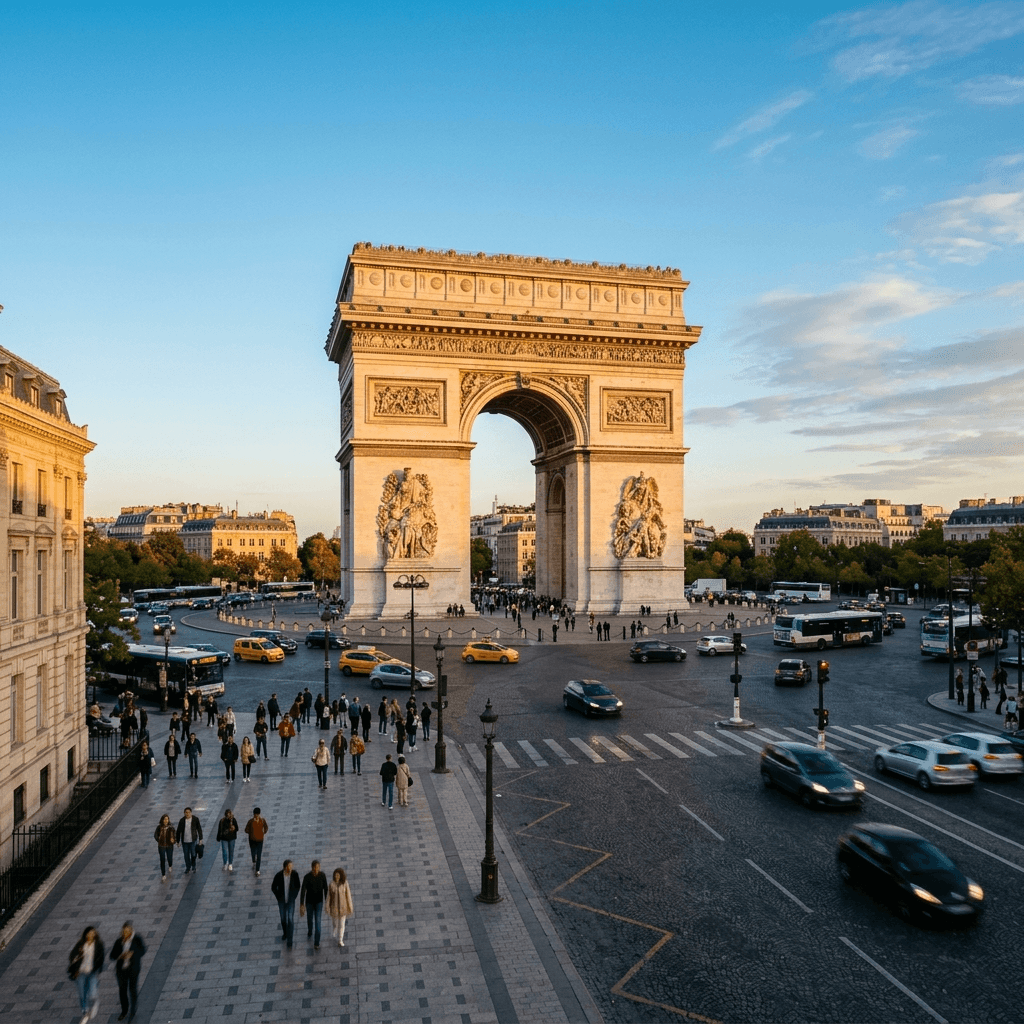
Chapter
1. Arc de Triomphe: The Complete History of Paris’s Most Iconic Monument
1.1 Napoleon and the Victory at Austerlitz: The Moment the Emperor Dreamed of the Arc de Triomphe
On December 2, 1805, under the frozen sky of Moravia, Napoleon Bonaparte crushed the combined armies of Russia and Austria at the Battle of Austerlitz. It was his military masterpiece — as we detail in the article about Napoleon (see section 2.1 The Battle of Austerlitz), the Emperor used the morning fog as a curtain and lured the allies into a deadly trap in the center of the battlefield. By day’s end, 25,000 enemy soldiers lay dead or wounded; Napoleon lost only 1,300. In that same historic instant, before his troops still covered in gunpowder, the Emperor promised: “You will return home under triumphal arches.”
The promise was not empty. On February 18, 1806, Napoleon signed the Imperial Decree ordering the construction of a colossal triumphal arch at the Place de l’Étoile. The goal was to immortalize the soldiers of the Grande Armée and eternalize the Emperor’s name in the heart of Paris. Austerlitz was not just a victory — it was Napoleon’s consecration as the greatest military strategist in Europe, and Paris deserved a monument worthy of such an achievement. The decree specified that the arch would be 50 meters tall, an unprecedented dimension for the time, and that the walls would be covered with the names of the battles won and the generals who led the troops.
The Arc de Triomphe was not born from an architectural whim. It was born from a battle, a promise, and an emperor who knew that monuments are the most durable propaganda a ruler can build. Ironically, Napoleon would never see his work completed — but the connection between the Arch and Austerlitz is so intrinsic that, to this day, the monument carries the invisible signature of that December morning in 1805.
The victory at Austerlitz was not only military — it was political and symbolic. It dissolved the Third Coalition, secured the Peace of Pressburg, and consolidated Napoleon as master of Central Europe. The Arc de Triomphe would be the stone embodiment of this hegemony. The monument’s original name, in fact, was to be “Arc de Triomphe de l’Étoile” to honor not only the victory but also the star-shaped square that would house it.
If you are planning to visit the Arc de Triomphe in Paris, know that every meter of that structure begins here — in the snow of Moravia, in the roar of the cannons, and in the mind of a Corsican emperor who dared to promise eternal glory to his men.
1.2 Jean Chalgrin: The Architect Who Died in 1811 Before Seeing the Arc de Triomphe Completed
The man who designed the Arc de Triomphe never saw it standing. Jean-François-Thérèse Chalgrin, born in 1739, was a neoclassical architect trained in the tradition of Étienne-Louis Boullée and influenced by the Roman severity of Vitruvius. Chalgrin already had important works in his portfolio: he designed the Church of Saint-Philippe-du-Roule, renovated the Luxembourg Palace, and worked on the Petit Trianon at Versailles. But the Arc de Triomphe in Paris would be his final and most ambitious project.
When Napoleon summoned Chalgrin in 1806, the architect was 67 years old. His vision was clear: an arch of colossal proportions, inspired by the Arch of Titus (81 AD) in Rome, but four times larger. Chalgrin discarded the traditional columns of Roman arches and opted for massive piers supporting a central vault 29 meters high. It was architecture as a declaration of power — straight lines, pure volumes, ornamentation concentrated in the sculptures. Chalgrin’s neoclassical style was the perfect architectural translation of Napoleonic imperialism.
Construction began on August 15, 1806, Napoleon’s birthday. Chalgrin supervised the foundations and the start of the masonry, but the pace was slow. Funding problems with the Imperial Treasury, constant war in Europe, and the technical difficulty of raising a limestone block 50 meters high made progress painful. In 1811, Chalgrin died, without even seeing the walls reach the height of the vault. Supervision of the work passed to Louis-Robert Goust, who maintained the original design.
Paris in 1811, when Chalgrin died, was a city in turmoil. The Napoleonic Empire was at its peak, but the constant wars were already showing cracks. Construction of the Arch would stop completely three years later, with the Emperor’s fall. Chalgrin, dead, at least did not witness the abandonment of his masterpiece. Today, when visiting the Arc de Triomphe in Paris, few tourists know that the genius behind those perfect proportions never heard the echoes of his own footsteps under the vault he designed.
1.3 30 Years of Construction: Why Did the Arc de Triomphe Take So Long to Finish?
An opera in three acts. That is how one can describe the construction of the Arc de Triomphe — 30 years of interruptions, restarts, and political upheavals that made the monument a portrait of France’s 19th-century instability itself.
Act I: The Empire (1806–1814). Under Napoleon, the work progressed at a snail’s pace. The Napoleonic Wars drained the French budget — maintaining 600,000 soldiers in the Russian campaign cost more than raising triumphal arches. When Napoleon abdicated in April 1814, the Arch’s construction had barely reached one-third of its final height. The foundations and pillars were ready, but the top was an unfinished scar on the Parisian landscape.
Act II: The Restoration (1814–1826). With the return of the Bourbons to power, the Arc de Triomphe became a political problem. The monument celebrated Napoleon — the usurper whom Kings Louis XVIII and Charles X preferred to erase from memory. For 12 years, the work lay abandoned, covered in vegetation and dust. Parisians nicknamed the stone skeleton “la grande injustice” — the great injustice. Some royal advisors suggested demolishing what had already been built. The lack of funding was chronic: the Restoration budget preferred to finance churches and palaces over Napoleonic monuments.
Act III: The Resumption and Completion (1826–1836). Charles X, trying to win popular support, authorized the resumption of works in 1826. Louis-Robert Goust was replaced by Jean-Nicolas Huyot, who adjusted the original design. But it was only under Louis Philippe, the “Citizen King,” that the Arch was finally completed. On July 29, 1836, after three decades of political and budgetary paralysis, the Arc de Triomphe in Paris was inaugurated — without the pomp Napoleon had imagined, but intact in its grandeur. The construction of the Arch lasted longer than the Napoleonic Empire itself. And this delay, ironically, made the monument more representative of France: built by an emperor, abandoned by kings, finished under a parliamentary monarchy.
1.4 The Wooden Model of 1810: How Napoleon “Saw” the Arc de Triomphe Complete (Before It Existed)
Napoleon was a man of haste and symbols. In 1810, he was preparing to receive his second wife, Archduchess Marie Louise of Austria, in Paris. The marriage was a strategic alliance with the Austrian Empire — and needed a stage worthy of emperors. But the real Arc de Triomphe was far from ready. Solution: build a fake one.
Architects and carpenters worked day and night to erect a full-scale model of the Arch at the Place de l’Étoile. The structure was made of painted canvas, wood, and plaster, mounted on the foundations Chalgrin had already built. The dimensions were exact: 50 meters high, 45 meters wide. The canvas was painted to imitate stone, with fake reliefs and simulated sculptures. When Napoleon passed under the false arch on April 2, 1810, in his wedding procession, he saw — albeit in illusion — the monument he had dreamed of five years earlier.
The details of the 1810 model impress with their ingenuity. The central vault was designed with tensioned fabric over a wooden frame to simulate the curvature of stone. The sculptures were painted on flat, inclined panels to give the illusion of depth. The army of workers — over 300 men — took three weeks to assemble the structure and two days to dismantle it after the ceremony.
Historians call the model of the Arc de Triomphe in Paris “the first fictitious construction of modern history.” It was not just a wedding prop: it was the assertion that Napoleon did not wait for reality to impose his vision. Paris would see the completed Arch in 1836, but Napoleon had already passed under it in 1810 — albeit in fake form. Today, visiting the Arc de Triomphe is stepping on the same ground where illusion and reality met for a few weeks.
1.5 The Almost Secret Inauguration in 1836: Why Did King Louis Philippe Fear Assassination Attempts at the Arc de Triomphe?
When the Arc de Triomphe was finally inaugurated on July 29, 1836, the ceremony was intentionally discreet. Louis Philippe I, the “Citizen King” who had ascended the throne during the Revolution of 1830, faced a fragile government. The Legitimists wanted the return of the Bourbons; the Republicans demanded the end of the monarchy; the Bonapartists dreamed of the return of Napoleon’s ashes. Inaugurating a monument to the Emperor was like lighting a fuse on a powder keg.
The ceremony began at dawn. Louis Philippe arrived without an imperial carriage, without ostentatious guards, without the excesses Napoleon would have demanded. The speech was delivered by Adolphe Thiers, then President of the Council of Ministers and future first president of the Third French Republic. Thiers chose calculated words: he praised French soldiers of all battles, not just the Napoleonic ones, and presented the monument as “a tribute to national glory, not to one man.” It was an attempt to republicanize the Arch, to wrench it from the hands of Napoleon’s ghost.
The paradox did not go unnoticed. The largest military monument in Paris was inaugurated by a king who had fought no battles, to celebrate soldiers of an empire he himself had helped topple (Louis Philippe fought alongside the revolutionaries in 1792). The press of the time noted the awkward silence: there were no cannon salutes, no military parade, no national holiday. The inauguration of the Arc de Triomphe was almost a private event.
Today, when visiting the Arc de Triomphe in Paris, it is hard to imagine that that colossus of stone — now the beating heart of French celebrations — was born from a ceremony marked by fear of knives and bombs. But this forced discretion saved the monument: while other triumphal arches were demolished during regime transitions, the Arc de Triomphe survived because it was never fully identified with a single ruler. Louis Philippe’s political maneuver was cowardly, but effective.
Chapter
2. Architecture and Dimensions of the Arc de Triomphe: The Staggering Numbers of the Monument
2.1 50 Meters High and 45 Wide: The Colossal Dimensions of the Arc de Triomphe
The Arc de Triomphe is a monument that defies human scale. The official measurements are precise: 49.5 meters high, 45 meters wide, and 22 meters deep. The central arch — the opening through which pedestrians and vehicles pass — is 29.19 meters high by 14.5 meters wide. For comparison, Notre-Dame Cathedral is 35 meters high at the roof; the Arch is 14 meters taller. Christ the Redeemer in Rio de Janeiro measures 38 meters including the pedestal — the Arch is 11 meters taller.
Until 1982, when the Triumphal Arch of North Korea (in Pyongyang) was inaugurated at 60 meters, the Arc de Triomphe in Paris was the largest triumphal arch in the world. It still surpasses all classical Roman arches combined: the Arch of Titus is 15 meters, the Arch of Constantine is 21 meters, the Arch of Septimius Severus is 23 meters — they would all fit inside the central span of the Parisian arch with room to spare.
The colossal dimensions are no accident. The neoclassical design requires the monument to be seen from afar — and the 12 avenues converging at Place Charles de Gaulle were designed to create perspectives stretching for kilometers. From atop the Arc de Triomphe in Paris, it is possible to see the Grande Arche de La Défense to the west and the Louvre Palace to the east — a straight line of 8 kilometers called the Historical Axis (Voie Triomphale). Every number of the Arch was calculated to dominate this perspective.
The total mass of the monument is estimated at 50,000 tons of Lutetian limestone. The front wall is 3 meters thick at the pillars. The panoramic terrace platform covers an area of 600 square meters. For the tourist planning to visit the Arc de Triomphe, understanding these dimensions is the first step to comprehending why the monument dominates the landscape of Paris like no other.
2.2 The Spiral Staircase of 284 Steps: How to Climb to the Panoramic Terrace of the Arc de Triomphe
Climbing to the top of the Arc de Triomphe is a vertical pilgrimage of 284 steps — from the ground to the panoramic terrace, via a narrow and steep spiral staircase that snakes inside the monument’s north pillar. There is no direct elevator to the top; the existing elevator only reaches the intermediate level (about two-thirds of the way up), where a small museum with models and historical objects is located. The last 80 steps must be taken on foot, on an even narrower staircase.
The steps were designed in the 19th century for soldiers, not tourists. The height of each step is irregular — ranging from 16 to 19 centimeters — which makes the climb more strenuous than modern stairs. Each flight has 18 to 22 steps before a small landing. During the ascent, the visitor passes illuminated niches displaying historical photographs and documents about the monument’s construction.
Along the climb, the internal walls display the names of 660 French generals engraved in stone (see chapter 3.4) — a hall of honor that turns each flight of stairs into a lesson in French military history. The effort is rewarded at the top. The panoramic terrace offers a 360-degree view of Paris. To the east, the Champs-Élysées stretches to the Place de la Concorde and the Tuileries Garden. To the west, the Grande Arche de La Défense closes the horizon. At night, the Eiffel Tower sparkles every hour — and from the Arch’s terrace, the view is one of the most photographed in the world.
Practical tips for those wanting to visit the Arc de Triomphe: avoid peak hours (11 AM to 2 PM), climb in the late afternoon to see the sunset and the city’s lights, and remember there is no luggage storage for large backpacks. The climb of 284 steps is not for everyone, but those who reach the top understand why Victor Hugo described the view as the most Parisian of all.
2.3 The Main Vault at 29 Meters: The Arc de Triomphe Space Through Which a Plane Flew in 1919
On August 7, 1919, French pilot Charles Godefroy took off from Le Bourget Airfield in a Nieuport 17, a World War I biplane with a wingspan of 8 meters. His goal: to fly under the vault of the Arc de Triomphe. The monument’s central opening is 14.5 meters wide — a clearance of only 3.25 meters on each side for the wings. A miscalculation meant certain death against Chalgrin’s limestone.
Godefroy was no ordinary adventurer. A decorated war veteran, he wanted to honor the pilots killed in the conflict — especially Georges Guynemer, a French flying ace shot down in 1917. The flight was planned in secret, without official authorization. To orient himself, Godefroy used the Eternal Flame of the Unknown Soldier (lit in 1923, but already planned in 1919) as a visual reference point.
At 7:20 AM, Godefroy dove at 200 km/h toward the Arch. The vertical margin was equally tight: the landing gear passed less than 2 meters from the ground. The crossing lasted 2 seconds. Upon exit, the pilot pulled up sharply to avoid traffic at the Place de l’Étoile. The crowd that had already gathered — alerted by rumors — erupted in applause.
The consequences were ambiguous. The French government fined Godefroy for “flying dangerously low in an urban area.” But public opinion turned him into a national hero. The feat would only be repeated once: in 1945, during the Liberation celebrations, another pilot attempted the same maneuver, unsuccessfully — he collided with a lamppost at the Place de l’Étoile. Today, when visiting the Arc de Triomphe in Paris, look at the central span and imagine the 8-meter wings cutting through the stone arch at speeds that gave no time even to blink.
2.4 The Neoclassical Design: How the Arch of Titus in Rome Inspired the Arc de Triomphe’s Design
The architecture of the Arc de Triomphe is a declaration of Roman heritage. Jean Chalgrin drank directly from the Arch of Titus (built in 81 AD to celebrate Titus’s conquest of Jerusalem) and the Arch of Constantine (315 AD), both in Rome. From the Arch of Titus, Chalgrin copied the single-span structure with decorated attics and the proportion between height and width. From the Arch of Constantine, he incorporated the tripartite division of surfaces and the use of narrative reliefs.
But the differences are as significant as the similarities. The Arch of Titus has engaged Corinthian columns (half-columns attached to the walls); the Arc de Triomphe abolished columns entirely, replacing them with immense smooth pillars that give the monument its massive, monolithic appearance. The height of the Arc de Triomphe is four times that of the Roman arch — a scale that transforms Roman reverence into imperial overwhelm.
The treatise “De Architectura” by Vitruvius (1st century BC) was Chalgrin’s bible. The Arch’s proportions follow the Vitruvian canons of symmetry and module — the total height is 3.4 times the height of the central span, the total width is 1.1 times the total height. But Chalgrin broke classical rules by eliminating the traditional horizontal entablature, creating a more abrupt transition between the pillars and the attic. This “infidelity” to the classical canon drew criticism from the Academy of Fine Arts in 1806, but the Emperor personally approved the design.
The neoclassical style of the Arc de Triomphe reflects the historical moment: Napoleonic France saw itself as the new Rome, and Paris as the new capital of the civilized world. Every architectural element was chosen to communicate power, permanence, and conquest. When visiting the Arc de Triomphe in Paris, notice the absence of decorative curves — everything is right angle, vertical mass, relentless symmetry. It is architecture speaking the language of empire.
2.5 The “Place de l’Étoile”: Why Do 12 Avenues Converge at the Arc de Triomphe?
The Place Charles de Gaulle — originally Place de l’Étoile — is no ordinary square. It is a circle 240 meters in diameter from which 12 radial avenues depart in all directions, forming a perfect star (hence the name Étoile). The Arc de Triomphe sits at the exact center of this star, like the hub of a giant wheel. The urban design makes the monument visible from any approaching avenue — a visual imposition that turns the Arch into the mandatory focal point of Paris.
The project is the work of Baron Georges-Eugène Haussmann, who redesigned Paris between 1853 and 1870 under orders from Napoleon III. Haussmann did not create the square from scratch — it already existed as a road junction since the 18th century — but he transformed it into a monumental roundabout with wide, straight avenues. The 12 avenues are: Champs-Élysées, Friedland, Hoche, Wagram, Mac-Mahon, Carnot, Grande-Armée, Foch, Victor-Hugo, Kléber, Iéna, and Marceau. Each was named after a military victory or a French marshal.
The geometry is so precise that the square became one of the most complex traffic challenges in the world. To this day, there are no pedestrian crossings to cross the roundabout — pedestrians access the Arch via an underground passage at the Avenue des Champs-Élysées. Parisian drivers consider the Place de l’Étoile the “driver’s hell,” with up to 8 lanes competing simultaneously without clear signage.
Urbanistically, the Place de l’Étoile and the Arc de Triomphe form the heart of the Historical Axis of Paris. Standing on the Arch’s terrace, the visitor sees the straight line connecting the Louvre to the Grande Arche de La Défense — an axis of power that cuts through the history of France. Haussmann’s design ensured that the Arc de Triomphe was not just a monument, but the geometric and symbolic center of the French capital.
2.6 The Limestone Blocks of the Arc de Triomphe: How Massive Stones Were Transported in the 19th Century
Each block of the Arc de Triomphe tells a logistical story as impressive as the monument itself. The stone chosen was Lutetian limestone (calcaire lutécien), the sedimentary rock that gives its name to Paris’s geological period (Lutetia was the Roman name for the city). Extracted from the underground quarries beneath the 13th arrondissement and the Saint-Maximin region (Oise), this stone has a characteristic light-yellow color and high compressive strength.
Transportation in the early 19th century was a titanic operation. Individual blocks weighed between 5 and 8 tons — the equivalent of two adult elephants. The stones were dragged by ox teams to the Seine River, where flat barges transported them along the river to central Paris. The unloading occurred near what is now the Port de la Conférence, next to the Place de la Concorde. From there, horse-drawn carts — up to 12 horses per block — carried the stones uphill to the Place de l’Étoile.
The cranes used at the site were human-powered — wooden wheels where up to 20 men walked simultaneously to generate traction. The pulley system was specifically designed to reach the 50-meter height of the monument. Each block took up to three days to be hoisted from the base to the top. During the 30 years of construction, about 15,000 blocks were cut, transported, and laid.
The cutting of the blocks was done by hand, with manual saws and chisels. Precision was essential: the joints between blocks did not use thick mortar — the fit was dry, with thin layers of lime for sealing. The technique, inherited from Roman builders, required each block to fit perfectly into its neighbor, at the risk of compromising the structure’s stability. Today, when visiting the Arc de Triomphe in Paris, run your hand along the external walls: each almost invisible joint between blocks bears witness to the work of hundreds of stone cutters who would never see their work completed.
Chapter
3. Sculptures and Symbolism of the Arc de Triomphe: The Art Hidden in the Walls
3.1 “La Marseillaise” by François Rude: The Arc de Triomphe Sculpture That Became a Symbol of France
On the right pillar of the east side of the Arc de Triomphe (the pillar facing the Champs-Élysées), sits the monument’s most famous sculpture: “Le Départ des Volontaires de 1792”, known worldwide as “La Marseillaise.” Created by François Rude between 1833 and 1836, the work depicts the moment when French citizens — old men, young men, soldiers — depart to defend the homeland against the Austrian and Prussian armies threatening the revolutionary borders.
The central figure is a winged woman, Victory (or Liberty), who flies over the volunteers with arms open, a sword in one hand, shouting — literally — the call to battle. Her mouth is open in such a realistic cry that art historian André Michel said that “one can hear the Marseillaise coming out of the stone.” At the feet of the winged figure, a naked youth (representing the purity of the revolutionary ideal) advances with sword raised, while an older soldier (experience) points the way. A stooped squire represents the weight of sacrifice.
Rude broke with neoclassical tradition by creating figures distorted by emotion. The muscles are exaggerated, the facial expressions are violent, the garments fly in swirls. It is romanticism in sculpture — a movement that privileged emotion over reason. When the work was presented at the Paris Salon of 1834, conservative critics called it “savage,” but the public immediately acclaimed it.
François Rude (1784–1855) was a staunch Bonapartist. He went into exile in Belgium after Napoleon’s fall in 1815 and only returned to France in 1827. “La Marseillaise” was his artistic revenge against the Bourbon Restoration. The sculpture at the Arc de Triomphe in Paris is considered his masterpiece and, alongside Rouget de Lisle’s musical Marseillaise, the most powerful symbol of French national identity. When visiting the Arc de Triomphe, stop under the east pillar and look up: Rude’s stone cry has echoed for nearly 200 years.
3.2 The Triumph of 1810 at the Arc de Triomphe: Napoleon Crowned by the Goddess of Victory
On the left pillar of the east side, in symmetry with “La Marseillaise,” stands “Le Triomphe de 1810” — the imperial counterpoint to Rude’s revolutionary ideal. Sculpted by Jean-Pierre Cortot (1787–1843), the work celebrates the Treaty of Schönbrunn and the peak of the Napoleonic Empire. The central scene shows Napoleon Bonaparte being crowned by a winged female figure — Victory or the Goddess of the Republic.
Napoleon appears idealized: taller, younger, more serene than he was in 1810 (when he was already gaining weight and suffering from stomach problems). He wears the imperial laurel crown, holds a scepter, and stands on a globe — symbol of world dominion. Victory holds an additional crown over his head and blows a double trumpet — the announcement of glory. At Napoleon’s feet, submissive figures represent the defeated nations.
Cortot was an official artist of the Empire — trained in the neoclassical tradition of Jacques-Louis David, Napoleon’s official painter. Unlike Rude’s romantic agitation, Cortot maintains the balanced, symmetrical, and hieratic composition typical of the Roman imperial style. Each figure occupies its place in the visual hierarchy: Napoleon at the center, glory above, the vanquished below. No confusion or chaos — only the order of the Empire.
The choice of Cortot to sculpt the symmetrical pillar was no accident. Louis Philippe’s government wanted the Arc de Triomphe to tell two stories: the Revolution of 1792 (the people rising up) and the Empire of 1810 (glory consolidated). It was an attempt to reconcile revolutionary France with imperial France — an impossible mission that art tried to resolve in stone. When observing the sculptures of the Arc de Triomphe in Paris, compare Rude’s emotion with Cortot’s rigidity: there lies the French contradiction between liberty and authority.
3.3 Resistance and Peace: The Arc de Triomphe Sculptures That Commemorate the End of Wars
The side faces of the Arc de Triomphe (the north and south sides) are dominated by two sculptures by Antoine Étex (1808–1888), one of the most talented but lesser-known sculptors of the 19th century. “La Résistance” (Resistance) and “La Paix” (Peace) flank the monument and tell the somber chapter separating the two glorious moments of the Arch: the invasion of France in 1814 and the final fall of Napoleon in 1815.
“La Résistance” (on the south side, facing the Seine) is a cry of pain. A colossal female figure protects a child and faces an invisible warrior. The woman’s face is distorted in agony, her body twisted in defensive movement. Behind her, an old man with bowed head holds a broken sword — inevitable defeat. The sculpture captures the feeling of 1814, when the Sixth Coalition invaded France and Paris was occupied by Russian, Prussian, and Austrian troops. It was the first time France saw itself as a victim, not as an aggressor.
“La Paix” (on the north side, facing the Avenue de la Grande-Armée) is the hopeful counterpoint. The same female figure is now serene, holding an olive branch in one hand and an open book in the other (representing treaties). A child holds a sheaf of wheat — prosperity. Plows and agricultural tools replace swords. It is post-1815 Europe, the beginning of the Concert of Europe and the period of relative stability that followed the Congress of Vienna.
Étex was a republican sculptor — and that shows in his work. Unlike Cortot, who celebrated the emperor, Étex celebrated the French people: collective resistance to invasion and the popular desire for peace. In 1836, his sculptures were considered the most “democratic” on the Arch. Today, when visiting the Arc de Triomphe in Paris, few tourists notice the side sculptures, but they are what humanize the monument — reminding that behind every victory there is suffering, and that the ultimate goal of all war is peace.
3.4 660 Generals Engraved on the Arc de Triomphe: The Honor Roll on the Inner Walls
On the inner walls of the Arc de Triomphe, under the vaults and along the staircases, lies one of the most impressive lists in world military history: the names of 660 French generals who served under the Republic and the Napoleonic Empire. Engraved directly into the limestone, in vertical columns of hand-carved characters, the names form a stone library of military bravery.
The selection criteria were rigorous: only divisional generals who led troops in combat or provided exceptional service. The names are organized by military campaign — Italy, Egypt, Germany, Spain, Russia, France — and each column corresponds to a period of the Napoleonic war. Generals killed in battle have their names underlined — a macabre and moving detail that turns the list into an anticipatory war memorial.
Among the most famous underlined names is General Charles Étienne Gudin, killed in 1812 during the Russian campaign (his remains were identified in 2019 through DNA analysis and repatriated to France in 2021). Another is General Louis-Vincent-Joseph Le Blond, killed at Waterloo. The complete list includes names like Junot, Murat, Ney, Lannes, Davout, Masséna, Bessières — the pantheon of Napoleonic war — but also hundreds of lesser-known generals, whose only funerary monument is this name on the stone of the Arc de Triomphe in Paris.
The hierarchy of names follows a geographic criterion, not one of importance. Napoleon’s name does not appear on the list — he was Emperor, not a general. But his stepson, Eugène de Beauharnais, is there, as is his brother Joseph Bonaparte (named honorary general). In total, 42 names are underlined — 42 generals killed in combat. For the visitor exploring the interior of the Arc de Triomphe, running their eyes over these names is reading the human face of the Empire: not everyone returned from Austerlitz.
3.5 128 Napoleonic Battles Engraved: The History Book Written in Stone at the Arc de Triomphe
If the 660 generals are the authors of the Napoleonic epic, the 128 battles engraved at the top of the inner walls of the Arc de Triomphe are the chapters. Distributed along the upper frieze of the monument, the battles cover from the Italian campaigns of 1796 to Waterloo in 1815. Each name is accompanied by the date and, in some cases, the number of troops involved.
The most prominent battles are on the east frieze: Austerlitz (1805), Jena (1806), Friedland (1807), Wagram (1809), Borodino (1812). The letters are larger and the carving deeper. On the west side are the Italian campaigns: Lodi, Arcole, Rivoli, Marengo — older, but equally decisive. Naval battles, significantly, are absent: Trafalgar (1805), France’s greatest naval defeat, was deliberately omitted from the Arch’s records.
The decision to engrave minor battles alongside the great ones was a strategy of military inclusion. Napoleon wanted every regiment, every general, every soldier to see their contribution recorded in stone. Thus, battles like Heilsberg, Eylau, Somosierra, Albuera, Talavera — some defeats, others ambiguous victories — are immortalized alongside the great triumphs.
When visiting the Arc de Triomphe in Paris, look for the name Austerlitz on the east frieze. Below it, is the phrase “2 décembre 1805” — the same date on which Napoleon promised the Arch to his soldiers. The coincidence is no accident: the monument begins and ends with the same battle. The 128 battles of the Arc de Triomphe are the catalog of an era in which France was in constant war — and winning or losing, for Napoleon, was a detail; what mattered was that the name was engraved.
3.6 The Sword That Broke at Verdun: The Legend of the Republic’s Sword at the Arc de Triomphe
One of the most fascinating — and most controversial — stories involving the Arc de Triomphe is the legend of the broken sword. In the bas-relief “The Battle of Austerlitz”, located on the east face of the monument, a figure of the French Republic holds a raised sword. According to popular belief, the sword supposedly broke spontaneously during the Battle of Verdun (1916), when France faced the German army in one of the bloodiest confrontations of World War I.
The most dramatic version of the legend says the sword fell from the figure’s hand at the exact moment Fort Douaumont fell to the Germans, and that the stone remained cracked forever. The reality, unfortunately, is more prosaic: the Austerlitz bas-relief was damaged during restoration work in the early 20th century, and the “break” was never associated with Verdun by contemporary sources. The legend, however, survives.
The symbolism, however, is powerful — and true in a metaphorical sense. The sword of the Republic at the Arc de Triomphe broken at Verdun would represent the idea that Napoleon’s monument of glory also carried the weight of the trenches. During World War I, French soldiers departing for the front passed under the Arch — and many never returned to celebrate victory there. The Tomb of the Unknown Soldier (which we will see in the next chapter) was installed exactly under the vault that the symbolic sword protects.
The legend of the broken sword at the Arc de Triomphe in Paris teaches something important about the monument: it is not a static object. People project onto it their pains, their hopes, their memories. The sword may not have broken at Verdun, but France did — and the Arch witnessed it all.
3.7 Forced Perspective: Why Is “La Marseillaise” 30% Larger Than the Other Sculptures on the Arc de Triomphe?
Climbing to the terrace of the Arc de Triomphe reveals a secret of artistic engineering that few tourists notice from below. The sculpture “La Marseillaise” by François Rude is intentionally 30% larger than the other sculptures on the monument. The difference is not a mistake — it is forced perspective, a technique used by artists since Ancient Greece to correct visual distortions caused by height and viewing angle.
The principle is simple: objects at the top appear smaller than objects at the base when viewed from below. To compensate, sculptors progressively increase the proportions of figures as they rise up the monument. “La Marseillaise” is at the highest level of the right pillar — and therefore was sculpted with enlarged dimensions. The head of the winged woman measures 80 centimeters (compared to 50 centimeters for Cortot’s figures at the same level). The hands are disproportionate, the arms elongated.
Rude mastered the technique like few others. He studied the pediments of the Parthenon in Athens and the Roman reliefs of the Arch of Constantine to understand how forced perspective worked on a monumental scale. During execution, Rude visited the site daily, climbed scaffolding, and personally checked the visual effect of every detail. Assistants report that he made adjustments at night, when artificial light created shadows that revealed distortions invisible during the day.
The consequence is that from below, all the sculptures of the Arc de Triomphe in Paris appear to be the same size — even though “La Marseillaise” is immensely larger. When visiting the Arc de Triomphe, look first from below, then climb to the terrace and observe from above: the difference in proportions jumps out. The sculpture that shouts the Marseillaise is not only the most famous — it is the largest, because it was farthest from the viewer. Rude did not sculpt stone; he sculpted perception itself.
Chapter
4. The Tomb of the Unknown Soldier under the Arc de Triomphe: The Eternal Memory
4.1 The Choice of 8 Anonymous Bodies: How France Selected Its Nameless Hero for the Arc de Triomphe
The Law of November 8, 1920, unanimously approved by the French National Assembly, determined that the remains of an unidentified soldier be buried under the Arc de Triomphe as a symbol of all French soldiers killed in World War I. The practical challenge was monumental: how to choose a single soldier among 1.4 million French dead in the conflict?
The process was meticulous. The Ministry of War assigned the Army’s identification service to select eight coffins of unidentified soldiers, exhumed from different sectors of the Western Front: Verdun, Somme, Marne, Aisne, Flanders, Argonne, Champagne, and Vosges. Each battle region had to be represented. The eight coffins, all identical and without any markings, were transported to the Citadel of Verdun — a symbolic site of French resistance.
On November 10, 1920, the eve of the second anniversary of the Armistice, a closed ceremony took place at the Citadel. The chosen one was Soldier Auguste Thin of the 132nd Infantry Regiment, a decorated war veteran. Thin received the mission to walk among the eight coffins and place a bouquet of flowers on one of them. He chose the sixth coffin — the number, he said later, corresponded to his unit: the 6th Battalion. The criterion for the final choice was, therefore, as subjective as it was symbolic.
The other seven coffins were buried at the Douaumont Ossuary in Verdun, where they remain to this day. The chosen one proceeded to Paris. The identity of the soldier buried at the Tomb of the Unknown Soldier at the Arc de Triomphe will never be known — and it is precisely this anonymity that transforms him into the universal representative of all soldiers who died without name, without grave, and without farewell.
4.2 January 28, 1921: The Day France Buried the Unknown Soldier under the Arc de Triomphe
On January 28, 1921, Paris stopped. The coffin of the Unknown Soldier was transported from the Panthéon — where it had remained since November 11, 1920 in a public wake — to the Place de l’Étoile. The procession crossed central Paris escorted by a battalion of the 33rd Infantry Regiment, mounted troops, and a guard of honor formed by mutilated war veterans — the “gueules cassées” (broken faces), disfigured survivors who became the living image of the human cost of the conflict.
The crowd along the route was estimated at over 500,000 people. Mourning Parisians, decorated veterans, war widows, and orphaned children lined up along the Champs-Élysées, many carrying black flags and photographs of deceased relatives. The silence was so dense that the sound of horses’ hooves echoed between the Haussmannian buildings.
Upon arriving at the Arc de Triomphe, the coffin was placed under the central vault — exactly in the middle of the 29-meter span. President Alexandre Millerand spoke: “France lays here, under the arch that celebrates its victories, the son who gave everything without asking for anything.” The coffin was lowered into the crypt, covered by a granite slab. On it, the simple inscription that would become one of the most famous in France.
The exact location of the Tomb of the Unknown Soldier at the Arc de Triomphe is not in the center of the monument, but slightly shifted to the west side, aligned with the Eternal Flame. The crypt is 3 meters deep and lined with concrete. Since 1921, no French government has ever considered removing the tomb — the anonymous soldier is the only permanent resident of the largest triumphal arch in the world.
4.3 The Eternal Flame of the Arc de Triomphe: Why Has the Fire Never Gone Out Since 1923?
On the first anniversary of the Armistice after the burial — November 11, 1923 — the Eternal Flame was lit over the Tomb of the Unknown Soldier for the first time. The initiative came from journalist Gabriel Boissy, who was inspired by the flame of the Tomb of the Unknown Soldier in London (at Westminster Abbey) and proposed that France create an equivalent symbol. The government accepted, and the Minister of War, André Maginot (yes, the same of the Maginot Line), supervised the installation.
The flame is real, not symbolic. Fueled by natural gas piped directly under the Place de l’Étoile, the flame burns at a temperature of 1,100°C. The system consists of a bronze ring 2 meters in diameter with 24 nozzles releasing gas in a continuous flow. The flame is visible from over 100 meters away and withstands rain, snow, and wind — the gas pressure is automatically adjusted so the fire never goes out.
The meaning is both literal and metaphorical. The flame represents eternal memory — the promise that France will never forget its dead. Unlike the Tomb of the Unknown Soldier at Arlington (USA), where the flame was lit in 1963 (by John F. Kennedy) and has gone out in storms, the flame at the Arc de Triomphe in Paris has never been extinguished since 1923. Not even during the German Occupation (1940–1944), when Paris was under Nazi rule — the flame continued burning, maintained by the French Resistance, as an act of civil disobedience.
In 1940, when the Nazis entered Paris, the first German order was to extinguish the flame. French veterans formed a human barrier around the tomb and refused to leave. German officers, fearing a diplomatic crisis, backed down. The flame of the Arc de Triomphe burned throughout the war — a fire that the Third Reich could not put out.
4.4 The Daily Ceremony at 6:30 PM at the Arc de Triomphe: Who Relights the Flame Every Day?
Since November 11, 1923, every single day — without a single exception — the Eternal Flame is relit in a public ceremony at 6:30 PM. The responsibility falls to veterans’ associations and entities linked to the French Ministry of Defense, coordinated by the committee “Les Fleurs de la Mémoire” (The Flowers of Memory). The ritual is as precise as a military clock.
The procedure: at 6:30 PM, a group of veterans (or representatives of associations) forms up before the tomb. A guard of honor places a wreath of flowers on the slab. The president of the day’s association gives a brief speech — usually about the meaning of remembering the war dead. Then, a ceremonial saber is used to relight the flame (the saber has a wick at the tip that channels the gas). The ceremony lasts exactly 15 minutes.
During the summer months, the ceremony attracts hundreds of tourists who gather under the Arch. In winter, especially on rainy days, the audience is reduced to a few veterans and family members. But the ceremony is never canceled. During the COVID-19 pandemic (2020–2021), when France was in lockdown, a single veteran — masked and alone — performed the daily ritual. The flame is not extinguished by decree.
For those planning to visit the Arc de Triomphe in Paris, watching the 6:30 PM ceremony is the most authentic experience the monument offers. Unlike the noise of the Place de l’Étoile during the day, the evening at the Arch is silent, solemn, and deeply moving. The Tomb of the Unknown Soldier under the Arc de Triomphe is not a tourist attraction — it is an active sanctuary, and the flame that never goes out is proof that France keeps its promise of remembrance.
4.5 “Here Lies a French Soldier”: The Inscription of the Tomb of the Unknown Soldier at the Arc de Triomphe
The black granite slab covering the Tomb of the Unknown Soldier bears a bronze inscription in capital letters that is, at once, the simplest and most powerful in the world:
“ICI REPOSE UN SOLDAT FRANÇAIS MORT POUR LA PATRIE 1914–1918”
(Here lies a French soldier who died for the homeland 1914–1918)
The inscription was chosen by a special commission appointed by the Ministry of Veterans in 1920. No name of the soldier — because he has no name. No rank — because he represents all ranks. No specific battle — because he died in all of them. The bronze plaque measures 2 meters long by 1 meter wide and is fixed directly into the granite. The letters were cast from bronze from German cannons captured in the war — a detail local guides love to point out.
Military historian Antoine Prost observed that the inscription of the Tomb of the Unknown Soldier at the Arc de Triomphe contains a profound irony: the soldier who has no name got the most famous address in France — under the largest triumphal arch in the world, in the center of Paris. “The anonymous one became immortal,” Prost wrote. “Not because his name was remembered, but because his lack of name made him universal.”
In 1923, a second plaque was added alongside, honoring soldiers of World War II, which came to include 1939–1945. In later years, additional inscriptions were engraved on the adjacent walls for the wars of Indochina (1946–1954) and Algeria (1954–1962). But the original 1920 plaque remains intact as the main one. When visiting the Arc de Triomphe in Paris, stop before the slab and read the inscription aloud: it is only 8 words that contain 1.4 million stories.
4.6 The Coffin on a 155mm Cannon: How the Unknown Soldier Was Transported to the Arc de Triomphe
The journey of the Unknown Soldier from Verdun to Paris was one of the most unique funeral processions in military history. His coffin — a simple oak casket covered with the tricolor flag — was not transported in an ordinary carriage, but on the platform of a 155mm heavy artillery gun, the Canon de 155 mm GPF (Grande Puissance Filloux), the main French howitzer of World War I.
The cannon — nicknamed “le 155” — was a beast of war: it weighed 12 tons, measured 6 meters long, and had fired hundreds of shells against German lines. Its choice to transport the coffin was deliberate: the anonymous soldier died under artillery fire and returned to his place of honor mounted on the weapon that killed him. The image of the coffin on the cannon — photographed and published in all French newspapers — became one of the icons of national mourning.
The procession departed Verdun on November 10, 1920, covering 300 kilometers to Paris. The cortege stopped at every town along the route: Saint-Mihiel, Bar-le-Duc, Vitry-le-François, Châlons-sur-Marne, Épernay, Château-Thierry, Meaux. At each stop, the local mayor laid flowers and local veterans stood guard. At Château-Thierry, where the Battle of the Marne in 1914 and 1918 had been particularly bloody, the estimated crowd was 30,000 people — in a town of 8,000 inhabitants.
At night, the coffin was removed from the cannon and placed in an improvised wake at town halls. The cannon stayed outside, covered by a tarp. On November 11, 1920, exactly two years after the Armistice, the cortege entered Paris through the Porte de Pantin and proceeded to the Panthéon, where the coffin lay in state for 78 days — until the final burial under the Arc de Triomphe on January 28, 1921.
The 155mm cannon that carried the Unknown Soldier was preserved and today is at the Musée de l’Armée at Les Invalides in Paris. A visit to the Arc de Triomphe and the Tomb of the Unknown Soldier is incomplete without knowing that the anonymous hero reached his eternal rest mounted on the same weapon that echoed the sound of his death. The soldier returned home on the thunder that took him.
Chapter
5. Christo and the Wrapped Arc de Triomphe: The Art Installation That Drove Paris Wild
5.1 The 60-Year Dream: How Christo Imagined Wrapping the Arc de Triomphe in 1961
Christo Vladimirov Javacheff, a Bulgarian-born French artist, first conceived the project of wrapping the Arc de Triomphe in 1961, when he was still sharing a room in Paris with his wife and creative partner Jeanne-Claude. The original sketch, done in pencil and collage, already showed the monument wrapped in blue fabric — a dream that would take six decades to materialize. Christo died on May 31, 2020, at age 84, without seeing the installation completed. Jeanne-Claude had passed away in 2009. The artist’s nephew, Vladimir Yavachev, took over supervision of the project and ensured that the work was executed exactly as his uncle had planned. The posthumous installation transformed the monument into a living sculpture for 16 days, proving that visionary art outlives its creator.
5.2 25,000 m² of Recyclable Fabric: The Colossal Logistics of Wrapping the Arc de Triomphe
Wrapping an arch 49 meters high, 45 meters wide, and 22 meters deep required 25,000 m² of recyclable polypropylene fabric in a silver-blue color, the same material used in Christo’s previous works. The structure was fastened with 3,000 meters of red rope, which contrasted with the blue fabric and created the characteristic folds the artist called “the skin of the monument.” The installation lasted 10 days, between September 18 and October 3, 2021, involving 120 workers including industrial climbers, engineers, and textile technicians. An internal scaffolding of 30 tons was assembled to support the fabric, while teams of climbers descended the facade to adjust every fold manually. The visual impact was overwhelming: the Arc de Triomphe ceased to be stone and became an ethereal mass, mutable according to the wind and the daylight.
5.3 14 Million Euros Self-Funded: How Art Paid for Itself at the Arc de Triomphe
The total cost of the installation was €14 million — and, like all of Christo and Jeanne-Claude’s work, not a single cent came from sponsorship or public money. The business model was unique: the artist financed each project by selling preparatory works — drawings, collages, models, and lithographs — in galleries around the world. The preparatory studies for L’Arc de Triomphe Wrapped, some dating from the 1960s, were auctioned for hundreds of thousands of dollars each. An original collage from 1988 was sold for €500,000 at Christie’s in 2020. The resale value of Christo’s works soars posthumously: the same drawing bought for €20,000 in the 1990s could fetch €400,000 today. The installation itself was temporary and generated no box office revenue — it was pure art, paid for by art itself.
5.4 The Eternal Flame That Never Stopped: How the Unknown Soldier Coexisted with the Artwork at the Arc de Triomphe
One of the greatest technical and symbolic challenges of the installation was preserving the Tomb of the Unknown Soldier, located under the central arch since 1920, and its Eternal Flame, which has never gone out since November 11, 1923. Christo designed a strategic opening in the fabric over the funerary slab, ensuring that access to the tomb remained free. The flame continued burning 24 hours a day throughout the installation. The daily relighting ceremonies, performed by veterans’ associations every day at 6:30 PM, were maintained without interruption. Christo always made it clear: “The flame will not be touched. The monument belongs to France; the art is a loan.” The delicate coexistence between artistic ephemerality and the perpetual memorial was resolved with technical rigor and absolute respect.
5.5 “A Gift for Parisians”: President Macron’s Reactions to the Installation at the Arc de Triomphe
President Emmanuel Macron visited the installation on October 15, 2021, days before the dismantling, accompanied by Minister of Culture Roselyne Bachelot. Macron posed for official photos with the wrapped monument in the background, declaring that the work was “a gift for Parisians and for the world.” He recalled that Christo, who became a French citizen in 1973, always wanted to “give something back to France.” The president also authorized that visits to the Arc de Triomphe during the installation period be free — and 120,000 people attended, a record number. There was debate about the possibility of making the work permanent, but Macron respected the artist’s will: impermanence was part of Christo’s signature. The installation was dismantled from October 4, exactly as planned.
5.6 The Environmental Debate: Why Was the Installation at the Arc de Triomphe Criticized for Wasting Fabric?
French environmentalists from the Green Party and the NGO Les Amis de la Terre openly criticized the use of 25,000 m² of synthetic fabric at a time of climate crisis. Polypropylene, although recyclable, is derived from petroleum, and its industrial production emits CO₂. The association “Artistes pour le Climat” published a manifesto calling the work an “ecological obscenity” and demanding that the government allocate the budget to environmental initiatives. Christo, while still alive, countered the argument: “Art is not a luxury. Art is a human necessity. What is waste for some is poetry for others.” The fabric, after dismantling, was sent for industrial recycling to manufacture tarps and plastic bags. The red rope was donated to charities. The ecological legacy of the work remains controversial, but Christo always defended that ephemeral beauty justifies the material cost — a debate that has accompanied his work since the wrapping of the Reichstag in 1995.
Chapter
6. The Impossible Flight: When a Plane Crossed the Arc de Triomphe in 1919
6.1 The Provocation: Why Were the Aviators Forced to Parade on Foot at the Arc de Triomphe?
The Victory Parade of July 14, 1919, celebrating the end of World War I, was the largest ever held on the Champs-Élysées. The French aviators — heroes of the skies who had faced the Red Baron and the German aces — expected to fly over the Arc de Triomphe as the parade’s climax. The government, fearing that an accident during a low pass would mar the celebration, forbade the flyover. The order came from high command: the pilots paraded on foot, mixed in with the infantry, without the aerial glory they believed they deserved. The humiliation was recorded by newspapers of the time: “The lords of the air were reduced to lead soldiers,” wrote Le Figaro. Among the indignant pilots was Jean Navarre, who at that moment began planning what would become the most legendary flight in French aviation — with or without permission.
6.2 Jean Navarre: The Flying Ace Who Died Before Making the Flight Through the Arc de Triomphe
Jean Navarre was the ideal pilot for the challenge: decorated with the Legion of Honor, 12 confirmed aerial victories, known as “The Sentinel” for patrolling the skies of Verdun alone. He accepted the unofficial mission to cross the Arc de Triomphe and began training in July 1919 near Villacoublay. On July 10, 1919, during a reconnaissance flight to study the approach angle, his Nieuport 27 suffered a structural failure at 200 meters altitude. Navarre died in the crash. The accident was attributed to a low-speed stall, exactly the maneuver he would need to master to pass through the arch. The plan seemed cursed — but another pilot was already preparing to take his place.
6.3 Charles Godefroy: The Pilot Who Stole a Plane to Prove a Point at the Arc de Triomphe
Charles Godefroy, also a flying ace with 9 official victories, was a friend of Navarre and decided to complete the mission in honor of his fallen comrade. On August 7, 1919, at 7:20 AM, Godefroy took off from Villacoublay airfield aboard a Nieuport 29 without formal authorization — essentially, a theft of a military aircraft. He flew skimming the Seine River at 50 meters altitude, aligned the nose of the plane with the center of the Arc de Triomphe, and crossed the central arch at 160 km/h. Witnesses on the ground — including photographer Jacques Mortane and cinematographer André Hache — confirmed the passage. Godefroy landed at Villacoublay 30 minutes later, already knowing he would be arrested. The government did indeed arrest him — but public opinion turned him into a national hero.
6.4 14 Meters Wide vs. 8 Meters Wingspan: The Tight Passage Through the Arc de Triomphe
The central arch of the Arc de Triomphe is 14.5 meters wide — generous for a car, suicidal for a plane. The wingspan of the Nieuport 29 was 8 meters, leaving 3.25 meters of clearance on each side. In practice, this meant Godefroy had less than two meters margin of error for each wing in full flight. To complete the challenge, he needed to fly at minimum speed — about 110 km/h — to avoid colliding with the arch’s ceiling, but fast enough to avoid the stall, the same trap that killed Navarre. The maneuver required Godefroy to bank the plane slightly to use the smallest possible dimension of the wingspan, a trick he only attempted after studying the arch for weeks. Any miscalculation and the Arc de Triomphe would have had the first plane crash in the center of Paris.
6.5 The Forbidden Film: Why Did the Authorities Try to Erase the Flight Through the Arc de Triomphe from History?
The footage of the flight, recorded by André Hache on a Pathé 35mm camera, was seized by the French government hours after Godefroy’s landing. The Ministry of War considered the images “dangerous for military discipline” — if a pilot could disobey orders and fly under France’s largest monument, any soldier could question authorities. Copies of the film were destroyed or locked in military archives for decades. One copy survived in the private collection of Jacques Mortane’s family and was donated to the Musée de l’Air et de l’Espace at Le Bourget in the 1980s. Today, the 47-second film can be seen in the museum’s digital collection and in documentaries such as “Les As du Ciel” (2003). The attempt at censorship, instead of erasing the feat, turned the flight into a legend — and every playback of the images is an act of defiance against historical erasure.
6.6 The Imitators: Other Pilots Who Crossed the Arc de Triomphe in 1981 and 1991
Godefroy’s flight was not the only one. On June 1, 1981, pilot Alain Marchand crossed the Arc de Triomphe aboard a Robin DR-400 during the Bourget Air Show, causing panic among authorities and at Le Bourget’s control tower. Marchand was arrested and lost his flying license for two years. In 1991, an unidentified pilot did the same in an ultralight, but was never caught. In 2005, American Frank Tallarico simulated the flight in a flight simulator and released a video that went viral in the early days of YouTube — but he himself joked: “On my computer, the margin of error is zero. In the real world, I would never try it.” In 2019, the centenary of the feat, the French Air Force denied a request for a commemorative flyover, maintaining the government’s tradition of never officially acknowledging what Godefroy did. Each imitator, deep down, reaffirms the same point: the Arc de Triomphe is not just a monument — it is an invitation to the impossible.
Chapter
7. Napoleon and the Arc de Triomphe: The Emperor Who Never Saw His Monument
7.1 The Order of 1806: Napoleon Wanted an Arch Bigger Than Rome’s for the Arc de Triomphe
On February 18, 1806, Napoleon Bonaparte signed the imperial decree authorizing the construction of a triumphal arch at the Place de l’Étoile, then on the outskirts of Paris. The order was clear: the monument should surpass the Roman arches of Antiquity — especially the Arch of Constantine and the Arch of Septimius Severus. Architect Jean-François-Thérèse Chalgrin received the mission to design something no Roman emperor had built: an arch 49 meters high and 45 meters wide, larger than any historical precedent. Napoleon, recently crowned emperor in 1804, wanted a symbol of the Grande Armée that would last a thousand years. The cornerstone was laid on August 15, 1806, the emperor’s birthday, but work began slowly — and would never be completed during his lifetime.
7.2 “We Can Postpone It for Two or Three Years”: Napoleon’s Final Indifference Toward the Arc de Triomphe
In 1811, five years after the start of work, Napoleon wrote to the Minister of the Interior Jean-Pierre de Montalivet authorizing the temporary halt of construction. The historic correspondence, preserved in the French National Archives, reveals the emperor’s casual tone: “We can postpone it for two or three years. At the moment, resources are needed elsewhere.” That “elsewhere” was the Russian campaign, which would begin in 1812 and destroy his army. Napoleon, who once saw in the arch an eternal monument to his glory, gradually lost interest as the wars intensified. In 1814, in a hurry, he ordered a wood and canvas arch to be built over the Rue Saint-Denis for the passage of his bride Marie Louise of Austria — a grotesque imitation of what the stone arch would never be. The irony is bitter: France’s greatest builder of monuments did not have the patience to see his own arch rise from the ground.
7.3 The Fall of the Empire: How the Defeat at Waterloo Paralyzed the Construction of the Arc de Triomphe
The Battle of Waterloo, on June 18, 1815, sealed the fate of Napoleon and the Arc de Triomphe. With the emperor’s abdication and the Bourbon Restoration, the works were completely abandoned. For 11 years, the arch remained a ghost construction site: the foundations were ready, but the columns barely passed 5 meters in height. The stone skeleton became a symbol of defeat — the monument to Napoleonic glory was frozen in time, exposed to the rain and the sarcasm of monarchists. Louis XVIII considered demolishing what had been built and even initiated studies to transform the Place de l’Étoile into a royal square. Only the intervention of architects like Louis-Robert Goust and Jean-Arnaud Raymond saved the project from oblivion. For over a decade, the Arc de Triomphe was a monument to the Empire’s failure, not its glory.
7.4 The Return of the Ashes in 1840: Napoleon Finally “Passed” Under the Arc de Triomphe
On December 15, 1840, 25 years after Waterloo, Napoleon’s ashes returned from Saint Helena to France in a ceremony orchestrated by Louis Philippe I, who sought to reconcile the country with its imperial past. The funeral cortege traveled along the Champs-Élysées and passed under the Arc de Triomphe, which was finally structurally complete after 34 years of construction. Over 400,000 people crowded the streets — the largest crowd ever seen in Paris up to that point. Victor Hugo, present in the crowd, noted: “The dead emperor entered the arch that the living emperor never saw.” The coffin, covered with the imperial purple mantle, proceeded to Les Invalides, where it rests to this day. It was the moment when the monument ceased to be an unfinished work and became France’s civic temple — and Napoleon, the absent emperor, finally honored his own triumphal arch.
7.5 From Napoleon to Louis Philippe: How the Arc de Triomphe Changed Meaning Over the Years
The Arc de Triomphe was conceived as Napoleonic propaganda, but its completion in 1836, under Louis Philippe, marked a political neutralization of the monument. The “Citizen King” ordered the names of generals of the Empire alongside monarchist officers to be inscribed on the arch, mixing the two sides of French history. In 1840, the passage of Napoleon’s ashes consolidated the arch as a national symbol, not an imperial one. In 1885, the casket of Victor Hugo was displayed under the arch before burial at the Panthéon — a tradition that would be repeated with heroes such as Foch, Joffre, and Leclerc, and in 2021, with singer Johnny Hallyday (though without an official display). In 1920, the Tomb of the Unknown Soldier transformed the monument into a war memorial. Each regime sought to resignify the arch in its own image, but the monument was always greater than any ruler. From Napoleon to Macron, the Arc de Triomphe remains a stone palimpsest where each layer erases and rewrites the narrative of France.
Chapter
8. The Axe Historique: The Historical Axis of Paris Connecting the Louvre to La Défense
8.1 The Concept of the Historical Axis: How Paris Was Designed to Have Aligned Monuments
The Axe Historique (Historical Axis) is an imaginary straight line 8 kilometers long that cuts through the heart of Paris, connecting the Louvre Museum to the business district of La Défense. The urban alignment began to take shape in the 17th century, when André Le Nôtre designed the Tuileries Gardens and extended a central avenue that later became the Champs-Élysées. The vision was to create an axis of power and beauty that would organize the capital around a perfect straight line. Louis XIV, the “Sun King,” was the first great promoter: he wanted Paris to look west, toward the future, and not toward the medieval east. The alignment was no accident — each monument along the axis was positioned to fit into the perspective, creating one of the most grandiose urban compositions in the Western world. The Arc de Triomphe became the focal point of this axis, the zero marker of a line that organizes the symbolic geography of Paris.
8.2 From Place de la Concorde to the Arc de Triomphe: The World’s Most Famous Avenue, the Champs-Élysées
The Avenue des Champs-Élysées is the most iconic segment of the Historical Axis: 1.9 kilometers long, connecting the Place de la Concorde to the Arc de Triomphe. Originally designed by André Le Nôtre in 1667 as an extension of the royal gardens, the avenue was urbanized in the 18th century with mansions and became the most coveted address in Paris. Napoleon ordered it widened to 70 meters, its current width. Baron Haussmann, in the 19th century, consolidated the profile with uniform 6-story buildings, wide sidewalks, and rows of chestnut trees. Today, the Champs-Élysées houses stores like Louis Vuitton, Cartier, and Sephora, historic cafés like Fouquet’s (founded in 1899), and corporate headquarters. It is the stage for France’s biggest events: the July 14 Parade, the Tour de France finish, New Year’s Eve celebrations, and political protests. No avenue in the world concentrates so much history, commerce, and symbolism in less than 2 km.
8.3 The Grande Arche de La Défense: The “New Arc de Triomphe” of the 20th Century in Paris
At the western end of the axis, the Grande Arche de La Défense was inaugurated in July 1989, on the bicentennial of the French Revolution, as the “Arc de Triomphe of the 20th century.” Designed by Danish architect Johan Otto von Spreckelsen, the monument is a near-perfect cube measuring 110 meters high, 108 meters wide, and 112 meters deep — large enough to house Notre-Dame Cathedral in its central span. Von Spreckelsen died in 1987, before the inauguration, and the work was completed by French architect Paul Andreu. The Grande Arche was aligned millimetrically with the Arc de Triomphe and the Arc de Triomphe du Carrousel at the Louvre, but with a rotation of 6.33 degrees to adjust to the historical axis — a deliberate imperfection that sparked debate between purists and modernists. The monument was harshly criticized by conservative architects who considered it “a concrete block at the end of the world,” but today it is one of the most visited postcards of Paris, receiving 1 million visitors per year.
8.4 The Perfect Alignment: Why Does the Sun Rise Aligned with the Arc de Triomphe on Certain Days?
Twice a year, the phenomenon of the sun aligned with the historical axis occurs: at sunrise, the sun rises exactly behind the Grande Arche de La Défense, illuminates the Obelisk at Place de la Concorde, crosses the Arc de Triomphe du Carrousel, and hits the Arc de Triomphe, creating a line of light that travels the 8 km of the axis. The approximate dates are April 15 and August 28, when the Earth’s tilt positions the sun at the exact angle of the urban alignment. The phenomenon was not planned — no one in the 17th century could have accurately predicted solar movement — but the cosmic coincidence turned these dates into a photographic spectacle pursued by thousands of tourists and professional photographers. The image of the setting or rising sun aligned with the Arc de Triomphe, the Obelisk, and the Grande Arche in a single line is considered the “perfect photo of Paris.” In 2009, photographer Yann Arthus-Bertrand captured the phenomenon from a helicopter for the book “Paris vu du Ciel”, cementing the image as a global icon.
Chapter
9. Historical Events at the Arc de Triomphe: The Moments That Marked the Monument
9.1 The Liberation of Paris in 1944: The Parade Through the Arc de Triomphe That Filled the City with Hope
On August 25, 1944, Paris experienced the end of four years of Nazi occupation. General Philippe Leclerc’s 2nd Armored Division advanced through the suburbs while the Resistance took to the streets and squares. The next day, August 26, Charles de Gaulle led a historic parade that began at the Arc de Triomphe and proceeded along the Champs-Élysées. 2 million Parisians filled the sidewalks amid tears and songs. De Gaulle placed a palm leaf at the Tomb of the Unknown Soldier, relighting the Flame of Remembrance — a gesture that would become a symbol of French resistance. The route from the Place de l’Étoile to the Place de la Concorde was filmed by Allied cinematographers and became a historical document. The sight of the Arc de Triomphe framing the military column is one of the most replicated images of the Liberation of Paris. The 2nd Armored Division lost 125 men in the capture of the capital, but the parade of August 26 consolidated the narrative of a France that liberated itself with its own forces. The Place de l’Étoile had never witnessed such a dense crowd since World War I.
9.2 The July 14 Parade at the Arc de Triomphe: The Tradition of France’s National Day
Every July 14 since 1880, the Arc de Triomphe serves as the epicenter of the Défilé du 14 Juillet, the oldest continuously running military parade in the world. The tradition began under the Third Republic, when July 14, 1880 was officially established as Fête Nationale in honor of the Storming of the Bastille (1789) and the Fête de la Fédération (1790). The parade starts from the Arch and goes along the Champs-Élysées to the Place de la Concorde, where the President of the Republic reviews the troops. The Patrouille de France flies over the monument with its trail of blue, white, and red smoke — one of the most anticipated moments of the year. In 1919, the parade celebrated victory in World War I with allied troops passing under the Arch. During the Occupation (1940–1944), the parade was suspended; in 1945, it returned in full force. July 14, 2020 was the first without a public since the war, due to the COVID-19 pandemic, but the symbolism remained intact. Armored vehicles, Leclerc tanks, helicopters, and foot troops — including the Foreign Legion with its iconic slow step — parade under the gaze of the Arc de Triomphe. The monument is not just a backdrop; it is the zero point of the route, the starting landmark that connects the French Republic to its military history.
9.3 The Tour de France: Why Does the Bicycle Race End at the Arc de Triomphe?
The Tour de France has finished its final stage on the Champs-Élysées since 1975, making the Arc de Triomphe the ultimate backdrop of world cycling. The decision came from then-race director Félix Lévitan, who wanted a monumental and photogenic finish. Since then, cyclists ride a closed circuit of 8 laps of approximately 6.5 km each, totaling 52 km of racing at the Place de l’Étoile. The first winner on the course was Bernard Thévenet in 1975. In 2024, the historic edition that finished in Nice (due to the Paris Olympic Games) made an exception to the tradition. The passage by the Arc de Triomphe is considered the most critical point of the race: the tight curves of the roundabout, the slippery asphalt, and the wind channeled by the 12 avenues create a scenario of high risk and high emotion. The maillot jaune crosses the finish line with the Arch in the background in one of the most reproduced images in world sport. The award ceremony takes place at the Place de l’Étoile itself, with the podium set up in front of the monument. For every cyclist, winning at the Arc de Triomphe means entering history.
9.4 The Yellow Vest Protests: The Day the Arc de Triomphe Was Attacked
On December 1, 2018, the Arc de Triomphe was the scene of one of the most violent episodes in its recent history. The Gilets Jaunes (Yellow Vests) movement — started in November against the fuel tax increase and loss of purchasing power — occupied the Place de l’Étoile in a protest that degenerated into open confrontation. Demonstrators destroyed the protective barriers, invaded the monument, and vandalized the interior. The statue of Napoleon was spray-painted with phrases like “The yellow vests will win.” Neoclassical sculptures on the facade were hit with hammers and crowbars. A replica of “La Marseillaise”, by François Rude, suffered damage. The Tomb of the Unknown Soldier was desecrated by demonstrators who danced on it — a gesture that sparked national outrage. Emmanuel Macron’s government ordered the immediate closure of the monument for three weeks. The cost of the damage was estimated at €1.2 million, including restoration of sculptures, cleaning of graffiti, and structural repairs. The episode exposed the vulnerability of a monument open to the public in the center of a metropolis — and reignited the debate on security at French national symbols.
9.5 The Memorial Ceremonies at the Arc de Triomphe: How France Honors Its Dead
The Arc de Triomphe has housed the Tomb of the Unknown Soldier since November 11, 1920, when the body of an unidentified soldier from World War I was buried under the arch. Since then, the monument has become France’s civic altar. Every November 11 (1918 armistice) and May 8 (1945 victory), the President of the Republic lays a wreath before the flame. The relighting of the Flame of the Unknown Soldier takes place every afternoon at 6:30 PM, in a ceremony coordinated by veterans’ associations — an uninterrupted tradition since 1923. The First Lady and foreign dignitaries often participate. The military protocol is strict: troops at attention, La Marseillaise played live, speeches by the president and the Minister of Veterans. In 2020, the Centenary of the Unknown Soldier was celebrated with a ceremony that united France, the United Kingdom, and the United States — a rare demonstration of unity around remembrance. The memorial ceremonies at the Arc de Triomphe are not empty protocol acts: they are rituals that reaffirm France’s debt to its 1.4 million dead in World War I and 600,000 in World War II. Each wreath, each minute of silence, and each relit flame at the Arch is a political declaration that sacrifice will not be forgotten.
Chapter
10. Curiosities and Myths About the Arc de Triomphe: What You Didn’t Know
10.1 The Elephant That Almost Replaced the Arc de Triomphe: The Rejected Project of 1758
Long before Napoleon Bonaparte commissioned the Arc de Triomphe, another monumental structure was about to occupy the Place de l’Étoile. In 1758, architect Jean-Charles Delafosse presented to the Royal Academy of Architecture the project for the Fontaine de l’Éléphant — a colossal fountain in the shape of an elephant 24 meters high, which would spout water from its trunks and have an internal staircase leading to a lookout on the animal’s back. The context was the end of the Seven Years’ War, when Louis XV desired a monument celebrating peace and public sanitation. The elephant would stand in the center of the Place de l’Étoile, then a wasteland on the outskirts of Paris. The project was rejected due to its astronomical cost and the lack of aesthetic agreement with the emerging urbanism of the French capital. Curiously, a similar elephant — the Fontaine de l’Éléphant de la Bastille — was actually built at full scale in wood and plaster between 1813 and 1846, at the Place de la Bastille, where it served as housing for workers before being demolished. Victor Hugo immortalized it in Les Misérables (1862) as shelter for the character Gavroche. Delafosse’s elephant was the first great “what if” in the history of the Arc de l’Étoile — and proof that the monument’s fate could have been quite different.
10.2 Other Triumphal Arches in Paris: Why Did the Arc de Triomphe de l’Étoile Become Famous?
Paris has five large triumphal arches, but none achieved the status of the Arc de Triomphe de l’Étoile. The Arc de Triomphe du Carrousel (1808), in the Louvre Palace Garden, is the oldest — commissioned by Napoleon to celebrate the Battle of Austerlitz — but it measures only 19 meters high against the 50 meters of the Arc de l’Étoile. The Porte Saint-Denis (1672) and the Porte Saint-Martin (1674) are 17th-century arches erected to glorify Louis XIV, but they function as urban gateways, not as standalone monuments. The Grande Arche de La Défense (1989), at 110 meters, is the tallest of the Parisian arches in height, but its modernist glass-and-concrete architecture disconnects it from the triumphal classicism of the others. What makes the Arc de Triomphe de l’Étoile incomparable is the conjunction of monumental scale (50m × 45m × 22m), strategic location at the center of a cluster of 12 radioconcentric avenues, and symbolic weight: it houses the Tomb of the Unknown Soldier, hosts the July 14 parade, and witnessed moments like the Liberation of Paris (1944). No other arch in Paris simultaneously combines architectural mass, urban centrality, and comparable historical density.
10.3 The Plane That Crossed the Arc de Triomphe in 1981 and 1991: Godefroy’s Imitators
Charles Godefroy’s flight under the Arch in 1919 spawned a lineage of imitators — with results ranging from bizarre to criminal. In 1981, French pilot Alain Marchand flew over the Arc de Triomphe aboard a miniature replica of Godefroy’s plane: a Nieuport 11 reduced to 60% of its original size. Marchand did not try to cross the arch — he only made a low pass over the Place de l’Étoile — but was still prosecuted for airspace violation and fined €15,000. In 1991, American Frank Tallarico piloted an A-4 Skyhawk of the US Navy in an air show over Paris; records indicate he was the pilot closest to repeating Godefroy’s feat, but the French Air Force denied authorization. In 2005, Tallarico published a memoir in which he claims to have flown over the Arch at 100 meters altitude aboard an F/A-18 Hornet fighter. None of the cases had independent confirmation. Even more controversial: in 1981, parachutist Michel Fournier tried — and failed — to cross the Arch’s span during a free fall. The Godefroy episode remains the only documented and legally accepted crossing of an aircraft under the Arc de Triomphe de l’Étoile, and the imitation attempts reinforce the myth rather than surpass it.
10.4 The Interactive Museum Inside the Arc de Triomphe: What’s Inside the Monument?
The interior of the Arc de Triomphe houses a museum space managed by the CMN (Centre des Monuments Nationaux) since 2007, after a €2.5 million renovation that transformed the mezzanine into an exhibition gallery. The tour begins at the Roman foundations, where panels tell the story of the construction site started in 1806. An interactive model at 1:100 scale allows visitors to visualize the Arch’s structure in layers — from the 8-meter-deep foundations to the terrace. Temporary exhibitions occupy 150 m² on the intermediate floor, with themes ranging from Napoleonic iconography to the history of unknown soldiers around the world. Multimedia resources — touch screens, 360° projections, and audio guides in 10 languages — complement the visit. To reach the top, visitors face 284 spiral steps (no elevator to the terrace). The route is rewarded by the panoramic terrace at 50 meters high, which offers one of the most complete views of Paris. On the ground floor, a shop sells specialized publications and replicas. The museum space receives about 1.5 million visitors per year, but many ignore the interior — focused only on the selfie with the Arch — and miss the chance to understand how the monument was built, by whom, and for what purpose.
10.5 The Panoramic View from the Arc de Triomphe: Why Is the Terrace the Best Spot in Paris for Photos?
The terrace of the Arc de Triomphe is the only viewpoint in Paris that offers a perfectly radial 360-degree view from the geometric center of the city. The 12 avenues radiating from the Place de l’Étoile create a unique visual effect: the eye simultaneously captures the Champs-Élysées toward the Tuileries Garden, the Avenue de la Grande Armée pointing toward La Défense, and the other streets spreading out like rays. From the top, in a single turn of the head, one can see the Eiffel Tower, Montmartre with the Sacré-Cœur Basilica, the Arc de Triomphe du Carrousel, the Louvre Museum, the Place de la Concorde with its obelisk, the Hôtel des Invalides with its golden dome, and the La Défense district in the background. The best time to climb is 45 minutes before sunset: the golden light bathes the city and, as it darkens, visitors watch Paris’s lights turn on in real time. The terrace has an advantage over the Eiffel Tower: from the Tower, the Arch looks tiny in the landscape; from the Arch, the Eiffel Tower appears framed by one of the avenues, creating photographic compositions that the Tower can never offer of itself. For photographers, the golden tip is to use a wide-angle lens (16–24mm), a tripod for long night exposures, and a polarizing filter to reduce reflection from the protective glass. The terrace of the Arc de Triomphe is not just a viewpoint — it is Paris’s coordinate system materialized in stone.
Chapter
11. The Construction of the Arc de Triomphe: The Engineers and Workers Who Raised the Arch
11.1 Louis-Robert Goust: The Architect Who Took Over Construction of the Arc de Triomphe After Chalgrin’s Death
Jean-François Chalgrin, original architect of the Arc de Triomphe, died on January 21, 1811 without seeing his work completed. His student and former assistant Louis-Robert Goust took over supervision of the site with the mission of continuing the project. Goust had already been working on the construction since 1807 as an inspector and knew every structural detail of the monument. Under his management, the foundations and the raising of the first rows of stone to a height of approximately 5 meters were carried out. Goust introduced modifications to the original design: he simplified the carving of the cornices and altered the arrangement of the planned sculptures, adapting the budget to the constraints imposed by the Napoleonic Wars. In 1814, with the fall of the Napoleonic Empire and the Bourbon Restoration, construction was halted. The new government of Louis XVIII did not look favorably on a monument that exalted Napoleon’s victories. Goust left his post and the Arch remained unfinished for 14 years, exposed to the elements as a ghost construction site. Goust’s contribution was essential to maintaining the structural integrity of the work during the long period of abandonment — he ensured that the foundations and the already-erected pillars withstood the weather and vegetation that took over the site. Without his work between 1811 and 1814, the Arch could never have been resumed in 1828.
11.2 Guillaume Abel Blouet: The Engineer Who Finalized the Arc de Triomphe in 1836
In 1828, the government of Charles X authorized the resumption of work on the Arc de Triomphe. Engineer Guillaume Abel Blouet, an architect trained at the École des Beaux-Arts and former student of Antoine-François Peyre, was appointed chief architect. Blouet took over a site abandoned for 14 years, with pillars up to 20 meters high exposed to erosion, lack of complete documentation, and a reduced budget. He had to reinterpret parts of Chalgrin’s original design to make completion feasible. Blouet simplified the ornamentation: he reduced the depth of the reliefs, eliminated some planned sculptural groups, and altered the design of the attic — the top of the Arch — to reduce weight and cost. It was also Blouet who decided the positioning of the four main sculptural groups on the facades, commissioning them from François Rude, Jean-Pierre Cortot, and Antoine Étex. He faced monumental technical challenges: raising the vaults of the central span (29.19 meters high) required the construction of wooden centering imported from the forests of Fontainebleau. Blouet also supervised the installation of the terrace drainage system and the internal spiral staircases. On July 29, 1836, 14 years after taking office, Blouet delivered the completed Arc de Triomphe — 30 years after Napoleon’s decree. The inauguration was discreet, without the presence of King Louis Philippe I, who avoided associating his image with a Napoleonic symbol. Blouet received no public honors, but his name is engraved in the history of French engineering as the man who finished what Napoleon started.
11.3 19th Century Construction Techniques: How Massive Blocks Were Assembled at the Arc de Triomphe
The construction of the Arc de Triomphe between 1806 and 1836 used technology that today seems archaic, but represented the state of the art of 19th-century engineering. The limestone blocks — extracted from the quarries of Château-Landon, Saint-Leu-d’Esserent, and Conflans-Sainte-Honorine — were transported via barges on the Seine River to the construction site. Each block weighed between 5 and 15 tons, requiring hoisting systems based on manual wooden winches with wrought-iron pulleys. Traction was provided by horses — up to 12 horses per winch — that walked in circles to wind the hemp ropes. The scaffolding was made of temporary oak logs tied with ropes and fixed with iron pegs, without screws. To raise the blocks to the final height of 50 meters, workers built earthen ramps around the pillars, which were raised as construction progressed — a technique inherited from the building of the Egyptian pyramids. The tools were manual: chisels, hammers, bow saws, and water levels (glass tubes with water to measure leveling). Safety was practically nonexistent: fatal accidents were common and not officially recorded. The workforce included stonemasons, quarrymen, carvers, and laborers, organized in teams of 12 to 15 men under a foreman. Work was paid by piece — each worker received payment per block carved and laid. It is estimated that over 2,000 workers passed through the site over the 30 years of construction. The stone-by-stone assembly, without mechanical cranes, makes the Arc de Triomphe one of the greatest feats of manual engineering of the 19th century in Europe.
11.4 The Academic Sculptors of the Arc de Triomphe: François Rude, Jean-Pierre Cortot, and Antoine Étex
The monumental sculptures of the Arc de Triomphe are the work of three artists trained in the French academic tradition, each responsible for one of the four main groups on the facades. François Rude (1784–1855) sculpted The Departure of the Volunteers of 1792, better known as La Marseillaise (east facade, right side). It is Rude’s masterpiece and the most photographed sculpture on the Arch: six men and a winged figure (the Goddess of Liberty) advance with expressions of fury and determination. Rude took three years to complete it (1833–1836) and received 20,000 francs. Jean-Pierre Cortot (1787–1843) produced The Triumph of Napoleon in 1810 (east facade, left side), which shows Napoleon being crowned by Victory under an arch of palms — a colder and more academic composition than Rude’s. Antoine Étex (1808–1888), the youngest of the three, sculpted two works: The Resistance of 1814 and The Peace of 1815 (west facade). Étex used 75,000 francs of the total budget — the largest individual amount — and delivered figures of tragic expression, with twisted bodies that contrast with Rude’s heroism. The government of Louis Philippe I paid the three sculptors with funds from the Ministry of the Interior. The sculptures were carved in situ, at the Arch’s construction site itself, under temporary protective structures. Rude, Cortot, and Étex competed among themselves — and this rivalry elevated the quality of the whole. No contemporary sculptor had worked on pieces 12 meters high like those of the Arc de Triomphe.
11.5 The Final Cost of the Arc de Triomphe: 10 Million Francs (Equivalent to €65 Million Today)
The final cost of the construction of the Arc de Triomphe was 10 million gold francs — a value officially recorded in the archives of the French Ministry of Finance in 1836. In current purchasing power, considering the price of gold and historical inflation, the amount is equivalent to €65–70 million. A comparison with other works of the time helps contextualize the expense: the Arc de Triomphe du Carrousel (1808) cost 800,000 francs; the Vendôme Column (1810) came to 1.2 million francs. The Arch was therefore 12.5 times more expensive than its neighbor at the Carrousel. Chalgrin’s original budget in 1806 was 4.5 million francs — meaning the final cost exceeded the budget by 222%. The reasons: three decades of inflation, political shutdowns (1814–1828), replacement of architects, rising labor costs, and cost of materials (stone from Château-Landon tripled in price in 30 years). Workers received between 2.50 and 5 francs per day, while the sculptors pocketed 115,000 francs in total. The government paid the bill entirely through the imperial budget (1806–1814) and later the royal budget (1828–1836). The cost per cubic meter of laid stone was 72 francs — comparable to the construction of a medium-sized palace. The symbolic cost-benefit ratio is considered high: the Arc de Triomphe has generated an estimated €4 billion in indirect tourism revenue since its inauguration (tickets, hospitality, brand image for Paris), paying for itself many times over 188 years.
Chapter
12. Restorations and Conservation of the Arc de Triomphe: How the Monument Has Been Maintained for 200 Years
12.1 The First Major Restoration of the Arc de Triomphe: The Monument in the 19th Century
After the inauguration in 1836, the Arc de Triomphe faced its first major conservation challenge by the end of the 19th century. The coal pollution burned in Parisian homes and factories began to darken the monument’s light limestone. The first documented repair occurred in 1854, when cracks in the central arch were filled with hydraulic lime mortar. In 1860, Prefect Haussmann included the Arch in Paris’s public lighting plan: gas lamps were installed around the Place de l’Étoile, replacing candles and oil. Between 1878 and 1880, a broader intervention reinforced the pillars with internal metal straps, after engineers detected cracks caused by vibration from carriage traffic. The terrace received new lead waterproofing in 1885. The sculptures by Rude, Cortot, and Étex were cleaned for the first time in 1892 with pressurized water and vegetable-bristle brushes. Photographs of the era — like those by Eugène Atget (1898) — show the Arch with a uniform dark patina, the result of decades of unremoved soot. In 1900, on the occasion of the Universal Exhibition of Paris, a general cleaning removed part of the crust, but without scientific methods — diluted muriatic acid was used, which damaged the surface of some areas. The first major restoration of the 19th century was more reactive than preventive, reflecting the embryonic stage of heritage conservation in 19th-century France.
12.2 The Damage of World War II to the Arc de Triomphe: Bullets and Shrapnel on the Sculptures
World War II left physical scars on the Arc de Triomphe that remain visible to this day. During the German Occupation (1940–1944), the monument was under the control of the Wehrmacht, which installed an observation post on the terrace. In August 1944, during the Battle of Paris, machine-gun fire and grenade shrapnel struck the east facade, especially the sculptural group La Marseillaise by François Rude. A bullet pierced the right arm of the winged figure of Liberty; the hole was never filled — it remains as a deliberate testament to the war. The Tomb of the Unknown Soldier was protected by sandbags by the German soldiers themselves, who respected the symbolic site. After the Liberation (August 25, 1944), the bullet marks on the internal columns and sculptures were photographed and catalogued by the Ministry of Culture. In 1945, the government chose to restore only the structural damage (fissures threatening stability) and preserve the war damage as historical memory. The shrapnel marks on the northwest pillar and the bullet holes at the base of La Résistance group (Étex) are pointed out in official guides to the monument. In 1994, a survey using 3D laser scanner identified 47 impact points still visible on the masonry. The decision not to erase these traces transformed the Arc de Triomphe into a three-dimensional document of war — a rare choice in heritage conservation, which normally prioritizes aesthetic reintegration.
12.3 The 2021 Restoration of the Arc de Triomphe: Why Was the Monument Cleaned with Sandblasting?
Between January and June 2021, the Arc de Triomphe underwent its most thorough restoration in 50 years, with an investment of €1.6 million financed by the CMN (Centre des Monuments Nationaux). The main treatment was a gentle abrasive blasting — a dry cleaning technique that uses fine particles of glass powder or calcium carbonate projected at low pressure (between 1 and 2 bar) to remove the layer of pollution and soot without damaging the stone. The method replaced chemical washing, used in the 1960 restoration, which had left acidic residues on the surface. The blasting removed 136 years of accumulated dirt (since the last manual cleaning of the 19th century), including black crusts of sulfur dioxide from fossil fuel burning. The period coincided with the posthumous installation of Christo’s project (wrapping of the Arch, September 2021) — which sparked speculation about a “cosmetic restoration” for the ephemeral artwork, but the CMN denied it and stated that the cleaning had been planned since 2018. The before-and-after images showed a dramatic contrast: the west facade, covered by a black veil, recovered the original golden-beige color of the Château-Landon limestone. The work lasted 6 months, required 30 professionals including restorers, archaeologists, and engineers, and used 12 tons of abrasive. The 2021 restoration was not aesthetic: it was a structural health intervention that extended the useful life of the stone by decades.
12.4 Paris Pollution and the Arc de Triomphe: How Dirt Threatens the Monument’s Sculptures
The Arc de Triomphe is at the center of the most congested traffic ring in Paris — the Place de l’Étoile, through which 70,000 vehicles pass per day on average. This position makes the monument one of the heritage sites most threatened by urban pollution in Europe. The limestone of the Arch is a porous sedimentary rock that absorbs rainwater — and with it, atmospheric pollutants. When acid rain (formed by the reaction of NOx and SOx with air humidity) hits the stone, the dissolution of calcium carbonate occurs, creating a surface crust of gypsum (calcium sulfate) that expands and detaches in plates — a phenomenon known as exfoliation. The Parisian photochemical smog, composed of tropospheric ozone and fine particles (PM2.5), accelerates the wear on the sculptures by Rude and Étex, whose deep reliefs accumulate pollutants in their recesses. Studies by the LRMH (Laboratoire de Recherche des Monuments Historiques) indicate that the surface loss rate of stone on the Arch is 0.05 mm per year — seemingly low, but enough to erase carving details in 200 years. Monitoring is done with weather stations installed on the terrace that measure rainwater pH, wind direction, and particle concentration. The Paris city hall initiated in 2020 a vehicle restriction plan at the Place de l’Étoile, prioritizing electric vehicles and public transport, but effectiveness depends on decades of emission reduction. Pollution is not just an aesthetic problem — it is a physical threat to the integrity of the monument.
12.5 The Arc de Triomphe Conservation Plan: The Challenges of Maintaining a Monument in the Center of Traffic
The Arc de Triomphe is managed by the CMN (Centre des Monuments Nationaux), which allocates €500,000 to €800,000 annually for its ongoing maintenance — covering cleaning, minor repairs, security, and lighting. The monument’s preventive conservation plan follows the French model of cyclical restorations: detailed technical inspections every 5 years using ground-penetrating radar, infrared thermography, and mechanical resistance tests of the stone. Every 10 to 15 years, a medium-scale restoration is scheduled (the next is planned for 2030–2035). The challenges are multiple and growing. Intense traffic generates vibrations that micro-crack the masonry — accelerometers installed in 2015 recorded vibration peaks equivalent to micro-earthquakes of grade 2 on the Richter scale during peak hours. Graffiti is a weekly problem: the Arch is targeted by acts of vandalism on average 2 to 3 times a month, requiring a specialized chemical cleaning team. In 2023, the CMN tested a nanotechnological hydrophobic coating on a pilot area of the south pillar — a transparent gel that repels water and pollutants without altering the natural porosity of the stone. Future projects include the installation of IoT sensors for real-time monitoring of surface moisture and temperature, and the creation of a heritage protection zone in the immediate surroundings, with total restriction of private vehicles at the Place Charles de Gaulle. Keeping the Arc de Triomphe standing for another 200 years will require both cutting-edge technology and political will to prioritize heritage over traffic convenience.
Chapter
13. The Arc de Triomphe Tunnel: The Engineering Feat Beneath the Monument
13.1 Why Is There a Tunnel Under the Arc de Triomphe? The Solution to Paris Traffic
The Place Charles de Gaulle, formerly called Place de l’Étoile, is one of the most hellish intersections on the planet. Twelve avenues — including the Champs-Élysées, the Avenue de la Grande Armée, and the Avenue Foch — converge at a single point: the Arc de Triomphe. In the 1960s, Paris was already suffocating with vehicle traffic, and the traffic-light-less roundabout had become an impassable barrier for pedestrians. Crossing the square on foot was equivalent to an act of faith. The solution came with the construction of a pedestrian underground tunnel in the 1960s and 1970s, designed to allow safe access to the monument without tourists having to risk themselves among cars, motorcycles, and buses. Today, about 200,000 vehicles circulate daily through the roundabout, making the tunnel not just a convenience but a matter of survival.
The engineering of the tunnel required deep excavations beneath one of the most unstable soils in Paris, built over historical layers of rubble and ancient fortifications. The pedestrian tunnel was excavated in a curve, with exits strategically positioned on each avenue, allowing pedestrians to access the monument from different points of the square. The structure is lined with reinforced concrete, with continuous lighting and a drainage system to prevent flooding — a constant challenge given the region’s water table. The original tunnel, however, was not the first to exist under the Arch; during World War II, the Germans had already dug secret passages on the site.
Recent statistics from the CMN (Centre des Monuments Nationaux) indicate that the tunnel is used by more than 1.5 million annual visitors who climb to the top of the Arch. Without this underground infrastructure work, visitation would be logistically unfeasible. The intense flow of tourists, combined with the incessant traffic of the Place Charles de Gaulle, makes the tunnel one of the most strategic — and least known — pedestrian corridors in Paris. Few visitors know that, when descending the tunnel stairs, they are crossing an engineering solution that resolved one of the greatest urban bottlenecks in the French capital.
13.2 The Entrance from the Champs-Élysées Side: How to Access the Arc de Triomphe Safely
The main entrance to the access tunnel of the Arc de Triomphe is located on the Champs-Élysées side, specifically at number 1, Place Charles de Gaulle. It is through here that most tourists begin their descent toward the monument. The underground passage is signposted with directional signs in French and English, as well as international pedestrian symbols. Upon descending the stairs, visitors find a well-lit, safe corridor monitored by cameras, which leads directly to the base of the Arch. The floor is non-slip, and there are handrails on both sides to ensure stability on rainy days.
Never — under any circumstances — try to cross the Place Charles de Gaulle above ground. The twelve-avenue roundabout is considered one of the most dangerous in Europe, with frequent accidents involving unwary pedestrians. Parisian drivers do not reduce speed nor wait for anyone to cross the roadway. The tunnel is the only safe route, and ignoring it is putting your own life at risk. Tourists should always exit the Charles de Gaulle — Étoile metro station through the correct exit, signposted as “Sortie Arc de Triomphe”, which leads directly into the tunnel.
For those who choose to arrive on foot via the Champs-Élysées, the tunnel entrance is about 50 meters from the start of the avenue, on the right side when walking up toward the monument. The descent takes approximately two minutes, and the tunnel is accessible throughout the Arch’s opening hours. At night, the lighting is reinforced, and the pedestrian flow is lower, making the crossing even more peaceful. An essential safety tip: keep bags and backpacks in front of your body — tourist tunnels, however safe, attract pickpockets during peak hours.
13.3 The Arc de Triomphe Tunnel in World War II: How the Germans Used It
Long before the current pedestrian tunnel, there existed a network of underground passages beneath the Arc de Triomphe dating back to the 19th century. During the German Occupation of Paris (1940–1944), the Nazis used these galleries for strategic purposes. The Arch became a military observation post, and the original tunnels were adapted to house communication rooms, ammunition depots, and anti-aircraft shelters. German soldiers could move beneath the Place de l’Étoile without being seen, monitoring traffic and the civilian population in the surrounding area.
Accounts from local historians indicate that the original tunnel was narrower and more rustic than the current passage, with irregular stone walls and poor lighting. The Germans installed generators and field telephone lines to maintain uninterrupted communication between military posts in the region. In August 1944, during the Liberation of Paris, the tunnels were used by members of the French Resistance to ambush Nazi soldiers retreating along the Avenue de la Grande Armée. General Leclerc’s 2nd Armored Division advanced through the Champs-Élysées, and the tunnel served as an escape and counterattack route.
Today, almost nothing remains of the original wartime structure. The tunnel was renovated and expanded in the following decades, burying the traces of the occupation. However, the Musée de l’Armée at Les Invalides preserves photographs and documents recording the German use of the Arch’s underground. For more attentive visitors, each step descended in the current tunnel passes over a history of war, espionage, and resistance that few guides recount. The tunnel is not just a passage — it is a silent archive of one of the darkest periods in Paris.
13.4 The Renovation of the Arc de Triomphe Tunnel: Changes for Pedestrians and Tourists
In recent years, the CMN has invested heavily in modernizing the access tunnel to the Arc de Triomphe. The most significant renovation occurred between 2019 and 2021, when the flooring was replaced, the lighting was upgraded to low-energy LEDs, and the walls were covered with informational panels about the monument’s history. The goal was to transform the underground passage — previously merely functional — into an extension of the Arch’s museum experience. Today, the tunnel features interactive installations and tactile maps for visually impaired visitors.
Universal accessibility was one of the central focuses of the renovation. Although the tunnel still requires descending stairs to access the base of the Arch, elevators were installed to take visitors with reduced mobility directly to the monument level. The elevator departs from inside the tunnel and goes up to the intermediate level, where the ticket office is located. There are also access ramps and handrails adapted for wheelchair users. The renovation also included the installation of a modern drainage system, solving chronic flooding problems on stormy days.
Future CMN projects foresee the complete digitalization of the tunnel with augmented reality, allowing visitors to point their smartphones at the walls and see historical reconstructions of 19th-century Paris and the German occupation. The idea is that the descent to the Arch becomes an immersive experience from the first step into the tunnel. For 2026, improvements are planned for ventilation and the fire safety system, in addition to the installation of USB chargers for tourists. The tunnel, which was once a pragmatic traffic solution, is transforming into an attraction in its own right.
Chapter
14. Global Influence of the Arc de Triomphe: How the Monument Inspired the Entire World
14.1 The Washington Square Arch: The American Copy of the Arc de Triomphe in Paris
The Washington Square Arch, located in the heart of Greenwich Village, in New York, is the most direct tribute from the United States to the Arc de Triomphe. Built in 1892 by architect Stanford White, the arch was erected to celebrate the centennial of George Washington’s inauguration as the first American president. White based his design openly on the neoclassical style of Jean-François-Thérèse Chalgrin, adapting the proportions to the urban context of Manhattan. At 23 meters high, the New York arch is considerably smaller than the 50 meters of the Parisian original, but it maintains the same three-span triumphal arch structure, with Corinthian columns and sculptural reliefs.
Unlike the Arc de Triomphe, which bears the names of Napoleonic battles, the Washington Square Arch displays statues of George Washington in two moments: as general of the Continental Army and as president. The inscription at the top — “Let us raise a standard to which the wise and the honest can repair” — reflects the American republican spirit, contrasting with the militaristic bias of the French monument. Stanford White also included decorative elements typical of the American Renaissance, such as eagles and oak leaves, which do not exist on the Parisian original.
The New York arch became a symbol of Greenwich Village, a stage for protests, celebrations, and cultural manifestations throughout the 20th century. While the Arc de Triomphe dominates a chaotic twelve-avenue roundabout, the Washington Square Arch frames a tree-lined square, frequented by skateboarders, street musicians, and students from New York University. The difference in use and scale reveals how the concept of the triumphal arch was reinterpreted by American democracy: less imposing, more accessible, deeply rooted in the daily life of the city.
14.2 The Grand Arch of Pyongyang: The Arc de Triomphe Bigger Than Paris’s (North Korea)
Built in 1982 in the capital of North Korea, the Triumphal Arch of Pyongyang was designed to surpass the Arc de Triomphe in size and grandeur. At 60 meters high (compared to 50 of the French original) and 50 meters wide, the North Korean arch is officially the largest triumphal arch in the world built in masonry. The work celebrates the Korean resistance against Japanese rule and, above all, the triumphant return of leader Kim Il-sung to Korea in 1945, after the country’s liberation.
The design is clearly inspired by the Parisian arch but adapted to the aesthetics of Korean socialist architecture. The proportions are more robust, with thicker pillars and a wider central arch. In total, 25,500 blocks of white granite were used in the construction — a symbolic number representing the days of Kim Il-sung’s life up to the date of the inauguration. Unlike the Arc de Triomphe, which displays bas-reliefs of French battles, the Pyongyang arch features sculpted azalea flowers, Korea’s national flower, and inscriptions celebrating the Juche ideology.
There is controversy over which arch is truly “larger.” The North Korean arch wins in height and width but loses in architectural complexity and global historical relevance. While the Arc de Triomphe is a universal landmark of Western history, the Triumphal Arch of Pyongyang remains a propaganda symbol of a closed regime, visited almost exclusively by foreign tourists on state-monitored trips. The comparison between the two reveals how the same architectural concept — the triumphal arch — can be appropriated by radically opposing ideologies.
14.3 The Arc de Triomf of Barcelona: A Catalan Version of the Arc de Triomphe
The Arc de Triomf de Barcelona is not a direct copy, but a Catalan reinterpretation of the triumphal arch concept. Built in 1888 as the entrance portal to the Barcelona Universal Exposition, the monument was designed by architect Josep Vilaseca i Casanovas in a Neo-Mudéjar style, radically different from the neoclassicism of the Parisian arch. While the Arc de Triomphe evokes Ancient Rome with its Corinthian columns, the Barcelona Arch features exposed brick, horseshoe arches, and Islamic geometric motifs — an aesthetic choice reflecting the Moorish heritage of the Iberian Peninsula.
At 30 meters high, the Catalan arch is significantly smaller than the Parisian one, but its function was completely distinct: not to celebrate military victories, but to welcome visitors from around the world arriving for the Universal Exposition. The main frieze, sculpted by Josep Llimona, represents “Recompense” — an allegory of Barcelona welcoming foreign nations. The inscription “Barcelona rep les nacions” (Barcelona welcomes the nations) captures the peaceful, cosmopolitan spirit of the event, in direct contrast to the militarism of the Parisian arch.
Unlike the Arc de Triomphe, which requires a ticket to climb to the top, the Arc de Triomf de Barcelona is an open, free monument that visitors simply walk through on foot or bicycle. It marks the beginning of the Parc de la Ciutadella, one of the city’s green lungs. For the tourist visiting Barcelona, the Catalan arch offers a fascinating contrast: it is proof that the triumphal arch model can be adapted to different architectural styles, social functions, and political contexts without losing its essence as a monumental portal.
14.4 The Impact of the Arc de Triomphe on World Architecture: How Chalgrin’s Design Influenced the 19th Century
The impact of Jean-François-Thérèse Chalgrin’s design transcended French borders and shaped monumental architecture of the 19th century on a global scale. The neoclassical triumphal arch model — a large central span flanked by two smaller arches, with Corinthian columns topped by a sculptural attic — became a universal template for celebrating military achievements, national independence, and universal expositions. From India to Mexico, from Portugal to Romania, triumphal arches inspired by the Arc de Triomphe sprang up as symbols of power and identity.
In India, the Gateway of India in Mumbai, erected in 1924, draws directly from Chalgrin’s source, though it blends elements of Indo-Saracenic architecture. The India Gate in New Delhi also bears traces of the Parisian arch in its three-span triumphal structure. In Eastern Europe, Bucharest built the Arcul de Triumf in 1936, an almost literal replica of the French arch, celebrating Romanian unification. In Mexico City, the Ángel de la Independencia is not an arch, but its triumphal column breathes the same neoclassical spirit that Chalgrin popularized.
Chalgrin’s architectural legacy lies in the monumental simplicity of his design. Before the Arc de Triomphe, European triumphal arches tended to be more ornate and hermetic, like the Porte Saint-Denis in Paris (1672). Chalgrin simplified, monumentalized, and gave the arch a geometric purity that dialogued with Haussmannian urbanism. This model proved incredibly adaptable: it could be dressed in Greek marble, Moorish brick, or socialist granite, but the underlying structure remained the same. The neoclassical triumphal arch thus became the architectural language of power in the 19th and early 20th centuries — and it all began under the gaze of Napoleon, atop the Chaillot hill.
Chapter
15. Practical Guide: How to Visit the Arc de Triomphe in 2026 (Hours and Tips)
15.1 Arc de Triomphe Hours and Tickets: The Best Days to Avoid Lines
The Arc de Triomphe is open daily, but hours vary by season. In high season (April to September), the monument is open from 10 AM to 11 PM, with last entry allowed until 10:15 PM. In low season (October to March), hours are reduced to 10 AM to 10:30 PM, with last entry at 9:45 PM. The arch is closed on January 1, May 1, and December 25. Always check the official CMN website before planning your visit, as special events — such as military commemorations and tributes at the Tomb of the Unknown Soldier — may alter operations.
Standard tickets cost between €13 and €16, depending on the season and purchase method. Children under 18 from the European Union and young people 18 to 25 residing in the EU get in free. For visitors of other nationalities, young people 18 to 25 pay half price. The Paris Museum Pass includes entry to the Arch, and is the most advantageous option for those planning to visit multiple monuments — the pass for 2 days (€55), 4 days (€70), or 6 days (€85) covers priority access to the Arch, the Louvre, the Musée d’Orsay, and dozens of other attractions.
The best time to visit is right at opening, 10 AM, or in the late afternoon, from 5 PM onward. Lines are considerably shorter during these periods. Weekends and French holidays see the greatest flow of visitors, with queues that can exceed 40 minutes of waiting at the ticket office and elevator access. Buy tickets online in advance through the CMN website — this eliminates the ticket office queue and guarantees a reserved time slot. Avoid the period between 12 PM and 3 PM, when tour groups arrive on crowded buses. For photos without crowds, the golden light of sunset (between 6 PM and 8 PM in summer) is unbeatable.
15.2 How to Get to the Arc de Triomphe: Metro, Bus, and the Best Walking Routes
The nearest metro and RER station is Charles de Gaulle — Étoile, served by metro lines 1, 2, and 6 and the regional train line RER A. The correct exit for the Arc de Triomphe is signposted as “Sortie Arc de Triomphe” — exiting through another exit means emerging directly onto the roundabout, with risk of accident. The station is one of the busiest in Paris, with connections linking the Arch to La Défense (line 1), Nation (line 6), and Porte Dauphine (line 2).
By bus, lines 22, 30, 31, 52, 73, and 92 stop near the Place Charles de Gaulle. Line 73 is the most scenic: it follows the route of the Champs-Élysées to the Musée d’Orsay, passing the Grand Palais and the Place de la Concorde. For those staying in the Marais, Saint-Germain, or Montmartre areas, the metro is faster, but the bus offers an introductory view of the Parisian avenues even before reaching the monument.
The best walking route is to go up the Champs-Élysées from the Place de la Concorde (2 km, approximately 25 minutes walk). The route is flat, tree-lined, and full of shop windows, cafés, and cinemas, making the journey a tourist outing in itself. For those arriving by car, the nearest parking is Indigo Paris — Arc de Triomphe, located under the Place Charles de Gaulle, with access via the Avenue de la Grande Armée. Parking is expensive (about €4 per hour), but it is the only safe option for drivers — parking on surrounding streets is nearly impossible and subject to severe fines.
15.3 The Climb of 284 Steps at the Arc de Triomphe: Tips for Those Afraid of Heights
Climbing to the top of the Arc de Triomphe requires facing 284 steps on a narrow, spiral staircase that winds inside the monument’s columns. The first section, from the base to the intermediate level, has 140 steps and is the steepest. From there, a corridor with historical exhibitions leads to a second staircase of 144 steps up to the panoramic terrace. The staircase is not recommended for people with severe claustrophobia — the space is tight, the ceiling low in some points, and the flow is bidirectional, requiring patience at crossings.
An elevator is available and takes visitors to the intermediate level (at 140 steps), where the ticket office, exhibitions, and restrooms are located. From there, however, visitors must climb the remaining 144 steps on foot — there is no elevator to the top. Visitors with reduced mobility can access the intermediate level, but the panoramic terrace is inaccessible for wheelchair users. The CMN has been studying the installation of an external panoramic elevator for years, but the project faces obstacles from visual impact and the monument’s classification as a Historical Monument.
Practical tips: bring water (especially in summer, when the interior of the staircase is stuffy). Do not carry large bags or bulky backpacks — the space is so narrow that a backpack on your back can block the passage and annoy other visitors. Take breaks at the intermediate landings — there are benches and informational panels telling the monument’s history, and the partial view already rewards the effort. The view from the top, with the Champs-Élysées stretching to the Place de la Concorde and, in the background, the Grande Arche de La Défense perfectly aligned, justifies every step.
15.4 The Access Tunnel to the Arc de Triomphe: How to Cross Place Charles de Gaulle Safely
Rule number one for visiting the Arc de Triomphe is: NEVER cross the Place Charles de Gaulle above ground. The twelve-avenue roundabout is one of the most dangerous intersections in the world, with intense traffic, no pedestrian crossings, and no safety lanes. Parisian drivers use the roundabout at high speed, and the flow of 200,000 vehicles per day makes any attempt at above-ground crossing a risky gamble. The pedestrian underground tunnel is the only safe route and must be used without exception.
Access to the tunnel is via different points around the square. The most used entrance is on the Champs-Élysées side, but there are access points on all twelve avenues, each signposted with pedestrian signs. Those exiting the Charles de Gaulle — Étoile metro via the correct exit already emerge directly into the tunnel, without needing to step onto the street. The passage is illuminated, safe, and leads directly to the base of the Arch, where the ticket office for climbing to the top is located.
For visitors arriving on foot from the surrounding area, the tip is to locate the downward staircases on the sidewalks encircling the square. Each staircase has a protective railing and signs in French and English, as well as the international metro symbol (since some staircases also provide access to the station). Inside the tunnel, follow the arrows on the floor and walls — the path is intuitive and leads in a single direction: the base of the Arc de Triomphe. Never try to “cut across” the square. The tunnel exists for a reason: to save lives.
15.5 Combined Paris Itinerary: Arc de Triomphe + Champs-Élysées + La Défense
One of the most classic itineraries in Paris can be done in half a day (about 4 to 5 hours) and connects three architectural landmarks that form the city’s Historical Axis: the Arc de Triomphe, the Champs-Élysées, and the Grande Arche de La Défense. Start at the Arch early in the morning (at 10 AM), climb the 284 steps and enjoy the panoramic view of the axis. Reserve 1h to 1h30 for the complete visit, including the exhibition on the intermediate level.
Walk down the Champs-Élysées toward the Place de la Concorde. The avenue is 1.9 km long and takes about 25 minutes of continuous walking. Along the way, you pass iconic stores like Louis Vuitton and Sephora, historic cafés like Fouquet’s, and cultural landmarks such as the Grand Palais and the Petit Palais. The Place de la Concorde, with its Luxor Obelisk and monumental fountains, is a must-stop for photos.
If time permits, continue to the Jardin des Tuileries (another 10 minutes on foot) and from there to the Musée du Louvre (another 5 minutes). For those who prefer a less obvious itinerary, take metro line 1 from Charles de Gaulle — Étoile station toward La Défense (westbound). In 15 minutes, you arrive at the Grande Arche de La Défense, the modern arch that completes the Historical Axis. The contrast between Chalgrin’s neoclassical arch and Johann Otto von Spreckelsen’s hollow glass-and-concrete cube is one of the most fascinating architectural walks in Paris.
Chapter
16. The Eternal Legacy of the Arc de Triomphe: Why the Monument Continues to Fascinate the World
16.1 A Symbol That Changed Meaning: From Military Glory to Memory of the Dead at the Arc de Triomphe
No Parisian monument has undergone such a profound semantic transformation as the Arc de Triomphe. Conceived in 1806 by order of Napoleon Bonaparte to celebrate the victories of the Grande Armée, the arch was born as a symbol of military glory, a triumphal portal that was to eternalize French imperial power. The four faces of the monument were sculpted with bas-reliefs of battles — Austerlitz, Jemappes, Aboukir, and Arcole — and the names of 558 French generals were engraved on the inner walls. It was a monument of exaltation, of conquest, of military might.
But the meaning of the Arch changed radically over the 20th century. The most important turn occurred on January 28, 1921, when the remains of the Unknown Soldier were buried under the central arch, in honor of the 1.3 million French soldiers killed in World War I. The eternal flame, lit for the first time on November 11, 1923, transformed the Arch from a monument of victory into a memorial of national mourning. Where conquest was once celebrated, sacrifice came to be honored. The triumphal arch became, paradoxically, a funerary arch.
Today, the Arc de Triomphe operates on multiple symbolic levels. It is the stage for military parades on July 14, but also for solemn ceremonies for war veterans. It is the final destination of tourist walks along the Champs-Élysées and also the starting point of the Champs-Élysées Film Festival. This symbolic polysemy — simultaneously military, memorial, and tourist — is the key to its continuing relevance. The Arch is not a monument frozen in time: it is a palimpsest of meanings that each generation rewrites in its own image.
16.2 The Inspiration of the Arc de Triomphe for Other Monuments: From Washington to Pyongyang
The Arc de Triomphe in Paris generated an architectural family tree that spreads across all continents. Each triumphal arch inspired by it carries not only traces of Chalgrin’s design but also the political and cultural ambitions of its country of origin. The Washington Square Arch (New York, 1892) is a republican arch, built not by an emperor but by a democracy celebrating its first president. The fact that it stands in a bohemian neighborhood, rather than a military square, says much about the American reinterpretation of the concept.
In Asia, the influence is even more surprising. The Gateway of India in Mumbai (1924) combines the European triumphal arch with elements of Indo-Saracenic architecture, such as domes and minarets. It was built to celebrate the visit of King George V and Queen Mary to British India — ironically, the same empire that Napoleon faced. Meanwhile, the Triumphal Arch of Pyongyang (1982) takes the concept to the extreme: at 60 meters high, it is the tallest and most explicitly political version of the Parisian arch, a propaganda monument that surpasses the original in scale but not in global historical significance.
In Europe, the Arcul de Triumf in Bucharest (1936) is perhaps the most faithful replica, while the Arc de Triomf in Barcelona (1888) is the most creative, swapping neoclassicism for Neo-Mudéjar. This diversity of adaptations proves that Chalgrin’s design functioned as a universal mold for the celebration of power — whether imperial, republican, colonial, or socialist. Each arch tells the story of who built it, but all carry the DNA of the Parisian model.
16.3 The Arc de Triomphe in Pop Culture: From Hollywood Films to Video Games
The Arc de Triomphe has transcended architecture to become one of the most iconic settings in world pop culture. In cinema, few images are as recognizable as a car driving down the Champs-Élysées with the Arch in the background. In National Treasure: Book of Secrets (2007), the monument is the scene of a chase and hides clues to a Masonic treasure. In The Bourne Identity (2002), Jason Bourne crosses the Place Charles de Gaulle in a tense sequence that exploits the chaotic traffic of the roundabout. Midnight in Paris (2011), by Woody Allen, uses the Arch as a backdrop for its nostalgic narrative about 1920s Paris.
In video games, the Arc de Triomphe is one of the most reproduced landmarks in virtual Paris. Assassin’s Creed Unity (2014) recreates the monument with impressive historical fidelity, allowing players to climb its facades and observe revolutionary Paris from the terrace. Call of Duty: Modern Warfare 3 (2011) includes the Arch in a mission set in Paris, where the roundabout becomes a battlefield. The presence of the monument in these games is no accident: developers know that the Arch is a visual shortcut to Paris’s identity, a geographic symbol as powerful as the Eiffel Tower.
In music, the Arch appears in music videos and lyrics by artists such as Jay-Z and Kanye West (in the video for Niggas in Paris, which intersperses images of the monument with nighttime shots of the city), Edith Piaf (who sang about Paris in the shadow of the Arch), and David Guetta (a native of Paris, who used the monument as a setting in several performances). Pop culture has immortalized the Arc de Triomphe not as a museum but as a living set — a stage where chases, romances, battles, and celebrations happen repeatedly, in every film, game, or song that chooses Paris as its backdrop.
16.4 The Future of the Arc de Triomphe: Conservation and the Challenges of the 21st Century
The greatest challenge for the Arc de Triomphe in the 21st century is pollution. The Lutetian limestone monument, extracted from the underground mines of Paris, suffers from corrosion caused by atmospheric pollution and gases emitted by the 200,000 vehicles that circulate daily on the Place Charles de Gaulle. Recent analyses by the CMN indicate that the stone has lost, on average, 2 millimeters of thickness in some areas over the last three decades, an accelerated wear process that requires periodic cleaning and restoration interventions.
Climate change represents another silent threat. Acid rain, increasingly frequent in Paris, accelerates the erosion of the reliefs sculpted by François Rude and Jean-Pierre Cortot. Extreme heat waves, such as the one in 2019 that reached 42.6°C in Paris, cause differential thermal expansion between the stone and the internal metal structures, generating micro-cracks. The CMN has already commissioned studies to model the climate impact on the monument over the coming decades and plans a continuous restoration program instead of point interventions.
Sustainable tourism is another front of battle. With 1.5 million annual visitors, the Arch faces the challenge of balancing public access with preservation. Ongoing digitalization projects include the creation of a 3D digital twin of the monument, which will allow immersive virtual visits and reduce physical pressure on the structure. Universal accessibility remains an unresolved priority: while the intermediate level is already accessible via elevator, the top of the Arch remains inaccessible for wheelchair users. The CMN is studying architectural solutions that do not compromise the monument’s classification as a Historic Monument. The future of the Arc de Triomphe will be defined by Paris’s ability to protect its past while embracing the technologies and challenges of the present.