Chapter
⏳ Background of the French Revolution (Before 1789): Roots of Change
1.1 Structural Crisis of the Old Regime: Why was France on the brink of collapse?
**1.1.1 💰 Disastrous taxation: Public debt and the expensive wars of the 18th century**
The **French public debt** at the end of the 18th century was a **bottomless pit** — and one of the strongest engines for the discontent that would lead to the Revolution. The tax structure of the **Old Regime** was **archaic, unequal and unsustainable**. More than half of what went into the royal coffers went straight to paying **interest on the debt**.
**📊 The origin of the financial hole**
📌 **Curiosity:**
In the cafes of Paris, people said ironically:
> *“America bought liberty, France bought bankruptcy.”*
---
**📉 Where did the money end up?**
Ministers like **Jacques Necker** (1776–1781) tried to bring transparency with the famous report **Compte rendu au roi (1781)**, published to show the situation.
---
**⚖️ An unfair system by design**
The French tax system was a **system of privileges**:
📜 Most hated taxes:
📌 **Shocking example of inequality:**
A **noble** could own 1,000 hectares and pay no taille at all.
A **peasant** with 2 cows and half a dozen chickens paid taille, gabelle, corvée and still owed feudal dues to the local lord.
---
**👑 The luxury of the court: symbol of waste**
Although court expenses were **a fraction of the deficit**, they became the **favorite target of pamphlets** and public opinion.
📜 A popular pamphlet of 1788 read:
> “While the people eat stale bread, the queen plays shepherdess at Versailles.”
---
**🔥 The inevitable result**
In 1788, France was **technically bankrupt**:
📌 **This financial collapse was the silent spark** that forced Louis XVI to summon the **Estates General** in 1789 — an event he himself did not know would open the way to the Revolution.
---
**1.1.2 ⚖️ Estates society: privileges of the clergy and nobility vs. burden on the Third Estate**
French society in the **Old Regime** (Ancien Régime) was organized into **three rigid estates**, a medieval legacy that, by the late 18th century, already seemed **anachronistic and explosive**. The system functioned like a pyramid of privileges, where a minority enjoyed exemptions and luxuries while the overwhelming majority carried the fiscal and social burden of the kingdom.
---
**🏰 The First Estate – The Clergy (about 0.5% of the population)**
The **French clergy** numbered about **130,000 people**, but exercised a disproportionate influence.
The clergy was divided into:
📌 **Crucial point for the Revolution:** Many priests from the **low clergy** (curés) supported the Third Estate in 1789, betraying the clerical elite and making room for radical reforms.
---
**⚔️ The Second Estate – The Nobility (about 1.5% of the population)**
The French nobility had about **400,000 members** (in a kingdom of over 26 million inhabitants).
There were two main “categories”:
📌 **Curiosity:** There were also the so-called **“fictitious” nobles**, rich bourgeois who acquired letters of nobility by buying offices — something that irritated both the traditional nobility and the Third Estate.
The nobility maintained:
---
**🌾 The Third Estate – 98% of the population**
The **Third Estate** included everyone who was neither clergy nor noble — a mass of **approximately 25 million people**.
📌 **Tension point:** The bourgeoisie wanted **political status** and access to positions reserved for the nobility. The peasants, on the other hand, wanted **tax relief** and the end of feudal dues.
---
**💥 A pyramid of privileges ready to collapse**
📊 **Revealing data:** In some regions, **about 50% of the peasant's income** disappeared between tithes, feudal dues and royal taxes.
---
**📜 The intellectual spark**
In January 1789, the pamphlet by **Abbé Sieyès**, *Qu’est-ce que le Tiers-État?* (“What is the Third Estate?”), summed up the feeling of injustice:
> “What is the Third Estate? **Everything**.
> What has it been until now in the political order? **Nothing**.
> What does it ask to be? **Something**.”
This text became **a revolutionary manifesto** and one of the most influential documents in modern history.
---
**🔥 Direct consequence**
This estates system — **so unfair, so unequal and so blind to reality** — not only generated resentment: it **blocked any attempt at reform**. Every time a minister proposed taxing the nobility or the clergy, the elite reacted. Instead of gradual changes, the system ended up creating the conditions for an **explosion** in 1789.
---
**1.1.3 🌾 Agricultural crisis: famine of 1788, harsh winter and ruined harvests**
The agricultural crisis of **1788–1789** was one of the most dramatic triggers for the French Revolution.
More than philosophical debates or Enlightenment ideals, it was the **famine** — raw, palpable, devastating — that pushed the people to the streets.
---
**❄️ The winter of 1788: a punishment from nature**
The winter of **1788–1789** was one of the most severe in recent European history.
📜 The astronomer **Jean-Sylvain Bailly**, future mayor of Paris, described the scene in letters from January 1789:
> “France is covered in a deadly white. There is no bread, no work, no hope for the people.”
---
**🌾 The ruined harvests**
The sequence of climate disasters devastated agricultural production:
📊 **Direct impact on bread prices (Paris):**
➡️ For a working-class family, this meant spending **up to 80% of their income just on bread**.
---
**🔥 The “bread economy”: the basis of French life**
In the Old Regime, bread was the **center of the diet**:
📌 In letters from 1789, there are reports of **mothers feeding their children with soup made of water and herbs**, due to lack of flour.
---
**⚠️ Riots and violence**
With bread expensive and scarce, **bread riots** emerged:
📜 A letter from a provincial intendant, dated February 1789, summarizes the chaos:
> “Men, women and children wander the roads, begging for bread. The ovens have been attacked, and the National Guard fears that hunger will turn into rebellion.”
---
**👑 Marie Antoinette and the phrase she never said**
The bread crisis also fueled the **most famous legend** of the Revolution: the phrase attributed to **Marie Antoinette** — “If they have no bread, let them eat cake” (brioches).
📌 **Historical fact:** This phrase **was never said by the queen**.
---
**💀 Hunger as a spark for revolt**
The famine of 1788–1789 was not just **an economic crisis**.
📌 In July 1789, when the people of Paris stormed the **Bastille**, they shouted:
> “We want weapons... and bread!”
---
**📊 The weight of hunger in the Revolution**
Historians like **Georges Lefebvre** argue that hunger was the **“social catalyst”** of the Revolution:
The French Revolution was born as much from **Enlightenment ideas** as from the **agony of missing bread**.
---
**1.2.1 📚 Radical Enlightenment: Rousseau, Voltaire and the contestation of the absolutist order**
If hunger set the countryside and cities on fire, it was the **ideas of the Enlightenment** that gave words, justifications and theories to the French Revolution.
The **18th century** was known as the *“Age of Enlightenment”* — and the **French philosophers** lit the way that would lead to the collapse of the Old Regime.
---
**🌟 What was the Enlightenment?**
The Enlightenment was a **European intellectual movement** that preached:
📜 France became the **heart** of this movement, exporting thinkers and books throughout the continent — and receiving in return a wave of questioning that undermined the absolute monarchy.
---
**📖 Jean-Jacques Rousseau (1712–1778): The prophet of the “general will”**
📌 **Rousseau's central ideas:**
📜 Famous quote from *The Social Contract*:
> “Man is born free, and everywhere he is in chains.”
💡 These words echoed in **1789**, being cited in speeches, pamphlets and even in the **Cahiers de Doléances (Registers of Grievances)** sent by French districts to the Estates General.
---
**⚡ Voltaire (1694–1778): The enemy of dogmas**
📜 His most famous phrase, which sums up his spirit (although apocryphal in its popular formulation):
> “I may not agree with what you say, but I will defend to the death your right to say it.”
📌 **Voltaire's central ideas:**
💡 Even so, his writings helped to erode the image of the **clergy** and the **Old Regime**, making him a target of censorship (and imprisonment).
---
**⚖️ Montesquieu (1689–1755): The architect of the separation of powers**
**The separation of the legislative, executive, and judicial powers.**
📌 This proposal was essential:
---
**📚 Encyclopedia: the Google of the 18th century**
No work better represented the Enlightenment spirit than the **Encyclopedia**, organized by **Denis Diderot** and **Jean le Rond d’Alembert**.
📌 For the monarchy and the Church, the Encyclopedia was dangerous:
---
**🔥 Direct impact of the Enlightenment**
The Enlightenment **did not alone cause** the Revolution, but it provided:
📜 The historian **Robert Darnton** summarizes:
> “The revolutionaries borrowed the ideas of the Enlightenment and used them as ammunition. Books came before weapons.”
---
**1.2.2 🏛️ Freemasonry and secret societies: clubs as precursors to the Jacobins**
When we think of the French Revolution, images of crowds in the streets, the Bastille in flames and fiery speeches come to mind.
But, **years before 1789**, revolutionary ideas already circulated discreetly in **salons, Masonic lodges and secret societies**.
These spaces functioned as **social and political laboratories**, where the language — and often the network of contacts — that would sustain the Revolution was forged.
---
**🔑 What was Freemasonry in the 18th century?**
The **Freemasonry** of the 18th century was not what some conspiratorial myths of today suggest.
📌 **Historical fact:** Freemasonry entered France in **1725**, with the creation of the first “lodges” in Paris — inspired by the English model.
---
**📜 Masonic ideals that would echo in the Revolution**
📌 **Curiosity:** Many of the slogans that would echo in the streets in 1789 — “Liberty, Equality, Fraternity” — **already circulated in Masonic lodges** before becoming revolutionary slogans.
---
**🔥 Key figures and Freemasonry**
Several figures who marked the Revolution had **direct or indirect ties** to Freemasonry:
📜 Even more radical figures, such as **Robespierre**, were not active Freemasons, but moved in networks influenced by Masonic ideals.
---
**🕵️ Secret societies, salons and pre-revolutionary clubs**
Besides Masonic lodges, there were **other discreet societies** and **literary salons**:
📌 **Important:** these environments were “**political incubators**”.
The future revolutionaries **already knew each other, already spoke the same language** and were already organized before 1789.
---
**⚔️ The myth and the reality: “was the Revolution made by Freemasonry”?**
📜 Some contemporaries (and many later critics) said that the Revolution was “the work of the Freemasons”.
📌 As historian **Daniel Roche** summarizes:
> “Freemasonry did not make the Revolution, but it gave the revolutionaries a way to recognize each other as brothers.”
---
**🔗 From Freemasonry to the Jacobins**
When the Revolution broke out in 1789, **many revolutionary clubs** (Jacobins, Cordeliers, Feuillants) **inherited Masonic practices**:
📌 In a sense, the Jacobins were the "political and open version" of a culture of meeting and debate that previously existed in **closed lodges**.
---
**🔥 Conclusion of this subtopic**
Freemasonry and the secret societies of the 18th century did not “create conspiracies” — they created **connections**.
They were **the invisible cement** that united **bourgeois, liberal nobles, intellectuals and reformists**, allowing that, when the time came, there was an **ideological and social network ready** to turn ideas into action.
---
**1.2.3 📰 Pamphlets and libels: propaganda against Marie Antoinette (e.g., “Affair of the Diamond Necklace”)**
If the Enlightenment ideas lit the intellectual flame of the Revolution, it was the **pamphlets and libels** that made it **incendiary** for the people.
18th-century France was a **powder keg of printed rumors and scandals** — and no one was hit harder than **Marie Antoinette**, transformed into the target of an unprecedented smear campaign.
---
**🖋️ The power of the pamphlet in the 18th century**
In the 1780s, France experienced a **publishing boom**:
📌 **Important:** Royal censorship existed, but was inefficient. Printed materials came out of clandestine workshops in Switzerland, Belgium or Holland and were smuggled through northern France.
---
**👑 Marie Antoinette: from foreign queen to “Madame Deficit”**
Marie Antoinette, Austrian archduchess married to Louis XVI in 1770, was always viewed with suspicion by part of the French:
📜 Pamphlets began to call her **“Madame Deficit”**, accusing her of being responsible for the kingdom's bankruptcy by spending on dresses, jewels and parties.
📌 Curiosity: Although the queen's expenses were a minimal fraction of the State budget, the **people believed** that the luxury of the court sucked the money that was missing for bread.
---
**💎 The “Affair of the Diamond Necklace” (1785): The scandal that destroyed the queen's image**
The most devastating episode of the anti-Marie Antoinette propaganda was the famous **“Affair of the Necklace”**.
📜 **Marie Antoinette never had any connection to the scam**, but the pamphlets presented her as an **accomplice** or **beneficiary** of the scheme.
📌 Impact: The case was fully exploited by the clandestine press, creating the image of a queen who was **greedy, manipulative and corrupt**.
---
**📚 Pornographic libels and symbolic destruction**
It wasn't just financial scandals — the campaign against Marie Antoinette had an **obscene** side.
📜 The historian **Robert Darnton** calls this phenomenon “**underground literature**”:
> “These libels functioned as a collective catharsis, destroying respect for royalty and creating an imaginary of permanent scandal.”
---
**🕵️ The war of prints: when rumors become facts**
The circulation of printed rumors transformed **lies into accepted truths**:
📌 The abyss between **public opinion** and **reality** had never been so deep — and the queen, isolated in Versailles, **had no way to reverse the narrative**.
---
**🔥 Direct consequence**
The pamphlets and libels were **the “Twitter” and “memes” of the 18th century**: short, acidic, viral.
---
**1.3.1 📊 Reformist ministers: Turgot, Necker and the first attempts to modernize the economy**
In the decade that preceded the Revolution, France seemed like a **house of cards about to collapse**.
The fiscal crisis and structural inequality were obvious — but, between 1774 and 1789, **three key ministers** attempted reforms that could have saved the Old Regime.
They failed — not for lack of vision, but because they faced the impenetrable wall of the **privileges of the clergy and nobility**.
---
**📜 Anne Robert Jacques Turgot (1727–1781): the visionary economist who wanted to “dismantle” the feudal system**
Turgot, appointed **Comptroller-General of Finances** by Louis XVI in **1774**, was a man of the Enlightenment, a disciple of the ideas of Quesnay and the physiocrats.
📌 **His bold proposals:**
📜 Turgot wrote to the king in 1774:
> “No reform will be sufficient if we do not attack privileges and bring justice to taxation.”
💥 **The reaction:**
📌 **Legacy:** Turgot was right — but he was “too radical, too soon”.
---
**📈 Jacques Necker (1732–1804): the Swiss banker who became a hero of the people**
Necker, a Swiss and Protestant banker, took over as finance minister in **1776** (and again in 1788).
He was **pragmatic, popular and charismatic** — a rarity among ministers.
📌 **His measures:**
📜 The *Compte rendu* sold **100,000 copies** — a political “best-seller”.
The people saw Necker as an “**honest minister**”, who wanted to expose the truth.
💥 **The fall:**
📌 **Curiosity:** When Necker was dismissed for the last time, pamphlets circulated saying:
> “They have overthrown Necker. The next to fall will be the king.”
---
**📉 Charles Alexandre de Calonne (1734–1802): the “minister of luxury” who became a reformist**
Appointed in 1783, Calonne had a reputation as a **spender** — he wanted to restore the kingdom's confidence by “showing abundance”.
But he soon realized that the debt was **unsustainable** and proposed the **most radical reform of all**:
📌 **Calonne's Plan (1786):**
💥 **The reaction:**
📌 Calonne was dismissed and exiled — but his proposals were the **last serious effort of reform before the Revolution**.
---
**⚖️ The tragic pattern of reformist ministers**
Each minister repeated the same fate:
1. 📢 Presented just reforms, often inspired by Enlightenment ideas.
2. 💥 Faced fierce resistance from the nobility, the clergy and the parlements.
3. 🚪 Was dismissed — and the reforms died with them.
📜 As historian **François Furet** wrote:
> “The monarchy tried to reform itself, but each attempt only revealed its impotence. Each fallen minister was another brick torn from the walls of the Old Regime.”
---
**1.3.2 🏛️ Assembly of Notables (1787): the nobility blocks tax reforms**
In 1787, the minister **Charles Alexandre de Calonne** presented to the king **the boldest reform plan of the Old Regime** — and the **Assembly of Notables** was summoned to approve it.
What could have been the **salvation** of the monarchy became a **theater of aristocratic resistance**, which exposed the rottenness of the system and pushed France into the revolutionary abyss.
---
**📜 What was the Assembly of Notables?**
📌 The last precedent had been in the reign of **Louis XIII** (1626).
➡️ The mere fact that Louis XVI summoned it showed **desperation**.
---
**📈 Calonne's plan: taxing privileges**
Calonne knew that France was **technically bankrupt**.
📜 Calonne summarized the urgency:
> “If the privileged do not pay, the State will die.”
---
**💥 The reaction of the “notables”**
The Assembly met in **Versailles**, but what happened was **a wall of refusal**:
📌 Translation: they kicked the can down the road, but, in practice, **they blocked the reform**.
---
**⚖️ The impasse that became a tragedy**
The nobility believed they were “defending the Constitution” by demanding the summoning of the **Estates General**.
But, by doing so, they opened a Pandora's box:
📜 Historian Simon Schama writes:
> “The Notables only wanted to protect their privileges, but they ended up sawing off the branch they were sitting on.”
---
**🏰 The direct consequences**
➡️ On **8 August 1788**, the king announced the summoning of the **Estates General** for May 1789 — an event he believed to be a solution, but which would become **the beginning of the end**.
---
**🔥 The final irony**
The Assembly of Notables was created to “save” the Old Regime — but by refusing to yield,
---
**2.1.1 🏛️ Estates General (May 1789): the meeting that opened Pandora's box**
When **Louis XVI** summoned the **Estates General** for **5 May 1789**, he probably did not imagine that he was signing the death warrant of the Old Regime.
What should have been a meeting to resolve the **financial crisis** ended up triggering a **political crisis of no return** — and, in a few weeks, the absolute monarchy began to crumble.
---
**📜 What were the Estates General?**
The **Estates General** were an **advisory assembly** created in the Middle Ages, composed of the three “estates” of the kingdom:
📌 **Important:** The Estates General had not met since **1614** — **175 years** of absence.
➡️ Their summoning in 1789 was perceived as an **extraordinary act of royal desperation**.
---
**💰 Why did Louis XVI summon the Estates General?**
The State was **bankrupt**.
📜 On 8 August 1788, the king announced:
> “We summon the Estates General for May of next year, in order to deliberate on the necessary reforms for the good of the kingdom.”
---
**📚 The “Cahiers de Doléances”: the nation's book of grievances**
Before the meeting, each district of France prepared the **Cahiers de Doléances** (Registers of Grievances), sending **lists of demands** from the three estates.
📊 **About 60,000 registers** were produced.
📌 **Curiosity:** Some registers from the Third Estate explicitly asked for **the abolition of the absolute monarchy** — a sign that the crisis already had a **revolutionary** tone.
---
**⚖️ The great impasse: vote by “order” or by “head”?**
The structure of the Estates General was **deeply unequal**:
📜 The **Third Estate** demanded that the voting be done **“by head”** (each deputy with one vote), and not **“by order”** (one vote per estate).
➡️ The dispute over **how to vote** would become the **breaking point**.
---
**🏟️ The opening of the Estates General in Versailles**
🎭 The king gave a vague speech, calling for “harmony”, but **did not propose concrete reforms**.
📜 The royal speaker, Baron de Brienne, warned:
> “It is not a question of changing the Constitution, but of restoring the finances.”
But the **Third Estate** no longer accepted “half measures”.
---
**🔥 The radicalization of the Third Estate**
📌 **Climax:** On **17 June 1789**, after weeks of impasse, the Third Estate **proclaimed itself the “National Assembly”**, claiming to represent “**the French nation**”.
📜 Abbé **Emmanuel-Joseph Sieyès**, author of the pamphlet *What is the Third Estate?*, proclaimed:
> “The Third Estate is everything.
> Until now it has been treated as nothing.
> Now it wants to be something.”
---
**⚠️ The domino effect**
The summoning of the Estates General **laid bare the social abyss** and the inability of the Old Regime to reform itself.
In a few weeks:
📜 As historian **Jules Michelet** said:
> “The Estates General were born as the king's council and died as the people's power.”
---
**2.1.2 ✋ Tennis Court Oath (20 June): the National Assembly proclaims itself**
The **Tennis Court Oath** is one of the most iconic moments of the French Revolution — not only for its symbolism, but because it was the moment when **power changed hands**.
From then on, France would no longer be an absolute kingdom: the **people, represented by the Third Estate, declared themselves sovereign**.
---
**🏛️ The context: the impasse in the Estates General**
After the opening of the **Estates General** in May 1789, the Third Estate demanded that the voting be done **“by head”**, and not “by order”.
📌 **17 June 1789** – A milestone:
📜 Abbé Sieyès summarized:
> “Where the nation is, there is the law; and where the law is, there is the Assembly.”
---
**🚪 The locked door coup**
Three days later, on **20 June 1789**, the deputies of the Third Estate arrived for another session…
➡️ And found the **doors locked** of the official hall (Hall of the Estates General).
🔥 Result: an act of rebellion.
---
**🏟️ The Tennis Court: improvised setting of a revolution**
Without a room, the deputies marched to the nearest building with space for everyone:
➡️ The **hall of a “jeu de paume”** (game similar to tennis) in Versailles.
📜 There, 576 deputies of the Third Estate (and some dissident priests and nobles) gathered.
With the room crowded and stuffy, a historic oath was taken.
---
**✍️ The oath that changed France**
The deputy **Jean-Sylvain Bailly**, president of the Assembly, raised his hand and proposed:
📜 The oath, drafted on the spot, read:
> “We solemnly swear never to separate, and to meet wherever circumstances demand, until the Constitution of the Kingdom is established and set on solid foundations.”
---
**🎨 David's painting: the immortalization of the moment**
The painter **Jacques-Louis David** immortalized the scene in an unfinished work, but which became a symbol of the Revolution.
📌 **Interesting detail:** The painting even includes a priest (Abbé Grégoire) and a noble (Mirabeau), reinforcing that the act transcended estates.
---
**⚡ The political significance**
The Tennis Court Oath was **the first act of collective insubordination** of the Revolution:
📌 **Reaction of Louis XVI:** tried to contain the situation by calling a “royal session” days later, but the tide had already turned.
---
**🔥 Direct consequence**
The oath transformed the Third Estate into a **legitimate political body** in the eyes of the people.
➡️ For the first time, France had an Assembly that said:
**“We are the Nation.”**
📜 As historian François Furet wrote:
> “On the day of the Tennis Court, absolute power suffered its first irreversible crack.”
---
**2.1.3 🏰 Fall of the Bastille (14 July): myths, symbology and the destruction of absolutism**
The **Fall of the Bastille**, on **14 July 1789**, is one of the most famous episodes in world history.
More than a military act, it was a **symbolic act** that announced the end of absolutism and the birth of the French Revolution.
---
**⚠️ The tension in Paris: the spark before the explosion**
Early July 1789 in Paris was a **powder keg**:
📌 **11 July 1789:**
The king dismissed the popular finance minister **Jacques Necker**.
➡️ For the people, it was proof that Louis XVI had chosen **repression**, not reform.
🔥 Result: Paris went into a **state of insurrection**.
---
**🏗️ What was the Bastille?**
The Bastille was a **medieval fortress** built in the 14th century to defend eastern Paris.
📌 Curiosity:
On 14 July, the Bastille had **only 7 prisoners** (4 forgers, 2 "lunatics" and an aristocrat accused of incest).
➡️ In other words: **no one was “liberated” en masse** — the importance was **symbolic**, not carceral.
---
**🔥 14 July: the day that changed France**
📜 The commander of the fortress, **Bernard-René de Launay**, tried to negotiate, but:
💥 **Around 5 pm**, the gates were taken, the guards surrendered and **Launay was captured** — and **lynched** by the population.
---
**⚔️ The violence and the blood**
The taking of the Bastille was brutal:
📜 A chronicler of the time described:
> “The fury of the people was such that not even the stone seemed safe against their hands.”
---
**🕵️ Myths and legends: secret tunnels and phantom prisoners**
📌 The myth surpassed reality: the Bastille became a **symbol of overthrown despotism**.
---
**🎭 The symbology of the act**
The Fall of the Bastille was not just an attack on a prison:
📜 As historian Jules Michelet wrote:
> “The Bastille fell, and with it fell the Old Regime.”
---
**📆 The legacy of 14 July**
📌 **Curious detail:**
What remained of the Bastille was demolished.
The stones were sold as **souvenirs** — even used to build the **Pont de la Concorde**.
---
**🔥 The immediate impact**
And he was right.
---
**2.1.4 🔥 The Great Fear (July–August 1789): peasant revolt and burning of castles**
After the **Fall of the Bastille**, Paris was in flames — but soon the fire spread to the fields.
Between **July and August 1789**, a wave of **panic and rural violence** swept through France: the episode became known as **“Le Grand Peur”** (The Great Fear).
It was a moment of collective hysteria, popular revolt and the **definitive breakdown of the feudal system**.
---
**⚠️ The trigger: rumors and hysteria**
After 14 July, news and rumors ran **faster than post horses**.
📜 A peasant from the Dauphiné recorded in a letter:
> “They say the bandits are coming tonight; they say the Austrians are already on the road; they say the English pay hordes to kill us.”
📌 **Result:** the fear turned into **generalized panic**.
---
**🌾 The revolt in the fields**
The fear turned into **violent action**.
➡️ **Castles were sacked and burned.**
➡️ Archives of taxes and feudal rights were destroyed — the peasants called these documents “**titles of slavery**”.
📊 It is estimated that **more than 1,000 castles and mansions** were attacked in a few weeks.
---
**🔥 Violence and symbolism**
The violence of the **Great Fear** was not random:
📌 **Example:** In Franche-Comté, peasants invaded castles and forced lords to sign letters renouncing their privileges.
---
**⚖️ The impact on the National Assembly**
The **Great Fear** frightened even the deputies of the Third Estate in Versailles:
📜 Result:
➡️ **4 August 1789 – Historic session:**
The National Assembly voted the **abolition of feudal rights**.
📌 Historian Georges Lefebvre called 4 August:
> “The night the Revolution destroyed 1,000 years of history.”
---
**🏰 The fear that became liberation**
The “Great Fear” began as hysteria, but ended as **social transformation**:
📜 Lefebvre concludes:
> “It was fear that made the Revolution advance faster than any decree.”
---
**2.1.5 📜 Declaration of the Rights of Man and of the Citizen (26 August): universal principles**
If the Fall of the Bastille knocked down **the stones of the Old Regime**, the **Declaration of the Rights of Man and of the Citizen** erected **the ideological columns of the new world**.
Adopted by the **National Constituent Assembly** on **26 August 1789**, it was not just a legal document — it was a **universal manifesto** that would echo far beyond the borders of France.
---
**📜 Context: from riots to principles**
After the Bastille and the Great Fear, the Revolution was boiling, but still **lacked an ideological north**.
📌 **Inspirers of the text:**
---
**🖋️ Drafting: who wrote the Declaration?**
The Declaration was written collectively, with a committee of five members:
📌 The goal: **create a short, clear and universal text**, that could serve as the **foundation of the new Constitution**.
---
**📜 Content: 17 articles that changed the world**
The **Declaration** contains **17 articles** – a summary of the ideals of the Revolution.
📖 **Some key principles:**
> “Men are born and remain free and equal in rights.”
➡️ Feudalism was officially buried.
> “The principle of all sovereignty resides essentially in the nation.”
➡️ The king was no longer the source of power.
> “The law is the expression of the general will.”
➡️ A Rousseauian phrase that legitimized democracy.
> “The free communication of ideas and opinions is one of the most precious rights of man.”
➡️ Modern **freedom of the press** was born.
📌 **Note:** The text **did not mention women** (something that Olympe de Gouges would later denounce in her *Declaration of the Rights of Woman and of the Female Citizen*).
---
**🌍 Influence and reach**
The Declaration was not only French – it became **universal**:
📜 Thomas Jefferson, who helped Lafayette, said:
> “What we started in America, France universalized.”
---
**⚖️ The paradox of the Declaration**
Despite speaking of “universal rights”, the application was **limited**:
📌 **Contradiction:**
France proclaimed universal freedom while maintaining slavery in its colonies — something that would only be abolished in 1794 (and restored by Napoleon years later).
---
**🏛️ The symbolic weight**
More than a law, the **Declaration of the Rights of Man and of the Citizen** is a **symbol**.
📜 Historian François Furet summarizes:
> “The Revolution killed a king, but first it wrote a text that killed the idea of royalty.”
---
**2.1.6 🚶♀️ March on Versailles (5 October 1789): women demand bread and bring the royal family to Paris**
If the **Fall of the Bastille** brought down a symbol of absolutism, the **March on Versailles** shifted the center of power.
On **5 October 1789**, thousands of Parisian women marched to the Palace of Versailles demanding **bread** and **justice** — and ended up bringing the royal family "back" to Paris, effectively ending the king's isolation.
---
**🍞 The trigger: hunger and provocation**
The autumn of 1789 was marked by a **devastating food crisis**:
📌 **Political trigger:**
In early October, rumors circulated that:
🔥 For the people of Paris, this was an **intolerable humiliation**.
---
**🚶♀️ The march begins**
📅 **5 October 1789.**
📢 Shouts echoed:
> “Bread! We want bread!”
📌 Soon, thousands of women began to march towards **Versailles** (about 20 km).
---
**⚔️ An improvised army**
The march, which started with women, was soon reinforced by:
📊 It is estimated that **10 to 15 thousand people** arrived at Versailles.
📜 A witness wrote:
> “The women marched in the rain, with mud on their feet, shouting for bread and justice.”
---
**👑 The confrontation at Versailles**
When the crowd arrived at the palace:
📌 Louis XVI promised to distribute **bread from the royal granaries** and signed the decrees.
But the tension did not decrease.
---
**🛏️ The invasion of the palace**
📅 **Early morning of 6 October:**
Part of the crowd **invaded the palace**.
📜 A shout echoed:
> “To the lantern!” (a threat of summary hanging).
---
**👑 The queen appears on the balcony**
The situation was chaotic until **Marie Antoinette** appeared on the balcony of the palace.
📌 The silence turned into a collective shout:
> “To Paris!”
---
**🚛 The “return of the king”**
On the same day, the royal family — Louis XVI, Marie Antoinette and their children — were **taken to Paris** under popular escort.
📜 An account of the time described:
> “The baker, the baker's wife and the little baker's boy return to Paris”
(a sarcastic nickname for the king, the queen and the dauphin).
---
**⚖️ The political significance**
The **March on Versailles** had profound consequences:
📜 Historian Simon Schama summarizes:
> “On that day, power walked twenty kilometers in the mud.”
---
**🌍 The greater symbolism**
The episode marked the strength of the **common people** in the Revolution:
📌 Today, the March on Versailles is remembered as one of the first **mass women's movements** in history.
---
**2.2.1 📜 Constitution of 1791: limited monarchy, census suffrage**
The **Constitution of 1791** was the **first constitutional text in the history of France** — and marked the attempt to transform the country from an **absolute monarchy** into a **constitutional monarchy**, inspired by the ideals of the Enlightenment.
Although representing a historic victory for the Third Estate, the text also planted **contradictions** that would lead to new crises.
---
**⚙️ The path to the Constitution**
After the events of 1789 (Bastille, Declaration of the Rights of Man, abolition of feudal privileges), the **National Constituent Assembly** assumed the task of **writing a constitution**.
📆 Between 1789 and 1791, intense debates divided deputies:
📌 On **3 September 1791**, after two years of discussions, the Constitution was promulgated.
---
**🏛️ What did the Constitution of 1791 establish?**
📖 **Main points:**
📜 The text stated:
> “Sovereignty resides in the nation; no authority can exist that does not emanate from it.”
---
**🗳️ Census suffrage: who could vote?**
The Constitution introduced a **census voting system**:
📊 Result: out of **27 million French**, only **4.3 million** had the right to vote.
📌 Women, the poor, servants and propertyless workers were **excluded**.
---
**⚖️ The paradox of “freedom”**
The Constitution was celebrated as a step towards freedom, but:
📜 The activist **Olympe de Gouges** denounced this in her *Declaration of the Rights of Woman and of the Female Citizen* (1791), writing:
> “Woman has the right to mount the scaffold; she must equally have the right to mount the rostrum.”
---
**👑 The king and the new order**
Louis XVI was forced to **accept the Constitution** after the **Flight to Varennes** (1791), which destroyed his credibility.
---
**📌 Immediate consequences**
But there were problems:
📜 Historian Timothy Tackett writes:
> “The Constitution of 1791 tried to freeze the Revolution, but ended up only heating the crisis.”
---
**🔥 The end of the “constitutional monarchy”**
The Constitution of 1791 lasted **less than a year**.
📌 The Constitution of 1791 survived as a **symbol of the first attempt to transform France into a constitutional monarchy**, but also as a **warning**:
➡️ **limiting an absolutist king is harder than it seems.**
**2.2.2 🏃♂️ Flight to Varennes (June 1791): Louis XVI tries to escape – end of trust in the king**
On **20 and 21 June 1791**, the French royal family tried to **flee Paris disguised** and escape to the eastern border, heading for Montmédy, where they relied on loyal troops.
The plan failed spectacularly in **Varennes**, and the capture of the king destroyed any **remaining trust** that still existed between the monarchy and the people.
---
**🎭 The setting: the “prisoner” king in Paris**
After the **March on Versailles (October 1789)**, Louis XVI, Marie Antoinette and their children were taken to the **Tuileries Palace**, in Paris.
📌 Louis XVI pretended to accept the Revolution, but, in secret, planned a **counter-offensive**.
---
**📝 The escape plan**
📆 **Spring 1791:** Marie Antoinette and Louis XVI began to architect an escape with the help of loyal monarchists.
📍 **Destination:**
📌 **The role of Marie Antoinette:**
---
**👑 The escape begins**
📅 **20 June 1791 – Night.**
➡️ **Fatal error:** the vehicle drew attention.
📜 Louis XVI carried documents proving that **he did not truly accept the Revolution**.
➡️ If discovered, they would be proof of **treason**.
---
**🚨 The recognition in Sainte-Menehould**
During the journey, the royal family was recognized in a small town called **Sainte-Menehould**.
📌 **Who recognized them?**
📜 Drouet alerted the authorities and organized an **interception**.
---
**🚧 The capture in Varennes**
📅 **21 June 1791 – Early morning.**
📜 The popular shock was devastating.
➡️ People shouted “**Traitor!**” when the carriage passed.
---
**📉 The political impact**
The **Flight to Varennes** destroyed any **remaining trust** in the monarchy:
📊 Immediate result:
📌 The newspaper *Révolutions de Paris* wrote:
> “The king fled, and with him fled the illusion that we still have a king.”
---
**⚖️ Direct consequences**
---
**🌍 The international reaction**
---
**🎭 The symbolic weight**
The escape was not just a logistical failure — it was a **psychological watershed**:
📜 Historian Timothy Tackett summarizes:
> “The king's flight killed the ‘citizen king’. What remained was an enemy king.”
---
**2.2.3 ⚰️ Champ de Mars Massacre (July 1791): National Guard kills protesters**
A few weeks after the **Flight to Varennes**, tension in Paris exploded.
On **17 July 1791**, a peaceful protest at the **Champ de Mars** ended in a **bloodbath** when the **National Guard** opened fire on the Parisians themselves.
It was a decisive moment: the Revolution showed that it was also capable of **brutally repressing the people who sustained it**.
---
**📜 The context: the Flight to Varennes and the crisis of the constitutional monarchy**
After the **capture of Louis XVI at Varennes (June 1791)**:
📌 Many moderate revolutionaries (like **Lafayette** and the **constitutional monarchists**) wanted to **preserve** the monarchy with restrictions.
➡️ The more radical ones, like the **Cordeliers** and popular sectors, wanted **the immediate deposition of the king**.
---
**📃 The Champ de Mars petition**
📆 **17 July 1791.**
The **Cordeliers Club** (led by figures like Danton and Desmoulins) called a **large popular rally** at the **Champ de Mars**, a huge open space in Paris (today dominated by the Eiffel Tower).
Goal: **collect signatures** on a petition calling for the:
📌 The protest gathered between **10 and 50 thousand people** (estimates vary).
---
**⚠️ The National Guard steps in**
The **mayor of Paris**, Bailly, and the commander of the **National Guard**, **Marquis de Lafayette**, feared that the protest would degenerate into violence.
📌 Sign of martial law:
➡️ **A red flag** was raised — a warning that **any gathering should disperse**.
---
**🔫 The massacre**
The crowd **did not disperse**.
💥 Result:
📜 A popular pamphlet shouted:
> “Lafayette shot at the people to save the king.”
---
**⚖️ The immediate consequences**
📌 The massacre “stained” the revolutionary flag with the **blood of the people themselves**.
---
**🎭 Radicalization grows**
The Champ de Mars marked a point of **no return**:
📜 Historian Jules Michelet wrote:
> “At the Champ de Mars, the Revolution pointed the rifle at itself and fired.”
---
**🏛️ The legacy**
📌 Today, the Champ de Mars, next to the Eiffel Tower, is a leisure space.
➡️ Few tourists imagine that, there, in 1791, the French people were executed in the name of the Revolution itself.
---
**3.1.1 ⚔️ Attack on the Tuileries (10 August 1792): the final blow against the monarchy**
If the Flight to Varennes destroyed trust in the king, the **Attack on the Tuileries Palace**, on **10 August 1792**, destroyed the **French monarchy** itself.
It was on this day that **Louis XVI lost the throne forever** — and the Revolution entered a more violent and radical phase.
---
**⚠️ The climate in Paris: war, hunger and conspiracy**
In the summer of 1792, the Revolution was **on the brink of the abyss**:
📌 The **Brunswick Manifesto** (25 July 1792) was the spark:
➡️ Result: the manifesto provoked **hatred and panic**.
---
**🏛️ The Tuileries Palace: the last royal fortress**
Since October 1789, Louis XVI lived in a **“gilded prison”** at the Tuileries Palace, in Paris.
📌 But in 1792, the palace became a **powder keg**:
---
**🔥 10 August: the day of insurrection**
📆 **Early morning:**
📌 Among them:
📢 Unanimous shout:
> “**Overthrow the tyrant! Long live the nation!**”
---
**⚔️ The massacre**
The fighting began right at dawn:
📜 Louis XVI, advised to avoid more blood, ordered:
> “Lay down your arms.”
➡️ It was a fatal mistake:
📊 **Numbers of horror:**
---
**👑 The king's fate**
While the massacre was happening, **Louis XVI, Marie Antoinette and their children** fled the palace and sought refuge in the **Legislative Assembly**.
📜 A deputy recorded:
> “The king of France entered the hall asking for shelter. He left there as a prisoner.”
📌 **Immediate result:**
➡️ The king was **“suspended” from his functions**.
➡️ The monarchy was, in practice, **abolished**.
---
**⚖️ Political consequences**
📌 **Immediate developments:**
---
**🎭 The symbolic weight**
The Attack on the Tuileries was more than a military confrontation — it was the **symbolic execution of absolutism**.
📜 Historian Jules Michelet summarized:
> “10 August was the real end of the monarchy, the guillotine would only be the confirmation.”
---
**3.1.2 🩸 September Massacres (1792): Parisian prisons are the target of summary executions**
Between **2 and 6 September 1792**, Paris experienced days of horror.
The city, already gripped by the fear of foreign invasions and counter-revolutions, plunged into a wave of violence: **prisons were invaded, and hundreds of detainees were summarily executed**.
This episode, known as the **September Massacres**, became one of the most controversial and brutal moments of the entire French Revolution.
---
**⚠️ The context: war, treason and panic**
📆 **Summer 1792:**
📌 The **Brunswick Manifesto** (25 July) still echoed: the Prussian duke had promised **revenge against the people of Paris** if anything happened to the king and queen.
➡️ The result was a **state of paranoia**:
📜 A popular pamphlet shouted:
> “Before the Prussians come to kill us, let us kill the traitors who are already among us!”
---
**🗡️ The trigger**
📆 **2 September 1792.**
The tocsin (alarm) bells rang in Paris, calling the people to arms.
The fear turned into **uncontrollable hatred**.
---
**🩸 The massacre**
The crowds invaded prisons, including:
⚔️ What happened was **collective lynching**:
📊 **Numbers of horror:**
📜 Witnesses speak of courtyards covered in blood, mutilated bodies and heads displayed on pikes.
---
**⚖️ Who ordered it? Who omitted themselves?**
📜 Danton is said to have told the Assembly:
> “Audacity, more audacity, always audacity, and France will be saved!”
➡️ For many, this phrase sounded like **an implicit blessing** to the violence.
---
**🌍 International repercussion**
The **September Massacres** shocked Europe:
📜 The English newspaper *The Times* wrote:
> “Paris is covered in blood; the world shudders before what the French call liberty.”
---
**🎭 The symbolic weight**
The September Massacres divided the Revolution itself:
📜 Historian Jules Michelet described:
> “The bells rang, the blood flowed, and the Revolution lost its innocence.”
---
**📌 Consequences**
📌 But the shadow of the massacres would never disappear — and to this day it is one of the most debated and disturbing episodes of revolutionary history.
---
**3.1.3 🇫🇷 Proclamation of the Republic (21 September 1792)**
On **21 September 1792**, the **French monarchy**, which had existed for more than **a thousand years**, was officially abolished.
In its place was born the **First French Republic** – a symbolic and political act that would change not only France, but all of **world history**.
---
**⚠️ The setting: Paris boiling**
In the previous months, the Revolution had already destroyed the basis of the Old Regime:
📌 **King Louis XVI was imprisoned** in the Temple Tower since August, and the **Legislative Assembly** had summoned a new **National Convention** to decide the country's course.
---
**🏛️ The first session of the National Convention**
📆 **21 September 1792.**
📌 **Composition of the Convention:**
---
**📜 The historic decree**
In the **first session**, the deputy **Jean-Marie Collot d’Herbois** proposed a simple, direct and explosive decree:
> “The National Convention decrees:
> **The monarchy is abolished in France.**”
📌 The decree was **approved by acclamation** – without formal opposition.
---
**🎉 The Republic is born**
📅 **21 September 1792**:
➡️ The **First French Republic** was officially born.
The next day (**22 September**), the Convention decided that this would be the **first day of “Year I of the French Republic”**, even inaugurating a **new revolutionary calendar**.
📌 **Symbols of the new regime:**
**“République Française, une et indivisible.”**
---
**⚖️ Immediate consequences**
📜 A Jacobin deputy proclaimed:
> “The throne is dead; long live the Republic!”
---
**🌍 International repercussion**
The proclamation of the Republic had a **seismic** effect in Europe:
📌 The **French Revolution** ceased to be a “French crisis” and became a **global phenomenon**.
---
**🎭 The symbolic weight**
The proclamation of the Republic represented the **political death** of the monarchy – an act as strong as the future execution of the king.
📜 Historian Georges Lefebvre wrote:
> “On 21 September, the French people did not merely overthrow a king: they overthrew the idea that anyone could be born to rule others.”
---
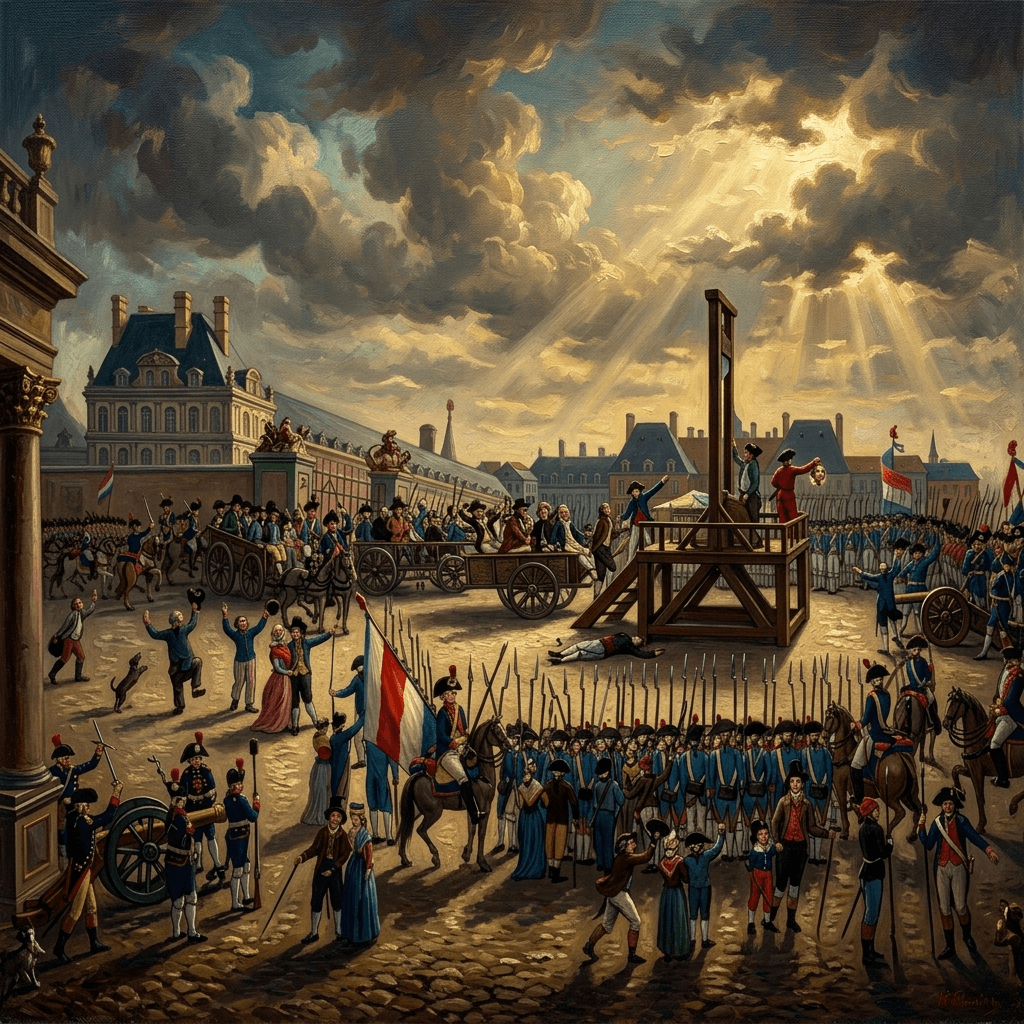
**3.1.4 ⚔️ Execution of Louis XVI (21 January 1793): the king who lost his crown… and his head**
On **21 January 1793**, on a freezing winter morning, **Louis XVI** — formerly “King of France and Navarre” — climbed the steps of the guillotine erected in the **Place de la Révolution** (current Place de la Concorde, in Paris).
With a single stroke of the blade, **the French monarchy was literally decapitated**, and the act echoed throughout Europe.
---
**⚖️ The king's trial**
📆 **11 December 1792:** Louis XVI, already called only “**citizen Louis Capet**”, was brought before the **National Convention**.
📜 Robespierre summarized the feeling of the radicals:
> “It is not a question of judging the king, but of condemning him. The king must die so that the country may live.”
---
**📊 The historic vote**
📆 **15 to 17 January 1793.**
The National Convention voted the fate of Louis XVI in three stages:
1️⃣ **Guilty or not guilty?**
2️⃣ **Death penalty or prison/exile?**
➡️ A difference of **only ONE vote** decided the sentence.
3️⃣ **Reprieve or not?**
📌 The fate was sealed: **death on the guillotine**.
---
**⚔️ The execution**
📆 **21 January 1793, 10:20 am.**
📜 A witness noted:
> “The silence was heavy. No cheers, no protests. Just silence.”
Upon arriving at the guillotine:
👑 **His last words:**
> “People of France, I die innocent.
> I forgive the authors of my death.
> And I pray to God that the blood you are about to shed will not fall back upon France.”
(The drums will drown out part of his speech before the end.)
💥 **10:22 am:** The blade falls.
➡️ **The king's head** is shown to the people.
➡️ Shouts of “**Vive la République!**” echo.
---
**🌍 Immediate repercussion**
The execution of Louis XVI was a **global political earthquake**.
📜 Edmund Burke, a critic of the Revolution, wrote:
> “A king was sacrificed, and with him, the entire civilized order of the world was threatened.”
---
**⚖️ Consequences for the Revolution**
---
**🎭 The symbolic weight**
The death of Louis XVI was not just the death of a man – it was the **execution of an idea**:
📜 Historian Jules Michelet wrote:
> “When the blade fell, it wasn't just Louis's head that rolled, it was the head of royalty in France.”
---
📍 **Location of the event today:**
The **Place de la Révolution** is currently called **Place de la Concorde**.
➡️ Tourists pass by, take pictures, but few realize that there, in 1793, the king of France lost his head.
---
**3.2.1 🏛️ Committee of Public Safety: Robespierre, Saint-Just, Couthon**
The **Committee of Public Safety** was created in **April 1793** by the **National Convention** as an emergency measure to **protect the Revolution** against internal and external threats.
What began as a temporary administrative body became, in a few months, a **centralized revolutionary government**, the ultimate symbol of the **Reign of Terror**.
---
**⚠️ The context: chaos, war and treason**
📆 **1793:**
France faced **threats on all fronts**:
➡️ The **National Convention** needed a small and agile body to make quick decisions.
📌 Thus was born the **Committee of Public Safety**.
---
**🏛️ Structure and functions**
📜 **Creation date:** 6 April 1793.
📌 Initially composed of **9 members** (later 12).
**Main functions:**
➡️ In practice, the Committee became **the de facto government of France** between 1793 and 1794.
---
**👤 The central figures**
Three names remained engraved in history as the “face” of the Committee:
➡️ Called “The Incorruptible”.
➡️ Uncompromising defender of civic virtue and the use of Terror as an instrument of justice.
➡️ Young, only 25 years old when he entered the Committee.
➡️ Known as the “Archangel of Terror”.
➡️ Created extremely harsh laws against “traitors”.
➡️ Lawyer from Clermont-Ferrand.
➡️ Paraplegic, moved around in a wheelchair.
➡️ Figure close to Robespierre, articulator of severe decrees.
📌 Other relevant members: Billaud-Varenne, Carnot (“organizer of the military victory”), Collot d’Herbois.
---
**⚖️ The government of Terror**
With almost unlimited powers, the Committee of Public Safety led the Revolution to the **Reign of Terror** (1793–1794):
📊 Estimates: between **16,000 and 40,000 executions** across the country during the Terror.
📜 Robespierre justified:
> “Without virtue, Terror is disastrous. Without Terror, virtue is powerless.”
---
**🌍 The “revolutionary dictatorship”**
The Committee centralized power like never before:
➡️ It was a **revolutionary dictatorship** in the name of the **salvation of the Republic**.
---
**📉 The decline**
📆 **1794:**
The Committee itself began to be seen as **tyrannical**.
📌 **27 July 1794 (9 Thermidor):** Robespierre and his allies were arrested and guillotined.
➡️ The Committee lost power and the Terror came to an end.
---
**🎭 The legacy**
The Committee of Public Safety was marked as:
📜 Historian François Furet wrote:
> “The Committee of Public Safety embodied the Revolution at its peak and in its abyss.”
---
**3.2.2 ⚖️ Law of Suspects (1793): anyone could be arrested without proof?**
On **17 September 1793**, the **National Convention** passed the **Law of Suspects** (*Loi des Suspects*), one of the darkest decrees of the French Revolution.
Under its vague and relentless text, **thousands of people were arrested and executed** – often without concrete evidence – marking the highest (and darkest) point of the **Jacobin Terror**.
---
**⚠️ The context: total war and revolutionary paranoia**
📆 **1793:**
➡️ The Revolution lived in a **state of emotional siege**: the fear of internal conspiracies justified increasingly extreme actions.
📜 Robespierre said:
> “We cannot be lenient with the enemies of the fatherland; indulgence is treason.”
---
**📜 What did the Law of Suspects say?**
📆 **17 September 1793 – Official decree.**
The text established that the following could be **arrested as suspects**:
➡️ **Practical translation:** **almost anyone** could be arrested.
---
**🏛️ How did it work?**
📊 It is estimated that **more than 300,000 people** were arrested under the Law of Suspects.
---
**🔥 What did imprisonment mean?**
📌 **Notable deaths:**
➡️ Girondins, Dantonists, even **innocent peasants** fell under the law.
---
**🌍 The terror of the “suspect”**
The law created a **climate of collective paranoia**:
📜 Saint-Just justified:
> “You cannot govern a people in revolution with liberty and clemency.”
---
**📉 The decline and repeal**
📆 **1794:**
With the fall of Robespierre (27 July 1794 – 9 Thermidor), the Law of Suspects was progressively **annulled**.
---
**🎭 The legacy**
The **Law of Suspects** became a symbol of:
📜 Historian Simon Schama wrote:
> “The Law of Suspects did not just define who was an enemy of the Revolution – it made everyone a potential enemy.”
---
**3.2.3 🔥 War in the Vendée: republican genocide and the drownings at Nantes**
Between **1793 and 1796**, the **Vendée** region, in western France, was the scene of one of the bloodiest and most traumatic conflicts of the French Revolution.
What began as a **peasant uprising against the Republic** ended in a **massacre of catastrophic proportions**, marked by mass executions, burned villages and even what some historians call **the first modern genocide**.
---
**⚠️ The context: civil war in revolutionary France**
📆 **March 1793:**
📌 **Reasons for the revolt:**
➡️ Result: **the countryside took up arms**.
---
**⚔️ The peasant uprising**
The insurgents called themselves the **“Catholic and Royal Army”**.
📌 **Composition:**
📢 Their battle cries:
> “**For the King! For Religion!**”
➡️ Before long, thousands of peasants took **entire cities** and defeated republican troops.
---
**🏛️ Paris's response: total repression**
The Convention, terrified by the civil war, ordered the **annihilation of the uprising**.
📆 **1793–1794:**
📌 **Method:**
➡️ The stated goal was to “**make the Vendée a national cemetery**”.
📊 Death estimates:
---
**🌊 The drownings at Nantes (“Noyades”)**
In Nantes, under the command of the revolutionary representative **Jean-Baptiste Carrier**, the repression reached levels of horror.
📌 **Cruel method:**
➡️ Called **“republican marriages”** when, macabrely, they tied a man and a woman together before throwing them into the river.
📊 It is estimated that **2,000 to 4,000 people** were killed this way in Nantes alone.
📜 Carrier said cynically:
> “The Loire will be our new national cemetery.”
---
**📉 The end of the revolt**
📆 **1796:**
The Vendée was **devastated**.
📜 A report from a revolutionary officer summarized:
> “There is nothing left. The Vendée has ceased to exist.”
---
**⚖️ Genocide? A historical debate**
Some historians (like Reynald Secher) argue that the repression in the Vendée was the **first modern genocide**:
Others argue that, despite the brutality, it was a **civil war massacre** and not a systematic genocide.
📌 Incontestable fact: it was **one of the bloodiest episodes** of the entire French Revolution.
---
**🎭 The symbolic weight**
The Revolt in the Vendée left deep scars:
📜 Historian Jules Michelet wrote:
> “The Vendée was the civil war in its most savage form; the Revolution found itself before its own mirror and did not like what it saw.”
---
**3.2.4 ⛪ Cult of Reason and the Supreme Being: Robespierre against atheism**
The French Revolution not only overthrew kings – it also shook **the very spiritual foundation of France**.
Between 1793 and 1794, amidst the **Reign of Terror**, revolutionaries attempted to **reinvent religion**: they substituted Christianity with "rational" cults and created a kind of civic faith.
It was the height of what many called the **dechristianization of France**.
---
**⚠️ The context: the attack on the Church**
From the beginning of the Revolution, the **Catholic Church** was the target of radical measures:
📌 In 1793, with radicalism on the rise, **the Catholic religion came to be seen as an enemy of the Revolution**.
---
**🔥 The Cult of Reason**
📆 **1793:** Radical groups (particularly the Hébertists) initiated the “**dechristianization**”.
**Main actions:**
📍 The most famous case:
➡️ **Notre-Dame Cathedral in Paris** was transformed into a **“Temple of Reason”**.
➡️ In November 1793, a colossal ceremony was held, celebrating **Reason** as the new divinity.
📜 A witness described:
> “Actresses representing the Goddess Reason climbed the altar; a hymn was sung, and the Catholic faith was expelled.”
---
**🙏 The return of “virtue”: Robespierre and the Cult of the Supreme Being**
Robespierre, although a revolutionary, detested the **aggressive atheism** of the Hébertists.
For him, a Republic needed **morality and virtue** – and this required **a superior belief**.
📆 **7 May 1794:**
The Convention approved the creation of the **Cult of the Supreme Being** (*Culte de l'Être suprême*).
**Principles:**
📜 Robespierre declared:
> “Atheism is aristocratic. The idea of a Supreme Being is republican.”
---
**🎭 The Festival of the Supreme Being**
📆 **8 June 1794.**
Robespierre organized a monumental festival in Paris:
📌 The ceremony, however, was viewed with suspicion:
---
**📉 Decline and end**
The creation of the Cult of the Supreme Being coincided with the **maximum point of Robespierre's power** – and also with the beginning of his fall.
A little more than a month later (**27 July 1794 – 9 Thermidor**), Robespierre was arrested and guillotined.
➡️ The cult disappeared rapidly, and France entered a phase of **religious disenchantment** and **partial rehabilitation of Catholicism**.
---
**🎭 The symbolic weight**
The episode of the revolutionary cults symbolizes the Revolution's attempt to **rewrite not only politics, but French spirituality itself**.
📜 Historian Albert Soboul wrote:
> “The Revolution wanted to create a religion of reason and virtue, but ended up proving that faith cannot be manufactured by decree.”
---
**3.3.1 💰 War economy: Law of the Maximum (price controls)**
On **29 September 1793**, the National Convention passed the **Law of the General Maximum** (*Loi du Maximum Général*), a decree that **fixed prices and wages** to contain inflation and guarantee food for the people of Paris.
It was a desperate attempt to deal with **food shortages**, speculation and war – but also an example of how the Revolution tried to **control the economy with an iron fist**.
---
**⚠️ The context: hunger, war and sans-culottes**
📆 **1793:**
➡️ The **people (sans-culottes)** pressed:
> “We want bread! We want fair prices!”
📌 Under this climate, the Convention yielded and approved the **price controls**.
---
**📜 What did the Law of the Maximum say?**
📆 **29 September 1793** – The decree established:
➡️ Workers could not demand wages above a certain limit.
➡️ Merchants who charged above the set price could **be arrested or guillotined** for “speculation”.
---
**🏛️ How did it work in practice?**
📜 A 1793 poster said:
> “The bread belongs to the people. He who hides it is an enemy of the Revolution.”
---
**📊 Results and problems**
**Short term:**
**Long term:**
➡️ The price controls became a paradox: **there were low prices… but there was not enough food.**
---
**⚖️ The end of the Maximum**
📆 **1794:**
---
**🎭 The symbolic weight**
The Law of the Maximum illustrates the **economic dilemma** of the Revolution:
📜 Historian Albert Soboul wrote:
> “The Maximum was the bread of the poor, but also the ruin of the countryside.”
📌 **Legacy:** The measure left deep marks on the French memory, as an example of **radical state intervention in times of crisis**.
---
**3.3.2 🏥 Public health: typhus outbreaks in prisons and the use of opium by Robespierre**
The French Revolution was not just politics and war – it also revealed the **sanitary challenges** of a country plunged into chaos.
While Paris saw crowded prisons and populous neighborhoods living in precarious conditions, **infectious diseases spread** and even revolutionary leaders sought **relief for their pains** in medicines of the time, such as **opium**.
---
**⚠️ Crowded prisons and extreme unhealthiness**
📆 **1793–1794:** With the **Law of Suspects**, tens of thousands of people were arrested on charges of being "enemies of the Revolution".
📌 **Problem:**
➡️ Inevitable result: **diseases spread**.
---
**🦠 Typhus: the “prison fever”**
**Epidemic typhus**, transmitted by **lice**, became a **lethal threat**:
📜 Accounts describe “**entire wards of feverish prisoners**”, coughing and delirious in deadly silence.
➡️ Even **guards and executioners** fell ill, showing that not even the agents of Terror were immune.
---
**🩺 What did the government do?**
There were **emergency measures**, but insufficient:
📌 But the constant flow of new prisoners **prevented any real improvement**.
---
**👤 Robespierre and the use of opium**
While the prisons fought against typhus, **Maximilien Robespierre**, maximum leader of the Committee of Public Safety, faced his **own health torments**.
📌 Historians report that Robespierre suffered from:
➡️ To relieve the pain, **Robespierre resorted to opium**, one of the few potent analgesic options of the time.
📜 A contemporary wrote:
> “The Incorruptible had moments of gloomy silence, red eyes, a face marked by pain – they say opium was his consolation.”
---
**🌍 Medicine and Revolution: between advances and tragedies**
The Revolution brought **great reforms** (public hospitals, incipient vaccination campaigns), but also revealed:
📌 Many prisoners were not guillotined – they died of **diseases**, a detail that rarely appears in history books.
---
**🎭 The symbolic weight**
Typhus and opium show the **human and fragile** side of the Revolution:
📜 Historian Jean-Clément Martin wrote:
> “The Revolution wanted to regenerate man, but first it had to face the rot of disease and pain.”
---
**4.1.1 ⚔️ Fall of Robespierre (9 Thermidor / 27 July 1794)**
On **27 July 1794** (9 Thermidor of Year II, in the **revolutionary calendar**), **Maximilien Robespierre** – the “Incorruptible” and central figure of the Committee of Public Safety – was overthrown by his own allies.
This event not only put an end to the **Reign of Terror**, but also changed the course of the French Revolution forever.
---
**⚠️ The context: the Terror devouring itself**
📆 **1793–1794:** The Committee of Public Safety, led by Robespierre, established the **Terror** to “save the Revolution”.
➡️ Result: **Paris lived under constant fear.**
📌 At the same time, **Robespierre** began to lose allies:
---
**🔥 The trigger: Robespierre's last speech**
📆 **26 July 1794 (8 Thermidor):**
Robespierre made a **threatening speech** at the National Convention.
📜 He accused “**internal enemies**” of conspiring against the Republic – but **did not name names**.
➡️ The effect was devastating:
---
**⚔️ The 9 Thermidor**
📆 **27 July 1794:** The **Convention** turned against Robespierre.
📢 A deputy shouted:
> “The tyranny has fallen!”
➡️ **Vote:** Robespierre, Saint-Just, Couthon and allies were **arrested**.
---
**🔫 The chaos on the Thermidorian night**
📆 **Night of 27 to 28 July.**
➡️ **Robespierre was shot in the face.**
📌 He was left with his **jaw destroyed**, bleeding in silence until the execution.
---
**⚖️ The execution**
📆 **28 July 1794 (10 Thermidor).**
📢 The executioner Sanson said:
> “Robespierre suffered as no one had ever suffered before dying.”
➡️ As the blade fell, an **era ended**.
---
**🌍 Consequences: the end of the Terror**
📌 The **revolutionary calendar** itself and cults like the **Supreme Being** fell into disrepute.
---
**🎭 The symbolic weight**
The fall of Robespierre marked the **moment when the Revolution “devoured its own creator”**.
The blade he used to maintain the Terror was the same one that ended his power.
📜 Historian François Furet wrote:
> “9 Thermidor was not the end of the Revolution – it was the end of the Revolution as a political religion.”
---
**4.1.2 ⚖️ Repression of the Jacobins: the White Terror**
With the fall of **Robespierre** on **27 July 1794 (9 Thermidor)**, the **Reign of Terror** ended, but the Revolution did not immediately return to peace.
What followed was the so-called **White Terror** (*Terreur Blanche*), a wave of **revenge, repression and violence** against the Jacobins and those who had supported the Terror regime.
---
**⚠️ What was the “White Terror”?**
📆 **1794–1795:**
After the execution of Robespierre, Saint-Just, Couthon and their allies, France entered a new phase:
📌 “White Terror” means exactly that:
➡️ The color **white** (symbol of the monarchists and counter-revolutionaries) was now associated with **revenge** against the “reds” (Jacobins).
---
**⚔️ How did it start?**
Right after the fall of Robespierre:
📜 A moderate deputy declared:
> “The executioners of the Terror will taste the steel.”
---
**🔥 The violence in the streets**
📆 **1795:** **Anti-Jacobin gangs** emerged, known as **“jeunesse dorée”** (“gilded youth”).
📌 Who were they?
➡️ They roamed Paris, **beating up sans-culottes**, invading Jacobin clubs and even **lynching former supporters of the Terror**.
📊 Historians estimate that **hundreds of Jacobins** were killed in **summary executions and lynchings**.
---
**📜 Official measures**
The Thermidorian government:
➡️ But also:
---
**📉 The end of radicalism**
The White Terror marked:
📜 The famous phrase attributed to a deputy summarizes the mood:
> “After 9 Thermidor, there will be no more revolutions – only business.”
---
**🎭 The symbolic weight**
The **White Terror** did not kill as many people as the Jacobin Terror, but it made clear that:
📜 Historian Timothy Tackett wrote:
> “The White Terror was the Revolution presenting the bill to itself – and proving that, in 1795, no one was clean of the blood shed.”
---
**4.2.1 🏛️ Corruption and instability of the Directory: frequent coups d'état**
After the collapse of the Terror and the fall of Robespierre, the French Revolution entered a new phase: the **Directory** (*Directoire*), which governed between **1795 and 1799**.
This period, although less bloody than the Terror, was marked by **endemic corruption, political intrigues and almost annual coups d'état**.
---
**⚠️ What was the Directory?**
📆 **26 October 1795:**
The Constitution of Year III created a new regime to end the radical phase of the Revolution.
📌 **Structure:**
➡️ The intention was to **avoid another dictatorship** like that of the Committee of Public Safety.
➡️ The result, however, was a **fragile and corrupt** system.
---
**💰 Corruption**
The Directory was one of the **most corrupt** periods of the Revolution:
📜 A 1797 pamphlet ironized:
> “The Revolution promised us liberty and bread; it gave us taxes and thieves.”
---
**⚔️ “Legal” coups d'état**
Between 1795 and 1799, the Directory faced **threats from all directions**:
➡️ Solution of the directors? **Preventive coups.**
📆 **Examples:**
📌 The regime used the army to “correct” results and ensure its survival.
---
**🔥 Rebellions and revolts**
➡️ The Directory responded with **violent military repression**, losing popular support.
---
**🎭 The rise of the generals**
With the Directory increasingly **dependent on the army**, generals gained political power.
📌 **The most notorious:**
➡️ **Napoleon Bonaparte**, who shined in the **Italian Campaign (1796–1797)** and became a national hero.
➡️ The Directory began to fear Napoleon… with reason.
---
**📉 The inevitable collapse**
📆 **1799:** The regime was **worn out**:
📜 A deputy wrote:
> “The Directory governs, but no one believes in it anymore.”
➡️ On **9 November 1799 (18 Brumaire)**, Napoleon executed the final coup, abolished the Directory and established the **Consulate**, paving the way for the **Empire**.
---
**🎭 The symbolic weight**
The Directory was marked as:
📜 Historian François Furet summarized:
> “The Directory taught the French to desire order – and thus prepared the ground for the Emperor.”
---
**4.2.2 ⚔️ Rise of Napoleon: Italian Campaign (1796–1797)**
In **1796**, a young general of only **26 years old**, named **Napoleon Bonaparte**, took command of the **Army of Italy**.
What seemed like a secondary campaign turned into a **military tour de force**, revealing Napoleon's genius and making him the most powerful – and feared – figure of the Directory.
---
**⚠️ The scenario before Napoleon**
📆 **1795:** Revolutionary France was at war against the **First Coalition** (Austria, Piedmont-Sardinia, England and other European kingdoms).
📌 The **Army of Italy**:
📜 An officer wrote:
> “The soldiers have no boots, no bread, no hope.”
➡️ The command fell to a young, little-known, but ambitious general: **Napoleon Bonaparte**.
---
**⚔️ The beginning of the campaign (1796)**
📆 **2 March 1796:** Napoleon takes command.
A few weeks later, he begins a **lightning offensive**.
**Strategy:**
📌 In less than a month:
➡️ With the flank clear, he turned against **Austria**.
---
**🏰 The great victories**
Between **April 1796** and **April 1797**, Napoleon accumulated legendary victories:
📊 **Result:**
➡️ In one year, Napoleon defeated **much larger armies**, captured cities and humiliated Austria.
---
**💰 Looting and treaties**
The Italian Campaign was not just military – it was also **financial**.
📌 Napoleon looted:
📆 **17 October 1797:**
➡️ Napoleon signed the **Treaty of Campo Formio** with Austria:
---
**🎭 The transformation of Napoleon**
The Italian Campaign made Napoleon a **revolutionary hero**:
📜 A soldier wrote:
> “He is small, but his soul is immense.”
➡️ But it also generated **fear in the Directory**:
---
**📉 The impact**
📌 The seed of the future Empire was planted in the **mud of Italy**.
---
**🎭 The symbolic weight**
The Italian Campaign was:
📜 Historian Andrew Roberts wrote:
> “In Italy, Napoleon did not just defeat armies – he reinvented war and reinvented himself.”
---
**5.1.1 🌍 Haitian Revolution (1791–1804): the only successful slave revolt?**
The French Revolution did not only transform France – its ideas crossed oceans.
In the colony of **Saint-Domingue** (current Haiti), the ideals of **liberty, equality and fraternity** fueled a revolt that would become **the only successful slave rebellion in history**, changing the Atlantic forever.
---
**📜 Haiti before the Revolution**
📆 **Late 18th century:**
📌 Society was divided:
➡️ It was a **powder keg**.
---
**⚠️ The impact of the French Revolution**
📆 **1789:** The Revolution and the **Declaration of the Rights of Man and of the Citizen** reached the colony.
📌 Result:
📜 The mulatto leader Vincent Ogé declared:
> “If the rights of man are universal, we demand them for ourselves as well.”
---
**🔥 The slave insurrection**
📆 **August 1791:**
A voodoo ceremony in Bois Caïman was the symbolic trigger:
➡️ **Slaves rebelled**, burning plantations and killing masters.
📊 Dimension:
➡️ The **largest slave uprising in modern history** had begun.
---
**⚔️ Civil war and insurgent leaders**
From the chaos emerged charismatic leaders:
📌 They organized the rebels into **disciplined armies** and faced:
---
**🏛️ Revolutionary France reacts**
📆 **1794:** Under pressure from the war, the National Convention **abolished slavery in all French colonies**.
➡️ Toussaint Louverture temporarily allied himself with the **French Republic** to fight the foreign invaders.
---
**📆 Napoleon and the betrayal**
📆 **1799–1802:** Napoleon Bonaparte assumed power in France.
📌 Initially, he maintained the abolition.
➡️ But, in 1802, he sent a **military expedition** to retake control of Saint-Domingue and **restore slavery**.
⚔️ Result:
---
**🎉 The birth of Haiti**
📆 **1 January 1804:** Jean-Jacques Dessalines proclaimed the **independence of Haiti**.
📜 He declared:
> “Let us swear before the whole world to exterminate forever the colonial power.”
📊 Consequences:
---
**🌍 Global impact**
---
**🎭 The symbolic weight**
The Haitian Revolution was more than a colonial conflict:
➡️ It was the **most radical realization of the ideals of 1789** – freedom not only for whites, but for **all human beings**.
📜 Historian C.L.R. James summarized:
> “In Saint-Domingue, the slaves took the French Revolution to its logical conclusions.”
---
**5.1.2 ⚔️ Napoleonic Wars: export of revolutionary ideals**
The **Napoleonic Wars** (1799–1815) were much more than military confrontations for the hegemony of Europe.
They became a **vehicle for exporting the ideals of the French Revolution** – liberty, equality, end of aristocratic privileges and legal reforms – to territories that had never experienced such concepts.
---
**⚠️ From the Directory to the Empire: the transition**
📆 **1796–1799:** Even under the Directory, the revolutionary armies (under the command of young generals like Napoleon) were already spreading **new principles**:
📆 **9 November 1799 (18 Brumaire):** Napoleon takes power, establishes the **Consulate** and then the **Empire** (1804).
📌 Even transforming himself into an **emperor**, Napoleon **did not abandon** the revolutionary bases – he **codified and exported them**.
---
**📜 The Napoleonic Code: the law travels with the army**
📆 **1804:** Napoleon promulgates the **Civil Code** (known as the Napoleonic Code).
📌 **Main principles:**
➡️ Wherever the French armies arrived, the Code was imposed – **Italy, Holland, Belgium, parts of Germany, Poland and even Spain**.
📜 Historian Jean Tulard wrote:
> “With his soldiers, Napoleon brought not only cannons, but registry offices.”
---
**🌍 “Exportation” of revolution: between reforms and resistance**
**Wherever Napoleon went, the following emerged:**
➡️ In many countries, these reforms **survived Napoleon**.
📌 But not everything was accepted with enthusiasm:
---
**⚔️ Napoleonic Wars: from idealism to empire**
📆 **1805–1812:**
📌 Many began to wonder:
➡️ “Is Napoleon a liberator or a conqueror?”
---
**📉 The decline and the legacy**
📆 **1812:** The disaster in **Russia** marks the beginning of the end.
📆 **1814–1815:** Napoleon is defeated and the **Congress of Vienna** tries to restore the “Old Regime”.
➡️ **But it was too late.**
📌 Even after the fall:
---
**🎭 The symbolic weight**
The Napoleonic Wars were a paradox:
📜 Historian Eric Hobsbawm summarized:
> “Napoleon did not just conquer Europe – he rewrote it in the name of the Revolution, even when he had already become an emperor.”
---
**5.2.1 🎬 The French Revolution in cinema: from *La Marseillaise* to *Marie Antoinette***
Few historical events have inspired filmmakers as much as the **French Revolution**.
Since the early decades of cinema, directors from all over the world have revisited the period, offering versions that range from the epic to the intimate, from historical rigor to pure visual delirium.
These films have shaped the **collective imagination** about 1789 – and, often, tell as much about the time in which they were produced as about the Revolution itself.
---
**🎥 The first films: propaganda and heroism**
📆 **1900–1930:** French silent cinema was already fascinated by the Revolution.
📌 They were short works, often **didactic**, almost like “little history lessons on film”.
---
**📽️ The era of historical epics**
📆 **1930s:**
Sound cinema allowed for **grandiose and political** productions.
🎞️ **La Marseillaise (1938, Jean Renoir)**
📌 Renoir made the Revolution **a popular epic**, exalting the song that became an anthem.
---
**👑 Marie Antoinette: the queen of the screen**
📆 From **Norma Shearer (1938)** to **Kirsten Dunst (2006)**, **Marie Antoinette** became a **cinematic icon**.
🎞️ **Marie Antoinette (1938, W.S. Van Dyke)**
🎞️ **Marie Antoinette (2006, Sofia Coppola)**
📌 Two approaches, two worlds:
➡️ A **martyr queen** in classic cinema.
➡️ A **pop queen** in contemporary cinema.
---
**⚔️ Political and engaged films**
📆 **1960s–1980s:**
The French Revolution returned to the cinema as an **ideological debate**.
🎞️ *Danton (1983, Andrzej Wajda)*
📌 Produced in communist Poland, the film is **a veiled critique of Soviet authoritarianism**, using the Revolution as a metaphor.
---
**🎭 Robespierre, the guillotine and the terror on screen**
📆 Several films explored the **dark side** of the Revolution:
📌 These films ask:
➡️ **Did the Revolution liberate… or just substitute one terror for another?**
---
**🎮 From the screen to the video game: the digital Revolution**
📆 **2014:**
🎮 *Assassin’s Creed Unity* reconstructed Paris of 1789 with **impressive detail**.
📌 For the first time, millions of players “walked” through the Bastille, the Louvre and Notre-Dame during the Revolution.
➡️ The game became a **new type of interactive cinema**, shaping popular memory.
---
**🎭 The symbolic weight**
The cinema did not just **tell the French Revolution** – it helped to **define it in the modern imagination**.
📜 Critic Georges Sadoul wrote:
> “Every film about 1789 says as much about the Revolution as about the time in which it was filmed.”
📌 From the patriotic glory of Renoir to the pop glamour of Coppola, the Revolution remains alive **not only in books, but on screens**.
---
**5.2.2 🎮 The French Revolution in games: from Assassin’s Creed Unity to digital adventures**
The French Revolution, with its epic drama, political intrigues and iconic settings, did not remain restricted to books and cinema.
In recent years, the **world of video games** has become one of the most **immersive and interactive** ways to experience the period – allowing players to “walk” through the streets of Paris in 1789, climb the Bastille or even interfere in historical events.
---
**🎮 Assassin’s Creed Unity (2014) – Paris as you've never seen it**
📆 **2014:** Ubisoft released **Assassin’s Creed Unity**, one of the most ambitious games ever made about the French Revolution.
📌 **Highlights:**
➡️ **Impact:**
📜 Specialized critique:
> “Unity is more than a game – it is an interactive history lesson.”
---
**🕵️ Other titles exploring the Revolution**
Although **Assassin’s Creed Unity** is the most famous, other games have also delved into (or touched on) the theme:
➡️ The player is a **judge of the Revolutionary Tribunal**, deciding who goes to the guillotine.
➡️ Moral tension: follow the law, please factions or save innocents?
➡️ Strategic RPG that, although centered on the American Revolution, makes reference to the French events.
➡️ Games inspired by Victor Hugo's universe touch on late reflections of the Revolution.
---
**🏛️ Experience beyond entertainment**
📌 **Why are games about the Revolution successful?**
🎓 In fact, some teachers use **Assassin’s Creed Unity** as a **pedagogical tool** in the classroom.
---
**🌍 Cultural impact**
---
**🎭 The symbolic weight**
The games show that the French Revolution is not just a **museum theme** – it is a **living universe**, capable of being explored by new media.
📜 A gamer critic wrote:
> “Assassin’s Creed Unity didn't just make me play – it made me understand that the streets of Paris have memories, and that history can be touched with your hands.”
---
- **Seven Years' War (1756–1763)**: This global conflict (fought in Europe, the Americas and India) against England ended in disaster for France.
- France lost **Canada**, territories in India and almost all of its colonial empire in America.
- Estimated cost: **1.3 billion livres** at the time, an unpayable fortune.
- Result: **brutal increase in debt** and international humiliation.
- **Support for the American Revolution (1775–1783)**: When the American colonists rebelled against England, France saw the chance to weaken its historical rival.
- King Louis XVI sent troops, ships and huge sums of money.
- It amounted to about **1.3 billion livres** in loans and military support.
- Benjamin Franklin in Paris became an icon of “liberty”, but the French Treasury was sinking.
- In **1788**, **50% of ALL State revenue** was used solely to pay the **interest on the debt**.
- About **25%** went to the **maintenance of the court and the army**.
- A meager **25%** was left for the rest: schools, public works, hospitals, roads, etc.
- It was the **first "public budget"** in French history.
- It showed a **colossal deficit** and infuriated the nobility, who did not want to give up privileges.
- The **clergy (First Estate)** and the **nobility (Second Estate)** had exemptions from almost all taxes.
- The **Third Estate (98% of the population)** — peasants, artisans, bourgeois, workers — carried the burden alone.
- **Taille:** direct tax on income/property.
- **Gabelle:** tax on salt, considered “the most odious” — there were regions where salt cost 10x more than in others.
- **Corvée royale:** forced labor on roads and royal public works.
- The **Palace of Versailles** cost a fortune to maintain — hundreds of servants, gardens, banquets, balls.
- Marie Antoinette was nicknamed **“Madame Deficit”**. Her expenses on fashion (dresses, hats, parties) and the famous **Petit Trianon** became **symbols of the moral and financial decay** of the Old Regime.
- International banks **no longer wanted to lend** to the government.
- Revenue was **unfair and insufficient**.
- The system of privileges prevented reforms.
- And the monarchy's image was destroyed.
- 📜 **Economic power:** The clergy owned about **10% of all land in France**.
- 💰 **Income:** It received the **ecclesiastical tithe** (10% of agricultural production), plus donations, income from properties and fees.
- ⚖️ **Tax privileges:** The clergy was **exempt from most royal taxes**, including the taille (direct tax).
- **High clergy:** bishops, abbots and cardinals, almost always coming from the **nobility**. They lived in the luxury of palaces and abbeys.
- **Low clergy:** parish priests and monks of rural villages. Many sympathized with the Third Estate, as they lived modestly.
- 🏞️ **Property:** controlled about **30% of the agricultural land**.
- ⚖️ **Privileges:** did not pay taille, had exemption from several taxes, could collect **feudal dues** and maintain seigniorial courts.
- **Nobility of the sword (noblesse d’épée):** the traditional military aristocracy.
- **Nobility of the robe (noblesse de robe):** families who bought judicial or administrative offices and, with that, the status of nobility.
- **Exclusive hunting rights** (even on peasants' lands).
- **The right to collect tolls, community mills and ovens** — feudal practices that generated hatred in the countryside.
- **Peasants:** about 80% of the Third Estate. Many still tied to feudal obligations.
- **Bourgeoisie:** merchants, bankers, lawyers, doctors, intellectuals. They were **rich in money**, but **without political power**.
- **Sans-culottes:** urban workers, artisans, apprentices and the unemployed. Named so because they wore long trousers (and not the culottes, aristocratic breeches).
- The **First Estate** (clergy) and the **Second Estate** (nobility) represented **about 2% of the population**, but held **almost all the privileges**.
- The **Third Estate**, with 98% of the French, paid:
- **Taille** (direct tax).
- **Corvée royale** (mandatory days of labor on roads).
- **Gabelle** (salt tax, which could cost 10x more in one province than in another).
- **Tithes to the Church** and feudal dues to the lords.
- Cold waves **froze entire rivers**, including the Seine, which became a block of ice in Paris.
- Thick layers of snow covered France, ruining transportation and delaying grain deliveries.
- Fruit trees and vines died, and seeds failed to germinate the following spring.
- The **wheat harvest of 1788** was considered **one of the worst of the 18th century**.
- The **price of bread**, the basis of the French diet, **doubled** between 1788 and mid-1789.
- 1787: 8 sous per kilo.
- 1789: 14–16 sous (some reports speak of up to 20 sous).
- Peasants, artisans and sans-culottes ate, on average, **500 to 700 grams of bread per day**.
- Meat was a rare luxury; cheese and wine were occasional.
- If bread was missing, **everything collapsed**.
- Bakeries were **looted**.
- Carts transporting wheat were **intercepted** on the roads by armed crowds with sticks and stones.
- Peasants invaded nobles' barns, suspecting they were hiding grain.
- It appears for the first time in the *Confessions* of **Jean-Jacques Rousseau**, written around 1767 (when Marie Antoinette was only 12 years old and was not even in France).
- But the pamphlets of 1789 attributed it to the queen, creating the myth of her **cruel indifference**.
- It **delegitimized the monarchy**: the people expected the king to be the “father of the kingdom”, capable of providing bread.
- The absence of bread was interpreted as **royal treason** — rumors arose that the aristocrats were hiding wheat to “starve the people”.
- **Philosophers and bourgeois** could theorize about freedom.
- But it was **the empty stomachs** that led thousands to the streets.
- **Reason** above tradition and authority.
- **Science** and empirical observation instead of religious dogmas.
- **Natural rights** of man (liberty, property, equality before the law).
- 🏞️ Born in Geneva, Rousseau was a **restless thinker** and controversial figure, who lived among aristocrats, but despised the aristocracy.
- His book **The Social Contract (1762)** became **a revolutionary bible**.
- Power comes from the **people**, not from God.
- The law must express the **“general will”**, and not that of an elite.
- If a government violates the social contract, the people have the **right to overthrow it**.
- Voltaire, pseudonym of **François-Marie Arouet**, was the **most famous writer in Europe** of his time.
- Master of sarcasm, he attacked the **Catholic Church** and **religious intolerance** with devastating irony.
- Defense of **freedom of expression** and worship.
- Criticism of **religious fanaticism** (his motto was *Écrasez l’infâme!* — “Crush the loathsome thing!”, referring to clerical intolerance).
- Support for an **enlightened monarchy** — Voltaire did not preach overthrowing kings, but rather educating them.
- In *The Spirit of the Laws (1748)*, Montesquieu introduced one of the most enduring ideas in political history:
- It inspired the **US Constitution** (1787).
- It directly influenced the **French revolutionaries** and the **Constitution of 1791**.
- 📘 Published between **1751 and 1772**, the *Encyclopédie* gathered articles on science, arts, economics and politics.
- Over **140 collaborators** (including Voltaire, Rousseau and Montesquieu) participated.
- The stated goal: “**Gather all human knowledge** and transmit it to the people.”
- It challenged dogmas.
- It questioned privileges.
- It spread the idea that **knowledge should not be a monopoly of the elite**.
- **Language** for the demands: “rights”, “social contract”, “general will”.
- **Moral justification** to question the king and the clergy.
- **Confidence in reason** — the idea that society could be **rebuilt from scratch**, like an perfected machine.
- It was, above all, a **philosophical and philanthropic club**, which promoted **ideals of fraternity, equality and liberty**.
- Its members were men from **diverse social backgrounds**: progressive nobles, bourgeois, intellectuals, scientists and even clerics.
- In **1773**, the **Grand National Lodge of France** was founded, later reorganized as the **Grand Orient of France**, which would become one of the most influential Masonic centers in the world.
- **Equality among brothers:** within the lodge, nobles and bourgeois treated each other as equals — something unthinkable outside of it.
- **Religious tolerance:** Catholics, Protestants and Jews coexisted, challenging the hegemony of the Catholic Church.
- **Rationalism:** debates on science, philosophy and politics replaced dogmas and superstitions.
- **Marquis de Lafayette** – Hero of the American Revolution and a central figure in the early years of the French Revolution, he was an active Freemason.
- **Philippe d’Orléans (Philippe Égalité)** – Cousin of Louis XVI, Grand Master of the Grand Orient of France. He used his position to sponsor reformist ideas (and, ironically, voted for the king's execution).
- **Condorcet, Bailly and Mirabeau** – Intellectuals and politicians linked to Masonic lodges and debate salons.
- **Parisian salons**: private spaces, usually organized by elite women (like **Madame Geoffrin** and **Madame Necker**). There, philosophy, economics, art — and politics — were discussed.
- **Societies of thought**: semi-formal groups, inspired by Freemasonry, that promoted debates and publications.
- **Embryonic patriotic clubs**: before the Jacobins officially existed, there were reading circles and groups of lawyers, journalists and intellectuals who rehearsed speeches that would later echo in revolutionary clubs.
- **The myth:** Royalist pamphlets accused Freemasonry of being a “secret society” conspiring to overthrow the throne and the altar.
- **The reality:** Freemasonry did not plan the Revolution, but **provided social networks, vocabulary and ideas** that helped pave the way.
- **Meeting structure**, with voting rituals and closed sessions.
- **National network:** just as lodges had branches in various cities, the clubs spread throughout France.
- **Language of fraternity:** Masonic vocabulary (“brothers”, “fraternity”, “light”) migrated to revolutionary discourse.
- 📜 **Banned books**, anonymous pamphlets, “libels” (defamation texts) circulated like wildfire.
- 💼 Street vendors, cafes and taverns became distribution points for subversive material.
- 📊 It is estimated that **more than 50 million printed materials** circulated in France between 1780 and 1789 — a colossal number for the time.
- 🇦🇹 She was “**the Austrian**” — in a country that had hated Austria since the Seven Years' War.
- 💍 She represented the luxury and frivolity of the court.
- 🎭 She frequented the **Petit Trianon** and played “shepherdess” at Versailles, feeding the image of alienation.
- 💎 A diamond necklace, valued at **1.6 million livres**, was originally commissioned for Madame du Barry (mistress of Louis XV).
- In 1785, **swindlers** (the Countess de La Motte and accomplices) tricked the **Cardinal de Rohan**, convincing him that he would help Marie Antoinette obtain the necklace and, thus, regain her favor at court.
- The cardinal made the deal; the necklace disappeared; and the story came to light.
- The 1786 trial acquitted the queen, but **public opinion had already condemned her**.
- Pornographic pamphlets circulated by the thousands, depicting the queen in scenes of **promiscuity, lesbianism** or even **incest**.
- These texts and images aimed not only to attack the person of Marie Antoinette, but to **desacralize the monarchy**.
- If a pamphlet said that Marie Antoinette was stealing from the Treasury, the street believed it.
- If a libel claimed that she kept lovers, the rumor became “fact”.
- They **killed the symbolic authority** of the monarchy before the guillotine did it physically.
- When the Revolution began, Marie Antoinette was already destroyed **in the popular imagination** — and there was no official propaganda capable of rehabilitating her.
- **Abolish the corvée royale** (forced labor on roads) and replace it with a **monetary tax proportional to wealth**.
- **Liberalize the grain trade**, allowing free movement and sale, hoping to stabilize prices.
- Reduce court expenses and cut **tax privileges**.
- The nobility and the parlements (courts dominated by nobles) revolted.
- Bread riots occurred after the liberalization of grain — known as the **“Flour War” (1775)**.
- In 1776, Turgot was dismissed.
- **Cuts in court expenses:** reduced royal parties and pensions (making enemies in Versailles).
- **Public loans instead of taxes:** financed the participation in the American War of Independence without immediately increasing taxes.
- Created the **Compte rendu au roi (1781)** — **the first public report of the finances of the French State**, to show “transparency”.
- The nobility hated him for “daring” to show real numbers.
- He was dismissed in 1781, recalled in 1788 and again dismissed in **July 1789** — an act that infuriated Paris and helped provoke the **Fall of the Bastille**.
- **Universal tax** on property — including clergy and nobility.
- End of several feudal exemptions.
- Creation of provincial assemblies to improve tax collection.
- The nobility accused him of “betraying his class”.
- Louis XVI summoned the **Assembly of Notables (1787)** to approve the reform.
- The assembly refused, blocking the plan.
- Created by **Louis XVI** on **22 February 1787**, it was an extraordinary meeting of **“notables”**:
- 144 members, among **nobles of high lineage, prelates of the Church and some magistrates**.
- It was not an elected parliament, nor a representative assembly — it was an **elite club** called to “advise” the king.
- He proposed a **“universal land tax”**: ALL landowners — including **nobility and clergy** — would have to pay.
- He suggested the **abolition of several feudal exemptions** and the creation of **provincial assemblies** to modernize tax collection.
- Clear idea: **touch privileges to save the State**.
- The nobles and the high clergy said **no** to the idea of paying taxes.
- They said they **had no authority** to approve such measures.
- They suggested that **only the Estates General** (a national assembly with representatives of the three estates) could decide something so big.
- The Estates General had not met since **1614**.
- When summoned, they would give the **Third Estate** (98% of the population) an unprecedented voice.
- This meant, in practice, **breaking the political order**.
- **Calonne fell** in April 1787, dismissed and accused of mismanagement.
- He was replaced by **Lomenie de Brienne**, another reformist who would also face resistance.
- The refusal of the Assembly left Louis XVI with no way out:
- **He could not raise more money.**
- **He could not govern without reforms.**
- **It exhibited the arrogance of the privileged.**
- **It laid bare the moral and political bankruptcy of the monarchy.**
- And, inadvertently, **lit the fuse of the Revolution.**
- **First Estate:** Clergy.
- **Second Estate:** Nobility.
- **Third Estate:** Everyone else — peasants, bourgeois, artisans, lawyers, merchants, sans-culottes.
- In 1788, the monarchy **could no longer borrow money**.
- The reformist ministers had been **defeated** by the resistance of the nobility (Assembly of Notables).
- The **bread crisis** and popular revolts increased the pressure.
- The **First Estate** asked for the maintenance of privileges, but many priests of the **low clergy** advocated reforms.
- The **Second Estate** (nobility) wanted administrative reforms, but **without losing tax exemptions**.
- The **Third Estate** asked for **the end of privileges**, **tax justice**, **freedom of trade** and **equality before the law**.
- Each “estate” had **a single vote** (clergy, nobility and Third Estate).
- This meant that **2% of the population (clergy + nobility)** could defeat **98% (Third Estate)**.
- 📅 **Date:** 5 May 1789.
- 📍 **Location:** Salle des Menus Plaisirs, in Versailles.
- The deputies of the Third Estate were lawyers, merchants, educated bourgeois — **an intellectual elite ready to challenge the system**.
- They saw that **aristocratic privileges blocked any solution**.
- The Third Estate broke with the estate structure.
- The **Tennis Court Oath** (20 June) consecrated the promise to create a **Constitution**.
- The path to the **end of absolute monarchy** was open.
- The **clergy** and the **nobility** resisted, fearing to lose control.
- With no solution, the deputies of the Third Estate decided to act on their own.
- The Third Estate **proclaimed itself the “National Assembly”**, claiming to represent **the entire French nation**.
- Officially, the reason was “preparations for a royal session”.
- But for the deputies, it was a **maneuver to disperse them**.
- That all swear **not to separate** until they gave France **a Constitution**.
- It shows the deputies with raised hands, shouting “We swear!”, while the wind shakes the curtains and the “storm of change” seems to enter through the window.
- Deputies declared themselves representatives of the **sovereign nation**, and no longer of the king.
- The Old Regime lost the **monopoly of political authority**.
- The price of **bread** skyrocketed.
- Rumors circulated that the king planned to **dissolve the National Assembly** by force.
- Royal troops, including foreign regiments, surrounded Paris — seen as **armies of repression**.
- In the 18th century, it was used as a **state prison** for political enemies and people detained by **order of the king** (*lettres de cachet*).
- It was a symbol of the **arbitrary power** of absolutism.
- **Morning:** Armed crowds with sticks, spears and some improvised weapons took the **Hôtel des Invalides**, capturing **28,000 muskets** (but no gunpowder).
- **Afternoon:** The crowd marched to the Bastille, looking for **gunpowder and ammunition**.
- The crowd grew.
- The negotiations became chaotic.
- Shots were exchanged.
- About **100 Parisians** died (mostly from shots by the defenders).
- **Launay's** head was cut off and displayed on a **pike**, a foreshadowing of future horrors.
- 💭 For years, rumors circulated that the Bastille had **secret tunnels** and **underground torture prisons**.
- Pamphlets spoke of “thousands of liberated prisoners” — something **false**, but powerful for the revolutionary narrative.
- It represented the **destruction of absolutism**.
- It showed that the **people of Paris could defeat the king's force**.
- It inspired **riots** and **revolts** throughout France.
- **14 July** became the **national holiday of France** (Fête Nationale).
- Since 1880, the day is celebrated with **military parades** and parties, as a symbol of **freedom** and **national unity**.
- Louis XVI, shocked, asked: **“Is this a revolt?”**
- The Duke of La Rochefoucauld replied: **“No, Sire. This is a revolution.”**
- It was said that **armies of foreign mercenaries** were on their way to **massacre the peasants** and **restore the king's order**.
- Other rumors spoke of “**bandits in the pay of the nobles**”, hired to destroy crops and terrorize villages.
- Peasants began to **arm themselves with pitchforks, scythes and sticks**.
- When they did not find the “bandits” they imagined, they attacked the **most obvious target: the feudal lords**.
- Nobles fled abroad (the “**émigrés**” were born).
- The burned archives meant the end of feudal obligations: **the system was literally destroyed in the fire**.
- They feared that **peasant anarchy** threatened the Revolution.
- They needed to **calm the interior** and **give an answer** to the popular demands.
- Tithes and servile obligations were eliminated.
- Privileges of nobility and clergy were destroyed.
- Peasants, driven by panic, attacked the system that oppressed them.
- Nobles, terrified, fled or renounced privileges.
- Feudalism, which seemed eternal, **fell in weeks**.
- The **Third Estate** had already proclaimed itself the **National Assembly** (June).
- **Feudalism had been abolished** (4 August).
- It remained to define: **what rights would the new order guarantee?**
- **Enlightenment:** Rousseau, Voltaire, Montesquieu.
- **American Independence (1776):** Jefferson and Franklin were known in Paris.
- **Natural Right:** the idea that certain rights belong to man **by nature**.
- **Marquis de Lafayette** – hero of the American Revolution and main author of the draft.
- **Abbé Sieyès** – theoretician of the Third Estate.
- **Mirabeau** – powerful orator and pragmatic politician.
- Other deputies contributed, including **influences from Thomas Jefferson**, then US ambassador in Paris.
- **Art. 1:**
- **Art. 3:**
- **Art. 6:**
- **Art. 11:**
- It inspired constitutions throughout Europe and Latin America.
- It is considered one of the **founding texts of human rights** modern.
- It echoes to this day: the **Universal Declaration of Human Rights (1948)** is strongly inspired by the 1789 document.
- Women, slaves and the poor were **excluded** in practice.
- The colonies (Haiti, for example) would take a long time to see these “rights” applied.
- It was read in squares.
- Affixed to churches and public buildings.
- It became the **identity card of the French Revolution**.
- The price of bread, a staple food, **had tripled**.
- Queues and riots at bakeries were routine.
- Women, who were **responsible for buying bread** for their families, directly felt the despair.
- The Royal Guard at Versailles had held a **luxurious banquet** at the Palace.
- During the event, the soldiers **trampled the new tricolor flag** (symbol of the Revolution) and toasted the old white flag of the Bourbons.
- In the morning, women began to gather at the central market of Paris (Les Halles).
- The protest grew, mixing **housewives, fish sellers, seamstresses, poor workers**.
- **Armed men** (including members of the National Guard).
- **Cannons** and improvised weapons.
- Demanded to **speak with the king**.
- Asked for **bread** and **the acceptance of the decrees of the National Assembly** (including the abolition of feudal privileges).
- Guards were killed by sword and bayonet blows.
- Marie Antoinette **narrowly escaped** to the king's apartments.
- She faced the crowd without saying a word.
- Behind her, **National Guards** with raised bayonets.
- The king's carriage was **escorted by armed women**, many carrying **sacks of flour and loaves on the tips of spears**.
- **Versailles ceased to be the center of power.**
- The king now lived in the **Tuileries Palace, in Paris** — under the eyes and control of the people.
- The monarchy **lost the aura of isolation and untouchability**.
- It was **women** who started the march and led the act.
- The demand for **bread** became a demand for **social justice**.
- **Constitutional monarchists** (like Lafayette) wanted to keep the king as “head of the Executive”, but with limited powers.
- **Radicals** wanted to go further and further reduce royal authority.
- **Separation of powers** (inspired by Montesquieu):
- **Executive:** The king, now “King of the French” (no longer “King of France”), with **restricted** power.
- **Legislative:** Elected Legislative Assembly, with a two-year term.
- **Judiciary:** Independent courts.
- **End of absolutism:** The king could no longer decree taxes or laws on his own.
- **Suspensive veto:** The king had the right to **veto** laws passed by the Assembly — but only **temporarily** (for two years).
- **Church subordinate to the State:** With the **Civil Constitution of the Clergy** (1790), priests and bishops became State employees and locally elected.
- Only so-called **“active citizens”** could vote.
- To be an active citizen, one had to:
- Be male.
- Be over 25 years old.
- Pay a **tax equivalent to 3 days of work**.
- It created a distinction between **“active citizens”** and **“passive citizens”**.
- **Women**, who had led the March on Versailles, were left without political rights.
- Upon accepting, he swore “to be faithful to the nation and the law”.
- He became called **“King of the French”** — a symbolic title showing that **power came from the people, and no longer from God**.
- **Official end of the Old Regime:** Absolutism, in theory, was dead.
- **Creation of the Legislative Assembly:** Replaced the Constituent in 1791.
- The king's veto irritated the revolutionaries.
- Census voting frustrated the poorest.
- Distrust towards the king only increased.
- In August 1792, the invasion of the Tuileries Palace and the arrest of the king definitively destroyed the system.
- In September 1792, the monarchy was abolished and the **Republic** proclaimed.
- In practice, the king was **under constant surveillance**.
- Guards of the National Guard controlled entrances and exits.
- The royal family lived under the eyes of the people.
- The fortress of **Montmédy**, near the border with Austria and the Austrian Netherlands (Habsburg territories).
- There, the king would join loyal troops and **negotiate from a position of strength** with the National Assembly.
- She maintained contact with **foreign powers** (especially her brother, the Emperor Leopold II of the Holy Roman Empire).
- She expected **a military intervention** to restore the monarchy.
- The royal family left the Tuileries Palace disguised:
- Louis XVI dressed as a **valet**.
- Marie Antoinette as a **governess**.
- The children as “children” of a supposed “baroness”.
- A **luxurious coach**, but huge and slow, was used to transport the group.
- The local postmaster, **Jean-Baptiste Drouet**, realized that the “stout valet” was **the king himself** (his image was on all the coins!).
- The royal family was **detained** in Varennes, a small town on the way.
- Formally recognized, they were **forced to return to Paris** under heavy escort.
- Until then, many believed that Louis XVI was an “honest king badly advised”.
- After the escape, it became clear: **the king did not accept the Revolution** and wanted to **overthrow it**.
- The king's image plummeted.
- The first **pamphlets calling for the republic** appeared.
- The constitutional monarchy became **absolutely fragile**.
- **Suspension of the king's powers:** The National Assembly temporarily suspended his functions.
- **Constitutional crisis:** How to maintain a monarchy with a king who tried to flee?
- **Radicalization:** The first **republican clubs** emerged (like the more radical Jacobins).
- European monarchs (especially the Habsburgs) began planning **military interventions**.
- The episode heightened fears of a **war against revolutionary France**.
- The monarchy ceased to be “reformable” in the eyes of the people.
- The idea of a **republic** ceased to be taboo.
- The king was taken back to Paris as a **moral prisoner**.
- The people began to **openly distrust** the monarchy.
- The debate in the National Assembly intensified:
- **Keep the king and save the Constitution?**
- **Or abolish the monarchy for good?**
- **Dismissal of Louis XVI**.
- Summoning of a **republican Constituent Assembly**.
- **Martial law** was declared.
- The **National Guard** was sent to the Champ de Mars to disperse the crowd.
- Some accounts speak of **stones thrown** at the National Guard.
- The troops responded with **shots**.
- Between **12 and 50 dead** (numbers vary).
- Many injured.
- The National Guard, which was a symbol of the “People's Revolution”, came to be seen as an **instrument of repression**.
- **Lafayette**, formerly a hero of the Revolution, became an **enemy of the popular sectors**.
- Moderates and radicals split for good:
- **Feuillants** (constitutional monarchists) advocated saving the monarchy.
- **Jacobins** and **Cordeliers** began to fight for the republic.
- The **Parisian people** realized they could be killed even by “moderate” revolutionaries.
- Trust in figures like Lafayette evaporated.
- The republican movement gained strength — and with it, the idea that the Revolution needed to be **more radical and more violent**.
- The episode accelerated the **fall of the monarchy**: from then on, the idea of conciliation seemed dead.
- It created an **abyss between the people of the streets and the moderate revolutionaries** — an abyss that would only widen in the following years.
- **France was at war** against Austria and Prussia (since April 1792).
- Pamphlets denounced an **“aristocratic conspiracy”** to restore absolutism.
- Marie Antoinette was called **“the treacherous Austrian”**, accused of sending military secrets to the enemies.
- The Duke of Brunswick, Prussian commander, threatened to **destroy Paris** if anything happened to the royal family.
- Guarded by the **Swiss Guard** (about 900 men).
- Surrounded by **National Guard** and Parisian patrols.
- Popular militias (sans-culottes) and **fédérés** coming from the provinces armed themselves in the streets.
- The **Jacobin Club** agitated for the immediate deposition of the king.
- **20,000 Parisians** — sans-culottes, Jacobin militants and radical national guards — marched towards the Tuileries.
- Men and women armed with muskets, spears, sabers and even household utensils.
- The “**fédérés from Marseille**” sang a revolutionary anthem (which would later become **La Marseillaise**).
- The **Swiss Guard** (professional troops, loyal to the king) opened fire to contain the insurgents.
- For a few hours, the Swiss **resisted** heroically.
- The Swiss guards laid down their arms and were **massacred**.
- About **600 Swiss guards** were killed.
- The courtyard and stairs of the Tuileries were **covered with bodies**.
- Heads were cut off and displayed on **pikes**.
- **10 August** marked the **end of the constitutional monarchy**.
- France entered a **new revolutionary phase**: the **Republic**.
- Arrest of the king and the royal family in the **Temple Tower**.
- Summoning of a **National Convention** to draft a new Constitution.
- The king lost the crown before losing his head.
- The Parisian people showed they were willing to **break down any barrier**.
- France was at **war against Austria and Prussia**.
- On **20 September**, Prussian armies threatened to take **Paris**.
- Rumors said that **the imprisoned nobles and priests** planned to **kill patriots** and **help the enemy** as soon as the Prussians arrived.
- Paris panicked.
- Crowds of **sans-culottes**, members of the **National Guard** and **revolutionary volunteers** began to gather in front of the prisons.
- The feeling: **“If we leave these prisoners alive, they will kill us when the enemies arrive.”**
- **Abbaye**
- **Conciergerie**
- **La Force**
- **Salpêtrière** (women's prison)
- Supposed “popular tribunals” improvised trials.
- In practice, the majority of the detainees were **executed immediately**.
- About **1,200 to 1,400 prisoners** were killed.
- Among them:
- Nobles.
- Refractory priests (who refused to swear loyalty to the Civil Constitution of the Clergy).
- Common criminals (some even innocent).
- **The revolutionary government (the Paris Commune)** claimed it did not have **enough forces** to stop the crowd.
- Some leaders (like **Danton**) were accused of **stimulating the massacre** or, at least, of **doing nothing to stop it**.
- Monarchies used the episode as proof that the Revolution was **savage and murderous**.
- Moderate revolutionaries were horrified.
- Radicals justified the massacres as “**preventive popular justice**”.
- For some, they were an **act of desperate national defense**.
- For others, an **indelible stain**, proof that the Revolution had crossed the line.
- France entered a **spiral of radicalization**.
- A few days later, on **21 September 1792**, the monarchy would be abolished and the **Republic proclaimed**.
- **Attack on the Tuileries (10 August 1792):** the monarchy was overthrown in practice.
- **September Massacres:** showed that the radicalized people did not trust formal courts.
- **External war:** Prussia and Austria advanced on France.
- The newly elected **National Convention** met in Paris.
- The session was chaired by **Jérôme Pétion**, former mayor of Paris and a moderate figure.
- About **749 deputies**.
- Divided between:
- **Girondins:** moderates, “bourgeois” republicans.
- **Jacobins (Montagnards):** radicals, supported by the sans-culottes.
- **“The Plain” (La Plaine):** undecided, who decided the direction of many votes.
- The **royal crown** was removed from official coats of arms.
- Documents, coins and decrees began to use the inscription:
- The **king** ceased to be “king” – now he was just “**citizen Louis Capet**”.
- The Convention would have to decide the **fate of Louis XVI** (the trial would come in January 1793).
- The **power of the aristocracy** and the clergy linked to the monarchy was definitively suppressed.
- Neighboring monarchies saw France as an **ideological threat**.
- **England, Spain and other kingdoms** began to prepare for war.
- Republican movements were inspired around the world, including in **Latin America**.
- The charge: **conspiracy against public liberty and the security of the State**.
- Evidence: letters, secret documents and testimonies demonstrated that the king **corresponded with foreign powers** and **tried to restore absolutism**.
- Result: **693 votes in favor, none against.**
- Result: **361 votes for execution, 360 against.**
- Result: request for reprieve **rejected**.
- Louis XVI was taken in a closed carriage from the **Temple Tower** to the **Place de la Révolution**.
- During the journey, the streets were **silent**, guarded by revolutionary troops.
- Louis XVI refused to be bound.
- Took off his coat, gave his hair to the executioner Sanson.
- **Horrified European monarchies:** England, Spain and other kingdoms went to war against France.
- **Revolutionaries celebrated:** For the Jacobins, it was the “purification” of the Revolution.
- **Moderates were shocked:** Many Girondins feared that the Revolution had gone too far.
- **Definitive end of the monarchy:** There was no turning back – France was now, irreversibly, **a republic**.
- **Radicalization:** The execution paved the way for the rise of the **Jacobins** and the beginning of the **Reign of Terror**.
- **Division:** Girondins (more moderate) distanced themselves, while sans-culottes demanded more blood.
- Dynastic absolutism.
- The “divine right of kings”.
- **External war:** Coalition of monarchies (Austria, Prussia, England, Spain) advanced.
- **Internal civil wars:** Royalist revolts, like the **Vendée**, gained strength.
- **Economic crisis:** food shortages, inflation and hunger.
- **Political division:** Girondins (moderates) vs. Jacobins (radicals).
- Direct the **war**.
- Coordinate **diplomacy**.
- Supervise the **economy** (including the supply of Paris).
- **Protect the Revolution** from internal conspiracies.
- **Maximilien Robespierre (1758–1794)**
- **Louis Antoine de Saint-Just (1767–1794)**
- **Georges Couthon (1755–1794)**
- **Repressive laws:** like the **Law of Suspects** (September 1793), allowing the arrest of “enemies of the Revolution” based on mere suspicions.
- **Revolutionary tribunals:** summary trials, quick executions.
- **Mass executions:** aristocrats, priests, Girondins, foreigners, even rebel peasants.
- The National Convention became **submissive**.
- Political clubs and critical newspapers were closed.
- The Committee controlled the **press, the economy and the army**.
- Robespierre, Saint-Just and Couthon lost support among Jacobins and sans-culottes.
- The Terror, previously tolerated, turned into **fear and resentment**.
- **Savior:** managed to prevent invasions, organize the army and save the Revolution from collapsing.
- **Executioner:** instituted a regime of fear and persecution.
- France was surrounded by enemies: England, Austria, Prussia, Spain.
- Within the country, royalist revolts (like the **War in the Vendée**) threatened the Revolution.
- The sans-culottes demanded “**radical measures against traitors**”.
- “All those who, by their conduct, relations, words or writings, have shown themselves to be **partisans of tyranny** or **enemies of liberty**.”
- “All those who cannot justify their means of subsistence and the performance of their civic duties.”
- “All former nobles who have not constantly manifested their **affection for the Revolution**.”
- Denunciations could come from **any citizen**.
- A **rumor**, a letter, a personal disagreement was enough.
- Prisons filled with people:
- Nobles and refractory priests.
- Moderate bourgeois (including former revolutionaries).
- Peasants accused of “speaking ill of the Revolution”.
- Many were **judged quickly** by the **Revolutionary Tribunals**.
- A large part was **executed on the guillotine**.
- Others died of **diseases, hunger or cold** in the prisons.
- **Neighbors denounced neighbors**.
- “Exemplary citizens” exaggerated patriotic gestures to prove loyalty.
- The phrase “**You are a suspect!**” became a sentence of fear.
- Prisoners were released.
- Tribunals lost power.
- The country began a phase of **reaction against the excesses of the Terror**.
- **Arbitrary justice**.
- **Abuse of power in the name of “virtue”**.
- The point at which the Revolution began to **devour its own children**.
- The **National Convention** decreed a **levée en masse** (mass conscription) to face the foreign coalition.
- The order reached rural areas, including the **Vendée**, a deeply Catholic and monarchist region.
- They hated the **Civil Constitution of the Clergy** (1790), which forced priests to swear loyalty to the State (many local priests refused and were persecuted).
- They resisted **forced conscription** into the revolutionary army.
- Nostalgia for the monarchy and distrust of the “men from Paris”.
- Peasants, refractory priests and local nobles.
- They used agricultural tools, old muskets, scythes.
- Revolutionary armies known as **“Infernal Columns”** (colonnes infernales), led by General Turreau, were sent.
- **Burned villages**.
- **Killed men, women and children** indiscriminately.
- **Destroyed crops and harvests**.
- **Between 150,000 and 200,000 people** (peasants, soldiers, civilians).
- Prisoners (men, women and even priests) were placed on **barges** in the Loire river.
- The barges were **deliberately sunk**.
- Victims drowned.
- The peasant army defeated.
- Entire villages destroyed.
- A population decimated.
- **Explicit orders of extermination.**
- **Mass execution of civilians.**
- For monarchists, it became a symbol of **martyrdom and resistance**.
- For republicans, an **embarrassing chapter** that showed that the Revolution was also capable of atrocities.
- **1790 – Civil Constitution of the Clergy:** forced priests to swear loyalty to the State.
- **Confiscation of Church property:** convents and monasteries were closed.
- "Refractory" priests (who refused the oath) were persecuted.
- **Closing of churches.**
- **Desecration of altars and religious images.**
- Transformation of cathedrals into “**Temples of Reason**”.
- Recognition of a **supreme divinity** (not the Christian God, but a “God of Reason and Virtue”).
- Belief in the **immortality of the soul**.
- Rejection of atheism.
- The Tuileries Gardens were decorated with triumphal arches and allegorical statues.
- Robespierre, wearing a sky-blue coat, **led the procession** like a kind of "high priest of the Revolution".
- Crowds sang civic hymns.
- Many deputies found it **excessive**, almost **monarchical**.
- They mocked, saying that Robespierre wanted to be “the Pope of the Revolution”.
- France faced **external wars** (Austria, Prussia, England, Spain).
- Agricultural production was **falling**.
- Speculators hoarded grain and sold it at abusive prices.
- Paris, epicenter of the Revolution, suffered a **lack of bread**, the staple food of the people.
- **Maximum prices** for:
- Grain (wheat, rye, barley).
- Flour and bread.
- Meat, butter, oil, wine, coal, salt.
- **Fixed wages:**
- **Severe penalties:**
- **Local committees** controlled the markets.
- There were **revolutionary inspectors** to monitor prices.
- Militias of sans-culottes searched warehouses and punished “**hoarders**” (those who hid food to sell it more expensively later).
- **Prices stabilized** temporarily.
- **Sans-culottes applauded** the measure, seeing it as a popular victory.
- Farmers lost the incentive to sell at low prices → **drop in production**.
- Black market flourished.
- Products began to **disappear from the shelves**.
- With the fall of Robespierre (9 Thermidor), the Law of the Maximum was gradually **repealed**.
- Prices skyrocketed again, but the economy began to “normalize”.
- Meet the popular pressure for social justice.
- But, at the same time, suffocate the market and generate shortages.
- The prisons of Paris (Conciergerie, Abbaye, La Force, Salpêtrière) became **overcrowded**.
- Prisoners slept in **corridors and open courtyards**, often without blankets.
- Baths were rare; drinking water, scarce.
- Symptoms: high fever, skin rashes, delirium.
- Highly contagious in closed environments.
- Killed **hundreds of prisoners** even before they reached the court.
- Sending revolutionary doctors to the prisons.
- Improvised cleaning with **quicklime** and **vinegar** to “disinfect” cells.
- Hasty burials, often in mass graves.
- **Intense migraines**.
- **Vision problems**.
- **Nervous breakdowns**.
- **Medical limitations of the time.**
- The **human cost** of the prisons and the Terror.
- The people paid with their health (and their lives) the price of radicalism.
- Even the leaders, like Robespierre, **were not invulnerable**.
- Laws like the **Law of Suspects** and the **Revolutionary Tribunals** led **thousands to the guillotine**.
- **Girondins**, **Dantonists**, **Hébertists** – all were eliminated.
- **Sans-culottes** thought he was not radical enough.
- **Deputies of the Convention** feared being the next on the guillotine list.
- Every deputy feared that Robespierre was **marking him to die**.
- The phrase **“Who are the guilty?”** echoed through the corridors.
- **Tallien**, **Barras** and other leaders attacked him in the plenary.
- Robespierre tried to speak, but was **booed and silenced**.
- Robespierre was taken to the **Hôtel de Ville** (headquarters of the Paris Commune).
- Sans-culottes tried to free him, but **hesitated to act**.
- Troops loyal to the Convention invaded the building.
- Historical debate:
- Did he attempt **suicide**?
- Was he **shot by a gendarme**?
- Robespierre, Saint-Just, Couthon and 19 allies were taken to the **guillotine**.
- Robespierre, with his jaw bandaged, could not speak his last words.
- **End of the Committee of Public Safety** as a revolutionary dictatorship.
- Prisons were emptied, repressive laws weakened.
- The **“Thermidorian Reaction”** began – a period of **deradicalization** and return to moderate liberalism.
- The **National Convention**, now under the control of more moderate politicians, sought to **“clean up” the excesses of the Terror**.
- But this did not mean clemency – it meant **persecution of the former persecutors**.
- **Jacobin clubs were closed.**
- The **Paris Commune** (sans-culotte stronghold) was dissolved.
- Radical leaders like **Billaud-Varenne** and **Collot d’Herbois** were arrested or deported.
- Young bourgeois, disguised counter-revolutionaries, former militiamen.
- Armed with canes and short swords.
- Repealed the **Law of the Maximum** (freeing prices).
- **Reopened churches**, decreasing control over religion.
- Freed “suspect” prisoners from the Terror.
- Executed remaining Jacobins.
- Deported others to **French Guiana** (prison in a tropical climate almost always meant **death from disease**).
- **The end of the influence of the sans-culottes**.
- The end of the **“pure” revolutionary government**.
- The return of a **moderate bourgeoisie** to power.
- The **French Revolution** had lost its innocence.
- The cycle of **violence and revenge** was a point of no return.
- A **Council of 500** (lower house).
- A **Council of Ancients** (upper house).
- **Five directors** in the executive power – hence the name “Directory”.
- **Military contracts** were sold to friends.
- Bribes were common in bidding and appointments.
- The directors got rich while the people faced **hunger and inflation**.
- **Jacobins** wanted to resume radicalism.
- **Royalists** dreamed of the return of the king.
- **Coup of 18 Fructidor (4 September 1797):** the directors annulled pro-monarchist elections and arrested royalist deputies.
- **Coup of 22 Floréal (11 May 1798):** electoral result again manipulated to exclude Jacobins.
- Sans-culottes revolted with the return of inflation.
- Royalists conspiring to restore the Bourbons.
- Revolts in the interior against taxes and military conscription.
- Financial bankruptcy.
- Political discredit.
- Conspiracies from all sides.
- A **transitional government**: neither radical nor stable.
- A **nest of corruption**.
- A **laboratory of coups**, where the Revolution lost part of its idealism and paved the way for the authority of Napoleon.
- Poorly paid.
- Poorly equipped.
- Demoralized.
- Rapid and unexpected movements.
- Dividing the enemy into smaller parts.
- Attacking with concentrated force at weak points.
- Defeated the **Piedmontese** (allies of the Austrians).
- Forced the **Kingdom of Sardinia** to sue for peace.
- **Battle of Montenotte (12 April 1796)** – Napoleon's first major victory.
- **Battle of Lodi (10 May 1796)** – Napoleon crosses the bridge under enemy fire, winning the respect of the troops (“**the little corporal became the general**”).
- **Battle of Castiglione (5 August 1796)** – Austria suffers a heavy defeat.
- **Battle of Rivoli (14–15 January 1797)** – One of Napoleon's greatest tactical victories.
- Treasures of the Italian cities.
- Works of art (many went to the **Louvre**, forming the embryo of the modern museum).
- France annexed **Belgium**.
- Created the **Cisalpine Republic** (satellite state in Italy).
- Expelled Austria from northern Italy.
- Soldiers adored him, calling him **“Petit Caporal”** (Little Corporal).
- The French people saw his victories as **glory for the Republic**.
- Napoleon was **very popular**.
- Independent, he did not blindly obey Paris.
- He began to cultivate **his own political ambitions**.
- The Directory survived thanks to **Napoleon** – without him, the war might have ended in disaster.
- But the general's success made the people and the army **look to him as a savior**, weakening civil authority.
- A **foundational moment** for the myth of Napoleon.
- Proof that a **man could dominate the Revolution**.
- The prelude to the **coup of 18 Brumaire** and the birth of the Empire.
- **Saint-Domingue** was the **richest colony in the world**.
- It produced enormous quantities of **sugar, coffee and cocoa**, sustaining the French economy.
- But this wealth came at a brutal price: **almost half a million African slaves** worked in inhumane conditions on the plantations.
- **Big whites**: plantation owners and colonial aristocrats.
- **Little whites**: artisans, soldiers, poor merchants.
- **Mulattoes and free blacks**: some property owners, but without full equality.
- **African slaves**: the overwhelming majority, living under whips and chains.
- **Mulattoes and free blacks** demanded equal rights.
- Slaves began to see a **breach for freedom**.
- About **100,000 slaves** rose up.
- **Thousands of whites were killed**; entire plantations were destroyed.
- **Toussaint Louverture**, self-taught ex-slave, brilliant strategist.
- **Jean-Jacques Dessalines** and **Henri Christophe**, who continued the struggle.
- French colonial troops.
- Forces sent by Spain and England.
- A revolutionary and unprecedented decision.
- Many ex-slaves became **French citizens**.
- Toussaint was captured and deported to France, where he died in 1803.
- But the rebels, led by Dessalines, resisted and **defeated the French**.
- Haiti became **the first independent black republic in the world**.
- And the **only successful slave revolt in history**.
- **Seismic shock to the slave system**: slave owners in the Americas panicked.
- **Napoleon gave up on the Americas**: after losing Saint-Domingue, he sold **Louisiana to the US** (1803).
- Haiti faced **international isolation and embargoes** – slaveholding powers feared the example.
- Overthrew **local monarchies**.
- Created **satellite republics** (like the **Cisalpine Republic** in Italy).
- Equality of all before the law (end of privileges of birth).
- Private property guaranteed.
- Secular State.
- **Modern constitutions.**
- **Abolition of fiefdoms and serfdom.**
- **End of tithes and privileges of the clergy.**
- Local nobles and clerics saw Napoleon as **a destroyer of traditions**.
- Occupied peoples, such as the Spanish, initiated **guerrilla wars**.
- Victory after victory: Austerlitz, Jena, Wagram.
- Napoleon creates a **“European Empire”** – but with a central contradiction:
- He preached freedom, but **occupied territories by force**.
- The **Napoleonic Code** remained in many countries.
- Ideas of **civil equality, secularism and meritocracy** could not be “un-exported”.
- They spread the **principles of the French Revolution** throughout Europe.
- But they also showed the price of “exporting revolution by the sword”.
- Films like *La Marseillaise* (silent shorts from 1903 and 1907) exalted revolutionary patriotism.
- Directors used the theme to show **crowds in fury, guillotines and the Bastille falling** – images that would become icons.
- Commissioned by the government of the French Popular Front.
- Shows the Revolution from the point of view of the people – **peasants, soldiers and ordinary citizens**.
- A film that mixes patriotism, social critique and art.
- Hollywood luxury production.
- Norma Shearer as the tragic queen.
- Romance, politics and tragedy mixed in technicolor.
- A pop and modern reinterpretation.
- Focus on the **intimate and adolescent life** of the queen.
- Soundtrack with alternative rock, macarons and pastel colors.
- Gérard Depardieu as Danton.
- Shows the **conflict between Danton and Robespierre**.
- A reflection on revolutions that devour their children.
- *The Scarlet Pimpernel* (1934, 1982): aristocratic heroes saving nobles from the guillotine.
- *That Night in Varennes* (1982): philosophers like Casanova and Thomas Paine discuss the failed flight of Louis XVI.
- **Incredibly detailed map of Paris** (Notre-Dame, Louvre, Bastille, Luxembourg Palace).
- Historical events integrated into the narrative: **Fall of the Bastille**, **execution of Louis XVI**, **Terror**.
- Main character: **Arno Dorian**, an assassin with personal motivations, but involved in the Revolution.
- The game was praised for its **meticulous historical reconstruction**.
- Even historians and architects used the 3D models of Notre-Dame after the 2019 fire.
- **We. The Revolution (2019)**
- **Liberty or Death (1993)**
- **Les Misérables (adaptations)**
- They allow **immersion**: the player doesn't just “see” the Revolution – they **live** it.
- They create **moral dilemmas**: follow orders? Fight for the people? Choose who lives or dies?
- They educate in a **non-traditional** way: it is playable history.
- **Unity** popularized the Revolution among **new generations**.
- Millions of young people got to know the **Bastille** or the **Place de la Révolution** through the video game controller.
- Games helped to **globalize** the memory of the Revolution – from a “French history” to an **interactive world heritage**.
6. 🎭 Central Characters of the French Revolution
The French Revolution was shaped not only by ideas and events, but also by **complex human figures** – kings and queens, lawyers and generals, journalists and philosophers.
Each character played a crucial role: some pushed the Revolution forward, others tried to contain it, and some were swallowed by it.
---
**6.1 👑 Louis XVI: The king who lost his head**
Louis XVI, born **Louis-Auguste de Bourbon** on **23 August 1754**, was the last absolute king of France before the collapse of the Old Regime.
His reign (1774–1792) began with promises of reforms, but ended with the **guillotine in the Place de la Révolution on 21 January 1793**.
---
**📜 Youth and personality**
📌 Historian Jules Michelet wrote:
> “Louis XVI was good, but not to be king in stormy times.”
---
**💍 Marriage to Marie Antoinette**
📜 Court gossip and pamphlets accused her of lust, excessive spending and even plotting against France.
---
**📉 Crisis and reform attempts**
---
**⚠️ The downfall of the king**
📌 From then on, the king ceased to be seen as the “father of the nation” and began to be seen as a **traitor**.
---
**⚔️ Trial and execution**
📜 **Last words:**
> “People of France, I die innocent! I forgive the authors of my death. And I hope that my blood may cement the happiness of the French.”
---
**🎭 Legacy**
📌 His death was not just the execution of a man – it was the **symbolic act of the end of the absolute monarchy** in France.
**6.2 👑 Marie Antoinette: Queen, myth and defamation**
Marie Antoinette, born **Maria Antonia Josefa Johanna of Habsburg-Lorraine** on **2 November 1755**, in Vienna, Austria, became one of the most iconic – and controversial – figures of the French Revolution.
To some, she was the “martyr queen”; to others, the “autrichienne” (the cruel pun of “the Austrian” with “the Austrian bitch”), a symbol of the waste and decadence of the Old Regime.
---
**👑 From Vienna to Versailles: a political union**
📜 Chronicle of an Austrian ambassador:
> “The young dauphine brought charm and freshness to Versailles, but also the burden of being a foreigner.”
---
**💃 The “queen of luxury” and the legend of waste**
📌 The famous phrase “**Let them eat cake**” (*Qu’ils mangent de la brioche*) is frequently attributed to Marie Antoinette, but **there is no proof that she said it**.
---
**🕵️♂️ The “Affair of the Necklace”**
📜 The scandal destroyed the queen's reputation and fixed her as a **“symbol of the corruption and lust of the court”**.
---
**⚠️ The Revolution and popular hatred**
📌 Pornographic pamphlets and cruel caricatures circulated en masse, portraying her in a humiliating way.
---
**⚔️ Arrest, trial and death**
📜 When she heard the accusation of incest, Marie Antoinette reportedly replied:
> “Nature itself revolts at such an accusation!”
---
**🎭 Legacy**
📜 The writer Stefan Zweig, in his biography, described her like this:
> “Marie Antoinette entered Versailles as an innocent child and left the world as a tragic legend.”
**6.3 ⚖️ Robespierre: The “Incorruptible” and the Terror**
Maximilien François Marie Isidore de Robespierre (1758–1794) is, perhaps, the most emblematic – and controversial – figure of the French Revolution.
Called “**The Incorruptible**” for his integrity and devotion to revolutionary ideals, he was also marked as the **architect of the Terror**, the darkest period of the movement.
---
**📜 Origins and youth**
📜 His nickname “The Incorruptible” emerged early, reflecting the perception that Robespierre was a man of principle, incapable of letting himself be bought or corrupted.
---
**⚖️ Political rise**
---
**🩸 The path to the Terror**
📜 For Robespierre, the Terror was not an end, but an “**instrument of virtue**”:
> “Without virtue, Terror is disastrous. Without Terror, virtue is powerless.”
---
**🙏 The “Supreme Being” and the new revolutionary morality**
📜 The **Festival of the Supreme Being**, in June 1794, was a monumental event, with Robespierre leading the ceremony as a kind of “high priest”.
---
**⚠️ The fall of the Incorruptible**
📆 On **27 July 1794 (9 Thermidor)**, Robespierre was arrested along with his allies Saint-Just and Couthon.
📆 The next day, he was guillotined **without a formal trial**.
📜 His last words are not clearly recorded, as he had been wounded in the jaw during his arrest.
---
**🎭 Legacy**
📜 Historian Georges Lefebvre summarized:
> “Robespierre was the man who wanted to embody virtue – and died crushed by the weight of his own purity.”
**6.4 🔥 Danton, Marat and Camille Desmoulins: the radical wing**
Not all protagonists of the Revolution followed the same path or had the same temperament.
Three names – **Georges Danton**, **Jean-Paul Marat** and **Camille Desmoulins** – represent the **most radical and incendiary wing** of the Revolution, figures who, in different ways, helped push the movement to the extremes and ended up paying the price for their fervor.
---
**⚡ Georges Danton: the voice of thunder**
📜 Famous for his direct style and memorable phrases:
> “The Revolution devours its children!”
📆 Arrested in 1794 and accused of corruption (without solid evidence), he was guillotined.
📜 His last words to the executioner:
> “Show my head to the people – it is worth seeing.”
---
**📰 Jean-Paul Marat: the “Friend of the People”**
📜 Marat lived as a recluse due to a **chronic skin disease**, spending long hours in a medicinal bathtub – an image that would become legendary.
📆 On 13 July 1793, Marat was **stabbed to death** in his bathtub by **Charlotte Corday**, a young sympathizer of the Girondins.
📜 His death transformed him into a **revolutionary martyr** – immortalized in the painting “The Death of Marat” by Jacques-Louis David.
---
**📢 Camille Desmoulins: the poet of the Revolution**
📜 Words of Desmoulins on the day:
> “Citizens! We have no more time! It is time to take up arms!”
📆 This position cost him dearly: he was arrested on the orders of Robespierre and **guillotined in April 1794**, along with Danton.
---
**🎭 Legacy of the radical trio**
📜 Historian Michelet wrote:
> “Danton was the thunder, Marat the blade, Desmoulins the flame. Together they set France on fire – and were consumed by the very fire.”
**6.5 ⚖️ Lafayette, Mirabeau and other moderates**
Not all leaders of the French Revolution sought the complete collapse of the Old Regime or the violence of the Terror.
There were also the **moderates**, figures who believed in **gradual reforms**, in a balance between the monarchy and the new order.
Among them stand out **Gilbert du Motier, Marquis de Lafayette** and **Honoré Gabriel Riqueti, Count of Mirabeau** – men who tried to build a bridge between the old and the new world, but ended up crushed by circumstances.
---
**🇫🇷 Lafayette: the hero of two revolutions**
📜 Called the “**Hero of Two Worlds**”, Lafayette believed in a **constitutional monarchy** along the lines of England.
⚠️ **Contradictions of Lafayette**:
📆 In 1792, with the radicalization of the Revolution, Lafayette was declared a **traitor** and fled, being imprisoned by the Austrians.
📌 He would return to France years later, already under Napoleon, but his role in the Revolution was over.
---
**📜 Mirabeau: the “eloquent lion”**
📜 Famous phrase attributed to him, before the king:
> “We are here by the will of the people and we will only leave by the force of bayonets!”
⚠️ **The Mirabeau scandal**:
📌 His mortal remains were transferred to the **Panthéon**, but, after the discovery of the letters, were **removed in disgrace**.
---
**⚖️ Other moderates**
---
**🎭 Legacy of the moderates**
📜 Historian François Furet summarized:
> “The moderates were swallowed by the whirlwind they tried to control.”
- Grandson of Louis XV, Louis XVI ascended the throne at just **20 years old**, after his grandfather's death.
- He was described as **shy, introverted and soft-spoken** – a stark contrast to the image of an “imposing king”.
- He was more interested in **hunting, carpentry and geography** than in politics.
- In 1770, he married the Austrian Archduchess **Marie Antoinette**, daughter of Maria Theresa of Austria.
- The marriage was a **political alliance** between France and Austria, but also a target of criticism:
- Marie Antoinette was called “**l’Autrichienne**” (the Austrian), a term that became an insult.
- He inherited a **France in debt** after expensive wars (Seven Years' War and support for the American Revolution).
- Appointed reformist ministers like **Turgot, Necker and Calonne**, but **failed to implement structural reforms**.
- The resistance of the nobility and clergy to accepting new taxes led to the **summoning of the Estates General in 1789** – an event that paved the way for the Revolution.
- With the advance of revolutionary ideas, Louis XVI oscillated between **concessions and resistance**.
- He sanctioned the **Declaration of the Rights of Man** in 1789, but **did not abandon the idea of recovering absolute power**.
- In **June 1791**, he tried to flee with his family in the **Flight to Varennes** – a humiliating failure that destroyed the little remaining trust of the people.
- On **21 September 1792**, the monarchy was officially abolished.
- Louis XVI became “**citizen Louis Capet**” and was judged by the National Convention.
- Accused of **treason** (mainly for secretly negotiating with foreign powers), he was condemned to death.
- On **21 January 1793**, he was guillotined in the **Place de la Révolution** (current Place de la Concorde).
- The executioner **Charles-Henri Sanson** raised the king's head for the people to see – a symbolic act that marked the definitive end of the Old Regime.
- Louis XVI went down in history as a **weak and indecisive** king, but also as a **tragic figure**.
- Some historians see him as a **victim of circumstances**; others, as **incapable of leading** in a period of crisis.
- Daughter of the Empress **Maria Theresa of Austria** and Francis I, Marie Antoinette grew up in the splendor of the court of Vienna.
- At **14 years old**, she married the French dauphin, the future **Louis XVI**, in a political alliance between **Bourbons and Habsburgs**.
- The ceremony in 1770 was celebrated as the beginning of an **era of peace between France and Austria** – but it also planted the seeds of future suspicions.
- In France, Marie Antoinette was quickly associated with **extravagance**:
- Very expensive dresses, gigantic wigs, opulent jewels.
- The construction of the **Petit Trianon** and the “toy village” (*Hameau de la Reine*), where she played peasant.
- The **revolutionary pamphlets** nicknamed her **“Madame Deficit”**, blaming her for the financial crisis of France – even though the real expenses were the consequence of decades of wars.
- In 1785, Marie Antoinette was involved in the scandal of the **Diamond Necklace**:
- A fraudulent plan to obtain a million-dollar jewel in the name of the queen.
- She was innocent, but public opinion believed the rumor that she had plotted the scam.
- With the outbreak of the Revolution in 1789, Marie Antoinette was seen as **the great enemy of the people**.
- Her Austrian nationality fueled conspiracy theories: it was believed that she **sent military secrets to Vienna**.
- During the **Flight to Varennes (1791)**, she was the one who allegedly insisted on the escape, reinforcing the image of a “traitor”.
- After the fall of the monarchy in 1792, Marie Antoinette was imprisoned in the **Temple** and then transferred to the **Conciergerie** – the “antechamber of the guillotine”.
- On **15 October 1793**, she was judged by the **National Convention** and accused of:
- Treason against France.
- Collusion with foreign powers.
- (and even of incest with her own son – an absurd accusation, used to destroy her image).
- Condemned to death, she was guillotined on **16 October 1793**, at 37 years old.
- For some, Marie Antoinette is the **martyr queen**, unjustly accused.
- For others, she is the **symbol of aristocratic insensitivity**.
- Born in **Arras**, in northern France, into a modest family of lawyers.
- Studied law in Paris at the prestigious **Collège Louis-le-Grand**, where he was a classmate of **Louis-Marie de Saint-Just**.
- Deeply admired the ideals of the **Enlightenment**, especially Rousseau and the concept of the “general will”.
- Elected deputy of the **Third Estate** in 1789, he stood out in the **Estates General** for his eloquence.
- Participated in the **Tennis Court Oath** and defended the end of aristocratic privileges.
- Became one of the most active voices in the **Jacobin Club**, defending radical social reforms:
- **Universal male suffrage**.
- **Abolition of the death penalty** (an irony given his future role).
- **Equal rights for all citizens**.
- In 1792, with the fall of the monarchy, Robespierre supported the **execution of Louis XVI**, believing that the survival of the king threatened the Republic.
- In 1793, he became the central figure of the **Committee of Public Safety**, a body that came to govern France almost dictatorially.
- Under his command:
- Thousands were guillotined on charges of treason.
- Any suspicion was enough for a summary arrest or execution.
- Robespierre sought to create a **new moral order**.
- Fought the **radical atheism** of certain revolutionaries and instituted the **Cult of the Supreme Being** – a civic religion based on virtue, inspired by Rousseau.
- The power concentrated in Robespierre's hands generated fear – even among the revolutionaries themselves.
- Deputies of the Convention began to conspire against him, fearing to be the next victims.
- Robespierre is seen in opposing ways:
- **For some**, an incorruptible idealist, who tried to create a just society.
- **For others**, a bloodthirsty dictator who sacrificed lives in the name of his principles.
- Born in **1759**, Danton was a lawyer and popular tribune, known for his **imposing physical presence** and **powerful voice**.
- Founded the **Cordeliers Club**, a more popular and radical rival to the Jacobins.
- Became one of the **leaders of the revolutionary movement** in 1792, playing a crucial role in the **fall of the monarchy**.
- During the **Terror**, Danton defended energetic measures against the enemies of the Republic, but **later tried to moderate the movement**, which put him on a collision course with Robespierre.
- A doctor by training, Marat abandoned science to become one of the **most violent pamphleteers** of the Revolution.
- Founded the newspaper **L’Ami du Peuple** (“The Friend of the People”), used to incite crowds and attack opponents.
- Shamelessly defended the use of **violence and terror** to purge “traitors”.
- Born in **1760**, Desmoulins was an eloquent lawyer and writer.
- A close friend of Robespierre since youth, it was he who, on **12 July 1789**, stood on a table at the Café de Foy, in Paris, and gave an impassioned speech that led the population to the streets – **two days before the Fall of the Bastille**.
- Despite his radical oratory, Desmoulins maintained a more conciliatory side. In 1794, through his newspaper “Le Vieux Cordelier”, **he called for the end of the Terror** and greater clemency.
- **Danton** symbolizes popular strength and the transition between radicalism and moderation.
- **Marat** embodies extreme radicalism and the verbal violence that inflamed the masses.
- **Desmoulins** represents the romantic and idealistic spirit who believed in the Revolution, but was crushed by it.
- Born in **1757** into a noble family, **Gilbert du Motier de Lafayette** gained worldwide fame fighting in the **American War of Independence** (1777–1781).
- Became a friend of **George Washington** and returned to France as a **hero of liberty**.
- In 1789, he was appointed commander of the **National Guard**, responsible for maintaining order in Paris after the Fall of the Bastille.
- Defended the Declaration of the Rights of Man (of which he was co-author), but repressed popular revolts.
- On **17 July 1791**, ordered the National Guard to open fire on protesters in the **Champ de Mars Massacre** – an event that tarnished his image.
- **Honoré Gabriel Riqueti, Count of Mirabeau** (1749–1791) was one of the greatest orators of the Revolution.
- A member of the nobility, but a critic of absolutism, he was elected by the **Third Estate** to the Estates General of 1789.
- Defended a **constitutional monarchy** – believed that France should follow the British model, limiting the king's powers, but not abolishing the crown.
- After his death in 1791, letters were discovered proving that he received **secret payments from Louis XVI** to help preserve the monarchy.
- His reputation plummeted: from a popular hero, he became known as a **traitor**.
- **Jean Sylvain Bailly**: first mayor of Paris, scientist and moderate; ended up guillotined in 1793.
- **Count of Clermont-Tonnerre**: defender of the rights of Jews and Protestants, killed by a mob in 1792.
- **Barnave**: eloquent deputy who tried to defend the monarchy after the Flight to Varennes, but ended up guillotined.
- **Lafayette** and **Mirabeau** represent the attempt – failed – to **tame the Revolution** and avoid its excesses.
- Their names symbolize what could have been a France of peaceful transition, but which ended up sinking into **violence and radicalization**.
7. 👩 The Role of Women in the French Revolution
The French Revolution was not only made by men of fiery speeches, eloquent lawyers and rising generals.
**Women – from peasants to bourgeois, from intellectuals to workers – played a crucial role in practically every moment of the revolutionary process.**
They marched, wrote, protested, founded clubs, demanded bread and rights.
Some gained fame, others remained anonymous, but together they formed the backbone of many of the actions that changed history.
---
**7.1 👩🌾 The women of the people and the March on Versailles**
One of the most striking episodes of the French Revolution occurred on **5 October 1789**, when **thousands of women**, mostly market sellers and housewives from Paris, marched almost **25 km to Versailles** demanding **bread** and a solution to the hunger that plagued the city.
---
**📉 The trigger: hunger and popular anger**
📜 A witness wrote:
> “Mothers screamed, children cried – hunger became a collective shout that echoed through the streets.”
---
**🚶♀️ The historic march**
📌 Along the way:
---
**⚔️ The confrontation at Versailles**
> “To Paris! To Paris!”
📌 Under pressure, **Louis XVI** accepted:
---
**🎭 The impact of the act**
📜 Historian Jules Michelet described the scene:
> “It was the women – the mothers of Paris – who dragged the monarchy from its palace of gold to the naked reality of the capital.”
---
**🔍 The symbolic role**
**7.2 🖋️ Olympe de Gouges and the “Declaration of the Rights of Woman”**
In the whirlwind of the French Revolution, one woman dared to go beyond the popular clamor for bread and demand something even more ambitious: **full equality between men and women**.
Her name was **Olympe de Gouges** (1748–1793) – playwright, pamphleteer and one of the first modern feminists.
---
**📜 From Marie Gouze to Olympe de Gouges**
---
**📜 The “Declaration of the Rights of Woman and of the Female Citizen”**
In **1791**, inspired by the **Declaration of the Rights of Man and of the Citizen** of 1789, Olympe wrote her most famous text:
**“Déclaration des droits de la femme et de la citoyenne”**.
📌 **Main points of the manifesto:**
📜 Striking phrase from Olympe:
> “Woman is born free and remains equal to man in rights.”
---
**⚠️ Reaction and persecution**
📌 In her pamphlets, she dared to:
---
**🩸 Arrest and guillotine**
📜 According to accounts, she mounted the guillotine calmly, saying:
> “If woman has the right to mount the scaffold, she must equally have the right to mount the rostrum.”
---
**🎭 Legacy**
📌 In 1989, during the bicentennial of the Revolution, her name was inscribed on several memorials, and today she is celebrated as a **universal precursor of gender equality**.
**7.3 👭 Women's clubs and their repression in 1793**
If the French Revolution opened space for debates on liberty and equality, **women were not left out of the political process**.
In fact, they created their own **revolutionary clubs and associations**, spaces for discussion and militancy – until the Jacobin radicalization of 1793 brutally suffocated them.
---
**📜 The birth of women's clubs**
📌 Goals:
---
**⚔️ Active participation in the streets**
📜 Recorded phrase from Pauline Léon in a speech:
> “We, women, have also shed our blood for liberty. We have the right to take up arms for the Republic.”
---
**🚫 The closing of the clubs**
📆 **October 1793**: the National Convention decreed the **prohibition of all women's clubs**.
📜 Declaration by Pierre Gaspard Chaumette (mayor of Paris at the time):
> “Nature has entrusted women with domestic cares; participation in politics is contrary to their destiny.”
---
**🩸 Arrests and persecutions**
---
**🎭 Legacy**
📜 Historian Dominique Godineau, an expert on the subject, summarizes:
> “Women were the engine of many revolutionary actions – but the Revolution was afraid of them.”
---
- The autumn of 1789 was marked by **food shortages** and the **brutal increase in the price of bread** – the staple food of the French diet.
- In the markets of Paris, women, responsible for buying and preparing food for their families, were the first to feel the crisis.
- On **5 October**, a small protest in the central market grew rapidly.
- Women armed with **kitchen knives, improvised spears and even captured cannons** began to march towards **Versailles**.
- Men began to join, but women **led the movement**.
- They sang slogans: “Bread! Bread! Bread!”
- The number of protesters reached **10,000**.
- Upon arriving at **Versailles**, the women invaded the **National Assembly** and demanded that the king come to Paris.
- Some entered the **Palace of Versailles**; guards were killed, and shouts echoed:
- Distributed bread to the protesters.
- Promised to sign the **Declaration of the Rights of Man**.
- And, most symbolic: **moved with the entire royal family to Paris**, escorted by the crowd.
- The March on Versailles marked the **end of the monarchy's isolation** in Versailles.
- The king and queen came to live under the direct gaze of the people in the **Tuileries Palace**.
- The march was more than a protest for bread: it was a **political act**, showing that the people – and especially **women** – had the power to change the course of the Revolution.
- The female presence consolidated itself as a driving force, inspiring the creation of **organized clubs and movements** in the following years.
- Born **Marie Gouze** in Montauban, southern France, of modest origins.
- Became a widow very young and moved to **Paris**, where she reinvented herself as **Olympe de Gouges** – writer and author of plays.
- She combined **literary spirit** and **political vision**, using pamphlets and plays to criticize social injustice, slavery and inequality.
- Women and men **are equal in rights and duties**.
- The right to **vote, hold public office and inherit property** must be extended to women.
- Marriage must be an **egalitarian contract** between the sexes.
- Mothers must have the right to State protection.
- The manifesto was a **scandal** at the time: many revolutionaries (even progressives) saw the demand for female equality as an **exaggeration**.
- Olympe began to be **watched and harassed** by the Jacobins.
- Criticize the **execution of Louis XVI**, asking for clemency.
- Denounce the **excesses of the Terror**.
- Defend a **constitutional** government, not a revolutionary dictatorship.
- In 1793, Olympe was accused of **treason** for “writing against the Republic”.
- Arrested, she refused to disown her texts.
- On **3 November 1793**, she was **guillotined**.
- Olympe de Gouges became a **symbol of nascent feminism**.
- Her “Declaration” is today seen as one of the **founding texts of women's rights**.
- From 1789 onwards, groups such as the **Society of Revolutionary Republican Women** (*Société des Citoyennes Républicaines Révolutionnaires*) emerged.
- Founded by **Pauline Léon** and **Claire Lacombe**, the society brought together **female artisans, workers and intellectuals**, many of them linked to the sans-culottes.
- Defend the **Republic** and the Revolution.
- Participate actively in politics.
- Pressure the National Convention for more radical measures (such as **price controls and punishment of speculators**).
- The women of these clubs **organized demonstrations**, marched armed, entered markets to guarantee supplies and **pressured the Convention**.
- **Claire Lacombe**, nicknamed “**the beautiful red**”, was a charismatic and feared presence in the galleries of the Assembly.
- In 1793, the Jacobins began to **distrust female political power**.
- **Maximilien Robespierre** and his allies considered that women's clubs were “**destabilizing public order**”.
- With the dissolution of the clubs, several leaders were **arrested**.
- **Claire Lacombe** was incarcerated; **Pauline Léon** survived, but was watched until the end of the Terror.
- The repression of women's clubs showed the **limits of revolutionary radicalism**:
- It preached liberty and equality, but **did not accept the full emancipation of women**.
8. 🎨 Art, Propaganda and Music in the French Revolution
The French Revolution not only transformed politics and society – it also reshaped **art, music and visual communication**.
The aesthetics of the period served as a **tool for propaganda**, a means of instruction and even as a **mirror of the passions and violence of the time**.
---
**8.1 🎨 Paintings and the legacy of Jacques-Louis David**
Among all the artists of the French Revolution, **Jacques-Louis David (1748–1825)** stands out as the **official painter of the Revolution** – a man whose brush became as powerful as the guillotine.
---
**🎭 David: from neoclassicism to the Revolution**
📜 He used to say:
> “It is not enough to paint history – it is necessary to guide it.”
---
**🖼️ The artist as propagandist**
📌 **Some emblematic works:**
---
**⚔️ The aesthetics of the Revolution**
📜 A contemporary wrote:
> “David did not paint, he erected monuments on canvas.”
---
**📉 Fall and transformation**
---
**🎭 Legacy**
📜 Historian Simon Schama defines:
> “David did not portray the Revolution – he staged it on canvas.”
**8.2 🎶 Hymns and songs: “La Marseillaise” and other symbols**
The French Revolution was, besides a political earthquake, a **sonic phenomenon**.
Hymns, marches and popular songs echoed through the streets, squares and trenches, transforming music into a **weapon, propaganda and a cry of national identity**.
---
**🇫🇷 “La Marseillaise”: the hymn that was born as a war song**
📌 **Why “La Marseillaise”?**
📜 First stanza (translation):
> “Arise, children of the fatherland, the day of glory has arrived!
> Against us tyranny's bloody standard is raised!”
⚠️ The song was so violent in its lyrics that it was **banned** in some later periods – including during the Empire of Napoleon III.
---
**🎵 Other revolutionary songs**
> “Ça ira, ça ira, ça ira,
> the aristocrats to the lantern!”
---
**🎭 Music as propaganda and ritual**
📜 A 1793 newspaper wrote:
> “The people sing more than they speak – and when they sing, the Revolution grows stronger.”
---
**🎵 Musical legacy**
📌 Many musicologists point out that **no other modern revolution produced a musical repertoire as rich and lasting as the French Revolution**.
**8.3 📰 Pamphlets, posters and caricatures: political propaganda**
The French Revolution was not only waged with fiery speeches and battles in the streets – it was also fought in the **field of words, images and symbols**.
Between 1789 and 1799, France experienced a true **explosion of printed propaganda**, which helped to overthrow kings, exalt heroes and demonize enemies.
---
**🖨️ The “boom” of pamphlets**
📊 **It is estimated that in 1789 alone more than 4,000 political pamphlets were published.**
📌 Most common themes:
📜 A famous pamphlet of 1789, authored by the Abbé Sieyès, asked:
> “What is the Third Estate? – Everything. What has it been until now in the political order? – Nothing. What does it want to be? – Something.”
---
**📜 Posters and murals in the streets**
📌 Often, posters were **put up in the early hours of the morning**, to avoid reprisals, and by morning they had already formed crowds of readers in the streets.
---
**🎭 Caricatures: the power of satire**
📜 The image became a weapon: **a drawing could be more devastating than a speech**.
---
**📰 Revolutionary newspapers**
📜 These newspapers were sold at newsstands, distributed in clubs and read aloud in taverns.
---
**📉 Propaganda and radicalization**
---
**🎭 Legacy**
📜 Historian Robert Darnton synthesizes:
> “In the French Revolution, ink and paper were as lethal as bayonets.”
- Born in Paris, David was a disciple of the **neoclassical** style, inspired by ancient Rome and Greece.
- His early painting exalted virtues such as **heroism, austerity and sacrifice**, elements that married perfectly with revolutionary ideals.
- David became a **deputy in the National Convention** and a member of the **Jacobin Club**.
- A friend of Robespierre, he used his art as **visual propaganda** for the Republic.
- **“The Oath of the Horatii” (1784)** – prior to the Revolution, it became a symbol of sacrifice for the fatherland.
- **“The Death of Marat” (1793)** – portrays the murdered pamphleteer in the bathtub as a “revolutionary Christ”.
- **“The Tennis Court Oath” (1791)** – unfinished painting, but a symbol of the birth of the National Assembly.
- David organized **civic funerals, parades and public festivals**, creating an **official iconography** for the new France.
- Even the death of revolutionary figures (like Marat and Lepeletier de Saint-Fargeau) became **political paintings**.
- With the death of Robespierre in 1794, David was **arrested** as a Jacobin.
- Later, he reconciled with the new regime and became **painter to Napoleon**, creating iconic works such as “The Coronation of Napoleon”.
- Jacques-Louis David was more than an artist: he was a **political actor**.
- His work helped to **build the image of the Revolution** and remains one of the **richest visual sources** to understand the period.
- In **1792**, army captain **Claude Joseph Rouget de Lisle** composed a song called **“Chant de guerre pour l'armée du Rhin”** (“War song for the Army of the Rhine”).
- The song was written in **Strasbourg**, in just one night, at the request of the mayor of the city, who wanted a patriotic hymn for the French soldiers to face the foreign troops.
- Volunteers coming from Marseille took the song to Paris.
- As they marched through the streets singing the hymn, the people began to call the song **“La Marseillaise”**.
- **Ça Ira (It Will Be Fine)**
- A popular song created in 1790, sung in clubs and on the streets.
- The chorus said:
- It became an **anti-monarchist and violent** anthem.
- **Le Chant du Départ (1794)**
- Composed by Étienne Méhul, it was called “**the older sister of the Marseillaise**”.
- A patriotic hymn that exalted the struggle for the Republic.
- **Hymne à la Liberté**
- Softer songs, sung at civic festivals and ceremonies, exalting the ideals of liberty and equality.
- The National Convention organized **grand revolutionary festivals**, such as the **Festival of the Supreme Being (1794)**, where orchestras, choirs and military bands created a **“soundtrack of the Revolution”**.
- Music was present in:
- **Public executions** (hymns were played at the guillotine).
- **Civic parades** and celebrations of the revolutionary calendar.
- **Military events**, raising the morale of the soldiers.
- “**La Marseillaise**” became the **French national anthem** in 1795 (it was replaced in some periods, but always returned).
- Today, it is still **one of the most famous anthems in the world** – symbol of the Revolution and the French spirit.
- Before 1789, the monarchy strictly controlled the printing of books and newspapers.
- With the Revolution, **censorship fell** and, suddenly, **thousands of pamphlets and leaflets** began to circulate through Paris and the provinces.
- **Attacks on the nobility and the clergy**.
- Defense of new rights and equality.
- Calls for assemblies, protests and demonstrations.
- The **walls of Paris** became an open-air newspaper.
- Posters announced **sessions of the Assembly**, denounced “traitors” and called the people to political actions.
- Political caricature flourished during the Revolution.
- Satirical engravings showed:
- **Louis XVI** as a gluttonous pig.
- **Marie Antoinette** as a “lustful foreigner” spending the people's money.
- Priests and nobles being crushed by the Third Estate.
- The press also experienced a boom.
- **Jean-Paul Marat** published his newspaper *L’Ami du Peuple* (“The Friend of the People”), which incited the sans-culottes against aristocrats.
- Other important titles:
- *Le Père Duchesne*, by Hébert – popular and vulgar, with direct language for the people.
- *Les Révolutions de Paris*, one of the most influential newspapers of the period.
- Propaganda was not neutral:
- **Exalted allies** (Marat was portrayed as a martyr).
- **Demonized enemies** (Marie Antoinette became the “Austrian devourer of children”).
- This climate helped to fuel the **Terror**: the printed word often preceded the blade of the guillotine.
- The French Revolution consolidated the idea that **public opinion** could be shaped by **prints, images and slogans**.
- Pamphlets and caricatures from 1789–1799 are today **valuable historical documents**, as they show how the people **viewed – and distorted – the events**.
9. ✝️ Religion and the Revolution: From the Church to the Cult of Reason
The French Revolution was also a **spiritual revolution**.
Few institutions suffered as much impact as the **Catholic Church**, which for centuries had shaped the life and identity of France.
From moral guardian of the Old Regime, the Church became the target of radical reforms, ideological attacks and even the creation of “new republican religions”.
---
**9.1 ⛪ Nationalization of Church property**
On **2 November 1789**, the National Constituent Assembly passed a historic decree:
**all the property of the Catholic Church in France was declared “national property”.**
---
**📉 Why was the measure taken?**
📜 The Abbé Sieyès, a deputy and one of the architects of the Revolution, declared:
> “The Church is not the owner, it is merely the guardian of the property that belongs to the Nation.”
---
**📜 The decree and its consequences**
📌 To facilitate the sale of these lands, the Assembly created the **assignats** – credit bonds that circulated as currency and were backed by the confiscated property.
---
**⚠️ Reactions and tensions**
📜 A peasant wrote in a letter:
> “The altar of the Lord was sold like a cow in the market.”
---
**🎭 Long-term consequences**
📜 Historian François Furet summarizes:
> “With a single decree, the Revolution broke centuries of alliance between throne and altar.”
**9.2 🚪 Closing of convents and persecution of the clergy**
After the nationalization of Church property in 1789, the French Revolution took an even more radical step: **dismantling the structure and direct influence of the clergy** in French life.
This meant the closing of convents, the dissolution of religious orders and a growing hostility – which, at times, turned into **open violence against priests and nuns**.
---
**📜 The Civil Constitution of the Clergy (1790)**
📌 **Main points:**
⚠️ Many religious figures saw the measure as **heresy**. Pope Pius VI condemned the Civil Constitution, deepening the rift between Rome and Paris.
---
**🚪 Closing of convents and monasteries**
📊 In 1792, more than **1,500 convents** had already been closed throughout France.
📜 A document of the time ironized:
> “We don't need monks praying, but citizens working.”
---
**🔥 Persecution of the refractory clergy**
📌 In regions like the **Vendée**, where the population was deeply Catholic, the persecution of the clergy helped to **ignite revolts against the Revolution**.
---
**⚔️ The height of anticlericalism (1793–1794)**
📜 A British observer wrote:
> “Never before has the cross been so vilified as under the tricolor flag.”
---
**🎭 Consequences**
📌 The closing of convents and the persecution of the clergy fueled a perception that the Revolution did not just want to **overthrow the king**, but also **“overthrow God”**.
**9.3 🌟 The Supreme Being and attempts to create a “new faith”**
As the French Revolution advanced, tensions with the Catholic Church continued to grow.
With the closing of convents, the persecution of priests and the hostility towards the Pope, many revolutionaries began to propose **not only a break with traditional religion**, but the creation of **new forms of republican spirituality**.
The culminating point of this movement was the **Cult of the Supreme Being**, instituted by **Maximilien Robespierre** in 1794 – an attempt to replace the Church with a “civic religion” based on virtue and republican morality.
---
**📜 The Cult of Reason: the first step to dechristianize France**
📌 The most famous event occurred on **10 November 1793**, in the Cathedral of Notre-Dame, in Paris:
⚠️ Many revolutionaries found the scene **excessive** and even **blasphemous**, provoking negative reactions.
---
**🌟 The Cult of the Supreme Being: Robespierre's “religion”**
📜 In a speech to the Convention (7 May 1794), he declared:
> “Atheism is aristocratic. The idea of a great Being who watches over innocence and punishes crime is democratic.”
---
**🎭 The grandiose Festival of the Supreme Being**
📌 For some, it was a moment of **moral renewal**.
📌 For others, a **theatrical spectacle** that showed Robespierre as a new “revolutionary pope”.
---
**⚠️ Decline and criticism**
📜 A critic wrote:
> “Robespierre wanted to be the pontiff of liberty – but ended up as its martyr.”
---
**🎭 Legacy**
📌 It was proof that the French Revolution did not just mess with thrones and bayonets, but also with **the deepest beliefs** of the French people.
- France faced a **devastating financial crisis** – the State's coffers were empty, and public debt was growing.
- The **clergy** owned **about 10% of French lands** – including monasteries, convents, churches and farms.
- The sale of these properties seemed the ideal solution to “sanitize” the finances.
- **Decree of 2 November 1789**:
- All Church property (lands, buildings, income) was **confiscated by the State**.
- The Church lost its financial autonomy and became dependent on the government.
- Many priests and bishops saw the measure as a **direct attack on the Catholic faith**.
- In several regions, peasants and parishioners resisted the sale of churches and monasteries.
- For others, however, nationalization brought opportunities: **bourgeois** and **rich peasants** bought land at advantageous prices.
- The nationalization of ecclesiastical property was one of the **first major blows to the Old Regime**.
- It weakened the power of the Church, paved the way for more radical reforms and created a **profound rupture** between Catholicism and the Revolution – a wound that would bleed throughout the 1790s.
- On **12 July 1790**, the National Assembly passed the **Civil Constitution of the Clergy**.
- This law reorganized the French Catholic Church under **State control**.
- Bishops and priests would now be **elected by the people** (including by non-Catholic citizens).
- The clergy would have to swear **loyalty to the Nation and the Constitution** – above loyalty to the Pope.
- “Useless” religious orders (like contemplative orders that provided no public service) were **abolished**.
- From 1790 onwards, hundreds of **convents and monasteries** were **closed**.
- Monks and nuns were **expelled**; in many cases, they had to abandon centuries of heritage.
- Priests who **refused to swear loyalty** to the Constitution (the so-called “**refractory priests**”) were persecuted.
- Many were:
- **Exiled** (mostly to England, Spain and Italy).
- **Imprisoned** in precarious conditions.
- And even **executed** during the most radical periods of the Terror.
- During the most radical Jacobin period, Catholic worship was practically **forbidden in many areas**.
- Churches were **closed or transformed into “temples of reason”**.
- Religious symbols were **destroyed** or **vandalized**.
- Anticlerical policy left deep marks:
- **Thousands of priests left France**.
- Entire communities were left without regular worship.
- The division between the Church and the Revolution would never be totally repaired.
- Between **1793 and 1794**, during the height of the **Terror**, radical sectors of the Revolution – known as “**Hébertists**” – began to promote a **“Cult of Reason”**.
- Churches were **closed or converted into “temples of Reason”**.
- Religious images were replaced by allegories of **Liberty** and the **Republic**.
- The church was renamed “**Temple of Reason**”.
- An actress (probably **Sophie Momoro**) was enthroned as the “**Goddess Reason**”, seated on an altar as a living goddess.
- Robespierre, Jacobin leader, **repudiated the atheistic excesses** of the Cult of Reason.
- For him, the Revolution needed a **spiritual morality**, not nihilism.
- Thus, the **Cult of the Supreme Being** was created – a civic religion based on:
- Belief in **God** (not Catholic, but a “Supreme Being”).
- The idea of the **immortality of the soul**.
- The promotion of **virtue and republican morality**.
- On **8 June 1794** (20 Prairial, Year II, in the revolutionary calendar), Paris witnessed a monumental celebration:
- The **Festival of the Supreme Being**, designed and directed by the artist **Jacques-Louis David**.
- Thousands of citizens marched with flowers and flags.
- Robespierre, in ceremonial dress, led the ceremony as a kind of “high priest of the Republic”.
- Shortly after, Robespierre fell (July 1794), and the Cult of the Supreme Being **collapsed along with him**.
- The attempt to create a “new republican faith” was seen by many as a **failure**.
- The Cult of the Supreme Being, although brief, shows how radical the Revolution was:
- It was not enough to change laws and overthrow kings – it was necessary to **reformulate religion itself**.
- Today, it is remembered as one of the most **extraordinary (and bizarre)** experiences of social engineering in history.
10. 🏛️ Heritage, Monuments and Lost Treasures
The French Revolution was not just a political earthquake – it was also an **unprecedented cultural and heritage shock**.
Churches, palaces, monasteries and symbols of the Old Regime were looted, destroyed or “reused” in the name of the Republic.
Some treasures were preserved, others disappeared forever, and certain episodes became **tragic symbols of historical destruction**.
---
**10.1 ⚰️ The desecration of Saint-Denis and the royal tombs**
The **Basilica of Saint-Denis**, located north of Paris, is one of the most sacred monuments in France.
Built in the Gothic style from the 12th century, it was **the traditional burial place of French kings** – from Dagobert I (7th century) to Louis XV.
During the Revolution, this basilica would become the setting for one of the **most shocking episodes of iconoclasm** in French history.
---
**🏛️ The decision to “finish with the kings – even after they are dead”**
📜 A decree declared:
> “The Republic does not need mausoleums for tyrants.”
---
**⚔️ The invasion of the Basilica of Saint-Denis**
📌 Among the exhumed bodies were:
---
**☠️ The fate of the mortal remains**
📜 A chronicler of the time described in horror:
> “The bones of kings were mixed in the dust of the Republic.”
---
**📉 The destruction of funerary monuments**
---
**🏛️ The partial restoration in the 19th century**
---
**🎭 The historical meaning**
📜 Historian Jules Michelet wrote:
> “The Revolution did not just destroy living kings – it destroyed the memory of the dead.”
**10.2 🏰 The Louvre: from palace to revolutionary museum**
Today, the Louvre is the **most famous museum in the world** – but before the French Revolution, it was a **royal palace**.
The transformation of this space, from residence of the monarchy to temple of the people, is one of the **most striking symbols of the cultural change brought by 1789**.
---
**🏛️ The Louvre before the Revolution**
📜 In 1775, the art critic Denis Diderot wrote:
> “Masterpieces must be seen by the people – and not locked up in the halls of royalty.”
---
**⚔️ The Revolution and the idea of the “people's museum”**
📊 **Opening day: 10 August 1793.**
🎟️ Entrance: **free** for all, especially for artists and students.
---
**🎨 What did the museum exhibit?**
📌 Among the first pieces were:
---
**🏗️ The Louvre under construction**
---
**📜 A revolutionary symbol**
📜 The Convention declared:
> “The Louvre is no longer of the king, nor of a caste, but of the entire Nation.”
---
**🎭 Legacy**
**10.3 🏺 What was destroyed, looted or preserved?**
The French Revolution provoked a true **heritage revolution**:
churches, castles, monasteries, royal collections and symbols of the Old Regime were targets of **confiscation, destruction, sale or selective preservation**.
Some objects survived thanks to visionaries; others disappeared forever, victims of hatred or greed.
---
**🔥 The iconoclastic hurricane**
📜 A 1793 decree said:
> “No symbol of despotism must remain standing.”
---
**📉 What was destroyed?**
📌 The destruction had **symbolic value**: to eliminate any trace of the Old Regime.
---
**💰 What was looted?**
📊 Between 1789 and 1794, **tons of silver and gold** were removed from monasteries and cathedrals.
📜 An official report described:
> “The treasury of Notre-Dame will supply the Republic.”
---
**🏛️ What was preserved – and by whom?**
📌 **Alexandre Lenoir** was a key figure:
---
**⚖️ Between fury and preservation**
📜 Historian Jules Michelet wrote:
> “The Revolution destroyed to liberate, but it also saved to teach.”
- In **August 1793**, the National Convention decreed that the royal tombs should be **opened and emptied**.
- The official justification:
- Recover precious metals and marble.
- “**Eliminate the symbols of despotism**”.
- Between **12 October and 25 October 1793**, the basilica was **invaded by workers sent by the government**.
- **More than 150 royal tombs** were **opened**.
- **Louis XIV, the Sun King**.
- **Louis XV**.
- Queens like **Anne of Austria** and **Maria Theresa of Spain**.
- Mortal remains of medieval kings like **Charlemagne (supposedly)**, Philip Augustus and Dagobert.
- The bodies were removed from the coffins, **thrown into mass graves** and **covered with quicklime** to accelerate decomposition.
- Jewels and precious metals were confiscated and sent to the **Mint**.
- Beautiful **marble sarcophagi and statues** carved by renowned artists were **broken or vandalized**.
- Some pieces were saved thanks to **antiquarians and artists** who intervened discreetly – including Alexandre Lenoir, who created the **Museum of French Monuments** to house rescued works.
- In **1817**, with the **Monarchic Restoration**, Louis XVIII ordered that the mortal remains of the kings be **reburied** in Saint-Denis – but most of the bones were **unrecognizable**.
- They were placed together in **collective ossuaries**, with memorial plaques.
- The desecration of Saint-Denis became a **symbol of revolutionary hatred for the Old Regime**.
- For some, an **act of historical justice**; for others, a **barbarity against memory and art**.
- The **Palais du Louvre** was the residence of French kings until the construction of the **Palace of Versailles** by Louis XIV.
- Since then, the Louvre housed **artists' workshops**, studios and royal collections.
- Throughout the 18th century, the idea of opening the collections to the public grew – but the project **never got off the ground under the Old Regime**.
- On **10 August 1793**, after the fall of the monarchy, the National Convention **decreed the opening of the Central Museum of Arts** in the Louvre.
- The date was not chosen by chance: it was the **first anniversary of the attack on the Tuileries Palace** – a symbolic gesture of transforming “the king's palace into the people's palace”.
- Initially, the collection was composed of:
- **Confiscated royal collections**.
- Works from churches and convents **nationalized**.
- Works confiscated from **emigrated nobles**.
- Paintings by **Leonardo da Vinci**, **Raphael** and **Veronese**.
- Classical sculptures from **Greco-Roman antiquity**.
- The Louvre, as we know it today, did not yet exist – there were unfinished wings and ruined areas.
- Revolutionaries and architects planned renovations to transform the palace into a **“national museum”**.
- The idea was that the Louvre would become a “**living art school**”, open to all.
- The Louvre came to embody the **ideal of collective heritage**:
- No more hidden treasures in palaces.
- But art accessible to every citizen.
- The Revolution was the catalyst that **transformed the Louvre into a museum**.
- Today, millions of visitors walk through the corridors that were once royal halls – a reminder that art **changed hands in 1793**: it ceased to belong to the crown and came to belong to the **world**.
- The overthrow of the monarchy and the hostility to the Church generated a wave of **iconoclasm**:
- **Royal coats of arms** were hammered.
- **Statues** were pulled down.
- **Religious relics** were desecrated.
- **Monarchic symbols**: Crowns, scepters, thrones and insignia were melted down or sold.
- **Works of sacred art**: Altars, reliquaries and images of saints were vandalized.
- **Architecture**: Castles and abbeys in rural areas were burned by rebellious peasants.
- The confiscation of property was not just ideological – it was also **economic**.
- Precious metals from churches and palaces were:
- Sent to the **Mint**.
- Transformed into bars or sold.
- Paradoxically, the Revolution also created the **awareness of heritage protection**.
- Some revolutionaries realized that total destruction would mean an irreparable loss.
- In 1791, he founded the **Museum of French Monuments**, where he gathered **statues, tombs and pieces rescued** from vandalism.
- Thanks to him, Gothic works, sculptures and even kings' tombs were **saved from total destruction**.
- The Revolution was contradictory:
- On the one hand, **devastation and looting**.
- On the other, the seed of the modern concept of **national heritage**.
11. 🧬 Science, Innovations and Cultural Reforms
The French Revolution did not only overthrow thrones and institute new forms of government – it also **transformed scientific and cultural thought**.
In an Enlightenment and rationalist spirit, the revolutionaries believed that it was necessary to “**measure the world anew**”, reorganize knowledge, standardize weights and measures, and create a system that reflected the ideals of **equality and universality**.
The most famous fruit of this effort was the creation of the **Decimal Metric System**, one of the greatest intellectual inheritances of the Revolution.
---
**11.1 📏 The Decimal Metric System (1795): the new measure of the world**
---
**📜 Before the Revolution: a chaos of measures**
📌 Examples:
➡️ This caused **confusion in trade**, legal disputes and facilitated **abuses**.
📜 A merchant wrote in 1788:
> “To travel through France is to change worlds every league, for each city has its pound, its bushel, its foot and its arm.”
---
**🧠 The Revolution and the desire for uniformity**
📌 In 1790, the National Constituent Assembly charged the **Academy of Sciences** with creating the new system.
---
**🔬 How the meter was defined**
➡️ Two scientists – **Jean-Baptiste Delambre** and **Pierre Méchain** – were tasked with measuring the arc of the meridian between Dunkerque and Barcelona (1792–1798).
📌 It was an epic mission, full of mishaps:
---
**📊 The decimal system**
📌 Principles:
📜 The decree said:
> “The measures of the Republic must be the same everywhere and for all men.”
---
**🌍 Global impact**
📌 It is considered one of the **most lasting legacies of the French Revolution** – alongside the Declaration of the Rights of Man and of the Citizen.
---
**🎭 A symbol of rationality**
📜 Historian Patrice Gueniffey wrote:
> “The meter is the guillotine of the old weights and measures.”
**11.2 📅 The Revolutionary Calendar and its curious months**
The French Revolution wanted to **reinvent everything** – from the political system to the way of counting time.
Between 1793 and 1806, France lived under the **Revolutionary Calendar**, an attempt to create a **new measure of time** that broke with Christian tradition and expressed the Enlightenment ideals of **reason, nature and equality**.
---
**📜 The birth of a new calendar**
📜 Fabre d’Églantine told the Convention:
> “It is not enough to destroy the tyranny of kings. We must also abolish the tyranny of superstitions in time.”
---
**📆 How did the calendar work?**
---
**🌿 The months “of nature”**
| Season | Revolutionary Months | Meaning |
|------------|-------------------------------|-------------|
| 🍂 Autumn | Vendémiaire, Brumaire, Frimaire | Vintage, mist, frost |
| ❄️ Winter | Nivôse, Pluviôse, Ventôse | Snow, rain, wind |
| 🌱 Spring | Germinal, Floréal, Prairial | Germination, flowers, meadows |
| ☀️ Summer | Messidor, Thermidor, Fructidor | Harvest, heat, fruits |
📌 Examples:
---
**🔨 The impact on daily life**
➡️ This generated **enormous popular resistance** – especially among peasants and religious people.
📜 A priest wrote ironically:
> “Even the good Lord doesn't know what to do in this new time.”
---
**⚖️ End of the calendar**
---
**🎭 Legacy**
📜 Historian Jean-Clément Martin summarizes:
> “The revolutionary calendar tried to tear France away from Christian time – and ended up trapped in history as one of the boldest dreams of the Revolution.”
**11.3 🎓 Educational reforms and medical advances**
The French Revolution was an earthquake not only for politics, but for **knowledge**.
The revolutionaries believed that **education and science** were weapons as powerful as armies or laws, and sought to reorganize schools, academies, hospitals and even medical training.
---
**📖 Education before 1789: an unequal system**
📊 In 1789, only **¼ of men** and **⅒ of women** in France knew how to read.
➡️ To the revolutionaries, **ignorance was “the ally of despotism”**.
---
**📜 The Revolution and the project of “national education”**
📌 **Defended principles:**
📜 In 1793, **Lepelletier de Saint-Fargeau** presented a plan for national education:
> “The child must learn not to pray to the king, but to love the fatherland.”
---
**🏫 New institutions created**
➡️ These schools became **world references** and still exist today.
---
**🏥 Medical and sanitary advances**
📌 Notable achievements:
---
**👨⚕️ Key figures**
📜 Pinel said:
> “Treating a man like a beast makes him a beast. Treating a man as human makes him a man.”
---
**🎭 Legacy**
- In the Old Regime, France experienced a **true nightmare of weights and measures**.
- There were **more than 250,000 different units** used throughout the country.
- A “foot” (unit of length) **varied** from city to city.
- An “arroba” in Marseille did not have the same weight as an “arroba” in Paris.
- Inspired by the **Enlightenment**, the revolutionaries decided to create **a single, rational and universal system**.
- The watchword was: **equality** – everyone should use the same measures, from peasant to noble.
- The idea was to establish a measure based **on nature**, not on arbitrary standards.
- The “meter” was defined as the **ten-millionth part of the distance from the pole to the equator**, measured along the terrestrial meridian that passes through Paris.
- They faced wars, local suspicions (some peasants called them “spies”).
- Méchain suffered anxiety attacks, and his obsessive measurements almost delayed the project.
- In **1795**, the National Convention made the **Decimal Metric System** official.
- **Base 10**: everything in multiples or submultiples of 10.
- New names:
- Meter (length)
- Liter (volume)
- Kilogram (mass)
- The system was slow to be accepted even in France (peasants resisted, preferring their old measures).
- But the idea spread across the world: **today, more than 95% of humanity uses the metric system**.
- The Metric System was not just a technical reform: it was a **philosophical statement**.
- It was the victory of **reason** over tradition, of **science** over custom.
- On **24 October 1793**, the National Convention approved the new system, drafted by **Charles-Gilbert Romme** and inspired by the ideas of the mathematician **Condorcet** and the poet **Fabre d’Églantine**.
- The goal was clear: **erase the Gregorian calendar**, with its Christian festivals, and replace it with a **calendar “of reason”**.
- **Year I** began on **22 September 1792** – day of the proclamation of the French Republic.
- The calendar had **12 months of 30 days**, organized into **3 weeks of 10 days** each (the “décadis”).
- At the end of the year, **5 or 6 complementary days** (called “Sansculottides”) completed the cycle.
- Fabre d’Églantine baptized the months with names **inspired by nature**, each reflecting the climate and rural activities:
- **14 July 1795** = **26 Messidor Year III**.
- **Napoleon took power on 18 Brumaire Year VIII** (9 November 1799).
- The revolutionary calendar changed **rest days**:
- Sunday was abolished.
- The weekly rest became on the **décadi** (every 10 days).
- The calendar was official from **1793 to 1806**.
- On **1 January 1806**, Napoleon Bonaparte restored the **Gregorian calendar**.
- But the revolutionary calendar left marks: its poetic names still fascinate historians, writers and lovers of the Revolution.
- The calendar was one of the most radical attempts to **reinvent time**.
- It did not survive, but it became a symbol of the **revolutionary impetus to recreate the world from scratch**.
- In the Old Regime, education was **strongly linked to the Church**.
- Jesuit colleges and parochial schools formed the elite, while much of the rural population had **little or no access to education**.
- The National Assembly and, later, the Convention, discussed several projects to create a **“republican education”**.
- **Free and universal**: every child should go to school.
- **Secularism**: the Church lost its monopoly on teaching.
- **Emphasis on civics**: to form “good citizens”, loyal to the Republic.
- **École Polytechnique (1794)**: founded to train engineers and mathematicians for the Republic.
- **École Normale Supérieure (1794)**: created to train republican teachers.
- **Conservatoire National des Arts et Métiers (1794)**: to preserve inventions, instruments and techniques.
- The Revolution also brought a new vision on **public health**.
- Hospitals were reorganized and **military doctors** gained prominence during the revolutionary wars.
- **Hospices civils**: beginning of the idea of national public hospitals.
- Creation of the **Military Health Corps** (1793) to treat soldiers and civilians.
- Development of emergency surgical methods, such as rapid amputations on the battlefield.
- **Jean-Nicolas Corvisart**: Napoleon's doctor, defender of auscultation and clinical diagnosis.
- **Antoine Fourcroy**: chemist and politician, helped create the modern structure of medical education.
- **Philippe Pinel**: pioneer in the **humanized treatment of the mentally ill**, removing chains from patients in asylums like Bicêtre and Salpêtrière.
- The Revolution laid the foundations of **modern French education** and transformed **medicine** into a more **scientific and institutional** field.
- These reforms show that, amidst the chaos, the Revolution was also a time of **creation and innovation**, leaving inheritances that still shape the world.
12. 🔍 Secret Topics and Curiosities of the French Revolution
The French Revolution was a period of intense events, but also of **mysteries, intrigues and legends** that continue to fascinate historians.
Between executions and decrees, there were **disappearances, stolen objects and obscure stories** that were never completely solved.
---
**12.1 🕵️ Unsolved mysteries: what was never explained?**
The Revolution left unanswered questions — from **stolen jewels** to **uncertain fates of members of the royal family**.
Some of these enigmas have become **true historical obsessions**.
---
**💎 The “Blue Diamond” (Hope Diamond)**
📜 The diamond disappeared — until **1812**, when it resurfaced in London, re-cut into a new shape: the famous **Hope Diamond**, today in the Smithsonian Museum (USA).
➡️ **Mystery:**
Was it the same diamond, reshaped to disguise the theft, or another stone?
Who stole it and how did it cross the borders of France?
---
**👑 Louis XVII: died in prison or swapped?**
📜 In 1795, it was announced that Louis XVII had **died of tuberculosis**.
➡️ **But doubts arose:**
📌 Throughout the 19th century, **dozens of impostors** claimed to be Louis XVII.
---
**🕵️ Lost treasures and missing documents**
➡️ To this day, some of these items remain **“ghosts of the past”**, occasionally appearing in auctions or private collections.
---
**🎭 Legacy of the mysteries**
These enigmas give the French Revolution an aura of **almost novelistic suspense**.
Every new document found, every DNA study, every rediscovered piece keeps the question alive:
📜 “Could there still be secrets of the Revolution hidden in ancient safes, chests or walls?”
**12.2 🎭 Surreal events: parties, nudity and unusual protests**
The French Revolution was marked by guillotines, decrees and battles — but also by **moments so unusual that they seem to have come out of a satirical novel**.
From **pagan festivals in churches** to **bizarre protests**, the revolutionaries created episodes that mixed politics, theater and even a certain **public scandal**.
---
**🔥 The Festivals of the Goddess Reason**
📌 **The ritual:**
➡️ For some, a **liberating act**.
➡️ For others, a **blasphemous scandal** — especially because some ceremonies had **touches of symbolic nudity**, shocking the more religious population.
📜 A conservative pamphlet of the time said:
> “The goddess of the day has the face of an actress and the morals of a courtesan.”
---
**✊ The Parisian women's sex strike (1795)**
📌 The message was clear:
> “No bread, no love.”
➡️ Although it did not bring down prices, it became **a symbol of popular despair** — and showed that Parisian women were not afraid to use **unusual weapons of political pressure**.
---
**🎶 Strange festivals and patriotic parties**
➡️ Some events had a **strong symbolic charge**, others became **mere popular revelries**, with wine and music until dawn.
---
**🎭 The theatrical side of the Revolution**
These episodes show how the Revolution was not just politics — it was also a **public spectacle**.
There was a need to **perform republican ideals**: freedom was not only proclaimed, but **staged**.
📜 Historian Simon Schama commented:
> “In the Revolution, the line between theater and politics was erased: the people were public and actor at the same time.”
**12.3 👗 Expressions, fashion and habits that were born in the Revolution**
The French Revolution not only changed politics and society — it **changed language, fashion and even everyday customs**.
Several words, clothes and gestures that we use today have their roots in **1793 and its surroundings**, reflecting the spirit of rupture with the Old Regime and the creation of a new cultural identity.
---
**🗣️ Expressions that emerged (and some that survived)**
📜 A 1793 pamphlet said:
> “Whoever calls a count ‘Monsieur’ conspires against the Republic.”
---
**👒 Revolutionary fashion: the end of wigs and silks**
The Revolution **also overthrew aristocratic fashion**.
The symbols of the Old Regime — powdered wigs, silk clothes and short pants (culottes) — came to be seen as signs of **social oppression**.
📌 Striking changes:
➡️ There even emerged a fashion that was “half antiquated, half Greek”: republican women wore **neoclassical**-inspired dresses, as if they were Roman heroines.
---
**🥖 Everyday habits and customs**
---
**🎭 A new lifestyle**
These changes went beyond aesthetics: they sought to **redefine the identity of the French people**.
📜 Journalist Camille Desmoulins wrote:
> “Even our clothes and our words must be free. If we are a new people, we need a new way of living.”
---
**🎯 Cultural legacy**
➡️ The fashion, words and habits of the Revolution were a way of **“dressing the Republic”** — literally.
- In September **1792**, amid the chaos of the fall of the monarchy, the **treasure of the French Crown** was looted.
- Among the stolen jewels was the famous **Blue Diamond**, of 45 carats, worn by Louis XV and Marie Antoinette.
- When Louis XVI was executed (1793), his 8-year-old son, **Louis-Charles**, became the “king” for monarchists (as **Louis XVII**).
- The boy was kept in the Temple prison, in **degrading** conditions.
- There were rumors that the child died of **mistreatment**.
- Others said that the **real prince had been swapped** for another boy, and that he had escaped, living incognito.
- In 2000, DNA tests confirmed that the preserved heart (attributed to the boy) actually belonged to a son of Marie Antoinette — partially ending the mystery.
- During the Revolution, **secret archives** of the monarchy were burned or stolen.
- Precious objects disappeared:
- Medieval crowns.
- Relics of the Merovingian kings.
- Manuscripts and personal letters of Marie Antoinette.
- In 1793, at the height of the **Cult of Reason**, several churches were transformed into “**temples of Reason**”.
- The most famous celebration took place at the **Cathedral of Notre-Dame**, in Paris.
- An altar was erected in place of the high altar.
- A woman (actresses like **Sophie Momoro** were chosen) represented the **Goddess Reason**.
- She was enthroned, in classical tunics, in an almost theatrical staging.
- In 1795, Paris faced a **lack of bread and galloping inflation**.
- Women of the people, exhausted by the queues and abusive prices, organized an unconventional protest: **a sex strike**.
- The movement was satirized in newspapers, and pamphlets circulated through the city, some mocking, others supporting the initiative.
- The Revolution also invented a series of **civic festivals**, which ranged from the sublime to the ridiculous:
- **Festival of the Supreme Being** (1794): directed by **Jacques-Louis David**, it looked like an open-air opera.
- **Festivals of Liberty** in inland towns, with dancing around “trees of liberty”.
- **“Citizen” and “Citizeness”** – Before the Revolution, the common address was “Monsieur” and “Madame”.
- From 1792 on, the revolutionaries demanded the universal use of **citoyen** and **citoyenne** to eliminate hierarchical titles.
- Even Napoleon, in many documents, temporarily “banned” “Monsieur”.
- **“Vive la République!”** – The battle cry and patriotic greeting that echoed in the streets, today a symbol of national pride.
- **“Terror”** – The word existed, but the Revolution gave it **a new political meaning** (the “Reign of Terror”).
- **Goodbye to wigs**: natural (and short) hair became the standard.
- **Simple fabrics**: linen and cotton replaced brocades and velvets.
- **Bonnet Phrygien**: the red cap, inspired by freed slaves of Rome, became a symbol of liberty.
- **Revolutionary calendar**: for more than a decade, the French lived without Sundays, with weeks of 10 days.
- **Patriotic greetings**: “fraternal” kisses and hugs became common at ceremonies and civic festivals.
- **New social etiquette**: one no longer kissed ladies' hands (an “aristocratic” gesture).
- Many of these expressions disappeared over time, but some survived.
- The **Phrygian cap** is still on **Marianne**, symbol of the French Republic.
- The use of “citizen” returned in times of crisis and is still **a term laden with revolutionary memory**.
13. 🌐 Transversal Themes: The Revolution in Broadened Perspective
The French Revolution cannot be seen merely as a political event – it was a **total phenomenon**, which messed with **science, medicine, symbology and even the way the world perceived France**.
This chapter brings a **broadened and interdisciplinary** vision of the period, exploring themes that crossed borders and left deep marks.
---
**13.1 🏥 Medicine and Revolution: mass amputations and early vaccines**
The French Revolution and the **wars that accompanied it** radically changed medicine.
Constant conflict and a colossal number of wounded required **surgical innovations, hospital reorganization and new concepts of public health**.
---
**⚔️ Wounded in numbers never seen before**
📊 It is estimated that **hundreds of thousands of amputations** were performed on the battlefields during the revolutionary and Napoleonic decade.
---
**🔪 Surgical advances**
📜 Larrey said:
> “The most seriously wounded soldier, whether he is a general or a drummer, will be the first to be treated.”
➡️ This philosophy is the basis of **modern emergency care**.
---
**🏛️ Hospital reorganization**
📌 Examples:
---
**💉 Vaccines and prevention**
📌 In 1800, the French government launched vaccination campaigns, which saved thousands of lives.
---
**🏥 Humanized psychiatry**
📜 Pinel wrote:
> “A madman is a sick person, not a criminal.”
➡️ Modern psychiatry **was born there**.
---
**🎭 Legacy**
The Revolution left permanent marks on medicine:
➡️ Modern medicine, to a large extent, **was forged in the revolutionary and Napoleonic heat**.
**13.2 🔺 Hidden symbology: Eye of Providence, freemasonry and the Great Seal of France**
The French Revolution not only changed laws and regimes – it created **its own visual and symbolic language**.
From flags to seals, from Phrygian caps to pyramids, the Revolution was also a **revolution of iconography**, often marked by occult, **Masonic** influences and Enlightenment thought.
---
**👁️ The Eye of Providence: the “new vigilance”**
📌 Origin:
➡️ Some saw it as a **symbol of liberty**; others, a **mark of “republican mysticism”**.
📜 A 1793 pamphlet said:
> “The eye of the Republic sees all, judges all, illuminates all.”
---
**🔺 The influence of Freemasonry**
📌 Masonic elements infiltrated the symbology of the Revolution:
➡️ This has fueled conspiracy theories to this day:
“Was the Revolution a Masonic plot?” – an exaggerated statement, but **the Masonic aesthetic was certainly present**.
---
**🏛️ The Great Seal of France**
📌 Elements of the original seal:
➡️ The seal summarizes the fusion of:
---
**🎭 The battle of symbols**
➡️ It was a **“visual shock”**: royal iconography was replaced by a **republican** iconography, loaded with esoteric and political meanings.
📜 Historian Maurice Agulhon wrote:
> “The Republic was born not only of laws and guillotines, but of images: the cap, the goddess, the eye and the tree created a new collective imagination.”
---
**🎯 Symbolic legacy**
➡️ The French Revolution was a laboratory of **political design** – a project of **visual reinvention of power**.
**13.3 🌍 The Revolution outside Paris: Lyon, Marseille, Toulon and the colonies**
Although Paris was the epicenter of the French Revolution, **history was not limited to the capital**.
The transformations of 1789–1799 caused **revolts, repressions, alliances and tragedies** in several French cities and colonial territories, creating a complex web of local and global conflicts.
---
**🏛️ Lyon: the rebel city and the exemplary punishment**
📌 Result:
📜 A report to the Convention declared:
> “Lyon made war on liberty; Lyon is no more.”
➡️ The repression in Lyon is one of the **most violent episodes of the Terror** outside Paris.
---
**⚓ Toulon: the royalist betrayal and the rise of Napoleon**
📌 A young artillery officer named **Napoleon Bonaparte** stood out in the operation.
➡️ **Historical result:**
---
**🎶 Marseille: the song that became an anthem**
➡️ In 1795, it became the **national anthem of France**, carrying the name of the city forever.
---
**🏝️ The French colonies and the Revolution**
📌 The most striking case:
➡️ France, under pressure, abolished **slavery in 1794** (although Napoleon re-established it in 1802, before its definitive abolition in 1848).
---
**🎭 Legacy of the “provincial” and colonial Revolution**
📜 Historian Laurent Dubois summarizes:
> “The French Revolution was Parisian in its form, but global in its impact.”
**14.1 ⚖️ The Revolutionary Tribunal: The “justice” created for the Revolution**
When the French Revolution entered its most turbulent period – that of the **Terror (1793–1794)** –, the revolutionary leaders felt the need to create an institution that would give an **appearance of legality** to the mass executions. Thus was born, on **10 March 1793**, the **Revolutionary Tribunal**.
---
**📜 **Creation and objective****
📌 **The creation of the Tribunal was the officialization of the Terror.**
With it, the guillotine gained a **constant flow of victims**.
---
**🏛️ **Structure and functioning****
⚠️ **The procedure was brutally fast**:
📜 A phrase attributed to a member of the tribunal said:
> “The Revolution doesn't need evidence, it needs convictions.”
---
**🧑⚖️ **Fouquier-Tinville: the “Public Prosecutor of the Terror”****
📌 In his office there were piles of anonymous denunciations.
Fouquier said:
> “My task is to accuse. It is up to the guillotine to decide.”
After the end of the Terror, he himself was **judged and guillotined** in 1795.
---
**⚖️ **Practical functioning: justice or spectacle?****
📊 **Estimated numbers:**
---
**🪓 **Symbol of Terror****
➡️ Created to “judge enemies of the people”, the tribunal quickly became **an enemy of the people themselves**, spreading fear even among the most faithful revolutionaries.
---
**🎯 **Legacy****
📜 As an observer of the time wrote:
> “The Tribunal did not judge: it executed.”
**14.2 ⚔️ Emblematic trials: from the fall of the king to the heads on the guillotine**
The revolutionary tribunals did not just serve to “judge enemies of the people” in a generic way – they were the stage for **some of the most famous and dramatic trials in modern history**.
Each process had an enormous symbolic and political weight, and their sentences shaped the course of the Revolution.
---
**👑 **The trial of Louis XVI: the “guilt” of being king****
📜 **The charges:**
📌 **The trial:**
🪓 **The execution:**
> “People of France, I die innocent.”
---
**👸 **The trial and execution of Marie Antoinette****
📜 **Charges:**
📌 **The trial:**
🪓 **The execution:**
> “Forgive me, sir. I didn't do it on purpose.”
---
**⚖️ **The death of Georges Danton and the “indulgents”****
📌 **The trial:**
> “The Revolution devours its own children!”
🪓 **The execution:**
> “I leave, but the guillotine will not rest.”
---
**📰 **The Hébert case and the “ultras”****
📌 **The trial:**
🪓 **The execution:**
---
**🪓 **The guillotine as universal sentence****
📊 **Some of the guillotined names:**
➡️ **The guillotine made no distinction of sides.**
Whoever fell from grace before the Committee of Public Safety had **the same fate**.
---
**🎭 **Legacy of the trials****
📜 Historian Jules Michelet wrote:
> “The Revolution wrote sentences in blood. And, in doing so, it judged itself.”
**14.3 📜 The system of denunciations, lists of suspects and the “role of rumor”**
One of the darkest elements of the French Revolution was the emergence of a **“culture of suspicion”**.
Between 1793 and 1794, fear spread not only by the force of the guillotine, but by the feeling that **anyone could be denounced at any moment** – and often without evidence.
---
**🏛️ **The Law of Suspects: the legalization of fear****
📜 The problem?
📊 Immediate result:
---
**👁️ **The culture of denunciation: neighbors against neighbors****
📌 **Anyone could report:**
📜 A popular phrase said:
> “In the France of 1793, silence could save, but it could also kill.”
---
**📰 **The role of rumor and the press****
Example:
---
**🔢 **The lists of suspects****
📊 It is estimated that:
---
**⚠️ **The paralyzing effect of fear****
📜 An observer wrote:
> “The French people lived with one eye on the guillotine and the other on their neighbor's door.”
---
**🎭 **The collapse of the system****
➡️ The “culture of suspicion” left a **dark legacy**: a lesson on how **fear and rumor can become instruments as powerful as weapons**.
- The revolutionary wars (1792–1802) mobilized **hundreds of thousands of soldiers**.
- Combat, often hand-to-hand, resulted in **severe injuries**, traumatic amputations and infections.
- Surgeons like **Dominique Jean Larrey** (chief medical officer of the Napoleonic armies) created **visionary** concepts:
- **Flying ambulances** (1797): light carriages to evacuate wounded quickly.
- **Patient triage**: for the first time, the wounded were treated **by the severity of the wound**, and not by rank.
- The Revolution confiscated Church hospitals and transformed them into **public institutions**.
- The idea emerged that **health was a State responsibility**.
- **Hospices civils** (civil hospitals) were created in several cities.
- Improvements in hygiene (although rudimentary by current standards).
- In 1796, **Edward Jenner** introduced the first smallpox vaccine in England.
- France, eager for scientific advances, quickly **adopted and spread the practice**.
- Doctor **Philippe Pinel** revolutionized the treatment of the mentally ill:
- Removed chains from patients in Bicêtre and Salpêtrière.
- Introduced the idea of “moral treatment”.
- **Ambulances** and military **triage** are used to this day.
- Public hospitals became part of the national system.
- Health began to be seen as **a matter of citizenship**.
- The **Eye of Providence** – that eye inside a triangle, often surrounded by rays of light – became one of the most intriguing symbols of the Revolution.
- It appeared on **official seals**, documents and even at revolutionary festivals.
- It comes from the **Enlightenment** and **Masonic** tradition, representing **reason and the vigilance of the people** – in contrast to the “divine vigilance” of the Old Regime.
- Freemasonry was an important cultural force in 18th century France.
- Many revolutionary leaders – such as **Mirabeau**, **Lafayette** and **Danton** – were members of Masonic lodges.
- **Levels and squares** (symbols of equality and justice).
- **Columns and classical temples** (references to the “Temple of Reason”).
- In 1792, the monarchy fell – and France needed **new official symbols**.
- The **Great Seal of the French Republic** emerged, still in use today (with modifications).
- **Female figure** with Phrygian cap (“Liberty”).
- A **spear** in her right hand and a **tablet with the inscription “Droits de l’Homme”** (Rights of Man) in her left.
- At her feet, the **fasces of lictors** (Roman symbol of authority).
- In the background, an **altar** and an **Eye of Providence**.
- **Neoclassicism** (references to Rome).
- **Enlightenment** (reason and human rights).
- **Masonic symbology** (eye and altar).
- The Revolution brought down **the coats of arms and crowns** of the Old Regime.
- In their place, it erected **new symbols**:
- Phrygian cap, tree of liberty, radiant eye, fasces of lictors.
- Many of these symbols **remained**:
- The **Great Seal of France** still bears the female figure with the Phrygian cap.
- The **Eye of Providence** continues on republican buildings and monuments.
- Lyon, the second largest city in France at the time, became a **symbol of counter-revolutionary resistance**.
- In 1793, when the Jacobins took power in Paris, Lyon rose up against the **National Convention** and supported the **Girondins** (moderate faction).
- In **October 1793**, after a brutal siege, Lyon was reconquered by the armies of the Republic.
- The city was **severely punished**: houses demolished, mass executions, firing squads in Place Bellecour.
- Toulon, a strategic port on the Mediterranean, revolted in 1793 and **surrendered to the British** and the royalists.
- The Republic reacted with force, sending troops to retake the city.
- The republican victory at Toulon (December 1793) catapulted Napoleon to military fame, marking the beginning of his meteoric career.
- Marseille played a fundamental cultural role: in 1792, Marseilles volunteers marched to Paris singing a song composed in Strasbourg – **“Chant de guerre pour l’armée du Rhin”**.
- The music thrilled the capital and soon became known as **La Marseillaise**.
- The Revolution was not restricted to the metropolis – **it also shook the French colonial empire**.
- In the Caribbean colonies, such as **Saint-Domingue** (current Haiti), the ideals of liberty fueled **slave revolts**.
- **Haitian Revolution (1791–1804)** – the only successful slave revolt in history, which led to the independence of Haiti and inspired abolitionist movements worldwide.
- Lyon showed the **relentless side of the Terror**.
- Toulon revealed the **ambition and talent of Napoleon**.
- Marseille gave the world **an immortal anthem**.
- The colonies showed that the ideals of 1789 could be **explosive in distant lands**.
- Created by the **National Convention**, the tribunal's mission was to “**judge the enemies of the people**”.
- In practice, it was an instrument of the **Committee of Public Safety** (led by Robespierre) to **quickly eliminate opponents**.
- The motto was not impartial justice, but rather “**quick and exemplary punishment**”.
- The Revolutionary Tribunal was headquartered in the **Palais de Justice**, in Paris.
- It was composed of:
- **A president**
- **Judges** (usually chosen by affinity with the Jacobins)
- **A public prosecutor** – the famous **Antoine Quentin Fouquier-Tinville**, known as “the prosecutor of the guillotine”
- **Popular jury** (but almost always made up of radical militants)
- Witnesses were often not heard.
- “Evidence” could be rumors or pamphlets.
- The defense was almost symbolic – lawyers were afraid to defend too strongly.
- Appointed **public accuser**, Fouquier-Tinville became synonymous with **relentless revolutionary justice**.
- He supervised **hundreds of trials** and sought the conviction of figures like:
- **Marie Antoinette**
- **Danton**
- **Camille Desmoulins**
- The trials took place in **public sessions** that were crowded.
- They often lasted only **a few hours**.
- The sentences almost always ended in **“death penalty by guillotine”**.
- Between March 1793 and June 1794: **1,200 people executed in Paris**.
- During the “Great Terror” (June–July 1794): **almost 1,400 executions in a few weeks**.
- The Revolutionary Tribunal **made the guillotine a routine**.
- Nobles, priests, Girondins, Dantonists, Hébertists, foreigners – **no one was safe**.
- The Revolutionary Tribunal is remembered as **one of the greatest historical examples of politicized justice**.
- It teaches, to this day, the risks of creating legal systems where **the verdict is already decided before the trial**.
- In December **1792**, Louis XVI was formally accused of **treason**.
- The “citizen Louis Capet” (the name given to him to remove the royal title) was judged by the **National Convention**, not by the Revolutionary Tribunal (which would only be created months later).
- Conspiring against the liberty of the nation.
- Maintaining secret correspondence with foreign powers.
- Fleeing to Varennes (1791), proving that he did not accept the Revolution.
- Lasted almost a month.
- Louis XVI answered calmly, insisting on his innocence.
- On **15 January 1793**, the Convention voted: **693 votes for death, 0 for acquittal** (some asked for prison or exile).
- On **21 January 1793**, the king was guillotined at the Place de la Révolution (current Place de la Concorde).
- Before dying, he said:
- In October **1793**, Marie Antoinette was brought to the **Revolutionary Tribunal**.
- Conspiracy with foreign powers.
- Squandering of State resources.
- And, controversially, **incest** with her son Louis-Charles (an accusation probably invented to degrade her).
- Lasted only **two days** (14 to 16 October).
- The defense was practically symbolic.
- Marie Antoinette remained **dignified and serene**.
- On **16 October 1793**, she was guillotined.
- Her last words, stumbling on the executioner's foot:
- **Danton**, one of the fathers of the Revolution, began to call for the **end of the Terror** in 1794.
- He became a target for Robespierre and the Committee of Public Safety.
- The Revolutionary Tribunal, under political orders, **prevented Danton from speaking** in his defense.
- Danton protested, shouting:
- On **5 April 1794**, Danton, Camille Desmoulins and other “indulgents” were guillotined.
- Desmoulins shouted to the crowd:
- **Jacques Hébert**, radical leader and editor of the newspaper *Le Père Duchesne*, was one of the most extreme voices of the Revolution.
- In March 1794, he was accused of conspiracy and **revolutionary excess**.
- The Tribunal condemned Hébert and his allies (the so-called “ultras”).
- On **24 March 1794**, they were guillotined.
- With the death of Hébert and then Danton, Robespierre **became isolated** – which would lead, a few months later, to his own fall.
- Between 1793 and 1794, **almost all the great names of the Revolution** (moderates, radicals, royalists) passed through the Revolutionary Tribunal.
- Marie Antoinette
- Madame du Barry (former mistress of Louis XV)
- Brissot and the Girondins
- Hébert and the ultra-radicals
- Danton and the indulgents
- The revolutionary trials were **as important as the battles** in shaping the Revolution.
- They showed how the legal system can be **transformed into a political weapon**.
- On **17 September 1793**, the **National Convention** passed the so-called **Law of Suspects**.
- It said that **any individual who showed “counter-revolutionary conduct” could be arrested**.
- The concept of “counter-revolutionary conduct” was **vague and broad**.
- It could include **nobles, refractory priests, merchants, foreigners and even moderate revolutionaries**.
- **Tens of thousands** of arrests.
- Crowded prisons, lists of suspects circulating, fear paralyzing social life.
- With the Law of Suspects, the Revolution encouraged, albeit indirectly, **denunciation as a civic duty**.
- A neighbor who seemed “suspicious”.
- A merchant accused of speculation.
- A former noble who did not show “enough enthusiasm”.
- **Anonymous letters** were sent to the Committee of Public Safety and the Revolutionary Tribunal.
- Pamphlets and “revolutionary” newspapers turned rumors into “evidence”.
- The revolutionary press, especially the radical newspapers (like that of Hébert and Marat), functioned as a **parallel tribunal**.
- A simple **published rumor** could be enough for someone to end up in prison.
- Marie Antoinette was accused of **incest** at her trial – an allegation based more on **printed defamation** than on evidence.
- The **revolutionary clubs**, the neighborhood sections and even ordinary citizens sent **lists of suspects** to the authorities.
- These lists were taken to the Revolutionary Tribunal, which often **condemned en masse**, without individualized trials.
- **Almost 500,000 French people were arrested as “suspects” between 1793 and 1794.**
- **Tens of thousands** never had a formal trial.
- The fear of denunciation led to a **frightened and silent society**.
- People avoided **private conversations**.
- Avoided expressing **doubts or criticisms**.
- Avoided even **wearing “too luxurious” clothes** (it could be considered a sign of “aristocratism”).
- In 1794, after the fall of Robespierre, the Revolutionary Tribunal itself was accused of **excesses and injustices**.
- The system of denunciations was dismantled, but the trauma remained.