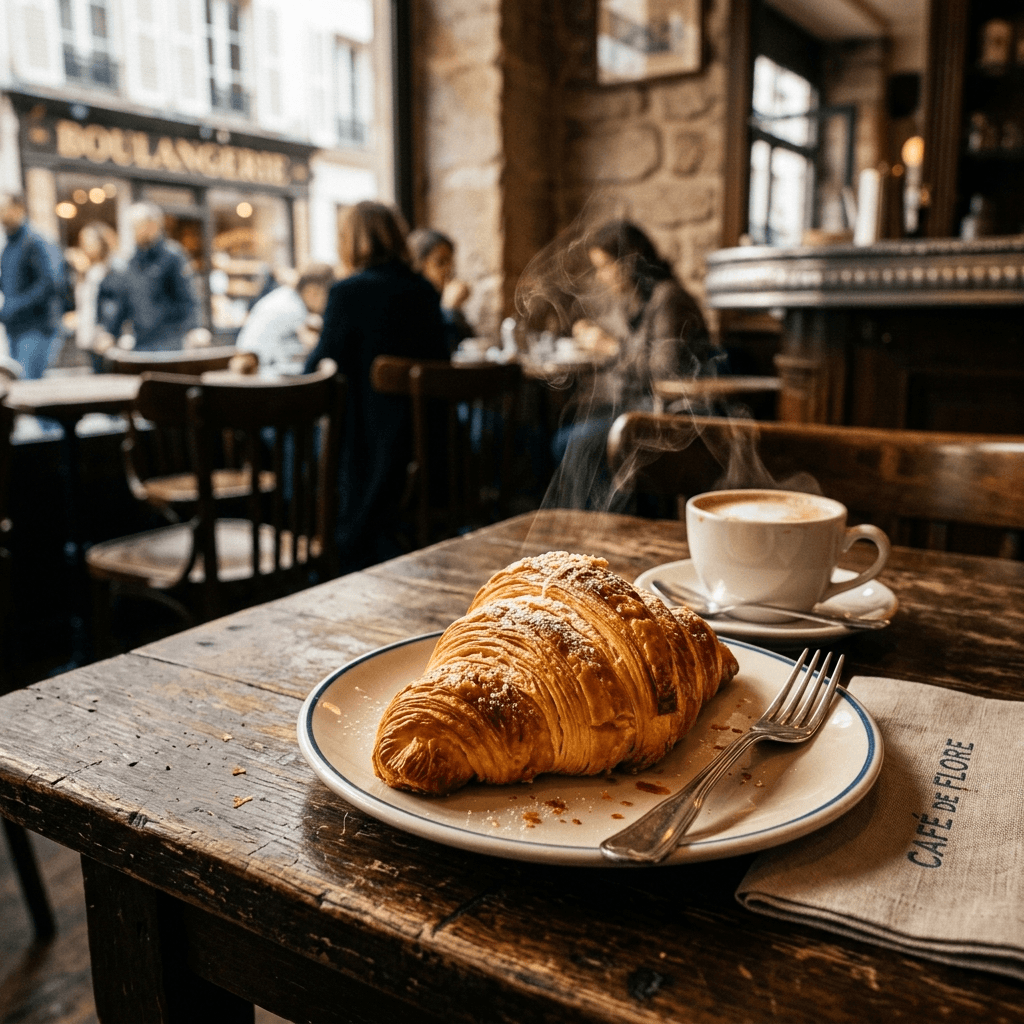
Chapter
1. The Birthplace of the Croissant: Why Wasn't France's Greatest Symbol Born in Paris?
Chapter
1.1 The 1683 Battle of Vienna and the Birth of the Austrian Kipferl
The story of the croissant begins not on the elegant Parisian boulevards, but on the blood-soaked walls of Vienna, in September 1683, when Christian Europe was fighting a decisive battle against the expansionism of the Ottoman Empire. The siege of Vienna was the second major Ottoman siege of the Austrian capital (the first had occurred in 1529), and mobilized around 150,000 Ottoman soldiers under the command of the Grand Vizier Kara Mustafa Pasha against approximately 60,000 defenders of the city, reinforced by the Polish troops of King Jan III Sobieski, who were marching to save the city.
The siege began on July 14, 1683 and dragged on for two months. The Viennese, hungry and desperate, depended on bakers who worked overnight to produce bread for the troops. According to the most widespread legend, Viennese bakers — especially a man called Peter Wendler, from the brotherhood Bäckerzunft — would have heard the sound of tunnels being dug under the walls by the Ottomans during the night of 11 to 12 September. By raising the alarm, the defenders managed to counterattack the invaders inside the tunnels, preventing the city from falling.
With the victory of the Christian forces — culminating in the largest cavalry charge in European military history, with 18,000 Polish knights razing the Ottoman lines — the Viennese bakers would have celebrated by creating a bread in the shape of a lunar crescent (Halbmond, in German), a symbol present on Ottoman flags, as an ironic allegory of the defeat of the invaders. This curved bread was named Kipferl (from Old High German *kipf*, meaning "curved").
It is important to distinguish legend from historical reality. The 17th century Kipferl was substantially different from the modern croissant: it was a simple bread, made from flour, water, yeast and salt, with a firm texture and neutral flavor — nothing like the flaky, buttery dough we know today. Kipferl was eaten as an accompaniment to soups and stews, not as breakfast. The crescent shape, however, was already established, and records from Vienna's Bäckerzunft indicate that Kipferl production was regulated by municipal statutes that defined standardized dimensions and curvature.
Austrian culinary historian Karl Gasteiger documented that the Vienna bakers' guild produced Kipferl in communal ovens (Gemeinschaftsöfen), where bakers shared the heat of the oven to bake multiple loaves of bread simultaneously. Production was seasonal: the Kipferl was most common during the period of Advent and Christmas, when the crescent shape was symbolically associated with rebirth and hope.
Kipferl remained an essentially Austrian specialty for 150 years, until trade and cultural routes between Vienna and Paris began to intensify in the late 18th century.
---
Chapter
1.2 Did Marie Antoinette Really Bring the Croissant to France? The Historical Truth
One of the most persistent legends about the origin of the croissant in France involves the Austrian Archduchess Maria Antonia Josepha Johanna — the future Marie Antoinette — who married the Dauphin of France, the future Louis XVI, on May 16, 1770, at a wedding by proxy concluded in Vienna. The 14-year-old girl left the Austrian capital with a retinue of 57 servants, traveling for 17 days to Paris.
The romantic version of the story states that Marie Antoinette, missing her homeland, asked the Austrian bakers in her entourage to prepare Viennese Kipferl in the ovens of the French court, thus introducing curved bread into Parisian high society. This narrative was repeated in 19th century cookbooks and was consolidated in the popular imagination as the "official origin" of the French croissant.
The historical truth, however, is more complex and less glamorous. Culinary historians Alain Dupuis and Marie-Hélène Baylac are categorical in stating that there is no documentary record in the French court archives or in Marie Antoinette's correspondence that mentions Kipferl or any Austrian curved bread. What occurred was a more subtle cultural phenomenon: the presence of Austrian bakers in Paris, combined with the French court's taste for imported culinary novelties, created an environment conducive to the gradual diffusion of Kipferl into aristocratic circles.
What is factually proven is that the term "croissant" began to appear in the French press at the beginning of the 19th century, decades after the death of Marie Antoinette (guillotined on October 16, 1793). In 1806, the Journal des Gourmands mentions "petits croissants au beurre" served in Parisian cafes on Rue de Richelieu. In 1813, the Dictionnaire de l'Académie des Gastronomes defines croissant as "a small curved bread, often served for breakfast".
The first unequivocal record of a "croissant" in Paris dates back to 1838, when François-Édouard de Cointreau — grandfather of the founder of the Cointreau liqueur brand — opened a bakery at Rue de Rivoli, nº 92, where he sold "croissants au beurre" inspired by the Viennese Kipferl. Still, the term had been circulating in the gastronomic press since the beginning of the century, appearing in chronicles that described "petits croissants au beurre" served in establishments such as Café de la Régence and Café Procope.
Therefore, the answer to the question that gives this subtitle its title is:no, Marie Antoinette did not bring the croissant to France. What she brought was a cultural context — Austrian fashion at the French court — that, over decades, allowed the Viennese Kipferl to be gradually adapted, transformed, and eventually reinvented as the Parisian croissant.
---
Chapter
1.3 August Zang and the Boulangerie Viennoise of 1839: How an Austrian Conquered Paris
The person truly responsible for transforming the Austrian Kipferl into the Parisian croissant was an Austrian military man and businessman called August Zang. Born in Vienna in 1807, Zang was not a baker by training — he was an officer in the Austrian imperial army who identified a business opportunity after noticing the growing demand for Viennese specialties in the French capital.
In 1838, Zang invested his savings and opened Boulangerie Viennoise at 92 Rue de Richelieu (currently in the 2nd arrondissement of Paris), in the heart of the capital's financial and commercial district. The establishment was equipped with steam ovens imported from Vienna — a revolutionary technological innovation at the time — which allowed bread to be baked with a thinner crust and a softer crumb than traditional French ovens.
Zang's decisive innovation was to apply the puff pastry (pâte feuilletée) technique to the Viennese Kipferl, creating what he called a "croissant au beurre". The original Kipferl was a simple bread with no layers. Zang incorporated butter in layers into the dough, using a technique he witnessed in Vienna:tourage — the process of repeatedly folding and stretching dough to create hundreds of microscopic layers of butter interspersed with dough.
Zang's Boulangerie Viennoise was a resounding success. Historical records indicate that the establishment sold more than 2,000 croissants per day in the first months of operation, attracting a clientele that included members of the Parisian upper bourgeoisie, foreign diplomats and figures from the court of Louis Philippe I, the King of the French.
Zang's success inspired a true "Viennese fashion" in Parisian gastronomy. During the 1840s, establishments such as Boulangerie de Vienne,Café Viennois and Maison Viennoise proliferated in the fashionable neighborhoods of Paris. The Revue Gastronomique of 1842 noted that "there is not a single Parisian café worthy of the name that does not offer croissants à beurre to its customers."
However, it is necessary to correct a historical inaccuracy. The exact address of Boulangerie Viennoise, often cited as "1839", has its opening date recorded in primary sources as 1838. The year 1839 appears in some secondary references as the year in which Zang published the inaugural advertisement in the newspaper Le Constitutionnel. In any case, the period 1838-1839 marks the decisive moment in which the puff pastry croissant established itself in Paris.
Boulangerie Viennoise operated until approximately 1850, when Zang returned to Vienna to manage the family business. But its legacy was consolidated: French bakery had absorbed, refined and made French what was originally Austrian. Over the following decades, the croissant spread throughout France, each boulangerie adapting the recipe to their local traditions.
---
Chapter
1.4 The 13th Century Kipferl: The First Documented Appearance of the Croissant in History
Although the most widespread version of the origin of the croissant dates back to 1683, there is historical evidence that suggests that a crescent-shaped bread existed in Europe long before the Battle of Vienna. These discoveries challenge the traditional narrative and add layers of complexity to the croissant story.
The oldest record of a curved bread similar to Kipferl dates from 1227, in a medieval manuscript from the monastery of Klosterneuburg, in Lower Austria, near Vienna. The document, preserved in the Austrian National Library (Österreichische Nationalbibliothek), describes the production of "Kipferl" in a monastic bakery, mentioning the crescent shape as a symbolic representation of the moon — associated with the lunar cycle and pagan solstice festivities that were incorporated into the Christian calendar.
In 1314, the Codex Manesse, an illuminated manuscript from medieval Germany, depicts a banquet scene where a curved loaf of bread appears on the table. Although not specifically called Kipferl, the visual similarity is notable. The manuscript, currently at Universität Heidelberg, is one of the most important iconographic sources of medieval food culture.
Other relevant evidence comes from Paris, in 1337, when the baker Guillaume de Tirel (known as Taillevent), master cook to King Philip VI of France, mentions in his book "Le Viandier " a "petite pâtisserie en forme de croissant de lune" (small pastry in the shape of a lunar crescent). Although the recipe described is closer to a sweet biscuit than a leavened bread, the use of the term "croissant de lune" is significant — it predates the modern use of the word "croissant" by more than 500 years.
Culinary historian Jean-Louis Flandrin, in his study "Histoire de l'Alimentation " (1996), suggests that the crescent shape in medieval baking had pagan symbolic origins that were later Christianized. The crescent moon was a symbol of fertility and renewal in many pre-Christian European cultures, and the tradition of baking crescent-shaped bread for seasonal festivities may have persisted for centuries before becoming associated with the Ottoman Empire in the 17th century.
Heinz Dieter Pohl documented that these medieval Kipferl were made with plain rye or spelled dough and did not resemble the modern croissant in texture or flavor.
Therefore, if we consider the croissant as any crescent-shaped bread, its history dates back to the 13th century in Central Europe. If we consider the croissant as a loaf of laminated dough with butter, its history begins in 1838 with August Zang. Both perspectives are valid — and they reveal that the croissant has much deeper roots in European history than the legend of the Battle of Vienna suggests.
---
Chapter
1.5 The Myth of the Ottoman Crescent Moon: Does the Croissant Celebrate a Victory or Is It Just Legend?
The most repeated story about the origin of the croissant — that it was created to commemorate the European victory over the Ottoman Empire, symbolizing the lunar crescent of Turkish flags crushed under the teeth of the Viennese — is, for many historians,more of a myth than a proven historical fact.
Let's analyze the problems with this narrative. The lunar crescent (hilal, in Arabic) is in fact a central symbol of the Ottoman Empire and, later, many Islamic nations. It has appeared on Ottoman flags since the 16th century. The idea that Viennese bakers created Kipferl as a "culinary humiliation" of the invaders is, at first glance, plausible and poetically satisfying.
However, culinary historians such as Peter Peter, author of "Kulturgeschichte der österreichischen Küche " (Cultural History of Austrian Cuisine), point out that there is no primary source from the 17th century that explicitly mentions the creation of the Kipferl to mock the Ottoman crescent. The first written mention of this association appears only in the 19th century, more than 150 years after the Battle of Vienna, in Austrian nationalist texts that sought to establish a heroic narrative for the country's culinary identity.
American historian Charles Perry, an expert on medieval Middle Eastern cuisine, discovered that crescent-shaped breads were already common in 10th-century Persia, long before the rise of the Ottoman Empire. "Kulcha-e-Khamiri ", a half-moon-shaped leavened flatbread, was popular throughout the medieval Islamic world and may have been introduced to Europe via trade routes.
A more critical analysis suggests that Kipferl's association with victory over the Ottomans may have been a nationalist invention of the 19th century, when the Austro-Hungarian Empire sought to consolidate its cultural identity in the face of the decline of the Ottoman Empire and internal nationalist tensions. The "myth of the crescent" would have served a political purpose of symbolic unification — transforming a simple bakery tradition into an emblem of European resistance and triumph.
Another element that weakens the myth is the fact that Kipferl pre-dated the Battle of Vienna by centuries, as we saw in the previous subtitle. Viennese bakers did not need to "invent" a new bread to celebrate victory—they simply continued producing bread that was already part of their tradition, to which legend later attributed symbolic meaning.
This doesn't mean the story is completely false. It is possible that,after the victory of 1683, Viennese bakers intensified the production of Kipferl and gave it a new symbolic meaning, transforming a traditional bread into an emblem of local identity. This practice of giving new meaning to existing foods in moments of crisis or celebration is well documented by food anthropology.
What we can safely say is that the croissant as we know it today — puffed, buttered, and laminated — bears little relation to the 17th-century Kipferl or the Ottoman crescent. The modern croissant is an essentially 19th century Parisian product, whose association with the victory over the Ottomans is, at the very least, indirectly and symbolically mediated by centuries of culinary transformations.
For tourists visiting Paris, historical truth matters less than sensory experience. But knowing these layers of history—some true, others legendary—adds depth to the appreciation of each bite.
---
Chapter
2. The First Official Croissant Recipe: Sylvain Claudius Goy and the Birth of the Modern Croissant in 1915
Chapter
2.1 La Cuisine Anglo-Americaine (1915): The Book that Immortalized the Original Croissant Recipe
Until the beginning of the 20th century, what was eaten in France under the name "croissant" was a very different creature from what we know today. Small Parisian bakeries served crescent-shaped rolls made from brioche dough, without the slightest hint of sheets of butter between layers of dough. It took a French expatriate chef in New York, a bilingual cookbook and the peculiar context of World War I for the first official recipe for the modern croissant to finally be recorded for posterity.
Sylvain Claudius Goy was born around 1872 in France and built a solid career behind the scenes of haute cuisine. Unlike celebrity chefs like Auguste Escoffier, Goy worked for years in the kitchen of the New York Jockey Club, one of the most exclusive private clubs in the city, frequented by the American industrial and financial elite. It was there, immersed in Anglo-American culture but carrying French technique, that he conceived the work that would forever change the history of viennoiserie.
In 1915, at the height of the Great War, Goy published La Cuisine Anglo-Américaine — a book written in English and French side by side, page by page, designed to teach American and British cooks to master the techniques of French cooking. The original edition was published by Éditions de La Critique in Paris and quickly spread among gastronomic circles on both sides of the Atlantic. The book was voluminous, with hundreds of recipes covering everything from starters to desserts, but it was in one of its bakery sections that Goy recorded something unprecedented: a recipe titled simply "Croissants" that described, for the first time in documented history, the complete process of rolling butter into yeast dough.
What makes Goy's work so monumental is not just the fact that it exists, but the level of technical detail. While earlier "croissant" recipes (such as that of Colombié in 1906) vaguely mentioned a puff pastry, Goy described exact proportions, resting times, temperatures, and the precise number of turns of rolling. He was unknowingly codifying the technical standard that would be followed by pâtissiers around the world for decades to come. World War I, ironically, created the perfect environment for this innovation: hundreds of thousands of American and British soldiers stationed in France were introduced to French baking, and books like Goy's served as a cultural bridge between the two worlds.
Interestingly,La Cuisine Anglo-Américaine fell into oblivion for decades. For most of the 20th century, Goy's recipe was occasionally cited by food historians, but rarely recognized for the landmark it truly was. It was only at the turn of the millennium, with the growth of academic interest in the history of food, that researchers like Jim Chevallier and Steven Kaplan rescued the work from oblivion and demonstrated, with documentary evidence, that it was there — on that yellowed page of a bilingual book from 1915 — that the modern croissant had officially been born.
---
Chapter
2.2 The Exact Ingredients of Goy's Historical Recipe: Flour, Butter, Yeast and the Original Proportions
Sylvain Claudius Goy's recipe, transcribed in the pages of La Cuisine Anglo-Américaine, is surprisingly lean for a dish that would become so complex. With few ingredients and proportions that today seem elementary, Goy established the mathematical basis of the artisanal croissant. The list, translated from the original French-English, included:500 grams of wheat flour,250 grams of high quality butter,15 grams of baker's yeast (fresh yeast),approximately 250 ml of warm water or milk,30 grams of sugar and 10 grams of salt.
The most impactful ratio is 50% butter to flour — exactly half a kilo of flour to a quarter kilo of butter. This proportion, today considered the minimum standard for a quality croissant au beurre, was revolutionary at the time. European breads and pastries of the early 20th century rarely used such generous volumes of butter, which was an expensive ingredient and, in times of war, rationed. Goy, writing for an affluent American audience, did not hesitate to prescribe an amount that, for the average European baker of the time, bordered on the extravagant.
The type of flour indicated by Goy was sifted white wheat flour, similar to the current French Type 55 flour (equivalent to wheat flour with a medium protein content, between 10% and 11%). This protein content is fundamental because the formation of gluten is what allows the dough to stretch without breaking during rolling, creating the very thin layers that separate the croissant from ordinary bread. Goy did not specify brands, but in France at the time, flours from the regions of Beauce and Brie — the breadbasket of Paris — were the most valued for baking.
The yeast used was fresh baker's yeast (boulanger yeast), purchased in tablets or in bulk from bakeries. Goy advised that the yeast be dissolved in a little water or warm milk before being incorporated into the flour, a technique that remains identical today. The ideal temperature, according to the text, was "neither cold nor hot to the touch" — approximately 35°C to 37°C, body temperature. Milk or warm water above 50°C would kill yeast; below 20°C would slow down fermentation to the point of making the process unfeasible.
Another fundamental detail of the original recipe is the absence of eggs in the dough. Unlike brioche, which contains eggs generously, Goy's croissant was a relatively lean yeast dough, enriched only by laminated butter. The egg appeared exclusively in the final brushing (egg wash) before going into the oven, to give the characteristic golden shine. This distinction is crucial: the egg in the dough would have made the croissant closer to a brioche, compromising the puffy texture. Goy, intuitively or through technical knowledge, avoided this trap.
As for salt, Goy used fine table salt (sel fin), in a proportion of approximately 2% of the weight of the flour. The salt in croissant dough not only serves a flavor function: it strengthens the gluten network, controls yeast activity (preventing the dough from rising too quickly) and extends the shelf life of the final product. In the 1915 recipe, this dual function of salt was already perfectly understood and documented.
---
Chapter
2.3 Pâte Feuilletée Levée: The Technical Innovation that Separated the French Croissant from the Austrian Kipferl
If there is a technical concept that defines the croissant as a distinct entity in the history of baking, that concept is Pâte Feuilletée Levée — in free translation, "fermented puff pastry". This is France's great technical legacy to the world: the fusion of two parallel baking traditions that, until the beginning of the 20th century, were separate.
On the one hand, the classic pâte feuilletée (puff pastry), developed and perfected by French chefs throughout the 17th and 18th centuries. The painter and cook Claude Gelée (known as Le Lorrain), in the mid 1600, is credited with inventing the technique of encasing butter in dough and folding it repeatedly to create hundreds of microscopic layers. This technique, called tourage (or "turning around"), produces the spectacular effect of puff pastry: when baked, the water in the butter evaporates and the layers of dough expand, creating an airy and crunchy structure. But the classic pâte feuilletée does not contain yeast — the rise comes exclusively from the steam generated by the butter.
On the other hand, the Austrian Kipferl, which was essentially a brioche dough (pâte à brioche): a dough enriched with eggs and butter, fermented with yeast, but without any rolling. The Kipferl grew thanks to the action of the biological yeast, not the formation of layers. It was a sweet, buttery roll, but without the flaky structure we associate with croissants today.
What Goy documented in 1915 was the synthesis of these two traditions. Instead of choosing between the French technique (yeastless puff pastry) and the Austrian technique (yeastless puff pastry), he simply combined both: he made a yeast dough (like Kipferl) but laminated it with butter (like puff pastry). The result was a dough that:
- grows with biological yeast (giving volume and softness to the crumb);
- expands due to the steam of the laminated butter (creating the puffy and crunchy texture);
- develops very thin layers of dough and fat which, when roasting, separate into dozens of sheets.
This technical hybridization was so successful that it created an entirely new category in French baking:viennoiserie. The term derives from "Vienne" (Vienna) and was coined to designate this family of fine bakery products that includes croissant, pain au chocolat and brioche. Viennoiserie is not exactly bread (because it contains more fat and sugar) nor exactly sweet (because it is not as rich in sugar as a cake or dessert). It occupies its own space, and Pâte Feuilletée Levée is its fundamental technical basis.
The technical challenge of this hybrid approach is considerable. The butter used in rolling must be at the exact temperature and consistency — cold enough not to melt and be absorbed by the dough during folding, but soft enough to stretch evenly without breaking. Goy recommended that the butter be kneaded with a knife or spatula until it reaches a pasty consistency, shaped into a square, and refrigerated before being incorporated into the dough. At the same time, the yeast needs to remain alive and active despite the cold in the refrigerator and constant handling — a delicate balance that requires precise control of temperatures and times.
Goy's genius was to recognize that this hybrid technique was not merely possible, but desirable. The Kipferl, on its own, was delicious but one-dimensional in texture. The classic puff pastry was spectacularly crunchy but one-dimensional in flavor (without the yeast aroma). By marrying the two, Goy created a third element that was greater than the sum of its parts: a product that offered the aromatic complexity of leavened bread and the textural sophistication of puff pastry, simultaneously.
---
Chapter
2.4 Colombié's 1906 Recipe: The First Mention of the Rolled Dough Croissant in the Nouvelle Encyclopédie Culinaire
Before Goy, there was Colombié. In 1906, chef and food writer Auguste Colombié published Nouvelle Encyclopédie Culinaire, a monumental work of reference that sought to catalog and systematize French culinary knowledge of the Belle Époque. Within its hundreds of pages, Colombié included a discreet but historically important entry that described a "croissant" made with puff pastry—predating Goy's recipe by nearly a decade and establishing the first documented bridge between the term "croissant" and the rolling technique.
Auguste Colombié (real name Auguste Tessier,1854–1925) was a chef, journalist and prolific author who directed the École de Cuisine de Paris and wrote extensively on technical gastronomy. His *Nouvelle Encyclopédie Culinaire* was ambitious: it aimed to be the definitive dictionary of French cuisine, with entries ranging from "Abats" to "Zeste", explaining each technique, ingredient and dish with encyclopedic precision. In the entry dedicated to the Croissant, Colombié described a "petit pain en forme de croissant, fait avec de la pâte feuilletée" — a crescent-shaped roll, made with puff pastry.
Colombié's description, however, was significantly less detailed than Goy's. It did not specify exact proportions of butter and flour, did not describe the number of rolling turns, and did not mention the use of biological yeast. To the modern reader, Colombié's entry sounds more like a conceptual suggestion than an executable recipe. He recognized the idea of a puffy croissant, but hadn't refined it to the point of replicable technical instruction.
The absence of yeast in the mention of Colombié is particularly notable. His 1906 "croissant" appears to be simply a puff pastry shaped into a crescent — something close to a puff pastry (feuilletage) in the shape of a half-moon, without the yeasty softness that characterizes the modern croissant. This suggests that in 1906 the innovation of Pâte Feuilletée Levée had not yet occurred, or had not been recorded. Colombié documented the state of the art in French bakery at the time: a croissant that was just an ordinary puff pastry, not the hybrid that Goy would codify nine years later.
Colombié's importance, therefore, is that of a precursor, not an innovator. He established the concept of associating the word "croissant" with puff pastry, creating the technical vocabulary that Goy would later fill with content. Without Colombié's entry in the encyclopedia, Goy's recipe might have seemed like an invention ex nihilo. With it, we see the evolutionary path clearly: in 1906, the idea existed, but the technique was incomplete; By 1915, the technique matured and was accurately documented.
Interestingly, Colombié's work continued to be reissued and updated in the following decades, and later editions incorporated the innovations of Goy and other bakers. This feedback process between encyclopedias and recipe books — where Colombié inspires Goy, and Goy is later incorporated into the following editions of Colombié — is a perfect example of how technical knowledge in gastronomy develops in a cumulative and collaborative way, even when authors compete for the same readership.
---
Chapter
2.5 The Original Step-by-Step Method: How Goy Described Rolling and Baking
The recipe by Sylvain Claudius Goy in La Cuisine Anglo-Américaine describes a process of approximately 4 to 6 hours, distributed between dough preparation, rolling, final fermentation and cooking. Although the book's language is concise (Goy was not given to literary digressions), the method described is perfectly recognizable to any contemporary pâtissier.
Phase 1 — Preparation of the Base Dough: Goy instructed the cook to sift the 500g of flour into a large bowl, make a hole in the center (the classic French "fontaine") and pour in the yeast dissolved in water or warm milk, the sugar and part of the liquid. Mix gently, gradually incorporating the flour from the edges to the center, until a dough forms.salt was added last (to prevent direct contact with the yeast from inhibiting its action) and kneaded until obtaining a smooth and elastic texture. Goy described this process as "working the dough until it comes away from the hands and the bowl" — approximately 10 minutes of manual kneading.
Phase 2 — First Fermentation (Pointage): The dough was covered with a damp cloth or lid and left to rest in a warm place for around 1 hour and 30 minutes to 2 hours, until it doubled in volume. This process, called pointage in technical terminology, develops the aromas of the yeast and relaxes the gluten, preparing the dough to receive the butter without resisting. Goy recommended that, after this first rise, the dough be "punched" (punched) to release the accumulated carbon dioxide and refrigerated for 30 minutes before rolling — what today we call détrempe.
Phase 3 — Preparation of the Butter (Beurre de Tourage): The 250g of butter were kneaded with a knife or spatula until they were malleable, shaped into a square of approximately 15x15 cm and refrigerated until the ideal consistency: cold, but not hard. The butter could not be so cold that it broke when stretched, nor so soft that it leaked down the sides of the dough during rolling. This preparation phase of the beurre de tourage is considered, to this day, the critical point of the process: the wrong butter makes the croissant unusable.
Phase 4 — Rolling (Tourage): Goy described the process in 3 simple turns (simple tours), which produce 81 theoretical layers of butter and dough. The procedure:
1. The dough was rolled out into a rectangle measuring approximately 40x20 cm.
2. The square of butter was placed in the center of the dough.
3. The sides of the dough were folded over the butter, completely covering it.
4. The dough was stretched (stretched with the rolling pin until it formed a long rectangle) and folded into thirds, like a business letter — the first round (simple tour).
5. The dough was refrigerated for 30 minutes to relax the gluten and prevent the butter from melting.
6. The stretching and bending was repeated two more times, with cooling between each time.
Goy did not specify whether the turns were "single" (fold in three) or "double" (fold in four), but from the context and the number of resulting layers, historians conclude that he used 3 simple tours, generating the 81 layers (3 × 3 × 3 × 3 = 81) that became the signature of the artisanal croissant.
Phase 5 — Modeling and Final Fermentation (Apprêt): After the last turn and refrigeration, the dough was stretched into a thin rectangle, cut into isosceles triangles of approximately 10 cm in base by 18 cm in height. Each triangle was rolled from the base to the tip, forming the characteristic crescent — Goy instructed that the tip be pressed against the base so that it would not come loose during cooking. The croissants were then placed on greased baking trays and left to rise for another 1 hour to 1 and a half hours, until they doubled in volume again. This second fermentation, called apprêt, is crucial: insufficient fermentation produces a dense croissant; Excessive fermentation melts the butter and loses its laminated structure.
Phase 6 — Brushing and Baking: Goy recommended brushing the croissants with egg beaten with a little milk (egg wash) to obtain the characteristic shiny gold. The oven had to be "very hot" — estimated to be between 200°C and 220°C — and baking lasted approximately 15 to 18 minutes, until the croissants were "golden and flaky" — Goy's poetic description of the perfect laminated texture.
The method described by Goy is notable for its completeness and precision for its time. In an era when recipes often omitted exact measurements and relied on the cook's intuition, Goy provided a technical roadmap that any trained pastry chef could follow and replicate.
---
Chapter
2.6 The First Appearance of the Word "Croissant" in 1853: When the Name Appeared Before the Recipe
Long before Goy, long before Colombié, the word "croissant" already circulated in the French language associated with food — but not with the buttery laminate we know. The first documented record of the term applied to baking dates back to 1853, when the Dictionnaire de l'Académie des Gastronomes or contemporary lexicographical works recorded "croissant" as a "petit pain en forme de croissant de lune" — a bread shaped like a lunar crescent.
For the historian who examines this record from 1853, the most surprising fact is to realize that the name appeared more than six decades before the recipe. Parisians in the mid-19th century already called certain breads "croissants", but these breads had nothing to do with Pâte Feuilletée Levée. They were common buns, sometimes made from plain bread dough or brioche, manually molded into a half-moon shape — a visual homage to the symbol of the crescent moon that, since ancient times, has decorated coats of arms, flags and banners.
The etymology is straightforward:croissant is the present participle of the French verb croître (to grow), and its use as a noun refers to the growth of the moon, the lunar "crescent". The crescent shape was already a popular decorative motif in medieval European baking—German pretzels,Alsatian bretzels, and certain ritual Easter breads often took on curved or interlocking shapes that evoked the lunar symbol.
What happened between 1853 and 1915 was a slow process of semantic and technical drift. The term "croissant" continued to be used in Parisian bakeries throughout the second half of the 19th century, but the product it designated was inconsistent: sometimes a crescent-shaped milk loaf, sometimes a brioche, sometimes a simple puff pastry. Cookbooks from the period reflect this confusion. In 1863,Dictionnaire Universel de Cuisine by Alexandre Viard mentioned "croissants" without any description of rolling. In 1870,Grand Dictionnaire de Cuisine by Alexandre Dumas (yes, the author of *The Three Musketeers*) included an entry on croissants that described them as "petits pains légers" — light rolls — without specifying the technique.
It was only with the entry of Colombié in 1906 that the word "croissant" was explicitly associated with feuilletage (puff pastry). And it was only with Goy in 1915 that this association gained complete technical support. In other words, for more than half a century, the French called "croissant" something that was just a crescent-shaped bread, and it was only at the beginning of the 20th century that the word migrated in meaning to designate the laminated product that we know today.
This phenomenon of mismatch between name and product is more common in the history of gastronomy than one might imagine. The "hamburger" lost its ham (Hamburg steak) when crossing the Atlantic; "Margherita pizza" only received its name decades after it existed; and "croissant," ironically, existed as a name for 62 years before it existed as a recipe. For the visitor to Paris who today walks into a boulangerie and orders a "croissant au beurre", it is worth remembering that each syllable of this expression carries more than a century of technical and linguistic evolution.
---
Chapter
2.7 From Brioche to Laminated: How Butter Replaced Brioche Dough in the 20th Century
If the appearance of the word "croissant" in 1853 marks the beginning of the nominal history, and Goy's recipe in 1915 marks the beginning of the technical history, the transition from the brioche croissant to the laminated croissant throughout the 20th century marks the history of its commercial consecration. This transition was neither instantaneous nor linear—it was a decades-long process that involved profound technological, economic, and cultural changes to the fabric of French baking.
At the end of the 19th century and the beginning of the 20th century, the typical Parisian croissant was made from brioche dough (pâte à brioche): a dough rich in eggs and butter incorporated directly into the flour, without rolling. This dough produced a soft, golden and buttery roll, but with a uniform texture — there were no layers, there was no puffy structure that defines the product today. The brioche croissant was, essentially, a sophisticated milk bread.
Goy's recipe (1915) represented the theoretical codification of the laminated alternative, but it took time for the technique to spread from professional cookbook kitchens to neighborhood bakeries. During the 1920s and 1930s, the technique of Pâte Feuilletée Levée began to be taught in French culinary schools, especially at Cordon Bleu (founded in 1895) and at École de Cuisine Française Le Cordon Bleu which, under the direction of chefs such as Henri-Paul Pellaprat, incorporated the rolled croissant into the standard curriculum.
The big turning point occurred after Second World War. During post-war rationing (which in France lasted until 1949, with the ration card system for bread and flour), butter was a scarce luxury, and brioche croissants — which required less butter than rolled croissants — continued to dominate. It was only with the normalization of the supply of raw materials in the 1950s, combined with the economic growth of the Trente Glorieuses (1945-1975), that French bakers were able to adopt Goy's method on a large scale.
The decisive factor was industrial butter and modern refrigeration. Rolling requires butter at a controlled temperature — neither soft nor hard. Before widespread electric refrigeration (which arrived in French bakeries mainly in the 1950s and 1960s), controlling the temperature of butter was a logistical nightmare. In the summer, the butter would melt and leak out of the dough; in winter, it broke. The commercial refrigerator has made rolling not only possible, but routine, in bakeries of all sizes.
In parallel,standardized industrial butter (such as beurre sec with 82% to 84% fat content) became widely available at affordable prices. While traditional artisanal butter is around 80-82% fat and higher water content (up to 18%), industrial dry butter — developed specifically for rolling — is 84% fat and just 14-16% water. This low water content is critical: less water means less steam during baking, which gives the pâtissier greater control over layer expansion and reduces the risk of the butter leaking out.
The transition was also accelerated by French regulations. In 1970, the French government established legal definitions to differentiate "croissant" from "croissant au beurre". The first could be made with margarine or vegetable fats; the second was required to contain exclusively butter (and in a minimum proportion of 20% in relation to flour to be able to use the name). This regulation, which remains in force with updates, was a milestone in the standardization of quality and a definitive victory for the rolled butter croissant over brioche or versions with vegetable fat.
By the end of the 20th century, the process was complete: the brioche croissant, which had dominated the Parisian bakery landscape for a hundred years, was a nostalgic souvenir. The rolled butter croissant — the technical creature conceived by Goy in 1915 and perfected in the following decades — reigned supreme in the shop windows of France and, increasingly, the world. Butter was no longer one ingredient among many: it was the soul of the croissant, and its replacement with any other fat was, from then on, a gastronomic heresy punishable by the contempt of the most basic consumer.
---
Chapter
3. The Hidden Engineering of the Croissant: The Physics and Chemistry of the 81 Perfect Layers
Chapter
3.1 What is Lamination? The Scientific Process of Creating Hundreds of Layers of Dough and Butter
Lamination — from the French laminage, derived from lamine (blade) — is the technical process that transforms a simple dough of flour and yeast into a structure made up of dozens of alternating microscopic sheets of dough and fat. This is not an isolated step in croissant production, but the fundamental physical principle that defines the entire product. Without rolling, there is no croissant—there is just a crescent-shaped, buttery loaf.
In scientific terms, rolling is a process of controlled mechanical deformation: a block of dough is opened with a roller, receives a sheet of butter in the center and is subjected to successive folding and compression operations. Each fold multiplies the number of layers of butter within the dough. The mathematical progression is exponential: you start with 1 layer of butter between 2 layers of dough; after the first fold in three (simple tour), there are 3 layers of butter; after the second, 9; after the third, 27; after the fourth, 81. This is the famous pattern of 81 layers, which has become the mathematical signature of the handmade croissant.
The underlying physics is governed by the viscoelastic properties of dough and the plasticity of butter. Croissant dough is a viscoelastic material: when stretched, it resists (elasticity) but also permanently deforms (viscosity). This dual nature is essential because it allows the dough to be stretched to fractions of a millimeter thick without breaking. Gluten — a three-dimensional network of proteins (gliadin and glutenin) formed when flour hydrates — is responsible for this property. Gliadin provides extensibility (the dough stretches), while glutenin provides elasticity (the dough partially returns to its original shape). The balance between the two determines whether the dough will stretch evenly or tear.
The butter, in turn, acts as a physical separator between the layers of dough. During rolling, the butter needs to be at the ideal plasticity temperature — generally between 12°C and 15°C. Above this range, the butter softens too much and becomes incorporated into the dough, eliminating the separation between layers. Below, the butter hardens and breaks as it is stretched, creating fragments that pierce the dough and allow the layers to stick together. Successful rolling is therefore an act of constant thermal balancing.
Each time the pâtissier stretches the dough with the rolling pin, the layers of butter become thinner. A well-rolled butter reaches thicknesses of the order of 0.01 mm to 0.1 mm per layer after the complete process. This thickness is critical: if the layers are too thick, the croissant will be greasy and heavy; if they are too thin, the structure will collapse during cooking.
The number of layers is not arbitrary. The 81 layers (4 simple tours, i.e. 3^4 = 81) represent the optimum point between two extremes. With fewer layers (e.g. 27, obtained with 3 simple tours), the croissant has very thick layers, resulting in a less airy texture and a greater greasy sensation in the mouth. With more layers (for example, 243 or 729, obtained with additional tours), the layers become so thin that the structure loses support and the croissant collapses, in addition to requiring so many folds that the gluten develops excessively (over-kneading) and the dough resists rising.
Baking studies conducted by INRAE (Institut National de Recherche pour l'Agriculture, l'Alimentation et l'Environnement) in France have demonstrated that the croissant's peak sensory quality — assessed by blind tasting panels — occurs precisely in the range of 55 to 81 layers, empirically validating what French pâtissiers have intuitively practiced for more than a century.
---
Chapter
3.2 Why Beurre Sec is Rolled Butter’s Best Kept Secret?
In the world of baking, there is an ingredient that separates the professionals from the amateurs, the exceptional croissants from the merely good ones:beurre sec (dry butter). This specific type of butter is the unofficial technical standard of every self-respecting Parisian boulangerie, and its chemical composition is optimized precisely for rolling.
Regular supermarket butter (beurre courant) contains between 80% and 82% fat,16% to 18% water and 1% to 2% milk solids. The beurre sec increases the fat content to 84% to 86% and reduces the water to 14% to 16%. This difference of just 2 to 4 percentage points seems subtle, but it has profound mechanical and thermal implications for the rolling process.
water in butter is the main problem. During rolling, the water in the butter interacts with the flour in the adjacent dough, forming gluten at the interfaces between the layers. This phenomenon, called interfacial glutenization, creates elastic bonds between dough layers that should remain separate. The result is a croissant whose layers partially merge, losing the clear separation that produces the puffy texture. Beurre sec, with a lower water content, minimizes this effect and preserves the integrity of the layers.
plasticity is the second crucial advantage of beurre sec. Butters with higher fat content have a wider range of plasticity — that is, they remain malleable over a wider range of temperatures. While ordinary 80% fat butter hardens too much to laminate below 10°C and softens too much above 14°C, 84% fat beurre sec remains workable between 8°C and 17°C. For the pâtissier who works in a professional kitchen where the ambient temperature varies between seasons, this extra margin is the difference between consistent work and a daily gamble.
The production of beurre sec follows a specific process. The cream is beaten until the fat from the buttermilk separates. In regular butter, washing with cold water removes excess buttermilk but retains about 16% residual water. In beurre sec, the washing process is more intense and prolonged, and the butter is subjected to an additional kneading (mechanical kneading) that expels excess moisture. The result is a more concentrated, more expensive (requires more cream per kilo of butter) and more stable product.
In France, beurre sec is typically sold in 500g or 1kg blocks, with the fat content declared on the label. Brands such as Échiré (from the Deux-Sèvres region),Président (professional line),Lescure and Le Gall produce versions of beurre sec specifically for use in rolling. The AOP Denomination (Appellation d'Origine Protégée) for butters from certain regions (such as Échiré AOP, since 1985) guarantees that the product follows strict composition and manufacturing standards.
For the tourist who wants to identify a quality croissant in Parisian boulangeries, beurre sec is the secret that the baker doesn't tell but that is inscribed in the final texture. If the croissant crumbles into thin sheets when broken and does not leave a greasy sensation in the mouth, beurre sec was present. If the layers separate but appear moist or stuck together, regular butter was probably used.
---
Chapter
3.3 How does the 27-Round Tourage Process Work to Create Crunch?
tourage — a technical term borrowed from the Latin tornus (lathe) — is the set of folding and stretching operations that transform the initial block of dough and butter into a laminated structure. Although the 81-ply pattern is the best known, French technical literature often refers to 27 turns — a number that, at first glance, appears discrepant, but is explained by the difference between single tours (triples) and double tours (four-folds).
The calculation is as follows: the dough and butter start as a "package" with 1 reserve of butter between 2 layers of dough (3 total layers). Each double tour multiplies the number of layers by 4:
-0 tour: 1 layer of butter
-1 tour double: 4 layers
-2 tours doubles: 16 layers
-3 double tours: 64 layers (close to the ideal 81)
In the case of 3 simple tours (folding into three), the progression is:
-1 simple tour: 3 layers
-2 simple tours: 9 layers
-3 simple tours: 27 layers
-4 simple tours: 81 layers
When H2 mentions "27 turns", it refers to the number of layers obtained after 3 single tours, or alternatively, the count of individual folds performed during the entire process: if each tour involves stretching and folding the dough, the "27" may represent the partial operations. In the oral tradition of French pâtissiers, it is said that a croissant receives 27 "folds" — each one creating a new contact surface between dough and butter.
The crunchiness —craquant in French — results directly from the geometry of these layers. When the croissant goes into the oven, the butter in the inner layers melts and the water in it turns into steam. This steam, occupying a volume approximately 1,600 times larger than liquid water, pushes the layers of mass upwards, separating them. Each layer expands individually, creating microscopic hollow spaces. When the croissant is bitten into, these very thin walls of baked dough successively break, producing the characteristic cracking sound — the acoustic signature of well-done rolling.
The final crispiness texture depends not only on the number of layers, but also on the final thickness of each layer. After 4 simple tours, the typical thickness of each layer of butter on the raw croissant is about 0.05 mm. When baking, this layer expands to form a wall of dough approximately 0.2 mm to 0.5 mm — thin enough to crisp, thick enough not to fall apart.
Sensory analysis research conducted by École Supérieure de Cuisine Française — Ferrandi Paris revealed that consumer perception of "ideal crispiness" is directly correlated with the number of acoustic peaks detected in the first 3 seconds after the first bite. Croissants with 27 layers produce, on average,12 to 15 peaks; croissants with 81 layers produce 35 to 45 peaks. The difference is perceived by the palate as "crunchier", even if the consumer cannot technically articulate why.
---
Chapter
3.4 The Melting Point of Butter: The Thermal Physics Behind an Aerated Croissant
Butter is a water-in-oil emulsion: tiny droplets of water (about 16% of the volume) are dispersed in a continuous matrix of fat (about 82%). This fat, in turn, is a complex mixture of triglycerides with different melting points, which range from approximately -40°C (unsaturated fats, such as oleic acid) to +45°C (saturated fats, such as stearic acid). It is this variation that gives butter its gradual thermal behavior — it does not melt abruptly like water, but softens progressively over a range of temperatures.
The effective melting point of rolling butter is between 32°C and 34°C. Below this temperature, butter maintains its stable crystalline structure, functioning as a solid barrier between layers of dough. Above 34°C, butter completely loses its crystalline structure and becomes a liquid oil that is absorbed by the dough, eliminating the separation between the layers and producing a dense, fatty croissant without a puffy texture.
The physics of croissant baking is a thermal drama in three acts:
Act 1 — Melting (0 to 5 minutes, 20°C → 50°C): When entering the oven, the croissant is at approximately 25°C to 30°C (room temperature after final fermentation). In the first few minutes, the butter begins to melt. The outer layers reach the melting point first; the inner layers, protected by the thermal insulation of the dough, take longer. This gradual melting is essential because it allows steam to begin forming in the outer layers while the inner structure is still solid, creating a "shell" that supports the expansion of the interior.
Act 2 — Steaming (5 to 10 minutes, 50°C → 100°C): When the internal temperature reaches 100°C, the water present in the butter (and in the dough) begins to vaporize. Steam, occupying a volume 1,600 times greater than liquid water, exerts pressure against the layers of dough, separating them. The melted butter, now liquid, is partially absorbed by the dough walls, acting as a "fryer" that cooks the layers inside and creates the airy texture. This process is technically called conduction frying — one of the few cases in baking in which the food is simultaneously baked and fried.
Act 3 — The Structuring (10 to 18 minutes, 100°C → 200°C): Once all the water has evaporated and the layers are completely separated, the temperature of the dough quickly rises to oven temperature (180°C to 220°C). At this stage,dehydration of the layers occurs — the remaining water in the dough (around 35% to 40% in a raw croissant) evaporates, leaving a rigid structure of proteins and gelatinized starch. The unabsorbed butter flows into the pan, and the croissant reaches its final shape.
A little-known fact: high-quality butter (like beurre sec) has a narrower melting range than regular butter, meaning it melts more evenly. This is because the beurre sec manufacturing process removes not only water but also low-melting fat fractions that would cause premature melting. The result is more controlled, predictable melting inside the oven — the difference between a croissant that rises evenly and one that opens on one side.
---
Chapter
3.5 Biological Yeast vs. Mechanic: How Steam and Yeast Work Together
The croissant occupies a unique position in bakery because it is the only product that simultaneously depends on two completely distinct growth mechanisms: biological yeast (yeast) and mechanical yeast (steam). Neither of these mechanisms alone would produce the final result — it is the interaction between the two that creates the technical miracle of the croissant.
Biological Yeast (Fermentation): During the final fermentation (apprêt), the yeasts Saccharomyces cerevisiae consume the simple sugars present in the dough (glucose and fructose, originally coming from the starch in the flour and added sugar) and produce carbon dioxide (CO2) and ethanol as metabolic byproducts. CO2, being a gas, forms bubbles that are retained in the dough thanks to the elastic gluten network. This process is responsible for approximately 30% to 40% of the final volume of the croissant — enough to create the basic alveolar structure, but insufficient for the total volume.
Optimal fermentation occurs at approximately 25°C to 28°C, lasting 1 to 2 hours for apprêt after shaping. If the temperature is too low, fermentation will be slow and the croissant will not rise enough. If it is too high (above 35°C), the butter starts to melt before entering the oven, compromising lamination. The experienced pâtissier monitors not only the volume but also the aroma of the fermented dough — a mild alcoholic odor indicates adequate fermentation; an acidic odor indicates excessive fermentation (production of acetic and lactic acids by contaminating bacteria).
Mechanical Rising (Steam): When the croissant enters the oven, the water in the butter and dough (about 16% of the butter and 35-40% of the dough) heats up to 100°C and vaporizes. Water vapor occupies a much larger volume than liquid water —1,600 times greater at atmospheric pressure. This violent expansion is the engine of mechanical yeast, responsible for 60% to 70% of the final volume of the croissant.
The steam exerts pressure against the layers of dough that have been separated by the solid butter. Because these layers are thin (0.05 mm to 0.1 mm), steam pressure easily pushes them upward, creating the effect of "leaves" that pull apart. The melted butter, which is between these layers, acts as a lubricant that allows the layers to slide over each other during expansion, rather than tearing.
The synchrony between the two mechanisms is the most subtle secret of croissant baking. If fermentation is excessive before baking, the CO2 will have already stretched the dough too much, thinning the walls between the bubbles and compromising the steam's ability to create new chambers. If the fermentation is insufficient, the dough will be too dense and the steam will not be able to push the layers efficiently — the croissant will rise little and have a heavy texture.
The peak efficiency of the two mechanisms occurs at different times. CO2 expands its maximum volume within the first 2 to 3 minutes of oven (the so-called oven spring, or "rising in the oven"), when the temperature is still below 60°C (above that, the yeasts die and stop producing CO2). Steam, on the other hand, reaches its peak between 5 and 8 minutes, when the internal temperature crosses the barrier of 100°C. The transition between the two mechanisms is the critical moment: CO2 stops expanding when the yeast dies (≈55°C), and the steam starts expanding when the water boils (100°C). Between these two points, there is a period of 2 to 3 minutes in which the growth of the croissant depends exclusively on the thermal expansion of the air and already existing gases — the so-called passive gas expansion (Charles' Law: the volume of a gas is proportional to its absolute temperature, P/T = constant).
Studies carried out by INRAE with laboratory ovens equipped with X-ray cameras showed that the expansion of the croissant is not uniform: the outer part (the "tips" of the crescent) expands first, followed by the center. This is because the heat reaches the edges before the crumb, and the steam begins to push the outer layers while the center is still fermenting. The crescent shape is not just aesthetic — it favors more even distribution of heat compared to a rectangular or cylindrical shape.
---
Chapter
3.6 The Maillard Reaction: The Chemistry That Gives Croissants the Golden Color and Flavor
No sensory aspect of the croissant is as immediately recognizable as its intense golden color, which ranges from light amber to reddish brown at the edges. This coloring is the work of the Maillard Reaction, a complex chemical process discovered and described by French physician and chemist Louis-Camille Maillard in 1912 — interestingly, just three years before Sylvain Claudius Goy published his recipe, as if science and technique were synchronized to define the modern croissant.
The Maillard Reaction is a reaction between amino acids (proteins) and reducing sugars (glucose, fructose, maltose) that occurs at high temperatures, generally above 140°C. Unlike caramelization (which involves only sugars and occurs at higher temperatures, above 160°C), the Maillard Reaction produces a huge variety of aromatic compounds — hundreds of different volatile molecules that contribute to the sensorial profile of the baked croissant.
Chemistry is extraordinarily complex. In the first phase, the carbonyl group of the sugar reacts with the amino group of the amino acid to form a Schiff base, which rearranges itself into Amadori products. These products undergo degradation in multiple parallel pathways, producing:
-Pyrazines: compounds with a nutty and roasted aroma;
-Furans: compounds with caramel and sweet aromas;
-Pyrroles: compounds with the aroma of toasted cereals;
-Thiophenes: compounds with an intense meaty and roasted aroma;
-Strecker Aldehydes: compounds that contribute notes of malt, chocolate and toasted bread.
It is estimated that the Maillard Reaction in croissants produces between 200 and 400 different volatile compounds, depending on the cooking conditions. The exact composition varies with:
- The temperature and humidity of the oven: higher temperatures favor the production of intense roast compounds; more moderate temperatures favor sweet, buttery notes.
- The brushing with egg: the yolk provides additional amino acids (mainly lysine and leucine) and sugars that intensify the reaction, producing a richer and brighter golden color.
- The pH of the surface: egg yolk is slightly alkaline (pH ≈ 6.5 to 7.0), and higher pH accelerates the Maillard Reaction — one of the reasons why pure yolk produces a more intense browning than the whole egg.
The ideal temperature for the Maillard Reaction in croissants is between 150°C and 170°C on the surface of the dough. At 150°C, the reaction is slow and produces lighter colors; at 170°C, it is fast and produces the ideal reddish brown. Above 180°C, the reaction accelerates too much and can produce acrylamide, a potentially carcinogenic compound that forms when asparagine (an amino acid present in wheat flour) reacts with sugars at temperatures above 180°C. European regulation sets maximum acrylamide levels for bakery products (recommendation (EU) 2017/2158), encouraging bakers to bake at moderate temperatures for longer, rather than very high temperatures for shorter times.
The ideal oven time to maximize Maillard compounds without burning the croissant is approximately 15 to 18 minutes at 190°C to 200°C for standard convection ovens. The first 5 minutes are dominated by expansion (oven spring); minutes 5 to 10, for internal cooking; minutes 10 to 18, by the Maillard Reaction on the surface. A croissant taken out of the oven before 14 minutes will have a pale surface and a raw flour flavor; a croissant left beyond 20 minutes will have a dark surface and a bitter burnt taste (excessive caramelization).
For the home baker looking for the perfect golden brown, brushing with egg yolk beaten with a spoonful of milk or cream is the classic method. The milk adds lactose (a reducing sugar) that intensifies the reaction, while the cream adds fat that adds shine. A pinch of salt in the mixture helps control the rate of the reaction and prevents the gold from darkening too quickly.
---
Chapter
3.7 The Alveolar Structure: Why Does the Croissant Crumb Look Like a Honeycomb?
Break a croissant in half and look inside. What you see is a pattern that resembles the structure of a honeycomb: hundreds of small irregular cavities (alveoli) separated by very thin walls of baked dough. This is the honeycomb structure of the croissant — the visual signature that distinguishes a quality artisanal croissant from an industrial one.
The formation of this structure is the combined result of all previous processes: rolling, fermentation, vaporization and protein structuring. In simplified terms, the alveoli are the bubbles of gas (CO2 initially, vapor later) that became trapped between the layers of dough and were expanded by heat.
The geometry of the alveoli is different in croissant compared to regular bread. In bread, gluten forms a continuous three-dimensional network that surrounds spherical or elongated gas bubbles, creating relatively uniform alveoli. In the croissant, the layers of butter interrupt the continuity of the gluten network, forcing the gas to distribute itself in flat, irregular spaces between the sheets. Therefore, the croissant crumb does not look like the crumb of French bread: it is more open, more irregular and with thinner walls.
alveolar density — number of alveoli per square centimeter — is one of the technical indicators of croissant quality. In a well-made artisanal croissant, the density varies between 8 and 15 cells per cm², with sizes ranging from 1 mm to 5 mm in diameter. In an industrial frozen dough croissant, the density tends to be higher (15 to 25 cells per cm²), but the cells are smaller and more uniform — a texture that French pâtissiers disparagingly call "loaf bread crumb" (mie de pain de mie).
Three main factors determine the quality of the alveolar structure:
1. Rolling Quality: If the butter was evenly distributed during the tourage, the layers will have a consistent thickness and the steam will expand evenly, creating cells of varying sizes but well distributed. If the rolling was uneven (broken or leaky butter), some areas will have giant alveoli (where the dough has separated too much) and others will have compressed or missing alveoli.
2. The Moisture Content of the Dough: Wetter doughs (55% to 60% hydration) produce more steam during cooking, generating larger and more irregular alveoli. Drier masses (hydration below 50%) produce less vapor and smaller, denser alveoli. The ideal hydration for the classic croissant is approximately 55% — the balance point between expansion and structure.
3. Oven Temperature: Hotter ovens (above 200°C) produce a crust more quickly, "stopping" the expansion of the outer alveoli while the interior is still expanding. This creates a contrast between the thin crust and the airy crumb — ideal for the croissant. Cooler ovens (below 180°C) allow steam to escape before the crust forms, resulting in small cells and a rubbery texture.
There is a little-known phenomenon called "post-oven alveolar collapse" that occurs when the croissant cools. As the temperature drops, the vapor inside the alveoli condenses back into liquid water, reducing the volume and creating a slight negative pressure inside the alveoli. If the walls between the alveoli are too thin or fragile, this negative pressure can cause part of the structure to collapse, resulting in deflation — one of the most common defects in poorly made croissants. To avoid this, pâtissiers let the croissants cool on a wire rack, allowing the steam to escape on all sides rather than condensing internally, and never stack them hot (which would block the steam from escaping and accelerate collapse).
The shelf life of the honeycomb structure is short: peak texture occurs between 30 minutes and 2 hours after baking, when residual steam has finished escaping and the dough walls have hardened enough to maintain the structure. After 4 to 6 hours, the migration of moisture from the crumb to the crust progressively softens the alveolar walls, and the texture begins to decline. That's why the French — with their ancient gastronomic wisdom — insist on buying croissants in the morning, on the day of consumption, and consider them "stale" after lunch. It's not freshness: it's physics and chemistry applied to everyday baking.
---
Chapter
4. Industrialization and the Croissant Crisis: The Frozen Croissant Revolution in the 1970s
Chapter
4.1 La Croissanterie: How a French Fast-Food Chain Saved the Croissant in the 1970s
In the 1970s, the French croissant was facing an identity crisis. On the one hand, the traditional artisanal bakery saw its space reduced by accelerated urbanization and the change in the consumption habits of the French, who spent less time in the kitchen and more time commuting between work and home. On the other, the invasion of American fast food — McDonald's arrived in France in 1972 (first unit in Créteil, a suburb of Paris) — threatened to engulf the fast-food market with hamburgers, French fries and milkshakes. It was in this scenario of cultural and gastronomic siege that La Croissanterie emerged, a chain that dared to transform the croissant into French fast food.
Founded in 1977 by Roland Moreno — who would later become more famous for inventing the electronic wallet and the payment chip —La Croissanterie was born with a simple and audacious proposal: selling fresh, warm and stuffed croissants in a quick service format, inspired by American drive-thrus but with a French soul. The first store was opened on Rue de Rivoli, in Paris, in the heart of the city, and quickly expanded to various parts of the capital and, later, throughout France.
Moreno's innovation was technical and logistical. He realized that the bottleneck in selling croissants on a large scale was the preparation time: an artisanal croissant takes 4 to 6 hours between preparation, fermentation and oven. To offer croissants "anytime", it was impossible to prepare them on demand. The solution was to develop a continuous baking system: stores equipped with industrial convection ovens that baked batches of pre-prepared croissants every 15 to 20 minutes, ensuring that there was always hot product available.
La Croissanterie's croissants were not frozen - they were prepared on the day, in a production center, and sent to stores in cold rooms, ready to bake. This half-baked approach became the industry standard in the following decades.
The menu was simple but creative: natural croissant, cheese croissant, ham croissant, chocolate croissant (pain au chocolat), and sweet options such as almond croissant and cream croissant. Prices were aggressive for the time — around 2 to 3 francs per unit (approximately 0.30 to 0.45 euros in contemporary values), less than half the price of an artisanal boulangerie croissant.
The success was immediate and overwhelming. In 1980, just three years after its founding, La Croissanterie already had more than 50 stores in France and was beginning to expand abroad (Belgium, Switzerland, United Kingdom). At its peak, in the 1990s, it reached approximately 120 stores spread across several countries, becoming the largest French-inspired fast-food chain in the world and the only one to directly challenge American dominance in the sector.
The cultural impact of La Croissanterie was ambivalent. For defenders of artisanal tradition, the chain represented the "McDonaldization" of the croissant — a symbol of the loss of quality and the replacement of the baker's savoir-faire by industrial standardization. Food critic Périco Légasse called the chain "a crime against pâtisserie française." For the consuming public, however, La Croissanterie was a democratizer: it made the croissant accessible to workers who did not have time to stop by the boulangerie in the morning, and introduced the stuffed croissant — until then a rarity — to the general public.
The network went into decline in the years 2000, pressured by:
- The growth of boulangeries themselves, which began to offer quick services (sandwiches, salads, coffees) competing directly with La Croissanterie.
- The consolidation of chains such as Paul (which, although more focused on sandwiches and sweets, also offered artisanal croissants in a fast-casual environment).
- The increase in rental costs in French urban centers, which made the dedicated store model less viable.
Today, La Croissanterie exists only as a shadow of its former self—a few remaining stores in airports and train stations—but its legacy is undeniable: It demonstrated that the croissant could be sold on an industrial scale without completely losing its soul, and it paved the way for the frozen food revolution that would follow.
---
Chapter
4.2 The Invention of the Pre-Shaped Frozen Croissant: The Sara Lee Corporation and Industrial Dough
If La Croissanterie industrialized the service of the croissant,Sara Lee Corporation industrialized the product itself. An American frozen food company, founded in 1939 in Chicago by Charles Lubin (who named the company after his daughter, Sara Lee), was responsible for developing the pre-shaped frozen croissant — the innovation that would forever transform the global baking industry and which, to this day, is responsible for approximately 30% to 40% of the global croissant market.
The story begins in 1970, when Sara Lee, already established as a frozen cake and pie giant, decided to diversify its portfolio. The company hired a team of pâtissiers and food engineers to solve a problem that seemed insoluble: how to produce a croissant that could be frozen raw, kept for weeks or months, and then baked by the end consumer at home with a result close to artisanal?
The technical challenge was monumental. The raw croissant contains about 35% water, live yeast and butter. Freezing this mixture without killing the yeast, destabilizing the butter emulsion, or damaging the laminated structure seemed impossible. The Sara Lee team, led by food chemist Dr. Richard A. Greenberg, developed three patented innovations that solved the problem:
Innovation 1 — Cryoprotected Yeast: The team discovered that yeast *Saccharomyces cerevisiae* dies during conventional freezing because ice crystals pierce its cell membrane. The solution was to develop a strain of yeast selected for its resistance to cold and incorporate natural cryoprotectants (such as glycerol and trehalose) into the dough, which stabilize cell membranes during freezing and ensure that at least 60% to 70% of the yeast survives the process.
Innovation 2 — Modified Laminated Butter: Conventional butter, with 80% fat and 16% water, forms large ice crystals during freezing that break the laminated structure. Sara Lee has patented a butter with a high fat content (87% to 90%) and additional emulsifiers (soy lecithin, mono- and diglycerides) that inhibit the formation of large crystals and maintain plasticity even after months of freezing.
Innovation 3 — Ultra-Quick Freezing (IQF): Instead of slow freezing in conventional cold rooms, the croissant is subjected to a blast of cold air at -40°C which freezes the dough in less than 30 minutes. Rapid freezing prevents the formation of large ice crystals (which would damage the structure), creating only microscopic crystals that do not compromise the texture.
The final product was launched in 1973 under the name "Sara Lee Croissants" — a box of 6 frozen ones, ready to bake in a home oven for 12 to 15 minutes at 190°C. The success was explosive: in the first year, Sara Lee sold more than 5 million units, and the company expanded production to meet demand.
The impact of the invention went far beyond the American domestic market. In the 1980s and 1990s, industrial bakeries in France, Belgium and Germany adopted quick-freezing technology to produce semi-ready croissants destined for hotels, cafes, restaurants and cafeterias. Large groups such as Bridor (founded in 1988, in Brittany),Europâtes and La Lorraine built factories dedicated exclusively to the production of frozen croissants, supplying the European food service channel.
Today, Sara Lee (which was sold in parts over the years — the frozen bread and croissant brand is currently owned by Grupo Bimbo, the largest bakery in the world) remains one of the most recognized frozen croissant brands in the United States, alongside Pepperidge Farm and Pillsbury. The industrial frozen croissant, once a technical impossibility, has become a global commodity.
---
Chapter
4.3 30 to 40% of French Croissants Are Frozen: The Dilemma of Fait Maison vs. Industrial
A figure often cited in discussions about the quality of French croissants — and which surprises most tourists — is that between 30% and 40% of all croissants consumed in France are made from semi-ready frozen dough, baked at the point of sale, but not prepared by hand from scratch. This means that out of every three croissants sold in a Parisian boulangerie, one of them probably came from a factory, not from the hands of the local baker.
The data, compiled by CNRS (Centre National de la Recherche Scientifique) in studies on the French baking industry, varies by region and size of the bakery. In Paris and large cities, where the cost of rent and labor is higher, the proportion of frozen croissants reaches 50% to 60%. In the interior and rural regions, where artisanal bakeries still dominate, the rate drops to 15% to 20%.
The consumer dilemma is real. A frozen dough croissant can be perfectly acceptable — and, in many cases, indistinguishable from artisanal to the untrained palate. Modern industrial frozen doughs use quality butter, precise automated rolling processes and controlled fermentation. The problem is not technical, but philosophical: the croissant stops being the product of the baker's manual labor and becomes a reheated industrial item.
The origin of this trend is economic, not gastronomic. The numbers are relentless:
-Labor: An experienced baker in France costs, on average,€2,500 to €3,500 per month (charges included). An artisanal bakery that produces 300 croissants per day spends around 2 to 3 hours of work to laminate, shape, ferment and bake. A bakery that uses frozen dough takes 15 minutes to thaw and bake.
-Production space: Artisan rolling requires a dedicated cold room, a refrigerated marble bench and space for fermentation. Frozen dough eliminates the need for this entire infrastructure, freeing up space that can be used for selling or preparing other items.
-Consistency: Frozen dough produces an exactly the same croissant every day — even if the assistant baker is off work or the recipe has slight seasonal variations in the flour.
-Waste: Frozen dough can be stored for weeks and baked on demand, reducing waste to almost zero. Artisanal dough needs to be prepared daily, and the surplus is lost.
The French government, aware of the pressure on artisanal baking, implemented protective measures.decree n° 93-976 of 1993 established that the term "boulangerie" can only be used by establishments that carry out the complete bakery cycle (mixing, kneading, fermentation and cooking) on site. The same protection does not extend, however, to the term "croissant" — which can be sold in any establishment, regardless of the origin of the dough.
For tourists who visit Paris and want to guarantee an authentic experience, the recommendation is simple: look at the window and the counter. Bakeries that display croissants of slightly irregular sizes, with subtle variations in golden color, almost certainly make their own croissants by hand. Bakeries where all the croissants are identical — same size, same curvature, same color — most likely use frozen dough.
---
Chapter
4.4 The Cost of Labor in France: Why Do Bakers Buy Frozen Dough?
A French baker's decision to abandon artisanal croissant production and adopt industrial frozen dough is rarely an ideological choice — it is almost always an economic decision forced by one of the highest operating costs in the world:French labor.
France has one of the most regulated and protective labor markets in Europe. The SMIC (Salaire Minimum Interprofessionnel de Croissance), the minimum wage, was €1,766.58 gross per month in 2023 (approximately €1,383 net). Employer charges apply to this amount, which amounts to between 25% and 42% of the gross salary, depending on the size of the company and the type of contract. A baker hired by SMIC costs, in practice, between €2,200 and €2,500 per month to the employer.
The cost of an hour of artisan baker's work in France in 2024 is estimated to be between €18 and €25, depending on region and experience. In comparison, an industrial rolling and freezing machine can produce thousands of croissants per hour at a labor cost of less than €0.01 per unit. The difference is absurd and, for many small business owners, unsustainable.
The baker's working hours are another critical factor. Traditionally, the French baker starts work between 3am and 4am to have croissants and bread ready for the bakery to open (7am or 8am). The artisanal preparation of croissants requires the baker to arrive even earlier — around 2am or 2:30am — to begin the rolling and fermentation process. French labor regulations, although flexible in some sectors, limit night shifts and require significant overtime payments (additional 30% to 100% for night hours).
With frozen dough, the croissant can be baked in 15 to 20 minutes directly from the freezer to the oven (without prior defrosting, in some cases). An employee with minimal training can place frozen croissants on baking sheets, brush with egg and place in the oven — no need for pâtisserie training, no late nights and no waste.
The phenomenon is not exclusive to France: throughout the developed world, artisanal baking is in economic decline. In the United Kingdom,60% of bread is produced industrially. In the United States, the proportion exceeds 80%. What makes the French case particularly dramatic is the cultural strength of the croissant as a national symbol — the tension between tradition and economy is felt in the soul of the country.
Some boulangeries have found a compromise: using frozen dough on weekdays (when business is lower and demand more predictable) and making artisanal croissants on weekends (when customers are more willing to pay a premium for quality). Others have adopted the "pre-fermentation" system: the dough is prepared by hand, but fermented and frozen before shaping, and the baker just shapes and bakes on site — a hybrid that preserves some of the savoir-faire without the full cost of daily manual production.
---
Chapter
4.5 The Croissant as French-style Fast Food: The Response to American-Style Fast Food
The croissant-as-fast-food phenomenon was not limited to La Croissanterie or supermarkets. It represented, more broadly, a French cultural response to the advancement of the American model of fast food—an attempt to adapt local gastronomic tradition to a world that demanded speed, low price, and convenience, without completely giving up the country's culinary identity.
The movement began in the 1980s, driven by three converging factors:
First, the union of retail and services: cafes and bakeries began to realize that the croissant could be the French equivalent of the hamburger — a portable item that doesn't require cutlery, that can be eaten with your hands and that goes well with hot and cold drinks. If the hamburger was the food symbol of American mobility, the croissant would be that of French mobility — a breakfast that is eaten while walking, on the subway, on the way to work.
Second, the diversification of fillings: the natural croissant was delicious but limited as a complete meal. French fast-food chains (La Croissanterie, Le Croissant Show, Brioche Dorée, Paul) began to offer savory fillings that transformed the croissant into a sandwich: emmental cheese and ham (the classic jambon-fromage croissant), chicken with mushrooms, smoked salmon with cream cheese, grilled vegetables. The pain au chocolat (chocolate croissant), although not a sandwich, fulfilled the role of a quick and satisfying sweet snack.
Third, the internationalization of taste: with the expansion of tourism and food globalization, the croissant went from being an exclusively French product to becoming a universal breakfast and snack item. Chains like Starbucks (which entered France in 2004) began offering croissants in all of their global markets, and the item became as ubiquitous in coffee shops around the world as the muffin and the bagel. Starbucks alone sells an estimated 200 million croissants per year globally — more than any artisanal French boulangerie in its entire history.
The success of the croissant as a fast food had a paradoxical side effect: it reinforced the French identity of the product even when industrialized. A croissant sold in a café in Tokyo, New York or São Paulo continues to be perceived as "French food" — a small gastronomic ambassador that carries, in its crescent shape, the symbolic weight of an entire culinary culture. The difference, of course, is in quality: the globalized industrial croissant rarely comes close to the French artisanal one, but it fulfills the role of making the experience accessible to billions of people who will never set foot in a Parisian boulangerie.
Today, the croissant's most iconic fast-food chain is no longer La Croissanterie, but Brioche Dorée (founded in 1976 in Brittany), which operates around 300 stores in 12 countries, serving croissants, sandwiches and salads in a fast-casual format.Paul (founded in 1889 as a traditional bakery, but converted into a fast-casual chain in the 1990s) also competes in the same space, with approximately 700 stores in 30 countries. Both use mostly semi-industrial croissants, supplied by their own production centers.
The croissant as a French fast food has therefore established itself as an irreversible phenomenon. For better or worse, it democratized access to the product, created a global market worth billions of dollars and created jobs throughout the production chain. The price paid — the partial loss of artisanal quality and regional diversity — is real, but difficult to measure in absolute terms. What can be safely said is that the croissant, as we know it today, is both a product of the industrial revolution of the 1970s and the artisanal tradition of the 19th century, and that this dual identity will continue to define its history in the coming decades.
---
Chapter
5. The Croissant Ordinaire vs. Croissant au Beurre: How to Identify a Quality Croissant
Chapter
5.1 Straight vs. Straight Format Curved: The Visual Secret That Differentiates the Butter Croissant from the Ordinary
The first visual sign of a croissant's quality is its shape. It may seem like a minor detail, but the shape — straight or curved — is, in France, as reliable an indicator as the color of the shell or the sound when it cracks. The rule is simple and almost never fails:straight croissants are made with butter (au beurre); curved croissants are common (ordinaire).
The origin of this difference lies in a 1970 regulation of the French government (updated by décret n° 2000-947), which established clear criteria for the denomination of croissants. Since then, the croissant au beurre must exclusively contain butter as fat (not margarine or shortening) and the straight shape has become the traditional way of presentation. The croissant ordinaire — also called croissant naturel — may contain margarine or other fats, and is traditionally curved, in a more pronounced half-moon shape.
The format difference is not arbitrary. Technically, butter croissants are made with a higher fat content (pure butter has more fat and less water than margarine), which gives the dough greater structural firmness before baking. This allows it to maintain its straight shape during fermentation and baking without warping or bending excessively. The ordinary croissant, with margarine or vegetable fats, has a softer structure and tends to arch naturally, taking on a more pronounced crescent shape.
In addition to shape,size and regularity count. The typical artisanal croissant au beurre measures between 18 and 22 cm in length and weighs between 60 and 80 grams. The curvature is subtle, almost straight in some cases, with the tips slightly turned inwards. The croissant ordinaire is generally more curved, with the ends almost meeting, forming a pronounced "C". The weight tends to be slightly lower (50 to 70 grams) because margarine, with less fat density, produces a slightly lighter dough.
For visitors to Paris, the rule of thumb is infallible: when entering a boulangerie, look at the counter. If the croissants are arranged in straight, parallel rows, with little curvature, you have croissants au beurre. If they are curved, with protruding tips and a more open shape, they are ordinaires. And if the bakery doesn't specify which is which on the label — be suspicious: the omission is almost always a sign that the croissant is ordinaire, and the baker prefers not to draw attention to the fact.
---
Chapter
5.2 Margarine vs. Butter: How Fat Defines Croissant Texture and Flavor
The choice of fat is the most impactful decision in the production of a croissant — more important than the flour, more decisive than the yeast. Butter and margarine are chemically different, and these differences produce radically different results in the oven.
Butter (Beurre): Composed of 82% to 84% milk fat,14% to 16% water and 1% to 2% milk solids. Dairy fat is a complex mixture of hundreds of triglycerides that melt between 30°C and 37°C. Butter also contains butyric acid (responsible for the characteristic aroma of butter), lactones (notes of cream and caramel) and diacetyl (intense buttery flavor). The flavor of butter in a croissant is unmistakable because these aromatic compounds are volatile and release in the mouth during chewing, creating a sensory experience that vegetable shortening simply cannot replicate.
Margarine: Invented in 1869 by Hippolyte Mège-Mouriès (a French chemist who won a Napoleon III competition to create a cheap butter substitute for the working classes), the original margarine was made from beef tallow and milk. Modern margarines are made from vegetable oils (palm, soybean, canola, sunflower) that undergo partial or full hydrogenation to become solid at room temperature. Typical baking margarine contains:
-80% to 85% vegetable fat (generally palm and palm kernel);
-14% to 18% water;
-Emulsifiers (mono and diglycerides, soy lecithin);
-Flavorings (synthetic diacetyl, to imitate the flavor of butter);
-Dyes (beta-carotene, to imitate the golden color of butter);
-Preservatives (potassium sorbate, citric acid).
The impact on the final product is drastic:
Texture: Vegetable shortening has a higher melting point than butter — it melts between 36°C and 42°C, depending on the formulation. This means that the margarine croissant melts less quickly in the mouth, leaving a greasy, "clumpy" sensation on the palate. The butter croissant melts at 32°C (mouth temperature), creating an immediate melting sensation — the so-called "mouthfeel" which pâtissiers describe as "the butter disappears on the tongue".
Taste: Margarine does not contain butyric acid or natural lactones. Artificial butter flavor (diacetyl) is a volatile molecule that dissipates quickly after baking, leaving an aftertaste of neutral vegetable fat and, in many cases, a slight bitterness (due to the oxidation of vegetable oils during cooking). The butter croissant, on the contrary, has a flavor that evolves during chewing: the first notes are of toasted bread (Maillard), followed by dairy notes (from the melting of the fat) and a slightly sweet finish (caramelization of the sugar and milk solids).
Crunchiness: Butter, with its lower melting point, melts and vaporizes more quickly in the oven, creating thinner, crispier layers. Margarine, melting more slowly, tends to produce thicker and less defined layers, resulting in a texture that is closer to soft brioche than to a puff croissant.
Nutritional Value: Butter contains cholesterol (about 215 mg per 100g) and saturated fats (about 51g per 100g). Margarine has no cholesterol (as it is of vegetable origin) and may have less saturated fats, depending on the formulation — but it contains trans fats (if hydrogenated) or large amounts of saturated palm fats. The butter vs. butter debate margarine from a health perspective is complex and has changed several times in recent decades. The current (2023) consensus position is that high-quality butter is preferable to highly processed industrial margarine, but that neither should be consumed in excess.
For tourists who want to experience the best that Paris has to offer, the rule is clear:always croissant au beurre. The price will be slightly higher (€1.20 to €1.80 versus €0.90 to €1.20 for the ordinary), but the difference in quality is worth every extra cent.
---
Chapter
5.3 The 27 Layer Test: How to Identify a Handmade Croissant vs. Industrial
One of the most revealing tests of a croissant's quality doesn't require taste — it just requires your eyes and hands. Known among pâtissiers as the "27 Layer Test" (or, more formally,"Visible Lamination Test"), it allows you to distinguish, with high precision, an artisanal croissant from an industrial one.
The procedure is simple:break the croissant in half with your hands, widthwise, and observe the inner surface of each half. Then gently separate the layers with your fingers.
On a handmade croissant you will see:
- Thin, translucent and irregular layers, varying from 0.2 mm to 0.5 mm in thickness;
-Visible butter between some layers, in small yellowish spots;
-Alveoli of varying sizes — some small (1 mm), others large (5 to 8 mm);
- Separation with your fingers reveals 27 layers or more that come away from each other like sheets of paper;
- The outer layers (the crust) are darker and thinner than the inner layers.
In an industrial croissant (frozen dough):
- The layers are uniform and thicker (0.5 mm to 1 mm);
- The butter is distributed evenly — no spots, no variations;
- The alveoli are small and regular (2 to 3 mm, all the same size);
- The layers do not separate easily — they are partially glued together;
- The crust and crumb are uniform in thickness and color;
The number "27" is not random. It goes back to the tradition of 3 simple tours that produce 27 layers — the minimum number for the croissant to be considered "laminated". Below that, the product is a shortbread, not a croissant. Above 27 (like the 81 layers of the 4 tours standard), quality increases, but after a certain point the difference becomes imperceptible to the average consumer.
The test is effective because the machine cannot imitate the natural imperfection of manual work. Industrial rolling is mathematically precise: each layer has the same thickness, the butter is distributed with millimeter uniformity and the result is visually perfect — but it is precisely this perfection that betrays the industrial origin. The human hand, with its natural variation in pressure on the roller, ambient temperature and personal technique, prints a signature of irregularity that is the mark of artisanal quality.
In a pâtisserie competition, such as the Concours du Meilleur Croissant au Beurre de Paris (held annually since 2000), judges apply the Layer Test as a tiebreaker. Croissants that display 45 to 81 visible layers, with natural variation in thickness and irregular alveoli, score higher than those with perfectly even layers — an irony in which imperfection is valued as proof of authenticity.
---
Chapter
5.4 Why Should the Perfect Croissant Snap When Broken? The Sound of Quality
The sound of a croissant being split is one of the most underrated indicators of its quality — and one of the most telling. Experienced pâtissiers and competition judges evaluate croissants partly with their ears: the dry, crisp, multi-fragmented crackle is the acoustic signature of successful rolling.
The physics of the crack is in the brittle fracture of the dehydrated mass walls. During baking, the outer layers of the croissant reach temperatures of 180°C to 200°C, while the interior is around 95°C to 100°C. The outer surface loses almost all moisture (water content drops from 35% to 2% to 5%), becoming a glassy and brittle material — essentially, a film of gelatinized starch and denatured proteins with very low moisture content.
When you break a croissant in half, this outer skin (the crust) breaks, producing a popping sound —"crack" — followed by a series of smaller cracks as the inner layers separate. A quality croissant produces:
-1 to 2 main pops in the first 0.5 seconds (crust rupture);
-5 to 15 secondary pops in the following 1 to 2 seconds (separation of the internal layers);
-Crisp, dry sound (not muffled or dull).
In industrial or poorly executed croissants:
- The main crack is muffled or absent — the crust that is too thin or too moist does not produce a clear fracture;
- Secondary clicks are few (2 to 5) or non-existent;
- The sound is dull — like breaking soft bread, not like breaking a sheet of crispy dough.
The popping sound is directly correlated to the residual moisture content of the croissant. Fresh croissants (30 minutes to 2 hours after baking) have ideal residual moisture (5% to 8% in the crust) and produce the crispest sound. Old croissants (6 hours or more) absorb moisture from the air, the crust softens and the sound becomes muffled. Microwaved croissants (which melt the moisture inside and redistribute it to the crust) produce a rubbery sound — one of the reasons the French never microwave croissants.
For tourists who want to test quality, the method is:
1. Hold the croissant with both hands, one at each end;
2. Break it quickly, with a dry movement;
3. Pay attention to the sound — clear crackle and multiple clicks = quality croissant;
4. Observe the edges of the fracture — they should be irregular and sharp-edged, not rounded or dented.
---
Chapter
5.5 The Color of the Shell: What the Golden Tone Reveals About Baking Time and Butter
The croissant's shell — its outer surface — is the baker's calling card. The color, shine and texture of the crust tell a complete story about the production process: the fermentation time, the oven temperature, the quality of the butter and the skill of the pâtissier.
The ideal color ranges from light golden to reddish amber, with slightly darker areas at the ends and edges (where the dough is thinner) and lighter in the center. The color gradient should not be abrupt — the transition should be smooth and natural.
The color palette of the croissant reveals:
-Light golden (pale, almost yellow): Cold oven (below 180°C) or insufficient oven time (less than 14 minutes). The croissant may be underbaked internally, with a sticky texture and a raw flour flavor. Low-quality butter (low in dairy solids) also produces less browning.
-Medium-Gold (amber, light caramel): The sweet spot for most boulangeries. Oven between 190°C and 200°C, time between 15 and 17 minutes. The Maillard Reaction is in full swing, producing good depth of flavor without burning.
-Reddish-amber to light brown: Hot oven (200°C to 210°C) or prolonged time. The croissant has a thicker crust and an intense toasted flavor, with notes of nuts and caramel. For some bakers, this is the sweet spot; for others, it's the limit before they burn out.
-Dark brown or black on the edges: Excessively hot oven (above 220°C) or wrong positioning in the oven (near the upper element). Bitter burnt taste, with possible formation of acrylamide.
-Irregular dark spots on the surface: Irregular egg brushing or unbalanced oven temperature (hot spots). It indicates a lack of care when applying the egg wash or a poorly calibrated oven.
The shell brightness is another indicator. Brushing with beaten egg (or pure egg yolk diluted with water or milk) produces an intense and uniform shine. Croissants without brushing (or brushing with pure milk) have a more opaque and lighter crust. The difference between a brushed and non-brushed croissant is immediately visible — and shine is one of the markers of quality that the French intuitively recognize.
The texture of the skin to the touch also counts: it should be firm and slightly rough, not smooth or waxy. Soft or sticky crust indicates excessive moisture (inadequate packaging or old croissant). Very hard shell indicates burnt or excessive dehydration.
---
Chapter
5.6 The Aerated Crumb: The Structure That Defines a First-Class Croissant
Break open a croissant and examine the crumb — the inner part, between the crust and the base. It is there that the baker's technical competence is revealed, without disguise. The croissant crumb is the death certificate of rolling: if it was done well, the crumb will have an open, irregular and silky alveolar structure; If it was done poorly, the crumb will be dense, uniform and lifeless.
The characteristics of a first-rate crumb are:
Irregular Alveoli (5 to 8 mm in diameter): The core should resemble a natural sea sponge — not a synthetic sponge. The alveoli must vary in size, with some large (up to 8 mm) and others small (1 to 2 mm), distributed in an apparently random manner. This irregularity is the hallmark of the artisanal croissant. Industrial croissants produce uniform alveoli — all the same size —, which indicates passage through calibrated rolling machines that compress the dough uniformly, without the natural variation of manual rolling.
Thin Walls (0.1 mm to 0.3 mm): The walls that separate the alveoli must be very thin — almost translucent. If the walls are thick (0.5 mm or more), the rolling was insufficient (few layers) or the dough was kneaded too much, developing excess gluten.
Moist, Not Dry Crumb: To the touch, the crumb should be soft and slightly moist, but not sticky. If it is dry and crumbly, the croissant was overbaked or exposed to air for too long. If it is too wet and sticks to your fingers, the croissant is underbaked (raw inside) or has insufficient fermentation.
Slightly Yellowish Core: The natural color of the crumb is a very light yellowish-white, due to the butter (which contains beta-carotene, a natural pigment from milk fat). If the crumb is pure white, the fat used did not contain beta-carotene (a sign of margarine). If it's bright yellow, artificial coloring (also common in baking margarine) has probably been added.
No Large Holes or Hard Zones: The worst flaw in a croissant crumb is the presence of isolated giant alveoli (1 cm or more) surrounded by dense, compact zones. This occurs when the rolling was uneven — the butter broke in spots, creating pockets of steam that expanded excessively in isolated areas, while adjacent areas did not expand. It's a serious defect, but relatively common even in reputable bakeries.
The Compression Test: A simple test to assess the crumb is to gently squeeze the croissant between your thumb and forefinger. A quality crumb compresses around 30% to 40% and returns to its original shape when the pressure stops (elasticity). A crumb that compresses a lot (more than 50%) and does not return is excessively airy and fragile — the croissant will fall apart when handled. A crumb that compresses little (less than 20%) and returns completely is too dense — the croissant is heavy and floury.
For tourists who want a complete tasting experience, it is recommended to taste the croissant without accompaniment (coffee or juice) in the first bite, so that the palate fully captures the texture of the crumb and the contrast with the crust. Only after enjoying the croissant pure should you add the drink — a ritual that the French have practiced for generations and which elevates the simple act of eating a croissant to a complete sensory experience.
---
Chapter
6. Croissant, Kipferl or Crescent Roll? The Cultural War Between France, Austria and the United States
Chapter
6.1 Why is the American "Croissant" a Sweet Bread and the French one a Butter Roll?
One of the most disconcerting experiences for Brazilian tourists who visit the United States after France — or vice versa — is discovering that the word "croissant" designates radically different products in the two countries. In the United States, what is called a croissant is often a soft, sweet bread, closer to a buttery bread than to the crispy laminate that defines the French croissant. This divergence is not accidental: it reflects decades of industrial adaptation of the product to the American palate.
The typical American supermarket or coffee shop croissant has the following characteristics:
-Soft and uniform texture, without distinct layers — the crumb resembles an enriched loaf of bread;
-Sweet flavor, often with the addition of extra sugar to the dough (not just the sugar needed for fermentation);
-Thin and soft shell, which does not crack when broken;
-Absence of visible blades — when broken, it does not separate into layers;
-Reduced butter content or replacement with vegetable fat;
-Larger size (80 to 120 g versus 60 to 80 g for French);
-Straighter and more elongated shape, often with points thinner than the body.
The historical reason for this transformation lies in two key moments in the American food industry.
The first was the introduction of the frozen croissant by Sara Lee (1973), which standardized a product adapted to the American palate: sweeter, softer and less buttery — because quality butter was expensive and margarine was cheap. The average American consumer in the 1970s was unfamiliar with the artisanal Parisian croissant; for him, the croissant was that frozen product that came in a box and was baked at home. The reference was established based on the industrial product, not the artisanal one.
The second was the popularization of Pillsbury Crescent Rolls (see section 6.2), which since 1965 had sold a canned dough that, when baked, produced a crescent-shaped roll—soft, buttery (with hydrogenated fat, not butter), and slightly sweet. For millions of Americans, these crescent rolls—not the French croissant—were their first experience with crescent-shaped bread.
The result is that, in the United States, "croissant" evolved as a separate category from its French ancestor. While some artisan boulangeries in cities like New York and San Francisco produce croissants true to the French tradition (using proper butter, rolling, and fermentation), the average American croissant—the kind you buy at supermarkets, Starbucks, and Dunkin' Donuts—is a hybrid product that the French wouldn't recognize as a croissant.
Interestingly, the American perception of the French croissant as "authentic" and "superior" generated, in the years 1990 and 2000, a movement back to its origins. Bakeries such as Bouchon Bakery (owned by Thomas Keller, in Napa Valley and New York),Dominique Ansel Bakery (owned by French chef Dominique Ansel, inventor of the cronut, in New York) and Tartine (in San Francisco) started to produce artisanal Parisian-style croissants, often superior in quality to those from France itself. These establishments charge $4 to $6 per croissant (compared to $1 to $2 for the average American croissant) and cater to an audience willing to pay for authenticity.
The paradox is complete: the French croissant, which arrived in the United States as an uncharacterized industrial product, is being rediscovered by Americans through expatriate French pâtissiers who reimport the tradition — a cycle of back and forth that reflects, on a micro scale, the globalization of gastronomy.
---
Chapter
6.2 The Pillsbury Crescents Case of 1965: How the US Industry Transformed the Croissant
In 1965,Pillsbury Company — an American food industry giant founded in 1869 in Minneapolis — launched a product that would forever change the American perception of the croissant: the Pillsbury Crescent Rolls. They weren't croissants in the technical sense of the word, but their cultural influence was so profound that, to this day, many Americans associate the crescent shape with the Pillsbury product.
Pillsbury's innovation was not gastronomic, but logistical: the company developed a canned dough that could be stored in the refrigerator for weeks and baked in minutes. The dough came in a sealed cardboard tube, which the consumer opened by hitting the edge of the table — the famous "pop" of opening — and contained 8 triangles of dough ready to roll and bake.
The composition of the original Crescent Rolls reveals the gulf between the American and French products:
-Enriched wheat flour
-Hydrogenated vegetable fat (partially hydrogenated palm and soy oil)
-Sugar (in significant quantities — around 5g per serving)
-Chemical yeast (sodium bicarbonate and sodium acid pyrophosphate) — NOT biological yeast
-Whey powder
-Salt, flavorings and preservatives
The absence of biological yeast is the most glaring difference: Crescent Rolls are leavened chemically, not biologically. Rising in the oven comes from the reaction of bicarbonate with acid, not from the action of live yeast. This means that the product does not develop the complex fermentation aromas (alcohols, esters, organic acids) that characterize the French croissant.
Pillsbury sold Crescent Rolls as a versatile product for family meals — served for breakfast with butter and jelly, as a dinner accompaniment (especially on Thanksgiving and Christmas), or as a base for savory recipes (such as the famous "Pigs in a Blanket" — sausages wrapped in crescent roll dough). The company invested heavily in television marketing in the 1960s and 1970s, with commercials that showed happy families opening the can and baking the crescent rolls in minutes.
The success was colossal. It is estimated that Pillsbury has sold more than 1 billion units of Crescent Rolls since its launch. The product has become an American pantry classic, alongside Jell-O, Kraft Mac & Cheese and Spam. As of 2018, Pillsbury (which is now owned by Hometown Food Company, following the sale of its baking division by J.M. Smucker Company) was still selling around 80 million cans of Crescent Rolls per year in the United States.
The cultural impact was so great that the product generated derivative recipes, such as Crescent Rolls stuffed (with cream cheese, chocolate, cinnamon) and the wholemeal and gluten-free versions. The "Poppin' Fresh" doll (Pillsbury's dough mascot) has become an icon of American pop culture, and the sound of the can opening is recognized by virtually any American who grew up in the 1970s to 2000s.
For the average Frenchman, the idea that a product with chemical yeast, vegetable fat and zero butter could be called a "croissant" is gastronomic heresy. But for the average American, the Crescent Roll was — and remains — the first and most enduring reference to what a crescent-shaped roll means. The cultural war between the two countries is, therefore, not a dispute between different versions of the same product, but between two completely different products that only share the name.
---
Chapter
6.3 Croissant in Cinema and TV: The French Symbol of Sophistication (and Cliché)
The croissant is probably the food most associated with France in the global cinematic imagination. It appears in films and series with a frequency disproportionate to its real role in everyday French food — and always carrying a symbolic meaning: sophistication, romance, morning indulgence, or the stereotype of the elegant and hedonistic Frenchman.
The classic scene is familiar to everyone: an open-air Parisian café, a steaming cup of espresso, a croissant on a small porcelain plate, and a character — usually an American tourist or a stylish Frenchman — who bites into the croissant while philosophizing about life, love or art. The croissant, in this context, functions as a shorthand visual icon for "France". It's the quickest shortcut a film director can use to geographically situate a scene.
Among the most iconic examples:
-"The Fabulous Destiny of Amélie Poulain" (2001): Although Amélie (Tautou) does not eat croissants on screen, her father's bakery, Genovesa's café and the entire Parisian atmosphere are punctuated by images of croissants in the windows of the boulangeries in the Montmartre neighborhood. The film cemented, in the minds of millions of viewers, the association between Paris and fresh croissants in the morning.
-"Breakfast at Tiffany's" (1961): In the famous opening scene, Holly Golightly (Audrey Hepburn) eats a croissant in front of the Tiffany jewelry store — although the character is American, the croissant signals her sophisticated and cosmopolitan lifestyle.
-"Julie & Julia" (2009): The film about Julia Child (Meryl Streep) includes scenes of croissants in French cuisine, symbolizing Child's apprenticeship at Le Cordon Bleu and her passion for French cuisine.
-"Ratatouille" (2007): The Pixar animation, which takes place in Paris, uses the croissant as a symbol of French gastronomic excellence — Rémy, the rat chef, demonstrates his talent by preparing a soup and then combining flavors that refer to French tradition.
-"Emily in Paris" (2020-present): The Netflix series is perhaps the most extreme example of the cliché. Emily (Lily Collins) is shown eating croissants in practically every episode — for breakfast, lunch, as a snack. The croissant functions as a constant visual marker that she is in Paris, even when the plot takes place indoors.
-"Mona Lisa's Smile" (2003): Julia Roberts, playing an art history professor, eats a croissant in a Parisian café while discussing modern art — a scene that, alone, condenses the entire imagery of the croissant as a symbol of intellectual sophistication.
Brazilian TV has also incorporated the cliché: in global soap operas that take place in France or involve French characters, the croissant appears as an obligatory scene prop — usually accompanied by a beret and a baguette, completing the French stereotype trio.
What few viewers realize is that, in real France, the croissant is a breakfast or morning snack item — it is not consumed throughout the day as the TV suggests. A Frenchman who eats a croissant for lunch or dinner would be violating unspoken social norms. But cinema is not concerned with gastronomic realism: the croissant is there as a symbol, not as food.
---
Chapter
6.4 The Croissant in Literature: From Charles Dickens to Marcel Proust
The presence of the croissant in literature precedes its cinematic consecration by decades — and, in a way, it was literature that established the croissant's imagery as a marker of class, sophistication and morning pleasure.
Charles Dickens, in "A Tale of Two Cities" (1859), mentions "croissants" in a passage describing an English gentleman's breakfast in Paris. Although the mention is brief, it already establishes the croissant as an item for foreigners and travelers — people who, when crossing the English Channel, adopt French morning customs.
Marcel Proust, in "In Search of Lost Time" (1913-1927), never mentions the croissant — his madeleine is the literary icon of another category of French sweets. But the absence is telling: Proust, who described the Parisian aristocracy in microscopic detail, does not mention croissants because, in his day, the modern croissan (rolled with butter) was not yet the standard. What was eaten was the brioche croissant — and Proust preferred the madeleine.
George Orwell, in "Down and Out in Paris and London" (1933), describes the Parisian cafés of the 1920s and mentions the croissant as the standard breakfast of the working poor of Paris — an interesting contrast to the modern image of the croissant as a sophisticated item. For Orwell, the croissant was the people's cheap and fast food, not the symbol of luxury that it would later become.
Ernest Hemingway, in "Paris is a Party" (1964, posthumous), mentions croissants in his descriptions of Parisian breakfast in the 1920s: "I ate a croissant and drank a café au lait at the Café de la Paix and read the newspapers." Hemingway, like Orwell, saw the croissant as an everyday food—but his writing cemented the romantic image of the croissant as part of the Parisian experience.
M.F.K. Fisher, the great American food writer, devoted several pages to croissants in "The Gastronomical Me" (1943) and "How to Cook a Wolf" (1942). Fisher described the croissant as "the miracle of patience and butter" and wrote about the experience of eating fresh croissants in a Parisian boulangerie during the German occupation—an act of everyday resistance.
Peter Mayle, in "A Year in Provence" (1989), who popularized the Provençal lifestyle among English-speaking readers, dedicates memorable passages to the morning croissants bought at the local boulangerie: "The croissant was still warm when I brought it home, and the butter was running down my fingers as I broke it."
In Brazil,Ziraldo, in his Parisian chronicles, and Lya Luft, in her texts about trips to Europe, mention croissants as part of the French sensory experience. More recently,Rita Lobo and other Brazilian food writers have incorporated the croissant into the national culinary lexicon as a synonym for special breakfast.
Literature, by capturing the croissant in different historical moments — from Dickens to Hemingway, from Orwell to Mayle — has documented the product's transformation from popular bread to global icon, passing through all social seasons: worker's food, writer's breakfast, symbol of tourist sophistication and, finally, globalized emoji.
---
Chapter
6.5 How the Croissant Became the Most Loved Emoji in World Gastronomy 🥐
In 2015, the Unicode Consortium approved the inclusion of the croissant emoji (🥐) in the Unicode 8.0 standard, alongside other iconic foods such as bacon, avocado and taco. Since then, the croissant has become the most versatile food emoji on the keyboard — used not only to represent the food itself, but as a symbol of various abstract ideas.
🥐's popularity soared in the years following its approval. Data from Emojipedia shows that 🥐 is among the 50 most used food emojis globally, ahead of classics like pizza (🍕), burger (🍔) and sushi (🍣). In certain contexts — especially during Paris Fashion Week, the Tour de France or the release of French films — 🥐 makes it into the top 10.
The most common uses of 🥐 in digital communication are:
1."I'm in France" (or I want to be): The most direct use. The 🥐 replaces the French flag as a location marker in travel posts.
2."Breakfast": 🥐 is used to indicate the first meal of the day, often accompanied by ☕ (coffee) or 🥛 (milk).
3."Sophistication": In ironic or serious contexts, the 🥐 signals elegance, refinement or "a rich thing".
4."Parisian fashion": During Paris Fashion Week, 🥐 appears in captions next to 👗 or 👠 as a symbol of French style.
5."Morning laziness": 🥐 is used to describe relaxed, unhurried mornings with a long breakfast — the digital equivalent of "I woke up late and ate a croissant in bed."
The rapid adoption of 🥐 reflects a broader cultural phenomenon: the globalization of the croissant as a symbol. In 2015, when the emoji was approved, the croissant was already known and consumed in practically every country in the world. Unlike the 🥖 (baguette), which is more specific to France, or the 🥨 (pretzel), which is more associated with Germany, the 🥐 is universally recognized — whether as the original French croissant, the American crescent roll, or the Austrian kipferl.
The shape of the emoji — a curved, golden croissant with visible striations on the surface — is purposefully generic: it is neither as straight as a French croissant au beurre nor as curved as an ordinaire. This visual neutrality allowed each culture to project its own definition of croissant onto the 🥐, making it the most democratic gastronomic emoji on the keyboard.
For tourists returning from France and wanting to share their experience on social media, 🥐 is the perfect tool: a picture worth a thousand words, carrying in a single Unicode character the entire history, technique and sensorial pleasure of the Parisian croissant.
---
Chapter
7. Chocolate Croissant: The War of Pain au Chocolat vs. Chocolate in France
Chapter
7.1 Why does the South of France call it Chocolatine and the North call it Pain au Chocolat?
Few gastronomic debates are as heated in France as the dispute between pain au chocolat and chocolatine. Unlike the cultural war between French and American croissants (which involves different products), this is an internal war — between north and south, between Parisians and Occitans, between the capital and the regions.
pain au chocolat (literally "chocolate bread") is the name used in northern France, including Paris, Île-de-France, Normandy, Hauts-de-France, and Grand Est. Historical Occitania (including the southwest).
The dividing line between the two nomenclatures is not political (north vs. geographic south), but linguistic: it roughly coincides with the historical border between langue d'oïl (spoken in the north, ancestor of modern French) and langue d'oc (Occitan, spoken in the south). The term "chocolatine" has roots in the Occitan "chocolatina", a diminutive of chocolate with the suffix "-ina" indicating affection. "Pain au Chocolat", in turn, is the Parisian functional description: "bread with chocolate".
The most comprehensive linguistic research on the topic was conducted by linguist Mathieu Avanzi, from Université de Neuchâtel (Switzerland), who in 2019 published an interactive map based on responses from thousands of native French speakers. The result showed:
-Pain au chocolat: dominant in 80% of French territory, including Paris, north, east and west;
-Chocolatine: dominant in 15% of the territory, concentrated in the southwest (regions of Toulouse, Bordeaux, Bayonne, Pau);
-Croissant au chocolat: a minority of around 5%, used in some areas of Burgundy and Rhône-Alpes;
-Petit pain au chocolat / Petit pain: used in specific areas of Brittany and Normandy.
The language war intensified with the advent of social media. In 2018, the Chambre de Métiers et de l'Artisanat de la Région Occitanie launched a humorous campaign calling for the official recognition of "chocolatine" as a protected regional term. The president of the region,Carole Delga, declared that chocolatine was "intangible heritage of Occitania". Paris responded with memes portraying southerners as stubborn provincials.
For tourists visiting France, the rule is simple:
- In Paris and the north: ask for "un pain au chocolat";
- In Toulouse, Bordeaux and southwest: ask for "une chocolatine";
- In Lyon and Rhône-Alpes: both are understood, but "pain au chocolat" is safer;
- Never, under any circumstances, order "chocolate croissant" in French — it doesn't exist in France and sounds like Anglicism.
Choosing between terms can generate unexpected reactions. There are reports of tourists who, when ordering "pain au chocolat" in Toulouse, were corrected with laughter or even harsh responses: "This is chocolatine, monsieur." The rivalry is slight, but real — and is part of the charm of French cultural diversity that many tourists are unaware of until they are confronted by it.
---
Chapter
7.2 The History of the Chocolate Croissant: How Pain au Chocolat Became an Icon
pain au chocolat (or chocolatine) is not, contrary to what many think, a simple variation of the croissant. It is a product with its own history and disputed origin, dating back to the 19th century and the Viennese bakeries that influenced French baking.
The most accepted version places the origin of pain au chocolat in 19th century Austria, where Kipferl was served filled with chocolate paste or chocolate pieces — a common practice in Viennese coffee shops since the late 1700s. When Austrian bakers migrated to Paris in the 19th century (see Chapter 1, section 1.3 on August Zang), they brought not only the croissant, but also the habit of filling the dough with chocolate.
The first documented recipe for a "pain au chocolat" in France appears in 1850, in a catalog of bakery products from Boulangerie Viennoise by August Zang. The product was described as "petit pain viennois fourré au chocolat" — a Viennese roll filled with chocolate. The difference in relation to the modern product is that, at that time, the chocolate used was thick dark chocolate, almost a paste, closer to ganache than the chocolate bar used today.
The consolidation of pain au chocolat as a mass bakery item took place throughout the 20th century, driven by two factors:
1.The industrialization of chocolate: With the advancement of the French chocolate industry (brands such as Valrhona, founded in 1922 in Tain-l'Hermitage, and Cacao Barry, founded in 1842), chocolate became more accessible and more standardized.chocolate sticks (thin, elongated sticks) developed specifically for bakery use have become the industry standard: chocolate bars with about 60% to 70% cocoa, shaped into sticks 8 to 10 cm long and 1 cm wide.
2.Consecration as breakfast: Unlike the croissant (considered suitable for breakfast or a snack), pain au chocolat established itself as the favorite breakfast of French children — a status it maintains to this day. It is estimated that 70% of French children between 5 and 12 years of age prefer pain au chocolat to croissant for breakfast (CNRS survey on children's eating habits, 2018).
Pain au chocolat also played an important role in the international expansion of French viennoiserie. In the United States, the United Kingdom and Brazil, pain au chocolat is as popular as the croissant — if not more so — and is often called a "chocolate croissant", despite technically not being a croissant (it is a rectangular pastry, not a crescent, and contains chocolate).
Today, pain au chocolat is the second best-selling item in French boulangeries (after the baguette), with an estimated 2.5 billion units consumed per year in France. Each French person consumes, on average,38 pains au chocolat per year, compared to 28 croissants — a reversal that surprises most tourists, who tend to overestimate their consumption of croissants and underestimate that of pain au chocolat.
---
Chapter
7.3 The Different Names of Chocolate Croissant Around the World
If France is already facing a name war between north and south, the global scenario is even more fragmented. Each country has developed its own name for the product, reflecting the local history of French immigration and the adaptation of the product to regional palates.
In United Kingdom and Ireland, the standard name is "pain au chocolat" (pronounced in French or with an English accent: "pan oh sho-ko-lah"). The term is widely understood in coffee shops and bakeries, although many Brits also use "chocolate croissant" as an informal term. The presence of French culture in the United Kingdom is strong enough that the term French has been retained.
In the United States, the most common name is "chocolate croissant". The influence of the American food industry (Pillsbury, Sara Lee) has standardized the term "croissant" as generic, and the addition of chocolate transforms croissant into "chocolate croissant". The term "pain au chocolat" is mainly used in artisanal bakeries in large urban centers (New York, San Francisco, Chicago).
In Canada, the division is linguistic and reflects the conflict between the Anglophone and Francophone communities:
- In Quebec (francophone):"pain au chocolat" (occasionally "chocolatine", influenced by French immigrants from the southwest);
- In Ontario and West (anglophone):"chocolate croissant".
In Spain, the product is called "chocolate napolitana" (in the south and center) or "chocolate palmera" (in some regions). The term "chocolate croissant" is also used, but French influence on Spanish baking has meant local names predominate.
In Italy, the product is called "cornetto al cioccolato" — "cornetto" being the Italian name for the croissant (derived from "corno", horn, for the crescent shape). The Italian cornetto is different from the French croissant: it contains more eggs and sugar, has a softer texture and is often filled with chocolate cream, nutella or melted chocolate.
In Brazil, the name is "chocolate croissant" — a direct translation of the English "chocolate croissant". The term "pain au chocolat" is only known in specialized gastronomic circles and high-end bakeries in São Paulo and Rio de Janeiro. The typical Brazilian bakery calls the product "chocolate croissant" and serves it as a breakfast item or afternoon snack.
In Japan, the name is "shokora kurossant" (チョコレートクロワッサン) — a direct transliteration. However, Japan has developed its own version of the product (see Chapter 11), which includes variations with white chocolate, matcha, and anko (sweet bean paste).
In Australia and New Zealand, the term is simply "chocolate croissant", with "pain au chocolat" reserved for establishments that want to convey an air of French sophistication.
The diversity of names reflects a fundamental truth: the pain au chocolat, like the croissant, has transcended its French origin to become a global product adapted to each culture. Each country that adopted it renamed it, reimagined it, and, in many cases, transformed it into something new — keeping only the technical basis of laminated chocolate dough.
---
Chapter
7.4 What is the Difference Between a Croissant and a Pain au Chocolat?
To the untrained eye, croissant and pain au chocolat look like variations of the same product. For the baker, there are two distinct products, with technical differences that go beyond the presence or absence of chocolate. Knowing these differences is essential for tourists who want to order the right item — and avoid the mistake of calling a pain au chocolat a "croissant."
Format and Modeling:
-Croissant: crescent shape (half-moon), modeled from a triangle of dough that is rolled from the base to the tip;
-Pain au chocolat: rectangular shape, modeled after a rectangle of dough in which two chocolate sticks (lipsticks) are placed, and the dough is folded over them in three folds (one on each side and one in the center).
Additional Ingredients:
-Croissant: pure laminated dough, without filling;
-Pain au chocolat: laminated dough + two sticks of dark chocolate (generally 60% to 70% cocoa), placed symmetrically on the dough before shaping.
Number of Layers:
-Croissant: 27 to 81 layers (depending on the number of tours);
-Pain au chocolat: typically fewer layers than croissant (about 18 to 27), because the dough is stretched to a slightly greater thickness to accommodate the filling without tearing.
Proportions:
-Croissant: dough + butter (60-80g);
-Pain au chocolat: dough + butter + chocolate (80-100g, with 10-15g of chocolate per stick).
Fermentation:
-Croissant: final fermentation (apprêt) is longer (1.5 to 2 hours) to maximize volume;
-Pain au chocolat: the final fermentation is slightly shorter (1 to 1.5 hours) because the chocolate adds weight that can flatten the dough if it rises too much.
Oven Point:
-Croissant: oven at 190-200°C for 15-18 minutes;
-Pain au chocolat: oven at 180-190°C for 16-20 minutes (slightly lower temperature to avoid burning the chocolate before the dough bakes).
Consumption:
-Croissant: breakfast, morning snack;
-Pain au chocolat: breakfast (especially children's), afternoon snack, school lunch.
For the baker, the production of pain au chocolat takes slightly longer than croissant production (around 20% longer, due to the manual placing of the chocolate sticks), but the cost of the chocolate is offset by the higher selling price (€1.30 to €1.80, compared to €1.00 to €1.50 for the croissant).
In terms of nutritional value, pain au chocolat is more caloric than the croissant: around 300 to 350 calories per unit (vs. 200 to 250 for the croissant), due to the added chocolate. But, for tourists in Paris, the caloric difference is irrelevant given the experience of tasting both icons of French viennoiserie.
---
Chapter
8. The Dark Days of the Croissant: How France Protected Its Viennoiserie During the Wars
Chapter
8.1 The Shortage of Butter and Flour in Occupied France: What Did They Eat There?
Between 1940 and 1944, during the Nazi occupation of France, the croissant — a product that relies on butter, white flour and sugar in abundance — became an inaccessible luxury item for the majority of the population. The rationing regime imposed by the Vichy government, combined with the confiscation of food by the German occupying forces, created a shortage that radically transformed French baking.
Official rationing began in September 1940, just a few months after the armistice was signed. Every Frenchman received ration cards (cartes d'alimentation) which limited the consumption of:
-Bread: 350g per day per adult (compared to more than 500g pre-war);
-Flour: strictly controlled — bakeries could only use wheat flour mixed with flour from other cereals (rye, barley, oats, corn);
-Butter: 50g per week per adult (compared to average consumption of 200g per week pre-war);
-Sugar: 500g per month (compared to 2-3 kg pre-war);
-Eggs: 2 to 4 per month (compared to 15-20 pre-war).
Under these conditions, the artisanal croissant was impossible to produce commercially. The butter required for rolling (250g for every 500g of flour) would consume 5 people's weekly butter quota on a single croissant. Sugar and eggs were also rationed.
What would you eat instead of a croissant? French bakers developed creative substitutes that tried to mimic the experience of eating something special for breakfast:
-Pain de guerre (bread of war): dark bread made from wheat flour mixed with rye, barley and, in some cases,potato or chestnut flour — a dense dough, without butter or sugar;
-Brioche de guerre: a drastically simplified version of brioche, made without eggs and with vegetable shortening (lower quality margarine) instead of butter;
-Galettes de guerre: hard, dry biscuits, made from wholemeal flour and water, which families bought in large quantities and stored for weeks;
-Croissant de guerre (rare): in some bakeries in affluent neighborhoods or on the black market, improvised versions of croissant were made with margarine, mixed flour and alternative sweeteners (such as beet syrup or molasses).
The black market for food thrived during the occupation. It is estimated that 30% to 40% of the food consumed in occupied France passed through the marché noir. Artisanal croissants made with contraband butter (acquired from farmers who hid their production from the authorities) were sold at exorbitant prices — up to 10 to 15 times the official price of bread — and only to those with resources and contacts.
Historian Kenneth Mouré, in his study "The Politics of Food in Occupied France", documents that the croissant became a class marker during the war: those who could eat croissants were those who had money and access to the black market, a minority that the general population viewed with resentment. The croissant, once an affordable item from the neighborhood bakery, has become a symbol of privilege in times of scarcity.
---
Chapter
8.2 Sugar Rationing in the First World War and the Ban on Sweets in France
The First World War (1914-1918) also imposed severe restrictions on French baking, although in a different way than the Second World War. Rationing in the First World War was less organized and more focused on two specific ingredients: sugar and wheat flour.
Sugar was the first to be rationed, from 1915, when the British naval blockade of German trade (which included the transport of beet sugar) and the mobilization of agricultural workers to the front drastically reduced French sugar production. France, which once produced abundant beet sugar in the north and northeast, saw these regions turn into battle zones. In 1916, sugar production fell to 30% of the pre-war level.
The French government responded with:
-Ban on "luxury sweets": pâtisseries, chocolates and fine confectionery were banned from producing and selling. Pâtissiers were forced to close their doors or convert to regular bakeries.
-Sugar limitation for bakeries: boulangeries had their sugar consumption limited to 5% of pre-war volume — insufficient to produce any viennoiserie on a commercial scale.
-Price control: the government set the maximum price for bread and prohibited the sale of "luxury bread" (a category that included croissants and brioches) at prices higher than those of ordinary bread.
The impact on the croissant was paradoxical. For one thing, production virtually ceased during the war — bakeries didn't have enough sugar or butter to produce it. On the other hand, the recent codification of the recipe by Goy (1915) occurred exactly during this period of scarcity. Goy's recipe, published the same year that sugar rationing began, was a time capsule that preserved the croissant technique for the postwar era—when the shortages were over and bakers could resume production.
Historian Steven L. Kaplan, in "Le Pain Maudit" (2007), argues that World War I had a twofold effect on the croissant: in the short term, it nearly wiped it out; in the long run, it strengthened it, because it established Goy's recipe as the standard to be resumed when peace returned.
Another legacy of the First World War was the collective memory of scarcity. The French who experienced rationing from 1914 to 1918 began to value the croissant as a symbol of "return to normality" — a food that, because it was superfluous and pleasurable, represented prosperity and peace. This association between croissants and the "good life" was born in the trenches and was consolidated in the 1920s, when production resumed and the croissant experienced its first golden age in the period known as Années Folles (1920-1929).
---
Chapter
8.3 The Resistance and Boulangerie: How French Bakers Evaded Nazi Rationing
During the Nazi occupation (1940-1944), French bakeries became centers of everyday resistance — places where sabotage of the rationing regime was practiced on a small scale but with enormous symbolic impact. Bakers, as providers of an essential good, were in a unique position to challenge the occupation authorities.
The ways of circumventing rationing varied in creativity and risk:
Flour Diversion: Bakers received official flour quotas from the Vichy government, which were strictly controlled. Many hid part of the flour they received and used it to produce "extra" bread and croissants that were sold on the black market. The most common method was to tamper with consumption records — declaring that the flour had been used in the production of regular bread (which burned faster in the oven) and reserving the extra flour for higher-value products (croissants, brioches).
Coupon Counterfeiting: Ration cards were issued by the government and exchanged for food in bakeries. Some bakers accepted previously used coupons (by erasing or tampering with the dates) or simply ignored the requirement for coupons for regular customers, recording the sale as a "loss" or "breakage."
Supply to Resistance Movements: Bakeries in rural areas, especially in the mountainous regions of Vercors and Central Massif, supplied bread and croissants (when possible) to the Maquis — groups of resisters who lived hidden in the forests and mountains. The baker of Saint-Martin-en-Vercors,Marcel Pourtout, was executed in 1944 for providing flour and butter to resisters — one of the many unsung heroes of French baking.
Clandestine Production of Croissants: In some cities, especially Lyon and Clermont-Ferrand (in the so-called "free zone" until 1942), bakers produced croissants clandestinely at night, in ovens heated with smuggled firewood, and distributed them through neighborhood networks. These croissants were made with ingredients of varying quality (margarine instead of butter, flour mix) and did not compare to pre-war croissants, but kept the technique and tradition alive.
Historian Patrick Viola, in "Le Pain des Années Noires", documents that clandestine croissant production in occupied France was estimated at less than 5% of the pre-war volume — but this small influx was crucial to preserving the technical knowledge that would be needed in post-war reconstruction.
The risk to bakers was real: unauthorized food production was punishable by heavy fines, closure of the bakery and, in extreme cases, imprisonment or deportation. The Economic Control Service of the Vichy government employed inspectors who inspected bakeries and strictly enforced sanctions. Between 1941 and 1944, more than 2,500 French bakeries were fined or closed for rationing violations.
---
Chapter
8.4 The Croissant as a Symbol of French National Identity in the Post-War
With the end of the Second World War in 1945, France began a long process of reconstruction that would last until the end of the 1950s. Food rationing continued until 1949 (for bread and flour) and in some cases until 1950 (for butter and sugar). But as soon as the basic ingredients became available again, the croissant returned to the boulangeries' windows — and with a much greater symbolic force than it had before the war.
The post-war croissant was no longer just a buttered roll. It became a symbol of national identity — an emblem of France that resisted, survived and was reborn. Eating a croissant was, for the post-war French, an act of cultural affirmation: "We are still French, we still make our croissants, we still have our gastronomy."
This phenomenon was fueled by:
Public Policies to Support Bakery: The French government, under the Fourth Republic (1946-1958), implemented flour and butter subsidy policies for artisanal bakeries, aiming to reactivate the sector. The loi sur le pain of 1948 established minimum quality standards for baking and encouraged artisanal production to the detriment of early industrialization.
Growth of Tourism: With the economic recovery of the 1950s, international tourism returned to France. Americans, British and Brazilians who visited Paris took home the image of the croissant as a symbol of the French experience. The croissant and the Eiffel Tower have become the capital's two most photographed icons.
Cinema and Literature: As discussed in section 6.3, post-war cinema established the croissant as a visual marker of France. Films such as "Paris 1900" (1947) and "Les Belles de Nuit" (1952) used the croissant as an ambience element that signaled "this is Paris".
"Deep France" (La France Profonde): The croissant also served as an element of cohesion between urban France and rural France. A Norman housewife, a Provençal farmer, and a Parisian factory worker might disagree on politics, but they all recognized the croissant as part of their common heritage. This role as a cultural unifier was particularly important in a country divided between the memory of resistance and collaboration.
The symbolism reached its peak in 1959, when President Charles de Gaulle — in one of his rare statements about gastronomy — is said to have said: "Le croissant, c'est la France qui se lève" (The croissant is France that rises). The phrase, of debatable authenticity, perfectly captured the post-war spirit: the croissant as a metaphor for France that is reborn after the darkness.
To the visitor to Paris today, this symbolism may seem distant or exaggerated. But when you eat a warm, fresh-from-the-oven croissant in a Parisian boulangerie, you are participating in a ritual that has spanned war, scarcity, resistance and rebirth — a thread of continuity that connects the France of 1945 to the France of today, through a simple piece of rolled dough.
---
Chapter
9. The Science of the Croissant: Modern Studies on Making the Perfect Croissant
Chapter
9.1 Mixing Time: How 8, 10 or 12 Minutes of Kneading Changes the Final Croissant
For the home baker, the kneading (mixing and kneading) step seems simple: add ingredients and knead until a smooth dough is obtained. For the food scientist, each minute of kneading profoundly changes the molecular structure of the dough — and the choice between 8, 10 or 12 minutes can determine whether the croissant will be airy and crispy or dense and rubbery.
The objective of kneading is to develop the gluten network of the dough. Wheat flour contains two key proteins:gliadin (responsible for extensibility — the ability to stretch without breaking) and glutenin (responsible for elasticity — the ability to return to its original shape). When the flour is hydrated and subjected to the mechanical shear of kneading, these proteins bind together into long chains, forming an elastic three-dimensional network that retains fermentation gases.
Studies conducted by INRAE (Institut National de Recherche pour l'Agriculture, l'Alimentation et l'Environnement) in Montpellier, published in Journal of Cereal Science (2018), measured the impact of kneading time on croissant dough with the following results:
The optimum point identified by INRAE is between 9 and 11 minutes of kneading in a planetary mixer at medium speed (or 12 to 15 minutes of manual kneading), with a final dough temperature between 22°C and 24°C. Dough below 20°C after kneading indicates insufficient kneading or ingredients that are too cold; Dough above 26°C indicates excessive kneading or excessive friction, which can start fermentation prematurely.
The phenomenon of overglutenization (also called "overmixing" or over-kneading) is particularly dangerous in croissants because of the subsequent rolling. An over-kneaded dough is so elastic that it resists stretching, shrinks after each pass of the roller and is unable to retain the butter between the layers — the result is a croissant that opens in the oven and has the texture of a shoe sole.
Research from Kansas State University (Department of Food Science, 2020) has shown that initial water temperature is the most controllable factor in regulating gluten development. For croissants, the water must be between 2°C and 4°C at the beginning of kneading, so that the final temperature of the dough is within the ideal range. Very cold water (below 2°C) excessively delays the hydration of the flour; Water at room temperature (20°C) raises the final temperature of the dough above the ideal.
---
| Sova Time | Gluten Development | Final Texture | Result |
|---|---|---|---|
| Sova Time6 minutes | Gluten DevelopmentUnderdeveloped | Final TextureSticky dough, difficult to laminate | ResultDense croissant, low volume |
| Sova Time8 minutes | Gluten Development70% developed | Final TextureGood extensibility, some stickiness | ResultAcceptable croissant, medium volume |
| Sova Time10 minutes | Gluten Development90% developed | Final TextureSmooth and elastic, ideal spot | ResultMaximum volume, airy texture |
| Sova Time12 minutes | Gluten Development100% developed | Final TextureVery elastic, difficult to stretch | ResultCroissant shrinks in the oven, rubbery texture |
| Sova Time14 minutes | Gluten DevelopmentOver-kneading (overglutenization) | Final TextureResistant dough, shrinks when rolled | ResultSmall, hard, low-expansion croissant |
Chapter
9.2 Bending Techniques: Single-Single vs. Double-Double — Which Creates the Best Texture?
The technical heart of the croissant is the rolling — and the heart of the rolling is the folds (tours). The choice between different folding sequences has been the subject of systematic study by food scientists, especially after the popularization of alternative techniques to the "Goy standard" of 3 to 4 simple tours.
The main bending techniques are:
1. Tour Simple (3 folds): The dough is stretched into a rectangle and folded into thirds, like a business letter. Each simple tour multiplies the number of layers by 3. Sequence of 4 simple tours: 1 → 3 → 9 → 27 → 81 layers.
2. Tour Double (4 folds): The dough is stretched and the two sides are folded towards the center (meeting in the middle), then the dough is folded in half on itself. Each tour double multiplies the number of layers by 4. Sequence of 3 tour doubles: 1 → 4 → 16 → 64 layers.
3. Single-Single-Double Technique (SSD): Two single tours followed by a double tour. Multiplication: 1 → 3 → 9 → 36 layers.
4. Double-Double-Double Technique (DDD): Three consecutive double tours. Multiplication: 1 → 4 → 16 → 64 layers.
A 2022 study by INRAE in partnership with École Ferrandi Paris compared 12 variations of fold sequences, measuring:
- Final volume of the croissant
- Number of layers visible under the microscope
- Texture (firmness and crunchiness measured by TA.XT Plus texturometer)
- Sensory evaluation by a trained panel (30 tasters)
Results: The Single-Single-Double (SSD) technique — two single tours (9 layers) followed by a double tour (36 layers) — produced the croissant with the best combination of volume, crunchiness and flavor. The sensory panel preferred SSD over any other technique, citing "more defined layers" and "more airy crumb" than the standard 4-tour single.
The Double-Double-Double technique produced thinner, more regular layers, but resulted in a croissant with slightly less volume and a texture that some tasters described as "overly fragile" — the layers crumbled when bitten into, rather than separating neatly.
The study concluded that the ideal number of layers is between 27 and 55 for most consumers, and that the folding technique (single vs. double) matters as much as the total number of layers. The double technique produces thinner and less resistant layers; the single technique produces thicker, more defined layers. The ideal balance, according to researchers, is to alternate the two techniques to get the best of each.
---
Chapter
9.3 Proofing Conditions: The Ideal Temperature and Humidity for the Croissant to Rise
The proof (or apprêt, in French) — the final fermentation period after shaping and before baking — is the most sensitive stage of the process. It is where the biological yeast produces the CO2 that will make the croissant rise, and it is where the butter, softened by room temperature, can start to leak if the conditions are not ideal.
INRAE conducted a comprehensive study in 2019 on the optimal proofing conditions for artisanal croissants, publishing the following ideal parameters:
moisture control is particularly critical and often underestimated by home bakers. During proofing, the surface of the croissant loses water through evaporation. If the air is very dry (humidity below 65%), the surface forms a dry film that, when placed in the oven, hardens before the interior expands, creating the defect known as "crocodile skin" — a thick, cracked shell that arrests growth.
If the air is very humid (above 85%), the surface of the croissant remains sticky, sticking to the cloths or baking sheets and deforming the shape. Optimal humidity (70-80%) keeps the surface flexible and elastic, allowing the croissant to expand freely in the first few minutes of baking.
Proofing time varies with flour strength (protein content). Stronger flours (Type 55 or higher, with 11-12% protein) require longer proofing (75-90 minutes) because the gluten network is tougher and needs more relaxing time. Weaker flours (Type 45, 9-10% protein) proof faster (50-70 minutes). The experienced baker does not blindly follow the clock: he watches the croissant.
The Touch Test: The most reliable method for determining the ideal proof point is to gently press the side of the croissant with your index finger. If the mass:
-Returns immediately (elastic): needs more testing time;
-Returns slowly, leaving a light mark: ideal point for roasting;
-Does not come back (withers, sinks): overcooked — overfermented croissant, likely to collapse in the oven.
Studies with real-time X-ray cameras (INRAE, 2021) showed that the optimal proofing moment is when the croissant reaches 70% to 80% of its maximum potential volume. The remaining 20% to 30% will be gained in the oven spring, through the thermal expansion of CO2 and the formation of steam. Baking a croissant that has already reached 100% of its potential volume is risky: it has no "reserve" to expand in the oven and may deflate or collapse.
---
| Parameter | Optimal Range | Out of Range Effect |
|---|---|---|
| ParameterAmbient temperature | Optimal Range25°C to 28°C | Out of Range EffectBelow 24°C: slow fermentation, dense croissant. Above 30°C: butter melts, fat leaks |
| ParameterRelative humidity | Optimal Range70% to 80% | Out of Range EffectBelow 65%: dry crust on the surface, "crocodile skin" croissant. Above 85%: sticky surface, compromised modeling |
| ParameterTest time | Optimal Range60 to 90 minutes | Out of Range EffectLess than 50 min: insufficient fermentation, low volume. More than 120 min: overfermentation, collapse in the oven |
| ParameterDough temperature at the beginning of the test | Optimal Range22°C to 25°C | Out of Range EffectBelow 20°C: very slow fermentation. Above 26°C: fermentation accelerates too much |
Chapter
9.4 The Ideal Oven: Convection vs. Ballast Oven in Croissant Quality
The type of oven used is one of the most impactful factors on the final quality of the croissant — and the choice between convection oven (hot circulating air) and ballast oven (heated refractory stone) defines the profile of the product.
Convection (Faned) Oven: Hot air circulates through an internal fan, distributing heat evenly throughout the oven. Advantages:
- Uniform cooking on multiple baking trays simultaneously;
- Shorter cooking cycle (12-15 minutes vs. 16-20 in the ballast oven);
- Greater energy efficiency;
- Ideal for volume production.
Disadvantages:
- Circulating air can dry out the surface of the croissant before the inside is completely baked;
- The crust tends to be thinner and less crunchy;
- The oven spring is less intense because the circulating air delays the formation of steam in the internal layers.
Ballast Furnace (Refractory Stone): Heat comes from the base and walls of the furnace, which are made of refractory stone or bricks that accumulate and radiate heat. Advantages:
- The heat from the base seals the bottom of the croissant quickly, creating a firm and crispy base;
- The heat retained in the stone produces a more intense oven spring (the thermal shock vaporizes the water more quickly);
- The crust becomes thicker and crispier;
- The final texture is superior — more layers, more crunch.
Disadvantages:
- The heat can be irregular (especially in poorly calibrated ovens);
- Cooking time is longer;
- Requires long preheating (30-60 minutes for the stone to stabilize);
- Limited production capacity.
Comparative Study (École Ferrandi, 2023): A study conducted by École de Gastronomie Ferrandi Paris compared croissants baked in a convection oven (Rational SCC) and in a ballast oven (traditional Bongard), with the same dough, the same temperature (200°C) and the same humidity. The results:
The ballast oven was clearly superior in all attributes except uniformity and cooking time. The challenge is that professional ballast furnaces are expensive (€8,000 to €20,000) and require specialized installation. For home bakers, a practical alternative is to use a pizza stone inside a conventional oven, which partially simulates the effect of ballast, although without the same thermal retention capacity.
A third type of oven, less common but revered by purists, is the wood oven. In rare traditional French boulangeries — such as Boulangerie du Pain in Paris or Boulangerie du Marché in Uzès — the croissant is baked in a wood-fired oven. The advantage is the intense heat transfer and the subtle aroma of burning wood that permeates the dough; the disadvantage is the difficulty in controlling the temperature, which requires an extremely experienced baker.
---
| Attribute | Convection Oven | Ballast Furnace |
|---|---|---|
| AttributeFinal volume | Convection Oven85% of potential | Ballast Furnace95% of potential |
| AttributeCrust thickness | Convection Oven0.2-0.4mm | Ballast Furnace0.5-0.8mm |
| AttributeNumber of visible layers | Convection Oven25-35 | Ballast Furnace40-60 |
| AttributeCrunchiness (measured by texturometer) | Convection Oven2.4N | Ballast Furnace3.8N |
| AttributeSensory Panel Preference | Convection Oven35% | Ballast Furnace65% |
Chapter
9.5 PCA Analysis (Principal Component Analysis): How Science Measures a Superior Croissant
Principal Component Analysis (PCA) is a statistical technique that reduces the dimensionality of multivariate data to identify the factors that contribute most to variation between samples. Applied to the croissant, it allows food scientists to determine, with mathematical precision, which sensory and physical characteristics most distinguish a superior croissant from a mediocre one.
The most comprehensive PCA study applied to croissants was published in 2021 in Journal of Food Science and Technology by a French-Japanese team from INRAE and University of Tokyo. The researchers analyzed 47 samples of croissants (artisan and industrial, French and international), measuring 38 variables per sample, including:
- Physics: volume (cm³), weight (g), density (g/cm³), crust thickness (mm), number of layers, bark color (L*a*b*);
- Mechanics: firmness (N), crunchiness (N), elasticity (mm);
- Chemicals: fat content (%), water content (%), water activity (aw), pH;
- Sensory (trained panel): appearance, aroma, flavor, texture, global acceptance.
PCA reduced the 38 variables to 3 main components that explained 86.4% of the total variation between samples:
Component 1 (48% of variation) — "Artisanality": Associated with high volume, high number of layers, high crunchiness, dark skin color and intense butter flavor. This component separates artisanal croissants (high in this component) from industrial ones (low). The higher Component 1, the closer it is to the artisanal Parisian croissant.
Component 2 (24% of variation) — "Freshness": Associated with water content, elasticity and fermented aroma. This component separates fresh (tall) croissants from stale or frozen (low) croissants. Freshly baked croissants have high values in this component; supermarket or frozen croissants have low prices.
Component 3 (14% of variation) — "Fatty Intensity": Associated with fat content, oily mouthfeel and presence of butter vs. Margarine. Pure butter croissants have moderate values in this component; croissants with margarine or vegetable fat have low values; Excessively buttered croissants (more than 30% butter in relation to flour) have very high values.
The researchers concluded that the "superior" croissant (evaluated with an average score > 8/10 by the panel) is characterized by:
-Component 1: high (craftsmanship)
-Component 2: high (freshness)
-Component 3: moderate (fat in the right amount)
The study also identified an optimum density point: croissants between 0.25 and 0.30 g/cm³ received the highest sensory scores. Below 0.20 g/cm³ (very aerated), the croissant was perceived as "hollow" and "without substance". Above 0.35 g/cm³ (dense), it was perceived as "heavy" and "massy".
PCA, applied to the croissant, scientifically confirms what pâtissiers know intuitively: the ideal croissant is not the most airy, not the most buttery, not the most golden — but the point of balance between all these attributes, where each characteristic is in the right measure to create the complete sensorial experience that we call the "perfect croissant".
---
Chapter
10. The Global Croissant Market: A Billion-Dollar Business
Chapter
10.1 The Size of the World Croissant Market: USD 8.6 Billion in 2025
The croissant, which began as an artisanal delicacy in 19th century Viennese and Parisian bakeries, has grown into a billion-dollar global industry. Market data compiled by Grand View Research (2023) and Mordor Intelligence (2024) estimate that the global croissant market (including frozen, pre-baked, fresh and make-ahead mixes) will reach approximately USD 8.6 billion in 2025, with growth projected to USD 12.5 billion by 2032, at a compound annual growth rate (CAGR) of 5.4%.
The market composition by category is revealing:
-Frozen/pre-baked croissants: 57% of the market (USD 4.9 billion) — dominated by industrial products for food service and retail;
-Artisan fresh croissants: 28% of the market (USD 2.4 billion) — boulangeries, coffee shops, independent bakeries;
-Mixes for preparation (mixes): 10% of the market (USD 0.86 billion) — aimed at bakeries that produce on site but use ready-made mixes;
-Others (frozen dough for baking, croissant machines): 5% of the market (USD 0.43 billion).
The geographic distribution of the global market is dominated by:
-Western Europe: 45% of the global market — France, Germany, United Kingdom, Italy, Belgium;
-North America: 22% of the global market — United States and Canada;
-Asia-Pacific: 18% and growing quickly — Japan, South Korea, China, Australia;
-Middle East and Africa: 8% — especially the United Arab Emirates, Saudi Arabia, South Africa;
-Latin America: 7% — Brazil, Mexico, Argentina.
The croissant market is significantly larger than that of other fine bakery items (such as brioche or pain de mie), but is still small compared to the global bread market (estimated at USD 200 billion). The croissant occupies a niche as a premium product within the bakery sector: it costs more than regular bread, but offers higher profit margins for producers and retailers.
The Brazilian croissant market, although small compared to the European one, has been growing at annual rates of 7% to 9% driven by the growth of coffee shop chains (Starbucks, The Coffee, Lucca Cafés) and premium bakeries. It is estimated that Brazil consumes around 200 to 300 million croissants per year (source: ABIP — Brazilian Bakery Industry Association, 2023), the majority of which are industrially produced.
---
Chapter
10.2 Is France the Largest Consumer? The Surprising Global Consumption Ranking
The popular belief that France is the largest consumer of croissants in the world is, surprisingly,only partly true. Per capita consumption data reveals a more complex ranking.
Total Consumption (units/year):
1.France: ~4.5 billion croissants + pains au chocolat (estimated, 2023)
2.United States: ~2.8 billion (including crescent rolls and similar products)
3.Germany: ~1.2 billion
4.UK: ~1.1 billion
5.Italy: ~0.9 billion (cornetti)
6.Japan: ~0.8 billion
7.Brazil: ~0.25 billion (includes industrialized versions)
Per Capita Consumption (units/person/year):
1.France: 67 croissants + pains au chocolat per person/year
2.Austria: 55 (includes Kipferl)
3.Belgium: 48
4.Switzerland: 42
5.Germany: 15
6.United Kingdom: 14
7.Brazil: 1.2
The most impressive data is French consumption: each French person consumes, on average,67 units of viennoiserie per year (between croissants and pains au chocolat), which is equivalent to more than 1 unit per week. Consumption is higher among children (who prefer pain au chocolat) and young adults (who prefer croissants). From the age of 50, consumption drops by half, for health reasons (cholesterol, diet).
French per capita consumption has been in slight decline since the peak in the 2000s (75 units/person/year), reflecting the global trend towards reduced consumption of carbohydrates and fats. However, in absolute value, France remains the largest market in the world.
The fastest growing is in Asia: Japan, South Korea and China have annual growth rates of 8% to 15% driven by the Westernization of eating habits, expansion of coffee shops and increasing disposable income. The Chinese croissant market, although still small in per capita terms (less than 0.5 units/person/year), is the fastest growing in absolute terms — a phenomenon that deserves special attention.
---
Chapter
10.3 Asia is the Fastest Growing Market: Why Did Croissants Explode in Japan and Korea?
The croissant explosion in Asia is one of the most fascinating phenomena of food globalization in the 21st century. In countries without a tradition of baking with butter and without a history of consuming wheat in large quantities, the croissant has become one of the fastest growing food items.
Japan leads the phenomenon. Although Japanese per capita consumption is low compared to Europe (around 6-7 units/person/year), the total market is enormous: an estimated 800 million croissants per year, placing Japan as the 6th largest market in the world. The explanation lies in three historical factors:
1. Japanese Baking Heritage (Yakipan): Japan developed its own baking culture after the Meiji Restoration (1868), when Western breads and sweets were introduced as part of modernization.Japanese sliced bread (shokupan) and stuffed sweet bread (anpan) were the first products to become popular. The croissant arrived in the 1970s and 1980s, a period of intense food Westernization, and found a market already familiar with fermented doughs.
2. Adaptation to the Local Taste: Japanese pâtissiers modified the croissant for the local palate: they reduced the amount of butter (less fatty products), reduced the salt and increased the sugar (sweeter flavor). Japanese croissants tend to be lighter, less crunchy, and softer than their French counterparts — a deliberate adaptation.
3. Culture of Occasional Breakfast (Morning Service): Japanese cafes developed the so-called "morning service": breakfast served between 7am and 11am, which usually includes croissant or toast, egg, salad and coffee. This service, offered at affordable prices (¥500-800, ~€3-5), has made the croissant part of the Japanese morning routine.
South Korea followed a similar trajectory, but with an even faster acceleration. Korean chains like Paris Baguette (founded in 1988, with more than 3,500 stores in Korea and 500 abroad) and Tous les Jours (founded in 1997, with more than 1,600 stores) have placed the croissant at the center of their operations. In Seoul, there are specialized boulangeries that sell croissants at premium prices (₩4,000-7,000, ~€3-5) and are always crowded.
China represents the greatest growth potential. Although per capita consumption is very low (less than 0.5 units/year), the rapidly growing Chinese middle class (an estimated 400 million people by 2025) is embracing Westernized breakfasts. Chains like BreadTalk (Singapore, 700 stores in China),Holiland (Chinese, 1,000 stores) and McDonald's China (serving croissants for breakfast since 2019) are expanding the offering.
The Asian phenomenon is so significant that some French brands are developing croissants specifically for the Asian market: less butter, more sugar, matcha fillings, sweet beans (anko) and black sesame.Maison Kayser, a French bakery chain, has stores in Japan that sell more matcha croissants than chocolate croissants — a total inversion of the Parisian matrix.
---
Chapter
10.4 Frozen Croissants Dominate 57% of the Market: The Strength of the Frozen Industry
The most impactful fact about the global croissant market is that more than half of all croissants consumed in the world are frozen at some stage of the production chain. The semi-ready frozen croissant (bake-off) industry generates approximately USD 4.9 billion annually and supports the entire global food service system.
The main players in the global frozen croissants industry are:
Bridor (France): Founded in 1988 in Brittany, it is the largest French frozen dough company for baking. It makes €600 million/year and exports to 60 countries. Its factory in Châteaubourg (Ille-et-Vilaine) produces 1.5 million croissants a day — more than all the artisan boulangeries in Paris combined.
Europâtes (France): Founded in 1992, specializing in frozen dough for croissants and viennoiserie. It operates factories in France and Poland, producing 800 million units/year.
La Lorraine (Belgium): Founded in 1950 in Belgium, it produces premium frozen croissants for the European and American market. Its industrial unit in Zele (Belgium) produces 400 million croissants/year.
Sara Lee (USA/Mexico): American brand of frozen croissants, currently controlled by Grupo Bimbo (Mexico), the largest bakery in the world. Sells frozen croissants to American, Mexican and Canadian retailers.
Pillsbury (USA): Iconic brand of crescent rolls (see section 6.2), revenue USD 1 billion/year with canned and frozen doughs, including croissants.
The dominance of frozen foods is explained by:
-Cost: Frozen croissants cost the food service between €0.15 and €0.40 per unit (depending on quality), compared to €0.60 to €1.00 for artisanal croissants;
-Convenience: An employee without pâtisserie training can bake frozen croissants with 15 minutes of training;
-Shelf life: Frozen croissants last 6 to 12 months in the freezer, compared to 24 hours for artisanal croissants;
-Consistency: The product is identical every day, regardless of the baker available.
The trend for the future is for continued growth in frozen foods, especially in emerging markets (Asia, Middle East, Latin America), where artisanal production is scarce or non-existent. The frozen industry is betting on products of increasingly artisanal quality — the so-called "frozen premiumization" — using quality butter and more sophisticated rolling processes.
---
Chapter
10.5 The Price of a Croissant: How Much Does It Cost to Produce vs. How much do you pay in France?
One of the most frequently asked questions by tourists visiting Paris is: "Why does the croissant at the bakery on the corner cost €1.20 while at the hotel it costs €5.00?" The answer involves a complex chain of production, distribution and profit margin costs that vary enormously depending on the sales channel.
Cost Structure of an Artisanal Croissant in France (2024):
Consumer Sales Price (by channel):
The artisan baker's profit margin on croissants is surprisingly low — between 5% and 15% at the neighborhood bakery. Many bakers keep the croissant at a low price to attract customers who buy other items (bread, coffee, sandwiches) with higher margins. The croissant works as bait product (loss leader): it is sold with a minimum margin to generate traffic.
The difference between the price of the neighborhood boulangerie (€1.20) and the tourist café on the Champs-Élysées (€3.00) does not reflect a difference in quality — the croissant could be the same, supplied by the same frozen food factory. The difference is in rent: a commercial square meter on the Champs-Élysées costs €10,000-15,000/year, while in the 11th arrondissement it costs €500-800/year.
For tourists looking for the best quality/price ratio, the recommendation is:
- Avoid bakeries in tourist areas (Champs-Élysées, Saint-Michel, Montmartre — over €1.50 guarantees);
- Prefer boulangeries in residential neighborhoods (11th, 13th, 19th, 20th arrondissements — €1.00 to €1.30);
- Check the seal "Boulangerie Artisanale" (blue and red) on the facade — it indicates that the baker makes the bread on site (it does not guarantee the same for the croissant, but it is a good indicator);
- Ask: "Est-ce que vos croissants sont faits maison?" — if the answer is "no" or hesitant, the croissant is frozen.
The price of a croissant in Paris, although it may seem high to Brazilian tourists (€1.20 ≈ R$6.50), is the same price as an espresso — and one of the cheapest foods you can buy in the French capital. By European standards, the croissant is one of the most accessible prepared foods there is.
---
| Channel | Average price | Producer margin |
|---|---|---|
| ChannelNeighborhood artisanal boulangerie | Average price€1.10 - €1.40 | Producer margin5-15% |
| ChannelPremium boulangerie (Le Grenier à Pain, Du Pain et des Idées) | Average price€1.50 - €2.00 | Producer margin15-25% |
| ChannelSupermarket (frozen industrial baked on site) | Average price€0.70 - €1.10 | Producer margin20-30% |
| ChannelTourist cafe (Champs-Élysées, Montmartre) | Average price€2.00 - €3.50 | Producer margin50-70% |
| Channel4-5 star hotel (breakfast included) | Average price€4.00 - €8.00 | Producer margin70-85% |
| ChannelStarred restaurant (+ service) | Average price€6.00 - €12.00 | Producer margin80-90% |
Chapter
11. Croissant in Japan and Asia: The Eastern Obsession with French Viennoiserie
Chapter
11.1 Matcha Croissant: How Japanese Green Tea Invaded Viennoiserie
The adaptation of the croissant to the Japanese palate has produced one of the most successful and surprising variations: the matcha croissant. Japanese green tea powder — produced from leaves of Camellia sinensis grown in the shade, ground on granite stone — found an unexpected but perfectly suitable vehicle in French laminated dough.
Matcha arrived in France imported by Japanese chefs who studied pâtisserie in Paris in the 1980s and 1990s. The ingredient's adoption in viennoiserie, however, was slow. It was only in the 2010s, with the global boom of matcha as a superfood and gourmet ingredient, that French pâtissiers began experimenting with it in croissants.
The matcha croissant has important technical differences compared to the classic croissant:
- The dough incorporates matcha powder (5-10 g per kg of flour, depending on the desired intensity), which gives a characteristic olive green color;
- The umami and slightly bitter flavor of matcha contrasts with the butter, creating a more complex flavor profile than a regular croissant;
- The filling is often white chocolate or white bean paste (shiro an), which balances the bitterness of the matcha;
- Frosting can include matcha frosting (green frosting made with white chocolate and matcha) or powdered sugar sprinkles.
In Japan, the bakery Viennoiserie (Japanese brand founded in 2010, with stores in Tokyo, Osaka and Kyoto) sells matcha croissants as its flagship, at ¥350-400 each (€2.20-2.50).Boulangerie L'Amande in Tokyo is also famous for its white bean matcha croissant, which draws daily queues.
In France, the matcha croissant first appeared in innovative chefs' pâtisseries.Sadayuki Aoyagi, a Japanese pâtissier based in Paris, was one of the pioneers, serving matcha croissants in his boutique Aoyagi Pâtisserie in the 6th arrondissement as of 2015. Today, several Parisian boulangeries offer the variation, especially in neighborhoods with a large Japanese community (such as the Sainte-Anne region, near the Opera).
---
Chapter
11.2 Anko (Sweet Bean) and Gum (Sesame) Croissant: The Franco-Japanese Fusion
The fusion between French pâtisserie and Japanese confectionery (wagashi) produced croissant variations that go far beyond matcha. Two of the most emblematic are the anko croissant (sweet bean paste) and the gummy croissant (black sesame).
Anko is bean paste azuki cooked with sugar, an ancient ingredient in Japanese confectionery (present in sweets such as dorayaki,taiyaki and daifuku). Its texture varies from smooth (koshi an) to grainy (tsubu an). In the croissant, anko is used as a filling, partially or completely replacing the chocolate. The flavor is less sweet than Western chocolate, with earthy notes and a subtle sweetness that doesn't compete with butter.
The anko croissant is particularly popular in Japan and Korea, where it is sold at chains such as Tous les Jours and Paris Baguette. In Tokyo, the bakery Bread, Espresso & (with several stores in the city) serves an anko croissant with salted butter — a combination that the Japanese call "anko-butter", a direct fusion between the French croissant and Japanese sweet bread.
Gum (roasted and ground black sesame) is another wagashi ingredient that has migrated to viennoiserie. Black sesame paste (neri goma) has an intense roasted nut flavor, oily texture and deep black color. In the croissant, it is used both in the dough (incorporated as a paste) and in the filling. The result is a black croissant, with an earthy and almond flavor, which became a trend on Japanese and Korean social media.
Le Ressource bakery in Kyoto (famous for its croissants with seasonal Japanese ingredients) offers a yuzu honey gummy croissant that is one of the most photographed products on Japanese food Instagram — a perfect example of the Japanese aesthetic applied to viennoiserie.
---
Chapter
11.3 The Tous les Jours Phenomenon and the South Korean Croissant Fever
If Japan adapted the croissant to its taste,South Korea transformed the croissant into a national craze — and, from there, into a cultural export. The center of this phenomenon is the chain Tous les Jours (in French, "Every Day"), founded in 1997 in Seoul by the group CJ Foodville (part of the CJ Group conglomerate).
Tous les Jours was born as a franchised bakery in the "French bakery" style — with croissants, baguettes and French sweets adapted to the Korean palate. The success was immediate and overwhelming:
-1997: First store in Seoul;
-2005: 500 stores in Korea;
-2010: 1,000 stores in Korea, international expansion (United States, China, Vietnam);
-2020: More than 1,600 stores in 8 countries, annual turnover of KRW 1.2 trillion (~€900 million);
-2024: Presence in 10 countries, with expansion plans in Europe and Southeast Asia.
The secret to the success of Tous les Jours and the Korean croissant craze in general lies in three factors:
1.Flavor Innovation: The chain launches 20 to 30 new croissant flavors per year, including variations such as black tea croissant with honey,sweet potato with cream cheese,bokbunja (Korean raspberry),caramelized Asian pear and creamy kimchi. The constant rotation of flavors keeps consumers engaged and generates buzz on social media.
2.Affordable Price: In Korea, a croissant from Tous les Jours costs between ₩2,000 and ₩3,500 (€1.40-2.50), compared to ₩4,000-7,000 from imported French artisanal bakeries. The affordable price makes the croissant an everyday item, not an occasional luxury.
3.Instagrammable Aesthetics: Tous les Jours stores are designed with warm lighting, marble countertops, glass display cases and a "Parisian chic" aesthetic that invites photography. The croissant is presented as a design object, and the act of photographing it before eating it is part of the experience.
Korean fever has spread abroad. In Los Angeles, the Koreatown branch of Tous les Jours sells more than 5,000 croissants a day — a record for the chain. In São Paulo, the first Brazilian store (opened in 2019 in the Itaim Bibi neighborhood) sells croissants for R$12-18 each and attracts queues on weekends.
---
Chapter
11.4 Egg and Ham Croissant in Hong Kong: How the Croissant Became Asian Street Food
In Hong Kong, the croissant underwent an even more radical transformation than in Japan or Korea: it became street food — street food sold in stalls and snack shops — and was incorporated into the local tradition of cha chaan teng (Hongkonese-style teahouse).
The ham and egg croissant is the best-selling bread in many snack shops in Hong Kong. The recipe is simple: an industrial croissant split in half, stuffed with fried egg (sunny-side up),cooked ham and a lettuce leaf, served warm. The set is often accompanied by Hongkonese style milk tea (very strong black tea with evaporated milk).
The origins of this combination lie in the Hong Kong diner culture of the 1970s and 1980s, when local bakeries began adapting Western products for the Chinese palate. The croissant—cheap, portable, and versatile—replaced sliced bread in hot sandwiches, and fried egg + ham became the standard filling.
The Hong Kong ham and egg croissant is typically made with industrial frozen croissant (from Bridor or Europâtes, imported from France), which is baked on site and assembled to order. The price is low:HK$15-25 per piece (€1.80-3.00), making it one of the cheapest meals in the city.
Café de Coral (Hongkonese fast-food chain founded in 1968, with 160 stores) sells more than 10 million egg and ham croissants per year — a number that places Hong Kong among the largest consumers of croissants per capita in Asia, behind only Japan.
---
Chapter
11.5 The Korean Pressed Croissant: The Kroong-Ji that went viral on TikTok
In 2023, a new croissant variation originating in South Korea became a global viral phenomenon: the Kroong-Ji (크룽지, contraction of "croissant" + "nurungji" — Korean burnt rice, crunchy). It is a croissant pressed and caramelized on a hot plate, creating a flat, crunchy and caramelized texture that does not exist in a traditional croissant.
The process is simple: a croissant (usually from the day before, as fresh croissants are too soft) is placed in a waffle press or hot plate with butter and sugar. The weight of the press flattens the croissant, the butter and sugar caramelize on the surface, and the result is a crispy disc of laminated dough with caramelized edges.
Kroong-Ji went viral on Korean TikTok and Instagram in mid-2023, with videos of the pressing process racking up millions of views. The hashtag #크룽지 (#KroongJi) has over 1.5 billion views on TikTok. The phenomenon spread to Japan, Taiwan, China and then to the West.
The popularity of Kroong-Ji reveals a broader trend: the reinvention of the croissant as a base for new textures. The pressed croissant is not heresy for Koreans — it is a natural evolution of their food culture, which values crunchy textures (like nurungji) and caramelized sweets. For French pâtissiers, the idea of pressing an artisanal croissant borders on sacrilege. For Korean consumers, it's simply a delicious (and perfectly in line with local palate) way to eat something they already love.
The Kroong-Ji inspired variations:
-Cheese Kroong-Ji: sprinkled with grated parmesan cheese before pressing;
-matcha Kroong-Ji: matcha sugar in caramelization;
-Chocolate Kroong-Ji: chocolate filling that melts when pressed;
-Stuffed Kroong-Ji: cut in half after pressing and stuffed with ice cream or whipped cream.
The trend arrived in Paris in 2024, when some bakeries began offering "croissant écrasé" as a seasonal item. The Kroong-Ji phenomenon shows that just as the croissant has adapted to America, Japan and Hong Kong, it continues to reinvent itself in Asian markets — often in ways that French purists would never imagine.
---
Chapter
12. The Most Absurd and Luxurious Croissant Innovations in the 21st Century
Chapter
12.1 The Cronut: How Dominique Ansel Created the Croissant-Donut Hybrid That Stopped New York
On May 10, 2013,Dominique Ansel Bakery in New York (on Spring Street, SoHo) put up for sale a product that would not only go viral — but redefine the boundaries of contemporary viennoiserie: the Cronut®, a croissant and donut hybrid that stopped the city and generated lines that started at 4am in front of the bakery.
chef Dominique Ansel, French born in Beauvais (1978), graduated from École Ferrandi Paris and former sous chef at restaurant Fauchon and Hôtel Plaza Athénée, created Cronut® based on a simple premise: "What happens if you fry dough rolled croissant instead of baking?" The answer — after 2 months and dozens of failed attempts — was a product that combined the laminated, buttery structure of the croissant with the fried texture and sugary topping of the donut.
Technically, Cronut® is a laminated croissant dough (with butter, 81 layers) that, instead of going in the oven, is fried in oil at 165°C for 90 seconds on each side, resulting in:
- Preserved laminated structure — the layers separate during frying, creating crispy air pockets;
- Crispy, golden crust on all sides (not just on the surface like on a baked croissant);
- Soft and airy interior — closer to a donut than a croissant;
- Icing topping (flavor varies monthly) and cream filling.
The Cronut® was an unprecedented media phenomenon in the world of gastronomy:
-The New York Times, The Wall Street Journal, Time, Vogue, Bon Appétit — all published reports;
-Instagram exploded: #cronut accumulated more than 500 thousand posts in the first 6 months;
- The bakery started selling 350 Cronuts® per day (maximum production), with a limit of 2 per customer;
- The black market for Cronuts® flourished: people who waited 5 hours in line sold their cronuts for $50-100 to those who didn't want to wait;
- Celebrities like Gwyneth Paltrow, Chrissy Teigen and Taylor Swift posted photos with Cronuts®;
-David Chang, chef at Momofuku, declared: "The Cronut is the biggest innovation in baking in the last 20 years."
The success generated a flood of imitations.Dunkin' Donuts, Starbucks, 7-Eleven and hundreds of independent bakeries have released their versions of "cronut" (although Ansel has trademarked Cronut® and defended the patent in some cases). In 2014,Pillsbury launched a similar product in supermarkets.
Today, Cronut® continues to be sold at Dominique Ansel Bakery in New York (and its locations in Los Angeles, London and Tokyo), with monthly flavors ranging from crème brûlée to matcha yuzu. More than 5 million Cronuts® have been sold since launch. The phenomenon proved that the croissant, even after 100 years of history, was still capable of generating genuine innovation — and that the creativity of a French chef in New York could stop the world.
---
Chapter
12.2 The 24K Gold Croissant at the Hotel Ritz Paris: Luxury or Gastronomic Exaggeration?
In 2016,Hôtel Ritz Paris (reopened after a 4-year renovation) launched a croissant that cost €40 — and featured 24K gold leaves on the surface. The Croissant Ritz Paris à la Feuille d'Or was created by pastry chef François Perret and served in Café Ritz, the hotel's tea room.
The composition:
-Artisanal croissant made with butter Échiré AOP (baratte butter from the Deux-Sèvres region, with PDO);
-24K gold leaves (edible, 99.9% pure, applied to the surface before baking);
-Iridescent Caviar (Gotcha) and Bourbon Vanilla Cream from Madagascar as a side dish (optional, €15 additional);
- Served on a silver Christofle platter with a pot of Jura coffee or Mariage Frères tea.
Critical reception was mixed:
-Pros: The technical execution was impeccable — the croissant itself was excellent, regardless of the gold;
-Cons: Gold has no flavor, does not change the texture and is perceived by many as a marketing trick to justify the absurd price.
-François Perret's verdict: "It's not about the gold. It's about offering an experience you can't find anywhere else in the world. The gold is the wrapper; the contents are the best croissant we can make."
The Ritz gold croissant remains on the Café Ritz menu to this day, selling around 100 units per month (a modest number, but enough to justify its existence as a luxury item and media attraction). The cost of gold per croissant is approximately €2-3; the rest of the price is the Ritz experience.
The phenomenon is not isolated. Other establishments launched their "golden croissants":
-Le Chocolat Alain Ducasse (Paris): "Croissant Leaf Gold" — €25 (2017);
-Masters of Rice Cakes (Thailand): "Golden Croissant" — €15 (2023);
-Dubai Golden Croissant — sold in Dubai coffee shops for US$30-50 (with gold and caviar).
For the pragmatic tourist, the recommendation is: don't buy a golden croissant expecting a transformative gastronomic experience. Buy if you want the Ritz experience — the atmosphere, the service, the Mariage Frères café, the Christofle platter. The gold is irrelevant to the taste. The golden croissant is, above all,gastronomic theater.
---
Chapter
12.3 Croissant with Caviar and Lobster: Where Pâtisserie Meets Haute Cuisine
The border between pâtisserie and haute cuisine has become increasingly blurred in the 21st century, and the croissant has been one of the main battlegrounds of this fusion. Croissants stuffed with caviar, lobster, truffles and foie gras began to appear on menus in starred restaurants and luxury hotels — not as breakfast, but as starters or main dishes.
The Croissant Caviar served at Café de la Paix (in Paris, since 2018) is an emblematic example:
- Butter croissant Échiré AOP, hand-baked;
- Broken in half and lightly toasted in butter;
- Layer of crème fraîche épaisse (French thick sour cream);
-Caviar Oscietra (traditional from Russia, today produced in Italy and Uruguay) — 30g per croissant;
- Price:€220 per unit.
The Croissant Lobster Roll from restaurant Le Bernardin (New York, from chef Éric Ripert) replaced the traditional lobster roll sandwich bread with a lightly toasted croissant — served with Maine lobster, herb mayonnaise and butter lettuce. Price:US$42.
The Foie Gras Croissant served at Café du Palais Royal (Paris, seasonal):
- Handmade croissant with butter;
- Filling of foie gras mi-cuit with caramelized figs and fleur de sel;
- Served warm with fig jam and Sauternes;
- Price:€35.
What drives this trend is the search for textures and contrasts: the crispy, buttery croissant works as a base for creamy (foie gras), savory (caviar) and soft (lobster) ingredients, creating a multisensory experience that haute cuisine values.
---
Chapter
12.4 Croissant Cereal, Broissant, Cruffin, Cröner: The Dictionary of New Viennoiseries
The 21st century has generated an explosion of neologisms and hybrids based on the croissant. Here is the dictionary of new viennoiseries:
Cronut® (2013): Croissant + Donut (fried). Dominique Ansel, New York. Already discussed in section 12.1.
Cruffin (2014): Croissant + Muffin. Laminated dough baked in a muffin pan (a cylinder, not a half-moon). The dough is cut into strips, rolled into a spiral and baked inside muffin tins. The result is a muffin-shaped croissant, crispy on the outside and soft on the inside, often filled with cream or fruit. Popularized by Mr. Holmes Bakehouse in San Francisco (2014).
Broissant (2015): Brownie + Croissant. A chocolate brownie (brownie dough) placed inside the croissant dough before rolling. The result is a croissant with a dense, moist brownie core. Popularized by bakeries in New York and London.
Cröner (2015): Croissant + Scone. Croissant dough with chunks of chilled butter (like scone) instead of laminated block. More crumbly and less laminated texture. Created in Melbourne, Australia.
Dossant (2015): Donut + Croissant. Similar to Cronut, but with yeast dough (not laminated) fried and opened for filling. South Korea.
Croissant Cereal (2017): Micro-croissants the size of breakfast cereals, served with milk like cereal. Created by Christophe Adam (L'Éclair de Génie, Paris).
Croissant Toast (2020): Loaf of bread made with laminated croissant dough — slices of bread with a laminated structure, sold in French supermarkets as "pain de mie feuilleté".
Croissant Waffle (2021): Croissant dough baked in the shape of a waffle. Popularized in Belgium (combination with Belgian waffle).
Kroong-Ji (2023): Pressed and caramelized croissant (see section 11.5). South Korea.
Cuban Croissant (2023): Croissant stuffed with shredded pork, Swiss cheese, pickles and mustard — a fusion of the Cuban sandwich with a croissant. Miami and New York.
Each of these hybrids represents an attempt to expand the boundaries of what the croissant can be—and together, they demonstrate that viennoiserie is a living, constantly evolving tradition, not an immutable dogma.
---
Chapter
12.5 François Perret's Elongated Croissant at the Ritz: The New Form of Viennoiserie
In 2019, chef François Perret (pâtissier at Hôtel Ritz Paris, winner of Meilleur Ouvrier de France in 2016 — the highest distinction in French pâtisserie) launched an innovation that caused controversy in the world of viennoiserie: the "Croissant Allongé" (elongated croissant), a radical reinterpretation of the classic form.
The Allongé Croissant does not have a curved half-moon shape: it is straight and elongated, measuring 25 cm in length (compared to 18-20 cm for the traditional croissant). The dough is the same as the classic croissant (Échiré butter, 27-layer lamination), but the modeling is different:
- The mass triangle is stretched to twice its normal length;
- It is rolled more loosely, creating fewer turns and a more exposed core;
- The final fermentation is shorter (45 minutes, compared to 75-90 for the standard);
- The oven temperature is higher (210°C, compared to 190°C), creating a thicker crust.
The result is a croissant that:
- It has a higher crust/crumb ratio (more crispy skin in relation to the soft interior);
- It is more crispy and less airy than the traditional one — the texture is dominated by the crust;
- It can be eaten like a sandwich — split in half, it serves as a base for fillings.
The reception from purists was mixed: some called it "heresy", others "genius". François Perret championed the innovation: "The croissant is not a shape — it's a technique. The rolling, the butter, the fermentation — that's the croissant. The shape is just the packaging."
The Croissant Allongé is permanently on the menu at Café Ritz (€12, with coffee) and has inspired imitators in Paris and abroad.
---
Chapter
12.6 The Popcorn Croissant: The Most Unusual Trend of 2024
In 2024, an unusual trend swept foodie social media: the popcorn croissant (popcorn croissant). The idea, which seems like an April Fool's joke, is genuine — and was created by chef Sébastien Gaudard (pâtissier at Maison Gaudard in Paris, founded in 2014).
The recipe:
- Classic artisanal croissant (with Lescure butter, 81 layer lamination);
- Filling with toasted corn cream (green corn burnt in butter, then transformed into cream);
-Caramelized popcorn (fresh popcorn covered with salted butter caramel) spread over the cream;
- Finish with flakes of sea salt (fleur de sel de Guérande).
The result is a croissant that mixes:
-butter and laminated dough (classic base);
- The toasted corn flavor (which evokes memories of cinema and childhood);
- The crunchy texture of popcorn (contrasting with the soft kernel);
- The salty of the fleur de sel (which balances the sweetness of the caramel).
The popcorn croissant was launched in March 2024 at Maison Gaudard (Rue des Martyrs, 9th arrondissement) as a limited spring edition. Demand was so great that Gaudard extended the offer for the entire year — and the popcorn croissant became the bakery's best-selling product in 2024, surpassing the classic chocolate one.
The trend spread to other Parisian and international bakeries.Du Pain et des Idées (Paris, 10th arrondissement) launched its version (with creamed corn and smoked popcorn).Dominique Ansel Bakery (New York) created a "Popcorn Cronut" in April 2024. The popcorn croissant is, for many commentators, the most extreme — and most delicious — manifestation of the "comfort food nostalgia" trend that has dominated global gastronomy since the COVID-19 pandemic.
---
Chapter
13. Does a Healthy Croissant Exist? The Challenges of Vegan, Keto, and Gluten-Free Croissants
Chapter
13.1 How Many Calories Are in a Croissant? The Nutritional Composition Revealed
The croissant is unequivocally a high-calorie food — but its exact nutritional composition surprises many consumers who assume that all croissants are equally "heavy." The reality crucially depends on the ingredients, size and production method.
Average Nutritional Composition of Artisan Au Beurre Croissant (60-70g):
*Based on 2,000 kcal/day diet
Comparison between Croissant Types (per 100g):
Amazing Facts:
1.Saturated fat content is the biggest concern: A croissant au beurre contains 8 to 10g of saturated fat — equivalent to 40-50% of the WHO recommended daily limit (World Health Organization: maximum 10% of daily calories in saturated fat).
2.Does the industrial croissant have LESS calories? Yes, because it uses less butter and more vegetable fat (which has fewer calories per gram than butter). But the difference is small (20-40 kcal) and compensated by lower nutritional quality.
3.Sugar is not the main problem: With 6-8g of sugar per unit, the croissant has less sugar than a glass of orange juice (20-25g) or sweetened yogurt (15-20g). The perception that croissants are "too sweet" is mistaken.
4.The croissant is NOT "just empty carbohydrates": The 5-7g of protein per unit is relevant — equivalent to a medium egg. Type 55 wheat flour contains about 11% protein, a significant portion of which is gluten (which, for people without restrictions, is a complete protein).
For tourists concerned about food, the recommendation is:one croissant au beurre per day is perfectly acceptable within a balanced diet. The problem isn't the croissant — it's the croissant + coffee with whole milk + orange juice + jam + extra butter, which turns breakfast into a 700-900 kcal calorie bombing.
---
| Type | Calories | Total Fat | Sugars | Protein |
|---|---|---|---|---|
| TypeHandmade croissant au beurre | Calories380-420 kcal | Total Fat22-26 g | Sugars10-12 g | Protein8-10 g |
| TypeOrdinary croissant (margarine) | Calories360-400 kcal | Total Fat20-24 g | Sugars10-12 g | Protein7-9 g |
| TypeIndustrial frozen croissant | Calories340-380 kcal | Total Fat18-22g | Sugars12-15 g | Protein6-8 g |
| TypeChocolate croissant (pain au chocolat) | Calories400-440 kcal | Total Fat24-28g | Sugars14-18g | Protein8-10 g |
| TypeVegan croissant | Calories280-340 kcal | Total Fat12-18 g | Sugars8-12g | Protein4-6 g |
Chapter
13.2 Is Vegan Croissant Possible? How Vegetable Butter Rebuilds Lamination
The vegan croissant (without ingredients of animal origin) faces a seemingly insurmountable technical challenge: rolling depends on butter, which is, by definition, an animal dairy product. Without butter, how can you create layers that separate in the oven and produce the characteristic crunchy texture?
The answer lies in vegetable fats specifically formulated to mimic the plasticity and melting point of butter. Available options:
Vegan Baking Margarine (Shortening): Modern formulations of vegetable margarine for rolling contain:
-Palm oil (stearine fraction, more solid);
-Coconut oil (melting point 24-26°C, close to that of butter);
-Cocoa butter (melting point 30-34°C, almost identical to butter);
-Emulsifiers (sunflower lecithin, mono and diglycerides);
-Natural flavorings (to imitate the taste of butter — natural diacetyl, coconut lactones).
The challenge is that the plasticity of vegetable shortening is different from that of butter. Palm margarine is harder at low temperatures and melts more abruptly than butter — meaning the ideal temperature window for rolling is narrower (about 2-3°C, versus 5-6°C for butter).
Coconut Butter + Cocoa Butter: This combination, used by artisanal vegan pâtissiers, produces results closer to a traditional croissant:
-cocoa butter (extracted from the cocoa bean) has an ideal melting point (32-34°C) and excellent plasticity;
-coconut oil (pressed coconut fat) adds creaminess and aroma;
- The combination is expensive (cocoa butter costs 3-5x the price of traditional butter).
Aquafaba Margarine (Innovation 2023): A recent technique uses aquafaba (chickpea cooking water) as a natural emulsifier, mixed with coconut oil and cocoa butter to create a "vegan butter" that mimics the chemical composition of animal butter. Brands like Violife and Miyoko's Creamery (USA, UK) have started selling these products.
The Result: High-quality vegan croissants, like those from Boulangerie Vegan (Paris, 11th arrondissement) or Café Pinson (Paris, multiple locations), are remarkably close to the original — about 85-90% sensory similarity in blind tests. The noticeable difference is in the flavor: vegan croissants lack the aroma compounds of butter (butyric acid, natural diacetyl) and have a more neutral flavor profile.
The vegan croissant market is growing rapidly: it is estimated to represent 5-8% of the global croissant market in 2025 (source: Grand View Research), projected to reach 12-15% by 2030. Demand is driven by vegans, lactose intolerants and consumers who avoid dairy for health or environmental reasons.
---
Chapter
13.3 The Keto Croissant with Almond Flour and Cheese: The Low-Carb Alternative
The ketogenic (low-carb, high-fat) diet has created a demand for versions of croissants that eliminate carbohydrates (primarily wheat flour) and maximize fat — a challenge that seems paradoxical, since the croissant is essentially flour and butter.
keto croissant replaces wheat flour with:
-Almond flour (ground almonds, 20-25% protein, 50-55% fat);
-Coconut flour (ground dehydrated coconut, 15-20% protein, 60-65% fiber);
-Flaxseed flour (ground linseed, rich in fiber and omega-3 fatty acids);
-Collagen protein (for structure and elasticity);
-Xanthan gum (to bind gluten-free ingredients);
-Creamy cheese (cream cheese) or mozzarella cheese (which, when melted, provides structure and flavor).
The technical problem is that without gluten, there is no elastic net to retain the fermentation gases. Keto croissants are usually leavened chemically (baking powder) rather than biologically, and their texture is denser and more crumbly than that of a traditional croissant.
A 2022 study from the Journal of Culinary Science & Technology compared 6 keto croissant recipes and found:
-Net carbohydrate content: 3-6g per croissant (vs. 26-30g for the traditional croissant);
-Protein content: 10-15g (vs. 5-7g for traditional);
-Fat content: 20-30g (vs. 12-16g for traditional);
-Calories: 280-350 kcal per unit (similar to traditional);
-Consumer satisfaction: 6.5/10 on average (vs. 8.5/10 for traditional).
Brands like Birkmann Mills (US) and Lo-Dough (UK) sell keto croissant mixes that promise acceptable results at home. The verdict of professional pâtissiers, however, is that the keto croissant is a compromise: it delivers the diet's macros, but the sensory experience is far from that of the traditional croissant.
---
Chapter
13.4 Gluten-Free Croissant: The Holy Grail of Gluten-Free Baking
If the vegan croissant is difficult, the gluten-free croissant is considered by many pâtissiers to be the holy grail of gluten-free baking — a technical challenge that, until very recently, seemed impossible to solve.
Gluten is the protein that gives croissant dough its elasticity and extensibility. Without it:
- The dough does not stretch — it breaks;
- Rolling is impossible — the butter tears the dough instead of being enveloped;
- The yeast does not have the structure to retain CO2 — the croissant does not rise.
Solutions developed to date include:
1. Modified Gluten-Free Flours: Mixtures of rice flour, potato flour, cassava flour and gums (xanthan, guar, hydroxypropylmethylcellulose — HPMC) that attempt to replicate the functionality of gluten.HPMC is particularly effective because it forms a thermo-reversible network that solidifies when heated, partially mimicking the behavior of gluten.
2. "Pre-Gelatinization" Technique: A part of the rice flour is cooked with water before being incorporated into the dough, creating a paste that increases viscosity and improves gas retention. This technique, developed by University of Milan (2020 study, published in the Journal of Food Engineering), improved the volume of gluten-free croissants by 40%.
3. Inclusion of Egg and Whey Protein: The addition of egg albumin (white powder) and whey protein (whey protein) provides an alternative protein structure that partially compensates for the absence of gluten.
Commercial results, however, are still modest:
-Artisan gluten-free croissant: Available in specialized bakeries in Paris (such as Chambelland, founded in 2014, 12th arrondissement — the first 100% gluten-free bakery in Paris), Lyon, London and New York. Price:€3.50-5.00 per unit (3x the price of the traditional croissant).
-Frozen gluten-free croissant: Schani (Germany) and Schar (Italy) produce frozen versions sold in European supermarkets.
-Sensory rating: Most gluten-free croissants receive scores of 5-6/10 for taste and texture. The crunchiness is significantly lower, and the texture tends to be more "crumbly" than laminated.
For those who have celiac disease (permanent gluten intolerance), the gluten-free croissant is a welcome option — even if imperfect. For those who have no restrictions, the traditional croissant is vastly superior in all sensory aspects.
---
Chapter
13.5 The Naturally Fermented Croissant (Sourdough): Healthier or Just Different?
A growing trend in artisanal baking — including viennoiserie — is the use of sourdough, or levain in French) as a substitute for commercial yeast.
Levain croissant (or "croissant au levain") replaces baker's yeast (Saccharomyces cerevisiae) with a pool of natural yeasts and lactic acid bacteria present in a fermented flour and water starter. The technical and sensorial differences are significant:
Process:
- Levain is slower: fermentation takes 12-18 hours (compared to 2-4 hours for commercial yeast);
- The acidity of the levain (pH 4.0-4.5) affects the structure of the gluten — the network becomes firmer and more resistant;
- The butter needs to be incorporated at a lower temperature (10-12°C, compared to 12-15°C for a traditional croissant), because the firmer gluten is more resistant to opening.
Flavor Profile:
- Acidic and complex notes (lactic and acetic acid produced by bacteria);
- Greater depth of flavor — the levain develops dozens of aromatic compounds that commercial yeast does not produce;
- More "fermented" and less "buttery" flavor — the acidity competes with butter;
Nutrition:
- Lower glycemic index (acidity slows down the digestion of carbohydrates);
- Greater bioavailability of minerals (acidity neutralizes phytate, which inhibits the absorption of iron, zinc and magnesium);
- Lower residual gluten content (long fermentation partially breaks down gluten proteins);
- Calorie content similar to the traditional croissant (230-270 kcal per unit).
Availability:
- Still rare in France: it is estimated that less than 2% of French boulangeries offer croissant au levain;
- More common in artisanal bakeries in countries such as the United States, United Kingdom and Australia, where the sourdough culture is stronger;
- Price:€2.50-4.00 per unit (2-3x the traditional croissant).
The croissant au levain is different, not necessarily better — it's a matter of personal preference. For those who appreciate acidic and complex flavors, it is a superior experience. For those looking for the classic flavor of butter and yeast, the traditional croissant is still the reference.
---
Chapter
13.6 Butter vs. Margarine: What Really Is the Healthiest Option?
The debate between butter and margarine is one of the oldest and most persistent nutritional controversies in modern food. The answer has changed several times over the decades:
1960s-1980s: Margarine is Better: The discovery of the relationship between saturated fats (present in butter) and cardiovascular disease led to a global campaign against the consumption of butter. Margarine, made from polyunsaturated vegetable oils, was promoted as a "healthy" alternative.
1990s-2000s: Butter is Better: The discovery that partial hydrogenation of vegetable oils creates trans fats — proven to be more harmful than saturated fats — reversed the recommendation. Hydrogenated margarine became the villain, and butter was rehabilitated.
Years 2010-2024: Depends on Formulation: The current consensus scientific position (2024) is:
Current scientific verdict:Quality butter (preferably pastured, organic) is superior to industrial margarine for most people. Baking margarine, although it has less saturated fat, contains:
- Trans fats (even "non-hydrogenated" margarines contain small amounts due to processing);
- Additives and preservatives;
- Omega-6 content (excessive inflammatory) often unbalanced in relation to omega-3.
For consumers who want to minimize risks, the recommendation is:
-Butter: consume in moderation (maximum 1-2 croissants au beurre per day, within a balanced diet);
-Margarine: avoid formulations with hydrogenated fat (label: "hydrogenated vegetable fat" or "partially hydrogenated"); prefer margarines that use coconut oil or cocoa butter as a base;
-Emerging alternatives: Cultured butter has a slightly better fatty acid profile than regular butter.Ghee (clarified butter) removes solids from milk, making it an option for those who are lactose intolerant.
Ultimately, the croissant is not a healthy food — it is a pleasure food, and its inclusion in the diet should be evaluated within the overall dietary context, not in isolation.
---
| Aspect | Butter (82% fat) | Margarine (baking, 80% fat) |
|---|---|---|
| AspectSaturated fats | Butter (82% fat)51g/100g — high | Margarine (baking, 80% fat)30-40g/100g — average |
| AspectTrans fats | Butter (82% fat)3-4g/100g — natural (vaccenic acid, less harmful) | Margarine (baking, 80% fat)0-10g/100g — depends on hydrogenation |
| AspectCholesterol | Butter (82% fat)215mg/100g | Margarine (baking, 80% fat)0mg/100g |
| AspectOmega-3 | Butter (82% fat)500mg/100g (from pasture) to 200mg/100g (confined) | Margarine (baking, 80% fat)0-5,000mg/100g (depends on the oil) |
| AspectVitamins | Butter (82% fat)A, D, E, K2 (MK-4) | Margarine (baking, 80% fat)A, D, E (added synthetically) |
| AspectPreservatives | Butter (82% fat)None (natural product) | Margarine (baking, 80% fat)Potassium sorbate, BHT, citric acid |
| AspectCalories | Butter (82% fat)717 kcal/100g | Margarine (baking, 80% fat)680-720 kcal/100g |
Chapter
14. The Definitive Guide to Eating the Best Croissant in Paris and France
Chapter
14.1 The 5 Unmissable Pâtisseries in Paris (With Updated Addresses and Prices)
Paris has thousands of boulangeries, but some stand out for the exceptional quality of their croissants. This selection reflects the consolidated opinion of gastronomic guides (Le Fooding, Gault&Millau, Les Meilleures Boulangeries de France) and the award from the Concours du Meilleur Croissant au Beurre de Paris.
1. Du Pain et des Idées
-Address: 34 Rue Yves Toudic, 10th arrondissement (métro République)
-Chef: Philippe Le Henanf
-Price: €1.80 (croissant au beurre)
-Differential: Natural yeasted dough croissant (levain), 81-layer lamination. The croissant is large, dark and crispy, with a strong fermented butter flavor. The bakery occupies a 19th century Haussmannian building with an original window from 1875.
-Website: dupainetdesidees.com
2. La Maison d'Isabelle
-Address: 47ter Boulevard Saint-Germain, 5th arrondissement (métro Maubert-Mutualité)
-Chef: Isabelle Weill
-Price: €1.50
-Differential: Voted "Best Croissant in Paris" in 2023 and 2024 by the Concours du Meilleur Croissant. Butter Échiré AOP, long fermentation (24 hours), manual rolling. Daily queues on the sidewalk. Golden croissant, light and with perfectly defined layers.
3. Le Grenier à Pain
-Address: 38 Rue des Abbesses, 18th arrondissement (metro Abbesses)
-Chef: Frédéric Comyn (Meilleur Ouvrier de France)
-Price: €1.30
-Differential: Voted "Best Croissant in Paris" multiple times (2008, 2009, 2010). The croissant is classic, no frills — pure butter, precise rolling, generous size. Excellent quality/price ratio.
4. Maison Pichon
-Address: 48 Rue Cambronne, 15th arrondissement (metro Cambronne)
-Chef: Frédéric Pichon (Meilleur Ouvrier de France)
-Price: €1.60
-Differential: Croissant with a velvety texture, with airy crumb and thin crust. High quality raw butter (beurre cru). Considered the best croissant in the 15th arrondissement.
5. Utopie
-Address: 20 Rue Jean-Pierre Timbaud, 11th arrondissement (metro Parmentier)
-Chefs: Sébastien Bruno and Erwan Ledoyen
-Price: €1.90
-Differential: Croissant from natural fermentation (levain) and baratte butter Échiré. Slightly acidic flavor from long fermentation, with notes of nuts and toasted butter. Crispy texture, irregular crumb. For those who enjoy sourdough.
Honorable Mentions: Blé Sucré (12th), Des gâteaux et du pain (15th), Yann Couvreur (10th), Mamiche (10th), Kouignette (3rd).
---
Chapter
14.2 Where to Eat the Best Croissant in Lyon, Bordeaux and Marseille
Lyon:
-Cuisine & Dépendances (1 Rue du Plâtre, 1st): Butter croissant Bordier (artisan butter from Brittany, considered the best butter in the world by many chefs). €1.50.
-La Boulangerie du Coin (18 Rue des Capucins, 1st): Artisanal bakery that produces croissants with organic flour and natural fermentation. €1.40.
-Jules & John (52 Rue de la Charité, 2nd): Generous-sized croissant, with Lescure butter. €1.30.
Bordeaux:
-Boulangerie du Marché (22 Rue du Pas-Saint-Georges, center): Naturally fermented croissant, Échiré butter. €1.40.
-Pâtisserie Maxime Boireau (5 Rue de la Boétie): Buttery and crispy croissant, with PDO Charentes-Poitou butter. €1.50.
-Aux Grands Hommes (18 Place des Grands Hommes): Historic bakery (established in 1965), classic and reliable croissant. €1.20.
Marseille:
-La Pâtisserie du Soleil (65 Rue Paradis, 6º): Light and airy croissant, adapted to the Provençal palate. €1.30.
-Boulangerie Ange (1 Place Jean-Jaurès): Croissant of consistent quality, affordable price. €1.10.
-Chez Boudin (39 Rue de la République): Artisan bakery with creamy butter croissant. €1.20.
General Rule: In cities in the interior and south of France, prices are 20-30% lower than in Paris, and quality tends to be more consistent — competition is less and the artisanal tradition is better preserved.
---
Chapter
14.3 How much does a Croissant cost in Paris? Average Price in 2026
The price of a croissant in Paris in 2026 varies significantly by region and type of establishment. The table below reflects data from Observatoire des Prix des Boulangeries (2025-2026):
Inflation in French baking has been moderate: the croissant au beurre rose from €1.10 in 2020 to €1.30 in 2026 — an increase of 18% in 6 years, below general inflation (around 22% in the same period), thanks to subsidies and the government-regulated bread price cap.
Savings Tip: Buy your croissant at the bakery between 7am and 9am — the first batches from the oven are the best and cheapest. After 10am, many bakeries reduce the price of croissants from the morning batch (which may not be as fresh).
---
| Type of Croissant | Average Price 2026 | Price Range |
|---|---|---|
| Type of CroissantCroissant ordinaire (neighborhood bakery) | Average Price 2026€1.00 | Price Range€0.80 - €1.20 |
| Type of CroissantCroissant au beurre (neighborhood bakery) | Average Price 2026€1.30 | Price Range€1.10 - €1.50 |
| Type of CroissantCroissant au beurre (award-winning bakery) | Average Price 2026€1.80 | Price Range€1.50 - €2.20 |
| Type of CroissantPain au chocolat (neighborhood bakery) | Average Price 2026€1.40 | Price Range€1.20 - €1.60 |
| Type of CroissantPain au chocolat (award-winning bakery) | Average Price 2026€2.00 | Price Range€1.70 - €2.50 |
| Type of CroissantSupermarket croissant (frozen industrial) | Average Price 2026€0.65 | Price Range€0.50 - €0.80 |
| Type of CroissantHotel/cafe croissant (tourist area) | Average Price 2026€3.50 | Price Range€2.50 - €5.00 |
Chapter
14.4 How to Order a Croissant in France: Essential Vocabulary at the Boulangerie
Knowing how to order at the boulangerie is an essential part of the tourist experience. Here is the fundamental vocabulary:
Greetings and Approach:
- "Bonjour, madame/monsieur" — ALWAYS greet when entering. It's the golden rule of French courtesy.
- "Je voudrais..." — "I would like..." (more polite than "je veux").
- "S'il vous plaît" — "Please" (use in every sentence).
- "Merci, bonne journée" — "Thank you, good morning" (when leaving).
Essential Orders:
- "Un croissant au beurre, s'il vous plaît" — a butter croissant.
- "Un pain au chocolat, s'il vous plaît" — a chocolate croissant (northern France).
- "Une chocolatine, s'il vous plaît" — a chocolate croissant (southern France).
- "Deux croissants, s'il vous plaît" — two croissants.
Variations:
- "Un croissant aux amandes" — almond croissant.
- "Un croissant nature" — simple croissant (can be ordinary).
- "Un croissant jambon-fromage" — ham and cheese croissant.
Quantities:
- "Un" (one), "deux" (two), "trois" (three), "quatre" (four), "cinq" (five).
- "À emporter" (to take away) / "Sur place" (to eat on site).
Pitfalls to Avoid:
- NEVER order "chocolate croissant" in French — it's Anglicism and not used in France. The correct name is "pain au chocolat" or "chocolatine" (depending on the region).
- NEVER use "croissant" in the plural as "croissants" (in English). In French, the plural is pronounced "croissant" (the final "s" is not pronounced).
---
Chapter
14.5 Croissant for Breakfast: The Parisian Ritual That Every Tourist Should Experience
The Parisian breakfast (petit déjeuner) with croissant is a gastronomic ritual that goes far beyond simply eating bread in the morning. To live it fully:
The Ideal Scenario:
- A neighborhood artisanal boulangerie (not a tourist café);
- Purchase of croissants between 7:30 am and 9 am, when the first batch comes out of the oven — still warm;
- Consumption at home, at the hotel, or in a cafe (sitting, without rushing).
The Ritual:
1.Break the croissant with your hands (never use a knife — the French break the croissant with their hands, in half or into pieces);
2.Take it to your mouth unattended on the first bite — feel the texture of the pure crust and butter;
3.Coffee with milk (café au lait) or black coffee (espresso) — drink between bites, do not dip the croissant in the coffee;
4.Fruit jelly (confiture) — optional, but traditional. The French spread a thin layer over pieces of the croissant, never the entire croissant.
What NOT to do:
- Do not heat the croissant in the microwave — it melts the butter and destroys the laminated texture;
- Do not butter the croissant (there is already butter in the dough);
- Don't eat with dirty hands (the French are scrupulous about cleaning their hands at the table);
- Don't order a "full breakfast" (eggs, bacon, pancakes) with a croissant — combinations with too many strong flavors mask the delicate flavor of the croissant.
---
Chapter
14.6 Where to Take a Croissant Making Course in Paris: Cooking Schools for Tourists
For tourists who want to take the croissant technique home, Paris offers several course options:
École Ferrandi Paris (28 Rue de l'Abbé Grégoire, 6th):
- Course: "Croissant, Pain au Chocolat et Brioche" (3 hours)
- Price: €220 per person
- Language: French with English translation
- Website: ferrandi-paris.com
Le Cordon Bleu Paris (8 Rue Léon Delhomme, 15º):
- Course: "Viennoiserie — Croissant & Pain au Chocolat" (3.5 hours)
- Price: €250 per person
- Language: French and English
- Website: cordonbleu.edu
La Cuisine Paris (80 Rue Quincampoix, 3rd):
- Course: "French Croissant Baking Class" (3 hours)
- Price: €99 per person (most affordable)
- Language: English
- Website: lacuisineparis.com
Cours de Cuisine: Offers private part-time classes (4 hours) in its kitchen in Montmartre (€189 per person), focusing on croissant and viennoiserie.
Tip: The most popular courses (Ferrandi, Cordon Bleu) need to be booked 2-3 months in advance, especially in spring and autumn (high tourist season).
---
Chapter
14.7 Croissant Festival: Viennoiserie Events and Competitions in France
Concours du Meilleur Croissant au Beurre de Paris (Annual, May):
- Organized by Chambre Professionnelle des Artisans Boulangers-Pâtissiers de Paris;
- Awards the best croissant au beurre in the capital;
- Judging criteria: shape, color, lamination, flavor, texture;
- The award-winning bakery receives a seal displayed in the window for one year.
- Website: boulangerie.paris
Fête du Pain (Paris, May):
- Annual festival at Notre-Dame Cathedral (Praça do Parvis);
- Bakers from all over France set up outdoor ovens;
- Croissants and bread baked on site, free tasting and sale.
Semaine du Goût (France, October):
- National event (since 1990) with activities in bakeries and schools;
- Free baking classes, visits to flour mills and bakeries.
Concours National de la Viennoiserie (Biannual, Lyon):
- Held during Salon du Chocolat et de la Pâtisserie;
- Awards the best viennoiserie in France (croissant, pain au chocolat and brioche);
- Participation restricted to Meilleurs Ouvriers de France and professional pâtissiers.
---
Chapter
14.8 Best Croissant Near Me: How to Find an Artisanal Boulangerie
To find a good artisan boulangerie in any French city:
Visual Signs on the Facade:
-"Boulangerie Artisanale" stamp (blue and red, with the image of a baker) — indicates that the bread is made on site;
-"Fabriqué sur place" (made on site) — good sign;
-"Croissant au beurre" on the sign — indicates that there are butter croissants;
- Absence of seal or plaque "Boulangerie": be suspicious.
Visual Signs in the Showcase:
-Irregular sizes between the croissants — a sign of artisanal production;
-Non-uniform color (gold tones vary) — sign of an artisanal oven;
-Visible butter between the layers on the split side — a sign of quality butter.
Questions to Ask (in French):
- "Est-ce que vos croissants sont faits maison?" — Are your croissants homemade?
- "Est-ce que c'est du beurre?" — Is it butter (not margarine)?
- "Isn't it cuits ce morning?" — Were they baked this morning?
Apps and Websites:
-Le Fooding (lefooding.com): Independent French gastronomic guide with bakery reviews;
-Boulangerie.paris (app and website): Collaborative map of boulangeries in Paris with filter by type;
-Google Maps (with reviews filter): Keywords in French: "boulangerie artisanale", "croissant au beurre".
Golden Rule: If the facade is beautiful, the storefront is full and there is a line of locals (non-tourists) on the sidewalk — come in. The queue is the best sign of quality.
---
Chapter
15. Croissant and Drink: The Perfect Pairing Guide from Viennoiserie
Chapter
15.1 Why is coffee with milk the perfect pair for croissants?
The coffee with milk (café au lait, in French) and the croissant form one of the most iconic combinations in world gastronomy — and the reason is not just cultural, but chemical and sensorial.
Coffee with milk is the ideal accompaniment for three reasons:
1. Temperature Contrast: The croissant is served warm (35-40°C) and the coffee with milk is served hot (60-70°C). The contrast between the warmness of the pasta and the hotness of the drink stimulates the thermoreceptors in the mouth, creating a more complex sensory experience.
2. Cut the Fat: The natural bitterness of coffee (caffeine and chlorogenic acids) cuts the butter fat of the croissant, cleansing the palate between bites. Milk adds casein (milk protein) that emulsifies residual fat, reducing the "greasy mouth" sensation. This effect is chemical: casein surrounds fat molecules, preventing them from being deposited on the palate.
3. Aroma Harmonization: The volatile compounds in coffee (more than 800 identified compounds) and croissants (Maillard Reaction, toasted butter) share overlapping aromatic families:
-Pyrazines (roasted walnut): present in both;
-Furans (caramel): present in both;
-Aldehydes (malt, chocolate): partial overlap.
Traditional French café au lait — made with espresso and warmed (not frothed) whole milk — is the standard accompaniment.café crème (espresso with heavy cream) is a more indulgent variation that intensifies the "luxurious breakfast" feeling.café noir (pure espresso) is the choice of purists, who prefer the taste of coffee without the softening of milk.
---
Chapter
15.2 Croissant with Hot Chocolate: The Classic Parisian Morning Combination
hot chocolate (chocolat chaud) and croissant are the favorite combination of French children — and many nostalgic adults. The French version of hot chocolate is significantly different from the American or Brazilian version: it is thicker, darker and less sweet.
chocolat chaud à l'ancienne (old-fashioned hot chocolate) is made with:
-Dark chocolate (60-70% cocoa) melted in whole milk;
-No corn starch (the thickness comes from chocolate fat, not thickeners);
-Little or no sugar — sweetness comes from milk and chocolate;
-Cinnamon stick or vanilla (optional, for flavoring).
Served in a bowl (bol) — not a cup — French hot chocolate is traditionally drunk in large gulps, with the croissant broken and dipped in each sip. Dipping a croissant in hot chocolate is not considered rude in France (unlike dipping it in coffee, which is less accepted).
Best places for combination:
-Café de Flore (Saint-Germain-des-Prés, 6th): €8.50 (chocolat chaud + croissant);
-Angelina Paris (Rue de Rivoli, 1st): Famous for Chocolat L'Africain (extra-creamy dark chocolate, recipe since 1903). €9.00 for a bowl with croissant;
-Les Deux Magots (Place Saint-Germain-des-Prés, 6th): €7.50.
---
Chapter
15.3 Champagne and Croissant: The Sophisticated Brunch Few Know About
A surprisingly elegant combination — and little known outside of France — is the croissant with champagne. Traditionally served at brunches in 5-star hotels and at French weddings, the combination explores the contrast between the acidity and bubbles of champagne and the buttery fat of the croissant.
Why it works:
- The acidity of champagne (pH 2.9-3.2) cuts butter fat even more effectively than coffee;
- The bubbles (CO2) mechanically clean the palate, removing fat residues from the tongue;
- The brioche flavor of the champagne (notes of toasted bread, yeast, dried fruit) echoes the flavor of the croissant, creating an aromatic resonance.
Recommended pairing:
-Brut Nature Champagne (no dosage): The high acidity and the absence of residual sugar perfectly cut through the fat. Rec.Billecart-Salmon Brut Nature (€45-50 in store) or Pierre Péters Blanc de Blancs.
-Rosé Champagne: Notes of red fruits complement the buttery flavor. Rec.Bollinger Rosé.
-Vintage Champagne (2008-2012): Fuller-bodied champagnes, with notes of brioche and yeast, which echo the aromas of the croissant. Rec.Dom Pérignon 2012 (for a special occasion).
Where to try in Paris:
-Hôtel Ritz Paris (Café Ritz, 1st): Brunch with champagne and allongé croissant — €65;
-Le Bristol Paris (114 Rue du Faubourg Saint-Honoré, 8th): Breakfast with Laurent-Perrier champagne and artisanal croissant — €58;
-Brasserie Lipp (151 Boulevard Saint-Germain, 6th): Croissant + glass of champagne — €18.
---
Chapter
15.4 Juices, Teas and Infusions: Non-Caffeinated Options to Serve
For those who don't consume caffeine, there are excellent pairing alternatives:
Orange Juice (Jus d'Orange): The classic of French breakfasts. The acidity of the orange cuts the fat of the croissant, and the natural sweetness balances the saltiness of the dough. Choose fresh juice (pressé), not from a box — in Paris, "jus d'orange pressé" is freshly squeezed (€4-6).
Black Tea (Thé Noir): The most traditional combination after coffee. Recommendations:
-Earl Grey: The citrusy bergamot contrasts with the butter;
-Darjeeling: Floral and soft green tea notes, ideal for more delicate croissants;
-Assam: Full-bodied and malty, for more intense croissants (such as levain).
Green Tea (Thé Vert): Lighter option, for those who prefer not to overload their palate.Sencha Japanese goes well with matcha croissant;Gyokuro is too intense for breakfast.
Infusions (Tisanes): Chamomile (camomille), mint (menthe) and verbena (verveine) are the most common. Chamomile has notes of apple and honey that complement the buttery flavor of the croissant.
Pure Milk (Lait Nature): For children or adults who prefer simplicity. In France, breakfast milk is served in a bowl (bol), not a glass — and is traditionally drunk in sips, with pieces of croissant dipped in it.
---
Chapter
15.5 Croissant with Wine? The Unusual Harmonization That Is In Fashion
The idea of pairing croissants with wine seems counterintuitive — but it gained momentum in the years 2020-2024, especially in enotecas and natural wine bars that serve croissants as a morning or afternoon "petit snack".
Dry White Wine:
-Sancerre (Sauvignon Blanc): Cutting acidity, citrus and herbaceous notes — cuts the fat and cleanses the palate. Ideal for natural croissant.
-Chablis (Chardonnay): Strong minerality, no wood — high acidity that contrasts with the butter. Ideal for croissant au beurre.
-Muscadet (Melon de Bourgogne): Light, citrusy, with lively acidity — excellent value for money (€8-15 a bottle in France).
Light Red Wine:
-Beaujolais Cru (Gamay): Soft tannic, notes of red fruits and low alcohol content (12-13%). Surprisingly good with chocolate croissant.
-Pinot Noir from Alsace or Burgundy: Elegant, fruity, fine tannins — the safest choice for red with croissant.
Sparkling Wine (Crémant):
-Crémant de Loire or Crémant d'Alsace: Cheaper alternative to champagne (€8-15), with a similar acidity and bubble profile. Excellent with natural or almond croissant.
Where to try it:
-La Buvette (67 Rue Saint-Martin, 4th, Paris): Natural wine bar that serves croissants with glasses of white wine from breakfast onwards;
-Le Verre Volé (67 Rue de Lancry, 10º): Natural wine + artisanal croissant between 10am and 12pm.
Croissant-wine pairing is an emerging trend that reflects the flexibility of the croissant as a base for varied gastronomic experiences — from traditional breakfast to sophisticated brunch, to an afternoon snack with friends.
---
Chapter
16. Croissant at Home: The Complete Guide to Making Your Own Handmade Croissant
Chapter
16.1 Homemade Croissant Recipe: Ingredients and Proportions Step by Step
Making artisanal croissants at home is one of the most rewarding — and challenging — experiences of home baking. This recipe follows the classic French pattern of ~20 croissants, with proportions that come closest to Goy's (1915) original recipe.
Ingredients:
For the base dough (détrempe):
- 500 g of Type 55 wheat flour (or regular wheat flour, protein content 10-11%)
- 300 ml of water at room temperature (or 250 ml of water + 50 ml of whole milk)
- 10 g of fine salt
- 60 g of refined sugar
- 20 g of fresh organic yeast (or 7 g of instant dry yeast)
- 30 g unsalted butter, at room temperature (for the dough)
For rolling (beurre de tourage):
- 250 g of high-quality unsalted butter (preferably 82-84% fat — the French "beurre sec")
To finish:
- 1 beaten egg + 1 tablespoon of milk (for brushing)
Summary Method (see following H2s for details):
1.The night before: Prepare the base dough, knead for 10 minutes, rest for 12 hours in the fridge.
2.Next morning: Prepare the block of butter, roll it (3 simple tours with 30 minutes in the fridge between each), rest the rolled dough for 1 hour in the fridge.
3.Modeling: Roll out the dough (4-5 mm), cut 10x18 cm triangles, roll the croissants, place on baking sheets.
4.Final fermentation: 1h30 to 2h in a warm environment (25-28°C), until doubled in volume.
5.Oven: Brush with beaten egg, bake at 200°C for 15-18 minutes.
6.Cooling: Grill for 20 minutes before serving.
---
Chapter
16.2 The 5 Most Common Mistakes of People Trying to Make Croissants at Home
Mistake #1: Butter too cold or too soft
- The most frequent and most destructive error. Butter that is too cold (below 8°C) breaks during rolling, creating fragments that pierce the dough. Butter that is too soft (above 16°C) melts and is absorbed by the dough, eliminating the separation between layers.
-Solution: The butter must be between 12°C and 14°C — consistency of firm toothpaste, which yields to finger pressure but does not soften. Check with a food thermometer.
Error #2: Insufficient or excessive kneading
- Insufficient kneading: sticky dough, underdeveloped gluten, dense croissant.
- Excessive kneading: dough that is too elastic, shrinks during rolling and in the oven.
-Solution: Croissant dough must be kneaded for 10 minutes (planetary mixer) or 12-15 minutes (manual). The windowpane test: stretch a piece of dough between your fingers — it should form a thin, translucent film without tearing.
Error #3: Ambient temperature too high during rolling
- If the kitchen is above 24°C, the butter softens too quickly and rolling becomes impossible.
-Solution: Work the dough in an air-conditioned environment (if possible, below 22°C). If you don't have air conditioning, do the rolling early in the morning (when the kitchen is cooler) or place an ice pack on the counter.
Error #4: Insufficient final fermentation
- Croissants do not rise enough in the oven when the final fermentation is too short.
-Solution: The touch test is reliable: lightly press the croissant with your finger. If the dough springs back slowly (leaving a light mark), it is ready to bake. If you come back immediately, you need more time. If it doesn't come back, it's past the point.
Error #5: Oven at the wrong temperature
- Cold oven: croissant does not rise, butter melts slowly, dense texture.
- Hot oven: burns on the outside and remains raw on the inside.
-Solution: Preheat the oven for 30 minutes before baking. Use an oven thermometer to check the actual temperature (many domestic ovens have a difference of 10-20°C from the dial). The ideal temperature for croissants is 200°C (convection oven) or 210°C (static oven).
---
Chapter
16.3 Gruau Flour T45 vs. T55: What is the Best Flour for Viennoiserie?
The choice of flour is decisive for the final result. In France, flour is classified according to taux de cendres (ash content, which indicates the degree of extraction and mineral content).
Flour Type 45 (T45): Ash content 0.45-0.50%. Very fine white flour, with a low protein content (9-10%). Mainly used for pâtisserie (cakes, thin doughs).Not recommended for croissants — the low protein does not form enough gluten to support rolling and expansion.
Flour Type 55 (T55): Ash content 0.50-0.60%. Protein content 10-11%. It is the all-purpose flour in France, suitable for breads and viennoiseries.The correct choice for homemade croissants — offers the ideal balance between extensibility (stretches without tearing) and elasticity (retains fermentation gases).
Gruau Flour (T45/Gruau): Ash content 0.45-0.50%. But the difference is not the ash content — it is the higher protein content (12-13%), despite being classified as T45. Gruau flour is made from specific wheats (strength wheat varieties such as Apache and Renan) selected for their high protein content and gluten quality.
Which one to choose for croissant?
-French Standard: T55 Flour — reliable, easy to find, good for beginners.
-For premium croissant (more airy texture): Gruau T45 flour — stronger, more elastic, allows for thinner rolling and greater expansion in the oven. Used by professional pâtissiers such as Cédric Grolet and Philippe Le Henanf.
-For home bakers outside of France: Look for flour with protein content between 10.5% and 12%. Brazilian Type 1 flours (11-12%) work well. American all-purpose flour (10-11%) or bread flour (12-13%) are also suitable.
---
Chapter
16.4 The Step-by-Step Process: How to Laminate Butter Without Melting
Rolling is the most critical and feared step. Follow this protocol to minimize errors:
Required Materials:
- Rolling pin (preferably wooden or marble);
- Marble or granite countertop (cold surface helps keep the butter solid);
- Pastry ruler (to measure thickness);
- Pizza cutter or sharp knife;
- Baking paper, plastic film;
- Food thermometer.
Rolling Protocol (3 Simple Tours):
1.Prepare the block of butter: Place the butter between two sheets of baking paper and beat with the rolling pin until it forms a square measuring 15x15 cm and 1 cm thick. Refrigerate for 20 minutes.
2.Prepare the dough: Roll out the chilled dough into a 30x40 cm rectangle (thickness 5-6 mm). Place the block of butter in the center, at a 45° angle (diamond).
3.Close the butter: Fold the four dough flaps over the butter, meeting in the center. Seal the seams well with your fingers — there must be no exposed butter.
4.1st Tour: Stretch the butter dough package into a rectangle measuring 40x60 cm (thickness 7-8 mm). Fold in thirds (like a letter). Wrap in plastic wrap and refrigerate for 30 minutes.
5.2nd Tour: Remove from the fridge, stretch again to 40x60 cm and fold into thirds. Refrigerate for 30 minutes.
6.3rd Tour: Repeat the process. Refrigerate for at least 1 hour before shaping.
Golden Tips:
- Measure the temperature of the dough at each tour. If it rises above 16°C, refrigerate immediately;
- Do not stretch the dough too much — if you notice that the butter is softening and leaking, stop, wrap it in plastic wrap and refrigerate for 20 minutes before continuing;
- The ideal final thickness is 4-5 mm — place a 1 euro coin next to the dough; the dough should be approximately the same thickness.
---
Chapter
16.5 How Long Does It Take? The Real Homemade Croissant 24-Hour Timeline
Making croissants at home isn't an afternoon project — it's a 24-hour project. This realistic timeline (based on the experience of professional home bakers) shows what to expect:
Day 1:
Day 2:
Total time (active): ~3 hours (distributed at intervals over 24 hours).
Total time (including rests): ~17 hours.
---
| Time | Step | Duration | Observation |
|---|---|---|---|
| Time07:00 | StepRemove dough from the refrigerator | Duration5 min | ObservationDough should be at 12-14°C |
| Time07:05 | StepPrepare block of butter | Duration15 min | ObservationBeat, shape, cool |
| Time07:30 | Step1st Tour | Duration15 min | ObservationStretch, bend, cool |
| Time08:00 | Step2nd Tour | Duration15 min | ObservationStretch, bend, cool |
| Time08:30 | Step3rd Tour | Duration15 min | ObservationStretch, bend, cool |
| Time09:30 | StepModeling | Duration30 min | ObservationCut triangles, roll |
| Time10:00 | StepFinal fermentation (apprêt) | Duration2h | ObservationEnvironment 25-28°C |
| Time12:00 | StepBrushing and oven | Duration25 min | ObservationBake 15-18 min at 200°C |
| Time12:30 | StepCooling | Duration20 min | ObservationGrid, do not stack |
| Time12:50 | StepREADY! | Duration— | ObservationServe warm |
Chapter
16.6 How to Freeze Raw Croissants and Bake Later: The Bakers' Trick
One of the most useful techniques learned from professional bakers is freezing raw croissants — which allows you to prepare croissants in advance and bake them fresh on the desired day.
Method:
1.Prepare and shape the croissants normally (until the shaping stage);
2.Place the croissants on a baking tray lined with baking paper, spaced apart (not touching each other);
3.Place in the freezer for 2-3 hours (or until completely frozen — firm to the touch);
4.Transfer to plastic bags or airtight containers (remove as much air as possible);
5.Keep frozen for up to 3 months.
To bake:
1.Option 1 (slow defrosting): Remove the croissants from the freezer, place on a baking tray, cover with a cloth and let thaw and ferment in the refrigerator for 12-14 hours (overnight). Then leave at room temperature for 1-2 hours before baking.
2.Option 2 (direct defrosting): Place the frozen croissants on a baking tray, cover and let thaw at room temperature for 3-4 hours (the defrosting time is also the fermentation time). Bake normally.
Important:
- The yeast survives freezing (around 60-70% of the cells remain viable);
- Butter can form small ice crystals that slightly change the texture — raw frozen croissants tend to be slightly less crispy than fresh ones;
- Do not freeze baked croissants — freezing destroys the laminated texture and thawing produces a rubbery croissant.
---
Chapter
16.7 Recipes with Dawn Croissant: Lost Croissant, Pudding and Sandwiches
Stale croissants (older than 6-8 hours) lose their original laminated texture, but gain a second life in recipes that take advantage of their structure. The stale croissant is, in fact, an ingredient coveted by chefs — its dense, dry texture absorbs liquids in a more controlled way than regular bread.
Lost Croissant (Pain Perdu de Croissant) — The French version of "french toast":
- 4 stale croissants, split in half;
- 2 eggs, 200 ml of milk, 30g of sugar, 1 teaspoon of cinnamon;
- Beat eggs with milk, sugar and cinnamon. Dip the croissants for 30 seconds on each side;
- Fry in hot butter (medium heat), 2 minutes on each side until golden;
- Serve with honey, berries or cream.
Croissant Bread Pudding:
- 6 stale croissants, cut into large cubes;
- 4 eggs, 500 ml of milk, 100g of sugar, 1 vanilla pod;
- Place the cubes on a greased baking tray. Beat eggs, milk, sugar and vanilla, pour over croissants. Press lightly to absorb;
- Bake in a water bath at 160°C for 40-45 minutes, until firm;
- Serve warm with caramel sauce or creme anglaise.
Croissant Sandwich:
- Stale croissant, split in half and lightly toasted (oven or frying pan);
- Suggested fillings: ham + Emmental cheese + Dijon mustard; chicken + cream cheese + arugula; smoked salmon + cream cheese + capers;
- Place in the oven at 180°C for 5-7 minutes to heat up and melt the cheese.
Croissant Croutons:
- Stale croissant cut into small cubes;
- Mix with olive oil, salt, herbs and garlic powder;
- Bake at 160°C for 10-15 minutes until golden;
- Use in salads or creamy soups.
Croissant Tiramisu:
- 6 stale croissants in cubes (replaces the champagne biscuit);
- Strong coffee, mascarpone (250g), eggs (2 yolks), sugar (60g), cocoa powder;
- Assemble in layers: croissant soaked in coffee + mascarpone cream + cocoa;
- Refrigerate for 4 hours before serving.
---
Chapter
17. The Secrets of the Master Pâtissiers: How to Evaluate and Taste a Croissant like a Chef
Chapter
17.1 The Visual Test: Color, Shape and Size of the Ideal Croissant
Evaluating a croissant begins before you touch it — it starts with your eyes. The judges at the Concours du Meilleur Croissant au Beurre de Paris use rigorous visual criteria that anyone can learn to apply.
The Color of the Shell:
-Maximum score (10/10): Golden to reddish-amber, with a smooth gradient from the center (lighter) to the tips (darker). Uniform shine, without dark spots or pale areas.
-Discounts: Dark spots (unbalanced oven), pale (low quality butter or cold oven), very dark color (burnt, bitterness).
The Shape:
-Maximum score: Smooth and symmetrical curvature, with 5 to 7 "rings" visible on the side (the lamination turns). Tips slightly turned inwards, without touching the body. Length/width ratio approximately 3:1.
-Discounts: Asymmetrical shape (irregular modeling), poorly defined rings (poorly rolled), loose or burnt ends.
Size:
-Maximum rating: 18-22 cm long, 60-80g weight (standard croissant au beurre).
-Discounts: Too small (less than 50g — looks "mignon" but may indicate insufficient fermentation), too large (more than 100g — loses the ideal proportion).
The Base Structure:
- The bottom of the croissant (the part that touches the pan) should be firm and slightly darker than the top — a sign that the heat from the oven has sealed the base properly. Pale base indicates cold oven or very thick pan.
---
Chapter
17.2 The Tactile Test: Crunchiness and Softness to the Touch
The second sense used in professional assessment is touch. The judges hold the croissant, squeeze it lightly and break it in half — each gesture reveals crucial information.
Crunchiness (when pressed):
- Gently squeeze the croissant between the thumb and forefinger of each hand. The shell must yield with resistance — it must not be hard (too brittle) nor soft (rubbery). It should produce a dry cracking sound when the shell breaks.
The Weight:
- A quality croissant weighs more than it looks (density 0.25-0.30 g/cm³). If the croissant seems too light for its size, it is a sign that it is hollow or too airy. If it seems heavy, it is dense and poorly fermented.
Elasticity:
- Press the crumb on the broken side with your finger. The crumb should compress 30-40% and slowly return to its original shape. If it does not return (withers), the alveolar structure is fragile. If it returns instantly (spring), there is too much gluten.
The Separation of Layers:
- Break the croissant in half and gently separate the layers with your fingers. In a quality croissant, the layers come off individually — like sheets of paper — in numbers from 27 to 81. Industrial croissants have layers that do not separate (stuck together by interfacial glutenization).
Mouthfeel:
- When biting, the shell should produce multiple audible cracks. The butter should melt at mouth temperature (32-34°C) without leaving a greasy sensation on the palate. The crumb should be soft and light, almost "cloudy", contrasting with the crispy crust.
---
Chapter
17.3 The Taste Test: The Explosion of Butter and the Absence of Residual Fat
Taste is the definitive test — and the most subjective. Professional judges use a standardized tasting protocol:
First Bite (Shell + Core):
- The first bite must capture shell and core simultaneously. The shell cracks, the core compresses. The initial flavor is of toasted butter (Maillard Reaction) and fermented bread.
-Maximum score: Clear contrast between external crunchiness and internal softness. Clean butter flavor with no notes of rancid or burnt fat.
Chewing (5-10 seconds):
- During chewing, the butter progressively melts. The flavor evolves:
-0-2s: Notes of toasted bread (Maillard) and crust;
-2-5s: Notes of melted butter (butyric acid, lactones);
-5-10s: Sweet finish (caramelization of sugar and milk solids).
-Maximum score: The three phases are noticeable and distinct. None dominates the others.
Residual Flavor (Post-Chewing, 10-30s):
- After swallowing, the aftertaste should be clean and pleasant — notes of milk and butter that linger for 10-20 seconds and then disappear completely.
-Discounts: Residual fat that coats the mouth (low quality butter or margarine); burnt taste (excessive caramelization); taste like raw flour (underbaked).
Absence of Residual Fat:
- Run your tongue over the palate (roof of the mouth). There should be no greasy or oily feeling. If there is, the butter was of low quality or the lamination was done poorly (butter ran out during the oven).
---
Chapter
17.4 The Finalists' Test: How to Judge a Croissant Contest
Croissant competitions follow a strict judging protocol, standardized by the Concours du Meilleur Croissant au Beurre de Paris and other similar events. Knowing the criteria allows tourists to apply the same rigor to their own assessments.
Judging Criteria (typical weights):
The Judgment Process:
1.Presentation: Each baker delivers 6 identical croissants, baked in the same batch, in neutral packaging (without identification); the samples are coded and drawn.
2.Visual Assessment (1 minute): Judges observe color, shape and symmetry of all 6 croissants. Write down scores from 1 to 20.
3.Tactile Assessment (1 minute): Break a croissant in half, examine the layers and the alveolar structure. They press another one to test elasticity.
4.Taste Assessment (3 minutes): Taste a whole croissant (not a piece) — evaluate flavor, texture, evolution and residual. They drink mineral water between each sample (never coffee, which masks flavors).
5.Discussion and Consensus: After tasting everyone, the judges discuss the scores and reach a consensus. Rare ties (occur in around 5% of contests) are broken by panel vote.
The Biggest Challenge: Subjectivity. What one judge considers “sweet spot fermentation,” another might consider “over-fermented.” Therefore, the competitions use 5 to 7 judges from different backgrounds (bakers, chefs, food critics, journalists) and the final score is the average of the individual scores.
---
| Criterion | Weight | What is Evaluated |
|---|---|---|
| CriterionVisual Appearance | Weight15% | What is EvaluatedColor, shape, symmetry, size |
| CriterionLamination (layers) | Weight25% | What is EvaluatedNumber and definition of layers |
| CriterionTexture (crunchiness) | Weight20% | What is EvaluatedSnap when broken, crunchy when bitten |
| CriterionFlavor | Weight25% | What is EvaluatedButter, fermentation, Maillard, final |
| CriterionCore (alveoli) | Weight15% | What is EvaluatedAlveolar structure, elasticity, moisture |
Chapter
17.5 The Vocabulary of the Croissant Sommelier: Technical Terms to Impress
For the enthusiast who wants to talk about croissants like a pro, here is the essential technical vocabulary:
Production Terms:
-Détrempe: Base dough (flour, water, yeast, salt, sugar) before receiving the butter.
-Beurre de tourage: Butter prepared for rolling (molded into a rectangular block, at the ideal temperature).
-Tourage: The rolling process itself (folding and stretching).
-Tour simple: Folds into three (like a business letter).
-Tour double: Fold in four (sides to the center, then to the middle).
-Pointage: First fermentation (before rolling).
-Apprêt: Final fermentation (after shaping, before oven).
-Oven spring: The "oven rise" — expansion in the first 2-3 minutes.
Texture Terms:
-Craquant: Crispy — the shell crackles when you bite.
-Feuilleté: Puff — laminated structure that separates into sheets.
-Alvéolé: Aerated — crumb with an open and irregular alveolar structure.
-Moelleux: Soft — the moist, silky texture of the crumb.
-Fondant: Melted — butter that melts in your mouth.
Flavor Terms:
-Beurré: Buttery — intense butter flavor.
-Torréfié: Roasted — notes on the Maillard Reaction.
-Fermenté: Fermented — notes of organic yeast.
-Caramélisé: Caramelized — notes of caramelized sugar in the shell.
-Pre: Harsh — unpleasant aftertaste (burnt fat or margarine).
Defect Terms:
-Crocodile skin: Thick and cracked shell (very dry air during the test).
-Chaussons: Flat croissant, without volume (insufficient fermentation).
-Trous d'air: Large, isolated air bubbles (irregular lamination).
-Beurre qui coule: Melted and drained butter (very high rolling temperature).
-Croûte molle: Soft shell (excessive humidity in the oven or premature packaging).
Baker's Expressions:
- "Il a une belle robe" — "She has a beautiful dress" (gold and uniform color).
- "Il chante" — "He sings" (the sound of the crack when leaving).
- "Il a du beurre dans les veines" — "He has butter in his veins" (talented baker, who makes exceptional croissants).
Mastering this vocabulary allows any connoisseur to describe a croissant with the precision of a wine sommelier — and impress friends (and bakers) with your technical knowledge.
---
Chapter
18. The Future of the Croissant: Trends, Sustainability and What’s Next
Chapter
18.1 Insect Protein Croissant? Sustainable Flour Alternatives
The search for sustainable ingredients in baking has led to one of the most controversial frontiers in viennoiserie: the use of insect flour (specifically crickets and mealworms) as a partial replacement for wheat flour.
cricket flour (produced from dehydrated and ground *Acheta domesticus* crickets) contains:
-60-70% protein (vs. 10-12% of wheat flour);
-10-15% fat (vs. 1-2% of wheat flour);
-5-10% fiber (vs. 2-3% of wheat flour);
- Complete profile of essential amino acids, including lysine (absent in wheat).
The technical challenge is that insect flour does not form gluten — there is no protein network to retain gases and support rolling. Therefore, it can only replace 10-20% of the total wheat flour, functioning as a protein supplement, not as a substitute.
Experiences in progress:
-EntoCroissant Project (France, 2023): Partnership between INRAE and the startup Ynsect (the largest insect producer in Europe). Development of a mixed wheat (85%) + cricket (15%) flour for croissants. Initial results: acceptable texture (7/10), flavor with notes of toasted nuts (considered positive), slightly darker color.
-Cricket Croissant in Switzerland (2024): The supermarket chain Coop launched a "cricket croissant" (wheat flour + 15% cricket flour) as a limited edition, selling 10,000 units in 3 days.
-Sustainable production: Crickets consume 2 kg of feed to produce 1 kg of protein (vs. 10 kg for 1 kg of beef protein) and emit 80% less greenhouse gases per kg of protein.
Consumer acceptance is still low in France (only 25% of French people say they are willing to try croissants with insect flour — Ifop survey, 2024), but it is growing among young and environmentally conscious consumers.
---
Chapter
18.2 AI in Pâtisserie: Algorithms that Create the Perfect Croissant Recipe
artificial intelligence has started to invade pâtisserie, and the croissant is one of the first fields of application. In 2023-2024, French and American startups launched generative AI platforms for recipe development.
What AI can do today:
1.Recipe Optimization: The CroissantAI platform (French startup founded in 2022, based in Lyon) uses machine learning to analyze data from 10,000+ croissant recipes and suggest adjustments in real time. Input: flour (type, batch), butter (fat content), room temperature, humidity, oven. Output: adjusted proportions, kneading time, temperature and oven time. Blind testing showed that croissants made with AI-optimized recipes received 12% higher scores in sensory panels.
2.Image Quality Control: Bridor (largest French manufacturer of frozen croissants) uses computer vision in its production lines. High-resolution cameras photograph each croissant (60 per second) and an algorithm detects defects: asymmetrical shape, non-standard color, irregular rolling. Disapproved croissants are automatically removed from the line. Hit rate:99.7%.
3.Demand Forecasting: AI algorithms are used by chains like Paul,Brioche Dorée and Tous les Jours to predict daily demand for croissants with 95% accuracy (2023 data), reducing waste by up to 30%.
4.Creating New Recipes: Google DeepMind and food startup NotCo used GANs (Generative Adversarial Networks) to create vegan croissant recipes. The algorithm suggested unlikely combinations of vegetable fats (coconut oil + cocoa butter + sunflower lecithin) that produced a vegan croissant with a flavor profile 78% similar to the butter croissant in blind tests (2024).
The impact of AI on pâtisserie is promising, but is met with resistance among purists who see the artisanal technique as irreplaceable. The industry consensus is that AI will be a supporting tool — not a replacement for the baker — optimizing repetitive processes and freeing the baker for creativity.
---
Chapter
18.3 The Croissant and Climate Change: How the Drop in Butter Production Threatens Viennoiserie
The climate crisis poses an existential threat to butter production — and, by extension, croissants. Rising global temperatures, prolonged droughts and unstable harvests are affecting milk production around the world.
Alarming Data (2023-2025):
-Europe: Milk production in the European Union fell 1.5% in 2023 and 2.2% in 2024 (source:European Milk Board), the biggest decline in a decade. The main cause: heat waves that reduce milk production per cow by 15-20% during the summer months.
-France: The country lost 7,000 milk producers between 2020 and 2024 (12% drop). The price of butter rose 35% between 2022 and 2025.
-New Zealand (largest butter exporter): Severe droughts reduced milk production by 8% in 2024 (the biggest drop in 20 years).
Direct Impacts on Croissant:
-Butter price: The cost of beurre sec butter has risen from €5.50/kg (2020) to €7.50-8.00/kg (2025) wholesale. €10/kg is projected by 2028 (source:CNIEL — Center National Interprofessionnel de l'Économie Laitière).
-Reduced Fat Content: Some French producers are experimenting with butter with a reduced fat content (75-78%) to stretch production — which compromises rolling quality.
-Replacement with Margarine: Cost pressure is leading more bakeries to replace butter with margarine or mixed fats. It is estimated that if the price of butter reaches €10/kg,20-30% of artisan boulangeries could switch to margarine.
Solutions in Development:
-Synthetic Butter (Precision Fermentation): Startups like Perfect Day (USA) and Formo (Germany) are developing laboratory-grown butter — milk proteins produced by precision fermentation (genetically modified yeasts that produce casein and whey).Formo announced in 2024 that its synthetic butter achieved 92% similarity with traditional butter in blind tests. Expected commercial launch:2027-2028.
-Nut Butter: Combinations of cocoa butter, coconut oil and cashew nut paste are being tested as alternatives to dairy butter.Maison de la Viennoiserie (Paris) launched a "cashew butter" croissant (€2.50) that received positive reviews (7.5/10), but is still far from the taste of the original.
The croissant industry therefore faces a dilemma: preserve the butter tradition (with increasing costs and significant environmental impact) or move to plant-based or synthetic alternatives (with inferior quality or uncertain public acceptance).
---
Chapter
18.4 Generation Z and the Croissant: Why Young People Are Resurrecting Artisanal Boulangerie
Paradoxically, as the industry faces climate and economic challenges,Gen Z (born between 1997 and 2012) is leading a revival of interest in artisanal boulangerie — and the croissant in particular.
Market Research (2024):
-64% of young French people (18-25 years old) prefer to buy croissants in artisan boulangeries rather than supermarkets (vs. 38% of those over 50 years old) — survey OpinionWay for Confédération Nationale de la Boulangerie;
-45% of young Americans (18-29 years old) say they would "make a specific detour to buy an artisanal croissant" (vs. 22% of those over 50) — survey CivicScience;
-Instagram and TikTok: The hashtag #croissant has 12 billion views on TikTok, the majority generated by Generation Z content creators;
- The hashtag #boulangerie has 3.5 billion views, with videos of young people showing the artisanal baking process.
Reasons for the Phenomenon:
1.Appreciation of Artisanal: Generation Z grew up in a world dominated by ultra-processed foods and seeks the opposite: authenticity, visible process, recognizable ingredients.
2.Social Networks: The croissant is visually attractive, easy to photograph and carries cultural capital ("France", "sophistication", "travel"). It's the perfect aspirational comfort food for your Instagram feed.
3.Experience Economy: For young people who prioritize spending on experiences over material goods, buying a €2.00 artisanal croissant in a historic Parisian boulangerie is an affordable and photographable experience.
4.Micro-Trends: Viral croissant variations (cronut, kroong-ji, popcorn croissant) are launched and consumed primarily by young people, who transform them into global trends through TikTok.
Practical Impact: The number of young people entering the bakery profession grew 18% between 2019 and 2024 in France (data from Ministry of Agriculture), reversing a decade of decline. Boulangeries founded by young bakers (under 35) are opening in middle-class neighborhoods in Paris, Lyon and Bordeaux — a sign that the profession is rejuvenating.
---
Chapter
18.5 The Croissant in Space? Astronaut Food Can Also Be Viennoiserie
In 2023,European Space Agency (ESA) and NASA announced a partnership with French pâtissiers to develop croissants for consumption in space — a project that seems frivolous but actually addresses serious issues of nutrition and psychology on long space missions.
The Technical Challenge:
- Croissant dough depends on gravity to rise: the CO2 from fermentation rises because it is lighter than the dough. In microgravity, the gas does not rise — it forms stationary bubbles that produce a spongy, irregular texture.
-rolling requires stretching and folding the dough on a surface — impossible without a fixed bench.
- Crumbs of dough and butter float in the ship's environment, which can clog air filters and damage equipment.
Solutions in Development:
-Rehydratable Dehydrated Croissant: Baked, freeze-dried and vacuum-packed croissant dough. The astronaut rehydrates with hot water (injected into the package) and eats with a spoon. Texture:60-70% of fresh croissant. Already tested on the International Space Station (ISS) in 2024.
-Croissant Baked in the ISS Oven: In development since 2022, ESA's specialized oven (called Bake in Space) allows you to bake pre-prepared raw dough in zero gravity. In 2024, breads were successfully baked on the ISS; croissants must be tested by 2026.
-Stabilized Butter: Butter for space use needs to be thermostabilized (heat treatment that eliminates microorganisms and extends the shelf life to 5 years at room temperature). The French CNIEL developed a stabilized butter that maintains 90% of the original flavor after 2 years of storage.
The Commercial Space Croissant: In 2025, Japanese company NEC Space Food launched the "Space Croissant" — a single-serving freeze-dried croissant, sold for ¥2,000 (€12) as a "food" item experiential space" for space tourists and enthusiasts. The product was launched in a limited edition and sold out within 48 hours.
---
Chapter
18.6 Flavor Trends 2026: The Croissants That Will Dominate the Year
Based on gastronomic trend reports from CNIEL,Mintel and Le Fooding, here are the croissant flavor trends projected for 2026:
1. Black Truffle Croissant: Black truffle (Tuber melanosporum — Périgord, France) is migrating from starred restaurants to viennoiserie. Croissant with black truffle cream and parmesan, served warm. Projected price: €5-8 in premium Parisian bakeries.
2. Ube Croissant (Filipino Purple Yam): The trend of ube (purple yam, Dioscorea alata) as a natural coloring and flavor, already popular in cakes and ice creams, reaches the croissant. Vibrant purple color, slightly sweet and earthy flavor. Popularized by Filipino-American bakeries in New York and Los Angeles, coming to Paris in 2026.
3. Salted Caramel Croissant with Flower of Salt: Salted caramel, already popular in desserts, gets a laminated version. Croissant filled with salted caramel cream (made with salted butter and fleur de sel de Guérande) and finished with sea salt flakes. Strong trend in France and the United Kingdom.
4. Espresso Coffee Croissant: Croissant dough infused with coffee (ground grains incorporated into flour or strong coffee replacing part of the water). Coffee ganache filling (white chocolate + espresso). Trend in specialty coffee culture (third wave coffee), popular in Melbourne and London.
5. Vegan Chestnut Cheese Croissant: With the expansion of the vegan market, croissants filled with vegetable "cheese" based on cashew nuts or almonds are becoming common. Flavors: cashew cream cheese + fine herbs; chestnut gouda + pepper; vegan blue cheese + nuts.
6. Naturally Fermented Croissant with Wholemeal Flour: The natural baking movement (sourdough) reaches premium viennoiserie. Croissants made with flour T80 (without wholemeal) or T110 (wholemeal), fermented for 48 hours, pasture-raised butter. Flavor profile: sour and nutty notes, denser texture. Price: €3-4.
The future of the croissant is one of diversification and personalization: there will not be a single "croissant of the future", but dozens of variations catering to different palates, diets and values — from vegan to premium, from sustainable to experimental. The croissant, after 100 years of documented history, continues to be one of the most versatile and innovative foods in world cuisine.
---