Chapter
1. - Versailles: A Universe of Power and Symbolism
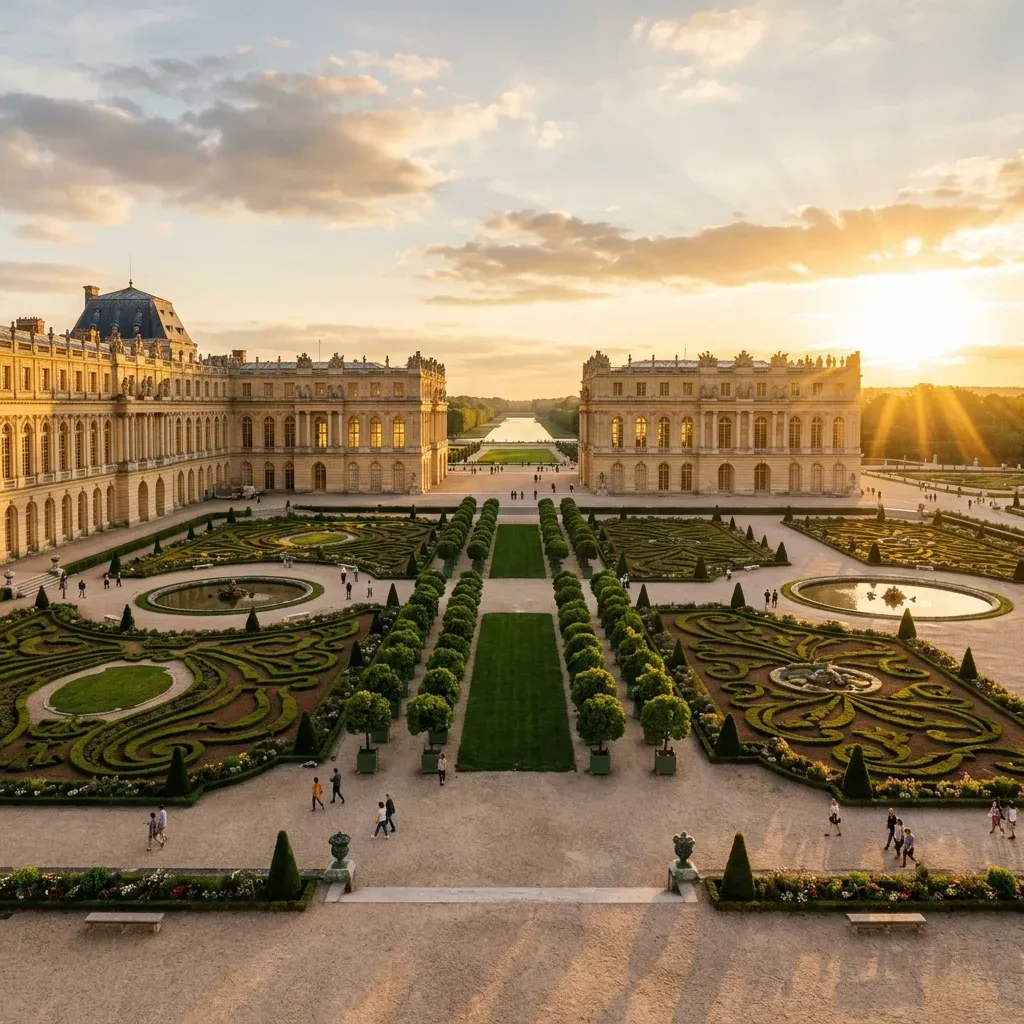
The Palace of Versailles, one of the world's architectural and cultural wonders, was much more than a royal residence. Conceived by Louis XIV, the "Sun King," it was a physical and ideological manifestation of divine absolutism, a cosmological model where the king was the center of the universe. The palace's organization, with its symmetrical axes radiating from the king's bedroom, imitated the solar order, reinforcing the idea that the monarch was the unquestionable center of France and its government. It was not just aesthetics; it was a monumental philosophical and political statement.
1.1 - The Symbolism of the Sun King and Absolutism
Louis XIV cultivated an image of a divine king, a star around which everything revolved. The Palace of Versailles was meticulously designed to be the perfect setting for this cult. Every detail, from the king's chambers facing east (so he would "be born" with the sun), to the sculptures and frescoes depicting him as Apollo, the sun god, reinforced this idea. He was not just the king, but the very embodiment of France and its glory.
- The Cult of the King: Louis XIV intensely promoted the image of a nearly divine king, with the sun as his central symbol.
- The Mirror of the State: Versailles mirrored a centralized state. By concentrating power and administration, Louis XIV monitored and controlled the nobility and bureaucracy, ensuring that all decisions emanated from him. The palace was the physical manifestation of his absolute power.
Chapter
2. - Life at Court: Theater, Etiquette, and the Human Cost
Life at Versailles was a constant performance, an intricate social theater where every gesture, outfit, and word had meaning, but also a high psychological and physical cost for its inhabitants.
2.2 - The Psychological Impact of Etiquette on the Individual
The rigidity of the court of Versailles was not just a social matter, but a deeply personal pressure.
Constant Performance and Personal Cost: Living at Versailles required an uninterrupted performance. Every gesture, word, and facial expression was observed and judged. This constant need to play a role, to suppress emotions, and to conform to minute rules generated enormous psychological stress and, for many, a profound sense of artificiality and alienation. The "true self" was rare and dangerous.
The Boredom of Routine and the Search for Distraction: Despite the balls and banquets, daily life at Versailles for most courtiers could be incredibly tedious and repetitive. The search for gossip, intrigues, gambling, and lovers was, in part, a way to escape the existential boredom imposed by the court's rigidity.
2.3 - Internal Challenges and Crises
Even with all its grandeur, Versailles was not immune to challenges and crises.
Financial Problems: The construction and maintenance of Versailles, military campaigns, and the luxurious lifestyle of the court imposed a colossal financial burden on France. The kingdom's economic difficulties, exacerbated by the expenses of Versailles, were a significant factor in the popular discontent that led to the French Revolution.
Diseases and Poor Sanitation: Sanitary conditions were a chronic problem. The absence of an adequate sewage system and the disposal of waste nearby contributed to the spread of contagious diseases. Outbreaks of smallpox, measles, and other illnesses were frequent and affected everyone, from royalty to servants.
The Impact of Climate: The palace, with its enormous windows and lack of central heating, was frigid in winter. The fireplaces were inefficient and often released smoke, causing respiratory problems and, as you said, even deaths by asphyxiation. This contrasted sharply with the image of luxury and comfort.
The Climate Crisis of 1709: The winter of 1709 was one of the most severe in European history. The water in the fountains froze, the garden trees died, and living conditions in the palace, already precarious in winter, became almost unbearable, with wine freezing in the king's glass. Details of how the court and the king survived this natural catastrophe add an aspect of vulnerability to the "Sun King."
2.4 - The Dark Side: Intrigues, Conspiracies, and Vices
Despite the pomp, life at court was a fertile ground for intrigue, despair, and corruption.
Poisoning and Scandals: The court of Louis XIV was the scene of notorious scandals, such as the "Affair of the Poisons" (Affaire des Poisons), which shocked French society. It involved high-ranking nobles and people close to the king, suspected of practicing black magic and poisoning for personal gain or to eliminate rivals, revealing a much darker and more dangerous side of court life.
The "Great Famine" and Social Contrast: While the nobility at Versailles enjoyed luxurious banquets, rural France frequently faced famine and extreme poverty. The exorbitant spending on the palace and the court contrasted sharply with the living conditions of the majority of the population, fueling the resentment that led to the French Revolution.
Internal Prisons and Political Control: Although the Bastille was the most famous prison, the monarchy's judicial and punitive system operated in conjunction with royal power at Versailles. Arbitrary arrest warrants (lettres de cachet) could be issued by the king, allowing individuals to be detained without trial. This was a tool of political control and a constant reminder of the monarch's absolute authority.
Secret Accounting and Corruption: Despite detailed records, the court was a fertile ground for corruption. Ministers and contractors often diverted funds or overcharged for projects for personal enrichment. There were veiled "gifts" and bribes to secure contracts and favors. Louis XIV, though vigilant, could not control everything. The secret debts of the royalty, accumulated from gambling, jewelry, and clothing, contributed to financial instability and the monarchy's image of irresponsibility.
Nightlife and Gambling: After dinners and shows, the nobility often gathered for high-stakes gambling games, such as "biribi" and "lansquenet." These sessions could last until dawn, with large sums of money changing hands, leading many courtiers to financial ruin.
Clandestine Gambling Clubs: In addition to official gambling, there were clubs and gambling sessions in more discreet and private rooms, where the stakes were even more stratospheric and the rules could be looser, leading to the ruin of fortunes in a single night.
Chapter
3. - Logistics and the Palace's Backstage: A Human Machine
Versailles was not just a static construction, but a complex machine that required an army of people and intricate logistics to function.
3.1 - The Invisible Bureaucracy and the "Men in the Shadows"
Beyond the visible ministers and courtiers, there was a layer of administrators and low-ranking officials who kept the palace running.
The Notaries and Scribes of the Court: Every transaction, will, contract, and appointment within the court was meticulously recorded by an army of notaries and scribes. They formed the bureaucratic backbone, ensuring the legality and documentation of every aspect of royal life. The archives they produced are, today, the primary source for most of our knowledge about Versailles.
The Seal Keepers and Access Control: Official communication was protected by royal seals. There were dedicated officials for applying and removing seals on documents, ensuring authenticity and confidentiality. This small detail reveals the concern for information security in a pre-digital era.
The Secret Chamberlains and "Confidants": The king and queen had an even more restricted circle of servants who handled their most intimate and confidential needs, often serving as silent confidants. Their lives were entirely dedicated to the monarch, and they knew the secrets that no one else knew, but were rarely recorded.
3.2 - Invisible Maintenance: Beyond Cleaning and Repairs
There was a constant and almost imperceptible effort to maintain the "illusion" of Versailles.
The "Night Brigade": Every night, a cleaning brigade operated in the palace to deal with the garbage and dirt accumulated during the day, including emptying the garde-robes (a type of primitive latrine), cleaning corridors and halls, and preparing everything for the next day. It was an invisible job, but essential to maintaining the appearance of grandeur.
The Heating and Lighting System: Heating and lighting 700 rooms and countless halls required a constant supply of firewood and candles. Hundreds of servants were responsible for lighting and maintaining the thousands of fireplaces and candles, a dangerous and exhausting job that consumed a large part of the budget and manpower. The nights at Versailles were, in fact, much darker than we imagine.
The Royal Laundry: With thousands of people and an etiquette that demanded impeccable clothing, the laundry was a massive operation. There were vast facilities dedicated to washing, ironing, and perfuming the clothes of the royalty and high nobility, a testament to the luxury and demand for presentability.
The Management of Light and Shine: To maintain the shine of the mirrors, crystal chandeliers, and polished marbles, there was a dedicated team for constant cleaning and polishing. The use of specific products and the techniques employed to maintain this luminosity were an art and a science in themselves.
The Rotation of Plants and the Creation of "Sceneries": The gardens were not static. There was a constant rotation of plants and flowers to ensure that the flowerbeds were always blooming and perfect. The team of gardeners created true vegetable "sceneries," replacing withered plants with others in full bloom, maintaining the illusion of an always-impeccable garden.
3.3 - The Cutting-Edge Technology of the Time and Its Flaws
Versailles was a technological marvel for the 17th century, but with limitations.
Rudimentary "Central Heating": Although there was no central heating system as we know it, the architects of Versailles implemented innovations to try to heat the vast spaces, such as modified hypocausts (underfloor heating systems) in some specific areas, or ducts to direct hot air from fireplaces. The effectiveness was limited, but it shows the search for comfort.
The Rudimentary "Tube Messenger" System: There is evidence that, in some more private or service sections of the palace, there were rudimentary tubes to quickly send small messages or documents between floors or departments, functioning as a precursor to pneumatic systems.
"Modern" Lighting and the Risk of Fire: Lighting by thousands of candles and chandeliers was the vanguard of technology at the time. However, the constant risk of fires was a real concern, and there were night teams dedicated to monitoring the flames and extinguishing the candles, in addition to a constant supply of water and sand for emergencies.
3.4 - Water Management: An Epic and Expensive Challenge
The fountains of Versailles required a colossal amount of water, and its management was an engineering feat with a monumental human and financial cost.
The Marly Machine: This was the largest and most complex hydraulic machine of its time, designed to pump water from the Seine river to Versailles. It was a monumental engineering feat, built with hundreds of wheels and pumps, but incredibly expensive to build and maintain. It consumed an enormous amount of labor and firewood, and its efficiency was limited; even with it, water was still rationed and the fountains only operated fully in the presence of the king.
The Reservoirs and Aqueducts: In addition to the machine, there was a vast system of aqueducts and large reservoirs built to store water. The works to conduct the water were so ambitious that they involved armies of workers, many of whom died in precarious conditions. This highlights the human and financial cost behind the beauty of the fountains.
The "Apollo Machine": Within the gardens themselves, there was a series of smaller mechanisms and pumps (often moved by gravity or hidden water wheels) that controlled the flow and pressure of the numerous fountains. Understanding these hydraulic "backstages" shows the intelligence behind the spectacle.
3.5 - Brutal Construction Methods and the Human Cost
The construction of Versailles was a gigantic and dangerous undertaking, with a very high price in human lives.
The Lives Lost in the Works: Thousands of workers (many of them forcibly recruited or from the army) died due to work accidents, diseases (malaria was common in the swampy areas), exhaustion, and unsanitary conditions. Although the exact numbers are difficult to verify, the human cost was immense, something rarely highlighted in the glorious narratives.
Violence and Discipline on the Construction Site: Discipline was strict, and violence against workers was common to ensure deadlines were met. Inhumane treatment, physical punishments, and the lack of basic rights were the reality for many who built the magnificence of the palace.
Chapter
4. - The Human Side of the Monarchs: Frailties, Eccentricities, and Vices
Despite being almost divine figures, the kings and queens of Versailles were humans with weaknesses, eccentricities, and fears, living under the microscope of the court.
4.1 - Royal Routines and Afflictions
The life of royalty at Versailles was marked by curious routines and health challenges.
Sleep and Eating Routines: Louis XIV had a legendary appetite, but life at Versailles was noisy and public; finding privacy and rest was a challenge. The king's food sometimes arrived cold.
The Doctors and Royal Afflictions: Medicine at the time was curious and sometimes brutal. The kings suffered from various diseases, and the treatments were often more dangerous than the illness itself (bloodletting, purges). Louis XIV, for example, had a severe dental infection that led to the removal of all his teeth and, later, an abscess that tormented him for years. This humanizes the royal figure.
Louis XIV's "Fistula Operation": Louis XIV suffered from an extremely painful anal fistula. The surgery to correct it, performed without modern anesthesia and with rudimentary instruments, was an event of enormous tension at court. The success of the operation was a miracle for the time and made the surgeon, Charles-François Félix, a legend. This shows the brutality of royal medicine.
The Royal Apothecaries and Secret Recipes: Each king and queen had their own private pharmacy and personal apothecary. In addition to the common medicines of the time, there were secret recipes and herbal mixtures to treat specific ailments, ensure fertility, or even as supposed aphrodisiacs, reflecting the medicine and esoteric beliefs of the era.
The Last Days of Louis XIV at Versailles: The "Sun King" had a painful end to his life, marked by illnesses and personal losses. The palace, which was the stage of his glory, witnessed his last and difficult years, showing the transience of power and life.
4.2 - Unimaginable Eccentricities and Personal Habits
Behind the public image, there were peculiarities that would shock modern standards.
Louis XV's Mania for Exotic Animals in the Apartment: Louis XV, in particular, had a fascination with exotic animals kept inside his private apartments. He even had a Bengal tiger in a special cubicle, and other animals like monkeys and parrots were common, adding a layer of eccentricity and a peculiar smell to these intimate areas.
Extreme Personal "Toilette" Rituals: Beyond the infrequent bathing, the toilette (personal grooming) was a complex ritual, involving the use of rice powders, dyes, and an exorbitant amount of strong perfumes to "freshen up." Brushing teeth was done with mixtures of herbs and fabrics, a rudimentary and often painful process.
The Use of the "Bidet" and Intimate Habits: Although not universal, the bidet began to appear in the more private apartments of royalty and the high nobility in the late 18th century, a sign of extreme luxury and an effort for more advanced intimate hygiene, contrasting with the general sanitary chaos of the palace.
Infested Wigs and Solutions for Lice: Wigs were hotbeds of lice and fleas. To combat this, gold and silver tweezers were used, and some even attached small bags of pig or chicken blood to the wigs, in the hope of attracting the parasites away from the noble's head.
The Royal Pets: In addition to the menagerie, the kings and queens had their own pets, from dogs and exotic birds to monkeys. These animals lived in luxury and were part of the daily life of the royal family, offering a more personal glimpse of its inhabitants.
4.3 - Superstitions, Magic, and Occultism at Court
Despite the rise of science and reason, beliefs in the supernatural still permeated court life, especially in the shadows.
Royal Astrology and Divination: Many monarchs and courtiers secretly consulted astrologers and soothsayers. Major decisions and important events were often preceded by consultations of horoscopes and omens. This shows a side of vulnerability and a search for control in an uncertain world.
The "Chambre Ardente" and the Witchcraft Trials: The infamous Affair of the Poisons led to the creation of the Chambre Ardente, a secret tribunal that investigated black magic rituals, poisonings, and macabre sacrifices involving members of high society and the court. Detailing the accusations and the paranoia generated by this case reveals a dark underworld and the belief in occult forces.
The "Royal Touch" for Scrofula: Louis XIV, like his predecessors, practiced the ritual of the "royal touch" to cure scrofula, believing that the king possessed divine healing powers. Thousands of sick people were brought to Versailles to be touched by the king, a manifestation of popular faith in the mystical power of the monarchy.
Personal Amulets and Talismans: In addition to common amulets, some members of the royalty possessed specific personal talismans, given by soothsayers or acquired in search of protection or luck.
Chapter
5. - Architecture and Engineering: The Art of Dominion
Versailles was not just an architectural feat, but a laboratory of engineering and a manifestation of human dominion over nature and design.
5.1 - Innovation and the Control of Nature in the Gardens
The gardens of Versailles were not just beautiful; they were a statement of human dominion over nature.
The "Flying Orangeries": In addition to the large Orangerie, there were small containers or mobile wooden structures, the "orangeries volantes," which allowed smaller groups of sensitive plants to be moved indoors and outdoors according to the weather, demonstrating extreme dedication and botanical engineering.
The "King's Gardeners": The maintenance of the vast gardens of Versailles required a colossal team of gardeners, fountain keepers, and technicians. It was a continuous and arduous job, ensuring that the thousands of plants, trees, and complex fountains were always impeccable.
The Cycle of the Orangerie's Orange Trees: The transfer of the thousands of orange, lemon, and pomegranate trees into the Orangerie in winter and back into the garden in summer was an annual event that involved great labor and care. This demonstrates the level of detail and investment in the property's maintenance.
The Concept of the "French Garden": The gardens of Versailles, with their perfect symmetries, elaborate flowerbeds, fountains, and sculptures, created the "Jardin à la française" (French Garden) style, which spread across the continent and is synonymous with order, control, and grandeur.
5.3 - The Acoustics and Planned Auditory Experience of the Palace
Sound at Versailles was part of the design of power, meticulously planned to enhance royal majesty.
The Acoustic Effect of the Hall of Mirrors: The architecture of the Hall of Mirrors was not just about light. Its vaulted ceiling and reflective surfaces created a particular acoustic, which could amplify the king's voice during official receptions, making his presence even more imposing, or muffle the court's chatter, controlling the sound environment.
Background Music and Controlled Ambient Noise: Court composers, like Lully, not only created grand operas but also incidental music for dinners, garden strolls, and ceremonies. There was an orchestration of the sound environment, aiming for a controlled experience. The "silence" in certain areas, or the noise allowed in others, was part of the protocol.
The General Sound Environment: In addition to music and royal speeches, imagine the buzz of thousands of people, the noise of carriages, the singing of birds in the gardens, the clinking of cutlery, the footsteps of servants, the crackling of fireplaces. There was also the constant sound of the fountains' water. Exploring the soundscape can provide a unique immersive dimension.
5.4 - Micro-Architecture and Ephemeral Spaces
Versailles was not just stone and structure; it was also shaped by temporary and highly specific elements.
The Secret "Fun Rooms": In addition to the grand halls, there were small rooms dedicated to specific games (like billiards, which was a popular royal pastime), tea rooms, or cabinets for more intimate discussions. They were micro-environments created for very specific functions, which offered an escape from the vast formalities.
The Tents and Temporary Party Pavilions: For grand parties, especially in the gardens, elaborate temporary structures were erected: silk tents, decorated pavilions, and even open-air theaters that were assembled and disassembled for a single event. The ephemerality of these spaces adds a layer of fleeting grandeur and immense logistical cost.
Chapter
6. - Economy, Art, and Culture: The Propaganda of the Sun King
Versailles was a center of excellence in various arts, boosting the economy and serving as a propaganda tool.
6.1 - Versailles as a Mirror of the Mercantilist Economy
The Palace of Versailles was not just a display of power, but a physical manifestation of France's economic policy in the 17th century: Mercantilism, driven by minister Jean-Baptiste Colbert.
Self-Sufficiency and Royal Industries: The Versailles project was, in part, an effort for France's economic self-sufficiency. Many of the raw materials and luxury objects used in construction and decoration (glass from the Hall of Mirrors, tapestries, furniture) were produced by French royal manufactories (such as the Gobelins Manufactory and Saint-Gobain for mirrors). This aimed to reduce dependence on imports and keep wealth within the kingdom.
Control of Artistic Production: Royal patronage was not just for beauty, but for the centralization of artistic production. Colbert organized and supervised the royal academies (of painting, sculpture, architecture), ensuring that artists worked for the glory of the king and the state, with Versailles being the main project.
Drainage of Regional Wealth: The presence of the nobility at Versailles meant that their fortunes were spent at court, on luxuries, and on maintaining their social position, instead of being invested in their own properties and regions. This contributed to the centralization of wealth in Versailles and Paris, emptying the provinces.
6.2 - The Architects and Artists: Beyond the Famous Names
Beyond Le Nôtre and Mansart, a universe of talent was behind the construction of Versailles.
The Army of Artisans: Versailles was built by a vast contingent of workers: masons, carpenters, blacksmiths, gardeners, sculptors, painters, gilders, and many others. The scale of the workforce was colossal.
The Role of Charles Le Brun: Charles Le Brun was the "first painter to the king" and the director of the Gobelins Manufactory. He supervised all the interior decoration of the palace, from the frescoes to the furniture design, ensuring a stylistic and iconographic unity that exalted the king. He was a central figure in the Baroque aesthetic of Versailles.
Blacksmiths, Carpenters, and Upholsterers: Think of the thousands of details: the artistic ironwork of the doors, the carved wooden panels, the furniture upholstered in silk and velvet. Each piece was created by specialized artisans, many of whom lived in nearby villages or in workshops within Versailles itself. The palace was a gigantic art studio.
The "Little Army" of Sculptors: The gardens and the interior of the palace were adorned with thousands of sculptures. In addition to the famous names, there was a vast group of sculptors and their apprentices who worked tirelessly in marble, bronze, and lead to create these works of art.
6.3 - Music and Entertainment as Royal Tools
Music and entertainment were an integral part of Louis XIV's power strategy, more than mere pastimes.
Jean-Baptiste Lully and the French Opera: Lully was Louis XIV's favorite composer and the architect of French opera, a distinct genre that combined music, ballet, and spectacle. He composed for the king and the court, and his works were performed at Versailles with grandiose sets and luxurious costumes, celebrating the glory of the monarch and France.
Ballets de Cour (Court Ballets): Louis XIV was an excellent dancer and used ballet as a way to express power and order. He performed himself, often in the role of Apollo. The court ballets were elaborate, with complex choreographies and rich costumes, involving the nobility and serving as a spectacle to show the harmony and control of the kingdom.
Comedies and Tragedies: Plays by renowned authors like Molière and Racine were frequently staged at Versailles, an essential part of the court's cultural life, often with subtle moral or political themes.
The "Académie Royale de Musique": Founded by Louis XIV, this academy (which would become the Paris Opera) had strong ties to Versailles. The king used music and opera to display French greatness and influence musical trends throughout Europe.
The Prince's Theater (Théâtre du Prince): In addition to the grand spectacles, there were smaller and more intimate theaters within the palace and its annexes, where more modest plays and private performances were held.
6.4 - Versailles and the Minor Arts / Luxury Crafts
It wasn't just architecture and painting that shone; the palace was a center of excellence in other arts.
The Gobelins Manufactory: Louis XIV founded the Royal Gobelins Manufactory, a factory for luxury tapestries, furniture, and art objects, to supply Versailles and serve as propaganda for French power. Renowned artists and artisans worked there, producing spectacular pieces that decorated the palace and were offered as diplomatic gifts. This shows Louis XIV's strategy of using art and craftsmanship as tools of prestige and influence.
The Goldsmith and Royal Jewelers: The court of Versailles was synonymous with dazzling jewelry. There were renowned goldsmiths and jewelers who worked exclusively for the royal family and the nobility, creating crowns, tiaras, necklaces, and brooches that symbolized wealth and status. The stories behind some of these pieces, like Louis XIV's Blue Diamond, can be fascinating.
The Perfumery of Grasse: The perfume industry in France, especially in Grasse, flourished in part due to the demand from the court of Versailles (including to mask bad odors). The nobility used perfumes in abundance, and the creation of exclusive fragrances for the king and queen was a lucrative and prestigious business.
The Perfume Protocol and the War of Scents: The city of Grasse became the world center of perfumery largely due to the demand from the court of Versailles. Perfumers created exclusive fragrances for each member of royalty, and even for each room. It was a real "war of scents" to overcome unpleasant odors, with fashion constantly dictating new aromas.
The Skill of the "Glove-Perfumers": There was a specific profession, that of the maîtres gantiers-parfumeurs (master glove-perfumers), who created soft, perfumed leather gloves, essential for court fashion. It was a form of status and "portable" hygiene.
Chapter
7. - Material Culture and Details of Daily Life
Think about the objects and small routines that made up daily life, revealing opulence even in the most intimate details.
7.1 - The Luxury of Everyday Objects
Every object, even those for personal use, was a work of art.
The Royal "Nécessaire": Royalty traveled and lived with many personal belongings. The "nécessaire" was a luxury set, often in gold and silver, containing personal hygiene items, sewing kits, or writing materials. Each object was a work of art in itself, reflecting opulence even in the most intimate details.
The Small Objects of Curiosity: In addition to the large collections, the nobility and royalty collected small objects of curiosity in their apartments: miniatures, inlaid snuff boxes, enamels, porcelains. These items reflect the personal taste and collecting trends of the time.
Marie Antoinette's "Luxury Toilettes": Marie Antoinette was known for her exquisite boudoirs and bathrooms, which were true works of art, equipped with the latest innovations for comfort and personal hygiene. They were a stark contrast to the general lack of sanitation in the palace.
Clocks and the Measurement of Time: Louis XIV was obsessed with punctuality. There were hundreds of clocks in the palace, many of them works of art, but also practical instruments for regulating the ceremonial and bureaucratic life of the court. The management of time was a manifestation of royal control.
The "Porcelain Trianon": Before the Grand Trianon we know today, Louis XIV had a leisure pavilion built in 1670-1671, known as the Porcelain Trianon. It was covered with blue and white ceramic tiles, imitating the Chinese porcelain that was highly valued at the time. Although it was demolished to make way for the marble Grand Trianon, its existence shows the constant search for novelty and luxury.
The Private Apartments: In addition to the large public halls, the royal family had their own private apartments, much more comfortable and with innovations for the time, such as the first "toilettes à l'anglaise" (English toilets), and small elevators or "flying chairs" to facilitate access. These spaces show a more human and less ceremonial side of royal life.
The "King's Small Cabinet" (Petit Cabinet du Roi): Within the private apartments, there was an even more secluded space, the "Petit Cabinet," where the king retired to work, reflect, or receive confidants without any formality. It was one of the few places where the "Sun King" could simply be a man.
The Greenhouse Apartments: There were much more intimate and functional spaces, such as small cabinets, private libraries, and even greenhouses or winter gardens attached to the royal apartments. These places allowed the royalty to enjoy exotic plants or moments of leisure in privacy, even during the harsh winters.
7.2 - The Culture of Consumption and the Royal "Showroom"
Versailles was not just a residence; it was a gigantic stage for consumption and ostentation, functioning almost as a "showroom" for French luxury.
The Role of Merchants and Royal Suppliers: A vast network of merchants, jewelers, couturiers, perfumers, confectioners, and specialized artisans existed in Paris and Versailles to meet the insatiable demands of the court. Many held the coveted title of "Royal Supplier" (Fournisseur du Roi), which guaranteed prestige and fortune. This boosted the luxury economy in France.
The Impact on Interiors from Day to Night: The palace interiors were constantly updated with the latest fashion. Furniture was exchanged, wall fabrics replaced, and new works of art acquired with surprising frequency. What was modern one year could be considered obsolete the next, showing the fluidity of taste and the obsession with novelty at court.
The "Great Winter" of 1709 and the Palace's Resilience: The winter of 1709 was one of the most severe in European history. The water in the fountains froze, the garden trees died, and living conditions in the palace became almost unbearable, testing the resilience of the court.
Supply Crises: In addition to the climate, wars and poor harvests led to supply crises for food and firewood. The logistics to keep Versailles running under these pressures were immense and often failed, causing discomfort and even hunger among the lower strata of the court and the city.
The Micropolitics of the Table and the Meaning of Food: The quality, quantity, and even the origin of the food served at Versailles were strictly linked to the social status of the courtier. The finest and most exotic dishes were reserved for the royal table, while those of lower status received simpler meals. Access to the "best food" was a coveted privilege and a tool of social control.
The Symbolism of Sweets and Desserts: In addition to the main courses, sweets and desserts were true works of art, often molded into architectural or allegorical shapes. They were not just for the palate, but for displaying the wealth and culinary skill of the court.
The Role of Royal Tasters: To ensure the king's safety against poisoning, there were royal tasters who tried the food and drink before the monarch consumed them. This ritual, though discreet, underlined the constant threat to the royal life and the paranoia of the court.
7.3 - Hygiene and the "War of Scents"
Despite the luxury, personal and environmental hygiene at Versailles presented significant challenges, leading to the development of a sophisticated perfume industry.
The Perfume Protocol and the War of Scents: The city of Grasse in Provence became the world center of perfumery largely due to the demand from the court of Versailles. Perfumers created exclusive fragrances for each member of royalty, and even for each room. It was a real "war of scents" to overcome unpleasant odors, with fashion constantly dictating new aromas.
The Skill of the "Glove-Perfumers": There was a specific profession, that of the maîtres gantiers-parfumeurs (master glove-perfumers), who created soft, perfumed leather gloves, essential for court fashion. It was a form of status and "portable" hygiene.
The "Scent" of Power and Luxury: In addition to the perfumes of royalty and flowers, the environment of Versailles itself had a particular smell. Imagine the odor of new leather from carriages and shoes, the wax from candles, the musk of the strongest perfumes, the dust from powdered wigs, the smoke from fireplaces, and, yes, the underlying human and animal odor. It was a complex and intense symphony of scents, characteristic of the era and the crowd.
The Presence of Pests and Insects: Despite the luxury, the abundance of food and the proximity to rural areas meant that rats, insects (fleas, lice, flies) were a constant reality even in the noblest areas of the palace. The solutions to combat them were rudimentary and often ineffective.
Chapter
8. - Diplomacy, Education, and the Management of the Royal Image
Versailles was a center for diplomatic decisions, an educational hub for royalty, and a stage for the meticulous management of the monarch's image.
8.2 - The Education of Princes and Princesses at Versailles
How were heirs to an empire prepared in this sumptuous environment?
Royal Curriculum: The education of the king's and queen's children was extremely rigorous and comprehensive, including languages, history, geography, science, music, dance, etiquette, and military arts for the boys. They had dedicated tutors and a team of servants, but their life was, for the most part, public, even in their studies.
The Dauphin's Apartment: The Dauphin (heir to the throne) had his own apartments and his own miniature "court" at Versailles. The future king's life was shaped to prepare him for governance, but also for ceremonial life and the expectations of being the "Sun King" or his successor.
8.3 - The Management of the Royal Image: Propaganda and Narrative Control
The absolutism of Louis XIV depended heavily on the creation and maintenance of a perfect public image.
Official Portraits and the Bureaucracy of Image: It wasn't just posing for a painting. There was a royal "image bureaucracy." Official portraits of the king were carefully commissioned and supervised to convey specific messages of power, divinity, and glory. Artists like Hyacinthe Rigaud, whose portrait of Louis XIV is iconic, worked under strict guidelines to shape public perception of the monarch.
Commemorative Medals and Pamphlets: To reinforce the image of the king and his deeds, commemorative medals were minted and pamphlets and engravings were distributed throughout the kingdom and Europe. These media of the time functioned as political propaganda, glorifying military victories, royal births, and the magnificence of Versailles.
The Micro-Management of Image and the Control of Appearances: Even the arrangement of objects in the royal apartments, the way the curtains were tied, or the flowers arranged, followed a "small protocol." The ladies-in-waiting and valets were trained to ensure that everything was perfect and according to the king's or queen's preferences, reflecting the meticulousness of the royal image.
The Position of the Mirrors in the Gallery: The position of the 357 mirrors in the Hall of Mirrors was not random. They were designed to maximize the reflection of light and ceremonies, creating an effect of grandeur and infinite depth, but also to ensure that everyone present saw themselves reflected, participating in the spectacle of royal power. It was a way to involve and impress everyone.
The Counting of the King's Steps: In some ceremonial moments, the protocol was so rigid that the count of the king's steps was observed. The rhythm and cadence were part of the choreography of power, and deviations could be noted, demonstrating an almost absurd level of control over the royal movement.
Chapter
9. - The Lasting Legacy and the Lessons of History
Versailles transcended its role as a royal residence to become a national and global symbol, a monument to human ambition and its consequences.
9.1 - Versailles as a "Brand" of France
Today, Versailles is one of the most recognized symbols of France in the world, attracting millions of visitors annually. It represents French history, art, and culture in its highest expression.
A Monument to Ambition and Its Consequences: The palace serves as a complex reminder of human ambition and the consequences of absolute power. It is a case study on how grandeur can coexist with misery, and how a symbol of power can become a catalyst for revolution.
Modern Events and Exhibitions: Versailles today is not just a static museum. It hosts contemporary art exhibitions that dialogue with the historical space, concerts, and even fashion events. This shows how the palace continues to be a living and relevant cultural center.
Versailles as a "Trademark" of France: A Continuous Legacy: Versailles transcended its role as a royal residence to become a "trademark" of France, synonymous with luxury, history, art, and cultural refinement worldwide. The image of the palace is used in tourism campaigns, in fashion, in luxury products, and even in international events. This "commodification" of Versailles' history reflects the lasting power of its image and the way the monument continues to be a tool of soft power and cultural influence for France.
Versailles in Literature and Philosophy: Many thinkers of the time, such as Montesquieu and Voltaire, although some were critics of absolutism, were aware of and influenced by the grandeur of Versailles. The image of the palace and the court appears in various literary works and philosophical treatises, reflecting the admiration and criticism it generated.
9.2 - The Post-Revolution Legacy and Continuous Transformation
What happened to Versailles after the Revolution is as complex as its construction.
Looting and Dismantling: In the years immediately following the French Revolution, Versailles was looted of many of its treasures. The furniture was sold, works of art were dispersed, and for a time, the palace was at risk of being completely destroyed or dismantled.
Different Post-Monarchy Uses: Before becoming a museum of French history under Louis-Philippe in the 19th century, Versailles had various uses. Napoleon Bonaparte considered residing there but opted for other palaces. He did use the Grand Trianon. The transformation was a deliberate act of national reconciliation, seeking to turn a symbol of the monarchy into a heritage for all French people.
The "Memory" of Versailles: The palace carries a complex historical memory. For some, it is a symbol of tyranny and excess; for others, of glory and cultural peak.
The History of Restorations: Versailles did not reach the present day intact. Over the centuries, it has undergone numerous restoration campaigns, some more faithful to the original, others that reflected the tastes of the restoration era. The history of the restorations itself is a field of study, revealing how different generations have tried to preserve and interpret the monument.
The "Lost Versailles": Much of what existed at Versailles over the centuries has been destroyed, modified, or removed. Furniture was sold, gardens were altered, structures were demolished (like the Porcelain Trianon). Historians and conservators today work tirelessly to reconstruct and redesign these "lost" parts through archives, inventories, and archaeological excavations.
The "Archaeological Layer" Under the Palace: Beneath the vast gardens and the palace itself, there are archaeological remains of earlier structures, such as Louis XIII's hunting lodge and even older settlements. The soil of Versailles is an archive of many eras.
9.3 - Contemporary Challenges and Heritage Preservation
Maintaining such a vast and ancient heritage in the 21st century is a monumental challenge.
The Fragility of the Heritage: Despite its apparent solidity, Versailles is a fragile monument. Exposure to millions of annual visitors, pollution, climate change, and natural wear and tear require a continuous and very expensive conservation and restoration effort.
Balancing Tourism and Preservation: The administration of Versailles faces the challenge of balancing the need to generate revenue through tourism (to finance its maintenance) with the protection of the structure and collections. The impact of the crowd, the logistics of visitor management, and security are modern complexities of the palace.
Incessant Maintenance: The palace undergoes a constant cycle of "regalia," where entire halls and apartments are redecorated, repainted, and re-equipped for the next monarch or to reflect a new taste. This generates a continuous flow of work for artisans and artists, but also an astronomical cost and a loss of original elements.
Fire Protection (Primitive): In a palace with thousands of fireplaces, candles, and little technology, fires were a constant threat. There were fire brigades (with rudimentary equipment) and safety protocols of the time, as well as large buckets of water strategically placed.
⏳ 9.4 - The Perception of Time and the Rhythm of Life at Court
At Versailles, time had its own meaning and flow, dictated by the king.
Unlike common life, governed by the sun or church bells, time at Versailles was entirely orchestrated by the king's rhythm. The day began and ended with the monarch's lever and coucher, and all court activities – meals, audiences, walks, balls – were punctuated by his routine. This created a sense that time at Versailles was not universal, but royal, shaped by the sovereign's will. Punctuality was crucial, but not to meet an external clock, but to align with the cadence of royal life. This dependence on the king's time generated constant anxiety and vigilance not to miss the right moment to appear or make a petition.
9.5 - Versailles as a Stage for Crises and the Anteroom of the Revolution
The palace was not just a symbol of glory, but an epicenter of growing tensions.
Although Versailles represented the height of absolutism, it also became a cauldron of discontent and a symbol of the disconnect between the monarchy and the people. The financial crises, costly wars, and court scandals (like the Affair of the Queen's Necklace, involving Marie Antoinette) were amplified by the stark contrast between the luxury of Versailles and the misery of the rest of France. The palace, with its visible and uninterrupted opulence, acted as a psychological trigger for popular fury.
The royalty's inability to understand the depth of suffering outside its walls was fatal. The tensions accumulated in its halls culminated in the Women's March on Versailles in 1789, which forced the royal family to leave the palace, marking the end of an era and the point of no return for the French Revolution. The luxury of Versailles was, ironically, a catalyst for its own downfall.
9.6 - The Abstract Legacy: Versailles in the Global Collective Imagination
Far beyond its walls, Versailles lives on as a global cultural archetype.
It represents not just a palace, but the very idea of excessive grandeur, royal opulence, and court drama. Its image is evoked whenever power, luxury, decadence, or the nature of absolutism are discussed. In literature, cinema, fashion, and even in everyday language, "Versailles" is an instant synonym for a certain kind of splendor and a specific historical era. This abstract perception of the palace, built and rebuilt through centuries of narrative and iconography, is perhaps its most lasting and pervasive legacy. It continues to fascinate us because it embodies the complexity and contradictions of human power in its most spectacular form.
9.7 - The Perception and Reconstruction of the Memory of Versailles
Versailles is not just a physical place, but a construction of memories, often conflicting, that evolve over time.
Versailles is a palimpsest of memories. Each era, each visitor, each historian, and even each revolution has "written" and "rewritten" its own version of what Versailles represents. For Louis XIV, it was the pinnacle of glory and control. For the revolutionaries, it was the symbol of tyranny and excess to be destroyed. For Louis-Philippe in the 19th century, it was transformed into a museum "to all the glories of France," in an effort of reconciliation.
Today, the perception of Versailles continues to be reconstructed. Through films, series, books, and even video games, the palace is constantly reimagined and interpreted, often with poetic licenses that blur the lines between historical fact and fiction. This continuous metamorphosis of its memory and meaning is perhaps the most fascinating and complex aspect of Versailles.
Practical Guide
🗺️ Plan Your Visit: An Essential Guide for Tourists
The Palace of Versailles is an immersive experience in history and art, and good planning ensures that your visit is as majestic as the place itself. Below, we detail everything you need to know to make the most of it.
Opening Hours: Know When to Visit Each Area
The hours vary slightly between the different areas of the Estate of Versailles and also between the high and low seasons. It is always advisable to check the official website before your visit for the most up-to-date information.
- Palace of VersaillesHigh Season (April to October): Tuesday to Sunday, from 9:00 AM to 6:30 PM (last admission at 6:00 PM). Low Season (November to March): Tuesday to Sunday, from 9:00 AM to 5:30 PM (last admission at 5:00 PM). Closed: Every Monday, December 25th, and January 1st.
- Estate of Trianon (Grand Trianon, Petit Trianon, and the Queen's Hamlet)High Season (April to October): Tuesday to Sunday, from 12:00 PM to 6:30 PM (last admission at 6:00 PM). Low Season (November to March): Tuesday to Sunday, from 12:00 PM to 5:30 PM (last admission at 5:00 PM). Closed: Every Monday, December 25th, and January 1st.
- GardensOpen every day, usually from 8:00 AM to 8:30 PM (last admission at 7:00 PM). They may close early on days of "Musical Fountains Shows" or special events.
- ParkOpen every day, usually from 7:00 AM to 8:30 PM for pedestrians and 7:00 AM to 7:00 PM for vehicles.
Tickets and Prices: Choose the Best Option for Your Visit
Several types of tickets are available, depending on the areas you wish to explore. Purchasing online in advance is highly recommended to avoid queues.
- Passeport (Passport)The most complete ticket, usually costing around €32 (prices may vary). It includes access to the Palace, the Estate of Trianon (Trianons and Hamlet), the Gardens (including musical fountain shows when in season), and the Park. It is the best option for those who want to see everything.
- Palace TicketAccess only to the Palace. Costs approximately €21.
- Combined TicketsThere are options that include access to the Palace + Virtual Reality experiences, for example, with prices starting from €35-€45.
- Free AdmissionAll visitors on the first Sundays from November to March. Young people under 18. European Union residents under 26. People with disabilities and one companion (upon presentation of proof).
- Important: Even if you are entitled to free admission, in many cases, you need to "book" a ticket online to guarantee entry and a time slot.
How to Get to Versailles from Paris: Your Transportation Guide
Versailles is easily accessible from Paris by public transport:
- By RER (Regional Express Network)Take the RER C line towards Versailles Château - Rive Gauche. This is the closest station to the Palace (about a 5-10 minute walk). Check the train's direction, as there are other stations in Versailles. Note: The T+ ticket (standard Paris metro ticket) is not valid for this journey. You will need to buy a specific "Paris - Versailles Rive Gauche" ticket.
- By SNCF TrainFrom Paris Montparnasse: Trains to Versailles Chantiers station (about a 10-minute walk from the Palace). From Paris Saint Lazare: Trains to Versailles Rive-Droite station (about a 10-minute walk from the Palace).
- By BusThe RATP bus line 171 departs from the Pont de Sèvres metro station (line 9) and goes directly to the Château de Versailles terminal.
- By CarTake the A13 motorway towards "Versailles/Saint Quentin-en-Yvelines/Rouen" to exit no. 5 "Versailles centre/Versailles château". There are paid parking lots near the Palace.
Visiting Rules and Permissions: What You Need to Know
To ensure the preservation of the site and the safety of all, some rules must be observed:
- Photography and FilmingPhotos without flash are generally allowed in the palace rooms. Selfie sticks, tripods, and drones are prohibited inside the Palace and in most of the estate without prior professional authorization. Professional photography requires written permission.
- Food and DrinkEating or drinking is not allowed inside the Palace and museums. You can have picnics in the Park (not in the formal Gardens). There are also cafes and restaurants on the estate.
- Prohibited ItemsKnives, scissors, and other sharp or blunt objects. Animals (except guide/service dogs, with the owner responsible for cleaning up). Very large bags or backpacks may need to be checked in the cloakroom.
- CloakroomsAvailable at the entrance of the Palace and the Trianon Estate for luggage, large bags, strollers, umbrellas, etc.
Essential Tips to Optimize Your Experience
A visit to Versailles can be extensive and physically demanding. Here are some tips to make the most of it:
- Buy Tickets Online in Advance: Essential to avoid long queues at the ticket office, especially in high season.
- Arrive Early: To avoid the tour crowds (which usually arrive around 11 AM), plan to arrive right at the Palace opening, at 9 AM.
- Wear Comfortable Shoes: You will walk a lot! The Palace is vast and the Gardens are gigantic.
- Allow Enough Time: A complete visit to the Palace and the main Gardens can take 4 to 6 hours or even more. If you plan to visit the Trianons and the Hamlet, set aside a full day.
- Download the App/Audioguide: The Palace of Versailles offers a free app with an audioguide and interactive map, very useful for getting around and learning details. Bring headphones.
- Consider the Petit Train or Bike Rental: To tour the vast Gardens and go to the Trianons, the Petit Train (tourist train with stops) or bike rental are great options, especially if you have little time or difficulty walking long distances.
- Choose the Visiting Period: High season (April to October): Gardens and fountains are at their peak, with the famous "Musical Fountains Shows" and "Musical Gardens" (events that usually require an extra ticket for the gardens). It is busier, especially on Tuesdays and weekends. Low season (November to March): Fewer crowds and free entry to the gardens. The gardens may be less flowery, but the Palace remains majestic.
- Beware of Pickpockets: As in any busy tourist attraction, keep your belongings safe.
Accessibility: Versailles for All Visitors
The Palace of Versailles strives to be accessible and offers various facilities for visitors with reduced mobility and other disabilities:
- AccessThe Palace and its various areas are accessible to wheelchair users and people with reduced mobility. Elevators serve all levels open to the public.
- WheelchairsWheelchairs are available for loan at the Palace (Gabriel Pavilion), Grand Trianon, and Petit Trianon for internal visits. They cannot be used in the gardens.
- Free EntryAs mentioned, people with disabilities and one companion are entitled to free entry. Access is via Entrance A (Dufour Pavilion).
- Restrooms and RestaurantsAccessible sanitary facilities and restaurants are available at various points on the estate.
- ParkingAccessible parking spaces are available. If you are driving, inform the staff at the Honour Gate for guidance.
- Interactive Maps and GuidesA geolocated interactive map of the Estate is available, and there are specific cultural activities and guided tours for visitors with reduced mobility.
2.1 - Social Life and the "Theater" of the Court
The nobility lived at Versailles not just to be near the king, but to participate in an intense social theater.
The "Grand Siècle" (Great Century): The era of Louis XIV is known as the Great Century, a period of unprecedented cultural and artistic flourishing. Versailles was the stage where etiquette, fashion, music, theater, and dance reached their peak, influencing all of Europe. French opera, for example, flourished under royal patronage at Versailles.
The King's and Queen's Apartments: Besides the Hall of Mirrors, the Grand Apartments of the King and Queen were sites of great ceremonial importance. There, daily rituals took place, such as the king's lever and coucher (the ritual of waking up and going to bed), observed by hundreds of courtiers. These public rituals reinforced the hierarchy and status of everyone at court.