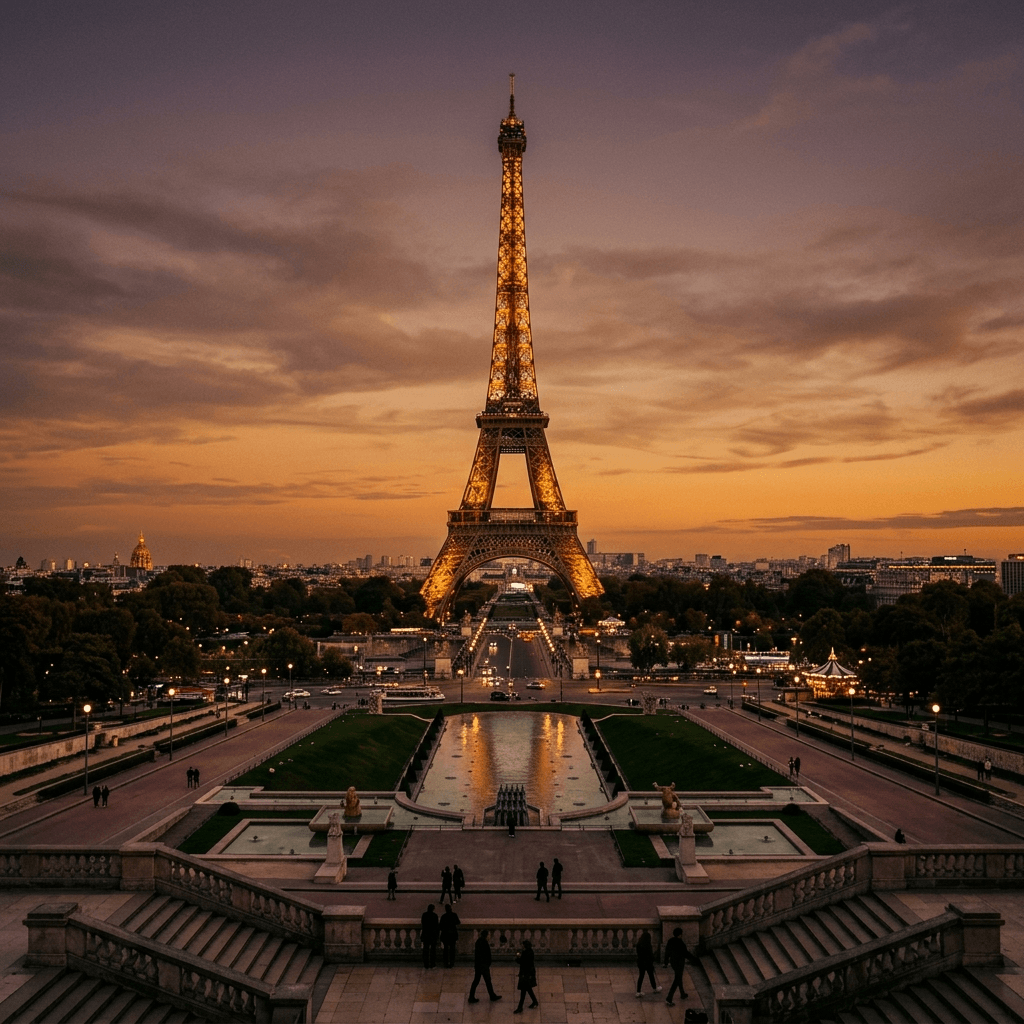
Chapter
1.1 The 1889 World's Fair: How Paris Competed with the World and Created the Eiffel Tower
The 1889 World's Fair represented the high point of an era of fierce rivalry among industrial powers. Following the resounding success of the 1878 Exposition, which had unveiled the head of the Statue of Liberty to the world before its shipment to New York, the French government of Jules Grévy decided to host the event once again, precisely on the centennial of the French Revolution. The date, May 5, 1889, was not chosen by chance: it marked exactly one hundred years since the opening of the Estates General in Versailles, the event that had sparked the revolution. In that context, erecting a tower of 984 feet — something that had never been attempted in the history of engineering — would serve as a demonstration of French technological sovereignty, in a Europe where the United Kingdom ruled the seas with its steam-powered navy and Bismarck's Germany advanced in heavy industry.
International competition was fierce. In 1884, the United States inaugurated the Washington Monument, a marble obelisk standing 554 feet tall, then the tallest building in the world. France needed to respond with something that not only surpassed the American mark but also established a new architectural paradigm. The exposition's commissioner general, Jean-Charles Alphand, and the minister of commerce, Édouard Lockroy, launched a public competition on May 1, 1886, challenging engineers and architects to "raise on the Champ de Mars an iron tower with a square base, 984 feet high." More than one hundred proposals were submitted, including a giant guillotine and a stone lighthouse, but only one combined technical feasibility, unprecedented scale, and relative economy of materials.
The choice of the Champ de Mars as the site was not fortuitous. The vast military parade ground, which had already hosted the 1867 Exposition, was strategically situated on the banks of the Seine River, between the École Militaire and the recently built Palais du Trocadéro, erected for the 1878 Exposition. The tower would serve as the gateway to the exhibition pavilions that would sprawl across the park, with the Galerie des Machines — another masterpiece of engineering boasting the largest clear-span roof ever built — occupying the central area. From the top of the tower, visitors would have a panoramic view of the entire exposition and the city.
Construction began at breakneck speed and amid immense public skepticism. Newspapers like Le Temps published scathing articles; the writer Guy de Maupassant became one of the most vocal critics, calling the future tower a "clumsy skeleton" and a "tall, skinny pyramid of iron staircases." The composer Charles Gounod and the painter William-Adolphe Bouguereau signed the famous "Protest of the Artists," an open letter published on February 14, 1887 in Le Temps, which branded the project "useless and monstrous" and warned that "the hateful shadow of the hateful column of bolted sheet metal" would forever stain the profile of Paris. Little did they know they were witnessing the birth of the most visited monument on earth.
The exposition opened on schedule, and the tower — though its elevators were still being finalized — opened to the public on May 15, 1889. In the first six months, 1,953,122 visitors climbed its steps. The economic impact was immediate: nearby hotels, such as those in the Passy district and on Avenue Kléber, were fully booked; the Paris Métro, whose first lines would be inaugurated in 1900, already had its demand anticipated by passenger flow studies conducted during the fair. The 1889 Exposition generated revenue exceeding 52 million gold francs, and the icon of Paris, originally slated for dismantling after twenty years, was ultimately saved precisely by the strategic value it would acquire in the decades that followed.
Chapter
1.2 Maurice Koechlin and Émile Nouguier: The Forgotten Engineers Who Designed the Eiffel Tower
It all began in a modest office in the Levallois-Perret suburb, where the workshops of the Gustave Eiffel & Cie. Company were located. Engineer Maurice Koechlin, born in Buhl, Alsace, in 1856, a graduate of the prestigious ETH Zurich (Swiss Federal Institute of Technology), was the head of the company's research department. Working alongside him was Émile Nouguier, born in Paris in 1840, an experienced civil engineer who had contributed to the structural calculations of the Statue of Liberty — another project in which Eiffel's firm had actively participated by supplying the internal metal framework. In June 1884, even before any public competition had been announced, Koechlin and Nouguier began sketching the first drafts of a colossal tower standing 984 feet tall.
Koechlin's original drawing, preserved in the archives of the National Library of France, showed a structure of four latticed pillars converging at horizontal platforms until they met at a slender top. The idea was one of mathematical purity: keeping the tower's profile subjected only to axial compression forces, without significant bending moments, so that the wind — the great enemy of tall structures — could flow through the lattice without generating lateral pressures capable of toppling the monument. No tower in the world had been calculated with such rigor to withstand winds of nearly 124 mph, also factoring in the effects of thermal expansion that would cause the Iron Lady to sway up to 6 inches at the top between Parisian winters and summers.
Koechlin was a brilliant theoretician and mastered the graphic methods of structural calculation developed by the German engineer Karl Culmann, his professor in Zurich. He was the one who mathematically determined the curvature of the tower's legs — an exponential curve that uniformly distributes wind loads along the entire height. This profile, far from being merely aesthetic, obeyed the zero bending moment equation under transverse wind action: the ideal curve that cancels bending stresses in each horizontal section. The mathematics behind the final form consumed months of work and produced more than 3,600 technical drawings detailing each component piece.
What makes the story of Koechlin and Nouguier particularly remarkable is how they remained in the shadows. Both were salaried employees of the company and, under the intellectual property laws of the time in France, creations made within the scope of the employment contract belonged to the employer. Grasping the project's potential, Gustave Eiffel moved swiftly to secure formal rights. He asked the engineers to add decorative elements to the bare structure — it was at this moment that architect Stephen Sauvestre entered the scene — and then purchased the full rights by paying fixed fees to Koechlin and Nouguier. Public recognition of the two engineers would only come decades later, almost as a belated historical reparation.
Chapter
1.3 Stephen Sauvestre and the Eiffel Tower's Design: The Architect Who Turned a Metal Structure into an Icon
When Stephen Sauvestre received the technical drawings by Koechlin and Nouguier in mid-1884, what he saw was a skeleton of remarkable mathematical precision but indisputably industrial aesthetics — four bare latticed legs rising to a platform at the top. Sauvestre, chief architect of the Eiffel company's architecture division, born in Bonnétable, Sarthe, in 1847, immediately understood that to overcome the resistance of the Parisian cultural establishment, cold engineering would have to be transformed into monumental architecture. His most visionary gesture was endowing the tower with monumental arches at the base, between the four pillars, which had no structural function whatsoever — they were purely ornamental, designed to create a grand entrance portal evoking the triumphal arches of the French classical tradition.
Sauvestre also conceived the glass-enclosed galleries on the first and second floors, which would give visitors the sensation of being suspended between sky and ground, along with the reception pavilions and restaurants that would make the experience commercially viable. At the top, he designed a private apartment — the same one that would later be occupied by Gustave Eiffel — with wide windows and a metal dome that, in addition to shielding against the elements, gave the monument the visual finish of a crown. Even the tower's color bore his signature: it was Sauvestre who recommended painting it in three graduated shades of reddish-brown, darker at the base and progressively lighter toward the top, to compensate for the atmospheric attenuation of perspective and make the monument appear uniformly colored when viewed from the ground.
Sauvestre's work was crucial not only for the aesthetic result but for the very political survival of the project. The "Protest of the Artists," published in Le Temps in February 1887, attacked precisely the bare, raw version of the tower — the skeleton by Koechlin and Nouguier. The arches, pavilions, finishes, and galleries designed by Sauvestre softened the hostility of the cultural elites, even if they did not completely silence the criticism. Guy de Maupassant, ironic to the end, continued to have lunch daily at the first-floor restaurant, saying it was "the only place in Paris where I don't have to see the tower." But the Iron Lady was already beginning to claim its definitive place in the Parisian imagination.
Another touch by Sauvestre that visitors rarely notice is the spiral staircase winding from the second to the third floor, with 1,665 steps. He designed the handrail, the rest landings, and even the openings that allow glimpses of the internal structure during the ascent. Every ornamental detail — from the wrought-iron railings with Art Nouveau arabesques to the original gas lamps — bore his signature. The result was an unprecedented fusion of 19th-century industrial aesthetics and the classical sense of proportion that the École des Beaux-Arts in Paris taught its architects.
Chapter
1.4 Gustave Eiffel and the Tower Controversy: Visionary Genius or Man Who Took Credit for Someone Else's Project?
Gustave Eiffel, born in Dijon on December 15, 1832, was the most celebrated engineer in France even before the tower existed. His metal bridges crossed rivers from Portugal to French Indochina; his internal framework for the Statue of Liberty had just been inaugurated in New York (October 28, 1886); the Nyugati Railway Station in Budapest boasted metal arches of his design. But none of these achievements compared, in scale and political risk, to the proposal of erecting the tallest structure in the world in the heart of the French capital. Eiffel's name was so powerful that the government itself began referring to the enterprise as "the Eiffel Tower" long before construction was completed, cementing in the public mind an association that history would later problematize.
The controversy is longstanding and persists among architectural historians: was Eiffel a business genius who made viable a project that would have been technically impossible for anyone else, or someone who appropriated the creative work of his subordinates? Eiffel's defense is solid on several points. Without his name, prestige, and political connections, the government would never have accepted the project. It was Eiffel who proposed the financing model that convinced the state: his company would bear 80% of the construction costs, estimated at 6.5 million francs, in exchange for commercial revenue for twenty years. Alone, neither Koechlin nor Nouguier would have had access to the necessary capital or influence. Moreover, it fell to Eiffel to supervise the work — and to bear the financial risk of any failure.
On the other side of the debate, however, lies the documented fact that Koechlin and Nouguier produced the complete conceptual design before any involvement by Eiffel. Patent No. 160,196, registered on September 18, 1884 with the French National Institute of Industrial Property (INPI), precisely described "a new arrangement enabling the construction of metal pillars and towers exceeding 984 feet in height" and bore the names of Gustave Eiffel, Maurice Koechlin, and Émile Nouguier as co-inventors. The fact that Eiffel figured as a co-inventor, even without having directly contributed to the original technical conception, indicates the nature of the agreement: he bought his participation in the patent by paying the engineers.
The historical truth appears to lie in a complex middle ground, where each figure played a distinct and complementary role. Koechlin and Nouguier conceived the engineering; Sauvestre gave it architectural soul and public acceptance; Eiffel supplied the name, the capital, the project management, the political defense against attacks from the press and artists, and, above all, the audacity to stake the reputation of an entire lifetime on the venture's success. The tower we know would have been impossible without any one of the four, and it was precisely the recognition of this interdependence that, decades later, led to the inclusion of the collaborators' names on the list of great scientists engraved on the sides of the monument.
Chapter
1.4.1 The Eiffel Tower Patent and Contract: The Multimillion-Franc Agreement with the French Government and the Purchase of Rights
The legal chronology is precise and revealing. On September 18, 1884, three months after Koechlin and Nouguier's first sketches, Patent No. 160,196 was filed with the French INPI, listing Eiffel, Koechlin, and Nouguier as co-inventors. Records show that Eiffel paid the two engineers an amount equivalent to roughly 10% of the patent's value in order to be listed as a co-author — common practice at the time, but one that clearly signals his conceptual contribution was secondary. The patent described in detail the structural principles of the "system of variable-section pillars forming a tower of great height" and already featured the essential proportions of the monument we know.
The next step was the contract with the government, signed on January 8, 1887, between the French Ministry of Commerce and Industry and Gustave Eiffel, acting in his own name. The agreement stipulated that the French state would contribute 1.5 million francs — less than a quarter of the total estimated cost of 6.5 million — while Eiffel would bear the remaining 5 million. In return, he would receive the full commercial revenue of the monument during the first twenty years of operation, starting from the inauguration. Eiffel's own calculations projected that revenue from tickets, restaurants, space rentals, and souvenir sales would allow him to recoup the investment in less than a decade. What he did not calculate — or calculated perfectly — was that the tower would quickly become the most visited monument in the world and that in just the first six months of the 1889 Exposition, ticket sales alone would already cover more than half of the initial investment.
The contract also provided for the concession of the land on the Champ de Mars for an initial period of twenty years, after which the government could choose to dismantle the tower or renew the concession. Article 11 of the document stated that the City of Paris would have the right to "demand the demolition of the tower at any time after the end of the exposition" — a clause that nearly came into effect in 1909 and whose non-enforcement was due almost exclusively to the discovery of the tower's strategic value as a radio telegraphy antenna. It is worth noting that Gustave Eiffel was the first to recognize this military and scientific application, installing a wireless telegraphy laboratory at the top on his own initiative while his concession was still in force.
Chapter
1.4.2 The Belated Recognition of Koechlin and Nouguier: The True Creators of the Tower Finally Enter History
During the decades following the inauguration, Eiffel's name shone alone. Books, postcards, newspaper reports, and even stamps from the French postal service consolidated the image of the great engineer as the monument's sole author. Koechlin remained with the company until retirement, overseeing other important works, including the internal structure of the Garabit Viaduct, but never publicly claimed credit. Nouguier, more discreetly, left the firm a few years later and opened his own consulting office, specializing in railway bridges in the Loire Valley region.
Historical rehabilitation began timidly in the 1920s, when technical engineering publications began mentioning the role of the two original collaborators. The decisive milestone came in 1939, when the French Society of Civil Engineers published a dossier detailing the creative process behind the world's most visited monument and attributing the original conception to Koechlin and Nouguier. From the 1980s onward, with the partial opening of the Eiffel company archives to public consultation, historians such as Bertrand Lemoine and Michel Carmona brought to light the documents proving shared authorship — Koechlin's calculation notebooks, the correspondence between him and Nouguier, and the patent registration drafts showing Eiffel's name added as co-author after the technical work had been completed.
Today, the monument displays on the sides of the first floor the names of 72 French scientists, engineers, and industrialists, and among the permanent exhibitions there are panels dedicated to Koechlin and Nouguier. However, the popular imagination — and the very official name of the tower — remains inextricably linked to Gustave Eiffel. This may be the definitive irony of the story: the two forgotten engineers designed the structure that allowed Eiffel to enter eternity.
Chapter
2.1 The Weather Laboratory in the Eiffel Tower: The Private Observatory That Operated for Decades on the Third Floor
Few of the millions of visitors who reach the top of the Iron Lady each year know that the third floor housed, for several decades, one of the most important meteorological observatories in Europe. Gustave Eiffel, who was never an engineer of merely commercial ambitions, conceived the tower from the outset as a vertical scientific laboratory. The summit, 935 feet above ground at the time — today 906 feet after successive structural renovations — offered ideal conditions for studying atmospheric pressure, wind direction and speed, temperature, relative humidity, and even cosmic ray incidence. Scientists from all over the world sent requests to install instruments on the monument's parapets.
The weather laboratory was equipped during construction itself. In 1889, Eiffel installed a precision Torricelli barometer, several Robinson anemometers, and a set of recording thermometers manufactured by the Parisian firm Richard Frères. Data was collected daily by a small team of observers who climbed the 1,665 steps each morning. The tower's measurements were integrated into the French national weather network coordinated by the Central Bureau of Meteorology, precursor to today's Météo-France. For over thirty years, the records from the tower's summit served as a reference for comparative urban climatology studies — simultaneous measurements taken at ground level, at the École Militaire, and at the top made it possible to calculate the vertical thermal gradient and model the dispersion of pollutants in a Paris in the throes of the Industrial Revolution.
Beyond meteorology, the laboratory hosted cutting-edge physics experiments. In 1910, the scientist Théodore Wulf installed an electrometer to measure ionizing radiation in the upper atmosphere — research that indirectly contributed to the discovery of cosmic rays, a discovery formally confirmed two years later by Victor Hess, who used manned balloons for measurements at even higher altitudes and was awarded the Nobel Prize in Physics in 1936. Eiffel himself made a point of maintaining correspondence with dozens of international researchers and encouraged the scientific use of the tower as a means of ensuring its survival against demolition advocates, who returned to the charge at the beginning of the 20th century.
The weather observatory operated continuously until the 1930s, when the modernization of automatic station networks and the development of radiosonde technology — which allowed instrument-laden balloons to be sent into the stratosphere — reduced the relative importance of fixed-altitude surface measurements. During World War II, the equipment was partially dismantled by the German occupation, and after the Liberation of Paris in August 1944, the space never regained its original scientific vocation, being converted into technical and administrative areas.
Chapter
2.2 Thomas Edison and Gustave Eiffel: The Meeting of Geniuses and the Phonograph That Stayed in the Tower
The most illustrious visit received by Gustave Eiffel in his aerial refuge was that of Thomas Edison, the American inventor who had revolutionized the world with the incandescent light bulb, the phonograph, and the direct-current power distribution system. The meeting took place on September 10, 1889, during the World's Fair, and was meticulously documented by Parisian newspapers of the time, including Le Figaro and L'Illustration. Edison, who was staying at the Hotel Continental on the Rue de Rivoli, climbed to the apartment accompanied by his wife, Mina Miller Edison, and a small entourage of American engineers exhibiting inventions at the United States pavilion.
The meeting was symbolically charged. On one side, Europe's greatest structural engineer; on the other, the New World's greatest inventor. Edison presented Eiffel with a wax cylinder phonograph — the Class M model, manufactured by his Edison Phonograph Company — and recorded a personal message of admiration, in which he called the Frenchman the "courageous builder of the most original and daring specimen of modern architecture." The device remained in the tower apartment as a collector's piece, and the original recording was preserved for decades in the Eiffel family archives, although the physical wax cylinder deteriorated over time. A replica of the phonograph is now part of the restored furnishings of the exhibition space open to visitors.
The two men spent the afternoon discussing practical applications of electricity and debating the future of public lighting — the tower itself was then equipped with arc lamps that turned it into a nighttime beacon visible for miles around. Edison, who had already patented more than four hundred inventions, was fascinated by the tower's hydraulic elevator systems, designed by engineer Léon Édoux. In Edison's diary entries, he noted that "the tower is proof that iron has become the material of the century." The encounter sealed a friendship that would last until both men's deaths and cemented the tower apartment as the epicenter of gatherings among the world's scientific elite at the turn of the century.
Chapter
2.3 How Long Was the Eiffel Tower's Secret Apartment Closed and How Was It Restored?
After the death of Gustave Eiffel on December 27, 1923, the third-floor apartment entered a long period of oblivion. The tower's concession was renewed by the French government and the monument's management passed to a mixed-economy company, the Société d'Exploitation de la Tour Eiffel (SETE). The space, which Eiffel had maintained as a private office and laboratory, was sealed off due to lack of use and institutional interest. For more than sixty years — from 1923 until the major renovation of the 1980s — the apartment remained closed, accessible only to maintenance workers who occasionally needed to change light bulbs or repair leaks on the third floor.
The rediscovery happened almost by accident during the renovation work on the third floor coordinated by architect Claude-Hélène Philippon, between 1981 and 1983. Workers replacing the internal metal structures of the upper platform found a rusted metal door leading to a compartment of approximately 270 square feet. Upon opening it, they were confronted with an environment frozen in time: dark walnut furniture in the Second Empire style, damask wallpaper faded by decades of humidity, bookshelves filled with 19th-century engineering books, and a work desk still covered in yellowed documents. The state of conservation, though precarious, made it possible to identify what had been the late engineer's study.
Restoration was carried out by SETE with support from the French Ministry of Culture and the Museum of Arts and Crafts (CNAM). The intervention, completed in 1985, was meticulous and sought to preserve the original character of the environment. The walls received a new layer of damask wallpaper faithfully reproducing the 19th-century pattern; the oak parquet was restored plank by plank; the tempered glass windows were replaced with replicas identical to the originals. The furniture underwent conservation treatment at the laboratory of the Musée Carnavalet, specialized in the history of Paris. The total cost of restoring the apartment was estimated at approximately 2 million French francs at the time, a sum absorbed within the larger budget for the tower's general renovation.
Since reopening, the apartment has become one of the most talked-about yet least-visited attractions of the monument — access is controlled to prevent deterioration, and entry is only granted at specific hours with a special ticket. The contrast between the discreet luxury of the room and the industrial environment of the tower is such that many visitors describe the sensation of having entered a Victorian time capsule suspended over the city.
Chapter
2.4 What Tourists See Today in the Eiffel Tower's Secret Space: Wax Figures, Original Furniture, and Living History
Visitors who reach the third-floor apartment are met with a scene bordering on the theatrical. In the center of the main salon, with its low ceiling — since it was built within the volume of the platform — two life-size wax figures recreate the historic meeting between Gustave Eiffel and Thomas Edison. Eiffel is seated at his original work desk, a sturdy piece of carved walnut; Edison stands, holding the phonograph he came to present. The scene, created by museographer Jean Lachaise — the same decorator who furnished the apartment in the 19th century at Eiffel's own request — is so lifelike that countless tourists photograph it believing they are seeing real people through the protective glass.
Beyond the figures, the space displays the restored original furnishings: a Henri II-style bookcase filled with leather-bound engineering and natural science treatises; a dark green velvet sofa where the engineer received distinguished guests; an auxiliary writing desk with a bronze inkwell and goose-feather quills; and the iconic aneroid barometer that Eiffel consulted daily for his weather notes. The walls display original engravings from the 1889 World's Fair and sepia photographs of the Iron Lady's construction stages. A small upright piano, which belonged to Eiffel's daughter Claire, occupies a corner of the room and, according to family records, was used in musical soirées that brought together the Parisian cultural elite.
Informational panels in French, English, and Spanish narrate the history of the apartment and contextualize the meeting between Eiffel and Edison. Digital monitors incorporated into the furniture — the only concession to audiovisual modernity — display period photographs and excerpts from documentaries about the tower's construction. SETE maintains a periodic rotation of the exhibited pieces to prevent damage caused by light and humidity variations, which means that some visits may reveal different details of the collection. The experience of being in such an intimate space nearly 900 feet above the ground, with Paris stretching beneath your feet through windows framing the Seine, the Notre-Dame Cathedral, and the Arc de Triomphe, transforms the visit to the secret apartment into one of the most underrated — and deeply memorable — moments of any trip to the French capital.
Chapter
3.1 How Many People Have Committed Suicide at the Eiffel Tower? The Forgotten History of Over 370 Documented Cases
Behind the golden glow of the nighttime illumination and the crowds that gather daily on the Champ de Mars, the Iron Lady carries a grim statistic that tour guides prefer to avoid: more than 370 suicides are recorded in the administration's archives since the monument's inauguration. The first documented case occurred on June 15, 1898, when a 33-year-old French man, whose name was never disclosed by the press at the time, jumped from the second floor, 377 feet above ground, after losing his family's entire fortune in failed Paris stock exchange investments. The body fell onto one of the park's lawns and was recovered by the municipal guard before the gates opened to the public. Since then, the tower has become one of the best-known suicide spots in the world, alongside places like the Golden Gate Bridge in San Francisco and Niagara Falls.
The distribution of cases throughout the 20th century tracks periods of intense social and economic instability. The years following the 1929 New York Stock Exchange Crash saw a vertiginous increase in occurrences, with more than fifteen fatal jumps documented between 1930 and 1934 alone. During the Great Depression, unemployed and bankrupt individuals from all over France traveled to Paris for the sole purpose of jumping from the tower. Another peak coincides with the end of the Nazi Occupation between 1944 and 1946, when collaborators and people ruined by the war committed the extreme act fearing reprisals or unable to bear rebuilding a devastated life. There are also records of German soldiers who threw themselves from the tower in the days leading up to the Liberation of Paris in August 1944.
Over the decades, authorities tried different containment strategies. During the first fifty years of operation, the railings on the first and second floors were insufficiently high — roughly 4 feet — making the jump a relatively simple mechanical action. Starting in the 1950s, the administration of the world's most visited monument began installing taller iron barriers and hiring guards trained to identify suspicious behavior. Even so, determined people found ways to circumvent surveillance, scaling the railings at night or jumping from service platforms between patrol rounds. The most recent cases are kept under absolute secrecy by the administration to avoid the so-called "contagion effect," a sociological phenomenon that causes new suicides to imitate methods reported by the media.
Chapter
3.1.1 Franz Reichelt and the 1912 Death at the Eiffel Tower: The Tailor Who Jumped with an Improvised Parachute and Shocked Paris
The most celebrated suicide — and paradoxically, the one that was not an intentional suicide — involved the Austrian tailor and inventor Franz Reichelt, based in Paris. Born on October 16, 1878 in the Bohemia region, then part of the Austro-Hungarian Empire, Reichelt was a talented tailor who had moved to the French capital as a young man and opened a successful atelier on the Avenue de l'Opéra, near the Palais Garnier. His obsession, however, was not fashion: Reichelt devoted the last years of his life to developing a parachute suit that would allow aviators to jump from malfunctioning aircraft and survive. The device consisted of a silk jumpsuit with lightweight rods that would open when the wearer fell, forming a drag surface meant to slow the descent.
In the months prior to the fateful test, Reichelt had conducted experiments with dummies weighing about 132 lbs dropped from the fifth floor of his building on Rue Gaillon. The results were a systematic failure: all the dummies crashed to the ground without the suit opening properly. However, the inventor believed that the failure lay in the insufficient height of the fall — with more descent time, he argued, the fabric would have a chance to inflate. Determined to prove his theory, Reichelt applied to the Paris Police Prefecture for permission to jump from the first floor of the tower, 187 feet above the ground. Permission was granted in February 1912 with the explicit condition that the test be conducted with a dummy, never with a human being. Reichelt did not comply with the condition.
On the morning of February 4, 1912, with temperatures just above freezing and a moderate northwest wind, Reichelt climbed to the first floor of the Iron Lady accompanied by two Parisian police officers and a cameraman hired by the Pathé production company, who would record the feat for the era's newsreels. He wore the prototype over a dark suit, and his appearance contrasted with the industrial setting of the platform. To the officers who confronted him, he assured them he would use the dummy. But upon stepping onto a stool, he pulled his hands away from the railing and declared: "I am going to jump myself, gentlemen." Before anyone could stop him, he threw himself into the void.
The footage, preserved in the Pathé archives and now available for consultation at the National Library of France, shows Reichelt hesitating for long seconds at the edge of the platform before launching himself forward. The suit never opened: the support rods, made of bamboo, were structurally insufficient for the drag force, and the silk fabric remained plastered to his body during the roughly four-second fall. The body struck the frozen ground in a crater of earth and ice, killing the inventor instantly. The scene shocked Paris and had international repercussions — newspapers in London, Berlin, and New York published detailed accounts of the event. Reichelt was buried in the Batignolles Cemetery, in Paris's 17th arrondissement, and his gravestone never mentions the tower.
Chapter
3.1.2 How Does the Eiffel Tower Prevent Suicides Today? Glass Barriers, Protective Railings, and Security Sensors
The fight against suicide at the world's most visited monument has evolved drastically since the 1950s and today constitutes one of the most sophisticated prevention systems among major global tourist structures. The first major safety renovation took place between 1954 and 1957, when the administration replaced the original iron railings, only 4 feet high, with 6-foot galvanized steel barriers featuring a closed mesh that prevents a human body from passing through. Simultaneously, access to outdoor platforms was restricted to designated hours, with mandatory closure of the gates after sunset.
In the following decades, new layers of protection were added. During the major renovation from 1981 to 1985, budgeted at more than 80 million French francs, 7-foot-high tempered laminated glass panels were installed on all observation decks open to the public — a material that withstands the impact of objects launched at high speed while preserving the panoramic visibility tourists expect. Platform lighting was redesigned to eliminate shadow areas that could facilitate undetected acts. In the 2000s, SETE invested in digital video surveillance systems with high-definition cameras connected to a security center operating 24/7.
The most recent reinforcement came with the installation, in 2018, of a 10-foot-high bulletproof glass perimeter around the tower's base, replacing the temporary fences that had been put in place in 2016 in response to a series of terrorist threat alerts in Paris. Strategically, the barrier not only impedes unauthorized access but also prevents potential jumps from ground level onto the Champ de Mars. Beyond physical barriers, the administration maintains a team of trained psychologists for crisis situations and an evacuation protocol that isolates areas if a visitor displays risky behavior. The effectiveness of the measures is measured by the simple fact that, over the last two decades, fatal incidents at the tower have become statistically rare.
Chapter
3.2 How Many Workers Died Building the Eiffel Tower? The Truth About Fatal Accidents on the 1887 Construction Site
The Iron Lady's construction site, active between January 26, 1887 and March 31, 1889, mobilized between 150 and 300 workers, in addition to 50 engineers and draftsmen. Working conditions, by 19th-century standards, were remarkably safe. Unlike major contemporary projects — such as the Panama Canal, whose French construction between 1881 and 1889 claimed over twenty thousand workers from malaria and yellow fever, or the American Transcontinental Railroad, which recorded hundreds of deaths — the tower's construction had a single documented fatal accident. The fact is so extraordinary that construction industry historians cite it as a benchmark of occupational safety excellence.
The sole victim was an Italian worker whose identity, unfortunately, was not preserved in detail in the official records. The accident occurred during the assembly of first-floor components, when the worker fell after losing his balance during operations outside regular working hours — which suggests that the fall did not take place under normal supervised working conditions, but rather at a moment when he was performing some additional task or was in an unauthorized area. The episode was recorded in the construction site's logbooks, which mention that the victim was not wearing the safety harnesses distributed by the company.
The secret to this impressive feat lay in Gustave Eiffel's obsession with safety. He mandated the use of temporary guardrails, protective netting between metal beams during assembly, and mobile scaffolding with non-slip platforms. Workers received protective equipment such as reinforced leather helmets, safety harnesses anchored to the structures, and metal-studded work boots that gripped the iron surfaces. In addition, Eiffel instituted strict conduct rules: anyone caught working without full equipment or outside established procedures was summarily dismissed. The engineer also set up a heated cafeteria on-site, where workers ate hot meals — the innovative nature of this measure helped prevent fatigue and dehydration, two factors known to be associated with workplace accidents.
During the 2 years, 2 months, and 5 days of construction, not a single strike was recorded, and the morale among the workforce was such that many workers continued climbing the structures on Sundays to admire their own work, even without overtime pay. The production of 18,038 parts at the Levallois-Perret workshops followed a rigorous industrial pre-assembly system: each element was manufactured with a margin of error of tenths of a millimeter, temporarily assembled at the factory, disassembled, and transported to the construction site, where the 2.5 million rivets were driven while hot by specialized teams. This method, known as "lean prefabrication," drastically reduced the need for adjustments at height — the operation that posed the greatest accident risk in 19th-century construction.
Chapter
3.3 The Pilot Who Flew Through the Eiffel Tower's Arch in 1944: The Forbidden Maneuver That Made Aviation History
Although the title evokes the image of a pilot flying under the tower — a physically impossible maneuver, since the base of the world's most visited monument spans 410 feet wide and there is insufficient airspace for an aircraft — the real story that comes closest to this feat took place during the Liberation of Paris. The protagonist was American pilot William Overstreet Jr., of the 357th Fighter Squadron of the United States Army Air Forces (USAAF). In early 1944, months before the Normandy landings, Overstreet was flying a P-51 Mustang on a bomber escort mission over the French capital when he was pursued by a German Messerschmitt Bf 109 fighter.
The chase extended through the narrow streets of central Paris, at rooftop level. Overstreet, in a desperate evasive maneuver, dove his P-51 toward the Seine River and passed at extremely low altitude between the pillars of the tower — an image that became legendary among fighter pilots. The German aircraft, unable to replicate the maneuver, pulled up and abandoned the pursuit. Overstreet survived, returned to base, and lived to tell the story, passing away peacefully in 2014 at age 92, in Virginia.
A different story is that of Leon Collot, a French civil aviation pilot who in 1926 performed an equally reckless maneuver: he flew under the tower in a small Caudron C.91 biplane. Immediately after the feat, he was arrested by the Parisian police and had his pilot's license permanently revoked. These stories of aerial daring, though they do not carry the tragic weight of the suicides, are part of the folklore of challenges surrounding the tower and reveal the fascination the monument has held for aviators worldwide since the earliest years of aviation.
Chapter
4.1 The Eiffel Tower in World War I: How the Monument's Antenna Intercepted Secret Messages from the German Army
When German cannons began to thunder at France's borders in August 1914, the Iron Lady was no longer merely a tourist monument. In 1903, French army captain Gustave Ferrié had installed a wireless telegraphy (TSF) transmitter at the top that, in the following years, had evolved into a military radio communications station of transcontinental reach. The 262-foot antenna at the top of the tower allowed the station to reach ships of the French Navy in the Mediterranean, outposts in North Africa, and, under favorable conditions, transatlantic communications with army bases in Saint-Pierre and Miquelon, in French Canada. World War I would transform this technical capability into a decisive strategic advantage.
In the very first weeks of the conflict, the tower's radio operators — assigned to the 8th Signals Regiment, headquartered at the Champ de Mars itself — began systematic interception of German army communications. The Grande Antenne, as it was called in military circles, captured messages broadcast by German mobile radio posts in northern France and occupied Belgium. The tower's location, in the exact center of Paris, was ideal: the antenna's altitude, 1,050 feet above sea level, offered a radio-frequency horizon reaching the plains of Champagne-Ardenne and the Marne Valley without terrain obstacles attenuating the signal.
The intercepted signals were sent directly to the Cryptography Section of the French Army Headquarters, commanded by the legendary codebreaker Georges Painvin. The tower's interception center processed dozens of messages per day, and although the Germans used the sophisticated ADFGVX code — a double transposition cipher that protected the high command's dispatches — French cryptanalysts managed, starting in June 1918, to break the code and anticipate troop movements. The flow of information contributed directly to the defense of French territory throughout the war, in one of the least-known chapters in the history of military telecommunications.
Chapter
4.1.1 Mata Hari and the Eiffel Tower: The Decisive Telegram the Spy Could Not Hide from French Intelligence
No episode better illustrates the Iron Lady's role in World War I espionage than the capture and execution of Margaretha Geertruida Zelle, known worldwide as Mata Hari. The 41-year-old Dutch dancer and courtesan, celebrated on the stages of the Folies Bergère and in the salons of Parisian high society, had been recruited by the German secret service, the Abwehr, under the codename H21. Her mission was to seduce high-ranking French officers and extract information about troop movements, artillery disposition, and offensive plans.
In mid-1916, French intelligence, through the tower's interception station, began capturing encrypted German messages that mentioned an agent infiltrated in Paris whose description matched Mata Hari's profile — age, nationality, social circle, presence at certain salons and hotels. The key piece was a German telegram intercepted in January 1917 and quickly decoded. In it, the Abwehr described the services rendered by agent H21 and approved a payment of 30,000 francs for information about French Schneider CA1 tanks, then undergoing testing near Saint-Chamond in the Rhône Valley. The message, transmitted from a German station in Spain, was captured by the tower's antenna and decoded by the Deuxième Bureau, the French intelligence service.
With evidence in hand, the French Counter-Espionage Service arrested Mata Hari on February 13, 1917 at the Hôtel Élysée Palace on the Avenue des Champs-Élysées. After a summary trial held on July 24 and 25, 1917 at the Palais de Justice de Paris, on charges of espionage and high treason, she was condemned to death. The execution by firing squad took place on October 15, 1917, at 6:15 a.m., at Fort de Vincennes, east of Paris. Mata Hari refused the blindfold and faced the twelve soldiers of the firing squad head-on. The interception of the telegram by the Iron Lady's antenna is recognized by historians as the decisive element that sealed her fate.
Chapter
4.1.2 Battle of the Marne 1914: The Decisive Role of the Eiffel Tower's Communications in the First Great French Victory
In early September 1914, the German army advanced on Paris with the overwhelming force of the Schlieffen Plan, which envisioned enveloping the French capital from the western flank and forcing a rapid surrender. The troops of Kaiser Wilhelm II came within just 25 miles of Paris's gates, and the French government, presided over by Raymond Poincaré, evacuated the capital, relocating to Bordeaux. The tower's radiotelegraphy station, however, remained operational under the coordination of General Joseph Joffre, commander-in-chief of the French forces.
The role of communications was decisive. The tower's radio operators captured messages from the German high command — the Oberste Heeresleitung (OHL) — that revealed that General Alexander von Kluck, commander of the German 1st Army, had diverted his trajectory southeast, abandoning the envelopment maneuver around Paris and exposing the right flank of his troops to French defense. The interception was transmitted to Joffre's Headquarters, which immediately ordered a massive counteroffensive involving the French 6th Army under General Michel-Joseph Maunoury, reinforced by troops hastily transported from the capital — an episode that became known as the "Taxis of the Marne," when hundreds of Parisian Renault AG1 taxis were requisitioned to carry reserve soldiers to the front.
The result was the First Battle of the Marne, fought between September 5 and 12, 1914, which halted the German advance, saved Paris from occupation, and transformed the war of movement into the trench warfare that would define the next four years of the conflict. Although military history concentrates its laurels on Joffre's strategy and troop mobility, the contribution of the tower's radio antenna — which operated uninterruptedly throughout the crisis — rarely receives the prominence it deserves.
Chapter
4.2 Hitler and the Eiffel Tower in World War II: Why the Führer Saw Paris But Never Set Foot at the Top
On June 14, 1940, Wehrmacht troops entered Paris, which had been declared an open city by the French government to avoid destruction. Nine days later, on June 23, 1940, Adolf Hitler made his sole visit to the French capital — a lightning tour lasting about three hours, on an overcast summer night. Accompanied by his personal architect Albert Speer, sculptor Arno Breker, and SS officers, the dictator landed at Le Bourget Airport and followed an itinerary that included the Opéra Garnier, the Arc de Triomphe, Napoleon's Tomb at Les Invalides, and the Basilica of Sacré-Cœur in Montmartre. Upon arriving at the Trocadéro, from which the tower's most iconic view unfolds, Hitler posed for the celebrated photograph that traveled the globe: in a light overcoat, hands clasped over his stomach, gazing at the monument his men had not managed to fully subdue.
The reason Hitler never ascended the Iron Lady is prosaic and, at the same time, laden with historical irony. Few hours before German troops reached Paris, members of the French Resistance — whose identities have never been fully confirmed, though the action is attributed to a group linked to the Musée de l'Homme, the same that would distribute anti-fascist leaflets — cut the elevator's steel cables. The sabotage was precise: the main traction cables were severed in the machine rooms of the first and second floors, completely disabling the vertical transport system. The original elevators, of the Édoux-Fives-Lille system, operated via a complex hydraulic mechanism, with pumps fed by pressurized water from the Seine River. Without the traction cables, the entire system was paralyzed, and repairing it required custom-made parts that the Occupation never bothered to procure.
The Wehrmacht attempted to circumvent the problem by hoisting an enormous flag bearing the Nazi swastika atop the tower. To raise it, German soldiers had to climb the 1,665 steps on foot — an exhausting feat that consumed hours and required rotation of teams. The flag, however, was so large that the wind tore it down within hours, ripping the fabric against the metal lattice. Humiliated, the Germans replaced it with a smaller flag, which also did not last long. The episode became a running joke among Parisians, who commented that not even the wind would accept the swastika over the city. Hitler, informed of the embarrassment and knowing he would have to climb on foot if he insisted on accessing the top, declined the visit to the interior of the monument.
Chapter
4.2.1 Who Cut the Eiffel Tower's Elevator Cables in 1940? The Heroic Sabotage by the French Resistance
The exact identity of the saboteurs remains a mystery that World War II historians have been trying to unravel for decades. What is known for certain is that, on June 11 and 12, 1940, when German armored vanguards were already in the suburbs of Saint-Denis and Montrouge, a group of tower administration employees, in coordination with militants of the nascent French Resistance, carried out the sabotage of the elevators. SETE records show that the maintenance superintendent, André Granet, received verbal orders — probably from the retreating government itself — to disable the vertical transport system before the enemy arrived.
The operation was technically complex. The elevators operated with steel cables 1 inch in diameter, double-spiral-braided to support the weight of passenger-laden cars. Cutting cables of this thickness required acetylene torches and at least two hours of uninterrupted work for each of the four main cables. The saboteurs worked through the early morning hours, under threat of Luftwaffe bombardment, and completed the operation shortly before dawn on June 12. The sabotage was so successful that the elevators would only return to operation in 1946, more than a year after the war ended, once the firm Fives-Lille — the same that had built them originally — manufactured and installed new custom cables.
In parallel with the elevator sabotage, another Resistance group removed and hid essential electronic components from the tower's radio station, preventing the Germans from using it as a communications relay to the Atlantic coast. Parts such as thermionic valves, copper coils, and ceramic capacitors were buried in the gardens of the Champ de Mars or distributed among collaborators' homes in the Passy district. The result was that, for much of the occupation, the antenna of the world's most visited monument remained silent — a fact that deeply irritated the German command in Paris, headquartered at the Hotel Meurice on the Rue de Rivoli.
Chapter
4.2.2 The Nazi Flag on the Eiffel Tower That Lasted Only a Few Hours: How the Wind Humiliated the German Occupiers
The episode of the Nazi flag is one of the most discussed in the memory circles of the Occupation of Paris. Eyewitness accounts preserved at the Museum of the National Resistance in Champigny-sur-Marne describe the scene in rich detail. The flag — a black swastika on a red and white background, in the Reichskriegsflagge pattern — measured approximately 49 feet long by 25 feet high, weighing approximately 99 lbs with the support poles. A platoon of the Kriegsmarine (German Navy) was tasked with hoisting it on the third-floor mast.
The operation began at dawn on June 14, 1940. Climbing on foot while carrying the equipment was grueling; the German soldiers, exhausted from the occupation march of the preceding days, needed more than three hours to reach the top. When the flag was finally unfurled, around 10 a.m., the Parisian wind — the same one Koechlin's calculations had factored in half a century earlier — was blowing in gusts of over 31 mph. The fabric, thick cotton untreated for such exposure, began tearing with the first gusts. The flag split in half vertically, and the shreds fell onto the beams of the second floor.
A second flag, of smaller dimensions, was hoisted the following morning. It also failed to withstand the wind. A third attempt, with lighter fabric, lasted about two days before disintegrating under the rain of June 16. The metaphor was too powerful for Parisians to ignore: an occupied, humiliated France, but whose greatest symbol physically rejected the occupier's insignia. For Hitler, the humiliation was an omen — and one of the reasons the dictator never returned to Paris during the war.
Chapter
4.3 Liberation of Paris 1944: The French Tricolor Flag Raised Atop the Eiffel Tower as a Symbol of the Resistance
If the swastika lasted mere hours over the Iron Lady, the French tricolor flag went up to never come down. On the morning of August 25, 1944, while the armored divisions of General Philippe Leclerc and the French 2nd Armored Division were entering Paris from the south, liberating neighborhood by neighborhood, a group of men from the French Naval Museum — an institution based at the Palais de Chaillot, at the Trocadéro, facing the tower — organized an expedition to the monument's summit.
The mission was led by Pierre Taittinger, a naval officer and member of the Resistance, assisted by sailors who had participated in the street fighting near Place du Trocadéro. There were still pockets of German resistance in the surrounding area, and Mauser rifle fire could be heard coming from the direction of the École Militaire. Even so, the group ran up the steps — the elevators, sabotaged four years earlier, were still inoperative. Upon reaching the summit, around noon, they lowered any vestige that remained of the German presence and hoisted the blue, white, and red flag of the French Republic.
The scene was immortalized in photographs that traveled the world. General Charles de Gaulle, who on that same day would lead the triumphant parade along the Avenue des Champs-Élysées amid the cheers of a crowd of two million people, made a point of mentioning the feat in his speech at the Hôtel de Ville: "Paris liberated, Paris liberated by herself, by her people, with the assistance of the armies of France." The tower, which had survived two world wars, sabotage, the demolition attempt — an order that German General Dietrich von Choltitz, military governor of Paris, had received directly from Hitler in August 1944 and had decided not to carry out, thus preserving the city — was definitively established as a symbol of French resistance and resilience.
The most visited monument in the world had survived. And it would continue to illuminate Paris every night, sparkling at the top of each hour — a beacon so permanent that some Parisians who lived through the war still cannot look at it without remembering that August when the tricolor flag returned to flutter 984 feet above the ground.
Chapter
5.1 Does the Eiffel Tower Sway in the Wind? The Aerodynamic Calculations That Allow Up to 3.5 Inches of Oscillation Without Risk
The idea that a monument weighing 8,050 short tons can move with the wind seems to defy intuition, but it is precisely this calculated flexibility that has kept the Iron Lady standing since 1889. The iron giant was designed to oscillate up to 3.5 inches at its upper end during extreme windstorms, a behavior that, far from representing fragility, constitutes the very essence of its structural resilience. Gustave Eiffel understood, decades ahead of the engineers of his time, that a tower too rigid would snap under wind force, whereas an elastically yielding structure dissipates kinetic energy without accumulating rupture stresses. The open lattice format was not merely an aesthetic choice: every beam, every crossing of wrought iron, was mathematically positioned to offer the least possible resistance to airflow, drastically reducing the contact surface that the wind must push against.
The aerodynamic calculations of Gustave Eiffel were based on empirical studies he himself had conducted in his workshop at Levallois-Perret, where he tested reduced-scale models under simulated wind loads before transposing them to the colossal dimensions of the final project. The curvature of the monument's four outer edges does not follow a decorative whim, but an optimized exponential curve that evenly distributes wind thrust along the entire height, preventing any single point from concentrating excessive stress. Under normal conditions, the Eiffel Tower oscillates imperceptibly by fractions of an inch, and even during the historic storm of 1999, when gusts exceeded 106 mph in Paris, the displacement recorded at the top remained within the safety limits predicted more than a century earlier.
What makes this achievement even more impressive is the technological context of the era: Gustave Eiffel had no computers, simulation software, or modern wind tunnels at his disposal. His calculations were done by hand, using slide rules and logarithmic tables, relying on fundamental principles of Newtonian physics and his prior experience with metal bridges and railway viaducts. The tower's geometry is so efficient that if its entire mass of iron were compacted into a solid cube, it would occupy an area equivalent to the 410-foot-wide square base with only 2.5 inches of height — an eloquent metaphor for the structural lightness achieved by the lattice format. The relationship between weight and height of the Eiffel Tower remains, even today, a paradigm of efficiency in civil engineering, studied in universities worldwide as an example of applied structural optimization.
The tower's movement under wind is also influenced by another lesser-known phenomenon: uneven solar heating. When the sun strikes only one face of the monument, the iron expands asymmetrically, causing thermal curvature that can displace the top by up to 7 inches in the opposite direction from the sunlit face, as if the Iron Lady were leaning gently to escape the solar rays. This combined displacement — wind plus thermal expansion — is permanently monitored by sensors installed at the top and intermediate platforms, feeding a predictive maintenance system capable of anticipating any need for adjustment before material fatigue becomes a real problem.
Chapter
5.2 Why Does the Eiffel Tower Grow 6 Inches in Summer? The Thermal Expansion Phenomenon Explained in Detail
Every Parisian summer, the iron giant puts on a spectacle invisible to the naked eye but perfectly measurable: it grows between 6 and 7 inches, stretching skyward as if breathing in the heat of the season. The phenomenon, known as linear thermal expansion, is an intrinsic physical property of all metallic materials and occurs because the rise in temperature causes the iron atoms to vibrate with greater amplitude, moving away from each other and increasing the macroscopic volume of the structure. In the case of the Eiffel Tower, at 1,083 feet in height (counting the antennas installed at the summit), this thermal expansion accumulates along the entire vertical extent and becomes perfectly detectable by precision instruments.
The thermal expansion coefficient of puddled iron — the specific type of wrought iron used by Gustave Eiffel — is approximately 0.000012 per degree Celsius. This means that for every degree of elevation in ambient temperature, each linear meter of iron expands by 12 millionths of a meter. Multiplying this minuscule fraction by the more than 1,000 feet of vertical structure and applying the typical seasonal thermal variation of Paris — which can oscillate from sub-freezing temperatures in winter to highs exceeding 95°F at the height of summer — the accumulated expansion reaches the impressive 6 to 7 inches documented by the engineers of SETE (Société d'Exploitation de la Tour Eiffel), the company that has administered the monument since 1980.
What makes the Iron Lady's thermal expansion particularly fascinating is that the growth does not occur in a perfectly symmetrical manner. Since the sun strikes the tower's different faces with varying intensity throughout the day, the side facing south can expand more rapidly than the north side, causing a temporary and subtle curvature of the structure that displaces the top by up to 7 inches in the direction opposite the sun. During the early morning hours, when all faces cool more uniformly, the monument gradually returns to its neutral position, in a daily cycle of imperceptible movements that has repeated itself for more than 130 years without causing any significant structural damage. Gustave Eiffel already foresaw this behavior in his original calculation notebooks and dimensioned the joints and rivets to absorb these dimensional variations without transmitting dangerous stresses to the construction's more rigid elements.
The monument's contemporary structural maintenance management incorporates laser displacement sensors and high-precision inclinometers that monitor in real time both the vertical expansion and the thermal curvature of the summit, generating data cross-referenced with weather stations installed on the platforms. These continuous records allow engineers to differentiate normal movements caused by temperature and wind from any anomalous deformations that could indicate structural fatigue, hidden corrosion, or differential settlement of the foundations. The Eiffel Tower may well be the most intensively monitored metal structure on the planet, and every fraction of an inch of displacement is analyzed by predictive maintenance teams who study the monument's health with the same precision with which cardiologists monitor a patient.
Chapter
5.3 The Eiffel Tower's Foundations: The Concrete Footing and Caisson System That Supports 11,130 Short Tons
Few visitors imagine, as they step onto the Champ-de-Mars and lift their eyes to the top of the iron giant, that much of the tower's stability rests on underground structures as ingenious as they are invisible. The Eiffel Tower's foundations represent a triumph of 19th-century civil engineering and were designed to support a total weight that, adding together the metallic structure itself and all equipment, elevators, restaurants, and antennas, reaches approximately 11,130 short tons. Each of the monument's four pillars rests on a concrete footing — a massive block of masonry and cement — that distributes the vertical load uniformly over the terrain, preventing the differential settlement that could compromise the structure's vertical alignment.
The foundation design had to contend with a particularly delicate geotechnical challenge: the pillar on the Seine River side (north pillar) sits on soil far wetter and less resistant than the other three, requiring a special solution employing compressed-air caissons — a cutting-edge technology for the era that allowed excavation below the water table without water invading the foundation pit. Workers labored inside these pressurized metal caissons at depths reaching 72 feet below ground level, under extremely adverse and dangerous conditions, removing the soft soil until reaching a layer of compact, resistant clay capable of bearing the designed load. The story of the Eiffel Tower foundation construction is, in itself, an epic of courage and ingenuity involving divers, high-capacity air pumps, and grueling shifts in environments where atmospheric pressure caused ear pain and risks of embolism.
The monument's four concrete footing foundations are anchored in limestone bedrock and compact clay that, over more than 130 years, have shown no significant sign of settling or displacement, confirming the precision of the geological studies conducted by Gustave Eiffel's team. Each footing measures approximately 33 feet long by 16 feet wide, and the total load of 11,130 short tons is transmitted to the ground at a pressure of only 3 to 4 kilograms per square centimeter — a surprisingly low value, equivalent to the weight of an average-sized person standing on one leg. This exceptionally efficient load distribution explains why the Eiffel Tower has never needed structural reinforcement of its foundations, even with the progressive addition of antennas, communication equipment, and complementary structures that have increased its total weight over the decades.
One detail worth highlighting is the drainage system enveloping the foundations, designed to prevent water accumulation around the concrete footings. Gustave Eiffel ordered the installation of underground drainage galleries that channel rainwater and natural groundwater moisture away from the pillar bases, preventing the chemical and mechanical erosion that water could inflict on the concrete and exposed iron below ground level. This drainage system is regularly inspected by maintenance crews and has been modernized several times throughout the 20th and early 21st centuries, incorporating electric pumps and electronic moisture sensors that complement the efficiency of the original hydraulic design.
Chapter
5.4 Wrought Iron vs. Steel at the Eiffel Tower: Why 18,038 Pieces and 2.5 Million Rivets Guarantee Over a Century of Longevity
The Eiffel Tower was erected with 18,038 individual pieces of puddled iron — a form of wrought iron obtained through a process of partial decarbonization of pig iron in reverberatory furnaces — joined by an astonishing 2.5 million hot-driven rivets. The choice of material was neither accidental nor driven by the technological limitations of the era: Gustave Eiffel was a specialist in metal and railway bridges and knew intimately the comparative properties of steel and wrought iron, deliberately opting for puddled iron for its superior resistance to atmospheric corrosion. Puddled wrought iron contains fibrous inclusions of iron silicate slag, arranged in layers that act as microscopic barriers against the progression of rust — a self-protection mechanism that carbon steel, far more homogeneous, does not naturally possess.
The crucial difference between wrought iron and carbon steel lies in the metallurgical microstructure: while steel contains between 0.2% and 2% carbon, making it harder and stronger in tension, wrought iron has less than 0.1% carbon and preserves the slag fibers that give it ductility and exceptional fracture toughness. The iron giant did not need to be extremely hard — it needed to be resilient, capable of swaying with the wind and expanding with heat without accumulating stresses that would lead to brittle fracture. Puddled iron met this requirement perfectly, and the definitive proof lies in the fact that, in more than 130 years of continuous exposure to rain, sun, wind, and Paris's atmospheric pollution, none of the 18,038 original pieces has needed replacement due to structural failure. Maintenance consists solely of protective repainting and visual inspection of joints and connections.
The assembly system using hot-driven rivets was another decisive factor in the monument's longevity. Each rivet was heated to a glowing red in portable forges installed on the work platforms themselves, inserted into the prepared hole, and hammered violently by teams of riveters working in pairs — one holding the rivet with tongs while the other struck the head with a sledgehammer — so that the metal, upon cooling, contracted and compressed the joined plates with a clamping force that no bolt could match. This permanent residual compression seals the joints against water and oxygen infiltration, the two primary agents of corrosion, and distributes stresses uniformly across the entire connection surface, eliminating the stress concentration points that are the most common cause of fatigue failure in metal structures. The Eiffel Tower is, essentially, a gigantic work of industrial goldsmithing forged by hand, piece by piece, rivet by rivet, over two years, two months, and five days of labor.
If the monument had been built of modern structural steel, with electric welding or high-strength bolts, it would have required complex expansion joints, far more aggressive anti-corrosion maintenance, and would likely have already faced replacements of critical components throughout the 20th century. The microscopic porosity of welds and the stress-corrosion cracking that affects tensioned bolts are failure modes simply absent in riveted puddled-iron construction, which sacrificed assembly speed in exchange for durability measured in centuries. Gustave Eiffel's legacy in this regard is so definitive that contemporary historical metal heritage restoration engineers study the original riveting techniques to apply them to century-old bridges and viaducts still in service.
Chapter
5.5 The Eiffel Tower's Colors Throughout History: From Vivid Red to Eiffel Tower Brown — The Fascinating Journey Through 7 Different Shades
The silhouette of the iron giant is so iconic that the grayish-brown hue characterizing it today seems to have been there from the start, but the truth is that the Eiffel Tower has sported at least seven different shades throughout its existence, in a chromatic palette that reflects both advances in industrial paint chemistry and transformations in French aesthetic taste between the late 19th century and the present day. At the moment of its inauguration, in May 1889, the monument displayed a vivid red color (known as "Venetian red"), applied at the Levallois-Perret workshops even before assembly on the Champ-de-Mars, and which served a primarily protective function: the red lead-based paint (lead tetroxide) formed an exceptionally effective anti-corrosion layer over the puddled iron. The original red color lasted until 1892, when it was replaced by an ochre hue (yellowish-brown) considered more elegant for a permanent monument.
In 1899, the Iron Lady received her first paint job with a chromatic gradient — a concept that would only be fully understood through contemporary optics decades later — with a darker shade at the base and progressively lighter toward the top, creating the illusion of visual uniformity when observed from the ground against the Parisian sky. This technique was refined over successive painting campaigns: 1907 brought a yellowish-brown, and between 1954 and 1968, the tower adopted a reddish-brown tone that began to approach the color we know today. It was only during the 1968 painting campaign that the definitive shade emerged: "Eiffel Tower Brown", an exclusive color developed specifically for the monument, inspired by the tone of oxidized bronze, and which has since been the official chromatic identity of the iron giant.
"Eiffel Tower Brown" is not a single color but a system of three shades in an ascending gradient: the darkest at the base (to harmonize with the ground and the trees of the Champ-de-Mars), an intermediate tone on the central body, and the lightest at the top (to contrast with the brightness of the sky and soften the silhouette against Parisian blue or gray). This trichromatic system, which became a visual signature of the monument, was formalized during the 1986-1988 campaign and is rigorously maintained with each periodic repainting, requiring painters to manually apply the three colors in transition zones with absolute precision so that the gradient is imperceptible to the naked eye, creating a tonal continuity that enhances the slenderness of the structure.
Chapter
5.5.1 What It's Like to Paint the Eiffel Tower: The Hand-Painted Tradition of 7 Coats Repeated Every 7 Years
Painting the Eiffel Tower is no ordinary maintenance task: it is the largest outdoor painting operation in the world and follows a rigorous seven-year cycle that dates back to Gustave Eiffel himself, whose original recommendation already prescribed periodic repainting as an essential condition for preserving the iron against corrosion. The complete process consumes approximately 66 short tons of paint specially formulated to withstand continuous atmospheric exposure, and every square inch of the structure's 250,000 square feet of metal surface receives, on average, seven superimposed coats of paint — counting both current campaigns and the historical layers accumulated over the decades. Tradition dictates that painting be done exclusively by hand: no pneumatic guns, mechanical sprayers, or automated robots are used, only rollers, brushes, and paintbrushes individually wielded by specialized painters who apply each coat with meticulous movements, ensuring the paint penetrates every crevice, every joint, and every intersection of the latticework where corrosion could find an entry point.
The paint used in modern campaigns is custom-formulated in SETE's laboratories, lead-free since 2001 (the year European environmental regulations definitively banned the use of lead-based pigments in industrial paints), and incorporates high-performance acrylic and epoxy resins capable of withstanding cycles of rain, sun, and urban air pollution without peeling, cracking, or losing adhesion. Before each new coat, the surface is rigorously prepared: areas with blisters, flakes, or signs of oxidation are scraped manually with spatulas and wire brushes, and an anti-corrosion primer is applied over bare iron before the finishing paints enter the scene. This meticulous preparation consumes more time than the painting itself and is the stage that truly determines the durability of the work.
Chapter
5.5.2 The Army of 25 Rope-Access Painters on the Eiffel Tower: The Logistics of the World's Largest Outdoor Painting Job
Each repainting campaign on the Iron Lady mobilizes a team of approximately 25 rope-access painters — professionals trained simultaneously in industrial painting techniques and vertical work at height, using ropes, carabiners, climbing harnesses, and specific personal protective equipment for operations on large-scale metal structures. These painters face conditions ranging from biting wind at 984 feet of altitude to the concentrated heat the iron radiates on summer days, and each work shift demands physical and psychological endurance comparable to that of elite athletes. The complete repainting campaign lasts on average 18 to 24 months, which means the tower is, essentially, being painted continuously and cyclically — when one campaign ends, preparations for the next have already begun, in a perpetual cycle that has not been interrupted since the 19th century.
The logistics of the operation involve modular scaffolding that is assembled and dismantled as painting zones advance, cranes that hoist paint cans, safety equipment, and team supplies daily, and meticulous planning of work area division that accounts for weather conditions, visitor presence on platforms, and the acoustic impact of scraping and sanding activities. During the most recent campaign, completed in 2022, a motorized suspended scaffold system was adopted that allowed painters to access areas of the structure previously unreachable without fixed scaffolding, reducing work time and the visual impact of the intervention on the millions of tourists who visit the monument annually.
The fact that the Eiffel Tower has been painted at least 19 times since its inauguration — with each campaign, a new coat of "Eiffel Tower Brown" in three shades is added to the previous ones — is the most eloquent testimony to the effectiveness of the preventive maintenance strategy conceived by Gustave Eiffel. The puddled iron, protected by this multilayered shield of paint, has remained virtually intact beneath the successive coats, and periodic metallurgical inspections find no signs of structural weakening, confirming that the secret to the iron giant's longevity lies not only in the material or the engineering, but in the stubborn conviction that maintenance can never be postponed or neglected.
Chapter
6.1 The Manifesto of the 300 Against the Eiffel Tower: The Letter That Called the Monument a "Hateful Shadow of Metal Plates"
On February 14, 1887, a little over two weeks after excavations began on the Champ-de-Mars, the newspaper Le Temps published an open letter that would go down in history as one of the most virulent aesthetic manifestos ever directed at a work of engineering. The document, which would become known as the "Artists' Protest" or "Manifesto of the 300", was led by Charles Garnier, the celebrated architect of the Paris Opera, and gathered the signatures of a constellation of luminaries from 19th-century French culture: the writer Guy de Maupassant, the playwright Alexandre Dumas (fils), the composer Charles Gounod (author of the opera Faust), the poet and future Nobel Prize in Literature laureate Sully Prudhomme, the Parnassian poet Leconte de Lisle, the academic painters William Bouguereau and Ernest Meissonier, and the playwright Victorien Sardou, among dozens of other illustrious names from academia, letters, and the plastic arts.
The text of the manifesto spared no devastating adjectives in describing Gustave Eiffel's project, branding it a "hateful shadow of the column of bolted sheet metal", a "vertiginous and ridiculous disgrace looming over Paris like a factory chimney", and prophesied that the tower would crush, "with its barbaric mass", the sacred architecture of Notre-Dame, the Sainte-Chapelle, the Palais du Louvre, the Arc de Triomphe, and all the monuments that made Paris the spiritual capital of Western beauty. Léon Bloy, the Catholic pamphleteer, called it a "truly tragic lamppost", while Paul Verlaine, the symbolist poet, pejoratively dubbed it the "skeleton of a bell tower", and Maupassant himself described it as a "tall, thin pyramid of iron stairs, a graceless, gigantic skeleton whose base seems made to support a formidable Cyclopean monument and which aborts into a ridiculous, slender factory chimney profile".
Faced with the virulence of the attacks, Gustave Eiffel responded with a dignity that time would turn into prophecy. In an interview with Le Temps itself, he argued that "the conditions of strength are always in harmony with the secret conditions of beauty", maintaining that the mathematically calculated curvature of the monument's four outer edges "will give a great impression of strength and beauty". Eiffel believed that engineering could be beautiful not despite its function, but precisely because of it — a revolutionary idea that anticipated by more than half a century the principles of functionalist architecture and that the artists of 1887, trained in neoclassical and romantic academicism, were incapable of understanding or accepting. The debate transcended newspaper pages and became a cultural war between traditionalists and modernists, between the France that worshipped carved stone and the France that embraced iron, steam, and electricity.
Chapter
6.2 Guy de Maupassant Ate Lunch at the Eiffel Tower Every Day: Why the Monument's Greatest Critic Was Its Most Loyal Customer
Few anecdotes in French cultural history encapsulate the complex relationship between art, vanity, and human contradiction as perfectly as the habit of Guy de Maupassant, one of the most vehement signatories of the "Artists' Protest" of 1887, of religiously having lunch every day at the first-floor restaurant of the Eiffel Tower after the monument's inauguration in 1889. When asked by friends and journalists about the apparent inconsistency of frequenting daily the structure he had publicly execrated with the most cutting epithets, the author of "Boule de Suif" and "Bel-Ami" would reply, with the caustic humor that characterized him, that it was "the only place in Paris where you don't see the tower". Maupassant's quip, half jest and half self-criticism, reveals that, regardless of the aesthetic disdain the monument inspired in part of the Parisian intelligentsia, it had already been born as a resounding public success.
Maupassant's contradiction was not an exception among the critics: many who signed the manifesto visited the monument in the early years, some privately, others more discreetly, and several publicly retracted their opinions as the tower consolidated itself as a symbol of Paris and modernity. Charles Gounod himself, who had signed the protest with particular indignation, later composed and conducted a Concert at the Eiffel Tower, transforming his former revulsion into a kind of musical reconciliation with the structure he could not help but admire. Maupassant's anecdote, however, remained the definitive metaphor of the ambiguous relationship between artists and modernity — the impulse to reject the new in the name of tradition, followed by the inability to ignore it or escape its overwhelming presence.
The first-floor restaurant where Maupassant lunched daily was called, at the time, the Restaurant Russe (or Russian Restaurant, a reference to the Franco-Russian alliance that was tightening during that period) and offered a panoramic view of the rooftops and domes of Paris that, according to contemporary accounts, was indeed spectacular — provided one avoided looking inward, where the shadow of the iron latticework fell across the white tablecloths like an insistent reminder of the "aesthetic offense" that had driven so many artists to the pages of Le Temps. The original restaurant building was demolished during the renovations for the 1937 International Exposition and replaced by a larger structure, but the gastronomic tradition of the site was never interrupted and culminated, decades later, in the opening of the prestigious Le Jules Verne, a Michelin-starred restaurant currently run by world-renowned chefs.
Chapter
6.3 Why the Eiffel Tower Was Almost Dismantled in 1909: The 20-Year License and the Reprieve That Came From Radio
When Gustave Eiffel obtained the concession from the City of Paris to erect his tower on the Champ-de-Mars, the contract stipulated a license to operate for only 20 years, counted from the inauguration of the 1889 Universal Exposition. The agreement provided that, at the end of this period, in 1909, ownership of the monument would be transferred to the municipality, which would have the right — and, according to many, the duty — to dismantle it, removing from the Parisian skyline what was still considered by broad sectors of public opinion to be a temporary metallic excrescence, tolerated only as long as it served the ephemeral purposes of the exposition. The idea that the Eiffel Tower would be demolished upon completing two decades of existence was not a vague threat: it was a legally binding contractual clause that reflected the political consensus of the era.
As 1909 approached, a powerful coalition for demolition formed in Paris, bringing together academic architects, urban planners who wished to free the Champ-de-Mars for new real estate projects, politicians who saw the dismantling as an opportunity to sell the monument's 8,050 short tons of iron as luxury scrap, and, naturally, the remnants of the aesthetic movement that had never forgiven Gustave Eiffel for what they considered a scar inflicted upon the most beautiful urban landscape in the world. The engineer himself, then over 70 years old, embarked on a desperate campaign for the survival of his creation, investing personal resources and mobilizing his network of influence in scientific, military, and political circles to demonstrate that the tower possessed utility that transcended tourism and aesthetic contemplation.
The saving argument that reversed the balance of power and convinced French authorities to indefinitely extend the iron giant's stay was its growing importance as a platform for scientific experiments, particularly in the fields of meteorology, aerodynamics, and — crucially — wireless telegraphy. Gustave Eiffel had authorized, as early as 1898, the installation of a radio antenna at the top of the tower for telegraphic transmission experiments, and in 1903 Captain Gustave Ferrié, a pioneer of French military radiotelegraphy, began regular transmissions from the monument, establishing contact with French army garrisons at distant points across the national territory. The unparalleled capacity of the Eiffel Tower as a transmission tower — its privileged altitude in a city of predominantly low buildings — became the definitive argument for its preservation, and in 1910 the license was renewed indefinitely, burying the demolition plans once and for all and ensuring that the Iron Lady would remain where she stood.
Chapter
6.4 How Wireless Telegraphy Saved the Eiffel Tower From Demolition and Turned the Monument Into a Strategic Military Antenna
The salvation of the Eiffel Tower by wireless telegraphy was not merely a stroke of luck, but the result of years of patient investment by Gustave Eiffel in the scientific value of his creation. From the beginning of the 1890s, the engineer had made the tower's three floors available to researchers from the most diverse disciplines, covering the costs of installing meteorological laboratories, anemometers, barometers, rain gauges, and even a physiology room where the effects of altitude on the human body were studied. He himself conducted aerodynamics experiments on the monument, dropping objects of different shapes from the second floor to measure air resistance — research that would later prove fundamental to the development of aviation. This scientific ecosystem created around the iron giant was what ensured that, when the issue of demolition became imminent, the French military already had a consolidated track record of using the tower as a communication platform that could not be ignored.
During World War I (1914-1918), the Eiffel Tower's strategic function as a military antenna was proven dramatically and definitively. Radio transmissions from the top of the monument, coordinated by Captain Gustave Ferrié, intercepted communications from the German army and transmitted vital intelligence to the Allied forces. It was thanks to the tower's antennas that the French intelligence service managed to decode the famous Radiogram of Victory, intercepting the message in which the German command admitted imminent defeat in the face of the Allied advance. This feat silenced all arguments for demolition: the very structure that the artists of 1887 had called a "hateful shadow" had contributed directly to the French victory in the bloodiest conflict Europe had ever witnessed.
After the war, the tower consolidated its vocation as telecommunications infrastructure, receiving successive generations of antennas that transformed it into the main radio and television broadcasting hub of the Paris region. AM radio broadcasts began from the monument in 1918, FM radio was inaugurated in 1957, analog television began operating from the top of the tower starting in 1957, and digital terrestrial television (DTT) was incorporated into the antennas in the 2000s. Today, more than 120 antennas for radio, television, and cellular telephony crown the summit of the iron giant, and the monument's total altitude, which originally measured 1,024 feet, was raised to the current 1,083 feet precisely thanks to the successive installations of transmission equipment. What began as a temporary exhibition tower became an irreplaceable communication infrastructure for the French capital, and the historical irony is that the same technological progress many of its detractors abhorred was precisely what saved it from the wrecking ball.
Chapter
7.1 The Evolution of the Eiffel Tower's Illumination From 1889 to 2026: From Yellowish Gas to the Laser That Reaches 50 Miles
When the Iron Lady first lit her lights, on the night of March 31, 1889, the illumination system was as pioneering as the structure that supported it: hundreds of gas lamps installed along the galleries and platforms, complemented by a powerful rotating beacon at the top that projected three beams of light in the colors of the French flag — blue, white, and red — over the rooftops of Paris, sweeping the horizon across a radius that, according to chroniclers of the time, could be seen from more than 19 miles away. A pyrotechnic cannon, triggered automatically at dusk and dawn, announced the start and end of the monument's luminous spectacle, in a mechanical choreography that blended engineering, physics, and a theatrical sense of grandeur that enchanted the millions of visitors to the Universal Exposition.
The arrival of electricity at the monument, during the 1900 Universal Exposition, revolutionized the tower's illumination and inaugurated a new era of luminous experimentation. 5,000 electric lamps progressively replaced the gas burners, and the iron giant began to shine with an intensity and chromatic purity that gas could never provide. The following decades were marked by a succession of innovations: between 1925 and 1934, Citroën used the north face of the tower as a support for the largest illuminated advertising panel ever conceived up to that point, with 250,000 light bulbs forming the automaker's name in letters of fire 98 feet tall, visible from across the entire city — a milestone in world advertising that temporarily turned the monument into a billboard of cyclopean proportions. In 1958, xenon floodlights were installed at the top, projecting beams even more powerful than the original ones from 1889.
The most decisive transformation occurred on December 31, 1985, when lighting engineer Pierre Bideau inaugurated the golden illumination system that would become the monument's definitive nighttime image: 336 high-pressure sodium projectors, strategically positioned within the structure itself and aimed upward, bathing each of the tower's faces in a warm, enveloping golden light that highlights the texture of the metal latticework and gives the iron giant a sculptural, almost translucent appearance against the night sky of Paris. Pierre Bideau's illumination is a triumph of lighting engineering: unlike previous systems, which projected light from external sources or from the ground, Bideau's projectors are housed inside the structure, sheltered from the elements and positioned to minimize light pollution for the surrounding neighborhoods, concentrating the light exactly where it belongs — on the monument.
In 2000, to celebrate the turn of the millennium, the Eiffel Tower received the most spectacular addition in its luminous history: 20,000 twinkling lamps of low energy consumption, distributed across the entire structure, which flash in a 5-minute show at the beginning of each hour, from nightfall until the early morning hours. Originally conceived as a temporary installation, the twinkling effect became permanent in 2003 and is, today, the most photographed and filmed element of the monument by the millions of tourists who crowd the Champ-de-Mars and the bridges of the Seine every night. In 2022, the xenon floodlights at the summit were replaced by high-efficiency LED projectors, capable of reaching up to 50 miles with sharper, more energy-efficient beams, reducing the total electrical consumption of the monument's illumination system by approximately 40% compared to the previous configuration.
Chapter
7.2 How the Eiffel Tower's 20,000 Twinkling Lights Show Works: Who Created the Effect That Sparkles Every Hour
The twinkling show that transforms the Eiffel Tower into a cascade of diamonds every night is powered by 20,000 incandescent lamps of 6 watts each, measuring just 2 inches across, mounted on metal frames fixed directly onto the tower's structure. The principle is deceptively simple: the lamps are grouped into independent circuits that flash in random sequences controlled by computers, creating a twinkling effect that appears organic and spontaneous, but is, in reality, the result of a meticulously programmed luminous choreography. Each show consumes approximately 6,500 kWh of electrical energy per night — the equivalent of the monthly consumption of about 30 French households — and the lamps are periodically replaced by teams of rope-access electricians who climb the structure to swap out burned-out units.
The creator of the twinkling effect was lighting engineer Pierre Bideau, the same person responsible for the golden illumination system of 1985, who developed the twinkling project at the request of SETE for the millennium turn celebrations. During the fateful night of December 31, 1999 into January 1, 2000, the 20,000 lamps lit up for the first time before a crowd estimated at more than 1 million people gathered around the Champ-de-Mars, and the public reaction was of such magnitude that the temporary character of the installation was promptly revoked. Since 2003, the twinkling show is a permanent attraction that repeats during the first 5 minutes of each hour from nightfall onward, with the last session occurring at 1:00 AM, when all of the tower's lights are extinguished.
The daily operation of the twinkling spectacle is managed by the central illumination control system installed in the bowels of the monument, which synchronizes the on and off times with sunset and sunrise, automatically adjusting to the seasons without human intervention. On days of national or international mourning, the twinkling is suspended and the tower is completely darkened — as occurred after the November 2015 Paris attacks, the Charlie Hebdo attacks in 2015, and other tragedies that shook France and the world. On commemorative dates, the illumination color can be altered to mark special occasions, covering the iron giant with the colors of national flags, humanitarian campaigns, or cultural events.
Chapter
7.3 Is It Illegal to Photograph the Eiffel Tower at Night? The Truth About the Artistic Lighting Copyright
Millions of tourists photograph the illuminated Eiffel Tower every night, sharing these images on social media without any legal issue, and yet there is, in fact, a legal restriction that prohibits nighttime photography of the monument for commercial use without prior authorization. The apparent contradiction between massive practice and the letter of the law lies in the specific nature of the copyrights involved: the daytime image of the tower belongs to the public domain, since Gustave Eiffel died in 1923 and the economic rights over his work expired 70 years after his death, in accordance with French copyright law. However, the artistic illumination of the tower, particularly the golden system by Pierre Bideau installed in 1985 and the twinkling show of 20,000 lamps, are considered by French law as original and independent artistic works, protected by their own copyrights, the management of which is exercised by SETE.
The legal distinction is crucial and must be understood in its exact terms: the physical structure of the monument is in the public domain and may be photographed, filmed, and reproduced freely during the day, without any restriction. The nighttime illumination, on the other hand, is considered a superimposed artistic creation — a temporary luminous work of art projected onto an architectural support, analogous to an art installation or a visual performance — and as such, is subject to copyright protection for the duration of the rights of the creator and his assignees. SETE, as the holder of the commercial exploitation rights to the illumination, formally authorizes any and all nighttime photography or filming intended for private, personal, tourist, or non-commercial social media sharing. What the law prohibits is the reproduction of nighttime images of the illuminated monument for commercial purposes — advertising, sale of photographs, calendars, postcards, marketing campaigns, use in audiovisual works with a for-profit purpose — without the payment of royalties and the express authorization of SETE.
In practice, SETE adopts a policy of tolerance and common sense, concentrating its enforcement efforts on manifestly commercial and large-scale uses, and has never prosecuted tourists, amateur bloggers, or amateur photographers for posting nighttime photos of the tower on their personal profiles. Content creators who monetize their platforms — YouTubers, influencers, professional photographers who sell prints — find themselves in a legally gray area, and the prudential recommendation is that they consult SETE's legal department before using nighttime images of the monument in contexts that could be interpreted as commercial exploitation. The controversy over the illumination's copyright is longstanding and has already generated heated debates among intellectual property law specialists, public domain advocates, and representatives of the French creative industry, but SETE's position has remained unchanged since 1985 and is systematically upheld by French courts when challenged.
Chapter
7.3.1 The Eiffel Tower's Illumination Copyright Since 1985: What the Law Actually Says and What It Prohibits
The legal basis for copyright protection of the Iron Lady's illumination lies in the French Intellectual Property Code (articles L.111-1 and following), which protects "works of the mind" regardless of the material medium in which they manifest. Pierre Bideau's illumination has been recognized by French case law as an original work, the fruit of specific creative choices in the arrangement of the projectors, the color temperature of the sodium light, the angle of incidence of the beams, and the intensity gradient along the height of the structure — elements that go beyond mere technical functionality and enter the territory of protectable artistic expression. The twinkling show of the 20,000 lamps, with its programmed luminous choreography, also qualifies as an independent copyrightable work, enjoying the same protection. What the law prohibits, in practical terms, is the reproduction and public communication for commercial purposes of these visual works without authorization, and it is this that underlies the licensing requirement for commercial nighttime photos.
Chapter
7.3.2 How to Photograph the Illuminated Eiffel Tower Without Getting Fined: The Guide for Content Creators and Tourists
For the average tourist, the answer is reassuringly simple: there is no restriction whatsoever on photographing the illuminated iron giant and publishing the images on social media, personal blogs, family albums, or any non-commercial sharing platform. SETE does not possess enforcement mechanisms for individual posts by amateur users and has never initiated any legal action against individuals for nighttime photos published in a personal capacity. For content creators who operate on monetized platforms, the situation requires greater caution: YouTubers whose videos contain nighttime images of the monument and generate advertising revenue, professional photographers who sell prints of nighttime photos of the tower, or advertising agencies wishing to use the image of the illuminated monument in commercial campaigns must mandatorily request authorization from SETE and pay the corresponding image rights, under penalty of facing sanctions that may include substantial fines and the forced removal of content from distribution platforms.
The practical recommendation for anyone unsure about the commercial or non-commercial nature of their use is to directly contact SETE's legal department via the monument's official website, where authorization request forms and licensing fee schedules are available, varying according to the type of use, print run, distribution territory, and license duration. For amateur photographers who simply wish to capture the beauty of the Eiffel Tower at night without any intention of economic exploitation, the golden rule is: photograph freely, publish freely, and don't worry — nighttime Paris and its most radiant monument belong to all who behold them.
Chapter
7.4 The Historical Colors of the Eiffel Tower's Illumination: When the Monument Turned Blue, Green, Rainbow, and Went Dark in Global Mourning
The thematic colors that the Eiffel Tower displays on special occasions have transformed the monument into a kind of luminous barometer of the great events of contemporary history, capable of silently communicating — through light — mourning, celebration, solidarity, or political protest. In 2008, during the French Presidency of the Council of the European Union, the iron giant dressed in deep blue with 12 golden stars projected onto the north face, symbolizing the European flag in a demonstration of belonging and leadership that was photographed by news agencies worldwide. The following year, in 2009, to celebrate its 120th anniversary, the tower received a multicolored rainbow illumination, with beams sweeping the chromatic spectrum from red to violet in a nighttime spectacle of simultaneously festive and inclusive significance.
In 2015, the Iron Lady's illumination became an instrument of political and humanitarian communication of planetary reach. During COP 21, the United Nations climate change conference held in Paris in December 2015, the monument was bathed in intense green — the symbolic color of the environmental movement — to mark the signing of the Paris Agreement, the most ambitious international treaty ever signed to curb global warming. A few weeks earlier, in the days following the November 13, 2015 terrorist attacks, the tower had displayed the colors of the French flag — blue, white, and red — in a gesture of defiant mourning and national resilience that deeply moved Parisians and the international community. That same year, after the attack on the satirical newspaper Charlie Hebdo, on January 7, the monument had also draped itself in the French tricolor, inaugurating a tradition of memorial illumination that would be repeated in subsequent tragedies.
The most impactful and symbolic gesture, however, is perhaps the total darkness: on several occasions of worldwide mourning — such as after the November 2015 Paris attacks, after the Charlie Hebdo attacks, and in solidarity with other nations struck by terrorism and humanitarian disasters — the Eiffel Tower extinguished all its lights completely, including the twinkling and the golden illumination, sinking into the Parisian night like a silent shadow of grief and reflection. The image of the darkened tower, reduced to a dark silhouette against the night sky, holds an almost unbearable symbolic power for Parisians, who have grown accustomed to seeing it as a perpetual beacon of light and hope. It is in moments of darkness that one fully understands how much the Iron Lady's light has become, for Paris and for the world, a symbol of civilization, permanence, and faith in beauty.
Chapter
8.1 007 at the Eiffel Tower: The 'A View to a Kill' Scene With Roger Moore That Made Cinema History
Few moments in the history of cinema synthesize as perfectly the alchemy between a monument and cinematic narrative as the action sequence in the film "A View to a Kill" (1985), which places James Bond — played by Roger Moore in his final appearance as the British secret agent — in the most iconic settings of the Eiffel Tower. The scene unfolds at the Le Jules Verne Restaurant, on the monument's second floor, where Bond meets agent May Day (played by Grace Jones), in a sequence that culminates with a parachute jump from the tower itself — one of the most daring stunts ever filmed at the site. The EON Productions team obtained special authorization from SETE to film inside the restaurant and on the platforms, and the scene instantly became a classic of the 007 franchise, immortalizing the Iron Lady as a setting of international intrigue, cosmopolitan elegance, and physical daring.
Filming at Le Jules Verne, which at the time already boasted gastronomic prestige — though it would only earn its Michelin star a few years later — required a complex logistical operation involving the partial closure of the restaurant for several days, the installation of filming equipment in cramped spaces, and coordination with civil aviation authorities to ensure the safety of the parachute jump over the Champ-de-Mars. The presence of Grace Jones, with her eccentric persona and avant-garde wardrobe, contrasting with the formal gravity of the Parisian restaurant, added a layer of pop surrealism to the scene that became one of the hallmarks of the Roger Moore era as 007 — an era characterized by self-aware humor, controlled exaggeration, and unabashed celebration of cinematic spectacle.
The impact of the "A View to a Kill" sequence on the international perception of the Eiffel Tower was significant: for an entire generation of viewers who grew up watching James Bond films in the 1980s, the image of the monument was inextricably linked to that of the British secret agent, to the luxury of the restaurant suspended over Paris, and to the daring of the man who parachuted from the tallest structure in the city. Le Jules Verne capitalized on the cinematic exposure and solidified its status as one of the most coveted gastronomic destinations in the world, reopening in 2007 under the command of chef Alain Ducasse and remaining ever since as the only Michelin-starred restaurant located inside a historical monument.
Chapter
8.2 The Eiffel Tower Destroyed on Screen: The Disaster Films and Sci-Fi Movies That Annihilated the Monument on Film
There is a peculiar subgenre in cinematic iconography that one might call the "destruction of the Eiffel Tower": disaster films and science fiction works that use the collapse, implosion, or annihilation of the monument as a visual metaphor for planetary apocalypse. In "The Day After Tomorrow" (2004), by Roland Emmerich, the Iron Lady appears covered in ice, swallowed by a new ice age that freezes Paris and signals the climatic collapse of civilization. In "Armageddon" (1998), by Michael Bay, the tower is struck by incandescent fragments of the meteorite threatening to extinguish life on Earth, and its lightning destruction serves as a visual prologue to the approaching cataclysm. In "Independence Day" (1996), also by Emmerich, although the main iconography of destruction is the explosion of the White House, Paris and its tower are mentioned as targets of the aliens, and the imaginary of the annihilated monument became part of the visual grammar of late-20th-century disaster cinema.
The most emblematic case is perhaps "G.I. Joe: The Rise of Cobra" (2009): in one of the most deliriously destructive action scenes in military superhero cinema, the Eiffel Tower is attacked by nanomites — microscopic molecular destruction weapons that corrode iron in real time — and the monument collapses into the Seine in a sequence of visual effects that required months of work by CGI teams to digitally recreate each rivet, each beam, and each truss before shattering them into millions of fragments. These cinematic destructions, far from trivializing the monument, function as an iconographic paradox: the more the tower is destroyed on screen, the more its presence in the collective unconscious solidifies as an irreplaceable symbol of Paris and, by extension, of the very civilization that disaster films strive to annihilate fictionally. The visual destruction of the iron giant is, at heart, an involuntary tribute to its symbolic indestructibility.
Science fiction cinema has also incorporated the Eiffel Tower in contexts that, without physically destroying it, distort its presence in disturbing and memorable ways. In "Inception" (2010), by Christopher Nolan, the dreamscape Paris folds back upon itself, and the streets surrounding the tower bend at impossible angles, with the monument serving as a visual reference point for the viewer's disorientation within the architecture of dreams. In "Ratatouille" (2007), the Pixar animation, the tower is the omnipresent and affectionate presence that frames the idealized Paris of the little rat Remy, shining in the distance as a constant reminder that the city is itself a work of art. "Amélie" (2001), by Jean-Pierre Jeunet, uses the monument with parsimony and intelligence: Amélie never climbs the tower, never poses before it, and her relationship with the Parisian icon is mediated by television and news reports, subverting the tourist cliché to construct a more intimate and everyday image of Paris.
Chapter
8.3 Emily in Paris and Tourism at the Eiffel Tower: How the Netflix Series Skyrocketed Visitor Numbers to the Monument
The impact of the series "Emily in Paris", launched by Netflix in 2020, on tourism in the French capital in general and at the Eiffel Tower in particular is a phenomenon widely documented by visitation statistics and market research from the French tourism sector. The series, starring Lily Collins in the role of an American marketing executive who moves to Paris, constructs an image of the city that blends aspirational glamour with the most recognizable visual clichés of the Parisian imaginary, and the Eiffel Tower is, inevitably, the most recurrent and most powerful scenographic element in this construction. Each episode contains at least one appearance of the monument — whether as the view from an apartment window, as the setting for a romantic encounter, or as the backdrop for a sentimental reflection — and this visual saturation produced a measurable increase in the number of visitors arriving at the Champ-de-Mars asking specifically for the locations that appear in the series.
Data from the Paris Île-de-France Regional Tourism Committee indicates that, in the months following the premiere of each season of the series, there were visitation peaks at the monument that exceeded seasonal projections based on historical series by up to 20%, with a particular concentration of American and Asian tourists in the 20 to 35 age bracket — exactly the demographic profile of the Netflix audience. Tour guides and receptive agencies rapidly incorporated "Emily in Paris" themed itineraries that include the tower as a starting or ending point, and SETE recorded an increase in demand for evening tickets, the time slot when the illuminated and twinkling monument appears most frequently in the series' scenes. The phenomenon demonstrates the power of serialized fiction as a tourism inducer and confirms that, more than 130 years on, the Eiffel Tower remains the most powerful tourist magnet in Europe, capable of renewing its appeal with each generation through the media and audiovisual languages of the moment.
Chapter
8.4 Songs That Pay Tribute to the Eiffel Tower: From Charles Trenet to Kanye West, the Legendary Songs Inspired by the French Icon
The presence of the Eiffel Tower in popular music crosses genres, decades, oceans, and languages, shaping a heterogeneous repertoire that ranges from chanson française to rap, from Eurovision pop to international hip-hop. Singer and composer Charles Trenet, one of the greatest names in 20th-century French music, celebrated the monument in his song "Y'a d'la Joie" and in various other compositions that evoke the Parisian landscape with sunny and optimistic lyricism. The Belgian singer Jacques Brel, in his iconic "La Chanson des Vieux Amants", mentions the tower as a silent witness to loves that grow old and passions that transform into memory, conferring upon the monument a poetic dimension that transcends the postcard to enter the territory of existential metaphor.
In the universe of hip-hop and international rap, the most resounding appearance of the Iron Lady occurs on the track "Niggas in Paris", by Kanye West and Jay-Z, released in 2011 on the collaborative album "Watch the Throne". The song, which became one of the biggest commercial and critical successes of both artists' careers, does not explicitly mention the tower in its lyrics, but the title and the music video — shot in Paris — associate the city and its most famous monument with the imaginary of luxury, power, fashion, and cultural affirmation that the rapper duo explores in the song. The track introduced the name of Paris into the global hip-hop vocabulary with a force that reverberates to this day, and the Eiffel Tower, by geographical and cultural synecdoche, shares in this resonance.
On the French rap scene, the duo PNL — formed by brothers Ademo and N.O.S. — has filmed music videos and produced promotional photographs with the monument as a backdrop, using the tower as a symbol of peripheral social ascent and of belonging to the French identity by right of conquest rather than inheritance. The band Téléphone, an icon of 1980s French rock, sang about Paris as a city of contrasts, and the tower appears as a tacit presence in songs that defined the soundtrack of an entire generation. At Eurovision, in Francophone pop, and in film soundtracks that have Paris as their setting, the tower is omnipresent — not as an explicit theme, but as a melodic shadow that confers upon songs an emotional geography instantly recognizable to listeners of any nationality.
Chapter
8.5 The Eiffel Tower in Video Games and Virtual Reality: Assassin's Creed Unity, Call of Duty, and the Most Realistic Digital Recreations
The transposition of the Eiffel Tower into the universe of video games began as a crude polygonal simplification on 8-bit and 16-bit consoles and evolved, with the exponential advance of graphical processing power, into digital recreations of a realism bordering on photographic indistinction. The definitive milestone of this evolution is Assassin's Creed Unity, released by Ubisoft in 2014, which reconstructs the Paris of the French Revolution at 1:1 scale with a level of architectural detail that required more than two years of historical research and three-dimensional modeling by the development team at the Montreuil studio. Although the tower itself did not yet exist in 1789 — the date in which the game's main plot is set — the three-dimensional model of the monument was included as part of the landscape in the game's contemporary timeline segments, and the recreation is so precise that the textures of the rivets, the piece identification plates, and the chromatic gradient of "Eiffel Tower Brown" are reproduced with obsessive fidelity. Assassin's Creed Unity is, to this day, the most realistic digital recreation of the monument ever produced for a video game, and its virtual Paris is used by architectural historians as a tool for studying and visualizing the pre-Haussmannian city.
In an opposite register — that of destruction — the game Call of Duty: Modern Warfare 3 (2011), by Activision, includes a campaign sequence set in Paris in which the Eiffel Tower, struck by aerial bombardments, collapses into the Seine in a cloud of smoke, dust, and fragments of twisted iron. The scene sparked controversy in the French press and reignited debates about the ethical limits of virtual destruction of real monuments in entertainment products, but it also demonstrated the degree of realism that the graphics engines of the PlayStation 3 and Xbox 360 generation had already achieved by the early 2010s. In Battlefield 3 (2011), by EA DICE, Paris appears as one of the playable maps in multiplayer mode, and the tower is the central element of the urban landscape, visible from practically any point on the map, functioning as a geographical reference and as a visual spectacle amid the combat.
Virtual reality has opened a new frontier of monument exploration that no previous medium could offer: VR applications allow users to virtually "climb" the Eiffel Tower, from the foundations to the summit, with a sensation of physical presence and three-dimensional scale that two-dimensional images, however beautiful, could never convey. Google Earth VR and other geospatial exploration platforms offer three-dimensional models of the monument with photogrammetric precision, and immersive educational experiences developed by French museums and universities use the tower as a learning environment for physics lessons (thermal expansion, aerodynamics), history (the Belle Époque, the Universal Expositions), and engineering (structural calculation, material properties). The convergence between historical heritage and digital technology is only just beginning, and the Eiffel Tower, which has been a pioneer in everything it has touched since its inauguration in 1889, continues at the forefront of cultural innovation in the 21st century.
Chapter
9.1 How Many Steps Does the Eiffel Tower Have From the Ground to the Top? The Surprising Answer (and Why This Number Changes)
The Eiffel Tower has exactly 1,665 steps from the ground to the top of the third floor. However, public access allows climbing only to the second floor, which totals 674 steps — consisting of 327 steps from the ground to the first floor and another 347 steps from the first to the second level. The stretch between the second and third floors, which adds up to 691 steps, remains closed to visitors for structural and safety reasons, being accessible exclusively by elevator.
The number of steps accessible to the public has fluctuated over the decades, which explains why older guidebooks mention different quantities. Renovations carried out between 1983 and 1986 altered the configuration of some internal staircases for the installation of safety equipment and new elevators. Additionally, the original staircase from 1889 underwent partial material replacements — from puddled iron to reinforced steel — especially in the flights most exposed to the elements. Each maintenance intervention can slightly modify the exact count, although the general layout remains faithful to Gustave Eiffel's design.
Climbing the stairs is a physically demanding experience, but profoundly rewarding. Each step reveals a different perspective of the metal structure: the diamond-shaped lattices intersect at angles that change with altitude, and the intermediate platforms offer strategic pauses to contemplate the Seine River and the rooftops of Paris. Many visitors report that the rhythm of the climb — feeling the wind strengthen, hearing the sound of footsteps on iron, observing the rivets up close — transforms a simple visit into a true immersion in 19th-century engineering.
Curiously, Gustave Eiffel climbed the stairs daily to his office at the top during the tower's early years, maintaining an exercise routine he considered essential for his health. At 56 years old upon inauguration, the engineer covered the equivalent of more than 984 vertical feet several times a week. His private office, preserved to this day on the third floor with wax figures, was only reached by elevator by visitors and staff — Eiffel himself preferred the steps.
Chapter
9.2 How Many Millions of Visitors Have Climbed the Eiffel Tower? The Billion-Dollar Revenue of the World's Most Profitable Paid Monument
Since its inauguration on May 15, 1889, more than 300 million people have visited the Eiffel Tower, cementing it as the most visited paid monument in the world. The current annual flow hovers around 7 million visitors, of whom approximately 75% are foreign. During the 1889 Universal Exposition alone, which lasted 173 days, the monument welcomed 1,896,987 visitors — a number that, at the time, represented an extraordinary logistical feat and surpassed all projections of its creators. The 200 millionth visitor was officially recorded on November 28, 2002, in a commemorative ceremony that distributed lifetime tickets and champagne.
The revenue generated by the Eiffel Tower is a financial pillar of the Société d'Exploitation de la Tour Eiffel (SETE), the company that manages the monument. With tickets that in 2025 range from $13 (stairs to the 2nd floor) to $32 (elevator to the top), gross revenue exceeds $110 million annually when combined with profits from restaurants, souvenir shops, and corporate events. The Le Jules Verne restaurant, the only one on the second floor with a Michelin star, generates additional revenue estimated at more than $11 million per year. The tower is, in essence, a self-sustaining tourism machine that does not depend on direct public subsidies.
The COVID-19 pandemic in 2020 represented the greatest financial shock in the monument's history. With closure for more than three months — the longest since World War II — the number of visitors plummeted to fewer than 1.5 million that year, and revenue fell by approximately 80%. The recovery was gradual: in 2022, numbers returned to pre-pandemic levels, driven by the return of Asian and North American tourism, as well as the installation of the new DAB+ antenna that raised the total height to 1,083 feet.
The geographical distribution of visitors reflects global tourism trends. French visitors account for about 10% of the total, while North Americans, British, Germans, Italians, and Spaniards lead among foreigners. In recent years, the most significant growth has come from Chinese and Indian tourists, whose emerging middle classes have begun to include Paris as a priority destination. The tower directly employs more than 500 employees, including ticket agents, security guards, waiters, maintenance technicians, and guides, indirectly mobilizing thousands of jobs in the Parisian tourism sector.
Chapter
9.3 What Is the Speed Record for Climbing the Eiffel Tower's Stairs? The Athletes Who Conquered the 1,665 Steps
The men's record for climbing the Eiffel Tower's stairs belongs to Poland's Piotr Lobodzinski, who in 2015 clocked a time of 7 minutes and 50 seconds. In the women's category, the mark is held by Australia's Suzy Walsham, who completed the course in 9 minutes and 34 seconds. Both records were set during the EcoTrail Paris competition, an annual vertical running event that transforms the monument's steps into an elite sports arena, with athletes specialized in climbing skyscrapers and towers around the world.
The race demands superhuman effort: there are 1,665 steps with variable incline, in a confined space where ventilation is limited and the temperature can rise several degrees compared to the outside. Competitors climb step by step, sometimes skipping two or three at a time on the less steep sections, with heart rates above 180 beats per minute and blood lactate at levels few elite athletes can sustain. The narrow width of the stairs — designed for one tourist at a time, not for racing — adds a tactical component: passing is extremely difficult and requires verbal negotiation between runners.
For comparison, a tourist in good physical shape takes on average between 30 and 45 minutes to climb the 674 steps to the second floor, the only section open to the public by stairs. A sedentary visitor or one with low conditioning may need more than an hour, including rest stops on the platforms. Meanwhile, EcoTrail athletes cover more than double that vertical distance in less than a quarter of the time — a difference that illustrates the gulf between Olympic-level training and recreational effort.
The EcoTrail Paris is part of an international circuit of vertical races that includes the Empire State Building in New York and the Taipei Tower in Taiwan. The Eiffel Tower stage is considered one of the most technical, not for its altitude — 1,083 feet is modest compared to skyscrapers — but for the historical configuration of the stairs, which were not designed for athletic efficiency. The helical shape of some flights, combined with the characteristic vibration of iron under repeated impact, creates an experience that runners describe as running inside a living sculpture.
Chapter
9.4 How Many Marriage Proposals Happen at the Eiffel Tower Per Year? Over 3,000 Proposals in the World's Most Romantic Setting
It is estimated that more than 3,000 marriage proposals take place each year at the Eiffel Tower, which equates to an average of more than 8 proposals per day. The number is not official — there is no formal registry maintained by the administration — but it is calculated based on tourism surveys, social media testimonials, and accounts from professional photographers who work in the monument's surroundings. The tower has solidified its position as the most popular proposal setting in the world, surpassing destinations such as the Trevi Fountain in Rome or Central Park in New York.
The romantic fascination of the tower is not accidental. Since its inauguration in 1889, the structure has been associated with modernity, the sublime, and the extraordinary — three qualities that 19th-century romantic aesthetics deeply valued. The nighttime illumination, inaugurated in 1985 and later enhanced with the twinkling of 20,000 lamps at the top of every hour starting in 2003, transformed the tower into a beacon of golden light visible from practically the entire city. The 5-minute twinkling at the beginning of each nighttime hour has become the exact moment chosen by thousands of couples to kneel and pop the question.
The most sought-after locations for proposals vary according to the couple's budget and style. The second floor, with its panoramic view at 377 feet, is the classic spot: the Le Jules Verne restaurant receives dozens of ring-included reservations per month, and the waitstaff is already trained to discreetly collaborate with the moment. The summit, at 906 feet, is chosen by those seeking the grandest possible gesture. Meanwhile, the lawns of the Champ de Mars allow for more intimate and budget-friendly proposals, with the entire tower as a frame in the background. Local photographers offer surprise photoshoot packages that include capturing the exact instant of the "yes," turning the proposal into material for the wedding album.
The proposal culture at the tower has generated its own micro-economy. Flower shops in the surrounding 7th arrondissement sell single bouquets at prices inflated by the location; hired musicians play violin or accordion in the Trocadéro gardens by reservation; and specialized companies set up picnics with champagne, flowers, and candles on the Champ de Mars lawns precisely at sunset. Some couples rent apartments with a direct view of the tower and propose on private balconies, combining intimacy with the iconic setting. Social media amplified the phenomenon: the hashtag #EiffelTowerProposal has accumulated millions of posts on Instagram.
Chapter
10.1 Where to Buy Official Eiffel Tower Tickets at the Best Price: Avoid Scams, Resellers, and Fake Websites
The only official and reliable source for purchasing Eiffel Tower tickets is toureiffel.paris, operated directly by SETE, the managing authority of the monument. Any other platform — including major tourism marketplaces — acts as a reseller and charges additional fees that can inflate the final price by 30% to 60%. In 2025, the cheapest ticket available is the stairs to the 2nd floor, priced at approximately €11.80 ($13) for adults, while the elevator to the summit ticket costs around €29.40 ($32). Young people aged 12 to 24 and children 4 to 11 qualify for significant reduced rates, and children under 4 enter free of charge, though they still require a symbolic ticket issued through the website.
The problem of counterfeit and fraudulent websites is real and growing. Dozens of domains with similar names — containing variations such as "eiffel-tower-tickets", "torre-eiffel-ingressos", or slightly altered spellings — appear in the first sponsored search results and deceive unwary tourists. These fake sites sell tickets at prices far above the official rate or, in more serious cases, simply fail to deliver any ticket at all. The tower's administration warns that it bears no responsibility for purchases made outside of toureiffel.paris and recommends verifying that the security padlock (HTTPS) is active in the address bar before entering any payment information.
During the high season — especially July and August — summit elevator tickets sell out weeks in advance. The recommendation is to purchase as soon as your travel dates are confirmed, ideally 30 to 60 days before your visit. For those who missed the window, alternatives still exist: stairs tickets rarely sell out completely, since sales are limited only by the physical capacity of the staircase. Another option is the ticket only to the 2nd floor, which has greater availability and already offers a spectacular view of the city, with the advantage of costing roughly 60% less than the full summit ticket.
A limited quantity of tickets is sold in person at the monument's ticket counters, but the on-site purchase line can exceed two hours during peak times. The official guidance is clear: buy online, in advance, exclusively at toureiffel.paris. The digital ticket can be presented on your phone screen, with no need to print. In the event of weather conditions that force the temporary closure of the summit due to strong winds or ice, the fare difference is automatically refunded or converted into credit for a new date.
Chapter
10.2 Eiffel Tower: Elevator or Stairs? The Comparative Guide to Price, Experience, and Physical Effort
The decision between the elevator and the stairs at the Eiffel Tower involves three main factors: price, experience, and physical fitness. The stairs ticket to the 2nd floor costs approximately €11.80 ($13) per adult, less than half the €18.80 ($21) of the elevator to the same floor. For the summit, the elevator is mandatory — there is no stair access from the second floor up — and the price rises to €29.40 ($32). Therefore, from a strictly financial standpoint, the stairs option is unbeatable, especially for large families or budget-conscious travelers.
The sensory experience of the stairs has passionate advocates and deserves consideration even among visitors willing to pay more. Climbing the 674 steps to the second floor, you walk literally inside the metal structure, touching the original rivets — more than 2.5 million in total — and observing up close the diamond-shaped lattice trusses designed by Gustave Eiffel and his team of engineers. Rest platforms display informational panels about the construction history, the scientific experiments conducted on the tower, and the architectural details that go unnoticed by those who ascend sealed inside the elevator. The climb takes between 30 and 45 minutes for a reasonably fit person and allows unlimited stops for photographs, catching your breath, and contemplation.
The elevator, for its part, offers full accessibility and a historical narrative of its own. The five elevators that connect the esplanade to the second floor are century-old machines, continuously modernized: the current duolifts cover the route in about 2 minutes, gliding at an angle that follows the curvature of the tower's legs. From the second floor to the summit, two sets of duolifts traverse the final 160 meters (525 ft) of vertical ascent in a glass cabin that delivers an almost cinematic sensation of rising. The wait for the elevator, however, is the great bottleneck: during peak hours, between 10 a.m. and 4 p.m., the combined line for both segments can consume one to three hours of your visit.
For visitors with reduced mobility, seniors, or families with small children, the elevator is the natural choice and often the only viable one. For backpackers, young couples, and photography enthusiasts, climbing the stairs represents both savings and a far more intimate connection with the monument's engineering. A highly popular hybrid strategy is going up by stairs and coming down by elevator: the exertion is concentrated in the first half of the visit, when energy is high, and the elevator descent provides a comfortable, complimentary finish.
Chapter
10.3 What Is the Best Time to Visit the Eiffel Tower and Avoid Crowds? Tips from Those Who Truly Know the Monument
The best time to visit the Eiffel Tower with the smallest possible number of crowds is the first ascent of the morning, ideally at 9:00 a.m. sharp, or the last ascent of the night, after 9:00 p.m. during the European summer. The most congested window is concentrated between 10:00 a.m. and 4:00 p.m., when tour buses disgorge large groups and the combined security and elevator line can exceed two hours. Those who arrive before opening — forming a line around 8:30 a.m. — have a real chance of being among the first to ascend and enjoying a summit with fewer than a dozen people, an experience radically different from the crowds that form from 10:30 a.m. onward.
The seasonal factor is equally decisive. The months of September and October, as well as April and May, offer the ideal balance between pleasant weather and moderate tourist flow. In July and August, the heat, long lines, and visitor saturation can make the experience potentially frustrating for anyone who hasn't planned months in advance. Meanwhile, November to March — excluding the year-end holidays — is the period of lightest traffic, with the additional bonus that the nighttime illumination begins earlier due to the earlier sunset, allowing you to watch the sparkling light show even at dinner-friendly hours.
The day of the week also matters. Tuesdays tend to be the busiest days, since many Parisian museums and monuments close on that day, channeling the entire tourist flow toward the Eiffel Tower and other attractions that remain open. Wednesdays and Thursdays are generally quieter. Weekends record mixed peaks: Saturdays concentrate short-stay tourists and regional French visitors, while Sunday mornings can be surprisingly calm, especially outside the high season.
Chapter
10.3.1 Sunrise, Sunset, or Night at the Eiffel Tower: What Is the Best Time for Each Type of Experience?
Each time of day at the Eiffel Tower delivers a radically different experience. Sunrise is a little-explored secret: with the tower still closed for ascents, the gardens of the Trocadéro and the lawn of the Champ de Mars are practically empty, and the golden, diffused light of dawn — what photographers call the morning golden hour — bathes the iron structure in orange tones and elongated shadows that are a delight for professional and amateur photographers alike. The silence of the Parisian dawn, broken only by birdsong and the first delivery vans, contrasts with the buzz that will dominate the same space just a few hours later.
Sunset is the most sought-after time for good reason: the combination of the setting sun's light with the progressive lighting of the city creates a spectacle that no photograph can faithfully reproduce. Around 7:00 p.m. in summer and 4:30 p.m. in winter, the Parisian sky takes on shades of pink, violet, and orange that frame the tower's silhouette. It is during this window that the Champ de Mars transforms into an immense open-air picnic, with hundreds of groups spread across the lawn waiting for the sunset like an audience at a theatrical performance. The pro tip is to reach the summit about 45 minutes before sunset, so you can witness the full transition: daylight, twilight, and the lighting of the city.
Nighttime offers the tower's most famous spectacle: the sparkling of the 20,000 lights that occurs every hour on the hour for 5 minutes, from nightfall until closing. The first sparkle of the evening — generally at 8:00 p.m. in winter and 10:00 p.m. in summer — is the moment of greatest collective emotion around the monument. For those who ascend, the illuminated Paris by night is an experience of almost unreal beauty: the boulevards laid out by Haussmann form luminous lines converging on the Arc de Triomphe, and the Seine River winds like a dark ribbon dotted with bateaux-mouches and their floodlights.
Chapter
10.4 What's on Each Floor of the Eiffel Tower? The Complete Guide to the 1st, 2nd, and 3rd Levels with Everything You Need to Know
The Eiffel Tower distributes its attractions across three main levels accessible to the public, each with a radically distinct atmosphere, height, and purpose. The first floor, at 57 meters (187 ft) above ground, is the most spacious and culturally oriented level, housing temporary exhibitions, a transparent glass floor that induces vertigo, and the brasserie restaurant Madame Brasserie. The second floor, at 115 meters (377 ft), is the photographers' lookout par excellence, where the scale of the city reveals itself in crisp detail and the Michelin-starred restaurant Le Jules Verne has operated since 1983. The third floor, at 276 meters (906 ft) (upper platform) and 330 meters (1,083 ft) (antenna tip), is the culminating point of the visit, featuring the Champagne Bar, the restored historical office of Gustave Eiffel, and a view that, on clear days, reaches up to 85 kilometers (53 mi) into the distance.
Chapter
10.4.1 First Floor of the Eiffel Tower: The Transparent Glass Floor, Cultural Exhibitions, and Madame Brasserie Bistro
The first floor underwent a complete renovation in 2014 that transformed what was once a simple pass-through platform into an attraction in its own right. The architectural highlight is the transparent glass floor installed on part of the esplanade: walking over the void at 57 meters (187 ft) above ground, watching the minuscule visitors below and feeling the controlled vertigo of glass beneath your feet, is an experience that rivals the view itself. The glass is laminated and tested to withstand far more than a crowd's weight, but the psychological sensation of floating over nothingness is genuinely impactful, and it's common to see visitors hesitating before taking their first steps.
The space houses rotating cultural exhibitions on themes related to the tower's history, French engineering, and the city of Paris. Interactive panels, touchscreens, and immersive projections recount the monument's journey from its controversial conception to its consecration as a global icon. There is also a permanent section dedicated to opera and Parisian art, with historical photographs and original documents from the tower's archives. The programming changes every six to twelve months, so even frequent visitors find fresh content.
The gastronomic offering on the first floor is helmed by Thierry Marx, a French chef with two Michelin stars known for his molecular and sustainable approach to cuisine. Madame Brasserie serves lunch and dinner in a casual-elegant setting with panoramic windows facing the Trocadéro. The menu favors seasonal ingredients and local producers from the Île-de-France region, with menus starting at approximately €50 ($55) per person. For those who don't want a full meal, there are kiosks and buffets with quick options like croissants, sandwiches, and coffees, plus a souvenir shop offering exclusive products unavailable in street-level stores.
Chapter
10.4.2 Second Floor of the Eiffel Tower: The Photographers' Lookout and the Michelin-Starred Restaurant Le Jules Verne
The second floor is widely considered the best observation point in the city, and not by accident. At 115 meters (377 ft) high, the human scale is still perceptible: you can distinguish people walking on the streets, identify specific monuments with clarity, and frame photographs with balanced proportions between sky, architecture, and urban landscape. From the summit, at 276 meters (906 ft), the view is grander and more panoramic, but the fine grain of the city dissolves into geometric abstraction. On the second floor, by contrast, every detail of Paris lies within reach of the eyes and the lens.
The panoramic telescopes installed along the railings point out the main monuments visible from each angle: Notre-Dame Cathedral, the Louvre Museum, the Basilica of Sacré-Coeur atop Montmartre, and the Arc de Triomphe aligned with the Avenue des Champs-Élysées. Informational plaques in several languages contextualize each landmark, and tactile relief maps assist visually impaired visitors in understanding the city's geography. The benches distributed around the perimeter invite prolonged pauses, and it is not uncommon to see people spending over an hour simply sitting, watching the city's movement far below.
Le Jules Verne is the sole restaurant on the second floor and holds a Michelin star earned under chef Frédéric Anton, a disciple of Joël Robuchon. Access is independent: an exclusive entrance in the south pillar leads to a private elevator that ascends directly to the main dining room, decorated in shades of gray and gold with views of three sides of the city. The six-course tasting menu starts at approximately €230 ($253) per person, and reservations months in advance are practically mandatory for Friday and Saturday dinners. The experience includes a welcome champagne in the private lounge, and the wine cellar houses labels from some of the most prestigious French vineyards.
Chapter
10.4.3 Third Floor and Summit of the Eiffel Tower: The Highest Champagne Bar in Europe and Gustave Eiffel's Historic Office
The third floor of the Eiffel Tower is, strictly speaking, the enclosed space at 276 meters (906 ft) above ground — a covered platform with glass windows and protective railings that houses the Champagne Bar and Gustave Eiffel's historic office. Above it, accessible only for technical maintenance, rises the antenna that brings the total height to 330 meters (1,083 ft). Unlike the lower floors, the third level is compact, with reduced space and an intimate atmosphere that contrasts with the airy expansiveness of the first and second levels.
The Champagne Bar, tucked into a corner of the main salon, claims the unofficial title of the highest champagne bar in Europe. Glasses cost between €15 and €25 ($17 and $28) and are served in glass flutes engraved with the tower's logo — a subtle souvenir that many visitors discreetly pocket. The champagne selection favors traditional French houses, and the ritual of toasting at 276 meters (906 ft) high, with the illuminated city at your feet, is one of the most emblematic experiences Paris can offer. It's not cheap luxury, but there is simply no equivalent anywhere else on the continent.
The office of Gustave Eiffel is a time capsule restored with meticulous fidelity. Three wax figures occupy the space: Eiffel himself seated at his dark wood desk, his daughter Claire, and the American inventor Thomas Edison, who visited the tower in 1889 and presented Eiffel with a phonograph, displayed on the premises. The room is a window into the engineer's mind: topographical maps on the walls, measuring instruments on the table, books on physics and engineering on the shelves. The reconstruction was based on period photographs and accounts by contemporaries, and the result is a historical immersion that humanizes the genius behind the numbers.
Chapter
10.5 Eiffel Tower with Children, Seniors, and Wheelchair Users: Accessibility, Adapted Elevators, Restrooms, and Everything About Mobility
The Eiffel Tower is partially accessible for visitors with reduced mobility, and understanding the limits of that accessibility is essential for planning a frustration-free visit. The elevators are adapted for wheelchairs up to the first and second floors, and there are accessible restrooms on both of these levels, as well as on the ground-level esplanade. The summit, however, is not accessible for wheelchair users — the duolifts that connect the second to the third floor have dimensions incompatible with most wheelchairs, and the upper platform has narrow spaces and steps that prevent autonomous circulation. The administration is transparent about this limitation, and the pricing policy reflects the difference: wheelchair-using visitors pay the reduced rate corresponding to the second floor.
For seniors with mild mobility difficulties, the elevator to the second floor is perfectly viable. It is advisable to avoid the peak period between 10 a.m. and 4 p.m., when crowding makes standing in line physically exhausting. The ideal approach is to reserve the first time slot of the morning or early evening and opt for timed-entry tickets, which significantly reduce waiting time. The platforms are flat and stable, with benches generously distributed for rest stops. Bringing a collapsible cane or a lightweight walker is recommended, especially because winds on the second floor can be intense and destabilizing.
Families with young children find a welcoming environment at the tower, but extra planning is required. Strollers are permitted and can be taken in the elevators, but the stairs are unfeasible with small children beyond the first flight. Family restrooms and changing tables are available on the esplanade and first floor, and the restaurants offer high chairs and special children's menus at reduced prices. A valuable tip for families: the Champ de Mars at the foot of the tower functions as a natural release valve — children who tire of the climb can run freely on the lawn, and the historic carousel nearby is a bonus for the little ones.
Chapter
10.6 What You Can and Cannot Bring to the Eiffel Tower: Backpacks, Suitcases, Prohibited Items, Security Rules, and Free Lockers
The Eiffel Tower enforces rigorous security screening, similar to that of airports, with metal detectors and visual inspection of bags and backpacks at the entrance. Large rolling suitcases and oversized backpacks — exceeding the standard airline carry-on size of approximately 55 x 35 x 20 cm (22 x 14 x 8 in) — are prohibited, and there are no lockers or baggage storage facilities available inside the monument to store them. This means that travelers in transit, freshly arrived from airports or train stations with large luggage, will be turned away at the entrance and will have to scramble for external solutions. The recommendation is to leave your baggage at your hotel or use the paid luggage storage at nearby metro stations.
Among the items expressly prohibited are: sharp or cutting objects of any size (pocket knives, scissors, metal nail clippers), alcoholic beverages brought from outside, sprays of any kind (including aerosol deodorants, which are routinely confiscated), pets (with the legal exception of guide dogs for the visually impaired), drones, and professional tripods. Water bottles are permitted, but glass bottles may be questioned — security staff have discretionary power to veto containers they deem potentially hazardous.
Small backpacks and handbags are allowed and pass through the X-ray without major issues. The ideal is to travel light: documents, wallet, phone, a plastic water bottle, and a modestly sized camera. Cold-weather clothing like coats and scarves should be worn, not carried, to avoid extra bulk during inspections. During the high season, the security line can take 30 to 60 minutes, especially between 11 a.m. and 3 p.m., and having few belongings speeds up the process for both the visitor and the staff.
An important note about photography: personal-use cameras are permitted without restriction, as are camera phones and action cameras such as GoPro. However, any equipment that suggests professional production — tripods, external lighting, large stabilizers, drones — requires prior authorization from the administration and, in many cases, a paid commercial filming license. Photos and videos for personal use and social media face no restrictions, but professional photo shoots (pre-wedding sessions, advertising campaigns) must be scheduled and formally authorized.
Chapter
11.1 Place du Trocadéro and the Eiffel Tower: The Classic Postcard Viewpoint of Paris's Most Famous Image
Place du Trocadéro is the classic and irreplaceable angle of the Eiffel Tower, the one that adorns postcards, travel guide covers, and the collective memory of anyone who has ever dreamed of Paris. From the top of the esplanade of the Palais de Chaillot, with its monumental staircases and gilded statues, the tower rises across the Seine River in impeccable symmetry, flanked by the water gardens and fountains of the Trocadéro that, in summer, launch synchronized water jets. The distance of approximately 700 meters (2,300 ft) provides a clean frame, free of visual obstructions, where the tower occupies the exact center of the composition and the Parisian sky fills the rest of the picture.
The competition for space at the Trocadéro is intense, especially during the golden hour — the 60 minutes before sunset, when the light takes on warm tones and the tower seems to emit a golden glow of its own. Professional photographers, influencers, and honeymooning couples arrive up to two hours in advance to secure the ideal position at the center of the retaining wall or on the edge of the side staircases. The tip for those who don't want to compete for space is to descend to the Place de Varsovie, the lower level between the two wings of the Palais de Chaillot, where the fountains and gardens offer foreground elements for more creative compositions and there are relatively fewer crowds.
In winter, between November and February, the Trocadéro offers an unexpected advantage: the dry season and the cold, crisp air provide the best visibility conditions of the year, with the tower silhouetted against intensely blue skies on sunny days or shrouded in dramatic fog banks on cloudy mornings. In spring, the cherry blossoms on the eastern edge of the esplanade frame the tower with pink branches that add a romantic, ephemeral touch to photographs — a detail that experienced photographers hunt every year between late March and early April.
Chapter
11.2 Rue de l'Université with the Eiffel Tower in the Background: The Parisian Street with the Perfect Instagram Frame
Rue de l'Université has become, in recent years, the most coveted Instagram spot in Paris for photographs with the Eiffel Tower. The magic lies in the contrast: a narrow, tranquil Parisian street, lined with Haussmann-era buildings of pale stone and wrought-iron balconies, at whose visual axis the tower rises imposingly in the background like a metallic apparition. The effect is that of an authentic, residential Paris, far from tourist clichés, as if the tower were a neighborhood secret known only to the locals. The exact intersection that went viral is the stretch between Avenue de la Bourdonnais and Rue de la Manutention.
The popularity of Rue de l'Université exploded starting in 2017, when photographs with the tower in the background began circulating massively on social media and the location was geotagged in digital guides. Since then, the street has seen its photographer-pedestrian traffic multiply tenfold, and the local residents — initially surprised, then resigned — have come to live with dozens of people crouching at the curb at any hour of the day. The ideal time to photograph is between 8 a.m. and 10 a.m., when the sun rises behind the tower and bathes the street in soft light, and car traffic is still sparse enough to allow safe photos from the middle of the road.
For a more elaborate composition, the tip is to walk to the end of the street, where it opens onto the tower's gardens, and use the elevated sidewalk as a diagonal shooting point. This lateral perspective reveals the lattice trusses at the tower's base in detail that the frontal framing of the Trocadéro doesn't capture. Photographers with telephoto lenses (above 85 mm) can compress perspective and make the tower appear even closer and more imposing in relation to the street, amplifying the visual impact. On rainy days, the wet pavement creates reflections that double the tower's silhouette on the ground, adding an extra layer of drama.
Chapter
11.3 Champ de Mars and the Eiffel Tower: The Perfect Picnic Lawn with the Most Privileged View in the City
The Champ de Mars is the park that stretches at the feet of the Eiffel Tower, and its function goes far beyond mere green space: it is the monument's natural amphitheater, the place where Parisians and tourists come together for picnics, reading, romantic encounters, and contemplation. At approximately 780 meters (2,560 ft) in length, the park offers varied perspectives of the tower — from the absolute majesty when you stand just a few meters from the base to the proportional elegance when you pull all the way back to the opposite end, near École Militaire.
The main lawn, sunken in relation to the lateral tree-lined paths, provides what many consider the most quintessentially Parisian experience: lying on the grass with a baguette, cheese, and wine, gazing at the tower as if it were a private monument. During the months of April through October, the lawn is open to the public until nightfall and transforms into a mosaic of groups of friends, couples, and families spread out like figures in an Impressionist painting. On late summer afternoons, amateur musicians with guitars and accordions create a spontaneous soundtrack that completes the atmosphere.
For photographs, the Champ de Mars offers a catalog of possibilities. The central tree-lined promenade flanked by centuries-old plane trees creates a natural tunnel that frames the tower symmetrically, especially beautiful in autumn, when the leaves take on golden hues. Closer to the base, flower gardens and ornamental fountains provide foreground elements for shallow depth-of-field compositions, where the flowers remain sharp and the tower softly blurs into the background. And the great differentiator of the Champ de Mars is the human scale: unlike the Trocadéro, where the tower is seen from afar and from above, here the structure imposes itself with all its metallic mass, and photographs capture the true dimension of the 330 meters (1,083 ft) rising before the observer.
Chapter
11.4 Avenue de Camoëns: The Hidden Viewpoint with an Eiffel Tower Vista That Only Parisians Know
Avenue de Camoëns is the perfect antidote to the crowds of the Trocadéro. Hidden in the 16th arrondissement, just a few minutes' walk from the Palais de Chaillot but invisible to the hurried tourist, this small square at the end of a residential street terminates in a stone retaining wall with an unobstructed view of the Eiffel Tower. The spot is a miniature belvedere: surrounded by quiet apartment buildings, with wrought-iron benches and old-fashioned lampposts, it offers a frontal view of the tower that rivals any famous vantage point in quality, but with a crucial difference — there are rarely more than five people on site simultaneously.
The avenue's name honors Luís de Camões, the Portuguese poet and author of Os Lusíadas, and the commemorative plaque on the stone wall explains the Franco-Portuguese connection to curious visitors. The atmosphere is that of a neighborhood Paris, residential and serene, where the predominant sound is not that of tour guides or street vendors, but of children leaving the nearby school and the clinking of teacups on neighboring balconies. Avenue de Camoëns is, above all, a reminder that Paris keeps hidden treasures for those willing to stray from the obvious routes.
The best light for photographing at Avenue de Camoëns comes in the late afternoon, when the sun sets to the right of the tower and casts elongated shadows on the Haussmann-era buildings that frame the view. The retaining wall serves as a support for tripod-free cameras, allowing longer exposures without camera shake — a technical advantage that makes possible nighttime photographs with the tower illuminated and the sky still deep blue, in the brief window of 15 minutes after sunset that photographers call the blue hour. In that moment, the tower's lights are already on, but the sky retains a residual luminosity that balances the exposure and prevents the structure from being underexposed against a completely black background.
Chapter
11.5 Pont de Bir-Hakeim: The Bridge from 'Inception' and the Best Reflection of the Eiffel Tower on the Seine
The Pont de Bir-Hakeim earned worldwide fame by serving as the setting for one of the most memorable scenes in Inception (2010), by Christopher Nolan, when the character played by Elliot Page — as Ariadne — walks across the lower deck of the bridge and the Parisian landscape begins to fold in on itself. But far beyond the cinematic frame, the Pont de Bir-Hakeim is the spot that offers the best reflection of the Eiffel Tower on the Seine River, a visual effect that no other angle can reproduce with the same precision.
The bridge has two levels: the upper deck, where vehicles and the metro on Line 6 pass, and the lower deck, a pedestrian and bicycle walkway that crosses the Seine framed by iron arches and sculpture-adorned columns. It is from the lower deck that the classic framing is obtained: the tower to the left, the river winding below, the bridge's metal arches serving as an architectural frame that adds depth to the composition. On windless days, when the surface of the Seine becomes as smooth as a mirror, the reflection of the tower in the river's dark-green waters provides an almost perfect symmetry that doubles the monument's visual impact.
Metro Line 6 crossing the upper deck is, in itself, a photographic attraction. The trains passing every few minutes, with their light-green bodies, add movement and urban life to the static photographs of the tower. Capturing a train passing with the tower in the background, using a relatively slow shutter speed to create motion trails, is a technical challenge that rewards with dynamic, genuinely Parisian images. The best time for this photograph is sunset, when the lights inside the train cars switch on and create luminous lines that contrast with the dark silhouette of the tower.
The Pont de Bir-Hakeim also offers the most complete lateral angle of the metal structure. Unlike the frontal view from the Trocadéro, here the tower reveals itself three-dimensionally, with its four legs visible in perspective and the iron trusses detailed by the oblique light. For photographers interested in architecture and engineering, this lateral angle is a visual masterclass on the structural complexity of the monument — every beam, every rivet, every iron crossing is exposed as in a three-dimensional technical blueprint. Île aux Cygnes, the artificial island extending from the tip of the bridge, offers an additional stroll with more unusual angles of the tower emerging from between the trees.
Chapter
11.6 Eiffel Tower Viewed from the Arc de Triomphe and Tour Montparnasse: The Best Panoramic Views of the Monument
Seeing the Eiffel Tower from atop other monuments is to invert the logic of the visit: instead of gazing at Paris from within the tower, you gaze at the tower from within Paris. The Arc de Triomphe, with its terrace at 50 meters (164 ft) high atop the Avenue des Champs-Élysées, offers a strategic view of the monumental axis connecting the arch to the tower. The distance of approximately 2.2 kilometers (1.4 mi) between the two icons provides a perspective where the tower occupies the focal point of a panorama that also encompasses the Basilica of Sacré-Coeur, the La Défense business district with its modern skyscrapers, and, on exceptionally clear days, the hills surrounding the Paris basin.
The climb to the terrace of the Arc de Triomphe requires conquering 284 steps in a spiral — no elevator — but the visual reward justifies every step. The upper platform, circular and protected by iron railings, allows you to walk 360 degrees around the monument and observe how the twelve avenues radiating from the arch, designed by Haussmann in the 19th century, form a geometric star of impressive urbanistic precision. The tower, in the southwest quadrant, functions as the vertical counterpoint of this horizontal geometry: while the avenues spread like rays, the tower projects as an axis that organizes the landscape. Architectural photographers prize this composition precisely for the dialogue between two monuments that define the silhouette of Paris.
The Tour Montparnasse, for its part, is the highest publicly accessible point from which to photograph the Eiffel Tower with the entire city as the foreground. From the panoramic terrace at 210 meters (689 ft) high — the 59th floor of the building — the view is breathtaking: the tower rises on the southwestern horizon, with the Champ de Mars, the Trocadéro, and the Seine River compressed between the two giants of the Parisian landscape. The terrace is open and unprotected, which means intense wind on winter days, but also the absence of glass interfering with photograph quality — a significant technical advantage over enclosed observation decks.
The most spectacular time to photograph from the top of Tour Montparnasse is twilight, when the tower lights up and the sparkle of its 20,000 bulbs can be photographed head-on, with the urban grid of Paris illuminated at your feet and the sky still tinged with the last hues of sunset. The altitude of 210 meters (689 ft) places the photographer approximately at the same height as the second floor of the Eiffel Tower, creating a visual parallelism that no other point in the city can reproduce. The ticket for the Tour Montparnasse terrace costs around €18 ($20) and, unlike the Eiffel Tower, rarely has lines exceeding 15 minutes.
Chapter
12.1 How Many Lightning Strikes Hit the Eiffel Tower per Year? The Most Powerful Natural Lightning Rod in Paris, by the Numbers
The Eiffel Tower is struck by lightning an average of 10 times per year, which makes it the most imposing and effective natural lightning rod in the city of Paris. With every electrical storm that sweeps across the French capital, the 330-meter (1,083 ft) structure acts as a colossal atmospheric discharge collector, conducting the electrical current through the iron framework to the ground via a grounding system designed by Gustave Eiffel himself in the 19th century. The principle is the same as a conventional lightning rod, but amplified by the monumental scale: the metal tip of the tower creates a path of least electrical resistance between the charged cloud and the earth, protecting the surrounding buildings within a radius of hundreds of meters.
The most notorious incident occurred in 1902, when a lightning strike of exceptional power directly hit the top of the tower and damaged part of the upper structure. The episode was documented in period photographs that show fusion marks on the iron, and it served as practical proof of the grounding system's effectiveness: despite the localized damage at the point of impact, the current was safely dissipated and no fire or injury was recorded. The images from that event contributed to the scientific understanding of electrical discharge mechanisms in large-scale metal structures and were studied by electrical engineers around the world in the following decades.
Photographing a lightning strike hitting the Eiffel Tower is the Holy Grail of storm photographers in Paris. During summer thunderstorms, which typically occur between June and August, dozens of professionals and amateurs position themselves at the vantage points of the Trocadéro and Tour Montparnasse with long-exposure equipment and interval triggers in hopes of capturing the precise instant when a lightning bolt connects the sky to the metal tip. The resulting images, which circulate on magazine covers and social media, are an impressive visual testament to the intimate relationship between the tower and atmospheric electricity. The monument's administration has kept detailed records of every strike since 1990 for structural monitoring and damage prevention purposes.
Chapter
12.2 Foucault's Pendulum Installed on the Eiffel Tower: The Scientific Experiment That Visually Proved the Earth Rotates
Foucault's pendulum is one of the most elegant and visually striking scientific experiments ever conceived, and its connection to the Eiffel Tower is less well known than it deserves. The original pendulum was presented by the French physicist Léon Foucault in 1851 at the Panthéon in Paris, not at the tower — but replicas of the experiment were later installed at the Eiffel Tower on various occasions for public and educational demonstrations. The principle is simple and brilliant: a long, heavy pendulum free to swing in any direction maintains its plane of oscillation fixed relative to the stars, while the Earth rotates beneath it. Over the course of hours, the plane of oscillation appears to slowly rotate to the eyes of an observer on the Earth's surface, visually and irrefutably proving that the planet is in rotation.
The installation of a replica pendulum at the Eiffel Tower leveraged the monument's altitude and structural stability to create ideal experimental conditions. The tower, being a rigidly anchored iron structure, minimizes vibrations that could interfere with the pendulum's trajectory, and its height allows the suspension of cables long enough for the effect to become noticeable within minutes of observation. During public demonstrations held throughout the 20th century, visitors were able to observe the apparent rotation of the oscillation plane and understand, without the need for equations or telescopes, that they were literally spinning along with the planet at more than 1,600 kilometers per hour (1,000 mph) at the latitude of Paris.
The educational value of the pendulum at the tower transcended tourism and reached physics education on a global scale. Generations of French teachers brought their students to the monument specifically to witness the experiment, and science textbooks in dozens of countries mention the Eiffel Tower as one of the historic demonstration sites of the pendulum. The association between the monument and the science of celestial mechanics is a powerful reminder that the tower was never conceived merely as a tourist attraction, but as an instrument for the dissemination of scientific knowledge — exactly as Gustave Eiffel insisted from the very beginning of the project.
Chapter
12.3 Sustainable Eiffel Tower: The Wind Turbines and Solar Panels Powering the Monument Since 2015
In 2015, the Eiffel Tower underwent a quiet transformation that placed it at the forefront of sustainability among the world's historic monuments. Two vertical-axis wind turbines were installed on the second floor, at 115 meters (377 ft) high, where winds are constant and strong enough to generate electricity consistently. The turbines, with a compact design and spiral blades painted to visually blend into the metal structure, produce approximately 10,000 kWh per year — the equivalent of the average electrical consumption of three French households. Although this generation represents a small fraction of the monument's total consumption, its symbolic and educational value is immense: the tower that was once criticized as an industrial monstrosity has become an example of integration between historical heritage and green technology.
The wind turbines were accompanied by the installation of photovoltaic solar panels in areas not visible to the public, mainly on technical surfaces of the floors and the ground-level esplanade. The combination of wind and solar energy, complemented by energy efficiency improvements such as the complete replacement of the monument's light bulbs with LED technology, reduced the tower's electrical consumption by significant percentages. The nighttime illumination of 20,000 sparkling lights, which consumes approximately 6,600 kWh per year, was optimized with low-consumption LEDs that maintain the same visual impact while using a fraction of the energy of the original incandescent bulbs from 1985.
The tower's sustainability project was carried out in partnership with SETE and French environmental engineering firms, and included a rigorous visual and structural impact study to ensure that the new technologies would compromise neither the aesthetics nor the integrity of the monument. The turbines, for instance, were painted in the same shade of grayish-brown as the structure — the official Tour Eiffel color — and installed in positions that do not interfere with the visual experience of visitors. The project demonstrated that century-old monuments can incorporate 21st-century technologies without mischaracterization, provided there is sensitive architectural planning and respect for the historical identity of the heritage site.
Chapter
12.4 Rainwater Harvesting at the Eiffel Tower: The Smart System That Irrigates the Champ de Mars Gardens
Since 2015, the Eiffel Tower has housed an intelligent rainwater harvesting system that transforms precipitation falling on the metal structure into a water resource for irrigating the Champ de Mars gardens and supplying the monument's restrooms. The exposed surface of the tower — thousands of square meters of iron distributed across beams, platforms, and trusses — functions as an immense natural collection basin: rainwater runs down the metal structures, is channeled through gutters integrated into the floors, and directed to reservoirs located on the ground-level esplanade and in underground levels.
The system is particularly relevant in the climatic context of Paris, where rain is frequent and well distributed throughout the year, with monthly averages between 40 and 60 millimeters. The captured water passes through a basic filtration process that removes particles and debris before being stored, and is used primarily for irrigating the flowerbeds and lawns of the Champ de Mars, reducing dependence on the public water supply. During the summer months, when demand for irrigation water is higher and rain is less frequent, the reservoirs accumulated during the rainy seasons ensure partial autonomy for the system.
Beyond its practical function, the rainwater harvesting system has an educational dimension aligned with the tower's educational mission. Informational panels on the first floor explain to visitors how the water cycle works within the monument, from the raindrop that strikes the structure to its reuse in the gardens. The initiative is part of the tower's broader environmental sustainability plan, which also includes composting of organic waste from the restaurants and recycling collection on all floors. The message is clear: even a monument from 1889 can operate with 21st-century environmental principles.
Chapter
12.5 Scientific Experiments at the Eiffel Tower: How the 300-Meter Altitude and Atmospheric Pressure Continue to Advance Science
Since its inauguration, the Eiffel Tower was conceived by Gustave Eiffel as a gigantic scientific laboratory, not merely as a world's fair attraction. The French engineer personally conducted dozens of aerodynamics experiments at the tower, using a system of cables and pulleys to drop bodies in free fall and measure air resistance at different speeds and altitudes. The data collected between 1889 and 1910 contributed to the foundations of fluid mechanics and aeronautical engineering in the decades preceding the Wright brothers' flight. Eiffel went so far as to build a vertical wind tunnel using the tower's central void, a feat of experimental engineering that impressed the international scientific community.
One of the most remarkable experiments carried out at the tower was that of German priest and physicist Theodor Wulf, who in 1910 climbed to the summit with an electroscope — a rudimentary instrument for measuring ionizing radiation — and discovered that the radiation detected at an altitude of 300 meters (984 ft) was significantly higher than at ground level. Wulf correctly interpreted the finding as evidence that the radiation did not come from the Earth's crust, but from outer space: he had just detected cosmic rays, ultra-high-energy particles that bombard the Earth's atmosphere from distant astrophysical sources. The discovery, later confirmed by Austrian physicist Victor Hess during balloon flights, earned Hess the Nobel Prize in Physics in 1936 and cemented the Eiffel Tower as a site of relevance in the history of particle physics.
Between 1910 and 1911, the tower housed the operations of the International Time Bureau, the body responsible for coordinating and transmitting universal time to the world. The radio antenna installed at the summit emitted precision time signals that were picked up by ships, astronomical observatories, and meteorological stations across several continents. The choice of the Eiffel Tower as the Bureau's headquarters was no accident: its altitude guaranteed a transmission range far superior to any other terrestrial antenna of the era, and its central location in Paris facilitated coordination with the main French scientific institutions. The tower functioned as the planetary master clock for nearly two years, until the Bureau's headquarters were transferred to permanent facilities.
The weather station at the Eiffel Tower has operated continuously since 1889 and provides the longest continuous series of altitude climate data for Paris. Sensors distributed across the three floors measure temperature, humidity, wind speed, atmospheric pressure, and air quality, feeding databases used by French climatologists and meteorologists. The altitude of 300 meters (984 ft) is particularly valuable for studying the urban thermal gradient — the temperature difference between ground level and the upper layers of the city, a phenomenon relevant to understanding urban heat islands and their implications for environmental planning in Paris.
The tower's scientific legacy remains alive through contemporary collaborations. Air pollution sensors installed in 2019 monitor in real time the concentrations of nitrogen dioxide, ozone, and fine particulate matter at the structure's different levels, generating data that helps the Paris city government calibrate vehicle restriction policies and environmental zoning. In 2022, the installation of the new DAB+ antenna for digital radio added transmission capacity for dozens of French broadcasters, maintaining the tower's vocation as telecommunications infrastructure — a role that began in 1903 with the first military radio transmissions and, more than a century later, continues to evolve.
Chapter
13. The 10 Most Impressive Eiffel Tower Replicas Around the World: From Las Vegas to Tokyo, from China to Brazil
The Eiffel Tower is not only the most visited monument on the planet: it is also the most copied structure in the history of modern architecture. Since its inauguration in 1889, the unmistakable profile of the Iron Lady has inspired dozens of replicas spread across every continent, some faithful to the original design, others adapted with surprising regional touches. It is estimated that there are more than 30 significant replicas of the Parisian icon around the globe, ranging from garden miniatures to telecommunications towers that surpass the height of the French original. Each of these architectural tributes tells a particular story about the relationship between Paris, modernity, and the international collective imagination.
The global obsession with reproducing the world's most famous monument began back in the 19th century, when England inaugurated the Blackpool Tower in 1894 — a tower standing 158 meters (518 ft) tall that, ironically, served as inspiration for Gustave Eiffel himself during the final phases of the Parisian project. Since then, the phenomenon has multiplied across countries as diverse as Japan, China, the United States, Romania, Russia, India, and Brazil, each reinterpreting the metallic silhouette with radically different materials, scales, and purposes. The universality of the original tower's design — that exponential curve calculated to resist wind with maximum elegance — proves so versatile that it functions equally well as an observation tower, a casino facade, a theme park ornament, and even a national broadcasting antenna.
The fascination is not merely aesthetic. Each Eiffel Tower replica carries a symbolic meaning: it represents technological progress, cosmopolitan modernity, a desire for connection with French culture, or, quite simply, the ambition of having a piece of Paris in one's own backyard. In some cases — such as Tokyo Tower — the copy surpassed the original in height and functional importance, becoming in its own right a national symbol of reconstruction and rebirth. In others, like the Chinese replicas of Tianducheng and Shenzhen, the tribute borders on urbanistic surrealism, with entire neighborhoods replicating Parisian architecture alongside towers that glitter beneath the Asian sky.
Getting to know the main replicas of the Iron Lady scattered across the world is also a way of understanding how France — and more specifically Paris — exerts a lasting cultural magnetism over the imagination of engineers, urban planners, and dreamers of all nationalities. From the lights of Las Vegas to the sunflower fields of the Brazilian countryside, each of the homages you'll discover below reveals a different facet of the planetary passion for the Parisian icon.
Chapter
13.1 The Eiffel Tower of Las Vegas: Half the Original Height, Twice the Glitter, and Pure American-Style Entertainment
The replica of the Eiffel Tower installed in Las Vegas is, without a doubt, the most spectacular and cinematic of them all. Inaugurated in 1999 as the centerpiece of the Paris Las Vegas Hotel & Casino complex, the structure reaches 165 meters (541 ft) high — exactly half of the original's 330 meters (1,083 ft) — and dominates the Las Vegas Strip with its instantly recognizable silhouette. The project, designed by the architecture firm Bergman Walls & Associates, was built at a 1:2 scale in relation to the Parisian monument, respecting with remarkable fidelity the proportions and details of the metal latticework that Gustave Eiffel conceived in the 19th century, albeit using modern construction techniques and materials adapted to the desert climate of Nevada.
What makes the Las Vegas version truly unique is not just the replica of the Iron Lady, but the entire thematic universe that surrounds it. Paris Las Vegas reproduces in miniature some of the most iconic architectural landmarks of the French capital: a reduced-scale Arc de Triomphe greets visitors at the entrance, while the main building's facade replicates the Opéra Garnier with details that include gilded sculptures and Corinthian columns. The ensemble is completed by a Montgolfier-branded hot air balloon that rides over a replica of the Seine River, with illuminated gondolas crossing bridges that evoke the Parisian riverbanks — all of this inside the casino, beneath a painted ceiling simulating the blue skies of France. The experience borders on luxurious kitsch, but is executed with a level of finish that impresses even the most skeptical European visitors.
The observation deck of the Las Vegas replica is located at approximately 140 meters (459 ft) high and offers a panoramic 360-degree view of the Strip and the desert mountains surrounding the city. Access is via glass-walled elevators that rise through the interior of the structure, revealing the complexity of the metal engineering along the way. At night, the tower lights up with a synchronized light show that rivals — and in many respects surpasses — the illumination of the Parisian original, with golden floodlights, strobe flashes, and projections that transform the structure into a glittering beacon visible from virtually anywhere on the Strip.
At the summit, the Eiffel Tower Restaurant offers a menu of French haute cuisine under chef J. Joho, with dishes such as soufflés, escargots, and premium cuts of meat in a setting that blends Parisian glamour with American informality. The fiercely coveted window tables provide a frontal view of the water and light shows of the Bellagio Fountains, creating one of the most romantic settings in the entire entertainment capital. The Parisian icon in Las Vegas proves that even in an environment as artificial and extravagant as the Nevada desert, the silhouette of the Eiffel Tower retains intact its power of fascination and seduction.
Chapter
13.2 Tokyo Tower: The Japanese Eiffel Tower Replica That Outpaced the Original in Height for Decades
Tokyo Tower is far more than a simple replica: it is a national symbol of modern Japan and one of the most successful examples of architectural cultural appropriation in history. Inaugurated on December 23, 1958 in the Shiba-koen neighborhood, Minato district, the Japanese tower reaches an impressive 332.9 meters (1,092 ft) in height, surpassing by nearly three meters the then 330 meters (1,083 ft) of the Parisian monument — although the original later regained the lead with the installation of new antennas in the 2000s. The structure was designed by architect Tachu Naito, one of Japan's foremost specialists in seismic engineering, who adapted Gustave Eiffel's design to withstand the frequent earthquakes and typhoons that afflict the Tokyo region.
The color choice for Tokyo Tower — international orange and white — was not merely aesthetic. The paint, renewed every five years in a meticulous process that consumes approximately 28,000 liters (7,400 gallons) of paint, complies with the civil aviation safety regulations of Japan, ensuring the structure is visible to pilots during daylight. However, the true purpose of the tower's construction was not touristic: postwar Japan desperately needed a centralized transmission antenna that could unify the radio and television signals of the broadcasters that were multiplying during the country's economic boom. Tokyo Tower was born, therefore, as telecommunications infrastructure disguised as a monument — the very same strategy that saved the Eiffel Tower itself from demolition at the beginning of the 20th century, when the French army discovered its value as a radiotelegraphy antenna.
The metal structure of the Japanese copy weighs about 4,000 metric tons (4,400 short tons) — less than half of the original's 10,100 metric tons (11,130 short tons) — thanks to the use of high-strength steel manufactured by Nippon Steel. A significant portion of this steel was obtained from recycling American tank hulls abandoned in the Pacific theater, a symbolic detail that transformed instruments of destruction into a symbol of peace and national reconstruction. The tower has two main observation decks: the Main Deck, at 150 meters (492 ft) high, and the Top Deck, at 250 meters (820 ft), the latter featuring a futuristic design of mirrored glass and a partially transparent floor that tests the nerves of the boldest visitors.
Over its more than six decades of existence, Tokyo Tower has illuminated the skyline of the Japanese capital with seasonal and thematic lighting schemes: warm orange in winter, diamond white in summer, pink during cherry blossom season, and green on St. Patrick's Day. Although it has lost some of its relevance as a transmission tower following the inauguration of the colossal Tokyo Skytree in 2012, the tower remains one of the most visited tourist attractions in Japan, with around 2.5 million visitors annually and an unshakable emotional status in the hearts of the Japanese people. In 2013, Tokyo Tower was officially registered as a Tangible Cultural Property of Japan, definitively enshrining the Japanese replica as an autonomous architectural heritage, far beyond its original Parisian inspiration.
Chapter
13.3 Tianducheng and Shenzhen: The Chinese Cities That Built Eiffel Tower Replicas and Entire Neighborhoods Copied From Paris
China boasts a peculiar and fascinating relationship with Eiffel Tower replicas, one that goes far beyond simply building isolated towers. The most emblematic – and surreal – case is Tianducheng, a satellite town in the district of Hangzhou, in Zhejiang province, approximately 75 miles southwest of Shanghai. Opened in 2007 at a cost exceeding $280 million, Tianducheng was conceived as a luxury gated community designed to faithfully replicate a Parisian neighborhood, complete with Haussmann-style buildings, fountains modeled after those of the Jardin du Luxembourg, streetscapes that evoke the Champs-Élysées, and, of course, its own Eiffel Tower rising 354 feet tall at the heart of the development. The Chinese replica, approximately one-third the size of the Parisian original, anchors a central square that also features a man-made lake and meticulously manicured French gardens.
Despite its architectural grandeur and the multimillion-dollar investment, Tianducheng became world-famous as an example of a luxury "ghost city," a recurring phenomenon in oversized Chinese real estate developments. The neighborhood's actual population density fell far below original projections, and the wide Parisian-style avenues often remain eerily deserted, creating an atmosphere that is at once beautiful and unsettling. Even so, the location draws professional photographers and couples seeking romantic backdrops for pre-wedding photoshoots – the famed pre-wedding photoshoots – who have found in Tianducheng an affordable alternative for capturing images with a Parisian aesthetic without having to cross the planet. The replica of the Iron Lady shines at night, solitary and imposing, set against a backdrop that looks like a European dream suspended over Asian soil.
Another Chinese hub of tributes to the Parisian icon is the Window of the World theme park, opened in 1993 in the Nanshan district of Shenzhen. Unlike Tianducheng's residential neighborhood concept, Window of the World is an amusement park that gathers more than 130 replicas of world monuments and wonders at reduced scale, spread across 119 acres of themed gardens. The park's Eiffel Tower, standing 354 feet tall – curiously the same height as the Tianducheng replica – occupies a prominent position and doubles as a panoramic observation deck and a stage for nighttime light shows, fireworks displays, and laser projections that draw vast crowds. The strategic location of Shenzhen, pressed right up against the border with Hong Kong, ensures a steady stream of both international and local visitors to the park.
Both Chinese replicas illustrate a broader cultural phenomenon that scholars call duplitecture – the architecture of duplication – in which emerging cities replicate European landmarks as a strategy for cultural legitimization and tourism appeal. Though they may strike a Western eye as uncanny, these towers represent a sincere form of admiration for France and for Paris, reinterpreted through the pragmatism and monumental scale that characterize contemporary Chinese urbanism. For the Brazilian visitor who has already experienced the original monument and wants to witness the surreal contrast between Paris and its Asian incarnations, both Tianducheng and Window of the World offer singular experiences that challenge our conventional notions of authenticity and copy.
Chapter
13.4 Eiffel Tower Replicas in Brazil, Romania, Russia, and India: The Most Unusual Versions You Need to Know About
The planetary dispersal of Eiffel Tower replicas holds especially curious chapters in countries where the presence of a local Iron Lady defies geographical and cultural expectations. In Brazil, the city of Umuarama, in the interior of Paraná state, is home to a replica standing 105 feet tall that has become the most unexpected postcard of the municipality. Built as a tourist landmark and observation deck in the heart of the city, the small Paraná Iron Lady surprises travelers crossing the highways of the state's northwestern region who come upon a Parisian silhouette rising among the ipê trees and soybean plantations. Modest compared with the versions in Las Vegas or Tokyo, the Umuarama replica is a moving testament to how the world's most famous monument has transcended continents and social classes, putting down affectionate roots even in the most far-flung corners of the Brazilian interior.
Romania also entered the map of unusual replicas with the tower of Slobozia, a small town in Ialomița County, about 75 miles from Bucharest. Standing approximately 177 feet tall, the structure was erected on the initiative of a local agribusiness millionaire who, after visiting Paris and falling in love with the Eiffel Tower, decided to gift his hometown a scaled-down version of the monument. What makes the Slobozia replica even more intriguing is its location: the tower rises solitary amid farmland, next to a rural property that also houses a replica of an American Texas-style ranch, creating an architectural eclecticism that borders on Dadaism. The tower operates as a restaurant and regional tourist attraction, welcoming Romanian visitors who would otherwise have little chance of experiencing the Parisian original.
In Russia, the tiny village of Parizh – whose name literally means "Paris" in Russian –, located in the Nagaybaksky district of the Ural Mountains region, proudly flaunts a 164-foot replica of the Parisian icon. The village was founded by Cossacks who took part in the Napoleonic campaigns and, as a tribute to the defeated enemy, christened the settlement after the French capital. The tower was erected in the twenty-first century as part of a project of tourism revitalization and local identity creation, and today the inhabitants of Parizh celebrate their tower with a blend of post-Soviet irony and genuine communal affection. The Russian replica proves that the Eiffel Tower can flourish symbolically even in the most unexpected settings – including a remote village whose very name is, in itself, a toponymic replica.
Rounding out the quartet of surprising replicas are the tower of Dapoli, in the Indian state of Maharashtra, standing about 197 feet tall, and the historic English Blackpool Tower, inaugurated in 1894 in the seaside town of Blackpool, Lancashire county. The latter, at 518 feet in height, deserves special mention for its chronological precedence: directly inspired by the Eiffel Tower just inaugurated in 1889, the British tower was designed by architects Maxwell and Tuke and became the entertainment heart of the English working class during the heyday of seaside holidays at the close of the Victorian era. Curiously, Gustave Eiffel himself followed the construction of the Blackpool Tower with keen interest, and some historians suggest that certain structural solutions of the English tower influenced later adjustments to the Parisian original, closing a cycle of cross-influences linking the two shores of the English Channel. From the Romanian plains to the English beaches, by way of the Paraná savanna and the Russian steppes, the replicas of the world's most famous monument prove that the 1,083-foot silhouette conceived for the 1889 Universal Exhibition has become universal heritage – literally and symbolically.
Chapter
14. Dining With a View of the Eiffel Tower: Restaurants, Bars, and Culinary Experiences You Need to Book
Eating and drinking at the foot of the Eiffel Tower – or directly inside it – ranks among the most iconic culinary experiences a traveler can savor in Paris. The world's most famous monument houses within its iron entrails two top-tier restaurants, a champagne bar at the summit, and a network of buffets and kiosks strategically distributed across its three publicly accessible levels, offering options that range from Michelin-starred luxury to a quick sandwich for those who don't want to waste a single minute of sightseeing. Over the past two decades, the gastronomic offerings of the Parisian icon have become a tourist attraction in their own right, drawing gourmets from across the globe who seek to marry the excellence of French cuisine with the most coveted view on the planet.
The experience of dining suspended above Paris is not a recent novelty. From its earliest years of operation, the Iron Lady hosted restaurants that followed the evolution of French gastronomy throughout the twentieth century, transitioning from modest buffets to establishments helmed by chefs bearing stars in the Michelin Guide. The movement to elevate the monument's culinary profile intensified in the 2000s and reached its zenith in the 2010s, when concessions for the tower's gastronomic spaces began to be fiercely contested by the biggest names in French haute cuisine through multimillion-euro public tenders. Today, the experience of booking a table inside the Eiffel Tower requires advance planning, but it rewards with memories that no other Parisian restaurant can provide.
The diversity of options available inside the world's most visited monument reflects a deliberate strategy by the Société d'Exploitation de la Tour Eiffel – the public company that manages the tower – to democratize access to high-altitude dining, ensuring that both the budget-conscious traveler and the gourmet prepared to spend several hundred euros each find a fitting option. From the artisanal macaron enjoyed standing on the esplanade to the multi-course tasting menu served in a private salon overlooking the Seine, every culinary experience at the Iron Lady is designed to communicate with the monumental setting that envelops it. Below, you will discover in detail each of the dining options that make the Eiffel Tower one of the most singular culinary addresses in France.
Chapter
14.1 Le Jules Verne at the Eiffel Tower: Frédéric Anton's Michelin-Starred Restaurant at 410 Feet in the Air
The Le Jules Verne occupies the second floor of the Eiffel Tower, precisely 410 feet above the ground, and since 2024 has held a star in the prestigious Michelin Guide. The restaurant is named after the celebrated French science fiction writer – a tribute to the spirit of innovation and futurism that characterized the monument's conception in 1889 – and operates as a hermetic and exclusive gastronomic universe, accessible solely via a private elevator located in the south pillar of the Iron Lady. Since 2019, the kitchen has been under the baton of chef Frédéric Anton, a disciple of the legendary Joël Robuchon and a central figure of contemporary Parisian haute cuisine, who also holds three stars at the restaurant Le Pré Catelan in the Bois de Boulogne.
The experience at Le Jules Verne begins even before the diner sets foot in the dining room. Access via the south pillar's private elevator – separated from the flow of millions of ordinary tourists – already establishes a ritual of exclusivity that prepares the palate and the spirit for what is to come. The main dining room, renovated in 2019 by designer Aline Asmar d'Amman under the concept of "Paris reinvented," pairs velvety leather in deep blue tones with brushed metals, beveled mirrors, and indirect lighting that enhances both the plates and the Parisian landscape framing every window. Tables alongside the picture windows – overlooking the Trocadéro, the Seine, and the zinc Haussmann rooftops – are among the most sought-after in the world and require reservations at least 3 months in advance, stretching to 6 months during the spring and fall high seasons.
The menu developed by Frédéric Anton celebrates French classicism with contemporary touches of lightness and technical precision. The full tasting menu hovers around $280 per person and can climb higher with wine pairings selected by the resident sommelier and the addition of seasonal delicacies such as fresh truffles and caviar. Among the signature dishes are the pithiviers of partridge with foie gras, the braised ris de veau (veal sweetbread) with an herb crust, and the mille-feuille of Madagascar vanilla with a light praline cream, a dessert that has become a house trademark. For those seeking a more contained experience, the restaurant offers a 3-course lunch menu at reduced prices, though advance booking remains indispensable.
Despite the steep price and the difficulty of securing a table, Le Jules Verne consistently ranks among the most talked-about destination restaurants on the planet, competing directly with other temples of Parisian haute cuisine such as Guy Savoy, Arpège, and Pierre Gagnaire. What none of these giants can offer, however, is the experience of savoring a Michelin-starred menu suspended 410 feet above the ground, with Paris progressively lighting up before one's eyes as the waiter pours a Château Margaux into a crystal glass. For the gourmet traveler planning a trip to the French capital, booking Le Jules Verne is the culinary equivalent of securing a front-row seat in the most beautiful city in the world.
Chapter
14.2 Madame Brasserie on the First Floor of the Eiffel Tower: Haute French Gastronomy by Thierry Marx
Installed on the first floor of the world's most famous monument, 187 feet high, Madame Brasserie represents the democratic – yet equally refined – face of the Eiffel Tower's suspended gastronomy. Opened in 2022 following an extensive overhaul of the first-floor spaces, the brasserie bears the signature of chef Thierry Marx, one of the most charismatic and innovative personalities in contemporary French cuisine, known for his advocacy of sustainable, socially inclusive, and technically creative gastronomy. Unlike the exclusivity of Le Jules Verne, Madame Brasserie was conceived to welcome a larger flow of diners with menus ranging from approximately $55 to $130, depending on the time of day and the category of dishes chosen.
The culinary philosophy of Thierry Marx – who also helms the prestigious Sur Mesure at the Mandarin Oriental hotel in Paris – is deeply rooted in the concept of locavorism, favoring ingredients from regional producers in Île-de-France through a short supply chain. The menu at Madame Brasserie changes with each season and reflects a commitment to reducing food waste, selecting fish from certified sustainable fisheries, and preferring meat from organic farms with a proven record of animal welfare. Dishes such as volaille fermière (free-range poultry) slowly roasted with seasonal vegetables and a creamy pearl barley risotto with wild mushrooms illustrate the balance Marx pursues between tradition and modernity, gustatory comfort and ecological responsibility.
The dining room of Madame Brasserie has likewise been thoroughly revamped, with a luminous and airy design by the architecture firm RDAI, which preserved the original nineteenth-century metal structures while introducing contemporary furnishings, scenic lighting, and broad visual openings to the outside. The atmosphere is deliberately less ceremonial than that of Le Jules Verne, approaching the spirit of a classic Parisian brasserie elevated to the status of a suspended experience. The restaurant serves both lunch and dinner, with reservations recommended 1 to 2 months in advance, especially for the sunset time slots, when the golden light of dusk washes over the Seine and the rooftops of Paris in a spectacle of colors that complements and elevates every dish served at the table.
For the Brazilian traveler who wishes to experience the Iron Lady's high-altitude gastronomy without the investment of a starred menu, Madame Brasserie is the ideal choice – an experience that balances sophistication and accessibility without sacrificing the signature touch of one of contemporary France's great chefs. The first-floor location also offers an additional advantage: after lunch or dinner, visitors can extend the experience by exploring the floor itself, which features a glass floor section offering a view of the ground 187 feet below, exhibition galleries on the monument's history, and a contemplation area that allows one to admire the intricacy of Gustave Eiffel's metal latticework from an angle that no other level of the tower provides.
Chapter
14.3 Champagne Bar at the Top of the Eiffel Tower: Toasting at 906 Feet With the Finest Vintages and Wines of France
The Champagne Bar at the summit of the Eiffel Tower, situated at an astonishing 906 feet above sea level, holds the undisputed title of the highest bar in Europe. Perched on the third and final level accessible to the public of the Iron Lady, the small glass-and-steel counter offers an experience as simple as it is sublime: a flute of champagne from the prestigious house of Moët & Chandon – the monument's official partner – accompanied by a panoramic view spanning up to 53 miles in radius on clear days, taking in everything from the Cathedral of Notre-Dame to the hills of Montmartre, by way of the silvery meanders of the Seine and the urban skyline of La Défense.
The price of a flute of champagne at the summit of the Parisian icon hovers between $16 and $22, a surprisingly moderate figure for a bar located at the highest point in Paris, operating at one of the most touristed addresses on the planet. The menu offers options of brut, rosé, and occasionally special vintages from Maison Moët & Chandon, served in stylized flutes that can be purchased as souvenirs. The concept of the Champagne Bar is deliberately informal and uncomplicated: there are no tables, chairs, or à la carte service; visitors pick up their flutes at the counter and are free to roam the observation deck while toasting the scenery, capturing photographs that rival the most coveted travel images on Instagram.
Beyond champagne, the summit bar offers a selection of French wines and non-alcoholic grape juices – an inclusive option for visitors of all ages and preferences who wish to take part in the ritual of raising a glass at 906 feet in the air. The experience is particularly magical during the spring and summer months, when the Parisian twilight stretches until nearly 10 p.m. and the sky over northern France is tinged with pink and lilac hues that seem to speak directly to the bubbles in one's champagne flute. Countless couples choose the Champagne Bar as the setting for marriage proposals, and it is not uncommon to witness bent knees and engagement rings glinting against the gilded backdrop of Paris at dusk.
For visitors who wish to make the most of this airborne toast, seasoned travelers recommend reserving summit access for the final time slot of the day – usually near closing time, which varies by season – when tourist density noticeably thins and the spectacle of the city lighting up takes on epic proportions. The Champagne Bar requires no separate reservation; access is automatic for any holder of a summit elevator ticket for the world's most famous monument, which includes the mandatory stop at the second floor before proceeding to the top. If you can do only one thing at the summit of the Iron Lady, let it be opening a flute of French champagne and toasting to the privilege of being, quite literally, at the highest point of the Parisian experience.
Chapter
14.4 Where to Eat at the Eiffel Tower Without Breaking the Bank? Buffets, Kiosks, Macarons, and Gourmet Souvenirs at the Monument
The visitor of the Eiffel Tower is not sustained by haute cuisine and European-priced champagne alone. The world's most famous monument houses a network of buffets, kiosks, cafés, and small shops strategically located on the ground-floor esplanade, the first floor, and the second floor, offering quick, flavorful, and far more affordable options for the traveler who wants to take a culinary break without committing to a full meal. These food and beverage points have been designed to cover the full spectrum of the contemporary visitor's needs – from a quick snack between selfies to a more leisurely pause with coffee and a Parisian pastry savored against the backdrop of the view.
The ground-floor esplanade, situated beneath the four pillars of the Parisian icon, concentrates the largest offering of quick and informal dining. There, kiosks and small cafés serve fresh baguettes, buttery croissants, individual quiches, assorted sandwiches, and cold salads in grab-and-go packaging, with prices ranging between $5.50 and $16. The menu includes hot and cold options, sweet and savory items, and a selection of beverages spanning French mineral waters, soft drinks, and craft beers. For the visitor who climbs on foot via the stairs – an experience that burns through about 674 steps to the second floor – the reward of a warm pain au chocolat devoured on the mid-level deck is one of those small joys that only those who visit the monument unhurriedly can experience.
The buffets on the first and second floors represent an intermediate rung on the Iron Lady's gastronomic ladder. With slightly more refined settings than the esplanade kiosks, these spaces offer complete meals in an upscale cafeteria format, with hot dish stations, composed salads, and desserts ranging from traditional chocolate éclairs to contemporary creations of French pâtisserie. Special mention must be made of the Pierre Hermé macarons, sold in individual packs and gift boxes at the monument's food and beverage outlets. Considered by many critics to be the finest macaronier in the world, Pierre Hermé maintains a partnership with the Société d'Exploitation de la Tour Eiffel, and his colorful almond sweets – in Ispahan (rose, lychee, and raspberry), Mogador (passion fruit with milk chocolate), and Infiniment Vanille (vanilla from Mexico, Madagascar, and Tahiti) – are the most iconic and portable gourmet souvenir one can acquire at the monument.
For visitors on an even tighter budget, the golden tip is to take advantage of the free esplanade of the Eiffel Tower, which offers unrestricted access to the lawns of the Champ de Mars and the gardens encircling the four pillars of the structure. In this area, which requires no ticket, it is entirely feasible to set up an improvised picnic with products bought at nearby markets and bakeries – such as the excellent Boulangerie Eric Kayser on Rue de Grenelle – and admire the monument from an angle that many tourists overlook: lying flat on your back on the grass, the Iron Lady projecting vertically above your chest, the sounds of Paris in the background, and an artisanal quiche lorraine in your hands. The gastronomy of the Eiffel Tower does not have to be expensive. It only has to be lived.
Chapter
How Much Does It Cost to Go Up the Eiffel Tower in 2025/2026?
The price of an Eiffel Tower ticket varies according to the type of access chosen: stairs to the second floor, elevator to the second floor, or elevator to the summit. For the 2025/2026 season, prices remain in the range of approximately $13 for stair access to the second floor (adult fare), around $21 for the elevator to the second floor, and approximately $33 for the full elevator ticket to the summit of the world's most famous monument. Children aged 4 to 11 pay reduced fares across all categories, which hover around 30% to 50% of the adult price, while children under 4 enter free of charge. Youth aged 12 to 24 also benefit from special discounted fares upon presentation of a valid ID.
It is important to note that booking in advance through the official Tour Eiffel website – www.toureiffel.paris – is the most advisable and economical method, as queues at the monument's physical ticket offices can consume 1 to 3 hours during high-season months (from May to September and during the Christmas period). Online sales open approximately 60 days in advance, and summit tickets tend to sell out within a matter of hours for the most sought-after time slots, such as sunset. There are also special fares for visitors with disabilities and their companions, who are entitled to discounts and priority access on all elevators of the Parisian icon.
Chapter
Is the Eiffel Tower Open Every Day of the Year?
Yes, the Eiffel Tower is open 365 days a year, without exception, including French national holidays such as July 14 (Bastille Day), January 1 (New Year's Day), and December 25 (Christmas Day). However, operating hours vary significantly between the summer high season and the winter low season. During the months of June through September, the world's most visited monument operates on extended hours: elevators run from 9 a.m. to 12:45 a.m. (with last admissions authorized around 11 p.m.), and the stairs may be used until 12:45 a.m. From October to May, hours are slightly reduced, with operation until 11:45 p.m. (last admissions around 10:30 p.m.).
There are exceptional circumstances under which the Iron Lady may close temporarily for safety reasons, such as extreme windstorms – the monument was designed to sway up to 5 inches in the wind, but speeds exceeding 62 mph may force closure –, risk of intense lightning strikes, or, in very rare instances, public security threats. During major national strikes in France, which occasionally affect public services in Paris, access to the monument may be partially interrupted or reduced, especially for the elevators, which require qualified operators. The recommendation is always to check the official website of the Société d'Exploitation de la Tour Eiffel on the day of your scheduled visit.
Chapter
What Is the Difference Between the Eiffel Tower Tickets?
The Eiffel Tower ticket office provides three main ticket categories, and understanding the differences among them is essential to planning a visit to the world's most famous monument. The stairs ticket to the second floor is the most economical option and the only one that allows an immersive experience with the metal structure of the Iron Lady: the visitor climbs 674 steps on foot – public stair access to the summit is permanently closed – and can appreciate details of the latticework, the rivets, and the commemorative plaques affixed to the pillars, in addition to glimpsing Paris from different angles at each landing conquered.
The elevator ticket to the second floor eliminates the physical effort of the stairs and is the preferred choice for families with small children, seniors, and visitors with limited time. The internal elevators – double-decker cabins with a capacity of 60 to 80 people each – cover the route to the second floor in less than 2 minutes, delivering a breathtaking vertical ascent through the metal beams. The elevator ticket to the summit is the most expensive and coveted of the three: it includes full access to the 1,083-foot summit, requiring an elevator transfer at the second floor. It is the only ticket that grants access to the third level, home to the Champagne Bar, the restored historic apartment of Gustave Eiffel, and the highest observation deck in Europe, with visibility that on clear days exceeds 43 miles in radius.
Chapter
Can You Go Up the Eiffel Tower for Free?
Access to the ground-floor esplanade, beneath the four pillars of the world's most famous monument, is completely free and unrestricted. Anyone may freely stroll through the gardens of the Champ de Mars and the public spaces surrounding the base of the Eiffel Tower, admiring the structure from below, photographing its meeting with the ground, and passing through the monumental archways at no cost whatsoever. This free area includes the kiosks, cafés, and shops located between the pillars, as well as the public restrooms and tourist information centers. For many Parisians on a tight budget, spending time on the esplanade of the Parisian icon with a picnic and a bottle of wine at dusk is every bit as valuable as going all the way to the top.
Children under the age of 4 do not pay admission for any form of access to the Iron Lady, including summit elevators. In addition, visitors with disabilities holding an official identification card and their companions are also entitled to reduced fares or exemption in certain specific categories, in accordance with the official policy of the Société d'Exploitation de la Tour Eiffel. However, there are no universal free-admission days or hours for adults – unlike museums such as the Louvre or the Musée d'Orsay, which offer free entry on the first Sunday of each month –, and anyone over the age of 4 who wishes to actually go up the tower must purchase a paid ticket.
Chapter
How Long Does a Visit to the Eiffel Tower Take?
A complete, unhurried visit to the world's most visited monument takes, on average, between 1.5 to 2.5 hours, depending on the type of ticket purchased, the time of year, and the level of tourist congestion on the day. The elevator ascent to the summit takes approximately 30 to 45 minutes just in the vertical journeys and level transfers – not counting the potential queues for the internal elevators – while the leisurely exploration of each floor, with its exhibition galleries, shops, restaurants, and observation points, takes up the remainder of the time.
Visitors who choose to climb via the stairs to the second floor need to set aside between 20 and 40 minutes simply to conquer the 674 steps, depending on physical fitness and willingness to pause for photographs. Meanwhile, the experience of dining at Le Jules Verne or the Madame Brasserie extends the visit to somewhere between 3 and 5 hours in total, including the meal, the ascent, the descent, and exploration of the other floors. During the summer high season (from June to September), it is advisable to build an extra margin of 1 to 2 hours into your planning to accommodate the crowds and potential access bottlenecks.
Chapter
Is There a Restaurant at the Eiffel Tower That Accepts Same-Day Reservations?
Securing a reservation at Le Jules Verne on the same day as your visit is, for all practical purposes, virtually impossible. The starred restaurant of Frédéric Anton operates at continuous full capacity, and tables are contested at least 3 to 6 months in advance during the spring and fall high seasons, the most sought-after periods by tourists and the local Parisian clientele alike. Even during the winter months, when demand dips marginally, last-minute openings at Le Jules Verne are exceedingly rare and generally occur only on days of heavy rain or extreme cold that discourage tourism, and even then they depend on cancellations of pre-existing reservations.
The situation is slightly more favorable at Madame Brasserie, the restaurant helmed by Thierry Marx on the first floor of the Iron Lady. Although ideally one should reserve 1 to 2 months in advance to secure the best time slot – especially at sunset – it is possible, on low-season days (particularly in January, February, and November), to find same-day availability for lunch or dinner. To do so, visitors should access the official booking website of Madame Brasserie or check directly with the restaurant's reception on the first floor, armed with patience and schedule flexibility. An in-person waiting list is also available, though without guarantees.
Chapter
Is the Eiffel Tower Safe? Does It Have Metal Detectors?
Security at the Parisian icon is among the strictest in the world for a monument open to public visitation, a standard that intensified dramatically following the terrorist attacks that shook Paris in 2015 and 2016. The perimeter of the Eiffel Tower is enclosed by a bulletproof glass barrier – installed in 2018 to replace the former provisional metal fencing – and access to the ground-floor esplanade is only possible through portals equipped with metal detectors operated by armed officers of the French national police and by private security personnel trained by the Société d'Exploitation de la Tour Eiffel.
Before passing through the metal detectors, all visitors have their bags, backpacks, and belongings subjected to X-ray scanners in a procedure similar to that of international airports. Oversized luggage, helmets, scooters, and sharp objects are prohibited throughout the entire complex of the world's most famous monument, and there are no lockers or baggage storage facilities on site, which obliges visitors to travel light on the day of their visit. Access to the interior of the pillars – where the elevators and stairs are located – requires a second security check with electronic ticket scanning, visual verification by recognition cameras, and, during periods of elevated threat, random manual searches conducted by French security forces.
Chapter
How Far Is the Eiffel Tower From the Louvre?
The distance between the Eiffel Tower and the Louvre Museum is approximately 2.2 miles as the crow flies and about 2.8 miles along the pedestrian route following the banks of the Seine, which represents a walk of roughly 45 minutes to 1 hour at a leisurely tourist pace, depending on the number of photography stops along the way. The pedestrian route linking the two monuments is one of the most beautiful and iconic in Paris, hugging the river with successive views of the Pont de l'Alma, the Pont Alexandre III – considered the city's most ornate bridge –, the Musée d'Orsay, the Place de la Concorde, and the Jardins des Tuileries, which open directly onto the Glass Pyramid at the main entrance of the Louvre.
For visitors who prefer public transportation, the Paris Métro offers the fastest and most efficient route: taking line 6 of the Métro at Bir-Hakeim station – the closest to the Iron Lady – toward Nation, and transferring to line 1 at Charles de Gaulle – Étoile station, you will reach Palais-Royal – Musée du Louvre station in approximately 15 minutes. Alternatively, tourist bus line 72, which crosses Rue de Rivoli, connects the two monuments in about 25 minutes, providing a pleasant and panoramic surface route. A taxi or ride-hailing app completes the journey between the world's most famous monument and the world's most visited museum in approximately 10 to 15 minutes, depending on traffic.
Chapter
Was the Eiffel Tower Built to Be Temporary?
Yes, and this is one of the most surprising and least-known facts in the history of modern engineering. The Eiffel Tower was conceived and built as a temporary structure intended to last only 20 years, with dismantling scheduled for 1909. Its sole reason for existing was to serve as the monumental entrance arch and main attraction of the 1889 Universal Exhibition, which celebrated the centenary of the French Revolution. Gustave Eiffel himself obtained a twenty-year operating concession from the French government, after which ownership of the monument would revert to the City of Paris, which could freely choose to keep or dismantle it. Even the public competition launched by the Ministry of Commerce and Industry in 1886 expressly stated that submitted proposals had to provide for the possibility of dismantling upon the close of the exhibition, a clause that Eiffel's engineers rigorously met in the structural design.
The salvation of the world's most famous monument came from the least expected quarter: the French armed forces. At the beginning of the twentieth century, Gustave Eiffel authorized the installation of a radiotelegraphy antenna atop the tower for Captain Gustave Ferrié, a pioneer of military wireless communications. The transmission experiments proved so promising – and so strategically valuable for the French army – that the structure's military utility outweighed the aesthetic debate over its permanence on the Paris skyline, and the tower was officially spared from the demolition that awaited it. Eiffel himself, grasping the significance of the discovery, personally funded research in aerodynamics, meteorology, and radiocommunication at the summit of the structure, cementing the monument as a cutting-edge scientific laboratory even before its consecration as a global tourist icon.
Chapter
What Does the Name Eiffel Mean?
The surname Eiffel has Germanic origins and traces back to the Eifel region, a volcanic plateau located in western Germany, near the borders with Belgium and Luxembourg. The family patriarch, Léonard Bönickhausen, an ancestor of Gustave Eiffel, emigrated from this Germanic region to France in the early eighteenth century and, following the common practice among immigrants of the era, adopted as his surname the name of his homeland, later adapting it to the French spelling Eiffel. Gustave Eiffel was born, therefore, as Alexandre Gustave Bönickhausen in Dijon on December 15, 1832, and the name Eiffel was only officially incorporated into the family record in the mid-nineteenth century.
The historical irony is striking: the man whose name would become a universal synonym for Paris, for France, and for the very idea of a monument was, ultimately, the descendant of German immigrants whose surname referenced a Germanic volcanic landscape. During World War I, when anti-German propaganda was at its height in France, isolated voices attempted to associate the name of Eiffel with its German roots as a means of discrediting the monument, but the effort proved futile: the Iron Lady had already transcended any patronymic origin and had settled definitively into the heart of French national identity.
Chapter
Was the Eiffel Tower Used as a Radio and TV Antenna?
Yes, and this role played an absolutely crucial part not only in the monument's survival, as detailed above, but also in the history of global telecommunications. The Eiffel Tower was the stage for the first successful transatlantic radio transmission in history, carried out in 1908 by Captain Gustave Ferrié, who managed to send a wireless telegraphy signal from the summit of the Iron Lady to a receiving station in Casablanca, Morocco, over 1,120 miles away. The feat was considered a watershed moment in military and civilian communications at the dawn of the century, and the radiotelegraphy laboratory installed by Ferrié on the third level became a global benchmark.
With the advent of television, the antenna of the Parisian icon also played a pioneering role: in 1935, the first experimental TV broadcasts in France were carried out from the top of the Eiffel Tower, inaugurating the era of television broadcasting in the country. Even after the construction of more modern, purpose-built antennas – such as that of the Tour Télécom Paris – the Iron Lady remained an active transmission center for FM radio and digital terrestrial television (DTT) signals serving the Greater Paris metropolitan area throughout the twentieth century and into the early decades of the twenty-first. Today, the antenna atop the world's most famous monument still emits digital radio signals (DAB+) and serves as a relay for the communications networks of the French capital.
Chapter
Can You See the Eiffel Tower From Anywhere in Paris?
Although conventional wisdom and pop culture often assert that the Eiffel Tower is visible from every corner of Paris, the topographical and urban reality is somewhat more nuanced. To be sure, the 1,083-foot silhouette of the world's most famous monument – the tallest structure in the city and the second tallest in France, behind only the Millau Viaduct – rises majestically on the skyline from dozens of elevated points, such as the steps of Montmartre, the hills of Belleville, the terraces of La Samaritaine, the bell tower of the Cathedral of Notre-Dame, the heights of the Parc des Buttes-Chaumont, and any upper floors of buildings in southern and western Paris.
At street level, however, the visibility of the Iron Lady is frequently obstructed by the 6- to 7-story Haussmann buildings that define the urban landscape of Paris. In densely built neighborhoods of the rive droite – especially in the Marais, around Opéra, and in the oldest central districts – the tower reveals itself only suddenly when the pedestrian crosses an open square, a bridge, or a diagonal avenue that offers an unobstructed line of sight. This characteristic is, in fact, part of the city's charm: the tower does not hand itself over effortlessly to the passerby; it "appears" at the most unexpected moments, peeking from behind a zinc roof, reflected in the water of a fountain, or framed by the arch of a stone portal, rewarding the attentive gaze with its sudden and ever-thrilling apparition.
Chapter
Is It True That the Eiffel Tower 'Sparkles' Every Hour?
Yes, and this spectacle, which delights tourists and Parisians alike, is one of the most photographed urban light shows in the world. Every day, from dusk until the closing of the Eiffel Tower – with the final show taking place at 11 p.m. – the world's most famous monument ignites 20,000 bulbs that sparkle and twinkle for 5 minutes at the top of each hour. The tiny golden xenon bulbs were installed in 2000 to celebrate the turn of the millennium, as part of a lighting project designed by lighting engineer Pierre Bideau, and were supposed to have been removed after the festivities. The success was so overwhelming and immediate, however, that the City of Paris and the Société d'Exploitation de la Tour Eiffel decided to keep the installation permanently, transforming it into the most emblematic nighttime signature of the French capital.
The energy cost of this spectacle is surprisingly modest: the 20,000 bulbs of 6 watts each together consume approximately 120 kW per hour of operation – the equivalent of the consumption of a small residential building. With the progressive transition to low-consumption LEDs, the environmental impact of the show has been further reduced in recent years, and the monument's management is studying the installation of even more efficient bulbs for the coming decade. Photographing the Iron Lady during the twinkling of the 20,000 lights is prohibited for commercial purposes, as the lighting display is protected by copyright as a work of art – exactly like a film or an artistic photograph – although photographs for personal use are, of course, free and absolutely irresistible.
Chapter
What Is the Best Metro Station to Reach the Eiffel Tower?
Bir-Hakeim station, on line 6, is by far the best and most emblematic gateway for a visit to the world's most famous monument. The very experience of arriving via this line is itself a prelude to the spectacle: line 6 of the Paris Métro runs mostly on the surface and on elevated tracks, and between Passy and Bir-Hakeim stations the train crosses the Pont de Bir-Hakeim – a two-level bridge built in 1905 –, offering passengers a cinematic vision of the Eiffel Tower suddenly appearing in the window, framed by the metal arches of the bridge and reflected in the waters of the Seine. Bir-Hakeim station is only 2,130 feet on foot from the tower's esplanade, equivalent to less than 10 minutes of walking.
Other excellent stations include Trocadéro, on line 9, whose exit leads directly onto Place du Trocadéro – the most classic and photogenic viewpoint in all of Paris, with the Iron Lady perfectly centered on the horizon –, and École Militaire, on line 8, which offers an approach through the gardens of the Champ de Mars, with the tower growing gradually before your eyes as you cross the monumental lawns. The Champ de Mars – Tour Eiffel station on the RER C line – the suburban train connecting Paris to outlying cities – is also an efficient option for those coming from farther reaches of the capital, leaving passengers about 1,640 feet from the south pillar of the monument.
Chapter
Is the Eiffel Tower the Most Visited Monument in the World?
The answer to this question requires an important distinction between "most visited paid monument" and "most frequented tourist attraction in absolute terms." The Eiffel Tower welcomes approximately 7 million paying visitors each year, placing it at the top of the worldwide ranking of monuments with paid admission, ahead of formidable competitors such as the Colosseum in Rome (roughly 7 million), the Louvre Museum (around 9 million annual visitors, though with differing free-admission policies), and the Empire State Building in New York (approximately 4 million). Since its inauguration in 1889, the Parisian icon has been visited by over 300 million people, cementing its status as one of the most frequented structures in human history.
If we consider, however, the criterion of absolute footfall – including not only paying visitors who ascend the tower, but all those who come to its surroundings to admire it, photograph it, or simply stroll at its feet – the number leaps to somewhere between 20 and 25 million people per year, competing with attractions such as New York's Times Square and the Vatican complex for the title of the most congested tourist point on the planet. Whether by the number of tickets sold or by the sheer volume of gazes that contemplate it each day, the Iron Lady retains, after more than 135 years of existence, the indisputable title of the supreme symbol of world tourism – a crown that no other monument of the twentieth or twenty-first centuries has ever managed to wrest away.