Chapter
1. The Origin of Joan of Arc: The True Story of the Peasant Girl Who Defied the World
Chapter
1.1. Where was Joan of Arc born? The Difficult Life on the Border of Domrémy-la-Pucelle
Born around 1412, little Joan of Arc came into the world in the quiet village of Domrémy, in northeastern France. At the time, the region was a territory of unstable loyalty, surrounded by hostile lands dominated by the Duchy of Burgundy, which was an ally of England. This geographical location placed Domrémy on the front line of constant threats, invasions and looting by mercenaries and enemy troops who roamed the potholed roads in the interior.
Life on the frontier was marked by palpable tension, where children grew up learning to hide to the sound of church alarm bells. Joana's childhood was defined by this environment of perpetual conflict, working in the wool spinning mill, helping her mother with household chores and taking care of the flock when necessary. Despite the war raging across the country, her community tried to maintain traditions, celebrating festivals around the "Fairy Tree", a local site of pagan and Christian legends that would later be used against her at her trial.
The constant military threat forced the village to be evacuated several times, forcing the d'Arc family to flee to the nearby town of Neufchâteau in search of refuge. This early exposure to the brutality of war and the suffering of French refugees profoundly shaped Joan's patriotism. She grew up witnessing burned churches and destroyed crops, fueling a silent desire to see France free from its oppressors and restored to its former glory.
Far from the image of an innate warrior, young Joana was known for her extreme piety, attending church assiduously and confessing frequently. Her neighbors described her as a charitable girl, who gave up her bed to pilgrims and donated her meager savings to the poor, demonstrating a deep empathy that contrasted sharply with the violence of the Hundred Years' War.
Chapter
1.2. What Was the Treaty of Troyes and Why Did France Urgently Need a Miracle?
In 1420, France suffered the most devastating diplomatic blow in its medieval history: the signing of the Treaty of Troyes. This disastrous agreement, forged after the catastrophic French defeat at the Battle of Agincourt, officially disinherited Dauphin Charles VII, the legitimate heir to the throne. The treaty stipulated that upon the death of Mad King Charles VI, the crown of France would pass to Henry V of England and his descendants, effectively merging the two nations under English rule.
The impact of this treaty was a moral and political cataclysm for the French, dividing the country into three bloody factions: the supporters of England, the traitorous Burgundians and those loyal to the disinherited Charles VII (the Armagnacs). The Dauphin, weakened and without resources, took refuge in the Loire Valley, governing a fragmented and demoralized territory, known pejoratively as the "Kingdom of Bourges". The French nobility was decimated, the coffers were empty and the troops lacked capable leadership or inspiration to fight.
For the common people, the Treaty of Troyes was not just a political defeat, but a divine humiliation. Queen Isabeau of Bavaria, mother of Charles VII, was believed to have betrayed the country by agreeing to the pact, which fueled a popular prophecy: "France will be ruined by a woman, but will be restored by a virgin." This apocalyptic sentiment created fertile ground for the emergence of a messianic figure who could reverse what seemed to be the inevitable end of the French nation.
Without an urgent miracle, the full assimilation of France into the English Empire was only a matter of time, especially when enemy forces began their siege of the strategic city of Orléans. The fall of Orléans would mean opening the southern gates to English troops, eradicating Charles VII's last resistance. It was in this exact scenario of absolute despair, where diplomacy and military strategy had failed miserably, that the promise of divine intervention through an illiterate peasant woman became the only hope of survival for the kingdom.
Chapter
1.3. Was the d'Arc Family Poor? The Real Financial Condition of the Heroine's Parents
The traditional image of Joan of Arc as a miserable shepherdess in rags is a romanticization that obscures her family's true social standing. His father, Jacques d'Arc, and his mother, Isabelle Romée, were not destitute serfs, but rather "laboureurs", a class of small landowners or independent tenant farmers. They owned around 20 hectares of land, encompassing pastures, crop fields and forests, which placed them in a position of relative financial comfort compared to the poorer peasants of Domrémy.
Jacques d'Arc was, in fact, a figure of local authority, holding important community positions. He served as the village's sergeant, responsible for collecting taxes, organizing local defense and mediating minor disputes between residents. This position of civic leadership by her father ensured that Joana grew up in an environment where a sense of duty, organization and community responsibility were fundamental values, contradicting the idea of a young woman alienated from the political and social world.
The family home, which still exists and can be visited today, was a solid stone structure with several fireplaces, indicating a level of prosperity that allowed them to shelter travelers and pilgrims. Joan's mother, Isabelle Romée (whose surname indicated that she or her family had made a pilgrimage to Rome), was deeply religious and instilled in her daughter a strict Catholic education, teaching her the Lord's Prayer, the Hail Mary and the Creed, as well as spinning and sewing skills.
Although not part of the nobility, the d'Arc owned cattle, sheep, and horses, and Joan actively helped manage these properties. This practical experience with large animals and familiarity with rural management responsibilities were crucial for his subsequent adaptation to military life. When Joan finally left her home to ride horses and lead armies, she did not start from absolute zero; She carried with her the resilience and tenacity of a family of landowners accustomed to defending what was theirs.
Chapter
2. The Mystery of Joan of Arc's Visions: Divine Revelation, Schizophrenia or Physical Illness?
Chapter
2.1. How did Joan of Arc begin to hear the voices of saints at the age of 13?
The turning point in French history began in the flower garden of the d'Arc household in the summer of 1425, when Joan was just 13 years old. It was there that she reported experiencing her first mystical vision: a blinding light accompanied by a majestic voice that she would later identify as that of the Archangel Saint Michael, the patron saint of the kingdom of France and leader of the heavenly armies. According to her testimonies, the apparition was so real and physically imposing that it left her terrified and crying, fearing for her own sanity.
As the months went by, Saint Michael's apparitions were accompanied by two of the most venerated saints of medieval times: Saint Catherine of Alexandria and Saint Margaret of Antioch. Both were virgin martyr figures who had defied pagan authorities and suffered terrible torture for their faith, serving as perfect mirrors for the fate that awaited Joan herself. The young woman reported that the saints appeared with radiant crowns, exuding a heavenly scent, and that she could not only hear them clearly but also touch and embrace them, highlighting the intensely physical nature of her visions.
These supernatural visitations were not isolated events, but almost daily occurrences, usually happening at midday, often accompanied by the ringing of neighboring church bells. For three long years, Joana kept this monumental secret, refusing to tell even her parents or her confessor about the voices. The psychological weight of carrying this divine experience in total isolation must have been crushing for a teenager, forging in her an unshakable conviction and independence of thought remarkable for the time.
The voices began with simple, moral guidance, instructing her to "be a good girl" and attend church more regularly. However, as France's political situation deteriorated and the English advanced, divine messages became progressively political and urgent. What began as an experience of personal piety quickly evolved into a divine military mandate, preparing the young peasant girl's mind for the most audacious mission ever conceived in medieval history.
Chapter
2.2. What Did Mystical Voices Really Demand Joan of Arc To Do?
The transition from spiritual messages to explicit military orders is what differentiated Joan of Arc from other medieval mystics. The voices were categorical in their demand: Joan must abandon her peaceful life in the village, assume military command, liberate the besieged city of Orléans and guarantee the consecration of the Dauphin Charles VII in Reims Cathedral. It was an audacious geopolitical and military plan, conveyed not by generals but by heavenly voices to an illiterate girl.
Divine demands contradicted all social, religious and military norms of the 15th century. Demanding that a single woman, with no training in weapons or cavalry tactics, go to the royal court and demand control of a national army bordered on delirium. The voices, however, offered no alternatives or excuses; when Joan protested that she was just "a poor girl who neither knew how to ride nor lead war", the divine response was implacable, ordering her to go to Vaucouleurs to meet Captain Robert de Baudricourt to obtain an escort.
In addition to the main objective of crowning the king, the saints detailed specific steps that Joan had to complete. They instructed the young woman on how to dress, warning her that she should adopt male soldier attire, both as a practical necessity for riding and fighting, and as a vital protection to preserve her chastity among thousands of rough mercenaries. This requirement, born of mystical instructions, would later become the very legal basis for his death sentence for heresy.
Interestingly, the voices never promised Joana personal survival or earthly rewards; on the contrary, they predicted that she would be injured in combat and that her mission would be arduous and fraught with opposition. Joana's obedience to these demands, even in the face of the certainty of suffering and death, demonstrates the persuasive power of the mystical experience. She was motivated not by ambition for power, wealth, or noble glory, but by the terrifying and inescapable conviction that the God of France himself was dictating the movements of his troops on the chessboard of the Hundred Years' War.
Chapter
2.3. What is the Modern Science Explanation for Joan of Arc's Visions?
Attempting to posthumously diagnose a historical figure from court records nearly 600 years old is a complex challenge, but modern neuroscientists, psychiatrists and medical historians have devoted decades to finding biological explanations for Joan of Arc's visions. Far from invalidating its historical impact, science seeks to understand which organic triggers could have generated such clear, coherent and structured visual and auditory hallucinations over several years.
Schizophrenia is often the first theory raised by the public, but it is almost unanimously dismissed by modern forensic psychiatrists who study the case. Unlike schizophrenic patients, who often experience severe disorganization of thought, cognitive decline, and persecutory or chaotic hallucinations, Joana's visions were highly logical and oriented toward precise geopolitical goals. His ability to lead armies, argue with brilliant theologians, and maintain a cohesive speech under the extreme pressure of an inquisitorial trial strongly contradicts the diagnosis of a disruptive psychotic disorder.
Other medical hypotheses point to more specific pathologies, focusing on the sporadic and sensorial nature of the experiences. Some theories suggest that extreme post-traumatic stress (caused by the frequent looting of her village) combined with the strict religious fasting she practiced, may have induced dissociative episodes accompanied by visions. However, these conditions rarely produce the persistence and hyperrealistic clarity that she reported over five uninterrupted years of sanctified apparitions.
Ultimately, no modern medical theory has been able to fully explain the phenomenon, especially Joana's remarkable ability to transform her supposed hallucinations into brilliant military and diplomatic victories. Modern science may offer plausible biological mechanisms for the neurological phenomenon of "hearing voices," but it falls short of the practical genius of its actions. If brain pathology was the driving force, it operated in a unique way in the history of medicine, creating a heroine of remarkable mental resilience and unquestionable tactical acumen.
2.3.1 Temporal Lobe Epilepsy: The Neurological Theory About Voices
Doctors proposed that Joana suffered from temporal lobe epilepsy with complex auditory and visual hallucinations. This condition affects the brain area responsible for hearing and emotions, explaining the spiritual content and emotional intensity she felt when hearing voices. Seizures could be triggered by the repetitive sound of bells, something common in their reports.
This neurological hypothesis would explain Joana's intellectual lucidity outside of seizures, since epilepsy of this type does not cause cognitive deterioration. Joana was able to maintain sharp logical reasoning during long legal debates, a behavior expected in epileptic patients who maintain intact intelligence. The hallucinations seemed real to him due to cerebral electrical hyperactivity in the temporal lobe.
The theory also justifies why the visions were accompanied by strong visual appeal, such as intense lights. Patients suffering from this brain dysfunction often report photopsia (light flashes) phenomena before hearing articulated voices. Therefore, what Joana interpreted as the angelic glow of São Miguel could be the physical prelude to an epileptic discharge.
However, critics of this hypothesis point out that epileptic episodes tend to disorientate the patient for hours. Joana, on the contrary, acted immediately in an articulate and focused way after the experiences. Neuroscience continues to debate the limits of this clinical explanation for the impressive effectiveness of its military actions.
2.3.2 Bovine Tuberculosis and Its Possible Hallucinatory Effects
Another line of medical research suggests bovine tuberculosis (scrofula) as the organic origin of Joan of Arc's visions. Drinking raw milk containing the bacteria *Mycobacterium bovis* was common in the Middle Ages, especially for peasants who handled livestock. Chronic infection could reach the central nervous system, causing slowly evolving tuberculous meningitis.
This specific clinical picture can cause chronic structured hallucinations and mood changes, in addition to discrete physical symptoms. Joana was described as very thin and in delicate health at certain periods, although she demonstrated unusual physical vigor when riding. Bovine tuberculosis would also explain her late menarche or amenorrhea, a fact recorded by fellow prisoners who noticed the absence of her menstrual cycle.
Proponents of this thesis argue that the constant low fever associated with chronic infection potentiated trance states. The combination of fevers and voluntary fasting created the perfect setting for prolonged mystical delusions that seemed real to touch and smell. The infection slowly attacked cortical areas of the brain without causing immediate dementia.
However, the evolution of bovine tuberculosis without treatment is usually fatal within a few years. Joana lived with the visions for years without showing motor decline or extreme physical weakness that would prevent armed combat. The diagnosis remains an intriguing hypothesis, but difficult to definitively prove without direct pathological examinations.
Chapter
3. How did Joan of Arc meet King Charles VII? The Impossible Challenge at Chinon Castle
Chapter
3.1. The Dangerous Escape to Vaucouleurs: The Difficult Convincing of Captain Baudricourt
Joan of Arc's first military obstacle was not defeating the English but convincing a cynical garrison captain to take her seriously. In May 1428, she secretly traveled to Vaucouleurs, the Dauphin's loyal stronghold closest to her village. Captain Robert de Baudricourt, a hardened and pragmatic soldier, received the 16-year-old peasant girl's request with open derision. When Joan declared that God had sent her to save France, Baudricourt's response was to order the cousin who accompanied her to slap the girl and send her back to her father.
Far from giving up, Joana remained in the city, silently winning the sympathy and support of the local population and the common soldiers. His undeniable charisma and sincere piety began to attract allies, including two minor nobles, Jean de Metz and Bertrand de Poulengy, who became convinced of the authenticity of his divine mission. The definitive turning point occurred in February 1429, when Joan, supposedly through a revelation, announced to Captain Baudricourt that the French army had just suffered a humiliating defeat near Orléans — days before the official news arrived by messengers.
Frightened by the young woman's prophetic accuracy and pressured by growing popular support, Baudricourt finally relented. He first subjected her to a quick exorcism to ensure that she was not dealing with the demon, and, after the priest's approval, authorized her mission. The captain provided him with an escort of six armed men, a sword and a horse, bidding him farewell with a famous phrase that mixed resignation and hope: "Go, whatever happens!" This was Joana's first diplomatic triumph, proving her ability to bend men of power to her iron will.
The 310-mile journey between Vaucouleurs and Château de Chinon, where the king was taking refuge, was a logistical and security nightmare. The small party had to travel at night and in secret through territory densely occupied by Burgundian and English enemy patrols, crossing frozen rivers during the harsh winter. Joana's physical resilience during these 11 days of strenuous riding, sleeping on the ground in armor, deeply impressed the veterans who accompanied her, solidifying the unwavering loyalty they would maintain for her until the end.
Chapter
3.2. Why Did Joan of Arc Wear Men's Clothes and Short Hair? The Practical Reason
It was before starting the dangerous crossing to Chinon that Joana made the decision that, ironically, would seal her tragic fate years later: she abandoned her red peasant dresses and adopted men's clothing and her hair cut in a "scuttle" style. This was not a precocious declaration of gender fluidity or teenage rebellion, but a coldly calculated survival tactic, necessitated by both their mystical voices and the practical dangers of their military mission.
In an era where wartime sexual violence was endemic, a young virgin traveling and sleeping surrounded exclusively by soldiers was at constant risk of rape. Men's clothing at the time—which consisted of tight pants tied tightly to the upper tunic with dozens of leather cords—acted like an almost impenetrable armor of chastity if the person did not cooperate, making the forced removal of the garments a time-consuming and extremely difficult process for any potential attacker.
In addition to physical protection, men's attire had a profound psychological effect, both on their own men and on the enemy. By dressing as a knight, Joan stripped herself of the social vulnerability associated with the female gender in the Middle Ages, forcing the military to view her not as a fragile maiden to be protected or courted, but as a comrade in arms and an instrument of divine fury. The uniform neutralized romantic distractions and established a strict professional boundary within the military camps she would lead.
The Catholic Church at the time had severe dogmas, based on the Book of Deuteronomy, strictly prohibiting transvestism. However, theologians favorable to Joan argued, based on the writings of Saint Thomas Aquinas, that the wearing of opposite-sex clothing was morally acceptable and not sinful if the purpose was to preserve chastity, protect one's life, or fulfill God's greater purpose. The validity of this theological exception would be the central legal battleground during his cruel Inquisitorial trial at Rouen.
Chapter
3.3. How Did Joan of Arc Recognize King Charles VII Hiding Among the Crowd?
Upon arriving in Chinon in March 1429, Joana faced a psychological test designed by the court to unmask her. To prove whether she truly possessed spiritual discernment, King Charles VII mingled with courtiers in the throne room, while another nobleman donned royal robes and occupied the official seat. The atmosphere was tense, lit by dozens of torches and filled with whispers from skeptical nobles who expected to see the peasant woman humiliated.
Upon entering the hall, Joana ignored the false monarch on the throne and walked purposefully towards the crowd of nobles. She identified Charles VII instantly, kneeling before him and hugging his knees in a sign of feudal submission. This immediate recognition caused astonishment in the court, as Joana had never seen the king in person and he did not wear any royal insignia that differentiated him from the others present in the room.
After recognition, Joan was taken to a private room, where she revealed to Charles VII a secret that changed the monarch's attitude. She whispered a secret prayer that the king had said to God in absolute silence on All Saints' Day, in which he questioned his own legitimacy as the son of Charles VI. By demonstrating knowledge of her most intimate and painful doubt, Joana restored the monarch's shaken confidence, who began to treat her with respect and seriousness.
This episode convinced the king that the young peasant woman could be useful in rebuilding national morale. Although many nobles continued to consider her a charlatan or a dangerous lunatic, Charles VII saw her as a perfect propaganda tool to legitimize his cause. From that day on, the court began planning to send Joan to Orléans, albeit with extreme political caution.
Chapter
3.4. The Embarrassing Virginity Test in Poitiers: The State of the Catholic Church
Despite having convinced the king, Joan still needed to go through the scrutiny of the feared medieval Catholic Church. Charles VII, fearing that he would be accused of siding with a witch or heretic sent by the devil, ordered her to be interrogated by theologians in the city of Poitiers. For three weeks, a committee of bishops and university professors questioned the young woman about her beliefs, her personal life and her mystical visions.
Parallel to the theological exams, Joana was subjected to a rigorous physical examination to certify her virginity. The test was conducted by two noble matrons of high repute, including Yolande of Aragon, the mother-in-law of Charles VII himself. Proving virginity was crucial in the Middle Ages, as theological tradition dictated that the devil was incapable of making pacts of voluntary submission with virgin women.
The results of the physical examination and interrogations were entirely favorable to Joana. The matrons attested to her absolute physical purity, and the clergy found no heresy in their intelligent and direct responses. On the contrary, the theologians of Poitiers declared that there was only "goodness, humility, virginity, devotion and simplicity" in her, recommending that the king make use of his military skills in war.
With the approval of the Church and the certificate of virginity, Charles VII was finally able to arm Joan without fear of immediate religious repercussions. The Maid of Domrémy was free to assume her role in the French military camps. The Poitiers examination served as a legal shield that protected the king from enemy accusations of witchcraft during the military campaign that began.
Chapter
4. Joan of Arc at the Siege of Orléans: The Battle That Changed the Fate of the Hundred Years' War
Chapter
4.1. Joan of Arc's Conflict With Experienced French Commanders at Orléans
When Joan arrived at the gates of Orléans in April 1429, she encountered skeptical French generals who did not want to listen to the orders of a peasant woman. Commander Jean de Dunois (the Bastard of Orléans) had planned long-term defensive strategies, expecting reinforcements that never arrived. He considered Joana's presence an affront to his military competence and tried to keep her away from the war council's strategic decisions.
Joan, however, rejected the French defensive tactic, which consisted of waiting for starvation to weaken the English. She advocated a direct and aggressive attack against the main fortresses surrounding the city, even at the risk of severe casualties. The young woman accused Dunois and the other generals of cowardice, claiming that the heavenly voices demanded immediate action and determination on the battlefield.
The command conflict led to tension in the camps, with privates openly supporting the Maiden while officers attempted to boycott her attacks. The commanders even locked the city's doors to prevent Joana from leading a sortie against the English forts. Determined, she ordered the population to open the gates by force, forcing the generals to follow her to avoid a military rebellion.
This bold attitude broke the apathy of French officers, who were forced to adopt Joana's offensive strategy. Her presence unified military command under a new combat mentality. From that moment on, the hesitation that had characterized French generals for decades was replaced by a relentless momentum of attack.
Chapter
4.2. The Suicidal Offensive Tactic: How Did It Defeat the British in Just Nine Days?
The strategy adopted by Joan of Arc in Orléans was based on continuous and aggressive frontal assaults against English fortifications (bastides). While French generals preferred slow sieges, Joan led direct attacks with ladders, ignoring enemy artillery and arrows. This approach, considered suicidal by traditional tactical standards, was based on speed and psychological impact on the defending English forces.
The English, accustomed to French passivity, were taken by surprise by the ferocity of the attacks led by the young woman. The speed with which Joana redirected her troops from one fort to another prevented the enemies from reorganizing or sending efficient reinforcements. Within days, English positions considered insurmountable, such as Saint-Loup and the Augustins, fell to French allied forces.
The tactic also depended on the clever use of spiritual propaganda to undermine English morale. Joana sent letters demanding surrender under penalty of divine punishment, making enemy soldiers believe that they were fighting against a supernatural force. The fear of facing an "envoy of the devil" paralyzed the English defenses, who began to desert en masse as the forts fell.
The climax of the campaign occurred on the ninth day, with the fall of the main fortress of Les Tourelles, forcing the total withdrawal of English troops. The siege that lasted seven months and seemed insoluble was broken in little more than a week by a force led by a peasant woman. This spectacular victory proved the effectiveness of Joan's offensive tactics and marked the beginning of the expulsion of the English from French territory.
Chapter
4.3. The Arrow Shot in the Shoulder: Joan of Arc's Miraculous Return to the Battlefield
During the violent final assault on Les Tourelles on May 7, 1429, Joan of Arc suffered a serious combat wound. An arrow fired from an English crossbow pierced his shoulder, penetrating deep into the flesh near his neck. The wound caused panic among French troops, who saw their spiritual leader carried bleeding away from the front line.
The soldiers feared that the prophecy of his death was coming true, and the army's morale quickly plummeted. At the makeshift medical camp, the surgeons suggested treating the wound with magic rituals and incantations to stop the bleeding. Joana vehemently refused these superstitious practices, demanding that the wound be cleaned only with olive oil and common lard.
After the painful dressing and a brief moment of silent prayer, Joana surprised everyone by returning to the battlefield. She mounted her horse with her blood-stained armor and ordered the troops to resume the assault immediately. The sight of the injured leader, who everyone believed to be dead or incapacitated, had an electrifying effect on the French soldiers, who attacked with renewed fury.
For the English, Joan's appearance on top of the walls was a devastating psychological blow. They believed the arrow had eliminated the peasant girl, and seeing her leading the attack again convinced them that she was either immortal or protected by supernatural forces. This miraculous return broke the last English resistance, consolidating the French victory at Orléans.
Chapter
4.4. What is the Military Significance of the End of the Siege of Orléans for French History?
The liberation of Orléans was the watershed event of the Hundred Years' War, altering the geopolitical balance of western Europe. Militarily, the city was the key to southern France; If Orléans fell, the English advance on the Dauphin's lands would be unstoppable. The French triumph ensured the survival of the Kingdom of Charles VII and prevented the forced unification of the crowns under the rule of England.
In addition to its strategic value, the end of the siege broke the myth of military invincibility that the English had boasted since the Battle of Agincourt. For the first time in decades, French armies realized they could defeat the feared English infantry in the open field. This psychological change transformed a demoralized army into a confident and aggressive striking force over the course of the following campaigns.
The victory also validated Joan of Arc's mission in the eyes of the French population and nobility. The skepticism that surrounded his figure was replaced by an almost religious veneration, facilitating the recruitment of thousands of new volunteers for the royal troops. Charles VII gained the political legitimacy he needed to plan his consecration and official coronation as a legitimate monarch.
In terms of military history, the Orléans campaign proved medieval warfare's transition from defensive sieges to fast-moving offensive conflicts. The speed imposed by Joana forced the modernization of combat tactics at the time. The city's liberation saved France's national identity and began the decline of the English empire on the European continent.
Chapter
5. Joan of Arc's Mystical Armor and Sword: Secrets of the Maiden's Equipment
Chapter
5.1. Where Did Joan of Arc Find Her Famous Sword? The Legend of Saint Catherine of Fierbois
Joan of Arc's military equipment contained legendary elements that fueled belief in her divine mission. The greatest of these mysteries involved her sword, which she refused to receive from the hands of King Charles VII. Instead, Joan claimed that their voices revealed the existence of an ancient sword buried behind the altar of the Church of Saint Catherine of Fierbois.
She sent a messenger to the site with specific instructions to dig at the point indicated by the saints. To the astonishment of the local priests, the sword was found exactly where Joana had said, covered in rust accumulated for years underground. The rust, according to reports at the time, easily fell off the blade as the clergy began to clean it, revealing five crosses engraved in the metal.
Historians believe that the weapon belonged to a knight who left it as a votive offering in past battles, a common practice in the Middle Ages. However, for the French troops and people, the find was interpreted as an unquestionable miracle that proved Joan's direct connection with the sacred. The sword became a symbol of spiritual authority that she carried at her waist as her main weapon of defense.
Joana used this magical sword during all of her great victories, although she avoided using it to directly harm enemies. The blade later mysteriously broke while being used to expel prostitutes from the French military camp. The loss of Fierbois's sword was seen by Joan as a grim omen of the end of her military fortunes in the war.
Chapter
5.2. The Heroine's White Banner: What Was the Message Hidden in the Flag?
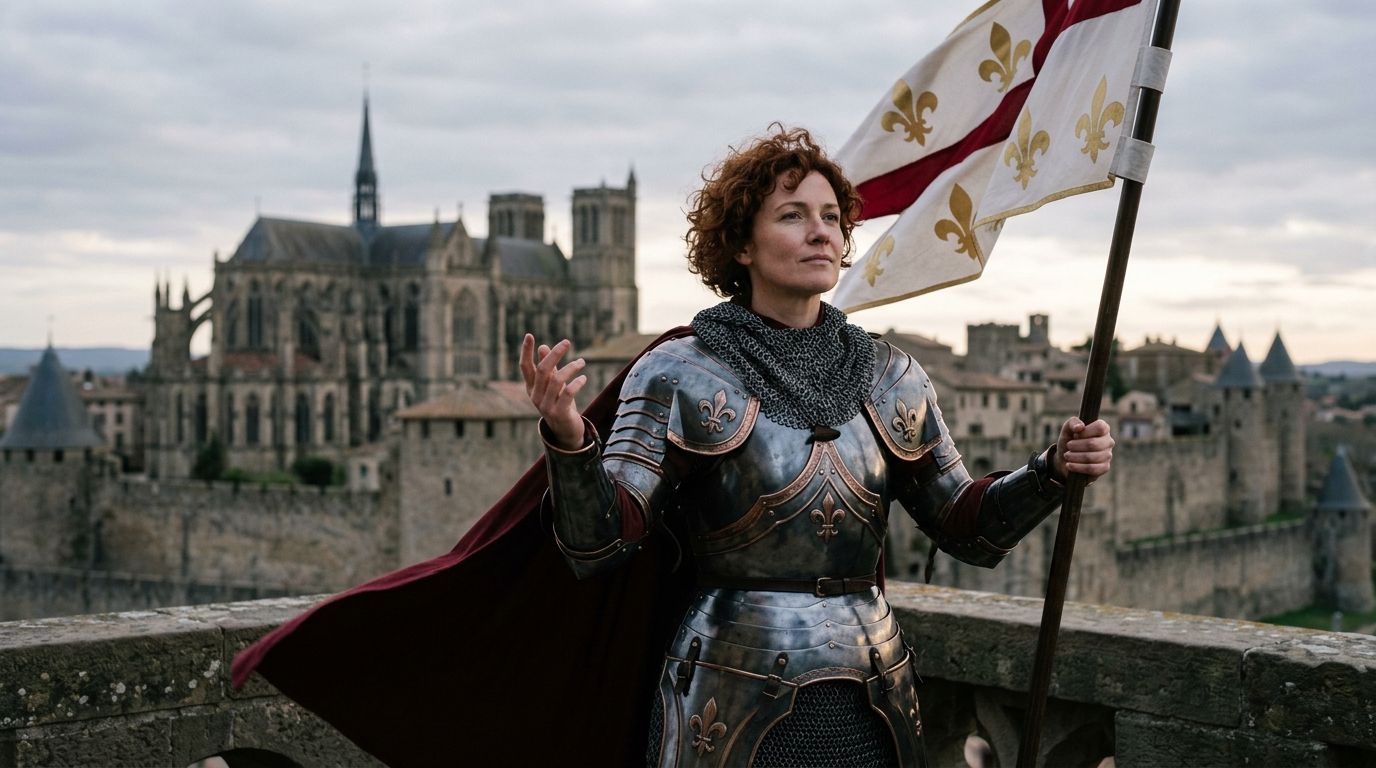
For Joan of Arc, her battle standard was far more important than her sword or protective armor. She ordered a white linen flag in Tours, decorated with silk fringe and elaborate religious paintings. The banner displayed the image of God the Father holding the globe, flanked by two kneeling angels offering lilies, the symbol of the French monarchy.
The flag contained the words "Jhesus Maria" written in gold letters, serving as a declaration of spiritual crusade against the English. Joana personally carried the standard during combat to avoid having to use weapons to kill enemy soldiers. She claimed that she preferred her banner "forty times more" than her own fighting sword.
The role of the standard was twofold: to serve as a visual guide for troops in the chaos of battle and to act as a point of moral unity. The sight of the white flag advancing against the walls inspired soldiers to follow it on the most dangerous assault missions. Joana often used the standard to mark the invasion point in gaps in enemy fortifications.
During her trial in Rouen, the inquisitors questioned Joan extensively about the flag, trying to associate it with rituals of witchcraft or idolatry. She defended the sacredness of the banner, asserting that the image represented the truth of her divine mission to save France. The white flag has remained in historical memory as the definitive visual symbol of the Maid of Orléans.
Chapter
5.3. Who Paid for Joan of Arc's Custom-Made White Armor?
The image of a peasant woman fighting in simple clothes is historically incorrect; Joan of Arc wore high-quality protective equipment. After the Poitiers examinations, King Charles VII ordered her a complete set of brushed steel plate armor, known as "white armor" due to the shine of the undecorated metal. The cost of this equipment was equivalent to the value of a small medieval castle at the time.
The financing of the armor was done through the royal treasury, as part of the military investment for the Orléans campaign. The armor was custom forged by master armorers in Tours to fit Joan's young, slender body. The total weight of the set was around 44 to 55 pounds, distributed evenly across the joints to allow mobility in combat.
The armor included a protective helmet, steel breastplate, arm and leg guards, and articulated metal gloves. Joana demonstrated unusual ease in dressing and moving around with the heavy equipment, something that normally required years of physical training in her youth. This fact surprised the experienced knights, who saw it as yet another sign of supernatural military aptitude.
The equipment saved Joana's life on several occasions, absorbing impacts from stones, arrows and sword blows. After his capture at Compiègne, his armor was confiscated by his enemies as a war trophy and displayed publicly. The white armor symbolized the legitimate military status granted to the Maiden by the French crown during the conflict.
Chapter
5.4. Did Joan of Arc Kill Someone in Battle During the Hundred Years' War?
One of the most debated questions about Joan of Arc's military actions is whether she directly shed enemy blood. During her testimonies at the Rouen court, Joana categorically stated that she had never killed a man in combat. She explained that she preferred to carry her white standard to avoid using the sword to wound or murder English soldiers in battle.
Although she led the troops on the front line, Joana's role was one of tactical leadership, moral inspiration and direction of the assault. She positioned artillery, organized attack lines and led advances against enemy walls with assault ladders. His presence in the vanguard served to break the hesitation of the French soldiers, and not to act as an individual duel combatant.
However, Joana did not hesitate to use tactical violence to achieve the campaign's military objectives. She ordered ruthless attacks and demanded that the English be mercilessly expelled if they refused to surrender peacefully. In the open field, she carried her sword and used it to defend herself from direct attacks from enemy soldiers, although she avoided mortal blows.
His refusal to kill reflected his deep religious devotion and his desire to maintain the spiritual purity necessary to hear the voices. Joana saw herself as an instrument of divine justice, and not as a battlefield executioner. This moral distinction between leading war and murdering individuals was maintained by her until the end of her military career.
Chapter
6. The Triumph of Joan of Arc: The Coronation of King Charles VII in Reims Cathedral
Chapter
6.1. The Violent Loire Valley Campaign and the English Crush at the Battle of Patay
After Orléans, Joan of Arc began the Loire Valley Campaign to clear the way towards the city of the king's coronation. French forces surrounded and captured the English fortresses of Jargeau, Meung-sur-Loire and Beaugency in quick succession. The speed of French victories disorganized the English military leadership, commanded by the feared General John Talbot.
The climax of the campaign occurred in June 1429 at the Battle of Patay, an open field confrontation that destroyed the elite of English archers. French scouts located the enemy positions thanks to a startled deer that ran toward the English lines, revealing Talbot's location. Joan ordered a rapid charge of heavy cavalry before the English could drive their defensive stakes into the ground.
The French attack was devastating, resulting in a crushing victory and the capture of General Talbot himself as a prisoner. The English defeat at Patay destroyed their troops' reputation for military invincibility and opened the way to Reims. Joana proved that her victories were not limited to defensive sieges, but also to open field combat.
The victory at Patay consolidated French control over the Loire Valley and neutralized the threat of immediate English counteroffensives. Joana's military leadership was recognized as the decisive factor in the historic turn in the conflict. With the way clear, the royal party was finally able to march towards the historic city of Reims to crown the monarch.
Chapter
6.2. Why Was the City of Reims So Important to the French Crown?
In French monarchical tradition, Reims was not just a city, but the sacred center of political and dynastic legitimacy. Since the baptism of Clovis, the first king of the Franks, in the year 496, almost all the kings of France had been crowned and consecrated in Reims Cathedral. The consecration ritual with the holy oil of the Holy Ampoule was what differentiated a legitimate king from a usurper.
For Charles VII, the coronation in Reims was vital to invalidate the Treaty of Troyes, which declared Henry VI of England as king of France. Without the traditional consecration in Reims, the Dauphin was seen by many as just a pretender to the throne without divine approval. The journey to Reims through enemy territory was a political and symbolic necessity to unify the country under his leadership.
Joan of Arc obsessively insisted on this journey, arguing that the coronation was the main order she had received from heavenly voices. She understood that the military victory at Orléans needed immediate political and religious validation to have a lasting effect. The coronation in Reims would transform the Dauphin into "Charles the Consecrated", the only legitimate monarch in the eyes of God and the population.
The peaceful entry of Charles VII's entourage into the city of Reims, which opened the doors without resistance from the Burgundian garrisons, was a spectacular diplomatic triumph. The local population celebrated the arrival of the king and the Maiden with patriotic enthusiasm. The consecration in Reims marked the definitive turning point of French sovereignty against English imperial pretensions in Europe.
Chapter
6.3. Joan of Arc's Central Role During the Royal Consecration Ceremony
On July 17, 1429, Reims Cathedral witnessed the most glorious moment in Joan of Arc's life. During the solemn coronation ceremony of Charles VII, the Maid of Domrémy stood beside the main altar, holding her famous white battle standard. Her physical presence at the event symbolized the decisive role that the peasant woman had played in restoring the dignity of the crown.
Joana watched the king's anointing with tears of emotion, seeing the prophecy of his heavenly voices come true before her eyes. After the coronation, she knelt before the consecrated monarch, calling him the legitimate king for the first time in public. The presence of the young woman in armor at the altar made a deep impression on the nobles and clergy who attended the long consecration ceremony.
When asked later why her flag was carried to the altar prominently at the event, Joana famously responded: "She had been in pain, it was only right that she should be in honor." The answer encapsulated the historical justice of his presence at the height of French political victory. The banner of Orléans shared the glory of the royal coronation of Reims.
The Reims ceremony marked the height of Joan of Arc's political and spiritual influence over the French royal court. The king, as a sign of gratitude for the victories, granted perpetual tax exemption to the village of Domrémy and ennobled the d'Arc family with the title of "du Lys". This royal privilege would be maintained for centuries as a reminder of the heroine's dedication to the kingdom.
Chapter
6.4. The Cowardice of Charles VII: The Beginning of Joan of Arc's Fall After the Coronation
After the consecration in Reims, Charles VII's attitude towards Joan of Arc began to change drastically. The king, now crowned and legitimized, began to prefer diplomatic negotiations and temporary truces with the Duchy of Burgundy rather than continuing the aggressive military campaign that Joan defended. The monarch's hesitation weakened the momentum of French troops in the following weeks.
Joan advocated a quick and direct attack on Paris, which remained under English and Burgundian control, to end the war definitively. Charles VII, influenced by cynical advisors such as Georges de La Trémoille, delayed sending reinforcements and began secret talks with Philip the Good, the Duke of Burgundy. This truce strategy gave the English time to reorganize their defenses in the capital.
Royal inaction frustrated Joan and her soldiers, who saw opportunities for military victory wasted by the court's political cowardice. The king seemed more interested in maintaining his comfortable position than in liberating the remaining French territory held by his enemies. The ennoblement of Joana's family was seen by many as an attempt by the king to remove the young woman from military leadership.
This strategic division marked the beginning of Joan of Arc's political isolation within the very court she had helped to build. The king and his advisors began to consider the Maiden an unpredictable and dangerous figure for the diplomatic truce agreements they wanted to sign. The distrust of the nobles paved the way for the betrayal that would seal the heroine's fate.
Chapter
7. The Betrayal and Fall of Joan of Arc: Failure in Paris and Capture at Compiègne
Chapter
7.1. What Happened at the Siege of Paris? The End of the Myth of Invincibility
In September 1429, Joan of Arc led an attack against the walls of Paris, against the express wishes of King Charles VII's advisors. The assault on the Porte de Saint-Honoré was a military disaster marked by the lack of logistical support from the crown. The royal forces did not send enough reserve troops and refused to provide equipment needed to bridge the capital's deep moats.
During the violent combat, Joan was wounded in the thigh by an arrow fired from a Parisian defense crossbow. She continued to encourage soldiers from the trenches until the king ordered a forced withdrawal the next day, canceling the campaign to invade Paris. The withdrawal demoralized the troops and broke the myth of invincibility that had surrounded the Maiden since Orléans.
The defeat in Paris was used by royal advisors to convince Charles VII that Joan's military fortunes had come to an end. The royal army was disbanded shortly thereafter, and Joan was relegated to minor combat missions against local marauding gangs. The king's lack of support drastically limited the French heroine's military effectiveness in the following months.
The failure in Paris proved that Joan's courage was not enough to win without the support of artillery and resources from the crown. From that event onwards, she lost control over the strategic decisions of France's main army. The Maid of Orléans was forced to act with small contingents of volunteer mercenaries loyal to her cause.
Chapter
7.2. How Was Joan of Arc Captured by Enemy Burgundians in Compiègne?
Joan of Arc's tragic military outcome occurred on May 23, 1430, during the defense of the besieged city of Compiègne, north of Paris. Joana entered the city at dawn to reinforce the local garrison against attacks by the allied Burgundian and English forces. In the afternoon, she led an offensive sortie against enemy positions outside the city walls of Compiègne.
The attack was repelled by surprise Burgundian reinforcements, forcing French troops to retreat in panic towards the bridge accessing the city. In the chaos of the military withdrawal, the governor of Compiègne, fearing that enemies would invade the city, ordered the drawbridge to be raised and the gates closed. This tragic decision left Joana and her small escort isolated outside the protective defenses.
Joan was surrounded by enemy knights and pulled from her horse by a Burgundian archer, who grabbed her red gold cloak. She initially refused to surrender, remaining true to her voices until she was immobilized by the soldiers of warlord Jean de Luxembourg. His capture was celebrated by the English and Burgundians as the greatest military victory of the entire campaign.
The question of whether the closing of the gates was an act of deliberate betrayal or a desperate defensive decision continues to divide historians. The fact is that Joan of Arc was left at the mercy of her most implacable enemies without any attempt at rescue by local French forces. The Maid of Domrémy began her long captivity in Burgundian prisons.
Chapter
7.3. Why Did King Charles VII Refuse to Pay the Ransom to Save Joan of Arc?
After the capture of Joan of Arc, Charles VII's court adopted an attitude of silence and indifference that shocked his contemporaries. In the military tradition of the Middle Ages, the release of high-ranking prisoners of war through financial ransom was a common and expected practice. However, the King of France made no financial or diplomatic offer to release the heroine who had secured his coronation in Reims.
Charles VII's refusal reflected the influence of his advisors, who convinced the king that Joan's mission had already fulfilled its role and that her captivity eliminated a politically inconvenient figure. The monarch feared that insisting on Joan's release could jeopardize the peace negotiations with Philip the Good, the Duke of Burgundy. Joana's life was sacrificed on the altar of diplomacy and political pragmatism at court.
While the King of France remained completely silent, the Inquisition and the English military leadership joined forces to purchase the prisoner from the Burgundians. The English government offered the astronomical sum of 10 thousand pounds of gold to obtain custody of Joan of Arc, an amount equivalent to the ransom of a royal prince at the time. Payment was made by Jean de Luxembourg, who handed the Maid over to her English captors.
Charles VII's indifference sealed Joan's fate, allowing her to be taken to English-held territory to face a political trial. History recorded the cowardice of the French monarch, who preferred to ignore the capture of his main military commander so as not to interfere with his immediate courtly interests. Joan of Arc was left to fend for herself by the king she had helped crown.
Chapter
7.4. The Desperate Suicidal Leap from the Tower of Beaurevoir Castle
During her Burgundian captivity at Beaurevoir Castle, Joan of Arc attempted a dramatic escape from her prison. Upon learning that she would be sold to the English and sent to the city of Rouen to be tried for witchcraft, despair took over the 18-year-old prisoner. She refused the instructions of their voices, which asked her for patience and resignation, and planned a daring escape.
Joana jumped from the window of her cell at the top of the castle tower, at a height of approximately 59 to 69 feet high. The impact against the floor of the pit was violent, leaving the young woman unconscious and seriously injured in her legs and back. She miraculously survived the fall without breaking any major bones, although she was weakened for weeks due to internal bruising.
Upon being recaptured by the castle guards, Joan justified the jump as a desperate attempt to escape falling into the hands of the English and to help the besieged population of Compiègne. Her captors used the episode to accuse her of attempting suicide, a very serious sin under the dogmas of the medieval Catholic Church. The leap from the tower was seen as proof of his rebellion against the divine designs he claimed to follow.
The Beaurevoir incident demonstrated Joan's extreme determination not to be handed over to the English under any circumstances. The physical fracture caused by the fall weakened her health for the difficult interrogations that awaited her in the city of Rouen. After the failed escape episode, security around the Maiden was doubled until her formal handover to the English authorities.
Chapter
8. The Unjust Trial of Joan of Arc at Rouen: The Dark Truth Behind the Trial
Chapter
8.1. Who Was Pierre Cauchon? The Corrupt Bishop Who Led the Inquisition Against the Heroine
The trial of Joan of Arc at Rouen was led by Bishop Pierre Cauchon of Beauvais, one of the most controversial and ambitious figures in French ecclesiastical history. Cauchon was a fervent ally of the English cause and a court advisor to the young King Henry VI of England. He saw the case against Joan as a golden opportunity to obtain the prestigious position of Archbishop of Rouen as a reward for his political services.
Cauchon designed the trial to serve the propaganda interests of England, which needed to prove that the coronation of Charles VII had been carried out with the help of a witch and heretic. The bishop used inquisitorial legal rules in a distorted way to ensure that Joana did not have access to lawyers or defense witnesses during the process. He personally selected a panel of judges and theologians sympathetic to the English cause to form the inquisitorial tribunal.
To ensure a conviction, Cauchon manipulated the written records of the interrogations, omitting Joana's most intelligent answers and altering the wording of her statements to make them appear sinful. He also allowed armed English soldiers to guard Joan's cell, violating the ecclesiastical rule that Inquisition prisoners should be kept in Church prisons guarded by religious women.
Pierre Cauchon's corrupt conduct was exposed years later at the rehabilitation trial, where he was posthumously found guilty of fraud and legal heresy. Her personal ambition cost the French heroine her life and turned her name into a synonym for injustice and religious manipulation in the country. Cauchon represented the darker face of the Anglo-Burgundian military ecclesiastical alliance of the time.
Chapter
8.2. How Did an Illiterate Peasant Defeat the Greatest Theologians of Paris in Interrogations?
During the interrogations carried out in the chapel of the Castle of Rouen, Joan of Arc faced more than 60 theologians, doctors of law and bishops trained at the University of Paris. The 19-year-old girl, unable to read or write, faced the complex and tricky questions of the greatest intellectuals of her time with remarkable lucidity and mental firmness. She defended the legitimacy of her heavenly voices against accusations of spiritual falsehood.
The judges tried to confuse her with difficult questions about dogma and complex theology, hoping that she would fall into contradictions that could justify the charge of heresy. Joana responded with simple peasant proverbs and a direct logic that disarmed the academic inquisitors. His detailed memory of past events and dialogues with the voices surprised the inquisitorial court in Rouen.
The clarity of his answers prevented Cauchon from ending the trial quickly with a summary conviction for witchcraft. Joan appealed several times to be taken before the Pope in Rome, knowing that a papal trial would be fairer than the English-dominated local court. Pierre Cauchon vehemently ignored these legitimate requests for legal appeal so as not to lose control over the case.
The confrontation between Joan's peasant intelligence and the scholastic sophistication of her judges became the most impressive element in the written records of Rouen's trial. Joana proved to be more faithful to Christian principles than most of the corrupt clergy who questioned her in court. His intellectual resistance in Rouen's debates and interrogations ensured that his trial would go down in history as an ecclesiastical farce.
Chapter
8.3. The Brilliant Answer About the "State of Grace" That Destroyed the Church Trap
The most tense and famous moment of the entire Rouen trial occurred on February 24, 1431, when an inquisitor asked a theological question considered a perfect trap to condemn Joan. He asked, "Do you know if you are in God's state of grace?" The question was considered insoluble in a secure theological way in the Middle Ages.
If Joan answered "yes", she would be condemned for heresy and sinful presumption, as Catholic theology dictated that no ordinary human being could be absolutely certain of being in God's grace without special revelation from the Church. If she answered "no," she would be admitting to being guilty of mortal sin and falsehood in her mission of spiritual leadership in war. Rouen's interrogation room remained in absolute silence awaiting the young defendant's inevitable response.
Joana, after a moment of silence, gave an answer that shocked the erudite theologians present in the room due to its perfect doctrinal precision: "If I am not there, may God place me in it; if I am, may God keep me in it. I would be the saddest person in the world if I knew that I was not in God's grace." The inquisitors were speechless and surprised by the wisdom of the illiterate defendant's direct response.
This episode proved the judges' inability to find legitimate theological flaws in their basic spiritual beliefs. The response about God's grace was recorded in the case file and continues to be cited as an example of extraordinary spiritual discernment under conditions of extreme pressure. Joana disarmed the inquisitorial trap with her pure faith and direct reasoning.
Chapter
8.4. The Inhumane Conditions in Rouen Prison and the Constant Threat of Abuse by the English Guards
Joan of Arc's suffering in Rouen was not limited to intellectual interrogations; she faced inhumane conditions of imprisonment in the castle tower. She was kept in a dark, cold cell, chained by her feet to a heavy oak beam and watched day and night by five rough English guards (the "houspillets"), known for their brutality against prisoners of war.
The English, enraged by the military defeats suffered in the war, subjected Joana to continuous insults and threats of torture and death at the stake. The constant presence of men in the cell prevented the young woman from having privacy for her basic physiological needs and personal hygiene. The fear of suffering sexual violence was a daily reality that tormented the young Maiden's mind in the Rouen prison.
To defend herself from rape attempts by English guards, Joana refused to abandon her male soldier's clothing, keeping her pants firmly tied to her leather doublet. On one occasion, she accused a high-ranking English nobleman of trying to rape her in her own cell in Rouen, a fact that convinced her of the absolute necessity of continuing to dress as a man.
Cauchon and the ecclesiastical authorities knew of the risk of physical abuse that the prisoner faced, but ignored the situation to maintain the military support of the English in the trial. The lack of adequate protection violated the minimum rights of a defendant in the custody of a religious court. The inhumane treatment suffered by Joana in Rouen prison hastened her physical and mental exhaustion before her final conviction.
Chapter
9. The 70 Crimes of Joan of Arc: Why Did Wearing Pants Lead the Heroine to Death?
Chapter
9.1. From Witchcraft to Horse Theft: What Were the Main Accusations in the Trial?
The Rouen inquisitorial process initially brought together 70 formal accusations against Joan of Arc, covering a wide variety of alleged religious and civil crimes. The accusatory list mixed arguments of far-fetched theology with mundane complaints about Joana's military conduct. She was accused of witchcraft, theological heresy, invocation of demons, excessive spiritual pride and rebellion against her parents in childhood.
Among the most unusual complaints, the English accused her of stealing horses during the military campaign and accepting honors and riches incompatible with Christian simplicity. The prosecution also alleged that Joan's visions under the Fairy Tree in Domrémy proved her connection to ancient pagan cults and local witchcraft practices. The court attempted to characterize all of the Maiden's actions as inspired by the devil to invalidate her military victories.
As the trial progressed and the more serious accusations of witchcraft proved difficult to prove due to a lack of hard evidence, Cauchon narrowed the list to 12 focused articles of condemnation. These final articles focused the accusation on three main points: the refusal to submit to the authority of the earthly Church Militant, the falsity of its heavenly revelations, and the obstinate wearing of men's clothing of the opposite sex.
The reduction of the process to men's clothing and ecclesiastical disobedience proved the legal fragility of the inquisitorial court. The English were unable to prove that Joan was a witch or an ally of demons in their battles. The final conviction was based on minor disciplinary and dogmatic issues that could be manipulated to justify execution.
Chapter
9.2. What Happened at Saint-Ouen Cemetery? The False Confession of Joan of Arc
On May 24, 1431, the court of Rouen prepared a public spectacle in the cemetery of the Abbey of Saint-Ouen to force Joan's moral surrender. She was taken before a large crowd and placed on a wooden platform in front of the newly prepared fire. The inquisitor read an accusatory sermon and demanded that she sign a document abjuring her immediate doctrinal errors.
Threatened with immediate execution if she refused to sign the paper, and physically exhausted by months of isolation and mistreatment in prison, Joana gave in to panic. She agreed to sign the abjuration document with a simple cross, abjuring her voices and promising to submit to the authority of the Church. This act of surrender temporarily prevented his execution at the stake in Rouen.
The original abjuration document read to Joana was short and simple, but Cauchon replaced the paper with a long text in which the defendant admitted to having lied about her visions and practicing serious heresies against the faith. The forced signature served to demoralize the heroine before her French supporters, proving that she was a repentant liar. Joana was sentenced to life in prison as punishment for her alleged past mistakes.
The surrender at Saint-Ouen lasted only a few days, as the young woman realized that she had been deceived by the corrupt inquisitors. She bitterly regretted having signed the abjuration to save her own physical life from the suffering of the flames. This repentance paved the way for the resumption of his original mission and for his definitive condemnation as a lapse.
Chapter
9.3. Why Did She Wear Men's Clothes Again in Prison? The Need for Defense
After Saint-Ouen's abjuration, Joan was given women's clothing in Rouen's cell, in accordance with the rules of her new life sentence. However, on May 28, 1431, the judges found Joan dressed again in men's leather soldier clothing in the tower cell. This return to masculine attire was considered definitive legal proof that she had lied in her abjuration.
Joan's justification for returning to men's clothing reflects the silent violence she suffered in the English prison of Rouen. She told the judges that the English guards tried to rape her and forcibly took off her women's clothing, leaving her with no alternative to protect herself from the cold and further physical abuse. Wearing men's pants held together by leather strings was her only defense against rape in her cell.
She also stated that the voices of Saint Catherine and Saint Michael reappeared in the cell, accusing her of having committed a great betrayal by signing the abjuration to save her life. Joan declared that she would rather die at the stake than live as a liar in the English prisons of the city of Rouen. The heroine resumed her military identity as a sign of absolute fidelity to her mission and personal dignity.
Classical theology permitted the wearing of clothing belonging to the opposite sex in cases of extreme need to defend physical chastity, but Cauchon disregarded this legitimate argument. He declared that the defendant had returned to her past errors with sinful obstinacy. The inquisitorial court declared Joan of Arc a "relapsed" heretic and formally handed her over to the English civil authorities for immediate execution at the stake.
Chapter
9.4. The Final Sentence: How the Church Condemned Joan of Arc as a Relapse and a Witch
The reading of Joan of Arc's definitive sentence took place on the morning of May 30, 1431, in the court of Rouen. The legal text declared the defendant guilty of obstinate heresy, sinful superstition and outrageous transvestism against the decency of her biological sex. She was classified as a rotten member to be cut off from the Church of Christ to avoid contaminating other local believers.
The designation of "relapse" was crucial under the rules of medieval inquisitorial law; it meant that the defendant had returned to sin after having sworn to abjure her mistakes in the cemetery. For lapses, Church law offered no new chance for forgiveness or earthly physical repentance. The only possible punishment was surrender to the English civil secular justice system for execution by fire.
The sentence was read by Pierre Cauchon, who wept hypocritically as he read the final accusations of heresy against the young peasant woman. The document, devoid of a solid legal basis, served as legal cover for the political assassination orchestrated by the English court in the city of Rouen. The crown of England had obtained the legitimation it needed to defame the cause of Charles VII.
With the signing of the sentence of condemnation, Joan of Arc lost the minimum protection that the Church granted her against immediate civil violence. She was handed over to the royal executioner of Rouen with strict orders to prepare the execution for the same day. The Rouen inquisitorial process ended with the delivery of the heretical defendant to the inquisitorial fire.
Chapter
10. Joan of Arc Burned at the Bonfire: The Dark Details of the Inquisitorial Execution
Chapter
10.1. How Was the Preparation for Death in the Old Market Square in Rouen?
On the morning of May 30, 1431, the Old Market Square (Place du Vieux-Marché) in Rouen was surrounded by more than 800 armed English soldiers to prevent rescue attempts by the local French population. Rouen's royal executioner, Geoffroy Thérage, was strictly ordered to build an exceptionally tall bonfire in the center of the execution square.
The unusual height of the oak fire pit had a dual purpose: to ensure that the crowd could see the execution and to prevent the executioner from applying the traditional "mercy choke" (quick strangulation of the condemned by means of a rope before the flames reached the body). Joan was condemned to burn alive slowly and painfully under the heat of the flames in the square of Rouen.
She was dressed in a linen tunic impregnated with sulfur to accelerate the initial fire and covered her head with a cardboard miter bearing the humiliating words written: "Heretic, Relapsing, Apostate, Idolater." The 19-year-old walked to the execution post crying and asking for prayers from the local population who watched in silence.
Corrupt judges and clerics occupied elevated tribunes around the square to comfortably watch the spectacle of political execution. The atmosphere in Rouen square was permeated with smoke and the smell of sulfur from the torches used to light the wood piled on the pole. The meticulous preparation of the fire demonstrates the logistical cruelty of the English government in the war.
Chapter
10.2. The Last Words of Joan of Arc and the Surprising Piety of an English Priest
As the executioner lit the wood for Rouen's fire, Joan of Arc cried out asking for a cross to be given to her to hold in her arms before the fire. A simple English soldier, sympathetic to the suffering of the injured young peasant woman, made an improvised cross with two sticks tied with string and handed it to the Maiden at the post. She kissed the wooden cross and tucked it under her linen tunic.
The Dominican priest Isambart de la Pierre, who had secretly supported Joan during Rouen's interrogations, ran to the neighboring church and brought the cathedral's golden processional cross. He kept the cross raised before Joana's eyes in the midst of the flames so that she could contemplate the image of Christ until her last moment of physical consciousness on the pole.
In the chaos of the flames that rose up the execution pole, Joana repeatedly shouted the name of "Jesus", also invoking the names of Saint Michael, Saint Margaret and Saint Catherine of Alexandria. She loudly declared that the voices she had heard were from God and that she had not lied or practiced heresy in the conduct of her military mission in France.
Joan of Arc's last words made a deep impression on the English soldiers and skeptical French clergy who watched the spectacle of death in the square of Rouen. Many began to cry openly, regretting having participated in the inquisitorial process against the heroine. The mercy shown at the post broke the morale of the English executioners in an unexpected way.
Chapter
10.3. The Miracle of the Intact Heart That Survived the Flames of the Bonfire
After the initial fire consumed Joan of Arc's linen clothes and skin, the executioner Geoffroy Thérage received orders from the English to remove the embers from Rouen's bonfire to display her charred body to the crowd in the square, proving that she was just a mortal woman and not a sorceress immune to the flames of the inquisition.
The executioner then threw new logs of oak wood into the fire to burn the remainder of the French prisoner's internal organs and bones completely at the stake. However, at the end of the execution in the square of Rouen, Geoffroy Thérage made a frightening discovery that left him in a moral panic before the English castle officials.
Joan of Arc's heart and intestines remained intact and filled with fresh blood amidst the red ashes of the Rouen bonfire, vehemently resisting the harsh flames that had melted the fat from her body. The executioner tried to burn the heart again with sulfur and boiling oil, but the organ remained miraculously intact under the inquisitorial fire from the square.
Terrified by the physical miracle, Thérage declared that he feared he had condemned a saint of God to death at the stake in Rouen. He later confessed to friends and clergy that his soul was lost for having executed the Maid of Domrémy in such a cruel way. The miracle of Joan of Arc's heart entered the chronicles of the time as proof of her divine purity before the English inquisition.
Chapter
10.4. Why were Joan of Arc's ashes thrown into the River Seine? The Fear of the Relics
The English government, fearing that French supporters of Charles VII would collect Joan of Arc's remains to create sacred religious relics of popular veneration, took extreme measures after the execution in the square of Rouen. They wanted to erase any physical trace of the Maid from French history.
The Cardinal of Winchester ordered the executioner Geoffroy Thérage to carefully collect all the ashes from the fire, the charred bones and the intact heart that had resisted the fire in the square of Rouen. He demanded that everything be placed in a heavy linen sack to be transported under military escort to Mathilde's bridge over the River Seine.
The executioner threw the bag containing Joan of Arc's remains and miraculous heart into the deep waters of the River Seine, ensuring that no fragment of her body could be kept by the faithful or French nobles. The complete physical destruction of his remains had the political purpose of preventing his tomb from becoming a site of national military pilgrimage in France.
The scattering of Joan of Arc's ashes in the waters of the River Seine did not prevent the birth of her cult of national veneration in the following decades. On the contrary, the absence of a physical tomb meant that his spiritual image spread throughout France as an eternal symbol of patriotic resistance. The Seine kept the physical secret of the Maid of Orléans.
Chapter
11. The Annulment Trial: How Joan of Arc Was Rehabilitated and Declared Posthumous Innocent
Chapter
11.1. The French Return to Rouen and the Beginning of the Secret Investigation in 1450
Two decades after Joan of Arc's execution, the military balance of the Hundred Years' War had shifted entirely in France's favor. In 1449, the forces of King Charles VII reconquered the city of Rouen from the hands of the English, taking physical control of the original archives of the inquisitorial process against the Maid of Orléans.
Charles VII understood that he could not allow his coronation in Reims to remain associated with a sentence of heresy and witchcraft against his main military commander. In 1450, the monarch ordered the rector of the University of Paris, Guillaume Bouillé, to begin a secret investigation into the written records of Pierre Cauchon's trial in Rouen.
The preliminary investigation revealed serious procedural fraud and manipulation of testimonies by the English authorities and the corrupt bishop. With the support of Pope Callixtus III, Joan of Arc's family was finally able to present an official petition to reopen the inquisitorial process to cleanse the honor of the French national heroine.
This was the first diplomatic and legal step towards annulling the unjust conviction suffered at the stake in Rouen. The king needed to purify the legitimacy of his royal dynasty before other European monarchs and the Catholic Church in Rome. The French return to Rouen opened the way for historical justice against Pierre Cauchon.
Chapter
11.2. The Role of Joan of Arc's Mother for Justice and Reopening of the Inquisitorial Process
The reopening of Joan of Arc's trial was tirelessly led by her elderly mother, Isabelle Romée, who traveled to Paris in 1455 to present the case in person to the Pope's representatives at Notre-Dame Cathedral. Accompanied by her surviving children, Isabelle read a moving plea asking for the restoration of her innocent daughter's honor.
Isabelle Romée defended the pure religious education she had given Joana as a child in Domrémy, arguing that her daughter had never practiced heresy or witchcraft against the Christian faith. Her maternal dedication moved the papal theologians, who agreed to open an official court of inquiry to hear witnesses at Rouen's trial.
Joana's mother actively participated in the investigation hearings, despite her poor health due to old age and material poverty caused by the Hundred Years' War. She represented the voice of simple peasant justice against the theological abuses committed by the corrupt bishops of the English Inquisition in France.
Isabelle Romée's actions were decisive in convincing the Catholic Church in Rome that the original process was a political farce disguised as an inquisition of faith. Her persistence ensured that Joan of Arc's memory was cleansed of all unjust accusations of witchcraft and ecclesiastical rebellion. The heroine's mother lived long enough to see the family's honor restored by the Pope.
Chapter
11.3. Shocking Testimonies of Repentance from Former Inquisitors and Guards
The rehabilitation court established by Pope Callixtus III heard more than 115 surviving witnesses from the Rouen trial and Joan's childhood in Domrémy. The inquiry gathered testimonies from former judges, court clerks, English prison guards and neighbors from Maiden's village.
Court clerks, such as Guillaume Manier, confessed under oath that Pierre Cauchon threatened them with physical death to alter the written records of Joan's interrogations in Rouen. They admitted that they omitted the peasant defendant's most brilliant theological responses to ensure her condemnation to the inquisitorial stake.
The testimonies also revealed the inhumane conditions that the defendant suffered in the Rouen tower, including attempted sexual violence committed by chained English guards. Even surviving English executioners and soldiers testified in regret of the cruel execution in the square of Rouen, declaring that they had killed an innocent saint.
These testimonies exposed the Anglo-Burgundian political conspiracy to discredit the French crown through the murder of Joan of Arc. The truth about the legal frauds committed by Pierre Cauchon was definitively recorded in the records of the papal rehabilitation process in Rouen.
Chapter
11.4. The Historic 1456 Verdict That Declared Joan of Arc Innocent and Martyr
On July 7, 1456, the papal court in Rouen issued its official verdict on the appeal of Joan of Arc's case. The ruling declared the 1431 trial of Pierre Cauchon as entirely null and void, fraudulent, unjust and corrupted by English political interests in the war.
The annulment verdict was read solemnly in the Old Market Square in Rouen, on the exact spot where Joan had been burned alive at the stake 25 years earlier. The Church ordered the installation of a monumental cross at the site of the bonfire to honor the memory of the innocent heroine declared a martyr of France.
The 1456 sentence cleansed the honor of Joan of Arc and her surviving family of all accusations of witchcraft, theological heresy, and rebellion against ecclesiastical faith. Charles VII was definitively cleansed of any association with the evil supernatural, ensuring the full legitimacy of his French royal dynasty.
The papal rehabilitation trial transformed Joan of Arc from a burned heretic into a legitimate defender of the French faith and nation in the Middle Ages. The historic sentence of 1456 remained the fundamental document of his canonization in the following centuries. The name of the Maid of Orléans was restored to national glory.
Chapter
12. From Heretic to Patron Saint of France: The Long Canonization of Joan of Arc
Chapter
12.1. Why Did It Take the Catholic Church Almost 500 Years to Recognize the Heroine?
A canonização de Joana d'Arc foi um processo lento de quase cinco séculos, devido a divisões diplomáticas e teológicas dentro da própria Igreja Católica e da política francesa. Although the trial of 1456 cleared her name of heresy, the Church hesitated for centuries to officially declare her a saint.
There was theological resistance to canonizing a military figure who had worn men's soldier clothing and led armies in war, something unusual for traditional female saints. The Vatican also feared that elevating Joan to the altar could reopen old diplomatic wounds with England and the United Kingdom in modern geopolitical campaigns.
The resurgence of the image of Joan of Arc occurred in the second half of the 19th century, when French nationalism and the loss of Alsace-Lorraine to Germany in 1870 created the need for a symbol of patriotic unity. Catholic and liberal historians joined forces to advance the cause of the Maiden's sainthood before the Holy See in Rome.
Defeat in the war led France to seek inspiration from its medieval history of resistance against foreign invaders at home. The Catholic Church understood the value of bringing the Christian faith closer to the French popular masses through the elevation of Joan to national altars. The journey to sainthood was driven by modern politics.
Chapter
12.2. What was the process of beatification and canonization like at the beginning of the 20th century?
The process of beatification and canonization of Joan of Arc was formally opened by Pope Leo XIII in the late 19th century, advancing rapidly in the following decades under the leadership of influential French bishops and the republican government in Paris.
On April 18, 1909, Pope Pius The act was seen as a triumph of French Catholicism at a time of strict separation of church and state in the country.
The definitive canonization took place on May 16, 1920, celebrated by Pope Benedict XV in Saint Peter's Basilica in Rome. Joan's elevation to "Saint" occurred shortly after the end of the First World War, serving as a symbol of national reconciliation and victory for French forces in the European conflict.
The canonization of 1920 crowned Joan of Arc's 490-year journey from condemned to the inquisitorial fire to the country's patron saint in an official way. French law declared the second Sunday in May a national holiday in honor of Saint Joan of Arc in France. The Maiden of Domrémy had achieved spiritual glory on Catholic altars.
Chapter
12.3. What Were the Three Official Medical Miracles Attributed to Saint Joan of Arc?
Under the Catholic Church's canonical rules for the canonization process, proof of unexplained medical healing miracles achieved through intercessory prayer is a mandatory requirement. In the case of Joan of Arc, three cures that occurred at the beginning of the 20th century were validated by the Vatican's medical committees.
The first miracle involved Sister Thérèse de Saint-Augustin, from Reims, who was instantly cured of a chronic and incurable tuberculous stomach ulcer after praying fervently for Joan of Arc's intercession in her severe pain.
The second validated case was the cure of Frust's sister Julie Gauthier, who suffered from metastatic breast cancer at an advanced stage that was incurable due to medical treatments at the time. The total regression of the malignant tumor occurred quickly after a novena in devotion to the Maid of Orléans.
The third attested miracle involved the healing of Marie-Jeanne Mirandelle, who suffered from a severe chronic bone infection (osteomyelitis) in her leg that prevented her from walking without crutches. The instant healing allowed her to walk again without physical pain. These medical miracles attested to the spiritual sanctity of the French heroine.
Chapter
12.4. The Use of the Image of Joan of Arc as a Symbol of Resistance in the World Wars
During the First and Second World Wars, the historical image of Joan of Arc was used massively by all political factions in France as the supreme symbol of patriotic resistance against foreign invasions.
In the First World War, military propaganda posters portrayed the Saint in white armor pointing her sword towards the trenches, encouraging French soldiers to defend their homeland against the German army in the Battle of the Marne. The bombed Reims Cathedral reinforced the mystical link between the past and the pains of modern conflict.
In the Second World War, the use of his image was disputed in parallel by the collaborationist Vichy government, under Marshal Pétain, and the Free French resistance forces, under General Charles de Gaulle. Vichy used Joan as a symbol of resistance against English aggression, remembering her death in Rouen.
General Charles de Gaulle, in turn, adopted the Cross of Lorraine — traditionally associated with Joan of Arc — as the official symbol of the French liberation forces against the Nazi German occupation of Europe. The Maiden unified France's identity in the final military victory of 1945. Her image proved her immortal strength of national resistance.
Chapter
13. Fun Facts About Joan of Arc: The Definitive Guide to Myths and Little-Known Facts
Chapter
13.1. The False Return: Who Was Claude des Armoises, the Impostor Who Deceived the People?
After her execution at the stake at Rouen, persistent rumors spread throughout France that Joan of Arc had escaped death through a miracle or by replacing prisoners at the post. Several women tried to pose as the heroine in the following years to obtain money and honors.
The most successful impostor was Claude des Armoises, who emerged in 1436 claiming to be the real Maid of Orléans who had escaped from English imprisonment. She managed to convince Joan's legitimate brothers, Jean and Pierre d'Arc, who publicly recognized her as their sister who had disappeared in the war.
Claude des Armoises' hoax ran for four years, during which time she was received with honors and gifts from kings by the population of Orléans and other French cities grateful for her past military victories. She even married a local noble knight of the Armoises lineage.
The hoax was exposed in 1440 when she was brought before King Charles VII in Paris. The monarch asked her to whisper the intimate secret they had shared in Chinon. Claude des Armoises broke down in tears, confessing his fraud and asking for royal clemency. She was publicly punished, but the legend of her escape from the burning of Rouen lived on for decades.
Chapter
13.2. The Mystery of Joan of Arc's Ring Purchased by Puy du Fou Park in 2016
In 2016, a historic artifact sparked international diplomatic controversy and historical debate in Europe: the sale at auction in London of an ancient gold-plated brass ring that once belonged to Joan of Arc. The jewel had been confiscated by the English inquisitors during his trial in Rouen.
The ring contained the religious inscriptions "Jhesus Maria" engraved in relief and three metal crosses on the side structure, matching the exact description of the jewelry that Joana had described to the judges during Rouen's interrogations. The artifact had remained in English private collections for almost 600 years of history.
The ring was purchased at auction by the historic French theme park Puy du Fou for the sum of $410,000, returning to France amid great national celebration. The British government tried to block the artefact from leaving, demanding a special license to export cultural heritage, which Puy du Fou refused to request.
The jewelry's return was surrounded by patriotic pride, although some skeptical historians raise doubts about the absolute authenticity of the brass ring due to the lack of continuous ownership records since the 15th century. Joan of Arc's ring remains on display in a prominent location at Puy du Fou.
Chapter
13.3. What Did Joan of Arc Really Look Like Physically? The Total Absence of Official Portraits
Despite her monumental fame, there are no official portraits or realistic paintings of Joan of Arc made during her short life of 19 years. The only image drawn contemporaneously with her is a quick sketch made in the margins of a court record in Paris by a clerk who had never seen her in person.
The 1429 sketch depicts the Maiden with long hair and feminine dress carrying a sword and banner, ignoring the reality of her short hair and masculine leather soldier's clothing. The classical paintings we know today were created centuries later based on the aesthetic conventions of each era.
Testimonies from comrades in arms provide important physical descriptions about Joana. She was described as a strong, broad-shouldered young woman with black hair cut short in a “scoop” style. Her voice was classified as soft, clear and feminine, contrasting strongly with her firm presence in military command in battles.
The absence of royal portraits allowed the image of Joan of Arc to be recreated in various forms in art and propaganda throughout history, adapting to French national needs. The face of the Maiden of Domrémy remains a historical mystery that fuels the imagination of artists and art historians.
Chapter
13.4. The Scary Friendship With Gilles de Rais: The War Companion Who Became a Serial Killer
One of the darkest facts of Joan of Arc's life was her military friendship with the nobleman Gilles de Rais, one of the richest and most experienced French commanders who fought alongside her in the Loire Valley campaign and the coronation of Reims.
Gilles de Rais was appointed by King Charles VII to act as Joan's protector in battle due to his physical vigor and heavy cavalry skills. He was deeply influenced by the Maiden's charisma, sharing the honor of Reims as Marshal of France at the age of 25.
After Joan's death, Gilles de Rais retreated to his estates in Brittany, where he began a life of moral decadence, dark alchemy, and the kidnapping of hundreds of local peasant children. He was arrested and hanged in 1440 for his barbaric crimes, serving as the inspiration for the legend of "Bluebeard."
The contradiction between Joan of Arc's spiritual purity and the terrible crimes committed by her chief battle companion is one of the most fascinating paradoxes of the Hundred Years' War. Gilles de Rais fought heresy alongside the Saint and ended up convicted of heresy and brutal murders in civil courts.
Chapter
14. Joan of Arc's Tourist Guide: Where to Visit the Heroine's Main Landmarks in France?
Chapter
14.1. What to See at Joan of Arc's Birthplace in Domrémy-la-Pucelle?
For those interested in learning about the origins of the national heroine, the small village of Domrémy-la-Pucelle, in the Lorraine region, is home to Joan of Arc's preserved birthplace. The rustic 15th-century stone structure retains its original medieval architectural features intact.
Visitors can explore the four simple rooms of Jacques d'Arc's house, including the room where Joan was supposedly born and the rustic stone fireplace around which she spun wool with her mother. The garden where she had her first mystical visions is maintained as a space of meditative silence.
Next to the birth house, a modern interactive museum presents exhibits about everyday life on the frontier during the Hundred Years' War and the Maiden's family background. The village church, where Joana was baptized in the medieval stone font, can also be visited on the itinerary.
The visit to Domrémy-la-Pucelle offers a deep immersion experience in the peasant simplicity that marked the first years of the French heroine's life. The site attracts thousands of tourists and pilgrims every year in search of the origins of Saint Joan of Arc in France.
Chapter
14.2. The Historical Jeanne d'Arc and the Exact Location of the Bonfire in the Ancient City of Rouen
The historic city of Rouen, in Normandy, is the definitive tourist destination for those who want to discover Joan of Arc's last moments in France. The main landmark is the Old Market Square (Place du Vieux-Marché), where a stone plaque indicates the exact spot where the bonfire was built in 1431.
Next to the bonfire site, the modern Church of Saint Joan of Arc features bold flame-shaped architecture and houses stunning medieval stained glass windows saved from churches destroyed in the Second World War. The castle tower where Joana was kept chained in the cold cell is also open to visits in the itinerary.
The tourism highlight is the Historial Jeanne d'Arc, a state-of-the-art multimedia museum located in the former archbishopric palace of Rouen, where the rehabilitation hearings of 1456 took place. The exhibition uses digital projections and audio in multiple languages to narrate the Maiden's trial in an immersive way.
Rouen preserves the medieval atmosphere of its half-timbered streets, transporting tourists to the dark times of the English occupation of Normandy. The city celebrates Joan's memory with annual street festivals at the end of May, attracting thousands of international visitors to the celebrations.
Chapter
14.3. The Majestic Reims Cathedral and the Impact of the Saint's Equestrian Statue
The Cathedral of Our Lady of Reims (Cathédrale Notre-Dame de Reims) is the ultimate symbol of Joan of Arc's political and military triumph in France. The monumental 13th-century Gothic facade is decorated with thousands of detailed medieval stone carvings of angels and saints.
Inside Reims Cathedral, on the right side of the main altar, stands a marble and bronze statue of Saint Joan of Arc, positioned in the exact spot where she stood holding her white battle standard during the solemn coronation ceremony of King Charles VII in 1429.
In front of the cathedral, in the main square of Reims, stands the famous bronze equestrian statue of Joan of Arc in armor with her drawn sword pointing upwards, a masterpiece of 19th century French sculpture that symbolizes the Maiden's patriotic national resistance in war.
A visit to Reims offers tourists an insight into the artistic and symbolic splendor of the medieval French monarchy and the role of the national heroine in legitimizing the throne of Charles VII. The cathedral bombed in the First World War remains a testament to the country's history of resistance.
Chapter
14.4. The House of Jeanne d'Arc in Orléans: The Heart of the Historic Battle Celebration
The city of Orléans annually celebrates the liberation of English troops with traditional festivities that last ten days. The main tourist landmark is the Maison de Jeanne d'Arc, a faithful reconstruction of Jacques Boucher's half-timbered residence where Joan stayed in 1429.
The indoor museum features detailed multimedia exhibits on the siege of Orléans, the military assault tactics developed by Joan, and the weapons used in the Hundred Years' War by the two fighting forces. The collection includes interactive models of the main English fortifications in the region.
In the center of Orléans square stands the monumental bronze statue of the Maiden on horseback, with carved side plates depicting the key moments of her nine-day victory against the English army. The city maintains a strong emotional connection with the memory of the young national heroine.
Orléans is the perfect destination to understand the immediate military impact of Joan of Arc's actions on the course of medieval French history. A visit to the museum and historical sites of the battle reveals the tactical genius of the Maiden who challenged the experienced generals of the time.
Chapter
14.5. The Royal Fortress of Chinon and the Tower of the Meeting with King Charles VII
Located in the beautiful Loire Valley, the Royal Fortress of Chinon (Forteresse Royale de Chinon) stands on a rocky hill bordering the River Vienne. The medieval castle is the historic site of the definitive meeting between Joan of Arc and Dauphin Charles VII in 1429.
Visitors can explore the ruins of the Great Throne Hall, where the famous recognition test of the king hidden in the crowd of skeptical nobles took place. The clock tower houses a permanent exhibition about Joana's time at the castle and the military preparations for the campaign.
The fortress has been completely restored with modern interactive technologies, allowing tourists to use augmented reality tablets to visualize what the castle's rooms and chambers were like in medieval times during audiences with the Maiden of Domrémy.
Chinon combines the beauty of the Loire Valley's wine landscapes with the rich political history of medieval France, attracting tourists interested in military architecture and the legend of Joan of Arc's first step towards liberating the country from war.
Chapter
15. FAQ
Chapter
15.1. Did Joan of Arc know how to read and write?
No, Joan of Arc was entirely illiterate, as were the overwhelming majority of French peasants in the 15th century. She marked her military letters with a simple cross or enlisted the help of royal clerks to draft her tactical messages aimed at enemies and French troops at war.
Chapter
15.2. How old was Joan of Arc when she was executed?
Joan of Arc was just 19 years old when she was burned alive at the inquisitorial stake in Rouen, on May 30, 1431. She began her active military role at the age of 17, completing her impressive journey of victories in just under two years of campaigning in France.
Chapter
15.3. Why is Joan of Arc called the "Maiden of Orléans"?
The title "Maiden" (La Pucelle) was adopted by Joan herself to affirm her absolute physical virginity, which she considered essential to legitimize her purity before God. The complement "of Orléans" is due to his definitive military triumph in liberating the city from the English siege in 1429.
Chapter
15.4. What was the difference between the Armagnacs and the Burgundians in the Hundred Years' War?
The Armagnacs were the French faction loyal to the Dauphin Charles VII and the national sovereignty of France, based mainly in the south of the country. The Burgundians were supporters of the Duke of Burgundy, allies of the English Empire and in favor of the unification of the crowns under the rule of England in the war.
Chapter
15.5. Who betrayed Joan of Arc at Compiègne?
Historically, Joan was captured by the forces of the Burgundian Jean de Luxembourg after the gates of Compiègne were closed. Although many accuse Governor Guillaume de Flavy of deliberate betrayal, modern historians consider the closure a desperate military security measure to prevent enemy invasion.
Chapter
15.6. Where are Joan of Arc's ashes kept today?
There are no ashes or preserved remains of Joan of Arc. By order of the English government, all the ashes from Rouen's bonfire and his miraculously intact heart were thrown into the deep waters of the River Seine to prevent them from being transformed into relics of popular veneration.
Chapter
15.7. How was Joan of Arc canonized by the Catholic Church?
The canonization process of Joan of Arc was completed at the beginning of the 20th century by Pope Benedict XV, on May 16, 1920, in Saint Peter's Basilica in Rome. The elevation to saint occurred after the validation of inexplicable medical miracles of healing attributed to Joana's intercession.
Chapter
15.8. What role did Gilles de Rais play in the life of Joan of Arc?
Gilles de Rais was one of the main military commanders who fought alongside Joan of Arc in the liberation of Orléans and the coronation of Reims. Years after the Maiden's death, he was executed for the barbaric crimes of child murder, serving as the inspiration for the tale of Bluebeard.
Chapter
15.9. Which Joan of Arc ring was auctioned in England in 2016?
The ring auctioned in London was a gold-plated brass ring bearing the inscriptions "Jhesus Maria" and three side crosses. The jewel belonged to Joan and was confiscated by the English in 1431, being purchased by the French historical park Puy du Fou to return to France.
Chapter
15.10. Is it possible to visit Joan of Arc's birthplace?
Yes, Joan of Arc's birthplace is preserved and open to the public in the small village of Domrémy-la-Pucelle, in Lorraine. Tourists can visit the original medieval stone structure, the garden of visions, the baptism church and a nearby interactive historical museum.
Chapter
15.11. Why did Joan of Arc wear men's clothes in the Middle Ages?
Wearing men's soldier attire served as a practical measure for riding and fighting in camps, as well as acting as essential physical protection of chastity against attempted sexual abuse and rape by soldiers and prison guards.
Chapter
15.12. Where was Joan of Arc executed at the stake?
Joan of Arc was burned alive in the Old Market Square (Place du Vieux-Marché), in the historic city of Rouen, in Normandy. The exact spot is marked today by a large stone memorial plaque and a modern church built in honor of the patron saint.