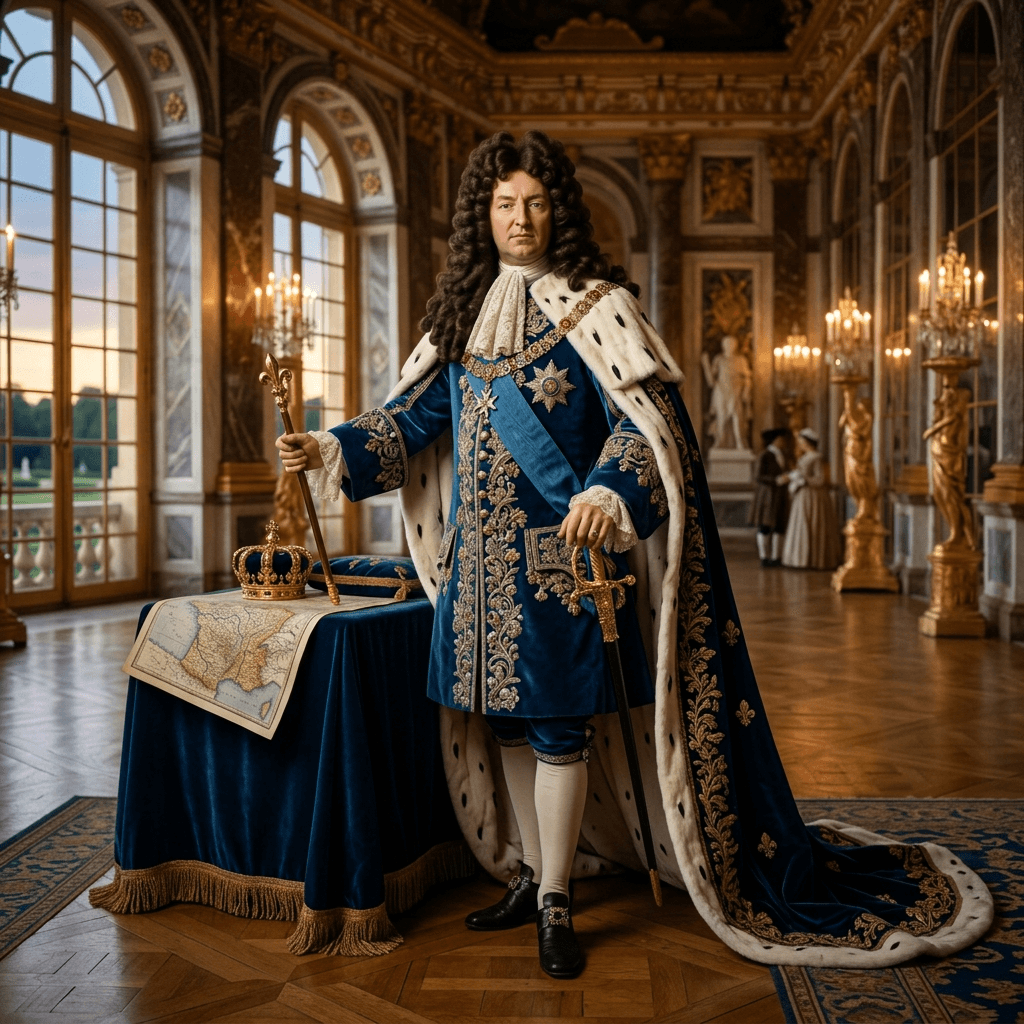
Chapter
?? 1. - The King's Formation and Rise to the Throne
Chapter
??? 2. - Government, Administration, and Centralization of Power
?? 2.1 - Administration and Economy under Jean-Baptiste Colbert
During the reign of Louis XIV, the administration of the French state reached an unprecedented degree of centralization and rationalization. This transformation was not the work of the king alone, but the result of the work of extremely competent ministers, among whom the most outstanding was Jean-Baptiste Colbert-a man who combined the vision of a meticulous bureaucrat with the ambition of a reforming statesman.
Colbert became Controller-General of Finances in 1665, a position equivalent to that of Minister of Economy, but with much broader powers, covering not only tax collection and the budget, but also the supervision of trade, industry, colonies, agriculture, and even the material culture of the court.
When Colbert took control of the finances, France was steeped in debt, corroded by administrative corruption, and haunted by the waste of wars and the unbridled luxury of some local courts. Taxes were collected inefficiently, through outsourced systems of tax farming (the so-called fermiers g�n�raux), which enriched collectors and impoverished the state. The majority of the population-peasants and bourgeoisie-bore the costs of the monarchy, while the nobility and clergy were exempt from almost all tax burdens.
Furthermore, France, despite its vast territory and large population, imported many luxury products: fine fabrics, mirrors, porcelain, colonial products. This created constant trade deficits, emptying the royal coffers and enriching rival economies, especially those of England and the Netherlands.
It was in this context that Colbert began his work of profound reorganization of the French economic and administrative apparatus.
Colbert's first step was to reform the fiscal machine. He promoted a broad audit of public accounts, fought fraud in tax contracts, and reduced private intermediation in tax collection, expanding the state bureaucracy. He established strict accounting standards, demanded detailed accountability from the intendants, and reorganized the internal customs, which caused enormous slowness to trade.
In addition, he reformed the road and port system, understanding that infrastructure was essential for economic growth. He ordered the paving of royal roads, facilitated river navigation, built the Canal du Midi (linking the Atlantic to the Mediterranean), and promoted the development of modern ports such as La Rochelle, Bordeaux, and Le Havre.
This meticulous control extended to production and consumption. He believed that the economy should directly serve the interests of the state, and not function as a field of free enterprise-a typical conception of mercantilism, the dominant economic doctrine of the time.
The economic model that Colbert applied became known as Colbertism, a form of highly protectionist and centralizing French mercantilism. Its fundamental principles were:
Produce everything within the kingdom: To avoid the outflow of wealth, Colbert encouraged the national production of luxury goods (glass, mirrors, silks, carpets, clocks, weapons), often by founding royal manufactories, financed by the state, with exclusive monopoly and strict supervision.
Replace imports with French products: He prohibited or overtaxed the entry of foreign products. The goal was for gold to remain in France, and not flow to rival powers.
Encourage exports: He created subsidies, simplified transport, and promoted 'French' brands abroad. He wanted to transform France into a world leader in the trade of luxury goods and artisanal technology.
Standardization of weights, measures, and quality: He implemented state guarantee seals, supervised the purity of metals, the meterage of fabrics, and the precision of instruments. Every French product was meant to represent 'royal excellence.'
Technical education and control of corporations: He founded schools to train artisans, watchmakers, typographers, and technicians. At the same time, he regulated the guilds, determining who could produce what, where, and how-all under royal supervision.
Colbert understood that overseas trade was vital to strengthening the state, as shown by the example of England and the Netherlands. Therefore, he reorganized the maritime sector and founded large trading companies, such as: Compagnie des Indes Orientales (East India Company), Compagnie des Indes Occidentales (West India Company), Compagnie du S�n�gal.
These companies, with state participation and guaranteed monopolies, operated trade routes with the Antilles, Africa, India, and North America. Their goal was to attract precious metals, spices, sugar, tobacco, cotton, and slaves, which fueled the metropolitan economy.
Colbert also strengthened French naval power, building shipyards, training engineers, and modernizing the fleet. He considered ships 'the carriages of commerce and the cannons of glory.' With a robust merchant and military navy, France could protect its routes, colonize new lands, and compete with the English and Dutch.
Colbert's policies brought real benefits to the French economy, especially in the 1660s and 1670s. Production grew, manufactories multiplied, the trade balance was balanced, and France's prestige increased on the European stage. Paris, Lyon, and Rouen became industrial centers. Versailles displayed the luxury produced by the kingdom's own factories. For the first time in centuries, France seemed self-sufficient and competitive.
However, the Colbertist model also had structural limits. Excessive protectionism generated friction with other countries. The concentration of investment in luxury industries left agriculture (the basis of the economy) in the background. Excessive bureaucratic centralization stifled private initiative. And, above all, the state's financial effort to maintain wars, the court, and public works ended up canceling out the productive gains.
When Colbert died in 1683, his work was partially dismantled by his successors. Many of the taxes he had tried to make fairer fell back on the poorest. Military spending intensified, and the fruits of industrial growth were absorbed by the war machine. In the long run, the French economy went into decline-but the model Colbert left remained a historical landmark of centralized, technical, and nationalist administration, a forerunner of modern state policies.
??? 2.2 - Concept Map: Principles and Consequences of Colbertism
?? 2.3 - Creation of the Modern Professional Army
Before the reign of Louis XIV, European armies were mostly composed of temporary troops, unstable mercenaries, and improvised levies of peasants gathered in times of war. Loyalty was fragile, training was almost non-existent, and command depended on feudal ties or emergency contracts.
Louis XIV broke with this model and implemented an unprecedented military reform for his time: the creation of a permanent, professional, centralized, and national army, controlled directly by the French crown.
This change transformed France into the greatest military power on the continent and laid the foundations for the modern armies we know today.
Under the command of the war minister Michel Le Tellier and, later, his son Louvois, the French army began to operate with officers with registered ranks, instead of hereditary or temporary positions; promotions by military merit or royal appointment, with central control; and formalized hierarchy, separating administrative, logistical, and combat functions.
The standardization of uniforms was a symbolic and practical step. Each regiment began to use specific colors, insignia, and cuts, which facilitated recognition on the field, increased morale and the sense of collective identity, and served as a tool of propaganda for royal power. It was the king-and no longer the feudal lords-who 'dressed' the army.
Louis XIV created military payrolls, with fixed salaries for soldiers and officers. This reduced the dependence on looting and pillaging (a common practice among mercenaries), making the army more disciplined, stable, and loyal to the state.
Before the reign of Louis XIV, soldiers were recruited and thrown into battle without specific training. From the reforms of the Sun King, each new recruit underwent standardized training in marching techniques, combat, use of weapons, and formation tactics; manuals of conduct and codes of discipline applicable to the entire army were established; and severe sanctions and clear rewards ensured order and loyalty to the royal command.
Louis XIV invested in centralized arsenals with stocks of weapons, gunpowder, and ammunition; military hospitals, with organized medical care for the wounded; warehouses and logistical supply networks for the rapid and effective movement of troops; and planned fortifications, many of them designed by Vauban, the greatest military engineer of the time.
A separate chapter in Louis XIV's military reforms is the work of S�bastien Le Prestre de Vauban, the royal chief engineer. He created the star-shaped fortification system, which made enemy sieges difficult; planned cities and fortresses with intelligent defensive networks; and introduced progressive siege techniques, still studied today.
With all these reforms, Louis XIV had about 400,000 soldiers at the height of his power-the largest military contingent in Europe in the 17th century. France became the hegemonic military power in Europe between 1670 and 1710.
The military reforms of Louis XIV were copied by powers such as Prussia, Russia, Austria, and, later, England. His model of a national army served as the basis for the emergence of modern national armies in the 18th and 19th centuries, the concept of permanent armed forces at the service of the state and not of individuals or factions, and the complete professionalization of military careers.
The creation of the professional army was a direct instrument of absolutism. By taking control of arms from the nobility and centralizing military power in the hands of the king, Louis XIV ensured that no internal uprising could threaten his throne.
?? 2.4 - Comparative Chart: Pre and Post Louis XIV Armies
| Aspect | Traditional Army (before Louis XIV) | Professional Army created by Louis XIV |
|---|
Historical observation: Louis XIV's military reform was not just a tactical change: it represented a structural change in the role of the army in society, consolidating the idea that the Armed Forces should serve the state and not private interests or factions.
???? ? 2.5 - Intendants: Royal Administrators Against Local Power
Louis XIV, the Sun King, is known for his theatricality and grandeur, but behind the pomp was a meticulous administrator obsessed with direct control of the French state.
While many kings entrusted regional government to hereditary nobles, Louis XIV decided to undermine this decentralized model by deploying a new body of royal representatives: the intendants. This administrative innovation became one of the practical foundations of French absolutism.
The intendants were officials appointed directly by the king, sent to the provinces to act as the eyes, ears, and hands of the monarchy. They did not belong to the traditional nobility-on the contrary, they generally came from the lettered bourgeoisie, with legal training and exclusive loyalty to the crown.
Their functions included: administration of local justice; collection of royal taxes and tributes; supervision of provincial armed forces; and oversight of municipal governments and local authorities.
The intendant had authority over regional parliaments, municipal councils, and military governors-which, in practice, replaced the old feudal power with a royal bureaucracy.
During the reign of Louis XIV, France was divided into administrative regions called g�n�ralit�s, and each one had at least one intendant. These regions did not respect the old feudal divisions or local traditions-they were created according to functional administrative criteria.
This network of intendants eliminated the feudal intermediaries between the king and the people; allowed Louis XIV to keep up-to-date data on the economy, justice, and security in every corner of the kingdom; and made possible the rapid implementation of royal decrees, without regional resistance.
The greatest consequence of the creation of the intendants was the erosion of the political power of the provincial nobility. Before the reforms of Louis XIV, local lords held control over justice in their lands, the collection of local taxes, and military and police authority. With the intendants, all these functions came to be supervised or directly executed by the king's agents.
The intendants were required to send periodic reports directly to Louis XIV and his ministers. These documents included population and economic statistics, public complaints, the state of harvests, taxes, prisons and local justice, recommendations for appointments, and reports of abuses. With this, the king maintained a detailed administrative overview of the country, without having to rely on information distorted by the nobles.
The institution of the intendants is considered by many historians as one of the seeds of the modern French state. It anticipated the idea of a career civil service; rational and non-hereditary administration; and continuous supervision of local authority by central bodies.
The supervisory structure created by Louis XIV would even influence the administrative models of the Enlightenment and the French Revolution, as well as being an inspiration for public service in other European countries.
?? 2.6 - Royal Etiquette: The Book that Controlled Even the Gestures of the Court
Under the reign of Louis XIV, the French court at Versailles was not just a space for parties and pomp, but a carefully rehearsed stage, in which every gesture, every word, and every movement had a political function. To ensure that the court functioned as a mechanism of obedience and order, the king instituted an extremely rigid system of royal etiquette-a detailed set of rules for behavior, position, and conduct within the palace.
This system became known as '�tiquette,' a term that, in French, literally means 'label' or 'tag,' but which took on the meaning of a formal protocol of social conduct at court. The etiquette of Versailles was more than good manners: it was a form of symbolic domination that imposed visible and unquestionable hierarchies.
Louis XIV's obsession with protocol was born from his personal experience with the political and social chaos of his childhood, especially during the Fronde (1648-1653), when nobles tried to challenge royal power. To prevent future rebellions, the king concluded that it was necessary to draw the nobles close to him and subject them to the discipline of the court.
Thus, instead of directly repressing the most powerful aristocrats, he domesticated them through prestige and vanity. Etiquette served precisely this purpose: it transformed the nobles into instruments of the royal spectacle, where each small privilege-such as approaching the king, holding a candle, or helping to put on a stocking-became a sign of political status and personal honor.
Etiquette was not informal or flexible. It was systematized and recorded in writing, in official volumes that listed: who could speak to the king, and in what circumstances; who could sit in his presence (almost no one, except members of the royal family); who could remain with a hat or sword in certain rooms; who could hold objects such as the water basin, the cloak, the royal plate, or the dinner towel; who could enter the king's apartments and at what time; the order of seats at the royal table, in parades, and in religious celebrations; and how to dress: colors, fabrics, amount of embroidery and adornments allowed by social category.
This system was so detailed that even the 'degree of reverence' before the king varied according to the person's noble title-three steps back, two knees on the ground, a kiss on the hem of the cloak, etc.
One of the most symbolic examples of courtly etiquette was the Lever du Roi-the moment when the king woke up and dressed. This scene, which could have been private and banal, was transformed by Louis XIV into a powerful court rite, with a controlled audience, designated functions, and inflexible protocol.
By creating and imposing this system, Louis XIV achieved several strategic objectives: he fixed the nobility in Versailles, far from the provinces; he transformed political rivalries into symbolic disputes; he consolidated his image as the center of the entire social system; and he standardized the behavior of the elite, spreading a French model of aristocratic culture throughout Europe.
In practice, etiquette reduced the nobles to actors in a permanent theater, in which the script was written by the king himself. And the more the courtiers became involved in the minutiae of the protocol, the less they concerned themselves with real politics-the true field of power that remained in the hands of Louis XIV.
The etiquette system of Versailles was not confined to France. It became a model for other absolutist European courts, such as Vienna, Madrid, Berlin, and St. Petersburg. French etiquette manuals circulated among foreign ambassadors and aristocrats, and the French language itself became the language of diplomacy, protocol, and refinement.
?? 2.7 - Sumptuary Laws and the Visual Control of Hierarchy
The reign of Louis XIV (1643-1715) was marked not only by wars, monumental works, and political centralization, but also by an obsession with the aesthetic and symbolic control of society. For the Sun King, appearance was an extension of power. Fashion, colors, fabrics, and adornments were not just vanity: they were coded social languages, used to establish order, distinguish castes, and reinforce royal authority.
In this spirit, Louis XIV created and reinforced a set of rules called 'lois somptuaires'-or sumptuary laws-that regulated in detail who could wear what, based on social position, income, titles, and ties to the court.
Sumptuary laws were not an invention of Louis XIV-they had existed since the Middle Ages and aimed to limit the ostentatious luxury of non-noble classes. However, the absolutist king gave them a new strategic purpose: it was not just a matter of morality, but of visible political and social order.
Louis XIV believed that to maintain control over the nobility and the rising bourgeoisie, it was necessary to regulate people's external image, so that no one appeared more important than they were-and especially, so that everyone knew their place just by the way they dressed.
These laws detailed minutely what each social group could wear or display. Fabrics like silk, velvet, and brocade were reserved for the high nobility and the king's officials. Colors like imperial purple were for the exclusive use of the king, while royal blue was for the court. Jewelry with diamonds, decorated swords, and red-heeled shoes were privileges granted by the king.
The official justification was to maintain moral decency and combat 'excessive luxury.' But in practice, the goal was to contain the enriched bourgeoisie who wanted to dress like nobles, confusing traditional hierarchies; to reward with visual privileges those who submitted to the king's authority; and to visually differentiate social levels, so that the power structure was immediately visible in clothing.
Sumptuary laws served not only to restrict, but also to distribute favors. The king granted exceptions to loyal courtiers, as a way of rewarding loyalty. Receiving from the king the authorization to wear a certain lace, color, or type of shoe was a gesture of prestige comparable to a title.
The society of Louis XIV began to function as a visual chessboard, where each person displayed, in their clothing, exactly who they were and how far they could go. This prevented visible social climbing, disguises, and symbolic transgressions. Everyone was aesthetically fitted into their place-and the king, at the center, shone with solar exclusivity.
?? 2.8 - Prohibition of the Use of Weapons by the Nobility
One of the silent pillars of Louis XIV's centralization of power was the demilitarization of the nobility. The king understood that it was not enough to remove aristocrats from the administration of the state: it was also necessary to deprive them of physical means of resistance, especially within the court. Therefore, he instituted a strict prohibition on the carrying of personal weapons by nobles in Versailles and other royal residences.
Until the 17th century, it was common for French nobles-even in times of peace-to carry swords, daggers, and poniards as a symbol of status and military readiness. These weapons were not merely decorative: they were tools of personal defense and, often, of offense in internal disputes. Louis XIV expressly forbade the carrying of real weapons within the court, under penalty of punishment. This measure aimed to prevent duels and aristocratic brawls, to physically control the movements and posture of the nobles, and to reduce the appearance of individual military power, reinforcing that the only legitimate armed force was that of the king.
Interestingly, although he forbade the carrying of real weapons, Louis XIV allowed the nobles to continue wearing ceremonial or decorative swords, without sharp blades. These pieces were a mandatory part of male visual etiquette at court; they were short, thin, and symbolic-almost like fashion accessories; and they served only to display status, without practical function.
The royal court of Versailles was protected by the Swiss Guard and the Royal Household Guard, both under the direct orders of the king. That is, all security was in the hands of the monarch, and the nobles themselves depended on the king's protection-a clear symbol of the power inversion.
This prohibition was added to other measures already applied by Louis XIV, such as forcing the nobles to live in Versailles under a rigid protocol, far from their lands and private armies; imposing sumptuary laws; and depriving them of regional administrative positions.
By prohibiting the use of weapons, Louis XIV removed the last vestige of physical power that the aristocrats held-sealing once and for all the subordination of the nobility to royal authority.
?? 2.9 - Extreme Spending with Obsessive Control of Administration
The reign of Louis XIV was marked by unprecedented grandeur: Versailles, international wars, spectacles, art, an opulent court, daily rituals, royal academies, and colonial campaigns. All of this required a colossal amount of resources. It is estimated that the total cost of Versailles alone exceeded 100 million livres-an unthinkable fortune at the time.
However, despite being a king who spent a lot, Louis XIV was not a negligent or disorganized administrator. On the contrary: he was a monarch who obsessively supervised reports, public accounts, the movement of coffers, and the flows of taxes and revenue. His financial policy was a paradox controlled by discipline, hierarchy, and constant presence.
When he assumed personal rule in 1661, Louis XIV declared: 'Je ferai tout moi-m�me.' ('I will do everything myself.'). From then on, the king began to deal directly with all his ministers, especially those responsible for finance, justice, war, trade, and public works.
For decades, Louis XIV personally read and analyzed the financial reports sent by his intendants, secretaries, and regional ministers. He knew names, numbers, and dates. His passion for order found an echo in Jean-Baptiste Colbert, who served as his finance minister. Colbert implemented an administrative system based on auditing, accountability, reorganization of tax collection, and detailed control over customs and ports.
Despite this obsession with order, Louis XIV himself spent on a titanic scale, especially on the construction of Versailles and the financing of prolonged wars. Even with all the control, the public debt grew enormously, especially after Colbert's death and the last years of war.
Louis XIV left his successor (Louis XV) a powerfully centralized state, richly structured and rigorously administered, but also burdened by a gigantic public debt-partly due to his monumental projects, partly due to his obstinacy for glory.
?? 2.10 - Signed 10,000 Documents a Year: Absolute Discipline
'L'�tat, c'est moi' ('The State, it is I') was not just a catchphrase attributed to Louis XIV-it was a program of action rigorously executed in the monarch's daily life. Behind the splendor of Versailles, there was a tireless king, who was minutely involved in the administrative, military, diplomatic, and judicial affairs of the kingdom, with an almost superhuman work discipline.
Louis XIV began his day around 7 or 8 a.m. and, after the ceremonial Lever du Roi, he would withdraw to the state councils. He read, analyzed, and personally signed hundreds of documents: decrees, appointments, sentences, reports, diplomatic letters, and administrative instructions.
The records of the royal administration preserved in the National Archives of France show that Louis XIV signed on average between 200 and 300 documents per working day, which resulted in between 10,000 and 15,000 documents with the direct signature of the king himself per year.
Unlike later kings, Louis XIV read practically all reports with attention, pointing out errors or inaccuracies; he rewrote passages of official letters to adjust the political tone; and he demanded that dispatches be prepared on special paper, with proper formatting.
Ministers like Colbert and Louvois often complained about the king's perfectionism, but also recognized that this vigilance resulted in cohesion and absolute command of the administrative machine.
The reign of Louis XIV was also a landmark in the bureaucratization of the monarchy. All administrative acts began to be recorded in official books, with entry and exit control. This system created a colossal documentary mass, which helps explain why the reign of Louis XIV is one of the best-documented in European history.
The obsessive signing of documents by Louis XIV was not just bureaucracy-it was a symbolic and practical gesture of total concentration of power. It meant that no relevant decision was made without the direct approval of the monarch and that the king embodied the state machine, and did not just command it from above.
??? 2.11 - Standardization of the French Language and the First Dictionary
During the reign of Louis XIV, France not only consolidated itself as a political power but also as a homeland of culture and linguistic sophistication. The king understood that linguistic unification was a powerful tool of control and centralization. In a country fragmented by dialects and regionalisms, imposing a standardized language meant asserting royal authority.
The Acad�mie Fran�aise, founded in 1635, gained real power under Louis XIV. Its mission was to make French 'clear, elegant, and precise,' purified of popular vices and worthy of a refined court. The Academy began to regulate vocabulary, grammar, and define a 'model' of French-the one spoken at the court of Versailles.
After decades of work, the Academy launched the first Dictionnaire de l'Acad�mie fran�aise in 1694. Louis XIV personally sponsored the publication, using the dictionary as a politico-cultural instrument to standardize the language and combat regionalisms.
The 'good French' promoted by the Academy reflected the language spoken at Versailles: refined, elegant, and controlled. Those who mastered this standard French gained social prestige and could rise politically.
The success of this internal policy soon had repercussions abroad: French became the diplomatic language of Europe, replacing Latin. During the 18th century, speaking French became a sign of education and nobility throughout Europe.
This linguistic standardization reinforced the centralization of power in Paris, weakened regional languages, and created the basis of modern French, still regulated today by the same Acad�mie Fran�aise.
?? 2.12 - French as a 'Feminine Language' and a Symbol of Civilization
During the 17th and 18th centuries, especially under the reign of Louis XIV, the French language came to be associated not only with sophistication but also with stylized femininity and aristocratic elegance.
This perception was based on several cultural and phonetic factors. Compared to languages like German or Russian, French was seen as a more fluid language, with open and nasal sounds, and delicate stress. These characteristics contributed to its association with lightness, refinement, and grace-traits traditionally attributed to the feminine.
During the reign of Louis XIV, the court of Versailles imposed aristocratic etiquette, French fashion, and the culture of witty conversations in salons led by noble ladies on the world. In this context, French was used as a vehicle for the exchange of refined ideas, word games, and sentimental literature, reinforcing the idea that it was the language of affection and sensitivity.
In Protestant Europe, it was common for diplomats and nobles to speak French fluently, but also to ridicule its 'excessive sweetness' or 'lack of virility.' This criticism reflected more prejudice than reality, but it reinforces how the language was seen by its cultural rivals.
It is important to note: calling French a 'feminine language' did not mean seeing it as inferior. It was the language of culture, seduction, elegance, and diplomacy, preferred even by foreign kings and generals for intimate letters, for its musicality and delicacy.
?? 2.13 - French as the Diplomatic Language of Europe
During the long reign of Louis XIV, the French language underwent a radical transformation: it ceased to be just the language of a powerful kingdom and became the reference language in diplomacy, literature, science, and international treaties.
This rise of French did not happen by chance. It was the result of a deliberate policy by the king. Before the 17th century, Latin was the international language of diplomacy, considered neutral and scholarly. But Louis XIV, by consolidating the cultural and political hegemony of France, saw in the language an instrument of royal power and prestige.
The peak of this transformation came in 1713, with the Treaty of Utrecht, which ended the War of the Spanish Succession. For the first time in modern history, a multilateral international treaty was written entirely in French, not in Latin. This act symbolized the triumph of French culture-and the recognition that French was now the diplomatic language par excellence.
From that point on, all major European treaties of the 18th century were written in French. Diplomats, ambassadors, and jurists began to study French compulsorily-just as English is required in the contemporary diplomatic world today.
The linguistic project of Louis XIV shows how French absolutism was not just military or political-it was also cultural and linguistic. By transforming French into the language of the European elite, the king exported the French model of civilization, created a symbolic hegemony that would last until the 20th century, and transformed speech and writing into weapons of royal influence.
? 2.14 - The King's Timed Routine at Versailles
Louis XIV transformed his personal life into a daily spectacle. His routine, marked by meticulously defined rituals, was not just a matter of etiquette or vanity: it was a powerful tool for controlling the nobility, displaying royal authority, and symbolically constructing absolutism.
The Palace of Versailles, with its immense corridors and specific rooms for each part of the day, was shaped to allow this continuous staging of power. Louis XIV's routine was as constant and predictable as a Swiss watch. The day began with the 'Lever' (waking up), followed by mass, state councils, public lunch, walks, hunting, meetings, and ended with the 'Coucher' (going to bed), all rituals attended by the court.
These rituals were not simple habits: they were political acts planned to divert the nobility's attention from political disputes, avoid conspiracies, and centralize the focus on the person of the king. By transforming every aspect of his routine into ceremonial acts, he reduced the nobles to the role of extras on a stage where the king was the main star.
?? 2.15 - Control of the Nobility at Versailles through the Theater of the Court
During the childhood of Louis XIV (1648-1653), France went through the Fronde, a civil war in which nobles rebelled against the government. This trauma deeply marked the young king, who decided to politically neutralize the aristocracy without resorting to direct violence. His instrument? The Palace of Versailles.
From 1682, Versailles became the official residence of the king and the seat of government. Louis XIV forced the most important nobles to live in the palace under strict rules of etiquette. To maintain their privileges, the nobles had to be present at court and participate in the king's daily rituals, such as the 'Lever du Roi' (the king's rising) and the 'Coucher du Roi' (the king's retiring).
Louis XIV kept the nobles busy with secondary activities: balls, tournaments, operas, hunts, and an obsessive etiquette that regulated how to dress and with whom to speak. Meanwhile, the real political positions were entrusted to lettered bourgeois. This system transformed the feudal nobility into a courtly elite dependent on royal favor, losing its political autonomy and becoming extras in the spectacle of the absolute monarchy.
Chapter
?? 3. - Culture, Art, Science, and International Influence
??? 3.1 - Culture and Art in the Reign of Louis XIV
The reign of Louis XIV marked one of the greatest periods of artistic and cultural flourishing in the history of France-the 'le Grand Si�cle.' In this period, culture was a tool of the state, a staging of royal power, and a reflection of absolutist order. Louis XIV personally took on the role of patron, and nothing was produced without the monarchy's approval.
One of Louis XIV's first steps was the founding of the great Royal Academies, structures that brought together artists and intellectuals under the Crown's tutelage. They were instruments of standardization and aesthetic control. The main ones were the Acad�mie Fran�aise (language), Acad�mie Royale de Peinture et de Sculpture, Acad�mie Royale de Danse, and Acad�mie Royale de Musique.
French theater experienced a golden age, with playwrights like Moli�re, Racine, and Corneille. In music, Jean-Baptiste Lully became the absolute master of the court, composing operas and ballets. Louis XIV, himself a dancer, institutionalized dance as part of the ceremony. Visual art was monumental and glorifying, with architects like Le Vau and Mansart, and painters like Le Brun, all working to exalt the king.
The cultural dominance of Louis XIV was not restricted to France. The French language became the diplomatic language of Europe, and the court of Versailles became a universal model of etiquette, fashion, and the art of governing. France became the cultural center of the continent, imposing the idea that refinement and beauty were marks of royal power.
?? 3.2 - Louis XIV as a Dancer: The Creation of Royal Ballet
From childhood, Louis XIV was educated to master the art of dance as part of a prince's training. In the 17th century, dancing was a language of power, hierarchy, and discipline. The harmony of movements was a metaphor for divine and political order.
Louis XIV's most famous performance took place in 1653, in the 'Ballet de la Nuit,' where, at the age of 14, he played the god Apollo, the Sun. This moment gave rise to his title of 'Sun King.' The king participated in more than 80 choreographic shows, always as the central character.
In 1661, Louis XIV founded the Acad�mie Royale de Danse, the world's first official ballet school, with the aim of standardizing steps and technique. Around 1670, he stopped performing, but dance remained an essential part of court rituals.
Louis XIV is considered the symbolic and institutional founder of Western classical dance. The standardization of the five foot positions and the rules of elegance and symmetry arose under his direct influence.
?? 3.3 - Self-Image and Propaganda: The King as a Demigod
Louis XIV built his image as a symbolic system of domination, where everything revolved around his figure. Each portrait, ceremony, or construction was a staging of absolute power. He used the visual arts as a weapon of propaganda, commissioning portraits that presented him as a mythological god, a warrior, or a Roman emperor. Artists like Hyacinthe Rigaud and Charles Le Brun were the main executors of this vision.
Louis XIV adopted the image of Apollo, the sun god, as a symbol of himself, representing light, reason, and order. This image was cultivated in balls, frescoes, coins, and sculptures. The Palace of Versailles was the largest propaganda project, where every architectural detail, like the Hall of Mirrors, reinforced the king's centrality.
Propaganda was also written. Louis XIV controlled the press, financed laudatory authors, and forbade 'imperfect' portraits. He disseminated his image internationally through diplomatic gifts, presenting himself as the most powerful monarch in Christendom.
?? 3.4 - The Mirror as a Symbol of Power at Versailles
Under the reign of Louis XIV, mirrors became political and symbolic instruments. They reflected the light of the Sun, spread the king's image, reinforced order and symmetry, and represented the technical dominance of France over Europe.
The Hall of Mirrors at Versailles is the symbolic heart of the palace. With 357 large mirrors, it multiplies sunlight and the king's image, creating an effect of power and infinity. During ceremonies, nobles and diplomats saw themselves reflected alongside the monarch, in a visual metaphor for the court's hierarchy.
In the 17th century, Venice dominated mirror manufacturing. By order of Colbert, French industrial spies were sent to steal the technology, bringing master glassmakers to France and establishing the Saint-Gobain manufactory. This was one of the first cases of industrial espionage in the modern era.
The mirror also had a metaphysical meaning: it represented constant vigilance, the theatricality of the court, and the cosmic order controlled by the king. The presence of mirrors, very expensive at the time, was a sign of proximity to royal power.
?? 3.5 - The Menagerie: Royal Zoo with Exotic Animals
In 1664, Louis XIV ordered the construction of the M�nagerie royale, a royal zoo at Versailles to house rare and exotic animals. For the king, dominating the wildest beasts was a way of demonstrating his authority over creation itself.
Designed by Louis Le Vau, the menagerie had a central octagonal pavilion with a view of circular courtyards, organizing the animals by type or origin, like sunbeams. Louis XIV received dozens of animals as diplomatic gifts: lions, elephants, giraffes, ostriches, parrots, and monkeys. Many were publicly displayed in ceremonies.
The menagerie was a symbolic extension of the king's power, demonstrating his dominion over the natural world and his diplomatic prestige. The place also served as a center for entertainment and scientific study. After the death of Louis XIV, the menagerie lost importance and was abandoned during the French Revolution. Today, only ruins of the central pavilion remain.
?? 3.6 - Chronological Gallery of Animals as Diplomatic Gifts
?? 3.7 - Founding of Scientific Institutions and Support for Cartography
Louis XIV was the first king of France to institutionalize and finance science as part of the state. In 1666, he founded the Acad�mie Royale des Sciences, bringing together mathematicians, physicists, and astronomers to promote advances useful to royal power, such as engineering, ballistics, and cartography.
The king wanted accurate maps to improve administration, define borders, and plan military campaigns. Members of the Academy were sent to map France, resulting in the country's first unified topographic map.
In 1671, the Paris Observatory was founded, the most modern in Europe at the time. Under the direction of Giovanni Cassini, rings and satellites of Saturn were discovered. Louis XIV also financed scientific expeditions overseas to collect plants, minerals, and map unknown territories. Scientific knowledge was seen as a tool of power: navigation for colonial expansion, astronomy for calculating routes, cartography for territorial control, and engineering for dominion over nature.
??? 3.8 - Influence on European Architecture (Including in Brazil)
The Palace of Versailles became a reference for European courts of the 17th and 18th centuries. Monarchs and princes wished to reproduce the aura of greatness of Louis XIV through architecture. Notable examples include the Herrenchiemsee Palace in Germany, the Sch�nbrunn Palace in Austria, and the Peterhof Palace in Russia.
Versailles exported a visual language of power: central axiality, rigorous symmetry, French-style gardens, and theatrical interiors. The Acad�mie Royale d'Architecture, created by Louis XIV in 1671, trained architects who disseminated these principles throughout Europe.
The influence of Versailles surpassed Europe. In Brazil, the Pa�o Imperial in Rio de Janeiro received neoclassical reforms and adornments inspired by the French model. In the United States, elements of French palatial architecture influenced the neoclassicism of public buildings, including the White House.
?? 3.9 - Louis XIV in Films, Legends, and Fictional Characters
The figure of Louis XIV transcended history and became a cultural icon, inhabiting art, literature, cinema, and television. One of the most enduring legends associated with his reign is that of the 'Man in the Iron Mask,' a mysterious prisoner whose identity was never confirmed. The theory that he was the king's twin brother, popularized by Alexandre Dumas, has captivated audiences for centuries.
In cinema and TV, Louis XIV has been portrayed in various productions. The series 'Versailles' (2015-2018) focuses on the early years of his reign. The film 'The King's Dance' (2000) explores his relationship with the composer Lully and the role of ballet as an instrument of power. 'The Man in the Iron Mask' (1998), with Leonardo DiCaprio, adapts Dumas's version.
Louis XIV is also cited and parodied in operas, Moli�re's plays, political cartoons, video games, and historical novels. His image, with a wig and a golden mantle, has become an archetype of the absolute king, symbolizing both excess and refinement and civilization.
Chapter
?? 4. - Personal Life and Palace Daily Life
?? 4.1 - Curious Hygiene Habits and the Use of Perfumes
Despite the magnificence of Versailles, hygiene in the 17th century was radically different from today's. Louis XIV, the symbol of refinement, almost never took immersion baths. This was due to the medical belief of the time that hot water opened the pores and left the body vulnerable to diseases.
Cleaning was done in parts, with damp cloths soaked in alcohol or rose water. The king changed his underwear several times a day and used intense perfumes to mask natural odors. The French court became the capital of perfumery precisely because bathing was avoided. Perfumes were used on everything: clothes, sheets, wigs, and even pets.
From the 18th century, with the advancement of medical science, these practices began to be criticized. The image of the perfumed king, but rarely bathed, became a symbol of an opulent, artificial, and decadent aristocracy.
??? ? 4.2 - Wigs, Powders, and Secret Sanitary Furniture
In the absence of bathing, the nobility used perfumed powders, made from rice flour or talc and mixed with essential oils, applied to the skin and in wigs to mask odors and oiliness. Wigs, in turn, were a symbol of status and a solution for baldness and poor hair hygiene. They were scented with liquid perfumes, powders, and sachets of herbs.
The lack of modern bathrooms at Versailles led to the use of portable and disguised sanitary furniture, called chaises perc�es. These were chairs or armchairs with a central hole and a hidden chamber pot. Louis XIV himself, on some occasions, received ministers while on the sanitary throne, as a way of demonstrating control.
?? 4.3 - Hunting, Spectacles, and Parties as Rituals of Power
Hunting was one of Louis XIV's favorite activities, both for personal pleasure and for symbolic function. For him, hunting was a staging of control over nature and a way to express his virility and command. He hunted almost every day, and the events were political rituals that affirmed his strength and allowed him to organize the nobility, who only participated by invitation.
Public spectacles, such as balls, operas, and fireworks, were grandiose events planned as demonstrations of splendor. The party 'The Pleasures of the Enchanted Island' (1664), which lasted seven days, is a famous example. In these events, Louis XIV was more than a spectator; he was the star, the sponsor, and the artistic director, using art as an absolute theater of power.
??? 4.4 - Fear of the Dark: Thousands of Candles at Versailles
Despite being the 'Sun King,' Louis XIV was afraid of the dark. He demanded abundant lighting in his apartments and corridors, even at night. It is estimated that between 3,000 and 10,000 candles could be lit simultaneously at Versailles.
This constant lighting was synonymous with vigilance and security, but also fed the king's psychological comfort. The intense use of candles, however, represented a real risk of fire, forcing the royal guard to circulate with buckets of water at night.
Louis XIV's aversion to darkness can also be seen as a metaphor for his political ideal: light represented clarity, reason, and order, expelling the 'shadows' of anarchy and ignorance. Thus, even his intimate fear was absorbed by the theatricalization of absolutism.
?? 4.5 - Use of Unicode Emojis on the Site: Modern and Compatible Style
Chapter
? 5. - Religion, Ideology, and Repression
?? 5.1 - Relationship with the Church and Gallicanism
The relationship between Louis XIV and the Catholic Church was one of the most complex and strategic of his reign. Although he was deeply devout, his faith was subordinate to the political vision of absolute power. He believed that the Church should serve the state and, more precisely, the king. Therefore, he promoted Gallicanism, a doctrine that affirmed the autonomy of the Church of France in relation to the authority of the pope.
Under his reign, Gallicanism reached its peak. The king had the right to appoint bishops and control ecclesiastical revenues. The conflict with the papacy reached its climax in 1682, when the Assembly of the Clergy of France approved the Four Gallican Articles, which affirmed the supremacy of the king in civil matters and limited papal power in France. These declarations provoked a direct conflict with the Vatican, which lasted for years.
?? 5.2 - Comparative Chart: Gallicanism vs. Ultramontanism
| Aspect | Gallicanism | Ultramontanism |
|---|
?? 5.3 - Revocation of the Edict of Nantes and Persecution of Protestants
One of the most brutal landmarks of Louis XIV's religious policy was the revocation of the Edict of Nantes in 1685. The edict, promulgated in 1598, granted Huguenots (Calvinist Protestants) freedom of worship and civil rights. Louis XIV, however, saw this religious duality as a threat to the unity of the kingdom, under the motto 'one king, one faith, one law.'
From the 1670s, a campaign of repression began, with the closure of Protestant schools and temples and forced conversions. In 1685, the Edict of Fontainebleau officially revoked that of Nantes, prohibiting Protestantism throughout France. Temples were demolished, pastors exiled, and Protestants who did not convert were persecuted.
Despite the prohibition on emigrating, it is estimated that between 200,000 and 300,000 Huguenots fled to countries like England, the Netherlands, and Germany. This flight had devastating economic consequences, as many were skilled artisans and merchants. The persecution left deep marks and isolated France on the diplomatic stage.
?? 5.4 - Ambiguous Relationship with Religion and the Pope
Despite his public posture as a defender of the faith, Louis XIV lived for decades in open adultery with official mistresses, such as Madame de Montespan, with whom he had seven children. This behavior scandalized part of the clergy and the population. The relationship with the Pope was equally tense. In addition to the conflict over Gallicanism, Louis XIV tried to intervene in the conclaves that elected the Popes, using political pressure to influence the vote of the cardinals.
The most notorious conflict was with Pope Innocent XI, who disapproved of the king's morals and the persecution of Protestants. In his later years, influenced by his morganatic wife, Madame de Maintenon, Louis XIV became more devout and sought to repair his sins, but without erasing the history of contradictions that marked his reign. For him, religion was, above all, a tool for legitimizing absolutism.
?? 5.5 - Veiled Tolerance of Homosexuality at Court
Despite the religious rigor, the court of Versailles allowed, in a veiled way, behaviors that contradicted the dogmas of the Church. A notorious example is the presence of homosexual relationships among nobles of the high aristocracy, including the king's own brother, Philip I, Duke of Orl�ans, who openly kept male lovers.
Louis XIV never formally punished his brother, as long as his conduct remained within the etiquette of the court and he fulfilled his dynastic obligations. There was a selective tolerance: within aristocratic circles, homosexuality was accepted with discretion, while outside the court, sodomy was a crime. This duality revealed a separation between public discourse and private practice, typical of absolutism.
?? 5.6 - Timeline: Repression and Sexual Permissiveness in Absolutist France
| Period | Event |
|---|
?? 5.7 - Intellectual and Ideological Influence of Absolutism
The reign of Louis XIV was an ideological construction that transformed the concept of royalty. Supported by the doctrine of the divine right of kings, the monarchy became sacralized. This idea was refined by intellectuals like Jacques-B�nigne Bossuet, who stated that to disobey the king was to disobey God.
However, the very rigor of the system generated tensions. The Acad�mie des Sciences, sponsored by the king, promoted reason and experimentation, planting the seeds of the Enlightenment. In the last years of the reign, as the people suffered from wars and famine, the king's image tarnished, and the splendor of Versailles came to be seen as an arrogant theater.
The absolutism of Louis XIV became both a model and a target. His policy influenced the concept of 'enlightened despotism' and became the central object of Enlightenment criticism, which would culminate in the French Revolution.
Chapter
?? 6. - Family, Death, and Succession
?? 6.1 - Family Tragedies and Succession to the Throne by a Great-Grandson
Louis XIV had only one legitimate son who survived childhood, the Grand Dauphin, Louis of France. However, the Dauphin died in 1711, before his father. The succession passed to the king's grandson, Louis, Duke of Burgundy.
The tragedy continued. In 1712, an epidemic (probably measles) struck the court. The Duke of Burgundy, his wife Marie Ad�la�de of Savoy, and their eldest son died within weeks. Suddenly, Louis XIV, already old, lost his son, grandson, and the great-grandson who was the direct heir.
The only survivor of the main line was the other great-grandson, Louis, Duke of Anjou, a child of only two years. He became the heir to the throne of France, the future Louis XV. The king, now over 70 and surrounded by mourning, took on the responsibility of preparing the boy for the throne, creating a regency council to govern after his death.
?? 6.2 - Death and Burial at the Basilica of Saint-Denis
Louis XIV passed away on September 1, 1715, at Versailles, after a reign of 72 years. His death marked the end of an era. As was tradition, his body was prepared for the funeral, and his heart was removed to be kept separately as a relic.
Louis XIV's body was taken in a solemn procession to the Basilica of Saint-Denis, the traditional necropolis of the kings of France. He was buried in the royal crypt, alongside his predecessors. However, during the French Revolution, in 1793, his tomb was desecrated, and his remains were thrown into a common grave, lost forever. Today, there is only a cenotaph (empty tomb) in his honor in the basilica.
?? 6.3 - Political Testament Left to Louis XV
In the last months of his life, weakened and reflective, Louis XIV wrote a set of instructions and advice for his great-grandson and successor, the young Louis XV. Known as his 'political testament,' the document was a moral and strategic legacy, in which the king indirectly acknowledged his mistakes.
The main pieces of advice were: to avoid unnecessary wars ('Do not imitate the taste I had for wars'); to avoid pride and vanity, distrusting flatterers; to govern with justice and fiscal balance, sparing the people from heavy taxes; and to trust ministers, but never to cease personally controlling state affairs.
Although noble, these instructions were largely ignored by the regent and, later, by Louis XV himself. Nevertheless, the text survives as a testament to a king who, at the end of his life, recognized his failings and tried to guide the future with more wisdom.
?? 6.4 - The Stolen Heart of Louis XIV and the Bizarre Legend
As was customary, the heart of Louis XIV was removed and kept in an urn in the Jesuit church in Paris. During the French Revolution, the relic was desecrated and sold on the black market. In the 19th century, the heart ended up in England, acquired by William Buckland, an eccentric English clergyman and naturalist.
Buckland had an obsession with eating specimens of every existing animal. According to his son's accounts, during a dinner, Buckland found the embalmed heart of Louis XIV, took a fragment, and ingested it, claiming that he would thus have the wisdom and majesty of the Sun King. The episode, although bizarre, became legendary. The heart of Louis XIV, a symbol of absolute power, ended up symbolically devoured by history.
Chapter
?? 7. - Curiosities and Little-Known Aspects
????? 7.1 - The Anal Fistula of 1686: Pain, Surgery, and Royal Propaganda
In 1686, Louis XIV was diagnosed with an anal fistula, a severe and extremely painful infection. In an era without anesthesia or antibiotics, the surgery was a brutal and high-risk procedure.
After months of useless treatments, the king agreed to be operated on by the royal surgeon Charles-Fran�ois F�lix de Tassy. The operation, performed without anesthesia, consisted of cutting the deep tissues and cauterizing the area with a hot iron. Miraculously, it was a success.
The episode was quickly transformed into state propaganda. The king's strength in enduring the pain was exalted as proof of his divine dignity, and the surgery consolidated the prestige of French court medicine. The surgeon F�lix became a celebrity, and the case went down in the history of medicine.
?? 7.2 - The People and the Nickname 'Great Deceiver' at the End of the Reign
If at the height of his power Louis XIV was the 'Sun King,' in the last years of his reign, the people, exhausted by wars, famine, and crushing taxes, began to call him 'Le Grand Trompeur'-the Great Deceiver. The splendor of Versailles contrasted brutally with the misery in the rest of France. The continuous wars, such as the War of the Spanish Succession, seemed to serve only the king's vanity, while costing lives and ruining the economy.
The religious persecution of Protestants also undermined his image. Despite censorship, clandestine pamphlets and songs began to circulate that mocked the 'king of taxes.' The image of the absolute monarch was no longer unquestionable. The people, once fascinated, now saw in him the symbol of an unjust and oppressive system.