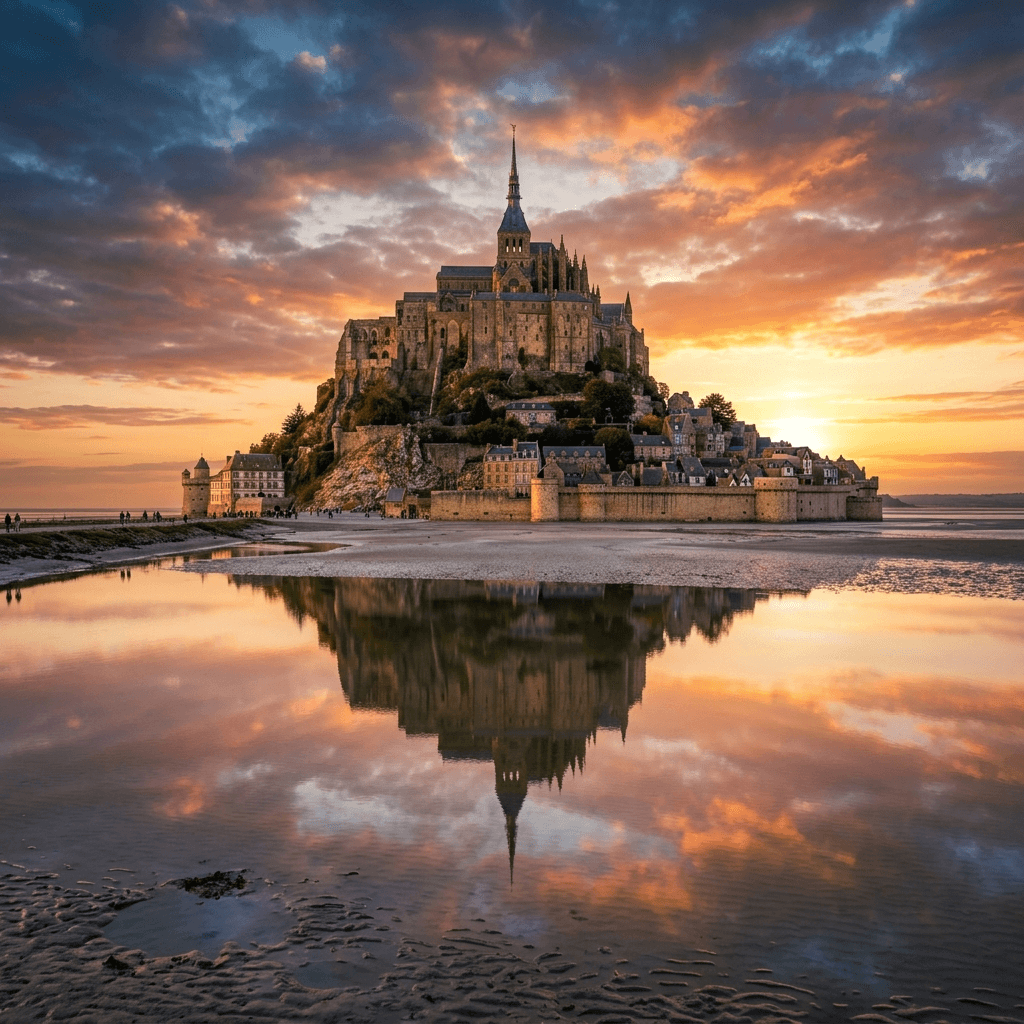
Chapter
1. The Hidden History of Mont Saint-Michel: How an Archangel's Vision Gave Rise to the Medieval Wonder
Chapter
1.1 The Apparition of Saint Michael the Archangel to Bishop Aubert of Avranches in 708
At the beginning of the 8th century, the region of Normandy was about to witness the birth of one of the greatest sanctuaries in the Christian world. The year was 708, and Aubert, the pious Bishop of Avranches, had his life transformed by a series of extraordinary experiences. According to the medieval tradition documented in the *Revelatio ecclesiae sancti Michaelis*, Aubert received a visit from Saint Michael the Archangel himself in his dreams. The archangel, chief of the heavenly hosts, ordered the bishop to build a sanctuary in his honor atop an isolated granite rock in the bay, known as Mont-Tombe.
Aubert, fearing he was the victim of a devilish illusion, ignored the first request. The archangel returned on a second night, repeating the instruction with more vehemence, but the bishop remained hesitant. It was only during the third apparition that the archangel decided to leave an undeniable physical proof of his divine will: he pressed his finger against the bishop's forehead, leaving a mark and a real hole in his skull. This traumatic and sacred event immediately convinced Aubert. The skull of Bishop Aubert, with the miraculous circular mark of the archangel's touch, is preserved to this day as a precious relic in the Basilica of Saint-Gervais in Avranches, attracting historians, onlookers, and pilgrims from all over the world.
Chapter
1.2 The Original Mont-Tombe: From Pagan Rock to Christian Sanctuary
Before becoming the imposing fortress of faith we know today, the site was known simply as Mont-Tombe (Tomb Mount), a huge block of granite that rose solitary and dramatic amidst the shifting sands and coastal forests of the bay. Local legends suggest that the mount, along with the neighboring rock of Tombelaine, was already considered a sacred or mystical place by ancient Celtic tribes and druids long before the Christianization of Gaul, possibly serving as a site for sun worship or pagan rituals associated with the forces of nature and extreme tides.
With the appearance of the Archangel Michael and the actions of Bishop Aubert, the mount was purified and consecrated to Christianity. Aubert led the first construction efforts in the autumn of 708, sending messengers to the sanctuary of Monte Gargano in southern Italy — the oldest center of worship for Saint Michael in Western Europe — to obtain sacred relics (a rock fragment and part of a red cloak worn by the archangel). On October 16, 709, the first rudimentary chapel was dedicated to Saint Michael, officially marking the definitive transition of the pagan rock into a medieval Christian pilgrimage hub.
Chapter
1.3 The Foundation of the Benedictine Abbey in 966 and the Arrival of the First Monks
The small sanctuary established by Aubert grew in fame and importance in the following centuries, but the true institutional and architectural leap occurred in the 10th century. In 966, Richard I, the powerful Duke of Normandy (known as 'the Fearless'), decided to reform the site to consolidate his political and spiritual control over the border with Brittany. He ordered the expulsion of the secular canons who managed the mount — accused of leading a worldly and dissolute life — and invited a community of Benedictine monks under the leadership of Abbot Maynard to settle on the rock.
The arrival of the Benedictines marked the beginning of an intellectual and constructive golden age. The monks brought with them the strict Rule of Saint Benedict, focused on prayer and manual labor, and began the construction of a much larger stone abbey. They dug deep foundations into the granite and began to erect a Romanesque church at the top of the hill, laying the pillars that support today's monumental abbey church. The abbey quickly became a renowned center of scholarship throughout Europe, nicknamed the 'City of Books' due to the richness of its scriptorium.
Chapter
2. The Impossible Engineering of Mont Saint-Michel: How to Build a Giant Cathedral Atop a Rock
Chapter
2.1 The Architectural Challenge of Building on Steep and Unstable Rock
Erecting a monumental abbey atop a conical and narrow granite rock, surrounded by violent tides and shifting sands, represented one of the greatest civil engineering challenges of the Middle Ages. The main obstacle was the lack of flat space at the summit of the mount to accommodate the traditional layout of a Benedictine abbey (which requires a church, cloister, dormitory, refectory, and workrooms). The usable surface at the top of Mont Saint-Michel was extremely small and steeply sloped.
To solve this geometric puzzle, medieval architects and master builders made a revolutionary decision: instead of flattening the rock, which would have been impossible with the tools of the time, they built the abbey around the rocky peak, wrapping it with a series of rooms and underground crypts that functioned as huge supporting buttresses. The abbey church was positioned exactly at the summit, with its naves and chapels resting directly on the central rocks and on the vaulted ceilings of the lower crypts. Each new level of the abbey was built upon the structure of the level below, transforming the mount into a perfect pyramid of stone where human engineering merges symbiotically with the natural topography of the mountain.
Chapter
2.2 The Wonder of the Gothic Style (La Merveille) and Its Three Functional Levels
The crown jewel of Mont Saint-Michel's architecture is the building known as La Merveille (The Wonder), built in the early 13th century (between 1211 and 1228) thanks to the generous patronage of King Philip Augustus of France. This radiant Gothic-style complex consists of two three-story buildings flanking the abbey on the north side, representing an unbelievable feat of spatial and functional distribution divided into three distinct levels, corresponding to the hierarchy of monastic life:
* The Lower Level (Ground Floor): Intended for hospitality and material needs. It contains the *Almonry* (where monks distributed alms and food to needy pilgrims) and the *Cellar* (a large room for storing provisions and wine barrels).
* The Intermediate Level (First Floor): Space for official reception and transition. It houses the sumptuous *Knights' Hall* (or scriptorium, where monks worked on copying manuscripts, heated by giant fireplaces) and the *Guest Hall* (reserved for receiving kings, nobles, and high-ranking visitors).
* The Upper Level (Second Floor): The spiritual peak of the complex. It contains the *Refectory* (a room flooded with light through narrow lancet windows, where monks ate in absolute silence listening to the reading of the scriptures) and the spectacular *Suspended Cloister*, which connects the church to the residential area and offers a magnificent view of the vastness of the bay.
Chapter
2.3 How Medieval Builders Transported Tons of Stones Under Dangerous Tides
The logistics of transporting materials for the construction of Mont Saint-Michel was one of the most arduous and dangerous tasks faced by medieval workers. The mount itself did not have granite quarries of sufficient quality to support the weight and strength of a cathedral. Therefore, most of the noble granite used in the construction of the abbey and walls had to be quarried from the Chausey Islands, an archipelago located more than 30 kilometers away in the bay.
The solid granite blocks were cut on the islands and loaded onto flat-bottomed barges during high tides. Sailors navigated the bay taking advantage of maritime currents, guiding the boats as close as possible to the rock before the tide receded. Once at the mount, workers used draft animals and human strength to haul the stones up the steep slope. On the eastern slope of the abbey, one can still see the huge medieval winch wheel (installed during the prison era but based on medieval models), operated by men who walked inside it (like giant hamsters) to wind thick ropes and hoist sledges loaded with tons of construction materials up the rock, proving the Herculean effort that made this masterpiece a tangible reality.
Chapter
3. The Transition of Styles at Mont Saint-Michel: From Austere Romanesque to Flamboyant Gothic
Chapter
3.1 The Abbey Church and the Reconstruction of the Gothic Choir After the 1421 Collapse
The abbey church that crowns Mont Saint-Michel is a fascinating architectural testament to resilience and artistic evolution over several centuries. Begun in the Romanesque style in the early 11th century (around 1023), the church's nave features robust pillars, round arches, and an atmosphere of sobriety and contemplation typical of the era. However, the church's fate was marked by tragedies and structural collapses caused by ground instability and fires resulting from lightning and military sieges. The most emblematic disaster occurred in 1421, in the midst of the Hundred Years' War, when the original Romanesque choir collapsed completely into ruins.
The reconstruction of the choir could only begin after the end of the Franco-English conflict, in 1448, and dragged on until 1521, marking a dramatic style transition. The new choir was designed in the exuberant flamboyant Gothic style (*gothique flamboyant*). In absolute contrast to the darker and heavier Romanesque nave, the choir rises majestically with monumental windows that flood the altar with natural light, complex ribbed vaults that seem to touch the sky, and finely carved granite pointed arches. This juxtaposition — where the visitor walks through the sober Romanesque nave and suddenly emerges into a luminous, vertical Gothic choir — symbolizes the transition from earthly darkness to divine light, an intentional architectural effect that dazzles anyone who enters the sanctuary.
Chapter
3.2 The Suspended Cloister: An Oasis of Silence and Light Between Heaven and Earth
Built between 1225 and 1228 as part of the upper level of the *La Merveille* complex, the abbey cloister of Mont Saint-Michel is considered one of the most refined masterpieces of Western Gothic architecture. Unlike the traditional cloisters of European abbeys, which are usually located at ground level in the center of the complex, the Mount's cloister is 'suspended', built more than 80 meters above sea level, on the roof of the Knights' Hall. It functioned as a haven of meditation and absolute silence, where monks could walk and pray surrounded by the vastness of the sky.
The architecture of the cloister is notable for its lightness and geometric sophistication. It is supported by a double colonnade in a zigzag pattern with 137 limestone columns (originally marble imported from England), carved with delicate floral capitals and foliage. The alternating positioning of the columns creates a stunning sense of movement and visual rhythm as one walks along the galleries. One of the great curiosities of this space is its central garden, designed to be a small suspended Eden, and the openings in the west wall that originally framed the sea. Today, the cloister connects the abbey church to the refectory, providing a peaceful transition experience where sunlight, the sea breeze of the bay, and monastic silence create an unforgettable mystical atmosphere.
Chapter
3.3 The Crypt of the Great Pillars: The Hidden Support of the Entire Upper Structure
To allow the construction of the imposing Gothic choir at the summit of the granite rock after the 1421 collapse, medieval engineers had to design a colossal underground infrastructure work. The result was the Crypt of the Great Pillars (*Crypte des Gros Piliers*), a monumental underground room built directly below the choir to serve as a foundation and distribute the weight of the upper walls and vaults onto the sloping rock.
The crypt owes its name to ten massive granite pillars, arranged in a semicircle, each measuring more than five meters in circumference. The scale of these pillars is impressive and conveys an almost subterranean cathedral feel, with robust groin vaults and no superfluous decorations, focusing exclusively on the pure functionality of weight support. Walking through this cold, dark crypt offers a fascinating contrast to the luminous choir directly above it. It represents the hidden structural genius of Mont Saint-Michel: without the mathematical precision and solidity of this underground crypt, the delicate, tall stone spires of the flamboyant Gothic choir would collapse under the force of the Atlantic winds, making it one of the greatest relics of structural engineering of the time.
Chapter
4. The Daily Life of Benedictine Monks: Prayer, Work, and the Hidden Scriptorium
Chapter
4.1 The Rule of Saint Benedict Applied to the Mount's Maritime Isolation
The daily life of the monks at Mont Saint-Michel was structured by the strict, ancient Rule of Saint Benedict (instituted by Saint Benedict of Nursia in the 6th century), synthesized in the famous Latin motto *Ora et labora* (Pray and work). However, the extreme geographical isolation of the mount — surrounded by the waters and sands of the bay — gave this routine an even deeper dimension of solitude and austerity. The Benedictine community divided their time between silence, spiritual contemplation, sacred reading, and the community work necessary to keep the abbey self-sufficient.
Daily life was measured with mathematical precision by the eight daily liturgical offices. The monks woke up in the early hours of the morning, around two o'clock, to the sound of bells announcing *Matins* and *Lauds*. They walked in absolute silence in the dark through the cold stone corridors to the abbey church, where they sang psalms by the dim light of beeswax candles. Prayers continued throughout the day with *Prime*, *Terce*, *Sext*, *None*, *Vespers* at sunset, and *Compline* before retiring to the common dormitory, where they slept dressed in their habits on simple straw mattresses, demonstrating the discipline of absolute renunciation that guided these men of faith.
Chapter
4.2 The Scriptorium and the Library of Illuminated Manuscripts of Mont Saint-Michel
During the Middle Ages, Mont Saint-Michel was not only a center of spiritual pilgrimage but also a beacon of culture and knowledge in Western Europe, receiving the honorable title of 'City of Books' (*la Cité des Livres*). The intellectual heart of the Mount was its famous scriptorium, located in the sumptuous Knights' Hall of the *La Merveille* complex. It was in this space, heated by giant fireplaces to prevent writing ink from freezing during the cold Norman winter months, that copyist monks carried out the meticulous and artistic work of transcription.
The monks spent hours under the light of the pointed windows copying sacred texts, Greek and Latin philosophical works, historical chronicles, and ancient science treatises on sheets of parchment (made from lamb or calf skin). The work demanded extreme precision and infinite patience: copyists created natural inks from minerals and plants and adorned the pages with stunning illuminations in gold leaf and expensive blue lapis lazuli pigments. The Mount's library accumulated hundreds of rare manuscripts over the centuries. During the French Revolution, this literary treasure was confiscated by the State and transferred to the neighboring city of Avranches, where it is preserved today in the *Scriptorial* museum, serving as one of the most important and intact medieval collections in all of France.
Chapter
4.3 How Monks Fed Themselves and Survived with Scarce Drinking Water on the Rock
Ensuring the daily survival and feeding of dozens of monks — as well as hundreds of daily pilgrims — atop a barren rock surrounded by salty sea water was one of Mont Saint-Michel's greatest domestic logistics victories. The Mount's granite lacked natural sources of drinking water. To quench thirst and allow hygiene and cooking, the monks built an ingenious network of underground cisterns that collected all the rainwater that ran off the sloped roofs of the abbey church and the *La Merveille* buildings, filtering it through layers of sand and charcoal.
The monastic diet was based on fish, crustaceans, and shellfish caught in the bay itself by community fishing nets, along with bread baked in the abbey's oven with grain harvested from continental lands held by the church. The monks also cultivated small suspended gardens of vegetables, medicinal herbs, and spices in the rare pockets of fertile soil around the walls. Fermented drinks such as wine and Norman apple cider were consumed daily, as they were microbiologically safer than water stored for long periods. The transport of these goods from the continent to the Mount depended entirely on mule trains that crossed the bay during low tide, always running the risk of being swallowed by the rapidly rising, violent waters.
Chapter
5. The Impregnable Fortress: How Mont Saint-Michel Survived the Hundred Years' War
Chapter
5.1 The 30-Year English Siege and the Heroic Resistance of the Knights
During the turbulent Hundred Years' War (1337-1453), Mont Saint-Michel became a supreme symbol of French patriotic and military resistance. While almost all of Normandy fell under English rule after the devastating French defeat at the Battle of Agincourt, the rock remained obstinately loyal to the French crown and the Dauphin (future King Charles VII). This loyalty prompted the English to launch an implacable siege that lasted, intermittently, about 30 years (especially between 1423 and 1434), transforming the Mount into one of the most contested positions in Western Europe.
The siege reached its peak in 1434 under the command of the English Lord Robert Scales. A garrison of only 119 French knights, led by the fearless Captain Louis d'Estouteville, entrenched themselves behind the mount's newly built stone walls. The English established a military siege base on the neighboring island of Tombelaine and on the mainland at Ardevon, blocking all supplies by land and sea. Despite the absurd numerical disadvantage, the French garrison and the monks heroically resisted repeated assaults and massive bombardments, repelling every attempt at invasion with unwavering courage, preventing the English banner from being raised at the top of the Mount and inspiring French resistance throughout the kingdom, including the young Joan of Arc.
Chapter
5.2 The Michelettes of the Garrison: The Medieval Cannons That Defended the Mount
One of the most fascinating military relics of the Hundred Years' War can be seen right at the main entrance of the village of Mont Saint-Michel, behind the King's Gate. These are the Michelettes, two monumental pieces of heavy medieval artillery (English bombardas) that were abandoned by English troops during the failed final assault of 1434. These historic cannons tell the story of the military technological transition that took place on the slopes of the mount.
The Michelettes are bombardas made of wrought iron bars held together by metal rings, designed to fire huge stone spheres weighing over 150 kilograms each. They were brought by the English to pulverize the granite walls of the village. However, the precision of the French garrison, which used its own artillery from the high towers of the wall, and the English logistics difficulty of operating heavy cannons on the unstable sand of the bay during high tide resulted in a devastating counterattack by the French defenders. During the English troops' hasty and chaotic retreat after the failure of the siege, the bombardas were captured by the French and kept at the Mount as eternal trophies of an improbable and historic military victory.
Chapter
5.3 Why the English Never Managed to Conquer the Abbey of Mont Saint-Michel
The English army's inability to conquer Mont Saint-Michel, even with immensely superior military resources and control over the entire surrounding region, was due to a perfect combination of natural geographical factors and state-of-the-art defensive engineering. The main ally of the French defenders was the bay of Mont Saint-Michel itself, with its implacable tides, the highest and fastest in all of Continental Europe. The sudden rise of the waters created an impassable saltwater moat that isolated the rock from any land attack for several hours of the day.
Furthermore, when the tide receded, the ground around the Mount turned into a deadly labyrinth of shifting sands and thick mud. Heavily armed English troops, cavalry, and heavy artillery could not maneuver without sinking or getting lost in the dense mists that often roll suddenly over the bay. The abbey itself was a perfect defensive fortress: the French had surrounded the village with an imposing stone wall reinforced by protruding semicircular watchtowers that allowed crossfire on invaders. Any English soldier who survived crossing the bay and tried to climb the steep rocks under the wall was easily targeted by French archers and bombardas positioned in the inaccessible heights of the rock, guaranteeing the historical invincibility of the mount.
Chapter
6. The Bastille of the Seas: The Dark Era of Mont Saint-Michel as a State Prison
Chapter
6.1 The Transformation of the Abbey into a Prison During the French Revolution and the Empire
The end of the 18th century brought a radical and dark disruption to the sacred history of Mont Saint-Michel. With the French Revolution of 1789, the abbey was declared national property, and the last Benedictine monks were expelled from the rock in 1791. The site, which for over a thousand years had served as a sanctuary of spiritual light, was profanely renamed *Mont-Libre* (Free Mount) and transformed into a maximum security state prison in 1793, mockingly nicknamed the 'Bastille of the Seas' due to its absolute isolation and the impossibility of escape.
Initially, the prison was used to incarcerate hundreds of refractory priests (who refused to swear allegiance to the civil constitution of the clergy established by the revolutionaries). Under the empire of Napoleon Bonaparte and subsequent monarchical regimes, the abbey became a permanent prison for common criminals and political opponents of the State. The church's naves and the beautiful Gothic buildings of *La Merveille* were partitioned with wooden floors and walls to create tiny cells and workshops for forced labor, where prisoners spent their days sewing and doing heavy manual industrial work in the damp ocean cold, staining the sacred soil of the mount with suffering and degradation.
Chapter
6.2 Louis XI's Iron Cage and the Subhuman Conditions of Political Prisoners
The dark reputation of Mont Saint-Michel as a place of torture and severe confinement, however, dated back to previous centuries. The most terrifying symbol of this prison past was the Iron Cage (*La Cage de Fer*), originally installed by King Louis XI in the 15th century. Although called an iron cage, it was actually a heavy structure of wooden beams reinforced by iron bands, built inside one of the dark underground crypts of the abbey.
Prisoners confined in this cage — usually traitors to the kingdom or dissident writers — could not stand or lie down comfortably due to the small dimensions of the space. They remained in absolute sensory isolation and cold for months or even years. During the 19th century, when the Mount functioned as an official state prison, living conditions were subhuman. About 700 prisoners shared the crowded space of the abbey simultaneously. The constant moisture of the ocean seeped through the unheated cells, typhus and tuberculosis decimated the inmates, and physical punishments were frequent, generating a terrifying contrast between the beauty of the Gothic architecture and the horror experienced inside.
Chapter
6.3 How Romantic Intellectuals and Victor Hugo Helped Save and Restore the Monument
The era of the state prison almost sealed the fatal fate of the structure of Mont Saint-Michel, which was deteriorating rapidly under the weight of the prison installations and the lack of maintenance of the lead and stone roofs. It was only in the middle of the 19th century that a wave of public outrage began to change the course of history. French intellectuals, artists, and writers associated with the Romantic movement launched a vigorous campaign demanding the immediate closure of the prison and the historical preservation of the medieval abbey.
The most influential leader of this campaign was the celebrated writer Victor Hugo, author of *Les Misérables*. Hugo visited the Mount in 1836 and was shocked by the degradation of the site, writing fiery letters to public opinion and rulers: *"Mont Saint-Michel is to France what the Great Pyramid is to Egypt. We must preserve it against state vandalism"*. Under constant pressure from romantic intellectuals and public opinion, Emperor Napoleon III finally signed the decree that officially closed the prison in 1863. The mount was then entrusted to the Historic Monuments Service, paving the way for the largest architectural restoration in the country's history.
Chapter
7. The Great Restoration of the 19th Century: Who Saved Mont Saint-Michel from Ruin
Chapter
7.1 The Monumental Work of Architect Édouard Corroyer Starting in 1872
Following the decree to deactivate the state prison in 1863, the task of recovering Mont Saint-Michel from a state of catastrophic neglect was entrusted to the renowned architect Édouard Corroyer. A student of the brilliant restorer Eugène Viollet-le-Duc, Corroyer assumed the post of chief architect of the monument in 1872 and dedicated the next fifteen years of his life to a Herculean effort of archaeological research, meticulous mapping, and structural reconstruction that saved the abbey from imminent collapse. The challenge was twofold: it was necessary to remove the tons of wooden and plaster prison partitions added during the prison period and, at the same time, consolidate the stone foundations that had been suffering from severe saline infiltration for decades.
Corroyer initiated unprecedented archaeological work, clearing the crypts, redesigning each buttress, and restoring the integrity of the Romanesque and Gothic naves. Under his direction, the vaults of the abbey church were consolidated with high-strength granite, and the roofs were completely rebuilt with slate coverings to withstand the biting winds of the Atlantic. The architect was also responsible for commissioning the first scientific excavations inside the abbey, unearthing the hidden history of previous constructions and ensuring that the restoration plan closely followed the original medieval layout of the monument. His meticulous documentation and photographic work, preserved to this day in the archives of the French national heritage, established the methodological foundations for all modern conservation interventions in Normandy.
Chapter
7.2 The Construction of the 1879 Dike-Road and Modern Ecological Consequences
As Mont Saint-Michel recovered its architectural glory under Corroyer's hands, the flow of tourists, painters, and pilgrims exploded dramatically. To facilitate continuous access to the rock — which until then depended on dangerous crossings on foot across quicksand during low tide or by boat during high tide —, the French government authorized the construction of a mega land infrastructure project: the access dike-road, inaugurated in 1879. This 1.9-kilometer-long earthen and rock dike directly connected the mainland coast to the foot of the mount's walls, allowing the constant movement of carriages, steam trains, and, later, automobiles.
Although hailed as a victory of civil engineering and tourism progress at the end of the 19th century, the dike-road exacted a very heavy ecological and geographical price over the following decades. By acting as a permanent physical artificial barrier in the heart of the bay, the dike blocked maritime currents and prevented the high tide from freely circling the mount. As a result, millions of cubic meters of silt, sand, and sediment brought by neighboring rivers (such as the Couesnon) accumulated around the rock instead of being swept back to the deep ocean by the force of the waters. The bay underwent a severe process of accelerated siltation, transforming the sea around the mount into salt marshes and terrestrial pastures. This dramatic loss of the original maritime character caused the abbey to become almost permanently connected to the mainland, motivating the colossal government ecological project started in the 21st century to remove the 1879 dike and replace it with a high-tech suspended footbridge on steel piles that allows the tide to flow freely again.
Chapter
7.3 The Installation of the Neo-Gothic Spire and the Archangel Statue by Emmanuel Frémiet in 1897
The final touch that gave Mont Saint-Michel its iconic and majestic silhouette recognized worldwide was the addition of the great spire tower and the golden statue of Saint Michael the Archangel at the top of the abbey. At the end of the 19th century, the abbey lacked a vertical crowning that did justice to its historical importance. The architect Victor Petitgrand, who succeeded Corroyer, designed a magnificent openwork neo-Gothic spire of stone and metal that rises more than 32 meters above the church roof, reaching a total height of 170 meters above sea level.
To crown this monumental structure, the acclaimed French sculptor Emmanuel Frémiet was invited to create a statue of Saint Michael the Archangel. Cast in bronze in 1897, the statue displays the archangel brandishing his victorious sword in the air against the dragon under his feet, symbolizing the triumph of good over evil. The statue was gilded with thin layers of pure gold to shine intensely under the Norman sun, visible from miles away in the bay. With a weight of 820 kilograms and measuring 2.8 meters in height, placing the statue at the top of the spire was a dramatic engineering feat that required the use of complex cranes at the time. More than an artistic masterpiece and a definitive spiritual symbol, the statue functions today as the main lightning rod for the entire abbey, protecting the delicate historical structure against the violent electrical storms from the Atlantic that frequently lash the rock.
Chapter
8. The Largest Tides in Europe: The Science and Mystery of the Waters at Mont Saint-Michel
Chapter
8.1 How the Tidal Cycle Works and Why They Rise at the Speed of a Galloping Horse?
The bay of Mont Saint-Michel is the stage for one of the most impressive and dynamic natural phenomena on the planet: the largest tides in Europe. Due to the unique geographical configuration of the bay — a vast shallow estuary in the shape of a funnel situated between Brittany and Normandy —, the tidal range (the vertical difference between low tide and high tide) can reach the impressive mark of up to 15 meters in height during spring tides. The physics behind this phenomenon is driven by the combined gravitational pull of the Moon and the Sun on the Earth, which is amplified like a natural hydraulic piston effect when the water masses of the Atlantic enter the narrow bottleneck of the bay.
The speed at which the tide rises is legendary. The local popular saying states that the water advances 'at the speed of a galloping horse' (*à la vitesse d'un cheval au galop*). Scientifically, although the water does not constantly run at the speed of a galloping horse (about 40 to 50 km/h), the average progress during spring tides is approximately 6 to 10 km/h. However, the flat and deceptive topography of the sandy bed creates extremely fast underlying currents that fill small hidden saltwater channels long before they cover the visible sand. This means that an unsuspecting visitor walking in the bay can be surrounded by water in a few minutes, unable to return to dry land due to treacherous suction currents and quicksands that liquefy under the body's weight, making the danger warning signs scattered along the coast a real necessity for survival.
Chapter
8.2 The Phenomenon of the Equinoctial Tide and the Temporary Transformation of the Mount into a Complete Island
The peak of this natural cycle occurs during the equinoctial tides (which happen twice a year, close to the spring and autumn equinoxes) or under the exceptional planetary alignment that generates the so-called 'Tides of the Century' (*Marées du Siècle*), a major astronomical event that repeats every eighteen years. At these moments, the tidal range reaches its maximum limit. The tide coefficient exceeds the mark of 115 (on a scale that goes up to 120), and the sea advances with impressive force, covering miles of bay in a few hours.
When this happens, Mont Saint-Michel experiences its most magical and photogenic moment: the transformation into a complete island. The water rises so high that it completely covers the lower rocky bases and reaches the medieval stone walls themselves, temporarily cutting off any land connection with the mainland, including pedestrian access via the footbridge. For about one to two hours, the abbey and its village float majestically in the middle of a giant saltwater mirror, restoring the historical and mystical landscape that ancient pilgrims faced in the 8th century. Thousands of spectators gather on the walls and the suspended bridge to watch the spectacle of the water surrounding the mount, a silent and grandiose event that demonstrates human smallness before cosmic and oceanic cycles.
Chapter
8.3 The Silt Removal Project and the Restoration of Mont Saint-Michel's Maritime Nature
The survival of Mont Saint-Michel as a maritime island was seriously threatened at the end of the 20th century due to chronic siltation caused by the 1879 dike-road and the canalization dike of the Couesnon River. With the high tide prevented from circulating freely, more than 20,000 cubic meters of sediment accumulated in the bay annually. Alarming scientific estimates pointed out that, by the year 2040, the Mount would be completely swallowed by permanent land pastures, losing its island status forever.
To reverse this ecological disaster, the French government and the European Union launched in 2005 the colossal Project to Restore the Maritime Character of Mont Saint-Michel, one of the largest environmental engineering works in the recent history of Europe, at a cost of more than 200 million euros. The project consisted of three major pillars:
1. The construction of a new discharge dam on the Couesnon River, designed to accumulate water from the river and tides and release it in controlled jets during low tide, creating a natural washing effect that pushes sediments back into the deep ocean.
2. The total removal of the old 1879 dike-road and parking areas close to the rock.
3. The inauguration in 2014 of a beautiful and light suspended footbridge of 760 meters designed by the renowned architect Dietmar Feichtinger. Supported by thin steel piles that allow marine currents and tidal water to pass freely underneath it, the footbridge ensures that nature does its work and cleans the sandy bed, returning to the mount its original and sustainable maritime isolation for generations to come.
Chapter
9. The Pilgrims' Route: The Medieval Paths of Faith and Their Deadly Dangers
Chapter
9.1 The Miquelots: Who Were the Ancient Travelers Who Crossed Europe on Foot?
During the Middle Ages, Mont Saint-Michel became one of the four largest pilgrimage sites in Western Christendom, rivaling in prestige and spiritual attraction Jerusalem, Rome, and Santiago de Compostela. Those who traveled to the Mount in search of plenary indulgence, healing of diseases, or to fulfill promises to the archangel were affectionately called Miquelots (or shepherds of Saint Michael). The pilgrimage attracted people from all social classes in Europe — from barefoot peasants and beggars to kings and queens of France and England, such as Louis XI and Francis I.
The paths traveled by the Miquelots were known as the *Chemins de Mont-Saint-Michel* (Paths of Saint Michael) or 'Paths to Paradise'. There was also a special and moving category of pilgrims: the children's pilgrimages (*pastoureaux*). In the 14th and 15th centuries, groups composed of thousands of children and teenagers from all over Germany, Switzerland, and France left their villages without their parents' consent, walking in organized processions singing spiritual hymns towards the sacred rock of northern France, guided by an inexplicable and overwhelming devotion to the warrior archangel. For adult Miquelots, the journey on foot lasted weeks or months of deprivation, hunger, assaults on forest roads, and constant cold, culminating in the triumphant and emotional sighting of the mount rising on the horizon of the bay.
Chapter
9.2 The Dangers of Quicksand and Sudden Mists in the Bay of Mont Saint-Michel
Although the long walk across Europe was full of challenges, the final and most dangerous test of the Miquelots' faith began only in the last kilometers of the journey, when stepping onto the sand of the bay. Crossing the bay barefoot to reach the mount was an act of spiritual purification and penance, but it represented a real and imminent risk of death. The first great enemy of the pilgrims was the quicksand (*sables mouvants*), pockets of extremely fine sand saturated with water under pressure that liquefy instantly when stepped on, acting as suction traps that bind the walker's legs, making quick escape impossible.
The second great danger was the implacable approach of the high tide combined with the sudden mist (*brume de mer*). The bay of Mont Saint-Michel is famous for its dense and cold sea mists that descend over the sand in a few minutes, reducing visibility to less of two meters. Without any visual point of reference (such as the mount or the mainland) and disoriented by the distorted echo of the wind on the walls, medieval pilgrims panicked, walking in circles as the tide rose silently through the side channels. Many Miquelots drowned in the freezing sea or were swallowed by quicksand a few meters from the safety of the mount, which is why the monks of the abbey kept a heavy bell ringing continuously at the top of the church tower during foggy days to guide lost travelers by sound.
Chapter
9.3 The Paths of Saint Michael Existing Today for Modern Pilgrimage
The rich historical and spiritual tradition of the Miquelots has not been lost in time. At the end of the 20th century, a joint effort by historians, geographers, and hikers led by the French association *Les Chemins du Mont-Saint-Michel* rescued, mapped, and marked thousands of kilometers of ancient medieval pilgrimage trails that had been forgotten under the modern road network. Today, these paths function as official cultural hiking and active spiritual pilgrimage routes connecting the Mount to various parts of France and Europe.
These routes are marked with the yellow shell and the classic staff of Saint Michael. Annually, tens of thousands of modern hikers cross these paths on foot in search of self-knowledge, physical challenge, or spiritual renewal, ending with the classic and exciting guided crossing of the bay on foot, which must be done in the company of a registered professional guide to avoid the lethal traps of tides and quicksands that remain active and unchanged in the bay.
Among the most famous routes preserved today, the following stand out:
* The Rouen Route (the Duke's Route), which recreates the historical route taken by the ancient dukes of Normandy starting from Rouen through the beautiful Seine River valley.
* The Paris Route (Via Turonensis), which connects the French capital to the mount via Chartres and its famous Gothic cathedral.
* The Route from Mont-Saint-Michel to Santiago, which crosses northwestern France and connects to the paths of Compostela in Spain.
Chapter
10. The Ecosystem of the Bay of Mont Saint-Michel: Unique Flora, Fauna, and Biodiversity
Chapter
10.1 The Salt-Meadow Lambs (Moutons de Pré-Salé) and Their Special Halophyte Diet
One of the greatest biological and gastronomic singularities of the region around Mont Saint-Michel is the presence of the Moutons de Pré-Salé (salt-meadow lambs). These animals are raised freely in the vast salt meadows — locally called *herbus* — that cover the areas of the bay flooded only during the highest spring tides. The bay of Mont Saint-Michel houses the largest extension of salt meadows in Europe, with more than 2,000 hectares of specialized vegetation.
The diet of these lambs is the key to their fame. The salt pastures are dominated by halophyte plants (vegetables tolerant to soil and sea water salinity), such as *puccinellie*, *obione*, and, especially, salicornia (or sea asparagus). By consuming daily these plants impregnated with sea salt and oceanic minerals (iodine and sodium), the meat of the animals acquires an incredibly delicate, juicy, and naturally seasoned flavor, with an incomparable texture. This traditional production is so unique and protected that it received the strict French and European certification of Protected Designation of Origin (PDO/AOP) under the name *Prés-salés du Mont-Saint-Michel*, ensuring that only animals born, raised, and fed in the bay can bear this prestigious brand in international cuisine.
Chapter
10.2 Common Seals and Migratory Birds: The Protected Wildlife of the Bay
In addition to its historical and cultural value, the bay of Mont Saint-Michel is an international ecological reserve of crucial importance, classified under the international Ramsar convention and integrated into the Natura 2000 protection network. The unique mixture of freshwater rivers, marine currents, and vast extensions of sand and mud creates an abundance of nutrients that supports a spectacular marine and terrestrial food chain.
The bay is home to the largest colony of common seals (*Phoca vitulina*) in the English Channel. These gentle and curious marine mammals can be observed resting on distant sandbanks during low tide or swimming close to the river estuary in search of fish. The area also functions as a true international airport for migratory birds. Annually, more than 200 species of birds use the bay as a resting, feeding, or nesting point during their epic journeys between Siberia and West Africa. Species such as the common shelduck, the avocet, and various types of sandpipers find in the mud rich in small mollusks and polychaetes the food necessary for their survival, making the bay an indispensable paradise for ornithologists and wildlife lovers.
Chapter
10.3 The Impact of Climate Change and Siltation on the Local Ecosystem
Despite the success of projects such as the silt removal of the abbey, the delicate ecological balance of the bay faces new and severe challenges in the 21st century resulting from global warming and human activity. Sea level rise and the higher frequency of violent storms in the Atlantic threaten to erode the salt meadows (*herbus*), reducing the grazing area of the salt-meadow lambs and altering the sedimentary dynamics that keep the river channels clean.
The temperature of the bay's water has also registered gradual increases, which directly impacts the reproduction of local fish and crustaceans and attracts invasive species. Furthermore, managing the tourist flow — which brings more than three million visitors per year to a fragile ecological area — requires constant vigilance to prevent water contamination, disturbance of seal colonies, and degradation of migratory bird habitats. The conservation of the bay of Mont Saint-Michel today depends on a complex governance that balances the preservation of the abbey's architectural heritage with absolute respect for biodiversity and the natural cycles that created this unique ecological wonder.
Chapter
11. Historical Comparison: Mont Saint-Michel (France) vs. St Michael's Mount (England)
Chapter
11.1 The Norman Connection and the Donation of Lands after the Conquest of 1066
The history of Mont Saint-Michel is intrinsically linked to England through a fascinating feudal and spiritual connection that crossed the English Channel in the Middle Ages. In the year 1066, William the Conqueror (Duke of Normandy) invaded and conquered England in the famous Battle of Hastings. The monks of Mont Saint-Michel actively supported William's military campaign, providing ships and spiritual support. As a reward for Norman loyalty, William and his noble allies confiscated lands in southwestern England, on the Cornwall peninsula, and donated them to the French abbey.
Among these possessions was a small rocky tidal island called St Michael's Mount, which possessed a striking physical similarity to the French mount. In the mid-11th century, the monks of Mont Saint-Michel established a subordinate Benedictine priorate atop the English mount, sending Norman monks to build a chapel and administer the island. For more than three centuries, St Michael's Mount functioned as an English branch of the Norman giant, sharing the same Benedictine liturgy and serving as an important trading port and pilgrimage site under French jurisdiction, proving the deep historical wounds and alliances shared between the French crown and medieval England.
Chapter
11.2 Geographical and Architectural Similarities between the Two Twin Islands
The similarities between Mont Saint-Michel and St Michael's Mount are so extraordinary that they are often described as 'twin islands' or mirror images separated by the sea. Geographically, both islands are tidal islands (*tidal islands*) formed by hard granite and schist rocks that resisted coastal erosion, rising dramatically a few hundred meters from the mainland coast and surrounded by shallow bays of fine sand that are completely submerged by high tide.
Architecturally, the influence of Norman builders in Cornwall is evident. St Michael's Mount was crowned with a stone church and monastic buildings that mimic, on a reduced scale, the defensive and vertical layout of the French mount. Both complexes use the natural rock as a support and buttress element, creating a spiral climb that leads the pilgrim from the fortified walls at the base to the spiritual sanctuary at the highest point. The pyramidal silhouette of stone rising from the sea under cloudy skies and violent tides gives both islands an identical mystical and cinematic atmosphere, attracting romantic painters who saw in them the ultimate symbol of the medieval natural sublime.
Chapter
11.3 Differences in Destiny: From French Abbey to English Residential Castle
Despite their common origins and astonishing visual similarities, the historical destiny of the two twin islands diverged radically due to geopolitical and religious conflicts between France and England. The first rupture occurred during the Hundred Years' War, when the English crown confiscated the assets of foreign priorates. In 1414, King Henry V of England officially severed St Michael's Mount's connection with the French mother abbey, handing over the administration of the site to English religious orders.
With the dissolution of the monasteries under the reign of Henry VIII and the subsequent Protestant Reformation in England, the Benedictine priorate of St Michael's Mount was completely deactivated. The island was fortified as a military fortress and, in the mid-17th century (1659), it was acquired by the influential St Aubyn family. The medieval chapel and monastic buildings were converted into a sumptuous private residential castle, which remains to this day as the historic residence of the family, who manages the mount in partnership with the British *National Trust*. While the French Mont Saint-Michel remained a public national monument under state management, preserving its character as a spiritual abbey and public military fortress, its smaller English brother was transformed into a fascinating domestic aristocratic refuge that combines Benedictine history with the life of the English gentry.
Chapter
12. Legends and Mysteries of Mont Saint-Michel: Curious Facts Beyond Official History
Chapter
12.1 The Legend of the Combat between Saint Michael and the Dragon on the Rock
The spiritual tradition of Mont Saint-Michel is imbued with mythological narratives that fed the imagination of pilgrims for centuries. The most famous of these legends is that of the cosmic combat between Saint Michael the Archangel and the Dragon, which represents the devil (Lucifer) or the forces of evil. According to medieval Norman folklore, the original granite mount was a place of dark pagan worship where the dragon hid, terrorizing the coastal populations of the bay.
Saint Michael descended from the heavens armed with his sword of fire and flaming shield to wage an apocalyptic battle against the beast at the top of the rock. The fight lasted several days and nights, making the sky thunder with lightning and the waters of the bay boil under the force of the blows. The archangel finally defeated the dragon, casting him into the abyss and purifying the mountain of all evil influence. This legend was not just a bedtime story, but a powerful theological symbol: it justified the consecration of the rock to the angelic cult and consolidated the image of Saint Michael as the supreme protector and commander of the heavenly hosts who watches over the borders of the Christian world against darkness, an image carved and painted in dozens of chapels along the mount.
Chapter
12.2 The Submerged Forest of Scissy: Myth or Geological Reality of the Bay?
One of the most intriguing legends surrounding the bay of Mont Saint-Michel is the existence of the legendary Forest of Scissy (*Forêt de Scissy*). According to medieval chronicles and tales, before the 8th century, the bay did not exist as we know it today. In its place, there was a dense and mysterious forest dominated by giant oaks, which covered the entire coastal area and connected Mont Saint-Michel and the neighboring mount of Tombelaine directly to the mainland. The forest would have housed early Christian hermits and Celtic druidic cults.
According to the legend, in the year 709 (coincidentally the same year as the dedication of Aubert's chapel), a cataclysmic tidal wave or a colossal equinoctial storm broke through the coastal dune barriers, flooding the entire forest and drowning it under the sea in a single night, transforming the mount into an isolated island. For centuries, historians debated whether the Forest of Scissy was just a geographical creation myth or a factual reality. Recent geological studies and excavations in the bay have brought fascinating answers: scientists discovered fossilized oak trunks and ancient peat under the bay's sand, dating back thousands of years before our era. Although the sudden cataclysm of 709 is largely a historical romanticization, the existence of an ancient forested area that was gradually swallowed by the post-glaciation rise in sea level is a proven geological fact, uniting legend and science perfectly in the bay.
Chapter
12.3 The Golden Bronze Statue of Saint Michael: The Protector of the Skies and the Abbey's Lightning Rod
The golden figure of the archangel at the top of the mount is surrounded by fascinating stories and technical interventions that seem straight out of a movie. With its 2.8 meters in height and open wings pointing to the sky, the statue is exposed to the most extreme weather conditions in northern France, suffering the direct impact of ocean winds of more than 100 km/h, constant saline humidity, and, primarily, lightning.
The statue functions as the main lightning rod for the entire abbey. Periodically, the thin layer of gold that protects it (gilded with gold leaf of a few microns) wears off due to the abrasion of the bay's sand winds. This requires monumental and highly complex restoration operations. One of the most famous occurred in 2016, when the golden bronze statue was removed by a special helicopter in the midst of a dramatic morning fog, suspended over the spire of the abbey before hundreds of photographers and spectators on the ground. Taken to a specialized workshop on the mainland, the statue received a new bath of 24-karat gold and structural repairs on its wings before being replaced at the top, maintaining its role as a bright sentinel that reflects the sun's rays over the entire bay and protects the physical integrity of the abbey against the destructive forces of nature.
Chapter
13. UNESCO Recognition: Why Mont Saint-Michel was the First French Heritage Site
Chapter
13.1 The Historical Classification of 1979 and World Cultural Importance
In 1979, the United Nations Educational, Scientific and Cultural Organization (UNESCO) initiated one of its most celebrated and revered lists of global preservation. Mont Saint-Michel and its spectacular surrounding bay were chosen to be among the very first world assets to receive the coveted title of World Heritage Site. The Mount was, in fact, the first cultural property classified in France, marking the country's pioneering role in international heritage protection cooperation and recognizing that this unique monument transcends national borders and belongs to all of civilization.
This historical classification was an important conceptual milestone. UNESCO did not only recognize the artistic value of the Benedictine abbey or the fortified medieval walls, but the entire bay as an integrated unit. The official decision highlighted that Mont Saint-Michel is an unsurpassed aesthetic feat, where human creation challenged and completed the natural landscape in a sublime way. From 1979, the Mount began to enjoy strict international legal protection, consolidating its status as a sanctuary of global interest and raising the French government's commitment to preserve both the integrity of the stone architecture and the delicate estuarine and marine ecosystem around it.
Chapter
13.2 UNESCO Evaluation Criteria on the Integrity of the Bay and the Abbey
The inclusion of Mont Saint-Michel on the World Heritage List was supported by strict evaluation criteria attesting to its exceptional universal value. The UNESCO committee based its decision on three fundamental pillars of historical and aesthetic relevance:
1. Masterpiece of Human Creative Genius (Criterion I): The abbey of Mont Saint-Michel, with its Romanesque church seated at the summit of a steep rock and the magnificent Gothic complex of *La Merveille*, is an unsurpassed technical and artistic achievement of medieval architecture, where man transformed a hostile natural topography into a monument of incomparable spiritual beauty.
2. Outstanding Example of an Architectural Ensemble (Criterion III): The Mount represents one of the richest and most complete manifestations of medieval feudal society, uniting in a single condensed geographical space the three estates of the Middle Ages: the church (the Benedictine abbey at the top), the nobility and military power (the walls and the castle of defense), and the civilian workers (the village with its shops and residences at the base).
3. Association with Traditions and Beliefs of Universal Significance (Criterion VI): The tidal island is a living pole of Christian spirituality that shaped the history of faith in Western Europe over more than a thousand years, connecting to the rich tradition of the Miquelots' pilgrimages that helped weave the cultural networks of the continent.
UNESCO stressed that the preservation of the landscape integrity — the clean view of the mount rising solitary on the horizon line without the interference of industrial constructions or wind farms on the mainland coast — is vital to keep this outstanding universal value intact.
Chapter
13.3 Modern Challenges to Balance Mass Tourism and Heritage Conservation
Being one of the greatest references of World Heritage attracts colossal responsibilities and challenges in the 21st century. The abbey and the village of Mont Saint-Michel receive annually more than three million tourists, concentrated mainly in the European summer months (July and August) and during peak hours (between 10 AM and 4 PM). This torrential flow of visitors generates the phenomenon of mass tourism (*surtourisme*), which severely pressures local sanitation, security, and physical conservation infrastructures.
The challenge lies in balancing the economic sustainability of tourism — which supports dozens of hotels, restaurants, and local shops — with the preservation of structural integrity and the visitor's spiritual experience. To mitigate the impact, the public administration of the Mount and the Center of National Monuments of France have implemented innovative flow management tactics. Among them are the promotion of night visits during the summer (when the mount is illuminated and silent), campaigns to attract visitors during the autumn and winter seasons (times when the bay gains a spectacular melancholy charm), and the regulation of continental parking to spread arrivals throughout the day, aiming to avoid congestion on the *Grande Rue* and ensure that the visit to this masterpiece of world heritage continues to be an inspiring and safe contemplative experience.
Chapter
14. Tips for Visiting Mont Saint-Michel: The Ultimate Guide to Avoid Lines and Scams
Chapter
14.1 How to Choose the Best Time of Year and the Ideal Times to Avoid Crowds?
Planning a visit to Mont Saint-Michel requires strategic intelligence to prevent the mystical beauty of the place from being overshadowed by suffocating crowds. The choice of the time of year is the first crucial factor. The summer months (July and August) record the absolute peak of visitors, when the narrow medieval alleys of the village become literally impassable. If possible, avoid this season. The best times to visit are the shoulder seasons: spring (April to June) and autumn (September to October). In these periods, the temperatures are mild, the light in the bay is spectacular for photography, and the volume of tourists is considerably lower. Winter (November to March) offers an almost solitary and poetic experience, although the Atlantic wind is freezing and some local shops close their doors.
The second golden secret lies in the choice of daily hours. About 80% of visitors arrive by tour bus or car between 10 AM and 3 PM, clogging the entrance and the main street. To experience the Mount in a magical and silent way, you must arrive before 9 AM in the morning or after 4:30 PM in the afternoon. From the late afternoon, the tours leave, the free shuttle buses (navettes) run empty, and the alleys recover their mysterious medieval silence. Another unbeatable tip is to spend the night in the village or in the continental hotels of *La Caserne*, allowing you to walk along the walls at night under the scenic illumination of the monuments or observe the solitary sunrise over the sands of the bay.
Chapter
14.2 The Official Tickets Guide for the Abbey of Mont Saint-Michel: Where and How to Buy?
Although access to the fortified medieval village of Mont Saint-Michel and its walls is completely free at any time of day or night, visiting the Abbey of Mont Saint-Michel (which sits at the highest point and houses the church, the suspended cloister, and the underground crypts) requires the purchase of a paid ticket. Do not fall for scams from parallel street ticket offices or unaccredited reseller sites that charge abusive fees promising non-existent priority access.
The only 100% secure purchase channel is the official website of the Center of National Monuments of France (*Centre des Monuments Nationaux*). It is highly recommended to buy your ticket online in advance, choosing a pre-booked entry slot. Booking a slot is mandatory, especially in high season, and ensures that you enter the access line without facing the long lines at the local ticket office, which can exceed an hour's wait in hot months. The ticket currently costs about 13 euros for adults, being free for under 18s and European Union citizens between 18 and 25 years old. Remember to bring the ticket printed or on your phone with the QR code legible and plan your walking access from the continental parking lot at least one hour in advance so as not to miss your reserved entry time.
Chapter
14.3 The Climb via the Main Path (Grande Rue) vs. Secret Shortcuts via the Ramparts
Once past the main gate of the mount (Porte de l'Avancée), the vast majority of tourists automatically follow in single file along the Grande Rue, the only paved main street of the village. Although the Grande Rue is charming, with its half-timbered medieval houses and iron signs, it is extremely narrow and home to the highest density of souvenir shops and expensive restaurants. On busy days, walking along it can be a claustrophobic and slow experience.
To avoid this stress and get spectacular panoramic views, use the secret shortcuts via the ramparts (*les remparts*). Right after passing through the second fortified gate (Porte du Boulevard) and before entering the dense part of the Grande Rue, look for a stone staircase on your right that gives access to the top of the medieval defense walls. Walking along the ramparts is completely free and offers a much wider, airier, and more photogenic alternative route to the entrance of the abbey. You will pass by several historic defensive towers (such as the *Tour de l'Arcade* and the *Tour Liberty*) and enjoy unobstructed panoramic views of the bay, the tides, and the quicksands below. Another useful shortcut for those seeking tranquility is the small secondary stone staircases that cut behind the village houses, known as *ruelles*, which climb through small gardens and rocky slopes, allowing you to reach the summit of the abbey in a peaceful and silent way.
Chapter
15. How to Get to Mont Saint-Michel: Transport from Paris, Parking, and Access
Chapter
15.1 Day Trip from Paris to Mont Saint-Michel by Train (TGV) or Bus: Is It Worth It?
Mont Saint-Michel is located approximately 360 kilometers west of Paris, on the border between Normandy and Brittany. The most frequent question among tourists planning their trip from the French capital is whether it is worth making a day trip on the same day or if it is preferable to spend the night in the region. The answer depends on the chosen means of transport and the level of depth you want to give to your visit.
The fastest and most comfortable option by public transport is the high-speed TGV train leaving from *Paris Montparnasse* station to Rennes or Dol-de-Bretagne station. The trip to Rennes takes about 1 hour and 25 minutes at a speed of up to 320 km/h. From Rennes, it is necessary to take a regional bus of the company *Keolis Armor* (direct line to Mont Saint-Michel) which covers the last 75 kilometers in about 1 hour and 15 minutes. Alternatively, Dol-de-Bretagne station is closer to the mount (28 km), but has fewer rail connections. For those who prefer the convenience of a trip without transfers, several road bus companies like FlixBus operate direct lines from Paris to Mont Saint-Michel, with a journey of about 4 to 5 hours, at considerably cheaper prices than the TGV. Although the day trip by train is possible (leaving Paris early and returning at night), it is exhausting and severely limits the visiting time at the mount. The recommendation is to spend at least one night in the region to appreciate the sunset, the night illuminations, and the sunrise in the bay — experiences that completely transform the visit.
For those traveling by car, the fastest route starts from Paris on the A13 highway towards Caen, then following the A84 (Estuaries highway) to the Mont Saint-Michel exit. The total trip takes about 3 hours and 45 minutes under normal traffic conditions. Driving is easy and road signs are excellent throughout Normandy.
Chapter
15.2 How the Official Parking and the Free Shuttle Bus (Navette) Work?
Since the completion of the maritime character restoration project in 2015, it is absolutely forbidden to park vehicles in the immediate vicinity of the mount. All the old parking next to the walls was demolished and returned to nature. In its place, a large continental parking center was built located about 2.5 kilometers from the rock, in the area known as *La Caserne*.
The official parking is operated by the company Véolia Transdev and works 24 hours a day, with capacity for thousands of vehicles (cars, motorhomes, and tour buses). The parking fee for cars is charged per 24-hour period (currently about 14.90 euros per day), and payment can be made at automatic machines with a credit card at the exit. From the parking lot, a free shuttle bus (*navette*) transports visitors to the entrance of the footbridge, departing every few minutes during the day (from 7:30 AM to midnight in high season). The buses are modern, wheelchair accessible, and operate continuously. The journey by shuttle takes about 12 minutes. Alternatively, for those who want a more picturesque experience, carriages pulled by Percheron horses (the Norman breed of heavy draft horses) are also available upon payment of an additional fee, offering a slow and charming transport that evokes the historical arrival of ancient pilgrims to the mount.
Chapter
15.3 Crossing the Footbridge on Foot: Distance, Time, and Practical Walking Tips
The last stage of the journey to Mont Saint-Michel is crossing the magnificent suspended footbridge (*pont-passerelle*) designed by Austrian architect Dietmar Feichtinger and inaugurated in 2014. The footbridge extends for 760 meters over the sandy bed of the bay, supported on thin steel piles that allow the free circulation of tidal water underneath. The walk on foot from the shuttle drop-off point to the entry gate of the mount (Porte de l'Avancée) takes between 25 and 35 minutes at a leisurely pace, depending on stops for contemplation and photography.
The footbridge is wide, flat, and fully accessible for strollers and wheelchairs. However, it is completely exposed to Atlantic winds, which can be extremely strong and cold, especially in the winter months and during equinox storms. It is highly recommended to wear windbreaker clothing and bring a jacket even in summer, as gusts in the bay are frequent and unpredictable. Use comfortable and sturdy shoes (avoid sandals or flip-flops) because the total walk — round trip across the footbridge plus the steep climb through the narrow stone streets and stairs of the village to the abbey — can easily exceed 6 kilometers on foot on uneven terrain. A precious tip: during high tide, stop in the middle of the footbridge and watch the sea rising around the rock — it is a mesmerizing spectacle that justifies every step of the walk.
Chapter
16. The Guide to the Mount's Museums: What to See Inside the Village of Mont Saint-Michel
Chapter
16.1 The Parish Church of Saint-Pierre: The Sanctuary of the Mount's Inhabitants
Far above the rushed glances of tourists climbing the Grande Rue towards the abbey at the top, lies a small spiritual treasure that deserves a thoughtful stop: the Église Saint-Pierre (Church of Saint Peter), the parish church of the village. Unlike the imposing Benedictine abbey — which historically served only the monks and the ecclesiastical nobility —, the Church of Saint-Pierre was and remains the temple of the mount's civil community, where the permanent inhabitants of the village (merchants, fishermen, and artisans) celebrated their baptisms, weddings, and funerals over the centuries.
The church dates back to the 11th century in its original structure, although it was expanded and remodeled several times throughout the Middle Ages and the modern period. Its interior is simple but rich in history: the stone walls display polychromatic statues of Norman saints and ex-votos from sailors and fishermen who thanked Saint Peter (patron saint of fishermen) for surviving violent storms in the bay. The main highlight is the presence of a beautiful silver statue of Joan of Arc (*Jeanne d'Arc*), honoring the French national heroine who, according to tradition, was guided by heavenly voices of Saint Michael the Archangel — the same archangel venerated at the top of the mount — during the Hundred Years' War. The small parish cemetery adjacent to the church, with gravestones worn by the salty wind, is one of the quietest and most photogenic corners of the village, offering unique side views of the walls and the bay.
Chapter
16.2 Historical Museum and the Archéoscope: Is It Worth Visiting the Private Museums?
Along the Grande Rue and in the adjacent alleys of the village, visitors will find flashy signs and banners announcing several private museums that promise to complement the experience of visiting the abbey. The two most famous are the Historical Museum (*Musée Historique*) and the Archéoscope. The honest question that every conscious tourist should ask is: are they worth the investment of time and money?
The Historical Museum is housed in an ancient medieval house and presents an eclectic collection of objects, medieval weapons, torture instruments (including a replica of the infamous Iron Cage of Louis XI), antique clocks, and various curiosities accumulated over generations. The experience is modest in terms of modern scientific curatorship, but it can be fun for families with children who wish to tangibly visualize the dark and military side of the mount's history. The Archéoscope, in turn, offers a 30-minute audiovisual presentation that narrates the thousand-year history of the Mount through projections, light effects, and artificial fog. Although the show's technology is outdated compared to contemporary immersive museum experiences, the condensed narrative can be useful as an introduction for visitors arriving without any prior knowledge of the site's history. Both museums charge separate tickets (usually between 6 and 10 euros each), and most specialized travel guides recommend that, if time is limited, visitors prioritize the visit to the abbey and walks along the walls — incomparably superior experiences in cultural and aesthetic value.
Chapter
16.3 The Museum of the Sea and Ecology: Understanding the Dynamics of the Bay
For visitors wishing to deeply understand the extraordinary marine ecosystem surrounding Mont Saint-Michel, the Museum of the Sea and Ecology (*Musée de la Mer et de l'Écologie*) offers a scientific perspective complementary to the historical and architectural experience of the abbey. Located inside the village, this small-scale museum is dedicated to explaining in a didactic and visual way the natural phenomena that make the bay a unique place on the planet.
The permanent exhibitions address topics such as the mechanics of giant tides (with three-dimensional models demonstrating the gravitational influence of the Moon and the Sun), the geological formation of the granite rock of the mount, the biodiversity of salt meadows and sandbanks, and the historical and environmental impact of siltation caused by the old 1879 dike-road. Detailed models show the evolution of the coastline over the last two thousand years, revealing how the bay periodically shrank and expanded in accordance with post-glaciation sea-level fluctuations. The museum is especially recommended for families with children and students, as it transforms complex scientific concepts into accessible and engaging visual experiences, preparing the visitor to observe with informed eyes the tide rising around the mount — a phenomenon that gains an entirely new layer of fascination when scientifically understood.
Chapter
17. Where to Stay and Where to Eat in Mont Saint-Michel: Gastronomy and Lodging in the Bay
Chapter
17.1 Sleeping Inside the Walls vs. Hotels on the Mainland (La Caserne): Which is the Best Option?
The decision of where to stay in Mont Saint-Michel can radically transform the quality of your experience. There are two main options, each with advantages and disadvantages that must be carefully weighed according to your budget and priorities.
Sleeping inside the walls is the most exclusive and magical experience the Mount can offer. Only a handful of hotels and inns (*auberges*) operate inside the medieval village, such as the historic Hôtel La Mère Poulard, the Auberge Saint-Pierre, and the Les Terrasses Poulard. The great advantage is the possibility of experiencing the mount at night, when the day trips depart and the stone alleys become practically deserted, illuminated only by the scenic light of medieval street lamps. Walking along the walls at sunset, dining in a restaurant overlooking the bay under the stars, and waking up to the sound of seagulls and the thousand-year-old monastic silence are peerless experiences that justify the investment. The disadvantage is the price: rooms inside the walls are significantly more expensive (starting from 150 to 350 euros per night, depending on the season) and spaces are compact, since medieval buildings were not designed for modern hotel comfort. In addition, all luggage must be carried on foot up the steep stone staircases of the village, as there is no vehicle access inside the mount.
Staying in the continental area of La Caserne, about 2 kilometers from the rock, is the most practical and economical alternative. Modern hotels like the Le Relais Saint-Michel (with an spectacular frontal view of the mount) and the Mercure Mont Saint-Michel offer spacious rooms, private parking, and on-site restaurants, with prices starting from 90 to 200 euros per night. The disadvantage is losing the magic of being inside the walls at night, although the view of the illuminated mount from La Caserne is spectacular in itself.
Chapter
17.2 The Famous Omelet of La Mère Poulard: Historical Tradition or Overpriced?
No gastronomic visit to Mont Saint-Michel is complete without at least knowing the legend of the omelet of Mère Poulard, the most famous and controversial dish on the rock. Annette Poulard, a young Norman cook, opened her restaurant and inn in 1888, at the height of the mount's restoration period. To feed the pilgrims and tourists arriving exhausted after the long walk across the bay's sands, she created a unique omelet: a mixture of eggs vigorously beaten by hand in large copper bowls for several minutes until reaching a frothy and aerated consistency, cooked in a long-handled cast-iron skillet directly over high flames of an open fireplace.
The result was an immense omelet, golden on the outside and extraordinarily fluffy and light on the inside, served in a smoking iron skillet on the table. The recipe became legendary and the La Mère Poulard restaurant survives to this day as a centennial institution, located right at the entrance of the village. However, the modern controversy lies in the price: a simple omelet currently costs between 35 and 50 euros per person — a value that many tourists consider excessive for an egg-based dish. Opinion among travelers is polarized: some consider the experience a mandatory and unforgettable historical ritual (especially when accompanied by the theatrical spectacle of the cooks beating the eggs rhythmically in copper bowls in the open kitchen), while others classify it as an overvalued tourist trap. The balanced tip is: if the budget allows, try the omelet at least once for the cultural and historical value of the tradition, but do not expect a gastronomic revelation — the true star dish of the region is the salt-meadow lamb.
Chapter
17.3 Recommended Restaurants to Taste the Salt-Meadow Lamb (Cordeiro de Pasto Salgado)
The salt-meadow lamb (*agneau de pré-salé*) is, without a doubt, the supreme gastronomic jewel of the bay of Mont Saint-Michel and one of the most refined and protected culinary specialties in all of France. As detailed in the chapter on the bay's ecosystem, these lambs feed exclusively on halophyte plants (such as salicornia) in the salt meadows periodically flooded by the tides, which gives the meat a delicate, naturally salty flavor and an incomparable tender texture, certified by the protected designation of origin PDO / AOP.
To taste this authentic delicacy, avoid the generic tourist restaurants on the Grande Rue that offer simplified versions at inflated prices. The best addresses to enjoy the true salt-meadow lamb with high gastronomic quality are located both inside the mount and on the mainland area:
* La Ferme Saint-Michel (inside the walls): A cozy restaurant serving classically Norman grilled lamb, accompanied by seasonal vegetables and local artisanal cider.
* Le Pré Salé (in La Caserne, mainland area): Specialized in the bay's lamb with creative preparations ranging from slowly roasted rib to navarin (traditional Norman stew).
* Auberge de la Baie (on the mainland coast, in Cherrueix or Genêts): For a more authentic experience away from the crowds of the mount, the restaurants of the small coastal villages around the bay serve the salt-meadow lamb at more accessible prices and in a genuine rural environment, often with a direct view of the herds grazing in the salt meadows at sunset.
Reserve your table in advance in high season and ask the waiter to confirm that the lamb served holds the official PDO certification — a guarantee of authenticity and traceability from the farm to the plate.
Chapter
18. Photography Guide in Mont Saint-Michel: Where to Take the Best Photos of the Mount
Chapter
18.1 The Best Angles on the Footbridge and Access Curves for Classic Photos
Mont Saint-Michel is one of the most photographed monuments in the world, and capturing the perfect image requires prior knowledge of the best viewpoints and ideal light conditions. The most classic and reproduced angle — the one that appears on postcards, magazine covers, and travel guides — is the frontal view of the mount rising solitary over the bay, with its mirror reflection in the shallow water at low tide. To get this iconic image, position yourself at the curve of the access road (the Route du Mont-Saint-Michel, D976), about 1.5 kilometers from the rock, just before the continental parking area. This spot offers an unobstructed and centralized perspective of the mount with the golden spire aligned perfectly in the center of the frame.
Another spectacular angle is captured directly from the suspended footbridge, especially in the first third of the journey (closest to the mainland), from where the complete silhouette of the mount rises majestically against the sky. Walk to the point where the footbridge curves slightly and position yourself on the side facing west: this position allows you to frame the entire mount with the oceanic horizon line in the background. For photos with depth and human scale, include the steel footbridge itself converging in perspective towards the rock. More adventurous photographers can go down to the base of the footbridge on the sand during low tide (with extreme caution and knowledge of tide times) to capture the mount with the winding lines of saltwater channels snaking through the sand in the foreground — a dramatic and unique composition.
Chapter
18.2 Capturing the Sunset and the Illuminated Mount at Night
The two most spectacular light conditions for photographing Mont Saint-Michel are sunset and artificial night illumination, and both require planning and patience. During sunset (which occurs between 5:30 PM in winter and 10 PM in summer), the sun goes down on the western horizon, behind the photographer positioned on the continental coast, bathing the eastern facade of the mount in a golden and reddish light that makes the granite stones glow like incandescent metal. The best spot to capture the sunset is the banks of the Couesnon River (on the small bridge or walkway near the discharge dam), which offers a frontal panoramic view of the mount with the reflection of the pink sky on the river water in the foreground.
For night photography, Mont Saint-Michel is artistically illuminated by hundreds of LED projectors that highlight the architectural volumes of the abbey, the walls, and the golden spire against the dark sky. The scenic illumination is activated at dusk and remains on until dawn. The best spots to capture the illuminated mount at night are: (1) the area of La Caserne, from where you get the complete silhouette reflected in the waters of the bay; (2) the terrace of the hotel Le Relais Saint-Michel, which offers an elevated and unobstructed frontal view. To shoot at night, it is essential to use a sturdy tripod and configure the camera with low ISO (100-400), intermediate aperture (f/8 to f/11), and long exposures of 10 to 30 seconds to capture the richness of luminous details without digital noise. Modern smartphones with night mode also produce surprising results when supported on stable surfaces.
Chapter
18.3 Equipment and Safety Tips for Photographing the Mount at High Tide
Photographing Mont Saint-Michel during high tide — especially during the great equinoctial tides — is the Holy Grail of landscape photography in Normandy. The image of the mount completely surrounded by water, transformed into a floating medieval island under a dramatic sky of Atlantic clouds, is one of the most powerful and exciting scenes a photographer can capture in Europe. However, this experience requires technical preparation and strict respect for safety conditions.
In terms of equipment, a camera with a wide-angle lens (16-35mm equivalent in full frame) is recommended to capture the width of the bay and the mount in its landscape context, in addition to a telephoto lens (70-200mm) to isolate architectural details such as the golden statue of the archangel at the top of the spire or the Gothic buttresses of La Merveille. Graduated neutral density (GND) filters are extremely useful for balancing the exposure between the bright sky and the dark waters of the tide. Always carry microfiber towels to clean salt water sprays from the lenses, as the bay wind carries microscopic saline droplets that quickly stain the optical glass.
In terms of safety, never venture onto the bay's sand to take photos without previously checking the official tide schedules (available on the local government website and in apps like Marée Info). The tide rises imperceptibly through the side channels and can surround the photographer in a few minutes. Always stay on the footbridge or on the walls during high tide, and never go down to the sand during fog. Waterproof clothing and rubber boots are essential for anyone wishing to photograph on the waterline during intermediate tides under the guidance of a registered local guide.
Chapter
19. Accessibility in Mont Saint-Michel: Challenges and Tips for Seniors, Children, and PRMs
Chapter
19.1 How to Deal with the Steep Stairs of the Grande Rue and Access to the Abbey
It is essential to be completely honest and transparent about an unavoidable reality of Mont Saint-Michel: this is one of the most physically challenging monuments in all of Europe for visitors with reduced mobility. The medieval village was built entirely on a steep granite rock that rises more than 80 meters above sea level, and the original topography was preserved without significant modern adaptations. The Grande Rue, which is the main access path to the top, is a continuous and steep climb paved with irregular medieval stones that are slippery when wet by rain or sea dampness. From the middle of the Grande Rue to the entrance of the abbey, visitors face hundreds of stone steps of varying heights and without handrails in many sections.
For seniors in good physical condition, the climb is possible, but requires a slow pace, frequent breaks, and sturdy non-slip footwear (absolutely avoid smooth-soled shoes, heels, or sandals). Resting benches along the climb are rare, so plan to sit on the stone walls of the intermediate ramparts to catch your breath and enjoy panoramic views of the bay. For small children, the climb can be tiring, but is generally well tolerated by children over 5 years old accustomed to walking. Bring water and snacks, as prices at establishments on the Grande Rue are inflated. The descent requires even more care than the climb, especially on rainy days, when the stones polished by time become genuinely dangerous.
Chapter
19.2 Services and Assistance Provided by the Center of National Monuments
Aware of the architectural limitations imposed by a medieval monument over a thousand years old, the Centre des Monuments Nationaux (CMN), responsible for managing the abbey, has progressively implemented measures to make the experience more inclusive within the limits of what is possible without compromising the historical integrity of the structure.
Inside the abbey, a partially accessible route has been created for wheelchair users and people with severely reduced mobility. This route allows access to the lower level of the abbey (including the *Salle des Hôtes* and the *Aumônerie*) through temporary ramps and a discreet elevator installed on the side of the building. However, it is important to know that the upper floors — including the suspended cloister, the Gothic refectory, and the abbey church at the top — are not accessible to wheelchairs due to the narrow spiral staircases that are an integral part of the original medieval structure. For visually impaired visitors, the CMN offers tactile guided tours upon prior booking, with relief models of the abbey and detailed audio-descriptive descriptions. Audio guides in multiple languages (including Portuguese) are available at the ticket office and can be requested with sound amplification for partially hearing-impaired visitors. Guide dogs are allowed in all spaces of the abbey without restriction.
Chapter
19.3 Tips for Planning the Trip with Strollers or Wheelchairs
For families traveling with strollers, the most important practical recommendation is: leave the stroller in the shuttle or in the luggage storage available at the base of the mount (near the Porte de l'Avancée) and use a baby carrier or carrying backpack instead. The Grande Rue and secondary alleys consist of staircases and uneven pavements that make the use of wheeled strollers virtually impossible and extremely frustrating. Trying to climb pushing a stroller up the steep medieval stones is an exhausting physical effort and potentially dangerous for the child.
For visitors in wheelchairs (manual or electric), the suspended footbridge is fully accessible and flat, allowing a comfortable crossing to the mount's entry gate. However, from the gate, wheelchair access inside the village is extremely limited. The only reasonably passable area with a wheelchair is the initial stretch of the Grande Rue (the first 100 meters) and the path along the lower walls to the first level of the fortifications. The climb to the abbey at the top is physically impossible with a conventional wheelchair without specialized assistance. Visitors with reduced mobility who wish to visit the abbey must contact the CMN accessibility service in advance (available via the official website or the monument's phone) to schedule personalized assistance and check the availability of the elevator to the lower level. Despite these limitations, the experience of contemplating the Mount from the footbridge, the lower walls, and the base of the rock already offers absolutely stunning panoramic views that make the trip worthwhile for any visitor, regardless of their physical condition.