Chapter
1. The True Story of the Hôtel des Invalides in Paris: The Palace Louis XIV Built for Wounded Soldiers That Became Napoleon Bonaparte's Mausoleum
Chapter
1.1 The Royal Edict of 1670 and the Construction of Les Invalides: Why Louis XIV Decided to Create a Monumental Hospital for the Veterans of His Wars
February 24, 1670 marked a turning point in the social history of France. On that day, King Louis XIV signed the Royal Edict of 1670 ordering the construction of the Hôtel des Invalides — a monumental hospital designed to house, feed, and care for French soldiers who had been wounded, aged, or impoverished during the countless wars of his reign.
The decision was not born of charity alone. Louis XIV, the Sun King, was at the height of his expansionist policy. The wars against Holland, Spain, and the Holy Roman Empire had produced thousands of mutilated veterans who roamed the streets of Paris, begging. The image of these men — who had shed blood for the glory of France — reduced to misery was politically untenable for a monarch who proclaimed himself the center of the universe.
The edict stipulated that the Hôtel des Invalides would be built on the plain of Grenelle, then a western suburb of Paris, on the banks of the Seine. The location was chosen strategically: close enough to the center of power for the king to supervise the work, but far enough that the veterans would not disturb court life at the Louvre Palace and, later, at Versailles.
Construction began in 1671 under the direction of architect Libéral Bruant. The project was on a scale unprecedented for a charitable institution. The complex was conceived as a true city within a city, with capacity to house up to 4,000 veterans simultaneously. Construction consumed colossal resources from the French royal treasury, but Louis XIV spared no expense: he wanted France — and all of Europe — to see that he took care of his soldiers. The main building and residential wings were completed in 1676, just 5 years after work began, an extraordinary pace for the standards of the time.
The Hôtel des Invalides was not just a hospital. It was a complete military institution, governed by a rigid hierarchy. Veterans wore uniforms, marched in formation, kept schedules, and obeyed officers. Those still physically able worked in workshops as shoemakers, tailors, bookbinders, and tapestry makers. The invalids even produced the uniforms of the French army itself — a way of maintaining discipline and dignity among the former soldiers while partially financing the institution.
Over time, the complex also came to house an active military hospital, a church for the soldiers, and a royal church with a golden dome — but that belongs to the next section. What matters here is that the Edict of 1670 transformed the relationship between the French state and its military. For the first time in modern European history, a king assumed institutional responsibility for the welfare of war veterans, creating a model that would be copied by other nations in the centuries that followed.
Chapter
1.2 Libéral Bruant and Jules Hardouin-Mansart: The Genius Architects of French Classicism Behind the Dôme and the Église Saint-Louis
The architectural history of Les Invalides is the story of two geniuses of French classicism who worked in succession: Libéral Bruant and Jules Hardouin-Mansart. Each left their indelible mark on the complex, and the transition between the two represents one of the most fascinating moments in 17th-century architecture.
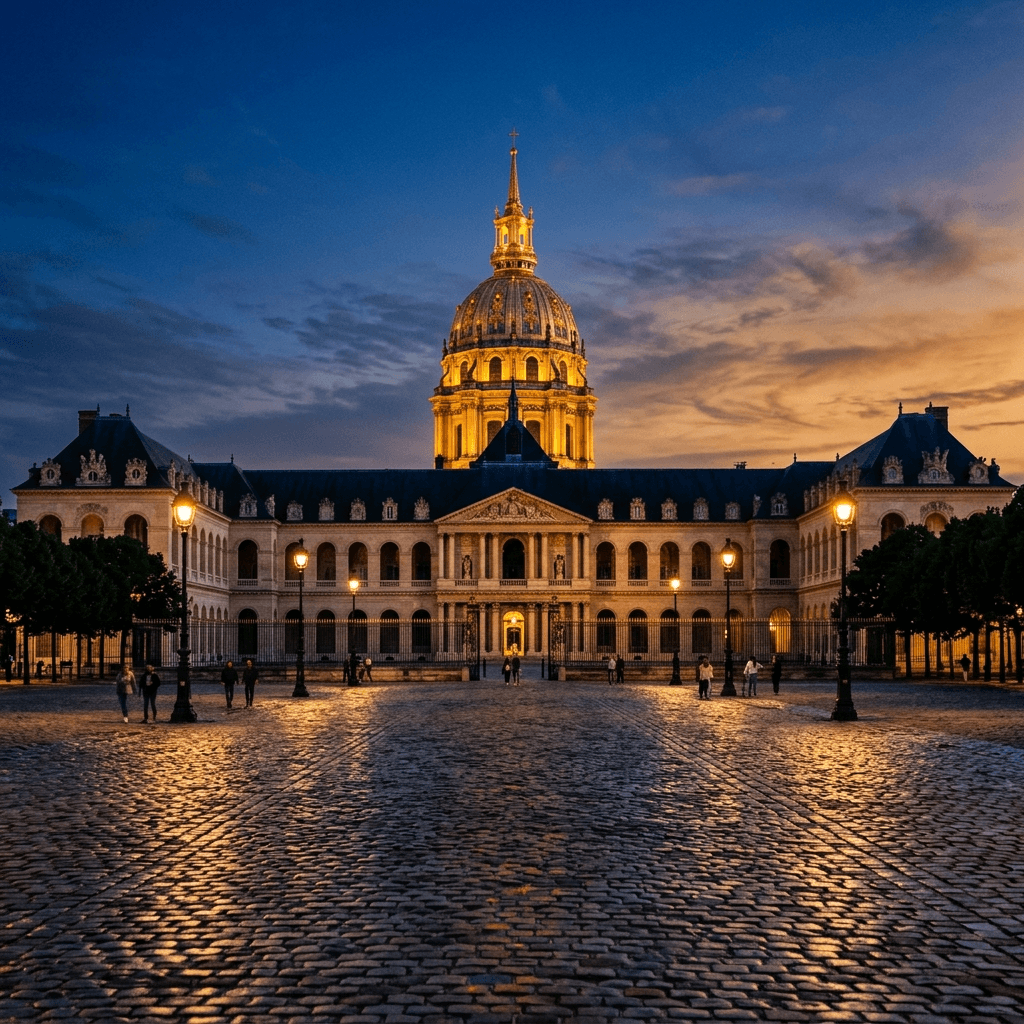
Libéral Bruant (1635-1697) was the first architect appointed by Louis XIV for the project. Bruant had already distinguished himself in the construction of the Hôpital de la Salpêtrière in Paris, another complex on a monumental scale. At Les Invalides, Bruant conceived the main structure between 1671 and 1676: a classical-façade building stretching 640 feet, organized around a cour d'honneur (Cour d'Honneur) that is one of the largest open spaces in Paris. The main façade, facing the Seine, displays the royal coat of arms of Louis XIV carved in stone, with the Sun — symbol of the Sun King — radiating over the entrance.
However, Bruant did not complete the church. In 1676, for reasons that historians still debate — possibly disagreements with the minister Louvois or simply the king's preference for a younger and more ambitious architect — Bruant was replaced by Jules Hardouin-Mansart (1646-1708), grandnephew of the legendary François Mansart, the architect who gave his name to the mansard roof.
Jules Hardouin-Mansart inherited his great-uncle's surname and surpassed him in fame. Appointed First Architect to the King in 1681, he was responsible for the most emblematic works of Louis XIV's reign, including the Hall of Mirrors and the Royal Chapel of the Palace of Versailles. At Les Invalides, Mansart faced a singular architectural challenge: the complex needed two distinct churches — one for the veteran soldiers and another for the king and the court.
Mansart's solution was brilliant. Between 1677 and 1706, he designed two churches sharing the same high altar: the Église Saint-Louis-des-Invalides, known as the soldiers' church, on a more modest scale and accessible to the veterans; and the Église du Dôme, the royal church with the golden dome that would become the symbol of Les Invalides. The two churches are separated by a glass wall behind the altar — an architectural innovation that allowed the king and the soldiers to attend the same mass without occupying the same physical space.
The Église Saint-Louis, completed in 1679, is a space of austere and functional beauty. Hanging there are the flags and standards captured by the French army in battles over the centuries — a detail that transforms the church into a military museum in its own right. The Église du Dôme, completed in 1706, is a masterpiece of French Baroque. Its Greek-cross plan, its Corinthian columns, its polychrome marbles, and its monumental dome represent the pinnacle of religious architecture of the Grand Siècle.
The indirect collaboration between Bruant and Mansart produced one of the most cohesive and impressive architectural ensembles in Europe. From Bruant's sober classicism to Mansart's triumphant Baroque, Les Invalides encapsulate the evolution of French architecture in less than 40 years.
Chapter
1.3 The Dôme des Invalides and Its 351-Foot Golden Dome: Why This Architectural Masterpiece Is Visible From Almost All of Paris
The golden dome of the Dôme des Invalides is, alongside the Eiffel Tower, one of the most recognizable visual landmarks of Paris. At 351 feet tall, it dominates the skyline of the 7th arrondissement and can be seen from dozens of points across the French capital — from the Trocadéro Esplanade to the Montparnasse Tower, the Sacré-Cœur, and the heights of the Parc de Belleville. But what makes this structure so visually striking?
The answer lies in its exterior cladding: genuine gold leaf. The dome's gilding is not paint, not imitation. It comprises 555,000 sheets of gold applied by hand over the lead and wood structure, in a gilding process repeated with every restoration. The last major renovation took place in 1989, when the bicentennial of the French Revolution prompted the French government to fully restore the dome's gilding. The cost was astronomical: roughly 10 kilograms of pure gold were laminated and applied by hand by specialized gilders.
The dome of Les Invalides is, in fact, a triple structure — a feat of 17th-century engineering that remains impressive to this day. The outer dome visible from the exterior is supported by a second inner dome, decorated with frescoes, and by a third structural dome that distributes the weight. Between the layers, stairs and passages allowed workers to climb up for maintenance. The system was designed by Jules Hardouin-Mansart with the collaboration of engineer Robert de Cotte.
Inside, the Dôme is decorated with frescoes by Charles de La Fosse (1636-1716), a disciple of Charles Le Brun, the official court painter. The central painting inside the dome depicts Saint Louis — King Louis IX, patron saint of the French monarchy — handing his sword to Christ, surrounded by angels and allegorical figures. It is an unmistakable political message: the French monarchy ruled by divine right, and its armies fought under celestial protection.
On the exterior, the dome is crowned by a lantern and a golden cross. Below it, the drum is adorned with 12 statues representing apostles and religious figures. The base of the dome is decorated with military trophies carved in stone — armor, helmets, shields, and flags — reinforcing the building's dual vocation as sacred space and military memorial.
The effect of the gilding at sunset is particularly breathtaking. When the golden light of dusk hits the dome's gold leaf, the brilliance multiplies and the Dôme seems to emit its own light. For Parisians, the dome of Les Invalides is not just an architectural landmark: it is a constant presence on the skyline, a reminder that the history of France is alive and gleaming over the city.
Chapter
1.4 How the Hôtel des Invalides Became the Musée de l'Armée: The Transformation of a Veterans' Asylum Into One of the World's Largest Military Museums
For nearly two centuries, the Hôtel des Invalides faithfully fulfilled its original mission. At the peak of its occupancy, during the reigns of Louis XV and Louis XVI, the complex housed around 4,000 veterans. But time, the Napoleonic Wars, and the social transformations of the 19th century profoundly altered the institution's function.
The museumification process began as early as the 18th century. In 1771, the Marquis de Monteynard, Secretary of State for War, decided to assemble at the Hôtel des Invalides a collection of models of French fortifications — the famous relief maps commissioned by Louis XIV and Vauban to plan the defense of the borders. This collection would later give rise to the Musée des Plans-Reliefs, which still operates today in a wing of the complex.
The great transformation, however, came with the creation of the Musée de l'Armée in 1905. That year, two distinct museum institutions were merged to form the new museum: the Musée d'Artillerie (Artillery Museum), founded in 1796 during the French Revolution and originally installed in the convent of Saint-Thomas d'Aquin, and the Musée Historique de l'Armée (Historical Army Museum), created in 1896 by a private society of military enthusiasts.
The merger was a strategic political decision of the government of the French Third Republic. France had been humiliated in the Franco-Prussian War of 1870-1871, losing Alsace and Lorraine to the newly unified German Empire. The country was undergoing a period of intense patriotic and militaristic exaltation, known as Revanchism. Creating a great national military museum, installed in the heart of Paris, was part of the effort to rebuild national pride and prepare the nation for a future confrontation with Germany.
The new Musée de l'Armée inherited extraordinary collections. From the Musée d'Artillerie came cannons, howitzers, mortars, and artillery pieces dating back to the 14th century, including pieces captured in famous battles. From the Musée Historique de l'Armée came uniforms, flags, edged weapons, battle paintings, and personal items of celebrated military figures. Over time, the collection expanded to include medieval armor, oriental weapons, objects from the Napoleonic Wars, and, later, material from both World Wars.
Today, the Musée de l'Armée occupies virtually the entire complex of Les Invalides. Although a small population of veterans still resides on the premises — keeping alive the original tradition of the edict of 1670 — most of the building is devoted to the museum collections. The museum houses over 500,000 pieces, distributed across departments covering from the Middle Ages to World War II, making it one of the three largest military museums in the world.
The transformation of the veterans' asylum into a national museum was symbolically completed in 1861, when the remains of Napoleon Bonaparte were placed in the crypt of the Dôme, forever sealing the building's destiny as one of the most important memorials in France.
Chapter
2. The Return of Napoleon Bonaparte's Ashes: The Epic Journey From Saint Helena to the Dôme des Invalides That Moved the World
Chapter
2.1 Napoleon's Death on Saint Helena on May 5, 1821, and the 19 Times the French Government Requested the Return of His Body
At 5:49 PM on May 5, 1821, a storm swept across the remote island of Saint Helena, lost in the South Atlantic nearly 1,240 miles from the coast of Africa. At that precise moment, in a modest room at Longwood House, the man who had conquered Europe and redefined the course of the modern world drew his last breath. Napoleon Bonaparte died at the age of 51.
The cause of death was stomach cancer — the same disease that had killed his father, Carlo Buonaparte, at the age of 38. The autopsy, performed the following day by Napoleon's personal physician, Francesco Antommarchi, in the presence of seven British doctors, confirmed the diagnosis: a perforated, cancerous gastric ulcer. For years, theories of arsenic poisoning circulated, fueled by 20th-century forensic analyses that detected abnormally high levels of the element in locks of the emperor's hair. Today, most historians dismiss the assassination hypothesis and attribute the arsenic to accidental ingestion via paints and pigments of the era.
Napoleon's last words are a subject of controversy. Witnesses reported that, amid feverish delusions, he murmured: "France, armée, tête d'armée, Joséphine" — "France, army, head of the army, Joséphine." Others claimed to have heard "À la tête de l'armée." What no one disputes is that the emperor, even on his deathbed, was thinking of France and the love of his life, Empress Joséphine de Beauharnais, who had died 7 years earlier.
After his death, the British governor of the island, Sir Hudson Lowe, imposed a posthumous humiliation. Lowe refused to allow the word "Napoleon" to be engraved on the tombstone. The grave, dug in the Valley of the Geraniums (Sane Valley), bore only the inscription "General Bonaparte" — a deliberate denial of all imperial titles and of the deceased's political identity. The body was buried in four concentric coffins: one of tin, one of mahogany, one of lead, and an outer one of mahogany.
Over the next 19 years, the French government requested the return of the body 19 times — once a year — to successive British governments. The requests were systematically ignored or denied. The situation only changed in 1840, when a new European political context finally opened the doors to repatriation. King Louis-Philippe I, monarch of the July Monarchy, saw in the return of the ashes a golden opportunity to reconcile post-Napoleonic France with its imperial past and to consolidate the legitimacy of his own reign.
Chapter
2.2 King Louis-Philippe, the Prince of Joinville, and the 1840 Expedition: The Naval Mission That Brought Napoleon Back to French Soil
In May 1840, King Louis-Philippe I finally obtained authorization from the British government, then led by Prime Minister Lord Melbourne, to repatriate Napoleon's remains. The diplomatic negotiation had been skillfully conducted by Adolphe Thiers, president of the Council of Ministers of France, who argued that returning the emperor's ashes was a gesture of reconciliation between the two nations.
To command the mission, Louis-Philippe chose his third son, François d'Orléans, the Prince of Joinville, then aged 22. The expedition sailed from Toulon on July 7, 1840 aboard the frigate Belle Poule, a 60-gun vessel that had taken part in the battle of Trafalgar — a detail laden with historical irony, since it was precisely the British navy that had defeated Napoleon in that decisive battle.
The journey lasted 93 days round trip. The Belle Poule, accompanied by the corvette Favorite, faced rough seas in the South Atlantic before anchoring at Jamestown, the only port of Saint Helena, on October 8, 1840. The arrival was received with solemnity by British authorities and by the small French community that had remained on the island tending the emperor's grave.
The exhumation took place in the early hours of October 15, 1840, by torchlight. The moment was charged with emotion and suspense: no one knew what state Napoleon's body would be in after 19 and a half years of burial. When the four concentric coffins were opened, those present were dumbfounded. Napoleon's body was perfectly preserved. His face was recognizable, his uniform of colonel of the Garde Impériale was intact, and even his famous hands crossed over his chest maintained their original position. Decomposition had been almost nil — a phenomenon some attribute to the hermetic sealing of the multiple coffins and others consider a minor chemical miracle.
The body was transferred to a new casket and loaded aboard the Belle Poule, which sailed back to France on October 18. The return voyage was faster, and the frigate arrived at the port of Cherbourg, in Normandy, on November 30, 1840. From there, the remains were transported by steamship along the Seine to the port of Courbevoie, on the outskirts of Paris, where they arrived on December 14.
The Prince of Joinville, in his memoirs, would describe the mission as "the greatest honor and the heaviest responsibility" of his life. He fulfilled his task with impeccable solemnity, returning to France not just the remains of a man, but the symbol of an entire era.
Chapter
2.3 Napoleon's Funeral on December 15, 1840: How Over One Million Parisians Braved Freezing Cold to Welcome the Emperor
The morning of December 15, 1840 dawned with a brutally low temperature in Paris: 18°F (-8°C). The cold was biting, and a thin layer of snow covered the streets of the French capital. But the freezing weather did not stop a colossal crowd from taking over the sidewalks, bridges, and squares along the funeral procession route. Contemporary estimates calculate that more than one million people — in a Paris that then had about 1 million inhabitants — crammed together to witness the return of the emperor.
The hearse was a work of art in itself. Designed by architect Henri Labrouste (with contributions by Visconti), the vehicle stood 32.8 feet tall by 19 feet wide and weighed 13 tonnes. It was pulled by 16 black horses richly caparisoned with plumes and golden drapes that dragged along the ground. Four groups of 4 horses each, mounted by riders of the Garde Nationale. The carriage was topped by a golden imperial crown and decorated with allegorical statues representing the victories of the empire.
The procession departed from the Church of Saint-Germain-l'Auxerrois, near the Louvre, around 10 in the morning. The itinerary was carefully planned to traverse the most symbolic points of Paris: it went down the Champs-Élysées, crossed the Place de la Concorde (where Louis XVI and Marie Antoinette had been guillotined 47 years earlier), and crossed the Seine via the Pont de la Concorde toward the Dôme des Invalides. The windows of every building along the route were packed. Trees, lampposts, and monuments were climbed by Parisians who had failed to secure a spot on the sidewalks.
King Louis-Philippe awaited the cortege at the Dôme des Invalides, accompanied by the entire royal family, the government, and the high military command. When the hearse finally passed through the portal of Les Invalides, it was already past 1 PM. The roughly 3.7-mile route took more than 3 hours to cover, such was the crowd pressing against the procession.
The body was temporarily placed in the Chapel of Saint-Jérôme, inside the Dôme, while the definitive crypt designed by Visconti was being completed — which would take another 21 years. The ceremony was solemn and brief, overshadowed by the intense cold and the exhaustion of the participants. But the symbolism of that day was greater than any physical discomfort: after 19 years of waiting, Napoleon was back in France.
Chapter
2.4 What Did Victor Hugo Write About Napoleon's Return? The Immortal Testimony of France's Greatest Poet Who Witnessed the Arrival of the Ashes
Victor Hugo (1802-1885) was among the crowd that braved the 18°F (-8°C) cold on December 15, 1840. The greatest French writer of the 19th century, author of Les Misérables and The Hunchback of Notre-Dame, was then 38 years old and already an established literary figure. His reaction to the event was immediate and passionate.
Hugo recorded his impressions in letters, diaries, and, above all, in the poem "Le Retour de l'Empereur", published shortly after the funeral. The verses capture the grandeur and strangeness of the occasion: all of France paralyzed to receive, not a living, triumphant emperor, but a handful of ashes inside a casket. He wrote that "a million people lined the streets", that the silence of the crowd was more impressive than any acclamation, and that the freezing cold seemed a divine punishment for France's ingratitude toward its greatest hero.
But Hugo's most famous text on the subject is the funerary ode "Napoléon", written over several years and incorporated into the book "Les Châtiments". In it, Hugo alternates between exalting Napoleonic greatness and condemning imperial tyranny — an ambiguity that reflected France's own feelings toward Napoleon. For Hugo, the emperor was simultaneously a "Prometheus" who had stolen fire from the gods to illuminate humanity and a "despot" who had sacrificed millions of lives in the name of his ambition.
Hugo was also one of the first to perceive the religious and almost mystical dimension that the return of the ashes was acquiring. He compared the funeral procession to a "resurrection", a pagan "apotheosis" in which the dead emperor was elevated to the status of demigod. The images of the hearse lit by the winter sun, the 16 black horses, the crowd kneeling on the sidewalks — all of this evoked, according to Hugo, an intimacy with the sacred that France had not experienced since the funerals of the kings at the Basilica of Saint-Denis.
The presence of Victor Hugo on that day and his subsequent writings helped fix the Retour des Cendres in the French collective imagination. Without the poet's literary testimony, the event might have become merely one more official ceremony in the annals of the 19th century. With Hugo, it was transformed into myth.
Chapter
3. Napoleon's Monumental Tomb at the Dôme des Invalides: Discover the Most Impressive Funerary Masterpiece in All of France
Chapter
3.1 The Red Quartzite Sarcophagus: The 5 Porphyry Blocks Quarried in Finland and Transported Over 2,480 Miles to Paris
At the center of the circular crypt of the Dôme des Invalides, beneath the 351-foot golden dome, rests one of the most extraordinary objects ever created to honor the dead: the sarcophagus of Napoleon Bonaparte. Carved from Shoksha red quartzite — an extremely rare variety of porphyry — the sarcophagus is, in itself, a geological, logistical, and artistic feat.
Shoksha quartzite is extracted from a single deposit in the world, located in the Karelia region, in northwestern Russia, near the border with Finland. The stone, a deep, uniform red with dark spots reminiscent of coagulated blood, had been known since Antiquity as "imperial porphyry" and was reserved exclusively for the sarcophagi of Roman and Byzantine emperors. Its hardness — superior to that of granite — makes its extraction and carving extremely difficult, which only increases its symbolic value.
The block of quartzite was a gift from Czar Nicholas I of Russia to the French government. The gesture was laden with geopolitical meaning: Russia had been Napoleon's executioner — the 1812 campaign and the Russian winter had destroyed the Grande Armée — and now it was offering the raw material for the tomb of the man who had tried to conquer it. The czar's donation was, at once, a tribute to Napoleon's military genius and a demonstration of moral superiority by the victorious Russia.
The extraction of the quartzite began in 1847 and was an operation of epic scale. 5 raw blocks were extracted from the Shoksha quarry, each weighing several dozen tons. The blocks were transported by ox-drawn sleds through the frozen forests of Karelia to the port of Petrozavodsk, on the shores of Lake Onega. From there, they traveled by river barges and canals to Saint Petersburg, where they were loaded onto ships that crossed the Baltic Sea, rounded Denmark, crossed the English Channel, and arrived at the port of Le Havre, in Normandy. The final leg was made by river barges along the Seine to Paris. Altogether, the journey covered more than 2,480 miles between the Finnish quarry and the Dôme des Invalides.
After transport, the 5 blocks were sculpted by French artisans under the direct supervision of architect Louis Visconti. The finished sarcophagus weighs an impressive 38 tonnes — after accounting for losses during carving. Its monumental dimensions — 13.6 feet long, 7.2 feet wide, and 14.9 feet high — were designed to convey the imperial grandeur that France wished to associate with Napoleon in death, since it could not sustain it in life.
The red color of the sarcophagus was not chosen by chance. Red porphyry, in Roman imperial symbology, represented supreme power, the blood of martyrs, and eternity. By enveloping Napoleon in this stone, the July Monarchy and, later, Napoleon III were deliberately associating the Corsican emperor with the Caesars of Rome, constructing a mythical genealogy that legitimized the Bonaparte dynasty.
Chapter
3.2 Louis Visconti and Napoleon's Circular Crypt: The Monumental Architectural Project That Took 21 Years to Complete
Napoleon's body arrived at the Dôme des Invalides on December 15, 1840, but the definitive crypt was only inaugurated on April 2, 1861. It took 21 years of work to transform the royal chapel of Jules Hardouin-Mansart into the imperial mausoleum we see today. The person responsible for this transformation was architect Louis Visconti (1791-1853), the same man who would later design the unification of the Louvre Palace with the Tuileries Palace.
Visconti faced a formidable challenge. The Dôme des Invalides was originally a church. Its Greek-cross plan, with the high altar located at the center under the dome, did not provide for a monumental sepulcher. Visconti's solution was radical and poetically brilliant: instead of raising the tomb, he sank it. The architect excavated a circular crypt directly under the center of the dome, creating a two-level space — the upper level, at the church floor level, and the lower, sunken level, where the sarcophagus rests.
The configuration means that visitors, as they approach the marble balustrade encircling the opening, must look down to see Napoleon's sarcophagus. The genius of the design lies in this inversion of perspective: visitors, however humble, stand above the emperor, who lies 6.6 feet below the floor level. Visconti explained that the intention was to symbolize humility and reverence — the greatest man in France, who once stood above all others, now places himself below even the simplest of visitors.
The lower crypt is accessed by a white marble staircase descending from the upper circular gallery. At the foot of the stairs, the visitor finds themselves before the immensity of the red sarcophagus. The ceiling height of the lower crypt is low compared with the dome above — a deliberate choice by Visconti to accentuate the feeling of intimacy and seclusion. The lighting is diffuse and soft, filtered through stained-glass windows representing imperial symbols: bees, eagles, laurels.
Visconti died in 1853, 8 years before the work was completed. The final phase was supervised by architect Jacques-Marie Huvé. The official inauguration took place on April 2, 1861, under the reign of Napoleon III, the emperor's nephew, who had restored the French Empire in 1852. The ceremony was a spectacle of imperial propaganda: the Second Empire was finally bestowing upon the founder of the dynasty the honors that the First Empire had not had time to grant him.
The visitor who today descends into the crypt of Les Invalides is not just standing before a tomb. They are standing before a masterpiece of European funerary architecture, a space conceived to provoke contradictory emotions: admiration for greatness, compassion for the fall, reverence for memory.
Chapter
3.3 Who Are James Pradier's 12 Winged Victories? The Marble Goddesses That Guard the Emperor and Represent His Campaigns
Around the lower crypt, arranged in a circle like eternal sentinels, stand 12 white marble statues that are, at once, mythological deities and war memorials. They are the Winged Victories (Victoires Ailées), sculpted by the Franco-Swiss artist James Pradier (1790-1852), one of the most celebrated neoclassical sculptors of the 19th century.
Each statue stands 11.2 feet tall and represents one of Napoleon's 12 great military campaigns: Austerlitz (1805), Jena (1806), Friedland (1807), Wagram (1809), Rivoli (1797), the Pyramids (1798), Marengo (1800), Ulm (1805), Eylau (1807), Eckmühl (1809), Borodino (1812), and Dresden (1813). The campaigns were selected with political care: the Russian defeat of 1812 is represented by Borodino (a battle won by Napoleon, even though the campaign as a whole was catastrophic), and the final defeat at Waterloo (1815) does not appear among the victories, as one would expect.
Pradier sculpted the figures in the purest neoclassical style. Each Victory is a winged female figure, with flowing robes that reveal the idealized anatomy of the body. The faces are serene, but the open wings and dynamic postures convey movement and contained energy. Some raise laurel wreaths, others hold palm fronds, and all bear the inscription of the battle they represent on their marble pedestals.
James Pradier, born in Geneva and trained at the École des Beaux-Arts in Paris, was known for his ability to fuse the Greco-Roman classical tradition with a typically French sensuality. His statues of goddesses and nymphs decorate fountains and squares throughout France, and his tomb in the Père-Lachaise cemetery is an attraction in its own right. For the Victoires of Les Invalides, Pradier restrained his habitual sensualism and opted for solemnity — the result being figures that inspire respect and contemplation, not desire.
The 12 Winged Victories fulfill a precise symbolic function in the crypt: they are a college of mythological guardians who protect the emperor's eternal sleep. The choice of twelve is not accidental — it recalls the 12 apostles, the 12 months of the year, the 12 tribes of Israel, the 12 signs of the zodiac. The number, laden with biblical and cosmological symbolism, confers upon the space a sacredness that transcends mere military homage.
The visual effect of the statues arranged around the red sarcophagus is hypnotic. The white marble contrasts with the crimson quartzite, the filtered light from the stained-glass windows casts shifting shadows on the open wings, and the silence of the crypt is broken only by the muffled footsteps of visitors. It is no exaggeration to say that Pradier's Victories are as responsible for the unique atmosphere of the mausoleum as the sarcophagus itself.
Chapter
3.4 Simart's 10 Bas-Reliefs on the Crypt Floor: How Napoleon's Civil Achievements Were Immortalized in Marble at the Dôme
While Pradier's Winged Victories celebrate Napoleon's military conquests, the floor of the circular gallery surrounding the crypt celebrates his civil conquests. There are 10 bas-reliefs carved in white marble by Pierre-Charles Simart (1806-1857), a disciple of Ingres and winner of the Prix de Rome in 1833, arranged as a ring that the visitor traverses while circling the sarcophagus.
The reliefs depict the great institutional achievements of the Napoleonic reign, those that survived the fall of the empire and shaped modern France:
The Code Civil (Napoleonic Code, 1804), which unified French law and influenced legal systems worldwide, from Louisiana to Japan. The Concordat of 1801, by which Napoleon reconciled post-revolutionary France with the Catholic Church, ending years of religious persecution. The creation of the Légion d'Honneur in 1802, France's highest decoration, which rewarded merit regardless of social origin. The founding of the Imperial University in 1808, which established the centralized educational system that France maintains to this day.
The reliefs also show the creation of the Bank of France (1800), the administrative reform of the departments, the building of bridges and canals, the opening of imperial roads, and the organization of the Conseil d'État. Each panel is a history lesson carved in stone, and together they form a visual summary of Napoleon's governmental work.
Pierre-Charles Simart worked on the reliefs between 1853 and 1857, dying shortly after completing them. His style is marked by the influence of Jean-Auguste-Dominique Ingres, under whom he studied: pure lines, balanced compositions, idealized figures that hark back more to Classical Antiquity than to the 19th century. The quality of execution is extraordinary — every detail of the garments, every facial expression, every allegorical symbol was meticulously chiseled.
The arrangement of the 10 bas-reliefs on the floor of the upper gallery creates a narrative experience for the visitor. Walking around the crypt opening, alternately looking at the reliefs on the floor and the sarcophagus below, the visitor traverses the complete biography of Napoleon: the battles (represented by the Victoires on the lower level) and the laws (represented by Simart's reliefs on the upper level). It is as if the entire mausoleum were a storytelling machine, designed by Visconti to instruct and to move.
The combined effect of Simart's reliefs, Pradier's statues, the red quartzite sarcophagus, and Visconti's crypt makes the Dôme des Invalides much more than a tomb. It is a book of stone, a poem in marble and quartzite, an architectural symphony that tells, for those who can read it, the complete story of the man who changed France — and the world — forever.
Chapter
4. Who Else Is Buried at the Dôme des Invalides? The Sons, Brothers, and Marshals Who Rest Alongside Napoleon Bonaparte
Chapter
4.1 Napoleon II, the King of Rome: The Tragic Story of the Son Who Died at 21 and Only Reunited With His Father in 1940 by Order of Adolf Hitler
When you descend into the circular crypt of the Dôme and contemplate the monumental tomb of Napoleon I, it is easy not to notice that another imperial figure rests nearby — but in a side chapel, almost discreet. This is Napoleon II, the emperor's legitimate son, whose story is one of the most tragic in the entire Napoleonic epic.
François Charles Joseph Bonaparte was born on March 20, 1811 at the Tuileries Palace in Paris. From the cradle he received the title of "King of Rome" — an imperial title created by his father to designate the heir to the throne. He was Napoleon's only legitimate son with Marie Louise of Austria, archduchess of Habsburg, in a dynastic marriage sealing the alliance between Napoleonic France and the Austrian Empire. The boy was the center of attention of all Europe: for Napoleon, he represented the continuity of the Bonaparte dynasty.
But the glory was short-lived. After Napoleon's first abdication in 1814, the little prince — just 3 years old — was taken to Vienna by his mother. He would never see his father again. At the Austrian court, he was raised as "Franz, Duke of Reichstadt" by his grandfather, Emperor Francis I of Austria. Educated as a Habsburg prince, forbidden to speak French, watched day and night — a gilded existence, but essentially a prisoner's. The boy who should have been Napoleon II never reigned a single day.
Franz's health was always frail. At 21, on July 22, 1832, he died of tuberculosis at Schönbrunn Palace in Vienna — the same palace where his father had humiliated the Austrian monarchy years earlier. His body was buried in the Imperial Crypt of the Habsburgs (Kapuzinergruft) in Vienna, among France's historical enemies. And there he remained for more than a century — the son separated from his father even in death.
What happened next can only be described as one of the most bizarre and cynical episodes of World War II. In 1940, with Paris under Nazi occupation, Adolf Hitler personally ordered the transfer of Napoleon II's remains from Vienna to Paris. The gesture was choreographed with propagandistic precision: the body arrived at the Dôme des Invalides on December 15, 1940, exactly 100 years after the return of Napoleon I's ashes in 1840. Hitler intended to gift occupied France with a "historic reunion" between father and son — a grotesque attempt to manipulate French nationalism.
The Parisians, however, were not deceived. They saw the gesture for what it was: propaganda from an occupying regime. Today, Napoleon II rests in a side chapel of the crypt of the Dôme — close to his father, but not beside the central sarcophagus. A short distance in feet, but one that says everything about the loneliness of a young man who bore the weight of being the son of the greatest man of his era and could never live up to the name he inherited.
Chapter
4.2 Joseph and Jérôme Bonaparte: Napoleon's Two Brothers Who Also Rest Under the Golden Dome of the Dôme des Invalides
Napoleon is not alone beneath the golden dome. Two of his brothers — kings appointed by Bonaparte's imperial ambition — also rest in the Dôme, each with his own destiny, his own glories and failures.
Joseph Bonaparte, the firstborn of the family, was born in 1768 in Corsica. He was Napoleon's older brother and, for many historians, the most sensible in the family. He was named King of Naples in 1806 and then King of Spain in 1808 — a throne he never truly managed to control, facing relentless guerrilla warfare and Wellington's British army. After the fall of the empire, Joseph fled to the United States, where he lived in exile for nearly two decades under the name "Count of Survilliers", on an estate in New Jersey. He died in 1844, in Florence, at the age of 76. His remains were transferred to the Dôme des Invalides in 1864, and he has rested ever since in one of the monument's side chapels — the prudent brother who, unlike Napoleon, knew how to survive his own empire.
Jérôme Bonaparte was the youngest of the family — and the most impetuous. Born in 1784, he was named King of Westphalia in 1807, a satellite kingdom created by Napoleon in the heart of Germany. He governed with extravagance and inexperience, earning the ironic nickname "König Lustig" ("King Jolly") among his German subjects. After Waterloo, Jérôme also went into exile, but unlike Joseph, he returned to France during the Second Empire, governed by his nephew Napoleon III. He became a Marshal of France and presided over the French Senate. He died in 1860, at 76, and was buried in the Dôme that same year — unlike Joseph, who waited until 1864 to be transferred.
The presence of these two brothers in the Dôme reflects something essential about Napoleon: he believed the Bonaparte family was a dynasty, and he treated his brothers as pieces on the European chessboard. Joseph bore the weight of impossible kingdoms; Jérôme, the irresponsible lightness of the youngest. Both survived the brother who made them kings by decades — and ended up together under the same golden dome that immortalized the name Bonaparte.
Chapter
4.3 The Great Marshals of France Buried at Les Invalides: Foch, Turenne, Vauban, Lyautey, and the Greatest French Military Heroes
The Dôme des Invalides does not belong only to the Bonaparte family. It is, above all, the supreme military pantheon of France — and houses the tombs of some of the greatest strategists and heroes the country has ever produced.
The most illustrious among them is Marshal Ferdinand Foch (1851-1929), the Supreme Allied Commander during World War I. It was Foch who coordinated the colossal final offensive of 1918 that broke the German lines and forced the Armistice of November 11. His strategic competence was such that, when signing the armistice in the railway carriage at Compiègne, the Germans surrendered to him — not to a politician. Foch died in 1929 and received exceptional state honors: his tomb in the Dôme was inaugurated in 1937. Today, his bronze effigy lies in one of the side chapels, a presence that reminds us that France owes him the triumph in the most devastating war Europe had ever seen.
But the Dôme houses soldiers from every French era. No visitor should fail to notice the tomb of Henri de La Tour d'Auvergne, Viscount of Turenne (1611-1675). Turenne was the greatest French general of the 17th century, the armed arm of Louis XIV, the man who defeated the armies of Spain, the Holy Roman Empire, and the United Provinces. His death in combat at the Battle of Salzbach in 1675 caused national commotion — Louis XIV ordered him to be buried in the Basilica of Saint-Denis, the necropolis of the kings of France. But it was Napoleon Bonaparte who, in 1800, ordered the transfer of his remains to Les Invalides. Napoleon admired Turenne above almost all generals of the past: for the emperor, he was the model of the cold, methodical, invincible commander.
Another name no French person ignores is Sébastien Le Prestre de Vauban (1633-1707), the genius of military engineering who built the fortresses that defended France's borders for two centuries. Vauban designed more than 160 fortifications and took part in 53 sieges — he never lost a defensive battle. His contribution was so extraordinary that his fortifications were declared a UNESCO World Heritage Site. In the Dôme, what rests is not his body, but a reliquary containing his heart — a monument worthy of the man who protected France with stone walls and mathematical genius.
To these are added Marshal Hubert Lyautey (1854-1934), Resident-General of Morocco during the French protectorate and a legendary figure of colonization, whose tomb was installed in the Dôme in 1961; General Henri Giraud (1879-1949), hero of both world wars and De Gaulle's rival for the leadership of Free France; and Admiral Émile Guépratte, of the French Navy, whose name is inscribed at Les Invalides. A gallery of military titans covering three centuries of French history — all watching over beneath the golden dome that Louis XIV built for his soldiers and that Napoleon transformed into an altar of national glory.
Chapter
5. The Monumental Collection of the Musée de l'Armée in Numbers: Over 500,000 Pieces of Military History From the Middle Ages to World War II
Chapter
5.1 The Ancient Weapons and Armor Department of the Musée de l'Armée: Europe's Largest Collection of Medieval Armor and the Swords of Knights
The Musée de l'Armée houses a collection of colossal dimensions: more than 500,000 objects, placing it among the three largest military museums in the world. And the historical heart of this collection lies in the Department of Ancient Weapons and Armor, one of the most important assemblages of historical weaponry ever brought together.
The armor collection impresses by its numbers and rarity: there are more than 2,500 pieces of armor and defensive equipment, covering a time span from the medieval period to the 17th century. Visitors journey through centuries of evolution in military metallurgy: from the chain mail of crusader knights to the full plate armor of the Renaissance — masterpieces of military goldsmithing that combined protection with ostentation. Each piece is a microcosm of social history: the shape of the helmet, the design of the pauldrons, the weight of the cuirasses — everything reveals who the warrior who wore it was and for what type of combat he prepared himself.
Among the most valuable pieces are the armors of French monarchs. The armor of François I (1515-1547), the knight-king of the Renaissance, rival of Charles V, and patron of Leonardo da Vinci. The armor of Henri II, killed tragically in a tournament in 1559 when a lance pierced his helmet and perforated his eye — an accident that changed the course of the French monarchy and plunged the country into the Wars of Religion. And the poignant armor of Louis XIII as a child, a boy-king dressed in steel for a throne he would receive at the age of 9.
An unexpected and fascinating nucleus is the collection of Japanese samurai armor — complete suits of armor, helmets ornamented with family crests, katanas, and horse armor. These pieces entered the collection through donations and acquisitions throughout the 19th century, a reflection of the European fascination with feudal Japan. Seeing a samurai armor just a few feet from a French medieval knight's armor is an experience of cultural mirroring that few museums in the world can offer: two warrior universes that never met on the battlefield, but that share the same human obsession with the art of making war.
Chapter
5.2 The Artillery Department of the Musée de l'Armée: The Cannons, Howitzers, and Siege Pieces That Changed the Course of European Wars Forever
If armor tells the story of individual combat, the artillery collection tells the story of impersonal war — the war of machines, gunpowder, and ballistic calculation. The Musée de l'Armée possesses one of the most complete artillery collections on the planet, with more than 1,200 pieces tracing the evolution of firepower from the dawn of gunpowder to the 20th century.
The section begins with the first cannons of the Hundred Years' War — crude pieces of forged iron, the direct ancestors of all modern artillery. These are weapons that witnessed the birth of a new era, when walls that had resisted for centuries began to crumble before the thunder of gunpowder. From there one moves on to the bronze cannons of Louis XIV: works of art cast with the royal seal, decorated with dolphins and fleurs-de-lis, instruments of destruction that were also pieces of monarchical propaganda. Each cannon of Louis XIV bore the engraved motto "Ultima Ratio Regum" — "The Last Argument of Kings" — a warning engraved in metal.
But the artistic and strategic high point of the collection is, without doubt, the Gribeauval System. Officer Jean-Baptiste Vaquette de Gribeauval revolutionized French artillery in the second half of the 18th century, standardizing calibers, pieces, and carriages. His system allowed any damaged cannon to be repaired with interchangeable parts — an industrial innovation before the Industrial Revolution. The light, precise pieces of the Gribeauval system were the backbone of Napoleonic artillery. It was with these cannons that Napoleon shattered enemy formations at Austerlitz, Wagram, and Borodino. Bonaparte, himself a trained artillery officer, knew exactly the value of those machines — and that is why the Musée de l'Armée displays them with due prominence, as the instruments that forged an empire.
Chapter
5.3 How the Musée de l'Armée Portrays the Two World Wars? Uniforms, Weapons, Vehicles, and Original Documents From 1914-1918 and 1939-1945
The Musée de l'Armée devotes entire wings — some of the most visited in the entire complex — to the two wars that redefined France and the world in the 20th century. The route is chronological and immersive, designed so that each room transports the visitor to the heart of the conflict, far beyond a simple display of objects.
The World War I (1914-1918) section begins with the blue and red uniforms of 1914 — the vibrant colors that French soldiers still wore at the start of the conflict, a legacy of the 19th century, which made them easy targets for German machine guns. From there one passes to the horizon-blue uniforms that replaced them, to the recreated trenches, the gas masks, the Adrian helmets. Among the most emblematic objects is the uniform of Marshal Foch, the one he wore in the decisive days of autumn 1918, and the famous "Taxi de la Marne" — a 1914 Renault Parisian taxi, one of the hundreds that rushed French soldiers to the Marne River front in September of that year. It was an improvised logistical fix that saved Paris from German invasion, and the taxi on display is one of the original vehicles that took part in the operation.
The World War II (1939-1945) wing is equally powerful, but darker. The route begins with the drôle de guerre (the "phony war") and the French collapse of June 1940. The Nazi occupation section is particularly impactful: swastika flags, German propaganda posters plastered on Paris walls, decrees of the Vichy regime. The museum does not soften the complexity of this period — it shows a France divided between collaboration, resistance, and daily survival under the German yoke. Authentic military vehicles from both sides punctuate the space: tanks, jeeps, motorcycles.
The Liberation section closes the route: the flags of Free France, the armbands of the Resistance, the portraits of anonymous and famous fighters. The contrast between the oppressive weight of the occupation room and the lightness of the liberation room is calculated — and it works. Visitors physically feel what it was like to pass from the night of occupation to the morning of freedom.
Chapter
6. The Charles de Gaulle Historial at the Musée de l'Armée: The Immersive, High-Tech Museum Dedicated to the General Who Liberated France
Chapter
6.1 How Does the Charles de Gaulle Interactive Journey Work? The Multimedia Technology That Transports Visitors to Occupied France in 1940
Inaugurated in 2008, the Charles de Gaulle Historial is a gem of contemporary museography installed in the basement of the Cour d'Honneur (the courtyard of honor) of Les Invalides. It covers 26,900 sq ft of immersive experience, a project that broke with traditional French museography and adopted a radically contemporary approach: cinema, audio, digital interactivity, and theatrical scenography.
The Historial is not a museum of objects — it is a museum of narrative. The visit unfolds as a chronological journey through De Gaulle's life, guided by an automatic audio-guide technology that detects the visitor's position in each room and triggers content synchronized with the environment. Multiple screen formats, enveloping projections, interactive terminals, and audio stations compose a living timeline.
The route covers the entirety of the general's life: his birth in Lille in 1890, into a Catholic and patriotic family; his military training at Saint-Cyr; his baptism of fire in World War I — where he was wounded at Verdun in 1916 and presumed dead, captured by the Germans; his five escape attempts from captivity; his solitary rebellion of June 1940 against the French surrender. The story advances through the years of Free France, the exile in London, the Normandy landings in 1944, and the triumphant march down the Champs-Élysées.
But the Historial is not limited to the war. The second half of the route covers De Gaulle's controversial return to power in 1958, the Algerian War and Algerian independence — a decision that divided France and made De Gaulle a target of assassination attempts —, the Constitution of the Fifth Republic, the events of May 1968, the lost referendum of 1969, the resignation, and, finally, his solitary death at Colombey-les-Deux-Églises on November 9, 1970. The Historial admission is included in the standard ticket for Les Invalides — and it is a serious mistake to skip this experience.
Chapter
6.2 General De Gaulle's Appeal of June 18, 1940: Where to Hear the Original Recording of the Speech That Changed the Destiny of France
At the heart of the Historial, in a room of calculated penumbra, the visitor encounters the most precious object in the entire exhibition: the original recording of the Appeal of June 18, 1940, broadcast by the BBC in London. It is the most important speech in 20th-century French history — and hearing it in that environment, emitted by period radios displayed around the room, is an experience many visitors describe as electrifying.
Context is essential to understanding its force. On June 18, 1940, France was on its knees: Paris had fallen four days earlier, the French government was preparing to sign the armistice with Hitler, and Marshal Pétain — the hero of Verdun — announced over the radio that "fighting must cease." De Gaulle, then an almost unknown brigadier general, freshly arrived in London, went to the BBC that night and did what no other French officer dared: he disobeyed. He declared that France had lost a battle, but not the war. He called upon the French to resist, to unite with him, to refuse defeat.
The appeal was heard by very few people that day. But it was transcribed, reproduced in clandestine newspapers, repeated in subsequent broadcasts. It became the founding myth of Free France. What the Historial room offers the visitor is not just the audio — it is the reconstruction of the atmosphere of that moment: the period radios, the photographs of an occupied Paris, the silence of the room, the sound emerging from the speakers. The original recording heard there is not from the 18th (there is no recording of the first broadcast) — it is the re-recording of June 22, 1940, made by De Gaulle himself so that the appeal could be rebroadcast. But the voice is the same, the text is the same, the urgency is the same.
Chapter
6.3 Why Is the 26,900-Square-Foot Appeal Room the Emotional Heart of Les Invalides? The Underground Space That Moves Even the Most Skeptical Visitors
The Charles de Gaulle Historial occupies a unique physical and symbolic position within the Les Invalides complex. It is underground, buried beneath the main courtyard, as if the architecture itself were saying that De Gaulle's memory is the invisible foundation upon which the French military pantheon stands. And although the total space of the Historial is 26,900 sq ft, it is the sequence of rooms dedicated to the 1940 appeal that functions as its emotional center of gravity.
The impact of these rooms cannot be explained by historical content alone — it is explained by the intelligence of the scenography. The lighting is low, the colors are dark, the ambient sounds evoke radio static and footsteps in the corridors of abandoned ministries. De Gaulle's voice fills the air when you least expect it. Screens show archival footage of refugee convoys on French roads in June 1940, crowds carrying bundles, French soldiers surrendering and marching into captivity. The contrast between France's collective despair and the solitary firmness of an unknown general's voice in the BBC studio is, simply, devastating.
Tour guides in Paris commonly report the same phenomenon: even visitors who come to Les Invalides just to see Napoleon's tomb — and who perhaps enter the Historial by chance, because the ticket is already paid for — leave these rooms visibly moved. Elderly French people sometimes cry. Foreigners remain silent for minutes. The force of that recording, amplified by the underground, silent, and solemn environment, transforms what could be a simple museum visit into an experience of almost civic transcendence.
The Historial closes with a reflection room: images of De Gaulle in old age, at Colombey, walking alone through the fields of Haute-Marne. A man who held absolute power and abandoned it twice. Who saved France from humiliation in 1940 and saved it from civil war in 1958. And who died, as he wished, far from the apparatus of the State, in a simple village house. The 26,900-square-foot room is the emotional heart of Les Invalides because it touches on a truth that Napoleon, in his quartzite sarcophagus, could never offer: the solitary greatness of a man who preferred France to himself.
Chapter
7. The Two Secret Museums Inside the Les Invalides Complex That Almost No One Knows About: Plans-Reliefs and Ordre de la Libération
Visitors to Les Invalides usually follow the classic circuit: Napoleon's tomb, the medieval armor collection, the two World Wars wing. But the complex houses two extraordinary museums that go completely unnoticed by most tourists — and that are among the most fascinating experiences in Paris. The Musée des Plans-Reliefs and the Musée de l'Ordre de la Libération are hidden gems on the top floor and in the side galleries of the building, and both are included in the same Musée de l'Armée ticket. If you have time for a complete visit to Les Invalides, do not skip these two treasures.
Chapter
7.1 The Musée des Plans-Reliefs and Vauban's Giant Models: The French Fortresses in Miniature That Louis XIV Commissioned
On the top floor of Les Invalides, occupying the same space since 1777, there is a silent, little-visited room that houses one of the most singular collections in European military history: the Musée des Plans-Reliefs. More than one hundred three-dimensional 1:600-scale models reproduce fortified cities, strategic ports, and French fortresses with a level of detail that defies comprehension.
The collection was born from a practical and brilliant idea. In 1668, during the reign of Louis XIV, the war minister Louvois commissioned the great military engineer Vauban to build three-dimensional models of the kingdom's main strongholds. The goal was purely strategic: the relief plans allowed the king and his generals to visualize defenses, plan sieges, and study the terrain without having to travel thousands of miles to each frontier. War, after all, was also won on the map table.
Each model was simultaneously a work of art and engineering. Specialized artisans spent months — sometimes years — reproducing not only the walls, bastions, and moats of the fortifications, but also every house, every church, every cultivated field, and every tree in the surroundings. The level of precision was so extreme that the models were updated as forts underwent renovations or expansions. When a new cannon battery was installed at Saint-Malo or a new bastion was erected at Besançon, the corresponding model received the adjustments.
Of the more than one hundred original models created over the reigns of Louis XIV, Louis XV, and Napoleon III, only 28 have survived intact. The rest were destroyed by fires, wars, neglect, or simply lost in the recesses of history. Those that remain are irreplaceable treasures — and are displayed at Les Invalides, under the natural light that enters through the attic skylights.
Among the cities represented in the collection are some of the most emblematic in French and European geography. The model of Saint-Malo shows the corsair city before the World War II bombings that almost completely destroyed it — the model is, therefore, an unsurpassable historical document of what the city once was. The model of Brest reveals the military port in the 18th century, with its protected roadstead and its shipyards. Toulon appears with its naval base and its fortified hills. Besançon displays the defensive system designed by Vauban, with the citadel dominating the meander of the Doubs River. The model of Luxembourg shows the fortress before the dismantlement mandated by the 1867 Treaty of London. Strasbourg displays its walls and bridges before the German annexation. And Mont-Saint-Michel appears not as the romantic tourist spot of today, but as the impregnable fortress that resisted all English sieges during the Hundred Years' War — with its walls, its fortified abbey, and the treacherous sandbanks of low tide reproduced in miniature.
Walking through the Plans-Reliefs gallery is an experience that blends aesthetic awe and historical fascination. Each model occupies tables several feet long, and visitors can move around them, lean in to observe the details, or climb elevated platforms to get an overview. Seeing cities as they were three hundred years ago — before Haussmann's avenues, before railroads, before industrialization — is a form of time travel that no book or documentary can replicate.
The Musée des Plans-Reliefs is, to this day, a museum within a museum: administratively independent, but integrated into the Les Invalides complex. The Musée de l'Armée ticket gives unrestricted access to the gallery, and the visit takes between thirty minutes and an hour, depending on your level of interest in military history, urbanism, or simply the pleasure of admiring artisanal goldsmithing on a grand scale.
Chapter
7.2 The Musée de l'Ordre de la Libération at Les Invalides: The Story of the Secret Order Created by De Gaulle in 1940 and Its 1,038 Hero Companions
The second secret museum of Les Invalides is smaller in size, but immense in emotional density. The Musée de l'Ordre de la Libération occupies a wing of the complex and tells the story of the highest French decoration after the Légion d'Honneur — and of the 1,038 heroes who received it.
It all begins on November 16, 1940. France is occupied, the Vichy government collaborates with the Nazis, and General Charles de Gaulle, exiled in London, seeks to consolidate the legitimacy of Free France. On that day, in Brazzaville — capital of French Congo, which had become the capital of Free France in Africa — De Gaulle signs the ordinance creating the Ordre de la Libération. The stated purpose is "to reward persons or military and civilian communities who have distinguished themselves in the work of liberating France and its empire."
What makes the Ordre de la Libération unique among world decorations is its absolute rarity. De Gaulle decided that the order would have a single rank — that of Compagnon de la Libération — and that appointments would cease as soon as France was liberated. Said and done: between 1941 and 1946, only 1,038 names were honored. Of these, 1,036 were individuals (including six women), 18 were military units of the Free French forces, and 5 were French communes — including Paris, honored for its uprising of August 1944, and the island of Sein, in Brittany, whose 128 able-bodied fishermen responded en masse to De Gaulle's appeal and departed for England in their fishing boats.
The last Compagnon de la Libération, Hubert Germain, died in 2021 at the age of 101. His funeral was a state event: Germain was buried in the crypt of the Mont Valérien memorial, on the outskirts of Paris, where the Nazis executed more than a thousand resistance fighters and hostages during the occupation. With his death, the order ended its living existence — but its legacy is preserved in the museum at Les Invalides.
The museum is not limited to displaying medals and decorations. Each showcase tells the story of a Compagnon — and they are stories ranging from epic heroism to silent tragedy. There is Commander Thierry d'Argenlieu, a discalced Carmelite and naval officer who became one of De Gaulle's right-hand men. There is Pierre Brossolette, journalist and resistance fighter tortured by the Gestapo, who threw himself from the fifth floor of the Nazi political police headquarters in Paris so as not to betray his comrades under torture. There is Félix Éboué, the Black governor of the colony of Chad, who was the first high official of the French colonial empire to join De Gaulle, securing a territorial base in Africa for Free France. There are the sisters Thérèse and Marie-Louise Dissard, who organized escape networks for Allied pilots shot down over occupied France. There is Romain Gary, the writer and diplomat who was a combat pilot in the Free French air forces. And there are the anonymous soldiers, the colonial combatants from Africa and Indochina, the communist resistance fighters, the Gaullists of the first hour, the Jews who fought in the Resistance even knowing that capture meant certain deportation.
The museum's hall of honor displays the Croix de la Libération — the cross of liberation — in its original design. Created by the jeweler Cartier, the insignia is a rectangular shield in polished bronze with a sword at the center, overlaid by a Cross of Lorraine in black enamel, all on a green background. On the reverse, the Latin inscription: "PATRIAM SERVANDO VICTORIAM TULIT" — "By serving the homeland, he won victory." The green and black respectively symbolize hope and mourning for occupied France. The Cross of Lorraine, chosen by De Gaulle in opposition to the Nazi swastika, became the universal symbol of the French Resistance.
The ribbon of the order also has its meaning: green with black edges, it is crossed by additional vertical black stripes — four in total, representing the four dark years of the German occupation. The insignia was worn on the left chest, and its bearer had the right — rarely exercised, but symbolically powerful — to be saluted by any member of the French armed forces.
A visit to the Musée de l'Ordre de la Libération is a natural and almost necessary complement to the Charles de Gaulle Historial (covered in chapter 6). While the Historial focuses on the figure of the general and the political context of Free France, the museum of the order tells the story through the eyes of individual combatants. They are narratives of courage, fear, sacrifice, and conviction that humanize the abstraction of war and remind us that French freedom was won by flesh-and-blood people — many of whom did not live to see the result of their struggle.
Like the Musée des Plans-Reliefs, the Musée de l'Ordre de la Libération is included in the Musée de l'Armée ticket. The visit takes between forty minutes and an hour, and it is recommended to combine it with the Charles de Gaulle Historial, as both deal with the same historical period from complementary perspectives. Together, these two hidden museums transform the experience of Les Invalides: what begins as a visit to Napoleon's tomb reveals itself, floor by floor, as a complete journey through four hundred years of French history — from Vauban's models to De Gaulle's companions, from the Sun King to the Resistance.
Chapter
8. The Ultimate Guide to Visiting the Musée de l'Armée and Napoleon's Tomb at Les Invalides in 2026: Tickets, Hours, and Best Tips
Visiting Les Invalides requires a minimum of planning. The complex is one of the largest museums in Paris, receives more than one million visitors per year, and houses multiple attractions under one roof — Musée de l'Armée, Napoleon's tomb in the Dôme, the Charles de Gaulle Historial, the Musée des Plans-Reliefs, and the Musée de l'Ordre de la Libération. This practical guide brings together all the information you need to plan your visit in 2026: tickets, hours, transport, a surrounding itinerary, and tips to avoid crowds.
Chapter
8.1 Where to Buy the Cheapest Musée de l'Armée and Dôme des Invalides Ticket? Updated Prices, Discounts, and Free Admissions
The Musée de l'Armée ticket costs approximately $16.50 (€15 full price) and gives complete access to the Les Invalides complex: the museum itself with its permanent collections, the Dôme and Napoleon's tomb, the Charles de Gaulle Historial, the Musée des Plans-Reliefs, and the Musée de l'Ordre de la Libération. There is no need to buy separate tickets: a single entry covers everything.
The best and cheapest way to purchase the ticket is directly on the official Musée de l'Armée website (musee-armee.fr). Advance online purchase guarantees the best price and allows you to choose an entry time, avoiding lines at the physical ticket office. There is also the option of buying on resale platforms like GetYourGuide and Tiqets, but prices tend to be slightly higher due to service fees.
Free admissions and discounts are generous. Free entry, upon proof, is granted to all European Union citizens under 26, all visitors under 18 regardless of nationality, people with disabilities and their companion, holders of the Paris Museum Pass (which also allows you to skip the line and enter directly), active French teachers, and accredited journalists. The first Sunday of each month also has free admission for all visitors — but be warned that on this day the museum is considerably more crowded.
For those who do not qualify for the free categories and want to save money, the golden tip is the Paris Museum Pass. The two-day pass costs around $68 (€62) and gives access to more than fifty museums and monuments in Paris, including Les Invalides, the Louvre, the Musée d'Orsay, the Arc de Triomphe, and Versailles. If you plan to visit three or more paid attractions during your stay in Paris, the pass already pays for itself. And at Les Invalides, it also offers the advantage of priority access, with no need to reserve a time slot.
Chapter
8.2 What Is the Best Time to Visit Napoleon's Tomb at Les Invalides and Avoid the Tourist Crowds?
The Musée de l'Armée is open daily from 10:00 AM to 6:00 PM, with the exception of three dates: January 1st, May 1st, and December 25th. From April to September, the high tourist season in Paris, there are extended hours on Tuesdays, when the museum stays open until 9:00 PM.
The best visiting window for those who want tranquility is Tuesday evening, during the extended hours of the high season. From 6:00 PM onward, the flow of visitors drops dramatically: most tourists have already left, school groups have dispersed, and the Dôme becomes surprisingly empty. Seeing Napoleon's tomb under the evening light that enters through the dome's windows, practically alone, is an experience completely different from a hurried daytime visit amid dozens of tourists taking selfies.
If Tuesday evening does not fit into your itinerary, the second-best option is to arrive at 10:00 AM sharp, at opening time, on any day of the week. The morning flow is still low, and you can do the main circuit — Dôme and tomb — before the arrival of large groups starting at 11:00 AM. Avoid weekends at all costs: Saturday and Sunday are the busiest days, with lines that can exceed an hour just for entry.
As for the duration of the visit, the minimum recommended is two hours, which allows you to see the Dôme, Napoleon's tomb, and take a quick tour of the museum's main collections. The ideal, however, is three to four hours, which allow you to add the Charles de Gaulle Historial, the Musée des Plans-Reliefs, and a relaxed lunch at the museum café. For military history enthusiasts who want to see everything at leisure, a full day is not an exaggeration — Les Invalides' collection is vast enough to occupy six or seven hours of continuous exploration.
Chapter
8.3 How to Get to the Musée de l'Armée and the Dôme des Invalides by Metro, RER, and Bus? Stations and Lines
The Les Invalides complex occupies a monumental block in the heart of Paris's 7th arrondissement, with three access entrances: via Rue de Grenelle (main address: 129 Rue de Grenelle, 75007 Paris), via Place Vauban (south side, closest to the Dôme), and via the Esplanade des Invalides (north façade, with the great courtyard of honor and the historic cannons).
The most direct metro station is Invalides, served by metro lines 8 and 13 and by RER line C (suburban train). From Invalides station to the main entrance on Rue de Grenelle is less than three minutes on foot. Stations La Tour-Maubourg (line 8) and Varenne (line 13) are also in the vicinity, about five to seven minutes' walk, and may be more convenient depending on where you are staying.
For those who prefer buses, lines 28, 63, 69, 82, 83, 86, 87, and 92 have stops near Les Invalides. Line 69 is particularly scenic: its route cuts across Paris from east to west, passing in front of the museum's façade with a spectacular view of the Esplanade and the golden Dôme.
Car parking is limited in the area, and traffic in the 7th arrondissement can be congested at peak hours. The metro and RER are, by far, the most practical options.
Chapter
8.4 What to Visit Near the Musée de l'Armée? Complete Itinerary Through the 7th Arrondissement: Eiffel Tower, Musée Rodin, Pont Alexandre III, and More
One of the trump cards of Les Invalides' location is that the museum is surrounded by some of the most iconic attractions in Paris, all of which can be visited on foot on the same day. A classic and perfectly feasible itinerary starts at Les Invalides in the morning and unfolds through the 7th arrondissement over the afternoon.
A quarter of a mile from the Les Invalides exit, via Rue de Varenne, is the Musée Rodin, installed in the Hôtel Biron — an 18th-century mansion with one of the most beautiful sculpture gardens in Paris. It is there that you'll find The Thinker (Le Penseur), Auguste Rodin's most famous sculpture, as well as The Kiss, The Burghers of Calais, and the monumental Gates of Hell. The museum is relatively small and can be visited in one hour, making it the perfect complement to a morning at Les Invalides.
A quarter of a mile in the opposite direction, toward the Seine, is the Pont Alexandre III — considered by many the most beautiful bridge in Paris. Inaugurated for the 1900 World's Fair, the bridge is an Art Nouveau extravaganza in wrought iron with golden candelabras, sculpted cherubs, winged nymphs, and a view of Les Invalides on one side and the Grand Palais on the other. Crossing it on foot, with the golden Dôme at your back, is one of the most photogenic walks in the city.
Continuing along the banks of the Seine toward the west, a fifteen-minute walk brings you to the Eiffel Tower, 0.74 miles from Les Invalides. The route can be taken via Avenue de Tourville or, more pleasantly, along the riverbank, passing the Trocadéro Esplanade if you want the classic photo of the tower.
Other nearby attractions include the Assemblée Nationale (the seat of the French parliament, installed in the Palais Bourbon, approximately 1,640 feet from Les Invalides), the Musée du Quai Branly (dedicated to the arts of Africa, Asia, Oceania, and the Americas, at the foot of the Eiffel Tower), and the Esplanade des Invalides itself, the vast lawn in front of the north façade of the complex that is one of the most pleasant open spaces in Paris for a rest between visits.
Chapter
9. FAQ — Frequently Asked Questions About the Musée de l'Armée and Les Invalides
Chapter
How much does the Musée de l'Armée and Napoleon's Tomb ticket cost in 2026?
The full-price ticket costs around $16.50 (€15) and covers entry to all sections of the complex: the permanent collection of the Musée de l'Armée, the Dôme and Napoleon's tomb, the Charles de Gaulle Historial, the Musée des Plans-Reliefs, and the Musée de l'Ordre de la Libération. There are no separate tickets for the tomb: the Dôme is part of the museum and access is unified. Free admission is granted to European Union citizens under 26, all minors under 18, people with disabilities and their companion, and holders of the Paris Museum Pass. The first Sunday of each month is also free for all visitors, but expect greater crowds on that day. The cheapest ticket is always purchased directly on the museum's official website; third-party platforms usually add service fees that raise the price by $2.20 to $5.50 (€2 to €5).
Chapter
Is Napoleon really buried at Les Invalides?
Yes, Napoleon Bonaparte is truly buried at the Dôme des Invalides, inside the red quartzite sarcophagus that dominates the circular crypt. His remains were repatriated from the island of Saint Helena in 1840 and placed at Les Invalides on December 15 of that year, in a ceremony that mobilized more than one million Parisians. The sarcophagus has been opened and verified on various occasions throughout history — the most recent and documented occurred during the restoration of the Dôme in the 20th century, confirming the presence of the body. Napoleon is buried inside six concentric coffins (tin, mahogany, lead, ebony, oak, and the outer quartzite sarcophagus), a structure designed to guarantee inviolability and the eternal preservation of the remains. The occasional doubt about the veracity of the burial arises from 19th-century conspiracy theories, but historical documentation and official inspections leave no room for serious questioning: Napoleon rests beneath the golden dome.
Chapter
Is the Musée de l'Armée open every day?
The museum is open daily from 10:00 AM to 6:00 PM, including Saturdays, Sundays, and most French public holidays. It closes only on three dates throughout the year: January 1st (New Year's Day), May 1st (Labor Day), and December 25th (Christmas Day). From April to September, the high tourist season, the museum extends its hours on Tuesdays until 9:00 PM, offering an opportunity for a quieter evening visit. The ticket office closes thirty minutes before the closing time, and visitors are asked to start making their way to the exit fifteen minutes before closing. It is always worth checking the official website before your visit: occasionally, specific wings may close for maintenance, official events, or the preparation of temporary exhibitions.
Chapter
How long does it take to visit Les Invalides?
The minimum duration for a visit covering the essentials — Dôme and Napoleon's tomb, plus a quick pass through the museum's main collections — is two hours. The ideal time for a complete experience, including the Charles de Gaulle Historial, the Musée des Plans-Reliefs, and the Musée de l'Ordre de la Libération, is three to four hours. For military history enthusiasts who wish to explore the collection in depth (the museum has more than 500,000 pieces, of which around 2,500 are in permanent exhibition), a full day of six to seven hours is not excessive. The museum café, installed in the inner courtyard, offers a convenient break for those planning to spend the day at the complex. The practical tip is to start with the Dôme and the tomb right at opening time, before the crowds arrive, and then explore the museum wings at your own pace.
Chapter
What is the best way to get to the Musée de l'Armée?
The most practical way to get to Les Invalides is by metro or RER. Invalides station, served by metro lines 8 and 13 and by RER line C, is less than three minutes' walk from the main entrance on Rue de Grenelle. Stations La Tour-Maubourg (line 8) and Varenne (line 13) are also nearby, a five- to seven-minute walk away. Buses on lines 28, 63, 69, 82, 83, 86, 87, and 92 have stops in the vicinity of the complex — line 69 is especially recommended for its scenic route through central Paris. Ride-hailing cars and taxis can drop passengers off at Place Vauban or the Esplanade des Invalides, but traffic in the 7th arrondissement can be dense at peak hours. Parking is scarce and expensive; public transport is the most recommended option.
Chapter
Is Napoleon's tomb wheelchair accessible?
Yes, the Les Invalides complex is fully accessible for people with reduced mobility. The main access to the Dôme and Napoleon's tomb has ramps and elevators that allow one to reach the level of the circular crypt without architectural barriers. The museum offers wheelchairs upon request at the reception desk, subject to availability, and the loan is free of charge. Guide dogs are allowed in all areas. People with disabilities and one companion are entitled to free admission upon presentation of supporting documentation. It is recommended to inform the museum in advance about specific accessibility needs to ensure the best possible experience.
Chapter
What is the difference between the Dôme and the Église Saint-Louis at Les Invalides?
The Les Invalides complex houses two distinct churches built under the same roof, but with completely different functions and architectures. The Église Saint-Louis des Invalides, also called the Église des Soldats (soldiers' church), was the chapel for the veterans who lived in the hospital. Its architecture is sober and functional, suited for the daily religious services of the residents. It still functions today as an active Catholic church and houses the war trophies and flags captured by the French army over the centuries — displayed on the walls of the central nave. The Dôme des Invalides, with its 351-foot golden dome, was the church reserved for the king and the royal family when they visited Les Invalides. Originally conceived as a royal chapel, it was transformed into an imperial mausoleum to receive Napoleon's tomb and, later, the sepulchers of other great names in French military history. The two churches are physically contiguous and share the same high altar: a glass window at the back of the altar allows the faithful in the Église Saint-Louis to see the altar of the Dôme, symbolizing the unity between the two chapels. During the visit, the Église Saint-Louis is generally the first space one passes through when entering the Dôme from the north side.
Chapter
Is the Musée de l'Armée suitable for children?
The museum is quite family-friendly and offers specific resources for children. There are audioguides with content adapted for kids, activity booklets available at the reception desk, and themed workshop visits scheduled on certain days. The medieval armor rooms tend to be children's favorites — life-size knights, armored horses, and impressive swords awaken the fascination of even the most museum-averse little ones. The artillery collection, with cannons of all sizes, also tends to please. The Charles de Gaulle Historial, with its interactive multimedia resources, can work well for children aged eight or nine and older who already have some notion of the historical context. For very young children, the space can be tiring due to the size of the complex: the tip is to focus on one or two specific wings and take breaks in the inner courtyard. Baby strollers are allowed and there are elevators on all floors.
Chapter
Are guided tours in Portuguese available at the Musée de l'Armée?
Officially, the Musée de l'Armée does not offer regular guided tours in Portuguese. The museum's guided tours are conducted mainly in French and English, with some sessions in Spanish and Italian depending on the season and the availability of guides. However, the museum's official audioguide is available in Portuguese and covers the main sections of the collection, including the Dôme and Napoleon's tomb. The audioguide can be rented at the reception desk for approximately $5.50 (€5) and is highly recommended: the narration is clear, informative, and significantly enriches the visit experience. For those who prefer a human guide in Portuguese, there are tourism agencies in Paris that offer private tours of Les Invalides with Portuguese-speaking guides — prices range between $165 and $330 (€150 to €300) for groups of up to six people, and reservations must be made in advance. An economical alternative is to download independent audioguide apps (such as VoiceMap or Rick Steves Audio Europe) that offer self-guided tours of Les Invalides in Portuguese to be listened to on your mobile phone.
Chapter
Can I take photos of Napoleon's tomb?
Yes, photographing Napoleon's tomb and the interior of the Dôme is allowed and encouraged. The museum authorizes the use of cameras and mobile phones for photos without flash in all areas of the permanent exhibitions. Flash is prohibited inside the Dôme and in the museum galleries to preserve historical objects from degradation caused by intense light. Tripods, extendable selfie sticks, and professional lighting equipment are not permitted without prior authorization from the museum administration. The Dôme, with its natural light filtered through the dome windows, offers reasonable lighting conditions for photographs — the tip is to position yourself in the circular gallery of the upper floor to capture the panoramic view of the crypt with the sarcophagus at the center. For nighttime exterior photographs, the illuminated façade of Les Invalides and the golden dome reflected on the Esplanade yield spectacular images, especially during the blue hour of twilight.
Chapter
Why was Napoleon buried at Les Invalides and not somewhere else?
The choice of Les Invalides as Napoleon's burial place met three criteria carefully weighed by Louis-Philippe's government in the 1840s. The first was political: Napoleon, in his will, had asked to be buried "on the banks of the Seine, amidst the French people whom I loved so much" — a wish that excluded the royal necropolis of Saint-Denis (traditional tomb of the Bourbons) and opened the way for a location that represented the nation, not the monarchy. The second criterion was symbolic: Les Invalides was the temple of French military glory, the place where the great soldiers of France rested. Burying Napoleon there was to consecrate him not as a monarch, but as the greatest general France had ever produced — a distinction that pleased the Bonapartists without excessively offending the legitimist monarchists. The third criterion was logistical and aesthetic: the Dôme offered an architectural space of monumental proportions, with its dome visible from all of Paris, which allowed the creation of a tomb worthy of the Napoleonic legend. By contrast, the alternative of burying him at Père Lachaise or the Arc de Triomphe offered neither the same architectural solemnity nor the same military tradition. Napoleon himself, during his consulate, had installed the headquarters of the Legion of Honor at Les Invalides in 1800, establishing a personal link with the place that would prove decisive for the final choice of his burial.
Chapter
Does the Musée de l'Armée include access to the Dôme and Napoleon's tomb?
Yes, a single Musée de l'Armée ticket covers access to absolutely all of the complex's attractions. It is not necessary — nor possible — to buy a separate ticket just for the Dôme or just for Napoleon's tomb. The unified entry gives access to the permanent collection of the Musée de l'Armée (including medieval armor, artillery, and the two World Wars wings), to the Dôme des Invalides with Napoleon's tomb and the sepulchers of his brothers, son, and marshals, to the Charles de Gaulle Historial with its multimedia exhibition, to the Musée des Plans-Reliefs with the fortress models, and to the Musée de l'Ordre de la Libération. Visitors can move freely between all these sections, including leaving the museum for the courtyard and returning, throughout the entire opening hours of the day.
Chapter
Was Napoleon really 5 feet 2 inches tall as they say?
No, Napoleon was not 5 feet 2 inches tall — this is one of the most persistent and incorrect historical myths about the emperor. The confusion stems from an error in converting units of measurement. When Napoleon died on Saint Helena in 1821, the British physician Francesco Antommarchi recorded his height as "5 feet 2 inches" using the French pouce (French inch), which measured 2.71 centimeters. The British press, however, interpreted the measurement as English feet and inches, which are slightly different: the English inch measures 2.54 centimeters. Correctly converting the original French measurements, Napoleon's real height was approximately 5 feet 6 inches (1.68 meters) — a value that places him exactly in the average height for French men of his era. The idea of the "short Napoleon" was, to a large extent, British war propaganda, amplified by the caricatures of cartoonist James Gillray, who portrayed Napoleon as an irritable, ridiculous little man. The pejorative nickname "Le Petit Caporal" (the little corporal), which French soldiers themselves used, did not refer to Napoleon's stature, but was a term of affection for his closeness to the troops. Supreme irony of history: the Napoleonic complex — the psychological compensation complex attributed to short men — was named after a man who was not even short.