Chapter
1. World War I in France: The Complete Guide to the Great War in the Trenches (1914–1918)
World War I was not just a conflict between nations — it was the collapse of an entire world. Between 1914 and 1918, French soil became the central stage of the greatest military nightmare humanity had ever witnessed up to that point. From the vineyards of Champagne to the hills of Verdun, from the banks of the Marne to the waterlogged fields of the Somme, France bore the conflict’s most brutal weight. More than 1.4 million French soldiers lost their lives, entire villages were wiped off the map, and a generation of young men was cut down in the name of a few miles of muddy ground.
But the Great War is not only a story of destruction. It is also the story of how France refused to fall, of how its soldiers, workers, and peasants faced the unthinkable, and of how the scars of this conflict shaped not only the country’s physical territory but the very soul of the nation. Today, more than a century later, the battlefields of La Grande Guerre are destinations of pilgrimage and remembrance that attract millions of visitors every year. This complete guide will take you from the origins of the conflict to the trenches that can still be visited, revealing what almost no one tells about the war that was supposed to be the last of all.
1.1 Why Was World War I Known as “The Great War”?
Before a second world war broke out in 1939 and overshadowed the first in numerical scale, the conflict of 1914 to 1918 was simply called La Grande Guerre by the French and The Great War by the British. And there were very concrete reasons for this title. For the first time in history, a war simultaneously involved all the world’s major industrial powers, mobilized more than 70 million combatants, and killed approximately 10 million soldiers and 7 million civilians.
No previous conflict had combined mass destruction technology — machine guns, heavy artillery, poison gas, tanks, and airplanes — with the logistical scale of the industrial era. The term “Great War” reflected not only the size of the confrontation but the devastating psychological impact it had on the peoples involved. For France, in particular, the name carried an even deeper meaning: with 10 departments in the northeast occupied by the Germans, the front line cut through the heart of the national territory. The war was not happening in some distant colony — it was literally in the French people’s backyard.
1.2 What Were the True Causes of World War I and Who Started It?
World War I was not caused by a single factor, but by an explosive accumulation of tensions that had been brewing for decades among the European powers. Exacerbated nationalism, the naval arms race between Great Britain and Germany, the system of military alliances that divided Europe into two blocs — the Triple Entente (France, United Kingdom, and Russia) versus the Triple Alliance (Germany, Austria-Hungary, and Italy) — and the dispute over colonial territories in Africa and Asia created an environment of mutual distrust and permanent military readiness.
France, in particular, carried an unhealed wound since 1871: the humiliating defeat in the Franco-Prussian War, which had cost it the territories of Alsace and Lorraine, annexed by the newly unified German Empire. The sentiment of revanche — revenge, retaliation — was a powerful force in French politics and culture. The recovery of these lost provinces became a national obsession that helped push the country toward war.
\\[BOLD-START\\] 1.2.1 The Sarajevo Assassination and the July Crisis of 1914: The Spark That Set Europe Ablaze\\[BOLD-END\\]
On June 28, 1914, a young Serbian nationalist named Gavrilo Princip fired two shots that would change the course of history. The victims: Archduke Franz Ferdinand, heir to the throne of the Austro-Hungarian Empire, and his wife Sophie, visiting Sarajevo, capital of annexed Bosnia. What followed was a diplomatic chain reaction known as the July Crisis. Austria-Hungary, backed by Kaiser Wilhelm II’s Germany, sent an impossible ultimatum to Serbia. Russia, traditional protector of the Slavs, mobilized its troops. Germany declared war on Russia on August 1, 1914 and on France on August 3. Within a week, the entire continent was in flames.
1.3 How Did France Enter World War I and Almost Fall in the First Month?
When Germany declared war on France on August 3, 1914, French military leaders believed the war would be swift and glorious. Plan XVII, devised by Generalissimo Joseph Joffre, called for a lightning offensive through Alsace and Lorraine to recover the lost territories. What Joffre had not calculated was the size of the pincer movement approaching from the north.
The German army did not plan a frontal attack through the fortified border of Alsace-Lorraine. Instead, it executed the Schlieffen Plan, a colossal maneuver conceived years earlier: a lightning invasion through neutral Belgium, a gigantic arc that would pass west of Paris and envelop the French army from behind. The idea was to defeat France in just 6 weeks, before Russia could fully mobilize in the east, and then turn the full weight of the army against the Tsar.
\\[BOLD-START\\] 1.3.1 The Schlieffen Plan: The German Lightning Invasion That Nearly Conquered Paris\\[BOLD-END\\]
The Schlieffen Plan was the most ambitious piece of military engineering of its time. Conceived by Count Alfred von Schlieffen at the beginning of the 20th century, the plan called for the bulk of the German army — about 1.5 million men — to march through Belgium in a vast wheel rotating counterclockwise, capturing the ports of the English Channel and descending upon Paris from the west. The German right wing would be so strong that, in Schlieffen’s own words, “the last soldier on the right wing should brush the English Channel with his sleeve.” The invasion of Belgium began on August 4, 1914, and the unexpectedly fierce Belgian resistance — especially at the fortresses of Liège and Namur — delayed the German timetable by crucial days. The university city of Louvain was burned and its medieval library destroyed, atrocities that quickly turned world public opinion against Germany.
\\[BOLD-END\\] 1.3.2 The Miracle of the Marne: How Taxis Saved Paris from the German Invasion in 1914\\[BOLD-END\\]
By the end of August 1914, the German army was just 25 miles (40 kilometers) from Paris. The French government evacuated the capital and took refuge in Bordeaux. It seemed like the end. But General Joseph Joffre, with a calm bordering on the supernatural, spotted an opening: the German advance had created a gap between von Kluck’s First German Army and von Bülow’s Second German Army. Joffre ordered a lightning counteroffensive in the Marne river valley.
It was at this moment that one of the most legendary episodes in French military history occurred. To quickly transport reserve troops from the capital to the battlefront, the military governor of Paris, General Joseph Gallieni, requisitioned all the city’s taxis. About 600 Renault AG1 taxis — the iconic red vehicles of the era — made multiple trips transporting approximately 6,000 soldiers to the front line. The First Battle of the Marne, fought between September 5 and 12, 1914, was a decisive Entente victory. The Germans retreated about 40 miles (65 kilometers) and the immediate threat to Paris was neutralized. But victory came at a price: both sides, exhausted, began digging trenches. The seed of four years of static warfare had been planted.
Chapter
2. Trench War in France: Everything About the Hell of the Western Front
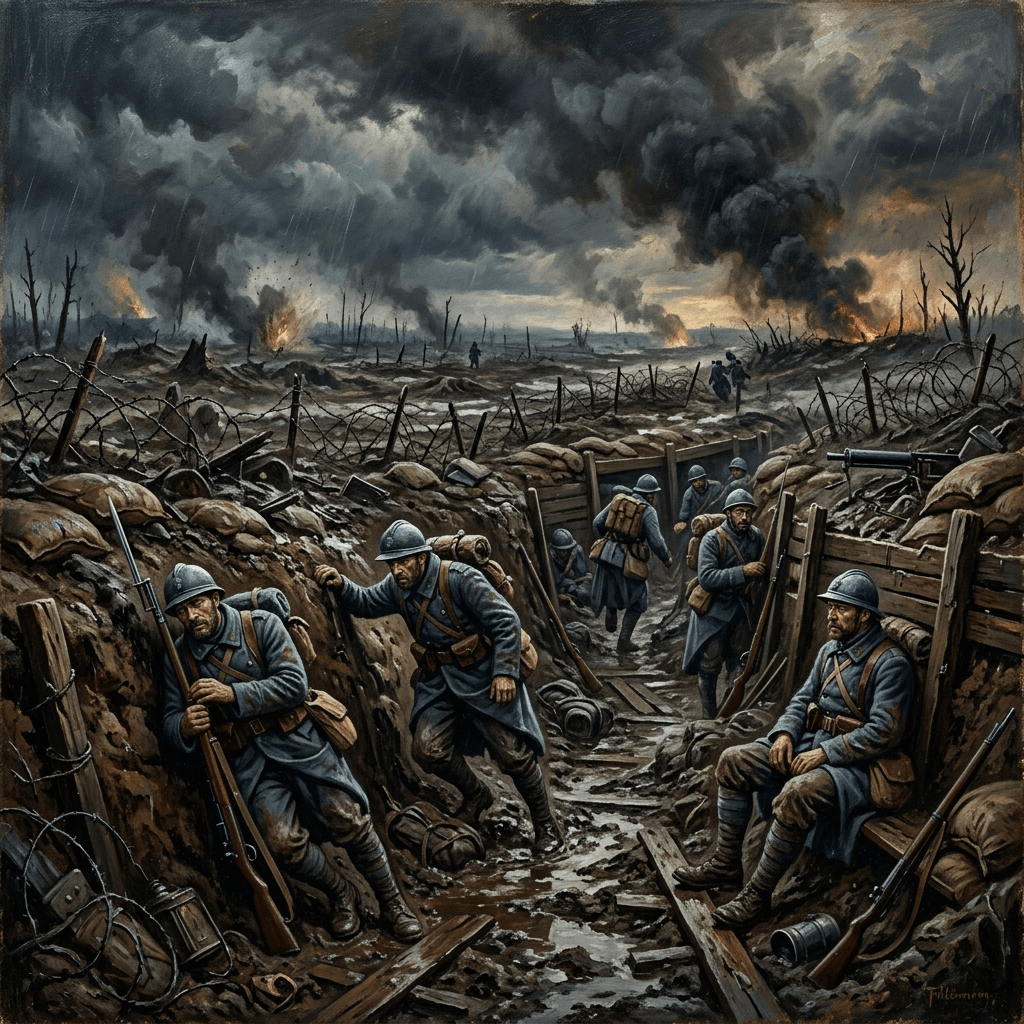
In the autumn of 1914, after the intense troop movements of the first months, the armies of the Entente and the Central Powers collided in a brutal stalemate. There were no more flanks to outflank, no more Napoleonic-style cavalry maneuvers. The Western Front crystallized into a continuous line of trenches stretching for more than 435 miles (700 kilometers), from the North Sea in Belgium to the Swiss border. It was the beginning of what would become known as trench warfare — a type of combat as new as it was terrifying, where industrial killing technology met medieval defensive strategies and produced a deadly stalemate that would last four long years.
2.1 What Was Daily Life Like for a Soldier in the Trenches of World War I?
Life in the Western Front trenches was an existence of misery, boredom, and intermittent terror, governed by a routine that alternated between long periods of oppressive monotony and moments of indescribable violence. The common French soldier, the poilu — a term of endearment meaning “hairy one,” a reference to the unkempt, bearded appearance of the combatants — typically spent between four and six days on the front line, followed by rest periods in the rear. But “rest” was a generous term: it meant carrying ammunition, repairing trenches under artillery fire, and burying the dead.
The day began before dawn with the stand-to — the state of maximum alert. All men positioned themselves on the parapets, bayonets fixed, ready to repel a surprise attack at sunrise, the favored time for offensives. Then came breakfast and rum — the sip of spirits that was, for many, the only thermal and psychological comfort of the day. Morning washing, weapon inspection, assignment of tasks, and then the long interval until the next stand-to at sunset. At night, patrols crawled through no man’s land in absolute silence, repairing barbed wire, spying on enemy lines, and often never returning.
2.1.1 Rats, Lice, Mud, and Hunger: The Brutal Routine of French Soldiers in the Trenches
If bullets and shells were the visible danger, the true daily hell of the trenches lay in the invisible and omnipresent enemies. Rats thrived in terrifying fashion on the battlefields: they fed on the unburied corpses in no man’s land and grew to grotesque sizes — there are reports of rodents the size of cats. They gnawed at the soldiers’ belongings, devoured food rations, and at night ran over the bodies of sleeping men.
Lice were equally omnipresent and transmitted the dreaded trench fever, a debilitating illness caused by the bacterium Bartonella quintana. Soldiers spent hours picking the parasites from the seams of their uniforms, a ritual known as “hunting lice.” The mud of the Western Front deserves a chapter of its own. In the regions of Flanders and the Somme, the clay soil and constant rains transformed the trenches into deep swamps where men and horses literally drowned. The mud was so thick and sticky that it could tear the boots off a marching soldier’s feet.
The food, although reasonably regular in most of the French army, was monotonous and often inedible. The pain de guerre — war bread — was made with lower-quality flour and often arrived hard and moldy. Watery vegetable soup, canned rata (cooked beef), and the infamous singe — canned monkey meat imported from Madagascar — completed the menu for those trying to survive the hell.
2.1.2 Trench Foot, Shell Shock, and Other Diseases That Plagued Soldiers in 1914–1918
Trench foot was one of the most disabling conditions of the Great War. Caused by prolonged exposure of the feet to moisture, cold, and poor circulation, the condition progressed from numbness and tingling to swelling, blisters, ulceration, and in the most severe cases, gangrene requiring amputation. It is estimated that more than 75,000 British soldiers and tens of thousands of French were affected. The only effective prevention was keeping feet dry, changing socks regularly, and applying whale oil — an impossible luxury in flooded trenches.
Shell shock — today recognized as Post-Traumatic Stress Disorder — was the invisible wound of industrial warfare. Soldiers exposed to continuous bombardments developed symptoms ranging from uncontrollable tremors, paralysis, and muteness to full-blown psychotic episodes. In the early years of the war, many of these men were summarily executed for “cowardice,” because military commanders simply did not understand what psychological trauma was. Only later did doctors such as the French Jean Lépine and the British Charles Myers begin to treat shell shock as a legitimate medical condition.
2.2 Why Did the Western Front Become a Deadly Stalemate of Over 700 Kilometers?
The Western Front stalemate was the direct result of a mismatch between offensive and defensive technology at the beginning of the 20th century. Attack weapons — bolt-action rifles, bayonets, and even cavalry — conceptually belonged to the 19th century. Defense weapons — machine guns, barbed wire, and indirect-fire artillery — represented the absolute cutting edge of industrial technology. The result was predictable: any frontal assault against well-fortified positions resulted in a massacre.
A single Maxim or Hotchkiss machine gun could fire 600 rounds per minute, mowing down entire rows of soldiers advancing in open formation. Barbed wire, originally invented to contain cattle in the American Old West, became the war’s most lethal passive defense: it slowed the infantry’s advance under machine-gun fire, turning men into stationary targets. Artillery accounted for about 70% of all casualties in the war, and commanders on both sides took years to learn that preliminary bombardments, however massive, rarely destroyed the enemy’s deep underground defenses.
2.2.1 The Race to the Sea: How the Trenches Froze the Western Front in 1914
After the First Battle of the Marne in September 1914, both the Entente and the German armies realized they could not break through enemy lines via frontal attacks. A period of lateral maneuvers then began, known as the Race to the Sea — although the goal was never to reach the sea, but rather to outflank the adversary to the north. During October and November 1914, each side successively tried to outflank the other’s flank toward the English Channel. With each attempt, new trenches were dug. When the two armies finally reached the Belgian coast near Nieuwpoort, there was no more room to outflank. The front was frozen from the North Sea to the Swiss Alps.
2.2.2 Barbed Wire, Machine Guns, and Fortifications: The Defensive System That Paralyzed the War
The German trench system on the Western Front was a masterpiece of defensive military engineering. Unlike the Allies, who saw trenches as temporary positions from which they would soon launch attacks, the Germans built their lines to last. German trenches were deeper, better drained, and equipped with underground concrete shelters that withstood the heaviest bombardments. Many had electricity, field kitchens, and even small hospitals. On the Hindenburg Line, built in 1917, the Germans elevated the art of fortification to a new level, with miles of underground tunnels, reinforced concrete casemates, and meticulously calculated fields of fire.
The defenses were organized in depth. The first line consisted of firing trenches and observation posts. About 328 to 656 feet (100 to 200 meters) behind came the support line, with shelters and tactical reserves. Further back still, the reserve line housed the bulk of the troops. Between them, zigzag communication trenches — designed this way so that a shell explosion would not kill everyone in a straight line — connected the positions. The result was a labyrinth that took days to traverse and that no bombardment could completely destroy.
2.3 How Did Trench War Destroy the Minds of French Soldiers?
The psychological impact of trench warfare on the French soldier was devastating and permanent, even for those who never exhibited classic symptoms of shell shock. The experience of living month after month in mud holes, surrounded by decomposing corpses, subjected to the random terror of artillery, produced a form of desensitization that the soldiers themselves called le cafard — a profound melancholy, a kind of living death.
The diaries and letters of the poilus reveal an emotional arc that began with ardent patriotism and ended in bitter cynicism and existential hopelessness. The phrase “pour la France” (for France) was gradually replaced by “pour les copains” — for the buddies. Men no longer fought for abstract ideals, but for the man next to them in the trench. The French writer Henri Barbusse, in his novel Le Feu (Under Fire), from 1916, captured this transformation like no one else: his characters are not heroes, they are survivors who have lost everything, including the ability to imagine a future.
2.4 What Happened in No Man’s Land? Death Between Enemy Lines
No man’s land was the strip of ground that separated the enemy trenches. Its width varied dramatically: in some sectors, such as Verdun, the lines were separated by just 49 feet (15 meters); in others, the distance reached 1,312 feet (400 meters) or more. But regardless of width, no man’s land was essentially an open-air cemetery.
Thousands of corpses lay unburied between the lines, impossible to retrieve without the soldiers attempting recovery being shot by snipers. The bodies swelled under the summer sun, froze in winter, and were slowly recycled by the mud and rats. For the soldiers, the smell of no man’s land was one of the most striking sensory experiences of the war: an unbearable mixture of rotting flesh, burnt gunpowder, feces, and chemicals. But no man’s land was also the stage for small acts of humanity: exchanges of tobacco and newspapers, tacit agreements not to shoot during breakfast, and on very rare occasions, spontaneous fraternizations such as the legendary Christmas Truce of 1914.
---
Chapter
3. Battle of Verdun 1916: The Definitive Guide to France’s Greatest Nightmare in World War I
The Battle of Verdun was not only the longest battle of World War I — ten uninterrupted months of combat, from February 21 to December 18, 1916 — but also the purest symbol of the French capacity to endure the unimaginable. Unlike other battles fought for conventional strategic objectives, Verdun was conceived by the German command purely as a meat-grinding machine. The plan of Erich von Falkenhayn, German Chief of Staff, was not to capture ground but simply to kill Frenchmen — so many and for so long that France would bleed to death. What Falkenhayn did not foresee was that the French, led by Philippe Pétain, would transform his calculated carnage into the founding myth of national resistance.
3.1 Why Did the Battle of Verdun Become the Greatest Symbol of French Resistance?
The choice of Verdun as a target was not random. The fortified city on the Meuse River was a historic symbol of French defense since the time of Charlemagne. In the 17th century, the great military engineer Sébastien Le Prestre de Vauban had transformed Verdun into one of the largest fortresses in Europe. In 1870, during the Franco-Prussian War, Verdun had been the last French fortress to surrender. For the French, losing Verdun was not just a military defeat — it was an existential defeat, a wound to the soul of the nation. Falkenhayn knew this and bet that the French would defend the symbol to the last man. He was right.
The battle began with an artillery bombardment of unprecedented scale. For 9 consecutive hours, more than 1,200 German guns poured about 1 million shells onto French positions along a front of just 8 miles (13 kilometers). Entire forests were pulverized. Villages disappeared without a trace. The soil was churned so deeply that even today, more than a century later, the battlefield topography remains altered, covered with craters that look more like the surface of the moon.
3.1.1 Bleeding France to Death: Falkenhayn’s German Strategy to Decimate the French Army
Erich von Falkenhayn’s strategy was as brutal as it was simple. In his memorandum to Kaiser Wilhelm II, written at Christmas 1915, Falkenhayn argued that Great Britain was Germany’s true strategic enemy, but that France was the “sword” of the British on the continent. If France were forced to commit its entire army to an unwinnable battle of attrition, the “sword” would be broken and the British would be left without allies on the continent. The operation received the sinister codename Operation Gericht — “Judgment” or “Place of Execution.”
Falkenhayn’s bet was that, by the laws of statistics, the Germans would lose fewer men than the French. But the calculation failed at a crucial point: the Voie Sacrée — the Sacred Way. This single dirt road linking Bar-le-Duc to Verdun became the vital artery through which French men, ammunition, and supplies flowed. At peak activity, a truck passed every 14 seconds, day and night, transporting about 90,000 men and 55,000 short tons (50,000 tons) of ammunition per week. The Germans never managed to cut this logistical umbilical cord.
3.1.2 “They Shall Not Pass”: How Philippe Pétain Organized the Heroic Defense of Verdun
Philippe Pétain was appointed commander of the defense of Verdun on February 25, 1916, when the situation seemed desperate. Fort Douaumont, the crown jewel of the defensive system, had fallen without firing a shot, and French troops were retreating in disorder. Pétain — a methodical and pessimistic general who had already distinguished himself in the battles of 1914 and 1915 — immediately reorganized the defense system into four sectors and instituted the troop rotation system known as the noria. About 70% of the entire French army passed through Verdun at some point, but no unit remained on the front line for more than two weeks. This ensured that soldiers were not psychologically annihilated by continuous exposure to hell.
The phrase that immortalized the battle was coined by General Robert Nivelle (who would later star in the Chemin des Dames disaster) and later popularized by Pétain: “Ils ne passeront pas!” — “They shall not pass!” It became the nation’s battle cry and a mantra that echoes in French memory to this day.
3.2 How Does the Verdun Battlefield Work? Underground Forts and Trenches Open to Visitors
Visiting Verdun today is to traverse one of the best-preserved battlefields of World War I. The battlefield area was declared Zone Rouge for decades and, although part of it has been reforested, vast stretches remain exactly as they were in 1918, with blast craters, trenches, and fortifications perfectly visible. The terrain is dotted with forts and underground ouvrages that formed the Séré de Rivières system, a network of fortifications built after the defeat of 1870. These forts, initially considered obsolete in the face of modern artillery, proved essential in the defense of Verdun and are now open to public visitation, providing an immersive and deeply moving experience.
3.2.1 Fort Douaumont: The Largest Fortress in Europe That Fell Without Firing a Shot
Fort Douaumont was, in 1916, the largest and most modern fortress in the world. Built between 1885 and 1913 at a cost equivalent to 6 million gold francs, the fort had 2 miles (3 kilometers) of underground corridors, reinforced concrete walls up to 8 feet (2.5 meters) thick, retractable artillery turrets, and accommodations for more than 800 soldiers. However, on February 25, 1916 — just four days after the start of the German offensive — the fort fell into enemy hands without firing a single cannon shot. The French garrison had been reduced to only 56 reserve soldiers, and a German patrol led by Sergeant Kunze simply entered the fort through an unguarded window. The news devastated French morale and infuriated the high command. Fort Douaumont would only be recaptured eight months later, on October 24, 1916, after a series of bloody counter-offensives.
3.2.2 Fort Vaux and Major Raynal: The French Resistance That Made History
If Fort Douaumont was the symbol of initial humiliation, Fort Vaux became the symbol of heroic resistance. Smaller and less imposing than its neighbor, Fort Vaux was besieged by German troops starting on June 2, 1916. The garrison commander, Major Sylvain Eugène Raynal, led about 600 men in an impossible defense during 6 days of underground combat. The Germans attacked with flamethrowers and gas grenades through the narrow corridors; the French responded with bayonets and hand-to-hand combat in absolute darkness. Without water, food, or ammunition, Raynal sent his last carrier pigeon — a bird named Vaillant — with a desperate message. The pigeon, severely poisoned by gas, managed to deliver the message before dying and was posthumously awarded the Croix de Guerre. Raynal and his men surrendered on June 7, without a drop of water remaining, but they had delayed the German advance by crucial days.
3.3 How Many Died at Verdun and What Does the Battlefield Soil Still Hide Today?
Casualty estimates for the Battle of Verdun are staggering and vary by source. The most accepted figures count about 163,000 French soldiers and 143,000 German soldiers killed, with a total of approximately 700,000 casualties when adding wounded, missing, and prisoners. But the most impressive number is this: about 80,000 soldiers from both sides were never found. Their bodies were pulverized by artillery, dissolved by the mud, or buried so deeply that no recovery effort has been able to locate them.
To this day, the soil of Verdun continues to give up its dead. Demining teams and archaeologists find, every year, human remains of soldiers, unexploded ordnance — about 992 short tons (900 tons) are collected annually in the region — and personal objects that emerge from the earth. The French Demining Service estimates that, at the current pace, it will take more than 700 years to completely clear just the unexploded ordnance from the Verdun battlefield.
3.4 Douaumont Ossuary: What Does the Largest French Necropolis of the Great War Hold?
Erected on the hill where the old military cemetery stood, the Douaumont Ossuary is the most important French memorial of the Great War. Inaugurated in 1932, the building is an imposing structure in the shape of a Latin cross, with a 151-foot (46-meter) tower that houses the famous death bell, the Bourdon de la Victoire. But what makes the ossuary truly unique are its lower windows: through them, visitors can see piles of human bones — femurs, tibias, skulls — of at least 130,000 unidentified French and German soldiers, organized by the sector of the battlefield where they were found. The national cemetery in front of the ossuary houses more than 16,000 individual graves of identified French soldiers, aligned in perfect geometric rows under a vast expanse of green grass. Admission to the ossuary is free, and the silence that dominates the place — broken only by the tolling of the bell every hour — is one of the most impactful experiences a tourist can have in France.
---
Chapter
4. Battle of the Somme 1916: The Bloodiest Battle in British History on French Soil
While Verdun was bleeding France dry in the east, the Allies planned a joint offensive in the Somme river valley in Picardy, to relieve pressure on the French defenders. The Battle of the Somme, fought between July 1 and November 18, 1916, went down in history as the bloodiest battle ever faced by the British Army and one of the most devastating of the entire war. In just over 4 months, more than 1 million soldiers from both sides were killed or wounded, and the maximum Allied territorial advance was no more than 6 miles (10 kilometers). It was the confrontation that, more than any other, exposed the bankruptcy of the military thinking of the era.
4.1 Why Is the First Day of the Battle of the Somme the Most Tragic in British Military History?
July 1, 1916 remains to this day the bloodiest day in the history of the British Army. In just 24 hours, the British suffered 57,470 casualties, of which 19,240 were killed — the majority in the first hours of the morning. The Allied plan was based on an uninterrupted 7-day artillery bombardment, during which approximately 1.5 million shells were fired at the German lines. British commanders were so confident that no enemy could have survived that they ordered the infantry to advance at walking pace, with heavy 66-pound (30-kilogram) packs, in a straight line across no man’s land.
The problem: Allied artillery had completely failed. The German underground defenses, dug up to 33 feet (10 meters) deep in solid limestone, had survived almost intact. When the bombardment ceased, the Germans simply emerged from their shelters, positioned their machine guns, and began mowing down the British soldiers advancing in open formation. The result was an industrial massacre on a scale never before seen. Entire battalions were annihilated in minutes. The Newfoundland Regiment, for example, lost 684 of the 780 men who entered combat that morning.
What makes the first day of the Somme even more devastating is the profile of the soldiers who fell. Many belonged to the so-called Pals Battalions — battalions formed by friends, coworkers, and neighbors from the same town who enlisted together under the promise that they would serve side by side. Entire towns in Great Britain lost almost their entire young male population in a single morning. In Accrington, Lancashire, the famous Accrington Pals lost 585 men out of the 720 who attacked. Entire working-class communities were destroyed in minutes, and the collective mourning of these British towns echoes to this day in the local memorials that dot the north of England.
The geography of the Somme also conspired against the attackers. The terrain is a vast limestone plain, slightly undulating, which favored the defenders entrenched on the heights. The Germans occupied the ridges and had an unobstructed view of the Allied lines. Moreover, the summer of 1916 was exceptionally rainy, turning the ground into a quagmire that slowed the infantry’s advance and swallowed the first tanks. British soldiers reported that, in some stretches, the mud reached waist height and it was impossible to advance carrying the heavy 66-pound (30-kilogram) equipment. Many drowned in water-filled shell craters before even reaching the German lines.
4.2 What Went Wrong at the Somme? The Military Innovations That Failed
The Battle of the Somme was conceived as the great breakthrough of the Western Front, but became a case study in how the military technology of the era was not yet up to the task of defensive warfare. The problem began with the concept: British General Douglas Haig believed that artillery could destroy any defense and that cavalry — yes, cavalry on horseback — could then advance through the breach and restore the war of movement. Haig kept a reserve cavalry corps throughout the entire battle, waiting for the breakthrough that never happened.
Another critical factor was the quality of the artillery shells. Due to accelerated production and quality control problems in the British arms industry, it is estimated that up to 30% of the shells fired during the preliminary bombardment simply did not explode. Shrapnel shells, designed to kill infantry in open ground, were practically useless against fortified positions and German underground shelters.
4.2.1 Mark I Tank: The Debut of the World’s First Armored Fighting Vehicle at the Somme
Amid the disaster, the Battle of the Somme witnessed a debut that would change warfare forever. On September 15, 1916, at the battle of Flers-Courcelette, the first tanks in history entered combat. The British Mark I was a monster of 31 short tons (28 tons), powered by a Daimler engine of 105 horsepower, with a crew of 8 men and a maximum speed of just 4 mph (6 km/h). Of the 49 tanks assigned to the attack, only 32 reached the starting line; the rest broke down en route or bogged down in the mud. Only 9 actually managed to cross no man’s land and engage the enemy. But the psychological effect on the German soldiers was devastating: they had never before seen an armored machine advancing relentlessly over barbed wire and trenches. The era of mechanized warfare had begun.
4.2.2 Artillery Bombardments That Failed to Cut the German Barbed Wire
One of the most underestimated failures of the Somme was the inability of Allied artillery to cut the German barbed wire. Commanders believed that high-explosive shells would pulverize the wire barriers, but in practice the wire was simply thrown into the air by the explosion and fell back into place, even more tangled than before. British soldiers who survived the machine-gun fire often found themselves stuck in the intact wire barriers, where they were shot point-blank. Survivor accounts describe scenes in which the bodies of dead soldiers hung from the barbed wire posts like “laundry on a line.” This image became one of the most powerful and terrifying symbols of the futility of trench warfare.
4.3 The Vanished Villages of the Somme: Where Are the French Towns the War Wiped Off the Map?
One of the lesser-known aspects of the Somme is the existence of 9 French villages that were so completely destroyed during the battle that they were never rebuilt. These villages détruites — destroyed villages — include names such as Fleury-devant-Douaumont (at Verdun) and, in the Somme, Fay, Soyécourt, Beaucourt-sur-l’Ancre, and others. Their territories were declared uninhabitable and incorporated into the public domain as open-air memorials. Although the villages no longer physically exist, they maintain legal status as French communes, with honorary mayors appointed to preserve their memory. Signposts indicate where the church, school, main street, and houses once stood. Visiting these places where even the building foundations were pulverized is an experience of awe and silence that no history book can reproduce.
---
Chapter
5. Weapons of World War I: The Deadly Inventions That Terrorized the French Front
World War I was, above all, as much a war of engineers and chemists as of soldiers. The French Front served as an open-air laboratory for some of the most terrifying inventions in military history. Weapons that today seem primitive to us were, in their time, as revolutionary and frightening as the atomic bomb would be in 1945. Below, a deep dive into the artifacts of death that defined the experience of the French combatant.
5.1 How Did Mustard Gas Work and Why Did It Change Chemical Warfare Forever?
The first use of poison gas as a weapon of war occurred on April 22, 1915, during the Second Battle of Ypres in Belgium, when the Germans released 185 short tons (168 tons) of chlorine gas against French and Algerian troops, opening a 4-mile (6-kilometer) breach in the Allied line. But it was mustard gas — introduced by the Germans in July 1917, also at Ypres (hence its nickname “Yperite”) — that became the most feared and effective. Unlike chlorine, which only attacked the respiratory tract, mustard gas was a vesicant agent that burned the skin, eyes, and lungs, causing enormous blisters, temporary blindness, and respiratory failure. It was also insidiously persistent: it remained active in the soil for days or weeks, contaminating the earth and water. Soldiers who lay down on the ground to protect themselves from shells ended up poisoned by contact with contaminated earth. The gas mask became the soldier’s most precious piece of equipment — losing it meant almost certain death.
The trauma caused by gas was so profound that it shaped the collective memory of the war in a unique way. Unlike bullet or shrapnel wounds, which were visible and comprehensible, gas victims suffered in an invisible and prolonged manner. Soldiers poisoned by mustard gas often survived the initial attack only to die days or weeks later, with destroyed lungs and skin raw. Those who survived carried permanent sequelae: partial blindness, chronic bronchial burns, and a susceptibility to respiratory infections that would accompany them for the rest of their lives. The image of the blind soldier, guided by a line of equally wounded comrades, hands on each other’s shoulders, became one of the most poignant visual icons of the Great War.
Curiously, the development of chemical weapons revealed a dark connection between science and war that had not previously existed. The German chemist Fritz Haber, who personally supervised the first chlorine attack at Ypres, was a brilliant scientist who would later win the Nobel Prize in Chemistry in 1918 for developing the ammonia synthesis process — an invention that revolutionized world agriculture. Haber’s personal tragedy is revealing: his wife, the chemist Clara Immerwahr, horrified by the military use of his research, committed suicide with her husband’s pistol after an argument about the Ypres attack. Haber left for the front the next morning, leaving his wife’s body to be found by their 13-year-old son.
5.2 What Was the Most Feared Weapon by Soldiers in the French Trenches?
The weapon that caused the most terror among the French poilus was not gas or the bayonet, but rather the German Minenwerfer — the trench mortar. Unlike conventional artillery, which fired shells from a distant trajectory, the Minenwerfer was a short-range weapon that launched drums of explosives weighing up to 220 pounds (100 kilograms) directly onto enemy trenches with terrifying precision. The projectile described a high parabolic trajectory, which meant that soldiers could literally watch it rise and fall toward them, with nowhere to run. The French nickname for these projectiles was “les sacs à charbon” — the coal sacks — because of their dark cylindrical shape. Another especially hated weapon was the flamethrower (Flammenwerfer), introduced by the Germans at Verdun, which projected jets of ignited oil at distances of up to 98 feet (30 meters) and was used to clear underground shelters and tunnels.
5.3 Paris Gun: How Did the Germans Bombard the French Capital from 130 Kilometers Away?
Between March and August 1918, the inhabitants of Paris lived through a surreal nightmare. Artillery shells began falling on the city without any enemy cannon being visible nearby. The mystery was only solved when it was discovered that the Germans had built a weapon of previously unimaginable range: the Paris-Geschütz — the Paris Gun. With a 112-foot (34-meter) long barrel and 8.3-inch (210-millimeter) caliber, this artillery piece fired 234-pound (106-kilogram) shells at such a high altitude that they literally left the Earth’s atmosphere and re-entered over the French capital, hitting targets an astonishing 81 miles (130 kilometers) away. During the 5 months of bombardment, the gun fired about 350 shells at Paris, killing 256 people and wounding 620. Although the military impact was minimal, the psychological effect was immense: for the first time in history, civilians in a major city were direct targets of enemy artillery at distances previously considered impossible.
5.4 How Did the Underground Tunnel and Mine War Work in World War I?
While the war on the surface stagnated in mud and death, another conflict — silent, claustrophobic, and equally deadly — was taking place in the depths of French soil. The war of tunnels and mines was waged by specialized military engineer units, often recruited from professional coal miners from Great Britain, Australia, and Germany. The objective was to dig tunnels under enemy positions, fill them with tons of explosives, and detonate them beneath the opposing trenches.
These tunnels could reach depths of up to 98 feet (30 meters) and extend for hundreds of yards. Both sides also dug defensive and counter-mining tunnels, and it was common for underground galleries of opposing armies to meet below ground, triggering hand-to-hand combat in total darkness, with shovels, pickaxes, and pistols. The miners worked in absolute silence, using primitive stethoscopes to detect the sounds of enemy digging. One wrong sound, and an entire tunnel could collapse or be blown up.
5.4.1 The Messines Explosion: The Largest Non-Natural Seismic Shock in History Until Hiroshima
The culmination of underground warfare occurred in the early hours of June 7, 1917, near the Belgian village of Messines (now Mesen). For 18 months, British engineers had dug 22 tunnels under German positions and filled them with a total of 502 short tons (455 tons) of explosives — mainly ammonal. At 3:10 a.m., 19 of these mines were detonated simultaneously. The explosion was so colossal that it was heard in London, 124 miles (200 kilometers) away, and recorded by seismographs in Dublin and Switzerland. It is estimated that 10,000 German soldiers died instantly in the explosion. Until the detonation of the atomic bomb at Hiroshima in 1945, the Messines mine explosion was the largest non-natural seismic shock ever produced by human beings. Three of the original mines did not detonate and remain buried to this day
The story of these lost mines is worthy of a geopolitical thriller. Of the 22 mines originally planned, 19 exploded on June 7, 1917. One of the three remaining accidentally exploded during an electrical storm in 1955, killing a cow. The other two remain buried at an approximately known location beneath the soil of Flanders: one near the farm of La Petite Douve and another under a side road near Ploegsteert. Both contain estimated charges of more than 22 short tons (20 tons) of explosives each. Despite several attempts to locate them precisely, the tunnels have collapsed over time and no one knows exactly where the charges are. Belgian authorities keep the areas under surveillance, but have chosen not to attempt deactivation due to the extreme risk of accidental detonation during excavation. These two geological time bombs are, in a way, the last sleeping soldiers of the Great War. somewhere under the Flanders landscape, charges of tens of tons that could explode at any moment.
---
Chapter
6. The Mutinies of 1917: When the French Army Almost Quit the War
The year 1917 was, for France, perhaps the most dangerous of the war. In mid-spring of that year, the French Army was on the verge of total collapse — not from a German attack, but from within its own ranks. What began as isolated protests by exhausted soldiers quickly transformed into a wave of mutinies that spread across 49 divisions — practically half of the French army on the Western Front. Soldiers refused to march to the trenches, sang revolutionary songs, raised red flags, and in some cases threatened to march on Paris. It was the moment when France came closest to losing the war — not to the external enemy, but to the internal collapse of its military force.
6.1 How Did Philippe Pétain Contain the Mutinies That Nearly Toppled the French Army?
On May 15, 1917, General Philippe Pétain — the same hero of Verdun — was appointed commander-in-chief of the French Army with the mission of containing the crisis that threatened to disintegrate the Republic’s armed forces. Pétain adopted a two-pronged strategy that proved effective. On the one hand, he responded with exemplary firmness: of the approximately 35,000 soldiers identified as active participants in the mutinies, roughly 3,400 were court-martialed, 554 were sentenced to death, and about 49 to 55 were actually executed — a number that remains controversial to this day. On the other hand, Pétain understood that pure repression would not suffice. He personally visited dozens of units, listened to the soldiers’ grievances, and implemented concrete reforms: he improved the quality of food, increased leave periods for family visits, instituted regular rest periods away from the front line, and, crucially, promised that there would be no more suicidal offensives like the one at the Chemin des Dames. The strategy worked, and the mutinies were contained in about six weeks — but the French army would never be the same. From then on, the offensive initiative on the Western Front increasingly shifted to the British and, starting in 1918, to the newly arrived Americans.
6.2 The Nivelle Offensive at Chemin des Dames: The Massacre That Sparked the Soldiers’ Revolt
The trigger for the mutinies was the disastrous Nivelle Offensive, launched on April 16, 1917, on the Chemin des Dames plateau, an elevated road in the Aisne region. General Robert Nivelle — who had replaced Joffre as commander-in-chief at the end of 1916 — promised a quick and decisive victory that would break through the German lines in 48 hours. To prepare the ground, Nivelle did something no French general had done before: he widely publicized the details of the plan, including to the press. The Germans, naturally, learned of everything in advance and reinforced their positions. When the offensive finally began, French soldiers advanced against intact German positions and suffered 40,000 casualties on the first day alone. In 10 days, French losses totaled about 134,000 men. No significant advance was achieved. The ratio between human sacrifice and military result was so grotesque that the soldiers lost confidence in the command. The final straw was the rumors that French officers were living in comfortable hotels in Paris while soldiers were dying in the mud of the Chemin des Dames.
The scale of the disaster at the Chemin des Dames can hardly be exaggerated. The plateau, a narrow limestone ridge stretching about 19 miles (30 kilometers) between the Aisne and Ailette rivers, had been occupied by the Germans since September 1914. In almost three years, they had transformed the position into a virtually impenetrable underground fortress, with natural caves and medieval quarries converted into bomb-proof shelters that could accommodate entire divisions. The French artillery, no matter how intense, barely scratched these defenses.
General Nivelle, however, was so convinced of his own tactical theories — an aggressive variant of the “creeping barrage” tactics he had used with limited success at Verdun — that he ignored all warnings. His own subordinates, including General Micheler, expressed serious doubts about the plan’s feasibility. Politicians in Paris called for the cancellation of the offensive. Even British officers, who had no veto power over French decisions, warned about the German defenses. Nivelle responded by threatening to resign if the offensive were canceled. The government, fearing a political crisis in the middle of a war, gave in. The result was 134,000 casualties in 10 days, a failure so complete that Nivelle was removed from command on May 15, 1917 and sent to North Africa — a gilded exile that the surviving soldiers considered a shamefully lenient punishment.
6.3 Who Was Georges Clemenceau, “The Tiger,” and How Did He Save France from Collapse?
While Pétain was reorganizing the army in the trenches, another man was fighting the battle for the nation’s survival in Paris. Georges Clemenceau, nicknamed “Le Tigre” — The Tiger —, took office as Prime Minister of France in November 1917, at the age of 76, at the darkest moment of the war. With an energy and ferocity that defied his age, Clemenceau concentrated all power in his hands, crushed the pacifist opposition, arrested politicians suspected of treason, and adopted as his sole and non-negotiable policy: “Je fais la guerre” — “I wage war.” His iron-fisted leadership — and his decision to unify the Allied command under French General Ferdinand Foch in March 1918 — was fundamental for the Entente to survive the last great German offensive of spring and then launch the victorious counter-offensive.
6.4 Executions for Cowardice in World War I: How Many Soldiers Were Shot by Their Own Army?
The topic of executions for cowardice during World War I remained taboo for decades in all belligerent countries, and France was no exception. It is estimated that the French Army executed between 600 and 650 of its own soldiers during the war, on charges ranging from desertion and abandonment of post to “refusal to obey in the face of the enemy.” Many of these cases were extremely controversial and involved summary trials without adequate defense. The so-called special court-martial, instituted in September 1914, could try and execute a soldier in a matter of hours, with no right to appeal. The most infamous case is that of the Corporals of Souain — four French soldiers shot in 1915 as an example to the troops after a failed offensive, without any concrete evidence of cowardice. These executions “pour l’exemple” (to set an example) only began to be reviewed by French justice starting in the 1990s
The mechanism of these trials was merciless by design. The defendant had no right to a defense attorney, prosecution witnesses were often the very officers who had ordered the failed attack, and the sentence was carried out the morning after the trial, before the entire battalion drawn up in formation, as a spectacle of terror designed to deter any thought of disobedience. In many cases, the firing squads were ordered to shoot to kill, but with blank ammunition in some weapons, so that no soldier would know whether he had been responsible for the death of the comrade.
The “shot as an example” became, over the decades, one of the most controversial themes in the French memory of the Great War. Families fought for generations to clear the names of executed fathers and grandfathers. In 1998, on the 80th anniversary of the Armistice, Prime Minister Lionel Jospin made a historic speech calling for the executed to be “reintegrated into the national collective memory.” Only in 2016, on the centenary of Verdun, did President François Hollande formally recognize that many of those executed “had not dishonored the homeland,” but the French state has never issued a formal legal rehabilitation. To this day, the names of those shot do not appear on the war memorials of their home towns — an absence that is, in itself, a silent monument to injustice., and in 2016, on the centenary of Verdun, President François Hollande made a symbolic speech acknowledging that many of those executed “had not dishonored the homeland” — they were exhausted men who succumbed to the unbearable.
---
Chapter
7. The Forgotten Heroes of the Great War: Colonial Troops, Women, and Foreign Volunteers
The standard narrative of World War I often portrays the conflict as a European war between white industrial powers. This view is profoundly incomplete. France fought the Great War with an army that was, to a large extent, multinational, multiethnic, and dependent on the effort of millions of people whom official history took decades to recognize. African soldiers, Asian workers, women in factories and fields, foreign volunteers from dozens of nationalities — all played crucial roles, and many paid with their lives.
7.1 How Many African and Asian Soldiers Fought and Died for France in World War I?
France massively mobilized its colonies during the Great War. In total, approximately 800,000 men were recruited from the French Colonial Empire, coming mainly from French West Africa (present-day Senegal, Mali, Ivory Coast, Guinea, Niger, and Burkina Faso), North Africa (Algeria, Morocco, Tunisia), Madagascar, and Indochina (present-day Vietnam, Laos, and Cambodia). About 170,000 of these colonial soldiers were killed or disappeared in the conflict.
The demographic impact in some regions was devastating. In certain villages in Senegal, almost the entire male generation between 18 and 40 years of age was recruited, and many never returned. Despite this sacrifice, colonial soldiers received lower pay and had less access to promotions than metropolitan French soldiers. After the war, many African and Asian veterans were simply forgotten, their promises of French citizenship denied, their benefits cut. War pensions for colonial veterans were only equalized with those of metropolitan Frenchmen in 2006, almost a century after the end of the conflict.
7.1.1 Senegalese Riflemen: The Courage and Tragic Forgetting of French Colonial Troops
The Tirailleurs Sénégalais — Senegalese Riflemen — formed the most emblematic unit of French colonial troops. Despite the name, the term encompassed soldiers from all of French West Africa, not just Senegal. About 200,000 of these men served in Europe during World War I, and approximately 30,000 died in combat. The tirailleurs were feared by the Germans and treated with a mixture of admiration and racist condescension by the French command. They were often used as shock troops in the most dangerous offensives — a practice that led to disproportionately high casualty rates. At Verdun, the tirailleurs played a decisive role in the defense of Fort Souville. During the recapture of Fort Douaumont in October 1916, Senegalese units were at the vanguard of the attack.
Despite this track record, the memory of the Tirailleurs Sénégalais was systematically erased in the postwar period. The film Indigènes (Days of Glory), from 2006, brought international visibility to the theme by portraying the tragic fate of North African soldiers during World War II — but the story of Africans in World War I remains, for the general public, one of the least known aspects of France.
7.1.2 Chinese and Indochinese Workers: The Forgotten Labor Force Behind the Trenches
Even less known are the 140,000 Chinese workers that the French government (and the British) imported to work behind the Western Front. Recruited mainly from the province of Shandong, these men — known as the Travailleurs Chinois — were not combatants but performed essential functions: they dug trenches, built roads and railways, unloaded ships in ports, buried the dead, and cleaned up the battlefields after combat. About 10,000 of these Chinese workers died in France — from diseases, work accidents, and enemy attacks — and were buried in cemeteries that still exist today, such as that of Noyelles-sur-Mer, the largest Chinese cemetery in Europe. Another 50,000 Indochinese workers (Vietnamese, Laotians, and Cambodians) were also brought to France during the war, working in factories, arsenals, and military infrastructure construction. Their contribution remains one of the least known pages of the Great War.
7.2 What Did French Women Do During World War I?
With the mass conscription of men to the front, France experienced an unprecedented social transformation. French women — who until then had lived mostly confined to the domestic sphere — were thrown en masse into the industrial, agricultural, and service labor market. Known as munitionnettes, the female workers in ammunition factories worked up to 12 hours a day handling explosives and dangerous chemicals, often with devastating effects on their health — yellowed skin from contact with picric acid (the explosive used in artillery shells) became a visible mark of these workers.
In the countryside, women took over the management of entire farms, driving plows, harvesting crops, and maintaining France’s agricultural production. The marraines de guerre — war godmothers — wrote letters of support and sent packages to unknown soldiers on the front, trying to offer a thread of humanity and emotional connection with the world they had left behind. Volunteer nurses worked under brutal conditions in field hospitals near the front line, dealing daily with wounds that the medicine of the time could barely treat. It is estimated that more than 3 million French women were directly mobilized for the war effort.
7.3 Who Were the Foreign Volunteers Who Fought Alongside France in the Great War?
The French Foreign Legion was reinforced by thousands of volunteers from all over the world who enlisted out of idealism, adventure, or simply because they had nowhere to go. Americans, Italians, Poles, Czechs, Greeks, Russians, Latin Americans, and even some anti-Nazi Germans and Austrians (in World War II) — the list of nationalities is immense. Among the most notable are the American pilots of the Lafayette Escadrille (Escadrille La Fayette): 38 volunteer pilots from the United States who enlisted in French aviation in 1916, more than a year before their country officially entered the war. They flew the fragile Nieuport and Spad biplanes and achieved 41 confirmed aerial victories before the American Air Corps even existed. Their mascot lion, Whiskey, and their other lion, Soda, became as famous as the pilots themselves.
Also worthy of mention are the Czechoslovak and Polish volunteers, who fought under the French flag with the explicit goal of winning independence for their nations after the war — which they indeed achieved in 1918. And the Italian Garibaldines, grandsons of Giuseppe Garibaldi’s fighters, who formed a volunteer legion and fought in France between 1914 and 1915, before Italy entered the war.
7.4 Harlem Hellfighters: The Saga of the African-American Regiment That Fought Under the French Flag
The 369th U.S. Infantry Regiment, better known as the Harlem Hellfighters, is a fascinating and painful chapter in the history of World War I. Formed mostly by African-American and Puerto Rican soldiers from New York, the regiment faced racism from the United States Army itself, which refused to allow black soldiers to fight alongside whites. The solution found was to “loan” the regiment to the French Army, which did not have the same segregationist restrictions.
Under French command, the Harlem Hellfighters spent 191 days on the front line — more time than any other American unit in the war. They never lost a foot of ground and never had a single soldier captured by the enemy. Two of their members, Henry Johnson and Needham Roberts, starred in one of the most extraordinary feats of the war: when attacked by a German patrol of about 20 men, they fought with rifles, grenades, and even machetes, killing 4 Germans and wounding another 20, saving their post. Despite this bravery, the regiment’s soldiers returned to the United States to a country that still treated them as second-class citizens. Henry Johnson only received the Medal of Honor from the U.S. Congress posthumously, in 2015 — almost a century after his acts of heroism.
---
Chapter
8. The End of the Great War: The 1918 Armistice and the Treaty of Versailles
The year 1918 began with Germany closer to victory than at any other moment since 1914 and ended with the total collapse of the German Empire, the abdication of the Kaiser, and an armistice signed in a train carriage in the middle of a French forest. What happened in those 11 months was a dizzying succession of reversals that transformed the war once and for all.
8.1 How Did Germany Go From Attack to Total Surrender in Less Than 8 Months in 1918?
At the beginning of 1918, the Allied situation was desperate. Russia had left the war after the Bolshevik Revolution of October 1917, signing the Treaty of Brest-Litovsk in March 1918 and freeing up about 1 million German soldiers from the Eastern Front. These men were quickly transferred west, giving Germany a temporary numerical superiority of 192 divisions against 156 Allied divisions. General Erich Ludendorff, the true German military mastermind, knew this advantage would not last. Hundreds of thousands of American soldiers were on their way to France, and each passing day strengthened the Allies. Germany’s only chance was a lightning victory before the Americans arrived in force.
8.1.1 The Spring Offensive of 1918: Germany’s Last Desperate Gamble on the Western Front
On March 21, 1918, Germany launched Operation Michael — the first of a series of five massive offensives that would become known as the Spring Offensive (Frühjahrsoffensive). Using new infiltration tactics developed by assault units — the feared Sturmtruppen — the Germans spectacularly broke through the British and French lines. In a few days, they advanced more than 37 miles (60 kilometers), something that had not happened since 1914. Paris was once again threatened. For the second time in the war, the French government considered evacuating the capital. The Germans positioned the Paris Gun and began shelling the city daily.
But the offensive had a fatal flaw: the Germans did not have sufficient reserves to sustain the momentum. With each attack, the assault units — the best troops in the German army — suffered terrible casualties that could not be replaced. In June, the tide began to turn. The Americans were finally arriving en masse — 10,000 soldiers per day were disembarking in French ports — and General Ferdinand Foch, now supreme Allied commander, was preparing the counter-attack.
8.1.2 The Hundred Days’ Counter-Offensive and the Definitive Collapse of the German Army
The Hundred Days’ Counter-Offensive, launched on August 8, 1918 with the Battle of Amiens, was one of the most impressive campaigns in military history. For the first time in the war, the Allies managed to coordinate infantry, artillery, tanks, and aviation in a synchronized and devastating manner. The attack at Amiens was so swift and overwhelming that Ludendorff himself described it as “the blackest day of the German Army.” In the following weeks, the Germans were systematically pushed back to the Hindenburg Line and then beyond it. German morale collapsed. Soldiers surrendered by the thousands. Sailors mutinied in Kiel, workers took to the streets of Berlin, and Kaiser Wilhelm II abdicated on November 9, 1918 and fled into exile in Holland. Two days later, the war was over.
8.2 Where and How Was the Armistice That Ended World War I Signed?
The Armistice of Compiègne was signed at 5:10 a.m. on November 11, 1918, but the negotiations to reach it were tense and dramatic. The German representatives, led by the civilian politician Matthias Erzberger, were led to a clearing in the Forest of Compiègne, about 50 miles (80 kilometers) north of Paris, where Marshal Ferdinand Foch awaited them in his personal command train — the Wagon de l’Armistice, carriage 2419D of the Compagnie Internationale des Wagons-Lits. Foch presented the terms — which were, in practice, a disguised surrender — and gave the Germans 72 hours to accept. There was no room for negotiation. The Kaiser had already abdicated. Germany was on the brink of socialist revolution. Erzberger signed. The ceasefire took effect at 11:00 a.m. — the 11th hour of the 11th day of the 11th month.
The carriage where the armistice was signed became a French national symbol and was displayed as a monument in Compiègne for decades. In one of the most symbolically charged acts of revenge in history, Adolf Hitler would demand that the French surrender in 1940 be signed in exactly the same train carriage, at the same spot in the Forest of Compiègne, and then ordered the carriage taken to Germany as a war trophy, where it was destroyed by Allied bombing at the end of World War II.
8.3 Did the Treaty of Versailles Really Plant the Seeds of World War II?
The question that has echoed for over a century among historians: was the Treaty of Versailles, signed on June 28, 1919 — exactly 5 years after the assassination of Franz Ferdinand — a just peace or a revenge that condemned the world to repeat the tragedy? The answer, like almost everything in history, is complex. But the modern consensus tends to agree with Marshal Foch, who, upon reading the terms of the treaty, reportedly said prophetically: “This is not a peace. It is an armistice for 20 years.”
The peace conference, held at the Palace of Versailles, was dominated by the so-called Council of Four: U.S. President Woodrow Wilson, British Prime Minister David Lloyd George, French Prime Minister Georges Clemenceau, and Italian Prime Minister Vittorio Orlando. Wilson arrived with his idealistic 14 Points, advocating a “peace without victors.” Clemenceau, whose country had lost 1.4 million men and had 10 departments occupied, was not interested in idealisms. He wanted security, reparations, and guarantees that Germany could never attack France again. The final treaty reflected Clemenceau’s vision far more than Wilson’s.
8.3.1 Guilt Clauses, Billion-Dollar Reparations, and the German Humiliation of 1919
Article 231 of the Treaty of Versailles — the infamous “war guilt clause” — declared Germany and its allies as solely responsible for all the losses and damages of the war. This clause was the legal basis for imposing astronomical financial reparations: 132 billion gold marks, a deliberately punitive sum that the German economy had no hope of paying without destroying itself. In addition to reparations, Germany lost 13% of its European territory, all its colonies, was forbidden from having an air force, tanks, and submarines, and had its army limited to just 100,000 men — smaller than that of Romania. Alsace and Lorraine were returned to France, and the rich industrial region of the Saar was placed under League of Nations administration for 15 years.
The feeling of national humiliation that the treaty generated in the German population was the perfect fuel for the nationalist and revanchist discourse that Adolf Hitler would exploit in the following years. The “stab in the back” myth — the idea that Germany had not been defeated on the battlefield, but betrayed by politicians, socialists, and Jews at home — found fertile ground in a humiliated, impoverished population hungry for a scapegoat. In this sense, Foch’s prophecy was fulfilled with disturbing precision: in September 1939, exactly 20 years and 2 months after Versailles, World War II began.
8.3.2 The Hall of Mirrors at Versailles: The Setting for the Signature That Redrew the Map of Europe
The choice of the Palace of Versailles as the site for signing the treaty was not casual — it was a deliberate symbolic punishment orchestrated by Clemenceau. In 1871, after the French defeat in the Franco-Prussian War, the Germans had proclaimed the German Empire precisely in the Hall of Mirrors of the same palace, humiliating defeated France. Now, 48 years later, the roles were reversed: defeated Germany would sign its own humiliation in the same hall where its empire had been born. The Hall of Mirrors — with its 357 mirrors, 17 arches covered in gold, and crystal chandeliers — witnessed on June 28, 1919 the signature that not only ended the Great War but completely redrew the map of Europe. Four empires disappeared (German, Austro-Hungarian, Russian, and Ottoman), and new countries emerged such as independent Poland, Czechoslovakia, Yugoslavia, Finland, and the Baltic States. The world that emerged from that room at Versailles was radically different from the one that had entered the war in 1914.
---
Chapter
9. World War I Battlefields in France: Visiting Tips, Memorials, and Complete Itinerary
Visiting the World War I battlefields in France is much more than a conventional tourist experience — it is a journey of memory, reflection, and connection with one of the most decisive chapters in human history. The good news is that the visitation infrastructure is excellent, with modern museums, interpretation centers, signposted routes, and specialized guides that make the experience accessible and deeply educational. The bad news is that the area to cover is immense — hundreds of miles of battlefields, memorials, and cemeteries scattered throughout the entire northeastern region of France. This guide will help you plan your pilgrimage.
9.1 Zone Rouge: Why Are Parts of French Soil Still Off-Limits More Than 100 Years Later?
Shortly after the end of the war, the French government created the Zone Rouge — Red Zone — a strip of territory so devastated by the fighting that it was considered permanently uninhabitable. Originally, the Zone Rouge covered about 463 square miles (1,200 square kilometers) along the Western Front and included the most intensely bombarded areas of Verdun, the Somme, Champagne, and Flanders. The soil in these areas was saturated with decomposing human and animal corpses, arsenic and other toxic chemicals, and absurd quantities of unexploded ordnance — it is estimated that 1 billion shells were fired during the war, and a significant fraction of them simply did not explode.
Over the decades, demining and decontamination efforts have reduced the Zone Rouge to about 39 square miles (100 square kilometers) currently. But these remaining areas remain absolutely off-limits to the public, fenced off, and posted with danger-of-death warnings. The soil still contains arsenic levels reaching up to 17% of the earth’s composition in some spots, due to the decomposition of chemical shells. In certain zones, any agricultural activity or civil construction is prohibited by law. These areas are a somber reminder that, for nature, the war has never completely ended.
9.2 What Are the Best World War I Memorials and Museums to Visit in France?
France is home to literally hundreds of memorials, cemeteries, and museums dedicated to the Great War, but a few stand out as absolutely unmissable on any itinerary. In addition to the already mentioned Douaumont Ossuary at Verdun, the following three memorials and museums are experiences no visitor should miss.
9.2.1 Thiepval Memorial: The Monument to the Missing British on the Somme
The Thiepval Memorial, designed by architect Sir Edwin Lutyens and inaugurated in 1932, is the largest British war memorial in the world. Its colossal structure of red bricks and overlapping arches — simultaneously evoking a triumphal arch and a Gothic cathedral — rises 148 feet (45 meters) above the fields of the Somme. On the interior and exterior walls of the memorial are engraved the names of 72,337 British and South African soldiers who disappeared during the Battle of the Somme and whose bodies were never found or identified. The scale of the names is staggering and deeply moving. Next to the memorial, the Thiepval Visitor Center offers interactive exhibits, historical films, and a detailed model of the battlefield in 1916. Admission is free.
9.2.2 Canadian National Memorial at Vimy Ridge: One of the Most Impressive in France
Upon Vimy Ridge, in the Pas-de-Calais region, stands what many consider the most beautiful and impactful memorial of all World War I. The Canadian National Memorial at Vimy Ridge, inaugurated in 1936, was sculpted in white limestone from Croatia by sculptor Walter Allward, who dedicated 11 years of his life to the work. The monument consists of two twin towers 131 feet (40 meters) high representing Canada and France, joined by a base where 20 giant allegorical figures represent values such as Justice, Peace, Truth, and Mourning. The park around the memorial preserves restored Canadian and German trenches, blast craters, and underground tunnels that can be visited with Canadian guides — young university students who spend seasons in France conducting free guided tours. The feeling of standing at the top of the ridge, looking out over the vast plain below and understanding the strategic importance of the position, is unforgettable.
9.2.3 Museum of the Great War in Meaux: The Largest Collection on 1914–1918 in France
Inaugurated in 2011, the Musée de la Grande Guerre in Meaux — just 25 miles (40 kilometers) east of Paris, near the site of the First Battle of the Marne — is the largest and most modern museum in Europe exclusively dedicated to World War I. Its collection brings together more than 65,000 objects and documents, from complete uniforms, weapons, and vehicles to personal letters, photographs, propaganda, and everyday objects from the trenches. The museography is exceptional and uses multimedia resources, immersive scenography, and collections of artifacts grouped by themes that tell the story of the war from its origins to its consequences. The museum is housed in a contemporary architecture building with a central plaza that replicates the map of the Western Front. Tickets cost about 10 euros, and the complete visit takes 2 to 3 hours.
9.3 How to Plan a Historical Tourism Itinerary Through the Somme and Verdun Trenches?
Planning an itinerary through the World War I battlefields requires some advance organization, but the effort is richly rewarded. Below, a compact 3-day itinerary covering the two main theaters of operations of the war in France.
On the first day, focus on Verdun. Start early with the Douaumont Ossuary and the National Cemetery in front. Then visit Fort Douaumont (admission: about 5 euros), walking through its underground corridors, and Fort Vaux (admission: about 5 euros). For lunch, stop in Verdun-sur-Meuse, a quiet town on the banks of the Meuse, with good restaurants and the World Peace Center. In the afternoon, hike the Tranchée des Baïonnettes Trail and visit the Verdun Memorial (admission: about 12 euros), a modern museum reopened in 2016.
On the second day, head to the Somme. Visit the Thiepval Memorial and its visitor center. Continue to the Somme 1916 Museum in Albert (admission: about 7 euros), a museum built inside medieval underground tunnels that served as shelters during the war. Have lunch in Péronne and visit the Historial de la Grande Guerre (admission: about 10 euros), a comparative museum that presents the war from the perspective of the three main belligerents: French, German, and British.
On the third day, if time permits, head north to the Artois region to visit the impressive Vimy Ridge Memorial and the Ring of Memory at Notre-Dame-de-Lorette, where the names of 580,000 soldiers of all nationalities who died in the region are engraved. If based in Paris, a day trip to the Museum of the Great War in Meaux is feasible.
9.3.1 Transport, Accommodation, and Tickets: Practical Tips for Visiting the Battlefields
The ideal means of transport for visiting the battlefields is, without a doubt, a rental car. The distances between the memorials are considerable — from Verdun to the Somme is about 155 miles (250 kilometers) — and public transportation in the region is limited. Renting a car in France costs from 30 to 50 euros per day. The ideal is to stay in strategically positioned base cities: Reims (Champagne), about 1 hour from Verdun and 1 hour from the Somme; Amiens, in the heart of the Somme; or Verdun-sur-Meuse itself. As for tickets, many memorials and cemeteries are free. Museums and forts generally charge between 5 and 15 euros. A combined pass for the main sites of Verdun costs about 18 euros and gives access to Fort Douaumont, Fort Vaux, the Verdun Memorial, and other sites.
9.3.2 What to Bring and How to Prepare for Walking Through the World War I Trenches
Walking through the original Great War trenches is a unique experience, but it requires minimal preparation. Wear sturdy waterproof footwear — the soil of the battlefields, especially at Verdun and the Somme, can be extremely muddy even on sunny days, as the terrain drainage is still impaired by the craters and subsoil compaction. Bring a windbreaker, as the hills of northeastern France are swept by constant winds, and the wind chill is almost always lower than the actual temperature. Water, sunscreen, and a small snack are essential, since many battlefield sites have no nearby food infrastructure. And above all, respect the danger signs: there is still unexploded ordnance underground. Never leave marked trails, do not dig, do not collect metal objects from the ground, and if you find anything suspicious, do not touch it — just alert the local authorities.
9.4 How Much Does It Cost to Visit the World War I Battlefields in France?
The cost of a historical tourism trip to the World War I battlefields can vary greatly depending on travel style, but a complete itinerary on a moderate budget is perfectly feasible. For a 3-day trip departing from Paris, consider approximately: 150 to 200 euros for car rental and fuel, 150 to 250 euros for accommodation (mid-range hotels), 80 to 120 euros for food, and about 50 euros for museum and fort admission tickets. The total is around 400 to 600 euros per person for a couple, or slightly less for groups. There are also guided group tours departing from Paris, priced between 150 and 300 euros per person for day trips to Verdun or the Somme — a more expensive but more convenient option for those who do not want to drive.
---
Chapter
10. Curiosities and Mysteries of World War I That Almost Nobody Knows
Beyond the monumental battles, the names of generals, and the casualty statistics that populate history books, the Great War hides an infinity of unusual, mysterious, and deeply human episodes that are rarely told. These are the stories you will not find in conventional tourist guides — but which make World War I an infinitely more complex and fascinating event than the simple narrative of trenches and mud.
10.1 Was the Christmas Truce of 1914 Real or Just a Romantic Legend?
The Christmas Truce of 1914 is, at once, real and mythologized. What really happened on Christmas Eve and Christmas Day 1914 was a series of spontaneous and unofficial ceasefires that broke out at various points on the Western Front — especially in sectors where British and German troops faced each other. Soldiers from both sides left the trenches, met in no man’s land, exchanged cigarettes, chocolate, uniform buttons as souvenirs, and in some places even improvised football matches. There are authentic photos and soldiers’ letters confirming the encounters.
But the extent of the truce is often exaggerated. It did not happen along the entire front — French and Belgian sectors had very few such incidents, because French soldiers were defending their own occupied territory and the animosity against the invaders was much greater. Moreover, the high commands on both sides reacted with fury to the fraternization. Explicit orders banned any repetition in subsequent years, and on Christmas 1915, preventive artillery barrages were ordered to ensure that nothing similar would happen again. The Christmas Truce was real, but it was also the last gasp of the 19th century in a war that had already become completely inhuman.
10.2 What Is the True Mystery Behind the Unknown Soldier Beneath the Arc de Triomphe?
The story of the French Unknown Soldier — whose tomb rests beneath the Arc de Triomphe in Paris — is surrounded by a ritual of tragic beauty and a mystery that moves people to this day. The idea of honoring an unidentified soldier as a symbol of all the missing arose in France and Great Britain simultaneously in 1916, but was only realized after the war. On November 10, 1920, eight bodies of unidentified French soldiers — one from each of the main sectors of the front: Flanders, Artois, Somme, Aisne, Chemin des Dames, Champagne, Verdun, and Lorraine — were exhumed and taken to the citadel of Verdun.
To choose which body would be the Unknown Soldier, a young soldier named Auguste Thin, son of a combatant who had disappeared in the war, was summoned. Before the eight identical coffins, Thin was given a bouquet of flowers and instructed to place it on whichever coffin he chose. He placed the flowers on the sixth coffin. When asked about his criterion, Thin replied that he had added the digits of his military registration number — 123 — and the result (6) determined his choice. A decision so random and profoundly human that it seems to encapsulate all the absurdity of the war. The chosen body was transferred to Paris and buried beneath the Arc de Triomphe on January 28, 1921, where an eternal flame has burned uninterruptedly since 1923, rekindled every evening in a solemn ceremony.
10.3 Are There Treasures, Lost Tunnels, and Still-Preserved Bodies in the Trenches of France?
Yes, and in far greater numbers than one might imagine. The discovery of human remains of Great War soldiers is a phenomenon that happens annually in France and Belgium. Each year, between 40 and 60 bodies of soldiers are found — by farmers plowing their fields, by construction crews excavating foundations, or by specialized archaeologists. In 2019, for example, the remains of 125 German soldiers were discovered during road tunnel construction work in Verdun. Many of these bodies are remarkably preserved by the clay soil and the acidity of the earth, with uniforms, boots, and even personal belongings still recognizable.
As for treasures, the reality is less romantic. There are persistent reports that gold, jewelry, and works of art looted by the Germans in retreat were hidden in tunnels and underground bunkers that have never been found again. There is also the legend of “Rommel’s Treasure” — although more associated with World War II — and stories of soldiers who buried their valuables before attacks from which they never returned. But the true archaeological “treasure” is the battlefields themselves: Great War archaeology is a vibrant academic field that continues to reveal details of trench life, from food cans and pipes to graffiti and inscriptions made by soldiers in underground shelters.
10.4 What Does World War I Have to Do With French Wineries and Champagne?
The Champagne region was one of the main battlefields of the Great War, and the impact on its wine industry was catastrophic and fascinating. The trenches directly cut through centuries-old vineyards, and some of the bloodiest battles of the war were fought on hills where today grow the Chardonnay, Pinot Noir, and Pinot Meunier grapes that produce the world’s most expensive champagne. The famous champagne caves — miles of underground tunnels carved into the limestone — served as shelters, field hospitals, and ammunition depots. The city of Reims, the heart of the champagne industry, was incessantly bombarded, and its Gothic cathedral — where the kings of France had been crowned for centuries — was severely damaged.
But perhaps the most impressive thing is what happened afterwards. The winegrowers of Champagne, returning to their devastated lands, found the soil churned up, intoxicated by chemicals, and literally sown with shell fragments. Despite this, they replanted. Many of the postwar harvests produced exceptional wines — the stress on the vines and the altered soil composition, ironically, may have contributed to the complexity of the wines. To this day, farmers in the region still find shells and shrapnel while working in the vineyards. Some champagne houses, such as Taittinger and Pommery, offer visits to their historic cellars where one can see graffiti and inscriptions made by soldiers who sheltered there during the war — a moving testimony of how, even in hell, life and culture found a way to survive.
---
## FAQ – Frequently Asked Questions About World War I in France
How many French soldiers died in World War I?
Approximately 1.4 million French soldiers were killed during World War I, which represented about 4% of the total population of France at the time. Another 4.2 million were wounded, many with permanent sequelae. Proportionally to its population, France suffered the highest military mortality rate among all the major Allied powers, surpassing even Russia.
What was the role of animals in World War I?
Millions of animals served in the war: horses and mules (about 8 million died) for transport and cavalry, dogs as messengers and wounded sniffers, carrier pigeons for communications (some received medals for bravery), and even fireflies — used by soldiers in the trenches to read maps at night without attracting the attention of snipers. There were also regimental mascots, such as the lion Whiskey of the Lafayette Escadrille and the bear Wojtek (more famous in World War II, but inspired by the common practice of World War I).
What happened to deserters and conscientious objectors in France during the war?
France did not recognize conscientious objection as a legal right during the Great War. Objectors were treated as deserters and could be shot. It is estimated that between 600 and 650 soldiers were executed for military crimes, many after summary trials. Some teachers, intellectuals, and trade union leaders who publicly opposed the war were imprisoned or exiled. France only legally recognized conscientious objection in 1963.
Is there any World War I survivor still alive today?
No. The last combat veteran of World War I, the British Claude Choules (who served in the Royal Navy), died in 2011 at the age of 110. The last non-combatant female veteran, the British Florence Green (who served in the Royal Air Force as a waitress), died in 2012 at the age of 110. The last French veteran, Lazare Ponticelli, died in 2008 at the age of 110.
Why is World War I talked about less than World War II?
World War II overshadowed World War I in scale of destruction, in number of dead (about 70 million against approximately 17 million), and in the moral clarity of the conflict (the fight against Nazism versus the more ambiguous causes of World War I). Furthermore, World War II generated the Cold War, the UN, and the geopolitical world in which we still live. World War I, although equally fundamental, is often remembered as a “tragic rehearsal” for the larger conflict to come — a perception that modern historians consider unfair.
Did France almost lose World War I?
Yes, on several occasions. In September 1914, during the First Battle of the Marne, the German army was just 25 miles (40 kilometers) from Paris. In 1916, the Battle of Verdun nearly completely exhausted French human reserves. In 1917, the mutinies of half the army placed France on the brink of internal military collapse. And in March 1918, the German Spring Offensive once again threatened to take Paris. France survived through a combination of national resilience, the leadership of men like Pétain and Clemenceau, and the decisive entry of the United States into the conflict.
How did World War I affect French culture and art?
The war produced a profound cultural rupture. Artistic movements such as Dadaism and Surrealism were born directly from the disenchantment with the values that had led to the war. Writers such as Henri Barbusse (Le Feu), Roland Dorgelès (Les Croix de Bois), and Maurice Genevoix (Ceux de 14) produced literary masterpieces based on their experiences in the trenches, inaugurating a brutal realism that broke with the romantic tradition of war. In architecture, the war memorials spread throughout France created an aesthetic of collective mourning that profoundly marked the cultural landscape of the 20th century.
How long did the cleanup of the battlefields take after the war?
The cleanup of the battlefields was a titanic effort that involved tens of thousands of workers and lasted decades. Immediately after the war, demining teams, often composed of German prisoners of war, began collecting shells and disarming traps. In Belgium alone, about 2 million shells were removed in the first 3 years after the war. But to this day, more than 100 years later, the cleanup has not been completed. The Département du Déminage (French demining service) collects annually about 992 short tons (900 tons) of unexploded ordnance, mainly in the Verdun and Somme regions. It is estimated that, at the current pace, the complete cleanup will take between 500 and 700 years.
What was the long-term demographic impact on France?
France lost not only 1.4 million soldiers, but an entire generation of young men of reproductive age. The birth deficit during and after the war was estimated at about 1.5 million children. The ratio between women and men of marriageable age became drastically unbalanced, and the phenomenon of “war widows” — women who lost husbands and never remarried — marked French society for decades. The demographic impact was one of the factors that contributed to the defensive posture and desire for appeasement that characterized French policy in the 1930s, culminating in the tragic inability to resist Nazi Germany in 1940.
Did the Germans really commit atrocities against civilians in France and Belgium?
Yes. During the invasion of Belgium and northern France in 1914, the German army committed a series of atrocities against civilians that shocked world public opinion. Cities such as Louvain and Dinant were burned, and thousands of Belgian and French civilians were summarily executed on the charge — often unfounded — of being snipers. It is estimated that about 6,500 civilians were killed in Belgium and northern France during the German advance. These events were intensely exploited by Allied propaganda, which coined the term “The Rape of Belgium” and used them as moral justification for the war.
How did censorship and propaganda work in France during the war?
France implemented one of the most rigorous censorship systems of the war. All newspapers, soldiers’ letters, and public communications were submitted to the Bureau de la Presse, which suppressed any information that could affect morale. Military defeats were minimized or simply omitted. The expression “bourrage de crâne” — literally “skull stuffing” — described the intoxicating patriotic propaganda that the press and government poured over the civilian population, painting the Germans as bloodthirsty barbarians and the war as a crusade for civilization. This disconnect between the reality of the front and the official narrative contributed to the profound cynicism and disillusionment that marked the postwar generation.
What is the best time of year to visit the World War I battlefields in France?
Spring (April to June) and autumn (September to October) are the best times. Temperatures are mild (between 50°F and 68°F (10°C and 20°C)), the landscape is green and in bloom, and the flow of tourists is lower than in the European summer. November is also a special month, with the Armistice Day ceremonies (November 11) attracting visitors from around the world, although the weather is colder and rainier. Avoid winter if you plan to walk through the trenches, as the cold, mud, and short days can make the experience unpleasant and even dangerous in more remote areas.
Are there ghosts or paranormal phenomena reported on the battlefields?
Reports of apparitions, inexplicable sounds, and strange sensations are common among visitors and guides on the battlefields. Many claim to have heard footsteps in empty trenches, whispers in German or French, or felt an oppressive and inexplicable sadness in certain places. The Verdun area, in particular, is famous for stories of unexplained phenomena. Although none of this has scientific proof, the density of death and suffering concentrated in these places creates, for many, a unique atmosphere that defies rational explanation. If you are sensitive to this type of experience, you may prefer to visit the fields accompanied by other people.
Could World War I have been avoided?
This is one of the great questions of modern historiography. Most historians agree that the war was not inevitable in 1914 — but that the system of military alliances, the arms race, the rigidity of mobilization plans, and the bellicose mentality of European elites made a large-scale conflict increasingly likely with each diplomatic crisis. The assassination of Archduke Franz Ferdinand was the trigger, but the powder keg had been filling for decades. Some historians argue that if European statesmen had been fully aware of the hell they were about to unleash, they would have backed down. The problem is that no one could imagine what a total industrialized war would be like — and when they realized, it was already too late to turn back.
Where are the German soldiers who died in France buried?
The German soldiers killed in France are buried in military cemeteries maintained by the Volksbund Deutsche Kriegsgräberfürsorge (German War Graves Commission). Unlike the Allied cemeteries, which are bright and gardened, the German cemeteries are somber and austere, with dark stone crosses, leafy trees, and collective headstones. The largest of them is the German Cemetery of Neuville-Saint-Vaast, near Arras, which houses the remains of more than 44,000 German soldiers. The Douaumont Ossuary in Verdun also contains bones of German soldiers mixed with French ones. The maintenance of these cemeteries is a gesture of reconciliation and mutual respect between France and Germany that, ironically, would become the pillars of the European Union.
FAQ – Frequently Asked Questions About World War I in France
How many French soldiers died in World War I?
Approximately 1.4 million French soldiers were killed during World War I, which represented about 4% of the total population of France at the time. Another 4.2 million were wounded, many with permanent sequelae. Proportionally to its population, France suffered the highest military mortality rate among all the major Allied powers, surpassing even Russia.
What was the role of animals in World War I?
Millions of animals served in the war: horses and mules (about 8 million died) for transport and cavalry, dogs as messengers and wounded sniffers, carrier pigeons for communications (some received medals for bravery), and even fireflies — used by soldiers in the trenches to read maps at night without attracting the attention of snipers. There were also regimental mascots, such as the lion Whiskey of the Lafayette Escadrille and the bear Wojtek (more famous in World War II, but inspired by the common practice of World War I).
What happened to deserters and conscientious objectors in France during the war?
France did not recognize conscientious objection as a legal right during the Great War. Objectors were treated as deserters and could be shot. It is estimated that between 600 and 650 soldiers were executed for military crimes, many after summary trials. Some teachers, intellectuals, and trade union leaders who publicly opposed the war were imprisoned or exiled. France only legally recognized conscientious objection in 1963.
Is there any World War I survivor still alive today?
No. The last combat veteran of World War I, the British Claude Choules (who served in the Royal Navy), died in 2011 at the age of 110. The last non-combatant female veteran, the British Florence Green (who served in the Royal Air Force as a waitress), died in 2012 at the age of 110. The last French veteran, Lazare Ponticelli, died in 2008 at the age of 110.
Why is World War I talked about less than World War II?
World War II overshadowed World War I in scale of destruction, in number of dead (about 70 million against approximately 17 million), and in the moral clarity of the conflict (the fight against Nazism versus the more ambiguous causes of World War I). Furthermore, World War II generated the Cold War, the UN, and the geopolitical world in which we still live. World War I, although equally fundamental, is often remembered as a “tragic rehearsal” for the larger conflict to come — a perception that modern historians consider unfair.
Did France almost lose World War I?
Yes, on several occasions. In September 1914, during the First Battle of the Marne, the German army was just 25 miles (40 kilometers) from Paris. In 1916, the Battle of Verdun nearly completely exhausted French human reserves. In 1917, the mutinies of half the army placed France on the brink of internal military collapse. And in March 1918, the German Spring Offensive once again threatened to take Paris. France survived through a combination of national resilience, the leadership of men like Pétain and Clemenceau, and the decisive entry of the United States into the conflict.
How did World War I affect French culture and art?
The war produced a profound cultural rupture. Artistic movements such as Dadaism and Surrealism were born directly from the disenchantment with the values that had led to the war. Writers such as Henri Barbusse (Le Feu), Roland Dorgelès (Les Croix de Bois), and Maurice Genevoix (Ceux de 14) produced literary masterpieces based on their experiences in the trenches, inaugurating a brutal realism that broke with the romantic tradition of war. In architecture, the war memorials spread throughout France created an aesthetic of collective mourning that profoundly marked the cultural landscape of the 20th century.
How long did the cleanup of the battlefields take after the war?
The cleanup of the battlefields was a titanic effort that involved tens of thousands of workers and lasted decades. Immediately after the war, demining teams, often composed of German prisoners of war, began collecting shells and disarming traps. In Belgium alone, about 2 million shells were removed in the first 3 years after the war. But to this day, more than 100 years later, the cleanup has not been completed. The Département du Déminage (French demining service) collects annually about 992 short tons (900 tons) of unexploded ordnance, mainly in the Verdun and Somme regions. It is estimated that, at the current pace, the complete cleanup will take between 500 and 700 years.
What was the long-term demographic impact on France?
France lost not only 1.4 million soldiers, but an entire generation of young men of reproductive age. The birth deficit during and after the war was estimated at about 1.5 million children. The ratio between women and men of marriageable age became drastically unbalanced, and the phenomenon of “war widows” — women who lost husbands and never remarried — marked French society for decades. The demographic impact was one of the factors that contributed to the defensive posture and desire for appeasement that characterized French policy in the 1930s, culminating in the tragic inability to resist Nazi Germany in 1940.
Did the Germans really commit atrocities against civilians in France and Belgium?
Yes. During the invasion of Belgium and northern France in 1914, the German army committed a series of atrocities against civilians that shocked world public opinion. Cities such as Louvain and Dinant were burned, and thousands of Belgian and French civilians were summarily executed on the charge — often unfounded — of being snipers. It is estimated that about 6,500 civilians were killed in Belgium and northern France during the German advance. These events were intensely exploited by Allied propaganda, which coined the term “The Rape of Belgium” and used them as moral justification for the war.
How did censorship and propaganda work in France during the war?
France implemented one of the most rigorous censorship systems of the war. All newspapers, soldiers’ letters, and public communications were submitted to the Bureau de la Presse, which suppressed any information that could affect morale. Military defeats were minimized or simply omitted. The expression “bourrage de crâne” — literally “skull stuffing” — described the intoxicating patriotic propaganda that the press and government poured over the civilian population, painting the Germans as bloodthirsty barbarians and the war as a crusade for civilization. This disconnect between the reality of the front and the official narrative contributed to the profound cynicism and disillusionment that marked the postwar generation.
What is the best time of year to visit the World War I battlefields in France?
Spring (April to June) and autumn (September to October) are the best times. Temperatures are mild (between 50°F and 68°F (10°C and 20°C)), the landscape is green and in bloom, and the flow of tourists is lower than in the European summer. November is also a special month, with the Armistice Day ceremonies (November 11) attracting visitors from around the world, although the weather is colder and rainier. Avoid winter if you plan to walk through the trenches, as the cold, mud, and short days can make the experience unpleasant and even dangerous in more remote areas.
Are there ghosts or paranormal phenomena reported on the battlefields?
Reports of apparitions, inexplicable sounds, and strange sensations are common among visitors and guides on the battlefields. Many claim to have heard footsteps in empty trenches, whispers in German or French, or felt an oppressive and inexplicable sadness in certain places. The Verdun area, in particular, is famous for stories of unexplained phenomena. Although none of this has scientific proof, the density of death and suffering concentrated in these places creates, for many, a unique atmosphere that defies rational explanation. If you are sensitive to this type of experience, you may prefer to visit the fields accompanied by other people.
Could World War I have been avoided?
This is one of the great questions of modern historiography. Most historians agree that the war was not inevitable in 1914 — but that the system of military alliances, the arms race, the rigidity of mobilization plans, and the bellicose mentality of European elites made a large-scale conflict increasingly likely with each diplomatic crisis. The assassination of Archduke Franz Ferdinand was the trigger, but the powder keg had been filling for decades. Some historians argue that if European statesmen had been fully aware of the hell they were about to unleash, they would have backed down. The problem is that no one could imagine what a total industrialized war would be like — and when they realized, it was already too late to turn back.
Where are the German soldiers who died in France buried?
The German soldiers killed in France are buried in military cemeteries maintained by the Volksbund Deutsche Kriegsgräberfürsorge (German War Graves Commission). Unlike the Allied cemeteries, which are bright and gardened, the German cemeteries are somber and austere, with dark stone crosses, leafy trees, and collective headstones. The largest of them is the German Cemetery of Neuville-Saint-Vaast, near Arras, which houses the remains of more than 44,000 German soldiers. The Douaumont Ossuary in Verdun also contains bones of German soldiers mixed with French ones. The maintenance of these cemeteries is a gesture of reconciliation and mutual respect between France and Germany that, ironically, would become the pillars of the European Union.