Chapter
1. The Museum of the Liberation of Paris: The Temple of Resistance and Courage
Chapter
1.1. The birth of a civic sanctuary dedicated to the memory of World War II
Imagine walking through the streets of Paris and coming across an ancient cobblestone square that hides, beneath the modern asphalt, the racing beats of rebel hearts. The birth of the Museum of the Liberation of Paris - General Leclerc - Jean Moulin represents the ultimate consolidation of a sacred space that not only displays the military hardware of a wounded nation but evokes the indomitable soul of men and women who decided to fight the darkness of the Nazi occupation. For the observant tourist or the rigorous historian, crossing the entrance of this imposing civic complex is to take a journey back in time and witness the birth of an eternal commitment to the dignity, honor, and sovereignty of the French people.
Behind the institutional scenes, the museum was structured to be a crucial interpretative bridge between the past of oppression and the free future of the Republic. Bringing together collections that previously belonged to different municipal holdings and rare donations from the families of combatants, the institution succeeded in centralizing one of the richest documentary displays on the European continent. Each worn uniform, handwritten letter, and clandestine pamphlet preserved in the high-tech, climate-controlled showcases tells a micro-history of resistance, offering military history specialists and students an incomparable empirical base for the study of war sociology.
Today, the civic importance of the museum transcends the simple cataloging of ancient relics and firearms. It acts as a beacon of democratic education and ethical reflection, promoting a continuous and vital debate on the price of silent heroism and the responsibility of individual action in the face of totalitarian regimes. By connecting the dramatic memories of 1944 with the new generations of visitors who crowd its galleries daily, the museum consolidates its role as one of the most dynamic and respected cultural institutions in the French capital, ensuring that the sacrifice of the heroes of the past remains eternally alive.
Chapter
1.2. Why is the Museum of the Liberation of Paris indispensable to understanding France?
For the traveler passionate about European culture, understanding the essence of the French soul requires looking directly into the eyes of its moments of greatest military trial and moral reconstruction. The Museum of the Liberation of Paris is absolutely indispensable because it demystifies the official narrative and reveals the complex and human fabric of a nation that, although physically occupied by the Third Reich, refused to surrender its spirit. It shows that the greatness of modern France was not born only in the gilded halls of Versailles or in classical war strategies, but rather in the hidden sacrifice of ordinary citizens who transformed everyday urban life into an active trench of resistance.
From a historical-sociological point of view, the Denfert-Rochereau collection allows researchers and visitors to analyze the deep political, social, and ideological fractures that divided the country during the years of the German Occupation. The collection exposes with scientific detail the painful duality between the collaborationism of the Vichy government and the clandestine patriotism of the French Forces of the Interior. By studying these artifacts closely, one understands how armed resistance and civil guerrilla warfare operated as essential catalysts to re-establish republican legitimacy and the country's political dignity on the post-war international stage.
From a practical and tourist point of view, the museum provides a deep sensory immersion that connects the visitor directly to the physical geography of Paris, showing that every corner, bridge, and historic building of the capital keeps invisible marks of street combat. It teaches that the liberation of the city was not an automatic event brought about solely by external allied forces, but a bloody conquest achieved with the active participation of workers, intellectuals, women, and immigrants from all parts of the world. This understanding immensely enriches the perception of any tourist itinerary through the capital, lending an impressive poetic depth to famous monuments.
Chapter
1.3. The emotional journey that connects the pain of occupation to the triumph of victory
Whether you are an academic researcher looking for original letters or a backpacker who wants to absorb the atmosphere of deep Paris, it is impossible not to be wrapped in the dramatic and moving scenographic narrative proposed by this exhibition. The museum works as an open book of physical memories that leads the visitor on a true roller coaster of collective feelings, starting from the devastating humiliation of the 1940 military capitulation to the cathartic and triumphant explosion of August 1944. It is a sacred route that transforms the individual suffering of thousands of civilians into one of the most beautiful universal lessons about resilience and the victory of human hope over tyranny.
In the first sectors of the exhibition, the minimalist environment, characterized by low lighting and cold colors, visually recreates the claustrophobic and oppressive weight of the years under the Nazi boot, with food rationing lines and the fear of Gestapo police raids. As the visitor moves through the rooms detailing the first resistance initiatives, the expography adopts warmer colors, interactive panels, and dynamic audio testimonies reflecting the emergence of an indomitable collective courage. This engineering of information design is carefully planned so that the physical transition of the galleries literally represents the spiritual and social liberation of an entire wounded national community.
At the end of the journey, the museum's atmosphere flows into an immense celebration of natural light and period songs celebrating the military triumph of General Leclerc and the civil forces commanded by the internal resistance. The visitor comes across the original footage of the popular celebration in the streets and avenues that washed away the pain of the occupation period in one of the greatest democratic festivals in European history. This moving journey not only teaches the factual history of artillery combats but marks the soul of anyone who visits the museum with an unshakeable feeling of hope in the transforming power of human solidarity.
Chapter
2. The History of the Museum of the Liberation of Paris: From Gare Montparnasse to the MAM
Chapter
2.1. The old location on top of the train station and the challenges of visibility
For those who contemplate the museum established today in its elegant neoclassical townhouses, it is curious to imagine that this grandiose collection was once kept almost invisibly for international mass tourism. Originally opened in 1994, the institution was located precariously and tightly on top of the busy Gare Montparnasse railway station, sharing urban space with the frenetic flow of rushed passengers and modern concrete platforms. This spatial arrangement, although historically connected to the arrival site of the city's liberators in 1944, presented very serious architectural and geographical limitations that choked the beauty and cultural importance of the valuable collection.
From a logistical and technical conservation point of view, the old address on top of the station suffered from constant structural vibrations caused by high-speed trains (TGV), which made the preventive preservation of highly chemical-fragile objects and documents difficult. Furthermore, the narrow layout of the galleries and the lack of thermal control and natural light prevented the staging of bold temporary exhibitions or the adequate hosting of large groups of international students and academics. This structural shortage relegated the institution, for decades, to a secondary role in the capital's museum circuit, despite housing fundamental relics of Jean Moulin and General Leclerc.
With the political decision of the Paris City Hall to revitalize historical monuments and democratize access to national civic memory, a broad strategic plan was launched to rescue the Montparnasse collection and give it a setting worthy of its grandiosity. It was necessary to remove the museum from the underground isolation of the railroad and transport it to an urban hub of incomparable geographical and tourist prestige, integrating it into the capital's monumental circuit. This urban rescue paved the way for the incredible transformation journey that would give the institution a new life, new architecture, and unprecedented international visibility on the European historical circuit.
Chapter
2.2. Why was the transfer in 2019 to Ledoux's pavilions a historic milestone?
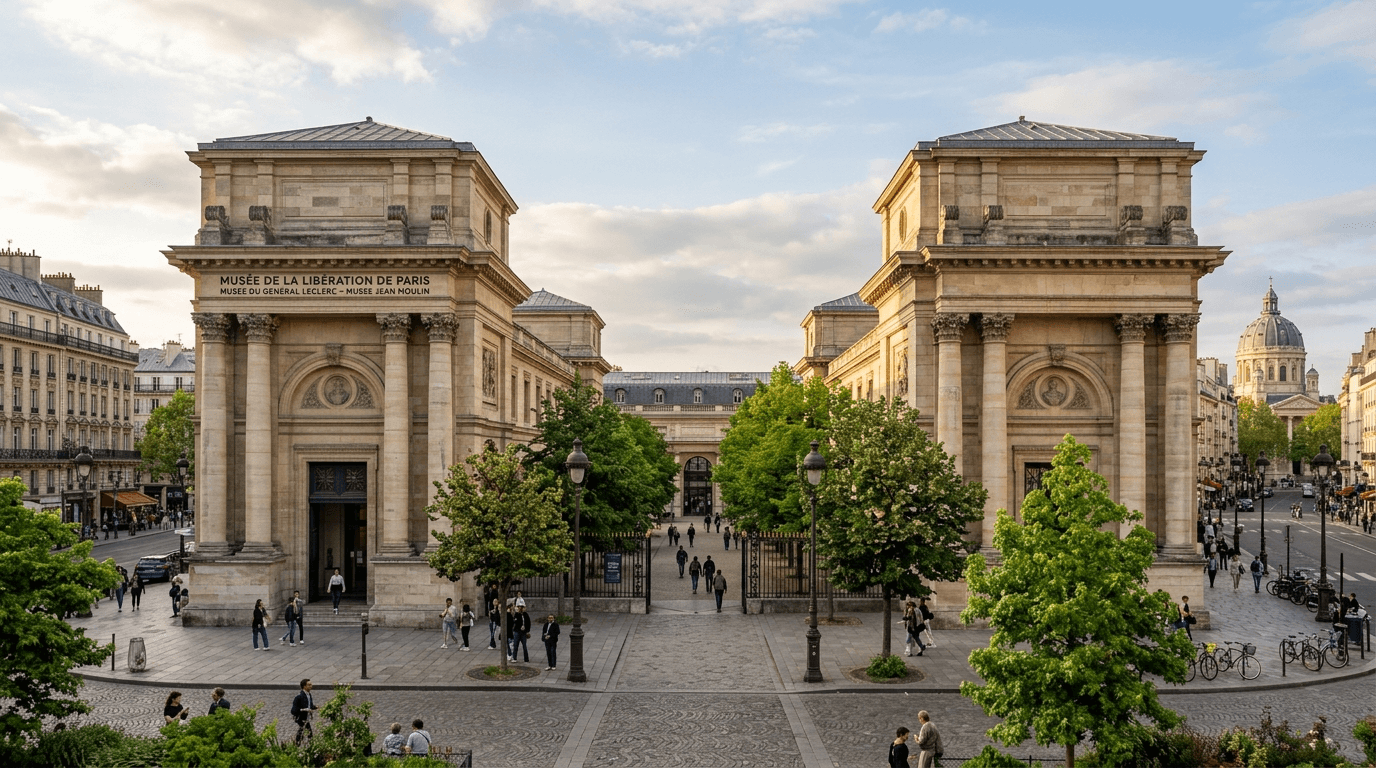
To walk today through the historic Place Denfert-Rochereau and contemplate the museum shining in its twin neoclassical townhouses is to understand the immense power that architecture exerts over the diffusion of collective human memory. The definitive transfer of the institution in 2019 to the pavilions designed by the celebrated architect Claude-Nicolas Ledoux marked an absolute turning point in the museum's history, uniting the monumental importance of the eighteenth-century buildings with the heroic narrative of 1944. It was the ultimate meeting between the stone history of the French Enlightenment and the flesh-and-blood heroism of urban civil resistance against Nazi totalitarianism.
The new address was not chosen by mere urbanistic whim or public space availability, but because it holds a symbolic and military weight of inestimable value to the history of French sovereignty. Place Denfert-Rochereau is the exact spot in the south of Paris through which the motorized vanguards and jeeps of General Leclerc's legendary Second Armored Division marched under applause and tears to rescue the city on August 25, 1944. By installing the museum precisely in this geographical setting, the municipality of Paris poetically set in stone the very entry route of the national liberators, transforming the urban space into a geographical sanctuary of reconciliation.
For national heritage professionals, the reopening of the museum in these restored pavilions in 2019 solved all the operational constraints and bottlenecks of the old Montparnasse headquarters, allowing the implementation of modern interactive exhibition systems. The complex now enjoys universal accessibility, air purification and thermal control systems to protect fragile old papers and textile fibers, and an intelligent visitor flow that guides tourists chronologically through the war years. This renovation milestone represented a true institutional rebirth, elevating the museum to the deserved status of one of the most visited and praised tourist hubs on the left bank of the Seine.
Chapter
2.3. The seventy-fifth anniversary of the liberation as a catalyst for the new era
Imagine the collective emotion of an entire city that stops to celebrate the rescue of its own civic dignity and, at the same moment, opens the doors of a fully innovative museum for future generations across the globe. The exact commemoration of the seventy-fifth anniversary of the liberation of Paris, celebrated with military and international pomp on August 25, 2019, worked as the ideal catalyst to inaugurate the museum's new neoclassical home. It was a moment of incredible national and historical communion that repositioned the memory of World War II at the center of contemporary diplomatic and tourist debate.
During the monumental festivities that took over the streets of Place Denfert-Rochereau, with parades of original period armored jeeps and the presence of war veterans of various nationalities, the new museum was presented as the great physical legacy of the celebration. The opening event attracted European and American diplomatic delegations, transforming the museum's opening into a global event that reinforced the image of Paris as the capital of human liberty. This heavy media exposure immediately attracted thousands of new visitors, who discovered in the southern square a vibrant cultural hub fully integrated into the capital's urban transport network.
The new era inaugurated in 2019 consolidated an innovative concept of active museology, where the visitor is not merely a passive observer of cold text panels, but an active participant in an interpretative experience rich in state-of-the-art technology. The success with the public and critics in the years following the transfer proved the effectiveness of this fusion between ephemeral historical celebration and permanent investment in high-level educational infrastructure. The museum's program thus became an exemplary international model of intangible heritage preservation and of how major national commemorative dates can be used to fund public works of the highest cultural value.
Chapter
3. Jean Moulin in the Museum of the Liberation of Paris: The Hidden Hero of the Resistance
Chapter
3.1. Who was the brilliant mind that unified the rival factions of the clandestine struggle?
In the cold shadows of a nation subjugated by Nazi tyranny, the elegant silhouette of a man wearing a dark wool scarf and a gray felt hat rose silently to become the invisible architect of republican unification. Jean Moulin, a man of extraordinary artistic sensitivity and privileged intellect, personifies the purest and most intellectual clandestine heroism, which the Museum of the Liberation of Paris details with deep interpretative reverence. For the contemporary researcher or the sensitive tourist, tracing the steps of this silent hero is to discover how intelligence, secrecy, and diplomacy were the most powerful weapons used to rescue the honor and sovereignty of the French homeland.
From a historical point of view, Moulin began his public career as a brilliant young prefect of the Eure-et-Loir department, where he demonstrated his unshakeable integrity by refusing to sign unjust German occupation orders in 1940, an act for which he was dismissed by the collaborationist Vichy regime. Exonerated and watched by the political police, he traveled clandestinely to London in 1941 under false names to meet General Charles de Gaulle, receiving the Herculean mission of unifying the armed militias, left-wing parties, and rival trade unions under a single banner of struggle. Moulin was the founder of the legendary National Council of the Resistance (CNR), operating as the living bridge that connected the political exile of London to the armed guerrilla cells operating in the deep basements of Paris and Lyon.
The exhibition rooms dedicated to Moulin display incredible relics illustrating the operational tactics of his silent struggle, such as micro espionage cameras, British radio transmitters, masterfully forged civilian identities, and encrypted confidential correspondence. The displayed documents reveal his bureaucratic genius in organizing clandestine war budgets and coordinating parachute drops of allied secret agents without drawing the attention of Gestapo patrol units. This historical material offers a deep sociological analysis of how the French internal resistance managed to organize itself autonomously and professionally, defying the most efficient social control military machine of its time.
Chapter
3.2. The tragic end of Jean Moulin at the hands of the Gestapo and the legacy for France
For those who study the limits of sacrifice and human loyalty of a patriot to his comrades-in-arms, the tragic and heroic end of Jean Moulin's life is one of the most moving and sad chapters of all contemporary history. In June 1943, Moulin was betrayed and arrested at a secret meeting of resistance leaders in the Caluire province, falling into the clutches of the cruel and ruthless local Gestapo chief, Klaus Barbie. Taken to the torture cellars of Lyon, the resistant leader was subjected to brutal beatings and severe deprivation for weeks, refusing to utter a single codename or clandestine cell location before dying of his injuries during transport for deportation to Nazi Germany.
The impact of his silent martyrdom and his absolute refusal to betray his allies consolidated his name as the ultimate symbol of dignity and moral integrity of the post-war French Republic. The museum displays original autopsy reports, secret letters of farewell sent to his family, and the official tribute of transferring his ashes to the prestigious national Pantheon in 1964, led by the immortal speech of André Malraux. For international visitors and social sciences students, the study of this sacrifice works as a profound universal lesson on the ethical and physical price of freedom and the power of one man's silence against the violence of an oppressive totalitarian State.
Moulin's legacy, brilliantly preserved in the galleries of Denfert-Rochereau, transcends his military biography and details his human facet as a visual artist and humanist intellectual, revealing his hidden sensitivity. Under the artistic pseudonym 'Romanin', Moulin operated as a talented caricaturist and used a commercial art gallery on the French Riviera as an impeccable diplomatic facade to cover his constant secret unification trips. By revealing this fascinating contrast between the delicate soul of a painter and the indomitable determination of the homeland's greatest spy chief, the museum humanizes the stone hero and beautifully brings him closer to the heart of any contemporary visitor.
Chapter
3.3. Personal objects and intimate letters preserved in the museum's galleries
Imagine leaning over a softly lit glass showcase and coming across the small, intimate daily fragments that belonged to a living legend of French national history. The personal objects of Jean Moulin preserved with extreme conservation rigor in the museum's galleries work as emotional keys that open the doors of his intimacy, allowing the tourist to touch his human essence as an ordinary citizen in a poetic way. It is a moving glimpse of ink pens, watercolor brushes, old reading glasses, and civil diaries where art notes disguised meetings that would define the country's liberation.
For archivists and historians seeking to understand the manual encryption methods of the internal resistance, the museum displays Moulin's intimate correspondence sent to his beloved sister Laure, in which he described his travels across Europe in a poetic and melancholy tone. The original letters, preserved with UV light filtering systems and strict humidity control to prevent the deterioration of old fountain pen inks, prove his deep concern to protect his loved ones from reprisals by the Nazi political police. Each sheet of paper displayed is accompanied by interactive digital transcriptions with critical commentary explaining the hidden context of the literary metaphors used.
The presence of these delicate and personal artifacts in the exhibition path contrasts spectacularly with the military hardness of the heavy artillery cannons and armored machine guns displayed in the museum's neighboring sectors. This clever scenographic juxtaposition is planned to remind the visitor that history is not made only of decisions taken on the great battlefronts of armies, but also by the discreet bravery of felt-hatted intellectuals who loved painting and writing. This poetic and sensitive perspective is what makes the museum an incomparable and deep attraction in the busy cultural circuit of the French capital.
Chapter
4. General Leclerc in the Museum of the Liberation of Paris: The Soldier of Free France
Chapter
4.1. From the African desert to glory on the Champs-Élysées: Leclerc's military epic
For lovers of great military strategy narratives and for anyone seeking to understand the impetuous force that returned honor and national independence to France, the name of General Leclerc is an immortal beacon. Philippe Leclerc de Hauteclocque, the French aristocrat of noble lineage who adopted a war codename to protect his family under occupation from cowardly reprisals by the Gestapo, led men through endless deserts and snowstorms with indomitable courage. His conquests, magnificently recreated in the museum's exhibition rooms, tell the story of a fast-acting commander with dynamic armored tactics who tore through the Third Reich's defense lines to rescue the French capital.
Leclerc's military epic began in French Equatorial Africa, where he led the capture of the Kufra fortress in Libya, under strict Italian fascist control, swearing with his soldiers the legendary 'Swear of Kufra': never to lay down weapons until the colors of the French flag floated glorious over the Strasbourg cathedral. This daring promise, considered a romantic fantasy in 1941, was fulfilled to the letter when Leclerc led the famous Second Armored Division (2e DB) from the landing beaches of Normandy to the heart of Alsace. Visitors to the museum can closely examine the tactical models of these battles, the original campaign maps annotated by hand by the general himself, and even the leather jacket and armored military jeep he used to enter Paris under enemy fire.
The study of this battlefield leader offers military history researchers a detailed analysis of Leclerc's tactical innovations to integrate heavy artillery armor with movements of light infantry troops and civil guerrilla warfare. His revolutionary methods of operational surprise and logistical flexibility inspired allied commanders worldwide and are displayed in the museum through interactive 3D map monitors. For the tourist, seeing closely the original navigation instruments, the shrapnel-pierced jeeps, and the medals of honor awarded to Leclerc is to understand the human and extremely physically determined side of one of the greatest generials in contemporary European history.
Chapter
4.2. The decisive role of the legendary Second Armored Division in rescuing the capital
Crossing the rooms displaying the tricolor standards and armored coats of arms of the legendary Second Armored Division (2e DB) is to come into direct contact with one of the greatest diplomatic and military achievements in French history. Leclerc's and his men's role in rescuing Paris went far beyond a simple march of tanks through the avenues; it was an absolute geopolitical and civic imperative fought behind diplomatic scenes against the bureaucracy of allied generals Eisenhower and Patton. Leclerc knew that the capital had to be liberated by the French to ensure that the post-war country would not be governed by a temporary military administration of foreign armies, guaranteeing immediate sovereignty for de Gaulle.
The museum's exhibits detail minutely Leclerc's negotiations to obtain approval from the allied command to march toward Paris on August 22, when the popular insurreccion of the urban resistance ran the real risk of being crushed by the German occupation garrison. The Second Armored Division was a fascinating human mosaic, bringing together experienced French veterans, Spanish republican volunteers (the famous 'La Nueve' company), and combatents from various overseas provinces. By displaying the original tactical progression maps, Leclerc's handwritten attack orders, and the heavy weapons used in the combats on the sidewalks of the south of the city, the museum reconstructs the tension and bravery of those historic days when sovereignty was won with blood and steel.
This interpretative immersion is enriched by recorded testimonies of surviving soldiers of the division, recounting the apotheotic and emotional reception of the civilian population as they saw Leclerc's armored vehicles cross the entry gates of Denfert-Rochereau under sniper fire from Nazi shooters on top of the Haussmannian buildings. Visitors and academics can compare the uniforms, ammunition, period military communication radios, and personal correspondence showing the unconditional dedication of these warriors who marched from the Libyan desert to the heart of free Europe. The Leclerc collection is thus an unmissable celebration of the transforming power of an army's determination born from a people's very will for freedom.
Chapter
4.3. How the displayed artifacts of war narrate the great artillery battles
Imagine leaning over the cold, gray metal of heavy artillery cannons that once dictated the deafening and violent pace of the liberation of one of the most beautiful cities on the planet. The war artifacts displayed in an integrated way in the gardens and inner courtyards of the Denfert-Rochereau museum function as silent and brutal witnesses to the combats fought against the Nazi armored forces resisting in Parisian monuments and public buildings. For the tourist interested in warfare history or the military researcher, analyzing the physical wear marks on these pieces is to read a chronicle in steel and bronze of one of the greatest urban battles of World War II.
Among the displayed items that most attract the attention of the public of all nationalities are original anti-tank cannons, heavy-caliber Browning machine guns, and campaign mortars recovered from the street barricades and destroyed armored vehicles in August 1944. Each artillery piece is accompanied by digital information panels describing its mechanical operation, technical ammunition specifications, and three-dimensional maps showing exactly on which Paris corners this equipment operated to silence German tanks. The state of conservation of these metal relics, preserved against the wear of time through special protective oils, impresses with its realism and the physical proximity it provides.
In addition, the internal showcases bring together real shell fragments collected from the limestone facades of monumental buildings in the capital, unexploded heavy ammunition, and ballistic calculation binoculars used by Leclerc's officers to plan shots without hitting civilian populations and the city's artistic treasures. This concern to spare Paris's monumental heritage while crushing the Nazi garrison is detailed in original tactical reports, revealing the historical sensitivity and technical precision of Leclerc and his command in the midst of urban chaos. The study of these military objects provides a fantastic depth of context, revealing the technological and engineering complexity of the battles for national freedom.
Chapter
5. The Rol-Tanguy Bunker at the Museum of the Liberation of Paris: The Clandestine Headquarters
Chapter
5.1. An exciting descent 66 feet underground to see the FFI refuge
If you want to feel an unforgettable shiver on your skin and experience the physical and claustrophobic sensation of being at the neurological heart of a clandestine liberation revolution, prepare yourself for a descent that will change your perception of World War II. Descending the 100 steep concrete steps that plunge **66 feet** beneath the ancient stones of Place Denfert-Rochereau is to enter the legendary underground command bunker used by Colonel Henri Rol-Tanguy, the fearless military chief of the French Forces of the Interior (FFI). It is a visceral and silent portal of gray stone where the tourist or researcher comes across the original wooden tables, telephone cables, and wall maps where the destiny of Paris was decided in urgent and tense whispers.
Originally built in the golden years of 1937 and 1939 to act as a passive protection shelter against air raids and poison gas attacks for the municipal water and sanitation engineers of the city of Paris, the bunker was a true masterpiece of civil defense engineering of the period. It possessed ultra-thick reinforced concrete walls, airtight doors with pneumatic seals, autonomous diesel electric generator systems, and internal air ventilation duct networks with active carbon filtration. When the popular insurrection exploded on the capital's sidewalks in mid-August 1944, the secret cells of the FFI took the underground shelter by silent storm, installing the headquarters that coordinated the combats against the German Nazi forces.
To descend to this sacred site of contemporary military archaeology, the visitor must respect strict fire safety and national heritage conservation rules (such as the mandatory use of closed shoes and the prohibition of bulky travel luggage), as visitation is restricted and strictly monitored. The fresh, damp air and the dense, solemn silence of the underground galleries preserved in their primitive state of raw concrete awaken an immediate reverent respect in visitors of all nationalities. To be there is to understand that the freedom of France was also won in the hidden labyrinths of the deep city, far from the sun and by the light of battery lamps.
Chapter
5.2. How did the original telephones and wall maps coordinate the urban revolt?
Imagine the frenetic and suffocating scene of an underground concrete room where officers in felt hats and workers in blue overalls operate telephones non-stop amid the smell of oil, sweat, and cigarette smoke, sending orders that would define the lives of thousands of Parisians. The original wall maps, preserved with extreme scientific rigor in the rooms of the Rol-Tanguy bunker, show the geography of the revolt with red pencil annotations marking the exact location of the hundreds of stone barricades erected by the civilian population on street corners. From the black bakelite telephones that still rest poetically on the rustic wooden tables, the rebel command coordinated in 24-hour shifts the guerrilla ambushes against the German armored patrols.
The communication network of the underground bunker was a masterpiece of clandestine improvisation engineering, connecting directly to the public sewer system and deep galleries through which agile messengers and resistance boys rode bicycles underground to deliver reports written on cigarette papers. When the official telephone lines were cut by the German Nazi occupation, Rol-Tanguy's operators used improvised radio transmitters with smuggled parts to issue encrypted dispatches to the advancing Allied troops and to the rebelled police stations on the Île de la Cité. The museum displays these original network diagrams and offers historians and espionage students a fantastic view of the logistical effectiveness of modern urban guerrilla warfare.
Visiting the command bunker allows the tourist to analyze this mechanical equipment and understand how high-precision tactical decisions could be made without the use of digital technologies or computer screens, relying only on the precision of manual paper maps and the heroism of messengers under heavy artillery fire. This interpretive plunge is considered one of the most praised points of the entire academic and leisure tourism circuit in Europe, offering an unforgettable educational experience that breaks historical and scenographic war paradigms.
Chapter
5.3. Engineering protection measures against bomb and poison gas attacks
For engineers and lovers of complex technical solutions of the early **20th century**, descending into the Denfert-Rochereau underground shelter is to discover a true example of excellence in civil engineering aimed at survival in times of extreme war. The bunker featured a series of defensive measures designed to withstand the direct impact of heavy aviation bombs and resist prolonged blockades or sieges by German troops on the surface. Every detail, from the rounded shape of the concrete galleries to dissipate thermal shock waves to the deep wastewater drainage grates, was designed to ensure that the leadership of the insurrection operated in total safety.
The major technological highlight of the bunker lies in its ingenious closed-circuit air filtration system, equipped with huge industrial active carbon filtration drums and mechanical emergency hand cranks that could be operated manually if the diesel electric generators failed under artillery bombardment. Air was collected from camouflaged suction intakes on the neoclassical surface of Ledoux's pavilions and forced through purification coils to remove primitive radioactive particles or asphyxiating chemical gases like chlorine and phosgene, widely feared after World War I. The original mechanical pressure gauges and indicators remain fixed on the gray masonry walls of the bunker as silent witnesses to the French technical genius of the time.
In addition to the measures against bomb attacks and chemical gas weapons, the bunker possessed airtight pressurized drinking water reservoirs, electric field kitchens, compact sterilization wards, and armored emergency exits integrated into Paris's historic catacombs network beneath Place Denfert-Rochereau. This direct access to the medieval limestone tunnels of the underground city allowed Rol-Tanguy and his men to evacuate the entire command post in a few minutes if the Nazi forces tried to invade or blow up the shelter with dynamite. The study of these preventive engineering solutions offers an extraordinary interpretive depth, uniting human bravery with the constructive excellence of national civic resistance.
Chapter
6. The August 1944 Insurrection at the Museum of the Liberation of Paris: The Pinnacle
Chapter
6.1. From the general police strike to the construction of thousands of stone barricades
Imagine the air of one of the most beautiful cities in the world suddenly charged with the acrid smell of gunpowder, burnt engine oil, and the electrifying murmur of an entire people who decided that freedom could not wait for tomorrow. The insurrection of August 1944, gloriously depicted in the main sectors of the Museum of the Liberation of Paris, was the moment when the population decided to take their own destiny into their own civic hands. For the tourist who contemplates the black-and-white photographs of blocked avenues, the museum spectacularly recreates the metamorphosis of ordinary citizens, from bakers and teachers to unarmed police officers, into relentless warriors who faced the German Nazi occupation with barricades and Molotov cocktails.
The revolutionary spark was lit on August 15, 1944, with the general strike declared by railway workers and by the French municipal police officers themselves, who occupied the historic Paris Police Headquarters on the Île de la Cité armed with old rifles, starting days of savage street fighting. Under the command orders sent from Rol-Tanguy's bunker, the civilian population began pulling stone paving blocks from the streets, tipping over delivery trucks, and cutting down century-old trees to build more than 600 defensive barricades throughout the urban expanse. Women, the elderly, and children worked in uninterrupted shifts on the sidewalks, manufacturing homemade bombs in empty wine bottles and accumulating emergency supplies to maintain positions against enemy machine guns.
The exhibitions dedicated to this week of military suspense bring together original clandestine combat newspapers, metal megaphones used to warn citizens in residential neighborhoods, and chilling audio testimonies of eyewitnesses who lived through the chaos of the barricades under sniper fire from Nazi shooters on top of the buildings. For specialists in European military history and social movements, the collection offers a unique opportunity to analyze how a civilian population under occupation can self-organize and immobilize a regular occupation army through intelligent urban blocking tactics and control of heavy artillery routes. The study of this August revolt is the true pinnacle of the interpretive experience of the VivaFrance.net portal.
Chapter
6.2. How did civilians armed with Molotov cocktails face Panther tanks?
For those who seek to understand the limits of physical courage of men armed only with fuel bottles against armored monsters of steel and high-caliber cannons, the museum's showcases tell stories of unbelievable bravery that seem extracted from urban legends. Civilians armed with old hunting pistols and Molotov cocktails improvised in Paris wine cellars faced head-on the dreaded Panther tanks and Panzer IV armored vehicles patrolling the wide Haussmannian avenues. The museum recreates these unequal battles through detailed tactile models, dramatic paintings, and period films captured by amateur filmmakers of the Resistance who risked their lives with cameras hidden in windows.
The civil guerrilla tactic consisted of luring German tanks into the narrow residential streets of Paris's historic center, where huge barricades of paving stones blocked their movement and mechanical combat progression. Once cornered and prevented from rotating their huge heavy artillery cannon turrets, the German armored vehicles were easy targets for Molotov cocktails thrown from the roofs of limestone townhouses by young resistance fighters who knew every shortcut and rooftop in the city. The museum displays the original fuel bottles that did not detonate, the twisted metal remains of destroyed armored vehicles, and the secret tactical orders written by rebel leaders to guide novice combatants on how to hit the engines and gasoline tanks of enemy vehicles.
This detailed and realistic historical analysis shows that the liberation of Paris was not achieved only with conventional weapons of regular armies, but rather with the collective intelligence and mechanical improvisation of a community unified by the indomitable will to be free from the German Nazi boot. For the contemporary tourist walking the capital's beautiful avenues today, seeing these rustic war relics and reading the testimonies of boys from the barricades is a profound life lesson on the power of human solidarity and the fragility of military occupation forces in the face of active resistance by a people. It is a mandatory stop to understand modern national identity.
Chapter
6.3. The arrival of Allied troops and the capitulation of General Dietrich von Choltitz
Imagine the uncontrollable explosion of popular joy taking over the sidewalks of a city bathed in summer light when Leclerc's columns of armored vehicles and heavy cannons finally cross Ledoux's barricades under applause and tears. The triumphant arrival of Allied troops on the afternoon of August 24, 1944, marked the spectacular outcome of Paris's urban insurrection, uniting Free France's armored forces with the clandestine armed cells of the FFI fighting without ammunition in the basements. The museum displays with high documentary rigor the moments of tension and relief that culminated in the official German military capitulation signed at the Paris Police Headquarters on August 25, 1944.
The exhibition features the official capitulation document signed by the commander of the German military occupation garrison, General Dietrich von Choltitz, who historically disobeyed Adolf Hitler's direct and brutal orders for Paris to be burned, imploded, and reduced to urban ashes before being delivered to the Allied armies. Visitors to the museum can examine photos of Choltitz being taken prisoner by Leclerc's officers, the original pens used to sign the military surrender treaty, and the maps of mines and explosives showing that famous monuments like the Eiffel Tower, Notre-Dame Cathedral, and the Pont-Neuf bridge were already completely mined and ready to be dynamited by German forces.
For historians and researchers in political science and the law of war, this section of the museum offers a very rich field to study the diplomatic backstage that convinced Choltitz to surrender the city intact to the provisional French army, saving the lives of millions of civilians and preserving the incomparable historical heritage of the Seine River. The victory celebration that followed along the Champs-Élysées with de Gaulle and Leclerc marching through crowds of Parisians in tears is presented in huge visual cinema panels at the exit of the museum. This end-of-journey experience consolidates the pedagogical value of the space and deeply moves visitors from all over the world in a definitive way.
Chapter
7. Museum of the Liberation of Paris Collection Guide: Relics of the Clandestine
Chapter
7.1. Clandestine pamphlets and satirical newspapers printed on hidden presses
Entering the silent labyrinth of the museum's showcase rooms is to come across the small and dangerous paper weapons that once challenged the iron censorship and totalitarian propaganda of the Vichy collaborationist regime and the German Nazi occupation. Clandestine pamphlets and satirical newspapers printed on manual presses hidden in deep city cellars are true relics of civil courage displayed for the attentive tourist and communication sciences researcher. Each yellowed sheet of old newspaper, with articles written under the deafening noise of Allied bombs, whispers stories of reporters and printers who knew that a single anonymous tip or a single distribution error would cost their own lives.
The museum's collection brings together extremely rare original copies of historical newspapers such as 'Combat', where the renowned philosopher and writer Albert Camus wrote fiery editorials under mysterious espionage codenames to inflame the patriotism of Parisians. There are also displays of brutal satirical cartoons ridiculing Vichy generals and Adolf Hitler himself, produced with rustic carved wood blocks and homemade printing inks based on charcoal and tractor engine oil. The museum also displays small brochures of practical instructions teaching citizens to perform discreet sabotage in German war industries and to boycott the military rationing orders imposed by the occupying Nazi army.
For historians of literature and the sociology of mass media, this section of Denfert-Rochereau is a fertile and incomparable field for understanding how the clandestine press functioned as the true ethical backbone and moral unification of the national liberation movement. By revealing the immense physical danger of distributing these sheets of paper on dark corners under severe wartime curfew, the museum teaches the invaluable worth of a free and courageous press in times of ideological and totalitarian censorship. The newspaper collection is a true treasure of national culture that the VivaFrance.net portal proudly supports and disseminates.
Chapter
7.2. Ingenious camouflaged weapons and encrypted messages engraved on fabrics
Imagine examining closely peaceful everyday objects of beauty that, under closer espionage and military tactical inspection, reveal deadly secrets of clandestine combat against German occupation forces. The Denfert-Rochereau museum houses an incomparable collection of camouflaged improvisation weapons and manual encryption mechanical devices that prove the ingenuity and desperation of FFI and British SOE secret agents who parachuted over French provinces. They are screwdrivers with hollow compartments for cyanide poison, fountain pens that fired small-caliber revolver bullets, map-measuring compasses with built-in navigational compasses, and period pocket watches with secret compartments for revealing clandestine microfilms.
One of the greatest technical treasures on display in the collection are the historic maps of extremely thin silk used by Allied fighter pilots who parachuted over occupied national territory to avoid capture by Vichy Nazi forces. Because they were waterproof, lightweight, and easy to crumple without making the dry rustling sound characteristic of manual paper maps, these noble fabrics could be sewn into the linings of civilian coats or hidden inside wool socks without drawing the attention of customs guards at Ledoux's checkpoints. The museum also presents the famous and rustic single-shot, light-caliber 'Liberator' pistols, mass-produced by American industries from cheap sheet steel and distributed in bulk by aircraft to arm urban civil cells in an agile and surprising way.
The study of each of these mechanical tools offers military researchers and mechanical engineers a precious analytical base on the development of irregular warfare and field intelligence technologies during the middle of the **20th century**. The museum displays these human survival instruments alongside the original encrypted messages on strips of fabric that have withstood time and manual bakelite decoders that allowed the decoding of tactical orders for bombing roads and railway bridges. The interpretive immersion in these clandestine relics impresses with its realism of practical details and the physical courage of men who operated in the dead of the Parisian night under absolute secrecy.
Chapter
7.3. How does the museum conserve these fragile artifacts against the deterioration of time?
For cultural heritage conservators and historians of modern archaeological materials, preserving a collection composed of low-quality wartime newsprint, worn military uniform fabrics, and metals oxidized by decades underground is a monumental technical challenge that requires cutting-edge applied science. The Museum of the Liberation of Paris is internationally considered a reference model in preventive conservation and active preservation museology, investing annually in sophisticated climate control and cold lighting infrastructures in the rooms of Ledoux's neoclassical monument. Each exhibition showcase is a true high-tech airtight chamber designed to fight against the chemical and physical deterioration of time.
The internal rooms use invisible central climate control systems that keep the temperature of the showcases stabilized at exactly **64°F** and the relative humidity of the air controlled at **50%**, perfect scientific parameters to delay the breakdown of cellulose fibers in clandestine newsprint pamphlets and the rapid oxidation of buckles and rustic metal weapons. The lighting of all permanent galleries in Denfert-Rochereau was replaced by intelligent LED systems with absolute filtering of ultraviolet (UV) and infrared (IR) rays, preventing the rapid fading of old fountain pen inks in Jean Moulin's letters and the delicate colors of Leclerc's silk war maps. For pieces of extreme organic degradation sensitivity, the museum applies controlled atmospheres of invisible dry nitrogen gas inside the glass cases.
In addition to thermal and light rigor, the museum has specialized restoration laboratories integrated into the Denfert-Rochereau pavilions, where archaeologists perform microscopic mechanical cleanings with high-frequency laser to remove fungi and iron oxide patinas without scratching the original textures of espionage tools. The entire physical collection was mapped and cataloged digitally in high-resolution 3D laser scans, allowing military history specialists from all capitals of the world to access confidential documentation online for deep academic research without subjecting the fragile original relics to the mechanical wear of direct human handling.
Chapter
8. Ledoux's Architecture at the Museum of the Liberation of Paris: The Historic Pavilions
Chapter
8.1. The neoclassical genius of the visionary architect of the French Enlightenment
For those who walk today through Place Denfert-Rochereau and contemplate the imposing and classic facade of symmetrical white stones housing the museum, they come across one of the greatest architectural treasures of Paris from the late **18th century**. Designed by Claude-Nicolas Ledoux, one of the most revolutionary, philosophical, and visionary architects of the French Enlightenment, the twin neoclassical pavilions carry the solemn grandeur of ancient Greek temples and the military sobriety of large Roman fortresses. By housing the moving narrative of the struggle for freedom within neoclassical structures originally designed for the tax control of the period, the space creates a dazzling poetic, historical, and monumental contrast that enriches any tourist or academic visit.
Ledoux was known in art history for challenging decorative baroque classical forms and proposing an architecture of pure geometric volumes, perfect symmetries, and rustic columns that dialogued with the human reason of the Enlightenment. The twin townhouses of Place Denfert-Rochereau present monumental colonnades, limestone masonry friezes, and mythological bas-reliefs representing the authority of the absolutist State and urban control, resisting in an incredible and spectacular way social revolutions, pitched battles, and armored artillery tank combats over three centuries of Haussmannian transformations of the capital of France.
For contemporary art historians and national heritage architects, the study of these constructions allows an understanding of the philosophical changes that dictated pre-revolutionary European architecture, where public works were meant to express the order, reason, and moral solidity of the government. The Denfert-Rochereau museum masterfully preserves this physical neoclassical heritage by integrating modern exhibition rooms in an invisible and subtle way within the original eighteenth-century masonry structure, creating an impeccable scenographic experience where classical limestone and brushed steel dialogue with deep visual harmony.
Chapter
8.2. The military role of customs barrier and tax control in the Ancien Régime
Imagine approaching the huge classic stone columns of Paris in 1785 and coming across a complex system of customs control and collection of severe tax duties on every **pound** of food, bottle of wine, or civil merchandise attempting to cross the city borders of the Ancien Régime. Erected originally between 1784 and 1787, Ledoux's pavilions in Denfert-Rochereau were part of the infamous 'Mur des Fermiers Généraux' (the Wall of the General Farmers), an imposing and hated urban circulation fiscal barrier surrounding Paris to guarantee the absolutist French crown's taxation monopoly. For the contemporary tourist or the economic sciences researcher, deciphering this mercantile origin is to understand the deep social tensions that lit the spark of the French Revolution.
The Denfert-Rochereau barrier, historically known as the 'Barrière d'Enfer' (Barrier of Hell due to the name of the old southern access road), featured monumental cast iron gates, internal cargo inspection yards, and civil merchandise weighing offices where the king's collectors inspected wagons under military protection. The Parisian people detested this customs barrier because the taxes on basic food and heating products immensely increased the cost of living in the poorest urban provinces, generating violent popular riots and arson attacks against Ledoux's pavilions on the eve of the Storming of the Bastille in July 1789.
Following the total destruction of the customs wall and the overthrow of monarchical taxes by the democratic reforms of the Republic in the **19th century**, Ledoux's townhouses remained as public monuments preserved by France's national historical heritage, witnessing civil battles and the march of armies along the sidewalks of the capital's south. The current museum uses this military and administrative history of the period to create a rich interpretive journey, showing that the same neoclassical monument that once represented fiscal exclusion and the tyranny of the absolute State was transformed into the democratic home for preserving civic freedoms and the collective heroism of the Resistance.
Chapter
8.3. How the modern minimalist design respected the ancient stone of the monument?
For the researcher of contemporary urban architecture or the tourist with an eye for museum interior design details, the renovation of Ledoux's neoclassical pavilions in 2019 represents a true masterpiece of preventive restoration and civil engineering in Europe. The greatest technical challenge faced by French heritage restorers and architects was to install heavy invisible climate control systems, universal accessibility elevators, and fire emergency exits without touching the integrity of the huge eighteenth-century limestone masonry walls of the Ancien Régime. The result is a wonderful minimalist visual dialogue where classic rustic limestone and modern panels of brushed steel and interactive glass merge sublimely.
The architectural intervention adopted the international principle of absolute structural reversibility, where all new circulation walkways, tempered glass showcase supports, and room partitions were mounted in a suspended manner or anchored on floating footings that do not pierce or damage Ledoux's original stone foundations of **1784**. The interior design uses a palette of neutral and dark colors based on charcoal-gray, darkened metal, and acoustic panels hidden in the restored plaster cornices, ensuring that the visitor's luminous attention is entirely directed to the historical artifacts and documents displayed in the suspended showcases. The huge classic oak frames were meticulously disassembled, sanded, and lacquered in a historic olive-gray tone certified by the municipal archives of the Paris City Hall.
This scientific concern for monumental integrity extended to the central cobblestone courtyard and the external terraces facing the square, where the old colonnades were cleaned with sodium bicarbonate micro-blasting technology to remove centuries of vehicle traffic soot without wearing down the texture of the classic porous limestone. Visiting the museum is, therefore, an aesthetic experience of the highest artistic and civil engineering level, teaching in practice how the preservation of national historical heritage can walk hand in hand with expographic technological modernity and civic social inclusion in a definitive way.
Chapter
9. How to Visit the Museum of the Liberation of Paris: Tickets and Tips
Chapter
9.1. The secret of the permanent free admission to the municipal collection of the city of Paris
If you are planning your trip to the French capital with a controlled tourism budget and seeking high-value cultural experiences without spending fortunes on entry fees to famous monuments, prepare to discover a hidden gem in the heart of south Paris. The Museum of the Liberation of Paris is completely free for all visitors of all nationalities, without any need for prior ticket purchases to access its permanent international-level exhibition and Ledoux's townhouses. As part of the prestigious network of municipal museums of the city of Paris (Les Musées de la Ville de Paris), free admission to the collection is a sacred State policy to ensure the universal democratization of civic memory and cultural heritage.
This permanent free admission allows the tourist to walk peacefully and unhurriedly through the museum's beautiful lit rooms, from Tuesday to Sunday, from 10:00 AM to 6:00 PM, taking advantage of an infrastructure of adapted restrooms, lockers with free mechanical keys for backpacks, and digital navigation guides without spending a penny. However, for the bold temporary exhibitions of international curation that the museum organizes annually in the neoclassical pavilions, the municipal administration may charge affordable entry fees, and it is recommended to always check the official cultural calendar on the museum's website before leaving the hotel.
For academic historians and international university professors planning group visits or researching rare documents in the museum's internal archives, free admission extends to study sessions scheduled in advance with the curators of the Denfert-Rochereau institution. This democratic opening and welcoming of researchers consolidates the museum as one of the most important hubs for the exchange of World War II military historical knowledge on the continent, breaking down old barriers of social exclusion that characterize many of the busiest attractions on the right bank of the Seine River. It is a true cultural gift for anyone who loves Paris.
Chapter
9.2. How to make the mandatory advance reservation to go down to the historic bunker?
Imagine the palpable emotion of walking in silence through a rustic underground military command bunker of concrete at **66 feet** deep, but remember that this fantastic immersive experience requires prior bureaucratic planning to avoid disappointment at the entrance of the Denfert-Rochereau museum. Due to strict and severe technical infrastructure restrictions, emergency fire evacuation, and moisture control for the archaeological conservation of Colonel Rol-Tanguy's original bunker, the descent down the stairs is conditioned on the mandatory prior reservation of a free specific time slot ticket issued on the museum's official website. Without this prior electronic reservation with a QR code, the tourist will not be able to descend the 100 steps of the underground refuge.
The reservation of this special free ticket opens a few weeks in advance on the institution's internet portal and usually sells out in a few minutes for scheduled visits on weekends and French national tourist holidays during the European summer. It is recommended to create an alert in the travel calendar and issue the time slot tickets in advance to ensure a smooth descent and enjoy the complete visit with family or academic groups. It is important to emphasize that safety regulations require the mandatory use of closed, comfortable walking shoes to descend the steep historical concrete staircase, and entry in high heels, flip-flops, or slippery open sandals is prohibited.
If you are traveling with young children, the elderly, or family members with reduced mobility, it is vital to verify in advance whether the descent of the steps is safe, as the original 1944 bunker does not have elevator infrastructure or mechanical accessibility ramps due to the preservation of the national archaeological masonry. The rest of the permanent and temporary exhibition rooms in the surface neoclassical townhouses are, however, fully accessible and adapted with modern circulation ramps and electric elevators, allowing everyone to enjoy the history of Paris's heroes without mobility barriers.
Chapter
9.3. What are the metro and bus connections to easily reach the attraction?
For the urban traveler who values the precious time of their itinerary in the capital of France and seeks easy, comfortable, and fast ways to get around by public transport, the museum's location in the historic Place Denfert-Rochereau is a true privilege of road engineering. Located in the charming **14th arrondissement** of Paris, the neoclassical architectural complex of Ledoux is located directly above one of the largest metro and railway junctions in the south of the capital, facilitating direct access from any geographical point or residential hotel in the City of Light in an agile and stress-free way.
The visitor can disembark at the integrated 'Denfert-Rochereau' station, which is served by high-frequency metro lines Line 4 (which cuts the capital from north to south along the banks of the Seine) and Line 6 (a line famous for its elevated tracks with a breathtaking view of the Eiffel Tower). In addition to the traditional metro, the station has immediate access to Line B of the RER (the fast metropolitan train that connects directly and without transfers to Charles de Gaulle International Airport and Orly Airport via the OrlyBus connection, which has its start and end point exactly at Place Denfert-Rochereau). This logistical ease makes it practical to include the museum as the first or last cultural stop on your Paris itinerary in a clean and convenient way.
For those who prefer the surface circulation of municipal buses to contemplate the beautiful Parisian facades, the square in front of Ledoux's pavilions is served by numerous urban bus lines connecting the right bank of the Seine to the bohemian districts of Montparnasse and the Latin Quarter in a few minutes. You can also program a monumental day of cultural tourism by combining the free visit to the Museum of the Liberation of Paris in the afternoon with the paid tour of the famous and dark Catacombs of Paris, located exactly on the other side of the same square Place Denfert-Rochereau, taking advantage of the same metro connections and local French high-gastronomy restaurants surrounding the historic site.
Chapter
10. The Mixed Reality Experience at the Museum of the Liberation of Paris: Tips
Chapter
10.1. A three-dimensional technological plunge with HoloLens glasses in the bunker
For enthusiasts of new technologies applied to historical education and for the new generation of digital tourists seeking deep immersive experiences that go far beyond the traditional cold analog panels of museums, prepare for a true technological time jump. The Museum of the Liberation of Paris revolutionized European military museology by integrating the rustic limestone stones of the underground bunker of Rol-Tanguy with state-of-the-art three-dimensional holographic pixels through a fantastic mixed reality experience with Microsoft HoloLens glasses. Seeing life-sized digitized resistance officers rushing to answer old bakelite telephones in the original **1944** underground HQ is a visceral, skin-chilling journey.
The immersive mixed reality technology was designed by consortia of French developers in partnership with historians and curators of the museum to align the three-dimensional holographic elements in a millimeter-precise way with the original raw concrete walls of the period bunker. By placing the lightweight and modern HoloLens glasses at the beginning of the underground descent path, the visitor comes across realistic light projections of wall maps that light up dynamically to show the tactical progression of the southern urban barricades and hears original radio transmissions and confidential military dispatches in whispers. It is the perfect sensory reconstruction of the atmosphere of suspense and anxiety that gripped the FFI rebel leadership in the final hours before the German surrender.
To ensure the best technical and operational use of this free mixed reality experience in the underground command bunker, the visitor must reserve the special ticket on the official website in advance and follow the instructions of the monitoring team regarding the fit of the glasses on the face and the recommended basic ocular calibration of three-dimensional focus. The immersive activity lasts approximately **25 minutes** of guided route underground, being considered by international information design schools and military academies one of the most brilliant and successful case studies of gamification and pedagogical technology applied to the historical-cultural heritage of modernity.
Chapter
10.2. How does digital interactivity reconstruct the climate of war in the galleries?
Imagine approaching a classic showcase at the Denfert-Rochereau museum and, instead of reading a static paper label, being able to use tactile interfaces, interactive expography tablets, and high-resolution video projection digital screens to "touch" and unfold the hidden stories of each clandestine relic from World War II. Digital interactivity was intelligently and surgically spread throughout all permanent surface galleries of Ledoux's neoclassical monument, ensuring that the visitor is the true author of their own interpretive route of historical knowledge. The museum uses interactive media not as empty ornaments, but as essential tools for democratizing deep military information.
The interactive totems installed alongside the collections of weapons and secret pamphlets allow access to high-definition 3D digital scans of rare documents and handwritten personal diaries of FFI and British SOE combatants, making it possible to zoom in to examine Jean Moulin's confidential signatures under a codename and the manual encryption techniques of secret messages. The visitor can also participate in fun and educational interactive simulations that teach how to program period tube field radios under fictional electronic interference and decode Allied encrypted military dispatches using digital replicas of the famous paper cipher tables. This user interactivity is one of the features most praised by teachers and tourist families from all parts of the world.
This modern expographic engineering reconstructs the dramatic and tense atmosphere of the war years in an engaging way by alternating the respectful reading of fragile physical relics with large-scale monumental cinematic projections on the walls of the neoclassical rooms, depicting the progress of Leclerc's battles for the liberation of Paris in dynamic maps and light graphics. Technology thus acts as a wonderful interpretive bridge translating cold statistical data of war and complex heavy artillery tactics into dynamic human narratives, easy to understand by visitors of all age groups, promoting an unforgettable learning experience of high cultural value that the VivaFrance.net portal disseminates with maximum dedication.
Chapter
10.3. The role of expographic tablets in the native translation of the collection for tourists
For the international traveler arriving in the capital of France without a fluent command of the classic French language or the technical military jargon of World War II, accessing deep information at many Paris monuments can be a tiring experience of linguistic exclusion. Aware of this immense communicative bottleneck of modern cultural tourism, the Museum of the Liberation of Paris implemented in its collections a network of portable expographic navigation tablets and digital interactive totems of the highest technological level. These devices offer audio and text translations with high linguistic rigor in multiple languages in a completely native way, transforming the self-guided visit into a journey of comfort, inclusion, and educational richness for tourists from all over the globe.
By using the tablets and touchscreens available for free in the rooms of Ledoux's neoclassical townhouses, the international visitor comes across clean and minimalist interfaces where they can quickly select their preferred language to decipher the detailed critical captions of each heavy artillery cannon, clandestine pamphlet, or intimate letter of Jean Moulin. The museum's expographic translation software at Denfert-Rochereau was written by teams of professional translators specializing in military history and international diplomacy of the period, avoiding inaccurate or superficial machine translations that compromise the scientific quality of the academic knowledge transmitted. This technical concern for semantic and linguistic accuracy of information elevates the museum to the most rigorous standards of contemporary European tourist excellence.
In addition to providing full translations of static wall texts, the expographic tablets function as true interactive virtual guides for physical navigation that help tourists locate specific rooms, adapted restrooms, emergency exits, and neighboring sectors of the museum housing Leclerc's monographic collections quickly. Digital technology thus acts as a hidden and powerful ally for information accessibility, allowing students and tourist families from different cultures and nationalities to share the same civic emotion in the face of Paris's resistance heroism without language barriers, serving as an exemplary model of museum information design that VivaFrance.net enthusiastically recommends.
Chapter
11. The Role of Women in the Museum of the Liberation of Paris: The Hidden Heroines
Chapter
11.1. From secret radio transmitters to active combatants on the barricades
Behind the deafening noise of heavy artillery cannons, armored tanks, and the major political decisions made solely in regular army cabinets, a silent but indomitable force of unyielding physical courage wove the steel threads that kept the backbone of the French resistance standing. The Museum of the Liberation of Paris dedicates one of its most moving, rich, and deep permanent collections to the fundamental role of the extraordinary women who operated clandestinely during the dark years under the German Nazi boot. For the attentive tourist or the researcher of military gender history, entering these halls is to encounter a tribute of dignity and historical justice to the heroines who defied the conventions of their time to save the free homeland.
From the perspective of tactical strategy and urban civil guerrilla warfare, female activity in secret networks was vital for the very survival and communication of all armed cells of the French Forces of the Interior (FFI). Under the pretext of making daily grocery purchases and riding bicycles harmlessly along Ledoux's sidewalks and customs checkpoints, the resistance fighters managed to bypass the Nazi guard with impressive field intelligence. They smuggled British radio transmitters, tapes of encrypted espionage messages, detonators, and dynamite cartridges hidden in the bottom of bread baskets, operating as secret transmitters of ballistic data that guided Allied aircraft bombings.
The Denfert-Rochereau exhibition reconstructs this military bravery in detail by highlighting the impressive trajectories of women who took up vintage weapons and captured German Mauser rifles to fight openly on the barricades erected on Paris street corners in August 1944. Women of all ages and social classes operated as field nurses under crossfire, radio operators in damp attics, and active infantry combatants shooting at German patrols on the Champs-Élysées. The museum's program is a brilliant and invaluable testimony that France's freedom was also washed by the unconditional courage of its felt-hatted heroines, who risked everything for the Free Republic.
Chapter
11.2. Who were the women who risked everything to smuggle messages?
Imagine the immense psychological tension of a young female resistance fighter walking calmly and smilingly toward a heavily armed German patrol, carrying in the lining of her wool skirt confidential encrypted espionage documents whose discovery would cost her deportation to extermination camps or immediate execution. The Denfert-Rochereau museum dedicates beautiful biographical panels and monographic showcases to rescue the biographies of extraordinary women like Cécile Rol-Tanguy, who acted heroically as the direct liaison officer and secret typist of her husband, FFI commander Colonel Henri Rol-Tanguy, in the concrete underground bunker under Place Denfert-Rochereau. Cécile operated in absolute secrecy under a codename, typing military war dispatches while hearing the sirens of bombings shake the concrete ceiling.
Another highlight of high interpretive value is the biography of famous and anonymous female resistance fighters who operated behind the scenes of major escape networks for downed Allied pilots and diplomatic intelligence, such as Marie-Madeleine Fourcade, the only woman to lead absolutely one of the largest Allied spy networks in occupied Europe (the Alliance network, which brought together more than 3,000 clandestine field agents). The museum brings together original mission reports from de Gaulle citing the precision of these female communication networks, field military surveillance binoculars used by these agents, and correspondence written with invisible ink revealing the espionage engineering developed by these brilliant minds.
The gender study of these collections at the museum allows academic tourists and sociology students to understand that female resistance was not a secondary activity or passive wartime support, but rather an active armed tactical force of extreme field operational intelligence that determined the military success of the liberation. By exposing these biographies with the same civic respect and monumentality dedicated to armored generals like Leclerc or unification leaders like Jean Moulin, the museum reconstructs national history in a balanced and deep way, serving as a universal and contemporary inspiration for visitors of all geographical backgrounds.
Chapter
11.3. Female uniforms and personal survival objects on display
For those moved by the most subtle and daily details of the real life of civilian combatants who lived in cellars and barricades in Paris under constant threat of anonymous tips to the Gestapo, examining the clothing and personal relics on display is a touching journey. The museum presents in its high-tech climate-controlled showcases original French Red Cross field nurse uniforms stained with debris dust, civilian leather purses with false bottoms designed to hide light-caliber revolvers, and emergency cyanide poison vials distributed to prevent the revelation of secret cells under systematic torture by German and Vichy executioners.
In addition to military uniforms, the Denfert-Rochereau collection brings together intimate letters written by female resistance fighters from inside the cells of the dreaded Fresnes prison before being deported to the Ravensbrück and Buchenwald concentration camps in Germany. These paper documents, preserved with extreme preventive conservation rigor against natural oxidation, record in trembling handwriting and a poetic and heroic tone eternal love for republican freedom, unshakeable courage in the face of imminent death, and ethical advice of dignity directed to their young children. Reading these survival diaries is to come into immediate contact with the human dimension and the real cost of war in the lives of ordinary people.
The presence of these uniforms and personal objects in the permanent exhibition acts as a deep emotional counterpoint to the monumentality of Ledoux's townhouses and the gigantism of the armored tanks displayed in the military sectors. This sensitive expography is surgically planned so that the contemporary visitor understands that the rescue of Paris was not just an event of tactical artillery strategies, but rather a painful human conquest also built by the hands and the fiber of the heroines of the French Resistance. It is an unforgettable visit that permanently marks the soul of anyone who walks through the galleries of the south of the French capital.
Chapter
12. Museum of the Liberation of Paris vs. Invalides: Which Itinerary to Choose in the Capital?
Chapter
12.1. The local immersion of Denfert-Rochereau against the colossal scale of the Army Museum
If you are a traveler fond of contemporary history, World War II, or European military architecture and land in Paris with limited sightseeing time, you are very likely to face a classic planning dilemma. On one side, the gilded imperial grandeur of the Hôtel des Invalides, which houses the gigantic Army Museum (Musée de l'Armée) and the huge stone tomb of Napoleon Bonaparte; on the other, the neoclassical, intimate, and visceral charm of Ledoux's pavilions on Place Denfert-Rochereau with the Museum of the Liberation of Paris. Understanding the essential differences of interpretive focus, collection scale, and urban atmosphere between these two high-level institutions is the golden key to designing a perfect academic itinerary in the French capital.
While the Army Museum at the Invalides impresses with the colossal scale of its monumental collections, which cover Western military evolution in an encyclopedic way from medieval knight armor to modern fighter jets, tanks, and missiles of the two World Wars, the Museum of the Liberation of Paris focuses on the micro-scale, the deep human dimension, and the urban civil clandestine resistance guerrilla warfare. At the museum at Denfert-Rochereau, you will not find huge fleets of heavy motorized military vehicles, but rather the small and dangerous hand tools, micro espionage cameras, clandestine newspapers, and intimate diaries that prove the resilience of ordinary citizens under oppression.
Furthermore, the scenographic and physical experience of the Museum of the Liberation of Paris has an unbeatable historical archaeological trump card that the Invalides cannot replicate in its imperial galleries: the exciting descent down steps **66 feet** underground to enter the real concrete underground bunker where Colonel Rol-Tanguy and the rebel forces of the FFI coordinated the popular insurrection that rescued the city in August 1944 in 24-hour shifts. This immediate physical proximity to the stage of clandestine combat gives the museum in south Paris a visceral atmosphere of suspense and historical authenticity that immediately moves visitors from all geographical backgrounds of the world.
Chapter
12.2. Which institution focuses on the urban human struggle and which focuses on warfare hardware?
For European cultural itinerary professionals and World War II historians, the two military collections in Paris should not be seen as rivals competing for clicks, but rather as two wonderful interpretive visions that complement each other in a harmonious and inseparable way. While the Invalides provides a monumental encyclopedic knowledge base on the great geopolitics of world armies, the heavy conventional artillery weapons of large armies, and the strategic progress of Europe's liberation battlefronts, the Place Denfert-Rochereau museum offers a sensitive look at micro-history focused on the sociology of clandestine urban human resistance and the unification of civilians against censorship and oppression.
When visiting the imperial rooms of the Invalides, the tourist contemplates the great military machine of regular armies, the evolution of marshals' gala uniforms, heavy American armored tanks, and high-tech German ballistic shooting cannons. On the other hand, when crossing the thresholds of Ledoux's pavilions on the left bank of Paris, the visitor plunges into the clandestine intimacy of felt-hatted intellectuals like Jean Moulin, secret typists like Cécile Rol-Tanguy, and boys from the paving-stone barricades erected on corners, understanding in practice how rustic homemade weapons, satirical pamphlets printed underground, and Molotov cocktails in empty wine bottles could bend the most efficient Nazi German occupation forces on the planet.
This difference in interpretive approach also dictates the operational time needed for a sightseeing itinerary to each monument in the French capital: while the Hôtel des Invalides requires a full day or at least an entire morning of tiring walking to cover its huge physical extent and monumental gardens, the Museum of the Liberation of Paris can be explored deeply and engagingly in a comfortable and free tour of two to three hours, including the scheduled descent to Rol-Tanguy's underground shelter in a practical and agile way, combining perfectly with a refined urban itinerary of high gastronomy and strolls in Paris's Provence.
Chapter
12.3. How to combine the two tours by metro for a full day of history?
Imagine planning a monumental day of sightseeing of high cultural and interpretive value in the French capital, connecting in just a few minutes by metro the imperial grandeur of world armies to the heroic intimacy of the urban clandestine struggle under the asphalt of Paris. The operational ease and public transport integration surrounding these two elite institutions make it possible to design a stress-free itinerary, perfect for students, families on a budget, or international academic researchers looking to optimize their valuable travel hours in the City of Light.
You can start your historical journey in the morning at the integrated metro station 'Invalides' (served by Metro Line 8 and Line 13), entering the huge gates of the Hôtel des Invalides to spend two unforgettable hours exploring the war rooms, Napoleon Bonaparte's imperial stone tomb, and the galleries detailing the Normandy landings and General Charles de Gaulle's exile in London. After ending this monumental tour and enjoying a pleasant lunch in one of the charming French high-cuisine brasseries in the **7th arrondissement**, you can walk peacefully to the nearby 'Duroc' metro station or take Metro Line 6 or Line B of the RER directly to 'Denfert-Rochereau' station to dive into another historical dimension.
The underground rail crossing takes about **15 minutes** of silent travel beneath Paris, dropping the visitor exactly at Place Denfert-Rochereau, in front of the imposing pavilions by Ledoux housing the Museum of the Liberation of Paris. In the afternoon, you can enjoy the completely free permanent exhibition, descend to Rol-Tanguy's deep command bunker with your state-of-the-art HoloLens mixed reality virtual glasses, and complete this immersive journey, understanding how the great strategy of Allied armies collided with the unconditional courage of the Parisian civil street guerrilla—a perfect day of unforgettable discoveries that VivaFrance.net recommends wholeheartedly.
Chapter
13. FAQ: Common Questions about the Museum of the Liberation of Paris and Your Visit
Chapter
13.1. Where is the Museum of the Liberation of Paris located and what is the best way to get there by metro?
For tourists and researchers of all nationalities seeking to optimize their travel route by public transport through the capital of France and locate high-performance SEO monuments without bureaucratic stress, this orientation of urban geographic coordinates is a true golden guide. The Museum of the Liberation of Paris - General Leclerc - Jean Moulin is strategically located in Place Denfert-Rochereau, in the heart of the vibrant and charming **14th arrondissement** of Paris, situated on the capital's left bank, exactly in front of the neoclassical pavilions providing access to the paid underground circuit of the famous Catacombes of Paris.
The best, fastest, and most comfortable way to reach Ledoux's neoclassical complex from any residential point or historic hotel in the French capital is through the city's integrated high-frequency metro and rail system. The visitor should disembark at the integrated 'Denfert-Rochereau' station, which is widely served by metro Line 4 (a fundamental line crossing Paris's historic center from north to south along the banks of the Seine) and Line 6 (a line famous for its elevated tracks with a spectacular view of the Eiffel Tower).
In addition to the conventional metro, the integrated Denfert-Rochereau station features immediate, transfer-free access to Line B of the RER (the fast metropolitan train connecting directly and affordably to Charles de Gaulle International Airport and Orly Airport via the OrlyBus express connection, which starts and ends exactly at Place Denfert-Rochereau), making it practical to plan your military cultural visit as the first unforgettable stop upon landing in the capital or as the farewell tour of your journey through deep France in total operational comfort.
Chapter
13.2. What is the ticket price and who is entitled to free admission to the permanent collections of the MAM?
Imagine enjoying one of the most complete, technological, and praised exhibitions on World War II history and urban clandestine resistance in all of Europe without spending a single euro cent on entry fees at the ticket offices in the French capital. Access to the permanent exhibition and the civic collection of relics of General Leclerc and Jean Moulin at the Museum of the Liberation of Paris is entirely free for all visitors of all nationalities in the world, of all age groups, without any need for prior purchase or issuance of paid entrance tickets—a policy of the Paris City Hall to democratize national memory in a democratic way.
This policy of universal free admission at Denfert-Rochereau enables the tourist to access Claude-Nicolas Ledoux's twin neoclassical townhouses from Tuesday to Sunday, from 10:00 AM to 6:00 PM, taking advantage of a free locker infrastructure with mechanical keys for backpacks, clean restrooms, and modern electric accessibility elevators in a universal and safe way. However, for the temporary international curation exhibitions that the museum hosts in the upper galleries, the public administration may charge economical entry fees, and it is recommended to always check the updated cultural calendar of the museum's portal before planning your family travel day.
For professional historians, military academics, and international university professors planning student group visits or wishing to conduct research on rare confidential documents in the World War II museum archives, free admission extends to study sessions by prior appointment with the curators. This democratic institutional opening and accessibility and information design consolidates the museum as one of the main centers for military historical studies in Europe, breaking economic barriers of cultural exclusion and serving as an international reference for conservation and civic social inclusion that the VivaFrance.net portal proudly disseminates wholeheartedly.
Chapter
13.3. How does the visit to descend to the underground bunker of Colonel Henri Rol-Tanguy work?
For those seeking an unforgettable physical immersive experience underground and to descend into the raw gray concrete heart of Paris's urban clandestine resistance, the visit to Colonel Henri Rol-Tanguy's bunker is the highest tactical suspense point of the entire journey. Due to strict and severe technical restrictions on preventive conservation against humidity, fire safety of the period site, and physical limitations of confined space, the descent down the stairs is conditioned on the mandatory advance reservation of a free specific time slot ticket issued electronically on the museum's official website. Without this prior electronic reservation with a QR code, the visitor will not be allowed to descend the 100 concrete steps of the staircase.
The descent to the rustic military command underground shelter of 1944 is located **66 feet** deep under the cobblestone courtyard of Ledoux's neoclassical pavilions, lasting about **25 minutes** of guided immersion in total. The state-of-the-art HoloLens mixed reality virtual glasses are provided for free by the Denfert-Rochereau monitors at the entrance of the concrete bunker, beautifully projecting three-dimensional, life-sized digitized resistance officers rushing to answer black period bakelite telephones and luminous tactical barricade maps floating underground, providing a visceral journey that deeply moves tourists and researchers of all backgrounds.
For reasons of safety and physical integrity of the historical stone and concrete stairs of the underground shelter, the museum's operational standards require the mandatory use of closed and comfortable shoes with non-slip soles for all visitors of the descent, and access for people wearing high heels, open flip-flops, or slippery beach sandals is strictly prohibited. It is important to highlight that, due to limitations of national archaeological masonry preservation, the original bunker does not feature elevator infrastructure or electric ramps for visitors with reduced mobility, and the descent and ascent of the 100 concrete steps is carried out solely via traditional stairs.
Chapter
13.4. Is it permitted to take photos and make video recordings inside the galleries and the bunker?
Imagine recording for your travel social media, university academic reports, or personal photo collections the neoclassical beauty of Ledoux's townhouses and the raw concrete harshness of the FFI's underground command cellars. Taking digital photos and making video recordings for personal and strictly non-commercial use is widely permitted and free of charge in the permanent surface galleries and inside the historic bunker of Colonel Rol-Tanguy at the Museum of the Liberation of Paris, allowing the visitor to freely save the memories of their exciting journey of military discoveries.
However, to maintain the strict and severe preventive conservation rules of fragile documents and old textile uniforms displayed in the climate-controlled showcases at Denfert-Rochereau, the use of electronic flash or high-temperature lighting equipment is strictly prohibited along the entire exhibition route. In addition, the use of extensible selfie sticks is vetoed in the narrower internal areas of the deep bunker and in the upper temporary exhibition rooms to prevent mechanical bumps and accidents that could scratch the protective glass or physically endanger the integrity of rare relics and works of art.
If you are a professional reporter, international film producer, or university historian looking for special permits for professional press photo sessions, video recordings with studio tripeds, or commercial filming of fashion shows on the neoclassical terraces facing the square, it is mandatory to forward a detailed filming project by email to the press office of the network of municipal museums of Paris several weeks in advance to officially obtain recording permission badges.
Chapter
13.5. Is the museum fully accessible for people with physical disabilities or reduced mobility?
For travelers planning accessible travel itineraries and seeking to ensure the physical circulation comfort of family members in wheelchairs, the elderly with canes, or young children in strollers through the capital of France, the Museum of the Liberation of Paris is a brilliant example of universal information design. The entire extension of permanent exhibitions located in the restored neoclassical pavilions of Claude-Nicolas Ledoux and the external cobblestone courtyards are 100% adapted with gentle slopes, spacious toilets of high civil hygiene, and modern electric elevators of high mechanical durability in a universal way.
The high-tech climate-controlled showcases, digital interactivity totems, and portable expographic tablets for native translation of the World War II collection were installed in compliance with the new European guidelines for physical ergonomics and information visibility, allowing visitors in wheelchairs to approach and interact comfortably with the relics of Jean Moulin and Leclerc without visual or physical design barriers. The museum also provides free electric wheelchairs for emergency loan at the Denfert-Rochereau ticket offices, requiring only the presentation of an official identity document as a temporary security deposit.
However, due to severe technical restrictions of archaeological conservation infrastructure and the integrity of a national historical monument of 18th-century France, the underground military command bunker of Rol-Tanguy, situated **66 feet** deep under the asphalt, does not feature wheelchair accessibility or access for people with severely reduced mobility, and the descent and ascent of the 100 steps of the staircase is carried out solely via the original steep concrete steps of the period. The rest of the surface museum offers, however, a fantastic and complete immersive experience of high emotional and civic value that serves everyone beautifully and democratically.