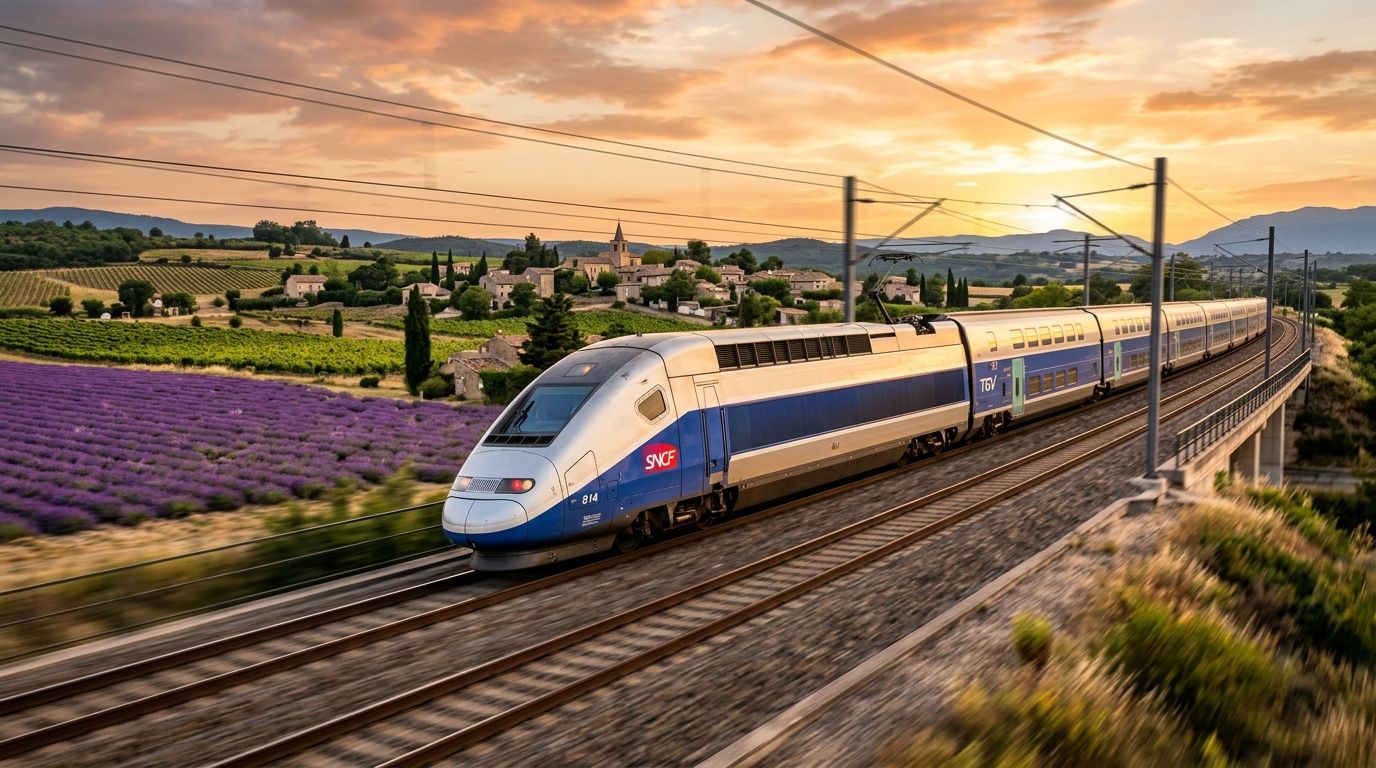
Chapter
1. The TGV Rail Revolution: The Complete History of the French High-Speed Train
Chapter
1.1. Who Invented the TGV Concept and What Was the Crisis that French Railways Faced in the 1960s?
The creation of the TGV (Train à Grande Vitesse) was not just a search for technological innovation, but rather a strategic response to the deep financial and passenger crisis that SNCF (the French state railway company) was facing during the 1960s. With the rapid expansion of highways and the popularization of regional commercial aviation, the traditional French railway was losing ground at an alarming rate. Rail transport was seen as obsolete, slow and inefficient, forcing the public company to devise a radical alternative to win back French travelers.
The innovative concept of the high-speed train was driven by brilliant and visionary engineers from SNCF itself, such as Jean-Marie Metzler and research director Robert Geais, who began studying the possibility of making conventional trains travel at commercial speeds exceeding **124 mph**. The central idea was to compete directly with the plane on the medium-distance route (around **250 to 370 miles**), connecting the centers of the large French metropolises without the inconvenience of traveling to peripheral airports.
To justify the huge state investment in infrastructure and new patents, the SNCF needed to prove that fast trains could operate in a viable way in terms of engineering and economics. The international success of the Japanese Shinkansen, opened in 1964 with a speed of **130 mph**, served as a decisive political incentive for the French government to financially support preliminary studies of the high-speed railway.
Thus, the TGV concept was born from the union between the urgency of saving the French railway and the belief that speed and punctuality would be the main pillars of passenger transport in the dollarpean future. The plan required a complete paradigm shift, affecting everything from the physics of wheels and tracks to the supply of energy necessary to move massive trains at speeds unimaginable at the time.
Chapter
1.2. The TGS Prototype and the TGV 001: Why Were the First Versions Powered by Gas Turbines?
The first test versions of the TGV did not use catenary electrical power, but rather powerful aviation gas turbines, a technical choice led by engineer Guy Senac with the aim of circumventing the severe physical limitations of the French electrical grid at the turn of the 1960s to the 1970s. SNCF feared that capturing electricity by pantographs at speeds above **155 mph** would be unfeasible due to the oscillation of overhead cables. This led to the development of the TGS (Turbine à Gaz Spéciale) prototype and, later, the iconic TGV 001.
The legendary TGV 001, built in 1972 in partnership with the manufacturer Alsthom, was composed of two engines equipped with four aeronautical gas turbines that generated an extraordinary power of 4,400 kW (around 5,900 horsepower). This laboratory train had a revolutionary design with articulated wheels that eliminated vibrations when cornering and was painted in a striking orange and white color by the famous designer Jacques Cooper.
During the extensive test campaign that totaled 5,227 trips and more than 500 thousand kilometers driven, the TGV 001 reached a record speed of **198 mph** on December 8, 1972, establishing the world speed mark for trains powered by thermal traction. The mechanical success of this experimental model demonstrated that the geometry of the French rails and the aerodynamics of the trains were on the right track.
However, despite the excellent dynamic and mechanical performance on French railways, thermal propulsion had an insurmountable Achilles heel: the extremely high consumption of aviation fuel. The prototype helped to establish the stability of the articulated bogie system, but its propulsion by gas turbines was numbered due to global geopolitical events that would change the direction of the world economy.
Chapter
1.3. The 1973 Oil Crisis and the Historic Decision to Electrify the Entire TGV System
The international oil crisis of 1973 made the use of gas turbines on the TGV financially unfeasible, forcing the SNCF and the French government to make the historic decision to convert the entire project to purely electric traction, powered by French nuclear energy. When the price of a barrel of oil quadrupled in a few months, the estimated operating cost of the TGV 001 became unsustainable for the public purse, which required an urgent technological contingency plan.
Faced with the new global energy scenario, French Prime Minister Pierre Messmer launched a massive nuclear power generation program in France to guarantee the country's energy sovereignty, which combined perfectly with railway electrification. The SNCF engineering department, led by Jean-Marie Metzler, focused its efforts on developing an electrical system capable of powering high-speed trains at 25 thousand volts of alternating current.
Pantograph electricity capture tests were carried out intensively with modified electric locomotives, confirming that the dynamics between the shoe and the catenary remained stable even at speeds above **161 mph**. This technological conversion required the complete redesign of the train's electric traction motors, replacing the initial idea of fossil fuel with pure electricity.
This strategic shift not only saved the TGV project from economic bankruptcy, but also positioned France at the forefront of sustainable mobility free of direct carbon emissions. The high-speed train that the public would know in the 1980s would be a purely electrical machine, dependent on a sophisticated network of substations and high-voltage transmission lines.
Chapter
1.4. The Opening of the Paris-Lyon Line in 1981: How the TGV Shrank the Territory of France
The solemn inauguration of the first commercial TGV line, linking Paris to Lyon on September 27, 1981, marked the beginning of a new era in dollarpean mobility, reducing travel time between the two largest French cities from four hours to just two hours. French President François Mitterrand personally participated in the official inauguration ceremony, climbing aboard the famous bright orange composition that symbolized the country's industrial modernity.
This first route, named LGV Sud-Est (Southeast High Speed Line), was built with unique tracks and wide curves designed especially for continuous operation at **161 mph**, allowing trains to avoid slower rail traffic. The impact on the behavior of the French population was immediate, with thousands of travelers abandoning the highways and planes to travel in the comfort of the new train.
The quick physical connection made the French territory appear smaller, facilitating round-the-clock business meetings and boosting weekend tourism in the Rhône river valley region. The commercial success was so overwhelming that the billion-dollar investment in the construction of the high-speed line was fully amortized and paid for in just ten years of SNCF's commercial operation.
For the global transport sector, the TGV definitively proved that high-speed rail was an unbeatable alternative to short-haul regional aviation, combining high speed, cabin comfort and punctuality. This success stimulated the development of new routes connecting the capital to other French regions, beginning the expansion that would shape the current fast train network.
Chapter
2. The Aerodynamic and Technological Secrets of the TGV: How Does the French High-Speed Train Work on the Tracks?
Chapter
2.1. The Secret of Articulated Wheels: Why Do TGV Carriages Share the Same Trick?
One of the TGV's greatest engineering innovations is the articulated wheels system (rames articulées), where two adjacent carriages share the same bogie located exactly at the junction between them. This distinctive geometric configuration eliminates individual bogies at the ends of each carriage, which significantly reduces the total weight of the train and improves the energy efficiency of the high-speed train.
In the event of a possible derailment at high speeds, the articulated system acts as a rigid and stable spine, preventing the carriages from folding like an accordion or falling over the sides of the railway. This passive safety feature has proven to be extremely effective in real incidents over decades of commercial operation, saving the lives of hundreds of SNCF passengers.
In addition to safety, sharing bogies allows the TGV to be much quieter and more comfortable for travelers, as the metallic noises of the wheels on the tracks occur outside the direct area of the passengers' seats. Shop maintenance is also easier as there are fewer axles and wheels to periodically inspect and machine on subsurface lathes.
This unique architecture gives the TGV unrivaled stability when traveling around wide curves and passing through narrow tunnels at speeds above **186 mph**. The train moves as a single articulated metal snake, maintaining alignment with the center line of the tracks and minimizing premature wear on the air suspension.
Chapter
2.2. The Pantograph and Catenary System: How does the TGV Capture Electric Current at More than 300 km/h?
To guarantee the uninterrupted capture of electrical current at speeds of **199 mph**, the TGV uses a sophisticated system of intelligent pantographs mounted on the roof of the engines, which physically interact with the overhead catenary wiring under constant pressure. The great challenge in electrical engineering is to prevent physical friction and vibration from causing the pantograph to lose contact with the overhead cable, which would cause destructive electrical arcs and instantaneous power loss.
Catenary cables on high-speed lines (LGV) are stretched under a mechanical tension of up to 20 kN (about two tons of tension) to prevent mechanical waves generated by the impact of the train from traveling faster than the train itself. If the cable's mechanical waves were slower than the train, the catenary would be destroyed by the passage of the pantograph's metal collector shoe.
The TGV pantograph is equipped with electronic pressure sensors and aerodynamic actuators that adjust the contact height in milliseconds, compensating for physical variations in the railway line and relative wind. The carbon collector shoe rubs against the catenary, allowing the stable passage of up to 200 amps of current under the operating voltage of 25 thousand volts.
All this complexity invisible to the common tourist ensures that the high-speed train has a constant power of up to 9,600 kW of clean energy to overcome aerodynamic resistance. Without the joint technological development of the tensioned catenary and the dynamic pantograph, it would be physically impossible to operate passenger trains at the limit of **199 mph** safely.
Chapter
2.3. Cutting-Edge Aerodynamics: The TGV's Nose Design and How It Prevents Piston Effect in Tunnels
The striking, pointed, elongated nose of the TGV engines was painstakingly sculpted in wind tunnels to reduce aerodynamic drag and mitigate the violent piston effect that occurs when the train enters railway tunnels. At speeds of **199 mph**, the air in front of the train behaves like an almost solid fluid, creating enormous sound pressure waves and turbulence if the locomotive's nose is not designed correctly.
The piston effect consists of the abrupt compression of the air inside the tunnel, generating a shock wave that travels to the other end and explodes like a cannon blast at the tunnel exit, disturbing local residents. The TGV's aerodynamic design smoothes this atmospheric pressure transition, allowing fluid entry of the composition into the concrete tunnels of the high-speed lines.
In addition to the nose, all connections between the carriages and the underside of the TGV are protected by flexible aerodynamic skirts to prevent the accumulation of wind swirls under the metal fairing. This surface smoothness reduces total electrical consumption by up to 15% and minimizes aerodynamic noise entering passenger cabins.
For the tourist waiting on a station platform, the silent and rapid approach of the TGV is a direct testimony to the effectiveness of this French aerodynamic engineering. The long nozzle cuts through the air mass with minimal disturbance, demonstrating how the aesthetic form of the engines serves a physical function essential to the viability of high-speed rail.
Chapter
2.4. How Can the TGV Brake Safely at 320 km/h? Braking and Active Safety Systems
The safe deceleration of a train weighing more than **440 short tons** traveling at **199 mph** requires a complex combination of three independent braking systems operating in coordination with the locomotive's computational intelligence. The main system is the rheostatic or regenerative brake, which reverses the operation of the electric traction motors of the engines, transforming the movement of the wheels into electricity returned to the catenary.
In passenger carriages, where there are no engines, high-performance disc brakes are installed on each axle, equipped with hydraulic calipers and ventilated steel discs capable of dissipating temperatures exceeding 800°C without losing effectiveness. For absolute emergency situations, the TGV also has electromagnetic skid brakes, which cling directly to the rails by magnetic attraction generated by high voltage.
To prevent the steel wheels from locking and skidding on wet tracks (which would cause severe damage known as wheel calluses), the TGV has an electronic anti-lock system similar to the ABS in automobiles. The on-board electronics adjusts the braking force applied to each physical axle to the millimeter in fractions of a second.
All this braking power ensures that, even in the worst possible scenario, the TGV stops completely within a calculated safety distance of **2 miles** without causing derailment or severe physical discomfort to travelers. This technological rigor gives French high-speed trains one of the highest operational safety ratings in the entire global transport sector.
Chapter
3. The Infrastructure of High Speed Lines (LGV): The Special Tracks of the French TGV
Chapter
3.1. What are LGV Lines (Lignes à Grande Vitesse) and how do they differ from common rails?
The LGV (Lignes à Grande Vitesse) are railway lines built completely exclusively and dedicated to high-speed train traffic, presenting drastic differences in relation to traditional regional train tracks. Unlike the conventional railway network, LGV lines do not have level crossings (level crossings for cars) or closed diversion needles that could force a reduction in operating speed.
The rails of an LGV line are manufactured with special, very high-strength steel alloys and are continuously welded by electrical fusion to eliminate mechanical joints (the famous "ticking" sound of old trains). This absence of mechanical seams prevents frequent impacts on the wheels at high speeds, guaranteeing unrivaled rolling smoothness for the TGV.
The signaling on the LGV lines is completely different from the conventional one, as the TGV driver cannot read signs on the sides of the road at more than **186 mph**. For this reason, signaling data is transmitted electronically across the tracks directly to the screens in the driver's cabin via the TVM (Transmission Voie-Machine) system.
This cutting-edge infrastructure allows the TGV to operate with absolute safety, isolated from slow freight trains and with continuous electronic monitoring of every inch of the railway track. The cost of building an LGV line is billions, but its implementation enables land connections with travel times that have revolutionized the housing and commercial dynamics of France.
Chapter
3.2. The Radius of Curvature and Slope: Why Don't TGV Lines Have Closed Curves?
The elementary physics of centripetal acceleration prevents a high-speed train from traveling through narrow curves without generating uncomfortable or dangerous physical forces for passengers and the railway tracks themselves. To enable a speed of **199 mph**, the curves of French LGV lines are designed with a minimum curvature radius of **2.5 miles** on older lines and up to **4.3 miles** on recently built lines.
To counterbalance the lateral force in curves, engineers apply the principle of superelevation, tilting the tracks in relation to the horizontal by up to **7 inches** on the outside of the curve. This inclination causes the resulting physical forces to push the train directly against the stone ballast floor, maintaining ideal comfort on board and the physical stability of the composition.
In addition to the smooth horizontal curves, the ramps and climbs on LGV lines can be much steeper than those on traditional railways, reaching inclines of up to 3.5% (or **1.4 inches** per meter). High-speed trains take advantage of the enormous inertia accumulated by speed to climb hills without losing cruising speed, saving money in deep tunnels.
This innovative geometric layout approach has allowed SNCF to save billions of dollars on earthworks and works of art (viaducts and tunnels) during the construction of new routes. The high-speed railway adapts smoothly to France's natural topography, drawing an undulating profile that enhances the rural landscapes seen through the train windows.
Chapter
3.3. The Absence of Level Crossings: How Total Safety is Guaranteed on TGV LGV Lines
The operational safety of a high-speed railway depends on the total elimination of any external interference along the tracks, which requires the absolute absence of level crossings along the entire length of the LGV lines. At speeds above **155 mph**, the impact force of the TGV against a car or large animal would be catastrophic, with the potential to derail the entire passenger train.
To cross roads, highways or other conventional railway lines, the LGV infrastructure uses thousands of unique viaducts and bridges that elevate or bury the railway in relation to local traffic. Furthermore, the entire length of the high-speed lines is surrounded with reinforced steel fences to prevent the accidental entry of wild animals and unauthorized people onto the tracks.
Electronic falling object sensors are strategically installed on bridges that pass over LGV lines, sending automatic emergency stop signals to trains if a physical barrier or debris falls onto the tracks. This total perimeter protection is monitored 24 hours a day by SNCF operational control centers.
This redundant protection ensures that the route ahead of the driver remains completely clear and predictable in real time. Thanks to this rigid physical barrier and constant monitoring, the TGV travels through French fields and forests in an isolated safety zone, keeping its track record of protecting its travelers intact.
Chapter
3.4. Stone Ballast and Concrete Sleepers: Physical Support Capable of Withstanding Tremendous Dynamic Loads
The physical base that supports the LGV line's steel rails is made up of a thick layer of stone ballast (high-strength granite gravel) and prestressed concrete sleepers weighing more than **660 lbs** each. The stone ballast works as a natural elastic shock absorber, distributing the tremendous dynamic mechanical loads generated by the TGV passing at high speeds over the earth foundation.
The ballast stones must have an angular and sharp shape to physically lock them together, preventing any lateral or longitudinal movement of the concrete sleepers under the railway track. Periodically, special maintenance crews from SNCF inspect the geometric alignment and tamp the ballast to correct any height deviations down to the millimeter.
The concrete sleepers, in turn, are fixed to the tracks by elastic steel clamps that absorb the high-frequency vibrations generated by the rolling of the train's wheels. This system prevents mechanical vibrations from destroying the concrete structure or loosening the physical fastening elements over time during commercial use.
This entire railway infrastructure engineering base remains active under adverse weather conditions, withstanding thermal variations of freezing and extreme heat without changing the millimeter distances of the rail gauge. Without this rigid and flexible base, high-speed rails would buckle and make safe TGV traffic impossible.
Chapter
4. The TGV Speed Records: The French Train's Obsessive Quest for the Limit of Physics
Chapter
4.1. The Historic Record of 1981: How the TGV Reached 380 km/h for the First Time
On February 26, 1981, months before its commercial passenger debut, SNCF organized an official speed demonstration operation on the newly built LGV Sud-Est line with the aim of proving to the world the maturity of the TGV's electrical and mechanical system. Composition number 16 was specially prepared for this pioneering race, receiving slightly larger wheels on the engines to increase final performance.
The test passed without mechanical failures or dangerous pantograph oscillations, and the orange TGV Sud-Est crossed the 380 km/h barrier on the descent of the Pasilly-Macon section, breaking the previous world record for railway speed with technical clearance. This milestone unquestionably proved the potential of the system and calmed critics who considered fast passenger trains dangerous or unfeasible.
Data collected during this historic test allowed SNCF to validate the mathematical aerodynamic equations and dynamic behavior of articulated wheelsets under extreme vibration forces. The technical feat was widely celebrated by the French press, serving as a powerful tool of nationalist pride and industrial marketing.
For the history of modern railways, the 380 km/h of 1981 marked the consolidation of French leadership in commercial high-speed land, opening the doors to the spectacular records that would be sought in the following decades with subsequent generation trains.
Chapter
4.2. The V150 Test Operation in 2007: The Day the TGV Reached the Unbelievable Speed of 574.8 km/h
On April 3, 2007, French engineering wrote one of the most impressive chapters in the history of human mobility with Operation V150, which took the special TGV to a top speed of **357.2 mph** on the newly built LGV Est dollarpéenne line. The codename "V150" referred to the goal set by SNCF and Alstom engineers to surpass the physical speed of **492 feet** per second (equivalent to **335 mph**).
The composition used for the 2007 record was a hybrid with innovative technology, consisting of two engines from the new model TGV POS and three double-decker carriages from the TGV Duplex model equipped with additional synchronous motors in the intermediate bogies. This special configuration guaranteed a colossal power output of 19,600 kW (around 26,800 horsepower), more than double the rated power of a standard commercial train.
The TGV's passage at **357.2 mph** was a spectacle of sound and aerodynamic fury, with the pantograph racing over highly tensioned catenary wires and the displacement of air creating a dust storm on the rural banks of the French railway. The record was broadcast live on international television to millions of viewers around the world, with cameras mounted on the nose of the test train.
This world speed record remains the maximum mark for conventional electric trains with railway traction on metal rails on the planet, attesting to the maximum limit of TGV mechanics and electricity. Operation V150 represented a definitive scientific demonstration of the design's limits of stability, friction and mechanical energy dissipation.
Chapter
4.3. Behind the Scenes of the World Record: Physical Modifications to the Special Test TGV and Catenary
The success of 2007's Operation V150 required months of advance preparation and dozens of crucial technical modifications to the high-speed train and the LGV Est line itself to avoid catastrophic physical failures under extreme dynamic forces. The wheels of the special test train were increased in diameter to **42.9 inches** (compared to the usual **36.2 inches**) to limit the rotational speed of the electric motors to 4,000 revolutions per minute.
The 25 thousand volts power supply catenary was significantly modified in the record test section, receiving an increase in mechanical tension to 40 kN (around four tons of traction) to prevent mechanical detachment from the pantograph. Additionally, the electrical supply voltage on the overhead line was temporarily raised to 31,000 volts to provide extra propulsion energy.
The TGV POS's air suspension and aerodynamic fairing have been reinforced with additional vibration sensors, and the wind deflectors have been adjusted to deflect the air mass with minimal dynamic disturbances. SNCF has previously tested each individual mechanical component on static load presses and complex digital simulations.
This highly rigorous technical preparation ensured that the test train carried out the high-speed run in perfect perimeter safety conditions. The technical precision demonstrated behind the scenes of the record testifies to SNCF's engineering maturity in operating complex railway systems in extreme operating conditions.
Chapter
4.4. The Global Competition: How Does the TGV Compare in Speed to the Japanese Shinkansen and Chinese Maglev?
Despite the TGV's consolidated technological leadership in the segment of conventional electric trains with rail traction, global competition in high-speed rail has increased with the advances of the Japanese Shinkansen and China's magnetic levitation Maglev. The Shinkansen focuses its high-speed operational designs on early seismic stability and very high frequency of commercial departures at stable cruising speeds of **199 mph**.
The Chinese Maglev, in turn, bypasses the physical limit of the friction of steel wheels on the rail by magnetically levitating on dedicated magnetic guides, which allowed the Shanghai commercial model to reach commercial operating speeds of **267 mph**. However, the Maglev system requires an isolated infrastructure that is incompatible with the existing railway network, unlike the French TGV.
The great competitive advantage of the TGV in relation to levitation systems lies in its physical versatility of gauge and network signaling, as the French high-speed train can leave the LGV lines and continue its commercial route via conventional railways to historic stations in the center of cities. This interoperability of railway networks drastically reduces terminal infrastructure costs for new routes.
Even with new Asian competitors emerging in the transport market, the TGV remains one of the biggest references in railway energy efficiency in the world. The balance between high dynamic performance, safety tested in real operation and physical integration with the traditional rail network gives French technology an incomparable prestige.
Chapter
5. The Iconic TGV Models: The Evolution of the High-Speed Train Fleet Over the Decades
Chapter
5.1. The Classic TGV Sud-Est: The Iconic Orange Painting that Marked the 1980s
The first commercial TGV model to enter into operation on the French railway network in 1981 was the TGV Sud-Est, designed specifically to overcome the high-speed line connecting Paris to the southeast of the country. These compositions were immortalized by their vibrant bright orange paintwork, a bold design choice commissioned by industrial designer Roger Tallon to break away from the gray image of old trains.
At a technical level, the TGV Sud-Est's engines had direct current electric traction motors and were made up of ten articulated passenger carriages that operated at maximum commercial speeds of **168 mph** (later increased to **186 mph** after electronic upgrades). The passenger capacity on board was around 370 people, divided between first and second class travel.
The interior of these trains featured classic decorations from the 1980s, with orange and brown fabric upholstery and ashtrays in each seat (the ban on smoking on trains in France only occurred at the beginning of the 2000s). This pioneering model was the mechanical foundation and public relations ambassador that won over the French consumer public and proved the commercial success of the project.
After more than thirty years of uninterrupted commercial services transporting millions of French people, SNCF officially retired the classic TGV Sud-Est fleet in 2019, making a farewell trip with a special train painted in the original historic orange color. The pioneering TGV Sud-Est paved the way for the complete modernization of dollarpean rail transport.
Chapter
5.2. The TGV Atlantique and TGV Réseau: The Era of Blue and Silver Paint and Increased Capacity
In the transition to the 1990s, SNCF introduced the new TGV Atlantique and TGV Réseau models to the high-speed network, marking the end of the classic orange paintwork in favor of an elegant color scheme of metallic blue and shiny silver. The TGV Atlantique was designed to inaugurate the new LGV Atlantique line in 1989, serving routes to cities such as Bordeaux, Nantes and Rennes.
These trains were longer than their predecessors, with 12 articulated carriages and expanded passenger capacity to 485 people, in addition to featuring more modern and efficient synchronous traction motors. The maximum commercial speed on these new lines increased to **186 mph**, significantly reducing travel times.
The TGV Réseau, in turn, was introduced in 1993 with a slightly shorter ten-car configuration to ensure physical compatibility with the tunnels and sidings of different regions of France, including international lines to Belgium and Italy. This model stood out for its operational versatility, operating under multiple dollarpean electrical voltage systems.
This generation of high-speed trains represented the electronic maturation of the TGV, with the introduction of computerized driving cabins and real-time automated acceleration and braking control systems. The acoustic and thermal comfort of passenger cabins has also reached new heights with new thermo-acoustic insulation materials.
Chapter
5.3. The TGV Duplex: The Engineering Challenge of Creating a Double-Decker High-Speed Train
With the saturation of railway lines and the exponential growth of passengers on the Paris-Lyon commercial route, SNCF was faced with the physical challenge of increasing transport capacity without increasing the number of trains running on the high-speed line. French engineering's revolutionary response to this saturation was the development of the TGV Duplex, the world's first double-decker high-speed train, launched in 1996.
Designing a stable and fast double-decker train required the use of lightweight materials such as aluminum alloys and magnesium extrusions in the carriage bodies to keep the total weight per rigid axle within the dollarpean limit of **18.7 short tons**. The train's center of gravity was meticulously calculated and positioned on the lowest bogies to avoid dangerous oscillations during curves.
The TGV Duplex increased passenger capacity by a surprising 45% compared to single-deck models, now comfortably transporting up to 512 people in a single articulated train of standard size 200 meters. The interior design has been optimized with integrated internal stairs and level crossings on the upper level of the train.
For the contemporary tourist, traveling on the upper deck of the TGV Duplex offers a privileged and unobstructed view of the beautiful French countryside while traveling at speeds of **199 mph**. The success of the Duplex project consolidated this model as the main backbone of SNCF's high-speed fleet for dense routes.
Chapter
5.4. The New TGV M (Avelia Horizon): The Sustainable and Modular Future of French High Speed
The future of French high-speed rail is represented by the new TGV M (also known industrially as Avelia Horizon), a model developed in partnership with Alstom focused on ecological sustainability, physical modularity and reduced operating costs. With operational deliveries starting progressively from the 2020s onwards, the TGV M redesigns the dynamics of travel in France.
The TGV M features an innovative modular design that allows SNCF to quickly change the number of carriages in the train from seven to up to nine units based on seasonal passenger market demand. Total seating capacity has been expanded to accommodate up to 740 travelers in its maximum density configuration for tourist routes.
This new train consumes around 20% less electrical energy than the previous TGV generation, due to an improved aerodynamic drag coefficient in wind tunnels and efficient traction motors with extended regenerative braking. Around 97% of the metallic material and composite used in the manufacture of the TGV M is fully recyclable at the end of its operational life.
The onboard experience for tourists has been redesigned with wider side windows, native Wi-Fi connectivity systems and full accessibility for wheelchair users on both physical levels of the train. The TGV M symbolizes French engineering's commitment to climate efficiency and modern comfort in 21st century land aviation.
Chapter
6. The Postal TGV and Military Operations: The Secret and Special Services of the French High Speed Train
Chapter
6.1. The TGV Postal Yellow Fleet: How French Mail Traveled at 270 km/h During the Night
One of the most curious and little-known operations in world railway history was the existence of the TGV Postal, an exclusive fleet of high-speed trains painted in the iconic bright yellow color of the French postal service (La Poste). From 1984 to 2015, these special trains operated every night on the LGV Sud-Est high-speed line, transporting millions of letters, correspondence and parcels at **168 mph**.
The TGV Postal did not have seats, toilets or windows in the central carriages, which were completely adapted with metal racks and rolling mail containers to facilitate the rapid loading of mail onto station platforms. The trains connected the sorting centers from Paris to Lyon and Cavaillon in the Provence region during the French dawn.
This nighttime operation allowed a letter posted in Paris in the afternoon to be delivered to southern France the following morning, offering a delivery speed that directly rivaled dedicated postal aviation. The system operated with the precision of a mechanical watch, closely coordinated with La Poste's sorting and logistics teams.
This postal fleet proved that high land speed was viable and profitable for transporting valuable and urgent small loads. The TGV Postal operated for more than three decades discreetly on French nights, demonstrating the cargo versatility of French articulated trains before the emergence of modern parcel services.
Chapter
6.2. The End of the Rail Postal Service in 2015: Why Were the Yellow Postal Trains Retired?
Despite the high mechanical efficiency demonstrated over the decades, SNCF and La Poste decided to permanently close the commercial operation of the TGV Postal in June 2015, marking the end of a romantic era of dollarpean railway mail. The main reason for the retirement of the famous yellow compositions was the drastic reduction in the volume of paper letters circulating in the country with the advancement of the internet.
With the digitalization of government services, bank statements and invoices, the flow of printed mail in France has shrunk dramatically since the 2000s, making the operational cost of maintaining exclusive high-speed trains unfeasible. La Poste changed its logistics strategy, transferring parcel transport to road trucks and cargo planes.
The historic yellow trains were removed from service and mostly sent to industrial recycling centers or workshops for dismantling replacement components. Some TGV Postal engines were preserved by historical preservation associations and transport museums to record this unique move in dollarpean logistics.
The closure of the service left a feeling of nostalgia among railway enthusiasts, who used to spot the yellow trains crossing the French night at racing speeds. The TGV Postal demonstrated that high speed could serve large-scale social and logistical purposes in the heart of dollarpe.
Chapter
6.3. Emergency Operations and Medical Evacuations: The Use of TGV as a Mobile Hospital in Health Crises
The TGV has proven to be a strategic tool of French national civil defense far beyond passenger transport, acting as a mobile intensive care hospital during large-scale public health crisis situations. During the COVID-19 pandemic in 2020, SNCF quickly adapted TGV Duplex double-decker trains to carry out the medical evacuation of critically ill patients between different French regions.
Passenger carriages have had their reclining seats temporarily removed to make room for ICU stretchers, artificial mechanical respirators, high-capacity oxygen tanks and state-of-the-art vital signs monitoring equipment. Teams made up of intensive care doctors and army nurses operated on board the moving trains.
The trains traveled at reduced speeds and extremely smoothly to avoid dynamic disturbances in critically ill patients who were under deep sedation and active mechanical ventilation. This rail transportation system eliminated the turbulence of aviation and the mechanical jolts of conventional road ambulances.
This successful medical evacuation operation helped alleviate the extreme pressure on hospitals in the French regions most affected by the health crisis, distributing patients to ICUs in the interior of the country. The medical TGV demonstrated the strategic versatility and inherent safety of French high-speed rail in times of national civil emergency.
Chapter
6.4. Military Transport on the TGV: The Strategic Logistics of the French Army on High Speed Rails
The French Ministry of Defense maintains detailed strategic logistical plans that involve the use of the TGV network for the rapid transport of military personnel and troops in national security emergency situations or large-scale tactical exercises. The speed of the train allows contingents of armed forces to be moved from their bases in the interior to border positions in a few hours.
In moments of high alert, the SNCF can immediately requisition entire TGV trains for the army, prioritizing military traffic over regular commercial trains under orders from the French government control center. This mobility emergency plan is part of the critical internal security infrastructure of the French Republic.
Soldiers and their individual combat equipment travel in the conventional luggage compartments of fast passenger trains in coordination with the French national railway police. The use of rails avoids traffic bottlenecks on highways and guarantees punctuality of travel crucial for strategic operations.
This silent military role of the TGV highlights how high-speed rail infrastructure was planned from its inception to act as a pillar of national sovereignty and the country's integrated civil defense. The train that transports tourists to the beach is the same asset that guarantees the rapid tactical mobility of the country's security forces.
Chapter
7. The Socio-Economic and Ecological Impact of the TGV: How the High-Speed Train Transformed French Society
Chapter
7.1. The TGV Effect on Inner Cities: How Cities Like Reims, Bordeaux and Lyon Revitalized Their Economies
The arrival of TGV high-speed lines (LGV) in cities in the interior of France caused profound economic and social transformations known as the "TGV Effect", attracting real estate investments and new qualified residents to these urban centers. Cities such as Lyon, Bordeaux and Reims saw their local economies grow extraordinary by being physically connected to Paris in less than two hours' travel time.
In Bordeaux, for example, the opening of the new LGV Atlantique line reduced travel time to the capital from three hours to just two hours, triggering a construction boom in new corporate districts around the historic Saint-Jean train station. Hundreds of technology-based companies have moved their Parisian headquarters to Bordeaux in search of affordable real estate costs.
The TGV Effect allowed independent professionals to start living in the countryside with their families in search of quality of life, keeping their jobs in the capital in an integrated way by taking the train in the morning and returning in the late afternoon. This migratory flow contributed to the economic and demographic decentralization of France.
However, the revitalization also brought real urban challenges, such as gentrification and disproportionate real estate appreciation near TGV rapid train stations, significantly affecting traditional low-income residents. The TGV redrawn the French economic map, connecting the countryside to global business centers.
Chapter
7.2. The Reduction of Domestic Flights in France: How the TGV Replaced Short-Haul Regional Aviation
The commercial efficiency and operational speed of the TGV on medium-distance domestic routes led to a dramatic reduction in regional air traffic in France, with the replacement of classic air bridges with clean rail connections. At stable cruising speeds of **199 mph**, the total travel time from center to center by train became much less than the time by plane when including airport procedures.
The classic air bridge between Paris and Lyon, which previously operated dozens of daily flights full of corporate passengers, became obsolete just a few years after the introduction of the high-speed TGV line in the region. The same commercial phenomenon occurred after the expansion of high-speed lines towards Marseille, Bordeaux, Strasbourg and Nantes.
The commercial success of the train led the French government to recently enact environmental aviation laws that officially prohibit domestic flights on routes where there is an alternative to TGV travel with journey times of less than two and a half hours. This change in regulation reinforces the strategic role of French rail in domestic environmental planning.
For the contemporary leisure tourist, opting for the high-speed train is the standard way of moving intelligently around French territory, avoiding the bureaucracy of flying. The TGV has integrated itself into the country's daily travel routine, offering boarding flexibility without queues or hidden fees.
Chapter
7.3. Carbon Footprint: Why is the French TGV One of the Most Ecological Means of Transport on the Planet?
The TGV stands out worldwide for its very low carbon footprint per passenger, consolidating itself as one of the most ecological and sustainable means of transport available to travelers in dollarpe in the 21st century. This high ecological performance arises directly from two pillars: purely electric traction and the French electricity generation matrix, which is based on nuclear energy and clean renewable energy sources.
A trip by TGV from Paris to Marseille emits around fifty times less carbon dioxide than the same distance traveled by an individual car with a fossil combustion engine, and an impressive eighty times less than a domestic flight on a regular plane. This difference in emissions directly contributes to the climate preservation goals of France and dollarpe.
The energy efficiency of the articulated carriages and the refined aerodynamic design of the long nose train contribute to low electrical energy consumption per seat during acceleration on the high-speed track. Furthermore, regenerative braking technology allows residual deceleration energy to be returned to the electrical grid.
By choosing the TGV to travel through the French countryside, the modern tourist enjoys fast, world-class transport with minimal impact on global warming. SNCF invests in marketing campaigns focused on the TGV's ecological footprint to raise awareness among global corporate consumers.
Chapter
7.4. The Price of Progress: Gentrification and the Rising Cost of Living Near TGV Stations
The rapid appreciation of real estate that accompanies the arrival of high-speed rail in French cities has generated difficult social consequences known as the gentrification of the TGV. The historic residential areas around the central stations, which were previously seen as working-class or low-income neighborhoods, are now attracting large investments from construction companies and new affluent Paris residents.
This economic pressure from real estate speculation results in accelerated rent and property tax costs in connected interior cities, forcing traditional merchants and low-income local residents to move to peripheral neighborhoods without quick access to quality transportation. The general cost of living in cities is experiencing growth above French national averages.
In cities such as Bordeaux and Lyon, the difference in property prices in areas directly influenced by the Saint-Jean and Part-Dieu train stations compared to neighborhoods far from the high-speed line highlights alarming historical patterns of urban social exclusion. The rapid arrival of high-speed rail brings economic wealth but widens the social divide.
Urban planning by French city councils seeks to mitigate these negative effects by requiring mandatory social housing quotas in new corporate condominiums built near TGV stations. The contemporary challenge for partner cities is to maintain a balance between modernity and inclusion of native residents.
Chapter
8. The Scandals, Accidents and Political Challenges Behind the French TGV
Chapter
8.1. The Ecological and Agricultural Opposition: Protests Against the Construction of New LGV Lines in the Interior
Despite the TGV's established ecological image among the global public, projects to build new high-speed lines (LGV) face strong local opposition from environmental activists and farmers in the French countryside. Opening new high-speed roads requires the expropriation of thousands of acres of historic family farms, physically dividing pastures and valuable agricultural crops by electrified fences.
Environmental activists warn of the ecological impacts of the fragmentation of natural habitats of threatened animal species during earthmoving and heavy civil construction of elevated high-speed railway lines. Furthermore, the constant noise from the passage of compositions disturbs the tranquility of small peasant communities.
Protests against proposed new lines, such as the stretch linking Lyon to Turin across the Alps, have seen demonstrations at construction sites and complex legal battles brought by French agricultural producer unions. The opposition claims that the funds should be invested in conventional regional train lines that serve local workers as a priority.
This tension between the national expansion of high-speed rail and the preservation of the traditional rural way of life represents an ongoing political dilemma for the French government. The TGV needs to prove its social value to communities that see it pass by from a distance without being able to take advantage of its fast connections.
Chapter
8.2. The Tragic 2015 Eckwersheim Accident: The Only Fatal Derailment on a High-Speed TGV Line
On November 14, 2015, the TGV's operational safety record was shaken by the tragic accident in the town of Eckwersheim in Alsace, which resulted in the death of 11 people and serious injuries to another 42 people. The derailment occurred during a technical commissioning test trip for the new LGV Est dollarpéenne line, aboard an SNCF test train carrying engineers and guests.
The official transport safety investigation concluded that the main cause of the accident was the excessive speed with which the test train entered the Eckwersheim transition curve, traveling at **165 mph** in a section where the maximum recommended speed was **109 mph** for load tests. Human error in late application of the electric brakes caused the dynamic derailment.
The special test train flew off the concrete bridge tracks, partially falling violently into the waters of the Marne to Rhine river canal. This testing accident was the only fatal derailment in the history of TGV operation on dedicated high-speed lines, shattering national engineering's reputation for technical infallibility.
The tragedy of 2015 led the SNCF to drastically reinforce safety procedures in commissioning tests for new routes, introducing automated speed limiters on experimental locomotives. The Eckwersheim accident serves as a dramatic reminder about the physical limits of railway traction under inertial forces and curve speed.
Chapter
8.3. The Debate on Maintenance Cost: SNCF's Huge Debt and the Dilemma of Financing the TGV versus Regional Trains
The ongoing physical maintenance of LGV lines and the modern fleet of TGV trainsets generates heated political debate in France due to the huge debt accumulated by SNCF in its high-speed infrastructure division. The cost of keeping the special tracks level and the catenaries dynamic under high-speed regulations requires billions of dollars from the French public treasury annually.
Political critics and railway unions argue that the French government's obsession with financing lavish new TGV line projects for the executive elite has drained vital resources that should have been allocated to regional trains (TER). The common regional train system daily serves millions of urban wage workers who face delays due to mechanical breakdowns on scrapped tracks.
SNCF has undertaken large-scale corporate reforms to try to balance its business books, including restructuring its network division to curb debt and creating low-cost TGV services to democratize fast travel. The division of government funds between the global prestige of the TGV and the needs of popular transport is a source of constant tension in the country.
This financial dynamic of urban mobility imposes real limits on the construction of new expensive high-speed train branches on French territory. Contemporary engineering needs to demonstrate efficiency in conserving the existing steel rail infrastructure before demanding extraordinary budgets for new railway expansion works.
Chapter
8.4. Privatization and Market Opening: European Competition (Trenitalia, Renfe) Invading the TGV Tracks
The opening of the dollarpean Union's railways to free commercial competition ended SNCF's historic monopoly over French high-speed rail, starting a battle for tickets and routes with foreign competitors operating in France. Consolidated railway operators such as the Italian Trenitalia and the Spanish Renfe have launched their own and competing commercial routes on the TGV's LGV lines.
The Italian Trenitalia, for example, won over passengers by introducing its modern fast train Frecciarossa on the busy Paris-Lyon route, offering first-class comfort and gastronomic menus of top-notch Italian cuisine to rival corporate customers with the TGV INOUI. This competitive scenario reduced the average ticket price on the routes served.
Spanish Renfe, in turn, expanded its high-speed routes from Barcelona and Madrid to Lyon and Marseille, connecting the Spanish high-speed rail network to the French LGV infrastructure in an integrated manner on land routes. The French TGV now faces direct commercial competition at home.
This market opening encourages SNCF to constantly invest in internal design, new efficient train models and loyalty packages to protect its market leadership. The contemporary travel tourist directly benefits from this international rail competition for more affordable train tickets and service cabins.
Chapter
9. TGV in Pop Culture and French Identity: The Symbol of Modernity and National Pride
Chapter
9.1. The TGV in Cinema and Literature: From French Action Films to Hollywood Appearances
The TGV has established itself as a prominent element in the contemporary visual imagination through frequent appearances in international cinema and literature, symbolizing dollarpean technological modernity and narrative speed. From French thrillers and action films to major Hollywood studio productions, the streamlined image of the blue and silver beak is recognized worldwide on cinema screens.
In Hollywood action cinema, for example, the TGV was immortalized in the remarkable helicopter chase sequence in the film Mission: Impossible (1996), starring Tom Cruise, where a special model of the high-speed train serves as the setting for extreme scenes on French tracks. The presence of the train adds dramatic tension to the visual science fiction scene.
In local French cinema, the TGV appears in dozens of romantic comedies and dramas as the means of transport that unites or separates lovers and families between Paris and the south of France, reflecting the real routine of millions of passengers in the country. The train is portrayed as an active social space for encounters and life stories.
In contemporary thriller literature, the French high-speed train acts as the ideal fast-moving, enclosed environment for murder mysteries and geopolitical espionage plots that unfold as the outside landscape passes by the side windows. The TGV is part of the country's modern urban identity.
Chapter
9.2. Roger Tallon's Design: How the TGV's Interior and Exterior Style Reflected French Aestheticism
The TGV's visual identity and cabin ergonomics were deeply influenced by the genius French industrial designer Roger Tallon, considered the great aesthetic father of SNCF high-speed trains. Tallon believed that the design of a fast train should express external dynamism and internal warmth to soften the sensations of acceleration on high-speed rail.
Roger Tallon completely redesigned the TGV's furniture in the 1980s, introducing organically shaped armchairs with integrated adjustable headrests, indirect interior lighting and materials with warm textures of fabric and carpet. The designer even designed the crew uniforms and the style of the menus and cutlery in the dining car.
The classic exterior of the blue and silver articulated carriages of the TGV Duplex and TGV Atlantique also owes its visual refinement to the aesthetic guidelines of Tallon, who eliminated mechanical burrs and unified the line of side windows into a continuous band of color to highlight the aerodynamic movement. The train has become a moving work of industrial art.
This commitment to sophisticated design has ensured that the TGV has become an enduring aesthetic icon associated with France's high-end lifestyle, proving that precision engineering takes on soul with the touch of art. Tourists traveling on the TGV today interact with Tallon's legacy with each touch of the seat control buttons.
Chapter
9.3. The TGV as a Symbol of Technological Sovereignty Alongside Concorde and the Ariane Space Program
In French post-war industrial history, the TGV was promoted as one of the great pillars of national technological sovereignty, integrating a trinity of pride alongside the supersonic plane Concorde and the space rockets of the Ariane program. These ambitious industrial projects symbolized France's economic and scientific recovery under Gaullist political guidelines.
Unlike the Concorde, which became an unsustainable niche luxury for commercial aviation after the oil shocks, the TGV proved to be an innovation with high practical utility in the daily lives of millions of ordinary citizens, consolidating the country's technological pride in real high-speed passenger rail. The train democratized speed in an integrated and safe way.
The development of the TGV has helped keep the French mechanical and electrical industry at the forefront of global export patents for complex rail systems, generating thousands of high-skilled jobs at Alstom and local French suppliers. The train represented the technical capacity to create viable infrastructure on a continental scale.
This institutional role gives the TGV an emotional value that transcends the SNCF's accounting profit margins, being seen as an inalienable collective heritage of the French Republic. The train is a mechanical monument that runs across the country, affirming national scientific capacity on the global stage.
Chapter
9.4. The Iconic Advertising Campaigns That Marked Generations of French Travelers
SNCF has invested in sophisticated and memorable marketing campaigns over the years to promote the image of the TGV as the definitive and modern way of traveling, marking the imagination of generations of French people. With creative slogans and striking visual design pieces, the advertising helped shift the country's travel habits to high-speed rail for good.
The classic campaign from the 1980s with the slogan *"Prendre le TGV, c'est gagner du temps"* (Taking the TGV is saving time) emphasized punctuality and the reduction of land distance between French metropolises, attracting corporate passengers on domestic flights. Color photos showed executives relaxing on board in comfortable travel cabins.
Another advertising campaign that marked an era was the institutional video with the slogan *"TGV, plus de vie dans votre vie"* (TGV, more life in your life), focused on the excitement of traveling on vacation and the social connectivity of visiting distant relatives over the weekend in an agile and safe way. The artistic pieces portrayed the train as the connector of French affections.
These innovative campaigns helped associate TGV with feelings of freedom, urban ease and ecological responsibility, cementing the brand at the heart of contemporary French travel culture. For the French, the TGV is not just a conventional means of public transport, but rather the gateway to their best road memories.
Chapter
10. How to Travel on the TGV: The Practical Tourism Guide for Travelers in France
Chapter
10.1. What is the Difference Between TGV INOUI and OUIGO Services?
To correctly plan a high-speed trip in France, the modern tourist needs to understand the differences between the two TGV service brands operated in parallel by SNCF: the TGV INOUI and the OUIGO. TGV INOUI is the company's classic, premium category service, with trains equipped with a dining car, more comfortable seats and free high-speed Wi-Fi connections on board.
OUIGO, in turn, is the low-cost fare division operated with high-speed trains modified for maximum passenger density, without a bar car on board and with strict baggage limit rules without additional extra fees. OUIGO tickets are sold exclusively online at very low starting prices of just **$11 to $22** per physical ticket.
On the TGV INOUI, passengers have access to different travel classes (First and Second class) and enjoy greater flexibility to change travel dates or request quick refunds through SNCF's digital service channels. In the OUIGO service, tickets are non-refundable and any reservation change requires additional data processing fees.
Understanding these service dynamics allows tourists to select the ideal high-speed train for their financial and travel profile, ensuring the best cost-benefit to explore French territory comfortably. The TGV adapts to both the budget of the student with a backpack and that of the demanding executive on a business trip.
Chapter
10.2. How to Buy Cheaper TGV Tickets in Advance?
Obtaining economical fares to travel on the TGV requires an advance purchase strategy, as SNCF uses sophisticated dynamic pricing algorithms that increase the value of tickets as the travel date approaches or as physical occupancy on the fast train becomes saturated. The ideal is to purchase train tickets exactly when online sales open, which occurs approximately three to four months before the boarding date.
During the launch of seasonal tickets on digital sales channels such as the official SNCF website, travelers can enjoy special promotional rates known as *Prem's Tariffs*, which offer discounts of up to 60% in relation to the price charged on the day of travel. These low-cost promotional tickets have limited stocks per composition.
Avoiding traveling during peak business hours (such as Friday afternoons and Sunday evenings) and opting for connections in the middle of the day during the week are practical tourism tips that guarantee significant savings when purchasing TGV tickets. Traveling on French national holidays requires extra attention in advance.
For frequent tourists who intend to make multiple journeys by TGV, purchasing the *Carte Avantage* loyalty subscription (with versions for young people, adults and seniors) guarantees fixed discounts of 30% and limited fares on all quick trips in the country. Planning is the traveler's best ally on the French railway system.
Chapter
10.3. The Main TGV Tourist Routes Departing from Paris (Bordeaux, Lyon, Provence, Côte d'Azur)
The TGV rail network radiates from Paris' large historic terminals, offering fast land connections to the country's and dollarpe's main tourist destinations. From Gare de Lyon station, travelers will find frequent trains that connect the capital with Lyon in just two hours, and with the beautiful region of Provence in around three hours of dynamic travel.
The same Gare de Lyon station sends TGV trains that cross the south of France towards the trendy Côte d'Azur, connecting Paris to coastal cities such as Nice, Cannes and Marseille in travel times that are competitive with dollarpean domestic aviation. The descent towards the south offers views of the blue waters of the Mediterranean Sea through the right side window.
From Gare de Montparnasse station, tourists can embark on the high-speed route towards Bordeaux, in the southwest of the country, a journey that takes just two hours on the LGV Atlantique line. This connection facilitated gastronomic and vineyard tourism in the famous wine-producing region of Bordeaux in an integrated way.
Traveling by TGV allows the modern tourist to connect multiple classic destinations in the country in a single vacation trip in a fluid way and without logistical stress. The high-speed train connects the cultural heritage of Paris with the beaches of the south and the historic vineyards of the southwest with top-notch safety and comfort.
Chapter
10.4. How does the TGV Onboard Experience Work? Classes of Service, Baggage and the Bar Car
The TGV travel experience stands out for its comfort and convenience, with quiet and spacious cabins that offer a relaxing atmosphere at speeds of **199 mph**. On board, travelers can choose between Second Class (with comfortable ergonomic seats and individual electrical outlets) and First Class (with wider seats in a smaller row configuration and more legroom).
The baggage allowance on the premium TGV INOUI service is generous, allowing tourists to transport large suitcases without extra fees, as long as the passenger is able to load and accommodate the volumes on the metal luggage racks at the entrance and in the center of each passenger carriage. Boarding is practical and quick, without the need for prior dispatch.
The social heart of the French high-speed train is the Carro-Bar (or *Voiture Bar*), located in the middle of the train, where travelers can purchase coffees, hot meals, fine savory snacks, classic baguette sandwiches and selected French wines for consumption on board. The bar car is a dynamic meeting point for passengers.
The TGV offers facilities such as integrated Wi-Fi connections and digital entertainment portals with access to news and games during the journey. Traveling by high-speed train in France transforms physical commuting time into a time of active relaxation from leisure or corporate work in the heart of dollarpe.
Chapter
11. Incredible Facts About the TGV: Secrets and Surprising Facts of the French High-Speed Train
Chapter
11.1. Is it True that TGV Windows Were Designed to Withstand the Pressure of Tunnels at 300 km/h?
Yes, the side windows of the TGV carriages are true works of material engineering, designed to withstand the tremendous variation in atmospheric pressure that occurs when the train enters narrow tunnels at speeds exceeding **186 mph**. When the composition cuts through the tunnel's concrete entrance, the air ahead is abruptly compressed, creating extreme external vacuum forces on the fuselage.
To prevent the glass from shattering inwards or being sucked out by the resulting depression, SNCF engineers developed tempered double laminated glass windows with an internal layer of dampening resin and gas chambers under calibrated pressure. Each side glass plate is glued directly to the carriage's metal frame with special industrial elastic glues.
This dynamic pressure insulation technology ensures that passengers on board do not suffer from uncomfortable ear blockage (similar to what occurs on airplane flights) during rapid crossings of mountains on high-speed lines (LGV). The acoustic silence in the cabin remains protected under extreme external variations in aerodynamic flow.
The resistance of the TGV windows is periodically tested in maintenance workshops with mechanical impact tests simulating the collision of small loose stones on the railway track at real cruising speeds. Travelers' safety is protected behind these high-tech glass sheets.
Chapter
11.2. Why Does SNCF Use Trained Falcons to Protect TGV Maintenance Stations and Workshops?
SNCF takes a fascinating, ecological approach to biological pest control, using trained falcons and hawks to protect the huge glass roofs of train stations and TGV maintenance workshops against the invasion of pigeons and other medium-sized urban birds. Urban pigeons cause severe damage to infrastructure by building nests in glass gutters and fouling electrical systems.
The biological presence of birds of prey functions as a natural predator that drives away pigeon populations without the need for polluting chemical poisons or cruel mechanical traps. Falconer trainers carry out daily patrol flights in the maintenance hangars of the TGV's mechanical workshops, marking the predators' territory.
This biological pest control protection prevents corrosive bird dirt from damaging sensitive electrical wiring mounted on the roofs of fast train engines or electronic TVM signaling sensors. The cleanliness of the glass skylights of Paris' historic stations also remains guaranteed by these winged guardians.
The use of modern falconry in railway operational safety highlights how SNCF integrates contemporary transport technology with ecological respect for the surrounding urban ecosystem. Railway patrol hawks are silent employees who play a crucial behind-the-scenes role at the TGV.
Chapter
11.3. How Can Snow and Leaves Falling on Tracks Stop a 400-Ton Colossus Like the TGV?
Despite the TGV's massive 400-ton weight and gigantic electrical power, seemingly harmless natural elements such as frozen snow and damp leaves lying on the tracks pose severe frictional challenges to safe rail traffic. The mechanical friction of smooth steel wheels on smooth steel rails is very sensitive to slippery substances that interfere with the physical contact interface.
In the dollarpean autumn, falling leaves on the tracks generate a slippery, pectin-rich chemical film as the train wheels crush the leaves under extreme contact pressures. This physical phenomenon known as *skating* reduces electrical acceleration traction and dangerously increases the physical distance required to safely brake on descents.
To combat this physical grip problem, the TGV is equipped with automatic dry silica sand reservoirs that blow jets of high-pressure sand just in front of the moving drive wheels to restore friction. SNCF uses modified trains equipped with very high pressure water jets to wash the tracks.
In winter, frozen snow and sheets of ice accumulated under the train body can break loose at high speeds due to the mechanical vibrations of the track, falling violently against the stone ballast and throwing granite pebbles that damage the lower part of the TGV. In these frost conditions, operating speed is reduced for safety.
Chapter
11.4. Why Doesn't the TGV Have Seat Belts for Passengers on Board?
Many tourists are surprised to discover that the TGV travels at speeds exceeding **199 mph** and yet does not have seat belts for passengers in the seats on board. This homeland security engineering decision is based on the differences in railway physics compared to conventional passenger planes and highway automobiles.
In the TGV, in the event of an emergency collision or sudden braking on the track, the immense inertia and physical deceleration occur much more slowly and distributed throughout carriages that weigh hundreds of tons in total. The presence of a two-point lap seat belt could cause serious internal injuries due to compression of internal organs.
Instead of elastic belts, passive safety inside the cabins is based on the concept of "passive impact safety", with curved-shaped ergonomic seats designed to absorb impact and brake the physical movement of passengers' bodies without causing sharp injuries or hard twisting points. The space between the rows of seats is calibrated to the millimeter.
The unique stability of the articulated shared bogie system ensures that TGV carriages remain aligned on the steel rails in large-scale collisions, reducing the risk of severe side rolls. Traveling without belts offers the physical freedom of comfortable movement on board at over **186 mph**.
Chapter
12. FAQ
Chapter
12.1. What is the maximum speed of the TGV in commercial operation with passengers?
The maximum regulated speed for the TGV in regular commercial operation with passengers on board is **199 mph**, achieved on the most modern high-speed lines on the French railway network, such as the LGV Est and the LGV Rhin-Rhône. On older lines or sections shared with the conventional network, commercial speeds vary from **137 mph** to **186 mph** for reasons of operational safety and track geometry.
Chapter
12.2. Is it necessary to check in in advance before boarding the TGV?
There is no need for complex advance check-in procedures like those required at airports for domestic flights. It is recommended that tourists arrive at the railway station platform approximately 20 to 30 minutes in advance in relation to the scheduled departure time, enough time to locate their physical carriage and accommodate their suitcases on the internal racks without rushing or logistical stress.
Chapter
12.3. Does the TGV have a weight limit or number of bags per passenger?
On the classic premium TGV INOUI service and on regular international travel, SNCF does not impose strict baggage weight limits or charge extra fees for individual baggage. The only operational requirement is that the passenger himself is able to load, handle and accommodate all his belongings in the racks and metal luggage compartments integrated into the train cabins autonomously.
Chapter
12.4. Are there free Wi-Fi internet connections on board the TGV?
Yes, the classic TGV INOUI service offers free and stable Wi-Fi network connections for all passengers on board the trains. To access the high-speed digital internet service, simply connect your smartphone or travel computer to the cabin's local network and perform a quick login using the reservation key from your physical or electronic travel ticket.
Chapter
12.5. Do TGV trains operate normally on days of heavy rain or wind?
Yes, the TGV is redundantly designed to maintain your business operations and service punctuality under adverse weather conditions, including heavy rain and strong winds. In the event of severe warnings of tropical storms or exceptional winds with structural risks to the overhead catenary network, the operational speed of the trains is temporarily reduced for safety reasons.
Chapter
12.6. How does the food service and dining car work on board the TGV?
The TGV has a dedicated bar car located in the middle of the train, where travelers can purchase coffees, quick snacks, savory snacks, hot and cold drinks, as well as hot dishes made with selected quality French ingredients. Passengers can consume food standing at the bar car's social counter or take it back to their seats.
Chapter
12.7. Is it possible to travel by TGV to other European countries from Paris?
Yes, the TGV operates integrated international routes that connect Paris to several dollarpean capitals and cities quickly by land. Through SNCF partnerships with other operators, it is possible to travel by TGV or derivative technology trains (such as dollarstar) directly to tourist destinations in Belgium, Germany, Switzerland, Italy, Spain, Luxembourg and England.
Chapter
12.8. Hall: 12.8 Does the TGV have electrical outlets to recharge cell phones in the seats?
Yes, all TGV INOUI travel cabins (both First and Second service class) are equipped with individual electrical sockets installed under the passenger seats or on the side armrests. This feature allows you to recharge cell phones, computers and other electronic devices throughout the high-speed trip without additional fees.
Chapter
12.9. Do TGV stations in France have accessibility facilities for wheelchair users?
Yes, the railway infrastructure and modern stations that serve TGV routes have elevators, special access ramps and dedicated support staff to assist passengers in wheelchairs or with reduced mobility when boarding and disembarking. It is recommended to request the free SNCF assistance service (Assist'enGare) when purchasing the ticket.
Chapter
12.10. What happens if I miss my TGV departure due to a delay at the station?
If the traveler misses the fast train due to personal delay at the train station, low-cost promotional tickets such as *Prem's* or OUIGO tickets lose their validity completely and do not entitle them to refunds or rebookings. Passengers with flexible integrated fare tickets can request a seat change for the next available train departure at physical service counters.
Chapter
12.11. Is it true that the nuclear TGV does not emit polluting gases along the way?
Yes, the TGV is an electric train that does not emit greenhouse gases directly into the atmosphere during its physical movement along the railway. As around 90% of the electricity mix generated in France comes from stable nuclear power plants and clean renewable energy sources (wind, water and solar), the indirect ecological carbon footprint of the fast train is one of the smallest in the world.
Chapter
12.12. Can I transport pets on board the TGV in France?
Yes, SNCF allows the transport of pets (such as dogs, cats and poultry) on board TGV trains, as long as the owner purchases a special ticket for the animal when booking online. Small animals must travel in suitable transport crates, and larger dogs must wear a reinforced collar and muzzle throughout the journey.