Chapter
1. Strasbourg Cathedral — Why was this Gothic cathedral the tallest in the world for 227 years?
Chapter
1.1 What makes Strasbourg Cathedral a unique architectural landmark?
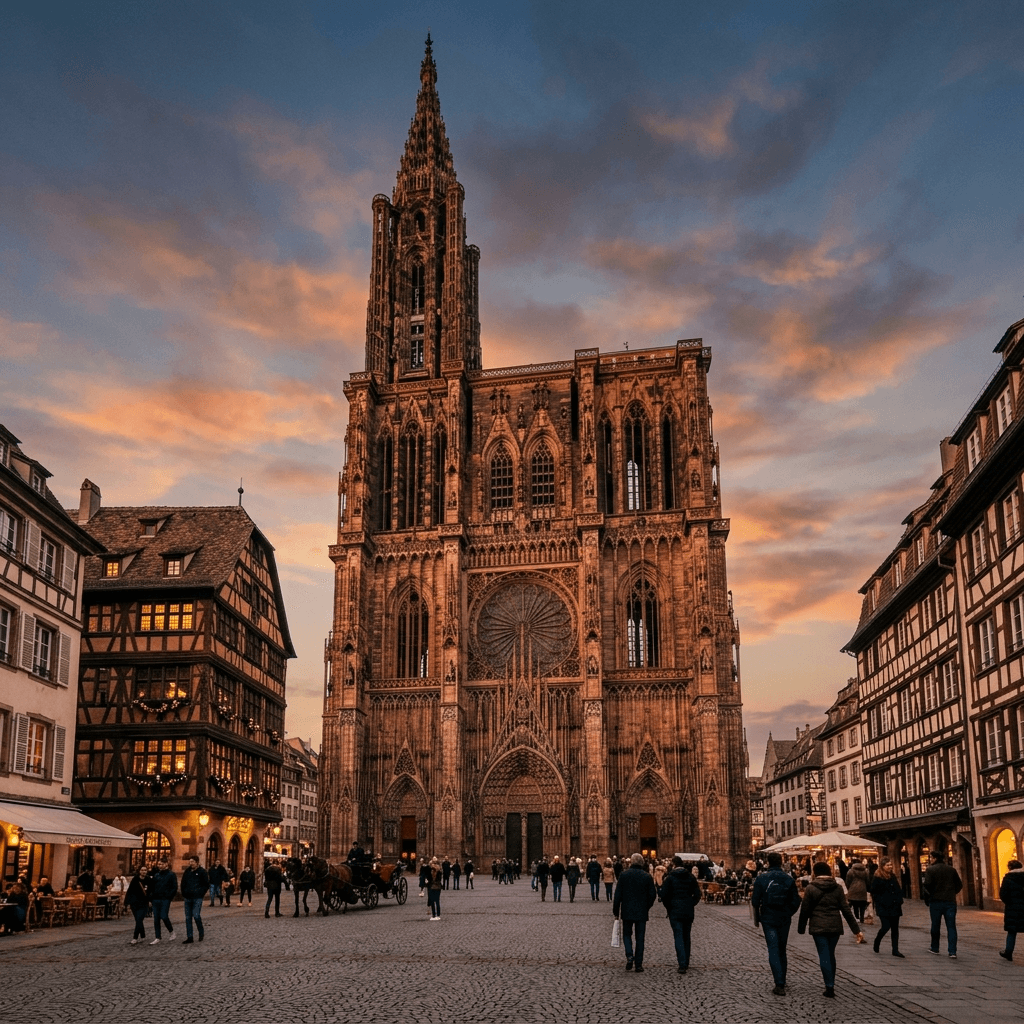
The Strasbourg Cathedral (officially Cathédrale Notre-Dame de Strasbourg) is one of the most impressive monuments of European Gothic architecture. Located in the historic centre of Strasbourg, in the Grand Est region of France, it is the sixth tallest church in the world and the tallest surviving medieval building.
What makes the cathedral unique is not just its height. Its west façade is considered a masterpiece of Gothic art, with thousands of sculpted figures and an exquisite rose window. The single bell tower, with its delicate openwork spire, seems to defy gravity.
Furthermore, the cathedral houses one of the largest and most fascinating astronomical clocks in the world, a marvel of Renaissance engineering that continues to function more than 400 years after its construction. It is this combination of architectural grandeur, technical innovation and artistic wealth that makes Strasbourg Cathedral a unique monument.
Chapter
1.2 How did a cathedral built in the 15th century reach 142 metres?
The Strasbourg Cathedral reached 142 metres in height with the completion of its spire in 1439. For 227 years — until the completion of the spire of the Church of St. Nicholas in Hamburg in 1874 — it was the tallest building in the world.
What makes this feat even more impressive is that it was achieved without modern technology, using cranes powered by men and animals, simple pulleys and an enormous amount of manual labour. The spire is made of Vosges sandstone, a relatively light stone that allowed the structure to reach such a height.
The secret lies in the openwork structure of the spire: instead of being a solid block, the spire is composed of stone frameworks that reduce weight while maintaining structural strength.
Chapter
1.3 Why does the cathedral only have one tower if the project planned two?
The original project for Strasbourg Cathedral included two towers on the west façade, following the tradition of Gothic cathedrals. However, only the north tower was built. The south tower was never started.
There are several theories as to why the second tower was not built. The most accepted is that the subsoil on the south side was unstable and could not support the weight of a second tower. Another theory suggests that the funds ran out after the construction of the north tower.
The result is the asymmetrical silhouette that we see today: a single tower on one side, giving the cathedral a unique and instantly recognisable appearance.
Chapter
1.4 How many years did it take to build Strasbourg Cathedral?
The construction of Strasbourg Cathedral was a process that stretched over more than 4 centuries (from 1015 to 1439), but the Gothic work that we see today took place between 1220 and 1439.
The initial structure, a Romanesque cathedral begun in 1015, was destroyed by fire. The current Gothic cathedral began to be built around 1220, starting with the choir and the north transept. The west façade was built between 1277 and 1350. The spire was finally completed in 1439.
In total, the construction of the Gothic cathedral took about 220 years — the work of many generations of architects, masons and craftsmen.
Chapter
2. The impossible engineering of the 142-metre spire — How was it built without modern cranes?
Chapter
2.1 What stone-lifting techniques were used in the 15th century?
In the 15th century, builders did not have electric cranes or hydraulic lifts. To lift the stone blocks weighing more than a tonne to heights of up to 142 metres, they used human-powered treadwheel cranes.
A treadwheel crane consisted of a large wooden wheel, similar to a hamster wheel, where two or more men walked to rotate a shaft that wound a rope, lifting the stone. These cranes were installed on the growing structure and moved up as the tower rose.
The precision required was enormous: each block of stone had to fit perfectly with the next, without the use of cement or mortar in the joints. The blocks were carved on the ground and then lifted to their final position. A mistake of a few centimetres could compromise the entire structure.
Chapter
2.2 How did the architects calculate wind resistance?
The architects of Strasbourg Cathedral did not have modern wind tunnel calculation programmes. Instead, they relied on empirical knowledge accumulated over centuries of cathedral and bridge construction.
The main solution they found is the openwork design of the spire. Instead of a solid block, the spire is composed of a framework of stone ribs that allow the wind to pass through, reducing lateral pressure. This principle, similar to that of a modern suspension bridge, was revolutionary for the time.
Furthermore, the spire has a slightly pyramidal shape, which makes it more stable. The centre of gravity is low, and the base of the spire is reinforced with four massive pillars that absorb lateral forces.
Chapter
2.3 How were the 6-metre-tall stained-glass windows installed?
The stained-glass windows of Strasbourg Cathedral are among the largest and oldest in Europe. Some windows reach 6 metres in height and were installed in the 14th century.
The installation of the stained-glass windows was done using lead frames that were placed directly into the stone frames. The stained glass was manufactured on the ground, in workshops near the cathedral, and then lifted to its final position using the same treadwheel cranes used for the stone.
Each stained-glass window is composed of dozens of pieces of coloured glass, joined by lead profiles. The largest windows required several months of work by a team of master glaziers.
Chapter
2.4 What structural innovations allowed the record height?
Several structural innovations allowed Strasbourg Cathedral to reach its record height of 142 metres:
These innovations, combined with the skill of the medieval masons, allowed the cathedral to rise higher than any other building in the world for more than two centuries.
Chapter
3. The Strasbourg astronomical clock — A Renaissance time machine
Chapter
3.1 How does the 1574 astronomical clock work?
The astronomical clock of Strasbourg Cathedral is one of the most complex and beautiful in the world. The current clock dates from 1574 (the third clock installed in the cathedral), designed by the Swiss mathematician Conrad Dasypodius and built by the watchmakers Isaac and Josias Habrecht.
The clock occupies a structure about 18 metres high inside the cathedral. It shows much more than the time: it indicates the position of the sun, the moon, the planets, the eclipses, the equinoxes and the liturgical calendar.
The most famous part is the procession of the apostles, which takes place every day at 12:30 PM. As a mechanical rooster crows three times, the twelve apostles parade before Christ, who blesses them. This automated spectacle, created in the 16th century, continues to fascinate visitors.
Chapter
3.2 What do the figures that parade at noon represent?
The procession of the apostles at noon (at 12:30 PM local time) is the most spectacular part of the astronomical clock. Four characters representing the four ages of man (Child, Youth, Adult, Old Age) parade before Death, who rings a bell.
Then, the twelve apostles pass before Christ, each bowing in turn while a mechanical rooster crows. The rooster is one of the oldest automata in the world, dating from 1574.
The figures are controlled by a complex system of gears, cams and springs. The mechanism is so precise that it can predict the position of the planets and the date of Easter for centuries to come.
Chapter
3.3 How accurate is the astronomical clock today?
The astronomical clock of Strasbourg Cathedral is still extraordinarily accurate, although it requires manual adjustments from time to time. The clock loses about 1 minute per year, an impressive precision for a mechanism built in 1574.
However, to keep the clock running, a watchmaker must wind it once a week. The last major restoration of the clock was carried out between 1989 and 1999 by the French watchmaker Alfred Ungerer.
The clock is so complex that it takes about 3 years for a watchmaker to fully understand its mechanism.
Chapter
3.4 What are the hidden mechanisms of the clock?
The astronomical clock has several hidden mechanisms that are not visible to the public. The most fascinating is the calendar mechanism, a complex system of gears that calculates the date of Easter and other movable feasts.
Another hidden mechanism is the planetarium, a set of moving spheres that represent the motion of the planets according to the Ptolemaic system (with Earth at the centre). The planetarium is located at the top of the clock.
The clock also has a perpetual calendar that automatically adjusts for leap years and other calendar irregularities. This mechanism is considered a masterpiece of Renaissance engineering.
Chapter
3.5 Who were the creators of the astronomical clock?
The astronomical clock was designed by Conrad Dasypodius (1530–1600), a Swiss mathematician and astronomer who was a professor at the University of Strasbourg. Dasypodius was a humanist and a scholar of classical texts.
The clock was built by the Habrecht brothers, Isaac and Josias, who were renowned watchmakers from Schaffhausen. The artistic decoration was carried out by the painter Tobias Stimmer and the sculptor Hans Rudolf Mürer.
The astronomical clock is therefore a collaborative effort between scientists, artists and craftsmen, reflecting the Renaissance ideal of the unity of knowledge.
- A posição do Sol e da Lua no céu em tempo real
- As fases lunares com precisão de um dia a cada 300 anos
- A posição dos planetas conhecidos no século XVI (Mercúrio, Vénus, Marte, Júpiter, Saturno) segundo o modelo geocêntrico (a Terra no centro do universo)
- A data da Páscoa e de todas as festas móveis do calendário cristão
- Os equinócios e solstícios
- A hora da maré astronômica (embora Strasbourg seja no interior, a maré influenciava a navegação no Reno)
Chapter
4. Dark mysteries of Strasbourg Cathedral — Secrets hidden in stone
Chapter
4.1 What demon is carved at the top of the cathedral?
At the top of Strasbourg Cathedral, on the spire, there is a small sculpture that has intrigued visitors for centuries: a little demon, often called the "imp of Strasbourg" or "demon of the spire".
The figure is located about 100 metres above ground, crouching on the railing of the spire platform. It is a small humanoid figure with horns and a mischievous expression, looking down at the city.
There are several legends about this figure. The most common says that the demon was placed there to protect the cathedral and watch over the city. Another says that it represents a mason who challenged God and was turned to stone.
Chapter
4.2 What is the curse of the architect Erwin von Steinbach?
The legend of the architect Erwin von Steinbach (1244–1318) is one of the most persistent of Strasbourg Cathedral. According to local tradition, Erwin made a pact with the devil to obtain the plans for the cathedral.
Erwin von Steinbach was the first architect of the cathedral's west façade. The legend says that, unable to complete the project, the architect asked the devil for help, promising his soul in exchange. The devil provided the plans, but Erwin managed to trick him by adding a cross to the façade, which prevented the devil from claiming his soul.
In revenge, the devil tried to destroy the cathedral, but was turned to stone and placed as a statue at the top. Some say the "demon" on the spire is the petrified devil.
Chapter
4.3 Why were pagan symbols incorporated into the Christian cathedral?
Strasbourg Cathedral is one of the most fascinating examples of how early Christianity adapted pagan symbols into its architecture. Several elements of the cathedral allude to pre-Christian beliefs and symbols.
The most notable example is the zodiac calendar on the west façade, which incorporates the 12 signs of the zodiac alongside biblical figures. This was a way of showing that the Christian God also presided over the cosmos.
Other pagan symbols include green men (faces surrounded by leaves), animals and mythological figures that decorate the capitals and doorways. These elements were not seen as contradictory, but as a way of integrating local traditions into the Christian faith.
Chapter
4.4 Is there a Masonic symbol in the cathedral?
The presence of Masonic symbols in Strasbourg Cathedral is the subject of much debate. It is true that the cathedral contains many geometric and symbolic elements that are also used in Freemasonry, such as the rose window and the geometric patterns.
However, it is important to remember that the cathedral was built by stonemasons' guilds, which shared symbols and techniques with the later freemason lodges. Many of the "Masonic" symbols — the compass, the square, the plumb line — were originally tools of the medieval stonemasons.
There is no evidence that the cathedral was designed according to Masonic rituals or that it contains secret Masonic messages.
Chapter
5. Stained-glass windows of Strasbourg Cathedral — A 1000-square-metre Bible of light
Chapter
5.1 What biblical scenes are depicted in the stained glass?
The stained-glass windows of Strasbourg Cathedral cover an area of approximately 1,000 m². They depict scenes from the Old and New Testaments, including the Creation, the life of Christ, the Virgin Mary and the saints.
The most famous stained-glass windows are the Rose Window on the west façade (13 metres in diameter, dating from the 13th century) and the windows of the north transept, which depict the Judgment of Solomon and the Coronation of the Virgin.
The stained-glass windows also include portraits of donors (kings, bishops and nobles who financed the work) and patron saints of guilds, reflecting the relationship between the Church and the city.
Chapter
5.2 How were the stained-glass windows made in the 14th century?
The stained-glass windows of Strasbourg Cathedral were made using the traditional technique of stained glass, which involves joining pieces of coloured glass with lead profiles.
The process began with a drawing (cartoon) at full scale. Then, the coloured glass was cut to size using a hot iron. The pieces were assembled on a table, joined with lead profiles, and sealed with a mixture of linseed oil and chalk powder to waterproof the joints.
The colours were obtained by adding metallic oxides to the molten glass: cobalt for blue, manganese for purple, copper for green, iron for red and yellow. Some of the original colours of Strasbourg are so intense that modern chemists have struggled to reproduce them.
Chapter
5.3 How did the stained-glass windows survive the wars?
The stained-glass windows of Strasbourg Cathedral survived the major conflicts that devastated Europe — the French Revolution, the Franco-Prussian War (1870) and the two World Wars — but not without damage.
During the French Revolution, the cathedral was pillaged and many sculptures were destroyed. The stained-glass windows were protected because they were considered too high to reach. In 1870, during the Franco-Prussian War, the cathedral was bombarded by Prussian artillery; some stained-glass windows were shattered.
During the Second World War, the stained-glass windows were removed and stored in a safe location to protect them from bombing. They were reinstalled after the war, and some underwent complete restoration.
Chapter
5.4 What was the restoration process for the stained glass?
The restoration of the stained-glass windows of Strasbourg Cathedral is a continuous process carried out by the Laboratoire de Recherche des Monuments Historiques (LRMH). The restoration involves cleaning the glass, repairing cracks, replacing broken pieces and strengthening the lead frames.
One of the biggest challenges of restoration is cleaning. Centuries of dust, pollution and oxidation have darkened the glass. The cleaning is done using lasers and chemical solutions that remove impurities without damaging the original glass.
Since the 1990s, a systematic restoration programme has been underway, with an average of two windows restored per year. The total cost of restoring all the stained-glass windows is estimated at several million euros.
Chapter
6. Myths and truths about Strasbourg Cathedral
Chapter
6.1 Is it true that the cathedral was built on a pagan temple?
There is strong evidence that a Roman temple and possibly older pagan sites occupied the site of Strasbourg Cathedral before the Christian church was built. Archaeological excavations have found remains of Roman and Merovingian structures beneath the cathedral.
In the 4th century, the first Christian church was built on the site. In the 8th century, a more substantial cathedral was built, followed by the Romanesque cathedral in 1015.
Therefore, it is plausible that the site had religious significance before Christianity. However, it is not accurate to say that the current cathedral "was built on a pagan temple" — it was built on a succession of earlier churches.
Chapter
6.2 Was the cathedral used as a military observation point?
Yes, the tower of Strasbourg Cathedral was used as a military observation post on several occasions. From its 142-metre height, the view covers the entire city and the surrounding region, making it an ideal strategic point.
During the Franco-Prussian War (1870), the tower was used by the Prussian army to observe the French positions. During the Second World War, both the French and German armies used the tower for observation.
Fortunately, neither the tower nor the cathedral suffered major damage during these conflicts, although the stained-glass windows were removed for protection during World War II.
Chapter
6.3 Is the architect's ghost still roaming the cathedral?
The legend of the ghost of Erwin von Steinbach, the cathedral's architect, is one of the most popular stories associated with Strasbourg Cathedral. According to tradition, Erwin is still wandering the corridors of the cathedral.
The story says that on certain nights, especially at Christmas, a shadowy figure can be seen walking along the gallery of the nave, inspecting the work of his life. Some claim to have heard footsteps on the stone stairs when no one was there.
There is no historical or photographic evidence of the ghost, but the legend continues to fascinate visitors and locals alike.
Chapter
6.4 Is there a treasure buried under the cathedral?
The idea that there is a treasure buried under Strasbourg Cathedral is a persistent legend, but has never been proven. The most common story is that the cathedral's treasure — gold objects, precious stones and relics — was hidden during the French Revolution and never recovered.
Another legend says that the Knights Templar, who had connections with the cathedral, hid part of their treasure there. Other stories mention a secret crypt where the Holy Grail or the Ark of the Covenant would be hidden.
None of these legends have been confirmed by archaeological excavations, which have found only tombs and building foundations.
Chapter
7. Practical guide to visiting Strasbourg Cathedral in 2026
Chapter
7.1 How much does the ticket to the cathedral and tower cost in 2026?
In 2026, the prices for visiting Strasbourg Cathedral are approximately:
Tickets can be purchased online through the official Strasbourg tourism website or at the ticket office located near Maison Kammerzell.
Chapter
7.2 What are the opening hours?
The cathedral can be visited daily from 7:00 to 11:20 and from 12:40 to 19:00. The tower is open from 9:00 to 18:30 in summer and 10:00 to 17:00 in winter.
The astronomical clock presentation takes place daily at 12:30 PM. The tower closes 30 minutes before the cathedral.
Chapter
7.3 How long does it take to climb the 330 steps?
Climbing the 330 steps of the tower takes, on average, 10 to 15 minutes at a moderate pace. However, most visitors take 20 to 30 minutes, stopping on the intermediate platforms to catch their breath and enjoy the views.
Descent takes about 5 to 10 minutes. The stairway is narrow (only one person at a time in some sections) and can be claustrophobic for some visitors.
Chapter
7.4 What is the best time of day to visit the cathedral?
The best time to visit Strasbourg Cathedral is early in the morning (from 7:00 to 9:00), when there are fewer visitors and the light is beautiful for photographs.
The astronomical clock is most visited at noon, so it is recommended to find a position about 15 minutes before 12:30 PM to get a good view of the apostle procession.
Late afternoon (from 16:00 onwards) is also a good option, with softer light and fewer groups.
Chapter
8. The architecture of Strasbourg Cathedral explained — From Romanesque to Gothic
Chapter
8.1 What Romanesque elements survive in the cathedral?
Although Strasbourg Cathedral is famous as a Gothic monument, there are some Romanesque elements that survived from the earlier cathedral. The most notable is the crypt, built in the 11th century.
The crypt, dedicated to Saint Andrew, is one of the oldest parts of the cathedral. It has vaulted ceilings and massive columns typical of Romanesque architecture.
Other Romanesque elements include the north portal of the nave and some capitals in the choir, which show floral and geometric motifs characteristic of the Romanesque style.
- Adulto: cerca de €8
- Tarifa reduzida (estudantes): cerca de €5
- Gratuito: menores de 18 anos
Chapter
8.2 How did Gothic architecture transform the cathedral?
The transition from Romanesque to Gothic at Strasbourg Cathedral occurred around 1220, when the decision was made to rebuild the earlier cathedral in the new Gothic style.
The Gothic architecture introduced several innovations: ribbed vaults, which allowed for higher ceilings; flying buttresses, which supported the walls and allowed for larger windows; and pointed arches, which distributed weight more efficiently.
The most Gothic part of the cathedral is the nave, with its 30-metre height, the west façade with its thousands of sculptures, and the spire that reaches 142 metres.
- Inverno (outubro a março): 12h30
- Verão (abril a setembro): 12h45
Chapter
8.3 Why does the north tower not exist?
The north tower of Strasbourg Cathedral does not exist because, although the original project included two towers, only the south tower was built.
The main reason is geological: the soil on the north side was considered unstable to support the weight of a tower. Furthermore, the financial resources were exhausted after the construction of the south tower and the spire.
The result is a unique asymmetrical silhouette that has become one of Strasbourg's most recognisable symbols.
- Compre o bilhete online com antecedência
- Chegue à hora de abertura (geralmente 09h00 ou 10h00)
- Visite durante a semana (as filas são maiores ao fim de semana)
- A primavera e o outono têm menos movimento do que o verão
Chapter
8.4 What is the west façade and why is it unique?
The west façade of Strasbourg Cathedral is considered one of the masterpieces of Gothic art. Built between 1277 and 1350, it is a huge vertical composition of stone, sculpture and glass.
The façade is divided into three levels: the first level has three portals decorated with biblical scenes; the second level has the Rose Window (13 metres in diameter); the third level has a gallery of kings and a series of blind arches.
What makes the west façade unique is the richness of its sculptural decoration. There are more than 1,000 sculpted figures, including saints, kings, angels, monsters and scenes from daily life.
- Interior da catedral e vitrais: 45 minutos a 1 hora
- Relógio astronômico e desfile: 30 minutos (incluindo espera)
- Subida à plataforma (332 degraus): 30 a 45 minutos (mais o tempo de fila)
- Tesouro (se aberto): 20 minutos
Chapter
8.5 What materials were used in the construction?
Strasbourg Cathedral was built mainly with Vosges sandstone, a stone extracted from quarries in the Vosges mountains, about 40 km from Strasbourg.
Vosges sandstone is a relatively soft and light stone, which makes it easier to carve but also more susceptible to erosion. This is one of the reasons why the cathedral requires constant restoration.
Other materials used include oak for the roof structure and scaffolding, lead for roofing, and iron for structural reinforcements and for holding the stained-glass windows in place.
Chapter
9. Strasbourg Cathedral in pop culture
Chapter
9.1 Which films feature Strasbourg Cathedral?
Strasbourg Cathedral has appeared in several films and television productions. The most notable is "The Hunchback of Notre Dame" (both the Disney animation and various adaptations), which, although set in Paris, uses Strasbourg as a visual reference.
Other productions include "The Strasbourg Cathedral" (a 2006 documentary) and several programmes about European Gothic architecture on BBC and France Télévisions. The cathedral also appears in the film "The Winter's Tale" (2014) and in the series "The Crown".
Chapter
9.2 Has the cathedral been featured in video games?
Yes, Strasbourg Cathedral appears in the game Assassin's Creed: Unity (2014), which recreates a version of the cathedral. Although the game's main setting is Paris, the cathedral of Strasbourg appears as a buildable monument.
The cathedral also appears in Civilization VI (2016) as a wonder that can be built. In Age of Empires II, the cathedral is mentioned in the historical context of the campaigns.
Chapter
9.3 Which books and poems mention the cathedral?
Johann Wolfgang von Goethe, the great German writer, was a great admirer of Strasbourg Cathedral. He wrote a famous essay titled "On German Architecture" (1772), in which he praised the cathedral as the pinnacle of Germanic art.
Victor Hugo also wrote about the cathedral in his travel notes, describing it as "a gigantic and delicate marvel". The poet Charles Baudelaire mentioned the cathedral in his writings.
In more recent literature, the cathedral appears in the novel "The Strasbourg Cathedral" by French author Éric-Emmanuel Schmitt.
Chapter
9.4 Has the cathedral been the stage for historical events?
Yes, Strasbourg Cathedral has been the stage for several important historical events. The most significant was in 1794, during the French Revolution, when the cathedral was used as a Temple of Reason.
More recently, the cathedral hosted the ceremony of the European Union in 2004 to celebrate the enlargement of the EU to 25 members. The cathedral also serves as the stage for the Strasbourg Christmas market, one of the oldest and most famous in Europe.
The cathedral is also the location for the Strasbourg Music Festival, which hosts classical music concerts in the nave.
- A cripta românica do século 1015, expandida para oeste por volta de 1180, com abóbadas de berço e colunas maciças
- Os pilares românicos do transepto, mais grossos que os góticos da nave, com capitéis decorados com folhagem
- A cúpula do cruzeiro (a cúpula sobre o cruzamento do transepto com a nave), românica, em forma de mitra
- A estrutura da abside, românica na sua base, modificada durante a construção gótica
Chapter
10. The cathedral and the city — The symbiosis between Strasbourg and its cathedral
Chapter
10.1 How did the cathedral shape the urban layout of Strasbourg?
Strasbourg Cathedral profoundly shaped the urban layout of the city. Built on an island on the river Ill, the cathedral was the focal point around which the medieval city developed.
The streets of the historic centre radiate from the cathedral, creating a radial urban plan typical of medieval cities. The cathedral square (Place de la Cathédrale) was the central meeting point for markets, religious celebrations and public events.
The height of the cathedral — visible from any point in the city — served as a visual reference for travellers and a symbol of the power of the Church and the city.
Chapter
10.2 What is the relationship between the cathedral and the river Ill?
The relationship between Strasbourg Cathedral and the river Ill is fundamental to understanding the city. The cathedral was built on an island formed by the branches of the Ill, which provided both protection and access to water for construction.
The sandstone used in the construction was transported by barges on the Ill from the Vosges quarries. The water also powered the mills that cut the stone.
Today, the Ill continues to surround the cathedral, creating a picturesque landscape that makes the cathedral reflect in the waters of the canals.
- A Anunciação
- O Nascimento de Cristo
- A Paixão (Cristo a caminho do Calvário)
- A Crucificação
- A Ressurreição
- A Ascensão
Chapter
10.3 How did the cathedral survive the world wars?
During the Franco-Prussian War (1870), Strasbourg Cathedral was hit by Prussian artillery. The tower was damaged, and some of the stained-glass windows were shattered.
During the First World War, the cathedral was relatively protected, as the city was part of the German Empire at the time. During the Second World War, the stained-glass windows were removed and stored in a salt mine in Germany.
The cathedral survived both world wars with relatively little damage, thanks to preservation efforts and the decision to remove the most valuable elements.
Chapter
10.4 What is the role of the cathedral in Strasbourg's cultural identity?
Strasbourg Cathedral is not just a tourist attraction — it is the symbol of Strasbourg's identity. For centuries, the cathedral was the tallest building in the world, a source of pride for the city.
The cathedral represents the cultural duality of Strasbourg, a city that has changed between France and Germany several times. Its architecture is a fusion of French and Germanic influences, reflecting the city's history.
Today, the cathedral is a symbol of European unity. Strasbourg is the seat of the European Parliament, and the cathedral is seen as a monument that transcends national borders.
Chapter
11. The organ of Strasbourg Cathedral — One of the largest in France
Chapter
11.1 What is the history of the cathedral organ?
The organ of Strasbourg Cathedral has a long history dating back to the Middle Ages. The first organ was installed in the 13th century. The current organ was built by Andreas Silbermann between 1697 and 1704.
The Silbermann organ underwent several modifications over the centuries. The most recent major restoration was carried out between 1999 and 2004, which returned the instrument to its original Baroque configuration.
The organ is considered one of the finest examples of Alsatian Baroque organ building and is still used for concerts and liturgical celebrations.
Chapter
11.2 How many pipes does the organ have?
The organ of Strasbourg Cathedral has approximately 5,700 pipes, distributed across four keyboards and a pedalboard. The pipes range from a few centimetres to over 5 metres in height.
The organ is divided into several sections: the Great Organ (main keyboard), the Positif (secondary keyboard), the Récit (expressive keyboard), the Manual and the Pedal.
The organ case, carved in oak, is a masterpiece of Baroque art, decorated with sculptures of angels, saints and musical instruments.
Chapter
11.3 Which famous organists have played at the cathedral?
Several famous organists have played the organ of Strasbourg Cathedral. The most notable include:
The organ is also used for international organ competitions that take place in Strasbourg.
Chapter
12. How to photograph Strasbourg Cathedral — Professional tips
Chapter
12.1 What is the best angle to photograph the cathedral?
The best angle to photograph Strasbourg Cathedral is from Place de la Cathédrale, the square in front of the church. This angle shows the full height of the west façade.
For a more complete photo of the tower and spire, the best angle is from Rue Mercière or Rue des Hallebardes, which offer a lateral view of the tower.
For a panoramic view, the Ponts Couverts (covered bridges) offer a magnificent perspective of the cathedral in the context of the historic city.
- O relicário de São Arbogast, primeiro bispo de Estrasburgo (século VI), em prata e ouro
- O relicário de Santa Atala, em ourivesaria medieval
- A cabeça-relicário de São Lázaro (século XIV), uma peça de ourivesaria em forma de busto
- Cálices e patenas em prata dourada dos séculos XV a XVIII
- Paramentos litúrgicos bordados a ouro
Chapter
12.2 How to photograph the astronomical clock?
To photograph the astronomical clock, a tripod is essential, as the lighting inside the cathedral is dim. Use a wide aperture (f/2.8 or f/4) and a high ISO (800 to 3200) to avoid motion blur.
The best moment to photograph the clock is during the 12:30 PM presentation, when the figures move. Use a shutter speed of 1/125 or faster to freeze the movement.
Chapter
12.3 What equipment is ideal for architectural photography?
For architectural photography of the cathedral, the following equipment is recommended:
A circular polariser filter is recommended to reduce reflections on the stone and increase colour saturation.
Chapter
13. Restorations of Strasbourg Cathedral — The invisible work of centuries
Chapter
13.1 How many times has the cathedral been restored?
Strasbourg Cathedral has undergone numerous restorations over its history. The most significant restorations were carried out in the 19th century (by Gustave Klotz), in the 20th century (after the wars) and in the 21st century (continuous programme).
The 19th-century restoration, led by the architect Gustave Klotz, was the largest. Klotz restored the west façade, the spire and the stained-glass windows, giving the cathedral much of its current appearance.
Today, the cathedral is under constant restoration, with a dedicated team of architects, stonemasons and restorers.
Chapter
13.2 How was the stone restored after pollution damage?
Pollution, especially from vehicle exhaust and industrial emissions, has severely damaged the stone of Strasbourg Cathedral. The sandstone becomes blackened and weakened by acid rain.
The restoration involves cleaning the stone with water jets and mild detergents, replacing damaged blocks with new Vosges sandstone, and applying protective treatments to slow down future deterioration.
Since the 1980s, a systematic programme has cleaned and restored about 80% of the west façade. The remaining 20% is expected to be completed by 2030.
- A temperatura e a humidade em diferentes pontos da flecha
- A deformação do arenito devido à poluição e às variações climáticas
- O movimento da flecha causado pelo vento, pela variação térmica e por micro-sismos
Chapter
13.3 What restoration challenges does the spire face?
The spire of Strasbourg Cathedral faces specific restoration challenges due to its height and exposure to the elements.
The restoration of the spire requires the assembly of complex scaffolding that reaches 142 metres. The work can only be carried out in good weather conditions, limiting the work to about 6 months per year.
Each restored block must be carved by hand by specialist stonemasons, following the original medieval techniques. This process is slow and expensive.
Chapter
14. Visiting the 142-metre tower — All about the climb
Chapter
14.1 How many steps to the top?
To reach the top of the tower of Strasbourg Cathedral, you must climb 330 steps. The staircase is a spiral staircase that goes around the tower.
Along the climb, there are two intermediate platforms where you can stop and rest. The first platform offers a view over the roofs of Strasbourg. The second platform is at the base of the spire.
Chapter
14.2 Is the climb difficult?
The climb is moderately difficult. The stairs are steep and narrow (only one person can pass in some sections). There is no lift.
It is not recommended for people with heart problems, respiratory difficulties or a fear of heights. It takes, on average, 10 to 15 minutes to climb and 5 to 10 minutes to descend.
- Usar uma lente grande angular (16–35 mm) para captar a altura da nave e a abóbada
- Aumentar o ISO (1600–3200) para compensar a pouca luz
- Usar um tripé (se permitido) ou apoiar a câmara num pilar para longas exposições
- Fotografar a rosácea oeste de preferência ao fim da tarde, quando a luz do sol a atravessa
Chapter
14.3 What can you see from the top?
From the top of the tower, at 142 metres high, the view is spectacular. On clear days, you can see the Vosges mountains to the west and the Black Forest in Germany to the east.
From the top, you can see the historic centre of Strasbourg, the cathedral square, the Ill river and its canals, and the modern buildings of the European quarter.
Chapter
14.4 Is the tower accessible for people with reduced mobility?
No, the tower of Strasbourg Cathedral is not accessible for people with reduced mobility. There is no lift, and the staircase is narrow and steep.
The cathedral nave is accessible, with ramps at the main entrance. The astronomical clock can also be viewed from the ground floor.
Chapter
15. FAQ — Frequently asked questions about Strasbourg Cathedral
How much does it cost to visit Strasbourg Cathedral?
The cathedral nave is free to visit. The tower costs approximately €8 for adults.
What are the cathedral's opening hours?
The cathedral is open daily from 7:00 to 11:20 and from 12:40 to 19:00.
How long does the visit take?
About 1 hour for the interior and 30 minutes for the tower climb.
Is the cathedral accessible for wheelchairs?
The nave is accessible. The tower is not accessible.
Can I take photos inside?
Yes, photography without flash is allowed.
Is there an audio guide?
Yes, audio guides are available in several languages.
What is the best time of day to visit?
Early in the morning to avoid crowds.
When does the astronomical clock operate?
The apostle procession takes place daily at 12:30 PM.
Is there a dress code?
As a place of worship, visitors are asked to dress respectfully.
Can I attend a service at the cathedral?
Yes, masses are celebrated daily. Check the times on the official website.
Is there a shop at the cathedral?
Yes, there is a shop at the exit of the cathedral.