Chapter
1. The True Story of the Musée Picasso in Paris: The 17th-Century Palace That Holds the World's Largest Collection of Works by the Cubist Genius
Chapter
1.1 What is the Hôtel Salé? The 1660 Baroque Mansion Built by a Salt Tax Collector That Survived the French Revolution
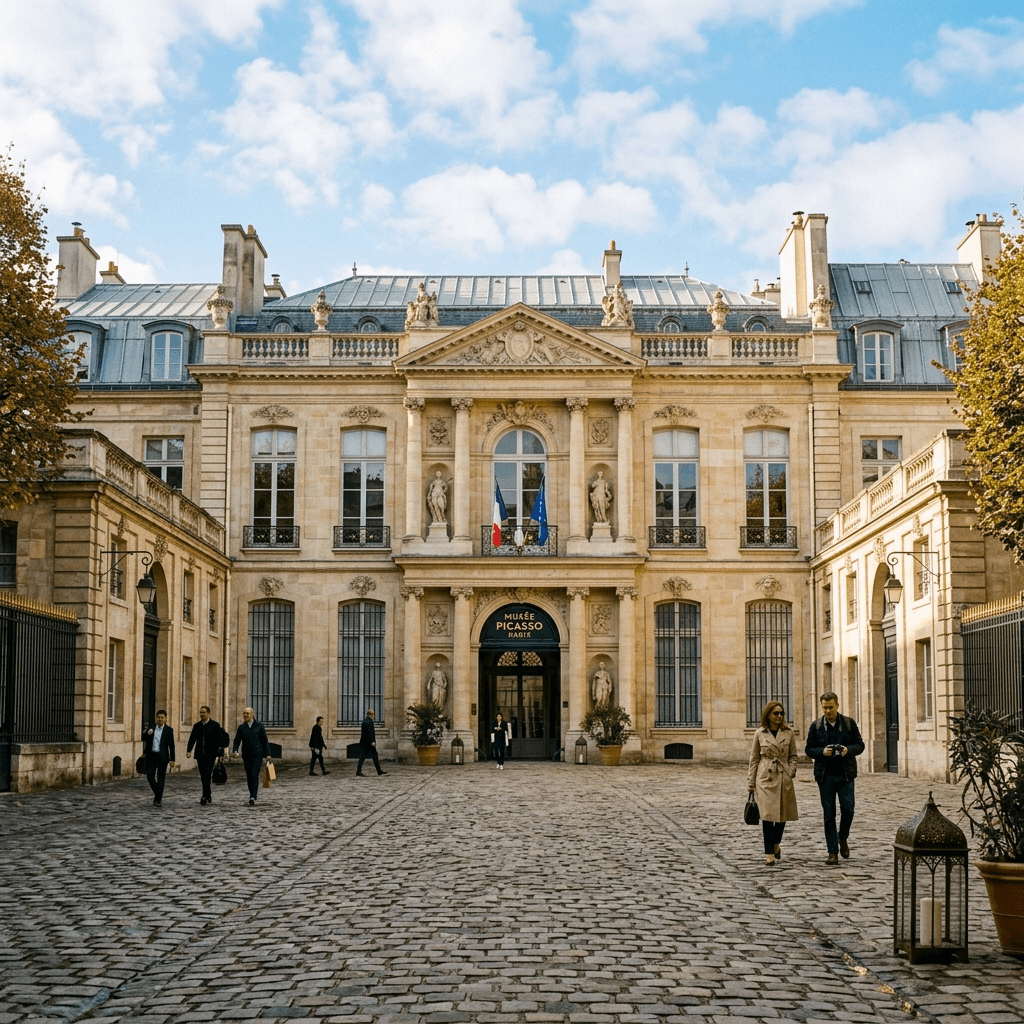
The Musée Picasso is not housed in just any building—it occupies the Hôtel Salé, one of the most imposing Baroque mansions in the Marais, built between 1656 and 1660 for Pierre Aubert de Fontenay. Aubert was a fermier général—a collector of royal taxes—who amassed his fortune precisely from the gabelle, the deeply unpopular salt tax of the Ancien Régime. It was this wealth, extracted drop by drop from French peasants, that financed every stone of the residence designed by architect Jean Boullier, at number 5 Rue de Thorigny, in the heart of the 3rd arrondissement.
The nickname "salé" (salty) is a biting irony of the era: a direct mockery of the source of Aubert's fortune. The mansion boasts all the canonical elements of 17th-century French Baroque—a symmetrical limestone façade, a carved triangular pediment with coats of arms, a steep mansard roof, and a monumental portal crowned by a lion's head. Inside, what immediately catches the eye is the monumental staircase: a structure in carved stone with a wrought-iron balustrade that occupies the entire central bay of the building, illuminated by a skylight that pours natural light from the ceiling to the ground floor. It is considered one of the best-preserved Baroque staircases in Paris—and, ironically, the only part of the palace that remained almost untouched over the centuries.
Aubert's glory, however, was brief. He lost prestige at court and his fortune evaporated. The Hôtel Salé passed through various hands over the next three centuries: it served as the embassy of the Republic of Venice, housed a school, was carved up into rental apartments, and, by the 20th century, sank into decay—leaks, peeling walls, pigeons nesting in the halls that once welcomed the French aristocracy. A Baroque ruin in the middle of the Marais.
It was only in 1964 that the City of Paris acquired the property, recognizing its historical value. Four years later, in 1968, the Hôtel Salé was officially classified as a Historical Monument of France. But the decisive step for its definitive transformation was still to come: someone had to decide what to do with that stone skeleton. The answer came from an event that would shake the art world in 1973.
Chapter
1.2 How Did the Picasso Dation of 1979 Work? The Story of How France Accepted Masterpieces in Payment of Taxes and Created a One-of-a-Kind Museum
On April 8, 1973, Pablo Picasso died at the age of 91 in his home in Mougins, in the south of France. He left no will. What he did leave was one of the largest artistic estates ever accumulated by a single individual—thousands of his own works, plus collections of other masters—and six heirs: his widow Jacqueline Roque, his son Paulo, grandchildren Marina and Bernard (children of Paulo), Maya (daughter with Marie-Thérèse Walter), and Claude and Paloma (children with Françoise Gilot).
French inheritance law at the time provided for astronomical estate taxes on a patrimony of this caliber. Estimates of the estate's value varied, but no one doubted that the heirs would never be able to pay in cash. That is where a unique legal mechanism came into play, created in 1968 at the initiative of then-Minister of Culture André Malraux: the dation en paiement—literally "transfer in lieu of payment". This law allowed heirs to settle their tax debts not with money, but with works of art of significant cultural value to the national heritage.
The Picasso dation was officially approved in 1979. It was not a simple process: for six years, a commission of experts, curators, and representatives of the French state examined the estate and negotiated with the heirs. The State had to select the works it would receive as payment, piece by piece, based on criteria of artistic relevance and chronological representativeness. What was at stake was not just paying off taxes—it was defining the canon of the 20th century's greatest artist.
The result was an extraordinary selection: the French state became the owner of more than 3,500 works by Picasso, spanning all phases of his production—from youthful sketches to monumental paintings of his maturity—plus his personal art collection (which included Cézanne, Matisse, and Rousseau) and his personal archive. No other country possessed, until then, such a vast and diverse body of a single artist's work. What was missing now was a place worthy of housing it. The Hôtel Salé, acquired a decade earlier and still without a defined purpose, became the natural choice.
Chapter
1.3 Why Did the Musée Picasso Take 12 Years to Open After the Artist's Death? The Controversy of the 1985 Inauguration
Twelve years separate Picasso's death in 1973 from the museum's inauguration on September 28, 1985. For many visitors, this time gap raises an inevitable question: why so long? The answer involves three layers of complexity—legal, curatorial, and architectural—that overlapped and delayed one another.
The first layer, and the thorniest, was the succession imbroglio. Without a will, with six heirs from three different relationships, the division of Picasso's inheritance dragged on in legal disputes. The lawyers for the different families—the Roques, the Picassos, the Walters, and the Gilots—debated for years over who would get which works. Before the State could exercise its right to the dation, the heirs first had to agree among themselves on the composition of the estate. This dispute was only resolved in 1979, when the dation was finally approved.
The second layer was the selection of works. The dation commission did not act hastily. Years of meticulous curatorial work were needed to choose, from tens of thousands of pieces, those that would tell the complete story of Picasso—ensuring representativeness of every period, technique, and medium. It was not about indiscriminately accumulating masterpieces, but about constructing a coherent museological narrative.
The third layer was the restoration of the Hôtel Salé. When the State decided that the Baroque mansion would house the museum, the building was in an advanced state of ruin. The renovation was entrusted to architects Roland Simounet and Jean Monge, who worked between 1974 and 1980 to transform a 17th-century palace into a modern museum—respecting the historic structures, including the monumental staircase, while creating climate-controlled spaces, controlled lighting, and adequate circulation for the public. The paradox was delicate: preserving the Baroque soul without sacrificing the technical requirements of a 20th-century museum. The result was so pleasing that Simounet received the prestigious Équerre d'Argent architecture prize in 1985.
Finally, on September 28, 1985, President François Mitterrand cut the inaugural ribbon. The Musée Picasso was open. Paris was gaining not just a monographic museum, but one of the densest and most well-curated collections in the history of modern art.
Chapter
1.4 The Donations That Multiplied the Musée Picasso's Collection: Jacqueline, the Heirs, and the Collection That Grew from 3,500 to Over 5,000 Works
The 3,500 items received via the dation were the founding core of the museum, but they were far from the final word. In the years and decades that followed, the collection continued to grow through successive donations from the heirs, transforming the museum into a living organism that never stopped expanding.
The first major contribution came from the artist's widow herself. Jacqueline Roque, who lived with Picasso during his last twenty years and inherited an expressive body of works, died in 1986—just one year after the museum's inauguration. Her posthumous donation of 1990 added hundreds of late Picasso pieces, especially from his final phase, when the artist painted with creative fury in his studio in Mougins. Jacqueline was also the guardian of works from other phases that Picasso had kept with him until the end of his life.
The other heirs followed similar paths. Maya Ruiz-Picasso, the artist's daughter with Marie-Thérèse Walter, donated significant works over the decades. Grandchildren Marina and Bernard also contributed with specific donations and long-term loans. In 2021, a new donation from Maya—the so-called Dation Maya Ruiz-Picasso—included nine works of extreme value, among them a Cubist portrait from 1917 and preparatory studies that enriched the already robust museum collection.
In addition to donations, the museum also made occasional acquisitions and received loans from private collectors. Today, the total collection of the Musée Picasso exceeds 5,000 works—a growth of more than 40% compared to the original core. More than numbers, this growth reflects a particularity of the museum: unlike other monographic institutions whose collections are "closed" after the artist's death, the Musée Picasso never stopped expanding. And each new donation reconfigures the exhibition narrative, revealing unprecedented angles on the trajectory of the Cubist genius.
Chapter
2. The Gigantic Collection of the Musée Picasso in Numbers: Over 5,000 Works, 200,000 Documents, and the Complete Chronology of the Genius
Chapter
2.1 How Many Picasso Works Are at the Musée Picasso? Discover the Exact Number of Paintings, Sculptures, Drawings, Ceramics, and Prints
Saying "5,000 works" gives a general dimension, but the exact numbers tell a more precise and impressive story. The Musée Picasso Paris today holds, according to its official inventory, approximately 297 paintings by Pablo Picasso—a number that seems modest until you realize that each one is a piece of singular museological importance. These are canvases that cover all phases, from the Blue Period of 1901 to the frantic paintings of the final months of 1973.
In the field of sculpture, the collection holds around 368 three-dimensional pieces, ranging from small bronzes modeled in his youth to monumental assemblages with unorthodox materials—wood, iron, scrap, cardboard, and even repurposed toys. It is in this grouping that the famous sculpture Man with a Lamb, from 1943, is found, created during the Nazi Occupation of Paris as a silent act of resistance.
The quantitative heart of the museum lies on paper: approximately 1,600 drawings—sketches, studies, intimate portraits, illustrations—and about 1,700 prints, in techniques ranging from etching to lithography, including drypoint and woodcut. Picasso was a compulsive and innovative printmaker, and the museum's collection reflects this facet with unmatched density in the world.
There is also an estimated set of 100 original ceramics, produced mainly at the Madoura workshop in Vallauris, where Picasso spent entire seasons experimenting with clay, glazes, and kilns. And, no less importantly, the museum holds the sketchbooks—the legendary sketchbooks where the artist obsessively jotted down ideas. No other institution in the world gathers such a variety of mediums, techniques, and periods of Picasso's production under a single roof.
Chapter
2.2 What Does Picasso's Personal Archive Contain? The 200,000 Items of Photographs, Letters, Manuscripts, and Newspapers That Reveal His Intimate Life
Beyond the works of art themselves, the Musée Picasso houses a documentary treasure that often goes unnoticed by visitors: Pablo Picasso's personal archive, a monumental collection of more than 200,000 items that the artist accumulated throughout his life. Picasso kept everything—not out of bureaucratic obsession, but out of a kind of preservation instinct that bordered on the superstitious.
The heart of the archive is the photographs. Thousands of them, taken by some of the greatest photographers of the 20th century—Brassaï, Dora Maar, Man Ray, Robert Capa, David Douglas Duncan—documenting Picasso in his studio, with friends, with lovers, on trips. Many of these images are the only visual proof of works that were sold, destroyed, or disappeared in family successions.
Then come the letters: correspondence exchanged with artists such as Matisse, Braque, Apollinaire, Cocteau, and Gertrude Stein; love letters to his muses, especially the exchanges with Marie-Thérèse Walter during the secret period of their relationship; business letters with dealers like Kahnweiler and Rosenberg. Each envelope is a time capsule of the Parisian avant-garde.
The third pillar is the manuscripts. Picasso did not consider himself a writer, but he wrote Surrealist poems and theatrical plays in the 1930s and 1940s—fragmented, dreamlike texts, full of neologisms and disconnected images that dialogue directly with his visual production of the period. There are also personal diaries, shopping lists scribbled on napkins, receipts, and invoices from paint and canvas suppliers.
A surprising item is the newspapers and clippings. Picasso collected entire pages of periodicals—especially those documenting wars, tragedies, and political crises. These clippings were not a pastime: he used them as raw material for collages, or studied them as iconographic documentation for works such as Guernica and the series Dreams and Lies of Franco. For the researcher, the personal archive is an unfiltered window into the artist's mind—and perhaps the most underrated part of the collection.
Chapter
2.3 Which Works by Other Artists Did Picasso Collect? The Cézannes, Matisses, Degases, Renoirs, and Rousseaus That Belonged to the Cubist Genius
Picasso not only produced art: he also collected. And the personal collection that the artist amassed throughout his life reflects, with surgical precision, the artists he admired, feared, or with whom he creatively dialogued. The Musée Picasso inherited this modernist cabinet of curiosities, which is now integrated into the permanent collection.
The artist most represented in Picasso's personal collection was Paul Cézanne. He owned three paintings by the master of Aix-en-Provence, whom Picasso revered as "the father of us all". One of these canvases, Chestnut Trees of the Jas de Bouffan, hung in his studio and was studied obsessively during the genesis of Cubism. Cézanne was the theoretical foundation upon which Picasso and Braque built their revolution: the idea that painting did not need to imitate nature, but to create its own reality.
Next came Henri Matisse, the rival-friend of a lifetime. The collection includes several works by Matisse, with whom Picasso maintained a relationship of competitive respect—they exchanged canvases, visited each other's studios, and, in Matisse's final years, Picasso became an almost daily presence at his sickroom. There are also works by Auguste Renoir—whom Picasso admired in his youth and later repudiated—, by Edgar Degas, and by Amedeo Modigliani, with whom he lived in Montmartre in the 1910s.
A special highlight is the presence of Henri Rousseau, the Douanier Rousseau. Picasso owned at least one canvas by the naïve painter and was the host of the legendary Rousseau Banquet in 1908, a night of mockery and admiration that became a founding myth of the Parisian avant-garde.
The collection also features works by Georges Braque, his partner in the Cubist adventure, and by Joan Miró, whom he mentored. But what most intrigues visitors are the pieces of African and Oceanic art: tribal masks, ritual statuettes, and ceremonial objects that Picasso began to acquire in Paris flea markets around 1906 and that had a direct impact on the conception of Les Demoiselles d'Avignon (1907). Seeing these anonymous pieces alongside Picasso's own works is to understand, in an almost physical way, how the dialogue between cultures can detonate an aesthetic revolution.
Chapter
3. The Complete Journey of Picasso Through the Halls of the Musée Picasso: Every Artistic Period of the Master Explained Through the Works in the Collection
Chapter
3.1 Picasso's Blue Period (1901-1904): The Deep Melancholy of the Young Artist Who Painted Poverty and Suffering in Shades of Blue
Picasso's Blue Period—between 1901 and 1904—is, for many, the most moving moment of his entire trajectory. It is not just a chromatic choice: the blue that dominates every canvas of this phase is the color of mourning, hunger, and alienation. Picasso was around twenty years old and had just lost his close friend Carlos Casagemas, who committed suicide in a Parisian café in February 1901. The shock was seismic and triggered a radical transformation: from the vivid colors of bohemian youth, Picasso plunged headlong into an almost monochromatic palette.
At the Musée Picasso, the Blue Period is represented by works of devastating intensity. The canonical example is La Celestina (1904), a portrait of a blind prostitute from Barcelona, with an eye whitened by cataracts and a dark blue mantle that covers her like a shroud. It is a painting that condenses the entire vocabulary of the period: the marginal figure, dignity in misery, the cold light that seems to come from nowhere. The canvas accuses no one—it merely shows, and in that absence of judgment lies its power.
But there are also the anonymous figures: emaciated mothers with children in their arms, beggars huddled against the wind, blind people groping the world with their hands. Picasso painted what he saw on the streets of Barcelona and in the working-class suburbs of Paris, but he also painted himself—a poor, unknown young Spaniard who could barely pay the rent on an unheated room in the Parisian winter. In the sketchbooks from this era, preserved in the museum, one can see the obsessive repetition of bent figures and gaunt faces, as if drawing were an exorcism of his own despair.
The Blue Period lasted only three years, but its impact on art history was disproportionate. It inaugurated the idea that an artist could transform his own depression into pictorial language—and the Musée Picasso is one of the rare places in the world where one can walk through this experience in chronological sequence, from the densest blue to the first crack of pinkish light that would announce the next phase.
Chapter
3.2 Picasso's Rose Period (1904-1906): The Acrobats, Harlequins, and the Transition to Light and Hope After Depression
In 1904, something begins to change in Picasso's canvases. The oppressive blue gives way to shades of pink, terracotta, and ochre. It is not just a change of pigments: it is the sign of an inner transformation. Picasso had left Spain definitively, settled in the Bateau-Lavoir in Montmartre, and began his relationship with Fernande Olivier, his first stable companion in Paris. The Rose Period, which extends to 1906, is the cycle of the acrobats, harlequins, and circus families—a poetics of wandering and fragility that replaces the despair of the previous period with a softer, almost tender melancholy.
The Musée Picasso holds a significant nucleus of works from this phase. The recurring characters are circus performers—slender acrobats, harlequins in colorful diamonds, boys with tambourines, tightrope walker women—that Picasso observed at the Cirque Médrano, on the hills of Montmartre. He identified with those nomads of spectacle: like them, the artist was a foreigner, a precarious worker, someone who lived by his manual skill and performed for an audience that rarely understood him.
An important detail of the Rose Period is the appearance of the harlequin as the painter's alter ego. The diamond harlequin became an autobiographical figure that Picasso would carry throughout his career, reappearing in phases as distant as the Neoclassicism of the 1920s and the late prints. The museum's collection allows one to trace this transversal presence: from the adolescent, melancholic harlequin of the Rose Period to the geometrized harlequin of Synthetic Cubism.
Visually, the Rose Period also marks the beginning of Picasso's interest in Mediterranean classicism. The elongated figures recall Pompeian frescoes and archaic Greek reliefs—a search for monumentality that foreshadows his later plunge into Neoclassicism. And, on the margins of this cycle, the first signs of formal restlessness already appear that would lead, in less than a year, to the greatest aesthetic rupture of the 20th century.
Chapter
3.3 How Picasso and Braque Revolutionized Art with Cubism? The Story of the Avant-Garde That Destroyed Perspective and Reinvented Painting
Cubism was not born from a manifesto or an organized movement. It was born, literally, from a conversation between two young painters—Pablo Picasso and Georges Braque—who, between 1907 and 1914, decided to destroy Renaissance perspective, the system that had organized Western painting since the 15th century. What they proposed in its place was a new way of seeing: fragmenting objects into geometric planes, showing them simultaneously from multiple angles, and abolishing the difference between figure and ground. The Musée Picasso Paris is, by far, the best place in the world to understand this visual revolution—because it preserves, side by side, the works that paved the way for Cubism and those that recorded every fold of its evolution.
Chapter
3.3.1 Les Demoiselles d'Avignon and the Birth of Cubism: The Work That Shocked Even Picasso's Closest Friends
No painting of the 20th century provoked as much perplexity, revulsion, and, later, reverence as Les Demoiselles d'Avignon (1907). Picasso worked on it for months—the preparatory studies kept at the museum, hundreds of them, show the obsessive process: drafts, discarded versions, alternative compositions. The final painting portrays five prostitutes from a brothel on Carrer d'Avinyó in Barcelona, but the shock was not in the subject—it was in the form.
Picasso abandoned perspective, proportion, and tonal gradation. The bodies are angular, faceted, as if seen through a broken kaleidoscope. Two of the faces—those on the right—are explicitly based on African masks, with asymmetrical eyes and geometric noses. The canvas was not merely ugly by the standards of the time: it was incomprehensible. Braque, upon seeing it for the first time in Picasso's studio, said it was "as if the artist wanted to make us drink kerosene". The dealer Ambroise Vollard laughed. Apollinaire, his greatest defender, remained silent. The canvas remained rolled up and hidden in the studio for almost a decade—it was only exhibited publicly in 1916.
What the first viewers could not know is that Les Demoiselles was not an endpoint, but a starting point. The museum's preparatory studies reveal how Picasso started from a conventional narrative composition—with a medical student and a sailor among the women—and, canvas after canvas, subordinated the narrative to geometry, until only the clash of planes and angles remained. It is the birth of Cubism, still in its raw state.
Chapter
3.3.2 Analytical Cubism vs. Synthetic Cubism: How to Distinguish the Two Phases Through the Works in the Museum's Collection
The Musée Picasso's collection allows the visitor to clearly distinguish the two major phases of Cubism. The first, Analytical Cubism (approximately 1908 to 1912), is austere, almost monochromatic—browns, grays, and ochres dominate. Picasso and Braque dismantled objects like a watchmaker dismantling a mechanism, decomposing bottles, guitars, tables, and faces into fragments that overlap like sheets of glass. The result is a hermetic painting that demands an effort of mental reconstruction from the viewer. Works such as Man with a Guitar (1911), present in the collection, exemplify this phase: the object is there, but diluted in a web of facets that defy any immediate reading.
The second phase, Synthetic Cubism (from 1912 onward), operated a turnaround: if Analytical Cubism dismantled, Synthetic Cubism reassembled. Picasso began to paste real materials onto the canvas—newspapers, sheet music, pieces of rope, wallpaper—inventing the technique of collage (papier collé). It is the birth of assemblage art: the idea that any object from the real world could enter the painting and become part of it. Works from the synthetic phase in the museum, such as Still Life with Chair Caning (1912), incorporate non-pictorial elements and use printed letters and numbers, definitively breaking the boundary between art and everyday reality. For the visitor walking through the museum's rooms, the transition between the two phases is visible in minutes—and this direct visual impact is something that no art book reproduction can convey.
Chapter
3.4 Picasso's Neoclassical and Surrealist Period: How the Master Moved Between Greek Classicism and Freud's Unconscious
After World War I, Picasso surprised the art world with yet another radical turn. While the avant-garde bet that the future of art lay in pure abstraction and total rupture with the past, he made the opposite move: he plunged into Neoclassicism. Between approximately 1917 and 1925, Picasso produced monumental figures with massive bodies, Greek profile faces, and compositions that echoed Poussin, Ingres, and ancient statuary. The turn coincided with his trip to Italy in 1917 with Diaghilev's Ballets Russes, for whom he was creating sets and costumes. In Rome and Pompeii, classical art entered Picasso's eyes with volcanic force.
It was also on that trip that he met the Russian ballerina Olga Khokhlova, whom he would marry shortly after. The portraits of Olga in the museum's collection—serene, almost hieratic figures, with full forms and a distant gaze—are the quintessence of this Picassian Neoclassicism. But there is an irony: while he painted Olga as a Greek goddess, his parallel work was already shifting towards increasingly dark and distorted territories.
From 1925 onward, Picasso entered Surrealism—although he never officially joined André Breton's group. What attracted him was not psychoanalytic theory, but absolute formal freedom: dismembered bodies, biomorphic figures reminiscent of marine organisms, metamorphoses between human and animal. The canvases of this phase, present in the museum, are explosions of color and visual violence. The Kiss (1925) shows two heads that merge into a single mouth, cannibalistic and animalistic. The female figures became creatures with elastic limbs and toothed mouths—an imaginary that dialogues directly with the unconscious, dreams, and repressed sexuality.
What is most fascinating, however, is the simultaneity. Picasso never completely abandoned one style when adopting another. Throughout the 1920s and 1930s, he moved between Neoclassicism, late Cubism, and Surrealism like someone switching languages in a conversation—and the Musée Picasso, by exhibiting the works chronologically, makes this stylistic schizophrenia palpable in a way that no other museum can.
Chapter
3.5 Picasso's Final Years (1950-1973): The Last Creative Explosion of an Octogenarian Genius Who Painted Frenetically Until His Last Day of Life
There is a persistent myth that Picasso's final phase—from age 70 to 91—represents a decline. One need only walk through the final rooms of the Musée Picasso to see that the myth is false. What one sees is exactly the opposite: a creative explosion of energy, speed, and urgency that would make a thirty-year-old artist envious. In his final phase, between 1950 and 1973, Picasso produced at an industrial cadence—hundreds of paintings per year, thousands of prints, entire series in which he revisited the great masters of the past with a pictorial violence that bordered on possession.
The reinterpretations of Velázquez, Delacroix, Manet, and David are the heart of this period in the museum's collection. The series on Las Meninas—58 canvases painted between August and December 1957—is an extreme case of creative obsession: Picasso locked himself in his studio at La Californie, in Cannes, and painted variations on Velázquez's masterpiece day after day, decomposing the original scene into increasingly bold fragments, altering colors, distorting figures, transforming the Spanish infanta into a Cubist specter. The museum displays a set of these canvases, and the impact is overwhelming—it is like watching a 17th-century master being swallowed and regurgitated by the 20th century.
Also from this phase are the Vallauris ceramics and the prints from the 347 Suite, a monumental erotic suite created in 1968 when Picasso was 86 years old. The prints reveal an artist obsessed with his own mortality and with sexuality as an affirmation of life—a recurring theme in his final years, in which the figure of the elderly painter observing a young model became a central autobiographical motif.
Picasso worked until the eve of his death. The last painting attributed to him dates from April 1973, a few days before the cardiac collapse that took him. The Musée Picasso closes its permanent exhibition at this point, with works that seem unfinished—broad brushstrokes, schematic figures, a haste that is almost a last breath. Seeing these final canvases in person, along the museum's chronological path, is to cross seventy years of art in a few hours—an experience that begins in a freezing Montmartre room in 1901 and ends in a sunlit studio in the south of France in 1973, with the brush still wet with paint.
Chapter
4. The 10 Unmissable Masterpieces of the Musée Picasso Paris: The Essential Itinerary for Your Museum Visit
Chapter
4.1 La Celestina (1904) by Picasso: The Portrait of the Blind Prostitute Considered the Supreme Masterpiece of the Blue Period
Among all the Blue Period canvases that the Musée Picasso houses, none carries the emotional weight of La Celestina. Painted in 1904, when Picasso was only 23 years old, the work portrays Carlota Valdivia—a one-eyed prostitute who ran a brothel in the winding streets of the Gothic Quarter of Barcelona. The subject's left eye is milky, irremediably blind, and Picasso paints it without disguise, without romanticism, with a frankness that borders on cruelty—but that hides a rare tenderness in the artist's work. He never sold this canvas. He kept it with him until the day of his death, in 1973. Among the more than 5,000 works that make up the museum's collection, La Celestina is the painting that Picasso himself chose as his personal favorite—a gesture that says more about the man than any biography.
What makes La Celestina so extraordinary is the economy of means with which Picasso builds an overwhelming human presence. The background is almost monochromatic, a grayish-blue that dissolves any spatial reference. All the force of the composition is concentrated in the asymmetrical face of Carlota Valdivia: the prominent cheekbone, the thin, pursed lips, the functional eye that stares at the viewer with a mixture of haughtiness and resignation. The other eye—the blind one—seems to float in a milky void, an anatomical detail that Picasso transforms into metaphor: physical blindness as a mirror of the moral blindness of a society that prefers not to see its own margins.
The model was fully aware of her condition. Carlota Valdivia used her blind eye as a work tool—superstitious clients believed that women with physical defects brought luck or protected against venereal diseases. Picasso frequented her establishment with bohemian friends and, unlike most brothel portraitists of the time, did not turn her into a caricature or a moral allegory. He painted her with the grave dignity of a Velázquez or a Goya. There are deliberate echoes of El Greco in the elongation of the face and the thin hands that the painting also reveals—hands that worked a lifetime.
The permanence of La Celestina in Picasso's personal collection for almost 70 years suggests a relationship of deep identification between the painter and the subject. Both were outsiders: she, marginalized by her body and her trade; he, a poor Spaniard trying to survive in the hostile Paris of the Belle Époque. Both knew hunger, exclusion, and the need to forge a mask of toughness to survive. When the visitor stands before this canvas at the Musée Picasso, they stand before not only a masterpiece—they stand before the only indirect self-portrait the artist ever needed to make.
---
Chapter
4.2 Why Are the Preparatory Studies for Les Demoiselles d'Avignon So Important? The Sketches That Reveal the Genesis of the Most Revolutionary Painting of the 20th Century
The Musée Picasso does not possess the final version of Les Demoiselles d'Avignon—that is at the MoMA in New York since 1939. But the Parisian museum holds something that, for scholars of modern art, is equally precious: dozens of preparatory studies, sketches, and drawing notebooks that document, like a visual diary, the genesis of the painting that split art history in two. In all, Picasso produced more than 100 preparatory drawings for the monumental canvas of 1907, and the concentration of these studies in the Musée Picasso's collection allows one to reconstruct, step by step, one of the most radical creative processes ever recorded.
The first sketches, dated to the winter of 1906-1907, show a composition completely different from the final work. In them, the scene is unequivocally narrative: the interior of a brothel on Carrer d'Avinyó in Barcelona, with five prostitutes, two sailors, and a medical student holding a skull—a conventional memento mori. What is seen in these initial drawings is a Picasso still bound by the conventions of genre painting, still telling a story with recognizable characters and setting. But something happens in the following months. The student disappears. The sailors disappear. The setting dissolves. And the five women—who in the original project were characters in a brothel anecdote—transmute into something entirely new.
The intermediate studies reveal the exact moment when Picasso abandons narrative in favor of pure form. The female figures lose their individual identities and become geometric constructions. The faces, which in the first sketches still bear recognizable expressions, begin to fragment—first timidly, then with a plastic violence that echoes Iberian sculpture and the African masks that Picasso had discovered at the Musée d'Ethnographie du Trocadéro. The smooth curves of academic drawing give way to edges, acute angles, and planes that collide like tectonic plates.
The most fascinating dimension of these studies is what they reveal about Picasso's own fear. Letters and testimonies from the time confirm that he kept the final canvas rolled up and turned to the wall for years, terrified of his peers' reaction. Georges Braque, upon seeing the work for the first time, declared that it was "like drinking kerosene". André Derain feared that Picasso might end up hanging himself behind the painting. The Musée Picasso's studies are the map of this hesitant courage: each crossed-out sketch, each abandoned composition, each tested and discarded graphic solution tells the story of a 26-year-old artist walking blindly toward the abyss—and deciding to jump.
---
Chapter
4.3 Man with a Lamb (1943) by Picasso: The Monumental Sculpture Created During the Nazi Occupation of Paris
In the center of one of the galleries of the Musée Picasso, a bronze man carries a lamb on his shoulders. The piece weighs over 330 pounds and stands approximately 7.2 feet tall. The man is naked, barefoot, his feet planted on the ground like roots. His head is bowed under the weight of the animal. The lamb—an ancestral symbol of sacrifice—twists on the carrier's shoulders. This is L'Homme au mouton, one of the most powerful sculptures of the 20th century, created by Picasso in 1943—the darkest year of the Nazi occupation of Paris.
The story of its creation is almost unbelievable. Picasso modeled the entire piece in clay in a single day, in the studio on Rue des Grands-Augustins, the same where he had painted Guernica six years earlier. He worked like a man possessed, without pause, while Paris lived under curfew, food rationing, and the constant threat of Gestapo raids. Despite being a Spanish citizen—and, therefore, technically neutral—, Picasso was closely watched by the occupation regime. His art had been classified as "degenerate" by the Nazis. Jewish friends had been deported. The sculptor knew that, at any moment, he could be next.
The choice of subject was not accidental. The lamb carried by a man directly references the moschophoros (calf-bearer) of archaic Greek sculpture, which Picasso knew well from the Louvre. But it also echoes the Christian iconography of the Good Shepherd and, above all, the biblical figure of Abraham carrying the lamb to sacrifice. In Paris of 1943, with convoys leaving weekly for the extermination camps, the image of a man arched under the weight of an animal destined for slaughter was a transparent—and courageous—metaphor for the human condition under fascism. The German authorities, perhaps out of ignorance or fear of international scandal, never confiscated the work.
The version exhibited at the Musée Picasso is one of three bronze casts authorized by Picasso. After his death, the sculpture was installed in the market square of Vallauris, in the south of France, where the artist lived his final years—and where, symbolically, a man who carried the weight of the world in the middle of war now watched over the peaceful routine of a provincial market.
---
Chapter
4.4 The Boisgeloup Heads: The Series of Experimental Sculptures Picasso Created at His Chateau in Normandy
In 1930, Picasso bought the Château de Boisgeloup, a rural property about 50 miles from Paris, in the green hills of Normandy. The 18th-century chateau had something that his Parisian studio did not offer: abandoned stables, spacious enough to set up a sculpture studio. It was there, between 1931 and 1932, that the artist produced the Boisgeloup Heads series—monumental plaster sculptures that revolutionized modern sculpture with the same intensity that Cubism had transformed painting two decades earlier.
The heads portray a single model: Marie-Thérèse Walter, the young lover Picasso had met in 1927, when she was 17 years old and he was 45. But these are not portraits in the conventional sense. Instead of reproducing Marie-Thérèse's appearance, Picasso reconstructs her as architecture. What defines these sculptures is an unprecedented formal procedure: the artist fuses the profile and the frontal view into a single volume, as if the face were seen from two angles simultaneously. The nose, which in profile projects outward, transforms—in the frontal view—into a phallic protuberance. The eyes, which should be aligned horizontally, shift to different planes. The ears migrate to impossible positions. The result is a series of biomorphic forms that oscillate between the human, the vegetal, and the mineral.
The scale of the Boisgeloup Heads was unprecedented in avant-garde sculpture of the time. Some pieces exceed 3.3 feet in height, weigh dozens of pounds, and were conceived as monuments—not as models or studies. Picasso worked directly in plaster, without prior modeling in clay, in a method that demanded speed and decision: each gesture of the hands remained recorded on the rough surface of the piece, unlike the polished finish that characterized traditional sculpture. It is a tactile, almost brutal sculpture, that preserves the marks of the creative process.
The Boisgeloup experience had lasting consequences on Picasso's work. The formal solutions tested in these monumental faces—the fusion of profile and frontality, expressive anatomical distortion, direct modeling of the material—would reappear a decade later in the heads of Dora Maar and, later, in the late Cubist portraits. The Musée Picasso preserves several of these original plaster pieces, some displaying the marks of Picasso's fingers, frozen in the material like fossils of an unrepeatable creative gesture.
---
Chapter
5. Picasso and Women: The Muses, Lovers, and Wives Who Defined His Art at the Musée Picasso — A Deep Dive into the Genius's Relationships
Chapter
5.1 Who Were Fernande Olivier and Eva Gouel? The First Muses of the Young Picasso in Belle Époque Paris
Picasso's love life is not a biographical annex—it is the engine of his art. Each of the painter's stylistic transitions corresponds, with almost chronometric precision, to the entrance or exit of a woman in his life. The first two muses, Fernande Olivier and Eva Gouel, govern the artist's most formative periods: the Rose Period, the invention of Cubism, and the years of consolidation in Paris. Without understanding them, one cannot understand the Musée Picasso.
Fernande Olivier entered Picasso's life in 1904, when both lived at the Bateau-Lavoir, the artists' barn in Montmartre that was at once a studio, tenement, and laboratory of the Parisian avant-garde. She was 23 years old, was a professional model, had fled an abusive marriage, and brought with her a classical beauty—oval face, dark hair, sculptural body—that enchanted painters. The relationship lasted eight years and coincides exactly with the transition from the Blue Period to the Rose Period: the cold tones of misery give way to warm ochres and the figures of acrobats, harlequins, and circus families. Fernande is in dozens of these canvases, sometimes recognizable, sometimes dissolved into Cubist planes. She witnessed the creation of Les Demoiselles d'Avignon and endured the years of extreme poverty, when Picasso burned drawings to heat the studio in winter. The relationship ended in 1912, corroded by jealousy, infidelities, and the devouring ambition of the artist.
Eva Gouel—stage name of Marcelle Humbert—was the opposite of Fernande in almost everything: small, fragile, delicate, without the voluptuous presence of her predecessor. Picasso met her when she was still the girlfriend of painter Louis Marcoussis, a friend from the Cubist circle. The scandal was immediate: Picasso "stole" his colleague's girlfriend and installed her with him in a studio on Boulevard Raspail. The relationship lasted only three years, from 1912 to 1915. They were years of radical Cubist production—the so-called Synthetic Cubism—and the canvases of this phase bear passionate inscriptions: "Ma Jolie" (My Pretty One), "J'aime Eva" (I Love Eva). These words, painted with ink on newspaper collages, are the most literal declarations of love Picasso ever made.
Fate was implacable. In 1915, Eva contracted tuberculosis. Picasso spent months at her bedside, drawing her gaunt face as the disease consumed her. She died in December of that year, at 30 years of age. The pain was deep and visible: the canvases of the immediately subsequent period are dark, almost monochromatic, inhabited by ghostly figures and melancholic pierrots. Eva was the only woman Picasso lost to death during their relationship—and the mourning, brief but intense, left marks that would echo in his painting for years.
---
Chapter
5.2 Olga Khokhlova and Picasso: The Russian Ballerina, the Bourgeois Marriage, and the Neoclassical Portraits That Defined the 1920s
In 1917, Picasso traveled to Rome to design sets and costumes for the ballet Parade, a production of Sergei Diaghilev's Ballets Russes with music by Erik Satie and a libretto by Jean Cocteau. It was backstage that he met Olga Khokhlova, a Russian ballerina of 26 years, daughter of a colonel from the czarist army. She was the opposite of everything Picasso had known until then: disciplined, bourgeois, conventional, attached to appearances and social respectability. He, the bohemian anarchist of Montmartre, fell madly in love. They married in 1918 in a Russian Orthodox ceremony in Paris, with Cocteau, Diaghilev, and Max Jacob as witnesses.
The early years of the marriage were dominated by Neoclassical painting—the so-called "return to order" that characterized post-war European art. Picasso painted Olga dozens of times: sitting in an armchair, holding a fan, with their son Paulo (born in 1921). These are portraits of serene, classicizing beauty, influenced by Ingres and the ancient statuary he had studied in Rome. The palette is light, the compositions balanced, the atmosphere is one of domestic happiness. But these canvases hide an underground tension that would soon explode.
From 1927 onward, when Picasso began his secret affair with Marie-Thérèse Walter, the marriage with Olga turned into a battlefield. She discovered the betrayal and reacted with fury. Picasso, in turn, began to portray her as a monster. The canvases from the late 1920s and early 1930s show Olga with sharp teeth, hooked nose, bulging eyes—deformations that express simultaneously the guilt of the unfaithful husband and his attempt to demonize the betrayed wife. The couple separated in 1935, but never divorced: French property laws required the division of assets in divorce, and Picasso preferred to keep Olga legally as his wife rather than lose half his works. She died in 1955, still officially Madame Picasso. The Musée Picasso holds both the Neoclassical portraits of the radiant young ballerina and the expressionist deformations of the jealous wife—two faces of the same woman, separated by the unhappiness of a marriage that should never have existed.
---
Chapter
5.3 Marie-Thérèse Walter: The Secret 17-Year-Old Lover Who Inspired the Sensuous Curves of Picasso's Surrealist Period
In January 1927, Picasso—at 45 years old, married, famous, and rich—spotted a young blonde woman leaving the Galeries Lafayette in Paris. He approached her with a phrase that would become legendary: "Miss, you have an interesting face. I would like to paint your portrait. I am Picasso." The young woman was Marie-Thérèse Walter. She was 17 years old. She had never heard of him. And, from that chance encounter onward, she became the secret lover whose presence would flood the artist's work with a torrent of curves, sensuality, and vital energy that would define Picasso's Surrealist period.
The relationship was kept in absolute secrecy for years. Marie-Thérèse was installed in an apartment a few blocks from the marital residence on Rue La Boétie. She did not frequent the painter's social circle, did not appear at vernissages, was not mentioned in interviews. But her invisible presence overflowed on the canvases: monumental bodies of blonde women with curves that expand like planets, reclining figures that seem made of solidified lava, faces where profile and frontal view merge into a single image—as in the Boisgeloup Heads, which portray her on an architectural scale. Picasso's palette, which had been dark during the years of his deteriorated marriage, explodes in sun-yellows, cobalt-blues, and acid-greens.
Marie-Thérèse's pregnancy in 1935 precipitated the separation of Picasso and Olga. Their daughter Maya was born in September of that year, and from then on Marie-Thérèse lived openly with the artist—although she never officially became his wife. The paintings of this period show her reading, sleeping, contemplating their daughter, always with the same languid curvaceousness, always enveloped in a golden light that seems to emanate from her. But the idyll did not last. In 1936, Picasso met Dora Maar. From then on, Marie-Thérèse was gradually relegated to a secondary position, although the artist never broke completely with her. Visits continued until the end of Picasso's life, and their daughter Maya was one of the heirs who most contributed to enriching the Musée Picasso's collection with posthumous donations.
Marie-Thérèse Walter died in 1977, four years after Picasso—by suicide, unable to bear the absence of the man who had dominated her existence since age 17. The works she inspired, spread throughout the galleries of the Musée Picasso, are the testimony of an asymmetrical passion that produced some of the most exuberant images in the history of modern art.
---
Chapter
5.4 Dora Maar and Picasso: The Surrealist Photographer Who Documented Guernica and Became the 'Weeping Woman'
If Marie-Thérèse Walter represented the sun, nature, and fecund curves, Dora Maar was her absolute opposite: cutting intelligence, intellectual sophistication, angularity—the dark moon of the Picassian universe. Born Henriette Markovitch in 1907, daughter of a Croatian architect and a Frenchwoman, Dora was a recognized Surrealist photographer in the Parisian art scene when she met Picasso in 1936, at age 29. Unlike all previous women, she was not a model or a passive muse: she was an established artist with her own body of work, sophisticated visual language, and full awareness of the intellectual game she was entering.
The meeting, according to testimonies, took place at the Café Les Deux Magots in Saint-Germain-des-Prés. Dora played a knife game between her open fingers on the table. She cut herself, the blood stained her black gloves. Picasso was fascinated. He asked for the blood-stained gloves as a souvenir. The pact between the two was sealed.
Dora Maar was the only one of Picasso's companions to actively participate in his creative process. In 1937, when he received the commission for a mural for the Spanish pavilion at the Paris International Exhibition, it was Dora who found the studio on Rue des Grands-Augustins—an immense attic with exposed wooden beams. And it was she who photographed, day after day, the seven weeks of creation of Guernica. Her images, now part of the documentary collection of the Musée Picasso with its 200,000 documents, are the only visual record of the genesis of the most celebrated anti-war painting of the 20th century. In addition to documenting, Dora intervened: it was she who painted the small vertical lines on the body of the dying horse, a detail that Picasso incorporated into the final composition.
But the relationship was, from the beginning, charged with psychological sadomasochism. Picasso demanded total submission and Dora, despite her intelligence and professional independence, gave in. The canvases that portray her are among the most disturbing in the collection: the series of the "Weeping Women" (Femmes en Pleurs), in which Dora's face appears shattered by geometric planes, her eyes cascading tears, her mouth open in a weeping that is both human and architectural. Picasso painted her crying—and he said she was "the woman who cries". The separation came in 1943, when the artist became involved with Françoise Gilot. Dora suffered a nervous breakdown, was hospitalized, and underwent electroshock treatment. She survived. She withdrew from photography and spent the last 50 years of her life in seclusion, painting in secret, converted to mystical Catholicism. She died in 1997, at age 89. The photographs she took of Guernica remain in the archives of the Musée Picasso as the silent legacy of a woman who gave Picasso much more than beauty—she gave him method, testimony, and history.
---
Chapter
5.5 Françoise Gilot and Jacqueline Roque: The Companion Who Defied Picasso and the Last Wife Who Stayed With Him Until the End
The story of Picasso's last two muses is, essentially, the story of two opposite survival strategies in the face of the same man. On one side, Françoise Gilot—the only woman who defied Picasso, abandoned him voluntarily, and lived to tell the tale. On the other, Jacqueline Roque—the only one who merged so completely with him that, after his death, she found no reason to continue.
Françoise Gilot was 21 years old when she met Picasso in 1943, in a Paris restaurant. He was 61. She came from a bourgeois family, was studying law at her father's insistence, but her true interest was painting. The age difference did not intimidate her. Unlike Dora Maar, Françoise never submitted completely. She argued with Picasso, challenged his opinions, refused to abandon her own artistic production. The relationship produced two children: Claude (born in 1947) and Paloma (born in 1949), whose names the artist immortalized in countless canvases, ceramics, and drawings from the Vallauris period.
The end came in 1953, when Françoise—at 31 years old and after ten years of relationship—simply took the children and left. No woman had done this before. Picasso's response was a mix of fury and administrative revenge: he ordered all dealers and gallery owners in Paris to boycott her work. The hardest blow, however, came in 1964, when Françoise published the memoir "Life with Picasso"—an intimate, devastating, and meticulous account of domestic life with the genius. Picasso mobilized lawyers to ban the publication, sued the publisher, lost in three instances, and, as retaliation, cut off all contact with Claude and Paloma. The book became an international bestseller and, to this day, is one of the most cited sources about the artist's personal life. Françoise Gilot died in 2023, at 101 years old—having survived Picasso by exactly half a century.
Jacqueline Roque entered Picasso's life in 1952, when Françoise was still on the scene (although the relationship was already in its final throes). She worked as a saleswoman at the Madoura pottery in Vallauris, where Picasso was producing his monumental ceramic output. She was 26 years old. She was divorced, had a young daughter, and came from a modest family from the south of France. Unlike the intellectual muses of Paris, Jacqueline was simple, devoted, maternal, and absolutely dedicated to Picasso. They married in 1961, after the death of Olga Khokhlova in 1955 finally allowed the legal formalization of the union.
Jacqueline was the most prolific muse in Picasso's history—he painted her more than 400 times, surpassing even Marie-Thérèse. In the artist's last 20 years of life, almost all pictorial production revolved around her face: almond eyes, dark hair, long neck, Egyptian profile that Picasso elongated and distorted to the limit of abstraction. She rigidly controlled access to the studio, keeping away journalists, dealers, and even the artist's children. She became a human shield. When Picasso died, on April 8, 1973, at age 91, Jacqueline collapsed. In 1986, 13 years later, she shot herself in the head at the Château de Vauvenargues, the property where Picasso is buried. The two women who closed the genius's amorous cycle thus represent the only two possible exits from an encounter with Picasso: freedom through rupture—or death through fusion.
---
Chapter
6. Inside the Hôtel Salé: The Secrets of the Baroque Architecture, the Hidden Gardens, and the Million-Euro Renovation of the Musée Picasso in the Marais
Chapter
6.1 What Is the Monumental Staircase of the Hôtel Salé Like? The 17th-Century Baroque Masterpiece That No Musée Picasso Visitor Should Ignore
The Musée Picasso does not begin with Picasso. It begins with a staircase. The moment the visitor crosses the cobblestone courtyard of the Hôtel Salé and enters the main hall, the first masterpiece they encounter is not hanging on the wall—it is under their feet and above their head. The monumental staircase of the mansion, built between 1656 and 1660, is considered one of the most beautiful remaining Baroque staircases from the 17th century in Paris. And, like everything in this museum, its beauty hides a story of power, money, and ambition.
The staircase was designed by architect Jean Boullier at the request of Pierre Aubert de Fontenay, a tax collector who had grown rich managing the gabelle—the hated royal salt tax. The term "Salé" (salty) in the palace's name is both descriptive and sarcastic: it alludes to the source of the owner's fortune (salt) and to the popular mockery directed at tax collectors. The staircase that Aubert commissioned was conceived as the centerpiece of a private palace that would rival in sumptuousness the hotels of the aristocracy of blood—a nouveau riche of the Ancien Régime trying to buy, in stone and wrought iron, the prestige that birth had denied him.
The wrought-iron handrail is the most dazzling element of the ensemble. Each baluster is a different volute, a metal curve that coils around itself like a metallic vine. The work was executed by anonymous blacksmiths whose technical virtuosity defies gravity: iron, heated to incandescence, was hammered and twisted by hand until it acquired forms that seem organic, almost liquid. The carved stone that covers the walls of the stairwell, in turn, displays motifs of garlands, fruits, putti (cherubs), and shells—the complete ornamental repertoire of French Baroque in its most exuberant phase.
The staircase survived more than three and a half centuries of transformations. It survived the French Revolution, when the Hôtel Salé was confiscated as national property and turned into a warehouse for works of art. It survived the building's multiple adaptations as a school, embassy, and offices. It survived the 2009-2014 renovation, which meticulously restored it using 17th-century techniques. Climbing these worn stone steps is to tread upon the same slabs that a tax collector trod upon in 1660, while admiring his own social ascent materialized in iron and limestone. No Picasso in the museum is older—or more eloquent.
---
Chapter
6.2 The Secret Gardens of the Musée Picasso: The Hidden Green Refuge in the Heart of Paris's Oldest and Most Charming Neighborhood
Hidden behind the stone walls of the Hôtel Salé, invisible from the Rue de Thorigny and accessible only by sight—never by foot—, there exists a French formal garden that few visitors to the Musée Picasso know about. The mansion's garden is not open to the public, but its presence insinuates itself through all the museum's windows: a green rectangle of precisely trimmed boxwood, symmetrical flowerbeds, gravel alleys, and centuries-old trees that filter the light of Paris through their canopies.
The original layout dates from the 17th century and obeys the principles of the classical French garden codified by André Le Nôtre, the landscape architect of Versailles: axial symmetry, forced perspective, absolute control of nature by geometry. In the Marais of the Ancien Régime, possessing a formal garden was a luxury reserved for the high nobility and the wealthiest financiers—and Pierre Aubert de Fontenay, the original owner of the Hôtel Salé, made a point of showing his off. The garden was the natural extension of the monumental staircase and the decorated salons: the demonstration that the owner dominated not only the interior of the palace, but also the nature that surrounded it.
During the French Revolution and the 19th and 20th centuries, the original garden was disfigured, mutilated by annexed constructions, and reduced to a service courtyard. Its restoration was part of the great renovation completed in 2014: landscape architects reconstituted the symmetrical flowerbeds from 17th-century documents, replanted the boxwood in arabesque patterns, remade the gravel alleys, and installed stone benches in the very spots where Aubert's guests once rested. The result is an archaeology-garden: a historically informed reconstruction that functions as an additional reading layer of the museum.
For the visitor, the impossibility of stepping on the geometrized lawn creates a curious effect: the garden becomes a kind of three-dimensional painting to be contemplated through the windows. In a way, it is the most Picassian experience the Musée Picasso offers—looking at a space that exists, that is real, but that remains inaccessible, like a canvas we cannot touch.
---
Chapter
6.3 How Did the 2009-2014 Renovation Transform the Musée Picasso? The Story of the Renewal That Doubled the Space and Created One of the Most Modern Museums in Paris
In 2009, the Musée Picasso closed its doors. The initial forecast was two years of work. It ended up being five. The project, budgeted at $57.2 million and led by architect Jean-François Bodin, transformed a historic mansion with 20th-century museum facilities into a 21st-century institution—without sacrificing a single millimeter of the original 17th-century elements. The renovation of the Musée Picasso is a case study in how to modernize without disfiguring, expand without demolishing, and respect history without becoming its hostage.
When the museum was inaugurated in 1985, its exhibition area was approximately 17,216 sq ft. It was a cramped space for a collection that even then exceeded 3,500 works—and insufficient for the thousands that would come in the following decades. Bodin's solution was ingenious: instead of building an annex that would visually compete with the Hôtel Salé, the architect opted to excavate. New spaces were created underground, including a temporary exhibition hall, an auditorium with a capacity for 100 people, and a research and documentation center that houses the 200,000 documents of the artist's personal archive. The museum's total area jumped from 37,660 sq ft to 107,600 sq ft, and the surface dedicated to the exhibition of the permanent collections doubled—from 17,216 sq ft to 40,888 sq ft.
The technical challenge was monumental. The Marais is a neighborhood of marshy soil, and excavating under a listed 17th-century building required engineering expertise that delayed the schedule by three years. Every foundation had to be reinforced, every supporting wall had to be monitored in real time by electronic sensors. Meanwhile, on the upper floors, restorers worked with scalpels and solvents to recover the painted ceilings, the wood panels (boiseries), and the monumental staircase—all elements that had been obscured by decades of layers of industrial paint, exposed electrical wiring, and inadequate interventions.
The reopening, on October 25, 2014—the date of Picasso's 133rd birthday—, revealed a transformed museum. Natural light, which before barely penetrated the building, was reintroduced through skylights and unblocked windows, allowing the works to be appreciated under conditions similar to those in which they were created. The circulation was reorganized to follow a chronological route that leads the visitor from the first academic sketches of the adolescent Picasso to the frantic brushstrokes of the octogenarian. The Musée Picasso ceased to be merely a repository of treasures—it became a time machine, an immersive journey through the mind of a genius, installed inside an architectural jewel of the Grand Siècle.
Chapter
7. The Definitive Guide to Visiting the Musée Picasso in Paris in 2026: Tickets, Hours, How to Get There, and the Best Tips to Enjoy Your Visit
Visiting the Musée Picasso is one of the most enriching cultural experiences in Paris—but it requires a minimum of planning so that you can enjoy every minute inside the Hôtel Salé without stress. This practical guide brings together everything you need to know about tickets, hours, transportation, visiting with children, and what to do around the museum.
Chapter
7.1 Where to Buy the Cheapest, Official, Skip-the-Line Musée Picasso Paris Ticket? Price and Discount Guide
The full-price ticket for the Musée Picasso costs approximately $15.40—a quite reasonable price for one of the most important museums in Europe. The smartest way to secure your entry is to purchase the ticket in advance through the museum's official website (billetterie.museepicassoparis.fr). Online booking not only guarantees your time slot but also allows you to skip the line at the physical ticket office, which can be long in high season months.
The museum offers a generous gratuity policy. Free entry is granted to all European Union residents under 26, minors under 18 of any nationality, people with disabilities and their companions, as well as active teachers in France. Free entry also applies to all visitors on the first Sunday of each month—but be aware: on those days demand is enormous and the museum fills up, so arrive early or book in advance even though it's free.
There is also the Paris Museum Pass, which includes the Musée Picasso among its more than 50 attractions and can be well worth it if you plan to visit other museums during your stay. The pass is available in 2, 4, or 6 consecutive day versions and allows priority access at most locations—although at the Musée Picasso, time-slot booking is still recommended even with the pass.
For those seeking extra savings, some tourism websites sell combos that include the Musée Picasso along with other Marais attractions, but the discount is usually small. The safest recommendation is always the official channel: you pay the fair price, without intermediaries, and have the guarantee that your ticket is valid.
Chapter
7.2 What Is the Best Day and Time to Visit the Musée Picasso in the Marais and Avoid the Crowds?
The Musée Picasso is closed on Mondays—so eliminate that day from your planning. Between Tuesday and Friday, the museum operates from 10:30 AM to 6:00 PM, and on Saturdays and Sundays, hours run from 9:30 AM to 6:00 PM. The first morning slot, as soon as doors open, is by far the best time to visit the museum in peace, especially on Tuesdays and Wednesdays, when the flow of tourists in the Marais is visibly lower.
Friday afternoons and entire Saturdays concentrate the largest crowds. Sunday morning, despite opening earlier at 9:30 AM, also attracts many visitors—however, since most tourists are still arriving or getting organized, the first hour on Sundays is usually surprisingly quiet.
The average visit time is between 1.5 and 3 hours, depending on your pace and how much you delve into the temporary exhibitions. If you are a Picasso enthusiast, set aside at least 2.5 hours—the collection is dense and the spaces of the Hôtel Salé invite unhurried walking. The museum is not gigantic like the Louvre, and precisely for that reason the experience is more intimate and absorbing.
Avoid French school vacation weeks (usually February, April, July-August, and October) and extended European holidays, when crowding skyrockets. If your trip falls during these periods, online booking with a scheduled time slot goes from being a recommendation to a necessity.
Chapter
7.3 How to Get to the Musée Picasso by Metro, Bus, or on Foot? The Stations and the Charming Streets of the Marais
The museum is located at number 5 Rue de Thorigny, in the heart of the Marais, 3rd arrondissement of Paris—one of the most charming and historic neighborhoods in the city. Getting there by metro is simple and cheap: the nearest stations are Saint-Sébastien–Froissart (line 8, just a 5-minute walk) and Chemin Vert (also line 8, practically the same distance). Rambuteau (line 11) and Saint-Paul (line 1) are slightly farther, about 10 to 12 minutes on foot, but the route through them is a pleasure in itself—the medieval lanes of the Marais, with their art galleries, independent boutiques, and historic façades, turn the walk into a tourist attraction in its own right.
By bus, lines 29, 69, 76, and 96 have stops near the museum. Bus 69, in particular, is almost a tourist attraction: its route passes through iconic sites such as the Eiffel Tower, the Musée d'Orsay, and the Hôtel de Ville before reaching the Marais.
If you are coming from other attractions in the neighborhood, walking is the best option. From Place des Vosges—the oldest and one of the most beautiful squares in Paris—it's just a 5-minute walk. From the Centre Pompidou, a world reference in modern and contemporary art, the walk takes 10 to 15 minutes, going down streets filled with shops and cafés. And since the Marais is a compact and flat neighborhood, even those not accustomed to long walks can navigate its routes without difficulty.
Those arriving by car should know that parking in the Marais is a nightmare—the streets are narrow, the spaces are scarce, and parking is extremely expensive. If you really need to, the nearest parking lot is Parking Marais Bastille, about a 15-minute walk away. But honestly, metro and walking are infinitely superior.
Chapter
7.4 Musée Picasso Paris with Children: Activities, Art Workshops, and Special Trails for Little Artists
The Musée Picasso is surprisingly welcoming for families with children. The museum's educational service is internationally praised and offers a robust program of artistic workshops (ateliers) aimed at different age groups, usually on weekends and during French school vacations. Children learn about Cubism, sculpture, and collage techniques by recreating works inspired by Picasso—all with trained educators and quality materials.
In addition to the workshops, the museum provides family thematic trails, with guided tours adapted to children's language that transform the story of Picasso and the Hôtel Salé into captivating narratives. Little ones discover, for example, why the artist painted faces with two eyes on the same side or how he turned bicycle handlebars into bull's heads—the kind of visual provocation that delights any curious child.
The museum's audio guide also has a version for children and young people, with more playful and interactive commentary. And do not underestimate the power of the inner garden: the green space hidden at the back of the Hôtel Salé is a perfect breather for children to burn off energy between rooms, while parents have a coffee at the museum's pleasant bistro with a view of the garden.
If your children have never visited a museum before, the Musée Picasso is an excellent gateway: its compact size avoids the fatigue of long museum marathons, and Picasso's art—with its vibrant colors, distorted forms, and playful sculptures—has an immediate visual appeal for children of any age.
Chapter
7.5 What to Visit Near the Musée Picasso? The Complete Cultural Itinerary Through the Galleries, Museums, and Cafés of the Marais
The Marais is one of the most vibrant and culturally dense neighborhoods in Paris. The city's former Jewish quarter, where historic synagogues, bookstores, and Ashkenazi cuisine restaurants still operate today, the Marais is also recognized as the Parisian LGBTQ+ epicenter since the 1980s—which gives it a unique cosmopolitan and welcoming atmosphere. Its narrow streets house an impressive concentration of contemporary art galleries, design shops, sophisticated thrift stores, and legendary patisseries.
Just a 5-minute walk from the museum is Place des Vosges, the oldest square in Paris, inaugurated in 1612. Surrounded by symmetrical arcades of red bricks and blue slate roofs, the square is an oasis of elegance. At number 6 is the Maison de Victor Hugo, the residence where the writer lived for 16 years—entry is free and the collection includes original furniture, manuscripts, and the room where Hugo wrote much of Les Misérables.
The Musée Carnavalet, dedicated to the history of Paris, is less than 10 minutes from the Musée Picasso and is another free treasure of the neighborhood. Its rooms filled with furniture, paintings, and objects tell the city's story from its Roman origins to the 20th century, including an entire room dedicated to the French Revolution and Marie Antoinette's personal belongings.
Walking 10 to 15 minutes in the opposite direction, you reach the Centre Pompidou, the iconic high-tech building that houses the largest modern and contemporary art museum in Europe. The contrast between the Baroque classicism of the Hôtel Salé and the industrial brutalism of the Pompidou summarizes, in two buildings, centuries of art history.
For a gastronomic break, the Marais is packed with options. Rue des Rosiers concentrates the best Jewish bakeries in the city, with highlights including the legendary falafels at L'As du Fallafel. Rue de Bretagne and its surroundings offer hip cafés, contemporary bistros, and artisanal bakeries. And if the idea is a picnic, buy bread, cheese, and fruit at the Marché des Enfants Rouges—the oldest market in Paris, founded in 1615, 10 minutes from the museum.
---
Chapter
8. FAQ — Frequently Asked Questions About the Musée Picasso Paris
Chapter
How much does the Musée Picasso ticket cost in 2026?
The full-price ticket costs $15.40. Entry is free for European Union residents under 26, minors under 18 of any nationality, people with disabilities and their companions. On the first Sunday of each month, entry is free for all visitors—but with high crowding.
The Paris Museum Pass also gives access to the museum and can be worth it if you plan to visit other attractions. In all cases, time-slot booking through the official website is recommended, especially in high season and on free days.
Chapter
Is the Musée Picasso open on Mondays?
No. The Musée Picasso is closed on Mondays, just like the vast majority of national museums and monuments in France. On other days, operating hours are as follows: Tuesday through Friday, from 10:30 AM to 6:00 PM; Saturdays and Sundays, from 9:30 AM to 6:00 PM. The museum is also closed on January 1st, May 1st, and December 25th. Before planning your visit, check the official website for any exceptional closures.
Chapter
How long does it take to visit the Musée Picasso?
A complete visit takes between 1.5 and 3 hours, depending on your pace and level of interest. The museum occupies a 17th-century mansion of generous but not gigantic proportions—do not expect the vastness of the Louvre or the Musée d'Orsay. In 1.5 hours you can cover the essential masterpieces at a leisurely pace; in 2.5 to 3 hours you can see the entire permanent collection, the current temporary exhibition, the garden, and still have a coffee at the bistro overlooking the green space.
Chapter
What is the most famous artwork at the Musée Picasso?
The most celebrated work in the collection is La Celestina (1904), the portrait of the blind prostitute considered the supreme masterpiece of Picasso's Blue Period. The painting captures the entire melancholic vocabulary of the blue phase: the restricted palette of blues and grays, the dignified poverty of the character, and the psychological intensity of the old procuress's empty gaze.
Another unmissable treasure is the collection of preparatory studies for Les Demoiselles d'Avignon (1907), the painting that broke with centuries of pictorial tradition and inaugurated Cubism. The museum holds dozens of sketches, notebooks, and studies that reveal the feverish creative process behind the work that shocked even the artist's closest friends. The painting itself is at MoMA in New York, but the Paris studies are equally fascinating.
Chapter
Which neighborhood of Paris is the Musée Picasso in?
The museum occupies the Hôtel Salé, at number 5 Rue de Thorigny, in the Marais neighborhood, 3rd arrondissement of Paris. The Marais is one of the most historic neighborhoods in the city: the city's former Jewish quarter, where historic synagogues and Ashkenazi cuisine restaurants still operate, the Marais is also recognized as the Parisian LGBTQ+ epicenter—a combination that gives it a cosmopolitan, welcoming, and vibrant atmosphere.
Its narrow, medieval streets escaped Haussmann's 19th-century demolition, meaning you walk through urban layouts that date back to the Middle Ages, surrounded by contemporary art galleries, design shops, legendary patisseries, and some of the world's best falafels.
Chapter
How to get to the Musée Picasso by metro?
The closest metro stations to the Musée Picasso are Saint-Sébastien–Froissart (line 8) and Chemin Vert (line 8), both about a 5-minute walk from the museum. Rambuteau station (line 11) and Saint-Paul station (line 1) are 10-12 minutes on foot, with the advantage that the route crosses the most charming streets of the Marais.
If you prefer the bus, lines 29, 69, 76, and 96 have stops nearby. Bus 69, in particular, is a tourist attraction in itself: its route passes the Eiffel Tower, the Musée d'Orsay, and the Hôtel de Ville before reaching the Marais.
Chapter
Is the Musée Picasso suitable for children?
Yes, and very much so. The museum has an exceptional educational service that includes artistic workshops (ateliers) for different age groups, family guided tours with adapted language, and audio guides with interactive children's content. The activities are led by trained educators and usually take place on weekends and during French school vacations.
Picasso's art—with vibrant colors, distorted forms, and sculptures made from common objects transformed into animals and figures—has an immediate visual appeal for children. The museum is also compact, which avoids the fatigue of long museum marathons, and has an inner garden where little ones can burn off energy. If your children have never visited a museum before, the Musée Picasso is an excellent gateway.
Chapter
What is the difference between the Musée Picasso Paris and the Picasso Museum in Barcelona?
The two museums have completely different proposals, scales, and natures—and both deserve to be visited for distinct reasons. The Musée Picasso Paris houses the largest and most comprehensive collection of Picasso's works in the world, with over 5,000 pieces covering the artist's entire career, from juvenile studies to the final paintings of the 1970s. Add to that Picasso's personal archive, with approximately 200,000 documents, photographs, letters, and manuscripts—a collection that transforms the Parisian museum into the world center for research on the artist's life and work.
The Picasso Museum of Barcelona, inaugurated in 1963, has a different and equally valuable focus: its emphasis is on works from Picasso's youth and formative period. The Barcelona collection includes academic works from his adolescence, landscapes of Catalonia, and works created during the artist's stays in his hometown. It was there, in fact, that Picasso painted his first masterpiece—the ambitious religious painting Science and Charity (1897), when he was only 16 years old. The Barcelona collection also benefited from donations from the artist's family and childhood friends, giving it a more intimate and biographical character.
In summary: Paris offers the definitive collection and the archive of the mature and consecrated artist; Barcelona offers the roots of the genius, the child prodigy who left Catalonia to conquer the world.
Chapter
Does the Musée Picasso have works from the Blue Period?
Yes, the museum holds one of the most important collections of works from Picasso's Blue Period (1901-1904) that exist in the world. The crown jewel of this phase in the collection is La Celestina (1904), the portrait of the blind prostitute that many critics consider the supreme masterpiece of the Blue Period. With its palette of deep blues, melancholic grays, and the expression of suffering dignity of the character, the painting condenses all the anguish of the young Picasso after the suicide of his great friend Carlos Casagemas—an event that triggered the artist's obsession with the color blue.
In addition to La Celestina, the collection includes self-portraits, portraits of marginalized figures (beggars, blind people, mothers with starving children), and sketches that document the evolution of the blue phase step by step, from the first monochromatic experiments in 1901 to the gradual transition toward warmer tones that announced the Rose Period in 1904.
Chapter
Can I take photos inside the Musée Picasso?
Yes, photography is allowed in the permanent exhibition rooms, as long as without flash and without professional equipment such as tripods or selfie sticks. Flash is prohibited—and with good reason: intense, repetitive light degrades pigments and accelerates the aging of works, especially paintings and paper drawings that are over a century old.
Temporary exhibitions may have different rules, so pay attention to the signage in the rooms. And a practical tip: the museum's lighting is designed to enhance the works, not for Instagram photography—take your photos, but remember that no camera replaces the experience of being face to face with a masterpiece in the silence of the Hôtel Salé.
Chapter
Why is the Musée Picasso in a palace and not in a modern building?
The museum occupies the Hôtel Salé, a Baroque mansion built between 1656 and 1660 for Pierre Aubert, a wealthy salt tax collector—hence the nickname "Salé", which means "salty" in French. The mansion was one of the most luxurious buildings in the 17th-century Marais and is considered one of the masterpieces of civil Baroque architecture in Paris, with its carved monumental staircase, courtyard of honor, and ornamented façade.
The building had a turbulent history: it served as the embassy of Venice, housed a religious institution, and, in the 20th century, was rented to various tenants until it was acquired by the City of Paris in 1964 and listed as a historical monument. When the French state needed a space to house the 3,500 works received through the Picasso dation in 1979, the Hôtel Salé was the natural choice: its palatial proportions allowed the magnitude of the collection to be exhibited, and the French Baroque architecture dialogued perfectly with an artist who spent his entire life dialoguing with tradition—only to then subvert it.
Chapter
How much did the Musée Picasso renovation cost?
The major museum renovation, carried out between 2009 and 2014, cost approximately $57.2 million. It was a deep and necessary intervention: the Hôtel Salé, over three centuries old, needed urgent structural restoration, from the roof to the foundations. The project, led by architect Jean-François Bodin, tripled the museum's exhibition area (from approximately 18,292 sq ft to nearly 53,800 sq ft), created a new wing dedicated to temporary exhibitions, installed a state-of-the-art climate control system to preserve the most delicate works, and built a modern research and documentation center.
The renovation was surrounded by controversy—successive delays, budget overruns, the dismissal of director Anne Baldassari in 2014—but the final result was universally praised. The museum reopened in October 2014 on Picasso's 133rd birthday with luminous spaces, impeccable museographic layout, and an intelligent integration between the historic architecture of the Hôtel Salé and the technical needs of a 21st-century museum.
Chapter
What else can I visit near the Musée Picasso in the Marais?
The Marais is a neighborhood so rich in attractions that you can spend the whole day there without setting foot on the metro. Just a 5-minute walk away, Place des Vosges is the oldest square in Paris—a perfect square with red brick arcades, symmetrical lawns, and fountains. At number 6 is the Maison de Victor Hugo, the writer's residence for 16 years, with free entry and a collection that includes the room where he wrote much of Les Misérables.
The Musée Carnavalet, dedicated to the history of Paris, is less than 10 minutes away and is also free. Walking in the opposite direction, the Centre Pompidou is 10-15 minutes away and houses the largest modern and contemporary art collection in Europe. On Rue des Rosiers, the neighborhood's main Jewish street, the falafel at L'As du Fallafel is a mandatory stop. And the Marché des Enfants Rouges, founded in 1615, is the oldest market in Paris, with fresh produce stalls and small restaurants serving everything from Moroccan food to Japanese sandwiches—ideal for an informal lunch between museums.
Chapter
Does the Musée Picasso have the original Guernica?
No. The original Guernica is at the Museo Reina Sofía in Madrid, where it was transferred in 1992—fulfilling the wish of Picasso himself, who stated that the monumental work should only go to Spain once democracy was restored in the country. It spent decades at MoMA in New York during the exile imposed by Franco's dictatorship.
However, the Musée Picasso holds a precious collection related to Guernica: dozens of preparatory studies, sketches, drawings of individual figures, and the famous photographs by Dora Maar that document, step by step, the six weeks of frenzied creation of the painting in the studio on Rue des Grands-Augustins, between May and June 1937. Seeing these studies at the Hôtel Salé is almost like watching Guernica being painted—a deeply moving experience for any art lover.