Chapter
1. Château de Fontainebleau — Why did this palace witness 34 kings over 8 centuries?
Chapter
1.1 What makes Fontainebleau different from Versailles?
The Château de Fontainebleau is the perfect antipode of Versailles. While Versailles was built all at once by Louis XIV as a monument to absolute power, Fontainebleau grew organically over eight centuries, like a tree gaining new rings each season. Each king left his mark — a new wing, a chapel, a staircase, a garden. The result is a palace that follows no single style, but rather an overlay of eras rarely seen in Europe.
Versailles impresses with its gigantism: 2,300 rooms, 700 meters of façade, a geometry that crushes the visitor. Fontainebleau, with its 1,200 rooms (though tradition says 1,500), is more intimate, more human. The rooms are smaller, the ceilings lower, the corridors narrower. It was not designed to overwhelm, but to inhabit. Louis XIV spent more days in Fontainebleau than any other monarch — ironically, the same king who built Versailles spent every late summer and early autumn hunting in the Fontainebleau forest.
1.1.1 Human scale vs. the gigantism of Versailles
The fundamental difference between the two palaces lies in the relationship between space and the human being. In Versailles, the Galerie des Glaces is 73 meters long — the visitor feels like a tiny speck on a stage built for gods. In Fontainebleau, the Francis I Gallery is 60 meters long, but its scale is more contained, more proportional.
Napoleon, who knew both palaces well, put it memorably: he called Fontainebleau *"la véritable demeure des rois, la maison des siècles"* — the true dwelling of kings, the house of centuries. For him, Fontainebleau was not a palace of strict architecture, but rather the most comfortable and most happily situated place in all of Europe.
Chapter
1.2 How many monarchs lived in Fontainebleau?
The Cité de Carcassonne had 34 kings. More precisely, 34 sovereigns — from Louis VII (who resided there from 1137) to Napoleon III (who was there until 1870) — passed through Fontainebleau. Of these, several were born within its walls: Philip IV (1268), Henry III (1551) and Louis XIII (1601). One died there: Philip IV in 1314.
The list includes all the great names of the French monarchy: Francis I, who transformed the medieval castle into a Renaissance palace; Henry II and Catherine de' Medici, who continued the expansion; Henry IV, who built the canal and the Gallery of the Stags; Louis XIII, who was born and baptized in the palace; Louis XIV, who hunted there every year; Louis XV, who built the wing that bears his name; Louis XVI, who was there for the last time in 1786; Napoleon I, who signed his abdication there in 1814; and Napoleon III, who restored the theatre and received the court of the Second Empire there.
Chapter
1.3 Why is Fontainebleau called the "true home of kings"?
The nickname "true home of kings" was coined by Napoleon Bonaparte himself, who described Fontainebleau as *"the true dwelling of kings, the house of centuries"*. But the idea goes back much further. Unlike Versailles — a palace built from scratch to impress — Fontainebleau was where royalty felt at home.
The reason is practical: the Fontainebleau forest, with 250 km², was the largest and richest hunting reserve in France. Medieval and Renaissance kings were voracious hunters, and Fontainebleau was only 55 km from Paris — close enough for government to function, far enough to escape the court.
Furthermore, the Belle-Eau spring (which gave Fontainebleau its name) provided pure water in abundance, and the air quality was considered excellent for health. For centuries, it was the palace where kings convalesced, where queens gave birth, and where princes were baptized.
Chapter
1.4 How did Napoleon transform Fontainebleau into his imperial residence?
When Napoleon Bonaparte became emperor in 1804, Fontainebleau was in poor condition — the Revolution had sold off all the furniture and the palace housed a school. Napoleon immediately saw the potential and ordered a complete restoration. He spent 1.2 million francs (about €5 million today) to turn Fontainebleau into his imperial residence of choice.
Napoleon installed his throne in the former king's chamber, transforming it into the Throne Room — the only original Napoleonic throne room that has survived intact to this day. He created an imperial apartment of 6 rooms, including a bedroom, library, map room and bathroom. He had a tinned copper bathtub built with a cotton skirt around it to keep the water warm.
It was in Fontainebleau that Napoleon received Pope Pius VII in 1804 for the coronation (and later held him prisoner in the same palace between 1812 and 1814). It was there that he signed his abdication on April 4, 1814. And it was in the Cour du Cheval Blanc that he bid farewell to the Imperial Guard on April 20, 1814 — the "Farewell of Fontainebleau", one of the most dramatic moments in French history.
---
Chapter
2. The secret engineering of Fontainebleau — How was the palace expanded over 800 years?
Chapter
2.1 What construction techniques allowed the palace to expand over centuries?
The Château de Fontainebleau is a living textbook of European construction techniques over eight centuries. The oldest part is the medieval tower (donjon) in the Cour Ovale, built in the 12th century with 3-meter-thick walls at the base, in limestone masonry. It was this tower that Francis I ordered preserved in 1528 when he began the Renaissance transformation — a symbolic gesture of continuity.
The 16th century brought revolutionary Italian techniques. Gilles Le Breton introduced the use of stucco in the interiors, while Rosso Fiorentino and Primaticcio developed the fresco on plaster technique that characterizes the Francis I Gallery. The stone walls were covered with carved wooden panelling, executed by Francesco Scibec da Carpi.
In the 18th century, the Louis XV Wing (built by Ange-Jacques Gabriel between 1738 and 1774) used a mixed brick and stone technique, lighter and faster to erect. The Gros Pavillon (1750–1754), also by Gabriel, introduced purer classical lines, foreshadowing neoclassicism.
Chapter
2.2 How was the famous horseshoe staircase built?
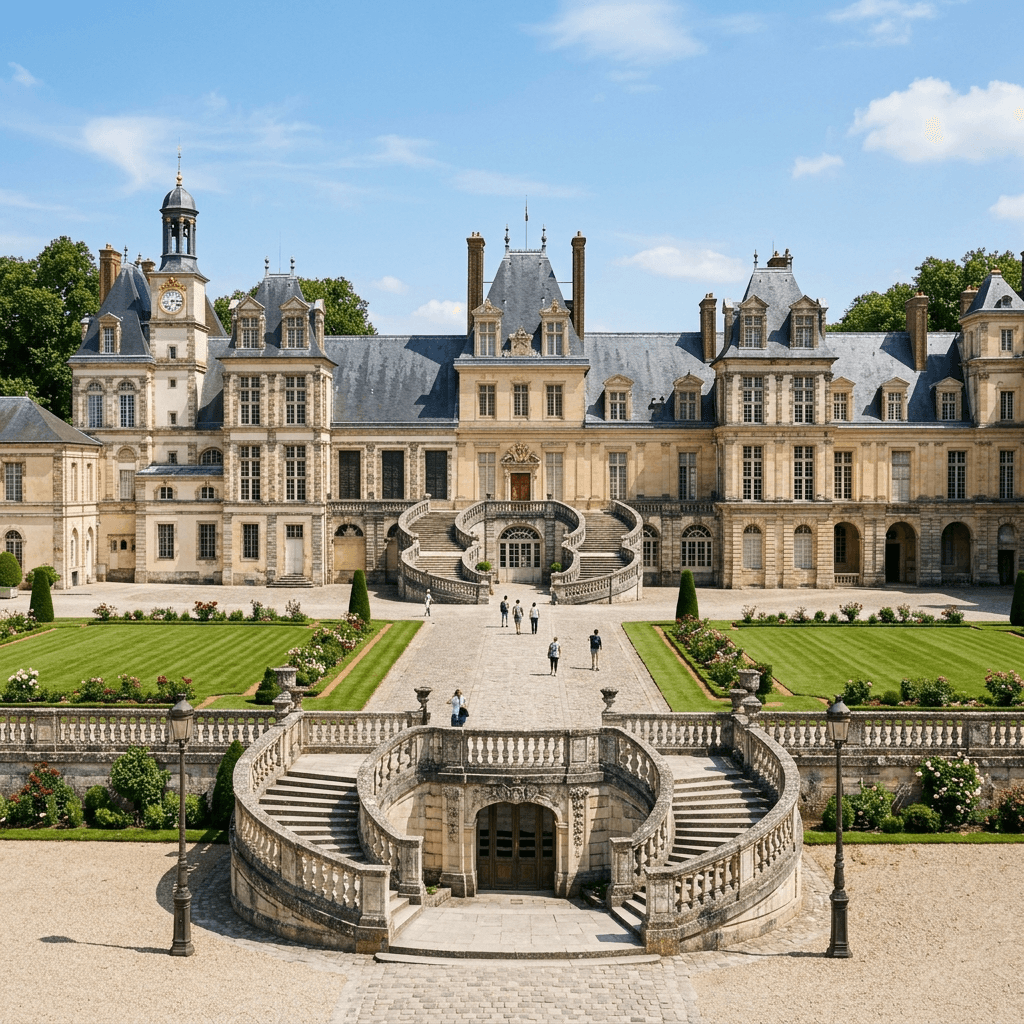
The Horseshoe Staircase (Escalier du Fer-à-Cheval) is the ultimate symbol of the Château de Fontainebleau. Originally built by Philibert de l'Orme in 1559, it was rebuilt by Jean Androuet du Cerceau in 1602 for Henry IV. The staircase embraces the Cour du Cheval Blanc (also called Cour d'Honneur) with its two symmetrical arms that meet in the centre, forming the shape of a horseshoe.
The geometry of the staircase required precise calculations: each step had to be identical to the next, and the curvature had to be mathematically perfect so that the two sides met at exactly the same point. The staircase is made of limestone,
with wide, shallow steps that allow descent on horseback — a necessity for a palace where hunting was the main activity. It was on this staircase that Napoleon bid farewell to his guard in 1814, and it was on it that Louis Philippe and Napoleon III received heads of state.
2.2.1 The exact geometry and engineering challenges of the 16th century
Building the Horseshoe Staircase in the 16th century presented immense challenges. The architects had no structural calculation programs — everything was done with ropes, plumb lines and wooden rulers. The double curvature (the staircase curves both in plan and elevation) required each stone block to be cut individually, with precise angles.
The solution found was to build the staircase in independent sections, each supported by its own stone arch. The arches distribute the weight evenly to the foundations, which rest directly on the limestone bedrock beneath Fontainebleau. The result is over 400 years of continuous use without the need for major structural repairs.
Chapter
2.3 How does the palace heating system work?
The heating system of the Château de Fontainebleau is, by modern standards, primitive — but for its time, it was remarkable. Each main hall had a monumental fireplace that burned whole oak logs from the forest. The Salle du Bal (Ballroom) has a fireplace 5 meters wide, flanked by two statues of satyrs.
The Emperor's Bedroom (Napoleon's) was designed with a system of side panels that could be opened or closed to control the circulation of heat from the fireplace. Napoleon's tinned copper bathtub was heated with hot water carried in buckets from the kitchens — a luxury in the early 19th century.
The smaller rooms used portable braziers (metal containers with embers) and hot water bottles to warm the beds before sleeping. The tapestries on the walls also functioned as thermal insulation, retaining heat in the rooms.
Chapter
2.4 What hydraulic innovations supplied the fountains and gardens?
The Château de Fontainebleau was a pioneer in hydraulic innovations. The 1.2 km Canal was built by Henry IV between 1606 and 1609 — 60 years before the Grand Canal of Versailles. Excavated exclusively with manual labour and animal traction, the canal served to irrigate the gardens, feed the fountains and allow gondola rides.
The Fountain of Diana, in the centre of the Diana Garden, was built by Tommaso Francini between 1601 and 1606. Francini, an Italian hydraulic engineer who also worked at Versailles, created a gravity pressurization system: water was stored in elevated tanks and channelled through lead pipes to the fountains, creating the necessary pressure for the water jets.
The Pine Garden Grotto (Grotte du Jardin des Pins), also by Francini, was the first artificial grotto in France. Decorated with shells, volcanic rocks and mythological statues, the grotto hid a system of pipes that made water run down the walls, creating the effect of a natural cave.
---
Chapter
3. The dark history of Fontainebleau — Murders, intrigues and betrayals on the throne
Chapter
3.1 What mysterious death occurred in the royal apartments?
The darkest episode in the history of the Château de Fontainebleau occurred on November 10, 1657, when Queen Christina of Sweden — one of the most cultured and eccentric women in Europe — had her lover assassinated in the palace corridors.
Christina had abdicated the Swedish throne in 1654 and travelled across Europe as a guest of kings. Louis XIV received her at Fontainebleau with full honours. During her stay, Christina suspected that her master of the horse and lover, the Marquis Gian Rinaldo Monaldeschi, was betraying her. She called a private meeting, and when Monaldeschi arrived, Christina's servants chased him through the corridors and stabbed him to death.
What was most shocking was not the murder, but Louis XIV's reaction: the king visited Christina the next day, did not mention the crime and allowed her to continue her journey. Monaldeschi's body was buried in the local church, and the scandal was hushed up.
Chapter
3.2 What happened at the "Black Wedding" of 1572 in Fontainebleau?
The "Black Wedding" refers to the context of the St. Bartholomew's Day Massacre (August 24, 1572), when thousands of Huguenots (Protestants) were murdered in Paris and other French cities. Although the massacre occurred mainly in Paris, Catherine de' Medici, who lived in Fontainebleau, was one of its main architects.
Catherine, the queen mother and regent, feared the growing power of the Huguenots at court. The marriage of her daughter Margaret of Valois to the Huguenot Henry of Navarre (the future Henry IV) was meant to seal the peace — but it was used as a trap. Days after the wedding, violence erupted.
In Fontainebleau, news of the massacre arrived and the court was in a state of shock. The city, which was one of the centres of Catholic power, did not record violence against Huguenots as elsewhere, but the palace witnessed the meetings where Catherine planned the next steps.
Chapter
3.3 How was Fontainebleau the stage for the signing of the Edict of Nantes?
The Edict of Nantes was signed by Henry IV in 1598 in Nantes. But Fontainebleau was the stage for its reverse: the Edict of Fontainebleau, signed by Louis XIV in October 1685, which revoked the Edict of Nantes and triggered one of the greatest religious crises in French history.
The Edict of Fontainebleau ordered the destruction of Huguenot churches, the closure of Protestant schools and the persecution of pastors who would not convert to Catholicism. In the following 20 years, between 210,000 and 900,000 Huguenots emigrated from France — a mass exodus that deprived the country of artisans, bankers and intellectuals.
This edict is considered one of Louis XIV's greatest political mistakes. In 1985, President François Mitterrand issued a public apology for the act.
Chapter
3.4 Who was imprisoned in the palace dungeons?
The most illustrious prisoner of the Château de Fontainebleau was Pope Pius VII, who was held there between 1812 and 1814 on the orders of Napoleon Bonaparte. The pope had refused to enforce the Continental Blockade against England and to accept the annexation of the Papal States.
Napoleon installed the pope in the royal apartments of the palace — a "gilded prison", with servants, a library and a private chapel. The pope was constantly supervised and Napoleon tried to force him to sign a new concordat (the Concordat of Fontainebleau). Pius VII resisted for two years, refusing to yield.
He was freed in January 1814, as the allied armies approached France. Months later, Napoleon would abdicate in the same palace.
---
Chapter
4. Napoleon and Fontainebleau — The emperor's farewell on the Horseshoe Staircase
Chapter
4.1 What was the "Farewell of Fontainebleau" in 1814?
The "Farewell of Fontainebleau" is one of the most emblematic moments in Napoleonic history. On April 4, 1814, after the military defeat in the Campaign of France and the entry of the allies into Paris, Napoleon Bonaparte signed his abdication in the Salon de l'Abdication of the palace. The historic words: *"I renounce, for myself and my heirs, the throne of France and Italy."*
Between the abdication and his departure for Elba, Napoleon spent days of profound anguish. He attempted suicide by ingesting poison, but survived (the poison had lost potency over time).
On April 20, 1814, Napoleon descended the Horseshoe Staircase for the last time. In the Cour du Cheval Blanc, the Imperial Guard was formed up. Napoleon delivered the speech that went down in history:
*"Soldiers of my Old Guard, I bid you farewell. For twenty years, I have found you on the path of honour and glory. Never abandon me."*
He kissed the flag, embraced the generals, boarded the carriage and left for Elba.
4.1.1 The moving speech to the Imperial Guard
Napoleon's speech to the Imperial Guard was transcribed by witnesses and became one of the most celebrated texts in French military history. His final words were:
*"Never abandon me... be content with my life. Farewell, my children. I wish to press you all to my heart. May this kiss be for all of you and for each one individually."*
Upon hearing these words, veterans hardened by 20 years of wars across Europe wept openly. The Guard responded with a cry that echoed through the palace walls: *"Vive l'Empereur!"*
Napoleon entered the carriage at 12:30 PM. At 1:00 PM, he crossed the gate and left for exile. Eleven months later, he would return for the Hundred Days.
Chapter
4.2 How did Napoleon transform Louis XVI's apartments?
When Napoleon arrived at Fontainebleau in 1804, he found the royal apartments empty — the Revolution had sold all the furniture at auction. He had everything redecorated in the Empire style, the style he himself helped create: mahogany furniture with gilded bronze mounts, chairs with swan-shaped armrests, ship-shaped beds.
The most significant transformation was in the former king's bedroom, which Napoleon converted into the Throne Room. The throne (brought from Saint-Cloud and the Tuileries) was installed on a three-step dais, under a canopy of red velvet embroidered with gold. It is the only Napoleonic throne room that has survived intact to this day.
Napoleon also created a private apartment of six rooms on the lower floor, including a topographic library — the emperor was obsessed with maps and cartography.
Chapter
4.3 Does Napoleon's throne in Fontainebleau still exist?
Yes, Napoleon I's throne in the Château de Fontainebleau exists and is exactly where the emperor placed it in 1808. It is the only original Napoleonic throne room that has survived intact in France.
The throne is made of gilded wood, with a seat and back of red velvet embroidered with gold. Above the canopy, the golden bees — Napoleon's personal symbol — replaced the fleur-de-lis of the monarchy. The room retains its original decoration: crystal chandeliers, silk tapestries and paintings celebrating the military campaigns of the Empire.
Napoleon III preserved his uncle's throne room, and the palace has never been altered since.
Chapter
4.4 What personal objects of Napoleon are in the castle?
The Château de Fontainebleau holds the largest collection of Napoleon Bonaparte's personal belongings outside Paris. Among the most notable:
---
- The camp bed (lit de camp), a folding bed of wood and canvas, identical to those Napoleon used on his military campaigns
- The tinned copper bathtub, with its cotton "skirt" to keep the water warm
- The small table where he signed the abdication on April 4, 1814 (in the Salon de l'Abdication)
- The topographic map of France and Italy, which Napoleon consulted daily
- Camp cutlery, including his travel service
- Personal decorations, including the Legion of Honour and the Iron Crown
Chapter
5. The scandal of the Abbot of Fontainebleau — The crime that shocked the court
Chapter
5.1 Who was the Abbot of Fontainebleau and what crime did he commit?
The Abbot of Fontainebleau was the abbot Guillaume de Beaumont, responsible for the abbey of Fontainebleau in the 17th century. His crime, which shocked the court of Louis XIV, was that of poisoning. Beaumont was accused of poisoning several members of the court and local nobility with arsenic, in a scheme involving blackmail and conspiracy.
The scandal became public when one of the victims survived and denounced the abbot. The investigation revealed that Beaumont was part of a network of poisoners operating in several European courts — known as the "Poisons Affair" (Affaire des Poisons), which in Paris involved figures such as the Marquise de Brinvilliers and Catherine Deshayes (La Voisin).
Chapter
5.2 How did the scandal shake the Church and the monarchy?
The scandal of the Abbot of Fontainebleau deeply shaken the Catholic Church and the French monarchy. An abbot — a clergyman who should have been an example of virtue — using the confessional to obtain information and poison his superiors was a shock that shook the foundations of the Ancien Régime.
The court of Louis XIV was in uproar. The king, who considered himself the "Sun King" and the defender of the Catholic faith, saw his moral authority undermined. The case fuelled a wave of anticlericalism that would last for years.
Chapter
5.3 What punishment was applied to the abbot?
Guillaume de Beaumont was tried and found guilty of poisoning. The punishment was exemplary: he was sentenced to death by burning, the standard sentence for poisoners in 17th-century France. However, because he was a clergyman, the sentence was commuted to life imprisonment in an ecclesiastical dungeon.
The abbot spent the rest of his life in an isolated cell, without visits or communication with the outside world. He died forgotten years later — a tragic end for someone who had begun as one of the most powerful figures in the region.
---
Chapter
6. Renaissance art in Fontainebleau — The school that changed France
Chapter
6.1 What was the School of Fontainebleau?
The School of Fontainebleau was the most important artistic movement of the French Renaissance. Created by Francis I from 1531, it brought together Italian artists specially brought in to decorate the Château de Fontainebleau. The king's goal was clear: to import the Italian Renaissance into France and create a French style that would rival the courts of Italy.
The School was divided into two phases. The First School (c. 1531–1547) was led by Rosso Fiorentino and Francesco Primaticcio, who worked on the Francis I Gallery. The Second School (c. 1594–1610), under Henry IV, was dominated by Flemish and French artists such as Ambroise Dubois, Toussaint Dubreuil and Martin Fréminet, who decorated the Gallery of the Stags and the Chapel of the Trinity.
The Fontainebleau style is characterized by the intensive use of stucco and fresco, complex mythological allegories, elegant figures with long necks and elongated bodies, and an iconography that mixes classical mythology with the glorification of the monarch.
Chapter
6.2 What Italian artists worked at the palace?
Rosso Fiorentino (1494–1540) was the first great artist invited by Francis I. He arrived in France in 1531 and devoted himself entirely to the decoration of the Francis I Gallery. His style — dramatic, expressionistic, with vibrant colours — profoundly marked French art. He committed suicide in 1540, at the age of 46.
Francesco Primaticcio (1505–1570) came from Bologna in 1532 and became the artistic director of the palace for decades. His style is more elegant and refined than Rosso's, with serpentine figures and an erotic-dreamlike atmosphere. He worked on the Ballroom and the Belle Cheminée Wing.
Niccolò dell'Abbate (1509–1571) was invited by Henry II in 1552 to complete the decoration of the Ballroom. His most important contribution was the introduction of landscape as a narrative element in frescoes, influencing French landscape painting.
6.2.1 Rosso Fiorentino, Primaticcio and Niccolò dell'Abbate
The three Italians formed the core of the First School of Fontainebleau. Rosso brought Florentine Mannerism, with its tense figures and complex compositions. Primaticcio introduced Bolognese elegance, with elongated bodies and sophisticated eroticism. Niccolò added the Emilian landscape, with forest backgrounds and open skies.
Together, they created a style that existed neither in Italy nor in France: the Fontainebleau Style, which combined painting, sculpture, stucco and woodwork into a total decorative synthesis.
Chapter
6.3 What Renaissance paintings and frescoes survive in the castle?
The surviving masterpiece of the School of Fontainebleau is the Francis I Gallery (1533–1539), considered the most important set of Renaissance frescoes in France. The scenes include:
Each fresco is framed by high-relief stuccoes by Rosso Fiorentino, with human figures, fantastic animals and festoons of fruit. The oak panelling is by Francesco Scibec da Carpi.
In the Ballroom, the frescoes by Primaticcio and Niccolò dell'Abbate (c. 1552) depict scenes from classical mythology, including the Nymphs of Fontainebleau and the Festivals of Bacchus.
- Ignorance Expelled: an allegory of the spread of knowledge
- The Unity of the State: Francis I's salamander emerging from the flames
- Danaë: the classical myth, treated with refined eroticism
- The Death of Adonis: a scene of pathos and beauty
- The Royal Elephant: an allegory of the king's power
Chapter
6.4 How did the School of Fontainebleau influence French art?
The School of Fontainebleau had a profound impact on French art that extended over three centuries. It introduced Italian Mannerism to France, which until then followed the late Gothic style. The engraving workshop established in Fontainebleau (c. 1542–1548) produced the first etchings in France, which spread the Mannerist style across northern Europe.
Its direct influence can be seen in Jean Cousin (the first great French painter), Jean Goujon (sculptor of the Louvre Caryatids), Germain Pilon (sculptor of the royal tombs) and François Clouet (court portraitist). The "Fontainebleau Style" — the combination of painting, stucco and woodwork — became the model for all French palaces in the following centuries.
The Second School (c. 1594–1610) kept the tradition alive, influencing French Classicism of the 17th century. Without Fontainebleau, French art would have followed a completely different path.
---
Chapter
7. Myths and truths about the Château de Fontainebleau
Chapter
7.1 Is it true that Francis I slept in a different bed every night?
It is an exaggerated myth. Francis I had multiple apartments in the palace and used different suites depending on the season, but he did not sleep in a different bed every night. The legend likely derives from the fact that the king had a hunting routine that led him to sleep in different wings of the palace, depending on the following day's hunting route.
What is true is that Francis I rarely slept in the same place for long: the French court was nomadic, and the king moved between Fontainebleau, Saint-Germain-en-Laye, Blois and Chambord throughout the year.
Chapter
7.2 Does the palace really have 1,500 rooms?
The number of 1,500 rooms is an oral tradition and tourist marketing. Modern surveys indicate approximately 1,200 to 1,300 rooms. For comparison, Versailles has about 2,300 rooms.
The myth of "1,500 rooms" persists in tourist brochures and is repeated by guides, although the palace administration has already acknowledged that the actual number is smaller. Still, 1,200 rooms are impressive enough: if you slept one day in each room, it would take over three years to go through them all.
Chapter
7.3 Did Louis XIV prefer Versailles but hate Fontainebleau?
False — it is exactly the opposite. Louis XIV spent more days in Fontainebleau than any other French monarch. Although Versailles is his architectural masterpiece and the symbol of his reign, the Sun King spent every year the end of summer and early autumn in Fontainebleau to hunt in the forest.
It is estimated that Louis XIV spent about a quarter of his reign in Fontainebleau. It was there that he felt free — away from the protocol of Versailles, he could devote himself to his passion for hunting.
Chapter
7.4 Is there a hidden treasure in the palace walls?
The legend of a hidden treasure in the walls of the Château de Fontainebleau is persistent, but has never been proven. The most common story is that Napoleon would have hidden part of his personal treasure in the walls or underground of the palace before leaving for Elba in 1814 — a reserve fund for his return.
Another legend speaks of a Trinitarian treasure, the medieval monastic order that occupied part of the palace before royalty. It is said that the monks hid gold and liturgical objects before being expelled during the Revolution.
No treasure has ever been found — but the legends continue to fuel the imagination of visitors.
---
Chapter
8. The gardens and parks of Fontainebleau — 130 hectares of royal nature
Chapter
8.1 What is the difference between the Diana Garden and the English Garden?
The Diana Garden (Jardin de Diane) was created by Catherine de' Medici in the 16th century and redesigned by Maximilien Joseph Hurtault for Napoleon I in the 19th century. It is a formal French garden, with geometric flower beds, marble statues and the Fountain of Diana at its centre — a work by Tommaso Francini (1601–1606) depicting the goddess of the hunt, a reference to the royal passion for hunting in the forest.
The English Garden (Jardin Anglais), also designed by Hurtault for Napoleon I, follows the English landscape style: winding paths, trees planted in apparent natural disorder and the Belle-Eau Fountain — the spring that gave Fontainebleau its name. The fountain, with its octagonal stone basin, is the central element.
The contrast between the two gardens reflects the evolution of European taste: from French geometric rigour to English romantic freedom.
Chapter
8.2 What secrets does the Pine Garden Grotto hide?
The Pine Garden Grotto (Grotte du Jardin des Pins) was built by Tommaso Francini for Henry IV between 1601 and 1606. It is the first artificial grotto built in France — a structure of stone and stucco that imitates a natural cave, decorated with shells, volcanic rocks and mythological statues.
The secret of the grotto lies in its hidden hydraulic system: lead pipes integrated into the walls made water run over the rocks and shells, creating the sound of a natural waterfall. In the centre, a statue of Pan or a nymph (depending on interpretation) emerged from the water, surprising visitors.
The grotto was restored in the 19th century and can be visited, although the original hydraulic system no longer works.
Chapter
8.3 How was the 1.2 km canal dug without machines?
The 1.2 km Canal of the Château de Fontainebleau was excavated between 1606 and 1609 on the orders of Henry IV — 60 years before the Grand Canal of Versailles. It was built exclusively with manual labour and animal traction.
The process involved hundreds of workers who dug the earth with shovels and pickaxes, transporting the debris in ox carts. The canal is not a simple trench in the ground: it has a calculated gradient so that water flows by gravity, feeding the fountains and lakes of the gardens. The bottom was lined with compacted clay to waterproof it.
Henry IV ordered rows of elms and fruit trees to be planted along the banks, creating a royal walkway that still exists today.
Chapter
8.4 What to see in the 130-hectare Park?
The park of the Château de Fontainebleau covers 130 hectares of gardens, lakes and woodlands. The unmissable spots are:
---
- The Carp Pond (Étang des Carpes), with 4 hectares and a pavilion at its centre designed by Louis Le Vau for Louis XIV — the carps are centuries old, some over 100 years old
- The Parterre, the formal French garden redesigned by André Le Nôtre for Louis XIV, with geometric flower beds and ancient statues
- The 1.2 km Canal, which can be walked or cycled along
- The Fontainebleau Forest, with 250 km², which begins where the park ends
Chapter
9. Fontainebleau in pop culture — Cinema, literature and video games
Chapter
9.1 What films were shot at the Palace of Fontainebleau?
The Château de Fontainebleau has been the setting for numerous film productions. The most famous film shot in its halls is "Au Revoir, Les Enfants" (1987), by Louis Malle, which takes place in the boarding school installed in the palace during World War II.
Other notable productions include "The Adventures of Rabbi Jacob" (1973), by Gérard Oury, starring Louis de Funès — a classic French comedy that used the Cour de la Fontaine as a setting. The film "Angélique, Marquise of the Angels" (1964) was also partially shot at the palace.
The series "The Crown" (Netflix) used Fontainebleau to recreate scenes of the French monarchy. And the film "Marie Antoinette" (2006), by Sofia Coppola, included some scenes at the palace.
9.1.1 "The Marquise" and other international productions
The film "The Marquise" (in French, *La Marque de la Reine*) used the halls of Fontainebleau as a setting to recreate the 18th-century French court. The Throne Room, the Francis I Gallery and the Ballroom were used for court scenes and balls.
Chapter
9.2 Did Fontainebleau inspire historical video game settings?
The silhouette of the Château de Fontainebleau and its forest have inspired several video games. The games Pokémon X and Y (Nintendo) based the Santalune Forest on the Fontainebleau Forest, with its sandstone rock formations and dense woodland environment.
Assassin's Creed: Unity (Ubisoft) includes references to the palace, and Age of Empires II mentions Fontainebleau in the Joan of Arc campaign. The "Castle Rock" map from the game Alliance of Valiant Arms is inspired by the forest landscape.
Chapter
9.3 What historical novels take place at the palace?
Several historical novels use the Château de Fontainebleau as a setting. The most famous is "The Corsican Brothers" (1852), by Alexandre Dumas, where a duel takes place in the Fontainebleau forest.
"The Black Corsair", by Emilio Salgari, and various film adaptations of the work use the palace as a setting. The trilogy "The Ants" by Bernard Werber sets the main action in the Fontainebleau forest.
Chapter
9.4 Has the palace been the stage for concerts and events?
Yes — and some of the most sublime moments in the cultural life of Fontainebleau take place in its halls. The American Art Schools Festival is held annually at the palace since 2024, with concerts, exhibitions and workshops (in 2026, it runs from June 30 to July 25).
The Balthasar Neumann Ensemble, under the direction of Thomas Hengelbrock, is the palace's resident ensemble, with regular concerts in the Ballroom and the Imperial Theatre.
---
Chapter
10. Practical guide to visiting the Château de Fontainebleau in 2026
Chapter
10.1 How much does the ticket to the castle cost in 2026?
In 2026, the prices of the Château de Fontainebleau are:
From October to March, the palace is free on the first Sunday of each month.
- Full ticket (palace + temporary exhibitions): €14 (full price)
- Reduced rate: €11
- Free: under 18 years (EU and non-EU), young people 18–25 years (EU citizens), disabled people
- Parks and gardens: free (open access every day)
- The ticket includes an audio guide in several languages, including English
Chapter
10.2 How to get to Fontainebleau from Paris?
The Château de Fontainebleau is located 55 km southeast of Paris. The most practical way to get there is:
By train: Depart from Gare de Lyon (line R) to Fontainebleau-Avon — about 40 minutes. Then, Bus Line 1 or a taxi take you to the palace (5 km, about 15 minutes).
By car: Via the A6 motorway, Fontainebleau exit — about 1 hour from Paris.
By bicycle: It is possible, via secondary roads through the forest, but the distance (55 km) is demanding.
Chapter
10.3 How long does the full visit take?
The full visit to the Château de Fontainebleau takes between 3 to 4 hours:
For a quicker visit (only the Grands Appartements and the Gallery), 2 hours are enough.
- Grands Appartements (state rooms): 1h30 to 2h
- Napoleonic Museum: 45 minutes to 1h
- Francis I Gallery and Ballroom: 30 minutes
- Gardens and park: 1h to 2h (depending on available time)
Chapter
10.4 What are the best times to avoid crowds?
The Château de Fontainebleau received 2,062,850 visitors in 2025, with peaks in July and August and on weekends. To avoid crowds:
- Visit during the week (the palace is closed on Mondays, confirm)
- Arrive at opening time (09:30 AM)
- Spring (April to June) and Autumn (September to October) are the best seasons
- Winter is the quietest time — the gardens are more bare, but the palace is practically empty
Chapter
10.5 Is the palace accessible for people with reduced mobility?
Yes, the Château de Fontainebleau has ramps and lifts for wheelchair access to the Grands Appartements and the Napoleonic Museum. There are adapted guided tours and reserved parking for people with reduced mobility.
---
Chapter
11. The Saint-Saturnin Chapel in Fontainebleau — Where kings were baptized
Chapter
11.1 Which kings and queens were baptized in this chapel?
The Saint-Saturnin Chapel is the place where several French monarchs were baptized. The most famous baptism took place on November 5, 1810: Charles-Louis-Napoléon Bonaparte, the future Napoleon III, was baptized in the chapel with Napoleon I as godfather and Empress Marie-Louise as godmother.
Louis XIII, who was born in Fontainebleau in 1601, was baptized in the same chapel. Other princes and princesses of the Bourbon and Bonaparte dynasties received baptism in the chapel over the centuries.
Chapter
11.2 What religious treasures does the chapel hold?
The Saint-Saturnin Chapel holds several religious treasures. The most notable is the high altar of the Chapel of the Trinity, in multicoloured marble, by Francesco Bordoni (1628–1634).
The chapel has the painting of the Holy Trinity by Jean Dubois the Elder (1642), and the carved wooden doors from the 17th century. The richly decorated coffered ceiling features the initials of Henry II intertwined with the salamander emblem of Francis I.
Chapter
11.3 How do the stained-glass windows tell the history of the monarchy?
The stained-glass windows of the Saint-Saturnin Chapel were made at the Royal Manufactory of Sèvres in the 19th century and designed by Maria of Orléans, daughter of King Louis Philippe I — the princess herself was an artist. The windows depict scenes from the life of Christ and the saints, but also include references to the French monarchy, with royal arms and symbols of the dynasties that inhabited the palace.
---
Chapter
12. The Fontainebleau theatre — The private stage of royalty
Chapter
12.1 Who commissioned the imperial theatre?
The Imperial Theatre of the Château de Fontainebleau was built by Napoleon III between 1854 and 1857. The architect was Hector Lefuel — the same who completed the Pavillon de Flore of the Louvre under Napoleon III.
The theatre was built on the site of a previous theatre (from the 18th century, in the Belle Cheminée wing) that was destroyed by a fire in 1856 — ironically, when the new theatre was already under construction.
Chapter
12.2 What performances took place in the royal halls?
The Fontainebleau theatre was the centre of cultural life at the court of the Second Empire. Napoleon III and Empress Eugénie received theatre companies from Paris, which travelled to Fontainebleau to present plays and operas in the royal halls.
In addition to the theatre, the Grands Appartements were used for balls, concerts and receptions. The Ballroom (Salle des Fêtes), with its frescoes by Primaticcio and Niccolò dell'Abbate, was the stage for the court's grand events.
Chapter
12.3 Is the theatre still in operation?
Yes — and it is more beautiful than ever. The Imperial Theatre was completely restored between 2007 and 2014 with funding from the government of Abu Dhabi, and in exchange was renamed the Sheikh Khalifa bin Zayed Al Nahyan Theatre. The reopening took place on April 30, 2014.
With a capacity of 350 to 400 seats, the theatre is currently used for concerts, conferences and performances. The Louis XVI Revival (neo-Louis XVI) decoration is one of the most exquisite in France.
Chapter
12.4 How was Napoleon III's theatre restored?
The restoration of the Imperial Theatre was one of the most ambitious conservation projects in France in the 21st century. The decorative paintings, gilded stuccoes, velvets and crystal chandeliers were meticulously cleaned and restored.
The project cost millions of euros, fully funded by the government of Abu Dhabi in exchange for naming rights to the theatre for a set period. The result is a theatre that looks as if it opened yesterday — every detail, from the painted curtain to the red velvet chairs, was recreated based on period documents.
---
Chapter
13. The Fontainebleau forest — Paradise for climbers and artists
Chapter
13.1 Why does the Fontainebleau Forest attract climbers from around the world?
The Fontainebleau Forest is the largest bouldering area in the world. With thousands of sandstone boulders scattered over 4,000 hectares of rock formations, it attracts climbers from every continent.
What makes Fontainebleau unique is the quality of the Oligocene sandstone (about 35 million years old), which offers unparalleled grip. The rocks were shaped by erosion over millions of years, creating rounded forms, gentle slopes and perfect overhangs for climbing.
The system of coloured circuits — yellow (easy), orange (moderate), blue (difficult), red (very difficult), black/white (extremely difficult) — was created in Fontainebleau and is used worldwide. The Font difficulty scale (from 1 to 9A) was also born here.
It was in Fontainebleau that the first 8A in history was climbed: *"C'était demain"* by Jacky Godoffe in 1984.
Chapter
13.2 What Impressionist painters were inspired by the forest?
The Fontainebleau Forest was the birthplace of the Barbizon School, the movement that preceded Impressionism. Théodore Rousseau, the group's leader, lived in the village of Barbizon, on the edge of the forest, and painted its landscapes for decades.
Jean-Baptiste-Camille Corot painted the *Fontainebleau Forest* (c. 1830), one of his most famous works. Pierre-Auguste Renoir painted *"Jules Le Coeur and His Dogs in the Fontainebleau Forest"* (1866). Claude Monet also painted in the forest.
It was the Barbizon artists who, in 1830, campaigned against the planting of conifers in the forest, which threatened to destroy the natural landscape. The artists' pressure led Napoleon III to create, on April 13, 1861, the first natural reserve in the world — the "Artistic Reserve" of the Fontainebleau Forest.
Chapter
13.3 What are the best hiking trails?
The Fontainebleau Forest has 300 km of marked trails, created by Claude-François Denecourt from 1842. Denecourt was the first to mark paths in the forest, publishing a guide in 1839.
The most recommended trails are:
- The Rock Circuit (Gorges d'Apremont), with spectacular sandstone formations
- The Franchard Circuit, which passes through the most famous climbing areas
- The Painters' Path, which follows the spots where Barbizon artists painted their canvases
Chapter
13.4 What unique biodiversity exists in the forest?
The Fontainebleau Forest has exceptional biodiversity. It counts 3,000 species of catalogued mushrooms and 7,000 animal species (of which 5,000 are insects).
The dominant tree is the oak (44% of the area), followed by Scots pine (40%) and beech (10%). The Sorbus latifolia (*Service tree of Fontainebleau*) is a nationally protected species.
Fontainebleau sand is one of the purest in the world — it is used in the manufacture of Murano glass and fibre optics. The soil is 98% sand, extremely permeable, meaning there are no permanent watercourses in the forest.
There are also over 2,000 caves with rock carvings from the Upper Palaeolithic to the Mesolithic, evidence of human presence in the region for 35,000 years.
---
Chapter
14. The Napoleonic Museum in Fontainebleau — Relics of the empire
Chapter
14.1 What pieces of the Napoleonic Empire are on display?
The Napoleonic Museum (Musée Napoléon I), housed in the Louis XV Wing since 1986, holds the most important collection of Napoleon Bonaparte's personal belongings outside Paris.
The centrepiece items include:
- The Abdication Table — the small table where Napoleon signed his abdication on April 4, 1814
- The Cradle of the King of Rome — the gilded cradle of Napoleon's son (Napoleon II), a masterpiece of goldsmithery and woodwork from the First Empire
- The Throne of Napoleon I, in gilded wood and red velvet
- The Imperial Guard Uniform, with the golden bees embroidered
- Sabres and ceremonial weapons, including the sword used in campaigns
- Personal decorations: the Legion of Honour and the Iron Crown
- Paintings and furniture from the First Empire
Chapter
14.2 Where is the famous cradle of the King of Rome?
The cradle of the King of Rome — son of Napoleon I, named Napoleon II — is on display in the Napoleonic Museum of the Château de Fontainebleau. The cradle was made in 1811 in Empire style, with gilded wood, velvet and bronze fittings.
The King of Rome never reigned: after Napoleon's fall in 1815, he was taken to Austria (the court of his grandfather, Emperor Francis I) and died of tuberculosis in 1832, at the age of 21.
Chapter
14.3 What uniforms and weapons of Napoleon can be seen?
The museum displays several original uniforms of Napoleon, including the famous green coat of the Imperial Guard and the bicorne hat. The weapons include ceremonial sabres, duelling pistols and the campaign sword.
Also on display are Napoleon's camp cutlery — a silver travel set that the emperor took to the battlefield.
Chapter
14.4 How was the museum organized after the fall of the Empire?
After the fall of Napoleon III in 1870 and the end of the Second Empire, the palace was gradually transformed into a museum. During the Third Republic, Napoleonic objects were collected from various palaces (Tuileries, Saint-Cloud, Compiègne) and concentrated in Fontainebleau.
The Napoleonic Museum was officially created in 1986 in the Louis XV Wing, with a route of themed rooms: the emperor's bedroom, the abdication hall, the library, the bathroom and the small room with the camp bed.
---
Chapter
15. FAQ
How much does the ticket to the Château de Fontainebleau cost in 2026?
The full ticket costs €14 (full price), €11 (reduced) and is free for under 18s and EU citizens up to 25 years old. Parks and gardens are free.
How to get to Fontainebleau from Paris?
By train from Gare de Lyon (line R) to Fontainebleau-Avon (40 min), then bus or taxi (15 min). By car, via the A6 (Fontainebleau exit), about 1h.
What is the best time to visit?
Spring (April to June) and autumn (September to October) have mild temperatures and fewer crowds.
How many rooms does the palace have?
Tradition says 1,500, but the actual number is approximately 1,200 to 1,300.
Is Fontainebleau better than Versailles?
It's not about "better", but different. Versailles impresses with its scale; Fontainebleau charms with its intimacy and 8 centuries of history.
Can I visit the palace for free?
Yes, on the first Sundays of each month between October and March. Parks and gardens are always free.
Is the palace open every day?
No. It is generally closed on Mondays, as well as January 1, May 1 and December 25. Check the official website before visiting.
How long does the visit take?
Allow 3 to 4 hours for the full visit (palace + gardens).
Is there an audio guide in English?
Yes, the audio guide is included with the ticket and available in several languages, including English.
Is the palace wheelchair accessible?
Yes, with ramps and lifts in the Grands Appartements and the Napoleonic Museum.
What does "Fontainebleau" mean?
The name comes from the Belle-Eau Spring (beautiful water), the natural spring that supplied the palace and gardens.
What is the difference between the Diana Garden and the English Garden?
The Diana Garden is formal and geometric (French style); the English Garden is landscape and naturalistic (English style).
How many kings passed through Fontainebleau?
34 monarchs, from Louis VII (1137) to Napoleon III (1870), lived in or visited the palace.
Does the palace theatre work?
Yes, with capacity for 350-400 seats, restored in 2014, currently used for concerts and performances.
Is the forest worth visiting?
Yes. The Fontainebleau Forest is the largest bouldering area in the world and was the planet's first natural reserve (1861).