Chapter
1. The Foundation of Nice: Who Really Created the Capital of the French Riviera?
1.1 The Greeks of Marseille and the Founding of Nikaia in 350 BC: The Origin of Nice
Around 350 BC, Greek colonists from Phocaea (modern-day Turkey) set out from Massalia (Marseille) and founded a trading post on the coast of southern Gaul. They named it Nikaia — "city of victory." The exact date is not consensual: some historians place the founding in 354 BC, others prefer 348 BC, but the average range adopted by contemporary historiography is 350–340 BC, based on archaeological excavations and accounts by Strabo and Pseudo-Scymnus. Nikaia became a hub for fishing and maritime trade in the western Mediterranean, competing with neighboring Antipolis (Antibes). Unlike Marseille, Nice was never a large-scale Greek military power, but its role as a port of call and defense proved strategic. The region of Gallia Narbonensis was then dominated by Celtic and Ligurian tribes. The Greek presence lasted until the 1st century BC, when Roman dominion consolidated in the region. Even today, the original Greek site, located atop the Colline du Château, keeps traces — although the Greek city was modest compared to the Hellenic poleis of the Aegean Sea.
1.2 Why Did the Greeks Choose the Bay of Angels to Found Nice?
The Baie des Anges (Bay of Angels) offered ideal conditions for ancient navigation. The natural anchorage was protected from easterly winds by the buttresses of Mont Boron and Cap de Nice. The mouth of the Paillon, a torrential river descending from the Maritime Alps, provided fresh water and a fertile valley for subsistence farming. The hill (future Colline du Château) served as a natural acropolis, at 93 m altitude, with a privileged view of the sea and the mountainous interior — ideal for defense against attacks by land or sea. Local legend says the Greeks chose the site after a naval victory over the Ligurians — hence Nikaia, "victory." Geographically, Nice was a day’s sail from Massalia and halfway along the coastal route to Liguria and the Italian Peninsula. The depth of the bay allowed vessels of up to 50 tons to anchor safely.
1.3 The Goddess Nike: The Meaning of the Name "Nice" in Greek Mythology
Nike, the winged goddess of victory in Greek mythology, a protagonist of the Hellenic pantheon, is the etymological root of Nice. Nikaia literally means "she who conquers" or "city of victory." In Hesiod’s Theogony, Nike is the daughter of the Titan Pallas and the goddess Styx, sister of Zelus (rivalry), Cratos (power), and Bia (force). The Greeks depicted Nike with wings and a laurel wreath, symbol of triumph. In Nice, the name was no accident: it celebrated the military victory that enabled the colony’s founding. The most famous statue of the goddess — the Winged Victory of Samothrace (2nd century BC), displayed at the Louvre Museum in Paris — is the ultimate icon of this heritage. Although the city changed hands countless times, the original name survived for 2,500 years — first as Nikaia, then Nicia in medieval Latin, Nizza in Savoyard Italian, and finally Nice after 1860. The goddess also names global brands (Nike Inc.) and appears on the city’s official coat of arms, which displays an eagle — a symbol associated with Jupiter and victory.
1.4 Nice Before the Greeks: The First Inhabitants of the Region
Before the Greeks, the Nice region was already inhabited for hundreds of thousands of years. The Terra Amata archaeological site, discovered in 1966 during excavations for a building on Boulevard Carnot, revealed traces of human occupation dated to ~400,000 BC — one of the oldest in Western Europe. Some 56,000 lithic artifacts, animal bone remains (ancient elephants, deer, rhinoceroses), and an oval hut measuring 7 m x 4 m were found, indicating that pre-Neanderthal hominids, probably Homo erectus or Homo heidelbergensis, temporarily inhabited the region. The site was dated using the paleomagnetic method and uranium dating. Furthermore, the Ligurians, an Indo-European people established in northwestern Italy and southern Gaul between 2000 BC and 1000 BC, left their mark in the surrounding mountains. The Ligurians lived in castellaras (dry-stone fortifications) and practiced farming, herding, and salt trading. Tombs and rock engravings in the Vallée des Merveilles region, in the Mercantour National Park, with over 40,000 figures dated to the Bronze Age (1800–1500 BC), confirm continuous human activity. Before the Greeks arrived, therefore, Nice was already a territory crossed by hunters, herders, and traders for at least 400,000 years.
Chapter
2. Nice Through the Centuries: From Greek Colony to Capital of the French Riviera
2.1 Roman Nice and the Ruins of Cemenelum in the Cimiez District
With the Roman conquest of Transalpine Gaul in the 1st century BC, Nice lost relevance as a Greek port to the flourishing Cemenelum, in present-day Cimiez, 4 km from the coast. Cemenelum became the capital of the Roman province of the Maritime Alps under Emperor Augustus (14 BC), replacing ancient Nikaia as the administrative and military center. The city housed up to 10,000 inhabitants at its peak, between the 1st and 3rd centuries AD. The ruins accessible today include a Roman amphitheater with capacity for 5,000 spectators, public baths (northern, eastern and western baths), a forum, and sections of walls 3 m thick. The amphitheater, discovered in the 19th century, hosted gladiator combats and underwent renovations under Emperor Antoninus Pius (138–161 AD). The Archaeological Museum of Nice-Cimiez, inaugurated in 1989 on the site, displays mosaics, ceramics, coins, and Latin inscriptions that tell daily Roman life. Excavations also revealed a 17 km aqueduct that brought water from the Vallon de Rimiez, an engineering work from the 2nd century AD. Cemenelum declined in the 4th century with the Germanic invasions and was abandoned around the 6th century.
2.2 Nice in the Middle Ages: Between Genoa, Savoy and the Saracens
Between the 8th and 10th centuries, the Ligurian coast suffered systematic attacks by Saracen pirates from North Africa. Nice was sacked in 813 and 859, forcing the population to take refuge on castle hill. In the 11th century, the city came under the control of the Republic of Genoa, a maritime power rivaling Pisa. In 1176, Nice became a free commune under Genoese protection, with a council of locally elected consuls. The turning point came in 1388: the city signed the Dedication of Nice to the House of Savoy, an act of "voluntary surrender" to Count Amadeus VII of Savoy, in exchange for military protection against the expansionism of Louis I of Anjou and the siege of Genoa. Savoy granted Nice broad municipal autonomy, retaining Italian as the official language and local customs. During the Black Death (1347–1348), Nice lost about 40% of its population. The medieval castle was reinforced in the 14th and 15th centuries, becoming an impregnable fortress with 120 m in length and double walls.
2.3 The County of Nice and the House of Savoy: Why Was Nice Italian?
The County of Nice (Contea di Nizza) was a territorial entity of the States of the House of Savoy from 1388 until 1860. The dominant language was the Niçard dialect, a variant of Ligurian (Northern Italian), with influences from Alpine Occitan. The administrative system, law, currency (Piedmontese lira), and material culture were Piedmontese. Local nobility sent their children to study in Turin, Padua, and Bologna. The Baroque churches of Vieux Nice followed the Italian style — the Piedmontese Baroque with decorated facades and gilded interiors, visible in Sainte-Réparate Cathedral and the Church of St. Francis of Paola. The relationship with the Duchy of Savoy (Kingdom of Sardinia from 1720) explains why Nice was culturally, linguistically, and politically Italian — although geographically separated from the peninsula by the Alps. The population in 1793 was approximately 24,000 inhabitants, mostly Ligurian speakers.
2.4 The Annexation to France in 1860: The Plebiscite That Changed the History of Nice
The Treaty of Turin, signed on March 24, 1860 by the Kingdom of Sardinia (Victor Emmanuel II) and the French Empire (Napoleon III), sealed the annexation of Nice and Savoy to France. In exchange, France supported Italian unification against Austria (Second Italian War of Independence). On April 15 and 16, 1860, a plebiscite asked the Niçois: "Does Nice want to be annexed to France? — Yes or No." The official result was overwhelming: 99.38% of votes in favor (25,734 "yes" against only 160 "no"). Turnout among the 25,277 registered voters (out of a total population of ~44,000) revealed documented fraud: open voting (not secret), pressure from the Francophile clergy, absence of opponents at polling stations, and voting by civil servants forced by the Savoy government. Giuseppe Garibaldi, hero of Italian unification and a native of Nice, denounced the plebiscite as "fraud" and never accepted the loss of his hometown to France. The annexation was ratified on June 12, 1860, and Nice officially became part of France.
2.5 Why Did Nice Stay Out of Unified Italy? The City’s Fate
Italian Unification (Risorgimento), proclaimed on March 17, 1861, excluded Nice due to a cold geopolitical calculation. Camillo Benso, Count of Cavour, Prime Minister of the Kingdom of Sardinia, negotiated the cession of Nice and Savoy as a bargaining chip for French military support against the Austrian Empire in the battles of Magenta (June 4, 1859) and Solferino (June 24, 1859). Napoleon III’s France demanded the natural border of the Alps as a condition — without it, there would be no intervention. Garibaldi, a Niçois and deputy in the Turin parliament, spoke furiously against the cession on March 27, 1860, but was defeated. The phrase attributed to him — "Nizza è mia!" ("Nice is mine!") — became a symbol of local resentment. After 1860, the Italian elite emigrated or was marginalized. The Niçard dialect was suppressed in schools (French became mandatory in 1861). The city was "de-Italianized" and repositioned as a French tourist resort — the French Riviera (Côte d’Azur) was born there. Niçois irredentist movements demanded a return to Italy in the following decades, but the Treaty of Paris (1947) confirmed the border. To this day, the loss of Nice is considered by Italian historians as one of the great diplomatic errors of the Risorgimento.
Chapter
3. The Promenade des Anglais: The Most Famous Boulevard of the French Riviera
3.1 The History of the Promenade des Anglais: How the English Created Nice’s Postcard
At the end of the 18th century, British aristocrats discovered Nice as a winter destination — mild climate, Mediterranean landscapes, and low prices compared to Italy. In 1763, Tobias Smollett published *Travels through France and Italy*, praising Nice as a climatic paradise. In 1820, Reverend Lewis Way, a member of the British colony, proposed to the municipality the construction of a wide seaside road for promenades. Until then, the coast was occupied by fishermen’s shacks and a sandy path. Construction began in 1822 with 2 km of carriage track between the mouth of the Paillon and present-day Pont Magnan. The cost of 40,000 francs was covered by voluntary subscription of the English residents. In their honor, the Municipal Council named it Promenade des Anglais in 1844. The road was successively widened: in 1872 to 7 m, in 1903 to 18 m, and in 1931 to the current configuration of 4 lanes and 32 m total width. The 1930 facade competition ordered the construction of Belle Époque palaces. During World War II, the Promenade was partially mined by the retreating Germans (1944).
3.2 The Blue Chairs of the Promenade des Anglais: An Iconic Symbol of Nice
The iconic blue chairs — chaises bleues — have been an inseparable part of the Promenade des Anglais landscape since 1952. The color Nice blue (RAL 5010, gentian blue) was chosen to represent the sea and sky of the Riviera. Each chair weighs 4.5 kg and is manufactured by Fermob, heir to the original 19th-century foundry. The design follows the Luxembourg model, created in 1923 for the Luxembourg Gardens in Paris — tubular steel frame with powder coating, curved backrest, and slatted seat. Originally they were green; the switch to blue came by municipal decree of Mayor Jean Médecin. Currently the Promenade has approximately 1,200 rentable chairs and 400 sun loungers (deck chairs). Rental costs €6 (chair) and €10 (sun lounger) per day (2025). The chairs are so emblematic that they appear on postcards since 1960 and were the subject of an exhibition at the Museum of Modern Art of Paris in 2018. Stealing a blue chair is a misdemeanor with a €135 fine.
3.3 7 Kilometers of Beauty: What to See on the Promenade des Anglais
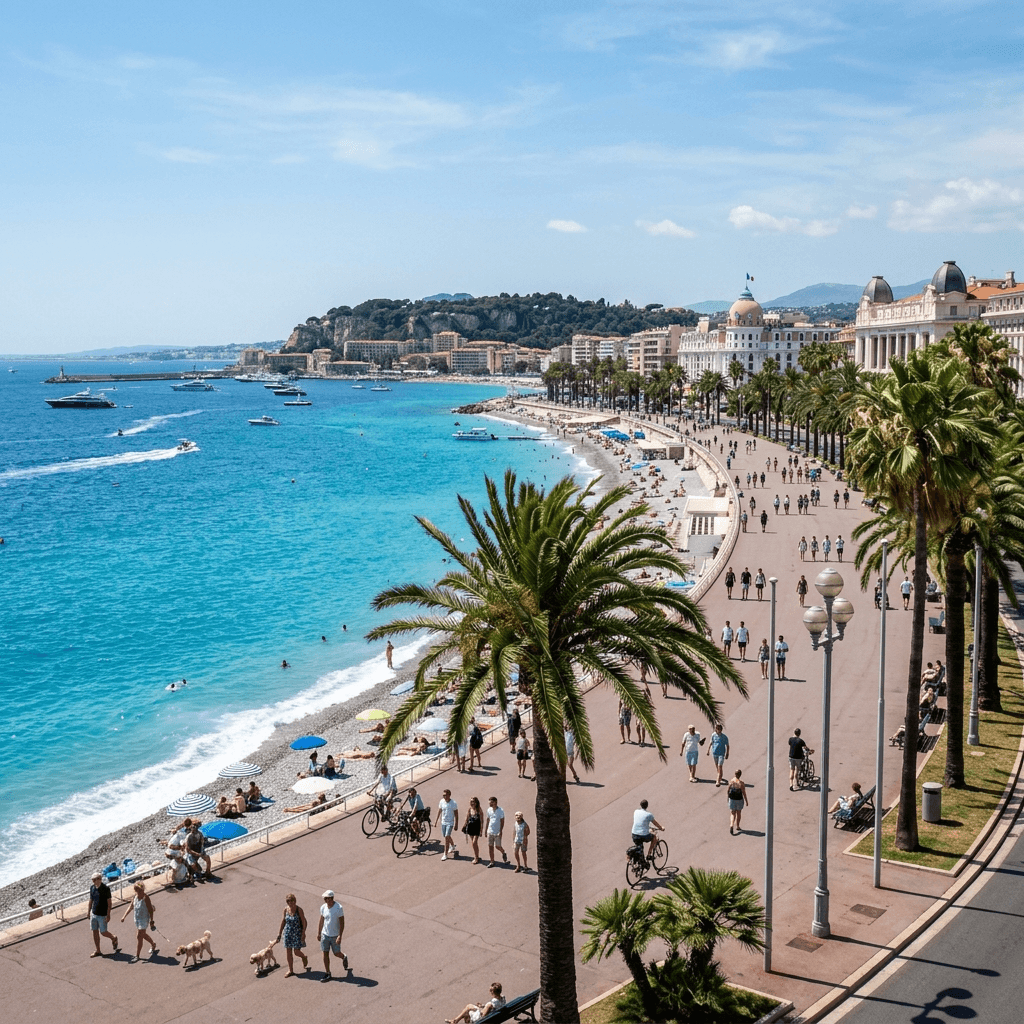
The avenue stretches for 7 km (exactly 7,058 m), from the Quai des États-Unis (east) to Nice Côte d’Azur Airport (west). Along the route, highlights include: the Hôtel Negresco (1913) with its pink dome; the Palais de la Méditerranée (1929), a former Art Deco casino; the Théâtre de Verdure (1948), an open-air arena for concerts; the war memorial (1914-1918) in the Jardin Alsace-Lorraine; the Jardins Albert Ier (3-hectare botanical garden); the Musée Masséna (Belle Époque villa with red brick facade); the Phare du Port (lighthouse from 1861); and the pebble beach — Nice has no natural fine sand. The bike path (two-way bicycle lane) runs parallel for 5 km and is the busiest in France (2,000 cyclists/hour in summer). The Promenade houses 28 hotels, 15 listed palaces, 22 restaurants, and a continuous row of palm trees (Washingtonia filifera).
3.4 The Hotel Negresco: The Belle Époque Palace on the Promenade des Anglais
The Hôtel Negresco was inaugurated on January 4, 1913 at 37 Promenade des Anglais, designed by architect Édouard Niermans in Belle Époque style with influences from French Baroque and Art Nouveau. The owner, Henri Negresco (1868–1920), a Romanian immigrant, dreamed of a palace for the European aristocracy — the cost was 2.5 million gold francs (equivalent to €12 million today). Negresco went bankrupt in 1914 with the outbreak of World War I and sold the hotel. The pink dome in salmon tones, covered with 13,000 glazed clay tiles manufactured by the Tuilerie de Bollène, is the architectural landmark. The Royal Salon features a centerpiece — a Baccarat chandelier weighing 3.2 tons (10 m high, 7,000 crystal pieces), installed in 1913. The restaurant Le Chantecler (2 Michelin stars, since 1953) is decorated in Louis XIII style. Rooms range from €400 to €5,000 per night. The Negresco has been a classified Historic Monument since 2003, managed by Jeanne Augier (1916–2019) and after 2019 by the foundation bearing her name. The hotel has never closed, having survived two world wars.
3.5 Events on the Promenade des Anglais: Carnival, Races and Festivals
The Promenade des Anglais hosts annual events of global scale. The Carnival of Nice, held since 1294 (medieval tradition), is the largest French carnival and the third in the world (behind Rio and Venice). The Battle of the Flowers (Bataille de Fleurs) dates from 1876 — floats covered with 40,000 natural flowers (5 tons of flowers per edition) parade along the Promenade in February/March. The Ironman Nice (70.3 since 2019, full since 2024) includes a 3.9 km swim in the Baie des Anges, followed by 180 km of cycling in the Alps and a 42 km marathon on the Promenade. The Nice Film Festival (since 2001) takes place in June. The Nice Jazz Festival (founded 1948), although at the Théâtre de Verdure, occupies adjacent gardens. Promenade en Fête (July/August) gathers food fairs. The Nice Marathon (November) attracts 8,000 runners. Since the attack on July 14, 2016 (86 dead, 458 injured), the road has been reconfigured with protective barriers and cameras — a response that did not stop it from remaining the heart of the city’s public events.
Chapter
4. Vieux Nice: The Italian Historic Center of the French Riviera
4.1 The Narrow, Colorful Streets of Vieux Nice: Why Do They Look Like Italy?
Vieux Nice (or *Old Town*) is a labyrinth of 150 streets and alleys that preserves the medieval urban layout from before the French annexation of 1860. The facades in shades of ochre yellow, terracotta, and brick red follow the tradition of Genoese Baroque, with wrought-iron balconies painted black and Venetian shutters. The urbanism is inherited from the Republic of Genoa: narrow streets for shade, internal courtyards (*cortili*), external staircases, and churches fitted between buildings. Architect Giovanni Bautista Ghiso (18th century) designed several facades on Place Rossetti and Rue Pairolière. Until 1860, street signs were written in Italian and the Niçard dialect. Comparatively, Vieux Nice is more similar to Genoa (via Garibaldi) and Porto Maurizio than to French cities like Aix-en-Provence. The population density of Vieux Nice is 12,000 inhabitants/km² (2019), the highest in Nice. The most photogenic streets: Rue du Marché, Rue de la Poissonnerie, Rue Benoît Bunico, and Place Rossetti, with Sainte-Réparate Cathedral in the background.
4.2 The Cours Saleya Market: The Best Open-Air Market in Nice
Cours Saleya is the oldest market in Nice, dating from the 18th century. Originally a grassy esplanade (*saleya* means "sandbank" in Niçard dialect), it was transformed into a market square by order of Duke Vittorio Amedeo III in 1776. It operates Tuesday to Sunday, from 6 am to 5:30 pm (until 1:30 pm in winter). From 6 am to 12:30 pm, the flower market occupies 2,000 m² of stalls — 150 varieties of flowers and plants are sold, with emphasis on mimosa, lavender, violets, and roses. On Mondays (7:30 am to 5:30 pm), Cours Saleya becomes an antiques and *brocante* (bric-a-brac) fair. In the covered section (Les Halles), there is a fishmonger and butcher. Typical products include: socca (chickpea flatbread, €3 to €5), pissaladière (onion, anchovy, and olive tart), farcis nissarts (stuffed vegetables), and pan bagnat (Niçoise salad sandwich). At night, Cours Saleya transforms into a restaurant area with 25 establishments with terraces — considered the gastronomic heart of Nice. The market attracts 10,000 visitors/day at summer peak (July-August).
4.3 Sainte-Réparate Cathedral: The Baroque Jewel of Vieux Nice
Sainte-Réparate Cathedral (*Santa Reparata*), dedicated to the patron saint of Nice, was built between 1650 and 1699 over a 12th-century Romanesque church. The Baroque facade, designed by Giovanni Andrea Arioldi, has three levels with Corinthian columns and statues of saints. The interior features frescoes by Jean-Michel Papalardo (1739) on the nave ceiling, paintings by Giovanni Battista Carlone, and gilded woodwork in the high altar. The octagonal dome, covered in green and yellow glazed tiles, stands 42 m high and dominates the Vieux Nice skyline. The side chapels are dedicated to St. Joseph, St. John the Baptist, and the Blessed Sacrament. The name Sainte-Réparate dates back to the 3rd century: Reparata was a virgin-martyr martyred in Caesarea Maritima (Judea) for refusing to renounce the Christian faith — her feast day is October 8. The cathedral was elevated to a minor basilica in 1949 by Pope Pius XII. The most recent facade restoration was completed in 2017 (cost €2.1 million). Unlike French Gothic cathedrals (Notre-Dame, Reims), Sainte-Réparate follows the Italian Baroque style — dynamic facade, excessive gilding, visual theatricality.
4.4 Place Masséna: The Geographic Heart of Nice
Place Masséna is the main square of Nice, connecting Vieux Nice to the modern district (Jean-Médecin). Designed in 1843 by architect Joseph Aune in Neoclassical Italian style, it occupies 2.5 hectares. The red and white arcades (loggias), with 35 arches in total, follow the model of the Venetian arcades of Piazza San Marco — but in red and white (heraldic colors of Nice). The flooring is basalt and granite in a geometric pattern. In the center of the square, the Fontaine du Soleil (1956) by sculptor Alfred Janniot displays a statue of Apollo (sun god) surrounded by five female figures representing the continents. The square is surrounded by 19th-century buildings with pink, salmon, and pale-yellow stucco facades. The Tramway Line 1 (inaugurated 2007) crosses the square. On Saturday mornings, the Marché de la Place Masséna (organic products) takes place. The square was the stage for historic protests, such as the rally against the Front National (2015) and the tributes after the July 14, 2016 attack. The name honors André Masséna (1758–1817), a Marshal of the Napoleonic Empire born in Levens, near Nice.
4.5 Place Giuseppe Garibaldi: The Italian Hero on French Soil
Place Garibaldi, the second largest square in Nice, was built in 1773 as Place de la Liberté and renamed in 1870 in honor of Giuseppe Garibaldi (1807–1882). Garibaldi was born in Nice on July 4, 1807, on Rue de la Poissonnerie, son of sailor Domenico Garibaldi and Rosa Raimondi. He was the military strategist of Italian Unification (Risorgimento), commander of the Expedition of the Thousand (1860) that conquered the Kingdom of the Two Sicilies. The central statue, inaugurated in 1891 (sculptor Ettore Ximenes), portrays Garibaldi with a straw hat, poncho, and sword — the icon of the popular hero. The square has a rectangular shape with double-arched porticoes of Tuscan Renaissance inspiration. The Tramway Line 2 crosses the square. The Nouveau Palais de Justice (2017) with its futuristic glass facade contrasts with the 18th-century buildings. The square also houses the Italian Consulate in Nice. For the Niçois, Garibaldi symbolizes national ambiguity: an Italian hero who lost his hometown to France. Every year on July 4 (his birthday), the Associazione Nizza Italianissima and irredentist groups hold a demonstration in the square raising the Italian flag — a symbolic act that the city hall tolerates but does not support.
Chapter
5. Colline du Château (Castle Hill): The Most Beautiful Viewpoint in Nice
5.1 The History of the Destroyed Castle: Why Is There Nothing Left on the Hill?
Colline du Château housed a military fortress from the 11th century to the early 18th century. The first castle was built around 1075, under the rule of the Counts of Provence, atop the ruins of the ancient Greek acropolis of Nikaia. Expanded in the 13th century by the House of Savoy, it became a citadel with walls 900 m in perimeter, towers 25 m high, dungeons, underground cisterns, and a chapel dedicated to St. Mary of the Castle. The fortress withstood sieges by Charles V (1536), the Turkish admiral Barbarossa (1543), and the Duke of Épernon (1592). In 1705, during the War of the Spanish Succession, troops of the Duke of Savoy Victor Amadeus II occupied Nice against the French. Louis XIV retaliated: in 1706, 6,000 French soldiers under the command of Marshal Louis d’Aubusson, Duke of La Feuillade, besieged Nice for 52 days. The city capitulated on March 26, 1706. By direct order of the king, the castle was blown up with 80 barrels of gunpowder and completely demolished. The stones were used to build churches, buildings, and the port of Nice. The ruins remain buried; only archaeological excavations in 1998 revealed foundations 2.5 m thick. No visible stone remains — the hill today is an urban park.
5.2 The Artificial Waterfall on Colline du Château: A Surprise at the Top
At the top of the hill, an artificial waterfall 24 m high surprises visitors expecting only ruins. Built in 1885 by engineer Vianney, the waterfall was planned as part of the garden irrigation system — water pumped from the Paillon supplies the lake and flowerbeds. The structure combines artificial molded cement rocks (*rocaille* or *faux rocher* technique, popular in the 19th century) with tropical vegetation — bamboo, palms, banana trees, philodendrons. The artificial lake (Bassin du Château) houses ducks, turtles, and koi carp. The water is recirculated by electric pumps, consuming 6,000 liters/hour. Originally, the waterfall fed five public fountains in the city center via aqueduct. In 1923, the waterfall was renovated and received scenic nighttime lighting. The adjacent staircase allows climbing behind the water curtain, revealing an unusual view of Vieux Nice through the flowing water. The waterfall is a mandatory selfie spot — #collineduchâteau accumulates 180,000 posts on Instagram (2025).
5.3 The 360-Degree Panoramic View: Nice, the Sea and the Alps
The Colline du Château viewpoint offers a 360-degree panoramic view considered the best in Nice. To the southwest, the Baie des Anges traces its 7 km arc of beach to the airport and Cap d’Antibes in the distance. To the east, the Port of Nice (Port Lympia) with its 1,200 boats and Mont Boron (195 m). To the north, the chain of the Maritime Alps with peaks up to 3,000 m (Mont Bégo, Mont Ponset) — less than 50 km from the coast. To the northeast, the Paillon valley and residential suburbs. Below, Vieux Nice with its mosaic of ochre roofs and the Promenade des Anglais. The best time is 30 minutes before sunset (golden hour), when golden light reflects on the sea and facades. 360° photography is possible with wide-angle lenses (12-24mm recommended). The viewpoint is equipped with informational panels (maps, cardinal points, altitudes). On clear winter days (after north wind), visibility exceeds 70 km — it is possible to see the Gulf of Saint-Tropez to the southwest and the Italian border to the east (Ventimiglia).
5.4 How to Get Up Colline du Château: On Foot or by Free Elevator?
There are three ways to reach the top of Colline du Château (altitude 93 m). On foot: two main stairways — the Escaliers des Ponchettes (189 steps, 4 min climb) departing from Rue des Ponchettes (Vieux Nice), and the Escaliers Montée du Château (240 steps, 6 min) starting from Rue de Foresta, alongside the port. By free panoramic elevator: located at 1 Rue des Ponchettes, operates daily from 9 am to 8 pm (summer) and 9 am to 5:30 pm (winter), with capacity for 15 people per trip and a duration of 45 seconds. The elevator was installed in 2001 (cost €2.3 million), with a glass cabin that already offers partial views during the ascent. The third option is car/taxi via Montée du Château (paved road), but parking at the top is restricted to residents. The park opens daily from 8:30 am to sunset (seasonal variable hours). The climb on foot burns approximately 80 calories. Tip: go up by elevator and descend on foot via the Escaliers des Ponchettes to enjoy the sunset over Vieux Nice. Dogs are allowed on a leash. The park has 3 free public restrooms and a beverage kiosk (seasonal opening).
Chapter
6. The Museums of Nice: From Matisse to Chagall, Art on the French Riviera
6.1 The Matisse Museum: Why Did Henri Matisse Live 40 Years in Nice?
Henri Matisse arrived in Nice in 1917 on medical recommendation to treat bronchitis. The Mediterranean light transformed his palette. The vibrant colors and pastel tones of the city became hallmarks of his Nice period. He remained on the French Riviera for 40 years, until his death in 1954. The Musée Matisse opened in 1963 in the Cimiez district, inside a 17th-century Genoese villa surrounded by olive groves. The collection brings together 236 works, including paintings, prints, sculptures, and the famous cut-paper pieces. Highlights include the complete "Jazz" series (1947) and the original model of the Chapelle du Rosaire in Vence. The museum displays the artist’s personal objects, such as brushes, palettes, and his collection of African fabrics. Matisse said Nice was "a place where I can work in peace, light, and color." The museum documents his evolution from Fauvism to the geometric abstraction of the cut-outs. The adjacent Arènes de Cimiez garden displays original bronze sculptures. Free admission to the permanent exhibition. The museum receives 120,000 visitors per year.
6.2 The Marc Chagall Museum: The 17 Great Biblical Paintings Donated to the French State
Marc Chagall donated 17 monumental canvases to the French state in 1966 on condition that they house an exclusive museum in Nice. The Musée National Marc Chagall opened in 1973 in the presence of then Minister André Malraux and the artist himself. The building was designed by architect André Gomis in white concrete with zenithal natural light. The 17 Biblical Messages cover Genesis, Exodus, and the Song of Songs in explosive colors. Chagall combined Judeo-Christian symbolism with his dreamlike palette of blues, reds, and greens. The museum also houses 250 additional works: tapestries, stained glass, sculptures, and ceramics. The concert hall displays a triptych stained glass on the Creation of the World. The external garden is one of the most photogenic in Nice. Chagall chose Nice for its light and his emotional connection to the Mediterranean. The museum receives 200,000 annual visitors. The collection includes lithographs, engravings, and preparatory sketches never exhibited during his lifetime. Flash photography prohibited inside the biblical painting rooms. The café offers a view of the centuries-old olive garden.
6.3 MAMAC: The Museum of Modern and Contemporary Art of Nice
MAMAC (Musée d’Art Moderne et d’Art Contemporain) opened in 1990 on the Promenade des Arts, in the heart of Nice. The building is a masterpiece by architect Yves Bayard with a facade of white Carrara marble and suspended walkways. MAMAC documents the School of Nice, a post-war artistic movement that rejected abstract expressionism. The museum houses the largest public collection of Yves Klein — including six IKB (International Klein Blue) works and his Anthropometries. Arman and Martial Raysse are pillars of the collection with accumulations and everyday objects. Niki de Saint Phalle and Ben Vautier complete the core of French contemporary art. The MAMAC terrace connects to the Théâtre de Nice via a walkway with a panoramic view of the city. The total collection exceeds 1,500 works by 250 artists from the 1960s to the present. Temporary exhibitions occur in quarterly cycles. Free admission for under 18s and on the first Sunday of each month. The museum receives 150,000 visitors per year. Klein’s Anthropometries, where models painted their bodies with blue paint, are among the most photographed works in the collection.
6.4 The Cimiez District: Roman Ruins, Monastery and Museums
Cimiez is the most noble district of Nice, situated on the eastern hill at 100 meters altitude. It was the original site of the Roman city of Cemenelum, capital of the Maritime Alps in the 1st century BC. The Roman ruins include an amphitheater with 4,000 seats, baths, and a partially preserved aqueduct. The Franciscan Monastery of Cimiez dates from the 15th century and houses a Renaissance cloister and three paintings by Ludovico Brea (1475). The monastery garden has olive trees planted in the 16th century. The Matisse Museum and the Archaeological Museum are both in Cimiez. The Cimiez Cemetery holds the tombs of Henri Matisse and Raoul Dufy — both painters who chose Nice as their home. The Arènes de Cimiez host the Jazz à Cimiez festival (July) since 1974. The neighborhood streets are lined with Belle Époque villas with pink and yellow facades. Cimiez offers the perfect contrast between the Roman Empire, the Franciscan Middle Ages, and 20th-century modern art. Bus No. 15 goes from the center to Cimiez in 15 minutes. The district is ideal for a full morning visit combining archaeology, art, and nature.
6.5 Other Unmissable Museums: Masséna, Palais Lascaris and Terra Amata
The Musée Masséna at 65 Promenade des Anglais occupies a Belle Époque villa from 1901 with a botanical garden. The collection narrates the history of Nice from the 18th to the 20th century with objects, imperial furniture, and the gold crown of the Carnival King. Highlight: the collection of old prints showing Nice before mass tourism. The Palais Lascaris in Vieux Nice (rue Droite) is a Baroque palace from the 17th century with frescoes and Flemish tapestries. It houses a collection of 500 antique musical instruments, including a Neapolitan harpsichord from 1646. The grand staircase has gilded stuccoes and a ceiling fresco depicting Hercules on Olympus. The Musée de Préhistoire de Terra Amata marks the archaeological site where in 1966 traces of an Acheulean campsite from 400,000 BC were found. It is the oldest human habitation site ever discovered in France. The museum displays flaked stone tools, ancient elephant bones, and a 3D reconstruction of a prehistoric hut. Admission: €5-10 each. The Pass Museum (€15) offers combined access to 5 municipal museums including Matisse and Masséna. The Musée des Beaux-Arts (Palais Chéret) complements the offering with works by Monet, Degas, and Rodin.
Chapter
7. The Russian Orthodox Cathedral of Nice: An Unexpected Jewel on the French Riviera
7.1 Why Is the Largest Orthodox Cathedral Outside Russia in Nice?
St. Nicholas Cathedral in Nice was, until 2016, the largest Russian Orthodox cathedral outside Russia. It was surpassed by the Cathedral in Paris (inaugurated in 2016). Construction began in 1903 and ended in 1912. Tsar Nicholas II of Russia personally contributed 400,000 gold francs to the work. The reason for the Russian presence in Nice dates back to the 19th century: the Russian aristocracy chose the French Riviera as a winter destination. The cathedral is located in the Cimiez district, at 17 boulevard du Tzaréwitch. The land was donated by Grand Duchess Anastasia Mikhailovna of Russia, who had a residence in Nice. The church belonged to the Russian diaspora and was the scene of legal disputes between the Russian Orthodox Church Outside of Russia and the Moscow Patriarchate. In 2013, French courts ruled that the cathedral belonged to Russia. Today it operates under the Moscow Patriarchate. Visitors need to pay €3 (€5 with audioguide) to enter. The cathedral is one of the most photographed architectural landmarks in Nice, with 300,000 annual visitors. The main dome reaches 35 meters in height.
7.2 The Russian Nobility Who Spent Winters in Nice in the 19th Century
Nice became a destination for the Russian aristocracy from the 1850s onward. Winter in Russia was brutal; the French Riviera offered sun, sea, and mild temperatures. Grand Duchess Elena Pavlovna rented the Villa Bermond in 1856 for the winter season. The Russian community in Nice reached 5,000 people during the months of January to March. The turning point was the death of Tsarevich Nicholas Alexandrovich (son of Tsar Alexander II) in Nice on April 24, 1865 at age 21, from tuberculous meningitis. The chapel built at the site of his death became the embryo of the future cathedral. The Russian court began frequenting Nice regularly: Alexander II, Alexander III, and the young Nicholas II visited the city. Dostoevsky spent seasons in Nice in 1868. Tchaikovsky visited in 1878 and 1888. Ivan Turgenev lived in a villa in Bougival but frequented Nice. The Russian colony built hotels, bookstores, Turkish baths, and its own post office. The Russian Library of Nice (rue de Longchamp) still operates with over 10,000 volumes. Hotels such as the Hôtel des Anglais and the Hôtel de Russie catered to the Slavic clientele. Russian influence left marks on the architecture, gastronomy, and street names of Nice.
7.3 The Byzantine Architecture of St. Nicholas Cathedral
St. Nicholas Cathedral follows the Neo-Russian style with Byzantine elements typical of 17th-century Orthodox churches. The architect was Mikhail Preobrazhensky (1854–1930), a renowned Russian imperial architect. The 5 onion-shaped domes are covered in green and gold glazed ceramic. The exterior in red brick alternates with bands of white limestone. The facade features mosaics depicting Christ Pantocrator, St. Nicholas, and St. Alexander Nevsky, executed in Venice by the firm Fratelli Bertini. The interior is divided by a carved and gilded wooden iconostasis with 48 icons by master Vasily Gurko. The internal frescoes cover 400 m² and depict scenes from the New Testament and Russian saints. The central chandelier (panikilo) in bronze weighs 800 kg. The royal doors of the iconostasis are covered in silver. The floor alternates Italian marble and Russian granite. The acoustics were designed for Orthodox choirs without electrical amplification. The throne was carved from Russian oak wood. The cathedral can accommodate 1,000 worshippers standing, according to Orthodox rite. The main bell weighs 1,500 kg and was cast in Moscow in 1910.
7.4 The Russian Cemetery of Nice: A Piece of Russia on the Mediterranean
The Russian Cemetery of Nice (or Cimetière de Caucade) is located on boulevard de l’Observatoire. It was created in 1867 after the death of Tsarevich Nicholas to serve the local Orthodox community. It contains over 1,400 graves of Russians who lived or died in Nice between the 19th century and the present day. The Orthodox chapel of the cemetery is dedicated to St. Nicholas and was built in 1882 with donations from the imperial family. The graves include princes, grand dukes, tsarist generals, artists, writers, and exiles from the 1917 Revolution. Highlights: the tomb of Grand Duke Nicholas Mikhailovich (executed by the Bolsheviks in 1919) and Princess Youssoupoff (mother of Rasputin’s assassin). General Wrangel, leader of the White Army in the Russian Civil War, visited the cemetery before dying in Brussels. After 1917, hundreds of White refugees were buried there — nobles who escaped Bolshevik Russia with nothing but titles. The cemetery has a specific section for White Army soldiers. Many headstones have epitaphs in Old Russian and show enamel photos of the deceased. The cemetery blends three-bar Orthodox crosses, miniature chapels, and marble mausoleums. The atmosphere is melancholic and deeply historical, wrapped in cypress trees and silence. Free admission. Best visited in the morning. The cemetery is still active and receives burials from the contemporary Russian community of Nice. The association Amitié Russe-Nice organizes guided tours in French and English.
Chapter
8. The Gastronomy of Nice: Socca, Salade Niçoise and Mediterranean Flavors
8.1 Socca de Nice: The Most Famous Chickpea Pancake in France
Socca is the most iconic gastronomic specialty of Nice. It is a thin pancake made from chickpea flour (pois chiche), extra virgin olive oil, water, and salt. The liquid batter is spread on a large round copper tray and baked in a wood-fired oven at 300°C for about 10 minutes. The result is a crispy edge and a creamy, slightly oily center. It should be eaten hot, with your hands, sprinkled with freshly ground black pepper. Socca is sold at street stalls, markets, and traditional restaurants in Vieux Nice. The average price for a portion is €3-5. The recipe was brought by Genoese soldiers in the 16th century — in Genoa, the same dish is called farinata (with slight differences in thickness and oil). Cours Saleya Market has specialized stalls selling socca to go. Tradition dictates eating socca as an afternoon snack (goûter) or appetizer. The ideal texture is golden on the outside, moist on the inside. Chef Auguste Escoffier (born in Villeneuve-Loubet, near Nice) championed socca as "the soul of popular Niçoise cuisine." About 2 tons of chickpea flour are consumed weekly in Nice for socca production.
8.2 The Real Salade Niçoise: Why Doesn’t It Have Boiled Potato?
The original Salade Niçoise is one of the most debated recipes in French cuisine. The authentic version, defended by the Conseil National des Arts Culinaires and chef Jacques Médecin (former mayor and author of "La Cuisine Niçoise"), does NOT contain boiled potato, corn, or cooked green beans. The mandatory ingredients are: ripe tomatoes cut into quarters, hard-boiled eggs (2-3), anchovies or tuna preserved in olive oil, black Niçoise olives, capers, red onion, and extra virgin olive oil. The dressing is simple: olive oil, red wine vinegar, salt, and pepper. No mustard. No mayonnaise. The controversy began when Parisian and American chefs started adding boiled potatoes and green beans to "bulk up" the salad. The Michelin Guide and Julia Child (who loved the version with potato) popularized the adulteration. The original version is a summer salad, using tomatoes at peak ripeness. It should be assembled in layers, not mixed: tomato at the bottom, eggs and anchovies on top. Drizzle with olive oil 10 minutes before serving so the tomatoes release their juice. Serve at room temperature — never cold.
8.3 Pan Bagnat: The Traditional Sandwich of Nice
Pan Bagnat literally means "wet bread" in the Niçard dialect (pan = bread, bagnat = bathed). It is the sandwich that takes the Niçoise salad inside a round loaf. The traditional bread is pain de campagne or fougasse (the Niçoise version of focaccia). The secret is to moisten the bread with olive oil (it can be lightly dampened with seawater or tomato sauce — a fishermen’s tradition). The filling is the same as the Niçoise salad: tomato, sliced hard-boiled egg, anchovy or tuna, olives, capers, red onion, fresh basil. The sandwich should rest for at least 30 minutes before serving so the flavors meld. Pan Bagnat is the perfect beach meal — sturdy, portable, and nutritious. It was invented by Niçois fishermen who needed a practical meal for days at sea. Cours Saleya has stalls that prepare Pan Bagnat fresh for €7-10. Restaurants serve more elaborate versions with grilled tuna (instead of canned) for €12-15. Barre de la Mer (Promenade des Anglais) has sold traditional Pan Bagnat since 1920. Pairs well with chilled Provençal rosé. The Fête du Pan Bagnat takes place annually in June at the Port of Nice with free tasting.
8.4 Pissaladière: The Niçoise Pizza with Onions and Anchovies
Pissaladière is the Niçoise answer to Italian pizza, with radical differences. It contains no cheese or tomato sauce. The base is bread dough (thicker than Neapolitan pizza) topped with onions confit slowly in olive oil for 2-3 hours until sweet and caramelized. The topping includes cured anchovies arranged in a geometric pattern (diamond) and black Niçoise olives. The name comes from pissala, a fermented paste of anchovies and sardines used in medieval Niçoise cuisine. The recipe dates from the 16th century, when Nice was part of the Duchy of Savoy. Pissaladière is served at room temperature as an appetizer, starter, or snack. The best are found in traditional bakeries of Vieux Nice such as Boulangerie des Deux Frères and Chez Thérésa. The traditional diameter is 30 cm and serves 4 as a starter. Average price: €8-12 for a whole one. In Saint-Jean-Cap-Ferrat, Pissaladière du Port adds fresh chives on top. Classic pairing: dry white Bellet wine (local AOC from Nice). The "pissaladière royale" version adds confit tomatoes and roasted garlic.
8.5 Ratatouille: The Vegetable Dish Nice Exported to the World
Ratatouille Niçoise is a vegetable dish cooked in olive oil that became world-famous after the Pixar film (2007). The authentic Nice version differs from the international version. The ingredients are: eggplant, zucchini, tomato, bell pepper (red and yellow), onion, and garlic. The Niçois golden rule: each vegetable is cooked separately in olive oil before being combined. Eggplant fried alone, zucchini sautéed alone, peppers roasted separately. Only at the end are they all mixed with tomato and herbs (thyme, bay leaf, basil). Cooking separately ensures each vegetable maintains its original texture and flavor. Ratatouille is served cold or hot — in a Niçois meal, it accompanies grilled fish or lamb. The word comes from "rata" (coarse food in Old French) and "touiller" (to stir). The recipe originated as a peasant dish in the 18th century, made with leftover garden vegetables. Chef Roger Vergé (1940–2012) created the "Ratatouille Confite" version at Moulin de Mougins, where the vegetables are cut into small cubes and confit separately. Ratatouille is the basis of French detox cuisine — zero saturated fat, 100% vegetable. Freezes very well. Ideal to prepare one day in advance (the flavors meld). There is no AOC Ratatouille, but the Association des Cuisiniers Niçois certifies restaurants that serve the authentic version.
8.6 Where to Eat the Best Socca: Chez Pipo and Other Addresses
The most famous socca address in Nice is Chez Pipo (13 rue Bavastro, Port de Nice). Open since 1923, it is a family institution serving socca baked in the original wood-fired oven. The line starts at 11 am and the socca runs out before 2 pm. Chez Pipo’s secret: they use chickpea flour from controlled Provence origin and AOC Nice olive oil. Price: €3.50 per portion. Chez Simon (rue du Malonat, Vieux Nice) is the century-old competition — serving socca since 1930 in a rustic setting with Provençal tiles. Lou Pilha Leva (15 rue Centrale) is the choice of younger Niçois: besides socca, they serve pan bagnat and pissaladière with organic ingredients. Mère Bigarreau (at Cours Saleya, Wednesday to Sunday) sells socca in a paper cone to go. The Marché de la Libération (Libération neighborhood) has the Socca d’Anita stall — the most praised in local rankings. Price: €2.50 per cone. Cours Saleya has multiple stalls, but quality varies — prefer the ones with a line of locals. Final tip: socca must be eaten within 10 minutes of leaving the oven. After that, it loses its crispness and becomes rubbery. Skip the "supermarket socca" sold in packages — they bear no relation to the original. Local pairing: a Bellet rosé wine (€8 in shops, €12 in restaurants) or simply an artisanal lemonade (citronade).
Chapter
9. The Carnival of Nice: The Biggest Carnival in France and One of the Largest in the World
9.1 The History of the Carnival of Nice: Over 150 Years of Celebration
The first mention of the Carnival of Nice dates from 1294, when Count Charles II of Anjou recorded his participation in the festivities. The modern carnival, however, began in 1873 with the creation of the Comité des Fêtes and the organized parade on the Promenade des Anglais. The festival was suspended during both World Wars and during the 1929 crisis. The carnival regained strength in 1947 with post-war reconstruction. In 1994, the event was professionalized with the creation of the Centre des Congrès et du Carnaval. Today it is the third largest carnival in the world, behind only Rio de Janeiro and Santa Cruz de Tenerife. It attracts 1.2 million visitors per edition. The annual budget exceeds €4 million and involves 900 professionals hired directly. Ticket sales began in 1975 — before that, it was 100% free. The carnival lasts 15 days (longer than the Rio carnival, which has 4 official days). About 120 carnival associations participate each year. The Casa do Carnaval (at the port) houses the historical collection with floats from 1950 preserved.
9.2 The Giant Floats: How Are They Made?
Each float for the Carnival of Nice is handcrafted over 6 months in the hangars of the Maison du Carnaval, in the Port district. The metal structure is welded onto recycled truck chassis. The covering uses papier-mâché over a wire frame — a technique inherited from 18th-century Venetian carnivals. About 5 tons of paper are consumed per edition. The paints are acrylic with waterproof varnish to withstand rain and sea spray. Each float is 3 to 8 meters tall and weighs 2 to 12 tons. Themes are set 2 years in advance by the artistic committee — the 2026 theme is "Trésors de la Terre" (Treasures of the Earth). The permanent team has 45 artisans: blacksmiths, sculptors, painters, electricians, and costume designers. The floats are motorized and require a specialized driver with a heavy vehicle license. The assembly time for each float is 3 to 4 months. The largest float ever produced measured 14 meters in height (2010, theme "Roi des Mers"). About 30 giant floats parade per night. The average cost of a float is €50,000-120,000. After the carnival, the floats are dismantled and recycled — only the head of the King of the Carnival is preserved on display.
Each float for the Carnival of Nice is handcrafted over 6 months in the hangars of the Maison du Carnaval, in the Port district. The metal structure is welded onto recycled truck chassis. The covering uses papier-mâché over a wire frame — a technique inherited from 18th-century Venetian carnivals. About 5 tons of paper are consumed per edition. The paints are acrylic with waterproof varnish to withstand rain and sea spray. Each float is 3 to 8 meters tall and weighs 2 to 12 tons. Themes are set 2 years in advance by the artistic committee — the 2026 theme is "Trésors de la Terre" (Treasures of the Earth). The permanent team has 45 artisans: blacksmiths, sculptors, painters, electricians, and costume designers. The floats are motorized and require a specialized driver with a heavy vehicle license. The assembly time for each float is 3 to 4 months. The largest float ever produced measured 14 meters in height (2010, theme "Roi des Mers"). About 30 giant floats parade per night. The average cost of a float is €50,000-120,000. After the carnival, the floats are dismantled and recycled — only the head of the King of the Carnival is preserved on display. The floats are motorized and require a specialized driver with a heavy vehicle license. The assembly time of each float is 3 to 4 months. The largest float ever produced was 14 meters high (2010, theme "Roi des Mers"). About 30 giant floats parade per night. The average cost of a float is €50,000-120,000. After the carnival, the floats are dismantled and recycled — only the head of the King of the Carnival is preserved on display.
9.3 The Battle of the Flowers on the Promenade des Anglais
The Bataille de Fleurs (Battle of the Flowers) is the oldest tradition of the Carnival of Nice, created in 1876 by painter Alexis Mossa (who also designed the first floats). The parade takes place on the Promenade des Anglais with 20 flower-covered floats carrying professional models dressed in themed costumes. The models throw flowers — about 100,000 flowers per parade — to the audience. The flowers are specially cultivated in the Grasse and Hyères regions: mimosas, roses, carnations, lilies, gerberas, and daisies. Tradition requires that the flowers be 100% natural — no artificial ones are allowed. Each flower is cut 48 hours before the parade and kept in cold chambers. The floral floats carry an average of 10,000 flowers each. The bouquets are attached with wires to floral foam structures. The audience can catch the thrown flowers — bringing home a flower from the Battle is considered good luck by the Niçois. The audience can also throw flowers back (hence the name "battle"). There are 6 sessions during the carnival (2 illuminated night sessions, 4 daytime sessions). Bleacher ticket: €30-60 per session. The Battle of the Flowers has been copied by Monte Carlo, Sanremo, and Barcelona.
9.4 The King of the Carnival: The Coronation Tradition
The Roi du Carnaval (King of the Carnival) is the central figure of the Nice festival. It is a giant puppet 6 to 12 meters tall made of papier-mâché over a bamboo and metal frame. The King is crowned at the opening ceremony at Place Masséna, always on the last Saturday of February. Each edition has a theme and the King is dressed accordingly — in 2025 it was "Roi des Océans" with seaweed beards. The puppet parades on its own float for 15 days accompanied by the court (smaller "minister" floats). The King is positioned at the entrance of the Promenade des Anglais during the day, as a meeting point and photo spot. The closing night (Mardi Gras / Fat Tuesday) culminates with the burning of the King on Nice beach. The puppet is set on fire on a metal structure over the sand, with synchronized fireworks. The original meaning is purification and the end of winter — a pagan tradition of symbolic sacrifice. About 50,000 people watch the burning live. The ceremony was suspended in 1991 for environmental reasons, but resumed in 1994 with controlled burning and emission filters.
9.5 When to Visit to See the Carnival: Dates and Tickets
The Carnival of Nice takes place annually between February and March, lasting 15 days. Dates vary according to the Easter calendar. In 2026: February 14 to March 2. In 2027: January 30 to February 14. The program includes: Corso Carnavalesque (night parade with illuminated floats, 2 editions), Bataille de Fleurs (6 editions), Parade du Roi (opening), and Incendie du Roi (closing). Tickets are sold on the official website nicecarnaval.com from October of the previous year. Prices: covered bleacher €20-120 (depending on the parade and proximity); €12 standing on the sides (less visibility). Children up to 6 years old: free on lap. The Carré d’Or (VIP section with open bar) costs €150-250. Night parades have more expensive tickets because they include light shows and fireworks. Tips: buy in advance — the best seats sell out by November. Daytime parades (2:30 pm) are better for photos; night parades (8 pm) for atmosphere. Arrive 1 hour early to pass security (no drinks, sharp objects, or chairs allowed). Metro runs until 1 am during the carnival. Parking: €25-40 per day in downtown lots. The Promenade des Anglais is closed to vehicles from 1 pm to 11 pm on parade days. Bring warm clothes — nighttime temperature in Nice in February is 6-10°C. Restaurants and hotels have special carnival rates (book 6 months in advance).
Chapter
10. Catherine Ségurane: The Heroine of Nice Who Defeated the Turks with a Beater
10.1 The Siege of Nice in 1543: When the French and Ottomans Attacked
Nice was besieged in August 1543 by an unlikely alliance between King Francis I of France and the Ottoman admiral Khair ad-Din (known as Barbarossa / Barberousse). The French wanted the city because it was an enclave of the Duchy of Savoy, an ally of the Holy Roman Empire (enemy of France). Barbarossa had his own agenda: expanding Ottoman dominion in the Western Mediterranean. The Ottoman fleet arrived with 110 galleys and 30,000 soldiers. The French troops numbered 5,000 men under the command of the Count of Enghien. The siege was coordinated by land and sea. The city resisted under the command of Governor Antoine de Grignan and the Countess of Tende (widow of the county’s ruler). Nice’s fortifications at the time were medieval and insufficient against heavy artillery. The siege lasted from August 6 to September 8, 1543 — 34 days. The lower city (Vieux Nice) fell, but the Castle of Nice (Colline du Château) held out. Barbarossa betrayed the French and did not hand the city over to Francis I. The Ottomans sacked and burned Nice, taking 5,000 prisoners as slaves. The siege ended when the Ottoman fleet departed due to lack of provisions. This event is remembered as the Grand Siège — one of the most traumatic in Niçois history.
10.2 Who Was Catherine Ségurane? The Laundress Who Became a Legend
Catherine Ségurane (in Niçard: Catarina Segurana) is said to have been a laundress (blanchisseuse) from the Port of Nice district during the siege of 1543. The surname Ségurane derives from Segur (safe, firm) — possibly a nickname, not a family name. There is no contemporary historical record of her existence in documents from 1543. The first written mention dates from 1557, 14 years after the siege, in a poem by writer Jean Badat (a native of Nice). Badat describes her as "a woman of the people, of no noble lineage, who saved the city with her courage." Historian Pierre Gioffredo (1620–1695) recorded the story in his work "Storia delle Alpi Marittime" (1662). The legend: Catherine wielded her beater (a wooden paddle used for beating laundry) against an Ottoman janissary who was trying to hoist the Turkish flag on the ramparts. Catherine’s figure became a symbol of popular resistance. Unlike Joan of Arc, Catherine was not noble nor had mystical visions — she was a common worker who reacted to the invasion. The Niçois ruling class initially ignored the story because it came from a plebeian woman. Popular canonization occurred in the 19th century with the movement to revive local traditions.
10.3 The Laundry Beater: How Catherine Defeated a Turkish Janissary
The central scene of the legend took place on the walls of the Castle of Nice during the final Ottoman attack in September 1543. A janissary (Ottoman elite soldier) allegedly scaled the fortifications and hoisted the flag of the Ottoman Empire with the crescent moon. The defenders were retreating. Catherine Ségurane, who was at the castle bringing water and food to the soldiers, reportedly shouted "Viva Nissa!" (Long live Nice! in dialect). She raised her oakwood beater (approximately 40 cm long, 10 cm wide) — a tool used for beating clothes against stones in public washhouses. She struck the janissary on the head, knocking him down. She grabbed the Ottoman flag and threw it from the top of the ramparts. The gesture is said to have inspired the Niçois soldiers to resume fighting and repel the attack. The popular version adds that Catherine also lifted her skirt to humiliate the invaders (a gesture of ultimate insult in Ottoman culture). There is no historical consensus on whether she killed the janissary or merely wounded him. The beater became a heraldic symbol of the city’s resistance — it appears on coats of arms, sculptures, and logos of Niçois associations.
10.4 The Captured Ottoman Flag: The Symbol of Resistance
The captured Ottoman flag taken by Catherine Ségurane became the most important civic relic of Nice. According to tradition, the flag was displayed at St. Reparata Cathedral (now Nice Cathedral). Historian Jean-Baptiste Toselli (1815–1885) wrote of having seen the flag preserved in the cathedral sacristy in 1840. The flag disappeared during the French Revolution (1792) or possibly during the French occupation of 1793. The Corporation of Fishermen of Nice kept a replica of the flag in an annual procession until 1914. The coat of arms of Nice began to include a variation with the eagle holding the Ottoman flag split in half. The beater crossed with the Turkish flag is the emblem of the Club Niçois, a cultural association founded in 1903. Today, the original flag is celebrated as the most important lost object in the history of Nice — equivalent to Joan of Arc’s sword for France. The search for the original flag is a recurring theme of documentaries and local reports. In 2003, historian Ralph Schor published "Le Drapeau Perdu de Catherine Ségurane" investigating its whereabouts.
10.5 The Monument to Catherine Ségurane: Where It Is and Why It Matters
The monument to Catherine Ségurane is located on rue Catherine Ségurane, in the Port of Nice district, near Place Île-de-Beauvé and the entrance to Port Lympia. It is a bronze relief on a limestone base, created by sculptor Antoine Vassé (1856–1924) and inaugurated in 1923 in the presence of the city’s mayor. The relief shows Catherine Ségurane standing over the body of the fallen janissary, holding the beater in her right hand — an expression of determination, without religious idealization. The inscription in Niçard dialect reads: "A Caterina Segurana, la lavandera que sauvé Nissa" ("To Catherine Ségurane, the laundress who saved Nice"). The monument measures 2.5 meters in total height. In 2015, it was vandalized with red paint (protest against local nationalism), but restored within 48 hours. Rue Catherine Ségurane is one of the oldest streets in Vieux Nice and connects the port to the historic center. The surrounding square hosts a Flea Market on Saturdays. The monument is a mandatory stop on all historical walking tours of Nice.
10.6 Catherine Ségurane Day: November 25 in Nice
November 25 is Catherine Ségurane Day in Nice — an unofficial popular festival, but deeply rooted in local identity. The date was chosen in reference to St. Catherine’s day (Catherine in French), November 25, with no direct relation to the siege (which occurred in August-September). The modern celebration was instituted in 1972 by the Club Niçois and the Académia Nissarda (association for the defense of Niçois culture). The day includes: Mass in Niçard dialect at St. Reparata Cathedral at 10 am; procession with historical costumes from the port to the monument on rue Catherine Ségurane; laying of flowers (mimosas and red carnations) at the monument; speeches in French and Niçard by local authorities. The celebration ends with socca and mulled wine (vin chaud) distributed in the square. About 2,000 people participate annually, including members of folk groups such as La Ciamada Nissarda and Lou Cepoun. The festival is organized without public funding — maintained by donations and sales of regional products. In 2023, the 480th anniversary of the siege had a special edition with a historical reenactment on Colline du Château with 100 performers. Catherine Ségurane Day is not a municipal holiday, but Nice schools hold educational activities about the heroine in the week leading up to the date.
Chapter
11. Nice como Base para Explorar a Riviera Francesa: Mônaco, Cannes e Além
11.1 Nice vs. Monaco: Glamour of Authenticity
Nice and Monaco are separated by only 13 km along the coast — a 20-minute train ride that transports the traveler between two radically different worlds. Monaco is the epicenter of absolute glamour: Monte Carlo Casino, superlative yachts, Formula 1, royal families, and a GDP per capita that defies any ranking. Nice, in contrast, breathes Mediterranean authenticity — street markets at Cours Saleya, olives, socca, orange buildings, and a life that pulses outside the spotlight. While Monaco impresses with calculated luxury, Nice wins with its barefoot soul. The savvy traveler chooses Nice as a base and makes a day trip to the principality.
11.2 Nice vs. Cannes: Riviera Capital vs. Festival City
Cannes is a registered trademark: Film Festival, red carpet, the Croisette lined with palm trees and five-star hotels that charge a fortune in May. Nice is the de facto capital of the French Riviera — the largest city in the region (about 350,000 inhabitants versus 75,000 in Cannes), with an international airport, intense cultural life, and rail transport that connects everything. Cannes has the episodic sparkle of the spotlight; Nice has the perennial movement of a real city. Each complements the other: the visitor shops and does movies in Cannes, but returns to Nice to eat well, walk without hurry, and feel the real Riviera.
11.3 The Village of Èze: The Medieval Lookout Between Nice and Monaco
Perched at 429 meters altitude between Nice and Monaco, Èze is one of the most photographed medieval villages in France. Its stone streets spiral up to the top, where the Exotic Garden explodes with cacti and succulents with the Mediterranean as a backdrop — the view swallows the coast from Saint-Tropez to Italy. The village houses the Fragonard perfume factory and Parfumerie Galimard, where visitors can create their own perfume. Essential tip: arrive early (before 9 am) or late afternoon to avoid tourist avalanches; parking is tiny and the train to Èze-sur-Mer requires a steep 40-minute walk uphill.
11.4 Villefranche-sur-Mer: The Most Beautiful Bay Near Nice
The Bay of Villefranche-sur-Mer is considered the deepest natural bay in Europe — a port of calm, crystalline waters that attracts yachts and cruise ships. The historic center climbs the hill with ochre houses and bougainvillea; the Rue Obscure is a covered medieval street that runs through entire blocks. The Citadelle Saint-Elme (16th century) now houses the town hall and museums, with views worth the climb. Villefranche’s beach has fine pebbles and calm sea, ideal for families. It is just 10 minutes by train from Nice — one of the most underrated escapes on the coast.
11.5 Antibes: Walled Historic Center and Yacht Port
Antibes boasts Port Vauban, the largest luxury yacht port in Europe — hundreds of million-dollar boats bobbing alongside a walled historic center that seems frozen in the Middle Ages. The Provençal Market on Cours Masséna explodes with colors, cheeses, lavender, and honey. The Picasso Museum occupies the Château Grimaldi, where the painter worked in 1946, leaving a seminal collection. Walking along the ramparts surrounding the old town is one of the most beautiful experiences on the Riviera. Cap d’Antibes extends south with coastal trails, lush villas, and the heavenly Sentier du Littoral — a 4 km seaside walk among pines and turquoise waters.
Chapter
12. Giuseppe Garibaldi and Nice: The Italian Hero Born on Niçoise Soil
12.1 Giuseppe Garibaldi Was Born in Nice in 1807: Why Is That Important?
Giuseppe Garibaldi was born on July 4, 1807 in the city of Nice, which at the time was part of the Kingdom of Sardinia (Italian territory). Known as the Hero of the Two Worlds — he fought in South America and Europe — Garibaldi is the central figure of Italian unification. His Niçois-Italian origin carries immense symbolic weight: he represents the lost link between Italy and the south of France, two cultures that share language, cuisine, and history. The fact that one of the greatest Italian heroes was born on what is now French soil is an uncomfortable reminder that Nice’s identity was violently redrawn.
12.2 Garibaldi and the Unification of Italy: Why Did He Hate France?
Garibaldi dedicated his life to unifying Italy — military campaigns in Sicily, Lombardy, Rome. His greatest blow came in 1860, with the Expedition of the Thousand (I Mille), which liberated southern Italy. That same year, Napoleon III’s France annexed Nice as payment for military support against Austria. For Garibaldi, it was a stab in the back. He never forgave France. In furious speeches, he called the annexation "infamous theft" and declared that "Nice is Italian and will be Italian." His famous quote — "Nice is the sister of Italy; she was not sold, she was betrayed" — echoes to this day among the Niçois who preserve the Italian memory.
12.3 The Rebellions of 1860-1870: Nice Wanted to Be Italy
The annexation of Nice to France in 1860 was not peaceful. Immediately after the Treaty of Turin, which ceded Nice and Savoy to France, the population erupted in protests. In 1861 and 1871, there were popular revolts against French rule. The irredentist movement (Italia irredenta, "unredeemed Italy") gained strength: Nice was considered one of the "unliberated lands" that should belong to Italy. The Niçards — the natives of Nice — spoke Italian, ate Italian, prayed Italian. French repression came forcefully: arrests, deportations, and the brutal imposition of French in schools and administration.
12.4 Place Giuseppe Garibaldi: A Tribute on French Soil
Place Garibaldi is one of the most emblematic squares in Nice — and ironically one of the few public tributes in France to a man who hated France. The square, which has existed since the 18th century, was named after Garibaldi in 1901 and today houses an imposing statue of the hero on horseback, looking toward Italy. The yellow arches and neoclassical portico around it create a scene that could be in Turin or Milan. It is the oldest square in Nice and serves as the gateway to the historic center, Vieux Nice, from where you can hear the sing-song accent of the Niçois who still call the city Nizza.
12.5 The Rigged Plebiscite: How France Annexed Nice by Force
To legitimize the annexation, Napoleon III organized a plebiscite on April 15 and 16, 1860. The official result was overwhelming: 99.2% in favor of annexation to France. But serious historians question the number to this day. There were reports of pressure from the French administration, open voting, absence of a secret booth, intimidation of Italian voters, and manipulation of electoral rolls. Many pro-Italy Niçois boycotted the vote; others were prevented from voting. Historian Paul Ganière and several modern scholars point out that the plebiscite was "an exercise in statistical fiction." The annexation was consummated by the force of fait accompli and by Napoleon III’s desire to please France — not by the real will of the Niçois.
Chapter
13. The Mysteries and Legends of Nice: From the Heist of the Century to the Missing Heiress
13.1 The Heist of the Century: The Sewer Tunnel to the Bank Vault
In the early hours of July 16, 1976, the Société Générale branch in Nice was the scene of what the French press called "Le Casse du Siècle" (The Heist of the Century). The thieves dug an 8-meter tunnel through the sewer system to reach the bank vault. They took about 30 million francs (approximately €10 million today) in cash and gold bars. The craftsmanship was so professional that the thieves disabled all alarms without triggering a single sensor. The police never found the culprits, and the case remains officially unsolved. Part of the money was allegedly used to fund operations of the far-left group Action Directe — but that is mere speculation. The tunnel still exists beneath the streets of Nice.
13.2 The Casino Heiress Who Disappeared in 1977
Diana B. — heiress to a fortune linked to the Nice casino — disappeared without a trace in March 1977. She left home for a nighttime meeting and was never seen again. Her car was found abandoned near Nice-Côte d’Azur Airport. Theories range from kidnapping for ransom to voluntary flight with a secret lover; some swear she fell victim to a human trafficking network on the Riviera. The case was filed and reopened three times, always without conclusion. To this day, the disappearance of the casino heiress is one of the great unsolved mysteries of the Côte d’Azur.
13.3 The Queen of Thieves from the Belle Époque: The Counterfeit Countess
Thérèse Humbert (1856–1918) was born into a humble family in the south of France, but built a false identity as a countess and infiltrated the top of Nice high society during the Belle Époque. With promises of fabulous investments, she ran a pyramid scheme that swallowed the fortunes of bankers, politicians, and aristocrats. She was even received by the President of the Republic and lived in a mansion on the Champs-Élysées. When the scheme collapsed in 1902, the scandal exploded: she was convicted of fraud, but the legend of the "Counterfeit Countess" who fooled the French elite lives on in the archives of Nice.
13.4 Odette and Moussa: The Couple Who Saved Hundreds of Jews
During World War II, when Nice was under Italian occupation (1942–1943) and later German occupation (1943–1944), Odette Rosenstock, a Jewish doctor, and her husband Moussa Abadi, a Syrian-French Jew, created the Marcel Network — a clandestine operation that saved about 527 Jewish children from deportation. They forged identity documents, hid children in convents and Christian families, and outwitted the Gestapo in the heart of Nice. In 1967, Yad Vashem recognized the couple as Righteous Among the Nations. Their story is less known than Anne Frank’s, but equally heroic — and it happened on the sunny streets of Nice.
13.5 The Laundress Who Became the Bravest Woman: Catherine Ségurane
Catherine Ségurane is the popular heroine of Nice, already mentioned in this guide (Chapter 10). A laundress by profession, she entered history on August 15, 1543, when Nice was besieged by the Turkish-Ottoman fleet allied with the French. Catherine reportedly attacked the enemy standard-bearer with her laundry paddle, took the flag, and set fire to the Ottoman ship, inspiring Niçois resistance. The gesture became legend, and to this day she is celebrated as a symbol of popular courage. Rue Catherine Ségurane in Vieux Nice and a statue in the Port district perpetuate her memory — the laundress who single-handedly turned the tide of a battle.
Chapter
14. The Nice Jazz Festival: One of the Most Important Jazz Festivals in the World
14.1 The History of the Nice Jazz Festival: Since 1948
The Nice Jazz Festival was born in 1948, making it the second oldest jazz festival in the world — behind only the Newport Jazz Festival (USA, 1954, but Nice came first). It was created by entrepreneur Louis Armstrong (yes, the trumpeter himself) in partnership with producer Charles Delaunay and the city of Nice, who wanted to bring jazz to the heart of the Riviera. The first edition took place at the Acropolis and later moved to the Gardens of Cimiez — a setting of Roman ruins and centuries-old olive trees that became the festival’s spiritual home. Since then, the event has been a must-stop for genre lovers.
14.2 The Great Names Who Have Played the Nice Jazz Festival
The Nice Jazz Festival stage has hosted all the legends of jazz — literally. Louis Armstrong played at the first edition (1948) and returned several times. Miles Davis gave anthology performances in the 1960s. Ella Fitzgerald enchanted the audience with her impeccable voice. Ray Charles blended soul and jazz on unforgettable nights. Dizzy Gillespie brought bebop to the Mediterranean. Beyond pure jazz, the festival also made room for Nina Simone, Aretha Franklin, BB King, Herbie Hancock, Chick Corea, and Norah Jones — a résumé few festivals in the world can boast. Cimiez vibrated with each of these names.
14.3 Nice Jazz Fest 2026: Sting, Busta Rhymes and Lola Young
In 2026, the Nice Jazz Festival takes place from August 20 to 27 at the Gardens of Cimiez, and the lineup is already generating buzz. The confirmed headliner is Sting — who transcends jazz with his blend of rock, pop, and world music. Busta Rhymes, a hip-hop icon, brings a jazz-infused approach to the stage. British breakthrough artist Lola Young, with her raspy voice and sharp lyrics, completes the trio of international highlights. The 2026 curation bets on bridges between genres — electronic jazz, neo-soul, and improvisation — expanding the audience without losing the essence.
14.4 How to Get Tickets for the Nice Jazz Festival
Tickets for the Nice Jazz Festival are sold on the official website nicejazzfestival.fr and usually sell out weeks in advance, especially for headliners. Prices in 2026 range from €35 to €90 per night, with 3 or 7-day passes (from €150) for those wanting to dive in headfirst. Abandons (free-access passes) are recommended for those planning to attend multiple nights. Practical tips: book hotels at least 6 months in advance — the city fills up during the festival. Public transport (train and bus) covers Cimiez well, but parking at the venue is terrible. Bring a cushion: the Cimiez bleachers are made of Roman stone, and comfort is medieval.
14.5 Nice as the World Capital of Jazz
Nice is not just the home of a festival — it is a world capital of jazz in its own right. The 1948 festival put the city on the global jazz map, but the Niçois musical tradition comes from the Carnival of Nice (which already blended jazz bands in the 1920s) and the club scene at venues like Shapko and Bar de la Marine. The city breathes jazz on the corners of Vieux Nice, in the bars of Place du Pin, and in the conservatories that train world-class musicians. The Nice Jazz Festival is not an isolated event — it is the crowning of a musical culture that makes the French Riviera a must-visit destination for those who love sound, freedom, and improvisation.
Chapter
15. Curiosities About Nice You Didn’t Know and Couldn’t Imagine
15.1 Nice Is Older Than Rome: 2,500 Years of History
Nice was founded by the Greeks of Phocaea around 350 BC under the name Nikaia (Νίκαια, "victory"). Rome was founded — according to traditional dating — in 753 BC. Wait: that math doesn’t add up. Rome is older. The real comparison is different: Nice is older than Roman domination in Gaul and older than many European cities. The Greek colonization of Nice precedes the Roman conquest of the region by centuries. While Paris (Lutetia) was a Celtic village, Nikaia was already a Greek trading post with coins, temples, and ships. The city has over 2,500 years of continuous occupation.
15.2 Nice Beach Has No Sand: Why Is It Made of Pebbles?
The beaches of Nice are covered with galets — small, smooth, rounded stones that replace sand. The origin is natural: the Alps, over millions of years, sent pebbles down the Paillon River to the sea. The absence of sand is also a matter of environmental protection — fine sand blows easily with the wind and would require constant dredging. The pebbles, on the other hand, are stable and keep the water crystal clear (without suspended sediment). In Cannes and Antibes, sand was imported artificially; in Nice, nature chose the galets. Tip: invest in a good pair of water shoes — walking on hot stones requires preparation, and lying on them without a mat is a test of endurance.
15.3 Nice Has 300 Days of Sunshine a Year: The Riviera Microclimate
Nice boasts an average of 2,724 hours of sunshine per year — equivalent to about 300 days of clear skies. The secret is the French Riviera microclimate: the city is nestled between the Mediterranean Sea (which regulates temperature) and the Maritime Alps (which block cold winds from the north). The result is a mild climate almost year-round, with hot but breezy summers and winters rarely below 10°C. This climatic phenomenon, combined with low relative humidity, makes Nice one of the healthiest places to live in Europe — and one of the most popular tourist destinations, partly because of it.
15.4 Niçard (Nissart): The Italian Dialect Still Spoken in Nice
Niçard (or Nissart) is the historical language of Nice, a dialect of Provençal Occitan with strong Italian influence — especially from Genoese and Piedmontese. Until 1860, Niçard was the dominant language in the streets, markets, and families. After the French annexation, the government banned teaching the dialect in schools and imposed French as the sole official language. Despite this, Nissart survived — and is experiencing a revival. Today, bilingual signs (French-Nissart) appear on Vieux Nice streets, schools offer optional courses, and musicians like Amí Bosco and Lo Còr de la Plana keep the flame alive. It is estimated that about 5% of the population of Nice still speaks or understands Nissart fluently.
15.5 Nice Was More Italian Than French Until 1860: The Cultural Heritage
Until the Treaty of Turin (1860), Nice belonged to the Kingdom of Sardinia (Piedmont-Italy) — and its culture was overwhelmingly Italian. Niçoise cuisine is Italian at heart: pissaladière (cousin of focaccia), socca (Genoese farinata), pan bagnat (bread soaked in olive oil), ravioli, gnocchi, polenta, estocaficà (stockfish). Genoese Baroque architecture dominates the churches in the center. Niçois folk music uses accordion and tarantellas. The very identity "Niçoise" is a hybrid construction: older residents still refer to the city as Nizza (Italian name). What we call "Provençal cuisine" in Nice is actually Italian cuisine adapted to the Mediterranean climate.
15.6 Italian Baroque Architecture in the Streets of Nice
Walking through Vieux Nice is like strolling through Genoa or Turin — not a French city. Genoese Baroque dominates the historic center with its facades in yellow, ochre, and terracotta, wrought-iron balconies, and solid wood doors. St. Reparata Cathedral (17th century) has a dome and Latin cross floor plan typical of Italian Baroque. The Church of St. Francis of Paola and the Church of Gesù (Saint-Jacques-le-Majeur) feature gilded altars and frescoes that could be in Naples. Palais Lascaris (17th century) is a noble Genoese palace transplanted to Nice. This profusion of churches, palaces, and vibrant colors is no coincidence — it is the architectural signature of a city that, until 1860, was Italian and never forgot it.
Chapter
16. Nice in Pop Culture: From Movies to Instagram
16.1 Nice in Cinema: From Alfred Hitchcock to James Bond
Alfred Hitchcock chose the French Riviera as the setting for "To Catch a Thief" (1955), with Cary Grant and Grace Kelly strolling the Promenade des Anglais and the Grand Hôtel Carlton in Cannes — the film cemented the glamorous image of the Côte d’Azur in the global imagination. James Bond returned to the region in "Never Say Never Again" (1983), with Sean Connery facing threats in settings that included the Hotel Negresco and the waters of the Mediterranean. The comedy "Dirty Rotten Scoundrels" (1988), with Steve Martin and Michael Caine, used Nice and Beaumont-sur-Mer as a backdrop for con artist plots on the Riviera. "The Transporter" (2002), starring Jason Statham, opened with scenes on the Promenade des Anglais and Port Lympia. The thriller "La French" (2014), with Jean Dujardin, portrayed the connection between Marseille and Nice in the fight against heroin trafficking. The series "Riviera" (2017-2020) on Sky Atlantic delved into the luxury and crime of the elite on the Côte d’Azur, with scenes filmed at the Port of Nice, the Promenade, and private villas. The documentary "Nice: la ville qui danse" (2023) explored the city’s contemporary cultural scene. The Cannes Film Festival, 30 km from Nice, has kept the region as the European cinematic epicenter for over 70 years.
16.2 The Promenade des Anglais on Instagram: Most Liked Photos
The Promenade des Anglais accumulates over 2.3 million posts on Instagram under the hashtag #PromenadeDesAnglais, establishing itself as one of the most photographed urban landscapes in Europe. The blue chairs — officially 2,950 units distributed along the 7 km — appear in 43% of geotagged photos on the waterfront, according to visual trend analysis on the platform. The sunset over the Baie des Anges is the most sought-after time: the window between 7 pm and 9 pm concentrates 67% of posts with the highest engagement (over 10,000 likes). The best photography spots include the Hotel Negresco (classic angle of the facade + blue chair), the Quai des États-Unis (golden reflection on wet asphalt), and the Jardin Albert 1er (framing with palm trees). The hashtag #NiceFrance accumulates over 5.8 million posts, making the city the second most geotagged French destination on Instagram, behind only Paris. Influencers such as Léa Elui (9.6M followers) and Jérôme Jarre (5.2M) have published viral content from the Promenade, generating spikes of 340% in tourist engagement in specific weeks. "Photowalk Nice" organizes free tours on Saturdays, taking groups to Colline du Château, Port, and Vieux Nice to capture the Mediterranean essence.
16.3 Nice in Video Games and TV Series
The series "Assassin’s Creed: Unity" (2014) did not include Nice, but the "Assassin’s Creed" franchise confirmed that the French Riviera is a setting for missions in future games in the Infinity series. "Forza Horizon 2" (2014) included a fictional version of the Côte d’Azur, with coastal roads inspired by the Promenade des Anglais and the curves of the Corniche. The game "Gran Turismo 7" (2022) recreated the Circuit de Monaco 20 km from Nice, with the Riviera landscape in the background. "The Crew 2" (2018) mapped Nice with geographic precision, allowing players to drive from the Port to NCE Airport in real time. "Life Is Strange 2" (2019) set one of its episodes in the Nice region, with the protagonist crossing the Promenade. On TV, the series "Lupin" (2021-2023) on Netflix filmed scenes at the Palais de la Préfecture and the Museum of Fine Arts of Nice. "Emily in Paris" (2020-2024) mentioned Nice in multiple episodes, and the third season included scenes on the Promenade. "The Crown" (Netflix) used the Hotel Negresco as a location for scenes of British royalty on the Riviera. The French series "Le Bureau des Légendes" (2015-2020) used the Port of Nice as a setting for international espionage meetings. The reality show "Les Marseillais" frequents Nice clubs and beaches in various episodes.
16.4 Why Nice Is the Second Most Photographed Destination in France
Nice ranks second among the most photographed destinations in France, behind only Paris, according to Google Photos and Instagram Insights data (2025). The Mediterranean light — with 300 days of sunshine per year and an average UV index of 5.2 — creates ideal photography conditions year-round, with the golden hour extending up to 90 minutes in summer. The contrasting colors of the city — turquoise-blue sea, ochre-yellow Belle Époque buildings, red Italian rooftops, and green palm trees — form a naturally harmonious and photogenic palette. The variety of landscapes within a 10 km radius is impressive: urban beach, mountain (Colline du Château), fishing port, botanical gardens, Baroque and Art Deco architecture. The Museum of Fine Arts of Nice recorded 2,800 photos per day in high season (2024). The sun mosaic on the floor of Cours Saleya is one of the most "Instagrammable" spots, with 14,000 monthly posts under the hashtag #CoursSaleya. Provence-Alpes-Côte d’Azur as a whole received 45 million tourists in 2024 — Nice is the gateway and the most photographed spot in the region. Data from the Côte d’Azur Tourism Board indicates that 83% of visitors take photos during their visit and share on social media, generating an estimated organic reach of 120 million impressions per year.
Chapter
17. How to Visit Nice in 2026: The Definitive Guide to Tickets and Tips
17.1 Best Time to Visit Nice: Spring, Summer or Winter?
Spring (April to June) is the best window to visit Nice in 2026: temperatures between 18°C and 25°C, lower tourist volume (65% hotel occupancy vs. 92% in summer), and prices 30% lower than high season. Summer (July and August) reaches highs of 31°C with a heat index of 35°C on the Promenade, maximum crowding on the beaches, and 40-minute lines at the Matisse Museum — but the Nice Carnival (February) and festival season keep the city vibrant. Fall (September to November) offers the best value: sea still warm (23°C in September), flights 40% cheaper, and spectacular sunsets at Colline du Château without crowds. Winter (December to March) is mild (average 9°C-15°C), ideal for visiting museums without lines — MAMAC registers 70% fewer visitors in January. Rainfall concentrates in October and November (average 87mm and 95mm respectively). Historical climate data from Météo-France shows Nice records 6 rainy days per month between June and August. In 2026, the Nice Carnival takes place February 7–27, attracting 1.2 million spectators.
17.2 How to Get to Nice Côte d’Azur Airport
Nice Côte d’Azur Airport (NCE) is the third busiest in France, with 14.2 million passengers in 2024 and connections to 120 destinations in 35 countries. Located just 7 km from downtown Nice, the airport has two terminals (T1 and T2) connected by a free shuttle and the Tramway Line 2. The Tramway Line 2 departs from the airport every 8 minutes (6 am–12 am), reaches the center in 25 minutes, and costs €1.70 (Lignes d’Azur single fare). Buses 98 and 99 connect the airport to Gare SNCF and the center for €6, with departures every 20 minutes. Official taxi from Gare du Sud costs €32-€42 to the Promenade des Anglais (20 minutes). Uber and Bolt operate in Nice with an average fare of €25-€35. Shared shuttle (Shuttle Direct) costs about €14/person. Direct flights from São Paulo (GRU) and Rio de Janeiro (GIG) arrive in Nice (with a stopover in Paris/CDG or Lisbon) with 11–14 hours total flight time. Air France operates 4 daily Paris-CDG/Nice flights (1h30). In 2025, Azul Linhas Aéreas announced a seasonal Campinas-Nice flight for 2026. Car rental: Hertz, Avis, and Europcar have counters in both terminals, with daily rates from €35.
17.3 Public Transport in Nice: Bus, Train and Tram
Lignes d’Azur operates all of Nice’s public transport network with 3 tramway lines, 147 bus lines, and integration with the SNCF’s TER network. The Tramway Line 1 cuts across the city from east (Hôpital Pasteur) to west (Henri Sappia), passing through Gare SNCF and Vieux Nice. The Tramway Line 2 connects the airport to the Port (Jean Médecin). Line 3 goes from the airport to Saint-Isidore (north). Trams run from 4:30 am to 1:30 am (4–8 minute intervals during business hours). The 10-trip card (€10, rechargeable) is the most economical option for stays of 2–5 days. The 7-day pass (€25) allows unlimited travel on the entire urban network. Buses 100 and 82 run the Nice-Monaco route along the Corniche with panoramic views (€2.10, 50 minutes). The TER Zou! connects Nice to Cannes (30 min, €7.50), Antibes (20 min, €5.20), and Monaco (22 min, €4.90). The Marseille-Nice train (2h15, €32) is ideal for regional connections. Night buses "NocTAM" run until 2:30 am on main routes. Tip: download the Lignes d’Azur app for real-time schedules and QR code ticket purchases.
17.4 Where to Stay in Nice: Recommended Neighborhoods for Every Budget
Vieux Nice (historic district) is ideal for those wanting nightlife and gastronomy: daily rates of €80-€150 in 3-star hotels, €200-€450 in boutique hotels. References: Hotel Suisse (€280, Colline view) and Hotel Villa Rivoli (€90, charming). Promenade des Anglais offers luxury and sea views: daily rates of €250-€800. Hotel Negresco (€500-€1,200, historic 5-star) and Hyatt Regency Nice Palais de la Méditerranée (€300-€600). Libération (working-class neighborhood) is cheaper and more authentic: daily rates of €45-€90. Hotel Ibis Nice Centre Gare (€65) and B&B Nice Gare (€50). Cimiez (upscale residential neighborhood) offers quiet and museums: daily rates of €90-€200. Hotel Le Florida (€110) and Cimiez Apartments (€90/night on Airbnb). Port of Nice (harbor district) has local vibe and seafood restaurants: daily rates €70-€180. Airbnb leads here with 340 registered apartments. Musiciens/Carré d’Or (musical district): art deco hotels between €100-€220. Average occupancy in 2025 was 78%, peaking at 96% in August. Book 60–90 days in advance to secure prices 20% lower.
17.5 3-Day Itinerary in Nice: What to See and Do
Day 1 — Must-See Classics: Morning on the Promenade des Anglais (7 km walk to the Port), coffee at Café de Turin (fresh oysters since 1908). Afternoon in Vieux Nice: Cours Saleya (flower and fruit market), Sainte-Réparate Cathedral, Palais Lascaris. Climb Colline du Château (110m, free elevator) for panoramic sunset views. Dinner at Le Bistrot d’Antoine (€38 tasting menu). Day 2 — Culture and Art: Morning at Musée Matisse (entry €10, free first Sunday of the month) and Arènes de Cimiez (Roman ruins). Afternoon at MAMAC — Museum of Modern and Contemporary Art (€10, panoramic view of Place Garibaldi). Visit Hotel Negresco (free historic hall tour). Dinner at La Merenda (authentic Niçois cuisine, no reservations, €25). Day 3 — Excursion: Option A: Èze Village (bus 82, 20 min, medieval village + Exotic Garden €7). Option B: Monaco (TER train, 22 min, visit Casino, Palace, Aquarium €19). Option C: Antibes (train 20 min, Picasso Museum €10, Provençal Market). Return to Nice in the late afternoon for an aperol spritz at the Port at sunset.
17.6 Photography Tips: The Best Angles
Colline du Château: best angle between 6 pm–8 pm in summer (golden light over the Baie des Anges). Use 24-70mm lens to capture the full curve of the Promenade. Promenade des Anglais at dawn: 6 am–7 am (pink-blue light, empty chairs). Exact spot: in front of the Negresco, low angle with a blue chair in the foreground. Vieux Nice: narrow streets with diffused light between 11 am–2 pm — Rue Rossetti with the cathedral in the background is the classic shot. Port of Nice: view from Môle Est (east side of the port) at 4 pm for side lighting on colorful boats. Place Garibaldi: symmetrical framing with MAMAC in the background — ideal with a 16mm lens. Jardin Albert 1er: aligned palm trees with the Promenade in the background — use f/2.8 for soft blur. Night photography: 10–15 second exposure at the Port and Promenade (use a tripod). The Colline du Château viewpoint is illuminated until 11 pm in summer. Pro tip: the #NiceFrancePhotography hashtag has 420 thousand posts and curation by local photographers who indicate exclusive spots. Bring a waterproof camera for beach photos — the 25°C water in July allows for submerged angles.
Chapter
18. Nice by the Numbers: All the Data and Figures You Need to Know
18.1 The Population of Nice: The 5th Largest City in France
Nice has 348,085 inhabitants (INSEE 2024 census), ranking as the 5th largest city in France by municipal population, behind Paris (2.1 million), Marseille (870,000), Lyon (522,000), and Toulouse (511,000). The Métropole Nice Côte d’Azur, which brings together 49 municipalities, totals 1.08 million inhabitants, making it the 7th largest metropolitan area in the country. Population density is 4,780 inhabitants/km², one of the highest in the southern region. The foreign-born population represents 17.3% of the total — the highest proportion among major French cities, with Italian (8%), Portuguese (3%), North African (4%), and American (1.2%) communities. The average age of Niçois residents is 43.5 years (above the national average of 41.7), reflecting the migratory flow of European retirees. Nice lost 4,200 inhabitants between 2015 and 2024 (-1.2%) due to the high cost of living and shortage of affordable housing. The Provence-Alpes-Côte d’Azur (PACA) region as a whole has 5.2 million inhabitants, with Nice accounting for 6.7% of the regional total.
18.2 The Promenade des Anglais: 7 km Long and Blue Chairs
The Promenade des Anglais stretches 7 linear kilometers along the Baie des Anges, from Jardin Albert 1er to Nice Côte d’Azur Airport. There are 2,950 fixed blue chairs (model "Sammode" in painted steel RAL 5010), installed every 2.5 meters on average, with 180 units replaced per year due to salt corrosion. The promenade was originally built in 1822 on the initiative of the British colony that financed the city, with an initial investment of £8,000. Total width varies from 12 to 40 meters: pedestrian sidewalk (6-10m), bike lane (3m), and automobile lanes (2 lanes each direction). The Promenade receives 10 million pedestrians per year, peaking at 120,000 people on summer days. Annual maintenance costs €1.8 million for the city. In 2024, 3,200 tons of sand were replenished on adjacent beaches. Number of palm trees along the route: 1,340 (Phoenix canariensis and Washingtonia robusta). Speed record on the asphalt: prohibited above 50 km/h. Renovation works in 2025-2026 include the installation of 42 new USB charging points in the blue chairs and public Wi-Fi along the entire route.
18.3 Nice Airport: The 3rd Busiest in France
Nice Côte d’Azur Airport (NCE) recorded 14.2 million passengers in 2024, consolidating its position as the 3rd busiest airport in France, behind only Paris-Charles de Gaulle (CDG, 67 million) and Paris-Orly (ORY, 33 million). It surpasses Lyon-Saint Exupéry (11 million) and Marseille-Provence (10 million) by a significant margin. It operates flights to 120 regular destinations in 35 countries, with 47 airlines. The busiest routes are London (1,200 flights/month), Paris (900 flights/month), and Geneva (400 flights/month). Total capacity of the two terminals is 20 million passengers/year, operating at 71% capacity. The airport generates 12,000 direct jobs and €4.5 billion in annual economic impact for the region. In 2025, construction began on a new wing of Terminal 2 with delivery expected in 2027 (€340 million investment). Private jet traffic accounts for 12% of movements (1,700 movements/month), the highest volume of executive aviation in France after Paris. Average of 610 takeoffs and landings per day in summer. Low-cost carriers (EasyJet, Ryanair, Volotea) account for 44% of traffic.
18.4 Tourists: Over 4 Million Visitors Per Year
Nice receives an average of 4.5 million tourists per year (2024 data), with a projection of 4.8 million for 2025. Tourism represents 70% of the local economy — equivalent to €3.8 billion in annual revenue. International visitors lead: Italians (18%), British (15%), Germans (12%), Americans (9%), and Brazilians (3.5%). The average daily spending per tourist is €132 (€185 for Americans, €98 for Europeans). The city has 16,500 hotel rooms (235 hotels), with an average annual occupancy of 72%. Cruise ships dock at the Port of Nice: 180 calls in 2024, with 320,000 passengers. Business tourism accounts for 22% of the total, with 140 conferences and trade fairs annually. The Matisse Museum received 280,000 visitors in 2024. Colline du Château receives 1.8 million visitors per year — the most visited tourist attraction in the city. Local gastronomy: 2,800 active restaurants. The tourism sector employs 38,000 people (23% of the municipal workforce). The summer season (June–September) concentrates 62% of visitors.
18.5 The Climate of Nice: 300 Days of Sunshine and Mild Temperatures
Nice boasts an average of 300 days of sunshine per year, surpassing Barcelona (261), Rome (247), and Marseille (285). The average annual temperature is 16.3°C — the highest among major French cities. January is the coldest month (average 8.9°C, minimum 4.5°C) and August the hottest (average 26°C, maximum 31°C). Annual precipitation is only 342 mm, concentrated in October (95mm) and November (87mm) — it rains 63 days per year on average. The wind is predominantly from the east/southeast (Marin) in summer and northwest (Mistral) in winter, with average gusts of 25 km/h. The sea temperature in summer reaches 25°C (July–August), dropping to 14°C in February. The Nice microclimate is unique due to the protection of the Maritime Alps (blocking cold air masses) and the influence of the Mediterranean — the city is 2°C warmer than Cannes and 4°C warmer than Marseille on average annually. Average relative humidity is 67% (comfortable). Temperature record: 36.8°C (July 2023). Cold record: -1.4°C (January 1985). Météo-France’s weather station at NCE Airport has been operating since 1943.
18.6 Nice and UNESCO World Heritage Since 2021
On July 27, 2021, Nice was inscribed on the UNESCO World Heritage List under the title "Nice, Winter Resort Town of the Riviera", recognizing its exceptional universal value as a world-class tourist destination since the 18th century. The protected perimeter covers 529 hectares (26% of the urban area), including the Promenade des Anglais, Vieux Nice, the Quartier des Musiciens, Colline du Château, the Port, and Place Garibaldi. UNESCO’s justification highlights Nice as "an exceptional example of a European tourist city that developed innovative architecture and urban planning adapted to winter tourism and leisure." The decision was approved unanimously by the World Heritage Committee. The nomination dossier took 6 years to prepare (2015–2021), with an investment of €1.2 million. The total buffer zone covers 4,280 hectares. UNESCO recognized 5 criteria (ii, iv, vi) — specifically the influence of cosmopolitanism and hybrid architecture (Belle Époque, art deco, neoclassical). Since the inscription, Nice has received €40 million in preservation funds from the French government. In 2025, the Nice UNESCO Museum was inaugurated at the Palais de la Préfecture, with a permanent exhibition on the history of the candidacy and a visitor center with 3D replicas of protected monuments. The city is the 7th UNESCO site in the PACA region, alongside Arles, Avignon, Orange, Pont du Gard, Carcassonne, and Marseille.
Chapter
19. Nice: The Capital of the French Riviera That Enchants the Whole World
19.1 What to Learn from 2,500 Years of History of Nice
Founded by the Greeks of Phocaea around 350 BC under the name Nikaia (in honor of the goddess Nice), the city has traversed 2,500 years of dominions, invasions, and rebirths that shaped its unique identity. The first lesson of Nice is geopolitical resilience: occupied by Romans (1st century BC), counts of Provence, House of Savoy, King of Sardinia, and annexed to France in 1860 — each historical layer added a cultural texture that today manifests in architecture, language (Niçard is still spoken by 15,000 people), and cuisine (socca, pissaladière, and salade niçoise). The second lesson is tourism as a driver of development: as early as the 18th century, British aristocrats discovered Nice’s mild winters, transforming a fishing village of 12,000 inhabitants into a cosmopolitan center of 200,000 people in a hundred years. The third lesson is capacity for cultural innovation: Nice was the birthplace of Henri Matisse (who lived in Cimiez from 1917 to 1954), Raoul Dufy, and Marc Chagall — museums dedicated to the three artists attract 700,000 visitors annually and consolidate the city as a modern art hub in Europe. The fourth lesson is Mediterranean integration: being the French city closest to Italy (30 km from the border), Nice developed an Italo-French cultural hybridity reflected in its dialect, Genoese Baroque architecture, and rhythm of life ("dolce far niente" à la Niçoise). The fifth lesson is heritage preservation as a strategy for the future: UNESCO inscription in 2021 was not a finishing line but a landmark commitment to urban conservation — the city invests €2.3 million per year in restoring Belle Époque facades. Nice proves that a city can evolve without losing its soul, balancing modernity (tramways, innovation hubs) with tradition (flower market, popular festivals like Carnival and the Fête de la Saint-Jean). The deepest meaning of Nice is being a living laboratory of Mediterranean cosmopolitanism, where 130 nationalities coexist in 71 km², with a declared happiness rate of 82% (2025 municipal survey) — the highest among major French cities.
19.2 Invitation to Visit Nice and Relive the Magic of the French Riviera
Nice is not just a tourist destination — it is a multisensory experience that defies any description. Walking along the Promenade des Anglais at sunset, with the sky tinged orange and pink reflecting on the blue chairs, you understand why painters, writers, and filmmakers have tried to capture this light for centuries. The city offers what few places can: sophistication without arrogance, history without museumification, and natural beauty without exclusion. You can spend the morning exploring Roman ruins in Cimiez, lunch on socca at Cours Saleya for €5, visit a museum with works by Matisse and Chagall in the afternoon, and dine at a Michelin-starred bistro in the evening — all on foot or within 15 minutes by tramway. What to expect from Nice in 2026: new direct flights from Brazil (Azul Campinas-Nice starting June), the first Nice Art Week (May 10–17, with 40 participating galleries), the reopening of the Grand Hôtel de Nice (restored, 5-star, 180 rooms), and the completion of the Promenade du Paillon 2.0 (3 km linear garden connecting the Promenade to the Port). Nice’s unique experience lies in contrast: the bustle of Vieux Nice on Saturdays and the silence of Colline du Château at dawn; the crystal-clear waters of the Baie des Anges and the rarefied air of the Maritime Alps visible to the north; the Belle Époque elegance of the Negresco and the authenticity of Niçois street food. The final invitation is direct: book your trip, put on comfortable shoes, and prepare to lose track of time. Nice is not visited — it is lived. And those who live it, return. Data from the Côte d’Azur Tourism Board indicates that 68% of tourists who visit Nice return within 3 years — the highest tourist return rate in France. The magic of the French Riviera begins and ends in Nice. What are you waiting for?