Chapter
1. André Le Nôtre: The Genius Who Created the Gardens of Versailles
Chapter
1.1 Who Was André Le Nôtre? The Landscape Architect Who Defined French Gardens
André Le Nôtre was born on March 12, 1613 in Paris, into a family of royal gardeners. His grandfather, Pierre Le Nôtre, had been a gardener at the Tuileries Gardens since 1572, and his father, Jean Le Nôtre, was the head gardener for King Louis XIII. André grew up inside the Tuileries Palace itself — the family lived in a house within the gardens — and from childhood he absorbed the practical and theoretical knowledge of gardening.
But Le Nôtre was not merely a practical gardener. He studied mathematics, painting and architecture at the Louvre Palace (which at the time functioned as an arts academy). He attended the workshop of Simon Vouet, official painter to Louis XIII, where he met and befriended Charles Le Brun — the future decorative painter of the Palace of Versailles. He learned perspective and optics from Vouet, and principles of architecture from François Mansart, the greatest French architect of the era.
In 1637, at age 24, Le Nôtre obtained the position of gardener of the Tuileries, succeeding his father. In 1643, he was promoted to "designer of the plans and flowerbeds of all His Majesty's gardens". In 1657, he became General Controller of the King's Buildings and Gardens.
His big break came through Nicolas Fouquet, the superintendent of finances under Louis XIV. Fouquet commissioned Le Nôtre to design the gardens of the Château de Vaux-le-Vicomte (1656-1661), in partnership with the architect Louis Le Vau and the painter Charles Le Brun. The result was so spectacular that when Louis XIV visited Vaux-le-Vicomte on August 17, 1661, he was impressed — and furious. The palace was more beautiful than any royal property. Fouquet was arrested for corruption three weeks later, and Louis XIV commandeered the team of artists — Le Nôtre, Le Vau and Le Brun — to build Versailles.
Le Nôtre worked for Louis XIV for 40 years, until his death on September 15, 1700, at age 87. He was buried at the Church of Saint-Roch in Paris. In 1675, he was ennobled by the king, receiving the Order of Saint Michael — a rare honor for a gardener.
Chapter
1.2 Why Did Louis XIV Choose Le Nôtre to Create the Gardens of Versailles?
Louis XIV had two reasons for choosing Le Nôtre: one practical and one political.
The practical reason was simple: Le Nôtre had demonstrated at Vaux-le-Vicomte that he could transform difficult terrain into masterpieces. Versailles sat on a swampy and flat area — the opposite of the ideal for a garden. The soil was sandy and poor, water was scarce, and the land had no natural slopes for dramatic cascades or fountains. Any ordinary gardener would have said Versailles was the worst possible place for a great garden. But Le Nôtre saw potential where others saw only problems.
The political reason was even more important. Louis XIV was transforming Versailles from his father's (Louis XIII) modest hunting lodge into a palace that symbolized the absolute power of the French monarchy. The gardens were an essential part of this political project: they needed to demonstrate that the Sun King controlled even nature itself. Le Nôtre understood this vision perfectly.
Legend has it that Le Nôtre was the only courtier who dared to disagree with the king. He would embrace Louis XIV during walks through the gardens, place his chair next to the monarch's, and answer frankly when the king proposed changes. The king affectionately called him "bonhomme Le Nôtre" (good old Le Nôtre) — and tolerated his liberties because he recognized his genius.
Le Nôtre was also a skillful courtier. He stayed away from court intrigues, did not participate in factions, and devoted himself exclusively to his work. His only ambition seemed to be the perfection of the gardens — and this loyalty to the project, more than to politics, earned him the king's eternal respect.
Chapter
1.3 Le Nôtre's Design Principles: Geometry, Perspective and Perfect Symmetry
Le Nôtre's style — the jardin à la française (French formal garden) — is based on three fundamental principles:
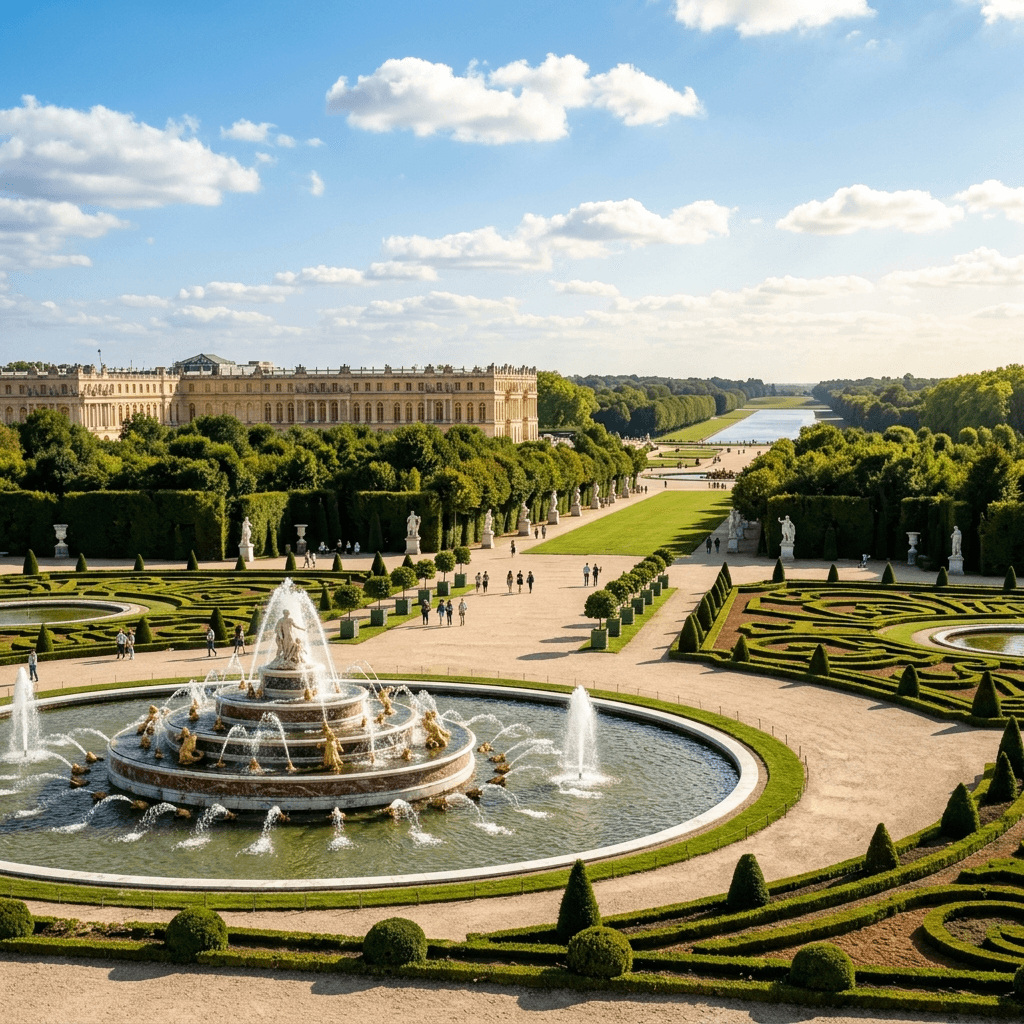
1. Perspective and Central Axis: Le Nôtre used perspective as a tool of power. The Central Axis of Versailles begins at the west facade of the palace, passes through the Green Carpet (parterre), crosses the Bassin d'Apollon (Apollo Basin) and extends along the Grand Canal to the horizon — a total of 8 km of straight visual line. This infinite perspective made the observer feel that the king's power extended as far as the eye could see.
2. Geometry and Symmetry: Le Nôtre treated the garden as an extension of the palace architecture. The flowerbeds (parterres) were designed like embroidery (broderies) — geometric patterns made of clipped boxwood, colored sand and flowers. Each section of the garden was an "outdoor room": the bosquets were "green rooms," the canals were "water mirrors," and the fountains were "water chandeliers."
3. Control of Nature: In the French formal garden, nature is tamed, ordered and subject to geometry. Trees were pruned into geometric shapes (cubic, spherical, pyramidal), canals were rectilinear, and avenues were perfectly symmetrical. There was no room for chance or "wild nature" — everything was planned, measured and controlled.
Le Nôtre also used optical illusions. He knew that visual perspective becomes distorted with distance, and compensated for this by tilting flowerbeds and adjusting angles so that the garden would appear perfectly symmetrical from any observation point. The Grand Terrace of Saint-Germain-en-Laye (2.4 km long) was designed to give the impression of having no end — an illusion he created by gradually narrowing the terrace's width as it moved away from the palace.
Chapter
1.4 Le Nôtre's Legacy: How His Gardens Influenced the Entire World
Le Nôtre's impact extends far beyond Versailles. His style became the model for European formal gardens during the 17th and 18th centuries, copied throughout Europe:
- Royal Palace of Caserta (Italy) — the royal palace of Naples has gardens directly inspired by Versailles. - Schönbrunn Palace (Austria) — the gardens of the imperial residence in Vienna follow the same central axis and symmetry. - Palace of Queluz (Portugal) — the Portuguese formal gardens are an adaptation of Le Nôtre's model. - Herrenchiemsee Palace (Germany) — Ludwig II of Bavaria attempted to recreate Versailles in Germany. - Peterhof Palace (Russia) — Peter the Great was inspired by Versailles for his gardens on the Gulf of Finland. - Hampton Court (England) — the English formal gardens followed the French model before the rise of the English landscape garden. - La Granja Palace (Spain) — Philip V, grandson of Louis XIV, built a replica of Versailles in the Guadarrama Mountains.
But Le Nôtre's most curious legacy lies in Paris: it was he who extended the central avenue of the Tuileries Gardens westward, creating a straight line that would later become the Champs-Élysées — the most famous avenue in the world. Le Nôtre, without knowing it, designed the Historical Axis (Axe Historique) of Paris, which today connects the Louvre to the Arc de Triomphe and the La Défense district.
Le Nôtre also influenced the urban planning of cities such as Washington D.C. (whose urban plan, designed by Pierre L'Enfant, uses axes and visual perspectives inspired by French gardens) and Brasília (whose pilot plan by Lúcio Costa is also based on monumental axes).
Today, the Gardens of Versailles are a UNESCO World Heritage Site (since 1979) and receive more than 10 million visitors per year. Le Nôtre's name is remembered in streets, squares and schools throughout France — but his true monument is the gardens he created over 350 years ago, still impressing visitors from around the world.
Chapter
2. Hydraulic Engineering of Versailles: How Water Feeds 2,400 Fountains
Chapter
2.1 The Initial Problem: Versailles Without Water
The greatest challenge of the Gardens of Versailles was not the design — it was the water. The land where Louis XIV chose to build his palace was a sandy marsh with no rivers, lakes or natural springs. The little water available came from small streams (such as the Ru de Gally) and rainwater collected in tanks.
In the 17th century, knowledge of hydraulics had advanced little since the Roman Empire. Pipes were made of hollowed-out tree trunks, copper and lead — materials that could not withstand high pressure and frequently cracked. There were no electric pumps, motors or modern pressurized systems.
When Le Nôtre designed the gardens, he planned for 1,600 water jets (four times more than the current 400), consuming 6,300 m³ of water per hour. To put it in perspective, when all the fountains operated in 1715, they consumed the equivalent of 69,000 muids (about 9 million liters) in just three hours — more than the daily consumption of the city of Paris at the time.
The solution required 32 years of hydraulic works (1661-1693), involving the best engineers in Europe, an army of 1,800 workers and a cost that reached 40% of the total construction budget of Versailles.
Chapter
2.2 The Machine de Marly: The Most Ambitious Pumping Station of the 17th Century
The idea of pumping water from the Seine River — the nearest river, 10 km away — had existed for years. The problem was the altitude difference: the water needed to rise 150 meters from the Seine level to the reservoirs of Versailles, an elevation that no technology of the time could achieve.
In 1678, two Belgians — the lawyer Arnold de Ville (1653-1722) and the carpenter Rennequin Sualem (1645-1708) — presented Louis XIV with an ambitious proposal: build a gigantic hydraulic machine on the banks of the Seine, in Bougival, capable of pumping water to the top of the Louveciennes hill.
The king approved, and the Machine de Marly was built between 1681 and 1684. It was the largest machine ever built in the world: 14 wooden water wheels, each 11.5 meters in diameter, partially submerged in the Seine, powered 221 pumps (later 250) that raised the water in three stages to the top of the hill.
The operation was ingenious: the Seine's current turned the 14 giant wheels, which drove a system of iron and wooden connecting rods and cranks, which in turn moved suction and pressure pistons. The water was raised to an aqueduct 643 meters long with 36 arches (the Louveciennes Aqueduct), which carried it by gravity to the reservoirs of Versailles.
The Machine de Marly was called the "Eighth Wonder of the World" and was visited by figures such as Queen Victoria of England, the Czar of Russia and even American presidents. It continued operating until 1960 — almost 300 years after its construction.
Chapter
2.3 Network of Aqueducts and Reservoirs
The Machine de Marly was only part of the system. Versailles' hydraulic network included:
- Louveciennes Aqueduct (1684): 643 meters, 36 arches, carried water from the Seine to the reservoirs. - Buc Aqueduct (never completed): Designed to bring water from the Bièvre River, 20 km away, but abandoned after the death of Louvois (minister of war) in 1691. - Etang de Trappes and Etang de Saint-Quentin: Artificial lakes created to store rainwater and feed the system. - Deux Portes Reservoir (1685): Capacity of 10,000 m³, located behind the palace, fed the fountains by gravity.
At the peak of the system, Versailles had 80 million cubic meters of water stored in artificial lakes, tanks and reservoirs — a volume comparable to a large urban lake.
The problem was that, even with all this infrastructure, the water pressure was insufficient to power all the fountains at once. The solution was rationing the fountains: during the king's walks, the "fontaineers" (fountain keepers) manually opened and closed the valves as the king approached — creating the illusion that all fountains were playing simultaneously, when in fact only those nearest the king were turned on.
Chapter
2.4 How Did the Hydraulic System Work? Engineering Explained
Versailles' hydraulic system operated by gravity and siphon — without electric pumps:
1. Water was raised from the Seine to the top of the Louveciennes hill (+150m) by the Machine de Marly. 2. From the aqueduct, water flowed by gravity to the Deux Portes Reservoir (behind the palace). 3. From the reservoir, water was distributed through 35 km of underground cast-iron pipes — many of which are original 17th-century pipes still in use today. 4. The water pressure in the fountains was generated by the natural elevation difference between the reservoir and the outlet point — the greater the vertical distance, the greater the pressure.
Each fountain had its own hydraulic circuit, with manual valves that the fontaineers opened and closed using original 17th-century metal keys — some still used today.
The Neptune Fountain, the largest in Versailles, has 99 individually controlled water jets. The Pyramid Fountain has 230 water points hidden beneath the surface. Each jet was fed by a different pipe, creating an underground network so complex that engineers nicknamed it "the spider".
Chapter
2.5 The Colossal Cost: 40% of Versailles' Budget Spent on Water
The cost of water at Versailles was astronomical. The Machine de Marly alone cost 3.5 million livres to build — and more than double that to maintain over the years. For comparison, the construction of the entire Palace of Versailles cost about 25 million livres during Louis XIV's reign.
This means that 40% of Versailles' total budget was spent on water systems — far more than on decoration, furniture or works of art. The materials included 850 tons of steel and lead in the Machine de Marly alone.
Maintenance was equally expensive. The machine required constant repairs: the wooden wheels rotted, the lead pipes cracked, the joints leaked. An army of 30 to 50 workers was permanently employed maintaining the system.
Despite the cost, the system never worked perfectly. The Machine de Marly had a theoretical capacity of 3,800 m³ per day, but in practice produced much less due to mechanical failures. The fontaineers developed ingenious techniques to maximize flow — and when the king was not in the gardens, the fountains were simply turned off.
Today, the system operates on a closed loop: electric pumps recycle water from the Grand Canal (which functions as a reservoir), and rainwater supplements the system. Current consumption is 4,500 m³ per hour — still impressive, but much less than the 6,300 m³/h of Louis XIV's era.
Chapter
3. The Fountains of Versailles: Latona, Apollo, Neptune and Much More
Chapter
3.1 Latona Fountain: The Myth That Justified Absolute Power
Located in the center of the Parterre de Latone, between the palace and the Grand Canal, the Latona Fountain is the most symbolic fountain in Versailles. Inaugurated in 1670, it was designed by André Le Nôtre, with sculptures by Gaspard Marsy (1624-1681) and Anselme Flamen (1647-1717).
The fountain depicts an episode from Ovid's Metamorphoses: the goddess Latona (mother of Apollo and Diana) arrives with her twin children in the land of Lycia and tries to drink from a lake. The local peasants refuse to let her and disturb the water. As punishment, Jupiter turns them into frogs and toads.
The political allegory was clear to 17th-century courtiers: Latona was the Catholic Church (threatened by Protestants), Apollo was Louis XIV (the Sun King), and the peasants were the enemies of the monarchy who would be crushed. The message: whoever opposes the king is transformed into an inferior creature.
The original 1670 fountain was made of white marble and sat in the center of a grass parterre. In 1687-1689, Jules Hardouin-Mansart rebuilt it in painted lead (cheaper and easier to sculpt), creating the current structure of four concentric tiers with 23 frogs, 20 toads, lizards and turtles spitting water at Latona at the top.
The 2022-2023 restoration (budget of 1.2 million euros) returned the fountain to its original appearance, including replacing corroded lead pieces and reinstalling the original hydraulic system. The fountain consumes 400 m³/h when in operation.
Chapter
3.2 Bassin d'Apollon: The Sun King in Command of the Waters
The Bassin d'Apollon (Apollo Fountain) is the centerpiece of the east-west axis of the gardens, located at the head of the Grand Canal. Sculpted by Jean-Baptiste Tuby (1635-1700) between 1668 and 1671, the fountain shows Apollo (representing Louis XIV) emerging from the waters in his quadriga (chariot pulled by four horses), flanked by tritons blowing conch shells to announce his arrival.
The sculpture is made of gilded lead (originally covered with gold leaf that was removed during the French Revolution). Apollo stands 3.5 meters tall, and the chariot measures 7.5 meters long by 5 meters wide — weighing 12 tons.
The total basin diameter is 120 meters, with 12 main jets reaching 4 meters in height. When the king held his evening walks (the Grandes Eaux), the fountain was lit by 3,000 torches and lanterns — a pyrotechnic spectacle that cost 10,000 livres per night.
The Apollo Fountain was restored in 2011-2014 (budget: 2.5 million euros), including replacing lead with epoxy resin in some parts to reduce weight and improve conservation.
Chapter
3.3 Neptune Fountain: The Largest and Most Spectacular in Versailles
The Neptune Fountain (Fontaine de Neptune), located at the northern end of the garden, is the largest in Versailles. Begun by Le Nôtre in 1679 as a simple basin (known as the "Bassin des Sapins"), it was expanded by Louis XV between 1736 and 1741 under the supervision of Ange-Jacques Gabriel (1698-1782), the king's chief architect.
Neptune has 99 water jets that fire simultaneously, forming a water curtain 15 meters high. The central sculptural group shows Neptune with his trident, surrounded by nymphs, tritons and sea horses, all sculpted in painted lead by Lambert-Sigisbert Adam (1700-1759).
When all the fountains of Versailles are operating (on Grandes Eaux days), the Neptune Fountain is the grand finale — all 99 jets fire at once, creating a spectacle that consumes 1,200 m³/h (nearly a third of the gardens' total water consumption).
The fountain was restored between 2005 and 2007 (cost: 1.7 million euros), with the replacement of 60% of the underground pipes and the reinstatement of the drainage system.
Chapter
3.4 Pyramid Fountain and Other Lesser Masterpieces
The Pyramid Fountain (Fontaine de la Pyramide), located between the Parterre d'Eau and the Parterre de Latone, is one of the most ingenious in Versailles. Designed by Le Nôtre in 1672 and sculpted by François Girardon (1628-1715), the pyramid has 230 water points hidden across four tiers of gilded lead, with figures of tritons, sea serpents and dolphins.
Water jets through microscopic holes on the surface of the sculptures, creating the effect that the sculpture itself is "sweating" water — an effect the fontaineers call "cascade water" without splashing.
Other notable fountains include:
- Dragon Fountain (Bassin du Dragon): A winged dragon 5.5 meters long spouting a water jet 27 meters high (the tallest in Versailles). Created by Gaspard Marsy in 1668. - Enceladus Fountain (Bassin d'Encelade): A giant being crushed by rocks, with a water jet shooting from his mouth — representing the revolt of the giants against the gods (allegory of the Fronde, the rebellion against the monarchy). Created by Gaspard Marsy in 1675. - Obelisk Fountain (Bassin de l'Obélisque): A central water column 25 meters high surrounded by 40 smaller jets, created in 1706 by Robert de Cotte. - Crown Fountain (Bassin de la Couronne): A floating royal crown with 60 water jets, located in the Rotunda Grove.
Chapter
3.5 The Grandes Eaux: The Spectacle That Enchants Tourists to This Day
The Grandes Eaux (Great Waters) are the oldest spectacle at Versailles. Created by Louis XIV to impress ambassadors and nobles, the Grandes Eaux took place every spring and summer afternoon, with all fountains operating simultaneously for three hours.
The spectacle was so expensive that the king only held it 12 to 15 times a year. During the Grandes Eaux, the fontaineers opened the valves of all 1,600 fountains at once — an operation that required 4 hours of preparation and coordinated 35 km of piping.
Today, the Grandes Eaux Musicales take place from April to October:
- Saturdays and Sundays: Fountains operate with Baroque music (Vivaldi, Lully, Charpentier) - Tuesdays: Grandes Eaux Nocturnes (Illuminated fountains + fireworks, 3 hours duration) - Ticket: €10.50 (garden access with fountains, separate ticket from the palace) - Special tour: "Grandes Eaux + Palace" — €21.50 - Attendance: Up to 15,000 people per day during peak season
The musical spectacle has been computer-synchronized since 1999, but the fontaineers still operate the valves manually — maintaining a 300-year living tradition. The Grandes Eaux Program changes each year, with three different routes guiding visitors through different combinations of operating fountains.
Chapter
4. The Bosquets of Versailles: The Secret Gardens Within the Garden
Chapter
4.1 What Are the Bosquets? Green Outdoor Rooms
The bosquets are enclosed spaces within the Gardens of Versailles — true outdoor rooms bounded by hedges, trees and screens of hornbeam (Carpinus betulus). Each bosquet has its own theme, its own sculpture and its own fountain — functioning as an open-air art gallery.
Louis XIV commissioned 15 original bosquets, created between 1661 and 1715. Today 12 remain — three were destroyed during the French Revolution (when the gardens were abandoned) and two were transformed in the 19th century.
The bosquets were designed to surprise: the visitor would walk along straight avenues and suddenly enter an enclosed space with a fountain, a sculpture or an open-air theater. Each bosquet was a discovery — and the order in which the king presented them to visitors was carefully choreographed.
The bosquets occupy 40% of the total garden area (about 200 hectares) and house 27 fountains — more than half of all the fountains in Versailles. They were inspired by the Italian Renaissance gardens, particularly the Villa d'Este in Tivoli and the Villa Medici Gardens in Rome.
Chapter
4.2 Water Theater Grove: The Liquid Stage
The Water Theater Grove (Bosquet du Théâtre d'Eau) was created by André Le Nôtre in 1671 and rebuilt by Jules Hardouin-Mansart in 1702. It is the most theatrical of the bosquets: a semicircular arena with grass steps on three levels, capable of seating 300 spectators, with a stage formed by five water cascades and 50 water jets that functioned as a liquid backdrop.
The inaugural performance was "Les Amants Magnifiques" by Molière in 1670, with music by Jean-Baptiste Lully and aquatic scenery that changed with each act of the play. Water was so central that the actors had to choreograph their movements to avoid getting wet.
The theater was used for operas, ballets and concerts throughout Louis XIV's reign. In 1684, the court attended a performance of Lully's "Alceste" with 200 musicians and 50 dancers — the largest spectacle ever mounted at Versailles.
Today, the Water Theater Grove has been converted into the Queen's Grove (Bosquet de la Reine), after a renovation in 1776 ordered by Marie Antoinette. The water cascades were removed and replaced with a central lawn. Only the semicircular structure of the steps remains visible.
Chapter
4.3 Three Fountains Grove and Triumphal Arch Grove
The Three Fountains Grove (Bosquet des Trois Fontaines) was created by Le Nôtre in 1670 and redesigned by Hardouin-Mansart in 1704. It is one of the rare cases where the renovation improved the original design: three rooms at different levels, each with a differently themed fountain.
- Lower Room: Fountain of the Cupids — cupids playing with swans, 8 water jets - Middle Room: Fountain of the Buttocks (Fontaine des Fesses — popular nickname) — nymphs with amphorae, 14 jets - Upper Room: Fountain of the Rising Sun — miniature Apollo, 20 jets
The grove was restored in 2014-2016 (budget: 3.1 million euros), with replanting of hedges and rehabilitation of the hydraulic system.
The Triumphal Arch Grove (Bosquet de l'Arc de Triomphe), created in 1672 in honor of Louis XIV's military victories, features a 12-meter triumphal arch sculpted in gilded lead, surrounded by 8 statues of prisoners of war (representing nations defeated by France). The central fountain shoots 30 water jets that form an arch over the king's statue.
Chapter
4.4 Labyrinth Grove and Apollo Grove
The Labyrinth Grove (Bosquet du Labyrinthe), inaugurated in 1672 and destroyed in 1775, was one of the most popular in Versailles. Inspired by Aesop's Fables, the labyrinth had 39 fountain groups representing the fables, each with a black marble plaque bearing the moral of the story in verses by Isaac de Benserade.
Each fountain was triggered by hidden pedals in the ground — stepping on the right spot activated the water and brought the fable to "life." The labyrinth measured 1,500 meters in length and took about 40 minutes to traverse.
It was replaced in 1775 by the Beautiful Fountain Grove (Bosquet de la Belle Fontaine), ordered by Louis XVI, who considered the labyrinth "childish." Today, only three of the original 39 fountains remain, on display at the National Museum of Versailles.
The Apollo Grove (Bosquet d'Apollon), created by Hubert Robert in 1777 for Marie Antoinette, is the only bosquet from the post-Le Nôtre period. It contains the Temple of Love (Temple de l'Amour) — a marble pavilion with 12 Corinthian columns and a gilded lead dome. Inside the temple, a copy of the sculpture "Cupid Carving His Bow from Hercules' Club" by Edmé Bouchardon.
Chapter
4.5 The Twelve Bosquets That Survive Today
The 12 current bosquets of Versailles (north to south):
Each bosquet has its own visiting hours — some only open on specific days of the Grandes Eaux. Visitors need a map (available in 10 languages at the entrance) to locate them all, since they are spread across 800 hectares and often hidden behind hedges.
The most recent restoration was the Colonnade Grove (2020-2022, budget: 2.8 million euros), which included replacing 28 marble columns and reinstalling the nighttime lighting system.
| Bosquet | Year | Highlight |
|---|---|---|
| BosquetTriumphal Arch Grove | Year1672 | Highlight12m triumphal arch |
| BosquetThree Fountains Grove | Year1670 | HighlightFountain of the Cupids |
| BosquetObelisk Grove | Year1706 | Highlight25m water column |
| BosquetRotunda Grove | Year1702 | HighlightCrown Fountain |
| BosquetKing's Garden Grove | Year1668 | HighlightKing's secret garden |
| BosquetQueen's Grove (Former Water Theater) | Year1671 | HighlightSemicircular arena |
| BosquetColonnade Grove | Year1670 | HighlightMarble colonnade |
| BosquetBeautiful Fountain Grove (Former Labyrinth) | Year1775 | HighlightArtificial grotto |
| BosquetApollo Grove / Temple of Love | Year1777 | HighlightMarble temple |
| BosquetEnceladus Grove | Year1675 | HighlightGiant's Fountain |
| BosquetFame Grove (Bosquet des Dômes) | Year1670 | HighlightOutdoor banquet hall |
| BosquetSouthern Grove (Bosquet du Midi) | Year1668 | HighlightFountain of the Seasons |
Chapter
5. The Grand Canal of Versailles: The 1,670-Meter Water Mirror
Chapter
5.1 Construction of the Largest Artificial Canal of the 17th Century
The Grand Canal (Grand Canal / Canal de Versailles) is the backbone of the gardens. At 1,670 meters long, 62 meters wide and 2.5 meters deep, it is the largest artificial canal ever built in Europe in the 17th century.
Construction began in 1667 under the direction of Le Nôtre and was completed in 1679 — 12 years of continuous work. Some 1.2 million cubic meters of earth were excavated, carried by 6,000 workers who labored in 12-hour shifts (including at night, by torchlight, during the war against the Netherlands in 1672).
The canal was aligned with the east-west axis of the gardens, so that the sun would set exactly in the center of the canal — creating the visual effect of the Sun King walking upon the waters at dusk. This astronomical alignment was calculated with precision to 0.5 degrees using instruments of the time.
The Grand Canal had three main functions: 1. Hydraulic function: Water reservoir for the fountains (capacity: 130,000 m³) 2. Aesthetic function: Water mirror reflecting the palace at sunset 3. Social function: Stage for parties, nautical parades and rowing competitions
Chapter
5.2 The Fleet of Versailles: Miniature Ships on Royal Waters
Louis XIV transformed the Grand Canal into a miniature military port. In 1674, he commissioned a complete fleet of scale-model ships — including three frigates, two galleons and a replica of the royal ship "Le Soleil Royal".
The ships measured between 5 and 15 meters in length, but were perfectly functional replicas — with sails, cannons that fired dry powder, and a crew of up to 30 sailors from the Royal Navy. They were used for mock naval battles during the king's festivities.
In 1674, during the "Les Divertissements de Versailles" festival, the largest simulated naval battle in history took place: 12 miniature ships (including 3 war frigates) faced off in a "battle against Barbary pirates" that lasted 3 hours, with fireworks, cannons and 500 extras on the banks.
The fleet was maintained until the French Revolution (1789), when the ships were destroyed or sold. Today, the Grand Canal hosts tourist pleasure boats (pedal boats and rowboats, rented at €15/hour), but the royal fleet no longer exists.
Chapter
5.3 The Nautical Festivities and the Year 1674
The year 1674 marked the peak of festivities on the Grand Canal. Louis XIV organized the "Grande Fête de Versailles" — a series of six days of celebrations that cost 500,000 livres (equivalent to €5 million today).
Highlights included: - Nighttime illumination: 3,000 Venetian lanterns floating on the canal, reflecting on the water mirror - Floating orchestra: 120 musicians on a 40-meter barge, playing operas by Lully and Charpentier - Fireworks: 10,000 rockets fired from barges in the center of the canal, reflected in the water - Drifting banquet: 300 guests in 10 Venetian gondolas (gifts from the Doge of Venice), served by 60 attendants
The most famous moment was the "Enchanted Isle" (Île Enchantée): an artificial island 50 meters in diameter was built in the middle of the canal, with a wooden palace covered in gold where the court dined by candlelight, surrounded by fireworks.
Chapter
5.4 The Grand Canal in Winter: Ice Skating and Frozen Banquets
In winter, when the Grand Canal froze (something that happened 2 to 3 times per decade in the 17th century, during the Little Ice Age), Louis XIV would turn the ice into a royal skating rink.
In January 1684, the canal remained frozen for 6 weeks. The king had heated tents built on the banks, with portable fireplaces and mulled wine. The court spent afternoons skating — a novelty in France, imported from Holland (where skating had been popular since the 16th century).
The king did not skate (he considered it "beneath a monarch"), but watched from a heated throne mounted on a sled pulled by miniature horses. The most unusual event was the "frozen banquet": a table set on the ice, with food that froze instantly — creating frozen soups, crystallized wines and frozen meats that the court ate as "culinary exoticism."
Chapter
5.5 The Canal Today: Boat Rides, Events and Curiosities
Today, the Grand Canal is the main outdoor attraction of Versailles:
- Boat rides: Pedal boat (€15/hour) and rowboat (€12/hour) — rental at the Grand Canal Port (April to October) - Annual race: "La Traversée du Grand Canal" — a 1,670-meter swimming competition (every summer, since 1985) - Nighttime events: "Les Grandes Eaux Nocturnes" spectacle with mapped projections on the water (Tuesdays, €21) - Picnics: Allowed on the banks (lawns), with views of the palace — a favorite spot for Parisians on weekends
Curiosity: In 2023, a study by the CNRS (French National Centre for Scientific Research) discovered that the Grand Canal has its own microclimate: the waters reflect the sun's heat, creating a temperature 3°C warmer than the surroundings during the day — which explains the proliferation of water lilies and carp (including Japanese koi carp, introduced in 1920 as a gift from the Emperor of Japan).
Practical tip: The best time to visit the Grand Canal is 5-6 PM (sunset), when the sun aligns exactly with the canal's axis and the palace reflects on the water — the iconic Versailles photo.
Chapter
6. The Trianons: The Kings' Refuge and Marie Antoinette's Folly
Chapter
6.1 The Grand Trianon: The Pink Marble Palace
The Grand Trianon was built in 1687 by Jules Hardouin-Mansart in just 6 months (March to September) for Louis XIV. The king wanted a "country" palace where he could escape the suffocating etiquette of the Versailles court — a place for intimate dinners, lovers and informal gatherings.
The name "Trianon" comes from the village of Trianon (formerly Triarnon), a medieval hamlet that Louis XIV purchased in 1663 to expand the gardens. The village was demolished, and a first palace (the "Trianon de Porcelaine," 1670-1687) was built with blue and white tiles imported from Delft, Holland — but the tiles could not withstand the winter of 1686, which cracked the porcelain.
The current Grand Trianon is made of pink marble from the Pyrenees (marble from Carcassonne) and Saint-Leu stone, with a peristyle of 28 marble columns opening onto the gardens. The palace has 30 rooms, including the famous Hall of Mirrors (with 17 mirrors and views of the gardens).
Important events at the Grand Trianon: - 1920: Treaty of Trianon — the peace treaty with Hungary after World War I was signed here (hence the name "Treaty of Trianon") - 1963: President Charles de Gaulle used the Grand Trianon to receive West German Chancellor Konrad Adenauer — a milestone in Franco-German reconciliation - French presidents: From de Gaulle to Nicolas Sarkozy, the Grand Trianon was used as a state guest residence
Chapter
6.2 The Petit Trianon: Marie Antoinette's Refuge
The Petit Trianon was built between 1762 and 1768 by Ange-Jacques Gabriel, chief architect of Louis XV, for the Marquise de Pompadour — but she died in 1764 and never saw it completed. The palace is a masterpiece of the neoclassical style: a perfect cube 23 meters on each side, with facades of limestone and marble, without excessive columns or ornamentation.
In 1774, Louis XVI gave the Petit Trianon to Marie Antoinette as a gift. She turned it into her personal refuge — a place where she could escape the rules of the court and live a simple, pastoral life (her "country villa").
Marie Antoinette established her own rules at the Petit Trianon: - Restricted access: Only expressly invited guests could enter — the king needed permission - No etiquette: No curtsies, no titles, no protocol - Simple dress: Marie Antoinette wore white muslin dresses (instead of heavy court gowns) and straw hats
The Petit Trianon has 15 rooms, including a Music Salon with hand-painted wallpaper depicting rural scenes and the Queen's Bedroom (where Marie Antoinette was arrested on October 5, 1789 when the mob stormed Versailles).
Chapter
6.3 The Queen's Hamlet: Marie Antoinette's Pastoral Dream
The Hameau de la Reine (Queen's Hamlet) is the most peculiar part of Versailles. Built between 1783 and 1787 by Richard Mique (architect) and Hubert Robert (landscape designer), it is a miniature Norman village — a toy farm with 12 thatched cottages, a pond with swans, a cheese dairy, a dovecote and a water mill.
Marie Antoinette and her ladies-in-waiting played at being peasant women — they dressed in farmers' clothes, milked cows (which were bathed daily and perfumed with orange blossom water), made cheese (served at the king's dinner as "the queen's farmstead cheese"), and picked fruits (which were planted specifically to look "rustic").
The hamlet was designed by Mique to look "decadent" — not "perfect." The houses are asymmetrically positioned, with thatched roofs and plaster walls painted to imitate aged wood. It cost 200,000 livres (about €2 million today).
Curiosity: The hamlet's cows were of the Dutch Swiss breed — chosen for being "picturesque" (white and black spotted). They were replaced by African dwarf goats in the 20th century, imported from Zaire (now the Democratic Republic of the Congo).
The Queen's Hamlet became a symbol of the monarchy's detachment during the Revolution — the image of Marie Antoinette playing peasant while the people starved fueled revolutionary propaganda. Today it is one of the most visited attractions at Versailles, with 1.2 million visitors per year.
Chapter
6.4 The Trianon Gardens: Marie Antoinette's English Garden
Unlike Le Nôtre's geometric gardens, the Petit Trianon Gardens were designed in the English style — the first large English garden in France. Created by Richard Mique and Hubert Robert between 1774 and 1785, the garden features organic curves, artificial lakes, rustic bridges and an artificial grotto — radically contrasting with the symmetry of the main gardens.
The garden covers 8 hectares and includes: - The Swiss Lake (Lac Suisse): Artificial lake of 1.2 hectares with a central island - The Temple of Love: Marble pavilion with 12 Corinthian columns, built in 1778 - The Belvedere: Octagonal music pavilion, built in 1780 - The Queen's Rock (Rocher de la Reine): Artificial grotto with a water cascade and moss cultivated specifically to look "wild"
The garden contains 50 species of trees imported from North America — including tulip trees, black locusts and red oaks — which Marie Antoinette had planted to create a sense of "untouched nature." The trees were brought by the naturalist André Michaux, who collected them during expeditions to the United States in 1784-1785.
The contrast between the geometric garden of Le Nôtre and the English garden of Marie Antoinette is one of the most interesting walks in Versailles — a transition from absolute power to romanticism in just a 15-minute walk.
Chapter
6.5 The Trianon Estate Today: Tickets and Visit
The Trianon Estate (Grand Trianon + Petit Trianon + Queen's Hamlet) is a separate visit from the main palace:
- Ticket: €12 (Trianon Estate) or €21.50 (full Versailles passport) - Hours: 12 PM-6:30 PM (April-October), 12 PM-5:30 PM (November-March) - Recommended time: 2-3 hours to see everything - Access: Electric shuttle bus (€5 round trip) or on foot (15 minutes from the palace along the Grand Canal)
Tip: Visit the Trianon in the late afternoon — after the tour groups leave, you can walk practically alone through the Queen's Hamlet. The best time is 4-5:30 PM, when the golden sunlight illuminates the cottages.
Special event: "Les Fêtes de la Reine" — historical reenactment with actors in period costumes at the Queen's Hamlet (June-September, €15 included in the Trianon ticket).
Chapter
7. Historical and Cultural Events in the Gardens of Versailles
Chapter
7.1 The Great Festivities of Louis XIV: Power and Ostentation
Louis XIV transformed the gardens into the stage for seven great festivals during his reign (1664-1674), each more expensive and elaborate than the last.
The most famous was "Les Plaisirs de l'Île Enchantée" (The Pleasures of the Enchanted Isle), in May 1664 — a 7-day party that cost 100,000 livres (equivalent to €1 million today). The event combined: - Nightly ballets with 600 performers - Complete operas staged in the bosquets - Naval battles on the Grand Canal (with miniature ships) - Fireworks with 20,000 rockets - An 80-course banquet served at tables set up in the Colonnade Grove
The purpose of the festivals was to impress foreign ambassadors and demonstrate the power of France. During the war against the Netherlands (1672-1678), Louis XIV continued holding festivals — to show that France was not "worried" about the war.
Louis XIV's last great festival was in 1674, when he celebrated the conquest of the Franche-Comté with a 7-day festival that included the lighting of all 1,600 fountains simultaneously for the first time. The cost: 500,000 livres — half the annual budget of the French Navy.
Chapter
7.2 Peace Treaties and Diplomatic Meetings
The Gardens of Versailles were the setting for four major peace treaties:
- Treaty of Paris (1783): Signed at the palace, recognized the independence of the United States. The news was celebrated with Grandes Eaux and fireworks in the gardens. - Treaty of Trianon (1920): Signed at the Grand Trianon, formalized the dissolution of the Austro-Hungarian Empire after World War I. - Schuman Declaration (1963): At the Grand Trianon, President Charles de Gaulle and German Chancellor Konrad Adenauer signed the milestone of Franco-German reconciliation — a symbolic event in the gardens that Louis XIV had built to project power over Germany.
The most unusual meeting was the visit of Tsar Peter the Great (1717): the Russian tsar visited Versailles incognito as "Pierre Mikhailov," but was immediately recognized. Louis XIV ordered all fountains to be turned on during his visit — something that rarely happened. Peter was so impressed that he had Peterhof built in Russia, inspired by Versailles.
Chapter
7.3 French Revolution: The Abandonment of the Gardens
With the French Revolution (1789), the Gardens of Versailles were abandoned and looted. Between 1789 and 1804: - Statues were melted down to make cannons (including several from the Triumphal Arch Grove) - Lead from the pipes was removed to make bullets - Trees were cut down for firewood - Fountains were deactivated — the Machine de Marly continued operating, but only to pump water to Paris - The Grand Canal partially dried up, since no one cleaned the pipes
In 1793, the National Convention decreed that "the Gardens of Versailles shall be opened to the people" — but without maintenance, public access accelerated the degradation. The bosquets became overgrown thickets, the hedges died, and the Latona Fountain was used as a laundry basin by local residents.
In 1795, during the Directory, the government tried to sell Versailles in lots — including the gardens — but found no buyers. The palace and gardens were saved by General Napoleon Bonaparte, who in 1804 ordered a partial restoration.
Chapter
7.4 Imperial Restoration and Napoleon's Visit
Napoleon Bonaparte visited Versailles in 1804 and was horrified by the state of the gardens. He ordered: - Replanting of 12,000 trees (mainly elms and lindens) - Repair of the pipes of the Machine de Marly - Restoration of the Apollo Fountain (which had been decapitated during the Revolution) - Cleaning of the Grand Canal (which was full of silt)
Napoleon did not live at Versailles (he preferred Fontainebleau and Compiègne), but used the gardens for military ceremonies. In 1810, he held a military parade of 30,000 soldiers on the garden lawns — the largest military gathering ever seen at Versailles.
Chapter
7.5 Versailles in Cinema and Pop Culture
The Gardens of Versailles have been the setting for more than 200 films and series:
- "Marie Antoinette" (2006, Sofia Coppola): Filmed in the gardens and the Petit Trianon — including an iconic scene at the Queen's Hamlet - "Versailles" (2015-2018, TV series): Filmed in the gardens and the palace — the first series authorized to film in the gardens at night - "The Man in the Iron Mask" (1998): Final scene on the Grand Canal - "Perfume: The Story of a Murderer" (2006): Scenes in the Colonnade Grove - "Midnight in Paris" (2011, Woody Allen): Walk through the gardens
In music, Versailles has inspired: - "Les Jardins de Versailles" (2005), opera by Marc-André Dalbavie - "Versailles" (2015), album by Daft Punk — not about the palace, but the name was inspired by the gardens' aesthetic - Lady Gaga concert (2014): The singer performed in the gardens for 3,000 guests — the first pop show authorized at Versailles
Annual cultural events: - "Versailles Festival" (July-August): Classical music concerts in the gardens at night - "Nuit des Musées" (May): Free night visit to the gardens with special lighting - "Fête de la Musique" (June 21): Free concerts in the bosquets
Chapter
8. The Restoration of the Gardens: How Versailles Recovered Its Splendor
Chapter
8.1 The Century of Abandonment (1790-1890)
After the French Revolution, the Gardens of Versailles went through 100 years of abandonment. Until 1830, no king or emperor took interest in Versailles — Louis XVIII (1814-1824) preferred the Tuileries, and Charles X (1824-1830) preferred Saint-Cloud.
In 1837, Louis Philippe I (King of the French) turned the palace into a museum dedicated "to all the glories of France" (Musée de l'Histoire de France). He partially restored the gardens, planting 20,000 trees and cleaning the Grand Canal, but there was no budget for the fountains.
The situation worsened at the end of the 19th century: without royal funds, the gardens became sheep pasture (rented by the government to "keep the grass cut"). In 1890, a report from the Ministry of Culture described the gardens as "an abandoned field with remnants of sculptures."
Chapter
8.2 The Great Restoration by Pierre de Nolhac (1892-1920)
Salvation came with Pierre de Nolhac (1859-1936), appointed chief curator of Versailles in 1892. Nolhac was the first to treat Versailles as a historical monument (not just as a museum).
He initiated the scientific restoration of the gardens: - 1892-1900: Reconstruction of the bosquets (replanting of 40,000 trees) - 1901-1905: Restoration of the Latona Fountain (the first complete fountain restoration since the 18th century) - 1906-1910: Reactivation of the Machine de Marly (which had stopped pumping to Versailles in 1900) - 1911-1914: Replanting of the Parterre d'Eau (the two large basins in front of the palace)
Nolhac also created the photographic archive of the gardens (over 5,000 photos between 1892 and 1920), which documented the pre-restoration state and served as a guide for subsequent restorations.
Chapter
8.3 The Post-War Restoration (1950-1990)
World War II (1939-1945) devastated the gardens once again. German troops occupied Versailles in 1940-1944 and used the gardens as a military training ground — including trenches dug in the lawns and trees felled for barricades.
In 1944, Allied bombing destroyed part of the Triumphal Arch Grove. In total, 5 bosquets were damaged and 12,000 trees lost.
The post-war restoration was led by Gérald Van der Kemp (1912-2001), chief curator from 1952 to 1981: - 1952-1955: Reconstruction of the damaged bosquets - 1960-1965: Replanting of 15,000 trees (mainly lindens and oaks) - 1967-1970: Restoration of the Neptune Fountain (the first major hydraulic restoration) - 1976-1980: Reconstruction of the Three Fountains Grove
Van der Kemp also initiated the "Grand Projet de Versailles" — a 20-year master plan to restore the gardens to their 1715 state (the year of Louis XIV's death).
Chapter
8.4 The Contemporary Restoration (1990-Present)
Since 1990, the restoration of the gardens has been coordinated by the Établissement Public du Château, du Musée et du Domaine National de Versailles (EPV), created in 1995 with its own budget.
The most important projects:
- 1999-2004: Planting of the King's Garden (Bosquet du Jardin du Roi) — recreation of Louis XIV's medicinal garden with 300 species of medicinal plants - 2005-2007: Complete restoration of the Neptune Fountain (€1.7 million) - 2011-2014: Restoration of the Apollo Fountain (€2.5 million) — including new gilding - 2014-2016: Restoration of the Three Fountains Grove (€3.1 million) - 2018-2020: Planting of 30 new tree species — preparing the gardens for climate change (including cork oaks, cypresses and Mediterranean pines) - 2022-2023: Restoration of the Latona Fountain (€1.2 million)
The annual restoration budget is €5-8 million — funded by: - 60%: Ticket sales and visitation - 30%: French government - 10%: Private donations (including €1 million from LVMH — the French luxury group)
Chapter
8.5 The Science of Restoration: How to Recreate a 17th-Century Tree
The restoration of the gardens is a multidisciplinary science involving: - Historians: Research archives to determine the original appearance - Botanists: Propagate 17th-century species through cloning (when the original species is extinct) - Hydraulic engineers: Reconstruct piping systems using 17th-century techniques - Sculptors: Recreate lead pieces using original molds kept in the archive
The most fascinating case: In 2018, the Colonnade Grove was restored using 300-year-old timber found at the bottom of the Grand Canal — oak trunks that sank during the construction of the canal in 1678 and were preserved by the mud. The wood was used to reconstruct the grove's columns, exactly as in the 17th century.
The biggest current challenge: Climate change. Temperatures at Versailles have risen 2°C since 1970, and the hornbeam hedges are dying from water stress. The EPV is planting drought-resistant varieties from the Mediterranean — a necessary adaptation to preserve the original design with different plants.
Chapter
9. Secrets and Curiosities of the Gardens of Versailles
Chapter
9.1 The Grotto of Thetis: The First Great Work (Destroyed)
The Grotto of Thetis (Grotte de Thétis) was the first great garden feature (1664-1668) and, ironically, one of the first to be destroyed (in 1684 — barely 20 years later).
It was an artificial grotto 22 meters long built north of the palace, with walls covered in seashells, corals and crystals imported from the South Seas (the most expensive decoration in the gardens). At the center, the sculptural group "Apollo Served by the Nymphs" showed the god being bathed by nymphs after his daily work of driving the sun across the sky — an allegory of the king resting after governing.
Inside, the pebble mosaic floor formed designs of stars and suns. Three niches with running water fountains created the sound of a natural waterfall. The grotto was destroyed in 1684 to make way for the Colonnade Grove — but the sculptural group "Apollo Served by the Nymphs" survived and today is in the Neptune Salon of the palace.
Chapter
9.2 The Orangerie: 1,000 Orange Trees Inside a Glass Palace
The Versailles Orangerie is a palace of glass and stone built in 1684-1688 by Jules Hardouin-Mansart, 155 meters long, 13 meters high and 1,200 m². It houses 1,005 potted trees — mainly orange trees (Citrus × aurantium), but also lemon trees, pomegranate trees, laurels and palm trees.
The oldest orange trees date from 1684 — the same trees that Louis XIV saw in the gardens. The species is the "Versailles Orange Tree" (Citrus aurantium), a bitter variety (inedible) cultivated specifically for its fragrant flower — used to make orange blossom water, which Louis XIV used as perfume and in desserts.
In winter, the trees are moved inside the Orangerie (a process that takes 3 days with 15 gardeners). In summer, they are placed in the Parterre de l'Orangerie (5 hectares), forming a geometric pattern of green and orange squares.
Curiosity: The Orangerie has never broken a single pane of glass in 336 years — not during the French Revolution, nor during the world wars. Legend has it that Marie Antoinette played hide and seek among the orange tree pots with her children.
Chapter
9.3 The Animals of the Gardens: Swans, Peacocks and... Kangaroos?
The Gardens of Versailles have their own ecosystems that include:
- Swans: Over 50 swans live on the Grand Canal (mainly mute swans — Cygnus olor). They have been protected by law since 1674 — Louis XIV banned swan hunting in the gardens under penalty of imprisonment. - Peacocks: 30 Indian peafowl (Pavo cristatus) roam freely in the gardens — descendants of a pair gifted by the Ottoman Sultan to Louis XIV in 1672. - Kangaroos: In 2022, two kangaroos (Bennett's wallabies) escaped from the Versailles Menagerie (historic zoo) and were seen hopping across the lawns — the news went viral internationally. - Bees: Miel de Versailles (Versailles honey) is produced by 50 beehives installed in the bosquets since 2012 — the honey is sold at the palace gift shop (€15/jar).
Rarest species: The Versailles newt (Triturus versaliensis) — a species of aquatic salamander discovered in 2017 in the Orangerie tanks. There are only 200 individuals in the world, all at Versailles.
Chapter
9.4 The Sundial and the Hidden Symbols
The Gardens of Versailles are full of hidden symbols that few visitors notice:
- The Sundial of the Parterre d'Eau: A large marble sundial (6 meters in diameter) that works perfectly — with markings for hours, months and zodiac signs. It was installed in 1684 by Claude Perrault (architect of the Louvre Colonnade) and still tells the correct time. - The 12 Groves = 12 Signs: The original distribution of the bosquets follows an astrological map — each grove corresponds to a zodiac sign, with associated sculptures and plants. - The King's Number: The number 14 appears everywhere — 14 wheels on the Machine de Marly, 14 jets on the Crown Fountain, 14 columns on the Grand Trianon peristyle (alluding to Louis XIV). - The Eye of Horus: On the Apollo Fountain, the god's eye is engraved with a triangle inside — a Masonic symbol added during Napoleon's restoration (he was a Freemason).
Chapter
9.5 The Ghosts of Versailles: Legends and Mysteries
Like any ancient monument, Versailles has its legends:
- The Lady in White: Since the 18th century, there have been reports of a female figure dressed in white wandering through the Queen's Grove. It is said to be the ghost of Madame de Montespan (Louis XIV's mistress), who died repentant. - The Ghostly Carriage: On moonlit nights, some guards report hearing the sound of horse and carriage on the Grand Canal — supposedly the ghost of Louis XIV taking his evening stroll. - The Piano at the Petit Trianon: In 1901, English writer Annie Moberly and academic Eleanor Jourdain visited Versailles and reported seeing Marie Antoinette playing piano at the Petit Trianon — the "Moberly-Jourdain Incident" (or "The Case of the Ladies of Versailles") sparked decades of debate among parapsychologists and historians. - The Ghostly Gardener: Garden staff swear they see a 17th-century gardener pruning the hedges of the Three Fountains Grove at night — always wearing clothes from Louis XIV's era.
Interesting fact: The EPV (Établissement Public de Versailles) has kept a "book of paranormal occurrences" since 1995, where night guards record strange reports. In 2022, there were 17 records — the highest number since 1995.
Chapter
10. Practical Guide: How to Visit the Gardens of Versailles in 2026
Chapter
10.1 Tickets, Hours and Best Time to Visit
Tickets for the gardens (2026):
Hours: - Gardens: 8 AM-8:30 PM (April-October), 8 AM-6 PM (November-March) - Grandes Eaux: Saturdays and Sundays (April-October), 11 AM-12 PM / 3 PM-5 PM - Grandes Eaux Nocturnes: Tuesdays (June-September), 9 PM-11 PM
Best time to visit: - April-May: Fewer crowds, mild temperatures, spring flowers - June-September: Grandes Eaux in full operation, but more crowded - October: Fewer tourists, golden leaves, fountains still running (until October) - November-March: Empty gardens (but no fountains), ideal for photography
Least busy days: Tuesdays, Wednesdays and Thursdays (avoid Saturdays and Sundays — the most crowded). Peak visiting hours are between 11 AM and 2 PM.
| Type | Price | Includes |
|---|---|---|
| TypeGardens (without fountains) | PriceFree | IncludesFull garden access (except on Grandes Eaux days) |
| TypeGrandes Eaux Musicales | Price€10.50 | IncludesGardens + fountains running + Baroque music |
| TypeGrandes Eaux Nocturnes | Price€21 | IncludesNight gardens + illuminated fountains + fireworks |
| TypeVersailles Passport | Price€21.50 | IncludesPalace + Trianon + Grandes Eaux |
| TypeTrianon Estate | Price€12 | IncludesGrand Trianon + Petit Trianon + Queen's Hamlet |
Chapter
10.2 How to Get There: From Paris to Versailles
Option 1 — Train (RER C) — Fastest and cheapest - Station: Paris (any station on the RER C line) → Versailles-Château-Rive-Gauche - Duration: 35 minutes from Paris - Price: €4.20 (one way) / €8.40 (round trip) - Frequency: Every 15-30 minutes - From the station: 10-minute walk to the palace
Option 2 — Train (Transilien) - Station: Paris Gare Saint-Lazare → Versailles-Rive-Droite - Duration: 25 minutes - Price: €4.70 (one way) - From station: 20-minute walk to the palace
Option 3 — Bus (line 171) - Station: Paris Pont de Sèvres (metro line 9) → Versailles-Place d'Armes - Duration: 40 minutes - Price: €2.10 (one way) — uses the regular t+ ticket
Option 4 — Car or Uber/Bolt - Distance: 20 km from central Paris - Duration: 30-60 minutes (depending on traffic) - Parking: Parking Versailles (€25/day) — Place d'Armes, in front of the palace - Uber: €35-50 (one way)
Chapter
10.3 Itinerary: What to See in 3 Hours, 6 Hours or 1 Day
Mini Itinerary (3 hours) — Essential - Stop 1: Parterre d'Eau (10 min) — the two large basins in front of the palace - Stop 2: Latona Fountain (15 min) — descending the central parterre - Stop 3: Grand Canal (20 min) — walk to the head of the canal (classic photo) - Stop 4: Apollo Fountain (15 min) — at the head of the canal - Stop 5: Neptune Fountain (20 min) — north side of the gardens - Total: 1h20 of walking (2 km route)
Medium Itinerary (6 hours) — Complete - Morning: Mini itinerary + visit to the Grand Trianon (1h) - Lunch: Picnic on the banks of the Grand Canal (free lawns) - Afternoon: Petit Trianon (45 min) + Queen's Hamlet (1h) + 2 bosquets (Three Fountains Grove + Triumphal Arch Grove — 1h) - Total: 5 km of walking
Intense Itinerary (1 day) — For Enthusiasts - Morning: Mini itinerary + Tour of all 12 bosquets (3h) - Lunch: Restaurant La Petite Venise (€25-35/person, Italian cuisine, next to the Grand Canal) - Afternoon: Full Trianon (2h) + Orangerie (30 min) + Grand Canal boat ride (1h) - End: Sunset at the Parterre d'Eau (6-7 PM) — the best view - Total: 8-10 km of walking — the electric train is recommended (€5)
Chapter
10.4 Practical Tips for Brazilian Tourists
- Water: Bring a water bottle (there are free drinking fountains near the Grand Trianon and at the garden entrance) - Sunscreen: The gardens have little shade (the hedges are low) — essential in summer - Footwear: Wear sneakers or comfortable shoes — you will walk 5 to 10 km - Food: Picnics allowed on the lawns by the Grand Canal (not in the bosquets). Prohibited on the Parterre d'Eau lawns - Luggage: There is no baggage storage in the gardens (only at the palace). Avoid large backpacks - Children: Strollers are allowed, but difficult to use in the bosquets (gravel paths) - Photos: Allowed throughout the garden. Drones prohibited (€135 fine) - Accessibility: Wheelchair users can visit 80% of the gardens (there are ramps at the main entrances). The electric train is accessible
Chapter
10.5 Seasonal Events and 2026 Schedule
Confirmed 2026 Schedule:
Golden tip: Buy tickets online at least 1 week in advance (at versailles.fr). On Grandes Eaux days, tickets sell out 3-4 days ahead in peak season.
| Month | Event | Price |
|---|---|---|
| MonthApril | EventGrandes Eaux opening (Saturdays and Sundays) | Price€10.50 |
| MonthMay | EventNuit des Musées (free night visit) | PriceFree |
| MonthJune | EventGrandes Eaux Nocturnes (Tuesdays) | Price€21 |
| MonthJuly | EventVersailles Festival (classical music) | Price€15-35 |
| MonthAugust | EventFête de la Musique (June 21) | PriceFree |
| MonthSeptember | EventJournées du Patrimoine (open doors) | PriceFree |
| MonthOctober | EventLast weekend of Grandes Eaux | Price€10.50 |
| MonthDecember | EventChristmas holidays (decorated gardens) | PriceFree |
Chapter
11. The Legacy of the Gardens of Versailles: Worldwide Influence and UNESCO World Heritage
Chapter
11.1 Versailles Inspires the World: From Peterhof to Washington D.C.
The French formal garden created by Le Nôtre at Versailles became the model for royal gardens throughout Europe and the Americas between the 17th and 19th centuries. More than 50 gardens worldwide were directly inspired by Versailles:
In Europe: - Peterhof, Russia (1714-1723): Built by Peter the Great after his visit to Versailles in 1717. It has 176 fountains and 4 monumental cascades — including the Grand Cascade that descends from the palace to the Gulf of Finland. The hydraulic system was copied from the Machine de Marly. - Royal Palace of Caserta, Italy (1752-1774): The largest palace in the world (5 hectares), with gardens that surpass Versailles in size. Caserta's Grand Canal is 3 km long — nearly twice that of Versailles. - Schönbrunn Palace, Austria (1695-1750): Summer residence of the Habsburgs, with gardens designed by Jean-Nicolas Jadot (a student of Le Nôtre). Schönbrunn's Neptune Fountain is a direct copy of Versailles'. - Herrenchiemsee, Germany (1878-1886): Ludwig II of Bavaria built a replica of Versailles on an island in Lake Chiemsee — including a copy of the Grand Canal and the Latona Fountain.
Outside Europe: - Petrópolis Palace Gardens, Brazil (1845-1862): Built by Dom Pedro II based on Le Nôtre's drawings — including a miniature Grand Canal (500 meters) and an Apollo Fountain. - Versailles Park, São Paulo, Brazil (1920): An upscale São Paulo neighborhood with streets named after the gardens (Latona Street, Neptune Street, Bosquets Avenue). - Casa Rosada, Argentina (1850): The gardens of the Argentine presidential headquarters in Buenos Aires follow the geometric pattern of Versailles' Parterre d'Eau. - National Mall, Washington D.C., USA (1901): The McMillan Plan for central Washington — with the Capitol at the center, the Washington Monument as an obelisk and the Lincoln Memorial in the background — is a direct adaptation of the Versailles-Paris axis.
Chapter
11.2 Le Nôtre in the City: How Versailles Redesigned Paris
Le Nôtre's design was not limited to Versailles — he redesigned Paris through three major works:
- Champs-Élysées Avenue (1667): Originally a tree-lined promenade created by Le Nôtre to connect the Tuileries Palace to the Arc de Triomphe — the urban version of the Versailles axis. Today it is the most famous avenue in the world. - Tuileries Garden (1664-1672): The first great public garden in Paris, designed by Le Nôtre as a "Versailles in miniature" — with a Grand Canal (smaller), geometric fountains and bosquets. - Jardin du Luxembourg (1612, modified by Le Nôtre in 1670): Le Nôtre redesigned the garden's Grand Parterre, creating the geometric pattern we see today.
The historical axis of Paris (Louvre → Tuileries Garden → Place de la Concorde → Champs-Élysées → Arc de Triomphe → La Défense) is, essentially, the same axis that Le Nôtre designed to connect Versailles to Paris.
Chapter
11.3 Influence on Art, Fashion and Design
The Gardens of Versailles have influenced visual arts, fashion and design for three centuries:
- Painting: Artists such as Antoine Watteau (1684-1721), François Boucher (1703-1770) and Jean-Honoré Fragonard (1732-1806) painted Versailles — and their works defined the Rococo style. - Fashion: The blue "Bleu de Versailles" (inspired by the garden sky) was created by Maison Chanel in 1921 and is still used today. In 2023, the Louis Vuitton Cruise collection was inspired by the colors and forms of the gardens. - Interior design: The geometric pattern of the parterres has been adapted for wallpapers, fabrics and carpets by designers such as Pierre Frey and Manuel Canovas. - Gardening: The term "jardin à la française" became official in the dictionary of the Académie Française in 1762, defining the style created by Le Nôtre.
Emblematic event: In 2024, Paris Fashion Week included a runway show in the Colonnade Grove, with models walking among the marble columns — the first time a fashion show was authorized in the bosquets.
Chapter
11.4 Versailles as World Heritage and Tourism
The Gardens of Versailles were declared a UNESCO World Heritage Site in 1979 (along with the palace) — one of the first French sites to receive the title.
Visitation numbers (2025): - Total visitors: 12 million (palace + gardens) - Garden-only visitors: 7.5 million - Grandes Eaux visitors: 1.2 million - Annual garden revenue: €45 million - Direct jobs: 800 employees (gardeners, fontaineers, guides, security)
Economic impact: The gardens generate €150 million/year in tourism for the Île-de-France region — including hotels, restaurants and transportation.
Additional recognition: In 2023, the gardens received the "Jardin Remarquable" label from the French Ministry of Culture — the highest recognition for historic gardens in France.
Chapter
11.5 The Future of the Gardens: Sustainability and Climate Adaptation
The greatest challenge for the gardens over the next 50 years is climate change. The EPV (Établissement Public de Versailles) launched in 2022 the "Plan Vert Versailles 2050" — a 30-year plan to adapt the gardens.
Main measures: - Water consumption reduction: Replacement of 30% of drinking water with recycled water from the Grand Canal by 2030 (savings: 1.5 million m³/year) - New species: Planting of drought-resistant trees (cork oaks, holm oaks, Mediterranean cypresses) to replace the hornbeams that are dying - Solar energy: Installation of solar panels on the Orangerie roofs (generating 20% of the gardens' energy) - Biodiversity: Creation of ecological corridors in the bosquets to connect local wildlife habitats - Education: "Gardener for a Day" program (since 2024) — visitors can participate in pruning and planting guided by professional gardeners (€25, 3 hours, limited to 20 people)
Most ambitious project: Recreation of the 1670 Grand Parterre — the EPV plans to restore the Parterre d'Eau to its original design, including the Sundial (which was removed in 1789) and 4 new fountains based on unpublished Le Nôtre drawings discovered in 2018 at the French National Archives. Budget: €8 million. Estimated completion: 2028.
Quote from the chief curator, Laurent Salomé (2025): "Versailles is not a museum frozen in time. It is a living organism that must adapt. Le Nôtre's gardens have survived revolutions, wars and three centuries of change. They will survive global warming — but not exactly the same."