Chapter
📜 1. Introduction to the Jardin du Luxembourg
Chapter
1.1 🌍 Location in Paris and Urban Context
The Jardin du Luxembourg is located in the 6th arrondissement of Paris, one of the most elegant and intellectual districts of the French capital. Situated between the Latin Quarter—a historic stronghold of students, universities, and philosophical cafes—and Saint-Germain-des-Prés, the garden occupies a strategic position, just minutes from the Panthéon, the Sorbonne, and the Boulevard Saint-Michel.
With its 25 hectares (21 open to the public and 4 reserved for the Senate), the Jardin du Luxembourg is the second-largest public park in Paris and one of the most beloved by both tourists and Parisians. The space is a true green lung amidst intense urbanization, offering a break from the city's fast pace.
📌 SEO Tip: Visitors can easily access it on foot, by bicycle, or by metro (the nearest stations are Odéon, Cluny – La Sorbonne, and Notre-Dame-des-Champs).
Chapter
1.2 🏷️ Origin of the Name “Luxembourg” and Its Meaning
The name Luxembourg has no connection to the country of the same name, but to a palace built on the site in 1612 by order of Marie de' Medici, Queen of France. The land previously belonged to a nobleman named François de Luxembourg, Duke of Piney, and became known as the “Palais du Luxembourg”—and, by extension, the garden received the same name.
> 📜 Curiosity: The term “Luxembourg” in Old French carries the idea of a “small luminous fortress,” something poetic for what would become one of the most charming gardens in the world.
Chapter
1.3 🌟 Popularity and Symbolic Role for Tourists and Parisians
The Jardin du Luxembourg is considered the most Parisian garden in Paris. While the Jardin des Tuileries is more tourist-focused and the Parc Monceau more aristocratic, the Luxembourg is seen as a democratic space: - Children sail model boats on the pond. - Students from the Sorbonne read under the trees. - Seniors play chess and pétanque. - Artists paint landscapes and sculptures.
📈 In 2024, it was estimated that the Jardin du Luxembourg received more than 10 million annual visitors, ranking it among the top 5 most visited sites in Paris.
> 📝 Historical quote: The American writer Ernest Hemingway called the garden “his office” during his years in Paris in the 1920s.
Chapter
1.4 🏞️ Comparison with Other Paris Gardens
Paris is full of parks and gardens, but the Luxembourg stands out for its unique combination of history, politics, and daily life.
- Jardin des Tuileries: closer to the Louvre, with a focus on tourism and monumentality. - Parc Monceau: aristocratic, refined, smaller, and less touristy. - Bois de Boulogne and Bois de Vincennes: immense, but further from the center.
📌 The Jardin du Luxembourg is different because it is central, historic, intimate, and at the same time, vibrant. It is a royal garden, a public garden, a cultural garden, and a political garden—all in one place.
Chapter
🏛️ 2. History of the Garden
Chapter
2.1 👑 Creation by Marie de' Medici (1612) and Italian Inspiration
The Jardin du Luxembourg was born in 1612, at the request of the powerful Marie de' Medici, Queen of France and widow of Henry IV. Nostalgic for her childhood in Florence, she wished to recreate in Paris the gardens she had known at the Pitti Palace and the Boboli Gardens. Thus, she commissioned the project to Salomon de Brosse, a renowned architect, and imported Italian ideas into the heart of France.
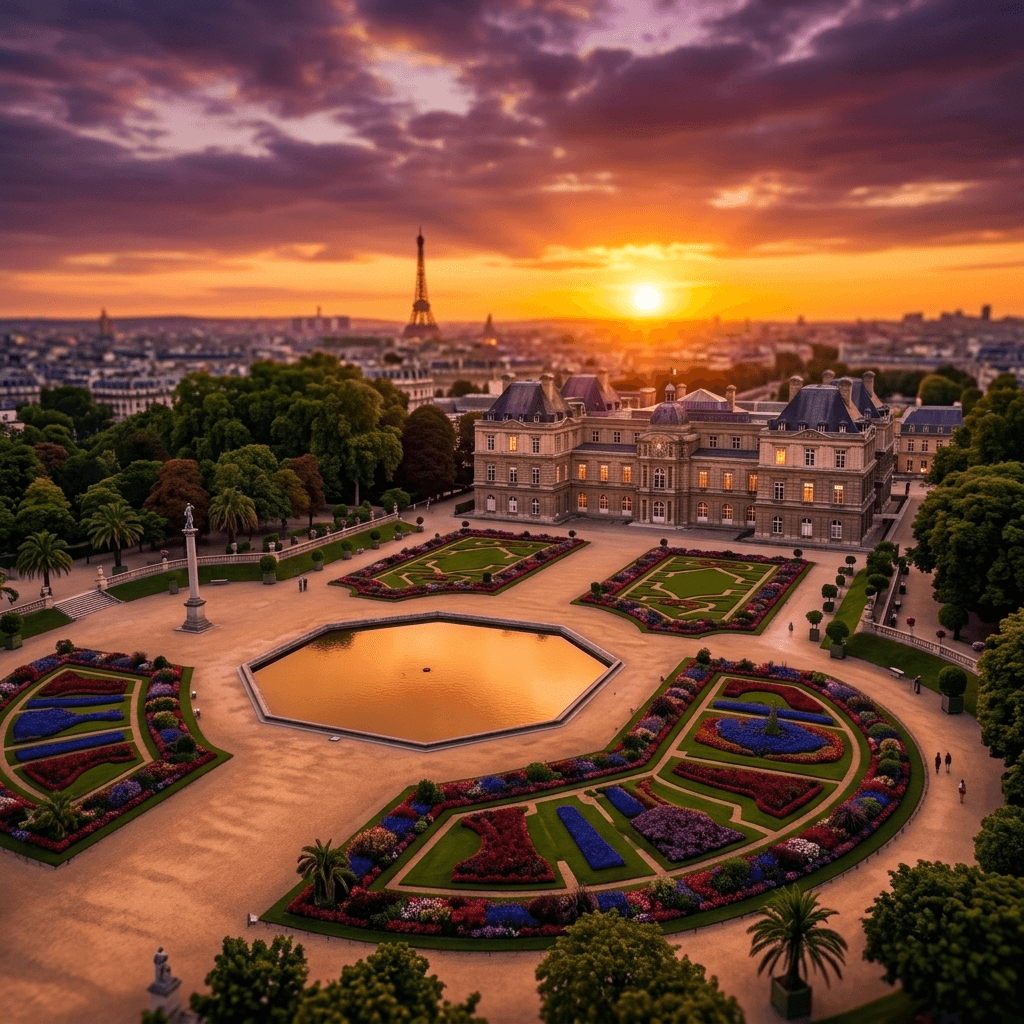
Marie de' Medici had a vast plot of land acquired and built the Luxembourg Palace, which would serve as her residence. The garden was planned to reflect the harmony of the Renaissance, with symmetrical lines, geometric alleys, and ornamental fountains, a breath of Tuscany on Parisian soil.
> 📜 Historical fact: Marie de' Medici brought Italian gardeners to Paris, and many of the original elements, such as the Medici Fountain, still carry Florentine DNA today.
Chapter
2.2 🏗️ Architectural and Landscaping Transformations Over the Centuries
Over the next four centuries, the Jardin du Luxembourg underwent several transformations, adapting to the tastes and needs of each era.
- 17th Century: expansion and formalization of the layouts in the classic French style. - 18th Century: reforms that softened the design, incorporating influences from English landscaping. - 19th Century: major urbanization works in Paris (by Haussmann) reduced the size of the garden but brought new paths and squares.
📈 Despite the changes, the garden has maintained a balance between French geometric rigor and Italian naturalistic charm, a rarity among European parks.
Chapter
2.3 ⚔️ The Garden during the French Revolution (public use and symbolism)
During the French Revolution (1789–1799), the Jardin du Luxembourg ceased to be merely an aristocratic space and came to symbolize a territory of the people. The Palace was confiscated and turned into a prison, and the garden—previously reserved—opened its doors to Parisians.
- The space became a meeting point for revolutionaries and intellectuals. - Some of the original sculptures were destroyed or looted. - The garden became one of the first truly public parks in Paris.
> 🔥 Curiosity: there are accounts that in 1794, trees from the garden were cut down for firewood during the famine that plagued Paris.
Chapter
2.4 🪖 Jardin du Luxembourg in Times of War (World Wars I and II, German occupation)
In times of conflict, the Jardin du Luxembourg always had strategic and symbolic functions.
- World War I: the garden served as a mobilization point and shelter for wounded soldiers. - World War II: the Palace was occupied by the Luftwaffe (Nazi air force), and the garden was partially closed. - Part of the space was turned into a war vegetable garden, with plots of potatoes and vegetables to supply the population.
> 📜 After the liberation of Paris in 1944, the garden became a symbol of resistance and recovery.
Chapter
2.5 📖 Historical Figures Linked to the Garden (kings, queens, intellectuals)
Throughout history, the Jardin du Luxembourg has been the stage for the presence of remarkable figures:
- Marie de' Medici: the garden's visionary. - Bourbon Kings: who maintained the space as a royal retreat. - Revolutionaries and political leaders: who used the garden as a place for speeches. - Intellectuals like Victor Hugo, Sartre, Simone de Beauvoir, and Hemingway, who strolled or wrote under its trees.
📍 Each generation left its mark, transforming the Luxembourg into a living witness to the history of France.
Chapter
2.6 🏛️ The Garden's Role in the Intellectual Life of Paris (19th and 20th centuries)
During the 19th and 20th centuries, the Jardin du Luxembourg became a cultural and intellectual epicenter. Close to the Sorbonne and the Collège de France, it became an outdoor living room for students, philosophers, writers, and artists.
- Poets like Baudelaire wrote verses inspired by walks in the garden. - In the 1920s, the space was frequented by artists and writers of the “Lost Generation,” like Hemingway, who sought inspiration in its bucolic setting. - To this day, it is common to see painting and literature classes taking place outdoors.
📌 The Jardin du Luxembourg, beyond its beauty, is also living history, culture, and literary inspiration.
Chapter
🎨 3. Architecture and Landscaping
Chapter
3.1 🏛️ French Style versus Italian Style in the Garden's Design
The Jardin du Luxembourg is one of the rare examples in Paris where two landscaping styles meet: the classic French style, marked by symmetry and geometric rigor, and the Italian Renaissance style, more organic and ornamental. This fusion is directly due to the taste of Marie de' Medici, who brought to Paris the influence of the gardens of Florence, where she grew up.
- From the Italian style, it inherited fountains, artificial grottoes, and the romanticism of shaded nooks. - From the French style, it absorbed symmetry, straight alleys, and a layout that extols order and human control over nature.
📌 The result is a garden that not only enchants with its beauty but also with the harmony between discipline and poetry, a rarity in historic parks.
Chapter
3.2 🌿 Classic Elements of Formal Landscaping
The layout of the Jardin du Luxembourg is designed to impress with its order and scale. Among the elements that define its landscaping are:
- Central avenues aligned to create monumental perspectives. - Geometric lawns and flowered parterres, carefully renewed each season. - Living borders, with shaped hedges and shrubs.
🔎 These elements give the visitor the feeling of walking on a natural stage, where every angle has been designed to create visual impact.
Chapter
3.3 💧 Historic Fountains and Water Features (including the iconic Fontaine Médicis)
The garden is home to several fountains and water features, but none is more famous than the Fontaine Médicis, commissioned by Marie de' Medici in 1630.
- Inspired by Italian grottoes, the fountain is a monument in the Mannerist style, with sculptures of mythological gods like Polyphemus, Acis, and Galatea. - It has become one of the most photographed spots in the park and is a haven of tranquility, especially popular for reading and romantic encounters.
Besides it, other smaller fountains scattered throughout the garden, such as the Delacroix Fountain, create points of coolness and contemplation.
Chapter
3.4 🏰 The Luxembourg Palace (Palais du Luxembourg) and its Architectural Role
At the heart of the garden stands the Palais du Luxembourg, a majestic example of early 17th-century architecture. Designed by Salomon de Brosse, the palace reflects Marie de' Medici's taste for Italian Renaissance architecture, but with a grandeur typical of the French nobility.
- Today, the palace houses the French Senate, but its presence continues to dictate the aesthetic composition of the park, aligning avenues, sculptures, and fountains with its central axis. - Its light stone facade creates a magnificent contrast with the intense green of the gardens.
📌 The palace and the garden form an inseparable whole: the building gives purpose to the garden, and the garden gives life to the building.
Chapter
3.5 🗿 Sculptures and Monuments Integrated into the Landscape
The Jardin du Luxembourg is home to more than 100 sculptures, carefully arranged to dialogue with the landscape.
- Galerie des Reines de France: a series of 20 statues of queens and illustrious women, lined up along one of the main axes. - Sculptures of writers like Beethoven, Baudelaire, and Delacroix create a link between art, literature, and nature. - There are also contemporary pieces, discreetly integrated, keeping the garden always alive and up-to-date.
📌 This combination makes the garden an open-air museum, where every step reveals a work of art and every angle is an invitation to artistic contemplation.
Chapter
🌸 4. Nature and Themed Gardens
Chapter
4.1 🌳 Formal Gardens, Lawns, and Walking Areas
The Jardin du Luxembourg is divided into well-defined areas, reflecting the harmony between classic landscaping and urban life. There are geometric lawns that can only be admired, open areas for picnics, and extensive gravel paths for walking.
- Central lawns: impeccably maintained, they change color and design with the seasonal flowers. - Walking areas: lined with iconic green metal benches, they invite contemplation. - Reserved sections: some lawns remain inaccessible, protecting the most sensitive vegetation.
Chapter
4.2 🍏 The Historic Orchard and the Orchid Garden
Few tourists know, but the Jardin du Luxembourg houses a historic orchard (verger) created in the 17th century. It maintains a living collection of over 400 varieties of apples and pears, many of them extremely rare.
In addition to the orchard, there is an orchid garden managed by the Senate's horticulturalists, with greenhouses that hold scientific botanical collections. These greenhouses are not always open to the public, but temporary exhibitions allow visitors to admire rare species and learn about botany.
> 🌱 Curiosity: the orchard also functions as an educational space, teaching students about grafting, pruning, and the conservation of ancient fruits.
Chapter
4.3 🌲 Historic Trees, Rare Species, and Botanical Corners
The park is a true living museum of trees. Among the notable species:
- Centennial chestnut trees, planted in the 17th century. - The purple beech, a rare tree with intense purple foliage. - A hybrid plane tree over 200 years old, protected by fences.
🌍 The garden also hosts exotic trees, such as potted palm trees in the summer, brought from the Mediterranean region, creating an exotic contrast with the classic style.
Chapter
4.4 🌿 Conservation, Reforestation, and Sustainability Policies
The French Senate, responsible for managing the garden, has implemented modern policies for maintenance and sustainability:
- Use of smart irrigation systems to save water. - Planting of climate-resilient species to face climate change. - Programs for reforestation and replacement of aging trees.
📌 The Jardin du Luxembourg is an example of urban environmental management, combining tradition and modernity.
Chapter
4.5 🏵️ The Senate's Horticulture: How the Garden is Maintained Today
The Senate's Horticulture Service (Service d’Horticulture du Sénat) is responsible for the care of the Jardin du Luxembourg. A team of gardeners, botanists, and landscape architects maintains:
- Seedlings and seasonal flowers, replanted according to the seasons. - Scientific collections, such as orchids, fruit trees, and rare plants. - Botanical study areas, connecting the garden to universities and schools.
> 📜 The daily care is so meticulous that the Jardin du Luxembourg is considered one of the best-maintained gardens in all of Europe.
Chapter
🧸 5. Activities and Attractions for Visitors
Chapter
5.1 🚤 Sailing Model Boats on the Central Pond
One of the most iconic attractions of the Jardin du Luxembourg is the miniature wooden model boats that children push with bamboo sticks on the large octagonal pond in front of the Palace. This tradition dates back to the 19th century, when artisans began producing small sailboats that Parisians would rent.
- Today, the boats can still be rented for a few euros, keeping alive one of the most photogenic scenes in Paris. - Each boat carries the flag of a different country, delighting tourists from all over the world.
> 📌 SEO TIP: terms like “Jardin du Luxembourg wooden boats” and “activities for children in Paris” attract families planning trips.
Chapter
5.2 🎭 Children's Playground and the Traditional Puppet Theater (Guignol)
The Luxembourg's playground is one of the most famous in the city, with slides, seesaws, and classic toys, many of vintage design. Next to it is the Théâtre des Marionnettes du Jardin du Luxembourg, one of the largest and most traditional puppet theaters in Europe.
- Established in 1933, the theater has enchanted generations with plays featuring Guignol, a classic French character. - Performances take place almost every day in spring and summer, attracting tourists and locals.
🎭 The theater is not just for fun: it is also a French cultural heritage that keeps the tradition of puppetry alive.
Chapter
5.3 🎾 Tennis Courts, Running Paths, Chess, and Pétanque
The Jardin du Luxembourg is not just a space for contemplation, but also an informal sports center.
- Tennis courts: available for rent, widely used by Parisians. - Running paths: runners use the garden's perimeter for training. - Chess boards: fixed tables attract players, with matches that turn into true philosophical duels. - Pétanque courts: the traditional French ball game, similar to boules, is played under the trees.
📌 These sports are part of Parisian daily life and show that the garden is a living space, used by all ages.
Chapter
5.4 🎼 Concerts, Art Exhibitions, and Outdoor Reading
During spring and summer, the Jardin du Luxembourg transforms into an open-air cultural stage.
- Free concerts are held at the central bandstand, featuring orchestras and jazz bands. - Photographic and artistic exhibitions occupy the garden's railings, presenting historical, environmental, and social themes. - Book clubs and literary gatherings happen spontaneously on the benches and lawns.
🎶 A visitor might come for a walk and end up watching a recital or a contemporary art exhibition—all for free.
Chapter
5.5 🧺 Picnics and Parisian Traditions on the Lawn
The Jardin du Luxembourg is one of the most traditional picnic spots in Paris. Parisians and tourists spread blankets on the permitted lawns, bringing baguettes, cheeses, wines, and fruits.
- This practice is a Parisian cultural institution, especially on Sundays and in the summer. - There are designated areas for picnics, preserving historic lawns. - The picnic scene at the Luxembourg is often depicted in iconic films and photographs.
📌 More than just a meal, a picnic in the Luxembourg is an authentic Parisian experience, combining gastronomy, leisure, and culture.
Chapter
🏛️ 6. The Luxembourg Palace and the French Senate
Chapter
6.1 🏰 History of the Palace and its Construction
The Palais du Luxembourg was commissioned in 1612 by Marie de' Medici, Queen of France, widow of Henry IV, and mother of the future Louis XIII. Wishing to distance herself from the hostile environment of the Louvre and recreate a piece of her native Florence in Paris, Marie had a palace built inspired by the Palazzo Pitti and the Italian gardens of the Giardino di Boboli.
To realize her dream, she hired the architect Salomon de Brosse, who designed a building that was innovative for its time: a mix of French symmetrical rigor and Italian delicacy. The palace was built with light-colored stone, large windows, and pavilions surrounding an inner courtyard, as well as a monumental facade facing the garden.
- Construction began in 1615 and was completed in 1631, becoming Marie de' Medici's residence until her death. - The architectural style was considered a precursor to French Baroque, influencing future aristocratic buildings. - The original project envisioned wider and more luxurious wings, but financial crises and political disputes limited some of the initial ambition.
The result was an elegant palace, but also highly symbolic: a statement of power, art, and the personal memory of the Florentine queen.
Chapter
6.2 🏛️ Its Current Role as the Seat of the French Senate
After Marie de' Medici's death, the palace passed through royal and noble hands and was even confiscated during the French Revolution. In the 19th century, it took on a new function: it became the seat of the French Senate, a position it holds to this day.
- Since 1958, with the creation of the Fifth Republic, the Senate has been consolidated as a fundamental legislative institution, operating within the palace. - The building is, therefore, a center of political power, where laws are debated, amendments are voted on, and national decisions are made. - The presence of the Senate ensures the palace has reinforced security and constant maintenance, preserving its heritage.
The Luxembourg Palace is not just an architectural masterpiece: it is a symbol of the modern French state, blending history and active political life.
Chapter
6.3 👣 Guided Tours and Areas Open to the Public
Although it is a functioning political institution, the palace opens its doors on special occasions, attracting thousands of visitors:
- European Heritage Days (Journées Européennes du Patrimoine): an annual event in September that allows the public to explore the halls, library, and historic corridors of the Senate. - Temporary exhibitions: some rooms host art, photography, and history shows, open to the public by reservation. - The inner courtyard and front gardens can be enjoyed by any visitor to the Jardin du Luxembourg, even when the interiors are closed.
> 📜 Historical note: Parisians often say that the palace “breathes politics,” but its gardens “breathe poetry.”
Chapter
6.4 🎨 The Senate Chamber: Artworks and Official Ceremonies
The interior of the Luxembourg Palace holds artistic and historical treasures.
- The Senate library is one of the richest in Paris, with legislative collections, rare manuscripts, and historical engravings. - The main halls display monumental paintings by French masters, depicting battles, allegories of the Republic, and episodes from national history. - Tapestries and sculptures decorate the corridors, blending aristocratic tradition with political functionality.
In addition to its artistic value, the halls host state events, diplomatic receptions, awards ceremonies, and official ceremonies, making the palace a place where art, politics, and protocol meet.
Chapter
6.5 🕰️ Transformations, Expansions, and Restorations
The Luxembourg Palace has undergone several phases of modification:
- 18th Century: internal adaptations when the building served as a prison during the French Revolution. - 19th Century: Napoleon Bonaparte had damaged areas restored and used parts of the palace for administrative bodies. - 20th Century: discreet modernizations to accommodate the needs of the Senate, including security systems, digital archives, and legislative infrastructure.
Each restoration has respected the original spirit of the palace, preserving its historical essence while adapting it to modern times.
Chapter
6.6 🌍 The Palace as a Political and Cultural Symbol
Today, the Luxembourg Palace is more than a government building: it is a living symbol of the balance between tradition and modernity in France.
- It represents the continuity of the French state, with centuries of history embedded in its walls. - It is a point of connection between political power and culture, as the gardens and exhibitions remain open to the public. - Its presence gives the Jardin du Luxembourg a unique weight: the garden is not just a leisure space, but also a place of historic decisions and national representation.
Chapter
🗿 7. Sculptures, Monuments, and Public Art
Chapter
7.1 👑 Statues of Queens and Famous Women (the famous “Galerie des Reines”)
One of the most impressive sculptural ensembles in the Jardin du Luxembourg is the so-called “Galerie des Reines” (Gallery of Queens). Created in the mid-19th century, this open-air gallery brings together 20 statues of queens, saints, and illustrious female figures from French history, majestically lined up along the central axes of the garden.
Among the personalities represented are:
- Saint Geneviève, the patron saint of Paris. - Anne of Austria, mother of Louis XIV. - Joan of Arc, a French national heroine. - Margaret of Anjou, queen consort of England.
Each statue tells a part of France's history, honoring women who have marked its culture, politics, and religion.
> 📜 Curiosity: the statues were produced between 1843 and 1856 in white marble, and many have required restoration over time due to pollution and weathering.
Chapter
7.2 📚 Literary and Philosophical Monuments (like that of Baudelaire and others)
The Jardin du Luxembourg is a true temple of literature and philosophy, and its sculptures reflect this. Scattered throughout the park, we find busts and monuments dedicated to writers, poets, scientists, and thinkers.
- A bust of Charles Baudelaire, the poet of Les Fleurs du Mal, is discreetly installed among the trees. - Monuments celebrate figures such as Eugène Delacroix, Stendhal, Henri Murger, and Paul Verlaine. - There are also tributes to scientists, like François Arago, a French astronomer and physicist.
These works transform the garden into an open-air classroom, where art and knowledge walk hand in hand.
Chapter
7.3 🎨 Contemporary Works in the Garden and Temporary Sculptures
Although filled with classical sculptures, the Jardin du Luxembourg is not stuck in the past. The French Senate, responsible for its administration, promotes the installation of contemporary works and temporary exhibitions.
- Modern sculptures dialogue with historical statues, creating a provocative contrast. - Some pieces are displayed only for a season, which means the garden is always artistically renewing itself.
This coexistence between the classic and the contemporary reinforces the image of the Luxembourg as a dynamic open-air museum, where visitors always find something new.
Chapter
7.4 ⚜️ Monuments Honoring Great French Scientists and Heroes
Besides queens and poets, the Jardin du Luxembourg also celebrates historical figures linked to progress and science.
Among the most notable monuments:
- Monument to Leconte de Lisle (poet and translator). - Statue of Chopin, honoring the Polish composer who lived in Paris. - Tributes to mathematicians, inventors, and military figures, representing the innovative spirit of France.
The sculptural ensemble of the Jardin du Luxembourg is so vast that many visitors say “it's impossible to walk 50 meters without finding a new work.” There are over 100 sculptures, harmoniously scattered, creating an unparalleled artistic and historical experience.
Chapter
🏃 8. Jardin du Luxembourg in Parisian Daily Life
Chapter
8.1 🤝 The Garden as a Meeting Point for Parisians
More than just a postcard, the Jardin du Luxembourg is a daily social space for Parisians. The garden functions as an outdoor living room: - Couples choose the spot for romantic dates. - Friends gather for conversations under the shade of the trees. - Families stroll with children, creating fond memories.
The atmosphere is so welcoming that many Parisians consider it “Paris's backyard.” It is common to see people reading, resting, sunbathing, or simply watching life go by.
Chapter
8.2 🎓 Sorbonne Students and the Academic Use of the Space
Its proximity to historic institutions like the Sorbonne, the Collège de France, and the École Normale Supérieure has turned the garden into an academic retreat.
- Students review notes on benches or lawns. - Professors use the garden for informal classes and philosophical debates. - Fieldwork in botany and art often uses the park as a “living classroom.”
This intellectual connection contributes to the Luxembourg's aura as a space for reflection and learning.
Chapter
8.3 🏃♂️ The Garden in Sports Life: Running, Walking, and Workouts
The Jardin du Luxembourg is not just for contemplation; it is also a space for the body.
- Runners do morning and evening circuits, using the garden's oval layout. - Walkers use the alleys as a daily wellness route. - Groups for tai chi, yoga, and gymnastics gather outdoors.
The balance between sport and leisure makes the garden a laboratory of the Parisian “art de vivre,” where health, nature, and urban routine coexist.
Chapter
8.4 📸 Fashion Shoots, Cinema, and Photo Sessions in the Garden
Thanks to its scenic beauty, the Jardin du Luxembourg is often used as a backdrop for cultural and commercial productions.
- Fashion shoots for international brands take advantage of the lawns and statues. - Films and series shoot scenes in the garden (from French productions to Hollywood ones). - Couples and professional photographers use the garden for wedding photo shoots or advertising campaigns.
This constant presence in visual media reinforces the Luxembourg's image as an aesthetic icon of Paris—recognizable from any angle.
Chapter
🎉 9. Annual Events and Cultural Activities
Chapter
9.1 🎼 Outdoor Concerts and Musical Seasons
The Jardin du Luxembourg transforms into an open-air cultural stage for much of the year. The central bandstand, built in the 19th century, is the heart of free musical performances.
- During spring and summer, bands, choirs, and orchestras play for crowds. - The repertoire is varied, ranging from jazz to classical music, from military bands to folk groups. - Many of the concerts are free and attract Parisians who bring folding chairs and picnic baskets.
> 🎶 Since the 19th century, listening to music in the Luxembourg has been a Parisian tradition—an experience that blends culture and outdoor leisure.
Chapter
9.2 🖼️ Temporary Art Exhibitions and Photographic Shows
The outer railings of the Jardin du Luxembourg frequently host open-air exhibitions, making art accessible to everyone.
- Photographic shows present themes such as the environment, history, world heritage, and French culture. - Temporary exhibitions of painting, sculpture, and illustrations complement the artistic scenery. - Admission is always free, democratizing access to art.
📍 These exhibitions change regularly, ensuring that every visit to the garden brings new visual discoveries.
Chapter
9.3 🇫🇷 National Holidays and Official Commemorations in the Garden
The Jardin du Luxembourg is also the stage for national celebrations and official ceremonies:
- On July 14th (Bastille Day), the garden hosts special musical performances and cultural activities. - Commemorations of historical dates, such as the birthdays of writers and scientists honored with statues in the park, also take place. - The Senate, housed in the Luxembourg Palace, organizes protocol events that are reflected in the garden, reinforcing the connection between political power and popular culture.
Chapter
9.4 🏃♀️ Sports Events and Traditional Competitions
The Luxembourg is not just about music and art—it's also about sport and tradition.
- Pétanque tournaments (a traditional French ball game) bring together veteran players and beginners. - Organized runs and walks, especially on commemorative dates, use the garden as a circuit. - Demonstrations of fencing, folk dancing, and historical sports take place on special dates.
> 🎯 These activities create a lively atmosphere, showing that the Luxembourg is much more than a contemplative space.
Chapter
9.5 🎬 Outdoor Cinema and Summer Activities
In the warmer months, the Luxembourg transforms into an outdoor cinema.
- Free screenings show classics of French and international cinema. - Films projected at dusk create a magical atmosphere, with the Paris sky as a backdrop.
In addition to cinema, seasonal activities include:
- Yoga and tai chi classes on specific lawns. - Art and gardening workshops for children and adults.
These events solidify the garden as a dynamic cultural center, which changes with the seasons and always offers something new to visitors.
Chapter
🌍 10. Curiosities and Little-Known Facts
Chapter
10.1 👻 Legends and Hidden Stories (secret loves, ghosts, and conspiracies)
The Jardin du Luxembourg is not just a place of beauty and tranquility—it also harbors urban legends and intriguing stories.
- There are reports of Marie de' Medici's ghost wandering the alleys on misty nights, as if reviewing her life's work. - Rumors of secret passages connecting the palace to strategic points in Paris fuel the popular imagination. - Some 19th-century writers spoke of secret meetings and political conspiracies that allegedly took place in the shadows of the garden.
These narratives, though often fanciful, contribute to the mysterious fascination of the place.
Chapter
10.2 📚 The Garden in Cinema, Literature, and Painting (from Hemingway to Woody Allen)
The Jardin du Luxembourg has a prominent presence in the arts and pop culture.
- In literature, authors like Victor Hugo, Baudelaire, and Hemingway have referenced the garden in their works. Hemingway, for example, mentioned the garden in A Moveable Feast. - In cinema, memorable scenes have been filmed there, including in acclaimed French films and international productions like Woody Allen's Midnight in Paris. - In the visual arts, 19th and 20th-century painters depicted the Luxembourg in impressionist and naturalist paintings.
📍 The garden is a visual and narrative icon that inspires generations of artists.
Chapter
10.3 🌟 Records and Unusual Episodes
The Jardin du Luxembourg has a long list of curious episodes:
- During World War II, part of the garden was turned into a war vegetable garden, with plantings of potatoes and cabbage. - There are records that in 1909, the garden hosted one of the first aviation demonstrations in Paris. - The garden has been the stage for protests, impromptu concerts, photo shoots, and even scientific experiments.
These facts show how versatile and adaptable the space is, always connected to history.
Chapter
10.4 📝 Famous Quotes from Writers, Poets, and Artists About the Garden
Many writers and artists were enchanted by the Luxembourg and left memorable phrases:
- Hemingway: “I would go to the Jardin du Luxembourg to work, because it was quiet and there was always something to see while I was thinking.” - Baudelaire: “Gardens are the temples of the free spirit, and in the Luxembourg, it breathes poetry.”
These quotes reinforce the garden's role as an inexhaustible source of inspiration.
Chapter
🧭 11. Practical Information for Visitors
Chapter
11.1 ⏰ Opening Hours and Best Times to Visit
The Jardin du Luxembourg is open every day of the year, but its hours vary with the season:
- Winter: it opens around 8:15 AM and closes earlier, around 4:30–5:00 PM. - Summer: it opens at 7:30 AM and stays open until 9:30–10:00 PM, taking advantage of the long days.
📍 Best times to visit: - Spring: the flowerbeds explode in color, with tulips and daffodils. - Autumn: the golden leaves create unforgettable photographic scenes.
Avoiding sunny weekends helps to escape the largest crowds of tourists.
Chapter
11.2 💳 Free Access and Possible Restricted Areas
Access to the Jardin du Luxembourg is completely free.
- Everyone can walk on the lawns, alleys, and open areas. - Some specific areas, like the children's playground and the tennis courts, have small usage fees. - Areas near the Senate may be temporarily closed for security reasons.
> 💡 Even though it's free, the garden is impeccably maintained—a reflection of the French Senate's investment in preserving heritage.
Chapter
11.3 🚇 How to Get There: Metro, Bus, and Walking Access
The garden's location in the 6th arrondissement makes it easy to access:
- Metro: - Line 4: Odéon station - Line 10: Cluny – La Sorbonne station - Line 12: Notre-Dame-des-Champs station
- RER B: Luxembourg station, practically at the garden's entrance. - Bus: several lines pass through the neighboring streets (21, 27, 38, 58, 82, 84, 85, 89).
🚶♂️ The garden is also perfect to reach on foot, as it is in the heart of the Latin Quarter.
Chapter
11.4 🏪 Services, Cafes, Restrooms, and Infrastructure
The Luxembourg offers exemplary infrastructure for visitors:
- Cafes and kiosks: selling coffee, sandwiches, pastries, and ice cream (ideal for a break during your visit). - Public restrooms: well-signposted and free. - Souvenir shops: small stalls sell postcards, books, and items related to the garden. - Drinking water: fountains are scattered throughout the park, allowing you to refill reusable bottles.
This structure makes the visit comfortable and practical, including for families with children.
Chapter
11.5 ♿ Accessibility and Ease for All Visitor Profiles
The Jardin du Luxembourg is one of the most accessible gardens in Paris:
- Wide, flat paths, suitable for wheelchairs and strollers. - Ramps in areas with level changes. - Adapted restrooms and clear signage.
This accessibility ensures that all visitor profiles—from children to the elderly—can fully enjoy the space.
Chapter
11.6 📸 Basic Rules of Conduct and Etiquette
To preserve the beauty and order of the garden, some rules must be respected:
- Photography: permitted, but the use of professional tripods may require authorization. - Picnics: allowed only in specific areas. - Pets: allowed in certain parts, but must be on a leash. - Closed lawns: some areas have restricted access; respect the signs.
Compliance with these rules ensures that the Jardin du Luxembourg remains a well-preserved heritage for all.
Chapter
🗺️ 12. Attractions and Points of Interest Near the Jardin du Luxembourg
Chapter
12.1 🏛️ The Sorbonne and the Intellectual Heart of the Latin Quarter
A few steps from the Jardin du Luxembourg is the Sorbonne, one of the oldest and most prestigious universities in the world, founded in the 13th century.
- The historic building of the Sorbonne is an icon of French academic tradition and a landmark of the Latin Quarter, the student and intellectual district of Paris. - Many students and professors frequent the Luxembourg daily to study, take breaks, or discuss ideas. - Walking around the area reveals centuries-old bookstores, like the Librairie J. Vrin, specializing in philosophy and humanities.
> 📜 Visitors can combine a walk in the garden with an inspiring stroll through the academic streets of the neighborhood.
Chapter
12.2 ⚰️ The Panthéon and Other Historical Gems in the Vicinity
The Panthéon is just a few minutes from the Luxembourg and is a must-see for history lovers.
- This majestic neoclassical building houses the remains of great French personalities, such as Victor Hugo, Voltaire, Rousseau, Marie Curie, and Émile Zola. - Its monumental dome offers an impressive view of Paris, including the garden itself.
Besides the Panthéon, visitors will find: - The Church of Saint-Étienne-du-Mont, an example of Gothic and Renaissance architecture. - Rue Mouffetard, one of the oldest market streets in Paris, full of cafes and markets.
Chapter
12.3 🎭 Cafes, Bookstores, and the Cultural Life of the Neighborhood
The area around the Jardin du Luxembourg is a paradise for culture lovers.
- Historic cafes, like the Café de Flore and Les Deux Magots, are a few blocks away, having been the meeting place of Sartre, Simone de Beauvoir, and Hemingway. - Charming and specialized bookstores offer rare editions, old maps, and art books. - Contemporary art galleries complete the cultural scene of the neighborhood.
📍 The region breathes a bohemian and intellectual air, perfect for those who want to immerse themselves in the Paris of writers and artists.
Chapter
12.4 🚶♂️ Walking Itineraries Connecting the Luxembourg to Other Paris Sights
The Jardin du Luxembourg is an ideal starting point for walking itineraries.
- Route 1: Luxembourg → Panthéon → Sorbonne → Rue Mouffetard (gastronomy and culture). - Route 2: Luxembourg → Saint-Germain-des-Prés → Café de Flore → Seine River. - Route 3: Luxembourg → Saint-Sulpice (a church famous from “The Da Vinci Code”) → Musée Delacroix.
These walks reveal the historic, academic, and bohemian Paris, with the garden as a central point.
Chapter
12.5 🏛️ Smaller Museums and Hidden Treasures of the Neighborhood
In the vicinity of the Luxembourg, there are discreet and little-known museums, perfect for those who enjoy exclusive experiences:
- Musée du Luxembourg: dedicated to high-level temporary exhibitions, located on the side of the Senate. - Musée Zadkine: small and charming, dedicated to the Russian-French sculptor Ossip Zadkine, set amidst a sculpture garden. - Musée Curie: a space dedicated to the life and discoveries of the scientist Marie Curie, just a few minutes' walk away.
These places offer a perfect complement to a walk in the garden, making the visit a complete cultural immersion.
Chapter
🌟 13. Experiences and Thematic Itineraries in the Jardin du Luxembourg
Chapter
13.1 🎨 Artistic Walk: Sculptures, Fountains, and Monuments
For art lovers, the Jardin du Luxembourg functions as an open-air museum.
- Galerie des Reines de France: the impressive row of 20 statues of French queens is the starting point. - Fontaine Médicis: one of the most beautiful examples of Italian Mannerism in Paris, ideal for photos and contemplation. - Literary monuments and busts of writers: discover tributes to Baudelaire, Delacroix, Chopin, and many others.
📍 Itinerary tip: wander through the garden in search of the lesser-known sculptures, like that of George Sand or the bust of Eugène Delacroix—often overlooked by hurried tourists.
Chapter
13.2 🥖 Parisian Picnic: Tradition and Flavor
A picnic in the Jardin du Luxembourg is an authentic and democratic experience, mixing Parisians and tourists.
- Where to buy: nearby bakeries (boulangeries) offer fresh baguettes, cheeses, wines, and pastries for a perfect picnic. - Best areas: permitted lawns, near the fountains, or under centennial trees. - Atmosphere: families, groups of friends, couples—all share the same space in a typically Parisian scene.
> 🥂 It's a way to experience local life, away from crowded restaurants, with the tranquility of the garden as a backdrop.
Chapter
13.3 📚 Literary Itinerary: From Baudelaire to Hemingway
The Luxembourg was and continues to be a refuge for writers and poets.
- Hemingway frequented the garden in the 1920s and even wrote parts of A Moveable Feast inspired by its alleys. - Baudelaire and Paul Verlaine mentioned the garden in poems. - Bookstores in the Latin Quarter can complement the itinerary, allowing visitors to purchase rare editions and walk in the same spaces as the great authors.
📍 This itinerary is perfect for those seeking the intellectual and bohemian Paris.
Chapter
13.4 👑 Historical Walk: Marie de' Medici, the Senate, and Politics
The Jardin du Luxembourg is also a political and historical stage.
- The itinerary begins at the Fontaine Médicis, evoking the legacy of the Italian queen. - It passes by the Luxembourg Palace, the current seat of the French Senate, where national decisions are still made. - It continues past the statues of historical figures and busts that recall significant episodes in French history.
> 🚶♂️ This walk connects art, history, and politics, making the tour much more profound.
Chapter
13.5 🏃♀️ Sports and Wellness Itinerary
For those who prefer a more active visit, the Luxembourg offers:
- Running paths used by athletes and amateurs. - Areas for yoga and tai chi outdoors. - Tennis courts and chess boards, for activities that combine leisure and socialization.
📍 An itinerary that combines a healthy lifestyle, sports, and the unique atmosphere of Paris.
Chapter
🍂 14. Jardin du Luxembourg in Other Seasons of the Year
Chapter
14.1 🌷 The Explosion of Colors in Spring
In spring, the Jardin du Luxembourg seems to be reborn on a living canvas.
- Tulips, daffodils, and hyacinths color the central flowerbeds in impeccable geometric patterns. - The mild weather attracts Parisians and tourists for the first picnics of the year. - The puppet theater reopens with new shows, and outdoor concerts begin to appear.
📍 It is the season when the garden becomes a true festival of flowers, offering the most photogenic scenery of the year.
Chapter
14.2 🌞 Summer: Social Life, Picnics, and Cultural Events
Summer transforms the Luxembourg into a social epicenter.
- The lawn fills with picnics: baguettes, wines, cheeses, and laughter make up the typical scene. - Cultural events multiply: concerts, photo exhibitions on the railings, and open-air cinema. - Tourists and locals share the space, and the long days allow for enjoying the garden until late.
> ☀️ Summer in the Luxembourg is a celebration of outdoor life.
Chapter
14.3 🍁 Autumn: Golden Foliage and Romantic Atmosphere
In autumn, the garden is covered in warm tones: yellows, oranges, and reds.
- The chestnut trees leave the ground covered in leaves, creating poetic scenes. - The crowds thin out, and the atmosphere becomes quieter and more contemplative. - It is the favorite season of photographers and couples seeking a calmer, more romantic Paris.
📍 The autumnal atmosphere of the Luxembourg is melancholic, yet deeply charming.
Chapter
14.4 ❄️ Winter: Tranquility, Snow, and Empty Gardens
In winter, the Jardin du Luxembourg takes on a serene and minimalist tone.
- With luck, a layer of snow covers the lawns and statues, creating an almost dreamlike landscape. - The fountains continue to run, but many chairs and benches are collected for preservation. - It is the quietest season: ideal for those seeking silence and introspection.
> ❄️ Winter reveals a less obvious side of the garden, but one that is equally beautiful, showing that the Luxembourg is fascinating at any time of the year.
Chapter
🎠 15. Jardin du Luxembourg and Children's Life
Chapter
15.1 🎭 Puppet Theater: The Charm of Guignol
The Théâtre des Marionnettes du Jardin du Luxembourg is one of the oldest and most renowned puppet theaters in Europe.
- Founded in 1933, it features the classic character Guignol, an icon of French children's theater. - The plays mix humor, moral lessons, and interactivity, enchanting generations. - Shows take place mainly on weekends and during school holidays, with affordable tickets (around €6).
📍 It is one of the highlights for those visiting Paris with children, combining culture and fun.
Chapter
15.2 🧸 Playgrounds and Fun Activities
The Luxembourg's playground is famous for being one of the best-equipped in the city.
- It features slides, seesaws, climbing ropes, and sand areas. - Access to the playground is paid (around €3), which ensures impeccable maintenance and safety. - Children of all ages find suitable options, from the little ones to the more adventurous.
> 🪁 The space is a fun and safe experience, ideal for families looking for a lively break.
Chapter
15.3 🏇 Pony Rides and Classic Amusements
One of the most adorable traditions of the Jardin du Luxembourg is the pony rides.
- Children can ride ponies led by monitors on a predefined route. - This activity dates back to the early 20th century and is a symbol of Parisian childhood.
In addition to ponies, the garden offers: - A traditional carousel, with hand-carved horses. - Antique toys, preserving the charm of past decades.
Chapter
15.4 👨👩👧 A Family-Friendly Space: Why the Luxembourg is the Children's Garden
Few parks in Paris offer as many children's activities as the Jardin du Luxembourg.
- It is safe, with constant surveillance and defined areas. - It is educational, as children come into contact with history, art, and nature at the same time. - It is interactive, as the theater, ponies, and playgrounds create an unforgettable experience.
📍 The Jardin du Luxembourg is, without a doubt, the most child-oriented park in all of Paris.
Chapter
🌱 16. Sustainability, Conservation, and Maintenance of the Jardin du Luxembourg
Chapter
16.1 🌿 The Role of the Senate in the Garden's Preservation
The Jardin du Luxembourg is unique in Paris: it belongs to the French Senate, which manages the Luxembourg Palace and the park.
- The Senate maintains a permanent team of gardeners, engineers, and specialists to care for the space. - This administration ensures that interventions respect the historical heritage and the landscaping legacy of the garden. - The Luxembourg's management model is an example of a partnership between public authority and cultural preservation.
Chapter
16.2 💧 Irrigation, Environmental Care, and Ecological Management
The garden's maintenance involves a sophisticated system of ecological management:
- Smart irrigation: sensors control water to prevent waste. - Natural fertilizers and composting: organic waste from the garden itself becomes fertilizer. - Integrated pest management: replacing chemical products with biological solutions.
📍 These practices make the Luxembourg a laboratory of urban sustainability in Paris.
Chapter
16.3 🌳 Replanting, Tree Replacement, and Native Species
The Luxembourg is home to centennial trees and rare species, but maintenance requires planning:
- Aging or diseased trees are gradually replaced. - New species are chosen to withstand global warming and climate change. - Some trees are monitored with electronic chips to control their health and growth.
> 🌍 This attention ensures that the garden remains alive and healthy for centuries to come.
Chapter
16.4 🏗️ Structural Restorations and Historical Preservation
Besides the green areas, the Senate takes care of architectural elements:
- Sculptures and statues undergo regular cleaning and restoration. - Fountains and water features receive hydraulic and structural maintenance. - Paths and urban furniture (like the iconic green chairs) are constantly repaired or replaced.
📍 This dedication ensures that the Luxembourg is always in impeccable condition, despite millions of annual visitors.
Chapter
16.5 ♻️ A Green Management Model for the Future
The Jardin du Luxembourg is not just a beautiful park: it is a model of sustainable management.
- The Senate invests in environmental education, opening greenhouses and orchards for educational visits. - Carbon emission reduction projects are part of the long-term plan. - The garden serves as a reference for other European parks on how to reconcile history, intensive use, and preservation.
📜 The result is a space that honors its past and is prepared for the future.
Chapter
📜 17. Cultural Legacy and Influence of the Jardin du Luxembourg
Chapter
17.1 🎨 The Garden as an Artistic and Literary Symbol
The Jardin du Luxembourg transcends its function as a park: it has become a cultural icon of Paris.
- Impressionist and Romantic painters, like Camille Corot and Henri Matisse, depicted scenes from the garden in their works. - Writers, from Baudelaire to Hemingway, cited it as a creative refuge. - French and international poets find inspiration for their verses in its alleys and statues, solidifying the garden as a living artistic space.
📍 Its image is present in books, paintings, films, and even songs, immortalizing it as one of the great symbols of Parisian culture.
Chapter
17.2 🇫🇷 The Jardin du Luxembourg and Parisian Identity
More than just a green space, the Luxembourg is part of the DNA of Paris.
- It represents French urban sophistication: a space that unites history, art, politics, and leisure. - It is considered by many Parisians as “the garden of the soul of Paris”, for its presence in family memories, romantic encounters, and daily rituals. - The balance between open areas, monuments, and cultural events makes it a model of how a city can dialogue with its citizens.
Chapter
17.3 🌍 International Influence: The Luxembourg as a Model for Parks
The Jardin du Luxembourg has served as inspiration for urban parks around the world.
- Its classic French landscaping has influenced public gardens in Europe, the Americas, and even Asia. - Architects and urban planners study the Luxembourg to understand how art, politics, and nature can coexist in harmony. - Elements like movable chairs, now common in other Paris gardens, were popularized here.
📜 Thus, the Luxembourg is not just a Parisian park: it is an international legacy of urban design and public life.
Chapter
17.4 🏛️ Historical Heritage and Future of the Garden
The Jardin du Luxembourg is officially recognized as a Historic Monument of France.
- Its preservation is guaranteed by heritage protection laws and by the direct care of the Senate. - There are ongoing projects to ensure its adaptation to new demands, such as growing tourism and climate change, without losing its essence. - The future of the garden involves more than maintenance: it involves preserving a unique cultural, social, and historical experience for future generations.
📍 The Jardin du Luxembourg is, in essence, a bridge between the past and the future of Paris.
Chapter
🔎 18. Rare Details and Hidden Treasures of the Jardin du Luxembourg
Chapter
18.1 🗽 The Original Statue of Liberty of the Jardin du Luxembourg
Few visitors know that the Jardin du Luxembourg houses an official replica of the Statue of Liberty, sculpted by Frédéric Auguste Bartholdi, the same creator of the original statue in New York.
- Installed in the garden in 1906, the sculpture was an artist's test prototype before the finalization of the American monument. - The piece was removed during World War II for protection and, years later, reinstalled. - Today, the statue has become a point of curiosity for attentive tourists, marking a link between Paris and the United States.
📍 A visit to the Luxembourg allows you to see one of the first versions of the Statue of Liberty still preserved.
Chapter
18.2 🍯 Beekeeping and Honey Production in the Heart of Paris
Since 1872, the Jardin du Luxembourg has hosted beehives and an educational apiary.
- The beehives are discreetly located in an area of the park called the Rucher du Luxembourg. - The honey produced is sold in limited editions once a year, usually in September, and is considered one of the rarest and most sought-after urban honeys in Paris. - The apiary offers beekeeping courses and workshops, teaching traditional techniques to new beekeepers.
📜 This tradition combines environmental preservation with sustainable urban culture.
Chapter
18.3 🌿 The Greenhouses and the Orangerie: The Hidden Botanical Garden
Many tourists pass through the Luxembourg without realizing that it houses historic greenhouses and an orangerie (orange tree house).
- Built in the 19th century, the greenhouses serve as the Senate's botanical laboratory, cultivating rare plants and flowers that later adorn the park. - The orangerie houses centennial orange trees in pots, some over 200 years old. - Periodically, guided tours allow visitors to discover this more scientific and green side of the Luxembourg.
📍 The space is a botanical treasure within Paris.
Chapter
18.4 🪧 The Garden and its History of Protests and Social Movements
As the seat of the Senate, the Jardin du Luxembourg has a long connection with French politics and social life.
- During the 19th century, it was the scene of republican demonstrations and revolutionary meetings. - In times of political tension, the garden served as a gathering point for speeches and marches. - To this day, it is a symbolic place for cultural, union, and student movements.
📜 This historical dimension makes the Luxembourg not just a leisure space, but also a stage for the living history of France.
Chapter
18.5 🏛️ Lesser-Known Treasures: Fountains, Benches, and Architectural Details
Besides the grand monuments, the Luxembourg is full of small details that go unnoticed:
- Benches with historical inscriptions that tell discreet stories. - Small hidden fountains and busts in less crowded areas. - Ornate railings and wrought iron gates, fine examples of 19th-century decorative art.
📍 Exploring the garden with attention reveals a secret Paris, made of details that most visitors ignore.
Chapter
18.6 🗺️ Historical Maps and the Evolution of the Garden's Layout
The Jardin du Luxembourg has not maintained the same appearance over the centuries—its configuration is the result of multiple interventions and reforms. The study of historical maps and architectural plans reveals a garden in constant transformation, reflecting the spirit of each era.
- 17th Century: the original layout by Marie de' Medici (1612) had a strong influence from Italian gardens, with geometric axes inspired by the Palazzo Pitti, Renaissance fountains, and a productive orchard. - Revolutionary Period (1790–1800): during the French Revolution, the garden underwent drastic changes; many sculptures were removed, some flowerbeds disappeared, and entire areas were abandoned. - 19th Century: under Napoleon III and later with the Senate's administration, the Luxembourg adopted a more symmetrical and classic French layout, inspired by the gardens of Versailles, with wide alleys, aligned statues, and well-defined lawns. - 20th Century: discreet modernizations brought playgrounds, sports courts, new benches, and paved paths, integrating contemporary leisure without destroying the historical character. - 21st Century: the garden maintains its classic structure, but recent maps show areas adapted for cultural events, accessibility improvements, and ecological zones, revealing a living space that respects the past and embraces the future.
📜 Curiosity: Old maps of the Luxembourg, preserved in the National Library of France and in the Senate itself, show elements that have now disappeared—such as small gardeners' houses and flowerbeds that followed 18th-century botanical fashions.
> 🖼️ Suggestion for the VivaFrance.net website: include a visual timeline with old maps and current images, allowing visitors to compare the layouts and perceive the “metamorphosis” of the Luxembourg over four centuries.