Chapter
1. The Historical Context of the Fall of the Bastille: How the Economic Crisis and Famine Suffocated France in 1789
Chapter
1.1. Famine in Paris and the Rising Price of Bread in 1789
Famine and extreme food shortages were the most urgent factors driving the Parisian population to armed insurrection in the summer of 1789. The previous year, 1788, had been marked by severe droughts and a terrible hailstorm that destroyed entire crops across the country, ruining the wheat harvest. With the lack of grain, the price of flour skyrocketed astronomically, raising the cost of bread, which was the absolute dietary staple for urban working families and peasants.
In practical terms, an average worker in Paris had to spend up to 80% of their daily wages just to buy the bread needed to feed their family. The long lines stretching around the corners of Parisian bakeries were marked by despair and anger, with constant bread riots and violent clashes over food. This subsistence crisis created a climate of extreme tension and imminent revolt on the streets of the French capital, where basic daily survival had become an inaccessible luxury.
The population directly blamed the royal court and grain speculators for the artificial scarcity and high prices that were starving them. Revolutionary pamphlets circulated rapidly, inflaming tempers by suggesting that the nobility was deliberately hoarding wheat to subjugate the people. This widespread sense of social injustice transformed the simple search for food into a highly volatile political fuel, ready to explode at any spark of royal repression.
For the tourist walking through the beautiful bakeries of Paris today, it is difficult to imagine that French bread was once the trigger for one of the greatest revolutions in human history. The wheat crisis of 1789 proved that extreme hunger ignores institutional barriers and destroys the legitimacy of absolutist governments in a matter of weeks. Understanding this scenario of absolute social despair is essential to comprehending why the people of Paris decided to march relentlessly against the physical structures of state repression.
Chapter
1.2. The System of the Three Estates: The Unequal Social Division of France
The social system of France at the end of the 18th century was structured under the Ancien Régime, rigidly divided into Three Estates. The First Estate was composed of the high and low clergy, totaling about 120,000 people. The Second Estate consisted of the French nobility, which numbered approximately 350,000 individuals. Together, these first two groups controlled most of the land and political offices of the nation, enjoying unparalleled medieval privileges.
The great social injustice lay in the fact that the clergy and nobility were almost entirely exempt from paying state taxes. The entire massive tax burden of the crown fell on the shoulders of the Third Estate, which represented a staggering 97% of the French population, totaling about 26 million people. This extremely heterogeneous group encompassed everyone from destitute peasants and rural serfs to urban artisans, small merchants, and the wealthy financial bourgeoisie.
The bourgeoisie, despite accumulating great economic wealth through trade and industry, was politically marginalized and excluded from decision-making power. This social contradiction generated deep frustration among the intellectuals of the Third Estate, who found in Enlightenment ideas the moral justification to demand an end to the privileges of the nobility and clergy. Dissatisfaction grew as the economic crisis deepened and the crown demanded even more financial sacrifices from the working class.
This archaic division prevented any social mobility and kept the vast majority of French people under the political rule of a parasitic aristocratic minority. The resentment accumulated over centuries of tax abuses and daily humiliations converged into an urgent desire for legal equality and real political representation. Without reforming this unequal feudal system of tax privileges, a violent collision between the rising bourgeoisie and the old absolutist court was only a matter of time.
Chapter
1.3. The Convocation of the Estates-General: The Political Trigger of the Revolt
Faced with the imminent financial collapse of the French monarchy, King Louis XVI was forced to take a drastic measure that had not occurred in 175 years: the convocation of the Estates-General. The extraordinary assembly, inaugurated on May 5, 1789, in the city of Versailles, brought together elected representatives from each of the Three Estates to deliberate on new tax reforms and the creation of taxes to save the kingdom's public finances.
However, the traditional functioning of the assembly soon revealed an insurmountable political impasse. Voting was conducted by Estate, rather than by head, which meant that the First and Second Estates always voted as a block to protect their feudal privileges, defeating the Third Estate by 2 to 1, even though it represented the vast majority of the nation. The bourgeoisie immediately demanded a head count to ensure fair and democratic representation.
After weeks of fruitless debate and the continuous refusal of the nobility and clergy to relinquish their voting privileges, the Third Estate led a political rebellion. On June 17, 1789, with the support of some dissident members of the lower clergy, they self-proclaimed the National Constituent Assembly. Three days later, barred from entering the official meeting room by order of the king, the deputies gathered in the Tennis Court (Jeu de Paume) and swore not to separate until a written Constitution was drafted for France.
This act of civil insubordination was the true beginning of the French Revolution in the institutional field, transferring national sovereignty from the absolute monarch to the elected representatives of the people. King Louis XVI, powerless and cornered by political circumstances, was forced to temporarily yield and recognize the Constituent Assembly. However, behind the scenes at the palace, the crown began planning a military counteroffensive to crush the rebellious deputies and restore absolute control over the kingdom.
Chapter
1.4. Why Was the French Monarchy on the Verge of Bankruptcy Before the Fall of the Bastille?
The severe financial bankruptcy plaguing France in the late 1780s was the result of years of excessive spending on foreign wars and the luxurious maintenance of the court at Versailles. France's military involvement in the American Revolutionary War (between 1775 and 1783) cost more than 1 billion livres ($1 billion), doubling the country's public debt and irreversibly draining the crown's coffers.
In addition to astronomical military expenses, the inefficient and unjust tax system prevented the state from collecting enough to cover its daily operational costs. The tax exemption granted to the clergy and nobility blocked public revenue from accessing the largest fortunes and land holdings in the country. To keep the government running, the king had to resort to constant loans from Swiss and Dutch bankers, paying interest rates that consumed more than half of the nation's annual budget.
Several reformist finance ministers, such as Anne-Robert-Jacques Turgot, Charles Alexandre de Calonne, and Étienne-Charles de Loménie de Brienne, attempted to implement modern tax reforms that included universal land taxation. However, all these attempts at fiscal change were systematically blocked by the regional assemblies of nobles, known as Parlements, which refused to relinquish their historical tax immunities, paralying the central government.
This administrative paralysis prevented any peaceful resolution to the economic crisis and led the crown to a financial dead end. The collapse of France's international credit in early 1789 forced the king to convene the Estates-General, triggering the political storm that would culminate in the Paris revolt. The depletion of royal finances stripped the monarch of the ability to pay his own foreign mercenary troops regularly, weakening the loyalty of military forces before the popular uprising.
Chapter
2. King Louis XVI and the Fall of the Bastille: How Royal Decisions and Indecision Precipitated the Revolution
Chapter
2.1. The Dismissal of Minister Jacques Necker: The Trigger for the People's Wrath
On July 11, 1789, King Louis XVI, pressured by Queen Marie Antoinette and the ultraconservative advisors at court, committed the political error that would seal the fate of the Bastille: the dismissal of the popular finance minister, Jacques Necker. The Swiss banker was seen by the population of Paris and the Third Estate as the only representative in the Versailles government who cared about the needs of the people and advocated for real economic reforms.
The news of Necker's dismissal took about 24 hours to travel the few miles separating Versailles from the capital, reaching Paris in the early afternoon of July 12. The impact was immediate and devastating for public order. The population interpreted the minister's removal as a disguised monarchical coup d'état, a clear sign that the king intended to dissolve the National Constituent Assembly and repress the people by force of arms.
Popular speakers, most notably the young journalist Camille Desmoulins, climbed onto tables in the gardens of the Palais-Royal to urge the crowd to armed resistance. Desmoulins spoke passionately, holding a pistol and calling on citizens to wear green leaves in their hats as a symbol of hope and popular mobilization. The enraged crowd invaded theaters, closed shops, and organized marches carrying busts of Jacques Necker and the Duke of Orléans through the central streets of Paris.
For the modern tourist visiting the cafes of the Palais-Royal, the echoes of that revolutionary July afternoon seem distant, but this place was the true cradle of the Parisian urban uprising. The dismissal of Necker destroyed any hope of a peaceful transition and pushed the moderate bourgeoisie and the workers into an alliance of mutual survival against the monarchy. Without the reformist minister to serve as a bridge of dialogue, the Parisian people realized that the only language the royal court would respect was that of weapons.
Chapter
2.2. The Military Troop Siege of Paris: Louis XVI's Great Calculation Error
During the months of June and July 1789, while the National Assembly was organizing in Versailles, King Louis XVI discreetly ordered the movement of more than 20,000 soldiers to the outskirts of Paris and Versailles. Most of these troops were composed of foreign mercenary regiments (Swiss and German), which the crown considered more reliable and less likely to sympathize with the French popular cause than native soldiers of the French Guards.
The conspicuous presence of military camps around Paris, such as on the Champ de Mars, spread generalized panic among the capital's citizens. The people saw themselves surrounded by armed forces loyal only to the absolute monarch and feared an imminent mass massacre or the systematic bombardment of the city from high points. Rather than pacifying or intimidating the population, the crown's military show of force only united the Parisian mass around the urgent need for self-defense.
French soldiers of the French Guards (Gardes Françaises), garrisoned in Paris, began fraternizing openly with local citizens, refusing to fire on hungry demonstrators in the streets. This internal mutiny left the crown in a precarious situation, as the king realized he could not fully rely on the loyalty of his own regular troops to maintain public order in the capital. The siege of Paris became a psychological threat that pushed the population to seek means of resistance.
This strategic error by Louis XVI transformed a crisis of peaceful political protests into a full-scale militarized insurrection. The city of Paris quickly organized a bourgeois militia, which would later be named the National Guard, to defend the city against both royal troops and internal looting by common criminals. To arm this new urban defense force, the population urgently needed firearms and, above of all, gunpowder.
Chapter
2.3. How the Weakness in Decision-Making at Versailles Facilitated the Fall of the Bastille?
The chronic indecision of Louis XVI and the physical isolation of the court at the Palace of Versailles created a fatal power vacuum during the crucial days of July 12 to 14, 1789. The king, known for his hesitant personality and preference for hunting and locksmithing over state affairs, received outdated and filtered reports about the riots in Paris, gravely underestimating the scale of the popular uprising.
While the French capital was in flames and barricades were being built in the streets, the royal council in Versailles wasted time in bureaucratic debates without taking quick and pragmatic decisions. The king refused to give clear orders to attack to the mercenary troops stationed around Paris to avoid a bloodbath, but he also did not withdraw the soldiers to calm the population. This constant hesitation paralyzed field military commanders, who were left not knowing how to act before the crowd.
This paralysis of command at Versailles allowed the revolutionaries to organize politically at the Hotel de Ville (Paris City Hall) and create a permanent committee of citizens to coordinate street actions. Without a decisive military response from the crown at the beginning of the protests, the popular insurrection gained strength and confidence with each passing hour, culminating in the looting of public arsenals. By the time the court finally understood the gravity of the situation, the Bastille fortress was already surrounded by thousands of armed citizens.
The fall of the Bastille was the direct result of this inability for rapid communication and decision-making by the absolute monarchy of France. The isolation of Versailles prevented the court from feeling the pulse of despair on the streets of Paris, which suffered from hunger and fear of military repression. The weakness shown by King Louis XVI in the face of his troops' mutiny and the urban insurrection forever destroyed the French monarch's aura of unquestionable authority.
Chapter
3. The True Story of the Taking of the Fortress: The Military Behind-the-Scenes of the Day of the Fall of the Bastille
Chapter
3.1. The Military Structure of the Bastille Fortress and Its Artillery Defenses
Originally built in the 14th century, during the Hundred Years' War, as a fortified gate to defend the eastern entrance of Paris, the Bastille had been converted into a maximum-security prison and military arsenal. The imposing stone structure featured eight circular towers standing about 79 feet high, linked by massive stone walls nearly 10 feet thick, surrounded by a deep moat filled with water from the Seine River.
For the defense of the military post on July 14, 1789, the fortress garrison consisted of 82 Invalides (retired military veterans with reduced combat capacity) aided by a detachment of 32 professional soldiers from the Swiss Salis-Samade regiment. The heavy weaponry consisted of 15 cannons positioned at the top of the towers and several light artillery pieces aimed at the entrance courtyard, making any frontal attack military suicide for uncoordinated forces.
However, the fortress suffered from severe structural logistical weaknesses that compromised its ability to withstand a prolonged siege by the population of Paris. The garrison had food and fresh water provisions sufficient for only two days of intense combat, and the main drinking water supply well was located in the outer courtyard, which was quickly occupied by demonstrators at the very beginning of the clash.
Additionally, the positioning of the cannons on top of the high stone towers prevented the weapons from firing at targets located very close to the base of the walls due to the inclination limit of the fortress's artillery mounts. This detail of military engineering forced the defenders to rely almost exclusively on individual musket fire to repel the invaders who managed to penetrate the prison's inner courtyards.
Chapter
3.2. The Armed March of the Rioters and the Bloody Siege of the Prison
On the morning of July 14, 1789, after looting the weapon stores of the Hôtel des Invalides, a massive crowd of Parisian citizens, estimated between 600 and 900 people on the armed front line, marched towards the Bastille. The popular mass, composed mostly of carpenters, shoemakers, tailors, and shopkeepers from the working-class neighborhood of Faubourg Saint-Antoine, demanded the immediate delivery of the 250 barrels of gunpowder stored in the fortress and the removal of the cannons aimed at the streets of Paris.
Formal negotiations began in the morning, when an official delegation from Paris City Hall was received by the prison governor. The climate of mutual distrust quickly soured when the crowd, impatient with the delay in negotiations, forced their way into the first outer courtyard of the prison, which was unlocked. Frightened by the imminent invasion of their defensive positions, the garrison guards opened fire on the mass of rioters, initiating a fierce exchange of musketry.
The inner courtyard of the fortress turned into a true slaughterhouse for civilians, with dozens of dead and wounded lying under the crossfire coming from the top of the circular towers. The revolutionaries, armed with old muskets and carpenter's axes, tried to return fire, but were easy targets for the garrison sheltered behind the solid slits of the stone walls. The invasion attempt seemed destined for complete military failure, with a catastrophic cost in human lives for the population.
The bloody siege dragged on for more than four hours under intense heat, with demonstrators demanding justice for the fallen and refusing to retreat before the firepower of the royal arsenal. The situation seemed to be at a deadly impasse until the arrival of professional military reinforcements completely changed the course of the battle. The intervention of mutinous royal forces gave the revolutionaries the tactical discipline and heavy weaponry necessary to seal the fate of the fortress.
Chapter
3.3. The Desertion of the Royal Troops: The Role of the French Guards in the Attack
The decisive factor that allowed the victory of the revolutionaries and the fall of the Bastille was the desertion of members of the French Guards (Gardes Françaises), led by Sergeant Pierre-Augustin Hulin and Sub-Lieutenant Jacob Job Élie. These professional soldiers, trained in siege tactics and heavy artillery, decided to actively support the popular Paris uprising, marching to the fortress bringing with them five cannons confiscated from the Invalides that same morning.
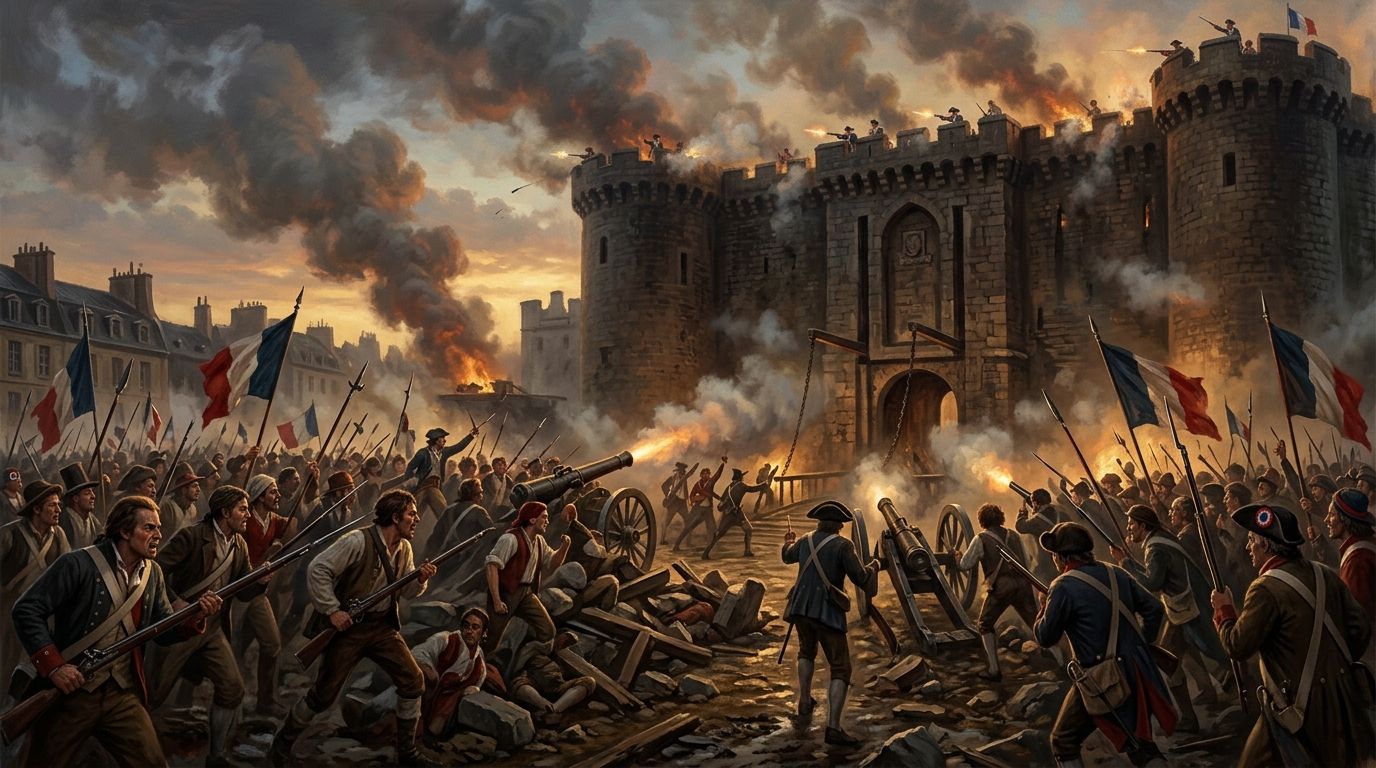
The arrival of the deserting soldiers brought immediate tactical organization to the disorganized mob of civilians who had been besieging the fortress for hours. The military positioned the cannons strategically in front of the main gates of the prison, pointing the artillery directly at the supporting chains of the large internal drawbridge, threatening to blow up the physical defenses of the Bastille in a few minutes if the garrison did not surrender.
The presence of military artillery aimed at the fortress deeply shook the morale of the Invalides defenders, who saw the uprising of their own brothers-in-arms as a betrayal and proof that the crown had lost military control of the capital. The Swiss soldiers, loyal to the end, tried to maintain resistance, but were pressured by the French veterans of the garrison, who demanded an immediate ceasefire to avoid mutual destruction.
This armed fraternization and the betrayal of entire regiments of royal infantry was the true political checkmate suffered by absolutism on July 14. The fall of the Bastille was not the work of an enraged mass of unarmed civilians alone, but rather a coordinated joint military action by deserting soldiers who placed their loyalty to the nation above the direct orders of the King of France.
Chapter
3.4. How Did the Revolutionaries Succeed in Crossing the Drawbridge of the Fortress?
The final entry of the revolutionaries into the interior of the fortress was facilitated by an audacious act by a small group of citizens who managed to scale the roof of a neighboring perfumery connected to the outer walls. Among these men, a former soldier named Jean-Baptiste Humbert stood out, who, armed with a carpenter's axe, cut the heavy iron chains supporting the first pedestrian drawbridge, causing it to crash down over the moat.
The sudden drop of the drawbridge allowed hundreds of rioters to invade the governor's central courtyard, bringing the cannons of the deserting guards to the front line of the attack. Seeing the broken chains and the barrels of the cannons pointed directly at the main door of the fortress just a few feet away, the governor of the Bastille realized that the physical resistance of the stone fortress had come to an end.
The fury of the crowd crossing the destroyed bridges was uncontrollable, inflamed by the dozens of dead in the previous musketry of the day. The gates of the fortress were opened from the inside by the garrison itself around 5:00 PM, following the solemn promise of military clemency made by the revolutionary officers Hulin and Élie. However, the promise of a peaceful surrender would be quickly swept away by the crowd's accumulated hatred of the royal prison.
For the Parisians of that generation, the Bastille drawbridge was not just a physical barrier of medieval military engineering, but the threshold of a new political era of citizen freedom. By crossing that fortified passage over the muddy water of the moat, the people of Paris broke the barriers of submission to the absolutist king and took physical control of the greatest symbol of repression in the capital of France.
Chapter
4. The Secret Prisoners of the Fall of the Bastille: Who Was Really Encarcerated in the Fortress?
Chapter
4.1. How Many Prisoners Were Actually in the Bastille on July 14?
Despite the immense popular legend portraying the Bastille as a gigantic dungeon filled with hundreds of political opponents and intellectuals tortured by French absolutism, the physical reality found by the revolutionaries on July 14, 1789, was surprising. When the stone cells of the fortress were opened, the crowd found only seven prisoners imprisoned in the entire monumental structure of eight towers.
This paltry number was due to the fortress's own administrative decay, which generated high maintenance and security costs for the French crown and was about to be deactivated and demolished by direct order of King Louis XVI to save funds. The prison, which at the height of Louis XIV's reign housed dozens of important prisoners through secret orders, had become a secondary and almost uninhabited custody site by the end of the 18th century.
The discrepancy between the myth of a medieval dungeon filled with heroes of freedom and the reality of an almost empty prison did not diminish the historical impact of the Fall of the Bastille. The fortress continued to be the greatest visible symbol of the absolute king's arbitrary power and the oppression of individual liberties through the infamous royal letters. The liberation of those few inmates, regardless of their actual crimes, was celebrated as an act of justice and popular redemption against tyranny.
For today's tourist, understanding this difference between literary myth and historical reality serves to highlight the strength of political symbolism in the French Revolution. The people of Paris did not march against the stone towers to free an army of imprisoned revolutionaries, but to tear down the architectural representation of the arbitrary power of an absolutist king who ruled without accounting to anyone.
Chapter
4.2. Who Were the Seven Prisoners Freed by the People?
The seven prisoners freed by the revolutionaries on the afternoon of July 14 formed a very heterogeneous group of individuals detained for common public and social reasons of the era. The group was composed of four bank document forgers accused of fraud against the national credit: Jean de La Corrège, Bernard Laroche, Jean-Antoine Pujade, and an English nobleman named Jean-Charles Béchade.
The other three prisoners included two men considered severely mentally unstable, who were under family and royal custody for reasons of public mental safety: Auguste-Claude Tavernier, a man accused of conspiring against the life of King Louis XV decades earlier, and the Count of Whyte de Malleville, an Irish aristocrat with severe dementia who was later transferred to the Charenton asylum.
The final prisoner was the Count of Solages, a young nobleman who had been imprisoned at the direct request of his own aristocratic family through a sealed royal letter (lettre de cachet), accused of committing grave moral offenses and incestuous sexual crimes against his sister in the country's interior, a scandal the family wished to hush up away from the courts of justice.
None of these freed individuals was a political martyr or an Enlightenment philosopher fighting for national liberty, and most of them did not even understand the historical dimension of the armed crowd breaking down the doors of their stone cells that afternoon. However, in the revolutionary fever of July, they were paraded through the central streets of Paris as national heroes freed from the shackles of French absolutist tyranny.
Chapter
4.3. The Man in the Iron Mask and Other Famous Inmates in the Prison's History
If in 1789 the Bastille was almost empty, its historical fame for housing great secrets of State and legendary figures had been built over centuries of royal repression and censorship of intellectuals. The most mysterious inmate in the entire history of the fortress was the legendary Man in the Iron Mask, who was imprisoned under the watch of jailer Bénigne d'Auvergne de Saint-Mars from 1698 until his death in 1703, and whose real identity remains one of the greatest enigmas of the French royal court.
In addition to the iron-masked man immortalized in literature, the Bastille received great names of the French Enlightenment who dared to criticize the Catholic Church and the crown. The philosopher Voltaire was imprisoned in the jail twice in the early 18th century (in 1717 for eleven months and again in 1726), where he used his time in the stone cell to write his tragedy Oedipus and sign his literary works under the pseudonym Voltaire for the first time in his life.
Another illustrious inmate was the controversial Marquis de Sade, who remained imprisoned in the fortress for over five years, from 1784 until July 2, 1789, when he was transferred in a hurry to the Charenton asylum after using a long iron funnel as a megaphone to shout from the tower windows that the guards were slaughtering citizens in the neighborhood outside the fortress.
Sade missed the Fall of the Bastille by just twelve days, and all of his valuable original manuscripts of extreme erotic literature, including the draft of The 120 Days of Sodoma which he had carefully hidden in the stone crevices of his cell, were lost or looted by the revolutionary crowd that invaded the site in search of weapons.
Chapter
4.4. Why Did the Bastille Have a Reputation as a Prison of Torture and Suffering?
The terrible reputation of the Bastille as an unhealthy dungeon was mainly due to the political use of letters de cachet, secret written orders signed directly by the King of France or his ministers of state, which allowed the immediate arrest of any individual for an indefinite period, without the need for a formal trial in court or the right to a legal defense.
This system of arbitrary imprisonment generated a climate of constant fear among Enlightenment writers, journalists, and pamphleteers, who could disappear from circulation overnight for criticizing the nobility or the church of Paris. The prison was seen as a place of absolute isolation, where the prisoner was stripped of their real name and identified only by the number of the tower and the stone cell where they were confined.
Although at the end of the 18th century the actual physical conditions of prisoners in the Bastille were significantly better than in most other common prisons in Paris (noble prisoners could read books, receive visits, have their own private servants, and even cook their meals), the literary imagery of sensationalist popular pamphlets portrayed the place with underground dungeons filled with rats, chained skeletons, and hidden torture chambers with hot irons.
This contrast between physical reality and the terror of the collective imagination made the Bastille the ideal target of public repudiation for the rising revolutionary middle class. It represented the negation of the modern civil right to established due process and judicial transparency. Destroying the stone walls of the Bastille was an assertion that the citizen's freedom to come and go could no longer be controlled by the unilateral sovereign will of an absolutist ruler.
Chapter
5. The Struggle for Weapons and Gunpowder: The Desperate Search That Driven the Fall of the Bastille
Chapter
5.1. The Attack on the Hôtel des Invalides: Where the Revolutionaries Stole 30,000 Muskets?
On the morning of July 14, 1789, before heading to the stone walls of the Bastille, thousands of Parisians armed with pitchforks, axes, and clubs surrounded the military complex of the Hôtel des Invalides, located in the west of the capital of France. The site, designed by King Louis XIV as a hospital for war veterans and a crown weapons arsenal, housed the largest military depot of muskets and infantry weapons in the entire city of Paris.
The military governor of the Invalides, the elderly Marquis de Sombreuil, tried to negotiate with the demonstrators to postpone the invasion, but the crowd forced the outer iron gates and invaded the complex's courtyards without firing shots at the invalids of the garrison, who strictly refused to shoot at the starving people. The invasion of the military complex happened quickly and peacefully, with citizens opening the cellars and weapon storage rooms of the hospital structure.
The revolutionaries confiscated more than 30,000 gunpowder muskets (Charleville model rifles), along with some light bronze heavy artillery pieces and infantry sabers that were immediately distributed among the population and volunteers of the rising national militia of Paris. The Hôtel des Invalides remains a spectacular tourist site in Paris today, housing the tomb of Napoleon Bonaparte and the French Army Museum.
Despite obtaining this colossal quantity of firearms in a matter of a few hours at the Invalides, the crowd realized that the weapons were useless for the city's self-defense without ammunition. The governor of the Invalides had transferred almost all of Paris's gunpowder ammunition to the Bastille fortress in the preceding days for the safety of the royal arsenal, forcing the people to march in mass to the east.
Chapter
5.2. Why Was the Gunpowder Transferred to the Bastille and Became the Main Target?
The strategic transfer of more than 250 barrels of gunpowder (about 11 short tons) from the city's depots to the stone walls of the Bastille on the night of July 12 was ordered directly by the French crown, which wished to protect the military explosive from street looting in Paris. The Bastille, with its massive walls and cannons, was considered the safest and most fortified place in the city to prevent armed rebels from controlling Paris's ammunition.
This military decision proved to be a major strategic error, as it placed a huge target on the back of the military fortress and sealed its fate before the masses. The central revolutionary committee organizing at Paris City Hall knew that the bourgeois national militia would be crushed by the king's foreign mercenary troops if it could not obtain the ammunition and gunpowder to load the muskets stolen at the Invalides.
The desperate search for military gunpowder was the true practical driver of the Fall of the Bastille, and not the purely idealistic desire to overthrow the absolute monarchy or free French political prisoners. If the gunpowder had remained stored in the normal depots of the Invalides or other points in Paris, the violent siege of the medieval military fortress would probably never have occurred on that hot July afternoon of 1789.
For the history tourist, this pragmatic search for ammunition reveals the logistical pragmatism behind the revolution. The people of Paris needed to survive the king's military siege, and the Bastille contained the city's only remaining gunpowder supply. Marching against the stone walls of the royal prison became a matter of physical life or death for the urban self-defense of Paris against Versailles repression.
Chapter
5.3. How Did the Critical Lack of Ammunition Seal the End of the Prison's Defenders?
Although the Bastille had heavy cannons and stone walls impregnable to direct attacks by unarmed civilians, the garrison suffered from ammunition shortages and a chronic lack of supplies to maintain prolonged military combat. The prison governor, Bernard-René de Launay, had not received military reinforcements from Versailles and had little food and little usable gunpowder for the towers' heavy artillery.
The Paris prison's ammunition consisted almost entirely of the bulk gunpowder stored in the lower cellars, without pre-fabricated cartridges or bullets of appropriate caliber for the individual muskets of the Swiss military garrison. As the shootout with the revolutionaries in the outer courtyards extended through the hot afternoon hours, the defending soldiers quickly consumed their few usable bullet cartridges.
The lack of fresh water inside the prison also became critical when the crowd occupied the external hydraulic installations, preventing the proper functioning of the military garrison and the cooling of the heavy artillery pieces. The governor realized that the promises of military support made by the Versailles court would never arrive in time and that the fortress would inevitably be invaded and demolished due to a lack of defensive ammunition if armed resistance continued.
The final capitulation of the Paris Bastille was sealed by this chronic logistical inability of the royal military garrison to maintain the defenses of the stone structure in the face of a large and cannon-armed crowd. The depletion of combat reserves forced Governor Bernard-René de Launay to seek an honorable military surrender, opening the gates of the fortress in exchange for the safety of the lives of his French and Swiss defending soldiers.
Chapter
6. Governor Bernard-René de Launay: The Tragic Fate of the Commander on the Day of the Fall of the Bastille
Chapter
6.1. The Failed Negotiations Between de Launay and the Popular Leaders
The Marquis Bernard-René de Launay, aged 59, was the military governor of the Bastille in Paris and belonged to a lineage of French royal officers with a long tradition in administering crown prisons. Born inside the very fortress where his father had also been military governor, de Launay ran the place with aristocratic rigor and little practical experience in controlling violent urban uprisings on the streets of Paris.
On the morning of July 14, de Launay received successive delegations of citizens from Paris City Hall trying to negotiate the peaceful delivery of the military gunpowder and the removal of the cannons on the towers aimed at the neighboring quarter. The governor received the popular delegates with aristocratic politeness, inviting them to lunch in his private quarters to debate the situation, but refused to surrender the military post without receiving direct orders from the court in Versailles.
The governor committed not to fire the artillery pieces at the population unless the fortress was directly attacked and ordered the barrels of the cannons on top of the walls to be rolled back to try to calm the mob's temper. However, this attempt at mutual pacification completely failed when the nervous crowd forced entry into the outer bridges, initiating the fatal shootout that broke any possibility of peaceful political dialogue on that July afternoon.
De Launay found himself caught in a terrible dilemma of medieval French military honor: he could not surrender the royal fortress without being accused of treason and cowardice by the royal court of Versailles, but he also did not have enough troops to maintain armed resistance in Paris for long. The lack of clear instructions from Versailles sealed the tragic fate of the military governor, who found himself isolated in the face of popular wrath.
Chapter
6.2. The Capitulation and the Opening of the Gates of the Fortress
Around 5:00 PM, with the arrival of the deserting French Guards' cannons pointed directly at the main gate of the fortress, Governor Bernard-René de Launay understood that military resistance was useless and that the stone walls of the Paris Bastille would be breached by heavy artillery at any moment, resulting in the inevitable slaughter of the entire military garrison.
De Launay threatened to go down to the lower cellars with a torch and detonate the 250 barrels of gunpowder stored there, which would destroy the entire military fortress and devastate a large part of the neighboring working-class neighborhood of Faubourg Saint-Antoine in a colossal explosion. However, the governor was prevented from carrying out his suicidal threat by his own French Invalides officers of the garrison, who refused to die in that manner and demanded an honorable surrender.
The governor sent a written note containing his surrender terms through a slit in the main iron gate, demanding that the military garrison be spared from lynching in exchange for the peaceful opening of the drawbridges of the fortress. Revolutionary Sub-Lieutenant Jacob Job Élie read the note and gave his word of honor as a French military officer that no one would be harmed on the streets of Paris if the combat ceased immediately.
Trusting in the solemn written promises of the leaders of the revolutionary committee, de Launay ordered the opening of the large iron gates and the final lowering of the main internal drawbridge of the Bastille fortress. The armed revolutionary crowd of Paris invaded the central courtyards of the medieval military prison like a flood of water, disarming the Invalides defender guards and looting the prison's gunpowder cellars in a disorganized manner.
Chapter
6.3. The Brutal Execution of Governor Bernard-René de Launay and His Head on a Pike
The fate of the military governor of the Paris Bastille after the gates were opened was marked by the violence and chaos of the French streets. The revolutionary committee tried to escort Bernard-René de Launay alive under the custody of officers Hulin and Élie to Paris City Hall at the Hôtel de Ville to be legally tried for his acts of military defense and the death of dozens of French citizens during the combat.
However, the revolutionary military escort was quickly broken by an uncontrolled mob of angry protesters near the Place de Grève. Governor de Launay was systematically beaten by the crowd, dragged along the pavement, and stabbed repeatedly by rioting citizens. In despair and physical agony, the commander kicked a jobless man named Desnot, crying out for mercy: "Let me die!".
De Launay was killed at the scene by gunfire and iron bayonet strikes, and his lifeless body was decapitated on the sidewalk by a Paris butcher who used a pocket knife to cut the French officer's neck. The head of Governor Bernard-René de Launay was impaled on top of a long iron pike and paraded through the streets of Paris under the crowd's applause, inaugurating the bloody practice of public display of severed heads that would mark the Reign of Terror of the French Revolution.
This brutal execution of de Launay proved that the bourgeois revolutionary committee of Paris City Hall had no real control over the fury of the popular masses of the Third Estate, known as the Sans-culottes. The murder of the royal commander of the medieval French military prison symbolized the final breakdown of respect for the crown's law and the emergence of direct popular violence as an instrument of revolutionary political action in the country.
Chapter
7. The Immediate Consequences of the Fall of the Bastille: The Political Impact on Versailles and Paris
Chapter
7.1. Louis XVI's Reaction to the Event: "Is It a Revolt?"
The news of the fall of the Bastille and the loss of military control over the city of Paris took hours to be officially communicated to King Louis XVI in Versailles, as court ministers feared the absolute monarch's desperate physical reactions and the advance of the Parisian revolutionary fury towards the palace. The king was awakened in his private quarters on the night of July 14 by the Duke of La Rochefoucauld-Liancourt.
The historic dialogue between King Louis XVI and the Duke of Liancourt became the greatest symbol of the political blindness of the French absolutist court to the transformations of its era. Surprised by the reports of urban insurrection in Paris, the king inquired of the nobleman: "But, Liancourt, is this a revolt?". The duke responded with historical firmness: "No, Sire, this is not a revolt. It is a revolution!".
King Louis XVI immediately understood the gravity of his political situation of isolation in Versailles and the loss of support from his own armed forces in the country's capital. On the morning of July 15, 1789, the monarch appeared unarmed and without military escort before the National Constituent Assembly to announce the definitive withdrawal of all German and Swiss mercenary troops from the outskirts of Paris and Versailles.
This political capitulation by Louis XVI temporarily saved his crown, but definitively shifted real political power from the hands of the absolute Bourbon monarchy to the Constituent Assembly dominated by the French bourgeoisie. The Fall of the Bastille forced the monarch to reinstate the popular minister Jacques Necker in the government and to travel to Paris on July 17 to receive the revolutionary tricolor cockade from the hands of the new mayor of the city.
Chapter
7.2. The Creation of the National Guard and the Role of the Marquis de Lafayette
To restore public order and contain the fury of the masses and looting after the fall of the medieval prison, the citizens' committee of Paris City Hall formalized the founding of the National Guard. The citizen military force was composed of middle-class bourgeois volunteers and had the double political role of defending the city against attacks by the monarch's royal army and protecting private properties from looting and vandalism.
General command of the National Guard was given to the celebrated Marquis Gilbert du Motier de Lafayette, acclaimed military hero of the American Revolutionary War and a personal friend of George Washington. Lafayette was seen as a moderate figure capable of unifying the aspirations of political liberty with the maintenance of legal social order in France, integrating the rebellious soldiers of the French Guards into the new bourgeois military corporation.
Under Lafayette's leadership, the National Guard adopted the official tricolor colors that would form the national flag of France: blue and red, the traditional colors of the city of Paris, joined by white, the historic dynastic color of the Bourbon monarchy. The creation of this armed force of citizens permanently stripped King Louis XVI of his monopoly on violence and military force in the French capital, legitimizing the country's bourgeois constitutional revolution.
For the history tourist, the figure of Lafayette remains one of the most admired and studied of the French Revolution, representing the search for a peaceful constitutional monarchy of civil liberties. The National Guard under Lafayette's command became the embryo of a new army of citizen volunteers that, years later, would defend France's borders against the neighboring absolutist powers of Europe.
Chapter
7.3. How Was the Bastille Fortress Demolished Stone by Stone by the Revolutionaries?
The immediate physical demolition of the stone towers of the Bastille began on the morning of July 15, 1789, as the imposing medieval structure was seen as an unbearable reminder of royal tyranny in the urban center of Paris. The revolutionary committee handed over the concession and the task of dismantling the walls to the building contractor Pierre-François Palloy, known as the "Patriot Palloy."
Palloy organized a workforce of about 800 workers from Paris who worked under hazardous physical conditions to demolish the prison's stone walls and towers. The massive limestone blocks of the Bastille were disassembled manually and used for various civic and practical purposes in rebuilding Paris's urban infrastructure.
A large portion of the structural stones removed from the Bastille's towers was transported to western Paris and used in the construction of the foundations and arches of the Concord Bridge (Pont de la Concorde), allowing Parisian citizens to symbolically step on the remains of the French king's absolutist fortress when crossing the Seine River daily.
In addition to building the bridge, the revolutionary entrepreneur Palloy transformed smaller pieces of stone and metal from the fortress into civic souvenirs of the revolution, carving miniature models of the medieval Bastille fortress which were distributed to all French departments as pedagogical symbols of the freedom won by the people of Paris.
Chapter
7.4. The Rise of the Great Fear (Grande Peur) in the Country's Interior
The sudden fall of the medieval Bastille fortress in Paris generated shockwaves and generalized panic throughout the rural interior of France during the months of July and August 1789, a phenomenon known as the Great Fear (Grande Peur). The lack of efficient centralized communications and the circulation of alarming rumors that aristocrats were hiring armies of foreign brigands to burn crops caused despair in French rural villages.
Peasants armed themselves with scythes and metal pitchforks to defend their small agricultural properties from imaginary invasions by the nobility's mercenaries. Finding no foreign brigands, the anger of the rural peasant populations turned directly against the castles and manor houses of the local aristocracy in the French countryside, demanding the surrender of tax and tithe records.
Many medieval noble manors were invaded and burned by rioting peasants in search of the feudal registries that recorded the perpetual labor obligations and debts of the rural population. This peasant uprising frightened the property-owning bourgeoisie and the constituent deputies of the Assembly in Versailles, accelerating institutional reforms in the country.
To contain violence in the French rural provinces and calm the panic of land owners, the National Constituent Assembly took the decision to abolish all feudal privileges and tithes of the nobility on the famous night of August 4, 1789. The Fall of the Bastille in Paris destroyed the feudal structure of medieval rights and obligations in the deep countryside of France, transforming the peasant serf into a free citizen of the nation.
Chapter
8. The Cultural Impact of the Fall of the Bastille: How July 14 Became the Greatest Symbol of French Liberty
Chapter
8.1. The Celebration of the Festival of the Federation in 1790 and the Alignment of the Nation
On July 14, 1790, exactly one year after the fall of the medieval Paris fortress, the monumental Festival of the Federation (Fête de la Fédération) was held on the Champ de Mars. The massive civic event brought together more than 300,000 citizens and National Guard representatives from all corners and provinces of France to swear allegiance to the new French national Constitution.
The celebration was marked by a fleeting climate of national reconciliation and political hope for a stable constitutional monarchy of civil rights. King Louis XVI himself, flanked by the Marquis de Lafayette and standing before the open-air altar of the fatherland, took a public oath to respect the new constitutional laws established by the Assembly, to the applause of the Parisian population.
The solemn civic mass of the Festival of the Federation was celebrated by the reformist bishop Charles-Maurice de Talleyrand-Périgord, symbolizing the initial support of the French clergy for the process of political regeneration of the homeland. The date of July 14 consolidated in that year as a symbol of the nation's civil union, binding the different provincial identities around a common project of free French citizenship.
Although this moment of constitutional harmony was swept away by the civil wars of the Terror in the subsequent years, the Festival of the Federation established the cultural basis for the future official celebration of the civic festival of the Fall of the Bastille. The event proved that the end of royal absolutism in France in 1789 had created a new national citizen identity based on national sovereignty and the common rights of all citizens.
Chapter
8.2. The Law of 1880: The Establishment of the Fall of the Bastille as the National Holiday of France
The definitive establishment of July 14 as the official National Holiday of the French Republic occurred nearly a century after the Fall of the Bastille, under the Third Republic. In 1880, the republican deputy Benjamin Raspail presented a bill to parliament to set a civic date of national unity capable of consolidating support for the rising republic against monarchists.
The choice of the date generated intense political debates in the French senate at the time. Many moderate senators feared that celebrating the Fall of the Bastille of 1789 would exalt the popular bloodbath of Governor Bernard-René de Launay's lynching and the street violence in Paris. To bypass this ethical objection, the proponents of the 1880 law decided that the holiday would celebrate in a dual manner both the Fall of the Bastille and the peaceful Festival of the Federation of 1790.
The law approved on July 6, 1880, consecrated July 14 (La Fête Nationale) as the national day of civic celebration of the homeland, marked by military parades organized under the leadership of the republican army on the Champs-Élysées avenue in Paris, popular public balls in all neighborhoods, and monumental firework displays throughout the country's territory.
For the modern traveler visiting Paris in mid-July, participating in the popular balls at the fire stations (Bals des Pompiers) and watching the patriotic military parade of armored vehicles and fighter jets in the city's skies is witnessing the perpetuation of this republican identity established in the 19th century. The national holiday of July 14 remains the greatest civic symbol of popular commemoration in Paris and France to the entire world.
Chapter
8.3. How Did the Fall of the Bastille and the Marseillaise Become Universal Symbols of Liberty?
The Fall of the Bastille transcended the physical borders of France and became a universal myth of liberation for the oppressed across the entire planet Earth. The destruction of the high stone walls of the medieval royal prison symbolized the definitive victory of the Enlightenment and the modern civil rights of peoples over the structures of feudal privileges and absolute monarchical dynasties of old Europe.
Along with the taking of the Paris prison, the revolutionary anthem The Marseillaise (La Marseillaise), composed by Claude Joseph Rouget de Lisle in 1792, spread aspirations of liberty, equality, and fraternity to all countries. The image of common people confronting the royal army in search of freedom inspired revolutionaries from the Americas to Asian nations throughout the 19th and 20th centuries.
The physical keys to the Bastille in Paris, sent as a gift to George Washington by the Marquis de Lafayette, exemplify this trans-Atlantic connection of struggles for popular sovereignty. The fall of the Paris fortress proved to the oppressed of all nationalities that no absolute stone fortification is strong enough to stop the force of the organized sovereign will of a people hungry for justice and civil rights.
Even in modern entertainment culture, the Fall of the Bastille continues to be portrayed in historical films, classic literary novels, and popular action video games as the representation of the citizens' heroic uprising against oppression. July 14, 1789, is celebrated in world historiography as the initial milestone that gave birth to the contemporary era of representative democracies and international human rights declarations.
Chapter
9. Myths and Truths of the Fall of the Bastille: What Does Official History Hide from the Public?
Chapter
9.1. Was the Bastille Indeed a Cruel Dungeon or Just an Inflated Political Symbol?
The popular image that the stone basements of the Paris Bastille housed hidden medieval torture chambers with red-hot irons and chained prisoners was, in large part, a work of political propaganda created by revolutionary pamphleteers at the end of the 18th century. Influential intellectual writers who had spent short periods imprisoned at the site, such as Simon-Nicolas-Henri Linguet in his celebrated work Memoirs on the Bastille, used dramatic rhetoric to inflame repudiation of the royal prison in Paris.
In the physical reality of the year 1789, the living conditions of the few aristocratic and bourgeois prisoners in the Bastille were considerably better than in common prisons in Paris like the Conciergerie or the Grand Châtelet. Detents with financial resources could rent spacious stone cells with windows, furnish their rooms with their own private luxury furniture, hire private room servants, read library books, smoke fine cigars, and even receive elaborate meals accompanied by good vintage red wine.
However, the absence of physical medieval tortures did not diminish the tyrannical nature of the place, as the oppression of the Bastille lay in its arbitrary institutional nature. The prison did not rely on formal judicial processes, physical evidence collected, or open jury trials. Any Parisian citizen could be confined for years at the site based solely on a sealed letter from King Louis XVI signed in Versailles at the personal whim of the nobility or the local church.
The people of Paris attacked the Bastille not to put an end to a physical chamber of atrocious tortures, but to destroy the bureaucratic structure of state secrecy and prisons without the right to an individual legal defense. It was a political symbol inflated by the revolutionary propaganda of July, but grounded in an unquestionable real injustice of denying the French citizen's modern civil liberties.
Chapter
9.2. Did the Rioters of Paris Intend to Dethrone Louis XVI on July 14, 1789?
One of the greatest historical misconceptions about the Fall of the Bastille of 1789 is the belief that the Parisian revolutionaries who marched against the fortress intended to dethrone King Louis XVI or immediately extinguish the French dynastic monarchy. In the summer of 1789, the general feeling of the population of Paris and the bourgeois deputies of the Constituent Assembly in Versailles was one of deep respect for the Bourbon monarch.
The people saw Louis XVI as a benevolent father misled by nefarious advisors and Queen Marie Antoinette. The wrath of the masses was directed against the aristocratic nobility and the tax exemption of the clergy, not against the crown. The slogan of street demonstrations in Paris used to be: "Long live the King!". The demonstrators wanted a just constitutional monarchy integrated with popular aspirations, not a republic without a king.
The desire to extinguish the monarchy and try King Louis XVI for national treason arose only years later, after the failed attempt of the royal family to flee to Austria in the historical episode of the Flight to Varennes in 1791, followed by the outbreak of wars with the absolutist European powers neighboring Paris. The execution of the French king under the revolutionary guillotine occurred only on January 21, 1793.
On July 14, 1789, the armed crowd sought only to defend themselves against an imminent military attack by the king's foreign mercenary forces surrounding Paris and to ensure the survival of their newly created National Assembly. The day of the Fall of the Bastille was the initial milestone that decentralized the absolute power of the crown, but with the initial intention of keeping Louis XVI on the throne as a citizen king under the constitution.
Chapter
9.3. Was the Fall of the Bastille the Result of Prior Planning or an Accident of History?
Contrary to narratives depicting the Fall of the Bastille as a meticulously planned and coordinated urban military operation by secret societies of Paris intellectuals, the taking of the stone prison was the result of a chaotic accident of history. No one at Paris City Hall or in the bourgeois popular revolutionary committees had planned to attack the medieval prison on the morning of that Tuesday in July.
The mass of citizens originally marched to the east of Paris with the sole practical goal of negotiating the delivery of the stored gunpowder with Governor Bernard-René de Launay, fearing the imminent attack by the king's troops. The violent attack began by accident due to mutual panic when popular forces managed to scale the first unlocked external gates and the Invalides garrison fired with rifles at the crowd, believing they were under military invasion.
The accidental shootout transformed a peaceful demonstration for ammunition into a bloody battle of life or death that united the Paris mob. The arrival of deserting French Guards soldiers brought royal cannons to the front line of the attack only in the middle of the afternoon, turning the protest into a coordinated military siege operation against the stone prison.
The Fall of the Bastille in Paris was, therefore, an improvised event under the tension of the fear of hunger and military siege, where quick and accidental decisions by rebel commanders at the scene changed the historical course of all of France. The transformation of this chaotic street event into a symbolic monument of liberation was subsequently carried out by revolutionary speakers to legitimize the violent seizure of power by the people of Paris.
Chapter
10. Tourist Guide: What to Visit at the Site of the Fall of the Bastille and Its Surroundings
10.2.1 The Outline Lines on the Ground of the Place de la Bastille
Although the medieval fortress was demolished stone by stone by the contractor Palloy starting in 1789, the attentive visitor can still see the exact physical outlines of the former stone towers of the prison on the sidewalks of the Place de la Bastille. Paris urban planning engineers marked the layout of the medieval walls on the asphalt using triple lines of reddish paving stones.
As you walk along the sidewalk in front of the local cafe and on the sidewalk of the intersection of rue Saint-Antoine, look at the ground beneath your feet to identify the paving curves indicating where the large circular towers of the Bastille fortress once stood. This layout allows one to understand the actual architectural scale of the prison within the urban fabric of Paris and to take original historical photos over the invisible marks of the revolution.
10.2.2 The Stones of the Walls Exposed in the Bastille Metro Station (Line 5)
One of the easiest and most accessible ways to view the original foundations of the stone prison without paying for tickets is to go down to the Bastille metro station, specifically on the platform of Line 5 (direction Bobigny / Place d'Italie). During urban archaeological excavations for the construction of the Paris metro network at the end of the 19th century, workers found intact remains of the ancient defensive structures.
Currently, a massive section of the original prison's stone retaining wall is perfectly cleaned, exposed, and marked with explanatory signs directly on the train boarding platform wall of Paris metro line 5. Passengers and tourists can observe the precision of the medieval limestone stone block joints while waiting for the arrival of the metro, a true daily lesson in underground archaeology.
10.2.3 The Ruins Transferred and Re-erected at the Square Henri-Galli
The largest three-dimensional physical remains of the Bastille fortress towers that the history tourist can touch and photograph up close are not located in the center of the square, but rather in the small public park Square Henri-Galli, located about 1,640 feet away from the Place de la Bastille, walking towards the Seine River along the banks of the Arsenal canal.
In 1899, during the construction of Metro Line 1 under rue Saint-Antoine, archaeologists discovered the intact stone base of the Liberty Tower (Tour de la Liberté), one of the eight towers of the Bastille fortress. The massive foundation stones of the medieval tower were carefully dismantled, transported by urban workers, and re-erected in their original circular shape on the lawn of the Square Henri-Galli.
The site is a quiet and leafy refuge in Paris where visitors can sit on public benches and touch the carved limestone blocks that once served as a royal dungeon for French Enlightenment prisoners. The Square Henri-Galli is a tourist spot little known to most traditional travelers to Paris, hiding a genuine piece of the history of the Fall of the Bastille in the shade of century-old trees.
Chapter
10.1. Place de la Bastille Today and the July Column (Génie de la Liberté)
The immense urban area that once housed the medieval military fortress of the Bastille is today the bustling Place de la Bastille, one of the most dynamic transit and cultural gathering points in the entire city of Paris. The historic space is marked by heavy pedestrian traffic, cafes with open terraces, and frequent political trade union demonstrations that perpetuate the revolutionary heritage of the site.
In the exact geographic center of the large Paris square stands the imposing July Column (Colonne de Juillet), crowned by the gilded sculpture of the Genius of Liberty (Génie de la Liberté). Many tourists mistakenly believe that the bronze column was erected to commemorate the Fall of the Bastille of 1789, but the monument celebrates the Revolution of 1830 (The Three Glorious Days) which overthrew the absolutist Bourbon king Charles X.
The July Column, inaugurated in 1840, has a subterranean burial crypt at its stone base that houses the remains of hundreds of Parisian combatants killed during the revolutionary days of 1830 and 1848 in the country. The monument is a masterpiece of cast bronze that dominates the square's urban landscape and serves as a visual reference point for anyone walking the streets of the region.
To visit the historic site, simply use the metro lines and get off at the central integration station Bastille in Paris. Walking around the column and observing the golden Genius of Liberty shining under the Parisian sun is an unmissable tourist experience connecting the history of contemporary France with the preservation of its civic ideals of freedom.
Chapter
10.3. The Bastille Opera: Modernity and State-of-the-Art Acoustics Where It All Began
The modern contrast to the square's medieval historical heritage is the monumental Bastille Opera (Opéra Bastille), whose curved facade of tempered glass and gray granite panels dominates the eastern side of the Place de la Bastille in Paris. Opened on July 13, 1989, by President François Mitterrand to commemorate the bicentennial of the Fall of the Bastille, the opera house is one of the largest in Europe.
Designed by the Uruguayan-Canadian architect Carlos Ott, the Opéra Bastille was conceived with the revolutionary ideal of democratizing access to classical opera and lyrical dance for the working population of Paris, offering tickets at more affordable prices than the traditional and aristocratic Palais Garnier, which houses the national ballet.
The Bastille lyrical complex features a main auditorium with a capacity of 2,745 spectators, equipped with advanced state-of-the-art acoustic technology and rotating mobile stages that allow the rapid exchange of gigantic sets in a matter of minutes between classical French opera theatrical performances.
For the contemporary visitor, attending a lyrical performance or taking a scheduled guided tour of the backstage and costume workshops of the Bastille Opera is to understand how Paris transformed the historic site of an ancient medieval prison into a vibrant hub of contemporary popular culture open to all social classes of France.
Chapter
10.4. Practical Tips for Visiting: How to Get There and Main Points of Interest
To visit the historic site of the Fall of the Bastille and make the most of your tourism tour in Paris, follow these practical guidelines and access routes:
- How to Get There by Metro: The Place de la Bastille is served directly by the Bastille metro station, which connects to lines 1 (La Défense - Château de Vincennes), 5 (Bobigny - Place d'Italie), and 8 (Balard - Pointe du Lac). Metro lines 1 and 5 are the most practical to arrive and locate the physical stone remains of the prison on the sidewalks and underground platforms of the station.
- Recommended Walking Route: Start your tour in the center of the square observing the base and top of the July Column. Next, walk towards the entrance of rue Saint-Antoine to locate the reddish paving stone lines that demarcate the outlines of the Bastille fortress on the asphalt of the Place de la Bastille in Paris.
- Extension of the Walk to the Seine River: Continue the walk along the western sidewalk of Boulevard Henri IV towards the Seine River for about ten minutes until you reach the Square Henri-Galli to see and touch the rebuilt real ruins of the Bastille's Liberty Tower. From there, you will be just a few steps from the Île Saint-Louis and Notre-Dame Cathedral.
- Safety and Crowds: As a place of heavy daily pedestrian and car traffic, pay attention to your personal pocket belongings (phones and wallets) on the sidewalks and at the entrance of the Bastille metro station to avoid urban pickpockets in Paris, especially during weekends and summer holidays.
Chapter
11. Fascinating Curiosities and Urban Legends Involving the Fall of the Bastille
Chapter
11.1. The Revolutionary Entrepreneur Who Sold Pieces of the Bastille as Souvenirs
The dismantling of the stone towers and walls of the Bastille after July 14 gave rise to the first great patriotic marketing and souvenir business in human history. The French architect and building entrepreneur Pierre-François Palloy, taking advantage of his public office as official demolition director of the prison site, realized the symbolic and financial value of the stones removed from the medieval military structure of Paris.
Palloy hired local sculptors to carve small pieces of stone from the prison's towers and transform them into detailed miniature replicas of the Bastille fortress. These civic stone miniatures were sent as gifts to all municipal administrations of the newly created departments of France, serving as pedagogical material to spread the republican ideals of the French Revolution.
In addition to the miniature replicas of the towers, the entrepreneur Palloy used the iron chains of the large internal drawbridge, the iron latches of the cells, and the prisoners' handcuffs to melt down commemorative freedom medals, civic clothing buttons, and patriotic jewelry sold successfully to the rising bourgeois middle class of Paris.
This active commercialization of physical remains of the medieval royal dungeon proves how the French bourgeoisie knew how to use industrial advertising to consolidate political victory over the absolutist court. Pierre-François Palloy's Bastille souvenirs served to ensure that French citizens of all provinces possessed in their own homes a physical piece of the greatest symbol of repression defeated in Paris.
Chapter
11.2. The Keys to the Bastille in the USA: How Did They Arrive at Mount Vernon for George Washington?
One of the greatest historical curiosities connecting the French Revolution with the American Revolution is the final destination of the physical iron keys to the main doors of the Paris Bastille. In 1790, the Marquis Lafayette, who commanded the French National Guard and had received possession of the keys to the fortress after the site's demolition by entrepreneur Palloy, decided to send the historic object as a gift to George Washington.
Lafayette considered George Washington his military political mentor and spiritual father of the cause of world liberty. The Marquis sent the iron key of the French royal dungeon accompanied by a detailed watercolor drawing of the Bastille fortress painted by hand, transported by transatlantic mail ships through the political philosopher Thomas Paine.
Thomas Paine delivered the iron key to George Washington in the city of Philadelphia, then the capital of the United States of America. Washington accepted the historic gift with great patriotic admiration and ordered the iron key to be displayed in a glass case in the main entrance hall of his private residence on the Mount Vernon estate in Virginia.
To this day, the original wrought-iron key to the Paris Bastille fortress remains on permanent display at Mount Vernon, a few miles from Washington D.C., serving as a historical symbol of the brotherhood of the democratic revolutions of the Americas and Europe at the end of the 18th century.
Chapter
11.3. The Global Influence of the Name of the Fortress on Other Prisons on the Planet
The dramatic fall of the medieval military fortress and prison of the Bastille in Paris caused the French proper name "Bastille" to transform into an international common noun to describe any large maximum-security prison, police repression fortress, or dungeon for political opponents run arbitrarily by governments on planet Earth.
Several countries around the world began to informally or officially name their most famous and feared prisons "Bastilles". In 19th-century Tsarist Russia, the military fortress of Peter and Paul in Saint Petersburg was known by intellectuals as "the Russian Bastille" due to its isolation and use for political imprisonment without the right to defense.
Even in classical Western literature, the term "Bastille" came to be used by renowned writers of novels such as Alexandre Dumas and Charles Dickens as a universal poetic synonym for unjust imprisonment and physical suffering in dark dungeons run by absolute kings and aristocrats.
This global semantic appropriation proves how the taking of the Paris prison fixed itself in the human mind as the definitive victory over state authoritarianism. The word "Bastille" ceased to represent only a physical structure located in eastern Paris and became a universal concept of institutional oppression defeated by the force of the organized sovereign will of peoples.
Chapter
11.4. The Mysterious Bones Under the July Column: Who Is Really Buried There?
One of the most mysterious urban legends of the Place de la Bastille involves the underground crypt located just below the bronze foundations of the July Column. Originally designed to receive the remains of 504 Parisian combatants killed on the urban barricades during the Revolution of 1830, the crypt houses historical skeletons of other eras by accident.
During the urban reforms of Paris carried out in 1848, the authorities decided to bury in the Bastille crypt more than 80 dead from the Revolution of 1848 which overthrew King Louis Philippe I, mixing the bones of combatants of different decades inside the stone crypt of the central column of the square.
The archaeological mystery increased when historians discovered that some Egyptian mummies brought to France by Napoleon Bonaparte on the scientific expedition to Egypt in 1798, which were stored in the damp basements of the Louvre Museum, had begun to rot due to the floods of the Seine River.
To save the archaeological relics, administrators decided to bury the Egyptian mummies temporarily in the gardens near the July Column. In the administrative and military confusion of 1848, the mummified Egyptian bodies were collected by grave diggers by accident and buried along with the heroes of the French barricades inside the Bastille's bronze crypt.
Chapter
12. FAQ
12.0.1 What was the exact day of the Fall of the Bastille?
The Fall of the Bastille occurred on July 14, 1789, during the summer in the city of Paris, France.
12.0.2 Why was the Bastille hated by the population of Paris?
The Bastille was hated because it symbolized the absolute power of the Bourbon monarchy, where people could be imprisoned without trial through secret letters signed by the king.
12.0.3 How many prisoners were freed on the day of the fall?
The revolutionaries found only seven prisoners imprisoned in the military fortress: four forgers, two mentally ill patients, and a young nobleman detained at his family's request.
12.0.4 Was the Marquis de Sade in the Bastille on the day of the fall?
No. The Marquis de Sade was transferred to a lunatic asylum in Charenton on July 2, 1789, just twelve days before the attack on the French medieval fortress.
12.0.5 What were the rioters looking for inside the Bastille fortress?
The revolutionaries of Paris were mainly looking for the 11 short tons of military gunpowder that had been transferred from the Invalides to the Bastille by the French crown.
12.0.6 Who was the military governor of the Bastille executed by the people?
The prison commander was the Marquis Bernard-René de Launay, who was beaten and decapitated by the crowd after opening the gates of the medieval military fortress.
12.0.7 How did the demolition of the Bastille help build the Concord Bridge?
The limestone stones from the Bastille towers were manually demolished and transported to western Paris, serving as a structural base for the construction of the Concord Bridge.
12.0.8 Where are the original keys to the Bastille prison kept?
The main iron key to the Bastille was sent as a gift by Lafayette to George Washington and is on display in the main entrance hall of his historic residence in Mount Vernon, USA.
12.0.9 What does the July Column in the center of the Place de la Bastille represent?
The bronze column and the gilded Genius of Liberty celebrate the dead of the Revolution of 1830 (The Three Glorious Days) and the Revolution of 1848, and not the Fall of the Bastille of 1789.
12.0.10 Is it possible to see the foundations of the old Bastille at the metro station?
Yes. The visitor can view a massive section of the original stone retaining wall of the prison on the train platform of Bastille Metro Line 5 in Paris.
12.0.11 What was the role of the Marquis de Lafayette in the National Guard?
Lafayette was appointed commander-in-chief of the National Guard of Paris to maintain internal public order and protect properties from looting by common criminals.
12.0.12 Why is the Fall of the Bastille considered the beginning of the French Revolution?
The event marked the first major direct and violent intervention of the popular masses of Paris in the political process, removing King Louis XVI's monopoly on armed force.