Chapter
1. The Mysterious Origin of the Festival: Why Was Cannes Chosen Instead of Biarritz?
1.1 Jean Zay and the Revolt Against Mussolini: How Politics Created the Greatest Film Festival
The Cannes Film Festival was born from an act of political revolt. In 1938, during the 6th Venice International Film Festival (Mostra di Venezia), the fascist governments of Benito Mussolini and Adolf Hitler directly interfered with the jury to ensure that awards went to Italian and German films, turning what should have been a celebration of cinematic art into a stage for Nazi-fascist propaganda.
The last straw was the awarding of the Coppa Mussolini (Mussolini Cup) for best foreign film to "Olympia" (1938), a German documentary directed by Leni Riefenstahl about the 1936 Berlin Olympics — even though the festival's regulations explicitly prohibited awarding documentaries. In the best film category, the winner was "Luciano Serra, Pilot", an Italian production supervised by Mussolini's son, Vittorio Mussolini. The French, British and American delegations walked out indignantly, vowing not to return.
It was in this context that Philippe Erlanger, a French historian and diplomat representing the French government in Venice, had the idea of creating an alternative festival — free, neutral and free from political pressure. On the train ride back from Venice to Paris, on September 3, 1938, Erlanger drafted a report addressed to the Minister of National Education and Fine Arts, Jean Zay, proposing the creation of a "festival of free nations" on French soil.
Jean Zay (1904-1944) was an exceptional figure: a lawyer, writer and politician, he was the youngest minister in French history (taking office at age 32). Born in Orléans, the son of a Jewish couple of teachers, Zay was a staunch republican and a fierce defender of culture as an instrument of popular emancipation. He enthusiastically embraced Erlanger's proposal, seeing in the festival an opportunity to affirm democratic values against the advance of fascism in Europe.
The French government initially hesitated. The international context was explosive — the Munich Agreement (September 1938) had been signed just months earlier, and France feared offending Mussolini's Italy. But Zay and Erlanger insisted, and in January 1939 the Minister of the Interior, Albert Sarraut, gave the final go-ahead. On May 31, 1939, the city of Cannes and the French government signed the official birth certificate of the "Festival International du Film".
Zay would not live to see the festival he helped create. In 1940, after the German invasion of France, he was arrested by the Vichy regime for his Jewish origins and his republican convictions. On June 20, 1944, he was executed by French militiamen serving the Nazis in a forest near Molles (Allier), at age 39. His body was only found in 1948. In 2015, his remains were transferred to the Panthéon, where he now rests alongside other French national heroes — a belated tribute to the man who, at the height of fascism's rise, dared to create a festival to celebrate freedom.
1.2 The First Edition Canceled (1939): What Happened That September Night?
The first edition of the Cannes Film Festival was scheduled for September 1 to 20, 1939, at the auditorium of the Municipal Casino of Cannes. The preparations were sumptuous: painter Jean-Gabriel Domergue created the official poster, a cardboard replica of Notre-Dame Cathedral was built on the beach to promote the American film "The Hunchback of Notre Dame" (William Dieterle, 1939), and a transatlantic liner chartered by Metro-Goldwyn-Mayer (MGM) was supposed to cruise along the Cannes coastline with Gary Cooper, Cary Grant, Tyrone Power, Norma Shearer and Spencer Tracy on board.
Seventeen countries confirmed participation, including the United States, the United Kingdom, the Soviet Union, Poland, Czechoslovakia, Belgium, Sweden and the Netherlands. The American selection included films like "The Wizard of Oz" (Victor Fleming), "Mr. Smith Goes to Washington" (Frank Capra) and "Only Angels Have Wings" (Howard Hawks). France entered "Le Nègre" (based on the work of Joseph Kessel), and the Soviet Union sent "Tomorrow Is War".
The first revelers began arriving in Cannes at the end of August. The pre-opening parties were lavish — cocktails, dinners, fashion shows on the beach. But the clouds of war were gathering on the horizon. On September 1, 1939, German troops invaded Poland. The festival was postponed by 10 days, in the hope that the crisis would be resolved. On September 3, France and the United Kingdom declared war on Germany, and general mobilization was decreed.
Only one film was screened — privately, not officially: "The Hunchback of Notre Dame", in a session for guests and journalists on the night of August 31 to September 1. Legend has it that the audience, upon seeing the hunchback Quasimodo over the Notre-Dame model on the beach, had a dark premonition — as if the beauty of cinema was about to be crushed by the brutality of war.
The films that had already been selected were returned to their countries, the actors and directors went home, and Cannes fell into a silence that would last seven years. In 2002, during the 55th edition of the festival, the Palme d'Or was retroactively awarded to the film "Union Pacific" (Cecil B. DeMille, 1939), as symbolic recognition of the edition that never happened.
1.3 1946: The Year Cannes Was Finally Born (And It Was a Memorable Mess)
After the end of World War II, in July 1945, Philippe Erlanger reintroduced the idea of the festival to the new French government. France was devastated by the war — cities in ruins, economy destroyed, rationing — but precisely for that reason the government saw in the festival an opportunity to rehabilitate the country's image and attract tourists back to the Côte d'Azur.
The financial challenge was immense. The French state and the city of Cannes had no resources. The solution came from a combination of private donations, municipal subsidies and a special tax on the region's casinos. On September 20, 1946, the 1st Cannes International Film Festival finally opened its doors, more than seven years after the frustrated attempt of 1939.
The first edition was, to say the least, chaotic. The venue was the same Municipal Casino, hastily adapted to function as a cinema. Conditions were precarious: on the eve of the awards ceremony, a storm tore off the canvas covering the roof, flooding part of the casino. The reels of the film "Spellbound" (Alfred Hitchcock, 1946) were screened in reverse order. The Mexican film "The Three Musketeers" (Miguel M. Delgado, 1946) was shown upside down.
Nineteen countries participated, presenting 41 feature films and 50 short films. Highlights included "The Lost Weekend" by Billy Wilder, "Rome, Open City" by Roberto Rossellini, "Brief Encounter" by David Lean and "The Battle of the Rails" by René Clément. The emphasis was more on creativity and cultural exchange than on competition — so much so that 11 films shared the Grand Prix (the top prize at the time).
The mess of 1946, however, had an unexpected effect: it created an atmosphere of camaraderie and improvisation that marked the spirit of the festival in the following decades. Unlike the bureaucratic rigidity of Venice, Cannes was born as a party — imperfect, confusing, but profoundly human. This spirit of "creative chaos" remains, to this day, one of the festival's trademarks.
1.4 Why the Festival Didn't Happen in 1948 and 1950? (The Answer Has to Do with Money)
Unlike what many imagine, the Cannes Film Festival has not been held annually since its founding. Two editions — 1948 and 1950 — were canceled for exclusively financial reasons. The story reveals the precarious balance between cultural idealism and economic reality that marked the festival's early years.
After the success of the 1946 edition, the festival grew rapidly. The 2nd edition, in 1947, was held as normal, but production costs — renting the casino, transporting film reels, hosting international delegations, simultaneous translation — far exceeded the available budget. France was still recovering from the war, and the government did not have the resources to fully subsidize the event.
In 1948, the crisis reached its peak. The French Ministry of Finance refused to release the necessary funds, and the city of Cannes, deeply in debt, could not cover the deficit. The festival was canceled with just weeks' notice. The films that had already been entered were returned, and the invitations revoked.
The cancellation of 1950 was even more frustrating because the festival was already in an advanced stage of organization. Delegations from several countries had already confirmed their presence, and the films were selected. But again, the French government — under the Fourth Republic, which faced a severe economic and political crisis — cut the funding. The festival was canceled just days before the opening, sparking a wave of protests in the international film industry.
The solution came in 1951, when the festival changed its dates — from September to April/May — to avoid coinciding with the Venice Film Festival (which remained its main competitor) and to take advantage of the tourist season on the French Riviera. The new calendar allowed for better fundraising, combining state subsidies with tourism revenue and private sponsorships. From 1951 onward, the festival was never canceled again — except in 2020, due to the COVID-19 pandemic.
For the visitor who arrives in Cannes today in May and sees the city taken over by the festival's glamour, it is difficult to imagine that the event was twice on the brink of bankruptcy in its first four years of existence. But this initial financial fragility is an essential part of the story: Cannes survived because the global film industry believed in the project — and because the city and the government learned, through hard experience, that the festival needed a sustainable funding model.
1.5 The Evolution of the Palais des Festivals: From the Old Casino to the Current Palace
The Cannes Film Festival has changed venues four times throughout its history, each move reflecting the growth and professionalization of the event. The trajectory of the buildings that housed the festival is a case study of how a cultural event can transform the architecture and urban planning of a city.
1946-1951: The first venue was the Municipal Casino of Cannes (also known as the Palais des Fêtes), a Belle Époque building located at the beginning of the Croisette. Built in 1906, the casino had a large ballroom that was adapted to function as a cinema. Capacity was limited — about 800 seats — and technical conditions were precarious (the projection booth was improvised, and the sound left much to be desired).
1952-1982: With the festival's growth, the casino became inadequate. In 1952, the original Palais des Festivals (today known as the Palais Croisette or Palais Steak) was inaugurated, built on the site of the old Municipal Casino. The new building had a capacity of 1,700 people in the main hall and marked the beginning of the association between the festival and the Croisette — the seaside avenue that would become the central axis of the event. It was in this palace that the Palme d'Or was introduced in 1955 and where the great classics of world cinema were screened in the 1950s, 1960s and 1970s.
1983-present: In 1983, the current Palais des Festivals et des Congrès was inaugurated, an imposing concrete and glass building located on the Promenade de la Croisette, at the eastern end of the beach. Designed by French architect Sir Hubert Bennett, the palace has a capacity of 2,300 seats in the Grand Théâtre Lumière (the main hall, where official competition screenings take place) and another 1,000 seats in the Debussy hall. The building also houses dozens of smaller screening rooms, conference spaces, administrative offices and the headquarters of the Marché du Film.
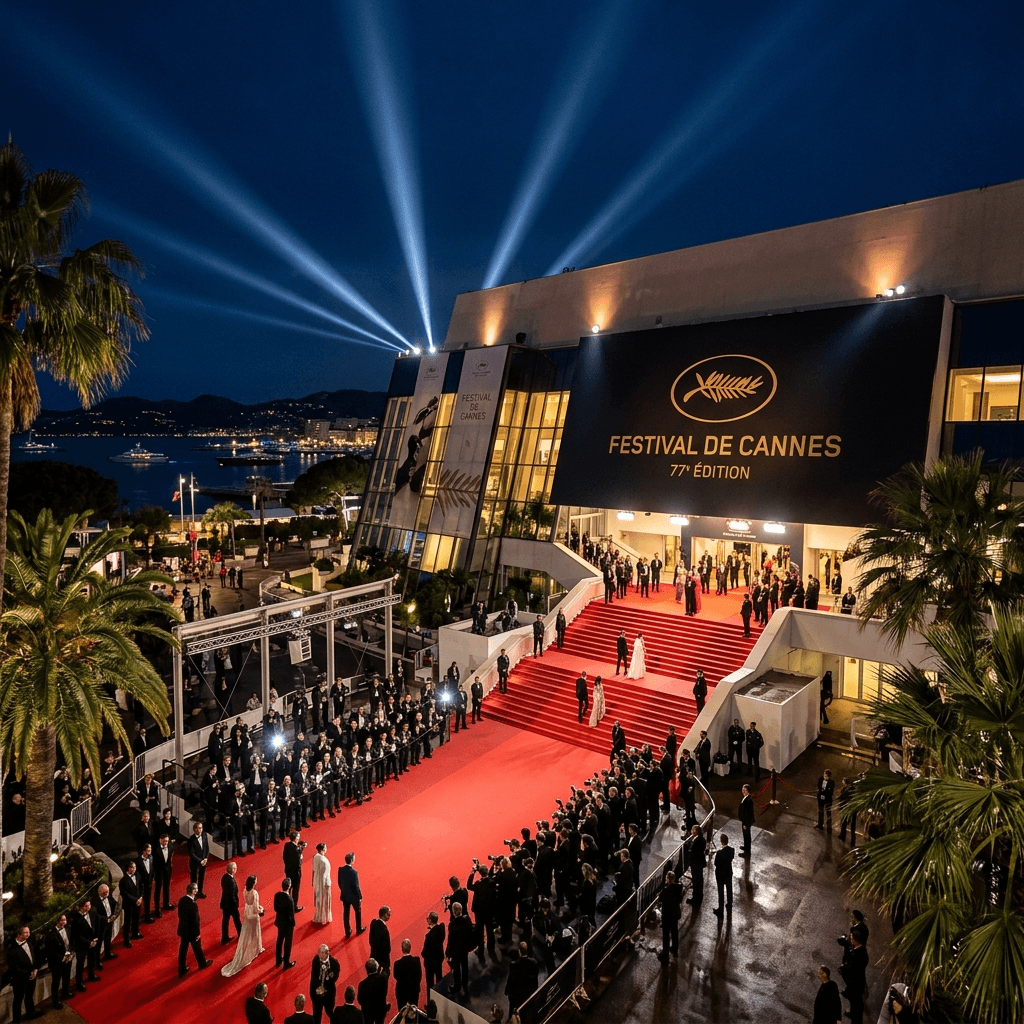
The Palais des Festivals is easily recognizable by its staircase of 24 steps leading to the main entrance — the famous red carpet. The building, however, is controversial among architecture lovers: its concrete facade is often described as "brutalist" and "lacking charm," especially compared to the Belle Époque elegance of neighboring buildings. But nobody can deny its functionality: the palace can simultaneously accommodate 30,000 film professionals during the festival, with state-of-the-art infrastructure for projection, sound and simultaneous translation.
A curiosity that few tourists know: the old Palais Croisette (1952-1982) was demolished in 1988 to make way for a complex of luxury hotels and designer stores — including the JW Marriott Cannes Hotel. A plaque on the hotel's facade marks the exact spot where the first Palme d'Or was awarded in 1955, a discreet tribute to the building that saw the legend of the festival being born.
Chapter
2. The Palme d'Or and the Golden Years: How Cannes Created the Greatest Prize in World Cinema
2.1 The Creation of the Palme d'Or (1955): How a Palm Branch Became Cinema's Most Coveted Award
In the early years of the Cannes Film Festival (1946-1954), the top prize was the Grand Prix du Festival International du Film — but it had no fixed format. Each year, the trophy was redesigned by a different contemporary artist: sometimes a statuette, sometimes a symbolic object, sometimes a simple commemorative plaque. The festival lacked a unifying symbol, an image that represented Cannes in the world's imagination.
In 1954, the then General Delegate of the festival, Robert Favre Le Bret, decided to change that. The board of directors invited several jewelers to submit designs of a palm — in homage to the coat of arms of the city of Cannes, which since the Middle Ages has displayed a palm tree as its heraldic symbol. The palm also evoked the legend of Saint Honoratus (Saint Honorat), the hermit who, according to tradition, climbed a palm tree on the Lérins Islands to calm the sea and rid the island of the serpents that infested it.
The winning design was by Parisian jeweler Lucienne Lazon, inspired by a sketch by director Jean Cocteau (then president of the festival jury). The original design had a beveled stem at the lower end forming a heart, and the pedestal was a terracotta sculpture by artist Sébastien. The palm was made of solid gold, with 19 stylized leaves, weighing 118 grams of 18-karat gold.
On April 26, 1955, during the 8th Cannes Film Festival, the first Palme d'Or in history was awarded to American director Delbert Mann for his film "Marty" (starring Ernest Borgnine), a sensitive drama about a lonely Bronx butcher in search of love. _Marty_ also won the Oscar for Best Picture that year — a rare double recognition that immediately established the prestige of the new award.
The Palme d'Or, however, was not an immediate public success. Many critics complained that the design was "too simple" or "looked like a Christmas ornament." In 1964, the festival temporarily reverted to the Grand Prix, abandoning the palm. It was only in 1975 that the Palme d'Or was permanently reintroduced, becoming the festival's enduring symbol. Since then, the design has undergone several revisions: the rounded pedestal became pyramidal in 1984; in 1992, Thierry de Bourqueney redesigned the palm with a hand-cut crystal pedestal; and in 1997, the Swiss jeweler Chopard, under the direction of Caroline Scheufele, took over production with a contemporary design that includes a subtle heart at the base of the stem — a tribute to the maison's logo.
Each Palme d'Or today requires 40 hours of handcrafted work, involving five specialized goldsmiths from Chopard in Geneva. Two copies are produced per year: one for the winner, another kept as a reserve (in case of a tie, theft or unforeseen event). No two Palmes d'Or are identical — each one is entirely handmade, a detail that reinforces the exclusivity of the prize.
2.2 The Golden Years: Brigitte Bardot, Grace Kelly and the Invention of Glamour
The 1950s was the period in which Cannes transformed from a film festival into a global cultural phenomenon. If today the festival is synonymous with the red carpet, designer dresses and poses for photographers, it was in the 1950s that this ritual was invented — and three women were the protagonists of this transformation.
Brigitte Bardot was the first star to understand the power of image outside the screening room. In 1953, at 19 years old, she appeared in Cannes not for a film in competition, but to promote "Manina, the Girl Without a Veil" (Manina, la fille sans voiles). During the festival, Bardot was photographed on Croisette beach wearing a floral bikini — an item considered so scandalous at the time that she had to be escorted back to her hotel by security. The photos went around the world, and Bardot became the first "it girl" of Cannes without ever having walked the red carpet. In 1955, she returned for the release of "And God Created Woman" (Roger Vadim), a film that consolidated her image as a sex symbol and icon of female freedom. Simone de Beauvoir would later write: "A saint would sell his soul to see Bardot dance."
Grace Kelly brought the opposite of Bardot's scandalous glamour: aristocratic elegance. In 1955, the American actress arrived in Cannes to promote "The Swan" and "The Country Girl". During the festival, she met Prince Rainier III of Monaco in an encounter arranged by _Paris Match_ magazine at the Palais des Festivals. The romance was immediately sealed by the press, and Grace Kelly became a princess in 1956 — a fairy tale story that Cannes claims as its own. Her last appearance at the festival as a single actress was in that same year of 1955, when she posed for the cameras in a white taffeta dress and opera gloves, creating the model of elegance that all actresses would try to imitate in the following decades.
Marilyn Monroe also made her presence felt in 1955, arriving in Cannes for the premiere of "The Seven Year Itch". She wore a white satin dress, fur stole and elbow-length gloves — an image that became one of the photographic icons of the 20th century. Unlike Bardot (who used the festival as a springboard) and Kelly (who sought refinement), Monroe treated Cannes as a global stage, proving that the festival was already, by the mid-1950s, the most powerful showcase in the world for cinema and celebrity.
Sophia Loren made her first appearance in Cannes in 1955, at 20 years old, and was impressed by the reception: "The audience applauded me on the street as if I were a very important actress," she later recalled. Her _dolce vita_ image found a second home in Cannes, and she would return countless times, including in 1961 with "The Pink Panther" and in 1992 when she received the Honorary Palme d'Or.
The glamour of the 1950s established a standard that Cannes maintains to this day: the festival is not only about the films, but about the spectacle of presence. The photos of Bardot on the beach, Kelly at the casino, Monroe on the staircase — these images created the visual DNA of the festival. The Croisette ceased to be merely a seaside avenue and became the catwalk where cinema and high society meet, every year, in May.
2.3 The First Cinema That Changed Cannes: Nouvelle Vague, Fellini and Cinema Novo
While glamour took over the Croisette, inside the screening rooms a cinematic revolution was underway. The 1950s and 1960s was the period in which Cannes ceased to be an international exhibition festival and became the barometer of major transformations in world cinema.
The French Nouvelle Vague exploded in Cannes in 1959, when François Truffaut presented "The 400 Blows" (Les Quatre Cents Coups) in the official competition. The film — a semi-autobiographical story about a rebellious boy in Paris — won the Best Director award, and Truffaut, who had been a critic for _Cahiers du Cinéma_ and a fierce critic of the festival, became its new hero. The same year, Alain Resnais presented "Hiroshima Mon Amour", which further expanded the formal boundaries of cinema with its non-linear narrative and bold editing. Cannes had embraced modernity.
In 1960, Federico Fellini won the Palme d'Or with "La Dolce Vita", a corrosive portrayal of Roman high society that became a global cultural phenomenon. It was in Cannes that Marcello Mastroianni and Anita Ekberg became global icons. The scene of Ekberg in the Trevi Fountain is inseparable from the festival's imagination — although it was filmed in Rome, it was in Cannes that the film came to life and achieved masterpiece status.
Michelangelo Antonioni won the special jury prize in 1960 with "L'Avventura", a film that divided the audience: deafening boos at the first screening, followed by historic acclaim in the following days. This incident entered Cannes legend as the ultimate example of how the festival can change the perception of a film — and how the Cannes audience, even when hostile, is part of film history.
In 1966, Claude Lelouch won the Palme d'Or with "A Man and a Woman" (Un Homme et une Femme), an intimate French film that captivated international audiences and proved that Cannes did not only award European art cinema, but also universal stories of love and loss. The same year, Michelangelo Antonioni presented "Blow-Up", which won the Palme d'Or, consolidating the partnership between Cannes and auteur cinema.
Brazilian Cinema Novo also made its mark. Glauber Rocha presented "Black God, White Devil" in 1964 and "Entranced Earth" in 1967, bringing the aesthetics of Brazilian marginal cinema to the center of world cinematographic debate. In 1969, "Antonio das Mortes" earned Glauber the Best Director award.
It was also during this period that Cannes began awarding directors who would later become legends. Akira Kurosawa won the Grand Prix in 1951 with "Rashomon" (which also introduced Japanese cinema to the West). Luis Buñuel won the Palme d'Or in 1961 with "Viridiana" (one of the most controversial films in the festival's history). Henri-Georges Clouzot shocked audiences in 1953 with "The Wages of Fear".
Cannes, in the 1960s, was no longer just a festival — it was the aesthetic battlefield of world cinema. Each edition brought a new controversy, a new discovery, a new director who would change cinematic language. The Palme d'Or, which had begun as a dubious bet in 1955, had become the prize that every great director in the world wanted to win.
Chapter
3. Politics and Scandals: When Cannes Became a Stage for World Battles
3.1 May 1968: The Festival That Was Interrupted by Students and Workers
On May 10, 1968, the 21st Cannes Film Festival opened with pomp and circumstance. Grace Kelly (then Princess of Monaco) presided over the opening ceremony, and the night began with a screening of the restored version of "Gone with the Wind" in 70mm. There was champagne, evening gowns, celebrities — the usual ritual. But a few hundred kilometers away, Paris was in flames.
On the night of May 10 to 11, the Latin Quarter was the scene of the "Night of the Barricades": 30,000 students clashed violently with police, with burned cars, hundreds injured and 461 arrests. What had begun as a student strike for better conditions at universities had turned into a national crisis, with 11 million workers on general strike, paralyzing France.
The contrast between the glamour of the Croisette and the revolt on the streets of Paris became untenable. On May 13, the Association of French Critics issued a statement calling for the suspension of the festival in solidarity with the students. The festival direction refused. Then, on May 17, after the screening of the Irish documentary "Rocky Road to Dublin" (Peter Lennon), Jean-Luc Godard and Claude Lelouch went on stage and announced that the festival should be shut down.
Godard was blunt: "We're talking about solidarity with students and workers, and you're talking about tracking shots and close-ups." The phrase became one of the most iconic moments in French cultural history. The next day, May 18, when the Spanish film "Peppermint Frappé" (Carlos Saura) was about to be screened, Saura went on stage and grabbed the curtains to prevent the screen from opening. A general brawl erupted in the audience — for and against the cancellation.
François Truffaut, who was in the audience, faced the furious crowd that wanted to watch the film. In a moment of maximum tension, he climbed onto a chair and shouted: "Are you going to watch a movie while Paris is burning?" Many directors withdrew their films from competition — Alain Resnais, Miloš Forman, Carlos Saura, among others — and jury members resigned.
On May 19, five days before the scheduled closing, the festival was officially canceled — the first time since World War II that Cannes awarded no films. No Palme d'Or was given in 1968. The edition went down in history as the moment when politics invaded cinema in its most dramatic form, reminding everyone that Cannes, no matter how glamorous, could not isolate itself from the world.
The legacy of 1968 was the creation of the Directors' Fortnight (Quinzaine des Réalisateurs) in 1969, a parallel section created by the Society of French Directors (SRF) to screen independent and politically engaged films, without the mediation of the official selection. To this day, the Directors' Fortnight is one of the most innovative and daring spaces of the festival.
3.2 The Era of Major Political Scandals: Godard, Kurdistan and the American Boycott
From the 1970s onward, Cannes became the preferred stage for politically charged cinema, attracting both applause and deafening boos.
In 1972, Italian director Francesco Rosi presented "The Mattei Affair", about the mysterious death of industrialist Enrico Mattei in a plane crash in Sicily in 1962. The film won the Palme d'Or, solidifying Cannes as a festival willing to award films that investigated power and corruption. The same year, American Jerry Schatzberg shared the Palme with "Scarecrow", a melancholic portrait of post-60s America.
The 1980s saw Cannes become a forum for debate about Latin America. In 1985, Argentine director Luis Puenzo won the jury prize for "The Official Story", the first film to openly address the forced disappearances during the Argentine military dictatorship (1976-1983). In 1987, "Under the Sun of Satan" (Maurice Pialat) divided opinions, but it was "Foreign Land" and the Brazilian cinema of Walter Salles that gained prominence in the 1990s.
In 1997, Abbas Kiarostami (Iran) and Shohei Imamura (Japan) shared the Palme d'Or — a symbol of the internationalization of the prize. The same year, the festival screened "Taste of Cherry" by Kiarostami, a film about suicide that was approved by Iranian censors but sparked heated debates about the limits of art in authoritarian regimes.
The year 2004 marked one of the most openly political moments in the festival's history: the Palme d'Or was awarded to the documentary "Fahrenheit 9/11" by Michael Moore, a fierce critique of George W. Bush's presidency, the Iraq War and the connections between the Bush and Bin Laden families. The jury, presided over by Quentin Tarantino, chose the film amid enormous controversy — the White House tried to block the film's release in the United States, and the Saudi government allegedly pressured the festival not to award it.
The documentary was the first since "The Silent World" (Jacques Cousteau and Louis Malle, 1956) to win the Palme d'Or. Moore, in his speech, said: "I dedicate this award to all those who believe that truth can change the world." The award was widely interpreted as a political statement by France against the American war in Iraq.
3.3 Cannes and Censorship: Banned Films, Trials and Freedom of Expression
Cannes's relationship with censorship is paradoxical. Founded as a reaction to fascist censorship in Venice, the festival has always prided itself on being a space of freedom — but in practice, it has faced numerous cases of censorship, boycotts and political pressure.
One of the most famous cases was that of the film "Viridiana" (1961) by Luis Buñuel. The film, which shared the Palme d'Or that year, portrayed a novice trying to help the poor and was considered blasphemous by the Catholic Church. Franco's government in Spain, which had approved the script without reading the final result, banned the film in Spain and tried to prevent its screening at Cannes. The Vatican publicly condemned the film. Despite the pressure, the Cannes jury upheld the award, and "Viridiana" became one of the festival's most emblematic works.
In 1973, the festival screened "Last Tango in Paris" by Bernardo Bertolucci, which sparked worldwide scandal for its explicit sex scenes. The film was banned in several countries (including Brazil during the military dictatorship) and became a symbol of the struggle for artistic freedom. Cannes, by screening it, reaffirmed its commitment to uncut exhibition.
In 1994, "Pulp Fiction" by Quentin Tarantino won the Palme d'Or amid controversy over its violence. Conservative critics accused the festival of glamorizing brutality, but the award was widely celebrated as a milestone of American independent cinema.
The so-called "selfie war" in 2015 — when General Delegate Thierry Frémaux banned selfies on the red carpet — was a mild form of censorship, but it revealed the tension between the festival's tradition and digital culture. Much more serious was the Netflix case in 2017: the festival selected two films from the platform ("Okja" and "The Meyerowitz Stories") for the official competition, but the French film industry reacted furiously, claiming that the films did not comply with the theatrical window. In 2018, Cannes banned Netflix films from the official competition, a decision that remains in place today.
Since 2025, the festival has implemented new rules banning nudity and voluminous dresses on the red carpet, drawing criticism that Cannes was surrendering to a "moral censorship" that contradicts its history of freedom.
3.4 The Festival That Became a Soapbox: From "Fahrenheit 9/11" to "What We See"
The 2000s and 2010s solidified Cannes as the world's greatest political stage for cinema. With each edition, the festival became the place where directors, actors and activists used the red carpet to make political statements.
In 2009, Marco Bellocchio won the jury prize with "Vincere", about Mussolini's first wife. 2011 saw "The Tree of Life" by Terrence Malick win the Palme, but the most striking political moment was the screening of "This Is Not a Film" by Jafar Panahi — the Iranian director, under house arrest in Tehran and banned from making films for 20 years, sent the feature to Cannes hidden on a USB drive inside a cake.
In 2012, Michael Haneke won with "Amour", but the great political controversy was "The Hunt" (Thomas Vinterberg), which addressed mass hysteria around false accusations of sexual abuse. In 2016, the Palme d'Or went to "I, Daniel Blake" by Ken Loach, a scathing critique of the British welfare system. Loach, a veteran of political cinema, used his speech to attack the conservative government's austerity: "This award is for all those who resist the cruelty of the system."
In 2018, 82 women led by Cate Blanchett — then jury president — staged a silent protest on the red carpet to protest the lack of female representation in the festival's history. Of 82 films awarded in the official competition up to that point, only 12 had been directed by women. Blanchett declared: "We are here to celebrate the women who work in this industry, and to say that we stand together."
In 2019, "Parasite" by Bong Joon-ho won the Palme d'Or and became the first Korean film to win the prize. Although less explicitly political than other winners, "Parasite" was a sharp class critique — and its victory was hailed as proof that Cannes remained attuned to the social tensions of the contemporary world.
In 2022, the festival denied the red carpet to Iranian authorities in solidarity with the "Woman, Life, Freedom" movement, sparked by the murder of Mahsa Amini by Iran's morality police. Several actresses and female directors paraded with strands of hair exposed, in defiance of Islamic laws.
3.5 The Roman Polanski Case and #MeToo: Cannes at the Center of the Global Debate
No case has exposed Cannes's contradictions more sharply than that of Roman Polanski. The French-Polish director, a fugitive from American justice since 1978 after pleading guilty to raping a 13-year-old minor (Samantha Geimer), remained a central figure at Cannes for decades.
Polanski presided over the festival jury in 1991, when his management was controversial: he allegedly got the other jurors drunk to force the victory of "Barton Fink" by the Coen brothers. In 2002, his film "The Pianist" won the Palme d'Or — the apex of his prestige at Cannes, but also the beginning of a growing public debate about the legitimacy of awarding a man convicted of rape.
The tension exploded in 2017-2018, with the emergence of the #MeToo movement following the allegations against Harvey Weinstein (who was a constant presence at Cannes and used the festival as a stage for his business). In 2018, Polanski called #MeToo "collective hysteria" in an interview, sparking worldwide outrage. Yet he continued to be invited by the festival.
In 2023, the screening of Polanski's "The Palace" out of competition prompted protests by feminist groups at the entrance of the Palais des Festivals. In 2024, French actress Adèle Haenel — who had denounced abuse suffered in childhood at the hands of director Christophe Ruggia — made an emotional speech at the festival criticizing impunity in the French film industry.
The turning point came in 2025. In May of that year, the festival for the first time banned a French actor from walking the red carpet for being under investigation for rape. The same day, the Paris court convicted Gérard Depardieu for sexual assault — the first major name in French cinema to be convicted since the beginning of #MeToo. The jury president, Juliette Binoche, said the conviction "would never have happened without the #MeToo movement." Cannes finally seemed to be taking the debate on sexual abuse in the film industry seriously — a discussion that, ironically, the festival itself had helped stifle for decades.
Chapter
4. The Films and Directors That Marked an Era in Cannes
4.1 The Films That Marked an Era: "La Dolce Vita", "Apocalypse Now", "Pulp Fiction"
The history of the Palme d'Or is the history of world cinema in the 20th and 21st centuries. Each decade had its emblematic films — works that, by winning Cannes, gained not just an award but a seal of eternity.
1960s — The Aesthetic Revolution: "La Dolce Vita" (Federico Fellini, 1960) opened the decade with a scathing satire of Roman high society, turning Marcello Mastroianni and Anita Ekberg into global icons. The scene of Ekberg in the Trevi Fountain is one of the most famous images in cinema. Two years later, "The Given Word" (Anselmo Duarte, 1962) gave Brazil its only Palme d'Or — still a landmark of national cinema. In 1966, "A Man and a Woman" (Claude Lelouch) proved that Cannes also awarded intimate romance, while "Blow-Up" (Michelangelo Antonioni) the same year celebrated the aesthetics of modern cinema.
1970s — Political Cinema and Violence: The decade was dominated by films that questioned power and society. "Taxi Driver" (Martin Scorsese, 1976) shocked the world with its brutal portrayal of urban loneliness and violence — the iconic line "You talkin' to me?" by Robert De Niro was born at Cannes. In 1979, "Apocalypse Now" (Francis Ford Coppola) shared the Palme with "The Tin Drum" (Volker Schlöndorff) — both films about war (Vietnam and World War II), but from radically different perspectives. Coppola nearly went mad in the Philippines during filming, and his version presented at Cannes was a "work in progress" that electrified the audience.
1980s — Geographic Diversity: The winners' list opened up to the world. "Kagemusha" (Akira Kurosawa, 1980) shared the Palme with "All That Jazz" (Bob Fosse). "Paris, Texas" (Wim Wenders, 1984) brought German cinema to the top, with the unforgettable cinematography of Robby Müller. "Missing" (Costa-Gavras, 1982) exposed U.S. involvement in the Chilean coup. Soviet director Elem Klimov shocked with "Come and See" (1985), one of the most brutal war films ever made.
1990s — The Triumph of Auteur Cinema: The decade began with "Twin Peaks: Fire Walk with Me" and "Wild at Heart" (David Lynch, 1990), which established Lynch as the poet of American surrealism. "Barton Fink" (Joel Coen, 1991) won Palme, Best Director and Best Actor — a triple award that led the festival to ban a film from winning so many trophies. "The Piano" (Jane Campion, 1993) made history by giving the first Palme to a female director. "Pulp Fiction" (Quentin Tarantino, 1994) exploded at Cannes with its non-linear narrative and sharp dialogue — the jury, presided over by Clint Eastwood, did not hesitate to award what would become the cult film of the decade.
2000s — Documentary and Politics: "Fahrenheit 9/11" (Michael Moore, 2004) was the first documentary in 48 years to win. "L'Enfant" (Dardenne, 2005) and "Rosetta" (Dardenne, 1999) consolidated Belgian social realism. "The Wind That Shakes the Barley" (Ken Loach, 2006) — about the Irish civil war — was met with boos at Cannes but prevailed for the top prize.
2010s-2020s — The New Global Wave: "Amour" (Michael Haneke, 2012) proved that Cannes awarded cinema about aging with unforgettable rawness. "Parasite" (Bong Joon-ho, 2019) became the first Korean film to win the Palme — and months later, the first non-English language film to win the Oscar for Best Picture. "Titane" (Julia Ducournau, 2021) shocked Cannes with its blend of body horror and family drama, giving the second Palme to a female director. "Anatomy of a Fall" (Justine Triet, 2023) gave the third Palme to a woman.
Each of these films, in its own way, represents what Cannes values most: artistic courage, narrative risk and an unmistakable auteur vision.
4.2 The Directors That Cannes Consecrated: Fellini, Kurosawa, Lynch, Haneke, Dardenne
Cannes does not just award films — it consecrates careers. Some directors built their legend in the hallways of the Palais des Festivals, either by winning multiple times or by establishing a unique relationship with the festival.
Francis Ford Coppola won two Palmes: "The Conversation" (1974) and "Apocalypse Now" (1979). No other American director has achieved the back-to-back championship. In 2024, at age 85, Coppola presented "Megalopolis" out of competition — a work he financed with his own fortune and that divided critics, proving that Cannes remains the stage for cinema's biggest gambles.
Akira Kurosawa won the Palme with "Kagemusha" (1980), but his relationship with Cannes began in 1951, when "Rashomon" won the Grand Prix. Curiously, Kurosawa never won the Palme d'Or in its individual format — he shared the prize in 1980 with Bob Fosse.
David Lynch is one of the directors most associated with Cannes: he won the Palme with "Wild at Heart" (1990) and won Best Director for "Mulholland Drive" (2001), in addition to having presided over the jury in 2002.
Michael Haneke is one of the few directors to win the Palme twice: with "The White Ribbon" (2009) and "Amour" (2012). His cold, clinical cinema found its ideal audience in Cannes.
The Dardenne Brothers (Jean-Pierre and Luc) represent Belgian social realism with two Palmes: "Rosetta" (1999) and "L'Enfant" (2005). They are absolute favorites of the festival, which has consecrated them as masters of committed European cinema.
Ken Loach also has two Palmes: "The Wind That Shakes the Barley" (2006) and "I, Daniel Blake" (2016). At 88, Loach remains the great name of British left-wing cinema.
Ruben Östlund won twice in five years: "The Square" (2017) — a satire of the contemporary art world — and "Triangle of Sadness" (2022) — a fierce critique of capitalism and the fashion world.
Cristian Mungiu won in 2007 with "4 Months, 3 Weeks and 2 Days" (about abortion in communist Romania) and again in 2026 with "Fjord" — his second prize came almost 20 years later.
There is a curious fact that few tourists know: Stanley Kubrick — one of the greatest directors of all time — never won the Palme d'Or. He was nominated only once, with "A Clockwork Orange" (1971), but lost. Cannes is not the Oscars: even geniuses must wait their turn.
4.3 The Palms That Should Never Have Been Forgotten: Women, Debutants and Foreigners
The history of the Palme d'Or is also the history of what was not awarded — or of what took too long to be recognized.
Women and the Palme d'Or: As of 2026, only four female directors have won the Palme: Jane Campion (1993, "The Piano"), Julia Ducournau (2021, "Titane"), Justine Triet (2023, "Anatomy of a Fall") and Bodil Ipsen (1946, co-winner of the Grand Prix). This means that in over 75 editions, only four films directed by women have won the top prize. The gap is even wider considering that Campion and Triet shared the Palme with other films.
Debutants Who Shocked Cannes: Some directors won the Palme on their very first or second film. Delbert Mann won with "Marty" (1955) in his debut. Julia Ducournau won with her second feature, "Titane" (2021). Sean Baker won in 2024 with "Anora" — a decades-long trajectory in independent cinema crowned with the top prize.
Foreigners and the Palme: Until the 1980s, the Palme was almost a European-American monopoly. From the 1990s onward, the prize globalized: Chen Kaige (China, 1993), Abbas Kiarostami (Iran, 1997), Apichatpong Weerasethakul (Thailand, 2010), Bong Joon-ho (South Korea, 2019) and Jafar Panahi (Iran, 2025). Each of these directors represented Cannes's opening up to cinematographies that were until then marginalized.
The Lost Palms: Some films left their mark on history but did not win the Palme — such as "Citizen Kane" (Orson Welles, 1941 — the festival did not exist), "The Godfather" (1972 — lost to "The Mattei Affair") or "2001: A Space Odyssey" (1968 — the festival was canceled). The absence of some masterpieces from the Palme's winners' list is a reminder that Cannes, like every award, is also an imperfect and subjective portrait of film history.
Chapter
5. The Red Carpet Ritual and the Secrets of the Croisette
5.1 The Red Carpet: The Most Famous Staircase in Cinema
The Cannes Red Carpet is not just a piece of fabric — it is a ritualized stage where cinema, fashion and power meet. Since 1983, when the new Palais des Festivals was inaugurated with its staircase of 24 steps, the ritual has been the same: guests step out of cars on Rue Dunant, climb the steps under the gaze of hundreds of photographers and, at the top, turn to the crowd before entering the Grand Théâtre Lumière.
The protocol is rigorous. Guests have exactly 20 minutes to climb the steps (the time is clocked so everyone enters before the screening begins). The photographers, positioned in grandstands on the sides, shout the names of celebrities in several languages — "Madonna! Julia! Look here!" — in the hope of getting the perfect shot.
In 2015, the festival banned selfies on the red carpet. Then General Delegate Thierry Frémaux called the practice "ridiculous and grotesque," arguing that selfies slowed the flow and trivialized the ritual. From 2018 onward, smartphone use was completely banned. Today, security guards intercept anyone attempting to take a selfie, and guests are instructed to put away their devices before reaching the staircase.
In 2025, new rules came into effect: nudity prohibited (transparent dresses or those simulating nudity are banned), dresses with very long trains were also restricted, and shoes must be "elegant" — but, finally, women were allowed to wear flat shoes, ending the "heelsgate" controversy that dominated the festival from 2015 to 2018.
The Cannes red carpet is also the most coveted in cinema. Getting an invitation to a premiere at the Grand Théâtre Lumière is any cinephile's dream. Invitations are distributed by sponsors, studios and the festival organization — and forging them is a crime in France.
5.2 The Croisette and Nightlife: Where Tourists and Celebrities Meet
The Promenade de la Croisette is the backbone of the festival — a 2.5 km seaside avenue that, during the 12 days of the festival, transforms into an open-air film set. On one side, the turquoise-blue Mediterranean Sea; on the other, Belle Époque hotels, designer stores and starred restaurants.
During the festival, the Croisette is taken over by three types of people: credentialed professionals (rushing between screenings and meetings), celebrities (escorted by security between hotels and the Palais) and tourists (looking for an autograph or a selfie with a star).
The hotels on the Croisette are almost as famous as the festival. The Hotel Carlton (built in 1911) is the most iconic: it was there that Alfred Hitchcock stayed while filming "To Catch a Thief" with Grace Kelly and Cary Grant in 1954. The Hotel Martinez (art deco, 1929) is traditionally the home of American stars. The JW Marriott (which occupies the site of the old Palais Croisette) is where the industry does business at the veranda cafes.
Cannes nightlife during the festival is an ecosystem of its own. The beach clubs — such as Baoli, Gotha and B — transform into private dance floors where parties last until dawn. Starred restaurants like La Palme d'Or (at the Hotel Martinez, two Michelin stars) and Le Park 45 are meeting points for studios hosting business dinners.
For the ordinary tourist, seeing a celebrity up close is a matter of knowing where to go. The best spot is Le Petit Majestic — a makeshift bar near the Palais that has become the go-to place for industry professionals to drink after screenings. They say it's easier to close a film deal at the Petit Majestic than at the Marché du Film.
5.3 The Unwritten Rules of the Festival: Dress Code, Invitations and Protocols
Besides the official rules, Cannes has a set of unwritten rules that every experienced attendee knows.
Invitations: It is not possible to "buy" tickets for festival screenings. Invitations are distributed exclusively by the organizers, sponsors and studios. There are three categories: Professional Cream Card (full access to all screenings), Professional Blue Card (access to the official competition and some parallel sections) and Single Invitations (distributed daily at the last-minute queue). The famous returns queue — where unused invitations are redistributed — is the only chance for a mortal without credentials to watch a film.
Dress Code: For evening screenings at the Grand Théâtre Lumière, the attire is formal mandatory: tuxedo for men, evening gown for women. During the day, the code is "elegant casual" — but no flip-flops or shorts. Sandals are only allowed if they are "elegant," as defined by the regulations. Sneakers are prohibited at any time inside the Palais.
Punctuality: The doors close when the film starts, without exception. Latecomers do not enter — not even celebrities. In 2011, Lars von Trier missed the first minutes of his own press conference because he was stuck in traffic.
The Jury's Silence: During the competition, jurors are forbidden from speaking publicly about the films. They meet behind closed doors after each screening. The jury president makes a speech at the closing ceremony, but never reveals details of the deliberations.
The Kiss on the Cheek: In France, the standard greeting between acquaintances is the double kiss (one on each cheek). Celebrities who do not follow the protocol are accused of being cold.
5.4 The Marché du Film: The Commercial Side That Moves Billions
While the world watches the red carpet, in the basements and pavilions of the Palais des Festivals, the Marché du Film takes place — the largest film market in the world, responsible for moving over US$ 1 billion in business each edition.
Created in 1959 on the initiative of Émile Natan and Bertrand Bagge, with the sponsorship of André Malraux, the Marché du Film began as a modest fair where producers rented hotel rooms to screen their films for buyers. Today, it is a business machine that occupies all available spaces of the Palais des Festivals and spreads out to temporary pavilions along the Croisette.
In numbers, the Marché du Film in 2026 received more than 15,000 professionals from 140 countries, with 4,000 films and projects presented in 1,500 screenings. There are 1,700 certified buyers — professionals who have proven purchasing power in the industry — and 600 exhibiting companies. Accreditation costs from €350 per person.
Business at the Marché du Film is divided into three main categories:
1. Sale of distribution rights: The heart of the market. A completed film is screened for international buyers who negotiate the exhibition rights for their territories (e.g., rights for Japan, streaming for Latin America, TV for Scandinavia).
2. Pre-sales: Films still in production or development are sold to raise financing. A producer can sell the distribution rights for a film that hasn't even started shooting.
3. Co-production: Producers from different countries partner to finance a film together, sharing risks and accessing tax incentives from multiple territories.
The honored country in 2026 was Japan, which saw a 50% increase in the participation of Japanese companies. In 2025, Brazil was the honored country.
For the tourist, the Marché du Film is invisible — it takes place in areas restricted to professionals. But its impact is felt on every corner of Cannes: the full hotels, the crowded restaurants, the air of business that dominates the city.
5.5 Cannes Without an Invitation: What to Do During the Festival as a Mere Mortal
Not everyone who goes to Cannes during the festival is credentialed. Thousands of tourists visit the city just to soak up the atmosphere — and there is plenty to do even without an invitation to the red carpet.
1. See the stars from afar: The best spot is the barrier in front of the Palais des Festivals, where fans gather to watch celebrities arriving. Arrive early (at least 2 hours before the premiere) and position yourself near the press stands. Bring a camera with zoom.
2. Watch Cinema de la Plage: The festival screens free outdoor films at Plage Macé (public beach) every night. The lineup includes classics and festival films — and the experience of watching a movie on the sand, with the sea in the background, is unforgettable.
3. Explore the Croisette: Even without a credential, walking along the Croisette during the festival is an attraction in itself. The hotels decorate their facades, luxury cars parade by, and the buzz is constant. The Hotel Carlton is the best place to spot celebrities coming and going.
4. Visit Rue d'Antibes: Parallel to the Croisette, this shopping street has more affordable stores, restaurants and cafes — and it's where many industry professionals have lunch between meetings.
5. Attend open parties: Many brands and studios organize events open to the public, especially at the beach clubs. Keep an eye on social media and specialized websites to find parties without invitations.
6. Take a day trip to the Lérins Islands: A few minutes by boat from Cannes, the islands of Sainte-Marguerite and Saint-Honorat offer tranquil beaches and historic monasteries — a perfect refuge from the festival chaos.
7. Visit the Musée de la Castre: At the top of Le Suquet hill (Cannes's medieval quarter), the museum offers a panoramic view of the city and the sea — and a unique perspective of the festival from above.
The golden rule for the tourist in Cannes during the festival is: don't try to compete with the festival. Accept that you won't get on the red carpet, you won't sit next to Tarantino and you probably won't see the Palme d'Or up close. Instead, enjoy what Cannes does best: the electric atmosphere, the outdoor films, the cafes on the Croisette and the feeling of being at the center of the cinema world.
Chapter
6. Behind the Scenes of the Festival: How the Cannes Machine Works
6.1 The Official Selection: How Films Are Chosen
Every year, the Cannes Film Festival receives approximately 16,000 submitted films from around the world. Of these, only 20 to 22 feature films are selected for the Official Competition — an acceptance rate of less than 0.14%, making Cannes the most selective festival in the world.
The selection process is conducted by the Selection Committee, made up of 8 to 10 members under the leadership of the General Delegate, Thierry Frémaux (in office since 2007). The committee meets weekly starting at the beginning of the year, watching dozens of films per session. Each member gives scores, and the films with the best averages advance to the final phase.
The official criteria are vague — Frémaux has said that "a great film reveals itself in the first 10 minutes" — but there are practical rules. The film must be unreleased (it cannot have been shown at any other festival or commercial circuit before Cannes). It must be in feature film format (over 60 minutes). And, from 2018 onward, it cannot be produced by Netflix (due to the conflict with theatrical window rules in France).
Besides the Official Competition, there are other sections:
- Un Certain Regard: Created in 1978, it showcases films with an "original perspective" — usually by emerging directors or more experimental proposals.
- Out of Competition: Films by major directors that do not compete for the Palme — such as "Indiana Jones and the Dial of Destiny" (2023) or "Megalopolis" (2024).
- Midnight Screenings: Genre films (horror, action) screened at midnight at the Grand Théâtre Lumière.
- Cannes Première: Created in 2021, for films by established directors not in the main competition.
- Directors' Fortnight: Parallel section created after 1968, organized by the Society of French Directors (SRF).
- Critics' Week: Parallel section for first and second films, created in 1962 by the French Union of Film Critics.
The selection is announced in mid-April at a press conference in Paris, broadcast live. The announcement is one of the most anticipated moments of the cinematic calendar — and the reactions of directors not selected are often as newsworthy as the official list itself.
6.2 The Jury: Who Decides the Palme d'Or
The Official Competition jury consists of 9 members (including the president), handpicked by the festival direction. The composition seeks to balance nationalities, genders and professions — directors, actors, screenwriters, producers, composers.
The jury president is the central figure of each edition. Traditionally, it is a director or actor of international prestige who already has a relationship with the festival. Some of the most notable presidents:
- Quentin Tarantino (2004) — presided over the jury that gave the Palme to "Fahrenheit 9/11".
- Isabelle Adjani (1997) — the only French actress to preside over the jury.
- Robert De Niro (2011) — acted as president in the year the festival celebrated its 60th anniversary (actually 64th, but the official count includes 1939).
- Cate Blanchett (2018) — led the protest of 82 women on the red carpet.
- Spike Lee (2021) — first Black president in the festival's history.
- Ruben Östlund (2023) — first director to preside over the jury while himself having two Palmes.
- Greta Gerwig (2024) — first American female director to preside over the jury.
The jury meets every day during the festival to discuss the screened films. The deliberations are secret, but some rules are known: the president does not vote, unless there is a tie; each member votes secretly, and the result is tabulated by the festival direction.
One of the most curious rules was created after 1991, when Roman Polanski (jury president) pressured the jurors to award the Palme, Best Director and Best Actor to "Barton Fink" — a triple prize that generated so much controversy that the festival created the rule: no film may win more than two prizes in the official competition.
6.3 The Closing Ceremony: How the Palme d'Or Is Awarded
The Closing Ceremony of the Cannes Film Festival is held on the Saturday night of the second week, at the Grand Théâtre Lumière. It is the most anticipated moment of the festival — when the Palme d'Or is finally awarded.
The ritual is precise. The jury president goes on stage and makes a brief speech. The awards are announced in ascending order of importance: Short Film Palme d'Or, Caméra d'Or (best first film), Jury Prize, Best Screenplay, Best Actress, Best Actor, Best Director, Grand Prix and, finally, Palme d'Or.
The atmosphere is one of maximum tension. The nominees sit in the front rows, and the live broadcast is watched by millions of people worldwide. When the Palme winner is announced, they climb the stage steps, receive the trophy from the hands of the jury president and make a speech. Tradition dictates that the speech be brief and in French (although many winners speak in English with a courtesy phrase in French).
Behind the scenes, the party continues. The Palme winner does an official photo session with the trophy — the images travel the world the next morning. Afterwards, there is a press conference and, later, the closing party — usually at the Hotel Carlton or a private beach club, where the industry celebrates (or laments) the result until dawn.
For those who stay in Cannes until the end, the Monday after the ceremony is farewell day: the Marché du Film booths are dismantled, the red carpets are rolled up, and the city returns to its routine as a tourist town in the south of France — until the following year.
Chapter
7. Cannes and Other Festivals: How the Riviera Compares
7.1 Venice Film Festival vs. Cannes: The Rivalry That Created Festival Cinema
The rivalry between Cannes and Venice is the oldest and most emblematic in film history. It all began in 1938, when the 6th Venice Film Festival — the world's first film festival, founded in 1932 — was dominated by fascist propaganda. Under pressure from Hitler and Mussolini, the jury changed the results at the last minute to award German and Italian films.
It was this betrayal of artistic freedom that led Philippe Erlanger to create Cannes. From the start, Cannes presented itself as the "free" festival — without political interference, without state censorship — in direct contrast to Venice, which was controlled by the Italian fascist regime.
After World War II, the competition between the two festivals intensified. Cannes, which had been born from the revolt against Venice, needed to prove it was superior. The choice of dates was strategic: Cannes moved to April/May, while Venice continued in August/September, allowing the same films to be screened at both.
Over the decades, the differences became more pronounced. Venice is seen as more intellectual and experimental — its top prize, the Golden Lion, tends to award more radical films. Cannes is more glamorous and media-focused — the Palme d'Or is the most desired prize in world cinema, and the festival attracts much more media attention.
Today, the two festivals maintain a cordial rivalry. Many directors participate in both in the same year (such as Alfonso Cuarón, who won the Golden Lion in 2018 with "Roma" and had already won the Palme in 2013). But the indirect competition continues: Venice prides itself on having discovered directors like Andrei Tarkovsky and Wong Kar-wai, while Cannes claims Fellini, Kurosawa and Tarantino.
For the tourist, the practical difference is clear: Venice is more intimate and less commercial; Cannes is more spectacular and more accessible to the public. Both, however, offer a unique cinematic experience in stunning settings.
7.2 Berlin, Cannes, Venice: How Cannes Stands Out
The three major European film festivals — Berlin (February), Cannes (May) and Venice (August/September) — form the so-called "Grand Slam" of world cinema. Each has its distinct personality.
Berlin (Berlinale): Founded in 1951 by the post-war Western powers, the Berlinale is the most political of the three festivals. Its top prize, the Golden Bear, frequently awards films of social critique and political engagement. In 2025, the winner was a documentary about Syrian refugees. Berlin is known for its large audience (over 300,000 tickets sold to the public) and for its less glamorous atmosphere — it is the most accessible and least elitist festival.
Venice (Mostra): Founded in 1932 (the oldest), it is the most artistic and experimental. Its location on the Lido — an island near Venice — creates an atmosphere of isolation and intellectual concentration. The Golden Lion tends to award bold auteur films. Venice is also the gateway to the awards season — many Golden Lion winners (such as "Nomadland," "The Shape of Water") went on to the Oscars.
Cannes: Founded in 1946 (though it claims 1939), Cannes is the most prestigious, glamorous and media-driven. It is the only one where the red carpet is a global event, where fashion competes with cinema and where the Marché du Film moves billions. Cannes is also the most selective — its acceptance rate is the lowest in the world.
For the director, winning at Cannes is the pinnacle of artistic prestige; winning at Venice is a vanguard statement; winning at Berlin is a political act. Together, the three form the triad that defines quality cinema in the world.
7.3 Other French Festivals: Deauville, Annecy, Angoulême
France is the country with the highest number of film festivals in the world — more than 500 events per year. Besides Cannes, three stand out:
Deauville American Film Festival: Created in 1975, in Deauville (Normandy), it is dedicated exclusively to American cinema. Unlike Cannes, which selects films from around the world, Deauville focuses on the USA — giving a platform to American independent films that often cannot find space at Cannes. The festival takes place in September, in the elegant Norman seaside resort, and is famous for its more relaxed atmosphere.
Annecy International Animated Film Festival: Created in 1960, it is the largest animation festival in the world. It takes place in June in Annecy (French Alps), around France's most famous lake. The festival attracts studios like Disney, Pixar, Studio Ghibli and DreamWorks, and screens hundreds of animated shorts and features. In 2025, it received over 12,000 professionals.
Angoulême Francophone Film Festival: Created in 2008, in Angoulême (Nouvelle-Aquitaine), it is the festival of French-language cinema. Unlike Cannes (which is international), Angoulême celebrates cinema in the French language — from France, Belgium, Switzerland, Canada, and French-speaking Africa. It takes place in August and is famous for its welcoming atmosphere and for honoring French actors and directors.
For the tourist, each festival offers a different experience: Cannes is the spectacle, Deauville is Norman elegance, Annecy is the magic of animation, Angoulême is the intimacy of French cinema.
7.4 Cannes vs. Oscar: Why the Palme d'Or Is More Prestigious Than the Statuette (for the French)
The comparison between the Palme d'Or and the Oscar is inevitable — and for the French, the Palme wins on almost every prestige criterion.
The Oscar is an industry award — given by 9,000 members of the Academy of Motion Picture Arts and Sciences in Hollywood. It is a commercial and democratic prize: any film can compete, and the winners are determined by peer vote.
The Palme d'Or is an artistic award — given by a jury of 9 people chosen by hand. Cannes does not accept spontaneous submissions: the selection committee chooses the films that enter the competition. The result is a more unpredictable, more auteur-driven and less influenced by marketing campaigns prize.
In practice, the differences are glaring:
- Superhero films: Never won the Palme. Several have won Oscars (including "Black Panther" and "Spider-Man: Across the Spider-Verse" in technical categories).
- Documentaries: Only 2 have won the Palme ("The Silent World" in 1956 and "Fahrenheit 9/11" in 2004). At the Oscars, documentaries have their own category and win every year.
- Non-English language films: Dominate the Palme (more than half of winners since 2000). At the Oscars, only 3 non-English language films have won Best Picture in 96 years.
For the French, the Palme is superior because it awards cinema as art, not as product. The Oscar is seen as an American industry award — "too local," as Bong Joon-ho said in 2019. The Palme is global, unpredictable and, above all, free — exactly as Cannes was conceived.
Chapter
8. Cannes for the Tourist: What to Do Outside the Festival
8.1 The Croisette Beyond the Festival: Walks, Beaches and Luxury in Everyday Life
The Promenade de la Croisette does not exist only for the festival. During the other 11 months of the year, it is one of the most elegant promenades in the south of France, comparable to the Paseo de la Concha in San Sebastián or the Promenade des Anglais in Nice.
The boardwalk stretches 2.5 km, from the Palais des Festivals to the Palm Beach Casino (at the eastern end). Along the way, visitors will find:
- Private beaches: A large part of the Cannes shoreline is occupied by private (pay) beaches, such as Plage du Martinez, Plage du Carlton and Plage Goéland. Access costs between €20 and €40 per day (including sun lounger, umbrella and bar service). For those who prefer public beaches, the best options are Plage Macé (near the Palais) and Plage du Midi (at the western end).
- Luxury stores: The Croisette is home to the major international brands: Chanel, Louis Vuitton, Dior, Gucci, Prada, Cartier, Rolex, Bulgari. For more affordable shopping, Rue d'Antibes (parallel to the Croisette) has brands like Zara, Mango and Sephora.
- Historic hotels: The Hotel Carlton (1911) and the Hotel Martinez (1929) are architectural monuments. It is worth stepping into the lobby of each to see the Belle Époque décor — even without staying there. The Martinez has a terrace bar with a sea view that is one of the best places for a sunset drink.
- Boat rides: From the Vieux Port (old port), boats depart to the Lérins Islands (20-minute crossing), to Saint-Tropez (1 hour) and to Monaco (1 hour). The trip to the islands is the most recommended for those with limited time.
8.2 Where to Eat in Cannes: From Haute Gastronomy to Niçoise Cuisine
Cannes offers everything from two-Michelin-star restaurants to modest street markets. The local cuisine is Provençal cuisine with influences from the Côte d'Azur — seafood, olive oil, aromatic herbs, fresh vegetables.
Haute Gastronomy:
- La Palme d'Or (Hotel Martinez, 2 Michelin stars) — considered the best restaurant in Cannes. Contemporary Mediterranean cuisine by chef Christian Sinicropi. Dishes from €120.
- Restaurant Le Park 45 — classic French cuisine with park views. Dishes from €80.
- La Villa Archange (1 Michelin star) — modern Provençal cuisine by chef Bruno Oger. Dishes from €70.
Traditional Cuisine (Bistros and Brasseries):
- Le Bistrot de la Mer — fresh seafood on the Croisette. Dishes from €35.
- Chez Astoux & Brun — the most famous seafood house in Cannes, on Rue Félix Faure. Specializes in fresh shellfish and bouillabaisse.
- La Table du Chef — traditional Provençal cuisine in the Suquet neighborhood.
Street Food and Markets:
- Marché Forville — Cannes's covered municipal market (open in the morning, except Mondays). Fruits, vegetables, cheeses, olives, artisan breads. Functions as a flea market on Sundays.
- Socca — the classic chickpea pancake from the Côte d'Azur. Try it at Chez Tintin, at the Vieux Port.
- Pan Bagnat — the Niçoise sandwich (round bread with Niçoise salad, tuna, eggs, olives). Ideal for a quick lunch on the beach.
Wines: Cannes is in the Côtes de Provence region, known for its refreshing rosé wines. To sample local wines, go to Bar à Vin Le Canon (Rue du Dr Monod) or Cave du Palais (Rue du Maréchal Foch).
8.3 Le Suquet and Old Cannes: A Walk Through History
The Cannes that tourists see — the Croisette, the luxury hotels, the Palais — is relatively recent (from the late 19th century onward). Old Cannes sits atop Le Suquet hill, the medieval quarter that gave rise to the city.
Le Suquet is a maze of narrow cobblestone streets, stone houses with colorful shutters and small family restaurants. There you will find the most important historic sites:
- Tour du Mont Chevalier: An 11th-century watchtower, built by the monks of the Lérins Abbey to protect the coast from Saracen attacks. From the top, the panoramic view of Cannes, the sea and the Lérins Islands is the best in the city.
- Église Notre-Dame de l'Espérance: Church built between the 16th and 17th centuries, in the Provençal Gothic style. Its interior houses an 18th-century organ and stained glass windows depicting the history of Cannes.
- Musée de la Castre: Housed in a 12th-century castle (which also housed the Lérins monks), the museum displays collections of primitive art, musical instruments from around the world and Orientalist paintings. Entry costs €6 and includes access to the tower.
- Rue Saint-Antoine: The most charming street in Le Suquet, lined with restaurants with terraces serving Provençal cuisine. It is the best place for a romantic dinner with a sea view.
A curiosity: contrary to what many think, Cannes was not a fishing village. Le Suquet was a military fortress and commercial center since the 11th century. The "fishing village" fame was an invention of 19th-century tourist guides to attract visitors — and it worked so well that Cannes became the tourist capital of the French Riviera.
Chapter
9. Parties, Gossip and the Dark Side of the Festival
9.1 The Most Famous Parties in Cannes History
Cannes is not just films — it is also the home of the most legendary parties in the entertainment world. During the 12 days of the festival, the city hosts hundreds of private parties, some of which have entered the festival's folklore.
Harvey Weinstein's Dawn Party (1990s-2010s): For decades, producer Harvey Weinstein was the king of Cannes parties. His dawn party at the Hotel du Cap-Eden-Roc (in Antibes, 15 minutes from Cannes) was the most coveted event of the festival. It started at 1 am and only ended when the sun rose over the Mediterranean. The stories of excess — champagne, caviar, celebrities in advanced states of intoxication — are legendary. After the sexual misconduct allegations that brought down Weinstein in 2017, the party ceased to exist.
The Festival's 70th Anniversary Party (2017): To celebrate seven decades of Cannes, the festival organized a party at the Palais des Festivals that brought together over 2,000 guests, including Isabelle Huppert, Nicole Kidman, Pedro Almodóvar and Will Smith. The highlight was a ballet performance inspired by Palme d'Or-winning films, choreographed by Benjamin Millepied.
The Magnum Party (1950s-1960s): The photo agency Magnum Photos organized elegant dinners at the Hotel Carlton where the world's greatest photographers — Henri Cartier-Bresson, Robert Capa — captured the stars in relaxed moments. Many of the festival's most iconic images came from these dinners.
The Love Party (2024): After Sean Baker's victory with "Anora", the director organized a party at Plage du Martinez that ended with guests dancing on the sand to the sound of Russian techno — a reference to the film. The event was immortalized in dozens of TikTok videos.
The Chopard Party: Since 1997, Swiss jeweler Chopard has organized an annual dinner at the Hotel du Cap-Eden-Roc to celebrate its partnership with the festival. The event is known for gathering the largest number of Palmes d'Or in a single room — all the year's winners are invited.
9.2 Behind-the-Scenes Stories: Fights, Romances and Real Gossip
The Cannes red carpet has been the stage for unforgettable moments — some romantic, some embarrassing, all real.
Grace Kelly's Meeting with Prince Rainier (1955): The most romantic story in Cannes. Grace Kelly was photographed by _Paris Match_ magazine during the festival, and the session led to a meeting with Prince Rainier III of Monaco at the Palais des Festivals. The rest is history: they married in 1956, and Grace became Princess of Monaco. The meeting was arranged by the magazine, which knew of the prince's interest in the actress.
The Godard vs. Truffaut Feud (1973): The two giants of the Nouvelle Vague, who together had stopped the festival in 1968, publicly fell out in Cannes. Godard accused Truffaut of selling out to commercial cinema; Truffaut responded with a 20-page letter that became legendary. They never reconciled.
The (Not So) Famous Slap (2022): During the festival that year, Will Smith was not present (it was the year of the Chris Rock slap at the Oscars), but Cannes had its own tense moment when actor Vincent Lindon — jury president — harshly criticized the escalation of violence in the competition films. The speech was interpreted as a dig at "Titane" (Julia Ducournau), which won the Palme.
The Simone Silva Scandal (1954): British actress Simone Silva removed the top of her bikini during a photo shoot on the beach with Robert Mitchum. Three photographers fell into the sea, one broke his ankle and another fractured his elbow in the chaos. Silva was expelled from the festival the next day.
The "Hurricane" Juliette Binoche (1990): The French actress attended the premiere of "The English Patient" in a green dress that tore on the staircase. Binoche continued climbing as if nothing had happened, and the moment was voted one of the most elegant in red carpet history.
9.3 The Dark Side: Prostitution, Trafficking and the Cannes Nobody Sees
The glamorous face of Cannes hides an underworld that flourishes during the festival. Each edition, the city becomes the epicenter of illegal activities that the festival prefers to publicly ignore.
Luxury Prostitution: During the festival, dozens of escort agencies operate from hotels and rented apartments, offering "models" and "escort girls" for amounts that can reach €10,000 per night. The clients are industry executives, oil sheikhs and celebrities seeking company. The French police conduct regular operations, but prostitution itself is not illegal in France — only pimping and sexual exploitation are.
Art Trafficking: Cannes attracts a global elite, and with it, the parallel art market. Scammers take advantage of the concentration of millionaires to sell fake paintings and sculptures. In 2019, a police operation recovered €3 million worth of fake artworks traded during the festival.
Invitation Forgery: One of the most common crimes at Cannes. Fake invitations to parties and screenings are sold for up to €500 on the streets near the Palais. In 2023, a gang was arrested for forging professional credentials — the invitations were so perfect that they were only detected when the festival's computer system rejected them.
Exploitation of Young People: Hundreds of young people from across Europe travel to Cannes during the festival looking for temporary work — as receptionists, waiters or security guards. Many are deceived by agencies that promise high wages and then do not pay, leaving them without money and without a return ticket.
The Drug Market: Cocaine and ecstasy are abundant during the festival, especially at private parties. Prices skyrocket — a gram of cocaine can cost €200 (compared to €60-80 on the regular Paris market). The police conduct regular crackdowns, but the scale of the festival makes control nearly impossible.
For the ordinary tourist, this dark side is invisible — unless one knows where to look. But it exists, and it is an integral part of the Cannes ecosystem, as real as the red carpet and the Palmes d'Or.
Chapter
10. Cannes in Numbers and the Legacy of the World's Greatest Festival
10.1 Fun Facts Nobody Tells You: Records, Numbers and Impressive Facts
The Cannes Film Festival is a machine of impressive numbers. Here are some of the most surprising:
Palme d'Or Records:
- Most Palmes: Francis Ford Coppola, Michael Haneke, Ken Loach, Dardenne Brothers, Ruben Östlund and Cristian Mungiu are the only directors with two Palmes. Nobody has three.
- First woman to win: Jane Campion ("The Piano", 1993) — but she shared the prize with Chen Kaige ("Farewell My Concubine").
- First woman to win outright: Julia Ducournau ("Titane", 2021).
- Youngest director: Delbert Mann was 35 years old when he won with "Marty" (1955).
- Oldest director: Michael Haneke was 70 years old when he won with "Amour" (2012).
- Most films in competition: 1946 — the first year — had 41 films (and 11 winners).
- Years without a Palme: 1948, 1950 (lack of money), 1968 (protests) and 2020 (COVID-19).
Festival Numbers (average per edition in the 2020s):
- 16,000 films submitted
- 20 to 22 films in Official Competition
- 5,000 credentialed journalists
- 40,000 credentialed professionals (including Marché du Film)
- 150,000 visitors during the festival
- €200 million annual economic impact for the region
The Palme d'Or in Numbers:
- 118 grams of 18-karat gold
- 19 leaves on the palm stem
- 40 hours of handcrafted work to manufacture
- 2 copies produced per year (the second is a reserve)
- €70,000 material value (the symbolic value is immeasurable)
- 1 heart at the base of the stem (introduced by Chopard in 1997)
The Red Carpet in Numbers:
- 24 steps to the entrance of the Grand Théâtre Lumière
- 20 minutes to climb (timed)
- 600 meters of red carpet used throughout the festival
- 3,000 photographers accredited per edition
Other Records:
- Country with most Palmes: France (10 wins, including the 11 of 1946).
- Shortest film to win: "Marty" (1955) — only 90 minutes long.
- Longest film to win: "Chronicle of the Years of Fire" (Mohammed Lakhdar-Hamina, 1975) — 177 minutes.
- Only Brazilian film to win: "The Given Word" (Anselmo Duarte, 1962).
- Most controversial film: "Viridiana" (Luis Buñuel, 1961) — condemned by the Vatican.
- Most boos: "Irreversible" (Gaspar Noé, 2002).
- Longest ovation: "Fahrenheit 9/11" (Michael Moore, 2004) — 20 minutes of applause.
10.2 The Legacy of Cannes: Why the Festival Remains Relevant
In a world where cinema is changing radically — with streaming, artificial intelligence and new forms of consumption — Cannes remains the most relevant festival on the planet. Why?
1. The Marché du Film: While other festivals struggle to stay financially afloat, Cannes has the largest film market in the world. Over 15,000 professionals gather to buy and sell films, moving hundreds of millions of dollars in business. No other festival comes close.
2. The Unbeatable Prestige: A Palme d'Or is worth more to a director's career than any other award. Directors like Bong Joon-ho ("Parasite") and Jane Campion ("The Piano") had their careers transformed by the Palme. The Oscar may come later, but the Palme is the seal of artistic quality that no one can buy.
3. Discovering New Talent: Cannes remains the place where new directors are discovered. Julia Ducournau (Palme 2021), Justine Triet (Palme 2023) and Sean Baker (Palme 2024) are examples of directors who exploded globally after winning at Cannes.
4. Glamour as Business: In an increasingly digital world, Cannes offers something that streaming cannot: the physical encounter between the industry, the press and the public. The red carpet, the parties, the dinners — they are all part of an ecosystem that generates value for the film industry.
5. Resistance to Streaming: Cannes is the only major festival that has banned Netflix from the official competition (since 2018). The decision is controversial, but it reflects the uncompromising defense of cinema as a collective experience — in a dark room, with an audience, without pauses to go to the kitchen.
6. Cinema as Political Art: In a world in crisis, Cannes remains the stage where cinema engages. From the war in Ukraine to the #MeToo movement, from the protests in Iran to climate change — Cannes gives voice to films that dare to question power.
The legacy of Cannes lies not only in the films it has awarded, but in the idea that founded it in 1939: that cinema is a form of freedom that must be protected — against censorship, against the market, against indifference.
10.3 Final Tips: The Perfect Itinerary for the Visiting Tourist
For the tourist planning to visit Cannes during the festival, here is a practical 3-day itinerary:
Day 1 — Arrival and Acclimatization:
- Morning: Arrive in Cannes by train (TGV from Paris in 5 hours) or by plane (Nice-Côte d'Azur Airport, then 30-minute train). Check into your hotel — book at least 6 months in advance (prices triple during the festival).
- Afternoon: Walk along the Croisette from the Palais to Palm Beach (1-hour walk). Stop for a coffee at Carlton Beach.
- Evening: Dinner at Le Suquet (Rue Saint-Antoine) and climb up to the Tour du Mont Chevalier to watch the sunset.
Day 2 — Festival Immersion:
- Morning: Visit the Palais des Festivals from outside (entry is restricted, but the external area is free). See the competition film panels affixed to the facade.
- Afternoon: Go to the Vieux Port to see the millionaires' yachts. Then take the boat to the Lérins Islands (round trip: €15). Visit the monastery on Saint-Honorat and the fortress on Sainte-Marguerite (where the Man in the Iron Mask was imprisoned).
- Evening: Cinema de la Plage (free, open air). Arrive early to secure a good spot on the sand. The program is published on the festival's website.
Day 3 — Culture and Gastronomy:
- Morning: Marché Forville to buy cheeses, olives and bread for a picnic. Then visit the Musée de la Castre (€6) and walk down Le Suquet hill.
- Afternoon: Public beach at Plage du Midi (west of the port, quieter). If you prefer, rent a sun lounger at a private beach — Plage Goéland is one of the best value-for-money options (€25 per day).
- Evening: Dinner at Chez Astoux & Brun (seafood) or, for something simpler, a socca at Chez Tintin. Farewell with a drink at the Hotel Martinez bar — the perfect place to toast the sun setting over the Croisette.
Golden Rules:
- Book everything in advance. Hotels, restaurants and even beach loungers fill up during the festival.
- Wear comfortable shoes. Cannes is best explored on foot, and high heels are unnecessary (contrary to what the festival tries to make you believe).
- Bring sunscreen and a hat. The May sun in the south of France is strong — and the queues are long.
- Learn a few words in French. "Bonjour," "merci," "s'il vous plaît" open doors in France much more than in any other country.
- Don't try to look like a celebrity. Festival security can spot a fake credential from 50 meters away. Enjoy Cannes as a tourist, not an impostor.
Cannes is a city that lives for the festival — but that offers much more than the red carpet. Beaches, history, gastronomy and the unique atmosphere of the French Riviera make it an unforgettable destination, whether the festival is happening or not.