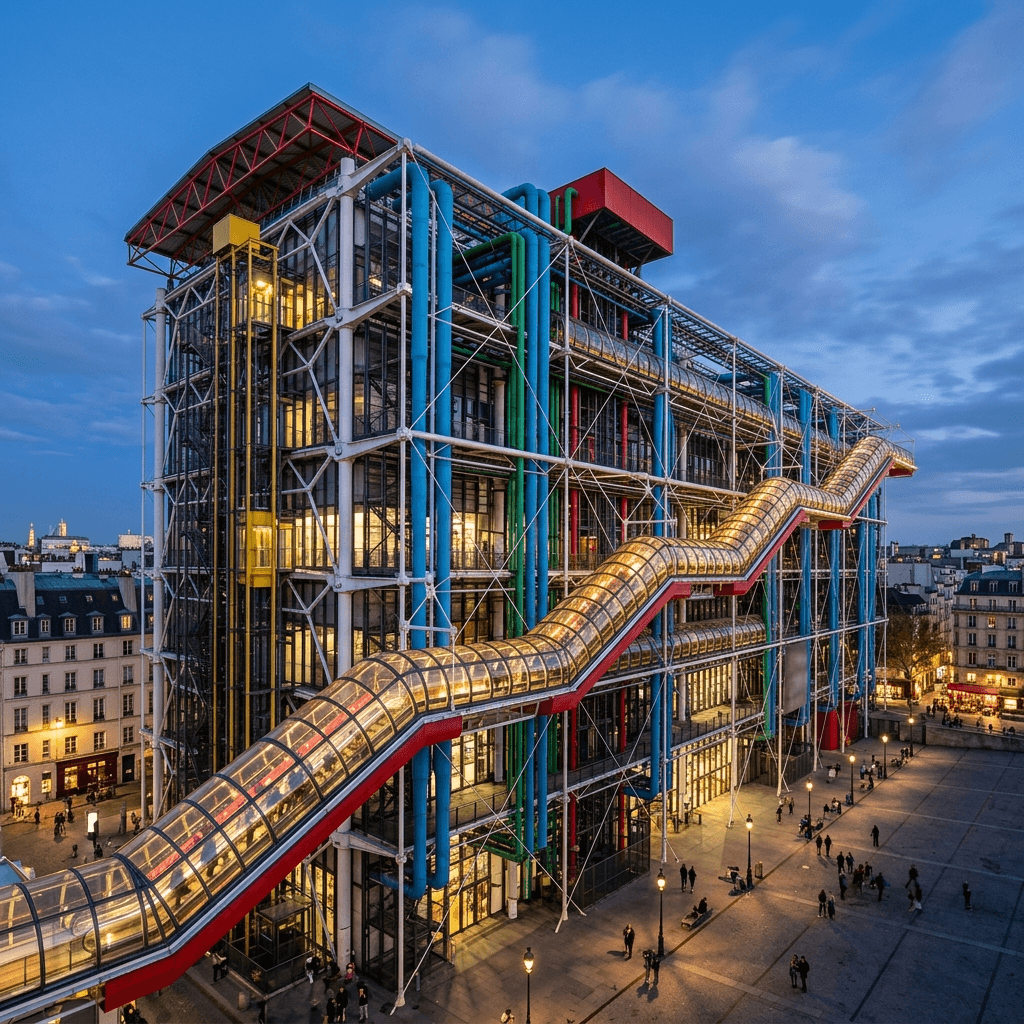
Chapter
1. The True History of the Centre Pompidou: The Architectural Revolution That Shocked Paris and Redefined Modern Art Museums Forever
Chapter
1.1 The 1971 Centre Pompidou International Competition: How 681 Architects From Around the World Competed to Create the Most Radical Museum of the 20th Century
In 1971, the French government launched one of the most ambitious architectural competitions in European history. The program was radical: to build a multidisciplinary cultural center in the heart of Paris that would bring together a museum, a library, and a musical research center under one roof — and that would be accessible to everyone, not just the intellectual elite.
The jury, chaired by legendary designer and engineer Jean Prouvé, received 681 projects from 49 countries. It was an unprecedented number for an architecture competition. Celebrated architects, unknown young talents, experimental collectives — everyone wanted to leave their mark on Paris.
The judging committee spent months analyzing models, drawings, and descriptive reports. The winning project needed to meet seemingly contradictory criteria: monumental yet flexible, technological yet welcoming, institutional yet democratic.
No one expected two young architects with barely any built work to take the prize. But that is exactly what happened — and what came next would forever change the concept of a museum in the world.
Chapter
1.2 Who Are Renzo Piano and Richard Rogers? The Unknown Young Architects Aged 33 and 38 Who Won and Scandalized France
When the result was announced, the question echoed through the architectural circles of Paris: who were those two? Renzo Piano, an Italian from Genoa, was 33 years old. Richard Rogers, British-born of Italian descent, was 38. Together, they didn't add up to half a dozen completed projects.
The duo operated out of a small office in London, with a team of young idealists and a vision that scorned conventions. To them, architecture was not about beautiful facades — it was about structural honesty, spatial flexibility, and technology in the service of the public.
Prouvé's jury saw something in those drawings that escaped the established masters of the profession: a building that hid nothing. Every pipe, every beam, every air-conditioning duct would be on display. The architecture confessed its entrails. The jury understood that this was not technical exhibitionism — it was a declaration of principles.
The project directly confronted the French tradition of palace-museums. Instead of marble and solemn staircases, a gigantic transparent cultural machine. The choice was unanimous. The Centre Pompidou was born.
Chapter
1.2.1 The Centre Pompidou's "inside-out" concept: why all the building's innards — pipes, stairs and metal structures — are exposed on the outside
Piano and Rogers started from a simple and brutal premise: turn the building inside out. The "inside-out" concept was born from the need to create completely free internal platforms — without structural walls, without intrusive pillars, without anything limiting the use of space.
To achieve this, the entire structural skeleton was expelled to the facade. Beams, tie rods, bracing and 15,000 tonnes of steel form an external carcass that supports the building like an exoskeleton. The interior, freed from any load-bearing function, became a modulable void — capable of completely reorganizing itself according to the exhibition or event.
Vertical circulation was also thrown outward. The famous transparent escalator — nicknamed the "mechanical caterpillar" — snakes up the west facade like an industrial prosthesis. Inside, the only fixed elements are the floor, the ceiling, and the light.
The metaphor is explicit: the Pompidou is not a monument, it is an organism. It breathes, pulses, and transforms. The visitor circulates through the inside of a culture-displaying machine.
Chapter
1.2.2 The Pompidou pipe color code: blue for air-conditioning, green for water, yellow for electricity and red for circulation
Each color on the Pompidou facade obeys a precise, almost didactic logic. The chromatic code was designed so that any passerby could read the building as one reads an open-air floor plan.
Blue: air-conditioning. The immense ducts that climatize the entire museum run along the facade like refrigerated arteries. Green: water. Supply, drainage and fire-fighting pipes form moss-green veins along the building. Yellow: electricity. Every conductor, every cable tray and every electrical busbar shines in bright yellow. Red: circulation. Elevators, stairs and any and all human movement devices explode in red — by far the most visible color. White: structure. The main metal skeleton remains bare, without pigments that disguise its function.
This chromatic legend is not merely functional — it is deeply conceptual. It transforms infrastructure into visual language. The entire building is a three-dimensional diagram that explains itself.
Chapter
1.3 Who Was Georges Pompidou? The Visionary President and Modern Art Lover Who Died in 1974 Before Seeing His Museum Inaugurated
Georges Pompidou (1911-1974) was far more than the president who gave the museum its name. A literature professor, lover of surrealist poetry and collector of modern art, he personified a rare type in French politics: the intellectual who governs with aesthetic conviction.
Pompidou believed that France needed a radically new cultural center — a place where modern art would not be confined to specialists, but would spill over into the public square. In 1969, newly elected, he decided to transform the abandoned parking lot of the Plateau Beaubourg into that dream.
He chose the site personally. Defined the architectural program. Followed every stage of the competition. The passion was genuine, almost obsessive. But fate was cruel: Georges Pompidou died of cancer on April 2, 1974, three years before the building was completed.
He never saw the mechanical caterpillar climb the facade. Never set foot on the free floors he envisioned. Never witnessed the crowds that would take over Beaubourg. His museum was inaugurated on January 31, 1977 by President Valéry Giscard d'Estaing. But the name that remained, forever, was that of the man who dared to build it.
Chapter
1.4 Why Was the Centre Pompidou Called the "Notre-Dame of Pipes"? The Fierce Criticism That Nearly Prevented Construction of Paris's Most Radical Building
Paris did not welcome its new cultural center kindly. The nicknames poured in with Parisian venom: "Notre-Dame of Pipes", "Monster of Beaubourg", "Oil Refinery", "Cultural Supermarket". No French public building had been so insulted since the Eiffel Tower.
The newspaper Le Figaro coined the expression that would become a symbol of conservative revolt: "a pile of scrap metal". Reputed architecture critics published fiery articles. Marais residents organized petitions. The construction was taken to court. Some called it an "art hangar" and others predicted the collapse of the foundations over the Paris metro.
The controversy spanned the 6 above-ground levels and the 3 basements of the building. Its height — 138 ft — clashed with the low-rise buildings of the 4th arrondissement. The metal structure with 15,000 tonnes of steel seemed an insult to the centuries-old stones of Paris.
But Paris, as always, rose to the occasion. From the inauguration on January 31, 1977, the public decided for itself. 5 million visitors walked through the Pompidou's doors in just the first year — double what the Eiffel Tower received at the same time. The line wrapped around the corner of Rue du Renard. The "monster" became a phenomenon. The "scrap" was declared heritage. Paris, for the second time in a century, had fallen in love with the building it swore to hate.
---
Chapter
2. The Centre Pompidou's Gigantic Collection in Numbers: Europe's Largest Modern Art Museum With Over 120,000 Works
Chapter
2.1 How Many Works Does the Musée National d'Art Moderne at the Centre Pompidou Hold? The Collection of 120,000 Pieces Spanning From 1905 to Contemporary Art
The Musée National d'Art Moderne (MNAM), installed on the 4th and 5th floors of the Pompidou, houses the largest collection of modern art in Europe. It holds over 120,000 catalogued works, covering a time span from 1905 — the birth of Fauvism — to the most radical contemporary production.
The scale defies imagination. The museum permanently displays over 12,000 works distributed across 150,640 sq ft of galleries. This means that even if you visited the Pompidou every day for a month, you still would not have seen a tenth of what is in the technical reserves.
The collection is organized by intertwined movements and chronologies. Fauvism. Cubism. Abstraction. Surrealism. Abstract Expressionism. Pop Art. Minimalism. Conceptual art. Each room is a portal to a decisive moment in art history — and the Pompidou's curatorship has the intelligence not to isolate them, but to make them dialogue with each other.
### The quantitative gems of the collection
Henri Matisse is represented by over 230 works — paintings, drawings, sculptures and cutouts that span the painter's entire trajectory. It is one of the largest Matisse collections on the planet.
Wassily Kandinsky appears with over 100 works, from early symbolist figuration to the abstract explosions of Munich and the Bauhaus. The Pompidou is, alongside the Lenbachhaus in Munich, the essential destination for anyone wanting to understand abstraction.
Pablo Picasso occupies entire rooms. Marcel Duchamp is present with foundational pieces of conceptualism. Georges Braque, Robert Delaunay, Fernand Léger, Marc Chagall, Max Ernst, René Magritte — all have a robust presence in the permanent collection.
From across the Atlantic, abstract expressionism explodes with Mark Rothko and Jackson Pollock. Pop Art dominates entire rooms with Andy Warhol, Roy Lichtenstein, and their European versions. Yves Klein, with his patented blue, occupies a place of honor. Gerhard Richter, the German giant of contemporary painting, is extensively represented.
The MNAM is not just a museum: it is the materialized timeline of Western modernity. Each work is a brick in the construction of what we call modern art — and the Pompidou holds the largest European inventory of that construction.
Chapter
2.2 The Centre Pompidou Public Information Library: Europe's Largest Free-Access Library With 2,200 Seats and 400,000 Documents
The Bibliothèque publique d'information (BPI) occupies three levels of the Pompidou and functions as the democratic lung of the building. Inaugurated alongside the museum in 1977, it was conceived with a revolutionary principle for a French public library: free access — no library card, no justification, no bureaucracy.
Its collection is impressive: 400,000 documents including books, periodicals, films, records and digital resources. The 2,200 reading seats are spread across spacious rooms with natural light, in an atmosphere that blends university, newsroom and ideas laboratory.
The BPI underwent deep renovations on its original floors — the 1st and 2nd levels — which modernized the digital infrastructure and expanded collaborative work areas. The spirit, however, remains the same as in 1977: anyone, with any goal, can enter, sit down and access knowledge.
That is why the BPI has become one of the busiest libraries in Europe. Students who cannot find a spot at the Sorbonne, independent researchers, recently arrived immigrants consulting materials in their native language, curious tourists — the diversity of patrons is a spectacle in itself.
In a building that is already a declaration of cultural democratization, the BPI is the definitive argument. Knowledge is not bought. You sit down and you read.
Chapter
2.3 What Is IRCAM? The Underground Musical Research Institute That Transforms the Centre Pompidou Into an Avant-Garde Sound Laboratory
Beneath the Place Stravinsky, buried in the basement of Beaubourg, operates one of the most advanced musical research centers in the world: the IRCAM — Institut de Recherche et Coordination Acoustique/Musique. Founded by composer Pierre Boulez (1925-2016), the institute was born alongside the Pompidou and has since operated at the absolute avant-garde of sonic creation.
The IRCAM is neither a music school nor a conventional concert hall — although its programming of contemporary performances is legendary. It is a laboratory where composers, sound engineers, and computer scientists work side by side to expand the boundaries of what music can be.
Real-time electronics. Granular synthesis. Sound spatialization with dozens of channels. Artificial intelligence applied to composition. Acoustic design of non-existent instruments. The IRCAM investigates all of this and more.
Its most mythical piece of equipment is the anechoic chamber — a room designed to absorb absolutely any sound reflection. The silence inside is so absolute that, according to recurring accounts, most people cannot withstand more than a few minutes before they start listening to their own blood circulating. Artists from around the world make pilgrimages to this cube of underground silence.
The paradox is beautiful: while above ground the Pompidou displays visual art for millions, underground the IRCAM investigates the sound of the future for very few initiates. The cultural center that turned Paris inside out also dug into its entrails — and found music where no one else was looking.
---
Chapter
3. The Unmissable Masterpieces of the Centre Pompidou: The Essential Modern and Contemporary Art Itinerary for Your Visit
Chapter
3.1 Henri Matisse's The Red Studio (1911) at the Centre Pompidou: The Painting That Redefined Color and Space in Modern Art
Few paintings in the history of modern art achieved what L'Atelier Rouge (1911) accomplished. Henri Matisse (1869-1954) painted his own studio — easels, furniture, paintings on the walls, sculptures on the table — and then plunged everything into absolute Venetian red. The floor is red. The walls are red. The very air seems to have become color.
The operation is as radical as it is subtle. Faint lines, almost ghosts, draw the outlines of objects over the chromatic field. The eye knows there is a table there, a dresser, a pendulum clock — but the brain struggles to separate them from the background. Figure and ground merge. The painting denies Renaissance perspective and proposes something new: space is not geometric, it is chromatic.
The Pompidou displays this painting with the deference it deserves. It usually occupies an entire wall, with controlled lighting and ample viewing distance — because the force of the red demands space. It is one of the first works the visitor encounters on the 5th floor route, and it functions as a portal: after The Red Studio, no painting behaves the same way.
Matisse is omnipresent at the Pompidou. Among the more than 230 works by the artist in the collection, this is the sharpest jewel. A century later, the red still pulses.
Chapter
3.2 Marcel Duchamp's Fountain (1917) at the Centre Pompidou: The Story of the Urinal That Revolutionized the Concept of Art and Belongs to the Museum's Collection
In 1917, a French-American with a surname unpronounceable to many turned Western art upside down — literally. Marcel Duchamp (1887-1968) took a white porcelain urinal manufactured by the J.L. Mott Iron Works company, signed it with the pseudonym "R. Mutt", gave it the title Fountain and entered the piece into an exhibition of the Society of Independent Artists in New York.
It was rejected. Of course it was. But the rejection was part of the work — perhaps the most important part. Duchamp was demonstrating that what makes something art is not manual skill, nor beauty, nor the rarity of the material. It is the artist's decision. The gesture. The institutional context that welcomes — or rejects.
The Pompidou keeps one of the authorized replicas of Fountain, produced by the gallery of Arturo Schwarz in 1964 under Duchamp's own supervision. The 1917 original was lost. But the idea — that remains intact, too intact, provoking discomfort a century later.
In the room dedicated to Duchamp, Fountain coexists with other readymades by the artist: a bicycle wheel mounted on a stool, a metal bottle rack, a steel comb. But it is the urinal that concentrates the incredulous stares and the awkward selfies. Duchamp would have liked that.
Chapter
3.3 Wassily Kandinsky's Masterpieces at the Centre Pompidou: How the Father of Abstraction Exploded European Figurative Art
The Pompidou holds over 100 works by Wassily Kandinsky (1866-1944), constituting one of the most complete and didactic collections for understanding the artist's journey toward pure abstraction. The collection covers every mutation of Kandinsky: from the symbolist landscapes of his Russian period to the monumental compositions of the Bauhaus, passing through the lyrical explosion of the Blaue Reiter in Munich.
The heart of the collection lies in the canvases from 1910-1914, when Kandinsky produced the first abstract works in the history of Western art. Composition, Improvisation, Impression — the three series that structure his visual thinking are present in the collection, allowing the visitor to follow how the human figure progressively dissolves into stains, strokes, and chromatic force fields.
One of the most intense experiences of the Pompidou's modern wing is precisely this: to walk slowly through the Kandinsky rooms and witness, canvas by canvas, the death of figuration and the birth of a new visual language. Floating forms. Colors with no owner. Lines that delimit nothing except themselves.
The museum organizes these works with remarkable curatorial intelligence. Instead of stacking them chronologically as German museums do, the Pompidou prefers transversal dialogues — a Kandinsky next to a Paul Klee, a Robert Delaunay or a František Kupka. Abstraction ceases to be a genre and becomes a conversation between artists who, in different corners of Europe, arrived at the same conclusion: painting does not need models.
Chapter
3.4 Pablo Picasso at the Centre Pompidou: The Cubist and Surrealist Collection That Dialogues With the Architecture of the Building Itself
There is a delicious irony in the presence of Pablo Picasso (1881-1973) at the Pompidou. The Spanish painter, who spent most of his adult life in France, despised the architecture of Piano and Rogers. He called it a "horror." But his collection is there, occupying noble rooms on the 4th floor, and the dialogue between Picasso's pictorial deconstruction and the building's architectural deconstruction is involuntarily powerful.
The MNAM's Picasso collection covers virtually all of the artist's phases. The analytical cubism of 1909-1912 is represented in still lifes that sliced up the European pictorial tradition. The synthetic cubism of the following years introduces collages, newspapers and textures that the Pompidou displays masterfully. The surrealist period of the 1920s and 1930s explodes in biomorphic figures and scenes of a personal mythology bordering on hallucinatory.
What distinguishes the presentation of Picasso at the Pompidou is the quality of the late works. Many museums focus on the young Picasso — the Blue Period, the Rose Period, the Demoiselles d'Avignon (which are at MoMA). The Pompidou, on the contrary, gives generous space to the old, late, angry Picasso, who paints as if fighting against time. These are canvases of brutal sexuality, urgent brushstrokes, compositions that completely ignore the conventions that Picasso himself helped create half a century earlier.
The Picasso route at the Pompidou is an exhibition within the exhibition. And, at the end, the visitor can contemplate the building's facade through the window — with its pipes, tie rods and garish colors — and wonder whether the old Spaniard, despite the "horror," might not have secretly enjoyed being exhibited inside a machine as insubordinate as his canvases.
Chapter
3.5 Warhol, Lichtenstein and Pop Art at the Centre Pompidou: How the Museum Houses the Works That Captured the Mass Culture Revolution
The Pompidou has dedicated a generous wing to Pop Art, and the curatorial decision is spot-on: the movement that dissolved the boundaries between high art and mass culture is the most coherent tenant of a building that dissolved the boundaries between museum and city.
Andy Warhol (1928-1987) dominates with silkscreen portraits of Marilyn Monroe, Elvis Presley and Mao Zedong — icons multiplied to the point of exhaustion, exactly as mass culture multiplies them. The Campbell's soup cans are there. The Disasters too — electric chairs, car crashes, the dark side of American industrial repetition.
Roy Lichtenstein (1923-1997) dialogues with Warhol but in a different key: while Warhol multiplies, Lichtenstein freezes. His enlargements of romantic comics and war scenes — with the unmistakable Ben-Day dots — transform the most despised graphic language of the 20th century into easel painting. The Pompidou displays iconic canvases such as Whaam! and portraits of crying women whose drama is purely graphic.
The dialogue between Warhol, Lichtenstein and the Pompidou's architecture is involuntarily perfect. The building is an industrial machine that houses culture; Pop Art is culture that appropriates industrial aesthetics. Both refuse the distinction between the sublime and the banal. Both irritated conservatives and fascinated the public. And both, fifty years later, remain absolutely contemporary.
Chapter
4. The Centre Pompidou From the Inside: The 6 Floors, the Mechanical Caterpillar and the Panoramic Terrace With the Most Underrated View of Paris
Chapter
4.1 The 6th Floor and Restaurant Georges at the Centre Pompidou: The 360° Panoramic Terrace View of Paris You Can Visit Without a Museum Ticket
The sixth floor of the Centre Pompidou holds one of the best-kept — and most democratic — secrets of Paris. Here operates the Restaurant Georges, run by the Costes brothers, the same ones who transformed Parisian hospitality and gastronomy into design experiences. The space was conceived by architects Dominique Jakob and Brendan MacFarlane with a minimalist and futuristic aesthetic: organic aluminum forms, curved surfaces and a chromatic palette that echoes the high contrast of the museum itself. It is not exactly cheap — a main course runs around $33 to $55 — but the cost-benefit ratio fully justifies itself when one considers that the view is, in practice, the main ingredient on the menu.
The great strategic advantage that few tourists know: the panoramic terrace and the restaurant have access independent of the museum ticket office. Simply take the famous external escalator — the caterpillar — and go directly up to the sixth floor without passing through the galleries. From there, the 360-degree view delivers a panorama that rivals the Eiffel Tower and the top of the Arc de Triomphe, but without monumental lines and without the stratospheric price. You see the Eiffel Tower to the west, the Sacré-Cœur silhouetted to the north, Notre-Dame Cathedral to the east and the Tour Saint-Jacques rising lonely among the zinc roofs.
The Georges terrace is, above all, the best spot in the Marais to watch the sunset. Between May and September, the golden late-afternoon light hits the building's west facade directly and transforms the colored pipes into incandescent filaments. As the sky darkens, the roofs of Paris acquire shades of deep blue and the windows of Haussmannian apartments begin to light up, dotting the landscape with small rectangles of yellowish light. It is the kind of experience that costs zero dollars if you bring your own wine to the esplanade and simply lean on the parapet.
The restaurant itself deserves at least a coffee or a cocktail, even if you do not plan a full meal. Drinks run around $16.50 and come accompanied by the same view. The menu, created by chefs who have passed through starred kitchens, bets on Mediterranean-influenced dishes with minimalist presentation that competes — on equal footing — with the hall's design. For those who want to save money and still enjoy the space, the tip is to go up during the day for an espresso and come back at dusk just for the outdoor terrace.
If you are the type who likes to plan, know that Georges accepts reservations through the official website and tends to fill up on spring and summer weekends. But the magic really happens on off-season weekdays, when the flow of tourists decreases and the terrace becomes a private balcony suspended above the rooftops of the French capital. Bring a camera with a good lens — or a cell phone with optical zoom — because the geometrized chimneys of Paris yield irresistible abstract compositions.
Chapter
4.2 How Does the Centre Pompidou's External Caterpillar Work? The Famous Transparent Mechanical Climber That Became a Tourist Attraction in Its Own Right
The Centre Pompidou's external escalator — affectionately nicknamed the "caterpillar" (chenille) — is much more than a means of vertical locomotion: it is the building's kinetic signature. Installed on the west facade, it runs along the face of the building in a diagonal zigzag, crossing the six above-ground floors inside a transparent glass tube. The insect metaphor is not merely poetic — the segmented movement of the steps really resembles a mechanical caterpillar of steel and crystal slowly climbing the museum's colored carcass.
The journey is a spectacle in itself. As you go up, Paris gradually unveils itself: the bluish-gray roofs first appear at eye level, then flatten out below, and at each landing the city's geometry reorganizes itself into a different chessboard. Upon reaching the top, you will have traveled the equivalent of a small scenic journey — and the best part is that access to the caterpillar is completely free up to the sixth floor, with no museum ticket needed. Just enter through the main facade, at the square level, and head to the elevators that lead to the external tube.
There is a symbolic dimension to this route that the architects themselves, Renzo Piano and Richard Rogers, made a point of emphasizing. While most traditional museums confine circulation to internal stairs and opaque corridors — isolating the visitor from the outside world — the Pompidou does exactly the opposite: it places the route outside, displays the visitor's body against the urban landscape and transforms the visitor into part of the performance. Those inside the tube see Paris; those in the square see the human flow crossing the facade as if they were cells traveling through a glass artery.
The structural design of the caterpillar deserves a technical note. Unlike conventional shopping mall escalators, this one was designed to span enormous open spans without intermediate pillars, supporting itself by metal tie rods that anchor it directly to the building's steel superstructure. Each escalator module weighs several tonnes and was hoisted by cranes during the original construction in the 1970s, in a millimeter-precision operation that the engineers of the time described as "assembling a crystal skeleton at 131 ft above the ground."
For photographers on duty, the caterpillar offers compositions that no other Paris viewpoint can replicate. The oblique angle of the tube, combined with the curvature of the steps and the checkered metal structure, creates natural architectural frames for city photos. Late afternoon is the most contested moment: with the low sun entering through the west face, the interior of the tube becomes a glass prism and golden reflections cross the exposed steel. Making the complete route at least once — going up and down unhurriedly — is a mandatory part of the Pompidou experience.
Chapter
4.3 The Pompidou's Temporary Exhibition Spaces: The Epic Shows That Have Already Brought Salvador Dalí, Gerhard Richter and Christian Boltanski to Paris
The sixth floor of the Centre Pompidou is not just a terrace and a restaurant: it also houses the temporary exhibition galleries, responsible for some of the most visited shows in the history of French museums. The most notorious case is the Salvador Dalí retrospective in 1979, which attracted 840,000 visitors — an absolute record that remains unbeaten to this day for the museum. It was the exhibition that consolidated the Pompidou not just as a permanent collection museum, but as a cultural machine capable of mobilizing crowds comparable to those of a World Cup.
The list of artists who have passed through the sixth-floor rooms is a who's who of 20th and 21st century art. Gerhard Richter occupied the space with his blurred landscapes and chromatic abstractions; Christian Boltanski set up installations of a memorialistic nature that made the visitor walk among piles of used clothes and identity archives; Alexander Calder suspended his monumental mobiles; and Alberto Giacometti made his threadlike figures cross the galleries like bronze specters. Each new project requires the curators to completely reinvent the space, since the rooms were conceived as neutral and modulable platforms — a machine à exposer, in the words of the architects themselves.
The Pompidou's curatorship has always had one foot in experimentation. While other museums bet on linear chronologies, Beaubourg from the start privileged transversal thematic exhibitions that cross eras, languages and geographies. The exhibition "Les Immatériaux" of 1985, curated by philosopher Jean-François Lyotard, is considered a landmark of contemporary museology: it mixed art, technology and philosophy in a scenographic labyrinth that questioned the materiality of the artistic object in the digital age — an exhibition about the postmodern that was, itself, a postmodern artifact.
There is also an enormous flow of shows dedicated to non-European production. The Pompidou was one of the first major Western museums to organize comprehensive retrospectives of contemporary Japanese, Chinese, Indian and Latin American art, often in collaboration with local institutions. The center's global vocation is reflected both in the content and in the box office: about 40% of the public for temporary exhibitions is made up of foreigners, and the shows usually travel to other partner museums in Europe, Asia and the Americas when they close their Paris season.
From a practical standpoint, temporary exhibitions have a separate ticket office from the permanent collection. The combined ticket — museum + exhibitions — is the best option for those who want to see everything, but it is also possible to buy a ticket just for the sixth-floor shows. Prices vary according to the scale of the exhibition: major retrospectives cost an average of $16.50 to $18.70, and smaller shows or those by lesser-known artists run around $13.20. It is worth checking the official website before your trip to see what will be on the schedule — the Pompidou's calendars are set at least two years in advance and usually include two or three simultaneous exhibitions on display.
Chapter
5. Place Georges Pompidou and the Stravinsky Fountain: The Vibrant Heart of Beaubourg With Street Art and the Most Fun Kinetic Fountain in Paris
Chapter
5.1 The Stravinsky Fountain and the Sculptures by Niki de Saint Phalle and Jean Tinguely: The 16 Colorful Mechanical Figures That Dance on the Water
The Stravinsky Fountain has occupied the square between the Centre Pompidou and the church of Saint-Merri since 1983, and in four decades of existence it remains the most improbable and fun public fountain in Paris. The ensemble brings together 16 sculptures spread over a shallow water mirror — a collaboration between two artists who were also a couple in real life and who worked with radically opposite languages. The voluptuous, colorful and festive figures of Niki de Saint Phalle in fiberglass deliberately contrast with the black mechanical structures of Jean Tinguely, made of iron, gears and hydraulic pumps that spin, turn and spit rhythmic water jets.
Each of the 16 sculptures represents a musical piece by Russian composer Igor Stravinsky, whose name gives the fountain its title. There are The Firebird (L'Oiseau de feu), The Rite of Spring (Le Sacre du printemps), Ragtime, The Nightingale (Le Rossignol) and many other works that revolutionized 20th century music. The choice of the composer was not random: Stravinsky composed his most radical works in Paris and is intimately linked to the cultural avant-garde that the Pompidou celebrates. The fountain, in this sense, is a kind of visual soundtrack — a mechanical ballet without dancers that performs its hydraulic choreography day after day.
The partnership between Niki de Saint Phalle and Jean Tinguely is an essential part of the ensemble's poetics. She made the organic, festive, almost childlike forms, with carnival colors and mother-goddess curves. He made the black, industrial skeleton, full of screws and creaking joints. When Tinguely's pieces enter into movement — the blades spin, the large gaping mouth opens and closes, the metallic arms shake fan-shaped jets — Niki's static figures gain a kinetic counterpoint that transforms the fountain into a spectacle of contrasts. It is the encounter between the solar matriarchy and the nocturnal machine, between carnival and factory.
The fountain is kinetic in the literal sense of the term: Tinguely's sculptures move continuously thanks to submerged electric motors and pumps that recirculate water in closed circuits. When the pumps are under maintenance or on the rare days of harsh winter when the system is shut down to prevent freezing, the fountain loses half its personality — Niki's figures remain there, but seem orphaned without their noisy counterpart. The maintenance of the mechanical assembly is complex and expensive, and over the years several pieces have already been restored or had their motors replaced. The collection belongs to the City of Paris and is maintained by the city hall with technical support from the Centre Pompidou itself.
For the first-time visitor, the Stravinsky Fountain functions as an entry portal to the Beaubourg universe. While the high-tech architecture of the Pompidou impresses with its scale and industrial rationality, the fountain offers the playful, baroque and deliberately irrational counterpoint. Children are the best thermometer: rarely does a child pass in front of the fountain without stopping and pointing at the figures that spin and spray. If you are planning a family visit, arrive via rue Saint-Merri and cross the square by the fountain — the initial impact is guaranteed.
Chapter
5.2 The Street Performers of the Centre Pompidou Square: Jugglers, Mimes, Musicians and the Free Daily Spectacle at Beaubourg
Place Georges Pompidou — also called Place Beaubourg — is much more than the museum's entrance: it is one of the great public stages of Paris. The square was designed with a gentle slope descending toward the building, creating a kind of open-air urban amphitheater. Not by chance, since the inauguration of the Pompidou in 1977 the site has become free territory for street artists of all disciplines and nationalities. What can be seen there daily is a permanent and free festival that rivals any paid cultural programming in the French capital.
The menu of attractions changes every hour, but certain characters are regular fixtures. Jugglers with fire clubs work in the center of the cobblestone promenade, accordion musicians play Édith Piaf and Charles Trenet for tourists from all latitudes, white-faced mimes interact with passing children and adults, and portraitists armed with portable easels offer live drawings for $22 or $33. There are also living statues — performers covered in metallic paint who remain motionless for endless minutes and suddenly wink or reach out a hand, drawing screams and laughter.
The quality of the artists who perform at Beaubourg is irregular, as in any public space, but there are moments of genuine brilliance. Conservatory musicians who use the square as a laboratory, professional jugglers training for festivals, street theater troupes testing numbers before premiering in official seasons. The square is, at the same time, a showcase of anonymous talents and a training zone for performance professionals. Anyone who spends an entire afternoon sitting on the sloped cobblestone ground — with a crepe in hand and the constant hum of the city in the background — watches a spectacle that renews itself every 30 minutes.
There is an interesting territorial dynamic in the square. The portion closest to the Pompidou's main facade is dominated by visual artists and portraitists. The intermediate stretch, near the grated ventilation outlets (which in winter expel warm air and attract homeless people and backpackers), is usually occupied by musicians and singers. Meanwhile, the western end, near the Stravinsky Fountain, is territory for jugglers and acrobats who take advantage of the flow of families stopping to see the fountain. This informal geography of the square is part of the spectacle — the attentive visitor quickly perceives that there is a tacit zoning that self-regulates without the intervention of any authority.
For Brazilian tourists, the square holds an additional charm: it is one of the rare places in Paris where the language barrier practically disappears. Street artists communicate through gestures, facial expressions and movements that transcend language. A mime does not need to speak French or English to draw laughter from a Brazilian child; a fire-breather needs no subtitles. It is probably the most democratic and multilingual space in all of central Paris — and visiting it costs absolutely nothing except the change you decide to leave in the hat at the end of the performance.
Chapter
5.3 The Reconstructed Brancusi Studio on the Pompidou Square: The Exact Replica of Romanian Sculptor Constantin Brancusi's Workshop
On the north side of Place Georges Pompidou, a small concrete and glass building contrasts sharply with the monumental scale of the museum. It is the faithful reconstruction of the studio of Constantin Brancusi (1876–1957), the Romanian sculptor who spent most of his creative life in Paris and who transformed modern sculpture with his purified forms and his concept that extreme simplicity is the shortest path to essence. The story of the studio is as extraordinary as the work of its occupant: upon his death in 1957, Brancusi bequeathed the entire contents of his studio to the French state, with a non-negotiable condition — the space should be reconstructed exactly as it was, preserving not only the works, but the spatial relationship between them.
The original studio occupied a plot on the Impasse Ronsin, a modest alley in the 15th arrondissement of Paris. It was a low-ceilinged space, illuminated by skylights, where Brancusi cultivated what he called a "mobile group" — his sculptures were never static. The artist spent decades moving the pieces around, repositioning pedestals, altering angles and distances, as if the studio were a single work of art in permanent evolution. For him, the spatial arrangement of the sculptures in relation to each other was as important as the making of each individual piece. Light, shadow, voids — all of this composed an installation that he never considered finished.
The bequeathed ensemble includes 137 sculptures, 87 pedestals, 41 drawings and 2 paintings. The pedestals are particularly relevant: Brancusi did not treat them as mere supports, but as sculptures in themselves — blocks of wood, plaster and stone that dialogued with the forms they sustained. The Bird in Space, the Sleeping Muse and the Endless Column are some of the most celebrated pieces that can be seen in the reconstructed studio, arranged exactly as the artist left them. The visitor is not before a traditional museological exhibition; literally enters the mental space of the sculptor.
The reconstruction we see today on the Pompidou square was led by architect Renzo Piano — the same one who conceived the museum next door — and inaugurated in 1997. Piano faced a delicate problem: the Impasse Ronsin had been demolished, and the original plot no longer existed. The solution was to erect a new construction, with rigorously identical internal proportions and absolute fidelity to the plans, photographs and descriptions of the original studio. The glass facade that envelops the new building allows the space to be seen from the square as a showcase — a transparent jewel box that protects Brancusi's minimalist and obsessive universe.
Entry to the Atelier Brancusi is free, which surprises a good number of visitors accustomed to the ticket policies of Parisian museums. The space is small, the visit is quick — 15 to 20 minutes suffice to traverse the environment — but the artistic density is inversely proportional to the physical dimensions. The tip for those doing the complete Pompidou circuit is to start at the studio and then enter the main museum: Brancusi's purified sculptures function as a kind of minimalist preface to the explosion of forms, colors and materials that will unfold on the upper floors.
Chapter
6. The Major Centre Pompidou Renovation 2025-2030: The 5-Year Closure and the $286 Million Renovation
Chapter
6.1 Why Will the Centre Pompidou Close Its Doors for 5 Years? Everything About the Largest Renovation of a French Museum in the 21st Century
The announcement made in January 2023 fell like a bomb in the cultural world: the Centre Pompidou would fully close its doors from the summer of 2025, and would remain so until 2030 — the first total closure in the museum's 50-year history. The decision, far from being an administrative whim, responds to an inescapable technical reality. Buildings constructed in the 1970s throughout Europe made intensive use of asbestos as an insulating and fireproofing material — and the Centre Pompidou was no exception. Asbestos, today classified as a category 1 carcinogen by the World Health Organization, is present in thermal insulation, coatings and sealing systems spread throughout the structure.
Asbestos removal in a building of the Pompidou's dimensions — with over 1,076,000 sq ft of built area, 15,000 tonnes of steel and a complex mesh of ducts and pipes — cannot be done with the building in operation. The protocol requires complete isolation of work zones, negative pressure systems to prevent fiber dispersion, level 3 protective equipment for workers and continuous environmental monitoring. Trying to do this service with the museum open, floor by floor, would triple the cost and quintuple the timeline — in addition to putting employees and visitors at risk.
But asbestos is just the trigger. The renovation includes a complete modernization of all the building's technical systems, many of which are the originals from 1977. The air-conditioning plant, the elevators, the water pumps, the electrical panels, the fire safety system — everything will be replaced with contemporary equipment that meets current European standards for energy efficiency and universal accessibility. The 1977 Pompidou was a technological prodigy of its time; the 2030 Pompidou will need to be a technological prodigy of the 21st century.
Accessibility is a separate chapter. The original building, despite its ramps and large open spans, was never conceived within contemporary parameters of universal design. Adapted restrooms, tactile signage for the visually impaired, accessible evacuation routes for wheelchair users, elevators with appropriate dimensions — all of this will be incorporated into the renovation project. France has one of the strictest accessibility laws in Europe (the 2005 law on equal rights and opportunities), and the closed Pompidou is the unique opportunity to bring the building entirely into compliance without the limitations of improvising on an operating structure.
The total estimated cost is $286 million for the civil works, plus an additional contribution of $203.5 million for the cultural program during the closure — the traveling exhibitions, the logistical operation of storing and transporting the collections, and the educational projects that will keep the Pompidou brand alive during the absence. The financing combines resources from the French Ministry of Culture (the largest share), the museum's own revenues from accumulated box office receipts, and partnerships with private sponsors. It is, by far, the largest investment in the renovation of a French cultural facility this century.
Chapter
6.2 What Changes at the Centre Pompidou After 2030? Complete Asbestos Removal, New Spaces and the Total Reconfiguration of Europe's Largest Cultural Center
The reopening scheduled for 2030 will not deliver the same Pompidou — it will deliver a deeply reconfigured museum. The complete asbestos removal will be, in a certain sense, the invisible and least glamorous part of the project, but also the most essential: it guarantees that future generations of visitors and workers will occupy a contamination-free building. For those behind the scenes of the cultural operation, the safe removal of hundreds of tonnes of contaminated material is the equivalent of a detox that the building had never undergone.
The redistribution of internal spaces will be significant. The museum will gain more exhibition area, with the reconfiguration of floors that currently house administrative and technical functions. The goal is to increase the surface dedicated to the permanent collections and temporary exhibitions by at least 20%, allowing a larger number of works from the gigantic collection to be displayed — today, less than 5% of the 120,000 pieces are on simultaneous exhibition. The floor occupation logic will be revised, and the current separation between modern art collections (levels 4 and 5) and temporary exhibitions (level 6) may be made more flexible with new hybrid spaces.
From an architectural standpoint, the renovation will fully respect Piano and Rogers's original project — but will update it where necessary. The chromatic code of the exposed pipes (blue for air, green for water, yellow for electricity, red for circulation) will be maintained and restored. The glass facades will be replaced with next-generation panels featuring intelligent solar control, which reduce thermal load without compromising the transparency that is the soul of the inside-out concept. The external square will also undergo requalification: the cobblestone paving will be renewed, public lighting will be modernized and access to the Stravinsky Fountain and the Brancusi Studio will be improved.
Energy sustainability is one of the project's pillars. The new Pompidou will be equipped with geothermal climate control systems, photovoltaic panels integrated into the roof, and an intelligent building management system (BMS — Building Management System) that will optimize water and electricity consumption in real time. The goals are ambitious: a 40% reduction in energy consumption compared to the current building, and HQE (Haute Qualité Environnementale) environmental certification, the French seal equivalent to American LEED. A building that was born as a high-tech manifesto in the 1970s will also become a manifesto of sustainable architecture in the 21st century.
There will also be a rethinking of the visitor experience. The circulation flow between the library (floor 1), the forum's public spaces (floor 0), the museum (floors 4 and 5) and the restaurant (floor 6) will be reorganized to avoid the bottlenecks that have always plagued operations on high-traffic days. New educational spaces, children's workshops and an expanded digital media library are in the plans, with the ambition of making the reopened Pompidou a cultural center as disruptive in 2030 as the original was in 1977.
Chapter
6.3 Where to See the Centre Pompidou's Works During the Closure? Partnerships With the Grand Palais, the Louvre and Worldwide Traveling Exhibitions
Closing Europe's largest modern art museum for five years without its collection disappearing from the map requires a logistical and diplomatic engineering operation of unprecedented proportions. The solution found by the Pompidou's management was an ambitious program baptized "Centre Pompidou hors les murs" — literally, Centre Pompidou outside the walls — which will take a significant part of the collection on a world tour while the mother building is under construction. The main anchor of this operation is a partnership with the Grand Palais, which will host regular exhibitions with works from the Pompidou's collection in its immense, recently restored halls on the right bank of the Seine.
The Grand Palais is the ideal partner: monumental enough to receive large-scale exhibitions, located less than 1.86 mi from Beaubourg, and already accustomed to hosting internationally renowned cultural events. During the closure, the Grand Palais will function as a kind of temporary embassy of the Pompidou in Paris, showing the French public part of the collection — probably in thematic exhibitions that revisit the great movements of the 20th century: Cubism, Surrealism, Abstraction, Pop Art. It is a way to keep the collection accessible to the Parisian public and, at the same time, strengthen ties between the two institutions.
Outside France, the strategy is one of total mobility. The Centre Pompidou has a consolidated history of international partnerships: it has already operated temporary satellites in Málaga (Spain), Shanghai (China) and Brussels (Belgium). During the closure, this network of collaborations will be intensified with traveling exhibitions that will take modules of the collection to museums in Asia, North America, Latin America and the Middle East. The goal is dual — maintaining the global presence of the Pompidou brand while generating revenue — and perfectly coherent with the export vocation that the museum has cultivated since the 1990s.
An important chapter of this logistics is the new storage and exhibition center in Massy, in the southern suburbs of Paris. This satellite hub will house part of the collection during the works and, after the Pompidou's reopening in 2030, will continue to function as a visitable technical reserve and complementary exhibition space. It is a trend that major European museums have been adopting: the Rijksmuseum has its depot in Amsterdam, the Victoria & Albert has V&A East in London, and now the Pompidou will have its suburban arm in Massy. For the public, it means a new visiting option about 30 minutes by train from central Paris.
The Public Information Library (BPI), which occupies a considerable part of the building (floors 1 to 3), will be transferred to a temporary location yet to be confirmed. The BPI has its own public — about 1.5 million users per year — whose loyalty is independent of the exhibition programming, and maintaining this service during the closure is a political priority of the Ministry of Culture. As for the IRCAM, the musical research institute that occupies the Pompidou's basement, it will not be deactivated: its underground facilities are structurally independent from the rest of the building and will be able to continue operating during the works, ensuring that the Parisian sound avant-garde will suffer no interruption.
The message that the Pompidou's directors have been repeating since the renovation was announced is a single one: the five-year closure is not a disappearance, it is a metamorphosis. The Center will not cease to exist — it will spread out. And when Beaubourg's doors reopen in 2030, the institution will have not only a renovated building, but a network of global partnerships, a permanent suburban presence and a collection that, by circulating around the world, will have won over new audiences who would never set foot in the Marais.
Chapter
7. Definitive Guide to Visiting the Centre Pompidou in Paris: Tickets, Hours, How to Get There and the Secret of the Free Panoramic Terrace
Chapter
7.1 Where to Buy the Cheapest and Official Centre Pompidou Ticket? Updated Prices, Free Entry Options and the Paris Museum Pass
The *Centre Pompidou ticket costs $16.50 and gives access to the Musée National d'Art Moderne plus the temporary exhibitions on display at the time of the visit. The ticket can be purchased simply and securely through the Centre Pompidou's official website — it is the most recommended channel because it allows you to choose a date and time in advance and avoids lines at the physical ticket office. Resale platforms such as GetYourGuide and Tiqets* also sell the official ticket, often with the option of free cancellation up to 24 hours in advance, but they usually apply a small service fee on top of the face value.
The biggest savings, however, lie in the free entry options. The *Centre Pompidou offers free entry for European Union citizens under 26 — simply present a valid ID at the entrance. The benefit covers both the permanent collection and the temporary exhibitions. The museum is also free for active teachers (with proof), disabled visitors and one companion, and youths between 18 and 25 of any nationality, exclusively on the first Sunday of each month. Anyone under 18*, regardless of nationality, does not pay admission on any date.
For those planning to visit several museums during their stay in Paris, the *Paris Museum Pass is a financially smart alternative. The pass covers entry to the Centre Pompidou and over 60 museums and monuments in the city, including the Louvre, the Musée d'Orsay, the Arc de Triomphe and the Panthéon. The 2-day pass costs about $68.20, the 4-day pass costs $84.70 and the 6-day pass costs $101.20 — in all cases, the visitor needs to calculate whether the number of attractions on the itinerary justifies the investment. Note: the Paris Museum Pass does not exempt you from needing to book a time slot at attractions that require advance scheduling, but the Centre Pompidou* accepts direct entry with the pass, without the need for an additional reservation on most days.
Chapter
7.2 What Is the Best Day and Time to Visit the Centre Pompidou and Avoid the Crowds?
*Wednesday and Thursday mornings are the ideal time to visit the Centre Pompidou in peace. The flow of visitors is still light right at opening, at 11 am, and the corridors of level 5 — where the heart of the modern collection is — remain quiet for at least an hour and a half. Avoid Tuesdays, as the museum is closed, and resist the temptation of weekends: Saturday and Sunday concentrate the largest volume of visitors, especially between 1 pm and 4 pm, when lines for the external elevator can exceed 30 minutes*.
There is a special window that many tourists are unaware of: *Thursday nights. The Centre Pompidou extends the closing time of the exhibitions until 11 pm exclusively on that day, and the flow of visitors drops drastically after 7 pm. Visiting the museum under evening lighting, with the lights of Paris shining through the colored pipes of the facade, is a different sensory experience — the collection remains the same, but the building's atmosphere transforms radically. Also take into account the first two weeks of August and the period between Christmas and New Year's*: Paris empties of local tourists, and the Pompidou breathes freely.
For readers planning their visit months in advance, the golden advice is to avoid the *first Sunday of each month. Although free admission is tempting, the lines outside Place Georges Pompidou usually snake all the way to the Stravinsky Fountain, and the density of people inside the galleries makes it difficult to contemplate works such as Matisse's The Red Studio or Kandinsky's monumental canvases. If your travel dates fall obligatorily on a weekend, prefer Sunday morning* over Saturday: many European tourists have already returned home, and the city breathes at a slightly slower pace.
Chapter
7.3 How to Get to the Centre Pompidou by Metro and RER? The Rambuteau, Hôtel de Ville, Châtelet Stations and the Heart of the Marais
The closest metro station to the *Centre Pompidou is Rambuteau, on line 11, which leaves the visitor less than 328 ft from the main entrance. Upon exiting the station, simply walk along Rue Rambuteau toward the colorful facade that dominates the neighborhood's skyline — it is impossible to miss the destination. Line 11 directly connects strategic areas such as Châtelet and République*, facilitating integration with practically any point in the city.
The second most convenient option is the *Hôtel de Ville station, served by lines 1 and 11. The walk to the museum takes about 5 minutes through charming streets that are already a preview of what the Marais offers: sidewalk cafés, independent art galleries and design boutiques. For those arriving by train from other French cities or from the airport, the Châtelet-Les Halles hub is the strategic disembarkation point. The station brings together metro lines 1, 4, 7, 11 and 14 and RER lines A, B and D — the walk to the Pompidou takes 8 to 10 minutes, crossing Place du Châtelet and following the axis of Rue de Rivoli or Rue Saint-Martin*.
Visitors arriving at *Charles de Gaulle Airport (CDG) should take RER B to Châtelet-Les Halles (approximately 35 minutes) and walk to the museum. Those arriving via Orly Airport have the option of the Orlyval to Antony, followed by RER B to Châtelet. For those staying on the Left Bank, metro lines 4 and 10 connect Saint-Germain-des-Prés and Odéon to the Beaubourg area in less than 15 minutes. The Centre Pompidou also has a paid underground parking lot at Place Georges Pompidou itself, but driving in central Paris is an experience that requires patience and a willingness to face the tight traffic of the medieval streets of the Marais*.
Chapter
7.4 How to Go Up to the Centre Pompidou Panoramic Terrace for Free? The Secret of the 6th Floor Without a Museum Ticket
Yes, it is true: the panoramic terrace on the *6th floor of the Centre Pompidou is completely free and can be accessed without buying a museum ticket. Simply enter through the main door at Place Georges Pompidou, go through the security check, and head directly to the mechanical caterpillar — the famous external escalator of transparent tubes that snakes up the building's west facade. Access to the terrace is made exclusively via this external escalator, which takes the visitor nonstop to the top floor. No employee will ask for a ticket along the way: ticket control only happens at the entrances to level 4 (contemporary collection) and level 5* (modern collection and temporary exhibitions).
From up there, the visitor finds one of the most underrated views of Paris. The terrace offers a *360-degree angle over the rooftops of the French capital: to the north, the hill of Montmartre and the white silhouette of the Basilique du Sacré-Coeur; to the west, the Eiffel Tower rising above the Haussmannian buildings; to the south, the twin towers of Notre-Dame and the Île de la Cité; to the east, the bell towers of the Church of Saint-Paul and the tangle of medieval streets of the Marais. The experience can be enriched with a pause at Restaurant Georges*, which occupies the same floor and welcomes customers without a museum ticket — the menu is created by contemporary chefs and the prices reflect the exclusivity of the address.
Enjoy the terrace at *late afternoon, when the golden light of sunset bathes the zinc roofs of Paris. The advanced tip is to go up 30 minutes before sunset* and remain until the city lights come on: the transition is hypnotic and photographs beautifully. Keep in mind that the external escalator may close on days of strong wind or scheduled maintenance — in those cases, access is redirected to the internal elevators, but the terrace remains free and open to the public.
Chapter
7.5 What to Visit Near the Centre Pompidou? Complete Itinerary Through the Marais, Hôtel de Ville, Notre-Dame and the Banks of the Seine
The *Centre Pompidou is planted in the heart of the Marais, one of the most vibrant and photogenic neighborhoods in Paris, and the visitor would do well to reserve at least half a day to explore the surroundings. Starting with the obvious and unmissable: the Stravinsky Fountain, in the museum's own square, with its 16 colorful kinetic sculptures created by Niki de Saint Phalle and Jean Tinguely. The mechanical figures spin, spray water and delight children and adults daily — and cost zero dollars. Next to the fountain, the Brancusi Studio, a faithful reconstruction of Romanian sculptor Constantin Brancusi*'s workshop, offers a contemplative pause before continuing the neighborhood itinerary.
Walk *8 minutes south and you will reach the Hôtel de Ville, the Paris city hall, a monumental neo-Renaissance palace with a facade decorated with 136 statues of illustrious figures from French history. The Place de l'Hôtel de Ville hosts free seasonal events: an ice-skating rink in winter, a big screen for sports broadcasts in summer, and themed fairs throughout the year. From there, it's another 5 minutes crossing the Pont d'Arcole to the Île de la Cité, where Notre-Dame de Paris — reopened to the public since December 2024 after the restoration from the 2019* fire — displays its renewed Gothic facade. Entry to the cathedral is free, but access to the towers requires a ticket and reservation.
On the way back to the Pompidou, dive into the narrow streets of the Jewish *Marais. Rue des Rosiers is the gastronomic epicenter of the neighborhood, famous for its falafel restaurants — L'As du Fallafel is the most celebrated, with lines that wrap around the corner on Sundays, but which move fast and reward with a generous, crispy sandwich. A few steps away, Place des Vosges, the oldest planned square in Paris, offers symmetrical arcades, impeccable lawns and the house-museum of Victor Hugo — also free. To finish the itinerary, Les Halles, with its underground shopping mall and the Canopée, a huge translucent canopy designed by Patrick Berger, is 10 minutes* west of the Centre Pompidou and serves well those looking for a shopping break or quick meals before continuing to explore the city.
Chapter
8. FAQ
Chapter
What is the price of the Centre Pompidou in 2026 and what is included?
The standard *Centre Pompidou ticket costs $16.50 and includes access to the Musée National d'Art Moderne — the permanent collection distributed between levels 4 and 5 — and to the temporary exhibitions on display during the visit period. The Bibliothèque Publique d'Information (BPI) and the ground-floor Forum remain free for all visitors, with no ticket needed. European Union citizens under 26 have free entry upon presenting an ID, as do teachers of the French public school system, disabled visitors with one companion, and anyone under 18 of any nationality. The Paris Museum Pass* fully covers the ticket price and offers priority access on days of moderate traffic.
With the approach of the closure for the major renovation in *September 2025, it is possible that the Centre Pompidou will launch special rates or festive programming with promotional prices in the final months of operation. It is recommended to consult the official website in advance to check for any price changes or extended hours. During the 5-year renovation, traveling exhibitions at partner venues such as the Grand Palais* will maintain their own pricing policy — with no direct link to Beaubourg's current rates.
Chapter
Is the Centre Pompidou closed in 2026?
Yes, the *Centre Pompidou will fully close its doors from September 2025 for the largest renovation of a French museum in the 21st century, with a planned duration of 5 years and an investment of $286 million. The work includes the complete removal of asbestos present in the original metal structure, the modernization of climate control and fire safety systems, and the reconfiguration of exhibition spaces — the museum will only reopen in 2030. During this period, the building designed by Renzo Piano and Richard Rogers* will be unavailable for any type of public visitation, including the panoramic terrace and the library.
The good news is that the collection of *120,000 works will not go dark. The French government has planned a strategic dispersion operation: the modern and contemporary collection will be temporarily displayed at the Grand Palais, which will host rotating exhibitions of the Pompidou's collection starting in 2026. Simultaneously, a series of traveling exhibitions will visit partner museums in France and abroad — areas such as Massy, in the southern periphery of Paris, will receive a satellite hub with selected works. Centre Pompidou Metz, in the Lorraine* region, will continue operating normally throughout the entire renovation period.
Chapter
How to visit the Centre Pompidou during the renovation? Where are the works?
During the total closure of the building at *Place Georges Pompidou, between September 2025 and 2030, visitors wanting to see the works from the collection need to redirect their itinerary to other addresses. The main one is the Grand Palais, in the 8th arrondissement, which will function as the temporary home of the Musée National d'Art Moderne with rotating exhibitions — the schedule will be announced months in advance on the Pompidou's official website and on the Paris city hall's tourism platforms. The Grand Palais is close to the Champs-Élysées-Clemenceau station (metro lines 1 and 13) and also accepts the Paris Museum Pass*.
Another important front is the satellite hub in *Massy, a city in Greater Paris about 20 minutes by RER B from Châtelet-Les Halles, which will house a dedicated space with part of the collection and educational programming. For Brazilians who do not intend to cross the Atlantic during the renovation, the international traveling exhibitions are the most likely alternative: the Centre Pompidou already maintains partnerships with the São Paulo Museum of Art (MASP)* and other Latin American institutions, increasing the chance that works from the collection will pass through Brazil in the coming years. Following the official calendar on the Pompidou website is the best way to know exactly where each work will be in a given month.
Chapter
What does Pompidou mean?
*Pompidou is the surname of the 19th President of the French Republic, Georges Pompidou, who governed the country between 1969 and 1974. A literature professor, modern art lover and deep connoisseur of contemporary French poetry, Pompidou* was the direct political force behind the creation of the cultural center that bears his name. He dreamed of a radically different museum — a place where modern art, avant-garde music, literature and cinema would coexist under the same roof, accessible to all and without the intimidating solemnity of traditional French museums.
*Pompidou did not live to see the building inaugurated: he died on April 2, 1974, victim of a rare cancer, almost 3 years before the official opening on January 31, 1977. The choice to name the center after him was a posthumous tribute — and a way to immortalize the vision of a president who, coming from the French intellectual elite, believed that cutting-edge culture should be a right, not a privilege. The name caught on so much that today, half a century later, "Pompidou"* is far more associated with the museum of colored pipes than with the former president.
Chapter
Is the Centre Pompidou terrace free?
Yes, the panoramic terrace on the *6th floor of the Centre Pompidou is completely free and can be accessed by anyone, regardless of whether they have purchased a museum ticket. The route is the mechanical caterpillar — the external escalator of transparent tubes on the west facade — which goes straight up from the ground level to the top floor. There are no turnstiles or employees checking tickets along the way: access control only exists on levels 4 and 5*, where the collection galleries are located.
Up there, the visitor enjoys a *360-degree view spanning from the Eiffel Tower to Montmartre, passing through Notre-Dame and the rooftops of the Marais. Restaurant Georges, installed on the same floor, also welcomes customers without a museum ticket — it offers contemporary French cuisine and a cocktail menu designed for the Parisian sunset. The locals' tip: go up 30 minutes before sunset, stay until the city lights come on, and do not spend a cent on tickets. The terrace closes at the same time as the museum and, after September 2025, will be unavailable throughout the 5-year* renovation.
Chapter
What is the best metro station for the Centre Pompidou?
The *Rambuteau station, on line 11, is the closest: it is less than 328 ft from the main entrance and practically drops the visitor at the foot of the colorful facade. Line 11 is short, efficient and connects Beaubourg to Châtelet and République in just a few minutes. The second-best option is Hôtel de Ville, served by lines 1 and 11 — it's a 5-minute pleasant walk through the streets of the Marais* to the museum.
For those who need a connection to the *RER, Châtelet-Les Halles station is the most strategic: it brings together metro lines 1, 4, 7, 11 and 14 and RER lines A, B and D, functioning as the central node of the Parisian transport network. The walk from there to the Pompidou takes between 8 and 10 minutes. Avoid Étienne Marcel station (line 4): although it is also about 10 minutes* away on foot, the route is less intuitive for those who do not know the neighborhood.
Chapter
How long does it take to visit the Centre Pompidou?
A visit focused exclusively on the *Musée National d'Art Moderne — the permanent collection on levels 4 and 5 — requires 2 to 3 hours to be worthwhile. This time allows you to calmly traverse the unmissable highlights: Matisse's The Red Studio (1911), Duchamp's Fountain (1917), Kandinsky's abstract compositions, Picasso's cubist portraits and the Pop Art wing with Andy Warhol and Roy Lichtenstein. Add 45 to 60 minutes* if you want to include the temporary exhibitions in your itinerary — they occupy generous spaces and frequently bring ambitious shows that are worth the detour.
For those who want the complete panorama — terrace, library, square and exhibitions — the ideal is to reserve an entire afternoon, from *2 pm to 8 pm, or about 5 to 6 hours. The 6th floor terrace deserves at least 30 minutes of contemplation, the Bibliothèque Publique d'Information can consume another 20 minutes of architectural curiosity, and Place Georges Pompidou with its street artists and the Stravinsky Fountain calls for a relaxed pause. The Restaurant Georges, at the top of the building, offers lunch and dinner at gourmet restaurant prices — if the idea is to close the day with a meal up there, count on at least 6 hours* between arrival and departure.
Chapter
Is the Centre Pompidou suitable for children?
The *Centre Pompidou is, by far, one of the most child-friendly art museums in Paris. The architecture already starts the show before you even enter: the colored pipes of the facade — blue, green, yellow and red — work like a giant visual puzzle that amuses little ones while parents explain the color code. The mechanical caterpillar, with its transparent tubes climbing up the facade, is an attraction in its own right and usually draws exclamations from children of all ages. The Stravinsky Fountain, in the external square, with its 16 kinetic sculptures* that spin and spurt water, is the highlight of the children's experience — and costs nothing.
Inside the museum, the *ground floor houses the Galerie des Enfants, an exhibition space specifically designed for children, with interactive installations that translate contemporary art concepts into the children's universe. The library on level 2 also maintains a section dedicated to children and young adults, with illustrated books, French comics and storytelling at scheduled times. The permanent collection, with its vibrant Fauvist colors, Cubist geometric forms and immersive contemporary art installations, stimulates visual curiosity much more directly than the gilded halls of traditional museums like the Louvre. Children under 18* do not pay admission.
Chapter
What is the difference between the Centre Pompidou and the Musée d'Orsay?
The fundamental difference between the *Centre Pompidou and the Musée d'Orsay lies in the chronological scope of the collections. The Centre Pompidou houses modern and contemporary art produced from 1905 onwards — from Matisse's Fauvism to Picasso's Cubism, from Dalí's Surrealism to Warhol's Pop Art, reaching the conceptual installations of the 21st century. The Musée d'Orsay, in turn, covers the immediately preceding period, from 1848 to 1914, focusing on Impressionism and Post-Impressionism: that is where you find Monet, Renoir, Van Gogh, Cézanne, Degas and Gauguin*.
The architecture of the two buildings also reveals the difference in spirit. The *Musée d'Orsay is a former Beaux-Arts train station converted into a museum, with a monumental ceiling height, golden clocks and a solemn atmosphere of a cultural temple. The Centre Pompidou turned aesthetics inside out — exposed pipes, beams and stairs — and to this day maintains a radical, industrial and provocative posture. In practice, the two museums complement each other perfectly: whoever visits the d'Orsay in the morning and the Pompidou in the afternoon traverses 150 years of art history in a single day, with a lunch break along the banks of the Seine* that separate one building from the other.
Chapter
Does the Centre Pompidou have works by Van Gogh?
No, the *Centre Pompidou does not have works by Vincent van Gogh in its collection. Van Gogh died in 1890, and the Pompidou's collection begins exactly in 1905, with the revolution of Fauvism. The Dutch painter's works — including masterpieces such as "Starry Night Over the Rhône", the "Self-Portrait" of 1889 and "The Bedroom in Arles" — belong to the Musée d'Orsay, which covers the period from 1848 to 1914 and is the natural home of the Impressionists and Post-Impressionists* in Paris.
The confusion is common and understandable: many tourists mentally group "modern art museum" with "any museum that isn't the Louvre." But the timeline is rigorous: the *Louvre covers from Antiquity to 1848, the Musée d'Orsay goes from 1848 to 1914, and the Centre Pompidou takes over from 1905 to the present day. Therefore, if Van Gogh, Monet, Cézanne and Renoir are priorities on your trip, the right destination is the Musée d'Orsay*, not the Pompidou.
Chapter
Why does the Centre Pompidou building have colored pipes on the outside?
The colored pipes on the *Centre Pompidou facade are the visual translation of the "inside-out" concept created by Renzo Piano and Richard Rogers, the architects who won the 1971* international competition with a project that scandalized Paris. The idea was simple and brilliant: remove all the building's entrails — air-conditioning ducts, water pipes, electrical cables and ventilation shafts — from inside the walls and display them openly on the external facade, like an organism whose innards are visible through the skin.
Each color has a precise meaning. *Blue identifies the air-conditioning and climate control system ducts. Green runs through the water circuits — distribution, drainage and fire-fighting. Yellow marks all the electrical wiring and energy conduits that power the 6 floors of the complex. Red, the most intense and visible color, marks the circulation elements: the escalators, the elevators and the very mechanical caterpillar that climbs the building's west face. The metal structures and exposed beams — elements that in any conventional building would be clad in concrete or drywall — were painted white*, creating a clean contrast with the chromatic explosion of the pipes.
Chapter
Is the Centre Pompidou Library free?
Yes, the *Bibliothèque Publique d'Information (BPI), which occupies part of level 1 and the entirety of level 2 of the Centre Pompidou, is completely free and open-access — no ticket, prior registration or proof of any kind is needed. With its 2,200 reading seats, 400,000 documents including books, periodicals and multimedia materials, and a collection updated in dozens of languages, the BPI is the largest free-access public library in Europe and receives about 1.5 million visitors* per year, many of them tourists who discover the space by chance while exploring the building.
Access to the library is through an independent entrance on the south side of the building, facing *Rue du Renard — there is a separate line from the museum entrance, and it can be long during peak hours because Parisian students and researchers use the space intensively. The tip for those who just want to peek at the interior architecture, the reading tables arranged on terraces and the view that the windows offer over the Marais, is to visit in the early afternoon on weekdays, when the flow of students has not yet peaked. The BPI closes with the museum: Monday to Friday, from 11 am to 10 pm, and Saturdays, Sundays and holidays from 11 am to 10 pm, with weekly closure on Tuesdays*.
Chapter
Can you take photos inside the Centre Pompidou?
Yes, photography is allowed in the permanent collection of the *Centre Pompidou — the rooms of level 4 (contemporary art) and level 5 (modern art) accept cameras and cell phones without restrictions, provided there is no flash and no tripod. Direct flash light accelerates the degradation of pigments and surfaces, especially in works on paper and early 20th century paintings such as Matisse's The Red Studio (1911) or Kandinsky*'s watercolored compositions, which is why the prohibition is strictly enforced by room security guards.
The rules change for temporary exhibitions. Many temporary exhibitions — especially those involving loans from private collections, works sensitive to copyright or installations with proprietary technology — completely prohibit photography. The signage at the entrance of each temporary room indicates the specific policy for that exhibition, and it is wise to check before pulling out your cell phone. The *6th floor terrace and the mechanical caterpillar, being in the museum's free area, have no photography restrictions and are two of the most photographed settings in Paris on social media. During the 2025-2030 renovation, photography rules at the Grand Palais*'s traveling exhibitions will follow the host venue's policy.
Chapter
Does the Centre Pompidou have an audio guide in Portuguese?
Unfortunately, the *Centre Pompidou does not offer an audio guide in Portuguese. The official audio guide service is available in French, English, Spanish, Italian and German — a typical selection among the major Parisian museums, which rarely include Portuguese in their mediation devices. The Musée d'Orsay and the Louvre* also do not have audio guides in Portuguese, which puts Brazilian visitors in a position of additional planning.
The practical alternative is the free *Centre Pompidou app, available for iOS and Android, which offers thematic itineraries, interactive maps and texts about selected works — although it is also limited to the languages mentioned, the app allows the visitor to read the texts at their own pace, with the aid of automatic translators if necessary. Another strategy is to hire a private guide who speaks Portuguese: there are Brazilian and Portuguese professionals based in Paris who offer personalized guided tours of the Pompidou and can be found on platforms such as GetYourGuide, Civitatis and social media specialized in tourism. For those who prefer autonomy, downloading a map of the collection and researching the main works in advance — using sources such as the museum's own website, Wikipedia in Portuguese and articles like this one from VivaFrança* — solves the issue well.
Chapter
What is the difference between the Centre Pompidou Paris and the Centre Pompidou Metz?
The *Centre Pompidou Paris and the Centre Pompidou Metz share the name, high-level curatorship and the mission of democratizing modern and contemporary art, but they are radically different institutions in scale, architecture and operation. The Centre Pompidou Paris, inaugurated in 1977 in the heart of the Marais, is the headquarters: a complex of 6 floors and 1,108,280 sq ft that houses the largest collection of modern art in Europe (120,000 works), a gigantic library, a musical research institute (IRCAM*), restaurants, movie theaters and spaces for international-scale temporary exhibitions.
The *Centre Pompidou Metz, inaugurated in 2010 in the city of Metz, in the Lorraine region, is a satellite branch designed by architect Shigeru Ban — winner of the Pritzker Prize in 2014 — in partnership with Jean de Gastines. Its building, with a roof that resembles an undulating Chinese hat woven in wood, covers 115,132 sq ft and functions as a space dedicated exclusively to large-format temporary exhibitions: it does not have its own permanent collection, but borrows works from the Parisian collection and mounts thematic shows that usually remain on display for several months. The location — 1h20 by TGV from Gare de l'Est in Paris — makes Pompidou Metz a feasible day trip for those who want to see art from the Beaubourg collection during the 2025-2030* closure, since the Metz branch will continue operating normally throughout the entire renovation of the headquarters.