Chapter
1. The Museum of Modern Art of Paris: The Temple of the Avant-Garde in the Palais de Tokyo
Chapter
1.1. The birth of the museum in the prestigious Palais de Tokyo and its role in Parisian culture
Imagine walking along the banks of the Seine River and coming across a giant of white stone whose classical imposingness hides a pulsating heart of artistic rebellion. The birth of the Museum of Modern Art of Paris (MAM), housed in the east wing of the monumental Palais de Tokyo, represents exactly this spectacular fusion: a monument erected under the auspices of civic grandiosity that ended up becoming the permanent home of painters and sculptors who challenged the aesthetic conventions of their time. For the traveler or the researcher, crossing the thresholds of this building is entering a space where the audacity of the avant-garde found shelter and a voice, altering the cultural landscape of the French capital forever.
Behind the scenes of history, the museum was conceived as a direct response to the need to house the rich collection of modern art that the city of Paris had been accumulating since the beginning of the 20th century. The Palais de Tokyo, originally built for the historic International Exposition of 1937, proved to be the perfect architectural setting. While the west wing welcomed experimental and temporary initiatives, the east wing was slowly adapted to house an invaluable permanent municipal collection, which ended up being officially inaugurated as an independent museum in 1961.
Today, the role of the MAM in Parisian culture goes far beyond being a simple gallery of famous paintings. It functions as a true historical and emotional anchor for the city, keeping alive the memory of periods when Paris was the artistic lighthouse of the free world. By promoting an open dialogue between the permanent collections and daring temporary exhibitions, the museum acts as a dynamic link that educates new generations and attracts scholars seeking to understand the deep aesthetic and social transformations of the last century.
Chapter
1.2. Why is the Museum of Modern Art of Paris considered one of the largest in Europe?
Entering the wide rooms of the Museum of Modern Art of Paris is to understand that the greatness of an institution is not measured only by the quantity of its rooms, but by the density and historical audacity of its collection. Considered one of the cultural pillars of Europe, the museum houses more than 15,000 works that trace the evolution of the art of the 20th and 21st centuries with a precision that few world institutions can rival. For the visitor eager for beauty, the MAM is not just a place of silent contemplation; it is a three-dimensional map of the visual revolutions that shaped contemporary Western thought.
The European relevance of the institution lies in its unique capacity to document the transition between the modern and the contemporary, integrating entire aesthetic currents under the same roof. While the neighboring Centre Pompidou focuses on the national and international totality of the arts, the municipal collection of the MAM shines for its deep connection with the artistic schools that were born in the bohemian neighborhoods of Paris. From massive collections of Fauvism and Cubism to rare manifestations of New Realism and Lyrical Abstraction, the museum offers a living timeline of the ruptures that dictated the directions of European design, literature, and cinema.
In addition to the extraordinary quality of its permanent works, the museum stands out internationally for the academic rigor of its retrospectives and the audacity of its temporary exhibitions. By rescuing artists unjustly forgotten by official history and presenting new perspectives on consolidated geniuses, the MAM annually attracts millions of tourists and researchers from all parts of the globe. This continuous flow of people and ideas consolidates Paris as an unshakable intellectual hub, where the debate over what constitutes modernity remains more alive than ever.
Chapter
1.3. The transition of works of art from the Petit Palais to the definitive collection of the MAM
For the lover of historical details and behind-the-scenes secrets, the collection of the Museum of Modern Art of Paris is the result of a fascinating and complex migration of treasures that once rested under the domes of the Petit Palais. Before the inauguration of the Palais de Tokyo as a modern art space, the City of Paris exhibited its avant-garde acquisitions amidst the eclecticism of the Petit Palais, mixing classical statues with the first provocative cubist paintings. This curious cohabitation, although charming, soon proved inadequate for the scale and rebellion of the works that needed their own space to breathe and dictate their own aesthetic rules.
This physical and conceptual transition, which spanned several decades of the 20th century, required meticulous planning by the city's first curators. Transporting monumental canvases and delicate sculptures across the Seine River to the new building at the Palais de Tokyo was not only a logistical challenge, but a political milestone that officialized the emancipation of modern art from French academic art. The memories of the 19th century remained in the Petit Palais; in the new temple of white stone, an unwavering commitment to absolute modernity was born.
With the consolidation of the definitive collection at the MAM, the works could be organized in an unprecedented chronological and thematic flow, highlighting the natural light and the monumentality of the rooms of the Palais de Tokyo. The practical result of this historic change was the creation of an immersive path where the visitor can witness, without distractions, how the color palette broke free from reality and how geometric shapes shattered to create a new visual language. This pioneering transition ensured that Paris maintained its cultural prestige at a time when the global art scene was beginning to decentralize to other metropolises.
Chapter
2. The History of the Museum of Modern Art of Paris: From the 1937 Exposition to the Collection
Chapter
2.1. The impact of the 1937 International Exposition on the construction of the monumental building
If you could travel back in time and walk along the banks of the Seine in 1937, you would see a Paris transformed into an immense and spectacular stage of political and aesthetic disputes under the shadow of the looming Second World War. It was in this context of extreme tensions and geopolitical displays of force that the Palais de Tokyo was born, built specifically for the International Exposition of Art and Technology in Modern Life. Conceived as a monumental structure to celebrate human innovation, the building that today houses the Museum of Modern Art of Paris was shaped by an aesthetic that sought to balance the official neoclassicism of the era with the promise of a rational and technological future.
The 1937 Exposition was a turning point not only for Parisian architecture, but for the fate of the city's entire art collection. The project for the Palais de Tokyo, signed by a consortium of renowned architects, was designed to be a symmetrical and imposing structure, divided by a central courtyard that frames a breathtaking view of the hill of Chaillot. The grandiosity of the building, with its stone colonnades and bas-reliefs honoring the muses of creation, served as the setting for the display of technological innovations that would change everyday life, leaving as a legacy one of the largest exhibition spaces on the continent.
After the end of the international event, which attracted millions of visitors from all over the planet, the French government and the city of Paris realized that the architectural complex of the Palais de Tokyo was too valuable to be dismantled or abandoned. The decision to convert the wide galleries of the east wing into a permanent home for modern arts marked the beginning of a new era for French cultural policy. The impact of that ephemeral exposition of 1937 ended up, thus, becoming set in stone in the history of the city, leaving future generations with a space of unique monumentality specifically designed to celebrate light, space, and creative freedom.
Chapter
2.2. How did the museum survive the Nazi occupation in Paris during World War II?
During the dark years when the Nazi swastika flew over the Eiffel Tower, the Palais de Tokyo and the modern art collections of Paris lived through one of their most dramatic and silent chapters, fighting an invisible battle for cultural survival. Classified by the German occupation regime as 'degenerate art', modern art — with its cubist distortions, expressionist colors, and authors of diverse origins — ran the real risk of being confiscated, destroyed, or auctioned to finance the war effort of the Third Reich. For the contemporary researcher, the story of how this collection escaped devastation is a testament to the silent courage of bureaucrats, curators, and ordinary citizens who risked everything for beauty.
Behind the scenes of the museum in preparation, a coordinated and secret effort began to protect the masterpieces from the claws of the Gestapo and the German artistic command (the infamous *Einsatzstab Reichsleiter Rosenberg*). Many of the most valuable paintings and sculptures were cataloged under generic terms or deliberately hidden in secret warehouses in the deep basements of the Palais de Tokyo itself, out of reach of the official inspections of the occupation officers. Other precious pieces were smuggled out of Paris under the cover of night, finding temporary refuge in the damp cellars of provincial castles and country houses of dedicated members of the French Resistance.
The survival of the MAM collections during this hostile period allowed the city, after the liberation of Paris in 1944, to rebuild its cultural identity almost immediately, without the trauma of having lost its modern aesthetic heritage. The Palais de Tokyo, which had resisted the bombings and urban confrontations intact, emerged from the war not only as a stone monument, but as a symbol of spiritual resistance. The clandestine effort to save the municipal collection paved the way for the definitive consolidation of the museum in the golden years that followed, proving that art is capable of surviving the most brutal tyrannies.
Chapter
2.3. The evolution of collections and donations from major patrons and French artists
The history of the collection of the Museum of Modern Art of Paris is not only a chronicle of government purchases, but an exciting saga of passion, generosity, and human connections forged between brilliant curators and the greatest patrons of the 20th century. The exponential growth of the municipal collection, which transformed a modest initial group of works into a treasure of global importance, is largely due to a network of visionary collectors and generous artists who saw the MAM as the ideal guardian of their legacies. For the visitor who contemplates these walls today, each room reveals not only aesthetic movements, but stories of lives dedicated to the preservation of visual audacity.
Among the many contributions that shaped the soul of the museum, the legendary donation of the couple Ambroise Vollard and, later, collectors like Maurice Girardin stands out, whose generosity in 1953 brought hundreds of masterpieces of Fauvismo and Expressionismo at once to the heart of the public collection of Paris. These monumental donations not only filled vital historical gaps, but also established a standard of prestige that encouraged other big names to follow the same path. Artists of the caliber of Henri Matisse and Pablo Picasso frequently donated works directly to the institution, recognizing the museum's commitment to presenting modern art in all its complexity.
This organic and passionate evolution allowed the museum to build incomparable monographic collections of creators who defined the direction of the visual arts, such as Raoul Dufy, Robert and Sonia Delaunay, and Fernand Léger. Instead of acquiring isolated pieces, the MAM systematically sought to preserve entire sets of works, sketches, and visual diaries, offering researchers a 360-degree view of the creative process of these geniuses. This spirit of mutual cooperation between the artistic community and the municipality of Paris ensured that the museum maintained its avant-garde and community essence throughout its decades of existence.
Chapter
2.4. The role of the museum in legitimizing the artistic avant-garde of the 20th century
In the turbulent cultural board of the 20th century, where new forms of artistic expression were often received by the public and critics with derision and misunderstanding, the Museum of Modern Art of Paris acted as a brave sanctuary of institutional legitimation. When revolutionary movements like Cubism, Surrealism, and Fauvism were rejected by traditional salons and labeled as visual madness, the MAM opened its monumental doors to these creators, offering them not only physical space, but the stamp of prestige of the city of Paris itself. For the historian or art student, this institution was the stage where the aesthetic rebels of yesteryear were officially crowned as the new classics of humanity.
The relevance of this action lies in the curatorial courage to break with rigid academic canons in a time of deep censorship and aesthetic conservatism. By systematically acquiring canvases by foreign artists and those marginalized by the Parisian elite — including many Jewish and immigrant painters who made up the famous *School of Paris* —, the museum signaled to the world that true art knows no geographical borders or formal conventions. These daring acquisitions transformed the municipal collection into a faithful mirror of the pain, hopes, and conceptual ruptures of a Europe trying to reinvent itself amidst the ashes of two world wars.
This pioneering posture of welcoming and validation ended up forcing other major global museum institutions to review their acquisition policies, consolidating the avant-garde as the definitive language of the modern man. By exposing and cataloging these transgressive manifestations with the same respect dedicated to the masters of the past, the MAM helped to educate the gaze of the general public, transforming the initial strangeness into deep admiration. This legacy of institutional courage is what continues to inspire the museum to support experimental and contemporary manifestations in its exhibition rooms to this day.
Chapter
2.5. The restoration of the building and the reopening of the modern art space in the following years
Walking through the galleries of the Museum of Modern Art of Paris today is to witness the result of a spectacular and meticulous engineering and restoration work that returned to the Palais de Tokyo its monumental glory and futuristic functionality. Throughout its rich history, the wear of time and the demands of an increasingly numerous public required that the iconic 1937 building undergo deep structural reforms that preserved its beautiful Art Deco shell, adapting the interior to the technological requirements of preservation and lighting of the 21st century. For the contemporary visitor, the reopening of the space marked the rebirth of one of the most dynamic tourist and cultural points in all of Europe.
The restoration process, which spanned different phases from the end of the 20th century, focused on recovering natural zenital light and reopening the immense spatial volumes originally designed by the architects of 1937. False walls added over decades of improvisation were demolished, revealing the purity of the original architectural lines and allowing the monumental canvases of Raoul Dufy and the bronze sculptures to breathe again in their original settings. Modern invisible climate control systems and smart LED lighting were installed to ensure that the fragile works of art could be displayed in ideal conditions without harming the historical architecture.
The grand reopening of the restored museum was not just an administrative event, but a celebration of Paris's return to the center of the global architectural debate, proving that it is possible to modernize a historical structure without erasing its scars and its soul of the past. The new layout facilitated the circulation of thousands of daily visitors, harmoniously integrating the exhibition areas, technical reserves, study rooms, and the new leisure and dining spaces that open up to the Seine River. This monumental renovation ensured that the MAM remained perfectly equipped to face the challenges of a new millennium of artistic discoveries.
Chapter
3. The 2010 Theft at the Museum of Modern Art of Paris: The Greatest Art Heist
Chapter
3.1. The unbelievable theft of five paintings valued at more than 100 million euros
In the cover of the cold night of May 20, 2010, the Museum of Modern Art of Paris became the setting for one of the most spectacular, silent, and daring crimes in human history, worthy of the best Hollywood screenplays. In an operation that lasted just under an hour, a single intruder managed to breach the security of one of the most important museums in the world and disappear into the darkness carrying with him five absolute jewels of world art history, conservatively valued at more than 100 million euros. For the tourist who today observes the empty spaces filled by new canvases, the memory of this spectacular heist hovers like a shadow of insolvable mystery that continues to intrigue investigators from all over the world.
The stolen works represented a timeline of the aesthetic ruptures of the 20th century: *"Le Pigeon aux Petits Pois"* by Pablo Picasso, *"La Pastorale"* by Henri Matisse, *"L'Olivier Près de l'Estaque"* by Georges Braque, *"La Femme à l'Éventail"* by Amedeo Modigliani, and *"Nature Morte aux Chandeliers"* by Fernand Léger. The simultaneous disappearance of these works caused an unprecedented cultural earthquake, generating headlines of despair in all the cultural capitals of the planet. The loss of these canvases was not only a colossal financial loss for the insurer and the municipality of Paris, but an open wound in the common aesthetic heritage of humanity.
The surgical precision of the heist revealed a frightening vulnerability in the heart of the security system that was supposed to protect French public heritage. How a single man managed to steal five works of incalculable value, without triggering a single alarm or waking the three guards on duty, is a question that exposed deep bureaucratic negligence and generated intense debates about security in European museums. The 2010 theft marked the end of innocence for many public institutions, proving that not even the monumental stone temples of the Seine were immune to the greed of the underworld of organized art crime.
Chapter
3.2. Who was the "Spider-Man" who invaded the Museum of Modern Art of Paris at night?
The name Vrejan Tomic may sound like that of a literary fiction character, but for the French police and museum curators he represents one of the most daring criminal minds of the 21st century, known worldwide by the nickname "The Spider-Man of Paris". With an impressive physical agility acquired in years of illegal urban climbs and a monumental psychological coldness, Tomic specialized in breaking into luxury apartments and galleries by scaling the facades of historical buildings without the use of ropes or heavy equipment. In May 2010, he executed his criminal masterpiece by invading the imposing complex of the Palais de Tokyo alone.
Born in the former Yugoslavia and raised amidst the difficulties of the European periphery, Tomic developed an almost mystical talent for identifying flaws in high-tech security systems and predicting the human behavior of guards and patrollers. To invade the Museum of Modern Art of Paris, he spent weeks monitoring the building on foot, observing the glass windows, the rotation of the external cameras, and the routine of the night watchmen. On the night of the heist, using only simple screwdrivers and glass suction cups, he silently removed a heavy glass pane and cut the padlock of an iron grate without making a single sound that could alert the acoustic system of the museum.
Tomic later confessed that his initial intention was to steal only the canvas by Fernand Léger, but upon realizing that the museum was plunged in absolute silence and that no alarm had sounded after his entry, he decided to take a calm walk and select four other canvases of astronomical value that simply "talked to him" in the darkness. His arrest years later revealed a complex network of art receivers operating behind the scenes of the European financial and antique market. The figure of the "Spider-Man" remains in history as the portrait of a romantic criminal who exposed, with light steps and unwavering audacity, the technical fragility of the greatest monuments of human culture.
Chapter
3.3. How did the failures in the security system facilitate the biggest art crime of the decade?
For integrated security experts and Interpol investigators, the 2010 theft at the Museum of Modern Art of Paris was not the result of alien technology used by the criminal, but of a tragic and almost unbelievable succession of technical and human failures that transformed the Palais de Tokyo into an easy target for intruders. In a market where museums compete for tight public resources, preventive maintenance of electronic systems often suffers unforgivable bureaucratic delays. The spectacular heist exposed how neglecting small operational details can compromise the safety of national treasures that should last forever.
The most outrageous failure identified in the post-crime investigation lay in the fact that the museum's volumetric alarm system — designed to detect any movement in the exhibition rooms — had been broken and deactivated for several weeks due to waiting for an imported replacement part that never arrived. The security cameras, although they were recording Vrejan Tomic's silent action, displayed images on worn analog monitors in the control room where the three guards on duty dozed or simply ignored the screens, distracted by tiring routines or too confident in the physical imposingness of the monumental building.
This chain of systematic errors demonstrated that a museum's security is only as strong as its weakest link. It is of no use to have concrete walls and reinforced iron doors if human processes and technological maintenance are ignored by the public administration. The scandal that followed the heist forced the dismissal of high officials of the city of Paris and triggered an unprecedented general audit in all art institutions in France, redesigning physical and digital monitoring protocols to ensure that technical negligence of this scale would never occur again.
Chapter
3.4. The mystery of the fate of the works by Picasso, Matisse, and Modigliani that disappeared
Where do the colors go when the most valuable canvases in the world disappear into the black market? The final fate of the five paintings stolen from the Museum of Modern Art of Paris in 2010 remains as one of the most distressing, enigmatic, and debated stories in all of contemporary art history, feeding urban legends, confidential investigations, and constant nightmares of historians. Despite the arrest and conviction of Vrejan Tomic and his direct receivers, the canvases by Picasso, Matisse, Braque, Modigliani, and Léger have never been recovered by the police, leaving a painful void in the galleries of the Palais de Tokyo and an insolvable enigma for posterity.
During the trial of the accused in Paris, the final receiver of the works, a panicked watchmaker named Jonathan Birn, declared in an official deposition under oath that, upon realizing that the police were closing in on him, he entered complete panic and threw all five monumental canvases into a common trash container on the street, which was collected and crushed by urban collector trucks hours later. This tragic claim, if true, means that some of the greatest creations of the human spirit were reduced to ashes and debris in a Parisian landfill. However, many experts in art theft and Interpol agents strongly doubt this simplistic version, suspecting that it is a rehearsed lie to protect billionaire collectors and international mobsters.
The alternative theory suggests that the masterpieces survive intact in private underground vaults in tax havens or decorate inaccessible walls of drug barons or unscrupulous tycoons in Eastern Europe, Asia, or the Middle East. Since these paintings are too famous to be sold in open auctions or displayed to the public, they function as a kind of 'bargaining chip' or collateral guarantee in highly complex transnational criminal transactions. The mystery surrounding the whereabouts of these works continues to inspire books, documentaries, and the unwavering desire of investigators who refuse to accept that beauty could have been destroyed by criminal stupidity.
Chapter
3.5. How did the heist transform the surveillance protocols of all French museums?
If there is one positive point in the cultural disaster of the 2010 theft, it was the brutal and immediate way it shocked the French bureaucracy and provoked an unprecedented technological and operational revolution in the security protocols of all cultural institutions in the country. The 'painful awakening' suffered by the public administration of Paris upon seeing its most prestigious rooms plundered without resistance forced museums to abandon analog and outdated surveillance approaches, adopting militarized security standards to protect the heritage that remained. The MAM of Paris, which was once an example of vulnerability, transformed into one of the most protected digital forts on the continent.
The new protocols implemented in the years following the heist included the complete replacement of all analog cameras with ultra-high definition (4K) monitoring systems integrated with artificial intelligences capable of detecting anomalous behavior of visitors and heat fluctuations in the rooms. The alarm system was decentralized and shielded with multiple redundancies: fiber optic sensors installed behind each canvas trigger instant and silent warnings directly to the national police headquarters in Paris if there is any attempt to touch or change the weight on the physical support of the work.
In addition to the massive investment in military surveillance technology, there was a deep restructuring in the human governance of French museums. Night guards began to receive rigorous tactical response and crisis management training, with unpredictable duty rotations and readiness audits conducted by undercover agents. These rigorous measures ensured that, although the pain of losing the five paintings of 2010 remains present in the national memory, the Palais de Tokyo and all other art palaces of the Seine River remain today as insurmountable fortresses dedicated to the eternity of human beauty.
Chapter
4. The Electricity Fairy at the Museum of Modern Art of Paris: The Work of Raoul Dufy
Chapter
4.1. "La Fée Électricité": The story behind one of the largest paintings in the world
Imagine entering a monumental horseshoe-shaped room where the walls seem to shine with their own light, enveloping the visitor in a visual symphony of electric colors and dynamic movements that celebrate the greatest technological revolution of the modern era. This is the unbelievable experience of contemplating *"La Fée Électricité"* (The Electricity Fairy), the colossal and magnificent painting created by the French master Raoul Dufy for the historic 1937 International Exposition in Paris. With frightening dimensions of **197 feet** in length by **33 feet** in height, this monumental work is not just a museum painting; it is one of the largest and most ambitious artistic achievements in human history, designed to immortalize the triumphant marriage between the scientific genius of man and the deathless beauty of the visual arts.
The genesis of the work goes back to the invitation made to Dufy by the historic Electricity Company of Paris (CPDE) to create a pavilion that celebrated the wonders of electricity in the daily life of ordinary citizens. Dufy, known for his palette of cheerful colors and his unique sensitivity to capturing the energy of the modern world, saw in this commission of pharaonic scale the opportunity of his life. He decided to create an immense visual narrative that traced the path of humanity from classical antiquity, plunged in the darkness of stormy nights, to the technological apotheosis of a Paris illuminated by thousands of incandescent bulbs and power generators.
The execution of this aesthetic immensity required Dufy to set up a huge industrial workshop, where he worked tirelessly alongside chemists and engineers to develop new quick-drying paints and techniques that allowed applying vibrant brushstrokes on the hundreds of heavy birch plywood plates that make up the panel. The final result, which mixes classical mythology, history of physics, and dynamic urban landscapes, remains to this day as one of the most important and optimistic aesthetic achievements of the 20th century. *"La Fée Électricité"* is the testament of an era that dared to believe in science as an instrument of spiritual emancipation and eternal beauty for all free men.
Chapter
4.2. How did Raoul Dufy combine art, physics, and science to portray the electrical revolution?
For the scientist, the historian, or the simple curious about conceptual innovations, the monumental work of Raoul Dufy at the Museum of Modern Art of Paris represents one of the richest and most complex dialogues ever established between the rational universe of physics and the intuitive world of the visual arts. Instead of creating an abstract allegory or a purely decorative representation of electrical energy, Dufy leaned on scientific treatises and historical biographies of physicists to populate his immense canvas with the most brilliant minds who unraveled the mysteries of nature. Walking through the oval room of the MAM, the visitor travels through a rigorous chronology where science and visual poetry walk hand in hand.
Dufy detailed in his work more than 100 scientists and philosophers who gave crucial contributions to the understanding of electromagnetism and modern physics, from Greek Antiquity sages like Thales of Miletus to modern pioneers like Thomas Edison, Nikola Tesla, Benjamin Franklin, and Michael Faraday. Each of these historical figures is represented alongside their inventions, mathematical formulas, or classic experiments, integrated into a fluid landscape where generators, hydroelectric power plants, and high-voltage transmission poles turn into elements of surprising chromatic beauty. Electricity, far from being a cold and purely technological element, comes to life on the canvas as a divine force personified by the flowing figure of the Fairy who floats triumphant at the top of the panel.
The union between art and science in Dufy's work also took place at a physical and material level in the very composition of the pigments used to cover the immense birch plywood plates of the pavilion. To achieve the luminous glow that the theme required without losing the transparency of his quick brushstrokes, Dufy used a revolutionary chemical medium based on synthetic resin developed especially by the renowned paint chemist Jacques Maroger. This innovative technology allowed light to penetrate into the deep layers of the painting and be reflected back to the eyes of the viewer, creating the optical illusion that the screen itself is connected to an infinite source of high-voltage electrical current.
Chapter
4.3. The impressive quick-painting technique applied on the 250 plywood plates
Walking in front of a painted wall of **6,450 square feet** and realizing that all this immensity was covered in just under ten months by one man and his few assistants is one of the most astonishing facts in world art history, revealing the technical discipline and practical gênio of Raoul Dufy. Faced with the tight deadline imposed by the organizers of the 1937 International Exposition and the titanic dimensions of the Palais de Tokyo pavilion, Dufy realized that traditional techniques of oil on canvas or wall fresco would be too slow and would collapse under the weight and humidity of the monumental stone building. He needed to reinvent the very method of making art on a large scale.
The brilliant solution found by the French master was to divide the gigantic surface into a mosaic of 250 individual birch plywood plates, prefabricated and numbered so that they could be painted horizontally on special easels and then assembled in the pavilion like an immense visual puzzle. Dufy first made detailed drawings on a small scale and projected the structural lines of each composition onto the wooden plates using magic lanterns and primitive luminous projectors in the darkness of his workshop. This method allowed him to maintain the anatomical and spatial proportions millimetrically correct throughout the **197 feet** of extension of the panel.
Using the revolutionary chemical medium based on Maroger resin, Dufy was able to apply the paint with impressive speed and extremely fluid brushstrokes that dried almost instantly to the touch, allowing him to superimpose layers of luminous colors without smudging the fine outlines of the underlying drawing. The speed with which the artist executed every detail — from spinning industrial turbines to small lavender flowers decorating the provincial fields of Provence — is evident to anyone observing the canvas closely, revealing a creative vigor and a physical energy that matched perfectly with the dynamism of the electric current itself that he celebrated in his masterpiece.
Chapter
4.4. Where is the monumental room dedicated to the work located within the Museum of Modern Art of Paris?
For the first-time traveler or the experienced researcher looking for a moment of pure visual catharsis in Paris, finding the oval room that houses *"La Fée Électricité"* within the Museum of Modern Art of Paris is the culminating point of any cultural itinerary on the right bank of the Seine River. Designed specifically to embrace the monumentality and the semicircular shape of Raoul Dufy's immense panel, the room is located in the east wing of the Palais de Tokyo, constituting the architectural heart and absolute focal point of the entire municipal art collection of the city. The space was designed to create an atmosphere of immersive contemplation that transports the visitor away from the external urban noise.
Upon entering the immense climate-controlled gallery with controlled zenital light, the visitor is immediately surrounded by the work, which gently curves around the viewer in a 360-degree chromatic embrace that nullifies the barriers between the real physical space and the painted universe. Comfortable benches of minimal design were positioned strategically in the center of the hall to allow art lovers to rest and spend hours deciphering the names of the scientists portrayed or simply absorbing the energy of the colors floating from the museum walls. The soft acoustics of the room, combined with the epic scale of the wooden panel, gives the space an atmosphere reminiscent of a secular cathedral dedicated to human progress.
Access to this monumental room is part of the main route of the MAM permanent collection, which to the joy of tourists and students from all over the world has free entry at all times of the year. This democratic accessibility reflects the spirit of Raoul Dufy himself, who always defended that monumental art should belong to the people of Paris and inspire as many free minds as possible. Leaving yourself to be wrapped by the painted lights of the Electricity Fairy at the end of the visit is the guarantee of taking with you a luminous and unforgettable memory of French genius.
Chapter
5. Guide to the Collection of the Museum of Modern Art of Paris: Must-See Masterpieces
Chapter
5.1. The iconic works of Henri Matisse, Pablo Picasso, and Amedeo Modigliani in the collection
If you want to see where the rules of Western art were broken and rewritten with brushstrokes of fire and lines of pure melancholy, the collection of the Museum of Modern Art of Paris guards some of the most revolutionary and iconic canvases created by the three greatest titans of modernity: Henri Matisse, Pablo Picasso and Amedeo Modigliani. Unlike other galleries that display late phases of these artists, the municipal MAM shines for possessing works that capture the youth of these masters, when they walked the bohemian streets of Montparnasse and dared to shock the world with their new visions of beauty and space. For the researcher or the first-time tourist, walking through these rooms is witnessing the birth of the modern gaze.
Among the must-see treasures of Henri Matisse, the monumental canvas *"La Danse"* stands out, a lyrical essay on rhythm, color, and anatomical simplicity that transmits an almost mystical joy through stylized human figures rotating on a background of infinite blue and vibrant green. By Pablo Picasso, the museum displays crucial works that illustrate his brilliant transition from the blue period to analytical and synthetic cubism, revealing how the Spanish master tore apart physical reality to rebuild it in challenging geometric planes. Each canvas by Picasso at the MAM functions as a visual theorem inviting the viewer to abandon the classical Renaissance perspective and embrace the multiplicity of time and space in a single flat surface.
The elegant melancholy of Amedeo Modigliani finds its maximum expression in the famous painting *"La Femme à l'Éventail"*, a beautiful and moving representation characterized by elongated lines, swan neck, and empty, almond-shaped eyes that became the trademark of the tragic Italian artist in Paris. The softness of the earthy colors and the deep psychological introspection of the model capture the poetic atmosphere and the pain of the generation of artists who lived on the edge of poverty in the tenements of Montmartre. Contemplating these original works side by side in the illuminated galleries of the MAM is to understand how the individual talent of these free men transformed the French capital into the definitive capital of 20th-century world art.
Chapter
5.2. The unfolding of artistic currents: From Fauvism and Cubism to Surrealism
Walking through the integrated rooms of the Museum of Modern Art of Paris is like flipping through a living art history book, where each bend of the gallery reveals the exciting unfolding of the aesthetic currents that imploded the academicism of the past and inaugurated the 20th century under the sign of absolute freedom. The visitor travels through a fluid and coherent succession of visual ruptures that show how color broke free from the obligation to imitate reality in Fauvism, how form fragmented into multiple geometric angles under the impact of Cubism, and how the subconscious and dreams were finally crowned as the raw material of creation in Surrealism.
The journey begins in the rooms dedicated to the explosion of pure and aggressive colors of Fauvism, led by Matisse and Derain, where rivers run in tones of fire-red and human faces gain brushstrokes of emerald green, shocking the conservative public of the time who nicknamed these creators 'wild beasts' (fauves). Shortly after, the visual agenda of the museum leads the viewer to the silent and rational revolution of Cubism, where Picasso, Braque, and Juan Gris dismantled the world into cubes, cylinders, and overlapping planes that challenge the observer's brain to decipher the latent image. This educational path allows understanding that cubist fragmentation was not an aesthetic whim, but a deep philosophical investigation into the very essence of spatial and temporal perception of modern man.
Finally, the MAM collections open up to the poetic mysteries and disturbing images of Surrealism and Dadaism, where artists like André Breton, Max Ernst, and Man Ray freed the demons of the subconscious and used psychic automatism to create compositions that challenge logic and traditional bourgeois morality. The municipal collection brilliantly records how these literary and visual currents mixed in the taverns of Paris, definitively altering photography, cinema, and mass advertising. The MAM of Paris stands out, therefore, as the ideal institution for those who wish to study these connections semantically in depth and in an integrated way.
5.2.1 The importance of analytical and synthetic Cubism in the exhibition rooms
For the art researcher or the student dedicated to the revolutions of form, the exhibition rooms of the Museum of Modern Art of Paris offer one of the most complete and educational analyses of the two most important and challenging phases of the artistic movement that changed the course of Western representation: Analytical Cubism and Synthetic Cubism. Far from being just a random grouping of geometric paintings, the layout of the rooms was designed to show the logical evolution of how painters destroyed classical Renaissance perspective and then reconstructed art using industrial collages of newspaper, wood, and sand.
In the galleries dedicated to Analytical Cubism (which spans from 1909 to 1912), the visitor encounters almost monochromatic compositions in shades of gray, ocher, and brown, where objects and human bodies are decomposed into dozens of small geometric planes that overlap and merge into the background of the screen in an almost illegible way. The goal of Picasso and Braque in this deep conceptual phase was not to paint a recognizable portrait, but rather to represent an object from all possible angles simultaneously on the two-dimensional surface of the painting. The MAM has rare specimens showing this radical analytical effort, where the observer is challenged to decipher the hidden presence of musical instruments, absinthe bottles, and faces in the middle of a whirlpool of fine geometric lines.
Upon crossing to the wing of Synthetic Cubism (from 1912), the visual rhythm of the rooms changes spectacularly with the return of vibrant colors and the introduction of real elements glued directly onto the canvases, such as pieces of wallpaper, sheet music, and industrial typography. The artists realized that extreme analyticism bordered on pure abstraction and decided to 'synthesize' the objects by combining simple shapes with real textures of the everyday streets of Paris. This section of the museum brilliantly demonstrates how this simple invention of collage opened the way for pop art and contemporary art, proving that any material can be transformed into visual poetry under the hands of a free creator.
5.2.2 How Surrealism and abstract art gained space in the national collection
The entry of the Surrealism and Abstract Art collections into the official galleries of the Museum of Modern Art of Paris represents one of the most fascinating chapters of institutional audacity against the conservatism of the French intellectual elites of the mid-20th century. While other Parisian institutions maintained a suspicious and distant attitude towards the Freudian delusions of Salvador Dalí or the geometric blobs of Kandinsky, the municipal MAM took the risk of acquiring these experimental manifestations when they were still seen as 'ephemeral provocations'. For the visitor, the result of this long-term vision is direct contact with the works that redefined the boundaries of human imagination.
The process of infiltration of Surrealism into the permanent collection took place in a coordinated way by the pioneering curators of the museum, who established deep ties of friendship with the poets and painters of the movement in the bohemian neighborhood of Saint-Germain-des-Prés. The MAM acquired not only classic oil paintings by names like Max Ernst and Joan Miró, but also strange sculptures, fotomontagens by Man Ray, and surrealist objects of disturbing tridimensionality...
In parallel, the advance of Abstract Art — both in its geometric variant and in its lyrical and gestural expression — was legitimated by the MAM through the systematic acquisition of works by pioneers such as Jean Arp, Sonia Delaunay, and the masters of the School of Paris who, guided by purely formal and emotional impulses, stripped painting down to its most essential elements: color, line, texture, and the rhythm of composition. The museum's curatorial decision to place Surrealism and abstraction in a shared space and open dialogue reveals an institutional vision that understood, long before academic criticism, that these two movements were not mutually exclusive but rather two tributaries of the same revolutionary river that irreversibly transformed the course of twentieth-century art.
Chapter
5.3. Less-known contemporary artists that you need to discover on your visit
Beyond the eternal glow of the signatures of Picasso, Matisse, or Modigliani, the true magic of the Museum of Modern Art of Paris lies in the spectacular opportunity to walk through its secondary rooms and come across breathtaking works created by geniuses less known to the general public, but of crucial importance to the history of visual arts. The municipal MAM prides itself on acting as an immense lighthouse of historical rescue, dedicating entire rooms to artists who challenged the currents of their time in a silent way and whose creations surprise visitors and academics by their aesthetic sophistication and political force. For those seeking an authentic and unusual discovery experience in the French capital, these are the richest galleries of the Palais de Tokyo.
Among the great revelations of the permanent collection are the monumental works and experimental installations of artists from the New Realism (*Nouveau Réalisme*) movement, the European response to American pop art, led by fascinating figures like César, with his compression sculptures of industrial cars, and Niki de Saint Phalle, famous for her colorful and voluminous female representations nicknamed "Nanas". These sculptures and assemblages use materials taken directly from urban waste and Paris factories to create an iconic and extremely fun critique of the post-war mass consumer society, challenging the visitor to rethink the very definition of artistic matter in the silent galleries of the museum.
Another indispensable name that the visitor needs to discover is the French painter and designer Jean Fautrier, whose paintings of texture espessa and almost mineral matter, classified under the *Informal Art* movement, convey an emotional force and an existential weight that chill those who stop in front of his canvases. Fautrier's works capture the physical trauma and the tragic silence of a Europe ravaged by war, using overlapping layers of plaster, glue, and pure pigment that transform the canvas into a sensory battlefield. Dedicating a time of silent reading and contemplation to these less-explored artists on conventional tourist routes is the guarantee of returning from Paris with an incomparably richer and more sensitive vision of the totality of modern human creation.
Chapter
5.4. Sculpture masterpieces decorating the terraces and internal galleries of the Palais
If you want to see how the human genius managed to shape bronze, marble, and iron to make them dialogue with the natural light of Paris and the flowing waters of the Seine River, the monumental terraces and internal galleries of the Palais de Tokyo house an extraordinary collection of modern sculptures that rival the best open-air museums on the planet. Walking through the wide architectural spaces designed for the 1937 International Exposition, the visitor constantly runs into three-dimensional shapes that challenge gravity and frame stunning views of the Eiffel Tower [cite: 72]. For the sensitive traveler, the sculpture in the MAM is not a decorative adornment; it is a striking physical presence that alters the way the body moves in the urban space.
On the outdoor terraces suspended over the Art Deco colonnades, the monumental bronze figures of Antoine Bourdelle, one of Auguste Rodin's greatest disciples, stand out, whose works capture the heroic strength, muscular drama, and almost mystical rigidity of classical tragedies and Greek mythological deities. The rough and heavily grooved surfaces of Bourdelle's bronzes react beautifully under the constant variations of the Parisian weather, shining intensely under the spring sun or accumulating melancholic reflections on gray autumn afternoons, creating a wonderful contrast with the white stone walls of the monumental building.
Upon crossing into the interior of the museum, the sculptural path modernizes spectacularly with the abstract shapes and pure lines of three-dimensional pioneers like Jean Arp and Alexander Calder, whose floating iron mobiles respond with almost invisible elegance to the air currents circulating through the MAM's galleries. Each of these internal and external sculptural masterpieces was positioned to establish a deep geometric connection with the rationalist architecture of the Palais de Tokyo complex, proving that modern art was not made only to be hung on white walls, but to interact with and redefine the living space of human cities.
Chapter
6. Architecture of the Museum of Modern Art of Paris: The Art Deco Style in the Building
Chapter
6.1. The monumental stone facade, colonnades, and mythological bas-reliefs
For the architect, the historian, or the simple lover of historical monuments, approaching the Palais de Tokyo is to encounter one of the largest and most stunning statements of the Monumental Art Deco style on the European continent, a perfect fusion of physical strength, geometric symmetry, and sculptural delicacy. Raised on the banks of the Seine for the historic 1937 International Exposition, the building that houses the Museum of Modern Art of Paris immediately impresses the observer with its immense facade covered with white limestone plates that shine under the Paris sun, transmitting a sense of historical durability and institutional prestige.
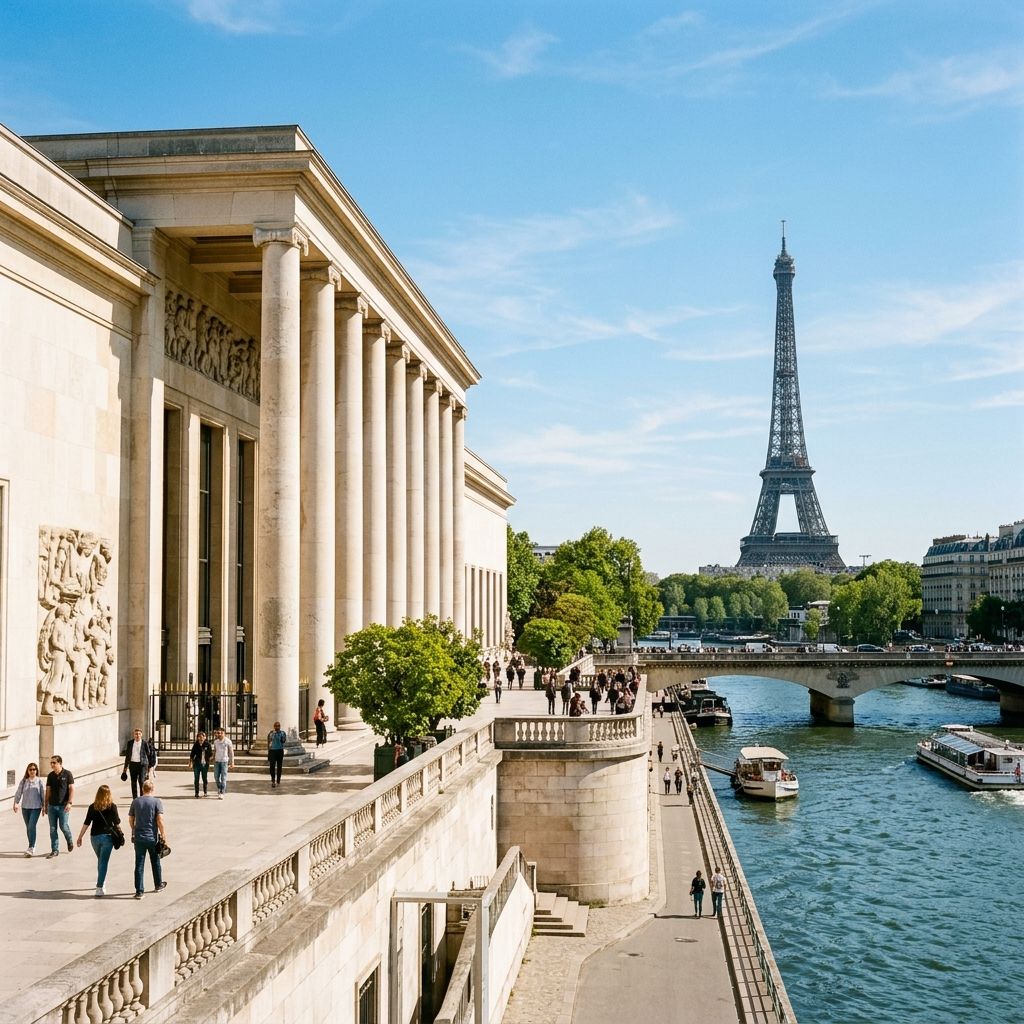
The absolute focal point of the external facade lies in the impressive and rhythmic sequence of rationalized neoclassical colonnades that connect the two immense wings of the complex through a central courtyard suspended over the waters of the river. These majestic columns, stripped of the decorative excesses of the classical orders of the past, represent the transition between the 19th-century stonemasonry tradition and the geometric and functionalist modernity of the 20th century. Each line of the building was drawn to create a play of light and shadow of great visual impact that values the human scale perante the monumentality of the capital's civic structure.
To crown this architectural masterpiece of art, the external walls and decorative friezes of the Palais de Tokyo are adorned with beautiful mythological bas-reliefs created by the celebrated French sculptor Alfred Janniot. These stone sculptures poetically depict the muses of artistic creation, sea gods, and allegorical figures of music and dance that seem to float over the massive blocks of the building, giving the rationalist stone temple a decorative delicacy and a literary narrative that connect the modernity of Paris to the deepest roots of classical Western civilization.
Chapter
6.2. How the rationalist structure of the Palais de Tokyo integrates into the urban environment
Walking through the central courtyard that divides the east wing (MAM) and the west wing of the Palais de Tokyo is to understand the gênio of an urban design that knew how to dialogue brilliantly with the sloped topography of the Seine banks and integrate a monumental stone structure into the daily flow of the city of Paris in a natural way and without physical barriers. Designed by a consortium of visionary architects in the 1930s, the palace complex was conceived not as an isolated and inaccessible fort of culture, but as an immense public esplanade and scenic viewpoint that invites the common citizen to cross its urban limits under the capital's sky.
The urban integration of the Palais de Tokyo takes place through a beautiful system of successive terraces and monumental staircases that elegantly overcome the natural slope running from the top of Avenue de New York to the busy banks of the Seine River. This multi-level arrangement creates a smooth transition between vehicular traffic space and the tranquility of the art galleries, allowing the outdoor courtyards and terraces to function as vibrant public gathering squares where youth skate, intellectuals read their papers in the sun, and couples contemplate the silhouette of the Eiffel Tower across the river [cite: 72].
This conceptual and physical openness to the urban landscape of Paris was a pioneering milestone in modern 20th-century museum architecture, which previously functioned as closed and intimidating palaces for the working classes. By eliminating heavy gates and isolation fences, the Palais de Tokyo integrated modern art into the living pulse of the streets, transforming itself into a natural extension of the city's public leisure space. This unique synergy between the concrete monument and the democratic energy of Parisian youth is what guarantees the MAM a dynamic urban atmosphere that you will hardly find in other traditional European institutions.
Chapter
6.3. The incredible zenital lighting designed to value large modernist canvases
For the interior designer, the painter, or the professional photographer visiting the Museum of Modern Art of Paris, the MAM's immense galleries reveal one of the most valuable and celebrated architectural secrets of the Palais de Tokyo: its innovative and spectacular zenital lighting technology. Originally designed in the 1930s to solve the challenge of homogeneously lighting large surfaces of modernist canvases without the need for side windows that would generate annoying reflections on the works of art, this light architecture was a milestone in 20th-century European museum engineering.
The MAM's lighting system is based on a complex double glass ceiling composed of immense external skylights that capture the changing natural light of the Paris sky and diffuse it softly through translucent frosted glass panels installed in the internal ceiling of the exhibition galleries. This continuous skylight creates a soft light atmosphere with no marked shadows on the walls, allowing the visitor to contemplate the mineral textures of Jean Fautrier's paints or the vibrant colors of Raoul Dufy's brushstrokes in their original chromatic purity, identically to the light under which the painters created their work in their bohemian Parisian workshops.
With the renovations and technological restorations conducted in recent decades, the original zenital system was modernized with the introduction of intelligent motorized blinds and computerized brightness sensors that adjust in real time to weather variations and passing clouds outside. This sophisticated engineering ensures that, even on gray and rainy winter days, the galleries remain illuminated with perfect clarity for the preservation of the canvases and the visual comfort of the millions of visitors walking in search of deciphering the colors and shapes of the museum's collection.
Chapter
6.4. The outdoor terraces with breathtaking views of the Eiffel Tower and the Seine River
If there is a secret and captivating place in Paris where the architectural monumentality of the Art Deco style merges with the most famous silhouette in the world to create a setting of pure cinema and visual enchantment, this place is the outdoor terraces of the Palais de Tokyo that frame the Museum of Modern Art of Paris. Elegantly suspended over the calm waters of the Seine River and surrounded by majestic white stone colonnades, these open spaces represent the perfect meeting point between the avant-garde universe of plastic arts and the urban geographical poetry of the French capital itself. For the eager visitor or photographer, these terraces offer angles and lights that directly touch the sensitivity of those who contemplate them.
As you walk along the polished limestone floors of the central terrace of the MAM, which serves as a spatial transition between the two immense wings of the complex, you are presented with a frontal, unobstructed, and monumental view of the Eiffel Tower rising majestically on the other side of the river, extending from the Champ de Mars towards the Parisian sky [cite: 72]. The contrast between the rational classical rigidity of the museum's concrete columns and the metallic curves and iron filigree of the famous 19th-century engineering tower creates a composition of wonderful geometric beauty that serves as a backdrop for fashion shows, international film productions, and breathtaking photo shoots of couples from all over the world.
The terraces are also adorned with beautiful ornamental reflection pools and stone basins that reflect the sunlight and the blue sky, serving as the base for the immense bronze sculptures by Antoine Bourdelle that decorate the outdoor area with their tragic and muscular strength. At dusk, when the lights of Paris begin to turn on and the Eiffel Tower starts its hourly sparkling show over the Seine [cite: 72], the courtyard of the MAM of Paris transforms into a bohemian living room poetically lit by discrete spotlights and soft laughter from the patrons of the complex's restaurants. It is the exact materialization of the refined and artistic lifestyle that defines the French capital in the global cultural imagination.
Chapter
7. The Palais de Tokyo and the MAM of Paris: The Largest Contemporary Art Hub
Chapter
7.1. The artistic coexistence between the MAM historical collections and the experimental installations of the Palais de Tokyo
Walking through the monumental complex of the Palais de Tokyo is to come across one of the most electric, dynamic, and contrasting experiences in the entire global art circuit, where the historical solidity of the classic modern collection of the Museum of Modern Art of Paris (MAM) coexists in perfect and constant tension with the ephemeral art manifestations and the most provocative experimental installations that occupy the west wing of the building. This unique artistic neighborhood, physically divided only by the majestic central courtyard and the white stone Art Deco colonnades of 1937 [cite: 26], creates an atmosphere of unparalleled creative energy that attracts everyone from traditional scholars to the rebel bohemian youth of the French capital.
While the silent and controlled zenital lighting rooms of the east wing (MAM) offer an impeccable educational path through the great visual revolutions of the 20th century [cite: 26] — proudly displaying the eternal works of Picasso, Matisse, and Raoul Dufy's monumental *Electricity Fairy* [cite: 26, 37] —, the west wing of the complex assumes the role of an open laboratory for radical and ephemeral contemporary manifestations. In this experimental territory, there are no permanent collections: the space changes spectacularly every few months, welcoming everything from industrial trash sculptures to immersive sound performances and interactive digital installations that challenge the public to physically participate in the creations of emerging artists from all corners of the globe.
This geographical and conceptual coexistence generates an extremely productive dialogue that enriches the visit to the complex, allowing the viewer to travel in a few steps from the consolidated history of the avant-gardes of the past to the deep conceptual investigations that will dictate the direction of the design and aesthetic thought of the future. Instead of canceling the differences of each wing, the integrated administration promotes joint events and festivals that mix the languages of the two institutions, consolidating the monumental courtyard of the Palais de Tokyo as the largest and most pulsating hub of artistic creativity and cultural tourism in Paris.
Chapter
7.2. How the spatial and conceptual division between the municipal wing and the experimental wing of the complex works
For the architect specialized in museums, the cultural planner, or the traveler dedicated to unraveling French bureaucratic engineering, understanding the spatial and conceptual division that organizes the imposing complex of the Palais de Tokyo is the key to reading the site's architecture and governance in a mature way. Although the white stone building of 1937 seems like a single and indivisible structure from the banks of the Seine River [cite: 26], it houses within it two cultural institutions of completely independent legal natures and artistic proposals that divide the space in a millimetric and intelligent way.
The east wing of the complex, which extends along the Avenue de New York esplanade, is entirely occupied by the Museum of Modern Art of Paris (MAM), a municipal public organ belonging to the *Paris Musées* network administered directly by the City of Paris. The MAM, with its permanent and valuable collection of more than 15,000 works [cite: 26], focuses its intellectual work on the conservation, research, and educational display of the classic modern art movements that were born or consolidated in the French capital throughout the 20th century, maintaining a permanent commitment to the history of European art and offering entirely free entry for the general public [cite: 26].
In contrast, the west wing of the building is the physical home of the Palais de Tokyo (contemporary art association), an experimental center of creation that operates under a model of private management of public utility subsidized in large part by the Ministry of Culture of the national government of France. Without possessing technical reserves or a permanent collection, the Palais de Tokyo dedicates the entirety of its wide raw concrete rooms to ephemeral exhibitions and artistic interventions of global contemporary creators in real time, charging paid entrance fees and adopting a daring semantic governance that constantly challenges traditional institutional boundaries. This conceptual separation ensures that each wing develops its own strong identity, while physical proximity stimulates partnerships that make Paris the unwavering lighthouse of global aesthetic thought.
Chapter
7.3. The synergy of night events and art festivals connecting the two cultural poles
If you want to see how the union of two distinct artistic visions can transform the central courtyard of the Palais de Tokyo into a pulsating volcano of youthful energy, contemporary creativity, and bohemian living, the great annual festivals and integrated art nights are the golden moments of the French capital's cultural calendar. By breaking down the physical barriers that separate the classic and historical collection of the MAM from the contemporary experimental wing of the west wing, these collective celebrations occupy the immense outdoor terraces overlooking the Eiffel Tower and the deep galleries of the complex [cite: 72], attracting thousands of students, transnational curators, and citizens looking for an immersive aesthetic experience outside conventional tourism routines.
During these special festive nights, the traditional rules of silent museum operation are temporarily suspended in favor of a democratic celebration of human expression. Experimental electronic bands and prestigious DJs set up their sound and light stages on the Art Deco terraces overlooking the Seine [cite: 26], framed by the monumental bronze sculptures by Antoine Bourdelle that seem to vibrate under the sound waves and the mapped digital projection games that illuminate the white stone facades of the 1937 palace [cite: 26]. The complex's courtyard transforms into an immense and colorful dance floor and open debate that connects Parisian youth to the deepest roots of modernist creation.
These multidisciplinary interventions extend throughout the night, allowing visitors to freely enter dark video projection rooms, watch contemporary dance performances in the raw concrete basements of the Palais de Tokyo, and visit the monumental rooms of the MAM to contemplate Raoul Dufy's grand *Electricity Fairy* to the sound of experimental soundtracks composed especially to dialogue with the work [cite: 26, 37]. This innovative cultural synergy proves that the MAM of Paris and the Palais de Tokyo are not static monuments of bureaucratic conservation, but living poles of continuous human inspiration that give new life to French heritage.
7.3.1 The impact of Nuit Blanche (White Night) on the integrated immersive exhibitions of the Palais de Tokyo
For the passionate traveler seeking to experience one of the greatest and most unforgettable rituals of urban artistic ecstasy in all of Europe, nothing compares to the surreal and poetic experience of visiting the monumental complex of the Palais de Tokyo during the famous Nuit Blanche — a single night each year, usually in early October, when the entire city of Paris transforms itself into a free open-air museum that never sleeps, and the boundaries between public art, institutional exhibition, and collective performance completely dissolve into a unique and unrepeatable nocturnal flow.
The impact of the Nuit Blanche on the exhibition rooms is profound and immediate, with curators and internationally prestigious artists developing light design, sound, and visual projection interventions that occupy all the spatial volumes of the 1937 palace throughout the night. The temporary installations created exclusively for this event go far beyond the decorative or illustrative; they transform the permanent architecture of the building into a living medium of experimentation, using the stone columns, the monumental ceilings, the tiled floors, and even the facades of the complex as three-dimensional canvases for immersive experiences.
In the monumental halls of the MAM of Paris, Raoul Dufy's work "La Fée Électricité" becomes the center of rare acoustic concerts and minimalist theatrical performances conceived specifically to dialogue with the scientific optimism of the immense painting. Contemporary musicians and sound artists perform with instruments in the silence of the closed galleries, creating an almost sacred atmosphere that merges the extraordinary visual power of the work with the live musical energy of voices and instruments resonating through the building's acoustic chambers.
7.3.2 International art book and independent fanzine fairs organized in the shared galleries
For the avid collector of rare editions, the avant-garde art historian, or the graphic designer in search of rare sources of visual inspiration, the complex of the Palais de Tokyo and the Museum of Modern Art of Paris periodically hosts some of the most exciting and intellectually stimulating international art publication fairs in the French capital. These events draw hundreds of independent publishers, experimental graphic artists, and editorial collectives from across Europe and beyond, transforming the shared galleries of the complex into a living marketplace of ideas, images, and innovative forms of printed communication.
The charm of these international fairs lies in the extraordinary opportunity to handle rare handcrafted publications, limited-edition poetic manifestos made by hand, and alternative photographic essays printed using obsolete mimeograph and screen-printing techniques. The publishers present their projects directly to visitors, creating an atmosphere of authentic intellectual complicity that is entirely absent in conventional book markets and traditional literary events.
These literary and graphic events create a wonderful bridge of connection between the historical printed heritage kept in the bookshop and the technical research library of the MAM of Paris and the new paths of contemporary experimental self-publishing. The editorial innovation on display at these fairs reflects, in a parallel way, the creative audacity that the museum itself has always championed in its collections — making the shared gallery space a unique crossroads between institutional memory and the living avant-garde.
Chapter
8. Museum of Modern Art of Paris vs. Pompidou: What is the Difference Between the Two?
Chapter
8.1. Palais de Tokyo vs. Centre Pompidou: Two distinct visions of art in Paris
If you are a traveler passing through Paris with limited time in your cultural itinerary and are in doubt about which temple of artistic avant-garde to visit, understanding the exciting "conceptual and architectural duel" between the Palais de Tokyo (MAM) and the Centre Pompidou is the first step to aligning your aesthetic expectations with the reality of two monumental institutions that represent completely different worldviews. While both house modern art collections of absolute international importance, the way each presents the creative process and integrates into the urban landscape of Paris offers radically opposite sensory and intellectual experiences for the visitor and researcher.
The Palais de Tokyo, with its stunning and sober Art Deco white stone shell of 1937 [cite: 26], represents a classical rational approach that values monumental elegance and formal harmony, serving as home for the City of Paris Museum of Modern Art (MAM) in an intimate and focused way. On the other hand, the spectacular and irreverent Centre Pompidou, inaugurated in the 1970s in the heart of the Beaubourg neighborhood, shocked world architecture by exposing its industrial structure of colored tubes, external escalators, and visible plumbing to the urban space, functioning as an immense futuristic machine designed to democratize all visual arts, literature, and contemporary music on a global scale.
This architectural difference is reflected directly in the internal atmosphere of its exhibition galleries and in the pace at which the visitor walks through the rooms. At the Palais de Tokyo's MAM, the respectful silence, the soft zenital light rooms [cite: 26], and the physical proximity to the calm banks of the Seine River invite a pace of poetic contemplation and focused study, ideal for those seeking a classic connection with the great painters of the School of Paris. At the Pompidou, the monumental scale of its double-height rooms, the noisy energy of the thousands of people of all ages climbing the external glass escalators, and the dynamism of the experimental exhibitions create an experience of multiple stimuli and constant urban boiling that represents the chaotic energy of contemporary man.
Chapter
8.2. How the Centre Pompidou houses the National Museum and the MAM houses the municipal collection
To understand the bureaucratic engineering and organization of the art collections that make Paris the largest center of cultural heritage on the planet, it is essential that the researcher or first-time tourist learns to differentiate the institutional nature of the Centre Pompidou, which houses the *National Museum of Modern Art of France (MNAM)*, from the structure of the Palais de Tokyo, which is the physical home of the *Museum of Modern Art of Paris (MAM)*, under municipal management. Although both museums have extremely similar names that frequently confuse visitors and generate mix-ups in conventional tourism routes, they operate independently with distinct budgets, curatorial directions, and acquisition goals.
The National Museum (MNAM) located in the Centre Pompidou is created and maintained by the Ministry of Culture of the federal government of France, which gives the institution a global geopolitical responsibility to acquire, conserve, and catalog the totality of artistic manifestations produced in French territory and in all major international art schools throughout the 20th and 21st centuries. The scale of its collection is colossal, extending over tens of thousands of works that are constantly loaned for exhibitions and retrospectives in museums around the world, consolidating French cultural diplomatic influence in global aesthetic capitals.
On the other hand, the MAM at the Palais de Tokyo is a municipal institution administered directly by the City of Paris through the integrated network of municipal public museums *Paris Musées*, focusing its acquisition intelligence on works of art and monographic sets that have a deep, direct, and historical connection with the city of Paris itself and with the creators who lived and worked in its historical neighborhoods during the golden decades of modernism. This municipal identity gives the MAM an incomparably more intimate and passionate atmosphere, where the visitor can witness the evolution of good taste and the generosity of great Parisian patrons and collectors who donated their personal treasures so that they would remain accessible forever for free to all citizens of the world.
Chapter
8.3. Which modern art museum to visit if you have little time in your Paris itinerary?
If your clock is running against the infinite cultural attractions of Paris and you have only a few precious free hours in your stay in the city to dedicate to the effervescence of the 20th-century visual arts, the decision of which temple of avant-garde to visit should be strictly based on your personal style of travel and the aesthetic sensations you seek to experience in your tourism itinerary. Both museums offer striking aesthetic experiences, but the format of their galleries and the ease of access can decisively dictate the success of your day of cultural exploration.
Choose the Museum of Modern Art of Paris (MAM) at the Palais de Tokyo if you seek a fluid, focused, and emotionally high-performance visit without the need to face monumental lines or spend on expensive tickets [cite: 26]. Because its permanent collections are completely free and located in the immediate vicinity of iconic monuments such as the Eiffel Tower and the Trocadero Gardens [cite: 72], the MAM allows you to contemplate masterpieces like Raoul Dufy's monumental *Electricity Fairy* or the striking canvases of Picasso and Matisse in a quick and extremely pleasant stop of less than two hours, keeping your day light and allowing a silent poetic connection with the banks of the Seine.
On the other hand, choose the Centre Pompidou if your travel goal is to spend an entire day immersed in the chaotic and experimental monumentality of global contemporary art, climbing the external glass escalators that offer the most spectacular panoramic view of the historical roofs of Paris and the Basilica of Sacré-Cœur of Montmartre [cite: 76]. The visit to the Pompidou requires more physical energy, planning time to bypass the immense security lines, and the advance purchase of paid tickets, but rewards the visitor with one of the most colossal art collections in the world and a direct immersion in the urban and multicultural effervescence of the bohemian neighborhood of the Marais. Weigh your aesthetic desires, consult your itinerary time, and let yourself be guided by the beauty of the French gaze!
Chapter
9. Temporary Exhibitions at the Museum of Modern Art of Paris: What to See Now
Chapter
9.1. How the museum became the main stage for daring and innovative temporary exhibitions
For the art collector, the specialized critic, or the simple lover of visual trends, crossing the doors of the Museum of Modern Art of Paris is the guarantee of having contact with the most daring, innovative, and intellectually stimulating creations on the global art scene. Throughout its decades of consolidation at the Palais de Tokyo, the municipal MAM has refused to function as a simple static mausoleum of canvases from the past, adopting a bold curatorial stance that has transformed its wide galleries into the main and most respected stage for avant-garde temporary exhibitions in the entire European continent.
This curatorial pioneering spirit rests on a long tradition of courage in taking aesthetic risks that traditional institutions avoid, organizing monumental retrospectives of unjustly forgotten creators or presenting radical new visions of consolidated masters of modernity. The temporary exhibitions of the MAM of Paris stand out for the academic rigor of their historical research combined with theatrical and immersive scenographies that transform the rationalist architectural space of the Palais de Tokyo into battlefields of visual sensations that stimulate the viewer's senses and generate intense intellectual debates in the global cultural press.
The flexibility of the museum's physical spaces, with their monumental high ceilings and movable walls, allows contemporary artists to create large-scale artistic interventions designed specifically to interact with the light and the Art Deco architecture of the building [cite: 26]. This capacity for constant renewal and this unique synergy with the transnational artistic community make the MAM a living and pulsating institution that dictates the directions of global aesthetic debate, attracting tens of thousands of tourists and academics with each new exhibition who seek to decipher where the visual arts are heading in the new millennium.
Chapter
9.2. Where to check the current schedule of exhibitions and retrospectives of renowned artists
For the meticulous planner or the last-minute tourist who wishes to optimize their exploration time in Paris and guarantee access to the most disputed temporary exhibitions of the moment, knowing exactly where and how to consult the current cultural programming of the Museum of Modern Art of Paris is a mandatory strategic step. Due to the high turnover and the international prestige of its retrospectives, the MAM of Paris constantly updates its exhibition calendar, offering an impressive variety of themes ranging from classic modern painting to new digital manifestations and contemporary immersive performances.
The official and safest channel to check the detailed programming and obtain behind-the-scenes information about the exhibitions in progress is the integrated online portal of the municipal network Paris Musées, where the visitor finds complete curatorial summaries, opening and closing dates for each exhibition, as well as quick visual essays and lists of featured works that help in the intellectual preparation for the physical visit to the galleries of the Palais de Tokyo. The museum also maintains an extremely active digital presence on its social media accounts and in its official mobile app of free audio guides, sharing promotional videos of the exhibitions and rare interviews with the contemporary artists invited for the stagings.
For travelers who appreciate classic analog convenience, the main cultural magazines and printed leisure guides of Paris (such as the famous weekly *L'Officiel des Spectacles* or the digital portal *Sortir à Paris*) offer detailed critical reviews, special operating hours, and star ratings on the MAM's exhibitions, serving as an excellent source of reference while you savor a warm croissant in a bohemian cafe on the right bank of the Seine [cite: 87]. Spend a few minutes checking the news of the artistic season before your trip and prepare to be surprised by the audacity of the French curatorial gaze!
Chapter
9.3. The behind-the-scenes of staging large exhibitions and the work of international curation
If you could walk through the immense empty rooms of the Museum of Modern Art of Paris during the days of transition between the season's exhibitions, you would see a silent army of conservation technicians, specialized carpenters, lighting designers, and transnational curators working under millimetric tensions to give physical life to the intellectual concepts that make up the MAM's great shows. The behind-the-scenes of staging an international exhibition at the Palais de Tokyo represents one of the most complex and fascinating cultural production engineering works in the modern world, a true symphony of logistical coordination involving global insurers, embassies, and the ultra-secure manipulation of works of incalculable value.
The work of the international curator resembles that of a visual orchestra conductor, starting several years in advance through confidential negotiations for the loan of precious canvases and sculptures with state museums and private collectors from all corners of the planet. Each painting obtained from a distant collection requires the development of climatized transport boxes with millimetric control of humidity, armed police escorts from Paris airports, and the mandatory presence of 'couriers' designated by the partner institutions to closely monitor the physical unpacking and microscopic verification of the conservation status of the works before their final fixing on the museum walls.
Once inside the Palais de Tokyo, the MAM's scenography team goes into action, painting the temporary galleries with colors specifically studied to dialogue with the palette of the artists on display, building false walls and adjusting the motorized skylights of zenital light to create the dramatic atmosphere desired by the curators [cite: 26]. Lighting specialists spend nights adjusting individual LED light spots to prevent thermal damage and ensure that each original brushstroke shines with maximum transparency for the eyes of the viewers. This monumental and invisible effort is what ensures that, with each opening of a temporary exhibition, Paris reaffirms itself to the world as the unwavering temple of freedom and international artistic prestige.
Chapter
10. Trivia of the Museum of Modern Art of Paris: Behind-the-Scenes Secrets
Chapter
10.1. The urban legend about the ghosts of artists roaming the basement galleries
For those who love a good mystery that mixes the plastic beauty of art with the chill of night mystery stories, the immense and deep concrete basements of the Palais de Tokyo hide historical secrets and spine-chilling urban legends that continue to live in the behind-the-scenes conversations of the night guards and employees of the Museum of Modern Art of Paris. Among the many stories whispered in the climate-controlled corridors and far from the eyes of the general public, the most famous and intriguing Parisian urban legend refers to the alleged appearance and whispers of ghosts of modernist artists who would roam the technical reserves hidden in the bowels of the monumental building in the dead of the cold night.
According to the guards who perform the unpredictable early morning security patrols through the MAM's immense dark rooms, shadows of slender silhouettes with bohemian felt hats and classic raincoats — reminiscent of the tragic figures represented by Amedeo Modigliani in his canvases of almond-shaped and melancholic faces [cite: 37] — are seen silently gliding through the technical reserve galleries where thousands of paintings rest on sliding metal racks. Soft sounds of brushes scraping against wood plywood canvases [cite: 26] and the sweet and unmistakable smell of oil solvents and turpentine inexplicably float in the basement air, even though there is no active restoration work being conducted at the time.
Although skeptics and the museum's public administration categorically dismiss these urban legends as fruits of visual fatigue, tired imagination, or simple wind currents circulating through the old ventilation ducts of the 1937 Palais de Tokyo, for lovers of the occult and Parisian mystery narratives, these stories give the white stone temple of the Seine a fascinating Gothic and romantic charm. After all, in a place that houses the greatest and most passionate creations of free souls who lived on the edge of creative madness in the bohemian tenements of Montmartre, it is beautiful and perfectly poetic to imagine that the passion for beauty is strong enough to keep the spirits of these painters wandering forever amidst their eternal works.
Chapter
10.2. How the museum became the setting for major film productions and fashion shows
Walking along the monumental outdoor terraces or under the high ceilings of the Palais de Tokyo is to constantly encounter a setting that immediately exudes the visual sophistication, historical grandeur, and modern glamour of Paris, which explains why this architectural complex has transformed into the favorite setting for major international Hollywood film productions and some of the most disputed and memorable haute couture shows of the entire Paris Fashion Week. The MAM, with its symmetrical Art Deco lines and its privileged view of the Eiffel Tower [cite: 72], has a unique three-dimensional aesthetic appeal that attracts directors of photography, famous designers, and image creators from all over the world seeking to translate the refined soul of the French capital to film screens and runways.
In the universe of cinema, the monumental white stone facade and the museum's zenital lighting halls have already served as a backdrop for intense secret agent chases, unusual romantic encounters, and spectacular art heists in action blockbusters and independent romances that celebrate Parisian geography in a scenic and poetic way. The central courtyard and Janniot's colonnades offer a depth of visual field and a play of natural light and shadow that immediately gives the cinematic images an institutional prestige and a dramatic historical weight that no artificial filming studio could reproduce with the same authenticity and material beauty.
At the same time, the global haute couture industry sees the Palais de Tokyo complex as a perfect living temple of avant-garde to present the new collections and trends that redefine international fashion with each show season. Major French luxury brands and innovative designers regularly rent the outdoor terraces with reflection pools or the wide raw concrete rooms of the basement to set up monumental runways of futuristic design that dialogue spectacularly with Bourdelle's sculptures and the 1937 building's rationalist architecture, magically merging the art of dressing with the eternity of the plastic arts under the soft light of the Parisian dusk.
Chapter
10.3. Hidden details in the floors and ceiling that tell the history of French engineering
For the observer with eyes attentive to the small details of matter, the specialized civil engineer, or the historical restoration architect, an unpretentious walk through the exhibition galleries of the Museum of Modern Art of Paris reveals a fascinating number of hidden details and industrial manufacturing marks in the parquet floors and in the concrete and iron structures of the ceiling that tell the story of French engineering and metallurgy from the mid-20th century. The Palais de Tokyo, far from being just a decorative neoclassical shell, was a true milestone of technological innovation and practical application of new civil construction materials of its time, whose historical footprints remain visible to those who know how to read the building's textures.
As you walk through the rooms of the permanent collections, if you turn your eyes away from the vibrant cubist canvases for a moment and focus on the deep corners of the stone galleries, you can see small metal plates embedded in the baseboards and cast iron frames of the immense monumental windows displaying the embossed brands and logos of old French foundries and metal industries that operated in the working-class suburbs of Paris during the 1930s. These small iron seals represent the collective effort of thousands of anonymous workers, locksmiths, and masons who worked under brutal deadlines and hostile weather conditions to raise the Palais de Tokyo monument in time for the official opening of the 1937 International Exposition, integrating the pride of French industrial production into the heart of the national artistic culture.
Looking up at the ceiling, the complex and immense mesh of reinforced concrete beams and steel supports that hold the frosted glass skylights of the zenital system reveals the genius of the pioneering structural calculation techniques developed in France to span monumental gaps without the need for internal support pillars that would fragment the viewing space of the works of art [cite: 26]. This structure, although painted today in discrete shades of white and soft gray so as not to compete with Raoul Dufy's colors [cite: 26], remains as an impressive structural skeleton of civil engineering strength that was decisive in paving the way for the construction of post-war modern buildings in Europe. Every detail of the MAM of Paris is, thus, an indissoluble fusion of manual labor, technological genius, and pure poetry.
Chapter
11. How to Visit the Museum of Modern Art of Paris: Free Admission and Tips
Chapter
11.1. Where to buy official tickets for the Museum of Modern Art of Paris?
For the first-time traveler or for the researcher who wishes to avoid bureaucratic headaches in the queues of Paris, understanding how the issue and purchase of tickets for the Museum of Modern Art of Paris works is the first step towards a stress-free and high-performance cultural journey. Unlike other private institutions and monuments that charge exorbitant prices for basic access, the MAM prides itself on offering democratic and accessible ticket policies, focused on the universal sharing of artistic beauty. However, with the constant growth of global tourism on the right bank of the Seine, prior digital planning has become mandatory for those wishing to optimize their Paris itinerary time.
Official tickets for the museum are managed directly by the municipal consortium Paris Musées through its integrated online portal, where the visitor can select the exact date and specific time of their choice for both general access and the busy temporary exhibitions of international level. It is of extreme importance to highlight that, while the permanent and monumental collection of the MAM (including the grand rooms of Raoul Dufy and the works of Picasso and Matisse) has 100% free and open access for all citizens of the world [cite: 26], temporary exhibitions require the purchase of paid tickets with mandatory time slot reservation on the online platform to avoid crowds and ensure comfort inside the rooms.
If you own official tourist discount cards, such as the famous Paris Museum Pass, it is essential to check the conditions of direct access at the museum turnstiles, since entry to the free permanent collections is already automatically guaranteed without the need to issue physical tickets. For highly relevant temporary exhibitions, online reservations open several months in advance and sell out quickly, especially on weekends and national holidays, making visiting the sales site a mandatory step in planning your gastronomic and cultural trip to France.
Chapter
11.2. Golden travel tip: How to enter the MAM's permanent collections for free?
If you love to travel with financial intelligence and enjoy the best Europe has to offer without emptying your wallet, the biggest 'golden tip' about the Museum of Modern Art of Paris lies in the extraordinary and almost secret policy that guarantees 100% free entry to its permanent collections every day of the year, with no catches or hidden service fees. While the vast majority of international visitors spend fortunes to face the crowds of the Louvre or the Musée d'Orsay, the experienced traveler walks quietly towards the Palais de Tokyo knowing that they can contemplate masterpieces by Matisse, Picasso, and Dufy completely free of charge and without paying a single cent for it.
This unrestricted free entry is an achievement of the progressive cultural policy of the city of Paris, which made the decision to democratize access to modern visual arts in the museums under its direct municipal management, integrated into the Paris Musées network. To gain access to the permanent galleries, the visitor only needs to head to the physical ticket office to pick up a 'zero rate' ticket quickly and friendly, or simply present a QR code generated for free on the official website of the museum directly at the security turnstiles, without the need to face the immense lines of the paid temporary exhibitions.
This economic ease allows the visitor to adopt a much lighter and more intimate approach with the museum, visiting the rooms on several short occasions throughout their stay in Paris instead of trying to absorb everything at once in an exhausting tourism marathon. You can enter for an hour to marvel at the monumental *Electricity Fairy* on a cloudy late afternoon [cite: 26], leave to walk along the banks of the Seine, and return the next day to study the cubist collages in the study rooms [cite: 37], knowing that the doors of the white stone temple of the Palais de Tokyo will always be open for free to welcome your curiosity.
Chapter
11.3. What is the best time to avoid lines and enjoy the temporary exhibitions?
For the high-performance traveler or for the academic researcher who values silence and personal space when contemplating highly relevant works of art, getting the exact time of the visit to the Museum of Modern Art of Paris right is the difference between a mystical experience of aesthetic connection and a chaotic journey amidst rooms crowded with noisy tour groups. With the constant growth in popularity of the Palais de Tokyo complex, the flow of people in the galleries varies spectacularly throughout the day, requiring an intelligent temporal planning strategy for those who wish to see art calmly and without rush.
The 'behind-the-scenes secret' for a silent visit of deep contemplation lies in taking advantage of the morning opening, around 10:00 AM from Tuesday to Thursday, when most mass tour groups are concentrated in the immense queues of major national museums like the Louvre or on boat trips along the Seine. At this calm start of the day, the natural light penetrating through the immense Art Deco skylights in the ceiling illuminates the galleries with a magical softness [cite: 26], allowing you to spend long minutes alone and without interruption in front of Raoul Dufy's monumental canvases or the outdoor terrace bronze sculptures.
Another spectacular time alternative that attracts a bohemian and young crowd of Parisian intellectuals is the night sessions on Thursday, when the museum extends its operating hours until 9:30 PM, offering an intimate atmosphere of artificial lights projected over the central courtyard of the Palais de Tokyo. Visiting the museum under the starry sky of Paris, with the Eiffel tower blinking in the background through the immense monumental windows [cite: 72], and then dining at one of the trendy restaurants of the complex is the guarantee of a night of pure romance and cultural sophistication that represents the true soul of the Parisian lifestyle.
Chapter
11.4. How to get to the museum by subway, bus, or on foot along the right bank of the Seine River?
Getting to the majestic complex of the Palais de Tokyo is an extremely simple and charming journey that puts the visitor in direct contact with some of the most stunning and cinematic urban landscapes in the entire French capital, connecting the city's efficient public transport to the historical beauty of the banks of the Seine River. Whether you are a fervent defender of the Parisian subway, an appreciator of scenic bus routes, or an tireless walker seeking to discover the city on foot under the blue spring sky, the Museum of Modern Art of Paris has perfect accessibility for all forms of urban mobility.
If your choice of transport is the subway, the most direct and convenient route is to take Line 9 (M9) and get off at the historic Alma-Marceau or Iéna station, located less than a five-minute walk from the monumental doors of the museum. For those who prefer to travel above ground and enjoy panoramic views of the city, bus lines 72, 63, 82, and 92 have stop points almost in front of the Palais de Tokyo, offering fast and extremely comfortable routes that cross the main historical neighborhoods and monumental bridges of the right and left banks of the Seine.
However, for the traveler seeking a true poetic connection with the geography and history of Paris, nothing beats the unforgettable experience of walking on foot along the banks of the Seine River starting from the Trocadero Gardens or the Pont Alexandre III towards the museum. This scenic route, which flanks the calm waters of the river and offers stunning photographic angles of the Eiffel Tower [cite: 72], allows the visitor to absorb the monumentality of the Palais de Chaillot and feel the architectural transition to the imposing Art Deco facade of the Palais de Tokyo. It is the perfect physical and sensory introduction to the universe of avant-gardes and artistic audacity that awaits you in the galleries of Paris's MAM.
Chapter
12. Gastronomy and Books at the Museum of Modern Art of Paris: The Art Courtyard
Chapter
12.1. The iconic "Forest" restaurant with a panoramic terrace and breathtaking views of the Eiffel Tower
If your desire is to savor high-end gastronomy that merges the vibrant colors of the Mediterranean with the sophistication of classic French cuisine, all under the shadow of monumental Art Deco colonnades from 1937 and with a breathtaking, jaw-dropping view of the iconic Eiffel Tower blinking over the Seine River [cite: 72], the "Forest" restaurant in the central courtyard of the Palais de Tokyo is the perfect setting to seal your cultural experience in Paris. Designed by the acclaimed French chef Julien Sebbag as a true poetic manifesto of connection between culinary genius, music, and modern visual arts, this gastronomic space stands out as one of the most disputed and elegant spots of contemporary Parisian night.
The restaurant's design seeks direct inspiration from the mysterious and organic rusticity of ancestral forests, mixing raw concrete materials original to the Palais de Tokyo building with walls covered by constant projections of moving foliage, creating an intimate fairy-tale atmosphere that transports the visitor away from the urban chaos of the streets of Paris. The menu focuses on signature dishes that give absolute prominence to fresh seasonal vegetables, aromatic herbs harvested in Parisian urban gardens, and fish caught sustainably on the French coast, served in handmade rustic ceramic tableware that harmonizes beautifully with the environment's palette of earthy colors and textures.
However, the undisputed star of "Forest" is its huge and stunning panoramic outdoor terrace located on the central esplanade, strategically positioned alongside Antoine Bourdelle's monumental bronze sculptures. Dining al fresco under discrete candlelight, savoring a dessert that echoes Raoul Dufy's colors [cite: 26], while the Eiffel Tower shines majestically just a few meters away reflected in the waters of the Seine [cite: 72], is one of those magical experiences of pure poetry and pleasure that make time stop and justify why Paris remains in the imagination as the definitive capital of beauty and existential refinement for all free men.
Chapter
12.2. The MAM specialized bookstore: A rare curation of art catalogs and independent publications
For the obstinate researcher of avant-garde history, the graphic designer in search of rare sources of visual inspiration, or the bibliophile who loves to spend hours exploring sophisticated art book bookshelves, the specialized bookstore located at the main entrance of the Museum of Modern Art of Paris is a true chest of incomparable literary treasures. Conceived as an indispensable intellectual and pedagogical extension of the museum itself, the MAM bookstore moves away from the commercial clichés of conventional museum shops to focus on a rare, rigorous, and deep curation of art books of the 20th and 21st centuries.
The elegantly designed bookshelves house an impressive collection of exhaustive monographic catalogs of retrospectives of modern painters who defined movements such as Fauvism and Cubism [cite: 37], rare academic biographies of immigrant artists from the School of Paris, and deep essays on art philosophy and high-quality urban graphic design. The selection also gives special prominence to independent publications from micro-scale publishers, alternative literary magazines, and zines of extremely limited circulation made by hand by collectives of artists circulating behind the scenes of the French capital, offering rare sources of reading and technical study that you will hardly find in conventional commercial bookstores in Paris.
In addition to the extraordinary variety of printed works in different languages (with a special focus on Portuguese, English, and French) [cite: 26, 37], the bookstore sells authorized reproductions of excellent quality of historical exhibition posters of the museum, limited-edition original prints signed by renowned artists, and catalogs of the permanent masterpieces of the MAM collection, such as Raoul Dufy's monumental canvases [cite: 26, 37]. It is the mandatory strategic place to acquire a refined material souvenir that supports your subsequent studies on the artistic effervescence of the banks of the Seine River or gift a zine-loving friend with an exemplar of pure French typographic taste.
Chapter
12.3. How the outdoor cafe in the monumental courtyard adorned with modern bronze sculptures works
If your high-performance cultural itinerary in Paris requires a strategic pause for rest and reflection, but you do not wish to distance yourself from the atmosphere of audacity and creativity surrounding the monumental complex of the Palais de Tokyo, the outdoor cafe located on the east esplanade of the Museum of Modern Art of Paris building offers the perfect refuge of tranquility, minimal design, and direct artistic immersion on the right bank of the Seine. Operating in the midst of the immense 1937 Art Deco architectural volumes [cite: 26], this relaxed cafe functions as a kind of secular and democratic open-air living room where intellectuals, foreign design students, and tourists of all origins sit side by side to enjoy the Parisian sun.
The layout of the cafe is based on simple iron tables and contemporary design chairs scattered lightly across the stone courtyard of the museum complex, beautifully surrounded by the immense and tragic bronze sculptures of Antoine Bourdelle that decorate the outdoor area with their anatomical expressiveness and muscular classical Greek inspiration. The visitor can savor a traditional strong French double espresso or drink a glass of cold white wine from the Loire Valley region, listening to the soft murmur of the Seine and observing the dynamic flow of walkers crossing the Pont de l'Alma towards the Eiffel Tower [cite: 72].
The menu of the MAM courtyard cafe focuses on practicality and the high quality of traditional French ingredients obtained from local producers and urban gastronomic markets in Paris, offering savory tarts and quiches baked daily, baguette sandwiches with artisanal cheeses, and fine traditional pastries such as the buttery croissant and the iconic pain au chocolat with double dark chocolate sticks [cite: 87, 88]. It is the ideal setting to flip through the art books newly acquired in the MAM specialized bookstore, write down travel impressions in your personal diaries, or simply let your gaze rest on the monumental geometric silhouette of the Palais de Tokyo while enjoying the soft evening breeze of Paris.
12.3.1 The interior design signed by leading names in contemporary architecture in the leisure spaces
For the professional designer, the architect specializing in commercial interiors, or the simple connoisseur of sophisticated aesthetic solutions that balance historical heritage with contemporary minimalism, the leisure and social areas of the monumental complex of the Palais de Tokyo are an immersive course in refined spatial intelligence and sensory restraint. The projects responsible for shaping and modernizing the public areas of the building represent a perfect example of how contemporary architecture can operate respectfully and boldly within pre-existing listed heritage.
The interior design projects stand out for their absolute respect for the original industrial materials that structure the 1937 monumental building, adopting an approach that exposes and valorizes the raw concrete weathered by time, the oxidized steel beams, and the original stone floors without concealing them under artificial coverings or decorative plaster. The bold decision to preserve and highlight the patina of time as a central element of the aesthetic narrative gives the leisure spaces a museum quality that extends naturally from the galleries to the café and the restaurant.
Custom minimalist LED fixtures, service counters made of massive blocks of brushed dark granite, and partition panels in translucent glass and noble metals were introduced with surgical precision by renowned architects to orient circulation and define intimate spaces within the grand volumes of the building, without compromising the spatial integrity and visual monumentality of the original 1937 architecture that continues to define the identity of the entire complex.
Chapter
13. FAQ: Common Questions about Visiting the Museum of Modern Art of Paris
Chapter
13.1. Where is the Museum of Modern Art of Paris located and what is the best way to get there by subway?
If you have the map of Paris in hand and wish to program an efficient high-performance public transport route for your cultural trip, know that the Museum of Modern Art of Paris (MAM) has a privileged and easily accessible location in the noble and tourist heart of the right bank of the Seine River. Housed in the east wing of the monumental complex of the Palais de Tokyo, the museum is situated at 11 Avenue du Président Wilson, in the prestigious 16th arrondissement (district) of Paris, a region surrounded by major embassies, tree-lined avenues, and stunning viewpoints with views of the Eiffel Tower [cite: 72].
For the traveler or researcher who prefers to use the city's efficient underground transport system, the best and fastest way to get there by subway is to take Line 9 (M9) and disembark at the historic Iéna or Alma-Marceau station, located less than 300 meters (**980 feet**) of quiet walk from the monumental doors of the museum. These subway stations have direct exits that put the visitor in immediate visual contact with the majestic white stone architecture of the 1937 Palais de Tokyo [cite: 26], allowing you to walk comfortably along the wide sidewalks of the avenue to the central courtyard of the complex without risk of getting lost and saving precious energy to explore the MAM's permanent collection in a dynamic way.
Walking from these subway stations is an experience in itself, as the path gradually reveals the silhouette of the Art Deco colonnades and the mythological bas-reliefs carved by Alfred Janniot in the palace's stone [cite: 26], creating the perfect physical and sensory introduction to the universe of avant-gardes that awaits you in the galleries. If you are coming from other tourist areas of the city, the subway lines and RER urban trains have easy connections with Line 9 at major central stations such as Franklin D. Roosevelt or Havre - Caumartin, guaranteeing agile and high-speed mobility from any lodging point in Paris.
Chapter
13.2. What is the ticket price and who is eligible for free admission to the MAM's permanent collections?
For the traveler who values the democratization of culture and loves to enjoy the best France has to offer without emptying their wallet, the tariff policy of the Museum of Modern Art of Paris represents one of the largest and most generous secrets of the entire European cultural circuit. Access to the extraordinary permanent collection of the MAM (which houses the works of Picasso, Matisse, and the monumental Electricity Fairy by Dufy) is 100% free for all visitors in the world every day of the year, with no catches or service fees charged at the physical box office or on the online platform [cite: 26, 37]. This unrestricted free entry reflects the commitment of the municipal government of Paris to bring the greatest number of free people closer to aesthetic beauty.
However, it is of extreme importance that the travel planner knows how to differentiate the free permanent collection from the highly relevant international temporary exhibitions, which require the purchase of paid tickets with mandatory online time slot reservation on the integrated portal of the *Paris Musées* network. Prices for temporary exhibitions usually float fairly between $11 and $16 depending on the scale of the art show, offering generous half-price discount policies for international students up to 26 years old, French public teachers, and seniors of all nationalities who prove their documents at the museum reception.
Absolute free admission for paid temporary exhibitions is also automatically guaranteed by law for all children and young people under 18 years old of any nationality, people with special physical accessibility needs with the right to a companion, and unemployed citizens who present the official social registrations of the French authorities or the community passport of the European Union. This social amplitude and this absence of economic barriers make the Museum of Modern Art of Paris a true living temple of democratic humanistic culture and a safe haven of free inspiration for all lovers of design, history, and modern art traveling along the banks of the Seine.
Chapter
13.3. What are the main practical differences between the MAM of Paris and the Centre Pompidou?
For the contemporary art researcher or for the tourist with little free time in Paris who wishes to align their travel expectations and avoid itinerary confusion, understanding the structural practical differences between the MAM of Paris (at the Palais de Tokyo) and the Centre Pompidou (National Museum) is a fundamental strategic step. Although both are prestigious French institutions dedicated to the effervescence of the 20th and 21st-century avant-gardes and have similar names, they differ deeply in their bureaucratic nature, collection scale, internal atmosphere, and visitation costs for the general public.
In terms of costs and route agility, the most striking difference lies in the fact that the MAM of Paris has 100% free entry to all its permanent collections for all citizens of all countries [cite: 26], while the Centre Pompidou charges fixed ticket prices (around **$16**) for access to its permanent galleries and upper panoramic terraces. The MAM at the Palais de Tokyo offers a much more fluid, intimate visitation experience with a concise educational path focused on painters and art movements that had a direct and historical relationship with the bohemian scene and workshops of the city of Paris during modernism, ideal for pleasant and short visits [cite: 26].
On the other hand, the Centre Pompidou houses the immense *National Museum of Modern Art of France*, boasting a colossal collection scale of national and global geopolitical importance that documents all major global visual currents under the same roof of colored industrial pipes. The visit to the Pompidou requires more physical effort to cover the dozens of double-height rooms, requires time in long integrated security lines and advance ticket planning, but rewards the visitor with one of the largest and most complete views of mass art, experimental cinema, and international avant-garde literature on the planet. Choose your aesthetic experience according to your physical energy and your intellectual desires!
Chapter
13.4. Is it allowed to photograph and film the works of art on display in the collection and in the temporary rooms?
For the amateur photographer, the digital influencer looking to capture sophisticated aesthetic angles, or the student who wishes to keep visual records of works of art for subsequent academic study, the photography rules of the Museum of Modern Art of Paris are balanced to reconcile the freedom of material recording and the strict preservation of the physical integrity of the precious canvases and international copyright of the modernist creators. In general terms, it is allowed to photograph and film the works of art on display in the MAM's permanent collection, as long as your capture intention is strictly for personal leisure or academic use without profit or mass brand reproduction.
The human security protocol for preserving works imposes a strict, mandatory, and enforced ban on the use of artificial flash in all rooms of the museum, since the intense and repetitive flashes of ultraviolet light emitted by cameras and cell phones corrode the fragile chemical pigments of oil and gouache paints, generating invisible thermal damage that fades the canvas colors over the decades of public exhibition. The use of bulky physical support accessories, such as heavy professional tripés, monopods, or selfie sticks, is also strictly prohibited in the rooms to prevent accidental mechanical collisions with the historical frames and ensure the free and accident-free flow of pedestrian traffic in the Palais de Tokyo galleries.
Regarding temporary exhibitions and shows of highly relevant contemporary artists, the rules can vary spectacularly according to the copyright requirements imposed by transnational insurers or by private heirs and collectors who temporarily loaned their canvases of incalculable value for the MAM stagings. In many specific temporary exhibitions, photography and filming are completely prohibited by the museum security teams, who strictly monitor the rooms to contain visual abuses on social networks, making it mandatory to carefully read the signs placed at the entrance doors of the rooms and strictly respect the friendly instructions given by the guards on duty.