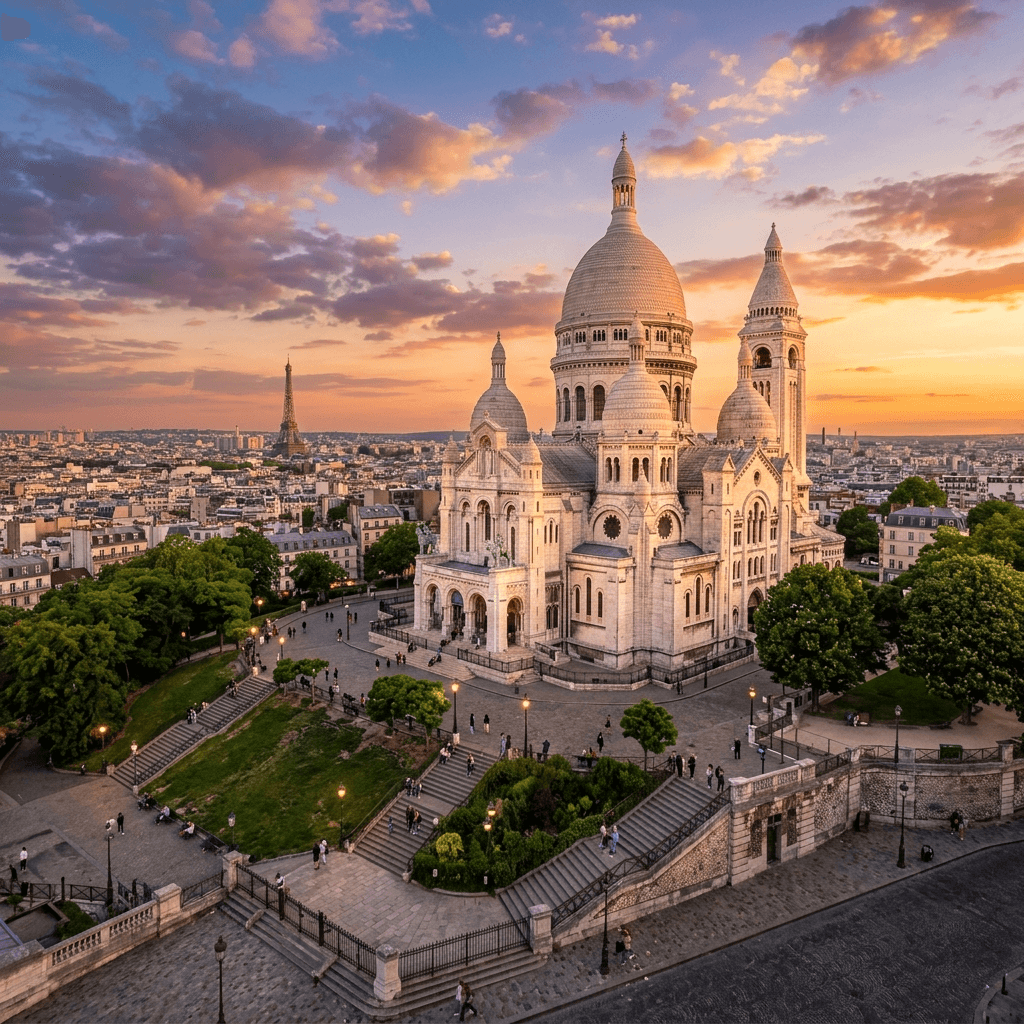
Chapter
1. The First Stone of the Sacred Heart Basilica: Who Really Started the Construction in 1875?
1.1 Alexandre Legentil and Hubert Rohault de Fleury: The Devout Men Who Promised the Sacred Heart Basilica
In January 1871, while Paris was still bleeding under the Prussian siege, a Catholic layman named Alexandre Legentil — a follower of Frédéric Ozanam, founder of the Society of Saint Vincent de Paul — drafted a solemn vow. Legentil, a philanthropist with ultramontane convictions, was convinced that the French defeat at the Battle of Sedan (September 1, 1870) and the captivity of Pope Pius IX in Italy were divine punishments for France's sins since the French Revolution. His proposal was clear: to build a sanctuary in Paris dedicated to the Sacred Heart of Jesus as an act of national expiation.
Hubert Rohault de Fleury, a military engineer and Legentil's brother-in-law, was the operational arm of the vow. While Legentil drafted the theological text, Rohault de Fleury devised the financing plan and fundraising campaign. Together, the two brothers-in-law presented the project to Cardinal Guibert, Archbishop of Paris, who approved it in 1872. The original vow stated: "We acknowledge that we have been guilty and justly punished. To make honorable reparation for our sins... we promise to contribute to the construction in Paris of a sanctuary dedicated to the Sacred Heart of Jesus."
Contrary to what many tour guides claim, Legentil and Rohault de Fleury — not Cardinal Guibert — were the true originators of the Sacré-Cœur. The cardinal was the institutional endorsement; the two laymen were the soul of the project. The donation campaign was based exclusively on private contributions, a condition imposed from the start to avoid using public funds.
1.2 The National Vow After the Franco-Prussian War: Why France Wanted to Build Sacré-Cœur
The geopolitical context of the 1870s is essential to understanding the National Vow. The Franco-Prussian War (1870-71) was a crushing humiliation for France. At Sedan, the Imperial Army of Napoleon III was annihilated, and the emperor himself was captured by the Prussians on September 2, 1870. Paris was besieged for four months, suffering bombardment, famine, and intense cold. The surrender came in January 1871, followed by the loss of Alsace and Lorraine.
For conservative French Catholics, the defeat was not merely military — it was theological. They believed that France had abandoned God since the Revolution of 1789, replacing Catholic monarchy with republican secularism. The Paris Commune (March-May 1871), which took Montmartre as its epicenter, reinforced this narrative. The communards executed the Archbishop of Paris, Monsignor Darboy, and dozens of priests. For Legentil, this was the final proof of the country's moral degeneracy.
The "National Vow" was therefore an act of reparation — not only for the lost war, but for a century of "de-Christianization." Each donor, by contributing, was symbolically asking forgiveness for France's sins. Over 10 million French people donated over the 40 years of construction, a number representing about one-third of the population at the time. The name "Basilica of the National Vow" was the project's official name before it was consecrated as Sacré-Cœur.
Approval in the National Assembly came in July 1873, when parliament declared the construction of "public utility." The official declaration stated that it was necessary "to erase with this work of expiation the crimes that crowned our sorrows." This language of expiation — not celebration — would mark the basilica forever.
1.3 Why Montmartre Was Chosen to Erect the Sacred Heart Basilica
Montmartre, the 130-meter hill that dominates northern Paris, was not chosen by chance. Three reasons converged for its selection: altitude, religious tradition, and political symbolism.
Geographically, Montmartre is the highest point in Paris — 130 meters above sea level, 200 meters above the Seine. Visible from virtually the entire city, the hill offered the visibility the originators desired: a basilica that could be seen from every arrondissement, reminding everyone of the divine presence. The 83-meter central dome raises the building's highest point to over 200 meters above the Seine, making Sacré-Cœur the second highest point in Paris, behind only the Eiffel Tower.
Religiously, Montmartre — "Mount of Martyrs" — carries a tradition dating back to the third century. According to Christian legend, Saint Denis (Saint Denis), the first bishop of Paris and patron saint of the city, was beheaded by the Romans on top of the hill around 250 AD. Tradition holds that Denis, after being beheaded, walked carrying his own head to the site where the Basilica of Saint-Denis now stands. Moreover, in 1534, Ignatius of Loyola and his first companions made their vows at the neighboring Church of Saint-Pierre de Montmartre, one of the oldest in Paris, founding the Society of Jesus (Jesuits) there.
Politically, Montmartre was where the Paris Commune had begun on March 18, 1871 — when government soldiers refused to fire on the crowd and joined the insurgents. Building a Catholic basilica exactly there was a symbolic declaration that France was being "reconquered" for the Church.
1.4 The Political Controversy: Catholic Monument or Civil War Provocation at the Sacred Heart Basilica?
No monument in Paris is as politically charged as the Sacré-Cœur. From its conception, the basilica was attacked by the republican left, which saw it as a monument to the repression of the communards — it is estimated that between 10,000 and 30,000 insurgents were killed in the repression of May 1871, the Semaine Sanglante.
Georges Clemenceau, leader of the left-wing coalition that won the parliamentary elections of 1882, immediately proposed halting construction. Clemenceau called the basilica a "provocation" and tried to block funding. However, canceling the construction would mean refunding tens of millions of francs to millions of donors — an unsustainable political and financial cost. The work continued.
In 1897, Clemenceau tried again. This time, the motion was overwhelmingly defeated: the government would have to return 30 million francs to 8 million contributors. The number of donors made Sacré-Cœur politically untouchable.
Émile Zola, in 1898, wrote sarcastically: "France is guilty. It must do penance. Penance for what? For the Revolution, for a century of free thought and science... that is why they built this gigantic landmark that Paris can see from all its streets."
The controversy extends into the 21st century. In 2004, the socialist mayor of Paris, Bertrand Delanoë, renamed the square in front of the basilica as Place Louise Michel, in honor of the famous anarchist and Commune leader. Socialist Prime Minister Lionel Jospin (1997-2002) expressed a desire for the basilica to be demolished as a symbol of "obscurantism, bad taste, and reactionaryism." In 2021, left-wing deputies blocked the declaration of Sacré-Cœur as a historical monument to prevent it from coinciding with the 150th anniversary of the Commune. The classification was only approved on December 8, 2022, unanimously, but immediately criticized by far-left leader Jean-Luc Mélenchon, who called it "glorification of the murder of 32,000 communards shot in just 8 days."
Thus, Sacré-Cœur remains a monument of contradictions: a symbol of faith for millions of pilgrims and a target of political contestation — a tension that defines its very identity.
Chapter
2. The Construction of the Sacred Heart Basilica: 39 Years of Work and Its Secrets
2.1 The Competition with 77 Architects: Why Did Paul Abadie Win to Design Sacré-Cœur?
In 1873, the committee of the National Vow and Cardinal Guibert launched a public competition to choose the architect for the future basilica. The program was rigorous: a maximum budget of 7 million francs, a requirement for a crypt, a monumental and visible statue of the Sacred Heart on the façade, and the mandatory location on Montmartre.
77 architects submitted 78 projects (some in teams), including Charles Garnier — the celebrated architect of the Paris Opera — and six Grand Prix de Rome winners. The models were displayed on the Champs-Élysées for public viewing. The winner was Paul Abadie (1812-1884), diocesan architect of Angoulême, Bordeaux, and Périgueux, and a disciple of Eugène Viollet-le-Duc.
Abadie won with a bold and deliberately anachronistic approach. While most projects followed the prevailing Neo-Gothic style, Abadie proposed a Roman-Byzantine style, inspired by the basilicas of southern France that he knew well — especially the Cathedral of Saint-Front in Périgueux, which he himself had restored. His design was a direct reaction to the Neo-Baroque of the Palais Garnier, which Legentil called a "scandalous monument of extravagance, indecency, and bad taste."
The choice of Abadie was not unanimous. Critics accused his style of "not being sufficiently French," preferring Gothic as a national expression. However, the vision of a universal church, dialoguing with both Eastern and Western Christian traditions, prevailed.
2.2 The Roman-Byzantine Style of the Sacred Heart Basilica: A Deliberately Exotic Choice
The Roman-Byzantine style of the Sacré-Cœur was an architectural and theological statement. Abadie sought inspiration from two of Christianity's most important churches: Hagia Sophia in Constantinople (today Istanbul), with its floating central dome built in the 6th century under Emperor Justinian; and St. Mark's Basilica in Venice, with its golden mosaics and Greek cross layout.
The choice was not merely aesthetic. Roman-Byzantine represented a one and universal church, predating the split between the Roman Catholic Church and the Eastern Orthodox Church. At a time when France sought "reparation" and spiritual reunification, the style symbolized the lost unity of Christianity.
The Byzantine elements are evident: the Greek cross layout (arms of equal length, unlike the Latin cross of Gothic cathedrals), the domes replacing pointed Gothic spires, the semicircular arches instead of pointed arches, and the abundance of mosaics and colors in the interior. The façade, with its three-arched porch inspired by the Cathedral of Périgueux, combines Romanesque elements (arcades, robust columns) with the Byzantine verticality of the domes.
The white travertine stone from Château-Landon contrasts dramatically with the darkened stone of Notre-Dame and the Haussmannian buildings, creating an intentional visual impact: Sacré-Cœur is no longer just a Parisian church — it is a monument that dialogues with the Mediterranean, with Jerusalem, with heaven.
Curiously, Charles Garnier — whose style Abadie rejected — ended up serving as an advisor to architect Henri-Pierre Rauline between 1891 and 1904, indirectly contributing to the project that originally sought to surpass his own.
2.3 The Death of Paul Abadie in 1884: Who Continued the Work of the Sacred Heart Basilica?
Paul Abadie died in 1884, less than a decade after the laying of the cornerstone, when only the foundations were complete. His early death paved the way for a succession of five architects who substantially modified the original design.
Honoré Daumet (1884-1886) was the first successor, responsible for initial structural adjustments. Then, Jean-Charles Laisné (1886-1891) supervised the construction of the walls and the completion of the crypt. Henri-Pierre-Marie Rauline (1891-1904) altered Abadie's design the most: he softened the lines, added Neoclassical elements to the domes, and modified the windows on the south façade. Lucien Magne (1904-1916) completed the bell tower (the 84-meter campanile) and finalized the central dome with its lantern. Finally, Jean-Louis Hulot (1916-1924) supervised the finishing touches after the consecration.
Each architect left his mark. The elongated domes and Neoclassical-influenced windows on the south façade are by Rauline and Magne, not Abadie. The bell tower — which Abadie had imagined differently — took the square form we know today thanks to Magne. The final result is an architectural palimpsest of decades of adaptations.
The central dome, completed in 1899, is 16 meters in diameter and 54.94 meters in internal height. The external dome reaches 83 meters from the ground. A lantern with a colonnade crowns the structure, offering a panoramic view of 30 km on clear days — accessible via 237 spiral steps.
2.4 Financial and Political Delays: How Sacré-Cœur's Construction Almost Came to a Halt
The initial estimated cost of 7 million francs proved unrealistic. The foundations alone consumed two years and a fortune: Montmartre's soil, formed by ancient gypsum quarries, required the excavation of 83 shafts, each 33 meters deep, filled with rock and concrete to serve as underground pillars. All of this work occurred before any visible structure above ground.
In 1882, the electoral victory of the left-wing coalition led by Georges Clemenceau brought the project to the brink of collapse. Clemenceau proposed stopping work immediately. However, the government realized that cancellation would create a liability of 12 million francs in compensation — more than the cost of finishing construction. The work continued.
Financial crises were recurrent. The construction depended exclusively on donations, without a cent of public money. Small contributions from all over France — workers, peasants, housewives — sustained the project. The "named stone" was a brilliant strategy: anyone who donated enough to buy a stone would have their name or initials engraved on it. To this day, thousands of French family names are inscribed on the walls of the basilica and crypt.
In 1891, the interior was opened for public worship, although construction was still far from complete. In 1897, Clemenceau made another attempt to block completion, but the motion was defeated by a large majority: there were 30 million francs in commitments to 8 million donors. The 19th-century crowdfunding made Sacré-Cœur politically invulnerable.
The total amount raised at the end was approximately 46 million francs, more than six times the initial budget.
2.5 Completion in 1914 and the Consecration Delayed by World War I
The basilica was technically completed in 1914 — 39 years after the laying of the first stone. The bell tower had been finished since 1912, and the cross on the lantern had been placed on April 6, 1912. The consecration was scheduled for October 17, 1914.
But World War I began in August 1914. Paris was threatened. The French government mobilized to defend the capital at the First Battle of the Marne. The consecration ceremony was canceled.
The consecration finally took place on October 16, 1919, after the armistice. The service was presided over by Cardinal Vico and Cardinal Amette, Archbishop of Paris. The chosen date — one year and one day after the end of the war — carried powerful symbolism: Sacré-Cœur, conceived as a monument of expiation for a defeat (1870), was now consecrated as a memorial of a victory (1918).
The inscription on the choir mosaic, which originally read "To the Sacred Heart of Jesus, a fervent, penitent, and grateful France," had the word "grateful" added after the war — an acknowledgment that France not only repented but also gave thanks for divine protection during the conflict.
The basilica that began as a vow of repentance thus became a landmark of national resilience.
Chapter
3. The Self-Cleaning Stone: The Secret of the Whiteness of the Sacred Heart Basilica
3.1 Travertine from Château-Landon: Why Is This Stone So Special at the Sacred Heart Basilica?
The immaculate white color of the Sacré-Cœur is not the result of constant cleaning, but of a clever geological choice. Paul Abadie personally selected the travertine from Château-Landon, extracted from the quarries of Souppes-sur-Loing, in the department of Seine-et-Marne, about 90 km southeast of Paris.
Travertine is not an ordinary limestone. It is a sedimentary rock formed by the precipitation of calcium carbonate in mineral-rich water springs, resulting in a microporous and extremely hard structure. Unlike the oolitic limestones used in other Parisian monuments, Château-Landon travertine has a very fine grain and high density, giving it superior resistance to weather and pollution.
The same stone was used in the construction of the Arc de Triomphe (started in 1806), but at Sacré-Cœur its behavior is enhanced by the orientation and architectural design: the curved surfaces of the domes allow rainwater to drain uniformly, maximizing the self-cleaning effect.
Transporting the stones from Souppes-sur-Loing to Montmartre was a colossal logistical operation in the 19th century. Multi-ton blocks traveled by train to Paris and were then hoisted up the Montmartre hill by horse-drawn winches. Each block was numbered and fitted into a precise laying system.
3.2 How Calcite Keeps the Sacred Heart Basilica White for Over 100 Years
The phenomenon that keeps Sacré-Cœur white is chemical and fascinating. The travertine from Château-Landon contains calcite (crystallized calcium carbonate) in its composition. When rainwater — slightly acidic due to dissolved CO₂ — comes into contact with the stone's surface, a chemical reaction occurs: the calcite dissolves in minuscule amounts and, upon drying, recrystallizes on the surface, forming a white protective layer.
This process, called "calcite exudation", makes the stone literally "clean itself." Pollutants and soot particles that settle on the surface are "expelled" by the recrystallization of calcium carbonate. Each rain shower washes the basilica, removing impurities and renewing the white brightness.
The effect is particularly effective at Sacré-Cœur due to three factors: the chemical composition of Château-Landon travertine (rich in pure calcite), the slope of the surfaces (the domes and steep walls allow water to drain quickly without accumulating dirt), and the climate of Paris (frequent and moderate rainfall, which regularly activates the process).
This natural mechanism has meant that the basilica has never needed a complete artificial cleaning in over a century — an extraordinary feat for a building in the center of a European capital with historically high pollution levels.
3.3 Stone Comparison: Sacred Heart Basilica vs. Notre-Dame, Panthéon, and Arc de Triomphe
To appreciate the uniqueness of Sacré-Cœur, one need only compare it with other Parisian monuments from the same historical period.
Notre-Dame de Paris (12th century) was built with Lutetian limestone extracted from the banks of the Seine. This limestone is softer and more porous than Château-Landon travertine, and its naturally yellowish color darkens over time due to oxidation and pollutant absorption. The cathedral has undergone several cleanings over the centuries — the most recent, after the 2019 fire, revealed layers of dirt accumulated over 200 years.
The Panthéon (1757-1790) was built with a combination of limestone and marble. Its stone is more porous and absorbs more pollutants, resulting in an uneven grayish tone. The Panthéon has undergone several cleaning campaigns, including a major restoration between 1996 and 1998.
The Arc de Triomphe (1806-1836) used the same Château-Landon travertine — the same stone as Sacré-Cœur. However, the Arc is located at the busy Étoile, exposed to intense vehicular pollution for 200 years. Although the travertine also exudes calcite, the amount of deposited pollutants is so high that the self-cleaning effect is insufficient to maintain original whiteness. The Arc was cleaned in 1989 and again in the 2010s, but its current tone is grayish-yellow.
The difference is clear: Notre-Dame and the Panthéon are built with stones that darken; the Arc de Triomphe uses the same stone as Sacré-Cœur but lost the battle against automotive pollution. The Sacred Heart Basilica, elevated and surrounded by gardens, benefits from a cleaner microclimate and its architecture that maximizes natural washing by rain.
3.4 The Necessary Maintenance: Why Sacré-Cœur's Stone Is Not Infinitely Self-Cleaning
Despite the impressive natural mechanism, Sacré-Cœur is not immune to time. The self-cleaning process through calcite exudation has limits.
Modern urban pollution — especially fine diesel particles and acidic compounds — can saturate the recrystallization capacity of calcite. In areas less exposed to rain, such as under eaves and in protected niches, dirt accumulates and is not washed away. Furthermore, the continuous recrystallization of calcite can, over time, form a thick crust that alters the surface texture of the stone.
Periodic interventions are necessary. The major restoration of the 1990s included replacing damaged travertine blocks, targeted cleaning of critical areas, and structural reinforcement. In 2022, new inspections revealed degradation in some parts of the bell tower and façade, requiring further interventions.
Another challenge is the cracks in the "La Savoyarde" bell, detected in the late 1990s. The giant oscillation of the 850 kg clapper generates mechanical stress that, combined with constant vibration, can compromise the bell tower's structure.
Sacré-Cœur proves that even the most intelligent natural self-cleaning solution does not eliminate the need for human maintenance. The difference is that while other monuments need general cleaning every 20-30 years, the Montmartre basilica can wait decades between significant interventions — a feat that modern materials engineering still tries to replicate in contemporary façades.
Chapter
4. The Architecture of the Sacred Heart Basilica: Greek Cross, Domes, and Proportions
4.1 The Greek Cross Layout at the Sacred Heart Basilica: Why Different from Gothic Cathedrals?
Sacré-Cœur adopts the Greek cross layout, an architectural choice that radically distinguishes it from the Gothic cathedrals of Paris, such as Notre-Dame and the Sainte-Chapelle.
In the Greek cross, the four arms of the nave have the same length, forming a perfectly symmetrical plan around the central altar. This shape is characteristic of Eastern Byzantine churches, such as Hagia Sophia in Constantinople and St. Mark's in Venice. The Latin cross — used in Notre-Dame and most Western cathedrals — has the longitudinal arm (the nave) significantly longer than the transept arms, creating an elongated form that directs the worshiper's gaze from the entrance to the altar.
Paul Abadie's choice of the Greek cross was deliberate. He wanted to create a centered church, where the altar is the focal point from all angles, rather than a linear progression toward the altar. This reflects Byzantine theology, which emphasizes the divine presence at the center of the community, as opposed to Gothic theology, which leads the faithful on a journey from the entrance (the profane world) to the altar (the sacred world).
Another fundamental difference: Gothic cathedrals were oriented on an east-west axis (altar facing Jerusalem, to the east). Sacré-Cœur breaks this tradition by adopting a north-south axis, with the main façade facing south — that is, toward Paris. The basilica not only looks at the city: it opens itself to it, like a symbolic embrace. "We want the basilica to open onto Paris," declared the building committee.
The Greek cross plan measures 85 meters in length (north-south axis) by 35 meters in width (east-west axis), proportions almost identical to those of the Cathedral of Périgueux, which served as Abadie's direct model.
4.2 The Four Domes and the 83-Meter Central Dome of the Sacred Heart Basilica
The silhouette of Sacré-Cœur is dominated by its system of five domes: a central dome 83 meters high, flanked by four smaller domes at the four cardinal points.
The central dome is the masterpiece. With an internal diameter of 16 meters, it rises 54.94 meters above the church floor (internal height under the vault keystone). Externally, the dome reaches 83 meters from the ground — it was the highest point in Paris until the construction of the Eiffel Tower in 1889. Above the dome, a lantern with a classical colonnade supports a 19-meter-high cross, raising the total maximum point to over 100 meters.
The four smaller domes surround the central one on the arms of the Greek cross. They are not merely decorative: they perform a structural function, distributing the weight of the central dome and balancing the forces on the pillars. Each smaller dome is about 30 meters high and follows the same elongated, ovoid profile as the central dome.
The profile of the domes is described as "elongated ovoid" or "egg-shaped" — a characteristic that earned Sacré-Cœur the pejorative nickname "the Meringue" among critics of the time. This specific shape, however, is functional: the elongated curvature allows rainwater to drain quickly, enhancing the self-cleaning effect of the travertine.
From afar, the five domes create a silhouette that evokes both a royal crown and a mountain of light — exactly the visual effect Abadie desired for the "hill of martyrs."
4.3 The Influence of Hagia Sophia and St. Mark's on the Sacred Heart Basilica Design
Sacré-Cœur is an exercise in architectural eclecticism that draws directly from two primary sources: Hagia Sophia in Constantinople (6th century) and St. Mark's Basilica in Venice (11th century).
From Hagia Sophia, Abadie inherited the concept of the great central dome as the dominant element of the interior space. In Hagia Sophia, the 31-meter-diameter dome appears to "float" on a ring of windows at its base, creating an effect of celestial light. At Sacré-Cœur, the central dome is smaller (16 meters), but it maintains the same principle of pendentives and arches that transfer weight to the pillars. The indirect lighting — which at Sacré-Cœur is deliberately subdued — creates a mystical atmosphere similar to Hagia Sophia, where light enters filtered through high windows.
From St. Mark's, Abadie assimilated the extensive use of mosaics and the Greek cross layout with domes on the four arms. The interior decoration of Sacré-Cœur — with its golden mosaics, colored marbles, and geometric patterns — is a direct homage to Venetian ornamental richness. The choir mosaic, "The Triumph of the Sacred Heart of Jesus," covers 475 square meters with 25,000 pieces of enameled and gilded ceramic, making it one of the largest mosaics in the world — comparable in ambition to the Byzantine mosaics of Ravenna.
The style is called French Roman-Byzantine because it fuses Romanesque elements (arcades, robust columns, porticos) with Byzantine verticality and light. It is an architecture that tells a story: 19th-century Catholic France dialoguing with the Eastern roots of Christianity, in a deliberate gesture of universality.
4.4 The Two Façade Towers and the Bell Tower at the Apse of the Sacred Heart Basilica
Unlike Notre-Dame, which has two twin towers on the west façade, Sacré-Cœur organizes its vertical elements asymmetrically.
The main façade (south) is flanked by two lower, robust towers that frame the three-arched porch. These towers are not bell towers — their function is purely compositional, visually balancing the 50-meter width of the façade between the massive volume of the central body and the domes. They house small bells and serve as a visual counterweight to the domes.
The bell tower — the actual campanile — is located at the north apse, separated from the main body of the church. This is a Byzantine characteristic: in Eastern churches, the bell tower is often a freestanding structure. The bell tower of Sacré-Cœur is 84 meters high, surpassing the central dome by 1 meter. Its square, massive form contrasts with the organic curves of the domes, creating an intentional geometric counterpoint.
The decision to separate the bell tower from the façade was functional: the weight of the giant bell (18,835 kg) and the vibration of its 850 kg clapper required an independent structure to avoid compromising the basilica's stability. In 1947, the bell was reinstalled in a "back-standing" position (with the clapper striking the opposite edge of the swing motion) because the original pressure on the bell tower structure was excessive.
4.5 The 26-Ton Bell of the Sacred Heart Basilica: One of the Largest in the World
"La Savoyarde" — official name Françoise-Marguerite du Sacré-Cœur de Jésus — is the largest bell in France and one of the five largest swinging bells in the world.
Cast on May 13, 1891 by the Paccard foundry in Annecy-le-Vieux, the bell was commissioned by the four dioceses of Savoy (Chambéry, Annecy, Saint-Jean-de-Maurienne, and Moûtiers) as a regional contribution to the national basilica. The annexation of Savoy to France in 1860 was still recent, and the offering of the bell was both a gesture of loyalty to France and an affirmation of Savoyard pride.
The numbers are impressive: 3.03 meters in diameter, 9.60 meters in external circumference, 22 centimeters thick at the base, 3.06 meters tall. The clapper weighs 850 kg; the support structure (yoke), 4,650 kg; the total swinging mass reaches 25,765 kg. The bell was transported from Annecy to Paris in October 1895, pulled by 26 to 28 Percheron horses in an operation that stopped the capital and drew crowds.
Installed in the bell tower in 1898, the bell sounds in the note low C and can be heard 10 km away. It only rings for major religious solemnities: Easter, Pentecost, Ascension, Christmas, Assumption, and All Saints' Day. A historical exception occurred on August 24, 1944, when "La Savoyarde" rang to celebrate the arrival of the 9th Company of the Régiment de Marche du Tchad at the Paris City Hall, announcing the beginning of the Liberation of Paris from Nazi occupation.
By comparison, the "Emmanuel" bell of Notre-Dame weighs 13 tons — less than half the weight of "La Savoyarde." Among Europe's swinging bells, only the Petersglocke (Cologne, Germany), the Olympic Bell (London), Maria Dolens (Rovereto, Italy), and Pummerin (Vienna, Austria) are larger. In the late 1990s, a crack was detected in the bell, and its ringing has since been controlled and monitored to prevent structural damage to the bell tower.
"La Savoyarde" is not just a bell: it is a monument within the monument, a symbol of the popular devotion that built Sacré-Cœur — donation by donation, franc by franc, kilogram by kilogram.
Chapter
5. The Interior of the Sacred Heart Basilica: Mosaic, Organ, and Hidden Treasures
5.1 The Christ in Majesty Mosaic of the Sacred Heart Basilica: 475 m² of Masterpiece
Upon crossing the portal of the Sacred Heart Basilica, the gaze is inevitably captured by the Christ in Majesty Mosaic that dominates the apse. At 475 square meters — a size comparable to a luxury Parisian apartment — this is the largest mosaic composition in all of France. There are 25 million pieces of enameled glass, each hand-cut and set in mortar by a team that worked for over two decades. The central figure displays Christ with the flaming heart exposed on his chest, a direct representation of the Sacred Heart of Jesus that gives the sanctuary its name. Above the Messiah's halo, the Latin inscription reads "Sanctissimum Cor Iesu" (Most Sacred Heart of Jesus). The Virgin Mary and Archangel Saint Michael flank the scene, while the Church Triumphant and the Church Militant are represented in the lower bands. Unlike frescoes, which deteriorate with Parisian humidity, the enameled glass mosaic technique — called *smalti* — ensures the colors remain vibrant for centuries, resisting pollution and thermal variations of the Montmartre hill.
5.2 Luc-Olivier Merson: The Artist Behind the Largest Mosaic of the Sacred Heart Basilica
The author of the masterpiece, Luc-Olivier Merson (1846–1920), was a French academic painter trained at the École des Beaux-Arts under the tutelage of Isidore Pils. In 1875, the basilica commission opened a competition for the apse mosaic, and Merson won with a design that fused Byzantine tradition with late 19th-century French naturalism. Merson dedicated 25 years of his career to supervising the work, from 1885 to 1910, constantly traveling between Paris and the Guilbert-Martin workshop in Saint-Denis, where the pieces were produced. The Guilbert-Martin atelier was then the main supplier of religious mosaics in France, also responsible for works in churches such as Notre-Dame de Fourvière in Lyon. Merson died in 1920, before seeing the basilica definitively consecrated, but his mosaic remains his most monumental legacy — so grand that it overshadows the rest of the interior decoration, deliberately sober so as not to compete with the apse.
5.3 The Cavaillé-Coll Organ of the Sacred Heart Basilica: 78 Stops and 8,000 Pipes
The Great Organ of the Sacred Heart Basilica represents an ambiguous chapter in the history of French organ building. Aristide Cavaillé-Coll (1811–1899), the greatest organ builder of the 19th century, died before he could build the instrument for Sacré-Cœur. The task fell to Charles Mutin, successor of Cavaillé-Coll & Cie, who delivered the organ between 1905 and 1914. There are 78 stops distributed across four manuals and pedalboard, feeding approximately 8,000 pipes that occupy a space equivalent to a Parisian apartment inside the gallery. The organ case, in carved oak, was designed to integrate with the Roman-Byzantine architecture of the basilica. In 1979, the instrument underwent a major overhaul by Jacques Barberis, who modernized the electric transmission while preserving the original pipes. The organ hosts regular concerts, especially during the Paris Organ Festival, and is among the five largest pipe organs in France — trailing only Notre-Dame (115 stops), Saint-Sulpice (102), Saint-Ouen de Rouen (94), and the Church of Saint-Étienne-du-Mont (86).
5.4 The Stained Glass and Side Chapels of the Sacred Heart Basilica: Details Few Notice
Unlike Notre-Dame or the Sainte-Chapelle, Sacré-Cœur does not boast large colorful stained glass windows. The choice was deliberate: Paul Abadie, chief architect, opted for discreet stained glass in neutral tones so as not to divert attention from the apse mosaic and to maintain the atmosphere of recollection required by perpetual adoration. This decision generated controversy at the time, with critics accusing the basilica of being "too dark." The side chapels, however, compensate for the general sobriety with precious details. The Chapel of the Virgin, to the right of the nave, houses a statue of Our Lady of Lourdes in Carrara marble and an altar decorated with lapis lazuli inlays. The Chapel of the Sacred Heart, on the left side, displays a bronze bas-relief depicting the apparition of the Sacred Heart to Saint Margaret Mary Alacoque in Paray-le-Monial, the event that inspired the construction of the sanctuary. Small mosaics in the chapel vaults depict French saints such as Saint Louis IX, Saint Joan of Arc, and Saint Martin of Tours, connecting the basilica to national history.
5.5 Joan of Arc in the Mosaic of the Sacred Heart Basilica: The Figure Most People Miss
Among the dozens of figures that make up the apse mosaic, one of the most significant goes unnoticed by most visitors: Joan of Arc — canonized only in 1920, ten years after the mosaic's completion, but already included as a "popular saint" by Merson. She is represented on the right side of the mosaic, near the base, wearing her armor and holding the fleur-de-lis standard. Her inclusion is not coincidental: the Sacré-Cœur basilica was conceived as a national vow after the defeat in the Franco-Prussian War (1870–1871), and the figure of Joan — the warrior who saved France in the Hundred Years' War — functioned as a symbol of patriotic redemption. Joan of Arc was beatified in 1909 and canonized in 1920, and her presence in the mosaic reflects French ultramontanism of the late 19th century, which associated sanctity with national identity. Today, a small sign next to the main altar points out Joan's location in the mosaic, but most tourists walk right past, missing the detail that connects the basilica to one of France's most iconic saints.
Chapter
6. The Perpetual Adoration of the Sacred Heart Basilica: 24 Hours a Day Since 1885
6.1 What Is the Perpetual Adoration of the Sacred Heart Basilica and Why Did It Start in 1885?
Perpetual Adoration is a Catholic practice in which the consecrated host — the body of Christ in Eucharistic theology — remains exposed in a monstrance on the altar, 24 hours a day, every day of the year, never to be returned to the tabernacle. At the Sacré-Cœur de Montmartre, this practice began on August 1, 1885, when the basilica was still under construction — only nine years after the laying of the first stone and five years before the official consecration of the church in 1891. The motivation was explicitly expiatory: the adoration was conceived as a "prayer of reparation" for the sins of France, especially in response to what the Church considered the growing secularism of the French Third Republic, which had passed secularization laws for education in 1882 and legalized divorce in 1884. The historical context was one of direct confrontation between the Catholic Church and the republican State, and the perpetual adoration functioned as a public affirmation of divine presence over Paris. The exposed host, visible from any point in the nave, became the theological heart of the sanctuary.
6.2 Over 51,000 Nights of Uninterrupted Prayer at the Sacred Heart Basilica
Since that first night in August 1885, adoration at Sacré-Cœur has never been interrupted — not for a single minute. By July 2026, the sanctuary surpasses the mark of 51,400 consecutive nights of Eucharistic exposition. This feat equates to more than 140 uninterrupted years of prayer, an absolute record in the history of world Catholicism. The two World Wars did not stop the adoration: during the siege of Paris (1914) and the Nazi occupation (1940–1944), the faithful continued taking turns before the host, even with the city under bombardment. During the Covid-19 Pandemic (2020), when France imposed one of the strictest lockdowns in Europe, adoration was maintained with a reduced number of volunteers, adapting to health restrictions. The data is so impressive that it appears in the Sacré-Cœur Jubilee Book (2025) as one of the most notable achievements in French ecclesiastical history.
6.3 How the System of Faithful Taking Turns in Adoration at Sacré-Cœur Works
The mechanism sustaining 140 years of continuous prayer is a precision ecclesial logistics engine. The adoration is organized by the Community of Benedictines of the Sacred Heart of Montmartre, a religious order founded specifically for this purpose in 1898 by Father Adolphe Leclercq. About 120 to 150 volunteers daily sign up for schedules covering the 24 hours of the day, divided into one-hour shifts — although the faithful may remain as long as they wish. Every hour on the hour, a different volunteer takes the post before the altar, ensuring there is never a moment without at least one person in prayer. During the early morning (midnight to 6 am), religious of the Benedictine community cover the most difficult shifts. On Sundays and liturgical feasts, the flow of volunteers increases substantially, and the adoration is complemented by Masses and the Angelus prayer at noon. Any baptized Catholic can sign up as an adorer, simply by going to the basilica sacristy and presenting an ID.
6.4 The Spiritual Experience at the Sacred Heart Basilica for Non-Catholics and the Curious
Even for those who do not share the Catholic faith, the atmosphere of the nave during perpetual adoration is a striking sensory experience. The absolute silence — preserved by security guards who discreetly ask visitors to speak only in whispers — contrasts with the tourist chaos outside, where Place du Tertre and Rue du Mont-Cenis teem with crowds. The smell of melted wax from votive candles, the diffuse light filtering through the neutral stained glass, and the golden glow of the apse mosaic create an environment that Antonio Machado described as "the silence that can be heard." Non-Catholic tourists are welcome to sit on the side benches and observe the scene, as long as they maintain decorum and do not interfere with the prayer. The basilica does not charge admission (unlike the dome and crypt), and one may stay as long as desired. For the traveler interested in religious tourism or sacred architecture, witnessing an hour of perpetual adoration offers a dimension of authenticity that a superficial visit does not achieve.
6.5 Why Is Photography Not Allowed Inside the Sacred Heart Basilica?
The ban on photography and video inside Sacré-Cœur is one of the best-known and most ignored rules by unsuspecting tourists. Unlike Notre-Dame or the Sainte-Chapelle, where photography is permitted (without flash), the Montmartre basilica prohibits it entirely for a theological and logistical reason: perpetual adoration requires an atmosphere of recollection and respect. The click of cameras, flash, and noise disturb the faithful at prayer, and the administration understands that the primary function of the space is worship, not tourism. The rule is enforced by uniformed security guards who circulate through the nave and politely approach offenders. The exception is external photography — of the façade, the dome, and the gardens — which is allowed and even encouraged. The practical tip: leave your camera in your backpack when entering, absorb the space with your eyes, and photograph only from the outside. The apse mosaic cannot be reproduced in image by amateurs, but the visual memory of those 475 square meters is worth more than any smartphone photo.
Chapter
7. The Crypt of the Sacred Heart Basilica: What Lies Beneath the Montmartre Hill
7.1 What Is Hidden Below the Sacred Heart Basilica? The Crypt Few People Know
Below the basilica floor, extending over an area equivalent to that of the upper church, there is a monumental crypt that most of the 10 million annual visitors to Sacré-Cœur never get to know. Built between 1876 and 1881 — even before the upper church — the crypt follows the Roman-Byzantine style and functions as a complete underground church, with its own altar, side chapels, and capacity for about 300 people. Its existence is unknown even to many hurried tour guides, who lead groups only to the main nave and the dome. The crypt was designed by Paul Abadie as an integral part of the architectural complex, originally serving for celebrations while the upper church was still under construction. Unlike medieval crypts — generally dark and damp — that of Sacré-Cœur is lit by narrow windows and has an 8-meter ceiling height, making it surprisingly airy. Its atmosphere, however, is of even greater recollection than the upper nave, intensified by the silence and the near-total absence of tourists.
7.2 The Pietà and the Tombs of Cardinals in the Crypt of the Sacred Heart Basilica
The most striking artistic element of the crypt is the Pietà in white marble sculpted by Jules Lefebvre — cousin of the famous academic painter Jules Joseph Lefebvre. The sculpture depicts the Virgin Mary holding the body of Christ taken down from the cross, following the iconographic tradition inaugurated by Michelangelo in 1499. Unlike the Vatican Pietà, however, the Sacré-Cœur version is more expressionist, with the folds of Mary's mantle accentuated and Christ's face marked by more realistic traces of suffering. The crypt also houses the monumental tombs of three cardinals who marked the basilica's history: Cardinal Léon-Adolphe Amette (1850–1920), Archbishop of Paris who presided over the basilica's consecration in 1919; Cardinal Louis-Ernest Dubois (1856–1929), his successor and great promoter of perpetual adoration; and Cardinal Maurice Feltin (1883–1975), who led the Church in Paris during World War II and the post-war reconstruction. The tombs are made of black Belgian marble and decorated with gilded bronzes depicting scenes from each prelate's life.
7.3 The Crypt of the Sacred Heart Basilica as an Air-Raid Shelter in World War II
During World War II (1939–1945), the Sacré-Cœur crypt served a function its architects never imagined: it was used as an air-raid shelter for the local population of Montmartre. When sirens sounded announcing Luftwaffe bombers or, later, Allied attacks against German targets in Paris, residents of the adjacent streets — Rue du Chevalier-de-la-Barre, Rue du Mont-Cenis, and Rue Tardieu — descended the basilica stairways to take cover under the 8-meter-thick stone vaults. Records from the archives of the Archdiocese of Paris indicate that the crypt sheltered more than 200 people simultaneously during the bombings of April 1944, when Allied aviation attacked the La Chapelle railway junction, a few kilometers away. Cardinal Suhard, then Archbishop of Paris, personally authorized the use of the crypt as a refuge, temporarily suspending liturgical celebrations in the underground space. Informational plaques at the crypt entrance narrate this episode, but few visitors read them.
7.4 The Staircases Connecting Crypt and Dome of the Sacred Heart Basilica: A Vertical Journey
One of the most fascinating architectural secrets of Sacré-Cœur is the system of internal staircases that connects the crypt, the upper church, and the dome in a vertical journey of more than 50 meters. In total, there are three interconnected levels: the crypt (-8m level relative to the nave), the main nave (0m level), and the dome (+83m level). The staircases linking crypt and nave are two, symmetrical, located on the sides of the narthex, each with 42 limestone steps worn by over a century of use. The staircase that rises from the nave to the dome — the most famous — is a narrow spiral of 300 steps in wrought iron and stone, with oak handrails and narrow windows that open onto the interior of the cupola. Access to the internal staircases connecting all levels is restricted to staff most of the time, except during special guided tours offered by the Association of Friends of Sacré-Cœur, which occur once a month and must be booked in advance.
7.5 How to Access the Crypt of the Sacred Heart Basilica (and Why Few Tourists Know About It)
The Sacré-Cœur crypt is little visited for three reasons: the entrance is discreet, the hours are restricted, and publicity is practically nonexistent. Unlike the upper nave, whose access is free and open, the crypt has a separate entrance on the left side of the main façade, identified by a small metal plaque 30 cm wide — easily overlooked amid the crowd. Access is allowed only during daily masses (Mon-Fri: 7 am and 12:15 pm; Sat: 7 am and 12 pm; Sun: 8 am, 10 am, 11 am, 5 pm and 6:30 pm) and upon payment of a symbolic fee of €3 (children up to 12: free). To visit as a tourist (not as a worshiper), it is recommended to arrive 30 minutes before the 12:15 pm mass, when the crypt is already open and there is less movement. The lack of signage is, ironically, a blessing for those who discover it: it is possible to have the space practically to yourself, contemplate Lefebvre's Pietà and the cardinals' tombs without any obstruction. The crypt is, without a doubt, the worst-kept secret of Sacré-Cœur.
Chapter
8. Climbing to the Dome of the Sacred Heart Basilica: 300 Steps That Change Your View of Paris
8.1 The Spiral Staircase of the Sacred Heart Basilica: 300 Steps with No Elevator
Climbing to the dome of the Sacred Heart Basilica is a rite of passage for any traveler who wants to see Paris from above. There are exactly 300 steps on a spiral staircase with a maximum width of 1.2 meters, no elevator, no conveyor, no shortcuts. Unlike the Arc de Triomphe — which offers an elevator to the level of the lower terrace — or the Eiffel Tower — which has three elevators — Sacré-Cœur keeps the climb entirely on foot, preserving the original 19th-century experience. The first section, from the base of the basilica to the level of the first balcony, is the steepest: 142 steps in a continuous spiral, with an average incline of 38 degrees. From there, the second flight leads to the top of the cupola with another 158 steps, totaling a vertical climb of 83 meters above the hilltop ground. For those keeping count, it is equivalent to climbing a 25-story building — but with the advantage of strategic pauses at windows that reveal the city with each turn of the spiral.
8.2 The Architectural Details of the Sacred Heart Basilica Visible Only During the Dome Climb
The dome staircase is not merely a means of transport; it is a museum of 19th-century engineering open to those who ascend. Along the climb, the visitor finds inspection windows that reveal the interior of the double dome — a structural innovation by architect Paul Abadie, inspired by the domes of the Pantheon in Rome and St. Peter's Basilica. The inner dome, made of perforated bricks, distributes the weight of the upper structure while allowing natural light to pass through. Wrought iron tie rods — visible at specific points on the staircase — connect opposite walls, counteracting lateral forces and preventing the dome from collapsing under its own weight. On some landings, it is possible to see the original inscriptions of the workers who built the basilica between 1876 and 1914: initials carved into the limestone from Château-Landon, the same stone used at the Louvre and the Grand Palais. The stone, known as pierre de taille, has the peculiarity of becoming harder upon contact with air, a phenomenon called carbonation hardening that 19th-century builders already intuitively exploited.
8.3 The 360-Degree Panoramic View from the Top of the Sacred Heart Basilica
At the top, the reward is a 360-degree panoramic view of Paris that rivals any other viewpoint in the city. Sacré-Cœur sits atop the Montmartre hill, the highest point in Paris within the Boulevard Périphérique, at 130 meters altitude above sea level. Adding the height of the basilica (83 meters), the viewpoint reaches 213 meters total altitude — higher than the Arc de Triomphe (64m high, 111m base) and substantially higher than the Tour Montparnasse platform (210m). Only the Eiffel Tower surpasses Sacré-Cœur, with its 330 meters (or 276m on the third floor). From the dome, visible landmarks include: the Eiffel Tower (5 km to the southwest), Notre-Dame Cathedral (4 km south), the Panthéon (4 km south), the Arc de Triomphe (5 km west), the Basilica of Saint-Denis (5 km north), and on clear days, the suburbs of Seine-Saint-Denis stretching to the horizon. Binoculars are allowed and recommended — especially for spotting details like the bells of Notre-Dame under reconstruction.
8.4 Why Sacré-Cœur Is the Only Spot in Paris with a View to the North
A geographical curiosity that few guides mention: Sacré-Cœur is the only tourist viewpoint in Paris that offers an unobstructed view of the north of the city. The Eiffel Tower has a limited view to the north blocked by the Palais de Chaillot and the urban density of Neuilly-sur-Seine. The Arc de Triomphe offers a limited perspective to the north due to the grand boulevards converging toward La Défense. The Tour Montparnasse, in the south, naturally points north, but Sacré-Cœur, being at the northern edge of the historic center, looks directly toward arrondissements 18, 19, and 20 and the banlieue nord — the northern suburbs of Paris, such as Saint-Denis, Aubervilliers, and La Courneuve. This view reveals a brutal social and architectural contrast: to the left, the zinc roofs of Haussmannian Paris; to the right, the concrete blocks of the working-class suburbs. For photographs, the best time is late afternoon (5 pm–6:30 pm in summer, 3 pm–4:30 pm in winter), when the sun sets over Paris to the west and illuminates the Dôme des Invalides and the Musée d'Orsay with golden light.
8.5 Tips for Those Afraid of Heights or Claustrophobia When Climbing the Dome of the Sacred Heart Basilica
The climb to the dome is not for everyone. The spiral staircase is narrow (1.2m wide), the handrail is single, and meeting other visitors coming down requires negotiating passage in tight angles. For those who suffer from claustrophobia, the most critical section is the first 50 steps, where the low ceiling (2.1m) and artificial lighting create a feeling of confinement. The practical recommendation: start slowly, stop at the intermediate windows, and breathe deeply — the cross-ventilation between the dome windows keeps the air circulating. For those afraid of heights (acrophobia), the final part of the climb — where the staircase becomes open grating and it is possible to see the central void of the basilica 40 meters below — is the most challenging point. Alternatives: climbing only the Montmartre hill (free, no steps) and walking around the basilica offers an excellent view of Paris from the outer terrace, without having to face the staircase. The Montmartre funicular (€2.15, valid on the T+ ticket) takes you from the foot of the hill to the basilica entrance in 90 seconds, eliminating the 222 external steps of the Rue Foyatier. And remember: there is no rush — the queue at the dome ticket office (€8 adults, €4 youth 12–17, free up to 12) is an opportunity to assess whether the climb is for you.
Chapter
9. The Sacred Heart Basilica in French History: War, Politics, and Redemption
9.1 The Franco-Prussian War and the Humiliating Defeat That Gave Rise to the Sacred Heart Basilica
In July 1870, Emperor Napoleon III declared war on Prussia under Otto von Bismarck without military preparation, allies, or popular support. On September 1, 1870, the Battle of Sedan sealed France's fate: Napoleon III was captured along with 104,000 French soldiers, and the empire collapsed within three days. Prussian troops marched on Paris and began a brutal siege lasting 131 days (September 19, 1870 to January 28, 1871). Paris starved — cats, rats, and the animals from the Jardin des Plantes were served at the table. The French surrender was signed at Versailles, and the war reparations included Alsace-Lorraine annexed to the German Empire. It was in this vacuum of national humiliation that Alexandre Legentil, a Catholic merchant from Lille, made the private vow in 1871: to build a basilica atop Montmartre dedicated to the Sacred Heart of Jesus as an act of expiation for France's sins. Legentil and his brother-in-law Hubert Rohault de Fleury led the campaign that raised 10 million francs in popular donations.
9.2 The Paris Commune: 10,000 to 30,000 Dead in Montmartre and the Construction of Sacré-Cœur
Montmartre was the epicenter of the Paris Commune (March 18 to May 28, 1871), the revolutionary government that took over the capital after the surrender to Bismarck. At the top of the hill, the National Guard cannons were positioned to defend Paris. When Adolphe Thiers's government tried to confiscate them on March 18, soldiers fraternized with the communards and executed Generals Claude Lecomte and Jacques Clément-Thomas. The Commune had begun. During the Semaine Sanglante (May 21 to 28, 1871), Thiers's army retook Paris house by house. The fighting in Montmartre was fierce: between 20,000 and 30,000 communards were summarily executed. The total death toll is disputed by historians — Robert Tombs estimates 10,000, Benoît Malon speaks of 30,000. The repression was brutal. For the French Catholic and conservative elite, the Commune was proof of the country's moral degeneracy. Legentil's vow gained political strength: the basilica would be a monument of expiation built on the blood of the "rebels," a cross planted in the heart of the insurrection. The controversy persists to this day — Sacré-Cœur is seen by part of the French left not as a temple of faith, but as a monument to the violent repression of the Commune.
9.3 The Controversy with Georges Clemenceau: "A Permanent Provocation" of the Sacred Heart Basilica
Georges Clemenceau, the Tiger of French politics and future leader in World War I, was a radical republican, journalist, and doctor. In 1880, during a debate in the Chamber of Deputies on the public utility of the basilica project, Clemenceau ascended the rostrum and declared that Sacré-Cœur was *"a permanent provocation to civil war."* For Clemenceau, erecting a church dedicated to monarchist and ultramontane worship atop Montmartre — where the Commune was born — was a deliberate insult to republicans and to the memory of the 20,000 dead of 1871. He argued that the basilica was not an act of faith, but a political instrument of the Catholic right to rewrite the history of the Commune as divine punishment. The debate was heated, but the project remained approved — the National Assembly declared the construction of public utility on July 23, 1873 with 400 votes in favor and 88 against. Clemenceau's phrase echoes to this day as the most scathing criticism ever made of the monument.
9.4 World War I and the Consecration of the Sacred Heart Basilica in 1919
On October 16, 1919, the basilica was finally consecrated, after 44 years of construction and a war that devastated Europe. The ceremony was presided over by Cardinal Léon-Adolphe Amette, Archbishop of Paris, in the presence of 70,000 pilgrims who filled the stairways, the Place du Parvis, and the surrounding streets. The context was deeply symbolic: France had won World War I, but paid the price of 1.4 million dead and 4 million wounded. The feeling of national gratitude to the Sacred Heart — to which many soldiers had prayed in the trenches — mingled with the memory of the humiliation of 1870-71. Three cardinals celebrated the solemn Mass. The choir sang the Te Deum, and the Cavaillé-Coll organ — one of the largest in France — sounded for the first time in its fullness. The consecration, originally planned for 1914, was delayed by the war. October 16, 1919 marks the moment when Sacré-Cœur ceased to be a construction site to become what it is today: one of the ultimate symbols of Paris.
9.5 World War II and the Crypt of the Sacred Heart Basilica as a Shelter
During the German Occupation of Paris (1940-1944), the Sacred Heart Basilica became a point of silent resistance. Its crypt, excavated in the gypsum rock of Montmartre, served as an air-raid shelter for residents of the 18th arrondissement during the Allied bombings of 1943 and 1944. Father Charles and other priests held secret masses for members of the French Resistance who could not gather in churches monitored by the Gestapo. The basilica's elevated location was also used as an observation point — but the Germans never occupied the monument, respecting its religious character, although they set up checkpoints on the stairways. Local stories tell that the statue of the Sacred Heart in the bell tower remained illuminated throughout the war as a symbol of hope for Parisians. After the Liberation of Paris on August 25, 1944, the basilica hosted a thanksgiving mass celebrated by Cardinal Emmanuel Célestin Suhard, with thousands of faithful climbing the hill on foot in a pilgrimage of gratitude.
Chapter
10. Montmartre and the Sacred Heart Basilica: The Bohemian Neighborhood That Enchanted Artists
10.1 The Sacred Hill of Montmartre: From Roman Temple to the Sacred Heart Basilica
Before being the bohemian heart of Paris, Montmartre was a sacred hill. Archaeological excavations from the 19th century found traces of a Roman temple dedicated to Mars or Mercury at the top of the hill — although the theory of Lugdunum (a temple of Mercury built by the Parisii) is debated. The name Montmartre derives from *Mons Martis* ("Mount of Mars" in Latin), but Christian tradition transformed it into *Mons Martyrum* ("Mount of Martyrs"), in reference to Saint Denis and his companions beheaded at the site around 250 AD. During the Middle Ages, the hill was covered with vineyards and windmills — 30 mills operated simultaneously at one point. It was there that Ignatius of Loyola and his companions founded the Society of Jesus in 1534. When the Archbishop of Paris authorized the construction of Sacré-Cœur atop the butte Montmartre in 1875, architects had to dig 83 foundation shafts up to 33 meters deep into the gypsum rock to ensure the basilica's stability. The hill, which had witnessed pagan temples, Christian martyrdoms, and workers' revolutions, was receiving its definitive monument.
10.2 The Tradition of the Martyrdom of Saint Denis in Montmartre and the History of Sacré-Cœur
Saint Denis arrived in Paris in the 3rd century as the first bishop of the city. Around 250 AD, during the persecution of Roman Emperor Decius, he was arrested and sentenced to beheading on top of what we now call Montmartre. The hagiographic legend — immortalized in the Golden Legend by Jacopo da Varazze (13th century) — narrates that after being beheaded, Denis stood up, took his own head in his hands, and walked 6 kilometers to the site where the basilica of Saint-Denis now stands, in present-day Villette, where he finally fell dead and was buried. A statue of Saint Denis carrying his own head can be seen in the central porch of Sacré-Cœur, flanking Christ the King alongside Saint Joan of Arc. The martyrdom is the reason why Montmartre ("Mount of Martyrs") received its name — and why the hill was chosen to house the expiatory basilica of the Sacred Heart. The story, although not accepted as literal historical fact by the modern Church, remains deeply rooted in the identity of the neighborhood.
10.3 The Artists Who Lived at the Foot of the Sacred Heart Basilica: Monet, Van Gogh, Picasso
Between the late 19th and early 20th centuries, the slopes of Montmartre teemed with the most vibrant artistic bohemia in Europe. Auguste Renoir painted *Le Moulin de la Galette* (1876) just meters from the basilica, and Claude Monet recorded the boulevard Montmartre in his series of Parisian views. Vincent van Gogh lived with his brother Theo on Rue Lepic between 1886 and 1888 — the plaque at 54 Rue Lepic marks the house where he painted some of his early canvases. Henri de Toulouse-Lautrec frequented the Moulin Rouge and immortalized the cabarets of the era. Pablo Picasso moved to the Bateau-Lavoir (on Place Émile Goudeau) in 1904 and there painted *Les Demoiselles d'Avignon* (1907), a work that revolutionized modern art. Amedeo Modigliani, Juan Gris, Kees van Dongen, and Maurice Utrillo — who obsessively painted Montmartre — completed the creative ecosystem. All lived in the shadow of the basilica under construction, whose white domes slowly emerged as a silent witness to the greatest cultural effervescence Paris had ever known.
10.4 Place du Tertre: Where Painters Still Pose for Tourists Near Sacré-Cœur
Place du Tertre, the most charming square in Montmartre, is a three-minute walk from the Sacred Heart Basilica. Originally a medieval market (12th century), it became in the 19th century the meeting point for painters such as Maurice Utrillo and Suzanne Valadon, who set up easels outdoors to depict Parisian life. Today, the square houses over 150 artists who pay a municipal fee to exhibit and sell works in watercolor, acrylic, and charcoal. The atmosphere is deliberately picturesque: restaurants with red wicker chairs, stone façades, and classic Parisian lanterns. Portraits in thirty minutes, caricatures, and cityscapes are sold to tourists from around the world. Place du Tertre keeps the artistic tradition of Montmartre alive — for better or worse. Many critics point to mass tourism and kitsch, but it is undeniable that the place preserves, albeit in a commercialized form, the spirit of an era when the hill was the nerve center of Western art.
10.5 The Montmartre Funicular: The Alternative to the 300 Steps to Reach the Sacred Heart Basilica
Inaugurated on July 12, 1900 — the same year as the Paris Universal Exposition and the opening of the Paris Métro — the Montmartre Funicular was designed to transport the faithful who could not climb the 300 steps (equivalent to a 20-story building) to the basilica. The original system was hydraulic: water tanks at the top and bottom balanced the cabins. In 1935, it was converted to electric propulsion. The current funicular, completely renovated in 1991 by the RATP, operates with two automatic cabins with a capacity of 60 people each, transporting 2 million passengers per year. The 36-meter elevation difference is covered in 37 seconds. A little-known advantage: the funicular is included in the same metro ticket — that is, if you already have a T+ ticket, the ride is free. It runs from 6 am to 12:45 am daily, with intervals of 4 to 8 minutes. It is the fastest and least tiring way to reach the top, but for those seeking the complete experience, the steps of Rue Foyatier offer stunning views at every landing.
Chapter
11. Sacred Heart Basilica Curiosities You Didn't Know and Couldn't Imagine
11.1 The Names of Donors Carved in the Stones of the Sacred Heart Basilica
The financing of Sacré-Cœur was a national popular fundraising campaign. Between 1872 and 1914, Catholics from all over France sent contributions ranging from a few cents to larger sums. To immortalize this collective effort, the names of donors were engraved on the very stones of the basilica's internal and external walls. There are thousands of names — from noble Parisian families to small farmers from Brittany and workers from Lyon. The inscriptions are on the walls of the ambulatory, in the side chapels, and in parts of the choir. The practice of inscribing names on religious monuments has medieval roots, but the volume at Sacré-Cœur is exceptional. Researchers from the University of Paris estimate that over 14,000 names are registered — many still legible, others worn by time and pollution. Each engraved name represents not just a donation, but a fragment of the social and religious history of 19th-century France.
11.2 The Bronze Foot of Saint Peter at the Sacred Heart Basilica: A Replica from the Vatican
In the right aisle chapel of Sacré-Cœur, a statue of Saint Peter in white marble holds the keys to the Kingdom of Heaven and extends his right foot forward. The foot, cast in bronze, has been worn by the touch and kisses of the faithful over decades — to the point where the metal is visibly smooth and shiny. The statue is a faithful replica of the famous bronze statue of Saint Peter in St. Peter's Basilica in the Vatican, dating from the 13th century and attributed to Arnolfo di Cambio. The tradition of kissing Saint Peter's foot dates back to the Middle Ages and symbolizes veneration for the apostle and papal authority. The replica at Sacré-Cœur was installed in the early 20th century and quickly adopted the same ritual. The contrast between the polished bronze foot and the rest of the immaculate statue impresses visitors who do not expect to find in Paris a tradition so associated with Rome.
11.3 The Stars of David Inside the Sacred Heart Basilica: Jewish Symbolism in a Catholic Church
One of the most intriguing surprises for those visiting the interior of the Sacred Heart Basilica is the presence of ornamental Stars of David in the decoration. They appear in stained glass and mosaics of the choir, especially in the great mosaic of Christ in Glory (the largest composition of its kind in France, at 475 m²). The symbol, composed of two interlocking triangles, is known in Hebrew as *Magen David* ("Shield of David") and has been one of the central symbols of Judaism since the 17th century. Its presence in a late 19th-century Catholic basilica can be interpreted in several ways. For art historians, it is a Christological symbol: the triangles represent the dual nature of Christ (human and divine) or the union of the Old and New Testaments. Catholic theologians point out that King David, an ancestor of Jesus according to the Gospels, is a central figure in messianic prophecy. Whatever the interpretation, the presence of the Star of David at Sacré-Cœur is a detail that surprises and invites dialogue between religious traditions.
11.4 The Masonic Images in the Decoration of the Sacred Heart Basilica
Since its construction, rumors have circulated that the Sacred Heart Basilica contains Masonic symbols in its decoration. The speculation has a fragile but persistent factual basis. Proponents of the theory point to geometric shapes in some mosaics that would resemble the square and compass — the best-known symbols of Freemasonry. Architect Paul Abadie, who died in 1884 before seeing the work completed, was not a known Freemason, but his successors such as Lucien Magne and Jean-Charles Laisné were targets of anachronistic suspicions. The truth is that the decoration of Sacré-Cœur follows the Roman-Byzantine style (inspired by the basilica of Hagia Sophia in Constantinople and St. Mark's Cathedral in Venice), rich in geometric patterns, concentric circles, and symmetries that are common in Eastern Christian art since the 6th century. Specialists from the École du Louvre reject the Masonic hypothesis as unfounded — but the myth persists on blogs and forums, fueled by the aura of controversy that has always surrounded the basilica. If you look, you will find geometric figures that evoke various symbolisms — but none provenly Masonic.
11.5 The Bronze Group on the Roof of the Sacred Heart Basilica with a Crocodile Pierced by a Sword
Atop the main dome of the Sacred Heart Basilica — 44 meters high — stands a gilded bronze statue of Saint Michael the Archangel, patron saint of France, in combat against a dragon. The sculpture, modeled by artist Maurice Legendre and cast in bronze between 1899 and 1901, depicts the archangel with a flaming sword raised, about to strike the beast at his feet. Many visitors mistake the dragon for a crocodile due to the creature's elongated, scaly form, with open jaw and visible teeth. The sculptural group is one of the highest points in Paris (second only to the Eiffel Tower and the Tour Montparnasse) and was entirely covered with gold leaf during the 2012 restoration. The image of Saint Michael vanquishing the dragon symbolizes the triumph of good over evil — a central theme of Sacré-Cœur's spirituality. The contrast of the gilded bronze against the Paris sky is visible from various points in the city and has become one of the most iconic images of the monument.
11.6 Why Is the Sacred Heart Basilica Called a "Wedding Cake" by Some Parisians?
Not every Parisian loves Sacré-Cœur. Since its inauguration, the basilica has received irreverent nicknames, the most famous being *"le gâteau de mariage"* — the wedding cake. The comparison is visual: the five white domes, with the elevated central dome and the four smaller lateral ones, resemble a multi-tiered wedding cake typical of 19th-century French pastry shops. The nickname was popularized by architecture critics who despised Paul Abadie's Roman-Byzantine style, considered anachronistic and kitschy at the height of Modernism and Art Nouveau. Poet Joris-Karl Huysmans called the basilica *"a monstrous absurdity."* Another common nickname is *"la meringue"* (meringue), due to the white color and the texture that the travertine from Château-Landon acquires over time. Over the decades, the critical tone has softened — many Parisians today use the nickname affectionately. The contrast between religious grandeur and the lightness of the culinary comparison reflects the ambiguous relationship the French have with their most controversial monument.
Chapter
12. The Sacred Heart Basilica in Pop Culture: From Films to Instagram
12.1 Sacré-Cœur in Cinema: From Amélie to James Bond — The Sacred Heart Basilica in Hollywood
The unmistakable silhouette of Sacré-Cœur has appeared in over 200 film productions. The most emblematic film is *Le Fabuleux Destin d'Amélie Poulain* (2001, Jean-Pierre Jeunet), which opens with Amélie in Montmartre, walking down Rue des Abbesses and passing by the basilica stairways — the scene where she releases the pigeon at the top of the hill is iconic. In *Midnight in Paris* (2011, Woody Allen), protagonist Gil Pender walks along Rue Montmartre with the basilica in the background, a symbol of the city's timeless appeal. *Paris Je T'Aime* (2006) dedicates the segment directed by Bruno Podalydès to Montmartre, centered on the Sacré-Cœur stairways. In *James Bond: A View to a Kill* (1985, John Glen), Roger Moore pursues the villain Max Zorin (Christopher Walken) in an aerial scene that flies over the top of the basilica by helicopter. *The Da Vinci Code* (2006, Ron Howard) uses external shots of Sacré-Cœur to set the scene for Robert Langdon's chase through Paris. *L'Auberge Espagnole* (2002, Cédric Klapisch) and *Angel-A* (2005, Luc Besson) also included the basilica in key scenes. No other Parisian monument — except the Eiffel Tower — appears in so many diverse films, proof that Sacré-Cœur has transcended its religious function to become a universal visual icon of Paris.
12.2 Instagram and the Most Liked Photos of the Sacred Heart Basilica
With over 4 million posts tagged with the hashtag #SacréCœur on Instagram (2025-2026 data), the basilica is one of the most photographed and shared monuments in the world. The most classic photo is taken from the parvis esplanade, with the monument framed in perfect symmetry and the setting sun behind the domes. The second most popular angle is from the steps of Rue Foyatier, looking upward, capturing the imposing façade with tourists seated on both sides. The panoramic view of the city from the top of the dome (after climbing the 300 steps) generates thousands of posts showing Paris at 130 meters high with Sacré-Cœur in the foreground. Golden hour times (6 am to 7:30 am in summer, 4 pm to 5:30 pm in winter) produce the most engaging photos. Travel influencers such as @parisinfourmonths and @miguelonparis accumulate millions of views on Reels recorded on the staircase. In 2023, a photo of a bride in a red dress on the basilica staircase, published by photographer @francephotography, reached 2.1 million likes — the most liked of the monument on the platform. The secret of professional photographers: arrive before 8 am to avoid crowds and use a 14-24mm wide-angle lens to capture the breadth of the façade.
12.3 The Sacred Heart Basilica in Video Games and Anime: A Global Inspiration
In the video game universe, Sacré-Cœur is represented with impressive fidelity in *Assassin's Creed Unity* (2014, Ubisoft). Set in Paris during the French Revolution, the game recreates the basilica in its 18th-century construction state — anachronistic, since construction only began in 1875, but visually stunning. Players can climb the domes and use the top as an observation point. In *Midnight Club: Paris* (2008, Rockstar), the basilica appears on the horizon during races in Montmartre. Mobile games such as *Paris: Eiffel Tower Run* and *Paris City Escape* include the monument as an obstacle or checkpoint. In anime, the basilica appears in *Mon Paris* (a series set in Paris), in episodes of *Lupin III* (where the gang plans heists on the stairways), and in *L'École des Secrets* (a Franco-Japanese production). The augmented reality game *Pokémon GO* turned the Sacré-Cœur parvis into one of the main meeting points for players in Paris — with hundreds of people gathering for Saturday afternoon community events. The virtual basilica has become as iconic as the real one.
12.4 Why Is Sacré-Cœur the Second Most Photographed Monument in Paris?
According to a survey by the Paris City Hall in partnership with the Paris Tourist Office (2024), Sacré-Cœur is the second most photographed monument in the French capital, behind only the Eiffel Tower and ahead of the Arc de Triomphe, the Louvre, and Notre-Dame Cathedral. The position is no accident and results from a unique combination of factors. First: the elevated location. The basilica occupies the top of the butte Montmartre, the highest point in Paris (130 meters above sea level), meaning it is visible from almost the entire city and that, from its steps, the photographer has an unobstructed panoramic view. Second: the white color of the travertine stone, which reflects light and contrasts with the grayish tones of Paris — creating photos with high visual impact even on cloudy days. Third: the stairways. The 300 steps of Rue Foyatier function as a natural amphitheater where dozens of people sit, chat, play guitar, and simply contemplate — creating endless opportunities for spontaneous photos. Fourth: the bohemian surroundings — the cobblestone streets, street artists, the funicular, and the viewpoints compose a scenery that begs to be photographed. Fifth: free access (unlike the top of the Eiffel Tower, which charges admission), which democratizes the experience and encourages repeat visits. The sum of these factors — visibility, aesthetics, accessibility, and atmosphere — makes Sacré-Cœur the most democratic monument in Paris and, consequently, the most photographed after Gustave Eiffel's icon.
Chapter
13. How to Visit the Sacred Heart Basilica in 2026: The Definitive Guide to Tickets and Tips
13.1 Opening Hours and Free Entry to the Sacred Heart Basilica
Unlike monuments such as the Eiffel Tower or the Arc de Triomphe, the Sacred Heart Basilica maintains its religious vocation with free entry to the main church — a democratic access that few Parisian tourist attractions offer. The opening hours are generous: the basilica opens daily from 6 am to 10:30 pm, allowing visits both at the first light of dawn and after dinner. This free admission, however, does not extend to two specific areas: the dome and the crypt, which require a paid ticket and have their own hours, generally from 9 am to 7 pm (with seasonal variations). The crypt houses temporary exhibitions and archaeological remains, while the dome offers the most panoramic view of Paris. Important: the basilica is an active place of worship — silence and appropriate attire are required during visits to the central nave.
13.2 How Much Does It Cost to Climb the Dome and Visit the Crypt of the Sacred Heart Basilica?
The combined ticket for dome + crypt costs between €8 and €10 (depending on the season and purchase method), a modest amount by Parisian standards. Children under 5 years go free, and youths between 5 and 17 years pay a reduced rate of approximately €5. The Paris Museum Pass includes entry to the dome and crypt, a considerable advantage for those planning to visit multiple monuments in the city. Payment methods on site include credit card (Visa, Mastercard) and cash, but the official recommendation is to bring a card, as the self-service machines at the dome entrance only accept electronic payment. EU students and the unemployed are entitled to free entry upon presentation of documentary proof.
13.3 Online Reservation for the Sacred Heart Basilica: Mandatory or Optional in 2026?
For the church itself, there is no reservation — and there will not be in 2026. Free entry is on a first-come, first-served basis, without a ticket or appointment system. The dome, however, accepts advance online purchase, although it is not mandatory: you can buy your ticket at the on-site box office. The recommendation for online booking applies to high season (June to September) and extended holidays, when the queue for the dome can exceed 40 minutes. The official website for purchase is that of the Sacred Heart Basilica (sacre-coeur-montmartre.com), which does not charge extra fees for booking. Avoid third-party intermediaries, who often resell the same ticket with a markup of up to 30%.
13.4 Best Time to Visit the Sacred Heart Basilica and Avoid Queues
The flow logic of the basilica follows the rhythm of Montmartre: early morning (8 am to 10 am) is the most peaceful period, with soft light and few visitors — ideal for photographing the façade without crowds. Late afternoon (from 5 pm) is also strategic, especially in summer, when the sunset casts golden tones on the white travertine of the basilica. Weekends are the most congested days, with peak between 11 am and 3 pm. On Sundays, the 11 am mass attracts local faithful and tourists, filling the central nave — avoid this time if you seek silent contemplation. Sunset (between 6 pm and 9 pm, depending on the season) is considered by photographers to be the most spectacular moment, when Paris gradually lights up at the foot of the hill.
13.5 Photography Tips at the Sacred Heart Basilica: The Best External Angles
The basilica is one of the most photographed monuments in Paris, and some angles are time-honored among professionals. The front staircase is the classic spot: climb a few steps and shoot from below looking up to emphasize the imposing nature of the three arcades and the central dome. Rue d'Abreuvoir (with its famous pink house on the corner) offers a bucolic framing, with the basilica in the background between vineyards and cobblestones. Place du Tertre, the artists' square west of the basilica, provides a vibrant contrast between displayed canvases and the white façade in the background. The view from the top of the funicular (Rue Foyatier) captures the basilica framed by trees and the dramatic slope of the hill. Rue Feutrier is the insiders' secret: a natural lookout with the basilica emerging between Haussmannian buildings, perfect for street photos with depth. For selfies or portraits, the photo spot at Parc de la Turlure (behind the basilica) delivers an elevated angle without crowds in the frame.
13.6 Suggested Itinerary: Montmartre + Sacred Heart Basilica in Half a Day
An optimized 6-hour itinerary covers the essential points of the neighborhood without rushing. Start at Anvers station (metro line 2) and go up by funicular (valid with a regular metro ticket) — the walk up the staircase has 222 steps and can be exhausting in summer. From 9 am to 10 am, visit the basilica inside, explore the crypt, and climb the dome (the 360° view spans from La Défense to Notre-Dame). From 10 am to 11:30 am, walk through Place du Tertre (where artists have painted live portraits since the 19th century) and Rue des Abbesses (the most charming street in the neighborhood, with boutiques and art nouveau cafés). Quick lunch on Rue Lepic (dive into a croque-monsieur and a glass of wine for €15-20). From 1 pm to 3 pm, walk down Rue des Abbesses toward the Moulin Rouge (on Boulevard de Clichy), passing by Picasso's former studio at the Bateau-Lavoir. Finish with a drink at one of the bars in Place Pigalle — the neighborhood breathes art, history, and bohemian life on every corner.
---
*This guide is updated regularly. Check the official website of the Sacred Heart Basilica to confirm hours and prices before your visit.*
Chapter
14. The Sacred Heart Basilica in Numbers: All the Data and Measurements You Need to Know
14.1 The Dimensions of the Sacred Heart Basilica: 83 Meters High, 85 Meters Long
The Sacred Heart Basilica commands respect with its monumental proportions. The main dome reaches 83 meters in height from the base of the church, but the total length of the building is 85 meters, with a maximum width of 35 meters. The most impressive figure, however, is the total altitude when combined with the Montmartre hill: the highest point of the basilica stands at 213 meters above sea level, making it the second highest point in Paris (behind only Mont Valérien). For comparison, the Eiffel Tower measures 330 meters with antenna — but the basilica, built atop the city's highest natural hill, offers a ground elevation that rivals it in visual impact. The façade, in white travertine from Château-Landon, has the unique property of self-cleaning with rain, maintaining the characteristic whiteness that dominates the northern Paris skyline.
14.2 The Mosaic of the Sacred Heart Basilica: 475 m² with 25 Million Pieces
The apse of the basilica houses the largest mosaic in France and one of the largest in the Christian world. Named "Christ in Majesty", the mosaic covers 475 square meters and is composed of approximately 25 million pieces of enameled glass — each manually applied by craftsmen over 7 years (1916 to 1923). Artist Luc-Olivier Merson used 14,000 different color shades to create the central image of Christ with open arms, flanked by the Virgin Mary and the Archangel Michael, with the Church militant represented in the lower part. The estimated weight of the mosaic exceeds 15 tons, supported by a reinforced concrete structure innovative for its time. The pieces are glass enameled with gold and silver, produced at the Lobin manufactory in Tours, ensuring brightness and durability that keep the colors vivid even after a century of exposure.
14.3 The Organ of the Sacred Heart Basilica: 8,000 Pipes and 78 Stops
The organ of the Sacred Heart Basilica is a masterpiece of French musical engineering. Built by the prestigious Cavaillé-Coll house (the same as Notre-Dame's organ) and later expanded by Mutin, the instrument boasts an impressive 78 stops distributed across 5 manuals and pedalboard, commanding about 8,000 pipes — some over 10 meters tall, others just a few centimeters. Installed in 1912 and renovated in 1985 and 2023, the organ undergoes rigorous periodic maintenance, and its state of preservation is considered excellent by musicologists. The acoustics of the basilica, with its 33-meter diameter dome and stone vaulted ceiling, give the instrument a unique resonance. Free concerts occur on Sundays at 3:30 pm, and the repertoire ranges from Bach to 20th-century French composers — a sound spectacle that many visitors are unaware of.
14.4 The Bell of the Sacred Heart Basilica: 26 Tons and 3 Meters in Diameter
"La Savoyarde" — that is the name of the bell of the Sacred Heart Basilica, one of the largest bells in the world and, without a doubt, the largest in France. Cast in Annecy (Savoy) in 1891 by the Paccard foundry, the sonic monument weighs an impressive 26 tons and measures 3 meters in diameter by 3 meters in height. The clapper alone (the piece that strikes the bell's edge) weighs 500 kilograms. Permanently installed in the bell tower in 1895, the sound of La Savoyarde reaches 10 kilometers away under favorable atmospheric conditions, being audible over much of the northern region of Paris. The bell is rung only on special occasions: major liturgical feasts (Christmas, Easter, Assumption) and significant national events. To move La Savoyarde, 4 people are needed to operate the electric mechanism (substitute for the original manual system). The last major solemnity requiring its peal was the reopening of Notre-Dame in December 2024.
14.5 The Climb to the Dome of the Sacred Heart Basilica: 300 Steps, 0 Elevators, 1 Experience
Climbing to the dome of the Sacred Heart Basilica is a test of determination and an unparalleled visual reward. There are 300 spiral steps, no elevator, on a narrow staircase that requires good physical fitness. The average climb time is 10 to 15 minutes, but the incline increases in the last 50 steps, where the width reduces and the spacing between steps becomes irregular — a legacy of medieval architecture adapted to the basilica's Roman-Byzantine style. The difficulty is moderate: there is no continuous handrail along the entire route, and the one-way system for ascending and descending can cause delays at peak times. The reward is the 360-degree panoramic view of Paris, from the Louvre Museum to the La Défense district, from the River Seine to the remaining vineyards of Montmartre. Key tip: climb with a water bottle and avoid large bags — the space at the top is limited and there is no luggage storage at the dome.
14.6 The Adoration at the Sacred Heart Basilica: 51,000+ Uninterrupted Nights of Prayer
Since August 1, 1885 — even before the official consecration of the basilica in 1919 — the nightly adoration of the Blessed Sacrament has never been interrupted at the Sacred Heart Basilica. There are over 140 years and 51,000 consecutive nights of vigil, a record that few religious institutions in the world can claim. The practice was instituted by Benedictine priests at the request of Alexandre Legentil, the visionary who proposed building the basilica as an act of contrition after the Franco-Prussian War. During World War II, when Paris was occupied by the Nazis, adoration continued in secret in the basilica's basements. During the 2020 pandemic, the monks maintained the vigil on a closed basis, streamed live over the internet. This data transforms the basilica not just into a tourist monument, but into an uninterrupted spiritual beacon — a feat of faith that spans generations and political regimes.
---
*Data and measurements obtained from the Historical Archive of the Sacred Heart Basilica, Direction Régionale des Affaires Culturelles (DRAC) Île-de-France, and official measurements of the Bureau des Monuments Parisiens.*
Chapter
15. Sacred Heart Basilica: The Symbol of Paris' Resilience That Inspires the World
15.1 What to Learn from 150 Years of Controversies and Faith at the Sacred Heart Basilica
Built atop the Montmartre hill — where Saint Denis, patron saint of Paris, was beheaded in the 3rd century and where Ignatius of Loyola founded the Society of Jesus in 1534 — the Sacred Heart Basilica carries in its stones a duality that defines Paris. Born from a religious promise after the French defeat in the Franco-Prussian War (1870) and amid the trauma of the Paris Commune (1871), the basilica was conceived as a monument of penitence for the nation's sins. But its construction (1875-1914) spanned a period of intense political controversy: for anti-clerical republicans, the project represented a monarchist and conservative symbol; for Catholics, it was the spiritual redemption of France. This tension has never fully dissipated — and that is precisely what makes the basilica a living monument, not a relic frozen in time. In 2026, the basilica marks 151 years since the start of its construction, and the lesson it offers is that faith and politics can coexist in the same space, each visitor extracting their own meaning. The basilica is not merely a tourist destination: it is an archive of human contradictions that continues to be written with every visitor who climbs its 300 steps.
15.2 Invitation to Visit the Sacred Heart Basilica and Relive the History of Montmartre
If there is a place in Paris where the traveler can touch the soul of the city with their hands, it is the top of the Montmartre hill, at the foot of the Sacred Heart Basilica. There, the silence of the central nave contrasts with the bustle of Place du Tertre; the solemnity of the ancient mosaics dialogues with the bohemia of the cobblestone streets. Climbing to the dome and seeing Paris stretching out like a living map — from the Arc de Triomphe to the Saint-Jacques Tower — is to understand why generations of artists (from Picasso to Van Gogh, from Renoir to Modigliani) chose this neighborhood to create. The basilica is not an endpoint on the tourist itinerary: it is an invitation to walk unhurriedly, discover urban vineyards on Rue des Saules, hear the bell of La Savoyarde echoing over the zinc roofs, and feel the weight of 150 years of history that insists on remaining alive. Visiting the Sacred Heart Basilica in 2026 is more than ticking a tourist checklist: it is participating in a narrative that began before you and will continue long after — but that, for an instant, at the top of Montmartre, belongs entirely to those who behold it. Paris awaits. Montmartre calls. The Sacred Heart is open.
---
*Texts produced by the Senior Editor-in-Chief of the VivaFrança portal. Independent editorial content, not affiliated with the Sacred Heart Basilica or the Archdiocese of Paris.*