Chapter
1. The True History of Ratatouille: From Its Origin in Nice and Provence to the Modern Recipe That Conquered the World
Few dishes in French gastronomy carry such a curious history as ratatouille, the summer vegetable stew that became the colorful emblem of Provence cooking. Contrary to what its current fame suggests, ratatouille is a surprisingly modern dish — and its history is the story of how vegetables from the New World transformed the Mediterranean table. In this first chapter, we will dismantle myths and reconstruct the true genealogy of one of the most beloved vegetarian dishes on the planet.
Chapter
1.1 What Is Ratatouille and Why Is It the Most Iconic and Colorful Vegetarian Dish of Provence?
Ratatouille is a stew — or sauté — of summer vegetables, slowly cooked in olive oil, bringing together the flavors of the Provençal sun. Its classic ingredients are tomato, onion, garlic, zucchini, eggplant and bell pepper, seasoned with herbes de Provence — basil, marjoram, thyme, bay leaf and, at times, fennel. It is a dish that celebrates the abundance of the Mediterranean garden at its summer peak.
Also called ratatouille niçoise, in reference to Nice and its region, the dish is the ultimate expression of rustic Provençal cooking: simple, colorful, aromatic and deeply flavorful. It is, at once, a side dish and a main course, served hot or cold, alone or as an accompaniment. For the world, it became the symbol of Mediterranean cuisine — a celebration of vegetables in their purest, most generous form.
Chapter
1.2 The Origin in Nice: How Ratatouille Was Born in Rural Provençal Cooking to Use Up Summer Vegetables
Ratatouille was born in the context of rural Provençal cooking, particularly associated with Nice and the Provence-Alpes-Côte d'Azur region. It developed as a practical solution to a concrete problem: what to do with the surplus of summer vegetables. When the garden produced tomatoes, zucchinis, eggplants and peppers in abundance, cooks sautéed them together in olive oil, creating a dish that preserved and made use of all that seasonal bounty.
It was, therefore, a dish of economy and of the season — the essence of peasant cooking, which turns the abundance of the moment into food for the days ahead. Ratatouille was not born of a chef's creativity, but of the practical wisdom of generations of anonymous cooks, who knew how to extract the maximum flavor from the vegetables of their own backyard. This humble origin is the key to understanding the soul of the dish.
Chapter
1.3 The First Printed Recipe of 1930: Why Ratatouille Is a Surprisingly Modern Dish
One of the most surprising facts about ratatouille is its youth. Although vegetable stews existed in Provence for a long time, there is no evidence of a fully developed recipe identifiable as modern ratatouille in printed cookbooks before the late 19th or early 20th century. The modern version of the dish — with today's standardized combination of eggplant, tomato, zucchini and pepper — only appears in print in 1930.
This late date is explained by the history of the ingredients themselves: the tomato, the pepper and the zucchini only reached France after the 16th century, coming from the Americas, and were not widely accepted as food until the 18th and 19th centuries. It was only when these vegetables became commonplace in Provence that they could be combined into the stew we know today. Ratatouille, in that sense, is a modern dish — a relatively recent invention dressed in the colors of an old tradition.
Chapter
1.4 How Did Ratatouille Become an International Classic of French Cuisine in the 20th Century?
The internationalization of ratatouille gained strength in the mid-20th century, driven by the growing interest in Mediterranean cuisine outside France. The writer Elizabeth David, with her influential book "A Book of Mediterranean Food" (1950), presented the dish to English-speaking audiences as the emblem of southern French cooking, praising olive oil, ripe seasonal vegetables and the simplicity of preparation.
From there, cookbooks aimed at Anglophone readers consecrated ratatouille as the ultimate representative of Provençal cuisine. The dish ceased to be a regional peasant specialty and became a widely recognized component of French cuisine — and, in the following decades, the universal symbol of healthy Mediterranean eating. The journey of ratatouille, from the garden of Provence to the tables of the world, is one of the most remarkable in modern gastronomy.
Chapter
2. The Etymology of Ratatouille: From the Occitan "Ratatolha" to the Verb "Touiller" That Named the Dish
Every dish carries a story in its name, and ratatouille is no exception. Its name, curious and musical, comes from an ancient language and from a simple kitchen gesture — the act of stirring and tossing the vegetables in the pan. Understanding this etymology is to understand the essence of the dish.
Chapter
2.1 What Does the Word "Ratatouille" Mean and What Is Its Linguistic Origin in Occitan?
The word ratatouille derives from the Occitan term ratatolha — the Romance language historically spoken in southern France, in Provence and the Languedoc. The great Provençal lexicographer Frédéric Mistral, in his monumental work "Lou Tresor dóu Felibrige", recorded the Occitan form, confirming the linguistic root of the name in the language of the region where the dish was born.
The term entered French keeping its characteristic musicality, and the dish's name came to designate not only the vegetable stew, but a whole idea of rustic, Mediterranean cooking. The Occitan origin of the name is yet another deep bond between ratatouille and the Provençal terroir — a dish that, from name to flavor, speaks the language of southern France.
Chapter
2.2 The Verb "Touiller": Why the Dish's Name Comes from the Act of Stirring and Tossing
The etymology of ratatouille is linked to the French verb touiller — meaning "to stir," "to toss" or "to mix" — through its expressive forms ratouiller and tatouiller. The dish's name comes, therefore, from a gesture: the act of stirring and tossing the vegetables in the pan as they cook, mixing them in the oil until they form that unctuous, aromatic stew.
This origin is deeply revealing. Unlike dishes named after a chef, a city or an ingredient, ratatouille was named after its method of preparation — the continuous gesture of stirring that defines the dish's technique. The name thus describes not what the dish is, but what one does with it: stir, toss, mix. It is the very essence of cooking in action, crystallized in a word.
Chapter
2.3 The Original Pejorative Sense: How "Ratatouille" Described a Coarse Stew in the 19th Century
In the early 19th century, the word ratatouille did not specifically designate the vegetable dish we know today — and, curiously, it carried a pejorative connotation. The term was used to describe a coarse stew or a rustic mixture of foods, sometimes with a derogatory sense: simple food, without refinement, made of leftovers or humble ingredients.
The earliest printed references show that the name applied broadly to rustic mixtures, indicating that the word predates the standardized recipe we know today. It was only over time that the term settled on the Provençal vegetable stew — and, from a pejorative term, came to designate one of the most celebrated dishes of French cuisine. It is a remarkable linguistic turn: the word that once described coarse food became synonymous with Mediterranean sophistication.
Chapter
3. The Vegetables of Ratatouille: Eggplant, Zucchini, Bell Pepper and Tomato — The New World at the Provençal Table
Ratatouille is, essentially, a celebration of vegetables — and, fascinatingly, most of its ingredients are not native to Europe. The tomato, the pepper and the zucchini came from the Americas; the eggplant arrived earlier, through the Mediterranean and Islamic world. This chapter tells the story of these vegetables and how they transformed the Provençal table.
Chapter
3.1 Which Vegetables Go into Authentic Ratatouille? The Complete List of the Classic Provençal Recipe
Authentic ratatouille brings together a specific set of summer vegetables: tomato, onion, garlic, zucchini, eggplant and bell pepper. To them are added olive oil and the herbes de Provence — basil, marjoram, thyme, bay leaf and, in some versions, fennel. It is this combination that defines the dish's identity, each vegetable bringing its color, texture and flavor to the whole.
The list, although it seems fixed, admits variations: some recipes add squash, others dispense with the pepper, and some prefer more or less tomato. What remains constant is the soul of the dish — ripe summer vegetables, slowly cooked in olive oil until they reach a soft, unctuous texture. Ratatouille is, above all, a garden dish, faithful to the season and to the produce available.
Chapter
3.2 Eggplant: The Vegetable That Arrived Earlier Through the Mediterranean and Islamic World
Eggplant is the oldest vegetable of ratatouille on European soil. Unlike the tomato and the pepper, it did not come directly from the Americas: it was introduced earlier, through the influence of Mediterranean and Islamic cuisines, which had cultivated and consumed it for centuries. Eggplant established itself first in southern France, before spreading northward.
This distinct origin explains the presence of eggplant in so many Mediterranean cuisines — from Italian caponata to Greek moussaka, from Middle Eastern baba ghanoush to Provençal ratatouille. In ratatouille, eggplant brings a meaty texture and a slightly bitter, earthy flavor, absorbing the oil and the aromas of the herbs like no other vegetable. It is, for many, the ingredient that gives body and personality to the dish.
Chapter
3.3 Tomato, Bell Pepper and Zucchini: The New World Vegetables That Only Became Popular in the 18th and 19th Centuries
The tomato, the bell pepper and the zucchini (a variety of squash) are contributions of the New World to the Provençal table. Introduced to France after the 16th century, in the wake of contact with the Americas, these vegetables were only widely accepted as food in the 18th and 19th centuries — before that, they were viewed with suspicion, when not cultivated merely as ornamentals.
This late acceptance explains the youth of ratatouille: the dish, as we know it, could only emerge once these vegetables became commonplace in Provençal kitchens. The tomato brings the acidity and moisture that bind the stew; the pepper, its sweet, vibrant flavor; the zucchini, its soft, delicate texture. Ratatouille is, thus, a dish profoundly marked by the encounter between Europe and the Americas — a Mediterranean cuisine enriched by the treasures of the New World.
Chapter
4. The Ingredients of Authentic Ratatouille: The Complete and Definitive Anatomy of the Traditional Recipe of Provence
Ratatouille is, like all great peasant dishes, built upon a short and humble list of ingredients — vegetables, oil, herbs — that slow cooking transforms into something extraordinary. There are no exoticisms: there are the products of the garden and the mill, and respect for what the season offers. This chapter dissects, item by item, the anatomy of the classic recipe.
Chapter
4.1 What Are the Essential Ingredients of Ratatouille? The Definitive List of the Classic Recipe
The core of ratatouille is formed by six vegetables that complement each other: the tomato, the onion, the garlic, the zucchini, the eggplant and the bell pepper. To them are added olive oil, which is the cooking medium and the soul of the dish, and the herbes de Provence — the seasoning that perfumes everything. Salt and pepper complete the list, enhancing the natural flavors of the vegetables.
The Larousse Gastronomique sums up the philosophy of the dish in a famous phrase: "according to the purists, the different vegetables should be cooked separately, then combined and cooked slowly together until they attain a smooth, creamy consistency." It is this combination of technique and simplicity that defines authentic ratatouille — each vegetable respected in its cooking, and all united in a harmonious whole.
Chapter
4.2 Olive Oil and Herbes de Provence: The Elements That Define the Soul of the Dish
Olive oil is, literally, the soul of ratatouille. It is what conducts the cooking, coats the vegetables and brings that fruity, slightly peppery flavor characteristic of Mediterranean cuisine. A good ratatouille calls for a quality extra virgin olive oil, whose perfume transfers entirely to the dish. The oil is not merely the cooking medium — it is an ingredient with its own personality.
The herbes de Provence — the mixture of basil, marjoram, thyme, bay leaf and, at times, fennel — are the seasoning that perfumes the stew. Thyme and bay leaf withstand the slow cooking, releasing their aromas gradually; fresh basil, added at the end, brings a vibrant, fragrant note. Together, oil and herbs transform a simple vegetable stew into a dish of unmistakable identity.
Chapter
4.3 Garlic, Onion and Basil: The Aromatics That Finish and Perfume Ratatouille
Garlic and onion are the aromatic base of ratatouille — the first into the pan, browned in the oil until they release their perfume and slowly sweeten. The onion provides the base sweetness that balances the acidity of the tomato; the garlic, its characteristic pungency, which softens and sweetens during cooking. Together, they build the flavor foundation on which the stew develops.
Fresh basil is the final touch — the herb added to the finished, or nearly finished, dish to preserve its delicate aroma. It is what gives ratatouille that fragrant, vibrant note, immediately recognizable, that evokes the Mediterranean summer. The order of the aromatics matters: garlic and onion at the start, to build; basil at the end, to perfume. It is this sequence that separates a mediocre ratatouille from a memorable one.
Chapter
5. The Science of Ratatouille: Why Tradition Calls for Cooking Each Vegetable Separately
Behind the apparent simplicity of ratatouille hides a precise technical wisdom. Each vegetable has its own water content, its own structure and its own cooking time — and the Provençal tradition, by calling for each to be cooked separately, demonstrates a deep understanding of food chemistry. This chapter unravels the science behind the technique.
Chapter
5.1 Why Do Purists Cook Each Vegetable Separately? The Science of the Perfect Texture
The reason why purists cook each vegetable separately is chemical and physical: each vegetable cooks in a different time. The eggplant, dense and spongy, absorbs a lot of oil and requires more time to soften; the zucchini, rich in water, cooks quickly and can fall apart; the pepper and the onion need to brown to release their flavor; and the tomato melts into a sauce. Cooking them all together from the start results in an uneven mixture — some disintegrated, others raw.
Cooking separately allows control of each vegetable's texture: the eggplant is browned until soft, the zucchini quickly sautéed to keep its shape, the pepper stewed until tender, and the tomato cooked until it becomes a thick sauce. Only then are the vegetables combined and slowly cooked together, so that the flavors merge. It is this technique that guarantees the perfect texture — each vegetable whole, and all in harmony.
Chapter
5.2 Water and Heat: How to Avoid Turning Ratatouille into a Watery, Flavorless Soup
The great enemy of ratatouille is water. Vegetables like zucchini and tomato are rich in water, and, if cooked wrongly, turn the dish into a watery, flavorless soup. The solution lies in controlling heat and technique: cooking the vegetables over enough heat to evaporate the excess liquid, concentrating the flavors instead of diluting them.
Salting the eggplant and zucchini before cooking is another ancestral trick: the salt draws out part of the water from the vegetables, which is then discarded, leaving them firmer and more flavorful. And the final cooking, slow and uncovered, allows the remaining moisture to evaporate, until the dish reaches that unctuous, almost creamy consistency that is the mark of a good ratatouille. The secret, in short, is patience and control of moisture.
Chapter
5.3 Why Does Ratatouille Taste Better the Next Day? The Science of Resting and Flavor Reabsorption
Like every great stew, ratatouille improves with rest — and science explains why. Upon cooling, the vegetables, still porous and soft, continue to absorb the juices and the aromas of the oil and the herbs, and the flavors slowly merge. In the refrigerator, that process of "marriage of flavors" rounds out the edges and deepens the harmony of the dish.
This phenomenon, known among chefs, makes ratatouille an ideal dish to prepare in advance. The next day, reheated or served cold, the dish presents a visibly more integrated and complex flavor. Not by chance, ratatouille became a classic of picnics and summer meals: it can be made the day before, rest, and reappear the next day at its peak — a gift that chemistry gives to cooks.
Chapter
6. The Complete Ratatouille Recipe: The Step-by-Step Guide to Making the Perfect Dish at Home Without Failing
The time has come to get hands-on — or rather, skillet-on. This chapter gathers, in a practical and methodical roadmap, everything you need to execute a ratatouille worthy of the best tables of Provence. From the essential equipment to the preparation of the vegetables, from the complete step-by-step to the mistakes that ruin the result, this is the definitive guide for those who wish to master one of the most emblematic vegetarian dishes of France.
Chapter
6.1 Which Utensils and Pans Do You Need to Make the Perfect Ratatouille? The Essential Equipment
Ratatouille does not require sophisticated equipment, but it does ask for adequate pans. The ideal is a wide skillet or a thick-bottomed pan, which distributes heat evenly and allows the vegetables to brown without crowding. A large pot — preferably of thick-bottomed iron or stainless steel — is essential for the final cooking of the stew.
Besides the pan, you will need little: a cutting board and a sharp knife to cut the vegetables into even pieces, and a spatula for stirring. Nothing more. Ratatouille is, in that sense, one of the most accessible dishes of French cuisine — few utensils, simple ingredients and technique within the reach of any cook. With this minimal arsenal, any home kitchen is capable of reproducing the Provençal classic.
Chapter
6.2 How to Prepare and Cut the Vegetables: The Base of Authentic Ratatouille Step by Step
Preparing the vegetables is the base of ratatouille. Start by cutting everything into even pieces — this guarantees homogeneous cooking. The eggplant and zucchini into cubes of about 3/4 to 1 inch; the pepper into strips or cubes; the onion into thin slices; and the tomato, peeled and seeded, into pieces. The garlic is minced or crushed.
An important step: salt the eggplant and zucchini before cooking, leaving them to rest for about 30 minutes. The salt draws out the excess water and the bitterness, leaving the vegetables firmer and more flavorful. Then rinse and dry well. With the vegetables prepared and evenly cut, the ratatouille is ready to be cooked — and the separate cooking technique of each vegetable can begin.
Chapter
6.3 The Complete Step-by-Step of Ratatouille: Sear, Sauté and Cook Slowly
The execution of ratatouille follows the tradition of cooking each vegetable separately. First, brown the onion and the garlic in the olive oil, until translucent and fragrant; set aside. Second, brown the eggplant in hot oil, in batches, until softened and golden; set aside. Third, quickly sauté the zucchini, keeping its texture; set aside. Fourth, stew the bell pepper until tender; set aside.
Fifth, cook the tomato until it melts into a thick sauce. Sixth, bring all the vegetables together in the pot, add the herbes de Provence, the salt and the pepper, and cook over low heat, uncovered, for 20 to 30 minutes, until the excess liquid evaporates and the flavors merge. Finally, finish with fresh basil and a drizzle of olive oil. Serve hot or cold, preferably the next day, when the flavors will be fully integrated.
Chapter
6.4 What Are the Most Common Mistakes That Ruin Ratatouille? The Definitive Guide to Never Failing
The road to ruining ratatouille is paved with predictable — and avoidable — mistakes. The first is cooking everything together from the start: vegetables with different cooking times result in an uneven mixture, with some disintegrated and others raw. The second is crowding the vegetables in the pan: without space, they steam instead of browning, losing flavor and texture. The third is not controlling the water: without evaporating the excess liquid, the ratatouille turns into a watery soup.
Other common slips include cutting the vegetables into uneven sizes, skimping on the olive oil — which is the soul of the dish —, and rushing the final cooking, preventing the flavors from merging. There is also the mistake of seasoning only at the end: the vegetables ask for layers of seasoning throughout the entire process. Avoiding these stumbles, ratatouille reveals itself generous — and forgives, with ease, any small imperfection of technique.
Chapter
7. Confit Byaldi and Haute Cuisine: How Ratatouille Was Reinvented by the Chefs
From the late 20th century onward, chefs began to reinterpret ratatouille with refined techniques and modern presentations. The dish, once rustic and peasant, was elevated to haute cuisine — and one of those reinventions, confit byaldi, became world-famous thanks to cinema. This chapter tells the story of that transformation.
Chapter
7.1 What Is Confit Byaldi and Who Was the Chef Michel Guérard Who Created It?
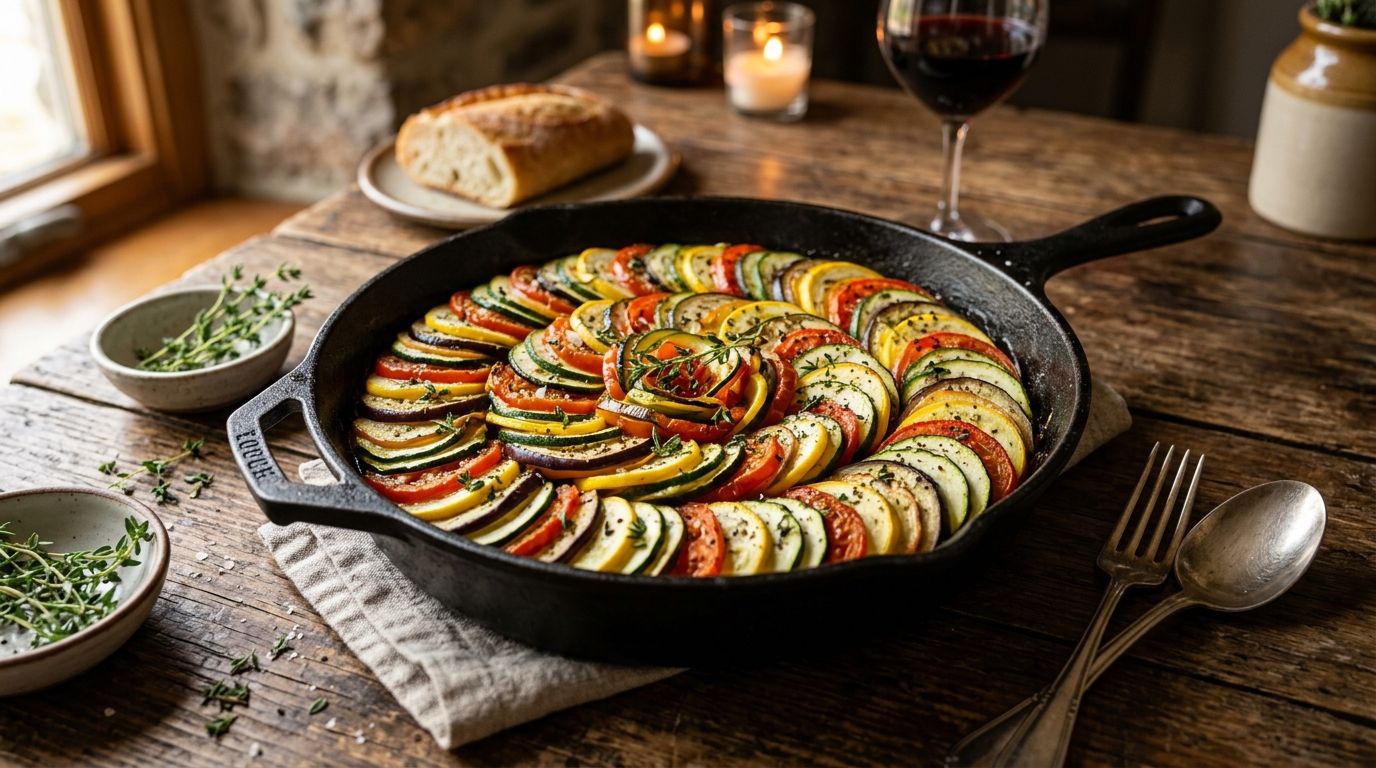
Confit byaldi is a refined variation of ratatouille, created by the French chef Michel Guérard, one of the fathers of the so-called nouvelle cuisine and of slimming cuisine (the *cuisine minceur*). Instead of the rustic stew, confit byaldi arranges the vegetables — eggplant, zucchini and tomato — in thin, carefully layered slices, slowly baked until they reach a soft, concentrated texture.
Guérard's inspiration came from a traditional Turkish dish, and he adapted the idea to the aesthetic of French haute cuisine, aligning ratatouille with the elegance and precision of contemporary cooking. Confit byaldi represents, thus, a break with the rustic tradition: no longer a stirred stew, but a geometric, almost architectural composition of layered vegetables. It is ratatouille reinterpreted as art.
Chapter
7.2 Thomas Keller's Layered Version: The Ratatouille of the Film That Enchanted the World
Confit byaldi gained worldwide fame at the hands of another chef: the American Thomas Keller, of the legendary The French Laundry restaurant in California. Keller was a culinary consultant for the film Ratatouille (2007), by Pixar, and created for the animation a version of confit byaldi — the vegetables in thin slices, arranged in a spiral over a base of tomato and pepper sauce — that became the definitive image of the dish in the popular imagination.
The final scene of the film, in which the rat chef Remy prepares this layered version for the food critic Anton Ego, is one of the most moving in the history of animation — and it turned Thomas Keller's confit byaldi into a global phenomenon. Millions of viewers came to know ratatouille through this elegant version, and the layered recipe began to be replicated in kitchens around the world.
Chapter
7.3 Rustic Ratatouille vs. Haute Cuisine Ratatouille: The Two Souls of the Dish
The history of ratatouille reveals two complementary souls. On one hand, the rustic ratatouille — the peasant stew, stirred in the pan, made with chopped vegetables and olive oil, faithful to the tradition of rustic Provençal cooking. On the other, the confit byaldi — the haute cuisine version, of vegetables in thin layers and geometric presentation, aligned with the aesthetic of great restaurants.
The two versions, although distinct, share the same essence: the summer vegetables of Provence, the olive oil and the herbs. What changes is the technique and the intention — the generous rusticity of a family dish against the elegant precision of a chef's work. For the appreciator, knowing the two souls of ratatouille is knowing the extraordinary versatility of a dish that moved, in a few decades, from the peasant garden to world haute cuisine.
Chapter
8. The 2007 Film Ratatouille and Pop Culture: How Pixar Turned a Regional Dish into a Global Icon
No dish in history owes as much to a film as ratatouille owes to Pixar's eponymous animation. Released in 2007, the film Ratatouille turned a regional Provençal stew into a planetary cultural icon, presenting it to an entire generation that might never have heard of it. This chapter tells the story of that phenomenon.
Chapter
8.1 The Story of the Film: The Rat Chef Remy and the Final Scene That Moved the World
The film Ratatouille (2007), directed by Brad Bird, tells the story of Remy, a rat with an extraordinary talent for cooking, who dreams of becoming a chef. After a series of adventures, Remy ends up in Paris, where he forms an unlikely partnership with Linguini, a clumsy young kitchen assistant. Together, they try to save the once-glorious restaurant Gusteau's.
The most famous — and most moving — scene of the film occurs at the climax: Remy prepares a ratatouille (in the confit byaldi version, layered) for the feared food critic Anton Ego. On tasting the dish, the critic is transported back to childhood, to the memory of the ratatouille made by his mother — and the scene captures, with rare sensitivity, the power of food to evoke memory and emotion. It is one of the most celebrated moments in the history of animation.
Chapter
8.2 How Did the Pixar Film Change the World's Perception of Ratatouille?
The impact of the film Ratatouille on the dish was immediate and lasting. Before 2007, ratatouille was known, outside France, mainly among appreciators of Mediterranean cuisine. After the film, it became a household name worldwide, and the recipe — especially the layered confit byaldi version — came to be sought out and reproduced by home cooks on a global scale.
The film also helped elevate the perception of the dish: from a simple vegetable stew, ratatouille came to be seen as something sophisticated, worthy of a great restaurant. The Pixar animation did, in a single scene, what decades of cookbooks had not achieved: it turned ratatouille into a pop culture phenomenon, associated with haute cuisine, emotional memory and emotion.
Chapter
8.3 Ratatouille in Pop Culture: From Haute Cuisine to Social Media
After the film, ratatouille consolidated itself as an icon of gastronomic pop culture. On social media, the dish — especially the spiral confit byaldi version — became one of the most photographed and shared of world cuisine, with its vibrant colors and geometric presentation making for irresistible images. Preparation videos and photos of plated dishes accumulate millions of views.
In haute cuisine, ratatouille continues to inspire chefs, who reinterpret it with rare vegetables, precise techniques and contemporary presentations. And, in popular culture in the broad sense, the name "ratatouille" became synonymous with sophisticated French cooking — a cultural shorthand that evokes, at once, Provence, haute cuisine and the magic of cinema. Few dishes have achieved such a presence in the collective imagination.
Chapter
9. The Regional Variations and Related Dishes of Ratatouille: From Piperade to Tian
Ratatouille does not stand alone: it belongs to a vast family of vegetable dishes that, across the Mediterranean basin, celebrate the abundance of the summer garden. From Basque piperade to Italian caponata, from Catalan samfaina to Middle Eastern shakshuka, each cuisine has its own version of the vegetable stew. This chapter travels that gastronomic family.
Chapter
9.1 Piperade of the Basque Country and Bohémienne of Vaucluse: The Cousins of Ratatouille
Piperade is the Basque cousin of ratatouille — a dish of southwestern France made of bell peppers, tomatoes and onions, cooked in olive oil, to which beaten eggs or ham are often added. It is a simpler preparation, centered on the pepper, which shares with ratatouille the soul of the southern vegetable stew.
The bohémienne, from the Vaucluse region, is a Provençal variation close to ratatouille, made with eggplant, tomato and onion. The difference between these dishes and ratatouille is often only the exact combination of vegetables and the presence or absence of eggs and meats. All belong to the same great family — that of Mediterranean cuisine turning summer vegetables into generous dishes.
Chapter
9.2 The Provençal Tian: The Baked Vegetable Dish Confused with Ratatouille
The tian is the closest Provençal relative of ratatouille — and the one that causes the most confusion. The name designates, at once, the dish and the earthenware vessel in which it is baked. Unlike ratatouille, which is a stew stirred in the pan, the tian is prepared with sliced vegetables, arranged in layers in the earthenware vessel and baked in the oven, often gratinéed.
The essential difference lies in the technique: ratatouille is cooked on the stove, stirred, into an unctuous stew; the tian is baked in the oven, in layers, with a drier texture and a lightly golden surface. Both, however, celebrate the same summer vegetables and the same olive oil of Provence. Knowing the difference between tian and ratatouille is what separates the curious tourist from the gastronomic traveler.
Chapter
9.3 Caponata, Samfaina and Shakshuka: The Mediterranean Relatives of Ratatouille
The family of ratatouille extends across the whole Mediterranean. Sicilian caponata is a sweet-and-sour stew of eggplant, tomato, celery, olives and capers, seasoned with vinegar and sugar; Catalan samfaina combines eggplant, pepper and tomato, similar to ratatouille; and Middle Eastern shakshuka is a stew of tomato, pepper and onion, in which eggs are poached.
All these preparations share the same fundamental idea: summer vegetables cooked in olive oil, celebrating the abundance of the Mediterranean garden. From Spanish pisto to Mallorcan tombet, from Georgian ajapsandali to Hungarian lecsó, each cuisine developed its own expression. Ratatouille is, in that sense, part of a culinary heritage common to the whole Mediterranean basin — proof that great vegetable cooking is a universal inheritance.
Chapter
10. How to Pair Ratatouille: The Best Wines, Side Dishes and Moments to Serve the Dish
A great dish deserves a great table. The pairing of ratatouille — the choice of the wine that accompanies it, of the side dish that sustains it and of the occasion on which it is served — is the final chapter of the experience, and the one that most reveals the gastronomic culture of Provence. This chapter gathers the classic rules and the welcome freedoms for serving the dish in its splendor.
Chapter
10.1 Which Wine to Serve with Ratatouille? The Golden Rule of Provençal Pairing
The golden rule of pairing ratatouille is to serve a wine from the region itself — a dry, fruity rosé from Provence, which is, indeed, the birthplace of rosé. Provençal rosés, light, fresh and aromatic, pair perfectly with the lightness and acidity of the vegetables, without competing with them. It is the most classic and elegant combination.
Light reds of the region, such as a Côtes de Provence or a young Bandol, also serve well, especially when ratatouille accompanies meats. And, on hot summer days, a dry white from the south — such as a Cassis or a Côtes de Provence blanc — is a refreshing alternative. The principle is the same as for all Mediterranean cuisine: light- to medium-bodied wines, served cool, that respect the delicacy of the vegetables.
Chapter
10.2 Bread, Rice or Polenta: What Is the Classic and Definitive Side Dish for Ratatouille?
Ratatouille is, in itself, a versatile dish — it can be a side dish or a main course. As a side dish, it wonderfully accompanies grilled meats, fish and poultry, or eggs. As a main course, it asks for sustenance: the classic is rustic bread, used to soak up the unctuous sauce; rice, white or aromatic-grain, which welcomes the vegetables; and creamy polenta, which offers a velvety base.
Some also serve ratatouille with pasta, quinoa or couscous, and some use it as a filling for omelets, tarts or quiches. Versatility is one of the dish's great virtues: it adapts to any context, from the picnic to the festive dinner. The principle, however, remains: the side dish must be neutral enough to let the vegetables shine.
Chapter
10.3 When to Eat Ratatouille? The Seasonality of the Provençal Summer Dish and the Best Occasions
Ratatouille is, by nature, a summer dish — the dish of the season when the vegetables that compose it are at their peak of flavor and abundance. It is the dish of outdoor lunches, of picnics, of the light meals of hot days, when the garden offers tomatoes, eggplants, zucchinis and peppers in profusion. Its association with summer is so strong that preparing it out of season is almost a contradiction for purists.
That does not prevent ratatouille from being enjoyed all year round — and it is, indeed, a classic of tables in all seasons, served hot in winter and cold in summer. The advice of connoisseurs is only to respect the spirit of the dish: to use ripe, quality vegetables, and to serve it with the time and calm it deserves. Because ratatouille is, above all, a celebration of summer — of the garden, the sun and the table.
Chapter
11. Where to Eat the Best Ratatouille in France: From Nice to the Restaurants of Provence
Tasting ratatouille in its territory is an experience that every lover of good food should pursue. Whether in a bistro of Nice, facing the Mediterranean, or in a starred restaurant of Provence, the dish reveals, in each place, a distinct personality. This chapter traces a route to find it at its best.
Chapter
11.1 The Best Restaurants in Nice to Try Authentic Ratatouille Niçoise
In Nice, the birthplace of ratatouille niçoise, the dish is prepared with a sense of place that no other restaurant in the world can imitate. The bistros and restaurants of the city serve the vegetable stew according to recipes handed down between generations, almost always with ripe local vegetables, regional olive oil and fresh herbs. It is in Nice that one tastes ratatouille in its purest, most faithful form.
The Niçoise experience is completed by the products that accompany the dish: the olive oil of Provence, the local breads, and the rosé wines served a few miles from where they are born. For the traveler who wants the full context, it is worth combining lunch with a visit to the Cours Saleya market, where the vegetables that compose ratatouille are sold in their splendor — turning the meal into an immersion in the terroir that gives the dish its name.
Chapter
11.2 The Restaurants of Provence That Elevated Ratatouille to Haute Cuisine
In Provence, ratatouille was elevated to haute cuisine by chefs who reinterpreted it with refined techniques. The confit byaldi of Michel Guérard, and the layered version of Thomas Keller, paved the way for a generation of chefs who treat the dish with the same rigor as any great culinary creation. In starred restaurants of the region, ratatouille appears in presentations that are true works of art.
These reinterpretations, however, rarely abandon the essence of the dish: the summer vegetables, the olive oil and the herbs of Provence. The respect for the original recipe is, in itself, a declaration — proof that a dish born of peasant economy reached a level of excellence that haute cuisine reveres. For the appreciator, tasting a chef's ratatouille is to experience the two souls of the dish in a single meal.
Chapter
11.3 How Much Does a Ratatouille Cost in a French Restaurant? The Complete Price Guide
The price of ratatouille in restaurants varies widely according to the establishment. In a bistro of Nice or Provence, the dish usually figures between 12 and 18 euros as a main course, and less as a side dish. In starred restaurants, where ratatouille appears in tasting menus or as a garnish for sophisticated dishes, the value is incorporated into the price of the menu — and can vary from 30 to 100 euros or more for the complete experience.
The question "is it worth it?" has an almost unanimous answer among connoisseurs: yes. Eating the dish in France is to experience it in the context for which it was created — with the right vegetables, the right oil and the right atmosphere —, something that no homemade version fully reproduces. Moreover, ratatouille is one of the most democratic dishes of French cuisine: for a fair price, it delivers flavor, health and the soul of Provence. It is, in the end, one of the best cost-benefits of Mediterranean gastronomy.
Chapter
12. Curiosities, Myths and Surprising Secrets of Ratatouille That Will Forever Change How You Look at the Dish
Behind every great dish there is a treasure of little-told stories. Ratatouille accumulates myths, misunderstandings and curiosities that surprise even the most dedicated appreciators — from its humble origin to its consecration as a symbol of healthy eating. This chapter gathers the secrets and surprises that reveal the dish in an entirely new light.
Chapter
12.1 Is Ratatouille Really a Healthy Vegetarian Dish? The Truth About the Traditional Recipe
Ratatouille is, indeed, a vegetarian and vegan dish in its classic form — made exclusively of vegetables, olive oil and herbs. But the fame of "light dish" deserves a clarification: the traditional recipe uses olive oil in abundance, and the slow cooking concentrates the natural sugars of the vegetables. A generous portion of ratatouille, although vegetal, is not free of calories.
That does not diminish, however, its nutritional qualities. Ratatouille is rich in fiber, vitamins and antioxidants, thanks to the variety of colorful vegetables that compose it — and it is one of the dishes most associated with the celebrated Mediterranean diet. The truth, therefore, is twofold: ratatouille is an extraordinarily healthy vegetable dish, but, like every dish cooked in olive oil, it should be enjoyed with balance.
Chapter
12.2 Why Doesn't Ratatouille Have a Single Official Recipe? The Mystery of the Regional Variations
Unlike dishes protected by rigorous origin seals, ratatouille does not have a single, official recipe. Food journalist Felicity Cloake, of the Guardian newspaper, observed that, considering the relatively recent origins of the dish, there is a great variety of methods for preparing it. There is no regulatory council that legally determines which vegetables are mandatory or how they should be cooked.
This absence of canon is the key to the dish's vitality. Each family, each town and each chef has its own version — some with more tomato, others with more eggplant, some cooking everything together, others separately. Ratatouille is, in that sense, a living, democratic dish, renewed in each kitchen. The rule that unites it is deeper than any recipe: summer vegetables, olive oil and herbs of Provence.
Chapter
12.3 Was Ratatouille Created by Peasants or Chefs? The Truth About the Dish's Humble Origin
Ratatouille was born in the kitchens of the peasants of Provence — not in those of chefs. It was the practical answer to the surplus of summer vegetables, a dish of economy that made use of the garden's abundance. The chefs only arrived later, at the end of the 20th century, to reinterpret and elevate the dish to haute cuisine — but the original creation is anonymous and popular.
This humble origin is, paradoxically, what gives ratatouille its nobility. Like so many great dishes of French cuisine, it was born of the necessity and the practical wisdom of generations of anonymous cooks, who turned simple ingredients into a celebration of summer. Ratatouille is, thus, proof that great gastronomy is not the privilege of chefs — it also flourishes in the most modest kitchens.
Chapter
12.4 Ratatouille and the Mediterranean Diet: The Dish That Embodies the World's Healthiest Eating
Ratatouille became, more than a dish, a symbol of the Mediterranean diet — recognized by science as one of the healthiest eating patterns in the world, and inscribed by UNESCO as intangible cultural heritage of humanity. With its colorful vegetables, olive oil and herbs, the dish perfectly embodies the principles of that eating: abundance of vegetables, healthy fats and simplicity.
This association elevated ratatouille to an almost emblematic status: it is, today, the image of Mediterranean eating throughout the world — the dish that demonstrates, with its vibrant colors, that eating well and eating healthily can be one and the same. From the peasant stew of Provence to the global icon of health, ratatouille traveled a remarkable path — and became, along the way, one of the most beautiful expressions of French cuisine.
Chapter
13. FAQ: The 15 Most Frequently Asked Questions About Ratatouille
Chapter
Which vegetables go into ratatouille?
The classic vegetables of ratatouille are tomato, onion, garlic, zucchini, eggplant and bell pepper, seasoned with herbes de Provence (basil, marjoram, thyme, bay leaf and, at times, fennel) and cooked in olive oil. The list admits variations — some recipes add squash, others dispense with the pepper — but these six vegetables form the core of the dish.
Chapter
Is ratatouille vegan or vegetarian?
Yes. Classic ratatouille is a vegetarian and vegan dish, made exclusively of vegetables, olive oil and herbs. It contains no meat, dairy or eggs. It is, therefore, one of the most inclusive dishes of French cuisine — and one of the emblems of Mediterranean plant-based eating.
Chapter
What is the difference between ratatouille and confit byaldi?
The difference lies in technique and presentation. Traditional ratatouille is a rustic stew, made with chopped vegetables, stirred and cooked together in the pan. Confit byaldi, created by chef Michel Guérard, is a haute cuisine variation, in which the vegetables are cut into thin slices and arranged in layers, slowly baked. Confit byaldi became famous through the spiral version in the Pixar film.
Chapter
Can I make ratatouille in the oven?
Yes, it is possible. Although traditional ratatouille is cooked on the stove, there are oven-baked versions — and the Provençal tian, its relative, is exactly that: sliced vegetables baked in an earthenware vessel. Baking the vegetables concentrates their flavors and creates a drier, lightly golden texture. The result differs from the pan stew, but is equally delicious.
Chapter
Which olive oil to use in ratatouille?
The ideal is a good-quality extra virgin olive oil, preferably from Provence or southern France. The oil is the soul of ratatouille — it conducts the cooking and brings that fruity, slightly peppery flavor of Mediterranean cuisine. A poor oil compromises the whole dish; a good oil elevates it.
Chapter
Is ratatouille healthy?
Yes, very much so. Ratatouille is rich in fiber, vitamins and antioxidants, thanks to the variety of colorful vegetables that compose it — and it is one of the dishes most associated with the Mediterranean diet, recognized as one of the healthiest in the world. It is worth remembering, however, that the traditional recipe uses olive oil in abundance, so the dish is not calorie-free, despite being vegetal.
Chapter
Can I freeze ratatouille?
Yes, and very well. Ratatouille is one of the dishes that best withstand freezing, thanks to its stew-like texture. Frozen in a well-sealed container, it keeps for up to three months. When thawing, do so slowly in the refrigerator and reheat over low heat. The texture of the vegetables may soften a little more, but the flavor remains excellent.
Chapter
What is the difference between ratatouille and tian?
The difference lies in the technique. Ratatouille is a stirred stew, cooked on the stove, with the vegetables chopped and sautéed until they form an unctuous whole. The tian is baked in the oven, with the vegetables sliced and arranged in layers in an earthenware vessel, resulting in a drier texture and a golden surface. Both use the same vegetables of Provence, but they are distinct dishes.
Chapter
Which wine to serve with ratatouille?
The ideal is a dry rosé from Provence — light, fresh and fruity, which pairs perfectly with the lightness of the vegetables. A light red from the region (Côtes de Provence or young Bandol) or a dry white from the south also serve well. The rule is that of Mediterranean cuisine: light- to medium-bodied wines, served cool.
Chapter
Does ratatouille necessarily contain eggplant?
In the traditional recipe, yes — eggplant is one of the essential vegetables of ratatouille, bringing body and a characteristic meaty texture. However, there are regional and personal variations that dispense with it, and the dish admits that flexibility. If you do not appreciate eggplant, you can prepare a ratatouille without it, although the result will differ from the classic.
Chapter
Who created ratatouille?
Ratatouille was not created by a chef, but was born in the kitchens of the peasants of Provence, as a solution for using up the surplus of summer vegetables. Its modern version only consolidated in the early 20th century. The confit byaldi, the haute cuisine variation, was created by chef Michel Guérard and popularized by Thomas Keller in the Pixar film.
Chapter
Can ratatouille be served cold?
Yes. Ratatouille is one of the rare dishes served equally well hot or cold. Cold, it is a classic of picnics and summer meals, with the flavors even more integrated after the rest. Hot, it comforts and accompanies meats, fish or eggs. This versatility is one of the dish's great virtues.
Chapter
How many calories does ratatouille have?
An average portion of ratatouille contains between 150 and 250 calories, varying according to the amount of olive oil used. It is a relatively light dish for a stew, thanks to its exclusively vegetable base. With side dishes such as bread, rice or polenta, the total caloric value of the meal increases, but ratatouille itself remains a light option.
Chapter
Does ratatouille improve the next day?
Yes, and it is not a myth. Ratatouille improves after a night of rest, because the vegetables continue to absorb the juices and the aromas of the oil and the herbs, and the flavors merge and round out. It is one of the rare dishes that genuinely benefit from being prepared in advance — and that are served, the next day, even better.
Chapter
What does the word "ratatouille" mean?
The word ratatouille derives from the Occitan term ratatolha, linked to the French verb touiller, which means "to stir" or "to toss." The dish's name comes, therefore, from the act of stirring the vegetables in the pan. In the 19th century, the word had a pejorative sense, describing a coarse stew; today, it is synonymous with one of the most celebrated dishes of French cuisine.