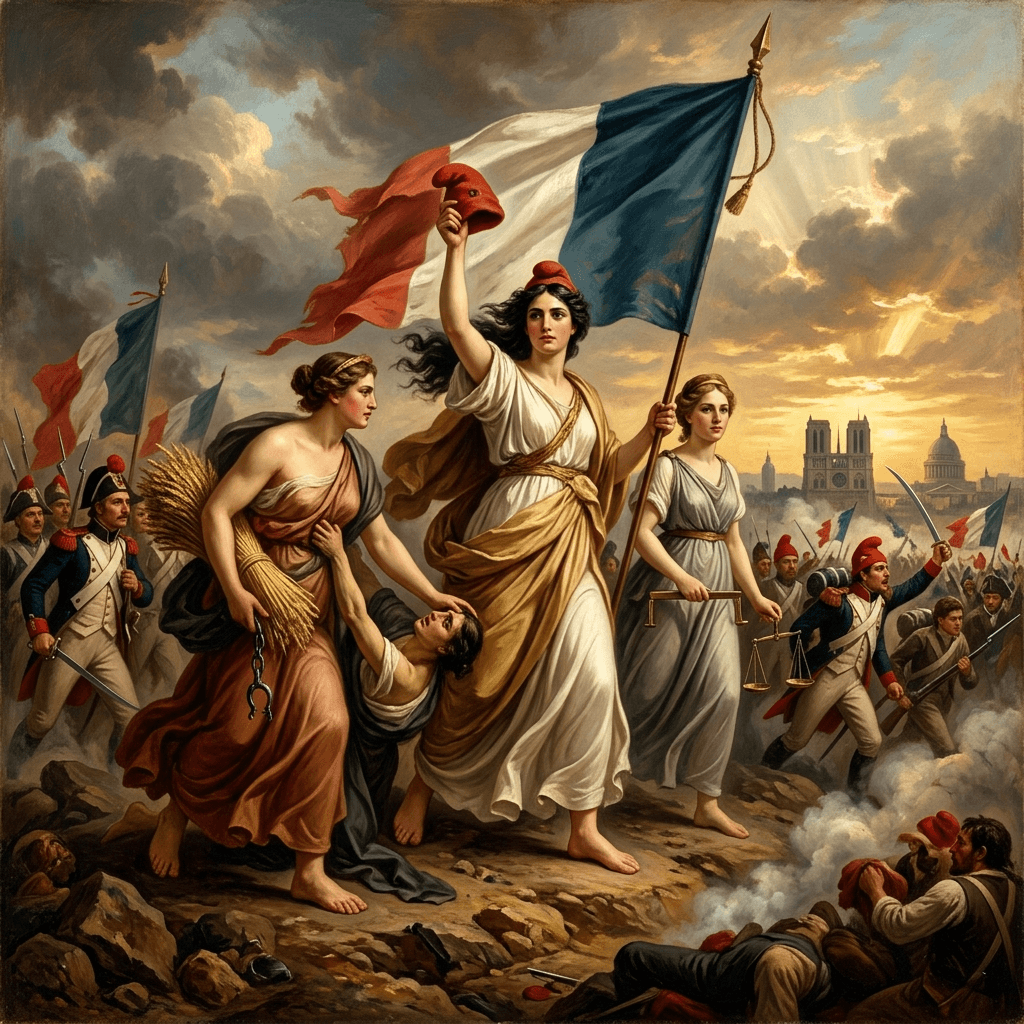
Chapter
1. The Mysterious Origin of the Motto: Who Really Created "Liberty, Equality, Fraternity"?
Chapter
1.1 Robespierre and the Lost Speech of 1790: The Proposal That Was Never Delivered
In December 1790, at the height of the first revolutionary upheavals, Maximilien de Robespierre — then a modest deputy of the National Constituent Assembly, known for his hoarse voice and unshakable conviction — wrote a speech that would forever change France's symbolism, although he himself never delivered it aloud. The text, entitled "Discours sur l'organisation des gardes nationales" (Speech on the Organization of the National Guards), was printed and distributed throughout France by the Popular Societies, reaching a capillarity that few revolutionary documents achieved.
In Article XVI of his draft decree, Robespierre proposed that national guard soldiers wear on their chests a plaque engraved with the words: "LE PEUPLE FRANÇAIS" and, below, "LIBERTÉ, ÉGALITÉ, FRATERNITÉ". He further decreed that the same words be inscribed on regimental banners, which already bore the three colors of the nation. The proposal was revolutionary not only in content but in military symbolism: for the first time, an army — created to defend the Revolution — would literally carry on its chest the values it was meant to protect.
The speech was never delivered because debates on the organization of the national guards were repeatedly postponed in the National Constituent Assembly. Robespierre prepared the text for the sessions of December 5, 1790 and subsequently for April 27 and 28, 1791, but on both occasions the agenda was diverted by political urgencies — the king's flight to Varennes, the economic crisis, the popular uprisings. The draft decree, like so many others in the revolutionary turmoil, simply never came to a vote.
The historical irony is monumental: the man who would later be accused of plunging the Revolution into the bloodbath of the Terror (1793-1794) was the same one who first formalized the most humanist triptych in modern history. Robespierre, educated at the Lycée Louis-le-Grand in Paris, an avid reader of Rousseau and Montesquieu, saw in the triad not merely a slogan, but a program of government. For him, liberty without equality was privilege, equality without fraternity was civil war, and fraternity without liberty was servitude disguised as solidarity.
Scholars at the Institute of the History of the French Revolution (IHRF) at Sorbonne Université point out that Robespierre's 1790 speech is the first known official document to bring the three words together in fixed sequence with programmatic intent. Before him, the words circulated separately in pamphlets, speeches in political clubs, and newspaper articles, but had never been consecrated as a formal triad in a legislative bill.
For the tourist visiting France today who sees the motto emblazoned on every town hall, school, and courthouse, knowing that the formula was born from a speech never delivered — printed, yes, but silenced by the chaos of History — adds a layer of drama to these three words as often repeated as they are misunderstood.
Chapter
1.2 The First Official Appearance: Why Did It Appear on the Flags of the Federates in 1790?
If Robespierre was the first to write the motto in an official document, Camille Desmoulins — the bulging-eyed, sharp-tongued lawyer who incited the fall of the Bastille with his speech at the Palais-Royal in July 1789 — was the first to utter it in public. On July 26, 1790, in the 35th edition of his newspaper "Révolutions de France et de Brabant", Desmoulins described the Fête de la Fédération, the great celebration of national unity held at the Champ-de-Mars on July 14 of that year, exactly one year after the fall of the Bastille.
In his chronicle of the event, Desmoulins wrote: "the citizen-soldiers rush into each other's arms, promising each other liberty, equality, fraternity" ("les soldats-citoyens se précipiter dans les bras l'un de l'autre, en se promettant liberté, égalité, fraternité"). The described scene was powerful: more than 300,000 people gathered at the Champ-de-Mars, under a torrential rain that did not dampen popular enthusiasm, while La Fayette, hero of the American Revolution and commander of the National Guard, swore an oath to the nation, the law, and the king.
The Fête de la Fédération was the moment when the motto gained public visibility for the first time. The federates — volunteer militiamen from all provinces of France who came to celebrate national unity — carried flags and banners that already bore various inscriptions. Many carried banners with the three terms, though still without the fixed order that Robespierre would consecrate months later. Some bore "Liberty and Equality," others "Union and Fraternity," in a profusion of combinations that reflected the creative effervescence of the revolutionary period.
Why did the motto first appear on the flags of the federates and not in official decrees? The answer lies in the decentralized nature of the Revolution in its early days. The communes, political clubs, and popular societies acted with enormous autonomy, creating symbols and watchwords that would later be absorbed — or not — by the central government. The federates, coming from cities like Marseille, Lyon, Bordeaux, and Strasbourg, brought with them the regional variations of revolutionary ideology. It was this melting pot of influences that allowed the triptych to emerge organically, from the bottom up, long before it was sanctioned by any constituted authority.
Historian Mona Ozouf, one of the greatest French specialists in republican symbols, argues that the strength of the motto lies precisely in this popular and diffuse origin. Unlike other symbols created by decree — such as the Republican Calendar or the Cult of the Supreme Being — the triptych "Liberté, Égalité, Fraternité" was born on the streets, in clubs, newspapers, and café conversations, which gave it an authenticity that no edict could have bestowed.
Chapter
1.3 The Forgotten "or Death": How the Revolutionary Motto Was Originally Complete and Terrifying
The motto as we know it today — serene, humanist, almost paternal — is a sanitized version of its revolutionary original. The complete version, painted on the façades of Parisian public buildings from June 1793 by order of then-mayor Jean-Nicolas Pache, was: "Unité, indivisibilité de la République; Liberté, Égalité, Fraternité ou la mort" (Unity, indivisibility of the Republic; Liberty, Equality, Fraternity or death).
The "or death" was not rhetorical embellishment. In 1793, France was living through the most acute moment of the Revolution: King Louis XVI had been guillotined in January of that year, foreign powers — Austria, Prussia, England, Spain — formed the First Coalition to invade French territory and restore the monarchy, and internally the Vendée was exploding in a counter-revolutionary civil war. The Paris Commune, dominated by the most radical Jacobins, saw death as the inevitable horizon for anyone who dared betray the Revolution — and also as the likely fate for the revolutionaries themselves, should they fail.
The original inscription on Parisian façades — including that of the Hôtel de Ville (Paris City Hall) — associated the motto with "Unité" and "Indivisibilité" of the Republic because, at that moment, the revolutionaries' greatest fear was the fragmentation of national territory. Provinces were rebelling, generals were deserting, and federalism — the decentralization of power — was seen as treason. The "or death" functioned as both a warning and a declaration of absolute commitment.
With the end of the Terror (July 1794) and the execution of Robespierre himself, the association of the motto with the guillotine became too heavy a burden. The new leadership — the Thermidorians, who took over after Robespierre's fall — moved to eliminate the "or death" from all public inscriptions. The word "death" was erased from façades, scraped off official seals, and removed from documents. In its place, only the stripped-down triptych we know today remained.
Curiously, some historians point out that the "or death" was never officially abolished by law — it simply fell into disuse, victim of its own symbolic weight. In Mauritius and some former French colonies, versions of the motto with "or death" survived on coins and coats of arms until the 19th century. In France itself, the memory of the "or death" remained alive in popular culture: in 1830, during the July Revolution, insurgents once again painted the complete version on the barricades of Paris, in a conscious attempt to recover the original radicalism of the Revolution.
For the visitor strolling through Paris today who sees the serene motto on the pediments of public buildings, it is almost impossible to imagine that those same words were once followed by a threat of summary execution. But this duality — the humanist ideal and revolutionary violence — is the key to understanding not only the motto, but the entire history of modern France.
Chapter
1.4 The Hidden Influence of the Enlightenment Thinkers: Rousseau, Voltaire, and Montesquieu Behind the Words
None of the three words of the motto was invented by the French Revolution. They are the direct legacy of the Age of Enlightenment (Siècle des Lumières), the philosophical movement that, throughout the 18th century, transformed the way Europeans thought about politics, society, and individual rights. The three names that most influenced the triad were Jean-Jacques Rousseau, Voltaire (François-Marie Arouet), and Charles de Montesquieu, each contributing in a distinct way to the meaning of each term.
Rousseau was the most radical of the three. In his "The Social Contract" (1762), he argued that sovereignty resides in the people and that the general will — not the will of the king — is the only legitimate source of laws. For Rousseau, liberty was not simply doing as one pleased, but obeying laws one has given to oneself. His vision of equality was equally demanding: he believed that economic inequality corrupted civic virtue and that a republic could only function if there were a minimum of material equity among citizens. It is Rousseau who stands behind the idea that liberty and equality are inseparable — a thesis that Robespierre, his avowed disciple, would take to the extreme.
Voltaire, in turn, was the champion of freedom of expression and religious tolerance. Exiled in England between 1726 and 1729, he returned to France impressed by the British parliamentary system and the relative press freedom he found there. His "Treatise on Tolerance" (1763), written after the unjust execution of the Protestant Jean Calas in Toulouse, became a manifesto against religious intolerance that would directly echo in Article 10 of the Declaration of the Rights of Man and of the Citizen of 1789: "No one shall be disturbed for their opinions, even religious ones." In practice, Voltaire contributed more to the concept of "Liberté" than to "Égalité" or "Fraternité," but his intellectual prestige gave the revolutionary ideology an unquestionable philosophical foundation.
Montesquieu completed the tripod with his theory of the separation of powers, expounded in "The Spirit of the Laws" (1748). For him, political liberty was only possible when the legislative, executive, and judicial powers were separated and balanced each other. Although the motto does not explicitly mention the division of powers, the idea that liberty depends on well-designed institutions — and not merely on good intentions — is a directly Montesquieu-inspired contribution to the ideology of 1789.
Beyond the three giants, other Enlightenment thinkers contributed to the intellectual ferment that brewed the motto. Denis Diderot, editor of the "Encyclopédie" (1751-1772), the greatest collective work of the Enlightenment, championed reason as a tool of human emancipation. Marquis de Condorcet, in his "Sketch for a Historical Picture of the Progress of the Human Mind" (1795), wrote that human perfectibility was infinite and that history walked inevitably toward a future of liberty and equality. Jean Le Rond d'Alembert, mathematician and co-editor of the Encyclopédie, contributed the rationalist rigor that characterized Enlightenment thought.
What the revolutionaries of 1789-1793 did was not invent new ideas, but synthesize decades of philosophy into three words of immediate impact. That is why Michelet, the great French romantic historian, would later say that the French Revolution was "the entrance of the people onto the stage, and not of a man" — the ideas were already ripe; the Revolution merely harvested them.
Chapter
1.5 The Masonic Question: Did the Freemasons Really Create the Motto?
One of the most persistent — and controversial — theories about the origin of the motto is its alleged creation by Freemasonry. The connection is not absurd: the motto "Liberté, Égalité, Fraternité" is also the official motto of the Grand Orient de France (GODF) and the Grande Loge de France, two of the country's main Masonic obediences. Since 1848, the motto has been present on the throne of the Grand Masters of Latin Freemasonry, and many of the revolutionaries of 1789 were avowed Masons.
The numbers are impressive: of the 1,154 deputies elected to the Estates General of 1789, an estimated 300 to 400 were Masons, including figures such as Marquis de La Fayette, Mirabeau, Danton, and possibly Robespierre himself (although there is no definitive documentary proof of his membership). French Masonic lodges of the 18th century — such as the Lodge of the Nine Muses and the Lodge of the United Arts — were true laboratories of Enlightenment ideas, where nobles, bourgeoisie, and clergy discussed political philosophy under conditions of hierarchical equality, something unthinkable in the society of the Old Regime.
However, the claim that Freemasons "created" the motto is a historical exaggeration. What the evidence shows is that Freemasonry adopted and propagated the motto, but did not invent it. The Grand Orient de France, founded in 1773, already used variations of the triptych in its rituals — especially "Liberté" and "Égalité" — but the joining of the three words in a fixed sequence only occurred after Robespierre's formalization in 1790 and, later, by the Constitution of 1848.
What makes the Masonic connection particularly interesting is the concept of "fraternité". Freemasonry is, by definition, an initiatic fraternity — its members call each other "brothers" and its rituals emphasize solidarity among the initiated. It was probably from Masonic lodges that the term "fraternité" gained its political connotation, moving from the religious sphere (Christian fraternity) to the secular (fraternity among citizens). Historian Pierre Chevallier, in his study "Histoire de la Franc-Maçonnerie Française", argues that Freemasonry functioned as a "bridge" between Enlightenment ideology and revolutionary political practice, and that the motto is one of the clearest examples of this mediation.
During the period of the Restoration (1814-1830), when the motto was banned from public spaces, it was the Masonic lodges that kept the flame of the triptych alive, using it in their rituals and private ceremonies. When the Revolution of 1848 finally consecrated the motto as official, the Masons proudly claimed the role of guardians of the triad during the "dark years" of the Empire and the restored monarchy.
To this day, the motto is a central part of French Masonic ritual. In the initiation ceremony of the Entered Apprentice Degree, the new Mason is reminded that "Liberté, Égalité, Fraternité" is not only the motto of the Republic but the foundation of the initiatic quest for truth and moral perfectibility. For the tourist visiting France who sees the motto on the pediments of public buildings, it may be fascinating to know that in hundreds of Masonic lodges scattered across the country, the same words are spoken every week in rituals dating back to the 18th century.
Chapter
2. The Dark History: From Revolution to Empire and Back to Republic
Chapter
2.1 The Reign of Terror (1793-1794): Why Was the Motto Associated with the Guillotine?
Between September 1793 and July 1794, France lived through its darkest and most contradictory period since the beginning of the Revolution. The Committee of Public Safety, dominated by Maximilien de Robespierre, Louis Antoine de Saint-Just, and Georges Couthon, instituted what became known as "the Terror" — a state of exception that suspended individual guarantees in the name of defending the Revolution against internal and external enemies. It was in this context that the motto "Liberté, Égalité, Fraternité" acquired its most radical and bloody version.
In June 1793, Jean-Nicolas Pache, then mayor of the Paris Commune and an ally of the Jacobins, ordered that all public buildings in the capital be painted with the inscription: "Unité, indivisibilité de la République; Liberté, Égalité, Fraternité ou la mort". The "or death" was not empty rhetoric. During the Terror, an estimated 16,594 people were officially sentenced to death by guillotine throughout France, with 2,639 in Paris alone, at the Place de la Révolution (now Place de la Concorde). Of these, about 15% were nobles, 25% clergy, and 60% belonged to the Third Estate — peasants, artisans, and bourgeoisie — revealing that the guillotine did not discriminate by class.
The association of the motto with the guillotine was inevitable and tragic. The same walls that displayed "Liberté, Égalité, Fraternité" saw the condemned pass by in carts on their way to execution. Historian Mona Ozouf, in her classic essay in the "Lieux de Mémoire" (1992), observes that the Terror created a "symbolic schizophrenia" in revolutionary France: the most humanist motto ever conceived was proclaimed precisely at the moment when thousands of people were being executed for crimes such as "incivisme," "conspiracy," or "lack of revolutionary enthusiasm."
The pinnacle of this contradiction was the execution of Camille Desmoulins himself — one of the first to use the motto publicly — and of Danton, both guillotined on April 5, 1794, on charges of "indulgence" (opposing the Terror). Desmoulins, who in 1790 had described citizen-soldiers promising each other "liberty, equality, fraternity," died under the sign of the very words he had helped popularize. Only three months later, on July 28, 1794, Robespierre himself — the author of the 1790 speech that formalized the triptych — would be guillotined without trial, victim of the same Terror he had helped institutionalize.
With the fall of Robespierre and the end of the Terror (9 Thermidor Year II, in the republican calendar, equivalent to July 27, 1794), the new leadership — the Thermidorians — moved to dissociate the motto from violence. The "or death" was quickly removed from façades, scraped off official seals, and excluded from public documents. But the symbolic wound remained: for decades, "Liberté, Égalité, Fraternité" would be remembered by many as the motto that adorned the executions at the Place de la Révolution.
For the visitor walking through Paris today who encounters the serene motto on the pediments, understanding this tragic duality is essential. The motto of the French Republic bears the marks of its violent birth — and perhaps it is precisely this historical awareness that makes its three words so powerful and so complex.
Chapter
2.2 Napoleon and Oblivion: Why Did the Empire Abandon the Revolutionary Motto?
With the rise of Napoleon Bonaparte to power — first as First Consul in 1799, then as Emperor of the French in 1804 — the motto "Liberté, Égalité, Fraternité" was systematically relegated to oblivion. Napoleon did not formally abolish it by decree, but simply ignored it, replacing it with a new set of values that better served his imperial project: "Honneur et Patrie" (Honor and Fatherland) and "Gloire" (Glory).
Napoleon's reasons for abandoning the motto were both practical and ideological. First, the triptych was irredeemably associated with the Revolution — and Napoleon, although he presented himself as the heir of the Revolution, needed to distance himself from its most radical period to consolidate his personal power. The motto evoked the Convention, the Terror, the execution of the king — events that the new Napoleonic elite preferred to forget. Second, the concept of "Liberté" was problematic for an authoritarian regime: Napoleon ruled as a dictator, suppressing press freedom, dissolving elected assemblies, and centralizing power in his own hands.
From 1804, the date of the imperial coronation, the motto disappeared completely from official documents, coins, and public buildings. In its place, Napoleon promoted a new symbolic code: the imperial eagle (inspired by the Roman eagle and the Germanic eagle of Charlemagne), the golden bee (symbol of immortality and labor), and the crowned "N", which came to adorn monuments, uniforms, and buildings. The new unofficial motto of the Empire was "Tout pour le Peuple et par le Peuple" (Everything for the People and by the People) — a phrase that sounded republican but was, in practice, empty of democratic content.
Curiously, Napoleon did not completely eliminate the revolutionary heritage. The Napoleonic Civil Code of 1804 — which remains the basis of French law to this day — enshrined the principles of equality before the law, individual liberty, and private property, which were direct legacies of the Revolution. But the motto itself was banished from public spaces, surviving only in the memory of staunch republicans and in Masonic lodges, which continued to use it in their private rituals.
The restoration of the monarchy in 1814, with Louis XVIII, did not bring the motto back. On the contrary: the restored Bourbons promoted their own motto, "Le Roi, l'État, la Nation", and set about erasing any symbolic trace of the Revolution. During the 15 years of the Restoration (1814-1830) and the 18 years of the July Monarchy (1830-1848), the motto "Liberté, Égalité, Fraternité" lived in clandestinity — printed in secret pamphlets, painted on walls during insurrections, whispered in meetings of secret societies. It was the longest period of silence for the triptych, but also the period in which it transformed from a revolutionary slogan into a symbol of republican resistance.
Chapter
2.3 The Revolution of 1848: Louis Blanc and the Official Consecration of the Triptych
The Revolution of 1848 — known as the February Revolution — was the decisive moment for the official consecration of the motto. From February 22 to 24, 1848, a popular insurrection in Paris overthrew King Louis Philippe I and his July Monarchy, giving rise to the Second French Republic. It was in this context of revolutionary effervescence that "Liberté, Égalité, Fraternité" was finally adopted as the official motto of France.
The main intellectual architect of this adoption was Louis Blanc (1811-1882), journalist, historian, and socialist politician, member of the Provisional Government proclaimed on February 24, 1848. Blanc, author of the work "The Organization of Labour" (1839), was a staunch defender of the right to work and of state intervention in the economy to guarantee material equality among citizens. For him, the motto could not be merely an abstract declaration of principles — it had to be a concrete program of government.
On February 26, 1848, only two days after the proclamation of the Republic, the Provisional Government issued a decree officially adopting "Liberté, Égalité, Fraternité" as the national motto. The decree determined that the formula be inscribed "on all public buildings, flags, and official documents of the Republic." For the first time in history, the triptych ceased to be one slogan among many and became the official symbol of the French State.
The Constitution of November 4, 1848, which formally established the Second Republic, went a step further: in its Article IV, the motto was defined as "a principle" of the Republic, alongside "the Family, Work, Property, and Public Order." The inclusion of the motto in the Constitution was a victory for republicans, but it also reflected the tensions of the moment: while Louis Blanc and the socialists saw the motto as a commitment to economic equality, moderate republicans — such as Alphonse de Lamartine — interpreted it as a declaration of classical liberal principles, without redistributive implications.
Historian Maurice Agulhon, in his study "1848 ou l'Apprentissage de la République", highlights that the official adoption of the motto in 1848 was accompanied by an unprecedented religious dimension. Throughout France, priests celebrated "Christ-Fraternity" and blessed "trees of liberty" planted in public squares — an attempt to reconcile Catholicism with revolutionary republicanism. Thousands of trees were planted between March and May 1848, many with plaques bearing the full motto.
The official consecration of 1848, however, was short-lived. In December 1848, Louis Napoléon Bonaparte — nephew of Napoleon I — was elected President of the Republic with 74% of the vote. On December 2, 1851, he staged a coup d'état; on December 2, 1852, he proclaimed himself Emperor as Napoleon III. And, following in his uncle's footsteps, he moved to eliminate the motto from public spaces.
Chapter
2.4 The Republicans' Resistance: Why Did Many Want "Solidarity" Instead of "Equality"?
Not all French republicans embraced the triptych with open arms. Throughout the 19th century, an intense debate divided republican ranks: many wanted to replace "Égalité" with "Solidarité" (Solidarity), arguing that equality was a mathematical and abstract concept, while solidarity was an ethical and practical principle that better reflected republican ideals.
The main advocate of this replacement was the philosopher and politician Léon Bourgeois (1851-1925), a central figure of French "solidarism". In his work "Solidarité" (1896), Bourgeois argued that modern society was based on a "social debt" that every citizen incurred at birth — a debt of knowledge, infrastructure, culture, and security — and that the State's function was to guarantee that this debt was repaid through policies of social cooperation, not forced equality. For him, "solidarity" was a more precise and less threatening term than "equality," which sounded like social leveling and collectivism to the propertied classes.
The debate was not merely theoretical. Jules Ferry (1832-1893), the great reformer of French education and one of the fathers of the law of 1881-1882 that made primary education free, secular, and compulsory, was one of the republicans who preferred "solidarity" over "equality." Ferry believed that equality of opportunity — guaranteed by universal education — was sufficient for a just republic, and that material equality was an unrealistic and potentially authoritarian goal.
On the other side of the spectrum, Léon Gambetta (1838-1882), another giant of the Third Republic, defended keeping "Égalité" in the motto, arguing that without equality, liberty would become privilege. For Gambetta, the complete motto was essential to distinguish the French Republic from European constitutional monarchies, which also proclaimed liberty but lacked the courage to confront the structural inequalities of society.
Pierre Larousse (1817-1875), the celebrated lexicographer author of the "Grand Dictionnaire Universel du XIXe Siècle", contributed to the debate by defining "fraternité" in his dictionary as synonymous with modern "solidarity," stripping the term of its "evangelical halo" and associating it with the welfare role of the State. His definition influenced generations of republicans and helped consolidate the "social" interpretation of the motto that prevails to this day.
The debate between "Égalité" and "Solidarité" was never formally resolved — the word "Égalité" remained in the motto by decision of the Constitution of 1848 and, subsequently, the constitutions of 1946 and 1958. But the tension between the two concepts remains alive in contemporary French politics, especially in debates about income redistribution policies, affirmative action, and the welfare state. For the foreign visitor, understanding that the motto is the fruit of a century-old debate — not a monolithic consensus — is an essential key to grasping the complexity of the French Republic.
Chapter
2.5 The Third Republic and July 14, 1880: When the Motto Became Part of the Pediments
It was under the Third Republic (1870-1940) — the longest and most stable regime in France since the Revolution — that the motto "Liberté, Égalité, Fraternité" finally consolidated itself as a permanent national symbol, inscribed on the pediments of public buildings throughout French territory. The decisive year was 1880, when the republican government, led by President Jules Grévy and President of the Council Charles de Freycinet, took two measures that would forever change the symbolic landscape of France.
The first measure was the law of July 6, 1880, which established July 14 as the Fête Nationale (National Holiday) of France. Senator Henri Martin, author of the bill, chose July 14 — which had been the day of the Fête de la Fédération in 1790 — as a date of national reconciliation, associating it not only with the storming of the Bastille (1789) but also with the celebration of national unity (1790). It was a brilliant political move: by celebrating July 14, the Third Republic honored the Revolution without celebrating the Terror.
The second measure, directly linked to the first, was the determination that the motto "Liberté, Égalité, Fraternité" be inscribed on the pediments of all French public buildings — mairies (town halls), écoles (schools), bibliothèques (libraries), palais de justice (courthouses), and gendarmeries (police stations). The order, issued by the Ministry of Public Instruction under Jules Ferry, was executed in the following years, transforming the urban and rural landscape of France.
Jules Ferry, who was Minister of Public Instruction between 1879 and 1883, was primarily responsible for spreading the motto on school pediments. His laws of 1881-1882, which established free, secular, and compulsory primary education, determined that every public school in France display the motto on its façade — a measure aimed at educating new generations in republican values from childhood. To this day, every French public school displays the triptych at its entrance, following the tradition begun by Ferry.
Curiously, French coins had already borne the motto since 1871, nine years before the pediments. The 1, 2, 5, and 10 centime coins minted from 1871 already displayed "Liberté, Égalité, Fraternité" on their edge, along with the words "Dieu protège la France" (God protect France) on the 20 and 100 franc gold coins, which circulated until 1906 — a curious coexistence between the secular republican motto and the religious invocation, reflecting the tensions between anticlerical republicans and Catholic sectors of French society.
From 1880 onward, the motto never again disappeared from French public spaces — not even during the two world wars. During the Second World War, the collaborationist government of Vichy (1940-1944), led by Marshal Philippe Pétain, officially replaced the motto with "Travail, Famille, Patrie" (Work, Family, Fatherland), but the Free French, the Resistance, and the government of Charles de Gaulle in exile continued to use the triptych as a symbol of the fight against Nazism. When France was liberated in 1944, the original motto was immediately restored.
The constitutions of 1946 (Fourth Republic) and 1958 (Fifth Republic, the current one) definitively enshrined the motto in Article 2: "The motto of the Republic is 'Liberté, Égalité, Fraternité'." Today, the motto is present on all official documents, coins, stamps, public buildings, and the official logo of the French government — a journey of nearly two centuries from Robespierre's undelivered speech in 1790 to its definitive consecration as the ultimate symbol of French republican identity.
Chapter
3. The Three Pillars: The Deep and Contested Meaning of Each Word
Chapter
3.1 Liberty: The First and Oldest of the Three Words (Even Before the Republic)
"Liberté" is the oldest and most consensual of the three words of the republican motto. Unlike "Égalité" and "Fraternité," which have generated controversies over the centuries, liberty has always been the foundational value of the French Revolution — the first cry of resistance against monarchical absolutism. Even before the Republic was proclaimed in 1792, liberty was already invoked as a natural right of man in Article 1 of the Declaration of the Rights of Man and of the Citizen of August 26, 1789: "Men are born and remain free and equal in rights."
But what did "liberty" mean to the revolutionaries of 1789? The answer is complex and multifaceted. For liberals like Marquis de La Fayette and Mirabeau, liberty primarily meant individual liberty — of expression, press, religion, property — against the arbitrary intervention of the monarchical state. For Jacobins like Robespierre and Saint-Just, liberty meant something more: the active participation of the citizen in the political life of the nation, the "liberty of the ancients" (as historian Benjamin Constant would later describe it) as opposed to the "liberty of the moderns," more focused on the individual.
The concept of liberty in pre-revolutionary France was strongly influenced by John Locke, whose "Two Treatises of Government" (1689) defended liberty as an inalienable natural right. But it was Jean-Jacques Rousseau who gave French liberty its distinctive character. For Rousseau, in his "The Social Contract" (1762), true liberty was not doing as one pleases, but obeying laws one has given to oneself — the so-called "civil liberty", which replaces "natural liberty" (the unlimited right to everything) with liberty guaranteed by the rule of law.
Liberty was also the value that earliest found concrete expression in French legislation. The Le Chapelier Law of June 14, 1791, abolished the trade guilds, guaranteeing freedom of work. The Declaration of the Rights of Man and of the Citizen of 1789 enshrined freedom of opinion (Article 10), expression (Article 11), and property (Article 17). The Penal Code of 1791 abolished the tortures and corporal punishments of the Old Regime, establishing physical liberty as a fundamental principle of the judicial system.
In the 20th century, the concept of liberty was expanded to include not only negative liberty (not being oppressed by the State) but also positive liberty (having the material means to exercise freedom). This distinction, formulated by philosopher Isaiah Berlin in his essay "Two Concepts of Liberty" (1958), is essential for understanding contemporary debates about the motto in France: for the right, liberty is primarily non-intervention by the State; for the left, liberty requires public policies that guarantee equal access to education, health, housing, and work.
For the tourist arriving in France and encountering the motto, understanding that "Liberté" is the oldest and least controversial word of the triptych helps decode the French soul. Liberty is not just an abstract right for the French — it is an existential value, a mark of national identity, a legacy of 1789 that remains alive in every street protest, in every heated debate in Parisian cafés, in every general strike that paralyzes the country.
Chapter
3.2 Equality: The Most Contested Principle That Still Generates Heated Political Debates
"Égalité" is, without doubt, the most controversial and contested word of the republican motto. While liberty is a relatively consensual value — who could be against liberty? — equality has divided France since 1789 and continues to generate heated political debates in the 21st century. The fundamental question is: equality of what? Equality before the law? Equality of opportunity? Equality of outcome? Material equality?
Article 1 of the Declaration of the Rights of Man and of the Citizen of 1789 states that "men are born and remain free and equal in rights." This formulation — equality of rights, not of material conditions — reflects the liberal compromise of the Revolution: all are equal before the law, but economic inequality is accepted as natural and inevitable. Abbé Sieyès, one of the main theorists of the Revolution, wrote in his pamphlet "What Is the Third Estate?" (1789) that equality was a legal principle, not an economic one.
However, the more radical sectors of the Revolution — the enragés (the enraged) led by Jacques Roux and the Hébertists of Antoine-François Momoro — demanded a more substantive equality, including land redistribution, price controls on food, and progressive taxation of wealth. This tension between formal equality and real equality runs through all of French history and lies at the heart of contemporary political debates.
Philosopher Alexis de Tocqueville, in his masterpiece "Democracy in America" (1835-1840), was one of the first to diagnose the paradox: the French love equality more than liberty. Tocqueville observed that democratic societies tend to value equality above all else, even if it means sacrificing individual liberties. His prophetic analysis anticipated the debates between liberals and egalitarians that would dominate French politics in the following centuries.
In the 20th century, the debate about equality took on new contours with the rise of the welfare state (État-providence) after the Second World War. The National Council of the Resistance (CNR), in its program of March 15, 1944, laid the foundations for a "democratic and social regime" that included universal social security, nationalization of strategic sectors, and guarantees of labor rights. The Constitution of 1946 enshrined, in its preamble, "the solidarity and equality of all citizens before the burdens resulting from national calamities."
Today, equality remains at the center of French political debate. The discussion about affirmative action (discrimination positive) — adopted in the United States but rejected in France — reveals the deep division between those who defend formal equality (blind to differences) and those who defend material equality (which requires differentiated treatment for historically disadvantaged groups). The Observatory of Inequalities (Observatoire des Inégalités), based in Paris, publishes annual reports showing that France remains one of the most unequal countries in Europe, with the richest 10% holding 25 times more wealth than the poorest 10%.
For the foreign visitor, understanding that "Égalité" is a word in constant dispute — and not a peaceful consensus — is crucial to comprehending contemporary France. The motto is not a petrified monument, but a political battlefield where different visions of society confront each other daily.
Chapter
3.3 Fraternity: The Word That Changed Meaning the Most Over the Centuries
"Fraternité" is the most intriguing and most changeable word of the republican motto. Unlike liberty (a legal-political concept) and equality (a legal-economic concept), fraternity is a moral and religious concept — and it was precisely this religious origin that generated the greatest controversies about its inclusion in the motto.
The word "fraternité" has roots in Latin "fraternitas", which derives from "frater" (brother). Before the French Revolution, the term was used almost exclusively in religious contexts — Christian fraternity, which preached love for one's neighbor as a brother in Christ. The Catholic Church spoke of the universal fraternity of the children of God, a spiritual notion that had no direct political implications.
The French Revolution secularized the concept of fraternity, transforming it from a religious virtue into a civic value. The Cordeliers Club — one of the most radical political clubs of the Revolution — adopted the motto "Liberté, Égalité, Fraternité" as early as 1791, and it was the printer Antoine-François Momoro, a member of the Cordeliers, who popularized the term through his print shop. For Momoro, fraternity was the bond that prevented liberty from becoming selfishness and equality from becoming authoritarian leveling.
The debate about fraternity resurfaced forcefully during the Revolution of 1848, when the motto was officialized. Many moderate republicans resisted including fraternity because of its religious connotation, preferring terms like "solidarity" or "association." Pierre-Joseph Proudhon, the great anarchist theorist, criticized "fraternité" as "an empty word," associated with "idealist dreams of Romanticism." For Proudhon, true solidarity among men would come from economic organization, not from sentimental proclamations.
Writer and poet Charles Péguy (1873-1914), one of the most original figures of French thought, proposed a radical reinterpretation of fraternity. For Péguy, fraternity was a "feeling," something experienced in shared misery — not an abstract right like liberty and equality. He wrote: "Fraternity is what the poor feel for one another; equality is what the rich offer the poor so they don't have to give them fraternity."
In the 20th century, the concept of fraternity was reinterpreted by the labor movement and socialist parties as "class solidarity". The Socialist International adopted the motto, and the French Communist Party incorporated it into its symbolism, replacing "fraternité" with "solidarité" in some contexts. The French welfare state, built after 1945, can be seen as an institutionalization of fraternity — the recognition that all citizens are "brothers" who share common risks and deserve collective protection.
Recently, the French Constitutional Council gave "fraternité" a new legal status. On July 6, 2018, the Council recognized the principle of "fraternité" as a constitutional value and, based on it, declared certain provisions of the "délit de solidarité" (crime of solidarity) unconstitutional, which punished citizens who helped irregular immigrants. This historic decision made fraternity — for the first time — an active legal principle, not merely a decorative symbol.
For the visitor who today reads "Liberté, Égalité, Fraternité" on French pediments, the third word is perhaps the most mysterious. Unlike liberty (a right) and equality (a promise), fraternity is an invitation — a call to action, to solidarity, to the recognition of the other as equal in dignity. It is, as historian Mona Ozouf said, "the word that never finishes being invented."
Chapter
3.4 The Order of the Words: Why Does "Liberty" Come First and "Fraternity" Last?
The order of the words in the motto — "Liberté, Égalité, Fraternité" — is not random. It reflects a hierarchy of values that was the subject of intense debate among revolutionaries and continues to be discussed by philosophers and politicians to this day. The sequence is not merely aesthetic: it carries a deep philosophical and political logic.
Liberté comes first because it is the foundational value of the entire republican edifice. Without liberty, there is no citizenship — there are only subjects. Liberty is the precondition for all other rights: freedom of expression enables democratic debate, freedom of association allows political organization, freedom of conscience permits religious diversity. The revolutionaries of 1789 placed liberty first because the Revolution was, above all, a struggle for liberty against monarchical absolutism.
Égalité comes second because it is the principle that gives social content to liberty. A liberty without equality, the Jacobins argued, would be privilege — the liberty of the strong to oppress the weak. Equality tempers liberty, ensuring that the rights of one do not override the rights of another. Historian François Furet, in his study "Interpreting the French Revolution" (1978), observed that the pair "Liberté-Égalité" forms a productive tension that defines modern French politics: liberty pulls to the right, equality pulls to the left, and the balance between them is what keeps the Republic in motion.
Fraternité comes last for three fundamental reasons. The first is chronological: fraternity was the last of the three words to be incorporated into the political lexicon, appearing consistently only after 1791. The second is philosophical: fraternity is the crowning of the motto — that which prevents liberty and equality from annihilating each other. Without fraternity, liberty becomes selfish individualism and equality becomes oppressive collectivism. Fraternity is the social cement that holds the other two words together.
The third reason is practical: fraternity has always been the most difficult to institutionalize. While liberty can be guaranteed by laws (freedom of expression, freedom of the press) and equality can be promoted by public policies (universal education, progressive taxation), fraternity depends on something the State cannot decree: the willingness of citizens to see themselves as brothers and to act in solidarity. That is why Mona Ozouf called fraternity "the missing word" — the ideal that the Republic has never fully managed to transform into reality.
Philosopher Auguste Comte, founder of positivism, proposed replacing the motto with "Ordre et Progrès" (Order and Progress) — a variation that was eventually adopted by Brazil as its national motto. Comte considered "Égalité" a "metaphysical and anarchic" idea, preferring the dyad "Order and Progress" for being more scientific and less subject to ideological disputes. Comte's rejection of the republican motto reflects precisely the difficulty of reconciling the three terms into a coherent political synthesis.
For the tourist walking through the streets of Paris who sees the motto on the façade of a mairie (town hall), it is worth noting that the order of the words is not merely a tradition: it is a political program in three movements. First liberty (the cry of independence), then equality (the promise of justice), and finally fraternity (the invitation to community). The sequence describes the ideal trajectory of the republican citizen: free, equal, solidary.
Chapter
4. The Motto and the Symbols of the Republic: An Intrinsic Connection with Marianne
Chapter
4.1 Marianne: The Woman Who Embodies the Motto and Why She Wears the Phrygian Cap
If the motto "Liberté, Égalité, Fraternité" is the voice of the French Republic, Marianne is its face. This allegorical figure — a woman with bare breasts and a red Phrygian cap on her head — is the personification of the Republic and its values, present in every mairie (town hall) in France, on official seals, on coins (until the introduction of the euro in 2002), and on the logo of the French government.
Marianne's origin dates back to the French Revolution, when republican artists sought a female figure to represent liberty and the Republic, in contrast to the male figures that symbolized monarchical power (the king, the noble, the clergy). The name "Marianne" likely derives from the combination of "Marie" (the name of the Virgin Mary, deeply rooted in French culture) and "Anne" (an equally popular name). Initially used pejoratively by counter-revolutionaries to ridicule the Republic, the name was proudly adopted by republicans from 1792 onward.
The Phrygian cap that Marianne wears — a conical red bonnet with the tip folded forward — has ancient origins. In ancient Rome, the Phrygian cap (or pileus) was worn by freed slaves as a symbol of their emancipation. During the Hellenistic period and the Roman Empire, the cap came to symbolize liberty in general, being represented on coins and monuments as the symbol of freedmen. The French revolutionaries revived this classical symbol and transformed it into an emblem of the French people's liberation from the monarchical yoke.
Marianne was immortalized in the painting "Liberty Leading the People" (1830) by Eugène Delacroix, one of the most famous works in the world. The painting depicts a bare-breasted woman with a Phrygian cap on her head and the tricolor flag in one hand, leading the people over the barricades of the Revolution of 1830. The painting, displayed at the Louvre Museum, is the most iconic representation of Marianne and one of the most reproduced images in the history of Western art.
Interestingly, Marianne does not have a single official face. Since 1968, the Association des Maires de France (Association of French Mayors) annually chooses a prominent French woman as the model for the bust of Marianne that decorates town halls. Models have included: actress Brigitte Bardot (1969), actress Catherine Deneuve (1985), model Inès de La Fressange (1989), philosopher and TV host Élisabeth Badinter (2003), human rights activist Simone Veil (posthumously, 2012), and actress Sophie Marceau (2019). Each bust of Marianne thus carries not only republican symbolism but also the face of a woman who represents the values of France in her time.
For the tourist visiting a French mairie, finding the bust of Marianne right at the entrance, alongside the motto "Liberté, Égalité, Fraternité," is a visual reminder that the Republic is not an abstraction — it has a face, a body, and a history.
Chapter
4.2 The Tricolor Flag: How the Colors Represent the Three Values of the Motto
The French tricolor flag — blue, white, and red — has been the national emblem of France since 1794, when the National Convention officially adopted it as the flag of the Republic. Its relationship with the motto "Liberté, Égalité, Fraternité" is so profound that Article 2 of the current Constitution of 1958 states: "The national emblem is the tricolor flag, blue, white, red. The national anthem is 'La Marseillaise.' The motto of the Republic is 'Liberté, Égalité, Fraternité.'"
The origin of the colors dates back to 1789, in the early days of the Revolution. The Marquis de La Fayette — hero of the American Revolution and commander of the National Guard — proposed that the Parisian militia wear a cockade (rosette) in the colors of the city of Paris (blue and red) combined with white, the color of the monarchy. The idea was to symbolize the alliance between the people of Paris and the king — a national union that, at that moment, still seemed possible.
Blue was the color of Saint Martin, the patron bishop of Paris, and traditionally the city's color since the Middle Ages. Red was the color of Saint Denis, the first bishop of Paris, martyred in the 3rd century, and also the color of the city's banners. When combined in a vertical flag — blue at the hoist, white in the center, red at the fly — the three colors came to be interpreted as the visual representation of republican values.
Different symbolic interpretations have been attributed to the colors over time. One of the most widespread associates blue with liberty (the open sky of possibilities), white with equality (the purity of the law that treats everyone equally), and red with fraternity (the shared blood that unites brothers). Another interpretation, more political, sees in blue and red the colors of the people of Paris (the revolutionary commune) surrounding and protecting the white of the monarchy (which, in the new order, would be subordinate to popular sovereignty).
The tricolor flag became so important to French identity that Napoleon Bonaparte — who abolished the motto "Liberté, Égalité, Fraternité" from official documents — never dared to abolish the flag. On the contrary: Napoleon carried the tricolor across Europe, and it became a symbol of national liberation in several countries, inspiring the flags of Italy (green, white, red), Ireland (green, white, orange), Belgium (black, yellow, red), and various other nations.
During the Second World War, the collaborationist government of Vichy kept the tricolor flag but replaced the republican motto with "Travail, Famille, Patrie." The Free France of Charles de Gaulle, in turn, kept both the tricolor and the original motto as symbols of resistance. When France was liberated in 1944, the flag and motto were restored in full.
A technical curiosity that few tourists notice: the French flag has a special proportion of stripes when flown on ships. While on land the three stripes have the same width (1:1:1 ratio), on ships the proportions are 30:33:37 (blue, white, red). This is because, when the flag is flying, the wind makes the colors appear to have unequal widths; the optical correction compensates for this distortion, making the three colors appear equal to the observer's eye.
Chapter
4.3 The Anthem "La Marseillaise": The Musical Connection to Liberty, Equality, and Fraternity
"La Marseillaise" — the national anthem of France — is the musical expression of the motto "Liberté, Égalité, Fraternité." Composed in 1792, at the height of the revolutionary war against Austria and Prussia, the anthem is a call to arms in defense of the homeland and republican values. Its lyrics, written by army captain Claude Joseph Rouget de Lisle in a single night (from April 24 to 25, 1792), in Strasbourg, is a declaration of war against tyranny and a hymn to liberty and fraternity among citizens.
Originally titled "Chant de guerre pour l'armée du Rhin" (War Song for the Rhine Army), the song was renamed "La Marseillaise" because it was sung by the federates from Marseille during their march to Paris in July 1792. The Marseillais, upon entering the capital, sang the song with such passion that it became instantly popular and was adopted as the national song.
The lyrics of "La Marseillaise" are deeply connected to the values of the motto. The first verse — "Allons enfants de la Patrie, le jour de gloire est arrivé" (Come, children of the Fatherland, the day of glory has arrived) — invokes fraternity among citizens (all are "children of the Fatherland"). The chorus — "Aux armes, citoyens! Formez vos bataillons!" (To arms, citizens! Form your battalions!) — echoes the ideal of liberty as something that must be actively defended, not merely passively enjoyed. The line "Marchons, marchons, qu'un sang impur abreuve nos sillons" (March on, march on, let impure blood water our fields) — the most controversial line of the anthem — expresses the ideal of equality in struggle: all citizens, regardless of origin, are united against the common enemy.
"La Marseillaise" was abolished by Napoleon I and Napoleon III during their respective empires, being restored by the Third Republic in 1879. During the Second World War, the Vichy government banned it, while De Gaulle's Free France used it as an anthem of resistance. The currently official version was established in 1958 by the Constitution of the Fifth Republic.
A curiosity relevant to the tourist: "La Marseillaise" is one of the most difficult anthems to sing in the world, due to its vocal range (spanning almost two octaves) and its dramatic intensity. Many French people, despite loving their anthem, struggle to sing it in the correct key. During French national team football matches, it is common to see fans singing with passion, but often off-key.
The connection between the anthem and the motto is so important in French culture that the Council of State (Conseil d'État) has ruled that playing "La Marseillaise" at official public events is an obligation of the State, not merely a tradition. In 2005, the Council ruled that the performance of the anthem is an integral part of the symbolic expression of republican values — in other words, hearing "La Marseillaise" is hearing "Liberté, Égalité, Fraternité" in musical form.
Chapter
5. The Motto in Education: How France Teaches Republican Values to Children
Chapter
5.1 Why Does Every French School Building Have the Motto on Its Façade? (Law of 1880)
If you visit any French public school, from maternelle (preschool) to lycée (high school), you will invariably see the motto "Liberté, Égalité, Fraternité" carved into the façade, just above the main entrance. This ubiquitous presence is not coincidence or spontaneous tradition — it is the direct result of the law of March 28, 1882, known as the Jules Ferry Law, which established free, secular, and compulsory primary education in France.
Jules Ferry (1832-1893), Minister of Public Instruction between 1879 and 1883, was the architect of the French republican school. For Ferry, education was the fundamental instrument for consolidating the Republic and its values in a country that, even in 1880, was deeply divided between monarchists, Bonapartists, and republicans. The school was to be the "factory of citizens" — the place where children from all backgrounds would learn to be French before learning to be Catholic, Protestant, regional, or class-conscious.
The law of 1880 determined that the motto be inscribed "sur le fronton de tous les édifices publics" (on the pediment of all public buildings), which explicitly included schools. The order was carried out in the following years throughout French territory, both metropolitan and colonial, transforming the country's educational landscape. Even schools built decades or centuries later followed the same determination, making the motto an integral part of French school architecture.
The presence of the motto in schools has an explicit pedagogical purpose: children must see, from their first day of school, that the school is not merely a place of technical instruction, but a space of republican formation. The motto on the façade functions as a visual contract between the school, the State, and the child: there, one will learn to be free, to recognize the equality of all, and to practice fraternity.
To this day, the Association des Maires de France and the Ministère de l'Éducation Nationale ensure that the motto is visible and well-maintained in all public schools. In 2015, after the terrorist attacks on Charlie Hebdo and the Bataclan, the French government launched a national campaign to restore the motto in all schools, with special funding to repair damaged façades or replace weather-worn plaques. The message was clear: in the face of terrorism, the Republic reaffirms its values.
Chapter
5.2 The "Charte de la Laïcité": How the Motto Relates to Secularism in Schools
Laïcité (secularism) — the separation between State and religions — is one of the pillars of the French Republic and is deeply connected to the motto "Liberté, Égalité, Fraternité." In September 2013, the Ministère de l'Éducation Nationale published the "Charte de la Laïcité à l'École" (Charter of Secularism in Schools), a document of 15 articles that explains how the principle of secularism should be applied in the school environment. The charter is mandatory posted in all French public schools, alongside the republican motto.
The relationship between secularism and the motto is direct: freedom of conscience (Article 1 of the Charter) derives from the "Liberté" of the motto; equality of all before the law, regardless of religion (Article 3) derives from "Égalité"; and fraternity among all citizens, beyond their religious differences (Article 5) derives from "Fraternité." For the French State, secularism is not hostility to religion, but the guarantee that everyone can practice their faith (or have no faith) under conditions of equality — exactly what the motto prescribes.
The Charte de la Laïcité was created in response to a series of incidents in French schools involving conspicuous religious symbols. The law of March 15, 2004, which banned the wearing of "conspicuous" religious symbols (such as the Islamic veil (hijab), the Jewish kippah, and large crucifixes) in public schools, was justified on the basis of the principle of laïcité and the need to protect the freedom of conscience of students most vulnerable to religious pressure.
The debate about secularism in schools is one of the most sensitive topics in contemporary France. In 2023 and 2024, the French government banned the wearing of the abaya (a traditional garment worn by some Muslim female students) in public schools, generating national and international controversy. The government argued that the abaya was a "conspicuous religious symbol" and therefore prohibited by the 2004 law; critics argued that the ban violated religious freedom and discriminated against Muslim female students.
For the foreign visitor entering a French school, the simultaneous presence of the motto "Liberté, Égalité, Fraternité" and the "Charte de la Laïcité" on the walls is a visual demonstration of how France understands the relationship between republican values and religion: the motto guarantees the right to believe; the Charter guarantees that this right does not override the rights of others.
Chapter
5.3 Art Projects in Schools: Frescoes and Murals That Illustrate the Three Values
The presence of the motto in French schools is not limited to the plaque on the façade or the poster on the wall. Since the beginning of the 20th century, French schools have developed artistic projects that visually explore the meanings of "Liberté, Égalité, Fraternité," transforming the motto into an object of aesthetic creation and civic reflection.
One of the most emblematic projects is the "Concours de la Résistance", created in 1961 by the French government and aimed at high school students. The competition asks students to create works (texts, paintings, sculptures, videos) inspired by the values of the French Resistance during the Second World War, which are a direct application of the motto: "Liberté" against the Nazi occupation, "Égalité" against the racism of the Vichy regime, "Fraternité" in the solidarity between combatants and the persecuted.
In écoles primaires (elementary schools), it is common to see colorful murals where each letter of the motto is transformed into an illustration: the "L" of "Liberté" as a dove flying, the "É" of "Égalité" as children of different ethnicities holding hands, the "F" of "Fraternité" as people embracing. These murals, usually painted by the students themselves under the guidance of teachers, are a form of visual pedagogy that makes the abstract concept of the motto accessible to children.
A notable example is at the École de la République in the 20th arrondissement of Paris, where a 15-meter-long mural represents the history of France through the three values: scenes from the French Revolution, the Resistance, the struggle for civil rights, and European construction are linked by lines that form the words "Liberté," "Égalité," "Fraternité." The mural, painted in 2019 by 8 to 10-year-old students in partnership with urban artist Seth, is one of the most ambitious examples of this type of project.
During the July 14 celebrations, many schools organize exhibitions of artistic works about the motto. In 2019, the Ministère de l'Éducation Nationale launched the campaign "Mon fronton, ma devise" (My pediment, my motto), encouraging schools to create new murals and artistic installations inspired by the motto. More than 2,500 schools participated in the campaign in its first year, producing works ranging from mosaics to stained glass, from iron sculptures to digital installations.
Chapter
5.4 Moral and Civic Education: Why French Students Study the Motto in Detail
Since 2015, the French educational system has included a compulsory subject called "Enseignement Moral et Civique" (EMC) — Moral and Civic Education — which replaced the former "Éducation Civique" (Civic Education). The subject, created after the January 2015 attacks against Charlie Hebdo, has as its central objective to teach republican values, including the motto "Liberté, Égalité, Fraternité," in a systematic and in-depth manner throughout the entire school career.
The EMC program is divided into four main axes that articulate with the motto:
1. Sensitivity (Liberté): students learn to identify and express their emotions, to respect the emotions of others, and to build relationships based on mutual respect. This axis is directly linked to "Liberté" as autonomy and self-knowledge.
2. Rules and law (Égalité): students study laws, the Constitution, the Declaration of the Rights of Man and of the Citizen, and in particular the principle of equality before the law. They learn that equality does not mean everyone is identical, but that everyone has the same fundamental rights.
3. Judgment (Fraternité): students are encouraged to develop critical thinking, to argue, to debate, and to consider points of view different from their own. This axis prepares for "fraternité" as the capacity to coexist with diversity of opinions.
4. Engagement (the three values in action): students are encouraged to participate in collective projects inside and outside the school — class councils, associations, volunteering — that allow them to experience the values of the motto in practice.
The teaching of the motto begins already in école maternelle (ages 3 to 5), where children learn to recite the three words and associate them with simple images (the dove for liberty, children holding hands for equality, the embrace for fraternity). In cours élémentaire (ages 6 to 8), students study the history of the motto and its basic meaning. In collège (ages 11 to 14), they analyze philosophical texts about liberty, equality, and fraternity, including excerpts from Rousseau, Montesquieu, and Condorcet. In lycée (ages 15 to 17), students debate contemporary issues related to the motto — such as secularism, immigration, racial discrimination, and economic inequality — preparing themselves for active citizenship.
The Conseil Supérieur des Programmes (Superior Council of Programs), an advisory body to the Ministry of Education, published in 2015 a document entitled "Le parcours citoyen" (The Citizen's Path), which details how the motto should be taught at each stage of education. The document states: "Knowledge and understanding of the motto 'Liberté, Égalité, Fraternité' should not be merely theoretical, but should translate into concrete behaviors and attitudes."
For the visitor arriving in France, the practical consequence of this educational system is visible: the French — even the youngest — generally have a sophisticated understanding of the meaning of the motto and its history. Unlike other countries where the national motto is mechanically repeated, in France it is taught, debated, and questioned throughout the entire school career — which perhaps explains why the French are so passionate in their discussions about politics and republican values.
Chapter
6. Modern Controversies: Why Does the Motto Still Spark Debate in the 21st Century?
Chapter
6.1 The Equality Question: Why Do the French Still Complain About Inequality?
Despite "Égalité" being one of the pillars of the republican motto, 21st-century France faces an inequality crisis that directly contradicts the ideal of 1789. Data from the Observatory of Inequalities (Observatoire des Inégalités), based in Paris, show that the richest 10% in France hold 25 times more wealth than the poorest 10% — a disparity that has grown over the last three decades and places France among the most unequal countries in Western Europe.
Inequality in France takes multiple dimensions. Income inequality is the most visible: the average salary of executives in the CAC 40 (the 40 largest French companies listed on the stock exchange) is €4.2 million annually — 110 times the French minimum wage (SMIC), which in 2025 is €1,766 gross per month. Territorial inequality is equally severe: the Île-de-France region (Paris and surroundings) concentrates 31% of national GDP and a per capita income 75% higher than the poorest regions, such as Hauts-de-France (north) and Corse (Corsica).
Racial and ethnic inequality is the most controversial aspect of the debate, because France, in its republican tradition, does not collect statistics based on race or ethnicity (considered unconstitutional as they violate the principle of formal equality). However, independent studies — such as "Trajectoires et Origines" (2019), conducted by the INED (Institut National d'Études Démographiques) and INSEE (Institut National de la Statistique) — show that people of Maghreb (North African) immigrant descent are 2.5 times more likely to be unemployed than non-immigrant French with the same qualifications, and that residents of banlieues (suburbs) with majority immigrant populations have 40% less access to quality jobs.
Popular perception of inequality is equally revealing. A 2024 survey by CEVIPOF (Sciences Po Political Research Center) showed that 76% of French people believe French society is "unjust," and 62% believe inequality has increased over the last 20 years. Only 12% believe the government is doing enough to reduce inequalities.
For the tourist visiting France who sees the motto emblazoned on every town hall, the inevitable question is: how can a country that proclaims equality on its pediments coexist with such inequality on its streets? The answer lies in the constitutive tension of the motto: "Égalité" is an ideal that the Republic pursues, not a reality it has already achieved. And it is precisely this distance between the ideal and the real that fuels political debate and social mobilization in France.
Chapter
6.2 Fraternity and Refugees: The Cédric Herrou Case and the Limits of Solidarity
The case of Cédric Herrou — a farmer from Breil-sur-Roya, in the Alpes-Maritimes, near the Italian border — became a symbol of the tension between "Fraternité" and immigration laws in contemporary France. Herrou, an ordinary 45-year-old citizen, began in 2015 to shelter migrants crossing the France-Italy border during the migration crisis that affected all of Europe. He offered food, shelter, and transportation to refugees, many of whom came from Eritrea, Sudan, and Afghanistan, fleeing wars and persecution.
In 2016, Herrou was prosecuted for "aiding the entry, circulation, and irregular stay of foreigners" — the so-called "délit de solidarité" (crime of solidarity), provided for in Article L622-1 of the Code on the Entry and Residence of Foreigners (CESEDA). In 2017, he was sentenced to 4 months suspended prison by the Tribunal de Grande Instance de Nice.
The case generated immense repercussion in France. Herrou became a symbol of citizen resistance against laws considered inhumane, and his cause was embraced by more than 170 mayors from across France, who signed a manifesto in his support. In his defense, Herrou invoked precisely the motto "Liberté, Égalité, Fraternité" and, in particular, the principle of "Fraternité," arguing that solidarity with those in need was a constitutional value that should prevail over immigration laws.
On July 6, 2018, the French Constitutional Council — the highest constitutional court in the country — issued a historic decision. In response to a Question Prioritaire de Constitutionnalité (QPC) raised by Herrou, the Council ruled that "Fraternité" is a constitutional principle and that the "délit de solidarité" was unconstitutional when applied to "disinterested" acts of humanitarian aid. The Council stated: "The principle of fraternity has constitutional value and must be taken into account in the application of immigration laws."
The Constitutional Council's decision did not legalize aid to immigrants in all circumstances, but it created a legal precedent of enormous importance: for the first time, "Fraternité" ceased to be merely a decorative symbol and became an active legal principle, capable of invalidating laws. The Herrou case paved the way for other activists prosecuted for the "délit de solidarité" to invoke the republican motto in their defense.
To this day, Herrou continues his agricultural activity in Breil-sur-Roya and maintains his commitment to migrants. As of 2025, he is estimated to have helped more than 2,000 people in vulnerable situations at the Franco-Italian border. His story is a reminder that "Fraternité" is not just a word on pediments — for some French people, it is a call to action that can come at a high cost.
Chapter
6.3 Secularism vs. Religious Freedom: How Does the Motto Fit into the Abaya Debate in Schools?
The debate about the abaya — the traditional garment worn by some Muslim female students — in French schools, which dominated the news in 2023-2024, is perhaps the clearest example of how the three values of the motto come into collision in contemporary France. The case exposes the difficulty of reconciling "Liberté" (religious freedom), "Égalité" (gender equality), and "Fraternité" (harmonious coexistence) when the three point in opposite directions.
In August 2023, the French government, under President Emmanuel Macron and Education Minister Gabriel Attal, announced the ban on the abaya in public schools, arguing that the garment was a "conspicuous religious symbol" and therefore prohibited by the law of March 15, 2004 on religious symbols in schools. The official justification invoked the principle of laïcité (secularism) and the need to protect gender equality and the freedom of conscience of female students.
Supporters of the ban argue that the abaya is an instrument of social and religious pressure on girls, and that allowing it in schools would mean accepting that the freedom of one (to wear the garment) overrides the equality of all (not to be pressured by religious norms). The French Council of the Muslim Faith (CFCM), although initially divided, supported the ban, recognizing that the school environment must be neutral.
Critics of the ban, in turn, argue that it violates religious freedom ("Liberté") and specifically discriminates against Muslim female students, disproportionately affecting their presence in school. Human rights organizations, such as Human Rights Watch and the Ligue des Droits de l'Homme, criticized the measure, pointing out that the abaya is a cultural garment, not necessarily a religious one, and that its ban fuels stigmatization of Muslim communities in France.
The debate reveals the complexity of applying the motto to concrete situations. The three values of the motto — liberty, equality, fraternity — do not form a harmonious system of principles pointing in the same direction. They form a tense triangle, where each value can come into conflict with the other two. The challenge of the French Republic (and of any democracy) is to find the balance between them — a balance that is never final and must be renegotiated with each generation.
For the tourist following the French debate on secularism, understanding that the motto is not an answer but a question — that France is constantly asking itself how to apply "Liberté, Égalité, Fraternité" to new situations — is the key to understanding the vitality and permanent controversy of French democracy.
Chapter
6.4 The "Yellow Vests" Crisis: The Motto as a Symbol of Protest and Revolt
The "Gilets Jaunes" (Yellow Vests) movement, which exploded in France in November 2018 and lasted for over a year, is a dramatic example of how the motto "Liberté, Égalité, Fraternité" can be inverted and used as a weapon of criticism against the very State that proclaims it.
The movement began as a reaction to the fuel tax increase (the carbon tax) announced by Emmanuel Macron's government, but quickly transformed into a revolt against economic inequality, the cost of living, job insecurity, and what protesters called "the disconnect between Parisian elites and the people." The yellow vests — literally the safety vests worn by all French motorists — became the symbol of an "invisible" France, forgotten by economic progress.
During the protests, the motto "Liberté, Égalité, Fraternité" appeared on signs, flags, and graffiti in ways that revealed the popular appropriation of the motto. Some signs added words to the original triptych: "Liberté, Égalité, Fraternité... et pouvoir d'achat" (Liberty, Equality, Fraternity... and purchasing power). Others inverted the motto: "Liberté, Égalité, Fraternité — sauf pour les gilets jaunes" (except for the Yellow Vests). The most emblematic phrase of the movement was: "Macron, tu nous parlais de Liberté, Égalité, Fraternité, mais on n'a que des vestes jaunes" (Macron, you spoke to us of Liberty, Equality, Fraternity, but all we have are yellow vests).
Historian Pierre Rosanvallon, professor at the Collège de France, analyzed the Yellow Vests movement as a "revolt of lost equality." According to him, the protesters were not asking for new rights, but denouncing the betrayal of the republican contract: the motto promised equality, but reality offered precariousness; it promised fraternity, but the government's economic policy was perceived as indifferent to the suffering of the working classes.
The Yellow Vests movement left deep marks on French politics and on the interpretation of the motto. Surveys conducted during and after the movement showed that French trust in republican institutions fell dramatically, and that a significant portion of the population came to see the motto not as a promise, but as a hypocrisy — beautiful words on pediments masking a reality of growing inequality.
Chapter
6.5 Opinion Polls: 61% of French People Believe the Motto Has Lost Its Meaning
A survey published by the Institut Français d'Opinion Publique (IFOP) in 2024, commissioned by the newspaper Le Figaro, revealed an alarming fact for the French Republic: 61% of French people believe that the motto "Liberté, Égalité, Fraternité" "has lost its meaning" or "no longer corresponds to the reality of the country." Only 39% of respondents believe the motto still faithfully represents the values of France.
The survey results vary significantly by age group and political position. Among young people aged 18 to 24, disbelief in the motto is even higher: 72% believe it has lost its meaning, compared to only 48% of those over 65. Politically, 78% of far-right voters (Rassemblement National) and 74% of far-left voters (La France Insoumise) reject the motto as irrelevant, while 55% of centrist voters (Macron's Renaissance) still believe in its validity.
The reasons for this disbelief are multiple. For 35% of respondents, the motto has lost its meaning because of growing economic inequality ("there is no equality when the rich get richer and the poor get poorer"). For 28%, the problem is insecurity ("there is no liberty when you can't walk the streets at night"). For 22%, it is immigration ("there is no fraternity when there are communities that don't integrate"). For 15%, it is state bureaucracy ("there is no liberty when the state controls everything").
The survey also revealed that 68% of French people believe that schools no longer adequately teach the meaning of the motto, and 57% believe the government does not do enough to promote republican values. These numbers reflect a crisis of confidence in institutions that goes beyond party politics and strikes at the very symbolic heart of the Republic.
For the foreign visitor, this survey is an important revelation: unlike many countries where the national motto is passively accepted, in France the motto is active, contested, and claimed — and it is precisely this constant questioning that keeps the motto alive. As philosopher Paul Ricœur said, "the symbol gives rise to thought" — and the French motto continues to give much food for thought, especially to the French themselves.
Chapter
7. The Motto Beyond Borders: International Influence and Countries That Adopted It
Chapter
7.1 Haiti: The First Country to Adopt the Motto (and Why It's So Important for Haitian History)
Haiti is the only country in the world, besides France, to have "Liberté, Égalité, Fraternité" as its official national motto, inscribed in Article 4 of its Constitution of 1987: "The national motto is: Liberté — Égalité — Fraternité." But the history of the motto's adoption by Haiti predates the current constitution and goes back to the Haitian Revolution (1791-1804), the only successful slave revolt in world history.
In 1791, the slaves of the French colony of Saint-Domingue (now Haiti) rebelled against their masters, inspired by the ideals of the French Revolution. The Declaration of the Rights of Man and of the Citizen of 1789 stated that "all men are born and remain free and equal in rights," but revolutionary France hesitated to apply this principle to its colonies, where the economy depended on slave labor.
Haitian leader Toussaint Louverture (1743-1803), a former slave who became a general and governor of Saint-Domingue, adopted the motto "Liberté, Égalité, Fraternité" as the banner of his struggle, reinterpreting it radically: for Louverture, "Liberté" meant the abolition of slavery (achieved in 1793 and confirmed by the French Convention in 1794); "Égalité" meant racial equality between Blacks, mixed-race people, and Whites; "Fraternité" meant solidarity among all the oppressed, regardless of origin.
After Haiti's independence on January 1, 1804, the new country adopted the motto as its own, but with a crucial difference: while France used the motto to proclaim universal values that in practice excluded the colonies, Haiti used the same motto to denounce French colonial hypocrisy. Haiti's first emperor, Jacques I (Jean-Jacques Dessalines), ordered the motto inscribed on Haitian public buildings as a declaration that the values of the French Revolution belonged to all human beings, not just Europeans.
Haiti's adoption of the motto had profound international consequences. Slaveholding countries like the United States and Brazil refused to recognize Haitian independence for decades, fearing that the Haitian example would inspire slave revolts in their own territories. Haiti had to pay an indemnity of 150 million gold francs to France (reduced to 90 million in 1838) to be diplomatically recognized, an amount equivalent to about US$20 billion in today's values that mortgaged the country's economic development for over a century.
Today, the motto "Liberté, Égalité, Fraternité" continues to appear on coins, stamps, and public buildings in Haiti, although the country faces immense challenges — extreme poverty, political instability, natural disasters — that make the motto, for many Haitians, as distant as it is for many French people. The difference is that, in Haiti, the motto carries an additional layer of meaning: it is the memory of the first and only successful slave revolution in history, and the testimony that "Liberté, Égalité, Fraternité" are not exclusively European values.
Chapter
7.2 The Philippines: How the French Motto Appears on the National Flag
Surprisingly, one of the countries where the influence of the French motto is most visible is on the other side of the world: the Philippines. The Philippine national flag — with its blue and red stripes and a golden sun with eight rays — bears an inscription on the official seal that directly echoes the French motto.
The Republic of the Philippines was proclaimed in 1898 as the first democratic republic in Asia, directly inspired by the ideals of the French Revolution. The leaders of Philippine independence — Emilio Aguinaldo, José Rizal, and Apolinario Mabini — were intellectuals educated in Europe, deeply influenced by the French Enlightenment and the values of 1789.
The official seal of the Republic of the Philippines, adopted in 1898, bore the motto "Libertad, Igualdad, Fraternidad" — the direct Spanish translation of "Liberté, Égalité, Fraternité." Although the motto is no longer officially used, it appears on several Philippine historical documents, independence monuments, and some versions of the national coat of arms.
The presence of the French motto in the Philippines is a testament to the globalization of ideas in the late 19th century. Just as the American revolutionaries of 1776 inspired the French revolutionaries of 1789, the French revolutionaries of 1789 inspired the Philippine revolutionaries of 1898. The motto traveled from Europe to Asia, crossing oceans and cultures, and was reinterpreted in completely different contexts.
Chapter
7.3 Other Countries: Chad, Niger, Gabon, and the Former French Colonies
Several former French colonies in Africa adopted the motto "Liberté, Égalité, Fraternité" in their constitutions and national symbols, although with variations and local reinterpretations. Chad, Niger, and Gabon are among the countries that maintain the motto in their official documents.
Chad (Tchad), which became independent from France in 1960, maintains the motto "Liberté, Égalité, Fraternité" on its national coat of arms, above the local motto "Unité, Travail, Progrès" (Unity, Work, Progress). The coexistence of the two mottos reflects the country's dual heritage: the French colonial heritage (the republican triptych) and the post-independence national heritage (the values of nation-building).
Niger also adopted "Liberté, Égalité, Fraternité" as its official motto upon independence in 1960. The motto appears on Niger's national coat of arms, alongside other symbols of national identity, such as the sun, the spear, and the zebu heads.
Gabon followed the same pattern, including the motto in its official symbolism. Gabon's coat of arms, adopted in 1963, bears the words "Liberté, Égalité, Fraternité" at the base, below the local motto "Union, Travail, Justice" (Union, Work, Justice).
The adoption of the motto by former French colonies was not without ambiguities. For many post-independence African leaders, keeping the French motto was a way of affirming continuity with the universal values of the Enlightenment and rejecting tribalism and authoritarianism. For others, it was a colonial imposition that should be abandoned. In some countries, such as Mali and Senegal, the motto was maintained for decades and then replaced by national mottos that better reflected local identity.
The presence of the French motto in African countries is a complex reminder of colonial history — at once a symbol of European cultural imposition and a declaration that the values of liberty, equality, and fraternity are universal and belong to all peoples, not just France.
Chapter
7.4 The Influence on the Universal Declaration of Human Rights (1948)
Perhaps the most enduring influence of the motto "Liberté, Égalité, Fraternité" lies not in any specific country, but in the Universal Declaration of Human Rights (UDHR), adopted by the United Nations (UN) on December 10, 1948. Although the UDHR does not explicitly mention the French motto, its fundamental principles are directly derived from it.
Article 1 of the Universal Declaration — "All human beings are born free and equal in dignity and rights" — is a direct paraphrase of Article 1 of the Declaration of the Rights of Man and of the Citizen of 1789, which is itself the legal expression of the "Liberté" and "Égalité" of the motto. Article 2 — "Everyone is entitled to all the rights and freedoms set forth in this Declaration, without distinction of any kind" — is the universal application of the principle of equality.
The principal drafter of the Universal Declaration was the French jurist René Cassin (1887-1976), Nobel Peace Prize laureate in 1968 and one of the founders of the United Nations. Cassin, who was a member of the French Council of State and president of the European Court of Human Rights, based his work directly on the French legal tradition and the republican motto.
In his presentation speech of the UDHR to the UN General Assembly, Cassin stated: "The Declaration of 1948 is the direct heir of the Declaration of 1789 and of the motto 'Liberté, Égalité, Fraternité'. What France proclaimed for itself in 1789, the world proclaimed for all humanity in 1948."
French influence on the UDHR was not limited to Cassin. The UN Commission on Human Rights, which drafted the Declaration, was chaired by Eleanor Roosevelt (United States) and included figures such as John Peters Humphrey (Canada), Charles Malik (Lebanon), and Peng-chun Chang (China). But the final wording, especially in the articles on liberty and equality, bore the unmistakable mark of the French legal tradition.
The European Convention on Human Rights (ECHR), adopted in 1950 by the Council of Europe, was also strongly influenced by the French motto. The ECHR, which created the European Court of Human Rights in Strasbourg, is based on the principles of liberty, equality, and fraternity — the same principles of the French republican motto, now applied to an entire continent.
For the tourist visiting France who sees the motto on the façades, knowing that the same three words underlie the entire international human rights system — from the UN to the Council of Europe, from Amnesty International to Human Rights Watch — gives the triptych a truly universal dimension. What began as a proposal by Robespierre in an undelivered speech in 1790 became, nearly two centuries later, the ethical foundation of the international community.
Chapter
8. Philosophical Debates: The Incompatibility Between Liberty and Equality?
Chapter
8.1 The Permanent Tension: How Can There Be Total Liberty and Equality at the Same Time?
The question that has haunted philosophers and politicians since the French Revolution is: are liberty and equality compatible? If everyone is free to accumulate wealth and power, inequality will inevitably increase — the most talented, ambitious, or fortunate will pull away from the rest. But if the State intervenes to guarantee equality, it necessarily limits the liberty of some — through taxes, regulations, labor laws. The motto "Liberté, Égalité, Fraternité" seems to unite what practice shows to be opposed.
Political philosopher Isaiah Berlin (1909-1997), in his famous lecture "Two Concepts of Liberty" (1958), distinguished between negative liberty (the absence of external interference — "being left alone") and positive liberty (the capacity to act to realize one's goals — "being master of oneself"). For Berlin, negative liberty is incompatible with material equality: if the State does not interfere, the strongest will inevitably accumulate more. But positive liberty, Berlin argued, can be compatible with equality, as long as the State guarantees everyone the material conditions to exercise their autonomy.
Sociologist Émile Durkheim (1858-1917), in his work "The Division of Labour in Society" (1893), proposed a distinction between external equality (equality of material conditions) and internal equality (equality of talents and abilities). For Durkheim, modern society, based on the division of labor, required external equality to function — without it, the social contract would be unjust and organic solidarity (the interdependence among members of society) would dissolve. But internal equality, he argued, was unattainable and undesirable, since diversity of talents is the engine of social progress.
Economist Thomas Piketty, in his bestseller "Capital in the Twenty-First Century" (2013), empirically showed that inequality in France and other developed countries has grown dramatically since the 1980s, and argued that progressive taxation is the only way to reconcile liberty and equality. For Piketty, market freedom does not need to be abolished — but it must be balanced by a strong State that redistributes wealth through taxes on inheritances, large fortunes, and high incomes.
The debate between liberty and equality lies at the heart of French politics and explains why France has one of the most progressive tax systems in the world, a robust welfare state, but also one of the highest levels of wealth inequality in Europe. France attempts to balance the two values — with imperfect results, but with the awareness that balance is a permanent task, not a definitive solution.
Chapter
8.2 Charles Maurras: The Nationalist Who Rejected the "Madness" of Equality
Charles Maurras (1868-1952) was one of the most influential and controversial political thinkers of 20th-century France. Founder of the Action Française, a monarchist, nationalist, and anti-republican movement, Maurras devoted much of his work to attacking the motto "Liberté, Égalité, Fraternité," which he considered the source of all the ills of modern France.
In his "Dictionnaire Politique et Critique", Maurras wrote that liberty was "an empty dream" — an illusion that promised individual autonomy but delivered social anarchy and moral decay. For Maurras, true liberty was not the individual's right to do as they pleased, but the voluntary submission to the natural order of society, which included hierarchy, tradition, and authority.
Equality, for Maurras, was "a madness" — an unnatural idea that denied the innate differences between human beings and led, inevitably, to social leveling and decline in quality. In his book "Enquête sur la Monarchie" (1909), Maurras argued that nature was hierarchical, that human societies had always been organized into elites and masses, and that trying to impose equality was to go against the very nature of things.
Of the republican triad, Maurras only accepted fraternity — but a fraternity understood in nationalist terms: solidarity among members of the French nation, united by blood, history, and tradition, and not a universalist fraternity that included foreigners, immigrants, and Jews (Maurras was notoriously anti-Semitic).
Maurras's influence in France was immense, especially among Catholic, monarchist, and nationalist circles. His Action Française was condemned by the Vatican in 1926 (although the condemnation was reversed in 1939), but it continued to be a powerful intellectual force until the Second World War. Maurras openly supported the collaborationist Vichy regime, and in 1945 he was sentenced to life imprisonment for collaboration with the Nazis.
Although Maurras is now largely discredited, his criticisms of equality continue to echo in certain sectors of French conservative thought. The debate he inaugurated — about the compatibility between equality and social order — remains alive, and his objections are still discussed in political philosophy courses at French universities.
Chapter
8.3 Charles Péguy: The Thinker Who Wanted Fraternity and Liberty, But Without Equality
Charles Péguy (1873-1914) was one of the most original and contradictory figures of French thought. Poet, essayist, editor, and socialist militant converted to Catholicism, Péguy developed a scathing critique of the republican motto that distinguished him from both liberals and conservatives.
For Péguy, fraternity was the most important of the three values — but a fraternity that, paradoxically, excluded equality. In his work "L'Argent" (1913), Péguy wrote: "Fraternity is what the poor feel for one another; equality is what the rich offer the poor so they don't have to give them fraternity." For him, equality was an abstract, mathematical concept that reduced human beings to interchangeable units and ignored the uniqueness of each person.
Liberty, for Péguy, was essential — but a liberty rooted in tradition, faith, and community, not in Enlightenment individual autonomy. Péguy contrasted the "liberty of the ancients" (the freedom to participate in the life of the community, to defend the homeland, to live according to faith) with the "liberty of the moderns" (the freedom of consumption, circulation, contract), which he considered empty and alienating.
Péguy's critique of equality reflected his personal experience. Born into a poor family in Orléans (his father died when he was a few months old; his mother worked as a furniture restorer), Péguy knew real poverty — not the abstract misery of political economy treatises. And it was precisely from this experience that he drew his conviction that fraternity was a "feeling," lived in the sharing of misery, while equality was an "idea," imposed from above by bureaucrats and technocrats who knew nothing about the lives of the poor.
Péguy died in 1914, at the First Battle of the Marne, in the early months of the First World War, fighting for the French army. His premature death prevented him from fully developing his thought, but his influence on French political thought — especially on the Christian left and personalism — was lasting. Philosopher Emmanuel Mounier, founder of the journal "Esprit" (1932), drew directly from Péguy's work to develop his personalist philosophy, which influenced generations of French Catholic intellectuals.
Chapter
8.4 The Left vs. Right View: Why Does Each Side Prioritize a Different Word?
One of the keys to understanding contemporary French politics is observing how each political spectrum prioritizes a different word of the motto, reinterpreting the other two in light of that central value.
The French right prioritizes "Liberté". For right-wing parties — from the Republicans (LR) to the National Rally (RN) — individual liberty is the supreme value, and the State should interfere as little as possible in the lives of citizens and the economy. Equality, for the right, is equality of opportunity, not equality of outcome: the State should guarantee that everyone has access to education and healthcare, but should not redistribute income or wealth. Fraternity, for the right, is often understood in national terms: solidarity among members of the national community, not the universalist openness to foreigners.
The French left prioritizes "Égalité". For left-wing parties — from the Socialist Party (PS) to La France Insoumise (LFI) and the Communist Party (PCF) — equality is the fundamental value, and the State should actively intervene to reduce economic and social inequalities through progressive taxation, universal public services, and redistribution policies. Liberty, for the left, is not merely negative liberty (not being oppressed), but positive liberty (having the material means to exercise freedom). Fraternity is understood as social solidarity and universalism: the obligation to help all human beings, regardless of nationality.
The political center — currently embodied by Emmanuel Macron's Renaissance party — attempts to balance liberty and equality, but with a growing emphasis on "Fraternité" as a unifying concept. Macron frequently invokes fraternity in his speeches as the value that can overcome the divisions between liberty and equality. In his inaugural speech in 2017, Macron stated that fraternity was "the forgotten word of the republican motto" and that recovering it was essential to "refound the republican contract."
The far-right (National Rally, led by Marine Le Pen) prioritizes "Liberté" but reinterprets it in nationalist terms: the liberty of the French nation to control its borders, its laws, and its cultural identity. Equality is rejected when it implies equal treatment between French people and immigrants. Fraternity is restricted to the national community — the "French by birth."
The far-left (La France Insoumise, led by Jean-Luc Mélenchon) prioritizes "Égalité" in its most radical sense, including economic, racial, and gender equality. Liberty is understood as emancipation — liberation from all forms of domination, including capitalist, colonial, and patriarchal domination. Fraternity is understood as international solidarity among oppressed peoples.
This dispute over the interpretation of the motto is what keeps "Liberté, Égalité, Fraternité" alive and relevant more than two centuries after its creation. As historian Pierre Nora said, the motto is not a fixed monument, but a "lieu de mémoire" — a symbol that each generation reinvents in its own image, reinterpreting the same three words in light of the challenges of its time.
Chapter
9. The Motto in Popular Culture: Films, Art, and Everyday Expressions
Chapter
9.1 Films That Feature the Motto: From "Les Misérables" to Contemporary French Comedies
The motto "Liberté, Égalité, Fraternité" appears in countless French and international films, sometimes as a symbolic backdrop, other times as a central narrative theme. "Les Misérables" (2012), the film adaptation of the musical based on Victor Hugo's novel (1862), is perhaps the most emblematic example of how the motto is intertwined with French popular culture.
Victor Hugo's novel — one of the best-selling in history — is a meditation on the three values of the motto. The main character, Jean Valjean, seeks liberty (his escape from prison and his struggle for a dignified life), equality (the denunciation of social injustice that condemns the poor to misery), and fraternity (his redemption through love and sacrifice for others, especially his adopted daughter Cosette). Inspector Javert, in turn, represents the law without fraternity — the mechanical application of rules without consideration for the humanity of the other.
In 2019, the French film "Les Misérables" (different from the novel of the same name), directed by Ladj Ly, made a contemporary reinterpretation of the motto. Set in the Parisian suburbs (in Montfermeil, exactly where part of Hugo's novel takes place), the film shows the tension between the police and the youth of the banlieues, and ends with a scene where the motto "Liberté, Égalité, Fraternité" appears spray-painted on a wall, in contrast to the violence and inequality portrayed throughout the film. The film was nominated for the Academy Award for Best International Feature in 2020.
"La Haine" (1995), directed by Mathieu Kassovitz, is another fundamental film for understanding the relationship between the motto and French popular culture. The film, set in the Parisian suburbs after a clash between youths and the police, shows three friends — one white (Vinz), one Black (Hubert), and one Arab (Saïd) — who are the racial embodiment of the motto: the "Liberté" denied to them, the "Égalité" that does not exist in the periphery, the "Fraternité" that unites them despite everything. The final scene, with the motto graffiti in the background as Vinz points a gun at a policeman's head, is one of the most iconic images in French cinema.
"The Intouchables" (2011), directed by Olivier Nakache and Éric Toledano, is a dramatic comedy that explores "Fraternité" poetically. The friendship between Driss, a young Black man from the suburbs, and Philippe, a wealthy white quadriplegic aristocrat, is a practical demonstration of what fraternity can mean: overcoming differences of class, race, and physical condition through mutual recognition of each other's humanity. The film was a huge box office success in France (over 19 million viewers) and internationally.
The motto also appears in non-French films set in France or dealing with French themes. "Midnight in Paris" (2011), by Woody Allen, shows the motto on the pediments of Parisian buildings as the protagonist time-travels to the so-called "Golden Age" of Paris (the 1920s). "The Hundred-Foot Journey" (2014) uses the motto as a backdrop for a story about immigration and integration in France.
Chapter
9.2 Street Art and Graffiti: How Urban Artists Interpret the Motto Today
Paris and other French cities are open-air galleries where the motto "Liberté, Égalité, Fraternité" is constantly reinterpreted by street artists. Unlike the official motto, which is immobilized on pediments, street art transforms the motto into something alive, mutating, and provocative.
French street artist JR — famous for his enormous black-and-white photographic collages — created a series of works that directly dialogue with the motto. In 2015, at the Place de la République in Paris, JR installed a gigantic portrait of a woman with her fist raised and the word "Liberté" written beside it. The work, which measured 15 meters high, was a response to the January 2015 terrorist attacks against Charlie Hebdo. JR declared: "After the attacks, the Republic needed to show its strength, and there is no greater strength than liberty."
In 2016, in the Belleville neighborhood (Paris), street artist Seth (Julien Malland) created a 20-meter mural entitled "Les Couleurs de la République" (The Colors of the Republic). The mural shows a girl painting the motto on a wall, but the letters transform into birds flying away. The work is a reflection on the fragility of republican values and the need for each generation to "repaint" the motto in its own way.
In the suburb of Saint-Denis (north of Paris), the Neozoon collective (artists who use animal stencils) created in 2018 a series of urban interventions where wild animals appear alongside the motto: a wolf next to "Liberté," a zebra next to "Égalité," a group of birds next to "Fraternité." The series, entitled "Animal Republic", questions the limits of the motto: are liberty, equality, and fraternity exclusively human values, or should they extend to animals and nature?
In Marseille, France's second-largest city, artist Boris Tellegen (known as Delta) created in 2022 a 30-meter mural in the Panier neighborhood showing the motto in three languages: French, Arabic, and Berber. The work, commissioned by the Marseille city hall as part of the city's 2,600th anniversary celebrations, is a declaration of the port city's multicultural identity and an affirmation that "Liberté, Égalité, Fraternité" does not have to be said only in French.
Political graffiti also constantly reinterprets the motto. During the Yellow Vests movement (2018-2019), anonymous artists spray-painted provocative variations across the country: "Liberté, Égalité, Fraternité — pour tous sauf les gilets jaunes" (for everyone except the Yellow Vests), "Liberté, Égalité, Fraternité — rêve français" (French dream), and the most radical version: "Liberté, Égalité, Fraternité... Révolution" (Liberty, Equality, Fraternity... Revolution).
Chapter
9.3 Everyday Expressions: When the French Say "Liberté, Égalité, Fraternité" in Daily Life
Unlike other national mottos that are used only in ceremonial contexts, "Liberté, Égalité, Fraternité" permeates the everyday language of the French. The three words are used in political discussions, heated debates, day-to-day complaints, and even in jokes and irony.
The most common expression is the use of "Liberté" as an interjection of indignation. When a French person feels oppressed by a bureaucratic rule, an exorbitant tax, or any restriction, it is common to hear them exclaim: "Et ma liberté?" (And my liberty?). The expression is used both genuinely (as a defense of individual rights) and ironically (as a parody of the "chronic French complaint").
"Égalité" frequently appears in discussions about social justice, salaries, and taxes. The phrase "Où est l'égalité?" (Where is equality?) is a political catchphrase used by both the left (to criticize economic inequality) and the right (to criticize privileges of certain groups). The expression "Traitement égalitaire" (equal treatment) is used in contexts ranging from politics to education, to the workplace.
"Fraternité" is the word that appears most in everyday vocabulary, although often imperceptibly. The word "fraternel" (fraternal) is used to describe deep friendships: "C'est mon frère" (He's my brother) can be said of a friend as close as a blood brother. "Solidarité" (solidarity) — a concept derived from fraternity — is one of the most invoked values in French associational life, present in fundraising campaigns, demonstrations, and social movements.
The complete motto is often used in political speeches with a dramatic pause between each word: "Liberté... Égalité... Fraternité", each word pronounced as a separate statement. This specific intonation — recognizable by any French person — is used by politicians from all spectrums and by ordinary citizens in bar discussions, television programs, and condominium meetings.
A linguistic curiosity: the motto is so ubiquitous in French culture that it has generated a specific slang expression. The phrase "les trois mots" (the three words) is used to refer to the motto without needing to mention it explicitly. "Respecting the three values" means, for any French person, living according to the republican motto.
A 2023 survey by the Ministère de la Culture showed that 92% of French people can recite the complete motto from memory, and 78% can explain the meaning of each of the three words. Only 8% do not know what the motto means — a rate of symbolic literacy that few countries in the world can match.
For the tourist visiting France, understanding that "Liberté, Égalité, Fraternité" are not dead words on pediments, but living words in the mouths of the people, is perhaps the most important key to understanding French culture. When a French person says "Liberté!," they are not merely quoting the motto — they are asserting their identity, their history, and their worldview.
Chapter
10. Practical Guide for Tourists: Where to Find the Motto and Understand Its Meaning
Chapter
10.1 Public Buildings: Town Halls, Schools, Libraries, and Courts with the Motto
For the tourist wishing to take a thematic tour of the republican motto through France, the good news is that it is everywhere — literally. Since the law of July 14, 1880, all French public buildings must display "Liberté, Égalité, Fraternité" on their façades. Here are the main places where the tourist can find the motto and understand its context:
Town Halls (Mairies): Every French town, from the smallest village of 200 inhabitants to the largest city, has the motto on the façade of its town hall. The Paris City Hall (Mairie de Paris), in the 4th arrondissement, is one of the most emblematic sites. Built between 1874 and 1882 in the Neo-Renaissance style, its main façade displays the motto in golden letters above the central door. The visitor can photograph the motto and then enter the main lobby, where there is usually a permanent exhibition on the symbols of the Republic.
Schools (Écoles): French public schools are the places where the motto has the greatest pedagogical impact. If the tourist has the opportunity to visit a French school (many accept scheduled visits), they will see the motto on the façade, at the entrance of each classroom, and, since 2013, alongside the Charte de la Laïcité (Charter of Secularism). The École de la République in the 20th arrondissement of Paris (Rue des Pyrénées) has a 15-meter mural about the motto that is worth visiting (check with the neighborhood town hall for authorization).
Libraries (Bibliothèques): The Bibliothèque Nationale de France (BNF) in the 13th arrondissement of Paris displays the motto at its main entrance, in the high hall of the four enormous glass towers that form the building. The Bibliothèque Historique de la Ville de Paris (in the Marais) has the motto engraved on its historic façade, alongside the city's coat of arms.
Courthouses (Palais de Justice): The Palais de Justice de Paris, located on the Île de la Cité (next to the Sainte-Chapelle), displays the motto on its monumental 19th-century façade. The motto is also present in courthouses in all French cities, as a reminder that justice must be blind — equal for all — and founded on liberty and fraternity.
National Monuments: Although the motto is not present on all national monuments, it appears in specific locations. The Panthéon (5th arrondissement of Paris), where the "great men" of France are buried, has the motto inscribed on its pediment: "Aux grands hommes, la Patrie reconnaissante" followed by "Liberté, Égalité, Fraternité." The Arc de Triomphe does not display the motto on its structure, but the Flame of the Unknown Soldier beneath the arch is an expression of national "Fraternité."
For the tourist seeking an immersive experience of the republican motto, a visit to Place de la République (10th/11th arrondissement of Paris) is recommended, where the 9.5-meter statue of Marianne dominates the square, with the motto inscribed on its base. The square, which has been the stage for countless political demonstrations (including the Yellow Vests and the republican marches after the 2015 attacks), is the symbolic heart of the Republic.
Chapter
10.2 Historical Landmarks Itinerary: From the Bastille to the Panthéon, the Places of the Motto
For the tourist who wishes to take a historical itinerary of the republican motto, here is a suggested route through Paris, which can be done on foot or by metro in one day:
1. Place de la Bastille (11th/12th arrondissement): Start the itinerary at the square where it all began. The storming of the Bastille on July 14, 1789, marked the beginning of the French Revolution and, consequently, the birth of the motto. The central column of the square (the Colonne de Juillet) is not from 1789, but from 1840, in honor of the Revolution of 1830. The name "Bastille" and the square itself are the ground zero of the motto.
2. Place de la Concorde (8th arrondissement): A few minutes' walk from the Bastille, through the Marais and the Louvre, one arrives at the largest square in Paris. Here, where the Place de la Révolution once stood, the guillotine was set up during the Terror (1793-1794). More than 1,300 people were executed at this site, including King Louis XVI and Queen Marie Antoinette, and Robespierre himself. It is the darkest place on the itinerary — the place where the "or death" of the motto became reality.
3. Palais Royal and Place du Carrousel (1st arrondissement): A few steps from the Louvre, the Palais Royal was the place where Camille Desmoulins made his famous speech on July 12, 1789, inciting the people to take up arms. The Palais Royal garden, with its striped columns, is a pleasant spot for a pause and reflection on how a single spark can set a nation ablaze.
4. Conciergerie and Sainte-Chapelle (1st arrondissement, Île de la Cité): The Conciergerie was the prison where thousands condemned to the guillotine awaited their execution, including Robespierre and Danton. On the external walls, the original motto with "or death" was painted in 1793. An information panel at the entrance explains the history of the motto in the prison.
5. Assemblée Nationale (7th arrondissement): Across the Seine, at the Palais Bourbon, is the French National Assembly. The façade of the French parliament displays the motto in giant letters. It was here, in 1790, that Robespierre proposed (though never delivered) his speech on the organization of the national guards with the motto. The building can be visited (by appointment).
6. Hôtel de Ville (4th arrondissement): The Paris City Hall, at the Place de l'Hôtel de Ville, was where mayor Jean-Nicolas Pache ordered in 1793 that the motto be painted on the façades. The motto is in golden letters above the main door. The square in front is a place of popular celebrations, especially on July 14.
7. Panthéon (5th arrondissement): End the itinerary at the Panthéon, the mausoleum of French national heroes. The pediment of the neoclassical building displays the motto "Liberté, Égalité, Fraternité." Inside are buried: Voltaire (whose ideas of tolerance inspired liberty), Rousseau (whose "Social Contract" inspired equality), Victor Hugo (whose "Les Misérables" is a meditation on fraternity), Émile Zola (defender of justice in the Dreyfus Affair), and Simone Veil (Holocaust survivor and defender of women's rights). No other place in France condenses the history of the motto so well in a single building.
For the tourist wishing for a shorter experience, it is recommended to visit only: Place de la Bastille (the symbolic beginning), Hôtel de Ville (the site of the first public inscription), and Panthéon (the monument that synthesizes the three values). At each of these locations, take a moment to read the motto aloud and reflect on what each word means — not only for France, but for you.
The Fête Nationale on July 14 is the ideal day to take this itinerary: all public buildings are decorated with tricolor flags, there are musical performances and free events, and the motto is celebrated in all its fullness. The day ends with the fireworks at the Eiffel Tower — a spectacle of light and color that, in a way, also celebrates "Liberté, Égalité, Fraternité" in its most beautiful and festive form.