Chapter
1. Cité de Carcassonne — Why is this medieval fortress the largest and most impressive in Europe?
Chapter
1.1 What makes the Cité de Carcassonne unique among European fortresses?
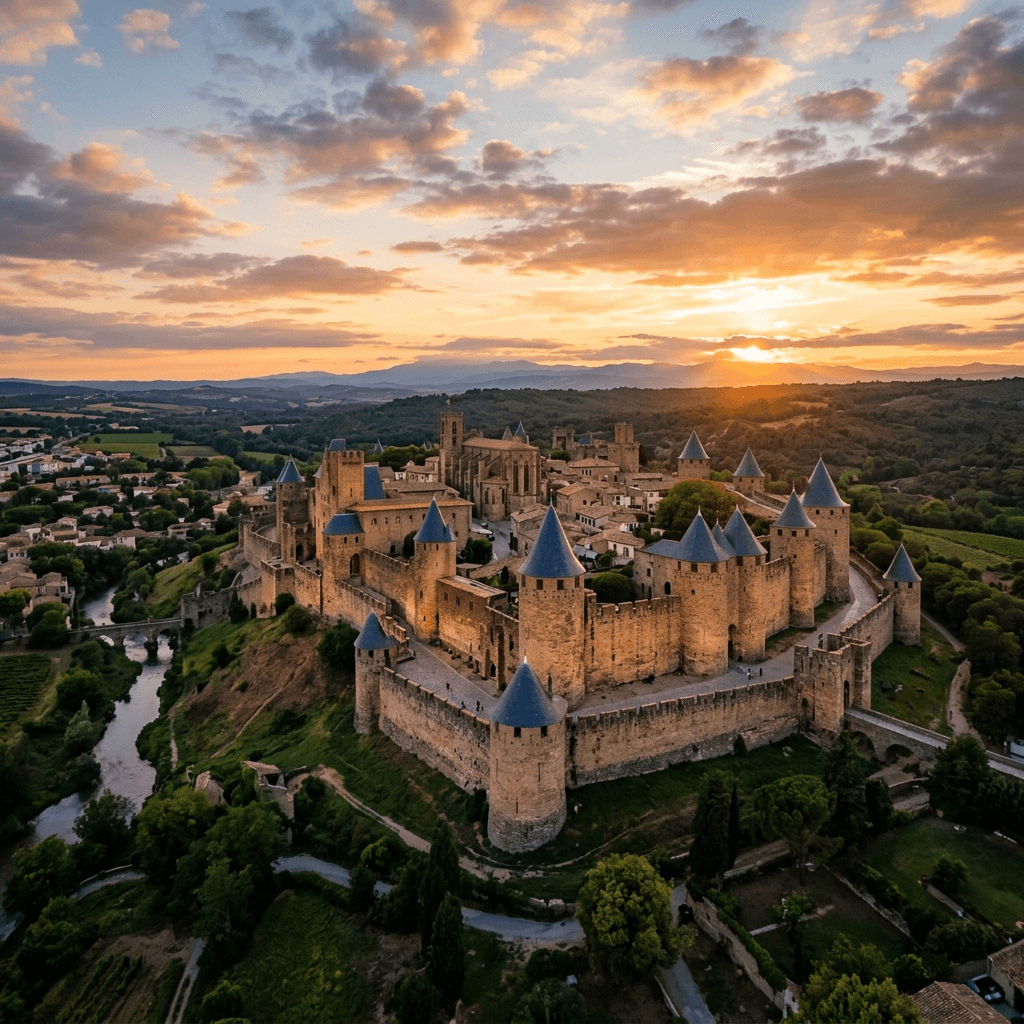
The Cité de Carcassonne is not just any castle: it is the largest preserved medieval fortress in all of Europe, a stone giant that defies time and imagination. With 3 kilometers of concentric walls, 52 towers and an intramural area of 11 hectares, the Cité is a unique monument to medieval military engineering. No other fortress on the continent offers such a complete and well-preserved defense system.
What makes it truly exceptional is its double wall: two overlapping belts of fortifications, one inner and one outer, with a space between them — the lices — that functioned as a deadly trap for invaders. Anyone who managed to cross the first wall would be trapped in a corridor of crossfire, completely exposed to archers on the inner wall. This defensive system, designed between the 12th and 13th centuries, was a war machine in stone.
Beyond the engineering, the Cité breathes history on every corner. From the Gallo-Roman period to the controversial restoration by Viollet-le-Duc in the 19th century, through the Visigoths, the Cathars and the Albigensian Crusade, Carcassonne is a palimpsest of two millennia of European history. That is why, in 1997, UNESCO classified it as a World Heritage Site — not only for its beauty, but for its authenticity as a testament to medieval military architecture.
1.1.1 The double wall system with 52 towers
The defensive system of the Cité de Carcassonne is based on a simple and brutal principle: creating successive barriers that exhaust the invader before they reach the heart of the fortress. The inner wall, built on Gallo-Roman foundations and expanded by the Visigoths and the Trencavels, is flanked by 26 circular towers. The outer wall, erected by Louis IX and Philip III in the late 13th century, has 19 round towers and 3 barbicans — advanced fortifications that protected the entrances.
Between the two walls lie the lices, a corridor 10 to 15 meters wide where any invader would be trapped under fire from defenders on both walls. The towers, with their battered bases (sloping outward), caused thrown stones and projectiles to ricochet onto the attackers. Each tower had a wall walk that allowed soldiers to move quickly along the entire fortification.
1.1.2 The total extension of 3 kilometers of fortifications
If stretched out in a straight line, the walls of the Cité de Carcassonne would cover the distance between the Arc de Triomphe and the Eiffel Tower in Paris. They are 3 kilometers of stone surrounding the hill on which the Cité stands, at 150 meters above sea level, overlooking the valley of the river Aude. The original Gallo-Roman wall, built in the 4th century AD, already had 1,070 meters of perimeter and 17 to 30 towers.
The thickness of the walls varies from 2 to 3 meters in the Gallo-Roman section, with a construction technique that alternates large stones with rows of bricks — an earthquake-resistant engineering that allows the wall to absorb tremors without collapsing. The average height of the curtain walls is 10 to 12 meters, enough that no medieval siege tower could be quickly erected against them.
Chapter
1.2 How old is the Cité de Carcassonne?
The Cité de Carcassonne does not have a single age: it is an organism that grew over 2,500 years. The site was inhabited since the Neolithic period (around 3500 BC), but the first documented fortification was a Celtic oppidum called *Carsac*, founded by the Volcae Tectosages around the 6th century BC.
The Romans arrived in 118 BC and transformed the settlement into a fortified city, naming it *Carcaso* (later *Julia Carcaso*). The Gallo-Roman walls still visible today — the base of many current towers — date from the 4th century AD, meaning the oldest still-visible structure is about 1,700 years old.
The Visigoths occupied the city from 462 AD and the Muslims between 725 and 759, but it was from the 11th century, under the Trencavel dynasty, that the Cité took the form we know today. The comtal castle began construction in 1130 and the Basilica of Saint-Nazaire was consecrated by Pope Urban II in 1096. Therefore, the Cité we visit today is the result of almost two millennia of overlapping constructions — a stone book where each century left its mark.
Chapter
1.3 How did Carcassonne withstand sieges that lasted decades?
The reputation of impregnability of the Cité de Carcassonne is not just legend: it is the result of a military design so effective that, for centuries, few armies dared to test it. The most famous siege was that of 1209, during the Albigensian Crusade, when an army of 30,000 crusaders surrounded the city. Viscount Raimond-Roger Trencavel resisted for two weeks — not because the walls were fragile, but because the water catchment point was outside the fortress.
The defense system was so feared that, in 1355, during the Hundred Years' War, the Black Prince (Edward of Woodstock) preferred to burn down the lower town rather than attack the Cité, considering that "a victorious siege would take too long." The 52 towers, the double walls, the dry moats and the fortified gates with 90-degree angles (which forced attackers to slow down and expose themselves) created a defensive system that no medieval army could quickly overcome.
Chapter
1.4 Why was Carcassonne considered impregnable?
The fame of impregnability of the Cité de Carcassonne rests on three pillars: topography, engineering and military psychology. The Cité occupies the top of a hill at 150 meters above sea level, with the river Aude protecting its base. Any attacker would have to climb the slope under fire before even reaching the walls.
The double wall was the nightmare of any medieval commander. Even if the first line were breached (which rarely happened), the invader would be trapped in the lices, a corridor of crossfire where archers on the inner wall could shoot without risk of hitting their comrades on the outer wall. The 52 towers were independent firing positions, each capable of defending its neighbors. There was no dead angle, no blind spot.
The only weakness — and it was through this that Carcassonne fell in 1209 — was the external water supply. The main well was outside the walls, and when the crusaders cut off access, thirst forced capitulation. This lesson was not forgotten: the French kings who expanded the fortress after 1226 made sure to dig cisterns and a monumental well inside the Cité.
---
Chapter
2. The secret military engineering of Carcassonne — How were the walls built?
Chapter
2.1 What was the construction technique of the double walls?
The construction of the walls of the Cité de Carcassonne is a lesson in medieval engineering that combined three distinct building traditions: Roman, Visigothic and Frankish. The inner wall, the oldest, rests on Gallo-Roman foundations from the 4th century AD, made of large stones interspersed with rows of bricks — a technique called *opus vittatum* that gave seismic flexibility to the structure.
On this base, medieval builders erected walls of sandstone and molasse from Carcassonne (a local sandstone), 2 to 3 meters thick. The towers were built in a horseshoe shape in the Gallo-Roman section (curved exterior, flat interior) and with battered bases in the medieval section (outward slope) — a design that made thrown stones ricochet onto the attackers.
The outer wall, built by Louis IX and Philip III between 1247 and 1285, followed the principles of Gothic military architecture: lighter, taller, and with perfectly circular towers that eliminated blind angles. Between the two walls, the space of the lices was deliberately kept narrow so that no army could form up there.
2.1.1 The exact thickness of the walls and the composition of the stone
The walls of the Gallo-Roman rampart are between 2 and 3 meters thick — enough to resist medieval battering rams and catapults. The stone used is local limestone sandstone, extracted from the quarries of the Montagne Noire, about 20 km north of Carcassonne. This sandstone has a pale golden color that, at sunset, gives the fortress its characteristic tone.
The Gallo-Roman towers are between 4.5 and 7 meters in diameter and 11.65 to 13.70 meters in height. The medieval towers of the outer wall are slightly taller (10 to 12 meters) and more slender, optimized for defense with crossbows and archers. Each tower was independent of the others: if one fell, the neighbors continued to defend the section.
Chapter
2.2 How did the defense system of the 52 towers work?
Each of the 52 towers of the Cité de Carcassonne functioned as an autonomous fortress within the larger fortress. The towers of the inner wall, circular in plan, had three interior floors: the ground floor served as a storehouse, the first floor was the tower's command post, and the rooftop was the firing platform.
The towers were spaced so that an archer could cover the neighboring tower with his shot. The arrow loops were narrow on the outside (to make it difficult for enemy arrows to enter) and wide on the inside (to give the defender a wide field of aim). The towers of the outer wall, more recent, had battered bases that caused stones and boiling oil to flow down onto the attackers.
The wall walk ran along the entire length of both walls, allowing soldiers to move quickly between towers. In case of attack, the garrison — which could reach 1,000 men in wartime — would occupy all towers within minutes.
Chapter
2.3 What military innovations were introduced in Carcassonne?
The Cité de Carcassonne was a laboratory of military innovations that influenced European defensive architecture for centuries. The main innovation was the elbow gate system: instead of entering directly, any visitor was forced to make a 90-degree angle (sometimes more) to access the interior, exposing their right flank (the side not protected by the shield) to the defenders.
The barbicans — advanced fortifications that protected the gates — were another innovation of Carcassonne. The Notre-Dame barbican to the north, and the Porte d'Aude to the west, are perfect examples of this design, with zigzag ramps and false gates designed to confuse and slow down the attacker.
The hoardings — wooden galleries suspended at the top of the walls — allowed defenders to throw stones and boiling oil through openings in the floor, hitting attackers at the base of the wall without exposing themselves. Although the current hoardings are reconstructions by Viollet-le-Duc, the principle was genuinely medieval.
2.3.1 The barbicans, moats and drawbridges
The barbicans of Carcassonne are masterpieces of defensive engineering. The Porte Narbonnaise, the main entrance to the east, is flanked by two imposing towers (built by Philip III around 1280) and protected by a double portcullis and a drawbridge. The Porte d'Aude, to the west, is even more ingenious: a zigzag ramp climbs along the wall, forcing attackers to expose their right flank throughout the entire approach.
The dry moats — dug where the natural slope of the terrain was insufficient — completed the defensive system. Unlike water-filled moats, dry moats did not freeze in winter and allowed defenders to descend to face attackers who fell into them.
Chapter
2.4 How did the water supply ensure resistance to sieges?
The harshest lesson the Cité de Carcassonne learned came from the siege of 1209: without water inside the walls, no fortress is safe. The crusaders cut off the city's access to the river Aude and the external well, and thirst forced capitulation in 15 days. After 1226, when the Cité came under French royal domain, the engineers of Louis IX and Philip III set about correcting this vulnerability.
The Grand Puits (Great Well) was dug, a monumental well inside the Cité, today classified as a historical monument. Cisterns were built in several towers, including one of great capacity in the south tower of the Porte Narbonnaise. The rainwater collection system was integrated into the architecture of the roofs and inner courtyards.
Thanks to these works, the Cité could withstand prolonged sieges — months, if necessary — without relying on external sources. When the Black Prince considered attacking Carcassonne in 1355, it was precisely this self-sufficiency system that made him give up.
---
Chapter
3. The dark history of Carcassonne — Sieges, crusades and betrayals
Chapter
3.1 What happened during the Siege of Carcassonne in 1209?
The siege of 1209 is the most dramatic episode in the history of the Cité de Carcassonne — and also the most tragic. The Albigensian Crusade, called by Pope Innocent III in 1208 after the assassination of the papal legate Pierre de Castelnau, targeted the Cathars, a Christian sect considered heretical that flourished in Languedoc. Carcassonne, under the rule of Viscount Raimond-Roger Trencavel, was one of the main centers of Catharism.
On August 1, 1209, an army of 30,000 crusaders (the largest ever assembled in Europe until then) arrived before the walls of Carcassonne. The army was led by Arnaud Amaury, papal legate, and by Simon de Montfort, the military commander. The two suburban boroughs — Saint-Vincent and Saint-Michel — were burned and the Cité was isolated.
The walls resisted direct attacks, but thirst proved more effective than battering rams. The Cité's water supply was outside the walls, and the crusaders quickly cut it off. On August 15, 1209, after only two weeks of siege, Trencavel surrendered with the promise that the population would be spared.
3.1.1 The Albigensian Crusade and the massacre of the Cathars
The Albigensian Crusade was one of the most brutal campaigns in medieval European history. Before reaching Carcassonne, the crusaders had taken Béziers on July 22, 1209, where the massacre that shocked Christendom occurred: between 7,000 and 20,000 people were killed, including women and children who had taken refuge in the church of Saint-Madeleine. The phrase attributed to Arnaud Amaury — *"Kill them all, God will know His own"* — became one of the most sinister epitaphs in Church history.
In Carcassonne, the surrender was negotiated with the promise that the population would be spared. But the promise was broken: the inhabitants were expelled from the Cité "wearing only their shirts" — naked and stripped of all their belongings. The Trencavel lands were confiscated and handed over to Simon de Montfort, who became the new lord of the region.
Chapter
3.2 Who was Viscount Trencavel and what became of him?
Raimond-Roger Trencavel (1185–1209) was the last viscount of Carcassonne of the Trencavel dynasty, a family that had ruled the region since 1067. Only 24 years old in 1209, Trencavel was a young, cultured and tolerant nobleman, known for protecting the Cathars in his territory — a position that put him on a direct collision course with the Papacy.
When the crusader army arrived at Carcassonne, Trencavel could have fled. He chose to stay and negotiate. On August 15, 1209, after two weeks of siege, he surrendered with the promise that his life and that of the population would be spared. Instead, he was imprisoned in his own castle, in the dungeons he himself had ordered built.
He died on November 10, 1209 — less than three months after the surrender. The official cause was dysentery, but many historians suspect murder. He was only 24 years old. His son, Raymond II Trencavel, still tried to reconquer the Cité in 1240, but the siege failed. In 1247, he formally renounced his rights over Carcassonne.
Chapter
3.3 Was Carcassonne the scene of mass executions?
The Cité de Carcassonne was the scene of executions and violence throughout its history, but there was no isolated "mass execution" like in Béziers. What existed was a systematic and continuous repression against the Cathars and their sympathizers. After the fall of the Cité in 1209, the Inquisition was installed in 1234 in the tower still called today the "Tower of the Inquisition".
The 13th-century inquisitorial records document dozens of interrogations and executions of Cathar heretics in the dungeons of the Cité. Public executions took place at the Champ de Mars, an esplanade south of the fortress. Torture was used to extract confessions, and the condemned were burned at the stake — the standard punishment for heresy at the time.
Furthermore, during the Hundred Years' War and the Religious Wars of the 16th century, the Cité served as a military prison and site for executing prisoners of war. In the 19th century, the comtal castle was used as a common prison, and it was only in 1918 that the army definitively abandoned the fortress.
Chapter
3.4 What secrets do the fortress dungeons hide?
The dungeons of the Cité de Carcassonne hold centuries of silent stories. The comtal castle, built from 1130 by the Trencavels, has a system of cellars, dungeons and cells extending over several underground levels. It was there that Raimond-Roger Trencavel was imprisoned after the surrender of 1209 — and where he died mysteriously three months later.
The Tower of the Inquisition, in the southwest corner of the inner wall, preserves the cells where Cathar heretics were interrogated. The stone walls, over 2 meters thick, muffled the screams. In the 15th century, the castle served as a state prison for nobles who had fallen from grace, including Jean IV of Armagnac, who was incarcerated there.
During the 19th century, before the restoration by Viollet-le-Duc, the castle was used as a common prison and munitions depot. In 1944, during World War II, German troops occupied the Cité and used the castle as a munitions depot — a secret that only came to light decades later, when the military archives were opened.
---
Chapter
4. The scandal of Carcassonne's restoration — Did Viollet-le-Duc invent the fortress?
Chapter
4.1 Who was Eugène Viollet-le-Duc and what did he do to Carcassonne?
Eugène Viollet-le-Duc (1814–1879) was the most influential (and controversial) architect-restorer of 19th-century France. Considered the father of creative restoration, he believed that restoring a monument was not merely repairing it, but "placing it in a state of completeness that might never have existed." This philosophy transformed — and, for some, distorted — the Cité de Carcassonne forever.
In 1844, Viollet-le-Duc began with the Basilica of Saint-Nazaire, whose restoration earned him the government's trust. In 1853, Napoleon III approved the project for the complete restoration of the Cité, with the state paying 90% of the works and the city only 10%. The work lasted from 1853 to 1879 (the year of his death), continued afterward by Paul Boeswillwald and Henri Nodet until 1913.
Viollet-le-Duc reconstructed towers, roofs, battlements, gates and even elements that had never existed. Of the 52 towers, most were wholly or partially rebuilt. The conical slate roofs — his most controversial hallmark — replaced the original Roman terracotta tile coverings. The drawbridge of the Porte Narbonnaise was entirely invented: there was no historical record that it had ever existed.
Chapter
4.2 Did Viollet-le-Duc restore or invent medieval elements?
This is the central question of the Carcassonne "scandal." Viollet-le-Duc did restore, but he also invented. The Porte Narbonnaise, for example, received a drawbridge that never existed in the medieval period — a "correction" based on his idealized vision of what a medieval fortress *should* have. The battlements and wall walks were largely reconstructed based on 15th-century drawings found in the Bibliothèque Royale by Jean-Pierre Cros-Mayrevieille.
The fiercest controversy, however, centers on the conical slate roofs. Southern France had always used terracotta tiles (the typical Roman *tuiles canal*) for its roofs. Viollet-le-Duc chose slate — typical of northern France — claiming to have found slate fragments on site during excavations. His critics accuse him of having "northernized" Carcassonne, imposing a Parisian aesthetic on a Mediterranean monument.
4.2.1 The controversy of the conical roofs on the towers
The conical gray slate roofs that top the towers of Carcassonne are so iconic today that few can imagine the fortress without them. Yet they are a 19th-century invention. The original roofs of the medieval towers were probably covered with terracotta tiles (canal), lighter and more suited to the Mediterranean climate of little rain and abundant sun.
The climate issue is real: slate retains heat in the Mediterranean summer and, over time, degrades faster in the south than in the north. However, Viollet-le-Duc defended his choice based on two arguments: first, that he had found slate fragments in the excavations; second, that slate gave a more "dramatic and medieval" appearance to the ensemble — an aesthetic goal he always prioritized over historical accuracy.
Today, Viollet-le-Duc's modifications are considered part of the monument's history and preserved as such by UNESCO. What was "invention" in the 19th century is now "heritage."
Chapter
4.3 Why do modern architects criticize the restoration?
Criticism of Viollet-le-Duc's restoration came from all quarters. The historian and architect Hippolyte Taine accused him of creating "a monument that never existed." Achille Rouquet and François de Neufchâteau criticized the "overly Gothic" style for a fortress that, in its origin, was much more austere and functional.
The most eloquent critic was Joseph Poux, a historian of Carcassonne, who denounced the poor reconstruction of Visigothic doors and windows, transformed by Viollet-le-Duc according to a uniform Gothic pattern that never corresponded to reality. Art historian Marcel Aubert considered that "Viollet-le-Duc did not restore Carcassonne: he created an idealized Carcassonne, a dream of what the Middle Ages should have been."
The percentage of original material in the Cité is one of the most shocking facts: only 15% to 30% of the stones seen today are medieval. The rest is 19th-century work. This raises a philosophical question: are we visiting the Cité de Carcassonne or Viollet-le-Duc's theme park?
Chapter
4.4 What would Carcassonne look like without the 19th century intervention?
Without the intervention of Viollet-le-Duc and his successors, the Cité de Carcassonne would probably not exist — or would exist as ruins. In 1849, the French government had officially decreed the demolition of the fortress, considering it a "useless quarry." The stones of the walls were being sold to private individuals for civil construction, and the Cité was rapidly deteriorating.
It was the preservation campaign started by Jean-Pierre Cros-Mayrevieille in 1835 that reversed the situation. Without it, the walls of Carcassonne would have been dismantled stone by stone, as happened with so many other French fortresses after the Revolution.
If Viollet-le-Duc had not intervened, Carcassonne would today be a collection of picturesque ruins — more authentic, perhaps, but far less visited. The truth is that the Cité we see is a 19th-century creation on medieval foundations, and it is precisely this duality — authenticity versus invention — that makes it a unique monument in the world.
---
Chapter
5. Carcassonne in Pop Culture — From Video Games to Cinema
Chapter
5.1 Which famous movies were shot in Carcassonne?
The unmistakable silhouette of the Cité de Carcassonne has made it the backdrop for dozens of film productions. The most famous movie filmed within its walls is "Robin Hood: Prince of Thieves" (1991), directed by Kevin Reynolds and starring Kevin Costner. The scenes of Nottingham Castle were filmed at the Porte Narbonnaise and along the Cité's ramparts.
Another French classic shot in Carcassonne is "Les Visiteurs" (1993) by Jean-Marie Poiré, starring Jean Reno and Christian Clavier. The medieval scenes at the Porte d'Aude are unmistakable. The film "Le Corniaud" (1965), with Louis de Funès and Bourvil, also includes scenes shot at the Cité.
More recently, the fortress served as a setting for historical TV series, documentaries, and advertising productions. Its visual authenticity — walls that look straight out of a fairy tale — makes fabricated sets unnecessary.
5.1.1 "Robin Hood: Prince of Thieves" and Other Productions
"Robin Hood: Prince of Thieves" used the Cité de Carcassonne as the setting for Nottingham Castle, making the most of the imposing double ramparts and conical towers. The battle scenes were filmed in the lices, the space between the two walls, which provided a perfectly medieval backdrop without any need for props.
Beyond cinema, Carcassonne appears in dozens of documentaries, travel series, and TV programs. Its profile — the walls stretching across the hill, dominating the landscape — is one of the most recognizable in France and regularly appears in TV travel guides and productions by National Geographic and the BBC.
Chapter
5.2 Does the board game "Carcassonne" have a real connection to the city?
Yes — and the connection runs deeper than many imagine. The board game "Carcassonne" was created by German designer Klaus-Jürgen Wrede and published in 2000 by Hans im Glück. The game consists of placing tiles that represent roads, cities, monasteries, and fields, building a collective medieval landscape. The mechanics reflect the organic construction of the Cité itself over the centuries.
"Carcassonne" was a global phenomenon: it won the prestigious Spiel des Jahres and the Deutscher Spiele Preis in 2001, and sold millions of copies worldwide. It spawned numerous expansions — The River, Inns and Cathedrals, Traders and Builders — and digital versions for Xbox, iOS, Android, PC, and Nintendo Switch.
The world championship of the game has been held annually in Essen, Germany, since 2006. And while the game does not faithfully recreate the geography of the Cité, it captures its spirit: a city that grows, fortifies itself, and transforms over time.
Chapter
5.3 Has Carcassonne inspired medieval video game settings?
The Cité de Carcassonne has been a constant source of inspiration for the video game industry. In 2024, Activision released the "Citadelle des Morts" map for the Zombies mode of Call of Duty: Black Ops 6, a medieval fortress setting clearly inspired by Carcassonne — with its double walls, conical towers, and maze-like corridors.
The Assassin's Creed series (by Ubisoft) has also drawn inspiration from Carcassonne's architecture to recreate French medieval cities, although the Cité itself does not appear directly. Several medieval strategy games, such as Stronghold and Age of Empires, feature castles and fortresses whose design borrows directly from the Carcassonne model — the double wall with circular towers has become the visual archetype of the perfect medieval fortress.
Chapter
5.4 Which books and historical novels are set in the fortress?
The Cité de Carcassonne has inspired writers from around the world. In the 19th century, French poet Gustave Nadaud wrote the poem Carcassonne, about a man who spends his life dreaming of visiting the city and never manages to — an allegory of the unattainable dream popularized by Georges Brassens.
Irish writer Lord Dunsany included the story Carcassonne in his book A Dreamer's Tales, and American William Faulkner wrote a short story of the same title. The travel book "Narrow Dog to Carcassonne" (2005) by Terry Darlington recounts the epic narrowboat journey from England to the Mediterranean — with Carcassonne as the final destination.
In historical fiction, the Cité appears as a setting in novels about the Albigensian Crusade and the Cathars, a theme that attracts writers worldwide fascinated by the tragic story of the Occitan heresy.
---
Chapter
6. Myths and Truths About the Cité de Carcassonne
Chapter
6.1 Is it true that Lady Carcas gave the city its name?
The legend of Lady Carcas is one of France's most charming stories, and the answer is: yes, the legend exists, but it is not historically true. According to tradition, Lady Carcas was a Saracen princess, widow of Ballak (a Muslim prince killed in battle). When Charlemagne besieged the city in the 8th century, Lady Carcas supposedly tricked the emperor: she fed the last remaining pig with the last sack of wheat and threw it from the walls. Charlemagne thought the city still had plenty of supplies and lifted the siege.
Lady Carcas rang all the bells in joy, and a soldier shouted: "Carcas sonne!" ("Carcas rings!") — hence the name "Carcassonne." A bust of Lady Carcas stands on a column near the Porte Narbonnaise, in 19th-century neo-Gothic style.
The historical truth is less romantic: the name "Carcassonne" derives from the Latin Carcaso, the name given by the Romans to the pre-existing Celtic oppidum. The legend was only first recorded in the 16th century — more than 700 years after the events it supposedly describes.
Chapter
6.2 Was Carcassonne truly impregnable or did it fall several times?
The reputation of impregnability of the Cité de Carcassonne is partly a myth — but a myth based on impressive facts. The fortress was never taken by direct assault. No army ever managed to scale the walls or break down the gates. The two times the Cité fell — in 1209 and, briefly, in 1226 — were due to thirst and betrayal, respectively.
In 1209, the Cité held out only two weeks, but not because of a failure of the walls: it was lack of water that forced Trencavel to surrender. In 1240, the siege by Raimond II Trencavel was a complete failure: the royal garrison held out until reinforcements from Louis IX arrived. In 1355, the Black Prince did not even attempt to attack the Cité, limiting himself to burning the lower town.
Therefore, the Cité was functionally impregnable by medieval military standards. Only thirst and politics (negotiated surrenders) managed to bring it down — never brute force.
Chapter
6.3 Is there a secret underground city beneath Carcassonne?
There is no secret underground city beneath the Cité de Carcassonne — but there are cellars, tunnels, and passages that fuel the legend. The comtal castle and some towers have deep cellars that served as prisons, storage rooms, and cisterns over the centuries.
During the siege of 1240, the inhabitants dug mining tunnels in an attempt to bring down the royal walls — a siege technique that involved excavating beneath the walls until they collapsed. Some of these tunnels may still exist beneath the Cité.
The idea of an "underground city" is exaggerated, but there is a grain of truth: the medieval cellars of Carcassonne form an underground network of corridors, cells, and cisterns stretching for several kilometers beneath the fortress. It is not a city — but it is a hidden world still awaiting full archaeological exploration.
Chapter
6.4 Was the fortress saved from demolition by a popular movement?
Yes — and this is one of the most inspiring stories in Carcassonne's history. In 1849, the French government, considering the Cité an "obsolete military square," decided to demolish it. The walls were being used as a quarry: stones were sold to private individuals for construction.
The man who led the movement to save the Cité was Jean-Pierre Cros-Mayrevieille, a local historian and archaeologist who dedicated his life to preserving the fortress. Since 1835 he had been fighting the government's indifference. In 1840, he got the Basilica of Saint-Nazaire classified as a historic monument — the first step.
The decisive moment came in 1849, when demolition was about to begin. Cros-Mayrevieille mobilized public opinion, wrote articles, pressured politicians, and managed to get the government to reverse its decision. In 1853, Napoleon III approved Viollet-le-Duc's restoration project. The Cité was saved — and owes its very existence today to a man who refused to let his fortress die.
---
Chapter
7. Practical Guide to Visiting the Cité de Carcassonne in 2026
Chapter
7.1 What is the best time of year to visit Carcassonne?
The best time to visit the Cité de Carcassonne depends on what you are looking for. Spring (April to June) and Fall (September to October) are ideal: temperatures are mild (between 15°C and 25°C), crowds are smaller, and the light is perfect for photographing the golden walls.
Summer (July and August) is peak season. Average temperatures hover around 28°C (sometimes exceeding 35°C on scorching days) and the Cité is packed. On the upside, this is the season for major events: the Light and Sound Festival and the Medieval Fair.
Winter (November to February) is the quietest season. The Cité is nearly deserted, allowing you to walk the ramparts in peace. Some restaurants and shops close, but the castle and walls remain open (except on December 25, January 1, and May 1).
Chapter
7.2 How much does the ticket for the castle and ramparts cost?
In 2026, prices for the Château Comtal (comtal castle) and the ramparts (which grant access to the wall walk) are as follows (approximate values, to be confirmed on the official website):
The Cité itself — its streets, squares, and the basilica — is free and open to all. You only pay to enter the comtal castle and walk the ramparts along the wall walk. Combination tickets with other monuments in the region are available and may be advantageous for longer stays.
- Adult: €11 to €13
- Reduced (18–25, non-EU): €9 to €10
- Free: under 18 (EU and non-EU), youth 18–25 (EU citizens), persons with disabilities
- Audio guide: about €3 extra (available in several languages, including Portuguese)
Chapter
7.3 How to get to Carcassonne from Toulouse or Barcelona?
The Cité de Carcassonne is strategically located in southern France, halfway between Toulouse and the Mediterranean.
From Toulouse: The Cité is 90 km southeast of Toulouse. By car, take the A61 motorway (exit 23 or 24) — about 1 hour. By train, frequent TGV and TER services run from Toulouse-Matabiau to Carcassonne, with a journey of 45 to 60 minutes.
From Barcelona: Carcassonne is 300 km northeast of Barcelona. By car, via the AP-7, A9, and A61 — about 3 hours. By train, the most practical option is to go to Narbonne (TGV) and then take a regional connection to Carcassonne.
From Paris: 700 km north. The TGV from Paris-Montpellier stopping at Carcassonne takes about 6h30. For those who prefer to fly, Carcassonne-Salvaza Airport (CCF) has low-cost flights with Ryanair to London, Brussels, Dublin, Porto, Frankfurt-Hahn, and Liverpool.
Chapter
7.4 How long does the full visit take?
It is recommended to set aside at least a full day to visit the Cité de Carcassonne at a leisurely pace. An ideal visit is divided as follows:
If you wish to include the lower town (the bastide Saint-Louis), add another 1 to 2 hours. For a lighter visit (castle and ramparts only), 2 to 3 hours are sufficient.
- Comtal castle and ramparts (with audio guide): 2 to 3 hours
- Basilica of Saint-Nazaire: 30 to 45 minutes
- Walk through the intramural streets: 1 hour
- Lunch: 1h30
- Panoramic view from the lookouts: 30 minutes
- Castle museum: 30 to 45 minutes
Chapter
7.5 What are the opening hours in 2026?
The Château Comtal and the ramparts are open year-round, with seasonal hours (check the official website):
Last admission: 45 minutes before closing. Closed on January 1, May 1, November 1, and December 25.
- January to February / November to December: 09:30–17:00
- March to April / October: 09:30–18:00
- May to September: 09:00–18:00
- July to August: 09:00–19:00
Chapter
7.6 Where to stay inside the Cité?
Sleeping inside the Cité de Carcassonne is a unique experience, but options are limited. The most famous intramural hotel is the Hôtel de la Cité (5-star), a neo-Gothic palace inaugurated in 1909, next to the comtal castle. The suites offer direct views of the ramparts, and breakfast is served on a terrace with an unforgettable panorama.
There are also charming guesthouses and B&Bs within the walls, but they are few and in high demand — reservations must be made months in advance. A practical and more affordable alternative is to stay in the lower town (bastide Saint-Louis), a 10-minute walk from the Cité, where there are far more accommodation options for every budget.
---
Chapter
8. The 52 Towers of Carcassonne — Each with Its Own Story
Chapter
8.1 Which is the oldest tower and which is the most imposing?
The oldest tower of the Cité de Carcassonne is the Tour Pinte, the only rectangular tower in the entire Gallo-Roman wall. Built in the 4th century AD, it served as the main watchtower, overlooking the entire Aude valley. Its rectangular shape, unique among the 52 towers, betrays its Roman origin — the remaining Gallo-Roman towers are horseshoe-shaped (curved exterior, flat interior).
The most imposing tower is the Tour du Trésau, the keep of the comtal castle. With three floors and a height greater than the others, it was the last bastion of defense — the place where the viscount would take refuge if the Cité fell. In 1794, the royal archives stored in the tower were burned by revolutionaries, an act of destruction that historians still lament to this day.
Chapter
8.2 Which tower served as a prison and torture chamber?
The Tour de l'Inquisition (Inquisition Tower), on the southwest corner of the inner wall, is where the inquisitorial tribunal installed in 1234 operated. It was there that dozens of Cathars were interrogated, tortured, and condemned to the stake. The cells still exist, and the 2-meter-thick walls hold the silence of centuries of suffering.
Beyond the Inquisition, the comtal castle served as a state prison in the 15th century (housing the noble John IV of Armagnac) and as a common prison in the 19th century, before Viollet-le-Duc's restoration. The castle dungeons, carved into the rock, were used continuously as a place of detention for more than 600 years.
Chapter
8.3 What was the exact function of each type of tower?
The 52 towers of the Cité de Carcassonne are divided into three main types, each with its specific function:
- Gallo-Roman towers (horseshoe-shaped): 17 survivors out of the original 30. Built in the 4th century AD, they served as shooting platforms for archers and crossbowmen. Their flat interior allowed soldiers to move around and store ammunition.
- Circular medieval towers (inner and outer wall): built between the 12th and 13th centuries, they are taller and more slender. Each tower is an autonomous defensive post, with capacity for 10 to 20 soldiers. The sloping bases cause projectiles to ricochet back at attackers.
- Barbicans (3): advanced fortifications protecting the main entrances. The barbican of Notre-Dame to the north and the barbican of the Porte d'Aude to the west are the most impressive examples.
Chapter
8.4 How many towers are open to the public?
Of the 52 towers of the Cité de Carcassonne, about 15 to 18 are accessible to the public via the paid wall walk (included in the comtal castle ticket). The wall walk runs along the inner and outer ramparts, allowing you to climb several towers along the route.
The remaining towers are closed to the public for conservation reasons or because they are used as workspaces (storage, offices, private residences). The Tour de l'Inquisition is generally accessible, but the Tour Pinte (the rectangular Gallo-Roman tower) is not open to the public.
---
Chapter
9. Daily Life in Medieval Carcassonne
Chapter
9.1 How many people lived inside the fortress?
At its peak in the 12th and 13th centuries, the Cité de Carcassonne housed between 3,000 and 4,000 inhabitants within its walls — an impressive population density for the time. Added to this number were the inhabitants of the two outlying boroughs, Saint-Vincent (to the north) and Saint-Michel (to the south), which were destroyed during the siege of 1209.
After the annexation of the Cité by the Kingdom of France in 1247, the population was partially transferred to the new bastide Saint-Louis (the lower town), built by Louis IX to rehouse those expelled. Over the following centuries, the population within the walls gradually declined, reaching just 761 inhabitants in 1911. Today, the Cité has a few dozen permanent residents — a tiny number for a fortress that was once a bustling city.
Chapter
9.2 How did trade and agriculture work within the walls?
The economy of medieval Carcassonne was based on the textile trade and agriculture. In the 14th century, the city was the largest textile center in France, exporting wool from the Montagne Noire and the Corbières to Constantinople and Alexandria. Carcassonne's weavers were famous throughout the Mediterranean for the quality of their cloth.
Agriculture was practiced in the intramural vegetable gardens and in the lands around the Cité. Vineyards, cereals, and vegetables supplied the population. Within the walls, livestock (pigs, goats, and chickens) was raised in the inner courtyards and in the lists.
The weekly market, held at the Market Square (now Place Marcou), was the economic center of the city. Peasants from the region, artisans, and merchants exchanged goods, and prices were monitored by the consuls (the municipal government established in 1192).
Chapter
9.3 What trades and guilds existed in the Cité?
Medieval Carcassonne was a city of artisans organized into guilds (trade corporations). The most important trades were the weavers, tanners (leather), blacksmiths, carpenters, bakers, and butchers. Each guild had its own street, its patron saint, and its privileges.
Weaving was the dominant trade, with dozens of looms scattered throughout the Cité. The wool came from sheep raised on the surrounding hills, and the fabrics were dyed with colors extracted from local plants. In the 17th century, Colbert (minister of Louis XIV) established the Royal Manufactory of La Trivalle (1696) in Carcassonne, which employed hundreds of workers.
The blacksmiths and carpenters worked mainly for the military garrison, producing weapons, repairing armor, and maintaining the wooden structures of the walls. The bakers supplied the daily bread to the population — such an essential good that the communal oven was owned by the lord.
Chapter
9.4 What was the sanitation and hygiene system like?
Sanitation in medieval Carcassonne was, as in almost all cities of the time, precarious. The narrow streets (deliberately designed to hinder the advance of invaders) were also a hygiene problem: there was no space for sewer channels, and waste was thrown into the lists (the space between the walls), which functioned as a garbage dump.
In the 19th century, there were 112 houses built in the lists — a testament to how the space between the walls, originally designed for defense, had been taken over by poverty and neglect. Drinking water came from wells and cisterns scattered throughout the Cité, including the Grand Puits (Great Well), now classified as a historical monument.
The Black Death struck Carcassonne in 1348 (the first of several waves), and the plague returned in 1557. The lack of sanitation and the proximity between houses made the Cité vulnerable to epidemics.
---
Chapter
10. Religious Architecture in Carcassonne — The Basilica of Saint-Nazaire
Chapter
10.1 What gothic stained-glass windows make the basilica a masterpiece?
The Basilica of Saint-Nazaire is one of the most underrated treasures in France. Its 13th and 14th-century stained-glass windows rank among the most beautiful in southern France, comparable to those of the great northern cathedrals. The windows of the choir and transept, funded by Archbishop Pierre de Rochefort, depict scenes from the life of Christ and the apostles with an impressive richness of color and detail.
What makes Saint-Nazaire's stained glass unique is its luminosity. Unlike the stained glass of northern France, which uses darker, denser tones (to compensate for the weaker light), Carcassonne's stained glass is lighter and more translucent, taking advantage of the Mediterranean light streaming through the windows. The blue of the skies, the red of the robes, and the gold of the halos create a spectacle of colors that changes with the time of day.
The basilica combines two styles: the Romanesque nave (11th century) and the Gothic choir and transept (1269–1330). The transition from one style to the other is visible in the architecture: the nave is dark, massive, of bare stone; the choir is light, tall, flooded with colored light from the stained glass.
Chapter
10.2 How did the basilica survive centuries of wars?
The Basilica of Saint-Nazaire survived the French Revolution, the two World Wars, and centuries of neglect thanks to a combination of luck and dedicated protection. During the French Revolution, the chapter (the body of canons) was dissolved in 1790, the episcopal palace was sold and demolished in 1795, and the cloister disappeared. But the basilica, although degraded, was not destroyed.
In 1801, it lost the title of cathedral to the Church of Saint-Michel (in the lower town), which saved it from being completely transformed — no one invested in altering it, and it survived intact in its medieval form. It was classified as a historical monument in 1840, and Viollet-le-Duc's first intervention in the Cité was precisely its restoration, starting in 1844.
During the Second World War, German troops occupied the Cité from 1942, but did not damage the basilica. The stained-glass windows were protected with sandbags, and the structure suffered no direct damage from the Allied bombings that hit the region in 1944.
Chapter
10.3 What tombs and sarcophagi rest in the crypt?
The crypt of the Basilica of Saint-Nazaire, built by the Trencavel family in the 12th century, holds the tombs of some of the most important names in Carcassonne's history. The most notable funerary monument is that of Archbishop Pierre de Rochefort, funder of the Gothic stained-glass windows of the choir, whose tomb is located in the north side chapel.
In the south chapel, the tomb with the coat of arms of Pierre Rodier, another bishop of Carcassonne, stands out. Several sarcophagi of lesser figures rest in the crypt, many of them unidentified — victims of time and the revolutionary looting of 1794, when the archives were burned and the memory of the dead was lost.
The crypt itself is a Romanesque space of rare beauty, with barrel vaults and stone columns that candlelight illuminates in an almost spiritual way.
Chapter
10.4 Does the basilica organ still work?
The organ of the Basilica of Saint-Nazaire is a historical instrument whose current state is uncertain. The chapter records prior to 1790 mention the existence of an organist and a chapel master, with 5 choirboys — a sign that liturgical music was important in the basilica.
With the dissolution of the chapter during the French Revolution and the transfer of the episcopal seat to Saint-Michel in 1801, the organ fell into disuse. There are no records of it having been restored or maintained in the 19th and 20th centuries. The visitor who enters the basilica today finds a silent space — the music that once echoed under its vaults lives only in historical documents.
---
Chapter
11. The Gastronomy of Carcassonne — What to Eat in the Fortress
Chapter
11.1 What typical Languedoc dishes to try in Carcassonne?
The gastronomy of Languedoc is rich, generous, and deeply rooted in the land. In Carcassonne, the king of dishes is cassoulet — a slow-cooked stew of white beans (haricot lingot de Castelnaudary) with duck confit, red-legged partridge, lamb, pork rind, and sausage. Carcassonne's version is particularly rich in meat: local tradition dictates that 30% of the dish be meat and 70% beans and pork rinds.
Other typical dishes include confit de canard (duck confit in its own fat), aligot (mashed potatoes with cheese and garlic), fougasse (flatbread typical of the south), anchoada (anchovy pizza), and the region's goat cheeses, such as Rocamadour.
The traditional dessert is crème catalane (similar to crème brûlée, but with cinnamon and lemon), a heritage from the proximity to Spain.
Chapter
11.2 Where to eat the best cassoulet in the region?
Carcassonne takes cassoulet so seriously that it has its own Universal Academy of Cassoulet, founded on January 22, 1998 by André Pachon and Jean-Claude Rodriguez. There is even an age-old quarrel between Carcassonne, Castelnaudary ("God the Father" of cassoulet), and Toulouse ("Holy Spirit") over who makes the best cassoulet — a dispute that the famous chef Prosper Montagné immortalized in his work.
Inside the Cité, the best restaurants to try cassoulet are those that serve traditional Languedoc cuisine. The atmosphere is as important as the food: eating cassoulet in a room with medieval stone walls, lit by candles, knowing that the fortress around you is the same one that saw the Cathars and the Crusaders, is an experience that no restaurant in Paris can offer.
In the lower town, there are dozens of bistros and brasseries serving cassoulet at more affordable prices. The weekly market at Place Carnot is a must for tasting local products: cheeses, cured meats, bread, and wine.
Chapter
11.3 Do the wines of Carcassonne deserve recognition?
Yes — very much so. The Languedoc region is one of the largest and oldest wine regions in France, and Carcassonne lies at its heart. The wines to try are:
Languedoc reds are perfect for local cuisine: full-bodied, tannic, with notes of wild berries and aromatic herbs. The value for money is excellent — many wines from the region cost half the price of an equivalent Bordeaux.
- Corbières AOC: full-bodied reds, ideal to accompany cassoulet
- Fitou AOC: the first AOC of Languedoc (1948), powerful wines from carignan and grenache
- Minervois AOC: elegant reds, with notes of Mediterranean maquis herbs
Chapter
11.4 Which restaurants inside the Cité offer good value for money?
Inside the Cité de Carcassonne, restaurants tend to be more expensive than in the lower town, but the experience of dining with a view of the illuminated walls is worth it. Recommendations include:
For those who prefer a more budget-friendly meal, the lower town (bastide Saint-Louis) offers dozens of options at lower prices, a 10-minute walk from the Cité.
---
- Traditional cuisine restaurants on the main streets of the Cité, serving cassoulet and duck confit at prices between €20 and €35 for the main course
- Creperies and bistros for lighter meals (€10 to €15)
- Cafés and terraces at Place Marcou and Place du Château, ideal for a quick lunch
Chapter
12. Shows and Events in Carcassonne — The Festival That Lights Up the Walls
Chapter
12.1 What is the nighttime sound and light show like?
The Spectacle de la Cité (formerly *Son et Lumière*) is one of the most spectacular events of the French summer. Held outdoors at the Théâtre Jean-Deschamps (inside the Cité), the show recreates the history of Carcassonne and the Languedoc with light projections, music, and live performance. The walls light up with giant images that tell the story of the fortress — from the Celts to Viollet-le-Duc.
The show takes place in July and August, usually in the late afternoon/evening. It is recommended to arrive early to secure a seat and bring a jacket — even in summer, Carcassonne nights can be cool. Tickets range from €15 to €25, depending on the sector.
Chapter
12.2 What medieval events take place in the Cité during the year?
The Cité de Carcassonne comes to medieval life at various times of the year. The main event is the Medieval Fair (Festival Médiéval), usually held in June or July, which transforms the Cité into a medieval market with artisans, jugglers, knight tournaments, and period music.
The streets fill with costumed performers, and visitors can see demonstrations of medieval trades: blacksmiths, weavers, armorers, and potters. The Medieval Fair is the ideal time to visit Carcassonne with children — the atmosphere is both festive and educational.
Besides the fair, the Cité hosts historical reenactments, guided theatrical tours, and exhibitions about the medieval history of Languedoc throughout the year.
Chapter
12.3 When is the Medieval Fair of Carcassonne?
The Medieval Fair of Carcassonne is usually held in June or July, with dates varying according to the annual calendar. The event typically lasts a full weekend (Saturday and Sunday), with extended hours.
During the fair, access to the Cité may be restricted in certain areas, and it is recommended to arrive early to avoid queues. The main streets fill with craft stalls, food and drink vendors, and there are street performances throughout the day.
Chapter
12.4 Does the castle host classical music concerts?
Yes. The Festival de Carcassonne regularly includes classical music concerts at the Théâtre Jean-Deschamps and, at times, inside the Château Comtal. The acoustics of the stone halls and the nighttime atmosphere of the illuminated Cité create unique conditions for music.
In addition to classical music, the Carcassonne summer festival includes concerts of jazz, world music, and French and international popular music. The full program is published on the festival's official website in the spring of each year.
---
Chapter
13. Carcassonne and the Cathars — The heretical bond that marked the city
Chapter
13.1 What is Carcassonne's connection to the Cathar heresy?
The Cité de Carcassonne was one of the main centers of Catharism in Languedoc. Catharism was a dualist Christian sect that considered the material world an evil creation and preached absolute purity — hence the name "Cathar" (from the Greek *katharós*, "pure"). Its followers rejected the hierarchy of the Catholic Church, the sacraments, and the wealth of the clergy.
Viscount Raymond-Roger Trencavel, ruler of Carcassonne from 1204 to 1209, openly protected the Cathars in his territory. His court was a refuge for heretics persecuted in other regions. Pope Innocent III considered Carcassonne a "land of heresy" and its viscount a protector of heretics — reason enough to launch the Albigensian Crusade in 1209.
Chapter
13.2 How did the Albigensian Crusade devastate the region?
The Albigensian Crusade (1209–1229) was one of the bloodiest chapters in French medieval history. Summoned by Pope Innocent III after the assassination of the legate Pierre de Castelnau (attributed to supporters of the Count of Toulouse), the crusade aimed to eradicate Catharism from Languedoc — but it quickly became a war of conquest of the north against the south.
After the fall of Carcassonne in 1209 and the death of Trencavel, the Occitan resistance continued for another 20 years. The Battle of Muret (September 12, 1213) was decisive: King Peter II of Aragon, who supported the Occitans, was killed in combat. The Treaty of Paris (1229) formalized the annexation of the territories of Toulouse and the Trencavel to the French crown.
The human cost was immense. The Inquisition records, which continued to operate in Carcassonne until the 14th century, document hundreds of executions. The Languedoc region, which before the crusade was independent and prosperous, lost its autonomy and entered an economic decline from which it would only recover centuries later.
Chapter
13.3 What Cathar traces still exist in Carcassonne?
The Cathar traces in the Cité de Carcassonne are subtle but significant. The Inquisition Tower is the most direct testimony: it was there that the inquisitorial court operated from 1234, and its cells are still preserved.
The Basilica of Saint-Nazaire, although a Catholic church, witnessed the Cathar drama: it was in its crypt that some of the last heretics were judged. The Porte Narbonnaise saw the crusaders come and go, and the Château Comtal was the prison of Raymond-Roger Trencavel.
Outside the Cité, the Lower Town (bastide Saint-Louis) was built by Louis IX to house the inhabitants expelled from the Cité after the crusade — a stone record of the medieval ethnic cleansing that followed the conquest.
Chapter
13.4 The Castle of Montségur and the connection to Carcassonne?
The Castle of Montségur, located about 100 km southwest of Carcassonne, was the last great Cathar stronghold. The siege of Montségur lasted from May 1243 to March 1244. On March 16, 1244, over 200 Cathar Perfecti were burned in a huge bonfire at the *prat dels cremats* (field of the burned), at the foot of the castle.
The connection between Carcassonne and Montségur is twofold: first, because many of the Cathars who resisted at Montségur were from Carcassonne or its region; second, because the Inquisition that operated in the Inquisition Tower of Carcassonne was the same one that tried and condemned the survivors of Montségur.
Besides Montségur, the Carcassonne region is known for the "Five Sons of Carcassonne" — five fortress-castles that defended the southern border: Aguilar, Peyrepertuse, Puilaurens, Quéribus and Termes. These castles, many of them spectacular ruins atop rocky peaks, are part of the same defensive network that had Carcassonne as its center.
---
Chapter
14. How to photograph the Cité de Carcassonne like a professional
Chapter
14.1 What is the best viewpoint for the panoramic photo?
The best angle to photograph the Cité de Carcassonne in its entirety is from the left bank of the Aude River, to the west of the fortress. From this point, the Cité appears in all its splendor: the double ramparts, the 52 towers crowned with conical slate roofs, and the Château Comtal at the center.
The second best angle is the viewpoint of the Porte d'Aude, which captures the labyrinthine entrance of the fortress with its zigzag ramp. In the late afternoon, when the setting sun gilds the stone, the photos turn out spectacular.
For those who want to photograph the silhouette of the Cité against the sky, the best spot is the paid wall walk (included in the castle ticket), which offers 360-degree views over the Aude valley and the lower town.
Chapter
14.2 What time of day has the ideal light for photographing the ramparts?
The ideal light for photographing the Cité de Carcassonne is the golden hour — the first hour after sunrise and the last hour before sunset. In the morning, the rising light illuminates the eastern facade (the Porte Narbonnaise and the wall facing the lower town). In the late afternoon, the setting sun gilds the western facade (the Porte d'Aude and the towers over the river).
For night photography, the Cité is artistically illuminated from dusk until midnight. The ramparts take on a uniform golden light that enhances the texture of the stone. The best period for night photos is summer, when the sky still has deep blue tones during the illumination.
Chapter
14.3 How to avoid tourists in photographs?
The Cité de Carcassonne receives between 3 to 4 million visitors per year, which means crowds are unavoidable in high season. To get clean photos:
For photos of the empty Cité, winter is the best time: the fortress is practically deserted during the week.
- Arrive at opening time (9:00 AM in summer, 9:30 AM in winter) and head first to the main viewpoints
- Visit in autumn or spring, when tourist flow is lower
- Photograph during the week (crowds are larger on weekends)
- Use a tripod and shoot with long exposure — moving people disappear from the image
Chapter
14.4 What photographic equipment is recommended?
To photograph the Cité de Carcassonne, the following is recommended:
Inside the Château Comtal and the basilica, photography is allowed without flash. Using a tripod indoors may require prior authorization.
---
- Wide-angle lens (16–35 mm): to capture the vastness of the ramparts and panoramic landscapes
- Telephoto lens (70–200 mm): for details of the towers, battlements and basilica stained glass
- Tripod: essential for night and long-exposure photos (especially of the illuminated Cité lights)
- Polarizing filter: reduces reflections and enhances the blue of the sky and the texture of the stone
- ND filter: for long exposures during the day, especially to photograph the Aude River with a silky effect
Chapter
15. FAQ
Is the Cité de Carcassonne accessible for people with reduced mobility?
Yes, but partially. The Château Comtal and the main streets of the Cité are accessible. The wall walk along the ramparts, with stairs and narrow passages, is not wheelchair accessible.
How many kilometers of ramparts does Carcassonne have?
The total length of the ramparts is approximately 3 kilometers, divided between the inner and outer walls.
Can I visit the Cité for free?
Yes. Access to the streets, squares and the Basilica of Saint-Nazaire is free. The paid ticket is only for the Château Comtal and the wall walk.
How long does the visit to the Château Comtal take?
The visit with audio guide takes between 1h30 and 2 hours, covering the dungeons, the castle rooms and the wall walk with panoramic views.
Are there guided tours in Portuguese?
In-person guided tours are generally in French or English. The audio guide is available in multiple languages, including Portuguese, Spanish, Italian, German, Chinese and Japanese.
Does Carcassonne have a beach?
No. Carcassonne is inland, about 60 km from the Mediterranean. The nearest beaches are those of Narbonne and Gruissan (about 1 hour by car).
What does "Cité" mean in French?
*Cité* means "city" in French. The Cité de Carcassonne is the upper, medieval part of the city, distinct from the lower town (bastide Saint-Louis) built in the 13th century.
Can dogs enter the Cité?
Small dogs can walk the streets of the Cité, but they are not allowed inside the Château Comtal or on the ramparts.
How many towers are open to visitors?
About 15 to 18 towers are accessible to the public through the paid wall walk.
When was the Basilica of Saint-Nazaire built?
Construction began in the 11th century (Romanesque nave), with Gothic expansion between 1269 and 1330 (choir and transept). It was blessed by Pope Urban II in 1096.
Is the Carcassonne game faithful to the real city?
No. The board game "Carcassonne" is a geometric abstraction that does not recreate the real geography of the Cité. It captures, however, the spirit of medieval construction.
Is it worth visiting Carcassonne in winter?
Yes. The Cité is practically deserted, the night lights contrast with the dark sky, and the intimate atmosphere of the empty streets is magical. Many restaurants close, but visiting the castle and ramparts is possible.
What is the difference between the Cité and the lower town?
The Cité is the medieval fortress on top of the hill (4th-13th centuries). The lower town (bastide Saint-Louis) was built by Louis IX from 1247 to rehouse the inhabitants expelled from the Cité. The lower town has grid-pattern streets (checkerboard plan) and is the modern commercial center of Carcassonne.
How much does the audio guide cost?
The audio guide costs about €3 additional to the entrance ticket, and is available in several languages including Portuguese.
Can I buy the ticket online?
Yes. Online purchase on the official website is recommended to avoid queues at the ticket office, especially in high season (summer).