Chapter
1. The True History of Cassoulet: The Legend of the Siege of Castelnaudary in 1355 and the Hundred Years' War
Few dishes in French gastronomy carry a mythology as deeply rooted as cassoulet, the slow-cooked stew of white beans and meats that became the ultimate emblem of southern French cooking. Its origin is wrapped in a legend of war, resistance and abundance that dates back to the Hundred Years' War — but, like so many founding legends, the documented history is far more nuanced than the myth suggests. In this first chapter, we will separate legend from reality and reconstruct the true genealogy of one of the most beloved — and most disputed — dishes in all of France.
Chapter
1.1 What Is Cassoulet and Why Is It the Most Iconic and Comforting Dish of Southern France?
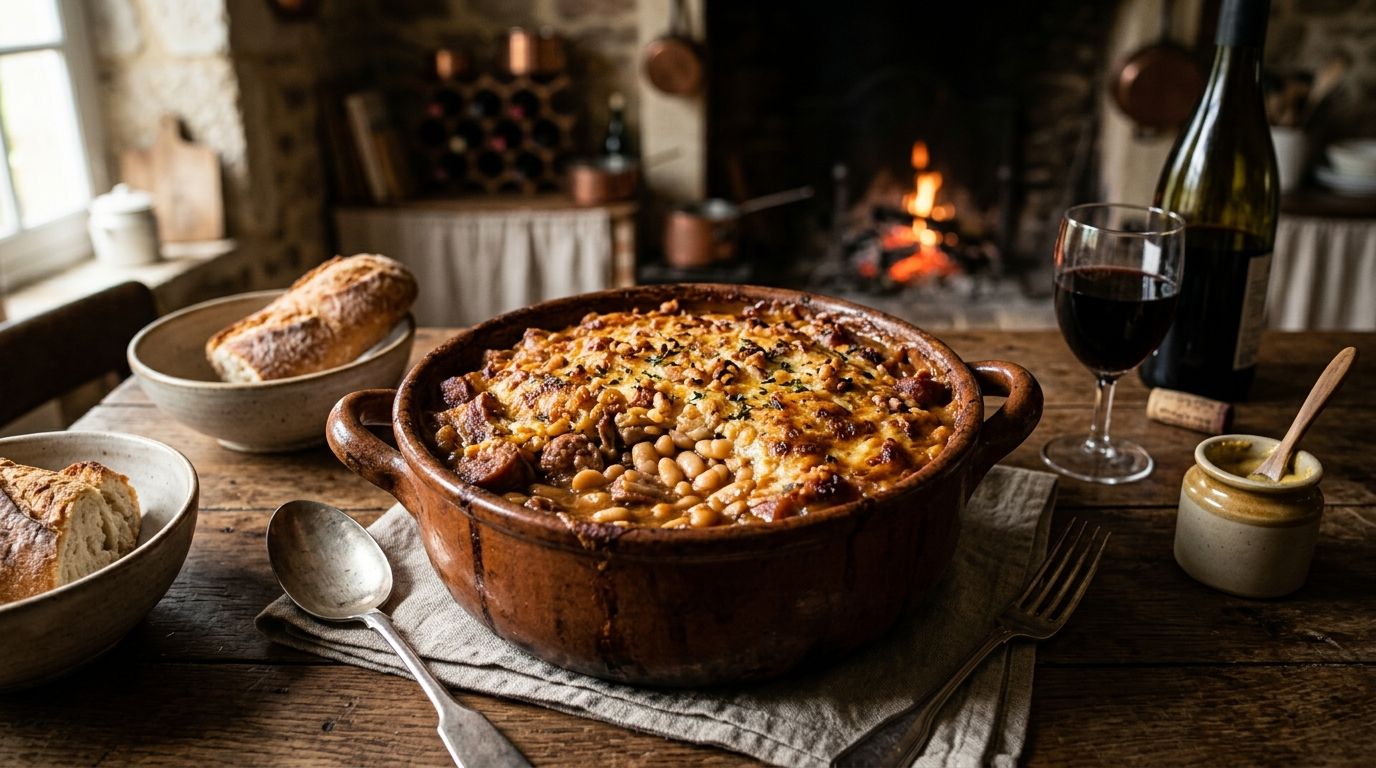
Cassoulet is a rich, slow stew originating in southern France, combining white beans (the haricot) with an abundance of meats — traditionally pork, sausage, mutton and preserved goose or duck — all slowly cooked in a clay pot until it forms an unctuous, deeply flavorful mass, crowned by a golden breadcrumb crust. The food writer Elizabeth David described it as "that sumptuous amalgamation of haricot beans, sausage, pork, mutton and preserved goose, aromatically spiced with garlic and herbs".
It is a dish of peasant soul, born of the need to feed many mouths with the ingredients available in winter — and it is precisely that rusticity that makes it so comforting. It is not a rare delicacy, but a generous, dense and democratic food that represents, for southern France, what beef bourguignon represents for Burgundy: the essence of terroir cooking, passed down from generation to generation.
Chapter
1.2 The Legend of 1355: How Cassoulet Is Said to Have Been Born During the English Siege of Castelnaudary in the Hundred Years' War
The most celebrated legend about the origin of cassoulet dates back to 1355, at the height of the Hundred Years' War, in the town of Castelnaudary, in the Aude department of the Occitanie region. According to the narrative, the town was under siege by English troops, and the population, on the verge of famine, gathered together all the ingredients that remained — beans, salted meats, sausages, duck and goose confit — and cooked them together, in a single pot, to feed the defenders before the battle.
The legend goes on to say that, fortified by that hearty stew, the inhabitants of Castelnaudary repelled the English attackers with renewed vigor. Thus, cassoulet is said to have been born: not from a chef's creativity, but from the urgency of a besieged people who turned scarcity into a dish of resistance. The story is beautiful and symbolic — but, as we shall see, it does not withstand the scrutiny of historians.
Chapter
1.3 The Historical Truth: Why There Was No Siege of Castelnaudary and the Black Prince Burned the Town
The legend of the siege, however seductive, hits an insurmountable obstacle: there was no siege of Castelnaudary in 1355. The historical records tell another, far darker story. In that year, the Black Prince — Edward, Prince of Wales, son of King Edward III of England — led a devastating campaign through southern France, known as the *chevauchée* (a mounted raid), characterized by the pillaging and systematic destruction of towns and fields.
In the case of Castelnaudary, there was no heroic resistance: the town was sacked and burned by the English troops, and much of its population was killed. The cassoulet legend therefore inverts reality — where there was flight, massacre and ashes, the myth places abundance, courage and victory. It is a classic example of how collective memory, over the centuries, transforms pain into an origin narrative, attributing to the dish an epic birth that history does not confirm.
Chapter
1.4 From the Medieval Estouffet to Modern Cassoulet: The Evolution of the Name and the Recipe Explained
In the Middle Ages, the dish we now call cassoulet was known by another name: estouffet. It was a stew of legumes — initially the favolles (broad beans), and not the white bean — with meats, slowly simmered in its pot. The name cassoulet, according to the Dictionnaire de l'Académie française, does not appear before the 19th century: it is the diminutive of the Occitan term cassolo, which designates the clay pot in which the dish is cooked.
The recipe, therefore, is far older than the name. What existed in the Middle Ages was a family of legume-and-meat stews, common throughout southern France; what the 19th century did was to baptize that tradition, consolidate it and raise it to the status of a regional signature dish. Understanding this distinction between the ancestral dish and the modern name is essential to grasping the true — and fascinating — history of cassoulet.
Chapter
2. The Etymology of Cassoulet: From the "Cassolo" of Issel to the Name That Baptized the Dish
Every great dish carries a story in its name, and cassoulet is no exception. Its name does not come from an ingredient, a technique or a chef — it comes from a pot. It is the clay pot that, over the centuries, lent its name to the dish it held, forever sealing the bond between cassoulet and the terroir of the Lauragais.
Chapter
2.1 What Does the Word "Cassoulet" Mean and What Is Its Linguistic Origin in Occitan?
The word cassoulet is the diminutive of the Occitan term cassolo — the Romance language historically spoken in southern France, in the Languedoc. The Dictionnaire de l'Académie française, the oldest and most authoritative reference of the French language, confirms this etymology: the dish's name derives directly from the pot in which it was cooked. Cassoulet is, literally, "what is cooked in the cassolo" — the content baptized by the container.
This linguistic origin reveals much about the dish's identity. Unlike so many recipes named after a chef, a city or an ingredient, cassoulet was named after its cooking vessel — a testimony to the centrality of the clay pot in Occitan gastronomic culture. Cassoulet is not merely a recipe; it is, above all, a technique of slow cooking, inseparable from the vessel that makes it possible.
Chapter
2.2 The "Cassol d'Issel": The Clay Pot from Issel That Gave Cassoulet Its Name
The writer Elizabeth David, one of the greatest authorities on French cooking, further specified the origin: the name would come from the "Cassol d'Issel" — the clay pot made in the small village of Issel, located a few miles from Castelnaudary. This pot, made of local clay, was the favorite of the cooks of the Lauragais for preparing the slow stews of beans and meat.
The detail is fascinating: a tiny, practically unknown village lent its name — through its pots — to one of the most celebrated dishes in France. The cassol d'Issel is proof that great French gastronomy was built, to a large extent, on the anonymous craftsmanship of local potters and artisans, whose daily work shaped, literally and figuratively, the cuisine of an entire region.
Chapter
2.3 Why Is the Cassole the Traditional Clay Pot Indispensable for Authentic Cassoulet?
The cassole — also called a toupin — is a deep, wide earthenware or stoneware pot that constitutes the traditional, and for purists indispensable, vessel of cassoulet. The writer Jane Grigson observed that the cassole is the "correct" vessel for the dish, adding that any earthenware or stoneware casserole will do, "provided it is deep and wide".
The reason for this preference is physical and gustatory. Clay conducts heat slowly, evenly and gently — exactly what the prolonged cooking of cassoulet requires. The width of the cassole, in turn, maximizes the surface area exposed to the air, favoring the formation of the dish's characteristic golden crust. Cooking a cassoulet in a clay cassole is not a nostalgic whim: it is what guarantees the velvety texture of the beans, the unctuousness of the meats and that crispy crust that are the signature of authentic cassoulet.
Chapter
3. The Bean of Cassoulet: From the Medieval Favolle to the White Haricot Brought from the New World
If cassoulet is a stew of meat and legumes, its central ingredient — and the one that gives it its name and identity — is the white bean. But the bean we now consider indispensable was not always present: the medieval recipe used another legume, and the arrival of the haricot in France is a story of travel, discovery and gastronomic transformation.
Chapter
3.1 Which Bean to Use in Authentic Cassoulet? The Lingot de Lauragais and the Tarbais Bean Explained
Authentic cassoulet calls for a specific white bean: the lingot — a white, oval, creamy bean that absorbs the flavors of the broth without falling apart. The most celebrated variety is the lingot de Lauragais, grown on the fertile plain stretching between Toulouse and Carcassonne, in the heart of cassoulet country. This bean is prized for its thin skin, soft core and extraordinary ability to hold its shape during the long cooking.
There is also the Tarbais bean, from the region of Tarbes in the Hautes-Pyrénées — another noble white variety, with large grains and a velvety texture, equally appreciated for cassoulet. What matters, in any case, is the quality of the legume: a good cassoulet begins with a good bean, which must cook until creamy inside but intact, without turning into a mash.
Chapter
3.2 The History of the Haricot: How the White Bean Arrived in France from America in the 16th Century
The haricot — the white bean — is a contribution of the New World to the French table. According to the Oxford Companion to Food, the bean arrived in France from America, via Spain, in the 16th century, brought by the navigators and merchants who crossed the Atlantic in the wake of the discovery of America. It was a legume unknown in Europe, which would go on to revolutionize the continent's diet.
The Larousse Gastronomique, for its part, points out that the white bean only came into widespread use in France in the 19th century. There is, therefore, a gap between the arrival of the bean (16th century) and its adoption as the dominant ingredient of cassoulet (19th century). For centuries, the ancestral stew continued to be made with medieval broad beans, until the haricot — softer, tastier and more versatile — definitively conquered the kitchens of the south.
Chapter
3.3 Why Did the Haricot Replace the Medieval Favolle in the Traditional Cassoulet Recipe?
In the Middle Ages, the stews that gave rise to cassoulet were made with favolles — the broad beans, fresh or dried —, the legume then dominant in Europe. The replacement of the broad bean by the white haricot was a gradual process, driven by both gustatory and practical reasons. The white bean cooks more evenly, has a more delicate, neutral flavor, and pairs better with the meats and fats of the stew, absorbing the broth without dominating it.
Moreover, the haricot proved to be more productive and easier to store dried, becoming the ideal legume for the long winters of southern France. The transition from the broad bean to the white bean, completed in the 19th century, is what defines cassoulet as we know it today: a dish that, ironically, owes its modern form to a legume from the other side of the ocean. Cassoulet is, thus, a medieval stew with an American soul — further proof that gastronomy was never static, but a constant flow of exchanges and discoveries.
Chapter
4. The Trinity of Cassoulet: Castelnaudary, Carcassonne and Toulouse — The Three Cities That Dispute the Dish's Authorship
Few dishes in the world are as disputed as cassoulet. Three cities of southern France — Castelnaudary, Carcassonne and Toulouse — claim authorship of the dish, each with its own version, its own ingredients and its own legion of passionate defenders. The great gastronome Prosper Montagné, editor of the Larousse Gastronomique, consecrated this dispute by organizing the three versions into a "Trinity": the Father, the Son and the Holy Ghost. This chapter unravels the geography and the controversy of this centuries-old rivalry.
Chapter
4.1 The Cassoulet of Castelnaudary: The "Father" of the Trinity and the Oldest, Soberest Version
In Prosper Montagné's Trinity, the cassoulet of Castelnaudary is the "Father" — the oldest, soberest and, to many, most authentic version. It is based exclusively on pork, in all its forms: loin, ham, leg, sausages and fresh rind (the *couenne*). In some recipes, it also admits goose confit, but pork is, indisputably, the protagonist.
It is the version that best embodies the original rusticity of the dish: unpretentious, made with the products of one's own backyard — the home-raised pig, the garden beans, the oven bread. For the defenders of Castelnaudary, it is precisely this simplicity that makes the local cassoulet the true one: the dish born there, in the legend of 1355, and which remains faithful to its peasant roots.
Chapter
4.2 The Cassoulet of Carcassonne: The "Son" with Mutton and Partridge in Season
The cassoulet of Carcassonne is the "Son" of the Trinity — and is distinguished by the presence of a meat that does not appear in the Castelnaudary version: mutton. The Carcassonne version uses leg of mutton as a central ingredient, giving the stew a deeper flavor and a distinct unctuousness. And, when the season allows, it adds partridge — a game bird that elevates the dish to another level of sophistication.
The city of Carcassonne, with its medieval fortress — the Cité de Carcassonne, a UNESCO World Heritage Site — claims a gastronomic tradition worthy of its history. For its defenders, the cassoulet of Carcassonne is the richest and most complex of the Trinity, the one that, through the presence of mutton and game, reflects the opulence of a city that was once one of the great centers of medieval southern France.
Chapter
4.3 The Cassoulet of Toulouse: The "Holy Ghost" with Toulouse Sausage and Duck Confit
The cassoulet of Toulouse completes the Trinity as the "Holy Ghost" — and is, of the three, the most widespread and popular version. It uses the same ingredients as the cassoulet of Castelnaudary, but in smaller quantities, and adds two elements that became its trademark: the Toulouse sausage — the thick pork sausage, flavored with garlic and wine, famous throughout France — and the duck or goose confit, which brings an unmistakable depth and unctuousness. Some versions also add mutton or partridge.
Toulouse, the "pink city" of southern France, is the economic and gastronomic capital of the region — and it was the city that, throughout the 20th century, most contributed to spreading cassoulet around the world. For its defenders, the cassoulet of Toulouse is the most complete: the one that, by bringing together Castelnaudary's pork, the confit and the sausage, achieves the perfect balance between rusticity and richness.
Chapter
4.4 The Eternal Rivalry: Which of the Three Cities Makes the True Authentic Cassoulet?
The rivalry between Castelnaudary, Carcassonne and Toulouse is, itself, a cultural heritage of southern France. Each city defends its version with almost religious fervor, and the question "which is the true cassoulet?" is capable of igniting heated debates at any table in the region. The Michelin Guide summarizes the situation with humor: every town brings its own personal touch to the recipe, and all claim the title of the one and only stronghold of authentic cassoulet.
The truth, as always, is more conciliatory than the controversy. There is not — and probably never will be — a single "official" cassoulet. What exists is a family of dishes, united by the white bean and slow cooking, and diversified by the meats that each terroir offers. The cassoulet of Castelnaudary, that of Carcassonne and that of Toulouse are not rivals: they are three brothers of the same tradition, and the richness of the dish lies precisely in that diversity.
Chapter
5. The Ingredients of Authentic Cassoulet: The Complete and Definitive Anatomy of the Traditional Recipe of Southern France
Cassoulet is, like all great peasant dishes, built upon a list of humble, accessible ingredients — beans, meats, fat, bread — that slow cooking transforms into something extraordinary. There are no exoticisms or rare inputs: there is time, technique and respect for the products of the terroir. This chapter dissects, item by item, the anatomy of the classic recipe.
Chapter
5.1 What Are the Essential Ingredients of Cassoulet? The Complete and Definitive List of the Classic Recipe
The core of cassoulet is formed by two elements that alternate in layers: the white bean (the haricot) and the meats. To the beans and meats are added the cooking stock, the fresh pork rind (the *couenne*), the garlic, the herbs — typically thyme, bay leaf and parsley — and the breadcrumbs, which form the golden crust of the surface. The meats vary by region, but traditionally include pork (in several forms), sausage, mutton and goose or duck confit.
In 1996, the États généraux de la gastronomie traditionnelle française, a body dedicated to promoting regional products and traditional cuisine, codified the proportions: cassoulet must contain at least 30% meat — which may include sausage and Toulouse sausage, mutton or preserved goose — and up to 70% white beans and stock, plus fresh pork rind, herbs and seasonings. This proportion, although not law, became the reference for authentic cassoulet.
Chapter
5.2 Duck Confit and Goose Confit: The Meat Preserved in Its Own Fat That Defines the Flavor
Confit is one of the oldest and most ingenious techniques of southwestern French cooking — and one of the pillars of cassoulet. It consists of slowly cooking the meat of duck or goose — usually the legs — in its own fat, until tender and juicy, and then preserving it immersed in that same fat, where it can last for months without refrigeration. It is an ancestral preservation technique, predating the age of refrigerators.
In cassoulet, the duck confit or goose confit brings a depth and unctuousness that no other ingredient reproduces. The meat, already cooked and tender, melts into the stew, releasing its flavorful fat, which permeates the beans and the broth with an unmistakable taste of terroir. It is the confit that, more than any other element, transforms a simple bean stew into a truly memorable cassoulet.
Chapter
5.3 The Toulouse Sausage and the Couenne: The Elements That Give Body and Unctuousness to Cassoulet
The Toulouse sausage is the emblematic cured meat of cassoulet — a thick pork sausage, seasoned with garlic, salt and, traditionally, a touch of white wine, without spices that mask the flavor of the meat. It is the heart of the cassoulet of Toulouse and a frequent presence in the other versions, bringing flavor, succulence and that firm texture that contrasts with the softness of the beans.
The couenne — the fresh pork rind — is the humble ingredient that makes all the difference. Rich in collagen, it releases, during the long cooking, a natural gelatin that thickens the broth and gives it that silky, almost unctuous quality that is the trademark of a good cassoulet. The couenne is often placed at the bottom of the pot, lining it, so that its gelatin slowly dissolves into the dish.
Chapter
5.4 The Breadcrumbs and the Golden Crust: The Secret of the Cassoulet's Crispy Surface
The breadcrumbs — crushed dry bread — are the final touch that distinguishes cassoulet from any other stew. Sprinkled over the surface of the dish, they form, during cooking, a golden, crispy crust that seals in the moisture, concentrates the flavors and adds a contrasting texture that is pure satisfaction. It is this crust, broken and golden, that visually announces that the cassoulet is ready.
Tradition calls for the crust to be broken several times during cooking — mixed into the beans and left to brown again. This ritual, repeated over hours, is not mere ceremony: with each break, the breadcrumbs absorb the juices from the surface and return them to the dish, progressively enriching it. The cassoulet crust is, thus, far more than a finish — it is a cooking method in itself.
Chapter
6. The Meats of Cassoulet: From Pork to Duck, Mutton and Partridge
If the bean is the soul of cassoulet, the meats are its heart — the source of flavor, fat and substance that transforms a legume stew into a complete, unforgettable dish. The choice of meats is, indeed, the point that most divides the regional schools of cassoulet, each defending its own combination as the only true one. This chapter explores the role of each meat in the construction of the dish.
Chapter
6.1 Which Meats Go into Traditional Cassoulet? The Official 1996 Rule of 30% Meat
The list of meats in cassoulet is generous and varied: pork (in multiple forms), sausage, mutton and goose or duck confit, as well as, in some versions, partridge, turkey or even game. The authors of "Mastering the Art of French Cooking" — Simone Beck, Louisette Bertholle and Julia Child — summed up the question with irony: "the composition of a cassoulet is, in typical French fashion, the subject of infinite dispute... arguments about what should go into this famous dish seem based on local traditions".
The 1996 rule of the États généraux de la gastronomie traditionnelle française brought some order to the dispute: cassoulet must contain at least 30% meat (which may include sausage, Toulouse sausage, mutton or preserved goose), for up to 70% beans and stock. It is a proportion that guarantees the substance of the dish without suffocating the bean — the delicate balance between the legume and the meats that defines authentic cassoulet.
Chapter
6.2 Pork in All Its Forms in Cassoulet: Loin, Ham, Leg and Fresh Rind
Pork is the founding meat of cassoulet — and, in the Castelnaudary version, practically the only one. It enters the dish in an impressive variety of forms: the loin, the ham, the leg, the sausages and the fresh rind (the couenne). Each part plays a role: the loin and leg bring lean meat and substance; the ham, salt and smoked flavor; the sausages, succulence; and the rind, the gelatin that thickens the broth.
This total presence of pork reflects the rural economy of southern France, where the animal was raised, slaughtered and used whole — from snout to tail, without waste. In cassoulet, pork is not just one ingredient among others: it is the expression of a peasant culture that turned the need to use everything into one of the great virtues of French cuisine.
Chapter
6.3 Mutton and Partridge: The Meats That Distinguish the Cassoulet of Carcassonne
What distinguishes the cassoulet of Carcassonne from the other versions is the presence of two meats absent from the cassoulet of Castelnaudary: mutton and partridge. The leg of mutton gives the stew a deeper, slightly sweeter flavor, as well as a distinct unctuousness, which enriches the broth in an unmistakable way.
The partridge — a game bird, available only in certain seasons — is the ingredient that elevates the cassoulet of Carcassonne to a level of sophistication rare in a peasant dish. When present, it brings a deep, complex game aroma that transforms the stew into an almost aristocratic experience. It is this combination of rusticity and opulence that makes the cassoulet of Carcassonne, for many appreciators, the most refined expression of the Trinity.
Chapter
7. The Science of Cassoulet: How the Beans, Collagen and Slow Cooking Create the Perfect Texture
Behind the rustic appearance of cassoulet hides a sophisticated culinary engineering. The bean, the collagen of the meats and the breadcrumb crust interact, during the long hours of slow cooking, to produce the velvety texture, the unctuousness and the depth of flavor that make the dish unmistakable. Understanding this science is what allows any home cook to confidently reproduce the result of the great masters.
Chapter
7.1 Why Is the Bean the Soul of Cassoulet? The Science of Cooking the White Haricot to Perfection
The white bean is the soul of cassoulet for a precise physical reason: its porous structure and its starch content make it the perfect vehicle for the flavors of the stew. During slow cooking, the starch of the bean absorbs the broth, the fats and the aromas of the meats, swelling and softening until it reaches that creamy-inside, intact-outside texture that is the ideal of the dish.
The secret lies in controlling time and temperature: the bean must cook over very low heat, without boiling vigorously, so that the skin does not burst and the core softens evenly. An overcooked bean falls apart into a mash; an undercooked bean remains hard and floury. The perfect cassoulet is, above all, an exercise in patience and precision in cooking the legume.
Chapter
7.2 The Collagen of the Confit and the Couenne: How Slow Cooking Enriches and Thickens the Broth
The second scientific pillar of cassoulet is collagen — the structural protein present in the couenne (pork rind) and in the meats of the confit. Under prolonged, moist heat, collagen undergoes hydrolysis and converts into gelatin, the same substance that gives body to broths and jellies. It is this gelatin that gives cassoulet its characteristic unctuousness — that dense, shiny, silky broth that envelops every bean and every piece of meat.
Without enough collagen, the cassoulet turns out thin and watery, however flavorful the other ingredients may be. That is why the couenne and the confit are not optional: they are what provide the raw material of unctuousness. Slow cooking is, in that sense, a chemical process — the gradual transformation of hard tissues into a soft, flavorful gelatin that is the signature of the dish.
Chapter
7.3 The Breadcrumb Crust: Why Does Tradition Call for Breaking the Crust Seven Times?
The breadcrumb crust of cassoulet is more than a finish: it is a method. Tradition calls for the crust to be broken and plunged into the stew several times during cooking — purists speak of seven times — letting it form and brown again with each cycle. This ritual, far from being superstition, has a solid physical basis.
With each break, the already-browned breadcrumbs are submerged, mixing into the beans and the broth, where they release the juices they absorbed and receive new ones. Left to brown again, they form a new crispy layer. The result is a dish that progressively concentrates flavors at the surface, creating that complexity of textures — crispy outside, velvety inside — that is the mark of a truly well-made cassoulet. Breaking the crust is not a whim: it is the very technique of the dish.
Chapter
7.4 Why Does Cassoulet Taste Better the Next Day? The Science of Resting and Flavor Reabsorption
Like every great stew, cassoulet improves with rest — and science explains why. Upon cooling, the gelatin in the broth solidifies, trapping the flavor compounds; and the beans, still hot and porous, continue to absorb the aromatic liquids overnight. In the refrigerator, the flavors merge, round out and deepen, eliminating edges present right after the fire.
This phenomenon, known among chefs as the "marriage of flavors", makes cassoulet an ideal dish to prepare in advance. When reheating, the gelatin melts again, returning to the broth all its unctuousness, now with a visibly more integrated flavor. Not by chance, cassoulet became the dish of Sunday lunches and end-of-year festivities: it can be made the day before, rest, and reappear the next day at its peak — a gift that chemistry gives to hosts.
Chapter
8. The Complete Cassoulet Recipe: The Step-by-Step Guide to Making the Perfect Dish at Home Without Failing
The time has come to get hands-on — or rather, pot-on. This chapter gathers, in a practical and methodical roadmap, everything you need to execute a cassoulet worthy of the best tables of southern France. From the essential equipment to the preparation of the beans and the confit, from the complete step-by-step to the mistakes that ruin the result, this is the definitive guide for those who wish to master one of the most emblematic stews of French gastronomy.
Chapter
8.1 Which Utensils and Pots Do You Need to Make the Perfect Cassoulet? The Essential Equipment
Cassoulet calls, above all, for an adequate pot: the cassole — the traditional deep, wide earthenware or stoneware pot. If you do not have an authentic cassole, any deep, wide earthenware or stoneware casserole will do, as Jane Grigson observed; the important thing is that the vessel conducts heat slowly and evenly and exposes a good surface to the formation of the crust. An enameled cast-iron pot also works well.
Besides the pot, you will need few items: a pot to cook the beans and prepare the confit, a cutting board and a sharp knife, and kitchen twine to tie the herb bundle. A stable-temperature oven is essential, since cassoulet is traditionally cooked in the oven for hours. With this simple arsenal, any home kitchen is capable of reproducing the classic.
Chapter
8.2 How to Prepare the Beans and the Confit: The Base of Authentic Cassoulet Step by Step
Cassoulet begins, the day before, with the white beans. Soak them in cold water for 12 hours, which reduces cooking time and improves texture. On the day, drain and cook the beans in water with carrot, onion, garlic and the bouquet garni, until soft outside and creamy inside, but still whole. Set aside, reserving the cooking water for the broth.
The duck confit (or goose), if not bought ready-made, must be prepared in advance: the legs are seasoned, cooked slowly in their own fat until they fall apart, and preserved in that fat. For home cassoulet, the confit can be bought at good stores — but it is this ingredient, more than any other, that defines the depth of the dish. With the beans cooked and the confit ready, the assembly can begin.
Chapter
8.3 The Complete Step-by-Step of Cassoulet: Layer the Ingredients and Cook Slowly for Hours
The assembly of cassoulet follows the tradition of layers. First, line the bottom of the cassole with the couenne (pork rind). Second, arrange a layer of white beans. Third, distribute over it the pieces of confit, the sausages, the pork and the mutton (if using). Fourth, cover with another layer of beans, pouring the reserved stock until almost covering. Fifth, place in the oven at 325 °F, leaving it to cook slowly.
During the hours of cooking — typically two to three hours — maintain the tradition of breaking the crust: whenever the surface browns, plunge the crust into the stew and sprinkle fresh breadcrumbs over it. Repeat the gesture several times, until the dish acquires a deeply golden surface and an unctuous broth. Finally, serve very hot, straight from the cassole, preferably the next day, when the flavors will have fully merged.
Chapter
8.4 What Are the Most Common Mistakes That Ruin Cassoulet? The Definitive Guide to Never Failing
The road to ruining cassoulet is paved with predictable — and avoidable — mistakes. The first is overcooking or undercooking the beans: the bean must be creamy inside and whole outside; overcooked, it turns to mash; undercooked, it stays hard and floury. The second is using a poor stock: without a good broth and the gelatin of the couenne and the confit, the cassoulet turns out thin and soulless. The third is rushing the cooking: cassoulet demands hours of slow oven; forcing the temperature hardens the beans and prevents the marriage of flavors.
Other common slips include not breaking the crust — letting it burn and turn bitter —, skimping on the fat of the confit, and serving immediately, giving up the overnight rest that rounds out the flavors. There is also the mistake of seasoning only at the end: the beans and the broth ask for layers of seasoning throughout the entire process. Avoiding these stumbles, cassoulet reveals itself generous — and forgives, with ease, any small imperfection of technique.
Chapter
9. The Grande Confrérie and the Fête du Cassoulet: The Brotherhood That Defends the Dish and the Festival That Celebrates It
Cassoulet is so important to the identity of southern France that there exists an organization dedicated exclusively to defending it: the Grande Confrérie du Cassoulet de Castelnaudary, the Grand Brotherhood of the Cassoulet. And, since the year 2000, the town celebrates the dish with an annual festival that draws crowds. This chapter tells the story of these institutions that turned cassoulet into living heritage.
Chapter
9.1 What Is the Grande Confrérie du Cassoulet de Castelnaudary? The Brotherhood Founded in 1970
The Grande Confrérie du Cassoulet de Castelnaudary was founded in 1970 with a clear and ambitious mission: to increase the prestige of cassoulet, spread its history and defend the traditions and quality of the dish. Inspired by the ancient medieval confraternities — the guilds that regulated trades and preserved knowledge — the Brotherhood brings together producers, cooks, gastronomes and enthusiasts, all united by the commitment to keep authentic cassoulet alive.
The Brotherhood performs ceremonies of enthronement, in which new members are solemnly invested, dressed in the traditional robes and touched by the ceremonial sword — a ritual that echoes the old corporate traditions of France. More than folklore, the Confrérie is an active guardian: it monitors, promotes and celebrates cassoulet, ensuring that the dish served in Castelnaudary and its surroundings respects the traditions that made it famous.
Chapter
9.2 The Fête du Cassoulet: The Three-Day Annual Festival That Draws Crowds to Castelnaudary
In 2000, the Grande Confrérie, in partnership with the town hall of Castelnaudary and other bodies, created the Fête du Cassoulet — the annual cassoulet festival, which turns the small town of the Aude into a great gastronomic stage. Over three days, the festival offers tastings of cassoulet, free concerts, a flower parade and a series of other attractions celebrating the dish and the local culture.
The Fête du Cassoulet has become one of the most important gastronomic events in southern France, attracting thousands of visitors from across the country and abroad. It is living proof that cassoulet is not merely a dish, but a cultural fact: a reason for meeting, celebration and communal pride, capable of bringing an entire town together around a clay pot.
Chapter
9.3 How Does the Confrérie Defend the Quality and Tradition of Authentic Cassoulet?
The defense of quality is the heart of the Grande Confrérie's mission. It works on several fronts: promoting the local producers of the lingot de Lauragais and the traditional meats, encouraging restaurants to maintain authentic recipes, and educating the public about what is — and what is not — a true cassoulet. The Brotherhood functions, in practice, as an informal seal of authenticity for the dish in its region.
Moreover, the Confrérie keeps alive the historical memory of cassoulet — from the legend of 1355 to the etymology of the cassol d'Issel — transmitting it to new generations through ceremonies, publications and the festival itself. It is thanks to this work of preservation that cassoulet remains, in the 21st century, not as a museum piece, but as a living dish, cooked daily in the kitchens and restaurants of southern France, faithful to its roots and open to the future.
Chapter
10. The Regional Variations of Cassoulet: From Montauban to Corbières and the Fish Cassoulet
The Trinity of Castelnaudary, Carcassonne and Toulouse does not exhaust the universe of cassoulet. Over the centuries, other towns and regions of southern France created their own versions of the stew, each with its peculiarities — from the tomato purée of Montauban to the pig's tail of Corbières, from the salt cod of the fish cassoulet to international reinterpretations. This chapter travels that map of variations.
Chapter
10.1 The Cassoulet of Montauban: The Regional Version with Tomato Purée
The cassoulet of Montauban, a town in the Tarn-et-Garonne department, is distinguished by an ingredient that none of the Trinity versions admits: tomato purée. This addition, recorded by the Michelin Guide, gives the stew an acidic, sweet note that brightens the unctuousness of the meats and adds a layer of freshness to the dish.
The presence of the tomato is, in fact, a delicious anachronism — the tomato, like the bean, is native to the Americas and only became popular in Europe centuries after the supposed creation of cassoulet. The cassoulet of Montauban is, therefore, a deliberately modern version, incorporating a New World ingredient into the tradition of southern France. For purists, it is heresy; for others, proof of the dish's vitality and capacity for reinvention.
Chapter
10.2 The Cassoulet of Corbières: The Version with Lightly Salted Pig's Tail and Ears
In the Corbières region, food historian Maguelonne Toussaint-Samat recorded a local peculiarity bordering on dogma: it would be a sacrilege to make cassoulet in Corbières without the lightly salted pig's tail and ears. This version incorporates the humblest, most gelatinous parts of the animal — rich in collagen, which gives the broth an extraordinary unctuousness.
It is the version that best embodies the spirit of full use of the pig that lies at the origin of cassoulet. Tail and ears, despised by refined cuisine, become here ingredients of honor, bringing the dish a texture and depth that noble meats do not achieve. The cassoulet of Corbières is proof that, in southern France, nothing is wasted — and everything is transformed into flavor.
Chapter
10.3 The Fish Cassoulet: The Version with Salt Cod Replacing the Duck and Goose
The Larousse Gastronomique records a surprising variation: the fish cassoulet, made with salt cod in place of the duck or goose. It is a version born in the coastal regions and in communities that, for religious or economic reasons, replaced the meats with fish preserved in salt.
The salt cod, with its firm texture and characteristic salty flavor, transforms the stew into an entirely distinct dish, lighter and more maritime, yet still faithful to the fundamental structure of cassoulet — the white bean slowly cooked with a preserved ingredient. It is proof of the extraordinary flexibility of the dish, capable of accommodating the most diverse food traditions without losing its essential identity.
Chapter
10.4 Cassoulet Around the World: From Quebec to Contemporary International Cuisine
Cassoulet crossed borders and conquered the world. In Quebec, the Francophone cuisine incorporated the dish, adapting it to local products; in the United States, the recipe was spread by Julia Child and by generations of chefs; and, in contemporary haute cuisine, chefs around the world reinterpret cassoulet with modern techniques, while keeping the essence of the white bean slowly cooked with meats and fat.
This international spread confirms the status of cassoulet as one of the great classics of world cuisine — alongside feijoada, chili and other bean stews that, in every corner of the planet, fulfill the same ancestral function: to feed, warm and bring people together. Cassoulet, born in a clay pot of the Lauragais, is today a dish of universal vocation.
Chapter
11. How to Pair Cassoulet: The Best Wines, Side Dishes and Moments to Serve the Dish
A great dish deserves a great table. The pairing of cassoulet — the choice of the wine that accompanies it, of the side dish that sustains it and of the occasion on which it is served — is the final chapter of the experience, and the one that most reveals the gastronomic culture of southern France. This chapter gathers the classic rules and the welcome freedoms for serving the stew in its splendor.
Chapter
11.1 Which Wine to Serve with Cassoulet? The Golden Rule of Pairing in Southern France
The golden rule of pairing cassoulet is to serve a wine from the region itself — a robust red from the French southwest, equal to the unctuousness and depth of the dish. The wines of Cahors, made from the Malbec grape, with their firm tannins and dark, full-bodied character, are the classic accompaniment. The reds of Gaillac, Corbières or Fitou, from Languedoc-Roussillon, also pair perfectly, with their ripe fruit and generous structure.
The principle is the same as for every rich dish: the wine must have enough body and acidity to cut through the fat of the confit and the sausage, without getting lost. A light red would fade before the power of the cassoulet; a full-bodied, lightly tannic red, served at 61 °F to 64 °F, is the ideal partner. And, as in all of French gastronomy, the company of a good regional wine turns the meal into a celebration.
Chapter
11.2 What Is the Classic Side Dish for Cassoulet? From Rustic Bread to Green Salad
Cassoulet is, in itself, a complete dish — beans, meats, fat and bread — and does not call for elaborate accompaniments. The classic is rustic bread, used to soak up the unctuous broth and accompany each forkful, in the purest French custom of *saucer* (soaking the bread in the sauce). A good pain de campagne or a slice of sourdough bread is the ideal companion.
To balance the richness of the dish, many appreciators serve a simple green salad, dressed with an acidic vinaigrette, whose freshness cuts through the unctuousness of the stew. Some also add a full-bodied red wine and, eventually, a local cheese at the end. But the rule is sobriety: cassoulet is the protagonist, and the side dishes should only enhance — never compete with — its presence.
Chapter
11.3 When to Eat Cassoulet? The Seasonality of the Winter Dish and the Best Occasions
Cassoulet is, by nature, a winter dish — dense, hot and comforting, made for the cold months when the body asks for substance. It is the dish of family Sunday lunches, end-of-year festivities and long convivial meals, when time lengthens at the table and the food warms body and soul. Its association with winter is so strong that, in southern France, cassoulet is almost a seasonal rite.
Nothing, however, prevents it from being enjoyed all year round — and many restaurants keep it on the menu permanently, such is its popularity. The advice of connoisseurs is only to respect the spirit of the dish: to serve it in generous portions, accompanied by good company and without haste. Because cassoulet is not just a recipe; it is an invitation to slowness, to conviviality and to the pleasure of the table — the true heart of the gastronomic culture of southern France.
Chapter
12. Curiosities, Myths and Surprising Secrets of Cassoulet That Will Forever Change How You Look at the Dish
Behind every great dish there is a treasure of little-told stories. Cassoulet accumulates myths, legends and curiosities that surprise even the most dedicated appreciators — from the eternal pot that has been cooking for decades to its surprising kinship with Brazilian feijoada. This chapter gathers the secrets and surprises that reveal the dish in an entirely new light.
Chapter
12.1 The Eternal Cassoulet: The Legend of Mère Clémence's Pot That Has Been Cooking for Twenty Years
The tradition of deglazing the pot of the previous cassoulet to give a base to the next gave rise to one of the most fascinating legends of French gastronomy: the perpetual cassoulet. The writer Elizabeth David, citing the novelist Anatole France, told the story of Mère Clémence, whose cassoulet was said to have been cooking for twenty years — the pot was never fully washed, and with each new batch new ingredients were added to the old base, so that "it was always the same cassoulet".
The idea of a dish that never ends, passed down from generation to generation in the same pot, is a powerful metaphor for the continuity of culinary tradition. Although the legend is certainly exaggerated, it captures a deep truth: cassoulet is a dish of inheritance, in which each batch carries, symbolically, the flavor of all those that preceded it.
Chapter
12.2 Why Is There No Single Official Cassoulet Recipe? The Controversy of the Three Cities
Unlike dishes protected by rigorous origin seals, cassoulet does not have a single, official recipe. There is no regulatory council that legally determines which ingredients are mandatory or prohibited — and the reason is historical: the dispute between Castelnaudary, Carcassonne and Toulouse was never resolved, and probably never will be. The authors of "Mastering the Art of French Cooking" summed it up with humor: the composition of cassoulet is "the subject of infinite dispute".
This absence of canon, far from weakening the dish, is the key to its vitality. Each family, each town and each chef has its own version, and all are legitimate. Cassoulet is, in that sense, a living, democratic dish — a tradition renewed with each pot, exactly like the great classics of oral culture. The rule that unites it is deeper than any recipe: white beans, meats, fat and patience.
Chapter
12.3 Cassoulet in Pop Culture: From the Literature of Anatole France to Haute Cuisine
Cassoulet left its mark on French culture far beyond the kitchen. The novelist Anatole France, a Nobel Prize laureate in Literature, immortalized it in his work, associating it with emotional memory and the identity of the south; and the legend of Mère Clémence's perpetual cassoulet circulated for decades in gastronomic literature, from Elizabeth David to contemporary authors.
In haute cuisine, cassoulet was also elevated to an object of art: renowned chefs reinterpreted it with modern techniques, noble meats and contemporary presentations, without ever abandoning the essence of the white bean slowly cooked. And, on social media, the dish accumulates admirers worldwide, with photos of the golden crust and the bubbling broth that make cassoulet's fame go viral. The humble stew of the Lauragais is, today, a cultural icon of planetary reach.
Chapter
12.4 Cassoulet and Feijoada: The Surprising Similarities Between France and Brazil
One of the most fascinating curiosities about cassoulet is its extraordinary similarity to Brazilian feijoada. The two dishes are, essentially, the same idea: a stew of beans with pork meats (and, in some versions, preserved meats), cooked slowly until it forms an unctuous, flavorful mass, served as a dish of gathering and celebration. In cassoulet, the white bean and the duck confit; in feijoada, the black bean and the salted meats — but the soul is the same.
This kinship is not accidental: both dishes descend from a European tradition of legume-and-meat stews, which crossed the Atlantic with colonization and gained, on each continent, its own expression. Cassoulet and feijoada are, thus, cousins separated by the ocean — two brothers of the same gastronomic family, proving that great bean cooking is a common heritage of humanity.
Chapter
13. FAQ: The 15 Most Frequently Asked Questions About Cassoulet
Chapter
Which bean to use in cassoulet?
The ideal is the white bean (haricot), preferably a noble variety such as the lingot de Lauragais or the Tarbais bean. These beans have a thin skin and creamy core, absorbing the flavors of the broth without falling apart. A good cassoulet begins with a good white bean, cooked until soft inside and whole outside.
Chapter
Are cassoulet and feijoada the same thing?
No, but they are close cousins. Cassoulet uses white beans and meats such as pork, sausage and duck/goose confit; feijoada uses black beans and salted meats. Both, however, descend from the same European tradition of bean-and-meat stews, and share the soul of a dish of gathering and celebration.
Chapter
Can I make cassoulet without confit?
Yes, but the result will be different. The duck confit (or goose) is what gives cassoulet its characteristic depth and unctuousness. Without it, the dish becomes lighter and more rustic — closer to the cassoulet of Castelnaudary, which is based exclusively on pork. For an authentic, rich cassoulet, the confit is strongly recommended.
Chapter
How long does it take to cook cassoulet?
Counting the soaking of the beans (12 hours) and the preparation of the confit, cassoulet is a dish prepared a day in advance. The cooking itself demands two to three hours of slow oven, at about 325 °F, with the ritual of breaking the crust several times. It is a dish of patience — and one that improves the next day.
Chapter
What is duck confit?
Duck confit is an ancestral meat preserve: the duck legs are cooked slowly in their own fat until they fall apart, and then preserved immersed in that fat, where they last for months. It is one of the most emblematic techniques of the French southwest and the ingredient that defines the depth of flavor of cassoulet.
Chapter
Can I freeze cassoulet?
Yes, and very well. Cassoulet is one of the dishes that best withstand freezing, thanks to the rich broth and the gelatin of the meats. Frozen in a well-sealed container, it keeps for up to three months. When thawing, do so slowly in the refrigerator and reheat over low heat, so that the broth recovers its unctuousness.
Chapter
What is the difference between the cassoulet of Castelnaudary, Carcassonne and Toulouse?
The difference is in the meats. The cassoulet of Castelnaudary uses only pork (loin, ham, leg, sausage and rind); the one of Carcassonne adds mutton and, in season, partridge; the one of Toulouse uses pork and adds the Toulouse sausage and the duck/goose confit. They are the three versions of the cassoulet "Trinity".
Chapter
Does cassoulet contain breadcrumbs?
Yes. The breadcrumbs are sprinkled over the surface and form the golden crust characteristic of cassoulet. During cooking, tradition calls for breaking the crust several times, plunging it into the stew and letting it brown again — a ritual that concentrates the flavors and creates the crispy texture of the surface.
Chapter
Which wine to serve with cassoulet?
The ideal is a full-bodied red from the French southwest, such as a Cahors (Malbec) or the reds of Gaillac, Corbières or Fitou. The wine must have enough body and acidity to cut through the fat of the confit and the sausage. Serve at 61 °F to 64 °F.
Chapter
Is cassoulet fattening? How many calories does it have?
Yes, cassoulet is a rich, caloric dish. An average portion can contain between 500 and 700 calories, varying according to the amount of confit, sausage and fat. It is a winter and festive dish, made for special occasions — and it is precisely that richness that makes it so comforting.
Chapter
What is the couenne?
The couenne is the fresh pork rind. Rich in collagen, it releases, during slow cooking, a natural gelatin that thickens the broth and gives cassoulet its silky unctuousness. It is often placed at the bottom of the pot, where it slowly dissolves into the dish.
Chapter
Is cassoulet originally from Castelnaudary?
According to tradition, yes: the legend places the birth of cassoulet in Castelnaudary, in 1355, during the Hundred Years' War — although documented history does not confirm the siege. The name "cassoulet", however, only appears in the 19th century, derived from the clay pot cassolo. The exact origin is, in fact, disputed between Castelnaudary, Carcassonne and Toulouse.
Chapter
Can I use canned beans in cassoulet?
You can, but it is not ideal. Canned beans come already cooked and lose the ability to absorb the flavors of the broth during slow cooking. For an authentic cassoulet, prefer dried beans, soaked and cooked in the aromatic broth of the dish itself — that is what guarantees the deep texture and flavor.
Chapter
Does cassoulet improve the next day?
Yes, and it is not a myth. Cassoulet improves after a night of rest, because the flavors merge and round out, and the beans continue to absorb the broth. It is one of the rare dishes that genuinely benefit from being prepared in advance and reheated the next day, over low heat.
Chapter
What does the word "cassoulet" mean?
The word cassoulet is the diminutive of the Occitan term cassolo, which designates the clay pot in which the dish is cooked. According to Elizabeth David, it would come from the "Cassol d'Issel", the pot made in the village of Issel, near Castelnaudary. The dish's name comes, therefore, from the vessel — and not from an ingredient or chef.