Chapter
1. Aix-en-Provence: The Complete Guide to the Elegant Historic Capital of Provence
Chapter
1.1. The irresistible Provençal charm of golden stone alleys and noble mansions
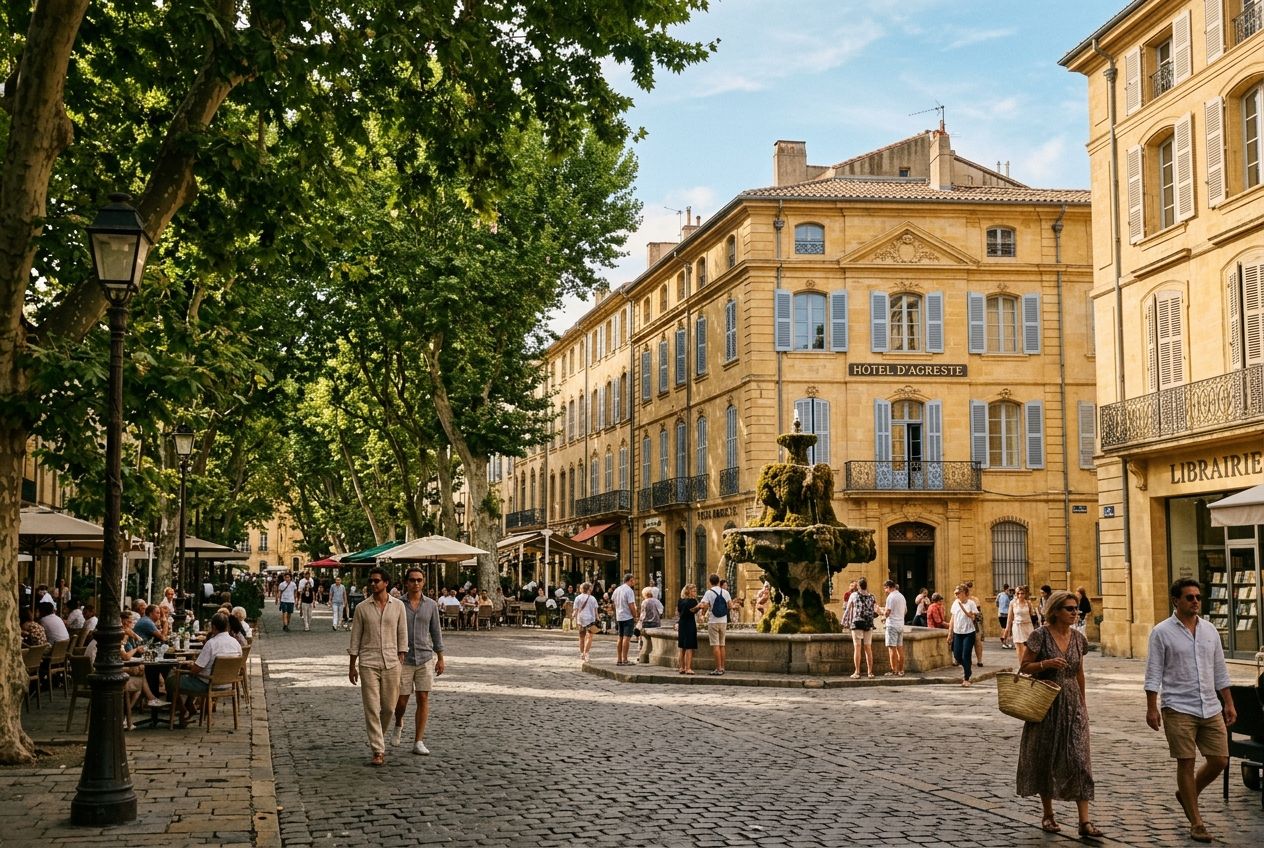
Walking through the narrow streets of Aix-en-Provence is like letting yourself be seduced by a visual symphony where the golden limestone, extracted from the neighboring Bibémus quarries, reflects the southern sunlight in an absolutely glorious and welcoming way. For the traveler seeking the true soul of the south of France, every corner of this ancient historic capital reveals monumental baroque palaces, courtyards shaded by centuries-old plane trees and a constant bubbling of water that whispers imperial secrets. It's an irresistible invitation to slow down and lose yourself in an urban labyrinth where Parisian elegance meets the sunny, bohemian lightness of Provençal life.
The aesthetic richness of the facades, adorned with caryatids carved in rustic stone and handcrafted wrought iron balconies, reflects the golden period in which the city served as the official residence of the Parliament of Provence in the 18th century. The hidden internal courtyards hide baroque portals that once welcomed carriages of the provincial nobility, creating an aristocratic residential atmosphere impeccably preserved by the municipality. For researchers of historical urbanism, Aix represents one of the most complete examples of the transition between the defensive urban planning of the Middle Ages and the open monumental squares of the European Enlightenment.
In addition to its impressive heritage integrity, the city stands out for the cultural vibrancy infused by its renowned university population, which keeps the cafes and public squares in a constant intellectual buzz throughout the year. This vibrant fusion between the weight of history and the freshness of youth creates a favorable environment for holding international opera festivals and contemporary art exhibitions of the highest international prestige. Exploring Aix-en-Provence is, therefore, enjoying a sophisticated setting where the monumental past and the dynamic present coexist in incomparable poetic harmony.
Chapter
1.2. Why has the city conquered intellectuals and artists over the centuries?
It is no coincidence that Aix-en-Provence has been the spiritual refuge and inspiring muse of some of the most brilliant and transformative minds in literature, painting and philosophy throughout the centuries of the modern era. For the researcher eager to decipher the mysteries of artistic creation, walking under the turquoise sky of Aix is understanding the exact sunlight that fascinated painters and poets, pushing them to break the rigid rules of traditional academicism. It is a fertile soil that breathes visual poetry and invites creative minds to reconnect with the primordial forms of nature in a profound and unforgettable way.
The city's magnetism lies in the perfect balance between the bucolic isolation of the surrounding hills of olive trees and pine trees and the intellectual sophistication of the debate halls and cafés of the Cours Mirabeau avenue. Figures of the caliber of Paul Cézanne and Émile Zola found the necessary fuel for their conceptual revolutions here, debating aesthetics and society while walking along the limestone trails that lead to the Sainte-Victoire mountain. This network of friendships and literary and pictorial influences established in Aix an unshakable tradition of creative freedom, attracting intellectuals from all over the world in search of genuine inspiration.
By devotedly preserving the ateliers, historic cafes and geographic points frequented by these geniuses of the past, the city offers incomparable interpretive tourism that connects the visitor to the artist's mental process. By following the routes indicated by bronze plaques with Cézanne's signature embedded in the stone sidewalks, the modern traveler stops being a mere passive spectator and begins to relive the physical steps and visual decisions that gave rise to modern art itself.
Chapter
2. The History of Aix-en-Provence: From Roman Hot Springs to Cultural Brilliance
Chapter
2.1. The Roman foundation of Aquae Sextiae and the military importance of thermal waters
Long before it became the temple of Provençal elegance, Aix-en-Provence was born from the comforting and healing heat of the depths of the earth, attracting the legions of Rome with the promise of healing and military rest in its thermal waters. Founded in 122 BC by the Roman consul Gaius Sextius Calvin under the imperial name of *Aquae Sextiae*, the city was strategically designed around natural hot springs of mineral water that sprang from deep geological faults. For the leisure tourist or classical historian, discovering the beginnings of this Roman military colony is understanding how the power of the Empire was consolidated in southern Gaul through the control and monumentalization of thermal waters.
The choice of the location for the foundation of *Aquae Sextiae* had both military and urgent therapeutic motivations, serving as an advanced fortress to protect the commercial route that connected the Italian peninsula to the Iberian peninsula via the Via Domicia. In the year 102 BC, the region was the historical setting of the legendary Battle of Aquae Sextiae, where Roman forces led by the brilliant general Gaius Marius decisively crushed the invading hordes of Cimbri and Teutons, consolidating Roman rule over the province of Gaul Narbonensis. The thermal waters then began to welcome veterans of the Roman legions for treatment of injuries and physical rehabilitation in monumental baths richly decorated with geometric mosaics and marble columns.
The remains of these ancient baths, discovered in successive archaeological excavations in the 19th and 20th centuries, are today elegantly integrated into the city's luxurious modern thermal complex, allowing visitors to relax in the same calcium and magnesium-rich waters that cured Gaius Marius's soldiers. These archaeological studies prove that the hydraulic system designed by Roman engineers was of impressive precision, capturing the springs and distributing the heated water underground through lead pipes and limestone channels that have resisted the passage of millennia.
Chapter
2.2. The role of Aix as the historical and judicial capital of the County of Provence
Aix-en-Provence's transition from a Roman military colony to the opulent judicial and administrative capital of the County of Provence during the late Middle Ages cemented its role as the neurological center of power and sophistication in southern France. Under the brilliant reign of the counts of the Catalan dynasty and later the Anjou dynasty, the city transformed into an avant-garde court that rivaled the greatest kingdoms of Christian Europe in luxury, arts, and legal scholarship. For the contemporary researcher or curious traveler, every medieval square and every golden stone archive whispers the golden legacy of the time when the city exercised absolute sovereignty over the vast Provençal territory.
The peak of this political prestige occurred during the reign of the legendary King René of Anjou in the fifteenth century, a polymath sovereign, generous patron and passionate about letters who transformed his court in Aix into a center of cultural renaissance even before the Italian transformations. René brought together musicians, Flemish painters, and high-achieving jurists at court, promoting the development of modern commercial laws and establishing the Parliament of Provence in Aix, which remained the region's supreme court of justice until the outbreak of the French Revolution. This judicial primacy guaranteed Aix the presence of a wealthy elite of lawyers and magistrates who invested fortunes in the construction of the imposing baroque palaces that today define the urban silhouette.
The loss of administrative capital status following the reforms of the French Revolution, which transferred the center of political power to neighboring port Marseille, ironically acted as a colossal historical preservation shield for Aix-en-Provence. Far from the accelerated industrialization and disorderly growth that reshaped other French metropolises in the nineteenth century, the city remained dormant in its aristocratic limestone beauty, preserving intact the geometric layout and valuable architectural heritage that today attracts millions of qualified tourists from all over the world.
Chapter
3. The Cours Mirabeau in Aix-en-Provence: The Elegant Heart Under the Shade of Plane Trees
Chapter
3.1. The creation of the monumental avenue in 1649 as a walkway for the local aristocracy
Walking under the magnificent green canopy formed by the intertwined leaves of the century-old plane trees of the Cours Mirabeau is like parading along a catwalk of baroque elegance designed to transform the simple act of strolling into a rite of social ostentation and aesthetic pleasure. Originally created in 1649 as a wide and imposing carriage avenue for the local nobility, the Cours Mirabeau avenue stretches for more than 1,300 feet, functioning as the geographic and social divide between medieval Aix and the refined Quartier Mazarin. For the traveler, this monumental avenue is the beating heart of the city, where the aroma of fresh coffee mixes with the bubbling sound of fountains and the sunlight that poetically filters through the leaves.
The Cours Mirabeau was conceived in the context of baroque urban expansion and renewal after the demolition of the old medieval walls in the south of the city, aiming to create a monumental leisure and circulation space for the luxurious carriages of the rich parliamentarians of Aix-en-Provence. On the north side of the avenue, majestic palaces (*hôtels particuliers*) stood adorned with carved stone portals and wrought iron balconies supported by expressive caryatid sculptures, displaying the opulence and prestige of the region's aristocratic families. The Cours Mirabeau quickly established itself as the center of civic and worldly life, where the local elite paraded their fortunes under the canopy of imported plane trees.
Today, the avenue remains one of southern Europe's most storied boulevards, closed to heavy freight vehicle traffic and transformed into a wide pedestrian promenade lined with stylish bistros, antique bookshops and cozy café terraces. When strolling along the Cours Mirabeau, visitors can admire four monumental, historic fountains distributed along its length, each telling a different phase of the water city's hydraulic engineering. It's the perfect setting to observe the refined daily lives of local residents while enjoying a glass of Provençal rosé wine in the shade of venerable trees.
Chapter
3.2. The historic cafés of the Cours Mirabeau and the legacy of the famous Café Deux Garçons
Entering the gilded halls or sitting on the iron terraces of the legendary Café Deux Garçons, opened on the Cours Mirabeau in mid-1792, is like taking a trip back in time to the epicenter of the great artistic, intellectual and revolutionary discussions of modern Europe. For the literary arts researcher or cultural tourist, this historic café — affectionately known by locals as *'Les Deux G'* — functions as a true sanctuary where the shadows of Paul Cézanne, Émile Zola, Albert Camus, Jean Cocteau and Jean-Paul Sartre debated aesthetics and philosophy while sipping coffee and artisanal liqueurs. It is a living monument that encapsulates the very free, bohemian soul that transformed Aix into an irresistible intellectual hub.
The atmosphere of Café Deux Garçons, with its huge period mirrors framed in weathered gilded wood, ceilings decorated with subtle Baroque frescoes, and waiters dressed in traditional black and white haute couture uniforms, has impressively withstood fires and hasty technological upgrades. During the nineteenth and early twentieth centuries, the place functioned as an informal public forum where avant-garde currents of painting and literature were energetically confronted over glasses of absinthe and strong espresso. Deux Garçons was the exact place where Cézanne and Zola, inseparable childhood friends, met every afternoon to discuss the future of literary realism and the collapse of traditional academic forms in art.
Although the café suffered from a tragic fire that destroyed part of its historic internal structure in 2019, the monumental effort of reconstruction and detailed heritage restoration promoted by the city of Aix aims to return the space to the exact shine and sophistication of its golden age. Deux Garçons remains in urban mythology as an immortal symbol of French intellectual bohemia, proving that a simple café can act as the silent catalyst for aesthetic revolutions that shaped contemporary Western thought.
Chapter
4. The Historic Fountains of Aix-en-Provence: The Hidden Wealth of the City of Water
Chapter
4.1. The Fontaine de la Rotonde and its monumental symbolism in the geographic center
Rising monumentally in the geographic and visual center of Aix-en-Provence, the spectacular Fontaine de la Rotonde dominates the urban landscape with a cascade of thermal waters and white limestone sculptures that celebrate the intellectual, artistic and agricultural wealth of the Provençal capital. Built in 1860 by civil engineer Jean-François de Tournadre at the height of the urban transformations of the Second French Empire, the immense structure is 105 feet in diameter and 39 feet in height, being powered by a complex hydraulic system with deep intake. For the visitor arriving in the city, the Fontaine de la Rotonde serves as the definitive welcome portal, a monumental jewel that harmonizes industrial engineering with the classical beauty of French sculpture.
The large circular stone basin is decorated with bronze statues of majestic lions, playful dolphins and graceful swans that spit jets of water in perfect hydraulic synchrony, generating a cool mist that alleviates the heat of the Provençal summer. At the top of the monument, three white marble statues sculpted by renowned French artists represent the three great muses that govern the city's history and civic identity: Justice (facing the Cours Mirabeau and sculpted by Joseph Ramus), Agriculture (facing Marseille and sculpted by Louis-Félix Chabaud) and Fine Arts (facing Avignon and sculpted by François Ferrat). This subtle geographical distribution carries a deep political symbolism, signaling Aix's humanist and economic vocation compared to neighboring cities.
From a technical conservation engineering point of view, maintenance of the Fontaine de la Rotonde requires rigorous chemical monitoring of the waters to prevent the accumulation of limestone and thermal minerals from corroding the bronze sculptures and darkening the beautiful Calissanne limestone. The hydraulic system works in a modern ecological closed circuit with continuous filtration of sand and active carbon, ensuring that the bubbling of the waterfalls remains crystal clear and sonorous throughout all seasons of the year, offering tourism photographers an unparalleled show of lights and water reflections at dusk.
Chapter
4.2. Hot springs and moss-covered Fontaine d'Eau Chaude
In the heart of the bustling Cours Mirabeau stands one of the most curious and visually striking hydraulic structures in all of Provence: the Fontaine d'Eau Chaude (Hot Water Fountain), known affectionately to locals as the *Fontaine Moussue* due to the thick carapace of emerald-green moss that covers it entirely. Fed since 1734 by the natural thermal spring of Bagniers, which springs from geological depths at a constant temperature of 93°F, this rustic-shaped fountain is a living sculpture that transforms daily under the action of the hot mineral waters and the microscopic flora that lives within it. For the traveler who contemplates it, the gentle vapor that rises from its stones during cold winter mornings creates a poetic and almost mystical scene of connection with the city's thermal underground.
The Fontaine Moussue was designed by Baroque architect Jean-Claude Rambot as a simple limestone structure, but the high content of dissolved calcium, silica and magnesium in the hot thermal waters triggered a continuous and accelerated calcification process over three centuries. This mineral accumulation worked as an ideal organic substrate for the growth of rare mosses, microscopic aquatic plants and algae that slowly enveloped the original stone, shaping a bright green carapace that grows and changes shape with each season of the year. In winter, the heat from the thermal water prevents the moss from freezing, generating a stunning contrast of colors amid the gray landscape of the avenue.
For the city council of Aix-en-Provence, the preventive conservation of the Fontaine Moussue represents a delicate botanical and heritage equation, as the moss should not be removed as it is part of the monument's iconic identity, but its heavy growth needs to be controlled to avoid clogging the water flow channels and the structural collapse of the calcified stones. The fountain is a living symbol of how nature and urban engineering can merge over time, transforming a simple hot water pipe into a living sculpture that breathes, grows and invites pedestrians to touch the warm waters to feel the geological heat of Provence.
Chapter
5. Paul Cézanne in Aix-en-Provence: Travel Itinerary in the Footsteps of the Genius of Art
Chapter
5.1. Paul Cézanne's Atelier on the Lauves Hill: Where the master painted the future
To climb the wooded hill of Lauves and cross the iron portal of Paul Cézanne's Atelier is to make a secular pilgrimage to the exact place where the geometric foundations of modern art were conceived and painted with brushstrokes of determination and revolutionary genius. Custom-built by the painter himself in 1901 and impeccably preserved in its original state by museums in France, the large brick pavilion and monumental glass windows facing north retains the exact atmosphere of silence and concentration that Cézanne demanded in his creative daily life. For the cultural tourist or the avant-garde researcher, entering this silent studio is like breathing the same air where the master painted his last and most revolutionary canvases that would inspire Pablo Picasso and Georges Braque.
The interior of the studio is a fascinating and moving time capsule, where the walls painted in a subtle gray-blue tone — mixed specifically by Cézanne to neutralize fluctuations in natural light and keep the colors pure — still house the real objects that served as models for his famous still lifes. Dusty glass bottles, three human skulls that served as *memento mori*, plaster apples, rustic ceramic vases, dried color palettes and the large wooden ladder used to paint monumental canvases such as *'Les Grandes Baigneuses'* remain exactly where the artist left them in 1906. This material integrity offers an unparalleled glimpse into the obsessive working method of a man who dedicated his life to capturing the hidden essence of forms in nature.
From the studio, a short, well-signposted ten-minute walk takes the visitor to the natural viewpoint of Lauves (*Terrain des Peintres*), the exact geographical point where Cézanne set up his easel every morning under the scorching Provence sun to portray the Sainte-Victoire mountain. At the site, the city hall installed glazed ceramic reproductions of the canvases painted from this golden angle, allowing tourists to directly contrast the physical reality of the limestone cliffs with the abstract chromatic deconstruction operated by the master. It is an invaluable didactic experience that reveals the transition between pure ocular observation and the birth of the geometric language, precursor of Cubism.
Chapter
5.2. The artistic obsession with the Sainte-Victoire mountain and its dozens of portraits
For Paul Cézanne, the imposing Sainte-Victoire mountain, a colossal blue-gray limestone massif that rises dramatically east of Aix-en-Provence, was not a mere decorative element of the Provençal landscape but an absolute aesthetic obsession, a living geological monument that he painted more than eighty times throughout his stormy creative career. This obsessive quest to transpose onto canvas the internal structure, relief and changing colors of the mountain under different conditions of sunlight transformed Sainte-Victoire into the greatest icon of the artistic transition between the impressionism of the nineteenth century and the abstract cubism of the twentieth century. For the contemporary visitor, contemplating the rugged silhouette of the Sainte-Victoire mountain from the trails of Aix is understanding the very origin of geometry in modern art.
Cézanne approached the mountain not to replicate its visual details realistically or photographically, but to extract from it its profound hidden architecture, reducing the pine vegetation and limestone slopes to fundamental cylindrical, conical and spherical volumes in structured brushstrokes of pure colors. He spent entire days isolated in the bedrock of the abandoned Bibémus quarries, studying the angular fractures of the Sainte-Victoire mountain from which he extracted a rich palette of earthy ochres, deep greens and ethereal blues that defied the traditional laws of academic linear perspective. This almost religious and solitary dedication to the rock mass was the conceptual laboratory where the artist paved the way for Picasso to declare, decades later, that Cézanne was 'the father of us all' in the visual arts.
Today, the Sainte-Victoire mountain is a protected natural site of national importance (*Grand Site de France*), crossed by a spectacular network of ecological trails that invite travelers to walk along the same red dirt paths trodden by the French painter. By traversing the limestone cliffs and natural viewpoints, the adventure tourist and art lover can enjoy breathtaking panoramic views of the Aix-en-Provence plain and understand how Provence's unique geology inspired modernity's most profound visual revolution. It is the perfect fusion between active nature tourism and high-performance aesthetic contemplation.
5.2.1 The geometric technique that preceded Cubism applied to limestone cliffs
The revolutionary technique of structural painting developed by Paul Cézanne during his exhaustive physical and geometric studies on the relief of the Sainte-Victoire mountain was based on replacing the traditional contour line with juxtaposed brushstrokes of pure color, a technique known in academia as *'chromatic modulation'*. Instead of drawing the shapes and then filling them with pigments, the artist built the volume and spatial depth of the limestone mass directly through the tonal transition relationship between warm hues (like the ochers that visually advance) and cold hues (like the blues that recede on the canvas). This innovative deconstruction abolished academic chiaroscuro and classical geometric perspectives inherited from the Italian Renaissance.
In the rustic quarries of Bibémus, where the golden limestone displays sharp vertical geometric cuts left by the manual labor of extracting period stone blocks, Cézanne found the ideal setting to refine his geometric vision of nature. He realized that the straight cracks of rock and the round crowns of stone pines could be translated pictorially as a two-dimensional network of overlapping planes that defied the traditional three-dimensional illusion of spatial depth. This innovative, flat treatment of the pictorial surface broke the commitment to pure figurative representation, focusing the art of painting on the two-dimensional expression of the canvas itself.
When Pablo Picasso and Georges Braque visited the first posthumous Cézanne retrospectives in Paris in 1907, the Sainte-Victoire mountain and Bibémus canvases acted as an absolute technical revelation that immediately triggered the birth of analytical cubism. The two young painters adopted the fragmentation of planes and the facet-structured brushstrokes of the Aix master to disassemble objects and portraits into multiple simultaneous perspectives on the canvas, irreversibly changing the direction of information design and visual communication in the twentieth century.
Chapter
6. Saint-Sauveur Cathedral in Aix-en-Provence: Monumental Mix of Styles
Chapter
6.1. The carved wooden Gothic portal and sixth-century Paleo-Christian baptistry
Rising with monumental grandeur on top of the historic hill of Aix-en-Provence, the Saint-Sauveur Cathedral is a beautiful and intriguing masterpiece of sacred architecture that narrates, through its limestone walls, the successive layers of spiritual, political and aesthetic transition of southern France over almost two millennia. Built on the foundations of the ancient Roman forum of *Aquae Sextiae* and a pagan temple dedicated to the god Apollo, the cathedral is a fascinating mix of architectural styles that fluctuate dramatically from medieval Romanesque and flamboyant Gothic to the decorative finishes of 18th-century Baroque. For the cultural tourist or the researcher of sacred art, crossing the threshold of this monument is taking a trip back in time and unveiling the religious archeology of Provence.
Among the many historical treasures housed in the Saint-Sauveur monumental complex, the sixth-century Paleo-Christian baptistery stands out as one of the oldest and most preserved baptismal structures in all of Central Europe, built in an octagonal shape and supported by eight original granite and marble columns taken from the adjacent Roman forum. In the center of the space, the immense stone baptismal immersion pool evokes the first medieval Catholic rituals of southern Gaul, transporting the visitor to a period of profound cultural and religious transitions following the fall of the Western Roman Empire. The subtle light that filters through the cracks in the stone walls highlights the sanctity and austere beauty of the Paleo-Christian architecture.
Another monumental highlight of inestimable artistic value resides in the Gothic carved walnut wood portal of the main facade, ingeniously protected by external double doors in rustic wood that are only opened by official guides of the historical monument to avoid physical wear and tear caused by the weather. Extensively carved in the early sixteenth century with detailed carvings depicting biblical prophets and sibyls of classical pagan mythology, the portal displays a rich stylistic transition between late French Gothic and the ornamental delicacy of the Italian Renaissance. It is a true masterpiece of art carpentry that has withstood intact civil revolutions and anti-clerical looting throughout centuries of history.
Chapter
6.2. Nicolas Froment's Burning Bush triptych and its medieval theological value
Guarded in the solemn silence of one of the darkened side chapels of the Saint-Sauveur Cathedral in Aix-en-Provence, the monumental Triptych of the Burning Bush (*Triptyque du Buisson Ardent*) stands as one of the absolute greatest masterpieces of fifteenth-century European late Gothic painting, personally commissioned by King René of Anjou in 1475 from the genius Flemish painter and illuminator Nicolas Froment. For the historian or high-performance art tourist, contemplating this monumental triptych of wood painted in oil and tempera is to unveil a complex religious and political allegory that fuses classical biblical theology with the courtly ostentation and royal prestige of the Anjou dynasty in the Provençal capital.
The central panel of the triptych displays a scene of incomparable mystical and technical beauty, depicting the Virgin Mary and the Child Jesus sitting gloriously atop a dense bush of burning bush that glows in flames without being consumed, while the prophet Moses, portrayed as an astonished shepherd, takes off his sandals to listen to God's commandments issued by a golden-winged angel in the desert. On the wooden side panels, Froment has masterfully immortalized the portraits of the work of art's generous donors: on the left side, King René of Anjou kneeling in prayer and assisted by his patron saint, and on the right side, his second wife, Queen Jeanne de Laval, surrounded by elegance and luxurious velvet and ermine fabrics that attest to the wealth of his court.
The Flemish technical precision in the detailed representation of the rustic foliage, the realistic texture of the period wool and velvet clothing and the geological landscapes in the background, which display the limestone columns and golden vineyards of the Provençal plain itself, reveal the visual sophistication that Nicolas Froment brought from the northern school to the south of France. The triptych's solemn opening is tightly controlled for color conservation reasons, being illuminated only at specific shifts with special cold light to preserve the vivacity of the medieval pigments against rapid oxidation induced by humidity and direct sunlight from the cathedral's windows.
Chapter
7. The Calisson of Aix-en-Provence: The Pastry Secret of the Sweet French Jewel
Chapter
7.1. The legend of Queen Jeanne de Laval's smile and the sacred recipe for calissons
For lovers of haute French confectionery and the romantic legends that give flavor to civic history, the Calisson of Aix-en-Provence is much more than an exquisite sweet; is a centuries-old gastronomic jewel whose subtle eye or smile shape bears the poetic legend of having restored joy to a sad queen on the day of her royal wedding in the fifteenth century. According to the most widespread oral tradition in the cafes and bistros of Aix, the sacred recipe for calisson was created by the confectioner at the court of King René of Anjou in 1454 for the wedding banquet of his young and melancholic wife, Queen Jeanne de Laval, who, when biting into the almond and melon sweet glazed with sugar, would have smiled for the first time in public, naming the dessert with the Provençal expression *'Di cali soun'* (these are confectioner's affections).
This romantic legend transformed calisson into the official sweet of Aix-en-Provence and the greatest symbol of Provençal gastronomic sweetness, with its recipe being kept under lock and key by local manufacturers and protected by a geographical indication seal to guarantee its integrity and historical purity. The sweet, with its thin wheat flour wafer base, ground sweet almond kernel and caramelized melon and glazed with a delicate top layer of firm white royal icing, is a refined delicacy that attracts confectioners from all over the world. The annual blessing of the calissons at the Church of Saint-Jean-de-Malte in Aix is one of the most important traditional festivals in the region, bringing together thousands of citizens in period costumes.
For cultural tourists, tasting calisson in the city's renowned artisanal patisseries — such as the famous *Confiserie du Roy René* or *Maison Béchard* on the Cours Mirabeau — is taking part in a sensorial ritual that connects the palate directly to the medieval and courtly history of Provence. Each calisson is a true masterpiece of flavor balance, where the subtle bitterness of Mediterranean almonds is perfectly harmonized with the fruity sweetness of Cavaillon melon slowly caramelized in sugar syrup. It is Aix's ultimate gastronomic gift, packaged in beautiful diamond-shaped tins that decorate pastry shop windows with classic elegance.
Chapter
7.2. The technical manufacturing process with ground almonds, melon and sugar syrup
The technical and traditional process of manufacturing Calisson de Aix-en-Provence is a true work of art in precision confectionery that requires master artisans (*confiseurs*) to master the syrup temperatures, mathematical proportions of ingredients and an extremely fine grind that preserves the natural oils of Mediterranean almonds. The classic recipe, protected by strict professional regulations that prevent the use of artificial chemical essences or industrial preservatives, is based on the union of two parts peeled sweet almonds to one part slowly caramelized fruit, of which the caramelized Cavaillon cantaloupe melon and the orange peel glazed in sugar syrup are the absolute stars.
Sweet almonds are first blanched in boiling water to manually remove their thin shells, then dried in air-conditioned ovens before being ground together with the melon and caramelized orange peel in heavy granite mills that prevent excessive heating of the mass and the loss of its volatile aromas. This mixture results in a compact, moist and aromatic dough with a velvety texture that is molded and rolled out onto a thin sheet of wheat flour wafer that serves as the structural base for the calisson. The top layer is covered with white royal icing (a precise mixture of pasteurized egg whites and refined icing sugar) before the pieces are placed in low-temperature ovens to dry the icing without altering the moisture content of the crumb.
For contemporary food production engineers and confectioners, the physical consistency of calisson is the result of the delicate thermodynamics of sugar conservation, where the controlled residual moisture of the mass must fluctuate strictly between nine and eleven percent to ensure the sweet remains soft for months without drying out or hardening. This exhaustive dedication to the quality of local rustic ingredients and the technical rigor of traditional production guarantees Calisson de Aix its unshakable international prestige, being exported in a sophisticated way to the largest fine cuisine stores in New York, Tokyo and London.
Chapter
8. The Quartier Mazarin in Aix-en-Provence: Noble Architecture of the Seventeenth Century
Chapter
8.1. The geometric grid layout commissioned by Archbishop Michel Mazarin in 1646
Walking through the straight and symmetrical streets of the refined Quartier Mazarin is to discover an Aix-en-Provence of rationalist elegance designed under the severity of classic seventeenth-century urbanism, contrasting dramatically with the organic medieval labyrinth of the north of the city. Commissioned and designed in 1646 by the ambitious Archbishop Michel Mazarin — brother of the legendary Cardinal Mazarin, Prime Minister of State at the court of King Louis XIV —, the neighborhood was designed in a perfect orthogonal grid inspired by the principles of symmetry of the Italian late Renaissance. For the tourist focused on architecture and urban design, touring these aristocratic blocks is to contemplate the birth of urban modernity in Provence.
The creation of Quartier Mazarin aimed to respond to the need for housing expansion for Aix-en-Provence's wealthy elite of parliamentarians, magistrates and court counselors, who wished to build monumental urban residences that showcased their proximity to the royal court of Versailles. The immense geometric blocks were quickly occupied by spectacular *hôtels particuliers* (aristocratic urban palaces) built from the yellow limestone of Bibémus, featuring symmetrical facades, carved baroque portals, discreet internal courtyards for carriages and classic geometric gardens hidden behind high masonry walls.
The geometric and social heart of this aristocratic neighborhood is the charming Place des Quatre-Dauphins (Square of the Four Dolphins), where four straight streets meet symmetrically around a beautiful baroque fountain designed by architect Jean-Claude Rambot in 1667. The fountain displays four stone dolphins carved with artistic mastery, which spit jets of water towards the central obelisk that supports the coats of arms of the powerful Mazarin family. Today, Quartier Mazarin remains Aix's most sophisticated and quiet residential address, housing world-class art museums, traditional bookstores and design galleries in an atmosphere that breathes classic elegance and historical distinction.
Chapter
8.2. Baroque palaces (hôtels particuliers) and the Fontaine das Quatro Mulheres
The jewel in the architectural and museological crown of the sophisticated Quartier Mazarin resides in the monumental Hôtel de Caumont, a spectacular baroque mansion built between 1715 and 1742 that today functions as one of the most prestigious art and culture centers in all of southern France, managed with artistic mastery by the Culturespaces foundation. Designed by celebrated royal architects Robert de Cotte and Georges Vallon to serve as an urban residence for the French nobility, the building is an absolute masterpiece of late Baroque and Neoclassical architecture that faithfully reflects the courtly luxury of the 18th century. For the qualified tourist or architectural heritage researcher, crossing the wrought iron gates of Caumont is a sensorial immersion in the golden age of the French Enlightenment.
The palace stands out for its imposing courtyard paved with polished limestone, its facade decorated with Ionic-style columns and mythological bas-reliefs and its interior halls meticulously restored with period silks, gilded Venetian mirrors, marble fireplaces and original frescoes on the ceilings celebrating classic Roman deities. Visitors can freely stroll through the luxurious private rooms of Pauline de Caumont, marquise of the period, understanding in the decorative details the evolution of baroque furniture to the refinement of the French rococo style and the daily routines of the provincial aristocracy. The geometric gardens located at the back of the building were completely replanted with carved bushes, ancient rose bushes and stone fountains that recreate the exact original 18th century botanical layout.
In addition to the incredible beauty of its preserved historical environments, the Hôtel de Caumont annually hosts major international temporary exhibitions dedicated to the greatest masters in the history of world art, from Michelangelo and Canaletto to Joaquín Sorolla and Marc Chagall, attracting thousands of intellectuals from across the continent. The space also houses an exquisite Baroque café where customers can enjoy delicious calissons and fine teas in the shade of the frescoes and decorative columns, or in the tripe garden courtyard. It is the perfect synthesis of how the aristocratic historical heritage of Aix-en-Provence has been revitalized to become an active hub of culture, haute couture leisure and artistic education for the new century.
Chapter
9. The Aix-en-Provence Market: Aromas, Colors and Flavors of Daily Life in the Region
Chapter
9.1. The Place de l'Hôtel de Ville flower market and the explosion of seasonal colors
Waking up in the early hours of the morning and walking towards the Place de l'Hôtel de Ville in Aix-en-Provence is to be greeted by a spectacle of fresh aromas and vibrant colors that explodes in a poetic way under the classic facade of the Municipal Palace and the immense medieval Clock Tower. The famous Aix flower market, which takes place traditionally on Tuesdays, Thursdays and Saturdays, transforms the limestone square into an immense sea of red roses, delicate tulips, lush peonies, yellow sunflowers and dried branches of fragrant lavender that color the air with the sweet and bucolic essence of the Provence countryside. For the tourist or researcher of regional daily life, it is an unforgettable sensorial immersion in the Provençal lifestyle and commercial traditions of the south of France.
The tradition of selling flowers in this historic square dates back to centuries when farmers and florists from the small surrounding villages would travel in the early hours of the morning in horse-drawn carts to display their fresh harvests under the windows of Aix-en-Provence's municipal rulers. Today, local florists arrange their stalls under huge white canvas umbrellas, putting together sophisticated arrangements of wildflowers harvested by hand from the slopes of the Sainte-Victoire mountain or the fertile valleys of the Durance River. The aroma of fresh flowers mixes pleasantly with the smell of old paper and rare books from the second-hand bookstores that are arranged alternately around the square's classic fountain.
The flower market is a favorite meeting place for Aix residents, who gather on the terraces of the surrounding historic cafes to enjoy a crispy croissant and strong latte while watching the cheerful bustle of shoppers and negotiating prices for botanical seedlings. The preservation of this traditional market represents a pact of affection and culture between citizens and local artisanal producers, ensuring that the commercial and visual heart of the historic center remains pulsating with the colors, perfumes and vivacity of flowers that define lyrical Provence itself.
Chapter
9.2. The Place des Prêcheurs food fair and the search for lavender and local cheeses
A few meters from the flower market, the immense and historic Place des Prêcheurs hosts the traditional Aix-en-Provence gastronomic fair, a true feast of rustic aromas, colors and Provençal flavors that attracts *gourmands* from all over southern Europe in search of artisanal goat cheeses and cold-pressed olive oils. Under the green canopies of venerable plane trees and around the monumental 1758 Fontaine des Prêcheurs, dozens of local farmers set up their rustic wooden stalls filled with creamy goat cheeses ripened in chestnut leaves, pots of light golden lavender honey and plump black olives seasoned with fine herbs from Provence. For the food culture researcher and the tourist passionate about terroir cuisine, browsing these rustic stalls is an unforgettable journey into the very soul of the French table.
The diversity of Aix's food market is impressive, ranging from artisanal dried meats and sausages seasoned with wild fennel seeds to towering piles of organic vegetables freshly harvested from the fertile, sun-drenched valleys of southern France, such as plump tomatoes, delicate-flowered courgettes and sweet Cavaillon melons. Protected designation of origin olive oil producers (*AOP Aix-en-Provence*) offer guided tastings of their golden oils that display intense herbaceous notes and fruity aromas of artichoke and green almond, revealing the complexity of the region's limestone soil in the olive trees. The aroma of field bread baked in a wood-fired oven and chickens roasted over coals with sprigs of rosemary wafts through the stone square, whetting visitors' appetites.
By interacting directly with Aix's artisanal cheese and olive oil producers, the modern tourist can understand the ancestral techniques of organic farming and period environmental preservation that define the high quality of the local gastronomic ecosystem. The Aix-en-Provence market is a true living and democratic community institution where elite gastronomy and rustic peasant wisdom meet poetically under the golden light of southern France. It's the ultimate terroir gastronomic experience a traveler can undertake in Provence, leaving with bags filled with goat's cheese, rye bread and bottles of golden olive oil for an unforgettable picnic on the slopes of the Sainte-Victoire mountain.
Chapter
10. Aix-en-Provence vs. Avignon: Which City to Choose on Your Tourist Itinerary
Chapter
10.1. The bourgeois atmosphere of Aix against the medieval papal monumentality of Avignon
Deciding between the elegant streets and golden terraces of Aix-en-Provence and the imposing gray stone walls of Avignon is to come across one of the most fascinating and watershed aesthetic and cultural dilemmas in all of Provence for discerning travelers seeking the south of France. On the one hand, Aix-en-Provence boasts a refined atmosphere of bourgeois and aristocratic court, where the baroque of its baroque palaces, the bubbling of its thermal springs and artistic walks in the footsteps of Paul Cézanne define a sophisticated and culturally vibrant rhythm of life. On the other side, Avignon rises with the dramatic grandeur of a medieval military fortress on the banks of the Rhône River, dominated by the colossal fourteenth-century Palace of the Popes that breathes the weight of papal ecclesiastical power and the military disputes of the Great Schism of the West.
While Aix-en-Provence invites you to a more contemplative pace of travel, focused on the urban design of the seventeenth and eighteenth centuries, on fine artisan confectionery and on the calm observation of the refined daily life of its residents, Avignon is a direct and deep immersion in the rough stones of the Middle Ages. Avignon's original walls, which entirely surround the medieval historic center with watchtowers and massive iron gates, create an atmosphere of dramatic enclosure and feudal power that contrasts sharply with the airy, flowery, open layout of the Cours Mirabeau in Aix. Avignon's famous international theater festival, which transforms medieval streets into avant-garde stages in July, attracts a global bohemian and artsy crowd, contrasting with the prestigious and formal Aix Opera Festival of classical music.
For historians of European urbanism and monumental architecture, the two cities represent complementary poles of power that clashed intellectually throughout the centuries-old history of the province of Provence. Aix-en-Provence was the capital of law, the judiciary of the provincial parliament and the French robed nobility, while Avignon was the foreign papal enclave embedded in French soil, a center of diplomatic intrigue, gold banking and ecclesial spiritual fortress. Understanding this profound political-cultural contrast between the court of the bourgeois magistrates of Aix and the wall of the papal sovereigns of Avignon enriches the journey of any qualified explorer of France in an incomparable way.
Chapter
10.2. Which city should you choose as a strategic base to explore Provence by car?
For travelers planning to explore the golden vineyards, scented lavender hills and charming rustic stone villages of southern France by car, the choice between establishing your logistics base in Aix-en-Provence or Avignon is a crucial strategic travel itinerary engineering decision. Aix-en-Provence presents itself as the ideal and most charming base for those wishing to explore the fertile valleys of the Luberon Natural Park, the spectacular coastal route of the Calanques National Park and the sunny beaches of the French Riviera within a short road drive. The city of Aix, as it is directly connected to the network of high-performance motorways that connect Spain to Italy, allows quick travel to historic cities such as Arles and Marseille in a practical way.
Avignon, in turn, stands out as the perfect road and rail transport base for travelers whose travel itinerary prioritizes the imposing Roman monuments of the Rhône Valley (such as the Roman aqueduct of Pont du Gard and the arenas of Nîmes), the world-renowned vineyards of Châteauneuf-du-Pape and the wild gorges of Ardèche to the north of the region. The Avignon TGV high-speed train station is strategically located on the main line that connects Paris to Marseille, also allowing agile travel without a passenger car. However, Avignon's extremely narrow, car-free medieval streets can present a herculean challenge for drivers when parking their rental cars in hotels in the historic center.
From the perspective of qualified tourism accommodation and hotels, Aix-en-Provence offers a more diverse range of baroque palaces converted into luxury boutique hotels and bistros awarded by the Michelin Guide that guarantee cozy nights of sophisticated rest after long hours of strolling along the winding roads. The city of fountains is considered more pedestrian-friendly at dusk than Avignon, whose medieval historic center, outside of the July theater festival season, tends to be quieter and deserted after the main shops and monuments close. The decision to establish the logistics base in Aix-en-Provence guarantees the traveler a refined and vibrant retreat with excellent covered public parking options on the edge of the limestone historic center.
Chapter
11. How to Visit Aix-en-Provence: Practical Transport Tips and Best Time
Chapter
11.1. How to get there by TGV fast train from Paris or by car via the motorway
Reaching elegant Aix-en-Provence and moving around its historic center of golden limestone is a simple transport operation facilitated by the excellent infrastructure integration that quickly connects the ancient capital of Provence to the main world hubs. The traveler can opt for the TGV fast train from the center of Paris (Gare de Lyon station), making a comfortable train journey of just three hours to the modern peripheral train station *Aix-en-Provence TGV*, located 9 miles from the center of the city of water. From there, modern electric buses and official taxis transfer passengers and luggage directly to the historic sidewalks of the Cours Mirabeau in regular fifteen-minute shifts throughout the day.
For international tourists who prefer to fly to the south of France, Marseille-Provence International Airport (MRS) is strategically located just twenty-five minutes by car or bus from Aix-en-Provence, connecting the Fourvière region to the main European capitals natively and quickly. If your travel plan includes exploring the vineyard routes and stone villages of the Luberon Valley with complete freedom of schedule, renting a passenger car at the airport or TGV train station is the decision most recommended by professional tour guides. The French road system has very high quality signage and paving, with the A8 motorway connecting Aix to the Côte d'Azur in a few hours of scenic travel.
Once located within the historic perimeter of Aix-en-Provence, the use of private car vehicles is strictly prohibited or highly discouraged due to the extremely narrow medieval alleys converted into wide pedestrian-only zones under strict electronic municipal supervision. The city council has provided an excellent network of covered public parking lots located on the edge of the Baroque center (such as the Rotonde and Cardeurs car parks), allowing you to safely leave your car for reasonable daily rates and explore Aix's fountains and squares entirely on foot. For people with reduced mobility or elderly people in a hurry, the city hall provides small, ecologically clean electric carriages, known as *'Diablines'*, which cross the historic center in a silent and fun way.
Chapter
11.2. The best time of year to visit the flowering lavender fields and avoid the heat
Choosing the perfect time of year to visit Aix-en-Provence is the golden key to ensuring a comfortable travel itinerary that combines the dazzling colors of lavender blooms with mild temperatures and squares free from mass summer tourism. Spring (which runs from April to June) stands out as the absolute best time to walk around the baroque city, when the century-old plane trees of the Cours Mirabeau take on new green leaves and traditional markets overflow with fresh asparagus, wild strawberries and plump olives. Spring temperatures fluctuate pleasantly between 64°F and 75°F, ideal for exploring the limestone trails around the Sainte-Victoire mountain without the scorching heat of southern summer.
If the main objective of the trip is to take classic blue-purple chromatic contrast photographs in the stunning lavender fields of the Valensole plateau, located about an hour's drive from Aix, the ideal visiting period is strictly restricted to the end of June and the first half of July of each year. It is in this short period of time that lavender plantations reach their peak of botanical flowering and color saturation before mechanical harvesters begin industrial harvesting to extract the essential oil for fine perfumery. However, the traveler must be prepared to face intense heat that can exceed 95°F and high-season hotel prices in the boutique hotels of Quartier Mazarin.
Autumn (September to November) represents another spectacular and very refined window to visit Aix-en-Provence, when the harvest of grapes in protected designation of origin vineyards brings the first white and rosé wines of the new harvest to local restaurants and bistros. The Provençal plain takes on warm tones of copper, ocher and yellow that inspired Paul Cézanne's last brushstrokes, and the hot water springs exhale their therapeutic steam on cold foggy mornings in a poetic way. Avoiding the rainy winter months of January and February and the height of urban heat in August guarantees the leisure tourist to enjoy Aix with the exact aristocratic and slow pace that has established the city in luxury tourism.
Chapter
12. Curiosities of Aix-en-Provence: The Secrets the Guides Never Told You
Chapter
12.1. The childhood friendship between Paul Cézanne and acclaimed novelist Émile Zola
Among the many literary legends and behind-the-scenes secrets preserved in the civic archives of Aix-en-Provence, the deep and tumultuous childhood friendship between the celebrated post-impressionist painter Paul Cézanne and the acclaimed novelist Émile Zola stands out as one of the greatest human and intellectual sagas in the history of Western art. The two boys met in 1852 on the school benches of the prestigious Bourbon College (now the Mignet College) in Aix, where they formed an inseparable trio with the young Jean-Baptiste Baille, calling themselves the 'inseparables' as they explored the limestone slopes of the Sainte-Victoire mountain and swam in the waters of the Arc River. For the cultural tourist or literary researcher, retracing the school paths and natural refuges of this duo of geniuses is to delve into the very genesis of literary realism and French artistic modernism.
Their childhood friendship had a colossal creative impact on the intellectual formation of both young men, with Zola acting as Cézanne's main confidant and artistic supporter during his years of depression and systematic rejection by the stalls at the Paris Salon of Painting. Zola, who was fatherless and suffered from financial difficulties and school bullying due to his Parisian accent and subtle childhood stutter, found in Cézanne's rustic physical strength and rebellious and protective temperament his safe haven of affection and intellectual courage. Cézanne, in turn, introduced Zola to the poetic universe of Provençal landscape painting and to the classical passion for Latin literature, encouraging his friend to write his first rustic stories in the olive-treed hills of the Aix plain.
However, the intimate friendship that had resisted decades of intense correspondence and fights in the capital was tragically broken in 1886 after the publication of Zola's famous novel, *'L'Œuvre'* (The Work), whose narrative portrays the tragic biography of Claude Lantier, a genius fictional painter, but tormented by artistic failure and madness who ends up hanging himself in front of his own unfinished canvas. Cézanne bitterly and immediately recognized Lantier's weaknesses, sending Zola a last cold and formal goodbye letter of gratitude for the years of acquaintance before breaking off all contact with his childhood friend forever. This painful rupture between two geniuses who loved each other remains in the cultural history of Aix as a mystery of silence and wounded pride that gives Fourvière's tracks an unshakable poetic melancholy.
Chapter
12.2. The mystery of ancient Roman gypsum mines hidden beneath baroque mansions
The rocky, limestone subsoil that supports the imposing Baroque palaces and aristocratic courtyards of the Quartier Mazarin in Aix-en-Provence hides a mysterious labyrinth of ancient archaeological plaster galleries and water collection systems that served as industrial infrastructure and underground quarries in Roman antiquity and the seventeenth century. This underground structural void, manually excavated by period workers to extract the famous gypsum clay used to manufacture decorative stucco and mortars for baroque facades, is a mysterious and invisible world whose physical access today remains locked by heavy iron doors and restricted for structural security reasons. For the urban geology researcher or the civil engineering historian, these forgotten mines reveal the invisible foundations of Aix's monumental wealth.
During the Middle Ages, many of these abandoned gypsum mines were clandestinely connected to the sewage systems and deep wine cellars of aristocratic mansions, serving as strategic escape routes, hiding places for smuggled goods to avoid Ledoux customs duties, and secret shelters for persecuted Catholic priests during the years of anti-clerical terror of the French Revolution. The moist limestone of the galleries maintains a constant internal temperature of 57°F that ideally preserves the fresh food and noble wines produced in the Provençal vineyards. The sound of the flow of deep thermal waters crossing the rocky crevices underground echoes in these dark tunnels like a continuous geological whisper that feeds the surface springs.
Due to the colossal weight of the imposing Calissanne limestone facades built in the 18th century on these excavated grounds of the Quartier Mazarin, the city council of Aix-en-Provence carries out continuous geotechnical monitoring using three-dimensional laser sensors installed underground to prevent structural collapses or geological subsidence. These civil engineering inspections ensure that the invisible foundations of the city of water remain stable, allowing tourists to stroll leisurely along the sidewalks of the Cours Mirabeau without suspecting that beneath their pedestrian feet lie centuries of industrial history carved into the dark, silent stone of deep Provence.
Chapter
13. FAQ: Common Tourism and Travel Questions about the City of Aix-en-Provence
Chapter
13.1. What is the best time of year to visit Aix-en-Provence and see the lavender?
To experience the height of classic Provence, the ideal window to plan your trip to Aix-en-Provence extends from mid-June to the end of July, the exact period when the lavender fields around the city and on the neighboring Valensole Plateau reach their peak bloom and color the landscape an incomparable vibrant purple. It is important to note that the flower harvest starts from August, so traveling at the end of summer may result in you finding the fields already harvested, although the city remains charming with its warm temperatures perfect for enjoying the cafes under the plane trees of the Cours Mirabeau.
Chapter
13.2. How long is the itinerary needed to see the main points of Aix?
For a quality immersion that allows you to stroll leisurely through the historic center, taste artisanal calissons and follow in the footsteps of Paul Cézanne, a two-full day itinerary in Aix-en-Provence is ideal. On the first day, you can dedicate yourself to exploring the vibrant Cours Mirabeau, the aristocratic palaces of the Quartier Mazarin and the majestic Saint-Sauveur Cathedral, reserving the second day to visit Cézanne's Studio on the Lauves hill, photograph the iconic Sainte-Victoire mountain and get lost in the street markets filled with Provençal aromas.
Chapter
13.3. How to get to Aix-en-Provence from Paris quickly and comfortably?
The best and most high-performance alternative to travel from Paris to Aix-en-Provence is to use the French high-speed train (TGV), which leaves Gare de Lyon in the heart of the capital and arrives at the modern Aix-en-Provence TGV station in just three hours of an extremely comfortable journey. It is worth noting that the TGV station is located about 12 miles from the historic center of Aix, but there is an integrated shuttle bus line (navette line 40) that quickly transports passengers every fifteen minutes, leaving you at the city's central bus station without any logistical complications.
Chapter
13.4. What is Calisson de Aix and what is the traditional flavor of this Provençal sweet?
Calisson de Aix is the city's most traditional sweet confectionary gem, a delicate almond-shaped delicacy whose historic recipe dates back to the 15th century, combining an ultra-soft pastry of finely ground almonds with candied Cavaillon melon and orange zest, all resting on a thin sheet of wafer and covered in a glossy white royal icing. Its flavor is a perfect harmony of floral and fruity notes with a balanced sweetness, with a dense and chewy texture that melts pleasantly in the mouth, making it the perfect accompaniment to an espresso or a glass of sweet Provencal wine on a sunny late afternoon.
Chapter
13.5. Is it possible to visit Paul Cézanne's famous studio and how to buy tickets?
Yes, the Atelier de Lauves, where the legendary post-impressionist painter Paul Cézanne worked daily in the last four years of his life, is open for public visitation and has been preserved identically to the day of his death, displaying his original brushes, easels, paint palettes and the still life objects that he immortalized in his internationally renowned canvases. As it is a small residential space with strict archaeological preservation, entry is highly controlled and tickets must be purchased in advance through the official Aix-en-Provence tourism website, selecting a specific time to guarantee access to this exciting journey through time.
Chapter
13.6. What are the best street markets to visit in Aix-en-Provence?
Aix-en-Provence's street markets are true sensorial spectacles that take place in several squares in the historic center, but the highlight is the market that takes place at Place des Prêcheurs and Place de l'Hôtel de Ville on Tuesday, Thursday and Saturday mornings, bringing together local producers who sell artisanal cheeses, golden olive oils, Provence herbs and lavender soaps. For those looking for antiques and rare books, Place de l'Hôtel de Ville hosts a charming brocantes market on Wednesdays and Saturdays, providing a typically Provencal and very fun shopping experience for tourists.
Chapter
13.7. What is the practical difference between Aix-en-Provence and neighboring Marseille?
Although they are separated by only 18 miles apart, Aix-en-Provence and Marseille have completely different personalities and urban atmospheres that attract different profiles of travelers. While Aix is a bourgeois and aristocratic university town characterized by classic ocher-colored stone alleys, majestic baroque fountains, luxury art galleries and a calm, refined pace of life, Marseille is a vibrant, cosmopolitan and chaotic port metropolis with a rich mix of Mediterranean cultures, an energetic old port and an appeal more towards maritime and rustic tourism.
Chapter
13.8. Why is Aix-en-Provence known as the "City of a Thousand Fountains"?
The historical and poetic nickname "City of a Thousand Fountains" is due to the immense abundance of underground thermal springs of mineral water that have supplied Aix-en-Provence since the Roman foundation of the city under the name of Aquae Sextiae in 122 BC. Over the centuries of Baroque renovation, the city council and local nobles built dozens of stone water monuments, which today decorate practically every square and intersection in the historic center, ranging from monumental Fontaine de la Rotonde to the rustic Fontaine Moussue, where thermal water heated at a constant thirty-four degrees Celsius gushes throughout the year.
Chapter
13.9. Is Aix-en-Provence a safe city for tourists traveling alone?
Aix-en-Provence is considered one of the safest and most welcoming cities in all of France for travelers of all ages, including solo travelers, thanks to its dynamic university atmosphere, strong police presence and the upscale village atmosphere of its car-free historic center. As in any popular tourist destination in Europe, it is only recommended to maintain basic safety precautions, such as not leaving bags unattended on the tables of the Cours Mirabeau's open-air cafes and avoiding walking through very dark and isolated alleys on the outskirts of the city late at night.
Chapter
13.10. What are the best options for a day trip to Provence from Aix?
Due to its extremely privileged geographical location in the heart of the Provençal region, Aix-en-Provence serves as the perfect strategic base for unforgettable daily trips by public transport or by rental car. In less than an hour's journey, you can explore the stunning limestone cliffs and calanques of Cassis on the edge of the Mediterranean Sea, follow the prestigious red and rosé wine route at the foot of the Sainte-Victoire mountain, or visit the perched medieval stone villages of the Luberon, such as Gordes, Roussillon and Lourmarin, immensely enriching your international tourism experience in France.