Chapter
1. The Medieval Fortress: From Fulk Nerra to the Royal Crown
Chapter
1.1 The Roman and Celtic Foundations
The history of the Château d'Amboise is much older than most tourist guides reveal, dating back to times when France did not even exist as a consolidated nation. Long before Renaissance kings and queens walked its golden corridors, the rocky promontory where the castle rests already housed a fortified Celtic camp belonging to the Turones tribe. Modern archaeological excavations have revealed that the first defensive foundations date back to the 1st century BC, evidencing that the site was always coveted for its incomparable military advantage.
With the expansion of the Roman Empire, the region was quickly assimilated, and a stone watchtower was erected over the Celtic rubble. The Romans realized that whoever controlled that hill would control all river and land traffic in the heart of Gaul. For centuries, the site served as an obscure and functional military post, far from the glamour that would make it world-famous in the future.
The transformation from a Roman outpost to a medieval fortress began only in the 11th century, under the orders of Fulk Nerra, the feared Count of Anjou. He consolidated the stone walls and transformed the site into an impenetrable bastion against Viking incursions and attacks from the Counts of Blois, building deep dungeons and defense systems that still support part of the current structure.
Chapter
1.2 Strategic Position on the Loire River
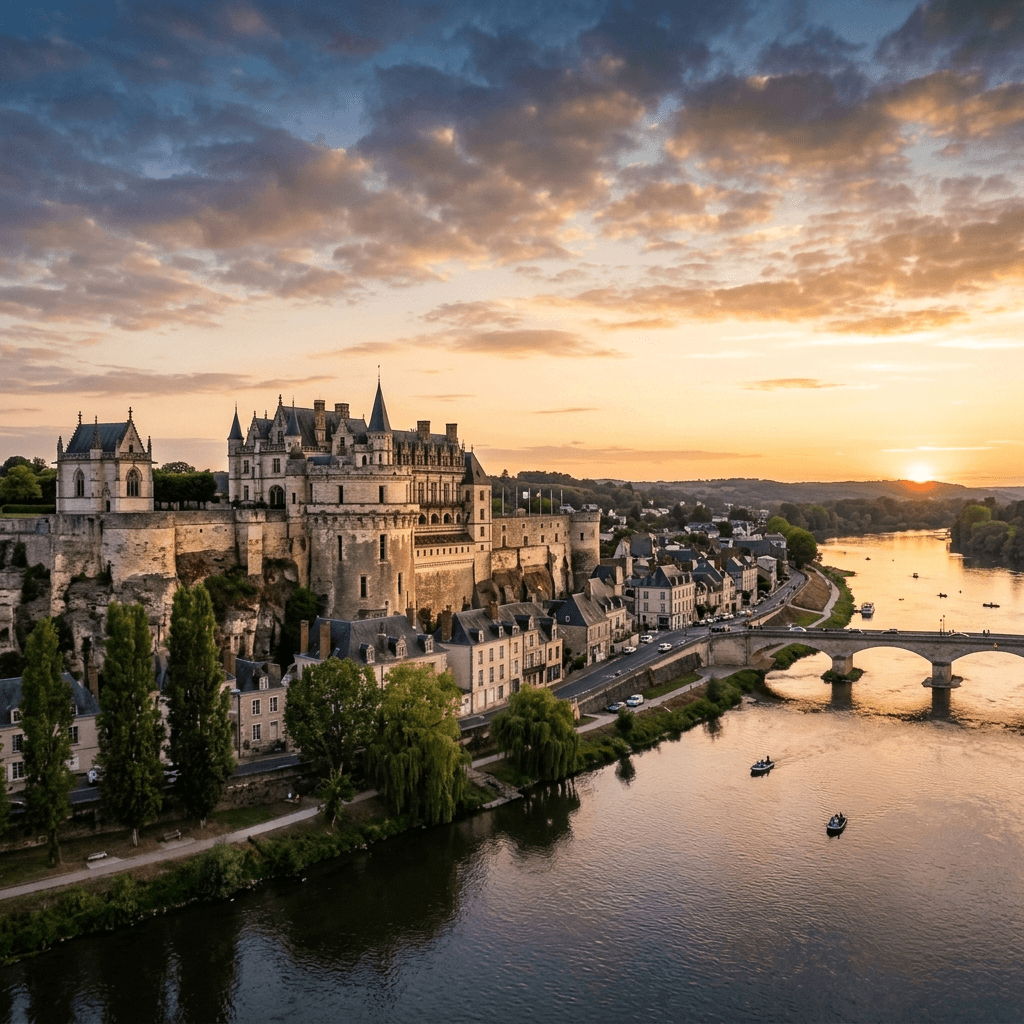
The answer to the historical invincibility of the Château d'Amboise lies purely in its privileged geography. Erected on a massive limestone (tuffeau) plateau that rises more than 131 feet above water level, the castle has a 360-degree panoramic view that allowed guards to spot any enemy army from miles away.
The Loire River, the longest in France, acted not only as an insurmountable natural moat on the northern flank but also as the kingdom's main commercial highway. Controlling the river meant taxing all goods, wines, and building stones circulating through the country.
The engineering of the time capitalized on this geography to the maximum. The castle's stone foundations were carved directly into the bedrock, making it impossible for the medieval tactic of mining the walls (digging tunnels underneath to collapse them). This perfect fusion between the brutality of nature and the cunning of military engineering transformed Amboise into an impenetrable vault.
Chapter
1.3 Seizure by the Crown
The transition of the Château d'Amboise from a private feudal property to a jewel of the French crown was marked by treason, espionage, and blood. Until the beginning of the 15th century, the castle belonged to the powerful d'Amboise family, whose leader, Louis d'Amboise, was one of the most influential and dangerous nobles in the kingdom.
In 1431, Louis committed a fatal mistake: he became involved in an obscure conspiracy alongside the adventurer Georges de La Trémoille to kidnap and assassinate a favorite of King Charles VII. The plot was discovered before it was executed, thanks to the king's network of spies.
The fury of Charles VII was immediate and relentless. Louis d'Amboise was arrested, tried for high treason, and condemned to death, with all his assets confiscated. Although the king later commuted the death sentence to imprisonment, he did not give up the greater prize: in 1434, the castle of Amboise was officially annexed to the royal domains of the French crown.
Chapter
2. Charles VIII and the Renaissance Transformation
Chapter
2.1 The Italian Influence and Master Builders
King Charles VIII is undoubtedly the great watershed in the history of the Château d'Amboise. Born in the castle itself in 1470, he nurtured a deep love for his childhood home. However, it was only after his intense military campaigns in Italy that the young monarch realized how rustic France looked compared to the aesthetic splendor of Naples and Florence.
Upon returning to France, Charles VIII brought not only spoils of war; he brought a true retinue of brains. He hired more than 20 elite Italian artisans, transporting them directly to Amboise with a clear order: transform the dark Gothic fortress into a palace of unparalleled light and beauty.
The impact of this decision was monumental. Cold stone walls were adorned with colorful frescoes, heavy oak furniture was replaced by carved walnut, and military architecture was softened by large windows. Amboise ceased to be a war machine to become the first great cultural laboratory of the French Renaissance.
Chapter
2.2 A Capela Saint-Hubert
Suspended like an eagle's nest from the castle walls, the Saint-Hubert Chapel is one of the most impressive wonders of European religious architecture. Built between 1491 and 1496, it was designed to be the private oratory of King Charles VIII and his wife, Anne of Brittany.
Unlike the enormous grandeur of cathedrals like Notre-Dame, the chapel is based on obsessive details and extreme lightness. It is considered the swan song of the extravagant Gothic style, the final and most ornate phase of Gothic before the total dominance of the Renaissance.
For tourists and architecture enthusiasts, visiting the chapel is an experience of pure aesthetic vertigo. Light streaming through the magnificent modern stained glass windows bathes the narrow interior in vibrant colors, illuminating the incredibly high ribbed vaults.
Chapter
2.3 The First Masters of the Court
At the epicenter of this architectural revolution in Amboise were two legendary names: Fra Giocondo and Domenico da Cortona (nicknamed "Boccador" or "Golden Mouth"). Fra Giocondo, a Franciscan monk from Verona, was a brilliant humanist, engineer and architect.
He not only oversaw much of the civil construction of the new wing, but also introduced advanced plumbing and irrigation systems to the gardens, using hydraulic principles that the French considered almost magical.
Domenico da Cortona, in turn, was a direct disciple of Giuliano da Sangallo, one of Michelangelo's masters. Known for his skill with carpentry and precision models, Domenico was responsible for translating the ideals of Italian geometric proportion to French stone.
Chapter
3. The tragic accident of Charles VIII
Chapter
3.1 The fatal tennis match of 1498
April 7, 1498 dawned as a common festive day at Château d'Amboise. King Charles VIII was preparing to watch a game of jeu de paume (the predecessor of modern tennis). Anxiously, he hurriedly walked through one of the darkest galleries, known as the Hacquelebac Gallery, famous for its extremely low ceiling.
In a moment of distraction, the monarch violently hit his forehead on the stone lintel of the door. The impact was so brutal that the sound echoed throughout the gallery. Surprisingly, Charles VIII did not fall immediately. He staggered, regained his balance, and continued to the pit to watch the match for nearly two hours.
What those present did not know was that the impact caused a severe concussion and slow intracranial hemorrhage. Hours later, the king collapsed and died. This seemingly banal event would go down in the annals of history as the exact blow that abruptly halted the monarch's grand plans and plunged France into a sudden succession crisis, leading to the accession of Louis XII.
Chapter
3.2 The King's Final Hours
At around 2 pm, while still watching the game, Carlos VIII suddenly fainted. He fell backwards, suffering convulsions and losing the ability to speak (aphasia). Panic gripped the court. Fearing moving him and worsening his condition, the royal doctors decided to leave him right there, on an improvised mattress on the dirty floor of the gallery.
For an incredible nine hours, the king agonized in the worst possible conditions, surrounded by astonished advisors who did not know how to proceed in the face of the primitive medicine of the time.
At 11pm, Charles VIII breathed his last. The shock in Amboise was absolute. The king, who had just returned triumphant from the Italian wars and was in the midst of a monumental castle reconstruction project, was dead. Worse still: all of his children with Anne of Brittany died in infancy.
Chapter
3.3 The Accession of Louis XII
Charles VIII's death paved the way for the accession of his second cousin, the Duke of Orleans, who was crowned Louis XII. The transition of power brought immediate consequences for Château d'Amboise and for European geopolitics.
The most curious impact, however, was matrimonial and territorial. To ensure that the strategic Duchy of Brittany remained under the control of the French crown, Louis XII had to annul his current marriage and marry the widow Anne of Brittany. This bizarre nuptial agreement, forced by circumstances, definitively unified France territorially.
Furthermore, Louis XII continued the Italian campaigns, further solidifying the influx of Renaissance art, architecture, and artists into the Loire Valley. The brutal accident, therefore, not only altered the family tree of the French monarchy, but accelerated the country's cultural transformation.
Chapter
4. Leonardo da Vinci and King Francis I
Chapter
4.1 The Royal Invitation of 1516
In 1516, King Francis I, a great admirer of the Italian genius Leonardo da Vinci, invited the artist to come and live in France. Da Vinci, who was 64 years old and facing financial difficulties in Rome, enthusiastically accepted the invitation. He left Italy accompanied by his disciples and brought with him three of his most famous works: the Mona Lisa, Saint Anne and Saint John the Baptist.
Francis I received Da Vinci with honors worthy of a head of state. He designated the Clos Lucé, a Renaissance mansion just 500 meters from the Château d'Amboise, as the artist's residence. The king also awarded da Vinci the title of “First Painter, Engineer and Architect to the King”, with a generous pension.
The relationship between Francisco I and Da Vinci transcended the simple hiring of an artist. The king visited Da Vinci regularly, discussing architecture, engineering and philosophy. Da Vinci, in return, worked on projects for the king, including studies for castles and war machines. This intellectual partnership lasted three years, until da Vinci's death in 1519.
Chapter
4.2 Clos Lucé and the secret underground tunnel
Clos Lucé is a 15th-century Renaissance mansion built in pink brick and white stone. Although not exactly a castle, Clos Lucé is one of the most sacred sites in the history of Western art, as it was here that Leonardo da Vinci spent the last years of his life.
The mansion is situated in a peaceful park, crossed by the River Amasse. The interior of Da Vinci's apartments has been restored to recreate the atmosphere of the 16th century, with period furniture, replicas of drawings and an exhibition about his inventions.
The most fascinating element of Clos Lucé is the underground passage that connects the mansion to the Château d'Amboise. According to tradition, Da Vinci took advantage of this passage to visit King Francis I without being seen by the public. The tunnel offers an immersive experience that transports the visitor to the time when the Italian genius walked the streets of Amboise.
Chapter
4.3 The final resting place in the Saint-Hubert Chapel
Leonardo da Vinci died on 2 May 1519, in Clos Lucé, aged 64. According to tradition, he died in the arms of King Francis I, who visited him regularly in his final days. Da Vinci enjoyed enormous royal esteem.
Da Vinci was buried in the Saint-Hubert Chapel, attached to the Château d'Amboise. The tomb, marked by a marble plaque, is in the chapel, where it remains to this day.
The presence of Da Vinci's tomb in Amboise transformed the castle into a place of pilgrimage for art and history lovers. Thousands of visitors arrive annually to pay homage to the Italian genius who revolutionized painting, engineering and science.
Chapter
5. Practical guide and frequently asked questions
Chapter
5.1 How to get to Amboise from Paris
Amboise is located just 16 miles from Tours and 109 miles from Paris. The most practical way to get there is by car, via the A11 and D31 highways, which are fast and well signposted.
For those who don't have a car, the most accessible option is the TGV train from Paris to Tours (1h15), followed by a regional train to Amboise (25 minutes). Amboise train station is about a 20-minute walk from the historic center and castles.
A valuable tip: if you are coming from Paris by train, consider renting a car in Tours to explore the region more freely. The Loire castles are spread over a vast territory and having your own vehicle allows you to visit several places in a single day.
Chapter
5.2 Best times to visit and ticket tips
Amboise is a popular destination, especially in high season (July-August). To avoid queues, especially at Château d'Amboise and Clos Lucé, the best strategy is to arrive right at opening time (9:30am in spring/summer) or after 3pm, when group tours start to depart.
It is recommended to purchase tickets online, especially for Clos Lucé, which has limited entry times. The combined ticket is a worthwhile investment to explore both sites without queuing.
The visit to Château d'Amboise lasts on average 1 to 2 hours, but it is possible to spend more time exploring the gardens and the Saint-Hubert Chapel. An effective strategy is to start at Clos Lucé and then visit the castle, taking advantage of the afternoon to explore the city.
Chapter
5.3 Combos and other castles
Amboise is strategically located in the heart of the Loire Valley, making it easy to combine with other famous destinations in the region. A distance of 500 meters separates Château d'Amboise from Clos Lucé, where Leonardo da Vinci lived.
Another popular combination is with Château de Chenonceau, the 'Castle of the Ladies', located about 19 miles from Amboise. Visiting both castles offers a fascinating contrast.
For those who have more time, it is worth including the Château de Chambord (37 miles away), the largest castle in the Loire Valley, or the Château de Blois (31 miles away). The Amboise region is an ideal starting point for exploring the richness of the Loire.
Chapter
6. The Tomb of Leonardo da Vinci
Chapter
6.1 Death in 1519
On May 2, 1519, the great polymath Leonardo da Vinci breathed his last in his room at the Clos Lucé. At age 67, his health was deteriorating rapidly after a stroke that paralyzed his right hand. A legendary – and deeply romanticized – story suggests that he died cradled in the arms of King Francis I.
Although historical evidence indicates that the king could have been in Saint-Germain-en-Laye on that particular day celebrating the birth of his second son, the enduring myth of the monarch weeping over the dying artist perfectly sums up the deep reverence the French crown had for the Italian master.
Leonardo's final will was incredibly meticulous. He asked to be buried in the collegiate church of Saint-Florentin, located within the walls of the Château d'Amboise. He even specified the exact number of candles, masses, and paupers (sixty, to be exact, each carrying a torch) to accompany his funeral procession. The king perfectly honored the wishes of his beloved “father figure”.
Chapter
6.2 The Destruction of Saint-Florentin
For nearly three centuries, da Vinci rested peacefully in the church of Saint-Florentin in Amboise. However, the French Revolution and subsequent chaotic decades proved disastrous for the country's architectural heritage.
At the beginning of the 19th century, the church was in a poor state of repair. In 1802, under the orders of a Napoleonic senator who purchased the property and found it too expensive to maintain, the majestic church of Saint-Florentin was mercilessly demolished.
The demolition was chaotic and the lead coffins, including Da Vinci's, were reportedly melted or lost in the rubble. For decades, the exact whereabouts of the genius's remains became one of history's great archaeological mysteries.
Chapter
6.3 The 19th Century Excavations
In 1863, a passionate local poet and fine arts inspector, Arsène Houssaye, embarked on an obsessive quest to find Leonardo's missing bones. Digging in the grassy spot where the church once stood, his team discovered fragments of a tombstone bearing the letters "EO", "ARUS VINC" and "DUS L VINC" - tantalizingly close to 'Leonardus Vincius'.
Nearby, they found a largely intact skeleton with an unusually large skull, which Houssaye immediately proclaimed belonged to the master himself. The remains were reverently collected and transferred to their current resting place: the exquisite Saint-Hubert Chapel.
Today, visitors flock to this chapel to pay their respects. But the mystery remains. Are the bones under the marble slab really those of Leonardo da Vinci? Modern historians remain divided and calls for DNA testing (comparing the remains with living descendants of Leonardo's brother) have so far been politely ignored by French authorities.
Chapter
7. The Bloody Conspiracy of Amboise (1560)
Chapter
7.1 The powder keg of religious wars
Château d'Amboise is not just a symbol of art and beauty; it was also the scene of one of the most horrific political massacres in French history. In 1560, France was a powder keg ready to explode, deeply divided between the Catholic majority, heavily influenced by the powerful Guise family, and the growing Protestant minority (the Huguenots).
The young and fragile King Francis II (husband of Mary, Queen of Scots) was heavily manipulated by the Guises, who were relentless in their persecution of Protestants. In response, a secret coalition of Huguenot nobles planned a desperate coup: they would march to the court, arrest the Guise brothers, and "free" the king from his Catholic influence.
This conspiracy, known as the Conspiracy of Amboise (Conjuration d'Amboise), was bold but fatally flawed. The Guise intelligence network learned of the plot weeks in advance and moved the royal court to the heavily fortified Château d'Amboise to prepare a trap.
Chapter
7.2 The foiled kidnapping plot
When the conspirators, led by Jean du Barry (Seigneur de La Renaudie), arrived in Amboise in March 1560, they headed straight for a bloodbath. Royal troops intercepted the small, disorganized bands of Protestant rebels in the forests and surrounding villages before they could even launch a coordinated attack.
The skirmishes were brief but incredibly violent. La Renaudie himself was killed in the forest of Château-Renault, his body taken back to Amboise, quartered, and displayed at the city gates as a dire warning.
The king, Queen Mother Catherine de Medici, and the Guises watched the initial interrogations and executions with cool detachment, determined to crush the Protestant revolt with overwhelming, public brutality.
Chapter
7.3 Mass Executions on Balconies
What followed was a horrific spectacle that forever tarnished Amboise's legacy. More than a thousand conspirators and alleged sympathizers were executed over the course of a few weeks. The methods were brutal: hangings, beheadings and drownings in the Loire River.
The bodies were hung from the iron balconies of the castle's grand façade – ironically, the same balconies where court ladies used to watch festive tournaments decades earlier. The stench of decay became so unbearable that the royal court was forced to abandon the castle and flee to Chenonceau.
This massacre triggered the devastating French Wars of Religion, a series of conflicts that would destroy the nation for the next thirty years. Today, as tourists admire Amboise's beautiful Renaissance facades, few realize the horrors those same walls witnessed during the dark spring of 1560.
Chapter
8. The Hidden Engineering of the Castle
Chapter
8.1 The Spiral Ramps of the Minimes Tower
The Minimes Tower houses one of the most daring engineering solutions of the Renaissance: a gigantic helical ramp with a gentle slope that wraps around a hollow central core, designed to allow horses and carriages to ascend directly from the banks of the Loire River to the castle terrace, situated more than 131 feet above. This masterpiece of civil engineering, begun in the late 15th century, eliminated the need to climb the steep slopes of the rocky promontory via exhausting stairs, revolutionizing the logistics and cargo transport of the French court.
The construction of the ramp is a feat of masonry and mathematical calculation. The white limestone (tuffeau) stones were cut with millimetric precision to form a continuous vault that follows the ascending spiral. The tower's central core, in addition to serving as structural support, is hollow, functioning as a natural ventilation chimney and a light well that illuminated the ascent of the knights with external sunlight. This innovative open-core architectural technique was imported from Italy and adapted to the monumental scale of French fortifications.
Militarily, the ramps allowed the rapid supply of heavy weapons, ammunition, and provisions directly to the upper bastions in case of siege, making the fortress even more self-sufficient and impenetrable. Beyond the practical aspect, the knight towers had an essential scenographic function for royal power. Foreign delegations and prestigious visitors were led on horseback or in sumptuous carriages up the ramp, being received at the top with a breathtaking and triumphant view, a true spectacle of architectural power that intimidated and marveled the guests of the crown.
Today, visitors to the Château d'Amboise can experience part of this grandiosity by descending the ramp of the Minimes Tower. Walking through the interior of the tower reveals the marks left by centuries on the stones and the impressive acoustics of the place. Rare special guided tours also allow exploring the guts of the tower and observing closely the functioning of its ventilation core, making the descent one of the most memorable and photogenic moments of the visit to the Loire Valley.
Chapter
8.2 Intelligent Military Logistics
The military logistics of the Château d'Amboise stood out for the ingenious integration of its monumental circular towers with the promontory's defensive systems, allowing the rapid movement of troops and heavy artillery defenses without congesting the internal access of the residential palace. This strategic planning transformed the castle into an impenetrable bastion that protected the royal family during periods of greatest civil and military instability in France, such as the Hundred Years' War and the Wars of Religion.
The two large knight towers, the Minimes Tower and the Heurtault Tower, were positioned at the north and south ends of the wall, respectively, creating two completely independent axes of mobility. The internal space of the plateau was organized so that the militarized area was separated from the luxurious quarters of the court. The walls, which reach thicknesses of more than 10 feet, possessed hidden internal galleries that allowed soldiers to move quickly from one tower to another without being seen by invaders.
With the introduction of gunpowder and cannons in the 15th century, Amboise's engineering had to adapt quickly to the new military reality. The terraces at the top of the knight towers were reinforced with solid stone platforms capable of withstanding the tremendous recoil of heavy artillery pieces. Strategically carved openings in the walls allowed cross-firing angles, covering both the waters of the Loire River and the city slope, nullifying any attempt of approach by enemy armies.
When walking along the outer walls of Amboise, the attentive visitor should notice the gun loops and the positions of the old cannon batteries facing the river. These details reveal the dual identity of the castle: a palace of Renaissance pleasures inside and a ruthless war fortress outside. The view from the fortifications helps to understand the monumental scale of the military engineering efforts required to protect French royalty in the Middle Ages.
Chapter
8.3 Extreme Architectural Innovations
The Château d'Amboise was the pioneer laboratory for the introduction of extreme architectural innovations in France, blending the late Gothic with Italian Renaissance techniques of symmetry, advanced hydraulic engineering, and challenging suspended structures. Under the orders of Charles VIII, the castle broke with the tradition of dark and closed fortresses, ushering in an era of glass facades and large open terraces integrated into the natural landscape.
One of the main technical innovations was the replacement of flat wooden ceilings with stone vaults without visible support pillars in the new wings, creating spacious and airy reception halls. In the field of hydraulic engineering, Italian masters like Fra Giocondo installed lead plumbing systems and deep underground wells that supplied the castle with fresh water directly from the upper springs of the hill, a sanitary luxury almost non-existent in European capitals of the time.
The use of local white limestone (tuffeau) allowed sculptors to carve highly decorated facades, but also required insulation techniques against the constant humidity of the Loire River. To protect the structure, builders developed special mortars and hidden drainage systems that channeled rainwater away from the rocky foundations, preserving the castle from the erosive effects of the climate for over 500 years.
These innovations revolutionized civil construction in the country. The Charles VIII Wing and the subsequent Louis XII Wing served as models for other castles in the Loire Valley, establishing a new standard of comfort and beauty that defined the French Renaissance. Visiting Amboise is witnessing the birth of a new aesthetic language in Europe, where extreme engineering served both art and State security.
Chapter
9. The Panoramic Gardens
Chapter
9.1 The First Renaissance Garden in France
The gardens of the Château d'Amboise represent the first Renaissance garden created in the Kingdom of France, designed in 1496 by the celebrated Neapolitan landscaper Dom Pacello da Mercogliano commissioned by Charles VIII. This new concept of garden, known as the "Terrasse de Naples" (Terrace of Naples), broke definitively with the medieval tradition of closed and utilitarian vegetable gardens, opening breathtaking visual perspectives over the Loire River and integrating cultivated nature into the castle's architecture.
Dom Pacello, often called "the Leonardo da Vinci of gardens", introduced to the French court the perfect geometry of Italian gardens, marked by strict symmetry, parterre beds in geometric patterns, and the aesthetic use of aromatic plants like lavender, rosemary, and laurel. He developed innovative decorative pruning techniques (topiary) and designed straight paths that guided nobles in meditative walks, transforming the green space into an outdoor social salon.
The greatest botanical revolution brought by Pacello to Amboise was the pioneer attempt to acclimate citrus trees, such as orange and lemon trees, in the cold climate of northern France. To protect them from the winter frosts of the Loire Valley, he created the first mobile protective structures and primitive greenhouses that would give rise to the famous French orangeries. Pacello also performed botanical crossbreedings in the neighboring domain of Château Gaillard, creating the famous "Reine-Claude" plum in honor of Queen Claude of France.
Today, tourists strolling through the gardens of the Château d'Amboise can walk through the restored historical area and enjoy the same geometric alignment designed centuries ago. The terrace offers spectacular panoramic views of the river and the lower town, allowing one to understand Pacello's vision of uniting human art with the immensity of the natural horizon. It is a space of tranquility and beauty that invites contemplation and photography.
Chapter
9.2 The Abd el-Kader Memorial
The Abd el-Kader Memorial is a solemn area located in the gardens of the Château d'Amboise dedicated to honoring Emir Abd el-Kader, Algerian resistance leader and human rights defender, who was kept in honorable confinement in the castle between 1848 and 1852 with his family and entourage of about 80 people. The memorial and the adjacent "East Garden" serve as a site of historical reconciliation and mutual respect between France and Algeria, recalling one of the castle's most complex episodes in the 19th century.
The stay of the Algerian entourage in Amboise was marked by very difficult weather conditions. Accustomed to the heat of North Africa, the members of the group suffered severely from the harsh and damp winters of the Loire Valley. During the four years of forced exile, 25 members of the Emir's entourage passed away due to respiratory illnesses, being buried in a specific sector of the castle gardens, today known as the "Muslim square" or "East Garden".
Despite the confinement, Emir Abd el-Kader won the respect and admiration of the local population and French intellectuals for his dignified behavior, theological wisdom, and humanist attitude. He promoted interfaith dialogue and tolerance, receiving visits from illustrious figures from all over Europe. On October 16, 1852, President Louis-Napoleon Bonaparte (future Emperor Napoleon III) visited Amboise personally to announce the official release of the Emir, ending his captivity in exchange for an oath not to return to Algeria.
The current monument in the gardens features stone tombstones amidst Mediterranean vegetation, symbolizing the union of cultures. The memorial has become an important site of historical pilgrimage and reflection on tolerance. For contemporary visitors, knowing the memorial is an opportunity to discover a less-known chapter of Amboise's history, which connects the royal castle to the events of colonization and the legacy of one of the greatest humanist heroes of the Arab world.
Chapter
10. Decline, Prison, and Restoration
Chapter
10.1 Transformation into a State Prison
From the 17th century on, after the definitive departure of the royal court to palaces such as the Louvre, Fontainebleau, and later Versailles, the Château d'Amboise entered a period of slow decline and was transformed into a maximum-security State prison. Its ancient luxurious rooms and impenetrable fortifications were adapted to lock up prisoners of high political relevance who had fallen into disgrace before the absolutist kings of the Bourbon dynasty.
The most illustrious prisoner of this period of decline was Nicolas Fouquet, the powerful Superintendent of Finances of Louis XIV, who was arrested in 1661 on charges of embezzlement of public funds and excessive ostentation in his palace of Vaux-le-Vicomte. Fouquet was taken to the castle of Amboise in December 1661 under the direct custody of Charles de Batz-Castelmore, the legendary musketeer d'Artagnan, remaining under tight military surveillance before being transferred and sentenced to life imprisonment in the fortress of Pignerol.
Another noble imprisoned in Amboise was the rebellious Duke of Lauzun, famous for his love escapades at the court of Versailles. During these decades as a prison, the castle suffered severe structural mutilations. Large rooms were partitioned by plaster walls to create cold and dark cells, monumental windows were blocked with iron grates, and the general lack of maintenance of the roof and facades accelerated the deterioration of the limestone stones, erasing part of the golden glow of the Renaissance.
The role of State prison changed the relationship of the city of Amboise with its castle. The ancient jewel that brought wealth and royal festivities transformed into a dark fortress that caused fear and silence. For today's tourist, understanding this period helps to understand why the castle lost so many of its original constructions during the political upheavals that shook France until the 19th century.
Chapter
10.2 The Salvation of the 19th Century
The salvation of the Château d'Amboise from total ruin occurred in the first half of the 19th century, thanks to the financial intervention and historical passion of King Louis-Philippe I. Upon inheriting the property from his mother, the Duchess of Orleans, the monarch began an extensive program of reconstruction and restoration to restore the castle's royal dignity, saving the surviving structures and transforming the old prison into a modern summer residence for the Orleans family.
Under the supervision of the renowned architect Pierre-Bernard Lefranc, the cells of the old state prison were demolished to reopen the grand Renaissance halls, the roofs were completely redone, and the facades facing the Loire River were cleaned and consolidated. The Saint-Hubert Chapel underwent a meticulous process of sculptural restoration, restoring the lacelike details of the flamboyant Gothic that had been damaged by weather and vandalism during the French Revolution.
However, the castle faced new moments of horror in the 20th century. During World War II, Amboise was hit by more than 100 German artillery shells in June 1940, damaging the chapel and the knight towers, and suffered a new Allied bombing in July 1944 that destroyed stained glass windows and roofs. The post-war restoration campaigns, conducted by the French government and the Saint-Louis Foundation (current manager of the castle), worked tirelessly to faithfully rebuild the war damage and keep the castle open to the international public.
Today, the Château d'Amboise is fully recovered and exhibits a prime state of conservation. Thanks to the continuous work of the Saint-Louis Foundation, traditional masonry and carpentry techniques are kept active to preserve the site for future generations. For the modern visitor, each restored wall represents a victory of historical heritage preservation against the forces of war and oblivion.
Chapter
11. Curiosities and Mysteries
Chapter
11.1 Apparitions and Ghosts
The supernatural mysteries of the Château d'Amboise focus mainly on stories of apparitions and reports of hauntings associated with the horrific massacre of the Conspiracy of Amboise of 1560, when more than 1,000 Huguenots (French Protestants) were brutally executed and their bodies hung from the iron hooks of the balconies of the castle's grand facade and thrown into the Loire River. Tourists, night guards, and locals have reported for centuries inexplicable sensations of sudden cold and mysterious shadows whispering along the outer walls.
One of the most cited ghosts in the castle's legends is that of Queen Catherine de Medici, who watched the bloody executions alongside her children from the main balcony. According to employee reports, a female figure dressed in dark period clothing is occasionally seen walking silently through the castle gallery during full moon nights, suddenly disappearing when approaching the Saint-Hubert Chapel. Local urban legends claim that the Queen Mother wanders in search of forgiveness for the bloodbath she helped authorize.
Another point of intense paranormal activity is the deep underground dungeons situated under the Garçonnet Tower. Castle guards report hearing metallic noises similar to the dragging of heavy chains and distant groans echoing through the ventilation shafts during night rounds. Local historians recall that these dungeons housed prisoners of war and rebels who suffered extreme torture in the Middle Ages, leaving a supposed negative energy charge in the limestone blocks.
Although these ghost legends add a mysterious and fun atmosphere to the visit, the castle does not promote ghost hunts officially. For the traveler exploring the terraces at dusk, looking at the decorated iron balconies and imagining the tragic fate of the conspirators hung there in the 16th century brings an inevitable sense of historical chill, connecting the present to the violent reality of the monarchical past.
Chapter
11.2 The Controversial Connection with The Da Vinci Code
The connection of the Château d'Amboise with the fiction and mystery novel "The Da Vinci Code" (written by Dan Brown) revolves around the controversial tomb of Leonardo da Vinci in the Saint-Hubert Chapel and the conspiracy theories about the secret underground passages linking the castle to the Clos Lucé mansion. The popular legend that the Renaissance genius kept hidden secrets of the Holy Grail under Amboise's foundations attracts thousands of fans annually in search of clues and hidden codes in the property's architecture.
The most debated point is the famous 1,640-foot underground passage that connects the castle to the Clos Lucé. Dan Brown explores the idea that Leonardo used this hidden path not only to meet with King Francis I without being seen by the public, but also to transport secret relics and alchemical documents forbidden by the Catholic Church. Although the tunnel actually exists physically, most of its route is collapsed for safety reasons, which only increases the mystery of what is hidden in the inaccessible section.
Another element that feeds conspiracy theories is the mysterious geometric carvings and sculptures of chimeras and fantastic animals on the facade and interior of the Saint-Hubert Chapel. Some secret society enthusiasts claim that the sculptures contain messages encoded in hermetic language left by Templar builders and by Da Vinci, indicating astronomical locations or hermetic secrets. Art historians, however, demystify these theories, pointing out that the elements belong strictly to the traditional iconography of flamboyant Gothic.
The popularity of the book and the movie generated a themed tourism boom in Amboise. The castle and the Clos Lucé offer itineraries and brochures that explain historical truth versus the legends created by pop fiction. Visiting Da Vinci's marble tomb and contemplating the stained glass windows of the chapel becomes a fascinating exercise in separating modern myth from the historical reality of one of humanity's greatest geniuses.
Chapter
11.3 Hidden Passages and False Doors
The Château d'Amboise has an intricate system of hidden passages, spiral staircases built into the walls, and false doors disguised in the wooden decoration, built to ensure the rapid escape of the royal family in case of invasion and to allow servants to move silently through the palace. This secret security engineering reflects the constant climate of conspiracies, assassinations, and espionage that marked the French court during the Renaissance period.
Many of these passages were carved directly into the white limestone walls, which are thick enough to house narrow stairs that connected the royal apartments on the upper floor directly to the underground kitchens and pantries. This allowed the food to be served hot and the servants to work without crossing the noble corridors, preserving the intimacy and pomp of the monarchs during official receptions.
In the royal quarters, some false doors were perfectly camouflaged by sumptuous tapestries or carved walnut panels that mimicked bookshelves or wainscoting. King Francis I and his predecessors could use these emergency exits to access fortified walkways on the walls or go down directly to the dungeons in case of imminent attack, ensuring a safe escape route while the main guard contained the enemies in the main courtyard.
Although most of these secret passages remain closed to the general public due to safety and accessibility restrictions, the castle offers special themed tours called "Behind the Scenes". On these tours, authorized guides open some of these secret doors and lead tourists through the hidden tunnels and staircases, providing an exciting experience that makes the visitor feel like a true spy of the French Renaissance court.
Chapter
11.4 The Mechanical Lion of Leonardo da Vinci
The Mechanical Lion is one of the greatest legends of engineering and entertainment associated with Leonardo da Vinci and King Francis I, having been designed by the Renaissance genius to impress the royal court during the grand festivities in Amboise. This primitive wood and metal automaton was capable of walking a few steps on its own and, at the end of its path, opening its own chest to reveal a collection of lily flowers, the ultimate symbol of the French monarchy.
The first version of the mechanical lion was presented in Lyon in 1515 to celebrate the alliance between the city of Florence and France, but it was in Amboise, during Leonardo's creative confinement at the Clos Lucé between 1516 and 1519, that the machine was perfected. Francis I, a monarch passionate about technology and scientific novelties, displayed the automaton to foreign ambassadors and nobles as proof of the brilliant intellect under his direct patronage, generating astonishment and admiration throughout Europe.
Although the original model of wood and iron gears was lost over time, the functioning of the mechanical lion was detailedly documented by chroniclers of the time and through gear mechanism schematics and drawings found in Leonardo's notebooks. Modern engineers and historians succeeded in rebuilding the automaton faithfully based on these notes, creating an impressive working replica that today can be seen up close in operation in the permanent exhibition of the Clos Lucé castle, just a few yards from the Château d'Amboise.
In addition to being an advanced technological toy for the time, the mechanical lion had a deep geopolitical symbolism. The lion represented the power of Florence (the Marzocco), which opened with reverence to deliver the lilies of the French crown, demonstrating submission and diplomatic friendship between the Italian State and the kingdom of Francis I. For the modern tourist, knowing this story shows that Amboise was the epicenter of the European scientific and cultural vanguard of the time.
Chapter
11.5 Nicolas Fouquet and the Duke of Lauzun: State Prisoners Under the Guard of d'Artagnan
The transformation of the Château d'Amboise into a maximum-security prison in the 17th century gathered under its walls prominent figures of the nobility who fell into disgrace before the absolutist power of Louis XIV, including the legendary musketeer d'Artagnan as head jailer of State prisoners such as Nicolas Fouquet and the rebellious Duke of Lauzun. This forced court of luxury prisoners transformed the once-cheerful summer residence into a golden cage that symbolized the ruthlessness of the Sun King.
Nicolas Fouquet, the brilliant and ambitious Superintendent of Finances, was arrested by d'Artagnan in September 1661 after an excessively luxurious banquet that aroused the king's jealousy and suspicion. He was transported to Amboise in December of the same year, under armed military escort of musketeers. During his stay in the castle towers, Fouquet was guarded day and night by d'Artagnan, who inspected his meals and correspondence to prevent any escape attempt or communication with his political allies in Paris.
Years later, the Duke of Lauzun, one of the king's most impertinent favorites, was imprisoned in the castle after trying to marry Louis XIV's wealthy cousin, the Grande Mademoiselle, in secret without royal authorization. Amboise served as the first isolation test for Lauzun, who would later be sent to the same Alpine fortress of Pignerol, where he would meet Fouquet. The stay of both in Amboise marked the end of an era of privileges and the physical demonstration that no one, no matter how rich or noble, was above the sovereign will of the absolutist monarch.
Visiting the rooms and towers where these illustrious captives spent their days under d'Artagnan's guard adds a layer of cloak-and-dagger romance to the visit to Amboise. Tourists can observe the thickness of the walls that isolated some of the most brilliant and ambitious brains of Louis XIV's century, recalling that Amboise was not only a place of artistic refuge, but also the stage where the tragic end of the greatest careers of the French court was played out.
Chapter
12. Frequently Asked Questions (FAQ)
Chapter
12.1 How does the use of the Histopad work during the visit to the Château d'Amboise?
The Histopad is an interactive tablet provided free of charge with the entry ticket to the Château d'Amboise that offers a spectacular augmented reality experience, allowing visitors to visualize the castle's halls exactly as they were in the 15th century and 16th century. By pointing the device at the markers scattered around the rooms, the current walls are digitally transformed into the luxurious banquets of Charles VIII or the design workshop of Leonardo da Vinci, recreating furniture, frescoes, and historical costumes with archaeological precision.
In addition to the 3D reconstructions, the tablet includes an interactive map of the castle with explanatory texts and audios available in more than 10 languages, including Brazilian Portuguese. The device also features a fun digital treasure hunt dynamic for children and adults, where visitors must find hidden historical objects in the virtual reconstructions to unlock extra curiosities.
For modern tourists, the Histopad is an indispensable tool that enriches the visit without the need for physical guides. It is recommended to pick up the tablet right at the entrance and reserve a few minutes in each room to explore all the interactive features and details, making the tour much more immersive and understandable, especially for those traveling as a family.
Chapter
12.2 Is it possible to visit the Château d'Amboise and the Clos Lucé on the same day?
Yes, it is perfectly possible and highly recommended to visit the Château d'Amboise and the Château du Clos Lucé on the same day, since the two monuments are separated by a distance of only 1,640 feet on foot in the historic center of Amboise. An optimized itinerary allows you to start the morning exploring royal grandiosity and the tomb of Leonardo da Vinci in the main castle and dedicate the afternoon to discovering the gardens and the genius's inventions at the Clos Lucé.
Walking between the two sites is simple and pleasant, following the famous route that passes through the picturesque medieval streets and the Montée de l'Emir Abd El Kader. The physical proximity allows saving travel time and making the most of Amboise's cultural richness without the need to use a car or public transportation after arriving in the city.
To save money, tourists can purchase combined tickets online that give access to both monuments with a discount. Planning the joint visit is the best way to understand the deep personal and working relationship between King Francis I and Leonardo da Vinci, diving into the epicenter of the French Renaissance.
Chapter
12.3 Does the Château d'Amboise offer accessibility for visitors with reduced mobility?
The Château d'Amboise has significant physical accessibility challenges due to its historical geographical location at the top of a rocky promontory elevated more than 131 feet above city level. Although the descent can be made via the ramp of the Minimes Tower, the main access to the gardens and the castle interior is made via steep ramps that require physical effort or the help of a companion.
The castle administration has carried out important adaptations to improve everyone's experience. The restrooms and the ticket office are adapted, and there is an elevator that gives access to some levels of the upper terraces. However, the interior of the royal lodgings has many narrow stone staircases and medieval passages that make complete wheelchair access to all exhibition floors impossible.
For visually or hearing-impaired visitors, the castle provides support resources, including tactile guides, audios with audio description, and translated contents on the Histopad. It is recommended to contact the castle staff before the visit to obtain special assistance and plan the best adapted route through the walls.
Chapter
12.4 What is the best time to take photos of the castle and the view of the Loire River?
The best time to photograph the Château d'Amboise and the Loire River is during the so-called golden hour, which occurs in the early morning, just after sunrise, or in the late afternoon, just before sunset. At these times, the soft, golden sunlight strikes directly on the white limestone of the facades, highlighting the lacelike details of the architecture and creating spectacular reflections on the river waters.
For those looking for the famous classic photo of the castle facade reflected in the Loire, the best viewpoint is on the opposite bank of the river, crossing the Pont Maréchal Leclerc bridge. In the morning, the frontal lighting highlights the towers and the chapel; in the afternoon, the sunset behind the castle creates dramatic and romantic silhouettes of the monument cut against the colorful sky.
Inside the gardens, the upper terraces offer incredible panoramic angles of the river islands and the roofs of the medieval town. Avoid shooting at noon, when the sunlight is very strong and creates harsh shadows that hide the reliefs carved on the Gothic stone of the Saint-Hubert Chapel.
Chapter
12.5 Are there free parking options near the Château d'Amboise?
Yes, the city of Amboise offers several free parking options located a short walk from the castle, although the spaces closest to the walls usually charge a fee (paid zones). The largest free parking lot is on the Île d'Or (Golden Island), situated in the middle of the Loire River, about a 10-minute walk from the main entrance of the castle via the pedestrian bridge.
Another recommended free parking option is the Parking du Mail, located about 2,624 feet from the castle, along the riverbanks. During the peak summer season months (July and August), spaces near the historic center run out quickly, making these further parking lots the smartest choice to avoid traffic jams.
For motorhome or electric car drivers, there are specific marked areas with charging stations around the center. Planning to arrive before 10 AM guarantees ease of parking at no cost and a calmer start to the walk through the city's medieval streets.
Chapter
12.6 How do I get to Amboise by train from Paris?
The fastest and most comfortable way to travel from Paris to Amboise by train is to take the TGV (high-speed train) at Gare Montparnasse station to Saint-Pierre-des-Corps station (in Tours), a journey that takes about 1h10, and then make a quick connection to the TER regional train to Amboise, which lasts another 15 minutes.
There is also the option to take a direct TER regional train from Gare d'Austerlitz station in Paris to Amboise station, an alternative that does not require connections but has a slightly longer travel time of approximately 1h50. Amboise train station is on the north bank of the river, about 0.7 miles (approximately 15 to 20 minutes walk) from the historic center and the castle.
For convenience, you can buy all tickets in a unified way through the official app of the French railway operator (SNCF). Traveling by train is ideal for those planning a one-day round trip from the French capital, ensuring speed and avoiding worries about traffic and parking.
Chapter
12.7 Is the castle a recommended attraction for children?
Yes, the Château d'Amboise is a fantastic attraction for children, offering a playful and educational experience that stimulates children's imagination through stories of kings, medieval knights, secret passages, and fascinating inventions by Leonardo da Vinci. The wide outdoor area of the gardens and the safe walls allow little ones to explore the place with freedom and fun.
The main ally of families on the visit is the Histopad, the interactive tablet that transforms history into an educational video game. Children love to participate in the 3D virtual treasure hunt, looking for ancient coins and hidden keys in the reconstructed scenarios of the castle rooms, receiving a virtual reward upon completing the mission.
In the gardens, children can also run through the large grass areas and admire the models and life-size inventions in the neighboring Clos Lucé. The castle offers changing tables, stroller facilities (although some stairs require carrying the stroller), and picnic areas ideal for a relaxing break during the day tour.
Chapter
12.8 Is picknicking allowed in the gardens of the Château d'Amboise?
Picnicking is not allowed directly on the decorative historical lawns or in the central garden areas of the Château d'Amboise for reasons of conservation and respect for national historical heritage. However, the castle provides specific areas designated for snacks and picnics near the outer walls and secondary terraces, where visitors can eat enjoying spectacular views of the Loire River.
For those who prefer a traditional picnic in the middle of nature, the best option is to go down to the riverbanks or cross the bridge to the Île d'Or, which has large public parks, wooden tables, and shaded areas perfect for relaxing with the family with the castle as a background scenery.
Remember to respect the environment by collecting all generated waste and disposing of it in the recycling bins scattered across the property. Combining the visit with a picnic on the banks of the Loire is one of the favorite activities for tourists visiting the region in summer.
Chapter
12.9 What are the rules for photography and the use of drones in the castle?
It is permitted to take photos and videos for personal and non-commercial use inside the Château d'Amboise and in its gardens, provided that flash, tripods, or professional lighting equipment are not used inside the royal apartments to protect the works of art and historical frescoes from degradation caused by intense light.
The use of drones is strictly prohibited in the entire perimeter of the castle, gardens, and over the historic center of Amboise without special prior authorization from the Ministry of Culture and French aviation authorities. This restriction aims to ensure the safety of visitors and protect the structural integrity of the historical walls against accidents.
For professional photographers or wedding photo sessions, it is necessary to request a special license from the property administration in advance. Respecting the image rules ensures a pleasant visit for everyone and helps preserve the collections of furniture and stained glass windows for the future.
Chapter
12.10 Does the castle open on holidays and during winter?
The Château d'Amboise remains open to the public during almost the entire year, including most national holidays, closing its doors only on January 1 and December 25. During the winter period, the operating hours are reduced, generally closing earlier (around 4:45 PM or 5 PM) compared to the summer, when the doors remain open until 7 PM.
Visiting Amboise in winter offers a unique and peaceful atmosphere, free from the large crowds of summer tourists, allowing you to contemplate the castle under the snow or the fog of the Loire River. The Saint-Hubert Chapel and the royal apartments are heated, ensuring the thermal comfort of visitors even on the coldest days of the year.
It is always recommended to check the updated schedule on the official website before traveling, as special events or maintenance work on the walls can occasionally alter the opening hours of some specific sectors of the property in winter.
Chapter
12.11 Where is the secret entrance to the tunnel that connects Amboise to Clos Lucé?
The physical entrance to the famous secret underground tunnel that connected the Château d'Amboise to the Clos Lucé mansion is located in the lower levels of the castle walls, in the fortification area that goes down towards the hill. On the Clos Lucé side, the entrance is in the basement of Leonardo da Vinci's house, protected by a heavy wooden door.
For reasons of structural safety against collapses and lack of oxygen, the tunnel is currently blocked and closed to the general public for the most part. Visitors can see only the first few yards of the passage entrance in the basement of the Clos Lucé, which is kept illuminated and decorated for tourist exhibition purposes.
Although the legend that King Francis I crossed the tunnel daily to embrace the Italian master is very popular, historians point out that the passage had a practical military function of escape and discreet transport of supplies between the two defensive properties in times of war.
Chapter
12.12 Are there boat tours on the Loire River departing from Amboise?
Yes, there are several traditional wooden boat tour options that depart from the banks of the Loire River in Amboise or from very close neighboring towns, such as Chaumont-sur-Loire. These tours offer a unique and unforgettable perspective of the castle facade from the water, tracing back to how Renaissance kings arrived in the city.
The traditional flat-bottomed boats are designed to navigate the shallow waters and sandbars of the Loire, the last wild river in Europe. During the tour, local guides explain the fauna, flora, and history of the river trade that enriched the Amboise region in the Middle Ages.
The boat tours at sunset are the most popular, offering a glass of local Loire Valley wine to passengers as the sun sets behind the castle towers, creating a romantic and memorable experience. It is recommended to book in advance during the summer months.