Chapter
1. The Musée des Beaux-Arts de Bordeaux: The Temple of Classical Painting in Aquitaine
Chapter
1.1. The museum's role as the largest collection of classical art in the Aquitaine region
Imagine entering a palace where the natural light of southern France bathes thousands of square feet of galleries filled with works of art that witnessed the rise and fall of empires and dynasties. The Musée des Beaux-Arts de Bordeaux proudly assumes the role of greatest guardian of the classical artistic heritage of the entire Aquitaine region, offering a cultural immersion unparalleled outside the French capital. For the visitor fascinated by historical grandeur, each room is a three-dimensional portal that reveals the aesthetic refinement and social transformations that have drawn the frontiers of the European mind over the last five hundred years.
The relevance of this historic institution transcends the municipal limits of Bordeaux, serving as a true cultural and academic anchor for southwestern France. Composed of a collection that ranges from the Italian Renaissance to the Expressionist and Fauvist avant-gardes of the twentieth century, the museum acts as a permanent laboratory for archaeological education and preservation. University art students and international curators find in their monographic rooms a documentary base of exceptional rarity, full of preparatory sketches, correspondence from classic masters and historical documents that help to reveal the creative processes of inescapable figures of Western civilization.
The regional importance of the collection is consolidated through strategic research partnerships with local universities and global conservation institutions. By integrating science and restoration into the daily maintenance of the canvases, the museum ensures that the original pigments and textures survive the degradation of time with the same vigor with which they were conceived by the painters in their studios. This rigorous preservation care consolidates Bordeaux on the map of Europe's great cultural capitals, showing that Aquitaine's heritage is protected with unwavering passion and surgical professionalism.
Chapter
1.2. Why does the Bordeaux collection rival the most prestigious galleries in Paris?
For the traveler accustomed to the colossal corridors of the Louvre Museum or the Musée d'Orsay, coming across the richness of the Bordeaux collection is an unforgettable surprise that challenges the cultural centralization of Paris. The permanent collection of the Musée des Beaux-Arts is not a mere provincial branch of classical art, but an autonomous set of masterpieces that directly rivals the most renowned collections on the European continent. Sitting in front of monumental canvases by Rubens or Delacroix with the tranquility of an imperial garden in the background provides a more intimate and profound aesthetic experience than the frenetic rush of the capital's large, crowded galleries.
This parity of artistic relevance is the direct result of centuries of collecting dedication and visionary political decisions for cultural decentralization. The Bordeaux museum was one of the major beneficiaries of post-French Revolution national decrees, receiving selected lots of works of art confiscated from royalty and churches across Europe, which ensured the presence of crucial art schools in southwestern France. The quality of the pieces on display, which range from Italian Mannerism to Baroque and Romantic innovations, attracts the attentive gaze of art critics seeking to enjoy dense collections free from the tourist saturation that often stifles aesthetic enjoyment in Paris.
Furthermore, Bordeaux's curatorial autonomy allowed the institution to develop a unique sensitivity for avant-garde acquisitions even before its consecrations in the Parisian markets. The active search for works by prominent local artists and the acceptance of monumental donations from regional patrons have enriched the collection with monographic collections that cannot be found in any other museum in the world. This conceptual independence makes Bordeaux a must-visit mutual destination, showing that the true artistic heart of France also beats strong and proud far from the banks of the River Seine.
Chapter
1.3. The poetic atmosphere that welcomes art lovers in the wings of the Palais Rohan
Walking through the symmetrical wings that make up the Musée des Beaux-Arts de Bordeaux is like floating in a visual poem that unfolds across ancient stone steps and hand-carved ceilings. The atmosphere of the museum, nestled in the heart of the Palais Rohan government complex, is permeated with a silent and poetic solemnity that invites the visitor to retreat and pure contemplation. The passage of time seems to slow down as the golden rays of sunlight pass through the tall stained glass windows and reveal the relief of the baroque screens, creating a spectacle of light and shadow that magically frames each visitor's experience in the exhibition halls.
This perfect harmony between neoclassical architecture and the spatial arrangement of the works was designed to encourage an intimate dialogue between the viewer and the artistic creation. Unlike contemporary museums of concrete and gray steel, the Bordeaux wings preserve the warmth of oak floors that creak softly under footsteps and pastel-colored wall paneling that enhances the original color palette of the classical masters. This scenographic choice creates a feeling of aristocratic cosiness, as if the art lover were visiting the private photo gallery of a nineteenth-century collector in a palace.
For couples, lonely students or travelers in search of poetic inspiration, the museum's wings offer corners with red velvet sofas strategically positioned in front of the largest canvases in the collection. There, you can spend hours contemplating the drama of naval battles, the delicacy of court portraits or the poignant realism of scenes from French rural life. This silent, slowed-down immersion purifies the gaze from everyday urban stress, transforming a simple afternoon of sightseeing into a retreat of spiritual reconnection through the transformative power of classical fine arts.
Chapter
2. The History of the Bordeaux Museum of Fine Arts: From the Chaptal Decree of 1801
In the revolutionary ashes that rebuilt the identity of the French Republic, one of the greatest legacies of cultural democratization in the modern world was born. The founding of the Musée des Beaux-Arts de Bordeaux is closely linked to the visionary Chaptal Decree of 1801, a historic law that decentralized the Crown's artistic treasures to the province's main urban hubs. For the history researcher or curious tourist, unraveling the evolution of this museum is understanding the journey of art: from the exclusive privilege of kings and popes to the eternal heritage of all citizens.
Chapter
2.1. The Chaptal Decree of 1801 and the decentralization of French royal treasuries
Imagine a period of revolutionary fervor where the royal palaces of Paris were overflowing with thousands of masterpieces of art confiscated from beheaded nobility and Catholic cathedrals across Central Europe. It was in the midst of this patrimonial chaos that Napoleon Bonaparte's Minister of the Interior, Jean-Antoine Chaptal, promulgated the Chaptal Decree on August 31, 1801, a revolutionary legislative landmark that determined the creation of fifteen provincial museums to house these treasures. Bordeaux was one of the cities selected to receive these imperial lots of artistic relics, laying the foundations for the creation of its municipal museum.
This pioneering policy of artistic decentralization did not only have objectives of physical preservation of canvases and sculptures, but rather a strong ambition for national pedagogical and ideological unification. The republican government wanted citizens of the provinces to have direct access to the cultural refinement that was once the exclusive enjoyment of the absolutist aristocracy of Versailles. The first batches of works sent to Bordeaux contained dozens of exceptional paintings by Italian, Flemish and Dutch masters, which previously decorated the personal apartments of the kings of France, creating an unprecedented educational and aesthetic impact on the population of Aquitaine.
For scholars of the political history of art, the Chaptal Decree of 1801 is considered the birth certificate of modern public museology, breaking the cultural monopoly of global metropolises and distributing beauty throughout the national territory. In Bordeaux, the arrival of these highly prestigious pieces cemented the city's vocation as a hub of intellectual resistance and classical appreciation. The museum was born under the banner of the democratization of art, a republican premise that the heritage of beauty and genius belongs to everyone and must be shared free of charge with the common citizen in a definitive way.
Chapter
2.2. How wars and donations shaped the growth of the municipal collection
Throughout the nineteenth and twentieth centuries, as Europe was rocked by revolutions, armed conflicts and political reconstructions, the Bordeaux museum's collection continued to expand in a spectacular and resilient way. The growth of the municipal collection did not depend solely on bureaucratic state purchases, but rather on a fascinating web of passionate private donations, testamentary legacies from local bourgeois patrons and the heroic rescue of works during conflicts. Each war that ravaged the French nation generated complex movements to safeguard collections, where Bordeaux often served as a safe haven for collections in times of emergency.
Large donations from passionate patrons were crucial in giving the museum its unique personality and immense monographic wealth. The generosity of collectors such as the doctor Maurice Girardin and the couple Ambroise Vollard brought astronomically valuable sets of pre-modern and modern art to southwestern France that filled important historical gaps in the exhibition halls. Furthermore, many artists born in the Bordeaux region or who found inspiration for their paintings there decided to leave their completed studio works to the municipality, ensuring the preservation of entire aesthetic currents in the municipal public collection.
In times of war, the museum played a discreet and heroic role in civic resistance to protect collections against looting by invading foreign armies. During the world wars of the twentieth century, the wings of the museum were emptied and the most fragile pieces were evacuated under total secrecy to the basements of medieval castles in the interior of Aquitaine, escaping bombings and inspections by German officers. This historical cycle of loving expansion and courageous preservation has endowed the museum with a robust collection of more than 15,000 items, proving that the passion for classical beauty is capable of overcoming the greatest European historical catastrophes.
Chapter
2.3. The strategic role of the museum in preserving the national artistic heritage
In contemporary times, the Musée des Beaux-Arts de Bordeaux plays a role of extremely high strategic value in safeguarding and disseminating the historical and artistic heritage of the French Republic. The museum works in coordination with the national network of museums in France (the famous *Musées de France*), ensuring that the most rigorous guidelines for preventive conservation, physical and digital restoration and academic research into the provenance of works are surgically applied in its two exhibition wings. For the art researcher, visiting the institution is to observe an impeccable international model of custody and preservation of priceless artistic relics.
This strategic role is manifested through advanced technological laboratories operated in partnership with historians and chemists from the Center for Research and Restoration of the Museums of France (C2RMF). Beneath the neoclassical galleries, the collection's canvases periodically undergo detailed x-ray fluorescence, infrared reflectography and mass spectrometry examinations to identify invisible cracks, the presence of microscopic fungi and even hidden layers of paint applied by the masters themselves before the final painting. These highly precise scientific interventions annually save works that were condemned to severe oxidation of old pigments.
Furthermore, the institution leads extremely important international ethical debates on the legal provenance of works and the fight against illegal trafficking in historical cultural goods in the European antiquities market. By making the entire collection catalog available in integrated global digital databases, the Bordeaux museum guarantees absolute transparency in the custody of its collections, serving as an example for large galleries and global collections in Europe and the United States. The preservation of beauty, in Bordeaux, is treated as a commitment of honor to the future of humanity and respect for the creators of the past.
Chapter
3. The Architecture of the Musée des Beaux-Arts de Bordeaux: The Brilliance of the Neoclassical
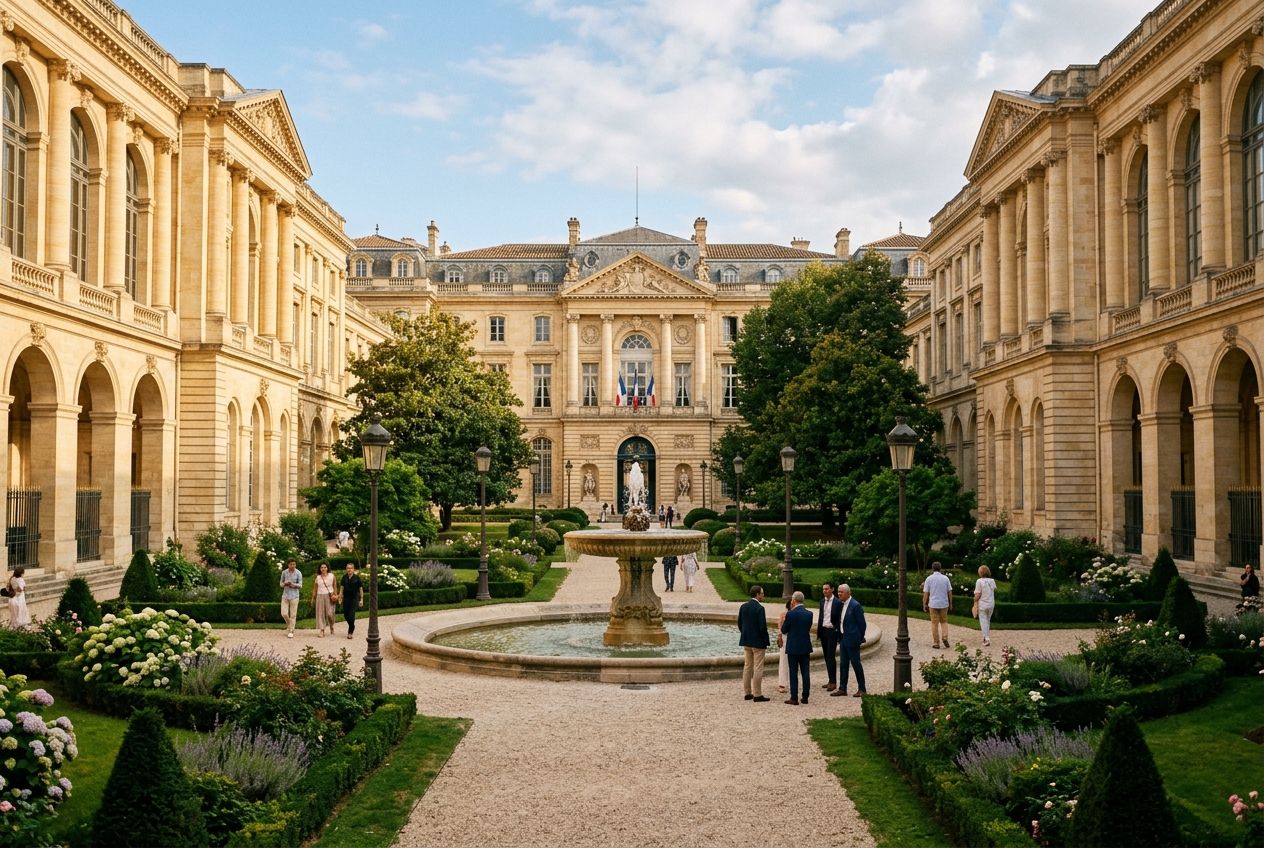
Built in a monumental geometric symmetry of golden Saint-Émilion limestone, the museum building is an architectural spectacle in itself. The two neoclassical wings of the Musée des Beaux-Arts de Bordeaux poetically frame the rear garden of the majestic Palais Rohan, today the seat of Bordeaux City Hall. For the connoisseur of space design or the traveling photographer, walking through these galleries is to witness the apogee of classical nineteenth-century harmony, designed specifically to guide light and shadows in a way that enhances human emotion expressed on large canvases.
Chapter
3.1. The architectural design of the two monumental wings in the courtyard of the Palais Rohan
For the tourist who enters the central courtyard of the Palais Rohan through the imposing wrought iron and gilded bronze railings, the view of the two twin, symmetrical wings of the Musée des Beaux-Arts reveals the apogee of good architectural taste of the French Enlightenment. Designed in the 19th century to frame the rear courtyard of City Hall, the two neoclassical galleries were designed by the city's leading architects to serve specifically as high-end public exhibition spaces for fine arts. The harmony of the facades, with their classical stonework bas-reliefs and elegant limestone balustrades, creates a theatrical setting that immediately transports the visitor to the golden age of French imperial architecture.
The physical distribution of the two twin wings follows strict conceptual and chronological planning for the division of the municipal collection. The north wing of the museum is traditionally dedicated to deep dives into classical collections from the fifteenth to the eighteenth centuries, encompassing the treasures of Italian religious painting, Dutch still lifes, and the Flemish Baroque of Peter Paul Rubens and his school. The south wing houses the revolutionary transformations of the 19th and 20th centuries, guiding the observer through the dramatic ruptures of Romanticism, the loose brushstrokes of Impressionism and the expressive freedom of Fauvism and Cubism, creating a route that breathes evolution and contrast.
The choice of Palais Rohan to house the museum's headquarters was a political move of immense prestige for the city of Bordeaux. The palace, originally built for Archbishop Ferdinand Maximilien Mériadec de Rohan in 1784, is one of the most beautiful and intact examples of neoclassical architecture in the country. By associating the public galleries with this monumental historical monument, the municipality of Bordeaux guaranteed a setting of the highest aesthetic luxury for the Chaptal Decree collections, proving that classical art deserves to be contemplated in settings of equal architectural majesty and civic dignity.
Chapter
3.2. How the 19th century neoclassical style integrates with classical landscaping
Imagine sitting under the shade of ancient trees on a classic wooden bench, surrounded by bronze sculptures and fountains whose crystal-clear waters whisper soothing melodies as you gaze at two monumental classic stone facades. The harmony between the two neoclassical wings of the Musée des Beaux-Arts de Bordeaux and the beautiful City Hall Garden (the *Jardin de la Mairie*) is a masterpiece of planning and urban landscape integration of the 19th century. This perfect connection between the built environment and living nature was designed to create a space of smooth transition and visual purification, preparing the visitor's gaze for the poetic intensity of the art exhibitions.
The neoclassical style of the wings, characterized by their clean straight lines, strict mathematical proportions inspired by ancient Greek and Roman temples and the absence of exaggerated and excessive ornaments, serves as a perfect counterpoint to the organic exuberance of the garden's plants and flowers. The soft golden color of the Saint-Émilion limestone, used in the stonework of the facades, absorbs and reflects the rich sunlight of southwestern France in a unique way, changing the tone of the walls from vibrant yellow at dusk to a melancholic pale gray on cloudy winter days, creating a constant visual dynamism that delights photographers.
This symmetrical integration between nature and stone also plays a fundamental role in circulation and urban ventilation in the historic center of Bordeaux. By creating a green corridor between the two monumental wings, the period architects allowed cool breezes from the Garonne River to circulate freely through the garden, alleviating the heat of Aquitaine's intense summers. Walking through this green corridor after hours of immersion in the painting rooms is a restorative sensorial experience, where the fresh air, the scent of French roses and the sober beauty of the limestone merge into a unique moment of civic peace and well-being.
Chapter
3.3. The overhead lighting designed to enhance the contours and colors of the screens
For the photographer passionate about lights and shadows or for the visual artist who studies the physics of colors, entering the upper galleries of the Bordeaux museum is to witness one of the most refined and successful zenithal lighting systems in nineteenth-century museum architecture. When designing the roofs of the two wings, the period architects incorporated immense central skylights with special etched glass that capture sunlight directly from the top and distribute it evenly across the exhibition walls. This high-performance lighting system eliminates unwanted glare and avoids cast shadows that could distort the emotion of the paintings.
The zenithal light, unlike traditional side windows that create intense gradients and zones of shadow, bathes each inch of oil canvas in a homogeneous way, revealing the true thickness and relief of the brushstrokes applied by baroque and romantic painters. This luminous effect allows the viewer to perceive the depth and physical texture of colors, from the subtlety of Rubens' chiaroscuro to the brilliance of Delacroix's reds and golds. The natural variation in daylight throughout the seasons means that the exhibitions never appear static, offering new shades and nuances depending on the time of visit.
To ensure the preservation of the fragile classical heritage against the harmful effects of ultraviolet rays, the modernization of skylights at the beginning of the twenty-first century incorporated invisible high-tech filters into the sheets of double tempered glass. This contemporary engineering intervention blocks harmful solar radiation waves without compromising the color temperature and beauty of natural daylighting, proving that Bordeaux can combine the sophistication of neoclassical architecture with the severe demands of international scientific conservation with absolute perfection.
Chapter
4. Rosa Bonheur at the Musée des Beaux-Arts de Bordeaux: The Rebel Painter of Art
At a time when the universe of highly relevant plastic arts was an impenetrable male monopoly, a woman born in Bordeaux dared to take up gigantic brushes to portray the indomitable soul of nature with revolutionary force. Rosa Bonheur, the rebellious painter passionate about animal realism, is one of the greatest glories of the Musée des Beaux-Arts de Bordeaux, where her colossal canvas 'La Foulaison' is displayed as a living monument. For the visitor or genre historian, discovering its legacy in Bordeaux is to come across a fascinating story of courage, unparalleled technique and emancipation.
Chapter
4.1. Rosa Bonheur and her deep connection with the city of Bordeaux and the museum's collection
Born in Bordeaux on March 16, 1822 into a family of free-spirited and progressive artists, Rosa Bonheur developed from her earliest childhood an intimate, telluric and poetic connection with the rural landscapes and animals that inhabited southwestern France. The Musée des Beaux-Arts de Bordeaux is proud to house the most important and richest monographic collection of her creations, keeping alive the memory of an illustrious daughter who became the first woman artist to be awarded the prestigious French Legion of Honor. For today's cultural tourist, viewing her paintings in Bordeaux is a visceral dive into the soul of a revolutionary creator who refused to fit into the social limitations of her time.
Rosa Bonheur's monographic collection at the Bordeaux museum was built with immense curatorial affection throughout the nineteenth century, through direct donations from the painter herself and strategic acquisitions from Bordeaux city hall following her resoundingly successful exhibitions in the London and New York art markets. The rooms dedicated to his memory display everything from his detailed sketchbooks and graphite drawings — which reveal an incomparable animal anatomical precision — to his monumental oil field compositions. This rare set allows academic researchers to trace the evolution of their realistic technique, which rejected artificial academic poses to capture the wild truth of animals in living nature.
Rosa Bonheur's connection to Bordeaux was also manifested in her active philanthropic support of the city's municipal drawing school for young women, seeking to open institutional pathways for Aquitaine's young artists to have access to the same elite professional training that men received at the national academies. By bequeathing part of her personal estate to the municipality, Rosa ensured that Bordeaux remained the epicenter of studies of her life and work. Her legacy, displayed with utmost honor in the neoclassical wings, continues to inspire generations of women artists around the world to seek their creative freedom without institutional constraints.
Chapter
4.2. The analysis of "La Foulaison", the monumental canvas and one of the masterpieces of realism
Upon crossing the entrance to the monumental room dedicated to nineteenth-century realism, it is impossible not to be immediately swept away by the kinetic force, suspended dust and wild energy that emanate from *"La Foulaison"* (The Threshing of Wheat), Rosa Bonheur's colossal masterpiece on display in the Bordeaux museum. More than 20 feet in width, the painting captures the dramatic instant of a herd of sturdy horses galloping in a circle over ears of wheat to separate the grain from the chaff on a rustic threshing floor in the golden light of evening. For the leisure tourist or the researcher of pictorial technique, the canvas is a master class in dynamism, muscular strength and anatomical precision unparalleled in the history of world realist painting.
The creation of *"La Foulaison"* required years of exhaustive dedication, dozens of anatomical sketches made directly in threshing fields and meticulous observation of equine behavior and musculature under extreme conditions of physical effort. Rosa Bonheur painted each horse with an individual personality, revealing the tension in the tendons, the shine of sweat on the dark coats and the dust that rises under the frantically moving feet. The contrast of lights and shadows creates an almost sculptural relief in the animal figures, while the background of the rural landscape captures the vastness and melancholy of the French soil with silent poetry of a very high technical level.
From a technical conservation point of view, maintaining a canvas of such colossal dimensions represents a constant challenge for the teams of conservators and restorers at the Bordeaux museum. The millimetric control of relative air humidity and color temperature in the exhibition rooms is kept on a tight leash to prevent the loosening of the immense linen weave and premature cracking of the layers of oil paint. Thanks to this custodian of scientific excellence, *"La Foulaison"* remains with the same freshness and visual impact that shocked and enchanted nineteenth-century audiences, proving the immortality of Rosa Bonheur's realistic artistic genius.
Chapter
4.3. How the artist challenged nineteenth-century genre conventions with her painting
To understand Rosa Bonheur's revolutionary greatness, one must understand that she not only painted horses with genius, but challenged the legal and social structures of one of the most patriarchal and conservative societies in modern European history. At a time when girls were educated exclusively for marriage and limited to painting small watercolors of flowers or delicate embroidery in domestic salons, Rosa Bonheur dared to wear men's pants, visit rustic livestock markets and animal morgues to study the anatomy of animals up close. For the contemporary visitor to the Bordeaux museum, its classical art is a portrait of the greatest civic rebellion and existential courage of the nineteenth century.
Behind his fearless presence at the Paris horse fairs lay a singular technical and legal need for artistic and personal survival. Rosa Bonheur obtained from the Paris police prefecture an official legal permission to cross-dress (the famous *permission de travestissement*), renewed every six months, which legally authorized her to wear pants to work comfortably in rural areas and avoid constant male harassment. By rejecting the voluminous skirts of the period, she claimed the physical right to walk freely through mud spaces, rustic fairs, and cattle pastures to seek the mechanical truth of the nature of her creations.
Throughout her long and prosperous life, Rosa maintained her absolute financial independence, lived in her own castle in By with her companion Nathalie Micas and managed her career with a brilliant commercial flair that made her one of the richest painters of her era. The Musée des Beaux-Arts de Bordeaux preserves this story of emancipation not only as a biographical curiosity, but as an inseparable part of its revolutionary realist aesthetic. Rosa proved to the world that creative genius has no gender and that the force of her classical animalist painting was capable of breaking down the thickest social barriers with the force of equine threshing.
Chapter
5. Flemish and Dutch Masterpieces in Bordeaux: From Rubens to Anthony van Dyck
The opulence of the Catholic courts and the bourgeois refinement of the unified provinces of northern Europe find their definitive refuge in Bordeaux. The collection of Flemish and Dutch masterpieces at the Musée des Beaux-Arts is one of the most beautiful and dense in all of France, bringing to the banks of the Garonne River the genius of masters of the caliber of Peter Paul Rubens and Anthony van Dyck. For the leisure tourist or the historian focused on trade routes and the arts, this set of Baroque canvases is an absolute delight of rich colors, luxurious textures and incomparable mysticism.
Chapter
5.1. Baroque mysticism and the great religious compositions of Peter Paul Rubens
To fall into contemplation before a monumental composition painted in oils by the baroque genius Peter Paul Rubens is to be immediately sucked into a world of dramatic twisting of bodies, silk fabrics that seem to wave in the breeze and a mystical golden light that emanates from the sacred itself. The Bordeaux museum houses monumental religious paintings by the Flemish master that reveal his immense technical capacity to unite the muscular strength inspired by Michelangelo's sculpture with the richness of color of the Venice School. For the cultural tourist, each room displaying these Baroque masterpieces is a fascinating glimpse into the height of the aesthetic and theological power of the Counter-Reformation in Central Europe.
One of Rubens's main pieces in the Bordeaux collection is *"The Martyrdom of Saint Just"*, a monumental painting that shocks and fascinates due to the rawness and virtuosity with which the miracle is portrayed. Rubens designed the scene with spectacular kinetic tension: the saint, holding his own decapitated head in his hands with inexplicable celestial serenity, defies the horror of his tormentors who retreat in dynamic despair beneath a storm-laden sky and baroque angels. This work, confiscated from Belgian monasteries during the revolutionary wars, arrived in Bordeaux through the Chaptal Decree of 1801, becoming one of the cornerstones of the classical museum.
The Catholic mysticism and dramatic luxury of Rubens' canvases serve as the basis for international academic research into studio techniques and the painter's role as a diplomat for the Spanish and English crowns. Bordeaux curators and restorers work in mutual cooperation with Belgian experts to preserve the luminosity and thickness of the oil paint layers, which used rare walnut oils to keep the blue and red pigments bright for centuries. Having free access to this Baroque genius in Bordeaux is an invaluable travel privilege, showcasing the immortality of Flanders' great pictorial tradition.
Chapter
5.2. The refinement of Anthony van Dyck and the golden age of portraiture in Northern Europe
Imagine looking at the melancholic eyes, the hands with long, elegant fingers and pale skin and the very fine Flanders lace collars that seem to almost float in the shadows of the oil canvases. Anthony van Dyck, Rubens's most brilliant disciple and the definitive portraitist of the British and Flemish aristocracy, shines with his own light in the classical wings of the Musée des Beaux-Arts de Bordeaux with his impeccable court portraits. For those who study the fashion, customs and political webs of the seventeenth century, contemplating Van Dyck's technique is an incomparable lesson in refinement, psychological subtlety and timeless aristocratic elegance.
Van Dyck's technique revolutionized the art of European portraiture by introducing a more relaxed, elongated and slightly haughty pose in court figures, a style known internationally as the aristocratic posture portrait (the *l'attitude aristocratique*). In the canvases on display in Bordeaux, it is possible to examine his incredible ability to paint the shine of satin fabrics, the rustic drape of black velvets and the metallic reflections of metal armor in such a realistic way that the visitor is tempted to touch the surfaces. This material virtuosity is accompanied by a deep sensitivity to capture the subtle temperament and hidden pains of his models.
The conservation of these smooth, translucent Van Dyck surfaces requires extremely complex preventive conservation techniques in the technical reserves of the Bordeaux museum. The use of low light reflection varnishes on the protective windows and the millimetric control of light incidence prevent the premature yellowing of the lead and tin pigments used by the Flemish master. Thanks to these precautions of scientific excellence, the figures of the nobility of Flanders continue to interrogate modern travelers with the same haughty and mysterious glow that they possessed when they posed in the great imperial halls in the seventeenth century.
Chapter
5.3. The wealth of details of Flemish daily life portrayed on the museum’s screens
For the tourist seeking to understand the simple, rustic and vibrant lives of the common people who inhabited the taverns, ports and markets of seventeenth-century Europe, the Flemish Bordeaux collection offers a precious social portrait of almost photographic fidelity. Unlike monumental court paintings, Flemish genre paintings celebrate rustic everyday life with an honesty, humor and richness of detail that enchants with human sympathy and technical ingenuity. Looking at these small oil-painted wooden tablets is like listening to laughter, folk music and the clinking of tin beer mugs in the old taverns of Flanders.
Flemish painters mastered the art of embedding profound moral lessons and popular proverbs amidst scenes of peasant festivities, banquets and noisy fish markets. In the wings of the Bordeaux museum, visitors and researchers can spend hours deciphering the small details hidden around the edges of the compositions: the dog gnawing on a pork bone under the table, the drunken expression of a bagpipe player or the silver coins piled on a usurer's green felt table. Each genre element is painted with a microscopic precision that reveals the artist's respect and affection for material truth.
These records of mundane life serve as indispensable historical research sources for specialists in material culture, period food, and popular dress of the Dutch and Flemish Golden Age. By studying the textures of earthenware and the design of glass cups depicted in the scenes, scholars are able to reconstruct the daily habits of the northern working classes. Bordeaux preserves this rich social and visual chronicle of the Flemish provinces, showing that classical beauty also lies in the sweetness and simplicity of the everyday lives of ordinary people in history.
5.3.1 Geometric precision and light contrasts in Dutch still lifes
For lovers of botany and classic landscaping who visit Bordeaux, the City Hall Garden is a true practical lesson in design and horticultural selection that enchants with the beauty of seasonal flowers. The park's flora was meticulously selected by the urban gardening teams to guarantee continuous flowering of extremely high ornamental value throughout the four seasons of the year, creating color gradients that perfectly interact with the neoclassical golden limestone facades of the Palais Rohan.
Painters of the United Provinces mastered the physics of light by depicting the reflection of invisible rectangular windows on the convex curves of pewter teapots, the glistening moisture of dew-dusted grapes, and the subtle transparency of spiraling lemon peels falling from the edges of classical marble tables. This extremely high geometric precision was accompanied by a virtuoso use of chiaroscuro, where objects emerge from dark shadowy backgrounds to gain relief through direct spotlights of high visual intensity. These canvases were not mere formal exercises in studio painting, but profound lessons in Protestant bourgeois morality.
Safeguarding these delicate oil paintings on thin oak or copper wood supports requires extremely strict environmental care in the exhibition rooms of the Bordeaux museum. The use of special air filters to eliminate microscopic abrasive dust and thermal monitoring prevent bowing and splitting of the ancient woods that support the rare pigments of lapis lazuli and malachite. This impeccable scientific custodianship ensures that the quiet beauty and existential appeal of the Dutch Golden Age continue to enchant and interrogate modern travelers with the same intensity and mystery as of yore.
Chapter
6. The Golden Century of French Painting at the Museum: The Light and Drama of Delacroix
In the nineteenth century, France emerged as the epicenter of modernity's most intense aesthetic revolutions, and the Musée des Beaux-Arts de Bordeaux spectacularly preserves the drama and light of this golden period. The collision between the symmetrical order of Classicism and the feverish, passion-filled brushstrokes of Romanticism is staged in a monumental way through the exceptional works of Eugène Delacroix. For those seeking to understand the birth of the modern soul in the fine arts, this section of classical French painting offers a feast of world-class expressive power.
Chapter
6.1. Eugène Delacroix and the height of French Romanticism expressed in the galleries of Bordeaux
Feeling your heart accelerate before brushstrokes full of dynamic fury, colors that seem to burn on the canvas and compositions where heroism and human tragedy merge under stormy skies is the unforgettable experience of contemplating Eugène Delacroix in the galleries of Bordeaux. The Musée des Beaux-Arts is proud to house crucial works by the unavoidable master of French Romanticism, offering visitors a masterclass of expressive power that defied the cold, academic rules of his time. For those who travel through the history of classical arts, Delacroix in Bordeaux represents the moment when French painting abandoned reason and embraced passion.
The master's main jewel in the Bordeaux collection is the monumental canvas *"Greece on the Ruins of Missolonghi"*, painted in 1826 as a political and poetic manifesto in support of Greek independence against the Ottoman Empire. Delacroix portrayed Greece as a beautiful woman with pale skin and traditional Greek attire with her arms open in a sign of despair and surrender, standing proudly on the classical marble stones stained with blood and gunpowder from battles. This mystical work of immense visual appeal consolidated the role of classical painting as a weapon of international civic social engagement in Central Europe.
The study of Delacroix's revolutionary chromatic techniques, which used the juxtaposition of complementary colors to create optical vibration in the shadows without using pure black in the background, is one of the institution's most prominent research topics. Bordeaux curators perform periodic spectrophotometric examinations to monitor the oxidation and early fading of rare organic pigments, such as red madder lacquer, which the painter imported from Eastern markets. Preserving this chromatic vibrancy in Bordeaux is a civic commitment to the memory of the rebelliousness and intelligence of French national Romanticism.
Chapter
6.2. The contrast between the rationality of Classicism and the dramatic brushstrokes of drama
Imagine walking along an invisible line in the exhibition room and seeing, on one side, the perfect symmetry, the impeccable design with firm contours and the statuesque poses inspired by the Greek marbles of Neoclassicism; and, on the other, the explosion of dynamic movement, fat, feverish strokes of paint and the chiaroscuro of Romanticism. This dramatic and fascinating contrast between reason and passion is one of the most successful pedagogical paths designed in Bordeaux galleries. For the cultural tourist or arts academic, this transition clearly reveals the spiritual and political crisis that redefined the role of the artist in French society after the fall of Napoleon.
The neoclassical painters of the Jacques-Louis David school, whose paintings also shine with rigor in the museum's collections, defended the aesthetic thesis that correct drawing and clean lines should absolutely prevail over the seduction of color and the chaos of brushstrokes. His compositions portray heroes of classical Roman and Greek antiquity as models of civic moral virtue to guide the nation. Romanticism, in turn, led by Delacroix and Géricault, shattered this classical rigidity by prioritizing pure color as a conductor of emotion, portraying madness, contemporary ship disasters and the wild violence of animals in free movement.
Studying this aesthetic duel in the rooms of Bordeaux provides visitors from all geographic origins with a deep understanding of how artistic revolutions go hand in hand with moments of political and social instability. The two currents, although ideologically opposed, represented brilliant responses of human genius to the uncertainties of their historical era of transition. The Bordeaux museum frames this duel impeccably, showing that the triumph of French fine arts lies precisely in their rich diversity and respect for the freedom of style of classic creators.
Chapter
6.3. How the museum tells the story of the cultural and artistic rise of 19th-century France
For those who gaze at the immense canvases of cavalry battles, the exquisite bourgeois portraits and the first open-air studies of rural landscapes in the wards of Bordeaux, the museum acts as an open living history book on France's cultural rise in the nineteenth century. This period was marked by the consolidation of France as the world capital of fine arts, a beacon of creativity that dictated the rules of global refined taste. The Musée des Beaux-Arts preserves this historical transition in a surgical way, proving that each change in style and technique on canvas accurately reflects the evolution of French society towards urban modernity.
Nineteenth-century collections reveal the transition from direct aristocratic and monarchical patronage to the new market economy of bourgeois art, driven by the great Paris Salons, the creation of private commercial galleries, and the birth of public collecting. Painters no longer depended exclusively on the whims of kings to survive, which allowed them to pursue bolder and more independent painting themes. This new creative freedom is expressed in the wards of Bordeaux through realistic psychological portraits, studies of the daily lives of urban workers and the appreciation of natural colors under the light of southern France.
The museum plays an invaluable international pedagogical role by showing how this wealth of creations influenced and shaped the modern country's republican identity. By connecting classical academic formal rigor with pre-Impressionist technical innovations, the Bordeaux institution teaches visitors and foreign students the real value of culture as a central element of France's social cohesion and global geopolitical projection. The story of the rise of the visual arts in Bordeaux is told with patriotic pride, impeccable academic precision and absolute respect for the silent heroes of national painting.
Chapter
7. Impressionism and Modern Art in Bordeaux: From Henri Matisse to Picasso
When the academic rules of contouring and drawing finally crumbled under the natural light of the South, the absolute modernity that redefined the global visual arts was born. The Musée des Beaux-Arts de Bordeaux houses a rich transition of canvases that show the triumphant arrival of the rapid brushstrokes of Impressionism and the geometric ruptures of Pablo Picasso's Cubism and Henri Matisse's Fauvism. For the contemporary tourist, this wing is an electrifying spectacle of pure colors, freedom of form and world-class conceptual innovation.
Chapter
7.1. The arrival of the rapid brushstrokes of Impressionism and the dissolution of natural light
Imagine freeing your brushes from the closed, stuffy environment of classic masonry ateliers and running to the banks of the River Garonne or the vineyards of Saint-Émilion to capture the exact moment when sunlight hits the leaves and dissolves their physical contours. Impressionism, portrayed brilliantly in the transition rooms of the Bordeaux museum, marked this unprecedented optical and existential revolution in the history of Western painting. For museum visitors, coming across these canvases that pulse light and movement is to witness the exact moment in which classical painting freed itself from the cold imitation of reality to become pure sensorial perception.
The revolutionary invention of oil paints in portable tin tubes and the development of complementary optical color theory allowed impressionist and post-impressionist painters to work entirely outdoors (*en plein air*). In the rooms of Bordeaux, leisure tourists and researchers of chromatic techniques can examine rare canvases by masters of movement that reveal the use of rapid, juxtaposed and impasto brushstrokes that seem to vibrate to the viewer's eyes according to the physical distance of contemplation. Natural light is no longer a scenographic element modeled in studio chiaroscuro, but the protagonist herself who dictates the rhythm of the composition.
Safeguarding these delicate impressionist and post-impressionist canvases against the physical degradation and premature oxidation of the new industrial pigments of the nineteenth century is one of the most demanding tasks of the scientific team at the Bordeaux museum. Period pigments such as chrome yellow and emerald green are known for their chemical instability under heat and intense direct light. Thanks to the use of special LED cool lamps in the modernized galleries, today's visitors can enjoy these chromatic innovations with the same purity, brightness and poetic intensity that they possessed when the painters last cleaned their brushes under the sun.
Chapter
7.2. How Henri Matisse, Pablo Picasso and Albert Marquet renewed the Bordeaux collection
Crossing the threshold that divides the impressionism of the modern art rooms of the Musée des Beaux-Arts is to come across an electrifying explosion of pure colors freed from any realistic commitment and geometric shapes that shatter before your eyes. Bordeaux's municipal collection was profoundly renewed throughout the twentieth century by acquiring and receiving rare donations of masterpieces by absolute geniuses of the caliber of Henri Matisse, Pablo Picasso and, especially, the local master Albert Marquet. For those seeking to understand the birth of contemporary painting, these modernized rooms offer one of the most influential and expressive avant-garde collections on the continent.
Albert Marquet, born in Bordeaux in 1875 and a close friend of Henri Matisse, played a central role in uniting the avant-garde and the southwestern municipality, bequeathing to the museum an invaluable monographic collection of harbor landscapes and bridge scenes. His canvases, alongside Matisse's Fauvism compositions and Picasso's Cubism deconstructions, brought a new aesthetic vocabulary of pictorial freedom to the classical museum. Color became the element of direct emotional expression, independent of the figurative realism of the nineteenth century, influencing the direction of European graphic design, cinema and urban advertising.
The academic study of these cutting-edge modern monographic collections is one of the main drivers of scientific publications and provenance research at the Bordeaux museum. Experts analyze how these intellectual and studio friendships between provincial painters and curators helped to break traditional artistic isolation, transforming the museum into a dynamic center for conceptual debates. By making these works available for loan at prestigious international retrospectives in New York, Tokyo and London, Bordeaux projects its cultural value on a global scale, showing that its collection of classical art is also a hub of modern intelligence.
Chapter
7.3. The transition from classical figurative forms to twentieth-century abstractionism
For the student seeking to understand the dramatic and silent moment in which human figures and recognizable objects simply disappeared from classical painting canvases, the modern rooms of Bordeaux offer a surgical visual map of the highest pedagogical clarity. The transition from neoclassical and realistic figurative forms to the total lyrical and geometric independence of Abstractionism is portrayed in the final rooms with exceptional conceptual density. Observing this journey is to understand how modern artists reacted to the historical catastrophes of the two world wars, disintegrating matter to search for new hidden truths beyond the rustic physical form.
In the collections of the Bordeaux museum, visitors can examine sketch and screen studies from the mid-twentieth century that reveal how the contour line gradually dissolved under the impact of speed, high-definition photography, and Einstein's new theories of quantum physics and space-time. The paintings stopped being realistic windows open to the outside world and became surfaces rich in pure gestural energy, chromatic fields and complex material textures of the highest lyrical expression. This conceptual change freed the viewer from a role of passive contemplation, inviting them to interpret the work with complete freedom.
The preservation of contemporary abstract works that incorporate fragile and unstable experimental materials, such as newsprint collages, primitive plastics and cheap period industrial paints, is one of the themes of greatest scientific innovation at the Bordeaux restoration laboratory. Experts apply preventative conservation techniques with relative humidity monitoring and inert vacuum to ensure that materials do not degrade irreversibly in the Studio's display cases. Thanks to this commitment to the physical integrity of the collection, the triumph of Bordeaux's fine arts extends vigorously into the new millennium, teaching that human creativity is free, unlimited and eternal.
Chapter
8. The Mystery of the 1870 Fire at the Bordeaux Museum: Loss and Survival
On the dark night of December 7, 1870, flames devoured the administrative and cultural heart of Bordeaux, threatening to erase forever the artistic heritage that the Chaptal Decree had entrusted to the city. The tragic fire at the Municipal Palace and museum is one of the most dramatic and mysterious episodes in the history of Aquitaine, marked by extraordinary acts of heroism by citizens who risked their own lives to rescue canvases from the clutches of fire. For the monument historian or cultural tourist, unraveling this mystery of loss and survival is a lesson in resilience.
Chapter
8.1. The tragic night of the fire that destroyed part of the city hall and the historical collection
Imagine the widespread panic that shook the city of Bordeaux in the cold early hours of the night of December 7, 1870, when the ringing of the cathedrals' emergency bells announced that a devastating fire of colossal proportions was consuming the wooden wings of the Municipal Palace and the museum of fine arts. The fire, fueled by the dry wooden decorations and the hundreds of canvases and flammable period oil varnishes in the galleries, spread with a terrifying speed that defied the precarious technology of firefighters at the time. In just a few hours, centuries of Aquitaine history and classic creations were in real danger of being reduced to dark ashes and toxic smoke.
The tragic night of the fire occurred in a political and military context of extreme national tension in France, at the height of the Franco-Prussian War, with the provisional national defense government provisionally installed in the city of Bordeaux. The presence of thousands of refugees and soldiers in the city generated immediate rumors of foreign sabotage and an internal anarchist conspiracy to weaken French sovereignty in the province. Although subsequent official investigations pointed to an accidental mechanical failure in an internal heating fireplace in the palace, doubts and mysteries about the true origin of the fire continue to instigate historians.
The final outcome of the 1870 disaster was painful and catastrophic for the municipal public collection of fine arts, with dozens of paintings by classical Italian and Flemish masters lost irreversibly in the conflagration of the wooden galleries. The destruction of an important part of the initial cataloging files of the Chaptal Decree made it difficult to accurately identify all material losses, creating inventory gaps that researchers into the provenance of Bordeaux works are trying to decipher to this day. However, amid the charred ruins of the palace, the city's civic strength found determination to rise from the ashes stronger and more organized.
Chapter
8.2. How citizens' heroism saved some of the gallery's most important works
At the height of the chaos of that night in 1870, while the flames of fire burst the glass skylights and caused the wooden beams of the museum's ceiling to collapse, a spectacle of solidarity, civic heroism and unshakable courage began to take place on the streets of Bordeaux. Ordinary citizens from all French social classes, from simple port workers on the Garonne River to bourgeois intellectuals at city hall, broke through the cordons of the militarized police to invade the rooms filled with suffocating smoke with the sole aim of tearing the large classical canvases from the burning walls.
Using simple pocket knives to cut through the heavy gilded plaster frames and carrying huge rolls of oil-painted linen on their backs under a shower of glowing embers, these unsung heroes managed to extract some of the most valuable masterpieces of the Chaptal Decree from the burning building, including the monumental creations of Peter Paul Rubens and Rosa Bonheur. The impromptu coordinated civic effort at Place Pey-Berland saved dozens of paintings from total destruction by piling the works on the grass and protecting the surfaces with woolen coats against the night's humidity, proving that the love of classical beauty is an indomitable force.
The city council of Bordeaux and the curators of the museum of fine arts maintain to this day records of official historical gratitude in honor of these fearless citizens, many of whose names remain preserved in Bordeaux's municipal archives of honor. The history of this heroic rescue teaches that a museum collection is not the exclusive property of State bureaucrats, but rather a collective emotional and moral heritage of the local urban population. By saving the paintings of Rubens and Delacroix, the citizens of Bordeaux saved their own cultural and spiritual dignity in the history of the great European civilizations.
Chapter
8.3. The reconstruction of the museum and the adoption of new preventive art safety rules
In the dark, cold ashes left by the monumental disaster of 1870, the municipality of Bordeaux was faced with the immense challenge of building from scratch a new home of the highest security and neoclassical dignity for its surviving fine art collections. The project to rebuild the museum of fine arts, begun at the end of the nineteenth century, represented a unique historical opportunity for innovation for architectural and museum planning in Central France. The new headquarters was designed by imperial architects with a clear and absolute premise of civil engineering: the preventive security of works of art must prevail unshakably.
The two new neoclassical wings built in the rear garden of the Palais Rohan incorporated, in a pioneering way in Europe, period high-tech construction materials that were completely fire-resistant, such as wrought iron support structures and concrete and stone floors, eliminating the old flammable wooden beams that had facilitated the 1870 fire. danger to the national treasures of Rubens and Delacroix, a security design copied by other European museums.
The reconstruction of the museum marked the beginning of a new scientific era of preventive art conservation in Bordeaux, culminating in the twenty-first century with the installation of digital electronic fire monitoring systems, watertight fire doors with pneumatic seals, and industrial extinguishers with special inert gas that do not leave chemical residues on the screens. The Musée des Beaux-Arts de Bordeaux has risen from the ashes with an inseparable commitment to security, proving that human intelligence and scientific professionalism are the greatest guarantees of immortality for the world's classical beauty.
Chapter
9. How to Visit the Musée des Beaux-Arts de Bordeaux: Practical Travel Tips
Planning a trip to the jewel of Aquitaine means you'll be presented with a plethora of wonderful historical tours, but the Musée des Beaux-Arts de Bordeaux deserves a prominent place on your tourism itinerary. To guarantee a comfortable, enriching visit free from unforeseen circumstances and long bureaucratic queues, we have gathered in this practical travel section all the essential operational guidelines, from official ticket purchase channels to the most quickly accessible transport routes in the city.
Chapter
9.1. Where to buy official museum tickets and how to get free tickets
Walking through rooms full of baroque and modern masterpieces in Bordeaux is a high-performance cultural experience that is within reach of all budgets and profiles of international travelers. To avoid scammers and unauthorized intermediaries who sell overpriced tickets on the internet, it is mandatory to purchase your official tickets directly on the Bordeaux municipality's integrated electronic website or at the official physical ticket offices located at the entrance to the Palais Rohan wings. The digital issuance process is extremely fast and intuitive, sending tickets in PDF format directly to the visitor's cell phone.
The great golden tip for saving tourism in Bordeaux lies in the fact that access to the permanent collections of the Musée des Beaux-Arts is entirely free for all visitors on the first Sunday of each month, without the need for proof of residence or age. Furthermore, university students from any European country under the age of 26, holders of the tourist transit card *Bordeaux Métropole City Pass* and people with physical disabilities and their official companions are entitled to a total exemption from ticket fees on any day of operation, simply needing to present supporting documents at the turnstiles.
For large-scale international temporary exhibitions that the museum organizes in mutual cooperation with major galleries around the world, ticket prices tend to fluctuate with accessible symbolic values, and advance booking is recommended by appointment to avoid frustrations during the trip. Bordeaux City Hall maintains a policy of strict cultural democratization, ensuring that fares are kept low so that the classical beauty of Rubens, Delacroix and Rosa Bonheur remains a heritage of all citizens and travelers passing through Aquitaine universally and uninterrupted.
Chapter
9.2. Route tips and best time to enjoy the galleries in silence and calm
Imagine floating silently through imposing neoclassical corridors, where the only audible sound is the soft creaking of oak floors and the beat of your own breathing in front of monumental canvases by Peter Paul Rubens or Eugène Delacroix. To be able to enjoy this poetic and contemplative atmosphere with maximum silence and calm, choosing the time and day of your visit to the Musée des Beaux-Arts de Bordeaux is a strategic travel factor. Avoiding peak school hours and weekend tourist hordes allows the viewer to absorb the chromatic density and subtleties of fine art in a unique way.
The best times to explore the two wings of the museum in aristocratic tranquility occur during the early hours of the morning on Wednesday and Thursday, just after the gates open at 11:00 am, or late in the afternoon on Fridays, when the flow of urban visitors decreases significantly before closing at 6:00 pm. The lunch period, between 12:30 pm and 2:30 pm, is also excellent, as most local tourist groups retire to the restaurants on Place Pey-Berland, leaving the galleries free for those who wish to take a slow, contemplative stroll of great benefit.
An intelligent visiting route recommends starting your exploration in the North Wing of the collection (dedicated to classical painting from the 15th to the 18th centuries) to acclimate yourself to the formal rigor of Flemish Baroque and Neoclassicism. Then, cross the beautiful City Hall Garden to have a coffee outdoors before entering the South Wing (focused on romanticism, Rosa Bonheur's realism and modern innovations), concluding the tour in a natural chronological manner. This structured itinerary ensures that the visitor's mind absorbs the evolution of shapes and colors in a logical, harmonious way and without visual fatigue.
Chapter
9.3. Public transport connections to easily reach Palais Rohan
Reaching the imposing neoclassical complex of the Palais Rohan and the Musée des Beaux-Arts de Bordeaux is an extremely simple, agile and comfortable task, thanks to the excellent integrated public transport infrastructure in the city of Bordeaux. Located in the city center (on Place Pey-Berland), the fine arts museum is surrounded by multiple clean urban transit access channels. For the tourist who wants to avoid the stress of expensive private car parking spaces, using the electric tram and cycle paths is the recommended high-efficiency and sustainable travel option.
The main access route by electric tramway (the famous *Bordeaux Tramway*) is through the Hôtel de Ville station, served by the high-frequency lines A and B. Upon disembarking at the station, the visitor is immediately faced with the grandeur of the Bordeaux Cathedral and the monumental neoclassical stone portal of the Palais Rohan, needing to walk less than 160 feet along the tree-lined limestone sidewalks to cross the entrance gates of the museum wings. There are also numerous urban bus lines with integrated stops in Pey-Berland square that quickly connect the museum to different peripheral neighborhoods.
For those who prefer the active and sustainable mobility of cycling, Bordeaux offers the municipal shared public bicycle system (the *V3*), with a huge docking and return station positioned right next to the city hall. The access paths have flat, signposted cycle paths with a very high level of safety, allowing you to combine a pleasant cycle along the Garonne riverbank with an unforgettable dive into the collection of fine arts by Peter Paul Rubens, Eugène Delacroix and Rosa Bonheur without any logistical difficulties.
Chapter
10. The Museum of Fine Arts vs. Other Museums in Bordeaux: What Itinerary to Take?
Bordeaux is a bustling cultural hub in France, boasting globally prestigious museums covering different periods of human genius. When planning your travel itinerary, understanding the essential differences in focus, scale and collection between the Musée des Beaux-Arts (classical), the disruptive CAPC (modern) and the immersive Musée d'Aquitaine (historic) is the golden key to creating a perfectly balanced, fatigue-free cultural itinerary.
Chapter
10.1. The contrast of the Musée des Beaux-Arts collection against the modern and disruptive CAPC
For the traveler exploring Bordeaux's vibrant cityscape, the aesthetic contrast between the classic Musée des Beaux-Arts and the disruptive CAPC (Bordeaux Museum of Contemporary Art) offers an electrifying intellectual experience that challenges the boundaries of French visual perception. While the Palais Rohan museum preserves the neoclassical majesty of academic drawing and the historic brushstrokes of Rubens and Delacroix, the CAPC, housed in a former 19th century colonial goods warehouse, challenges the visitor with bold conceptual installations and provocations of current abstractionism. To observe these two temples of creativity is to understand the endless dialogue between the consecrated past and the transgressive future.
CAPC stands out for its immense capacity to transform the immense period rustic stone warehouse (the *Entrepôt Lainé*) into a space of interactive immersive installations of monumental dimensions that occupy the center of the classic architectural nave. There, instead of gilded plaster frames with oil paintings, the public is faced with sculptures made from discarded industrial materials, provocative digital video art and live conceptual performances by avant-garde international artists. The conceptual contrast with the neoclassical wings of the Palais Rohan is deliberate and enriching, forcing the viewer to question the very meaning of classical definitions of fine art.
To make the most of this artistic contrast during your tourist vacation in Bordeaux, we recommend visiting the Musée des Beaux-Arts in the morning to educate your eye on the anatomical precision of Rosa Bonheur and the baroque textures of Flanders. After a gourmet lunch in the historic center, take the B line electric tram to spend the afternoon in the monumental and minimalist rooms of the CAPC, completing the complete interpretative cycle of aesthetic evolution from classical French art to the contemporary avant-garde.
Chapter
10.2. How to integrate a visit to the museum with the historical exploration of the Aquitaine Museum
If you want to decipher the deep soul of Bordeaux, understanding how a Roman fortress and river merchant port became the economic and cultural heart of France in the 18th century, the integration between the Musée des Beaux-Arts and the Aquitaine Museum (the *Musée d'Aquitaine*) is the ideal travel path. While the neoclassical wings of the Palais Rohan focus strictly on the international pictorial genius of the classical fine arts, the Aquitaine museum offers a rich anthropological journey through local microhistory, from cave-era prehistory to the international colonial trade in Bordeaux wines.
A visit to the Aquitaine Museum provides the essential historical context for tourists to understand the real economic and social conditions that allowed Bordeaux to develop a prosperous bourgeoisie and passionate patrons who later donated their fortunes and collections to the Musée des Beaux-Arts. In Aquitaine's archaeological rooms, visitors and researchers can contemplate everything from monumental medieval stone tombs (such as Michel de Montaigne's cenotaph) to detailed records of the triangular Atlantic slave trade, a painful period that enriched the neoclassical architecture of the Palais Rohan.
To plan a seamless civic itinerary without wasting time, the traveler can take advantage of the geographic proximity between the two elite institutions in the historic center of Bordeaux. After spending hours immersed in Flemish baroque spirituality and the animal realism of Rosa Bonheur at the Beaux-Arts, just walk for less than ten minutes through the historic stone-paved alleys of the town hall to enter the imposing halls of the Aquitaine Museum, enjoying a unified cultural experience of extremely high interpretative value.
Chapter
10.3. The ideal one-day cultural itinerary to delve into Bordeaux's artistic past
Designing a high-performance cultural itinerary that maximizes your time spent sightseeing in Bordeaux without sacrificing the depth of intellectual discovery is the big secret to an unforgettable trip through southwestern France. Bordeaux is a flat metropolis, with extremely fluid traffic via electric trams, where the greatest historical monuments of humanity reside within a few hundred yards of each other on the classic stone sidewalks. With a logical day's planning, it is perfectly possible to dive headlong into the city's artistic and monumental past in absolute comfort and without eye strain from excessive walking.
Start your monumental journey at 10 am with a silent visit to the imposing Palais Rohan complex and its two symmetrical wings of the Musée des Beaux-Arts, taking advantage of the first hours of sunlight to contemplate the strength of Peter Paul Rubens and Rosa Bonheur [cite: 59, 112]. At midday, take a relaxing break for a gourmet lunch of classic Aquitaine cuisine and Bordeaux wines in one of the charming bistros on Place Pey-Berland, in the shadow of the cathedral's imposing tower [cite: 72]. In the afternoon, walk through the medieval alleys to the Aquitaine Museum to absorb the regional archaeological context and close the day with a poetic sunset walk over the historic Pont de Pierre [cite: 59].
This structured circuit ensures that the traveler absorbs the evolution of Bordeaux in a unified way: from the ancient port mercantile economy that enriched the city to its final consecration as a center of classical beauty of European relevance. The one-day itinerary in the historic center preserves the integrity of your travel experience, proving that the VivaFrance.net portal is the definitive support guide for those seeking to decipher the true classical heritage and monumental secrets of Central France with passion and elite technical precision.
Chapter
11. Curiosities from Behind the Scenes of the Musée des Beaux-Arts: Secrets of Painters
Behind the apparent neoclassical calm of Bordeaux's galleries, fascinating mysteries hide that escape the untrained eye of the hurried visitor. The technical reserves and restoration rooms of the Musée des Beaux-Arts hold intriguing behind-the-scenes secrets, from scientific discoveries under x-rays to haunting legends that inspire the imagination of local curators. For the leisure tourist or curiosity seeker, this section reveals the hidden life that pulses beneath the gilded plaster moldings.
Chapter
11.1. Secret messages hidden in classical paintings revealed by x-rays at museum
Imagine staring at an oil painting you've known about for years and suddenly discovering, through a high-resolution x-ray scanning screen, that beneath that peaceful image lies an entirely different scene, a draft of political heresy or a portrait hastily erased by the classical master himself four hundred years ago. The Bordeaux museum's preventive conservation laboratory has uncovered fascinating behind-the-scenes secrets by subjecting some of its major paintings by Peter Paul Rubens and Italian Mannerist painters to physical examinations using high-precision integrated industrial radiology.
The x-rays revealed the famous *pentimenti* (regrets), moments in which the painter changed his mind and dramatically altered the position of a hand, the expression of despair of an executioner or the fall of the silk folds of a baroque religious blanket. These scientific discoveries allow Bordeaux historians and curators to understand the micro-history of the period studio creation process, proving that the great classical masterpieces were not born in a miraculous and instantaneous way, but rather through exhaustive battles of mechanical corrections, existential doubts and technical overlapping of layers of paint.
For the cultural tourist or academic student, the Bordeaux museum provides interactive digital totems alongside the main x-ray screens, allowing the visitor to swipe a touchscreen to compare the image visible to the naked eye with the hidden skeleton revealed by x-ray physics. This interactivity of extremely high pedagogical value humanizes the great masters of art history, showing the public that behind the prestigious signatures there were men of flesh and blood who made mistakes, corrected and challenged the physical techniques of their time with genius and constant mechanical effort.
Chapter
11.2. The ghost stories of artists that inspire the imagination of local curators
In the dead of night, when the monumental doors of the neoclassical wings of the Palais Rohan close to the tourist flow and the absolute stone silence takes over the fine art galleries, stories of mysteries and urban legends of period hauntings awaken the whispers of Bordeaux watchmen and curators. One of the most recurring and charming urban legends that lurks behind the scenes of the fine arts museum concerns the mysterious appearances of figures in classic wool coats and felt hats that wander through the romantic painting rooms next to Eugène Delacroix's giant canvases.
Night watchmen say they have heard on cold winter nights the whisper of voices in Old French discussing classical perspective techniques and the soft creak of oak floorboards in monograph rooms that were locked by high-security electronic locks. Some of Bordeaux's more romantic curators joke that the ghosts of Rosa Bonheur and old masters from Flanders periodically visit the museum of fine arts in the dim light to check that their beloved historic oil pigments remain protected and displayed with the civic respect and dignity they have always deserved.
These rich folkloric narratives of mystery, although devoid of empirical scientific proof by security inspectors, lend a layer of unparalleled poetic charm to Bordeaux's historic monument. Far from frightening staff or tourists, stories of intellectual hauntings humanize the cold grandeur of the limestone galleries, showing that works of classical art are living objects that retain the psychic and spiritual energy of their creators through the centuries-old history of human civilization in the beautiful region of Aquitaine.
Chapter
11.3. Fascinating details of complex restorations that saved rare historic pigments
For the lover of applied sciences or for those who are dazzled by the microscopic patience of twenty-first century artisans, the silent and extremely precise work of the Bordeaux museum's restorers is a true epic of heritage recovery. Over decades of exposure to oxygen, atmospheric humidity and artificial light, the protective varnishes applied to baroque and romantic canvases undergo an inevitable natural process of chemical oxidation and early yellowing that alters and erases the brightness of the original colors conceived by classical painters.
One of the most internationally prestigious restorations carried out in Bordeaux laboratories involved the microscopic cleaning of a monumental baroque altar painting, the surface of which was covered by a thick gray layer of soot from church candles and oxidized varnishes more than two hundred years ago. Using delicate titanium surgical scalpels under high-focus electron microscope lenses and ultra-low toxicity chemical solvents custom-developed by local university physicists, experts removed the dark crust of dirt without touching a single original linen fiber or baroque pigment fragment.
The end result of this patient work of monks was the spectacular recovery of deep ultramarine blue tones made from precious lapis lazuli and brilliant crimson reds that had been completely erased from the general public's view. These interventions of scientific excellence guarantee the physical integrity of Bordeaux's 1801 Chaptal Decree collection for centuries to come, proving that classical French painting is a living treasure protected with the highest technological rigor and humanist passion by local curators.
Chapter
12. The Bordeaux City Hall Garden: The Classic Green Space of the Palais Rohan
Nestled like an oasis of serenity between the museum's two monumental neoclassical wings, the Bordeaux City Hall Garden is the perfect retreat for the traveler to slow down the pace of their cultural exploration. The classic park design of Palais Rohan combines the symmetry of ancient French gardens with ornate fountains and bronze sculptures, offering a relaxing transition between the world of high-performance arts and the tranquil nature of the historic center.
Chapter
12.1. The history and landscaping of the majestic garden located between the two wings of the museum
Walking between perfectly symmetrical flower beds drawn on the ground with the geometric precision of a compass and listening to the cool murmur of crystal-clear waters gushing from baroque fountains is the undeniable invitation that the Bordeaux City Hall Garden offers to visitors. Designed in the 19th century in the rear courtyard of the Palais Rohan, this majestic classical-style garden serves as a connecting corridor and smooth transition between the two twin neoclassical wings that house the municipal public collection of fine arts, creating a haven of unparalleled visual harmony.
The garden's history dates back to Enlightenment urban planning in Bordeaux, when the city's central region was remodeled to express the civil power of the bourgeoisie through monumental squares and integrated tree-lined parks. The park's landscaping follows a classic French design, with white stone paths lined with boxwoods pruned with geometric rigor, leafy trees that cast cool shadows in the hot summers of Aquitaine and flowerbeds that display roses from historical species cultivated with passion by the gardening teams.
For historians and landscapers, the City Hall Garden is considered an example of conservation of France's national green heritage, integrating the neoclassical architecture of classical art galleries into the daily leisure life of the local urban population of Bordeaux. The space acts as a green lung that refreshes the historic stone center, teaching that the harmony between the mechanical genius of man and the wild beauty of classical flora is one of the greatest pillars of civic well-being and quality of life in modern metropolises.
Chapter
12.2. The beautiful bronze sculptures that decorate the fountains and tree-lined paths
For those who walk leisurely along the winding white cobblestone paths of the Bordeaux City Hall Garden, each curve of the flowerbed reveals a bronze sculptural surprise of the highest classical artistic level that decorates the outdoor space. The park's baroque fountains and green lawns function as a natural public display extension of the Musée des Beaux-Arts' sculpture wings, integrating monuments of stone and bronze into the everyday leisure experience of local residents and passing foreign tourists.
The sculptures on display in the garden depict themes ranging from classical Greek and Roman mythology with its nymphs and heroes to realistic and vigorous representations of fierce animals in combat, created by great French sculptors of the 19th century. The dark patina of the bronze, accumulated in a poetic way under the action of oxygen and Aquitaine rain, contrasts beautifully with the golden limestone of the museum wings in the background, creating an exceptional chromatic dynamism that attracts the focus of the lenses of the most demanding photographers in search of lights.
Safeguarding these delicate monumental bronze and marble pieces exposed to the elements requires constant preventive conservation inspections and periodic deep physical and chemical cleanings by Bordeaux's scientific restoration teams. The careful removal of abrasive deposits caused by urban pollution and the application of impermeable microcrystalline waxes protect the metal against the dangers of unwanted green oxidation, proving that Bordeaux's commitment to fine art extends with vigor beyond the gallery walls.
Chapter
12.3. The perfect resting space for tourists after hours of immersion in the visual arts
If you've ever spent hours slowly walking in front of hundreds of monumental oil paintings by Rubens, Delacroix and Rosa Bonheur in the wings of a museum of fine arts, you know that visual and physical fatigue (the famous *Stendhal syndrome*) can overwhelm the mind of the most enthusiastic art lover. It is exactly at this moment of aesthetic saturation that the Bordeaux City Hall Garden reveals its greatest practical travel value, serving as the perfect refuge for visitors to slow down their heart rate, breathe fresh air and relax their gaze.
Sitting on one of the comfortable iron benches under the leafy shade of the garden's century-old plane trees and lime trees, while watching Parisian children playing in the distance and locals reading classic French novels, is a gentle bath of reality that restores energy. The comforting sound of trickling water from the fountains and the soft scent of seasonal flowers clear the mind of the dramatic and theological intensity of the Baroque battles in the paintings, providing a moment of timeless civic peace of the highest level.
This integrated leisure space is one of Bordeaux's biggest differences in urban quality compared to the congested museums of Paris, where tourists often encounter noisy sidewalks and crowded squares shortly after leaving public art exhibitions. In the Bordeaux City Hall Garden, the transition between the sacred and the everyday occurs with total neoclassical harmony and respect for well-being, making your cultural tourism journey in Aquitaine a truly invigorating tour for the body, intellect and human spirit.
12.3.1 The selected flora and classic symmetry that enchant visitors to Aquitaine
For lovers of botany and classic landscaping who visit Bordeaux, the City Hall Garden is a true practical lesson in design and horticultural selection that enchants with the beauty of seasonal flowers. The park's flora was meticulously selected by the urban gardening teams to guarantee continuous flowering of extremely high ornamental value throughout the four seasons of the year, creating color gradients that perfectly interact with the neoclassical golden limestone facades of the Palais Rohan.
The classical symmetry of the boxwood beds and the straight lines of tree-lined paths create a visual frame that directs the visitor's gaze to the imposing wrought-iron gates and classical columns of the municipal palace complex, reflecting the rationalist mathematical rigor of the nineteenth-century French Enlightenment. To walk along these axes of geometric symmetry is to understand how human order and the spontaneity of living nature can coexist in total aesthetic balance in the beautiful region of Aquitaine in an eternal way.
The integrated ecological control of botanical pests and the cultivation without the use of industrial agricultural chemical pesticides in the garden soil are severe priorities of the municipality of Bordeaux to protect the regional urban biodiversity of the municipal palace park. This environmentally respectful custody guarantees the biological integrity of the French flower soil and preserves the purity of the air in the museum's classic fine arts galleries, proving that Bordeaux City Hall can combine high civic conservation with sustainable excellence.
Chapter
13. FAQ: Common Tourism Questions about the Musée des Beaux-Arts de Bordeaux
Browsing practical tourism information before leaving the hotel is essential to ensure a comfortable journey free from unexpected events and queues in the capital of Aquitaine. In this dedicated section, we have gathered direct, accurate and up-to-date answers to the most frequently asked questions asked by international travelers and historical researchers about the Musée des Beaux-Arts de Bordeaux. Whether you're a backpacker looking to save money or a university professor planning a collection search, these logistics guidelines will serve as a safe guide for your trip.
Chapter
13.1. Where is the museum located and what is the closest tram station?
The Musée des Beaux-Arts de Bordeaux has an extremely privileged location with easy urban access in the historic center of the city, being located on Place Pey-Berland, just behind the imposing Palais Rohan (today the seat of Bordeaux City Hall) and next to the majestic Saint-André Cathedral. This geographic centrality allows leisure tourists to integrate visits to the neoclassical galleries with other notable tours of the city's historic center without wasting travel time on long and tiring journeys by car.
The best and quickest way to reach the classic museum complex by public transport is via the modern electric tram system (*Tramway de Bordeaux*). The visitor must disembark directly at the Hôtel de Ville integrated station, which is served simultaneously on a high frequency basis by the A and B tram lines, requiring a walk of less than 160 feet along the flat limestone sidewalks to cross the monumental stone entrance gates to the north and south wings of the institution.
For those traveling by bicycle, Bordeaux offers stations of the shared public bicycle system (the *V3*) right next to the municipal palace, with flat paths and well-signposted cycle paths that guarantee a safe and pleasant arrival. There are also city bus stops integrated into Place Pey-Berland, allowing travelers of all backgrounds to quickly connect to the banks of the Garonne River and Aquitaine's main regional metropolitan transit railway stations.
Chapter
13.2. How much is the admission fee and who is entitled to discounts or free admission?
The municipality of Bordeaux maintains an honorable commitment to the democratization of culture, ensuring that ticket prices for the Musée des Beaux-Arts are kept accessible and transparent for all global visitor profiles. The full-fare ticket for full access to the collection of the two permanent wings costs a low symbolic value, allowing quick issuance through the official tourism website of Bordeaux City Hall or directly at the physical ticket offices at the entrance to the Palais Rohan.
To make the most of your savings during your travel itinerary in southwestern France, it is recommended to plan your visit for the first Sunday of each month, when access to all of the museum's permanent collections is completely free for all visitors, without the need to issue housing identification cards in advance. The VivaFrance.net portal advises arriving early on these exemption days to avoid the natural queues generated by the high interest of the local population.
In addition, university students of any nationality under 26 years of age, holders of the integrated tourist card *Bordeaux Métropole City Pass* and people with special accessibility needs and their official companions are permanently exempt from fees on any day the museum is regularly open. Simply present your identification documents or tourist card directly to the agents at the access turnstiles to enjoy the Baroque beauty of Rubens, Delacroix and Rosa Bonheur without bureaucracy.
Chapter
13.3. Is it permitted to bring large backpacks, strollers or take photographs?
For severe reasons of national preventive civic security against fires, vandalism and to guarantee the physical integrity of fragile and priceless works of art displayed in the wings, the Bordeaux museum adopts clear rules for the circulation of belongings of traveling visitors. The entry of bulky suitcases, large hiking backpacks or long umbrellas with metal tips is strictly prohibited in the public exhibition halls, and the use of free electronic luggage storage in the basement is mandatory.
Standard-sized strollers for the comfortable transport of young children are widely permitted in all galleries and courtyards of the north and south wings, making visits for families with young children immensely easier. The museum has adapted modern elevators and high-tech civic access ramps to guarantee continuous universal accessibility for people with reduced mobility and wheelchairs in all exhibition and sanitary areas of the two neoclassical wings.
Taking photographs for personal, recreational and non-commercial use is widely permitted and encouraged within the entire permanent collection of the Musée des Beaux-Arts, as long as artificial light flash and professional studio illuminators remain strictly turned off so as not to oxidize the pigmentations of the oil canvases. The use of heavy tripods, camera stands and extendable selfie sticks is prohibited in the narrow areas to avoid accidental collisions with the historical painters' classic gilded plaster frames.
Chapter
13.4. How long is recommended to explore the entire collection of both wings?
To be able to absorb with intellectual depth, poetic tranquility and without visual fatigue the immense chromatic density and historical value of the more than 15,000 works preserved at the Musée des Beaux-Arts de Bordeaux, time planning is essential. For a tourist undertaking a basic circuit highlighting the main masterpieces of the north and south wings (such as Peter Paul Rubens, Eugène Delacroix and Rosa Bonheur's colossal canvas), the recommended visit duration is at least two hours of structured tour.
If you are an academic researcher specializing in fine arts, a design student or simply a lover of Baroque painting who wants to carefully read all the explanatory panels of historical context and decipher the messages and mysteries under the x-rays of the canvases, it is advisable to set aside an entire afternoon (about three to four hours of visit) to explore the two neoclassical wings with the due collection and silent calm that the southwestern French monument inspires.
The VivaFrance.net portal suggests interspersing your intellectual journey of classical art with a restorative rest break on the comfortable benches in the City Hall Garden, strategically located in the central green courtyard between the two monumental exhibition wings [cite: 59]. This strategic stop clears the view and prevents excessive aesthetic fatigue, allowing the visitor to return to contemplating the works of romanticism and modern abstractionism with the same intellectual vigor, freshness and enthusiasm with which they started their day at Palais Rohan [cite: 59].