Chapter
1. The Pont de Pierre in Bordeaux: The Monument That Unites the City and History
Chapter
1.1. The visual impact of the first urban crossing monument over the Garonne River
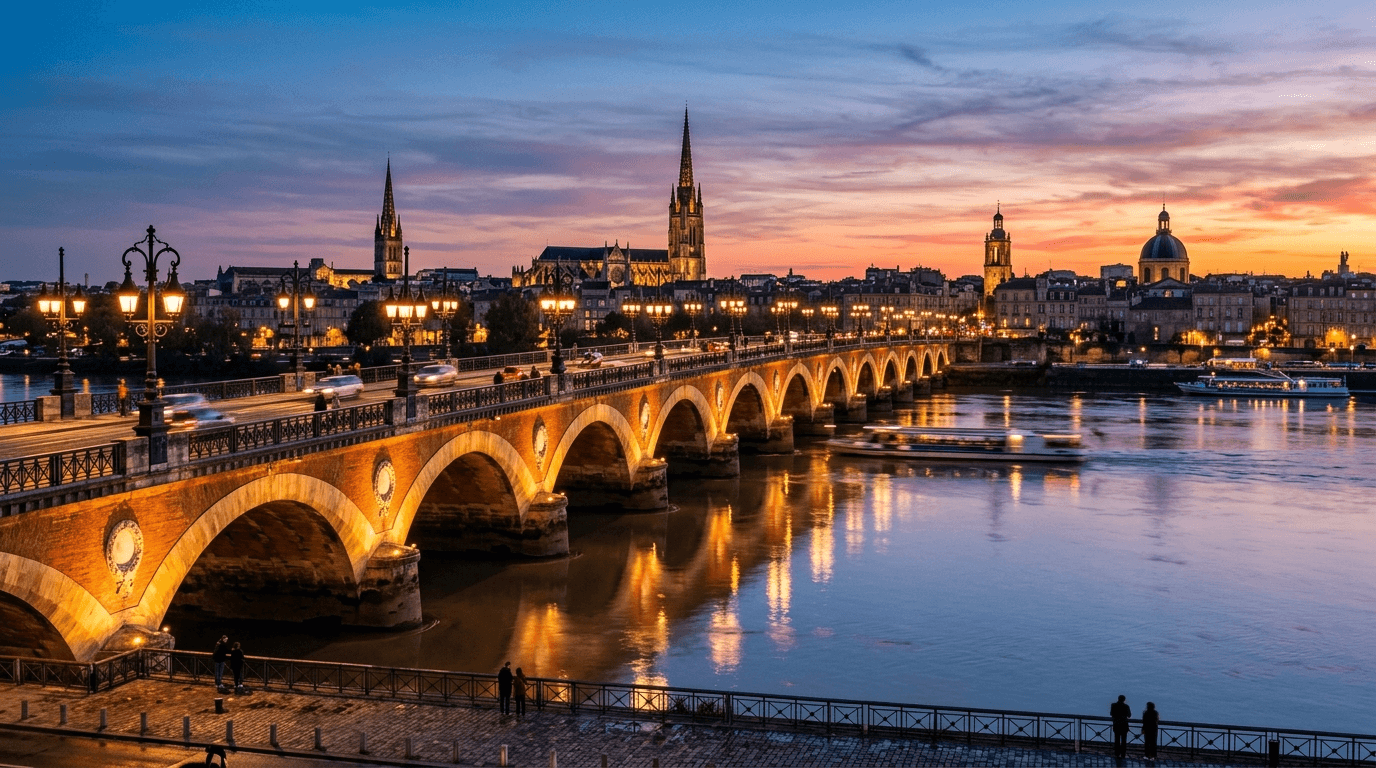
Crossing the banks of the Garonne River and coming across the monumental silhouette of the Pont de Pierre is to witness a moment of pure architectural poetry, where the golden limestone seems to float over the impetuous waters that cross the historic city of Bordeaux. For the attentive tourist or the enthusiastic researcher, this colossus of stone and red bricks is not just a physical link of passage, but a setting of emotional transition that frames one of the most stunning views of southwestern France. Contemplating the bridge at twilight, when its columns of light reflect on the current, is to understand the exact moment when human engineering decided to tame the brute force of nature to build one of the greatest symbols of urban sophistication and resilience.
Before the inauguration of this monumental stone bridge in the first half of the 19th century, crossing the immense and stormy Garonne River in Bordeaux represented a daily test of courage and a massive commercial bottleneck. Citizens and travelers depended entirely on wooden ferries and small improvised boats, which were frequently paralyzed for days due to violent sea currents, dense fog, or scary floods that swept the banks. The imposing presence of the Pont de Pierre dramatically altered the city's urban appearance, finally offering a stable, safe, and monumental land passage that boosted the wine trade and consolidated Bordeaux as a connected metropolis.
Today, the aesthetic impact that the bridge exerts on the urban landscape of Bordeaux is unparalleled, harmoniously integrating the classic look of the left bank, with its Haussmannian and neoclassical style facades, to the renovated and green right bank. The bridge acts as an open-air viewpoint from which the city's main landmarks unfold, such as the imposing Spire of Saint-Michel and the famous Place de la Bourse with its iconic reflecting pool. It is a structure that breathes local identity, attracting millions of visitors who seek to walk without haste between its historic columns and feel the gentle breeze of the river while uncovering the past of one of the most famous regions on the planet.
Chapter
1.2. Why is the Pont de Pierre considered the historical backbone of Bordeaux?
For the historian looking over the old maps of Bordeaux or for the curious traveler wishing to uncover the geopolitical evolution of the region, the Pont de Pierre stands as the true backbone that shaped the political and economic destiny of Aquitaine. If the cobblestone streets and aristocratic mansions of the historic center tell the story of mercantile luxury, the stone bridge narrates the story of the physical integration of a territory that, for centuries, remained divided by an impassable water barrier. It is the definitive monument of Bordeaux's urban maturity, marking the transition from an isolated commercial port to a modern metropolis perfectly integrated into the flows of goods and people from all over Western Europe.
As the first fixed bridge to cross the Garonne River in the city, the structure not only physically connected the two halves of the metropolis, but reorganized the entire land transport flow of southwestern France. From a macroeconomic perspective, it allowed the valuable goods produced in the interior of the continent, including the renowned Bordeaux wines and civil construction timber, to reach the shipping port without the dramatic delays of the ferries. The bridge became the central axis around which the first networks of public carriages were structured, followed by railways and, later, the modern traffic systems that shaped the residential growth of Bordeaux.
In addition to its obvious economic relevance, the Pont de Pierre carries an immense symbolic value of national pride and civil resilience for the population of Bordeaux, having survived catastrophic floods, world wars, aerial bombardments, and severe economic crises. Each carved stone and each arch of red bricks represent the victory of human intellect and persistence over one of the most difficult rivers to tame on the European continent due to the strength of its Atlantic tides. Understanding the bridge is, therefore, understanding the very soul of Bordeaux, a living monument where civic history and monumental engineering merge in an inseparable way to keep the city in constant motion.
Chapter
1.3. The transformation from ferry crossing to the grandeur of classical engineering
Closing your eyes and imagining the banks of the Garonne River at the end of the 18th century is to come across a chaotic and noisy scene of sailors shouting, horses neighing, and anxious passengers crowded onto wooden boats that fought against relentless currents to make the crossing. For the contemporary researcher or the tourist with a vivid imagination, the Pont de Pierre represents a monumental civilizing leap, transforming the logistical nightmare of river transport into a smooth, elegant, and majestic ride over classical masonry arches. This dramatic transition from wooden ferry to the solidity of stone is one of the most fascinating chapters in the history of French engineering, marking the beginning of urban modernity in Aquitaine.
The ferry system, although it had served the city since medieval times, was frequently associated with terrible tragedies, drowning accidents, and thefts in the boarding and disembarking areas, which were congested by dozens of wagons and merchant carriages waiting for favorable sailing conditions. During the harsh winter, large floating ice blocks floated down the Garonne River from the Pyrenees mountains, making the ferry crossing completely impossible for weeks and isolating Bordeaux from all of northern and eastern France. The innovative design of the stone bridge was hailed as a civic liberation, a technical monument of colossal proportions that put an end to centuries of vulnerability and structural delay.
The construction of the Pont de Pierre represented a milestone of conceptual breakdown in classical French engineering, abandoning medieval empiricism to adopt rigorous mathematical calculation methods, the use of steam power, and advanced hydraulic foundation techniques. The crossing, which previously took hours in unstable and dangerous weather conditions, began to be completed in a few minutes with the incomparable comfort of a flat avenue paved with ashlar stones and protected by ornamental iron railings. This triumph of rationality over river chaos not only beautified the Bordeaux skyline, but established new standards for bridge engineering throughout the national territory.
Chapter
2. The Origin of the Pont de Pierre in Bordeaux: Napoleon's Imperial Will
Chapter
2.1. The military strategic need of the imperial campaigns in the Iberian Peninsula
If you walk today along the elegant sidewalks of the Pont de Pierre under the gentle daylight, it might be hard to imagine that the origin of this magnificent Bordeaux monument is closely linked to the roar of cannons and the implacable march of French troops during the Napoleonic Wars. For the military researcher and for the traveler passionate about imperial history, the stone bridge is one of the greatest physical relics of Napoleon Bonaparte's strategic ambition in the early 19th century. Conceived not just as a work of urban aesthetic embellishment, it was born from the urgent military need to guarantee a fast, continuous, and safe land transit route for the French imperial armies marching toward the Iberian Peninsula.
During the French military campaign in Spain and Portugal, which dragged on for years of bloody combat, the city of Bordeaux functioned as the main logistics and replenishment center for Napoleon Bonaparte's forces. However, the wide and dangerous Garonne River dramatically divided the supporting forces: the infantry, cavalry regiments, and the heavy artillery columns descending from northern France had to face the chaotic bottleneck of the ferries to continue their march toward the Spanish border. Napoleon, impatient with the intolerable operational delays affecting the deployment of reinforcements and supplies to the front lines, issued a direct imperial order for the immediate construction of a monumental stone bridge in the city.
The strategic impact of this decision was immense, as the bridge was intended to function as the main axis of a vast military road connecting Paris directly to Madrid. Although the works suffered dramatic delays due to the collapse of the French Empire and constant financial crises, Napoleon Bonaparte's original determination planted the technical seed that allowed the definitive completion of the structure in the subsequent years of peace. The Pont de Pierre remains, therefore, as one of the greatest heritages of Napoleonic war logistics that eventually converted into a civilizing monument of union, progress, and international tourism.
Chapter
2.2. How Napoleon Bonaparte's decree changed the infrastructure of southwestern France
In the vast and detailed archive of imperial decrees that shaped modern France, Napoleon Bonaparte's signature in 1810 ordering the construction of the Pont de Pierre in Bordeaux shines as one of the most audacious and transformative acts of infrastructure planning in southwestern France. For the researcher of administrative history or the visitor interested in uncovering the origins of national civil engineering, this act of imperial will represented a political earthquake that shook the local bureaucratic inertia and centralized decisions over the Garonne River basin. The Napoleonic decree not only guaranteed the physical start of the works, but established a model of funding and public cooperation that redefined the relationship between Paris and the French provinces.
The promulgation of the imperial decree forced the immediate creation of an elite engineering commission, headed by the celebrated engineer Claude Deschamps, who received full powers to confiscate land, recruit specialized labor, and extract building materials from quarries throughout the national territory. From that moment on, the construction of the Bordeaux stone bridge became a national priority of the first order, channeling resources that were previously scattered in small local projects without real macroeconomic impact. Southwestern France, historically isolated from capital decision-making by long road journeys, suddenly found itself at the center of an unprecedented technological revolution.
The transformation generated by this imperial decree was deep and long-term, paving the way for the modernization of the entire Garonne River basin and the Aquitaine shipping canals. The technical success in settling the first stone pillars proved that the rigid guidelines and military standardization imposed by the Napoleonic administration were highly effective in overcoming physical obstacles considered insurmountable by previous local bureaucracies. The Pont de Pierre became the ultimate quality benchmark for all future bridge, road, and river port projects in southwestern France, marking the birth of an integrated high-performance infrastructure.
Chapter
2.3. The complex financing and political disputes after the fall of the French Empire
Uncovering the history of the financial backstage of the Pont de Pierre is to dive into an exciting plot of political intrigue, dramatic economic bankruptcies, and fierce fiscal disputes that almost condemned the bridge to remain as an unfinished row of abandoned stone pillars in the Garonne River. For the historian specializing in public finance and for the intellectual tourist, the period following the fall of Napoleon Bonaparte and the restoration of the Bourbon dynasty represents a fascinating case study on how a war economy can collapse and how private initiative was called in to save a monument of national public utility. The completion of the bridge was not only a technical triumph, but a masterpiece of financial engineering and political diplomacy.
With the collapse of the Napoleonic Empire in 1814 and the return of the Louis XVIII monarchy, imperial war funds disappeared instantly, leaving the Bordeaux City Hall with a huge halted work and astronomical debts accumulated with brick and timber suppliers. The new monarchical regime, eager to erase any aesthetic legacy or military glory associated with Napoleon, initially demonstrated a deep lack of interest in financing the completion of a bridge born from a military decree of the deposed emperor. The unfinished stone pillars, nicknamed 'the ruins of imperial ambition', became a source of ridicule and despair for local citizens, who saw the river remain impassable.
The salvation of the monument came through an audacious and pioneering private sector concession, led by a consortium of influential bankers and merchants from Bordeaux, who signed an agreement with the French State in 1818. In exchange for full private financing of the remaining works, the consortium secured the exclusive right to collect a lucrative toll on the crossing of pedestrians, carriages, and cattle for a period of 99 years. This innovative agreement relieved the public treasury and allowed the engineer Claude Deschamps to resume work at an accelerated pace, culminating in the triumphant inauguration of the bridge in 1822 under the restoration banner, but with the monumental technical base inherited from the Napoleonic period.
Chapter
3. The Secrets of the 17 Arches of the Pont de Pierre: A Tribute to the Emperor
Chapter
3.1. The exact numerical correspondence between the arches and the letters of Napoleon Bonaparte
If you stop for a few moments in the middle of the Pont de Pierre in Bordeaux to count, arch by arch, the imposing openings that support the stone structure over the Garonne River, you will discover one of the most fascinating and silent architectural tributes in French imperial history. For the attentive tourist or the researcher of historical symbology, the fact that the bridge has exactly seventeen arches is not a mere coincidence of hydraulic engineering or a random structural choice of the builders. The number of arches corresponds millimetrically and precisely to the exact number of letters that make up the full name of the French emperor: N-A-P-O-L-E-O-N B-O-N-A-P-A-R-T-E.
This subtle and brilliant symbolic engineering was planned by the chief engineer Claude Deschamps and his collaborators as a way to immortalize the figure of their political and military mentor without provoking the wrath of the royal censors after the collapse of the imperial regime. When the bridge was finally inaugurated in 1822 during the Bourbon Restoration, the mathematical tribute remained intact and hidden in the physical foundations of the bridge, passing unnoticed by monarchical inspectors who sought to remove obvious Napoleonic symbols, such as the letter 'N' engraved in relief or imperial eagles. The bridge became an acrostic of stone and red bricks whispering the name of the conqueror of Europe with each tide crossing.
For the contemporary visitor, walking from one end to the other counting the 17 arches is to connect directly with the spirit of the time, where classical mathematics, monumental architecture, and political cunning intertwined in a brilliant way. This historical detail adds an extra layer of charm and mystery to the crossing, transforming the trivial act of crossing the Garonne River into a living lesson of hidden history. The Pont de Pierre remains, therefore, as an eternal and structural tribute to the man whose decree gave life to modern Bordeaux, proving that monumental architecture is capable of speaking even when silence is imposed by the censorship of the era.
Chapter
3.2. The decorative white porcelain medallions and royal and imperial coats of arms
Walking with slow steps along the Pont de Pierre in Bordeaux, the sharp-eyed traveler will notice, embedded in the limestone flanks of each of the seventeen monumental arches, a series of elegant circular white porcelain medallions that tell the story of the dynasties and powers that ruled France. For the cultural tourist and the historian of French decorative art, these small ornaments of fine ceramic represent details of incredible aesthetic sophistication, contrasting dramatically with the rustic appearance of the red bricks and stone foundations. They function as an open-air art gallery suspended over the turbulent waters of the Garonne River, revealing the iconographic evolution of the country.
Each of these decorative medallions displays reliefs carved with surgical precision, varying between three main symbolic motifs of great political and historical relevance for Bordeaux. In some arches, imperial coats of arms stand out, honoring the legacy of Napoleon Bonaparte; in others, traditional fleur-de-lis celebrating the Bourbon Restoration and the French monarchy; and finally, the official coat of arms of the city of Bordeaux, adorned with the iconic three crescent moons that symbolize the crescent curve the Garonne River makes as it embraces the historic city center. The joint presence of these three iconographic currents on the same monument is a poetic testimony of reconciliation and historical plurality.
The choice of white porcelain for the manufacture of these decorative medallions was a brilliant technical and aesthetic innovation promoted by the curators and artists of the era, aiming to guarantee a high visual contrast that could be appreciated from a distance by passengers on ferries and trading ships crossing the waters of the Garonne River. The material, resistant to sea weather and pollution from steamship coal, maintained its sparkling shine over more of two centuries of existence, serving as a silent witness to the decorative whim and obsession with artistic perfection that characterized the classical engineering of imperial and royal France.
Chapter
3.3. Mathematical symmetry and military aesthetics in 19th-century arch engineering
The monumental symmetry that frames the Pont de Pierre in Bordeaux is a monument to mathematical precision and classical rationality that dominated the military engineering offices of the French army in the early 19th century. For the visitor fascinated by visual harmony or for the researcher seeking to understand the structural secrets of ancient bridges, the perfect alignment of the seventeen arches represents the pinnacle of classical European design. Each curve, each pillar, and each wedge of stone were designed not only to withstand the fury of the Garonne River, but to convey to observers a deep sense of order, eternal stability, and state authority over the physical space and natural landscape.
The chief engineer Claude Deschamps applied the rigid geometric theories developed by the renowned École des Ponts et Chaussées in Paris, using perfect mathematical proportions between the height of each arch and the width of the supporting pillars to ensure that the stone bridge appeared light and graceful despite its hundreds of tons of physical weight. The military aesthetics is reflected in the imposing simplicity of the architectural lines, free of baroque excesses and focused on the rationalist monumentality that defined the aesthetic identity of Napoleon Bonaparte's First Empire. The stone bridge functions as a monument of mathematical order and tactical functionality merged under the golden limestone of Aquitaine.
This visual harmony and flawless mathematical symmetry not only beautified the urban landscape of Bordeaux, but also optimized the mechanical resistance of the bridge against the compression forces caused by the weight of heavy artillery carriages and, later, the electric tram and heavy urban traffic. Each stone arch acts as a self-supporting element that transfers loads in a distributed manner to the foundation pillars embedded in the clay bottom of the river, proving that classical beauty and maximum structural stability go hand in hand when designed by brilliant and visionary minds of 19th-century French military engineering.
Chapter
4. The Engineering Challenges of the Pont de Pierre: The Struggle Against the Garonne River
Chapter
4.1. The fury of tidal currents and the muddy, shifting soil of the riverbed
For the hydraulic engineering researcher or the traveler contemplating the Garonne River from the Pont de Pierre, the brown-hued waters crossing Bordeaux hide one of the most hostile, complex, and impetuous river environments in all of Western Europe. Building a monumental stone bridge over this river represented a test of limits for 19th-century civil engineering, a true war of attrition against the daily fury of extremely violent Atlantic tidal currents and a totally unstable muddy riverbed. Understanding the extreme conditions that challenged the bridge's builders is to give due historical value to each of the golden stones that support the monumental urban crossing today.
The Garonne River in Bordeaux is heavily influenced by the tides of the Atlantic Ocean, which generate daily water level variations of up to **20 feet** and extremely fast torrential currents, changing direction four times a day and dragging large quantities of fine sediment and natural debris. The biggest nightmare faced by engineer Claude Deschamps lay, however, in the geology of the Garonne riverbed, consisting of a deep layer of wet clay, quicksand, and shifting mud up to **98 feet** deep, with no solid rock to support the heavy foundations of the pillars. Any excessive weight placed on the unstable soil ran the immediate risk of asymmetrical sinking or catastrophic structural collapse under the muddy waters.
Many renowned engineers of the time considered the project of building a stone bridge in Bordeaux totally unfeasible and utopian, predicting that the force of the river would destroy the foundation works in a few months, as had occurred with previous attempts with wooden structures. Deschamps had to fight a daily hydraulic engineering battle, adapting new scientific techniques, conducting mechanical soil compaction tests, and inventing new drainage tools to ensure that the monumental pillars remained firm against the continuous thrust of the river. The Pont de Pierre stands as a resounding victory of human intellect over the most indomitable natural elements of southwestern France.
Chapter
4.2. The innovation of wooden cofferdams and pioneering divers in settling pillars
For the tourist passionate about behind-the-scenes stories of great constructions or the civil engineering historian, building the foundations of the Pont de Pierre in Bordeaux is one of the most exciting human and technical epics of the 19th century, worthy of a scientific adventure novel. To settle the immense golden limestone blocks in the shifting, wet soil of the Garonne riverbed, chief engineer Claude Deschamps used a technique that was revolutionary and highly dangerous for the time: submerged watertight wooden cofferdams of monumental proportions. This pioneering methodology required the heroic work of professional divers equipped with primitive diving suits and heavy waterproof clothing operating at the limit of human strength in the muddy darkness of the river.
The wooden cofferdams, which functioned as immense floating bottomless oak boxes, were towed by boats to the exact position of each of the seventeen monumental pillars and then control-sunk by filling them with heavy stones. Once settled in the mud of the riverbed, workers and divers descended inside these structures to manually remove the muddy water and dig the clay until finding a stable layer of compacted soil. The work was carried out in conditions of extreme humidity, chronic lack of oxygen, and under the constant threat of violent water leaks that could tragically drown workers in a few seconds.
The Pont de Pierre divers, pioneers of industrial diving in France, operated at depths of up to **49 feet** under the water's surface, using manual air tubes connected to compression pumps operated exhaustively on the surface by teams of workers. They were responsible for inspecting the correct settling of the oak piles that served as the base and ensuring that the first courses of ashlar stone were fitted perfectly symmetrically in the underwater soil. The sacrifice, extraordinary courage, and surgical precision of these men in the Garonne riverbed guaranteed the monumental stability that allows the stone bridge to support Bordeaux's heavy traffic to the present day.
Chapter
4.3. How steam and pneumatic foundation technology saved civil construction
Uncovering the mechanical and industrial secrets of Bordeaux's Pont de Pierre is to dive into the very infancy of the Industrial Revolution, a period when the muscular strength of men began to be replaced by the spectacular power of coal and expanding water in steam-driven combustion engines. For the contemporary visitor and the French civil technology historian, the stone bridge is a monument of fascinating technical transition, having been one of the first large-scale construction sites in Europe to systematically use high-performance pile drivers operated by steam engines and mechanical drainage hydraulic pumps. This pioneering use of new mechanical technologies saved the project from a financial and operational failure that seemed imminent.
Driving more than four thousand oak piles into the muddy soil of the Garonne riverbed to form the solid supporting base for the seventeen monumental pillars was an impossible task to perform solely by the strength of workers' arms. Each wooden pile, more than **33 feet** in length and **20 inches** of heartwood thickness, had to be driven into the deep clay until reaching the point of mechanical refusal of compaction. The introduction of innovative steam-powered pile drivers, imported from English industrial foundries by Claude Deschamps, allowed the piles to be driven with a speed and impact force dozens of times superior to traditional medieval manual methods.
Steam-powered hydraulic pumps also played a crucial role in emptying the muddy water that infiltrated inside the submerged wooden cofferdams, keeping the workers' environment reasonably dry and safe for the secure placement of each golden ashlar limestone block. This pioneering mechanization drastically reduced the execution time of each pillar, optimized the financial costs of the private consortium, and proved that the driving force of steam was the ultimate tool for overcoming geological challenges considered insurmountable by the traditional classical engineering of the French Ancien Régime.
Chapter
5. The Architecture of the Pont de Pierre in Bordeaux: Details in Brick and Stone
Chapter
5.1. The elegant chromatic contrast between red bricks and golden limestone
If you stop for a few moments on the banks of the Garonne River during the sunset of Bordeaux, when the solar rays touch the structures of the Pont de Pierre, you will witness one of the most beautiful aesthetic and architectural choices in all of France. For the tourist with a sensitive eye and the researcher specializing in the history of urban art, the elegant chromatic contrast between red bricks and golden ashlar limestone is the bridge's trademark, giving it a unique and imposing visual identity that stands out with softness and elegance over the muddy water landscape of the Garonne River. This palette of warm and refined colors was not only an artistic choice of the builders, but a highly ingenious engineering solution of great practical utility for Bordeaux.
The golden limestone, extracted from traditional historic quarries in the hills of Saint-Émilion and the Dordogne River basin, is a monumentally prestigious rock, soft to be carved with decorative precision by stonecutters, but extremely resistant to mechanical water erosion when exposed to the open air. Due to the high financial transport cost of this noble material, chief engineer Claude Deschamps decided to use it strictly in the vital parts of the bridge exposed to direct physical wear, such as the underwater supporting pillars, decorative cornices, and external arches. To fill the large internal volumes of the walls and upper arches, he used red bricks manufactured in local Bordeaux brickyards.
The red bricks, produced from the rich clay of the Garonne alluvial plains, were infinitely cheaper to produce and transport, and had a much lower physical weight than the heavy limestone ashlar stones. The intelligent use of red bricks reduced the total weight of the bridge's superstructure on the unstable foundation pillars embedded in the deep river mud. The result of this ingenious technical and aesthetic solution was a monument of extraordinary chromatic balance, where the golden brightness and the warmth of the red brick merge inseparably to create one of the most loved and photographed postcards in all of southwestern France.
Chapter
5.2. The hollow internal structure of the viaduct and the ingenious system of technical galleries
Crossing the paved surface of the Pont de Pierre in Bordeaux over the silent tracks of the high-tech tram is to enjoy a crossing of impeccable stability, without the common visitor suspecting that beneath their feet lies one of the most spectacular civil engineering secrets of the 19th century. For the investigative tourist or the contemporary civil engineer, the internal structure of the stone bridge is a masterpiece of structural lightness, consisting of a totally hollow internal viaduct composed of a network of vaulted masonry underground galleries and chambers. This innovative hollow architecture was designed not only to save precious building materials, but to prevent the physical collapse of the entire Bordeaux bridge into the riverbed.
If the Pont de Pierre were a completely solid structure of stone and earth, its total physical weight would be so massive that the oak piles driven into the deep mud of the Garonne riverbed would collapse by asymmetrical soil crushing a few months after the inauguration. Deschamps designed a hollow and light structure where the dozens of supporting arches and external walls support a huge roadway platform that rests on empty internal technical and ventilation galleries. These galleries reduce the bridge's own weight on the unstable foundations, while allowing inspectors to check the integrity of each masonry block from its dry interior, protected from Garonne River floods.
The system of internal technical galleries also functions as a high-performance channel for the passage of essential infrastructure for the city of Bordeaux in a discreet and protected manner, including drinking water pipe networks, high-voltage electricity cables, telecommunication fiber optics, and urban gas pipelines. This functional flexibility ensures that the Pont de Pierre continues to play its vital role as an integrated infrastructure and urban connection in the 21st century, genially integrating 19th-century classical design with the contemporary operational needs of one of Europe's most technological metropolises.
5.2.1 The monitoring role of internal galleries against structural cracks
The hollow internal galleries of Bordeaux's Pont de Pierre play a crucial role in structural monitoring and preventive conservation, functioning as the true internal 'nervous system' of the classical monument. Municipal civil engineers and technical inspectors regularly walk through these silent underground passages suspended over the Garonne River's stone arches, equipped with high-precision digital laser sensors, mechanical inclinometers, and computerized three-dimensional scanning systems. This real-time tracking allows identifying small cracks, dangerous brackish water infiltrations, or millimetric shifts in foundations caused by violent Atlantic tides and the constant traffic of pedestrians, cyclists, and the Bordeaux electric tram.
Systematic inspection from the internal galleries ensures quick preventive repair intervention before small local damage can turn into major structural problems that compromise public safety or require expensive road closures. Thanks to this cutting-edge monitoring, Bordeaux's Pont de Pierre has consolidated itself as one of the best-monitored and safest ancient monuments in all of Europe, joining 19th-century civil engineering wisdom with 21st-century advanced digital technology to ensure that its golden limestone and red brick arches remain firm for many generations of visitors.
Chapter
5.3. The classic design of lighting poles and original iron railings
If you have the privilege of walking across Bordeaux's Pont de Pierre at nightfall, when the lights begin to light up one by one along the bridge's entire urban length, you will notice one of the most charming and elegant decorative and urban details in all of France. For the cultural tourist of refined taste and the historian interested in classical urban design, the cast iron lamp posts and long original railings that delimit the platform represent masterpieces of 19th-century French artistic casting. They frame the crossing with breathtaking geometric symmetry, evoking the sophistication of the *Belle Époque* and the ornamental caprice that established Bordeaux as one of the most elegant capitals in the world.
The lamp posts, originally designed with triple ornamental supports in neoclassical style and refined decorative frames, were cast in major French metalworking industries in the 19th century and adapted over time to the city's different energy sources: they began running on whale oil, passed through the urban coal gas system, and finally received contemporary high-efficiency LED smart lighting. The soft amber light emitted by these historical fixtures casts a warm, intimate glow on the stone sidewalk, creating a highly romantic and welcoming atmosphere that invites loving couples and photographers to capture the sparkling reflection on the Garonne River's dark waters.
The original iron railings, painted in historical olive-green and adorned with coats of arms and refined geometric motifs in Art Deco and classical styles, protect pedestrians and cyclists without obstructing the unobstructed view of the Garonne River and the monumental center. They show rustic marks of wear and the scars of more than two hundred years of continuous exposure to sea air and weather, serving as a solid and elegant barrier that closely witnessed the evolution of transport in Bordeaux. The handcrafted care in the design of these original ironworks proves that, in Bordeaux's classical engineering, public safety and aesthetic beauty always went hand in hand in a flawless way.
Chapter
6. The Urban Impact of the Pont de Pierre: The Integration of the Bastide Neighborhood
Chapter
6.1. The definitive union between the historic center of Bordeaux and the industrial district of Bastide
Walking today along the modern right bank of Bordeaux and seeing the Bastide district filled with green parks, trendy restaurants, technological innovation centers, and open-air cafes facing the Garonne River makes it difficult to imagine that, for many centuries, this vast alluvial region was considered a swampy, isolated, and unhealthy no-man's-land of Bordeaux. For the tourist interested in urban planning or for the researcher specializing in social evolution, Bordeaux's Pont de Pierre was the definitive catalyst that promoted physical and psychological union between the exquisite monumental historic center of the left bank and the untamed territory of the right bank. The inauguration of the stone bridge represented the political birth of a new and vibrant urban hub for the Aquitaine metropolis.
Before the stone bridge, the right bank, known as Bastide, functioned strictly as a rustic landing point for ferries, surrounded by precarious wooden warehouses, noisy leather tanneries, and small agricultural farms that suffered from frequent devastating Garonne River floods. Geographical isolation prevented any quality residential or urban investment in the Bastide region, which remained separated from the cultural and economic decisions of the elegant historic center of Bordeaux. The opening of the Pont de Pierre in 1822 opened the floodgates for unprecedented economic and demographic integration, transforming the swamp into a vital and high-market-value extension for urban development.
The union generated by the bridge allowed Bordeaux to expand its physical borders in a logical and secure way, accommodating the growth of modern industries, integrated port warehouses, and affordable housing for the working class that settled in Bastide throughout the 19th-century Industrial Revolution. The Bastide neighborhood went from being an inaccessible suburb to an industrial lung and, later, to one of the trendiest, greenest, and most valued districts of the contemporary city. The Pont de Pierre remains, therefore, as the historical gateway of social integration that redefined the urban balance of Bordeaux in a democratic and sustainable way.
Chapter
6.2. The real estate and commercial development generated by the ease of land crossing
Uncovering the history of urban growth in Bordeaux after the opening of the Pont de Pierre is fascinating for the visitor attentive to the brick and stone facades of the avenues that open immediately after crossing the Garonne River. For the business tourist and the historian interested in French real estate dynamics, the ease of land crossing provided by the stone bridge represented an extraordinary economic engine that generated one of the greatest residential construction and real estate speculation fevers in southwestern France in the 19th century. The wine trade and port logistics gained new horizons of rapid expansion, changing the consumption and housing habits of thousands of new citizens.
With the guarantee of a flat and safe traffic route over the Garonne River, the banks of Bastide saw the emergence of a monumental access avenue, filled with elegant neoclassical style residential buildings constructed with golden limestone, transit hotels for travelers, busy commercial cafes, and large wine warehouses with modern rail systems for transporting casks. The value of agricultural land on the right bank shot up spectacularly in a few years, attracting millionaire investments from large Bordeaux wine merchant families and French bankers. The bridge transformed into a factory of real estate wealth, integrating previously underutilized lands into the international market economy.
The commercial development extended to open-air food markets, regional agricultural markets for urban supply, carriage repair shops, and small manufacturing industries of fabrics and glass that took advantage of the rapid export route provided by the Pont de Pierre. Bordeaux was thus able to diversify its industrial productive base without congesting the already densely populated medieval historic center on the left bank of the Garonne River. The positive impact of this planned real estate expansion is what continues to attract young couples and property investors to the contemporary right bank, keeping the region's dynamism in constant rise.
Chapter
6.3. How the railway and the electric tram integrated the new circulatory artery of the city
If you observe the central floor of Bordeaux's Pont de Pierre today, when the modern high-tech electric tram slides smoothly over the bridge without emitting any combustion noise or smoke, you will witness the result of one of the most successful public transport integrations in all of Central European urban history. For the tourist of modern urban routes and the researcher seeking to understand the circulatory evolution of French metropolises, the stone bridge was the fundamental axis that allowed connecting regional railway networks and ancient carriage systems to the innovative electric tram that crosses Bordeaux today. The bridge was and continues to be the beating circulatory heart that guarantees the agile and democratic flow of thousands of people every day.
In the late 19th century, Bordeaux adopted a pioneering network of electric trams that used the flat surface of the Pont de Pierre to connect Bordeaux's main railway stations in an integrated manner, such as the historic Orleans station on the right bank of Bastide and the Saint-Jean station on the left bank. This integrated transport system allowed industrial workers, university students, and tourists passing through the city to travel between different urban points with affordable fares and in record times for the era. The Pont de Pierre became a vital, high-performance circulatory artery, uniting neighborhoods and railways into a cohesive metropolitan transport system.
The contemporary reintroduction of the Bordeaux tramway (Tramway de Bordeaux) in the early 2000s utilized an innovative and sophisticated ground-level power supply (APS) technology on the Pont de Pierre, eliminating the need for iron poles or overhead electricity wires that could damage or disfigure the classical beauty of the historic stone and brick monument. The tram slides gracefully over the rails embedded in the rustic ashlar stone, genially integrating the classical 19th-century engineering heritage with 21st-century clean sustainability and information design, proving that the Pont de Pierre is a living structure adapted to the future of active mobility.
Chapter
7. Hidden Legends and Curiosities of the Pont de Pierre: The Folklore of Bordeaux
Chapter
7.1. The legend of the builder's pact with mystical entities to stem the floods
Walking along the banks of the Garonne River under the dense and cold fog of Bordeaux during winter mornings is to come across an atmosphere of ancient mystery that has fed the imagination of poets and Bordeaux residents for more than two centuries. For the tourist of folkloric curiosities or the researcher interested in the anthropology of French popular beliefs, the Pont de Pierre is the setting for one of the most famous and sinister urban legends of southwestern France: the builder's pact with mystical entities to stem the catastrophic floods that threatened to destroy the foundations of Bordeaux's stone bridge. This popular myth reflects human awe and helplessness in the face of the Garonne River's untamable forces in the Medieval and Modern eras.
According to local oral popular tradition passed from generation to generation by local stonecutter families, the master builder in charge of settling the first underwater supporting pillars, desperate after seeing several of his wooden foundation cofferdams repeatedly dragged away and destroyed by violent Atlantic tidal currents, was said to have received a nocturnal visit from a tall man dressed in dark clothes on the dark banks of Bastide. The mysterious visitor reportedly offered a miraculous hydraulic compaction secret that would guarantee the eternal stability of the arches over the Garonne River, requiring in exchange for the pact the soul of the first living being to cross the monumental bridge on its official inauguration day.
The urban legend tells that the master builder accepted the dark agreement, but on the day of the grand triumphant opening of Bordeaux's Pont de Pierre in 1822, he acted with great cunning to deceive the mystical entity: instead of allowing the mayor of Bordeaux or the royal commission of engineers to cross the sidewalk first, he let loose a small, frightened stray dog that happily ran from one bank of the Garonne River to the other, thus saving the souls of local Bordeaux citizens. This folkloric tale adds a layer of mystery and fun to the contemporary visitor's tour, proving that in monumental France, technical engineering and mystical imagination always walk intertwined through the classical stones of the past.
Chapter
7.2. The heroic rescues and secret passages used during wars and occupations
Uncovering the details and hidden scars in the rustic ashlar stones of Bordeaux's Pont de Pierre is to enter a labyrinth of heroic stories, secret espionage missions, and spectacular rescues that occurred during the major European wars that swept through Aquitaine. For the researcher of military contemporary history or the tourist of patriotic tourism, the stone bridge was much more than an urban crossing viaduct: it functioned as a strategic board disputed by local resistance forces, clandestine guerrillas, and allied army officers fighting against the Nazi German occupation forces in World War II.
During the dark years when the German army held Bordeaux under tight control and Nazi forces guarded the bridges and railways with heavy machine guns and barbed wire fences, the hollow internal galleries of the Pont de Pierre (the famous internal technical passages) were used in absolute secrecy by French Resistance fighters. The clandestine guerrillas entered the passages through discreet maintenance gates located on the banks of Bastide to hide espionage materials, high-frequency communication radios that transmitted strategic data to Allied English aircraft, and to hide escaping prisoners of war seeking to escape the clutches of the local Gestapo.
The stone bridge of Bordeaux was also the scene of spectacular heroic rescues of resistance workers and civil sailors who threw themselves into the torrential waters of the Garonne River under the cover of night to collect packages of dynamite smuggled from local coal mines or to cut crucial Nazi naval communication cables. At the end of the war in 1944, when retreating German troops planned to implode the bridge and destroy all of Bordeaux's infrastructure, the quick and heroic action of these clandestine saboteurs deactivated the dynamite explosive charges already installed in the internal galleries, saving the stone monument and ensuring that the Pont de Pierre remained standing for new French generations.
Chapter
7.3. Incredible curiosities about the official inauguration and the first toll collected
If you walk freely today along the sidewalks of Bordeaux's Pont de Pierre, where pedestrians and cyclists cross the Garonne River unimpeded and without paying a single cent of toll, you will find it hard to believe that the bridge's inauguration in 1822 was surrounded by strict customs restrictions of the era and rigid toll collections for all Bordeaux citizens. For the historian interested in French urban sociology and for the tourist passionate about old tax curiosities, the history of the inauguration of the first toll is a fascinating dive into the post-revolutionary economic practices of France, where each crossing represented a transaction calculated down to the last detail.
On the day of its official opening to the public, Bordeaux pedestrians came across beautiful neoclassical toll booths built of golden limestone at both access ends of the Garonne River, operated by tax inspectors from the private consortium who guarded the passage with wrought iron turnstiles. Each pedestrian had to pay a small fee to make the land crossing from one bank of the river to the other, with rates that varied dynamically and were tabulated according to the weight of the load carried, the type of carriage used, and even the number of cattle and sheep destined for the local markets of Bastide. This historical collection system generated massive civil protests from Bastide workers, who considered the rates extremely unfair and exclusionary.
The toll booths operated lucratively and continuously for more than five decades of the 19th century, generating fortunes for the shareholders of the private consortium and helping to quickly amortize the immense private capital invested in settling the pillars and in the hydraulic engineering of the bridge. The toll was only definitively abolished after major political battles in the municipal government of Bordeaux, which nationalized the historic monument, tore down the physical toll collection barriers, and declared the Pont de Pierre free and open for the democratic public use of all citizens, a milestone celebrated at the time with major fireworks displays and popular street parties.
Chapter
8. How to Visit the Pont de Pierre in Bordeaux: Practical Tips for Itineraries
Chapter
8.1. Where the Pont de Pierre is located and the best way to get there on foot or by tram
For the tourist arriving in the beautiful city of Bordeaux who wants to check the Pont de Pierre off their list of must-visit places in France, planning the urban route is an extremely simple task to perform comfortably and quickly by public transport or bicycle. Located in the geographical and historical heart of Bordeaux, the stone and red brick monument directly connects the busy Cours Victor Hugo on the historic left bank to the dynamic and tree-lined Avenue Thiers in the modern Bastide neighborhood on the Garonne River's right bank. Understanding the circulatory network of trams and bike paths is the technical and operational secret to ensuring an unforgettable and stress-free trip in Aquitaine.
The best way to get by public transport to the Pont de Pierre is by using the high-tech network of the Tramway de Bordeaux (municipal electric tram), specifically Line A, which has a dedicated station called "Stalingrad" located immediately at the right bank access entrance (Bastide neighborhood), and the "Porte de Bourgogne" station at the left bank access entrance. The urban transit ticket is extremely cheap and can be purchased easily at automatic touch-screen ticket machines located at all Bordeaux tram stations, accepting easy payments with euro coins or international credit and debit cards.
If you prefer a more dynamic and healthy tour in Bordeaux, the golden travel recommendation is to rent one of the shared public bicycles from the municipal system (V3) or walk without haste along the entire length of the historic quays that frame the banks of the Garonne River. The classical stone monument is completely flat and extremely pleasant to cross on foot, offering wide lanes for pedestrians of all ages and modern dedicated and safe smooth asphalt bicycle paths, allowing you to cross the stone bridge with complete comfort while enjoying a breathtaking panorama of the most elegant city in southwestern France.
Chapter
8.2. Tips for an integrated tourist itinerary: Combining the visit with the Place de la Bourse
Designing a high-performance smart tourist itinerary in Bordeaux requires knowing how to combine the classic charm of the Pont de Pierre with other monuments and architectural attractions located just a few steps away from the stone bridge of Bordeaux. For the tourist of quick and smart urban routes and the researcher seeking to optimize their exploration time of French monuments, the Pont de Pierre functions as the perfect transition bridge to connect the medieval historic districts to the stunning reflecting pool of the Place de la Bourse. The secret of an integrated itinerary lies in knowing how to walk along the quays and take advantage of the city's spatial dynamics.
It is recommended to start the walking tour from the monumental Porte de Bourgogne, an imposing neoclassical style stone gate built in the 18th century that served as a gateway to Bordeaux and is located exactly at the left bank access entrance of the Pont de Pierre. After taking beautiful photos of the decorative bas-reliefs of the classical stone gate, the visitor can start the walking crossing of the classical stone bridge, walking calmly towards the Bastide neighborhood on the Garonne River's right bank, where they can stop at the green courtyard of Place Stalingrad to see the famous monumental Blue Lion sculpture of Bordeaux.
After exploring the modern right bank of Bordeaux, the traveler can return walking leisurely along the wide and tree-lined quays of the Garonne River's left bank, following the flow of cyclists until coming across the magnificent neoclassical symmetrical facade of the Place de la Bourse. There, the tourist can cool off and take the most famous photos of their integrated itinerary at the iconic Miroir d'Eau (the largest reflecting pool in the world), where the classical silhouette of the royal palace and the arches of the Pont de Pierre reflect symmetrically in a thin sheet of water, creating a visually spectacular atmosphere that summarizes the urban harmony and architectural brilliance of Bordeaux.
Chapter
8.3. The best time of day to cross the bridge and explore the right bank
If you want to live a true high-level sensory experience in Bordeaux and ensure that the photos in your travel diary are worthy of a professional tourism publication, choosing the exact time to cross the Pont de Pierre is of vital operational relevance. For the experienced tourist and the photographer looking for the ideal golden light of color contrast on the stone bridge, late afternoons are considered by far the best time of day to cross the Garonne River and explore the Bastide neighborhood. The poetic contrast of colors and the movement of the contemporary city create an unparalleled setting.
When walking over the classical bridge starting at 5:00 PM, the warm colors of the golden limestone and the red bricks of the Pont de Pierre are enhanced by the low sun setting behind the gothic spires of the towers in Bordeaux's historic center, casting long shadows of geometric symmetry over the flat sidewalk of the bridge. The urban atmosphere becomes highly vibrant, with locals jogging, executives in suits pedaling modern bicycles from work to home, and loving couples strolling unhurriedly along the original iron railings of the bridge, creating an authentic and high-performance portrait of French lifestyle.
After crossing into the Bastide neighborhood, visitors to Bordeaux can take advantage of the starting warm evening to dine in one of the trendy ecological restaurants and alternative cafes installed in the innovative cultural space Darwin Ecosystem, a former decommissioned military barracks that was reurbanized and converted into a hub of urban art, organic local gastronomy, and sustainability just a few minutes' walk from the stone bridge. Closing your day of integrated tourist exploration with a glass of Bordeaux wine facing the Pont de Pierre of Bordeaux illuminated by warm amber lights under the starry sky is one of those unforgettable moments that justify the whole trip to France.
Chapter
9. The Pont de Pierre in Pop Culture: From Bordeaux Postcard to Movie Set
Chapter
9.1. The monument in French travel literature and in the diaries of great intellectuals
Diving into the old pages of diaries and travel books written by French and foreign intellectuals who crossed the Aquitaine region throughout the 19th and 20th centuries is to come across a profusion of high praise and passionate descriptions about the classical grandeur of Bordeaux's Pont de Pierre. For the researcher of French urban literature history or the tourist of literary tourism, the stone bridge was and continues to be one of the greatest sources of poetic and narrative inspiration in southwestern France. Great minds of world literature came across the tamed barrier of the Garonne River and recorded the crossing spectacularly in their travel memoirs.
The celebrated French writer Victor Hugo, author of world masterpieces such as *"Les Misérables"*, recorded an exciting and breathtaking description in his private travel diaries when he visited Bordeaux in the mid-19th century, declaring that Bordeaux's Pont de Pierre was a masterpiece of solidity and mathematical symmetry and one of the most beautiful monuments that classical French civil engineering had ever offered to the world. He poetically described the color tones contrast of the red bricks and golden limestone shining under the morning fog of the Garonne River, comparing the bridge to a classical giant stretched over the impetuous waters of the river to unite northern and southern France eternally.
Other intellectuals of international weight, such as the existentialist writer and philosopher Jean-Paul Sartre, who spent important periods of his youth and maturity in the Bordeaux region, also mentioned the Pont de Pierre in their correspondences and literary essays as the definitive urban setting for the contemplation of the pains and anxieties of contemporary man. The bridge was seen as Bordeaux's geometric point where the currents of French political history and the eternal flow of the Garonne River crossed, transforming the original iron railings and neoclassical iron lighting posts into immortal symbols of progress, art, and philosophical reflection.
Chapter
9.2. The presence of the Pont de Pierre in fine arts and in classical painting of Bordeaux
Walking through the wide art galleries of the Musée des Beaux-Arts de Bordeaux or visiting small contemporary art exhibitions scattered throughout Bordeaux's historic neighborhoods, the attentive visitor will come across a monumental quantity of canvases, drawings, and prints that feature the Pont de Pierre as the absolute protagonist of the artistic composition. For the tourist passionate about fine arts and the historian interested in classical urban iconography of Aquitaine, the monument of stone and red bricks was the great catalyst of inspiration for generations of French and foreign painters fascinated by the dynamics of water and the chromatic reflection of French bridges.
Great impressionist and realist painters of the 19th century, attracted by the extraordinary golden light that bathes the banks of the Garonne River in Bordeaux during hot summer afternoons, set up their open-air painting easels on the quays of Bastide or on the hills of Queyries to paint the classical stone bridge. They sought to capture the fluid atmosphere of smoke from steamships passing under the seventeen symmetrical stone arches and the frenetic movement of the first public carriages crossing the bridge's flat sidewalk. The loose and vibrant brushstrokes of these artists eternalized the unique aesthetic fusion of golden limestone and red bricks in the history of European painting.
Bordeaux's stone bridge also became a recurring classical theme in detailed technical engravings and architectural perspective drawings of the 19th and 20th centuries, serving as a practical sample of progress and technical ingenuity that circulated internationally in illustrated science and industrial engineering magazines of Central Europe. These detailed graphic representations helped spread the monumental fame of Bordeaux's Pont de Pierre far beyond the physical borders of the continent, consolidating the monument as a ultimate symbol of good taste, aesthetic sophistication, and unshakeable hydraulic mastery of imperial and royal France's classical engineering.
Chapter
9.3. Contemporary cinema and the use of the bridge in period productions and short films
For those who watch great contemporary French film productions or independent short films screened at major international art festivals in Central Europe, the classical and monumental silhouette of Bordeaux's Pont de Pierre is an unbeatable period setting that immediately evokes the romantic melancholy and historical drama of southwestern France. For the tourist of film tourism or the researcher interested in audiovisual language and classical French urban scenography, the stone and brick monument of Bordeaux is the perfect backdrop for cinematographic productions seeking to recreate the historical atmosphere of Napoleon's First Empire, the *Belle Époque*, and World War II.
Renowned French film directors take advantage of the complete absence of contemporary overhead electrical wiring and the impeccable restoration of golden limestone on Bordeaux's Pont de Pierre to shoot complex period scenes without the need for expensive post-production digital visual effects or artificial studio sets. The smooth movement of the modern electric tram with ground-level power supply crossing the classical bridge's seventeen stone arches is frequently framed by anamorphic cinema lenses to create poetic images of temporal and spatial transition, capturing the essence of a city that knew how to keep its engineering heritage alive.
Bordeaux's stone bridge also serves as a frequent inspiration for conceptual short films by young local filmmakers funded by the Bordeaux municipality and prestigious national film schools, who use the original neoclassical iron lighting poles and original iron railings of the French stone bridge to compose intimate scenes of urban romance at sunset or night suspense under the dense muddy fog rising from the Garonne River. This constant presence of the Pont de Pierre in cinema proves that Claude Deschamps' 1822 masterpiece continues to play a vital role in contemporary imagination, connecting classical precision engineering to the new digital media of the 21st century.
Chapter
10. The Preservation of the Pont de Pierre in Bordeaux: The Struggle for Its Structure
Chapter
10.1. The millimeter-level sinking of the stone pillars and cutting-edge laser monitoring
Behind the immense static stability and monumentality that Bordeaux's Pont de Pierre proudly displays to the millions of pedestrians and cyclists who cross it every year, one of the most advanced, scientific, and technological civil engineering battles in all of Central Europe is fought behind the scenes at Bordeaux City Hall to preserve the integrity of the historical monument's foundations. For the researcher interested in architectural heritage conservation or the tourist fascinated by French geotechnical curiosities, the classical bridge's seventeen stone pillars suffer from continuous, asymmetrical, millimeter-level sinking since the beginning of its hydraulic construction in the Garonne River in the 19th century.
As the bridge's dozens of monumental supporting pillars do not rest on solid rock, but rather on more than four thousand oak piles driven deep into the wet clay and shifting mud of the Garonne River bed, the red brick and golden limestone superstructure exerts a formidable weight of its own that compacts the soil slowly and millimeter by millimeter over the decades. To monitor this scary geological behavior and ensure that no dangerous inclinations or catastrophic structural cracks occur that compromise public safety, French bridge engineers use state-of-the-art integrated computerized systems of high-precision digital laser monitoring.
Digital laser sensors installed at strategic points in the hollow interior of the technical galleries and on the external flank of the arches measure with millimeter precision any variation in soil leveling, physical horizontal displacement, or angular rotation of the classical stone pillars in relation to the Garonne River clay bed. This high-performance geological data is processed in real time by algorithms that send immediate alerts to the computers of the bridges and national monuments department of the city of Bordeaux at the slightest sign of mechanical anomaly, proving that the survival of Bordeaux's Pont de Pierre in the 21st century depends on the perfect union of classical avant-garde engineering and contemporary digital technology.
Chapter
10.2. The major historical restoration campaigns to recover the stability of the arches
Uncovering the immense engineering interventions carried out to guarantee the stability of Bordeaux's Pont de Pierre over its two centuries of existence is to come across one of the greatest technical and financial sagas of cultural heritage preservation in all of Central Europe. For the historian interested in architectural restoration and the visitor contemplating the floating scaffolding and civil repair barges moored next to the classical bridge's stone pillars, the red brick and golden limestone arches periodically undergo deep and expensive campaigns to consolidate hydraulic foundations. The technical objective of these major public works is to curb natural millimeter-level sinking and protect the monument from the Garonne River's violent tidal currents.
The most audacious campaign of restoration and structural consolidation of the classical bridge's foundations in recent times involved the computerized mechanical injection of dozens of tons of high-performance microfine cement grout into the deep subsoils of the Garonne River bed, filling the clay voids around the original 1822 oak piles to stabilize the soil. This technical injection process of high-performance special cement was planned by consortia of French and international engineers specializing in ancient French monuments, requiring continuous laser monitoring to ensure that the injection of high-performance cement did not cause unwanted structural compression cracks in the classical bridge.
Parallel to the soil consolidation injections of the Garonne River bed, teams of highly skilled stonemasons work suspended on floating platforms over the violent Atlantic tidal currents to remove golden limestone blocks worn by water erosion and replace them with new pieces carved manually in French quarries in Bordeaux, maintaining the aesthetic authenticity of the bridge's colors. This multi-million dollar public heritage preservation investment proves Bordeaux's unwavering commitment to keeping its Pont de Pierre as a monument of progress, qualified international tourism, and active civic pride for future generations of French citizens.
Chapter
10.3. The challenge of conserving limestone against corrosive humidity and river weather
When running your fingers gently along the decorative stone moldings of the Pont de Pierre in Bordeaux, the traveler will notice the rustic and slightly porous texture of the golden limestone that frames the seventeen monumental arches suspended over the Garonne River. For the art tourist and the researcher of preventive materials conservation science and historical architectural heritage, the protection and preservation of this noble limestone against the daily aggression of corrosive humidity from the Garonne River represent a permanent monumental technical challenge that requires the use of innovative French high-performance chemical solutions.
The golden limestone, although a stone of extreme classical aesthetic beauty and easy to carve by stonemason artisans, is highly susceptible to mechanical wear caused by muddy and violent Atlantic tidal currents, brackish humidity brought by coastal winds from the Atlantic Ocean, and constant freeze-thaw cycles during Aquitaine's harsh winters. Water infiltrated into the microscopic pores of the limestone expands when frozen, causing small structural cracks invisible to the naked eye that facilitate the detachment of classical stone flakes over time. Pollution caused by urban car combustion and heavy urban traffic also contributes corrosively to the aesthetic degradation of the stone.
To combat these harmful and corrosive effects of river humidity from the Garonne River, chemical scientists and restorers from Bordeaux's national monuments department apply innovative preventive treatments of nanotechnology and special transparent water-repellent resins to the surface of the Pont de Pierre's golden limestone. These high-performance microscopic resins penetrate deep into the pores of the classical limestone ashlar stone, creating an invisible water-repellent barrier that prevents rainwater and brackish river humidity infiltration from the Garonne River, without obstructing the classical stone's natural breathing capacity. Bordeaux's stone bridge thus consolidates itself as a masterpiece of scientific conservation, joining traditional 18th-century design with the future of molecular chemistry.
Chapter
11. The Pont de Pierre and Active Mobility: Pedestrian and Bicycle Paths
Chapter
11.1. The historic closure to private car traffic and direct environmental impact
If you visit the Pont de Pierre in Bordeaux on a beautiful spring or summer day, you will witness an atmosphere of incredible tranquility and urban silence that would be unthinkable on any other metropolitan monumental French bridge of great geographical importance. For the tourist interested in applied ecology and the researcher of modern national and international urban mobility, Bordeaux's Pont de Pierre represents one of the greatest and most daring environmental success cases of green transition in all of Central Europe, having definitively and historically banned and closed heavy private car traffic on its sidewalks. The classical stone bridge was returned entirely to the exclusive use of sustainable active mobility.
Until the mid-2010s, Bordeaux's Pont de Pierre functioned as one of the most congested, chaotic, and polluted urban expressways in southwestern France, crossed daily by more than twenty thousand noisy cars emitting tons of greenhouse gases and corrosive coal dust directly onto the original golden limestone and red bricks of the Napoleonic monument. Noise pollution and constant mechanical vibrations caused by braking and accelerating urban combustion engines placed the physical stability of the classical French bridge's seventeen stone arches over the Garonne River at serious risk of material fatigue. Closing it to cars was a political act of environmental civic courage by Bordeaux City Hall.
The direct environmental impact of this green mobility transition was monumental and immediate for the city of Bordeaux: air pollution levels for nitrogen dioxide and fine particles at the bridge's access ends plummeted spectacularly in a few months, while urban noise pollution decreased drastically, transforming the classical bridge's sidewalk into a silent avenue where only the murmur of the waters and the cry of Garonne River gulls can be heard. This green transition served as an international example of high-performance urban design, proving that it is possible to combine the rigorous preservation of classical stone historical heritage with the future of clean mobility.
Chapter
11.2. Bordeaux's panoramic bicycle path: How to pedal with a breathtaking view over the bridge
For the long-distance cycle tourist or the urban traveler who wants to feel the wind in their face while pedaling with one of the most spectacular skyline views in all of Central Europe, crossing Bordeaux's Pont de Pierre on two wheels is the highlight of any tourist itinerary in southwestern France. For the urban adventure tourist and the researcher interested in high-performance integrated bicycle path infrastructure, the bi-directional cycle path crossing Bordeaux's stone and red brick monument is considered an exemplary model of active mobility information design and safety for cyclists of all ages in France.
The panoramic smooth asphalt cycle path of the Pont de Pierre, fully segregated from the electric tram circulation and protected from the flat pedestrian sidewalks by rustic boundary bands of classical ashlar stone, offers cyclists and electric scooter users a flat and extremely safe crossing over the Garonne River. Pedaling over the seventeen symmetrical classical stone arches feeling the gentle river breeze and watching the classical silhouette of the gothic church towers of Bordeaux and the illuminated neoclassical facades of the left bank cut into the sunset skyline is a sensory experience of high visual appeal that attracts cycle tourists from all over the world.
The Pont de Pierre cycle path directly connects to a vast regional network of high-performance cycle paths that pleasantly line both banks of the Garonne River (the famous Quays of Bordeaux), allowing you to plan leisure cycle tourism itineraries without haste through Bordeaux's traditional historic wineries or cross the classical bridge towards the natural parks of Bastide's right bank. The ease of access to shared public bicycles and the extraordinary civic respect shown by local Bordeaux drivers and pedestrians consolidate the city as the undisputed bicycle capital of southwestern France, with Bordeaux's Pont de Pierre shining as its ultimate green vanguard gateway.
Chapter
11.3. Peaceful coexistence between pedestrians, cyclists, and the electric tram without overhead wires
If you sit for a few moments on one of the stone benches in the squares that give access to Bordeaux's Pont de Pierre on the right bank of Bastide, you will witness a true urban choreography of mutual respect and civil integration that exemplifies the best of human coexistence in contemporary smart metropolises. For the tourist interested in social dynamics and the city planner and urban traffic researcher, the daily peaceful and harmonious coexistence between pedestrians of all ages, leisure cyclists, and the modern high-tech electric tram without overhead electricity wires over the classical French bridge is a brilliant and inspiring case study of high-performance integrated public space design in Europe.
The secret of this peaceful coexistence lies in the intelligent urban design of the Pont de Pierre's circulatory platform, planned so that each type of clean active or collective transport mode has its physical space clearly delimited by natural visual elements of stone and asphalt, without aggressive physical barriers or iron fences that could disfigure the classical beauty of the 1822 monument. The Bordeaux tram, with its innovative ground-level power supply (APS) technology, operates at safe, reduced speeds over the classical bridge, emitting only a soft and elegant classical bell sound to alert distracted pedestrians walking by the original iron railings.
This circulatory harmony and urban integration exemplify how contemporary cities can humanize their major historical classical engineering structures without isolating neighborhoods or restricting free public access in an arbitrary and exclusionary way. Bordeaux's Pont de Pierre has ceased to be a noisy and dangerous car passage of heavy urban traffic to convert into a democratic, safe, and pleasant public space for shared urban leisure, where time seems to pass slower to the rhythm of bicycles, the steps of Bordeaux pedestrians, and the eternal murmur of the Garonne River's Atlantic tides.
Chapter
12. Photography and Sunset at the Pont de Pierre: Where to Take the Best Photos
Chapter
12.1. The golden angle from the Quai de Queyries on the right bank of the Garonne River
If you wish to record with your camera or cell phone the most spectacular, harmonious, and high visual impact image of the Pont de Pierre in Bordeaux, the ideal geographical location to set up your photographic tripod is located just a few minutes' walk from the stone bridge, along the stunning Quai de Queyries on the right bank of the Garonne River in the Bastide neighborhood. For the tourist passionate about artistic photography and the professional photographer looking for the ideal golden light of contrast, this panoramic point offers the so-called 'golden angle', perfectly framing the monumental length of the seventeen symmetrical stone and classical brick arches over the turbulent waters of the river.
From the Quai de Queyries, the photographer is able to capture a stunning lateral perspective of great visual depth of the classical stone bridge, showing in detail the elegant color contrast of the red bricks and the golden limestone of the supporting pillars and the original iron railings shining under the morning fog or the warm sunset reflections. The golden angle allows including in the same image the classical silhouette of the medieval gothic church towers and the stone domes of the neoclassical palaces on the left bank of the Garonne River in the background, creating a composition that exudes sophistication and aesthetic harmony.
The best time of year to photograph from this classical Bordeaux angle is during the warm afternoons of autumn and spring, when the urban atmosphere is free of dense mist and the sunset aligns poetically with the flat extension of Bordeaux's Pont de Pierre, coloring the clouds with vibrant tones of orange, pink, and lilac that reflect with spectacular intensity in the shifting muddy waters of the Garonne River. Positioning your camera close to the lush greenery of the parks on the right bank of the Garonne River adds a natural green framing element to the composition, resulting in images that look like true classical works of painting art.
Chapter
12.2. How to capture the reflections of the illuminated arches in the water during calm high tide
For the photographer passionate about the visual magic of the night in Bordeaux and the tourist who wishes to record the warm amber lights of the Pont de Pierre reflected spectacularly on the currents of the Garonne River, technique and timing are of vital importance to ensure a perfect photo. The golden secret to capturing the illuminated classical bridge with flawless light mirror reflections in the water lies in synchronizing your photo session with the precise moment of calm high tide (known locally as the slack tide period), when the Garonne River temporarily ceases its violent flow before reversing the direction of the sea current.
During the slack high tide, which occurs twice a day for a brief period of about twenty minutes, the surface of the Garonne River's muddy water calms down in a spectacular and breathtaking way, converting into an immense and clear natural water mirror that reflects with millimeter perfection the lights of each of the seventeen symmetrical arches and the original neoclassical iron fixtures of the Pont de Pierre. The columns of golden light projected under the monumental stone arches plunge into the darkness of the muddy water, creating bright, abstract geometric shapes of great visual appeal and beauty that enchant any photographer or cultural traveler passing through the city.
To capture this spectacular visual effect of reflections in the muddy water with digital color precision, it is recommended to use long exposure techniques on your camera or cell phone, mounting the equipment firmly on a stable tripod and using slow shutter speeds to further smooth the liquid surface of the Garonne River. The color contrast between the deep blue of Bordeaux's night sky (the famous blue hour) and the warmth of the warm amber lights emitted by the original neoclassical iron lighting posts of the classical bridge creates a chromatic harmony of the highest artistic level, resulting in photographs that exude mystery, romance, and the sophistication of French Aquitaine.
Chapter
12.3. Composition tips to include the silhouette of Bordeaux's towers in the background
Creating a truly iconic and highly documented image of Bordeaux's Pont de Pierre requires the photographer to have a sharp eye for the composition of the plane and for the intelligent inclusion of other architectural landmarks and classical monuments that draw the famous historic skyline of the city's left bank. For the cultural tourist and the researcher seeking to contextualize the stone and brick monument of Bordeaux in relation to its civic urban evolution, positioning your camera to include the silhouettes of the famous medieval gothic spires in the background is the ultimate technical and artistic secret to composing a photographic work of art.
One of the best classical composition tips is to position yourself close to the foundations of the classical stone bridge on the Garonne River's right bank, using a short telephoto lens or adjusting your phone's zoom to bring the monumental silhouette of the Pont de Pierre closer to the medieval historic background of the Garonne River's left bank. By aligning the dozens of golden limestone and red brick arches in the lower third of the image, you can guide the viewer's eye along the flat sidewalk of the French stone bridge until coming across the monumental silhouettes of the Spire of Saint-Michel and the gothic towers of the Saint-André Cathedral rising majestically towards the classical sky of France.
This visual overlay of classical and gothic architectural scales in the same image creates a contrast of great impact and narrative force, revealing how the 19th-century monumental engineering of Bordeaux's Pont de Pierre dialogues harmoniously with the city's medieval and gothic religious heritage. Playing with the contrast of dark silhouettes against the vibrant colored sky during the final minutes of Bordeaux's sunset gives your photographic composition a melancholic atmosphere of deep civic and poetic reverence to the heritage of Bordeaux, resulting in unforgettable images that look like true high-performance postcards.
Chapter
13. FAQ: Frequently Asked Questions About Visiting the Pont de Pierre in Bordeaux
Chapter
13.1. Does the Pont de Pierre in Bordeaux charge a toll for pedestrians and bicycles to cross?
Absolutely not! Currently, crossing the historical sidewalks and panoramic bicycle paths of the Pont de Pierre in Bordeaux is a totally free urban activity, free of any toll fees for all pedestrians, leisure cyclists, and users of the city's clean public transport. The 19th-century ferry or carriage crossing, which once required paying toll fees at neoclassical booths built at the access ends of the Garonne River, was definitively abolished by Bordeaux City Hall after the historic nationalization of the classical bridge, transforming the monument into a free and democratic public way.
Free and toll-free access is in effect continuously 24 hours a day, seven days a week on the French stone bridge, allowing international tourists and local residents to walk or pedal between the left bank and the right bank at any time of day or night with complete safety and urban comfort. The beautiful 19th-century toll booths were demolished in the past to facilitate the circulatory flow of pedestrians, but the memory of their rustic toll rates remains recorded in the historical archives of the city of Bordeaux and is told as a tourist curiosity of interpretative value.
This free and toll-free urban crossing makes the Pont de Pierre of Bordeaux one of the most recommended ecological and economical tourist routes in all of French Aquitaine, allowing you to include the monument in any travel plan without compromising the traveler's budget. You can cross the classical stone bridge as many times as you wish during your stay in the city, taking advantage of the circulatory dynamics to discover the classical beauties of the left bank and the modern parks and cafes of Bastide's right bank in a totally integrated and free way.
Chapter
13.2. What is the total length of the Pont de Pierre and how many arches does it actually have?
The Pont de Pierre of Bordeaux has a total length of **1,598 feet** of linear length and exactly seventeen symmetrical stone and red brick arches suspended over the violent Atlantic tidal currents of the Garonne River. For the visitor or researcher interested in physical dimensions of classical hydraulic engineering, these colossal numbers make Bordeaux's stone bridge one of the longest and most imposing masonry arch urban crossing structures in all of France and all of Central Europe, serving as a physical witness to the constructive genius of the 19th century.
The total width of the bridge's circulatory platform is about **62 feet** wide, integrated to accommodate pedestrian sidewalks on both sides, dedicated smooth asphalt bicycle paths, and the silent high-tech tracks of the Bordeaux electric tram with ground-level power supply (APS), ensuring the safe transit of thousands of people every day without the dead weight of the classical stone superstructure overloading the foundation pillars embedded in the deep river mud. The number seventeen of arches has an exact symbolic mathematical correspondence with the name of the French emperor Napoleon Bonaparte.
The perfectly flat and symmetrical alignment of the seventeen monumental arches gives the classical stone bridge an extraordinary visual lightness that masks the immense amount of golden limestone from Saint-Émilion and local red bricks that make up the physical structure of the internal hollow viaduct. Walking along these **1,598 feet** of length, hearing the gentle sound of the muddy waters of the Garonne River and watching the modern circulatory movement of the city of Bordeaux is to take a true trip back in time, where human scale and imperial Napoleonic monumentality coexist peacefully in southwestern France.
Chapter
13.3. Is it possible to visit the hollow interior of the Pont de Pierre and its technical galleries?
Unfortunately, due to strict operational public safety reasons, permanent preventive maintenance of strategic infrastructure, and national archaeological conservation, the hollow interior and technical galleries system of Bordeaux's Pont de Pierre are not open to the general public or ordinary tourists. These silent underground passages suspended over the Garonne River's seventeen stone arches are strictly reserved for technical access by municipal civil engineers, classical monument restorers, and maintenance technicians of Bordeaux's urban networks.
The internal technical galleries, in addition to housing high-precision digital laser sensors that monitor the millimeter sinking of the Saint-Émilion limestone ashlar pillars in the riverbed mud, function as crucial pathways for the protected passage of drinking water pipes, high-voltage electrical cables, and telecommunication fiber optics. The physical presence of high-voltage industrial electrical networks and the humid confined space make the internal viaduct environment unsuitable and dangerous for tourist or leisure walks, requiring special written permits issued solely by the Bordeaux municipality for specialized academic researchers of high level.
However, tourists and ordinary visitors can understand the ingenuity of this internal hollow architecture of the Pont de Pierre by observing the explanatory tactile engineering models and detailed period structural schematics on display at the Aquitaine Museum (Musée d'Aquitaine) in Bordeaux, where classical technical drawings reveal the interior of Claude Deschamps' 1822 work. This physical distance from the internal underground passages adds a layer of mystery and fascination to the classical stone monument, allowing pedestrians walking along the stone sidewalk to appreciate the immense solidity of a hollow bridge that floats smoothly over the Garonne River.
Chapter
13.4. How does the electric tram circulation work on top of the stone bridge?
The circulation of Bordeaux's electric tram (Tramway de Bordeaux) on top of the Pont de Pierre platform works through an innovative and sophisticated ground-level power supply (APS) system, designed specifically so that clean public transport technology does not visually harm or pollute the classical harmony of the seventeen stone and red brick arches of the 1822 historical monument. Instead of using traditional high-voltage overhead wires suspended from iron poles, which would disfigure the silhouette of the classical bridge, the tram captures the electricity needed for its electric motors directly from a third rail embedded in the sidewalk.
This technologically avant-garde APS system operates in an extremely safe and intelligent way: electricity is only activated in the embedded third metal rail at the exact moment the tram cars pass over the physical section of the sidewalk, immediately turning off the electrical current as the tram moves away, preventing any risk of dangerous electrical shocks to Bordeaux pedestrians, leisure cyclists, and pets crossing the Pont de Pierre of Bordeaux. The tram slides smoothly and silently over the embedded tracks, integrating into the urban dynamics of the bridge.
Bordeaux's ground-level power supply technology serves as an international reference of high performance and sustainability applied to the planning of historic cities in Central Europe, proving that it is perfectly possible to modernize collective urban circulation systems without erasing the traditional 18th-century design or damaging the rustic foundations of golden limestone and red brick of Bordeaux's Pont de Pierre. By eliminating the smoke noises and destructive mechanical vibrations of old polluting urban buses and private cars, the electric tram ensures the long-term structural integrity and survival of the classical bridge.
Chapter
13.5. What is the real relationship between the Pont de Pierre and the Emperor Napoleon Bonaparte?
The real and historical relationship between Bordeaux's Pont de Pierre and the Emperor Napoleon Bonaparte is deep, direct, and of vital importance, since the stone bridge was born from a direct imperial decree promulgated by Napoleon in 1810 to supply military infrastructure and war logistics needs for his campaigns in the Iberian Peninsula. The French emperor, impatient with the intolerable operational delays suffered by the infantry, cavalry regiments, and heavy artilleries crossing the Garonne River by ferry to fight in Spain and Portugal, determined the construction of a limestone and brick land crossing.
Although the military collapse of his empire in 1814 and his subsequent abdication and forced exile on the island of Saint Helena prevented the French emperor from seeing the completed work or crossing the monumental arches of the classical French stone bridge in person, his original political will and war infrastructure planning guidelines planted the avant-garde engineering foundation that allowed the definitive completion of the classical bridge in 1822. Chief engineer Claude Deschamps and his collaborators kept in the monumental design the hidden tribute of seventeen symmetrical arches, where each arch corresponds to a letter of Napoleon Bonaparte's name.
Understanding Bordeaux's Pont de Pierre is, therefore, to uncover the material legacy of Napoleon Bonaparte's First Empire in Aquitaine, a work of military tactical logistics that, with the arrival of the years of peace and the ingenuity of Bordeaux's wine trade, converted into a civilizing monument of union, sustainable mobility, and high-performance cultural tourism that beautifies Bordeaux's urban skyline in a democratic and sustainable way. The classical French stone bridge remains firm, proving that a French emperor's strategic vision can last centuries in a country's history.