Chapter
1. Brie de Meaux: The Definitive Guide to the French Cheese Known as the "Prince of Cheeses"
Brie de Meaux is a soft, bloomy-rind French cheese made exclusively from raw cow's milk and protected by a designation of origin since 1980. Born in the historic Brie region, on the outskirts of Meaux, in the Seine-et-Marne department, it has earned a title over the centuries that no other cheese on the planet holds with such pomp: that of the "prince of cheeses". The nickname is no mere marketing ploy — it was born in the halls of European diplomacy and remains alive in French gastronomic memory to this day.
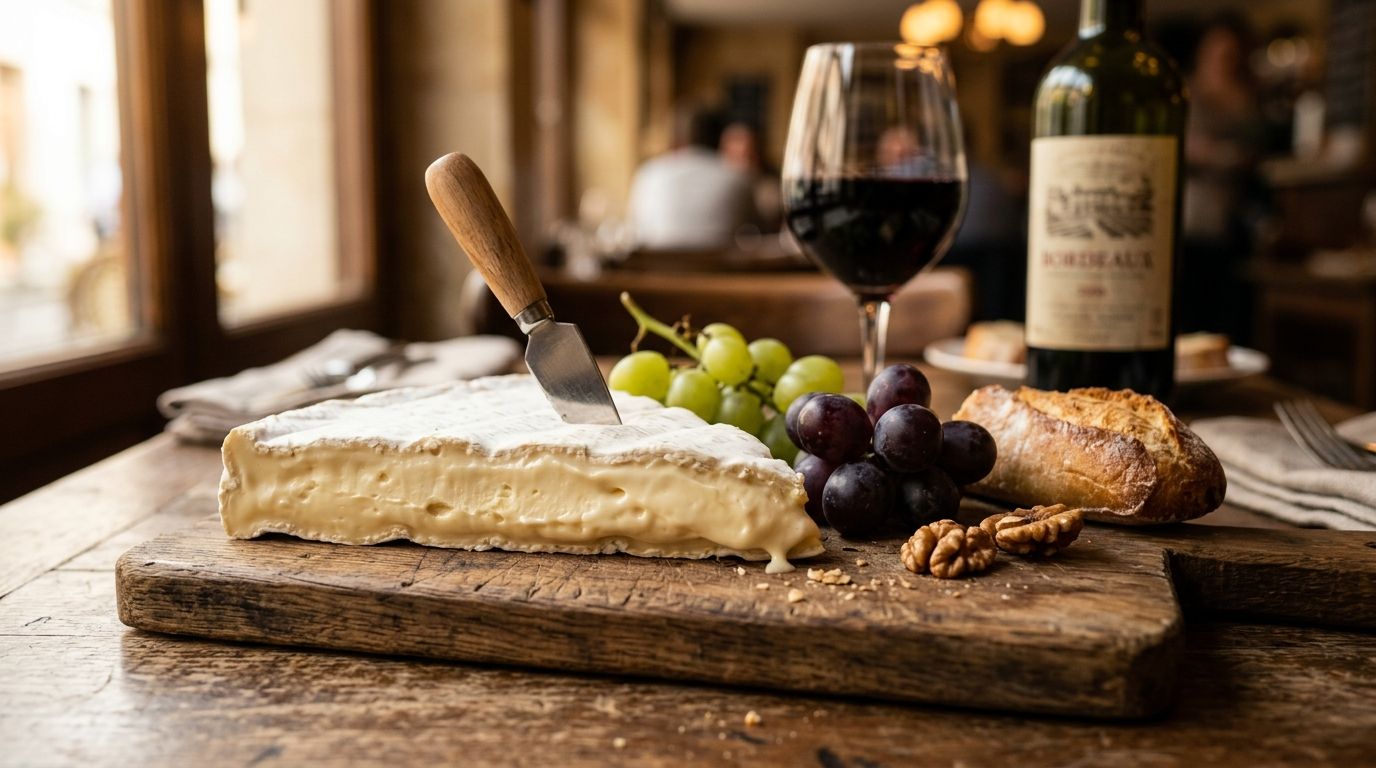
Recognizing it is easy for the trained eye: a large, flat wheel with a thin, white, velvety rind, sprinkled with reddish streaks, wrapping a straw-yellow, creamy, fragrant interior. Unlike the industrial bries that dominate supermarkets, the authentic Brie de Meaux AOP is a living, seasonal, artisanal food, whose flavor shifts with the season, the farm and the stage of ripening.
Chapter
1.1. What is Brie de Meaux and why is it called the "prince of cheeses"?
Brie de Meaux is a raw cow's-milk cheese with a soft, bloomy-rind paste, produced in a delimited geographical area stretching from the plains of Brie to the Meuse department. Its name comes from the town of Meaux, an old trading center of the region, and from the very landscape of Brie, a fertile plateau east of Paris whose name, of Gaulish origin, evokes elevations and terraces of rich soil.
The epithet "prince of cheeses" has diplomatic roots and is linked to the Congress of Vienna in 1815. Tradition has it that Charles-Maurice de Talleyrand-Périgord, the astute French diplomat, refused to accept that any other European cheese rivaled his beloved Brie. Annoyed, Prince Klemens von Metternich, who championed his "Bleu de Bavière", organized a blind tasting of 52 regional cheeses at the closing banquet, each representing one of the countries present. At the end of the contest, it was Metternich himself who proclaimed the winner, crowning the French cheese as the "Prince des fromages et premier des desserts" — the "Prince of cheeses and first among desserts".
Chapter
1.2. What is the difference between raw-milk Brie de Meaux AOP and industrial supermarket brie?
The difference between Brie de Meaux AOP and industrial bries is the same that separates a terroir wine from a grape soda. The authentic cheese is made only with raw milk — that is, milk that goes through no pasteurization process — preserving all its natural microflora of bacteria and ferments, exactly what gives the cheese its aromatic complexity and living character.
Industrial brie, on the other hand, is made with pasteurized milk, which eliminates these microorganisms and standardizes the flavor. It is mass-produced, in smaller formats and with accelerated ripening times, resulting in a smooth, predictable cheese without depth. While Brie de Meaux ripens for six to eight weeks and can weigh nearly 6.6 pounds per wheel, supermarket bries tend to be small, light and neutral — practical, but unable to tell the story of an entire region.
Chapter
1.3. What does the AOP label mean and why does it change everything for Brie de Meaux?
The AOP label stands for Appellation d'Origine Protégée (Protected Designation of Origin), a seal of the European Union that protects products whose quality and characteristics are essentially tied to a specific geographical region. In the case of Brie de Meaux, the AOC designation (the French equivalent) was obtained on 18 August 1980, and the European AOP protection came in 1996.
The seal is not decorative: it imposes a strict set of specifications, defining where the milk may be produced, how the cheese must be made, its measurements, its minimum ripening time and even the molding method. Buying a Brie de Meaux AOP is therefore a legal guarantee that you are looking at the original product, made according to centuries-old methods — and not an industrial imitation that merely borrows the famous name.
Chapter
2. The Medieval Origins of Brie de Meaux: From the Tables of French Kings to the Congress of Vienna
The history of Brie de Meaux is intertwined with the history of France itself. Long before it became a gourmet icon, the cheese already circulated at the tables of kings, was traded at the great medieval fairs and appeared in court account books. Its trajectory reveals how a simple rustic food rose to the top of European gastronomy.
Chapter
2.1. Was Brie already served in the Middle Ages? The story of the monks and the kings of France
Yes — and the records are surprisingly old. Tradition points to the Abbey of Notre-Dame de Jouarre as one of the cradles of the cheese, but the fame of Brie goes back at least to the year 999, when Robert II the Pious, according to the accounts, enjoyed brie at the castle of Melun. The monks played a central role in this story, perfecting the techniques of curdling and curing during the Middle Ages.
An extraordinary document from 1217 proves the product's prestige: the countess Blanche of Navarre bought, at the fairs of Provins, two hundred cheeses called in the records casei brienses — the "cheeses of Brie" — sending them to King Philip II Augustus. Trade was such that, at that time, seven cheeses were negotiated for about one sou, a considerable sum for the era.
Chapter
2.2. Did Charlemagne taste Brie de Meaux in 774? The legend of the emperor and the cheese
The most celebrated of the legends about Brie de Meaux involves none other than Charlemagne. According to tradition, the Frankish emperor tasted the cheese in 774, in the company of a bishop, during a stop at the priory of Reuil-en-Brie, and was so enchanted that he began demanding the annual delivery of two cartloads of the product to his court at Aachen.
The historian on duty, however, recommends caution: the anecdote does not appear in the reliable sources of the time and circulates mainly through loose hagiographic accounts, such as those of Notker the Stammerer, in the 9th century. Even so, the legend of Charlemagne has been fondly repeated for centuries and helped cement the imperial aura surrounding the cheese — an unintentional marketing that has spanned more than a thousand years.
Chapter
2.3. The Congress of Vienna of 1815: how Talleyrand crowned Brie de Meaux the "king of cheeses"
It was at the Congress of Vienna, in 1815, that Brie de Meaux won its definitive crown. In the long negotiations that redrew the map of Europe after the Napoleonic wars, Talleyrand, France's representative, used banquets as a diplomatic weapon. It is said that he provocatively claimed that no cheese in the world was worth Brie.
The climax is said to have occurred at the closing banquet, on 9 June 1815, when Metternich, the Austrian chancellor, annoyed at seeing his Bleu de Bavière snubbed, organized the now legendary tasting of 52 cheeses. The vote crowned the French cheese, and Metternich's verdict — "king of cheeses" and "prince of cheeses and first among desserts" — has echoed through the centuries, securing Brie de Meaux an eternal place in the pantheon of gastronomy.
Chapter
3. Brie de Meaux AOP: The Strict Rules That Protect the Original French Cheese
Being called Brie de Meaux is not a right, but a privilege earned through compliance with draconian rules. The AOP specifications work as a true constitution of the cheese, defining every detail of production — from pasture to plate.
Chapter
3.1. Which French municipalities can produce the real Brie de Meaux?
The denomination area of Brie de Meaux covers seven French departments: Seine-et-Marne (in full), plus Loiret, Meuse, Aube, Marne, Haute-Marne and Yonne, in specific slices of cantons and communes. It is an impressive expanse, running from the Briard plains, east of Paris, to the hills of the Meuse, already on the border with Lorraine.
There is a delicious irony in this geography: although the cheese bears the name of Meaux, it is the Meuse department, hundreds of miles away, that today accounts for more than 70% of the production of milk destined for the denomination. The town of Meaux became a symbol, while the fromageries of the east became the industrial heart of the recipe.
Chapter
3.2. Raw milk is mandatory: why does the Brie de Meaux AOP forbid pasteurized milk?
The requirement of raw milk is the cornerstone of the identity of Brie de Meaux. Raw milk — which does not undergo pasteurization — carries with it a living community of microorganisms from the pasture, the herd and the farm environment, forming what experts call the "microbial terroir". It is this diversity that produces the cheese's complex aromas of hazelnut, butter and mushroom.
Pasteurization, by heating the milk to eliminate pathogens, also destroys this beneficial flora, making the flavor standardized and simpler. That is why the AOP is uncompromising: without raw milk, there is no Brie de Meaux. The requirement, however, imposes a very strict sanitary control of production, which explains why the authentic cheese is more expensive and rarer than its imitations.
Chapter
3.3. "Moulage à la louche": the hand molding that defines the texture of Brie de Meaux
Few steps are as decisive as the moulage à la louche, the ladle molding. Once curdled, the curd of Brie de Meaux is cut into small cubes with a tranche-caillé and then deposited by hand into the mold, in thin, successive layers, with the help of a large skimmer called the "pelle à brie" — the brie paddle.
This ancestral gesture, repeated for hours, is what gives the cheese its delicately aerated texture and its even melting in the mouth. It is slow, physical work, impossible to fully mechanize without changing the result. The AOP rules keep hand molding as a seal of authenticity and of respect for the cheesemaker's craft.
Chapter
3.4. The exact measurements of Brie de Meaux AOP: diameter, weight and ripening time
A true Brie de Meaux is unmistakable at first sight, and its dimensions are determined by the specifications. No individual supermarket mini-wheels here: we are talking about a large and noble wheel of cheese, made to be shared.
3.4.1 The diameter of 14 to 14.5 inches and the thickness of about 1.2 inches
The standard wheel of Brie de Meaux measures between 14 and 14.5 inches in diameter, with a relatively thin height of about 1.2 inches. It is precisely this wide, flat geometry that allows the paste to ripen evenly: the thin rind breathes across the whole surface, while the central interior ripens at its own pace, creating the characteristic creamy texture that can even flow gently at the ideal point.
3.4.2 The weight of 5.5 to 6.6 pounds and the flattened "wheel" shape
A full wheel of Brie de Meaux weighs, on average, 6.2 pounds, and can range between 5.5 and 6.6 pounds. Producing a single wheel requires about 6.6 US gallons of raw milk. Sold whole or in generous triangular slices — the traditional "pointes" — the cheese is made for the great French tables, where sharing is an essential part of the gastronomic ritual.
3.4.3 The minimum ripening of 4 weeks and the total affinage period
Time is the last — and perhaps the most important — ingredient of Brie de Meaux. After salting, the cheese begins its ripening in controlled chambers: first at 54 °F, where the white rind starts to bloom, and then at 45 °F. The denomination requires a minimum of about four weeks of aging, but full maturity is only reached between six and eight weeks. It is in this interval that the interior goes from firm and slightly chalky to creamy and velvety, at the peak of its expression.
Chapter
4. How Brie de Meaux Is Made: The Science and Art Behind the Perfect Cheese
Behind the simple appearance of Brie de Meaux lies a meticulous process that combines microbiology, physics and a savoir-faire passed down from generation to generation. Each step, from the raw milk to the curing chamber, is a small work of precision.
Chapter
4.1. From raw milk to rennet: the step-by-step production of Brie de Meaux
Everything begins with the raw milk, which ferments in a vat for about 16 hours. It then receives the rennet and the lactic ferment, starting the coagulation, which lasts approximately one hour. The formed curd is then cut into small cubes with the tranche-caillé, to release the whey.
Next comes the artisanal stage: the ladle molding, with the pelle à brie. The molding room is heated to 91 °F for four hours to drain the whey, then to 75 °F for six hours and finally to 66 °F. Draining is done on reed mats — the nattes de roseaux. The next day, the cheeses are unmolded and dry-salted, remaining two days in the salting room before beginning the long ripening.
Chapter
4.2. What is Penicillium candidum and how does it create the velvety white rind of Brie de Meaux?
The magic of the white rind of Brie de Meaux has a scientific name: it is a fungus of the Penicillium genus, seeded on the cheese's surface during production. In the ripening chamber, at around 54 °F, these microorganisms colonize the rind and form the characteristic "fleur" — the white velvet that gives the cheese its name of "à croûte fleurie" paste, or bloomy rind.
The fungus is not merely aesthetic. As it grows, it produces enzymes that slowly digest the fat and protein of the cheese from the rind toward the center, transforming the firm paste into a creamy, unctuous interior. It is this invisible biological activity that explains why Brie de Meaux ripens "from the outside in" and why its texture and aroma evolve so much over the weeks.
Chapter
4.3. The ripening (affinage) of Brie de Meaux: how the creamy, buttery interior is born
Ripening, or affinage, is the phase in which Brie de Meaux truly becomes itself. After the first week at 54 °F, the cheeses are transferred to a chamber at 45 °F, where they remain for at least three additional weeks. Throughout the period, they are regularly turned by hand, ensuring even curing.
It is in this stage that the interior, initially compact and chalky, progressively liquefies, gaining that melted-butter texture that defines the style. The aroma also deepens: notes of hazelnut, fresh mushroom and a light touch of fermentation emerge. A good Brie de Meaux is one that reaches the perfect balance between rind, creamy interior and a slightly firmer heart.
Chapter
4.4. Why is Brie de Meaux not turned in its mold, unlike Brie de Melun?
Here lies one of the technical subtleties that distinguish the two great denomination bries. Brie de Meaux is molded in a single form, without being turned during molding: the curd is cut and deposited in successive layers, and the cheese keeps the same position until unmolding. This contributes to its fine, delicate, uniform texture.
Brie de Melun, its smaller, more rustic sibling, follows another path: its curd is not cut and the cheese is turned during the process, resulting in a firmer paste and a more intense, saltier flavor. This difference in technique explains why, although related, Brie de Meaux and Brie de Melun offer such distinct gastronomic experiences.
Chapter
5. Characteristics of Brie de Meaux: Rind, Interior, Aroma and Flavor Explained
Learning to "read" a Brie de Meaux is part of the pleasure of tasting. Rind, interior, aroma and flavor form a harmonious whole that evolves with each day of ripening, and knowing how to identify them turns the tourist into a true connoisseur.
Chapter
5.1. How do you recognize a perfect Brie de Meaux by its white rind and reddish streaks?
The rind of an authentic Brie de Meaux is thin, a velvety white with a slightly downy touch, the result of the Penicillium that blooms in the curing chamber. The detail that betrays authenticity is the reddish streaks that run across it, a mark left by the contact of the cheese with the reed mats and by natural ripening — a sign of a traditionally cured product.
A good specimen should yield slightly to the pressure of the fingers, indicating a creamy interior, without being too soft or crumbling. The rind should show no deep cracks or strong ammonia smell, which would betray over-ripening. When all these signs align, you are looking at a cheese at its peak.
Chapter
5.2. What does Brie de Meaux taste like? Notes of butter, hazelnut, mushroom and truffle
The flavor of Brie de Meaux is, at once, delicate and deep. On first contact, notes of fresh butter and milk dominate; then nuances of hazelnut and mushroom are revealed, and, in the most ripened specimens, a subtle echo of truffle. The rind adds a light earthy bitterness that balances the unctuousness of the interior.
Intensity grows with time: a young cheese is milder and milkier, while a well-aged one gains body and a long, almost piquant finish. This progression is precisely what makes each Brie de Meaux a unique experience — the same cheese can seem like two different products depending on the week in which it is opened.
Chapter
5.3. Should you eat the rind of Brie de Meaux? The etiquette of French cheese
The rind of Brie de Meaux is edible and, for most French people, an essential part of the experience. It carries the character of the fungus and the terroir, adding complexity and a textural counterpoint to the creamy interior. Refusing the rind at a French table can be seen, in more traditional circles, as a small waste of flavor.
There are, however, common-sense exceptions: if the rind has a strong ammonia smell or an excessively bitter taste, a sign of advanced ripening, it is perfectly acceptable to discard it. The golden rule is simple — taste first, decide later. Respecting your own palate is also a form of etiquette.
Chapter
5.4. What is the fat content and nutritional value of Brie de Meaux?
Brie de Meaux is a whole-milk cheese, with a fat content of at least 45% in dry matter, which represents about 22% to 23% fat in the final product. It is, therefore, an energy-dense and rich food, as befits a dessert cheese born on the tables of the nobility.
Beyond the fat, it is a source of protein, calcium and phosphorus, valuable nutrients in a balanced diet. Like all ripened raw-milk cheeses, it should be consumed in moderation and with special care by pregnant women and the immunocompromised, who should opt for pasteurized versions. For the curious tourist, however, the rule is clear: Brie de Meaux was made to be savored without guilt, in all its fullness.
Chapter
6. How to Serve Brie de Meaux: Perfect Temperature, Cutting and Pairing
Reaching the moment of serving a Brie de Meaux is the reward of the whole journey. But there is an art to this final hour, and mastering it makes all the difference between a good cheese and an unforgettable experience.
Chapter
6.1. At what temperature should Brie de Meaux be served to reveal all its flavor?
Temperature is the worst-kept secret of Brie de Meaux. Taken out of the fridge, it is "anesthetized": the solidified fat traps the aromas, and the flavor seems muted. That is why the cheese should be removed from refrigeration one to two hours before serving, reaching room temperature — ideally between 64 °F and 68 °F.
At that point, the fat melts gently, the aromas are released and the interior reaches its maximum creaminess. The same applies to tasting while traveling: buying a Brie de Meaux in the morning and letting it breathe outside the cold before the afternoon picnic is the recipe for perfect pleasure.
Chapter
6.2. How do you cut Brie de Meaux correctly without annoying a French person?
Cutting cheese in France is serious business, and Brie de Meaux has its own etiquette. The wheel is normally served in triangular slices, the "pointes", and the rule of courtesy is to slice in a way that preserves the point — the "nose" of the triangle — for the next guest. Taking the point for yourself is one of the few gestures capable of drawing a look of disapproval at a well-set table.
The ideal is to cut longitudinal slices, from the widest rind toward the point, keeping each piece with its portion of rind and interior. An old Briard legend holds that not cutting the point brings bad luck — one more reason, beyond good manners, to respect the ritual.
Chapter
6.3. Which wines pair best with Brie de Meaux?
Brie de Meaux is a generous partner at the table and accepts a surprisingly wide variety of wines. The elegant reds of Burgundy, such as a Pinot Noir, and the labels of the Rhône create a classic match, with acidity balancing the cheese's unctuousness. From Bordeaux, a more structured Saint-Émilion or Pomerol also works well.
Among whites, a Champagne or a full-bodied Chardonnay shine alongside the creaminess. A regional, unpretentious suggestion is the cidre — the cider — preferably produced in the Brie region itself, which locals swear is the most authentic combination of all. The choice, in the end, depends on the ripening point: the more aged and intense the cheese, the more robust the wine can be.
Chapter
6.4. Ideal breads, fruits and accompaniments for a Brie de Meaux board
A board worthy of Brie de Meaux starts with a good rustic bread: the traditional baguette, with its crisp crust and soft crumb, is the obvious companion, but a walnut or rye bread adds layers of flavor. The cheese's unctuousness calls for a counterpoint of freshness and acidity — grapes, apples and pears fulfill that role perfectly.
Walnuts and almonds echo the hazelnut notes of the cheese itself, creating an almost redundant, yet delicious harmony. To finish, a drizzle of honey or a red-berry jam brings the sweet balance that enhances the interior's complexity. Brie de Meaux also stars in classic recipes of the region, such as the galettes briardes and the bouchées à la reine.
Chapter
7. Brie de Meaux in the History of France: Kings, Legends and the Fall of a Monarchy
Few foods have crossed as many dramatic chapters of French history as Brie de Meaux. From royal tables to the legends of the Revolution, the cheese was present in some of the country's most decisive moments.
Chapter
7.1. Louis XVI and Brie de Meaux: the legend of the cheese in the Flight to Varennes
The Flight to Varennes, in June 1791, is one of the most dramatic episodes of the French Revolution: Louis XVI and the royal family, in disguise, tried to escape from Paris toward the border, but were recognized and arrested in the small town of Varennes. It was the postal agent Jean-Baptiste Drouet who identified the king, a recognition that would seal the monarchy's fate.
Popular legend, fondly repeated in regional accounts, adds a gastronomic detail to the episode: that the king's stop for a meal — in some versions, involving the beloved Brie — contributed to the fatal loss of time that allowed the capture. Historians treat the version with skepticism, but the story persists as proof of the place the cheese held, even in the most extreme moments, in the French identity.
Chapter
7.2. Cheese at the table of the French royalty: from Henry IV to the 18th century
Long before Louis XVI, Brie was already a guaranteed presence at court. Medieval records mention Robert II the Pious enjoying brie in 999, and the purchase of two hundred casei brienses by Blanche of Navarre, in 1217, for Philip II Augustus, proves the product's prestige among the nobility.
In the 18th century, the cheese had become a national institution, celebrated by writers and gastronomes. In 1793, in the midst of the Revolution, the magistrate François Joachim Esnue-Lavallée summed up its egalitarian spirit with a famous phrase: Brie, loved by rich and poor, preached equality before anyone could imagine it possible. Proof that, between nobles and revolutionaries, the cheese always knew how to move with elegance.
Chapter
8. Brie de Meaux vs. Other French Cheeses: The Differences Few Tourists Know
In a country with hundreds of cheeses, Brie de Meaux occupies a throne — but it does not reign alone. Understanding its differences from close cousins and historical rivals is essential to navigate the rich landscape of French cheeses.
Chapter
8.1. What is the difference between Brie de Meaux and Brie de Melun?
Brie de Meaux and Brie de Melun are siblings with opposite personalities, and both hold the AOP designation. The former is large, delicate and unctuous, with wheels up to 14.5 inches and a velvety white rind. The latter, Brie de Melun, is visibly smaller, more rustic and with a more intense, saltier flavor, reflecting a process in which the curd is not cut and the cheese is turned during production.
While Brie de Meaux seduces with its buttery smoothness, Brie de Melun conquers with its earthy, almost wild character. Both were born in the same region and share the glory of the AOP, but they offer experiences so distinct that many connoisseurs consider them cheeses from different universes.
Chapter
8.2. Brie de Meaux vs. Camembert: the rivalry of France's bloomy-rind cheeses
The rivalry between Brie and Camembert is a classic of French gastronomy — and each region defends its champion with fervor. Brie de Meaux is older, larger and historically tied to royalty; Camembert de Normandie, born in Normandy and popularized in the 19th century, is smaller, with its individual little wheels, and carries a more penetrating, earthy aroma.
In tasting, Brie de Meaux tends to be creamier, smoother and more velvety, while Camembert presents stronger notes of mushroom, cabbage and hay. Both are raw-milk, bloomy-rind icons, but each tells a distinct regional story — and the choice between them, the French say, is more a matter of temperament than of quality.
Chapter
8.3. Industrial "Brie de Meaux": how industry imitates the original and changes the flavor?
Outside France, the word "brie" has become a generic synonym for creamy white-rind cheese, and industry has known how to exploit this. Most of the so-called "bries" sold around the world are made with pasteurized milk, in reduced formats and with accelerated ripening, ignoring the rules of the AOP. The result is a smooth, uniform, safe cheese, but without soul.
The difference in flavor is striking: the industrial version loses the hazelnut, butter and truffle notes of the original, gaining in return a neutrality that pleases the mass market. For the tourist visiting France, it is worth the experience of comparing the two side by side — it is the most instructive way to understand why a Brie de Meaux AOP justifies its fame and its price.
Chapter
9. The Production of Brie de Meaux Today: Who Makes the Real AOP Cheese?
Behind the glamour of Brie de Meaux lies a real production chain, made up of farms, cheesemakers and dairies that keep a centuries-old tradition alive. Knowing who makes the cheese is understanding why it is so special — and so rare.
Chapter
9.1. How many producers still make Brie de Meaux AOP in France?
The production of Brie de Meaux AOP is surprisingly concentrated. In the most recent data, it involves a small number of players: about 7 cheesemaker-affineurs, 3 independent affineurs and 8 industrial dairies, supplied by approximately 443 milk producers. It is a small universe, especially compared to the cheese's worldwide fame.
This concentration is, at once, a fragility and a guarantee of quality: few producers mean rigorous control over the specifications, but also a limited supply. Each wheel of Brie de Meaux on the market is, therefore, the result of a small and dedicated network of professionals.
Chapter
9.2. The traditional fromageries of Brie de Meaux and the role of raw-milk farms
The heart of current production beats in the Meuse department, where fromageries such as those of Cousances-lès-Triconville, Raival and Biencourt-sur-Orge account for about 70% of French production of Brie de Meaux. They work with raw milk collected from farms that respect rigorous feeding and herd-management practices.
This bond between farm and cheesemaking is essential: since the milk is not pasteurized, the quality of the pasture, the health of the cows and the hygiene of milking directly determine the character of the cheese. It is a delicate alliance between rural producers and master affineurs, in which every link of the chain must be impeccable so that the flavor of Brie de Meaux remains faithful to its history.
Chapter
9.3. Why is Brie de Meaux AOP rare and expensive outside France?
The annual production of Brie de Meaux fluctuates around 6,600 to 7,700 short tons — a modest volume compared to the industrial giants of the dairy sector. Added to this is the fact that the cheese is made with raw milk, which imposes sanitary restrictions on export to various countries, especially those with strict legislation on unpasteurized dairy products.
The result is a cheese that rarely crosses borders on a large scale, remaining an essentially French treasure. When it appears in foreign markets, it arrives expensive and in limited quantities. For the tourist, this only reinforces the value of the experience: tasting an authentic Brie de Meaux on French soil is a privilege that few travelers enjoy.
Chapter
10. Where to Taste Brie de Meaux in France: A Practical Guide for the Tourist
No gastronomic trip to France is complete without a pilgrimage to the territory of Brie de Meaux. From the historic town of Meaux to the Parisian markets, there is an entire itinerary to be savored.
Chapter
10.1. The town of Meaux and the Maison du Brie de Meaux (the cheese museum)
The town of Meaux, east of Paris, is the natural starting point of this journey. On the banks of the Marne river and dominated by its imposing Gothic cathedral, the town lends its name to the noblest cheese of the region. It is there that one can immerse oneself in the product's history and understand its intimate bond with the territory of Brie.
For the tourist, the visit is completed at the Maison du Brie de Meaux, a space dedicated to the culture of the cheese, where it is possible to learn about the production, the designation of origin and, of course, to taste specimens at different stages of ripening. The town also hosts events linked to the local brotherhood, celebrating the cheese as living heritage.
Chapter
10.2. The best markets and cheese shops to buy Brie de Meaux in Paris
In Paris, Brie de Meaux is within reach of those who know where to look. The great fromageries of the capital — especially the traditional houses that display AOP labels and work with renowned affineurs — are the safest address to guarantee an authentic specimen at the ideal point of ripening.
The covered markets and the shopping streets of the central districts, such as the Marais and Saint-Germain, concentrate prestigious cheese shops where it is possible to ask for guidance and even taste before buying. A good shopkeeper will know how to indicate the cheese at the desired ripeness and suggest the perfect pairing for the occasion.
Chapter
10.3. How do you transport Brie de Meaux on a trip without ruining the cheese?
Transporting a Brie de Meaux requires some care, but it is perfectly possible. The cheese should be kept cool, wrapped in proper cheese paper or parchment paper, and carried in a cooler bag, especially in the hot months. The ideal is to buy it at the end of the trip, close to the return, to minimize the time outside refrigeration.
In carry-on or checked luggage, respect the airline's rules for food: raw-milk cheese may face customs restrictions in some destinations, so check the legislation of the arrival country. For those traveling by train within Europe, transport is simple and hassle-free — and the unmistakable aroma of Brie de Meaux may even spark good conversations in the carriage.
Chapter
10.4. How do you identify an authentic Brie de Meaux AOP in the shop?
At the time of purchase, a few signs guarantee authenticity. Look for the name "Brie de Meaux" printed on the rind or the packaging, accompanied by the AOP label — the legal guarantee of designation of origin. The cheese should display the white rind with the characteristic reddish streaks and yield slightly to the touch, indicating adequate ripening.
Beware of products generically labeled only as "brie": without the AOP label and the full name, it is an industrial version. As for price, authentic Brie de Meaux is naturally more expensive, a reflection of the raw milk, the manual work and the long curing time. In the end, the label is the most reliable compass for taking home a true piece of France.
Chapter
11. Curiosities, Myths and Legends About Brie de Meaux
Brie de Meaux is not just flavor — it is also history, folklore and ritual. The legends that surround it reveal the imagination of an entire nation around a simple cheese.
Chapter
11.1. Why "prince of cheeses" and not "king of cheeses"?
The doubt about the title of Brie de Meaux has roots in diplomacy itself. In the most widespread version, Talleyrand is said to have crowned the cheese as the "roi des fromages" — the "king of cheeses" — during the Congress of Vienna, in 1815. In another tradition, recorded in rich detail, it was Metternich who proclaimed the verdict, using the formula "Prince des fromages et premier des desserts".
The two crowns coexist in the French imagination, and both refer to the same episode: the legendary tasting of the 52 cheeses at the congress's final banquet. King or prince, what is certain is that Brie de Meaux left Vienna with a title of nobility that no competitor has ever taken from it.
Chapter
11.2. The "brie noir" and other ancient variations of Brie de Meaux
Few know it, but the family of bries is vast and included, over the centuries, varieties that have now almost disappeared. The "brie noir" — the black brie — was a very long-ripened version, cured for up to several months, that developed a dark, hardened rind and an intense, penetrating flavor, quite different from the delicate profile of today's Brie de Meaux.
Alongside it coexisted the Brie de Montereau, the Brie de Nangis, the Brie de Provins and the Coulommiers, among others. Today, only the bries of Meaux and Melun retain the AOP protection, but this historical diversity proves the richness of a region that, for centuries, lived around the art of cheese.
Chapter
11.3. The Brotherhood of the Knights of Brie de Meaux and the cheese festivals
The devotion to Brie de Meaux was institutionalized in the gastronomic brotherhoods — fraternities that bring together producers, affineurs and connoisseurs to defend the cheese's tradition. Among them stands out the Brotherhood of the Knights of Brie de Meaux (in French, Confrérie des Chevaliers du Brie de Meaux), guardian of the product's heritage and authenticity.
These brotherhoods promote festivals, investitures and tasting events throughout the year, especially in the regions of Meaux and the Meuse, keeping the cheese's memory and pride alive. Taking part in one of these celebrations is, for the tourist, the chance to experience the culture of Brie de Meaux not only on the plate, but as a living, festive tradition.
Chapter
12. FAQ
12.0.1 Is Brie de Meaux made with pasteurized milk?
No. The authentic Brie de Meaux AOP is made exclusively with raw cow's milk, without any pasteurization, which preserves its natural flora and its characteristic flavor.
12.0.2 What is the shelf life of a Brie de Meaux?
Brie de Meaux is a living cheese and should be consumed relatively quickly after purchase. Kept refrigerated, the ideal is to consume it within one to two weeks, always respecting the date indicated by the seller.
12.0.3 Can Brie de Meaux be frozen?
It is not recommended. Freezing alters the texture of Brie de Meaux, breaking the creamy structure of the interior and compromising the experience. The best is to buy it in the right amount and consume it fresh.
12.0.4 Is melted Brie de Meaux safe for pregnant women?
Since it is made with raw milk, Brie de Meaux is not recommended for pregnant women, even melted, due to the risk of bacteria such as Listeria. Pregnant women should opt for pasteurized cheeses.
12.0.5 What is the difference between AOC and AOP?
AOC (Appellation d'Origine Contrôlée) is the French national designation, obtained by Brie de Meaux in 1980. AOP (Appellation d'Origine Protégée) is the corresponding European label, granted in 1996, which protects the product throughout the European Union.
12.0.6 Is Brie de Meaux the same all year round?
No. Because it is a raw-milk cheese, Brie de Meaux varies with the seasons and the cattle's diet. Its best consumption period runs from July to March, when the milk is richer and more aromatic.
12.0.7 How many liters of milk are needed for a wheel of Brie de Meaux?
About 6.6 US gallons of raw milk are needed to produce a single wheel of Brie de Meaux, which weighs on average 6.2 pounds.
12.0.8 Does Brie de Meaux contain lactose?
Yes, like all milk cheeses, Brie de Meaux contains lactose, although in a smaller amount than fresh milk. People with intolerance should observe their individual tolerance, since ripened cheeses tend to be better accepted.
12.0.9 Why does Brie de Meaux have reddish spots on the rind?
The reddish streaks are the result of the cheese's contact with the reed mats during ripening and of the natural development of molds on the rind. They are a sign of authenticity and traditional curing.
12.0.10 How do you know if a Brie de Meaux is at the right point?
A Brie de Meaux at its peak yields slightly to the pressure of the fingers, with a creamy interior and a gentle aroma. If it is too hard, it is still young; if it exudes a strong ammonia smell and is running, it has gone past its prime.
12.0.11 Is Brie de Meaux eaten hot or cold?
The ideal is to consume it at room temperature, taking it out of the fridge one to two hours beforehand. It can also be baked, but tradition consecrates tasting at room temperature.
12.0.12 Is there a difference between Brie de Meaux sold whole and sold in slices?
The product is the same, but whole Brie de Meaux preserves moisture and ripens more evenly. Already-cut slices should be consumed more quickly, as they dry out and oxidize more easily.
12.0.13 Can Brie de Meaux be taken in airplane luggage?
It depends on the legislation of the destination country. Because it is made with raw milk, Brie de Meaux may face customs restrictions. Within the European Union, transport is permitted, but it is prudent to check the airline's rules.