Chapter
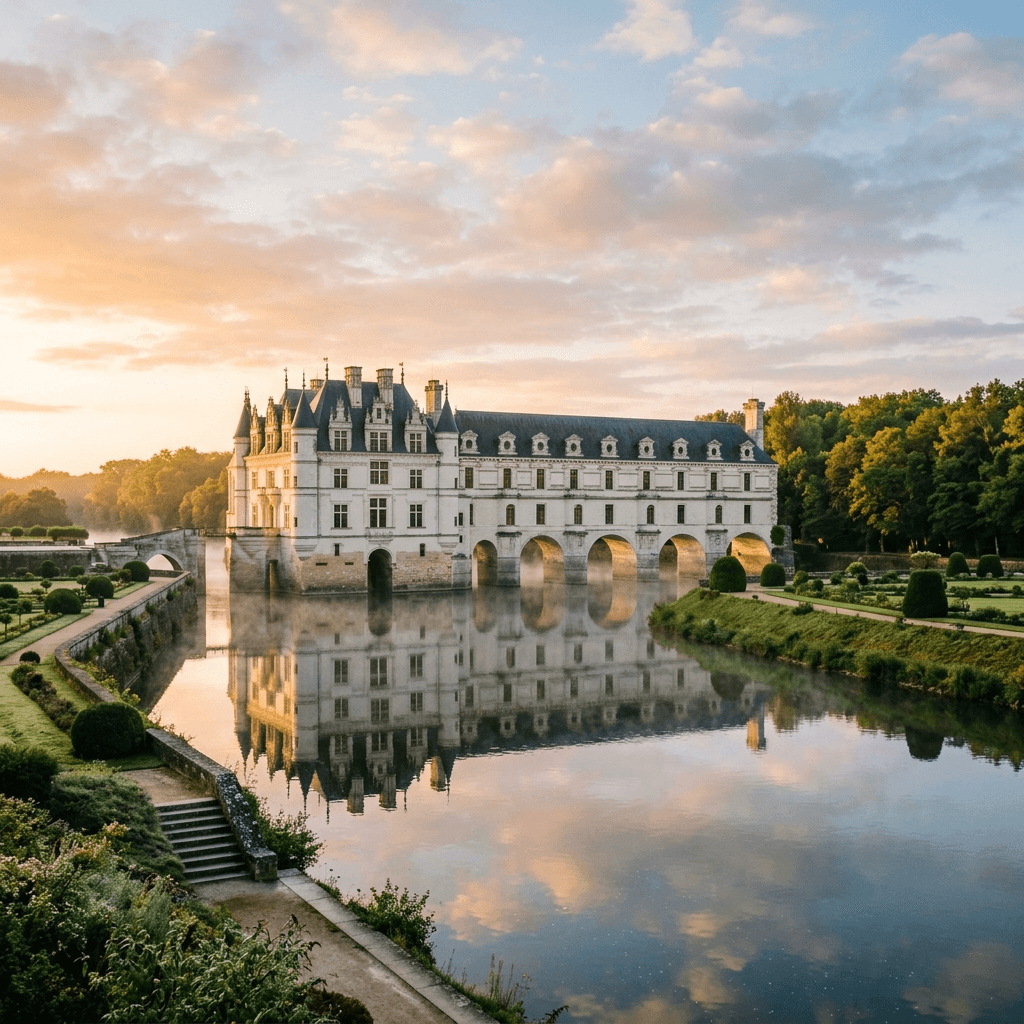
1. Château de Chenonceau — Why is this bridge-castle considered France's most romantic Renaissance jewel?
Chapter
1.1 What makes the Château de Chenonceau unique among the Loire castles?
The Château de Chenonceau is not just another castle among the dozens that dot the Loire Valley. Architecturally and symbolically, it is a singular piece in the history of European architecture. While its neighbours — Chambord, Cheverny, Azay-le-Rideau — stand imposingly on solid ground, Chenonceau defies gravity by stretching directly over the bed of the river Cher, as if floating on the water. This feature, which earned it the epithet "bridge-castle," was no mere aesthetic whim: it was a daring engineering solution that required foundations driven into the riverbed and a structure capable of withstanding centuries of floods and currents.
Chenonceau's uniqueness lies in its dual identity. In the morning, when mist rises from the waters of the Cher and the rising sun gilds the limestone of its façades, it is the most romantic of castles — the fairy-tale image every traveler seeks. But as you cross its vestibule and step onto the 60-meter-long, 6-meter-wide gallery that spans the river, you realize this is also an engineering feat ahead of its time. No other Loire castle offers this experience: being inside a palace and, at the same time, on a bridge, with water flowing beneath your feet.
The blend of late Gothic architecture with early Renaissance elements gives it a fascinating hybrid visual personality. The central corps de logis, square and massive, evokes medieval fortresses, but the wide windows, the symmetry of the façade, and the lightness of the southern gallery already herald the new spirit of the French Renaissance. It is this synthesis — the bridge that is a palace, the Gothic embracing the Renaissance, the stone mastering the river — that makes Chenonceau an architectural experience without parallel in the Loire.
Chapter
1.2 How did women shape the history of Chenonceau?
If Chenonceau is unique in its architecture, its history is equally singular: it was conceived, governed, expanded and saved by women. Over more than five centuries, seven extraordinary women left their mark on the castle, earning it the nickname "Castle of the Seven Ladies" (Château des Sept Dames).
The first was Katherine Briçonnet, wife of Thomas Bohier, who personally oversaw the initial construction between 1515 and 1521 while her husband was away on military campaigns in Italy. She made the daily architectural decisions and ordered the initials "T.B.K." (Thomas Bohier and Katherine) to be carved into the famous oak ceiling of the library, dated 1525 — one of the earliest Italian-style ceilings carved in France. The family motto, embroidered on the entrance door, reveals the project's ambition: *"S'il vient à point, me souviendra"* (If I finish it in time, I will be remembered).
Then came the two figures who would turn Chenonceau into a stage of rivalry, power and passion: Diane de Poitiers and Catherine de Médici. The first, official mistress of King Henry II, received the castle as a royal gift in 1547 and commissioned the architect Philibert de l'Orme to build the bridge over the Cher between 1556 and 1559. The second, the widowed queen, reclaimed the castle upon the king's death and built the great gallery atop the existing bridge between 1570 and 1576, under the design of Jean Bullant.
The remaining "ladies" — Louise de Lorraine (the mourning queen), Gabrielle d'Estrées (mistress of Henry IV), Louise Dupin (the savior of the Revolution) and Marguerite Pelouze (the 19th-century restorer) — complete this feminine lineage that made Chenonceau not a castle of warriors, but a castle of queens, lovers, writers and patronesses.
1.2.1 Catherine de Médici vs. Diane de Poitiers — the rivalry that built the castle
The rivalry between Diane de Poitiers and Catherine de Médici is one of the most fascinating in French history, and Chenonceau was its architectural battlefield. Diane, 39 years older than King Henry II, had been his official mistress since 1538 and wielded immense power at court. When Henry gifted her Chenonceau in 1547, Diane immediately set about transforming it: she commissioned the bridge over the Cher (the structure that would make the castle famous) and created her gardens in four triangles with stone terraces to protect them from river floods — the Diane de Poitiers Gardens, which today cover 12,000 m².
Catherine, the legitimate queen, was forced to watch in silence as her husband's mistress beautified the castle. It is said that on the ceilings of the Guard Room, the interlaced initials "H" and "C" (Henry and Catherine) were cunningly designed so they could also be read as "H" and "D" (Henry and Diane) — a double tribute that allowed the king to honor both women in the same space.
When Henry II died tragically in a tournament in 1559, Catherine wasted no time. As regent of the kingdom, she forced Diane to exchange Chenonceau for the Château de Chaumont, a smaller and less pleasant castle. Without royal protection, Diane had no choice. Catherine took possession of the castle and launched an expansion campaign that rivaled her predecessor's: she built the Great Gallery of 60 meters atop Diane's bridge, added service wings, and planned a massive expansion that would turn Chenonceau into a colossal palace — a project immortalized in the engravings of Jacques Androuet du Cerceau in 1579, but never executed.
The final irony: Diane's gardens are more than twice the size of Catherine's (12,000 m² vs. 5,500 m²), as if, even after being defeated, the mistress continued to outshine the queen in splendor and scale.
Chapter
1.3 How long did it take to build the Château de Chenonceau?
The construction of the Château de Chenonceau was not a single event, but rather a process that stretched over more than six decades in several distinct phases. The first stone of the current castle was laid in 1514, when Thomas Bohier, a wealthy financier from Normandy, purchased the old medieval castle and the 15th-century fortified mill that occupied the site. The actual construction took place between 1515 and 1521 — about six years — under the careful supervision of Katherine Briçonnet.
However, the structure we see today is the result of two later major building campaigns. The bridge over the Cher was commissioned by Diane de Poitiers from Philibert de l'Orme, who executed it between 1556 and 1559 — three years of intense work. Finally, Catherine de Médici added the two-story gallery atop the bridge, designed by Jean Bullant, between 1570 and 1576 — another six years. Adding the three main phases together, Chenonceau took about 62 years to reach the form we know today, counting from Bohier's purchase of the land in 1514 to the completion of the gallery in 1576.
Chapter
1.4 Why is Chenonceau called the "castle of the ladies"?
The nickname "Castle of the Ladies" (Château des Dames) is not poetic license: it is the recognition of a rare historical fact. For nearly 500 years, Chenonceau was owned, managed and transformed predominantly by women, at a time when political and economic power was almost exclusively male.
The "seven ladies" that justify the title are, in chronological order: Katherine Briçonnet (the builder), Diane de Poitiers (the mistress who commissioned the bridge), Catherine de Médici (the queen who raised the gallery and governed France from the castle), Louise de Lorraine (the grieving widow), Gabrielle d'Estrées (mistress of Henry IV), Louise Dupin (the Enlightenment hostess who saved the castle from the guillotine) and Marguerite Pelouze (the 19th-century restorer).
But the title goes beyond mere ownership. Each of these women did not just inhabit the castle: they physically shaped it, expanded it, decorated it or saved it from destruction. Chenonceau is therefore a stone testament to feminine genius across the centuries — a living museum of women's influence in French history.
Chapter
1.5 What is the engineering secret behind the bridge-gallery over the Cher?
The secret to the longevity of the bridge-gallery at the Château de Chenonceau lies in a combination of Renaissance genius and medieval solidity. The bridge rests on stone pillars driven directly into the bed of the river Cher, atop foundations that reuse the oak stakes of the old 15th-century fortified mill. These pillars distribute the weight of the 60-meter gallery evenly, allowing the structure to "float" over the water without the need for intermediate supporting arches.
The gallery itself, built by Jean Bullant between 1570 and 1576, is a marvel of apparent lightness. At 6 meters wide and two stories high (ground floor and first floor), its weight is supported exclusively by the pillars of Philibert de l'Orme's bridge. The black-and-white floor tiles, the wide windows opening onto the river on both sides, and the painted beam ceiling create the illusion that the gallery is ethereal — but the truth is that thousands of tons of stone and wood balance atop the pillars with a mathematical precision that Renaissance engineers mastered like no one else.
Chapter
2. The hidden engineering of Chenonceau — How has the bridge-gallery stood for centuries?
Chapter
2.1 What foundation supports the gallery over the river?
The foundations of the Château de Chenonceau are, literally, invisible to the visitor's eye — and that is their greatest feat. When Thomas Bohier purchased the land in 1513, a 15th-century fortified mill already stood there, with its stakes driven into the bed of the river Cher. Rather than removing these foundations, Bohier and Katherine Briçonnet made the smart decision to build atop them, taking advantage of the existing infrastructure.
The original stakes, made of oak — a wood that, when submerged, becomes harder over time — were driven into the riverbed and kept permanently underwater. Oak, when deprived of oxygen, does not rot: it mineralizes and acquires the consistency of stone. It was upon this ancient base that Renaissance architects erected the stone pillars that support the gallery.
2.1.1 The oak stakes driven into the bed of the Cher
The oak stakes that still support the Château de Chenonceau today are a remarkable example of medieval engineering adapted to the Renaissance. Driven into the bed of the Cher, they have remained submerged for over 500 years with no signs of decay. Submerged oak creates a chemical reaction with water minerals that slowly fossilizes it, making it more resistant than modern concrete.
This technique, known as "pile foundations," was common in the Middle Ages for bridges and mills, but applying it to a Renaissance palace was a bold innovation. The weight of the castle is distributed across dozens of these stakes, which transfer the load to the river's rocky bed, several meters deep. That is why, despite periodic floods and natural wear, Chenonceau remains firm — literally rooted in the river.
Chapter
2.2 How did Renaissance architects calculate the weight of the structure?
The Renaissance architects of the 16th century did not have the structural calculation programs that modern engineers use. Instead, they relied on empirical rules, geometric proportions and centuries of accumulated experience in bridge and cathedral building. Philibert de l'Orme, the architect of the bridge, was a complete humanist: he had studied Vitruvius and Roman architectural treatises, and applied principles of the golden ratio and mass balance to ensure that the bridge pillars would support the weight of the gallery that would later be built on top.
The secret lay in weight distribution. L'Orme's bridge was designed with pillars wide and deep enough to support not only their own weight, but also the additional weight of a two-story structure that Catherine de Médici would add years later. L'Orme could not have known the gallery would be built, but his design was so generous in safety margins that Bullant's structure settled perfectly onto the existing pillars.
Chapter
2.3 What hydraulic innovations were used at the castle?
The Château de Chenonceau was a laboratory of hydraulic innovations from the very beginning. The most notable is the system of kitchens installed within the very pillars of the bridge, over the river. This arrangement, revolutionary for its time, allowed goods to be unloaded directly from boats into the pantries, without the need for land transport. Food arrived at the castle by river, entered through the kitchens at water level, and rose to the halls via a network of internal staircases.
This riverine logistics system was complemented by an ingenious water supply mechanism: the castle drew water directly from the Cher for the kitchens and sanitary facilities, a rare luxury in the 16th century, when most palaces relied on wells and cisterns. Furthermore, the stone terraces of Diane's gardens were designed as wave breakers, protecting the flowerbeds from the Cher's periodic floods — a landscaping solution that was at once hydraulic and aesthetic.
Chapter
2.4 How did the castle withstand floods and river wear?
The Cher is a temperamental river: it rises in central France and, when the snow melts in spring or autumn rains intensify, its flow can increase tenfold in just a few hours. The Château de Chenonceau, built directly over the riverbed, has faced this challenge for centuries.
The architects' solution was elegantly simple: instead of fighting the water, they integrated it into the design. The bridge pillars were built with streamlined shapes that allow water to flow around them without creating excessive pressure. The oak foundations, permanently submerged, are unaffected by variations in flow. Diane's gardens were equipped with raised stone terraces that act as flood barriers.
In 1940, the Cher flooded violently and devastated the gardens, but the castle structure remained intact — proof of the original design's solidity. After the war, the gardens were restored under the direction of Bernard Voisin, the landscape architect who dedicated more than 40 years (from 1951 to 1993) to restoring the park. The 1940 floods were the worst of the 20th century, but Chenonceau, true to its nature, held firm.
Chapter
3. The dark history of Chenonceau — Secrets of war, torture and betrayal
Chapter
3.1 Was Chenonceau really a hospital during World War I?
Yes, and it was no ordinary makeshift hospital. During World War I, between 1914 and 1918, the Château de Chenonceau was turned into a military hospital by the Menier family — the owners of the famous chocolate factory, who had purchased the castle in 1913. Gaston Menier, then owner, offered the 60-meter gallery over the Cher as a ward.
The choice was no coincidence. The gallery, with its enormous windows on both sides, offered abundant natural light and cross-ventilation — ideal conditions for the recovery of the wounded. Hospital beds were arranged along the entire length of the gallery, creating a surreal scene: soldiers maimed by modern warfare recovered under Renaissance ceilings, with a view of the river Cher.
3.1.1 The 2,000 soldiers treated in the gallery over the river
It is estimated that around 2,000 soldiers were treated in the ward set up in the Chenonceau gallery during the four years of the Great War. The castle's location — relatively close to the front line yet far enough to be safe — made it a strategic spot for the medical rear guard. The wounded arrived by train in Tours and were transported to Chenonceau in military ambulances.
Many of these soldiers, upon leaving the hospital, took with them not only their recovered health but also the memory of having stayed in one of the most beautiful palaces in France — a poetic irony for men who had witnessed the horror of the trenches.
Chapter
3.2 What secrets do the castle cellars hide?
The cellars of the Château de Chenonceau, carved out beneath the corps de logis and partially submerged by the river, hold centuries of silent history. During the Middle Ages, the fortified mill that preceded the castle used these cellars as a grain store and shelter during sieges. With the construction of the Renaissance palace, the cellars were expanded and adapted as a wine cellar — a function they still serve today.
But the cellars also witnessed less noble episodes. During the Wars of Religion (second half of the 16th century), when France was divided between Catholics and Protestants, the cellars served as a hiding place for the persecuted. Oral tradition holds that, during the French Revolution, statues of saints and liturgical objects from the chapel were hidden there to avoid republican looting.
Today, the cellars are a must-see space, where you can see the enormous oak barrels aging the wine produced from the castle's vineyards — a tradition dating back to the 16th century and proof that Chenonceau never forgot its rural origins.
Chapter
3.3 How did Chenonceau survive the French Revolution?
The French Revolution was the most dangerous period for French castles. Thousands of palaces were looted, burned or destroyed by popular fury. That Chenonceau survived unscathed is almost a miracle — and it is entirely due to one woman: Louise Dupin.
Louise Dupin (1706–1799) was the granddaughter of banker Samuel Bernard and an intellectual godmother of the French Enlightenment. Her literary salon, housed at Chenonceau from 1733, brought together figures such as Voltaire, Montesquieu, Buffon and Jean-Jacques Rousseau — who served as Louise's personal secretary and tutor to her son, and wrote parts of his work *Émile* in the castle gardens.
When the Revolution broke out in 1789, Louise Dupin, already in her eighties, faced the revolutionaries with cunning. Knowing that Chenonceau was the only bridge over the Cher for several leagues around, she argued that destroying the castle would mean cutting off the region's main route for trade and transport. The pragmatic argument won: the revolutionaries spared the castle, but demanded the removal of all royal and religious symbols.
3.3.1 The destruction of statues and republican looting
Although Chenonceau escaped total destruction, the Revolution did not pass without leaving its marks. The statues of royal figures that adorned the façade and gardens were toppled and destroyed. The coats of arms of the Bohier family and the fleur-de-lis, symbols of the monarchy, were hammered and chiseled off doors and ceilings.
The chapel was turned into a wood storage shed — a degradation that, ironically, protected it from being completely vandalized. The revolutionaries needed space to store materials, and the chapel, with its high vaulted ceiling, was the ideal spot. It was this practical necessity that saved most of the architectural elements of the sacred space.
Chapter
3.4 Who was Chenonceau's most famous ghost?
Among the many legends surrounding the Château de Chenonceau, none is as persistent as the ghost of Louise de Lorraine, the mourning queen.
Louise de Lorraine (1553–1601) was the wife of King Henry III, the last monarch of the Valois dynasty. When her husband was assassinated in August 1589 by a Dominican monk, Jacques Clément, Louise was at Chenonceau. The news reached her chambers, and it is said she was never the same again.
For the 11 years she had left to live, Louise dressed exclusively in black — hence her nickname "the queen in black" (la reine blanche in French, an expression denoting a king's widow). She had her chambers lined with black tapestries embroidered with skulls, crossbones and funerary symbols. The room became a death chamber in life.
Legend has it that her spirit still wanders the corridors of the second floor and the gallery over the Cher, and that the rustle of her mourning dress can be heard on winter nights. Castle staff discreetly confirm stories of doors opening on their own and a feminine presence felt in the south-side rooms. Truth or imagination, the legend of Louise de Lorraine adds a layer of mystery to a castle that is already extraordinary in its own right.
Chapter
4. The French court scandals that took place at Chenonceau
Chapter
4.1 What orgies filled the halls of Catherine de Médici?
Catherine de Médici was not only the most powerful queen mother in France: she was also a hostess famous for her taste for spectacle, ostentation and courtly pleasures. At Chenonceau, her favorite palace, Catherine organized parties that lived on in collective memory as some of the most sumptuous (and scandalous) events of the French Renaissance.
The court ladies, known as Catherine's *escadron volant* (flying squadron), were young noblewomen dressed in revealing attire who danced and entertained guests at endless suppers. The Green Study, her personal office, was where the queen mother received ambassadors, cardinals and conspirators between card games and ambiguous conversations.
The height of scandal occurred at the reception organized for Mary Stuart (the future queen of Scotland) in 1560, when Catherine had a walkway installed over the river and illuminated the gardens with torches. The event, which lasted three days, included the first recorded fireworks display in France and suppers that stretched until dawn. The atmosphere of moral freedom that prevailed at Chenonceau under Catherine shocked foreign ambassadors, who reported to their courts the "licentiousness" they had witnessed there.
Chapter
4.2 How was Diane de Poitiers driven out of the castle she loved?
The expulsion of Diane de Poitiers from Chenonceau is one of the most dramatic stories in French history. For 12 years, Diane was the uncrowned queen of France: official mistress of King Henry II, she wielded power comparable to that of a prime minister, signed decrees and received ambassadors. Chenonceau was her residence of choice, the symbol of her power.
Everything changed on July 10, 1559, when Henry II died from injuries sustained in a tournament in Paris — a splintered lance from the captain of the Scottish Guard, Gabriel de Montgomery, pierced the king's visor and struck his eye. Catherine de Médici, the widowed queen, did not waste a single day. Immediately after her husband's death, she ordered Diane to return to the Crown all the crown jewels the king had given her.
But the final blow came weeks later: Catherine demanded the exchange of Chenonceau for the Château de Chaumont, a smaller, damper castle upstream on the Loire. Diane, without royal protection and without allies at court (the new king, Francis II, was only 15 and was controlled by the Guise family, allies of Catherine), had no alternative. In 1559, after only 12 years of possession, Diane abandoned the castle she had helped build.
The irony of history: when Catherine died in 1589, the castle passed to Louise de Lorraine, the daughter-in-law who had hated her in life. Catherine, who had fought so hard for Chenonceau, had no descendants to keep it — the castle went to the Vendôme family and, later, into the hands of strangers. Diane, at least, had the consolation of seeing her name forever linked to the gardens she created.
Chapter
4.3 The masquerade ball that concealed a murder
Among the many dark episodes that punctuate the history of Chenonceau, one of the most sinister involves a masquerade ball that, under the guise of celebration, concealed a conspiracy of death. The year was 1560, and Catherine de Médici had organized a grand reception to celebrate the ascension of her eldest son, Francis II, to the throne.
Guests from across Europe paraded through the castle's halls, many of them masked in the Venetian fashion then in vogue. But Catherine, a master of intrigue, used the ball to identify and neutralize her political enemies. During the night, several Protestant nobles (Huguenots) were discreetly arrested in the rooms assigned to them, while the music continued to play and the other guests danced.
The historian Jules Michelet would later describe this episode as "the ball where death danced disguised as pleasure." Although there is no record of murders committed that night at Chenonceau, several of those arrested were executed in the following months, accused of conspiring against the king. The episode reveals Catherine's most Machiavellian side: the queen who governed from her Green Study, where she received informants and issued orders while, in the halls, guests danced unaware of what was being plotted.
Chapter
4.4 Louise de Lorraine and the eternal mourning — the queen in black
The story of Louise de Lorraine is by far the most tragic among all the women of Chenonceau. When her husband, King Henry III, was assassinated on August 1, 1589 by a fanatical monk, Louise was at the castle. The news reached her days later, and the impact was such that she never recovered.
Louise transformed her chambers at Chenonceau into a living mausoleum. The walls were covered with black tapestries embroidered with silver thread, depicting skulls, crossbones, shovels and other mortuary symbols. Her bed was draped in black, and she herself began to wear exclusively mourning dresses — a choice she would maintain until the end of her life.
For 11 years, Louise wandered the castle corridors like a living shadow, refusing to go out or receive visitors. It is said that only the closest servants saw her, and that her face remained veiled even indoors. She died in January 1601, forgotten by the court and the world.
Today, her bedroom is one of the most visited spaces in the castle. The funerary tapestries no longer exist (they were destroyed by time), but the heavy atmosphere of the room, with its dark canopy bed and stone walls, still conveys the grief of a queen who preferred death in life to continuing without her love.
Chapter
5. Chenonceau in pop culture — Where has the castle already appeared?
Chapter
5.1 Which movies were filmed at the Château de Chenonceau?
The cinematic beauty of the Château de Chenonceau has attracted filmmakers from all over the world. The most famous movie shot in its galleries is "Les Adieux à la Reine" (Farewell, My Queen, 2012), directed by Benoît Jacquot, which recreates the final days of the French monarchy at Versailles as seen through the eyes of a maid. Although the action takes place in another palace, Chenonceau was chosen to film several interior scenes due to the authenticity of its 16th-century ceilings, fireplaces, and tapestries.
Before that, the castle had already appeared in dozens of historical documentaries and French and international television productions. Its unmistakable silhouette — the square main body of the palace extending into the bridge-gallery over the river — is one of the most recognizable icons of French heritage, and it regularly appears in travel shows, documentary series, and televised tour guides.
5.1.1 "Farewell, My Queen" and other film productions
"Les Adieux à la Reine" was partially shot at Chenonceau in 2011, with Léa Seydoux, Diane Kruger, and Virginie Ledoyen in the lead roles. The film, which won the Silver Bear at the Berlin Film Festival, used the Guard Room, the Green Study, and the Gallery as settings for key moments in the narrative.
More recently, Chenonceau has served as inspiration and location for French television historical series, including productions about Catherine de Medici and the French Renaissance. Its architectural authenticity — everything in the castle is original from the 16th century — makes fabricated sets unnecessary and transports the viewer directly into the past.
Chapter
5.2 Did Chenonceau inspire video game and animation castles?
Although there is no official confirmation that Chenonceau was directly reproduced in video games, its silhouette — a palace stretching out over the water — is a recurring trope in historical strategy and fantasy games. Titles like the Assassin's Creed series (which has already recreated Paris and Versailles with meticulous detail) and Civilization include architectural wonders inspired by Loire castles, and it is highly likely that Chenonceau's image is among the visual references used by designers.
In the world of animation, the bridge-castle over the river evokes the imagery of European fairy tales. Although Disney used the Château de Chambord as direct inspiration for *Sleeping Beauty*, Chenonceau's aesthetic — more delicate and integrated into the aquatic landscape — has influenced countless animated backdrops depicting Renaissance palaces.
Chapter
5.3 Which literary works mention Chenonceau?
The list of writers who have mentioned or drawn inspiration from the Château de Chenonceau reads like a *who's who* of French literature. Jean-Jacques Rousseau, who served as secretary to Louise Dupin in the mid-18th century, wrote parts of his philosophical work *Émile* there and composed a verse piece entitled *Sylvie's Path*, inspired by a tree-lined avenue in the castle park.
Voltaire, a frequent guest at Louise Dupin's salon, mentions Chenonceau in his letters, describing it as "the place where the muses found shelter." George Sand (Aurore Dupin), Louise Dupin's granddaughter, grew up hearing stories about the castle and refers to it indirectly in several of her works.
In contemporary literature, American novelist Max Brooks chose Chenonceau as a post-apocalyptic sanctuary in his book *Zombie Apocalypse* — an unusual use, but one that proves how the image of an isolated bridge-castle over water continues to fuel the imagination of writers worldwide.
Chapter
5.4 Has the castle ever hosted musical events?
Yes, and some of the most sublime moments in Chenonceau's recent history have taken place in the realm of music. Every summer, the castle organizes the Promenades Nocturnes — nighttime strolls through the gardens and galleries lit by candles and torches, accompanied by Baroque music, namely compositions by Arcangelo Corelli.
These events, which take place on weekends during the summer months, transform Chenonceau into a living stage. The gallery over the river, with its windows open to the starry night and music echoing over the water, offers a unique sensory experience. Additionally, the castle has hosted classical music concerts, harpsichord recitals, and choir performances inside the chapel and the Guard Room, whose acoustics are surprisingly good.
Chapter
6. Myths and truths about the Château de Chenonceau
Chapter
6.1 Is it true that Catherine de Medici ordered the construction of the bridge-gallery?
No. This is one of the most persistent myths about Chenonceau — and one of the most incorrect. The bridge over the Cher was commissioned by Diane de Poitiers from the architect Philibert de l'Orme, between 1556 and 1559. What Catherine de Medici had built was the two-story gallery atop the existing bridge, between 1570 and 1576, designed by Jean Bullant.
The confusion is understandable: the gallery is the most visible and photogenic architectural element of the castle, and Catherine, as a powerful queen, ended up with the fame. But the historical truth is that the structure that made the gallery possible — the bridge itself — was Diane's work. Catherine, generous in life but competitive in death, appropriated her rival's project and completed it with the gallery, but the structural genius belongs to Diane and her architect.
Chapter
6.2 Was Chenonceau really a gift from Henry II to Diane de Poitiers?
Yes — but the story is more complex than a simple romantic gesture. The Château de Chenonceau was officially offered by King Henry II to his mistress Diane de Poitiers in 1547, shortly after his ascension to the throne. However, the legal transfer of the property only took place in 1555, following a legal maneuver that convinced the legitimate heir, Antoine II Bohier, to relinquish his rights in exchange for financial compensation.
Diane, who was extremely competent in financial and administrative matters, ensured the situation was legalized in an irreproachable manner. She was not just the king's mistress: she was his advisor, and she knew that without a solid deed, the castle could be taken from her at any moment. The irony is that, even with all legal precautions, that is exactly what Catherine de Medici did after Henry II's death — she forced Diane to exchange Chenonceau for Chaumont, in a transaction that was legally dubious but politically unquestionable.
Chapter
6.3 Does the castle have a secret underground labyrinth?
No — there is no historical or archaeological evidence of an underground labyrinth beneath the Château de Chenonceau. The castle's labyrinth is the yew labyrinth, planted above ground, covering over 1 hectare with 2,000 yew trees, located in the park west of the castle.
The legend of a secret underground labyrinth likely stems from confusion with the system of cellars and wine vaults that extends beneath the castle and indeed forms a network of vaulted tunnels. These cellars, which served as storage and wine cellars, can give the impression of a labyrinth, especially in areas where the foundations of the old medieval mill intertwine with the Renaissance structures.
However, there are no secret passages, escape tunnels, or hidden chambers — at least, none that have been discovered or documented. If they exist, they remain as well hidden as in the 16th century.
Chapter
6.4 Was Chenonceau used as a headquarters during WWII?
Not exactly. Contrary to what some legends suggest, Chenonceau was neither a German nor Allied headquarters during World War II. Its role was more subtle, but equally important: it served as a crossing point for refugees fleeing the occupied zone to the free zone.
Due to its location exactly on the demarcation line that divided occupied France (north) from Vichy France (south), the castle became a strategic escape point. The Menier family, who still owned it, allowed the Resistance to use the gallery as a passage to transport Jews, escaped prisoners of war, and resistance fighters.
6.4.1 The truth about the demarcation line on the Cher River
The demarcation line established by the armistice of June 22, 1940 between France and Nazi Germany ran precisely along the Cher River. This meant that the north bank of the Cher, where the castle entrance is located, was the occupied zone, while the south bank, where the gardens extend, was the free zone.
The Château de Chenonceau, with its gallery spanning the river, thus became the only covered link between the two zones. For several months, refugees and resistance members crossed the gallery under the complicit silence of the owners, who pretended not to see. This heroic episode has been documented by several historians and is one of the noblest chapters in the castle's recent history.
On June 7, 1944, one day after D-Day, the castle was bombed by the Allies, who were targeting the Cher bridges to hinder German movement. The chapel was hit, and the original stained-glass windows from 1521 were destroyed. The current stained-glass windows, installed in 1954, are by master glassmaker Max Ingrand.
Chapter
7. Practical guide to visiting the Château de Chenonceau in 2026
Chapter
7.1 What is the best time of year to visit Chenonceau?
The best time to visit the Château de Chenonceau depends on what you are looking for. For those who want to see the castle at its fullest splendor, the months of May to September are ideal: the gardens are in bloom, the days are long, and opening hours are extended until 7:00 PM (and until 6:30 PM at the end of December). In July and August, the castle is open until 7:00 PM, and there are Promenades Nocturnes on weekends, with Baroque music and the castle lit by candles.
For those who prefer to avoid crowds, April and October are the best options. The weather is still mild, the gardens are in bloom in spring or golden in autumn, and the flow of visitors is significantly lower. In November and December, the castle is quieter, but the days are shorter and visiting hours are reduced to 4:30 PM. Still, the intimate winter atmosphere, with the Cher River flowing silently beneath the empty gallery, has a special charm.
Chapter
7.2 How much does the entrance ticket cost in 2026?
In 2026, ticket prices for the Château de Chenonceau are as follows, according to the official website:
Tickets can be purchased online through the platform chateaudechenonceau.tickeasy.com, which is recommended to avoid queues at the ticket office, especially during high season.
- Adult (with guide booklet): €19.00
- Adult (with audio guide): €24.00
- Senior 65+ (with guide booklet): €16.00
- Senior 65+ (with audio guide): €21.00
- Student (with guide booklet): €16.00
- Student (with audio guide): €21.00
- Child 7–18 years (guide booklet): €15.00
- Child 7–18 years (audio guide): €20.00
- Child <7 years: Free
- Group >20 people (guide booklet): €16.00
- Group >20 people (audio guide): €20.00
- Disabled visitors: Free (+ €5 audio guide; companion pays €16)
- Journalists and ICOM members: Free (+ €5 audio guide)
Chapter
7.3 How to get to Chenonceau from Paris?
The Château de Chenonceau is located in Chenonceaux (with an "x"), in the Indre-et-Loire department, 214 km southwest of Paris. There are several ways to get there:
By car: Via the A10 "Aquitaine" motorway, exits Blois or Amboise. The journey takes about 2 hours under normal traffic conditions. The castle has parking for cars and buses.
By train: The most practical option is to take the TGV from Paris-Montparnasse to Saint-Pierre-des-Corps (the Tours station), a journey of approximately 1 hour. Then transfer to the regional TER train to Chenonceaux, which takes 25 minutes. Chenonceaux train station is 400 meters from the castle, just a few minutes' walk.
By plane: For those arriving from far away, Charles de Gaulle Airport (CDG) has an integrated TGV station that allows you to catch a direct train to Saint-Pierre-des-Corps in about 1 hour.
Chapter
7.4 How much time should I allow for visiting the castle and gardens?
It is recommended to set aside at least half a day (about 3 to 4 hours) to visit the Château de Chenonceau at a leisurely pace. The interior visit of the castle (guard rooms, chapel, library, green study, bedrooms, gallery, and kitchens) takes about 1.5 to 2 hours. The gardens — Diane's Garden, Catherine's Garden, the Floral Workshop, and the yew labyrinth — deserve at least another 1.5 to 2 hours, especially for those who enjoy photography or taking a slow stroll.
If you plan to have lunch at the L'Orangerie restaurant or have a picnic in the park, add another 1 hour to your planning.
Chapter
7.5 What are the opening hours?
The Château de Chenonceau is open every day of the year, with hours that vary by season:
On public holidays (Easter, May 1, May 8, Ascension, Pentecost), hours are extended to 09:00–19:00.
- January 1 to 4: 09:30–18:00
- January 5 to April 3: 09:30–16:30
- April 4 to July 3: 09:00–18:00
- July 4 to August 23: 09:00–19:00
- August 24 to September 27: 09:00–18:00
- September 28 to November 1: 09:00–17:30
- November 2 to December 4: 09:30–16:30
- December 5 to 6: 09:00–17:00
- December 7 to 11: 09:30–16:30
- December 12 to 13: 09:30–17:00
- December 14 to 18: 09:30–16:30
- December 19 to 25: 09:30–18:00
- December 26 to 31: 09:30–18:30
Chapter
7.6 Which other castles can you visit near Chenonceau?
The Loire Valley is a UNESCO World Heritage site and is home to some of the most beautiful castles in France. Starting from Chenonceau, you can visit:
If you have only one day, the classic combination is Chenonceau + Amboise + Chambord, all less than an hour apart from each other.
- Château de Chambord — about 50 km north, the largest and most imposing Loire castle, with its famous double-helix staircase attributed to Leonardo da Vinci.
- Château d'Amboise — 15 km away, where Leonardo da Vinci's tomb rests (in the nearby Saint-Hubert Chapel).
- Château de Chaumont-sur-Loire — 30 km west, the castle Diane de Poitiers was forced to accept in exchange for Chenonceau.
- Château de Blois — 40 km north, a favorite of French kings, with four facades in four different styles.
- Château d'Azay-le-Rideau — 30 km southwest, a Renaissance gem built on an island in the Indre River.
- Château de Villandry — 40 km away, famous for its geometric Renaissance gardens.
- Château de Cheverny — 50 km away, which inspired Tintin's castle (Moulinsart).
Chapter
8. The gardens of Chenonceau — Hidden botanical masterpiece
Chapter
8.1 What is the difference between Catherine's garden and Diane's garden?
The two main gardens of the Château de Chenonceau are a reflection of the personalities of their creators. The Garden of Diane de Poitiers, at 12,000 m², is larger, bolder, and more floral. It was the first to be created, in 1551, and its current layout was redesigned by landscape architect Achille Duchêne at the beginning of the 20th century. The garden consists of four triangular flowerbeds radiating from a central axis, flanked by stone terraces built to protect the plantings from Cher floods. Diane cultivated flowers, vegetables, and fruit trees there — a garden that was both ornamental and utilitarian.
The Garden of Catherine de Medici, at 5,500 m² (less than half the size), is more intimate and refined. Situated facing the lake and the park, it reflects the Italian influence of the queen: more geometric, more formal, with flowerbeds bordered by boxwood and a more restrained color palette. Catherine, who grew up in the Renaissance gardens of Florence, opted for a design closer to the *giardini all'italiana*, with fewer flowers and more vegetal architecture.
The size difference between the two gardens (Diane's is more than double Catherine's) is often interpreted as a final victory of the mistress over the queen. But the truth is that the available land for each was different, and Catherine concentrated her efforts on the gallery and architectural expansions, leaving the garden as a secondary concern.
Chapter
8.2 Which flowers bloom in each season?
The Floral Workshop garden at Chenonceau, covering 1 hectare divided into 12 square beds bordered by apple trees and Queen Elizabeth rose bushes, cultivates about 100 varieties of cut flowers. It is one of the rare active flower workshops at a French castle, and the only one in France where the head florist holds the title of *Meilleur Ouvrier de France*.
In Spring, the beds burst with tulips, daffodils, hyacinths, and irises, followed by peonies and roses in late May. In Summer, it is the turn of dahlias, lilies, gladioli, sunflowers, and carnations — an explosion of color that lasts until September. In Autumn, chrysanthemums, asters, and ornamental grasses take over, creating a warm palette of oranges and golds. Even in Winter, the beds maintain structure with hellebore (Christmas rose), cyclamen, and holly.
The flowers harvested from the workshop are used daily to decorate all the salons and rooms of the castle, keeping alive the 500-year tradition of fresh flowers at Chenonceau.
Chapter
8.3 How were the gardens restored after being abandoned?
The gardens of the Château de Chenonceau went through several periods of neglect, but the most severe was after World War II. The flood of 1940 devastated Diane's flowerbeds, and the German occupation and bombings of 1944 prevented any restoration work. For almost 10 years, the gardens were left abandoned, covered in brambles and debris.
Restoration began in 1951, when Bernard Voisin, a talented landscape architect, was hired by the Menier family to restore the park. Voisin dedicated 42 years of his life to Chenonceau, from 1951 to 1993, replanting the flowerbeds, restoring the labyrinth, and redesigning Diane's Garden based on the original plans by Achille Duchêne. It was Voisin who created the Floral Workshop and who planted the Queen Elizabeth rose bushes that today border the flowerbeds.
Chapter
8.4 The yew labyrinth — does it really exist?
Yes, the yew labyrinth at the Château de Chenonceau exists and is one of the most popular attractions in the park. Covering over 1 hectare, it is planted with 2,000 yew trees (*Taxus baccata*) and is located west of the castle, in an area further away from the main gardens.
Legend has it that the labyrinth was desired by Catherine de Medici, who wanted a space for recreation and privacy away from the eyes of the court. The center of the labyrinth is marked by an elevated belvedere that offers a panoramic view of the entire park and the castle in the background.
Unlike boxwood labyrinths, which rarely exceed knee height, this is a true labyrinth of green walls: the yew trees easily reach 2 to 3 meters in height, creating corridors that disorient visitors and transport them into a closed vegetal world. It is one of the few original Renaissance labyrinths restored in France.
Chapter
9. The architecture of Chenonceau explained — From Gothic to Renaissance
Chapter
9.1 Which Gothic elements survived in the castle?
Despite being considered a Renaissance castle, the Château de Chenonceau preserves several Gothic elements that bear witness to its medieval origins. The most evident is the Marques Tower, the only remnant of the 15th-century medieval castle, which was adapted to Renaissance taste but retains its keep-like silhouette.
Other Gothic elements include the pointed vaults of some ground-floor rooms, the exposed beam ceilings (such as that of the Guard Room) and the massive stone fireplaces, typical of late Gothic architecture. The moat surrounding the entrance courtyard is also a medieval legacy, although it has been transformed into a decorative rather than defensive feature.
The square floor plan of the corps de logis itself, with the central vestibule and rooms symmetrically arranged on either side, follows the tradition of 15th-century French Gothic castles, before Italian influence introduced the open plan and lateral wings.
Chapter
9.2 How did Renaissance symmetry transform the façade?
The great Renaissance transformation at Chenonceau is visible above all on the south façade, the one facing the river. Unlike the north façade (Gothic, asymmetrical, with the Marques Tower breaking the horizontality), the south façade is strictly symmetrical, with geometrically aligned windows and a horizontality that extends along the gallery over the river.
This symmetry is the hallmark of the French Renaissance, which imported from Italy the principles of proportion, balance and mathematical harmony. The gallery, with its wide, regular windows on both sides, is the ultimate example of this aesthetic: each window is identical to the next, each pillar corresponds to its opposite, creating a visual rhythm that guides the visitor's gaze along the 60 meters of the structure.
The caryatids that once adorned the north façade (removed in 1875 by Félix Roguet and moved to the park) were also a typically Renaissance element, inspired by classical Greek sculpture.
Chapter
9.3 Why does the chapel have such a low vault?
The chapel of the Château de Chenonceau, located on the west side of the entrance courtyard, surprises with its low vault — an architectural choice that was no accident. When Thomas Bohier had the castle built on the foundations of the medieval mill, the space available for the chapel was limited by the existing structure.
The solution found was to lower the vault to allow the chapel to integrate into the overall volume of the building without having to raise the roof. The result is an intimate, almost secluded space that contrasts with the tall, vertical chapels of classic Gothic.
The vaulted ceiling is decorated with painted coffers and the walls preserve inscriptions from Mary Stuart's Scottish guards, who carved two mottos there in 1543 and 1546: *"The fury of man does not fulfill the justice of God"* and *"Do not let yourself be possessed by Evil"*. These historic graffiti, made by soldiers who watched over the future Queen of Scots during her childhood in France, are one of the castle's most overlooked treasures.
Chapter
9.4 What architectural innovations did Chenonceau introduce?
The Château de Chenonceau introduced several architectural innovations that made it a model for the French Renaissance. The first and most obvious is the inhabited bridge-gallery — the idea of building a living and circulation space over a river, rather than a simple crossing bridge. This innovation paved the way for other riverside constructions in Europe.
The second innovation was the kitchens installed in the bridge pillars, which created an integrated logistical system of river supply. No other 16th-century European castle had its kitchens so directly connected to an underground landing dock.
The third innovation was the Italian-style oak ceiling of the library (1525), one of the first examples in France of a suspended coffered ceiling, a technique imported from Italy that would become standard in French Renaissance palaces.
Finally, the dual interpretation solution of the initials on the ceiling of the Guard Room (where "H" and "C" can also be read as "H" and "D") is a conceptual innovation: architecture at the service of amorous and political diplomacy, allowing the same space to pay homage to two women simultaneously.
Chapter
10. The furniture and artworks of Chenonceau
Chapter
10.1 Which original artworks are still in the castle?
The Château de Chenonceau preserves one of the most important collections of Renaissance and Baroque art in a palatial context in France. Unlike many castles that were emptied during the French Revolution or dispersed through inheritances, Chenonceau retained much of its original furnishings, thanks to the continuity of the owning families.
Among the most notable pieces are paintings by Rubens, Tintoretto (including *The Queen of Sheba* and the *Portrait of a Doge*), Correggio (*A Martyr*), Murillo (two works: *Virgin and Child* and *Saint Anthony of Padua*), Andrea del Sarto (*Holy Family*), Nattier (portrait of Louise Dupin), Poussin (*The Flight into Egypt*), Van Dyck (*Child with Fruits*), Veronese (a *Study of a Woman's Head*), Zurbarán, Jacob Jordaens and the Dutch Mannerist Goltzius Hendrik (*Samson and the Lion*).
Sculpture is also present, notably the Virgin and Child in Carrara marble by Mino da Fiesole, in the chapel, and the famous Diana's Fireplace, attributed to Jean Goujon, the greatest sculptor of the French Renaissance.
Chapter
10.2 Where is the famous bed of Diane de Poitiers?
The bed traditionally identified as the "Bed of Diane de Poitiers" is located in Diane's Bedroom, on the first floor of the castle. However, the historical truth is more complex. The bed seen today is not the original 16th-century one, but rather a bed from the early 17th century, with turned corner posts and a brocade canopy, acquired by the Menier family to evoke the spirit of Diane.
The original bed of Diane de Poitiers, like most 16th-century furniture, was lost or sold over the centuries. What remains truly connected to Diane are smaller objects: her personal writing desk, her tapestries and some goldwork pieces displayed in the display cases of the Green Cabinet.
Despite this, Diane's Bedroom is one of the most evocative spaces in the castle, with its monumental fireplace by Jean Goujon, the Flemish tapestries and the view of the gardens she herself created.
Chapter
10.3 Which Flemish tapestries adorn the walls?
The tapestries of the Château de Chenonceau are one of its greatest artistic treasures. In the Guard Room, two 16th-century Flemish tapestries depict hunting scenes and a marriage proposal, woven in wool and silk with an impressive wealth of detail.
In the Green Cabinet, the *"Aristolochia"* tapestry, made in Brussels in the 16th century, is a masterpiece of Flemish weaving. Inspired by the fauna and flora of the newly discovered Americas, it depicts pheasants, pineapples, orchids and pomegranates in Peruvian silver thread. Originally green (hence the name of the room), the tapestry oxidized over the centuries and acquired its current blue tone.
Other important tapestries include the *Triumph of Strength* and the *Triumph of Charity*, both Flemish with Latin inscriptions, and the famous black mourning tapestries of Louise of Lorraine, embroidered with skulls and crossbones — testimonies to the funereal atmosphere the grieving queen created in the castle.
Chapter
10.4 How did the painting collection survive the centuries?
The survival of the painting collection at the Château de Chenonceau over 500 years is almost miraculous, considering the historical upheavals France went through. During the French Revolution, Louise Dupin protected the castle's furnishings with a combination of cunning and luck. The paintings were removed from the walls, rolled up and hidden in the cellars, while the revolutionaries contented themselves with destroying the heraldic symbols on the frames and ceilings.
In the 19th century, Marguerite Pelouze had a large part of the collection restored, commissioning Félix Roguet to clean and reframe the canvases. During the Second World War, the Menier family, aware of the value of the collection, evacuated the most important paintings to castles in the south of France, away from the bombings.
Today, the collection continues to be maintained by the Menier family, who manage the castle as a private company. The paintings are regularly restored and studied by art historians, and many of them still await a complete scientific cataloging.
Chapter
11. Gastronomy in Chenonceau — Where to eat near the castle
Chapter
11.1 What gastronomic specialties to try in the region?
The Loire Valley region is one of the greatest gastronomic breadbaskets of France, and Touraine (the province where Chenonceau is located) offers unique specialties. Visitors must try Rillettes de Tours (confit and shredded pork, served as a pâté), Andouillette de Tours (grilled tripe, a characterful dish for adventurous palates) and Rillons (pork belly confit until caramelized).
Goat cheeses are the glory of the region: Sainte-Maure de Touraine (log-shaped, with a straw through the center — AOC certified) and Crottin de Chavignol (small, round, intensely flavored) are unmissable.
For dessert, Tarte Tatin — invented in Lamotte-Beuvron, just 60 km from Chenonceau — is a must-stop. This upside-down caramelized apple tart was created by chance by the Tatin sisters in the late 19th century and became a classic of world pastry.
As for wines, the region produces some of the best whites in France: Vouvray (Chenin Blanc, from dry to sweet), Montlouis-sur-Loire, Sancerre and Pouilly-Fumé (Sauvignon Blanc). For reds, Chinon, Bourgueil and Saint-Nicolas-de-Bourgueil (Cabernet Franc) are world-class.
Chapter
11.2 Is the castle restaurant worth it?
The restaurant L'Orangerie, located within the castle grounds, next to Diane's gardens, offers refined seasonal cuisine with local products. The menu varies according to the season and includes dishes such as fish from the Cher River, local poultry and vegetables from the Loire market gardens.
The value for money is good by the standard of restaurants in French castles: a full lunch (starter + main course + dessert) costs between €35 and €50, depending on the menu. A children's menu is available for around €15.
The main advantage of L'Orangerie is the location: the terrace tables have a direct view of Diane's Garden and the south façade of the castle, making the meal part of the experience. Reservations are recommended, especially in July and August.
Chapter
11.3 Where to have picnics with a view of Chenonceau?
For those who prefer a more economical and picturesque meal, the 70 hectares of the park at Chenonceau offer countless ideal spots for a picnic. The south bank of the Cher, on the lawns extending in front of Catherine's Garden, provides the most classic view of the bridge-castle — the angle that appears on every postcard.
Another option is the area around the yew maze, where there are stone benches and generous shade. Further away, the forest park to the west of the castle is quieter and less frequented.
Picnics are allowed in the park, as long as you respect the designated areas and take your rubbish back with you. There are no fixed tables, so bringing a blanket is recommended. Local products (rillettes, goat cheese, baguette, Vouvray) can be bought at the grocery stores and markets of Chenonceaux or nearby Amboise.
Chapter
12. How did Chenonceau become the most photographed castle in the Loire?
Chapter
12.1 What is the best angle to photograph the bridge-gallery?
The most iconic angle for photographing the Château de Chenonceau is the one that shows the castle in its full length, with the gallery stretching over the Cher River and its reflections on the water. This classic framing is obtained from the south bank of the Cher, on the lawn in front of Catherine de' Medici's Garden. In the late afternoon, when the setting sun gilds the limestone, the light is perfect.
For those seeking a more original angle, the balcony on the first floor of the gallery (accessible during the visit) allows you to photograph the river from the structure itself, creating a unique inside-out perspective. Another option is the north bank, near the entrance, which captures the castle head-on, with the Marques Tower to the left and Diane's gardens to the right.
Chapter
12.2 How to avoid crowds in photos?
The Château de Chenonceau receives around 800,000 visitors per year, which means crowds are inevitable, especially between May and September. To get people-free photos, the best strategy is to arrive at the castle at opening time (09:00 or 09:30, depending on the season) and head straight for the desired angle.
Another tip: most visitors start with the interior tour and only then go to the gardens, so if you do the reverse route (gardens first, then the interior), you will find the lawns emptier in the early hours. In the months of April and October, the flow is naturally lower, and crowd-free photos are much easier to obtain.
Chapter
12.3 What filters and edits enhance the white stone?
The limestone of the Château de Chenonceau has a warm, almost golden tone that looks especially beautiful with edits that enhance pastel tones and soft contrast. In editing, it is recommended:
The reflection on the water of the Cher is the most valuable element in Chenonceau photography. An edit that increases blue saturation and white luminosity will make the castle seem to float between sky and water — the effect that makes Chenonceau photos unmistakable.
- Slightly increase exposure to whiten the stone without blowing out the highlights
- Enhance warm tones (orange + yellow) to accentuate the golden effect of the sunset
- Reduce blacks to soften shadows and give a more ethereal look to the image
- Apply a soft clarity filter (between +10 and +20) to enhance the texture of the stone without creating artifacts
Chapter
13. Chenonceau and the Cher River — A symbiotic relationship
Chapter
13.1 How did the Cher River shape the castle's architecture?
The Cher River is not merely the backdrop of the Château de Chenonceau — it is the reason for its existence and the mold of its architecture. The castle was not built despite the river, but because of it. The choice of location, over the Cher's riverbed, allowed Chenonceau to function simultaneously as a palace and a bridge, collecting tolls and controlling river trade.
The architecture adapted to the river in several ways: the gallery was built parallel to the flow to minimize resistance to the current; the foundations were driven into the riverbed rather than the banks, to take advantage of the stability of the rocky substrate; the kitchens were installed in the pillars to allow direct supply by boat.
The corps de logis itself was oriented so that the main rooms had views of the river both to the east and west, maximizing natural light and the visual relationship with the water.
Chapter
13.2 Which boats sailed under the gallery?
In the 16th and 17th centuries, the Cher was an important commercial transport route. Flat-bottomed barges, known as "chalands", carried wine, grain, timber, and limestone between the Loire cities and central France. These vessels, with a shallow draft (less than 1 meter), passed easily under the Chenonceau gallery.
The castle had its own private dock next to the kitchens, where goods were unloaded. This logistical system allowed the castle to be supplied without relying on the poor roads of the time.
Today, the Cher is no longer navigable for commercial barges (the flow is too irregular and the river has silted up over the centuries), but rowing boats and small tourist vessels still ply the stretch near the castle during summer.
Chapter
13.3 Does the Cher ecosystem threaten the foundations?
The Cher is a lowland river, with moderate flow and predictable seasonal variations. The riparian ecosystem includes plant species that help stabilize the banks, such as willows and poplars, whose roots fix the soil and reduce erosion.
The castle's oak foundations, permanently submerged, are protected from biological degradation by the absence of oxygen. However, climate change poses a new risk: more intense and frequent floods, like the one in 1940, can increase hydraulic pressure on the pillars and accelerate bank erosion.
The Menier family carries out periodic inspections of the foundations and bridge pillars, and maintains a hydrological monitoring program in partnership with regional authorities. To date, there are no signs of structural degradation that could put the castle at risk.
Chapter
14. Chenonceau during World War II — Stories of resistance
Chapter
14.1 How did Chenonceau serve as an escape route?
During the German occupation of France, between 1940 and 1944, the Château de Chenonceau played a discreet but crucial role as an escape route for refugees trying to reach the free zone. The line of demarcation, established by the armistice of June 22, 1940, ran precisely along the Cher River, dividing the country in two.
The castle's gallery, which crosses the river from north to south, was the only covered passage between the two zones. Refugees — including Jews, escaped prisoners of war, and resistance fighters — were led through the gallery at night, while German guards patrolled the banks.
The Menier family, who still owned the castle, turned a blind eye and remained silent. Several castle employees were involved in the escape network, risking their lives to help strangers cross to freedom.
Chapter
14.2 Who was the woman who saved the castle from the Nazis?
Unlike Louise Dupin, who saved Chenonceau from the revolutionaries in the 18th century, there is no single heroic female figure from World War II associated with the castle. The protection of the castle during the war was mainly due to Gaston Menier and his family, who maintained a stance of passive resistance: they never collaborated with the German authorities, never allowed the castle to be used as headquarters or officer accommodation, and continued to manage the property as if the war did not exist — which, in practice, meant protecting the artistic and architectural heritage.
The woman who symbolically represents Chenonceau's silent resistance is Madame Menier, who during the war years maintained the castle's routine, protected the artworks, and ensured that employees continued to receive their salaries, even when the number of visitors dropped to zero.
Chapter
14.3 Did the demarcation line actually run through the castle?
Yes, literally. The demarcation line between occupied France (north) and free France (south, Vichy government) followed the course of the Cher River. This meant that the north bank — where the castle entrance, main courtyard, and Marques Tower are located — was in Nazi-occupied territory, while the south bank — where the gardens of Diana and Catherine extend — was in the free zone.
The 60-meter gallery over the Cher was therefore the only space in the castle where one could be simultaneously in both Frances. There are accounts of refugees who, while crossing the gallery, would stop halfway to look out the window and see, on the same horizon line, the occupied side and the free side.
This absurd geography turned Chenonceau into an involuntary symbol of French division. Photographs from the era show German soldiers on the north bank and, in the background, the peaceful silhouette of the bridge-castle that silently defied the line the Nazis had drawn.
Chapter
15. FAQ
How long does it take to visit the Château de Chenonceau?
The full visit (castle interior + gardens + maze) takes between 3 to 4 hours. The interior alone takes about 1h30 to 2h.
Is the castle wheelchair accessible?
Yes, the ground floor of the castle, the gallery, and the gardens are accessible. The first floor has no elevator. Visitors with disabilities have free entry (companion pays €16).
Can the castle be visited at night?
Yes, in the summer months there are the Promenades Nocturnes — nighttime visits with candlelight and Baroque music, usually on weekends.
Is there free parking?
Yes, visitor parking is free and located about 200 meters from the entrance.
Is photography allowed inside?
Yes, photography without flash is permitted inside the castle. Use of tripods and professional equipment requires prior authorization.
Can pets enter?
Pets are not allowed inside the castle, but they may roam the park and gardens as long as they are kept on a leash.
Is the castle heated in winter?
Only partially. The visiting rooms have heating, but the temperature is kept low for the preservation of artworks. It is recommended to bring a coat for a winter visit.
Are there guided tours in Portuguese?
Guided tours are available in French and English. The audio guide is available in 12 languages, including Portuguese, Spanish, Italian, German, Chinese, Japanese, and Russian.
What is the difference between Chenonceau and Chenonceaux?
Chenonceau (without "x") is the name of the castle. Chenonceaux (with "x") is the name of the village where the castle is located. Legend says that Louise Dupin removed the "x" from the castle's name during the French Revolution to distinguish it from the republican town.
Can the castle be rented for private events?
Yes, the Château de Chenonceau can be rented for weddings, receptions, and corporate events, subject to availability and budget. Contact must be made directly with the castle administration.
Is there a dress code for visiting?
There is no mandatory dress code, but comfortable footwear is recommended, especially for visiting the gardens and the maze, which involve walking on grass and gravel.
How many rooms does the castle have?
The castle has about 20 visitable rooms, including historic bedrooms, salons, the chapel, the library, the Green Study, the Guard Room, and the kitchens. The upper floors (not open to visitors) include private apartments and offices.
Can I buy wine from the castle?
Yes, the castle shop sells wine produced from the estate's vineyards, including Vouvray and Chinon, as well as regional products such as cheeses and preserves.
What is the best time to see the gardens in bloom?
May and June are the peak blooming months, with roses, peonies, and irises in full glory. The Floral Workshop garden is open from April to October.
Are there family discounts?
There is no specific family ticket, but children under 7 enter for free, and children 7–18 years old pay €15 (guide booklet) or €20 (audio guide).