Chapter
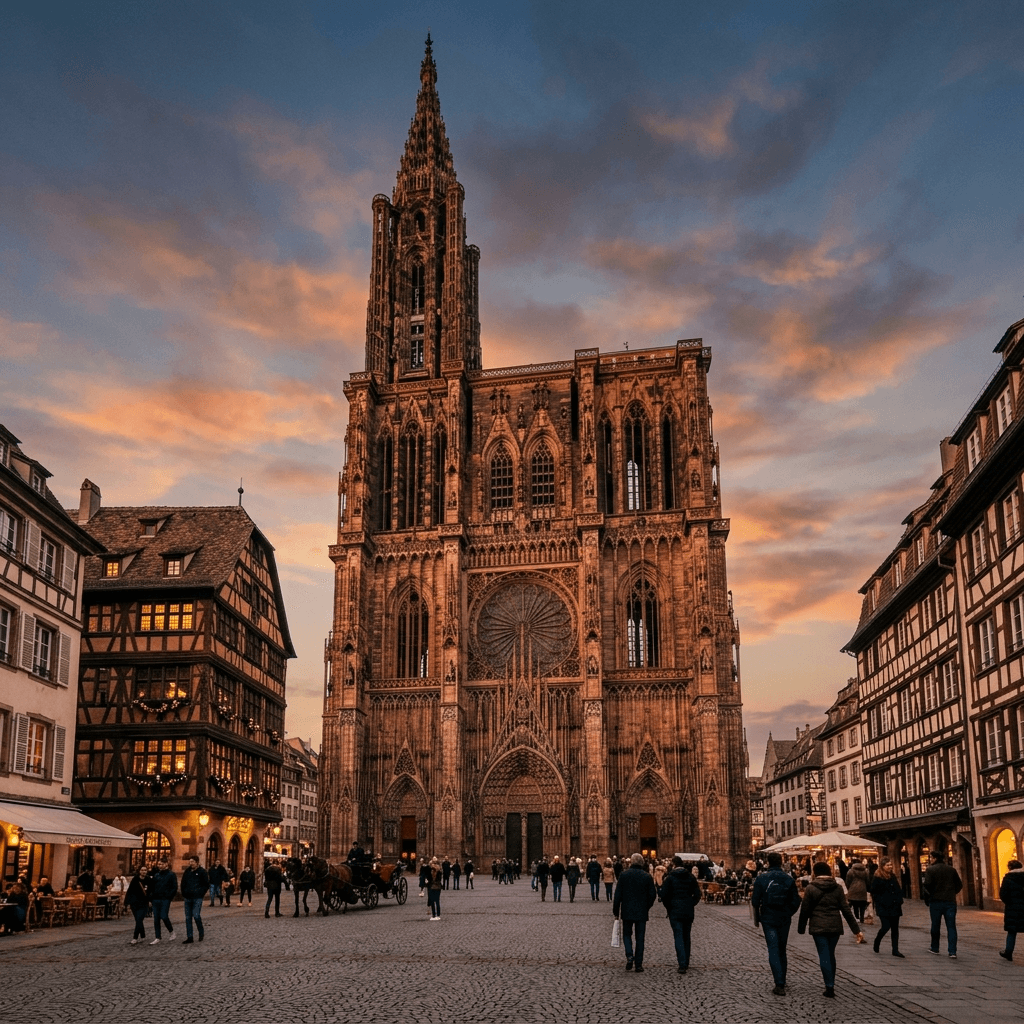
1. Strasbourg Cathedral as a Sacred Space: Discover Why This Temple is Unique in Christendom
Chapter
1.1 What is the meaning of the dedication to Notre-Dame at Strasbourg Cathedral?
Strasbourg Cathedral is dedicated to Notre-Dame (Our Lady), a tradition that dates back to the beginning of its construction in the 11th century. Marian devotion is deeply rooted in the history of Alsace, and the cathedral has always been the spiritual heart of this region. The choice of Our Lady as patroness was no accident: the Virgin Mary was seen as the protector of the city, intercessor with God and model of faith for the faithful.
Over the centuries, the cathedral has housed countless Marian representations. The most venerated is the statue of Notre-Dame de Strasbourg, located on the south pillar of the transept, which receives prayers and candles from devotees to this day. Marian worship at the cathedral is also expressed in the feasts of the Assumption (15 August), patroness of the cathedral, and the Immaculate Conception (8 December), when solemn Masses gather the Alsatian Catholic community.
Chapter
1.2 How do Strasbourg Cathedral stained-glass windows tell the story of salvation?
Light has always been a central element in Christian theology, and at Strasbourg Cathedral it reaches its symbolic apex. The stained-glass windows of the cathedral, covering approximately 1,000 m2, are not mere decorative elements: they function as a Bible of light, telling the story of salvation in colour and image. This tradition goes back to the thought of Pseudo-Dionysius the Areopagite, who saw physical light as a reflection of divine light.
The oldest stained-glass windows, dating from the 12th century, are in the choir and depict scenes from the Life of Christ and the Virgin Mary. The north transept windows, from the 13th century, show figures from the Old Testament that prefigure Christ, while those in the south transept represent the Apostles and the Saints of the Church.
Chapter
1.3 Why is Strasbourg Cathedral facing the sunrise?
Strasbourg Cathedral, like most medieval churches, is oriented with the high altar facing east. This orientation is no coincidence: it symbolises the Christian hope in the Second Coming of Christ, which tradition associates with the east, where the sun rises.
In liturgical practice, this orientation meant that the community gathered in the nave looked east during Mass, towards the altar and the rising sun, remembering that Christ is the Light of the World. During the spring equinox, the rays of the rising sun penetrate through the east rose window and directly illuminate the high altar.
Chapter
1.4 What was the role of Strasbourg Cathedral in the city spiritual life?
Since its foundation, Strasbourg Cathedral has been the centre of the city religious life. During the Middle Ages, it was not only the venue for great liturgical celebrations, but also the space where citizens gathered for assemblies, processions and moments of spiritual crisis.
Even during the period when it was assigned to the Protestant faith (between 1524 and 1681), the cathedral remained the spiritual centre of the city, under reformers such as Martin Bucer and John Calvin. When the city was annexed by Louis XIV in 1681, the cathedral returned to the Catholic faith. Today it is the seat of the Archdiocese of Strasbourg.
Chapter
2.1 Where is the fragment of the True Cross at Strasbourg Cathedral?
The Treasury of Strasbourg Cathedral holds one of the most venerated relics of Christendom: a fragment of the True Cross, the cross on which Jesus was crucified. The relic, brought from Constantinople during the Crusades, is preserved in a gilded silver monstrance from the 13th century, richly ornamented with precious stones.
The authenticity of the fragment has been attested by several popes over the centuries, and the relic is the object of special veneration on Good Friday, when it is exposed for the veneration of the faithful. The reliquary is a masterpiece of medieval goldsmithing.
Chapter
2.2 Which medieval chalices and monstrances are in the Strasbourg Treasury?
The Treasury of Strasbourg Cathedral includes an impressive collection of chalices, monstrances, navetas and thuribles dating from the 12th to the 19th century. Each piece is a masterpiece of goldsmithing, executed in silver, gold and gilded bronze.
The oldest chalice dates from the 12th century and is a rare example of Romanesque goldsmithing. The Baroque monstrance from the 18th century, with its radiant sun shape, is the piece most used for the Blessed Sacrament.
Chapter
2.3 Where to see the medieval liturgical vestments of Strasbourg?
The collection of liturgical vestments in the Treasury of Strasbourg Cathedral is one of the richest in France. The chasubles, copes, dalmatic and stoles date from the 15th to the 18th century and are made of velvet, silk, brocade and taffeta, with embroidery in gold and silver thread.
The most impressive piece is the Assumption chasuble, from the 16th century, in red velvet with embroidery depicting the Virgin Mary surrounded by angels.
Chapter
2.4 How did the cathedral treasury survive the looting of the French Revolution?
During the French Revolution (1789-1799), Strasbourg Cathedral was severely damaged and its treasury looted. Many of the most valuable pieces were melted down for coinage or sold to finance the revolutionary wars. However, a significant part of the treasury was hidden by the faithful and the local clergy.
The objects that survived include the reliquary of the True Cross, some medieval chalices and most of the 17th-century vestments. After the Restoration of the monarchy in 1815, the treasury was reorganised. Today it is displayed at the Musee de l'OEuvre Notre-Dame.
Chapter
2.5 How to visit the Strasbourg Cathedral Treasury: hours and tickets
The Treasury of Strasbourg Cathedral is currently divided between the Treasury Room (located in the cathedral sacristy) and the Musee de l'OEuvre Notre-Dame (a few metres from the cathedral).
The museum houses the most important pieces, including the reliquaries, chalices and vestments. Opening hours vary by season, and it is recommended to check the official website before visiting.
Chapter
3.1 Who was the sculptor of the Renaissance pulpit at Strasbourg Cathedral?
The pulpit of Strasbourg Cathedral is a masterpiece of Renaissance sculpture, executed between 1485 and 1486 by the sculptor Hans Hammer, a master of the German late 15th century school.
The pulpit is carved in red sandstone from the Vosges, the same material used in the construction of the cathedral. The structure is supported by a central column decorated with figures of prophets and apostles.
Chapter
3.2 Which biblical scenes are carved on the Strasbourg pulpit?
The pulpit parapet is divided into four panels, each carved in high relief with scenes from the Life of Christ. The first panel shows the Annunciation, the second the Nativity, the third the Passion, and the fourth the Resurrection.
Each figure is carved with extraordinary richness of detail: the folds of the garments, the facial expressions, the gestures of the hands. For the visitor, the pulpit is an invitation to contemplation.
Chapter
3.3 What do the figures of apostles and prophets on the cathedral pulpit mean?
The central column of the pulpit is surrounded by statuettes of apostles and prophets, each identified by traditional attributes. Saint Peter holds the keys of the Kingdom, Saint Paul the sword of the Word, Saint John the chalice.
These figures establish a theological connection between the Old and New Testaments, showing that the preaching of the Gospel is the fulfilment of ancient prophecies.
Chapter
3.4 How did the acoustics of the Strasbourg Cathedral pulpit amplify the voice?
The pulpit of Strasbourg Cathedral was designed not only to be seen, but also to be heard. Its position next to a pillar of the central nave and its semicircular shape were calculated to maximise the projection of the preacher voice.
Before electrical amplification, being heard by the entire congregation was a considerable technical challenge. The Strasbourg pulpit solves this problem with its carefully calculated shape and the canopy that acts as a natural acoustic reflector.
Chapter
4.1 Where is the Chapel of Saint John the Baptist and its medieval baptismal font?
The Chapel of Saint John the Baptist, located on the north side of the nave, is one of the oldest spaces in Strasbourg Cathedral. Built in the 13th century, it houses the original baptismal font of the cathedral, an imposing bronze piece from the 15th century.
The baptismal font is 1.20 metres in diameter and is supported by figures of the four evangelists. For centuries, all baptisms of the cathedral parish were performed at this font.
Chapter
4.2 What is the history of the Chapel of Saint Joseph at Strasbourg Cathedral?
The Chapel of Saint Joseph, located on the south side of the nave, is dedicated to the universal patron of the Church and patron of workers. The chapel dates from the 14th century and houses a Baroque altar from the 18th century.
The chapel is particularly popular among the faithful seeking intercession for work and family matters. Every 19 March, the feast of Saint Joseph, a solemn Mass is celebrated in the chapel.
Chapter
4.3 Where is the miraculous statue of Notre-Dame at Strasbourg Cathedral?
The Chapel of the Virgin (also known as the Chapel of Our Lady) is the heart of Marian devotion at Strasbourg Cathedral. Located behind the high altar, it houses the most venerated statue of the cathedral: Notre-Dame de Strasbourg.
The chapel is a permanent space of prayer where the faithful light candles and deposit their intentions. The altar is topped by a Gothic baldachin from the 15th century.
Chapter
4.4 Where are the bishops of Strasbourg buried in the cathedral?
Over the centuries, Strasbourg Cathedral served as a burial place for numerous bishops, canons and illustrious figures of the city. The funerary chapels house tombs dating from the 13th to the 18th century.
The most important tomb is that of Bishop Conrad de Lichtenberg (died 1299), who began the construction of the west facade. His tomb, in black marble, features a recumbent statue of the bishop in pontifical vestments.
Chapter
5.1 Which Old Testament scenes are in the north transept stained glass?
The north transept of Strasbourg Cathedral houses one of the most beautiful series of 13th-century stained-glass windows. The windows depict scenes from the Old Testament in a narrative sequence from the Creation of the World to the Prophets.
Among the most notable scenes are the Creation of Adam and Eve, the Great Flood, the Tower of Babel, the Sacrifice of Isaac and the visions of the Major Prophets.
Chapter
5.2 How is the Passion of Christ cycle depicted in the choir stained glass?
The choir stained-glass windows tell the story of the Passion of Christ in a sequence from the Last Supper to the Resurrection. These windows, dating from the 14th century, are considered masterpieces of late Gothic art.
The sequence begins with the Entry into Jerusalem, followed by the Last Supper, the Agony in the Garden, the Arrest of Jesus, the Trial before Pilate, the Flagellation, the Crowning with Thorns, the Way of the Cross, the Crucifixion and finally the Resurrection.
Chapter
5.3 What is the meaning of the 13-metre west rose window at Strasbourg Cathedral?
The west rose window of Strasbourg Cathedral is one of the largest in Europe, with 13 metres in diameter. Built between 1277 and 1350, it depicts the vision of the Apocalypse of Saint John.
The rose window is a true catechism in glass and light. The golden centre represents divine glory, while the concentric circles show the celestial hierarchy. The best time to appreciate it is in the late afternoon.
Chapter
5.4 Which patron saints of Alsace appear in the cathedral stained glass?
Beyond the great biblical narratives, Strasbourg Cathedral houses stained-glass windows dedicated to patron saints of Alsace. The most venerated is Saint Andrew, the apostle patron of Alsace, whose window shows him with his X-shaped cross.
Chapter
5.5 How is the Virgin Mary represented in Strasbourg Cathedral stained glass?
The Virgin Mary occupies a prominent place in the stained-glass windows of Strasbourg Cathedral, as befits a cathedral dedicated to Notre-Dame. Three Marian scenes are repeated in different windows: the Annunciation, the Nativity and the Assumption.
The Annunciation window, located in the south transept, shows Mary seated with an open book. The Assumption window, in the choir, shows Mary crowned by Christ surrounded by angels.
Chapter
6.1 Who was the first bishop of Strasbourg and how did he evangelise Alsace?
The first recorded bishop of Strasbourg is Amand, who participated in the Councils of Cologne and Sardica in 346 and 347. His presence indicates that the diocese of Strasbourg was already well established in the 4th century, just decades after the Edict of Milan (313).
Chapter
6.2 How did the prince-bishops of Strasbourg accumulate political and religious power?
During the Middle Ages and the Ancien Regime, the bishops of Strasbourg were not only spiritual leaders but also territorial princes of the Holy Roman Empire. As prince-bishops, they exercised temporal authority over vast lands in Alsace.
The most famous of the prince-bishops was Guillaume de Honstein (1506-1541). His successor Jean de Manderscheid (1569-1592) implemented the reforms of the Council of Trent in the diocese.
Chapter
6.3 Who was Bishop Leon-Arthur Elchinger, the bishop of Vatican Council II?
Bishop Leon-Arthur Elchinger (1908-1998) was bishop of Strasbourg between 1957 and 1984 and one of the most striking figures of 20th-century French Catholicism. He actively participated in the Second Vatican Council (1962-1965).
Elchinger was a tireless promoter of Franco-German reconciliation and ecumenism. During his episcopate, Strasbourg Cathedral became a symbol of European unity.
Chapter
6.4 Who is the current archbishop of Strasbourg and what are the challenges of the Church in Alsace?
Currently, the Archdiocese of Strasbourg is led by Archbishop Pascal Delannoy, appointed in 2024. The Church in Alsace faces challenges common to all Western Europe: declining numbers of practising faithful and a shortage of priestly vocations.
However, the archdiocese also has unique strengths: a strong tradition of popular Catholicism, a rich heritage of sacred music and a geographic location that makes Strasbourg home to major European institutions.
Chapter
7.1 How did the Chapter of Canons govern Strasbourg Cathedral?
Since the Middle Ages, Strasbourg Cathedral has been governed by the Chapter of Canons, a community of secular priests responsible for the cathedral administration and the celebration of the Divine Office. The chapter was founded in the 11th century by Bishop Werner I.
The canons lived in community, following a rule inspired by Saint Augustine. They were responsible not only for the liturgy, but also for the education of young clerics and charity towards the poor.
Chapter
7.2 Where was the Dominican convent next to Strasbourg Cathedral?
Next to Strasbourg Cathedral, a convent of the Order of Preachers (Dominicans) was founded in 1260. The Dominicans were known for their emphasis on preaching and study, and their convent in Strasbourg became a major intellectual centre.
It was in this convent that John Tauler (c. 1300-1361), one of the greatest German mystics, preached his sermons on the union of the soul with God.
Chapter
7.3 Which women convents existed in Strasbourg in the Middle Ages?
Women monastic life also flourished in Strasbourg over the centuries. Several women convents were founded near the cathedral, including the Dominican convent of St Nicholas and the Benedictine convent of St Margaret.
Chapter
7.4 What to visit at the Episcopal Palace next to Strasbourg Cathedral?
The Episcopal Palace (Palais Rohan), built between 1732 and 1742 by Cardinal Armand-Gaston de Rohan, is located a few metres from Strasbourg Cathedral. Today it houses three municipal museums.
Chapter
8.1 What makes the liturgical rite of Strasbourg unique in France?
The Archdiocese of Strasbourg has a liturgical tradition that distinguishes it from other French dioceses. Until the Second Vatican Council (1962-1965), the diocese maintained its own rite, known as the Rite of Strasbourg, reflecting Germanic influence on the local liturgy.
Although the Roman rite was adopted after Vatican II, some Alsatian liturgical traditions remain alive. The Sunday Mass at the cathedral still includes elements of Gregorian chant and hymns in Alsatian.
Chapter
8.2 How does the schola cantorum keep Gregorian chant alive at the cathedral?
Strasbourg Cathedral has always been a centre of excellence in sacred music. The schola cantorum dates back to the 9th century. Today, the Schola Cantorum de Strasbourg continues this tradition with regular performances during solemn Masses and concerts.
Chapter
8.3 How is the 5,700-pipe Silbermann organ used in the liturgy?
The organ of Strasbourg Cathedral, built by Andreas Silbermann between 1697 and 1704, is one of the most important instruments in France. With 5,700 pipes distributed across 4 keyboards, the organ was specifically designed for the Catholic liturgy of the Counter-Reformation.
Chapter
8.4 How to attend the Midnight Mass at Strasbourg Cathedral?
The Midnight Mass at Strasbourg Cathedral is an event that attracts faithful and tourists from all over the world. Held at midnight on 24 December, the Mass is concelebrated by the Archbishop of Strasbourg with the participation of the cathedral choir and the Silbermann organ.
Traditionally, the Mass begins with the Noel Alsacien, a Christmas hymn in the Alsatian dialect. It is recommended to arrive at least one hour early as the cathedral fills up quickly.
Chapter
9.1 How is Advent lived at Strasbourg Cathedral?
Advent is lived with special intensity at Strasbourg Cathedral. The cathedral receives a giant Advent wreath suspended in the central nave, with four candles lit progressively each Sunday. The cathedral traditionally promotes the Christmas Novena (16 to 24 December).
Chapter
9.2 How is Christmas celebrated at Strasbourg Cathedral?
The Christmas Season at Strasbourg Cathedral goes from the Midnight Mass (24 December) to the Feast of the Epiphany (6 January). The Feast of the Epiphany (Three Kings Day) is celebrated with particular solemnity.
Chapter
9.3 How is Lent lived with the Stations of the Cross at the cathedral?
Lent is a time of penance and preparation. Ash Wednesday marks its beginning with the imposition of ashes. During Lent, the cathedral holds the Stations of the Cross every Friday evening, going through the 14 stations along the side nave.
Chapter
9.4 How to participate in the Easter Vigil at Strasbourg Cathedral?
Easter is the most important feast of the Christian calendar. The Easter Vigil on Holy Saturday is the longest and richest celebration of the liturgical year. It begins with the blessing of the new fire in the cathedral forecourt.
The light of the Paschal Candle is shared with the faithful, turning the dark cathedral into a sea of light. The vigil includes readings from salvation history, the Gloria with bells, the baptismal liturgy and the first Mass of Easter.
Chapter
9.5 What is the parish routine at Strasbourg Cathedral during Ordinary Time?
Ordinary Time is the period when Strasbourg Cathedral lives its daily parish routine. Daily Masses (Monday to Saturday at 7:30 and 12:00) gather the local community. The Sunday Mass (Saturday at 18:00, Sunday at 10:00 and 18:30) is the central moment of the week.
Chapter
10.1 What is the Assumption procession like at Strasbourg Cathedral?
The Feast of the Assumption of Our Lady (15 August) is the most important celebration of the liturgical calendar at Strasbourg Cathedral. After Mass, a procession of Our Lady takes place through the historic centre of Strasbourg.
Chapter
10.2 What are the Holy Week traditions at Strasbourg Cathedral?
Holy Week is lived with intensity at Strasbourg Cathedral. The celebrations begin on Palm Sunday and culminate in the Easter Vigil on Holy Saturday, which begins with the blessing of the new fire in the cathedral forecourt.
Chapter
10.3 What is the Corpus Christi procession like at Strasbourg Cathedral?
The Feast of Corpus Christi is celebrated with a solemn Eucharistic procession through the streets of the historic centre. The Blessed Sacrament is carried under a canopy by civil and religious authorities. This tradition dates back to the 13th century.
Chapter
10.4 Which regional saints of Alsace are celebrated at the cathedral?
The Archdiocese of Strasbourg celebrates the feasts of its regional patron saints. Saint Odile (13 December), patroness of Alsace, Saint Huno (8 February) and Saint Florentius (7 November) are special occasions at the cathedral.
Chapter
11.1 Is it true that the statue of the Virgin wept blood at Strasbourg Cathedral?
One of the most persistent legends associated with Strasbourg Cathedral is the miracle of the statue of the Virgin. According to oral tradition, in 1298, during a plague epidemic, the statue of Notre-Dame de Strasbourg is said to have wept tears of blood for three days.
Chapter
11.2 Why is Strasbourg Cathedral a pilgrimage destination?
Over the centuries, Strasbourg Cathedral was an important pilgrimage destination. During the Middle Ages, the cathedral was one of the stops on the Via Francigena, the pilgrimage route from Canterbury to Rome. Today, the cathedral continues to receive pilgrims from all over Europe.
Chapter
11.3 What are the ex-votos and vows at Strasbourg Cathedral?
Strasbourg Cathedral preserves a collection of ex-votos that bear witness to graces received through the intercession of Our Lady. The tradition dates back to the Middle Ages and continues today, with the faithful placing candles and flowers at the feet of the statue of Notre-Dame.
Chapter
11.4 Why is Saint Andrew so venerated in Alsace?
Saint Andrew is the principal patron of Alsace. Tradition says that a relic of the apostle was brought to Alsace in the 4th century. His feast on 30 November is celebrated with a solemn Mass at the cathedral.
Chapter
12.1 What is the religious origin of the Strasbourg Christmas Market?
The Strasbourg Christmas Market, known in Alsatian as Christkindelsmarik, has deeply religious origins. Established in 1570, the name Christkindel (Christ Child) reflects the Alsatian tradition that it was the Christ Child who brought presents to children on Christmas night.
Chapter
12.2 Where to see the monumental nativity scene at Strasbourg Cathedral at Christmas?
Strasbourg Cathedral annually sets up a monumental nativity scene in its central nave, following the tradition begun by Saint Francis of Assisi in 1223. The nativity scene includes life-sized figures of Saint Joseph, Our Lady, the infant Jesus and the Three Kings.
Chapter
12.3 Which sacred music concerts take place during Advent in Strasbourg?
During Advent, Strasbourg Cathedral promotes a series of sacred music concerts with works from Bach Christmas Oratorio and Gregorian chants. The Concerts de l Advent attract thousands of people.
Chapter
12.4 What is the spiritual meaning of the Christmas lights at Strasbourg Cathedral?
During Christmas, Strasbourg Cathedral receives a special lighting called Cathedrale de Lumiere. For Christians, this lighting has a deep spiritual meaning: the light symbolises Christ, the Light of the World.
Chapter
13.1 What are the spiritual differences between Strasbourg Cathedral and Notre-Dame de Paris?
Although both are dedicated to Notre-Dame, Strasbourg Cathedral and Notre-Dame de Paris have very different spirits. Paris is the cathedral of royalty; Strasbourg is the cathedral of a free imperial city, marked by bilingualism and Germanic influence.
Chapter
13.2 How does Strasbourg Cathedral compare spiritually to Cologne Cathedral?
Cologne Cathedral and Strasbourg Cathedral are two of the greatest expressions of Gothic architecture. Cologne is the cathedral of the Relics of the Three Kings; Strasbourg is the cathedral of the Alsatian people, more connected to local traditions and popular devotion.
Chapter
13.3 What does Strasbourg Cathedral teach about Christianity on the border?
The location of Strasbourg on the border between France and Germany made the cathedral a symbol of encounter and tension between two cultures. Over the centuries, the cathedral was Catholic, Protestant and Catholic again. This history teaches that Christianity on the border is marked by interfaith dialogue.
Chapter
14.1 What are the Mass times at Strasbourg Cathedral?
For the visitor who wishes to attend Mass at Strasbourg Cathedral, the times are: daily Masses (Monday to Saturday) at 7:30 and 12:00; Sunday Masses on Saturday at 18:00, Sunday at 10:00 and 18:30.
Masses are celebrated in French, with some readings in Alsatian on special feasts. A daily Mass lasts about 30 to 40 minutes; Sunday Mass lasts about 1 hour.
Chapter
14.2 How to attend free organ concerts at Strasbourg Cathedral?
The Silbermann organ of Strasbourg Cathedral is one of the most famous in Europe. During the summer (July and August), free concerts take place on Wednesday at 20:00. Tickets for special concerts (Easter, Christmas) must be purchased in advance.
Chapter
14.3 What are the visiting rules during Mass at Strasbourg Cathedral?
When visiting Strasbourg Cathedral during a liturgical celebration, it is important to maintain silence and recollection during Mass; photographs are allowed only without flash; do not walk around during the readings; dress appropriately; and keep mobile phones on silent.
Chapter
14.4 Is it possible to hold a wedding or baptism at Strasbourg Cathedral?
Yes, it is possible to hold weddings and baptisms at Strasbourg Cathedral. For weddings, at least one of the couple must be a member of the parish. Booking must be made at least six months in advance.
Chapter
14.5 How to request a Mass intention at Strasbourg Cathedral?
Anyone can request a Mass intention at Strasbourg Cathedral, for a deceased person or a personal intention. The suggested contribution is 5 to 10 EUR. Intentions can be registered at the parish office (Monday to Friday, 9:00-12:00 and 14:00-17:00).
Chapter
15. FAQ - Frequently Asked Questions about Strasbourg Cathedral
What is the difference between Strasbourg Cathedral (Notre-Dame) and the Strasbourg Cathedral (monument)?
Strasbourg Cathedral is the same building, but this article focuses on its spiritual and religious aspect (liturgy, devotions, festivals). The parallel article on the architectural/tourist aspect covers engineering, the height record, the astronomical clock and visiting tips.
Is Strasbourg Cathedral a basilica?
No. Strasbourg Cathedral does not hold the title of basilica.
Can I visit the cathedral during Mass?
Yes, visitors are welcome during celebrations, respecting the atmosphere of prayer. Photographs are allowed without flash.
What is the capacity of Strasbourg Cathedral?
The cathedral can accommodate approximately 5,000 people seated, and up to 10,000 standing during large celebrations.
Does the cathedral charge admission?
No, entry to the cathedral is free. Access to the tower costs about 8 EUR.
Is there parking near the cathedral?
The nearest parking is Parking Cathedrale (Rue de la Rape), with about 500 spaces.
What is the best time to visit for spiritual purposes?
Advent (December) and Holy Week (March/April) are the richest times for liturgical celebrations.
Can I light a candle in the cathedral?
Yes, there is a votive candle stand in the Chapel of the Virgin.
Is the cathedral open every day?
Yes, the cathedral is open every day. Hours vary by season: generally 7:00 to 19:00.