Chapter
1. The Artistic Revolution of Impressionism: The Origins and Historical Context in 19th Century France
Chapter
1.1. What Was the Paris Academy of Fine Arts and Why Did It Dictate the Rules of Painting?
The Paris Academy of Fine Arts was France's most powerful and influential cultural institution in the 19th century, acting as the supreme arbiter of aesthetic taste and rigidly defining the rules of what was considered quality art. Originally founded in 1648 under the patronage of the monarchy, the Academy controlled the artistic education of young painters through the prestigious School of Fine Arts and exercised an almost absolute monopoly over the French art market.
The Academy's rules were based on strict respect for neoclassical tradition and precision design, prioritizing historical, mythological and religious themes over everyday life. Painters were instructed to use invisible brushstrokes, with extremely smooth and polished canvas surfaces, and to work exclusively inside closed studios with controlled artificial light. Any deviation from this classic standard was classified as a lack of technique or pure amateurism.
For the artist of the time, defying the Academy meant professional death and financial ruin, as the institution also controlled the jury of the official exhibition hall. This rigid control stifled artistic innovation and forced young painters to repeat tired visual formulas to gain social acceptance. Academic rigidity acted as an insurmountable barrier for those who wanted to explore the expressiveness of colors.
It was precisely against this aesthetic dictatorship of the Academy of Fine Arts that a group of young rebels decided to rise up at the beginning of the 1860s. By rejecting the classical rules of drawing and the isolation of studios, these painters paved the way for the birth of Impressionism, a visual revolution that would change the course of world art history forever.
Chapter
1.2. The Paris Salon: The Prestigious Event that Rejected the Future Geniuses of Impressionism
The Salon de Paris was the official and annual art exhibition sponsored by the French government, serving as the only public showcase where artists could display and sell their works to collectors and wealthy bourgeois of the time. The event, held at the imposing Palace of Industry, attracted thousands of visitors from all social classes and was widely covered by the Paris press, dictating the reputation of all participants.
The big problem for the innovative young painters was that the Salon jury was made up almost entirely of conservative members of the Academy of Fine Arts. This jury used outdated aesthetic criteria to select the canvases, systematically rejecting any work that presented visible brushstrokes, very bright colors or portrayed urban reality without romantic idealization.
During the 1860s and 1870s decades, future masters such as Claude Monet, Pierre-Auguste Renoir, Camille Pissarro and Paul Cézanne had almost all of their paintings summarily rejected by the Paris Salon jury. The constant rejection imposed a severe financial crisis on these artists, as without the seal of approval of the official event, it was practically impossible to attract the attention of buyers or reputable art dealers.
This systematic exclusion forced the rejected painters to realize that the official system would never accept their revolutionary artistic vision. The realization that the Paris Salon was closed to modernity was the catalyst that united young artists around a common project: the creation of an independent exhibition society that could challenge the state monopoly.
Chapter
1.3. The Salon des Refusés of 1863: The Milestone of the Rebellion Against Academic Conservatism
The Salon des Refusés (Hall of the Refused) was an alternative exhibition personally authorized by Emperor Napoleon III in 1863 to display the more than 3 thousand works of art that had been rejected by the extremely conservative jury of that year's Paris Salon. The emperor took this political decision to calm the noisy protests of the excluded artists, who accused the official jury of favoritism and aesthetic persecution.
The event became an immediate landmark of scandal and public curiosity, attracting crowds who came to the hall mainly to laugh and mock the paintings considered bizarre by traditional critics. Among the works on display were creations by Édouard Manet and James Whistler, which openly challenged the conventions of academic perspective and bourgeois morality of the period.
Despite the jokes and hostility from a large part of the public, the Salon des Refusés of 1863 provided an invaluable service to art by breaking the aura of infallibility of the Academy of Fine Arts jury. The exhibition proved that there was a vibrant, modern and contesting artistic scene operating on the margins of the official institutions of the French state, winning over the first intellectual defenders.
For the history of Impressionism, this alternative hall functioned as the true ground zero of unity and awareness among artists. The experience of exhibiting together and debating the public reception of their paintings convinced the future Impressionist generation that institutional independence was the only possible path for the survival and evolution of their innovative art.
Chapter
1.4. Napoleon III's France and Haussmann's Reconstruction of Paris: The Urban Setting of the Movement
The birth of Impressionism coincided temporally with the grandiose urban reconstruction of Paris promoted by Baron Haussmann under the direct orders of Emperor Napoleon III, transforming the former medieval capital into a modern metropolis of wide avenues, public parks and illuminated cafes. This profound physical metamorphosis of the city provided the dynamic visual backdrop and urban themes that fascinated modern painters.
Haussmann demolished entire neighborhoods of narrow, dark streets to open up the iconic tree-lined boulevards and erect the new stone buildings with uniform facades that define Paris today. The introduction of gas lighting in the streets and the construction of large train stations, such as Gare Saint-Lazare, changed the daily lives of citizens and the visual perception of urban space.
The Impressionists were the first artists to record this new, pulsating Paris on their canvas, painting the iron smoke of the locomotives in the stations, the elegant pedestrians walking in the rain on the boulevards and the bohemian life in the cafes. The speed of modern urban life demanded a new rapid painting technique that could capture the ephemeral movement of the crowd.
Thus, the reconstructed Paris of Napoleon III was not just the geographical location of the movement, but rather an active character that dictated the contrasts of light, the new geometric perspectives and the atmosphere of leisure that the painters sought to immortalize. Impressionism was born as the direct visual chronicle of the first modern metropolis in the Western world.
Chapter
2. Claude Monet and the Founding Work of Impressionism: The Painting that Gave the Movement its Name
Chapter
2.1. The Story Behind "Impression, Sunrise" Painted in Le Havre in 1872
The painting that would give the movement its name, "Impression, Sunrise" (Impression, soleil levant), was painted by Claude Monet on the morning of November 13, 1872, from the window of his hotel room with a direct view of the industrial port of the city of Le Havre, in Normandy. The painting depicts the morning mist of the port cut by the silhouette of boats and industrial chimneys, under the light of a bright orange rising sun.
Monet did not intend to create an accurate topographical portrait of the port of Le Havre, but rather to capture the ephemeral atmosphere of the morning light and the changing reflections of the sun on the trembling surface of the water. The artist worked quickly with loose brushstrokes and juxtaposed patches of color, capturing the scene before the sunlight changed position and dissipated the port fog.
When the painting was selected for the group of independent artists' first exhibition in 1874, Monet needed to give the painting a title for the official exhibition catalogue. Upon considering that the work was too abstract and unfinished to be called a conventional landscape, the painter decided to call it simply *"Impression"*, an unpretentious semantic choice that would make art history.
Today, this historic canvas is preserved as one of the greatest relics of art history at the Marmottan Monet Museum in Paris, attracting thousands of visitors annually. The work synthesizes the essence of Impressionism: the primacy of instant visual perception and atmospheric light over rigid contour drawing and detailed description of the object.
Chapter
2.2. The Critic Louis Leroy and the Ironic Origin of the Term "Impressionism"
The term "Impressionism" was born as an ironic and derogatory nickname coined by the French art critic Louis Leroy in a satirical article published in the humorous newspaper *Le Charivari* on 25 April 1874, shortly after the critic visited the exhibition of independent artists. Leroy used the title of Monet's painting to mock the technique of the entire group of associated painters.
In his sarcastic text, written in the format of a fictional dialogue, Leroy pretended to talk to an academic painter shocked by the lack of finishing on the canvases on display. When analyzing Monet's painting, the critic wrote that *"a wallpaper in its embryonic state is more finished than this navy"*, reducing the painters' technical effort to mere sketches and vague impressions without real artistic value.
For Leroy and the conservative public of the time, the quick and visible brushstrokes and direct color mixing on the canvas were clear signs of the painters' intellectual laziness or pure technical inability to draw. The word "impressionist" was used by the journalist as an insult to label the group as charlatans who tried to deceive the public with inkblots.
However, the group's artists themselves, led by Monet, Degas and Pissarro, decided to adopt the term in a provocative and proud way to name the movement that was being born. Leroy's insult was transformed into a manifesto of independence and modernity, and the word "Impressionism" became the most influential and enduring stamp of culinary and artistic prestige on the planet.
Chapter
2.3. The Gardens of Giverny: How Monet Created His Own Outdoor Studio to Paint Water Lilies
In 1883, seeking isolation and direct contact with nature, Claude Monet moved with his family to the quiet village of Giverny, in Normandy, where he purchased a rustic property and dedicated the next three decades of his life to creating a grand flower garden and an oriental water garden that would serve as his definitive outdoor studio.
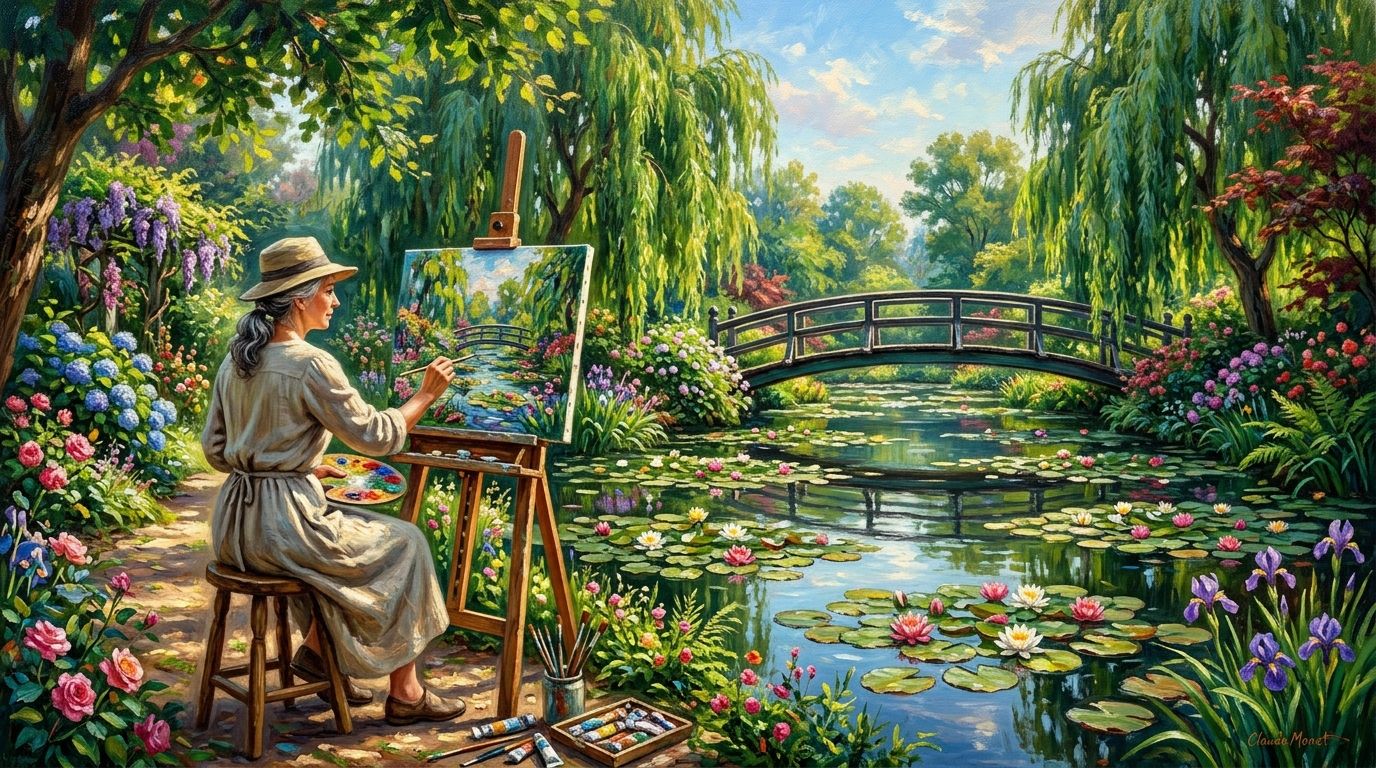
Monet diverted the course of a small tributary of the River Epte to feed the lake of his water garden, where he planted water lilies imported from Asia and built the iconic Japanese green wooden bridge surrounded by wisteria and weeping willows. The painter planned the arrangement of the lake's flowers and vegetation as if he were mixing colors on a three-dimensional palette to create infinite painting themes.
The pond of water lilies became the final artistic obsession of Monet, who painted hundreds of canvases depicting the changing reflections of light on water and the movement of aquatic flowers in sunlight through the seasons. The canvases in this giant series grew in abstraction of form and monumental scale, resulting in the grandiose panels preserved in the Orangerie Museum.
Visiting Monet's house and gardens in Giverny allows the contemporary tourist to understand the profound symbiosis between botany and art in the painter's work. Monet didn't just paint what he saw; he planted and cultivated the very light and color he wished to portray, transforming living nature into his most enduring three-dimensional masterpiece.
Chapter
2.4. Monet's Obsession With Light: The Rouen Cathedral Series of Canvases at Different Times of the Day
During the years 1892 and 1893, Claude Monet carried out one of the most radical and systematic experiments in the history of painting by creating a series of thirty canvases depicting the Gothic facade of Rouen Cathedral under different atmospheric light conditions and times of day. The painter rented rooms overlooking the cathedral to paint the same physical object repeatedly.
Monet's intention was not to extol the Gothic architecture of the medieval cathedral or its religious importance, but rather to prove that the object changes its physical appearance every minute as sunlight falls on the carved stone. The artist worked with multiple canvases open at the same time in his temporary studio, switching canvases as the light changed on the church's facade.
The process was physically exhausting for the painter, who wrote letters reporting nightmares about the cathedral constantly changing color under the sun. The final result of the series shows the stone facade dissolving into a golden haze in the morning, in shades of blue and purple in the evening, or glowing in the midday sun.
This monumental series confirmed that, for Impressionism, the true raw material of painting is not the solid stone of the cathedral or the leaf of the tree, but rather the reflected light itself that travels to the viewer's eyes. Monet proved that a single physical monument has infinite changeable visual realities dependent on time and climate.
Chapter
3. The Great Masters of French Impressionism: The Iconic Figures Who Redefined Art
Chapter
3.1. Pierre-Auguste Renoir: A Celebration of Parisian Social Life, Colors and Feminine Beauty
Pierre-Auguste Renoir stood out in impressionist circles for his dedication to portraying the human figure and the joy of living of Parisian society, distancing himself from the pure landscape themes that dominated Monet's work. Renoir used a warm color palette and soft brushstrokes to capture the vibrancy of open-air balls, boat trips, and festive dinners among Paris' youth.
His most celebrated masterpiece, "The Ball at the Moulin de la Galette" (Bal du moulin de la Galette), painted in 1876, is a brilliant testament to this social skill, showing young people dancing and chatting in the shadows of sunlight filtered through the leaves of Montmartre's trees. The painter mastered the physics of light splashed on the skin and clothes of those portrayed in a unique way.
In addition to bohemian social scenes, Renoir was renowned for his portraits of women and children, characterized by a softness of line that recalled his first professional training as a painter of fine porcelain in his childhood. The colors on his canvases flowed with a pastel sweetness that pleased collectors and early liberal buyers.
Even though he suffered from severe deforming arthritis at the end of his life, Renoir kept his passion for celebrating life and colors active, painting until his final days at his home in the south of France. His work remains a beacon of aesthetic optimism, immortalizing the sweetness and atmosphere of leisure that marked the French Belle Époque.
Chapter
3.2. Edgar Degas: The Painter of Ballerinas, Dynamic Movement and Paris Nightlife
Unlike most of his Impressionist colleagues, Edgar Degas rejected painting outdoors (*en plein air*), preferring to work inside his studio to focus on precision drawing and capturing the dynamic movement of the human body, with the world of Paris Opera ballerinas and racing horses as his great visual obsessions.
Degas painted and drew hundreds of behind-the-scenes canvases of the ballet, capturing the dancers not in glorious poses on stage, but rather during grueling rehearsals, painful stretches, or resting in the wings. The artist used innovative framing influenced by photography and Japanese prints, cutting figures into the edge of the canvas in a bold way.
The painter mastered the use of chalk pastels, a dry technique that allowed layers of vibrant colors to be superimposed with enormous physical speed without the need to wait for traditional oil paints to dry. His studies of the artificial light of theater stages and dark cabarets reveal his sensitivity to modern Paris nightlife.
Degas saw himself as a classical realist in constant dialogue with the tradition of linear drawing, but his choice of modern themes and his quest to capture the fleeting moment of movement integrated his trajectory into the impressionist movement in a definitive way. His bronze sculptures of ballerinas remain fundamental works of art in the Musée d'Orsay.
Chapter
3.3. Camille Pissarro: The Group's Intellectual Mentor and the Only One to Exhibit in the Eight Exhibitions
Camille Pissarro was the great uniting force and the intellectual and moral mentor of the Impressionist movement, being the only artist in the group to have the physical constancy and prestige of exhibiting his works in all eight independent exhibitions organized from 1874 to 1886. Pissarro was admired by young painters for his generosity and theoretical teaching wisdom.
His pictorial technique was characterized by short, dense brushstrokes applied vigorously to the canvas, portraying mainly rural landscapes, farms and the daily work of peasants in the French countryside, far from the bourgeois glamor of Paris. Pissarro had a unique sensitivity to earth tones, autumn foliage and winter light.
During the 1880s, seeking to renew his artistic style, Pissarro welcomed and encouraged young revolutionary talents such as Paul Cézanne, Paul Gauguin and Georges Seurat, even experimenting with the technique of pointillism for a brief period. The painter functioned as the transition bridge between generations of high modern French art.
For the history of modern art, Pissarro's role as pacifier of the constant intellectual disputes between Degas and Monet was indispensable for the very survival and continuity of the impressionist group throughout the years of public rejection. Without his father figure and moral integrity, the union of independent painters would have dissolved prematurely.
Chapter
3.4. Alfred Sisley: The Silent Poet of Landscapes and Light Effects on Water and Snow
Alfred Sisley was the most constant Impressionist painter dedicated to pure landscape, remaining faithful to the movement's principles throughout his artistic career, even facing severe poverty and a lack of critical recognition until his premature death in the French countryside.
Born in Paris to English parents, Sisley painted the rural villages of the Seine River valley with a singular poetic delicacy, specializing in capturing the subtle reflections of light on the water and the chromatic transformations of the landscape under the effect of winter snow. The artist dedicated a large part of the space on his canvases to portraying immense, cloudy skies with rich nuances of blue and gray.
His series of canvases on the floods in the city of Port-Marly, painted in 1876, is celebrated as one of the greatest aesthetic masterpieces of Impressionism, showing the water covering the streets of the small village under a diffused light that integrates the buildings with the water reflection in a harmonious and touching way.
Despite his undisputed talent and the admiration of his bandmates, Sisley's silent work remained in the shadow of the later commercial successes of Monet and Renoir. Today, international art critics recognize Sisley as one of the movement's purest painters, whose atmospheric sensibility captured the soul of the French landscape in an unparalleled way.
Chapter
4. The Women Pioneers of Impressionism: The Talent that Defied Gender Prejudices
Chapter
4.1. Berthe Morisot: The First Woman to Join the Impressionist Circle and Her Loose Brushstroke Technique
Berthe Morisot was one of the most important and revolutionary artistic figures of Impressionism, standing out as the first woman to exhibit with the group of independent artists in 1874 and gaining the professional respect of her colleagues due to her bold technique of free and unfinished brushstrokes.
Born into an educated bourgeois family, Morisot had access to private painting lessons with Camille Corot, but faced the severe social limits imposed on women in the 19th century, who were prohibited from attending the School of Fine Arts or from walking unaccompanied through the cafes and bohemian streets of Paris in search of urban themes.
Morisot circumvented these social gender barriers by focusing his canvases on the intimate representation of women's private universe, portraying women in their dressing rooms, boating in public parks or caring for their children. His technique of quick brushstrokes and expressive use of pastel and white tones gave his canvases a feeling of lightness that profoundly influenced Claude Monet himself.
Despite her invaluable aesthetic contribution to the movement, her official obituary in 1895 recorded her profession only as "no profession", revealing the institutional blindness of French society at the time towards female talent. Today, Berthe Morisot is celebrated worldwide as one of the great painters who founded artistic modernity.
Chapter
4.2. Mary Cassatt: The American Artist Who Conquered Paris With Her Paintings About Motherhood
Mary Cassatt was the only artist of American nationality to join the inner circle of the Impressionists in Paris, personally invited by Edgar Degas in 1877 after the painter admired the technical talent and modern composition of her works exhibited in French galleries.
Cassatt used dynamic framing and vibrant colors to portray the everyday lives of modern women, specializing in creating series of innovative canvases about the intimate and real relationship between mothers and young children, moving away from traditional religious idealizations of motherhood in the history of art.
The artist also played a crucial practical role as a public relations ambassador for Impressionism in the United States, advising wealthy American collectors to acquire works from their financially strapped French counterparts. This circulation of international capital saved many Impressionists from material ruin and paved the way for the movement's success in the American market.
His sensitivity to engraving and linear drawing influenced the group's style, bringing technical rigor to the search for light effects. Mary Cassatt's work is proof of the international circulation of aesthetic ideas that made Paris the global beacon of 19th-century visual arts.
Chapter
4.3. Eva Gonzalès: Édouard Manet's Student Prodigy and Her Portrait of Bourgeois Private Life
Eva Gonzalès was the only formal student accepted by the celebrated painter Édouard Manet in the 1860s, quickly becoming his prodigy painter and inspiring muse, depicted in famous canvases of Manet working at his easel in a white evening dress.
Gonzalès absorbed Manet's technique of using striking contrasts of dark colors and high-contrast brushstrokes, but developed his own intimate style for depicting the everyday lives and quiet dramas of bourgeois women in private drawing rooms, opera houses, and residential gardens.
Despite sharing the aesthetic research of light and movement of Impressionism, Gonzalès followed the example of his master Manet and chose not to participate in the group's independent exhibitions, seeking official recognition through the jury of the Paris Salon, where he managed to exhibit some of his most important works.
His promising artistic career was tragically cut short by his premature death at the age of thirty-four, which occurred in 1883 due to complications during the birth of his son, just a few days after the death of his master Manet. Eva Gonzalès' work is rediscovered by contemporary critics as a jewel of French realism's technical sensitivity.
Chapter
4.4. Marie Bracquemond: The Brilliant Painter But Forgotten By Her Husband's Jealousy and Obscurity
Marie Bracquemond is considered one of the most brilliant and unfairly forgotten talents of Impressionism, whose artistic evolution in outdoor painting and the luminous use of colors was brutally boycotted by the professional jealousy and conservatism of her husband, the prestigious engraver Félix Bracquemond.
Marie actively participated in the group's independent exhibitions in 1879, 1880 and 1886, presenting landscape canvases and portraits of family members in domestic gardens that revealed a refined sensitivity to the reflections of sunlight on vegetation and the use of bright colors influenced by her friendship with Gauguin.
However, constant bullying and destructive criticism from her husband Félix, who rejected the rapid techniques of Impressionism in favor of rigid academic drawing, eroded Marie's mental health. The painter was forced to abandon commercial painting around 1890 to preserve the family peace of her home.
The silencing of Marie Bracquemond is one of the saddest and most revealing stories about the personal costs imposed on women who dared to pursue artistic authorship in the 19th century. Today, the preservation of his few remaining canvases in international museums reconstructs the memory of his solar and innovative brushwork.
Chapter
5. Édouard Manet: The Precursor and the Link with Impressionism
Chapter
5.1. "Lunch on the Grass" (Le Déjeuner sur l'herbe): The Scandal that Shook Parisian Morality in 1863
The painting "Lunch on the Grass" (Le Déjeuner sur l'herbe), presented by Édouard Manet at the historic Salon des Refusés of 1863, provoked the biggest cultural and moral scandal in France of that century due to its crude and modern representation of a naked woman having a snack alongside two clothed bourgeois men in a Parisian forest.
Parisian society at the time accepted female nudity in art only if it was justified by mythological themes of Greek goddesses or nymphs in distant environments. Manet broke this social hypocrisy by portraying the nudity of an ordinary, contemporary woman (model Victorine Meurent), who looks directly at the screen viewer with a defiant gaze of equality.
On a technical level, Manet abandoned the classical use of academic chiaroscuro that created the illusion of smooth three-dimensional depth, applying flat blocks of pure color and high contrast of light and dark tones directly to the canvas in an innovative way. The official jury classified the painter's technique as lacking perspective and vulgar.
This revolutionary work challenged aesthetic conventions and bourgeois morality, establishing the conceptual foundations for modern art. The "Lunch on the Grass" scandal united the young painters who would later form Impressionism around Manet, recognizing him as the great leader and precursor of their artistic rebellion.
Chapter
5.2. "Olympia": Why Did the Realistic Depiction of Female Nudity Shock French Society So Much?
When exhibited at the Paris Salon in 1865 under police protection to prevent it from being destroyed by an angry public, Édouard Manet's painting "Olympia" caused immediate outrage for depicting a Parisian courtesan (luxury prostitute) lying naked on her bed, receiving flowers sent by a client from her black servant.
The name "Olympia" was a common pseudonym adopted by luxury prostitutes in Paris in the 19th century, which eliminated any pretext of classical mythological idealization of the painted scene. The realistic and cold gaze of model Victorine Meurent, staring at the salon visitor without shame or submission, forced the bourgeois event-goers to face their own hidden sexual hypocrisies.
Traditional critics attacked Manet with extreme verbal violence, describing Olympia's cold, pale skin as "cadaverous" and the painter's technique as "charcoal-stained" due to the strong shadows applied without smooth tonal transitions on the model's legs and torso. The presence of a black cat with a straight tail on the bed added sexual connotations to the alcove scene.
The painting "Olympia" became the great manifesto of Realism and artistic modernity, proving that art should not serve to embellish classical fantasies of the medieval past, but rather to record the complex realities and social conflicts of the contemporary present in an honest way.
Chapter
5.3. Friendship with Monet and Degas: Why Did Manet Refuse to Exhibit with the Impressionists?
Despite his close friendships with Claude Monet, Edgar Degas and Berthe Morisot, and his active participation in the heated aesthetic discussions of the group of independent artists at Café Guerbois, Édouard Manet systematically refused to exhibit his paintings in independent impressionist exhibitions.
Manet firmly believed that the real battle for recognition and art history should be fought within the official system of the Academy of Fine Arts itself, winning over the Paris Salon jury in a traditional way. The painter feared that formally associating his name with a group labeled mad rebels by the press could harm his quest for institutional legitimacy.
This refusal caused real intellectual tensions with Edgar Degas, who accused Manet of seeking approval for state medals of honor in a bourgeois way. However, Manet supported his friends in a silent financial and moral way, purchasing Monet's paintings and recommending art collectors to visit independent galleries.
Even without signing the Impressionist catalogues, Manet was influenced by his friends in the 1870s and 1880s, brightening his color palette and painting outdoors alongside Monet on the River Seine. The artist remained the transitional figure and the irreplaceable connecting link between urban realism and the revolution of light.
Chapter
5.4. The Bar at the Folies-Bergère: Manet's Last Masterpiece and Visual Testament of Impressionism
The last major oil painting completed by Édouard Manet before his death in 1883 was "The Bar at the Folies-Bergère" (Un bar aux Folies-Bergère), presented at the Paris Salon of 1882 and celebrated as the true visual testament of his aesthetic mastery and urban Parisian sensibility.
The canvas depicts young attendant Suzon standing behind the marble counter of Paris' famous bohemian cabaret, surrounded by bottles of champagne and fine fruit. Behind the attendant, a huge mirror covers the entire wall of the screen, reflecting the blurred crowd of spectators in the cabaret galleries and the legs of a trapeze artist on the ceiling of the house.
Manet used an intentionally distorted perspective in the mirror to show the reflection of the attendant talking to a customer wearing a top hat in the right corner of the screen, creating a visual ambiguity that fascinates art historians to this day. Suzon's melancholic and distant gaze contrasts sharply with the festive brightness and leisurely atmosphere of the modern cabaret.
The work summarizes the research into artificial light, optical reflections and urban solitude that marked Impressionism. By fixing the gaze of the bar attendant in the center of the nightlife of Paris, Manet said goodbye to painting with a declaration of love for the modernity that he helped free from classical ties.
Chapter
6. The Technical Revolution of Impressionism: Paint Tubes, Brushstrokes and Color Theory
Chapter
6.1. The Invention of the Flexible Metal Paint Tube and How It Freed Painters from Closed Ateliers
One of the simplest and most decisive industrial innovations for the birth of Impressionism was the invention of the flexible metallic tin paint tube, originally patented by the American artist John Goffe Rand in 1841 and quickly adopted by Paris paint manufacturers in the 1850s.
Before this mechanical innovation, painters were forced to grind natural pigments by hand and mix them with oil in their studios, storing the fresh paint in pig bladders tied with string. The balloons burst easily and could not be sealed tightly, which forced artists to work locked inside their studios to prevent the colors from drying quickly.
The screw-top tin tube allowed artists to carry a full palette of bright, ready-to-use colors in compact carrying cases anywhere, without the risk of leaks or premature drying of materials. Renoir himself later declared that *"without the paint tubes, there would have been no Impressionism"*.
This material mobility enabled the explosion of outdoor painting, allowing artists to move to fields, beaches and railways in search of instant natural light. The metal tube was the key to physical liberation that transformed the painter from a studio craftsman into a visual explorer of geographic space.
Chapter
6.2. En Plein Air (Outdoor) Painting: The Physical Challenge of Capturing the Effects of Light in a Few Minutes
The practice of painting en plein air (outdoors) became the greatest identification mark and the greatest technical challenge for the Impressionists, who sought to record the light and natural atmosphere of the place directly, without the idealized retouching that occurred in closed studios.
The great challenge of painting outdoors is the speed of light and weather, as the position of the sun changes the colors and shadows of the landscape every minute of the journey. To capture the golden reflection of an evening or the light of a stormy sky before the scene changed completely, painters were forced to work with enormous physical speed on the canvas.
This urgency of time dictated the creation of the technique of quick, short brushstrokes applied continuously, without time to mix the colors on the traditional palette. The finish of the canvases appeared unfinished and raw to the conservative public, but it was the only physical way to record the chromatic truth of the day's instantaneous atmosphere.
In addition to the pressure of the sun, painters faced adverse weather conditions such as strong winds that knocked over easels, rain that ruined fresh paint, and dust or insects that stuck to the canvas. Plein air painting was a strenuous and courageous physical activity that combined the scientific passion for the natural world with the artist's bodily effort.
Chapter
6.3. Optical Mixing and the Juxtaposition of Pure Colors: The Science Behind Impressionist Brushwork
The Impressionists revolutionized the use of colors by applying to their canvases the recent scientific theories of optics and visual perception developed by French scientists such as Michel Eugène Chevreul, especially the law of simultaneous color contrast.
Chevreul proved that colors are not isolated and static properties of the object, but depend on neighboring colors to be processed by the retina of the human eye. Instead of mixing pigments in the traditional palette to obtain opaque grays or browns, the Impressionists applied brushstrokes of pure, complementary colors juxtaposed directly onto the canvas (e.g., blue next to orange).
This technique of optical mixing requires the viewer of the canvas to physically or visually move away from the painting so that their own brain mixes the colors on the retina, creating tones that are much brighter and more luminous than those obtained by physically mixing paints on a wooden palette. Impressionist shadows never used pure black, but rather contrasts of blues, violets and dark greens.
This scientific approach transformed the painting into an experiment in applied optics, where the canvas becomes a mosaic of vibrant light that pulses under the gaze of the museum visitor. The juxtaposition of pure colors gave Impressionist canvases a sunny glow that contrasted sharply with the opacity of traditional academic paintings.
Chapter
6.4. The Influence of Photography and Japanese Prints (Ukiyo-e) on the Movement’s Compositions
The visual revolution of Impressionism was profoundly driven by two major cultural innovations of the 19th century: the popularization of photography and the massive arrival in Paris of Japanese woodblock prints (Ukiyo-e) after the opening of Japan's commercial ports.
Photography freed painting from the obligation to record reality in a documentary and static way, allowing artists to seek the truth of light and atmosphere that the black and white camera of the time was unable to record. Furthermore, photography introduced the concept of visual snapshots of movement and spontaneously cut frames.
Japanese prints by artists such as Hokusai and Hiroshige fascinated painters such as Degas, Monet and Mary Cassatt for their bold composition, with the use of flat perspectives, vibrant colors without academic shadows and the asymmetrical cut of figures at the physical edge of the canvas.
These oriental and technological influences helped the Impressionists break away from the rigid rules of perspective inherited from the classical Italian Renaissance, opening the doors to dynamic new points of view in painting. French modern art was born from the creative dialogue between Western technological innovation and the elegant aestheticism of Japan.
Chapter
7. The Sacred Places of Impressionism: Where Painters Gathered to Create and Discuss
Chapter
7.1. The Café Guerbois and the Café de la Nouvelle Athènes: The Intellectual Centers of Aesthetic Discussions
The bohemian cafes of the Batignolles and Montmartre neighborhood were the true conceptual cradles of Impressionism, serving as the intellectual centers of aesthetic discussions where painters, art critics and writers met weekly to debate the reform of painting against the rules of the Academy. The first and most important of these places was Café Guerbois, located on Rue de Clichy in Paris.
On Friday nights, Édouard Manet presided over the discussion tables at Café Guerbois, surrounded by brilliant minds such as Edgar Degas, Claude Monet, Pierre-Auguste Renoir, Camille Pissarro and the art critic Émile Zola. Theoretical debates about realism, light and the Paris Salon were marked by passion and intense intellectual confrontations of artistic points of view.
At the end of the 1870s, the center of discussions moved to the Café de la Nouvelle Athènes, on Place Pigalle, in Montmartre, where Degas became the central figure, debating new ideas about modern drawing and engraving alongside young French intellectuals.
These cafes functioned as true laboratories of aesthetic ideas where the silent manifesto of the movement was designed. Without the exchange of mental energy and mutual support that occurred around the café tables of Paris, Impressionist artists would have remained isolated in their individual pursuits, lacking the collective strength necessary to challenge the State.
Chapter
7.2. The Hill of Montmartre: The Bohemian Quarter that Attracted Impressionists Looking for Inspiration
The Montmartre hill, located in the north of Paris, was the great geographic and social epicenter of French artistic bohemia at the end of the 19th century, attracting impressionists with its steep streets of ancient stones, residual rustic windmills and affordable housing and studio rental costs.
Montmartre offered painters a fascinating urban contrast between the traditional peasant way of life and the leisure boom of popular night cabarets, cafés, and open-air balls attended by bourgeois youth. The place exuded a freedom of customs that contrasted with the rigidity of Haussmann's boulevards.
It was in Montmartre that Renoir rented a temporary studio on Rue Cortot to paint the famous *"Ball at the Moulin de la Galette"*, transporting his huge canvas daily to the dance court to capture the real light under the local vegetation. Degas also established his studio and residence in the area, designing the nightlife of its theaters and café-concerts.
Today, the hill of Montmartre remains an international pilgrimage site for lovers of high art, preserving bohemian charm in its neighborhood museums. For Impressionism, Montmartre was the social and visual laboratory where modern art found its most authentic and courageous freedom of expression.
Chapter
7.3. Grenouillère and Bougival: Leisure Destinations on the River Seine Where Renoir and Monet Painted Together
In the late 1860s, leisure destinations on the River Seine, such as the floating restaurant La Grenouillère and the nearby village of Bougival, became the sites of joint aesthetic experiments crucial to the birth of the impressionist technique of Claude Monet and Pierre-Auguste Renoir.
During the summer of 1869, Monet and Renoir set up their easels side by side on the wooden platforms of La Grenouillère, painting the Parisian middle class swimming, boating and chatting in the sunlight that filtered through the trees of the River Seine. The two artists worked cooperatively to solve the dynamic challenge of painting the tremulous, shifting movement of light reflections on river water.
This joint work resulted in the development of rapid brushwork divided into small patches of pure color, a technique that would become the trademark of Impressionism. While Monet's brushwork focused on the physical structure of light on water and the atmosphere of wind, Renoir's brushstroke softened the contours to exalt human joy and the beauty of the day.
The canvases painted at Grenouillère in 1869 are considered by art historians to be the first truly impressionist works in history, created even before the movement's official term was consolidated. The River Seine acted as the great channel of inspiration that freed French painting from studio neoclassicism.
Chapter
7.4. Argenteuil: The Little Village on the Bank of the River That Became the Capital of Impressionism in the 1870s
During the 1870s, the small and charming village of Argenteuil, located a few kilometers by train from Paris, became the informal capital and the most important geographic meeting point of the Impressionist movement, where Claude Monet took up official residence and produced some of his most famous works.
Argenteuil attracted painters for its yachting basin on the River Seine, which hosted elegant sailing regattas on sunny weekends, providing chromatic themes of light and speed perfect for the aesthetic researches of Monet, Renoir, Sisley and Manet. Monet built a special floating studio boat in Argenteuil so he could paint the river banks from the perspective of the water.
Friendship and artistic cooperation between painters in Argenteuil reached its peak during this period of rural leisure, with Manet painting Monet's family in their domestic garden and Monet depicting the arrival of steam locomotives crossing the city's modern iron railway bridge.
The sunny, colorful landscapes painted in Argenteuil defined the public image and aesthetic prestige that the world associates with classical Impressionism today. The village symbolized the perfect balance between the industrial modernity of the train and the natural beauty of the River Seine under the European summer sun.
Chapter
8. The Eight Historical Exhibitions of Impressionism: The Struggle for Recognition in 19th-Century Paris
Chapter
8.1. The First Exhibition of 1874 at the Photographer Nadar’s Studio: The Public Birth of the Group
The first independent exhibition organized by the group of rebel artists, under the official name of *Society Anonymous of Painters, Sculptors and Engravers*, opened its doors on April 15, 1874 on the second floor of the former studio of the famous photographer Nadar, located on Boulevard des Capucines, in Paris.
The exhibition brought together 165 works by 30 different artists, including Claude Monet, Pierre-Auguste Renoir, Edgar Degas, Camille Pissarro, Berthe Morisot and Alfred Sisley, who came together financially and signed an internal cooperation regulation to bypass the Academy of Fine Arts jury. Nadar's studio was lit by large glass skylights, offering ideal light for the brilliantly colored canvases.
The decision to organize a private commercial exhibition outside the official Salon de Paris was an act of political and aesthetic courage unprecedented in the history of contemporary French art, breaking with the system of state monopoly of cultural prestige. The works were displayed on red walls without academic distinction of importance of drawing themes.
The event attracted around 3,500 visitors over the course of a month, but the general reception was marked by incomprehension from the press and satirical laughter from a large part of the conservative public. The first exhibition in 1874 went down in history as the public birth of Impressionism, following the critical mockery of journalist Louis Leroy.
Chapter
8.2. Opposition and Public Laughter: How the Impressionists Were Seen as Crazy and Incapable
During the group's first public exhibitions in the 1870s and 1880s, the Impressionists faced unrelenting hostility and contempt from mainstream art critics and bourgeois audiences, who viewed the innovative canvases as personal insults to good taste and artistic morality.
Satirical newspapers in Paris published caricatures showing pregnant women being banned from entering the independents' exhibition to prevent the visual shock of paint blots from causing harm to their babies. Critics wrote that the painters' technique was similar to *"throwing buckets of paint at the canvas and hoping the colors would make sense by scientific miracle"*.
The misunderstanding resulted from the lack of classical aesthetic references on the screens, as the public was accustomed to linear drawings with sharp black outlines and gray and dark studio light transitions. The loose brushstrokes and pure color contrasts were seen as a lack of technical ability or pure madness on the part of the associated artists.
This climate of systematic hostility made it difficult to sell paintings, forcing many impressionist painters to live in extreme poverty of basic resources, dependent on the financial charity of friends and liberal art merchants such as Paul Durand-Ruel. The global prestige that today surrounds these million-dollar paintings was achieved under personal scorn and suffering.
Chapter
8.3. Internal Divisions and Disputes Between Degas and Monet Over the Course of Exhibitions
Despite the common objective of challenging the Paris Academy of Fine Arts, the internal history of the impressionist group was marked by severe conceptual divisions and heated intellectual disputes between its leaders, especially between the figures of Edgar Degas and Claude Monet over the aesthetic direction of the exhibitions.
Degas argued that the group should expand its commercial exhibitions by inviting more traditional realist painters from the Paris Salon who shared the rigor of linear drawing and portrait subjects, rejecting the term "impressionist" in favor of "modern realist". Degas openly criticized the exclusion of geometric designs in Monet and Sisley's pure landscape research.
Monet, Renoir and Sisley, in turn, defended the purity of chromatic research using natural light in the open air, opposing the excess of guests brought by Degas who undermined the aesthetic unity of the group's original exhibitions. These disputes over points of view led to Monet and Renoir boycotting several editions of the exhibitions.
Pissarro acted as the great pacifier of these discussions, managing to unite artists around minimum commercial operating regulations. Intellectual tensions prove that Impressionism was not a homogeneous block of aesthetic ideas, but rather a dynamic collective of strong individual personalities in search of new artistic directions.
Chapter
8.4. The Eighth and Last Exhibition of 1886: The End of the Group and the Transition to Post-Impressionism
The group's eighth and last independent exhibition, held in May 1886 in a gallery on Rue de Laffitte in Paris, marked the end of the collective trajectory of the original Impressionists and the definitive aesthetic transition to the vanguards of Post-Impressionism.
This last exhibition featured the voluntary absence of Claude Monet, Renoir and Sisley, but it consecrated the triumphant entry of new revolutionary talents led by Georges Seurat and his gigantic pointillist painting *"A Sunday Afternoon on the Island of Grande Jatte"*, which divided the opinions of the group's founders with their systematic painting technique.
The discussions surrounding Seurat's pointillism and neo-impressionism confirmed that the aesthetic research of classical Impressionism had branched into new scientific investigations of colors and geometric shapes that broke with the spontaneous capture of light in the open air. The group of painters formally dissolved after twelve years of joint struggle.
The end of the 1886 group of exhibitions occurred precisely at the moment when the movement's original painters were beginning to achieve international critical acceptance and sales success in the bourgeois art market. Impressionism fulfilled its historic mission of liberating contemporary art, paving the way for the 20th century.
Chapter
9. Post-Impressionism and the Legacy of Impressionism in the History of Art
Chapter
9.1. Paul Cézanne: The Geometric Structuring of Nature that Paved the Way for Cubism
Paul Cézanne participated in the first exhibitions of the Impressionist group in the 1870s, but distanced himself from the movement by developing his own conceptual research focused on giving geometric solidity and physical structure to natural forms, seeking to transform Impressionism into *"something lasting like museum art"*.
Cézanne rejected the dissolution of contours by ephemeral light practiced by Monet, preferring to apply oil paint to the canvas in small facets of juxtaposed colors that built volumes and spatial depth without the use of classical linear perspective. His series of paintings on the Sainte-Victoire mountain in southern France reveals this structural obsession.
The painter argued that all forms of nature should be treated using basic geometric shapes: the cylinder, the sphere and the cone, opening the conceptual doors for painters to disrupt the physical forms of reality in an innovative way in the following decades.
This radical geometric structuring by Cézanne was the great conceptual influence that directly inspired Pablo Picasso and Georges Braque to create Cubism at the beginning of the 20th century. Cézanne is revered today as the true father of modern art, whose constructive brushstroke revolutionized Western painting.
Chapter
9.2. Vincent van Gogh: How Expressionism and Vibrant Colors Derived from Impressionist Freedom
The brilliant Dutch painter Vincent van Gogh arrived in Paris in 1886, at the exact moment the group's collective exhibitions were closing, and went through a profound personal technical revolution as he came into direct contact with the bright colors and freedom of loose brushwork of Impressionism.
Before his stay in Paris, Van Gogh painted dark, gloomy canvases depicting Dutch peasant misery. Contact with the sunny canvases of Monet and Pissarro instantly brightened the painter's color palette, and he began to use pure tones of yellow, cobalt blue and red to express deep emotions through outdoor painting.
Van Gogh took the split brushstroke of the Impressionists to its emotional limit of physical expressiveness, applying thick layers of oil paint directly from the tin tube onto the canvas in circular, rhythmic movements that revealed his troubled mental state and his mystical passion for the natural world.
This technical evolution gave rise to Modern Expressionism, where color and brushstrokes on the canvas no longer serve only to immortalize the physical reflection of the external light of the French morning, but rather to shout and project the internal light of the artist's own soul onto reality.
Chapter
9.3. Paul Gauguin: The Search for Primitivism and the Symbolism of Pure Colors Outside Europe
Paul Gauguin began his career in art as a bourgeois collector of prestigious impressionist canvases and became an active painter under the direct encouragement of Camille Pissarro, exhibiting in the last editions of the group's independent exhibitions in the 1880s.
However, Gauguin rejected the purely visual representation of classical Impressionism, seeking to develop a style of pure colors and flat surfaces without academic shadows with a strong symbolic charge. The artist traveled to distant regions of French Brittany and later moved to the island of Tahiti, in Polynesia, in search of a primitive way of life free from the industrial decay of Europe.
In his Tahitian canvases, Gauguin applied pure colors in an arbitrary and non-factual way to express mystical and spiritual sensations of the natives, influenced by the style of Japanese woodblock prints. The artist definitively broke with the realistic search for natural light outdoors.
Gauguin's primitivist and symbolist style influenced the historical avant-gardes of the 20th century, especially Fauvism and modern Primitivism. Gauguin proved that colors and shapes on a flat canvas have autonomous spiritual value, freeing painting from its function as a mirror of the visible world.
Chapter
9.4. Georges Seurat and Pointillism: The Scientific and Systematic Evolution of Impressionism
Georges Seurat led the transitional movement known as Neoimpressionism or Pointillism, presenting in the group's last exhibition in 1886 a painting technique that systematized in a mathematical and scientific way the optical research of the original Impressionists.
Seurat rejected the spontaneous and intuitive brushwork applied en plein air by Monet, developing a rigorous method of applying to the canvas thousands of small dots of pure and complementary colors of uniform size calculated in a closed studio based on Chevreul's theory of optical contrast.
His monumental painting *"A Sunday Afternoon on the Island of Grande Jatte"* required two years of meticulous technical preparation with hundreds of previous geometric drawing sketches. The composition features static and solemn human figures that refer to the stability of classical Egyptian monuments inserted in modern life in Paris.
This rigorous, mathematical approach to pointillism attempted to give laws of scientific stability to the ephemeral capture of light in classical Impressionism. Seurat's work was one of the greatest proofs that the revolution of light and colors that began in 1874 had transformed painting into a complex, avant-garde intellectual discipline.
Chapter
10. Where to See Impressionism in Paris: The Practical Guide for Art Lovers
Chapter
10.1. The Musée d'Orsay: The World's Largest Collection of Impressionist Paintings in the Old Train Station
For the modern leisure tourist visiting Paris, the Museum d'Orsay (Musée d'Orsay) is the main obligatory stop to contemplate the largest and most spectacular collection of Impressionist and Post-Impressionist paintings on the entire planet, housed inside a monumental old railway station built in 1900.
The Musée d'Orsay displays in its imposing exhibition rooms under the natural light of glass skylights famous masterpieces such as *"The Ball at the Moulin de la Galette"* by Renoir, *"The Ballet Class"* by Degas, *"Lunch on the Grass"* by Manet and dozens of historical paintings by Claude Monet and Camille Pissarro.
The iron and stone architecture of the old d'Orsay train station harmonizes perfectly with the bohemian and modern soul of the industrial paintings displayed in the historical collection. The place offers a direct immersion in the French 19th century that tourists cannot find in any other commercial gallery in the world.
It is recommended to buy official tickets in advance of the date and time booked online to avoid the long queues that form daily at the doors of the museum on the banks of the River Seine. The d'Orsay is the supreme temple where the rebellion of rejected painters won eternity as a museum.
Chapter
10.2. The Orangerie Museum: Claude Monet's Temple of Giant Water Lilies in the Tuileries Garden
Located in the heart of Paris at the edge of the Tuileries Garden, the Orangerie Museum (Musée de l'Orangerie) is considered the true spiritual temple of Impressionism, housing in its specially designed oval rooms the monumental canvases from the "Water Lilies" (Les Nymphéas) series donated by Claude Monet to the French State at the end of his life.
Monet collaborated directly with architect Camille Lefèvre to design the museum's two integrated oval rooms that receive natural overhead lighting from the ceiling, allowing the colors and shapes of the eight gigantic panels of water lilies to change appearance with the movement of the sun and time across the Paris sky.
The giant panels stretch nearly one hundred meters in total linear length, enveloping the museum visitor in a three-dimensional contemplative immersion of water, flowers, and winter and summer light reflections. Monet planned the oval room as a haven of meditative silence for weary urban workers of the metropolis.
A visit to the Orangerie Museum is an experience that transcends the traditional visual observation of paintings on the walls of commercial galleries. The site functions as the perfect union of architecture and painting designed together to immortalize the three-dimensional perception of light on the green lake of Giverny.
Chapter
10.3. The Marmottan Monet Museum: Home of the "Impression, Sunrise" Painting and Hidden Gems of the Movement
The Marmottan Monet Museum (Musée Marmottan Monet), located in the quiet residential neighborhood of La Muette in Paris, is the unmissable destination for art lovers as it houses the original and founding painting of the movement: "Impression, Sunrise" by Claude Monet, as well as the largest individual collection of Monet's works in the world.
The museum, housed in an elegant 19th century bourgeois mansion preserved with prestigious period furniture, received the enormous historical collection of paintings through direct donations from Monet's family and partner collectors who supported the movement in difficult critical moments.
In addition to Monet's paintings, Marmottan Monet houses an incomparable collection of paintings and drawings by the artist Berthe Morisot, allowing visitors to contemplate the technical evolution of her loose brushwork in light tones and the delicacy of her intimate female portraits in a preserved period environment.
Visiting this neighborhood museum offers a quieter, more reserved experience compared to the tourist crowds that flock to d'Orsay or the Louvre. Marmottan Monet is home to hidden gems of beauty that reveal the everyday life and deep friendship that united the founders of Impressionism.
Chapter
10.4. Giverny Tour: How to Visit Claude Monet's House and Gardens from Paris
To experience Claude Monet's true source of botanical and artistic inspiration, the contemporary tourist should take an excursion to the charming village of Giverny, located in Normandy about seventy-five kilometers away by train from Paris' Gare Saint-Lazare train station.
A visit to the Claude Monet Foundation in Giverny allows you to walk along the tree-lined paths of the *Clos Normand* flower garden and cross the famous green Japanese wooden bridge over the lake of water lilies, contemplating the same water landscapes and reflections of weeping willows that the master painted in his eternal canvases.
Monet's rustic house in Giverny is preserved in its original cheerful colors, including the striking bright yellow dining room decorated with Japanese woodblock prints from the painter's personal collection and the blue kitchen with traditional Rouen tiles on the walls.
It is recommended to plan your visit for the European spring or summer, when the gardens bloom with an explosion of colors and aromas of lavender, roses and sunflowers under the sunlight that Monet loved. The Giverny tour is the perfect journey to connect the work of art in the Musée d'Orsay to the living land from which it was born.
Chapter
11. Fascinating Curiosities About Impressionism That Nobody Tells You
Chapter
11.1. Is It True that Claude Monet's Visual Impairment Influenced the Colors of His Last Canvases?
Yes, Claude Monet's severe visual impairment, caused by bilateral cataracts officially diagnosed in 1912, dramatically altered the painter's color perception and directly influenced the warm colors of his last monumental paintings of water lilies in Giverny.
As the lenses in his eyes whitened and hardened due to cataract disease, Monet began to see the world through a natural filter of yellow, red and brown tones, losing the physical ability to perceive cold blues and violets. His canvases painted between 1915 and 1922 feature vigorous brushstrokes in tones of dark red and yellow that border on abstraction of shapes.
After reluctantly for years for fear of losing his vision for good, Monet underwent cataract surgery on his right eye in 1923. Removing the eye's natural lens allowed the painter to once again see shades of blue with extreme sensitivity, but the absence of a UV filter made him perceive uncomfortable bluish ultraviolet light.
The painter began to wear special glasses with yellow colored lenses to try to calibrate his color vision and rewrite parts of his monumental canvases. Monet's struggle with blindness highlights the role of the visual physics of the artist's own retina in creating the classic Impressionism of his late life.
Chapter
11.2. Why Did Renoir Tie Brushes to His Own Hands to Continue Painting at the End of His Life?
At the end of his life, suffering severely from deforming rheumatoid arthritis originally diagnosed in the 1890s, Pierre-Auguste Renoir had his hand joints completely destroyed and deformed by chronic pain from joint inflammation.
To continue his unwavering passion for plein air painting and colorful portraits into old age, the painter asked his assistants and family to tie long-handled brushes directly to the palms of his paralyzed hands with gauze strips and insert the color palette into adjustable table holders in front of him.
Renoir declared that *"the pain passes, but the beauty of the work remains"*, maintaining his active physical painting routine in his home in Provence even while confined to an adapted wheelchair. His painting technique was adapted with quick, broad-arm brushstrokes that gave his canvases a singular ethereal sweetness of color.
This physical courage in the face of the suffering of one's own body proves the absolute artistic integrity of the pioneering Impressionists in their quest for visual beauty. Renoir transformed his physical disability into a monument of perseverance that inspires artists around the world.
Chapter
11.3. How did the invention of train stations make it easier for Impressionist painters to travel around France?
The rapid expansion of the French railway network and the construction of large train stations in Paris in the 1850s were crucial technological factors that facilitated the rapid journey of Impressionist painters towards the Seine River valley and the sunny beaches of Normandy.
The railroad reduced journeys that once consumed days of uncomfortable road diligence to a few hours of practical, affordable travel on fast steam trains. Artists could carry their suitcases of paint tubes and collapsible easels into passenger cars and paint en plein air on riverbanks on the same sunny afternoon.
Monet painted the Gare Saint-Lazare railway station in a famous series of twelve canvases in 1877, capturing the blue and white smoke of the locomotives mixing with the sunlight beneath the great iron and glass roof of the station, which he saw as the true temple of industrial modernity.
The train shortened the physical and social distances of 19th century France, allowing the circulation of ideas and the discovery of new provincial lights that defined the chromatic palette of Impressionism. Railway technology was the great material engine that moved artists towards the light.
Chapter
11.4. What Was the Most Expensive Impressionist Painting in History Sold at Auction?
The impressionist painting that holds the record for the highest commercial value in history sold at a public art auction is the painting "Meules" (Haystacks) by Claude Monet, sold for the impressive figure of 110.7 million dollars at a *Sotheby's* auction in New York in May 2019.
The painting, completed by Monet in his open-air studio at Giverny in 1890, is part of his famous series of twenty-five canvases depicting rustic haystacks under different effects of sunlight and winter and summer seasons. The work stands out for its brilliant use of warm tones of red and gold at sunset.
The anonymous buyer of Monet's masterpiece competed for several minutes with other millionaire art collectors worldwide, revealing the extreme appreciation that surrounds impressionist paintings in the international contemporary art market of the 21st century.
The current millionaire value contrasts ironically and dramatically with the poverty and lack of basic resources faced by Monet and his colleagues during the first decades of public rejection of Impressionism. The art that was born under journalistic jokes reached the top of global financial prestige.
Chapter
12. FAQ
Chapter
12.1. What is the main technical difference between Impressionism and classical painting?
The main technical difference lies in the primacy of atmospheric light and color over rigid linear design. While classical academic painting requires invisible brushstrokes, sharp contours and smooth chiaroscuro transitions carried out in a closed studio, Impressionism uses quick, visible brushstrokes and the juxtaposition of pure colors painted outdoors (*en plein air*).
Chapter
12.2. Is it true that the Impressionists necessarily painted their canvases outdoors?
Painting outdoors (*en plein air*) was the common standard practice recommended for capturing instantaneous sunlight effects directly, but it was not an absolute mandatory rule for all group members. Painters such as Edgar Degas and Mary Cassatt worked primarily in their closed studios, focusing on portraits and interior scenes under artificial light.
Chapter
12.3. How did the name "Impressionism" appear ironically in the Paris press?
The term emerged from a satirical article by the French critic Louis Leroy published on April 25, 1874 in the humorous newspaper *Le Charivari*. Leroy used the title of Claude Monet's painting, *"Impression, Sunrise"*, exhibited in the group's first independent exhibition, to ridicule the paintings, calling the group "impressionists" as a synonym for unfinished blots.
Chapter
12.4. What is the historical importance of the Salon des Refusés of 1863 for the group's painters?
The Salon des Refusés (Salon of the Refused) of 1863 was the great political milestone that broke the aesthetic monopoly of the Academy of Fine Arts by exhibiting the works rejected by the official jury of the Paris Salon. The event united young rebellious artists around Édouard Manet and proved to the public the existence of a vibrant modern artistic scene outside the State.
Chapter
12.5. Why did impressionist painters avoid using the color black in their canvases?
Impressionists avoided the use of pure black based on scientific theories of optics, which proved that the color black does not exist in nature under direct sunlight. To paint the areas of shadow and darkness in their paintings, artists mixed complementary colors of cobalt blue, violet and dark green, creating luminous shadows integrated with light.
Chapter
12.6. How did the invention of the flexible metallic tin paint tube affect the movement?
The invention of the tin tube with hermetic screw seal in 1841 freed painters from the physical confinement of studios, where they were forced to mix and grind pigments when used in pig bladders. Portable tubes made it possible to carry fresh paints in suitcases anywhere, making traveling and painting outdoors possible.
Chapter
12.7. Where is Claude Monet's painting "Impression, Sunrise" preserved today?
The founding and historical masterpiece of the movement is permanently preserved and exhibited in the collection of the Marmottan Monet Museum, located in the 16th district (La Muette neighborhood) of Paris. The museum houses the largest individual collection of Monet paintings from around the world from historic donations from family members and partner collectors.
Chapter
12.8. Could women Impressionists attend the Paris School of Fine Arts?
No, the social restrictions and gender prejudices of the 19th century strictly prohibited women's access to the prestigious official School of Fine Arts and their unaccompanied circulation through intellectual cafés and urban boulevards. Brilliant artists like Berthe Morisot and Mary Cassatt had to resort to private lessons and focus on the private domestic world.
Chapter
12.9. Which museum in Paris houses the largest collection of impressionist art on the planet?
The Museum d'Orsay (Musée d'Orsay) in Paris houses the largest and most valuable collection of Impressionist and Post-Impressionist paintings and sculptures in the world, housed inside an old iron and stone railway station opened on the banks of the River Seine in 1900 and adapted into an art museum in the 1980s.
Chapter
12.10. What are Claude Monet's water lilies on display at the Orangerie Museum?
The Water Lilies (Les Nymphéas) are a series of eight huge oil painting panels donated by Monet to the French State at the end of his life, depicting the green lake of his water garden in Giverny. The canvases are permanently displayed in two special oval rooms designed by the painter to receive natural zenithal lighting.
Chapter
12.11. How did photography influence the composition of Impressionist paintings?
Photography freed painting from the need to document physical reality in a static form, allowing art to focus on color and direct visual perception. Furthermore, photography introduced new points of view into painting, dynamic framing with asymmetrical cuts of figures at the edge and the search for recording the real movement of the body.
Chapter
12.12. Is it possible to visit Claude Monet's house and gardens in France today?
Yes, Monet's historic former residence and its famous oriental flower and water gardens in the village of Giverny in Normandy are open to the seasonal tourist public by the Claude Monet Foundation from April to November. Tourists can walk across the green Japanese bridge and see the water lily pond that inspired modern painting.