Chapter
1. The Roman Theatre of Lyon: Discover the Great Monument of Fourvière in France
Chapter
1.1. The visual impact of the archaeological site on the historic hill of Fourvière
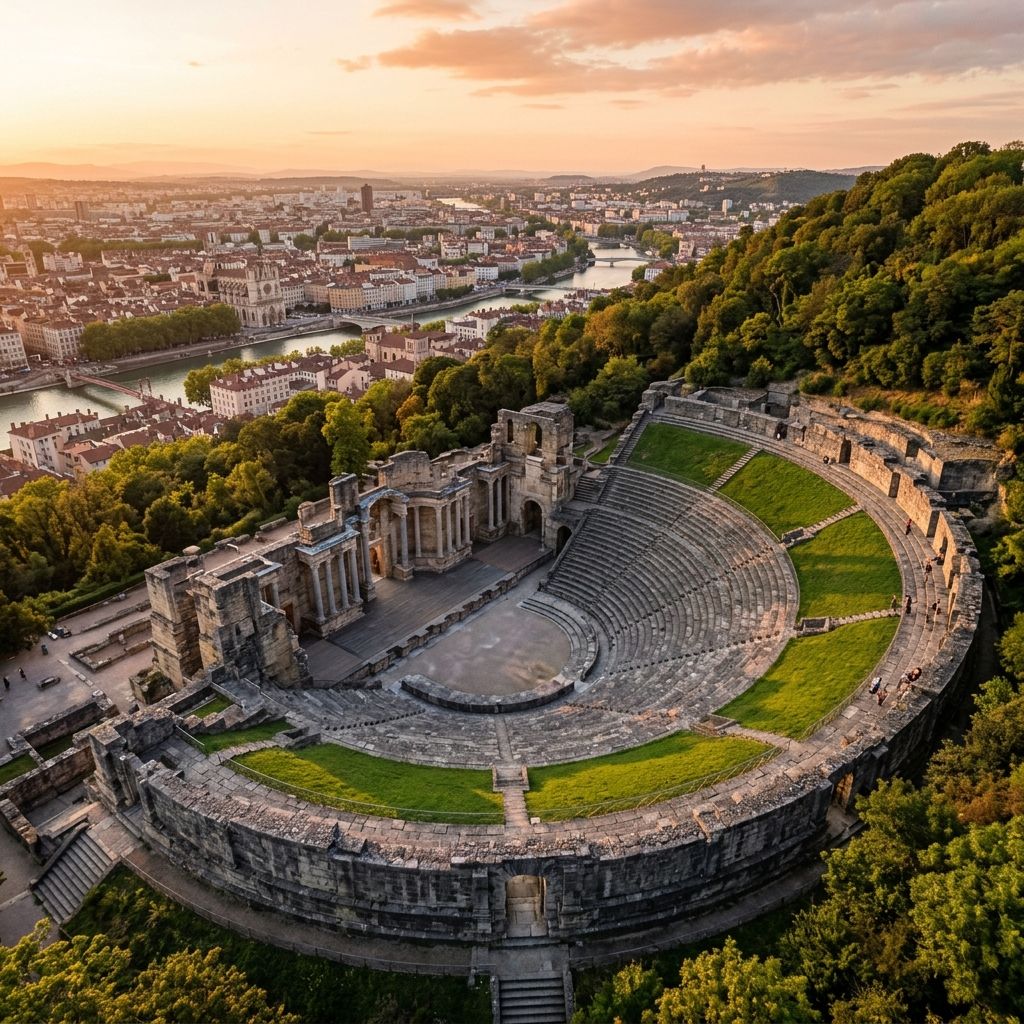
For the passionate traveler arriving in Lyon and for the researcher eager for relics of Antiquity, coming across the monumental grandstands of the Roman Theatre of Lyon is like seeing history materialize before their eyes. Perched atop the Fourvière hill, the monument offers a breathtaking visual spectacle, where steps of gray stone descend in a perfect curve toward the modern city skyline, beautifully framing the Saône and Rhône rivers. It is an immersive time portal that invites visitors to sit on the very same stones where, over two millennia ago, the citizens of Lugdunum gathered to laugh, cry, and applaud beneath the sky of imperial Gaul.
The geographical choice of the Fourvière hill to house the theater was not only of a military or defensive nature, but adhered to a rigorous visual and urban planning of classical engineering. The steep slope provided the ideal structural support to hold the tons of rock that formed the caveae (grandstands), minimizing landfill costs and ensuring a formidable physical stability that survived the passage of centuries. Today, as the sun begins to set and gilds the classical ruins, the archaeological site becomes the ultimate viewpoint of Lyon, establishing a dramatic dialogue between the monumental splendor of the past and contemporary urban dynamism.
From an archaeological standpoint, the visual impact of the Fourvière complex is unique in Europe because it brings together, in a single hanging garden, the Great Theatre and the neighboring Roman Odeon, forming a dual performance center of rare beauty. The 20th-century excavations cleared the dense vegetation that covered the stones, revealing refined details such as the stage foundations, rainwater drainage channels, and fragments of classical column porticos. For the tourist, the visit transcends a simple historical walk and becomes a profound reflection on human ingenuity and the eternity of cultural heritage.
Chapter
1.2. Why is this monument considered the oldest Roman theatre in France?
For those seeking to uncover the roots of Roman colonization in European territory, the Roman Theatre of Lyon stands as an unparalleled monument, being officially recognized by historians as the oldest theater built outside the Italian peninsula in Gaul. Erected around 15 BC under the direct orders of Emperor Augustus, this stone giant witnessed the birth of the Gallo-Roman civilization itself, serving as an architectural and conceptual model for all the arenas that would spread across France in the following centuries. To understand its antiquity is to understand the exact moment when the classical culture of Rome crossed the Alps to establish its permanent foundations in Celtic lands.
The chronological pioneering of this theater reflects the strategic importance that the Fourvière hill played in Rome's geopolitical chessboard during the early Empire. While other French provinces still relied only on temporary wooden structures or rustic dirt arenas, Augustus invested monumental resources to endow the newly founded colony of Lugdunum with a high-standard stone building. This initiative aimed to transform the city into the cultural, religious, and administrative center of the three Gaulish provinces, using the prestige of classical theatrical arts as a tool for peaceful assimilation and consolidation of imperial power.
The structural longevity of the monument lies in the transition from wooden construction techniques to the ultra-resistant limestone masonry that Deschamps and other classical engineers used in their foundations. In the first decades of its existence, the theater had a diameter of about 295 feet and hosted an audience of approximately four thousand five hundred spectators, an impressive size for a nascent colony. The success of its pioneering structure paved the way for Emperor Hadrian, in the 2nd century AD, to finance its monumental expansion, consolidating the building as a laboratory of Roman engineering that shaped classical French urbanism.
Chapter
1.3. The importance of Lyon (ancient Lugdunum) in the European Roman cultural scene
For the researcher or tourist exploring the archaeological park of Fourvière, the grandeur of the ancient theater makes perfect sense when placed in the context of Lugdunum, the legendary Roman metropolis that served as the administrative capital of all the Gauls. Founded in 43 BC by general Lucius Munatius Plancus on the hills dominating the strategic confluence of the Saône and Rhône rivers, the city quickly became the main financial, cultural, and road hub of the European continent. Being in Lyon during Antiquity meant being at the epicenter of decisions linking the Rhine river frontiers to the heart of Rome.
The cultural importance of Lugdunum was so monumental that the city held the exclusive privilege of housing the Federal Sanctuary of the Three Gauls, where annually delegates from sixty Gallic tribes gathered to swear loyalty to the Roman emperor and celebrate gala festivals. The theatrical complex of Fourvière functioned as the physical extension of this power, hosting dramatic performances, poetry recitals, musical exhibitions, and world-class philosophical debates that attracted brilliant minds from all over the Mediterranean. This intellectual dynamism transformed Lyon into a center of artistic and literary innovation of undeniable academic prestige.
From an economic and traffic standpoint, Lugdunum operated as a gigantic commercial port of entry for exotic goods, which enriched the local elite and allowed the private financing of major artistic performances. The rare marbles that decorated the stage of the theater and the odeon were brought on cargo ships from Egypt, Greece, and Asia Minor, symbolizing the purchasing power of a cosmopolitan city that rivaled Rome itself in luxury. To study the classical heritage of Lyon is, therefore, to understand the strength of an economic and cultural ecosystem that shaped the foundations of modern Europe.
Chapter
2. The Great Empire of Augustus and Hadrian: How Lyon Became the Capital of Gaul
Chapter
2.1. The role of Augustus in the administrative reorganization of the Gallic provinces
Walking through the classical ruins of the Roman Theatre of Lyon is to step on the starting point of the grand geopolitical strategy that Emperor Augustus designed to pacify and administer the Gaul territory conquered by Julius Caesar. For the tourist and historian, the monument is not merely a leisure piece of gray stone, but the physical anchor of a monumental administrative revolution that transformed the ancient colony of Lugdunum into the capital of the entire Roman province. By concentrating power on the Fourvière hill, Augustus established an efficient governance model that peacefully connected Celtic cultures to the heart of Rome.
Augustus immediately realized that the pure and simple military force of the Roman legions was insufficient to maintain the cohesion of a territory as vast and ethnically diverse as Celtic and Transalpine Gaul. During his historic visit to Lugdunum in 15 BC, he initiated an ambitious plan of road integration, border reorganization, and urban infrastructure modernization, dividing the territory into three main provinces coordinated from Lyon. The Roman theater of Fourvière was erected in this exact historical context as the grand public stage for the diffusion of the Latin language, imperial laws, and the official Roman religion.
Augustus's policy of involving Gaulish tribal elites in the Roman imperial governance system ensured a formidable civil stability that generated centuries of peace in the region. Local chiefs gained citizenship and prominent seats reserved in the front rows of the gray stone grandstands of the Fourvière theater, where they watched classical tragedies and comedies alongside Roman generals. This prestigious cultural fusion transformed Lyon into the beacon of classical civilization in central Europe, demonstrating the power of architecture designed not only to retain earth but to unify peoples.
Chapter
2.2. The luxurious residence of the governors of Lugdunum and Roman imperial influence
For those exploring the top of the historic Fourvière hill, the physical proximity between the grandstands of the Roman Theatre of Lyon and the archaeological remains of classical luxury villas reveals the exquisite daily life of the elite who administered the Empire. The wooded slopes of the hill housed the palace of the governor of the Gallic province and the luxurious residences of Roman patricians, structures featuring central underfloor heating, mineral water thermal baths, and floors decorated with high-precision colorful mosaics. Studying these ruins means understanding the opulent standard of living that Rome exported to France over two thousand years ago.
Rome's imperial influence in Lugdunum manifested in the architecture of these residential properties, which faithfully reproduced the design of open central courtyards and elegant colonnades characteristic of palaces on the Italian peninsula. The governors of Lyon acted as direct representatives of emperors Augustus and Hadrian, coordinating the finances of the Gallic provinces, issuing civil law sentences, and organizing public gala festivals that filled the Fourvière theater with entertainment. The palace was the administrative heart from which orders were dispatched to maintain commercial roads and bridges.
The decorative richness of these Roman villas, whose brightly colored frescoes and classical marble statues are preserved in the adjacent Lugdunum museum, reflects the high economic attraction the city held over the greatest artisans of the classical world. Local patricians financed the construction of hanging gardens with running water fountains and observation terraces opening up to the ancient Vieux Lyon with its river spectacles. Visiting the archaeological park today is, therefore, to contemplate the remnants of a golden era where Roman civil luxury found its perfect setting on the slopes of France.
Chapter
2.3. How the Gallic elite assimilated architectural traditions and theatrical games
For the contemporary observer studying the history of classical France, the peaceful transition of Celtic warrior tribes into urban citizens integrated into Rome's discipline is one of the most fascinating social phenomena of European Antiquity. This transformation occurred largely through voluntary assimilation and the fascination that theatrical games and the architectural monumentality of the Roman Theatre of Lyon exerted on the ancient Gallic elite. Instead of imposing Roman culture at the point of a sword, Augustus and his governors used dramatic spectacle and civic comfort as irresistible tools of social attraction.
The chiefs of the Gallic tribes quickly realized that, to maintain their economic relevance and political authority in Rome's new geopolitical chessboard, it was essential to adopt the cultural habits, gala attire, and forms of entertainment of the imperial court. They financed out of their own pockets the construction of secondary roads, the decoration of classical temples, and the physical expansion of leisure spaces like the Fourvière theater, engraving their own names in Latin on bronze plaques and tombstones of gratitude. This social prestige investment permanently integrated the local aristocratic families into the Roman elite.
The active participation of the local population in the theatrical games and classical artistic festivals of Lugdunum broke down old linguistic barriers and consolidated the use of Latin as the common language of commerce and continental diplomacy. On the gray stone grandstands of the ancient theater, the Gauls learned to laugh at the same classical myths and admire the same republican heroes represented on the monumental stage, forging a unique hybrid cultural identity: the Gallo-Roman civilization. The Fourvière monument remains the greatest physical testimony to this historic encounter that shaped the course of French civilization.
Chapter
3. The History of the Roman Theatre of Lyon: From the Origins of Lugdunum to the Rescue
Chapter
3.1. The foundation by Lucius Munatius Plancus and the peak of the capital of Celtic Gaul
Crossing the portal of the Fourvière archaeological site is coming into direct contact with the military audacity of Lucius Munatius Plancus, the Roman general and former lieutenant of Julius Caesar who founded the colony of Lugdunum in 43 BC under the sky of Celtic Gaul. For the fascinated tourist and the researcher, the birth of this city represents the starting point of one of the most radical urban transformations in Western Europe, where a rustic hill inhabited by Celtic peoples was converted into a high-standard imperial stone metropolis. The theater was the instrument of cement and limestone chosen to seal this cultural transition, offering classical art and leisure for the new Roman population.
In the early years following the foundation, Plancus focused his efforts on building walled defenses, high-flow aqueducts, and communication routes linking the new hub to the river ports of the Saône river. However, aware that a true Roman power center required spaces dedicated to civic and cultural life, he planned the initial alignment of the theater on the eastern flank of the Fourvière hill. Under the direction of Emperor Augustus, who succeeded the republican period, the works gained a frantic pace, resulting in the inauguration of the first version of the monument around 15 BC, transforming the slope into a landmark of glory.
The theater's peak coincided with the spectacular population and financial growth of Lugdunum in the 1st and 2nd centuries of our era, when the colony became the Empire's coin-producing center and the official residence of high-ranking imperial officials. Dramatic performances attracted crowds of citizens who filled the stone grandstands in a hierarchical manner, reflecting Rome's social structure and civic discipline in Gaul. This golden age of spectacles consolidated the monument as the territory's primary engine for political propaganda and social integration, proving that classical art was the pillar of stability and prestige of power.
Chapter
3.2. The monumental expansion under the reign of Emperor Hadrian in the 2nd century AD
Walking through the current ruins of the Roman Theatre of Lyon is coming face to face with the expansion marks left by Emperor Hadrian, the brilliant and traveling mind who redesigned the monumental heritage of the Empire in the 2nd century AD. Upon visiting the capital of the Gauls in 121 AD, Hadrian realized that the original theater built by Augustus, although impeccable in its architecture, had become too small to accommodate the mass of citizens of a rapidly growing metropolis. The emperor ordered and financed a colossal engineering expansion that doubled the size of the building and elevated it to the status of one of the largest theaters in the Roman world.
The renovation commissioned by Hadrian added a third external cavea (grandstand) over the ancient structure, raising the building's total diameter to about 354 feet of physical stone width. This highly complex expansion allowed the audience capacity to jump from four thousand five hundred to over ten thousand simultaneous spectators, a colossal scale that required the construction of new underground circulation galleries and safety archways. Roman engineers also redesigned the back wall of the stage (*frons scenae*), erecting monumental columns of rare marbles brought from all corners of the commercial Mediterranean.
The practical result of this imperial investment was the consolidation of Lyon as the definitive hub for dramatic performances and gala festivals in Western Europe, where acoustic quality and aesthetic beauty rivaled the most luxurious structures of Rome or Athens. Hadrian's expansion was also a political act that reaffirmed the importance of Lugdunum as the cultural heart of the Empire in Gaul, stimulating the local economy and consolidating the influence of the Gallo-Roman elite. Today, the ruins that tourists touch in the Fourvière archaeological park are, to a large extent, the physical testimony of this golden era of wealth and expansion.
Chapter
3.3. The long period of oblivion and the systematic excavations of the 20th century
For the lover of archaeological mysteries and stories of heritage recovery, the trajectory of rescuing the Roman Theatre of Lyon in the 20th century is an emotional saga of stone detectives who brought a giant back to light after centuries of absolute oblivion. With the fall of the Roman Empire and the progressive abandonment of the Fourvière hill during the Middle Ages, the imposing theatrical complex of Augustus and Hadrian slowly disappeared beneath dense layers of earth, urban debris, and undergrowth. For over a thousand years, generations of Lyonnais who walked the hill were completely unaware that beneath their feet rested the largest classical monument in France.
The scientific rediscovery began to take shape at the end of the 19th century, when small fragments of marble columns and Roman coins started to appear during agricultural excavations and private residential works on the slopes of Fourvière. However, it was only in the 1930s, under the visionary leadership of Lyon's mayor Édouard Herriot and the fearless archaeologist Pierre Wuilleumier, that a systematic program of public archaeological excavations was financed and initiated. The work was colossal, requiring the careful demolition of old residential properties and the manual removal of thousands of tons of earth accumulated over centuries of abandonment.
As archaeologists advanced down the slope, the monumental gray stone structure emerged intact from the bowels of the earth, surprising experts with its extraordinary physical preservation and construction quality. The careful restoration of the grandstands and underground circulation galleries returned to the world the original design envisioned by the builders of Augustus and Hadrian. The official inauguration of the recovered archaeological site in 1946 was a civic milestone for Lyon, rescuing the city's classical heritage and transforming the slumbering old ruins into the main postcard and cultural pride of the region.
Chapter
4. The Mystery of the Abandonment of the Roman Theatre of Lyon: How the Arena Became a Quarry
Chapter
4.1. The decline of Lugdunum with the fall of the Western Roman Empire and the Middle Ages
For the contemporary historian and for the tourist contemplating the monumental ruins of the Fourvière hill, it is difficult to imagine that the imposing theatrical complex that hosted ten thousand gala spectators was abandoned and forgotten through centuries of material darkness. The decline of the Roman Theatre of Lyon began to take shape at the end of the 3rd century AD, with the first barbarian invasions that crossed the Rhine river and the political and administrative weakening of Lugdunum as the administrative capital of the Gauls. The decline of Rome dragged with it the urban luxury of the great colonies, transforming the stone temples into silence.
With the fragmentation of the Western Roman Empire and the progressive Christianization of European society during the early Middle Ages, classical dramatic performances and pagan theatrical games were condemned by the new ecclesiastical authorities, who saw the Roman arenas as dens of civil immorality. The population of Lyon began to migrate down the slope, abandoning the top of the Fourvière hill to settle on the safer and more commercial banks of the Saône river, founding the neighborhood that today corresponds to the ancient Vieux Lyon of river spectacles. The monumental theater was left isolated, plunged into twilight.
Without periodic urban maintenance and at the mercy of the climatic severities of the European summer and winter, the wooden structures of the stage rotted quickly and collapsed onto the orchestra slabs, while the underground circulation galleries began to accumulate earth and debris washed down by the Fourvière hill floods. The grandiose back wall of the stage of Augustus and Hadrian slowly crumbled, burying the marble columns and luxury statue niches that once projected the human voice with such acoustic clarity. The greatest monument of Gaul began its long journey of oblivion under the silence of medieval forests.
Chapter
4.2. The dismantling of classical stones for the construction of local churches and monuments
For those studying the history of urban architecture in Lyon, the physical disappearance of the upper part of the Roman Theatre of Lyon reveals a common and tragic phenomenon that devastated Europe's classical heritage during the Middle Ages: the ruthless recycling of monumental stones. Deprived of active quarries and needing to erect new defensive fortifications, Romanesque churches, and stone palaces on the banks of the Saône, medieval builders saw the Roman theater of Fourvière as an immense and free mine of high-quality limestone and rare marbles already sculpted and ready for technical use.
Workers methodically dismantled the upper rows of the grandstands and the highest floors of the imposing back wall of the theatrical stage, dragging the heavy ashlar stones down the slope with the help of pulleys and draft animals. The marbles imported from Egypt and Greece that decorated the elite seats and the statue niches of Emperor Augustus were turned into lime in local kilns or sliced to embellish the altars of Lyon's churches, such as the Saint-Jean Cathedral itself. The classical stone bridge also received foundations reused from the theater.
This systematic dismantling process reduced the monument to its basic rock skeleton carved into the very slope of the Fourvière hill, saving from physical destruction only the lower steps that had already been covered by earth accumulated by the hill's floods. The theater, once the definitive symbol of Roman imperial glory in the capital of Gaul, became a forgotten monument, a phantom quarry whose true classical utility was erased from the memories of local citizens throughout centuries of feudal transitions.
Chapter
4.3. How vegetation covered the ruins, transforming the site into local legend and myth
For lovers of European folklore and urban legends of ancient mysteries, the period when nature covered the ruins of the Roman Theatre of Lyon is a fascinating chapter on how physical heritage can transform into spiritual myth. With the advance of the Middle Ages and the Renaissance, the layers of clayey earth accumulated by rains on the Fourvière hill created the ideal soil for a dense forest of oaks, agricultural vineyards, and private gardens to cover the remains of the gray stone grandstands that resisted dismantling. The classical giant was completely buried, visible only in the local imagination.
The Fourvière hill, once the center of Roman power, came to be seen by local peasants as a mysterious space haunted by spirits of the classical pagan past of spectacles. The few arches of underground circulation galleries that still appeared on the surface of private residential gardens were called by the population "the caves of the giants" or "the tombs of the martyrs," giving rise to legends of secret tunnels connecting the hill to the deep sewers of ancient Vieux Lyon. The true archaeological identity of Fourvière had been lost in the mists of time.
Many landowners on the hill built rustic stone wine cellars taking advantage of the arches of the Roman vomitorium of Augustus, using the ancient concrete foundations without knowing they were stepping on the elite seats of the imperial dynasty. It was necessary to wait until the 20th century for historical science and the civic courage of archaeologists to demystify these popular myths, cutting down the trees and digging up the clayey earth to rescue the stone truth that rested silently under the green mantle of Fourvière.
Chapter
5. Curiosities of the Roman Theatre of Lyon: Facts the Guides Won't Tell You
Chapter
5.1. The secret excavation and the rescue of the ruins financed by courageous mayors
For those passionate about real political plots and stories of civic bravery behind the scenes of European heritage, the true story of how the Roman Theatre of Lyon was saved from urban burial is a narrative worthy of espionage books. In the early 1930s, the Fourvière hill was entirely subdivided for private real estate investors and local religious orders who planned to erect large complexes of residential buildings on the slope, ignoring the rare signs of gray Roman arches appearing in the gardens.
It was at this critical moment that the figure of Édouard Herriot grew, the legendary and obstinate mayor of Lyon who governed the city for decades with an unwavering commitment to public culture. Knowing that expropriating private lands on the Fourvière hill would cause a violent judicial war with the local conservative elites, Herriot used secret municipal funds and emergency public works budgets under the pretext of sanitary sewer improvements to discreetly acquire the plots where archaeologist Pierre Wuilleumier suspected the grandstands of Augustus rested.
This silent and courageous fiscal maneuver by Herriot allowed teams of workers and archaeologists to begin the first systematic archaeological excavations under the protection of the Lyon municipal police, preventing private construction companies from cementing over the greatest classical monument in Gaul forever. The technical rescue of the historical caveae amidst the political tensions that preceded the Second World War was one of the greatest acts of resistance and love for historical heritage in the republican France of the era, returning to light a priceless national asset.
Chapter
5.2. The legend of the Christian martyrs of Lyon and clandestine meetings in the monuments
For the military historian or for the travel tourist seeking to understand the profound religious transformations that shook the Roman Empire in the 2nd century AD, the Fourvière archaeological park carries dark spiritual connections that point back to the legend of the Christian martyrs of Lugdunum. In the year 177 AD, under the empire of Marcus Aurelius, the nascent Christian community of Lyon was the target of violent popular persecution, resulting in the summary execution of dozens of faithful (such as the slave Blandina and Bishop Pothinus) in the local civic arena of spectacles.
Although the historical martyrdom officially took place at the "Amphitheater of the Three Gauls" on the neighboring Croix-Rousse hill, the popular legend and oral tradition of Lyon associated for centuries the dark tunnels and underground circulation galleries of the Roman Theatre of Lyon as the secret refuge and clandestine meeting place of the persecuted Christians. In the dead of the cold night, the faithful secretly descended the wooded slopes of Fourvière to hide in the vomitorium of Augustus, sharing bread and prayers of courage under the noise of Germanic sentinels or Roman patrols.
These stories of clandestine faith and spiritual sacrifice helped keep alive the mystical and sacred aura surrounding the stone ruins of Fourvière even during the period when the dense forest covered the classical theater in the Middle Ages. Today, walking through the arched passages that support the gray grandstands, the attentive visitor feels the solemn vibration of a monument that was a physical witness to moral disputes that redesigned the philosophical foundations of modern Western man and the transitions of Roman imperial pagan power.
Chapter
5.3. How archaeologists discovered the true extent of the cavea under private gardens
Imagine the surprise of a Lyon resident in the 1930s upon seeing archaeologists enter their residential garden at the top of the Fourvière hill with pickaxes and shovels, digging the clay soil under their private vegetable patch to reveal, just a few feet deep, the immense upper grandstands of the oldest Roman theater in France. The discovery of the true physical extent of the monument of Augustus and Hadrian was one of the greatest technical surprises in European classical archaeology, requiring colossal urban mapping and expropriation work.
Archaeologists led by Pierre Wuilleumier used high-precision aerial photographs taken by thermal balloons in the Lyon summer to identify subtle differences in the growth of vegetation and grass on the Fourvière slope. The classical limestone and Roman concrete foundations under the soil prevented plant roots from going deep, generating perfect semicircular marks on the surface of private gardens that corresponded exactly to the design of the ancient Roman caveae buried under the earth.
This work of botanical and geological detectives made it possible to map the entire classical archaeological complex even before digging the first shovel of clay soil, avoiding the accidental destruction of fragile structures and ensuring the perfect preservation of the underground circulation galleries of the vomitorium. The controlled demolition of the old residential houses covering the ruins was done in friendly partnerships and reconciliations with local landowners, transforming old vineyard backyards into the public archaeology jewel that tourists admire today.
Chapter
6. The Architecture of the Roman Theatre of Lyon: Engineering and Acoustics of the Empire
Chapter
6.1. The engineering of the caveae carved directly into the slope of the Fourvière hill
If you pause on the gray stone grandstands of the Roman Theatre of Lyon to observe the perfect inclination of its staircases, you will be facing one of the most brilliant and economical civil engineering solutions of classical Antiquity. Instead of erecting complex supporting arch structures of masonry from flat ground—which would require a colossal consumption of mortar and bricks—Roman architects took advantage of the natural geological slope of the Fourvière hill to carve and support the cavea directly on the rock. For the tourist or modern engineer, the monument is a living study of how classical architecture integrated intelligently and sustainably into the urban relief.
The excavation and laying of the limestone and granite blocks required millimeter-precise geometric planning of weight dispersion and control of hydrostatic forces of the hill. The builders of Augustus excavated horizontal supporting terraces on the clayey slope, covering them with a waterproofing layer of lime mortar and volcanic ash to prevent rainwater infiltration from shifting the grandstand stones over time. On this stable base, they rested the heavy gray ashlar slabs, carving the access stairs and the seats that perfectly accommodated the different classes of spectators.
The result of this direct laying technique was formidable natural wear and seismic resistance, allowing the basic structure of the grandstands to remain intact even after centuries of burial and abandonment. The inclination of the Fourvière caveae also ensured that each of the ten thousand spectators enjoyed a clean and unobstructed sightline to the stage, eliminating blind spots and democratizing the visual experience of classical dramatic performances. Today, walking down these monumental steps, the visitor experiences the same tactile engineering design planned over two thousand years ago by the emperor's master builders.
Chapter
6.2. The acoustic functioning of the marble columns and the monumental stage wall
For those standing in the exact center of the semicircular orchestra of the Roman Theatre of Lyon and whispering a simple word, the crystal-clear sound effect that propagates to the highest step of the grandstand is a breathtakingly fantastic acoustic experience. Far from being a fortunate geographic accident, this perfect sound propagation is the product of highly sophisticated acoustic physics that Roman architects mastered with absolute technical brilliance. The great secret lay in the back wall of the stage (*frons scenae*), a monumental three-story masonry structure that acted as a gigantic acoustic box and voice wave reflector mirror.
The monumental stage wall, which at its peak under Emperor Hadrian rose to over 98 feet in physical height, was decorated with fluted marble columns and niches holding bronze and limestone statues that had strategic concave surfaces. These classical luxury decorations did not merely serve an aesthetic role of propaganda, but functioned as acoustic diffusers that prevented echo formation and distributed sound waves evenly across the entire semicircular extension of the grandstands. The wooden floor of the stage and the perfect geometric inclination of the caveae completed the physical system of lossless voice wave conduction.
Furthermore, Lugdunum's engineers used bronze resonator vases tuned to specific mathematical frequencies, embedded in hidden niches beneath the gray stone grandstands of the theater. These physical devices, based on the acoustic theories of the Roman architect Vitruvius, captured the voices of actors and lyric singers and passively amplified them, ensuring that the dramatic nuances and classical poetry were heard with impeccable clarity even in the last row of seats. Feeling the sound propagate with such clarity today in the Fourvière ruins is a tribute to Rome's classical scientific intellect.
Chapter
6.3. The structure of the underground circulation galleries for elite spectators
Exploring the dark and cool tunnels passing beneath the monumental grandstands of Fourvière means discovering the secrets of circulation and social security that organized the flow of thousands of the Empire's citizens. These underground galleries, known as *vomitoria*, were highly resistant stone arch passages designed with surgical traffic flow precision to empty the theater of ten thousand spectators in under ten minutes in case of civil emergencies. For the contemporary researcher, the engineering of these galleries reveals the pragmatic and disciplined side of Roman society applied to Lyon's civic urban planning.
The structure of the circulation galleries rigidly divided spectators hierarchically from the moment they crossed the outer gates of the Fourvière archaeological park. Common citizens and freed slaves used the upper external galleries to access the highest limestone seats farthest from the performance stage, while Lugdunum's governmental elite and patricians descended through smaller, exclusive tunnels that provided direct access to the orchestra and the front-row marble chairs. This physical separation prevented class mixing and invisibly ensured social order.
The full-centered supporting arches holding up the ceilings of these gray underground galleries are testaments to the strength of classical Roman mortar, made of lime, sand, and mineral water, which acquired the hardness of granite stone over time. The zenithal ventilation and light openings of these galleries were calculated to keep the internal environment always cool and illuminated during the suffocating heat of the European summer of spectacles. Walking through these tunnels carved into the Fourvière hill today is an unforgettable tactile stroll through the engineering backbone that sustained the amusement of the Roman world.
Chapter
7. The Roman Odeon of Lyon: The Sister Monument and Its Classical Luxury Mosaics
Chapter
7.1. The functional difference between the theater for the masses and the odeon for elite performances
For the leisure tourist and the historian exploring the Fourvière archaeological park, the presence of two semicircular gray stone structures of different sizes on the same archaeological site might initially generate understandable confusion. However, the Roman theatrical complex of Lyon reveals a dual urban planning of high civic sophistication, where the Great Theatre and the adjacent Roman Odeon performed totally distinct and complementary functions in the cultural life of Lugdunum. Understanding this division is essential to deciphering the spectacle politics and social hierarchy of the Empire.
While the Great Roman Theatre of Lyon was a monumental building geared towards mass spectacles, capable of accommodating ten thousand spectators from all social classes for grand tragedies, satirical comedies, and noisy civic celebrations under Augustus, the Roman Odeon was a space of classical luxury reserved for elite performances and more intimate events. With a capacity for about three thousand qualified spectators in the 2nd century AD, the odeon hosted Latin poetry recitals, refined instrumental music performances, Greek philosopher readings, and private patrician political meetings.
The functional difference was immediately reflected in the acoustics and physical roofing of the monumental building of Fourvière. The Roman Odeon had a permanent oak wood roof that protected the orchestra and grandstands from the climatic severities and the suffocating sun of the European summer, creating a closed environment that retained and amplified the delicate chords of lyres and harps without sound loss. In contrast, the classical theater, of colossal dimensions, only used the *velarium* system (large movable fabric canvases supported by masts) to flexibly protect the large audience of ten thousand people.
Chapter
7.2. The floor of rare marbles imported from Egypt, Greece, and Asia Minor in the Lyon odeon
Walking through the semicircular orchestra of the Roman Odeon in the Fourvière archaeological park is stepping on one of the most exquisite and expensive ornamental treasures to have survived the fall of the Roman Empire in French territory. The orchestra floor of the odeon is composed of a spectacular and luxurious geometric collage (*opus sectile*) made of rare marbles brought from all the provinces that made up Rome's global trade in the 2nd century AD. For the contemporary researcher or art tourist, this floor is a tactile testimony to the high economic capacity and prestige of classical Lyon's performances.
The marbles used in the Fourvière orchestra were selected with formidable chromatic rigor and monumental luxury by Emperor Hadrian's builders. The floor combines slabs of deep green porphyry brought from the imperial quarries of Greece, golden yellow marble (*giallo antico*) imported from the mountains of Numidia (modern-day Tunisia), and the extremely rare and expensive red and purple marble from Egypt. This polychromatic mixture of rare stones created a dazzling visual effect under daylight, symbolizing that the ancient colony of Lugdunum was fully integrated into the Mediterranean's most luxurious consumer network.
The physical preservation of these two-thousand-year-old polished slabs is an archaeological miracle, considering that most of the marbles from the neighboring Roman theater were destroyed or turned into lime during the Middle Ages. The meticulous restoration carried out by the curators of the Lugdunum Museum cleaned the crusts of clayey earth accumulated by the floods of the Fourvière hill, revealing the original shine of the period stones. Observing this classical luxury mosaic under the Lyon sun is an unforgettable sensory journey through the aesthetic pinnacle of Gallo-Roman civilization.
Chapter
7.3. The structure of the smaller colonnades and the intimate music and poetry performances
For lovers of ancient instrumental music and classical literature, the atmosphere of quietude surrounding the ruins of the Roman Odeon of Lyon immediately recalls the poetic refinement that characterized the elite soirées of Lugdunum. The odeon's architecture featured smaller, delicate stone colonnades framing the stage for intimate performances, granting the semi-classical building a much more human scale focused on artistic introspection than the monumental immensity of the neighboring Roman theater. Studying this space means stepping behind the scenes of leisure and refined intellectual debates of classical France.
The poetic performances and music recitals at the Odeon of Fourvière were highly sought-after academic prestige events by the Gallo-Roman aristocracy, attracting renowned philosophers, Latin poets, and orators traveling across the imperial provinces. The select audience of three thousand patricians sat in the front rows decorated with fine limestone seats, enjoying a dramatic experience of perfect acoustic proximity that discreetly facilitated the transmission of complex political ideas. The odeon functioned as the cultural parlor of the local government.
The ruins of the back wall and marble columns of the Lyon Odeon, although smaller in physical scale than those of the adjacent Roman theater, exhibit the same ashlar rigor and granite block-laying techniques that characterized 2nd-century AD imperial urbanism. The grassy terraces surrounding the classical monument are ideal spots for leisure tourists to rest in the shade during the afternoon, listening to the whisper of the Fourvière hill breeze that once carried the chords of Celtic poets integrated into the Roman way of life.
Chapter
8. The Lugdunum Museum of Lyon: The Fantastic Architecture of Bernard Zehrfuss
Chapter
8.1. The spectacular integration of the underground concrete museum with the archaeological park
For the contemporary architect and for the tourist fascinated by avant-garde design, entering the Lugdunum Museum, adjacent to the ruins of the Roman Theatre of Lyon, is experiencing one of the most impressive and ingenious spatial experiences in the entire European continent. Designed in the 1970s by acclaimed French architect Bernard Zehrfuss, one of the masters of classical brutalism, the museum was conceived to be completely invisible from the surface of the Fourvière archaeological park. Buried deep within the clayey slope, the building spectacularly integrates into the stone landscape without breaking the visual harmony of the ancient Roman grandstands.
Zehrfuss immediately understood that erecting a conventional modern glass and steel building next to a two-thousand-year-old Roman theater built under Augustus would be a true visual sacrilege that would compromise the region's cultural heritage integrity. His audacious engineering solution was to dig into the soil of the Fourvière hill itself, creating a raw reinforced concrete structure that perfectly molds to the underground geological relief. The visitor walks through the classical hanging gardens and suddenly comes across concrete entrance doors that plunge into a labyrinth of classical lights and shadows.
The result of this invisible brutalist architecture is absolute respect for the monumentality of the theater ruins and the neighboring ancient Roman odeon. The textured concrete used on the museum walls was produced by mixing local sand and pebbles from the Fourvière hill itself, giving the modern building the same rough, gray mineral tone that characterizes the time-worn Roman grandstands. Visiting the Lugdunum Museum is, therefore, witnessing how high-performance contemporary design can pay homage to the Empire's engineering with humility and spatial genius.
Chapter
8.2. The magnificent spiral concrete ramp and the curation of Gallo-Roman mosaics
If you cross the concrete doors of the Lugdunum Museum of Lyon, you will be guided by a magnificent and monumental reinforced concrete ramp descending in a continuous spiral through the bowels of the Fourvière hill. This brutalist ramp designed by Bernard Zehrfuss has no stone steps or heavy visual barriers, creating a continuous and elegant spatial flow leading the visitor on a chronological journey through Lugdunum's history, from Celtic prehistory to the fall of the Empire of Augustus and Hadrian. For the researcher or tourist, walking down this ramp is floating in classical time.
The museum's curation took advantage of the concrete ramp design to exhibit, in niches perfectly integrated into the brutalist structure, the largest and most valuable collection of Gallo-Roman mosaics in all of France. These immense carpets of colored stones and rare marbles, rescued from classical luxury villas and public buildings of the ancient capital of Lyon, depict complex scenes from classical mythology, chariot races in Roman circuses, and gala banquets of the imperial aristocracy. The LED lighting was adjusted to highlight the high precision of the ancient artisans who shaped the mineral glass.
The brutalist ramp also brings the visitor before priceless bronze relics and archaeological treasures, such as the famous "Lyon Tablet" (*Tabula Claudiana*), an immense bronze plate preserving the royal speech of Emperor Claudius (born in Lyon itself) delivered before the Senate in Rome in 48 AD. The aesthetic contrast between the rough gray concrete of the museum walls and the delicacy of the two-thousand-year-old colored mosaics creates a solemn atmosphere of a cathedral of history, consecrating the Fourvière space as the region's greatest archaeological hub.
Chapter
8.3. The immense raw concrete windows framing the view of the ancient Roman theater
For those walking down the spiral concrete ramp of the Lugdunum Museum of Lyon, the visual climax of the archaeological visit occurs upon encountering the immense "light cannons" or monumental windows that Bernard Zehrfuss carved into the facade of the underground building. These geometric openings of raw concrete, which project outward from the Fourvière hill slope in a dramatic fashion, act as true cinematic frames bringing the grandstands of the Roman Theatre of Lyon directly into the exhibition rooms. It is a brilliant visual fusion between the showcased archaeological collection and the external ruins of Augustus.
The raw brutalist concrete windows were positioned with high mathematical and telescopic precision by Zehrfuss to focus the visitor's gaze on specific details of the Great Theatre and the neighboring Roman Odeon as they descend through the museum. In one room, the concrete frame displays only the gray stone foundations of the monumental stage; in another, the angle widens to reveal the semicircular immensity of the grandstands that accommodated ten thousand spectators under Hadrian's empire. This continuous visual dialogue eliminates the claustrophobic sensation of being in a classical underground museum.
The intelligent use of low-reflection double-tempered glass ensures that natural daylight illuminates the displayed Gallo-Roman mosaics without exposing them to ultraviolet rays harmful to the conservation of period mineral pigments. Sitting on the concrete benches in front of these monumental Fourvière windows, observing the silent archaeological park while reading about the Roman engineering that erected it, is an unforgettable contemplative moment of qualified tourism that makes any travel itinerary through France worthwhile.
Chapter
9. Nuits de Fourvière at the Roman Theatre of Lyon: The Great Summer Festival
Chapter
9.1. The rebirth of the classical space through concerts, theater, dance, and opera
Attending a music concert under the light of colorful spotlights and real stars, with the cool night breeze touching the two-thousand-year-old stone grandstands, is witnessing the miracle of cultural rebirth that happens annually at the Roman Theatre of Lyon. Through the renowned *Les Nuits de Fourvière* festival, the ancient monument built under the empire of Augustus gains new life every European summer, converting its silent archaeological ruins into the most vibrant, dynamic, and coveted stage in all of France. It is an incomparable poetic fusion between the monumental weight of ancient history and the electric pulse of contemporary performing arts.
The *Les Nuits de Fourvière* festival, created in mid-1946 right after the complete rescue of the classical ruins by Wuilleumier's public excavations, was born with the bold artistic mission of returning the Roman theater to its original vocation of mass entertainment. The program spans two uninterrupted months of world-class performances, ranging from classical operas and progressive rock concerts to conceptual circus shows, modern dance, and Greek theater plays. The semicircular space of the historical caveae offers an intimate physical proximity and breathtaking dramatic energy between the artists and the ten thousand spectators.
The original acoustics designed by Augustus's engineers and expanded under Emperor Hadrian in the 2nd century AD work perfectly with modern digital sound systems, propagating every musical note and dramatic whisper with cathedral-like clarity under the open sky. International artists describe the experience of performing in Fourvière as a mystical milestone in their careers, feeling the vibration of centuries of artistic rituals engraved in every gray limestone block. For the tourist, the festival is the golden passport to experience the true artistic soul of Lyon in an atmosphere of pure lighting magic.
Chapter
9.2. How the festival annually attracts thousands of spectators from all over the world
For tourism festival organizers and cultural economy professionals in Europe, the *Nuits de Fourvière* represent one of the greatest successful case studies of historical heritage valuation integrated into the daily life of a vibrant modern metropolis. Attracting over two hundred thousand national and foreign spectators from the most diverse geographical origins annually, the festival has converted Lyon into France's main cultural summer hub, formidably boosting the network of hotels, classical luxury restaurants, and public transportation. The event is a true monument of regional commercial attraction and dynamism.
The festival's global appeal lies in its refined and bold artistic curation, which blends legendary icons of international music (such as Bob Dylan, Björk, Sting, and Robert Plant) with avant-garde theatrical and dance productions not seen on any other French stage. Tickets for the show nights sell out within minutes of the opening of global digital sales on the official website, attracting travelers from all over the world who plan their summer vacations strictly focusing on the Fourvière performance dates. This cosmopolitan circulation of people and creative minds preserves the ancient multicultural spirit that characterized Roman Lugdunum.
In addition to the performances at the Great Theatre, the neighboring Roman Odeon is also integrated into the festival's stage network, hosting intimate classical music concerts and poetry readings under the warm light of candles and soft lamps. The entire archaeological park becomes an elegantly illuminated courtyard for leisure and collective gathering, where tourists, academic students, and local families mix to celebrate classical and contemporary art hand in hand. Participating in one of these gala nights in Fourvière is experiencing a profound sensory experience that remains engraved in one's travel memory forever.
Chapter
9.3. Essential tips for buying tickets and watching shows under the starry sky
If you are planning your next cultural tourism trip to Lyon during the European summer months (June to July), securing a spot on the gray stone grandstands of the Fourvière festival requires a good logistical strategy of planning and electronic speed. Since the national and international demand for shows is massive and the physical spaces in the historical caveae are strictly limited by archaeological conservation and civic safety, official sales open in early spring on the institution's official website and require a mandatory advance digital registration to avoid surprises.
The golden travel tip for those who manage to secure a ticket is to arrive at the Fourvière archaeological park at least an hour and a half before the official start time of the gala artistic performances. Because access to the classical limestone grandstands does not have individual numbered seats (with the exception of reserved VIP chairs), spectators sit freely and communally on the same steps where Roman citizens sat two thousand years ago, allowing early arrivals to choose the best central acoustic spots close to the orchestra.
Another poetic and indispensable tradition of the *Nuits de Fourvière* is the use of small padded green cushions distributed free of charge by the festival's organizing team at all archaeological entrance gates. The theater's stone steps, although beautiful and cool, become hard and uncomfortable after hours of shows, and these cushions ensure the perfect comfort of the spectators. At the end of the performances, in a traditional gesture of thanks and visual applause, the audience usually throws the cushions towards the classical performance stage, generating a beautiful and traditional green shower of artistic affection.
Chapter
10. Panoramic View of Fourvière in Lyon: How to Capture the Perfect Photo
Chapter
10.1. The best observation points to frame the Roman ruins with Vieux Lyon
If you are a visual content creator or an amateur photographer looking for the definitive golden angle of Lyon, the Fourvière archaeological park holds breathtaking photographic settings that mix the rustic textures of two thousand years with the terracotta skyline of the medieval historical center. The best observation point of the Roman Theatre of Lyon to capture this classical composition is located in the upper grandstands of the north wing (*summa cavea*), where the semicircular curvature of the gray stone steps guides the viewer's eyes in a natural guideline toward the urban valley.
From this elevated viewpoint on the Fourvière hill, the classical photographic framing integrates the physical monumentality of the Roman ruins built under Augustus's empire with the Gothic silhouette of the Saint-Jean Cathedral and the Renaissance-style reddish roofs of the ancient Vieux Lyon of river spectacles. On clear days without urban smoke clouds, the visual contrast extends to the modern commercial district of "Part-Dieu" and its high-performance pencil-shaped skyscraper, creating a fantastic temporal overlapping of three distinct historical eras in a single click.
Another technical tip for tourism photographers is to approach the fluted marble columns that were re-erected at the base of the monumental stage of the ancient Great Roman Theatre. By positioning the low-reflection camera at ground level and using a wide-angle lens, the professional can frame the semicircular grandstands through the gaps of the classical columns, generating a breathtakingly incredible depth of field composition that enhances the Roman geometric design applied to Lyon's urban relief.
Chapter
10.2. How to take advantage of the warm late afternoon light to photograph the Fourvière stones
To get the golden glow and the textured shadows that set the tone of mystery and nobility to European cultural heritage postcard photos, the best time to visit the Roman Theatre of Lyon with a camera in hand is the famous "golden hour" in the late afternoon. Since the Fourvière theater was strategically built facing the east of the spectacle hill to catch the morning sun rays and protect the large audience of ten thousand people from the midday heat, the late afternoon sun hits the monument from behind, generating spectacular backlight effects.
As the sun begins to dip behind the Basilica of Notre-Dame de Fourvière at the top of the hill, the oblique rays of light pass through the monumental columns and the trees of the archaeological park, bathing the gray stone steps of the theater in a palette of warm colors that fluctuates from soft red to deep amber. This warm light highlights the rustic texture and period ashlar scars left by the hammers of the classical builders of Emperor Augustus and Hadrian, giving three-dimensionality to the old limestone slabs.
The contrast of shadows cast by the semicircular grandstands and the underground circulation galleries of the vomitorium creates an unmatched dramatic and poetic effect of Roman civic solitude, perfect for artistic photoshoots or high-aesthetic impact travel photos on travel Instagrams. For those shooting with tripods or high-precision ND filters, the beginning of the "blue hour" shortly after sunset offers the perfect moment to capture the gray artificial digital LED lighting that silently turns on throughout the classical archaeological park.
Chapter
10.3. The fascinating visual contrast between the classical ruins and the modern urban skyline
Walking through the Fourvière grandstands is living in a constant aesthetic and chronological zigzag where the observer's gaze jumps, without physical layovers, from the rough stones of the 1st century BC to the dark glass giants of the 21st century that scratch Lyon's commercial skyline. The fascinating visual contrast between the classical ruins of the Roman Theatre of Lyon and the modern corporate towers of the Part-Dieu business district is proof that the French metropolis knew how to integrate its civic past and future without erasing the scars of its history.
This tactile and visual contrast stands out immensely in photos taken from the semicircular orchestra of the neighboring ancient classical Roman Odeon, where the classical frame of re-erected Greek columns in front of the monumental performance stage shares direct visual space with the large silhouette of the "Incity" tower skyscraper in the Saône river valley. For the contemporary researcher, this urban juxtaposition of eras proves that Lyon preserved its ancient vocation as an infrastructure capital and architectural innovation hub that Hadrian so stimulated in the 2nd century AD.
For those seeking more abstract or conceptual compositions in qualified tourism photography, the brutalist raw concrete windows designed by Bernard Zehrfuss in the neighboring Lugdunum Museum offer the perfect geometric framing. By focusing on the gray textured concrete of the 1970s museum framing the classical gray stone arches of the ancient theater in the background, the photographer captures the continuous dialogue of mineral materials that share the same period color and the same spirit of solidity and eternity of the French heritage of Fourvière.
Chapter
11. Roman Theatre of Lyon vs. Arles: Which Classical Arena to Visit in France?
Chapter
11.1. The drama of the Lyon slopes versus the monumental horizontality of Arles and Nîmes
If you are planning a cultural tourism trip through classical France focusing on Roman monuments and facing the dilemma of which spectacle site to include in your travel itinerary, understanding the scenographic and design differences between the ruins of the Roman Theatre of Lyon and the arenas of southern France, such as Arles and Nîmes, is the first step to aligning your top-tier leisure aesthetic and photographic expectations.
The great differential of the classical archaeological complex of Fourvière in Lyon lies in the scenographic drama of its steep slopes and Emperor Augustus's geometric utilization of the hill's natural relief [cite: 34]. At the Roman theater of Lyon, the visitor experiences a monumental verticality and a design of gray stone steps descending toward the valley, framing the Saône and Rhône rivers poetically and breathtakingly [cite: 34]. It is a dramatic mountain architecture that perfectly integrates into the hanging natural landscape of the capital of Gaul.
Conversely, the Roman arenas of Arles and Nîmes in the sunny Provence region were built following the monumental horizontality of flat terrains and open valleys, relying on complex external systems of masonry arcades and circular walls projecting upwards like classical fortresses. In Arles, the visitor contemplates the classical design of the amphitheater concentrically dominating the city's historical center, offering a monumental scale of a noisy gladiator arena. Visiting Lyon is contemplating the communion between Roman engineering and geology; visiting Arles is seeing the pure strength of Roman cement.
Chapter
11.2. Which city to choose for an in-depth itinerary on Gallo-Roman civilization
For the researcher or university student seeking to do a deep dive into history, the civic politics of imperial laws, and the aesthetic refinement of Gallo-Roman civilization in France, the choice between Lyon and the cities of Provence should be based on the interpretive focus of each archaeological collection and period cultural heritage preservation.
Lyon is the definitive and indispensable choice if your goal is to understand the grand geopolitical strategy, governmental decisions, and refined cultural life of the administrative capital of the three Gauls established under Augustus [cite: 34]. By gathering in the same Fourvière archaeological park the Great Roman Theatre, the luxury stone Odeon with imperial marbles, and the fantastic and monumental architecture of Bernard Zehrfuss's Lugdunum Museum, the metropolis offers a study base and historical references unparalleled in central Europe.
On the other hand, an itinerary focused on Arles, Orange, and Nîmes in Provence is perfect for those seeking to focus on the great physical combat arenas, the triumphal arches celebrating the glories of the Roman military legions, and the water and sanitation monuments, such as the legendary Pont du Gard aqueduct. The southern cities breathe the sunny Mediterranean climate of yellowish stone that immediately recalls the colonies of the classical Italian peninsula, making it ideal for combining leisure tourism with outdoor history under the warm Provençal light.
Chapter
11.3. How Lyon integrates the ruins into the urban daily life of a vibrant modern metropolis
One of the greatest interpretive advantages of choosing the Roman Theatre of Lyon for your next trip is witnessing how a large contemporary European metropolis knew how to integrate its ancient ruins of classical spectacles into the artistic and social daily life of its modern inhabitants. Far from being a sterile archaeological park of gray stones isolated behind high walls and metal security fences, the Fourvière park is a dynamic public space that breathes living culture every day.
Lyon university students, local independent artists, and hiking families use the grassy terraces and the grandstands built under Augustus and Hadrian as leisure spaces, cheese and wine picnics, and quiet reading of history books during sunny autumn afternoons. Children run through the underground circulation galleries of the vomitorium playing mazes, while researchers draw the ancient granite blocks under the cool breeze of the Fourvière hill.
This poetic integration reaches its artistic peak with the *Les Nuits de Fourvière* festival in the summer, proving that the theater is not a sleeping museum piece, but an active cultural organism of contemporary performances that faithfully fulfills the same social mission of mass entertainment projected two thousand years ago by the masters of Rome. Visiting Lyon is, therefore, understanding that historical heritage does not belong only to the academic books of the past, but is the aesthetic cement and civilizing pride that unites present generations in the urban dynamism of the future.
Chapter
12. How to Visit the Roman Theatre of Lyon: Tickets, Hours, and Golden Tips
Chapter
12.1. The secret of free access to the Fourvière archaeological park during the day
Planning a trip to the vibrant capital of French gastronomy means coming across a multitude of paid attractions, but the best-kept secret of Lyon's cultural and archaeological tourism lies in the fact that the Fourvière archaeological park is totally free for everyone. As part of the city hall's historical commitment to the democratization of France's national cultural heritage, access to the archaeological site that gathers the Great Roman Theatre and the stone Odeon does not require the issuance of paid travel tickets or advance reservations. It is a golden gift for those traveling on a tight budget.
The archaeological park opens its monumental doors from Tuesday to Sunday, from seven o'clock in the morning until late at night during the European summer (closing earlier in autumn and winter due to daylight), offering incredible schedule flexibility for tourists to fit the classical attraction at any point in their spectacle itinerary. The permanent free admission also extends to the external ruins of the odeon and the landscape observation terraces surrounding the monuments of Augustus and Hadrian, allowing visitors to enjoy the space freely and calmly.
Only the Lugdunum Museum, embedded in the brutalist slope of Bernard Zehrfuss, requires the charge of an individual ticket of modest value to access its internal collections of period Gallo-Roman mosaics and civic law bronze relics (with guaranteed free admission for European students and accredited international tourism journalists). Combining the free exploration of the stone grandstands with the paid guided tour of the museum is the definitive strategy to make a deep historical immersion of the highest academic level without blowing the trip's leisure budget.
Chapter
12.2. How to get there by funicular from Vieux Lyon quickly and charmingly
If you are staying on the banks of the Saône river or exploring Lyon's medieval historical center, overcoming the steep and immense slope of the historical Fourvière hill on foot can turn into a tiring physical challenge that will require comfortable shoes and good physical shape. Fortunately, the Lyon metropolis public transportation network offers a high-performance alternative that combines technological efficiency and the poetic charm of great period urban travel: the traditional funicular trams, affectionately called "ficelles" by locals.
To reach the Roman Theatre of Lyon archaeological park quickly and very comfortably, the visitor should head to the central subway station "Vieux Lyon" (served by the express train line D) and board the historical line F1 funicular toward the "Minimes - Théâtres Romains" hill. The fun trip lasts just under five minutes of traffic, overcoming the dramatic inclination of the Fourvière hill via ancient tracks passing through tunnels carved under the classical stone performance foundations, dropping the tourist off at the entrance gates of the ruins.
The funicular fare is integrated into the common urban public transport ticket of the TCL network of Lyon, allowing for free transfers from subway or bus lines at no additional travel cost. For those wishing to have a civic experience of poetic walking, it is recommended to take the funicular up to the top of the Fourvière hill to visit the historical monuments and calmly walk down the flowery staircases and tree-lined paths of the "Gourguillon" gardens until returning to medieval Vieux Lyon, enjoying unforgettable aerial views of the city.
Chapter
12.3. The best walking itinerary to combine the theater with the Basilica of Notre-Dame de Fourvière
To make the most of your cultural tourism day at the top of Lyon's most famous hill, designing an integrated walking itinerary without physical upward zigzags is the golden key to saving your legs and ensuring the best classical travel photos. The ideal leisure itinerary starts at the highest point of the Fourvière hill, where the visitor should disembark from the line F2 funicular directly in front of the imposing and monumental Basilica of Notre-Dame de Fourvière, the main Catholic temple in the region, built in refined Byzantine style at the end of the 19th century.
After exploring the magnificent gold-plated naves and external observation terraces of the basilica (which offer a 360-degree aerial view of Lyon), the tourist should begin a gentle, tree-lined ten-minute walking descent via "Rue Roger Radisson" towards the south of the hill. This clean path leads the visitor directly to the iron gates of the Roman Theatre of Lyon archaeological park, allowing entry to the archaeological site through the upper grandstands of the Great Theatre built under Augustus and walking down the steps calmly.
After exploring the gray slabs of the Great Theatre, the rare marble floor of the neighboring classical Roman Odeon, and the underground circulation galleries of the ancient vomitorium, the visitor can access the brutalist interior of the Lugdunum Museum to check out the Gallo-Roman mosaics without leaving the archaeological park. To crown the travel itinerary, walk down the slopes of the Fourvière hill via the hanging paths of the "Jardin du Rosaire" until returning to the banks of the Saône river in Vieux Lyon, capping off an unforgettable day of period history.
Chapter
13. FAQ: Common Questions about Visiting the Roman Theatre of Lyon and Its Surroundings
Chapter
13.1. Where exactly is the Roman Theatre of Lyon located and what is the nearest subway?
The classical archaeological complex is located at the top of the Fourvière hill, in the fifth district of Lyon (*5e arrondissement*), just a few minutes' walk from the Basilica of Notre-Dame and the iconic underground raw concrete Lugdunum Museum [cite: 34]. The fastest and most comfortable urban rail traffic access is made by taking the historical line F1 funicular at the central subway station "Vieux Lyon" and disembarking directly at the exclusive "Minimes - Théâtres Romains" station, situated 328 feet from the archaeological entrance gates of the ruins.
Chapter
13.2. Do you have to pay an entrance fee to enter the Fourvière archaeological park?
No, entry and exploration of all the external ruins of the Great Roman Theatre, the neighboring classical luxury stone Odeon, and the landscape observation terraces of the Fourvière archaeological park are entirely free of charge for all visitors and tourists from the world permanently [cite: 34]. Only the internal visit to the archaeological collections and Gallo-Roman mosaics housed in the exhibition rooms of the adjacent Lugdunum Museum requires the issuance of affordable paid tickets (with fee exemptions for students and accredited guides).
Chapter
13.3. How does the Nuits de Fourvière festival work and where to buy official tickets?
The *Les Nuits de Fourvière* festival takes place every year during the European summer months (June to July), converting the gray stone Roman grandstands of the theater of Augustus and Hadrian into the largest and most coveted public stage for concerts, theater, modern dance, and gala operas in France [cite: 34]. Official tickets must be purchased exclusively digitally on the festival's website in early European spring, requiring a mandatory electronic registration and great speed due to high demand and the rapid sell-out of classical seats.
Chapter
13.4. Are picnics or professional photography allowed in the Roman theater?
Yes, having quick leisure picnics, resting in the shade of the grassy terraces of the Fourvière archaeological park, and taking non-flash photos for personal use and digital social media is widely and freely permitted for all tourists inside the Roman site of Lyon. Complex commercial video recordings with heavy professional lighting equipment, large tripods, or flying drones require prior written authorization issued by the municipal city hall of Lyon and the cultural heritage preservation department.
Chapter
13.5. Is the site accessible for people with physical disabilities and wheelchairs?
The Fourvière archaeological park and the adjacent Lugdunum Museum have paved access ramps and modern elevators adapted for people with physical disabilities or reduced mobility in the classical surface exhibition rooms. However, due to physical safety restrictions and ancient engineering preservation of France's national archaeological monument, the steep grandstands of the Great Roman Theatre and the underground circulation tunnels of the vomitorium are not wheelchair accessible, requiring assistance from local guides.