Chapter
1. Gardens of Villandry — Why are these geometric gardens considered the most perfect in France?
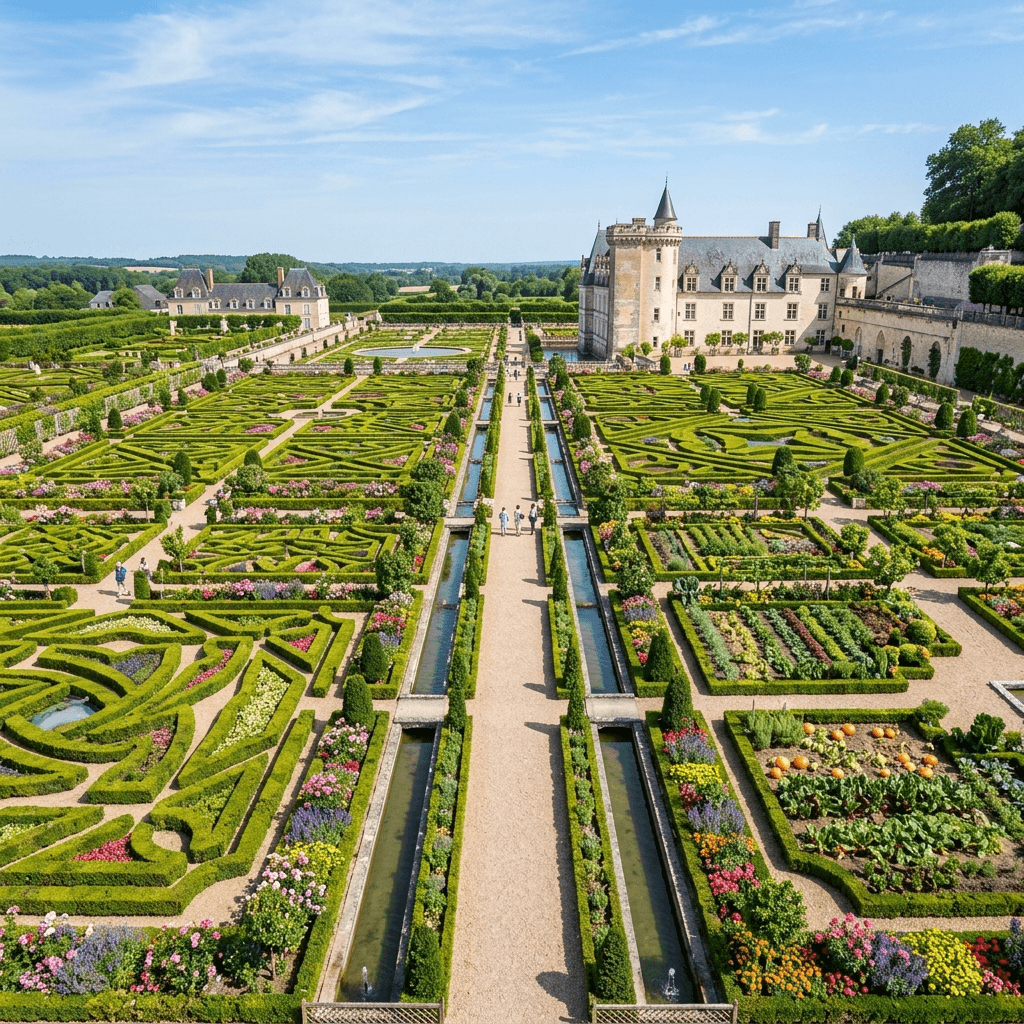
The Gardens of Villandry are not merely gardens — they are a mathematical poem written with plants, an open-air museum of Renaissance geometry and one of the most visited tourist attractions in the Loire Valley. Located on the banks of the river Loire, about 20 km west of Tours, Villandry is famous for its three-tiered gardens: the Ornamental Vegetable Garden, the Water Garden and the Ornamental Garden (which includes the Love Garden).
What makes Villandry unique is not just their beauty — it is the mathematical precision of each flower bed. At Villandry, each plant is a pixel in a grand image that can only be fully appreciated from above, from the castle's belvedere. Every year, the 9 gardens of Villandry receive more than 400,000 visitors from all over the world.
But Villandry is also a story of rescue. In the early 20th century, the castle was about to be demolished. It was saved by a Spanish doctor, Joachim Carvallo, who bought it in 1906 and dedicated his life to recreating the Renaissance gardens that had disappeared. This article will take you through every detail of this masterpiece of landscape architecture.
Chapter
1.1 What makes the Gardens of Villandry unique in the world?
The Gardens of Villandry are unique because they combine three elements that rarely appear together: geometric perfection, agricultural utility and symbolic meaning. While most classical gardens were exclusively ornamental, Villandry's ornamental vegetable garden produces tonnes of vegetables every year while maintaining absolute aesthetic rigour.
Furthermore, the Love Garden is the only garden in the world that explicitly narrates the four types of love through plants: Tender Love, Passionate Love, Fickle Love and Tragic Love. Each flower bed, each colour, each arrangement of plants was designed to tell a specific story.
Another unique aspect is that the gardens were completely reconstructed in the 20th century based on Renaissance treatises. They are not original from the 16th century — they are an archaeological recreation of what they would have been. This makes Villandry a living reconstruction of how gardens were conceived in Renaissance France.
Chapter
1.2 How did Renaissance geometry transform gardening?
The Renaissance was the golden age of geometry in the arts. Inspired by the studies of Leonardo da Vinci, Albrecht Dürer and Piero della Francesca, garden designers of the 16th century began to apply mathematical principles to landscape design. Symmetry, proportion, the golden ratio and perspective were used to create gardens that reflected the divine order of the universe.
The Gardens of Villandry are a perfect example of this philosophy. Each flower bed is a geometric figure — squares, circles, triangles, diamonds — that together form a complex pattern. The ornamental vegetable garden, for example, is composed of 9 squares of identical size, each subdivided into geometric flower beds planted with vegetables of different colours.
This geometric approach was a direct reflection of the Renaissance worldview: the belief that the universe was governed by mathematical laws and that art should reflect that perfection.
Chapter
1.3 How many hectares are the Villandry gardens?
The Gardens of Villandry currently occupy an area of 9 hectares (approximately 22 acres), spread over three distinct levels. For comparison, this is the equivalent of about 12 football fields.
This 9-hectare area is divided into:
In addition to the 9 hectares of formal gardens, the estate also includes about 40 hectares of parkland and woods, making the total property around 50 hectares.
Chapter
1.4 Why is Villandry called the "garden of gardens"?
The nickname "garden of gardens" was not invented by marketers — it comes from the recognition that the Gardens of Villandry are a synthesis of all the elements that define a classical French garden. If you had to choose just one garden in France to understand what French landscaping is, this would be Villandry.
The expression was popularized by the Spanish doctor Joachim Carvallo, the castle's restorer, who wrote that Villandry was "the garden that contains all gardens" — a reference to the fact that it brings together an ornamental vegetable garden, a water garden, a flower garden and an orchard in a single, perfectly integrated design.
Furthermore, the Love Garden — a sub-garden within the ornamental garden — is itself a "garden of gardens", containing within its four flower beds a complete repertoire of human emotions expressed through plants.
Chapter
2. The secret engineering of the Villandry Gardens — How were the geometric flower beds designed?
Designing the Gardens of Villandry was an act of engineering as much as art. Before a single plant was put into the ground, Joachim Carvallo and his team spent years studying 16th-century treatises to understand how Renaissance gardeners planned, levelled and irrigated their creations.
Chapter
2.1 How did medieval gardeners trace perfect geometric shapes?
In the 16th century, gardeners did not have modern surveying equipment. To create the perfect geometric flower beds of the Renaissance, they used ropes, wooden stakes and compasses. The tool of greatest precision was the surveyor's square, an L-shaped instrument that allowed right angles to be traced with surprising accuracy.
The process began by defining a central axis, usually aligned with the main castle entrance. From this axis, perpendicular lines were traced using the 3-4-5 triangle (Pythagorean theorem). Squares, rectangles and circles were then drawn on the ground using ropes as compasses.
When Joachim Carvallo reconstructed the gardens in the early 20th century, he used the same techniques described in 16th-century treatises to ensure geometric fidelity to the original design.
Chapter
2.2 What irrigation system feeds the 9 gardens?
The irrigation system of the Gardens of Villandry is a masterpiece of hydraulic engineering adapted from Renaissance principles. Water is captured from the river Loire and directed to a system of underground channels that distribute it to the 9 gardens.
The Water Garden (one of the three main gardens) functions as a reservoir: an 800 m² mirror of water that stores the resource and distributes it by gravity to the rest of the gardens. The Water Garden is surrounded by a channel of water lilies and lotus flowers that also serve as a water reserve.
The irrigation is done through a system of underground porous pipes installed beneath the flower beds. This system, modernized in the 1990s, replaced the old manual irrigation that required hours of work by the gardening team. Today, the system is controlled by an automated central panel that regulates the amount of water according to the needs of each plant species.
Chapter
2.3 How does the ornamental vegetable garden produce food and beauty?
The ornamental vegetable garden is the great innovation of the Gardens of Villandry and what makes them unique in the world. This is not a decorative garden that ignores food production: here, vegetables and flowers share the same space in a perfect balance between utility and beauty.
The ornamental vegetable garden is composed of 9 squares of identical size (approximately 15 x 15 metres each), surrounded by trellises of roses and fruit trees carefully pruned. Each square is subdivided into geometric flower beds where vegetables, aromatic herbs and flowers are planted in alternating patterns.
The trick is to choose varieties that have both aesthetic value and food value. The red cabbage, for example, is used for its vibrant colour and its ornamental leaves. The flowers (nasturtiums, pansies, marigolds) are edible and also serve to attract pollinators.
Chapter
2.4 What topiary innovations were used at Villandry?
The topiary art at the Gardens of Villandry is one of its most admired features. The Renaissance gardeners perfected the technique of trimming trees and shrubs into geometric shapes — spheres, cubes, pyramids, cones — that create a three-dimensional architecture within the garden.
At Villandry, topiary appears in several forms:
The maintenance of the topiary is a continuous task that occupies the gardening team for 6 months of the year. Each shrub is trimmed according to a precise template, ensuring that the shapes remain geometrically perfect.
Chapter
3. The dark history of Villandry — The castle that was almost demolished
The history of the Château de Villandry is as fascinating as its gardens, but for different reasons. While the gardens are a masterpiece of creation, the castle is a story of survival — a building that was almost destroyed not in the Middle Ages, but in the 20th century.
By the beginning of the 1900s, the Château de Villandry was in a state of advanced ruin. The French Revolution had led to the abandonment of many noble properties, and the castle had been used as a quarry for construction materials. The Renaissance gardens that had made it famous had long since disappeared, replaced by simple agricultural fields.
The fate of the castle was sealed when it was put up for sale in 1905 with the intention of being demolished to reuse its stones. That's when the Spanish doctor Joachim Carvallo appeared. Carvallo, a physiologist by training and a lover of French culture, saw the castle not as a ruin, but as an opportunity to rewrite the history of French landscape architecture.
Chapter
3.1 Why was the Château de Villandry almost destroyed in the 20th century?
The answer is simpler than one might imagine: the Château de Villandry was almost demolished to be used as a quarry of construction materials. In the 19th century, many French castles were bought by demolition entrepreneurs who sold the stones, beams, tiles and marble for new buildings.
The castle had already been stripped of its original furniture (sold during the Revolution) and the gardens had been destroyed. What remained was a skeleton of a castle that no one wanted to maintain. In 1905, the castle was put up for sale with a description that emphasized its value as a source of materials.
It was Dr. Joachim Carvallo who took the bold decision to buy it for 120,000 francs in 1906, an act considered insane by his contemporaries. His Spanish family thought he had lost his mind. But Carvallo had a vision: to restore the castle and, above all, recreate the Renaissance gardens that had disappeared.
Chapter
3.2 How did Joachim Carvallo save the castle from ruin?
Joachim Carvallo (1869–1936) was a Spanish doctor, physiologist and art lover. Born in Extremadura, Spain, he studied medicine in Madrid and Paris, where he worked at the Collège de France alongside the famous physiologist Étienne-Jules Marey. His scientific background gave him a methodological rigour that he would apply to the restoration of Villandry.
In 1906, at the age of 37, Carvallo bought the Château de Villandry for 120,000 francs. He spent the next 18 years restoring the castle and recreating the gardens. The work was arduous: Carvallo personally studied 16th-century treatises, especially the works of Jacques Androuet du Cerceau and Olivier de Serres, to understand how Renaissance gardens were designed.
The restoration was completed in 1924, when the gardens opened to the public for the first time. Carvallo continued to live in the castle until his death in 1936. His descendants still own and maintain the property to this day, following the principles he established.
Chapter
3.3 What secrets do the castle cellars hide?
The cellars of the Château de Villandry date back to the 12th century, much older than the current castle. They were part of the original medieval fortress that occupied the site before being replaced by the Renaissance building.
During the restoration in the 20th century, the cellars were explored and it was discovered that they contained tombs dating back to the 14th century. Several stone coffins were found, probably from the old chapel that existed on the site.
The cellars also housed a wine cellar — a tradition that continues to this day. The Carvallo family produces wine on the estate, and the cellars are used to age both red and white wines.
Chapter
3.4 Who inhabited Villandry before the Spanish family?
Before being bought by Joachim Carvallo in 1906, the Château de Villandry passed through the hands of several notable families. The original castle on the site was a medieval fortress from the 12th century, then known as Colombiers.
In the 16th century, the castle was acquired by Jean Le Breton, the Minister of Finance of King Francis I. Le Breton was also the one who built the Château de Chambord under the orders of the king. He demolished the old fortress and built the current castle in 1536, in the purest Renaissance style.
After the Le Breton family, the castle passed to the Castellane family and later to the Marquis de Vaubrun. During the French Revolution, the castle was confiscated and sold as national property. In the 19th century, it changed hands several times until it reached the point of near demolition.
Chapter
4. The three gardens of Villandry — Ornamental vegetable garden, water garden and ornamental garden
The Gardens of Villandry are organized into three distinct levels, each with a different function and design. This three-tiered structure is one of the most notable features of French Renaissance gardens.
The first level (the highest) is the Water Garden, a large mirror of water surrounded by channels of water lilies. The second level (intermediate) is the Ornamental Garden, which includes the famous Love Garden. The third level (the lowest, at ground level) is the Ornamental Vegetable Garden, the largest edible garden in the world.
This vertical organization reflects the Renaissance conception of the universe: water at the top (the celestial element), love in the middle (the human element) and food at the bottom (the earthly element).
Chapter
4.1 What is the ornamental vegetable garden and why is it unique?
The Ornamental Vegetable Garden is the centrepiece of the Gardens of Villandry and the largest edible garden in the world. It occupies an area of 1.2 hectares and is composed of 9 squares of identical size, each measuring approximately 15 x 15 metres.
Each square is subdivided into geometric flower beds of different shapes — diamonds, triangles, circles — planted with vegetables, aromatic herbs and flowers. The planting changes every season, and each year a new combination of colours and textures is created.
What makes the ornamental vegetable garden unique is not just its size, but its artistic conception: each bed is designed to be seen from above, from the castle tower or the belvedere. The colours of the vegetables are carefully selected to create visual patterns that resemble a living tapestry.
Chapter
4.2 How does the water garden mirror the stars?
The Water Garden is the highest level of the Gardens of Villandry. With an area of 800 m², it is a perfect square of water surrounded by a channel of water lilies, lotus flowers and aquatic plants.
The function of the Water Garden is both aesthetic and practical. Aesthetically, it acts as a celestial mirror that reflects the sky and the castle, creating a sense of infinity and amplitude. Practically, it works as a water reservoir that stores and distributes water to the rest of the gardens.
The idea that the Water Garden "mirrors the stars" comes from the Renaissance belief that gardens should reflect the cosmic order. The square shape of the lake represents the four cardinal points, and the mirror of water was designed to capture the reflection of the stars at night.
Chapter
4.3 What is the secret of the Love Garden?
The Love Garden is one of the most famous sub-gardens of Villandry and a unique attraction in the world of landscaping. It occupies a rectangular area within the larger ornamental garden and is divided into four large squares, each representing a type of love.
The four types of love portrayed are:
The four squares are: Tender Love (represented by hearts and masks), Passionate Love (represented by hearts in flames and dancing figures), Fickle Love (represented by fans and butterflies) and Tragic Love (represented by daggers and swords). Each square is planted with flowers of specific colours that reinforce the meaning.
Chapter
4.4 How do the gardens change colour in each season?
One of the most impressive features of the Gardens of Villandry is how they change colour throughout the year. The garden is never static — each season brings a new palette of colours, textures and atmospheres.
In spring (March to May), the gardens explode with tulips, pansies, daffodils and forget-me-nots. The ornamental vegetable garden is planted with the first seedlings of vegetables. In summer (June to August), the gardens are at their peak: vegetables are fully grown and flowers are in full bloom.
In autumn (September to October), the colours become warmer — oranges, golds and reds dominate. The pumpkins and squashes in the ornamental vegetable garden add a special touch. In winter (November to February), the gardens are in dormancy, but the geometric structure remains visible, revealing the architectural skeleton of the flower beds.
Chapter
5. The Château de Villandry — Far beyond the gardens
Chapter
5.1 What is the history of the Château de Villandry?
The Château de Villandry was built in 1536 by Jean Le Breton, Minister of Finance of King Francis I. Le Breton was also responsible for the construction of the Château de Chambord, one of the jewels of the French Renaissance.
The castle was built on the site of an old 12th-century medieval fortress, of which only the cellars and the keep remain. The design of the new castle followed the purest Renaissance style, with a U-shaped plan, central body and two lateral wings.
Over the centuries, the castle passed through several hands and underwent modifications. In the 18th century, neoclassical elements were added, including a new façade. In the 19th century, the castle was abandoned and fell into ruin, until its purchase by Joachim Carvallo in 1906.
Chapter
5.2 What architectural styles mix at Villandry?
The Château de Villandry presents a fascinating architectural mix that reflects its history of construction and modifications. The main structure is Renaissance (from 1536), with elements typical of the French Renaissance: symmetry, decorative dormer windows, high roofs and tall chimneys.
However, when Joachim Carvallo restored the castle in the early 20th century, he introduced Spanish-Moorish elements that reflect his own Spanish roots. The most notable of these additions is the ceiling of the Arab Hall, a masterpiece of Moorish carpentry that contrasts with the Renaissance surroundings.
The result is a hybrid castle that defies pure classification — part Renaissance, part Spanish Revival, part Neoclassical. This cultural mix is one of the most distinctive features of Villandry, making it unique among the Loire castles.
Chapter
5.3 Which rooms are open to the public inside the castle?
The Château de Villandry opens several rooms to the public. The tour includes:
The visit takes about 45 minutes to 1 hour and is included in the garden ticket.
Chapter
5.4 What works of art are inside the castle?
The collection of works of art at the Château de Villandry includes paintings from the 16th to the 19th centuries, with works by Spanish, Italian and Flemish artists. The most notable are:
Also notable is the collection of ancient furniture, including pieces from the Renaissance and Baroque periods that were acquired by Joachim Carvallo during his restoration of the castle.
Chapter
6. Myths and truths about the Gardens of Villandry
Chapter
6.1 Is it true that the gardens are medieval?
Partially true — but requires clarification. The gardens currently at Villandry are not original from the Middle Ages or the Renaissance. The original gardens from the 16th century were destroyed after the French Revolution.
What exists today is a recreation, designed and planted by Joachim Carvallo between 1906 and 1924. However, this recreation is not an invention: it is an archaeological reconstruction based on 16th-century treatises.
So if by "medieval" you mean "created in the Middle Ages", the answer is no. If by "medieval" you mean "faithful to the Renaissance spirit", then yes.
Chapter
6.2 Are the Villandry gardens the largest in the Loire Valley?
It depends on the criterion! The Gardens of Villandry are among the largest in the Loire Valley, but they are not the largest in France. In terms of formal gardens, Villandry's 9 hectares are comparable to those of Château de Chambord (about 10 hectares of formal gardens) or Château de Chenonceau (about 12 hectares of gardens).
However, if we consider the total area of the estate (including parkland), Villandry is not the largest. The Domaine de Chambord is by far the largest, with a 54 km² park.
Chapter
6.3 Is it possible to visit the gardens at night?
Yes, but not every night. The Gardens of Villandry open for special nocturnal visits on summer Friday nights (from June to August). During these events, the gardens are illuminated by candles and lanterns, and there are classical music concerts.
The Water Garden is the highlight of the nocturnal visit, with the mirror of water reflecting the candlelight and the starry sky. It is a unique experience that requires advance booking.
Chapter
6.4 Do the gardens belong to the French State?
No — they are privately owned. The Gardens of Villandry and the castle belong to the Carvallo family, descendants of the Spanish doctor who bought the property in 1906. The current owner is Henri Carvallo, Joachim's great-grandson.
The property is maintained with the revenue from ticket sales, the on-site shop and the restaurant. The family lives in part of the castle during part of the year.
Chapter
7. Practical guide to visiting the Gardens of Villandry in 2026
Chapter
7.1 What time of year is best to visit Villandry?
The best time to visit the Gardens of Villandry depends on what you want to see. For those who want to see the gardens in their maximum splendour, the months of May to September are ideal: the ornamental vegetable garden is fully planted, the flower beds are in bloom, and the weather is pleasant.
For those who prefer to avoid crowds, April and October are the best options. The gardens are still beautiful, the weather is mild, and there are significantly fewer visitors. In November to February, the gardens are in dormancy, but the geometric structure is more visible.
Chapter
7.2 How much does the ticket cost in 2026?
In 2026, the ticket prices for the Gardens of Villandry are approximately:
Tickets can be purchased online on the official website, which is recommended to avoid queues at the ticket office.
Chapter
7.3 What are the opening hours?
The Gardens of Villandry are open every day of the year, with hours that vary by season:
The gardens close only on December 25 (Christmas Day). The castle interior closes for lunch between 12:30 and 14:00.
Chapter
7.4 How to get to Villandry from Paris?
The Gardens of Villandry are located in the Loire Valley, about 20 km west of Tours and 230 km southwest of Paris.
By car: Take the A10 motorway (direction Bordeaux), exit Villandry. The journey takes about 2h30 from Paris and 25 minutes from Tours.
By train: Take the TGV from Paris-Montparnasse to Tours (about 1 hour), then a taxi or bus to Villandry (about 25 minutes).
By bicycle: Villandry is on the Loire à Vélo cycle route, which connects the main Loire castles. The route from Tours is about 20 km, mostly flat.
Chapter
7.5 How long does the visit take?
It is recommended to allocate at least 2 to 3 hours for exploring the gardens and 1 hour for visiting the castle. So plan for half a day in total.
If you want to have lunch at the restaurant or have a picnic in the park, add at least 1 hour more.
Chapter
8. The botany of Villandry — What does science learn from this garden?
Chapter
8.1 What plant species are cultivated at Villandry?
The Gardens of Villandry cultivate a diverse range of plant species, organized by garden type. In the ornamental vegetable garden, more than 40 varieties of vegetables are planted each year, including:
In the ornamental garden, flowers include roses, lavender, irises, peonies, tulips, pansies, nasturtiums and marigolds. In the water garden, aquatic plants include water lilies, lotus flowers and papyrus.
Chapter
8.2 How does the garden serve as a biodiversity laboratory?
The Gardens of Villandry serve as an important biodiversity laboratory. Because the gardens are organic and do not use pesticides, they attract a wide variety of insects, birds and small mammals.
Studies carried out on the site have identified more than 50 species of bees and other pollinators visiting the gardens. Butterflies, including the Emperor Butterfly and the Peacock Butterfly, are common in summer.
The gardens also serve as a refuge for birds, including blackbirds, robins, tits, swallows and birds of prey such as kestrels.
Chapter
8.3 What sustainable gardening techniques are used?
The Gardens of Villandry are maintained according to sustainable gardening principles. The main techniques used include:
In addition, the soils are analysed annually to monitor their health, and crop rotation is practised in the ornamental vegetable garden.
Chapter
8.4 How is the garden adapted to climate change?
The Gardens of Villandry have been facing the effects of climate change for several years. The main challenges include increasingly hot and dry summers, which demand more water, and unpredictable frosts, which can damage spring planting.
To adapt, the gardens have implemented several measures:
The Carvallo family works with climatologists and agronomists to monitor changes and adjust garden management as needed.
Chapter
9. Villandry in pop culture — Where have the castle and gardens appeared?
Chapter
9.1 Which films were shot at Villandry?
The Gardens of Villandry have served as a setting for several films and television productions. Among the most famous is "La Guerre des Boutons" (The War of the Buttons, 2011), a French film that used the gardens as a backdrop for its rural scenes.
The gardens have also appeared in travel documentaries from France Télévisions, BBC and National Geographic. The castle has been featured in programmes about the Loire castles and French Renaissance gardens.
Chapter
9.2 Was Villandry the inspiration for literary gardens?
Although there is no direct confirmation that Villandry was used as the setting for a specific novel, the gardens have certainly inspired authors and poets. The writer Maurice Maeterlinck (1911 Nobel Prize in Literature) visited Villandry and wrote about its gardens.
Furthermore, the geometric gardens of Villandry have been cited as inspiration for fictional gardens in historical novels set in the Renaissance period.
Chapter
9.3 Which artists painted the gardens?
Several artists have painted the gardens of Villandry, especially in the 20th century after Carvallo's restoration. Post-Impressionist painters and watercolourists have been attracted by the order and colour of the geometric flower beds.
The gardens appear in the collection of the French Academy of Fine Arts as an example of the art of French gardens.
Chapter
9.4 Is Villandry featured in documentary series?
Yes, Villandry appears frequently in documentary series about the Loire Valley and French gardens. Programmes such as "Des Racines et des Ailes" (France 3), "Échappées Belles" (France 5) and "Le Jardin Extraordinaire" have dedicated episodes to Villandry.
Internationally, the gardens have been featured on the BBC (in the series "The Secret History of European Gardens") and on National Geographic (in the documentary "The Most Beautiful Gardens in the World").
Chapter
10. The ornamental vegetable garden of Villandry — The largest edible garden in the world
Chapter
10.1 What vegetables are planted in the ornamental vegetable garden?
The ornamental vegetable garden of Villandry grows a wide variety of vegetables, selected both for their aesthetic value and food value. The vegetables planted include:
The choice of varieties changes every season, allowing the gardening team to create a new colour palette each year.
Chapter
10.2 How is the planting planned each season?
Planting planning is a meticulous process that begins months in advance. The gardening team creates a detailed plan of the ornamental vegetable garden, deciding which vegetables will go into each flower bed, considering colours, textures and heights.
The planning follows three principles:
The plan is drawn on paper and then transferred to the beds using ropes and stakes.
Chapter
10.3 Where does the harvested produce go?
The produce from the ornamental vegetable garden does not go to waste. About 70% is used in the castle's restaurant, the L'Orangerie, which offers seasonal cuisine based on vegetables harvested from the garden.
The remaining produce is sold in the castle shop or donated to local charities. Nothing is wasted — even the plants that have completed their cycle are composted to fertilize the soil.
Chapter
10.4 What is the symbology of colours in the flower beds?
The colours of the flower beds in the ornamental vegetable garden are not random — they follow a chromatic code that dates back to the Renaissance. At Villandry, colours have symbolic meanings:
The combination of colours is designed to create visual harmony and contrast. The gardening team studies colour theory to plan the planting so that the flower beds form a coherent visual composition.
Chapter
11. The Love Garden at Villandry — Hidden meanings in every flower bed
Chapter
11.1 What does the Garden of Love represent?
The Love Garden at Villandry represents the four types of love according to the Renaissance conception. It is a <b>visual narrative</b> created entirely with plants, without any words or sculptures — the flowers themselves tell the story.
The garden was designed by Joachim Carvallo based on 16th-century love treatises. The idea was to create a space that would stimulate reflection on human emotions while delighting the senses with the beauty of the plants.
Chapter
11.2 What are the four types of love portrayed?
The four squares of the Love Garden represent:
Each square uses specific colours and shapes of flower beds to convey its meaning.
Chapter
11.3 How were the symbols of love designed?
The symbols of the Love Garden were designed based on Renaissance emblem books, which associated each concept with a visual image. The main symbols include:
These symbols are recreated each year with different plants, maintaining the original design while allowing seasonal variation.
Chapter
11.4 What flowers and colours represent each type of love?
In the Love Garden, each type of love is associated with a specific colour palette:
The colour combinations are renewed each season by the gardening team, who select the varieties of flowers and foliage that best express each type of love.
Chapter
12. How to photograph the Gardens of Villandry — Professional tips
Chapter
12.1 What is the best angle to photograph the gardens?
The best angle to photograph the Gardens of Villandry is from above. The gardens were designed to be seen from the castle tower, the belvedere or the upper windows. This elevated perspective reveals the geometric patterns of the flower beds.
The castle tower offers the most complete view: from there, you can see the three levels of the garden simultaneously.
Chapter
12.2 What time of day has the best light?
The best light for photographing the gardens is at the beginning of the day (from 9:00 to 11:00) or at the end of the afternoon (from 16:00 to 18:00). During these hours, the sunlight is softer and creates more interesting shadows that emphasize the relief of the flower beds.
At midday, the light is very harsh and tends to flatten the colours of the gardens. It is best to avoid this time, especially in summer.
Chapter
12.3 How to photograph from the castle tower?
The castle tower is the best point for panoramic photos of the gardens. The tower is open to visitors and offers a 360-degree view over the entire estate.
To photograph from the tower, it is recommended to use a wide-angle lens (24-70mm) to capture the full extent of the gardens. A telephoto lens (70-200mm) can be useful for isolating details of the flower beds.
Chapter
12.4 What equipment is ideal for garden photography?
For garden photography, the following equipment is recommended:
If you are visiting during the summer opening hours (until 19:00), you can also capture the golden hour light.
Chapter
13. The gardeners of Villandry — The invisible 12-month work
Chapter
13.1 How many gardeners maintain the gardens?
A team of 7 full-time gardeners maintains the 9 hectares of gardens at Villandry. This number may increase to 10 to 12 during the busiest months (spring and summer).
The team is coordinated by a head gardener who plans the planting for each season and supervises the maintenance of the topiary, lawns and flower beds.
Chapter
13.2 What is the daily routine of a gardener at Villandry?
The daily routine of a gardener at Villandry begins early, at 7:00 in the morning, before the gardens open to the public. The tasks include:
During spring and summer, the working day can extend until 19:00.
Chapter
13.3 How long does it take to plant all the flower beds?
Planting all the flower beds of the ornamental vegetable garden takes about 3 to 4 weeks each season. The spring planting starts in March and the summer planting in June.
The autumn planting (for the winter display) takes place in September. Each season, the team plants approximately 15,000 seedlings of vegetables and flowers by hand.
Chapter
13.4 What is the most difficult task in the gardens?
The most difficult task at Villandry is maintaining the topiary. Trimming the hundreds of shrubs into geometric shapes requires years of experience and a very steady hand.
Another demanding task is crop rotation in the ornamental vegetable garden. Changing the plants each season to maintain soil health and ensure the desired colour palette requires meticulous planning.
Chapter
14. Gastronomy near Villandry — Where to eat in the region
Chapter
14.1 What local products to try near Villandry?
The region around the Gardens of Villandry is rich in gastronomic products typical of the Loire Valley. The main specialities include:
Many of these products can be bought in local markets.
Chapter
14.2 Which restaurants near the castle are worth it?
The main restaurant at Villandry is L'Orangerie, located in the castle grounds, next to the gardens. It offers seasonal cuisine based on local products and vegetables from the ornamental vegetable garden.
A full lunch at L'Orangerie costs between €30 and €45. Booking is recommended, especially in summer.
Chapter
14.3 Where to have a picnic with a view of Villandry?
The Villandry park offers several ideal spots for a picnic. The lawn area near the Water Garden provides a beautiful view of the castle and the lake.
Local products can be bought at the castle shop or in nearby markets.
Chapter
15. FAQ — Frequently asked questions about the Gardens of Villandry
Chapter
15.1 What is the best time to visit the Villandry gardens?
May to September for full splendour. April and October for fewer crowds.
Chapter
15.2 How much does the ticket cost?
Approximately €14 (full price), €10 (reduced) and free for under-18s.
Chapter
15.3 Are the gardens accessible for people with reduced mobility?
Yes, the gardens are almost entirely accessible. The main paths are wide and flat, suitable for wheelchairs and pushchairs.
Chapter
15.4 Can I take my pet to the gardens?
Yes, pets are allowed in the gardens, provided they are on a lead.
Chapter
15.5 Is it allowed to walk on the flower beds?
No, walking on the flower beds is strictly prohibited. The gardens are for viewing, not for walking on.
Chapter
15.6 Are there guided tours in English?
Yes, guided tours in English are available. Audio guides are also available in several languages.
Chapter
15.7 Can I buy plants or seeds from the gardens?
Yes, the castle shop sells seeds and plants produced in the gardens.
Chapter
15.8 Is the castle included in the garden ticket?
Yes, the ticket includes access to both the gardens and the castle interior.
Chapter
15.9 Can I visit Villandry and other castles on the same day?
Yes, Villandry is close to several other castles: Azay-le-Rideau (15 km), Chenonceau (30 km), Ussé (20 km) and Langeais (15 km).
Chapter
15.10 What should I bring to the visit?
Comfortable shoes, a hat and sunscreen for summer, a raincoat for possible rain, and a camera.
Chapter
15.11 Are there long queues at the entrance?
It depends on the season. In summer, queues can be long (15 to 30 minutes). Buying online is recommended.
Chapter
15.12 Are the gardens worth visiting in winter?
Yes, in a different way. The geometric structure of the flower beds is more visible without the foliage, and the park is very peaceful.