Chapter
1. Comté AOP: The Definitive Guide to France's Most Consumed Hard Cheese
Comté (also known as Gruyère de Comté) is a hard, cooked and pressed French cheese made exclusively from raw cow's milk in the Jura Mountains of eastern France. With an annual production of around 66,000 short tons, it holds an impressive title: it is the most produced and most consumed cheese of protected origin in France, appearing on the table of about 40% of the French population.
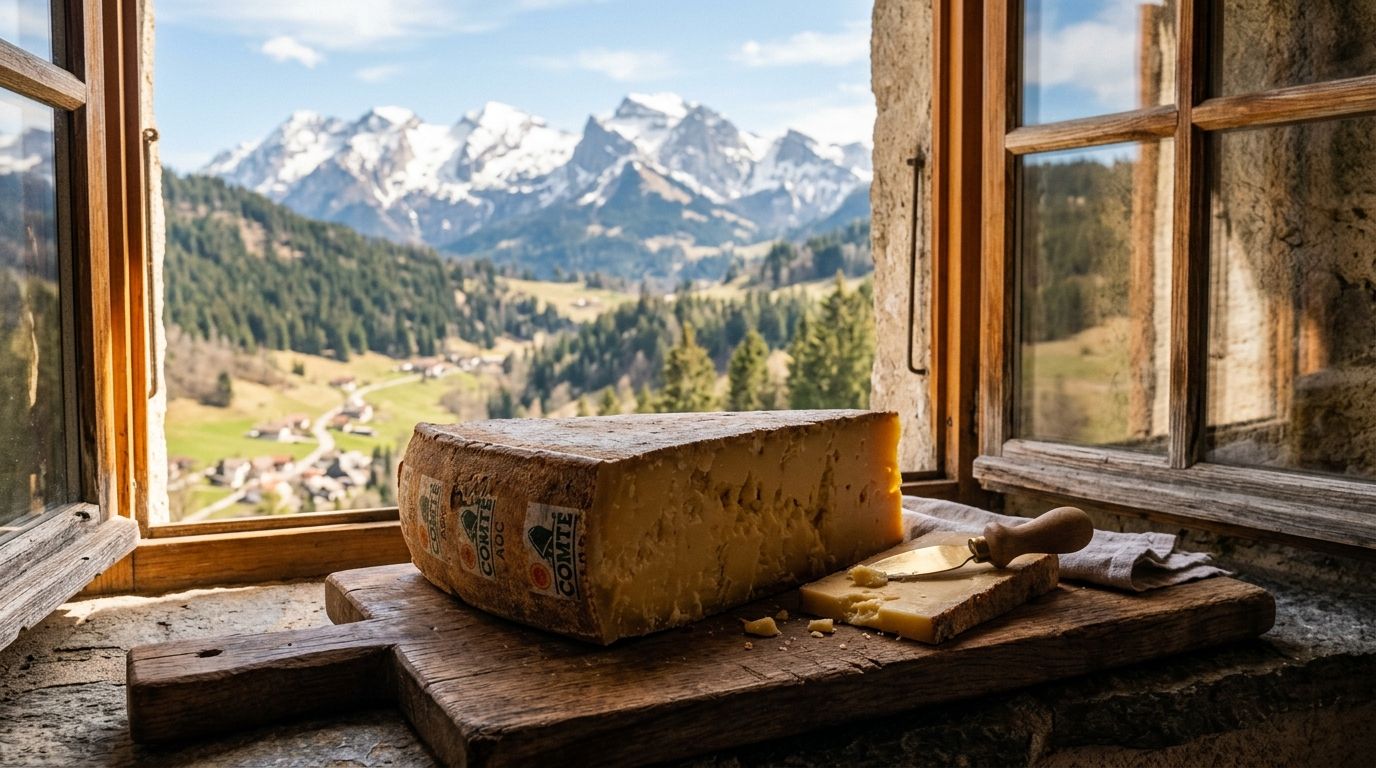
Recognizing it is easy for the attentive eye: a large wheel with a dusty-brown rind, a pale creamy-yellow interior, a firm yet flexible texture and a mild, nutty, slightly salty and sweet flavor. Behind this sober appearance, however, hides one of the most complex and tightly regulated terroir cheeses in the world, the fruit of a cooperative tradition stretching back more than eight centuries.
Chapter
1.1. What is Comté and why is it France's most consumed AOP cheese?
Comté is a raw cow's-milk cheese with a cooked, pressed paste, made in large wheels — between 22 and 30 inches in diameter and 71 to 99 pounds in weight. It was born in the mountains of the Jura, in the Franche-Comté region, and producing it requires about 119 US gallons of raw milk for a single wheel, which explains the historic need to pool the milk of several herds.
With roughly 66,000 short tons a year, Comté comfortably leads the ranking of French AOP cheeses by volume produced. About four out of ten French people consume it regularly, whether grated, in thin slices, melted in fondue or as the star of the cheese board. Its unique combination of flavor, versatility and tradition makes it a true national champion.
Chapter
1.2. What is the real difference between Comté, Gruyère and Emmental?
Although they look like first cousins, Comté, Gruyère and Emmental have quite distinct identities. Comté is, historically, a descendant of the Swiss Gruyère recipe — so much so that it was once called "gruyère de Comté" — but it developed its own personality thanks to the Jura terroir and its own specific production rules.
The most visible difference is texture and flavor: Comté has small, scattered holes, or almost none, and a nutty, fruity flavor; Swiss Gruyère is firmer and saltier; while Emmental is famous for its large, regular holes and its milder, sweeter taste. While French Emmental can be industrial, Comté is protected by the AOP and can never be produced on a standardized industrial scale — there is no "industrial Comté".
Chapter
1.3. What does the AOP label mean and what does it protect in Comté?
The acronym AOP stands for Appellation d'Origine Protégée (Protected Designation of Origin), the European Union label that guarantees a product was born, processed and matured in a specific geographical region, according to traditional methods. In the case of Comté, the French AOC designation was granted in 1958 — one of the first in the country — and the European AOP protection came in 1996.
The label protects far more than a name: it fixes the territory, the permitted cattle breeds, the cows' diet, the production method and even the minimum ripening time. Buying a Comté AOP therefore guarantees that you are looking at a cheese with identity and history — and not a generic imitation.
Chapter
2. The Medieval Origins of Comté: From the Monks of the Jura to the Cooperative Fruitières
The history of Comté is inseparable from the harshness of the Jura climate and the collective spirit of its people. It was born as a survival solution and became, over the centuries, a unique model of cooperative economy.
Chapter
2.1. How did the monks of the Jura create Comté in the Middle Ages?
Comté has millennial roots: the artisanal techniques that gave rise to it were developed in the Jura Mountains about 1,000 years ago. The long, harsh winters forced communities to think about subsistence collectively — the abundant summer milk had to be preserved for the months of scarcity.
Large, dry, hard cheeses were the perfect solution: they could be stored for many months and, moreover, traveled well, making it easy to sell them in distant markets. The monasteries and mountain villages perfected this art, and the first large cheeses of the region are already attested in the 12th and 13th centuries.
Chapter
2.2. What are the fruitières and why did they define the identity of Comté?
The fruitière is the soul of Comté. To make a single wheel requires about 119 to 132 US gallons of milk, an amount no single breeder could gather alone. The solution was cooperative: producers began taking their cows' milk daily to a common site, where a master cheesemaker — the fruitier — turned it into cheese.
This system was born in the heart of the Middle Ages and persists to this day, making Comté a cheese with deep roots. The first known mention of a fructerie dates from 1263, in the town of Poligny. This centuries-old cooperative structure is what guarantees that no "industrial Comté" exists — it is, by definition, a collective and artisanal cheese.
Chapter
2.3. The AOC designation of 1958: how did Comté win its protection?
Official recognition came in the 20th century, but the road was long. France created the AOC rules for cheese in the 1920s, and Comté won its designation in January 1958, becoming one of the first cheeses in the country to receive the label. The full rules were consolidated in 1976, and the European AOP protection was obtained on 21 June 1996.
These designations shielded the product: they defined the Jura territory as the sole place of production, fixed the permitted breeds and banned silage in the cattle's diet. This is what allowed Comté to cross the 20th century without losing its character, remaining faithful to its mountain origins.
Chapter
3. The Territory of Comté: Why Only the Jura Massif Can Produce It
Not all of France can make Comté — and this is not bureaucracy, but physics. The cheese is the edible expression of a unique landscape, and the AOP label merely registers this deep bond.
Chapter
3.1. Which French departments can produce Comté AOP?
The production area of Comté AOP coincides, almost entirely, with the French part of the Jura Massif. It covers two departments of Franche-Comté — the Doubs and the Jura — plus the eastern half of the Ain department, some communes of Saône-et-Loire and one commune of Haute-Savoie.
It is Franche-Comté that produces the vast majority of Comté. Hundreds of communes are spread across hills, plateaus and mountain valleys, all united by a common terroir of limestone, natural pasture and a harsh climate — exactly the ingredients that shape the cheese's character.
Chapter
3.2. What is the terroir of the Jura and why does it define the flavor of Comté?
The concept of terroir sums up everything that makes Comté an unrepeatable cheese: the geology, the soil, the natural flora, the climate and the human practices of a region. In the Jura, the high-altitude pastures feed the cows with a rich and diverse flora, and this repertoire of herbs and flowers reaches the milk directly and, finally, the flavor of the cheese.
This is why each fruitière produces a Comté with its own nuances. Experts can distinguish a mountain cheese from a lowland cheese by its aroma. This diversity is celebrated — not standardized — because it is the essence of what makes Comté so fascinating.
Chapter
3.3. Summer versus winter: why does Comté change color and flavor with the season?
Few cheeses tell the passing of the seasons like Comté. In summer, when the cows graze freely in the flowering meadows, the milk is rich in carotenes — natural plant pigments — and the cheese takes on a golden yellow color and intense aromas of flowers, fruit and herbs.
In winter, when the herd feeds on dry hay, the milk loses these pigments, and Comté is born paler and lighter, with milder, milkier, nuttier flavors. The "summer Comté" and the "winter Comté" are thus two faces of the same cheese — one of the most instructive ways to understand the concept of seasonality.
Chapter
4. The Cows of Comté: Montbéliarde and Simmental, the Official Breeds
Before the wheel of cheese, there is the herd. And, in Comté, not every cow is allowed to contribute: the AOP rules are rigorous even in the choice of breeds.
Chapter
4.1. Why are only the Montbéliarde and French Simmental breeds allowed?
The Comté AOP authorizes only two breeds: the Montbéliarde and the French Simmental — or the cross between them. Both are rustic breeds, adapted to the Jura climate, known for producing milk of excellent quality, rich in protein, ideal for making long-ripened cheeses.
The choice is no whim: these are breeds that graze well on mountain terrain and transform the local flora into milk of high aromatic complexity. By restricting the herd, the AOP guarantees the constancy of the raw material and preserves an ancestral genetic heritage of the region.
Chapter
4.2. The strict diet of the cows: hay, pasture and the ban on silage
The diet of the Comté cows is a chapter unto itself. The specifications limit the fertilization of the pastures and strictly prohibit silage — the fermented feed common in industrial farming, which alters the milk's flavor. The cattle may only receive fresh, natural feed: pasture, hay and cereals.
There is also a density limit: no more than 1.3 cows per hectare of pasture (roughly one cow per 2 acres). This rule prevents overcrowding and ensures each animal has space and quality food. It is livestock farming designed for the health of the land and the flavor of the cheese, not for maximum productivity.
Chapter
4.3. How much milk is needed to produce a wheel of Comté?
The mathematics of Comté are impressive: about 119 US gallons of raw milk — and, in some references, up to 132 US gallons — are needed to produce a single wheel of 71 to 99 pounds. It is an amount no single breeder could supply in a day.
This physical requirement is the historical explanation for the fruitières: only by pooling the milk of several herds is it possible to make one wheel a day. Each wheel therefore represents the collective effort of an entire community — which is why it carries, on its rind, the production date and the identification of its fruitière.
Chapter
5. How Comté Is Made: From Raw Milk to the 88-Pound Wheel
From milking to the finished wheel, Comté travels a meticulous path that mixes ancestral gestures and discreet technology. Each stage is dictated by the specifications and executed with clockwork precision.
Chapter
5.1. The mandatory raw milk and the daily production in the fruitières
Everything begins with raw milk — with no pasteurization whatsoever — which must be taken to the fruitière immediately after milking. The coagulation must occur within a stipulated time, according to the milk's storage temperature, ensuring it reaches the vat at the peak of its freshness.
Production is daily: the morning milk is turned into cheese the same day, in the large copper vats of the fruitière, where it is gently warmed. The raw milk may only undergo a single heating — and that heating happens precisely during coagulation, and may not exceed 133 °F.
Chapter
5.2. Cooking and pressing: what defines the texture of Comté's hard paste?
After the rennet is added, the milk coagulates and the curd is cut into small grains, the size of grains of rice or wheat. These grains are then stirred and reheated for about 30 minutes — this is the cooking stage, which expels the whey and firms the paste, a hallmark of cooked, pressed cheeses.
Next, the paste is placed in molds and pressed to eliminate the excess whey. After a few hours, the mold is opened and the wheel already has its definitive shape. It is this sequence of cooking and pressing that gives Comté its firm yet flexible texture, capable of aging for months without losing structure.
Chapter
5.3. Brining and the start of Comté's long ripening
With the wheel formed comes the salting, done in a controlled way: the salt may only be applied directly to the surface of the cheese. The wheel then spends its first weeks of ripening at the fruitière itself, before moving on to specialized ripening cellars.
On the rind, a casein label is fixed — an edible plaque — bearing the production date and the wheel's identification. It is this label that will allow each cheese to be traced back to its origin. The minimum mandatory ripening is four months, but the great specimens can age far beyond that.
Chapter
6. The Ripening (affinage) of Comté: The Secret of Complex Flavors
It is in the dark, damp cellars that Comté reveals its true nature. Ripening is where science meets patience — and where each wheel develops a unique flavor profile.
Chapter
6.1. What happens in Comté's ripening cellars over the months?
In the ripening cellars, Comté undergoes a slow and profound transformation. The wheels are regularly brushed and turned with brine, which forms the rind and guides the development of the aromas. Temperature and humidity are controlled to create the ideal environment for enzymatic reactions.
Over the months, enzymes slowly break down the proteins and fats, generating an extraordinary aromatic complexity. The affineurs — the master maturers — accompany each wheel, deciding the exact moment it reaches its peak. It is work of patience and sensory sensitivity.
Chapter
6.2. Why is a 24-month Comté different from a 4-month one?
Time radically transforms Comté. A 4- to 6-month cheese is mild, milky and nutty, with a still relatively flexible paste. A 12-month Comté, on the other hand, gains notes of dried fruit and caramel, while a 24-month one reaches an intense, complex and persistent flavor, with crunchy crystals.
The AOP allows ripening of up to 36 months, and there are also the legendary cellar cheeses with even longer aging. The rule is simple: the more time, the deeper and more concentrated the flavor — and the higher, in general, the price. Every palate finds its ideal point on this aging ladder.
Chapter
6.3. The 20-point grading: what separates a Comté Extra from an ordinary one?
Not every wheel of Comté is equal — and the designation itself takes care of separating the wheat from the chaff. Each cheese is evaluated by inspectors on a 20-point scale, which distributes scores for overall appearance, rind quality, internal appearance, texture and, above all, flavor.
Wheels that reach more than 14 points receive the green casein label — with the drawing of a green bell — and are classified as Comté Extra. Those between 12 and 14 points earn the brown label and are called simply Comté. Wheels below 12 points — or with a very low flavor score — cannot use the name Comté and are destined for other purposes.
Chapter
7. The Characteristics of Comté: Flavor, Aroma, Color and Texture Explained
Learning to read a Comté is discovering a world of nuances. Flavor, aroma, color and texture together tell the story of the terroir, the season and the ripening time.
Chapter
7.1. What are the flavors and aromas of Comté? More than 80 aromas identified
Comté is one of the most complex cheeses in the world. Sensory studies have identified more than 80 aromas in its wheels, a repertoire ranging from fresh milk and butter to walnut, dried fruit, caramel, chocolate and even floral and roasted-coffee notes.
This richness is born of the combination of raw milk, the flora of the Jura pastures and the long ripening. The famous "jury terroir" — panels of trained tasters created by food scientist Florence Bérodier — meet regularly to describe and debate the flavors of each harvest, publishing the results in the newsletter Les Nouvelles de Comté.
Chapter
7.2. Why is summer Comté yellow and winter Comté lighter?
The color of Comté is a signature of the seasons. In summer, the cows feed on fresh pasture, rich in carotenes — the orange plant pigments — which pass into the milk and give the paste its characteristic golden-yellow tone.
In winter, on a hay-based diet, the milk loses these pigments and the cheese is born pale and light. Besides the color, the aroma changes too: summer brings more floral and intense notes, while winter favors milder, nuttier flavors. It is a lesson in seasonality that can be seen — and tasted — in every slice.
Chapter
7.3. The texture of Comté: why does it have those little crunchy crystals?
Anyone who has tasted an aged Comté knows the sensation: small crunchy points that crackle lightly between the teeth. These crystals are formed by tyrosine, an amino acid that crystallizes naturally during the long ripening, as the proteins break down.
Far from being a defect, the crystals are a sign of quality and of well-conducted ripening. They appear especially in cheeses of 12 months or more and are prized by connoisseurs as one of the signatures of a great Comté. The texture, in fact, is one of the criteria evaluated in the cheese's official grading.
Chapter
8. How to Serve Comté: Perfect Temperature, Cutting and Pairing
The moment of pleasure has arrived. Serving a Comté well is an art that begins with the cut and ends with the pairing — and mastering it lifts the experience to another level.
Chapter
8.1. At what temperature should Comté be served to reveal all its flavor?
Like every great cheese, Comté should be savored at room temperature. Take it out of the fridge 30 minutes to 1 hour before serving: excessive cold hardens the fat and traps the aromas, making the flavor dull and the texture brittle.
At room temperature, the paste recovers its flexibility and the aromas of walnut and caramel are fully released. This is the moment when Comté shows why it is France's most beloved cheese — a definitive argument for never serving it cold.
Chapter
8.2. How do you cut a wheel of Comté correctly without annoying a French person?
Cutting cheese in France has rules, and Comté, with its large wheel, demands technique. The wheel is divided into wedges and, then, each wedge is sliced into thin shavings, from the rind toward the center, so that each piece keeps the ideal proportion of rind and paste.
At a formal table, the golden rule is never to tear the wheel apart any which way: the slices must be regular and generous, respecting the cheese's geometry. For fondue, Comté is grated or cut into cubes. Well cut, the cheese yields more and keeps all its elegance.
Chapter
8.3. Which wines pair with Comté? Vin jaune, vin de paille and more
Comté finds its soulmate in the wines of its own land: the Jura. The legendary vin jaune — the "yellow wine" aged under a veil of yeast — is the classic match, with its intense flavor of walnut and curry that mirrors the cheese's complexity. The sweet vin de paille also shines, creating a delicious contrast with the saltiness.
Outside the Jura, the whites of Chardonnay and the light reds of Pinot Noir from neighboring Burgundy work admirably. The more aged the Comté, the more robust the wine can be — a 24-month cheese easily supports a full-bodied white or a structured red.
Chapter
8.4. Comté in the kitchen: fondue comtoise and other unmissable recipes
Comté is one of the most versatile cheeses in French cooking. It is the star of the fondue comtoise — the regional version of fondue — and an essential ingredient in soups, gratins, quiches and sandwiches. Melted, it forms long, creamy strands, without ever becoming oily.
Grated, it turns a simple omelette or a pasta dish into a memorable meal. And, of course, no self-respecting French cheese board is complete without a good wedge of Comté beside dried fruits, nuts and a drizzle of honey. It is the cheese that goes from starter to dessert without ever disappointing.
Chapter
9. Comté in French Gastronomy and Culture
More than a food, Comté is a symbol. Its presence runs through the gastronomy, the economy and even the cultural imagination of an entire region.
Chapter
9.1. Why is Comté the best-selling AOP cheese in France?
The success of Comté is no accident. It combines a flavor that pleases almost every palate — mild enough for children, complex enough for connoisseurs — with a rare versatility in the kitchen. Add to this a solid, cooperative production chain deeply rooted in the territory.
With about 66,000 short tons a year and a presence on the table of 40% of French people, Comté is simply unbeatable. It has achieved the feat of being, at once, an everyday cheese and a high-gastronomy product, without losing its artisanal soul.
Chapter
9.2. Fondue comtoise and the role of Comté in regional cuisine
The fondue comtoise is the recipe that best sums up the identity of Comté. In the original version of Franche-Comté, the cheese is melted slowly with white wine and garlic, forming a golden, velvety cream into which cubes of rustic bread are dipped.
Around the fondue gravitates a constellation of regional dishes: soups, gratins, quiches and the famous croute au comté. In all of them, Comté is the absolute protagonist, proving that it is as good melted as it is in slices — and that its versatility is one of the secrets of its dominance.
Chapter
9.3. Comté as a cultural icon: from the table to cinema and literature
Comté transcended the kitchen to become an emblem of the Jura and Franche-Comté. It appears in literary works, in gastronomic documentaries and as a symbol of the French mountain way of life, alongside the clocks of Besançon and the landscapes of the Jura.
Its cooperative history — of peasants who joined forces to survive the winter — is told with pride as an example of solidarity. Comté has thus become an intangible heritage: a cheese that carries not only flavor, but an entire worldview.
Chapter
10. Comté Production Today: Numbers, Fruitières and the Future
Behind the prestige, there is a real production chain, employing thousands of people and structuring the economy of an entire region. Knowing Comté's numbers is measuring its importance.
Chapter
10.1. How many liters of milk and how many tons of Comté are produced each year?
Comté is a giant: about 66,000 short tons are produced annually, placing it at the absolute top of French AOP cheeses. To do this, the region's cows supply hundreds of millions of liters of raw milk a year, transformed daily in the fruitières.
Each of the wheels — there are hundreds of thousands a year — carries on its rind its production date and identification, forming one of the most rigorous traceability systems in the world of cheese. It is large-scale production, yes, but keeping the artisanal soul of always.
Chapter
10.2. The cooperative fruitières and the local economy of the Jura
The fruitières remain the beating heart of Comté. Today, about 160 village fruitières transform the local producers' milk, keeping alive the cooperative model born in the Middle Ages. In 2005, 175 transformers — between cooperatives and industrial firms — shared the production.
This system sustains the rural economy of the Jura, the Doubs and the Ain, generating income for thousands of families and anchoring the population in the countryside. Comté is, therefore, much more than a cheese: it is the economic and social pillar of an entire region.
Chapter
10.3. What are the challenges of Comté AOP in the 21st century?
The success of Comté also brought dilemmas. The growth of the herd to meet demand generated environmental concerns — especially the pollution of waterways in the departments of Ain, Doubs and Jura — sparking a debate on how to balance economy, culture and the environment.
The industry responds with sustainability initiatives and a reaffirmation of the cooperative model. The challenge of the 21st century is to preserve the identity and quality of Comté as demand grows — proving that it is possible to grow without betraying one's roots.
Chapter
11. Where to Taste Comté in France: A Practical Guide for the Tourist
No trip to France is complete without a pilgrimage to the territory of Comté. From the ripening cellars to the village fruitières, there is an entire itinerary to explore.
Chapter
11.1. The Jura region and the Comté Route
The Jura Massif, between Franche-Comté and the Alps, is the cradle of Comté and one of the most beautiful corners of France. Towns such as Poligny — considered the capital of Comté —, Arbois and Lons-le-Saunier are ideal starting points for diving into this universe.
The so-called Comté Route invites the visitor to travel the territory discovering fruitières, ripening cellars, pastures and mountain villages. It is a journey to be made slowly, savoring the landscape and the cheese it produces.
Chapter
11.2. Visiting a fruitière or a ripening cellar: how does it work?
Many fruitières and ripening cellars of the Jura open their doors to the public. The visit reveals the complete process: the arrival of the milk, the production in the copper vats, the pressing and, in the cellars, the enormous racks of wheels aging in silence.
It is possible to follow the work of the affineurs and, at the end, take part in tastings comparing Comtés of different ages and seasons. Seeing the scale of the cellars up close — with thousands of stacked wheels — is an experience no cheese lover should miss.
Chapter
11.3. How do you buy and transport Comté on a trip without ruining the cheese?
Comté is a robust cheese, which makes travel easier. It withstands transport well, as long as it is kept cool and wrapped in proper paper. Being a hard paste, it tolerates more temperature variation than a soft cheese, but the ideal is to keep it refrigerated until consumption.
When buying, look for the name Comté on the rind and the casein label with the production date — and, if you can, ask to taste before buying. Cheeses with more ripening are more expensive, but also more complex. A good wheel or wedge of Comté is a travel souvenir worth every gram.
Chapter
12. Curiosities, Myths and Legends About Comté
Behind Comté there is a world of stories, symbols and small secrets that few know.
Chapter
12.1. Why does Comté have a green or brown casein label?
The casein label of Comté is a true identity card. Made of milk protein — and therefore edible — it is printed directly on the rind of each wheel and carries the production date and the identification of the fruitière.
The color of the label reveals the quality: the green label, with the drawing of a bell, marks the Comté Extra, which exceeded 14 points in the evaluation. The brown label identifies the ordinary Comté, between 12 and 14 points. It is an ingenious way of communicating quality without breaking the artisanal ritual.
Chapter
12.2. The "Comté de garde" and the very long-ripened cheeses
Beyond the commercial ripenings of up to 36 months, there is a secret tradition: the so-called "Comtés de garde" — cellar cheeses, aged for many years, reserved for special occasions. These rare specimens develop extraordinarily concentrated flavors, with dense texture and abundant crystals.
It is not common to find them for sale: they are treasures kept by producers and connoisseurs. For the tourist, tasting a very long-ripened Comté in a guided tasting in the Jura is an experience of rare sophistication, capable of redefining what one understands by cheese.
Chapter
12.3. Myths and truths: does Comté really have more than 80 aromas?
Yes, and science confirms it. Sensory studies conducted in the region identified more than 80 aromatic descriptors in Comté, an impressive number that places the cheese among the most complex in the world. The aroma wheel created by the jury terroir catalogs this repertoire rigorously.
The variety is born of the sum of factors: the raw milk, the botanical diversity of the pastures, the seasons and the ripening time. It is no exaggeration to say that each wheel of Comté is a sensory world of its own — and that tasting different specimens is discovering a new cheese with every slice.
Chapter
13. FAQ
13.0.1 Is Comté made with raw or pasteurized milk?
Comté AOP is made exclusively with raw cow's milk, without any pasteurization, which preserves its complex aromas and its terroir character.
13.0.2 How many liters of milk are needed for a wheel of Comté?
About 119 US gallons of raw milk are needed to produce a single wheel of Comté, which weighs between 71 and 99 pounds.
13.0.3 Does Comté have holes like Emmental?
Not like Emmental. Comté may have small, scattered eyes or almost none, while Emmental is famous for its large, regular holes.
13.0.4 What do the green and brown labels on Comté mean?
The green casein label (with a bell) identifies Comté Extra, scoring more than 14 points. The brown label marks the ordinary Comté, between 12 and 14 points.
13.0.5 What is the difference between summer and winter Comté?
Summer Comté is more yellow and aromatic, since the cows graze plants rich in carotenes. Winter Comté is lighter and milder, the result of a hay-based diet.
13.0.6 Is Comté safe for pregnant women?
Because it is made with raw milk, Comté is not recommended for pregnant women, even cooked, due to the risk of bacteria such as Listeria. Pregnant women should opt for pasteurized cheeses.
13.0.7 How long can Comté be ripened?
The minimum ripening of Comté is 4 months, but it can age for 12, 24 or even 36 months, in addition to the rare cellar cheeses that are even older.
13.0.8 Are the crunchy crystals in Comté normal?
Yes. The small crunchy crystals are tyrosine, an amino acid that crystallizes during ripening. They are a sign of quality and appear especially in the more aged cheeses.
13.0.9 Which wine pairs best with Comté?
The classic is the vin jaune of the Jura, but Chardonnay wines, the sweet vin de paille and light Pinot Noir reds also pair very well.
13.0.10 Can Comté be frozen?
It is not recommended. Freezing alters the texture and aromas of Comté. The ideal is to buy the right amount and consume it fresh, at room temperature.
13.0.11 Does Comté contain lactose?
Like every milk cheese, Comté contains lactose, but in a much smaller amount than fresh milk. Hard, long-ripened cheeses tend to be better tolerated.
13.0.12 Is there industrial Comté?
No. Comté is, by definition, a cooperative and artisanal cheese, produced in the fruitières of the Jura region. The AOP prevents its standardized industrial production.
13.0.13 What is the difference between Comté and Gruyère?
Comté descends from the Swiss Gruyère recipe, but has a nuttier, fruitier flavor, with smaller holes and its own Jura terroir rules. They are distinct cheeses, each with its own identity.