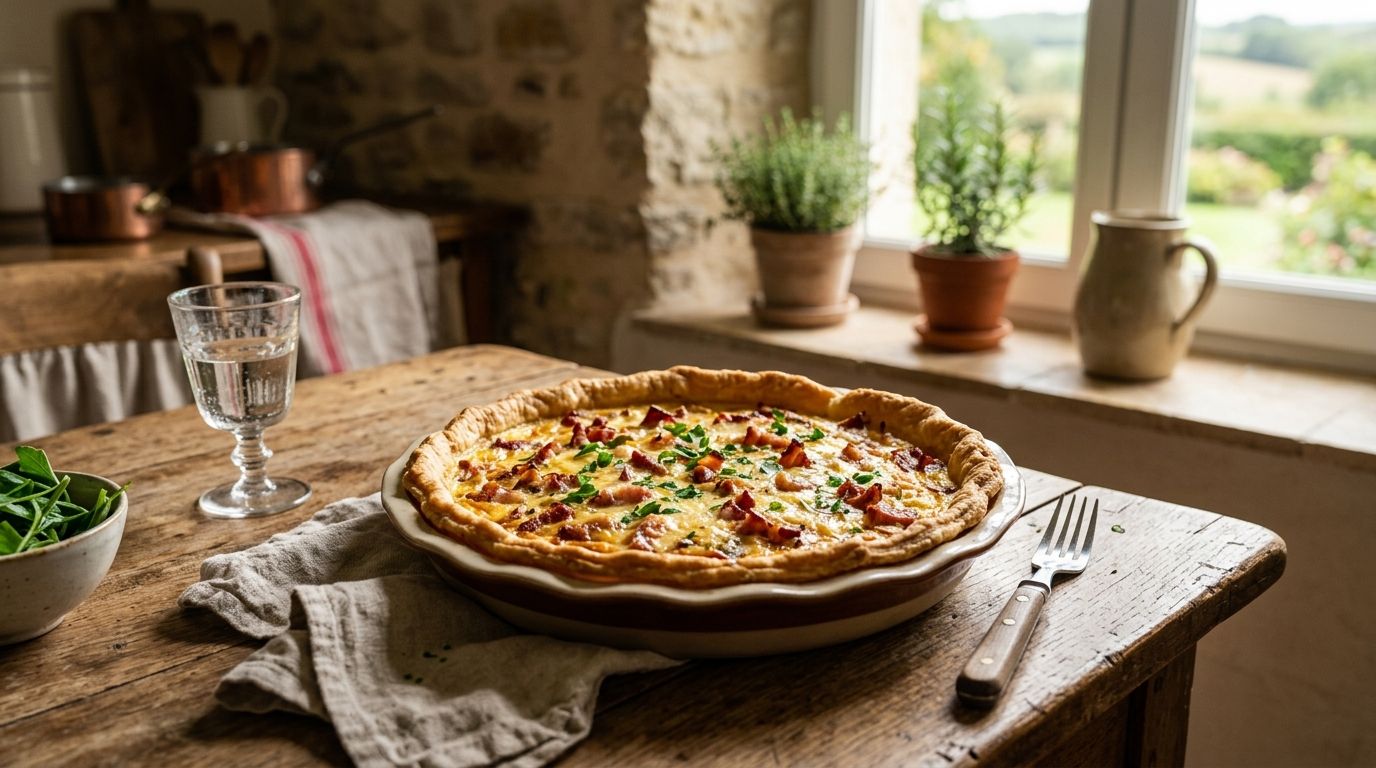
Chapter
1. The Royal Origins of Quiche Lorraine: How a German Dish Became a French Icon
Chapter
1.1 The Duchy of Lorraine and the Germanic influence on the medieval recipe
The history of Quiche Lorraine is a fascinating journey through the shifting geopolitical borders of medieval Europe. To truly understand the essence of this iconic dish, it is necessary to travel back in time to the ancient Duchy of Lorraine (Lothringen, in German). Nestled between the emerging powers of France and the Holy Roman Empire, the duchy was a land of transition, where Latin and Germanic cultures intricately intertwined. The local cuisine reflected this duality, combining the robustness of Germanic ingredients with the technical refinement that would eventually define French gastronomy. During the Middle Ages, the region was predominantly agricultural, heavily dependent on seasonal harvests and abundant dairy farming.
It was in this environment of arduous rural life that the earliest versions of the quiche emerged. Far from being the delicate delicacy of contemporary bistros, the original recipe was an essentially practical peasant dish, created to sustain field workers. When rural bakers heated the large communal wood-fired ovens in the villages, they would often test the oven's temperature by throwing a small piece of bread dough inside. To avoid wasting this baked dough, the villagers began stretching it into flat disks and topping it with whatever they had on hand: leftover thick cream (crème fraîche), eggs from local farms, and rustic pieces of cured pork.
The Germanic influence on this culinary foundation was undeniable. The concept of an open, savory tart baked on a bread base (rather than the buttery shortcrust pastry we use today) is a direct inheritance from Central European baking traditions, similar to the flammkuchen of neighboring Alsace or the German zwiabelkuech. In the medieval Duchy of Lorraine, where harsh winters demanded highly caloric meals and pantries relied heavily on smoked pork for preservation, this rustic "bread tart" became the perfect hot, comforting, and calorie-dense meal.
For centuries, the quiche remained confined to peasant kitchens and local taverns in Lorraine. It was a food of the people, served in generous slices and eaten directly with the hands by workers during harvest breaks. There was no official record of it in royal courts or grand aristocratic banquets. The recipe was passed down orally from generation to generation, a matriarchal tradition forged in the fire of stone ovens. It was only when the region's political borders began to shift that the humble bread tart caught the attention of high gastronomy.
Chapter
1.2 The meaning of the term "Kuchen" and its evolution into the French "Quiche"
The etymology of the word "quiche" is, in itself, a living testament to the complex Franco-Germanic heritage of the Lorraine region. Contrary to what many lovers of French cuisine believe, the term has no Latin or Gallo-Roman roots. It derives directly from the Lorrain Franconian (or francique lorrain) language, a Germanic dialect spoken by local populations along the linguistic border. In the local dialect, the word for cake or tart was *Kuchen*, the same term used in modern standard German.
Over the centuries, with the gradual cultural and political rapprochement of the Duchy of Lorraine and the Kingdom of France, a natural process of linguistic assimilation occurred. The guttural harshness of the "K" consonant and the Germanic "ch" sound (as in *Kuchen*) was softened by the Romance languages. The term evolved phonetically, passing through regional variations like *kichel* or *küeche*, until it was finally Frenchified in the 19th century into the spelling we know today: *quiche*. Thus, the very name of the dish is a linguistic fossil that preserves its German origin, even when pronounced with the most elegant Parisian accent.
This etymological transition was not abrupt. The word *quiche* began to appear in French written records only around 1805, coinciding with the dish's growing popularity outside its native region. Prior to this, in many ancient documents, the dish was often referred to simply as a *tarte lorraine* or *gâteau salé* by the French elites who were beginning to discover the regional specialties of their unified kingdom. The consolidation of the term "quiche" was a process of cultural acceptance, where France embraced a foreign term, transforming it into a symbol of its own heritage.
Interestingly, the original meaning of *Kuchen* (cake) perfectly reflects the texture and height of the early quiches. Unlike the thin, shallow tarts we often see in modern supermarkets, ancient peasant quiches were tall, puffed, and thick, almost resembling a savory cake due to the yeast-leavened dough base (bread dough) and the generous layer of cream. When you savor a deep, fluffy slice of an authentic Quiche Lorraine, you are, etymologically speaking, eating a true egg and bacon "cake".
Chapter
1.3 How 16th-century French cuisine adapted and refined the traditional dish
The metamorphosis of the quiche from a rustic peasant bakers' snack to a respected dish on aristocratic tables began to take shape during the Renaissance, specifically in the 16th century. As the Duchy of Lorraine strengthened its cultural and matrimonial ties with France, culinary traditions began to blend in noble kitchens. A frequently cited milestone in the legend of Quiche Lorraine is the reign of Charles III, Duke of Lorraine (1543–1608), who supposedly enjoyed the rustic dish and demanded that his court chefs serve it during banquets in Nancy.
To elevate the quiche to the standards of the nobility's demanding palates, the 16th-century chefs made a revolutionary modification: substituting the tart's base. The heavy, rustic, yeast-leavened bread dough (*pâte à pain*) was abandoned in favor of the delicate, buttery, and crumbly *pâte brisée* (shortcrust pastry). This innovation completely changed the profile of the dish. Butter, a luxury ingredient at the time, imparted a flaky texture and a rich flavor that contrasted perfectly with the soft cream, transforming the quiche from a calorie-dense subsistence food into a refined delicacy.
Beyond the pastry, the filling (the *migaine*) also underwent a process of refinement. In the older peasant versions, the cream was often made with buttermilk or leftover sour cream, mixed with whole eggs and coarse salt. French chefs introduced the use of thick, rich crème fraîche, meticulously combined with extra egg yolks to ensure a silky, velvety texture, almost like a savory pudding (flan). Freshly grated nutmeg and freshly ground black pepper began to be added to flavor the cream, bringing the exoticism of the spice routes to the regional dish.
This adaptation in the 16th century was crucial because it defined the anatomy of the modern Quiche Lorraine. By marrying the robust ingredients of the countryside (eggs, smoked pork) with the sophisticated baking techniques of the court (the buttery brisée pastry), France created a timeless classic. The dish shed its heavy Germanic identity and gained the lightness and technical precision that characterize *haute cuisine*. Quiche Lorraine ceased to be merely food to survive the winter and became a triumph of culinary art, ready to conquer the cafés of Paris and, eventually, the rest of the world.
Chapter
2. Ingredients of Traditional Quiche Lorraine: What Goes Into the Original Recipe?
Chapter
2.1 The "Migaine": The secret of the classic egg and fresh cream filling
At the heart of every true Quiche Lorraine rests the *migaine*, also known in other parts of France as *appareil à quiche* (quiche mixture). This is the liquid mixture, the binding cream that envelopes and embraces the solid ingredients before transforming into a heavenly savory custard in the heat of the oven. The word "migaine" is a deep dialectal term from the Lorraine region, attesting to the geographic purity of the recipe. For Lorraine purists, mastering the proportion and quality of the migaine is the ultimate test of a cook's skill.
The traditional migaine is spartan in its components, depending entirely on the absolute quality of its basic ingredients: fresh free-range eggs and thick fresh cream (crème fraîche épaisse). There is no room for using thin carton cream or skim milk in the authentic recipe. The cream must have a substantial fat content (ideally around 30% to 35%) to ensure the emulsion is rich, stable, and does not separate or curdle aggressively during cooking, creating the desired velvety texture.
The mathematics of the migaine varies subtly from family to family, but a classic golden rule dictates a ratio of three whole eggs plus two extra yolks for every half liter (about **17 fluid ounces**) of crème fraîche. The additional yolks are crucial; they provide an appetizing golden color, intensify the richness of the flavor, and aid in the final structure of the custard, ensuring it jiggles slightly (like firm gelatin) when the quiche is removed from the oven, without collapsing when sliced.
The seasoning of the migaine is minimalist but strict. Fine salt (used cautiously, as the bacon is already salty), freshly ground white pepper (so as not to visually blemish the cream), and, fundamentally, a generous pinch of freshly grated nutmeg. Nutmeg acts as the magical flavor bridge, mellowing the lactic richness of the cream and eggs, adding an earthy, aromatic warmth that is unmistakably French. Whisking this mixture gently—without incorporating too much air to prevent the quiche from puffing up in the oven and then sadly deflating—is the mark of a chef who respects tradition.
Chapter
2.2 The role of smoked bacon (lardon) in the dish's salty and smoky signature
If the migaine is the soul of Quiche Lorraine, the *lardons* (thick strips or cubes of smoked bacon) are its beating heart. They provide the primary flavor structure, introducing a salty, smoky, and slightly crunchy contrast to the smooth, milky sea of egg custard. In the original 19th-century Lorraine recipe, before the advent of modern refrigeration, salted and smoked pork was one of the few reliable sources of protein during the long winter months.
The choice of bacon is not trivial. The true recipe demands cured and lightly wood-smoked (such as beech or oak) pork belly bacon, never the thin, excessively salty industrialized bacon often found in foreign supermarkets. The smokiness must be elegant and present, not artificial and overwhelming. Traditionally, a whole piece (*poitrine fumée*) is bought at the butcher and manually cut into meaty batons, known as *lardons allumettes* (matchstick-shaped strips), about **0.4 inches** thick.
The preparation of the lardons before they enter the quiche is a step of utmost importance that novice cooks often skip. They must be quickly blanched in boiling water for one minute. This process, known as *blanchir*, removes excess surface salt and impurities, as well as purging moisture. Next, the lardons are carefully browned in a dry skillet over low heat, allowing the fat to render slowly and the meat to become slightly crispy at the edges.
The rendered fat from this frying often generates debate. Some purists claim that a spoonful of this flavorful fat should be brushed over the brisée pastry base before pouring in the migaine, creating a natural waterproofing barrier and intensifying the flavor. Others prefer to drain the lardons on paper towels to ensure the quiche doesn't become overly heavy or greasy. Regardless of the school of thought, the browned lardons are spread evenly over the bottom of the baked pastry crust, awaiting the comforting bath of the cream.
Chapter
2.3 Why true Gruyère or Comté cheese divides opinions among purists?
We now arrive at the most controversial, belligerent, and exhaustively debated question in the history of Quiche Lorraine: the presence of cheese. For a newcomer to French cuisine or in any café around the world, a quiche lorraine invariably includes a thick layer of melted cheese—usually Gruyère, Emmental, or Comté. However, if you ask the venerable *Syndicat National de Défense et de Promotion de l'Authentique Quiche Lorraine* (Yes, this syndicate exists in France), the answer is categorical and ruthless: TRUE QUICHE LORRAINE DOES NOT CONTAIN CHEESE.
Historically and geographically, the defenders of the "no cheese" recipe are absolutely correct. In the Duchy of Lorraine, the focus of the recipe was exclusively the lactic richness of the migaine and the pork. The introduction of Swiss Gruyère or Emmental cheese into the recipe was actually a late Parisian modification that occurred in the early 20th century. When Parisian bakers began selling the quiche in their window displays, they discovered that adding cheese not only increased visual appeal with a golden gratin but also helped mask flaws in the custard and increased sales appeal to the urban public.
This "Parisianized" version with cheese (which purists technically call *Quiche Vosgienne* if it has cheese, or *Quiche Alsacienne* if it has onions) became so universally accepted outside the Lorraine region that it eventually supplanted the original recipe in global consciousness. Today, even renowned French Michelin-starred chefs, such as Alain Ducasse or Paul Bocuse (during his lifetime), frequently included a handful of aged Comté or Swiss Gruyère in their recipes, arguing that the umami depth and melting texture the cheese brings justify the evolution of tradition.
For the modern cook seeking the authentic experience, the choice is philosophical. If you wish to honor the ancestral Lorraine tradition and experience the velvety purity of the egg custard contrasting sharply with the smokiness of the pork, omit the cheese. If you prefer the complex richness and gratinated crust that dominates Paris bakeries, add about **3.5 ounces** of freshly grated Gruyère or Comté. The only unbreakable rule in both approaches is: never, ever use cheap processed cheese, as the oil will separate and irremediably ruin the migaine.
Chapter
2.4 The choice of high-quality butter for a perfect pâte brisée
While the migaine and lardons steal the spotlight, the quiet success of a sublime Quiche Lorraine rests entirely on its architectural foundation: the shortcrust pastry, or *pâte brisée*. And the soul of the pâte brisée is, unquestionably, the butter. The function of the pastry is not merely to be an edible container; it must provide a textural contrast of crispy, buttery flakes against the soft filling, without aggressively competing with the flavor.
In France, butter is not treated merely as fat, but as a regulated agricultural institution. For a perfect pâte brisée, chefs insist on using high-fat butter (at least 82 to 84%), often certified as AOC (Appellation d'Origine Contrôlée) from regions like Isigny-sur-Mer in Normandy, or Charentes-Poitou. These European butters contain less water than common American or Brazilian supermarket butter. Less water in the dough means less gluten development in the flour, which is the mathematical secret to avoiding a tough, leathery crust.
Beyond quality, the temperature of the butter dictates the physical success of the pastry. The butter must be cut into small cubes and be glacially cold, almost frozen, when incorporated into the flour. The goal is not to create a homogeneous paste, but rather to rub the butter into the flour (a process called *sablage*) until the texture resembles coarse breadcrumbs or damp sand. When the pastry is baked, these tiny, intact pieces of cold butter will suddenly melt in the violent heat of the oven, creating tiny pockets of steam that result in the highly desired flaky and crumbly texture.
Salt and flour also deserve a mention. A fine, low-protein wheat flour (often classified as T45 or T55 in France) is the ideal choice to inhibit gluten elasticity. And, surprisingly to some, adding a teaspoon of fine salt to the flour before the butter is not optional; the salt enhances the buttery aromas and ensures the crust doesn't taste flat like raw flour, creating a harmonious balance from the first to the last bite of the quiche.
Chapter
3. How to Make the Perfect Quiche Lorraine: Chefs' Secrets for the Kitchen
Chapter
3.1 The step-by-step of pâte brisée: How to achieve the ideal crumbly texture
The creation of *pâte brisée* (shortcrust pastry) is often feared by home cooks, but in reality, it requires more thermal discipline than advanced manual skill. The term "brisée" means broken, referring to its friable texture that should melt in the mouth. The first absolute commandment in preparing this dough is: keep everything cold. Not just the butter, but also the water and, if possible, the utensils and the flour itself. The heat from human hands is the greatest enemy of pâte brisée, as it melts the fat prematurely.
The traditional manual process, which is still advocated by many artisan bakers, begins by sifting the flour and salt onto a cold marble surface or into a large metal bowl. The cold cubed butter is then scattered over the flour. Using only the fingertips (the coldest part of the hands), the butter is quickly rubbed and crushed into the flour until the mixture resembles coarse breadcrumbs. This step must be done quickly, in less than three minutes, to ensure that the pockets of fat remain structurally intact.
Next comes hydration. A small beaten egg or tablespoons of almost-frozen water are progressively added to the center of the flour and butter "sand." Using a dough scraper (corne) or a fork, the liquid is gently folded in until the dough begins to clump together into moist crumbs. At this point, the final and crucial technique called *fraisage* is applied: using the heel of the hand, the dough is pushed against the counter once or twice in short, vigorous motions. This crushes the final layers of fat, ensuring binding without kneading the dough (which would develop gluten).
3.1.1 The ideal mathematical ratio of fat and flour to avoid a tough pastry
French baking and *pâtisserie* are, at their core, exercises in precise chemistry and mathematics. For *pâte brisée*, the sacred ratio taught in schools like Le Cordon Bleu is incredibly simple, yet absolutely inflexible: the 2:1 ratio. That is, you must use exactly half the weight of the flour in butter. For example, for **8.8 ounces** (250 grams) of wheat flour, strictly **4.4 ounces** (125 grams) of high-quality butter is used, accompanied by approximately **1.7 to 2 fluid ounces** of ice water (or an egg) and **0.2 ounces** of salt.
Any significant deviation from this ratio results in structural failure. Less butter will produce a hard, dense, dry biscuit-like crust (a tough pastry that resists a fork). More butter will make the dough excessively greasy and impossible to handle, causing it to aggressively melt and shrink out of shape on the edges of the pan when subjected to the heat of the oven. Keeping the kitchen scale as your ally and respecting the 2:1 ratio is the non-negotiable foundation of the perfect quiche.
3.1.2 Why the resting time in the fridge is mandatory for the gluten?
Once the brisée pastry takes the shape of a disk, human instinct is to immediately roll it out and line the pan. This is the cardinal sin of home baking. The newly mixed dough has suffered a mechanical "trauma"; its gluten protein networks, although minimized by the butter, are stretched, tense, and elastic like fully stretched rubber bands. Additionally, the handled butter has begun to dangerously warm up.
The disk of dough must be tightly wrapped in plastic wrap and rest in the refrigerator for an absolute minimum of one hour (and ideally overnight). This period of refrigerated lethargy serves two vital chemical purposes. First, the butter solidifies again, recovering its structural integrity so that when rolled out, the flaky layers are preserved. Second, and most crucially, the gluten relaxes. A dough that does not rest enough will fight against the rolling pin, stubbornly shrinking back. Even worse, when baked, the accumulated tension will cause the edges of the crust to collapse down the sides of the pan, ruining the walls needed to contain the liquid filling.
Chapter
3.2 How to blind bake the pastry to prevent a soggy bottom
The universal nightmare of anyone who eats (and makes) Quiche Lorraine goes by the English name "soggy bottom"—a pale, mushy, soaked pastry base, incapable of supporting the structure of the filling. This occurs because the cream (migaine) is essentially a liquid. If the migaine is poured over raw dough and put in the oven, the flour will absorb the liquid long before the heat can cook and seal the crust, resulting in a textural disaster. The scientific solution to this problem is a fundamental technique in French pastry: *cuire à blanc*, or blind baking.
After rolling out the cold dough, lining a fluted tart pan with a removable bottom (traditionally metal to conduct heat well), and pricking the entire base with the tines of a fork (to prevent air bubbles), the pan returns to the fridge or freezer for 30 minutes for a final thermal shock. Next, the interior of the cold, raw pastry is lined with crumpled parchment paper, filling the cavity to the top with "pie weights" (which can be special ceramic spheres, or more practically, dried beans or rice).
The pastry then goes into a preheated oven at about **375°F to 390°F** for approximately 15 to 20 minutes. The weights ensure the bottom remains flat and the sides do not slip and collapse. After this time, the paper and weights are carefully removed. The exposed base will still look slightly pale, so it returns to the oven for another 5 to 10 minutes to dry completely, until it acquires a slightly golden hue and a porous texture, similar to a baked shortbread cookie.
Some French chefs use a masterful trick at this final stage: they remove the pre-baked crust from the oven and quickly brush the bottom with a thin layer of raw egg white, returning it to the oven for just one minute. The egg white dries almost instantly, forming a transparent protein seal, a waterproofing "paint" that absolutely ensures the wet filling, when added next, will never penetrate the crispy pastry.
Chapter
3.3 The ideal oven temperature for slow cooking and a light filling
With the pastry pre-baked, sealed, and perfectly crispy (the solid foundation built), the delicate process of assembly and the true cooking of the Quiche Lorraine begins. The previously fried lardons are spread evenly over the bottom, and the migaine is carefully poured on top, ideally while the crust is still warm in the pan. This is where many cooks make a fatal error out of impatience: managing the oven temperature for the second phase of cooking.
The migaine is not a bread or a cake that requires high temperatures to rise. It is a delicate emulsion of egg proteins and milk fats, essentially a creamy pudding (custard). If baked at a heat that is too high (above **390°F**), the outer edge of the quiche will boil violently, the eggs will coagulate too quickly squeezing the water out (a process called syneresis), and the surface will puff up like an uncontrolled soufflé, only to crack and deflate horribly as soon as it comes out of the oven. The internal texture will go from silky to rubbery and full of holes, resembling a bath sponge.
The golden secret of pastry chefs is to reduce the oven temperature to a moderate and gentle heat, typically around **320°F to 340°F**, immediately after placing the quiche inside. The cooking should be slow, meditative, and closely watched. This gentle heat allows the energy to progressively penetrate to the center of the tart, coagulating the egg proteins at a gentle pace.
The time varies depending on the oven and the depth of the pan, but generally ranges between 35 and 45 minutes. The indicator of perfect cooking is not the timer, but rather visual and tactile observation. The quiche is ready at the exact moment when the edges of the migaine are slightly puffed and golden, but the center (about **2 inches** in diameter) still presents a slight, lovely "jiggle," wobbling like gelatin when gently shaken on the oven rack. This jiggly center is not raw; it will continue to cook with the residual heat outside the oven.
Chapter
3.4 The post-oven rest: Why you should never cut the quiche right after baking?
Taking a golden and fragrant Quiche Lorraine out of the oven is an indescribable temptation. The aroma of toasted butter and smoked bacon fills the room, inviting immediate tasting. However, it is at this exact moment that patience separates amateur food lovers from true professionals. A quiche fresh out of the oven is in a volatile physical state, almost liquid internally. The matrix of eggs and cream, puffed up by pockets of scalding steam, has not yet completely structured its molecular bonds.
If you give in to haste and run a sharp knife through the hot quiche, the result will be an immediate collapse. The slice will lose its architectural integrity; the hot cream will cave in, leak, and spread disastrously across the plate, while the pastry will become soggy with the escaped juices, ruining hours of meticulous work in a matter of seconds. The texture that should have been velvety will look like a shapeless mush.
The French rule for serving a quiche stipulates absolute resting on a cooling rack (to prevent condensation at the bottom of the pan) for at least 20 to 30 minutes at room temperature. During this crucial resting period, chemical miracles occur. The residual heat finishes gently coagulating the center of the tart evenly. The internal steam dissipates, allowing the cream's structure to calm down, firm up, and slightly retract from the edges of the pastry. The butter fats in the crust partially solidify, reinforcing the flaky texture.
When the quiche reaches a "tepid" (warm) temperature, cutting becomes an aesthetic and sensory pleasure. A serrated knife (ideal for cutting the rigid crust) followed by a clean cut with a chef's knife will reveal a cross-section of architectural beauty: a dry pastry base of millimeter thickness, perfectly distributed lardons at the bottom, and a dense, smooth, flawless, self-supporting cream that gently melts in the mouth with every warm bite.
Chapter
4. The Science Behind Quiche Lorraine: Why is the Cream Texture So Light?
Chapter
4.1 The coagulation of egg proteins: How to obtain a silky, firm, and hole-free cream
For molecular gastronomy enthusiasts, Quiche Lorraine is a thermo-chemical work of art. The miracle of transforming liquid and fluid ingredients (fresh cream and raw eggs) into a solid matrix that can be cut into architectural slices rests entirely on mastering the denaturation and coagulation of egg proteins. The egg, when exposed to heat, triggers a complex chain reaction. The long, coiled protein molecules present in the white and yolk, which normally float freely, begin to unravel (denature) as thermal energy breaks the bonds holding their folded shape.
Once unraveled, these active protein fibers begin to group together and form bonds with each other, creating a continuous three-dimensional network, a microscopic mesh that traps and retains all the water and fat from the cream. It is this network, when built gradually, that gives the quiche its firm yet soft structure. The secret to the silky texture, often described by chefs as "custard-like," depends on how spaced out and delicate this protein mesh is.
However, science punishes excessive heat. If the oven is too hot (a common mistake detailed in the previous chapter), coagulation occurs violently and chaotically. The egg proteins contract abruptly, drawing too close together. Like a sponge being wrung out by rough hands, this super-contracted network mercilessly squeezes out the water it was supposed to retain. The result is "syneresis": the quiche "weeps" liquid into the bottom of the pastry, making the crust soggy. At the same time, the superheated water turns into steam that punctures the protein matrix, leaving the cream hard, rubbery, and full of holes, resembling Swiss cheese rather than velvety satin. Slow cooking at **320°F** ensures that the mesh forms elegantly, without squeezing out the water, preserving the immaculate texture.
Chapter
4.2 The science of fat in the dough: How butter prevents excessive gluten formation
If the science of the migaine is about managing the interlacing of egg proteins, the science of the brisée pastry (shortcrust pastry) is essentially about prevention, the active fight against the formation of another protein: gluten. When the gliadin and glutenin proteins present in wheat flour come into contact with water and are manipulated (through mixing or kneading), they bind to form elastic gluten strands. In bread or pizza dough making, this strong, chewy structure is highly desired. In the dough of a luxurious quiche, gluten is the fatal enemy of flaky delicacy.
The primary and most effective defense against gluten formation goes by the name of fat, specifically cold butter. The technical process of mixing the ice-cold butter into the flour before adding any liquid (the "sablage" or sanding method) is actually a microscopic waterproofing. The flour particles are coated by layers of butterfat, creating a physical barrier that isolates them. When water (or egg) is finally added to the mixture, the flour proteins, waterproofed by the fat, cannot freely bind with the moisture to activate and unravel the gluten network extensively. The fat literally "shortens" or corrals the gluten chains (which is why pastry fats are called "shortening" in English).
Beyond gluten inhibition, the role of cold fat extends to creating the textural marvel that is flakiness (crumbly crispness). Because the butter is incorporated cold and the dough is not perfectly homogenized, thousands of small, hard lentils of butter remain randomly scattered throughout the raw dough. When this dough is subjected to the explosive heat of the oven during blind baking, the water contained—around 16% in European butter—boils almost instantaneously. The generated steam expands vertically, pushing the dough upwards, leaving small empty cavities in its wake. At the same time, the flour proteins cook and firm up around these microscopic cavities, resulting in hundreds of tiny, crispy layers. Science, therefore, dictates that butter that melts in your hand before reaching the oven will ruin both gluten inhibition and steam generation, explaining the imperative of absolute coldness in French pastry.
Chapter
5. Modern Versions of Quiche Lorraine: What Changes in Recipes Around the World?
Chapter
5.1 The introduction of new French cheeses and vegetables in contemporary cuisine
Although the guardians of Lorraine tradition fiercely defend the exclusivity of the migaine (cream and eggs) and smoked bacon, culinary evolution is an unstoppable force. As Quiche Lorraine migrated from its native region to the cosmopolitan window displays of Paris and, later, to global bakeries, it ceased to be just a rigid regional recipe to become a versatile culinary concept, a "blank canvas" for modern chefs' experimentation. The introduction of cheese was only the first step toward an infinity of variations that reflect contemporary consumer trends.
In modern bakeries and creative bistros, the addition of new French cheeses has radically transformed the quiche's flavor profile. While Comté and Swiss Emmental have become ubiquitous in the classic "Quiche Vosgienne" (often sold as Lorraine), chefs have begun to incorporate more assertive and complex cheeses. Roquefort, with its salty and pungent blue mold notes, is crumbled into the cream to create an explosive contrast. Goat cheese (Chèvre), often combined with a drizzle of honey or walnuts, offers an earthy acidity that cuts through the heavy richness of the lactic fat, creating a lighter and more sophisticated version.
The vegetable revolution has also redefined the dish, driven by the growing demand for flexitarian and vegetarian diets. Leeks slowly sweated in butter (*fondue de poireaux*) have become an incredibly popular addition, often completely replacing the lardons (resulting in the so-called Flamiche). Wilted fresh spinach, sautéed mushrooms (especially cèpes and chanterelles in France), confit tomatoes, and crisp asparagus are frequently integrated. These vegetables not only add visual and nutritional complexity but also bring technical challenges: they must be perfectly dried and pre-cooked before meeting the migaine, otherwise, their natural water will destroy the cream's coagulation and soak the pastry.
This modernization has sparked a lasting semantic debate. For gastronomic purists, any quiche containing ingredients other than cream, eggs, and bacon cannot, under any legal or moral circumstance, bear the name "Lorraine." They are simply "tartes salées" (savory tarts) or generic quiches. However, the weight of the global market has enshrined the term "Quiche" as a universal synonym for any baked custard tart. Thus, the modern Quiche Lorraine, with its infinite variations, acts today as the unofficial ambassador of France's ability to export a flawless technique (the brisée base and the egg emulsion) that can be adapted to the *terroir* and season of anywhere in the world.
Chapter
5.2 How to make a gluten-free version or use puff pastry (pâte feuilletée)
The global expansion of the quiche inevitably clashed with modern dietary needs, especially the growing prevalence of celiac disease and gluten intolerance. Initially, adapting the *pâte brisée* presented a titanic challenge for pastry chefs. Because gluten, although undesirable in excess, is the structural backbone that keeps the dough from crumbling, its total absence resulted in quiche crusts that were hard, brittle like dry sand, or that melted miserably in the oven under the weight of the cream.
The solution in contemporary gluten-free cooking involves the careful engineering of flour blends. Instead of traditional wheat, chefs use a balanced proportion of rice flour (for the base structure), almond or buckwheat flour (which impart an incredibly deep nutty flavor and attractive visual browning), and potato starch or cornstarch (for lightness). To simulate the lost flexibility of gluten, binding ingredients like xanthan gum are essential. The thermal shock—keeping the dough excessively cold before baking—becomes even more critical in gluten-free versions, and blind baking requires lower temperatures and prolonged times to ensure the crust does not collapse.
On the other hand, an adaptation purely aimed at textural indulgence is the replacement of the traditional pâte brisée with opulent *pâte feuilletée* (puff pastry). This modification does not stem from a dietary restriction, but from a desire for extreme luxury. French puff pastry, built through a laborious process of successive folds interleaved with blocks of cold butter, creates hundreds of microscopic layers that separate and puff violently in the oven.
When using puff pastry for a Quiche Lorraine, the result is an architectural spectacle. The edges of the tart puff up into crispy golden flakes, offering an extremely light and airy bite that contrasts drastically with the soft cream inside. However, the technique is risky: puff pastry absorbs moisture much more aggressively than brisée. Therefore, sealing the pastry base with raw egg white after blind baking becomes not just a tip, but an absolute requirement to avoid a soggy bottom destroyed by the weight of the liquid migaine.
Chapter
6. Wine Pairing for Quiche Lorraine: Which Wines to Choose?
Chapter
6.1 Dry white wines from Alsace: The perfect combination of acidity and fat for the dish
The ancient golden rule of food and wine pairing dictates that true harmonizing excellence lies in matching food with wines from its region of origin ("What grows together, goes together"). Since the Duchy of Lorraine does not have a wine production as prominent and internationalized as its immediate neighbors, the classic and canonical pairing for Quiche Lorraine seeks refuge on the sunny slopes of the Alsace region, bordering and culturally linked.
Quiche Lorraine is a dish built upon the fundamental pillar of fat. The rich butter of the pâte brisée, the deep lactic content of the crème fraîche in the migaine, and, above all, the smoky umami and rendered fat of the pork lardons create a heavy, enveloping flavor profile that coats the palate. Serving an equally heavy or oak-laden wine would cancel out the dish, making the meal cloying and tiresome after the first slice. The solution requires an aromatic "knife" capable of cutting through this density, and this is exactly where the great dry Alsatian white wines triumph.
The perfect pairing, endorsed by French sommeliers for decades, is a dry **Alsatian Riesling**. Unlike its often sweeter German peers, the Alsace Riesling is vibrant, dry, incisively mineral, and possesses a backbone of sharp, piercing acidity. This acidity acts as a magical palate cleanser, surgically cutting through the rich cream and butter with every sip, while its complex notes of citrus fruits, green apple, and, in aged vintages, that slight touch of petroleum, wonderfully complement the smoked pork.
For those who prefer a slightly rounder aromatic profile, the Alsatian **Pinot Gris** is the second luxury choice. Fuller-bodied than the Riesling, it offers rich notes of peach, subtle honey, and sweet spices, possessing enough weight in the mouth to embrace the texture of the savory custard, while still providing the necessary acidity to balance the lardons. The harmony achieved between the richness of the quiche and the elegant tension of these white wines transforms a peasant dish into an experience worthy of high gastronomy.
Chapter
6.2 Light French reds: Pinot Noir and Gamay as sophisticated alternatives
Although conventional bistro wisdom screams "white wines with creams and eggs," evolving preferences and the climate give full opening for red wines to find their place at the table alongside a Quiche Lorraine. The fundamental challenge when pairing reds with egg-based dishes is that the natural sulfur in the yolk can clash disastrously with potent tannins, creating a metallic, bitter taste and destroying the delicate texture of the migaine. Therefore, robust wines like a Bordeaux Cabernet Sauvignon or a heavy Syrah must be avoided at all costs.
The key to a successful red pairing lies in extreme lightness, high natural acidity, and low to almost nonexistent tannins. This is where the majesty of the French **Pinot Noir** shines, preferably from the neighboring Burgundy region or even the light reds from Alsace itself (where Pinot Noir is the only permitted red grape). A young Pinot Noir, served slightly chilled (around **57°F**), brings a vibrant acidity similar to that of a white wine, but with charming notes of wild red fruits, fresh cherries, and a very subtle earthy background (sous-bois). This earthy profile establishes a wonderful connection with the rustic smokiness of the bacon, without overpowering the cream.
The other unquestionable star for this pairing is the **Gamay** grape, especially expressed in classic **Beaujolais**. A Beaujolais-Villages or a Cru (like Morgon or Fleurie) exudes freshness. Characterized by its euphoric and direct aromas of strawberry, raspberry, and even crushed black pepper, Beaujolais has an extremely agile body and practically imperceptible tannins. The juicy vivacity of the Gamay, when cut by the fat of the quiche, provides a quintessential Parisian spring meal—cheerful, uncomplicated, and immensely tasty, cleansing the palate and immediately inviting the next bite.
Chapter
6.3 Non-alcoholic drinks: Black teas and citrus infusions that cleanse the palate
Understanding that Quiche Lorraine is widely served in morning contexts, casual lunches, and brunches around the world, pairing is not restricted to alcohol. To maintain the same architectural logic used by sommeliers—seeking acidity and astringency to combat the richness of the lactic fat and pork—non-alcoholic beverages must be chosen with surgical care. Excessively sweet sodas or heavy, thick juices will aggravate the weight of the dish, making digestion unpleasant.
The most sophisticated non-alcoholic option is, without a doubt, **pure black tea** served without sugar and without milk. High-quality teas, such as a First Flush Darjeeling or a classically bergamot-scented Earl Grey, possess a level of natural tannins that function as a miniature version of a structured wine. The fine astringency and heat of the black tea literally dissolve the layer of butter and cream left on the tongue. In the case of Earl Grey, the vibrant citrus notes of the bergamot oil act as an invisible knife of acidity, complementing the saltiness of the lardon exceptionally well.
For more refreshing and cold options, especially during Parisian summers, **bubbly botanical infusions and highly carbonated mineral waters** (like the classic Perrier) are popular choices. An infusion of sparkling water, ice, generous slices of Sicilian lemon, fresh rosemary, and perhaps a touch of ginger provides everything the palate needs: the effervescence to physically "scrub" the palate, cutting through the dense fat of the egg cream, and the sharp citrus acidity to balance the salty, smoky profile of the dish, ensuring the diner finishes the meal feeling surprisingly light.
Chapter
7. Common Mistakes When Making Quiche Lorraine: How to Avoid a Soggy Pastry?
Chapter
7.1 The classic wet lardon mistake: How to fry and dry the fat before assembly
The anatomy of a culinary failure is rarely a single catastrophic event; generally, it is the lethal accumulation of small, imperceptible shortcuts. In preparing an authentic Quiche Lorraine, one of the most fatal and common shortcuts practiced by amateur cooks is pouring the smoked bacon (lardon) directly onto the pastry base, whether raw, under-fried, or excessively glistening in its own fat and moisture. This simple mistake is the root of the greasiest, heaviest, and most ruined quiches in the world.
Bacon, even the highest quality cured variety, contains a considerable amount of water in its muscle fibers and, of course, a very high percentage of lard in the white fat veins. If introduced into the quiche without the proper rigorous preparation, the gentle heat of cooking the migaine (at **320°F**) will slowly extract this water and lard, creating a microscopic, unwanted lake of salty oil that will float on top of the cream, making the quiche look repellent, orange, and extremely greasy.
Classical doctrine requires a two-step preparation for lardons. First, they must be "blanched": plunged into boiling unsalted water for exactly one minute. This hot water purges raw impurities and partially seals the edges of the meat, preventing them from losing all their vital juices in the next stage. After meticulously drying them on paper towels, the lardons go into a hot, completely dry frying pan. Frying over medium-low heat, the intermuscular fat slowly begins to melt (render), frying the cubes in their own porcine essence until they are golden and crispy at the edges, explosively concentrating the smoked flavor.
The final and non-negotiable step in this prevention process is absolute drying. The golden lardons must be removed from the pan using a slotted spoon (leaving the pool of fat behind, which can be saved for roasting brilliant potatoes) and spread over a double layer of paper towels to vigorously drain any excess surface oil. Only when they are very dry, pale, and crispy should they be sprinkled over the bottom of the pre-baked pastry crust. This obsessive care ensures that each lardon is an isolated burst of flavor, rather than a landmine of rendered fat.
Chapter
7.2 Excess moisture in the cream: How to adjust the exact ratio of eggs and cream
While the wet lardon mistake ruins the fat, the most widespread flaw in the creamy filling itself is the complete neglect of the water balance (the ratio of moisture and binding). Many cooks try to "lighten" the dish dietarily by replacing thick fresh cream with diluted UHT cream, or worse, using regular whole (or even skim) milk. This chemical betrayal of the migaine's principles almost guarantees a disastrous final product, where the Quiche Lorraine looks more like a watery, spongy omelet.
For the migaine to become a silky, velvety cream that supports its own weight after slicing, the egg proteins need to coagulate in a protected environment with a high lactic fat content. When milk or excessively liquid cream (low fat and high water content) is used, the egg protein concentration must work double to trap that water. During oven baking, the inevitable happens: the excess liquid that the proteins cannot retain (or that they squeeze out due to the heat) invisibly seeps and settles at the bottom of the crust. The once waterproofed and crispy bottom is drowned in pools of salty milk, and the entire slice collapses on the plate when cut.
The classical chemistry of French pastry stipulates proportions that should not be treated as suggestions, but as dogmas. The universal ratio for success is adding eggs to a cream with at least 30% to 35% fat content. The thickness of crème fraîche (or high-quality heavy whipping cream) is indispensable for creating that dense, luxuriant crumb.
If the cook really needs to lighten the calories and wishes to mix the cream with a portion of whole milk (a trick to make it less heavy), the mathematical adjustment is crucial: for every **3.4 fluid ounces** (100 ml) of milk added to the formula, one to two extra egg yolks must compulsorily be added (not the whole egg, just the yolk). The extra yolk provides lecithin, nature's most potent natural emulsifier, which will bind the water in the milk to the fats, thickening the liquid and returning the lost structure to the mixture, saving the quiche from a soggy tragedy.
Chapter
8. Quiche Lorraine in Pop Culture: From Peasant Dish to Luxury Tables
Chapter
8.1 How a rustic farmer's dish conquered the palates of Parisian bistros
The journey of Quiche Lorraine, from the heavy wood-fired ovens of the Duchy of Lorraine to the brilliant zenith of gas-lit boulevards in Paris, is a classic story of gastronomic social migration. For hundreds of years, this was strictly a proletarian dish: thick slices of flatbread topped with cheap eggs and scraps of pork, designed to provide quick, efficient calories to farmers in winter fields. The French elite and royalty often looked down upon peasant cooking, favoring stuffed pheasants, highly elaborate sauces with truffles, and spun sugar architecture.
The major turning point occurred during the turbulent years of the Franco-Prussian War (1870-1871). With the humiliating defeat of the French Empire, France was forced to cede the rich region of Alsace and vast portions of the neighboring Lorraine territory to the newly unified German Empire. This geopolitical fracture provoked a massive population exodus. Thousands of French citizens from Lorraine (known as *Lorrains*), stubbornly refusing to live under the rule of Kaiser Wilhelm I, fled as refugees and settled in Paris. With them, they brought the culinary pillar of their invaded homeland: the Quiche.
In a Paris eager for patriotism and solidarity after military humiliation, consuming Quiche Lorraine ceased to be merely a nutritional act and became a political gesture of defiance. Brasseries and bistros that began popping up all over Paris, many of them founded by refugees from Alsace and Lorraine themselves, placed the recipe firmly on their menus. It was in this cosmopolitan melting pot of the early 20th century that the recipe was stylized and modernized; the rustic bread base was definitively eradicated, replaced by the refined butter of *pâte brisée*, and additional ingredients like aged Parisian cheeses began to be integrated. From a food of resistance and political mourning, the quiche elevated itself to the status of a chic delicacy, a mandatory appetizer for the intellectual bourgeoisie who spent their afternoons chatting along the Seine.
Chapter
8.2 The globalization of the quiche in the 1950s: Conquering the American market
If the Franco-Prussian War brought Quiche Lorraine to Paris, it was World War II and the subsequent cultural boom of the 1950s that catapulted the rustic dish across the Atlantic Ocean toward global dominance. The catalyst for this explosion was not the marketing savvy of businessmen, but the sensory memories of the Allied armed forces. When thousands of British and American soldiers marched through liberated French towns during the fall of 1944, quiche (often served cold, easy to transport in unofficial rations, and immensely satisfying) became the first true experience of French gastronomy for many young military men.
With the return of peace and the colossal rise of the American middle class in the 1950s, an unprecedented fascination with the "European lifestyle" and international cuisine took hold in the United States. What was once a villager's pie became an instant symbol of sophisticated exoticism and good culinary taste for housewives in American suburbs. Recipes began to pop up frantically in the pages of women's magazines and the cooking sections of major New York and Chicago newspapers. "Quiche Lorraine" was not just food; it was an instant trip to Paris in a Pyrex glass dish.
However, the American journey also brought profound modifications and the popularization of "fake quiches." The original recipe, restricted and puritanical, clashed head-on with the American culture of abundance and the convenience of processed products. Crème fraîche was frequently swapped for canned evaporated milk or cottage cheese; handmade pâte brisée gave way to frozen pre-made pie crusts that clogged the shelves of newly opened supermarkets. Waterlogged frozen vegetables and massive blocks of cheddar altered the dish's minimalist nobility, transforming the delicate French tarte salée into a dense symbol of lazy middle-class home dinners in the decades that followed.
Chapter
8.3 Literary and cinematic impact: The dish as a symbol of modern sophistication
The absolute and comical zenith of the quiche's cultural trajectory occurred at the dawn of the 1980s, consolidated by the publication of the massive international bestseller and lifestyle satire *Real Men Don't Eat Quiche* (by Bruce Feirstein in 1982). The book catapulted the recipe not just as a food, but as a semantic divider in the cultural wars of contemporary Western masculinity.
In the ironic book, the quiche (with its airy texture of delicate cream, its meticulous pastry, and its origin often confused with bistros for wealthy Parisian women) became the main scapegoat for the emergence of the so-called urban, sensitive, and politically correct man of the 80s era. The dish was positioned as the diametrical antithesis of the "steak and potatoes" consumed by flannel-clad lumberjacks, rugged cowboys, and imaginary truck drivers. The literary meme achieved a giant viral potency long before the advent of the internet, spawning mugs, t-shirts, and posters spread worldwide. Quiche ceased to be gastronomy and became a behavioral state of mind.
On the silver screens of Hollywood and global television, Quiche Lorraine was recurrently used by art directors and scriptwriters as a quick semiotic code to signal pretentious elegance, imported European high culture, or overly sophisticated characters disconnected from common reality. From elitist dinners in romantic comedies where foreign ingredients were pronounced with incorrect accents to scenes of luxurious daytime Parisian lunches, the dish never lost its exotic air for the international audience. Ironically, the 1982 book that tried to stigmatize it actually sealed its immortality: global sales of quiches soared, transforming the French delicacy into an irrevocable pop culture phenomenon and ensuring its perpetual presence on menus worldwide.
Chapter
9. Benefits and Nutrition of Quiche Lorraine: How to Balance the French Diet?
Chapter
9.1 The caloric profile and essential nutrient density present in the traditional recipe
Classic Quiche Lorraine was never conceived through the lens of contemporary nutrition focused on caloric restriction. On the contrary, its origin dates back to a time when concentrated calorie intake was a matter of survival in the harsh Central European winter. Consequently, the authentic recipe, anchored in buttery pastry, high-fat cream, and pork bacon, presents a formidable caloric profile. A generous slice (approximately **5.3 to 6.3 ounces**) can easily house between 450 and 600 calories, strictly depending on the exact ratio of the migaine and the thickness of the pâte brisée. The vast majority of this energy comes from saturated fats and cholesterol.
However, looking only at caloric value is to underestimate the nutritional density that high-quality, whole ingredients offer. Quiche Lorraine is a satiety bomb and a rich source of essential nutrients. Eggs, which make up almost a third of the dish's volume, are frequently classified as the "gold standard" of biological protein, providing all nine essential amino acids needed for muscle maintenance. Furthermore, yolks are naturally loaded with choline (crucial for neurological and liver function), vitamin D, lutein, and zeaxanthin, fundamental antioxidants for eye health.
Milk and fresh cream inject a considerable dose of calcium and phosphorus, indispensable elements for bone density. Even the lactic fat from butter, when sourced from grass-fed cows (as is tradition on many French farms), contains appreciable amounts of vitamin A, conjugated linoleic acid (CLA), and butyrate, a short-chain fatty acid that nourishes the gut microbiome. Although not a dish to be consumed daily on weight-loss diets, traditional Quiche Lorraine acts as an incredibly nutritious meal, rich in protein and fat-soluble vitamins, providing a slow and sustained release of energy that keeps the diner satisfied for long hours.
Chapter
9.2 Tips for light side dishes: How a green salad with vinaigrette balances the fat
The true secret of the "French Paradox" (the ability to consume foods rich in saturated fat without corresponding high rates of cardiovascular disease) does not lie in magically modifying heavy food, but in the wisdom of structural moderation and pairing. In any traditional bistro in Paris, Lyon, or Nancy, you will rarely see a Quiche Lorraine served alone on a plate. The canonical presentation requires a mandatory dietary and sensory counterpoint: a vibrant *salade verte* (green salad).
The salad's function is not merely decorative; it is a digestive tool designed to balance the caloric load and cleanse the palate. Assertive and slightly bitter-tasting green leaves, such as frisée, wild arugula (roquette), or watercress, are preferred. These leaves provide the watery volume and dietary fiber (absent in the quiche) that facilitate intestinal transit and promote an early feeling of satiety, preventing excessive consumption of the caloric tart.
The most vital component of this side dish, however, is the classic French *vinaigrette* (a vigorous emulsion of extra virgin olive oil, red or white wine vinegar, a touch of Dijon mustard, and minced shallots). The piercing acidity of the mustard and vinegar acts chemically in the mouth in the same way Alsatian wines do: it dissolves the film of butter and bacon fat, reactivating the taste buds so that the next bite of quiche seems as fresh and tasty as the first. This synergy between the hot, heavy dish and the cold, crisp, acidic salad transforms what could be a lethargic meal into a holistic and incredibly balanced gastronomic experience.
Chapter
9.3 Modern adaptations: Healthy substitutions to reduce cholesterol without losing flavor
For lovers of French cuisine who need to strictly manage their cholesterol and saturated fat intake on medical advice, the original Quiche Lorraine may seem prohibitive. However, advances in culinary dietetics have allowed chefs and nutritionists to develop ingenious adaptations that preserve the structural integrity and nostalgic flavor of the dish while drastically reducing its caloric and lipid load.
The first target for modification is, inevitably, the migaine (the cream). Replacing all the crème fraîche with light cream or whole milk will cut calories in half, but it will require protein reinforcement to prevent the filling from becoming thin and leaking. The nutritional technique involves changing the egg ratio: using fewer yolks and incorporating more egg whites. The whites provide the protein responsible for coagulation (the three-dimensional structure) without adding a single milligram of fat or cholesterol. Another popular technique, adopted by low-glycemic diet advocates, is adding plain Greek yogurt in place of half the cream, which introduces a pleasant acidity and a generous dose of probiotics while maintaining the thick consistency.
The buttery pâte brisée, which is often the biggest caloric villain, can also undergo interventions. Replacing 30% to 50% of the white wheat flour with whole wheat flour not only increases the complex fiber content (reducing insulin spikes) but also adds a formidable earthy flavor. In more radical (and less orthodox) approaches, crusts made entirely of crushed, roasted cauliflower or overlapping ultra-thin slices of sweet potato (forming a scale pattern) eliminate refined fats and gluten entirely.
Finally, the cured pork belly lardons can be swapped for leaner alternatives. Smoked Canadian bacon, smoked turkey breast, or lean pancetta significantly reduce the saturated fat content. While Lorraine purists might frown at these substitutions, a well-executed "light" version allows the comforting spirit of Quiche Lorraine to remain accessible to those with cardiovascular restrictions, proving the adaptive resilience of this classic.
Chapter
10. Quiche Lorraine in Global Gastronomy: How the Dish Conquered the World
Chapter
10.1 The popularization in the United States and the American brunch revolution in the 70s
Quiche Lorraine's conquest of the international palate is undeniably starred by its overwhelming explosion in the United States. Although soldiers returning from World War II brought the first descriptions of the dish, it was the culinary revolution of the 1960s and 1970s, led by iconic figures like Julia Child, that introduced the French technique into middle-class domestic kitchens. With the publication of *Mastering the Art of French Cooking* (1961), Julia Child demystified the *pâte brisée* and the *migaine*, giving American housewives the confidence that they could reproduce the magic of Parisian bistros in Ohio or California.
But the true propeller of the quiche in the US was not the formal dinner, but the consolidation of a new and enduring Anglo-Saxon cultural institution: Sunday "brunch." Quiche Lorraine, with its hybrid essence (it contains eggs and bacon, typical of an American breakfast, but has the presentation of an exquisite tart, typical of lunch), proved to be the perfect culinary invention to bridge the gap between morning and afternoon meals. Served at room temperature or slightly warmed, it allowed hosts to prepare the dish in advance, freeing them to socialize with guests while sipping mimosas.
During the 1970s, quiche became ubiquitous, a mandatory status symbol at neighborhood parties, baby showers, and book club meetings. It democratized the idea of gastronomic sophistication without requiring expensive ingredients like lobster or caviar. The dish was cheap to make, incredibly versatile (any fridge leftovers could be tossed into the mix), and visually stunning when freshly sliced. American quiche helped define the aesthetic of the chic suburban lifestyle before suffering cultural satire in the following decade.
Chapter
10.2 The bizarre and creative variations of the dish found in Asian and Latin American cuisine
As soon as Quiche Lorraine broke through Franco-American borders and was absorbed by globalization, it morphed from a specific dish into a platform for hyper-customization, spawning cultural hybrids that would make the monks of the Duchy of Lorraine hold their breath. Around the world, gastronomic communities adapted the baked custard tart technique to the abundant ingredients in their own "terroirs," resulting in brilliant and occasionally eccentric variations.
In Asia, the adoption of French pastry techniques occurred massively through Japan and South Korea, countries with a deep obsession for European-style bakeries (boulangeries). However, the flavor was violently adjusted to local palates. It is not uncommon to find in Tokyo puff pastry quiches filled with a cream infused with Matcha green tea powder, encompassing pieces of soy-marinated salmon, spicy cod roe (mentaiko), and even crumbled nori. In Taiwan, sweet-and-savory variations replace the lardon with sweet shredded pork (rousong), contrasting the French technique with the explosive umami of East Asia.
In Latin America, where the abundance of corn and fresh dairy dominates native diets, quiche also underwent delicious mutations. In countries like Brazil and Argentina, the classic Quiche Lorraine is frequently reinforced (or entirely replaced) by ultra-meltable local cheeses, such as Catupiry or prato cheese. More radically, the *pâte brisée* base is often abandoned in favor of economical mixtures made with crushed water biscuits and margarine, or the traditional French bacon is replaced by fiery smoked calabrese sausage or shredded dried meat sautéed with red onions, creating a dish that merges the architectural engineering of Paris with the fiery, caloric soul of South American steakhouses.
Chapter
10.3 The debate between French purists and the cultural appropriation of the recipe
This aggressive globalization spawned a fierce and defensive counter-movement within France itself. Gastronomy, in France, is not just sustenance; it is intangible cultural heritage protected by the State and defended by ancient brotherhoods. For many gastronomes, historians, and artisan bakers (notoriously gathered in groups like the aforementioned Brotherhood of the Authentic Quiche Lorraine in Dombasle-sur-Meurthe), the proliferation of global variations is not seen as flattering homage, but as predatory cultural appropriation that erodes the homeland's identity.
The culinary-theological debate revolves around semantic trivialization. Purists argue that by calling a chicken, Catupiry, and spinach stuffed pie a "Quiche," the world is dehydrating the meaning of the original recipe, turning a historical testament of Lorraine peasant survival into a simple generic word for "cheap savory pie." Fury is directed especially at industrial supermarkets that sell pre-packaged "Quiches Lorraines" filled with analog cheese, chemical preservatives, and artificial smoke flavors, irreparably tarnishing the true recipe's reputation for technical excellence.
In contrast, pragmatic chefs and food sociologists remind purists that Quiche Lorraine itself was, in its genesis, the result of a cultural fusion between Germanics and Latins. They argue that food, like language, is organic and alive. If Quiche Lorraine had not been adapted with cheese in Paris in the 20th century, or with onions in Alsace, it might never have emerged from obscurity. The moderate consensus that arises in this debate is respect for nomenclature: global creative innovation is encouraged (like the dried meat quiche), as long as the sacred title of "Lorraine" is relinquished, reserving the latter solely for the holy trinity of brisée pastry, pure migaine, and perfectly golden lardons.
Chapter
11. Gastronomic Tourism: Where to Eat the Best Quiche in the Lorraine Region?
Chapter
11.1 Nancy and Metz: The historical capitals of Lorraine and their century-old restaurants
For the aficionado who wishes to go beyond local bakeries and seek the transcendental experience of true Quiche Lorraine on its birth soil, the Grand Est region (which today encompasses historical Lorraine) is the mandatory pilgrimage destination. This journey invariably must begin in the region's two rival and complementary cities: Nancy (the elegant 18th-century ducal capital) and Metz (the imposing fortress of Prussian and Roman architecture). In these cities, quiche is not treated as a quick window snack, but as a venerable civic heritage.
In Nancy, the charm of Art Nouveau architecture and the famous golden Place Stanislas serves as a backdrop for centuries-old bistros and brasseries that serve the recipe with monastic reverence. The renowned restaurant *Excelsior*, a dazzling jewel from 1911, frequently appears on the sacred lists of food critics. There, Quiche Lorraine is prepared under strict observance of tradition: without a single shred of cheese, with a *migaine* that wobbles with gelatinous perfection, and served warm, revealing a crust so rich in butter that it melts at the mere touch of a fork. The experience of savoring it beneath the crystal chandeliers of the Excelsior transports the visitor directly to the Belle Époque.
Metz, with its majestic Gothic cathedral, offers an equally authentic experience, but often found in artisan bakeries and traditional *charcuteries* scattered through medieval streets. In these family institutions, the emphasis is often placed on the hyper-local quality of the *lardon*. The artisans of Metz pride themselves on using bacon smoked over beechwood from the nearby Vosges forests, which gives the quiche a deep, rustic campfire aroma that no modern Parisian supermarket recipe will ever be able to faithfully reproduce.
Chapter
11.2 The Quiche Route: A tourist itinerary through the award-winning bakeries and bistros of Eastern France
For the traveler with time and appetite (and, preferably, a rental car), the regional government and gastronomic tourism associations frequently promote culinary itineraries through the picturesque countryside of Lorraine. Away from the spotlight of big cities, it is in small villages, surrounded by green pastures where dairy cows graze, that one finds the true heart of ancestral peasant cooking.
This unofficial "Quiche Route" takes visitors to villages like Dombasle-sur-Meurthe, spiritual headquarters of the Defense Syndicate of Authentic Quiche. Along the winding country roads, *fermes-auberges* (farm-inns) offer "pasture to plate" meals. The allure of these farms is total traceability: the quiche served on the rustic wooden table was prepared with flour milled on the property itself, free-range eggs collected in the morning, and thick crème fraîche drawn from the milk of the cows the tourist just photographed.
Exploring these rural routes also allows one to discover the "cousins" of Quiche Lorraine. Traveling further east toward the mountainous border, tourists encounter the *Tourte Lorraine* (a pork and veal pie marinated in wine, completely enclosed in pastry), the *Pâté Lorrain*, and the *Vosgienne* version of the quiche, which embraces the abundant cheese produced in the Vosges valleys. This itinerary is an immersion in the culture of French charcuterie and dairy preservation, transforming a simple trip into a living lesson in food anthropology.
Chapter
11.3 Annual food festivals dedicated exclusively to celebrating Quiche Lorraine
No French gastronomic celebration would be complete without the spectacle of village festivals and the extravaganzas of brotherhoods (confréries) wearing ceremonial robes. In the Lorraine region, Quiche is not just consumed; it is ceremonially worshipped in vibrant seasonal festivals that attract both frantic locals and hungry international tourists.
The most prominent of these events is usually the festival organized by the venerable *Confrérie de la Quiche Lorraine* in Dombasle-sur-Meurthe, whose members parade in velvet robes (typically in yolk-yellow and toasted-brown colors), wearing large medaled necklaces. The central event is the "enthronement" of new members (a mix of famous chefs, local politicians, and devout enthusiasts), who must prove their loyalty to the authentic recipe and swear, publicly, never to add cheese to the sacred migaine. The oath is sealed, naturally, with the ingestion of a warm slice washed down with a local white wine, accompanied by the solemn beating of drums.
Beyond the closed ceremonies, town squares are transformed into colossal open-air fairs, imbued with the aroma of browning butter and bacon sizzling in pans. Stalls from dozens of local bakeries fiercely compete for the title of "Best Quiche of the Year," evaluated blindly by rigorous juries. The festivals often culminate in megalomaniacal attempts to break local records, constructing gigantic quiches several feet in diameter baked in custom-built ovens in the middle of the square. The frantic energy and unbridled passion of these festivals prove that, far beyond an exported dish, Quiche Lorraine remains the beating heart and immortal soul of Eastern France.
Chapter
12. Incredible Quiche Lorraine Trivia: Facts Almost No One Knows
Chapter
12.1 The giant quiche from the Record Book and other festival eccentricities
The pride that France and world feel for Quiche Lorraine often spills over into the territory of eccentricities. In a spectacular (and incredibly caloric) display of culinary devotion, the city of Paris hosted a historic event in November 1997, orchestrated by visionary French chef Alain Marcotullio. His goal was nothing short of colossal: to etch the name of the famous Lorraine tart into the Guinness Book of World Records. The result was the largest Quiche Lorraine ever baked in human history.
The logistics required for this feat were military. The giant quiche measured an impressive **16.2 feet** (4.95 meters) in diameter. The shopping list for the *migaine* and the *pâte* was staggering: chefs and bakers used exactly 1,928 fresh eggs, 156 liters of cream, **308 pounds** (140 kilograms) of smoked bacon, and **330 pounds** (150 kilograms) of pure butter for the pastry. The challenge was not just mixing tons of ingredients, but ensuring the tart baked evenly without burning the edges or leaving the center liquid. A custom dome-shaped oven had to be built outdoors, heated progressively for hours. After being weighed and certified by Guinness judges, the massive quiche was cut with swords and served to thousands of awestruck Parisians, proving that tradition can be scaled to epic proportions.
Beyond this world record, small towns in the Grand Est region (Lorraine and Alsace) frequently hold annual games involving the delicacy. "Quiche dough throwing" competitions, contests to see who can crimp the edges of a pie fastest with their thumbs (a traditional movement known as *chiqueter*), and even races where waiters must balance slices of hot quiche on trays without spilling the wobbly filling. These eccentricities keep the dish alive in contemporary folklore, far from the rigid pomp of high gastronomy.
Chapter
12.2 National Quiche Day and how French families celebrate this ancient tradition
While many modern food holidays are cynical social media marketing inventions, the reverence for Quiche Lorraine has assumed the proportions of an informal civic calendar. Although the so-called "National Quiche Day" is celebrated internationally on May 22nd (a date widely promoted in the United States and the United Kingdom), families in the Lorraine region often treat every autumnal Sunday family gathering as a true celebration of the recipe.
In the oldest Lorraine tradition, the act of making a quiche was a communal ritual. Before the advent of gas ovens in every modern home, Sunday was the day to heat the village oven (*four banal*). Families prepared their *migaine* and *lardons* at home and brought the cloth-covered metal pan to bake at the communal bakery. Today, this spirit is recreated in family dinners (*repas de famille*), where quiche is rarely ordered from a pastry shop. It is a joint effort: the grandmother (*grand-mère*) teaches the crumbly texture of the dough to her grandchildren, while the children handle the slow frying of the bacon.
During these gatherings, the etiquette dictated by tradition imposes certain rules of celebration. Unlike sweet cakes that are the center of attention at the end of the meal, Quiche Lorraine is presented triumphantly as the *entrée* (hot appetizer) to open the palate, cut while still steaming slightly in the center of the table, accompanied by exclamations of approval about its golden color. The success of the home baker is measured not by verbal praise, but by the reverent silence that sets in during the first minutes of chewing.
Chapter
12.3 The favorite dish of historical figures: From French kings to Hollywood stars
Quiche Lorraine has crossed paths with the elite of history, dazzling palates accustomed to extreme luxury with its sublime simplicity. The dish's first notorious ambassador was Charles III, Duke of Lorraine (1543–1608), who not only consumed it almost daily, but also offered it to foreign diplomatic emissaries, using cuisine as a demonstration of his duchy's soft power. Hundreds of years later, legendary film director Alfred Hitchcock (a formidable gastronome with a demanding palate for heavy creams) supposedly insisted on having a classic Lorraine quiche prepared perfectly waiting for him in his dressing room during intense filming, considering the pie the only comfort food capable of calming his nerves on set.
Another historical figure fascinated by the preparation was pioneer television chef Julia Child, who popularized the recipe in American middle-class homes. She saw Quiche Lorraine not just as food, but as the Rosetta Stone of French cooking. Child argued that if an American cook could master the balance between the crust's butter and the filling's egg coagulation, that individual would have the technical mastery to execute any other *haute cuisine* dish. This emphatic recommendation cemented the dish's intellectual status.
More recently, rumors frequently circulate in lifestyle newspapers about the dietary habits of the Élysée Palace. It is said that contemporary French presidents often request thin slices of Quiche Lorraine served as "amuse-bouche" (small appetizers) during long and grueling ministerial meetings. The dish serves as a deeply rooted reminder of French soil and peasant tradition, keeping politicians literally anchored in their nation's cultural reality while they debate the country's destinies.
Chapter
12.4 Quiche in space: The French dish that was served to astronauts on the International Space Station
The final testament to the resilience and universality of Quiche Lorraine occurred well above Earth's atmosphere. The French National Centre for Space Studies (CNES), often in collaboration with renowned star chefs (like Alain Ducasse), develops special freeze-dried and canned menus designed to break the nutritional monotony of the International Space Station (ISS). The idea is to provide psychological comfort food for French and European astronauts confined in space for months.
On several recent missions led by French astronaut Thomas Pesquet, Ducasse's gastronomic research labs managed to engineer a downsized, hermetically sealed version of Quiche Lorraine. The technical challenge was immense: how to keep the brisée pastry crispy and prevent the wet cream from molding or crumbling in microgravity? The solution involved a radical dehydration process and the use of flexible polymer pouches.
The result was a package that, when rehydrated and heated in the ISS service ports, exuded the same smell of smoked bacon and butter as the bakeries in Nancy. The fact that a rustic dish born from the dough scraps of medieval bakers in the Duchy of Lorraine is floating **250 miles** (400 kilometers) above the surface of the Earth and comforting space explorers demonstrates the unwavering immortality and absolute triumph of French culinary design.
Chapter
13. FAQ: Frequently Asked Questions about the Traditional Quiche Lorraine Recipe and History
Chapter
13.1 Does the real Quiche Lorraine have cheese?
No, absolutely not. In the historical and traditional recipe codified by the Syndicate for the Defense of the Authentic Quiche in the Lorraine region, the addition of cheese (whether Emmental, Gruyère, or any other) is considered a culinary violation. The richness of the dish must come exclusively from the perfect emulsion between the fresh cream (*crème fraîche épaisse*), the egg yolks, and the rendered fat from the smoked bacon. If you add cheese to the mixture, the pie is technically called *Quiche Vosgienne*.
Chapter
13.2 What is the difference between Quiche Lorraine and Quiche Vosgienne?
The fundamental difference lies in just one extra dairy ingredient. Quiche Lorraine is strictly composed of cream, eggs, and lardons (thickly cubed cured bacon). Quiche Vosgienne, named after the Vosges Massif, a nearby mountain range where cheese production is abundant, includes generous amounts of grated Gruyère or Comté cheese spread over the bottom of the crust and mixed into the migaine. Although bakeries around the world often call Vosgienne "Lorraine," in traditional France, the distinction is rigorous.
Chapter
13.3 Can I use puff pastry instead of shortcrust pastry (pâte brisée)?
Yes, you can, but with extreme thermal caution. The canonical recipe demands shortcrust pastry (*pâte brisée*), which offers structural stability and a buttery, crumbly bite. Using puff pastry (*pâte feuilletée*) creates a visually stunning edge that puffs into hundreds of crispy flakes, which is highly popular in modern bistros. However, puff pastry absorbs liquids aggressively; therefore, it is absolutely mandatory to perform a perfect blind bake and brush the base with raw egg white to waterproof it before adding the liquid filling, avoiding a raw and soggy bottom.
Chapter
13.4 How to store and reheat quiche to maintain a crispy texture?
Incorrect storage destroys the crust. After the quiche has cooled completely, store it in the refrigerator loosely wrapped in aluminum foil or inside a container that allows slight ventilation. Never place it in airtight containers while it is even slightly warm, as condensation will cause the pastry to become soggy. To reheat, step away from the microwave, which makes the cream rubbery and the crust soggy. Heat slices in a preheated oven at about **300°F** for 10 to 15 minutes. This revives the butter's crispness and softens the migaine without boiling it.
Chapter
13.5 Can you freeze baked Quiche Lorraine?
Yes, and with excellent results, provided that thawing is done with patience. Baked Quiche Lorraine freezes formidably due to its high protective fat content. Wrap it entirely (or sliced) doubly in tight plastic wrap and then in aluminum foil to prevent freezer burn. When ready to consume, do not thaw it at room temperature, as it will release a lot of water. Take it from the freezer directly to a moderate oven (**320°F**) for about 30 to 40 minutes. This allows the retained water to slowly sublime without soaking the pastry.
Chapter
13.6 What type of bacon should I buy for the original recipe?
Avoid the ultra-thin, vacuum-packed bacon strips common in supermarkets, as they burn quickly and lack texture. Look for a whole piece of cured pork belly, ideally smoked over beech or oak wood (in France, you ask the butcher for *poitrine de porc fumée*). At home, remove the rind (tough skin) and manually cut the meat into thick rectangular batons, the famous *lardons allumettes*. These batons will withstand the initial frying and provide the necessary dental resistance ("bite") when immersed in the soft cream.
Chapter
13.7 Can I make the recipe without cream, using only milk?
Making this substitution will ruin the chemical stability of the tart. If you use only whole milk, the filling will lose its silky custard texture and turn into a watery sponge. The water in the milk won't have enough fat to bind to, leaking to the bottom of the pie (syneresis). The original recipe requires a thick, high-fat cream (above 30%). If you must use milk to cut calories or costs, it is essential to add 2 to 3 extra egg yolks to the mixture; the additional yolks will act as formidable emulsifiers, binding the water from the milk and returning the necessary viscosity to the cream.
Chapter
13.8 What is the exact origin of the name 'Quiche'?
The word "Quiche" is a profound German etymological inheritance, rooted in the complex history of shifting borders between France and Germany. It has no Latin root. The word originates from the medieval Germanic term *Kuchen*, meaning cake or pie, hailing from the Franconian dialect spoken in the former Duchy of Lorraine (*Lothringen* in German). With the centuries-old influence of the French accent in the region, the guttural *Kuchen* underwent a phonetic metamorphosis and was successively softened to *kichel*, *küeche*, and, in the 19th century, finally adopted the official Frenchified spelling we use today.
Chapter
13.9 Can Quiche Lorraine be considered a main meal?
Without a doubt. Historically, quiche was the primary heavy energy meal of farmers, designed to provide calories for an intense day's work in the cold. In the modern context, contemporary diets treat it as an exquisite lunch or dinner. Given the enormous protein density of the eggs and the high lipid load of the butter and bacon, a quarter (a 90-degree slice) of a standard **9-inch** (22-centimeter) quiche is widely considered a satisfying portion for a main meal, and it must obligatorily be accompanied by an acidic green salad to aid digestion.
Chapter
13.10 What are the best kitchen utensils for baking the pastry perfectly?
The most important utensil is the pan itself. Discard pliable silicone molds or thick Pyrex glass, as they conduct heat poorly and retain moisture at the base. True quiche requires a traditional French fluted pan made of thin sheet steel (often tinned or non-stick), and preferably with a false bottom (removable bottom). The metal conducts heat violently, shocking the butter in the dough to ensure a crispy crust. Additionally, spherical ceramic baking tools or dried beans (to provide weight during blind baking) are essential to prevent the raw base from puffing up with air pockets.