Chapter
1. The True History of Coq au Vin: From the Legend of Julius Caesar in Ancient Gaul to the First Documented Recipe of 1906
Few dishes in French gastronomy carry as rich a mythology as coq au vin, the stew of rooster braised in red wine that became synonymous with Burgundian cooking. Its origin is wrapped in a legend that dates back to ancient Gaul and to Julius Caesar himself — but the documented history is surprisingly more recent than the myth suggests. The first written recipe only appears in 1906, and the dish, far from having crossed two millennia intact, is in fact a relatively late creation that appropriated a peasant tradition to dress itself in history. In this first chapter, we will separate legend from reality and reconstruct the true genealogy of one of the most emblematic stews in France.
Chapter
1.1 What Does the Name "Coq au Vin" Mean and Why Is the Traditional Dish Made with a Rooster and Not a Chicken?
The name coq au vin means, literally, "rooster with wine" — and not "chicken with wine." This distinction is fundamental to understanding the dish's identity. The coq, in French, is the rooster — the adult male bird, with firm, fibrous and deeply flavorful meat, radically different from the poulet (chicken), which is young, tender and more delicate in flavor. The traditional dish was conceived precisely to make use of the mature rooster's meat, which, because of its toughness, was unsuited to quick roasting and required hours of slow, moist cooking to become edible.
That is why the choice of bird is not a detail, but the very essence of the dish. The old rooster possesses abundant connective tissue and collagen, which, under the gentle heat of the braise, convert into gelatin — giving the coq au vin sauce an unctuousness and body that a young chicken could never reproduce. In modern home practice, chicken has largely replaced the rooster, being more accessible and quicker to cook, but purists still consider the mature rooster the only truly authentic choice.
Chapter
1.2 The Legend of Julius Caesar and the Arverni Chief: The Founding Myth of Coq au Vin in Ancient Gaul Explained
The most celebrated legend about the origin of coq au vin dates back to Gaul in the 1st century BC, during the campaigns of Julius Caesar. According to the narrative, a Gallic chieftain of the Arverni tribe — a people of the present-day Auvergne region — is said to have sent Caesar a fighting rooster as a symbol of defiance and resistance. The gesture was a provocation: the rooster, a combative and proud animal, represented the ferocity with which the Gauls intended to face the Roman legions.
Caesar's response, the legend says, was of impeccable gastronomic irony: the Roman general invited the Arverni chieftain to a banquet and served him, as the main course, the very rooster — cooked slowly in wine. The message was clear and disdainful: the symbol of Gallic resistance had been reduced to a dinner. Thus, coq au vin is said to have been born. The story is seductive, but it does not withstand historical scrutiny — there is no documentary record from the time that corroborates it, and it only began to circulate much later.
Chapter
1.3 The First Documented Coq au Vin Recipe in 1906: Edmond Richardin's Record and the Poulet au Vin Blanc of 1864
The first documented recipe of coq au vin under that name appears only in 1906, in the work "La cuisine française: l'art du bien manger", organized by Edmond Richardin. This is a surprising fact for those who imagined the dish to be millennia old: between the supposed Gallic origin and the first written mention there is a documentary void of almost two thousand years. Food historians, however, are unanimous in affirming that the dish existed as rustic cooking long before it was recorded — it was one of those peasant preparations transmitted orally, without the prestige necessary to figure in cookbooks.
A documented precursor is the poulet au vin blanc — "chicken in white wine" — which already appeared in an English cookbook of 1864, signed by "a French lady." This recipe demonstrates that the technique of braising poultry in wine was already circulating in European kitchens in the mid-19th century. Coq au vin, therefore, did not emerge from nothing in 1906: it was the crystallization, in definitive form and name, of a much older and more diffuse culinary practice.
Chapter
1.4 Why Did Coq au Vin Only Become an International Classic in the 20th Century? The Story of the Dish's Rise
The leap of coq au vin from the status of a rustic regional dish to that of an international gastronomic classic occurred, decisively, in the 20th century — and it is owed, to a large extent, to a single person: Julia Child. Before her, the dish was known only in the bistros and home kitchens of Burgundy and its surroundings, without any global projection. It was the inclusion of the recipe in "Mastering the Art of French Cooking" (1961) and its broadcast on the television show "The French Chef" that turned coq au vin into a phenomenon of American home cooking — and, from there, of the whole world.
The context matters. Post-war France was experiencing a renaissance of its gastronomic identity, and coq au vin, with its combination of rusticity and sophistication, perfectly embodied the spirit of the French cuisine that Americans were then discovering. The dish offered something rare: an accessible technique, relatively simple ingredients and a result of extraordinarily deep flavor. It was this combination that elevated it, in a few decades, to the pantheon of the great classics of world cuisine — a destiny that neither Julius Caesar nor the peasants of Burgundy could have foreseen.
Chapter
2. Coq au Vin and Beef Bourguignon: The Real Differences Between Burgundy's Two Great Red Wine Stews
Coq au vin and beef bourguignon are often confused — and with reason, for they share the same logic of slow cooking in red wine, the same garnish of lardons and mushrooms, and the same region of origin. They are, however, distinct dishes, with their own identities forged by the meat, the history and the technique. This chapter unties the knot and teaches how to recognize, at once, each of them.
Chapter
2.1 What Is the Difference Between Coq au Vin and Beef Bourguignon? Meat, Cooking Time and Flavor Profile Compared
The most evident difference lies in the central ingredient: coq au vin is made with rooster (or chicken), while beef bourguignon uses beef. This apparently simple distinction has profound consequences on flavor, texture and preparation time. Rooster meat, although firm, is more delicate and cooks more quickly than the hard cuts of beef; coq au vin, therefore, tends to require less time on the fire — usually between an hour and a half and two hours — while beef bourguignon calls for two and a half to three hours.
In flavor profile, coq au vin is lighter and subtler, with the poultry meat bringing a natural sweetness and a texture that shreds elegantly, while beef bourguignon delivers the robust, earthy and intensely unctuous depth of beef. Both share the red Burgundy wine, the bouquet garni, the lardons, the mushrooms and the pearl onions, but the personality of each is unmistakable: coq au vin is the elegant cousin; beef bourguignon, the robust relative.
Chapter
2.2 Why Is Coq au Vin Considered the Older Cousin of Beef Bourguignon? The Timeline of the Two Stews
Although the first documented recipe of coq au vin (1906) is later than that of beef bourguignon (1867), the perception that coq au vin is the "older cousin" is based not on the written dates, but on legend and oral tradition. The narrative of Julius Caesar projects the origin of coq au vin back to ancient Gaul, conferring upon it a mythical ancestry that beef bourguignon does not possess — the latter is admittedly a 19th-century dish, with no pretensions of Roman antiquity.
In the documentary reality, however, the relationship is inverted: beef bourguignon was recorded earlier (1867) than coq au vin (1906). What oral tradition suggests, and historians accept, is that both descend from the same ancestral technique of braising meats in wine, practiced for centuries in French rural kitchens. Coq au vin inherited the legend; beef bourguignon, the date. Together, they form the two faces of a single Burgundian culinary heritage.
Chapter
2.3 The Shared Techniques: The Braise, the Lardon and the Bouquet Garni That Unite Coq au Vin and Beef Bourguignon
What truly unites coq au vin and beef bourguignon is technique. Both are braises — that is, meats cooked slowly, over very low heat, submerged in flavorful liquid, inside a covered pot. Both begin with the browned lardon, whose smoky fat serves as the base for searing the meat and building the foundation of the sauce. Both depend on the bouquet garni — the bundle of thyme, bay leaf and parsley that perfumes the cooking — and on a final garnish of mushrooms and pearl onions prepared separately.
This technical community is not accidental: it reflects the wisdom of French rural cooking, which turned the need to use up tough meats into an art. The braise in wine is, essentially, a technique of economy and patience — and both coq au vin and beef bourguignon are its most refined expressions. Learning the technique of one is learning, to a large extent, the technique of the other; what changes is only the meat that submits to the ritual.
Chapter
3. The Rooster and the Chicken of Coq au Vin: Why the Ideal Meat Is a Mature Rooster Rich in Collagen
At the heart of coq au vin lies a choice of meat that defines the entire character of the dish. The recipe was born for the rooster — not for the chicken — and understanding this distinction is to understand the very soul of the stew. This chapter explores the science and tradition behind the ideal bird, and how to adapt it to the modern kitchen.
Chapter
3.1 Why Does Traditional Coq au Vin Use a Rooster and Not a Chicken? The Science of Collagen and Mature Meat Flavor
The choice of the rooster is not a whim, but a gastronomic necessity. The mature rooster — generally over one year of age — develops, over its life, a dense musculature and an abundant connective tissue, rich in collagen. That same characteristic that makes it tough and almost impossible to chew when roasted or grilled is, paradoxically, what makes it perfect for the braise: under slow, moist cooking, the collagen hydrolyzes and transforms into gelatin, which tenderizes the meat and enriches the sauce with a silky unctuousness.
Beyond texture, the mature rooster offers a deeper and more complex flavor than that of a young chicken. The developed meat concentrates more amino acids and flavor compounds, which emerge during the hours of cooking. That is why connoisseurs insist: a coq au vin made with a true farm-raised rooster has a flavor presence that no version with industrial chicken can equal. The right bird, here, is the secret ingredient.
Chapter
3.2 Which Chicken to Use in Modern Coq au Vin? The Breed, the Cut and the Ideal Weight for the Perfect Result
Since the mature rooster is rare and expensive in the markets, modern cooking adapted the recipe to the chicken — but choosing the right chicken makes all the difference. The ideal is a free-range or farm-raised chicken, preferably of a noble breed such as the poulet de Bresse — the famous chicken of the Bresse region in France, the only one to hold a controlled designation of origin (AOC) since 1957. These chickens, raised outdoors and slaughtered at an older age, have firmer, more flavorful meat, richer in collagen than industrial chickens.
As for weight and cut, a chicken of 3.3 to 4.4 pounds is recommended, cut into pieces — thighs, drumsticks, wings and breast —, because the pieces cook more evenly and absorb the sauce better. The thighs and drumsticks are especially appreciated for their juiciness and resistance to long cooking. A good chicken, raised with time, comes considerably close to the original rooster and is the key to a truly memorable homemade coq au vin.
Chapter
3.3 How to Cut, Sear and Marinate Coq au Vin Meat to Extract Maximum Flavor and Tenderness?
Preparing the meat begins with cutting it into even pieces. If using a whole chicken, separate it into thighs, drumsticks, wings and breast, keeping the skin — which protects the meat and adds flavor and fat to the sauce. Next, the marinade is a highly recommended step: the pieces rest in the red wine, with carrot, onion, garlic, peppercorns and the bouquet garni, for 12 to 24 hours in the refrigerator. The marinade tenderizes the fibers through the action of acidity and impregnates the meat with aroma from within.
Before going into the pot, there is a non-negotiable step: drying and searing the meat. The pieces removed from the marinade must be dried with paper towels and browned, in batches, in a very hot pan — preferably in the fat of the lardons. Searing creates, through the Maillard reaction, a golden and flavorful crust that will be the backbone of the sauce. Some cooks, before searing, dust the pieces with flour, which helps them brown and thickens the sauce. This initial care is what separates a deep, complex coq au vin from a pale, insipid stew.
Chapter
4. The Wines of Coq au Vin: From Burgundy Pinot Noir to the Regional Variations That Change the Dish
Wine is the soul of coq au vin — and, contrary to what many imagine, there is no single "official" wine for the dish. The classic version uses Burgundy red, but each French region created its own interpretation, substituting the local wine and transforming the character of the stew. This chapter travels the map of coq au vin wines, from the noble red to the white, from the yellow of the Jura to the sparkling of Champagne.
Chapter
4.1 Which Red Wine to Use in Classic Coq au Vin? Pinot Noir and the Tradition of Burgundy Explained
The canonical wine of coq au vin is Burgundy red, made from the Pinot Noir grape. It is this wine that defines the classic version of the dish, giving the sauce its deep color, lively acidity and earthy, fruity character. The ideal is a good-quality Pinot Noir — a village wine from appellations such as Gevrey-Chambertin, Beaune or simply Bourgogne Rouge — dry, balanced and pleasant to drink, without excess aggressive tannins or new oak.
The golden rule is the same as for every braise in wine: cook with a wine you would serve at the table. The wine is not merely the cooking liquid; it is the very flavor of the sauce, and its quality transfers entirely to the dish. A medium-bodied Pinot Noir, with enough acidity to cut through the fat of the lardon and the skin of the bird, is the choice that French chefs recommend for coq au vin in its most orthodox form.
Chapter
4.2 The Jura's Coq au Vin Jaune: The Version with Yellow Wine and Morel Mushrooms That Enchants Gourmets
In the Jura, the mountainous region of eastern France, coq au vin gains one of its most celebrated and refined versions: the coq au vin jaune, made with the legendary vin jaune — the "yellow wine," an oxidative white wine, aged under a film of yeasts, with intense aromas of nuts, curry and dried fruits. It is a singular wine, of unmistakable personality, produced almost exclusively with the Savagnin grape.
In this version, coq au vin jaune swaps the white mushrooms for the noble morels (morchella), whose earthy, terroir-driven flavor pairs perfectly with the oxidative character of the yellow wine. The result is a dish of deep and complex aromas, more austere and sophisticated than the red version, and deeply tied to the terroir of the Jura. For many gourmets, it is the highest expression of coq au vin — an experience that justifies, on its own, a trip to the region.
Chapter
4.3 Alsace's Coq au Riesling and Coq au Champagne: The White and Sparkling Versions of the Dish
In Alsace, the regional version is the coq au riesling, made with the white Riesling wine — dry, mineral and aromatic —, which gives the dish a lightness and elegance that red wine does not possess. In this version, the sauce becomes lighter, more acidic and more delicate, allowing the flavor of the bird and the mushrooms to shine with another intensity. It is the preferred version of those seeking a fresher, subtler coq au vin.
At the opposite extreme of luxury is the coq au champagne, prepared with Champagne — the most festive and sophisticated version of all. The sparkling wine brings acidity, effervescence and a touch of opulence, creating a surprisingly light and elegant sauce. These white and sparkling versions, although "heterodox" in the eyes of Burgundy purists, are legitimate and delicious regional traditions that prove the extraordinary versatility of the dish.
Chapter
4.4 The Beaujolais Nouveau's Coq au Pourpre: The Young, Fruity and Uncomplicated Version
In the Beaujolais region, south of Burgundy, there is a festive and relaxed version of the dish: the coq au pourpre (or coq au violet), prepared with Beaujolais Nouveau — the young, fruity wine, made from the Gamay grape, which the French celebrate on the third Thursday of November. The name refers to the vibrant purple color that this young wine gives to the sauce.
It is the lightest, fruitiest and most uncomplicated version of coq au vin, ideal for those starting out with the dish or for the months when Beaujolais Nouveau has just arrived on the shelves. The exuberant fruit of the young Gamay creates an accessible and cheerful sauce, without the austere depth of Pinot Noir or vin jaune. Coq au pourpre is proof that coq au vin is not a single dish, but an entire family of dishes, spread across the whole wine geography of France.
Chapter
5. The Ingredients of Authentic Coq au Vin: The Complete and Definitive Anatomy of the Traditional French Recipe
Coq au vin is, like all the great classics of French cuisine, built upon a short and humble list of ingredients. There are no exoticisms: there is a bird, wine, cured pork, aromatics and time. What turns this simplicity into a masterpiece is the precision with which each element is chosen and integrated. This chapter dissects, item by item, the anatomy of the classic recipe.
Chapter
5.1 What Are the Essential Ingredients of Coq au Vin? The Complete and Definitive List of the Classic Recipe
The core of coq au vin is formed by a few elements: the rooster (or chicken), the red Burgundy wine, the lardons (cubes of cured bacon), the mushrooms and, optionally, the garlic. To them are added the onions and the carrots, which build the aromatic base; the bouquet garni of thyme, bay leaf and parsley; and the cognac, used to flambé and intensify the flavor. The flour and the butter complete the picture, for searing and thickening.
The final garnish — the browned lardons, the sautéed mushrooms and the pearl onions — is prepared separately and incorporated into the dish in the final minutes, preserving its texture and identity. It is this combination of meat and wine as foundation, and garnish as coronation, that defines authentic coq au vin. Each ingredient has a precise function, and the omission of any one of them subtly but perceptibly alters the balance of the dish.
Chapter
5.2 The Lardon, the Garlic and the Onion: The Aromatic Trio That Builds the Deep Flavor Base of Coq au Vin
The lardon is the first actor to enter the scene — and its importance is disproportionate to its size. Browned slowly at the start of the preparation, it releases a smoky, salty fat that serves as the base for searing the bird and sautéing the aromatics, impregnating the entire stew with a smoky foundation that no other ingredient replaces. In France, the lardon is a consecrated charcuterie product, sold already cut in virtually any market.
The garlic and the onion form, with the lardon, the aromatic trio that sustains the dish. The garlic — used whole, crushed or in cloves — brings its characteristic pungency, which softens and sweetens during the long cooking. The onion, sautéed until translucent, provides the base sweetness that balances the acidity of the wine. Together, these three elements create the flavor foundation on which the coq au vin sauce will be built, layer by layer.
Chapter
5.3 The Mushrooms and the Bouquet Garni: The Elements That Finish and Perfume Coq au Vin
The mushrooms are the garnish par excellence of coq au vin. Traditionally, the champignons de Paris — the small white mushrooms, of mild flavor and firm texture — are used, sautéed in hot butter until golden and releasing their juice. In the Jura version, the morels (morchella) replace the champignons, bringing an earthy, deep aroma that dialogues with the yellow wine. The mushrooms are prepared separately and added to the dish only in the final minutes, so that they keep their shape and freshness.
The bouquet garni is the aromatic heart of the cooking. It is the bundle of fresh thyme, bay leaf and parsley, tied with kitchen twine, that perfumes the wine and the meat during the hours of braising without leaving residue. It is removed before serving, having silently fulfilled its mission of impregnating the dish with the perfume of the herbs of French cooking. Without it, coq au vin would lose a good part of its soul.
Chapter
5.4 The Cognac and the Blood: The Secret Ingredients That Thicken and Enrich the Coq au Vin Sauce
Two "secret" ingredients distinguish coq au vin from other braises. The first is cognac, used in the flambéing stage: after searing the bird, the cook drizzles the pan with cognac and sets it alight, letting the alcohol burn off and leave behind only its concentrated aromatic compounds. This dramatic gesture deeply intensifies the flavor, adding a layer of complexity that wine alone would not achieve.
The second — and most controversial — is the bird's blood. In the traditional recipe, the sauce was thickened not with flour, but with a small quantity of rooster's blood, added at the end of cooking. The blood acts as a natural thickener and gives the sauce a deep color, a silky shine and a slightly ferruginous, intense flavor. Today, this technique has fallen into disuse in home cooking — replaced by the flour-and-butter roux —, but it remains alive in some rustic kitchens and traditional restaurants, as testimony to an era when nothing of the bird was wasted.
Chapter
6. The Science of Coq au Vin: How the Rooster's Collagen and Red Wine Turn Tough Meat into a Buttery Texture
Behind the apparent simplicity of coq au vin hides a sophisticated chemical engineering. Each step — the searing, the flambéing, the wine bath, the long cooking and the resting — triggers precise reactions that transform the rooster's tough meat into something that melts in the mouth. Understanding this science is what allows any home cook to confidently reproduce the result of the great chefs.
Chapter
6.1 What Happens to the Rooster's Collagen During the Slow Cooking of Coq au Vin? The Conversion into Gelatin
The invisible ingredient of coq au vin is collagen, the structural protein that forms the connective tissue of the mature rooster — the tendons, the membranes and the film that surrounds the muscle fibers. In the old rooster, this collagen is abundant, which makes its meat tough and resistant to quick cooking. But it is precisely this abundance that the braise turns into a virtue: when subjected to prolonged moist heat, starting at about 158 °F, collagen begins to denature and, in a process called hydrolysis, breaks its long chains down into gelatin.
This conversion is gradual and requires time — typically an hour and a half to two hours in the case of coq au vin. The result is twofold: the muscle fibers, previously held by collagen, loosen and become tender and juicy; and the released gelatin naturally thickens the sauce, giving it body and that silky shine that no industrial thickener imitates. That is why the old rooster, despised for roasting, is the hero of the stew.
Chapter
6.2 Why Does Red Wine Tenderize Coq au Vin Meat? The Chemistry of Tannins and Acidity Explained
The red wine acts on the meat of coq au vin on two complementary chemical fronts. The first is acidity: the natural acids of the wine — such as tartaric and malic — work as a gentle tenderizer, partially denaturing the proteins on the surface of the meat during the marinade and cooking. This effect is discreet, but real, and helps the meat retain moisture. The second front is the tannins, phenolic compounds from the grape skin, which bind to the proteins and add structure and a slight astringency that balances the fat of the lardon.
The wine is also the vehicle of flavors: it dissolves the aromatic compounds of the bouquet garni, the garlic and the onion, and carries them into the fibers of the meat during cooking. That is why the choice of wine is so decisive — it is not merely the cooking medium, but the very alphabet of flavor. A bad wine produces an insipid coq au vin; a good Pinot Noir, a memorable dish.
Chapter
6.3 Blood as a Coq au Vin Thickener: The Ancestral Technique That Gives Shine, Color and Body to the Sauce
One of the most fascinating — and today rare — techniques of traditional coq au vin is the use of blood as a thickener. In the ancestral recipe, a small quantity of rooster's blood was whisked and added to the sauce at the end of cooking, acting as a natural binder. The proteins of the blood coagulate gently with the heat, thickening the sauce and giving it a deep, almost black color, a silky shine and a slightly ferruginous flavor of great complexity.
This practice, dating back to an era when nothing of the bird was wasted, has become rare in modern home cooking — replaced by the flour-and-butter roux — but it remains alive in rustic kitchens and traditional restaurants of France. It is testimony to the dish's deep connection to peasant cooking, where the full use of ingredients was not only a virtue but a necessity. Knowing this technique is knowing the most intimate history of coq au vin.
Chapter
6.4 Why Does Coq au Vin Taste Better the Next Day? The Science of Resting and Flavor Reabsorption
Anyone who has tasted a freshly made coq au vin and then reheated it the next day knows the phenomenon: the dish improves with rest. It is not an impression — it is chemistry. Upon cooling, the gelatin in the sauce solidifies, trapping the flavor compounds, and the fibers of the bird, still relaxed by cooking, continue to absorb the aromatic liquids. Overnight in the refrigerator, the flavors merge, round out and deepen, eliminating edges present right after the fire.
This effect, known among chefs as the "marriage of flavors", makes coq au vin one of the rare dishes that genuinely benefit from being prepared in advance. When reheating, the gelatin melts again, returning to the sauce all its fluidity and unctuousness, now with a visibly more integrated flavor. Not by chance, coq au vin became the ideal dish for entertaining guests: it can be made the day before, rest, and reappear the next day at its peak — a gift that science gives to hosts.
Chapter
7. The Complete Coq au Vin Recipe: The Step-by-Step Guide to Making the Perfect Dish at Home Without Failing
The time has come to get hands-on — or rather, pot-on. This chapter gathers, in a practical and methodical roadmap, everything you need to execute a coq au vin worthy of a restaurant in your own kitchen. From the essential equipment to the marinade, from the complete step-by-step to the mistakes that ruin the result, this is the definitive guide for those who wish to master one of the most emblematic stews in France.
Chapter
7.1 Which Utensils and Pots Do You Need to Make the Perfect Coq au Vin? The Essential Equipment
Coq au vin does not require sophisticated equipment, but it does ask for an adequate pot. The ideal is a heavy, thick-bottomed vessel that distributes heat evenly and keeps it stable for hours — such as an enameled cast-iron cocotte or a Dutch oven. These pots retain heat steadily, seal in moisture with their heavy lids and conduct the braise to perfection, both on the stove and in the oven.
Besides the main pot, you will need few items: a skillet to sear the bird and sauté the mushrooms, a cutting board and a sharp knife to cut the pieces, tongs to handle the meat without piercing it, and kitchen twine to tie the bouquet garni. A stove that maintains a stable low heat or an oven with temperature control complete the list. With this simple arsenal, any home kitchen is capable of reproducing the classic.
Chapter
7.2 The Coq au Vin Marinade: How Long and with Which Aromatics to Marinate the Rooster in Red Wine?
The marinade is an optional, but highly recommended step for those seeking depth. In it, the pieces of rooster or chicken rest immersed in the red wine, accompanied by sliced carrot, onion wedges, crushed garlic, black peppercorns and the bouquet garni. The ideal resting time varies from 12 to 24 hours, always in the refrigerator, in a covered container. This prolonged contact allows the acidity of the wine to gently tenderize the fibers and the aromas to penetrate the meat completely.
An important warning: do not marinate for too long, because excess acidity can, paradoxically, harden the surface of the meat and alter its texture. The classic point of balance revolves around one night. After the marinade, the meat is drained and very well dried before being seared — and the marinade liquid, strained, can be used in the cooking, returning to the pot all the flavors it extracted.
Chapter
7.3 The Complete Step-by-Step of Coq au Vin: Sear, Flambe, Sauté and Cook Slowly for Hours
The execution of the dish follows a rigid sequence that guarantees the result. First, brown the lardons slowly, until they render their fat, and set them aside. Second, sear the pieces of rooster or chicken, in small batches, in the hot fat, until the skin is golden and crispy; set aside. Third, in the same pot, sauté the onion and the carrot, scraping the bottom to release the browned residues. Fourth, return the bird to the pot, drizzle with the cognac and flambé, tilting the pot so that the alcohol ignites and burns off.
Fifth, sprinkle the flour over the bird, stirring, to create the roux that will thicken the sauce. Sixth, drizzle with the red wine and a little chicken stock until almost covering the pieces, add the bouquet garni and the garlic, and bring to a gentle boil. Seventh, cover and transfer to the oven at 325 °F — or keep on the stove, on the lowest heat — and cook for an hour and a half to two hours, until the meat is tender and falls off the bone. Eighth, prepare separately the sautéed mushrooms and the glazed pearl onions and, in the last half hour, incorporate them into the stew along with the reserved lardons. Finally, adjust the salt and pepper, reduce the sauce if necessary and serve very hot, preferably the next day.
Chapter
7.4 What Are the Most Common Mistakes That Ruin Coq au Vin? The Definitive Guide to Never Failing
The road to ruining coq au vin is paved with predictable — and avoidable — mistakes. The first is searing moist or crowded bird, which generates steam instead of browning and leaves the sauce pale and shallow. The second is using a bad or sweet wine, which can ruin the balance of the sauce with uncontrolled bitterness or sweetness. The third is letting it boil vigorously: as we have seen, the aggressive boil hardens the meat and steals its juiciness.
Other common slips include adding the garnish too early — lardons, pearl onions and mushrooms added too soon fall apart and lose their identity —, rushing the cooking out of impatience, and serving immediately, giving up the overnight rest that rounds out the flavors. There is also the mistake of seasoning only at the end: the meat and the sauce ask for layers of seasoning throughout the entire process. Avoiding these stumbles, the dish reveals itself generous — and forgives, with ease, any small imperfection of technique.
Chapter
8. Julia Child and Coq au Vin: The Story of the Dish That Became the Signature of America's Greatest Television Chef
If beef bourguignon was the recipe that consecrated Julia Child in writing, coq au vin was the dish that consecrated her on television — and that became, perhaps, her most enduring signature. The trajectory of the American chef and that of the French dish intertwine so deeply that it is impossible to tell the story of one without telling the story of the other.
Chapter
8.1 Who Was Julia Child and Why Did Coq au Vin Become Her Most Famous Signature Dish?
Julia Child (1912-2004) was one of the most influential figures in the history of American cooking. Born in Pasadena, California, she only discovered French cuisine as an adult, when she moved to Paris in the late 1940s, accompanying her husband, the diplomat Paul Child. Fascinated by the local gastronomy, she enrolled in the legendary Le Cordon Bleu school and spent years studying the techniques of French cooking in depth.
Coq au vin became her signature for a simple reason: it was the perfect dish for teaching French technique to the American public. It demonstrated, in a single recipe, several fundamental skills — searing, flambéing, braising and preparing the garnish — while remaining, at the same time, accessible and spectacular. When Julia Child prepared it before the cameras, with her contagious energy and good humor, the dish turned into a spectacle that captivated millions of viewers.
Chapter
8.2 Coq au Vin in "Mastering the Art of French Cooking" and on the TV Show "The French Chef"
Coq au vin figures prominently in "Mastering the Art of French Cooking" (1961), the book that Julia Child wrote with the French women Simone Beck and Louisette Bertholle. There, the recipe is presented with the authors' characteristic rigor: the bird seared and flambéed, the sauce reduced and unctuous, the garnish of lardons, mushrooms and pearl onions prepared separately. The recipe occupied several pages and required, by the American standards of the time, considerable dedication.
It was, however, on television that the dish achieved immortality. Julia Child prepared coq au vin twice on her show "The French Chef", on the public broadcaster PBS, and those broadcasts became legendary. Millions of Americans saw, for the first time, how to flambé a bird with cognac and how to turn simple ingredients into a restaurant-worthy dish. Coq au vin thus became a symbol of the culinary revolution that Julia Child led in America.
Chapter
8.3 How Did Julia Child's Coq au Vin Conquer America and the World? The Legacy of the Recipe in Home Cooking
The impact of Julia Child's coq au vin transcended television. The recipe inspired a generation of American home cooks to abandon industrialized dishes and embrace cooking from scratch, with technique and patience. Coq au vin became, in the United States, synonymous with "special dinner" — the dish one prepared to impress, to celebrate or to demonstrate love.
That legacy persists to this day. Coq au vin is, alongside beef bourguignon, one of the recipes most associated with Julia Child, and it continues to be reproduced by home cooks around the world. The American chef did not invent the dish — but she was, without a doubt, the one who immortalized it, turning a French regional stew into a global classic of home cooking. For the traveler who arrives in Burgundy in search of the authentic dish, there is, therefore, a silent debt to the American from Pasadena who taught the world how to cook it.
Chapter
9. The Regional Variations of Coq au Vin: From Burgundy to the Jura, Alsace and Champagne
Far from being a single, immutable dish, coq au vin is an entire family of recipes, each expressing the character of its region through the local wine. From the noble red of Burgundy to the oxidative yellow of the Jura, from the mineral white of Alsace to the sparkling of Champagne, each variation tells a different story. This chapter travels the map of the regional reinventions of the dish.
Chapter
9.1 Coq au Vin de Bourgogne: The Classic Version with Pinot Noir, Lardons and Mushrooms
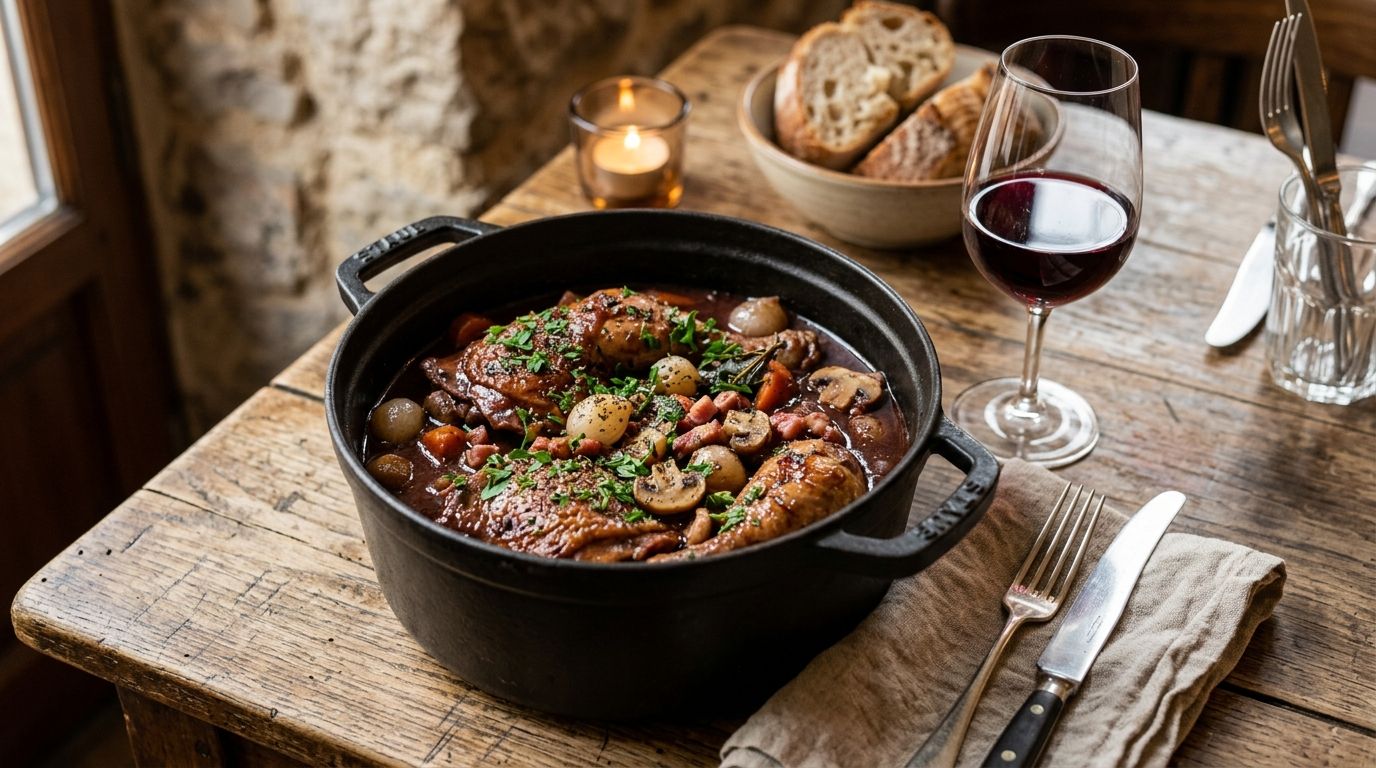
The canonical version of coq au vin is that of Bourgogne — the coq au vin de Bourgogne —, made with the red Pinot Noir, the lardons, the mushrooms and the pearl onions that define the dish's identity. It is the most sober, deep and orthodox version, with the dark, unctuous sauce that became the universal image of the stew. It is also the one that best represents the rural heritage of the region, where the dish was born in peasant kitchens.
In this version, balance is everything: the acidity of the Pinot Noir cuts through the fat of the lardon and the skin of the bird, while the mushrooms and pearl onions bring freshness and texture. Served with boiled potatoes and accompanied by a good Burgundy red, coq au vin de Bourgogne is the purest and most faithful experience the dish can offer — the obligatory starting point for any appreciator.
Chapter
9.2 Coq au Vin Jaune: The Treasure of the Jura with Yellow Wine and Morel Mushrooms
In the Jura, coq au vin reaches its most sophisticated expression: the coq au vin jaune, prepared with the vin jaune — the celebrated "yellow wine," an oxidative white aged under a veil of yeasts, with aromas of nuts, curry and dried fruits, produced almost exclusively with the Savagnin grape. It is a wine of unique personality, which completely transforms the character of the dish.
In this version, the morels (morchella) — noble, earthy mushrooms — replace the champignons de Paris, creating a combination of deep and complex aromas. The result is an austere, sophisticated dish, deeply tied to the terroir of the Jura, considered by many gourmets the highest expression of coq au vin. It is a singular gastronomic experience that justifies a trip to the mountainous region of eastern France.
Chapter
9.3 Coq au Riesling and Coq au Champagne: The White and Sparkling Versions That Divide the Purists
In Alsace, the dish is reinterpreted as coq au riesling, made with the white Riesling — dry, mineral and aromatic —, which gives the stew a lightness and elegance absent from the red version. The sauce becomes lighter, more acidic and more delicate, letting the flavor of the bird and the mushrooms shine with another intensity. It is the choice of those seeking a fresher, subtler coq au vin.
At the opposite extreme of luxury is the coq au champagne, prepared with Champagne — the most festive and sophisticated version. The sparkling wine brings acidity, effervescence and opulence, creating a surprisingly light and elegant sauce. These white and sparkling versions, although considered "heterodox" by Burgundy purists, are legitimate and delicious regional traditions that prove the extraordinary versatility of the dish — and the freedom that French cuisine grants to each territory.
Chapter
9.4 Coq au Pourpre and Other Versions: The Complete Guide to the Regional Reinventions of the Dish
In the Beaujolais, south of Burgundy, there is the festive version of the dish: the coq au pourpre (or coq au violet), prepared with Beaujolais Nouveau — the young, fruity wine of the Gamay grape, celebrated on the third Thursday of November. The name refers to the vibrant purple color that the young wine gives to the sauce, and the exuberant fruit of the Gamay creates a light, cheerful and uncomplicated dish.
The family of coq au vin extends even further: there are versions with cider in Normandy, with red wines of the Languedoc or the Loire, and modern reinterpretations that use noble birds and prestigious wines. Each region imprints its mark, but all obey the same ancestral logic: a bird, a local wine, and the patience of the braise. Coq au vin is, in that sense, a gustatory map of the whole of France — living proof that great cuisine is, above all, an expression of the territory.
Chapter
10. How to Pair Coq au Vin: The Best Wines, Side Dishes and Moments to Serve the Dish
A great dish deserves a great table. The pairing of coq au vin — the choice of the wine that accompanies it, of the side dish that sustains it and of the occasion on which it is served — is the final chapter of the experience, and the one that most reveals the sophistication of French cuisine. This chapter gathers the classic rules and the welcome freedoms for serving the stew in its splendor.
Chapter
10.1 Which Wine to Serve with Coq au Vin? The Golden Rule of Pairing That Every Sommelier Follows
The golden rule of French pairing is elegant and ancient: serve the same wine used in the cooking, or at least a wine from the same region and the same grape. Thus, a coq au vin made with a Pinot Noir from Burgundy asks, at the table, for another Burgundy red — preferably somewhat nobler than the one that went into the pot. The idea is that the wine in the glass echoes that of the sauce, creating a continuity of flavor between the glass and the dish.
If the regional choice is difficult, the classic alternatives are accepted with pleasure: a village Beaujolais, a Pinot Noir from other latitudes, or even a fruity Gamay, all medium-bodied with good acidity. In the white versions of the dish — coq au riesling or coq au champagne — the same logic applies: serve the white or sparkling wine of the recipe. The serving temperature also matters: a lightly cool red, between 59 °F and 63 °F, enhances the fruit and the acidity, making the whole more vibrant.
Chapter
10.2 Potatoes, Pasta or Bread: What Is the Classic and Definitive Side Dish for Coq au Vin?
The traditional side dish for coq au vin is boiled potatoes. Simple, almost rustic, they absorb the dense sauce without competing with it, fulfilling the role of the perfect vehicle for the richness of the braise. The potatoes can be served whole, steamed or lightly buttered, and are the canonical choice in French bistros. The creamy, comforting mashed potato is the second most beloved option.
There is, moreover, room for regional variations and personal preferences. Fresh pasta — such as tagliatelle or wide noodles — is common in some regions and creates a more substantial dish, absorbing the sauce with generosity. Rustic bread — a slice of baguette or a pain de campagne — is the ideal companion for cleaning the plate, in the purest French custom of *saucer* (soaking the bread in the sauce). Whatever the choice, the principle is the same: the side dish must be neutral enough to let the stew shine, but robust enough to sustain it.
Chapter
10.3 When to Eat Coq au Vin? The Seasonality of the French Dish and the Best Occasions to Serve It
Coq au vin is, by nature, an autumn and winter dish. Its hours of braising warm the kitchen, and its richness comforts in the cold months — hence its deep association with family Sunday lunches, festive gatherings and convivial dinners. It is the dish served when time lengthens at the table and the food calls for red wine and warm bread.
Nothing, however, prevents it from being enjoyed all year round — and many restaurants keep it on the menu permanently, such is its popularity. The advice of connoisseurs is only to respect the spirit of the dish: to serve it in generous portions, accompanied by good company and without haste. Because coq au vin is not just a recipe; it is an invitation to slowness, to conviviality and to the pleasure of the table — the true heart of French gastronomic culture.
Chapter
11. Where to Eat the Best Coq au Vin in France: From Rural Burgundy to the Legendary Bistros of Paris
Tasting coq au vin in its territory is an experience that every lover of good food should pursue. Whether in the rusticity of an auberge in Burgundy, facing the vines of the Côte d'Or, or at the counter of a historic bistro in Paris, the dish reveals, in each place, a distinct personality. This chapter traces a route to find it at its best.
Chapter
11.1 The Best Restaurants in Burgundy to Try the Authentic and Traditional Coq au Vin
In Bourgogne, coq au vin is prepared with a sense of place that no other restaurant in the world can imitate. In cities such as Dijon — the historic capital of the region — and Beaune, the heart of the Côte de Beaune, the *auberges* and the restaurants of Bourguignonne cuisine serve the stew according to recipes handed down between generations, almost always with farm-raised poultry and local wine. Beaune, in particular, is a mandatory stop: the medieval city, with its historic hospices and wine cellars, offers countless tables where the dish is served in its most orthodox version.
The Burgundian experience is completed by the products that accompany the stew: the Dijon mustard, the cheeses of the region such as the Époisses — with its washed rind and intense aroma — and, of course, the wines served a few miles from where they are born. For the traveler who wants the full context, it is worth combining lunch with a visit to a winery of the Côte de Nuits, turning the meal into an immersion in the terroir that gives the dish its name.
Chapter
11.2 The Paris Bistros That Serve the Most Celebrated and Coveted Coq au Vin in the French Capital
Paradoxically, coq au vin became, in the 20th century, a dish more associated with the bistros of Paris than with the farms of Burgundy. It was in the restaurants of the capital that it consolidated as a classic of the French menu, served in steaming casseroles alongside boiled potatoes. The traditional Parisian bistros — many of them centenary, with mirrors, dark woods and slate menus — continue to serve faithful and memorable versions of the stew.
Seeking out the dish in Paris is also a lesson in gastronomic history: the city has been, since the 19th century, the great stage of French cuisine, and it was there that the stew gained dignity and technique. For the tourist, the tip is to look for bistros with authorial cooking and quality products, outside the most touristic circuits, where the coq au vin is made with the same respect as any haute cuisine dish. In many cases, the dish is announced as the specialty of the house — a sign that it is taken seriously there.
Chapter
11.3 How Much Does a Coq au Vin Cost in a French Restaurant? The Complete Price Guide and Whether It Is Worth It
The price of coq au vin in restaurants varies widely according to the establishment and the region. In a neighborhood Parisian bistro, the dish usually figures between 16 and 25 euros; in more prestigious addresses or in restaurants of Burgundy focused on gastronomic tourism, the value can rise to 25 to 35 euros or more, especially when accompanied by selected wines and high-quality ingredients. In lunch menus (*formule* or *menu du jour*), the stew frequently appears as the main course at a reduced cost.
The question "is it worth it?" has an almost unanimous answer among connoisseurs: yes. Eating the dish in France is to experience it in the context for which it was created — with the right wine, the right bread and the right atmosphere —, something that no homemade version fully reproduces. Moreover, coq au vin is one of the rare dishes that have yielded well from their own humble origin: for a fair price, it delivers depth of flavor, history and the comfort of one of the great recipes of humanity. It is, in the end, one of the best cost-benefits of French gastronomy.
Chapter
12. Curiosities, Myths and Surprising Secrets of Coq au Vin That Will Forever Change How You Look at the Dish
Behind every great dish there is a treasure of little-told stories. Coq au vin accumulates myths, misunderstandings and curiosities that surprise even the most dedicated appreciators. This chapter gathers the secrets and surprises that reveal the dish in an entirely new light.
Chapter
12.1 Was Coq au Vin Really Born in Ancient Gaul? The Historical Truth Behind the Myth of Julius Caesar
The most persistent myth about coq au vin is that it was born in ancient Gaul, during the campaigns of Julius Caesar. The legend of the Arverni chieftain and the rooster served to the Roman general is seductive — but it does not withstand historical scrutiny. There is no source from the time that corroborates it, and the first documented recipe of the dish only appears in 1906, almost two thousand years later. Historians are unanimous: the legend is a later construction, projecting onto the dish a mythical ancestry that it, documentarily, does not possess.
The grain of truth in the legend lies in the technique. Indeed, the braise of meats in wine is a practice deeply rooted in European rural cuisine, dating back to time immemorial — and the Gauls, celebrated for their consumption of game and rooster meat, probably cooked birds in wine long before the Roman era. What the legend does is give name and date to a diffuse practice, creating a romantic origin that the documentation does not support. The truth, as always, is more complex — and no less fascinating.
Chapter
12.2 Why Is the Rooster the National Symbol of France? The Connection Between Coq au Vin and the Gallic Rooster
There is a delicious irony in the relationship between coq au vin and the Gallic rooster — the *coq gaulois*, the national symbol of France. The rooster became a French emblem thanks to a linguistic pun: the Latin word *gallus* meant both "Gaul" and "rooster", and the Romans mocked the Gauls by associating them with the bird. Over time, the rooster was adopted as a symbol of national pride and combativeness, appearing on sports jerseys, monuments and even the gate of the Élysée Palace.
The irony is that the same animal that represents French national pride also stars in one of the most emblematic dishes of its cuisine. The rooster, symbol of resistance and combativeness, ends up — in the pot — as the star of a red wine stew. This duality between the emblem and the ingredient is one of those delicious paradoxes that only French culture, with its deep love of gastronomy, could produce.
Chapter
12.3 Does Coq au Vin Really Contain Blood? The Controversy of the Traditional Thickener Explained
Yes — and this is one of the most fascinating controversies of the dish. In the traditional recipe, the sauce of coq au vin was thickened with a small quantity of rooster's blood, added at the end of cooking. The blood acted as a natural binder: its proteins coagulated gently with the heat, thickening the sauce and giving it deep color, shine and a slightly ferruginous flavor of great complexity. The technique was common in rural cooking, where nothing of the bird was wasted.
Over time, the practice fell into disuse in home cooking — for sanitary, practical and taste reasons —, being replaced by the flour-and-butter roux. It remains, however, alive in some rustic kitchens and traditional restaurants, as an echo of an era when coq au vin was made with the whole bird, from beak to feet. For the modern appreciator, knowing this technique is knowing the most intimate and authentic history of the dish.
Chapter
12.4 Does Coq au Vin Appear in Pop Culture? From Cinema to Haute Cuisine, the Dish's Appearances
Coq au vin crossed the border between the kitchen and popular culture. Its most celebrated appearance was on the shows of Julia Child, which turned the dish into a television phenomenon in the United States. From there, coq au vin became a visual shorthand for "serious French cooking" in films, series and cooking shows — the dish that a character prepares to impress, seduce or comfort.
In haute cuisine, coq au vin continues to inspire chefs around the world, who revisit it with modern techniques — noble birds, prestigious wines, contemporary presentations — while preserving the essence of the braise in wine. And on social media, the dish accumulates millions of views, with videos of the bird browning, the spectacular flambéing and the meat falling apart on the fork. Coq au vin, born in peasant kitchens and elevated by television, is today a cultural icon of planetary reach.
Chapter
13. FAQ: The 15 Most Frequently Asked Questions About Coq au Vin
Chapter
Which wine to use in coq au vin?
The ideal is a dry red from Burgundy, preferably a Pinot Noir from a village appellation, such as Gevrey-Chambertin or Beaune. If you prefer a more accessible option, a generic Bourgogne Rouge or a good-quality Beaujolais fulfills the role well. The important thing is that the wine be dry, balanced and pleasant to drink — never a sweet wine or one of very inferior quality, which would compromise the sauce.
Chapter
Are coq au vin and beef bourguignon the same thing?
No. They are distinct dishes from the same family of braises in wine. Coq au vin is made with rooster (or chicken), while beef bourguignon uses beef. Coq au vin is lighter, subtler and cooks faster; beef bourguignon is more robust, earthy and unctuous, and requires more time on the fire. Both, however, share the red Burgundy wine, the lardons, the mushrooms and the bouquet garni.
Chapter
Can I use chicken instead of rooster?
Yes. Modern cooking largely replaces the rooster with the chicken, which is more accessible and quicker to cook. The ideal is a free-range or farm-raised chicken, preferably of a noble breed such as the poulet de Bresse, with firmer, more flavorful meat. The mature rooster, however, remains the choice of purists, for its abundant collagen and deeper flavor.
Chapter
How long does it take to cook coq au vin?
Counting the optional marinade, the dish can take from 24 to 36 hours in total. The cooking itself demands an hour and a half to two hours of braising on low heat, at a temperature of about 325 °F in the oven or on minimum heat on the stove. The marinade, if done, adds 12 to 24 hours of advance time.
Chapter
Does coq au vin really contain blood?
In the traditional recipe, yes. The sauce was thickened with a small quantity of rooster's blood, added at the end of cooking, which gave deep color, shine and a slightly ferruginous flavor. Today, this technique has fallen into disuse in home cooking, being replaced by the flour-and-butter roux. It remains alive only in some rustic kitchens and traditional restaurants.
Chapter
Can I make coq au vin without alcohol?
Yes, it is possible to adapt. The traditional coq au vin depends on red wine, but there are alcohol-free versions that replace the wine with a combination of chicken stock, dark grape juice and a touch of red wine vinegar to simulate the acidity. The result is not identical to the original, but it preserves the spirit of the dish for those who do not consume alcohol.
Chapter
What is the lardon in coq au vin?
The lardon is a cube of cured bacon or smoked pork belly, typical of French charcuterie. In coq au vin, it is browned at the beginning to release tasty fat and returns to the dish at the finish. Outside France, it can be replaced by bacon in cubes, preferably a thick bacon, not too smoky.
Chapter
What side dish to serve with coq au vin?
The traditional side dish is boiled potatoes, served whole or lightly buttered. The mashed potato is the second classic option, followed by fresh pasta and rustic bread, used to soak up the sauce. The choice depends on taste and region, but boiled potatoes remain the canonical tradition of French bistros.
Chapter
Is coq au vin fattening? How many calories does it have?
Coq au vin is a rich dish, but generally less caloric than beef bourguignon, since it uses poultry. An average portion can contain between 350 and 550 calories, varying according to the cut, the amount of lardons and the side dish. With potatoes or mash, the value rises. It is a dish for special occasions, not for everyday life.
Chapter
Can I freeze coq au vin?
Yes, and very well. Coq au vin is one of the dishes that best withstand freezing, thanks to the rich sauce and the gelatin of the meat. Frozen in a well-sealed container, it keeps for up to three months. When thawing, it is recommended to do so slowly in the refrigerator and to reheat over low heat, so that the sauce recovers its velvety texture.
Chapter
What does "coq au vin" mean?
"Coq au vin" means, literally, "rooster with wine" in French. The term coq designates the rooster — the adult male bird —, and not the chicken (*poulet*). The name reveals the essence of the dish: a bird, traditionally the mature rooster, cooked slowly in wine until it falls apart in tenderness.
Chapter
Is coq au vin originally from Burgundy?
The association with Burgundy is strong and legitimate, thanks to the region's red wine that defines the classic version of the dish. However, coq au vin is not exclusive to Burgundy: each French region has its version, from the Jura (with yellow wine) to Alsace (with Riesling) and Champagne (with sparkling wine). The origin legend dates back to ancient Gaul, but the first documented recipe is from 1906.
Chapter
Who popularized coq au vin worldwide?
It was Julia Child, the American cook and writer, who popularized coq au vin internationally. Her recipe in "Mastering the Art of French Cooking" (1961) and her broadcasts on the TV show "The French Chef" turned the dish into one of her signature dishes and into a classic of home cooking worldwide.
Chapter
What is the difference between coq au vin rouge and coq au vin blanc?
The difference is in the wine. Coq au vin rouge (the classic version) uses red wine, usually Pinot Noir, resulting in a dark and deep sauce. Coq au vin blanc uses white wine — such as Alsace Riesling, the Jura's vin jaune or Champagne —, resulting in a lighter, more delicate sauce. They are two faces of the same family of dishes.
Chapter
Does coq au vin improve the next day?
Yes, and it is not a myth. Coq au vin improves after a night of rest, because the flavors merge and round out, and the meat continues to absorb the sauce. It is one of the rare dishes that genuinely benefit from being prepared in advance and reheated the next day, over low heat.