Chapter
🏛️ 1. Origins and History of the Throne Fair
🏰 1.1 Medieval Origin of the Throne Fair
The oldest fair in Paris was born from faith and popular celebration.
🕯️ Sacred roots: the Abbey of Saint-Antoine and the “pain bénit”
The origin of the Throne Fair dates back to the 12th century, in the heart of the Middle Ages. Its creation is directly linked to the Abbey of Saint-Antoine, located in the current 12th arrondissement of Paris. Every year, during Holy Week, the monks of the abbey blessed special loaves of bread—the famous pain bénit (blessed bread)—and distributed them to the faithful as part of the Easter celebrations. These religious events attracted crowds from all over the Île-de-France, who gathered to watch the ceremonies, acquire the blessed loaves, and, over time, participate in small parallel festivities.
🎪 The birth of the secular fair
As is common in many medieval traditions, the sacred and the profane eventually intertwined. Street vendors, artisans, musicians, and street performers began to set up around the abbey during this period, taking advantage of the flow of the faithful. This activity gave rise to what would become known as the “Foire de Saint-Antoine,” which was later renamed the Throne Fair—a reference to the former “Place du Trône,” the historic name of the current Place de la Nation, where the fair was established for centuries.
📜 Official recognition and royal privileges
The fair gained so much popular and commercial importance that it was officially recognized by the French monarchy. The kings of France granted tax privileges, royal protection, and annual installation rights to the fair—a common practice for important markets and fairs of the time. Over time, the event ceased to be just an extension of the Easter ceremonies and became a major annual entertainment fair, bringing together merchants, itinerant artists, games, food stalls, and rudimentary toys—a true celebration of the people.
🏛️ A medieval event that has survived the centuries
Since the 12th century, the Throne Fair has withstood wars, revolutions, and urban transformations, remaining the oldest traditional fair in Paris still in operation. Its medieval origin gives it an invaluable symbolic and cultural value—a rare link between the spirituality of the Middle Ages and modern leisure.
📜 1.2 Historical Evolution of the Fair Over the Centuries
From a medieval religious fair to a modern amusement park.
🏰 12th to 15th Century: a fair of faith and commerce
The Throne Fair was born in the 12th century in the vicinity of the Abbey of Saint-Antoine, as part of the Easter celebrations. Initially focused on the blessing and distribution of the pain bénit (blessed bread), the fair attracted artisans, merchants, and popular artists. It became a meeting point for religion, culture, and commerce, with strong support from the Parisian population. During the Middle Ages, the fair was accompanied by street events, puppet shows, charlatans, and spice vendors, creating a lively and diverse atmosphere. The French monarchs granted annual operating rights, recognizing its economic and social value.
🏛️ 16th to 18th Century: commercial peak and the rise of popular theater
In the following centuries, the fair grew and consolidated as one of the largest commercial fairs in the French capital. The Place du Trône area (now Place de la Nation) became its main location. In the 17th century, during the reign of Louis XIV, the fair was a stage for cultural innovations. Popular theaters, puppet companies, and itinerant comedy performances emerged, which would later directly influence modern French theater. It was during this period that fixed structures for performances and games were established. The fair became increasingly secular and popular, attracting various social strata. Rudimentary mechanical rides and game stalls began to appear, and food stalls multiplied. The atmosphere was one of continuous celebration.
⚔️ 19th Century: persecutions, prohibitions, and urban restructuring
With the French Revolution and the urban reconfiguration of Paris, the Throne Fair faced restrictions, censorship, and relocation. The fair was considered by some sectors as "immoral" or "disorderly," being persecuted in times of conservatism. However, thanks to its popular appeal, it managed to survive. It passed through several locations, including being moved away from the center of Paris for security and urban reorganization reasons during the 19th century. During the Second Empire and the Third Republic, it incorporated more modern elements, such as mechanical rides, and expanded its gastronomic offerings. It came to be seen as an urban leisure event for all social classes.
🎡 20th Century: the arrival of modern rides and electricity
From the early 20th century, the Throne Fair underwent a technological revolution: electricity, night lighting, large-scale mechanical rides, and expanded stalls breathed new life into the fair. It became comparable to modern amusement parks, with motorized carousels, Ferris wheels, themed attractions, and high-speed rides. During the Belle Époque and the interwar years, it became one of the main leisure centers in the Paris region. Despite the world wars, the fair maintained its annual event with few interruptions—a symbol of cultural resistance and popular joy.
🏙️ 21st Century: modernization, security, and preserved tradition
Since 1965, the Throne Fair has been held in the Bois de Vincennes, one of the largest green areas in Paris. The event now features modern infrastructure, security control, health regulations, and official programming by the city hall. Today, the fair attracts more than 3 million visitors per edition, maintaining its status as the largest popular fair in France and one of the oldest in the world in continuous operation. The program includes everything from thrill rides and shows to children's events, gastronomy, and cultural exhibitions. Even with all the modernization, the Throne Fair preserves historical elements such as the sale of gingerbread, traditional stalls, and the spirit of a festival by the people for the people—a true link between the medieval past and contemporary urban life.
👑 1.3 The Name 'Throne Fair': Origin and Relation to the Monarchy
How the Easter tradition became a symbol of French royal power.
🏛️ The old 'Royal Throne' of the Place du Trône
The name 'Foire du Trône' (Throne Fair) is closely linked to the Place du Trône, one of Paris's oldest historic squares. This square, now known as Place de la Nation, was located on the outskirts of the Abbey of Saint-Antoine, where the fair originally established itself in the Middle Ages. The place was called 'Place du Trône' because, in symbolic ceremonies, a ceremonial throne was set up there where the king of France would 'take his seat' as a sign of sovereignty, especially upon returning from campaigns or in moments of affirmation of royal power. Over time, this space became known as the fixed point of the great Easter fair, which eventually inherited the name of the square—thus giving rise to the expression 'Foire du Trône'.
⚜️ The symbolic link with royal power
The presence of the monarchy was not just nominal. The medieval fair needed royal authorizations to be held, which was common for popular markets and fairs. These authorizations came in the form of royal letters that guaranteed security, legal protection, and annual operating rights. Moreover, over time, various kings—especially during the Ancien Régime—used the fair as a demonstration of royal benevolence: they allowed it to be held, forgave installation fees, and sometimes even sponsored attractions. By appropriating the name 'Throne,' the fair also symbolically assumed the backing of the king. The idea was clear: even though it was a popular festival, it existed 'under the gaze of the monarchy'.
🧭 From monarchy to republic, the name remained
Even with the end of the monarchy and the great political transformations of France, the name 'Foire du Trône' was never abandoned. During the French Revolution, many royal references were erased from Paris's toponymy, but the fair retained its name, already consolidated in popular tradition. The fact that it has traversed both the absolutist regime and the republic, keeping the name that harks back to monarchical power, is proof of the cultural and historical strength of the event. The term 'trône,' which originally referred to the king's seat of power, came to be seen as part of the popular heritage of Paris.
🎠 Tradition preserved in name and spirit
Today, few visitors to the Throne Fair know the real meaning of the name. Yet, by using it, they perpetuate a tradition that connects contemporary leisure with the royal past of the city of Paris. The fair, though reinvented, still carries in its name the memory of its noble and ancestral origin, as a living bridge between the people and the history of France.
🗺️ 1.4 History of the Locations Where the Fair Has Been Held
A journey through the emblematic spots of Paris that have hosted the fair over the centuries.
🏛️ Early centuries: around the Abbey of Saint-Antoine
The original location of the Throne Fair dates back to the 12th century, when the fair was organized annually in the vicinity of the Abbey of Saint-Antoine-des-Champs, in eastern Paris. The abbey was near what is now the 12th arrondissement and was an important pilgrimage site during Holy Week. During these early centuries, the fair took place around the abbey, occupying squares, streets, and vacant lots that filled with stalls, musicians, and vendors. It was a space with a strong religious connotation, but it soon evolved into an environment of popular celebration.
📍 Place du Trône (current Place de la Nation): the most emblematic address
From the 17th century, the fair began to settle on the so-called Place du Trône, named in reference to the symbolic throne that was set up for royal receptions. Located in eastern Paris, this square would become the fair's most lasting and emblematic address. During the 17th and 18th centuries, the fair occupied the square and its adjacent avenues for weeks on end, with theatrical performances, games, candy stalls, and rudimentary toys. It was one of the main seasonal events of the capital and attracted both commoners and members of the aristocracy. Even after the French Revolution, which renamed the square Place de la Nation, the fair continued to be held there, with only brief interruptions. During the 19th century, this address maintained the Foire as a landmark of popular urban culture.
🧨 Transition to the Place de la Bastille
At the end of the 19th and early 20th centuries, urban changes and social pressures led to the need to move the fair to less densely populated areas. The Place de la Bastille, already transformed into a symbolic republican space, became the temporary home of the event. However, the Bastille did not offer the large and safe space necessary for the growing dimensions of the modern fair. Traffic and urbanization limited the number of attractions, and there were growing concerns about hygiene, noise, and security.
🌳 Definitive establishment in the Bois de Vincennes (since 1965)
In 1965, the Throne Fair was finally transferred to a new address: the Bois de Vincennes, the largest public park in Paris, located in the southeast of the city. With vast green areas and enough space for large structures, the woods proved to be the ideal place to host the modern version of the fair. Since then, the fair is set up every year on the Pelouse de Reuilly, an extensive grassy area within the park. There, the Throne Fair can safely accommodate thousands of visitors per day, offering modern infrastructure, parking, a nearby metro (line 8 – Porte Dorée), and sufficient distance from residential areas. The move consolidated the event as a large temporary amusement park, without losing its historical roots.
🎠 A fair in constant motion, but with deep roots
The history of the locations of the Throne Fair is a chronicle of the urban evolution of Paris itself: from medieval spirituality to the modern demands of security and logistics. By changing places, the fair showed its ability to adapt without losing its popular soul—a characteristic that helps explain why it is the oldest and most enduring fair in France.
📚 1.5 The Throne Fair in Ancient Books and Documents
Written memories that have immortalized the oldest popular fair in France.
📜 Medieval records and the link with the clergy
The first mentions of the Throne Fair appear in manuscripts and religious records of the 12th century, linked to the Abbey of Saint-Antoine-des-Champs, where the fair originated. In archives preserved in the parochial funds of Paris, we find references to the distribution of pain bénit (blessed bread) and the seasonal gatherings during Easter. Monastic letters describe the flow of the faithful and the presence of small merchants in the vicinity of the abbey. Some documents speak of 'tolerated popular joy' by the religious, albeit with some discomfort with the growing secular character of the event. These records are essential to attest that the Throne Fair did not arise spontaneously, but evolved with the endorsement (and later the annoyance) of the Church and the royal administration.
🖋️ Chronicles and memoirs of 17th and 18th century Paris
During the Ancien Régime, several French chroniclers and writers mentioned the Throne Fair in their works. An example is the 'Journal du Parlement,' which documented public life and recorded the granting of royal authorizations to the fair. Other descriptive texts of Baroque Paris cite the fair as 'a festival of the people, where the French spirit shows itself without a mask.' The 'carnets de police' of the time also record complaints about thefts, disorders, and vendor scams—a realistic portrait of the fair as a space of joy, but also of conflict. These accounts help to compose the image of a vibrant, popular, and contradictory Paris, in which the Throne Fair occupied a central place in the city's calendar.
📖 19th-century literature: between fascination and contempt
With the rise of romanticism and realism in French literature, the fair began to appear in novels, short stories, and newspaper articles, sometimes as a symbol of childhood nostalgia, sometimes as a space of urban decay. Authors like Victor Hugo, Balzac, and Zola did not write directly about the Throne Fair, but frequently mentioned popular fairs in Paris, describing their candy stalls, games of chance, and caricature characters. In the 19th-century press, it is possible to find satirical and poetic reviews of the fair. An example is the periodical Le Charivari, which published caricatures of the fair with comments on 'the average Frenchman' and his passions for sweets, raffles, and 'horror trains'.
📰 Republican sources and 20th-century records
During the 20th century, with the professionalization of the press and the emergence of photographic archives, the Throne Fair began to appear in printed journalism, municipal bulletins, and popular culture publications. The archives of the Paris city hall hold official announcements and schedules of the fair since the 1920s. During the wars, there are moving accounts of the absence of the fair and, later, of its return as a symbol of normality and hope. In the television era, the fair became the subject of documentaries, as in the programs of the INA (Institut National de l’Audiovisuel), which preserve rare videos of old editions.
🏛️ A documented heritage, but still little explored
Despite its historical and cultural importance, the Throne Fair is still little studied in depth in universities and public libraries, being treated more frequently in the press than in academia. Nevertheless, there is a valuable collection available in archives such as the Bibliothèque nationale de France (BnF), on the Gallica website, and in the Parisian municipal archives. Scholars interested in popular culture, fairground theater, urban life, or gastronomy find in the Throne Fair a very rich object of analysis and valuation of French daily life.
Chapter
🎡 2. Current Structure and Main Attractions
🗺️ 2.1 Current Location and How the Fair is Organized
From the historic center to the green of the Bois de Vincennes: how the fair is structured today.
🌳 Bois de Vincennes: the current home of the fair
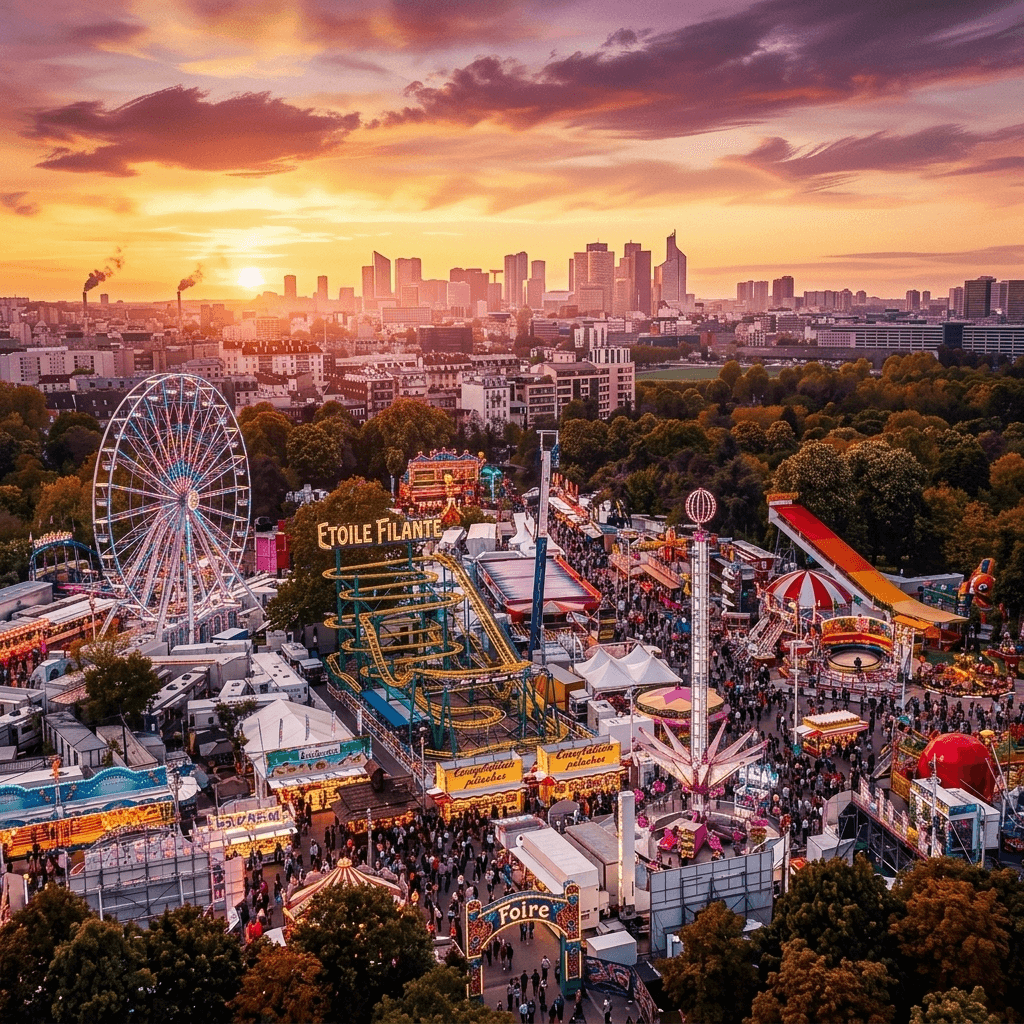
Since 1965, the Throne Fair has been held annually in the Bois de Vincennes, in the southeast of Paris. It is the largest public park in the French capital, with about 995 hectares, equivalent to almost three times the size of New York's Central Park. The event is set up on the Pelouse de Reuilly, an extensive grassy area perfectly adapted to receive thousands of people per day. Its location offers the ideal combination of ample space, easy access, and a safe distance from residential areas, allowing for large attractions to be held safely.
📍 Official address: Pelouse de Reuilly, Bois de Vincennes, 75012 Paris
📌 See on Google Maps
🚇 How to get to the Throne Fair
The fair is extremely accessible by public transport—which is essential for its huge attendance. The main options are:
- Metro line 8 → Porte Dorée station (the closest, about a 5-minute walk)
- Bus: lines 46, 87, and PC run through the area
- Parking: there are public parking lots nearby, but it is recommended to use public transport, especially on weekends
🎪 Physical organization of the fair
The Throne Fair is organized as a true open-air amusement park, with an efficient layout of attractions that allows for a smooth flow of visitors even on the busiest days. The structure is usually divided into thematic zones:
- 🎢 Thrill rides zone: with roller coasters, drop towers, boosters, human catapults, and other high-adrenaline rides
- 🎠 Children's attractions area: carousels, mini trains, bouncy castles, and gentle games for young children
- 🍭 Gastronomic corridors: with stalls selling cotton candy, candy apples, french fries, artisanal sausages, churros, and typical French sweets (nougat, gingerbread, etc.)
- 🎯 Games and raffles zone: with fishing, ball throwing, shooting galleries, among other skill and chance games, with various prizes
- 🎤 Event and stage space: for shows, performances, and nightly attractions (in some editions)
The fair usually has more than 300 different attractions, which vary with each edition, coming from various corners of France and Europe. The night lighting transforms the space into a true spectacle of lights and sounds, attracting visitors of all ages.
🔒 Security and services
The organization of the fair follows strict security and accessibility protocols, with the presence of rescue and fire teams, chemical toilets and rest areas, accessibility for people with reduced mobility, and monitoring by cameras and local police.
🎢 2.2 Main Modern Rides and Attractions
Fun for all ages with adrenaline, magic, and nostalgia.
🎠 A fair for all generations
The Throne Fair is considered the largest temporary amusement park in France, bringing together more than 300 attractions during its annual season on the Pelouse de Reuilly, in the Bois de Vincennes. Each year, exhibitors and operators bring the latest in mechanical rides, mixed with timeless classics that are part of the affectionate memory of the French. The great highlight of the fair is its ability to please audiences of all ages, from the most adventurous to those who prefer a quiet and tasty stroll. Below are the main types of attractions that make the Throne Fair a true entertainment spectacle.
🎢 Thrill rides: for the brave at heart
The fair is famous for hosting some of the most extreme rides in Europe, with gigantic structures that challenge the limits of gravity and courage. The rides are disassembled and reassembled for each edition with high technical standards and safety. Transportable roller coasters, Booster / Human Catapult, Sky Fall, Rotor / Extasy, and 360° Inversions are some examples.
🎠 Family and children's attractions: magic for the little ones
The Throne Fair also maintains a large area dedicated to families with young children, with accessible, colorful, and enchanting rides. These attractions keep the tradition of classic amusement parks alive. Themed carousels, mini roller coasters, small trains, and children's bumper cars are some of the options.
🎃 Themed houses and sensory experiences
Among the modern attractions, there are also immersive and interactive spaces, such as the House of Terror, distorting mirrors, 5D and 7D simulators, and glass mazes.
🎯 Skill games and raffles
A classic of French fairs, throwing and luck games remain strong at the event: magnetic fishing, shooting gallery, ring and ball toss, raffles with giant prizes, and claw machines.
🌙 Night spectacle and themed lighting
At night, the fair transforms into a true festival of lights and sounds. The attractions gain synchronized LED lighting, colorful effects, live music, and light shows that create an unforgettable sensory experience.
👶 2.3 Children's Areas and Attractions for Kids
Safe, charming, and unforgettable fun for little adventurers.
🎠 A fair designed also for the little ones
Although many images of the Throne Fair are associated with thrill rides and nightly frenzy, the fair is also a true paradise for children, with a section specially adapted for them. The organization ensures there is a balance between adrenaline and safe, playful, and educational games, guaranteeing a complete family experience. This children's area is organized separately from the large rides, with reinforced security, clear signage, and lower-intensity attractions.
🐎 Mini-carousels and classic attractions
Children's carousels are the heart of the dedicated children's zone. Decorated with fairy tale characters, bouncing horses, and enchanted carriages, they are perfect for introducing little ones to the magic of traditional fairs. Other attractions include mini roller coasters, small trains, and children's bumper cars.
🛝 Inflatable toys and recreational circuits
Inflatable structures are big hits with young children. Colorful, soft, and visually appealing, they provide hours of fun without any mechanical mechanism. Options include bouncy castles, obstacle courses, and giant foam balls.
🎯 Games for little winners
Even typical fair games have versions adapted for children, such as mini magnetic fishing and target shooting games with light balls. The idea is to stimulate motor coordination and the joy of 'winning something,' without frustration.
🍼 Family structure: safety and comfort
The fair has special resources to welcome families with comfort and tranquility, such as toilets with changing tables, rest areas, and a present security team.
🎨 Workshops and educational activities (occasional)
In some editions, the Throne Fair offers complementary activities for children, such as face painting workshops, storytelling, and encounters with mascots.
🍭 2.4 Typical Fair Gastronomy
Sweet and savory flavors that have delighted generations of visitors.
🍬 A stroll for the palate too
The Throne Fair is more than an amusement park: it is an open-air gastronomic festival, where the smell of burnt sugar, fried dough, and spices mixes with the sound of rides and crowds. Each edition, hundreds of food stalls and trailers are scattered across the Pelouse de Reuilly, offering an eclectic menu that combines French tradition, popular treats, and seasonal creations.
🌭 Most popular savory foods
Frites maison (homemade french fries), saucisses grillées (grilled sausages), raclette sandwiches (melted cheese), and Breton galettes (savory pancakes) are some of the options.
🍩 Traditional and irresistible sweets
The fair's sweet gastronomy is a true parade of temptations. Stuffed churros, crêpes sucrées, cotton candy, gingerbread, pommes d’amour (candy apples), and artisanal nougat are some of the classics.
☕ Hot and seasonal drinks
On colder days, it is common to find chocolat chaud à l’ancienne, cidre doux (sweet apple cider), and vin chaud (mulled wine).
🍽️ A complete sensory experience
Eating at the Throne Fair is part of the ritual. The aromas spread throughout the park, creating a synesthetic experience that composes a typical scene of Parisian spring.
🎯 2.5 Popular Games and Classic Stalls
Between laughter, rings, and prizes: the playful soul of the Parisian fair.
🎪 A tradition that spans centuries
Even before mechanical rides, it was the fair games that made the Throne Fair famous. Coming from the Middle Ages, they offered the people an accessible way to have fun, test their skills, and—with luck—take home a prize.
🎯 Shooting gallery (tir à la carabine)
One of the most traditional games of the fair is target shooting with an air rifle, where the player must hit metal or spinning targets to accumulate points.
🐟 Magnetic fishing (pêche à la ligne)
A classic among children, fishing for floating toys is one of the oldest attractions, where many stalls guarantee a prize even if the child misses.
🏹 Ring, ball, and dart throwing
Various types of stalls involve hitting targets with simple objects, requiring aim and patience, such as fitting rings on bottles or knocking down stacked cans.
🧸 Prizes: from giant teddy bears to modern gadgets
One of the great attractions of these stalls are the prizes displayed in eye-catching rows: giant teddy bears, collectible dolls, and electronic toys.
💡 Aesthetics and ambiance of the stalls
Many of these stalls maintain a vintage or retro aesthetic, with neon lights and striped awnings, creating a magical and nostalgic atmosphere.
🏆 More than games: French social rituals
In French popular culture, these games are not just games—they are social rituals, spaces for conviviality and conquest.
🧵 2.6 French Crafts and Popular Culture at the Stalls
Where manual tradition and the soul of the people take shape, color, and history.
🎨 Much more than rides: a fair of cultural expressions
The Throne Fair is not just about rides and sweets. Part of its historical identity is preserved in the stalls dedicated to traditional French crafts, offering unique and soulfully made products.
🪡 Handmade artisanal products
It is possible to find tents selling artisanal soaps from Provence, decorated candles, embroidery, silver jewelry, cloth dolls, and gastronomic products like honey and homemade jams.
🧺 Regional knowledge and cultural identity
Each craft stall carries a piece of a French region, be it Brittany with its Celtic symbols or Alsace with its painted ceramics. Direct selling allows visitors to talk with the artisans and hear the stories behind the objects.
📚 Books, art, and popular knowledge
In some editions, the fair also hosts stalls focused on popular literature, with almanacs, historical illustrations, and artisanal comics, reinforcing the educational side of the event.
🎭 Traditional performing arts (occasionally)
The fair may host artists such as storytellers, puppeteers, street musicians with accordions, and folk dancers, connecting the visitor to the France of yesteryear.
🤲 Preserving the handmade in a fast-paced world
Amid the speed of modern rides, the craft stalls offer a sensitive pause in time, inviting visitors to value manual gesture and tradition.
🎭 2.7 Street Shows and Performances
When the fair becomes a stage: magic, laughter, and art in the open air.
🌟 The scenic soul of the fair
The Throne Fair transforms into an open-air theater, with spontaneous shows that hark back to the fair's medieval origins.
🤡 Clowns and children's entertainers
A traditional presence, clowns interact with the public, perform mimes, and distribute balloons, keeping the art of popular laughter alive.
🎪 Acrobats and balance artists
Acrobats on stilts, jugglers, and balance artists perform impressive acts, creating spontaneous circles of spectators.
✨ Magicians and illusionists
Performing card tricks and levitating objects, magicians reinforce the idea that the fair is a place where anything is possible.
🎶 Live music and street artists
The fair's soundtrack is enriched by street musicians with a repertoire ranging from French jazz to pop, creating distinct atmospheres.
🎨 Artistic interventions and themed characters
In special editions, the fair hosts living statues, puppet theaters, and historical reenactments, connecting the visitor to different eras of France.
🎁 A free show for all
The beauty of these performances lies in their free and spontaneous access, making every visitor part of the scene.
🖼️ 2.8 Exhibitions and Parallel Thematic Events
When fun meets knowledge: art, history, and experiences beyond the park.
🎓 A lesser-known side of the fair
The Throne Fair also makes room for temporary cultural exhibitions and educational events, uniting entertainment with learning.
🖼️ Cultural and historical displays
In partnership with museums or artists, the fair can host galleries of old photos, exhibitions of historical toys, or urban art shows.
📚 Educational events and workshops for children
Many editions include painting workshops, storytelling, and pedagogical games, with a playful and inclusive focus.
🎨 Temporary artistic interventions and installations
The fair can host outdoor art installations, such as interactive lights, live graffiti murals, or totems with QR codes about the history of the event.
🎬 Launches, media events, and premieres
The visibility of the fair makes it a stage for promotional launches of films, books, or brand campaigns.
📸 An invitation to cultural discovery amidst the fun
By integrating these exhibitions, the fair strengthens its identity as a plural event, where it is possible to laugh, spin, eat, and also reflect and learn.
🎵 2.9 Sound Traditions and Typical Music of the Throne Fair
The soundtrack of French childhood: between laughter, sirens, and nostalgic songs.
🔊 The soundscape that defines the Throne Fair
The fair's sound identity is a mix of mechanical sounds, nostalgic soundtracks, and the voices of the fairground workers, creating an emotional memory that crosses generations.
🎠 Classic mechanical sounds
The sounds of carousel organs, retro horror train soundtracks, and the bangs of bumper cars form a familiar sound fabric.
📻 Nostalgic soundtracks and recurring themes
Classic French songs, children's songs, and pop hits from the 80s and 90s are repeated each edition, creating a collective musical memory.
🎧 Sound effects created for emotion
Modern rides use effects like roars, countdowns, and electronic soundtracks to amplify the sensory and theatrical experience.
🎼 Live musicians and festive repertoire
Street musicians with accordions and guitars play gypsy jazz and chanson française, keeping the atmosphere human and festive.
🔔 Calls and voices from the stalls
The classic calls of the fairground workers like 'Gagnez, gagnez, tout le monde gagne !' give the fair an oral and popular aspect.
🧠 Sound as a collective memory
For many French people, the sound of the Throne Fair is a marker of time, referring to childhood, family, and spring.
📱 2.10 Presence of Apps, QR Codes, and Interactive Technologies
Tradition meets innovation: how the fair modernized without losing its soul.
🔄 A secular event with 21st-century tools
The Throne Fair has incorporated technological solutions for the convenience, interactivity, and security of visitors.
📲 Official Throne Fair app
With an interactive map, event schedule, notifications, and digital coupons, the app facilitates the visitor experience.
📌 QR codes scattered throughout the fair
Allow obtaining descriptions of attractions, accessing videos, viewing queues, and participating in prize draws.
🎮 Games and challenges with augmented reality (AR)
Some stalls offer interactive treasure hunt experiences or selfie filters with the fair's theme.
💡 Digital panels and information screens
Display maps, security warnings, and highlights of the day, increasing accessibility.
📶 Public Wi-Fi and connectivity
Free Wi-Fi zones allow for sharing experiences on social media without consuming mobile data.
🔐 Digital security and privacy
The technological solutions follow European data protection standards (GDPR), ensuring public trust.
🔄 Tradition and innovation side by side
Technology is used to expand access and enrich the experience, allowing visitors to explore the history of the fair interactively.
Chapter
👣 3. Visitor Experience and Practical Information
🚇 3.1 How to Get There: Public Transport and Access
Guiding the visitor to the magic of the fair safely, quickly, and comfortably.
📍 Exact location of the Throne Fair
The fair takes place on the Pelouse de Reuilly, in the Bois de Vincennes (12th arrondissement).
🚇 Metro: the most practical and fastest way
The nearest station is Porte Dorée (line 8). Other options are Michel Bizot and Porte de Charenton (also on line 8).
🚌 Bus and surface lines
Lines 46, 87, 325, and 201 stop near the Bois de Vincennes.
🚆 RER (Regional Express Network)
Nation station (RER A) offers a connection to metro line 8.
🚗 Private car and parking
There are paid parking lots nearby, but public transport is recommended due to heavy traffic.
🚴 Bicycle and active mobility
The location has bike lanes and Vélib’ Métropole stations for bike rental.
🧭 Accessibility and access for people with reduced mobility
The fair has entrances with ramps and adapted toilets, with priority access for people with disabilities.
📱 Extra tip: digital route planning
Use apps like Google Maps or CityMapper to plan the fastest route and check the status of public transport in real time.
🎟️ 3.2 Admission Prices, Tickets, and Payment Methods
Everything you need to know before visiting the largest popular fair in France.
🆓 Free admission: one of the great attractions
Access to the fairgrounds is completely free. There is no charge to walk around the area or watch the street shows.
🎢 Paid tickets per attraction
Each ride or game has its own price, charged directly on site. Prices range from €3 to €10, depending on the attraction.
💸 Promotional combos and 'special days'
The fair offers discount packages for multiple tickets and promotional days with reduced rates.
💳 Accepted payment methods
Most stalls accept cash and card. It is recommended to have small change for smaller stalls. QR code payments are becoming more common.
🛑 Estimated overall cost for the visitor
A family of 2 adults and 2 children can spend between €100 and €140 in a day, including rides and food.
⏰ 3.3 Opening Hours and Annual Calendar
Everything you need to know about the dates, times, and schedule of the most traditional fair in Paris.
📅 When does the Throne Fair take place?
The fair is annual and occurs in the spring, usually from late March to early June, lasting 6 to 8 weeks.
⏰ Fair opening hours
- Monday to Thursday: 12 PM to 11 PM
- Fridays: 12 PM to 12:30 AM
- Saturdays: 12 PM to 1 AM
- Sundays and holidays: 12 PM to 12 AM
Hours may be extended on special dates.
🧭 Seasonal variations in the program
The program changes, with specific days for shows, fireworks, and reduced rates, usually on weekends.
📌 Useful tip for planning your visit
Prefer weekday afternoons to avoid queues. Check the weather forecast, as the fair is outdoors.
📲 Where to follow official updates
Consult the official website (foiredutrone.com), social media, and tourism apps for up-to-date information.
🚨 3.4 Security, Policing, and Fair Rules
Everything you need to know to enjoy the fair with peace of mind and responsibility.
🛡️ Reinforced security measures
Security is a priority, with a visible presence of police, private security, camera monitoring, and medical stations.
🎒 Mandatory bag checks at the entrance
All visitors are subject to bag checks, and metal detectors may be used. Bring only the essentials to speed up entry.
🚫 Internal fair rules: what is prohibited?
It is forbidden to bring alcoholic beverages from outside, carry sharp objects, smoke in designated areas, and engage in unauthorized commerce.
✅ What is allowed, but in moderation?
Taking photos without disturbing, bringing small snacks to consume in open areas, and wearing costumes without masks that cover the face.
👮 Help and emergency stations
The fair has marked stations for medical help, lost and found, and reporting incidents.
📱 Technology for security
The official app has emergency buttons and real-time notifications.
🔒 Conclusion: visible but discreet security
Security measures are implemented in a way that does not compromise the festive atmosphere of the event.
♿ 3.5 Accessibility for People with Reduced Mobility
How the traditional Paris fair adapts to ensure inclusion, comfort, and safety for all.
🏞️ A popular event that welcomes diversity
The Throne Fair has invested in universal accessibility, with ramps, level floors, and clear signage.
🛣️ Adapted access and priority entry
The main entrances have ramps and accessible lanes, with priority entry for people with disabilities (PWD).
🚽 Accessible toilets and adapted restrooms
All toilet blocks have cabins adapted for wheelchair users.
🎢 Accessible attractions or with priority service
Many attractions offer priority queues and assistance from trained operators.
🧍♀️ Free or discounted companion
People with the European mobility card (CMI) may be entitled to free admission for the companion on some attractions.
🧭 Signage and visual guidance
Signs with universal icons and maps indicate accessible routes and services.
📲 Inclusive digital resources
The official app is compatible with screen readers and provides information on accessibility.
✅ Conclusion: a fair in constant inclusive evolution
The fair is updated to be increasingly accessible, ensuring a safe and pleasant experience for all.
🗺️ 3.6 Interactive Map of the Fair and Sector Organization
How to easily navigate the park and find rides, stalls, and services in seconds.
📍 The largest fair in Paris: get ready to walk!
The Throne Fair occupies a large area on the Pelouse de Reuilly. A good map is essential.
🧭 Main sectors of the Throne Fair
The fair is organized into thematic sectors: Major Attractions, Children's Area, Games, Food, Shows, and Services.
📲 Official digital and interactive map
Available via app or QR codes, it allows you to locate attractions in real time, filter by category, and view detailed information.
📌 Physical paper map: still available
Distributed for free at the entrances, with visual legends and a multilingual version.
🧩 Visual organization that favors flow
The layout of the attractions is planned to avoid crowds and facilitate circulation.
🔍 Conclusion: an essential map for a pleasant visit
Whether in digital or printed version, the map is indispensable for making the most of your time at the fair.
🌍 3.7 Practical Tips for International Tourists
Everything foreign visitors need to know to enjoy the fair like a true Parisian.
💶 1. Currency and payment methods
The currency is the Euro (€). Many attractions accept cards, but it's good to have small change for smaller stalls.
🗣️ 2. Language spoken at the fair
The official language is French, but many operators speak basic English. Simple phrases in French are welcome.
🍴 3. Where to eat (and what to expect)
The fair offers classics like crepes, fries, and candy apples. There are also more substantial options like sandwiches and pizzas.
👗 4. Typical behavior and social etiquette
Be polite, respect queues, and avoid excessive noise. Greet with 'bonjour' and thank with 'merci'.
🛑 5. What to avoid to prevent trouble
Avoid large backpacks, be aware of pickpockets in crowds, and use identification bracelets on children.
🗺️ 6. Extra resources for tourists
The fair has a multilingual information center, first aid stations, and an app with an English version.
✈️ Conclusion: an international experience with a French soul
With a little preparation, tourists can have unforgettable moments, immersing themselves in Parisian popular culture.
📸 3.8 Best Spots for Photos and Instagrammable Experiences
Discover the most photogenic scenes of Paris's most vibrant fair to capture unforgettable moments.
🎡 1. The illuminated Ferris wheel at sunset
Ideal at dusk, it offers a panoramic view of Paris and magical lights at night.
🎨 2. Decorative panels and artistic facades
Many attractions have vintage murals that form a perfect retro backdrop for photos.
🍭 3. Photogenic foods and giant desserts
Colorful cotton candy, shiny candy apples, and stuffed churros are great for vibrant photos.
🎠 4. Illuminated carousels and retro rides
With their belle époque style, they make for romantic and nostalgic photos, especially at night.
✨ 5. Signs and seasonal decorations
Giant illuminated signs and interactive installations are popular spots for selfies.
🧚 6. Lesser-known corners with a lot of charm
Wooded paths, giant prize stalls, and decorated benches offer great opportunities for creative photos.
📲 Extra tips for your photos to go viral on social media
Use the official hashtag #FoireduTrône, tag the location, and record short videos of the rides in motion.
🎁 3.9 Giveaways, Souvenirs, and Exclusive Fair Products
Discover the most desired items to keep as a memento or to give as a gift after your visit.
🧸 1. Giant teddy bears
The most iconic prize from the game stalls, they are true photographic trophies.
🥤 2. Personalized fair cups
Themed reusable cups that have become collector's items, with a new design each year.
🧲 3. Magnets, pins, and keychains
Small and affordable souvenirs shaped like a Ferris wheel, unicorns, or the fair's logo.
🎪 4. Commemorative items and special editions
Caps, t-shirts, and tote bags with themed phrases or the fair's map, sold at official stalls.
🛍️ 5. Artisanal and regional products
Soaps, candles, embroidery, and jewelry made by small producers, ideal for those looking for something unique.
📸 6. Printed photos as a souvenir
Some attractions offer instant photos with a personalized fair frame.
🎉 Conclusion: the fair as a material memory
Taking a souvenir from the fair is a way to extend the magic even after returning home.
🎪 3.10 Difference Between the Throne Fair and Other Parisian Fairs
Understand what makes the Throne Fair unique among the popular festivals of Paris.
🏆 Throne Fair (the largest and most traditional)
Located in the Bois de Vincennes from March to May, it is the oldest and largest fair, with more than 300 attractions for all audiences.
🏛️ Fête des Tuileries (in the tourist heart of Paris)
It takes place in the summer in the Jardin des Tuileries. It is smaller, more charming, and ideal for tourists, with about 60 classic attractions.
🎉 Fête à Neuneu (popular festival in western Paris)
Held in September in the Bois de Boulogne, it has a more local and family-friendly atmosphere, with a focus on children's attractions.
🧭 Which to choose?
For the most intense and historical experience, choose the Throne Fair. For something light and central, the Fête des Tuileries. For a more local atmosphere, the Fête à Neuneu.
✨ Conclusion: each fair with its soul
Although they share the essence of a popular festival, each represents a different aspect of Parisian culture.
Chapter
🌍 4. Culture, Impact, and Social Relevance
🇫🇷 4.1 Cultural Significance of the Fair for the French
More than fun: a living symbol of popular tradition and French collective identity.
🏛️ A link between medieval tradition and modern popular culture
With origins in the 12th century, the fair is one of the oldest cultural events in the country, representing the French ability to preserve the past and adapt to the present.
👪 A family tradition that spans generations
Millions of French people visited the fair in their childhood and today bring their children, creating a strong emotional bond and an intergenerational heritage.
🎪 The fair as a symbol of accessible popular joy
Its free admission and inclusive atmosphere make it a democratic leisure space, where different social classes meet.
🎭 Living visual and sensory culture
The aesthetics of the fair, with its lights, sounds, and smells, compose a sensory ritual that is rooted in the French festive identity.
📚 Preservation of memory and intangible heritage
The fair is cited in chronicles, books, and documentaries, being an object of study that reveals the evolution of popular urban culture.
🎯 Conclusion: a pillar of French festive identity
The Throne Fair transcends leisure, inserting itself into the cultural imagination as a space for meeting, celebration, and belonging.
🗣️ 4.2 Oral Tradition and Stories Passed Down Through Generations
How the Throne Fair lives in the family memory of the French, generation after generation.
👨👩👧👦 A fair that is transmitted with words and memories
Parents and grandparents proudly share their experiences, creating a strong oral tradition that keeps the essence of the event alive.
🎠 First experiences that become family rituals
The first time on the Ferris wheel or the first cotton candy are symbolic rituals of childhood, strengthening emotional bonds.
🧓 Narratives of other times: the fair as a mirror of change
The elderly tell how the rides were simpler, but the magic was the same, helping the younger ones to understand the roots of the event.
💬 Stories told outside the fair
Even when it is not running, the fair remains present in family conversations and photo albums, ensuring its status as oral heritage.
📚 From personal accounts to historical archives
Some family testimonials are recorded by historians and documentarians, revealing social transformations and transgenerational affections.
🎯 Conclusion: the strength of the word and memory
The Throne Fair survives because it lives in the hearts of families as a continuous narrative, passed from mouth to mouth.
🗨️ 4.3 Testimonials from Past and Present Attendees
Voices of memory: what the Throne Fair means to those who have lived it—and still live it.
📖 A mosaic of voices and generations
The true greatness of the fair is told in the first person, through testimonials that reveal its role as a living collective memory.
👵 Testimonials from older generations (1940s to 1980s)
Accounts of the emotion of the first carousel, the fair as a 'paradise for the poor,' and a symbol of hope in the post-war period.
👩🦰 Testimonials from the intermediate generation (1990s–2000s)
The fair as a ritual of family memory, a 'live Instagram' to meet friends, and the scene of the first kiss.
👧 Contemporary testimonials (2010s–present)
The charm of the house of mirrors, the magic of bringing three generations together on the same ride, and the joy of winning a giant bear.
🧠 What do these accounts reveal?
The fair is an emotional institution that maintains its affective relevance over the decades.
🎯 Conclusion: the heart of the fair is in the voices that have lived it
The lights go out, but the stories remain. The Throne Fair pulses in the memory of those who have passed through it.
💶 4.4 Economic Impact on the Region and Job Creation
Much more than fun: how the fair moves trade, generates jobs, and boosts the local economy.
🏙️ One of the largest seasonal events in Paris in financial volume
The fair attracts more than 3 million visitors and hundreds of suppliers, generating a peak in consumption and mobilization of services.
🛍️ Boost to local trade
There is a positive impact on restaurants, hotels, and shops in the neighborhoods near the Bois de Vincennes.
🎡 Direct and indirect jobs
The fair generates between 1,200 and 1,800 temporary jobs, including ride operators, security guards, and attendants.
🚚 Hiring of suppliers and specialized services
Security, cleaning, logistics, and infrastructure companies are hired, boosting the local economy.
📈 Tourism and financial return for the city
The fair pays fees to the city hall and reinforces the image of Paris as a festive and welcoming city.
🤝 Social inclusion and diversity of professional profiles
The fair employs professionals with varied profiles, including young people, seasonal workers, and small traders.
🎯 Conclusion: a fair that is also a financial engine
The Throne Fair is an example of how popular culture can go hand in hand with economic development.
🏗️ 4.5 Temporary Infrastructure and Behind-the-Scenes Setup
Behind the magic: how the largest amusement fair in France is built every year in the Bois de Vincennes.
🔧 An ephemeral city that emerges every spring
The Throne Fair is set up from scratch in one of the largest parks in Paris, transforming an empty lot into a vibrant metropolis.
📦 Transport logistics and arrival of equipment
Rides and stalls arrive on trucks from all over Europe and are unloaded following a precise logistical plan.
🛠️ Stages of assembly: from the ground up
The organization follows a strict order: demarcation of the land, installation of large rides, electrical connection, and finally, security inspections.
👷 Professionals involved: a multidisciplinary team
The assembly depends on hundreds of professionals, such as assemblers, electricians, engineers, and heavy machinery operators.
🛡️ Strict safety inspections and standards
Before opening, each attraction undergoes mandatory inspections by the city hall, firefighters, and technical safety agencies.
♻️ Sustainable and removable structure
At the end of the event, the entire structure is dismantled, and the park space is returned clean and intact.
🎯 Conclusion: a feat of engineering and cultural organization
Assembling a complete and safe park in a few days is a technical feat that involves coordination, know-how, and passion.
🏛️ 4.6 Relationship with Public Bodies and Licensing
A traditional event that depends on strict rules, institutional cooperation, and administrative control to exist.
📋 A private event with public authorization
The fair depends on authorization from the Paris City Hall, with clear contractual rules on the use of space, security, and environmental impact.
🏢 Public bodies involved in the organization
The event involves the City Hall, the Police, the Directorate of Cleanliness and Water, firefighters, and the health control agency.
🧼 Sanitary licensing and food standards
Food stalls must comply with French hygiene standards (HACCP), with regular inspection.
🛡️ Safety and evacuation licenses
The entire structure undergoes stability tests and must have an emergency evacuation plan.
🤝 Partnership with the city hall: obligations and counterparts
The fair pays fees for the use of the land and complies with obligations of cleaning and noise control.
📢 Communication with residents and neighboring districts
The organizers maintain a channel of dialogue with residents to inform them about schedules and sound impact.
🎯 Conclusion: tradition with legal and civic responsibility
The Throne Fair is an example of how popular culture and public power can work in harmony.
🔄 4.7 Comparison Between Editions: What Has Changed Over Time
How the most traditional fair in Paris has evolved in attractions, structure, technology, and relationship with the public over the centuries.
🕰️ From medieval market to urban megapark
The fair has evolved from a religious market in the 12th century to a popular spectacle with modern rides and technology.
🎡 Rides and attractions: what has been left in the past?
Attractions like manual wooden wheels and human curiosity circuses have been replaced by high-adrenaline rides and simulators.
📲 Technological and operational innovations
The fair incorporated electricity in the 60s, computerized systems in the 2000s, and more recently, apps and QR codes.
🧾 Organization and regulation: more professionalism
In the past, the rules were informal. Today, there are standardized contracts and strict inspection of safety and hygiene.
🎭 The profile of the public has also evolved
From peasants and clergy to international tourists and connected young people, the fair maintains its democratic character.
🎯 Conclusion: tradition in constant transformation
The Throne Fair is a reflection of French society, preserving its popular identity while reinventing itself for each new generation.
🎓 4.8 School and Educational Visits to the Throne Fair
Much more than fun: how the fair is also a cultural and learning tool for children and young people.
🏫 A tradition of learning outside the classroom
Parisian schools organize excursions to the fair, turning it into an open-air classroom on history, physics, and culture.
🎡 What students learn in practice
Teachers use the context of the fair to work on themes such as the medieval origin of the event, the movement of the rides, and cultural diversity.
🧑🏫 Partnerships with schools and education networks
The fair offers exclusive hours and discounts for school groups, with prepared educational packages.
🧒 Safety and logistics for children
During visits, the site has reinforced security, monitors, and exclusive areas for rest and meals.
🎯 Conclusion: learning while playing is possible
The fair reaffirms itself as a cultural heritage that teaches and moves, uniting fun and knowledge.
📺 4.9 The Fair's Presence in French and International Media
How the most traditional fair in Paris is portrayed in the press, television, and digital platforms around the world.
📰 Cover of newspapers and magazines for generations
Outlets like Le Parisien and Le Figaro highlight the opening, new attractions, and cultural importance of the fair.
📺 Television reports and live specials
Networks like TF1 and France 2 produce reports with aerial images, interviews, and behind-the-scenes of the event.
🌍 Growing international visibility
The fair is cited in travel guides like BBC Travel and National Geographic, attracting tourists from all over the world.
🧑💻 Blogs, vlogs, and digital influencers
The fair is a must-visit for content creators, with tours, reviews, and challenges that go viral on TikTok and Instagram.
🎞️ Documentaries and audiovisual memories
The fair is the subject of documentaries about Parisian popular culture and its intangible heritage.
🎯 Conclusion: an event that fascinates cameras and narratives
The Throne Fair occupies a unique emotional and visual place in the collective imagination, perpetuating its memory through the media.
🏅 4.10 Awards and Official Recognitions Received
A popular fair that has won cultural seals, certifications, and the status of a festive heritage of the city of Paris.
🎖️ A recognized symbol of Parisian tradition
The fair is formally recognized by public bodies through titles, seals, and cultural awards.
🏛️ Recognition as a 'traditional event' of Paris
Since 1993, it has been considered an 'événement traditionnel parisien,' with promotion in official tourist channels.
🧾 Seal of valorization of intangible heritage
It has received the seal of 'manifestation du patrimoine vivant' from the Ville de Paris and is the subject of exhibitions at the Musée Carnavalet.
🗺️ Inclusion in official tourist routes
The fair appears in guides like Michelin and Le Routard as an option for an authentic outing.
💬 Institutional support and letters of support
The event has already received honorable mentions and letters of support from mayors and deputies, highlighting its cultural and economic value.
🌍 International projection as a reference event
It is cited in academic publications as an example of a long-lasting popular event and cultural integration.
🎯 Conclusion: a party certified by history
Its awards and seals are a proof that a popular festival can be a protected and institutionally celebrated cultural asset.
Chapter
🕯️ 5. Curiosities and Historical Behind-the-Scenes
🏰 5.1 Medieval Relics That Still Survive in the Current Fair
Centuries-old traditions preserved amidst the modern lights of the largest popular fair in France.
🕯️ The fair that has crossed the centuries
Despite technology, the fair preserves living elements that date back to its medieval origin.
🍰 Traditional cakes and sweets from the Middle Ages
Gingerbread, rustic waffles, and artisanal nougat are gastronomic heritages that resist time.
⚜️ Ancient symbols and coats of arms on the facades
Some stalls maintain decorations with the coat of arms of the Abbey of Saint-Antoine or the fleur-de-lis, the symbol of the monarchy.
🪑 Centuries-old structures still in use
Carousels inspired by 19th-century models and folding wooden stalls have been used by fairground families for generations.
🕯️ Oral tradition as a living relic
Older fairground workers preserve legends, tales, and assembly methods passed down from father to son.
🎯 Conclusion: the past still lives among lights and laughter
The Throne Fair is a bridge between the present and the Middle Ages, where the visitor can taste the living heritage of centuries of history.
🎭 5.2 Influence of the Fair on Street Theater and Puppets
How the Parisian fair was the cradle of French popular theater and the stage for the emergence of iconic characters.
🎪 The fair as a stage for theatrical expression since the Middle Ages
Since its origins, the fair brought together itinerant artists, jugglers, and storytellers, forming the basis of popular theater.
🪆 Puppets and comic characters take the stage
In the 17th and 18th centuries, the fair popularized puppet theaters with characters like Polichinelle, who satirized society.
🎟️ Rivalry with the Comédie-Française
The fair faced prohibitions from the official theater, which stimulated the creativity of street artists, who created hybrid forms of spectacle.
🎠 Creation of own repertoires and fixed characters
The fair was the birthplace of characters like Gilles, who inspired harlequins and pierrots, and of the guignol theater.
🧩 Living legacy: from fairground theater to modern stages
The tradition of the fair influenced directors like Molière and variety theater, and still today hosts artists who maintain these scenic heritages.
🎯 Conclusion: popular stage of French creativity
The fair was more than a park; it was a stage for street culture, where an essential part of French theater was born.
🎨 5.3 The Fair as Inspiration for Artworks and Cinema
How the oldest popular fair in France became a setting for films, paintings, novels, and photographs over the centuries.
🖼️ A recurring theme in visual arts since the 18th century
Watercolors and engravings by artists like Honoré Daumier depicted the social diversity and vibrant atmosphere of the fair.
📖 The fair as a literary backdrop
Mentioned in novels by Émile Zola and chronicles by Balzac, the fair served as a microcosm of French society.
🎬 In cinema: a space of dream, chaos, and nostalgia
The fair appears in classic films like 'Les Enfants du Paradis' (1945) and in contemporary productions, symbolizing Parisian popular culture.
📸 Photography: capturing the ephemeral spirit
Photographers like Robert Doisneau recorded scenes from the fair, preserving the daily life and joy of the people.
🧠 The fair as a narrative symbol
Used as a metaphor for the cycle of life and a meeting point between classes, the fair enriches narratives with its cultural charge.
🎯 Conclusion: from canvas to screen, from paper to the big screen
The Throne Fair transcended the physical space to become an icon of French visual culture.
👻 5.4 Unusual Stories, Legends, and Myths Linked to the Fair
The mystical, legendary, and even supernatural side of the largest popular fair in France.
🪄 The fair as fertile ground for fantastic stories
With its medieval origin and eccentric atmosphere, the fair has always been a cauldron of urban legends and myths.
🎠 The haunted carousel of the 19th century
A persistent legend speaks of an old wooden carousel whose horses moved on their own at night.
🎢 The legend of the 'ghost' ride
Reports of an attraction called 'The Flying Witch' that was said to have been cursed and mysteriously removed after an incident.
🧙♂️ Mystical fairground workers and popular prophecies
Old merchants had beliefs like 'if it rains on the first day, it will rain for 40 days' and consulted the stars before setting up their stalls.
👁️ Superstitions among visitors
Attendees avoid riding Ferris wheels counter-clockwise and tie ribbons on the gate as a symbol of commitment.
🎭 Mysterious characters and the 'man of the cards'
A mythical figure who circulated through the fair offering free card readings and who supposedly disappeared mysteriously.
🎯 Conclusion: tradition and mystery under the same sky
The fair is a symbolic space between the real and the enchanted, full of legends that survive in the popular imagination.
📊 5.5 Curious Statistics: Visitors, Consumption, and Structure
Impressive numbers that reveal the grandeur of the largest popular fair in France.
🎡 Millions of visitors every year
The fair receives more than 3 million visitors per edition, with peaks of 70,000 people in a single day.
✨ A spectacle of light and sound
The infrastructure has 2.5 km of light strands, 50,000 LED bulbs, and about 400 stalls and attractions.
🍭 The impressive consumption of sweets and food
An estimated 90 tons of cotton candy, 60,000 crepes, and 45,000 churros are sold each season.
👨👩👧👦 Visitor profile
The majority are from the Paris region, with a predominantly family and young-adult audience, and a growing presence of tourists.
💼 Jobs and economic impact
The fair generates about 3,000 temporary jobs and moves 20 to 25 million euros per season.
🎯 Conclusion: the numbers that make history
The grandeur of the fair in every detail reaffirms its place as a cultural and economic symbol of Paris.
🌱 5.6 Sustainability and Environmental Management at the Event
How the most traditional fair in France is adapting to the ecological challenges of the 21st century.
♻️ Environmental commitments in a historical event
The fair has implemented measures to reduce waste, encourage recycling, and save energy.
🚮 Waste management and selective collection
Ecological islands with separate bins and partnerships with recycling companies have been implemented.
💡 Conscious use of electricity
The switch to LED bulbs and the use of biodiesel generators help reduce energy consumption.
🍴 Sustainable initiatives in gastronomy
The use of reusable cups and biodegradable packaging is growing among the fairground workers.
🚲 Mobility and encouragement of ecological transport
The fair supports the use of bicycles and public transport to reduce the environmental impact of travel.
🌍 Environmental education as part of the experience
Exhibitions and workshops on recycling and sustainability are offered in some editions.
🎯 Conclusion: tradition with responsibility
The Throne Fair reinvents itself to respond to environmental challenges, uniting popular festival and ecological innovation.
📱 5.7 Presence of Digital Influencers and Social Media
How the most traditional fair in France conquered the connected public and became an online phenomenon.
🌐 The Throne Fair in the digital age
The colorful and vibrant environment has made the fair one of the most 'Instagrammable' places in Paris.
📈 Impact on social media
The hashtag #FoireduTrône accumulates millions of views, with videos of rides, food, and challenges going viral.
🎥 Promotional actions with influencers
The organization invests in partnerships with content creators, offering VIP days and early access.
💬 Shared experience in real time
Stories and polls create a sense of community and anticipation, transforming the fair into a digital destination.
🤳 Tips for content creators at the fair
Arriving in the late afternoon, using the official hashtag, and recording videos of the rides in motion are some of the tips to go viral.
🎯 Conclusion: tradition that goes viral
With its explosion on social media, the fair connects with new generations and transforms into a digital phenomenon.
🌍 5.8 The Fair as Seen by Foreigners Throughout History
Accounts of tourists, diplomats, and chroniclers who have immortalized the fair in the eyes of the world.
🕰️ An international attraction since the Middle Ages
Since the 12th century, the fair has been mentioned in travelers' reports as a 'portrait of the French people'.
🖋️ Impressions recorded in historical documents
Ancient chronicles described with astonishment the mix of religious and secular fair, and the sale of rare items.
🌐 During the Enlightenment: a French cultural showcase
Ambassadors and tourists visited the fair as an 'anthropological walk' to understand popular culture.
✈️ In the 20th century: a recognized tourist destination
The fair began to be listed in guides like Michelin and Le Routard as an option for an authentic outing.
🎥 Representations in foreign films and reports
Images of the fair are used in documentaries to represent the festive and popular side of Paris.
✍️ Current testimonials on social media and digital platforms
Comments on Google Maps and vlogs from tourists in dozens of languages continue to record the charm of the fair.
🎯 Conclusion: a spectacle that crosses borders
The Throne Fair is a bridge between generations and cultures, offering a unique and sensory experience.
🎠 5.9 Why Does the Throne Fair Still Attract Millions Each Year?
The secrets behind the longevity and success of the oldest fair in France.
🧬 Living tradition that adapts to the times
The appeal of the fair is a formula of respect for history with constant adaptation to new generations.
🎡 Variety of attractions for all ages
The combination of modern rides and retro charm keeps the experience balanced and renewable.
🌟 Festive and nostalgic atmosphere
Its sounds, lights, and aromas create an emotional setting that connects with the affective memory of the French.
📸 Attraction for the digital generation
The fair has reinvented itself as a visual icon on social media, attracting a young and connected audience.
💖 Emotional value and cultural memory
It is a rite of passage and a collective emotional heritage, the scene of family memories.
⚙️ Efficient organization and modern infrastructure
Security, accessibility, and technology ensure a comfortable experience even in crowds.
💡 Constant innovation and cultural sensitivity
The fair adjusts to the spirit of the times, incorporating new attractions and sustainable practices.
🏆 Conclusion: the art of crossing the centuries
Its longevity comes from the mix of historical heritage, collective emotion, and conscious innovation.
⚖️ 5.10 Throne Fair as a Symbol of Balance Between Tradition and Modernity
How the secular French fair resists time without losing its roots.
🏛️ A living medieval heritage in the 21st century
The fair preserves elements like traditional sweets and the popular spirit, coexisting with modern technology.
🔁 Tradition that reinvents itself without being erased
The fair incorporates changes organically, keeping traditional music on new rides or updating classic games.
🌐 A cultural showcase in constant dialogue with the present
The fair is a stage for influencers, adopts sustainable practices, and participates in educational actions, showing its current relevance.
🎯 Conclusion: the eternal present of the Throne Fair
It is a celebration of time, where old memories meet new experiences, and where tradition and innovation embrace without conflict.